EP3591301A1 - New fan and anti-cold air control method and apparatus therefor - Google Patents
New fan and anti-cold air control method and apparatus therefor Download PDFInfo
- Publication number
- EP3591301A1 EP3591301A1 EP17920183.5A EP17920183A EP3591301A1 EP 3591301 A1 EP3591301 A1 EP 3591301A1 EP 17920183 A EP17920183 A EP 17920183A EP 3591301 A1 EP3591301 A1 EP 3591301A1
- Authority
- EP
- European Patent Office
- Prior art keywords
- wind speed
- temperature
- fresh air
- preset
- determining
- Prior art date
- Legal status (The legal status is an assumption and is not a legal conclusion. Google has not performed a legal analysis and makes no representation as to the accuracy of the status listed.)
- Granted
Links
Images

Classifications
-
- F—MECHANICAL ENGINEERING; LIGHTING; HEATING; WEAPONS; BLASTING
- F24—HEATING; RANGES; VENTILATING
- F24F—AIR-CONDITIONING; AIR-HUMIDIFICATION; VENTILATION; USE OF AIR CURRENTS FOR SCREENING
- F24F11/00—Control or safety arrangements
- F24F11/30—Control or safety arrangements for purposes related to the operation of the system, e.g. for safety or monitoring
- F24F11/49—Control or safety arrangements for purposes related to the operation of the system, e.g. for safety or monitoring ensuring correct operation, e.g. by trial operation or configuration checks
-
- F—MECHANICAL ENGINEERING; LIGHTING; HEATING; WEAPONS; BLASTING
- F24—HEATING; RANGES; VENTILATING
- F24F—AIR-CONDITIONING; AIR-HUMIDIFICATION; VENTILATION; USE OF AIR CURRENTS FOR SCREENING
- F24F11/00—Control or safety arrangements
- F24F11/70—Control systems characterised by their outputs; Constructional details thereof
- F24F11/72—Control systems characterised by their outputs; Constructional details thereof for controlling the supply of treated air, e.g. its pressure
- F24F11/74—Control systems characterised by their outputs; Constructional details thereof for controlling the supply of treated air, e.g. its pressure for controlling air flow rate or air velocity
- F24F11/77—Control systems characterised by their outputs; Constructional details thereof for controlling the supply of treated air, e.g. its pressure for controlling air flow rate or air velocity by controlling the speed of ventilators
-
- F—MECHANICAL ENGINEERING; LIGHTING; HEATING; WEAPONS; BLASTING
- F24—HEATING; RANGES; VENTILATING
- F24F—AIR-CONDITIONING; AIR-HUMIDIFICATION; VENTILATION; USE OF AIR CURRENTS FOR SCREENING
- F24F11/00—Control or safety arrangements
- F24F11/62—Control or safety arrangements characterised by the type of control or by internal processing, e.g. using fuzzy logic, adaptive control or estimation of values
- F24F11/63—Electronic processing
- F24F11/65—Electronic processing for selecting an operating mode
- F24F11/67—Switching between heating and cooling modes
-
- F—MECHANICAL ENGINEERING; LIGHTING; HEATING; WEAPONS; BLASTING
- F24—HEATING; RANGES; VENTILATING
- F24F—AIR-CONDITIONING; AIR-HUMIDIFICATION; VENTILATION; USE OF AIR CURRENTS FOR SCREENING
- F24F11/00—Control or safety arrangements
- F24F11/70—Control systems characterised by their outputs; Constructional details thereof
- F24F11/72—Control systems characterised by their outputs; Constructional details thereof for controlling the supply of treated air, e.g. its pressure
- F24F11/74—Control systems characterised by their outputs; Constructional details thereof for controlling the supply of treated air, e.g. its pressure for controlling air flow rate or air velocity
-
- F—MECHANICAL ENGINEERING; LIGHTING; HEATING; WEAPONS; BLASTING
- F24—HEATING; RANGES; VENTILATING
- F24F—AIR-CONDITIONING; AIR-HUMIDIFICATION; VENTILATION; USE OF AIR CURRENTS FOR SCREENING
- F24F11/00—Control or safety arrangements
- F24F11/70—Control systems characterised by their outputs; Constructional details thereof
- F24F11/80—Control systems characterised by their outputs; Constructional details thereof for controlling the temperature of the supplied air
- F24F11/81—Control systems characterised by their outputs; Constructional details thereof for controlling the temperature of the supplied air by controlling the air supply to heat-exchangers or bypass channels
-
- G—PHYSICS
- G05—CONTROLLING; REGULATING
- G05B—CONTROL OR REGULATING SYSTEMS IN GENERAL; FUNCTIONAL ELEMENTS OF SUCH SYSTEMS; MONITORING OR TESTING ARRANGEMENTS FOR SUCH SYSTEMS OR ELEMENTS
- G05B15/00—Systems controlled by a computer
- G05B15/02—Systems controlled by a computer electric
-
- F—MECHANICAL ENGINEERING; LIGHTING; HEATING; WEAPONS; BLASTING
- F24—HEATING; RANGES; VENTILATING
- F24F—AIR-CONDITIONING; AIR-HUMIDIFICATION; VENTILATION; USE OF AIR CURRENTS FOR SCREENING
- F24F11/00—Control or safety arrangements
- F24F11/30—Control or safety arrangements for purposes related to the operation of the system, e.g. for safety or monitoring
- F24F11/41—Defrosting; Preventing freezing
-
- F—MECHANICAL ENGINEERING; LIGHTING; HEATING; WEAPONS; BLASTING
- F24—HEATING; RANGES; VENTILATING
- F24F—AIR-CONDITIONING; AIR-HUMIDIFICATION; VENTILATION; USE OF AIR CURRENTS FOR SCREENING
- F24F2110/00—Control inputs relating to air properties
- F24F2110/10—Temperature
-
- F—MECHANICAL ENGINEERING; LIGHTING; HEATING; WEAPONS; BLASTING
- F24—HEATING; RANGES; VENTILATING
- F24F—AIR-CONDITIONING; AIR-HUMIDIFICATION; VENTILATION; USE OF AIR CURRENTS FOR SCREENING
- F24F2110/00—Control inputs relating to air properties
- F24F2110/30—Velocity
-
- F—MECHANICAL ENGINEERING; LIGHTING; HEATING; WEAPONS; BLASTING
- F24—HEATING; RANGES; VENTILATING
- F24F—AIR-CONDITIONING; AIR-HUMIDIFICATION; VENTILATION; USE OF AIR CURRENTS FOR SCREENING
- F24F2110/00—Control inputs relating to air properties
- F24F2110/40—Pressure, e.g. wind pressure
-
- F—MECHANICAL ENGINEERING; LIGHTING; HEATING; WEAPONS; BLASTING
- F24—HEATING; RANGES; VENTILATING
- F24F—AIR-CONDITIONING; AIR-HUMIDIFICATION; VENTILATION; USE OF AIR CURRENTS FOR SCREENING
- F24F2140/00—Control inputs relating to system states
- F24F2140/20—Heat-exchange fluid temperature
-
- F—MECHANICAL ENGINEERING; LIGHTING; HEATING; WEAPONS; BLASTING
- F24—HEATING; RANGES; VENTILATING
- F24F—AIR-CONDITIONING; AIR-HUMIDIFICATION; VENTILATION; USE OF AIR CURRENTS FOR SCREENING
- F24F2221/00—Details or features not otherwise provided for
- F24F2221/54—Heating and cooling, simultaneously or alternatively
-
- Y—GENERAL TAGGING OF NEW TECHNOLOGICAL DEVELOPMENTS; GENERAL TAGGING OF CROSS-SECTIONAL TECHNOLOGIES SPANNING OVER SEVERAL SECTIONS OF THE IPC; TECHNICAL SUBJECTS COVERED BY FORMER USPC CROSS-REFERENCE ART COLLECTIONS [XRACs] AND DIGESTS
- Y02—TECHNOLOGIES OR APPLICATIONS FOR MITIGATION OR ADAPTATION AGAINST CLIMATE CHANGE
- Y02B—CLIMATE CHANGE MITIGATION TECHNOLOGIES RELATED TO BUILDINGS, e.g. HOUSING, HOUSE APPLIANCES OR RELATED END-USER APPLICATIONS
- Y02B30/00—Energy efficient heating, ventilation or air conditioning [HVAC]
- Y02B30/70—Efficient control or regulation technologies, e.g. for control of refrigerant flow, motor or heating
Definitions
- the present disclosure relates to the field of air conditioning technologies, and more particularly, to an anti-cold-air control method for a fresh air machine, a non-transitory computer readable storage medium, an anti-cold-air control device for a fresh air machine, and a fresh air machine.
- the fresh air machine When the fresh air machine is in the process of defrosting during heating, or oil-return operating of switching from the heating mode to the refrigeration mode, the fresh air machine may be controlled to enter the anti-cold-air operation state, to prevent cold air from blowing out.
- the related anti-cold-air control schemes for the fresh air machine often follow the scheme of conventional indoor machine of air conditioners. Specifically, the on/off and wind level switching control of the indoor fan are performed according to the temperature value detected by the temperature sensor disposed at the central part of the current indoor heat exchanger.
- the following problems may occur when the above schemes are applied: 1) when the fan is turned off, the temperature value detected by the temperature sensor disposed at the central part may rise rapidly, which may easily enable the anti-cold-air fan to be turned on, after the fan is operating, even when the fan operates in the minimum wind level, it may cause the temperature value detected by the temperature sensor disposed at the central part to decrease rapidly, and cause the fan to turn off, thus causing the fan to turn on or turn off frequently.
- an objective of the present disclosure is to provide an anti-cold-air control method for a fresh air machine, which can shorten the time of adjusting the outlet wind speed, reduce the on/off frequency of the fan, and greatly improve the anti-cold wind effect.
- a second objective of the present disclosure is to provide a non-transitory computer readable storage medium.
- a third objective of the present disclosure is to provide an anti-cold-air control device for a fresh air machine.
- a fourth objective of the present disclosure is to provide a fresh air machine.
- embodiments of a first aspect of the present disclosure provide an anti-cold-air control method for a fresh air machine.
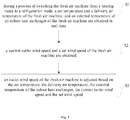
- the method includes: during a process of switching the fresh air machine from a heating mode to a refrigeration mode, obtaining, in real time, a set temperature and a delivery air temperature of the fresh air machine, and an external temperature of an indoor heat exchanger of the fresh air machine; obtaining a current outlet wind speed and a set wind speed of the fresh air machine; and adjusting an outlet wind speed of the fresh air machine based on the set temperature, the delivery air temperature, the external temperature of the indoor heat exchanger, the current outlet wind speed and the set wind speed.
- the outlet wind speed of the fresh air machine can be adjusted based on parameters such as the detected set temperature, the delivery air temperature, the external temperature of the indoor heat exchanger of the fresh air machine, the current outlet wind speed and the set wind speed, such that the time of adjusting the outlet wind speed can be shortened, the on/off frequency of the fan can be reduced, and the anti-cold wind effect can be greatly improved.
- the anti-cold-air control method for a fresh air machine may have the following additional technical features.
- adjusting the outlet wind speed of the fresh air machine based on the set temperature, the delivery air temperature, the external temperature of the indoor heat exchanger, the current outlet wind speed and the set wind speed includes: determining whether a maximum value of the delivery air temperature and the external temperature of the indoor heat exchanger is greater than a first preset temperature value in response to determining that the current outlet wind speed of the fresh air machine is zero; adjusting the outlet wind speed of the fresh air machine to a first wind speed in response to determining that the maximum value of the delivery air temperature and the external temperature of the indoor heat exchanger is greater than the first preset temperature value, in which the first wind speed is greater than zero and less than the set wind speed; determining whether the delivery air temperature is greater than a second preset temperature value in response to determining that the current outlet wind speed of the fresh air machine is the first wind speed, in which the second preset temperature value is greater than the first preset temperature value; and adjusting the outlet wind speed of the fresh air machine to the set wind speed in response to determining that the delivery air temperature is greater than
- adjusting the outlet wind speed of the fresh air machine based on the set temperature, the delivery air temperature, the external temperature of the indoor heat exchanger, the current outlet wind speed and the set wind speed includes: determining whether the delivery air temperature is less than a third preset temperature value in response to determining that the current outlet wind speed of the fresh air machine is the set wind speed; adjusting the outlet wind speed of the fresh air machine to the first wind speed in response to determining that the delivery air temperature being less than the third preset temperature value; determining whether the delivery air temperature is less than a fourth preset temperature value in response to determining that the current outlet wind speed of the fresh air machine is the first wind speed, in which the fourth preset temperature value is less than the third preset temperature value; and adjusting the outlet wind speed of the fresh air machine to zero in response to determining that the delivery air temperature is less than the fourth preset temperature value.
- the first wind speed is set based on the delivery air temperature and the set temperature.
- the method further includes: determining whether a difference between the delivery air temperature and the set temperature is less than a first preset difference; determining an outlet wind speed corresponding to a minimum wind level of the fresh air machine as the first wind speed in response to determining that the difference between the delivery air temperature and the set temperature is less than the first preset difference; determining whether the difference between the delivery air temperature and the set temperature is less than or equal to a second preset difference in response to determining that the difference between the delivery air temperature and the set temperature is greater than or equal to the first preset difference, in which the second preset difference is greater than the first preset difference; determining that a wind level corresponding to the first wind speed is two levels less than a wind level corresponding to the set wind speed in response to determining that the difference between the delivery air temperature and the set temperature is less than or equal to the second preset difference; determining that the wind level corresponding to the first wind speed is one level less than the wind level corresponding to
- embodiments of a second aspect of the present disclosure provide a non-transitory computer readable storage medium having stored thereon computer programs that, when executed by a processor, cause the method anti-cold-air control method for a fresh air machine according to embodiments of the first aspect of the present disclosure to be implemented.
- the time of adjusting the outlet wind speed can be shortened, the on/off frequency of the fan can be reduced, and the anti-cold wind effect can be greatly improved.
- inventions of a third aspect of the present disclosure provide an anti-cold-air control device for a fresh air machine.
- the device includes: a temperature obtaining module, a wind speed obtaining module, and a wind speed adjusting module.
- the temperature obtaining module is configured to, during a process of switching the fresh air machine from a heating mode to a refrigeration mode, obtain, in real time, a set temperature and a delivery air temperature of the fresh air machine, and an external temperature of an indoor heat exchanger of the fresh air machine.
- the wind speed obtaining module is configured to obtain a current outlet wind speed and a set wind speed of the fresh air machine.
- the wind speed adjusting module is configured to adjust an outlet wind speed of the fresh air machine based on the set temperature, the delivery air temperature, the external temperature of the indoor heat exchanger, the current outlet wind speed and the set wind speed.
- the wind speed adjusting module can adjust the outlet wind speed of the fresh air machine based on the set temperature and the delivery air temperature of the fresh air machine, and the external temperature of the indoor heat exchanger obtained by the temperature obtaining module, and the current outlet wind speed and the set wind speed of the fresh air machine obtained by the wind speed obtaining module, thus the time of adjusting the outlet wind speed can be shortened, the on/off frequency of the fan can be reduced, and the anti-cold wind effect can be greatly improved.
- the anti-cold-air control device for a fresh air machine may have the following additional technical features.
- the wind speed adjusting module is configured to: determine whether a maximum value of the delivery air temperature and the external temperature of the indoor heat exchanger is greater than a first preset temperature value in response to determining that the current outlet wind speed of the fresh air machine is zero; adjust the outlet wind speed of the fresh air machine to a first wind speed in response to determining that the maximum value of the delivery air temperature and the external temperature of the indoor heat exchanger is greater than the first preset temperature value; determine whether the delivery air temperature is greater than a second preset temperature value in response to determining that the current outlet wind speed of the fresh air machine is the first wind speed; and adjust the outlet wind speed of the fresh air machine to the set wind speed in response to determining that the delivery air temperature is greater than the second preset temperature value.
- the first wind speed is greater than zero and less than the set wind speed
- the second preset temperature value is greater than the first preset temperature value.
- the wind speed adjusting module is configured to: determine whether the delivery air temperature is less than a third preset temperature value in response to determining that the current outlet wind speed of the fresh air machine is the set wind speed; adjust the outlet wind speed of the fresh air machine to the first wind speed in response to determining that the delivery air temperature is less than the third preset temperature value; determine whether the delivery air temperature is less than a fourth preset temperature value in response to determining that the current outlet wind speed of the fresh air machine is the first wind speed; and adjust the outlet wind speed of the fresh air machine to zero in response to determining that the delivery air temperature is less than the fourth preset temperature value.
- the fourth preset temperature value is less than the third preset temperature value.
- the wind speed adjusting module is configured to set the first wind speed based on the delivery air temperature and the set temperature.
- the wind speed adjusting module is configured to: determine whether a difference between the delivery air temperature and the set temperature is less than a first preset difference; determine an outlet wind speed corresponding to a minimum wind level of the fresh air machine as the first wind speed in response to determining that the difference between the delivery air temperature and the set temperature is less than the first preset difference; determine whether the difference between the delivery air temperature and the set temperature is less than or equal to a second preset difference in response to determining that the difference between the delivery air temperature and the set temperature is greater than or equal to the first preset difference, in which the second preset difference is greater than the first preset difference; determine that a wind level corresponding to the first wind speed is two levels less than a wind level corresponding to the set wind speed in response to determining that the difference between the delivery air temperature and the set temperature is less than or equal to the second preset difference; and determine that the wind level corresponding to the first wind speed is one
- inventions of a fourth aspect of the present disclosure provide a fresh air machine.
- the fresh air machine includes the anti-cold-air control device for a fresh air machine according to embodiments of the second aspect of the present disclosure.
- the time of adjusting the outlet wind speed can be shortened, the on/off frequency of the fan can be reduced, and the anti-cold wind effect can be greatly improved.
- Fig. 1 is a flow chart of an anti-cold-air control device for a fresh air machine according to an embodiment of the present disclosure.
- the method according the embodiment of the present disclosure may include the followings.
- a set temperature T S and a delivery air temperature T A of the fresh air machine, and an external temperature T2 of an indoor heat exchanger of the fresh air machine are obtained in real time.
- the set temperature T S set by the user through an operation panel or a remote control may be obtained
- the external temperature T2 of the indoor heat exchanger of the fresh air machine may be obtained through a temperature sensor disposed at a central part of the indoor heat exchanger
- the delivery air temperature T A may be obtained by a delivery air temperature sensor.
- the set wind speed set by the user through the operation panel or the remote control can be obtained and stored for calling in the subsequent control process.
- the set wind speed may be set by a stepped wind speed level.
- the user may select 1 st level, 2 nd level, 3 rd level, ..., or n th level through the remote control, and set the set wind speed to the wind speed corresponding to the 1 st level, 2 nd level, 3 rd level, ..., or n th level.
- the set wind speed may also be set by the stepless wind speed value.
- the user may set the percentage value by the remote control, and set the set wind speed to a certain percentage of the maximum allowable wind speed.
- the set wind speed set by the user through the operation panel or the remote control may be different from the current outlet wind speed of the fresh air machine.
- an outlet wind speed of the fresh air machine is adjusted based on the set temperature T S , the delivery air temperature T A , the external temperature T2 of the indoor heat exchanger, the current outlet wind speed and the set wind speed.
- a maximum value max(T2, T A ) of the delivery air temperature T A and the external temperature T2 of the indoor heat exchanger may be taken as a judgment condition.
- the outlet wind speed of the fresh air machine may be adjusted to a first wind speed. The first wind speed is greater than zero and less than the set wind speed.
- the delivery air temperature T A may be taken as a judgment condition. In detail, it can be determined whether the delivery air temperature T A is greater than a second preset temperature value b. When the delivery air temperature T A is greater than the second preset temperature value b, the outlet wind speed of the fresh air machine may be adjusted to the set wind speed. The second preset temperature value is greater than the first preset temperature value.
- the delivery air temperature T A may be taken as a judgment condition. In detail, it can be determined whether the delivery air temperature T A is less than a third preset temperature value c. When the delivery air temperature T A is less than the third preset temperature value c, the outlet wind speed of the fresh air machine may be adjusted to the first wind speed.
- the delivery air temperature T A may be taken as a judgment condition. In detail, it can be determined whether the delivery air temperature T A is less than a fourth preset temperature value d. When the delivery air temperature T A is less than the fourth preset temperature value d, the outlet wind speed of the fresh air machine may be adjusted to zero, i.e., the fan stops running. The fourth preset temperature value d is less than the third preset temperature value c.
- the outlet wind speed of the fresh air machine may be adjusted by changing the wind level.
- the first wind speed may be set based on the delivery air temperature T A and the set temperature T S . In detail, it can be determined whether a difference ⁇ (T A -T S ) between the delivery air temperature T A and the set temperature T S is less than a first preset difference. When the difference ⁇ (T A -T s ) between the delivery air temperature T A and the set temperature T S is less than the first preset difference, the first wind speed may be set as an outlet wind speed corresponding to a minimum wind level of the fresh air machine.
- the difference ⁇ (T A -T S ) between the delivery air temperature T A and the set temperature T S is greater than or equal to the first preset difference, it can be further determined whether the difference ⁇ (T A -T S ) between the delivery air temperature T A and the set temperature T S is less than or equal to a second preset difference.
- the difference ⁇ (T A -T S ) between the delivery air temperature T A and the set temperature T S is less than or equal to the second preset difference, it is determined that a wind level corresponding to the first wind speed is two levels less than a wind level corresponding to the set wind speed.
- the difference ⁇ (T A -T s ) between the delivery air temperature T A and the set temperature T S is greater than the second preset difference, it is determined that the wind level corresponding to the first wind speed is one level less than the wind level corresponding to the set wind speed.
- the second preset difference is less than the first preset difference.
- the first preset difference may be 4 ⁇
- the second preset difference may be 6 ⁇ .
- the wind level corresponding to the first wind speed may be the minimum wind level.
- the difference ⁇ (T A -T S ) between the delivery air temperature T A and the set temperature T S is greater than or equal to 4 ⁇ and less than or equal to 6 ⁇
- the wind level corresponding to the first wind speed may be two levels less than the wind level corresponding to the set wind speed.
- the wind level corresponding to the first wind speed is one level less than the wind level corresponding to the set wind speed.
- the first preset temperature a, the second preset temperature b, the third preset temperature c, and the fourth preset temperature d mentioned above are variable, they may be adjusted by external input devices (such as wire controllers) according to different regions' climate and user needs.
- the outlet wind speed of the fresh air machine can be adjusted based on parameters such as the detected set temperature, the delivery air temperature, the external temperature of the indoor heat exchanger of the fresh air machine, the current outlet wind speed and the set wind speed, such that the time of adjusting the outlet wind speed can be shortened, the on/off frequency of the fan can be reduced, and the anti-cold wind effect can be greatly improved.
- the present disclosure further provides a non-transitory computer readable storage medium.
- the non-transitory computer readable storage medium stores computer programs, and when the programs is executed by a processor, cause the method anti-cold-air control method for a fresh air machine according to the above embodiments of the first aspect of the present disclosure to be implemented.
- the time of adjusting the outlet wind speed can be shortened, the on/off frequency of the fan can be reduced, and the anti-cold wind effect can be greatly improved.
- the present disclosure further provides an anti-cold-air control device for a fresh air machine.
- the anti-cold-air control device for a fresh air machine may include a temperature obtaining module 10, a wind speed obtaining module 20, and a wind speed adjusting module 30.
- the temperature obtaining module 10 is configured to, during a process of switching the fresh air machine from a heating mode to a refrigeration mode, obtain, in real time, a set temperature T S and a delivery air temperature T A of the fresh air machine, and an external temperature T2 of an indoor heat exchanger of the fresh air machine.
- the wind speed obtaining module 20 is configured to obtain a current outlet wind speed and a set wind speed of the fresh air machine.
- the wind speed adjusting module 30 is configured to adjust an outlet wind speed of the fresh air machine based on the set temperature T S , the delivery air temperature T A , the external temperature T2 of the indoor heat exchanger, the current outlet wind speed and the set wind speed.
- the set wind speed may be stored for calling in in the subsequent control process.
- the set wind speed may be set by a stepped wind speed level. For example, the user may select 1 st level, 2 nd level, 3 rd level, ..., or n th level through the remote control, and set the set wind speed to the wind speed corresponding to the 1 st level, 2 nd level, 3 rd level, ..., or n th level.
- the set wind speed may also be set by the stepless wind speed value. For example, the user may set the percentage value by the remote control, and set the set wind speed to a certain percentage of the maximum allowable wind speed.
- the set wind speed set by the user through the operation panel or the remote control may be different from the current outlet wind speed of the fresh air machine.
- a maximum value max(T2, T A ) of the delivery air temperature T A and the external temperature T2 of the indoor heat exchanger obtained by the temperature obtaining module 10 may be taken as a judgment condition.
- the wind speed adjusting module 30 may determine whether the maximum value max(T2, T A ) of the delivery air temperature T A and the external temperature T2 of the indoor heat exchanger obtained by the temperature obtaining module 10 is greater than a first preset temperature value a.
- the wind speed adjusting module 30 may adjust the outlet wind speed of the fresh air machine to a first wind speed.
- the first wind speed is greater than zero and less than the set wind speed.
- the delivery air temperature T A obtained by the temperature obtaining module 10 may be taken as a judgment condition.
- the wind speed adjusting module 30 may determine whether the delivery air temperature T A is greater than a second preset temperature value b. When the delivery air temperature T A is greater than the second preset temperature value b, the wind speed adjusting module 30 may adjust the outlet wind speed of the fresh air machine to the set wind speed.
- the second preset temperature value is greater than the first preset temperature value.
- the delivery air temperature T A obtained by the temperature obtaining module 10 may be taken as a judgment condition.
- the wind speed adjusting module 30 may determine whether the delivery air temperature T A obtained by the temperature obtaining module 10 is less than a third preset temperature value c. When the delivery air temperature T A is less than the third preset temperature value c, the wind speed adjusting module 30 may adjust the outlet wind speed of the fresh air machine to the first wind speed.
- the delivery air temperature T A obtained by the temperature obtaining module 10 may be taken as a judgment condition.
- the wind speed adjusting module 30 may determine whether the delivery air temperature T A is less than a fourth preset temperature value d. When the delivery air temperature T A is less than the fourth preset temperature value d, the wind speed adjusting module 30 may adjust the outlet wind speed of the fresh air machine to zero, i.e., the fan stops running. The fourth preset temperature value is less than the third preset temperature value.
- the outlet wind speed of the fresh air machine may be adjusted by changing the wind level.
- the first wind speed may be set based on the delivery air temperature T A and the set temperature T S .
- the wind speed adjusting module 30 may determine whether a difference ⁇ (T A -T S ) between the delivery air temperature T A and the set temperature T S is less than a first preset difference. When the difference ⁇ (T A -T S ) between the delivery air temperature T A and the set temperature T S is less than the first preset difference, the first wind speed may be set as an outlet wind speed corresponding to a minimum wind level of the fresh air machine.
- the wind speed adjusting module 30 may determine whether the difference ⁇ (T A -T S ) between the delivery air temperature T A and the set temperature T S is less than or equal to a second preset difference. When the difference ⁇ (T A -T S ) between the delivery air temperature T A and the set temperature T S is less than or equal to the second preset difference, it is determined that a wind level corresponding to the first wind speed is two levels less than a wind level corresponding to the set wind speed.
- the difference ⁇ (T A -T S ) between the delivery air temperature T A and the set temperature T S is greater than the second preset difference, it is determined that the wind level corresponding to the first wind speed is one level less than the wind level corresponding to the set wind speed.
- the second preset difference is less than the first preset difference.
- the first preset difference may be 4 ⁇
- the second preset difference may be 6 ⁇ .
- the wind level corresponding to the first wind speed may be the minimum wind level.
- the wind level corresponding to the first wind speed may be two levels less than the wind level corresponding to the set wind speed.
- the wind speed adjusting module 30 determines that the difference ⁇ (T A -T S ) between the delivery air temperature T A and the set temperature T S is greater than 6 ⁇ , the wind level corresponding to the first wind speed is one level less than the wind level corresponding to the set wind speed.
- the first preset temperature a, the second preset temperature b, the third preset temperature c, and the fourth preset temperature d mentioned above are variable, they may be adjusted by external input devices (such as wire controllers) according to different regions' climate and user needs.
- the wind speed adjusting module may adjust the outlet wind speed of the fresh air machine based on the set temperature and the delivery air temperature of the fresh air machine, and the external temperature of the indoor heat exchanger obtained by the temperature obtaining module, and the current outlet wind speed and the set wind speed of the fresh air machine obtained by the wind speed obtaining module, thus the time of adjusting the outlet wind speed can be shortened, the on/off frequency of the fan can be reduced, and the anti-cold wind effect can be greatly improved.
- the present disclosure further provides a fresh air machine.
- the fresh air machine according to an embodiment of the present disclosure includes the anti-cold-air control device for a fresh air machine provided by the above-mentioned embodiments of the present disclosure.
- the anti-cold-air control device for a fresh air machine provided by the above-mentioned embodiments of the present disclosure.
- the time of adjusting the outlet wind speed can be shortened, the on/off frequency of the fan can be reduced, and the anti-cold wind effect can be greatly improved.
- first and second are used herein for purposes of description and are not intended to indicate or imply relative importance or significance or to imply the number of indicated technical features.
- the feature defined with “first” and “second” may explicitly or implicitly includes one or more of the features.
- a plurality of' means two or more than two, unless specified otherwise.
- the terms “mounted,” “connected,” “coupled,” “fixed” and the like are used broadly, and may be, for example, fixed connections, detachable connections, or integral connections; may also be mechanical or electrical connections; may also be direct connections or indirect connections via intervening structures; may also be inner communications of two elements, which can be understood by those skilled in the art according to specific situations.
- a structure in which a first feature is "on" or “below” a second feature may include an embodiment in which the first feature is in direct contact with the second feature, and may also include an embodiment in which the first feature and the second feature are not in direct contact with each other, but are contacted via an additional feature formed therebetween.
- a first feature "on,” “above,” or “on top of' a second feature may include an embodiment in which the first feature is right or obliquely “on,” “above,” or “on top of' the second feature, or just means that the first feature is at a height higher than that of the second feature; while a first feature "below,” “under,” or “on bottom of' a second feature may include an embodiment in which the first feature is right or obliquely “below,” “under,” or “on bottom of' the second feature, or just means that the first feature is at a height lower than that of the second feature.
Landscapes
- Engineering & Computer Science (AREA)
- General Engineering & Computer Science (AREA)
- Chemical & Material Sciences (AREA)
- Mechanical Engineering (AREA)
- Combustion & Propulsion (AREA)
- Physics & Mathematics (AREA)
- Signal Processing (AREA)
- Fluid Mechanics (AREA)
- Fuzzy Systems (AREA)
- Mathematical Physics (AREA)
- Automation & Control Theory (AREA)
- General Physics & Mathematics (AREA)
- Air Conditioning Control Device (AREA)
Abstract
Description
- The present disclosure relates to the field of air conditioning technologies, and more particularly, to an anti-cold-air control method for a fresh air machine, a non-transitory computer readable storage medium, an anti-cold-air control device for a fresh air machine, and a fresh air machine.
- When the fresh air machine is in the process of defrosting during heating, or oil-return operating of switching from the heating mode to the refrigeration mode, the fresh air machine may be controlled to enter the anti-cold-air operation state, to prevent cold air from blowing out.
- At present, the related anti-cold-air control schemes for the fresh air machine often follow the scheme of conventional indoor machine of air conditioners. Specifically, the on/off and wind level switching control of the indoor fan are performed according to the temperature value detected by the temperature sensor disposed at the central part of the current indoor heat exchanger. However, the following problems may occur when the above schemes are applied: 1) when the fan is turned off, the temperature value detected by the temperature sensor disposed at the central part may rise rapidly, which may easily enable the anti-cold-air fan to be turned on, after the fan is operating, even when the fan operates in the minimum wind level, it may cause the temperature value detected by the temperature sensor disposed at the central part to decrease rapidly, and cause the fan to turn off, thus causing the fan to turn on or turn off frequently. 2) when the fan is turned on, it is detected that the delivery air temperature is above 37°C for 10 minutes, the temperature value detected by the temperature sensor disposed at the central part is still low, which makes the fan operating at a low speed for a long time, leading to an increase in the time of switching the wind level.
- The present disclosure aims to solve at least one of the technical problems existing in the related art to at least some extent. Accordingly, an objective of the present disclosure is to provide an anti-cold-air control method for a fresh air machine, which can shorten the time of adjusting the outlet wind speed, reduce the on/off frequency of the fan, and greatly improve the anti-cold wind effect.
- A second objective of the present disclosure is to provide a non-transitory computer readable storage medium.
- A third objective of the present disclosure is to provide an anti-cold-air control device for a fresh air machine.
- A fourth objective of the present disclosure is to provide a fresh air machine.
- To achieve the above objectives, embodiments of a first aspect of the present disclosure provide an anti-cold-air control method for a fresh air machine. The method includes: during a process of switching the fresh air machine from a heating mode to a refrigeration mode, obtaining, in real time, a set temperature and a delivery air temperature of the fresh air machine, and an external temperature of an indoor heat exchanger of the fresh air machine; obtaining a current outlet wind speed and a set wind speed of the fresh air machine; and adjusting an outlet wind speed of the fresh air machine based on the set temperature, the delivery air temperature, the external temperature of the indoor heat exchanger, the current outlet wind speed and the set wind speed.
- With the anti-cold-air control method for a fresh air machine according to embodiments of the present disclosure, the outlet wind speed of the fresh air machine can be adjusted based on parameters such as the detected set temperature, the delivery air temperature, the external temperature of the indoor heat exchanger of the fresh air machine, the current outlet wind speed and the set wind speed, such that the time of adjusting the outlet wind speed can be shortened, the on/off frequency of the fan can be reduced, and the anti-cold wind effect can be greatly improved.
- Moreover, the anti-cold-air control method for a fresh air machine according to above embodiments of the present disclosure may have the following additional technical features.
- Specifically, adjusting the outlet wind speed of the fresh air machine based on the set temperature, the delivery air temperature, the external temperature of the indoor heat exchanger, the current outlet wind speed and the set wind speed includes: determining whether a maximum value of the delivery air temperature and the external temperature of the indoor heat exchanger is greater than a first preset temperature value in response to determining that the current outlet wind speed of the fresh air machine is zero; adjusting the outlet wind speed of the fresh air machine to a first wind speed in response to determining that the maximum value of the delivery air temperature and the external temperature of the indoor heat exchanger is greater than the first preset temperature value, in which the first wind speed is greater than zero and less than the set wind speed; determining whether the delivery air temperature is greater than a second preset temperature value in response to determining that the current outlet wind speed of the fresh air machine is the first wind speed, in which the second preset temperature value is greater than the first preset temperature value; and adjusting the outlet wind speed of the fresh air machine to the set wind speed in response to determining that the delivery air temperature is greater than the second preset temperature value.
- Furthermore, adjusting the outlet wind speed of the fresh air machine based on the set temperature, the delivery air temperature, the external temperature of the indoor heat exchanger, the current outlet wind speed and the set wind speed includes: determining whether the delivery air temperature is less than a third preset temperature value in response to determining that the current outlet wind speed of the fresh air machine is the set wind speed; adjusting the outlet wind speed of the fresh air machine to the first wind speed in response to determining that the delivery air temperature being less than the third preset temperature value; determining whether the delivery air temperature is less than a fourth preset temperature value in response to determining that the current outlet wind speed of the fresh air machine is the first wind speed, in which the fourth preset temperature value is less than the third preset temperature value; and adjusting the outlet wind speed of the fresh air machine to zero in response to determining that the delivery air temperature is less than the fourth preset temperature value.
- Furthermore, the first wind speed is set based on the delivery air temperature and the set temperature. The method further includes: determining whether a difference between the delivery air temperature and the set temperature is less than a first preset difference; determining an outlet wind speed corresponding to a minimum wind level of the fresh air machine as the first wind speed in response to determining that the difference between the delivery air temperature and the set temperature is less than the first preset difference; determining whether the difference between the delivery air temperature and the set temperature is less than or equal to a second preset difference in response to determining that the difference between the delivery air temperature and the set temperature is greater than or equal to the first preset difference, in which the second preset difference is greater than the first preset difference; determining that a wind level corresponding to the first wind speed is two levels less than a wind level corresponding to the set wind speed in response to determining that the difference between the delivery air temperature and the set temperature is less than or equal to the second preset difference; determining that the wind level corresponding to the first wind speed is one level less than the wind level corresponding to the set wind speed in response to determining that the difference between the delivery air temperature and the set temperature is greater than the second preset difference.
- To achieve the above objectives, embodiments of a second aspect of the present disclosure provide a non-transitory computer readable storage medium having stored thereon computer programs that, when executed by a processor, cause the method anti-cold-air control method for a fresh air machine according to embodiments of the first aspect of the present disclosure to be implemented.
- With the non-transitory computer readable storage medium according to embodiments of the present disclosure, by performing the stored computer programs, the time of adjusting the outlet wind speed can be shortened, the on/off frequency of the fan can be reduced, and the anti-cold wind effect can be greatly improved.
- To achieve the above objectives, embodiments of a third aspect of the present disclosure provide an anti-cold-air control device for a fresh air machine. The device includes: a temperature obtaining module, a wind speed obtaining module, and a wind speed adjusting module. The temperature obtaining module is configured to, during a process of switching the fresh air machine from a heating mode to a refrigeration mode, obtain, in real time, a set temperature and a delivery air temperature of the fresh air machine, and an external temperature of an indoor heat exchanger of the fresh air machine. The wind speed obtaining module is configured to obtain a current outlet wind speed and a set wind speed of the fresh air machine. The wind speed adjusting module is configured to adjust an outlet wind speed of the fresh air machine based on the set temperature, the delivery air temperature, the external temperature of the indoor heat exchanger, the current outlet wind speed and the set wind speed.
- With the anti-cold-air control device for a fresh air machine according to embodiments of the present disclosure, the wind speed adjusting module can adjust the outlet wind speed of the fresh air machine based on the set temperature and the delivery air temperature of the fresh air machine, and the external temperature of the indoor heat exchanger obtained by the temperature obtaining module, and the current outlet wind speed and the set wind speed of the fresh air machine obtained by the wind speed obtaining module, thus the time of adjusting the outlet wind speed can be shortened, the on/off frequency of the fan can be reduced, and the anti-cold wind effect can be greatly improved.
- Moreover, the anti-cold-air control device for a fresh air machine according to above embodiments of the present disclosure may have the following additional technical features.
- Specifically, the wind speed adjusting module is configured to: determine whether a maximum value of the delivery air temperature and the external temperature of the indoor heat exchanger is greater than a first preset temperature value in response to determining that the current outlet wind speed of the fresh air machine is zero; adjust the outlet wind speed of the fresh air machine to a first wind speed in response to determining that the maximum value of the delivery air temperature and the external temperature of the indoor heat exchanger is greater than the first preset temperature value; determine whether the delivery air temperature is greater than a second preset temperature value in response to determining that the current outlet wind speed of the fresh air machine is the first wind speed; and adjust the outlet wind speed of the fresh air machine to the set wind speed in response to determining that the delivery air temperature is greater than the second preset temperature value. The first wind speed is greater than zero and less than the set wind speed, and the second preset temperature value is greater than the first preset temperature value.
- Further, the wind speed adjusting module is configured to: determine whether the delivery air temperature is less than a third preset temperature value in response to determining that the current outlet wind speed of the fresh air machine is the set wind speed; adjust the outlet wind speed of the fresh air machine to the first wind speed in response to determining that the delivery air temperature is less than the third preset temperature value; determine whether the delivery air temperature is less than a fourth preset temperature value in response to determining that the current outlet wind speed of the fresh air machine is the first wind speed; and adjust the outlet wind speed of the fresh air machine to zero in response to determining that the delivery air temperature is less than the fourth preset temperature value. The fourth preset temperature value is less than the third preset temperature value.
- Further, the wind speed adjusting module is configured to set the first wind speed based on the delivery air temperature and the set temperature. The wind speed adjusting module is configured to: determine whether a difference between the delivery air temperature and the set temperature is less than a first preset difference; determine an outlet wind speed corresponding to a minimum wind level of the fresh air machine as the first wind speed in response to determining that the difference between the delivery air temperature and the set temperature is less than the first preset difference; determine whether the difference between the delivery air temperature and the set temperature is less than or equal to a second preset difference in response to determining that the difference between the delivery air temperature and the set temperature is greater than or equal to the first preset difference, in which the second preset difference is greater than the first preset difference; determine that a wind level corresponding to the first wind speed is two levels less than a wind level corresponding to the set wind speed in response to determining that the difference between the delivery air temperature and the set temperature is less than or equal to the second preset difference; and determine that the wind level corresponding to the first wind speed is one level less than the wind level corresponding to the set wind speed in response to determining that the difference between the delivery air temperature and the set temperature is greater than the second preset difference.
- To achieve the above objectives, embodiments of a fourth aspect of the present disclosure provide a fresh air machine. The fresh air machine includes the anti-cold-air control device for a fresh air machine according to embodiments of the second aspect of the present disclosure.
- With the fresh air machine according to embodiments of the present disclosure, the time of adjusting the outlet wind speed can be shortened, the on/off frequency of the fan can be reduced, and the anti-cold wind effect can be greatly improved.
-
-
Fig. 1 is a flow chart of an anti-cold-air control device for a fresh air machine according to an embodiment of the present disclosure; -
Fig. 2 is a schematic diagram of a process of adjusting an outlet wind speed of a fresh air machine according to an embodiment of the present disclosure; -
Fig. 3 is a block diagram of an anti-cold-air control device for a fresh air machine according to an embodiment of the present disclosure. - Embodiments of the present disclosure will be described in detail in the following descriptions, examples of which are shown in the accompanying drawings, in which the same or similar elements and elements having same or similar functions are denoted by like reference numerals throughout the descriptions. The embodiments described herein with reference to the accompanying drawings are exemplary, which are used to explain the present disclosure, and shall not be construed to limit the present disclosure.
- The anti-cold-air control method for a fresh air machine, the anti-cold-air control device for a fresh air machine, and the fresh air machine according to embodiments of the present disclosure will now be illustrated with reference to accompanying drawing as follows.
-
Fig. 1 is a flow chart of an anti-cold-air control device for a fresh air machine according to an embodiment of the present disclosure. - As illustrated in
Fig. 1 , the method according the embodiment of the present disclosure may include the followings. - At block S1, during a process of switching the fresh air machine from a heating mode to a refrigeration mode, a set temperature TS and a delivery air temperature TA of the fresh air machine, and an external temperature T2 of an indoor heat exchanger of the fresh air machine are obtained in real time.
- Specifically, when the fresh air machine is in the process of defrosting during heating, or oil-return operating of switching from the heating mode to the refrigeration mode, the set temperature TS set by the user through an operation panel or a remote control may be obtained, the external temperature T2 of the indoor heat exchanger of the fresh air machine may be obtained through a temperature sensor disposed at a central part of the indoor heat exchanger, and the delivery air temperature TA may be obtained by a delivery air temperature sensor.
- At block S2, a current outlet wind speed and a set wind speed of the fresh air machine are obtained.
- In an embodiment of the present disclosure, the set wind speed set by the user through the operation panel or the remote control can be obtained and stored for calling in the subsequent control process. The set wind speed may be set by a stepped wind speed level. For example, the user may select 1st level, 2nd level, 3rd level, ..., or nth level through the remote control, and set the set wind speed to the wind speed corresponding to the 1st level, 2nd level, 3rd level, ..., or nth level. The set wind speed may also be set by the stepless wind speed value. For example, the user may set the percentage value by the remote control, and set the set wind speed to a certain percentage of the maximum allowable wind speed.
- To achieve an objective of the present disclosure, in an embodiment of the present disclosure, the set wind speed set by the user through the operation panel or the remote control may be different from the current outlet wind speed of the fresh air machine.
- At block S3, an outlet wind speed of the fresh air machine is adjusted based on the set temperature TS, the delivery air temperature TA, the external temperature T2 of the indoor heat exchanger, the current outlet wind speed and the set wind speed.
- Specifically, as shown in
FIG. 2 , when the current outlet wind speed of the fresh air machine is zero (i.e., when the fan is off), a maximum value max(T2, TA) of the delivery air temperature TA and the external temperature T2 of the indoor heat exchanger may be taken as a judgment condition. In detail, it can be determined whether the maximum value max(T2, TA) of the delivery air temperature TA and the external temperature T2 of the indoor heat exchanger is greater than a first preset temperature value a. When the maximum value max(T2, TA) of the delivery air temperature TA and the external temperature T2 of the indoor heat exchanger is greater than the first preset temperature value a, the outlet wind speed of the fresh air machine may be adjusted to a first wind speed. The first wind speed is greater than zero and less than the set wind speed. - As shown in
FIG. 2 , when the current outlet wind speed of the fresh air machine is the first wind speed, the delivery air temperature TA may be taken as a judgment condition. In detail, it can be determined whether the delivery air temperature TA is greater than a second preset temperature value b. When the delivery air temperature TA is greater than the second preset temperature value b, the outlet wind speed of the fresh air machine may be adjusted to the set wind speed. The second preset temperature value is greater than the first preset temperature value. - As shown in
FIG. 2 , when the current outlet wind speed of the fresh air machine is the set wind speed, the delivery air temperature TA may be taken as a judgment condition. In detail, it can be determined whether the delivery air temperature TA is less than a third preset temperature value c. When the delivery air temperature TA is less than the third preset temperature value c, the outlet wind speed of the fresh air machine may be adjusted to the first wind speed. - As shown in
FIG. 2 , when the current outlet wind speed of the fresh air machine is the first wind speed, the delivery air temperature TA may be taken as a judgment condition. In detail, it can be determined whether the delivery air temperature TA is less than a fourth preset temperature value d. When the delivery air temperature TA is less than the fourth preset temperature value d, the outlet wind speed of the fresh air machine may be adjusted to zero, i.e., the fan stops running. The fourth preset temperature value d is less than the third preset temperature value c. - In an embodiment of the present disclosure, the outlet wind speed of the fresh air machine may be adjusted by changing the wind level. In an embodiment of the present disclosure, the first wind speed may be set based on the delivery air temperature TA and the set temperature TS. In detail, it can be determined whether a difference Δ(TA-TS) between the delivery air temperature TA and the set temperature TS is less than a first preset difference. When the difference Δ(TA-Ts) between the delivery air temperature TA and the set temperature TS is less than the first preset difference, the first wind speed may be set as an outlet wind speed corresponding to a minimum wind level of the fresh air machine. When the difference Δ(TA-TS) between the delivery air temperature TA and the set temperature TS is greater than or equal to the first preset difference, it can be further determined whether the difference Δ(TA-TS) between the delivery air temperature TA and the set temperature TS is less than or equal to a second preset difference. When the difference Δ(TA-TS) between the delivery air temperature TA and the set temperature TS is less than or equal to the second preset difference, it is determined that a wind level corresponding to the first wind speed is two levels less than a wind level corresponding to the set wind speed. When the difference Δ(TA-Ts) between the delivery air temperature TA and the set temperature TS is greater than the second preset difference, it is determined that the wind level corresponding to the first wind speed is one level less than the wind level corresponding to the set wind speed. The second preset difference is less than the first preset difference.
- For example, as shown in Table 1, the first preset difference may be 4 □, and the second preset difference may be 6 □. When the difference Δ(TA-TS) between the delivery air temperature TA and the set temperature TS is less than 4 □, the wind level corresponding to the first wind speed may be the minimum wind level. When the difference Δ(TA-TS) between the delivery air temperature TA and the set temperature TS is greater than or equal to 4 □ and less than or equal to 6 □, the wind level corresponding to the first wind speed may be two levels less than the wind level corresponding to the set wind speed. When the difference Δ(TA-TS) between the delivery air temperature TA and the set temperature TS is greater than 6 □, the wind level corresponding to the first wind speed is one level less than the wind level corresponding to the set wind speed.
range of Δ(TA-TS) (□) Δ<4 4≤Δ≤6 Δ>6 wind level corresponding to first wind speed minimum wind level two levels less than wind level corresponding to set wind speed one level less than wind level corresponding to set wind speed - It should be noted that, as a critical value for adjusting the outlet wind speed, the first preset temperature a, the second preset temperature b, the third preset temperature c, and the fourth preset temperature d mentioned above are variable, they may be adjusted by external input devices (such as wire controllers) according to different regions' climate and user needs.
- With the anti-cold-air control method for a fresh air machine according to embodiments of the present disclosure, the outlet wind speed of the fresh air machine can be adjusted based on parameters such as the detected set temperature, the delivery air temperature, the external temperature of the indoor heat exchanger of the fresh air machine, the current outlet wind speed and the set wind speed, such that the time of adjusting the outlet wind speed can be shortened, the on/off frequency of the fan can be reduced, and the anti-cold wind effect can be greatly improved.
- Corresponding to above embodiments, the present disclosure further provides a non-transitory computer readable storage medium.
- The non-transitory computer readable storage medium according to embodiments of the present disclosure stores computer programs, and when the programs is executed by a processor, cause the method anti-cold-air control method for a fresh air machine according to the above embodiments of the first aspect of the present disclosure to be implemented.
- With the non-transitory computer readable storage medium according to embodiments of the present disclosure, by performing the stored computer programs, the time of adjusting the outlet wind speed can be shortened, the on/off frequency of the fan can be reduced, and the anti-cold wind effect can be greatly improved.
- To implement the anti-cold-air control method for a fresh air machine according to the above embodiments, the present disclosure further provides an anti-cold-air control device for a fresh air machine.
- As illustrated in
Fig. 3 , the anti-cold-air control device for a fresh air machine according to embodiments of the present disclosure may include atemperature obtaining module 10, a windspeed obtaining module 20, and a wind speed adjusting module 30. - The
temperature obtaining module 10 is configured to, during a process of switching the fresh air machine from a heating mode to a refrigeration mode, obtain, in real time, a set temperature TS and a delivery air temperature TA of the fresh air machine, and an external temperature T2 of an indoor heat exchanger of the fresh air machine. The windspeed obtaining module 20 is configured to obtain a current outlet wind speed and a set wind speed of the fresh air machine. The wind speed adjusting module 30 is configured to adjust an outlet wind speed of the fresh air machine based on the set temperature TS, the delivery air temperature TA, the external temperature T2 of the indoor heat exchanger, the current outlet wind speed and the set wind speed. - In an embodiment of the present disclosure, after the wind
speed obtaining module 20 obtains the set wind speed set by the user through the operation panel or the remote control, the set wind speed may be stored for calling in in the subsequent control process. The set wind speed may be set by a stepped wind speed level. For example, the user may select 1st level, 2nd level, 3rd level, ..., or nth level through the remote control, and set the set wind speed to the wind speed corresponding to the 1st level, 2nd level, 3rd level, ..., or nth level. The set wind speed may also be set by the stepless wind speed value. For example, the user may set the percentage value by the remote control, and set the set wind speed to a certain percentage of the maximum allowable wind speed. - To achieve an objective of the present disclosure, in an embodiment of the present disclosure, the set wind speed set by the user through the operation panel or the remote control may be different from the current outlet wind speed of the fresh air machine.
- In an embodiment of the present disclosure, when the current outlet wind speed of the fresh air machine obtained by the wind
speed obtaining module 20 is zero (i.e., when the fan is off), a maximum value max(T2, TA) of the delivery air temperature TA and the external temperature T2 of the indoor heat exchanger obtained by thetemperature obtaining module 10 may be taken as a judgment condition. In detail, the wind speed adjusting module 30 may determine whether the maximum value max(T2, TA) of the delivery air temperature TA and the external temperature T2 of the indoor heat exchanger obtained by thetemperature obtaining module 10 is greater than a first preset temperature value a. When the maximum value max(T2, TA) of the delivery air temperature TA and the external temperature T2 of the indoor heat exchanger is greater than the first preset temperature value a, the wind speed adjusting module 30 may adjust the outlet wind speed of the fresh air machine to a first wind speed. The first wind speed is greater than zero and less than the set wind speed. - When the current outlet wind speed of the fresh air machine obtained by the wind
speed obtaining module 20 is the first wind speed, the delivery air temperature TA obtained by thetemperature obtaining module 10 may be taken as a judgment condition. In detail, the wind speed adjusting module 30 may determine whether the delivery air temperature TA is greater than a second preset temperature value b. When the delivery air temperature TA is greater than the second preset temperature value b, the wind speed adjusting module 30 may adjust the outlet wind speed of the fresh air machine to the set wind speed. The second preset temperature value is greater than the first preset temperature value. - When the current outlet wind speed of the fresh air machine obtained by the wind
speed obtaining module 20 is the set wind speed, the delivery air temperature TA obtained by thetemperature obtaining module 10 may be taken as a judgment condition. In detail, the wind speed adjusting module 30 may determine whether the delivery air temperature TA obtained by thetemperature obtaining module 10 is less than a third preset temperature value c. When the delivery air temperature TA is less than the third preset temperature value c, the wind speed adjusting module 30 may adjust the outlet wind speed of the fresh air machine to the first wind speed. - When the current outlet wind speed of the fresh air machine obtained by the wind
speed obtaining module 20 is the first wind speed, the delivery air temperature TA obtained by thetemperature obtaining module 10 may be taken as a judgment condition. In detail, the wind speed adjusting module 30 may determine whether the delivery air temperature TA is less than a fourth preset temperature value d. When the delivery air temperature TA is less than the fourth preset temperature value d, the wind speed adjusting module 30 may adjust the outlet wind speed of the fresh air machine to zero, i.e., the fan stops running. The fourth preset temperature value is less than the third preset temperature value. - In an embodiment of the present disclosure, the outlet wind speed of the fresh air machine may be adjusted by changing the wind level. In an embodiment of the present disclosure, the first wind speed may be set based on the delivery air temperature TA and the set temperature TS. In detail, the wind speed adjusting module 30 may determine whether a difference Δ(TA-TS) between the delivery air temperature TA and the set temperature TS is less than a first preset difference. When the difference Δ(TA-TS) between the delivery air temperature TA and the set temperature TS is less than the first preset difference, the first wind speed may be set as an outlet wind speed corresponding to a minimum wind level of the fresh air machine. When the difference Δ(TA-TS) between the delivery air temperature TA and the set temperature TS is greater than or equal to the first preset difference, the wind speed adjusting module 30 may determine whether the difference Δ(TA-TS) between the delivery air temperature TA and the set temperature TS is less than or equal to a second preset difference. When the difference Δ(TA-TS) between the delivery air temperature TA and the set temperature TS is less than or equal to the second preset difference, it is determined that a wind level corresponding to the first wind speed is two levels less than a wind level corresponding to the set wind speed. When the difference Δ(TA-TS) between the delivery air temperature TA and the set temperature TS is greater than the second preset difference, it is determined that the wind level corresponding to the first wind speed is one level less than the wind level corresponding to the set wind speed. The second preset difference is less than the first preset difference.
- For example, as shown in Table 1, the first preset difference may be 4 □, and the second preset difference may be 6 □. When the wind speed adjusting module 30 determines that the difference Δ(TA-TS) between the delivery air temperature TA and the set temperature TS is less than 4 □, the wind level corresponding to the first wind speed may be the minimum wind level. When the wind speed adjusting module 30 determines that the difference Δ(TA-TS) between the delivery air temperature TA and the set temperature TS is greater than or equal to 4 □ and less than or equal to 6 □, the wind level corresponding to the first wind speed may be two levels less than the wind level corresponding to the set wind speed. When the wind speed adjusting module 30 determines that the difference Δ(TA-TS) between the delivery air temperature TA and the set temperature TS is greater than 6 □, the wind level corresponding to the first wind speed is one level less than the wind level corresponding to the set wind speed.
- It should be noted that, as a critical value for adjusting the outlet wind speed, the first preset temperature a, the second preset temperature b, the third preset temperature c, and the fourth preset temperature d mentioned above are variable, they may be adjusted by external input devices (such as wire controllers) according to different regions' climate and user needs.
- With the anti-cold-air control device for a fresh air machine according to embodiments of the present disclosure, the wind speed adjusting module may adjust the outlet wind speed of the fresh air machine based on the set temperature and the delivery air temperature of the fresh air machine, and the external temperature of the indoor heat exchanger obtained by the temperature obtaining module, and the current outlet wind speed and the set wind speed of the fresh air machine obtained by the wind speed obtaining module, thus the time of adjusting the outlet wind speed can be shortened, the on/off frequency of the fan can be reduced, and the anti-cold wind effect can be greatly improved.
- Corresponding to above embodiments, the present disclosure further provides a fresh air machine.
- The fresh air machine according to an embodiment of the present disclosure includes the anti-cold-air control device for a fresh air machine provided by the above-mentioned embodiments of the present disclosure. For detailed implementation manners, reference may be made to the foregoing embodiments, and to avoid redundancy, details are not described herein.
- With the fresh air machine according to embodiments of the present disclosure, the time of adjusting the outlet wind speed can be shortened, the on/off frequency of the fan can be reduced, and the anti-cold wind effect can be greatly improved.
- In the description of the present disclosure, it should be understood that, terms such as "central," "longitudinal," "lateral," "length," "width," "thickness," "upper," "lower," "front," "rear," "left," "right," "vertical," "horizontal," "top," "bottom," "inner," "outer," "clockwise," "counterclockwise," "axial," "radial" and "peripheral" should be construed to refer to the orientation as then described or as shown in the drawings under discussion. These relative terms are for convenience of description and do not require that the present disclosure be constructed or operated in a particular orientation, therefore cannot be construed to limit the present disclosure.
- In addition, terms such as "first" and "second" are used herein for purposes of description and are not intended to indicate or imply relative importance or significance or to imply the number of indicated technical features. Thus, the feature defined with "first" and "second" may explicitly or implicitly includes one or more of the features. In the description of the present disclosure, "a plurality of' means two or more than two, unless specified otherwise.
- In the present disclosure, unless specified or limited otherwise, the terms "mounted," "connected," "coupled," "fixed" and the like are used broadly, and may be, for example, fixed connections, detachable connections, or integral connections; may also be mechanical or electrical connections; may also be direct connections or indirect connections via intervening structures; may also be inner communications of two elements, which can be understood by those skilled in the art according to specific situations.
- In the present disclosure, unless specified or limited otherwise, a structure in which a first feature is "on" or "below" a second feature may include an embodiment in which the first feature is in direct contact with the second feature, and may also include an embodiment in which the first feature and the second feature are not in direct contact with each other, but are contacted via an additional feature formed therebetween. Furthermore, a first feature "on," "above," or "on top of' a second feature may include an embodiment in which the first feature is right or obliquely "on," "above," or "on top of' the second feature, or just means that the first feature is at a height higher than that of the second feature; while a first feature "below," "under," or "on bottom of' a second feature may include an embodiment in which the first feature is right or obliquely "below," "under," or "on bottom of' the second feature, or just means that the first feature is at a height lower than that of the second feature.
- Reference throughout this specification to "an embodiment," "some embodiments," "one embodiment," "an example," "a specific example," or "some examples" means that a particular feature, structure, material, or characteristic described in connection with the embodiment or example are included in at least one embodiment or example of the present disclosure. In the specification, expressions of the above terms do not need for same embodiments or examples. Furthermore, the feature, structure, material, or characteristic described can be incorporated in a proper way in any one or more embodiments or examples. In addition, under non-conflicting condition, those skilled in the art can incorporate or combine features described in different embodiments or examples.
- Although explanatory embodiments have been shown and described, it would be appreciated that the above embodiments are exemplary and cannot be construed to limit the present disclosure, and changes, amendments, alternatives and modifications can be made in the embodiments by those skilled in the art without departing from spirit, principles and scope of the present disclosure.
Claims (10)
- An anti-cold-air control method for a fresh air machine, comprising:during a process of switching the fresh air machine from a heating mode to a refrigeration mode, obtaining, in real time, a set temperature and a delivery air temperature of the fresh air machine, and an external temperature of an indoor heat exchanger of the fresh air machine;obtaining a current outlet wind speed and a set wind speed of the fresh air machine; andadjusting an outlet wind speed of the fresh air machine based on the set temperature, the delivery air temperature, the external temperature of the indoor heat exchanger, the current outlet wind speed and the set wind speed.
- The anti-cold-air control method of claim 1, wherein adjusting the outlet wind speed of the fresh air machine based on the set temperature, the delivery air temperature, the external temperature of the indoor heat exchanger, the current outlet wind speed and the set wind speed comprises:determining whether a maximum value of the delivery air temperature and the external temperature of the indoor heat exchanger is greater than a first preset temperature value in response to determining that the current outlet wind speed of the fresh air machine is zero;adjusting the outlet wind speed of the fresh air machine to a first wind speed in response to determining that the maximum value of the delivery air temperature and the external temperature of the indoor heat exchanger is greater than the first preset temperature value, wherein the first wind speed is greater than zero and less than the set wind speed;determining whether the delivery air temperature is greater than a second preset temperature value in response to determining that the current outlet wind speed of the fresh air machine is the first wind speed, wherein the second preset temperature value is greater than the first preset temperature value; andadjusting the outlet wind speed of the fresh air machine to the set wind speed in response to determining that the delivery air temperature is greater than the second preset temperature value.
- The anti-cold-air control method of claim 2, wherein adjusting the outlet wind speed of the fresh air machine based on the set temperature, the delivery air temperature, the external temperature of the indoor heat exchanger, the current outlet wind speed and the set wind speed comprises:determining whether the delivery air temperature is less than a third preset temperature value in response to determining that the current outlet wind speed of the fresh air machine is the set wind speed;adjusting the outlet wind speed of the fresh air machine to the first wind speed in response to determining that the delivery air temperature being less than the third preset temperature value;determining whether the delivery air temperature is less than a fourth preset temperature value in response to determining that the current outlet wind speed of the fresh air machine is the first wind speed, wherein the fourth preset temperature value is less than the third preset temperature value; andadjusting the outlet wind speed of the fresh air machine to zero in response to determining that the delivery air temperature is less than the fourth preset temperature value.
- The anti-cold-air control method of claim 2 or 3, wherein the first wind speed is set based on the delivery air temperature and the set temperature, the method further comprises:determining whether a difference between the delivery air temperature and the set temperature is less than a first preset difference;determining an outlet wind speed corresponding to a minimum wind level of the fresh air machine as the first wind speed in response to determining that the difference between the delivery air temperature and the set temperature is less than the first preset difference;determining whether the difference between the delivery air temperature and the set temperature is less than or equal to a second preset difference in response to determining that the difference between the delivery air temperature and the set temperature is greater than or equal to the first preset difference, wherein the second preset difference is greater than the first preset difference;determining that a wind level corresponding to the first wind speed is two levels less than a wind level corresponding to the set wind speed in response to determining that the difference between the delivery air temperature and the set temperature is less than or equal to the second preset difference;determining that the wind level corresponding to the first wind speed is one level less than the wind level corresponding to the set wind speed in response to determining that the difference between the delivery air temperature and the set temperature is greater than the second preset difference.
- A non-transitory computer readable storage medium having stored thereon computer programs that, when executed by a processor, cause the anti-cold-air control method for a fresh air machine according to any one of claims 1 to 4 to be implemented.
- An anti-cold-air control device for a fresh air machine, comprising:a temperature obtaining module, configured to, during a process of switching the fresh air machine from a heating mode to a refrigeration mode, obtain, in real time, a set temperature and a delivery air temperature of the fresh air machine, and an external temperature of an indoor heat exchanger of the fresh air machine;a wind speed obtaining module, configured to obtain a current outlet wind speed and a set wind speed of the fresh air machine; anda wind speed adjusting module, configured to adjust an outlet wind speed of the fresh air machine based on the set temperature, the delivery air temperature, the external temperature of the indoor heat exchanger, the current outlet wind speed and the set wind speed.
- The anti-cold-air control device of claim 6, wherein the wind speed adjusting module is configured to:determine whether a maximum value of the delivery air temperature and the external temperature of the indoor heat exchanger is greater than a first preset temperature value in response to determining that the current outlet wind speed of the fresh air machine is zero;adjust the outlet wind speed of the fresh air machine to a first wind speed in response to determining that the maximum value of the delivery air temperature and the external temperature of the indoor heat exchanger is greater than the first preset temperature value;determine whether the delivery air temperature is greater than a second preset temperature value in response to determining that the current outlet wind speed of the fresh air machine is the first wind speed; andadjust the outlet wind speed of the fresh air machine to the set wind speed in response to determining that the delivery air temperature is greater than the second preset temperature value;wherein the first wind speed is greater than zero and less than the set wind speed, and the second preset temperature value is greater than the first preset temperature value.
- The anti-cold-air control device of claim 7, wherein the wind speed adjusting module is configured to:determine whether the delivery air temperature is less than a third preset temperature value in response to determining that the current outlet wind speed of the fresh air machine is the set wind speed;adjust the outlet wind speed of the fresh air machine to the first wind speed in response to determining that the delivery air temperature is less than the third preset temperature value;determine whether the delivery air temperature is less than a fourth preset temperature value in response to determining that the current outlet wind speed of the fresh air machine is the first wind speed; andadjust the outlet wind speed of the fresh air machine to zero in response to determining that the delivery air temperature is less than the fourth preset temperature value;wherein the fourth preset temperature value is less than the third preset temperature value.
- The anti-cold-air control device of claim 7 or 8, wherein the wind speed adjusting module is configured to set the first wind speed based on the delivery air temperature and the set temperature,
the wind speed adjusting module is configured to:determine whether a difference between the delivery air temperature and the set temperature is less than a first preset difference;determine an outlet wind speed corresponding to a minimum wind level of the fresh air machine as the first wind speed in response to determining that the difference between the delivery air temperature and the set temperature is less than the first preset difference;determine whether the difference between the delivery air temperature and the set temperature is less than or equal to a second preset difference in response to determining that the difference between the delivery air temperature and the set temperature is greater than or equal to the first preset difference, wherein the second preset difference is greater than the first preset difference;determine that a wind level corresponding to the first wind speed is two levels less than a wind level corresponding to the set wind speed in response to determining that the difference between the delivery air temperature and the set temperature is less than or equal to the second preset difference; anddetermine that the wind level corresponding to the first wind speed is one level less than the wind level corresponding to the set wind speed in response to determining that the difference between the delivery air temperature and the set temperature is greater than the second preset difference. - A fresh air machine, comprising the anti-cold-air control device for a fresh air machine according to any one of claims 6 to 9.
Applications Claiming Priority (2)
| Application Number | Priority Date | Filing Date | Title |
|---|---|---|---|
| CN201710653474.XA CN107514744B (en) | 2017-08-02 | 2017-08-02 | New blower and its anti-cold air control method and apparatus |
| PCT/CN2017/105414 WO2019024241A1 (en) | 2017-08-02 | 2017-10-09 | New fan and anti-cold air control method and apparatus therefor |
Publications (3)
| Publication Number | Publication Date |
|---|---|
| EP3591301A1 true EP3591301A1 (en) | 2020-01-08 |
| EP3591301A4 EP3591301A4 (en) | 2020-04-08 |
| EP3591301B1 EP3591301B1 (en) | 2025-06-04 |
Family
ID=60722805
Family Applications (1)
| Application Number | Title | Priority Date | Filing Date |
|---|---|---|---|
| EP17920183.5A Active EP3591301B1 (en) | 2017-08-02 | 2017-10-09 | Anti-cold-air control device and method |
Country Status (8)
| Country | Link |
|---|---|
| US (1) | US11306936B2 (en) |
| EP (1) | EP3591301B1 (en) |
| JP (1) | JP2020505577A (en) |
| KR (1) | KR20190107086A (en) |
| CN (1) | CN107514744B (en) |
| ES (1) | ES3036988T3 (en) |
| PT (1) | PT3591301T (en) |
| WO (1) | WO2019024241A1 (en) |
Families Citing this family (13)
| Publication number | Priority date | Publication date | Assignee | Title |
|---|---|---|---|---|
| CN111706981A (en) * | 2020-05-27 | 2020-09-25 | 广东纽恩泰新能源科技发展有限公司 | Cold air prevention control method and system for air source heat pump air heater unit |
| CN114576824B (en) * | 2020-11-30 | 2023-04-07 | 广东美的制冷设备有限公司 | Control method and operation control device of air conditioner and air conditioner |
| CN112594894A (en) * | 2021-01-21 | 2021-04-02 | 广东积微科技有限公司 | Control method and system for fresh air fan and fresh air fan |
| CN113531834B (en) * | 2021-07-21 | 2022-07-12 | 四川虹美智能科技有限公司 | Refrigeration hot-air-proof processing method and device for indoor unit of air conditioner |
| CN115682344B (en) * | 2021-07-30 | 2026-03-27 | 广东美的制冷设备有限公司 | Air conditioner and control method thereof, computer-readable storage medium |
| CN113883677B (en) * | 2021-09-16 | 2023-06-09 | 青岛海尔科技有限公司 | Control method and device of air conditioner, storage medium and electronic device |
| CN113958996A (en) * | 2021-09-24 | 2022-01-21 | 珠海格力电器股份有限公司 | Air conditioner, control method thereof and storage medium |
| CN113757793B (en) * | 2021-09-27 | 2022-09-30 | 浙江中广电器集团股份有限公司 | Air conditioner and cold air prevention operation control method thereof |
| CN115076997B (en) * | 2022-04-22 | 2023-11-14 | 珠海格力电器股份有限公司 | Control method, nonvolatile storage medium and control device for air conditioner |
| CN115013891B (en) * | 2022-05-27 | 2023-09-15 | 成都归谷环境科技有限责任公司 | Indoor air conditioning system for allergic rhinitis |
| CN114963482B (en) * | 2022-06-29 | 2024-06-21 | 广东美的制冷设备有限公司 | Air conditioner control method, air conditioner and storage medium |
| CN118129284A (en) * | 2022-12-01 | 2024-06-04 | 广东美的制冷设备有限公司 | New fan control method and device, new fan and storage medium |
| CN119492139B (en) * | 2023-08-14 | 2025-11-14 | 青岛海尔空调电子有限公司 | Control methods for fresh air systems and fresh air systems |
Family Cites Families (17)
| Publication number | Priority date | Publication date | Assignee | Title |
|---|---|---|---|---|
| JPS56114340U (en) * | 1980-02-04 | 1981-09-02 | ||
| JPH043843A (en) * | 1990-04-20 | 1992-01-08 | Fujitsu General Ltd | Method of controlling air conditioner |
| JPH0914735A (en) * | 1995-06-30 | 1997-01-17 | Toshiba Corp | Multi-system air conditioner |
| JP2002340384A (en) * | 2001-05-18 | 2002-11-27 | Fujitsu General Ltd | Air conditioner control method |
| JP2007040554A (en) * | 2005-08-01 | 2007-02-15 | Matsushita Electric Ind Co Ltd | Air conditioner |
| US7912807B2 (en) * | 2009-04-30 | 2011-03-22 | Integrated Environmental Solutions, Ltd. | Method and system for modeling energy efficient buildings using a plurality of synchronized workflows |
| EP2427862B1 (en) * | 2009-05-08 | 2016-07-27 | Accenture Global Services Limited | Building energy consumption analysis system |
| JP5249293B2 (en) * | 2010-09-09 | 2013-07-31 | パナソニック株式会社 | Air conditioner |
| CN102331065A (en) * | 2011-05-25 | 2012-01-25 | 宁波奥克斯电气有限公司 | Anti-cold wind control method of indoor unit during heating of VRV air-conditioning system |
| US9726420B2 (en) * | 2011-06-08 | 2017-08-08 | Mitsubishi Electric Corporation | Apparatus for defrosting a plurality of heat exchangers having a common outdoor fan |
| CN103307697B (en) * | 2012-03-15 | 2015-10-28 | 广东美芝精密制造有限公司 | The heat-production control method of air-conditioner |
| DE102013207449A1 (en) * | 2013-04-24 | 2014-10-30 | Dürr Systems GmbH | Process for conditioning air and conditioning plant |
| US11193677B2 (en) * | 2015-07-21 | 2021-12-07 | Samsung Electronics Co., Ltd. | Air conditioner and control method thereof |
| CN106288174A (en) * | 2016-08-11 | 2017-01-04 | 广东美的制冷设备有限公司 | The control method of air-conditioner and device, air-conditioner |
| CN106568170B (en) * | 2016-10-28 | 2018-10-19 | 珠海格力电器股份有限公司 | Air conditioner and heating cold-proof device and method thereof |
| CN106839284B (en) * | 2017-01-05 | 2020-02-04 | 广东美的暖通设备有限公司 | Air pipe machine air conditioning system and control method and device of indoor fan of air pipe machine air conditioning system |
| CN107166677B (en) * | 2017-06-21 | 2020-02-04 | 广东美的暖通设备有限公司 | Fresh air machine and control method and device thereof |
-
2017
- 2017-08-02 CN CN201710653474.XA patent/CN107514744B/en active Active
- 2017-10-09 ES ES17920183T patent/ES3036988T3/en active Active
- 2017-10-09 EP EP17920183.5A patent/EP3591301B1/en active Active
- 2017-10-09 PT PT179201835T patent/PT3591301T/en unknown
- 2017-10-09 KR KR1020197023664A patent/KR20190107086A/en not_active Withdrawn
- 2017-10-09 JP JP2019540441A patent/JP2020505577A/en not_active Withdrawn
- 2017-10-09 US US16/490,590 patent/US11306936B2/en active Active
- 2017-10-09 WO PCT/CN2017/105414 patent/WO2019024241A1/en not_active Ceased
Also Published As
| Publication number | Publication date |
|---|---|
| US11306936B2 (en) | 2022-04-19 |
| EP3591301B1 (en) | 2025-06-04 |
| WO2019024241A1 (en) | 2019-02-07 |
| US20200003446A1 (en) | 2020-01-02 |
| EP3591301A4 (en) | 2020-04-08 |
| ES3036988T3 (en) | 2025-09-26 |
| CN107514744B (en) | 2019-10-01 |
| CN107514744A (en) | 2017-12-26 |
| JP2020505577A (en) | 2020-02-20 |
| KR20190107086A (en) | 2019-09-18 |
| PT3591301T (en) | 2025-07-30 |
Similar Documents
| Publication | Publication Date | Title |
|---|---|---|
| US11306936B2 (en) | Method, device and non-transitory computer readable storage medium for HVAC and fresh air control | |
| EP3578892A1 (en) | Fresh air blower and control method and apparatus therefor | |
| CN107560007B (en) | Anti-condensation control method and device for air conditioning system and refrigerant heat pipe | |
| CN107747793B (en) | Inverter air conditioner and control method and device thereof | |
| EP3696474A1 (en) | Air conditioner, and control method and apparatus therefor | |
| US10684039B2 (en) | Air conditioning and mode switching control method thereof | |
| CN105910221B (en) | Air conditioner and air conditioner control method and device | |
| CN106839284B (en) | Air pipe machine air conditioning system and control method and device of indoor fan of air pipe machine air conditioning system | |
| CN104006498B (en) | The control method and device of air-conditioner automatic running | |
| US10782041B2 (en) | Multi-type air conditioning system and anti-cold-air control method and apparatus of indoor unit thereof | |
| US20170198956A1 (en) | Method and device for controlling refrigerant distribution of multi-split air-conditioning system | |
| EP3232134A1 (en) | Heat pump hot water machine control method and system | |
| US20210404695A1 (en) | Air-conditioning ventilation system | |
| CN111397125B (en) | Sterilization control method and device of air conditioner, storage medium and control equipment | |
| CN106765981A (en) | An air conditioner operating frequency determination device, method and air conditioner | |
| CN114087733A (en) | Control method of air conditioner and air conditioner | |
| CN108469105A (en) | Air-conditioner control method, device, air conditioner and computer readable storage medium | |
| WO2019034124A1 (en) | Method for controlling automatic temperature-adjustment air conditioner and air conditioner | |
| CN110440416B (en) | Air conditioner cold air prevention control method, air conditioner and computer readable storage medium | |
| WO2024060561A1 (en) | Method and apparatus for controlling outdoor fan of air conditioner, and air conditioner and storage medium | |
| CN105043008A (en) | Inverter refrigerator, low-temperature compensation system thereof and low-temperature compensation control method | |
| CN116202188A (en) | Defrosting control method and device for air conditioner and air conditioner | |
| CN109282445B (en) | Air conditioner and its control method and control device | |
| KR101965652B1 (en) | Control method of air conditioning system for vehicles | |
| CN114543287A (en) | Control method and control device of air conditioner and air conditioner |
Legal Events
| Date | Code | Title | Description |
|---|---|---|---|
| STAA | Information on the status of an ep patent application or granted ep patent |
Free format text: STATUS: THE INTERNATIONAL PUBLICATION HAS BEEN MADE |
|
| PUAI | Public reference made under article 153(3) epc to a published international application that has entered the european phase |
Free format text: ORIGINAL CODE: 0009012 |
|
| STAA | Information on the status of an ep patent application or granted ep patent |
Free format text: STATUS: REQUEST FOR EXAMINATION WAS MADE |
|
| 17P | Request for examination filed |
Effective date: 20191003 |
|
| AK | Designated contracting states |
Kind code of ref document: A1 Designated state(s): AL AT BE BG CH CY CZ DE DK EE ES FI FR GB GR HR HU IE IS IT LI LT LU LV MC MK MT NL NO PL PT RO RS SE SI SK SM TR |
|
| AX | Request for extension of the european patent |
Extension state: BA ME |
|
| A4 | Supplementary search report drawn up and despatched |
Effective date: 20200305 |
|
| RIC1 | Information provided on ipc code assigned before grant |
Ipc: F24F 11/00 20180101AFI20200228BHEP Ipc: F24H 9/20 20060101ALI20200228BHEP Ipc: F24H 4/00 20060101ALI20200228BHEP Ipc: F24F 140/20 20180101ALI20200228BHEP Ipc: F24F 110/10 20180101ALI20200228BHEP Ipc: F24F 110/40 20180101ALI20200228BHEP Ipc: F24F 11/81 20180101ALI20200228BHEP Ipc: F24F 11/74 20180101ALI20200228BHEP Ipc: F24F 11/67 20180101ALI20200228BHEP Ipc: F24F 11/49 20180101ALI20200228BHEP |
|
| DAV | Request for validation of the european patent (deleted) | ||
| DAX | Request for extension of the european patent (deleted) | ||
| STAA | Information on the status of an ep patent application or granted ep patent |
Free format text: STATUS: EXAMINATION IS IN PROGRESS |
|
| 17Q | First examination report despatched |
Effective date: 20210601 |
|
| GRAP | Despatch of communication of intention to grant a patent |
Free format text: ORIGINAL CODE: EPIDOSNIGR1 |
|
| STAA | Information on the status of an ep patent application or granted ep patent |
Free format text: STATUS: GRANT OF PATENT IS INTENDED |
|
| INTG | Intention to grant announced |
Effective date: 20250326 |
|
| GRAS | Grant fee paid |
Free format text: ORIGINAL CODE: EPIDOSNIGR3 |
|
| GRAA | (expected) grant |
Free format text: ORIGINAL CODE: 0009210 |
|
| STAA | Information on the status of an ep patent application or granted ep patent |
Free format text: STATUS: THE PATENT HAS BEEN GRANTED |
|
| AK | Designated contracting states |
Kind code of ref document: B1 Designated state(s): AL AT BE BG CH CY CZ DE DK EE ES FI FR GB GR HR HU IE IS IT LI LT LU LV MC MK MT NL NO PL PT RO RS SE SI SK SM TR |
|
| REG | Reference to a national code |
Ref country code: GB Ref legal event code: FG4D |
|
| REG | Reference to a national code |
Ref country code: CH Ref legal event code: EP |
|
| REG | Reference to a national code |
Ref country code: DE Ref legal event code: R096 Ref document number: 602017089839 Country of ref document: DE |
|
| REG | Reference to a national code |
Ref country code: IE Ref legal event code: FG4D |
|
| REG | Reference to a national code |
Ref country code: PT Ref legal event code: SC4A Ref document number: 3591301 Country of ref document: PT Date of ref document: 20250730 Kind code of ref document: T Free format text: AVAILABILITY OF NATIONAL TRANSLATION Effective date: 20250724 |
|
| REG | Reference to a national code |
Ref country code: ES Ref legal event code: FG2A Ref document number: 3036988 Country of ref document: ES Kind code of ref document: T3 Effective date: 20250926 |
|
| REG | Reference to a national code |
Ref country code: NL Ref legal event code: MP Effective date: 20250604 |
|
| PG25 | Lapsed in a contracting state [announced via postgrant information from national office to epo] |
Ref country code: FI Free format text: LAPSE BECAUSE OF FAILURE TO SUBMIT A TRANSLATION OF THE DESCRIPTION OR TO PAY THE FEE WITHIN THE PRESCRIBED TIME-LIMIT Effective date: 20250604 |
|
| REG | Reference to a national code |
Ref country code: LT Ref legal event code: MG9D |
|
| PG25 | Lapsed in a contracting state [announced via postgrant information from national office to epo] |
Ref country code: NO Free format text: LAPSE BECAUSE OF FAILURE TO SUBMIT A TRANSLATION OF THE DESCRIPTION OR TO PAY THE FEE WITHIN THE PRESCRIBED TIME-LIMIT Effective date: 20250904 Ref country code: GR Free format text: LAPSE BECAUSE OF FAILURE TO SUBMIT A TRANSLATION OF THE DESCRIPTION OR TO PAY THE FEE WITHIN THE PRESCRIBED TIME-LIMIT Effective date: 20250905 |
|
| PG25 | Lapsed in a contracting state [announced via postgrant information from national office to epo] |
Ref country code: PL Free format text: LAPSE BECAUSE OF FAILURE TO SUBMIT A TRANSLATION OF THE DESCRIPTION OR TO PAY THE FEE WITHIN THE PRESCRIBED TIME-LIMIT Effective date: 20250604 |
|
| PG25 | Lapsed in a contracting state [announced via postgrant information from national office to epo] |
Ref country code: BG Free format text: LAPSE BECAUSE OF FAILURE TO SUBMIT A TRANSLATION OF THE DESCRIPTION OR TO PAY THE FEE WITHIN THE PRESCRIBED TIME-LIMIT Effective date: 20250604 |
|
| PG25 | Lapsed in a contracting state [announced via postgrant information from national office to epo] |
Ref country code: HR Free format text: LAPSE BECAUSE OF FAILURE TO SUBMIT A TRANSLATION OF THE DESCRIPTION OR TO PAY THE FEE WITHIN THE PRESCRIBED TIME-LIMIT Effective date: 20250604 |
|
| PG25 | Lapsed in a contracting state [announced via postgrant information from national office to epo] |
Ref country code: RS Free format text: LAPSE BECAUSE OF FAILURE TO SUBMIT A TRANSLATION OF THE DESCRIPTION OR TO PAY THE FEE WITHIN THE PRESCRIBED TIME-LIMIT Effective date: 20250904 |
|
| PGFP | Annual fee paid to national office [announced via postgrant information from national office to epo] |
Ref country code: CZ Payment date: 20250923 Year of fee payment: 9 |
|
| PG25 | Lapsed in a contracting state [announced via postgrant information from national office to epo] |
Ref country code: LV Free format text: LAPSE BECAUSE OF FAILURE TO SUBMIT A TRANSLATION OF THE DESCRIPTION OR TO PAY THE FEE WITHIN THE PRESCRIBED TIME-LIMIT Effective date: 20250604 |
|
| PG25 | Lapsed in a contracting state [announced via postgrant information from national office to epo] |
Ref country code: NL Free format text: LAPSE BECAUSE OF FAILURE TO SUBMIT A TRANSLATION OF THE DESCRIPTION OR TO PAY THE FEE WITHIN THE PRESCRIBED TIME-LIMIT Effective date: 20250604 |
|
| PGFP | Annual fee paid to national office [announced via postgrant information from national office to epo] |
Ref country code: PT Payment date: 20251002 Year of fee payment: 9 |
|
| REG | Reference to a national code |
Ref country code: AT Ref legal event code: MK05 Ref document number: 1800661 Country of ref document: AT Kind code of ref document: T Effective date: 20250604 |
|
| PG25 | Lapsed in a contracting state [announced via postgrant information from national office to epo] |
Ref country code: IS Free format text: LAPSE BECAUSE OF FAILURE TO SUBMIT A TRANSLATION OF THE DESCRIPTION OR TO PAY THE FEE WITHIN THE PRESCRIBED TIME-LIMIT Effective date: 20251004 |
|
| PGFP | Annual fee paid to national office [announced via postgrant information from national office to epo] |
Ref country code: DE Payment date: 20251027 Year of fee payment: 9 |
|
| PGFP | Annual fee paid to national office [announced via postgrant information from national office to epo] |
Ref country code: GB Payment date: 20251024 Year of fee payment: 9 |
|
| PG25 | Lapsed in a contracting state [announced via postgrant information from national office to epo] |
Ref country code: AT Free format text: LAPSE BECAUSE OF FAILURE TO SUBMIT A TRANSLATION OF THE DESCRIPTION OR TO PAY THE FEE WITHIN THE PRESCRIBED TIME-LIMIT Effective date: 20250604 Ref country code: SM Free format text: LAPSE BECAUSE OF FAILURE TO SUBMIT A TRANSLATION OF THE DESCRIPTION OR TO PAY THE FEE WITHIN THE PRESCRIBED TIME-LIMIT Effective date: 20250604 |
|
| PGFP | Annual fee paid to national office [announced via postgrant information from national office to epo] |
Ref country code: IT Payment date: 20251022 Year of fee payment: 9 |
|
| PGFP | Annual fee paid to national office [announced via postgrant information from national office to epo] |
Ref country code: FR Payment date: 20251028 Year of fee payment: 9 |
|
| PG25 | Lapsed in a contracting state [announced via postgrant information from national office to epo] |
Ref country code: EE Free format text: LAPSE BECAUSE OF FAILURE TO SUBMIT A TRANSLATION OF THE DESCRIPTION OR TO PAY THE FEE WITHIN THE PRESCRIBED TIME-LIMIT Effective date: 20250604 |
|
| PG25 | Lapsed in a contracting state [announced via postgrant information from national office to epo] |
Ref country code: RO Free format text: LAPSE BECAUSE OF FAILURE TO SUBMIT A TRANSLATION OF THE DESCRIPTION OR TO PAY THE FEE WITHIN THE PRESCRIBED TIME-LIMIT Effective date: 20250604 Ref country code: SK Free format text: LAPSE BECAUSE OF FAILURE TO SUBMIT A TRANSLATION OF THE DESCRIPTION OR TO PAY THE FEE WITHIN THE PRESCRIBED TIME-LIMIT Effective date: 20250604 |
|
| PGFP | Annual fee paid to national office [announced via postgrant information from national office to epo] |
Ref country code: ES Payment date: 20251104 Year of fee payment: 9 |
|
| REG | Reference to a national code |
Ref country code: DE Ref legal event code: R097 Ref document number: 602017089839 Country of ref document: DE |
|
| PLBE | No opposition filed within time limit |
Free format text: ORIGINAL CODE: 0009261 |
|
| STAA | Information on the status of an ep patent application or granted ep patent |
Free format text: STATUS: NO OPPOSITION FILED WITHIN TIME LIMIT |
|
| PG25 | Lapsed in a contracting state [announced via postgrant information from national office to epo] |
Ref country code: DK Free format text: LAPSE BECAUSE OF FAILURE TO SUBMIT A TRANSLATION OF THE DESCRIPTION OR TO PAY THE FEE WITHIN THE PRESCRIBED TIME-LIMIT Effective date: 20250604 |
|
| REG | Reference to a national code |
Ref country code: CH Ref legal event code: L10 Free format text: ST27 STATUS EVENT CODE: U-0-0-L10-L00 (AS PROVIDED BY THE NATIONAL OFFICE) Effective date: 20260416 |
|
| 26N | No opposition filed |
Effective date: 20260305 |