EP3590977A1 - Lösungsmittelfreies polymerisierbares gemisch, verfahren zur herstellung eines funktionalisierten polymers und funktionalisiertes polymer - Google Patents
Lösungsmittelfreies polymerisierbares gemisch, verfahren zur herstellung eines funktionalisierten polymers und funktionalisiertes polymer Download PDFInfo
- Publication number
- EP3590977A1 EP3590977A1 EP18182002.8A EP18182002A EP3590977A1 EP 3590977 A1 EP3590977 A1 EP 3590977A1 EP 18182002 A EP18182002 A EP 18182002A EP 3590977 A1 EP3590977 A1 EP 3590977A1
- Authority
- EP
- European Patent Office
- Prior art keywords
- polymer
- solvent
- styrene
- polymerizable mixture
- functionalization
- Prior art date
- Legal status (The legal status is an assumption and is not a legal conclusion. Google has not performed a legal analysis and makes no representation as to the accuracy of the status listed.)
- Granted
Links
Images







Classifications
-
- C—CHEMISTRY; METALLURGY
- C08—ORGANIC MACROMOLECULAR COMPOUNDS; THEIR PREPARATION OR CHEMICAL WORKING-UP; COMPOSITIONS BASED THEREON
- C08F—MACROMOLECULAR COMPOUNDS OBTAINED BY REACTIONS ONLY INVOLVING CARBON-TO-CARBON UNSATURATED BONDS
- C08F12/00—Homopolymers and copolymers of compounds having one or more unsaturated aliphatic radicals, each having only one carbon-to-carbon double bond, and at least one being terminated by an aromatic carbocyclic ring
- C08F12/02—Monomers containing only one unsaturated aliphatic radical
- C08F12/04—Monomers containing only one unsaturated aliphatic radical containing one ring
- C08F12/14—Monomers containing only one unsaturated aliphatic radical containing one ring substituted by hetero atoms or groups containing heteroatoms
- C08F12/16—Halogens
- C08F12/18—Chlorine
-
- B—PERFORMING OPERATIONS; TRANSPORTING
- B01—PHYSICAL OR CHEMICAL PROCESSES OR APPARATUS IN GENERAL
- B01D—SEPARATION
- B01D71/00—Semi-permeable membranes for separation processes or apparatus characterised by the material; Manufacturing processes specially adapted therefor
- B01D71/06—Organic material
- B01D71/28—Polymers of vinyl aromatic compounds
- B01D71/281—Polystyrene
-
- B—PERFORMING OPERATIONS; TRANSPORTING
- B29—WORKING OF PLASTICS; WORKING OF SUBSTANCES IN A PLASTIC STATE IN GENERAL
- B29C—SHAPING OR JOINING OF PLASTICS; SHAPING OF MATERIAL IN A PLASTIC STATE, NOT OTHERWISE PROVIDED FOR; AFTER-TREATMENT OF THE SHAPED PRODUCTS, e.g. REPAIRING
- B29C33/00—Moulds or cores; Details thereof or accessories therefor
- B29C33/42—Moulds or cores; Details thereof or accessories therefor characterised by the shape of the moulding surface, e.g. ribs or grooves
-
- B—PERFORMING OPERATIONS; TRANSPORTING
- B29—WORKING OF PLASTICS; WORKING OF SUBSTANCES IN A PLASTIC STATE IN GENERAL
- B29C—SHAPING OR JOINING OF PLASTICS; SHAPING OF MATERIAL IN A PLASTIC STATE, NOT OTHERWISE PROVIDED FOR; AFTER-TREATMENT OF THE SHAPED PRODUCTS, e.g. REPAIRING
- B29C35/00—Heating, cooling or curing, e.g. crosslinking or vulcanising; Apparatus therefor
- B29C35/02—Heating or curing, e.g. crosslinking or vulcanizing during moulding, e.g. in a mould
- B29C35/08—Heating or curing, e.g. crosslinking or vulcanizing during moulding, e.g. in a mould by wave energy or particle radiation
- B29C35/0888—Heating or curing, e.g. crosslinking or vulcanizing during moulding, e.g. in a mould by wave energy or particle radiation using transparant moulds
-
- B—PERFORMING OPERATIONS; TRANSPORTING
- B29—WORKING OF PLASTICS; WORKING OF SUBSTANCES IN A PLASTIC STATE IN GENERAL
- B29C—SHAPING OR JOINING OF PLASTICS; SHAPING OF MATERIAL IN A PLASTIC STATE, NOT OTHERWISE PROVIDED FOR; AFTER-TREATMENT OF THE SHAPED PRODUCTS, e.g. REPAIRING
- B29C37/00—Component parts, details, accessories or auxiliary operations, not covered by group B29C33/00 or B29C35/00
- B29C37/0053—Moulding articles characterised by the shape of the surface, e.g. ribs, high polish
-
- B—PERFORMING OPERATIONS; TRANSPORTING
- B29—WORKING OF PLASTICS; WORKING OF SUBSTANCES IN A PLASTIC STATE IN GENERAL
- B29C—SHAPING OR JOINING OF PLASTICS; SHAPING OF MATERIAL IN A PLASTIC STATE, NOT OTHERWISE PROVIDED FOR; AFTER-TREATMENT OF THE SHAPED PRODUCTS, e.g. REPAIRING
- B29C39/00—Shaping by casting, i.e. introducing the moulding material into a mould or between confining surfaces without significant moulding pressure; Apparatus therefor
- B29C39/02—Shaping by casting, i.e. introducing the moulding material into a mould or between confining surfaces without significant moulding pressure; Apparatus therefor for making articles of definite length, i.e. discrete articles
-
- B—PERFORMING OPERATIONS; TRANSPORTING
- B29—WORKING OF PLASTICS; WORKING OF SUBSTANCES IN A PLASTIC STATE IN GENERAL
- B29C—SHAPING OR JOINING OF PLASTICS; SHAPING OF MATERIAL IN A PLASTIC STATE, NOT OTHERWISE PROVIDED FOR; AFTER-TREATMENT OF THE SHAPED PRODUCTS, e.g. REPAIRING
- B29C39/00—Shaping by casting, i.e. introducing the moulding material into a mould or between confining surfaces without significant moulding pressure; Apparatus therefor
- B29C39/22—Component parts, details or accessories; Auxiliary operations
- B29C39/26—Moulds or cores
-
- C—CHEMISTRY; METALLURGY
- C08—ORGANIC MACROMOLECULAR COMPOUNDS; THEIR PREPARATION OR CHEMICAL WORKING-UP; COMPOSITIONS BASED THEREON
- C08F—MACROMOLECULAR COMPOUNDS OBTAINED BY REACTIONS ONLY INVOLVING CARBON-TO-CARBON UNSATURATED BONDS
- C08F12/00—Homopolymers and copolymers of compounds having one or more unsaturated aliphatic radicals, each having only one carbon-to-carbon double bond, and at least one being terminated by an aromatic carbocyclic ring
- C08F12/02—Monomers containing only one unsaturated aliphatic radical
- C08F12/04—Monomers containing only one unsaturated aliphatic radical containing one ring
- C08F12/14—Monomers containing only one unsaturated aliphatic radical containing one ring substituted by hetero atoms or groups containing heteroatoms
- C08F12/26—Nitrogen
-
- C—CHEMISTRY; METALLURGY
- C08—ORGANIC MACROMOLECULAR COMPOUNDS; THEIR PREPARATION OR CHEMICAL WORKING-UP; COMPOSITIONS BASED THEREON
- C08F—MACROMOLECULAR COMPOUNDS OBTAINED BY REACTIONS ONLY INVOLVING CARBON-TO-CARBON UNSATURATED BONDS
- C08F12/00—Homopolymers and copolymers of compounds having one or more unsaturated aliphatic radicals, each having only one carbon-to-carbon double bond, and at least one being terminated by an aromatic carbocyclic ring
- C08F12/02—Monomers containing only one unsaturated aliphatic radical
- C08F12/04—Monomers containing only one unsaturated aliphatic radical containing one ring
- C08F12/14—Monomers containing only one unsaturated aliphatic radical containing one ring substituted by hetero atoms or groups containing heteroatoms
- C08F12/30—Sulfur
-
- C—CHEMISTRY; METALLURGY
- C08—ORGANIC MACROMOLECULAR COMPOUNDS; THEIR PREPARATION OR CHEMICAL WORKING-UP; COMPOSITIONS BASED THEREON
- C08F—MACROMOLECULAR COMPOUNDS OBTAINED BY REACTIONS ONLY INVOLVING CARBON-TO-CARBON UNSATURATED BONDS
- C08F257/00—Macromolecular compounds obtained by polymerising monomers on to polymers of aromatic monomers as defined in group C08F12/00
- C08F257/02—Macromolecular compounds obtained by polymerising monomers on to polymers of aromatic monomers as defined in group C08F12/00 on to polymers of styrene or alkyl-substituted styrenes
-
- C—CHEMISTRY; METALLURGY
- C08—ORGANIC MACROMOLECULAR COMPOUNDS; THEIR PREPARATION OR CHEMICAL WORKING-UP; COMPOSITIONS BASED THEREON
- C08F—MACROMOLECULAR COMPOUNDS OBTAINED BY REACTIONS ONLY INVOLVING CARBON-TO-CARBON UNSATURATED BONDS
- C08F287/00—Macromolecular compounds obtained by polymerising monomers on to block polymers
-
- B—PERFORMING OPERATIONS; TRANSPORTING
- B29—WORKING OF PLASTICS; WORKING OF SUBSTANCES IN A PLASTIC STATE IN GENERAL
- B29C—SHAPING OR JOINING OF PLASTICS; SHAPING OF MATERIAL IN A PLASTIC STATE, NOT OTHERWISE PROVIDED FOR; AFTER-TREATMENT OF THE SHAPED PRODUCTS, e.g. REPAIRING
- B29C35/00—Heating, cooling or curing, e.g. crosslinking or vulcanising; Apparatus therefor
- B29C35/02—Heating or curing, e.g. crosslinking or vulcanizing during moulding, e.g. in a mould
- B29C35/08—Heating or curing, e.g. crosslinking or vulcanizing during moulding, e.g. in a mould by wave energy or particle radiation
- B29C35/0805—Heating or curing, e.g. crosslinking or vulcanizing during moulding, e.g. in a mould by wave energy or particle radiation using electromagnetic radiation
- B29C2035/0827—Heating or curing, e.g. crosslinking or vulcanizing during moulding, e.g. in a mould by wave energy or particle radiation using electromagnetic radiation using UV radiation
-
- B—PERFORMING OPERATIONS; TRANSPORTING
- B29—WORKING OF PLASTICS; WORKING OF SUBSTANCES IN A PLASTIC STATE IN GENERAL
- B29C—SHAPING OR JOINING OF PLASTICS; SHAPING OF MATERIAL IN A PLASTIC STATE, NOT OTHERWISE PROVIDED FOR; AFTER-TREATMENT OF THE SHAPED PRODUCTS, e.g. REPAIRING
- B29C59/00—Surface shaping of articles, e.g. embossing; Apparatus therefor
- B29C59/02—Surface shaping of articles, e.g. embossing; Apparatus therefor by mechanical means, e.g. pressing
- B29C59/022—Surface shaping of articles, e.g. embossing; Apparatus therefor by mechanical means, e.g. pressing characterised by the disposition or the configuration, e.g. dimensions, of the embossments or the shaping tools therefor
- B29C2059/023—Microembossing
-
- B—PERFORMING OPERATIONS; TRANSPORTING
- B29—WORKING OF PLASTICS; WORKING OF SUBSTANCES IN A PLASTIC STATE IN GENERAL
- B29L—INDEXING SCHEME ASSOCIATED WITH SUBCLASS B29C, RELATING TO PARTICULAR ARTICLES
- B29L2031/00—Other particular articles
- B29L2031/756—Microarticles, nanoarticles
Definitions
- the present invention relates to a solvent-free polymerizable mixture, a method for producing a functionalized polymer from the solvent-free polymerizable mixture and a functionalized polymer obtainable from the method.
- Functionalized polymers and nano- / microstructured moldings made from such functionalized polymers are used in various areas of technology.
- Nano- / microstructured polymer moldings include, among other things, porous membranes and moldings with more complex structures for microfluidic applications (e.g. filter units, textured surfaces, valves, needles), which are used, among other things, in the field of life sciences (e.g. framework structures) Tissue engineering and for 3D cell cultures) or in micro-optical applications.
- microfluidic applications e.g. filter units, textured surfaces, valves, needles
- life sciences e.g. framework structures
- Porous polymer membranes can be mentioned as a simple example of nano- / microstructured polymer moldings. Porous membranes are widely used in industry and research. One area of application of particular importance is the use of porous polymer membranes for mechanical separation processes (filtration). Filtration processes often use membranes with pore sizes of 0.1 ⁇ m to 0.1 mm to separate various substances from a mixture. With the help of porous membranes, it is also possible to purify water. Depending on the pore size, one speaks of microfiltration (pore size: 100 nm to 10 ⁇ m), ultrafiltration (pore size: 1 nm to 100 nm) or nanofiltration (pore size: 0.5 nm to 10 nm).
- Porous membranes are also used in biological research.
- Cell biology uses membranes with a pore size of 1 to 10 ⁇ m as cell culture inserts (for example for transwell assays ) for the investigation of cell-cell interactions or for cell migration assays.
- tissue engineering One topic that is currently the focus of interest of numerous research groups is tissue engineering . Their goal is the development of biological tissue as replacement tissue or as the basis for in vitro systems for high throughput screening in the field of pharmaceutical research or basic research.
- Tissue engineering is concerned with three-dimensional cell culture, which is based on porous membranes in numerous applications (e.g. transwell systems or various organ-on-a-chip systems ).
- Suitable polymer materials for the membranes used in the prior art are, for example, polyethylene (PE), polyethylene terephthalate (PET), polycarbonate (PC) or polytetrafluoroethylene (PTFE).
- PE polyethylene
- PET polyethylene terephthalate
- PC polycarbonate
- PTFE polytetrafluoroethylene
- Nano- or microstructures can be created, for example, using ion track etching .
- polymer films are first bombarded with accelerated heavy ions. The bombardment causes local damage to the film along the trajectory of the ion.
- the film material is then removed by wet chemical etching, whereby pores are formed. Porosity, pore size and pore geometry can be influenced by suitable selection of the parameters for the ion bombardment and the etching.
- Ion track etching is also used on an industrial scale. It can also be used, for example, to manufacture organ-on-a-chip systems. Such systems have, for example, a curved, microfluidic channel that forms an artificial blood vessel ( Ivannikov, D. In vitro reconstruction of various vascular barriers.
- vasQchip A Novel Microfluidic, Artificial Blood Vessel Scaffold for Vascularized 3D Tissues, Advanced Materials Technologies, 2018 ; such as EP 2 679 666 A1 ).
- curved structures with pores can be produced with the aid of ion track etching.
- SMART technology can be used to produce curved porous moldings that can be used, for example, in organ-on-a-chip systems ( Giselbrecht, S., Gietzelt, T., Gottwald, E., Trautmann, C., Truckenmüller, R., Weibezier, KF, and Welle, A., 3D tissue culture substrates produced by microthermoforming of pre-processed polymer films, Biomed Microdevices 2006, 8, 191-199 ).
- SMART technology includes a step of forming a polymer film into a microchannel, the at least one pore being introduced into the film after the forming. The at least one pore can be generated by ion trace etching.
- Disadvantages of SMART technology include the fact that the diameter of the microchannel depends on the mold temperature and pressure during the forming process and can vary considerably with minimal changes to these parameters.
- ion trace etching which is usually used in the context of SMART technology, is that an exact structuring is not possible with it. How Figure 1A can be removed, the arrangement / distribution of the pores is not uniform due to the heavy ion bombardment. In addition, the pore geometries during ion track etching are difficult to control. In addition, the pore size is determined by the etching conditions.
- Injection molding is a widely used technology for producing molded articles from polymers. However, only moldings with dimensions of 100 ⁇ m or more can be produced here. It is hardly possible to go below this limit, since high injection pressures are used, which would destroy the mold in the case of smaller structures. Since this process also works at high temperatures, injection molding is also restricted with regard to functionalization of the polymer material. Functionalization of the surface of a molded body obtained by injection molding can only be achieved by complex additional steps.
- WO 2017/092859 A1 describes a method for producing microstructured polymer bodies. However, no porous curved foils or microchannels can be obtained with this method. Silicones, which have disadvantages for use as an artificial blood vessel, and thermoplastics are also used here.
- a modification or functionalization of the surface of a polymer or a molded body made of a polymer (molded polymer body) is necessary for many areas of application.
- modified surfaces can influence cell growth, for example.
- cell differentiation can be controlled by modifying the surfaces.
- Surface modifications also play a role in the abovementioned separation processes (for example filtration), since this can significantly increase or influence the separation performance.
- a polymerization reaction can be carried out first and then followed by chemical functionalization (post-functionalization).
- the polymers can be given a specific shape / structure before the functionalization using the abovementioned methods.
- a subsequent typical surface modification is, for example, plasma treatment.
- the most commonly used gas for surface activation is oxygen.
- the plasma treatment allows polar groups to be attached to the surface, which increase the hydrophilicity and can then be further modified.
- carboxyl, aldehyde, keto or epoxy groups also arise, which is why the surface functionalization by plasma treatment is unspecific.
- monofunctionalizations with, for example, carboxyl, hydroxyl, amino or bromide groups can be generated.
- silane chemistry Another option for selective surface modification is based on silane chemistry.
- the hydroxyl groups generated by plasma activation on the polymer surface can by functionalized silane modifiers, such as. B. 3-aminopropyltriethoxysilane (APTES), are further modified.
- APTES 3-aminopropyltriethoxysilane
- the chemical functionalization of the polymer can be achieved directly during the polymerization process (in-situ functionalization).
- functionalized monomers in the context of solvent polymerization
- the functional group is statistically incorporated into the polymer backbone.
- PS functionalized polystyrene
- a small percentage of functionalized styrene is used in addition to styrene and the monomer solution is polymerized, for example by adding a radical initiator.
- An advantage of this method is that the polymerization and functionalization are combined in a single step.
- a solvent is used in this process, which must be removed.
- the shaping (structuring) of the polymer and functionalization cannot be combined using the above method. Due to the presence of a solvent, the shaping can only be carried out in a subsequent separate processing step (injection molding, hot stamping, milling, thermoforming, etc.).
- An object of the present invention is to provide a mixture from which a functionalized polymer can be produced in a simple manner, and a corresponding method for producing the functionalized polymer.
- the present invention relates to a solvent-free polymerizable mixture which comprises at least one styrene monomer, at least one styrene prepolymer and at least one photoinitiator, the mixture having a viscosity of 100 to 10,000 mPa ⁇ s, at least part of the at least a styrene monomer and / or at least part of the at least one styrene prepolymer has a functionalization and the weight-average molecular weight of the prepolymer M w is 1500 to 400,000 g / mol.
- the at least one styrene monomer alone serves as a solvent for the at least one styrene prepolymer, i.e. H.
- the polymerizable mixture according to the invention is solvent-free.
- a (different) solvent is contained in a concentration of at most 1000 ppm, preferably at most 10 ppm, preferably at most 1 ppm, based on the total mass of the mixture, with such (other) solvent one is understood that is capable of at least partially dissolving at least one of the styrene monomer, the styrene prepolymer and the photoinitiator and is not reacted in a polymerization step (that is, a solvent does not undergo a chemical reaction in a polymerization reaction).
- the functionalized polymer according to the invention can be produced from the mixture according to the invention in a particularly simple manner and with only a few process steps.
- the mixture can be brought into a desired shape and polymerized. In this way, a functionalized polymer or a functionalized polymer molded body can be obtained without the need for a separate shaping step.
- the mixture according to the invention is polymerizable, in particular polymerizable by UV / VIS light. This means that a polymerization reaction is triggered by the action of UV / VIS radiation, in which the mixture is converted into the functionalized polymer according to the invention.
- UV / VIS light or the term “UV / VIS radiation” denotes electromagnetic radiation with a wavelength of 200 to 750 nm.
- the at least one styrene monomer has a basic styrene structure and can optionally be substituted, for example with a C 1 to C 4 alkyl group.
- the styrene monomer is preferably unsubstituted (apart from the functionalization which may be present).
- An unsubstituted styrene monomer is (apart from the functionalization that may be present) identical to styrene.
- the at least one styrene prepolymer has a polystyrene basic structure, a block copolymer basic structure polystyrene-polybutadiene-polystyrene (SBS) or polystyrene-polyisoprene-polystyrene (SIS), a polystyrene basic structure being preferred.
- SBS polystyrene-polybutadiene-polystyrene
- SIS polystyrene-polyisoprene-polystyrene
- the prepolymer is SBS or SIS
- the mass fraction of the styrene repeat units is preferably 5 to 45% by weight, particularly preferably 15 to 40% by weight.
- the styrene content can be determined by means of UV spectroscopy via the extinction of the band at 261 nm and calibration with a polystyrene standard.
- the styrene content is known, the corresponding amount of butadiene or isoprene is calculated.
- the composition of the copolymer can also be determined by means of NMR spectroscopy.
- Some or all of the repeating units of the styrene prepolymer can be optionally substituted, for example with a C 1 to C 4 alkyl group. It is preferred that the butadiene or isoprene repeat units are unsubstituted.
- the styrene prepolymer is preferably unsubstituted (apart from the functionalization which may be present). If functionalization is present, the functional groups are preferably bound to the styrene repeat units.
- At least part of the at least one styrene monomer and / or at least part of the at least one styrene prepolymer of the solvent-free polymerizable mixture has a functionalization.
- a functionalized (pre) polymer has a polymer backbone, at least some of the repeating units of the polymer backbone having functional groups (functionalizations).
- each repeating unit can be functionalized, preferably only a part of the repeating units of the (pre) polymer being functionalized.
- the at least part of the at least one styrene monomer has a functionalization, the at least one styrene prepolymer having no functionalization.
- the at least one styrene monomer comprises a styrene monomer with functionalization and can also comprise a styrene monomer without functionalization.
- the at least one styrene monomer preferably comprises both a styrene monomer with functionalization and a styrene monomer without functionalization. It is particularly preferred that the at least one styrene monomer consists of (at least) one styrene monomer with functionalization and (at least) one styrene monomer without functionalization.
- the proportion of the styrene monomer with functionalization in the total amount of the at least one styrene monomer is 0.01 to 100 mol%, preferably 0.1 to 99.9 mol% , particularly preferably 1 to 50 mol%, particularly preferably 5 to 20 mol%.
- the functionalization of the functionalized styrene monomer or the functionalized styrene prepolymer comprises a group selected from chlorine, bromine, isothiocyanate, azide, alkyne, thiol, alkene, preferably norbornene, amine, amide, alcohol, ketone , Aldehyde, carboxylic acid, carboxylic acid ester, ether, nitrile, nitroso, nitro and azo.
- These functional groups have an excellent balance between chemical stability and reactivity and are therefore particularly suitable for further functionalizations.
- Azides are particularly suitable for click reactions with alkynes, alkynes for click reactions with azides and for thiol-in reactions, thiols for thiol-in-click reactions and for thiol-en-click reactions with norbornene, for thiol-maleimide click reactions and for reversible oxidation with formation of disulfide bridges, norbornene for Thiol-en-click reactions, carboxylic acids for peptide couplings, carboxylic acid esters, especially active esters, for nucleophilic acyl substitutions, amines for nucleophilic additions / substitutions and for peptide couplings, alcohols for nucleophilic additions / substitutions as well as for oxidations / reductions, isothiocyanates for reactions with nucleophiles (e.g. Alcohols and amines) and ketones or aldehydes for electrophilic additions and for oxidation / reduction.
- These functional groups can be obtained from halogen,
- the mixture according to the invention preferably consists of the at least one styrene monomer, the at least one styrene prepolymer and the at least one photoinitiator and, if appropriate, a crosslinking agent and, if appropriate, a plasticizer. This can ensure that the entirety of the mixture is converted to a polymer material without the need for post-treatment (e.g. removal of solvent).
- the functionalization / functional group can be linked via a linking group to the styrene monomer, the styrene prepolymer or the polymer backbone of the functionalized polymer according to the invention.
- Suitable linking groups are, for example, a C 1 to C 10 alkylene group, which can optionally be substituted, preferably a C 1 to C 4 alkylene group, which can optionally be substituted.
- the C 1 to C 10 alkylene group or the C 1 to C 4 alkylene group one or more carbon atoms can be replaced by a hetero atom, for example S or O.
- the linking group is particularly preferably a methylene group (-CH 2 -), a methyleneoxy group (-CH 2 O-) or an oxymethyleneoxy group (-OCH 2 O-).
- the viscosity of the solvent-free polymerizable mixture is 100 to 10,000 mPa ⁇ s, particularly preferably 200 to 5000 mPa ⁇ s, particularly preferably 300 to 1000 mPa ⁇ s, most preferably 450 to 650 mPa ⁇ s.
- the viscosity can be determined at 25 ° C with a viscometer.
- a viscometer for example, a BROOKFIELD DV-II + Pro viscometer (rotary viscometer) from BROOKFIELD Inc. (USA) can be used.
- a constant rotation speed of 0.5 rpm and a sample volume of 1 mL are suitable as measurement parameters.
- the styrene prepolymer has a weight-average molecular weight M w of 1500 to 400,000 g / mol, preferably 2000 to 200,000 g / mol and particularly preferably 3000 to 150,000 g / mol.
- M w is preferably 1500 to 5500, particularly preferably 2500 to 4500, particularly preferably 3000 to 4000 g / mol.
- M w is preferably 10,000 to 400,000, particularly preferably 100,000 to 200,000, particularly preferably 130,000 to 160,000 g / mol.
- M w is preferably 10,000 to 400,000, particularly preferably 100,000 to 200,000, particularly preferably 130,000 to 160,000 g / mol.
- M w can be determined according to the invention by means of gel permeation chromatography (GPC) with toluene as the standard.
- the ratio of the molecular weight of the styrene monomer M to the weight-average molecular weight M w of the styrene prepolymer M / M w is preferably 6.9-10 -2 to 2.6.10 -4 , particularly preferably 5.2 ⁇ 10 -2 to 5.2 ⁇ 10 -4 , particularly preferably 3.4 ⁇ 10 -2 to 6.9 ⁇ 10 -4 .
- the polymerizable mixture has particularly favorable rheological properties. This can, for example, facilitate step (C) of the introduction described below.
- the ratio of the mass of the styrene prepolymer to the mass of the styrene monomer in the polymerizable mixture is preferably 1:10 to 10: 1, particularly preferably 1: 5 to 5: 1, particularly preferably 1: 2.5 to 2.5: 1.
- the rheological properties of the mixture according to the invention can also be positively influenced by adjusting the above weight ratio to these ranges.
- the photoinitiator is not subject to any particular restriction as long as it is able to initiate a polymerization reaction by the action of UV / VIS light.
- any photoinitiator suitable for the photopolymerization of styrene can be used.
- the photoinitiator can be, for example, bis (2,4,6-trimethylbenzoyl) phenylphosphine oxide (IRGACURE® 819).
- the mass fraction of the photoinitiator in the total mass of the polymerizable mixture is preferably 0.001 to 5% by weight, particularly preferably 0.01 to 2% by weight, particularly preferably 0.10 to 1.0% by weight.
- the mixture according to the invention contains one or more crosslinking agents.
- any crosslinking agent which is suitable for crosslinking polystyrene or SBS or SIS can be used.
- the crosslinking agent preferably has a benzene basic structure and is substituted by two vinyl groups (divinylbenzene).
- Cross-linking between linear polymer chains can be produced by the cross-linking agent, whereby a cross-linked functionalized polymer can be obtained.
- Such crosslinking leads to an increase in the impact strength, dimensional stability and solvent resistance of the functionalized polymer of the present invention obtainable from the mixture according to the invention.
- the mass fraction of the crosslinking agent in the total mass of the polymerizable mixture is preferably 0.1 to 99.9% by weight, particularly preferably 0.5 to 50% by weight, particularly preferably 1.0 to 10% by weight, most preferably 1.0 to 5.0% by weight.
- the mixture according to the invention contains one or more plasticizers.
- Suitable plasticizers are known to the person skilled in the art. These include, for example, diethyl phthalate and tri-n-butyl citrate, it also being possible for the mixture to contain various plasticizers according to the invention.
- the mass fraction of the plasticizer in the total mass of the polymerizable mixture is preferably 0.1 to 20% by weight, particularly preferably 0.5 to 10% by weight, particularly preferably 1.0 to 5% by weight.
- the present invention relates to a method for producing a functionalized polymer, comprising a step (D) of polymerizing the solvent-free polymerizable mixture according to the invention by the action of UV / VIS radiation.
- the step of polymerizing is not particularly limited according to the invention. It is polymerized by the action of UV / VIS radiation. Any UV / VIS radiation source suitable for photopolymerization can be used.
- An artificial radiation source for example a UV lamp or a lamp which emits visible light (380 to 750 nm), is preferably used.
- the artificial radiation source OSRAM Ultra Vitalux 300W with an intensity of 0.2 W / cm 2 is suitable.
- the duration of the polymerization step is not particularly limited. In general, the duration depends on the layer thickness of the polymerizable mixture. UV / VIS light is preferably irradiated for a duration of 1 s to 120 min, particularly preferably 10 s to 60 min, particularly preferably 120 s to 30 min.
- the mixture Before the step (D) of polymerizing, the mixture can be brought into a desired shape.
- the mixture is applied to a surface before step (D).
- the use of a spin coater is suitable for an even distribution.
- the thickness of the coating can be modulated via the speed of rotation and the viscosity of the photopolymerizable mixture during the spin coating process.
- the surface is preferably a flat surface.
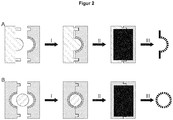
- a predetermined shape is replicated by casting with the photopolymerizable mixture (soft lithography, pour-and-cure method).
- the photopolymerizable mixture is poured into a mold which has the desired structural features, irradiated with light in the mold and cured.
- the corresponding molds can be made available using various manufacturing methods, including soft lithography, injection molding, milling and 3D printing.
- the photopolymerizable mixture is used in a laser-based 3D printing process for high-resolution structuring, such as stereolithography (SLV) or laser direct writing.
- SLV stereolithography
- the photopolymerization takes place in a highly site-specific manner directly in the mixture according to the invention.
- the basis for this is the use of a laser, which means that the mixture is only exposed at very specific points and polymerized only there.
- a three-dimensional framework structure is created.
- the unpolymerized mixture is removed by washing and the polymeric framework structure is thus exposed. With this method, resolutions down to the nanometer range are possible.
- structuring takes place by means of a 3D printing process.
- the 3D printing process can be injection or extrusion based. Such methods are known to the person skilled in the art and have already been established for many plastics and hydrogels.
- the photopolymerizable mixture according to the invention is transferred to a cartridge and then printed to the desired shape. After a layer has been successfully printed, the photopolymerizable mixture is cured by exposure to light.
- Complex scaffolding structures are built up successively by layer-by-layer printing. The resolution depends on the needle used and is in the macro to micrometer range.
- step (A) of the preferred method for producing a nano- and / or microstructured polymer molded body a mold with nano- and / or microstructures is provided.
- the shape is not particularly limited as long as it is suitable for the solvent-free polymerizable mixture to be injected into the shape.
- a structural element with a length dimension is under a nanostructure understood in the nanometer range (1.0 to ⁇ 1000 nm).
- a microstructure is a structural element with a length dimension in the micrometer range (1.0 to ⁇ 1000 ⁇ m).
- the shape preferably has nano- and / or microstructures with length dimensions of 10 nm to 900 ⁇ m, particularly preferably 100 nm to 100 ⁇ m, particularly preferably 500 nm to 10 ⁇ m.
- the shape in addition to the nano and / or microstructures, can also have structures with larger length dimensions.
- a structural element is already considered to be a nano- or microstructure if one of the length dimensions (height, width, length) of the structural element has a value in the nanometer or micrometer range.
- the shape preferably has structural elements, of which all the length dimensions (height, width, length) are in the nano or micrometer range.
- the shape of the nano and / or microstructures is not subject to any particular restriction according to the invention.
- the shape has nano and / or microstructures in the form of one or more depressions.
- the depression / depressions can have, for example, a depth of 0.1 ⁇ m to 1000 ⁇ m, preferably 10 ⁇ m to 500 ⁇ m, particularly preferably 100 ⁇ m to 500 ⁇ m.
- the width of the depressions can be, for example, 0.1 ⁇ m to 2 mm, preferably from 10 ⁇ m to 1000 ⁇ m, particularly preferably from 100 ⁇ m to 1000 ⁇ m.
- the length of the wells can vary; length dimensions of the depressions from 0.1 ⁇ m to 50 mm, preferably from 100 ⁇ m to 20 mm, particularly preferably from 500 ⁇ m to 20 mm, are possible.
- the shape may have nano and / or microstructures in the form of one or more protrusions.
- the projection (s) can for example have a height of 10 nm to 500 ⁇ m, preferably 0.1 ⁇ m to 100 ⁇ m, particularly preferably 5 ⁇ m to 50 ⁇ m.
- the width of the projections can be, for example, 10 nm to 100 ⁇ m, preferably from 0.1 ⁇ m to 50 ⁇ m, particularly preferably from 1 ⁇ m to 10 ⁇ m.
- the length of the protrusions can vary; length dimensions of the projections from 10 nm to 100 ⁇ m, preferably from 0.1 ⁇ m, are possible up to 50 ⁇ m, particularly preferably from 1 ⁇ m to 10 ⁇ m.
- the shape has a plurality of projections with a width of 1 ⁇ m to 500 ⁇ m, preferably of 1 ⁇ m to 100 ⁇ m, particularly preferably of 1 ⁇ m to 10 ⁇ m.
- the length of the projections is not restricted and can be, for example, from 1 ⁇ m to 500 ⁇ m, preferably from 1 ⁇ m to 10 ⁇ m.
- the width of the projections is particularly preferably approximately equal to the length of the projections. "About" means that the width is 0.9 to 1.1 times, preferably 0.99 to 1.01 times the length.
- the projections particularly preferably have a rounded, for example an elliptical or circular, cross section.
- the shape has a depression in the form of a micro-half channel.
- the micro-half channel can have a rectangular cross section, possibly with rounded edges, or preferably a round cross section, for example a semi-elliptical or semi-circular cross section.
- the length of the micro-half channel is preferably 5 to 50 mm, particularly preferably 10 to 30 mm.
- the width of the micro-half channel is preferably 0.05 to 3 mm, particularly preferably 0.5 to 2 mm.
- the depth of the micro-half channel is preferably 0.1 to 900 ⁇ m, particularly preferably 100 to 500 ⁇ m.
- the protrusions described above which can be suitable for producing pores, are introduced into the micro-half channel.
- Such a shape allows molded articles with microchannel structures with pores to be produced in the wall of the microchannel.
- the method according to the invention can thus be used to produce an artificial blood vessel with diverse fields of application in industry and research.
- the mold used in the process according to the invention can be constructed in several parts, preferably in two parts.
- “Multi-part” / "two-part” here means that the shape is composed of several / two parts.
- the nano- and / or microstructured polymer molded body can be removed from the mold in a simple manner by disassembling the mold.
- the different parts of the multi-part form do not necessarily have to be connected to one another in steps (C) and (D).
- one or more parts of the mold can be combined to form an outer part of the mold, wherein one or more parts of the mold can be combined to form an inner part of the mold without the outer and inner parts being connected to one another.
- an inner part of the mold may have an elongated shape and extend inside the outer part of the mold.
- some or all of the shape is at least partially transparent to UV / VIS radiation. If the form is in several parts, one or more parts of the form can be at least partially transparent to UV / VIS radiation. If the shape has an inner and one (or more) outer part, the inner part can, for example, be at least partially transparent to UV / VIS radiation. In this case, step (D) can take place in that the inner part of the mold is irradiated from the outside with UV / VIS light.
- the UV / VIS-permeable inner part guides the UV / VIS radiation into the interior of the mold, in which the solvent-free mixture polymerizes out by the action of the UV / VIS radiation.
- a suitable inner part of the mold can be, for example, a glass rod.
- Suitable materials that are at least partially transparent to UV / VIS radiation which the form or parts thereof can be made of include glass, polydimethylsiloxane (PDMS), polymethyl methacrylate (PMMA), polycarbonate (PC), polyethylene (PE), polypropylene (PP), polyvinyl chloride (PVC), polyamide (PA), polyimide CPI), polyethylene terephthalate (PET), polyethylene terephthalate glycol (PETG) and cycloolefin copolymers (COC), with PDMS, PMMA, COC and glass being preferred.
- PDMS polydimethylsiloxane
- PMMA polymethyl methacrylate
- PC polycarbonate
- PE polyethylene
- PP polypropylene
- PVC polyvinyl chloride
- PA polyamide
- PA polyimide CPI
- PET polyethylene terephthalate
- PETG polyethylene terephthalate glycol
- COC cycloolefin copolymers
- the functionalized molded body can be removed from the mold particularly easily after photopolymerization has taken place. This reduces the risk of damage to the functionalized molded body.
- a coating can increase the solvent resistance of the mold to the polymerizable mixture.
- the anti-adhesive material is preferably a perfluorinated polymer, for example polytetrafluoroethylene (PTFE), or is made of self-assembling monolayers (SAM), such as.
- PTFE polytetrafluoroethylene
- SAM self-assembling monolayers
- Other suitable anti-adhesive coatings include Liquid Infused Substrate (LIS), Slippery Liquid Infused Porous Substrate (SLIPS) and polysiloxane surfaces.
- a step of degassing the polymerizable mixture can optionally be carried out.
- degassing can be done by applying a vacuum. The risk of bubble-shaped gas inclusions can be minimized by degassing.
- the mold or a part thereof is made from a water-soluble polymer.
- Suitable water-soluble polymers are, for example, polyvinyl alcohol (PVA), butenediol-vinyl alcohol copolymer (BVOH), polyethylene glycol diacrylate (PEGDA), with PVA and BVOH being preferred.
- PVA polyvinyl alcohol
- BVOH butenediol-vinyl alcohol copolymer
- PEGDA polyethylene glycol diacrylate
- the preferred step (E) of the demolding takes place by dissolving the Mold / of the molded part in an aqueous solvent or in water.
- other materials suitable for the mold basically include all dimensionally stable materials which are suitable for the formation of nano- or microstructures.
- these include in particular SU-8® (photoresist from Microchem Corp.), Ormocer®, IP photoresist (IP-Dip, IP-L 780, IP-G 780, IP-S), AZ® photoresist (AZ® MiR 701, AZ® 5214 AZ® 9260; IP and AZ® photoresists are available from Nanoscribe), pentaerythritol triacrylate (PETA), polyether ether ketone (PEEK), polytetrafluoroethylene (PTFE), acrylonitrile-butadiene-styrene copolymers (ABS), Polycaprolactone (PCL), polylactide (PLA), polyglycolide (PGA), with SU-8®, IP photoresists, PETA, PTFE and PEEK being preferred.
- SU-8® photoresist from Microchem Corp.
- step (C) the polymerizable mixture is introduced into the mold.
- the introduction is not subject to any particular restriction. It is preferably introduced by injection.
- the introduction can take place, for example, by pouring in with a pipette, manual injection with a syringe, by injection with a screw through a nozzle, such as in the injection molding of thermoplastics, or by injection with a plunger, with a view to the production of large quantities by means of injection Snail or piston is preferred.
- the preferred injection (C) is carried out under a pressure of 1 to 2000 bar, particularly preferably 1 to 100 bar, particularly preferably 1 to 10 bar. With such an injection pressure, the mold can be completely filled by the mixture without the mold being subjected to too great a load or even being destroyed.
- the polymerizable mixture preferably has a temperature of 10 to 40 ° C., particularly preferably 15 to 35 ° C., particularly preferably 18 to 30 ° C. At such a temperature, polymerizable mixture has favorable rheological properties which facilitate the process of introduction / injection.
- the duration of step (C) is not particularly limited. With regard to industrial production, a short duration is advantageous.
- the duration of step (C) is preferably 1 s to 30 min, particularly preferably 1 s to 5 min, particularly preferably 1 s to 60 s.
- the method for producing a functionalized polymer molded body further comprises a step (E) of demolding, in which the polymer molded body is removed from the mold.
- Step (E) can be followed by a step of modifying (F).
- the step of polymerizing (D) is followed by a step of modifying (F) the polymer surface.
- a molecule is covalently bound to the polymer surface by a modification. Due to the functionalization, it is possible to modify the surface of the polymer / the molded polymer body, for example with biomolecules such as sugars, DNA, RNA and / or peptides / proteins (i.e. to bind them covalently to the surface).
- a polymer or modified polymer molded body modified in this way is particularly suitable for an array for pharmacological high-throughput screening.
- the step of modifying takes place in a location-specific manner, that is to say only at selected points / regions of the polymer surface.
- a location-specific manner that is to say only at selected points / regions of the polymer surface.
- This can be done, for example, with a photolithographic method, such as. B. by thiol-in chemistry.
- alkyne-modified polymer surfaces can only be modified highly selectively at the desired locations.
- different molecules can be covalently bound to the polymer surface by means of targeted exposure cycles (laser, photomask). Among other things, this allows simple and inexpensive production of improved cell culture materials, microarrays, surface coatings and electronic components.
- the (site-specific) modification step is particularly preferably carried out with a hydrophilic, preferably superhydrophilic coating and / or with a hydrophobic, preferably superhydrophobic coating.
- Superhydrophobic coatings serve, for example, as antifouling coatings or are used as droplet microarrays in the case of site-specific modifications.
- the present invention relates to a functionalized polymer obtainable from the process according to the invention.
- the functionalized polymer is a functionalized nano- and / or microstructured polymer molded body.
- the molded body has a microchannel with pores in the wall of the microchannel.
- the wall thickness is preferably 10 ⁇ m to 50 ⁇ m.
- the channel diameter is preferably 50 to 1000 microns.
- the porosity is preferably 10 ° to 5 ⁇ 10 8 pores / cm 2 , particularly preferably 10 3 to 10 6 pores / cm 2 .
- the arithmetically averaged pore diameter is preferably 0.5 to 10 ⁇ m.
- a polystyrene (PS) polymer (styrene prepolymer 1) was produced under the following conditions.
- the styrene prepolymer 1 was obtained by a radical polymerization of styrene, which was initiated by means of the thermal radical initiator AIBN Azobis (isobutyronitrile).
- Styrene prepolymer 2 (a polystyrene-polybutadiene-polystyrene (SBS) block copolymer with a mass fraction of 30% by weight of styrene) was purchased commercially from Sigma-Aldrich. (SBS block copolymers with mass fractions of styrene ranging from 23 to 96% by weight are also available from the same manufacturer.)
- SBS polystyrene-polybutadiene-polystyrene
- the polymerization was carried out under the following conditions: The polymerizable mixture was placed on a surface coated with silicone resin (PDMS) and purchased by irradiation with UV / VIS light (UV / VIS light source: OSRAM Ultra Vitalux 300W E27, manufacturer: Osram Licht AG) at: Conrad Electronic (Germany)) cured. The cured polymer was then chemically characterized.
- PDMS silicone resin
- polystyrene was produced under the same conditions. (namely from a mixture consisting of 56.66% by weight of styrene prepolymer 1, 42.49% by weight of styrene monomer and 0.85% by weight of photoinitiator (IRGACURE® 819). The polystyrene was cured by Irradiate with UV / VIS light.
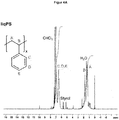
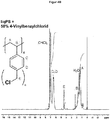
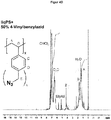
- NMR spectra of the products obtained are in the Figures 4A to 4D shown.
- a characteristic peak E was also obtained for the cured chlorine- or azide-functionalized polymer, which can be attributed to the methylene unit (-CH 2 -) of the chlorine (1) or azide- (2) functionalized building block is.
- this demonstrates covalent incorporation of the chlorine (1) or azide (3) functionalized monomer into the polystyrene polymer.
- a quantitative conversion of the monomers can be assumed, since no or only slight monomer residues (styrene, 4-vinylbenzyl chloride, 4-vinylbenzyl azide) have it proven.
- the proportion of functionalized styrene monomer in the polymerizable mixture enables the degree of functionalization to be modulated, as can be seen by comparing 50% by weight and 100% by weight of the chlorine-functionalized monomer 1. As expected, doubling the amount of chloride added doubles the integral obtained.
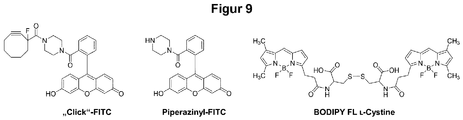
- the polymer which was obtained, inter alia, from the monomer mixture consisting of 50% by weight of chlorine-functionalized monomer 1 and 50% by weight of styrene monomer, was as in Figure 5 shown modified with a piperazinyl FITC residue.
- a major advantage over other functionalized styrene monomers is that 4-vinylbenzyl chloride can be purchased commercially and does not have to be chemically modified before it is installed via photopolymerization. This enables functionalized, polystyrene-based polymers to be produced very quickly and easily, which can be further functionalized chemically in the next step.
- the polymerization was carried out under the following conditions: The polymerizable mixture was applied to a silicone resin (PDMS) -coated surface by irradiation with UV / VIS light (product name: OSRAM Ultra Vitalux 300W E27, manufacturer: Osram Licht AG, purchased from: Conrad Electronic ( Germany) cured (analogous to above) The cured polymer was then chemically characterized
- the polymer with isothiocyanate-functionalized monomer 2, the polymer with azide-functionalized monomer 3 and the polymer with alkyne-functionalized monomer 4 were in each case as in Figures 8 . 9 and 10 shown modified.
- Isothiocyanate groups were further functionalized via the reaction with nucleophiles (here secondary amine: piperzinyl-FITC to form a thiourea), azide groups via a voltage-induced azide-alkyne click reaction (SPAAC) using an alkyne (here: "click” -FITC), alkyne functionalized via thiol-in-click reaction using a thiol (here: BODIPY FL L-cystine + reducing agent dithioerythritol).
- nucleophiles here secondary amine: piperzinyl-FITC to form a thiourea
- SPAAC voltage-induced azide-alkyne click reaction
- alkyne here: "click” -FITC
- alkyne functionalized via thiol-in-click reaction using a thiol here: BODIPY FL L-cystine + reducing agent dithioerythritol
- the homogeneous fluorescence signal indicates a homogeneous distribution of the functional groups on the polymer surface.
- the Figures 7 to 10 were obtained as follows: HI PLAN I 10x / 0.22 DRY lens. The evaluation was carried out by the Leica LAS X (scale bar: 250 ⁇ m).
- Microscope used Leica DM IL LED (manufacturer: Leica Microsystems GmbH) Objective used: objective HI Plan I 10x / 0.22 DRY Software used: LAS X (manufacturer: Leica Microsystems GmbH) Scale bar: 250 ⁇ m
Landscapes
- Chemical & Material Sciences (AREA)
- Health & Medical Sciences (AREA)
- Chemical Kinetics & Catalysis (AREA)
- Organic Chemistry (AREA)
- Polymers & Plastics (AREA)
- Medicinal Chemistry (AREA)
- Oral & Maxillofacial Surgery (AREA)
- Mechanical Engineering (AREA)
- Engineering & Computer Science (AREA)
- Thermal Sciences (AREA)
- Physics & Mathematics (AREA)
- Toxicology (AREA)
- Treatments Of Macromolecular Shaped Articles (AREA)
Abstract
Description
- Die vorliegende Erfindung betrifft ein lösungsmittelfreies polymerisierbares Gemisch, ein Verfahren zur Herstellung eines funktionalisierten Polymers aus dem lösungsmittelfreien polymerisierbaren Gemisch und ein aus dem Verfahren erhältliches funktionalisiertes Polymer.
- Funktionalisierte Polymere und nano-/mikrostrukturierte Formkörper aus solchen funktionalisierten Polymeren finden in verschiedenen Bereichen der Technik Anwendung.
- Zu nano-/mikrostrukturierten Polymer-Formkörpern zählen unter anderem poröse Membranen sowie Formkörper mit komplexeren Strukturen für mikrofluidische Anwendungen (z. B. Filtereinheiten, texturierte Oberflächen, Ventile, Nadeln), welche unter anderem im Bereich der Biowissenschaften (z. B. Gerüststrukturen zur Gewebezüchtung und für 3D-Zellkulturen) oder in mikrooptischen Anwendungen Einsatz finden.
- Als einfaches Beispiel für nano-/mikrostrukturierte Polymer-Formkörper können poröse Polymermembranen genannt werden. Poröse Membranen finden eine breite Anwendung in Industrie und Forschung. Ein Einsatzgebiet von besonderer Bedeutung ist die Verwendung von porösen Polymermembranen für mechanische Trennverfahren (Filtration). Bei Filtrationsprozessen werden häufig Membranen mit Porengrößen von 0,1 µm bis 0,1 mm eingesetzt, um verschiedene Stoffe aus einem Gemisch abzutrennen. Mithilfe poröser Membranen ist es zudem möglich, Wasser aufzureinigen. Je nach Porengröße spricht man von Mikrofiltration (Porengröße: 100 nm bis 10 µm), Ultrafiltration (Porengröße: 1 nm bis 100 nm) oder Nanofiltration (Porengröße: 0,5 nm bis 10 nm).
- Auch in der biologischen Forschung finden poröse Membranen Anwendung. In der Zellbiologie werden Membranen mit einer Porengröße von 1 bis 10 µm als Zellkultur-Einsätze (beispielsweise für transwell-Assays) zur Untersuchung von Zell-Zell-Interaktionen oder für Zellmigrations-Assays eingesetzt. Ein Themengebiet, das zur Zeit im Mittelpunkt des Interesses zahlreicher Forschungsgruppen steht, ist die Gewebezüchtung (tissue engineering). Deren Ziel ist die Entwicklung biologischer Gewebe als Ersatzgewebe oder als Grundlage für in vitro Systeme für Hochdurchsatz-Screenings (high throughput screening) im Bereich der Pharmaforschung oder der Grundlagenforschung. Das tissue engineering befasst sich hierfür mit dreidimensionaler Zellkultur, die in zahlreichen Anwendungen auf porösen Membranen basiert (z. B. transwell-Systeme oder verschiedene organ-on-a-chip-Systeme).
- Geeignete Polymermaterialien für die im Stand der Technik verwendeten Membranen sind beispielsweise Polyethylen (PE), Polyethylenterephthalat (PET), Polycarbonat (PC) oder Polytetrafluorethylen (PTFE).
- Nano- bzw. Mikrostrukturen können beispielsweise mithilfe des lonenspurätzens (ion track etching) erzeugt werden. Bei diesem Verfahren werden Polymerfolien zunächst mit beschleunigten Schwerionen beschossen. Durch den Beschuss erfolgt entlang der Flugbahn des Ions eine lokale Beschädigung der Folie. Das Folienmaterial wird anschließend durch nasschemisches Ätzen entfernt, wodurch Poren gebildet werden. Porosität, Porengröße und Porengeometrie können durch geeignete Wahl der Parameter für den lonenbeschuss und das Ätzen beeinflusst werden. Das lonenspurätzen wird auch im industriellen Maßstab eingesetzt. Zudem kann es beispielsweise zur Herstellung von organ-on-a-chip-Systemen verwendet werden. Derartige Systeme verfügen beispielsweise über einen gekrümmten, mikrofluidischen Kanal, der ein artifizielles Blutgefäß bildet (Ivannikov, D. In vitro Rekonstruktion verschiedener vaskulärer Barrieren. Cuvillier Verlag: Göttingen, 2016; Kappings, V-. Grün, C., Ivannikov, D., Hebeiß, I., Kattge, S., Wendland, I., Rapp, B.E., Hettel, M., Deutschmann, O., Schepers, U., vasQchip: A Novel Microfluidic, Artificial Blood Vessel Scaffold for Vascularized 3D Tissues, Advanced Materials Technologies, 2018; sowie
EP 2 679 666 A1 ). Somit können mithilfe des Ionenspurätzens gekrümmte Strukturen mit Poren erzeugt werden. - Zur Herstellung gekrümmter poröser Formkörper, die beispielsweise in organ-on-a-chip-Systemen eingesetzt werden können, kann die SMART-Technologie verwendet werden (Giselbrecht, S., Gietzelt, T., Gottwald, E., Trautmann, C., Truckenmüller, R., Weibezahn, K. F., und Welle, A., 3D tissue culture substrates produced by microthermoforming of pre-processed polymer films, Biomed Microdevices 2006, 8, 191-199). Die SMART-Technologie schließt einen Schritt des Umformens einer Polymerfolie zu einem Mikrokanal ein, wobei die mindestens eine Pore nach dem Umformen in die Folie eingebracht wird. Die mindestens eine Pore kann durch lonenspurätzen erzeugt werden.
- Nachteile der SMART-Technologie bestehen unter anderem darin, dass der Durchmesser des Mikrokanals abhängig von der Formtemperatur und dem Formdruck beim Umformen ist und durch minimale Änderungen dieser Parameter bereits erheblich variieren kann.
- Zudem besteht ein Nachteil des lonenspurätzens, welches üblicherweise im Rahmen der SMART-Technologie zum Einsatz kommt, darin, dass eine exakte Strukturierung damit nicht möglich ist. Wie
Figur 1A entnommen werden kann, ist die Anordnung/Verteilung der Poren, bedingt durch den Schwerionenbeschuss, nicht gleichmäßig. Zudem sind die Porengeometrien beim lonenspurätzen schwer kontrollierbar. Darüber hinaus wird die Porengröße durch die Ätzkonditionen bestimmt. - Die Kontrolle der Parameter, welche die Struktur des vorstehenden gekrümmten Formkörpers mit Poren beeinflussen, erweist sich in der Praxis oft als sehr schwierig. Die Reproduzierbarkeit der Kanaldurchmesser und Porengrößen ist daher mit erheblichem Arbeitsaufwand verbunden. Wie bereits erwähnt, ist die Verteilung der Poren durch den Schwerionenbeschuss bestimmt und ist nicht gleichmäßig. Dies kann dazu führen, dass unter Umständen Poren fusionieren und so größere Poren als erwünscht generiert werden (siehe
Figur 1A ). An anderen Stellen sind deutlich weniger Poren vorhanden, was sich in der Anwendung in variierender Diffusion je nach Bereich des Kanals eines artifiziellen Blutgefäßes zeigt. Zudem haben die durch lonenspurätzen erzeugten Poren eine konische Form (sieheFigur 1B ), was von Nachteil sein kann. - Eine weit verbreitete Technologie zur Herstellung von Formkörpern aus Polymeren ist das Spritzgießen. Hier können jedoch nur Formkörper mit Dimensionen von 100 µm oder mehr hergestellt werden. Eine Unterschreitung dieser Grenze ist kaum möglich, da mit hohen Einspritzdrücken gearbeitet wird, welche die Gussform bei kleineren Strukturen zerstören würde. Da außerdem bei diesem Verfahren mit hohen Temperaturen gearbeitet wird, ist das Spritzgießen auch mit Hinblick auf eine Funktionalisierung des Polymermaterials eingeschränkt. Eine Funktionalisierung der Oberfläche eines durch Spritzguss erhaltenen Formkörpers kann nur durch aufwändige zusätzliche Schritte erreicht werden.
- Die Herstellung von Formkörpern mit kleineren Dimensionen ist durch Stereolithografie oder durch Laserdirektschreiben (direct laser writing) möglich. Hierbei werden photopolymerisierbare Monomere verwendet. Durch einen Laser wird der Formkörper Schicht für Schicht in der Monomerlösung durch Polymerisation gebildet. Bei diesem Verfahren sind Auflösungen im Nanometerbereich möglich, jedoch eignet sich das Laserdirektschreiben nicht für die Serienfertigung. Formkörper mit Funktionalisierung des Polymermaterials sind bisher kommerziell nicht erhältlich. Zudem sind Laserdirektschreiben und Stereolithografie sehr zeitintensiv und teuer und eignen sich daher nicht für die Serienproduktion.
-
WO 2017/092859 A1 beschreibt ein Verfahren zur Herstellung mikrostrukturierter Polymerkörper. Mit diesem Verfahren können jedoch keine porösen gekrümmten Folien oder Mikrokanäle erhalten werden. Außerdem werden hier Silikone, die für eine Anwendung als artifizielles Blutgefäß mit Nachteilen verbunden sind, sowie Thermoplasten verwendet. - Weitere Verfahren zur Herstellung poröser Membranen sind Elektrospinning oder photolithographische Prozesse. Letztere sind jedoch in der Auswahl der Materialien stark eingeschränkt.
- Neben den vorstehend genannten Nachteilen in Bezug auf Verteilung, Größe und Geometrie der Poren sowie den Schwierigkeiten bei den Formprozessen ist ein weiterer Nachteil, den alle bisherigen Methoden zur Herstellung poröser Membranen teilen, dass oft nur herkömmliche Polymere eingesetzt werden können. Die Erzeugung funktionalisierter Oberflächen ist daher nur schwer möglich.
- Eine Modifikation oder Funktionalisierung der Oberfläche eines Polymers bzw. eines Formkörpers aus einem Polymer (Polymer-Formkörper) ist für viele Anwendungsgebiete notwendig. Im Bereich des tissue engineering und der 3D-Zellkultur können modifizierte Oberflächen beispielsweise das Zellwachstum beeinflussen. Im Gebiet der Stammzellkultur kann durch Modifikation der Oberflächen die Zelldifferenzierung gesteuert werden. Auch bei den vorstehend genannten Trennverfahren (beispielsweise Filtration) spielen Oberflächenmodifikationen eine Rolle, da durch diese die Trennleistung signifikant erhöht beziehungsweise beeinflusst werden kann.
- Mit herkömmlichen Verfahren ist die Erzeugung einer Funktionalisierung der Oberflächen nur erschwert möglich und benötigt mehrere Verfahrensschritte vor oder nach der Erstellung der Struktur. Üblicherweise sind für die Strukturierung (Formgebung) bzw. die Polymerisierung einerseits und die Funktionalisierung andererseits mindestens zwei separate Verfahrensschritte erforderlich.
- Beispielsweise kann zunächst eine Polymerisierungsreaktion durchgeführt werden und eine chemische Funktionalisierung sich daran anschließen (Post-Funktionalisierung). Dabei kann den Polymeren vor der Funktionalisierung über die vorstehend erwähnten Verfahren eine bestimmte Form/Struktur verliehen werden. Eine anschließende typische Oberflächenmodifikation stellt beispielsweise die Plasmabehandlung dar. Das am häufigsten verwendete Gas zur Oberflächenaktivierung ist Sauerstoff. Durch die Plasmabehandlung lassen sich polare Gruppen auf der Oberfläche anbringen, welche die Hydrophilie erhöhen und anschließend weiter modifiziert werden können. Neben Hydroxylgruppen entstehen aber auch Carboxyl-, Aldehyd-, Keto- oder Epoxygruppen, weswegen die Oberflächenfunktionalisierung durch Plasmabehandlung unspezifisch ist. Mit neueren, aufwändigeren Verfahren, die auf der gepulsten Plasmaaktivierung beruhen, können Monofunktionalisierungen mit beispielsweise Carboxyl-, Hydroxyl-, Amino- oder Bromidgruppen erzeugt werden. Eine weitere Möglichkeit für die selektive Oberflächenmodifikation beruht auf der Silanchemie. Die durch Plasmaaktivierung erzeugten Hydroxylgruppen auf der Polymeroberfläche können durch funktionalisierte Silan-Modifizierer, wie z. B. 3-Aminopropyltriethoxysilan (APTES), weiter modifiziert werden. Nachteile dieser Verfahren bestehen darin, dass sie sehr aufwändig sind, und darin, dass Aminosilan-funktionalisierte Oberflächen häufig nur eine geringe Stabilität aufweisen, da sie in wässrigem Milieu leicht hydrolysieren.
- Als Alternative zur Post-Funktionalisierung kann die chemische Funktionalisierung des Polymers direkt während des Polymerisationsvorgangs erreicht werden (in-situ-Funktionalisierung). Durch den Einsatz funktionalisierter Monomere im Rahmen einer Lösungsmittelpolymerisation erfolgt ein statistischer Einbau der funktionellen Gruppe ins Polymerrückgrat. Um beispielsweise funktionalisiertes Polystyrol (PS) herzustellen, wird neben Styrol zusätzlich ein kleiner prozentualer Anteil an funktionalisiertem Styrol verwendet und die Monomerlösung beispielsweise durch die Zugabe eines Radikalstarters polymerisiert. Ein Vorteil dieser Methode liegt darin, dass die Polymerisation und Funktionalisierung zu einem einzigen Arbeitsschritt zusammengefasst sind. Allerdings wird in diesem Verfahren ein Lösungsmittel verwendet, welches entfernt werden muss. Somit können mit vorstehendem Verfahren die Formgebung (Strukturierung) des Polymers und Funktionalisierung nicht zusammengefasst werden. Aufgrund der Gegenwart eines Lösungsmittels kann die Formgebung erst in einem sich anschließenden separaten Verarbeitungsschritt (Spritzgießen, Heißprägen, Fräsen, Thermoformen etc.) vorgenommen werden.
- Eine Aufgabe der vorliegenden Erfindung besteht darin, ein Gemisch, woraus ein funktionalisiertes Polymer auf einfache Weise hergestellt werden kann, sowie ein entsprechendes Verfahren zur Herstellung des funktionalisierten Polymers bereitzustellen.
- Die vorstehende Aufgabe wird durch die in den Ansprüchen gekennzeichneten Ausführungsformen gelöst.
- In einem Aspekt betrifft die vorliegende Erfindung ein lösungsmittelfreies polymerisierbares Gemisch, welches mindestens ein Styrol-Monomer, mindestens ein Styrol-Vorpolymer und mindestens einen Photoinitiator umfasst, wobei das Gemisch eine Viskosität von 100 bis 10 000 mPa·s aufweist, zumindest ein Teil des mindestens einen Styrol-Monomers und/oder zumindest ein Teil des mindestens einen Styrol-Vorpolymers eine Funktionalisierung aufweist und das gewichtsgemittelte Molekülgewicht des Vorpolymers Mw 1500 bis 400 000 g/mol beträgt.
- Gemäß der vorliegenden Erfindung dient allein das mindestens eine Styrol-Monomer als Lösungsmittel für das mindestens eine Styrol-Vorpolymer, d. h. das erfindungsgemäße polymerisierbare Gemisch ist lösungsmittelfrei. Dies bedeutet im Rahmen der vorliegenden Erfindung, dass ein (anderes) Lösungsmittel in einer Konzentration von höchstens 1000 ppm, vorzugsweise höchstens 10 ppm, vorzugsweise höchstens 1 ppm, bezogen auf die Gesamtmasse des Gemisches, enthalten ist, wobei unter einem solchen (anderen) Lösungsmittel ein solches verstanden wird, das imstande ist, zumindest eines von dem Styrol-Monomer, dem Styrol-Vorpolymer und dem Photoinitiator zumindest teilweise zu lösen und in einem Polymerisationsschritt nicht umgesetzt (das heißt, ein Lösungsmittel geht in einer Polymerisationsreaktion keine chemische Reaktion ein). Dadurch, dass in dem polymerisierbaren Gemisch erfindungsgemäß kein solches (anderes) Lösungsmittel enthalten ist, muss dieses nach dem Polymerisationsschritt nicht abgetrennt werden. Dadurch kann aus dem erfindungsgemäßen Gemisch besonders einfach und mit nur wenigen Verfahrensschritten das erfindungsgemäße funktionalisierte Polymer hergestellt werden. Das Gemisch kann in eine gewünschte Form gebracht und polymerisiert werden. So kann ein funktionalisiertes Polymer bzw. ein funktionalisierter Polymerformkörper erhalten werden, ohne dass ein separater Formgebungsschritt erforderlich ist.
- Das erfindungsgemäße Gemisch ist polymerisierbar, insbesondere durch UV/VIS-Licht polymerisierbar. Das heißt, dass durch Einwirkung von UV/VIS-Strahlung eine Polymerisationsreaktion ausgelöst wird, worin das Gemisch zu dem erfindungsgemäßen funktionalisierten Polymer umgesetzt wird.
- Der Begriff "UV/VIS-Licht" bzw. der Begriff "UV/VIS-Strahlung" bezeichnet erfindungsgemäß elektromagnetische Strahlung mit einer Wellenlänge von 200 bis 750 nm.
- Das mindestens eine Styrol-Monomer weist eine Styrol-Grundstruktur auf und kann gegebenenfalls substituiert sein, beispielsweise mit einer C1 bis C4-Alkylgruppe. Vorzugsweise ist das Styrol-Monomer (abgesehen von der gegebenenfalls vorhandenen Funktionalisierung) unsubstituiert. Ein unsubstituiertes Styrol-Monomer ist (abgesehen von der gegebenenfalls vorhandenen Funktionalisierung) mit Styrol identisch.
- Das mindestens eine Styrol-Vorpolymer weist eine Polystyrol-Grundstruktur, eine Block-Copolymer-Grundstruktur Polystyrol-Polybutadien-Polystyrol (SBS) bzw. Polystyrol-Polyisopren-Polystyrol (SIS) auf, wobei eine Polystyrol-Grundstruktur bevorzugt ist. Ist das Vorpolymer SBS bzw. SIS, beträgt der Massenanteil der Styrol-Wiederholungseinheiten vorzugsweise 5 bis 45 Gew.-%, besonders bevorzugt 15 bis 40 Gew.-%. Der Styrol-Anteil kann mittels UV-Spektroskopie über die Extinktion der Bande bei 261 nm und Kalibrierung mit einem Polystyrol-Standard ermittelt werden. Bei Kenntnis des Styrol-Anteils wird der entsprechende Anteil des Butadiens bzw. Isoprens berechnet. Alternativ kann die Zusammensetzung des Copolymers auch über NMR-Spektroskopie bestimmt werden. Ein Teil oder die Gesamtheit der Wiederholungseinheiten des Styrol-Vorpolymers kann/können gegebenenfalls substituiert sein, beispielsweise mit einer C1 bis C4-Alkylgruppe. Dabei ist bevorzugt, dass die Butadien- bzw. Isopren-Wiederholungseinheiten unsubstituiert sind. Vorzugsweise ist das Styrol-Vorpolymer (abgesehen von der gegebenenfalls vorhandenen Funktionalisierung) unsubstituiert. Sofern eine Funktionalisierung vorhanden ist, sind die funktionellen Gruppen vorzugsweise an die Styrol-Wiederholungseinheiten gebunden.
- Gemäß der vorliegenden Erfindung weist zumindest ein Teil des mindestens einen Styrol-Monomers und/oder zumindest ein Teil des mindestens einen Styrol-Vorpolymers des lösungsmittelfreien polymerisierbaren Gemisches eine Funktionalisierung auf.
- Ein funktionalisiertes (Vor)polymer weist ein Polymer-Grundgerüst auf, wobei zumindest ein Teil der Wiederholungseinheiten des Polymer-Grundgerüstes funktionelle Gruppen (Funktionalisierungen) aufweisen. Erfindungsgemäß kann jede Wiederholungseinheit funktionalisiert sein, wobei vorzugsweise nur ein Teil der Wiederholungseinheiten des (Vor)polymers funktionalisiert ist.
- Gemäß einer bevorzugten Ausführungsform des lösungsmittelfreien polymerisierbaren Gemisches der vorliegenden Erfindung weist zumindest ein Teil des mindestens einen Styrol-Monomers eine Funktionalisierung auf, wobei das mindestens eine Styrol-Vorpolymer keine Funktionalisierung aufweist. In diesem Fall umfasst das mindestens eine Styrol-Monomer ein Styrol-Monomer mit Funktionalisierung und kann darüber hinaus ein Styrol-Monomer ohne Funktionalisierung umfassen. Vorzugsweise umfasst das mindestens eine Styrol-Monomer sowohl ein Styrol-Monomer mit Funktionalisierung als auch ein Styrol-Monomer ohne Funktionalisierung. Es ist besonders bevorzugt, dass das mindestens eine Styrol-Monomer aus (mindestens) einem Styrol-Monomer mit Funktionalisierung und (mindestens) einem Styrol-Monomer ohne Funktionalisierung besteht.
- Gemäß einer weiteren bevorzugten Ausführungsform des lösungsmittelfreien polymerisierbaren Gemisches der vorliegenden Erfindung beträgt der Anteil des Styrol-Monomers mit Funktionalisierung an der Gesamtstoffmenge des mindestens einen Styrol-Monomers 0,01 bis 100 Mol-%, vorzugsweise 0,1 bis 99,9 Mol-%, besonders bevorzugt 1 bis 50 Mol-%, insbesondere bevorzugt 5 bis 20 Mol.-%.
- Gemäß einer bevorzugten Ausführungsform der vorliegenden Erfindung umfasst die Funktionalisierung des funktionalisierten Styrol-Monomers oder des funktionalisierten Styrol-Vorpolymers eine Gruppe, ausgewählt aus Chlor, Brom, Isothiocyanat, Azid, Alkin, Thiol, Alken, vorzugsweise Norbornen, Amin, Amid, Alkohol, Keton, Aldehyd, Carbonsäure, Carbonsäureester, Ether, Nitril, Nitroso, Nitro und Azo. Diese funktionellen Gruppen weisen ein hervorragendes Gleichgewicht zwischen chemischer Stabilität und Reaktivität auf und eignen sich daher besonders für weitere Funktionalisierungen. Geeignet sind insbesondere Azide für Click-Reaktionen mit Alkinen, Alkine für Click-Reaktionen mit Aziden und für Thiol-In-Reaktionen, Thiole für Thiol-In-Click-Reaktionen und für Thiol-En-Click-Reaktionen mit Norbornen, für Thiol-Maleimid-Click-Reaktionen und für reversible Oxidation unter Ausbildung von Disulfidbrücken, Norbornen für Thiol-En-Click-Reaktionen, Carbonsäuren für Peptidkupplungen, Carbonsäureester, insbesondere Aktivester, für nukleophile Acylsubstitutionen, Amine für nukleophile Additionen/Substitutionen und für Peptidkupplungen, Alkohole für nukleophile Additionen/Substitutionen sowie für Oxidationen/Reduktionen, Isothiocyanate für Reaktionen mit Nukleophilen (bspw. Alkohole und Amine) und Ketone bzw. Aldehyde für elektrophile Additionen und für Oxidationen/Reduktionen. Diese funktionellen Gruppen können durch Methoden, die dem Fachmann bekannt sind, aus Halogen-, vorzugsweise Chlor- und Brom-Gruppen, erhalten werden.
- Vorzugsweise besteht das erfindungsgemäße Gemisch aus dem mindestens einen Styrol-Monomer, dem mindestens einen Styrol-Vorpolymer und dem mindestens einen Photoinitiator sowie gegebenenfalls einem Vernetzungsmittel und gegebenenfalls einem Weichmacher. Dadurch kann sichergestellt werden, dass die Gesamtheit des Gemisches zu einem Polymermaterial umgesetzt wird, ohne dass es einer Nachbehandlung (z. B. Entfernen von Lösungsmittel) bedarf.
- Die Funktionalisierung/funktionelle Gruppe kann über eine Verknüpfungsgruppe an das Styrol-Monomer, das Styrol-Vorpolymer bzw. das Polymer-Grundgerüst des erfindungsgemäßen funktionalisierten Polymers gebunden sein. Geeignete Verknüpfungsgruppen sind beispielsweise eine C1 bis C10-Alkylengruppe, welche gegebenenfalls substituiert sein kann, vorzugsweise eine C1 bis C4-Alkylengruppe, welche gegebenenfalls substituiert sein kann. In der C1 bis C10-Alkylengruppe bzw. der C1 bis C4-Alkylengruppe können ein oder mehrere Kohlenstoffatome durch ein Heteroatom, beispielsweise S oder O, ersetzt sein. Besonders bevorzugt ist die Verknüpfungsgruppe eine Methylen-Gruppe (-CH2-), eine Methylenoxy-Gruppe (-CH2O-) oder eine Oxymethylenoxy-Gruppe (-OCH2O-).
- Ausführungen in Bezug auf das funktionalisierte Styrol-Monomer und das funktionalisierte Styrol-Vorpolymer gelten entsprechend für das funktionalisierte Polymer und umgekehrt.
- Gemäß der vorliegenden Erfindung beträgt die Viskosität des lösungsmittelfreien polymerisierbaren Gemisches 100 bis 10 000 mPa·s, besonders bevorzugt 200 bis 5000 mPa·s, insbesondere bevorzugt 300 bis 1000 mPa·s, am bevorzugtesten 450 bis 650 mPa·s. Dadurch hat das Gemisch eine besonders gute Verarbeitbarkeit. So kann es beispielsweise einfach in eine Form eingebracht werden. Insbesondere das Einbringen durch Einspritzen wird durch eine Viskosität innerhalb der vorstehend angegebenen Bereiche erleichtert.
- Die Viskosität kann bei 25 °C mit einem Viskosimeter bestimmt werden. Beispielsweise kann ein Viskosimeter BROOKFIELD DV-II + Pro (Rotationsviskosimeter) der Firma BROOKFIELD Inc. (USA) verwendet werden. Als Messparameter geeignet sind eine konstante Rotationgeschwindigkeit von 0,5 rpm und ein Probenvolumen von 1 mL.
- Das Styrol-Vorpolymer weist erfindungsgemäß ein gewichtsgemitteltes Molekülgewicht Mw von 1500 bis 400 000 g/mol, vorzugsweise 2000 bis 200 000 g/mol und besonders bevorzugt 3000 bis 150 000 g/mol auf. Sofern das Styrol-Vorpolymer eine Polystyrol-Grundstruktur aufweist, beträgt Mw vorzugsweise 1500 bis 5500, besonders bevorzugt 2500 bis 4500, insbesondere bevorzugt 3000 bis 4000 g/mol. Sofern das Styrol-Vorpolymer eine SBS-Grundstruktur aufweist, beträgt Mw vorzugsweise 10 000 bis 400 000, besonders bevorzugt 100 000 bis 200 000, insbesondere bevorzugt 130 000 bis 160 000 g/mol. Sofern das Styrol-Vorpolymer eine SIS-Grundstruktur aufweist, beträgt Mw vorzugsweise 10 000 bis 400 000, besonders bevorzugt 100 000 bis 200 000, insbesondere bevorzugt 130 000 bis 160 000 g/mol.
- Mw kann erfindungsgemäß mittels Gelpermeationschromatographie (GPC) mit Toluol als Standard bestimmt werden.
- Weiterhin beträgt das Verhältnis des Molekülgewichts des Styrol-Monomers M zum gewichtsgemittelten Molekülgewicht Mw des Styrol-Vorpolymers M/Mw vorzugsweise 6,9-10-2 bis 2,6.10-4, besonders bevorzugt 5,2·10-2 bis 5,2·10-4, insbesondere bevorzugt 3,4·10-2 bis 6,9·10-4. Innerhalb dieser Bereiche von Mw bzw. M/Mw hat das polymerisierbare Gemisch besonders günstige rheologische Eigenschaften. Dadurch kann beispielsweise nachstehend beschriebener Schritt (C) des Einbringens erleichtert werden.
- Vorzugsweise beträgt das Verhältnis der Masse des Styrol-Vorpolymers zur Masse des Styrol-Monomers in dem polymerisierbaren Gemisch 1:10 bis 10:1, besonders bevorzugt 1:5 bis 5:1, insbesondere bevorzugt 1:2,5 bis 2,5:1. Auch durch Einstellen des vorstehenden Gewichtsverhältnisses auf diese Bereiche können die rheologischen Eigenschaften des erfindungsgemäßen Gemisches positiv beeinflusst werden.
- Der Photoinitiator unterliegt erfindungsgemäß keiner besonderen Einschränkung, solange er in der Lage ist, durch Einwirken von UV/VIS-Licht eine Polymerisationsreaktion auszulösen. Es kann grundsätzlich jeder Photoinitatior, der zur Photopolymerisation von Styrol geeignet sind, verwendet werden. Der Photoinitiator kann beispielsweise Bis(2,4,6-trimethylbenzoyl)-phenylphosphinoxid (IRGACURE® 819) sein.
- Der Massenanteil des Photoinitiators an der Gesamtmasse des polymerisierbaren Gemisches beträgt vorzugsweise 0,001 bis 5 Gew.-%, besonders bevorzugt 0,01 bis 2 Gew.-%, insbesondere bevorzugt 0,10 bis 1,0 Gew.-%.
- Gemäß einer bevorzugten Ausführungsform enthält das erfindungsgemäße Gemisch ein oder mehrere Vernetzungsmittel. Grundsätzlich kann jedes Vernetzungsmittel, welches zur Vernetzung von Polystyrol bzw. von SBS oder SIS geeignet ist, verwendet werden. Vorzugsweise weist das Vernetzungsmittel eine Benzol-Grundstruktur auf und ist mit zwei Vinylgruppen substituiert (Divinylbenzol). Durch das Vernetzungsmittel können Querverbindungen zwischen linearen Polymerketten erzeugt werden, wodurch ein vernetztes funktionalisiertes Polymer erhalten werden kann. Eine derartige Vernetzung führt zu einer Erhöhung der Schlagzähigkeit, Formstabilität und Lösungsmittelresistenz des aus dem erfindungsgemäßen Gemisch erhältlichen funktionalisierten Polymers der vorliegenden Erfindung.
- Der Massenanteil des Vernetzungsmittels an der Gesamtmasse des polymerisierbaren Gemisches beträgt vorzugsweise 0,1 bis 99,9 Gew.-%, besonders bevorzugt 0,5 bis 50 Gew.-%, insbesondere bevorzugt 1,0 bis 10 Gew.-%, am bevorzugtesten 1,0 bis 5,0 Gew.-%.
- Gemäß einer bevorzugten Ausführungsform enthält das erfindungsgemäße Gemisch einen oder mehrere Weichmacher. Geeignete Weichmacher sind dem Fachmann bekannt. Dazu zählen beispielsweise Diethylphthalat und Tri-n-butylcitrat, wobei erfindungsgemäß auch davon verschiedene Weichmacher in dem Gemisch enthalten sein können. Der Massenanteil des Weichmachers an der Gesamtmasse des polymerisierbaren Gemisches beträgt vorzugsweise 0,1 bis 20 Gew.-%, besonders bevorzugt 0,5 bis 10 Gew.-%, insbesondere bevorzugt 1,0 bis 5 Gew.-%.
- In einem weiteren Aspekt betrifft die vorliegende Erfindung ein Verfahren zur Herstellung eines funktionalisierten Polymers, umfassend einen Schritt (D) des Polymerisierens des erfindungsgemäßen lösungsmittelfreien polymerisierbaren Gemisches durch Einwirkung von UV/VIS-Strahlung.
- Der Schritt des Polymerisierens unterliegt erfindungsgemäß keiner besonderen Einschränkung. Es wird durch Einwirkung von UV/VIS-Strahlung polymerisiert. Es kann jede zur Photopolymerisation geeignete UV/VIS-Strahlungsquelle benutzt werden. Vorzugsweise wird eine künstliche Strahlungsquelle, beispielsweise eine UV-Lampe oder eine Lampe, die sichtbares Licht (380 bis 750 nm) emittiert, verwendet. Geeignet ist beispielsweise die künstliche Strahlungsquelle OSRAM Ultra Vitalux 300W mit einer Intensität von 0,2 W/cm2.
- Die Dauer des Polymerisationsschrittes unterliegt keiner besonderen Einschränkung. Allgemein gilt, dass die Dauer von der Schichtdicke des polymerisierbaren Gemisches abhängt. Vorzugsweise wird für eine Dauer von 1 s bis 120 min, besonders bevorzugt 10 s bis 60 min, insbesondere bevorzugt 120 s bis 30 min UV/VIS-Licht eingestrahlt.
- Vor dem Schritt (D) des Polymerisierens kann das Gemisch in eine gewünschte Form gebracht werden.
- Gemäß einer bevorzugten Ausführungsform wird das Gemisch vor Schritt (D) auf eine Oberfläche aufgebracht. Das heißt, im einfachsten Fall wird das erfindungsgemäße Gemisch dazu verwendet, um Oberflächenbeschichtungen vorzunehmen. Für eine gleichmäßige Verteilung eignet sich der Einsatz eines Spin-Coaters. Die Dicke der Beschichtung lässt sich über die Drehgeschwindigkeit sowie die Viskosität des photopolymerisierbaren Gemisches während des Spin-Coating-Prozesses modulieren. Vorzugsweise ist die Oberfläche eine ebene Oberfläche.
- Gemäß einer weiteren bevorzugten Ausführungsform des erfindungsgemäßen Herstellungsverfahrens wird mit dem photopolymerisierbaren Gemisch eine vorgegebene Form durch Abgießen repliziert (Soft Lithographie, pour-and-cure-Verfahren). Das photopolymerisierbare Gemisch wird dazu in eine Form gegossen, welche die gewünschten Strukturmerkmale aufweist, in der Form mit Licht bestrahlt und ausgehärtet. Die entsprechenden Gussformen können dabei über verschiedene Herstellungsmethoden, darunter Soft Lithographie, Spritzguss, Fräsen und 3D-Druck, bereitgestellt werden.
- Gemäß einer weiteren bevorzugten Ausführungsform des erfindungsgemäßen Herstellungsverfahrens wird das photopolymerisierbare Gemisch in einem laserbasierten 3D-Druckverfahren zur hochauflösenden Strukturierung wie der Stereolithographie (SLV) oder dem Laserdirektschreiben verwendet. Bei diesem Verfahren erfolgt die Photopolymerisation hochgradig ortsspezifisch direkt in dem erfindungsgemäßen Gemisch. Grundlage hierfür bildet der Einsatz eines Lasers, wodurch das Gemisch nur an ganz bestimmten Stellen belichtet und nur dort auspolymerisiert wird. Durch Variation der Position des Lasers erfolgt der Aufbau einer dreidimensionalen Gerüststruktur. Nach Beendigung des Druckprozesses wird das nicht auspolymerisierte Gemisch durch Waschen entfernt und so die polymere Gerüststruktur freigelegt. Bei diesem Verfahren sind Auflösungen bis in den Nanometerbereich möglich.
- In einer weiteren bevorzugten Ausführungsform des Herstellungsverfahrens der vorliegenden Erfindung erfolgt eine Strukturierung mittels eines 3D-Druckverfahens. Das 3D-Druckverfahren kann injektions- oder extrusionsbasiert sein. Derartige Verfahren sind dem Fachmann bekannt und bereits für viele Kunststoffe und Hydrogele etabliert. Das erfindungsgemäße photopolymerisierbare Gemisch wird dazu in eine Kartusche überführt und anschließend zur gewünschten Form verdruckt. Nachdem eine Schicht erfolgreich gedruckt wurde, wird das photopolymerisierbare Gemisch durch die Bestrahlung mit Licht ausgehärtet. Der Aufbau komplexer Gerüststrukturen erfolgt sukzessiv durch schichtweises Drucken (Layer-by-Layer-Verfahren). Die Auflösung hängt dabei von der verwendeten Nadel ab und liegt im Makro- bis Mikrometerbereich.
- Gemäß einer bevorzugten Ausführungsform umfasst das erfindungsgemäße Verfahren zur Herstellung eines funktionalisierten Polymers die Schritte
- (A) Bereitstellen einer Form mit Nano- und/oder Mikrostrukturen;
- (B) Bereitstellen des erfindungsgemäßen lösungsmittelfreien polymerisierbaren Gemisches;
- (C) Einbringen des erfindungsgemäßen lösungsmittelfreien polymerisierbaren Gemisches in die Form; und
- (D) Polymerisieren des lösungsmittelfreien polymerisierbaren Gemisches durch Einwirkung von UV/VIS-Strahlung,
- In Schritt (A) des bevorzugten Verfahrens zur Herstellung eines nano- und/oder mikrostrukturierten Polymer-Formkörpers wird eine Form mit Nano- und/oder Mikrostrukturen bereitgestellt. Die Form unterliegt keiner besonderen Einschränkung, solange sie dazu geeignet ist, dass das lösungsmittelfreie polymerisierbare Gemisch in die Form eingespritzt werden kann.
- Erfindungsgemäß wird unter einer Nanostruktur ein Strukturelement mit einer Längendimension im Nanometerbereich (1,0 bis < 1000 nm) verstanden. Eine Mikrostruktur ist ein Strukturelement mit einer Längendimension im Mikrometerbereich (1,0 bis < 1000 µm). Vorzugsweise weist die Form Nano- und/oder Mikrostrukturen mit Längendimensionen von 10 nm bis 900 µm, besonders bevorzugt 100 nm bis 100 µm, insbesondere bevorzugt 500 nm bis 10 µm, auf. Erfindungsgemäß kann die Form neben den Nano- und/oder Mikrostrukturen auch Strukturen mit größeren Längendimensionen aufweisen. Erfindungsgemäß gilt ein Strukturelement bereits dann als Nano- oder Mikrostruktur, wenn eine der Längendimensionen (Höhe, Breite, Länge) des Strukturelementes einen Wert im Nanometerbereich oder Mikrometerbereich aufweist. Vorzugsweise weist die Form Strukturelemente auf, wovon sämtliche Längendimensionen (Höhe, Breite, Länge) im Nano- oder Mikrometerbereich liegen.
- Die Gestalt der Nano- und/oder Mikrostrukturen unterliegt erfindungsgemäß keiner besonderen Einschränkung.
- Gemäß einer bevorzugten Ausführungsform der vorliegenden Erfindung weist die Form Nano- und/oder Mikrostrukturen in der Gestalt von einer oder mehreren Vertiefungen auf. Die Vertiefung/Vertiefungen können beispielsweise eine Tiefe von 0,1 µm bis 1000 µm, vorzugsweise von 10 µm bis 500 µm, besonders bevorzugt von 100 µm bis 500 µm aufweisen. Die Breite der Vertiefungen kann beispielsweise 0,1 µm bis 2 mm, vorzugsweise von 10 µm bis 1000 µm, besonders bevorzugt von 100 µm bis 1000 µm, betragen. Die Länge der Vertiefungen kann variieren; möglich sind Längendimensionen der Vertiefungen von 0,1 µm bis 50 mm, vorzugsweise von 100 µm bis 20 mm, besonders bevorzugt von 500 µm bis 20 mm.
- Die Form kann Nano- und/oder Mikrostrukturen in der Gestalt von einem oder mehreren Vorsprüngen aufweisen. Der Vorsprung / die Vorsprünge können beispielsweise eine Höhe von 10 nm bis 500 µm, vorzugsweise von 0,1 µm bis 100 µm, besonders bevorzugt von 5 µm bis 50 µm aufweisen. Die Breite der Vorsprünge kann beispielsweise 10 nm bis 100 µm, vorzugsweise von 0,1 µm bis 50 µm, besonders bevorzugt von 1 µm bis 10 µm betragen. Die Länge der Vorsprünge kann variieren; möglich sind Längendimensionen der Vorsprünge von 10 nm bis 100 µm, vorzugsweise von 0,1 µm bis 50 µm, besonders bevorzugt von 1 µm bis 10 µm.
- Gemäß einer bevorzugten Ausführungsform der vorliegenden Erfindung weist die Form eine Mehrzahl von Vorsprüngen mit einer Breite von 1 µm bis 500 µm, vorzugsweise von 1 µm bis 100 µm, besonders bevorzugt von 1 µm bis 10 µm auf. Die Länge der Vorsprünge ist nicht eingeschränkt und kann beispielsweise von 1 µm bis 500 µm, vorzugsweise von 1 µm bis 10 µm betragen. Besonders bevorzugt ist in dieser Ausführungsform die Breite der Vorsprünge in etwa gleich der der Länge der Vorsprünge. "In etwa" bedeutet, dass die Breite das 0,9- bis 1,1-fache, vorzugsweise das 0,99- bis 1,01-fache der Länge beträgt. Insbesondere bevorzugt weisen die Vorsprünge einen abgerundeten, beispielsweise einen elliptischen oder kreisrunden Querschnitt auf. Mit einer Form, die derartige Strukturen aufweist, kann ein Formkörper mit Poren, beispielsweise eine poröse Membran, bereitgestellt werden, wobei die Anordnung und Form der Poren durch entsprechende Ausgestaltung der Form genau definiert werden kann.
- Gemäß einer weiteren bevorzugten Ausführungsform der vorliegenden Erfindung weist die Form eine Vertiefung in Form eines Mikro-Halbkanals auf. Der Mikro-Halbkanal kann einen rechteckförmigen Querschnitt, gegebenenfalls mit abgerundeten Kanten, oder vorzugsweise einen runden, beispielsweise einen halbellipsen- oder halbkreisförmigen Querschnitt, aufweisen. Die Länge des Mikro-Halbkanals beträgt vorzugsweise 5 bis 50 mm, besonders bevorzugt 10 bis 30 mm. Die Breite des Mikro-Halbkanals beträgt vorzugsweise 0,05 bis 3 mm, besonders bevorzugt 0,5 bis 2 mm. Die Tiefe des Mikro-Halbkanals beträgt vorzugsweise 0,1 bis 900 µm, besonders bevorzugt 100 bis 500 µm.
- In einer besonders bevorzugten Ausführungsform sind in den Mikro-Halbkanal die vorstehend beschriebenen Vorsprünge, welche zur Erzeugung von Poren geeignet sein können, eingebracht. Durch eine derartig ausgestaltete Form können Formkörper mit Mikrokanalstrukturen mit Poren in der Wand des Mikrokanals hergestellt werden. Durch Aufeinanderlegen zweier Formkörper mit Mikro-Halbkanalstrukturen kann ein Mikrokanal erhalten werden (siehe
Figur 2A ). Ebenso ist es möglich, eine Form bereitzustellen, mit der in einem einzigen Verfahrensdurchgang, das heißt, ohne dass zwei Formkörper hergestellt werden müssen, ein Mikrokanal mit Poren erhalten werden kann (sieheFigur 2B ). Somit kann durch das erfindungsgemäße Verfahren ein künstliches Blutgefäß mit vielseitigen Anwendungsgebieten in Industrie und Forschung hergestellt werden. - Zur leichteren Entformung kann die in dem erfindungsgemäßen Verfahren verwendete Form mehrteilig, vorzugsweise zweiteilig, aufgebaut sein. "Mehrteilig" / "zweiteilig" bedeutet hierbei, dass die Form aus mehreren / zwei Teilen zusammengesetzt ist. Durch Zerlegen der Form in ihre Teile kann der nano- und/oder mikrostrukturierte Polymer-Formkörper auf einfache Weise entformt werden. Die verschiedenen Teile der mehrteiligen Form müssen nicht zwangsläufig in Schritt (C) und (D) miteinander verbunden sein. Beispielsweise können ein oder mehrere Teile der Form zu einem äußeren Teil der Form zusammengefasst sein, wobei ein oder mehrere Teile der Form zu einem inneren Teil der Form zusammengefasst sein, ohne dass der äußere und der innere Teil miteinander verbunden sind. Beispielsweise kann ein innerer Teil der Form eine längliche Form haben und sich im Inneren des äußeren Teils der Form erstrecken.
- Gemäß einer bevorzugten Ausführungsform der vorliegenden Erfindung ist ein Teil oder die Gesamtheit der Form zumindest teilweise für UV/VIS-Strahlung durchlässig. Ist die Form mehrteilig, können ein oder mehrere Teile der Form zumindest teilweise für UV/VIS-Strahlung durchlässig sein. Weist die Form einen inneren und einen (oder mehrere) äußeren Teil auf, kann beispielsweise der innere Teil zumindest teilweise für UV/VIS-Strahlung durchlässig sein. Schritt (D) kann in diesem Fall dadurch erfolgen, dass der innere Teil der Form von außen mit UV/VIS-Licht bestrahlt wird. Der UV/VISdurchlässige innere Teil leitet die UV/VIS-Strahlung in das Innere der Form, worin durch Einwirkung der UV/VIS-Strahlung das lösungsmittelfreie Gemisch auspolymerisiert. Ein hierfür geeigneter innerer Teil der Form kann beispielsweise ein Glasstab sein.
- Zu geeigneten für UV/VIS-Strahlung zumindest teilweise durchlässige Materialien, aus denen die Form oder Teile davon aufgebaut sein können, zählen Glas, Polydimethylsiloxan (PDMS), Polymethylmethacrylat (PMMA), Polycarbonat (PC), Polyethylen (PE), Polypropylen (PP), Polyvinylchlorid (PVC), Polyamid (PA), Polyimid (CPI), Polyethylenterephthalat (PET), Polyethylenterephthalat Glykol (PETG) und Cycloolefin-Copolymere (COC), wobei PDMS, PMMA, COC und Glas bevorzugt sind.
- Vorzugsweise kann zumindest ein Teil der Oberfläche der Form mit einem anti-adhäsiven Material beschichtet werden. Dadurch kann der funktionalisierte Formkörper nach erfolgter Photopolymerisation besonders einfach entformt werden. Dadurch wird die Gefahr einer Schädigung des funktionalisierten Formkörpers verringert. Darüber hinaus kann eine derartige Beschichtung die Lösungsmittelresistenz der Form gegenüber dem polymerisierbaren Gemisch erhöhen. Das anti-adhäsive Material ist vorzugsweise ein perfluoriertes Polymer, beispielsweise Polytetrafluoroethylen (PTFE), oder ist aus selbstassemblierenden Monoschichten (SAM), wie z. B. Tridecafluoro-1,1,2,2-tetrahydrooctyl)-1-trichlorosilan (TFS), aufgebaut. Zu weiteren geeigneten anti-adhäsiven Beschichtungen zählen Liquid Infused Substrate (LIS), Slippery Liquid Infused Porous Substrate (SLIPS) und Polysiloxan-Oberflächen.
- Vor dem Schritt (D) des Polymerisierens kann gegebenenfalls ein Schritt des Entgasens des polymerisierbaren Gemisches durchgeführt werden. Beispielsweise kann durch Anlegen eines Vakuums entgast werden. Durch Entgasen kann die Gefahr von blasenförmigen Gaseinschlüssen minimiert werden.
- Gemäß einer weiteren bevorzugten Ausführungsform wird die Form oder ein Teil davon aus einem wasserlöslichen Polymer gefertigt. Geeignete wasserlösliche Polymere sind beispielsweise Polyvinylalkohol (PVA), Butendiol-Vinylalkohol-Copolymer (BVOH), Polyethylenglykoldiacrylat (PEGDA), wobei PVA und BVOH bevorzugt sind. Durch Verwendung eines wasserlöslichen Polymers kann die Gefahr einer Beschädigung oder Zerstörung des Formkörpers beim Entformen minimiert werden. Somit können mit dem erfindungsgemäßen Verfahren selbst feinste und filigranste Strukturen erzeugt werden. Bei Verwendung einer Form oder eines Formteils aus einem wasserlöslichen Polymer erfolgt der bevorzugte Schritt (E) des Entformens durch Lösen der Form / des Formteils in einem wässrigen Lösungsmittel bzw. in Wasser.
- Neben den bereits genannten umfassen weitere für die Form geeignete Materialen grundsätzlich alle formstabilen Materialen, die zur Ausbildung von Nano- bzw. Mikrostrukturen geeignet sind. Hierzu zählen insbesondere SU-8® (Fotolack der Firma Microchem Corp.), Ormocer®, IP-Fotolacke (IP-Dip, IP-L 780, IP-G 780, IP-S), AZ®-Fotolacke (AZ® MiR 701, AZ® 5214 AZ® 9260; IP- und AZ®-Fotolacke werden von der Firma Nanoscribe angeboten), Pentaerythritoltriacrylat (PETA), Polyetheretherketon (PEEK), Polytetrafluoroethylen (PTFE), Acrylnitril-Butadien-Styrol-Copolymere (ABS), Polycaprolacton (PCL), Polylactid (PLA), Polyglykolid (PGA), wobei SU-8®, IP-Fotolacke, PETA, PTFE und PEEK bevorzugt sind. Diese Materialien können in herkömmlicher Weise bearbeitet werden, beispielsweise durch Laserdirektschreiben, Softlithographie oder ähnliche, um die in dem erfindungsgemäßen Verfahren verwendete Form zu erhalten.
- In Schritt (C) wird das polymerisierbare Gemisch in die Form eingebracht. Das Einbringen unterliegt keiner besonderen Einschränkung. Das Einbringen erfolgt vorzugsweise durch Einspritzen. Das Einbringen kann beispielsweise durch Eingießen mit einer Pipette, manuelles Einspritzen mit einer Spritze, durch Einspritzen mit einer Schnecke durch eine Düse, wie beim Spritzgießen von Thermoplasten, oder durch Einspritzen mit einen Kolben erfolgen, wobei mit Hinblick auf die Herstellung großer Stückzahlen das Einspritzen mittels Schnecke oder Kolben bevorzugt ist.
- Gemäß einer bevorzugten Ausführungsform erfolgt das bevorzugte Einspritzen (C) unter einem Druck von 1 bis 2000 bar, besonders bevorzugt 1 bis 100 bar, insbesondere bevorzugt 1 bis 10 bar. Bei einem derartigen Einspritzdruck kann die Form vollständig von dem Gemisch ausgefüllt werden, ohne dass die Form einer zu großen Belastung ausgesetzt oder gar zerstört wird.
- Unmittelbar vor dem Einbringen bzw. Einspritzen weist das polymerisierbare Gemisch vorzugsweise eine Temperatur von 10 bis 40 °C, besonders bevorzugt 15 bis 35 °C, insbesondere bevorzugt 18 bis 30°C auf. Bei einer derartigen Temperatur weist das polymerisierbare Gemisch günstige rheologische Eigenschaften auf, die den Vorgang des Einbringens/Einspritzens erleichtern.
- Die Dauer von Schritt (C) unterliegt keiner besonderen Einschränkung. Mit Hinblick auf eine industrielle Fertigung ist eine kurze Dauer vorteilhaft. Vorzugsweise beträgt die Dauer von Schritt (C) 1 s bis 30 min, besonders bevorzugt 1 s bis 5 min, insbesondere bevorzugt 1 s bis 60 s.
- In einer bevorzugten Ausführungsform der vorliegenden Erfindung umfasst das Verfahren zur Herstellung eines funktionalisierten Polymer-Formkörpers weiter einen Schritt (E) des Entformens, in dem der Polymer-Formkörper aus der Form genommen wird. An Schritt (E) kann sich ein Schritt des Modifizierens (F) anschließen.
- Gemäß einer bevorzugten Ausführungsform schließt sich an den Schritt des Polymerisierens (D) ein Schritt des Modifizierens (F) der Polymeroberfläche an. Durch eine Modifikation wird ein Molekül kovalent an die Polymeroberfläche gebunden. Aufgrund der Funktionalisierung ist es möglich, die Oberfläche des Polymers / des Polymer-Formkörpers beispielsweise mit Biomolekülen wie Zuckern, DNS, RNS und/oder Peptiden/Proteinen zu modifizieren (d. h. diese kovalent an die Oberfläche zu binden). Ein derart modifiziertes Polymer bzw. modifizierter Polymer-Formkörper ist besonders für einen Array für das pharmakologische Hochdurchsatz-Screening geeignet.
- Gemäß einer bevorzugten Ausführungsform erfolgt der Schritt des Modifizierens ortsspezifisch, das heißt nur an ausgewählten Stellen/Bereichen der Polymeroberfläche. Dies kann beispielsweise mit einem photolithographischen Verfahren, wie z. B. durch Thiol-In-Chemie, erfolgen. Beispielsweise können Alkin-modifizierte Polymeroberflächen hochselektiv nur an den gewünschten Stellen weiter modifiziert werden. Neben einer homogenen (nicht ortsspezifischen) Funktionalisierung können durch gezielte Belichtungszyklen (Laser, Photomaske) unterschiedliche Moleküle kovalent an die Polymeroberfläche gebunden werden. Dies erlaubt unter anderem eine einfache und kostengünstige Herstellung verbesserter Zellkulturmaterialien, Mikroarrays, Oberflächenbeschichtungen sowie elektronischer Bauteile.
- Besonders bevorzugt erfolgt der Schritt des (ortsspezifischen) Modifizierens mit einer hydrophilen, vorzugsweise superhydrophilen Beschichtung und/oder mit einer hydrophoben, vorzugsweise superhydrophoben Beschichtung. Superhydrophobe Beschichtungen dienen beispielsweise als Antifouling-Beschichtungen oder werden bei ortsspezifischer Modifikation als Droplet-Mikroarrays verwendet.
- In einem weiteren Aspekt betrifft die vorliegende Erfindung ein funktionalisiertes Polymer, erhältlich aus dem erfindungsgemäßen Verfahren. In Bezug auf das Polymer gelten die vorstehenden Ausführungen in Bezug auf das zugrunde liegende Herstellungsverfahren entsprechend. Gemäß einer bevorzugten Ausführungsform ist das funktionalisierte Polymer ein funktionalisierter nano- und/oder mikrostrukturierter Polymer-Formkörper.
- In einer bevorzugten Ausführungsform weist der Formkörper einen Mikrokanal mit Poren in der Wand des Mikrokanals auf. Die Wanddicke beträgt vorzugsweise 10 µm bis 50 µm. Der Kanaldurchmesser beträgt vorzugsweise 50 bis 1000 µm. Die Porosität beträgt vorzugsweise 10° bis 5·108 Poren/cm2, besonders bevorzugt 103 bis 106 Poren/cm2. Der arithmetisch gemittelte Porendurchmesser beträgt vorzugsweise 0,5 bis 10 µm.
- In einer weiteren bevorzugten Ausführungsform weist das erfindungsgemäße Polymer Modifizierungen auf der Oberfläche auf. Besonders bevorzugt sind die Modifizierungen ortsspezifisch.
-
Figur 1 zeigt verschiedene Ansichten eines geätzten Mikrokanals (Ätzparameter: 70 °C, 5 N NaOH, 0,1% Dowfax 2A1™, 5,5 h).Figur 1A zeigt eine Draufsicht auf die Poren (Vergrößerung: 1000-fach).Figur 1B zeigt einen Querschnitt durch mehrere Poren (Vergrößerung: 1880-fach). InFigur 1A und 1B ist jeweils ein Maßstabsbalken mit der Beschriftung "5 µm" angegeben. -
Figur 2 zeigt schematisch zwei konkrete Ausführungsbeispiele A und B des erfindungsgemäßen Verfahrens zur Herstellung eines nano- und/oder mikrostrukturierten Polymer-Formkörpers. -
Figur 3 zeigt mögliche Syntheseverfahren für funktionalisierte Monomere. -
Figuren 4A bis D zeigen NMR-Spektren (Spektrometerfrequenz: 300 MHz, Lösungsmittel: CDCl3) von in Beispiel 1 erhaltenen Polymeren. -
Figur 5 zeigt Ergebnisse aus Beispiel 1.Figur 5A und D zeigt den Nachweis der Chlorid-Gruppen auf einer funktionalisierten liqPS-Polymerfolie aus Beispiel 1 durch Anknüpfung von Piperazinyl-Fluoresceinisothiocyanat (FITC).Figur 5B und E zeigt eine Negativkontrolle mit Piperazinyl-FITC und einer unfunktionalisierten liqPS-Polymerfolie.Figur 5C und F zeigt eine Negativkontrolle mit einer Chlorid-funktionalisierten liqPS-Polymerfolie ohne Piperazinyl-FITC. InFigur 5D bis F ist jeweils ein Maßstabsbalken mit der Beschriftung "250 µm" angegeben. -
Figur 6 zeigt Ergebnisse aus Beispiel 1.Figur 6A und D zeigt einen Nachweis der Isothiocyanat-Gruppen des Homopolymers durch Anknüpfung von Piperazinyl-FITC.Figur 6B und E zeigt eine Negativkontrolle mit Piperazinyl-FITC und unfunktionalisiertem SBS-Polymer.Figur 6C und F zeigt eine Negativkontrolle mit einem Isothiocyanat-Homopolymer ohne Piperazinyl-FITC. InFigur 6D bis F ist jeweils ein Maßstabsbalken mit der Beschriftung "250 µm" angegeben. -
Figur 7 zeigt Ergebnisse aus Beispiel 1.Figur 7A und D zeigt einen Nachweis der Azid-Gruppen auf der funktionalisierten liqSBS-Polymerfolie durch Kupplung von "Click"-FITC.Figur 7B und E zeigt eine Negativkontrolle mit "Click"-FITC und einer unfunktionalisierten liqSBS-Polymerfolie.Figur 7C und F zeigt eine Negativkontrolle mit einer Azid-funktionalisierten liqSBS-Polymerfolie ohne "Click"-FITC (Fluoresceinisothiocyanat). InFigur 7D bis F ist jeweils ein Maßstabsbalken mit der Beschriftung "250 µm" angegeben. -
Figur 8 zeigt Ergebnisse aus Beispiel 1.Figur 8A und D zeigt den Nachweis der Alkin-Gruppen des Homopolymers durch "Click"-Reaktion mit BODIPY FL (Bor-Dipyrromethen (BODIPY) Fluorophor (FL)) L-Cystin und DTE (Dithioerythritol).Figur 8B und E zeigt eine Negativkontrolle mit BODIPY FL L-Cystin, DTE (Dithioerythritol) und unfunktionalisiertem SBS-Polymer. Figur C und F zeigt eine Negativkontrolle mit dem Alkin-Homopolymer ohne BODIPY FL L-Cystin. InFigur 8D bis F ist jeweils ein Maßstabsbalken mit der Beschriftung "250 µm" angegeben. -
Figur 9 zeigt die chemischen Strukturformeln der verwendeten Fluorophore in den Figuren 7-10. -
Figur 10 zeigt das auf einer Photopolymerisation basierende Syntheseverfahren zur Herstellung funktionalisierter Polymere aus Polystyrol bzw. Polystyrol-Polybutadien-Polystyrol (SBS)-Co-Blockpolymer. -
Figur 11 zeigt die Biokompatibilität des durch Photopolymerisation hergestellten Polystyrols an verschiedenen humanen Zelllinien (HeLa: humane Zervixkarzinomzellen, HepG2: humane Leberkarzinomzellen, NHDF: humane Fibroblasten). Zur Erhöhung der Hydrophilie und Zelladhäsion wurden die Polymeroberflächen mit Kollagen beschichtet. Ein Maßstabsbalken zeigt eine Länge von 250 µm an. -
Figur 12 zeigt die Biokompatibilität des durch Photopolymerisation hergestellten Polystyrol-Polybutadien-Polystyrol (SBS)-Block-Copolymers an verschiedenen humanen Zelllinien (HeLa: humane Zervixkarzinomzellen, HepG2: humane Leberkarzinomzellen, NHDF: humane Fibroblasten). Zur Erhöhung der Hydrophilie und Zelladhäsion wurden die Polymeroberflächen mit Kollagen beschichtet. Ein Maßstabsbalken zeigt eine Länge von 250 µm an. - Die Evaluation der Viabilität (siehe
Figur 11 und Figur 12 ) erfolgte über eine Lebend-/Tot-Färbung 24 h nach Aussaat der Zellen. Durch die Verwendung der beiden Fluorophore Fluoresceindiacetat (FDA) und Propidiumiodid (PI) wurden lebende und nekrotische Zellen visualisiert. FDA ist ein nicht-fluoreszentes Molekül, das von lebenden Zellen aufgenommen und durch Esterasen im Cytosol zu Fluorescein metabolisiert wird, welches eine grüne Fluoreszenz aufweist. PI dagegen kann die Zellmembran lebender Zellen nicht durchdringen. Der Farbstoff ist nur in der Lage, die geschädigte Membran toter Zellen zu passieren. Im Zellkern interkaliert PI in die DNA-Doppelhelix und emittiert ein rotes Fluoreszenzsignal. - Als ein Chlor-funktionalisiertes Monomer wurde kommerziell erhältliches 4-Vinylbenzylchlorid verwendet (Chlor-funktionalisiertes Monomer 1). Daraus wurden unter den in
Figur 3 angegebenen Bedingungen ("RT" = Raumtemperatur, nämlich 25°C) Isothiocyanat-funktionalisiertes Monomer 2, Azid-funktionalisiertes Monomer 3 und Alkin-modifiziertes Monomer 4 hergestellt. - Unter folgenden Bedingungen wurde ein Polystyrol (PS)-Polymer (Styrol-Vorpolymer 1) hergestellt. Das Styrol-Vorpolymer 1 wurde durch eine radikalische Polymerisation von Styrol erhalten, die mittels des thermischen Radikalstarters AIBN Azobis(isobutyronitril) initiiert wurde.
- Unter Argon wurden 60 ml Styrol (54,6 g 524 mmol, 1,00 Äq.) und 2,13 g AIBN (13,0 mmol, 0,02 Äq.) in einem Zweihalskolben vorgelegt und in 60 ml Toluol gelöst. Gegebenenfalls können zuvor die im Styrol enthaltenen Stabilisatoren (in der Regel 4-tert-Butylcatechol oder Hydrochinon) durch zweimaliges Waschen mit einer 10 %igen (w/v) wässrigen Natriumhydroxid (NaOH)-Lösung entfernt werden, was hier nicht erfolgte. Anschließend wurde mit destilliertem Wasser (H2O) neutral gewaschen. Das Reaktionsgemisch wurde unter Rückfluss für 5 h erwärmt (120°C). Nach Abkühlung auf Raumtemperatur wurde die Lösung filtriert (Porengröße ca. 10 µm) und das Lösungsmittel unter vermindertem Druck entfernt. Der polymere Feststoff expandierte dabei zu einem weißen Schaum, der anschließend mechanisch in kleine Stücke fragmentiert wurde. Als Produkt wurden 47,5 g Polystyrol (87 % Ausbeute, bezogen auf die eingesetzte Menge an Monomer) erhalten.
- Styrol-Vorpolymer 2 (ein Polystyrol-Polybutadien-Polystyrol (SBS)-Block-Copolymer mit einem Massenanteil von 30 Gew.-% Styrol) wurde kommerziell bei Sigma-Aldrich erworben. (Daneben sind vom gleichen Hersteller SBS-Block-Copolymere mit Massenanteile von Styrol, die von 23 bis 96 Gew.-% reichen, erhältlich.)
- Herstellung funktionalisierter Polymere auf Basis von Styrol-Vorpolymer 1 (liqPS) Polymerisierbare Gemische, bestehend aus 56,66 Gew.-% des Styrol-Vorpolymers 1, 42,49 Gew.-% eines Monomerengemisches und 0,85 Gew.-% eines Photoinitiators (IRGACURE® 819), wurden bereitgestellt. Die Monomerengemische bestanden entweder zu 100 Gew.-% aus dem funktionalisierten Monomer 1 oder aus einem Gemisch, bestehend aus 50 Gew.-% eines der funktionalisierten Monomere 1 oder 3 und 50 Gew.-% Styrol-Monomer.
- Die Polymerisation erfolgte unter folgenden Bedingungen: Das polymerisierbare Gemisch wurde auf eine mit Silikonharz (PDMS) beschichtete Oberfläche gegeben und durch Bestrahlen mit UV/VIS-Licht (UV/VIS-Lichtquelle: OSRAM Ultra Vitalux 300W E27, Hersteller: Osram Licht AG, gekauft bei: Conrad Electronic (Deutschland)) ausgehärtet. Das ausgehärtete Polymer wurde anschließend chemisch charakterisiert.
- Als Vergleichsbeispiel wurde unter den gleichen Bedingungen Polystyrol hergestellt. (nämlich aus einem Gemisch bestehend aus 56,66 Gew.-% Styrol-Vorpolymer 1, 42,49 Gew.-% Styrol-Monomer und 0,85 Gew.-% Photoinitiator (IRGACURE® 819). Die Aushärtung zum Polystyrol erfolgte durch Bestrahlen mit UV/VIS-Licht.
- NMR-Spektren der erhaltenen Produkte sind in den
Figuren 4A bis 4D gezeigt. Beim ausgehärteten Chlor- bzw. Azid-funktionalisierten Polymer wurde neben den typischen Signalen von Polystyrol zusätzlich ein charakteristischer Peak E erhalten, der auf die Methyleneinheit (-CH2-) des Chlor- (1) bzw. Azid- (2) funktionalisierten Bausteins zurückzuführen ist. Da zudem keine Signale von ungesättigten Protonen (5 bis 6 ppm) erhalten wurden, weist dies einen kovalenten Einbau des Chlor- (1) bzw. Azid- (3) funktionalisierten Monomers in das Polystyrol-Polymer nach. Darüber hinaus ist von einem quantitativen Umsatz der Monomere auszugehen, da sich keine bzw. nur geringfügige Monomer-Rückstände (Styrol, 4-Vinylbenzylchlorid, 4-Vinylbenzylazid) nachweisen lassen. - Der Anteil an funktionalisiertem Styrol-Monomer im polymerisierbaren Gemisch ermöglicht eine Modulation des Funktionalisierungsgrades, wie sich beim Vergleich von 50 Gew.-% und 100 Gew.-% des Chlor-funktionalisierten Monomers 1 zeigt. Eine Verdopplung der zugegebenen Chlorid-Menge bewirkt erwartungsgemäß eine Verdopplung des erhaltenen Integrals.
- Das Polymer, welches unter anderem aus dem Monomerengemisch, bestehend aus 50 Gew.-% des Chlor-funktionalisierten Monomers 1 und 50 Gew.-% Styrol-Monomer, erhalten wurde, wurde wie in
Figur 5 gezeigt mit einem Piperazinyl-FITC-Rest modifiziert. - Das Ergebnis ist in
Figur 5 gezeigt. Im Vergleich zu den beiden Negativkontrollen (liqPS ohne Chlor-Funktionalisierung + Piperazinyl-FITC, liqPS mit Chlor-Funktionalisierung - Piperazinyl-FITC) lässt sich für das Chlor-funktionalisierte Polymer eine deutlich erhöhte Fluoreszenz beobachten, die auf die kovalente Anbindung des Fluorophors Piperazinyl-FITC via nukleophile Substitution zurückzuführen ist. Damit wurde der Nachweis erbracht, dass sich die im Zuge der Photopolymerisation eingebauten Chlor-funktionalisierten Monomere 1 durch Reaktion mit Nukleophilen (hier: sekundäres Amin) weiter modifizieren lassen. Ein wesentlicher Vorteil gegenüber anderen funktionalisierten Styrol-Monomeren (Azid, Alkin, Isothiocyanat etc.) besteht darin, dass 4-Vinylbenzylchlorid kommerziell erworben werden kann und vor seinem Einbau via Photopolymerisation nicht erst chemisch modifiziert werden muss. Dadurch können sehr schnell und auf einfache Weise funktionalisierte Polymere auf Polystyrol-Basis hergestellt werden, die sich im nächsten Schritt chemisch weiter funktionalisieren lassen. - Herstellung funktionalisierter Polymere (liqSBS) auf Basis von Styrol-Vorpolymer 2 Polymerisierbare Gemische, bestehend aus 28,45 Gew.-% des Styrol-Vorpolymers 2, 71,12 Gew.-% eines Monomerengemisches und 0,43 Gew.-% eines Photoinitiators (IRGACURE® 819), wurden bereitgestellt. Die Monomerengemische bestanden entweder zu 100 Gew.-% aus dem funktionalisierten Monomer 2 (Isothiocyanat) bzw. Monomer 4 (Alkin) oder aus einem Gemisch, bestehend aus 10 Gew.-% des funktionalisierten Monomers 3 (Azid) und 90 Gew.-% Styrol-Monomer.
- Die Polymerisation erfolgte unter folgenden Bedingungen: Das polymerisierbare Gemisch wurde auf eine Silikonharz (PDMS)-beschichtete Oberfläche gegeben durch Bestrahlen mit UV/VIS-Licht (Produktname: OSRAM Ultra Vitalux 300W E27, Hersteller: Osram Licht AG, gekauft bei: Conrad Electronic (Deutschland) ausgehärtet (analog zu oben). Das ausgehärtete Polymer wurde anschließend chemisch charakterisiert
- Das Polymer mit Isothiocyanat-funktionalisiertem Monomer 2, das Polymer mit Azidfunktionalisiertem Monomer 3 und das Polymer mit Alkin-funktionalisiertem Monomer 4 wurde jeweils wie in
Figuren 8 ,9 und10 gezeigt modifiziert. - Die Ergebnisse sind in den Figuren und Figurenbeschreibungen angegeben. Die verschiedenen funktionellen Gruppen (Isothiocyanat, Azid, Alkin), die im Zuge der Photopolymerisation ins Polymer eingebaut wurden, bildeten den Ausgangspunkt für weitere chemische Modifikationen am Polymer. Hierbei wurden als Nachweis bewusst Fluorophore gewählt, um einerseits die Modifikation visuell sichtbar zu machen und andererseits auf die Verteilung der funktionellen Gruppen im Polymer zu schließen (lokal konzentriert vs. homogen verteilt). Isothiocyanat-Gruppen wurden über die Reaktion mit Nukleophilen (hier sekundäres Amin: Piperzinyl-FITC unter Bildung eines Thioharnstoffes) weiter funktionalisiert, Azid-Gruppen über eine Spannungsinduzierte Azid-Alkin-Click-Reaktion (SPAAC) mittels eines Alkins (hier: "Click"-FITC), Alkin-Gruppen über Thiol-In-Click-Reaktion mittels eines Thiols (hier: BODIPY FL L-Cystine + Reduktionsmittel Dithioerythritol) funktionalisiert. In allen drei Beispielen konnte im Vergleich zu den entsprechenden Negativkontrollen eine deutlich erhöhte Fluoreszenz nachgewiesen werden. Damit lassen sich alle angeführten funktionellen Gruppen chemisch weiter modifizieren. Zudem deutet das homogene Fluoreszenzsignal auf eine homogene Verteilung der funktionellen Gruppen auf der Polymeroberfläche hin. Die
Figuren 7 bis 10 wurden wie folgt erhalten: Objektiv HI PLAN I 10x/0.22 DRY. Die Auswertung erfolgte durch die Leica LAS X (Maßstabsbalken: 250 µm). - Verwendetes Mikroskop: Leica DM IL LED (Hersteller: Leica Microsystems GmbH) Verwendetes Objektiv: Objektiv HI Plan I 10x/0.22 DRY Verwendete Software: LAS X (Hersteller: Leica Microsystems GmbH) Maßstabsbalken: 250 µm
Claims (10)
das Gemisch eine Viskosität von 100 bis 10 000 mPa·s aufweist,
zumindest ein Teil des mindestens einen Styrol-Monomers und/oder zumindest ein Teil des mindestens einen Styrol-Vorpolymers eine Funktionalisierung aufweist und
das gewichtsgemittelte Molekülgewicht des Vorpolymers Mw 1500 bis 400 000 g/mol beträgt.
die Funktionalisierung eine Gruppe, ausgewählt aus Chlor, Brom, Isothiocyanat, Azid, Alkin, Thiol, Alken, vorzugsweise Norbornen, Amin, Amid, Alkohol, Keton, Aldehyd, Carbonsäure, Carbonsäureester, Ether, Nitril, Nitroso, Nitro und Azo, umfasst.
die Nano- und/oder Mikrostrukturen der Form Längendimensionen im Bereich von 0,5 nm bis 500 µm aufweisen.
ein Teil oder die Gesamtheit der Form zumindest teilweise für UV/VIS-Strahlung durchlässig ist.
das Einbringen (C) durch Einspritzen unter einem Druck von 1 bis 2000 bar erfolgt.
Priority Applications (1)
| Application Number | Priority Date | Filing Date | Title |
|---|---|---|---|
| EP18182002.8A EP3590977B1 (de) | 2018-07-05 | 2018-07-05 | Lösungsmittelfreies polymerisierbares gemisch, verfahren zur herstellung eines funktionalisierten polymers und funktionalisiertes polymer |
Applications Claiming Priority (1)
| Application Number | Priority Date | Filing Date | Title |
|---|---|---|---|
| EP18182002.8A EP3590977B1 (de) | 2018-07-05 | 2018-07-05 | Lösungsmittelfreies polymerisierbares gemisch, verfahren zur herstellung eines funktionalisierten polymers und funktionalisiertes polymer |
Publications (2)
| Publication Number | Publication Date |
|---|---|
| EP3590977A1 true EP3590977A1 (de) | 2020-01-08 |
| EP3590977B1 EP3590977B1 (de) | 2020-09-30 |
Family
ID=62874689
Family Applications (1)
| Application Number | Title | Priority Date | Filing Date |
|---|---|---|---|
| EP18182002.8A Not-in-force EP3590977B1 (de) | 2018-07-05 | 2018-07-05 | Lösungsmittelfreies polymerisierbares gemisch, verfahren zur herstellung eines funktionalisierten polymers und funktionalisiertes polymer |
Country Status (1)
| Country | Link |
|---|---|
| EP (1) | EP3590977B1 (de) |
Cited By (1)
| Publication number | Priority date | Publication date | Assignee | Title |
|---|---|---|---|---|
| EP3973002A4 (de) * | 2019-05-23 | 2023-03-01 | Braskem America, Inc. | Azid-funktionalisiertes polymer und verfahren zu seiner herstellung und verwendung |
Citations (5)
| Publication number | Priority date | Publication date | Assignee | Title |
|---|---|---|---|---|
| JPS62212403A (ja) * | 1986-03-13 | 1987-09-18 | Toagosei Chem Ind Co Ltd | スチレン系プレポリマ−の製造法 |
| US5304618A (en) * | 1993-07-22 | 1994-04-19 | Great Lakes Chemical Corporation | Polymers of brominated styrene |
| US5376503A (en) * | 1990-12-20 | 1994-12-27 | Exxon Chemical Patents Inc. | UV/EB curable copolymers for lithographic and corrosion-resistant coating applications |
| EP2679666A1 (de) | 2012-06-26 | 2014-01-01 | Karlsruher Institut für Technologie | Gefäßmodell, Verfahren zu seiner Herstellung und seine Verwendung |
| WO2017092859A1 (de) | 2015-12-02 | 2017-06-08 | Karlsruher Institut für Technologie | Mikrostrukturierter polymerkörper, mikrobioreaktor und verfahren zu ihrer herstellung |
-
2018
- 2018-07-05 EP EP18182002.8A patent/EP3590977B1/de not_active Not-in-force
Patent Citations (5)
| Publication number | Priority date | Publication date | Assignee | Title |
|---|---|---|---|---|
| JPS62212403A (ja) * | 1986-03-13 | 1987-09-18 | Toagosei Chem Ind Co Ltd | スチレン系プレポリマ−の製造法 |
| US5376503A (en) * | 1990-12-20 | 1994-12-27 | Exxon Chemical Patents Inc. | UV/EB curable copolymers for lithographic and corrosion-resistant coating applications |
| US5304618A (en) * | 1993-07-22 | 1994-04-19 | Great Lakes Chemical Corporation | Polymers of brominated styrene |
| EP2679666A1 (de) | 2012-06-26 | 2014-01-01 | Karlsruher Institut für Technologie | Gefäßmodell, Verfahren zu seiner Herstellung und seine Verwendung |
| WO2017092859A1 (de) | 2015-12-02 | 2017-06-08 | Karlsruher Institut für Technologie | Mikrostrukturierter polymerkörper, mikrobioreaktor und verfahren zu ihrer herstellung |
Non-Patent Citations (3)
| Title |
|---|
| GISELBRECHT, S.; GIETZELT, T.; GOTTWALD, E.; TRAUTMANN, C.; TRUCKENMÜLLER, R.; WEIBEZAHN, K. F.; WELLE, A.: "3D tissue culture substrates produced by microthermoforming of pre-processed polymer films", BIOMED MICRODEVICES, vol. 8, 2006, pages 191 - 199, XP019392065, DOI: doi:10.1007/s10544-006-8174-8 |
| IVANNIKOV, D.: "Cuvillier", 2016, VERLAG, article "In vitro Rekonstruktion verschiedener vaskulärer Barrieren" |
| KAPPINGS, V; GRÜN, C.; IVANNIKOV, D.; HEBEISS, I.; KATTGE, S.; WENDLAND, I.; RAPP, B.E.; HETTEL, M.; DEUTSCHMANN, O.; SCHEPERS, U: "vasQchip: A Novel Microfluidic, Artificial Blood Vessel Scaffold for Vascularized 3D Tissues", ADVANCED MATERIALS TECHNOLOGIES, 2018 |
Cited By (2)
| Publication number | Priority date | Publication date | Assignee | Title |
|---|---|---|---|---|
| EP3973002A4 (de) * | 2019-05-23 | 2023-03-01 | Braskem America, Inc. | Azid-funktionalisiertes polymer und verfahren zu seiner herstellung und verwendung |
| US11613598B2 (en) | 2019-05-23 | 2023-03-28 | Braskem America, Inc. | Azide-functionalized polymer and process of making and using thereof |
Also Published As
| Publication number | Publication date |
|---|---|
| EP3590977B1 (de) | 2020-09-30 |
Similar Documents
| Publication | Publication Date | Title |
|---|---|---|
| Engelhardt et al. | Fabrication of 2D protein microstructures and 3D polymer–protein hybrid microstructures by two-photon polymerization | |
| DE60304163T2 (de) | Herstellung von beschichtungen durch plasmapolymerisation | |
| Chan-Park et al. | Fabrication of high aspect ratio poly (ethylene glycol)-containing microstructures by UV embossing | |
| EP2621713B1 (de) | Vorrichtung und verfahren zur schichtweisen herstellung von 3d-strukturen, sowie deren verwendung | |
| Benetti et al. | Modulation of surface-initiated ATRP by confinement: Mechanism and applications | |
| Kabandana et al. | Emerging 3D printing technologies and methodologies for microfluidic development | |
| Barata et al. | Development of a microfluidic platform integrating high-resolution microstructured biomaterials to study cell–material interactions | |
| WO2018141657A1 (de) | Strukturiertes komposit aus matrixmaterial und nanopartikeln | |
| DE10130428B4 (de) | Verfahren zum flächenartigen Verbinden von Körpern | |
| Scharin-Mehlmann et al. | Nano-and micro-patterned S-, H-, and X-PDMS for cell-based applications: Comparison of wettability, roughness, and cell-derived parameters | |
| EP3590977B1 (de) | Lösungsmittelfreies polymerisierbares gemisch, verfahren zur herstellung eines funktionalisierten polymers und funktionalisiertes polymer | |
| KR20130042854A (ko) | 세포 패터닝과 대사산물 검출의 기능을 가진 미세패턴된 다층 구조의 나노섬유 스캐폴드 | |
| WO2006007948A1 (de) | Formkörper, verfahren zu seiner herstellung und seine verwendung | |
| EP3536402A1 (de) | Probenkammer | |
| Kimura et al. | Development of Low‐Viscosity Silicone Rubber With Variable Hardness for Precise Microfabrication | |
| WO2017092859A1 (de) | Mikrostrukturierter polymerkörper, mikrobioreaktor und verfahren zu ihrer herstellung | |
| WO2018202868A1 (de) | Barriere-verkapselung wasserbasierter systeme auf basis uv-härtbarer schalensysteme | |
| Choi et al. | A three-dimensional liquid-based exchangeable gradient osmosis chip for a permeability controllable microfluidic device | |
| DE102009006943A1 (de) | Verfahren zur Herstellung photovernetzbarer Nanopartikel im kontinuierlichen Reaktor | |
| DE102007026998A1 (de) | Hydrophiler Beschichtungslack | |
| WO2022175361A1 (de) | Mikrofluidisches system aus einer gefalteten folie und herstellungsverfahren | |
| DE4107662A1 (de) | Verfahren zur herstellung von mikroformkoerpern mit hohem aspektverhaeltnis | |
| Altunakar et al. | Fabrication of biodegradable zein films by using soft lithography | |
| DE10207393A1 (de) | Rapid Prototyping durch Drucken von organischen Substanzen und deren Verfestigung | |
| WO2019106047A1 (de) | Verfahren zur erzeugung von biofunktionalen polymerpartikeln |
Legal Events
| Date | Code | Title | Description |
|---|---|---|---|
| PUAI | Public reference made under article 153(3) epc to a published international application that has entered the european phase |
Free format text: ORIGINAL CODE: 0009012 |
|
| STAA | Information on the status of an ep patent application or granted ep patent |
Free format text: STATUS: THE APPLICATION HAS BEEN PUBLISHED |
|
| AK | Designated contracting states |
Kind code of ref document: A1 Designated state(s): AL AT BE BG CH CY CZ DE DK EE ES FI FR GB GR HR HU IE IS IT LI LT LU LV MC MK MT NL NO PL PT RO RS SE SI SK SM TR |
|
| AX | Request for extension of the european patent |
Extension state: BA ME |
|
| STAA | Information on the status of an ep patent application or granted ep patent |
Free format text: STATUS: REQUEST FOR EXAMINATION WAS MADE |
|
| 17P | Request for examination filed |
Effective date: 20200220 |
|
| RBV | Designated contracting states (corrected) |
Designated state(s): AL AT BE BG CH CY CZ DE DK EE ES FI FR GB GR HR HU IE IS IT LI LT LU LV MC MK MT NL NO PL PT RO RS SE SI SK SM TR |
|
| GRAP | Despatch of communication of intention to grant a patent |
Free format text: ORIGINAL CODE: EPIDOSNIGR1 |
|
| STAA | Information on the status of an ep patent application or granted ep patent |
Free format text: STATUS: GRANT OF PATENT IS INTENDED |
|
| RIC1 | Information provided on ipc code assigned before grant |
Ipc: C08F 12/14 20060101AFI20200313BHEP Ipc: B29C 39/00 20060101ALI20200313BHEP Ipc: B01D 61/00 20060101ALI20200313BHEP Ipc: C08F 2/48 20060101ALI20200313BHEP Ipc: C08F 2/02 20060101ALI20200313BHEP |
|
| INTG | Intention to grant announced |
Effective date: 20200421 |
|
| GRAS | Grant fee paid |
Free format text: ORIGINAL CODE: EPIDOSNIGR3 |
|
| GRAA | (expected) grant |
Free format text: ORIGINAL CODE: 0009210 |
|
| STAA | Information on the status of an ep patent application or granted ep patent |
Free format text: STATUS: THE PATENT HAS BEEN GRANTED |
|
| AK | Designated contracting states |
Kind code of ref document: B1 Designated state(s): AL AT BE BG CH CY CZ DE DK EE ES FI FR GB GR HR HU IE IS IT LI LT LU LV MC MK MT NL NO PL PT RO RS SE SI SK SM TR |
|
| REG | Reference to a national code |
Ref country code: CH Ref legal event code: EP Ref country code: GB Ref legal event code: FG4D Free format text: NOT ENGLISH |
|
| REG | Reference to a national code |
Ref country code: AT Ref legal event code: REF Ref document number: 1318725 Country of ref document: AT Kind code of ref document: T Effective date: 20201015 |
|
| REG | Reference to a national code |
Ref country code: DE Ref legal event code: R096 Ref document number: 502018002590 Country of ref document: DE |
|
| REG | Reference to a national code |
Ref country code: IE Ref legal event code: FG4D Free format text: LANGUAGE OF EP DOCUMENT: GERMAN |
|
| PG25 | Lapsed in a contracting state [announced via postgrant information from national office to epo] |
Ref country code: GR Free format text: LAPSE BECAUSE OF FAILURE TO SUBMIT A TRANSLATION OF THE DESCRIPTION OR TO PAY THE FEE WITHIN THE PRESCRIBED TIME-LIMIT Effective date: 20201231 Ref country code: NO Free format text: LAPSE BECAUSE OF FAILURE TO SUBMIT A TRANSLATION OF THE DESCRIPTION OR TO PAY THE FEE WITHIN THE PRESCRIBED TIME-LIMIT Effective date: 20201230 Ref country code: SE Free format text: LAPSE BECAUSE OF FAILURE TO SUBMIT A TRANSLATION OF THE DESCRIPTION OR TO PAY THE FEE WITHIN THE PRESCRIBED TIME-LIMIT Effective date: 20200930 Ref country code: FI Free format text: LAPSE BECAUSE OF FAILURE TO SUBMIT A TRANSLATION OF THE DESCRIPTION OR TO PAY THE FEE WITHIN THE PRESCRIBED TIME-LIMIT Effective date: 20200930 Ref country code: HR Free format text: LAPSE BECAUSE OF FAILURE TO SUBMIT A TRANSLATION OF THE DESCRIPTION OR TO PAY THE FEE WITHIN THE PRESCRIBED TIME-LIMIT Effective date: 20200930 Ref country code: BG Free format text: LAPSE BECAUSE OF FAILURE TO SUBMIT A TRANSLATION OF THE DESCRIPTION OR TO PAY THE FEE WITHIN THE PRESCRIBED TIME-LIMIT Effective date: 20201230 |
|
| PG25 | Lapsed in a contracting state [announced via postgrant information from national office to epo] |
Ref country code: LV Free format text: LAPSE BECAUSE OF FAILURE TO SUBMIT A TRANSLATION OF THE DESCRIPTION OR TO PAY THE FEE WITHIN THE PRESCRIBED TIME-LIMIT Effective date: 20200930 Ref country code: RS Free format text: LAPSE BECAUSE OF FAILURE TO SUBMIT A TRANSLATION OF THE DESCRIPTION OR TO PAY THE FEE WITHIN THE PRESCRIBED TIME-LIMIT Effective date: 20200930 |
|
| REG | Reference to a national code |
Ref country code: NL Ref legal event code: MP Effective date: 20200930 |
|
| REG | Reference to a national code |
Ref country code: LT Ref legal event code: MG4D |
|
| PG25 | Lapsed in a contracting state [announced via postgrant information from national office to epo] |
Ref country code: LT Free format text: LAPSE BECAUSE OF FAILURE TO SUBMIT A TRANSLATION OF THE DESCRIPTION OR TO PAY THE FEE WITHIN THE PRESCRIBED TIME-LIMIT Effective date: 20200930 Ref country code: SM Free format text: LAPSE BECAUSE OF FAILURE TO SUBMIT A TRANSLATION OF THE DESCRIPTION OR TO PAY THE FEE WITHIN THE PRESCRIBED TIME-LIMIT Effective date: 20200930 Ref country code: EE Free format text: LAPSE BECAUSE OF FAILURE TO SUBMIT A TRANSLATION OF THE DESCRIPTION OR TO PAY THE FEE WITHIN THE PRESCRIBED TIME-LIMIT Effective date: 20200930 Ref country code: RO Free format text: LAPSE BECAUSE OF FAILURE TO SUBMIT A TRANSLATION OF THE DESCRIPTION OR TO PAY THE FEE WITHIN THE PRESCRIBED TIME-LIMIT Effective date: 20200930 Ref country code: PT Free format text: LAPSE BECAUSE OF FAILURE TO SUBMIT A TRANSLATION OF THE DESCRIPTION OR TO PAY THE FEE WITHIN THE PRESCRIBED TIME-LIMIT Effective date: 20210201 Ref country code: CZ Free format text: LAPSE BECAUSE OF FAILURE TO SUBMIT A TRANSLATION OF THE DESCRIPTION OR TO PAY THE FEE WITHIN THE PRESCRIBED TIME-LIMIT Effective date: 20200930 |
|
| PG25 | Lapsed in a contracting state [announced via postgrant information from national office to epo] |
Ref country code: AL Free format text: LAPSE BECAUSE OF FAILURE TO SUBMIT A TRANSLATION OF THE DESCRIPTION OR TO PAY THE FEE WITHIN THE PRESCRIBED TIME-LIMIT Effective date: 20200930 Ref country code: ES Free format text: LAPSE BECAUSE OF FAILURE TO SUBMIT A TRANSLATION OF THE DESCRIPTION OR TO PAY THE FEE WITHIN THE PRESCRIBED TIME-LIMIT Effective date: 20200930 Ref country code: IS Free format text: LAPSE BECAUSE OF FAILURE TO SUBMIT A TRANSLATION OF THE DESCRIPTION OR TO PAY THE FEE WITHIN THE PRESCRIBED TIME-LIMIT Effective date: 20210130 Ref country code: PL Free format text: LAPSE BECAUSE OF FAILURE TO SUBMIT A TRANSLATION OF THE DESCRIPTION OR TO PAY THE FEE WITHIN THE PRESCRIBED TIME-LIMIT Effective date: 20200930 |
|
| PG25 | Lapsed in a contracting state [announced via postgrant information from national office to epo] |
Ref country code: SK Free format text: LAPSE BECAUSE OF FAILURE TO SUBMIT A TRANSLATION OF THE DESCRIPTION OR TO PAY THE FEE WITHIN THE PRESCRIBED TIME-LIMIT Effective date: 20200930 Ref country code: NL Free format text: LAPSE BECAUSE OF FAILURE TO SUBMIT A TRANSLATION OF THE DESCRIPTION OR TO PAY THE FEE WITHIN THE PRESCRIBED TIME-LIMIT Effective date: 20200930 |
|
| REG | Reference to a national code |
Ref country code: DE Ref legal event code: R097 Ref document number: 502018002590 Country of ref document: DE |
|
| PLBE | No opposition filed within time limit |
Free format text: ORIGINAL CODE: 0009261 |
|
| STAA | Information on the status of an ep patent application or granted ep patent |
Free format text: STATUS: NO OPPOSITION FILED WITHIN TIME LIMIT |
|
| PG25 | Lapsed in a contracting state [announced via postgrant information from national office to epo] |
Ref country code: DK Free format text: LAPSE BECAUSE OF FAILURE TO SUBMIT A TRANSLATION OF THE DESCRIPTION OR TO PAY THE FEE WITHIN THE PRESCRIBED TIME-LIMIT Effective date: 20200930 |
|
| 26N | No opposition filed |
Effective date: 20210701 |
|
| PG25 | Lapsed in a contracting state [announced via postgrant information from national office to epo] |
Ref country code: IT Free format text: LAPSE BECAUSE OF FAILURE TO SUBMIT A TRANSLATION OF THE DESCRIPTION OR TO PAY THE FEE WITHIN THE PRESCRIBED TIME-LIMIT Effective date: 20200930 |
|
| PG25 | Lapsed in a contracting state [announced via postgrant information from national office to epo] |
Ref country code: SI Free format text: LAPSE BECAUSE OF FAILURE TO SUBMIT A TRANSLATION OF THE DESCRIPTION OR TO PAY THE FEE WITHIN THE PRESCRIBED TIME-LIMIT Effective date: 20200930 |
|
| REG | Reference to a national code |
Ref country code: CH Ref legal event code: PL |
|
| PG25 | Lapsed in a contracting state [announced via postgrant information from national office to epo] |
Ref country code: MC Free format text: LAPSE BECAUSE OF FAILURE TO SUBMIT A TRANSLATION OF THE DESCRIPTION OR TO PAY THE FEE WITHIN THE PRESCRIBED TIME-LIMIT Effective date: 20200930 |
|
| REG | Reference to a national code |
Ref country code: BE Ref legal event code: MM Effective date: 20210731 |
|
| PG25 | Lapsed in a contracting state [announced via postgrant information from national office to epo] |
Ref country code: LI Free format text: LAPSE BECAUSE OF NON-PAYMENT OF DUE FEES Effective date: 20210731 Ref country code: CH Free format text: LAPSE BECAUSE OF NON-PAYMENT OF DUE FEES Effective date: 20210731 |
|
| PG25 | Lapsed in a contracting state [announced via postgrant information from national office to epo] |
Ref country code: IS Free format text: LAPSE BECAUSE OF FAILURE TO SUBMIT A TRANSLATION OF THE DESCRIPTION OR TO PAY THE FEE WITHIN THE PRESCRIBED TIME-LIMIT Effective date: 20210130 Ref country code: LU Free format text: LAPSE BECAUSE OF NON-PAYMENT OF DUE FEES Effective date: 20210705 |
|
| PG25 | Lapsed in a contracting state [announced via postgrant information from national office to epo] |
Ref country code: IE Free format text: LAPSE BECAUSE OF NON-PAYMENT OF DUE FEES Effective date: 20210705 Ref country code: BE Free format text: LAPSE BECAUSE OF NON-PAYMENT OF DUE FEES Effective date: 20210731 |
|
| PG25 | Lapsed in a contracting state [announced via postgrant information from national office to epo] |
Ref country code: CY Free format text: LAPSE BECAUSE OF FAILURE TO SUBMIT A TRANSLATION OF THE DESCRIPTION OR TO PAY THE FEE WITHIN THE PRESCRIBED TIME-LIMIT Effective date: 20200930 |
|
| PG25 | Lapsed in a contracting state [announced via postgrant information from national office to epo] |
Ref country code: HU Free format text: LAPSE BECAUSE OF FAILURE TO SUBMIT A TRANSLATION OF THE DESCRIPTION OR TO PAY THE FEE WITHIN THE PRESCRIBED TIME-LIMIT; INVALID AB INITIO Effective date: 20180705 |
|
| PGFP | Annual fee paid to national office [announced via postgrant information from national office to epo] |
Ref country code: GB Payment date: 20230724 Year of fee payment: 6 |
|
| PGFP | Annual fee paid to national office [announced via postgrant information from national office to epo] |
Ref country code: FR Payment date: 20230720 Year of fee payment: 6 Ref country code: DE Payment date: 20230720 Year of fee payment: 6 |
|
| PG25 | Lapsed in a contracting state [announced via postgrant information from national office to epo] |
Ref country code: MK Free format text: LAPSE BECAUSE OF FAILURE TO SUBMIT A TRANSLATION OF THE DESCRIPTION OR TO PAY THE FEE WITHIN THE PRESCRIBED TIME-LIMIT Effective date: 20200930 |
|
| PG25 | Lapsed in a contracting state [announced via postgrant information from national office to epo] |
Ref country code: TR Free format text: LAPSE BECAUSE OF FAILURE TO SUBMIT A TRANSLATION OF THE DESCRIPTION OR TO PAY THE FEE WITHIN THE PRESCRIBED TIME-LIMIT Effective date: 20200930 |
|
| REG | Reference to a national code |
Ref country code: AT Ref legal event code: MM01 Ref document number: 1318725 Country of ref document: AT Kind code of ref document: T Effective date: 20230705 |
|
| PG25 | Lapsed in a contracting state [announced via postgrant information from national office to epo] |
Ref country code: MT Free format text: LAPSE BECAUSE OF FAILURE TO SUBMIT A TRANSLATION OF THE DESCRIPTION OR TO PAY THE FEE WITHIN THE PRESCRIBED TIME-LIMIT Effective date: 20200930 |
|
| PG25 | Lapsed in a contracting state [announced via postgrant information from national office to epo] |
Ref country code: AT Free format text: LAPSE BECAUSE OF NON-PAYMENT OF DUE FEES Effective date: 20230705 |
|
| PG25 | Lapsed in a contracting state [announced via postgrant information from national office to epo] |
Ref country code: AT Free format text: LAPSE BECAUSE OF NON-PAYMENT OF DUE FEES Effective date: 20230705 |
|
| REG | Reference to a national code |
Ref country code: DE Ref legal event code: R119 Ref document number: 502018002590 Country of ref document: DE |
|
| GBPC | Gb: european patent ceased through non-payment of renewal fee |
Effective date: 20240705 |
|
| PG25 | Lapsed in a contracting state [announced via postgrant information from national office to epo] |
Ref country code: DE Free format text: LAPSE BECAUSE OF NON-PAYMENT OF DUE FEES Effective date: 20250201 |
|
| PG25 | Lapsed in a contracting state [announced via postgrant information from national office to epo] |
Ref country code: FR Free format text: LAPSE BECAUSE OF NON-PAYMENT OF DUE FEES Effective date: 20240731 |
|
| PG25 | Lapsed in a contracting state [announced via postgrant information from national office to epo] |
Ref country code: GB Free format text: LAPSE BECAUSE OF NON-PAYMENT OF DUE FEES Effective date: 20240705 |
|
| PGFP | Annual fee paid to national office [announced via postgrant information from national office to epo] |
Ref country code: AT Payment date: 20260410 Year of fee payment: 5 |