EP3590847B1 - Luftfahrzeug, das mit einem system zum abschätzen der parameter eines aufpralls ausgestattet ist - Google Patents
Luftfahrzeug, das mit einem system zum abschätzen der parameter eines aufpralls ausgestattet ist Download PDFInfo
- Publication number
- EP3590847B1 EP3590847B1 EP19178811.6A EP19178811A EP3590847B1 EP 3590847 B1 EP3590847 B1 EP 3590847B1 EP 19178811 A EP19178811 A EP 19178811A EP 3590847 B1 EP3590847 B1 EP 3590847B1
- Authority
- EP
- European Patent Office
- Prior art keywords
- impact
- sensors
- skin
- aircraft
- processing unit
- Prior art date
- Legal status (The legal status is an assumption and is not a legal conclusion. Google has not performed a legal analysis and makes no representation as to the accuracy of the status listed.)
- Active
Links
Images


Classifications
-
- B—PERFORMING OPERATIONS; TRANSPORTING
- B64—AIRCRAFT; AVIATION; COSMONAUTICS
- B64C—AEROPLANES; HELICOPTERS
- B64C1/00—Fuselages; Constructional features common to fuselages, wings, stabilising surfaces or the like
- B64C1/06—Frames; Stringers; Longerons ; Fuselage sections
- B64C1/12—Construction or attachment of skin panels
-
- B—PERFORMING OPERATIONS; TRANSPORTING
- B64—AIRCRAFT; AVIATION; COSMONAUTICS
- B64D—EQUIPMENT FOR FITTING IN OR TO AIRCRAFT; FLIGHT SUITS; PARACHUTES; ARRANGEMENT OR MOUNTING OF POWER PLANTS OR PROPULSION TRANSMISSIONS IN AIRCRAFT
- B64D45/00—Aircraft indicators or protectors not otherwise provided for
-
- B—PERFORMING OPERATIONS; TRANSPORTING
- B64—AIRCRAFT; AVIATION; COSMONAUTICS
- B64F—GROUND OR AIRCRAFT-CARRIER-DECK INSTALLATIONS SPECIALLY ADAPTED FOR USE IN CONNECTION WITH AIRCRAFT; DESIGNING, MANUFACTURING, ASSEMBLING, CLEANING, MAINTAINING OR REPAIRING AIRCRAFT, NOT OTHERWISE PROVIDED FOR; HANDLING, TRANSPORTING, TESTING OR INSPECTING AIRCRAFT COMPONENTS, NOT OTHERWISE PROVIDED FOR
- B64F5/00—Designing, manufacturing, assembling, cleaning, maintaining or repairing aircraft, not otherwise provided for; Handling, transporting, testing or inspecting aircraft components, not otherwise provided for
- B64F5/60—Testing or inspecting aircraft components or systems
-
- G—PHYSICS
- G01—MEASURING; TESTING
- G01L—MEASURING FORCE, STRESS, TORQUE, WORK, MECHANICAL POWER, MECHANICAL EFFICIENCY, OR FLUID PRESSURE
- G01L5/00—Apparatus for, or methods of, measuring force, work, mechanical power, or torque, specially adapted for specific purposes
- G01L5/0052—Apparatus for, or methods of, measuring force, work, mechanical power, or torque, specially adapted for specific purposes measuring forces due to impact
-
- G—PHYSICS
- G01—MEASURING; TESTING
- G01N—INVESTIGATING OR ANALYSING MATERIALS BY DETERMINING THEIR CHEMICAL OR PHYSICAL PROPERTIES
- G01N29/00—Investigating or analysing materials by the use of ultrasonic, sonic or infrasonic waves; Visualisation of the interior of objects by transmitting ultrasonic or sonic waves through the object
- G01N29/14—Investigating or analysing materials by the use of ultrasonic, sonic or infrasonic waves; Visualisation of the interior of objects by transmitting ultrasonic or sonic waves through the object using acoustic emission techniques
-
- B—PERFORMING OPERATIONS; TRANSPORTING
- B64—AIRCRAFT; AVIATION; COSMONAUTICS
- B64D—EQUIPMENT FOR FITTING IN OR TO AIRCRAFT; FLIGHT SUITS; PARACHUTES; ARRANGEMENT OR MOUNTING OF POWER PLANTS OR PROPULSION TRANSMISSIONS IN AIRCRAFT
- B64D45/00—Aircraft indicators or protectors not otherwise provided for
- B64D2045/008—Devices for detecting or indicating hard landing
-
- B—PERFORMING OPERATIONS; TRANSPORTING
- B64—AIRCRAFT; AVIATION; COSMONAUTICS
- B64D—EQUIPMENT FOR FITTING IN OR TO AIRCRAFT; FLIGHT SUITS; PARACHUTES; ARRANGEMENT OR MOUNTING OF POWER PLANTS OR PROPULSION TRANSMISSIONS IN AIRCRAFT
- B64D45/00—Aircraft indicators or protectors not otherwise provided for
- B64D2045/0085—Devices for aircraft health monitoring, e.g. monitoring flutter or vibration
-
- G—PHYSICS
- G01—MEASURING; TESTING
- G01N—INVESTIGATING OR ANALYSING MATERIALS BY DETERMINING THEIR CHEMICAL OR PHYSICAL PROPERTIES
- G01N2291/00—Indexing codes associated with group G01N29/00
- G01N2291/10—Number of transducers
- G01N2291/106—Number of transducers one or more transducer arrays
-
- G—PHYSICS
- G01—MEASURING; TESTING
- G01N—INVESTIGATING OR ANALYSING MATERIALS BY DETERMINING THEIR CHEMICAL OR PHYSICAL PROPERTIES
- G01N2291/00—Indexing codes associated with group G01N29/00
- G01N2291/26—Scanned objects
- G01N2291/269—Various geometry objects
- G01N2291/2694—Wings or other aircraft parts
Definitions
- the present invention relates to an aircraft equipped with a system for estimating the parameters of an impact.
- a plurality of service vehicles gravitate around an aircraft during the phases of refueling or loading / unloading on the ground. It may happen that parts of vehicles, such as ladders or ramps, impact the external surface, known as the skin, of the aircraft.
- the localization and evaluation of the severity of the impact is carried out by operators during inspection operations of the fuselage, either by visual identification or using inspection means such as flying drones fitted with devices. optics to inspect the fuselage. Following the inspection operation, the operators write a precise report of the event and implement, possibly depending on the severity of the impact, a maintenance operation to repair the skin of the fuselage.
- the object of the invention is to meet all or part of this need and relates to an aircraft equipped with a system for estimating the parameters of an impact as claimed in claim 1.
- the invention also relates to a method. for estimating the parameters of an impact on the skin of an aircraft according to claim 6.
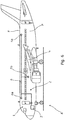
- an aircraft A comprises a fuselage F to which wings L are attached.
- the fuselage F like the wings Ls, are produced by assembling panels (not shown), for example made of composite materials, fixed to a metal structure (not shown). ) which forms the skeleton of the aircraft A.
- the panels form the outer surface, or skin P, of the aircraft.
- An impact occurring on the skin P of the aircraft A at an impact instant t 0 (corresponding to the instant of contact of an element external to the aircraft with the skin P), generates elastic waves which go , from the position of the point of impact F , propagate the skin P for a time which depends on the dimensions of the aircraft A and the intensity I of the impact then reflect at the frontiers of the aircraft to be superimposed in damped vibration modes.
- the aircraft A is equipped with a system for evaluating the parameters (position of the point of impact, intensity, duration, position of the peak, asymmetry of the peak, etc.) of an impact 1
- the latter comprises an array of sensors 2 attached to the panels (on the face of the panels facing the interior of the aircraft) to measure data relating to impacts, and a central unit 3 connected to the array of sensors 2 and configured for evaluate the parameters of an impact from the data of the network of sensors 2 and from a model of the response of the skin P to external excitations.
- the response model of the skin is calculated from the modal properties of the P skin determined by means of a modal analysis of the P skin carried out experimentally, or numerically by means of a finite element model of the skin.
- the modal properties of the skin P include the modal matrix ⁇ of the skin, the natural frequencies, the modal deformations and modal dampings of certain modes of vibration of the skin, known as discriminating modes which are obtained by calculating the modal deformations of the skin.
- the discriminating modes are the modes of vibration of the skin P whose contribution in the measured response of the skin P to an impact characterizes the point of impact F.
- the discriminating modes of the skin P of an aircraft A are for example the first 10 vibration modes of the aircraft, at frequencies ranging from 0.7 Hz to 10 Hz.
- the sensor array 2 comprises a first set of sensors 4 and a second set of sensors 5.
- the sensors 4a, 5a of the two sets 4, 5 are fixed to certain panels, on their interior face (that is to say the face facing the interior of the aircraft).
- the coordinates of each sensor 4a, 5a, in a frame of reference linked to the aircraft A, are recorded in a memory of the central unit 3.
- the first set of sensors 4 provides data relating to the elastic waves
- the second set of sensors 5 supplies data relating to the temporal detection of an instant of impact on the skin to assist the first set of sensors 4 in determining the instant of impact t 0 .
- the data relating to the elastic waves measured by the first set of sensors 4 comprise the data relating to the elastic waves propagating in the skin P as well as the vibratory measurements.
- Vibration measurements are data relating to elastic waves when they are superimposed in spatially standing waves, called modes of vibration, which dampen temporally.
- the sensors 4a of the first set of sensors 4 are displacement sensors or accelerometers.
- the accelerometers are advantageous since the signal emitted by an accelerometer fixed to the skin P which vibrates consecutively to an impact, has an amplified amplitude and a better signal / noise ratio, than those of a signal emitted by a displacement sensor for the same conditions.
- Each sensor 4a of the first set 4 is placed on a particular point, called the neutral point of the skin P which does not preferentially vibrate in a discriminating mode of the skin (i.e. the amplitude of the shape of wave at this point has a substantially uniform amplitude, in absolute value, for all discriminating modes).
- the positioning of the sensors 4a of the first set 4 on the neutral points reinforces the robustness and the precision of the estimation of the impact parameters carried out by the central unit 3.
- the coordinates of the neutral points of the skin P are obtained by determining the points closest to the intersections of the modal deformations of the discriminating modes of the skin P.
- the sensors 5a of the second set of sensors 5 are, for example, sensors of the piezoelectric type, with high sampling frequency and high sensitivity, for recording deformations of the skin P following the propagation of an elastic wave in the latter.
- the sensors 5a of the second set of sensors 5 are microphones.
- the sensors 5a of the second set of sensors 5 are distributed over the skin P of the aircraft in the areas which are statistically the most impacted by the skin P of the aircraft A.
- the areas most statistically impacted by impacts from vehicles / external elements, are the lower part of the fuselage (for example at the level of the luggage compartment doors), or the lower surface of the wing.
- the central unit 3 in a known manner, comprises a processor (not shown) and memories (not shown) containing instructions executed by the processor.
- the central unit 3 processes in real time the information from the network of sensors 2, and implements a method for estimating the parameters of an impact, using the data supplied by the first network of sensors 4, as soon as an impact has been detected by the first and / or the second set of sensors 4,5.
- the central unit 3 sends a Salert alert signal to the operators if the intensity I of the impact exceeds a predetermined threshold G characteristic of damage to the skin P of the aircraft A.
- the skin P at the level of the lower surface is a plate for which three discriminating modes have been determined, that the first set of sensors 4 comprises a single sensor 4a and that the second set of sensors 5a comprises three sensors 5a1, 5a2, 5a3.
- the vibratory measurements can be suitably represented by the response to an impact of half-sine shape and an impact law is used whose parameters are the position of the point of impact F on the skin P, impact intensity I and impact duration T. It is considered that the impact takes place near the sensor 4a3.
- the central unit receives the signal S4a from the sensor 4a of the first set of sensors 4 and the signals S 5 a 1, S 5 a 2, S 5 a 3 from the sensors 5al , 5a2, 5a3 of the second set of sensors 5 and compares the normalized amplitude of each of the signals to a predetermined threshold K characterizing an abnormal event.
- the aim of this comparison is to filter the signals representative of a normal event such as, for example, a vibration of the skin following strong winds, or the normal support of an airport bridge against the skin of the aircraft.
- the comparison step E1 is carried out at regular and successive time intervals Int 0 ... m , for example every 5 or 10 seconds.
- the central unit 3 implements a step E2 for locating the impact zone in which the latter determines a zone Z of the skin in which the impact has taken place.
- This zone Z is centered around sensor 5a3 having emitted, first in the time of the interval Int x considered (see figure 5 ), a signal S 5 to 3 whose amplitude exceeds the predetermined threshold K.
- the central unit 3 implements a step E3 of determining the instant of impact t 0 which is the time at which the predetermined threshold K is exceeded for the first times in the interval Int x considered, by the amplitude of a signal S 4 a 3 coming from the sensor network 2 (see figure 5 ).
- the instant of impact t 0 corresponds to the time from which elastic waves will propagate in the skin P from the point of impact F and it thus constitutes the starting time point for the analysis of the signals supplied by the first set of sensors 4.
- the dimension of the zone Z defined in the location step E2 is a constant chosen arbitrarily.
- the dimension of the zone Z is a function, with predefined correspondence criteria, of the amplitude, at the moment of impact t 0 , of the signal S 4 a 3 of the sensor 4a3 having emitted, first in the 'time interval Int x considered, a signal whose amplitude exceeds the predetermined threshold K.
- a step E4 of processing the vibratory measurements implemented after step E3 of determining the instant of impact t 0 , the central unit 3 receives only the signal from the sensor 4a of the first set of sensors 4 from d 'a time after the moment of impact t 0 and for a limited period (for example a period allowing about ten oscillations of the discriminatory mode of smallest natural frequency to increase the speed of implementation of the method by central unit 3.
- the central unit 3 also implements, in the reception step E4, a low-pass frequency filtering of the signal from the sensor 4a of the first set 4 to removing the high frequency components therefrom, and in particular to remove the frequencies beyond the frequency of the highest discriminating mode.
- These estimates are obtained from a mathematical response model ( q ⁇ ( t i )) 1 ⁇ i ⁇ n of the sensor 4a of the first set 4 at any excitations and from the observations obtained ( q ( t i )) 1 ⁇ i ⁇ n in the preceding step E4.
- the estimate X ⁇ F of the contributions X F ( X 1 X 2 X 3 ) of the three discriminating modes concentrates data allowing, after suitable treatment, to find an estimate of the position of the point of impact F on the skin P as well as an estimate Î of the intensity of impact I.
- the mathematical model of response of sensor 4a of the first set of sensors 4 to any excitations makes it possible to predict the response of said sensor to a given excitation for the parameters (point of impact F , intensity of impact f , duration of impact T ) of the chosen impact law.
- the mathematical model is determined from the modal superposition method which describes the response of the skin P to any excitation as being a superposition of the damped vibration modes of the skin.
- the central unit 3 implements, for example, the method of non-linear least squares to minimize the difference between the mathematical model of response ( q ⁇ ( t i )) 1 ⁇ i ⁇ n of sensor 4a of the first set of sensors 4 and the observations ( q ( t i )) 1 ⁇ i ⁇ n .
- the purpose of the method used is to calculate the values of the parameters which, applied to the mathematical response model of the sensor 4a, best reproduce the observations ( q ( t i )) 1 i n .
- the central unit 3 searches for the lines of the modal matrix ⁇ (truncated to the discriminating modes) of the skin which are collinear, with a tolerance predefined, to the estimate X ⁇ F of the contributions X F of the modes of vibration of the skin P.
- each row of the modal matrix ⁇ of the skin P is associated with a single point of the skin P and that the point of impact F can be found in a unique way by searching for the single collinear line to the contribution X F of the modes of vibration of the skin P.
- the collinear lines in a predefined tolerance, which makes it possible to locate several candidate points, called candidate point F cand, close to the point of impact F.
- step E6 the central unit 3 determines the coordinates of at least one candidate point Fcand.
- the implementation of the location step E6 gives three candidate points F cand, all grouped around the point of impact F.
- step E6 ′ implemented after step E6 of locating the point of impact F , the central unit 3 compares the coordinates of the candidate points of impact Fcand with the coordinates of the zone Z defined in step E2 for locating the impact zone.
- a candidate point F cand whose coordinates are not in the impact zone is not considered in the rest of the process.
- the central unit 3 firstly estimates the intensity I of the impact for each candidate point Fcand.
- the estimate of the intensity I of the impact at the level of a candidate point Fcand is obtained by calculating a coefficient of collinearity between the line of the modal matrix ⁇ associated with the candidate point Fcand and the estimate X ⁇ F of the modal participation vector.
- the central unit 3 calculates an impact force with the parameters ( T ⁇ , Î ) and the acceleration at the candidate point Fcand with the parameters ( T ⁇ , Î, X ⁇ F ).
- the central unit 3 integrates twice the acceleration of Fcand to obtain the displacement.
- the impact energy E associated with a candidate point Fcand is estimated by integrating the product of the force by the displacement over the duration of the vibratory measurements.
- the last step of the method is an alert step E8 in which the central unit 5 sends a Salert alert signal to the operators of the aircraft in the case where the estimate ⁇ of the impact energy at a candidate point F cand calculated in the preceding step E7 is greater than a predetermined threshold G.
- the alert signal Salert contains the data on the estimate of the impact energy and the position of the candidate point Fcand. The method loops back to the comparison step E1 following the alert step E8.
- the method as described above is implemented, for example, when the aircraft A is switched off or when the aircraft A is switched on until the first engine start and five minutes after the shutdown. engines
- An aircraft A according to the invention can proceed, automatically and in real time, to a self-diagnosis to estimate the parameters of an impact.
- the estimated parameters are supplied to the operators of the aircraft in order to launch, if necessary, maintenance operations on the aircraft A in the event of damage to the skin following the impact.
- the central unit 3 comprises a database in which are entered intrinsic properties of the aircraft (age, repairs carried out, known deformations of the skin) in order to adapt , specifically to the aircraft, the process estimate as described above.
- the properties recorded in the database make it possible, for example, to refine the mathematical model of the response of the sensors of the first set 5 to excitations.
- the database includes a history of the impact parameters estimated previously by the system for estimating the parameters of an impact, as well as for each estimate implemented, the real coordinates of the point of impact as detected. visually by operators.
- the central unit 3 by implementing a learning algorithm, can refine the algorithm implemented in the method as described above to reduce the position difference between the candidate impact points F cand determined and the point of impact F following an impact.
- the system for estimating the parameters of an impact 1 has been described for a network of sensors 2 which comprises a first set of sensors 4 and a second set of sensors 5 assisting the first set 4 of sensors in determining the instant. impact t 0 .
- the system for estimating the parameters of an impact 1 does not include a second set of sensors 5 to assist the first set of sensors 4 in determining the instant of impact.
- the method for estimating the parameters of an impact 1 implemented by the system for estimating the parameters of an impact 1 according to this variant is identical to the method as described above, except that only the signals of the first set of sensors 5a are taken into account in the steps of the method.
- This variant applies to small-sized aircraft for which the instant of impact and the instant of the vibration measurements merge. The advantage is to use fewer sensors and to identify the impact more quickly.
Landscapes
- Engineering & Computer Science (AREA)
- Aviation & Aerospace Engineering (AREA)
- Physics & Mathematics (AREA)
- Mechanical Engineering (AREA)
- General Physics & Mathematics (AREA)
- Health & Medical Sciences (AREA)
- Transportation (AREA)
- Acoustics & Sound (AREA)
- Manufacturing & Machinery (AREA)
- Life Sciences & Earth Sciences (AREA)
- Chemical & Material Sciences (AREA)
- Analytical Chemistry (AREA)
- Biochemistry (AREA)
- General Health & Medical Sciences (AREA)
- Immunology (AREA)
- Pathology (AREA)
- Measurement Of Mechanical Vibrations Or Ultrasonic Waves (AREA)
Claims (9)
- Flugzeug (A), das eine Haut (P) besitzt, die eine äußere Oberfläche des Flugzeugs bildet, wobei das Flugzeug (A) mit einem System (1) für die Schätzung von Parametern eines Stoßes ausgerüstet ist, das ein Netz (2) von Sensoren, die an der Haut (P) befestigt sind, und eine Zentraleinheit (3), die mit dem Netz verbunden ist und konfiguriert ist, die Parameter (F, I, T) eines Stoßes zu bewerten, umfasst, wobei die Parameter wenigstens die Position (F) eines Stoßpunkts, die Intensität (I) und die Dauer (T) des Stoßes umfassen, wobei das Sensornetz (2) eine erste Gesamtheit von Sensoren (4) umfasst, die Daten bezüglich elastischer Wellen liefern, wobei sich die Sensoren (4a) der ersten Sensorgesamtheit (4) an Neutralpunkten der Haut (P) des Flugzeugs (A) in Bezug auf diskriminierende Eigenschwingungsmoden der Haut (P) befinden, wobei die Zentraleinheit (3) die Parameter (F, I, T) eines Stoßes anhand der Daten des Sensornetzes (2) und eines Modells der Antwort der Haut auf äußere Erregungen, das anhand der Schwingungseigenschaften der Haut (P) berechnet wird, bewertet.
- Flugzeug (A) nach Anspruch 1, dadurch gekennzeichnet, dass die Sensoren (4a) der ersten Sensorgesamtheit (4) Beschleunigungsmesser sind.
- Flugzeug (A) nach einem der Ansprüche 1 bis 2, dadurch gekennzeichnet, dass das Sensornetz (2) eine zweite Gesamtheit (5) von Sensoren umfasst, die Daten bezüglich der zeitlichen Detektion eines Stoßzeitpunkts (t0) liefern.
- Flugzeug (A) nach Anspruch 3, dadurch gekennzeichnet, dass sich die Sensoren (5a) der zweiten Sensorgesamtheit (5) in Zonen des Flugzeugs (A) befinden, die von Stößen statistisch am stärksten getroffen werden.
- Flugzeug (A) nach einem der Ansprüche 3 bis 4, dadurch gekennzeichnet, dass die Sensoren (5a) der zweiten Sensorgesamtheit (5) Sensoren sind, die unter den folgenden Sensortypen gewählt sind: Mikrofon und piezoelektrischer Sensor.
- Verfahren zum Schätzen von Parametern eines Stoßes auf die Haut (P) eines Flugzeugs (A), wobei das Flugzeug (A) mit einem System zum Schätzen von Parametern eines Stoßes (1) ausgerüstet ist, das ein Netz (2) von Sensoren, die an der Haut (P) befestigt sind, und eine Zentraleinheit (3), die mit dem Netz verbunden ist und konfiguriert ist, die Parameter (F, I, T) eines Stoßes zu bewerten, umfasst, wobei die Parameter wenigstens die Position (F) eines Stoßpunkts, die Intensität (I) und die Dauer (T) des Stoßes umfassen, wobei das Sensornetz (2) eine erste Gesamtheit (4) von Sensoren umfasst, die Daten bezüglich elastischer Wellen liefern, wobei sich die Sensoren (4a) der ersten Sensorgesamtheit (4) an Neutralpunkten der Haut (P) des Flugzeugs (A) bezüglich diskriminierender Eigenschwingungen der Haut (P) befinden und wobei die Zentraleinheit (3) die Parameter (F, I, T) eines Stoßes anhand der Daten des Sensornetzes (2) und eines Modells der Antwort der Haut auf äußere Erregungen, das anhand der Schwingungseigenschaften der Haut (P) berechnet wird, bewertet, wobei das Verfahren die folgenden Schritte umfasst:- einen Schritt (E1) des Vergleichens, in dem die Zentraleinheit (3) die Signale (S4a, S5a1, ..., S5a3) von jedem der Sensoren (4a, 5a1, ..., 5a3) des Sensornetzes (2) empfängt und die Amplitude jedes der Signale mit einem vorgegebenen Schwellenwert (K), der ein anomales Ereignis bezeichnet, vergleicht;- einen Schritt (E2) des Lokalisierens der Stoßzone, der ausgeführt wird, falls eines der Signale der Sensoren (4a, 5a1, ..., 5a3) des Sensornetzes (2) eine Amplitude besitzt, die den vorgegebenen Schwellenwert (K) überschreitet, wobei die Zentraleinheit (3) eine Zone (Z) der Haut (P) bestimmt, in der ein Stoß eines bezüglich des Flugzeugs (A) äußeren Elements auf die Haut (P) stattgefunden hat;- einen Schritt (E3) des Bestimmens gleichzeitig mit dem Schritt (E2) des Lokalisierens der Stoßzone, in dem die Zentraleinheit (3) anhand der Signale der Sensoren (4a, 5a1, ..., 5a3) des Sensornetzes (2) einen Stoßzeitpunkt t0 bestimmt, der dem Zeitpunkt des Kontakts des bezüglich des Flugzeugs (A) äußeren Elements mit der Haut (P) entspricht;- einen Schritt (E4) des Verarbeitens von Schwingungsmessungen, in dem die Zentraleinheit (3) das Signal eines Sensors (5a) der ersten Sensorgesamtheit (5) ab einer Zeit nach dem Stoßzeitpunkt (t0) und während einer vorgegebenen Dauer empfängt;- einen Schritt (E5) des Optimierens, in dem die Zentraleinheit (3) eine Schätzung (T̂) einer Stoßdauer (T) und eine Schätzung (X̂F) von Beiträgen (XF) von Schwingungsmoden der Haut berechnet, wobei die Schätzungen anhand der Signale des Sensors (5a) der ersten Sensorgesamtheit (5), die im vorhergehenden Schritt (E4) verarbeitet werden, und anhand eines mathematischen Modells der Antwort des Sensors der ersten Gesamtheit auf beliebige Erregungen berechnet werden;- einen Schritt (E6) des Lokalisierens des Stoßpunkts (F), in dem die Zentraleinheit (3) die Koordinaten eines geschätzten Stoßpunkts, der Kandidatenstoß (Fcand) genannt wird, anhand einer Suche der Kolinearität zwischen den Zeilen einer Modalmatrix (Φ) der Haut (P) und der Schätzung (X̂F) der Beiträge der Schwingungsmoden der Haut bestimmt;- einen Schritt (E7) des Schätzens der Stoßenergie, in dem die Zentraleinheit (3) die Stoßenergie (E) auf Höhe jedes Kandidatenstoßpunkts (Fcand) anhand einer Schätzung der Stoßintensität (I), der Schätzung (T̂) der Dauer (T) des Stoßes und der Schätzung (X̂F) der Beiträge (XF) der Schwingungsmoden der Haut schätzt;- einen Schritt (E8) des Warnens, in dem die Zentraleinheit (3) ein Warnsignal (Salert) aussendet, falls die Schätzung (Ê) der Energie des Stoßes an einem Kandidatenpunkt (Fcand) größer als ein vorgegebener Schwellenwert (G) ist.
- Verfahren nach Anspruch 6, dadurch gekennzeichnet, dass die Zone (Z), die im Schritt (E2) des Lokalisierens der Stoßzone bestimmt wird, auf einen Sensor zentriert ist, der ein Signal (S4a3) ausgesendet hat, dessen Amplitude den vorgegebenen Schwellenwert (G) überschreitet.
- Verfahren nach Anspruch 7, dadurch gekennzeichnet, dass der Schritt (E1) des Vergleichens in regelmäßigen und aufeinander folgenden Zeitintervallen (Int0...m) ausgeführt wird.
- Verfahren nach einem der Ansprüche 6 bis 8, dadurch gekennzeichnet, dass nach dem Schritt (E6) des Lokalisierens des Stoßpunkts und vor dem Schritt (E7) des Schätzens der Stoßenergie die Zentraleinheit (3) einen Schritt (E6') des Bestätigens ausführt, in dem die Zentraleinheit (3) die Koordinaten der Kandidatenstoßpunkte (Fcand) mit den Koordinaten der Zone (Z), die im Schritt (E2) des Lokalisierens der Stoßzone definiert wird, vergleicht.
Applications Claiming Priority (1)
| Application Number | Priority Date | Filing Date | Title |
|---|---|---|---|
| FR1856096A FR3083215A1 (fr) | 2018-07-02 | 2018-07-02 | Aeronef equipe d'un systeme d'estimation des parametres d'un impact |
Publications (2)
| Publication Number | Publication Date |
|---|---|
| EP3590847A1 EP3590847A1 (de) | 2020-01-08 |
| EP3590847B1 true EP3590847B1 (de) | 2020-08-19 |
Family
ID=65031355
Family Applications (1)
| Application Number | Title | Priority Date | Filing Date |
|---|---|---|---|
| EP19178811.6A Active EP3590847B1 (de) | 2018-07-02 | 2019-06-06 | Luftfahrzeug, das mit einem system zum abschätzen der parameter eines aufpralls ausgestattet ist |
Country Status (4)
| Country | Link |
|---|---|
| US (1) | US10800508B2 (de) |
| EP (1) | EP3590847B1 (de) |
| CN (1) | CN110688705B (de) |
| FR (1) | FR3083215A1 (de) |
Families Citing this family (4)
| Publication number | Priority date | Publication date | Assignee | Title |
|---|---|---|---|---|
| CN111392062B (zh) * | 2020-03-25 | 2021-09-14 | 中国人民解放军海军特色医学中心 | 一种在有限曲面滑翔起飞的飞行器上乘员加速度估计方法 |
| US11454643B2 (en) * | 2020-05-05 | 2022-09-27 | The Boeing Company | Method of collecting measurements for estimating air data parameters of an aerospace vehicle |
| FR3123891B1 (fr) * | 2021-06-14 | 2024-10-25 | Otonomy Aviation | Système embarqué de détection d’impacts sur le fuselage d’un aéronef |
| US20230202676A1 (en) | 2021-12-28 | 2023-06-29 | Beta Air, Llc | Systems and methods for monitoring impact on electric aircraft |
Family Cites Families (9)
| Publication number | Priority date | Publication date | Assignee | Title |
|---|---|---|---|---|
| FR2931553B1 (fr) * | 2008-05-22 | 2010-10-29 | Airbus France | Estimation d'un critere de charge subie par un composant structurel d'un aeronef, et aide a la detection d'un atterissage dit "dur" grace a un tel critere |
| FR2937953B1 (fr) * | 2008-11-05 | 2011-01-14 | Elta | Procede et installation de detection et d'analyse des dommages subis par le fuselage d'un avion en stationnement. |
| KR101273422B1 (ko) * | 2011-09-08 | 2013-06-11 | 국방과학연구소 | 항공기의 구조 건전성 감시 시스템 |
| EP3043322A1 (de) * | 2015-01-12 | 2016-07-13 | Airbus Operations GmbH | System und Verfahren zur Schadensverfolgung und -Überwachung während der Bodenabfertigung eines Flugzeugs |
| FR3038109B1 (fr) * | 2015-06-29 | 2018-07-27 | Airbus Operations (S.A.S.) | Systeme et procede de localisation d'impacts sur une surface externe |
| CN107016186B (zh) * | 2017-04-01 | 2021-03-23 | 司靓 | 一种面向危害性冲撞击事件的智能辨识与评估方法 |
| US11536701B2 (en) * | 2017-08-25 | 2022-12-27 | Simmonds Precision Products, Inc. | Interactive transformational analysis of structural health monitoring data |
| CN108169037B (zh) * | 2017-12-15 | 2019-03-29 | 南京航空航天大学 | 连续异构型大面积冲击监测网络及冲击区域定位方法 |
| US10922412B2 (en) * | 2018-01-22 | 2021-02-16 | The Boeing Company | Automatic tampering detection in networked control systems |
-
2018
- 2018-07-02 FR FR1856096A patent/FR3083215A1/fr not_active Ceased
-
2019
- 2019-06-06 EP EP19178811.6A patent/EP3590847B1/de active Active
- 2019-07-01 US US16/458,560 patent/US10800508B2/en active Active
- 2019-07-02 CN CN201910590208.6A patent/CN110688705B/zh active Active
Non-Patent Citations (1)
| Title |
|---|
| None * |
Also Published As
| Publication number | Publication date |
|---|---|
| CN110688705A (zh) | 2020-01-14 |
| US20200010166A1 (en) | 2020-01-09 |
| FR3083215A1 (fr) | 2020-01-03 |
| EP3590847A1 (de) | 2020-01-08 |
| CN110688705B (zh) | 2023-06-06 |
| US10800508B2 (en) | 2020-10-13 |
Similar Documents
| Publication | Publication Date | Title |
|---|---|---|
| EP3590847A1 (de) | Luftfahrzeug, das mit einem system zum abschätzen der parameter eines aufpralls ausgestattet ist | |
| US9909953B2 (en) | Method and apparatus for non-destructive detection of tire anomalies | |
| RU2771465C2 (ru) | Система и способ обнаружения повреждения | |
| US7398698B2 (en) | Smart repair patch and associated method | |
| EP3555585B1 (de) | Verfahren und system zur steuerung der integrierten gesundheit einer mechanischen struktur durch diffuse elastische wellen | |
| Pawar et al. | Helicopter rotor health monitoring-a review | |
| FR2901610A1 (fr) | Dispositif de controle non destructif d'une struture par analyse vibratoire | |
| US20120006118A1 (en) | Acoustic structural integrity monitoring system and method | |
| CA2418476C (fr) | Procede d'identification d'une source d'un signal | |
| FR2963448A1 (fr) | Procede et systeme d'analyse de donnees de vol enregistrees au cours d'un vol d'un avion. | |
| US8707787B1 (en) | Time delay based health monitoring system using a sensor network | |
| US8483977B1 (en) | Method of laser vibration defect analysis | |
| US20190257794A1 (en) | Real-time damage detection and localization of damage in vehicle components using acoustic emission and machine learning | |
| FR2931553A1 (fr) | Estimation d'un critere de charge subie par un composant structurel d'un aeronef, et aide a la detection d'un atterissage dit "dur" grace a un tel critere | |
| TR201808735T4 (tr) | Darbe tespiti ve ses emisyonu veri işleme. | |
| WO2010052393A1 (fr) | Procede et installation de detection et d'analyse des dommages subis par le fuselage d'un avion en stationnement. | |
| EP2602615A2 (de) | Referenzfreies Inkonsistenzdetektionssystem | |
| EP4016472A1 (de) | System und verfahren zur wartung eines luftfahrzeugs mit prognoseklassifikator | |
| FR3090106A1 (fr) | Procédé et dispositif pour détecter un évènement d’impact et véhicule associé | |
| Demetgul et al. | Data Requirements for Tire-Road Monitoring: A Roadmap for Data Collection, Processing, and Decision Making | |
| EP4300095B1 (de) | Verfahren zur automatischen identifizierung einer akustischen quelle aus einem erzeugten akustischen signal | |
| Sharma | Performance demonstration of guided waves based structural health monitoring system for aerospace application | |
| FR3078162A1 (fr) | Dispositif et procede de detection de defauts d'une structure | |
| Do | Passive and active sensing technologies for structural health monitoring | |
| FR3081994A1 (fr) | Procede de caracterisation de l'etat d'une piece au moyen d'un capteur de deformation de type jauge d'extensometrie |
Legal Events
| Date | Code | Title | Description |
|---|---|---|---|
| PUAI | Public reference made under article 153(3) epc to a published international application that has entered the european phase |
Free format text: ORIGINAL CODE: 0009012 |
|
| STAA | Information on the status of an ep patent application or granted ep patent |
Free format text: STATUS: REQUEST FOR EXAMINATION WAS MADE |
|
| 17P | Request for examination filed |
Effective date: 20190606 |
|
| AK | Designated contracting states |
Kind code of ref document: A1 Designated state(s): AL AT BE BG CH CY CZ DE DK EE ES FI FR GB GR HR HU IE IS IT LI LT LU LV MC MK MT NL NO PL PT RO RS SE SI SK SM TR |
|
| AX | Request for extension of the european patent |
Extension state: BA ME |
|
| GRAP | Despatch of communication of intention to grant a patent |
Free format text: ORIGINAL CODE: EPIDOSNIGR1 |
|
| STAA | Information on the status of an ep patent application or granted ep patent |
Free format text: STATUS: GRANT OF PATENT IS INTENDED |
|
| INTG | Intention to grant announced |
Effective date: 20200219 |
|
| RAP1 | Party data changed (applicant data changed or rights of an application transferred) |
Owner name: AIRBUS (S.A.S.) |
|
| RIN1 | Information on inventor provided before grant (corrected) |
Inventor name: GENDRE, DIDIER Inventor name: GOUTAUDIER, DIMITRI |
|
| GRAS | Grant fee paid |
Free format text: ORIGINAL CODE: EPIDOSNIGR3 |
|
| GRAA | (expected) grant |
Free format text: ORIGINAL CODE: 0009210 |
|
| STAA | Information on the status of an ep patent application or granted ep patent |
Free format text: STATUS: THE PATENT HAS BEEN GRANTED |
|
| RBV | Designated contracting states (corrected) |
Designated state(s): AL AT BE BG CH CY CZ DE DK EE ES FI FR GB GR HR HU IE IS IT LI LT LU LV MC MK MT NL NO PL PT RO RS SE SI SK SM TR |
|
| AK | Designated contracting states |
Kind code of ref document: B1 Designated state(s): AL AT BE BG CH CY CZ DE DK EE ES FI FR GB GR HR HU IE IS IT LI LT LU LV MC MK MT NL NO PL PT RO RS SE SI SK SM TR |
|
| REG | Reference to a national code |
Ref country code: CH Ref legal event code: EP |
|
| REG | Reference to a national code |
Ref country code: DE Ref legal event code: R096 Ref document number: 602019000503 Country of ref document: DE |
|
| REG | Reference to a national code |
Ref country code: AT Ref legal event code: REF Ref document number: 1303686 Country of ref document: AT Kind code of ref document: T Effective date: 20200915 |
|
| REG | Reference to a national code |
Ref country code: IE Ref legal event code: FG4D Free format text: LANGUAGE OF EP DOCUMENT: FRENCH |
|
| REG | Reference to a national code |
Ref country code: LT Ref legal event code: MG4D |
|
| REG | Reference to a national code |
Ref country code: NL Ref legal event code: MP Effective date: 20200819 |
|
| PG25 | Lapsed in a contracting state [announced via postgrant information from national office to epo] |
Ref country code: NO Free format text: LAPSE BECAUSE OF FAILURE TO SUBMIT A TRANSLATION OF THE DESCRIPTION OR TO PAY THE FEE WITHIN THE PRESCRIBED TIME-LIMIT Effective date: 20201119 Ref country code: BG Free format text: LAPSE BECAUSE OF FAILURE TO SUBMIT A TRANSLATION OF THE DESCRIPTION OR TO PAY THE FEE WITHIN THE PRESCRIBED TIME-LIMIT Effective date: 20201119 Ref country code: LT Free format text: LAPSE BECAUSE OF FAILURE TO SUBMIT A TRANSLATION OF THE DESCRIPTION OR TO PAY THE FEE WITHIN THE PRESCRIBED TIME-LIMIT Effective date: 20200819 Ref country code: PT Free format text: LAPSE BECAUSE OF FAILURE TO SUBMIT A TRANSLATION OF THE DESCRIPTION OR TO PAY THE FEE WITHIN THE PRESCRIBED TIME-LIMIT Effective date: 20201221 Ref country code: FI Free format text: LAPSE BECAUSE OF FAILURE TO SUBMIT A TRANSLATION OF THE DESCRIPTION OR TO PAY THE FEE WITHIN THE PRESCRIBED TIME-LIMIT Effective date: 20200819 Ref country code: GR Free format text: LAPSE BECAUSE OF FAILURE TO SUBMIT A TRANSLATION OF THE DESCRIPTION OR TO PAY THE FEE WITHIN THE PRESCRIBED TIME-LIMIT Effective date: 20201120 Ref country code: SE Free format text: LAPSE BECAUSE OF FAILURE TO SUBMIT A TRANSLATION OF THE DESCRIPTION OR TO PAY THE FEE WITHIN THE PRESCRIBED TIME-LIMIT Effective date: 20200819 Ref country code: HR Free format text: LAPSE BECAUSE OF FAILURE TO SUBMIT A TRANSLATION OF THE DESCRIPTION OR TO PAY THE FEE WITHIN THE PRESCRIBED TIME-LIMIT Effective date: 20200819 |
|
| REG | Reference to a national code |
Ref country code: AT Ref legal event code: MK05 Ref document number: 1303686 Country of ref document: AT Kind code of ref document: T Effective date: 20200819 |
|
| PG25 | Lapsed in a contracting state [announced via postgrant information from national office to epo] |
Ref country code: LV Free format text: LAPSE BECAUSE OF FAILURE TO SUBMIT A TRANSLATION OF THE DESCRIPTION OR TO PAY THE FEE WITHIN THE PRESCRIBED TIME-LIMIT Effective date: 20200819 Ref country code: RS Free format text: LAPSE BECAUSE OF FAILURE TO SUBMIT A TRANSLATION OF THE DESCRIPTION OR TO PAY THE FEE WITHIN THE PRESCRIBED TIME-LIMIT Effective date: 20200819 Ref country code: PL Free format text: LAPSE BECAUSE OF FAILURE TO SUBMIT A TRANSLATION OF THE DESCRIPTION OR TO PAY THE FEE WITHIN THE PRESCRIBED TIME-LIMIT Effective date: 20200819 Ref country code: NL Free format text: LAPSE BECAUSE OF FAILURE TO SUBMIT A TRANSLATION OF THE DESCRIPTION OR TO PAY THE FEE WITHIN THE PRESCRIBED TIME-LIMIT Effective date: 20200819 Ref country code: IS Free format text: LAPSE BECAUSE OF FAILURE TO SUBMIT A TRANSLATION OF THE DESCRIPTION OR TO PAY THE FEE WITHIN THE PRESCRIBED TIME-LIMIT Effective date: 20201219 |
|
| PG25 | Lapsed in a contracting state [announced via postgrant information from national office to epo] |
Ref country code: SM Free format text: LAPSE BECAUSE OF FAILURE TO SUBMIT A TRANSLATION OF THE DESCRIPTION OR TO PAY THE FEE WITHIN THE PRESCRIBED TIME-LIMIT Effective date: 20200819 Ref country code: EE Free format text: LAPSE BECAUSE OF FAILURE TO SUBMIT A TRANSLATION OF THE DESCRIPTION OR TO PAY THE FEE WITHIN THE PRESCRIBED TIME-LIMIT Effective date: 20200819 Ref country code: RO Free format text: LAPSE BECAUSE OF FAILURE TO SUBMIT A TRANSLATION OF THE DESCRIPTION OR TO PAY THE FEE WITHIN THE PRESCRIBED TIME-LIMIT Effective date: 20200819 Ref country code: CZ Free format text: LAPSE BECAUSE OF FAILURE TO SUBMIT A TRANSLATION OF THE DESCRIPTION OR TO PAY THE FEE WITHIN THE PRESCRIBED TIME-LIMIT Effective date: 20200819 Ref country code: DK Free format text: LAPSE BECAUSE OF FAILURE TO SUBMIT A TRANSLATION OF THE DESCRIPTION OR TO PAY THE FEE WITHIN THE PRESCRIBED TIME-LIMIT Effective date: 20200819 |
|
| REG | Reference to a national code |
Ref country code: DE Ref legal event code: R097 Ref document number: 602019000503 Country of ref document: DE |
|
| PG25 | Lapsed in a contracting state [announced via postgrant information from national office to epo] |
Ref country code: ES Free format text: LAPSE BECAUSE OF FAILURE TO SUBMIT A TRANSLATION OF THE DESCRIPTION OR TO PAY THE FEE WITHIN THE PRESCRIBED TIME-LIMIT Effective date: 20200819 Ref country code: AT Free format text: LAPSE BECAUSE OF FAILURE TO SUBMIT A TRANSLATION OF THE DESCRIPTION OR TO PAY THE FEE WITHIN THE PRESCRIBED TIME-LIMIT Effective date: 20200819 Ref country code: AL Free format text: LAPSE BECAUSE OF FAILURE TO SUBMIT A TRANSLATION OF THE DESCRIPTION OR TO PAY THE FEE WITHIN THE PRESCRIBED TIME-LIMIT Effective date: 20200819 |
|
| PLBE | No opposition filed within time limit |
Free format text: ORIGINAL CODE: 0009261 |
|
| STAA | Information on the status of an ep patent application or granted ep patent |
Free format text: STATUS: NO OPPOSITION FILED WITHIN TIME LIMIT |
|
| PG25 | Lapsed in a contracting state [announced via postgrant information from national office to epo] |
Ref country code: SK Free format text: LAPSE BECAUSE OF FAILURE TO SUBMIT A TRANSLATION OF THE DESCRIPTION OR TO PAY THE FEE WITHIN THE PRESCRIBED TIME-LIMIT Effective date: 20200819 |
|
| 26N | No opposition filed |
Effective date: 20210520 |
|
| PG25 | Lapsed in a contracting state [announced via postgrant information from national office to epo] |
Ref country code: IT Free format text: LAPSE BECAUSE OF FAILURE TO SUBMIT A TRANSLATION OF THE DESCRIPTION OR TO PAY THE FEE WITHIN THE PRESCRIBED TIME-LIMIT Effective date: 20200819 |
|
| PG25 | Lapsed in a contracting state [announced via postgrant information from national office to epo] |
Ref country code: MC Free format text: LAPSE BECAUSE OF FAILURE TO SUBMIT A TRANSLATION OF THE DESCRIPTION OR TO PAY THE FEE WITHIN THE PRESCRIBED TIME-LIMIT Effective date: 20200819 |
|
| REG | Reference to a national code |
Ref country code: BE Ref legal event code: MM Effective date: 20210630 |
|
| PG25 | Lapsed in a contracting state [announced via postgrant information from national office to epo] |
Ref country code: LU Free format text: LAPSE BECAUSE OF NON-PAYMENT OF DUE FEES Effective date: 20210606 |
|
| PG25 | Lapsed in a contracting state [announced via postgrant information from national office to epo] |
Ref country code: IE Free format text: LAPSE BECAUSE OF NON-PAYMENT OF DUE FEES Effective date: 20210606 |
|
| PG25 | Lapsed in a contracting state [announced via postgrant information from national office to epo] |
Ref country code: BE Free format text: LAPSE BECAUSE OF NON-PAYMENT OF DUE FEES Effective date: 20210630 |
|
| REG | Reference to a national code |
Ref country code: CH Ref legal event code: PL |
|
| PG25 | Lapsed in a contracting state [announced via postgrant information from national office to epo] |
Ref country code: LI Free format text: LAPSE BECAUSE OF NON-PAYMENT OF DUE FEES Effective date: 20220630 Ref country code: CH Free format text: LAPSE BECAUSE OF NON-PAYMENT OF DUE FEES Effective date: 20220630 |
|
| PG25 | Lapsed in a contracting state [announced via postgrant information from national office to epo] |
Ref country code: CY Free format text: LAPSE BECAUSE OF FAILURE TO SUBMIT A TRANSLATION OF THE DESCRIPTION OR TO PAY THE FEE WITHIN THE PRESCRIBED TIME-LIMIT Effective date: 20200819 |
|
| PG25 | Lapsed in a contracting state [announced via postgrant information from national office to epo] |
Ref country code: HU Free format text: LAPSE BECAUSE OF FAILURE TO SUBMIT A TRANSLATION OF THE DESCRIPTION OR TO PAY THE FEE WITHIN THE PRESCRIBED TIME-LIMIT; INVALID AB INITIO Effective date: 20190606 |
|
| PG25 | Lapsed in a contracting state [announced via postgrant information from national office to epo] |
Ref country code: SI Free format text: LAPSE BECAUSE OF FAILURE TO SUBMIT A TRANSLATION OF THE DESCRIPTION OR TO PAY THE FEE WITHIN THE PRESCRIBED TIME-LIMIT Effective date: 20200819 |
|
| PG25 | Lapsed in a contracting state [announced via postgrant information from national office to epo] |
Ref country code: MK Free format text: LAPSE BECAUSE OF FAILURE TO SUBMIT A TRANSLATION OF THE DESCRIPTION OR TO PAY THE FEE WITHIN THE PRESCRIBED TIME-LIMIT Effective date: 20200819 |
|
| PG25 | Lapsed in a contracting state [announced via postgrant information from national office to epo] |
Ref country code: MT Free format text: LAPSE BECAUSE OF FAILURE TO SUBMIT A TRANSLATION OF THE DESCRIPTION OR TO PAY THE FEE WITHIN THE PRESCRIBED TIME-LIMIT Effective date: 20200819 |
|
| PGFP | Annual fee paid to national office [announced via postgrant information from national office to epo] |
Ref country code: DE Payment date: 20250618 Year of fee payment: 7 |
|
| PGFP | Annual fee paid to national office [announced via postgrant information from national office to epo] |
Ref country code: GB Payment date: 20250618 Year of fee payment: 7 |
|
| PGFP | Annual fee paid to national office [announced via postgrant information from national office to epo] |
Ref country code: FR Payment date: 20250626 Year of fee payment: 7 |
|
| PG25 | Lapsed in a contracting state [announced via postgrant information from national office to epo] |
Ref country code: TR Free format text: LAPSE BECAUSE OF FAILURE TO SUBMIT A TRANSLATION OF THE DESCRIPTION OR TO PAY THE FEE WITHIN THE PRESCRIBED TIME-LIMIT Effective date: 20200819 |