EP3589680B1 - Filter zum austausch von wärme und feuchtigkeit zur anwendung im medizinischen bereich und verfahren zur herstellung davon - Google Patents
Filter zum austausch von wärme und feuchtigkeit zur anwendung im medizinischen bereich und verfahren zur herstellung davon Download PDFInfo
- Publication number
- EP3589680B1 EP3589680B1 EP18717989.0A EP18717989A EP3589680B1 EP 3589680 B1 EP3589680 B1 EP 3589680B1 EP 18717989 A EP18717989 A EP 18717989A EP 3589680 B1 EP3589680 B1 EP 3589680B1
- Authority
- EP
- European Patent Office
- Prior art keywords
- solution
- chitosan
- gelatin
- freeze
- temperature
- Prior art date
- Legal status (The legal status is an assumption and is not a legal conclusion. Google has not performed a legal analysis and makes no representation as to the accuracy of the status listed.)
- Active
Links
Images


Classifications
-
- B—PERFORMING OPERATIONS; TRANSPORTING
- B29—WORKING OF PLASTICS; WORKING OF SUBSTANCES IN A PLASTIC STATE IN GENERAL
- B29C—SHAPING OR JOINING OF PLASTICS; SHAPING OF MATERIAL IN A PLASTIC STATE, NOT OTHERWISE PROVIDED FOR; AFTER-TREATMENT OF THE SHAPED PRODUCTS, e.g. REPAIRING
- B29C35/00—Heating, cooling or curing, e.g. crosslinking or vulcanising; Apparatus therefor
- B29C35/16—Cooling
-
- C—CHEMISTRY; METALLURGY
- C08—ORGANIC MACROMOLECULAR COMPOUNDS; THEIR PREPARATION OR CHEMICAL WORKING-UP; COMPOSITIONS BASED THEREON
- C08J—WORKING-UP; GENERAL PROCESSES OF COMPOUNDING; AFTER-TREATMENT NOT COVERED BY SUBCLASSES C08B, C08C, C08F, C08G or C08H
- C08J3/00—Processes of treating or compounding macromolecular substances
- C08J3/24—Crosslinking, e.g. vulcanising, of macromolecules
-
- A—HUMAN NECESSITIES
- A61—MEDICAL OR VETERINARY SCIENCE; HYGIENE
- A61M—DEVICES FOR INTRODUCING MEDIA INTO, OR ONTO, THE BODY; DEVICES FOR TRANSDUCING BODY MEDIA OR FOR TAKING MEDIA FROM THE BODY; DEVICES FOR PRODUCING OR ENDING SLEEP OR STUPOR
- A61M16/00—Devices for influencing the respiratory system of patients by gas treatment, e.g. ventilators; Tracheal tubes
- A61M16/10—Preparation of respiratory gases or vapours
- A61M16/1045—Devices for humidifying or heating the inspired gas by using recovered moisture or heat from the expired gas
-
- C—CHEMISTRY; METALLURGY
- C08—ORGANIC MACROMOLECULAR COMPOUNDS; THEIR PREPARATION OR CHEMICAL WORKING-UP; COMPOSITIONS BASED THEREON
- C08J—WORKING-UP; GENERAL PROCESSES OF COMPOUNDING; AFTER-TREATMENT NOT COVERED BY SUBCLASSES C08B, C08C, C08F, C08G or C08H
- C08J3/00—Processes of treating or compounding macromolecular substances
- C08J3/02—Making solutions, dispersions, lattices or gels by other methods than by solution, emulsion or suspension polymerisation techniques
- C08J3/03—Making solutions, dispersions, lattices or gels by other methods than by solution, emulsion or suspension polymerisation techniques in aqueous media
- C08J3/075—Macromolecular gels
-
- C—CHEMISTRY; METALLURGY
- C08—ORGANIC MACROMOLECULAR COMPOUNDS; THEIR PREPARATION OR CHEMICAL WORKING-UP; COMPOSITIONS BASED THEREON
- C08K—Use of inorganic or non-macromolecular organic substances as compounding ingredients
- C08K5/00—Use of organic ingredients
- C08K5/0008—Organic ingredients according to more than one of the "one dot" groups of C08K5/01 - C08K5/59
- C08K5/0025—Crosslinking or vulcanising agents; including accelerators
-
- C—CHEMISTRY; METALLURGY
- C08—ORGANIC MACROMOLECULAR COMPOUNDS; THEIR PREPARATION OR CHEMICAL WORKING-UP; COMPOSITIONS BASED THEREON
- C08K—Use of inorganic or non-macromolecular organic substances as compounding ingredients
- C08K5/00—Use of organic ingredients
- C08K5/04—Oxygen-containing compounds
- C08K5/06—Ethers; Acetals; Ketals; Ortho-esters
-
- C—CHEMISTRY; METALLURGY
- C08—ORGANIC MACROMOLECULAR COMPOUNDS; THEIR PREPARATION OR CHEMICAL WORKING-UP; COMPOSITIONS BASED THEREON
- C08K—Use of inorganic or non-macromolecular organic substances as compounding ingredients
- C08K5/00—Use of organic ingredients
- C08K5/04—Oxygen-containing compounds
- C08K5/13—Phenols; Phenolates
- C08K5/134—Phenols containing ester groups
- C08K5/1345—Carboxylic esters of phenolcarboxylic acids
-
- C—CHEMISTRY; METALLURGY
- C08—ORGANIC MACROMOLECULAR COMPOUNDS; THEIR PREPARATION OR CHEMICAL WORKING-UP; COMPOSITIONS BASED THEREON
- C08K—Use of inorganic or non-macromolecular organic substances as compounding ingredients
- C08K5/00—Use of organic ingredients
- C08K5/04—Oxygen-containing compounds
- C08K5/15—Heterocyclic compounds having oxygen in the ring
- C08K5/151—Heterocyclic compounds having oxygen in the ring having one oxygen atom in the ring
- C08K5/1515—Three-membered rings
-
- C—CHEMISTRY; METALLURGY
- C08—ORGANIC MACROMOLECULAR COMPOUNDS; THEIR PREPARATION OR CHEMICAL WORKING-UP; COMPOSITIONS BASED THEREON
- C08K—Use of inorganic or non-macromolecular organic substances as compounding ingredients
- C08K5/00—Use of organic ingredients
- C08K5/04—Oxygen-containing compounds
- C08K5/15—Heterocyclic compounds having oxygen in the ring
- C08K5/151—Heterocyclic compounds having oxygen in the ring having one oxygen atom in the ring
- C08K5/1545—Six-membered rings
-
- C—CHEMISTRY; METALLURGY
- C08—ORGANIC MACROMOLECULAR COMPOUNDS; THEIR PREPARATION OR CHEMICAL WORKING-UP; COMPOSITIONS BASED THEREON
- C08L—COMPOSITIONS OF MACROMOLECULAR COMPOUNDS
- C08L5/00—Compositions of polysaccharides or of their derivatives not provided for in groups C08L1/00 or C08L3/00
- C08L5/08—Chitin; Chondroitin sulfate; Hyaluronic acid; Derivatives thereof
-
- C—CHEMISTRY; METALLURGY
- C08—ORGANIC MACROMOLECULAR COMPOUNDS; THEIR PREPARATION OR CHEMICAL WORKING-UP; COMPOSITIONS BASED THEREON
- C08L—COMPOSITIONS OF MACROMOLECULAR COMPOUNDS
- C08L89/00—Compositions of proteins; Compositions of derivatives thereof
- C08L89/04—Products derived from waste materials, e.g. horn, hoof or hair
- C08L89/06—Products derived from waste materials, e.g. horn, hoof or hair derived from leather or skin, e.g. gelatin
-
- C—CHEMISTRY; METALLURGY
- C08—ORGANIC MACROMOLECULAR COMPOUNDS; THEIR PREPARATION OR CHEMICAL WORKING-UP; COMPOSITIONS BASED THEREON
- C08J—WORKING-UP; GENERAL PROCESSES OF COMPOUNDING; AFTER-TREATMENT NOT COVERED BY SUBCLASSES C08B, C08C, C08F, C08G or C08H
- C08J2305/00—Characterised by the use of polysaccharides or of their derivatives not provided for in groups C08J2301/00 or C08J2303/00
- C08J2305/08—Chitin; Chondroitin sulfate; Hyaluronic acid; Derivatives thereof
-
- C—CHEMISTRY; METALLURGY
- C08—ORGANIC MACROMOLECULAR COMPOUNDS; THEIR PREPARATION OR CHEMICAL WORKING-UP; COMPOSITIONS BASED THEREON
- C08J—WORKING-UP; GENERAL PROCESSES OF COMPOUNDING; AFTER-TREATMENT NOT COVERED BY SUBCLASSES C08B, C08C, C08F, C08G or C08H
- C08J2489/00—Characterised by the use of proteins; Derivatives thereof
- C08J2489/04—Products derived from waste materials, e.g. horn, hoof or hair
- C08J2489/06—Products derived from waste materials, e.g. horn, hoof or hair derived from leather or skin
Definitions
- the present invention refers to a filter, made entirely with natural and biodegradable materials, for the protection of the respiratory tract of patients in the medical-surgical field; the invention also refers to the process for making the filter.
- breathing normally occurs through the upper airways, that is essentially the nose, pharynx and larynx.
- the inspired air is heated and humidified; furthermore, the mucus of which the internal surfaces of these parts are coated, have bacteriostatic ability and of capture of particles suspended in the air.
- the air inhaled through these routes thus reaches the lungs in optimal conditions for their correct functioning.
- the patient is at risk of pulmonary complications, due to the fact that the inhaled air has too low temperature and humidity, or because of the entry directly into the lungs of germs, pathogenic substances or particulate matter.
- HME Heat and Moisture Exchange
- HME filters In principle, the operation of HME filters is based primarily on their ability to absorb heat and moisture from the air exhaled by the patient and release them to the incoming air during inspiration, and secondly on the ability to retain dust and pathogens (at least those of greater dimensions), thanks to the reduced dimensions of their porosity.
- US Patent 5,035,236 describes an HME filter in which the filtering element consists of a glass fiber membrane soaked in silicon oil; filters of this type are very cumbersome, and the filtering and heat exchange surface is very small compared to the overall size of the filter. These filters also present the problem of a relatively high pressure drop across the two faces of the membrane, which makes patient breathing difficult; to overcome the problem, the membrane surface must be increased, but this further increases the size and weight of the filter.
- the filters made with synthetic polymer foams with open porosity, typically polyurethane foams.
- the polymer foams have the characteristics of being generally non-hygroscopic, so that they do not effectively absorb moisture from the vapors and gases exhaled by the patient; moreover, their thermal exchange properties are also not optimal.
- these foams are loaded with substances having suitable properties, such as hygroscopic salts to improve the moisture exchange, activated carbon or molecular sieves ( US 4,619,948 ) to improve the retention capability of harmful species, or aluminum powder ( WO 94/01489 A1 ) to improve the thermal exchange properties of the filters.
- Porous materials obtained from the chitosan cross-linking with a gelatin, for use in general in the medical field, are known from various Chinese patent applications.
- Application CN 103525097 A describes the production of spongy materials based on fish skin gelatin, alone or in a mixture with chitosan, starting from aqueous solutions containing acetic acid and optionally glutaraldehyde as cross-linker; after drying of the polymeric network by freeze-drying, products are obtained which are said to have a uniform microstructure of the pores and good moisture absorption properties, and which are indicated as generally useful in the biomedical field.
- Application CN 105920679 A is directed to the preparation of a porous material useful for the regrowth of the skin.
- This material is obtained by cross-linking and extraction of the solvent by freeze-drying from solutions containing a gelatin and chitosan in ratios between 0.5:1 and 1:1; in particular, in view of the required application, the drying by freeze-drying is carried out in order to have porosities with a gradient of diameter, which is between 5 and 70 ⁇ m at a face of the manufactured article, and between 50 and 200 ⁇ m on the opposite side.
- Application CN 103724657 A describes the production of porous materials to be used as scaffolds for the re-growth of tissues in general; the main components are gelatin and chitosan, which are reticulated with the use of an organosilanic compound.
- the structure of the material has porosity of large dimensions, between 100 and 300 ⁇ m, inside which porosities of smaller dimensions are contained; this particular porosity hierarchy is said to be useful for promoting cell proliferation.
- Application CN 101703806 A describes porous composite materials with three components, hydroxyapatite (particles of 2-20 ⁇ m in size), chitosan and gelatin, in weight ratios of 3:3:4. These composites have porosity dimensions even higher than those of the material of the previous application, in the order of 300-400 ⁇ m.
- a porous material For use as an HME filter, a porous material must have a well balanced set of properties. From the chemical point of view, it must first have good moisture exchange properties (absorption from moist air and release in dry air or with a low moisture content); the cross-linking process carried out on the device must be such as to guarantee an adequate chemical stability and mechanical resistance of the material to the gas passage, properties that must be preserved even in humid conditions so as to avoid the collapse of the structure due to the pressure exerted by the passing gas.
- the porous materials of the prior art do not have all together these characteristics, because the sponges of CN 103525097 A have uniform porosity and without a preferential orientation; the material of CN 105920679 A presents porosity of less than 70 ⁇ m on a face of the manufactured article, such as to generate an excessive obstacle to the air passage; also the porosity structure of CN 103724657 A , with porosity of large dimensions containing porosity of smaller dimensions, can give rise to excessive pressure drops at the two ends of the filter; the materials of CN 101703806 A have, instead, porosity of excessive dimensions, such as not to effectively retain particulate matter, germs and bacteria; and the aforementioned article by B.
- Vazquez et al reports only very general and incomplete information on the composition, the type of cross-linker used, the preparation method and the freeze-drying conditions of the studied HME filters, and does not give indications if these filters do or do not show a preferential direction of porosity, parameter of fundamental importance to guarantee a correct and prolonged operation of the device.
- the aim of the present invention is to provide a new filter for HME application which overcomes the problems of the prior art.
- the present invention in a first aspect relates to a process for the production of a material useful for the production of HME filters; in a second aspect thereof, the invention relates to the material obtained with said process and the HME filters produced with this material; finally, in a third aspect, the invention relates to an HME filter with a composite structure, which favors the control of the temperature of the filter itself and therefore of its characteristics of preheating of the inspired air and of release of moisture thereto.
- the invention relates to a process for the production of a material useful for the production of HME filters that comprises the following steps:
- an HME filter must have definite properties of heat and moisture exchange ability, as well as of retention of particles, germs and the like, characteristics that improve with the reduction in the size of the filter pores; at the same time, the filter must offer the minimum resistance possible to the patient inhalation effort, and therefore the minimum pressure drop, a feature that improves with increasing pore size.
- the process of the invention allows obtaining the set of these properties in ranges of acceptable values for use in HME filters.
- the process admits two variants, which have in common the steps from a) to c) and which differ from each other, in the subsequent steps, for the moment and the manner in which the cross-linking of the polymeric components (chitosan and gelatin) is carried out.
- the first step of the invention process, a) consists in preparing an aqueous chitosan solution.
- Chitosan is a naturally derived polymer commercially available from many suppliers, which is obtained by deacetylation (generally under basic conditions) of chitin, the material that forms the exoskeleton of insects, marine crustaceans and the like, but also a major component of the cell wall of mushrooms (such as basidiomycetes, ascomycetes, and ficomycetes).
- deacetylation generally under basic conditions
- chitin the material that forms the exoskeleton of insects, marine crustaceans and the like
- a major component of the cell wall of mushrooms such as basidiomycetes, ascomycetes, and ficomycetes.
- chitosan is dissolved in an acidic solution, for example at a pH lower than 6; the solvent is preferably an aqueous solution at a concentration of 1% acetic acid, having a pH of about 5.5. Chitosan is used in such quantities to form a solution of concentration from 1% to 2.5%.
- the initial mixture is preferable to subject the initial mixture to vigorous stirring, for example with the aid of an ultrasonic bath to facilitate the disintegration of the particles, for a time generally ranging from about 10 minutes to 1 hour.
- an animal gelatin is used. Gelatin is also used in such quantities as to form a solution having a concentration between 2.5% and 5%.
- the gelatin is dissolved in water, generally at a temperature between about 40 and 50 °C and under stirring; in these conditions, the dissolution takes about 1 hour.
- step b) can be realized before, after or at the same time as a).
- step c) of the process the two solutions prepared in the previous steps are mixed together.
- the volumes of the two solutions are chosen in such a way that the weight ratio between gelatin and chitosan is between 80:20 and 50:50, and preferably equal to 70:30.
- the solution immediately obtained from the union of the two previous ones must be stirred to favor their homogeneity; the stirring must however be bland, to prevent the formation of foam.
- the maximum stirring intensity of the mixture can be checked visually, verifying that in fact there is no foam formation; in the experience of the inventors, with solution volumes of about 700-800 mL, magnetic stirring was used in a useful way at speeds of up to 500 rpm.
- the chitosan and gelatin present in the solution obtained by step c) must be cross-linked to consolidate the structure giving it both chemical and structural stability that is preserved even in wet conditions in which the device operates, in addition to regulating the degree of hydrophilia of the material being formed; moreover, it is necessary to dry the obtained material.
- the process can follow two alternative embodiments, which differ from each other due to the fact that in the first one the solution obtained in the step c) is first subjected to the crosslinking treatment between chitosan and gelatin, obtaining a hydrogel which is subsequently dried by freeze-drying, while in the second one the order of these two passages is inverted, the solution is first freeze-dried and then reticulated by a heat treatment.
- the first variant of the process is completed with the steps from c') to e).
- crosslinking is done by chemical means.
- a compound capable of forming bonds both with chitosan and gelatin, forming "bridges" between the two materials is added with step c').
- Suitable compounds for this purpose are 1,4-butanediol diglycidyl ether (known in the art as BDDGE), glutaraldehyde, tannic acid and, preferred, genipin, a chemical compound extracted from the gardenia fruit; all these compounds are of common commercial availability and are also safe for the present application, finding wide use in the production of biomedical devices and in the food industry.
- the crosslinking compound is added in amounts ranging from 0.5% to 4%, preferably 1%, with respect to the sum of the chitosan and gelatin weights, preferably in the form of an aqueous solution thereof (all the mentioned compounds are soluble in water).
- step c' The solution obtained in step c') is poured into the container of step d), inside which the crosslinking reaction (step d') takes place at room temperature (20-25 °C); the product of step d') is a hydrogel.
- the container is kept closed to avoid water evaporation, phenomenon that could influence the hydrogel concentration and the structure of the material being formed.
- Crosslinking is generally complete in a period of 1-3 days, and in the case of genipin it can be monitored by the change in color, which changes from the light yellow of the starting solution to the dark blue-green of the final hydrogel.
- the container has a thermally conductive bottom and thermally insulating walls, so as to allow a correct cooling/freezing profile of the hydrogel during the subsequent freeze-drying phase; more precisely, as mentioned, the container bottom must have a thermal conductivity equal to or greater than 15 W/(m ⁇ K), while the walls must have a thermal conductivity equal to or less than 1 W/(m ⁇ K).
- the bottom of the container can be made of steel, copper or silicon, while the walls can be made of materials of various types, such as plastics (eg, PVC or polyethylene), teflon or glass.
- step e) the hydrogel obtained in step d') is dehydrated by freeze-drying.
- the freeze-drying process is carried out at a pressure between 0.001 mbar and atmospheric pressure, and consists of a first freezing step of the hydrogel at a temperature from -20 to -60 °C, preferably -40 °C, followed by a primary drying by heating with a speed between 2 and 8 °C/h up to a temperature between -5 and -10 °C, and finally a secondary drying by heating with a speed between 1 and 5 °C/h up to a temperature between 15 and 20 °C.
- the above-described cooling and freezing phase is carried out by placing the bottom of the container in contact with the refrigerating system so that the cold transfer takes place in a completely directional manner from the bottom to the top; this operating mode, combined with the different thermal conductivity of the bottom and the walls of the container described above, allows to obtain porosities in their turn directional, with channels completely open and aligned in the vertical direction.
- Operating with the directional, and in particular vertical, heat transfer mode is not strictly necessary for the subsequent heating phases; however, for convenience these subsequent phases can be realized in turn by heating the bottom of the container, so to realize the whole process in the same container.
- steps c') and d') are not carried out, and the process is completed with step f).
- Steps d) and e) are carried out in a manner identical to that described for the first variant of the process, except in this case, in step d), the solution which is poured into the container does not contain a chemical crosslinker.
- cross-linking is carried out, in step f), with a thermal dehydration treatment, which consists in subjecting the already freeze-dried material to a temperature ranging from 140 to 160 °C, preferably 160 °C, at a pressure between 0.001 mbar and atmospheric pressure and for a duration between 24 and 48 h.
- a thermal dehydration treatment which consists in subjecting the already freeze-dried material to a temperature ranging from 140 to 160 °C, preferably 160 °C, at a pressure between 0.001 mbar and atmospheric pressure and for a duration between 24 and 48 h.
- the final product has the consistency of a fairly rigid sponge, and can undergo mechanical processing not too intense, for example directed to remove, with a slicer or a scalpel, the surfaces above and below the material that may have too small pores; preferably, however, the material obtained after freeze-drying is not mechanically worked, so that the container in which the gel is formed has the geometry and dimensions of the final porous body to be obtained.
- the invention relates to the material obtained with the process described up to now.
- the material has a mixed gelatin/chitosan composition, in which the two components are present in the weight ratio determined during the production process by the ratio between the volumes of the corresponding solutions used in step c).
- the material obtained according to the process described above has a porous structure, with a porosity degree (ratio between the volume of the pores and the apparent volume of the material) ranging from about 80 to 98% and pores with a diameter between 100 and 350 ⁇ m.
- the material porosities have the characteristic of having a strong anisotropy in their form, presenting as open channels at their ends, then on the opposite faces of the filter, and essentially parallel to each other.
- the direction of the channels hereinafter referred to as longitudinal direction, is that determined by the temperature gradient that occurs during the freeze-drying phase, step e) of the process above described; this direction is therefore parallel to the vertical direction during the freeze-drying of the material.
- the direction orthogonal to the longitudinal one is called transverse.
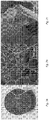
- Figures 1a, 1 b and 1c show, respectively, a photograph of a filter obtained with the invention process, and two photographs at 50x magnification obtained with a scanning electron microscope (SEM) on a section of said filter along the longitudinal direction of the material, and on a filter section along the transverse direction.
- SEM scanning electron microscope
- the gelatin/chitosan material is produced around a "core" of a different material, having paramagnetic properties.
- the “core” consists of a composite material, formed by a hydrophilic polymer mineralized and/or mixed with magnetic particles such as iron oxides (magnetite, maghemite, ...) or a hydroxyapatite modified with the addition of iron.
- Hydroxyapatite is the compound of formula Cas (PO 4 ) 3 (OH), which exists in nature as a mineral and is also the mineral constituent of human and animal bones.
- the compound is also indicated in the literature also with the abbreviation HA.
- the compound offers many possibilities of modification through partial replacement of the component elements; for example, in the natural mineral the hydroxyl ion can be partially replaced by chlorine, fluorine or carbonate ions.
- an amount ranging from 2 to 40% atomic of calcium is substituted by iron present in both its valences (II) and (III), which confers paramagnetic properties to the compound.
- the hydrophilic polymer used for the mineralization with hydroxyapatite is preferably an alginate, in particular sodium alginate, but the invention can also be carried out with other hydrophilic polymers, such as gelatin, nanocellulose, chitosan or their mixtures.
- hydrophilic polymers such as gelatin, nanocellulose, chitosan or their mixtures.
- the paramagnetic "core” useful for the invention is produced by a so-called “biomineralization” process, in which the modified HA (hereinafter referred to as FeHA) is formed, in the form of nanoparticles of size generally not higher than 200 nm, directly inside the sodium alginate matrix.
- FeHA modified HA
- the process for the realization of the "core” includes the steps of:
- Steps g), h) and i) can be performed in any order or at the same time.
- the amounts of reagents are calculated so that the weight ratio between modified HA and sodium alginate in the final product is between 40:60 and 60:40.
- the freeze-drying process is preferably carried out inside a container having the shape and dimensions corresponding to those of the desired core, in such a way that the same is ready for use, without the need for mechanical processing, at the end of the described process.
- the production process of the paramagnetic core can be carried out according to two alternative methods, which differ in the execution order of the intermediate steps between j) and m).
- the core is produced by immediately mixing the hydrophilic polymer(s) solution of step i) with the HA precursors (steps k and l).
- the paramagnetic core is produced by mixing said hydrophilic polymer(s) solution with modified magnetic HA (FeHA) or iron oxide nanoparticles previously produced.
- modified magnetic HA FeHA
- the formation of a modified hydroxyapatite precipitate is first determined, and to the suspension of FeHA particles thus obtained is added the hydrophilic polymer(s) solution, so that said FeHA particles are incorporated into the matrix of said polymer that is formed in steps from m) to o).
- the hydrophilic polymer of the step i) preferred for the purposes of the invention is sodium alginate.
- the amounts of magnetic phase and polymer are calculated so that the weight ratio in the final product is between 40:60 and 80:20.
- the freeze-drying process is preferably carried out inside a container having the shape and dimensions corresponding to those of the desired core, so that the same is ready for use, without the need for mechanical processing, at the end of the described process.
- the paramagnetic core thus produced is then placed in the bottom and in the center of the container in which the process described above is carried out, comprising the steps from a) to e) or f).
- the solution obtained in step c') (in the first variant of the process) or in step c) (in the second variant of the process) is added to the container, so as to surround the paramagnetic core, so that with cross-linking and subsequent steps of hydrogel formation and of freeze-drying the core is surrounded by and adheres to a "shell" of the gelatin/chitosan material.
- the core has a porous structure, but with porosity dimensions significantly lower than those of the gelatin/chitosan shell, so that the gases pass preferably through the latter, which maintains its function of heat and moisture exchange with the gases and vapors with which it comes in contact.
- the paramagnetic core can be heated from the outside with an alternating magnetic field, controlling with precision its temperature, and consequently also that of the overall filter.
- the active heating of the filter improves the properties of the same in releasing the humidity to the inhaled air, as well as, of course, bringing the temperature of the same to values closer to the physiological ones and therefore more comfortable and above all that result in lower health risks of the patient.
- Fig. 2a shows a photograph of the filter as a whole, in which the boundary zone between the HA/alginate core in the center and the gelatin/chitosan shell on the outside is evident.
- Fig. 2b shows a photograph at a 100x magnification obtained with a SEM of the interface area between the core and the shell of Fig. 2a .
- Fig. 2c shows a 1,000 ⁇ magnification photograph obtained with a SEM of the core, from which the modified HA nanoparticles connected to the alginate structure are evident.
- the HME filter of the invention offers various advantages with respect to analogous filters of the prior art.
- the filter acts to protect of the patient respiratory system not only in a passive way (physically retaining possible pathogenic elements), but also actively.
- the described core/shell embodiment allows, at a low price, to add the temperature control functionality that allows to obtain further improved functional properties with respect to the commercially available HME filters.
- the samples morphology has been analyzed using an environmental scanning electron microscope (ESEM, Quanta 600 FEG, FEI Company, Hillsbrono, OR).
- ESEM environmental scanning electron microscope
- Quanta 600 FEG FEG
- FEI Company FEI Company, Hillsbrono, OR
- the samples were mounted on aluminum supports with carbon ribbon and subsequently made conductive by a thin and uniform gold coating deposited by means of a Polaron Sputter Coater (Mod. E5100, Polaron Equipment, Watford, Hertfordshire, U.K.).
- the porosity of the filters has been evaluated by the apparent density method.
- porosity % 1 ⁇ ⁇ relative ⁇ 100
- the affinity that the material has with water has been evaluated by measuring the static contact angle on materials in the film form.
- the hydrogel has been distributed as a thin film on the surface of a microscope slide and air-dried at room temperature.
- the pressure drop generated by the sample has been recorded at three different dry air flow rates (30 l/min, 60 l/min and 90 l/min) as reported by ISO 9360-1 and 9360-2, specific for these HME devices.
- the resistance along the device is measured by an electronic differential pressure gauge (2080P, Digitron, United Kingdom); in all measurements, the pressure drop due to the instrument is calculated and subtracted from the sample pressure drop.
- This example refers to the synthesis procedure of HME devices based on gelatin and chitosan chemically crosslinked with genipin.
- the solution obtained was poured into cylindrical molds with an internal diameter of 50 mm, consisting of a 1 mm thick steel bottom and 1.5 mm thick PVC walls, until obtaining a solution level height in the mold of 35 mm; the molds were then closed by covering them with plastic lids, taking care not to touch the solution with the lid, and the solution was left to stand for 64 h, time necessary for crosslinking.
- the thermally conductive bottom of the container was placed in contact with a surface initially at room temperature.
- the temperature was controlled with a thermocouple inserted into the sample at the center of its upper surface; the probe is connected through a feedback system to a logic circuit that controls a temperature programmer, in turn in contact with the surface on which the container is placed.
- This example refers to the synthesis procedure of HME devices based on gelatin and chitosan cross-linked by dehydrotermal treatment (DHT).
- DHT dehydrotermal treatment
- gelatin and chitosan solutions were prepared as described in Example 1, with the difference that after mixing the two solutions the crosslinker solution was not added, but only 28.6 g of water; the gelatin and chitosan solutions were used in quantities and ratios identical to those of Example 1.
- the chitosan solution was poured into the gelatin solution at room temperature and the resulting solution was kept under slow magnetic stirring to avoid foaming until complete homogenization of the system (30 min).
- the obtained solution was poured into the molds and left to rest until hydrogel achievement, after about 3 hours as visually verified (step d).
- step e The freeze-drying (step e) was carried out following the same thermal profile of Example 1.
- Example 1 refers to the synthesis procedure of a HME device based on gelatin and chitosan chemically crosslinked with genipin following the procedure of Example 1 and varying the gelatin:chitosan ratio which, in this case, is equal to 50:50.
- Example 1 was repeated by changing only the amounts and concentrations of chitosan and genipin solutions as described below:
- Example 1 refers to the synthesis procedure of a HME device based on gelatin and chitosan chemically crosslinked with genipin following the procedure of Example 1 and varying the gelatin:chitosan ratio which, in this case, is equal to 80:20.
- Example 1 was repeated by changing only the amounts and concentrations of chitosan and genipin solutions as described below:
- Example 1 refers to the synthesis procedure of a HME device based on gelatin and chitosan chemically crosslinked with genipin following the procedure of Example 1 and varying the polymer part concentration in the hydrogel obtained at the end of step d'), that, in this case, is equal to 3% by weight.
- Example 1 was repeated only changing the concentrations of gelatin and chitosan solutions as described below:
- This example refers to the synthesis procedure of a HME device based on gelatin and chitosan chemically crosslinked with genipin following the procedure of Example 1 and varying the concentration of genipin, which, in this case, is equal to 1% by weight with respect to the sum of gelatin and chitosan weights.
- Example 1 was repeated only changing the concentration of the genipin solution as described below:
- This example refers to the synthesis procedure of a HME device based on gelatin and chitosan chemically crosslinked with genipin following the procedure of Example 1 and varying only the concentration of the genipin, which, in this case, is equal to 4% by weight with respect to the sum of the gelatin and chitosan weights.
- Example 1 was repeated only changing the concentration of the genipin solution as described below:
- This example refers to the synthesis procedure of a HME device based on gelatin and chitosan chemically crosslinked with genipin following the procedure of Example 1 and varying only the concentration of the genipin, which, in this case, is equal to 0.5% by weight compared to the sum of gelatin and chitosan weights.
- Example 1 was repeated only changing the concentration of the genipin solution as described below:
- This example refers to the synthesis procedure of an HME device based on gelatin and chitosan cross-linked by dehydrotermal treatment (DHT) following the procedure of Example 2 with the only difference that in this case the procedure was not carried out under vacuum but at atmospheric pressure.
- DHT dehydrotermal treatment
- gelatin and chitosan solutions were prepared as described in Example 2 and were employed in amounts and ratios identical to those of Example 2.
- This example refers to the synthesis procedure of an HME device based on gelatin and chitosan cross-linked by dehydrotermal treatment (DHT) following the procedure of Example 2 with the only difference that the crosslinking time, in this case, was equal to 24 hours.
- DHT dehydrotermal treatment
- gelatin and chitosan solutions were prepared as described in Example 2 and were employed in amounts and ratios identical to those of Example 2.
- Example 1 A sample prepared as described in Example 1 was subjected to a pressure drop test according to standards ISO 9360-1 and ISO 9360-2. The results are shown in Figure 3 , where it can be seen that the sample complies with the parameters defined by the reference standards, that is, a pressure drop not greater than 5 mbar. Similar results were obtained with the samples prepared in Examples 3 and 7, as confirmed by the values shown in Figure 3 .
- Example 2 A sample prepared as described in Example 2 were subjected to a test to evaluate the ability to absorb water (also called swelling). The results are shown in Figure 4 , where it can be seen that the sample has a high capacity to absorb water due to its high hydrophilicity, a fundamental property for this type of devices that must be able to quickly absorb the moisture present in the flow of expired air and release it to the flow of inspired air.
- Example 1 A sample prepared as described in Example 1 was subjected to a moisture absorption capacity test according to standards ISO 9360-1 and 9360-2. The result is shown in Figure 5 , in which it is observed that the parameters defined by the reference standards, that is, an absolute humidity recovery of about 80%, are respected. Similar results were obtained with the samples prepared in Examples 3 to 6 as confirmed by the values shown in Figure 5 .
- This example refers to the synthesis procedure of HME devices composed of a core based on sodium alginate on the fibers of which HA modified with Fe 2+ and Fe 3+ is biomineralized, and a shell based on gelatin and chitosan chemically crosslinked with genipin following the procedure of Example 1.
- gelatin, chitosan and genipin solutions were prepared as described in Example 1 and were employed in amounts and ratios identical to those of Example 1.
- the chitosan solution was poured into the gelatin solution at room temperature and the resulting solution was kept under slow magnetic stirring to avoid foaming until complete homogenization of the system (30 min).
- the genipin solution was added to the mixture obtained in the previous step, and magnetic stirring was maintained for 15 min.
- the obtained solution was poured into molds having an internal diameter of 50 mm, equal to those used in Example 1, until obtaining a height of the level of the solution in the mold equal to 35 mm; within and at the center of the same molds before the solution the superparamagnetic core synthesized as described above in point a) were introduced; the molds were then closed by covering them with plastic lids, taking care not to touch the solution with the lid, and the solution was left to stand for 64 h, a time necessary for cross-linking.
- This example refers to the synthesis procedure of HME devices consisting of a core based on sodium alginate mixed with HA modified with Fe 2+ and Fe 3+ (FeHA) and a shell based on gelatin and chitosan chemically crosslinked with genipin following the procedure of Example 1.
- gelatin, chitosan and genipin solutions were prepared as described in Example 1 and were employed in amounts and ratios identical to those of Example 1.
- the chitosan solution was poured into the gelatin solution at room temperature and the resulting solution was kept under slow magnetic stirring to avoid foaming until complete homogenization of the system (30 min).
- the genipin solution was added to the mixture obtained in the previous step, and magnetic stirring was maintained for 15 min.
- the obtained solution was poured into molds having an inner diameter of 50 mm, equal to those used in Example 1, until a solution level height of 35 mm was obtained in the mold.
- the superparamagnetic core synthesized as described above at point a) were introduced; the molds were then closed by covering them with plastic lids, taking care not to touch the solution with the lid, and the solution was left to stand for 64 h, a time necessary for crosslinking.
Landscapes
- Chemical & Material Sciences (AREA)
- Health & Medical Sciences (AREA)
- Chemical Kinetics & Catalysis (AREA)
- Medicinal Chemistry (AREA)
- Polymers & Plastics (AREA)
- Organic Chemistry (AREA)
- Dispersion Chemistry (AREA)
- Engineering & Computer Science (AREA)
- Public Health (AREA)
- Veterinary Medicine (AREA)
- Emergency Medicine (AREA)
- Pulmonology (AREA)
- General Health & Medical Sciences (AREA)
- Anesthesiology (AREA)
- Biomedical Technology (AREA)
- Heart & Thoracic Surgery (AREA)
- Hematology (AREA)
- Life Sciences & Earth Sciences (AREA)
- Animal Behavior & Ethology (AREA)
- Physics & Mathematics (AREA)
- Oral & Maxillofacial Surgery (AREA)
- Thermal Sciences (AREA)
- Dermatology (AREA)
- Materials For Medical Uses (AREA)
- Medicinal Preparation (AREA)
- Solid-Sorbent Or Filter-Aiding Compositions (AREA)
- Manufacture Of Porous Articles, And Recovery And Treatment Of Waste Products (AREA)
Claims (8)
- Verfahren zur Herstellung eines für die Herstellung von HME-Filtern geeigneten Materials, das die folgenden Schritte umfasst:a) Herstellung einer sauren wässrigen Lösung von Chitosan in einer Konzentration von 1 bis 2,5 Gew.-%;b) Herstellung einer wässrigen Lösung einer Gelatine tierischen Ursprungs in einer Konzentration von 2,5 bis 5 Gew.-% bei einer Temperatur zwischen 40 und 50 °C;c) Mischen der beiden so erhaltenen Lösungen in solchen Mengen, dass ein Gewichtsverhältnis von Gelatine:Chitosan von 80:20 bis 50:50, vorzugsweise 70:30, erhalten wird, vorsichtiges Rühren der resultierenden Lösung, um die Bildung eines Schaums zu vermeiden, bis eine homogene Lösung erhalten wird, und anschließendes Verdünnen der Mischung, um eine Gesamtpolymerkonzentration von 2 bis 4 Gew.-%, vorzugsweise 2 Gew.-%, zu erhalten;d) Gießen der in Schritt c) hergestellten Lösung in einen Behälter, dessen Boden aus einem Material mit einer Wärmeleitfähigkeit von mindestens 15 W/(m·K) und dessen Seitenwände aus einem Material mit einer Wärmeleitfähigkeit von höchstens 1 W/(m·K) bestehen;e) Gefriertrocknen der in Schritt c) erhaltenen Lösung im Inneren des Behälters gemäß den folgenden Phasen:- Einfrieren des Hydrogels auf eine Temperatur von -20 bis -60 °C, vorzugsweise -40 °C, indem der Boden des Behälters in Kontakt mit einem Kühlsystem gebracht wird;- Primärtrocknen durch Erhitzen mit einer Geschwindigkeit zwischen 2 und 8 °C/h bis zu einer Temperatur zwischen -5 und -10 °C bei einem Druck zwischen 0,001 mbar und atmosphärischem Druck;- Sekundärtrocknen durch Erhitzen mit einer Geschwindigkeit zwischen 1 und 5 °C/h bis zu einer Temperatur zwischen 15 und 20 °C bei einem Druck zwischen 0,001 mbar und atmosphärischem Druck;f) Unterziehen des in Schritt e) erhaltenen gefriergetrockneten Produkts einer Vernetzungsbehandlung durch thermische Dehydratisierung, indem es auf eine Temperatur von 140 bis 160 °C, vorzugsweise 160 °C, bei einem Druck zwischen 0,001 mbar und atmosphärischem Druck für eine Dauer zwischen 24 und 48 Stunden erhitzt wird.
- Verfahren nach Anspruch 1, wobei der Boden des Behälters, in dem das Hydrogel gebildet wird, aus Stahl, Kupfer oder Silizium und die Wände aus Kunststoff, Teflon oder Glas hergestellt sind.
- Verfahren nach einem der vorstehenden Ansprüche, bei dem vor dem Einbringen der Lösung in den Behälter, in dem das Hydrogel gebildet wird, in denselben Behälter ein paramagnetischer Kern eingebracht wird, der einen Hydroxyapatit umfasst, in dem eine Menge zwischen 2 und 40 Atom-% Calcium durch Eisen ersetzt ist, das in seinen beiden Oxidationsstufen (II) und (III) vorliegt, hergestellt durch ein Verfahren, das die folgenden Schritte umfasst:g) Herstellen einer wässrigen Lösung, die einen Calciumvorläufer, mindestens ein lösliches Eisen(II)-Salz und mindestens ein lösliches Eisen(III)-Salz enthält;h) Herstellen einer wässrigen Lösung, die eine wasserlösliche Phosphorverbindung, vorzugsweise Phosphorsäure, enthält;i) Herstellen einer wässrigen Lösung, die einen Vorläufer eines oder mehrerer hydrophiler Polymere enthält;j) langsames Zugeben der Phosphorverbindungslösung zu der Lösung, die den Calciumvorläufer und die Eisensalze enthält, um eine Suspension zu erhalten;k) gegebenenfalls sofortiges Zugeben der in Schritt i) erhaltenen Lösung zu der in Schritt j) erhaltenen Suspension;I) wenn Schritt k) durchgeführt wurde, Reagierenlassen des Systems bei einer Temperatur zwischen Umgebungstemperatur T und 70 °C für eine Dauer zwischen 1 und 5 Stunden;k') falls die Schritte k) und I) nicht durchgeführt wurden, Reagierenlassen des in Schritt j) erhaltenen Systems bei einer Temperatur zwischen Umgebungstemperatur T und 70 °C für eine Dauer zwischen 1 und 24 Stunden; undl'), wenn Schritt k') durchgeführt wurde, Vermischen der erhaltenen Suspension mit der in Schritt i) erhaltenen wässrigen Lösung;m) Unterziehen des in Schritt l) oder in Schritt l') erhaltenen Produkts einer Gefriertrocknungsbehandlung;n) Eintauchen des gefriergetrockneten Produkts in eine CaCl2-Lösung mit einer Konzentration zwischen 0,5 und 1,5 M für eine Dauer zwischen 15 bis 45 Minuten und anschließendes Waschen der Vorrichtung durch Eintauchen in destilliertes Wasser;o) erneutes Unterziehen des Materials einer Gefriertrocknungsbehandlung.
- Verfahren nach Anspruch 3, wobei Natriumalginat als hydrophiles Polymer verwendet wird.
- Verfahren nach einem der Ansprüche 3 oder 4, bei dem die Reaktanten in solchen Mengen eingesetzt werden, dass das Gewichtsverhältnis zwischen dem Magnetkern und dem umgebenden polymeren Material zwischen 40:60 und 80:20 liegt.
- Verfahren nach einem der vorstehenden Ansprüche, bei dem am Ende des Verfahrens zwischen 3 und 5 mm der Oberseite und der Unterseite des erhaltenen Produkts mechanisch entfernt werden.
- HME-Filter, erhalten nach dem Verfahren gemäß einem der Ansprüche 1, 2 und 6, mit einer Porosität zwischen 80 und 98 % und Poren mit einem Durchmesser zwischen 100 und 350 µm, wobei die Poren die Form von Kanälen aufweisen, die an ihren Enden offen und im Wesentlichen parallel zueinander sind.
- HME-Filter, erhalten nach einem der Ansprüche 3 bis 6, umfassend:- einen zentralen Kern, der aus einer porösen Matrix gebildet ist, die aus einem oder mehreren hydrophilen Polymeren hergestellt ist, die Teilchen aus modifiziertem Hydroxyapatit enthalten, in denen eine Menge zwischen 2 und 40 Atom-% Calcium durch Eisen in seinen beiden Oxidationsstufen (II) und (III) ersetzt ist; und- eine den Kern umgebende Schale, die aus Chitosan und einer natürlichen Gelatine gebildet ist, eine Porosität zwischen 80 und 98 % und Poren mit einem Durchmesser zwischen 100 und 350 µm aufweist und in der die Poren die Form von Kanälen aufweisen, die an ihren Enden offen und im Wesentlichen parallel zueinander sind.
Applications Claiming Priority (2)
| Application Number | Priority Date | Filing Date | Title |
|---|---|---|---|
| IT102017000022625A IT201700022625A1 (it) | 2017-02-28 | 2017-02-28 | Filtro per lo scambio di calore e umidità per applicazione in campo medicale e procedimento per la sua produzione |
| PCT/IB2018/051234 WO2018158684A1 (en) | 2017-02-28 | 2018-02-27 | Filter for the exchange of heat and moisture for application in the medical field and procedure for the production thereof |
Publications (2)
| Publication Number | Publication Date |
|---|---|
| EP3589680A1 EP3589680A1 (de) | 2020-01-08 |
| EP3589680B1 true EP3589680B1 (de) | 2022-08-24 |
Family
ID=59521299
Family Applications (1)
| Application Number | Title | Priority Date | Filing Date |
|---|---|---|---|
| EP18717989.0A Active EP3589680B1 (de) | 2017-02-28 | 2018-02-27 | Filter zum austausch von wärme und feuchtigkeit zur anwendung im medizinischen bereich und verfahren zur herstellung davon |
Country Status (7)
| Country | Link |
|---|---|
| US (1) | US11628602B2 (de) |
| EP (1) | EP3589680B1 (de) |
| KR (1) | KR20190124732A (de) |
| CN (1) | CN110709448B (de) |
| CA (1) | CA3054489A1 (de) |
| IT (1) | IT201700022625A1 (de) |
| WO (1) | WO2018158684A1 (de) |
Families Citing this family (4)
| Publication number | Priority date | Publication date | Assignee | Title |
|---|---|---|---|---|
| CN113087962B (zh) * | 2021-04-17 | 2022-04-29 | 北京化工大学 | 一种抗氧化高吸液倍率止血海绵的制备方法 |
| CN114767925B (zh) * | 2022-05-05 | 2024-10-01 | 江南大学 | 一种荧光pH敏感的抗菌水凝胶敷料及其制备方法和应用 |
| CN115010959B (zh) * | 2022-06-29 | 2025-09-12 | 陕西科技大学 | 一种氨基改性MXene增强明胶/壳聚糖复合水凝胶及其制备方法 |
| CN116425999B (zh) * | 2023-03-01 | 2026-02-10 | 中国石油大学(华东) | 一种壳聚糖-海藻酸钠水凝胶及其制备方法和应用、含过氧化铜的水凝胶及其制备方法 |
Family Cites Families (11)
| Publication number | Priority date | Publication date | Assignee | Title |
|---|---|---|---|---|
| WO2001057121A1 (fr) * | 2000-02-03 | 2001-08-09 | Menicon Co., Ltd. | Moulage spongieux comprenant un polymere hydrosoluble et procede pour en controler les pores |
| CN101703806A (zh) * | 2009-12-03 | 2010-05-12 | 淄博高新区联创科技服务中心 | 一种多孔羟基磷灰石/壳聚糖-明胶复合材料支架 |
| IT1401487B1 (it) * | 2010-07-29 | 2013-07-26 | Consiglio Nazionale Ricerche | Idrossiapatite intrinsecamente magnetica |
| US8877498B2 (en) * | 2010-12-01 | 2014-11-04 | Drexel University | Porous polymer scaffolds for neural tissue engineering and methods of producing the same |
| AU2012334820B2 (en) * | 2011-11-11 | 2014-12-18 | ResMed Pty Ltd | Exchanger assembly for respiratory treatment |
| CN103525097A (zh) * | 2013-10-23 | 2014-01-22 | 中国科学院烟台海岸带研究所 | 一种水产鱼皮明胶海绵及其制备方法 |
| CN103724657A (zh) * | 2013-12-25 | 2014-04-16 | 同济大学 | 一种交联壳聚糖/明胶复合多孔支架的制备方法 |
| CN104530466A (zh) * | 2015-01-21 | 2015-04-22 | 中国科学技术大学 | 一种用于制备具有微观层状结构的材料的冷冻方法 |
| CN105854078B (zh) * | 2016-04-26 | 2018-08-24 | 青岛大学 | 一种功能性人造皮肤支架材料的制备方法 |
| CN105920678B (zh) * | 2016-04-26 | 2018-11-06 | 青岛大学 | 一种具有三维梯度孔结构的海藻酸盐多孔材料的制备方法 |
| CN105920679B (zh) * | 2016-04-26 | 2018-10-19 | 青岛大学 | 一种具有三维梯度孔结构的皮肤支架材料的制备方法 |
-
2017
- 2017-02-28 IT IT102017000022625A patent/IT201700022625A1/it unknown
-
2018
- 2018-02-27 EP EP18717989.0A patent/EP3589680B1/de active Active
- 2018-02-27 US US16/489,504 patent/US11628602B2/en active Active
- 2018-02-27 WO PCT/IB2018/051234 patent/WO2018158684A1/en not_active Ceased
- 2018-02-27 CN CN201880028205.7A patent/CN110709448B/zh not_active Expired - Fee Related
- 2018-02-27 CA CA3054489A patent/CA3054489A1/en active Pending
- 2018-02-27 KR KR1020197026689A patent/KR20190124732A/ko not_active Abandoned
Also Published As
| Publication number | Publication date |
|---|---|
| KR20190124732A (ko) | 2019-11-05 |
| WO2018158684A1 (en) | 2018-09-07 |
| IT201700022625A1 (it) | 2018-08-28 |
| EP3589680A1 (de) | 2020-01-08 |
| CN110709448A (zh) | 2020-01-17 |
| CN110709448B (zh) | 2022-10-11 |
| US20200030566A1 (en) | 2020-01-30 |
| CA3054489A1 (en) | 2018-09-07 |
| US11628602B2 (en) | 2023-04-18 |
Similar Documents
| Publication | Publication Date | Title |
|---|---|---|
| EP3589680B1 (de) | Filter zum austausch von wärme und feuchtigkeit zur anwendung im medizinischen bereich und verfahren zur herstellung davon | |
| Cui et al. | Robust hemostatic bandages based on nanoclay electrospun membranes | |
| Langwald et al. | Measuring physical properties of electrospun nanofiber mats for different biomedical applications | |
| Wu et al. | Porous bioactive diopside (CaMgSi2O6) ceramic microspheres for drug delivery | |
| Lalegül‐Ülker et al. | Magnetic silk fibroin composite nanofibers for biomedical applications: Fabrication and evaluation of the chemical, thermal, mechanical, and in vitro biological properties | |
| JP2011523425A (ja) | 素早く濡れる親水コロイド含有材料、その製造方法及びその使用 | |
| Wei et al. | 3D bioprinting of alginate scaffolds with controlled micropores by leaching of recrystallized salts | |
| Cortes | Synthesis and characterization of hydroxyapatite nanoparticle | |
| Brum et al. | Polymer coatings based on sulfonated-poly-ether-ether-ketone films for implant dentistry applications | |
| Wan et al. | Development of polycaprolactone/chitosan blend porous scaffolds | |
| Qi et al. | Electrospun nano‐CaO2/polycaprolactone/gelatin nanofibers and their wound healing application through in situ supplying H2O2 | |
| Cahyati et al. | Properties of carbonated hydroxyapatite-based scaffold from oyster shells composited with honeycomb and polyethylene oxide for bone tissue engineering applications | |
| Kurdtabar et al. | Stimuli-responsive hydrogel based on poly ((2-dimethylamino) ethyl methacrylate) grafted onto sodium alginate as a drug delivery system | |
| Liu et al. | Amphipathic medical composite cotton gauze with unidirectional drainage and anti-adhesion properties for wound healing | |
| Mohamed et al. | New insights in large-pores mesoporous silica microspheres for hemostatic application | |
| Grazioli et al. | Synthesis and characterization of poly (vinyl alcohol)/chondroitin sulfate composite hydrogels containing strontium‐doped hydroxyapatite as promising biomaterials | |
| Kawaguchi et al. | Facile fabrication of gelatin hydrogels with anisotropic gel properties via self-assembly | |
| EP4306139A1 (de) | Poröse anorganische partikel und verbundfüllstoff sowie produkt damit | |
| Nardecchia et al. | Living magnetorheological composites: From the synthesis to the in vitro characterization | |
| Roberto | Silver Nanoparticles and PDMS Hybrid Nanostructure for Medical Applications | |
| CN118557784B (zh) | 氧化石墨烯基磷酸钙复合材料及其应用 | |
| Zeng et al. | 3D biocompatible bone engineering foams with tunable mechanical properties and porous structures | |
| CN119236169B (zh) | 含镓仿生矿化粒子与聚多巴胺纳米粒子的复合微球及其制备方法与应用 | |
| Taşar | Fabrication of Magnetic Bioactive Glass Nanoparticles | |
| CN109913200A (zh) | 一种具有磁性和荧光双重功能的纳米材料及其制备方法 |
Legal Events
| Date | Code | Title | Description |
|---|---|---|---|
| STAA | Information on the status of an ep patent application or granted ep patent |
Free format text: STATUS: UNKNOWN |
|
| STAA | Information on the status of an ep patent application or granted ep patent |
Free format text: STATUS: THE INTERNATIONAL PUBLICATION HAS BEEN MADE |
|
| PUAI | Public reference made under article 153(3) epc to a published international application that has entered the european phase |
Free format text: ORIGINAL CODE: 0009012 |
|
| STAA | Information on the status of an ep patent application or granted ep patent |
Free format text: STATUS: REQUEST FOR EXAMINATION WAS MADE |
|
| 17P | Request for examination filed |
Effective date: 20190925 |
|
| AK | Designated contracting states |
Kind code of ref document: A1 Designated state(s): AL AT BE BG CH CY CZ DE DK EE ES FI FR GB GR HR HU IE IS IT LI LT LU LV MC MK MT NL NO PL PT RO RS SE SI SK SM TR |
|
| AX | Request for extension of the european patent |
Extension state: BA ME |
|
| DAV | Request for validation of the european patent (deleted) | ||
| DAX | Request for extension of the european patent (deleted) | ||
| GRAP | Despatch of communication of intention to grant a patent |
Free format text: ORIGINAL CODE: EPIDOSNIGR1 |
|
| STAA | Information on the status of an ep patent application or granted ep patent |
Free format text: STATUS: GRANT OF PATENT IS INTENDED |
|
| INTG | Intention to grant announced |
Effective date: 20220316 |
|
| GRAS | Grant fee paid |
Free format text: ORIGINAL CODE: EPIDOSNIGR3 |
|
| GRAA | (expected) grant |
Free format text: ORIGINAL CODE: 0009210 |
|
| STAA | Information on the status of an ep patent application or granted ep patent |
Free format text: STATUS: THE PATENT HAS BEEN GRANTED |
|
| AK | Designated contracting states |
Kind code of ref document: B1 Designated state(s): AL AT BE BG CH CY CZ DE DK EE ES FI FR GB GR HR HU IE IS IT LI LT LU LV MC MK MT NL NO PL PT RO RS SE SI SK SM TR |
|
| REG | Reference to a national code |
Ref country code: CH Ref legal event code: EP |
|
| REG | Reference to a national code |
Ref country code: IE Ref legal event code: FG4D |
|
| REG | Reference to a national code |
Ref country code: AT Ref legal event code: REF Ref document number: 1513633 Country of ref document: AT Kind code of ref document: T Effective date: 20220915 Ref country code: DE Ref legal event code: R096 Ref document number: 602018039681 Country of ref document: DE |
|
| REG | Reference to a national code |
Ref country code: LT Ref legal event code: MG9D |
|
| REG | Reference to a national code |
Ref country code: NL Ref legal event code: MP Effective date: 20220824 |
|
| PG25 | Lapsed in a contracting state [announced via postgrant information from national office to epo] |
Ref country code: SE Free format text: LAPSE BECAUSE OF FAILURE TO SUBMIT A TRANSLATION OF THE DESCRIPTION OR TO PAY THE FEE WITHIN THE PRESCRIBED TIME-LIMIT Effective date: 20220824 Ref country code: RS Free format text: LAPSE BECAUSE OF FAILURE TO SUBMIT A TRANSLATION OF THE DESCRIPTION OR TO PAY THE FEE WITHIN THE PRESCRIBED TIME-LIMIT Effective date: 20220824 Ref country code: PT Free format text: LAPSE BECAUSE OF FAILURE TO SUBMIT A TRANSLATION OF THE DESCRIPTION OR TO PAY THE FEE WITHIN THE PRESCRIBED TIME-LIMIT Effective date: 20221226 Ref country code: NO Free format text: LAPSE BECAUSE OF FAILURE TO SUBMIT A TRANSLATION OF THE DESCRIPTION OR TO PAY THE FEE WITHIN THE PRESCRIBED TIME-LIMIT Effective date: 20221124 Ref country code: NL Free format text: LAPSE BECAUSE OF FAILURE TO SUBMIT A TRANSLATION OF THE DESCRIPTION OR TO PAY THE FEE WITHIN THE PRESCRIBED TIME-LIMIT Effective date: 20220824 Ref country code: LV Free format text: LAPSE BECAUSE OF FAILURE TO SUBMIT A TRANSLATION OF THE DESCRIPTION OR TO PAY THE FEE WITHIN THE PRESCRIBED TIME-LIMIT Effective date: 20220824 Ref country code: LT Free format text: LAPSE BECAUSE OF FAILURE TO SUBMIT A TRANSLATION OF THE DESCRIPTION OR TO PAY THE FEE WITHIN THE PRESCRIBED TIME-LIMIT Effective date: 20220824 Ref country code: FI Free format text: LAPSE BECAUSE OF FAILURE TO SUBMIT A TRANSLATION OF THE DESCRIPTION OR TO PAY THE FEE WITHIN THE PRESCRIBED TIME-LIMIT Effective date: 20220824 |
|
| REG | Reference to a national code |
Ref country code: AT Ref legal event code: MK05 Ref document number: 1513633 Country of ref document: AT Kind code of ref document: T Effective date: 20220824 |
|
| PG25 | Lapsed in a contracting state [announced via postgrant information from national office to epo] |
Ref country code: PL Free format text: LAPSE BECAUSE OF FAILURE TO SUBMIT A TRANSLATION OF THE DESCRIPTION OR TO PAY THE FEE WITHIN THE PRESCRIBED TIME-LIMIT Effective date: 20220824 Ref country code: IS Free format text: LAPSE BECAUSE OF FAILURE TO SUBMIT A TRANSLATION OF THE DESCRIPTION OR TO PAY THE FEE WITHIN THE PRESCRIBED TIME-LIMIT Effective date: 20221224 Ref country code: HR Free format text: LAPSE BECAUSE OF FAILURE TO SUBMIT A TRANSLATION OF THE DESCRIPTION OR TO PAY THE FEE WITHIN THE PRESCRIBED TIME-LIMIT Effective date: 20220824 Ref country code: GR Free format text: LAPSE BECAUSE OF FAILURE TO SUBMIT A TRANSLATION OF THE DESCRIPTION OR TO PAY THE FEE WITHIN THE PRESCRIBED TIME-LIMIT Effective date: 20221125 |
|
| PG25 | Lapsed in a contracting state [announced via postgrant information from national office to epo] |
Ref country code: SM Free format text: LAPSE BECAUSE OF FAILURE TO SUBMIT A TRANSLATION OF THE DESCRIPTION OR TO PAY THE FEE WITHIN THE PRESCRIBED TIME-LIMIT Effective date: 20220824 Ref country code: RO Free format text: LAPSE BECAUSE OF FAILURE TO SUBMIT A TRANSLATION OF THE DESCRIPTION OR TO PAY THE FEE WITHIN THE PRESCRIBED TIME-LIMIT Effective date: 20220824 Ref country code: ES Free format text: LAPSE BECAUSE OF FAILURE TO SUBMIT A TRANSLATION OF THE DESCRIPTION OR TO PAY THE FEE WITHIN THE PRESCRIBED TIME-LIMIT Effective date: 20220824 Ref country code: DK Free format text: LAPSE BECAUSE OF FAILURE TO SUBMIT A TRANSLATION OF THE DESCRIPTION OR TO PAY THE FEE WITHIN THE PRESCRIBED TIME-LIMIT Effective date: 20220824 Ref country code: CZ Free format text: LAPSE BECAUSE OF FAILURE TO SUBMIT A TRANSLATION OF THE DESCRIPTION OR TO PAY THE FEE WITHIN THE PRESCRIBED TIME-LIMIT Effective date: 20220824 Ref country code: AT Free format text: LAPSE BECAUSE OF FAILURE TO SUBMIT A TRANSLATION OF THE DESCRIPTION OR TO PAY THE FEE WITHIN THE PRESCRIBED TIME-LIMIT Effective date: 20220824 |
|
| REG | Reference to a national code |
Ref country code: DE Ref legal event code: R097 Ref document number: 602018039681 Country of ref document: DE |
|
| PG25 | Lapsed in a contracting state [announced via postgrant information from national office to epo] |
Ref country code: SK Free format text: LAPSE BECAUSE OF FAILURE TO SUBMIT A TRANSLATION OF THE DESCRIPTION OR TO PAY THE FEE WITHIN THE PRESCRIBED TIME-LIMIT Effective date: 20220824 Ref country code: EE Free format text: LAPSE BECAUSE OF FAILURE TO SUBMIT A TRANSLATION OF THE DESCRIPTION OR TO PAY THE FEE WITHIN THE PRESCRIBED TIME-LIMIT Effective date: 20220824 |
|
| PG25 | Lapsed in a contracting state [announced via postgrant information from national office to epo] |
Ref country code: AL Free format text: LAPSE BECAUSE OF FAILURE TO SUBMIT A TRANSLATION OF THE DESCRIPTION OR TO PAY THE FEE WITHIN THE PRESCRIBED TIME-LIMIT Effective date: 20220824 |
|
| PLBE | No opposition filed within time limit |
Free format text: ORIGINAL CODE: 0009261 |
|
| STAA | Information on the status of an ep patent application or granted ep patent |
Free format text: STATUS: NO OPPOSITION FILED WITHIN TIME LIMIT |
|
| 26N | No opposition filed |
Effective date: 20230525 |
|
| PG25 | Lapsed in a contracting state [announced via postgrant information from national office to epo] |
Ref country code: SI Free format text: LAPSE BECAUSE OF FAILURE TO SUBMIT A TRANSLATION OF THE DESCRIPTION OR TO PAY THE FEE WITHIN THE PRESCRIBED TIME-LIMIT Effective date: 20220824 |
|
| PG25 | Lapsed in a contracting state [announced via postgrant information from national office to epo] |
Ref country code: MC Free format text: LAPSE BECAUSE OF FAILURE TO SUBMIT A TRANSLATION OF THE DESCRIPTION OR TO PAY THE FEE WITHIN THE PRESCRIBED TIME-LIMIT Effective date: 20220824 |
|
| REG | Reference to a national code |
Ref country code: BE Ref legal event code: MM Effective date: 20230228 |
|
| PG25 | Lapsed in a contracting state [announced via postgrant information from national office to epo] |
Ref country code: LU Free format text: LAPSE BECAUSE OF NON-PAYMENT OF DUE FEES Effective date: 20230227 |
|
| REG | Reference to a national code |
Ref country code: IE Ref legal event code: MM4A |
|
| PG25 | Lapsed in a contracting state [announced via postgrant information from national office to epo] |
Ref country code: IE Free format text: LAPSE BECAUSE OF NON-PAYMENT OF DUE FEES Effective date: 20230227 |
|
| PG25 | Lapsed in a contracting state [announced via postgrant information from national office to epo] |
Ref country code: BE Free format text: LAPSE BECAUSE OF NON-PAYMENT OF DUE FEES Effective date: 20230228 |
|
| PGFP | Annual fee paid to national office [announced via postgrant information from national office to epo] |
Ref country code: DE Payment date: 20240206 Year of fee payment: 7 Ref country code: GB Payment date: 20240208 Year of fee payment: 7 Ref country code: CH Payment date: 20240301 Year of fee payment: 7 |
|
| PGFP | Annual fee paid to national office [announced via postgrant information from national office to epo] |
Ref country code: IT Payment date: 20240228 Year of fee payment: 7 Ref country code: FR Payment date: 20240213 Year of fee payment: 7 |
|
| PG25 | Lapsed in a contracting state [announced via postgrant information from national office to epo] |
Ref country code: BG Free format text: LAPSE BECAUSE OF FAILURE TO SUBMIT A TRANSLATION OF THE DESCRIPTION OR TO PAY THE FEE WITHIN THE PRESCRIBED TIME-LIMIT Effective date: 20220824 |
|
| PG25 | Lapsed in a contracting state [announced via postgrant information from national office to epo] |
Ref country code: BG Free format text: LAPSE BECAUSE OF FAILURE TO SUBMIT A TRANSLATION OF THE DESCRIPTION OR TO PAY THE FEE WITHIN THE PRESCRIBED TIME-LIMIT Effective date: 20220824 |
|
| PG25 | Lapsed in a contracting state [announced via postgrant information from national office to epo] |
Ref country code: CY Free format text: LAPSE BECAUSE OF FAILURE TO SUBMIT A TRANSLATION OF THE DESCRIPTION OR TO PAY THE FEE WITHIN THE PRESCRIBED TIME-LIMIT; INVALID AB INITIO Effective date: 20180227 |
|
| PG25 | Lapsed in a contracting state [announced via postgrant information from national office to epo] |
Ref country code: HU Free format text: LAPSE BECAUSE OF FAILURE TO SUBMIT A TRANSLATION OF THE DESCRIPTION OR TO PAY THE FEE WITHIN THE PRESCRIBED TIME-LIMIT; INVALID AB INITIO Effective date: 20180227 |
|
| REG | Reference to a national code |
Ref country code: DE Ref legal event code: R119 Ref document number: 602018039681 Country of ref document: DE |
|
| REG | Reference to a national code |
Ref country code: CH Ref legal event code: PL |
|
| PG25 | Lapsed in a contracting state [announced via postgrant information from national office to epo] |
Ref country code: CH Free format text: LAPSE BECAUSE OF NON-PAYMENT OF DUE FEES Effective date: 20250228 |
|
| GBPC | Gb: european patent ceased through non-payment of renewal fee |
Effective date: 20250227 |
|
| PG25 | Lapsed in a contracting state [announced via postgrant information from national office to epo] |
Ref country code: TR Free format text: LAPSE BECAUSE OF FAILURE TO SUBMIT A TRANSLATION OF THE DESCRIPTION OR TO PAY THE FEE WITHIN THE PRESCRIBED TIME-LIMIT Effective date: 20220824 |
|
| PG25 | Lapsed in a contracting state [announced via postgrant information from national office to epo] |
Ref country code: DE Free format text: LAPSE BECAUSE OF NON-PAYMENT OF DUE FEES Effective date: 20250902 |
|
| PG25 | Lapsed in a contracting state [announced via postgrant information from national office to epo] |
Ref country code: GB Free format text: LAPSE BECAUSE OF NON-PAYMENT OF DUE FEES Effective date: 20250227 |
|
| PG25 | Lapsed in a contracting state [announced via postgrant information from national office to epo] |
Ref country code: IT Free format text: LAPSE BECAUSE OF NON-PAYMENT OF DUE FEES Effective date: 20250227 Ref country code: FR Free format text: LAPSE BECAUSE OF NON-PAYMENT OF DUE FEES Effective date: 20250228 |