EP3589197B1 - System und verfahren für verbesserte diffusionsgewichtete bildgebung - Google Patents
System und verfahren für verbesserte diffusionsgewichtete bildgebung Download PDFInfo
- Publication number
- EP3589197B1 EP3589197B1 EP18761729.5A EP18761729A EP3589197B1 EP 3589197 B1 EP3589197 B1 EP 3589197B1 EP 18761729 A EP18761729 A EP 18761729A EP 3589197 B1 EP3589197 B1 EP 3589197B1
- Authority
- EP
- European Patent Office
- Prior art keywords
- gradient
- diffusion
- constraints
- pulse sequence
- moment
- Prior art date
- Legal status (The legal status is an assumption and is not a legal conclusion. Google has not performed a legal analysis and makes no representation as to the accuracy of the status listed.)
- Active
Links
Images





Classifications
-
- G—PHYSICS
- G01—MEASURING; TESTING
- G01R—MEASURING ELECTRIC VARIABLES; MEASURING MAGNETIC VARIABLES
- G01R33/00—Arrangements or instruments for measuring magnetic variables
- G01R33/20—Arrangements or instruments for measuring magnetic variables involving magnetic resonance
- G01R33/44—Arrangements or instruments for measuring magnetic variables involving magnetic resonance using nuclear magnetic resonance [NMR]
- G01R33/48—NMR imaging systems
- G01R33/54—Signal processing systems, e.g. using pulse sequences ; Generation or control of pulse sequences; Operator console
- G01R33/56—Image enhancement or correction, e.g. subtraction or averaging techniques, e.g. improvement of signal-to-noise ratio and resolution
- G01R33/563—Image enhancement or correction, e.g. subtraction or averaging techniques, e.g. improvement of signal-to-noise ratio and resolution of moving material, e.g. flow contrast angiography
- G01R33/56341—Diffusion imaging
-
- A—HUMAN NECESSITIES
- A61—MEDICAL OR VETERINARY SCIENCE; HYGIENE
- A61B—DIAGNOSIS; SURGERY; IDENTIFICATION
- A61B5/00—Measuring for diagnostic purposes; Identification of persons
- A61B5/05—Detecting, measuring or recording for diagnosis by means of electric currents or magnetic fields; Measuring using microwaves or radio waves
- A61B5/055—Detecting, measuring or recording for diagnosis by means of electric currents or magnetic fields; Measuring using microwaves or radio waves involving electronic [EMR] or nuclear [NMR] magnetic resonance, e.g. magnetic resonance imaging
-
- G—PHYSICS
- G01—MEASURING; TESTING
- G01R—MEASURING ELECTRIC VARIABLES; MEASURING MAGNETIC VARIABLES
- G01R33/00—Arrangements or instruments for measuring magnetic variables
- G01R33/20—Arrangements or instruments for measuring magnetic variables involving magnetic resonance
- G01R33/44—Arrangements or instruments for measuring magnetic variables involving magnetic resonance using nuclear magnetic resonance [NMR]
- G01R33/48—NMR imaging systems
- G01R33/54—Signal processing systems, e.g. using pulse sequences ; Generation or control of pulse sequences; Operator console
- G01R33/543—Control of the operation of the MR system, e.g. setting of acquisition parameters prior to or during MR data acquisition, dynamic shimming, use of one or more scout images for scan plane prescription
-
- G—PHYSICS
- G01—MEASURING; TESTING
- G01R—MEASURING ELECTRIC VARIABLES; MEASURING MAGNETIC VARIABLES
- G01R33/00—Arrangements or instruments for measuring magnetic variables
- G01R33/20—Arrangements or instruments for measuring magnetic variables involving magnetic resonance
- G01R33/44—Arrangements or instruments for measuring magnetic variables involving magnetic resonance using nuclear magnetic resonance [NMR]
- G01R33/48—NMR imaging systems
- G01R33/54—Signal processing systems, e.g. using pulse sequences ; Generation or control of pulse sequences; Operator console
- G01R33/56—Image enhancement or correction, e.g. subtraction or averaging techniques, e.g. improvement of signal-to-noise ratio and resolution
- G01R33/561—Image enhancement or correction, e.g. subtraction or averaging techniques, e.g. improvement of signal-to-noise ratio and resolution by reduction of the scanning time, i.e. fast acquiring systems, e.g. using echo-planar pulse sequences
- G01R33/5615—Echo train techniques involving acquiring plural, differently encoded, echo signals after one RF excitation, e.g. using gradient refocusing in echo planar imaging [EPI], RF refocusing in rapid acquisition with relaxation enhancement [RARE] or using both RF and gradient refocusing in gradient and spin echo imaging [GRASE]
- G01R33/5616—Echo train techniques involving acquiring plural, differently encoded, echo signals after one RF excitation, e.g. using gradient refocusing in echo planar imaging [EPI], RF refocusing in rapid acquisition with relaxation enhancement [RARE] or using both RF and gradient refocusing in gradient and spin echo imaging [GRASE] using gradient refocusing, e.g. EPI
-
- G—PHYSICS
- G01—MEASURING; TESTING
- G01R—MEASURING ELECTRIC VARIABLES; MEASURING MAGNETIC VARIABLES
- G01R33/00—Arrangements or instruments for measuring magnetic variables
- G01R33/20—Arrangements or instruments for measuring magnetic variables involving magnetic resonance
- G01R33/44—Arrangements or instruments for measuring magnetic variables involving magnetic resonance using nuclear magnetic resonance [NMR]
- G01R33/48—NMR imaging systems
- G01R33/54—Signal processing systems, e.g. using pulse sequences ; Generation or control of pulse sequences; Operator console
- G01R33/56—Image enhancement or correction, e.g. subtraction or averaging techniques, e.g. improvement of signal-to-noise ratio and resolution
- G01R33/565—Correction of image distortions, e.g. due to magnetic field inhomogeneities
- G01R33/56518—Correction of image distortions, e.g. due to magnetic field inhomogeneities due to eddy currents, e.g. caused by switching of the gradient magnetic field
Definitions
- the present disclosure relates generally to systems and methods for magnetic resonance imaging (“MRI”) and, in particular, to eddy current controlled diffusion-weighted imaging (“DWI").
- MRI magnetic resonance imaging
- DWI diffusion-weighted imaging
- any nucleus that possesses a magnetic moment attempts to align itself with the direction of the magnetic field in which it is located. In doing so, however, the nucleus processes around this direction at a characteristic angular frequency (Larmor frequency), which is dependent on the strength of the magnetic field and on the properties of the specific nuclear species (the gyromagnetic ratio ⁇ of the nucleus). Nuclei which exhibit these phenomena are referred to herein as "spins.”
- polarizing field B 0 When a substance such as human tissue is subjected to a uniform magnetic field (polarizing field B 0 ), the individual magnetic moments of the spins in the tissue attempt to align with this polarizing field, but process about it in random order at their characteristic Larmor frequency. A net magnetic moment M Z is produced in the direction of the polarizing field, but the randomly oriented magnetic components in the perpendicular, or transverse, plane (x-y plane) cancel one another.
- the net aligned moment, M Z may be rotated, or "tipped", into the x-y plane to produce a net transverse magnetic moment Mt, which is rotating, or spinning, in the x-y plane at the Larmor frequency.
- NMR nuclear magnetic resonance
- NMR magnetic resonance
- the spatial distribution of spin excitation can be controlled and the location of the resulting NMR signals can be identified from the Larmor frequencies typical of the local field.
- the acquisition of the NMR signals is referred to as sampling k-space, and a scan is completed when sufficient NMR cycles are performed to fully or partially sample k-space.
- the resulting set of received NMR signals are digitized and processed to reconstruct the image using various reconstruction techniques.
- Diffusion-weighted imaging is an important MRI technique that is based on the measurement of random motion of water molecules in tissues and provides directionally dependent microstructural information across a wide range of spatial scales.
- DWI has been utilized for studying the anatomy of the brain, including neural architecture and brain connectivity, as well as various brain disorders, including Alzheimer's disease, schizophrenia, mild traumatic brain injury, and so forth.
- DWI has been widely used to estimate the apparent diffusion coefficient (“ADC”) in the brain, and is considered the clinical gold standard for detection of acute and chronic stroke.
- ADC apparent diffusion coefficient
- DWI commonly uses large amplitude gradient pulses to impart sensitivity to diffusion in the MRI signal amplitude.
- large gradients induce eddy currents within conductive hardware components in the MRI system, which generate additional magnetic fields affecting measured signals.
- many systems use active gradient coil shielding, advanced gradient coil designs and gradient pre-emphasis corrections.
- substantial image distortions due to the large gradient pulses may still remain.
- EPI echo planar imaging
- DTI diffusion tensor imaging
- image distortions due to induced eddy currents are dependent on the direction and magnitude (i.e. b-value) of the diffusion encoding gradients. This leads to mis-registration between different diffusion-weighted images and confounds diffusion tensor reconstruction if not taken into account in post-processing.
- TRSE twice refocused spin echo
- TRSE balances the eddy currents produced by each diffusion encoding gradient ramp by implementing a bipolar gradient encoding design and an additional refocusing pulse.
- TRSE significantly increases echo times ("TEs") compared to conventional diffusion encoding pulse sequences, such as monopolar (“MONO”) diffusion-weighted pulse sequences. This is particularly true for low to moderate diffusion-weighting (i.e.
- TRSE long echo-planar imaging
- SAR specific absorption rate
- the present disclosure overcomes the drawbacks of previous technologies by providing a system and method directed to diffusion-weighted imaging (“DWI").
- DWI diffusion-weighted imaging
- a convex optimization framework is used herein to generate diffusion encoding gradient waveforms for acquiring diffusion-weighted images.
- various constraints are simultaneously satisfied and desired objectives are optimized, including minimizing temporal footprint.
- eddy current compensation is incorporated in the optimization framework, in addition to satisfying imaging and hardware constraints.
- diffusion-weighted images such as diffusion tensor images (“DTI”), may be free of eddy current distortions.
- DTI diffusion tensor images
- diffusion-weighted images can be produced using a single refocusing pulse, thereby reducing sensitivity to B 1 imperfections and SAR deposition.
- MRI magnetic resonance imaging
- MRI magnetic resonance imaging
- Diffusion-weighted imaging can provide invaluable information about the structure and function of various tissues in the body.
- a diffusion-weighted pulse sequence a pair of diffusion encoding gradients, or gradient waveforms, are typically applied along a given direction to attenuate the transversal magnetization in a volume of tissue.
- the detected signal intensity depends on the diffusion of water within the tissue being imaged.
- the "b-value" of a diffusion-weighted pulse sequence (measured in units of s/mm 2 ) indicates the degree of diffusion-weighting in an acquired image and dictates the level of signal attenuation as a function of tissue diffusivity.
- the b-value is determined in general by the strength and duration of the applied gradients and in some cases by the time interval between applied gradients. Higher b-values increase the effect of diffusion on the signal and decrease the overall signal intensity.
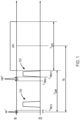
- FIG. 1 shows an example monopolar (“MONO") gradient encoding SE-EPI pulse sequence that is widely available and relatively fast.
- MONO produces moderate signal-to-noise ratios (“SNR”) and spatial resolution, the sequence is very sensitive to bulk motion, and includes a dead time that extends the overall diffusion encoding temporal footprint.
- SNR signal-to-noise ratios
- the large, motion-sensitizing gradients 100 introduce eddy currents that cause image distortions.
- Eddy currents are produced within various conductive MRI hardware components during applied time-varying gradient pulses, and specifically during ramp-up and ramp-down intervals, and exponentially decay over time.
- ramp-up and ramp-down intervals such as the case of the trapezoidal gradient waveforms in MONO pulse sequence of FIG. 1
- eddy currents are equal in magnitude and opposite in direction.
- the amount decay of the eddy currents between the ramp-up and ramp-down intervals is different because of their occurrence at different time points in the pulse sequence. This leads to imperfect cancellation and a non-zero superposition of the eddy current induced magnetic fields.
- Such magnetic fields can persist during the echo-planar imaging ("EPI") readout and can result in deviations from the target k-space trajectory and substantial image distortions.
- EPI echo-planar imaging
- diffusion encoding gradients need to be off during application of RF pulses and readout.
- diffusion encoding gradient waveforms need also conform to target b-values, gradient moment values, as well as hardware capabilities of the imaging system, such as maximum gradient amplitude and slew rate.
- obtaining closed-form gradient waveforms in a diffusion-weighted pulse sequence that can satisfy most or all imaging and hardware constraints and are time-optimal can be tremendously difficult, if not impossible.
- prior approaches have typically utilized general guidelines to develop pulse sequences (such as using trapezoidal diffusion gradients, and symmetrical arrangements), that often come at the expense of imaging speed or quality, as described.
- a system and method implementing a convex optimization framework that incorporates eddy current compensation or nulling, in addition to imaging and hardware considerations, to produce enhanced diffusion-weighted images is described herein.
- optimized diffusion encoding gradient waveforms that satisfy a number constraints, including eddy current constraints, are generated without need for restricting gradient waveform shape.
- a number of objectives including minimized gradient duration during a diffusion encoding period, and optionally e.g. minimized echo time, are also taken into consideration in this optimization framework.
- a convex optimization approach is utilized, as will be described.
- the optimization framework is a convex optimized diffusion encoding ("CODE") framework.
- resultant gradient waveforms are eddy current nulled convex optimized diffusion encoding ("EN-CODE”) gradient waveforms.
- the present approach can significantly shorten the echo time ("TE") in a Spin-Echo Echo Planar Imaging (“SE-EPI”) pulse sequence, for example, and improve signal-to-noise ratios ("SNR").
- TE echo time
- SE-EPI Spin-Echo Echo Planar Imaging
- SNR signal-to-noise ratios
- the time between the RF excitation and refocusing pulses in a SE-EPI pulse sequence can be effectively utilized to decrease TE.
- optimized diffusion encoding gradient waveforms generated using the herein provided system and method may be asymmetric about the refocusing pulse.
- discussion provided herein refers to a SE-EPI pulse sequence, one of ordinary skill in the art would recognize that present approach is applicable more broadly to other diffusion-weighted pulse sequences.
- the present framework could be implemented using a stimulated echo acquisition mode (“STEAM”) pulse sequence, a turbo spin echo (“TSE”) pulse sequence, and others.
- STEM stimulated echo acquisition mode
- TSE turbo spin echo
- the present optimization framework can be used to generate optimized diffusion encoding gradients that satisfy a number of constraints, including eddy current constraints, gradient constraints, gradient moment constraints, and hardware constraints.
- gradient constraints include diffusion encoding gradient magnitude and timing constraints, such as gradients being off during RF activity and during the data acquisition.
- diffusion encoding gradients are zero during both RF excitation pulses and RF refocusing pulses, as well as during the EPI readout.
- TE T Diff + 0.5*T EPI , for example.
- the moments of the slice select gradient which may also be negligible (less than 0.5% of typical diffusion encoding gradient moments for MONO) with respect to the diffusion encoding gradients, were not, but could be, considered in this optimization.
- Eqns. 2 indicate gradient moment constraints for M0, M1 and M2, it is envisioned that the present approach may be readily extended to any combination of gradient moment constraints, including higher order gradient moments, such as M3, M4, and so forth.
- the present optimization framework takes into account eddy currents induced by applied gradients.
- eddy currents from an arbitrary gradient waveform G(t) can be modeled using an RL-circuit model.
- Eqn. 4 reduces to:
- B EC ⁇ t w ⁇ dG dt ⁇ e ⁇ t ⁇
- ⁇ ⁇ t dG dt ⁇ e ⁇ t ⁇
- nulling eddy currents at T Diff ensures that eddy current contributions from the diffusion encoding gradient waveform are zero after T Diff , namely t ⁇ T Diff .
- the eddy current constraint ensures that the effects of induced eddy currents from the diffusion encoding gradient waveform are nullified to eliminate image distortions. In some aspects, eddy current-induced magnetic field values are negligible during readout.
- induced magnetic fields are either zero during readout, due to eddy currents having fully decayed, or substantially consistent during readout, with eddy currents being constant across all desired diffusion encoding directions. Such, non-zero or constant magnetic fields would not contribute to misregistration and other undesired effects.
- Eqn. 6 can also be used to define the eddy current characteristics of any diffusion encoding gradient waveform, referred to herein as eddy current spectrum.
- eddy current spectrum By calculating ⁇ ( ⁇ ,t) over a range of ⁇ , and at the end of diffusion encoding (T Diff ), the eddy current spectrum can be compared between different diffusion encoding gradient waveforms. It is noted that because w is not included in this formulation, the eddy current spectrum is system invariant.
- G(t) is the gradient amplitude as a function of time
- T Diff is the time at the end of the diffusion encoding gradient waveform
- ⁇ is the gyromagnetic ratio of 1H.
- the optimization to obtain optimized diffusion encoding gradient waveforms, satisfying various constraints as described above, may then be carried out by determining a maximum b-value for a fixed TE or selected sequence timing, and iteratively reducing the TE until the maximum b-value is equivalent to a target b-value.
- FIG. 2 shows a flowchart illustrating steps of a process 200 for generating optimized diffusion encoding gradient waveforms, in accordance with aspects of present invention.
- process 200 shows specific steps and implementations, indeed various modifications would be apparent to one of ordinary skill in the art, and such modifications may still be considered within the scope of the present approach, provided they fall under the scope of the appended claims.
- the process 200 may begin with a timing initialization, as indicated by process block 202, which establishes initial values for lower and upper TE bounds, TE L and TEu, respectively. Such values may be selected in accordance with desired diffusion-weighted images and pulse sequence utilized. A target b-value, b target , may also be provided at this step.
- TEu may be defined by the monopolar TE plus about 20ms.
- TE L may be defined by the TE of an equivalent spin echo sequence (i.e., without diffusion encoding gradients), which has a minimum TE of 2•(0.5•T 180 + T ⁇ ) ( FIG. 1 ).
- constraints may include gradient constraints (Eqns. 1), gradient moment constraints (Eqns. 2), hardware constraints (Eqns. 3) and eddy current constraints (Eqn. 7).
- the combination of constraints may depend upon specific imaging requirements, such as requirements for controlling eddy currents, bulk motion, and hardware requirements.
- the objective functional(s) may be configured to reflect other objectives, constraints, or terms, including Maxwell terms, simulation thresholds, noise/sound pressure, eddy currents, and others.
- the b-value in Eqn. 8 is a convex functional of G(t) (i.e. its second variation is positive definite) and therefore does not necessarily have a single maximum.
- a time optimal solution is reached at process block 218, having an optimized diffusion encoding gradient waveform G(t), that satisfies the target b-value and reaches a minimized TE.
- the optimization problem is efficiently solved through successive binary searches that divide the TE search space with each iteration of Eqn. 7.
- the optimized diffusion encoding gradient waveform is then included in a pulse sequence that is executed to generate diffusion-weighted images.
- FIG. 3 is a flowchart setting forth steps of a process 300, in accordance with aspects of a method of the present invention.
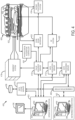
- This process 300 may be carried out using a magnetic resonance imaging ("MRI") system, as will be described with reference to FIG. 4 , or any suitable system.
- MRI magnetic resonance imaging
- the process 300 may be embodied using software or instructions stored in non-transitory computer-readable media.
- the process 300 begins at process block 302 with providing a plurality of constraints for imaging a target at a selected diffusion weighting. As described, this includes eddy current constraints, and may further include providing gradient constraints, gradient moment constraints, hardware constraints, as well as other objectives.
- an indication may also be provided at process block 302 with respect to the imaging pulse sequence being utilized.
- the indication may include parameters associated with a SE-EPI pulse sequence, including desired field-of-view, spatial resolution, SNR, and so forth.
- the indication may include a selected b-value, or diffusion-weighting, and applied gradient directions.
- a convex optimization framework is applied to generate an optimized diffusion encoding gradient waveform.
- this process includes generating an objective function based on the provided constraints, (Eqn. 11) and other objectives, and obtaining solution for the gradient waveform, based on the selected b-value, using an iterative process.
- the iterative process is performed to minimize pulse sequence timing parameters, including in accordance with the invention a gradient duration during the diffusion encoding period(s), and may further include TE and other timings.
- the optimized diffusion encoding gradient waveform is then used in a pulse sequence to generate diffusion-weighted data, as indicated by process block 306.
- FIG. 6B shows an illustrative example outside the scope of the present invention
- FIG. 6D shows a limiting SE-EPI pulse sequence incorporating optimized diffusion encoding gradient waveforms in accordance with the present approach.
- various gradient waveforms in dependence of the indicated constraints
- various pulse sequences including various data acquisitions and k-space sampling trajectories may be utilized at process block 306.
- the pulse sequence may be repeated for any number of times, and for any gradient directions, depending on the imaged structures, image type, and amount of diffusion-weighted data sufficient for desired SNR.
- At least one image is generated at process block 308 using various image reconstruction techniques and methods.
- images generated at process block 308 include diffusion-weighted images, ADC maps, diffusion tensor images ("DTIs”), diffusion restriction images, fractional anisotropy (“FA”) maps, mean diffusivity (“MD”) maps, radial diffusivity (“RD”) maps, axial diffusivity (“AD”) maps, and higher order q-space images.
- DTIs diffusion tensor images
- FA fractional anisotropy
- MD mean diffusivity
- RD radial diffusivity
- AD axial diffusivity
- gradient directions to be sampled are accounted for in the optimization.
- the MRI system 400 includes a workstation 402 having a display 404 and a keyboard 406.
- the workstation 402 includes a processor 408, such as a commercially available programmable machine running a commercially available operating system.
- the workstation 402 provides the operator interface that enables scan prescriptions to be entered into the MRI system 400.
- the workstation 402 is coupled to servers, including a pulse sequence server 410, a data acquisition server 412, a data processing server 414, and a data store server 416.
- the workstation 402 and each server 410, 412, 414, and 416 are in communication.
- the pulse sequence server 410 functions in response to instructions downloaded from the workstation 402 to operate a gradient system 418 and a radiofrequency ("RF") system 420.
- Gradient waveforms necessary to perform the prescribed scan are produced and applied to the gradient system 418, which excites gradient coils in an assembly 422 to produce the magnetic field gradients G x , G y , and G z used for position encoding MR signals.
- the gradient coil assembly 422 forms part of a magnet assembly 424 that includes a polarizing magnet 426 and a whole-body RF coil 428.
- RF excitation waveforms are applied to the RF coil 428, or a separate local coil (not shown in FIG. 4 ), by the RF system 420 to perform the prescribed magnetic resonance pulse sequence.
- Responsive MR signals detected by the RF coil 428, or a separate local coil are received by the RF system 420, amplified, demodulated, filtered, and digitized under direction of commands produced by the pulse sequence server 410.
- the RF system 420 includes an RF transmitter for producing a wide variety of RF pulses used in MR pulse sequences.
- the RF transmitter is responsive to the scan prescription and direction from the pulse sequence server 410 to produce RF pulses of the desired frequency, phase, and pulse amplitude waveform.
- the generated RF pulses may be applied to the whole body RF coil 428 or to one or more local coils or coil arrays.
- the RF system 420 also includes one or more RF receiver channels.
- Each RF receiver channel includes an RF preamplifier that amplifies the MR signal received by the coil 428 to which it is connected, and a detector that detects and digitizes the I and ⁇ quadrature components of the received MR signal.
- the pulse sequence server 410 also optionally receives patient data from a physiological acquisition controller 430.
- the controller 430 receives signals from a number of different sensors connected to the patient, such as electrocardiograph ("ECG”) signals from electrodes, or respiratory signals from a bellows or other respiratory monitoring device.
- ECG electrocardiograph
- Such signals are typically used by the pulse sequence server 410 to synchronize, or "gate,” the performance of the scan with the subject's heart beat or respiration.
- the pulse sequence server 410 also connects to a scan room interface circuit 432 that receives signals from various sensors associated with the condition of the patient and the magnet system. It is also through the scan room interface circuit 432 that a patient positioning system 434 receives commands to move the patient to desired positions during the scan.
- the digitized MR signal samples produced by the RF system 420 are received by the data acquisition server 412.
- the data acquisition server 412 operates in response to instructions downloaded from the workstation 402 to receive the real-time MR data and provide buffer storage, such that no data is lost by data overrun. In some scans, the data acquisition server 412 does little more than pass the acquired MR data to the data processor server 414. However, in scans that require information derived from acquired MR data to control the further performance of the scan, the data acquisition server 412 is programmed to produce such information and convey it to the pulse sequence server 410. For example, during prescans, MR data is acquired and used to calibrate the pulse sequence performed by the pulse sequence server 410.
- navigator signals may be acquired during a scan and used to adjust the operating parameters of the RF system 420 or the gradient system 418, or to control the view order in which k-space is sampled.
- the data acquisition server 412 acquires MR data and processes it in real-time to produce information that is used to control the scan.
- the data processing server 414 receives MR data from the data acquisition server 412 and processes it in accordance with instructions downloaded from the workstation 402. Such processing may include, for example: Fourier transformation of raw k-space MR data to produce two or three-dimensional images; the application of filters to a reconstructed image; the performance of a backprojection image reconstruction of acquired MR data; the generation of functional MR images; and the calculation of motion, flow, or diffusion-weighted images.
- Images reconstructed by the data processing server 414 are conveyed back to the workstation 402 where they are stored.
- Real-time images are stored in a data base memory cache, from which they may be output to operator display 412 or a display 436 that is located near the magnet assembly 424 for use by attending physicians.
- Batch mode images or selected real time images are stored in a host database on disc storage 438.
- the data processing server 414 notifies the data store server 416 on the workstation 402.
- the MRI system 400 may also include one or more networked workstations 442.
- a networked workstation 442 may include a display 444, one or more input devices 446 (such as a keyboard and mouse or the like), and a processor 448.
- the networked workstation 442 may be located within the same facility as the operator workstation 402, or in a different facility, such as a different healthcare institution or clinic.
- the networked workstation 442 may include a mobile device, including phones or tablets.
- the networked workstation 44 may gain remote access to the data processing server 414 or data store server 416 via the communication system 440. Accordingly, multiple networked workstations 442 may have access to the data processing server 414 and the data store server 416.
- magnetic resonance data, reconstructed images, or other data may be exchanged between the data processing server 414 or the data store server 416 and the networked workstations 442, such that the data or images may be remotely processed by a networked workstation 442.
- This data may be exchanged in any suitable format, such as in accordance with the transmission control protocol ("TCP"), the internet protocol (“IP”), or other known or suitable protocols.
- TCP transmission control protocol
- IP internet protocol
- Embodiments of the present technology may be described herein with reference to flowchart illustrations of methods and systems according to embodiments of the technology, and/or procedures, algorithms, steps, operations, formulae, or other computational depictions, which may also be implemented as computer program products.
- each block or step of a flowchart, and combinations of blocks (and/or steps) in a flowchart, as well as any procedure, algorithm, step, operation, formula, or computational depiction can be implemented by various means, such as hardware, firmware, and/or software including one or more computer program instructions embodied in computer-readable program code.
- any such computer program instructions may be executed by one or more computer processors, including without limitation a general purpose computer or special purpose computer, or other programmable processing apparatus to produce a machine, such that the computer program instructions which execute on the computer processor(s) or other programmable processing apparatus create means for implementing the function(s) specified.
- blocks of the flowcharts, and procedures, algorithms, steps, operations, formulae, or computational depictions described herein support combinations of means for performing the specified function(s), combinations of steps for performing the specified function(s), and computer program instructions, such as embodied in computer-readable program code logic means, for performing the specified function(s).
- each block of the flowchart illustrations, as well as any procedures, algorithms, steps, operations, formulae, or computational depictions and combinations thereof described herein can be implemented by special purpose hardware-based computer systems which perform the specified function(s) or step(s), or combinations of special purpose hardware and computer-readable program code.
- these computer program instructions may also be stored in one or more computer-readable memory or memory devices that can direct a computer processor or other programmable processing apparatus to function in a particular manner, such that the instructions stored in the computer-readable memory or memory devices produce an article of manufacture including instruction means which implement the function specified in the block(s) of the flowchart(s).
- the computer program instructions may also be executed by a computer processor or other programmable processing apparatus to cause a series of operational steps to be performed on the computer processor or other programmable processing apparatus to produce a computer-implemented process such that the instructions which execute on the computer processor or other programmable processing apparatus provide steps for implementing the functions specified in the block(s) of the flowchart(s), procedure (s) algorithm(s), step(s), operation(s), formula(e), or computational depiction(s).
- programming or “program executable” as used herein refer to one or more instructions that can be executed by one or more computer processors to perform one or more functions as described herein.
- the instructions can be embodied in software, in firmware, or in a combination of software and firmware.
- the instructions can be stored local to the device in non-transitory media, or can be stored remotely such as on a server, or all or a portion of the instructions can be stored locally and remotely. Instructions stored remotely can be downloaded (pushed) to the device by user initiation, or automatically based on one or more factors.
- processor computer processor, central processing unit (“CPU"), and computer are used synonymously to denote a device capable of executing the instructions and communicating with input/output interfaces and/or peripheral devices, and that the terms processor, computer processor, CPU, and computer are intended to encompass single or multiple devices, single core and multicore devices, and variations thereof.
- eddy current nulled convex optimized diffusion encoding (“EN-CODE”) gradient waveforms, obtained using a convex optimization framework in accordance with the present invention, can result produce imaging efficiently and free of eddy current induced image distortions.
- eddy current compensated diffusion encoding waveforms were used to generate diffusion tensor imaging ("DTI"). The DTI were then compared to images obtained using the existing pulse sequence methods attempting to address eddy currents, including a twice refocused spin echo (“TRSE”) pulse sequence and monopolar (“MONO”) pulse sequence, as well as images obtained using non-eddy current compensated CODE.
- TRSE twice refocused spin echo
- MI monopolar
- the range of ⁇ null values was chosen to match the time scale of the DWI pulse sequence and corresponds with values that have been previously shown to be relevant on a clinical MRI system.
- Analogous TRSE diffusion encoding gradient waveforms were also designed using the same pulse sequence parameters and hardware constraints and with the same ⁇ null values used for EN-CODE.
- Conventional MONO waveforms and non-eddy current compensated CODE waveforms were also designed.
- TE differences between EN-CODE and alternative diffusion encoding methods were also evaluated.
- ⁇ null 80ms was used based on the findings of the phantom imaging experiments shown below.
- Phantom experiments were performed to evaluate eddy current induced image distortions between diffusion encoding methods and to determine the optimal ⁇ null for the present system.
- a phantom containing 50mL conical tubes of water submerged in a susceptibility-matched fluid with and negligible MRI signal (Fomblin, Solvay Solexis, West Deptford, NJ) was imaged using a 3T scanner (Prisma, Siemens, Er Weg, Germany).
- FOV Resolution [mm] b [s/mm 2 ] TR [ms] TE [ms]
- Other MONO 300 ⁇ 300 1.7 ⁇ 1.7 ⁇ 5.0 1000 2300 80 2x GRAPPA 5 Averages 15 Slices BW 1852 Hz/px CODE 71 TRSE 96 EN-CODE 76-78
- Eddy current induced image distortions were evaluated for each diffusion encoding waveform by measuring the pixel-wise coefficient of variation ("CoV") across the three acquired directions.
- the optimal ⁇ null were determined for EN-CODE and TRSE by comparing the mean CoV Edge from the acquisitions with each of the ten ⁇ null values. The ⁇ null that led to the minimum CoV Edge was then used for in vivo imaging.
- a ⁇ null of 80ms was chosen for TRSE and EN-CODE based on the phantom results (see below).
- the in vivo protocol was identical to the phantom study, but with 20 diffusion encoding gradient directions to facilitate tensor reconstruction (Table 1).
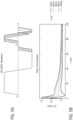
- FIG. 5 (A) shows EN-CODE gradient waveforms generated for a range of ⁇ null values and the corresponding eddy current spectra (B), normalized to the largest peak.
- Each ENCODE gradient waveform nulled eddy currents for each specified ⁇ null .
- MONO and CODE are both susceptible to eddy current distortions, whereas TRSE and EN-CODE are eddy current compensated.
- EN-CODE accomplishes eddy current nulling with a slight TE decrease compared to MONO, whereas TRSE requires a significant TE increase compared with MONO.
- TRSE had the longest TE (96ms) which was reduced to 80ms with MONO, further reduced to 78ms with EN-CODE, and minimized to 71ms with CODE.
- the eddy current spectra for each sequence are shown in FIG. 7 .
- MONO demonstrated the largest residual eddy currents across all time constants ( ⁇ ) whereas CODE notably reduced eddy currents at all ⁇ while minimizing TE compared to the other three methods.
- TRSE and EN-CODE demonstrated even greater eddy current reductions, particularly for ⁇ >20ms.
- FIG. 8 shows graphs illustrating (A) The minimum TE as a function of b-value and EPI time-to-echo, T ⁇ for TRSE, EN-CODE and MONO diffusion encoding, (B) TE differences between TRSE and EN-CODE (left) as well as between MONO and EN-CODE (right). Positive values (blue) indicate EN-CODE has a shorter TE while negative values (red) indicate EN-CODE has a longer TE.
- the black square indicates the parameters used for phantom and in vivo imaging in this study and plotted in FIG. 6 .
- the choice of ⁇ null had only a small impact on the TE for EN-CODE (the maximum TE difference between ⁇ null values was 2ms) and had no impact on TE for TRSE.
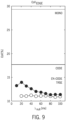
- CoV Edge was plotted for MONO and CODE and for TRSE and EN-CODE as a function of ⁇ null , as shown in FIG. 9 .
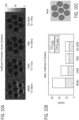
- FIG. 10 (A) The CoV was high for MONO near phantom edges (water-Fomblin interfaces) indicating eddy current induced misregistration between images with different diffusion encoding directions. This effect was mitigated with CODE and substantially reduced with TRSE and EN-CODE, as shown in the CoV Global and CoV Edge values plotted in FIG. 10 (B) .
- the segmentation used for global analysis is shown in FIG. 10 (C) .
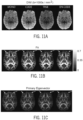
- FIG. 11 shows (A) diffusion weighted images from each technique, (B) reconstructed FA maps and (C) FA-weighted primary eigenvector maps where the x, y, and z vector components are mapped to red, green, and blue, respectively.
- MONO diffusion encoding leads to substantial eddy current image distortions that led to regions of artificially high FA (white arrows).
- the apparent SNR of the DWI from TRSE was lower compared to the other sequences due to the longer TE ( FIG. 11 A) .
- Eddy current distortion between diffusion encoding directions in MONO and CODE led to regions of notably elevated FA near brain edges ( FIG. 11 B,C ) that were largely eliminated with TRSE and EN-CODE.
- FIG. 12 Global FA analysis is shown in FIG. 12 .
- FIG. 12 (A) shows Mean global FA values measured in all brain voxels, FA Global (red) and voxels along brain edges, FA Edge (blue), where * indicates significant differences from MONO (p ⁇ 0.05).
- FIG. 12 (B) also shows an example DWI and mask used for FA Global and FA Edge analysis.
- EN-CODE achieves a significant reduction of eddy current distortions compared with MONO.
- EN-CODE reduced TE compared with MONO and TRSE for a wide range of imaging and diffusion weightings parameters.
- Symmetric, full-Fourier k-space coverage was used in this work, but partial Fourier imaging can be used to substantially shorten T ⁇ and thereby reduce TE, particularly for TRSE.
- partial Fourier may lead to an increase in bulk-motion sensitivity, the potential for additional signal attenuation from eddy currents, a broader point-spread function, and lower SNR.
- EN-CODE can be used to shorten TE without the drawbacks of partial Fourier imaging.
- EN-CODE reduced TE compared to TRSE and MONO for a wide range of acquisition parameters, it led to longer TEs for cases with high b-values and very short (i.e. low spatial resolution, partial Fourier) EPI readouts.
- EN-CODE improves diffusion tensor reconstruction without the need for post-processing eddy current corrections. While numerous image processing corrections exist that improve DTI reconstruction in the presence of eddy current distortions, the present eddy current nulled diffusion encoding approach avoids the added complexity and potential for errors. In addition, EN-CODE achieves this with no penalty compared to MONO over a wide range of acquisition parameters.
- CODE which does not explicitly account for eddy currents, improved eddy current distortions compared to MONO.
- CODE has previously been shown to reduce TE compared with MONO for a wide range of b-values and EPI durations indicating that the CODE gradient design is both time optimal and more robust to eddy current induced image distortion than MONO.
Landscapes
- Physics & Mathematics (AREA)
- Health & Medical Sciences (AREA)
- Nuclear Medicine, Radiotherapy & Molecular Imaging (AREA)
- High Energy & Nuclear Physics (AREA)
- Engineering & Computer Science (AREA)
- General Physics & Mathematics (AREA)
- Condensed Matter Physics & Semiconductors (AREA)
- Signal Processing (AREA)
- General Health & Medical Sciences (AREA)
- Radiology & Medical Imaging (AREA)
- Life Sciences & Earth Sciences (AREA)
- Vascular Medicine (AREA)
- Medical Informatics (AREA)
- Molecular Biology (AREA)
- Surgery (AREA)
- Animal Behavior & Ethology (AREA)
- Heart & Thoracic Surgery (AREA)
- Public Health (AREA)
- Veterinary Medicine (AREA)
- Biomedical Technology (AREA)
- Pathology (AREA)
- Biophysics (AREA)
- Magnetic Resonance Imaging Apparatus (AREA)
Claims (13)
- Verfahren zur Erzeugung von Bildern unter Verwendung eines Magnetresonanztomographiesystems (MRI), wobei das Verfahren umfasst:a) Bereitstellen (302) einer Vielzahl von Einschränkungen, umfassend eine Wirbelstrom-Nullungs-Einschränkung für die Abbildung eines Ziels mit einer ausgewählten Diffusionsgewichtung;b) Anwenden (304) eines konvexen Optimierungsrahmens, um eine optimierte Diffusionscodierungs-Gradientenwellenform zu erzeugen, die die Vielzahl von Einschränkungen erfüllt, wobei das Anwenden des Optimierungsrahmens das Durchführen eines iterativen Prozesses umfasst, um mindestens einen Pulssequenz-Timing-Parameter zu minimieren, der eine Gradientendauer während einer Diffusionscodierungsperiode umfasst, wobei das Durchführen des iterativen Prozesses aufeinander folgende binäre Suchen umfasst, die einen Pulssequenz-Timing-Parameter-Suchraum mit jeder Iteration von

 c) Durchführen (306), unter Verwendung des MRI-Systems, einer Pulssequenz, die die optimierte diffusionscodierende Gradientenwellenform umfasst, um diffusionsgewichtete Daten zu erzeugen; undd) Erzeugen (308) mindestens eines Bildes des Ziels unter Verwendung der diffusionsgewichteten Daten.
 - Verfahren nach Anspruch 1, wobei die Wirbelstromkompensations- oder die Wirbelstrom-Nullungs-Einschränkung darin besteht, dass die durch Wirbelstrom induzierten Magnetfeldwerte während des Auslesens vernachlässigbar sind.
- Verfahren nach Anspruch 1, wobei die Mehrzahl der Einschränkungen ferner mindestens eine der folgenden Einschränkungen umfasst: Gradienteneinschränkungen, Gradientenmomenteinschränkungen und Hardwareeinschränkungen.
- Verfahren nach Anspruch 3, wobei die Gradienteneinschränkungen Nullgradientenwerte für einen Diffusionscodierungsgradienten während einer Hochfrequenzaktivität (RF) und einer Auslesung umfassen.
- Verfahren nach Anspruch 3, bei dem die Gradientenmomenteinschränkungen mindestens eines der folgenden Momente umfassen: ein Nullmoment (M0), ein erstes Moment (M1), ein zweites Moment (M2), ein drittes Moment (M3) und ein viertes Moment (M4), das aufgehoben wird.
- Verfahren nach Anspruch 1, wobei der mindestens eine Pulssequenz-Timing-Parameter ferner eine Echozeit (TE) umfasst.
- Verfahren nach Anspruch 1, wobei die Pulssequenz eine Spin-Echo Echo-Planar-Imaging (SE-EPI)-Pulssequenz umfasst und wobei das Timing einer Auslesung in der SE-EPI-Pulssequenz auf der Grundlage des ausgewählten Sichtfelds, einer Auslesebandbreite und einer räumlichen Auflösung konfiguriert wird.
- Verfahren nach Anspruch 1, wobei das mindestens eine Bild mindestens eines der folgenden umfasst: ein diffusionsgewichtetes Bild (DWI), eine Karte des scheinbaren Diffusionskoeffizienten (ADC), ein Diffusionstensorbild (DTI) und ein q-Raum-Bild.
- System zur Magnetresonanztomographie (MRI) umfassend:ein Magnetsystem, das so konfiguriert ist, dass es ein polarisierendes Magnetfeld um mindestens einen interessierenden Bereich (ROI) eines in dem MRI-System angeordneten Objekts erzeugt;eine Vielzahl von Gradientenspulen, die so konfiguriert sind, dass sie ein Gradientenfeld in Bezug auf das polarisierende Magnetfeld anwenden;ein Hochfrequenz (RF)-System, das so konfiguriert ist, dass es RF-Anregungsfelder an das Objekt anlegt und daraus MR-Bilddaten gewinnt; undeinen Computer, der programmiert ist, zum:Empfangen eines Hinweises auf eine Vielzahl von Einschränkungen, die eine Wirbelstromkompensations- oder Nulling-Einschränkung für die Abbildung der ROI mit einer ausgewählten Diffusionsgewichtung umfassen;Anwenden eines konvexen Optimierungsrahmens, um eine optimierte Diffusionscodierungs-Gradientenwellenform zu erzeugen, die die Vielzahl von Beschränkungen erfüllt, wobei das Anwenden des Optimierungsrahmens das Durchführen eines iterativen Prozesses umfasst, um mindestens einen Pulssequenz-Timing-Parameter zu minimieren, der eine Gradientendauer während einer Diffusionscodierungsperiode umfasst, wobei das Durchführen des iterativen Prozesses aufeinanderfolgende binäre Suchen umfasst, die einen Pulssequenz-Timing-Parameter-Suchraum mit jeder Iteration von

 Anweisen der mehreren Gradientenspulen und des RF-Systems zur Durchführung einer Pulsfolge, die die optimierte diffusionscodierende Gradientenwellenform umfasst, um diffusionsgewichtete Daten zu erzeugen; undErzeugen mindestens eines Bildes des Ziels unter Verwendung der diffusionsgewichteten Daten.
 - System nach Anspruch 9, wobei mindestens eines der folgenden Merkmale vorliegt:die Wirbelstromkompensations- oder die Nullungseinschränkung umfasst vernachlässigbare gradienten-induzierte Magnetfeldwerte während des Auslesens;die Vielzahl der Einschränkungen umfasst außerdem mindestens eine der folgenden Einschränkungen: Gradienteneinschränkungen, Gradientenmomenteinschränkungen und Hardwareeinschränkungen;die Gradienteneinschränkungen umfassen Nullgradientenwerte während einer Hochfrequenzaktivität (RF) und einer Auslesung; oderdie Gradientenmomenteinschränkungen umfassen mindestens eines der folgenden Momente: ein Nullmoment (M0), ein erstes Moment (M1), ein zweites Moment (M2), ein drittes Moment (M3) und ein viertes Moment (M4), das null ist.
- System nach Anspruch 9, wobei der mindestens eine Pulssequenz-Timing-Parameter ferner eine Echozeit (TE) umfasst.
- System nach Anspruch 9, wobei der Computer ferner so programmiert ist, dass er die optimierte diffusionscodierende Gradientenwellenform entlang einer oder mehrerer Gradientenfeldrichtungen anwendet.
- System nach Anspruch 9, wobei das mindestens eine Bild mindestens eines der folgenden umfasst: ein diffusionsgewichtetes Bild (DWI), eine Karte des scheinbaren Diffusionskoeffizienten (ADC), ein Diffusionstensorbild (DTI) und ein q-Raum-Bild.
Applications Claiming Priority (2)
| Application Number | Priority Date | Filing Date | Title |
|---|---|---|---|
| US201762465517P | 2017-03-01 | 2017-03-01 | |
| PCT/US2018/020458 WO2018160839A1 (en) | 2017-03-01 | 2018-03-01 | System and method for improved diffusion-weighted imaging |
Publications (3)
| Publication Number | Publication Date |
|---|---|
| EP3589197A1 EP3589197A1 (de) | 2020-01-08 |
| EP3589197A4 EP3589197A4 (de) | 2020-12-09 |
| EP3589197B1 true EP3589197B1 (de) | 2024-09-11 |
Family
ID=63370496
Family Applications (1)
| Application Number | Title | Priority Date | Filing Date |
|---|---|---|---|
| EP18761729.5A Active EP3589197B1 (de) | 2017-03-01 | 2018-03-01 | System und verfahren für verbesserte diffusionsgewichtete bildgebung |
Country Status (3)
| Country | Link |
|---|---|
| US (1) | US11137467B2 (de) |
| EP (1) | EP3589197B1 (de) |
| WO (1) | WO2018160839A1 (de) |
Families Citing this family (4)
| Publication number | Priority date | Publication date | Assignee | Title |
|---|---|---|---|---|
| US10732248B2 (en) * | 2017-05-22 | 2020-08-04 | Synaptive Medical (Barbados) Inc. | System and method to reduce eddy current artifacts in magnetic resonance imaging |
| CN110507311B (zh) * | 2019-08-27 | 2022-07-19 | 中科麦迪人工智能研究院(苏州)有限公司 | 一种基于图像信息的心电分析方法、装置、设备及介质 |
| DE102020205692A1 (de) * | 2020-05-06 | 2021-11-11 | Siemens Healthcare Gmbh | Verfahren zur Diffusionsbildgebung mit einer Magnetresonanzeinrichtung, Magnetresonanzeinrichtung, Computerprogramm und elektronisch lesbarer Datenträger |
| WO2022221884A1 (en) * | 2021-04-16 | 2022-10-20 | Beth Israel Deaconess Medical Center, Inc. | Systems and methods for non-selective stimulated echo multislice diffusion imaging |
Family Cites Families (9)
| Publication number | Priority date | Publication date | Assignee | Title |
|---|---|---|---|---|
| US4731583A (en) * | 1985-11-15 | 1988-03-15 | General Electric Company | Method for reduction of MR image artifacts due to flowing nuclei by gradient moment nulling |
| US6815952B1 (en) | 2003-05-12 | 2004-11-09 | The University Of Queensland | Magnetic resonance diffusion imaging with eddy-current compensation |
| WO2005114260A2 (en) | 2004-05-14 | 2005-12-01 | The General Hospital Corporation | Methods for obtaining mri frequency maps |
| JP5138043B2 (ja) * | 2008-09-25 | 2013-02-06 | 株式会社日立メディコ | 磁気共鳴イメージング装置 |
| US8942945B2 (en) * | 2011-04-19 | 2015-01-27 | General Electric Company | System and method for prospective correction of high order eddy-current-induced distortion in diffusion-weighted echo planar imaging |
| US8948480B2 (en) * | 2011-11-10 | 2015-02-03 | Siemens Aktiengesellschaft | Image reconstruction using redundant Haar wavelets |
| WO2014164963A1 (en) * | 2013-03-12 | 2014-10-09 | Levin Pavel | Method and apparatus for magnetic resonance imaging |
| DE102013224406B4 (de) * | 2013-11-28 | 2015-10-08 | Siemens Aktiengesellschaft | Korrektur von Verzerrungen in Magnetresonanz-Diffusionsbildern |
| US9846214B2 (en) * | 2014-12-29 | 2017-12-19 | Toshiba Medical Systems Corporation | Magnetic resonance image reconstruction for undersampled data acquisitions |
-
2018
- 2018-03-01 WO PCT/US2018/020458 patent/WO2018160839A1/en not_active Ceased
- 2018-03-01 US US16/488,972 patent/US11137467B2/en active Active
- 2018-03-01 EP EP18761729.5A patent/EP3589197B1/de active Active
Also Published As
| Publication number | Publication date |
|---|---|
| US20190377050A1 (en) | 2019-12-12 |
| WO2018160839A1 (en) | 2018-09-07 |
| EP3589197A1 (de) | 2020-01-08 |
| US11137467B2 (en) | 2021-10-05 |
| EP3589197A4 (de) | 2020-12-09 |
Similar Documents
| Publication | Publication Date | Title |
|---|---|---|
| EP3408679B1 (de) | System und verfahren zur optimierten diffusionsgewichteten bildgebung | |
| CN106232005B (zh) | 用于减小的视场磁共振成像的系统及方法 | |
| JP6270709B2 (ja) | 磁気共鳴生データの再構成方法および装置 | |
| CN105556326B (zh) | 具有dixon类型的水/脂肪分离的mr成像 | |
| CN105934683B (zh) | 具有对主磁场变化的估计的dixon型水/脂肪分离的mri | |
| Sung et al. | Measurement and characterization of RF nonuniformity over the heart at 3T using body coil transmission | |
| EP3589197B1 (de) | System und verfahren für verbesserte diffusionsgewichtete bildgebung | |
| WO2013126252A1 (en) | System and method for magnetic resonance imaging water-fat separation with full dynamic range using in-phase images | |
| US10338183B2 (en) | Magnetic resonance imaging with different frequency encoding patterns | |
| US11009577B2 (en) | System and method for Nyquist ghost correction in medical imaging | |
| CN113939846B (zh) | 具有偏共振伪影校正的螺旋mr成像 | |
| US8995738B2 (en) | System and method for magnetic resonance imaging parametric mapping using confidence maps | |
| US20170242089A1 (en) | Magnetic resonance apparatus and method for dynamic adjustment thereof with multiple adjustment parameters | |
| CN101283288A (zh) | 扩散加权mri中的高度约束背投重构过程 | |
| US9316711B2 (en) | System and method for accelerated magnetic resonance imaging using spectral sensitivity | |
| US10746832B2 (en) | DTI with correction of motion-induced diffusion gradient inconsistency | |
| US9329251B2 (en) | System and method for magnetic resonance imaging using multiple spatial encoding magnetic fields | |
| CN114062988B (zh) | 磁共振波谱成像方法、装置、计算机设备和存储介质 | |
| CN115349095A (zh) | 用于放射治疗规划的mr成像 | |
| US6919722B2 (en) | Image quality improvement for SENSE with low signal regions | |
| US11402454B2 (en) | Correction of distorted diffusion-weighted magnetic resonance image data | |
| US12411195B2 (en) | System and method for improved fat suppression for diffusion weighted imaging in magnetic resonance imaging | |
| US10132890B2 (en) | System and method for controlling undesired magnetic field effects in magnetic resonance imaging | |
| US11474183B1 (en) | Motion correction systems and methods of propeller magnetic resonance images | |
| US20240201302A1 (en) | Systems and methods for non-selective stimulated echo multislice diffusion imaging |
Legal Events
| Date | Code | Title | Description |
|---|---|---|---|
| STAA | Information on the status of an ep patent application or granted ep patent |
Free format text: STATUS: THE INTERNATIONAL PUBLICATION HAS BEEN MADE |
|
| PUAI | Public reference made under article 153(3) epc to a published international application that has entered the european phase |
Free format text: ORIGINAL CODE: 0009012 |
|
| STAA | Information on the status of an ep patent application or granted ep patent |
Free format text: STATUS: REQUEST FOR EXAMINATION WAS MADE |
|
| 17P | Request for examination filed |
Effective date: 20190919 |
|
| AK | Designated contracting states |
Kind code of ref document: A1 Designated state(s): AL AT BE BG CH CY CZ DE DK EE ES FI FR GB GR HR HU IE IS IT LI LT LU LV MC MK MT NL NO PL PT RO RS SE SI SK SM TR |
|
| AX | Request for extension of the european patent |
Extension state: BA ME |
|
| DAV | Request for validation of the european patent (deleted) | ||
| DAX | Request for extension of the european patent (deleted) | ||
| A4 | Supplementary search report drawn up and despatched |
Effective date: 20201109 |
|
| RIC1 | Information provided on ipc code assigned before grant |
Ipc: G01R 33/54 20060101ALI20201103BHEP Ipc: G01R 33/563 20060101AFI20201103BHEP Ipc: G01R 33/561 20060101ALN20201103BHEP Ipc: G01R 33/565 20060101ALI20201103BHEP |
|
| STAA | Information on the status of an ep patent application or granted ep patent |
Free format text: STATUS: EXAMINATION IS IN PROGRESS |
|
| 17Q | First examination report despatched |
Effective date: 20221006 |
|
| REG | Reference to a national code |
Ref country code: DE Free format text: PREVIOUS MAIN CLASS: A61B0005000000 Ipc: G01R0033563000 Ref country code: DE Ref legal event code: R079 Ref document number: 602018074265 Country of ref document: DE Free format text: PREVIOUS MAIN CLASS: A61B0005000000 Ipc: G01R0033563000 |
|
| RIC1 | Information provided on ipc code assigned before grant |
Ipc: G01R 33/561 20060101ALN20240222BHEP Ipc: G01R 33/54 20060101ALI20240222BHEP Ipc: G01R 33/565 20060101ALI20240222BHEP Ipc: G01R 33/563 20060101AFI20240222BHEP |
|
| GRAP | Despatch of communication of intention to grant a patent |
Free format text: ORIGINAL CODE: EPIDOSNIGR1 |
|
| STAA | Information on the status of an ep patent application or granted ep patent |
Free format text: STATUS: GRANT OF PATENT IS INTENDED |
|
| INTG | Intention to grant announced |
Effective date: 20240409 |
|
| RIC1 | Information provided on ipc code assigned before grant |
Ipc: G01R 33/561 20060101ALN20240322BHEP Ipc: G01R 33/54 20060101ALI20240322BHEP Ipc: G01R 33/565 20060101ALI20240322BHEP Ipc: G01R 33/563 20060101AFI20240322BHEP |
|
| GRAS | Grant fee paid |
Free format text: ORIGINAL CODE: EPIDOSNIGR3 |
|
| GRAA | (expected) grant |
Free format text: ORIGINAL CODE: 0009210 |
|
| STAA | Information on the status of an ep patent application or granted ep patent |
Free format text: STATUS: THE PATENT HAS BEEN GRANTED |
|
| AK | Designated contracting states |
Kind code of ref document: B1 Designated state(s): AL AT BE BG CH CY CZ DE DK EE ES FI FR GB GR HR HU IE IS IT LI LT LU LV MC MK MT NL NO PL PT RO RS SE SI SK SM TR |
|
| REG | Reference to a national code |
Ref country code: GB Ref legal event code: FG4D |
|
| REG | Reference to a national code |
Ref country code: CH Ref legal event code: EP |
|
| REG | Reference to a national code |
Ref country code: DE Ref legal event code: R096 Ref document number: 602018074265 Country of ref document: DE |
|
| REG | Reference to a national code |
Ref country code: IE Ref legal event code: FG4D |
|
| REG | Reference to a national code |
Ref country code: LT Ref legal event code: MG9D |
|
| PG25 | Lapsed in a contracting state [announced via postgrant information from national office to epo] |
Ref country code: NO Free format text: LAPSE BECAUSE OF FAILURE TO SUBMIT A TRANSLATION OF THE DESCRIPTION OR TO PAY THE FEE WITHIN THE PRESCRIBED TIME-LIMIT Effective date: 20241211 |
|
| REG | Reference to a national code |
Ref country code: NL Ref legal event code: MP Effective date: 20240911 |
|
| PG25 | Lapsed in a contracting state [announced via postgrant information from national office to epo] |
Ref country code: GR Free format text: LAPSE BECAUSE OF FAILURE TO SUBMIT A TRANSLATION OF THE DESCRIPTION OR TO PAY THE FEE WITHIN THE PRESCRIBED TIME-LIMIT Effective date: 20241212 Ref country code: FI Free format text: LAPSE BECAUSE OF FAILURE TO SUBMIT A TRANSLATION OF THE DESCRIPTION OR TO PAY THE FEE WITHIN THE PRESCRIBED TIME-LIMIT Effective date: 20240911 |
|
| PG25 | Lapsed in a contracting state [announced via postgrant information from national office to epo] |
Ref country code: BG Free format text: LAPSE BECAUSE OF FAILURE TO SUBMIT A TRANSLATION OF THE DESCRIPTION OR TO PAY THE FEE WITHIN THE PRESCRIBED TIME-LIMIT Effective date: 20240911 |
|
| PG25 | Lapsed in a contracting state [announced via postgrant information from national office to epo] |
Ref country code: LV Free format text: LAPSE BECAUSE OF FAILURE TO SUBMIT A TRANSLATION OF THE DESCRIPTION OR TO PAY THE FEE WITHIN THE PRESCRIBED TIME-LIMIT Effective date: 20240911 |
|
| PG25 | Lapsed in a contracting state [announced via postgrant information from national office to epo] |
Ref country code: HR Free format text: LAPSE BECAUSE OF FAILURE TO SUBMIT A TRANSLATION OF THE DESCRIPTION OR TO PAY THE FEE WITHIN THE PRESCRIBED TIME-LIMIT Effective date: 20240911 |
|
| PG25 | Lapsed in a contracting state [announced via postgrant information from national office to epo] |
Ref country code: ES Free format text: LAPSE BECAUSE OF FAILURE TO SUBMIT A TRANSLATION OF THE DESCRIPTION OR TO PAY THE FEE WITHIN THE PRESCRIBED TIME-LIMIT Effective date: 20240911 Ref country code: RS Free format text: LAPSE BECAUSE OF FAILURE TO SUBMIT A TRANSLATION OF THE DESCRIPTION OR TO PAY THE FEE WITHIN THE PRESCRIBED TIME-LIMIT Effective date: 20241211 |
|
| PG25 | Lapsed in a contracting state [announced via postgrant information from national office to epo] |
Ref country code: RS Free format text: LAPSE BECAUSE OF FAILURE TO SUBMIT A TRANSLATION OF THE DESCRIPTION OR TO PAY THE FEE WITHIN THE PRESCRIBED TIME-LIMIT Effective date: 20241211 Ref country code: NO Free format text: LAPSE BECAUSE OF FAILURE TO SUBMIT A TRANSLATION OF THE DESCRIPTION OR TO PAY THE FEE WITHIN THE PRESCRIBED TIME-LIMIT Effective date: 20241211 Ref country code: LV Free format text: LAPSE BECAUSE OF FAILURE TO SUBMIT A TRANSLATION OF THE DESCRIPTION OR TO PAY THE FEE WITHIN THE PRESCRIBED TIME-LIMIT Effective date: 20240911 Ref country code: HR Free format text: LAPSE BECAUSE OF FAILURE TO SUBMIT A TRANSLATION OF THE DESCRIPTION OR TO PAY THE FEE WITHIN THE PRESCRIBED TIME-LIMIT Effective date: 20240911 Ref country code: GR Free format text: LAPSE BECAUSE OF FAILURE TO SUBMIT A TRANSLATION OF THE DESCRIPTION OR TO PAY THE FEE WITHIN THE PRESCRIBED TIME-LIMIT Effective date: 20241212 Ref country code: FI Free format text: LAPSE BECAUSE OF FAILURE TO SUBMIT A TRANSLATION OF THE DESCRIPTION OR TO PAY THE FEE WITHIN THE PRESCRIBED TIME-LIMIT Effective date: 20240911 Ref country code: ES Free format text: LAPSE BECAUSE OF FAILURE TO SUBMIT A TRANSLATION OF THE DESCRIPTION OR TO PAY THE FEE WITHIN THE PRESCRIBED TIME-LIMIT Effective date: 20240911 Ref country code: BG Free format text: LAPSE BECAUSE OF FAILURE TO SUBMIT A TRANSLATION OF THE DESCRIPTION OR TO PAY THE FEE WITHIN THE PRESCRIBED TIME-LIMIT Effective date: 20240911 |
|
| REG | Reference to a national code |
Ref country code: AT Ref legal event code: MK05 Ref document number: 1723167 Country of ref document: AT Kind code of ref document: T Effective date: 20240911 |
|
| PG25 | Lapsed in a contracting state [announced via postgrant information from national office to epo] |
Ref country code: NL Free format text: LAPSE BECAUSE OF FAILURE TO SUBMIT A TRANSLATION OF THE DESCRIPTION OR TO PAY THE FEE WITHIN THE PRESCRIBED TIME-LIMIT Effective date: 20240911 |
|
| PG25 | Lapsed in a contracting state [announced via postgrant information from national office to epo] |
Ref country code: IS Free format text: LAPSE BECAUSE OF FAILURE TO SUBMIT A TRANSLATION OF THE DESCRIPTION OR TO PAY THE FEE WITHIN THE PRESCRIBED TIME-LIMIT Effective date: 20250111 Ref country code: PT Free format text: LAPSE BECAUSE OF FAILURE TO SUBMIT A TRANSLATION OF THE DESCRIPTION OR TO PAY THE FEE WITHIN THE PRESCRIBED TIME-LIMIT Effective date: 20250113 |
|
| PGFP | Annual fee paid to national office [announced via postgrant information from national office to epo] |
Ref country code: DE Payment date: 20250319 Year of fee payment: 8 |
|
| PG25 | Lapsed in a contracting state [announced via postgrant information from national office to epo] |
Ref country code: RO Free format text: LAPSE BECAUSE OF FAILURE TO SUBMIT A TRANSLATION OF THE DESCRIPTION OR TO PAY THE FEE WITHIN THE PRESCRIBED TIME-LIMIT Effective date: 20240911 Ref country code: SM Free format text: LAPSE BECAUSE OF FAILURE TO SUBMIT A TRANSLATION OF THE DESCRIPTION OR TO PAY THE FEE WITHIN THE PRESCRIBED TIME-LIMIT Effective date: 20240911 |
|
| PG25 | Lapsed in a contracting state [announced via postgrant information from national office to epo] |
Ref country code: EE Free format text: LAPSE BECAUSE OF FAILURE TO SUBMIT A TRANSLATION OF THE DESCRIPTION OR TO PAY THE FEE WITHIN THE PRESCRIBED TIME-LIMIT Effective date: 20240911 Ref country code: AT Free format text: LAPSE BECAUSE OF FAILURE TO SUBMIT A TRANSLATION OF THE DESCRIPTION OR TO PAY THE FEE WITHIN THE PRESCRIBED TIME-LIMIT Effective date: 20240911 |
|
| PG25 | Lapsed in a contracting state [announced via postgrant information from national office to epo] |
Ref country code: PL Free format text: LAPSE BECAUSE OF FAILURE TO SUBMIT A TRANSLATION OF THE DESCRIPTION OR TO PAY THE FEE WITHIN THE PRESCRIBED TIME-LIMIT Effective date: 20240911 Ref country code: CZ Free format text: LAPSE BECAUSE OF FAILURE TO SUBMIT A TRANSLATION OF THE DESCRIPTION OR TO PAY THE FEE WITHIN THE PRESCRIBED TIME-LIMIT Effective date: 20240911 |
|
| PGFP | Annual fee paid to national office [announced via postgrant information from national office to epo] |
Ref country code: FR Payment date: 20250324 Year of fee payment: 8 |
|
| PG25 | Lapsed in a contracting state [announced via postgrant information from national office to epo] |
Ref country code: SK Free format text: LAPSE BECAUSE OF FAILURE TO SUBMIT A TRANSLATION OF THE DESCRIPTION OR TO PAY THE FEE WITHIN THE PRESCRIBED TIME-LIMIT Effective date: 20240911 Ref country code: IT Free format text: LAPSE BECAUSE OF FAILURE TO SUBMIT A TRANSLATION OF THE DESCRIPTION OR TO PAY THE FEE WITHIN THE PRESCRIBED TIME-LIMIT Effective date: 20240911 |
|
| PGFP | Annual fee paid to national office [announced via postgrant information from national office to epo] |
Ref country code: GB Payment date: 20250324 Year of fee payment: 8 |
|
| REG | Reference to a national code |
Ref country code: DE Ref legal event code: R097 Ref document number: 602018074265 Country of ref document: DE |
|
| PG25 | Lapsed in a contracting state [announced via postgrant information from national office to epo] |
Ref country code: DK Free format text: LAPSE BECAUSE OF FAILURE TO SUBMIT A TRANSLATION OF THE DESCRIPTION OR TO PAY THE FEE WITHIN THE PRESCRIBED TIME-LIMIT Effective date: 20240911 |
|
| PLBE | No opposition filed within time limit |
Free format text: ORIGINAL CODE: 0009261 |
|
| STAA | Information on the status of an ep patent application or granted ep patent |
Free format text: STATUS: NO OPPOSITION FILED WITHIN TIME LIMIT |
|
| 26N | No opposition filed |
Effective date: 20250612 |
|
| PG25 | Lapsed in a contracting state [announced via postgrant information from national office to epo] |
Ref country code: SE Free format text: LAPSE BECAUSE OF FAILURE TO SUBMIT A TRANSLATION OF THE DESCRIPTION OR TO PAY THE FEE WITHIN THE PRESCRIBED TIME-LIMIT Effective date: 20240911 |
|
| PG25 | Lapsed in a contracting state [announced via postgrant information from national office to epo] |
Ref country code: MC Free format text: LAPSE BECAUSE OF FAILURE TO SUBMIT A TRANSLATION OF THE DESCRIPTION OR TO PAY THE FEE WITHIN THE PRESCRIBED TIME-LIMIT Effective date: 20240911 |
|
| REG | Reference to a national code |
Ref country code: CH Ref legal event code: H13 Free format text: ST27 STATUS EVENT CODE: U-0-0-H10-H13 (AS PROVIDED BY THE NATIONAL OFFICE) Effective date: 20251024 |
|
| PG25 | Lapsed in a contracting state [announced via postgrant information from national office to epo] |
Ref country code: LU Free format text: LAPSE BECAUSE OF NON-PAYMENT OF DUE FEES Effective date: 20250301 |
|
| REG | Reference to a national code |
Ref country code: BE Ref legal event code: MM Effective date: 20250331 |
|
| PG25 | Lapsed in a contracting state [announced via postgrant information from national office to epo] |
Ref country code: BE Free format text: LAPSE BECAUSE OF NON-PAYMENT OF DUE FEES Effective date: 20250331 |
|
| PG25 | Lapsed in a contracting state [announced via postgrant information from national office to epo] |
Ref country code: CH Free format text: LAPSE BECAUSE OF NON-PAYMENT OF DUE FEES Effective date: 20250331 |
|
| PG25 | Lapsed in a contracting state [announced via postgrant information from national office to epo] |
Ref country code: IE Free format text: LAPSE BECAUSE OF NON-PAYMENT OF DUE FEES Effective date: 20250301 |