EP3588398A1 - Banc d'essai avec système de maintenance et procédé de maintenance d'un tel banc d'essai - Google Patents
Banc d'essai avec système de maintenance et procédé de maintenance d'un tel banc d'essai Download PDFInfo
- Publication number
- EP3588398A1 EP3588398A1 EP19181713.9A EP19181713A EP3588398A1 EP 3588398 A1 EP3588398 A1 EP 3588398A1 EP 19181713 A EP19181713 A EP 19181713A EP 3588398 A1 EP3588398 A1 EP 3588398A1
- Authority
- EP
- European Patent Office
- Prior art keywords
- bench
- equipment
- database
- action
- parameters
- Prior art date
- Legal status (The legal status is an assumption and is not a legal conclusion. Google has not performed a legal analysis and makes no representation as to the accuracy of the status listed.)
- Granted
Links
Images

Classifications
-
- G—PHYSICS
- G06—COMPUTING OR CALCULATING; COUNTING
- G06Q—INFORMATION AND COMMUNICATION TECHNOLOGY [ICT] SPECIALLY ADAPTED FOR ADMINISTRATIVE, COMMERCIAL, FINANCIAL, MANAGERIAL OR SUPERVISORY PURPOSES; SYSTEMS OR METHODS SPECIALLY ADAPTED FOR ADMINISTRATIVE, COMMERCIAL, FINANCIAL, MANAGERIAL OR SUPERVISORY PURPOSES, NOT OTHERWISE PROVIDED FOR
- G06Q10/00—Administration; Management
- G06Q10/20—Administration of product repair or maintenance
-
- G—PHYSICS
- G01—MEASURING; TESTING
- G01M—TESTING STATIC OR DYNAMIC BALANCE OF MACHINES OR STRUCTURES; TESTING OF STRUCTURES OR APPARATUS, NOT OTHERWISE PROVIDED FOR
- G01M15/00—Testing of engines
- G01M15/14—Testing gas-turbine engines or jet-propulsion engines
Definitions
- the invention relates to the field of axial turbomachinery and more particularly the test benches for aircraft jet engines. More specifically, the invention relates to the management of preventive maintenance of the various pieces of equipment of such a bench.
- EP 3,290,897 A1 describes a test bench for a turbomachine.
- Such a bench can be provided with a very large number of equipment, such as sensors, infrastructure or architectural elements, sound-insulating, security elements, etc.
- the maintenance of the equipment of such a bench can be curative, that is to say that a sensor is replaced when it is detected as having a malfunction. Maintenance can also be preventive by means of periodic inspections or detectors, anticipating potential failures.
- a bench can have several thousand sensors and as many cabling to keep in operation. Interruptions to perform maintenance tasks or inspections can therefore be potentially numerous and disabling for the use of the bench.
- the invention aims to minimize the downtime of a turbomachine test bench by proposing a bench and a method involving improved predictive maintenance.
- the subject of the invention is a method of maintaining a test bench for a turbomachine, the test bench comprising a system for managing the predictive maintenance and a plurality of devices, the method comprising the following steps: incrementing a database comprising data relating to the bench and its use, determination, for each device, of an index which varies according to the content of the database, generation of information that an action is to be carried out on a given item of equipment when the corresponding index reaches a given criterion, and a step of maintenance of the given equipment during which the action to be carried out is carried out, preferably by an operator.
- the database includes not only instant measurements but also a history of the data. Consideration of the history supports the fact that it is not only the data acquired at a given instant that are taken into account to establish that an item of equipment requires maintenance action, but the monitoring of several data during the time.
- the management system comprises at least the standard software and hardware elements of a computer, with at least one processor, at least one memory and at least one human-machine interface.
- the invention also relates to a turbomachine test bench comprising a system for managing predictive maintenance of the bench, the bench comprising a plurality of equipment and means for maintaining this equipment, the system being implemented on a computer device and being configured to carry out the method described above, the system being configured to increment a database comprising data relating to the bench and to its use, the system determining for each equipment an index which varies according to the content of the database data, the system generating the information that an action is to be carried out on a given piece of equipment when the corresponding index reaches a given criterion.
- the invention also relates to a network of several of these benches, remarkable in that when an action is carried out on an equipment of one of the benches, the database of the bench in question is shared with the other benches of the network and the definition , according to the database, the criterion of said equipment on which an action has been taken, is updated by self-learning on all the benches of the network.
- each object of the invention is also applicable to the other objects of the invention.
- Each object of the invention can be combined with the other objects, and the objects of the invention can also be combined with the embodiments of the description, which in addition can be combined with one another, according to all possible technical combinations, unless the opposite is not explicitly mentioned.
- the bench management system allows the use of artificial intelligence to assist the maintenance operations of a test bench.
- the system is not limited to certain aspects of the bench and therefore makes it possible to establish a link which would not seem obvious to humans, between the conditions of use and the wear of the equipment.
- the system can manage a multitude of information in the same way as Big Data and thus form a maintenance system, sometimes called 4.0, applied to turbomachine test benches.
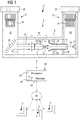
- the figure 1 shows in a simplified manner an engine test bench 2, more particularly a test bench 2 for an aircraft turbojet engine 4.
- the test bench 2 could possibly receive a complete aircraft, or at least part of an aircraft.
- Test bench 2 forms a construction with an infrastructure. It comprises a passage 6 with an inlet 8 and an outlet 10.
- the passage 6 comprises a corridor 12 which is essentially elongated. Its length can be greater than or equal to 60 m.
- the length of the corridor 12 allows the circulation in a straight line of an air flow 14 by limiting the formation of vortices detrimental to the quality of the test.
- the passage 12 may have an upper passage section or equal to 50 m2.
- the air flow 14 passing through the test bench 2 can be driven by the turbomachine 4 itself during its test phase.
- An installation zone 16 of the turbomachine 4 is provided.
- the installation zone 16 can be a fixing zone for the turbomachine 4. It can be provided with a fixing system 18 to which the turbomachine 4 is fixed during its test.
- the system 18 can extend vertically from the ceiling of the corridor 12, in the manner of a column or a post. The system 18 makes it possible to mount the turbomachine 4 with an offset, and to center the latter relative to the middle of the corridor 12, in particular relative to a central axis 19 of the corridor 12.
- the corridor 12 can be delimited by vertical chimneys 20, 22 at the inlet 8 and at the outlet 10. They allow an air intake and an exhaust both vertical and in elevation with respect to the corridor 12. To reduce noise pollution, they may include sound baffles 24, or acoustic blades 24, making it possible to absorb sound waves passively.
- Complementary devices 26 can be present at inlet 8 and outlet 10 to avoid reversals of flows, which would disturb the test conditions.
- the “U” configuration is only a non-limiting example.
- the bench 2 is equipped with a series of deflection blades 28. They make it possible to return the air descending from the inlet chimney 20 in a horizontal direction.
- the bench 2 optionally has a grid 30 making it possible to intercept debris liable to disturb the test and to damage the turbomachine 4.
- the bench 2 Downstream of the turbomachine 4, the bench 2 comprises a tube 32 collecting the air flow 14 propelled by the turbomachine 4 and the exhaust gases.
- the collecting tube 32 helps to absorb the noise generated during the test.
- the collecting tube 32 includes a diffuser 34 at its outlet.
- the diffuser 34 can be in the outlet chimney 22.
- the collecting tube 32 can be held in the bench 2 by means of two partitions 36. These partitions 36 extend vertically and transversely in the corridor 12. They form watertight partitions, which make it possible to contain the flow 14 coming from the turbomachine 4.
- a cone 37 can be placed in the extension of the collecting tube 32. It can be fixed to a vertical wall at the end of the corridor 12. Its point can coincide with the central axis 19.
- the bench 2 also includes a very large number of equipment of the sensor type or construction elements, in particular. For example, an engine rotation speed sensor A 4, an exhaust gas sensor B and an audio sensor C outside the gas passage.
- the bench 2 finally comprises a maintenance management system 40.
- This can be implemented on a computer, comprising a processor 42 and a memory 44 for storing information in the form of databases 46.
- databases can be recorded all the data useful for maintenance management, including the history of the various parameters measured or estimated. From these parameters, the maintenance management system establishes whether such or such equipment requires a maintenance operation.
- the management system is connected, via networks 50 to other 2 'test benches, so that the management systems can influence each other on their way of estimating the lifetime of each item of equipment.
- the system makes it possible to determine that a certain number of parameters influence one of its devices, for example on device A. These parameters are n in number, and are denoted p 1A , p 2A , ... p nA . Over the life of the management system, the parameters are refined (deleted or added). Certain parameters have measurable values (for example the instantaneous temperature of the exhaust gases). Certain other parameters can be predefined to change over time (for example the age of the bench).
- some parameters do not correspond to a quantifiable value (for example the quality of the concrete used for the foundations of the bench) but this non-quantified data can be modeled initially by a wear curve varying as a function of time, between a new state (taking for example a value 0 and a worn state taking for example the value 1).
- each of the parameters p are defined an interval [ ⁇ , ⁇ ] and optionally a duration t.
- all the parameters p 1A , p 2A , ... p nA are in their respective intervals [ ⁇ 1A , ⁇ 1A ], [ ⁇ 2A , ⁇ 2A ], ..., [ ⁇ nA , ⁇ nA ] for a period of time greater than or equal to their respective durations t 1A , t 2A , ..., t nA , then the criterion where an action is to be carried out on the equipment A is reached.
- index i A of the equipment A which will have for example the value 1 under these conditions, and the value 0 when at least one of the parameters p 1A , p 2A , ... p nA is not in the required interval [ ⁇ 1A , ⁇ 1A ], [ ⁇ 2A , ⁇ 2A ], ..., [ ⁇ nA , ⁇ nA ] or is during / there for less than the required time t 1A , t 2A,. .., t nA .
- the criterion will therefore be a value of the index i A equal to 1.
- i AC critical index
- the matrix on the left includes the weighting factors ⁇ to be applied to each parameter.
- Line j of the right matrix will have the value 1 if the parameter p j is in the interval [ ⁇ jA , ⁇ jA ], for a duration of at least t jA . Otherwise, the value of line j is 0.
- line j of the right matrix can have a value included in the interval [0; 1].
- the 1 / ⁇ ratio at the start of the line is optional and is only used so that the index has a value between 0 and 1.
- the system can give itself a critical value of i A , noted i AC and comprised between 0 and 1, beyond which the criterion required to trigger a maintenance operation of the equipment A is reached, that is to say when i A ⁇ i AC .
- the values of p, ⁇ , ⁇ , t, ⁇ and i C are updated during the life of the bench and / or in based on information received from another bank from the same network of banks.
- a test bench may comprise a sensor of the speed of rotation of the engine, denoted sensor A.
- the amplitude of the vibrations in the vertical direction may be the parameter p 1 ; the intensity of the noise formed outside the bench can be another parameter p 2 and the thrust generated by the engine can be a criterion p 3 .
- the richness of the invention lies in the fact that all of the parameters can be taken into account, even those which the person skilled in the art would not consider relevant as a premium on board.
- the system can, either initially or after learning, consider that the criterion p 3 is predominant and therefore assign it the weighting coefficient 5, the other two criteria having a weighting coefficient of 2.
- the system established that the sensor A is worn out when the displacements linked to the vibrations are greater than 3 mm for at least 10 seconds; when the sound level is between 104 dB and 128 dB for more than a minute and the thrust is greater than 300 kN for more than 30 hours.
- the critical index i AC is 0.75, then the index i A being greater than the critical index i AC , the criterion for generating the information of the need to perform an action on the sensor A is filled.
- the system is configured to change the values of intervals, durations, weights and critical values, as required, for each device.
- the figure 2 describes a possible procedure for the management system.
- an initialization step 100 the parameters to be considered for each equipment and the default values of ⁇ , ⁇ , t, ⁇ and i C are defined. This step may coincide with the equipment calibration.
- a monitoring and control step 102 consists in acquiring and / or calculating the parameters p. During this step, the indices i are also calculated for each item of equipment.
- step 104 the indices i are compared with the critical indices i C of the corresponding equipment.
- step 106 the procedure continues to step 106 for this device.
- step 106 the user is warned that the equipment must undergo a maintenance operation.
- step 108 the user performs the necessary operation and confirms this to the system.
- step 110 the system updates its databases and in particular the values of ⁇ , ⁇ , t, ⁇ and i C and the parameters p necessary for monitoring the equipment in question. The system communicates this information to the other 2 'test benches on the network. The procedure continues by returning to step 102.
- step 102 If on the other hand i ⁇ i C , then the procedure returns to the monitoring and control step 102 without notifying the user of a need for a maintenance operation.
- an update step similar to step 110 can also take place before returning to step 102.
- the system can delete a parameter from the matrix, when it considers that this parameter has no influence on the wear of equipment, the system can also integrate parameters or even create its own parameters.
- the system can for example establish that an equipment F is replaced each time the parameter p rD (rth parameter of the equipment D) is included in a given interval, and that the parameter p sE (s th parameter of the equipment E) is included in a given interval.
- the system will therefore construct a new parameter for the equipment F, which will be equal to 1 when p rD and p sE are in these respective given intervals.
- the weighting ⁇ rDsE of this new parameter p rDsE and the weight of p rD and p sE in this new parameter p rDsE may change depending on the relevance that the system will find to this new parameter.
- the system will develop over time its own parameters and its own rules to optimize maintenance.
- the rules can become very complex in a short time and combine several tens of parameters with respective intervals and respective durations associated with each of these parameters combined.
- the system allows to be interrogated by the user to extract a formulation of the criteria used by the system.
- the user can force certain choices for p, ⁇ , ⁇ , t, ⁇ and i C to remain in control of maintenance operations.
- the different systems of different benches communicate in such a way that the artificial intelligences cooperate. Calculation distribution protocols between the different banks can be used.
Landscapes
- Engineering & Computer Science (AREA)
- Business, Economics & Management (AREA)
- Physics & Mathematics (AREA)
- Human Resources & Organizations (AREA)
- General Physics & Mathematics (AREA)
- Entrepreneurship & Innovation (AREA)
- Operations Research (AREA)
- Quality & Reliability (AREA)
- Strategic Management (AREA)
- Tourism & Hospitality (AREA)
- Marketing (AREA)
- General Business, Economics & Management (AREA)
- Economics (AREA)
- Theoretical Computer Science (AREA)
- Chemical & Material Sciences (AREA)
- Combustion & Propulsion (AREA)
- Testing Of Devices, Machine Parts, Or Other Structures Thereof (AREA)
Abstract
Description
- L'invention concerne le domaine des turbomachines axiales et plus particulièrement les bancs d'essais pour turboréacteurs d'aéronefs. Plus précisément, l'invention concerne la gestion de la maintenance préventive des différents équipements d'un tel banc.
- Le document
EP 3 290 897 A1 décrit un banc d'essai pour turbomachine. Un tel banc peut être muni d'un très grand nombre d'équipements, tels des capteurs, des éléments d'infrastructure ou d'architecture, des éléments isolants phoniques, de sécurité, etc. - La maintenance des équipements d'un tel banc peut être curative, c'est-à-dire qu'un capteur est remplacé lorsqu'il est détecté comme présentant une malfonction. La maintenance peut aussi être préventive au moyen d'inspections périodiques ou de détecteurs, anticipant les défaillances potentielles. Un banc peut comporter plusieurs milliers de capteurs et autant de câblage à maintenir en fonctionnement. Les interruptions pour effectuer des tâches de maintenance ou des inspections peuvent donc être potentiellement nombreuses et handicapantes pour l'utilisation du banc.
- L'invention a pour objectif de minimiser les temps d'arrêt d'un banc d'essai de turbomachine en proposant un banc et un procédé mettant en jeu une maintenance prédictive améliorée.
- L'invention a pour objet un procédé de maintenance d'un banc d'essai pour turbomachine, le banc d'essai comprenant un système de gestion de la maintenance prédictive et une pluralité d'équipements, le procédé comprenant les étapes suivantes : incrémentation d'une base de données comprenant des données relatives au banc et à son utilisation, détermination, pour chaque équipement, d'un indice qui varie en fonction du contenu de la base de données, génération d'une information qu'une action est à mener sur un équipement donné lorsque l'indice correspondant atteint un critère donné, et une étape de maintenance de l'équipement donné lors de laquelle l'action à mener est effectuée, préférentiellement par un opérateur.
- La base de données ne comprend pas seulement des mesures instantanées mais également un historique des données. La considération de l'historique appuie le fait que ce ne sont pas seulement les données acquises à un instant donné qui sont prises en compte pour établir qu'un équipement nécessite une action d'entretien, mais bien le suivi de plusieurs données au cours du temps.
- Le système de gestion comprend au moins les éléments software et hardware standard d'un ordinateur, avec au moins un processeur, au moins une mémoire et au moins une interface homme-machine.
- Selon d'autres aspects de l'invention, le procédé peut comprendre une ou plusieurs des caractéristiques suivantes, prises isolément ou selon toutes les combinaisons techniques possibles :
- La formulation du critère se présente sous la forme de la conjonction de la présence de plusieurs paramètres dans un intervalle qui leur est propre et qui est propre à l'équipement.
- La formulation est complétée par la présence de chaque paramètre dans son intervalle propre pendant une durée donnée.
- La présence des paramètres dans les intervalles est pondérée pour calculer l'indice.
- Le critère est atteint lorsque l'indice atteint un indice critique.
- L'indice critique, les intervalles, les durées, les pondérations et/ou les paramètres pris en compte pour un équipement, sont mis à jour par le système de gestion.
- Le système analyse les données disponibles pour créer des paramètres.
- L'invention concerne également un banc d'essai de turbomachine comprenant un système de gestion de la maintenance prédictive du banc, le banc comprenant une pluralité d'équipements et des moyens de maintenance de ces équipements, le système étant implémenté sur un dispositif informatique et étant configuré pour réaliser le procédé décrit ci-dessus, le système étant configuré pour incrémenter une base de données comprenant des données relatives au banc et à son utilisation, le système déterminant pour chaque équipement un indice qui varie en fonction du contenu de la base de données, le système générant l'information qu'une action est à mener sur un équipement donné lorsque l'indice correspondant atteint un critère donné.
- Selon d'autres aspects de l'invention, le banc peut comprendre une ou plusieurs des caractéristiques suivantes, prises isolément ou selon toutes les combinaisons techniques possibles :
- Le critère déterminant qu'une action est à mener sur un équipement donné est lui-même incrémenté par le système. Ainsi, ce critère peut dynamiquement varier au cours de la vie du banc.
- Le critère consiste en la présence de paramètres relatifs au banc ou à son utilisation dans un intervalle donné pendant une durée donnée.
- Les données relatives à l'utilisation du banc comprennent les valeurs instantanées et passées des paramètres relatifs à la turbomachine testée et/ou aux turbomachines ayant été testées sur le banc, parmi lesquels au moins l'un des paramètres suivants : la puissance ou la poussée de la turbomachine, le type de machine, les cycles de tours/minute appliqués, le régime moteur instantané, la température des gaz d'échappement, la poussée instantanée, l'amplitude et/ou la fréquence des vibrations générées, les émissions acoustiques de la turbomachine, les émissions de gaz. Également, les pannes passées peuvent être analysées et répertoriées dans la base de données.
- Les données relatives au banc comprennent au moins l'un des paramètres suivants : la durée d'utilisation cumulée ou l'âge du banc, la nature des infrastructures comme notamment le type de béton utilisé ou les dimensions du banc, la présence de fissure dans les infrastructures, les émissions acoustiques mesurées à l'extérieur du banc, les émissions polluantes mesurées à l'extérieur du banc. Les cycles d'utilisation ou les cycles appliqués aux moteurs peuvent être répertoriés. Des fuites de lubrifiant moteur peuvent aussi être répertoriées car celles-ci peuvent être nuisibles pour les fondations du banc. La température extérieure peut être suivie également. Les dimensions ou la section de passage de l'air dans le banc peuvent aussi être un paramètre, certes invariable, mais important ainsi que le nombre de commutation des différentes vannes ou valves du banc.
- Les équipements comprennent au moins l'un des items suivants : les filtres acoustiques, les infrastructures et notamment les fondations en béton, les éléments de sécurité, le démarreur électromagnétique, les capteurs, les cartes d'acquisition, les logiciels.
- L'action à mener sur l'équipement est un remplacement de l'équipement et la confirmation auprès du système de gestion, du remplacement de l'équipement, le système étant configuré pour mettre à jour la base de données suite à ladite confirmation.
- L'action à mener sur l'équipement est une inspection de l'équipement et la confirmation auprès du système de gestion, du bon état de l'équipement, le système étant configuré pour mettre à jour la base de données suite à ladite confirmation.
- L'action à mener sur l'équipement est une réparation, un nettoyage, un reconditionnement, et/ou une révision de l'équipement et la confirmation auprès du système de gestion, que ladite action a été effectuée, le système étant configuré pour mettre à jour la base de données suite à ladite confirmation.
- L'invention concerne également un réseau de plusieurs de ces bancs, remarquable en ce que lorsqu'une action est menée sur un équipement d'un des bancs, la base de données du banc en question est partagée aux autres bancs du réseau et la définition, en fonction de la base de données, du critère dudit équipement sur lequel une action a été menée, est mise à jour par auto-apprentissage sur tous les bancs du réseau.
- Les caractéristiques techniques détaillées en rapport avec le banc sont aussi notamment des caractéristiques techniques du procédé et vice versa.
- De manière générale, les modes avantageux de chaque objet de l'invention sont également applicables aux autres objets de l'invention. Chaque objet de l'invention est combinable aux autres objets, et les objets de l'invention sont également combinables aux modes de réalisation de la description, qui en plus sont combinables entre eux, selon toutes les combinaisons techniques possibles, à moins que le contraire ne soit explicitement mentionné.
- Le système de gestion du banc permet d'employer une intelligence artificielle pour assister les opérations de maintenance d'un banc d'essai. En particulier, le système ne se limite pas à certains aspects du banc et permet donc d'établir un lien qui ne semblerait pas évident pour l'homme, entre les conditions d'utilisation et l'usure des équipements. Le système peut gérer une multitude d'information à la manière du Big Data et ainsi former un système de maintenance, parfois appelé 4.0, appliqué aux bancs d'essai de turbomachine.
-
- La
figure 1 représente un banc d'essai de turbomachine axiale selon l'invention ; - La
figure 2 illustre schématiquement un procédé employé par le système de gestion de la maintenance du banc d'essai selon l'invention. - La
figure 1 représente de manière simplifiée un banc d'essai 2 de moteur, plus particulièrement un banc d'essai 2 pour turboréacteur 4 d'avion. Le banc d'essai 2 pourrait éventuellement recevoir un avion complet, ou du moins une partie d'avion. - Le banc d'essai 2 forme une construction avec une infrastructure. Il comprend un passage 6 avec une entrée 8 et une sortie 10. Le passage 6 comprend un couloir 12 essentiellement allongé. Sa longueur peut être supérieure ou égale à 60 m. La longueur du couloir 12 permet la circulation en ligne droite d'un flux d'air 14 en limitant la formation de tourbillons nuisant à la qualité de l'essai.
- Afin de limiter la résistance à l'écoulement au travers du couloir 12, en particulier la résistance s'opposant à l'entrée d'un flux d'air 14 dans la turbomachine 4, le couloir 12 peut présenter une section de passage supérieure ou égale à 50 m2. Le flux d'air 14 traversant le banc d'essai 2 peut être entraîné par la turbomachine 4 elle-même pendant sa phase de test. Une zone d'installation 16 de la turbomachine 4 est prévue. La zone d'installation 16 peut être une zone de fixation de la turbomachine 4. Elle peut être munie d'un système de fixation 18 auquel la turbomachine 4 est fixée pendant son test. Le système 18 peut s'étendre verticalement depuis le plafond du couloir 12, à la manière d'une colonne ou d'un poteau. Le système 18 permet de monter la turbomachine 4 avec un déport, et de centrer cette dernière par rapport au milieu du couloir 12, notamment par rapport à un axe central 19 du couloir 12.
- Le couloir 12 peut être délimité par des cheminées verticales 20, 22 en entrée 8 et en sortie 10. Elles permettent une admission d'air et un échappement tous deux verticaux et en élévation par rapport au couloir 12. Pour réduire les nuisances sonores, elles peuvent comporter des baffles sonores 24, ou lames acoustiques 24, permettant d'absorber des ondes sonores de manière passive.
- Des dispositifs 26 complémentaires peuvent être présents en entrée 8 et en sortie 10 pour éviter des inversions d'écoulements, qui perturberaient les conditions de tests. La configuration en « U » n'est qu'un exemple non limitatif.
- A la jonction entre la cheminée amont et le couloir 12, le banc 2 est équipé d'une série de lames de déviation 28. Elles permettent de renvoyer l'air descendant de la cheminée d'entrée 20 dans une direction horizontale. En entrée du couloir 12, le banc 2 présente optionnellement une grille 30 permettant d'intercepter des débris susceptibles de perturber l'essai et d'endommager la turbomachine 4.
- En aval de la turbomachine 4, le banc 2 comporte un tube 32 collectant le flux d'air 14 propulsé par la turbomachine 4 et les gaz d'échappement. Le tube collecteur 32 contribue à absorber le bruit généré lors de l'essai. Le tube collecteur 32 comprend un diffuseur 34 à sa sortie. Le diffuseur 34 peut être dans la cheminée de sortie 22.
- Le tube collecteur 32 peut être maintenu dans le banc 2 à l'aide de deux cloisons 36. Ces cloisons 36 s'étendent verticalement et transversalement dans le couloir 12. Elles forment des séparations étanches, qui permettent de contenir le flux 14 issu la turbomachine 4.
- Pour dévier le flux issu du tube collecteur 32, et du diffuseur 34, un cône 37 peut être mis dans le prolongement du tube collecteur 32. Il peut être fixé à une paroi verticale en fin de couloir 12. Sa pointe peut coïncider avec l'axe central 19.
- Le banc 2 comprend également un très grand nombre d'équipements du type capteur ou éléments de construction, notamment. Par exemple, un capteur de vitesse A de rotation du moteur 4, un capteur B de gaz d'échappement et un capteur sonore C à l'extérieur du passage de gaz.
- Le banc 2 comprend enfin un système de gestion de la maintenance 40. Celui-ci peut être implémenté sur ordinateur, comprenant un processeur 42 et une mémoire 44 pour stocker des informations sous forme de bases de données 46. Dans les bases de données peuvent être enregistrées toutes les données utiles à la gestion de la maintenance, parmi lesquelles l'historique des différents paramètres mesurés ou estimés. À partir de ces paramètres, le système de gestion de la maintenance établit si tel ou tel équipement nécessite une opération de maintenance.
- Le système de gestion est connecté, via des réseaux 50 à d'autres bancs d'essais 2', afin que les systèmes de gestion puissent s'influencer les uns les autres sur leur façon d'estimer la durée de vie de chaque équipement.
- Les paragraphes suivants illustrent un exemple de fonctionnement du système de gestion.
- Le système permet de déterminer qu'un certain nombre de paramètres influent sur un de ses équipements, par exemple sur l'équipement A. Ces paramètres sont au nombre de n, et sont notés p1A, p2A, ... pnA. Au fur et à mesure de la vie du système de gestion, les paramètres sont affinés (supprimés ou rajoutés). Certains paramètres ont des valeurs mesurables (par exemple la température instantanée des gaz d'échappement). Certains autres paramètres peuvent être prédéfinis pour évoluer avec le temps (par exemple l'âge du banc). Enfin, certains paramètres ne correspondent pas à une valeur chiffrable (par exemple la qualité du béton employé pour les fondations du banc) mais cette donnée non chiffrée peut être modélisée initialement par une courbe d'usure variant en fonction du temps, entre un état neuf (prenant par exemple une valeur 0 et un état usé prenant par exemple la valeur 1).
- Pour chacun des paramètres p sont définis un intervalle [α,β] et optionnellement une durée t. Lorsque tous les paramètres p1A, p2A, ... pnA sont dans leurs intervalles respectifs [α1A,β1A], [α2A,β2A], ..., [αnA,βnA] pendant une durée supérieure ou égale à leurs durées respectives t1A, t2A, ..., tnA, alors le critère où une action est à mener sur l'équipement A est atteint.
- On peut définir un indice iA de l'équipement A qui aura par exemple la valeur 1 dans ces conditions, et la valeur 0 lorsqu'au moins un des paramètres p1A, p2A, ... pnA n'est pas dans l'intervalle requis [α1A,β1A], [α2A,β2A], ..., [αnA,βnA] ou y est pendant/depuis un temps inférieur au temps requis t1A, t2A, ..., tnA. Le critère sera donc une valeur de l'indice iA égale à 1.
- Alternativement, le critère peut être une valeur d'indice différente de 1, que l'on peut nommer indice critique iAC, avec par exemple iAC=0.75. Ainsi, s'il y a 8 paramètres pris en compte pour l'équipement A, il suffit que 6 de ces paramètres soient dans l'intervalle voulu pour qu'une action soit à mener sur l'équipement A. Comme tous les paramètres n'ont pas nécessairement le même poids dans l'impact qu'ils ont sur la nécessité d'effectuer une action de maintenance sur un équipement donné, il peut être nécessaire de pondérer ces paramètres.
- Ainsi, il est possible de formuler la valeur de l'indice de l'équipement A de la façon suivante :

- La matrice de gauche comprend les facteurs de pondération γ à appliquer sur chaque paramètre.
- La ligne j de la matrice de droite aura pour valeur 1 si le paramètre pj est dans l'intervalle [αjA,βjA], depuis une durée d'au moins tjA. Sinon, la valeur de la ligne j est 0. Optionnellement, pour le cas des paramètres ne correspondant pas à une valeur chiffrable, la ligne j de la matrice de droite pourra avoir une valeur comprise dans l'intervalle [0 ;1].
- Le ratio 1/∑ en début de ligne est optionnel et n'est utilisé que pour que l'indice ait une valeur comprise entre 0 et 1.
- Ainsi, le système peut se donner une valeur critique de iA, notée iAC et comprise entre 0 et 1, au-delà de laquelle le critère requis pour déclencher une opération de maintenance de l'équipement A est atteint, soit lorsque iA ≥ iAC.
- Pour chacun des équipements du banc (notés par exemple A, B, ... Z), les valeurs de p, α, β, t, γ et iC sont mises à jour au cours de la vie du banc et/ou en fonction des informations reçues d'un autre banc issu du même réseau de bancs.
- Pour donner un exemple concert, une illustration hypothétique est décrite ci-après. Un banc d'essai peut comprendre un capteur de la vitesse de rotation du moteur, noté capteur A. Par exemple, l'amplitude des vibrations selon la direction verticale peut être le paramètre p1 ; l'intensité du bruit formé à l'extérieur du banc peut être un autre paramètre p2 et la poussée générée par le moteur peut être un critère p3. La richesse de l'invention réside dans le fait que tous les paramètres peuvent être pris en compte, même ceux que l'homme du métier ne considèrerait pas comme pertinent de prime à bord. Dans cet exemple, le système peut, soit initialement, soit après apprentissage, considérer que le critère p3 est prédominant et donc lui attribuer le coefficient de pondération 5, les deux autres critères ayant un coefficient de pondération de 2.
- Dans cet exemple, par apprentissage, le système a établi que le capteur A est usé lorsque les déplacements liés aux vibrations sont supérieurs à 3 mm pendant au moins 10 secondes ; lorsque le niveau sonore est compris entre 104 dB et 128 dB pendant plus d'une minute et que la poussée est supérieure à 300kN pendant plus de 30h.
- Dans ces conditions, l'indice du capteur A est calculé de la façon suivante :

- En admettant qu'à un instant donné, les deux derniers paramètres (bruit et poussée) sont dans les intervalles indiqué depuis la durée indiquée, la valeur de iA est :

- Si à cet instant, l'indice critique iAC est de 0.75, alors l'indice iA étant supérieur à l'indice critique iAC, le critère pour générer l'information du besoin d'opérer une action sur le capteur A est rempli.
- Cet exemple illustre bien que la pondération permet d'inciter à la réformation ou la révision d'un équipement alors même que tous les paramètres n'ont pas nécessairement atteint les intervalles qui leur sont propres.
- Le système est configuré pour faire évoluer au besoin les valeurs des intervalles, des durées, des pondérations et des valeurs critiques, pour chacun des équipements.
- Ainsi, la
figure 2 décrit une procédure possible pour le système de gestion. Lors d'une étape d'initialisation 100, les paramètres à considérer pour chaque équipement et les valeurs par défaut de α, β, t, γ et iC sont définis. Cette étape peut coïncider avec l''étalonnage des équipements. - Ensuite, une étape de suivi et de contrôle 102 consiste en l'acquisition et/ou le calcul des paramètres p. Lors de cette étape sont aussi calculés les indices i pour chaque équipement.
- À l'étape 104, les indices i sont comparés aux indices critiques iC des équipements correspondants.
- Si, pour un équipement donné, i ≥ iC , alors la procédure continue à l'étape 106 pour cet équipement. À l'étape 106, l'utilisateur est averti que l'équipement doit subir une opération de maintenance. À l'étape 108, l'utilisateur effectue l'opération nécessaire et confirme cela au système. À l'étape 110, le système met à jour ses bases de données et notamment les valeurs de α, β, t, γ et iC et les paramètres p nécessaires au suivi de l'équipement en question. Le système communique ces informations aux autres bancs d'essai 2' du réseau. La procédure se poursuit en revenant à l'étape 102.
- Si par contre i < iC , alors la procédure revient à l'étape de suivi et de contrôle 102 sans avertir l'utilisateur d'un besoin d'une opération de maintenance. Optionnellement, une étape de mise à jour semblable à l'étape 110 peut avoir lieu également avant le retour à l'étape 102.
- Bien que la procédure soit présentée sous forme d'étapes successives, il est à noter que toutes les étapes se passent à chaque instant et pour tous les équipements : un paramètre peut être mesuré alors qu'une mise à jour est faite, par exemple due à des informations provenant d'un autre banc 2'.
- Si le système peut supprimer un paramètre de la matrice, lorsqu'il estime que ce paramètre n'a aucune influence sur l'usure d'un équipement, le système peut également intégrer des paramètres voir créer ses propres paramètres.
- En analysant les valeurs de toutes les données disponibles, le système peut par exemple établir qu'un équipement F est remplacé à chaque fois que le paramètre prD (r-ième paramètre de l'équipement D) est compris dans un intervalle donné, et que le paramètre psE (s-ième paramètre de l'équipement E) est compris dans un intervalle donné. Le système construira donc un nouveau paramètre pour l'équipement F, qui vaudra 1 lorsque prD et psE seront dans ces intervalles donnés respectifs. Au cours du temps, la pondération γrDsE de ce nouveau paramètre prDsE et le poids de prD et psE dans ce nouveau paramètre prDsE pourront évoluer en fonction de la pertinence que le système trouvera à ce nouveau paramètre.
- Ainsi, le système va développer au fur et à mesure du temps ses propres paramètres et ses propres règles pour optimiser la maintenance. Les règles peuvent devenir très complexes en peu de temps et combiner plusieurs dizaines de paramètres avec des intervalles respectifs et des durées respectives associés à chacun de ces paramètres combinés. Malgré tout, à chaque instant, le système permet d'être interrogé par l'utilisateur pour extraire une formulation des critères utilisés par le système.
- L'utilisateur peut forcer certains choix pour p, α, β, t, γ et iC pour rester maître des opérations de maintenance.
- Les différents systèmes de différents bancs communiquent de manière à ce que les intelligences artificielles coopèrent. Des protocoles de répartition du calcul entre les différents bancs peuvent être utilisés.
Claims (15)
- Procédé de maintenance d'un banc d'essai (2) pour turbomachine (4), le banc d'essai (2) comprenant un système de gestion (40) de la maintenance prédictive du banc (2) et une pluralité d'équipements (A, B, C, ...), le procédé comprenant les étapes suivantes :- incrémentation d'une base de données (46) comprenant des données relatives au banc et à son utilisation,- détermination, pour chaque équipement, d'un indice (i) qui varie en fonction du contenu de la base de données (46),- génération (106) d'une information qu'une action est à mener sur un équipement (A, B, C, ...) donné lorsque l'indice (i) correspondant atteint un critère donné (ic),le procédé comprenant en outre une étape de maintenance de l'équipement donné lors de laquelle l'action à mener est effectuée, préférentiellement par un opérateur.
- Procédé de maintenance selon la revendication 1, comprenant en outre une étape d'extraction depuis le système de gestion, d'une formulation, en fonction des données de la base de données (p, α, β, t, γ et iC), de l'indice (i) générant l'information d'une action à mener sur un équipement.
- Procédé selon la revendication 2, caractérisé en ce que la formulation du critère se présente sous la forme de la conjonction de la présence de plusieurs paramètres (pjA) dans un intervalle ([αjA,βjA]) qui leur est propre et qui est propre à l'équipement (A).
- Procédé selon la revendication 3, caractérisé en ce que la formulation est complétée par la présence de chaque paramètre (pjA) dans son intervalle propre ([αjA,βjA]) pendant une durée donnée (tjA).
- Procédé selon la revendication 3 ou 4, caractérisé en ce que la présence des paramètres (pjA) dans les intervalles ([αjA,βjA]) est pondérée par des coefficients de pondération (γjA) pour calculer l'indice (iA).
- Procédé selon l'une des revendications 1 à 5, caractérisé en ce que le critère (iC) est atteint lorsque l'indice (iA) atteint un indice critique (iAC).
- Procédé selon l'une des revendications 2 à 6, caractérisé en ce que l'indice critique (iAC), les intervalles ([αjA,βjA]), les durées (tjA), les pondérations (γjA) et/ou les paramètres (pjA) pris en compte pour un équipement donné (A), sont mis à jour par le système de gestion (40).
- Procédé selon l'une des revendications 1 à 7, caractérisé en ce que le système de gestion analyse les données disponibles pour créer des paramètres.
- Banc d'essai (2) de turbomachine (4) comprenant un système de gestion (40) de la maintenance prédictive du banc (2), le banc (2) comprenant une pluralité d'équipements (A, B, C, ...) et des moyens de maintenance de ces équipements, le système (40) étant implémenté sur un dispositif informatique et étant configuré pour réaliser le procédé selon l'une des revendications 1 à 8 , le système étant configuré pour incrémenter une base de données (46) comprenant des données relatives au banc et à son utilisation, le système (40) déterminant pour chaque équipement un indice (i) qui varie en fonction du contenu de la base de données (46), le système (40) générant (106) l'information qu'une action est à mener sur un équipement (A, B, C, ...) donné lorsque l'indice (i) correspondant atteint un critère donné (iC).
- Banc selon la revendication 9, caractérisé en ce que le critère (iC) déterminant qu'une action est à mener sur un équipement donné est lui-même incrémenté par le système (40).
- Banc selon l'une des revendications 9 à 10, caractérisé en ce que les données relatives à l'utilisation du banc (2) comprennent les valeurs instantanées et passées des paramètres (p) relatifs à la turbomachine (4) testée et/ou aux turbomachines (4) ayant été testées sur le banc, parmi lesquels au moins l'un des paramètres suivants : la puissance ou la poussée de la turbomachine (4), le régime moteur instantané, la température des gaz d'échappement, la poussée instantanée, l'amplitude et/ou la fréquence des vibrations générées, les émissions acoustiques de la turbomachine, les émissions de gaz.
- Banc selon l'une des revendications 9 à 11, caractérisé en ce que lesdites données relatives au banc (2) comprennent au moins l'un des paramètres suivants : la durée d'utilisation cumulée ou l'âge du banc (2), la nature des infrastructures comme notamment le type de béton utilisé ou les dimensions du banc, la présence de fissure dans les infrastructures, les émissions acoustiques mesurées à l'extérieur du banc, les émissions polluantes mesurées à l'extérieur du banc.
- Banc selon l'une des revendications 9 à 12, caractérisé en ce que les équipements (A, B, C, ...) comprennent au moins l'un des items suivants : les filtres acoustiques (26), les infrastructures (6, 8, 10, 12, 16, 18, 20, 22, 36) et notamment les fondations en béton, les éléments de sécurité, le démarreur électromagnétique, les capteurs (A, B, C), les cartes d'acquisition, les logiciels.
- Banc selon l'une des revendications 9 à 13, caractérisé en ce que l'action à mener sur l'équipement (A, B, C, ...) est au moins l'une des actions suivantes :un remplacement de l'équipement (A, B, C, ...) et la confirmation auprès du système de gestion, du remplacement de l'équipement (A, B, C, ...), le système étant configuré pour mettre à jour la base de données suite à ladite confirmation ;une inspection de l'équipement (A, B, C, ...) et la confirmation auprès du système de gestion, du bon état de l'équipement (A, B, C, ...), le système étant configuré pour mettre à jour la base de données suite à ladite confirmation ;une réparation, un nettoyage, un reconditionnement, et/ou une révision de l'équipement (A, B, C, ...) et la confirmation auprès du système de gestion, que ladite action a été effectuée, le système étant configuré pour mettre à jour la base de données suite à ladite confirmation.
- Réseau de plusieurs bancs selon l'une des revendications 9 à 14; caractérisé en ce que lorsqu'une action est menée sur un équipement (A, B, C, ...) d'un des bancs (2), la base de données du banc (2) en question est partagée aux autres bancs (2') du réseau et la définition (p, α, β, t, γ et iC), en fonction de la base de données, du critère dudit équipement (A, B, C, ...) sur lequel une action a été menée, est mise à jour par auto-apprentissage sur tous les bancs (2, 2') du réseau.
Applications Claiming Priority (1)
| Application Number | Priority Date | Filing Date | Title |
|---|---|---|---|
| BE20185440A BE1026414B1 (fr) | 2018-06-22 | 2018-06-22 | Banc d'essai avec système de maintenance |
Publications (2)
| Publication Number | Publication Date |
|---|---|
| EP3588398A1 true EP3588398A1 (fr) | 2020-01-01 |
| EP3588398B1 EP3588398B1 (fr) | 2023-03-08 |
Family
ID=62975794
Family Applications (1)
| Application Number | Title | Priority Date | Filing Date |
|---|---|---|---|
| EP19181713.9A Active EP3588398B1 (fr) | 2018-06-22 | 2019-06-21 | Banc d'essai avec système de maintenance et procédé de maintenance d'un tel banc d'essai |
Country Status (3)
| Country | Link |
|---|---|
| EP (1) | EP3588398B1 (fr) |
| CN (1) | CN110631838B (fr) |
| BE (1) | BE1026414B1 (fr) |
Families Citing this family (1)
| Publication number | Priority date | Publication date | Assignee | Title |
|---|---|---|---|---|
| CN116307639B (zh) * | 2023-05-18 | 2023-08-22 | 中国电子科技集团公司第十研究所 | 一种柔性测试产线中自适应测试项分配方法 |
Citations (1)
| Publication number | Priority date | Publication date | Assignee | Title |
|---|---|---|---|---|
| EP3290897A1 (fr) | 2016-09-05 | 2018-03-07 | Safran Aero Boosters SA | Banc d'essai de turbomachine avec contrôle actif du bruit |
Family Cites Families (6)
| Publication number | Priority date | Publication date | Assignee | Title |
|---|---|---|---|---|
| JPH0933684A (ja) * | 1995-07-17 | 1997-02-07 | Hitachi Ltd | 予防保全方法及び予防保全装置 |
| CN104377815A (zh) * | 2014-01-08 | 2015-02-25 | 国家电网公司 | 一种继电保护设备在线监测方法 |
| CN103823433B (zh) * | 2014-01-08 | 2015-01-21 | 国家电网公司 | 一种使用通讯过程分析实现继电保护设备在线监测的方法 |
| CN103793859B (zh) * | 2014-02-21 | 2017-11-07 | 北京科诺伟业科技股份有限公司 | 一种风电场运行监控及事件综合评价方法 |
| CN107085773A (zh) * | 2017-05-16 | 2017-08-22 | 交通运输部公路科学研究所 | 一种用于评价在用汽车技术状况的系统及方法 |
| KR102830583B1 (ko) * | 2017-08-02 | 2025-07-07 | 스트롱 포스 아이오티 포트폴리오 2016, 엘엘씨 | 대규모 데이터 세트들을 갖는 산업 사물 인터넷 데이터 수집 환경에서의 검출을 위한 방법들 및 시스템들 |
-
2018
- 2018-06-22 BE BE20185440A patent/BE1026414B1/fr not_active IP Right Cessation
-
2019
- 2019-06-21 EP EP19181713.9A patent/EP3588398B1/fr active Active
- 2019-06-24 CN CN201910549514.5A patent/CN110631838B/zh active Active
Patent Citations (1)
| Publication number | Priority date | Publication date | Assignee | Title |
|---|---|---|---|---|
| EP3290897A1 (fr) | 2016-09-05 | 2018-03-07 | Safran Aero Boosters SA | Banc d'essai de turbomachine avec contrôle actif du bruit |
Also Published As
| Publication number | Publication date |
|---|---|
| CN110631838A (zh) | 2019-12-31 |
| CN110631838B (zh) | 2024-01-09 |
| EP3588398B1 (fr) | 2023-03-08 |
| BE1026414A1 (fr) | 2020-01-23 |
| BE1026414B1 (fr) | 2020-01-30 |
Similar Documents
| Publication | Publication Date | Title |
|---|---|---|
| Zhang et al. | A probabilistic fault detection approach: Application to bearing fault detection | |
| CA2571997C (fr) | Methode, systeme et produit-programme informatique pour l'execution de services de gestion de pronostics et de biens | |
| CA2746537C (fr) | Standardisation de donnees utilisees pour la surveillance d'un moteur d'aeronef | |
| Abdelrhman et al. | Condition monitoring of blade in turbomachinery: a review | |
| US8996334B2 (en) | Method and system for analysis of turbomachinery | |
| CN105264181A (zh) | 用于监视旋转叶片的健康状况的方法和系统 | |
| EP3080670B1 (fr) | Prévision d'opérations de maintenance a appliquer sur un moteur | |
| FR2714750A1 (fr) | Système et procédé de diagnostic de défaut de machine. | |
| CN109642470A (zh) | 用于阀和致动器监测系统的紧密度测试评定模块 | |
| WO2018044507A1 (fr) | Procédé à base de modèle assisté par apprentissage de machine pour estimer la durée de vie d'un composant de turbine à gaz | |
| CN112800660A (zh) | 引擎队中的芯摩擦诊断 | |
| JP3788901B2 (ja) | 発電設備の損傷診断装置 | |
| Barbieri et al. | Sensor-based degradation prediction and prognostics for remaining useful life estimation: Validation on experimental data of electric motors | |
| EP3588398B1 (fr) | Banc d'essai avec système de maintenance et procédé de maintenance d'un tel banc d'essai | |
| Ashkarkalaei et al. | Optimum feature selection for the supervised damage classification of an operating wind turbine blade | |
| Omoregbee et al. | Bearing failure diagnosis and prognostics modeling in plants for industrial purpose | |
| Zurita-Millán et al. | Vibration signal forecasting on rotating machinery by means of signal decomposition and neurofuzzy modeling | |
| Hubert | Amplitude and phase demodulation of multi-carrier signals: Application to gear vibration signals | |
| Green et al. | Overview of digital asset management for industrial gas turbine applications | |
| Kalyankolo et al. | Predictive Maintenance (Ai) In Power Generation for Rotating Machines Based on Vibration Analysis | |
| CN121480124B (zh) | 基于多物理场耦合的风电机组件寿命评估方法及系统 | |
| EP4592781A1 (fr) | Détection de changement de régime d'actifs ou de processus industriels connectés | |
| Kobenko et al. | Monitoring of the Wind Turbine Bearing Condition Using Identification Measurement Technology | |
| Ellis | A real-time hybrid prognostics method for | |
| Ellis | A Real-Time Hybrid Method Based on Blade Tip Timing for Diagnostics and Prognostics of Cracks in Turbomachine Rotor Blades |
Legal Events
| Date | Code | Title | Description |
|---|---|---|---|
| PUAI | Public reference made under article 153(3) epc to a published international application that has entered the european phase |
Free format text: ORIGINAL CODE: 0009012 |
|
| STAA | Information on the status of an ep patent application or granted ep patent |
Free format text: STATUS: THE APPLICATION HAS BEEN PUBLISHED |
|
| AK | Designated contracting states |
Kind code of ref document: A1 Designated state(s): AL AT BE BG CH CY CZ DE DK EE ES FI FR GB GR HR HU IE IS IT LI LT LU LV MC MK MT NL NO PL PT RO RS SE SI SK SM TR |
|
| AX | Request for extension of the european patent |
Extension state: BA ME |
|
| STAA | Information on the status of an ep patent application or granted ep patent |
Free format text: STATUS: REQUEST FOR EXAMINATION WAS MADE |
|
| 17P | Request for examination filed |
Effective date: 20200630 |
|
| RBV | Designated contracting states (corrected) |
Designated state(s): AL AT BE BG CH CY CZ DE DK EE ES FI FR GB GR HR HU IE IS IT LI LT LU LV MC MK MT NL NO PL PT RO RS SE SI SK SM TR |
|
| STAA | Information on the status of an ep patent application or granted ep patent |
Free format text: STATUS: EXAMINATION IS IN PROGRESS |
|
| 17Q | First examination report despatched |
Effective date: 20201113 |
|
| GRAP | Despatch of communication of intention to grant a patent |
Free format text: ORIGINAL CODE: EPIDOSNIGR1 |
|
| STAA | Information on the status of an ep patent application or granted ep patent |
Free format text: STATUS: GRANT OF PATENT IS INTENDED |
|
| INTG | Intention to grant announced |
Effective date: 20220914 |
|
| GRAS | Grant fee paid |
Free format text: ORIGINAL CODE: EPIDOSNIGR3 |
|
| GRAA | (expected) grant |
Free format text: ORIGINAL CODE: 0009210 |
|
| STAA | Information on the status of an ep patent application or granted ep patent |
Free format text: STATUS: THE PATENT HAS BEEN GRANTED |
|
| AK | Designated contracting states |
Kind code of ref document: B1 Designated state(s): AL AT BE BG CH CY CZ DE DK EE ES FI FR GB GR HR HU IE IS IT LI LT LU LV MC MK MT NL NO PL PT RO RS SE SI SK SM TR |
|
| REG | Reference to a national code |
Ref country code: CH Ref legal event code: EP Ref country code: AT Ref legal event code: REF Ref document number: 1553101 Country of ref document: AT Kind code of ref document: T Effective date: 20230315 |
|
| REG | Reference to a national code |
Ref country code: DE Ref legal event code: R096 Ref document number: 602019026062 Country of ref document: DE |
|
| REG | Reference to a national code |
Ref country code: IE Ref legal event code: FG4D Free format text: LANGUAGE OF EP DOCUMENT: FRENCH |
|
| REG | Reference to a national code |
Ref country code: LT Ref legal event code: MG9D |
|
| REG | Reference to a national code |
Ref country code: NL Ref legal event code: MP Effective date: 20230308 |
|
| PG25 | Lapsed in a contracting state [announced via postgrant information from national office to epo] |
Ref country code: RS Free format text: LAPSE BECAUSE OF FAILURE TO SUBMIT A TRANSLATION OF THE DESCRIPTION OR TO PAY THE FEE WITHIN THE PRESCRIBED TIME-LIMIT Effective date: 20230308 Ref country code: NO Free format text: LAPSE BECAUSE OF FAILURE TO SUBMIT A TRANSLATION OF THE DESCRIPTION OR TO PAY THE FEE WITHIN THE PRESCRIBED TIME-LIMIT Effective date: 20230608 Ref country code: LV Free format text: LAPSE BECAUSE OF FAILURE TO SUBMIT A TRANSLATION OF THE DESCRIPTION OR TO PAY THE FEE WITHIN THE PRESCRIBED TIME-LIMIT Effective date: 20230308 Ref country code: LT Free format text: LAPSE BECAUSE OF FAILURE TO SUBMIT A TRANSLATION OF THE DESCRIPTION OR TO PAY THE FEE WITHIN THE PRESCRIBED TIME-LIMIT Effective date: 20230308 Ref country code: HR Free format text: LAPSE BECAUSE OF FAILURE TO SUBMIT A TRANSLATION OF THE DESCRIPTION OR TO PAY THE FEE WITHIN THE PRESCRIBED TIME-LIMIT Effective date: 20230308 Ref country code: ES Free format text: LAPSE BECAUSE OF FAILURE TO SUBMIT A TRANSLATION OF THE DESCRIPTION OR TO PAY THE FEE WITHIN THE PRESCRIBED TIME-LIMIT Effective date: 20230308 |
|
| REG | Reference to a national code |
Ref country code: AT Ref legal event code: MK05 Ref document number: 1553101 Country of ref document: AT Kind code of ref document: T Effective date: 20230308 |
|
| PG25 | Lapsed in a contracting state [announced via postgrant information from national office to epo] |
Ref country code: SE Free format text: LAPSE BECAUSE OF FAILURE TO SUBMIT A TRANSLATION OF THE DESCRIPTION OR TO PAY THE FEE WITHIN THE PRESCRIBED TIME-LIMIT Effective date: 20230308 Ref country code: NL Free format text: LAPSE BECAUSE OF FAILURE TO SUBMIT A TRANSLATION OF THE DESCRIPTION OR TO PAY THE FEE WITHIN THE PRESCRIBED TIME-LIMIT Effective date: 20230308 Ref country code: GR Free format text: LAPSE BECAUSE OF FAILURE TO SUBMIT A TRANSLATION OF THE DESCRIPTION OR TO PAY THE FEE WITHIN THE PRESCRIBED TIME-LIMIT Effective date: 20230609 Ref country code: FI Free format text: LAPSE BECAUSE OF FAILURE TO SUBMIT A TRANSLATION OF THE DESCRIPTION OR TO PAY THE FEE WITHIN THE PRESCRIBED TIME-LIMIT Effective date: 20230308 |
|
| PG25 | Lapsed in a contracting state [announced via postgrant information from national office to epo] |
Ref country code: SM Free format text: LAPSE BECAUSE OF FAILURE TO SUBMIT A TRANSLATION OF THE DESCRIPTION OR TO PAY THE FEE WITHIN THE PRESCRIBED TIME-LIMIT Effective date: 20230308 Ref country code: RO Free format text: LAPSE BECAUSE OF FAILURE TO SUBMIT A TRANSLATION OF THE DESCRIPTION OR TO PAY THE FEE WITHIN THE PRESCRIBED TIME-LIMIT Effective date: 20230308 Ref country code: PT Free format text: LAPSE BECAUSE OF FAILURE TO SUBMIT A TRANSLATION OF THE DESCRIPTION OR TO PAY THE FEE WITHIN THE PRESCRIBED TIME-LIMIT Effective date: 20230710 Ref country code: EE Free format text: LAPSE BECAUSE OF FAILURE TO SUBMIT A TRANSLATION OF THE DESCRIPTION OR TO PAY THE FEE WITHIN THE PRESCRIBED TIME-LIMIT Effective date: 20230308 Ref country code: CZ Free format text: LAPSE BECAUSE OF FAILURE TO SUBMIT A TRANSLATION OF THE DESCRIPTION OR TO PAY THE FEE WITHIN THE PRESCRIBED TIME-LIMIT Effective date: 20230308 Ref country code: AT Free format text: LAPSE BECAUSE OF FAILURE TO SUBMIT A TRANSLATION OF THE DESCRIPTION OR TO PAY THE FEE WITHIN THE PRESCRIBED TIME-LIMIT Effective date: 20230308 |
|
| PG25 | Lapsed in a contracting state [announced via postgrant information from national office to epo] |
Ref country code: SK Free format text: LAPSE BECAUSE OF FAILURE TO SUBMIT A TRANSLATION OF THE DESCRIPTION OR TO PAY THE FEE WITHIN THE PRESCRIBED TIME-LIMIT Effective date: 20230308 Ref country code: PL Free format text: LAPSE BECAUSE OF FAILURE TO SUBMIT A TRANSLATION OF THE DESCRIPTION OR TO PAY THE FEE WITHIN THE PRESCRIBED TIME-LIMIT Effective date: 20230308 Ref country code: IS Free format text: LAPSE BECAUSE OF FAILURE TO SUBMIT A TRANSLATION OF THE DESCRIPTION OR TO PAY THE FEE WITHIN THE PRESCRIBED TIME-LIMIT Effective date: 20230708 |
|
| REG | Reference to a national code |
Ref country code: DE Ref legal event code: R097 Ref document number: 602019026062 Country of ref document: DE |
|
| PLBE | No opposition filed within time limit |
Free format text: ORIGINAL CODE: 0009261 |
|
| STAA | Information on the status of an ep patent application or granted ep patent |
Free format text: STATUS: NO OPPOSITION FILED WITHIN TIME LIMIT |
|
| PG25 | Lapsed in a contracting state [announced via postgrant information from national office to epo] |
Ref country code: MC Free format text: LAPSE BECAUSE OF FAILURE TO SUBMIT A TRANSLATION OF THE DESCRIPTION OR TO PAY THE FEE WITHIN THE PRESCRIBED TIME-LIMIT Effective date: 20230308 |
|
| PG25 | Lapsed in a contracting state [announced via postgrant information from national office to epo] |
Ref country code: SI Free format text: LAPSE BECAUSE OF FAILURE TO SUBMIT A TRANSLATION OF THE DESCRIPTION OR TO PAY THE FEE WITHIN THE PRESCRIBED TIME-LIMIT Effective date: 20230308 Ref country code: MC Free format text: LAPSE BECAUSE OF FAILURE TO SUBMIT A TRANSLATION OF THE DESCRIPTION OR TO PAY THE FEE WITHIN THE PRESCRIBED TIME-LIMIT Effective date: 20230308 Ref country code: DK Free format text: LAPSE BECAUSE OF FAILURE TO SUBMIT A TRANSLATION OF THE DESCRIPTION OR TO PAY THE FEE WITHIN THE PRESCRIBED TIME-LIMIT Effective date: 20230308 |
|
| REG | Reference to a national code |
Ref country code: CH Ref legal event code: PL |
|
| 26N | No opposition filed |
Effective date: 20231211 |
|
| PG25 | Lapsed in a contracting state [announced via postgrant information from national office to epo] |
Ref country code: LU Free format text: LAPSE BECAUSE OF NON-PAYMENT OF DUE FEES Effective date: 20230621 |
|
| REG | Reference to a national code |
Ref country code: IE Ref legal event code: MM4A |
|
| PG25 | Lapsed in a contracting state [announced via postgrant information from national office to epo] |
Ref country code: LU Free format text: LAPSE BECAUSE OF NON-PAYMENT OF DUE FEES Effective date: 20230621 |
|
| PG25 | Lapsed in a contracting state [announced via postgrant information from national office to epo] |
Ref country code: IE Free format text: LAPSE BECAUSE OF NON-PAYMENT OF DUE FEES Effective date: 20230621 |
|
| PG25 | Lapsed in a contracting state [announced via postgrant information from national office to epo] |
Ref country code: IE Free format text: LAPSE BECAUSE OF NON-PAYMENT OF DUE FEES Effective date: 20230621 Ref country code: CH Free format text: LAPSE BECAUSE OF NON-PAYMENT OF DUE FEES Effective date: 20230630 |
|
| PG25 | Lapsed in a contracting state [announced via postgrant information from national office to epo] |
Ref country code: IT Free format text: LAPSE BECAUSE OF FAILURE TO SUBMIT A TRANSLATION OF THE DESCRIPTION OR TO PAY THE FEE WITHIN THE PRESCRIBED TIME-LIMIT Effective date: 20230308 |
|
| PG25 | Lapsed in a contracting state [announced via postgrant information from national office to epo] |
Ref country code: BG Free format text: LAPSE BECAUSE OF FAILURE TO SUBMIT A TRANSLATION OF THE DESCRIPTION OR TO PAY THE FEE WITHIN THE PRESCRIBED TIME-LIMIT Effective date: 20230308 |
|
| PG25 | Lapsed in a contracting state [announced via postgrant information from national office to epo] |
Ref country code: BG Free format text: LAPSE BECAUSE OF FAILURE TO SUBMIT A TRANSLATION OF THE DESCRIPTION OR TO PAY THE FEE WITHIN THE PRESCRIBED TIME-LIMIT Effective date: 20230308 |
|
| PGFP | Annual fee paid to national office [announced via postgrant information from national office to epo] |
Ref country code: DE Payment date: 20250618 Year of fee payment: 7 |
|
| PGFP | Annual fee paid to national office [announced via postgrant information from national office to epo] |
Ref country code: GB Payment date: 20250625 Year of fee payment: 7 |
|
| PGFP | Annual fee paid to national office [announced via postgrant information from national office to epo] |
Ref country code: BE Payment date: 20250624 Year of fee payment: 7 |
|
| PGFP | Annual fee paid to national office [announced via postgrant information from national office to epo] |
Ref country code: FR Payment date: 20250623 Year of fee payment: 7 |
|
| PG25 | Lapsed in a contracting state [announced via postgrant information from national office to epo] |
Ref country code: CY Free format text: LAPSE BECAUSE OF FAILURE TO SUBMIT A TRANSLATION OF THE DESCRIPTION OR TO PAY THE FEE WITHIN THE PRESCRIBED TIME-LIMIT; INVALID AB INITIO Effective date: 20190621 |
|
| PG25 | Lapsed in a contracting state [announced via postgrant information from national office to epo] |
Ref country code: HU Free format text: LAPSE BECAUSE OF FAILURE TO SUBMIT A TRANSLATION OF THE DESCRIPTION OR TO PAY THE FEE WITHIN THE PRESCRIBED TIME-LIMIT; INVALID AB INITIO Effective date: 20190621 |
|
| PG25 | Lapsed in a contracting state [announced via postgrant information from national office to epo] |
Ref country code: TR Free format text: LAPSE BECAUSE OF FAILURE TO SUBMIT A TRANSLATION OF THE DESCRIPTION OR TO PAY THE FEE WITHIN THE PRESCRIBED TIME-LIMIT Effective date: 20230308 |