EP3586394B1 - Lithium-ion battery formation process - Google Patents
Lithium-ion battery formation process Download PDFInfo
- Publication number
- EP3586394B1 EP3586394B1 EP17709009.9A EP17709009A EP3586394B1 EP 3586394 B1 EP3586394 B1 EP 3586394B1 EP 17709009 A EP17709009 A EP 17709009A EP 3586394 B1 EP3586394 B1 EP 3586394B1
- Authority
- EP
- European Patent Office
- Prior art keywords
- cell
- equal
- sei
- charging
- charge rate
- Prior art date
- Legal status (The legal status is an assumption and is not a legal conclusion. Google has not performed a legal analysis and makes no representation as to the accuracy of the status listed.)
- Active
Links
Images

Classifications
-
- H—ELECTRICITY
- H01—ELECTRIC ELEMENTS
- H01M—PROCESSES OR MEANS, e.g. BATTERIES, FOR THE DIRECT CONVERSION OF CHEMICAL ENERGY INTO ELECTRICAL ENERGY
- H01M10/00—Secondary cells; Manufacture thereof
- H01M10/42—Methods or arrangements for servicing or maintenance of secondary cells or secondary half-cells
- H01M10/44—Methods for charging or discharging
- H01M10/446—Initial charging measures
-
- H—ELECTRICITY
- H01—ELECTRIC ELEMENTS
- H01M—PROCESSES OR MEANS, e.g. BATTERIES, FOR THE DIRECT CONVERSION OF CHEMICAL ENERGY INTO ELECTRICAL ENERGY
- H01M10/00—Secondary cells; Manufacture thereof
- H01M10/05—Accumulators with non-aqueous electrolyte
- H01M10/052—Li-accumulators
-
- H—ELECTRICITY
- H01—ELECTRIC ELEMENTS
- H01M—PROCESSES OR MEANS, e.g. BATTERIES, FOR THE DIRECT CONVERSION OF CHEMICAL ENERGY INTO ELECTRICAL ENERGY
- H01M10/00—Secondary cells; Manufacture thereof
- H01M10/05—Accumulators with non-aqueous electrolyte
- H01M10/052—Li-accumulators
- H01M10/0525—Rocking-chair batteries, i.e. batteries with lithium insertion or intercalation in both electrodes; Lithium-ion batteries
-
- H—ELECTRICITY
- H01—ELECTRIC ELEMENTS
- H01M—PROCESSES OR MEANS, e.g. BATTERIES, FOR THE DIRECT CONVERSION OF CHEMICAL ENERGY INTO ELECTRICAL ENERGY
- H01M10/00—Secondary cells; Manufacture thereof
- H01M10/05—Accumulators with non-aqueous electrolyte
- H01M10/056—Accumulators with non-aqueous electrolyte characterised by the materials used as electrolytes, e.g. mixed inorganic/organic electrolytes
- H01M10/0564—Accumulators with non-aqueous electrolyte characterised by the materials used as electrolytes, e.g. mixed inorganic/organic electrolytes the electrolyte being constituted of organic materials only
- H01M10/0566—Liquid materials
- H01M10/0567—Liquid materials characterised by the additives
-
- H—ELECTRICITY
- H01—ELECTRIC ELEMENTS
- H01M—PROCESSES OR MEANS, e.g. BATTERIES, FOR THE DIRECT CONVERSION OF CHEMICAL ENERGY INTO ELECTRICAL ENERGY
- H01M10/00—Secondary cells; Manufacture thereof
- H01M10/42—Methods or arrangements for servicing or maintenance of secondary cells or secondary half-cells
- H01M10/4235—Safety or regulating additives or arrangements in electrodes, separators or electrolyte
-
- H—ELECTRICITY
- H01—ELECTRIC ELEMENTS
- H01M—PROCESSES OR MEANS, e.g. BATTERIES, FOR THE DIRECT CONVERSION OF CHEMICAL ENERGY INTO ELECTRICAL ENERGY
- H01M10/00—Secondary cells; Manufacture thereof
- H01M10/42—Methods or arrangements for servicing or maintenance of secondary cells or secondary half-cells
- H01M10/48—Accumulators combined with arrangements for measuring, testing or indicating the condition of cells, e.g. the level or density of the electrolyte
-
- H—ELECTRICITY
- H01—ELECTRIC ELEMENTS
- H01M—PROCESSES OR MEANS, e.g. BATTERIES, FOR THE DIRECT CONVERSION OF CHEMICAL ENERGY INTO ELECTRICAL ENERGY
- H01M2220/00—Batteries for particular applications
- H01M2220/20—Batteries in motive systems, e.g. vehicle, ship, plane
-
- H—ELECTRICITY
- H01—ELECTRIC ELEMENTS
- H01M—PROCESSES OR MEANS, e.g. BATTERIES, FOR THE DIRECT CONVERSION OF CHEMICAL ENERGY INTO ELECTRICAL ENERGY
- H01M2300/00—Electrolytes
- H01M2300/0017—Non-aqueous electrolytes
- H01M2300/0025—Organic electrolyte
-
- H—ELECTRICITY
- H01—ELECTRIC ELEMENTS
- H01M—PROCESSES OR MEANS, e.g. BATTERIES, FOR THE DIRECT CONVERSION OF CHEMICAL ENERGY INTO ELECTRICAL ENERGY
- H01M2300/00—Electrolytes
- H01M2300/0017—Non-aqueous electrolytes
- H01M2300/0025—Organic electrolyte
- H01M2300/0028—Organic electrolyte characterised by the solvent
-
- Y—GENERAL TAGGING OF NEW TECHNOLOGICAL DEVELOPMENTS; GENERAL TAGGING OF CROSS-SECTIONAL TECHNOLOGIES SPANNING OVER SEVERAL SECTIONS OF THE IPC; TECHNICAL SUBJECTS COVERED BY FORMER USPC CROSS-REFERENCE ART COLLECTIONS [XRACs] AND DIGESTS
- Y02—TECHNOLOGIES OR APPLICATIONS FOR MITIGATION OR ADAPTATION AGAINST CLIMATE CHANGE
- Y02E—REDUCTION OF GREENHOUSE GAS [GHG] EMISSIONS, RELATED TO ENERGY GENERATION, TRANSMISSION OR DISTRIBUTION
- Y02E60/00—Enabling technologies; Technologies with a potential or indirect contribution to GHG emissions mitigation
- Y02E60/10—Energy storage using batteries
-
- Y—GENERAL TAGGING OF NEW TECHNOLOGICAL DEVELOPMENTS; GENERAL TAGGING OF CROSS-SECTIONAL TECHNOLOGIES SPANNING OVER SEVERAL SECTIONS OF THE IPC; TECHNICAL SUBJECTS COVERED BY FORMER USPC CROSS-REFERENCE ART COLLECTIONS [XRACs] AND DIGESTS
- Y02—TECHNOLOGIES OR APPLICATIONS FOR MITIGATION OR ADAPTATION AGAINST CLIMATE CHANGE
- Y02P—CLIMATE CHANGE MITIGATION TECHNOLOGIES IN THE PRODUCTION OR PROCESSING OF GOODS
- Y02P70/00—Climate change mitigation technologies in the production process for final industrial or consumer products
- Y02P70/50—Manufacturing or production processes characterised by the final manufactured product
Definitions
- the present disclosure is related to lithium ion batteries or cells, and more particularly to an improved method for initially charging such batteries (SEI formation process).
- Lithium-ion batteries are part of a family of rechargeable battery types in which lithium ions move from the negative electrode to the positive electrode during discharge and from the positive electrode to the negative electrode when charging.
- the anode comprises generally carbon and the cathode comprises a lithium compound.
- the anode and the cathode are separated by a separator made from a porous polymer, such as a micro-perforated plastic sheet, which allows ions to pass through.
- the anode, cathode and separator are immersed in an electrolyte.
- Lithium-ion batteries may be classified according to the cathode material.
- the lithium-ion battery may be put through at least one precisely controlled charge/discharge cycle to activate the working material. This step is called the formation process. This formation process provides an initial full charge of the battery.
- SEI solid electrolyte interface
- the battery is charged at a constant charge rate (i.e., constant current).
- the charge rate is also expressed as a C-rate, which represents a charge or a discharge rate equal to the capacity of a battery in one hour. It has been found that high-quality SEI is formed at small Crates, which means that the initial charging is performed over an extended period of time.
- the battery is charged at a small C-rate up to the fully charged voltage of the battery in order for the SEI to form on the carbon anode during the first charge and then the battery is held constant at the fully charged voltage until the current drops below a threshold.
- the battery is then left to rest for two hours and is discharged at a small C-rate to a pre-set voltage, i.e., the discharge cut-off voltage. This formation process may be cycled at least once.
- US 2014/159674 discloses a method for monitoring a Li-ion battery and monitoring device for the implementation thereof.
- Additives have also been added to the electrolyte to improve the formation of the SEI and therefore enhancing the anode stability.
- the present inventors have recognized that it remains desirable to reduce the duration of a formation process for an SEI, while having a battery that will exhibit good properties over a large number of charge/discharge cycles.
- the present method enables formation of a high-quality SEI from an SEI-forming additive, while minimizing the time used for an initial preparation charge. This further results in a battery having a high capacity retention with reduced production time, thereby translating to cost savings.
- the first predetermined voltage and the second predetermined voltage are determined based on acoustic emission signals.
- the first charge rate is greater than or equal to 2 C, preferably greater than or equal to 2.5 C, more preferably equal to 3 C.
- the second charge rate is less than or equal to 1 C, preferably less than or equal to 0.5 C, more preferable less than or equal to 0.3 C.
- the third predetermined charge rate is greater than or equal to the first predetermined charge rate.
- the additive provided in the electrolyte may be selected from an oxalate salt, an ethylene carbonate, and a sulfone.
- acoustic emission signals received from a sensor on a case of the cell may be measured and/or counted and, based on a number of received signals, the first predetermined voltage determined.
- a vehicle comprising one or more cells prepared using the method described above is provided.
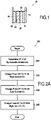
- Fig. 1 shows a schematic representation of an exemplary lithium ion cell 10.
- the lithium ion cell 10 includes an anode 12 fixed on an anode current collector 14 and a cathode 16 fixed on a cathode current collector 18.
- the anode 12 and the cathode 16 are separated by a separator 20, the anode 12, the cathode 16 and the separator 20 being immersed in an electrolyte 22.
- anode 12 may comprise a carbon material
- anode current collector 14 may comprise copper
- cathode 16 may comprise an intercalated lithium compound
- cathode current collector 18 may comprise aluminum. Lithium ions present in the electrolyte 22 move from the anode 12 to the cathode 16 during discharge of the cell 10 and from the cathode 16 to the anode 12 when charging the cell 10.
- One or more SEI-forming additives may be added to the electrolyte 22 to aid in formation of SEI 24.
- one or more SEI-forming additives provided in the electrolyte 22 may be selected from at least one of an oxalate salt, an ethylene carbonate and/or a sulfone.
- oxalate salts may include lithium salts of:
- Examples of ethylene carbonate may include:
- Examples of sulfone may include:
- anode 12 may comprise graphite (e.g., fabricated from a powder having an average particle size of ⁇ 10 ⁇ m), cathode 16 may comprise LiNo 1/3 Co 1/3 Mn 1/3 O 2 and separator 20 may comprise a film of polyethylene.
- the electrolyte 22 may be a mixture of ethylene carbonate, dimethyl carbonate and ethyl methyl carbonate present in equal volume ratio.
- the electrolyte may also comprise LiPF 6 at 1 mol/L (mole/litre).
- the SEI-forming additive may be a lithium difluoro(oxalate) phosphate salt added to the electrolyte 22 at 5 wt% (weight percent).
- a solid electrolyte interface (SEI) 24 may be formed during a charging process.
- the SEI 24 may be formed during the formation process of the cell 10, i.e., during the initial charging of the cell 10.
- an SEI may be formed both by an SEI-forming additive present in the electrolyte, and by a certain level of SEI formation from the electrolyte itself.
- SEI generally, it is intended to include the conglomerate SEI layer, i.e., both from the SEI-forming additive and the electrolyte.
- reference numeral 24 will be used to refer to the SEI-forming additive portion formed from SEI-forming additive present in the electrolyte 22.
- reference numeral 26 will refer to the SEI formed from the electrolyte 22 itself.
- Fig. 2A shows a block diagram illustrating an exemplary method for preparing a cell according to embodiments of the present disclosure
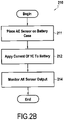
- Fig. 2B shows an exemplary method associated with step 210 of Fig. 2A in greater detail.
- a pre-test is performed to obtain voltage values, V 1 and V 2 , that are to be used during subsequent charging processes according to the present disclosure for similarly configured cells 10 (step 210).
- V 1 and V 2 voltage values
- step 210 a pre-test is carried out on such a cell design using a first cell having no SEI-forming additives to determine voltage V 2 , and a second cell having the desired SEI-forming additives for determining voltage V 1 , and the voltage values carried forward for preparation processes for subsequently produced cells 20 of similar design.
- an acoustic emission sensor may be placed on a case of the cell (10), for example, as near as possible to a geometric center of the case (step 211, Fig. 2B ).
- Such an AES may comprise, for example, a piezoelectric transducer (e.g., R15 from Physical Acoustics Corp., resonant frequency of 175kHz, frequency range of 50-200 Hz).
- a piezoelectric transducer e.g., R15 from Physical Acoustics Corp., resonant frequency of 175kHz, frequency range of 50-200 Hz.
- the AES may be connected to an acoustic emission measuring system, for example, a multi-channel AE monitoring system from Mistras Group SA, as well as pre-amplifiers (e.g., 60dB gain) and band-pass filters, for example, with a range between 100kHz and 1MHz).
- a threshold value for removing noise may be set at, for example, 27dB.
- Separate charging processes of the cell 10 having no SEI-forming additive and the cell 10 having an SEI-forming additive may then be performed, each, for example, at a charge rate of 1C (step 212, Fig. 2B ), and the acoustic emissions and voltage for each cell monitored (step 214, Fig. 2B ).
- Fig. 3 is a graph plotting acoustic emission and voltage information for a pretest of exemplary cells 10, one having no SEI-forming additive, and a second having a desired SEI-forming additive therein, according to the present disclosure.
- acoustic emissions begin to be detected at around 3.1V for the cell 10 having no SEI-forming additive in the electrolyte.
- These acoustic emissions correspond to the voltage at which the SEI 26 begins formation from the electrolyte, i.e., V 2 , and in the present example V 2 is determined to be 3.1V.
- line 310 demonstrates that acoustic emissions begin to be detected at around 1.8V, which corresponds to formation of SEI 24 by the SEI-forming additive. This voltage then corresponds to V 1 .
- a fully charged voltage for a single lithium-ion cell is approximately 4V, and this voltage then corresponds to V 3 , i.e., a fully charged state.
- a cell 10 including one or more SEI-forming additives can be charged from its assembly voltage to V 1 quickly, for example, at a rate of 3C (step 220). During this time, little to no SEI formation should occur.
- the cell can then be charged from V 1 to V 2 at a reduced rate, for example, 0.1C to 0.3C, during which time the SEI-forming additive should form SEI 24 on the anode 12 of the cell 10 (step 230).
- the cell may then be charged quickly again, for example, at 3C, up to the final voltage V 3 , i.e., approximately 4 volts (step 240). During this time, little to no formation of SEI 26 may occur, depending on a configuration of a cell 10 being charged.
- V 3 is known for a lithium ion cell, and is equal to ⁇ 4.0V.
- the cycle test mentioned in equation 11 involves 500 charge/discharge cycles of a cell between 3 volts and 4 volts, at room temperature, where the charge and discharge are each performed at a rate of 2C.
- Sample 4 was rapidly charged at 3C during all phases, while Sample 5 was charged at a constant 1C through all phases.
- Sample 4 capacity retention results demonstrate that rapidly charging through all phases results in relatively poor capacity retention.
- Sample 5 capacity retention results demonstrate that constant charging at the relatively low rate of 1C through all phases also yields below desirable levels of retention.
- Sample 1 results indicate that rapid charging at 3C to V1 followed by slow charging at 1C to V2, and rapid charging again at 3C from V2 to V3, can improve retention over sample 4, but retention was not significantly different than Sample 5.
- Samples 2 and 3 demonstrate significant gains in retention capacity where a rapid 3C charging to V1, followed by a reduced rate charge (e.g., 0.1C-0.3 C) from V1 to V2, and a rapid 3C charge from V2 to V3 are used. As shown at Fig. 3 , bottom portion, this is due to the relatively greater formation of SEI 24 from the SEI-forming additive, and minimized SEI 26 formation from the electrolyte itself.
- the method is described in terms of a single cell. However, it may be easily adapted for batteries having multiple cells.
Landscapes
- Chemical & Material Sciences (AREA)
- Engineering & Computer Science (AREA)
- Manufacturing & Machinery (AREA)
- Chemical Kinetics & Catalysis (AREA)
- Electrochemistry (AREA)
- General Chemical & Material Sciences (AREA)
- Physics & Mathematics (AREA)
- Condensed Matter Physics & Semiconductors (AREA)
- General Physics & Mathematics (AREA)
- Inorganic Chemistry (AREA)
- Materials Engineering (AREA)
- Secondary Cells (AREA)
Description
- The present disclosure is related to lithium ion batteries or cells, and more particularly to an improved method for initially charging such batteries (SEI formation process).
- Lithium-ion batteries are part of a family of rechargeable battery types in which lithium ions move from the negative electrode to the positive electrode during discharge and from the positive electrode to the negative electrode when charging.
- There are various types of lithium-ion battery. The anode comprises generally carbon and the cathode comprises a lithium compound. The anode and the cathode are separated by a separator made from a porous polymer, such as a micro-perforated plastic sheet, which allows ions to pass through. The anode, cathode and separator are immersed in an electrolyte.
- Lithium-ion batteries may be classified according to the cathode material.
- Once the lithium-ion battery is assembled, before the battery is suitable to be used, the lithium-ion battery may be put through at least one precisely controlled charge/discharge cycle to activate the working material. This step is called the formation process. This formation process provides an initial full charge of the battery.
- During the formation process, a solid electrolyte interface (SEI) is formed on the anode. High-quality SEI formation is desirable for performance and life of the lithium-ion battery or cell.
- Methods for initial charging, i.e., for the formation process, of a lithium-ion battery have been proposed.
- Typically, the battery is charged at a constant charge rate (i.e., constant current). The charge rate is also expressed as a C-rate, which represents a charge or a discharge rate equal to the capacity of a battery in one hour. It has been found that high-quality SEI is formed at small Crates, which means that the initial charging is performed over an extended period of time.
- Indeed, fully charging a battery at a C-rate equal to C/5 would take approximately five hours. According to some available techniques, the battery is charged at a small C-rate up to the fully charged voltage of the battery in order for the SEI to form on the carbon anode during the first charge and then the battery is held constant at the fully charged voltage until the current drops below a threshold. The battery is then left to rest for two hours and is discharged at a small C-rate to a pre-set voltage, i.e., the discharge cut-off voltage. This formation process may be cycled at least once.
- In order to reduce the manufacturing time of lithium-ion batteries, so-called dynamic forming processes have been proposed. In such processes, the battery is charged at a small C-rate up to the end of SEI layer formation on the anode, corresponding to a threshold voltage value, and then, a large C-rate is used to charge the battery up to the fully charged voltage. For example
US 2015/060290 discloses such a formation protocol which still involves at least charging the battery up to the fully charged voltage at least twice, and resting the cell for two hours between each charge/discharge of the cell, the total duration of the dynamic formation process being greater than forty hours. However, inUS 2015/060290 , the voltage value at termination of SEI layer formation on the anode is determined by a method using differences of temperature, and this determination can be inaccurate and based on approximations. This may be particularly true where an SEI layer is relatively small. -
US 2014/159674 discloses a method for monitoring a Li-ion battery and monitoring device for the implementation thereof. - Additives have also been added to the electrolyte to improve the formation of the SEI and therefore enhancing the anode stability.
- The present inventors have recognized that it remains desirable to reduce the duration of a formation process for an SEI, while having a battery that will exhibit good properties over a large number of charge/discharge cycles.
- Therefore, according to embodiments of the present disclosure, a method of performing a formation process for a lithium-ion cell according to
claim 1 is provided - The present method enables formation of a high-quality SEI from an SEI-forming additive, while minimizing the time used for an initial preparation charge. This further results in a battery having a high capacity retention with reduced production time, thereby translating to cost savings.
- The first predetermined voltage and the second predetermined voltage are determined based on acoustic emission signals.
- The first charge rate is greater than or equal to 2 C, preferably greater than or equal to 2.5 C, more preferably equal to 3 C.
- The second charge rate is less than or equal to 1 C, preferably less than or equal to 0.5 C, more preferable less than or equal to 0.3 C.
- The third predetermined charge rate is greater than or equal to the first predetermined charge rate.
- The additive provided in the electrolyte may be selected from an oxalate salt, an ethylene carbonate, and a sulfone.
- During charging of the cell, acoustic emission signals received from a sensor on a case of the cell may be measured and/or counted and, based on a number of received signals, the first predetermined voltage determined.
- According to another embodiment of the present disclosure, a vehicle comprising one or more cells prepared using the method described above is provided.
- It is intended that combinations of the above-described elements and those within the specification may be made, except where otherwise contradictory.
- It is to be understood that both the foregoing general description and the following detailed description are exemplary and explanatory only and are not restrictive of the disclosure, as claimed.
- The accompanying drawings, which are incorporated in and constitute a part of this specification, illustrate embodiments of the disclosure and together with the description, and serve to explain the principles thereof.
-
-
Fig. 1 shows a schematic representation of an exemplary lithium ion cell; -
Fig. 2A is a flowchart highlight an exemplary method according to embodiments of the present disclosure; -
Fig. 2B is a flowchart highlighting an exemplary pre-test method according to the present disclosure; and -
Fig. 3 is a graph showing acoustic emissions and voltages for an exemplary batter of the present disclosure. - Reference will now be made in detail to exemplary embodiments of the disclosure, examples of which are illustrated in the accompanying drawings. Wherever possible, the same reference numbers will be used throughout the drawings to refer to the same or like parts.
-
Fig. 1 shows a schematic representation of an exemplarylithium ion cell 10. Thelithium ion cell 10 includes ananode 12 fixed on an anodecurrent collector 14 and acathode 16 fixed on a cathodecurrent collector 18. Theanode 12 and thecathode 16 are separated by aseparator 20, theanode 12, thecathode 16 and theseparator 20 being immersed in anelectrolyte 22. - According to exemplary embodiments,
anode 12 may comprise a carbon material, anodecurrent collector 14 may comprise copper,cathode 16 may comprise an intercalated lithium compound, and cathodecurrent collector 18 may comprise aluminum. Lithium ions present in theelectrolyte 22 move from theanode 12 to thecathode 16 during discharge of thecell 10 and from thecathode 16 to theanode 12 when charging thecell 10. - One or more SEI-forming additives may be added to the
electrolyte 22 to aid in formation ofSEI 24. - According to some embodiments, one or more SEI-forming additives provided in the
electrolyte 22 may be selected from at least one of an oxalate salt, an ethylene carbonate and/or a sulfone. - Examples of oxalate salts may include lithium salts of:


- (1) is difluoro(oxalate)phosphate.
- (2) is difluoro(oxalato)borate
- (3) is bis(oxalato)borate.
- (4) is tetrafluoro(oxalato)phosphate.
- (5) is tris(oxalato)phosphate.
- Examples of ethylene carbonate may include:


- (6) is vinylene carbonate.
- (7) is fluoroethylene carbonate.
- (8) is (fluoromethyl)ethylene carbonate.
- Examples of sulfone may include:


- (9) is sulfolane.
- (10) is ethyl methyl sulfone.
- In one exemplary cell according to the present disclosure,
anode 12 may comprise graphite (e.g., fabricated from a powder having an average particle size of ~10µm),cathode 16 may comprise LiNo1/3Co1/3Mn1/3O2 andseparator 20 may comprise a film of polyethylene. Theelectrolyte 22 may be a mixture of ethylene carbonate, dimethyl carbonate and ethyl methyl carbonate present in equal volume ratio. The electrolyte may also comprise LiPF6 at 1 mol/L (mole/litre). The SEI-forming additive may be a lithium difluoro(oxalate) phosphate salt added to theelectrolyte 22 at 5 wt% (weight percent). - On
anode 12, a solid electrolyte interface (SEI) 24 may be formed during a charging process. TheSEI 24 may be formed during the formation process of thecell 10, i.e., during the initial charging of thecell 10. - It is to be noted that an SEI may be formed both by an SEI-forming additive present in the electrolyte, and by a certain level of SEI formation from the electrolyte itself. When referring to SEI generally, it is intended to include the conglomerate SEI layer, i.e., both from the SEI-forming additive and the electrolyte. When referring to a specific portion of an SEI layer formed from the SEI-forming additive,
reference numeral 24 will be used to refer to the SEI-forming additive portion formed from SEI-forming additive present in theelectrolyte 22. Similarly,reference numeral 26 will refer to the SEI formed from theelectrolyte 22 itself. One of the desired effects of embodiments of the present disclosure is to minimize formation ofSEI 26 from theelectrolyte 22. -
Fig. 2A shows a block diagram illustrating an exemplary method for preparing a cell according to embodiments of the present disclosure, whileFig. 2B shows an exemplary method associated withstep 210 ofFig. 2A in greater detail. - According to the invention a pre-test is performed to obtain voltage values, V1 and V2, that are to be used during subsequent charging processes according to the present disclosure for similarly configured cells 10 (step 210). In other words, where a manufacturing process is being configured for
cells 10 having a similar composition/configuration, one or more pre-tests are carried out on such a cell design using a first cell having no SEI-forming additives to determine voltage V2, and a second cell having the desired SEI-forming additives for determining voltage V1, and the voltage values carried forward for preparation processes for subsequently producedcells 20 of similar design. - To carry out a pre-test on a particular cell configuration, an acoustic emission sensor (AES) may be placed on a case of the cell (10), for example, as near as possible to a geometric center of the case (step 211,
Fig. 2B ). Such an AES may comprise, for example, a piezoelectric transducer (e.g., R15 from Physical Acoustics Corp., resonant frequency of 175kHz, frequency range of 50-200 Hz). One of skill understands that more than one AES may be used, as desired, and for minimizing costs and complexity one such sensor is discussed here. - The AES may be connected to an acoustic emission measuring system, for example, a multi-channel AE monitoring system from Mistras Group SA, as well as pre-amplifiers (e.g., 60dB gain) and band-pass filters, for example, with a range between 100kHz and 1MHz). A threshold value for removing noise may be set at, for example, 27dB.
- Separate charging processes of the
cell 10 having no SEI-forming additive and thecell 10 having an SEI-forming additive may then be performed, each, for example, at a charge rate of 1C (step 212,Fig. 2B ), and the acoustic emissions and voltage for each cell monitored (step 214,Fig. 2B ). -
Fig. 3 is a graph plotting acoustic emission and voltage information for a pretest ofexemplary cells 10, one having no SEI-forming additive, and a second having a desired SEI-forming additive therein, according to the present disclosure. - As shown at
Fig. 3 ,line 300, acoustic emissions begin to be detected at around 3.1V for thecell 10 having no SEI-forming additive in the electrolyte. These acoustic emissions correspond to the voltage at which theSEI 26 begins formation from the electrolyte, i.e., V2, and in the present example V2 is determined to be 3.1V. - Similarly, in the
cell 10 including the SEI-forming additive in the electrolyte,line 310 demonstrates that acoustic emissions begin to be detected at around 1.8V, which corresponds to formation ofSEI 24 by the SEI-forming additive. This voltage then corresponds to V1. - A fully charged voltage for a single lithium-ion cell is approximately 4V, and this voltage then corresponds to V3, i.e., a fully charged state.
- Once V1 and V2 have been determined for a particular cell design, the cell formation process can proceed for
subsequent cells 10 using these same voltage values for V1 and V2. Therefore, acell 10 including one or more SEI-forming additives can be charged from its assembly voltage to V1 quickly, for example, at a rate of 3C (step 220). During this time, little to no SEI formation should occur. - The cell can then be charged from V1 to V2 at a reduced rate, for example, 0.1C to 0.3C, during which time the SEI-forming additive should form
SEI 24 on theanode 12 of the cell 10 (step 230). - After reaching V2, the cell may then be charged quickly again, for example, at 3C, up to the final voltage V3, i.e., approximately 4 volts (step 240). During this time, little to no formation of
SEI 26 may occur, depending on a configuration of acell 10 being charged. - Five
sample cells 10 having the same components were prepared according to the present disclosure for testing at varying charge rates. These cells were configured as follows: - Cathode:
- LiNi1/3Co1/3Mn1/3O2;
- conductive material - acetylene black;
- binder - poly vinylidine difluoride (PVDF)
- Anode: active material - graphite; binder - styrene butadiene rubber (SBR), carboxymethyl cellulose (CMC)
- Separator: polyethylene film
- Electrolyte: EC:DMC:EMC = 1:1:1 by volume with
LiPF6 1 mol/L; SEI-forming additive - Lithium difluoro(oxalate) phosphate 5% by weight. - A pre-test for this particular design was then performed according to the pre-test procedures described above to determine the first and second voltages V1 and V2, respectively. V1 was determined to be equal to 1.8V and V2 = 3.1V. V3 is known for a lithium ion cell, and is equal to ~4.0V.
- Charging was then performed for each sample according to Table 1, and the resulting capacity retention recorded in this table.

- Capacity retention was calculated using equation 11:

- The cycle test mentioned in equation 11 involves 500 charge/discharge cycles of a cell between 3 volts and 4 volts, at room temperature, where the charge and discharge are each performed at a rate of 2C.
- As shown at Table 1, Sample 4 was rapidly charged at 3C during all phases, while Sample 5 was charged at a constant 1C through all phases. Sample 4 capacity retention results demonstrate that rapidly charging through all phases results in relatively poor capacity retention. Similarly, Sample 5 capacity retention results demonstrate that constant charging at the relatively low rate of 1C through all phases also yields below desirable levels of retention.
-
Sample 1 results indicate that rapid charging at 3C to V1 followed by slow charging at 1C to V2, and rapid charging again at 3C from V2 to V3, can improve retention over sample 4, but retention was not significantly different than Sample 5. - Samples 2 and 3, however, demonstrate significant gains in retention capacity where a rapid 3C charging to V1, followed by a reduced rate charge (e.g., 0.1C-0.3 C) from V1 to V2, and a rapid 3C charge from V2 to V3 are used. As shown at
Fig. 3 , bottom portion, this is due to the relatively greater formation ofSEI 24 from the SEI-forming additive, and minimizedSEI 26 formation from the electrolyte itself. - Thus, the inventors have demonstrated that formation of a high quality SEI with good capacity retention can be achieved with a relatively short duration of formation process by way of embodiments of the present disclosure.
- Throughout the description, including the claims, the term "comprising a" should be understood as being synonymous with "comprising at least one" unless otherwise stated. In addition, any range set forth in the description, including the claims should be understood as including its end value(s) unless otherwise stated. Specific values for described elements should be understood to be within accepted manufacturing or industry tolerances known to one of skill in the art, and any use of the terms "substantially" and/or "approximately" and/or "generally" should be understood to mean falling within such accepted tolerances.
- Although the present disclosure herein has been described with reference to particular embodiments, it is to be understood that these embodiments are merely illustrative of the principles and applications of the present disclosure.
- It is intended that the specification and examples be considered as exemplary only, with a true scope of the disclosure being indicated by the following claims.
- The method is described in terms of a single cell. However, it may be easily adapted for batteries having multiple cells.
Claims (5)
- A method of preparing a lithium-ion cell (10), the method comprising:providing to an electrolyte (22) of the cell, an additive configured to improve formation of a solid electrolyte interface (24) on an anode (12);charging the cell (10) at a first predetermined charge rate (C1) greater than or equal to 2 C, up to a first predetermined voltage (V1), wherein the first predetermined voltage (V1) corresponds to a voltage at which the additive begins formation of the solid electrolyte interface (24);charging the cell (10) at a second predetermined rate (C2) less than or equal to 1 C, to a second predetermined voltage (V2), wherein the second predetermined voltage (V2) corresponds to a voltage at which the electrolyte (22) begins formation of the solid electrolyte interface (24); andcharging the cell (10) to a fully charged capacity at a third predetermined charge rate (C3), the third charge rate (C3) being greater than the second charge rate (C2) and greater than or equal to the first predetermined charge rate (C1), wherein the first predetermined voltage (V1) and the second predetermined voltage (V2) are determined based on acoustic emission signals during a pre-test of a similarly configured lithium-ion cell prior to subsequent charging processes.
- The method according claim 1, wherein the first charge rate (C1) is greater than or equal to 2.5 C, and preferably equal to 3 C.
- The method according to any of claims 1 to 2, wherein the second charge rate (C2) is less than or equal to 0.5 C, and preferably less than or equal to 0.3 C, for example 0.1C.
- The method according to any of claims 1 to 3, wherein the additive provided in the electrolyte (22) is selected from a lithium salt of difluoro(oxalate)phosphate, difluoro(oxalato)borate, bis(oxalato)borate, tetrafluoro(oxalato)phosphate, and tris(oxalato)phosphate; an ethylene carbonate selected from among vinylene carbonate, fluoroethylene carbonate, and (fluoromethyl)ethylene carbonate; and a sulfone selected from among sulfolane and ethyl methyl sulfone.
- The method according to any of claims 1-4, wherein the pre-test comprises:during charging of the cell, measuring acoustic emission signals received from a sensor within a case of the cell;determining, based on a number of received signals, the first predetermined voltage (V1).
Applications Claiming Priority (1)
| Application Number | Priority Date | Filing Date | Title |
|---|---|---|---|
| PCT/EP2017/054090 WO2018153449A1 (en) | 2017-02-22 | 2017-02-22 | Lithium-ion battery formation process |
Publications (2)
| Publication Number | Publication Date |
|---|---|
| EP3586394A1 EP3586394A1 (en) | 2020-01-01 |
| EP3586394B1 true EP3586394B1 (en) | 2022-03-30 |
Family
ID=58231586
Family Applications (1)
| Application Number | Title | Priority Date | Filing Date |
|---|---|---|---|
| EP17709009.9A Active EP3586394B1 (en) | 2017-02-22 | 2017-02-22 | Lithium-ion battery formation process |
Country Status (6)
| Country | Link |
|---|---|
| US (1) | US10741886B2 (en) |
| EP (1) | EP3586394B1 (en) |
| JP (1) | JP6940583B2 (en) |
| KR (1) | KR102141175B1 (en) |
| CN (1) | CN109478696B (en) |
| WO (1) | WO2018153449A1 (en) |
Families Citing this family (3)
| Publication number | Priority date | Publication date | Assignee | Title |
|---|---|---|---|---|
| CN112928349B (en) * | 2021-01-21 | 2022-08-19 | 中国科学院宁波材料技术与工程研究所 | Formation method of lithium-rich battery |
| CN113540595A (en) * | 2021-06-18 | 2021-10-22 | 万向一二三股份公司 | A kind of chemical formation method to improve high nickel ternary material cell interface |
| KR102640466B1 (en) * | 2021-09-10 | 2024-02-27 | 주식회사 엘지에너지솔루션 | Methods of activation for secondary battery |
Family Cites Families (16)
| Publication number | Priority date | Publication date | Assignee | Title |
|---|---|---|---|---|
| JP3990107B2 (en) * | 2000-12-28 | 2007-10-10 | 株式会社東芝 | Non-aqueous electrolyte secondary battery charging method |
| JP3997711B2 (en) * | 2001-01-10 | 2007-10-24 | トヨタ自動車株式会社 | Initial charging method and manufacturing method of lithium secondary battery |
| US8252465B2 (en) * | 2001-01-19 | 2012-08-28 | Samsung Sdi Co., Ltd. | Electrolyte for lithium secondary battery and lithium secondary battery comprising same |
| JP2011108550A (en) * | 2009-11-19 | 2011-06-02 | Nissan Motor Co Ltd | Charging method and charging device for nonaqueous electrolyte secondary battery |
| CN101872879A (en) * | 2010-06-01 | 2010-10-27 | 奇瑞汽车股份有限公司 | Chemical combination method of lithium-ion recharging battery |
| FR2974675B1 (en) * | 2011-04-29 | 2013-05-17 | Commissariat Energie Atomique | METHOD FOR MONITORING AN LI-ION BATTERY AND MONITORING DEVICE FOR ITS IMPLEMENTATION |
| DE112011105809B4 (en) * | 2011-11-04 | 2019-10-02 | Toyota Jidosha Kabushiki Kaisha | Sealed lithium secondary battery and method of making the same |
| CN103988357B (en) * | 2011-11-24 | 2017-09-26 | 丰田自动车株式会社 | The manufacture method of nonaqueous electrolytic solution secondary battery |
| CN103326069B (en) * | 2012-03-20 | 2016-05-04 | 北汽福田汽车股份有限公司 | A kind of chemical synthesizing method of LiMn2O4 electrokinetic cell |
| WO2014141930A1 (en) * | 2013-03-14 | 2014-09-18 | Necエナジーデバイス株式会社 | Lithium ion secondary battery and charging method therefor |
| US20150004474A1 (en) * | 2013-07-01 | 2015-01-01 | Samsung Sdl Co., Ltd. | Secondary battery |
| US9276293B2 (en) | 2013-08-30 | 2016-03-01 | Southwestern Research Institute | Dynamic formation protocol for lithium-ion battery |
| US10468729B2 (en) | 2014-01-10 | 2019-11-05 | Envision Aesc Japan Ltd. | Method for producing non-aqueous electrolyte secondary battery |
| EP3132486B1 (en) * | 2014-04-17 | 2018-06-06 | Gotion, Inc. | Alkylbenzoate derivatives as electrolyte additive for lithium based batteries |
| JP6299623B2 (en) * | 2015-02-10 | 2018-03-28 | トヨタ自動車株式会社 | Initial charging method for lithium-ion battery |
| JP6274532B2 (en) * | 2015-06-11 | 2018-02-07 | トヨタ自動車株式会社 | Method for producing non-aqueous electrolyte secondary battery |
-
2017
- 2017-02-22 US US16/315,741 patent/US10741886B2/en active Active
- 2017-02-22 EP EP17709009.9A patent/EP3586394B1/en active Active
- 2017-02-22 JP JP2019500534A patent/JP6940583B2/en active Active
- 2017-02-22 CN CN201780045317.9A patent/CN109478696B/en active Active
- 2017-02-22 KR KR1020197000653A patent/KR102141175B1/en not_active Expired - Fee Related
- 2017-02-22 WO PCT/EP2017/054090 patent/WO2018153449A1/en not_active Ceased
Also Published As
| Publication number | Publication date |
|---|---|
| US20190372177A1 (en) | 2019-12-05 |
| CN109478696A (en) | 2019-03-15 |
| EP3586394A1 (en) | 2020-01-01 |
| KR20190039074A (en) | 2019-04-10 |
| WO2018153449A1 (en) | 2018-08-30 |
| JP6940583B2 (en) | 2021-09-29 |
| US10741886B2 (en) | 2020-08-11 |
| JP2019530127A (en) | 2019-10-17 |
| KR102141175B1 (en) | 2020-08-05 |
| CN109478696B (en) | 2022-02-22 |
Similar Documents
| Publication | Publication Date | Title |
|---|---|---|
| EP3057195B1 (en) | Initial charging method and production method for lithium-ion battery | |
| KR101951067B1 (en) | Secondary battery control device and soc detection method | |
| JP5699970B2 (en) | Lithium ion secondary battery system and deposition determination method | |
| JP2011069775A (en) | Method of inspecting secondary battery | |
| CN110471001B (en) | Diagnostic method and diagnostic device for lithium ion battery | |
| KR102477915B1 (en) | Method of producing lithium-ion battery | |
| KR20130098704A (en) | Non aqueous electrolyte and secondary battery comprising the same | |
| EP3586394B1 (en) | Lithium-ion battery formation process | |
| WO2018153450A1 (en) | Lithium-ion battery high temperature aging process | |
| US10553910B2 (en) | Lithium-ion battery formation process | |
| WO2017148500A1 (en) | Lithium-ion battery formation process | |
| CN114072952B (en) | Method for determining the degree of wetting by using low current testing | |
| KR102005506B1 (en) | Method for preparing lithium secondary battery | |
| JP6627621B2 (en) | Output evaluation method of lithium ion secondary battery | |
| JP6741768B2 (en) | Lithium-ion battery formation process | |
| KR101735032B1 (en) | A method of removing water from electrode material, electrode comprising the electrode material obtained from the method, and lithium secondary battery comprising the electrode | |
| WO2021186781A1 (en) | Capacity recovery device, capacity recovery method, and secondary battery system | |
| WO2017144120A1 (en) | Lithium-ion battery high temperature aging process | |
| JP2004296179A (en) | Manufacturing method of lithium secondary battery |
Legal Events
| Date | Code | Title | Description |
|---|---|---|---|
| STAA | Information on the status of an ep patent application or granted ep patent |
Free format text: STATUS: UNKNOWN |
|
| STAA | Information on the status of an ep patent application or granted ep patent |
Free format text: STATUS: THE INTERNATIONAL PUBLICATION HAS BEEN MADE |
|
| PUAI | Public reference made under article 153(3) epc to a published international application that has entered the european phase |
Free format text: ORIGINAL CODE: 0009012 |
|
| STAA | Information on the status of an ep patent application or granted ep patent |
Free format text: STATUS: REQUEST FOR EXAMINATION WAS MADE |
|
| 17P | Request for examination filed |
Effective date: 20190124 |
|
| AK | Designated contracting states |
Kind code of ref document: A1 Designated state(s): AL AT BE BG CH CY CZ DE DK EE ES FI FR GB GR HR HU IE IS IT LI LT LU LV MC MK MT NL NO PL PT RO RS SE SI SK SM TR |
|
| AX | Request for extension of the european patent |
Extension state: BA ME |
|
| DAV | Request for validation of the european patent (deleted) | ||
| DAX | Request for extension of the european patent (deleted) | ||
| GRAP | Despatch of communication of intention to grant a patent |
Free format text: ORIGINAL CODE: EPIDOSNIGR1 |
|
| STAA | Information on the status of an ep patent application or granted ep patent |
Free format text: STATUS: GRANT OF PATENT IS INTENDED |
|
| INTG | Intention to grant announced |
Effective date: 20210924 |
|
| GRAS | Grant fee paid |
Free format text: ORIGINAL CODE: EPIDOSNIGR3 |
|
| GRAA | (expected) grant |
Free format text: ORIGINAL CODE: 0009210 |
|
| STAA | Information on the status of an ep patent application or granted ep patent |
Free format text: STATUS: THE PATENT HAS BEEN GRANTED |
|
| AK | Designated contracting states |
Kind code of ref document: B1 Designated state(s): AL AT BE BG CH CY CZ DE DK EE ES FI FR GB GR HR HU IE IS IT LI LT LU LV MC MK MT NL NO PL PT RO RS SE SI SK SM TR |
|
| REG | Reference to a national code |
Ref country code: GB Ref legal event code: FG4D |
|
| REG | Reference to a national code |
Ref country code: CH Ref legal event code: EP |
|
| REG | Reference to a national code |
Ref country code: AT Ref legal event code: REF Ref document number: 1480032 Country of ref document: AT Kind code of ref document: T Effective date: 20220415 |
|
| REG | Reference to a national code |
Ref country code: DE Ref legal event code: R096 Ref document number: 602017055167 Country of ref document: DE |
|
| REG | Reference to a national code |
Ref country code: IE Ref legal event code: FG4D |
|
| REG | Reference to a national code |
Ref country code: LT Ref legal event code: MG9D |
|
| PG25 | Lapsed in a contracting state [announced via postgrant information from national office to epo] |
Ref country code: SE Free format text: LAPSE BECAUSE OF FAILURE TO SUBMIT A TRANSLATION OF THE DESCRIPTION OR TO PAY THE FEE WITHIN THE PRESCRIBED TIME-LIMIT Effective date: 20220330 Ref country code: RS Free format text: LAPSE BECAUSE OF FAILURE TO SUBMIT A TRANSLATION OF THE DESCRIPTION OR TO PAY THE FEE WITHIN THE PRESCRIBED TIME-LIMIT Effective date: 20220330 Ref country code: NO Free format text: LAPSE BECAUSE OF FAILURE TO SUBMIT A TRANSLATION OF THE DESCRIPTION OR TO PAY THE FEE WITHIN THE PRESCRIBED TIME-LIMIT Effective date: 20220630 Ref country code: LT Free format text: LAPSE BECAUSE OF FAILURE TO SUBMIT A TRANSLATION OF THE DESCRIPTION OR TO PAY THE FEE WITHIN THE PRESCRIBED TIME-LIMIT Effective date: 20220330 Ref country code: HR Free format text: LAPSE BECAUSE OF FAILURE TO SUBMIT A TRANSLATION OF THE DESCRIPTION OR TO PAY THE FEE WITHIN THE PRESCRIBED TIME-LIMIT Effective date: 20220330 Ref country code: BG Free format text: LAPSE BECAUSE OF FAILURE TO SUBMIT A TRANSLATION OF THE DESCRIPTION OR TO PAY THE FEE WITHIN THE PRESCRIBED TIME-LIMIT Effective date: 20220630 |
|
| REG | Reference to a national code |
Ref country code: NL Ref legal event code: MP Effective date: 20220330 |
|
| REG | Reference to a national code |
Ref country code: AT Ref legal event code: MK05 Ref document number: 1480032 Country of ref document: AT Kind code of ref document: T Effective date: 20220330 |
|
| PG25 | Lapsed in a contracting state [announced via postgrant information from national office to epo] |
Ref country code: LV Free format text: LAPSE BECAUSE OF FAILURE TO SUBMIT A TRANSLATION OF THE DESCRIPTION OR TO PAY THE FEE WITHIN THE PRESCRIBED TIME-LIMIT Effective date: 20220330 Ref country code: GR Free format text: LAPSE BECAUSE OF FAILURE TO SUBMIT A TRANSLATION OF THE DESCRIPTION OR TO PAY THE FEE WITHIN THE PRESCRIBED TIME-LIMIT Effective date: 20220701 Ref country code: FI Free format text: LAPSE BECAUSE OF FAILURE TO SUBMIT A TRANSLATION OF THE DESCRIPTION OR TO PAY THE FEE WITHIN THE PRESCRIBED TIME-LIMIT Effective date: 20220330 |
|
| PG25 | Lapsed in a contracting state [announced via postgrant information from national office to epo] |
Ref country code: NL Free format text: LAPSE BECAUSE OF FAILURE TO SUBMIT A TRANSLATION OF THE DESCRIPTION OR TO PAY THE FEE WITHIN THE PRESCRIBED TIME-LIMIT Effective date: 20220330 |
|
| PG25 | Lapsed in a contracting state [announced via postgrant information from national office to epo] |
Ref country code: SM Free format text: LAPSE BECAUSE OF FAILURE TO SUBMIT A TRANSLATION OF THE DESCRIPTION OR TO PAY THE FEE WITHIN THE PRESCRIBED TIME-LIMIT Effective date: 20220330 Ref country code: SK Free format text: LAPSE BECAUSE OF FAILURE TO SUBMIT A TRANSLATION OF THE DESCRIPTION OR TO PAY THE FEE WITHIN THE PRESCRIBED TIME-LIMIT Effective date: 20220330 Ref country code: RO Free format text: LAPSE BECAUSE OF FAILURE TO SUBMIT A TRANSLATION OF THE DESCRIPTION OR TO PAY THE FEE WITHIN THE PRESCRIBED TIME-LIMIT Effective date: 20220330 Ref country code: PT Free format text: LAPSE BECAUSE OF FAILURE TO SUBMIT A TRANSLATION OF THE DESCRIPTION OR TO PAY THE FEE WITHIN THE PRESCRIBED TIME-LIMIT Effective date: 20220801 Ref country code: ES Free format text: LAPSE BECAUSE OF FAILURE TO SUBMIT A TRANSLATION OF THE DESCRIPTION OR TO PAY THE FEE WITHIN THE PRESCRIBED TIME-LIMIT Effective date: 20220330 Ref country code: EE Free format text: LAPSE BECAUSE OF FAILURE TO SUBMIT A TRANSLATION OF THE DESCRIPTION OR TO PAY THE FEE WITHIN THE PRESCRIBED TIME-LIMIT Effective date: 20220330 Ref country code: CZ Free format text: LAPSE BECAUSE OF FAILURE TO SUBMIT A TRANSLATION OF THE DESCRIPTION OR TO PAY THE FEE WITHIN THE PRESCRIBED TIME-LIMIT Effective date: 20220330 Ref country code: AT Free format text: LAPSE BECAUSE OF FAILURE TO SUBMIT A TRANSLATION OF THE DESCRIPTION OR TO PAY THE FEE WITHIN THE PRESCRIBED TIME-LIMIT Effective date: 20220330 |
|
| PG25 | Lapsed in a contracting state [announced via postgrant information from national office to epo] |
Ref country code: PL Free format text: LAPSE BECAUSE OF FAILURE TO SUBMIT A TRANSLATION OF THE DESCRIPTION OR TO PAY THE FEE WITHIN THE PRESCRIBED TIME-LIMIT Effective date: 20220330 Ref country code: IS Free format text: LAPSE BECAUSE OF FAILURE TO SUBMIT A TRANSLATION OF THE DESCRIPTION OR TO PAY THE FEE WITHIN THE PRESCRIBED TIME-LIMIT Effective date: 20220730 Ref country code: AL Free format text: LAPSE BECAUSE OF FAILURE TO SUBMIT A TRANSLATION OF THE DESCRIPTION OR TO PAY THE FEE WITHIN THE PRESCRIBED TIME-LIMIT Effective date: 20220330 |
|
| REG | Reference to a national code |
Ref country code: DE Ref legal event code: R097 Ref document number: 602017055167 Country of ref document: DE |
|
| PG25 | Lapsed in a contracting state [announced via postgrant information from national office to epo] |
Ref country code: DK Free format text: LAPSE BECAUSE OF FAILURE TO SUBMIT A TRANSLATION OF THE DESCRIPTION OR TO PAY THE FEE WITHIN THE PRESCRIBED TIME-LIMIT Effective date: 20220330 |
|
| PLBE | No opposition filed within time limit |
Free format text: ORIGINAL CODE: 0009261 |
|
| STAA | Information on the status of an ep patent application or granted ep patent |
Free format text: STATUS: NO OPPOSITION FILED WITHIN TIME LIMIT |
|
| 26N | No opposition filed |
Effective date: 20230103 |
|
| PG25 | Lapsed in a contracting state [announced via postgrant information from national office to epo] |
Ref country code: SI Free format text: LAPSE BECAUSE OF FAILURE TO SUBMIT A TRANSLATION OF THE DESCRIPTION OR TO PAY THE FEE WITHIN THE PRESCRIBED TIME-LIMIT Effective date: 20220330 |
|
| REG | Reference to a national code |
Ref country code: DE Ref legal event code: R081 Ref document number: 602017055167 Country of ref document: DE Owner name: TOYOTA JIDOSHA KABUSHIKI KAISHA, TOYOTA-SHI, JP Free format text: FORMER OWNERS: TOYOTA JIDOSHA KABUSHIKI KAISHA, TOYOTA-SHI, AICHI-KEN, JP; TOYOTA MOTOR EUROPE, BRUSSELS, BE |
|
| PG25 | Lapsed in a contracting state [announced via postgrant information from national office to epo] |
Ref country code: IT Free format text: LAPSE BECAUSE OF FAILURE TO SUBMIT A TRANSLATION OF THE DESCRIPTION OR TO PAY THE FEE WITHIN THE PRESCRIBED TIME-LIMIT Effective date: 20220330 |
|
| REG | Reference to a national code |
Ref country code: DE Ref legal event code: R084 Ref document number: 602017055167 Country of ref document: DE |
|
| REG | Reference to a national code |
Ref country code: GB Ref legal event code: 732E Free format text: REGISTERED BETWEEN 20230803 AND 20230809 |
|
| PG25 | Lapsed in a contracting state [announced via postgrant information from national office to epo] |
Ref country code: MC Free format text: LAPSE BECAUSE OF FAILURE TO SUBMIT A TRANSLATION OF THE DESCRIPTION OR TO PAY THE FEE WITHIN THE PRESCRIBED TIME-LIMIT Effective date: 20220330 |
|
| REG | Reference to a national code |
Ref country code: CH Ref legal event code: PL |
|
| REG | Reference to a national code |
Ref country code: BE Ref legal event code: MM Effective date: 20230228 |
|
| PG25 | Lapsed in a contracting state [announced via postgrant information from national office to epo] |
Ref country code: LU Free format text: LAPSE BECAUSE OF NON-PAYMENT OF DUE FEES Effective date: 20230222 Ref country code: LI Free format text: LAPSE BECAUSE OF NON-PAYMENT OF DUE FEES Effective date: 20230228 Ref country code: CH Free format text: LAPSE BECAUSE OF NON-PAYMENT OF DUE FEES Effective date: 20230228 |
|
| P01 | Opt-out of the competence of the unified patent court (upc) registered |
Effective date: 20231024 |
|
| REG | Reference to a national code |
Ref country code: IE Ref legal event code: MM4A |
|
| PG25 | Lapsed in a contracting state [announced via postgrant information from national office to epo] |
Ref country code: IE Free format text: LAPSE BECAUSE OF NON-PAYMENT OF DUE FEES Effective date: 20230222 |
|
| PG25 | Lapsed in a contracting state [announced via postgrant information from national office to epo] |
Ref country code: BE Free format text: LAPSE BECAUSE OF NON-PAYMENT OF DUE FEES Effective date: 20230228 |
|
| PG25 | Lapsed in a contracting state [announced via postgrant information from national office to epo] |
Ref country code: CY Free format text: LAPSE BECAUSE OF FAILURE TO SUBMIT A TRANSLATION OF THE DESCRIPTION OR TO PAY THE FEE WITHIN THE PRESCRIBED TIME-LIMIT; INVALID AB INITIO Effective date: 20170222 |
|
| PG25 | Lapsed in a contracting state [announced via postgrant information from national office to epo] |
Ref country code: HU Free format text: LAPSE BECAUSE OF FAILURE TO SUBMIT A TRANSLATION OF THE DESCRIPTION OR TO PAY THE FEE WITHIN THE PRESCRIBED TIME-LIMIT; INVALID AB INITIO Effective date: 20170222 |
|
| PG25 | Lapsed in a contracting state [announced via postgrant information from national office to epo] |
Ref country code: TR Free format text: LAPSE BECAUSE OF FAILURE TO SUBMIT A TRANSLATION OF THE DESCRIPTION OR TO PAY THE FEE WITHIN THE PRESCRIBED TIME-LIMIT Effective date: 20220330 |
|
| PGFP | Annual fee paid to national office [announced via postgrant information from national office to epo] |
Ref country code: FR Payment date: 20251231 Year of fee payment: 10 |
|
| REG | Reference to a national code |
Ref country code: GB Ref legal event code: 746 Effective date: 20260112 |
|
| PGFP | Annual fee paid to national office [announced via postgrant information from national office to epo] |
Ref country code: GB Payment date: 20260106 Year of fee payment: 10 |
|
| PGFP | Annual fee paid to national office [announced via postgrant information from national office to epo] |
Ref country code: DE Payment date: 20251230 Year of fee payment: 10 |