EP3584570A1 - Method for manufacturing a relative humidity sensor and relative humidity sensor - Google Patents
Method for manufacturing a relative humidity sensor and relative humidity sensor Download PDFInfo
- Publication number
- EP3584570A1 EP3584570A1 EP18305779.3A EP18305779A EP3584570A1 EP 3584570 A1 EP3584570 A1 EP 3584570A1 EP 18305779 A EP18305779 A EP 18305779A EP 3584570 A1 EP3584570 A1 EP 3584570A1
- Authority
- EP
- European Patent Office
- Prior art keywords
- electrode
- relative humidity
- humidity sensor
- pattern
- voids
- Prior art date
- Legal status (The legal status is an assumption and is not a legal conclusion. Google has not performed a legal analysis and makes no representation as to the accuracy of the status listed.)
- Withdrawn
Links
- 238000004519 manufacturing process Methods 0.000 title claims abstract description 27
- 238000000034 method Methods 0.000 title claims abstract description 27
- 239000000758 substrate Substances 0.000 claims abstract description 22
- 238000000206 photolithography Methods 0.000 claims description 8
- 238000000059 patterning Methods 0.000 claims description 7
- 229910052581 Si3N4 Inorganic materials 0.000 claims description 6
- 238000001312 dry etching Methods 0.000 claims description 6
- HBMJWWWQQXIZIP-UHFFFAOYSA-N silicon carbide Chemical compound [Si+]#[C-] HBMJWWWQQXIZIP-UHFFFAOYSA-N 0.000 claims description 6
- 229910010271 silicon carbide Inorganic materials 0.000 claims description 6
- HQVNEWCFYHHQES-UHFFFAOYSA-N silicon nitride Chemical compound N12[Si]34N5[Si]62N3[Si]51N64 HQVNEWCFYHHQES-UHFFFAOYSA-N 0.000 claims description 6
- 238000001039 wet etching Methods 0.000 claims description 6
- 239000011651 chromium Substances 0.000 claims description 5
- VYZAMTAEIAYCRO-UHFFFAOYSA-N Chromium Chemical compound [Cr] VYZAMTAEIAYCRO-UHFFFAOYSA-N 0.000 claims description 2
- 229910052804 chromium Inorganic materials 0.000 claims description 2
- 239000010410 layer Substances 0.000 description 74
- 238000000151 deposition Methods 0.000 description 12
- XLYOFNOQVPJJNP-UHFFFAOYSA-N water Chemical compound O XLYOFNOQVPJJNP-UHFFFAOYSA-N 0.000 description 9
- 230000008021 deposition Effects 0.000 description 7
- 230000015572 biosynthetic process Effects 0.000 description 6
- 238000005229 chemical vapour deposition Methods 0.000 description 6
- 238000005240 physical vapour deposition Methods 0.000 description 6
- 229910052782 aluminium Inorganic materials 0.000 description 5
- 230000008859 change Effects 0.000 description 5
- TWNQGVIAIRXVLR-UHFFFAOYSA-N oxo(oxoalumanyloxy)alumane Chemical compound O=[Al]O[Al]=O TWNQGVIAIRXVLR-UHFFFAOYSA-N 0.000 description 5
- 230000008569 process Effects 0.000 description 5
- 238000005334 plasma enhanced chemical vapour deposition Methods 0.000 description 4
- 238000000623 plasma-assisted chemical vapour deposition Methods 0.000 description 4
- 230000032683 aging Effects 0.000 description 3
- 239000003990 capacitor Substances 0.000 description 3
- 230000000295 complement effect Effects 0.000 description 3
- 229910052802 copper Inorganic materials 0.000 description 3
- 239000003989 dielectric material Substances 0.000 description 3
- 229910052737 gold Inorganic materials 0.000 description 3
- 239000007788 liquid Substances 0.000 description 3
- 239000000463 material Substances 0.000 description 3
- 230000004048 modification Effects 0.000 description 3
- 238000012986 modification Methods 0.000 description 3
- 239000000126 substance Substances 0.000 description 3
- 239000010409 thin film Substances 0.000 description 3
- 239000011800 void material Substances 0.000 description 3
- VYPSYNLAJGMNEJ-UHFFFAOYSA-N Silicium dioxide Chemical compound O=[Si]=O VYPSYNLAJGMNEJ-UHFFFAOYSA-N 0.000 description 2
- XAGFODPZIPBFFR-UHFFFAOYSA-N aluminium Chemical compound [Al] XAGFODPZIPBFFR-UHFFFAOYSA-N 0.000 description 2
- 239000004020 conductor Substances 0.000 description 2
- 230000032798 delamination Effects 0.000 description 2
- 238000005530 etching Methods 0.000 description 2
- 239000010408 film Substances 0.000 description 2
- 229910052751 metal Inorganic materials 0.000 description 2
- 239000002184 metal Substances 0.000 description 2
- 229920000620 organic polymer Polymers 0.000 description 2
- 239000011148 porous material Substances 0.000 description 2
- 230000003252 repetitive effect Effects 0.000 description 2
- 230000035945 sensitivity Effects 0.000 description 2
- RIMXLXBUOQMDHV-UHFFFAOYSA-N 1,2-dichloro-4-(2-chlorophenyl)benzene Chemical compound C1=C(Cl)C(Cl)=CC=C1C1=CC=CC=C1Cl RIMXLXBUOQMDHV-UHFFFAOYSA-N 0.000 description 1
- XUIMIQQOPSSXEZ-UHFFFAOYSA-N Silicon Chemical compound [Si] XUIMIQQOPSSXEZ-UHFFFAOYSA-N 0.000 description 1
- 239000012790 adhesive layer Substances 0.000 description 1
- PNEYBMLMFCGWSK-UHFFFAOYSA-N aluminium oxide Inorganic materials [O-2].[O-2].[O-2].[Al+3].[Al+3] PNEYBMLMFCGWSK-UHFFFAOYSA-N 0.000 description 1
- 238000007743 anodising Methods 0.000 description 1
- 230000015556 catabolic process Effects 0.000 description 1
- 229910052681 coesite Inorganic materials 0.000 description 1
- 229910052906 cristobalite Inorganic materials 0.000 description 1
- 230000003247 decreasing effect Effects 0.000 description 1
- 238000006731 degradation reaction Methods 0.000 description 1
- 230000000593 degrading effect Effects 0.000 description 1
- 230000000694 effects Effects 0.000 description 1
- 238000005516 engineering process Methods 0.000 description 1
- 239000012467 final product Substances 0.000 description 1
- 239000012530 fluid Substances 0.000 description 1
- 230000014509 gene expression Effects 0.000 description 1
- 239000011521 glass Substances 0.000 description 1
- 239000003292 glue Substances 0.000 description 1
- 238000003384 imaging method Methods 0.000 description 1
- 229910010272 inorganic material Inorganic materials 0.000 description 1
- 239000011147 inorganic material Substances 0.000 description 1
- 238000001459 lithography Methods 0.000 description 1
- 230000007774 longterm Effects 0.000 description 1
- 239000000155 melt Substances 0.000 description 1
- 239000003921 oil Substances 0.000 description 1
- 239000012044 organic layer Substances 0.000 description 1
- 239000011368 organic material Substances 0.000 description 1
- 238000002161 passivation Methods 0.000 description 1
- 230000000737 periodic effect Effects 0.000 description 1
- 239000002861 polymer material Substances 0.000 description 1
- 229910052594 sapphire Inorganic materials 0.000 description 1
- 239000010980 sapphire Substances 0.000 description 1
- 239000004065 semiconductor Substances 0.000 description 1
- 230000035939 shock Effects 0.000 description 1
- 229910052710 silicon Inorganic materials 0.000 description 1
- 239000010703 silicon Substances 0.000 description 1
- 239000000377 silicon dioxide Substances 0.000 description 1
- 235000012239 silicon dioxide Nutrition 0.000 description 1
- 238000004544 sputter deposition Methods 0.000 description 1
- 239000007858 starting material Substances 0.000 description 1
- 229910052682 stishovite Inorganic materials 0.000 description 1
- 230000007704 transition Effects 0.000 description 1
- 229910052905 tridymite Inorganic materials 0.000 description 1
Images


Classifications
-
- G—PHYSICS
- G01—MEASURING; TESTING
- G01N—INVESTIGATING OR ANALYSING MATERIALS BY DETERMINING THEIR CHEMICAL OR PHYSICAL PROPERTIES
- G01N27/00—Investigating or analysing materials by the use of electric, electrochemical, or magnetic means
- G01N27/02—Investigating or analysing materials by the use of electric, electrochemical, or magnetic means by investigating impedance
- G01N27/04—Investigating or analysing materials by the use of electric, electrochemical, or magnetic means by investigating impedance by investigating resistance
- G01N27/12—Investigating or analysing materials by the use of electric, electrochemical, or magnetic means by investigating impedance by investigating resistance of a solid body in dependence upon absorption of a fluid; of a solid body in dependence upon reaction with a fluid, for detecting components in the fluid
- G01N27/121—Investigating or analysing materials by the use of electric, electrochemical, or magnetic means by investigating impedance by investigating resistance of a solid body in dependence upon absorption of a fluid; of a solid body in dependence upon reaction with a fluid, for detecting components in the fluid for determining moisture content, e.g. humidity, of the fluid
-
- G—PHYSICS
- G01—MEASURING; TESTING
- G01N—INVESTIGATING OR ANALYSING MATERIALS BY DETERMINING THEIR CHEMICAL OR PHYSICAL PROPERTIES
- G01N27/00—Investigating or analysing materials by the use of electric, electrochemical, or magnetic means
- G01N27/02—Investigating or analysing materials by the use of electric, electrochemical, or magnetic means by investigating impedance
- G01N27/22—Investigating or analysing materials by the use of electric, electrochemical, or magnetic means by investigating impedance by investigating capacitance
- G01N27/223—Investigating or analysing materials by the use of electric, electrochemical, or magnetic means by investigating impedance by investigating capacitance for determining moisture content, e.g. humidity
-
- G—PHYSICS
- G01—MEASURING; TESTING
- G01N—INVESTIGATING OR ANALYSING MATERIALS BY DETERMINING THEIR CHEMICAL OR PHYSICAL PROPERTIES
- G01N27/00—Investigating or analysing materials by the use of electric, electrochemical, or magnetic means
- G01N27/02—Investigating or analysing materials by the use of electric, electrochemical, or magnetic means by investigating impedance
- G01N27/22—Investigating or analysing materials by the use of electric, electrochemical, or magnetic means by investigating impedance by investigating capacitance
- G01N27/227—Sensors changing capacitance upon adsorption or absorption of fluid components, e.g. electrolyte-insulator-semiconductor sensors, MOS capacitors
Definitions
- the present invention relates to a method for manufacturing a relative humidity sensor and relative humidity sensor.
- US 8,783,101 B2 discloses a relative humidity sensor based on a nano-structured aluminum oxide thin film. It comprises an anodic aluminum oxide thin film formed from an aluminum substrate which also serves as one electrode. A porous metal layer is formed over the anodic aluminum oxide thin film as a second electrode.
- This relative humidity sensor is obtained by stamping an aluminum sheet and anodizing it to form the porous aluminum oxide, then the porous metal layer is formed over the aluminum oxide by sputtering. Using solderable electrode pins connected to the electrodes using spring contacts or conductive glue, the obtained sensor can be plugged or soldered into a circuit.
- the fabrication method disclosed can, however, not be implemented into high yield microfabrication means which would allow to remove all mechanical assembly steps and to reduce the part to part difference.
- the parts assembly is tedious and can lead to a lack of alignment precision. Furthermore, an unwanted delamination of the parts can be observed.
- US 4,651,121 discloses another moisture sensor comprising a substrate, a bottom electrode over the substrate, and an organic moisture sensitive film sandwiched between the bottom electrode and an upper electrode.
- the capacitance of the sensor changes when water vapor enters the moisture sensitive film. This effect is used to determine variations in the amount of water vapor in the atmosphere by detecting the corresponding changes of the capacitance.
- US 2011/179861 A1 discloses a humidity sensor of capacitive type comprising intedigitated first and second electrodes provided with an intrinsically nanoporous dielectric material of methylsilsesquioxane (MSQ) or SiOCH.
- MSQ is an organic polymer
- SiOCH is a porous organic organosilicate.
- organic material based relative humidity sensors are intrinsically submitted to degrading because of chemical ageing of the material and are heat sensitive, amongst others due to a low glass temperature transition.
- polymer materials are not adapted to stand high temperatures, such as temperatures 300°C or more, the structure degradation corresponding to the delamination induced by the melt of the metallic layers of the sensors.
- a method of manufacturing a relative humidity sensor comprising the step of a) providing a first electrode on or over a substrate, b) providing a non-porous inorganic dielectric layer over the first electrode, c) providing a second electrode over the inorganic dielectric layer, and then d) forming a pattern of voids in the second electrode and the inorganic dielectric layer through the second electrode (21).
- the sensor can be fabricated in a full automated way with high yields and reliability.
- the sensor can be downsized to smaller volumes, the overall assembly of the various parts forming the sensor is simplified and alignment can be achieved within the tight limits of microfabrication in contrast to a mechanical assembly, like in the prior art.
- any type of non-porous inorganic dielectric layer can be used, as the sensitivity to humidity is not obtained by the change of the effective dielectric constant of a porous material but by probing the modification of the dielectric function the air inside the voids as well as the dielectric constant of the water layer at the thermo-dynamical equilibrium on the sides of the void structures.
- the obtained humidity sensor is less exposed to ageing than sensors with an organic dielectric and a wider temperature range, in particular for temperatures even exceeding 300°C, can be used.
- the present method of manufacturing a relative humidity sensor can be further improved according to various advantageous embodiments.
- the step d) can comprise forming the pattern of voids using photolithography followed by a dry etching or wet etching.
- humidity can enter the structure which will change the parameters of the capacitor and will therefore allow to measure humidity.
- the pattern is created by a highly repetitive process, humidity sensors with reproducible properties can be fabricated so that it becomes possible to suppress additional calibration steps.
- the inorganic dielectric layer can be silicon nitride or silicon carbide. Both materials provide improved temperature ranges and thermal shock resistance as well as chemical stability, and more effective mechanical and dielectric properties in comparison with organic polymer based dielectric layer or Alumina porous dielectric layer.
- the voids can have a cylindrical shape and can e.g. be arranged in a honeycomb pattern.
- cylindrical voids instead of cylindrical voids also other forms like a plurality of trenches could be formed.
- any suitable pattern, with respect to form and size of each void, but also with respect to the arrangement in the pattern of the voids can be achieved, so that the sensor can be designed to the needs of the final product.
- the inventive method can comprise a step of patterning the first electrode to obtain a pattern voids.
- the voids in the first electrode and the voids in the second electrode can be arranged in a staggered pattern. Such a voids pattern between the first and the second electrodes allows improving the dynamic of the relative humidity sensor by decreasing the nominal capacitance.
- the pattern of voids in the first electrode and the second electrode can be complementary and in particular shifted with respect to the other.
- the period of the pattern can be the same but the phase be shifted, e.g. the phase can be opposite.
- the voids in the first and second electrode can be arranged such that they do not overlap when looking in the direction perpendicular to the layers. This will further improve the characteristics of the sensing capacitor.
- the method can comprise a step of forming an adhesion layer, in particular at least one chromium adhesion layer, before forming the first electrode and/or the second electrode.
- an adhesion layer in particular at least one chromium adhesion layer
- the deposition of an adhesion layer facilitates the growth of the electrode layers and thus contributes to further enhance the long term reliability of the sensor.
- the method can further comprise a step of providing a capping layer over the first and/or second electrode.
- a relative humidity sensor which comprises: a substrate, a first electrode on or over the substrate, an inorganic non porous dielectric layer over the first electrode and a second electrode over the dielectric layer, wherein both of the inorganic dielectric layer and the second electrode are provided with voids having the same pattern.
- This sensor can be fabricated only with microfabrication process steps with high yields of over 90%, and high reliability.
- the size of the sensor can be downscaled. Due to the fact that the sensor is fabricated using microfabrication manufacturing methods, e.g. thin layer deposition, photolithography, etching etc, devices with highly reproducible geometric properties can be obtained, so that it becomes possible to refrain from a calibration step.
- any type of non-porous inorganic dielectric layer can be used, as the sensitivity to humidity is not obtained by the change of the effective dielectric constant of a porous material but by probing the modification of the dielectric function the air inside the voids as well as the dielectric constant of the water layer at the thermo-dynamical equilibrium on the sides of the void structures.
- the humidity enters inside the voids such that a liquid water layer stands along the wall surfaces of the voids. Hence, a change of the capacitance value can effectively be measured.
- the present relative humidity sensor can be further improved according to various advantageous embodiments.
- the inorganic dielectric layer can be made of silicon nitride or of silicon carbide. Chemical ageing like for organic layers can be reduced or prevented. Further, a sensor working for temperatures of 300°C or more can be achieved. Thus, the obtained inventive sensor functions in a range that is larger than the temperature range of sensors with an organic dielectric layer.
- the sensor can be used to detect humidity in gas and/or water in oil or other fluids.
- the first electrode can be patterned.
- the first electrode can have a complementary pattern compared to the pattern of the second electrode.
- the pattern of the first and second electrode can be staggered, in particular the pattern of the first and the pattern of the second electrode do not overlap in the direction perpendicular to the layers. This arrangement allows reducing the nominal capacitance c0, obtained in vacuum, and therefore can improve the dynamic of the sensor as the ration C/C0 increases, with C being the capacitance as a function of the humidity.
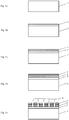
- Figures 1a to 1e illustrate the method of manufacturing a relative humidity sensor according to a first embodiment of the invention. It illustrates the formation of one relative humidity sensor, it is, however, to be understood that the described process is a microfabrication process allowing the formation of a plurality of sensor structures at the same time on one substrate, e.g. one wafer.
- Figure 1a illustrates a substrate 1 which can be a silicon substrate with or without an oxide layer on its surface, a sapphire substrate or any other suitable substrate used in microfabrication production lines.
- ASIC application-specific integrated circuit
- a layer is formed on or over the substrate 1 and serving as a first electrode 3.
- the first electrode 3 is a metallic layer, e.g. from Al, Cu, Au or from any other suitable material.
- an adhesive layer e.g. of Cr, can be formed first on the substrate 1 before providing the first electrode 3.
- the first electrode can be grown with standard layer deposition techniques, e.g. using a PVD (for Physical Vapor Deposition) and CVD (for Chemical Vapor Deposition) process.
- the first electrode 3 is grown to a thickness in a range of 0,2 to 100nm.
- Figure 1c illustrates the result of the formation of a non-porous inorganic dielectric layer 5 over the first electrode 3.
- the non-porous dielectric material 5 is silicon nitride or silicon carbide and may be deposited by Plasma Enhanced Chemical Vapour Deposition (PECVD) or any other suitable deposition technique.
- PECVD Plasma Enhanced Chemical Vapour Deposition
- the non-porous inorganic dielectric layer 5 is grown to a thickness in a range of 1 to 500nm.
- Figure 1d illustrates the result of a further deposition step to form a second electrode 7 over the non-porous inorganic dielectric layer 5.
- the second electrode 7 is a metallic layer.
- the second electrode layer 7 is an Al, Cu or Au layer, but any other suitable conducting material could be used instead.
- the second electrode 7 has a typical thickness in a range of 0.2 nm to 100 nm and can be grown by any deposition method, e.g. PVD or CVD.
- an adhesion layer e.g. of Cr, can be deposited to improve the adhesion of the second electrode 7 on or over the non-porous inorganic dielectric layer 5.
- Figure 1e illustrates the result of a photolithography step followed by a dry or wet etching step.
- a pattern 9 of voids is formed in the second electrode 7 and in the non-porous inorganic dielectric layer 5.
- the pattern is the same in the second electrode 7 and the dielectric layer 5.
- the pattern 9 is a regular pattern, e.g. of cylindrical or trenchlike voids.
- the width or diameter of the voids is of the order of the physical limit of the photolithography technology used up to about 500 ⁇ m, in particular in a range of 100nm to 100 ⁇ m.
- the substrate 1 is diced and individual sensors can be packaged.
- Water vapour entering the voids 9 changes the dielectric properties of the capacitance between the second electrode 7 and the first electrode 3 which can be used to measure the relative humidity.
- the entire production is realized using microfabrication process steps. This fabrication allows the manufacture of the sensors with high yield and reliability. Furthermore, a sensor of small dimensions, in particular down to 50 ⁇ m*50 ⁇ m and even smaller can be achieved. Due to the precision of the used process steps it becomes possible to realize the sensors with a high repeatability of their intrinsic properties. Thus it is no longer necessary to carry out a calibration of the sensors thereby further simplifying the manufacturing process.
- FIGS 2a to 2g illustrate a method of manufacturing a relative humidity sensor according to a second embodiment of the invention.
- a relative humidity sensor can be fabricated in which the first electrode also comprises a pattern of voids.
- a first electrode 3 in particular a metallic layer, is then formed on or over the substrate 1, like illustrated in Figure 2b and explained above.
- Figure 2c illustrates the result of a patterning step of the first electrode 3.
- a modified first electrode 11 with a pattern 13 of voids is obtained.
- the pattern 13 can be obtained using photolithography and a dry or wet etching.
- the voids have a regular pattern, e.g. of cylindrical or trench like shape.
- Figure 2d illustrates the result of the formation of the non-porous inorganic dielectric layer 5 over the modified first electrode 11.
- the non-porous dielectric material 5 in this embodiment can be any type of inorganic material, in particular silicon nitride or silicon carbide and may be deposited by Plasma Enhanced Chemical Vapour Deposition (PECVD) or any other suitable deposition technique.
- PECVD Plasma Enhanced Chemical Vapour Deposition
- the non-porous inorganic dielectric layer 5 is grown to a thickness in a range of few nm to several hundreds of ⁇ m.
- Figure 2e illustrates the result of a further deposition step to form a second electrode 7 over the non-porous inorganic dielectric layer 5.
- the second electrode 7 is a metallic layer.
- the second electrode layer 7 is an Al, Cu or Au layer, but any other suitable conducting material could be used instead.
- the second electrode 7 has a typical thickness in a range of 0,2nm to 100nm and can be grown by any deposition method, e.g. PVD or CVD.
- an adhesion layer e.g. of Cr, can be deposited to improve the adhesion of the second electrode 7 on or over the non-porous inorganic dielectric layer 5.
- Figure 2f illustrates the result of the following patterning process step. Using photolithography followed by dry or wet etching the second electrode 7 and the non-porous inorganic dielectric layer 5 get patterned at the same time with the same pattern 15 of voids.
- the pattern 15 of voids in the second electrode 7 and the non-porous inorganic dielectric layer 5 is the same regular pattern as the pattern 13 in the modified first electrode 11, but the pattern 15 and the pattern 13 are opposite in phase.
- the patterns are therefore complementary.
- the first and second electrodes do not overlap laterally.
- the nominal capacitance C0, corresponding to vacuum conditions, of the capacitor formed by the modified first electrode 11, the patterned non-porous inorganic dielectric layer 5 and the patterned second electrode 7 is reduced. This improves the dynamic of the sensor C/C0.
- Figure 2g illustrates the result of a further deposition step.
- a capping layer 21 is deposited on or over the modified first electrode 11 and/or the second electrode.
- the addition of a capping layer 21 prevents an electrical short cut of the electrodes due to the electrical conduction through the adsorbed, liquid water.
- the capping layer can be a SiO2 layer or any other suitable electrically insulating layer.
- the substrate 1 is diced and individual sensors are packaged.
- Figure 3 illustrates a third embodiment of the invention, namely a relative humidity sensor 31 obtained using the method according to the first or second embodiment.
- Figure 3 represents a three dimensional view. Elements with the same reference numeral already used in figures 1a to 1e and figures 2a to 2g will not be described in detail again but reference is made to their description above.
- the relative humidity sensor is mount and connected to a printed circuit board (PCB) 33. Using wire bonded connections 35, 37 the first electrode 39 and the second electrode 41 are electrically connected to the electrically conductive traces 43 and 45 of the PCB 33. The capacitance of the humidity sensor 31 can be read out using the traces 43 and 45.
- the first electrode 39 can a continuous layer like illustrated in Figure 1e of the first embodiment or like the modified first electrode 11 in Figure 2f of the second embodiment.
- the second electrode 41 corresponds to the second electrode 7 of the first and second embodiment.
- Figure 3 shows the regular periodic pattern 47 of the voids, as can be seen in figures 1e and 2f , in the second electrode 41 and the underlying non-porous inorganic dielectric layer 5.
- the voids are cylindrically shaped and extend entirely through both layers.
- the pattern is the same in both the second electrode 7 and the non-porous inorganic dielectric layer 5. This actually allows humidity to enter the voids and to change the capacitance of the structure which can then be detected via the conductive traces 43 and 45.
- the sensor 31 can be adapted to the needs. Using microfabrication its dimensions can be reduced and reliability be enhanced. At the same time, due to the repeatability of the process steps, a calibration is no longer necessary.
- the voids of the pattern 47 have a circular cross-section and are arranged in several rows that are parallel to each other. However, other shapes and arrangements of the voids can be realized as well. In a variant, the voids are arranged in a honeycomb pattern.
- the relative humidity sensor 51 has a modified pattern 53 of voids.
- parallel trenches are etched through the second electrode 55 and the non-porous inorganic dielectric layer 57.
- deposition step and patterning relate to standard fabrication steps used in the semiconductor manufacturing.
- deposition step can relate to chemical vapour deposition (CVD) or physical vapour deposition (PVD) and patterning step can relate to a lithography imaging and dry or wet etching step.
- CVD chemical vapour deposition
- PVD physical vapour deposition
Landscapes
- Chemical & Material Sciences (AREA)
- Chemical Kinetics & Catalysis (AREA)
- Electrochemistry (AREA)
- Physics & Mathematics (AREA)
- Health & Medical Sciences (AREA)
- Life Sciences & Earth Sciences (AREA)
- Analytical Chemistry (AREA)
- Biochemistry (AREA)
- General Health & Medical Sciences (AREA)
- General Physics & Mathematics (AREA)
- Immunology (AREA)
- Pathology (AREA)
- Engineering & Computer Science (AREA)
- Power Engineering (AREA)
- Investigating Or Analyzing Materials By The Use Of Electric Means (AREA)
Abstract
Description
- The present invention relates to a method for manufacturing a relative humidity sensor and relative humidity sensor.
- Such relative humidity sensors are known in the art.
US 8,783,101 B2 discloses a relative humidity sensor based on a nano-structured aluminum oxide thin film. It comprises an anodic aluminum oxide thin film formed from an aluminum substrate which also serves as one electrode. A porous metal layer is formed over the anodic aluminum oxide thin film as a second electrode. This relative humidity sensor is obtained by stamping an aluminum sheet and anodizing it to form the porous aluminum oxide, then the porous metal layer is formed over the aluminum oxide by sputtering. Using solderable electrode pins connected to the electrodes using spring contacts or conductive glue, the obtained sensor can be plugged or soldered into a circuit. - The fabrication method disclosed can, however, not be implemented into high yield microfabrication means which would allow to remove all mechanical assembly steps and to reduce the part to part difference. The parts assembly is tedious and can lead to a lack of alignment precision. Furthermore, an unwanted delamination of the parts can be observed.
-
US 4,651,121 discloses another moisture sensor comprising a substrate, a bottom electrode over the substrate, and an organic moisture sensitive film sandwiched between the bottom electrode and an upper electrode. The capacitance of the sensor changes when water vapor enters the moisture sensitive film. This effect is used to determine variations in the amount of water vapor in the atmosphere by detecting the corresponding changes of the capacitance. -
US 2011/179861 A1 discloses a humidity sensor of capacitive type comprising intedigitated first and second electrodes provided with an intrinsically nanoporous dielectric material of methylsilsesquioxane (MSQ) or SiOCH. A floating electrode might be placed over the nanoporous dielectric. MSQ is an organic polymer, and SiOCH is a porous organic organosilicate. - However, organic material based relative humidity sensors are intrinsically submitted to degrading because of chemical ageing of the material and are heat sensitive, amongst others due to a low glass temperature transition. Furthermore, polymer materials are not adapted to stand high temperatures, such as temperatures 300°C or more, the structure degradation corresponding to the delamination induced by the melt of the metallic layers of the sensors.
- It is therefore the object of the present invention to provide an improved relative humidity sensor that can be mass manufactured and provides extended lifetime and temperature range properties.
- This object is achieved with a method of manufacturing a relative humidity sensor according to
claim 1 comprising the step of a) providing a first electrode on or over a substrate, b) providing a non-porous inorganic dielectric layer over the first electrode, c) providing a second electrode over the inorganic dielectric layer, and then d) forming a pattern of voids in the second electrode and the inorganic dielectric layer through the second electrode (21). - According to the invention, all process steps can be carried out using microfabrication methods. Hence, the sensor can be fabricated in a full automated way with high yields and reliability. Using microfabrication during all process steps, the sensor can be downsized to smaller volumes, the overall assembly of the various parts forming the sensor is simplified and alignment can be achieved within the tight limits of microfabrication in contrast to a mechanical assembly, like in the prior art. Essentially any type of non-porous inorganic dielectric layer can be used, as the sensitivity to humidity is not obtained by the change of the effective dielectric constant of a porous material but by probing the modification of the dielectric function the air inside the voids as well as the dielectric constant of the water layer at the thermo-dynamical equilibrium on the sides of the void structures.
- At the same time, the obtained humidity sensor is less exposed to ageing than sensors with an organic dielectric and a wider temperature range, in particular for temperatures even exceeding 300°C, can be used.
- By patterning the dielectric layer and the second electrode during the same process steps, it becomes possible to reduce the total number of process steps.
- The present method of manufacturing a relative humidity sensor can be further improved according to various advantageous embodiments.
- According to an embodiment, the step d) can comprise forming the pattern of voids using photolithography followed by a dry etching or wet etching. By providing the voids, humidity can enter the structure which will change the parameters of the capacitor and will therefore allow to measure humidity. As the pattern is created by a highly repetitive process, humidity sensors with reproducible properties can be fabricated so that it becomes possible to suppress additional calibration steps.
- According to an embodiment, the inorganic dielectric layer can be silicon nitride or silicon carbide. Both materials provide improved temperature ranges and thermal shock resistance as well as chemical stability, and more effective mechanical and dielectric properties in comparison with organic polymer based dielectric layer or Alumina porous dielectric layer.
- According to an embodiment, the voids can have a cylindrical shape and can e.g. be arranged in a honeycomb pattern. Instead of cylindrical voids also other forms like a plurality of trenches could be formed. Using photolithography, any suitable pattern, with respect to form and size of each void, but also with respect to the arrangement in the pattern of the voids can be achieved, so that the sensor can be designed to the needs of the final product.
- According to an embodiment, the inventive method can comprise a step of patterning the first electrode to obtain a pattern voids. According to a further preferred embodiment, the voids in the first electrode and the voids in the second electrode can be arranged in a staggered pattern. Such a voids pattern between the first and the second electrodes allows improving the dynamic of the relative humidity sensor by decreasing the nominal capacitance.
- According to an embodiment, the pattern of voids in the first electrode and the second electrode can be complementary and in particular shifted with respect to the other. In case of a repetitive pattern, the period of the pattern can be the same but the phase be shifted, e.g. the phase can be opposite. Thus, according to another embodiment, the voids in the first and second electrode can be arranged such that they do not overlap when looking in the direction perpendicular to the layers. This will further improve the characteristics of the sensing capacitor.
- According to an embodiment, the method can comprise a step of forming an adhesion layer, in particular at least one chromium adhesion layer, before forming the first electrode and/or the second electrode. The deposition of an adhesion layer facilitates the growth of the electrode layers and thus contributes to further enhance the long term reliability of the sensor.
- According to an embodiment, the method can further comprise a step of providing a capping layer over the first and/or second electrode. By doing so, it becomes possible to prevent short cuts between the first and second electrode by the liquid water absorbed in the voids.
- This object is also achieved with a relative humidity sensor according to claim 12, which comprises: a substrate, a first electrode on or over the substrate, an inorganic non porous dielectric layer over the first electrode and a second electrode over the dielectric layer, wherein both of the inorganic dielectric layer and the second electrode are provided with voids having the same pattern. This sensor can be fabricated only with microfabrication process steps with high yields of over 90%, and high reliability. In addition, the size of the sensor can be downscaled. Due to the fact that the sensor is fabricated using microfabrication manufacturing methods, e.g. thin layer deposition, photolithography, etching etc, devices with highly reproducible geometric properties can be obtained, so that it becomes possible to refrain from a calibration step. Essentially any type of non-porous inorganic dielectric layer can be used, as the sensitivity to humidity is not obtained by the change of the effective dielectric constant of a porous material but by probing the modification of the dielectric function the air inside the voids as well as the dielectric constant of the water layer at the thermo-dynamical equilibrium on the sides of the void structures.
- As the inorganic dielectric layer and the second electrode have the same pattern, the humidity enters inside the voids such that a liquid water layer stands along the wall surfaces of the voids. Hence, a change of the capacitance value can effectively be measured.
- The present relative humidity sensor can be further improved according to various advantageous embodiments.
- According to an embodiment, the inorganic dielectric layer can be made of silicon nitride or of silicon carbide. Chemical ageing like for organic layers can be reduced or prevented. Further, a sensor working for temperatures of 300°C or more can be achieved. Thus, the obtained inventive sensor functions in a range that is larger than the temperature range of sensors with an organic dielectric layer. The sensor can be used to detect humidity in gas and/or water in oil or other fluids.
- According to an embodiment of the invention the first electrode can be patterned. Preferably, the first electrode can have a complementary pattern compared to the pattern of the second electrode. According to an embodiment, the pattern of the first and second electrode can be staggered, in particular the pattern of the first and the pattern of the second electrode do not overlap in the direction perpendicular to the layers. This arrangement allows reducing the nominal capacitance c0, obtained in vacuum, and therefore can improve the dynamic of the sensor as the ration C/C0 increases, with C being the capacitance as a function of the humidity.
- The invention will now be described in further detail using advantageous embodiments in an exemplary manner and with reference to the drawings. The described embodiments are merely possible configurations and it must be borne in mind that the individual features as described above can be provided independently of one another or can be omitted altogether while implementing this invention.
-
Figures 1a-1e schematically illustrate the method of manufacturing a relative humidity sensor according to a first embodiment of the invention, -
Figures 2a-2g schematically illustrate the method of manufacturing a relative humidity sensor according to a second embodiment of the invention, -
Figures 3 illustrates a relative humidity sensor according to a third embodiment and fabricated using the first or second embodiment of the invention, and -
Figure 4 illustrates a relative humidity sensor according to a fourth embodiment and fabricated using the first or second embodiment of the invention. -
Figures 1a to 1e illustrate the method of manufacturing a relative humidity sensor according to a first embodiment of the invention. It illustrates the formation of one relative humidity sensor, it is, however, to be understood that the described process is a microfabrication process allowing the formation of a plurality of sensor structures at the same time on one substrate, e.g. one wafer. - In the following process steps, the various layers necessary to build the relative humidity sensor will be formed.
Figure 1a , illustrates asubstrate 1 which can be a silicon substrate with or without an oxide layer on its surface, a sapphire substrate or any other suitable substrate used in microfabrication production lines. As an alternative an application-specific integrated circuit (ASIC) could also be used as a starting material of the process according to the invention. - As illustrated in
Figure 1b , a layer is formed on or over thesubstrate 1 and serving as afirst electrode 3. Thefirst electrode 3 is a metallic layer, e.g. from Al, Cu, Au or from any other suitable material. According to a variant and in order to improve the adhesion of thefirst electrode 1 an adhesive layer, e.g. of Cr, can be formed first on thesubstrate 1 before providing thefirst electrode 3. The first electrode can be grown with standard layer deposition techniques, e.g. using a PVD (for Physical Vapor Deposition) and CVD (for Chemical Vapor Deposition) process. In this embodiment, thefirst electrode 3 is grown to a thickness in a range of 0,2 to 100nm. -
Figure 1c illustrates the result of the formation of a non-porous inorganicdielectric layer 5 over thefirst electrode 3. Inn this embodiment, the non-porousdielectric material 5 is silicon nitride or silicon carbide and may be deposited by Plasma Enhanced Chemical Vapour Deposition (PECVD) or any other suitable deposition technique. In this embodiment, the non-porous inorganicdielectric layer 5 is grown to a thickness in a range of 1 to 500nm. -
Figure 1d illustrates the result of a further deposition step to form asecond electrode 7 over the non-porous inorganicdielectric layer 5. Thesecond electrode 7 is a metallic layer. In this embodiment, thesecond electrode layer 7 is an Al, Cu or Au layer, but any other suitable conducting material could be used instead. In this embodiment, thesecond electrode 7 has a typical thickness in a range of 0.2 nm to 100 nm and can be grown by any deposition method, e.g. PVD or CVD. According to a variant, prior to the formation of the second electrode an adhesion layer, e.g. of Cr, can be deposited to improve the adhesion of thesecond electrode 7 on or over the non-porous inorganicdielectric layer 5. -
Figure 1e illustrates the result of a photolithography step followed by a dry or wet etching step. Following the etching step apattern 9 of voids is formed in thesecond electrode 7 and in the non-porous inorganicdielectric layer 5. The pattern is the same in thesecond electrode 7 and thedielectric layer 5. Thepattern 9 is a regular pattern, e.g. of cylindrical or trenchlike voids. The width or diameter of the voids is of the order of the physical limit of the photolithography technology used up to about 500µm, in particular in a range of 100nm to 100µm. - Afterwards, the
substrate 1 is diced and individual sensors can be packaged. Water vapour entering thevoids 9 changes the dielectric properties of the capacitance between thesecond electrode 7 and thefirst electrode 3 which can be used to measure the relative humidity. The entire production is realized using microfabrication process steps. This fabrication allows the manufacture of the sensors with high yield and reliability. Furthermore, a sensor of small dimensions, in particular down to 50µm*50µm and even smaller can be achieved. Due to the precision of the used process steps it becomes possible to realize the sensors with a high repeatability of their intrinsic properties. Thus it is no longer necessary to carry out a calibration of the sensors thereby further simplifying the manufacturing process. -
Figures 2a to 2g illustrate a method of manufacturing a relative humidity sensor according to a second embodiment of the invention. With the method according to the second embodiment, a relative humidity sensor can be fabricated in which the first electrode also comprises a pattern of voids. Elements with the same reference numeral already used infigures 1a to 1e will not be described in detail again but reference is made to their description above. - The fabrication steps illustrated in
Figures 2a and 2b correspond to the ones of the first embodiment illustrated inFigures 1a and 1b and will therefore not be described again in detail. - In
Figure 2a thesubstrate 1 is provided and afirst electrode 3, in particular a metallic layer, is then formed on or over thesubstrate 1, like illustrated inFigure 2b and explained above. -
Figure 2c illustrates the result of a patterning step of thefirst electrode 3. As a result, a modifiedfirst electrode 11 with apattern 13 of voids is obtained. Thepattern 13 can be obtained using photolithography and a dry or wet etching. In this embodiment the voids have a regular pattern, e.g. of cylindrical or trench like shape. -
Figure 2d illustrates the result of the formation of the non-porous inorganicdielectric layer 5 over the modifiedfirst electrode 11. Like in the first embodiment, the non-porousdielectric material 5 in this embodiment can be any type of inorganic material, in particular silicon nitride or silicon carbide and may be deposited by Plasma Enhanced Chemical Vapour Deposition (PECVD) or any other suitable deposition technique. The non-porous inorganicdielectric layer 5 is grown to a thickness in a range of few nm to several hundreds of µm. -
Figure 2e illustrates the result of a further deposition step to form asecond electrode 7 over the non-porous inorganicdielectric layer 5. Thesecond electrode 7 is a metallic layer. In this embodiment, thesecond electrode layer 7 is an Al, Cu or Au layer, but any other suitable conducting material could be used instead. Thesecond electrode 7 has a typical thickness in a range of 0,2nm to 100nm and can be grown by any deposition method, e.g. PVD or CVD. According to a variant, prior to the formation of the second electrode an adhesion layer, e.g. of Cr, can be deposited to improve the adhesion of thesecond electrode 7 on or over the non-porous inorganicdielectric layer 5. -
Figure 2f illustrates the result of the following patterning process step. Using photolithography followed by dry or wet etching thesecond electrode 7 and the non-porous inorganicdielectric layer 5 get patterned at the same time with thesame pattern 15 of voids. - In this embodiment, the
pattern 15 of voids in thesecond electrode 7 and the non-porous inorganicdielectric layer 5 is the same regular pattern as thepattern 13 in the modifiedfirst electrode 11, but thepattern 15 and thepattern 13 are opposite in phase. The patterns are therefore complementary. Thus, when looking in thedirection 17 of thelayer stack 19, the first and second electrodes do not overlap laterally. As a consequence, the nominal capacitance C0, corresponding to vacuum conditions, of the capacitor formed by the modifiedfirst electrode 11, the patterned non-porous inorganicdielectric layer 5 and the patternedsecond electrode 7 is reduced. This improves the dynamic of the sensor C/C0. -
Figure 2g illustrates the result of a further deposition step. During this step, acapping layer 21 is deposited on or over the modifiedfirst electrode 11 and/or the second electrode. The addition of acapping layer 21 prevents an electrical short cut of the electrodes due to the electrical conduction through the adsorbed, liquid water. The capping layer can be a SiO2 layer or any other suitable electrically insulating layer. - Afterwards, like in the first embodiment the
substrate 1 is diced and individual sensors are packaged. -
Figure 3 illustrates a third embodiment of the invention, namely arelative humidity sensor 31 obtained using the method according to the first or second embodiment.Figure 3 represents a three dimensional view. Elements with the same reference numeral already used infigures 1a to 1e andfigures 2a to 2g will not be described in detail again but reference is made to their description above. - The relative humidity sensor is mount and connected to a printed circuit board (PCB) 33. Using wire bonded
connections first electrode 39 and thesecond electrode 41 are electrically connected to the electrically conductive traces 43 and 45 of thePCB 33. The capacitance of thehumidity sensor 31 can be read out using thetraces 43 and 45. Thefirst electrode 39 can a continuous layer like illustrated inFigure 1e of the first embodiment or like the modifiedfirst electrode 11 inFigure 2f of the second embodiment. Thesecond electrode 41 corresponds to thesecond electrode 7 of the first and second embodiment. -
Figure 3 shows the regularperiodic pattern 47 of the voids, as can be seen infigures 1e and2f , in thesecond electrode 41 and the underlying non-porous inorganicdielectric layer 5. The voids are cylindrically shaped and extend entirely through both layers. The pattern is the same in both thesecond electrode 7 and the non-porous inorganicdielectric layer 5. This actually allows humidity to enter the voids and to change the capacitance of the structure which can then be detected via the conductive traces 43 and 45. By adapting the pattern and/or form and/or size of the voids, thesensor 31 can be adapted to the needs. Using microfabrication its dimensions can be reduced and reliability be enhanced. At the same time, due to the repeatability of the process steps, a calibration is no longer necessary. - In
figure 3 , the voids of thepattern 47 have a circular cross-section and are arranged in several rows that are parallel to each other. However, other shapes and arrangements of the voids can be realized as well. In a variant, the voids are arranged in a honeycomb pattern. - In the fourth embodiment, illustrated in
Figure 4 , therelative humidity sensor 51 has a modifiedpattern 53 of voids. In this embodiment, parallel trenches are etched through thesecond electrode 55 and the non-porous inorganic dielectric layer 57. This is the only difference with respect to the sensor according to the third embodiment of the invention. Features with the same reference numerals already used in thefigures 1 to 3 will not be described again but reference is made to their description. - In the above description, the terms deposition step and patterning relate to standard fabrication steps used in the semiconductor manufacturing. As an example, deposition step can relate to chemical vapour deposition (CVD) or physical vapour deposition (PVD) and patterning step can relate to a lithography imaging and dry or wet etching step.
- Modifications to the embodiments and combinations of embodiments of the invention described in the foregoing are possible without departing from the scope of the invention as defined by the accompanying claims. Expressions such as "including", "comprising", "consisting of", "have", "is" used to describe and claim the present invention are intended to be construed in a non-exclusive manner, namely allowing for items, components or elements not explicitly described also to be present. Reference to the singular is also to be construed to relate to the plural.
-
- 1
- substrate
- 3
- first electrode
- 5
- dielectric layer
- 7
- second electrode
- 9
- pattern of voids the dielectric layer and the second electrode
- 11
- modified first electrode
- 13
- pattern of voids in the modified first electrode
- 15
- pattern of voids in the dielectric layer and the second electrode
- 17
- direction of the layer stack
- 19
- layer stack
- 21
- passivation/capping layer
- 31
- relative humidity sensor according to the third embodiment
- 33
- printed circuit board
- 35
- wire bonded connection
- 37
- 2nd wire bonded connection
- 39
- first electrode
- 41
- second electrode
- 43
- conductive trace
- 45
- 2nd conductive trace
- 47
- pattern of voids
- 51
- relative humidity sensor according to the fourth embodiment
- 53
- pattern of voids
- 55
- second electrode
- 57
- non.-porous inorganic dielectric layer
Claims (15)
- Method of manufacturing a relative humidity sensor comprising the step of:a) providing a first electrode (3) on or over a substrate (1),b) providing a non-porous inorganic dielectric layer (5) over the first electrode (3),c) providing a second electrode (7) over the inorganic dielectric layer (5), and thend) forming a pattern of voids (9) in the second electrode (7) and the inorganic dielectric layer (5) through the second electrode (7).
- The method of manufacturing a relative humidity sensor according to claim 1, wherein step d) comprises forming the pattern of voids by photolithography and/or dry etching or wet etching.
- The method of manufacturing a relative humidity sensor according to any one of the preceding claims, wherein the non-porous inorganic dielectric layer (5) is made of silicon nitride or silicon carbide.
- The method of manufacturing a relative humidity sensor according to any one of the preceding claims, wherein the voids have a cylindrical shape, in particular arranged in a honeycomb pattern, or a trench shape.
- The method of manufacturing a relative humidity sensor according to any one of the preceding claims, further comprising a step of patterning the first electrode (11) with voids.
- The method of manufacturing a relative humidity sensor according to claim 5, wherein the pattern (13) of voids in the first electrode (11) and the pattern (15) of voids in the second electrode (7) and the dielectric layer (5) are staggered with respect to each other.
- The method according to claim 5 or 6, wherein the pattern of voids in the first electrode and the second electrode is the same but shifted one with respect to the other.
- The method according to claim 6 or 7, wherein the voids in the first and second electrode are arranged such that they do not overlap when looking in the direction perpendicular to the layers.
- The method of manufacturing a relative humidity sensor according to any one of the preceding claims, further comprising a step of providing an adhesion layer, in particular at least one chromium adhesion layer prior to forming the first electrode (3, 11) and/or the second electrode (7).
- The method of manufacturing a relative humidity sensor according to any one of the preceding claims, further comprising a step of providing a capping layer (21) over the first and/or second electrode.
- Relative humidity sensor, in particular fabricated according to one of the claims 1 to 11, comprising:a substrate (1);a first electrode (3) on or over the substrate (1);an inorganic non porous dielectric layer (5) over the first electrode (3); anda second electrode (7) over the dielectric layer (5); wherein both of the inorganic dielectric layer (5) and the second electrode (7) are provided with voids having the same pattern (9, 15).
- The relative humidity sensor according to claim 12, wherein the inorganic dielectric layer (5) is made of silicon nitride or silicon carbide.
- The relative humidity sensor according to one of claims 12 to 14, wherein the first electrode (11) is patterned.
- The relative humidity sensor according to claim 14, wherein the first electrode (11) has the same pattern (13) as the second electrode (15).
- The relative humidity sensor according to claim 15, wherein the pattern of the first electrode (13) and second electrode (15) are staggered, in particular the pattern of the first and the pattern of the second electrode do not overlap in the direction (17) perpendicular to the layers.
Priority Applications (3)
| Application Number | Priority Date | Filing Date | Title |
|---|---|---|---|
| EP18305779.3A EP3584570A1 (en) | 2018-06-20 | 2018-06-20 | Method for manufacturing a relative humidity sensor and relative humidity sensor |
| US16/446,551 US11187666B2 (en) | 2018-06-20 | 2019-06-19 | Method for manufacturing a relative humidity sensor and relative humidity sensor |
| CN201910535279.6A CN110618171A (en) | 2018-06-20 | 2019-06-20 | Method for producing a relative humidity sensor and relative humidity sensor |
Applications Claiming Priority (1)
| Application Number | Priority Date | Filing Date | Title |
|---|---|---|---|
| EP18305779.3A EP3584570A1 (en) | 2018-06-20 | 2018-06-20 | Method for manufacturing a relative humidity sensor and relative humidity sensor |
Publications (1)
| Publication Number | Publication Date |
|---|---|
| EP3584570A1 true EP3584570A1 (en) | 2019-12-25 |
Family
ID=62846103
Family Applications (1)
| Application Number | Title | Priority Date | Filing Date |
|---|---|---|---|
| EP18305779.3A Withdrawn EP3584570A1 (en) | 2018-06-20 | 2018-06-20 | Method for manufacturing a relative humidity sensor and relative humidity sensor |
Country Status (3)
| Country | Link |
|---|---|
| US (1) | US11187666B2 (en) |
| EP (1) | EP3584570A1 (en) |
| CN (1) | CN110618171A (en) |
Cited By (1)
| Publication number | Priority date | Publication date | Assignee | Title |
|---|---|---|---|---|
| EP4159992A1 (en) | 2021-09-30 | 2023-04-05 | MEAS France | Turbine device |
Families Citing this family (5)
| Publication number | Priority date | Publication date | Assignee | Title |
|---|---|---|---|---|
| DE102018215018A1 (en) * | 2018-09-04 | 2020-03-05 | Infineon Technologies Ag | HUMIDITY SENSOR |
| US11425821B2 (en) * | 2019-08-22 | 2022-08-23 | Cisco Technology, Inc. | Optimizing design and performance for printed circuit boards |
| EP3812754A1 (en) * | 2019-10-25 | 2021-04-28 | MEAS France | Inorganic humidity sensor device |
| WO2022074636A1 (en) * | 2020-10-09 | 2022-04-14 | Yonatan Gerlitz | Pathogen detection apparatus and method |
| KR102489142B1 (en) * | 2020-11-25 | 2023-01-13 | 한양대학교 에리카산학협력단 | Capacitive gas sensor and its manufacturing method |
Citations (7)
| Publication number | Priority date | Publication date | Assignee | Title |
|---|---|---|---|---|
| US4651121A (en) | 1984-05-15 | 1987-03-17 | Sharp Kabushiki Kaisha | Moisture sensor and a method for the production of the same |
| US20110179861A1 (en) | 2008-07-16 | 2011-07-28 | Commissariat A L'energie Atomique Et Aux Ene Alt | Capacitive humidity detector with nanoporous hydrophilic dielectric |
| JP2011196835A (en) * | 2010-03-19 | 2011-10-06 | Fujitsu Ltd | Sensor device and method for manufacturing the same |
| US20140125359A1 (en) * | 2012-10-29 | 2014-05-08 | MEMS-Vision International Inc. | Methods and systems for humidity and pressure sensor overlay integration with electronics |
| US8783101B2 (en) | 2009-12-22 | 2014-07-22 | Nano And Advanced Materials Institute Limited | Rapid response relative humidity sensor using anodic aluminum oxide film |
| NL2011845C2 (en) * | 2013-11-27 | 2015-06-01 | Univ Delft Tech | A capacitive sensor for humidity and/or ammonia sensing. |
| US20150153297A1 (en) * | 2012-06-04 | 2015-06-04 | Commissariat A L'energie Atomique Et Aux Ene Alt | Capacitive humidity sensor with graphene electrode |
Family Cites Families (10)
| Publication number | Priority date | Publication date | Assignee | Title |
|---|---|---|---|---|
| JPH02108952A (en) * | 1988-10-18 | 1990-04-20 | Rika Kogyo Kk | Humidity sensor |
| US6580600B2 (en) * | 2001-02-20 | 2003-06-17 | Nippon Soken, Inc. | Capacitance type humidity sensor and manufacturing method of the same |
| KR20040095871A (en) * | 2003-04-29 | 2004-11-16 | 주식회사 하이닉스반도체 | Method of forming fine pattern for semiconductor device |
| JP2007278716A (en) * | 2006-04-03 | 2007-10-25 | Epson Toyocom Corp | Capacitance change pressure sensor |
| TW200819739A (en) * | 2006-10-27 | 2008-05-01 | Mercury Microsystems Company Ltd | Miniatured humidity sensor having a non-coplanar electrode and moisture entry/exit |
| US8707781B2 (en) * | 2008-09-11 | 2014-04-29 | Nxp, B.V. | Sensor has combined in-plane and parallel-plane configuration |
| CN102315385B (en) * | 2010-07-06 | 2013-09-18 | 中芯国际集成电路制造(上海)有限公司 | Method for making storage unit of phase-change random access memory |
| US9027400B2 (en) * | 2011-12-02 | 2015-05-12 | Stmicroelectronics Pte Ltd. | Tunable humidity sensor with integrated heater |
| US9658179B2 (en) * | 2015-06-24 | 2017-05-23 | Infineon Technologies Ag | System and method for a MEMS transducer |
| CN108155145A (en) * | 2016-12-02 | 2018-06-12 | 中芯国际集成电路制造(上海)有限公司 | A kind of semiconductor devices and its manufacturing method |
-
2018
- 2018-06-20 EP EP18305779.3A patent/EP3584570A1/en not_active Withdrawn
-
2019
- 2019-06-19 US US16/446,551 patent/US11187666B2/en not_active Expired - Fee Related
- 2019-06-20 CN CN201910535279.6A patent/CN110618171A/en active Pending
Patent Citations (7)
| Publication number | Priority date | Publication date | Assignee | Title |
|---|---|---|---|---|
| US4651121A (en) | 1984-05-15 | 1987-03-17 | Sharp Kabushiki Kaisha | Moisture sensor and a method for the production of the same |
| US20110179861A1 (en) | 2008-07-16 | 2011-07-28 | Commissariat A L'energie Atomique Et Aux Ene Alt | Capacitive humidity detector with nanoporous hydrophilic dielectric |
| US8783101B2 (en) | 2009-12-22 | 2014-07-22 | Nano And Advanced Materials Institute Limited | Rapid response relative humidity sensor using anodic aluminum oxide film |
| JP2011196835A (en) * | 2010-03-19 | 2011-10-06 | Fujitsu Ltd | Sensor device and method for manufacturing the same |
| US20150153297A1 (en) * | 2012-06-04 | 2015-06-04 | Commissariat A L'energie Atomique Et Aux Ene Alt | Capacitive humidity sensor with graphene electrode |
| US20140125359A1 (en) * | 2012-10-29 | 2014-05-08 | MEMS-Vision International Inc. | Methods and systems for humidity and pressure sensor overlay integration with electronics |
| NL2011845C2 (en) * | 2013-11-27 | 2015-06-01 | Univ Delft Tech | A capacitive sensor for humidity and/or ammonia sensing. |
Cited By (1)
| Publication number | Priority date | Publication date | Assignee | Title |
|---|---|---|---|---|
| EP4159992A1 (en) | 2021-09-30 | 2023-04-05 | MEAS France | Turbine device |
Also Published As
| Publication number | Publication date |
|---|---|
| CN110618171A (en) | 2019-12-27 |
| US20190391103A1 (en) | 2019-12-26 |
| US11187666B2 (en) | 2021-11-30 |
Similar Documents
| Publication | Publication Date | Title |
|---|---|---|
| US11187666B2 (en) | Method for manufacturing a relative humidity sensor and relative humidity sensor | |
| US5321989A (en) | Integratable capacitative pressure sensor and process for its manufacture | |
| US8047074B2 (en) | Humidity sensor and method of manufacturing the same | |
| US8188555B2 (en) | Capacitive sensor and manufacturing method therefor | |
| US5431057A (en) | Integratable capacitative pressure sensor | |
| US6906392B2 (en) | Micromechanical component | |
| KR20090064693A (en) | Micro gas sensor and its manufacturing method | |
| US8754453B2 (en) | Capacitive pressure sensor and method for manufacturing same | |
| CN107850505A (en) | MEMS capacitive pressure sensor and manufacture method | |
| US6923061B2 (en) | Physical quantity sensor having beam | |
| US20100327393A1 (en) | Method and structures for etching cavity in silicon under dielectric membrane | |
| US5317922A (en) | Capacitance transducer article and method of fabrication | |
| US20200283886A1 (en) | Method For Manufacturing A Humidity Sensor And Humidity Sensor | |
| US11346800B2 (en) | Inorganic humidity sensor device | |
| WO2012102735A1 (en) | Multi-sensor integrated chip | |
| WO2007126269A1 (en) | Touch mode capacitive pressure sensor | |
| US20070256501A1 (en) | High temperature LC pressure transducer and methods for making the same | |
| US8033178B2 (en) | Pressure-measuring cell | |
| US20200064214A1 (en) | Physical quantity sensor | |
| US8471573B2 (en) | Dynamic quantity sensor and manufacturing method thereof | |
| CN120077253A (en) | Sensor element and method for producing a sensor element | |
| US9130081B2 (en) | Bolometer having absorber with pillar structure for thermal shorting | |
| KR20050075225A (en) | Mems monolithic multi-functional integrated sensor and methods for fabricating the same | |
| JP5355028B2 (en) | Acceleration sensor | |
| EP4332053A1 (en) | Arrangement of carbon nanotubes and a method for manufacturing the arrangement |
Legal Events
| Date | Code | Title | Description |
|---|---|---|---|
| PUAI | Public reference made under article 153(3) epc to a published international application that has entered the european phase |
Free format text: ORIGINAL CODE: 0009012 |
|
| STAA | Information on the status of an ep patent application or granted ep patent |
Free format text: STATUS: THE APPLICATION HAS BEEN PUBLISHED |
|
| AK | Designated contracting states |
Kind code of ref document: A1 Designated state(s): AL AT BE BG CH CY CZ DE DK EE ES FI FR GB GR HR HU IE IS IT LI LT LU LV MC MK MT NL NO PL PT RO RS SE SI SK SM TR |
|
| AX | Request for extension of the european patent |
Extension state: BA ME |
|
| STAA | Information on the status of an ep patent application or granted ep patent |
Free format text: STATUS: REQUEST FOR EXAMINATION WAS MADE |
|
| 17P | Request for examination filed |
Effective date: 20200625 |
|
| RBV | Designated contracting states (corrected) |
Designated state(s): AL AT BE BG CH CY CZ DE DK EE ES FI FR GB GR HR HU IE IS IT LI LT LU LV MC MK MT NL NO PL PT RO RS SE SI SK SM TR |
|
| STAA | Information on the status of an ep patent application or granted ep patent |
Free format text: STATUS: EXAMINATION IS IN PROGRESS |
|
| 17Q | First examination report despatched |
Effective date: 20220511 |
|
| RAP3 | Party data changed (applicant data changed or rights of an application transferred) |
Owner name: TE CONNECTIVITY SENSORS FRANCE |
|
| GRAP | Despatch of communication of intention to grant a patent |
Free format text: ORIGINAL CODE: EPIDOSNIGR1 |
|
| STAA | Information on the status of an ep patent application or granted ep patent |
Free format text: STATUS: GRANT OF PATENT IS INTENDED |
|
| INTG | Intention to grant announced |
Effective date: 20240703 |
|
| STAA | Information on the status of an ep patent application or granted ep patent |
Free format text: STATUS: THE APPLICATION IS DEEMED TO BE WITHDRAWN |
|
| 18D | Application deemed to be withdrawn |
Effective date: 20241105 |