EP3583207B1 - Neuartige reverse-transkriptasen und verwendungen davon - Google Patents
Neuartige reverse-transkriptasen und verwendungen davon Download PDFInfo
- Publication number
- EP3583207B1 EP3583207B1 EP18754654.4A EP18754654A EP3583207B1 EP 3583207 B1 EP3583207 B1 EP 3583207B1 EP 18754654 A EP18754654 A EP 18754654A EP 3583207 B1 EP3583207 B1 EP 3583207B1
- Authority
- EP
- European Patent Office
- Prior art keywords
- seq
- reverse transcriptase
- mlvrt
- flvrt
- sequence
- Prior art date
- Legal status (The legal status is an assumption and is not a legal conclusion. Google has not performed a legal analysis and makes no representation as to the accuracy of the status listed.)
- Active
Links
Images
Classifications
-
- C—CHEMISTRY; METALLURGY
- C12—BIOCHEMISTRY; BEER; SPIRITS; WINE; VINEGAR; MICROBIOLOGY; ENZYMOLOGY; MUTATION OR GENETIC ENGINEERING
- C12N—MICROORGANISMS OR ENZYMES; COMPOSITIONS THEREOF; PROPAGATING, PRESERVING, OR MAINTAINING MICROORGANISMS; MUTATION OR GENETIC ENGINEERING; CULTURE MEDIA
- C12N15/00—Mutation or genetic engineering; DNA or RNA concerning genetic engineering, vectors, e.g. plasmids, or their isolation, preparation or purification; Use of hosts therefor
- C12N15/09—Recombinant DNA-technology
- C12N15/10—Processes for the isolation, preparation or purification of DNA or RNA
- C12N15/1096—Processes for the isolation, preparation or purification of DNA or RNA cDNA Synthesis; Subtracted cDNA library construction, e.g. RT, RT-PCR
-
- C—CHEMISTRY; METALLURGY
- C12—BIOCHEMISTRY; BEER; SPIRITS; WINE; VINEGAR; MICROBIOLOGY; ENZYMOLOGY; MUTATION OR GENETIC ENGINEERING
- C12N—MICROORGANISMS OR ENZYMES; COMPOSITIONS THEREOF; PROPAGATING, PRESERVING, OR MAINTAINING MICROORGANISMS; MUTATION OR GENETIC ENGINEERING; CULTURE MEDIA
- C12N9/00—Enzymes; Proenzymes; Compositions thereof; Processes for preparing, activating, inhibiting, separating or purifying enzymes
- C12N9/14—Hydrolases (3)
- C12N9/16—Hydrolases (3) acting on ester bonds (3.1)
- C12N9/22—Ribonucleases [RNase]; Deoxyribonucleases [DNase]
-
- C—CHEMISTRY; METALLURGY
- C12—BIOCHEMISTRY; BEER; SPIRITS; WINE; VINEGAR; MICROBIOLOGY; ENZYMOLOGY; MUTATION OR GENETIC ENGINEERING
- C12Q—MEASURING OR TESTING PROCESSES INVOLVING ENZYMES, NUCLEIC ACIDS OR MICROORGANISMS; COMPOSITIONS OR TEST PAPERS THEREFOR; PROCESSES OF PREPARING SUCH COMPOSITIONS; CONDITION-RESPONSIVE CONTROL IN MICROBIOLOGICAL OR ENZYMOLOGICAL PROCESSES
- C12Q1/00—Measuring or testing processes involving enzymes, nucleic acids or microorganisms; Compositions therefor; Processes of preparing such compositions
- C12Q1/68—Measuring or testing processes involving enzymes, nucleic acids or microorganisms; Compositions therefor; Processes of preparing such compositions involving nucleic acids
- C12Q1/6844—Nucleic acid amplification reactions
- C12Q1/686—Polymerase chain reaction [PCR]
-
- C—CHEMISTRY; METALLURGY
- C12—BIOCHEMISTRY; BEER; SPIRITS; WINE; VINEGAR; MICROBIOLOGY; ENZYMOLOGY; MUTATION OR GENETIC ENGINEERING
- C12N—MICROORGANISMS OR ENZYMES; COMPOSITIONS THEREOF; PROPAGATING, PRESERVING, OR MAINTAINING MICROORGANISMS; MUTATION OR GENETIC ENGINEERING; CULTURE MEDIA
- C12N2770/00—MICROORGANISMS OR ENZYMES; COMPOSITIONS THEREOF; PROPAGATING, PRESERVING, OR MAINTAINING MICROORGANISMS; MUTATION OR GENETIC ENGINEERING; CULTURE MEDIA ssRNA viruses positive-sense
- C12N2770/00011—Details
- C12N2770/00022—New viral proteins or individual genes, new structural or functional aspects of known viral proteins or genes
-
- C—CHEMISTRY; METALLURGY
- C12—BIOCHEMISTRY; BEER; SPIRITS; WINE; VINEGAR; MICROBIOLOGY; ENZYMOLOGY; MUTATION OR GENETIC ENGINEERING
- C12Q—MEASURING OR TESTING PROCESSES INVOLVING ENZYMES, NUCLEIC ACIDS OR MICROORGANISMS; COMPOSITIONS OR TEST PAPERS THEREFOR; PROCESSES OF PREPARING SUCH COMPOSITIONS; CONDITION-RESPONSIVE CONTROL IN MICROBIOLOGICAL OR ENZYMOLOGICAL PROCESSES
- C12Q1/00—Measuring or testing processes involving enzymes, nucleic acids or microorganisms; Compositions therefor; Processes of preparing such compositions
- C12Q1/68—Measuring or testing processes involving enzymes, nucleic acids or microorganisms; Compositions therefor; Processes of preparing such compositions involving nucleic acids
- C12Q1/6844—Nucleic acid amplification reactions
Definitions
- RNA polymerases are useful for detection and amplification of DNA or RNA.
- the application of such procedures for RNA analysis can involve the investigation of gene expression, diagnosis of infectious agents or genetic diseases, and the generation of cDNA, to name but a few applications.
- the reverse transcription of RNA thus has many uses. In some instances, the reverse transcriptase is followed by polymerase chain reaction amplification which can be used for rapid detection and quantification of RNA.
- a hybrid reverse transcriptase comprising a finger domain, a palm domain, a thumb domain, a connection domain and an RNase H domain, wherein
- the portion of the MLVRT comprises SEQ ID NO: 1 and the portion of the FLVRT comprises SEQ ID NO:5. In some embodiments of (I) above, the portion of the FLVRT comprises SEQ ID NO:6 or SEQ ID NO:10. In some embodiments of (I) above, the portion of the FLVRT comprises SEQ ID NO:7, SEQ ID NO:8, SEQ ID NO:9, or SEQ ID NO:11.
- the portion of the MLVRT comprises SEQ ID NO:2. In some embodiments of (I) above, the portion of the MLVRT comprises SEQ ID NO:3 or SEQ ID NO:4.
- the portion of the MLVRT comprises SEQ ID NO:4 and the portion of the FLVRT comprises SEQ ID NO:7; or
- the hybrid reverse transcriptase comprises a sequence at least 95% identical to SEQ ID NO: 14, 15, 16, 17, 18, 19, 34, or 35.
- the hybrid reverse transcriptase comprises a sequence at least 95% identical to SEQ ID NO:30.
- the hybrid reverse transcriptase comprises a sequence at least 95% identical to SEQ ID NO:31.
- the hybrid reverse transcriptase as described above has at least one mutation corresponding to L139, D200, N479, D522, F526, H592, L601, E605, and H632 in SEQ ID NO:34 that improves thermostability.
- nucleic acid comprising a polynucleotide encoding the hybrid reverse transcriptase as described in the first aspect above.
- the nucleic acid may further comprise a (optionally heterologous) promoter operably linked to the polynucleotide.
- reaction mixture comprising: an RNA or DNA template; and the hybrid reverse transcriptase as described in the first aspect above.
- the reaction mixture may further comprise at least one oligonucleotide primer and/or deoxynucleotides.
- a method of performing reverse transcription comprises contacting the hybrid reverse transcriptase as described in the first aspect above or elsewhere herein in a reaction mixture with a template RNA and a primer that hybridizes to the template RNA under conditions such that the hybrid reverse transcriptase extends the primer in a template RNA-dependent manner to form a cDNA.
- the conditions may comprise an extension step between 42-60 °C.
- Heterologous when used with reference to portions of a protein, indicates that the protein comprises two or more domains that are not found in the same relationship to each other in nature.
- a protein e.g., a fusion protein such as the hybrid RTs described herein, contains two or more sequences covalently linked via a peptide bond or peptide linker sequence arranged to make a new functional protein.
- a “primer” refers to a polynucleotide sequence that hybridizes to a sequence on a target nucleic acid and serves as a point of initiation of nucleic acid synthesis.
- Primers can be of a variety of lengths and are often less than 50 nucleotides in length, for example 12-30 nucleotides, in length.
- the length and sequences of primers for use in PCR can be designed based on principles known to those of skill in the art, see, e.g., Innis et al., supra.
- Polymerase refers to an enzyme that performs template-directed synthesis of polynucleotides. The term encompasses both the full- length polypeptide and a domain that has polymerase activity.
- a “template” refers to a polynucleotide sequence that comprises the polynucleotide to be amplified, optionally flanked by one or two primer hybridization sites.
- nucleic acid means DNA, RNA, single-stranded, double-stranded, or more highly aggregated hybridization motifs, and any chemical modifications thereof. Modifications include those providing chemical groups that incorporate additional charge, polarizability, hydrogen bonding, electrostatic interaction, points of attachment and functionality to the nucleic acid ligand bases or to the nucleic acid ligand as a whole.
- Such modifications include peptide nucleic acids (PNAs), phosphodiester group modifications (e.g., phosphorothioates, methylphosphonates), 2'-position sugar modifications, 5-position pyrimidine modifications, 8-position purine modifications, modifications at exocyclic amines, substitution of 4-thiouridine, substitution of 5-bromo or 5-iodo-uracil; backbone modifications, methylations, and unusual base-pairing combinations such as the isobases, isocytidine and isoguanidine.
- Nucleic acids can also include non-natural bases, such as, for example, nitroindole. Modifications can also include 3' and 5' modifications such as capping with a fluorophore (e.g., quantum dot) or another moiety.
- polypeptide peptide
- protein protein
- amino acid polymers in which one or more amino acid residue is an artificial chemical mimetic of a corresponding naturally occurring amino acid, as well as to naturally occurring amino acid polymers and non-naturally occurring amino acid polymers.
- amino acid refers to naturally occurring and synthetic amino acids, as well as amino acid analogs and amino acid mimetics that function in a manner similar to the naturally occurring amino acids.
- Naturally occurring amino acids are those encoded by the genetic code, as well as those amino acids that are later modified, e.g., hydroxyproline, gamma-carboxyglutamate, and O-phosphoserine.
- Amino acid analogs refers to compounds that have the same basic chemical structure as a naturally occurring amino acid, i.e., a carbon atom that is bound to a hydrogen atom, a carboxyl group, an amino group, and an R group, e.g., homoserine, norleucine, methionine sulfoxide, methionine methyl sulfonium. Such analogs have modified R groups (e.g., norleucine) or modified peptide backbones, but retain the same basic chemical structure as a naturally occurring amino acid.
- Amino acid mimetics refers to chemical compounds that have a structure that is different from the general chemical structure of an amino acid, but that functions in a manner similar to a naturally occurring amino acid.
- Amino acids may be referred to herein by either their commonly known three letter symbols or by the one-letter symbols recommended by the IUPAC-IUB Biochemical Nomenclature Commission. Nucleotides, likewise, may be referred to by their commonly accepted single-letter codes.
- promoter refers to regions or sequence located upstream and/or downstream from the start of transcription and which are involved in recognition and binding of RNA polymerase and other proteins to initiate transcription.
- a “vector” refers to a polynucleotide, which when independent of the host chromosome, is capable replication in a host organism.
- Preferred vectors include plasmids and typically have an origin of replication.
- Vectors can comprise, e.g., transcription and translation terminators, transcription and translation initiation sequences, and promoters useful for regulation of the expression of the particular nucleic acid.
- nucleic acid sequences or polypeptides are said to be “identical” if the sequence of nucleotides or amino acid residues, respectively, in the two sequences is the same when aligned for maximum correspondence as described below.
- the terms “identical” or percent “identity,” in the context of two or more nucleic acids or polypeptide sequences, refer to two or more sequences or subsequences that are the same or have a specified percentage of amino acid residues or nucleotides that are the same, when compared and aligned for maximum correspondence over a comparison window, as measured using one of the following sequence comparison algorithms or by manual alignment and visual inspection.
- sequence identity When percentage of sequence identity is used in reference to proteins or peptides, it is recognized that residue positions that are not identical often differ by conservative amino acid substitutions, where amino acids residues are substituted for other amino acid residues with similar chemical properties (e.g., charge or hydrophobicity) and therefore do not change the functional properties of the molecule. Where sequences differ in conservative substitutions, the percent sequence identity may be adjusted upwards to correct for the conservative nature of the substitution. Means for making this adjustment are well known to those of skill in the art. Typically this involves scoring a conservative substitution as a partial rather than a full mismatch, thereby increasing the percentage sequence identity.
- a conservative substitution is given a score between zero and 1.
- the scoring of conservative substitutions is calculated according to, e.g., the algorithm of Meyers & Miller, Computer Applic. Biol. Sci. 4:11-17 (1988 ) e.g., as implemented in the program PC/GENE (Intelligenetics, Mountain View, Calif., USA).
- Sequences are "substantially identical" to each other if they have a specified percentage of nucleotides or amino acid residues that are the same (e.g., at least 60%, 65%, 70%, 75%, 80%, 85%, 90%, 91%, 92%, 93%, 94%, 95%, 96%, 97%, 98%, or 99% identity over a specified region or when not specified the whole sequence (SEQ ID NO)), when compared and aligned for maximum correspondence over a comparison window, or designated region as measured using one of the following sequence comparison algorithms or by manual alignment and visual inspection.
- sequence comparison typically one sequence acts as a reference sequence, to which test sequences are compared.
- test and reference sequences are entered into a computer, subsequence coordinates are designated, if necessary, and sequence algorithm program parameters are designated. Default program parameters can be used, or alternative parameters can be designated.
- sequence comparison algorithm then calculates the percent sequence identities for the test sequences relative to the reference sequence, based on the program parameters.
- a “comparison window”, as used herein, includes reference to a segment of any one of the numbers of contiguous positions selected from the group consisting of from 20 to 600, usually about 50 to about 200, more usually about 100 to about 150 in which a sequence may be compared to a reference sequence of the same number of contiguous positions after the two sequences are optimally aligned.
- Methods of alignment of sequences for comparison are well-known in the art. Optimal alignment of sequences for comparison can be conducted, e.g., by the local homology algorithm of Smith & Waterman, Adv. Appl Math. 2:482 (1981 ), by the homology alignment algorithm of Needleman & Wunsch, J. Mol. Biol.
- Percent sequence identity and sequence similarity is determined using the BLAST algorithm, which is described in Altschul et al., J. Mol. Biol. 215:403-410 (1990 ).
- Software for performing BLAST analyses is publicly available through the National Center for Biotechnology Information (http://www.ncbi.nlm.nih.go- v/).
- This algorithm involves first identifying high scoring sequence pairs (HSPs) by identifying short words of length W in the query sequence, which either match or satisfy some positive-valued threshold score T when aligned with a word of the same length in a database sequence. T is referred to as the neighborhood word score threshold (Altschul et al, supra).
- initial neighborhood word hits act as seeds for initiating searches to find longer HSPs containing them.
- the word hits are extended in both directions along each sequence for as far as the cumulative alignment score can be increased. Extension of the word hits in each direction are halted when: the cumulative alignment score falls off by the quantity X from its maximum achieved value; the cumulative score goes to zero or below, due to the accumulation of one or more negative-scoring residue alignments; or the end of either sequence is reached.
- the BLAST algorithm parameters W, T, and X determine the sensitivity and speed of the alignment.
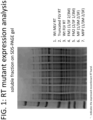
- FIG. 1 depicts an exemplary soluble fraction SDS-PAGE gel following RT mutant expression.
- RT reverse transcriptase
- MLVRT mouse leukemia virus reverse transcriptase
- FLVRT feline leukemia virus reverse transcriptase
- the inventors have generated hybrid reverse transcriptases comprising a finger domain, a palm domain, a thumb domain, a connection domain and an RNase H domain, wherein at least one of said domains is a mouse leukemia virus reverse transcriptase (MLVRT) and other of said domains are from feline leukemia virus reverse transcriptase (FLVRT).
- MLVRT mouse leukemia virus reverse transcriptase
- FLVRT feline leukemia virus reverse transcriptase
- the inventors have generated hybrids in which the finger and palm domains are either FLVRT or MLVRT sequences with at least some of the remainder being from the alternative enzyme.
- hybrid reverse transcriptases that have the five RT domains (from amino to carboxyl: finger, palm, thumb, connection, and RNase H domains) where at least one (e.g., 1, 2, 3, or 4) of those domains are from MLVRT and the remaining domain(s) are from FLVRT.
- the structure of MLVRT and finger, palm, thumb, connection, and RNase H domains are described in, e.g., Das and Georgiadis, Structure 12:819-829 (2004 ).
- the resulting hybrid RTs have improved expression (e.g., in E. coli ) compared to an RT where all of the domains are from FLVRT (i.e., wildtype FLVRT) while in some embodiments having improved accuracy compared to MLVRT.
- the hybrid RT may comprise the finger and palm domains of MLVRT linked to the thumb, connection, and RNase H domains of FLVRT.
- Exemplary portions of MLVRT that comprise finger and palm domains include, for example, SEQ ID NO:1 or a substantially identical sequence thereof.
- the portion of MLVRT that comprises finger and palm domains may comprise SEQ ID NO:2 or a sequence substantially identical thereto.
- the above-described MLVRT portion can be linked to a portion of FLVRT that comprises the thumb, connection, and RNase H domains.
- An exemplary portion of FLVRT that comprises the thumb, connection, and RNase H domains is SEQ ID NO: 5 or a substantially identical sequence thereof.
- the portion of FLVRT that comprises the thumb, connection, and RNase H domains may be SEQ ID NO: 6 or a substantially identical sequence thereof or SEQ ID NO: 10 or a substantially identical sequence thereof.
- Exemplary hybrid RTs can comprise, for example SEQ ID NO: 1 or SEQ ID NO:2 any of SEQ ID NO:5, SEQ ID NO:6, or SEQ ID NO: 10.
- the hybrid RT may comprise one of SEQ ID NOs: 14, 15, 16, 17, 18, or 19 or a substantially identical sequence thereof.
- the hybrid RT may comprise at least the finger and palm domains of FLVRT linked to the thumb and connection domains of either FLVRT or MLVRT, which in turn is linked to the RNase H domains of MLVRT.
- the hybrid RT may comprise finger and palm domains of FLVRT and thumb, connection, and RNase H domains of MLVRT.
- Exemplary portions of FLVRT that comprise finger and palm domains include, for example, SEQ ID NO:26 or a substantially identical sequence thereof.
- Exemplary portions of MLVRT that comprise thumb, connection, and RNase H domains include, for example, SEQ ID NO:28 or a substantially identical sequence thereof.
- the hybrid RT may comprise finger, palm, thumb, and connection domains of FLVRT and RNase H domain of MLVRT.
- Exemplary portions of FLVRT that comprise finger, palm, thumb, and connection domains include, for example, SEQ ID NO:27 or a substantially identical sequence thereof.
- Exemplary portions of MLVRT that comprise the RNase H domain include, for example, SEQ ID NO:29 or a substantially identical sequence thereof.
- the hybrid RT may comprise one of SEQ ID NO: 30 or 31, or a substantially identical sequence thereof.
- any of the hybrid RTs described herein can include further amino acids at the amino or carboxyl terminus.
- Exemplary additional amino acid sequences can include, for example, epitope tags or other tags that allow for purification of the proteins or whose underlying codons allow for cloning sites. Such tags can be fused at either end of the hybrid RT as most convenient for purification. Examples of such tags include poly-histidine sequences or FLAG-tag.
- Various linker sequences can also be included to link such tags or other sequences to the hybrid RT sequence. Linkers can include, for example glycine, serine or other amino acids that do not significantly interfere with protein folding such that the activity of the hybrid RT is not harmed.
- the linker sequences can also include protease cleavage sequences such that the tag can be removed by a protease or other cleavage mechanism, optionally once the hybrid RT has been purified (e.g., using the tag).
- the hybrid RT may include one or more (e.g., 2-20, 2-5, e.g., 3) alanines at the carboxyl terminus.
- any hybrid RTs as described herein can include one or more mutation that improves the thermostability (i.e., ability to remain active during or after exposure to temperatures over 37 ° C, e.g., 42-60 ° C) of the enzyme.
- Exemplary mutations include one or more (e.g., 2, 3, 4, 5, 6, or more) mutation at a position corresponding to L139 (including L139P), D200 (including D200N), N479 (including N479D), D522 (including D522G, D522N, or D522A), F526 (including F526I), H592 (including H592K), L601 (including L601W), E605 (including E605K), and H632 (including H632Y) in SEQ ID NO:34. It should be understood that such position designations do not indicate the number of amino acids in the claimed molecule per se, but indicate where in the claimed molecule the residue occurs when the claimed molecule sequence is maximally aligned with SEQ ID NO:34.
- Two portions of different RTs as described herein as described can be joined via a linker by methods well known to those of skill in the art. These methods can include both recombinant and chemical methods.
- Linking portions of different RTs may also comprise a peptide bond formed between moieties that are separately synthesized by standard peptide synthesis chemistry or recombinant methods.
- the coding sequences of each portion in the hybrid RT are directly joined and expressed as a fusion protein.
- an amino acid linker sequence may also be encoded in the polypeptide coding sequence and employed to separate the first and second RT portions by a distance sufficient to ensure that each polypeptide folds into its secondary and tertiary structures. Such an amino acid linker sequence is incorporated into the fusion protein using recombinant techniques well known in the art.
- Suitable peptide linker sequences may be chosen based on the following factors: (1) their ability to adopt a flexible extended conformation; (2) their inability to adopt a secondary structure that could interact with functional epitopes on the first and second polypeptides; and (3) the lack of hydrophobic or charged residues that might react with the polypeptide functional epitopes.
- Typical peptide linker sequences contain Gly, Ser, Val and Thr residues. Other near neutral amino acids, such as Ala can also be used in the linker sequence.
- Amino acid sequences which may be usefully employed as linkers include those disclosed in Maratea et al. (1985) Gene 40:39-46 ; Murphy et al. (1986) Proc. Natl. Acad. Sci.
- the linker sequence may generally be from 1 to about 50 amino acids in length, e.g., 3, 4, 6, or 10 amino acids in length, but can be 100 or 200 amino acids in length. Linker sequences are not necessarily required.
- Chemical linking can be performed, for example, as described in Bioconjugate Techniques, Hermanson, Ed., Academic Press (1996 ). Joining can include, for example, derivatization for the purpose of linking the two proteins to each other, either directly or through a linking compound, by methods that are well known in the art of protein chemistry.
- the means of linking the catalytic domain and the nucleic acid binding domain comprises a heterobifunctional-coupling reagent which ultimately contributes to formation of an intermolecular disulfide bond between the two moieties.
- Other types of coupling reagents that are useful in this capacity for the present invention are described, for example, in US Patent 4,545,985 .
- an intermolecular disulfide may conveniently be formed between cysteines in each moiety, which occur naturally or are inserted by genetic engineering.
- the means of linking moieties may also use thioether linkages between heterobifunctional crosslinking reagents or specific low pH cleavable crosslinkers or specific protease cleavable linkers or other cleavable or noncleavable chemical linkages.
- Other chemical linkers include carbohydrate linkers, lipid linkers, fatty acid linkers, polyether linkers, e.g., PEG.
- polyethylene glycol linkers are available from Shearwater Polymers, Inc. Huntsville, Alabama.
- linkers optionally have amide linkages, sulfhydryl linkages, or heterobifunctional linkages.
- the linking group can be a chemical crosslinking agent, including, for example, succinimidyl-(N-maleimidomethyl)-cyclohexane-1-carboxylate (SMCC).
- SMCC succinimidyl-(N-maleimidomethyl)-cyclohexane-1-carboxylate
- the linking group can also be an additional amino acid sequence(s), including for example, a polyalanine, polyglycine or similarly, linking group.
- Nonclassical amino acids or chemical amino acid analogs can be introduced as a substitution or addition into the sequence.
- Non-classical amino acids include the D-isomers of the common amino acids, ⁇ -amino isobutyric acid, 4-aminobutyric acid, Abu, 2-amino butyric acid, ⁇ -Abu, ⁇ -Ahx, 6-amino hexanoic acid, Aib, 2-amino isobutyric acid, 3-amino propionic acid, ornithine, norleucine, norvaline, hydroxy-proline, sarcosine, citrulline, cysteic acid, t-butylglycine, t-butylalanine, phenylglycine, cyclohexylalanine, ⁇ - alanine, fluoro-amino acids, designer amino acids such as ⁇ -methyl amino acids, C ⁇ -methyl amino acids, N -methyl amino acids, and amino acid analogs in general. Furthermore,
- Nucleic acids encoding the hybrid RTs can be obtained using routine techniques in the field of recombinant genetics. Basic texts disclosing the general methods of use in this invention include Sambrook and Russell, Molecular Cloning, A Laboratory Manual (3rd ed. 2001 ); Kriegler, Gene Transfer and Expression: A Laboratory Manual (1990 ); and Current Protocols in Molecular Biology (Ausubel et al., eds., 1994-1999 ).
- nucleic acids may also be obtained through in vitro amplification methods such as those described herein and in Berger, Sambrook, and Ausubel, as well as Mullis et al., (1987) US Patent 4,683,202 ; PCR Protocols A Guide to Methods and Applications (Innis et al., eds) Academic Press Inc. San Diego, Calif. (1990) (Inn is); Arnheim & Levinson (Oct. 1, 1990) C&EN 36-47 ; The Journal Of NIH Research (1991) 3: 81-94 ; Kwoh et al. (1989) Proc. Natl. Acad. Sci. USA 86: 1173 ; Guatelli et al. (1990) Proc. Natl.
- modifications can additionally be made to the hybrid RTs without diminishing their biological activity. Some modifications may be made to facilitate the cloning, expression, or incorporation of a domain into a fusion protein. Such modifications are well known to those of skill in the art and include, for example, the addition of codons at either terminus of the polynucleotide that encodes the binding domain to provide, for example, a methionine added at the amino terminus to provide an initiation site, or additional amino acids (e.g., poly His) placed on either terminus to create conveniently located restriction sites or termination codons or purification sequences.
- hybrid RT polypeptides as described herein can be expressed in a variety of host cells, including E. coli, other bacterial hosts, yeasts, filamentous fungi, and various higher eukaryotic cells such as the COS, CHO and HeLa cells lines and myeloma cell lines.
- E. coli E. coli
- yeasts yeasts
- filamentous fungi various higher eukaryotic cells
- COS COS
- CHO and HeLa cells lines and myeloma cell lines eukaryotic cells
- Techniques for gene expression in microorganisms are described in, for example, Smith, Gene Expression in Recombinant Microorganisms (Bioprocess Technology, Vol. 22), Marcel Dekker, 1994 .
- bacteria examples include Escherichia, Enterobacter, Azotobacter, Erwinia, Bacillus, Pseudomonas, Klebsielia , Proteus, Salmonella, Serratia, Shigella, Rhizobia , Vitreoscilla , and Paracoccus.
- Filamentous fungi that are useful as expression hosts include, for example, the following genera: Aspergillus, Trichoderma, Neurospora, Penicillium, Cephalosporium, Achlya , Podospora , Mucor, Cochliobolus, and Pyricularia .
- the polynucleotide that encodes the polypeptide is placed under the control of a promoter that is functional in the desired host cell.
- promoters are available and known to one of skill in the art, and can be used in the expression vectors of the invention, depending on the particular application. Ordinarily, the promoter selected depends upon the cell in which the promoter is to be active.
- expression control sequences such as ribosome binding sites, and transcription termination sites are also optionally included.
- Constructs that include one or more of these control sequences are termed "expression cassettes.” Accordingly, the nucleic acids that encode the joined polypeptides are incorporated for high level expression in a desired host cell.
- prokaryotic control sequences that are suitable for use in a particular host cell are often obtained by cloning a gene that is expressed in that cell.
- Commonly used prokaryotic control sequences which are defined herein to include promoters for transcription initiation, optionally with an operator, along with ribosome binding site sequences, include such commonly used promoters as the beta-lactamase (penicillinase) and lactose (lac) promoter systems ( Change et al., Nature (1977) 198: 1056 ), the tryptophan (trp) promoter system ( Goeddel et al., Nucleic Acids Res. (1980) 8: 4057 ), the tac promoter ( DeBoer, et al., Proc. Natl.
- Standard bacterial expression vectors include plasmids such as pBR322-based plasmids, e.g., pBLUESCRIPT TM , pSKF, pET23D, lambda-phage derived vectors, and fusion expression systems such as GST and LacZ.
- Epitope tags can also be added to recombinant proteins to provide convenient methods of isolation, e.g., c-myc, HA-tag, 6-His tag, maltose binding protein, VSV-G tag, anti-DYKDDDDK (SEQ ID NO:42) tag, or any such tag, a large number of which are well known to those of skill in the art.
- polypeptides described herein can be expressed intracellularly, or can be secreted from the cell. Intracellular expression often results in high yields. If necessary, the amount of soluble, active fusion polypeptide may be increased by performing refolding procedures (see, e.g., Sambrook et al., supra.; Marston et al., Bio/Technology (1984) 2: 800 ; Schoner et al., Bio/Technology (1985) 3: 151 ).
- Polypeptides can be expressed in a variety of host cells, including E. coli, other bacterial hosts, yeast, and various higher eukaryotic cells such as the COS, CHO and HeLa cells lines and myeloma cell lines.
- the host cells can be mammalian cells, insect cells, or microorganisms, such as, for example, yeast cells, bacterial cells, or fungal cells.
- the nucleic acids that encode the polypeptides can also include a coding sequence for an epitope or "tag" for which an affinity binding reagent is available.
- suitable epitopes include the myc and V-5 reporter genes; expression vectors useful for recombinant production of fusion polypeptides having these epitopes are commercially available (e.g., Invitrogen (Carlsbad Calif.) vectors pcDNA3.1/Myc-His and pcDNA3.1/V5-His are suitable for expression in mammalian cells).
- Additional expression vectors suitable for attaching a tag to the fusion proteins of the invention, and corresponding detection systems are known to those of skill in the art, and several are commercially available (e.g., "FLAG" (Kodak, Rochester N.Y.).
- FLAG Kodak, Rochester N.Y.
- Another example of a suitable tag is a polyhistidine sequence, which is capable of binding to metal chelate affinity ligands. Typically, six adjacent histidines are used, although one can use more or less than six.
- Suitable metal chelate affinity ligands that can serve as the binding moiety for a polyhistidine tag include nitrilo-tri-acetic acid (NTA) ( Hochuli, E.
- the hybrid RT polypeptide(s) may possess a conformation substantially different than the native conformations of the constituent polypeptides. In this case, it may be necessary or desirable to denature and reduce the polypeptide and then to cause the polypeptide to re-fold into the preferred conformation.
- Methods of reducing and denaturing proteins and inducing re-folding are well known to those of skill in the art (See, Debinski et al. (1993) J. Biol. Chem. 268: 14065-14070 ; Kreitman and Pastan (1993) Bioconjug. Chem. 4: 581-585 ; and Buchner et al. (1992) Anal. Biochem. 205: 263-270 ).
- Debinski et al. describe the denaturation and reduction of inclusion body proteins in guanidine-DTE.
- the protein is then refolded in a redox buffer containing oxidized glutathione and L-arginine.
- RT Reverse transcription
- RNA including for example, all RNA in a cell, e.g., to make a cDNA library
- the RT reaction can be primed with a random primer, an oligo dT, or an RNA-specific primer.
- Components and conditions for RT reactions are generally known.
- the reactions can further comprise RT-PCR.
- Standard techniques for performing PCR assays are known in the art (PCR Technology: Principles and Applications for DNA Amplification (Erlich, ed., 1989 ); PCR Protocols: A Guide to Methods and Applications (Innis, Gelfland, Sninsky, &, White, eds., 1990 ); Mattila et al., Nucleic Acids Res. 19: 4967 (1991 ); Eckert & Kunkel, PCR Methods and Applications 1: 17 (1991 ); Wallace et al., Ligase Chain Reaction, in Technologies for Detection of DNA Damage and Mutations, pp. 307-322 (Pfiefer, ed., 1996 )).
- RT and PCR reactions are often used in the same assay and are referred to as RT-PCR.
- RT-PCR combines reverse transcription of RNA into DNA and subsequent DNA amplification reactions in a single reaction.
- Optimal reverse transcription, hybridization, and amplification conditions will vary depending upon the sequence composition and length(s) of the primers and target(s) employed, and the experimental method selected by the practitioner.
- Various guidelines may be used to select appropriate primer sequences and hybridization conditions (see, e.g., Sambrook et al., Molecular Cloning: A Laboratory Manual (2nd ed.) (1989 ); Ausubel, F. M. et al., eds.
- Hybrid RTs described herein are used in a reverse transcriptase reaction at a higher temperature than would ordinarily be used.
- some hybrid RTs described herein can be used at, 37 ° C or 42 ° C, or a temperature greater than 42 ° C, for example, between 42 °-60 °, 43 °-55 ° C, 45 °-56 ° C, 45 °-65 ° C.
- Higher temperature RT reactions are particularly helpful in situations where the template RNA forms secondary structure at normal RT temperatures (e.g., 37 ° or 42 ° C) that partially or completely inhibit reverse transcription.
- reaction mixtures comprising the hybrid RT polypeptides described herein are provided.
- the reaction mixtures can comprise, for example, a target nucleic acid, e.g., an RNA target where reverse transcription is to take place.
- the reaction mixtures can comprise appropriate nucleotides (e.g., deoxynucleotides (dNTPs) or dideoxynucleotides) and in some embodiments, at least one buffer.
- exemplary buffers can include, for example Tris, HEPES, ACES, PIPES, MOPSO, BES, MOPS, TES, TAPSO, POPSO, BICINE, TAPS, or AMPSO.
- the reaction mixtures can optionally comprise one or more oligonucleotides that function as a primer for template-dependent nucleic acid extension, one or more oligonucleotides that function as a probe (e.g., linked to a label such as a quencher, fluorescent dye.), and/or a double stranded DNA binding dye (e.g., SYBRGREEN).
- the reaction mixture may further comprise a separate DNA-dependent DNA polymerase, and/or the reaction mixture may further comprise magnesium (Mg++).
- Kits for conducting reverse transcription (and optionally cyclic amplification, e.g., such as PCR) reactions are also described herein.
- Such kits include a hybrid RT as described herein, and optionally dNTPs, and at least one buffer.
- Such kits may also include stabilizers and other additives to increase the efficiency of the amplification reactions.
- Such kits may also include one or more primers (e.g. poly-T, random hexamers, or specific primers) as well as instructions for conducting reverse transcription reactions using the components of the kits.
- the kits may further comprise a separate DNA-dependent DNA polymerase.
- the hybrid RT FM1 (1/3 FLV-2/3 MLV RT) included a N-terminal sequence of FLV RT from amino acid 1-279, which includes the finger and palm domains, and a C-terminal sequence of MLV RT from amino acid 280-671, which includes the thumb, connection and RNase H domain.
- the hybrid RT FM2 (2/3 FLV-1/3 MLV RT) included a N-terminal sequence of FLV RT from amino acid 1-497, which includes the finger, palm, thumb, and connection domains, and a C-terminal sequence of MLV RT from amino acid 498-671, which includes the RNase H domain.
- the hybrid RT MF includes a N-terminal sequence of MLV RT from amino acid 1-277, which includes the finger and palm domains, and a C-terminal sequence of FLV RT from amino acid 276-667, which includes the thumb, connection, and RNase H domains.
- the hybrid RT MF(P) includes a N-terminal sequence of MLV RT from amino acid 1-221, which includes the finger and palm domains, and a C-terminal sequence of FLV RT from amino acid 221-667, which includes the thumb, connection, and RNase H domains.
- Point mutations were introduced into MF and MF(P) hybrid RTs in order to improve the enzyme performance.
- MF4CH, FF4CH The "H” at the end represents a histidine Tag at the C-terminus in addition to a N-terminus His-Tag.
- FF4G, FF4GC "FF" represents Feline RT mutants not the fusion between MLV and FLV RT.
- FF4NDKW, FLV RT and Fusion RT that have 4 point mutations at D200N, MF(P)4NDKW N477D, H592K, L601W.
- FF4NGWN, FLV RT and Fusion RT that have 4 point mutations at D200N, MF(P)4NGWN D522G, L601W, D651N.
Landscapes
- Chemical & Material Sciences (AREA)
- Life Sciences & Earth Sciences (AREA)
- Health & Medical Sciences (AREA)
- Organic Chemistry (AREA)
- Genetics & Genomics (AREA)
- Engineering & Computer Science (AREA)
- Zoology (AREA)
- Wood Science & Technology (AREA)
- Bioinformatics & Cheminformatics (AREA)
- Molecular Biology (AREA)
- Biotechnology (AREA)
- General Engineering & Computer Science (AREA)
- Biomedical Technology (AREA)
- Microbiology (AREA)
- Biochemistry (AREA)
- General Health & Medical Sciences (AREA)
- Biophysics (AREA)
- Physics & Mathematics (AREA)
- Proteomics, Peptides & Aminoacids (AREA)
- Chemical Kinetics & Catalysis (AREA)
- Medicinal Chemistry (AREA)
- Plant Pathology (AREA)
- Bioinformatics & Computational Biology (AREA)
- Analytical Chemistry (AREA)
- Crystallography & Structural Chemistry (AREA)
- Immunology (AREA)
- Enzymes And Modification Thereof (AREA)
- Micro-Organisms Or Cultivation Processes Thereof (AREA)
Claims (13)
- Hybride Reverse Transkriptase, umfassend eine Fingerdomäne, eine Handflächendomäne, eine Daumendomäne, eine Verbindungsdomäne und eine RNase-H-Domäne, wobei(I) ein Teil der Reversen Transkriptase des Mausleukämievirus (MLVRT), der die Finger- und die Handflächendomäne umfasst, mit einem Teil der Reversen Transkriptase des Katzenleukämievirus (FLVRT), der die Daumen-, die Verbindungs- und die RNase-H-Domäne umfasst, verknüpft ist, wobei der Teil der MLVRT zu wenigstens 95% identisch zu SEQ ID Nr. 1 ist und der Teil der FLVRT zu wenigstens 95% identisch zu SEQ ID Nr. 5 ist; oder(II) ein Teil der Reversen Transkriptase des Katzenleukämievirus (FLVRT), der die Finger- und die Handflächendomäne umfasst, mit einem Teil der Reversen Transkriptase des Mausleukämievirus (MLVRT), der die Daumen-, die Verbindungs- und die RNase-H-Domäne umfasst, verknüpft ist, wobei der Teil der FLVRT zu wenigstens 95% identisch zu SEQ ID Nr. 26 ist und der Teil der MLVRT zu wenigstens 95% identisch zu SEQ ID Nr. 28 ist; oder(III) ein Teil der Reversen Transkriptase des Katzenleukämievirus (FLVRT), der die Finger-, Handflächen-, Daumen- und Verbindungsdomäne umfasst, mit einem Teil der Reversen Transkriptase des Mausleukämievirus (MLVRT), der die RNase-H-Domäne umfasst, verknüpft ist, wobei der Teil der FLVRT zu wenigstens 95% identisch zu SEQ ID Nr. 27 ist und der Teil der MLVRT zu wenigstens 95% identisch zu SEQ ID Nr. 29 ist.
- Hybride Reverse Transkriptase gemäß Anspruch 1 (I), wobei der Teil der MLVRT SEQ ID Nr. 1 umfasst und der Teil der FLVRT SEQ ID Nr. 5 umfasst.
- Hybride Reverse Transkriptase gemäß Anspruch 2, wobei der Teil der FLVRT SEQ ID Nr. 6 oder SEQ ID Nr. 10 umfasst.
- Hybride Reverse Transkriptase gemäß Anspruch 3, wobei der Teil der FLVRT SEQ ID Nr. 7, SEQ ID Nr. 8, SEQ ID Nr. 9 oder SEQ ID Nr. 11 umfasst.
- Hybride Reverse Transkriptase gemäß einem der Ansprüche 2 bis 4, wobei(i) der Teil der MLVRT SEQ ID Nr. 2 umfasst; oder(ii) der Teil der MLVRT SEQ ID Nr. 3 oder SEQ ID Nr. 4 umfasst.
- Hybride Reverse Transkriptase gemäß Anspruch 2, wobei:der Teil der MLVRT SEQ ID Nr. 4 umfasst und der Teil der FLVRT SEQ ID Nr. 7 umfasst; oderder Teil der MLVRT SEQ ID Nr. 4 umfasst und der Teil der FLVRT SEQ ID Nr. 8 umfasst; oderder Teil der MLVRT SEQ ID Nr. 4 umfasst und der Teil der FLVRT SEQ ID Nr. 9 umfasst; oderder Teil der MLVRT SEQ ID Nr. 3 umfasst und der Teil der FLVRT SEQ ID Nr. 11 umfasst; oderder Teil der MLVRT SEQ ID Nr. 3 umfasst und der Teil der FLVRT SEQ ID Nr. 10 umfasst; oderder Teil der MLVRT SEQ ID Nr. 4 umfasst und der Teil der FLVRT SEQ ID Nr. 13 umfasst.
- Hybride Reverse Transkriptase gemäß Anspruch 2, wobei die hybride Reverse Transkriptase eine Sequenz umfasst, die zu wenigstens 95% identisch zu SEQ ID Nr. 14, 15, 16, 17, 18, 19, 34 oder 35 ist.
- Hybride Reverse Transkriptase gemäß Anspruch 1 (II), wobei die hybride Reverse Transkriptase eine Sequenz umfasst, die zu wenigstens 95% identisch zu SEQ ID Nr. 30 ist.
- Hybride Reverse Transkriptase gemäß Anspruch 1 (III), wobei die hybride Reverse Transkriptase eine Sequenz umfasst, die zu wenigstens 95% identisch zu SEQ ID Nr. 31 ist.
- Hybride Reverse Transkriptase gemäß einem der Ansprüche 1 bis 9, die wenigstens eine Mutation auf einer Position, die L139, D200, N479, D522, F526, H592, L601, E605 und H632 in SEQ ID Nr. 34 entspricht, aufweist, welche die Thermostabilität verbessert.
- Nucleinsäure, die ein Polynucleotid umfasst, das die hybride Reverse Transkriptase gemäß einem der Ansprüche 1 bis 10 codiert.
- Reaktionsgemisch, umfassend: eine RNA- oder DNA-Matrize; und die hybride Reverse Transkriptase gemäß einem der Ansprüche 1 bis 10.
- Verfahren zur Durchführung einer Reversen Transkription, wobei das Verfahren umfasst:
das In-Kontakt-Bringen der hybriden Reversen Transkriptase gemäß einem der Ansprüche 1 bis 10 in einem Reaktionsgemisch mit einer Matrizen-RNA und einem Primer, der unter solchen Bedingungen, dass die hybride Reverse Transkriptase in einer matrizen-RNA-abhängigen Weise unter Bildung einer cDNA den Primer verlängert, mit der Matrizen-RNA hybridisiert.
Applications Claiming Priority (2)
| Application Number | Priority Date | Filing Date | Title |
|---|---|---|---|
| US201762459974P | 2017-02-16 | 2017-02-16 | |
| PCT/US2018/017977 WO2018152097A1 (en) | 2017-02-16 | 2018-02-13 | Novel reverse transcriptases and uses thereof |
Publications (3)
| Publication Number | Publication Date |
|---|---|
| EP3583207A1 EP3583207A1 (de) | 2019-12-25 |
| EP3583207A4 EP3583207A4 (de) | 2020-11-18 |
| EP3583207B1 true EP3583207B1 (de) | 2024-10-09 |
Family
ID=63106733
Family Applications (1)
| Application Number | Title | Priority Date | Filing Date |
|---|---|---|---|
| EP18754654.4A Active EP3583207B1 (de) | 2017-02-16 | 2018-02-13 | Neuartige reverse-transkriptasen und verwendungen davon |
Country Status (4)
| Country | Link |
|---|---|
| US (3) | US10988762B2 (de) |
| EP (1) | EP3583207B1 (de) |
| CN (1) | CN110382690B (de) |
| WO (1) | WO2018152097A1 (de) |
Families Citing this family (3)
| Publication number | Priority date | Publication date | Assignee | Title |
|---|---|---|---|---|
| CN111684064A (zh) | 2018-01-19 | 2020-09-18 | 生物辐射实验室股份有限公司 | 突变dna聚合酶 |
| US12163164B2 (en) | 2019-07-15 | 2024-12-10 | Bio-Rad Laboratories, Inc. | Hybrid reverse transcriptases |
| CN112795546B (zh) * | 2019-11-13 | 2024-02-27 | 广州达安基因股份有限公司 | 一种具有高逆转录效率的耐高温逆转录酶突变体及其应用 |
Family Cites Families (16)
| Publication number | Priority date | Publication date | Assignee | Title |
|---|---|---|---|---|
| US4545985A (en) | 1984-01-26 | 1985-10-08 | The United States Of America As Represented By The Secretary, Dept. Of Health And Human Services | Pseudomonas exotoxin conjugate immunotoxins |
| US4751180A (en) | 1985-03-28 | 1988-06-14 | Chiron Corporation | Expression using fused genes providing for protein product |
| US4683202A (en) | 1985-03-28 | 1987-07-28 | Cetus Corporation | Process for amplifying nucleic acid sequences |
| US5679543A (en) | 1985-08-29 | 1997-10-21 | Genencor International, Inc. | DNA sequences, vectors and fusion polypeptides to increase secretion of desired polypeptides from filamentous fungi |
| US4935233A (en) | 1985-12-02 | 1990-06-19 | G. D. Searle And Company | Covalently linked polypeptide cell modulators |
| US5244797B1 (en) | 1988-01-13 | 1998-08-25 | Life Technologies Inc | Cloned genes encoding reverse transcriptase lacking rnase h activity |
| EP0377842B1 (de) | 1988-12-13 | 1995-10-04 | President And Fellows Of Harvard College | Prototypische FeLV-Isolate für die Verwendung als Krankheitsmuster oder Impfstoffe |
| JPH11271592A (ja) | 1998-03-24 | 1999-10-08 | Fuji Photo Optical Co Ltd | テレビレンズ用操作装置 |
| US6271004B1 (en) * | 1999-06-25 | 2001-08-07 | Display Systems Biotech A/S | Method for improved reverse transcription at high temperatures |
| WO2004024749A2 (en) | 2002-09-13 | 2004-03-25 | Invitrogen Corporation | Thermostable reverse transcriptases and uses thereof |
| US7595179B2 (en) | 2004-04-19 | 2009-09-29 | Applied Biosystems, Llc | Recombinant reverse transcriptases |
| EP1836319B1 (de) | 2005-01-06 | 2012-09-19 | Life Technologies Corporation | Polypeptide mit nukleinsäurebindender aktivität sowie verfahren zur nukleinsäureamplifikation |
| CN101613680B (zh) * | 2009-01-23 | 2013-07-24 | 广州华银医药科技有限公司 | 莫洛尼氏鼠白血病病毒逆转录酶突变体及其表达方法和应用 |
| CN101684474A (zh) * | 2009-02-19 | 2010-03-31 | 孙启明 | 一种重组鼠白血病病毒逆转录酶(mmlv-rt)在大肠杆菌中的可溶性表达及纯化方法 |
| US10308955B2 (en) * | 2011-10-26 | 2019-06-04 | Newvectys | Transient expression vectors, preparation and uses thereof |
| US10364420B2 (en) | 2015-12-07 | 2019-07-30 | Bio-Rad Laboratories, Inc | Dimeric reverse transcriptase |
-
2018
- 2018-02-13 EP EP18754654.4A patent/EP3583207B1/de active Active
- 2018-02-13 WO PCT/US2018/017977 patent/WO2018152097A1/en not_active Ceased
- 2018-02-13 CN CN201880012198.1A patent/CN110382690B/zh active Active
- 2018-02-13 US US15/895,504 patent/US10988762B2/en active Active
-
2021
- 2021-03-24 US US17/211,595 patent/US11649453B2/en active Active
-
2023
- 2023-03-23 US US18/125,661 patent/US12065645B2/en active Active
Also Published As
| Publication number | Publication date |
|---|---|
| US10988762B2 (en) | 2021-04-27 |
| EP3583207A4 (de) | 2020-11-18 |
| US12065645B2 (en) | 2024-08-20 |
| CN110382690A (zh) | 2019-10-25 |
| US20180230462A1 (en) | 2018-08-16 |
| EP3583207A1 (de) | 2019-12-25 |
| WO2018152097A1 (en) | 2018-08-23 |
| CN110382690B (zh) | 2024-05-24 |
| US20210207133A1 (en) | 2021-07-08 |
| US11649453B2 (en) | 2023-05-16 |
| US20230332142A1 (en) | 2023-10-19 |
Similar Documents
| Publication | Publication Date | Title |
|---|---|---|
| US12065645B2 (en) | Reverse transcriptases and uses thereof | |
| US11834685B2 (en) | Dimeric reverse transcriptase | |
| EP1660650B1 (de) | Verbesserte sso7-polymerase-konjugat-proteine | |
| EP2723880B1 (de) | Hybride polymerasen mit möglichkeit zur produktion langer amplicons | |
| US9556423B2 (en) | PCR reaction mixtures with decreased non-specific activity | |
| US9322002B2 (en) | Sso7-polymerase conjugates with decreased non-specific activity | |
| Frank et al. | A strategy for the expression of recombinant proteins traditionally hard to purify | |
| CN118028263A (zh) | 一种dna聚合酶及其制备方法与应用、表达基因、表达载体及重组细胞 |
Legal Events
| Date | Code | Title | Description |
|---|---|---|---|
| STAA | Information on the status of an ep patent application or granted ep patent |
Free format text: STATUS: THE INTERNATIONAL PUBLICATION HAS BEEN MADE |
|
| PUAI | Public reference made under article 153(3) epc to a published international application that has entered the european phase |
Free format text: ORIGINAL CODE: 0009012 |
|
| STAA | Information on the status of an ep patent application or granted ep patent |
Free format text: STATUS: REQUEST FOR EXAMINATION WAS MADE |
|
| 17P | Request for examination filed |
Effective date: 20190814 |
|
| AK | Designated contracting states |
Kind code of ref document: A1 Designated state(s): AL AT BE BG CH CY CZ DE DK EE ES FI FR GB GR HR HU IE IS IT LI LT LU LV MC MK MT NL NO PL PT RO RS SE SI SK SM TR |
|
| AX | Request for extension of the european patent |
Extension state: BA ME |
|
| DAV | Request for validation of the european patent (deleted) | ||
| DAX | Request for extension of the european patent (deleted) | ||
| A4 | Supplementary search report drawn up and despatched |
Effective date: 20201019 |
|
| RIC1 | Information provided on ipc code assigned before grant |
Ipc: C12N 15/62 20060101ALI20201013BHEP Ipc: C12N 15/09 20060101ALI20201013BHEP Ipc: C12P 19/34 20060101ALI20201013BHEP Ipc: C12N 9/00 20060101AFI20201013BHEP Ipc: C12N 15/11 20060101ALI20201013BHEP |
|
| RAP3 | Party data changed (applicant data changed or rights of an application transferred) |
Owner name: BIO-RAD LABORATORIES, INC. |
|
| STAA | Information on the status of an ep patent application or granted ep patent |
Free format text: STATUS: EXAMINATION IS IN PROGRESS |
|
| 17Q | First examination report despatched |
Effective date: 20230221 |
|
| GRAP | Despatch of communication of intention to grant a patent |
Free format text: ORIGINAL CODE: EPIDOSNIGR1 |
|
| STAA | Information on the status of an ep patent application or granted ep patent |
Free format text: STATUS: GRANT OF PATENT IS INTENDED |
|
| INTG | Intention to grant announced |
Effective date: 20240506 |
|
| P01 | Opt-out of the competence of the unified patent court (upc) registered |
Free format text: CASE NUMBER: APP_36839/2024 Effective date: 20240620 |
|
| GRAS | Grant fee paid |
Free format text: ORIGINAL CODE: EPIDOSNIGR3 |
|
| GRAA | (expected) grant |
Free format text: ORIGINAL CODE: 0009210 |
|
| STAA | Information on the status of an ep patent application or granted ep patent |
Free format text: STATUS: THE PATENT HAS BEEN GRANTED |
|
| AK | Designated contracting states |
Kind code of ref document: B1 Designated state(s): AL AT BE BG CH CY CZ DE DK EE ES FI FR GB GR HR HU IE IS IT LI LT LU LV MC MK MT NL NO PL PT RO RS SE SI SK SM TR |
|
| REG | Reference to a national code |
Ref country code: CH Ref legal event code: EP |
|
| REG | Reference to a national code |
Ref country code: DE Ref legal event code: R096 Ref document number: 602018075208 Country of ref document: DE |
|
| REG | Reference to a national code |
Ref country code: IE Ref legal event code: FG4D |
|
| REG | Reference to a national code |
Ref country code: LT Ref legal event code: MG9D |
|
| REG | Reference to a national code |
Ref country code: NL Ref legal event code: MP Effective date: 20241009 |
|
| REG | Reference to a national code |
Ref country code: AT Ref legal event code: MK05 Ref document number: 1730635 Country of ref document: AT Kind code of ref document: T Effective date: 20241009 |
|
| PG25 | Lapsed in a contracting state [announced via postgrant information from national office to epo] |
Ref country code: NL Free format text: LAPSE BECAUSE OF FAILURE TO SUBMIT A TRANSLATION OF THE DESCRIPTION OR TO PAY THE FEE WITHIN THE PRESCRIBED TIME-LIMIT Effective date: 20241009 |
|
| PG25 | Lapsed in a contracting state [announced via postgrant information from national office to epo] |
Ref country code: NL Free format text: LAPSE BECAUSE OF FAILURE TO SUBMIT A TRANSLATION OF THE DESCRIPTION OR TO PAY THE FEE WITHIN THE PRESCRIBED TIME-LIMIT Effective date: 20241009 |
|
| PG25 | Lapsed in a contracting state [announced via postgrant information from national office to epo] |
Ref country code: IS Free format text: LAPSE BECAUSE OF FAILURE TO SUBMIT A TRANSLATION OF THE DESCRIPTION OR TO PAY THE FEE WITHIN THE PRESCRIBED TIME-LIMIT Effective date: 20250209 Ref country code: HR Free format text: LAPSE BECAUSE OF FAILURE TO SUBMIT A TRANSLATION OF THE DESCRIPTION OR TO PAY THE FEE WITHIN THE PRESCRIBED TIME-LIMIT Effective date: 20241009 Ref country code: PT Free format text: LAPSE BECAUSE OF FAILURE TO SUBMIT A TRANSLATION OF THE DESCRIPTION OR TO PAY THE FEE WITHIN THE PRESCRIBED TIME-LIMIT Effective date: 20250210 |
|
| PGFP | Annual fee paid to national office [announced via postgrant information from national office to epo] |
Ref country code: DE Payment date: 20250226 Year of fee payment: 8 |
|
| PG25 | Lapsed in a contracting state [announced via postgrant information from national office to epo] |
Ref country code: FI Free format text: LAPSE BECAUSE OF FAILURE TO SUBMIT A TRANSLATION OF THE DESCRIPTION OR TO PAY THE FEE WITHIN THE PRESCRIBED TIME-LIMIT Effective date: 20241009 |
|
| PG25 | Lapsed in a contracting state [announced via postgrant information from national office to epo] |
Ref country code: BG Free format text: LAPSE BECAUSE OF FAILURE TO SUBMIT A TRANSLATION OF THE DESCRIPTION OR TO PAY THE FEE WITHIN THE PRESCRIBED TIME-LIMIT Effective date: 20241009 |
|
| PG25 | Lapsed in a contracting state [announced via postgrant information from national office to epo] |
Ref country code: ES Free format text: LAPSE BECAUSE OF FAILURE TO SUBMIT A TRANSLATION OF THE DESCRIPTION OR TO PAY THE FEE WITHIN THE PRESCRIBED TIME-LIMIT Effective date: 20241009 |
|
| PG25 | Lapsed in a contracting state [announced via postgrant information from national office to epo] |
Ref country code: NO Free format text: LAPSE BECAUSE OF FAILURE TO SUBMIT A TRANSLATION OF THE DESCRIPTION OR TO PAY THE FEE WITHIN THE PRESCRIBED TIME-LIMIT Effective date: 20250109 |
|
| PG25 | Lapsed in a contracting state [announced via postgrant information from national office to epo] |
Ref country code: LV Free format text: LAPSE BECAUSE OF FAILURE TO SUBMIT A TRANSLATION OF THE DESCRIPTION OR TO PAY THE FEE WITHIN THE PRESCRIBED TIME-LIMIT Effective date: 20241009 Ref country code: GR Free format text: LAPSE BECAUSE OF FAILURE TO SUBMIT A TRANSLATION OF THE DESCRIPTION OR TO PAY THE FEE WITHIN THE PRESCRIBED TIME-LIMIT Effective date: 20250110 Ref country code: AT Free format text: LAPSE BECAUSE OF FAILURE TO SUBMIT A TRANSLATION OF THE DESCRIPTION OR TO PAY THE FEE WITHIN THE PRESCRIBED TIME-LIMIT Effective date: 20241009 |
|
| PG25 | Lapsed in a contracting state [announced via postgrant information from national office to epo] |
Ref country code: PL Free format text: LAPSE BECAUSE OF FAILURE TO SUBMIT A TRANSLATION OF THE DESCRIPTION OR TO PAY THE FEE WITHIN THE PRESCRIBED TIME-LIMIT Effective date: 20241009 |
|
| PGFP | Annual fee paid to national office [announced via postgrant information from national office to epo] |
Ref country code: FR Payment date: 20250224 Year of fee payment: 8 |
|
| PGFP | Annual fee paid to national office [announced via postgrant information from national office to epo] |
Ref country code: GB Payment date: 20250218 Year of fee payment: 8 |
|
| PG25 | Lapsed in a contracting state [announced via postgrant information from national office to epo] |
Ref country code: RS Free format text: LAPSE BECAUSE OF FAILURE TO SUBMIT A TRANSLATION OF THE DESCRIPTION OR TO PAY THE FEE WITHIN THE PRESCRIBED TIME-LIMIT Effective date: 20250109 |
|
| PG25 | Lapsed in a contracting state [announced via postgrant information from national office to epo] |
Ref country code: SM Free format text: LAPSE BECAUSE OF FAILURE TO SUBMIT A TRANSLATION OF THE DESCRIPTION OR TO PAY THE FEE WITHIN THE PRESCRIBED TIME-LIMIT Effective date: 20241009 |
|
| PG25 | Lapsed in a contracting state [announced via postgrant information from national office to epo] |
Ref country code: DK Free format text: LAPSE BECAUSE OF FAILURE TO SUBMIT A TRANSLATION OF THE DESCRIPTION OR TO PAY THE FEE WITHIN THE PRESCRIBED TIME-LIMIT Effective date: 20241009 |
|
| REG | Reference to a national code |
Ref country code: DE Ref legal event code: R097 Ref document number: 602018075208 Country of ref document: DE |
|
| PG25 | Lapsed in a contracting state [announced via postgrant information from national office to epo] |
Ref country code: EE Free format text: LAPSE BECAUSE OF FAILURE TO SUBMIT A TRANSLATION OF THE DESCRIPTION OR TO PAY THE FEE WITHIN THE PRESCRIBED TIME-LIMIT Effective date: 20241009 |
|
| PG25 | Lapsed in a contracting state [announced via postgrant information from national office to epo] |
Ref country code: RO Free format text: LAPSE BECAUSE OF FAILURE TO SUBMIT A TRANSLATION OF THE DESCRIPTION OR TO PAY THE FEE WITHIN THE PRESCRIBED TIME-LIMIT Effective date: 20241009 |
|
| PG25 | Lapsed in a contracting state [announced via postgrant information from national office to epo] |
Ref country code: SK Free format text: LAPSE BECAUSE OF FAILURE TO SUBMIT A TRANSLATION OF THE DESCRIPTION OR TO PAY THE FEE WITHIN THE PRESCRIBED TIME-LIMIT Effective date: 20241009 |
|
| PG25 | Lapsed in a contracting state [announced via postgrant information from national office to epo] |
Ref country code: CZ Free format text: LAPSE BECAUSE OF FAILURE TO SUBMIT A TRANSLATION OF THE DESCRIPTION OR TO PAY THE FEE WITHIN THE PRESCRIBED TIME-LIMIT Effective date: 20241009 |
|
| PG25 | Lapsed in a contracting state [announced via postgrant information from national office to epo] |
Ref country code: IT Free format text: LAPSE BECAUSE OF FAILURE TO SUBMIT A TRANSLATION OF THE DESCRIPTION OR TO PAY THE FEE WITHIN THE PRESCRIBED TIME-LIMIT Effective date: 20241009 |
|
| PLBE | No opposition filed within time limit |
Free format text: ORIGINAL CODE: 0009261 |
|
| STAA | Information on the status of an ep patent application or granted ep patent |
Free format text: STATUS: NO OPPOSITION FILED WITHIN TIME LIMIT |
|
| PG25 | Lapsed in a contracting state [announced via postgrant information from national office to epo] |
Ref country code: SE Free format text: LAPSE BECAUSE OF FAILURE TO SUBMIT A TRANSLATION OF THE DESCRIPTION OR TO PAY THE FEE WITHIN THE PRESCRIBED TIME-LIMIT Effective date: 20241009 |
|
| PG25 | Lapsed in a contracting state [announced via postgrant information from national office to epo] |
Ref country code: MC Free format text: LAPSE BECAUSE OF FAILURE TO SUBMIT A TRANSLATION OF THE DESCRIPTION OR TO PAY THE FEE WITHIN THE PRESCRIBED TIME-LIMIT Effective date: 20241009 |
|
| 26N | No opposition filed |
Effective date: 20250710 |
|
| REG | Reference to a national code |
Ref country code: CH Ref legal event code: PL |
|
| PG25 | Lapsed in a contracting state [announced via postgrant information from national office to epo] |
Ref country code: LU Free format text: LAPSE BECAUSE OF NON-PAYMENT OF DUE FEES Effective date: 20250213 |
|
| PG25 | Lapsed in a contracting state [announced via postgrant information from national office to epo] |
Ref country code: CH Free format text: LAPSE BECAUSE OF NON-PAYMENT OF DUE FEES Effective date: 20250228 |