EP3583163B1 - Antimony free composition for laser marking thermoplastic compounds - Google Patents
Antimony free composition for laser marking thermoplastic compounds Download PDFInfo
- Publication number
- EP3583163B1 EP3583163B1 EP18705155.2A EP18705155A EP3583163B1 EP 3583163 B1 EP3583163 B1 EP 3583163B1 EP 18705155 A EP18705155 A EP 18705155A EP 3583163 B1 EP3583163 B1 EP 3583163B1
- Authority
- EP
- European Patent Office
- Prior art keywords
- laser
- bismuth oxide
- marking
- markable
- markable plastic
- Prior art date
- Legal status (The legal status is an assumption and is not a legal conclusion. Google has not performed a legal analysis and makes no representation as to the accuracy of the status listed.)
- Active
Links
Images
Classifications
-
- B—PERFORMING OPERATIONS; TRANSPORTING
- B41—PRINTING; LINING MACHINES; TYPEWRITERS; STAMPS
- B41M—PRINTING, DUPLICATING, MARKING, OR COPYING PROCESSES; COLOUR PRINTING
- B41M5/00—Duplicating or marking methods; Sheet materials for use therein
- B41M5/26—Thermography ; Marking by high energetic means, e.g. laser otherwise than by burning, and characterised by the material used
- B41M5/267—Marking of plastic artifacts, e.g. with laser
-
- C—CHEMISTRY; METALLURGY
- C08—ORGANIC MACROMOLECULAR COMPOUNDS; THEIR PREPARATION OR CHEMICAL WORKING-UP; COMPOSITIONS BASED THEREON
- C08K—Use of inorganic or non-macromolecular organic substances as compounding ingredients
- C08K3/00—Use of inorganic substances as compounding ingredients
- C08K3/01—Use of inorganic substances as compounding ingredients characterized by their specific function
- C08K3/013—Fillers, pigments or reinforcing additives
-
- A—HUMAN NECESSITIES
- A01—AGRICULTURE; FORESTRY; ANIMAL HUSBANDRY; HUNTING; TRAPPING; FISHING
- A01K—ANIMAL HUSBANDRY; AVICULTURE; APICULTURE; PISCICULTURE; FISHING; REARING OR BREEDING ANIMALS, NOT OTHERWISE PROVIDED FOR; NEW BREEDS OF ANIMALS
- A01K11/00—Marking of animals
-
- B—PERFORMING OPERATIONS; TRANSPORTING
- B41—PRINTING; LINING MACHINES; TYPEWRITERS; STAMPS
- B41M—PRINTING, DUPLICATING, MARKING, OR COPYING PROCESSES; COLOUR PRINTING
- B41M5/00—Duplicating or marking methods; Sheet materials for use therein
- B41M5/26—Thermography ; Marking by high energetic means, e.g. laser otherwise than by burning, and characterised by the material used
- B41M5/262—Thermography ; Marking by high energetic means, e.g. laser otherwise than by burning, and characterised by the material used recording or marking of inorganic surfaces or materials, e.g. glass, metal, or ceramics
-
- C—CHEMISTRY; METALLURGY
- C01—INORGANIC CHEMISTRY
- C01G—COMPOUNDS CONTAINING METALS NOT COVERED BY SUBCLASSES C01D OR C01F
- C01G29/00—Compounds of bismuth
-
- C—CHEMISTRY; METALLURGY
- C01—INORGANIC CHEMISTRY
- C01G—COMPOUNDS CONTAINING METALS NOT COVERED BY SUBCLASSES C01D OR C01F
- C01G49/00—Compounds of iron
- C01G49/0018—Mixed oxides or hydroxides
-
- C—CHEMISTRY; METALLURGY
- C08—ORGANIC MACROMOLECULAR COMPOUNDS; THEIR PREPARATION OR CHEMICAL WORKING-UP; COMPOSITIONS BASED THEREON
- C08K—Use of inorganic or non-macromolecular organic substances as compounding ingredients
- C08K3/00—Use of inorganic substances as compounding ingredients
- C08K3/32—Phosphorus-containing compounds
-
- C—CHEMISTRY; METALLURGY
- C08—ORGANIC MACROMOLECULAR COMPOUNDS; THEIR PREPARATION OR CHEMICAL WORKING-UP; COMPOSITIONS BASED THEREON
- C08K—Use of inorganic or non-macromolecular organic substances as compounding ingredients
- C08K3/00—Use of inorganic substances as compounding ingredients
- C08K3/34—Silicon-containing compounds
- C08K3/346—Clay
-
- C—CHEMISTRY; METALLURGY
- C08—ORGANIC MACROMOLECULAR COMPOUNDS; THEIR PREPARATION OR CHEMICAL WORKING-UP; COMPOSITIONS BASED THEREON
- C08L—COMPOSITIONS OF MACROMOLECULAR COMPOUNDS
- C08L101/00—Compositions of unspecified macromolecular compounds
-
- C—CHEMISTRY; METALLURGY
- C08—ORGANIC MACROMOLECULAR COMPOUNDS; THEIR PREPARATION OR CHEMICAL WORKING-UP; COMPOSITIONS BASED THEREON
- C08L—COMPOSITIONS OF MACROMOLECULAR COMPOUNDS
- C08L55/00—Compositions of homopolymers or copolymers, obtained by polymerisation reactions only involving carbon-to-carbon unsaturated bonds, not provided for in groups C08L23/00 - C08L53/00
- C08L55/02—ABS [Acrylonitrile-Butadiene-Styrene] polymers
-
- C—CHEMISTRY; METALLURGY
- C08—ORGANIC MACROMOLECULAR COMPOUNDS; THEIR PREPARATION OR CHEMICAL WORKING-UP; COMPOSITIONS BASED THEREON
- C08L—COMPOSITIONS OF MACROMOLECULAR COMPOUNDS
- C08L75/00—Compositions of polyureas or polyurethanes; Compositions of derivatives of such polymers
- C08L75/04—Polyurethanes
-
- C—CHEMISTRY; METALLURGY
- C08—ORGANIC MACROMOLECULAR COMPOUNDS; THEIR PREPARATION OR CHEMICAL WORKING-UP; COMPOSITIONS BASED THEREON
- C08K—Use of inorganic or non-macromolecular organic substances as compounding ingredients
- C08K3/00—Use of inorganic substances as compounding ingredients
- C08K3/32—Phosphorus-containing compounds
- C08K2003/321—Phosphates
-
- C—CHEMISTRY; METALLURGY
- C08—ORGANIC MACROMOLECULAR COMPOUNDS; THEIR PREPARATION OR CHEMICAL WORKING-UP; COMPOSITIONS BASED THEREON
- C08K—Use of inorganic or non-macromolecular organic substances as compounding ingredients
- C08K3/00—Use of inorganic substances as compounding ingredients
- C08K3/32—Phosphorus-containing compounds
- C08K2003/321—Phosphates
- C08K2003/322—Ammonium phosphate
-
- C—CHEMISTRY; METALLURGY
- C08—ORGANIC MACROMOLECULAR COMPOUNDS; THEIR PREPARATION OR CHEMICAL WORKING-UP; COMPOSITIONS BASED THEREON
- C08K—Use of inorganic or non-macromolecular organic substances as compounding ingredients
- C08K3/00—Use of inorganic substances as compounding ingredients
- C08K3/18—Oxygen-containing compounds, e.g. metal carbonyls
- C08K3/20—Oxides; Hydroxides
- C08K3/22—Oxides; Hydroxides of metals
Definitions
- This invention relates to a laser-markable plastic composition which is free of antimony.
- thermoplastics have to be marked, todays preferred technology is contact free laser marking.
- laser marking is solvent and contact free, imparts excellent flexibility and speed.
- a Nd:YAG system with a frequency of 1064 nm is commonly used, because it is cheap and flexible.
- laser-marking additives are required to boost the markability of thermoplastics that are not inherently laser markable, such as, for example, polycarbonates.
- Polymers like polyolefines or thermoplastic urethanes need additional additives to deliver the right laser marking result in contrast and edge sharpness.
- Laser marking additives are normally incorporated into the polymer by diluting an additive or color concentrate (Masterbatch) in the polymer.
- laser-marking additives work in two different modes of action: intrinsic and non-intrinsic working additives.
- Non-intrinsic additives absorb the energy of the laser and transfer it to the surrounding polymer matrix.
- the polymer can either carbonize, which normally leads to a brownish or greyish contrast on the surface of the polymer, or the polymer degrades to short length molecules and monomers that tend to vaporize at the surface and generate a foam. This results in bright marking caused by different refractive indices at the interface between the different solid phases.
- the laser marking can also be a result of both mechanisms.
- Intrinsic additives are working by changing its own chemical structure. For example, commonly used antimony trioxide Sb 2 O 3 reduces to antimony Sb that has a dark color to provide a sufficient contrast of the marking. Intrinsic laser-marking additives should be dispersed inside the polymeric matrix with good homogeneity, so that the edge sharpness normally is better than when using non-intrinsic additives.
- antimony trioxide is the preferred additive for the marking of such products.
- antimony trioxide has a non-environmental friendly profile and is therefore a potential candidate to be substituted by other solutions that the marking is seeking for. Due to the lack of alternatives, antimony trioxide or antimony containing additives are still the majority of additives that are used for this purpose.
- US-4,816,374 discloses the use of antimony oxide as a laser radiation opacifier substance in a polyurethane plastic material to satisfy French standard (number NF-T-54006) for abrasion in order to make and use ear tags for livestock animals.
- French standard number NF-T-54006
- antimony is still being studied regarding health problems that it might induce in mammals.
- thermoplastic polyurethanes as laser-markable plastics.
- the TPU's contain pigments having a coating of tin dioxide thereon, which coating is doped with 0.5 - 20 % by weight of antimony, arsenic, bismuth, copper, gallium, germanium, or a corresponding oxide thereof.
- EP-0697433 B1 describes the use of copper salts for the purpose of laser marking. It is well known that e.g. copper hydroxy phosphate has a high efficiency in high contrast laser marking. Nevertheless, for the application of ear cattle tags for example there is a limited utility because the copper hydroxy phosphate is able to react with animal faeces and cause a color change.
- EP-1190988 B1 claims the use of Bismuth containing compounds as a substitute of antimony trioxide for the purpose of a laser marking opacifier. However the effect is a lower performance in contrast compared to Sb 2 O 3 and also more expensive.
- a subject of the invention is a laser-markable plastic comprising a thermoplastic polymer, bismuth oxide and a co-absorbing additive selected from the group consisting of platelet-shaped silicates, wherein the amount of bismuth oxide is in the range of from 0.5 to 5 wt.-%, relative to the total weight of the laser-markable plastic, and wherein the amount of the co-absorbing additive relative to the bismuth oxide is from 5 to 40 wt.-% and wherein the thermoplastic polymer is a thermoplastic polyurethane.
- Bismuth oxide used in the present invention is preferably Bi 2 O 3 .
- Bismuth oxide used as the intrinsic laser active material can be of any particle size, for example a d 50 of from 0.5 to 25 microns.
- a technical grade particle size provides better contrast values delta L than fine grade or submicron grade material. Therefore, the preferred particle size d 50 of bismuth oxide is from 0,5 to 20 microns, more preferably from 2 to 10 microns.
- the amount of bismuth oxide, relative to the total weight of the laser-markable plastic is preferably from 0.5 to 5 wt.-%, more preferably 0.5 to 2.5 wt.-%, most preferably from 0.75 to 2 wt.-%.
- the co-absorbing additive is a platelet-shaped silicate, e.g. a phyllosilicate, for example selected from the group consisting of mica, talc, and kaolin.
- a platelet-shaped silicate e.g. a phyllosilicate, for example selected from the group consisting of mica, talc, and kaolin.
- Preferred particle sizes d 50 of the co-absorbing additives are from 1 to 20 microns, more preferably from 3 to 10 microns.
- the co-absorbing additive mainly functions to absorb the energy delivered by the laser system to provide more energy that can be absorbed by the bismuth oxide.
- phyllosilicates that normally show no contrast in laser marking, have a boosting effect as co-absorbing additive when used together with bismuth oxide.
- Some laser marking additives such as copper hydroxyl phosphate that have strong disadvantages when used alone, do not show this draw back when used in a combination with bismuth oxide and are improving the result of the color change of Bismuth oxide as well.
- Copper hydroxy phosphate when used alone in ear cattle tags may get in contact with animal excrements leading to strong discoloration due to the fact the additive reacts with such substance.
- the use of fine aluminum pigments is limited due to the strong grey color that it causes. Also in this case the laser marking effect of bismuth oxide is improved by using just a small amount of the aluminium that is not able to affect the color shade.
- a further subject of the present invention is a process for preparing a laser-markable plastic comprising the step of dispersing the bismuth oxide and the co-absorbing additive into the thermoplastic polymer, expediently via a melt-mixing process, preferably on a twin screw extruder. This can be done by direct compounding or by using an additive masterbatch as a predispersed concentrate.
- the resin can either be of the same thermoplastic polymer as the end polymer to be equipped or it can be a different polymeric carrier, a so-called multipurpose carrier.
- Such carrier will be dispersed into the end-polymer and can deliver additional benefits like an increased compatibility to the additive composition and herewith provide improved dispersibility.
- Other advantages of the use of some of these multipurpose carriers can be to improve mechanical properties in comparison to the additive filled polymer that has to be equipped.
- these polymers are able to achieve a higher concentration of the additive that can be loaded into the additive and be more cost effective as the polymer of the application itself. Examples for such resins are EVA (ethylene vinyl acetate) or EBA (Ethylene butyl acrylate).
- customary additives can be added, like UV stabilizers, antioxidants, waxes, processing aids, and colorants, e.g. pigments, dyes, or both, to provide a specific color for a better contrast against the laser-marking.
- the laser-markable plastic according to the invention can be used for labelling of industrial and consumer products, e.g. by bar codes or serial numbers, and plastic marks for the individual tagging of animals, e.g. ear tags.
- the laser labelling of plastics is preferably carried out using Nd-YAG lasers which emit a pulsed energy beam having a characteristic wavelength of 1064 nm.
- the inscription with the laser is carried out by introducing the test specimen into the ray path of said laser.
- injection molded plaques contain areas of the surface that are structured and firm. This is especially important for the application of identification tag for domestic livestock, to avoid deflections when BAR-code scanners are applied.
- test grid To visualize the enhanced absorption of the thermoplastic compound, the plaque was marked with a so-called "test grid". Herewith you vary the main laser marking parameters like marking speed and pulse frequency. The result is a matrix where you can see the effect of these different parameters. This helps you to find the optimal setting for the laser and shows the robustness of the system. The more parts of this test-grid show a good contrast the less sensible your system is for changes of laser settings. To prove the applicability of the test the bars were also marked letters and numbers as well as a BAR code with specific laser parameters, similar to the application of ear cattle tags.
- formulation 1 shows an improvement in contrast and edge sharpness in comparison to formulation 2, which can be called as state of the art for lasermarking, especially in TPU.
- formulation 2 which can be called as state of the art for lasermarking, especially in TPU.
- This is proven by the higher delta L* values relatively to the amount of bismuth oxide when marked with the co-absorbant. This leads to a reduction of the mentioned mixture to achieve the same performance as achieved with pure bismuth oxide and in most cases a reduction of costs and color influence of the additive formulation.
- formulation 1 and 3 performs better that formulation 4 and 5. This surprisingly leads to the conclusion that medium to bigger particle sized bismuth oxide absorbs the laser energy more efficient than smaller particle sizes.
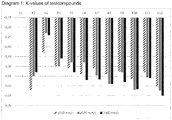
- Laser marking additive Co-absorbing additive TPU + MB resin + color K value 1000 mm/s 2000 mm/s 3000 mm/s K1 - - 100 % 0.10 0.10 0.10 K2 2 % Iriotec ® 8208 - 98 % -0.62 -0.55 -0.53 K3 1.2 % Sb 2 O 3 - 99 % -0.43 Campine ® Z -0.33 -0.34 K4 1 % Bi 2 O 3 - 99 % -0.50 Varistor Grade -0.50 -0.46 K5 0.99 % Bi 2 O 3 0.01 % Lasersafe ® 99 % 0.51 Varistor Grade 040 -0.48 -0.53 K6 0.96 % Bi 2 O 3 0.04 % Fabulase ® 330 99 % -0.54 Varistor Grade -0.48 -0.57 K7 1 % Bi 2 O 3 0.2 % Micro Mica ® 98.8 % -0.51 Varistor Grade -0.55 -0.5
- formulations K5 - K12 show an improvement in contrast and edge sharpness in comparison to formulation K4. This was proven by the higher K values relatively to the amount of bismuth oxide when marked alone and with the co-absorbant.
- Formulation K2 and K3 can be called as benchmark. With the same amount of active ingredient, the contrast is comparable or even better with lower costs and without the content of antimony.
- Mica when used as a co-absorbant, shows different performance in respect to the particle size.
Landscapes
- Chemical & Material Sciences (AREA)
- Organic Chemistry (AREA)
- Chemical Kinetics & Catalysis (AREA)
- Polymers & Plastics (AREA)
- Medicinal Chemistry (AREA)
- Health & Medical Sciences (AREA)
- Optics & Photonics (AREA)
- Physics & Mathematics (AREA)
- Life Sciences & Earth Sciences (AREA)
- Environmental Sciences (AREA)
- Inorganic Chemistry (AREA)
- Biodiversity & Conservation Biology (AREA)
- Animal Husbandry (AREA)
- Zoology (AREA)
- Birds (AREA)
- Dispersion Chemistry (AREA)
- Engineering & Computer Science (AREA)
- Ceramic Engineering (AREA)
- Compositions Of Macromolecular Compounds (AREA)
- Thermal Transfer Or Thermal Recording In General (AREA)
- Laser Beam Processing (AREA)
Description
- This invention relates to a laser-markable plastic composition which is free of antimony.
- In many plastics applications a marking of the manufactured end product is required. Whether is it food packaging, where shelf life or the producer has to be indicated, or electronic parts, where a type description or serial number has to be added. Today consumers as well as the industry want transparency and traceability all through the value chain, especially when sustainable sourcing and production are desired.
- When thermoplastics have to be marked, todays preferred technology is contact free laser marking. In difference to ink based pad printing, laser marking is solvent and contact free, imparts excellent flexibility and speed.
- For laser marking different types of materials and laser technologies are available.
- For the laser marking of plastics, a Nd:YAG system with a frequency of 1064 nm is commonly used, because it is cheap and flexible. However, not all plastics are coupling the laser with the same absorption capacity within the issued wavelength. Therefore, laser-marking additives are required to boost the markability of thermoplastics that are not inherently laser markable, such as, for example, polycarbonates. Polymers like polyolefines or thermoplastic urethanes need additional additives to deliver the right laser marking result in contrast and edge sharpness. Laser marking additives are normally incorporated into the polymer by diluting an additive or color concentrate (Masterbatch) in the polymer.
- In general, laser-marking additives work in two different modes of action: intrinsic and non-intrinsic working additives.
- Non-intrinsic additives absorb the energy of the laser and transfer it to the surrounding polymer matrix. Depending on the feedback of the polymer, the polymer can either carbonize, which normally leads to a brownish or greyish contrast on the surface of the polymer, or the polymer degrades to short length molecules and monomers that tend to vaporize at the surface and generate a foam. This results in bright marking caused by different refractive indices at the interface between the different solid phases. The laser marking can also be a result of both mechanisms.
- Intrinsic additives are working by changing its own chemical structure. For example, commonly used antimony trioxide Sb2O3 reduces to antimony Sb that has a dark color to provide a sufficient contrast of the marking. Intrinsic laser-marking additives should be dispersed inside the polymeric matrix with good homogeneity, so that the edge sharpness normally is better than when using non-intrinsic additives.
- However, there is a need to replace antimony trioxide as a laser-marking additive because of it is toxic profile. It is classified as dangerous for health and environment and has to be labelled as harmful to health according to Regulation (EC) No. 272/2008.
- An especially important aspect is the use of laser-marking additives for the marking of ear cattle tags. Today, antimony trioxide is the preferred additive for the marking of such products. However, antimony trioxide has a non-environmental friendly profile and is therefore a potential candidate to be substituted by other solutions that the marking is seeking for. Due to the lack of alternatives, antimony trioxide or antimony containing additives are still the majority of additives that are used for this purpose.
-
US-4,816,374 (Lecomte ) discloses the use of antimony oxide as a laser radiation opacifier substance in a polyurethane plastic material to satisfy French standard (number NF-T-54006) for abrasion in order to make and use ear tags for livestock animals. However, it is not preferred to use heavy metals such as antimony in thermoplastic compounds for healthy and safety reasons. Indeed, antimony is still being studied regarding health problems that it might induce in mammals. -
US-6,214,917 (Linzmeier et al. ) discloses thermoplastic polyurethanes as laser-markable plastics. The TPU's contain pigments having a coating of tin dioxide thereon, which coating is doped with 0.5 - 20 % by weight of antimony, arsenic, bismuth, copper, gallium, germanium, or a corresponding oxide thereof. -
EP-0697433 B1 describes the use of copper salts for the purpose of laser marking. It is well known that e.g. copper hydroxy phosphate has a high efficiency in high contrast laser marking. Nevertheless, for the application of ear cattle tags for example there is a limited utility because the copper hydroxy phosphate is able to react with animal faeces and cause a color change. -
EP-1190988 B1 claims the use of Bismuth containing compounds as a substitute of antimony trioxide for the purpose of a laser marking opacifier. However the effect is a lower performance in contrast compared to Sb2O3 and also more expensive. - In
DE-102014000359 A1 pigments based on bismuth compounds and the use thereof, preferably as a laser-absorbing additive, and a method for their preparation are claimed. However the manufacturing of such compounds is complex and expensive. To have a suitable replacement for antimony trioxide, the costs may not be much higher. - Therefore, a need exists to provide a low-cost, environmentally and toxicologically friendly laser-markable plastic, which is free from antimony, and which provides a good contrast after laser treatment.
- Surprisingly it was found that an addition of particular co-absorbing additives selected from the group consisting of platelet-shaped silicates to an intrinsic laser markable bismuth oxide can boost the laser marking result yielding a high contrast and edge sharpness, even though these added substances alone show no to little effect when used alone.
- Therefore, a subject of the invention is a laser-markable plastic comprising a thermoplastic polymer, bismuth oxide and a co-absorbing additive selected from the group consisting of platelet-shaped silicates, wherein the amount of bismuth oxide is in the range of from 0.5 to 5 wt.-%, relative to the total weight of the laser-markable plastic, and wherein the amount of the co-absorbing additive relative to the bismuth oxide is from 5 to 40 wt.-% and wherein the thermoplastic polymer is a thermoplastic polyurethane.
- Bismuth oxide used in the present invention is preferably Bi2O3. Bismuth oxide used as the intrinsic laser active material, can be of any particle size, for example a d50 of from 0.5 to 25 microns. However, it was found surprisingly that a technical grade particle size provides better contrast values delta L than fine grade or submicron grade material. Therefore, the preferred particle size d50 of bismuth oxide is from 0,5 to 20 microns, more preferably from 2 to 10 microns.
- The amount of bismuth oxide, relative to the total weight of the laser-markable plastic, is preferably from 0.5 to 5 wt.-%, more preferably 0.5 to 2.5 wt.-%, most preferably from 0.75 to 2 wt.-%.
- The co-absorbing additive is a platelet-shaped silicate, e.g. a phyllosilicate, for example selected from the group consisting of mica, talc, and kaolin.
- Preferred particle sizes d50 of the co-absorbing additives are from 1 to 20 microns, more preferably from 3 to 10 microns.
- Without being bound by any theory, it is suspected that the co-absorbing additive mainly functions to absorb the energy delivered by the laser system to provide more energy that can be absorbed by the bismuth oxide. Especially phyllosilicates that normally show no contrast in laser marking, have a boosting effect as co-absorbing additive when used together with bismuth oxide.
- Some laser marking additives, such as copper hydroxyl phosphate that have strong disadvantages when used alone, do not show this draw back when used in a combination with bismuth oxide and are improving the result of the color change of Bismuth oxide as well.
- Copper hydroxy phosphate when used alone in ear cattle tags may get in contact with animal excrements leading to strong discoloration due to the fact the additive reacts with such substance.
- Also the use of fine aluminum pigments is limited due to the strong grey color that it causes. Also in this case the laser marking effect of bismuth oxide is improved by using just a small amount of the aluminium that is not able to affect the color shade.
- A further subject of the present invention is a process for preparing a laser-markable plastic comprising the step of dispersing the bismuth oxide and the co-absorbing additive into the thermoplastic polymer, expediently via a melt-mixing process, preferably on a twin screw extruder. This can be done by direct compounding or by using an additive masterbatch as a predispersed concentrate.
- If a masterbatch is used, the resin can either be of the same thermoplastic polymer as the end polymer to be equipped or it can be a different polymeric carrier, a so-called multipurpose carrier. Such carrier will be dispersed into the end-polymer and can deliver additional benefits like an increased compatibility to the additive composition and herewith provide improved dispersibility. Other advantages of the use of some of these multipurpose carriers can be to improve mechanical properties in comparison to the additive filled polymer that has to be equipped. Furthermore, these polymers are able to achieve a higher concentration of the additive that can be loaded into the additive and be more cost effective as the polymer of the application itself. Examples for such resins are EVA (ethylene vinyl acetate) or EBA (Ethylene butyl acrylate).
- In addition to the aforementioned additives of the invention further customary additives can be added, like UV stabilizers, antioxidants, waxes, processing aids, and colorants, e.g. pigments, dyes, or both, to provide a specific color for a better contrast against the laser-marking.
- The laser-markable plastic according to the invention can be used for labelling of industrial and consumer products, e.g. by bar codes or serial numbers, and plastic marks for the individual tagging of animals, e.g. ear tags.
- Other applications are for example electric and electronic components that have to be marked with waste disposal recommendations, lot-numbers, certifications and other informations. Also markings for decorative purposes can be applied to any possible consumer good. The laser labelling of plastics is preferably carried out using Nd-YAG lasers which emit a pulsed energy beam having a characteristic wavelength of 1064 nm. The inscription with the laser is carried out by introducing the test specimen into the ray path of said laser.
-
Table 1: Materials: Bismuth oxide, Bi2O3 CAS No. 1304-76-3 "Varistor Grade" supplied by 5Nplus Particle size d50 = 3.7 µm "Varistor Grade Fine" supplied by 5Nplus Particle size d50 = 1.6 µm "Submicron Grade" (chemically oxidized) supplied by 5Nplus Particle size d50 = 0.7 mm "Technical Grade" supplied by 5Nplus Particle size d50 = 7 µm Mica "Micafill 115" supplied by Alpha Calcit CAS No. 12001-26-2 Particle size d50 = 5 µm "Micafill 125" supplied by Alpha Calcit Particle size d50 = 7 µm "Micafill 145" supplied by Alpha Calcit Particle size d50 = 12 µm "Micro Mica" sipplied by Omya Particle size d50 = 10 µm "Iriotec 8800" supplied by Merck Particle size d50 50 = 6 µm Copper Hydroxy Phosphate CAS No. 12158-74-6 / 235-285-2 Fabulase® 361 supplied by BUDENHEIM IBERICA, S.L. Soc. en Comandita Particle size d50 = 3.5 µm Ultrafine aluminia on a PE-carrier Lasersafe® 040 supplied by Eckart GmbH Iriotec™ 8208 Encapsulated antimony trioxide on a polyolefinic carrier Antimony trioxide Sb2O3 Campine® Z supplied by Campine CAS No. 1309-64-4 Particle size d50 = 8.0 - 13 µm TPU polymer Ellastollan® 1185 A supplied by BASF CAS No. 25750-84-9 Masterbatch resin EBA (Lucofin® 1400 MN supplied by Lucobit AG) CAS No. 9018-04-6 - Several formulations as listed in Table 2were prepared on a twin screw extruder "Leistritz ZSE 40" with a 27 mm screw diameter and an L/D ratio of 40 equipped with two gravimetric dosing systems and a side feeder was used. The so-called carrier resin was dosed via main feeder. The additive formulation that was premixed together with all other additives and antoxidants were dosed by using the side feeder. The strand coming from the die was cooled by a water bath and cut down to cylindrical shaped pellets by a strand pelletizer. All Masterbatches have been letdown together with 3 % of a yellow colorconcentrate and diluted with commercially available TPU Elastollan 11 85A.
- These so produced Masterbatches were diluted on a BOY 35 injection moulding machine to produce plaques made from thermoplastic urethane.
- These so manufactured injection molded plaques contain areas of the surface that are structured and firm. This is especially important for the application of identification tag for domestic livestock, to avoid deflections when BAR-code scanners are applied.
- To test the effect of laser marking of the different formulation, these so equipped injection molded plaques are applied to a laser marking system. For the mentioned trials a device was used by company Trumpf with a Nd:YAG marking laser with a 20 W laser source (TruMark 3020).
- To visualize the enhanced absorption of the thermoplastic compound, the plaque was marked with a so-called "test grid". Herewith you vary the main laser marking parameters like marking speed and pulse frequency. The result is a matrix where you can see the effect of these different parameters. This helps you to find the optimal setting for the laser and shows the robustness of the system. The more parts of this test-grid show a good contrast the less sensible your system is for changes of laser settings. To prove the applicability of the test the bars were also marked letters and numbers as well as a BAR code with specific laser parameters, similar to the application of ear cattle tags.
- To quantify the results numerical a filled circle was marked on 3 molded plaques each of the tested formulations. By using a spectrometer Datacolor SF600® PLUS-CT the brightness of the unmarked and the marked marked circle were marked and calculated to a delta L* value. The higher the negative delta L* value, the better is the marking contrast.
Table 2: Formulations of injection molded compounds for Delta L* values: MB No. Laser marking additive Co-absorbing additive TPU + MB resin + color Delta L* value 1 1 % Bi2O3 Varistor Grade 0.2 % Mica Micafill 145 98.8 % -37.0 2 2 % Iriotec 8208 - 98% -36.5 3 1 % Bi2O3 Technical Grade 0.2 % Mica Iriotec® 8800 98.8 % -33.1 4 1 % Bi2O3 Fine Grade 0.2 % Mica Iriotec® 8800 98.8 % -23.6 5 1 % Bi2O3 Submicron Grade 0.2 % Mica Iriotec® 8800 98.8 % -18.1 6 - - 100 % 0.06 ± 0.02 - It has been found, that above mentioned
formulation 1 shows an improvement in contrast and edge sharpness in comparison to formulation 2, which can be called as state of the art for lasermarking, especially in TPU. This is proven by the higher delta L* values relatively to the amount of bismuth oxide when marked with the co-absorbant. This leads to a reduction of the mentioned mixture to achieve the same performance as achieved with pure bismuth oxide and in most cases a reduction of costs and color influence of the additive formulation. - It can also be recognized that
formulation 1 and 3 performs better that formulation 4 and 5. This surprisingly leads to the conclusion that medium to bigger particle sized bismuth oxide absorbs the laser energy more efficient than smaller particle sizes. - Different trials using the same way of making test-specimens as mentioned above, were measured by using a ColorLite sph900 device. This device is able to measure a so-called K-value (Light contrast value). Like the Delta L* value, the result gives an indication about the quality of the marking but does also recognize light reflectance. The lower the value, the better is the marking contrast.
- The laser used for these trials was a Datalogic 50Hz with fiber technology. Three different measurements were performed using 3 different laser marking speeds (1000 mm/s, 2000 mm/s, 3000 mm/s).
Table 3: Formulations of injection molded compounds for K values: MB No. Laser marking additive Co-absorbing additive TPU + MB resin + color K value 1000 mm/s 2000 mm/s 3000 mm/s K1 - - 100 % 0.10 0.10 0.10 K2 2 % Iriotec® 8208 - 98 % -0.62 -0.55 -0.53 K3 1.2 % Sb2O3 - 99 % -0.43 Campine® Z -0.33 -0.34 K4 1 % Bi2O3 - 99 % -0.50 Varistor Grade -0.50 -0.46 K5 0.99 % Bi2O3 0.01 % Lasersafe® 99 % 0.51 Varistor Grade 040 -0.48 -0.53 K6 0.96 % Bi2O3 0.04 % Fabulase® 330 99 % -0.54 Varistor Grade -0.48 -0.57 K7 1 % Bi2O3 0.2 % Micro Mica® 98.8 % -0.51 Varistor Grade -0.55 -0.57 K8 2 % Bi2O3 0.4 % Micro Mica® 97.6 % -0.54 Varistor Grade -0.59 -0.59 K9 1 % Bi2O3 0.2 % Micafill® 125 98.8 % -0.52 Varistor Grade -0.53 -0.58 K10 2 % Bi2O3 0.4 % Micafill® 125 98.8 % -0.56 Varistor Grade -0.62 -0.62 K11 1 % Bi2O3 0.2 % Micafill® 145 98.8 % -0.53 Varistor Grade -0.56 -0.56 K12 2 % Bi2O3 0.4 % Micafill® 145 98.8 % -0.60 Varistor Grade -0.62 -0.65 - It has been found, that above mentioned formulations K5 - K12 show an improvement in contrast and edge sharpness in comparison to formulation K4. This was proven by the higher K values relatively to the amount of bismuth oxide when marked alone and with the co-absorbant. Formulation K2 and K3 can be called as benchmark. With the same amount of active ingredient, the contrast is comparable or even better with lower costs and without the content of antimony.
- It can also be recognized that Mica, when used as a co-absorbant, shows different performance in respect to the particle size.
Claims (8)
- A laser-markable plastic comprising a thermoplastic polymer, bismuth oxide and a co-absorbing additive selected from the group consisting of platelet-shaped silicates, wherein the amount of bismuth oxide is in the range of from 0.5 to 5 wt.-%, relative to the total weight of the laser-markable plastic, and wherein the amount of the co-absorbing additive relative to the bismuth oxide is from 5 to 40 wt.-% and wherein the thermoplastic polymer is a thermoplastic polyurethane.
- The laser-markable plastic according to claim 1, wherein the amount of the co-absorbing additive relative to the bismuth oxide is from 10 to 30 wt.-%.
- The laser-markable plastic according to any of the preceding claims, comprising from 0.5 to 2.5 wt.-% of bismuth oxide, relative to the total weight of the laser-markable plastic.
- The laser-markable plastic according to any of the preceding claims, wherein the platelet-shaped silicates are phyllosilicates.
- The laser-markable plastic according to any of the preceding claims, wherein the platelet-shaped silicates are selected from the group consisting of mica, talc, and kaolin.
- The laser-markable plastic according to any of the preceding claims, wherein the particle size d50 of the bismuth oxide is from 0.5 to 20 microns.
- A method for preparing the laser-markable plastic of any of claims 1 to 6 comprising the step of dispersing the bismuth oxide and the co-absorbing additive into the thermoplastic polymer in a melt-mixing process.
- Use of the laser-markable plastic of any of claims 1 to 6 for labelling of industrial and consumer products, and plastic marks for the individual tagging of animals.
Applications Claiming Priority (2)
| Application Number | Priority Date | Filing Date | Title |
|---|---|---|---|
| EP17156822.3A EP3363649A1 (en) | 2017-02-20 | 2017-02-20 | Antimony free composition for laser marking thermoplastic compounds |
| PCT/EP2018/054058 WO2018150033A1 (en) | 2017-02-20 | 2018-02-20 | Antimony free composition for laser marking thermoplastic compounds |
Publications (2)
| Publication Number | Publication Date |
|---|---|
| EP3583163A1 EP3583163A1 (en) | 2019-12-25 |
| EP3583163B1 true EP3583163B1 (en) | 2021-12-29 |
Family
ID=58108446
Family Applications (2)
| Application Number | Title | Priority Date | Filing Date |
|---|---|---|---|
| EP17156822.3A Withdrawn EP3363649A1 (en) | 2017-02-20 | 2017-02-20 | Antimony free composition for laser marking thermoplastic compounds |
| EP18705155.2A Active EP3583163B1 (en) | 2017-02-20 | 2018-02-20 | Antimony free composition for laser marking thermoplastic compounds |
Family Applications Before (1)
| Application Number | Title | Priority Date | Filing Date |
|---|---|---|---|
| EP17156822.3A Withdrawn EP3363649A1 (en) | 2017-02-20 | 2017-02-20 | Antimony free composition for laser marking thermoplastic compounds |
Country Status (14)
| Country | Link |
|---|---|
| US (1) | US11780255B2 (en) |
| EP (2) | EP3363649A1 (en) |
| JP (1) | JP7219714B2 (en) |
| KR (1) | KR102501334B1 (en) |
| CN (1) | CN110337463B (en) |
| AR (1) | AR111056A1 (en) |
| AU (1) | AU2018222799B2 (en) |
| BR (1) | BR112019014947B1 (en) |
| ES (1) | ES2906152T3 (en) |
| MX (1) | MX2019009704A (en) |
| SG (1) | SG11201906568WA (en) |
| TW (1) | TWI774727B (en) |
| WO (1) | WO2018150033A1 (en) |
| ZA (1) | ZA201904574B (en) |
Families Citing this family (4)
| Publication number | Priority date | Publication date | Assignee | Title |
|---|---|---|---|---|
| EP4063444A1 (en) * | 2021-03-23 | 2022-09-28 | Covestro Deutschland AG | Tpu with copper as ir absorber and 3d printing process employing such a tpu |
| EP4116350A1 (en) * | 2021-07-07 | 2023-01-11 | Covestro Deutschland AG | Tpu with copper as ir absorber and 3d printing process employing a copper-containing thermoplastic polymer |
| WO2022200258A1 (en) * | 2021-03-23 | 2022-09-29 | Covestro Deutschland Ag | Tpu with copper as ir absorber and 3d printing process employing a copper-containing thermoplastic polymer |
| CN113667180B (en) * | 2021-09-09 | 2023-02-28 | 珠海市恒誉科技有限公司 | Laser marking auxiliary agent and preparation method thereof |
Family Cites Families (17)
| Publication number | Priority date | Publication date | Assignee | Title |
|---|---|---|---|---|
| FR2580233B1 (en) | 1985-04-12 | 1988-11-25 | Rhone Alpes Projets Plast | PROCESS FOR MAKING LASER-SENSITIVE PLASTIC MATERIAL AND ALLOWING IT TO BE LASER-MARKED, AND ARTICLE OBTAINED IN PARTICULAR FOR MARKING ANIMALS |
| RU2035055C1 (en) | 1991-05-20 | 1995-05-10 | Комарь Валентина Васильевна | Composition sensitive to ir laser radiation |
| DE4415802A1 (en) | 1994-05-05 | 1995-11-09 | Merck Patent Gmbh | Laser-markable plastics |
| US5489639A (en) | 1994-08-18 | 1996-02-06 | General Electric Company | Copper salts for laser marking of thermoplastic compositions |
| JPH10224041A (en) * | 1997-01-31 | 1998-08-21 | Nippon Carbide Ind Co Inc | Multilayer wiring board and method of manufacturing the same |
| US6503316B1 (en) | 2000-09-22 | 2003-01-07 | Dmc2 Degussa Metals Catalysts Cerdec Ag | Bismuth-containing laser markable compositions and methods of making and using same |
| DE10063105A1 (en) | 2000-12-18 | 2002-06-20 | Merck Patent Gmbh | Laser-markable plastics as well as their production and use |
| WO2006065611A1 (en) * | 2004-12-14 | 2006-06-22 | Polyone Corporation | Use of bismuth oxides for laser markings in thermoplastic polyurethane compounds |
| US8790769B2 (en) * | 2010-01-05 | 2014-07-29 | Basf Se | Transparent, laser-inscribable polyurethane |
| BR112012016658A2 (en) * | 2010-01-05 | 2018-05-15 | Basf Se | polyurethane, process for producing a preferably thermoplastic polyurethane and transparent polyurethanes, and use for producing identification markings. |
| EP2650225B1 (en) | 2010-12-06 | 2020-06-03 | Koa Glass Co., Ltd. | Method for manufacturing a decorative glass container |
| US9637651B2 (en) * | 2013-05-20 | 2017-05-02 | Tokan Material Technology Co., Ltd. | Bismuth oxide-based addictive for laser marking |
| JP6252073B2 (en) | 2013-09-27 | 2017-12-27 | 大日本印刷株式会社 | Laminated retort packaging material, packaging retort body using the same, and packaging retort laser printing body |
| DE102014000359A1 (en) | 2014-01-16 | 2015-07-30 | Merck Patent Gmbh | pigments |
| CN103951946A (en) * | 2014-02-25 | 2014-07-30 | 北京市化学工业研究院 | Preparation method of black halogen-free fire retardation polyester capable of being subjected to laser marking |
| CN103951945A (en) * | 2014-02-25 | 2014-07-30 | 北京市化学工业研究院 | Preparation method for laser-markable halogen-free fire retardation polyester having variable ground color |
| CN105330898B (en) * | 2015-12-08 | 2018-09-28 | 四川大学 | A kind of laser marking additives and the preparation method and application thereof |
-
2017
- 2017-02-20 EP EP17156822.3A patent/EP3363649A1/en not_active Withdrawn
-
2018
- 2018-01-30 TW TW107103242A patent/TWI774727B/en active
- 2018-02-19 AR ARP180100384A patent/AR111056A1/en active IP Right Grant
- 2018-02-20 AU AU2018222799A patent/AU2018222799B2/en active Active
- 2018-02-20 JP JP2019544040A patent/JP7219714B2/en active Active
- 2018-02-20 MX MX2019009704A patent/MX2019009704A/en unknown
- 2018-02-20 KR KR1020197027709A patent/KR102501334B1/en active Active
- 2018-02-20 BR BR112019014947-3A patent/BR112019014947B1/en active IP Right Grant
- 2018-02-20 US US16/486,854 patent/US11780255B2/en active Active
- 2018-02-20 ES ES18705155T patent/ES2906152T3/en active Active
- 2018-02-20 CN CN201880012274.9A patent/CN110337463B/en active Active
- 2018-02-20 SG SG11201906568WA patent/SG11201906568WA/en unknown
- 2018-02-20 WO PCT/EP2018/054058 patent/WO2018150033A1/en not_active Ceased
- 2018-02-20 EP EP18705155.2A patent/EP3583163B1/en active Active
-
2019
- 2019-07-12 ZA ZA2019/04574A patent/ZA201904574B/en unknown
Also Published As
| Publication number | Publication date |
|---|---|
| CA3051067A1 (en) | 2018-08-23 |
| BR112019014947A2 (en) | 2020-04-07 |
| RU2019129468A3 (en) | 2021-03-25 |
| ES2906152T3 (en) | 2022-04-13 |
| EP3363649A1 (en) | 2018-08-22 |
| AU2018222799B2 (en) | 2022-12-01 |
| TWI774727B (en) | 2022-08-21 |
| JP7219714B2 (en) | 2023-02-08 |
| JP2020508370A (en) | 2020-03-19 |
| KR102501334B1 (en) | 2023-02-21 |
| KR20190117020A (en) | 2019-10-15 |
| US20210129570A1 (en) | 2021-05-06 |
| EP3583163A1 (en) | 2019-12-25 |
| CN110337463A (en) | 2019-10-15 |
| AR111056A1 (en) | 2019-05-29 |
| BR112019014947B1 (en) | 2023-03-28 |
| CN110337463B (en) | 2022-07-01 |
| RU2019129468A (en) | 2021-03-22 |
| SG11201906568WA (en) | 2019-08-27 |
| ZA201904574B (en) | 2020-12-23 |
| TW201842073A (en) | 2018-12-01 |
| WO2018150033A1 (en) | 2018-08-23 |
| NZ755381A (en) | 2024-10-25 |
| US11780255B2 (en) | 2023-10-10 |
| AU2018222799A1 (en) | 2019-08-01 |
| MX2019009704A (en) | 2019-12-02 |
Similar Documents
| Publication | Publication Date | Title |
|---|---|---|
| US11780255B2 (en) | Antimony free composition for laser marking thermoplastic compounds | |
| KR102454337B1 (en) | Laser markable and laser-weldable polymer materials | |
| AU690993B2 (en) | Laser-markable plastics | |
| EP3157995B1 (en) | Microspheres | |
| CN109963702B (en) | Additives for laser-markable and laser-weldable polymer materials | |
| JP5752149B2 (en) | Laser additive | |
| CN101405146A (en) | Nanoparticulate metal boride composition and its use for identification-marking plastic parts | |
| EP3013468A1 (en) | Microspheres | |
| CN107849290A (en) | Can laser labelling polymer and coating | |
| US6482511B1 (en) | Laser markable monofilaments | |
| DE102014018586A1 (en) | Laser-markable and laser-weldable polymeric materials | |
| WO2006029677A1 (en) | Laser markable and laser weldable polymer materials | |
| CA3051067C (en) | Antimony free composition for laser marking thermoplastic compounds | |
| RU2772273C2 (en) | Antimony-free composition for laser marking of thermoplastic compounds | |
| US20170101523A1 (en) | Laser-markable and laser-weldable polymeric materials | |
| KR100697977B1 (en) | Thermoplastic resin composition capable of laser marking | |
| CN112119128B (en) | Laser additives and their use in polymer materials |
Legal Events
| Date | Code | Title | Description |
|---|---|---|---|
| STAA | Information on the status of an ep patent application or granted ep patent |
Free format text: STATUS: UNKNOWN |
|
| STAA | Information on the status of an ep patent application or granted ep patent |
Free format text: STATUS: THE INTERNATIONAL PUBLICATION HAS BEEN MADE |
|
| PUAI | Public reference made under article 153(3) epc to a published international application that has entered the european phase |
Free format text: ORIGINAL CODE: 0009012 |
|
| STAA | Information on the status of an ep patent application or granted ep patent |
Free format text: STATUS: REQUEST FOR EXAMINATION WAS MADE |
|
| 17P | Request for examination filed |
Effective date: 20190920 |
|
| AK | Designated contracting states |
Kind code of ref document: A1 Designated state(s): AL AT BE BG CH CY CZ DE DK EE ES FI FR GB GR HR HU IE IS IT LI LT LU LV MC MK MT NL NO PL PT RO RS SE SI SK SM TR |
|
| AX | Request for extension of the european patent |
Extension state: BA ME |
|
| DAV | Request for validation of the european patent (deleted) | ||
| DAX | Request for extension of the european patent (deleted) | ||
| GRAP | Despatch of communication of intention to grant a patent |
Free format text: ORIGINAL CODE: EPIDOSNIGR1 |
|
| STAA | Information on the status of an ep patent application or granted ep patent |
Free format text: STATUS: GRANT OF PATENT IS INTENDED |
|
| INTG | Intention to grant announced |
Effective date: 20210902 |
|
| RAP3 | Party data changed (applicant data changed or rights of an application transferred) |
Owner name: AVIENT SWITZERLAND GMBH |
|
| GRAS | Grant fee paid |
Free format text: ORIGINAL CODE: EPIDOSNIGR3 |
|
| GRAA | (expected) grant |
Free format text: ORIGINAL CODE: 0009210 |
|
| STAA | Information on the status of an ep patent application or granted ep patent |
Free format text: STATUS: THE PATENT HAS BEEN GRANTED |
|
| AK | Designated contracting states |
Kind code of ref document: B1 Designated state(s): AL AT BE BG CH CY CZ DE DK EE ES FI FR GB GR HR HU IE IS IT LI LT LU LV MC MK MT NL NO PL PT RO RS SE SI SK SM TR |
|
| REG | Reference to a national code |
Ref country code: GB Ref legal event code: FG4D |
|
| REG | Reference to a national code |
Ref country code: CH Ref legal event code: EP |
|
| REG | Reference to a national code |
Ref country code: AT Ref legal event code: REF Ref document number: 1458640 Country of ref document: AT Kind code of ref document: T Effective date: 20220115 |
|
| REG | Reference to a national code |
Ref country code: IE Ref legal event code: FG4D |
|
| REG | Reference to a national code |
Ref country code: DE Ref legal event code: R096 Ref document number: 602018028759 Country of ref document: DE |
|
| REG | Reference to a national code |
Ref country code: LT Ref legal event code: MG9D |
|
| REG | Reference to a national code |
Ref country code: ES Ref legal event code: FG2A Ref document number: 2906152 Country of ref document: ES Kind code of ref document: T3 Effective date: 20220413 |
|
| PG25 | Lapsed in a contracting state [announced via postgrant information from national office to epo] |
Ref country code: RS Free format text: LAPSE BECAUSE OF FAILURE TO SUBMIT A TRANSLATION OF THE DESCRIPTION OR TO PAY THE FEE WITHIN THE PRESCRIBED TIME-LIMIT Effective date: 20211229 Ref country code: LT Free format text: LAPSE BECAUSE OF FAILURE TO SUBMIT A TRANSLATION OF THE DESCRIPTION OR TO PAY THE FEE WITHIN THE PRESCRIBED TIME-LIMIT Effective date: 20211229 Ref country code: FI Free format text: LAPSE BECAUSE OF FAILURE TO SUBMIT A TRANSLATION OF THE DESCRIPTION OR TO PAY THE FEE WITHIN THE PRESCRIBED TIME-LIMIT Effective date: 20211229 Ref country code: BG Free format text: LAPSE BECAUSE OF FAILURE TO SUBMIT A TRANSLATION OF THE DESCRIPTION OR TO PAY THE FEE WITHIN THE PRESCRIBED TIME-LIMIT Effective date: 20220329 |
|
| REG | Reference to a national code |
Ref country code: NL Ref legal event code: MP Effective date: 20211229 |
|
| REG | Reference to a national code |
Ref country code: AT Ref legal event code: MK05 Ref document number: 1458640 Country of ref document: AT Kind code of ref document: T Effective date: 20211229 |
|
| PG25 | Lapsed in a contracting state [announced via postgrant information from national office to epo] |
Ref country code: SE Free format text: LAPSE BECAUSE OF FAILURE TO SUBMIT A TRANSLATION OF THE DESCRIPTION OR TO PAY THE FEE WITHIN THE PRESCRIBED TIME-LIMIT Effective date: 20211229 Ref country code: NO Free format text: LAPSE BECAUSE OF FAILURE TO SUBMIT A TRANSLATION OF THE DESCRIPTION OR TO PAY THE FEE WITHIN THE PRESCRIBED TIME-LIMIT Effective date: 20220329 Ref country code: LV Free format text: LAPSE BECAUSE OF FAILURE TO SUBMIT A TRANSLATION OF THE DESCRIPTION OR TO PAY THE FEE WITHIN THE PRESCRIBED TIME-LIMIT Effective date: 20211229 Ref country code: HR Free format text: LAPSE BECAUSE OF FAILURE TO SUBMIT A TRANSLATION OF THE DESCRIPTION OR TO PAY THE FEE WITHIN THE PRESCRIBED TIME-LIMIT Effective date: 20211229 Ref country code: GR Free format text: LAPSE BECAUSE OF FAILURE TO SUBMIT A TRANSLATION OF THE DESCRIPTION OR TO PAY THE FEE WITHIN THE PRESCRIBED TIME-LIMIT Effective date: 20220330 |
|
| PG25 | Lapsed in a contracting state [announced via postgrant information from national office to epo] |
Ref country code: NL Free format text: LAPSE BECAUSE OF FAILURE TO SUBMIT A TRANSLATION OF THE DESCRIPTION OR TO PAY THE FEE WITHIN THE PRESCRIBED TIME-LIMIT Effective date: 20211229 |
|
| PG25 | Lapsed in a contracting state [announced via postgrant information from national office to epo] |
Ref country code: SM Free format text: LAPSE BECAUSE OF FAILURE TO SUBMIT A TRANSLATION OF THE DESCRIPTION OR TO PAY THE FEE WITHIN THE PRESCRIBED TIME-LIMIT Effective date: 20211229 Ref country code: SK Free format text: LAPSE BECAUSE OF FAILURE TO SUBMIT A TRANSLATION OF THE DESCRIPTION OR TO PAY THE FEE WITHIN THE PRESCRIBED TIME-LIMIT Effective date: 20211229 Ref country code: RO Free format text: LAPSE BECAUSE OF FAILURE TO SUBMIT A TRANSLATION OF THE DESCRIPTION OR TO PAY THE FEE WITHIN THE PRESCRIBED TIME-LIMIT Effective date: 20211229 Ref country code: PT Free format text: LAPSE BECAUSE OF FAILURE TO SUBMIT A TRANSLATION OF THE DESCRIPTION OR TO PAY THE FEE WITHIN THE PRESCRIBED TIME-LIMIT Effective date: 20220429 Ref country code: EE Free format text: LAPSE BECAUSE OF FAILURE TO SUBMIT A TRANSLATION OF THE DESCRIPTION OR TO PAY THE FEE WITHIN THE PRESCRIBED TIME-LIMIT Effective date: 20211229 Ref country code: CZ Free format text: LAPSE BECAUSE OF FAILURE TO SUBMIT A TRANSLATION OF THE DESCRIPTION OR TO PAY THE FEE WITHIN THE PRESCRIBED TIME-LIMIT Effective date: 20211229 |
|
| PG25 | Lapsed in a contracting state [announced via postgrant information from national office to epo] |
Ref country code: PL Free format text: LAPSE BECAUSE OF FAILURE TO SUBMIT A TRANSLATION OF THE DESCRIPTION OR TO PAY THE FEE WITHIN THE PRESCRIBED TIME-LIMIT Effective date: 20211229 Ref country code: AT Free format text: LAPSE BECAUSE OF FAILURE TO SUBMIT A TRANSLATION OF THE DESCRIPTION OR TO PAY THE FEE WITHIN THE PRESCRIBED TIME-LIMIT Effective date: 20211229 |
|
| PG25 | Lapsed in a contracting state [announced via postgrant information from national office to epo] |
Ref country code: MC Free format text: LAPSE BECAUSE OF FAILURE TO SUBMIT A TRANSLATION OF THE DESCRIPTION OR TO PAY THE FEE WITHIN THE PRESCRIBED TIME-LIMIT Effective date: 20211229 Ref country code: IS Free format text: LAPSE BECAUSE OF FAILURE TO SUBMIT A TRANSLATION OF THE DESCRIPTION OR TO PAY THE FEE WITHIN THE PRESCRIBED TIME-LIMIT Effective date: 20220429 |
|
| REG | Reference to a national code |
Ref country code: DE Ref legal event code: R097 Ref document number: 602018028759 Country of ref document: DE |
|
| REG | Reference to a national code |
Ref country code: CH Ref legal event code: PL |
|
| REG | Reference to a national code |
Ref country code: BE Ref legal event code: MM Effective date: 20220228 |
|
| PG25 | Lapsed in a contracting state [announced via postgrant information from national office to epo] |
Ref country code: LU Free format text: LAPSE BECAUSE OF NON-PAYMENT OF DUE FEES Effective date: 20220220 Ref country code: DK Free format text: LAPSE BECAUSE OF FAILURE TO SUBMIT A TRANSLATION OF THE DESCRIPTION OR TO PAY THE FEE WITHIN THE PRESCRIBED TIME-LIMIT Effective date: 20211229 Ref country code: AL Free format text: LAPSE BECAUSE OF FAILURE TO SUBMIT A TRANSLATION OF THE DESCRIPTION OR TO PAY THE FEE WITHIN THE PRESCRIBED TIME-LIMIT Effective date: 20211229 |
|
| PLBE | No opposition filed within time limit |
Free format text: ORIGINAL CODE: 0009261 |
|
| STAA | Information on the status of an ep patent application or granted ep patent |
Free format text: STATUS: NO OPPOSITION FILED WITHIN TIME LIMIT |
|
| 26N | No opposition filed |
Effective date: 20220930 |
|
| PG25 | Lapsed in a contracting state [announced via postgrant information from national office to epo] |
Ref country code: LI Free format text: LAPSE BECAUSE OF NON-PAYMENT OF DUE FEES Effective date: 20220228 Ref country code: IE Free format text: LAPSE BECAUSE OF NON-PAYMENT OF DUE FEES Effective date: 20220220 Ref country code: CH Free format text: LAPSE BECAUSE OF NON-PAYMENT OF DUE FEES Effective date: 20220228 |
|
| PG25 | Lapsed in a contracting state [announced via postgrant information from national office to epo] |
Ref country code: SI Free format text: LAPSE BECAUSE OF FAILURE TO SUBMIT A TRANSLATION OF THE DESCRIPTION OR TO PAY THE FEE WITHIN THE PRESCRIBED TIME-LIMIT Effective date: 20211229 Ref country code: BE Free format text: LAPSE BECAUSE OF NON-PAYMENT OF DUE FEES Effective date: 20220228 |
|
| P01 | Opt-out of the competence of the unified patent court (upc) registered |
Effective date: 20230523 |
|
| PG25 | Lapsed in a contracting state [announced via postgrant information from national office to epo] |
Ref country code: MK Free format text: LAPSE BECAUSE OF FAILURE TO SUBMIT A TRANSLATION OF THE DESCRIPTION OR TO PAY THE FEE WITHIN THE PRESCRIBED TIME-LIMIT Effective date: 20211229 Ref country code: CY Free format text: LAPSE BECAUSE OF FAILURE TO SUBMIT A TRANSLATION OF THE DESCRIPTION OR TO PAY THE FEE WITHIN THE PRESCRIBED TIME-LIMIT Effective date: 20211229 |
|
| PG25 | Lapsed in a contracting state [announced via postgrant information from national office to epo] |
Ref country code: HU Free format text: LAPSE BECAUSE OF FAILURE TO SUBMIT A TRANSLATION OF THE DESCRIPTION OR TO PAY THE FEE WITHIN THE PRESCRIBED TIME-LIMIT; INVALID AB INITIO Effective date: 20180220 |
|
| PG25 | Lapsed in a contracting state [announced via postgrant information from national office to epo] |
Ref country code: MT Free format text: LAPSE BECAUSE OF FAILURE TO SUBMIT A TRANSLATION OF THE DESCRIPTION OR TO PAY THE FEE WITHIN THE PRESCRIBED TIME-LIMIT Effective date: 20211229 |
|
| PGFP | Annual fee paid to national office [announced via postgrant information from national office to epo] |
Ref country code: TR Payment date: 20250203 Year of fee payment: 8 |
|
| PGFP | Annual fee paid to national office [announced via postgrant information from national office to epo] |
Ref country code: GB Payment date: 20260223 Year of fee payment: 9 |
|
| PGFP | Annual fee paid to national office [announced via postgrant information from national office to epo] |
Ref country code: ES Payment date: 20260317 Year of fee payment: 9 |
|
| PGFP | Annual fee paid to national office [announced via postgrant information from national office to epo] |
Ref country code: DE Payment date: 20260220 Year of fee payment: 9 |
|
| PGFP | Annual fee paid to national office [announced via postgrant information from national office to epo] |
Ref country code: IT Payment date: 20260220 Year of fee payment: 9 |
|
| PGFP | Annual fee paid to national office [announced via postgrant information from national office to epo] |
Ref country code: FR Payment date: 20260227 Year of fee payment: 9 |