EP3578370B1 - Aqueous ink composition comprising polyisoprene, process and printing process - Google Patents
Aqueous ink composition comprising polyisoprene, process and printing process Download PDFInfo
- Publication number
- EP3578370B1 EP3578370B1 EP19177754.9A EP19177754A EP3578370B1 EP 3578370 B1 EP3578370 B1 EP 3578370B1 EP 19177754 A EP19177754 A EP 19177754A EP 3578370 B1 EP3578370 B1 EP 3578370B1
- Authority
- EP
- European Patent Office
- Prior art keywords
- ink
- ink composition
- sulfonated polyester
- carbon atoms
- viscosity
- Prior art date
- Legal status (The legal status is an assumption and is not a legal conclusion. Google has not performed a legal analysis and makes no representation as to the accuracy of the status listed.)
- Active
Links
Images
Classifications
-
- B—PERFORMING OPERATIONS; TRANSPORTING
- B41—PRINTING; LINING MACHINES; TYPEWRITERS; STAMPS
- B41M—PRINTING, DUPLICATING, MARKING, OR COPYING PROCESSES; COLOUR PRINTING
- B41M1/00—Inking and printing with a printer's forme
- B41M1/06—Lithographic printing
-
- B—PERFORMING OPERATIONS; TRANSPORTING
- B41—PRINTING; LINING MACHINES; TYPEWRITERS; STAMPS
- B41C—PROCESSES FOR THE MANUFACTURE OR REPRODUCTION OF PRINTING SURFACES
- B41C1/00—Forme preparation
- B41C1/10—Forme preparation for lithographic printing; Master sheets for transferring a lithographic image to the forme
- B41C1/1008—Forme preparation for lithographic printing; Master sheets for transferring a lithographic image to the forme by removal or destruction of lithographic material on the lithographic support, e.g. by laser or spark ablation; by the use of materials rendered soluble or insoluble by heat exposure, e.g. by heat produced from a light to heat transforming system; by on-the-press exposure or on-the-press development, e.g. by the fountain of photolithographic materials
- B41C1/1033—Forme preparation for lithographic printing; Master sheets for transferring a lithographic image to the forme by removal or destruction of lithographic material on the lithographic support, e.g. by laser or spark ablation; by the use of materials rendered soluble or insoluble by heat exposure, e.g. by heat produced from a light to heat transforming system; by on-the-press exposure or on-the-press development, e.g. by the fountain of photolithographic materials by laser or spark ablation
-
- B—PERFORMING OPERATIONS; TRANSPORTING
- B41—PRINTING; LINING MACHINES; TYPEWRITERS; STAMPS
- B41J—TYPEWRITERS; SELECTIVE PRINTING MECHANISMS, i.e. MECHANISMS PRINTING OTHERWISE THAN FROM A FORME; CORRECTION OF TYPOGRAPHICAL ERRORS
- B41J2/00—Typewriters or selective printing mechanisms characterised by the printing or marking process for which they are designed
- B41J2/005—Typewriters or selective printing mechanisms characterised by the printing or marking process for which they are designed characterised by bringing liquid or particles selectively into contact with a printing material
- B41J2/0057—Typewriters or selective printing mechanisms characterised by the printing or marking process for which they are designed characterised by bringing liquid or particles selectively into contact with a printing material where an intermediate transfer member receives the ink before transferring it on the printing material
-
- B—PERFORMING OPERATIONS; TRANSPORTING
- B41—PRINTING; LINING MACHINES; TYPEWRITERS; STAMPS
- B41M—PRINTING, DUPLICATING, MARKING, OR COPYING PROCESSES; COLOUR PRINTING
- B41M5/00—Duplicating or marking methods; Sheet materials for use therein
- B41M5/0023—Digital printing methods characterised by the inks used
-
- B—PERFORMING OPERATIONS; TRANSPORTING
- B41—PRINTING; LINING MACHINES; TYPEWRITERS; STAMPS
- B41M—PRINTING, DUPLICATING, MARKING, OR COPYING PROCESSES; COLOUR PRINTING
- B41M5/00—Duplicating or marking methods; Sheet materials for use therein
- B41M5/025—Duplicating or marking methods; Sheet materials for use therein by transferring ink from the master sheet
-
- B—PERFORMING OPERATIONS; TRANSPORTING
- B41—PRINTING; LINING MACHINES; TYPEWRITERS; STAMPS
- B41M—PRINTING, DUPLICATING, MARKING, OR COPYING PROCESSES; COLOUR PRINTING
- B41M5/00—Duplicating or marking methods; Sheet materials for use therein
- B41M5/26—Thermography ; Marking by high energetic means, e.g. laser otherwise than by burning, and characterised by the material used
- B41M5/382—Contact thermal transfer or sublimation processes
-
- C—CHEMISTRY; METALLURGY
- C09—DYES; PAINTS; POLISHES; NATURAL RESINS; ADHESIVES; COMPOSITIONS NOT OTHERWISE PROVIDED FOR; APPLICATIONS OF MATERIALS NOT OTHERWISE PROVIDED FOR
- C09D—COATING COMPOSITIONS, e.g. PAINTS, VARNISHES OR LACQUERS; FILLING PASTES; CHEMICAL PAINT OR INK REMOVERS; INKS; CORRECTING FLUIDS; WOODSTAINS; PASTES OR SOLIDS FOR COLOURING OR PRINTING; USE OF MATERIALS THEREFOR
- C09D11/00—Inks
- C09D11/02—Printing inks
- C09D11/03—Printing inks characterised by features other than the chemical nature of the binder
-
- C—CHEMISTRY; METALLURGY
- C09—DYES; PAINTS; POLISHES; NATURAL RESINS; ADHESIVES; COMPOSITIONS NOT OTHERWISE PROVIDED FOR; APPLICATIONS OF MATERIALS NOT OTHERWISE PROVIDED FOR
- C09D—COATING COMPOSITIONS, e.g. PAINTS, VARNISHES OR LACQUERS; FILLING PASTES; CHEMICAL PAINT OR INK REMOVERS; INKS; CORRECTING FLUIDS; WOODSTAINS; PASTES OR SOLIDS FOR COLOURING OR PRINTING; USE OF MATERIALS THEREFOR
- C09D11/00—Inks
- C09D11/02—Printing inks
- C09D11/10—Printing inks based on artificial resins
- C09D11/102—Printing inks based on artificial resins containing macromolecular compounds obtained by reactions other than those only involving unsaturated carbon-to-carbon bonds
- C09D11/104—Polyesters
-
- C—CHEMISTRY; METALLURGY
- C09—DYES; PAINTS; POLISHES; NATURAL RESINS; ADHESIVES; COMPOSITIONS NOT OTHERWISE PROVIDED FOR; APPLICATIONS OF MATERIALS NOT OTHERWISE PROVIDED FOR
- C09D—COATING COMPOSITIONS, e.g. PAINTS, VARNISHES OR LACQUERS; FILLING PASTES; CHEMICAL PAINT OR INK REMOVERS; INKS; CORRECTING FLUIDS; WOODSTAINS; PASTES OR SOLIDS FOR COLOURING OR PRINTING; USE OF MATERIALS THEREFOR
- C09D11/00—Inks
- C09D11/02—Printing inks
- C09D11/10—Printing inks based on artificial resins
- C09D11/106—Printing inks based on artificial resins containing macromolecular compounds obtained by reactions only involving carbon-to-carbon unsaturated bonds
-
- C—CHEMISTRY; METALLURGY
- C09—DYES; PAINTS; POLISHES; NATURAL RESINS; ADHESIVES; COMPOSITIONS NOT OTHERWISE PROVIDED FOR; APPLICATIONS OF MATERIALS NOT OTHERWISE PROVIDED FOR
- C09D—COATING COMPOSITIONS, e.g. PAINTS, VARNISHES OR LACQUERS; FILLING PASTES; CHEMICAL PAINT OR INK REMOVERS; INKS; CORRECTING FLUIDS; WOODSTAINS; PASTES OR SOLIDS FOR COLOURING OR PRINTING; USE OF MATERIALS THEREFOR
- C09D11/00—Inks
- C09D11/02—Printing inks
- C09D11/03—Printing inks characterised by features other than the chemical nature of the binder
- C09D11/033—Printing inks characterised by features other than the chemical nature of the binder characterised by the solvent
-
- C—CHEMISTRY; METALLURGY
- C09—DYES; PAINTS; POLISHES; NATURAL RESINS; ADHESIVES; COMPOSITIONS NOT OTHERWISE PROVIDED FOR; APPLICATIONS OF MATERIALS NOT OTHERWISE PROVIDED FOR
- C09D—COATING COMPOSITIONS, e.g. PAINTS, VARNISHES OR LACQUERS; FILLING PASTES; CHEMICAL PAINT OR INK REMOVERS; INKS; CORRECTING FLUIDS; WOODSTAINS; PASTES OR SOLIDS FOR COLOURING OR PRINTING; USE OF MATERIALS THEREFOR
- C09D11/00—Inks
- C09D11/02—Printing inks
- C09D11/03—Printing inks characterised by features other than the chemical nature of the binder
- C09D11/037—Printing inks characterised by features other than the chemical nature of the binder characterised by the pigment
Definitions
- a process of digital offset printing comprising applying an ink composition onto a re-imageable imaging member surface at an ink take up temperature, the re-imageable imaging member having dampening fluid disposed thereon; forming an ink image; transferring the ink image from the re-imageable surface of the imaging member to a printable substrate at an ink transfer temperature; wherein the ink composition comprises water; an optional co-solvent; an optional colorant; a sulfonated polyester; and an isoprene rubber.
- the ink composition has a first viscosity of from about 3,000 to about 90,000 millipascal seconds at an ink take up temperature of from 45 °C to 80 °C; and a second viscosity of from 100,000 to 2,000,000 millipascal seconds at an ink transfer temperature of from 18 °C to 30 °C.
- Typical lithographic and offset printing techniques utilize plates that are permanently patterned, and are, therefore, useful only when printing a large number of copies of the same image, such as magazines, newspapers, and the like.
- Variable data digital lithography or digital offset lithographic printing has been developed as a system that uses a non-patterned re-imageable surface, which is initially uniformly coated with a dampening fluid layer. Regions of the dampening fluid are removed by exposure to a focused radiation source (e.g., a laser light source) to form pockets. A temporary pattern in the dampening fluid is thereby formed over the non-patterned re-imageable surface. Ink applied thereover is retained in the pockets formed by the removal of the dampening fluid.
- a focused radiation source e.g., a laser light source
- the inked surface is then brought into contact with a substrate, such as paper, plastic or metal and the ink transfers from the pockets in the dampening fluid layer to the substrate.
- the dampening fluid may then be removed, a new uniform layer of dampening fluid applied to the re-imageable surface, and the process repeated.
- Digital offset printing systems use offset-type inks that are specifically designed and optimized to be compatible with the materials the ink is in contact with, including the re-imageable surface and the dampening solution as well as with the various subsystems used during the printing process to enable high quality digital printing at high speed.
- an inker subsystem may be used to apply a uniform layer of ink over the layer of dampening fluid.
- the inker subsystem may use an anilox roller to meter the ink onto one or more ink forming rollers that are in contact with the re-imageable surface.
- the ink used with this subsystem should have a viscosity that is not so high that anilox-take up and delivery to the re-imageable surface is difficult.
- too low of a viscosity, tack and/or poor cohesion may result in the ink crawling out of the ink loader, resulting in unwanted spills, loss of ink and potential contamination of the printer.
- digital offset inks should have a certain range of viscosity, tack and tack stability to afford sufficient and predictable ink cohesion to enable good transfer properties in and among the various subsystems.
- an ink composition useful for digital offset printing applications includes a colorant and a high viscosity thickening agent.
- the ink is formulated to incorporate a gellant into the ink set to help meet the requirement of two different viscosity or temperature pairs at two different stages of the ink delivery process.
- lithography imaging a bulk ink is first transferred onto an anilox roll and then onto the imaging cylinder blanket. The first transfer from bulk ink to anilox roll requires the ink to have a low viscosity while the transfer from roll to imaging blanket requires a high viscosity.
- the addition of the gellant will increase the viscosity difference within the allowable temperature range thus increasing process latitude and robustness.
- U. S. Patent 9,822,267 describes in the Abstract thereof an ink composition useful for digital offset printing applications includes a colorant and a high viscosity thickening agent.
- the ink is formulated to incorporate polyester viscosity modifier to help meet the requirement of two different viscosity or temperature pairs at two different stages of the process.
- digital offset printing a bulk ink is first transferred onto an anilox roll, and then from the anilox roll onto the imaging cylinder blanket. During the bulk ink to anilox roll the disclosed ink has a low viscosity while the transfer from roll to imaging blanket the ink has a higher viscosity.
- the addition of the polyester viscosity modifier increases the viscosity difference within the allowable temperature range, thus, increasing process latitude and robustness.
- Digital offset printing architectures require offset type inks that are specifically designed and optimized to be compatible with the different subsystems, including ink delivery system and imaging system, that enable high quality printing at high speed with no residual.
- Digital offset printing inks differ from conventional inks because they must meet demanding rheological requirements imposed by the lithographic printing process while being compatible with system component materials and meeting the functional requirements of sub-system components, including wetting and transfer.
- Print process studies have demonstrated that higher viscosity is preferred for ink transfer to digital lithography imaging blanket from the inker unit via a roll and yet even higher viscosity is needed to improve transfer to a print substrate. Therefore, there remains a need for digital advanced lithography imaging inks to have increased viscosity latitude to enable excellent ink transfer from the ink loader system at both about 60°C and excellent ink delivery from the anilox roller to the fluorosilicone blanket at temperatures as low as about 20°C.
- an aqueous ink composition comprising water; an optional co-solvent; an optional colorant; a sulfonated polyester; and an isoprene rubber.
- the sulfonated polyester is a sodium sulfonated polyester and has a degree of sulfonation of at least 7.5 mol percent, and is of the formula: wherein R is an alkylene of from 2 to 25 carbon atoms; Ri is an alkylene of from 2 to 25 carbon atoms or an arylene of from 6 to 36 carbon atoms; and wherein x, y and z are from 10 to 100,000.
- Also described is a process of digital offset printing the process comprising applying an ink composition onto a re-imageable imaging member surface at an ink take up temperature, the re-imageable imaging member having dampening fluid disposed thereon; forming an ink image; transferring the ink image from the re-imageable surface of the imaging member to a printable substrate at an ink transfer temperature; wherein the ink composition comprises water; an optional co-solvent; an optional colorant; a sulfonated polyester; and an isoprene rubber.
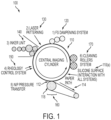
- an exemplary digital offset printing architecture is shown in FIG. 1 .
- an exemplary system 100 may include an imaging member 110.
- the imaging member 110 in the embodiment shown in FIG. 1 is a drum, but this exemplary depiction should not be interpreted so as to exclude embodiments wherein the imaging member 110 includes a plate or a belt, or another now known or later developed configuration.
- the re-imageable surface 110(a) may be formed of materials including, for example, a class of materials commonly referred to as silicones, including flurosilicone, among others.
- the re-imageable surface may be formed of a relatively thin layer over a mounting layer, a thickness of the relatively thin layer being selected to balance printing or marking performance, durability and manufacturability.
- the ink desirably possesses many physical and chemical properties.
- the ink is desirably compatible with materials it is in contact with, including printing plate, fountain solution, and other cured or non-cured inks. It also desirably meets functional requirements of the sub-systems, including wetting and transfer properties. Transfer of the imaged inks is challenging, as the ink desirably possesses the combination of wetting and transfer traits, that is, the ink desirably at once wetsthe blanket material homogeneously, and transfers from the blanket to the substrate. Transfer of the image layer is desirably efficient, desirably at least as high as 90%, as the cleaning sub-station can only eliminate small amounts of residual ink. Any ink remaining on the blanket after cleaning can result in an unacceptable ghost image appearing in subsequent prints.
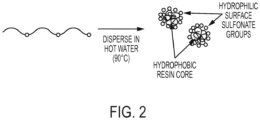
- the sulfonated polyester can be simultaneously synthesized during the self-assembly or dispersing of polymer in water as indicated in Figure 2 .
- the sulfonated polyester is dispersed in water, for example at a temperature of about 90 °C, providing a hydrophobic resin core and hydrophilic surface sulfonate groups.
- the sulfonated polyester resins disclosed herein have been selected to have a hydrophobic backbone while presenting hydrophilic sulfonate groups attached along the chain.
- the hydrophobic portions when placed in water and heated, the hydrophobic portions may interact with each other to form a hydrophobic core with the hydrophilic sulfonate groups facing the surrounding water resulting in the sulfonated polyester self-assembling into a higher order, spherical nanoparticle without the requirement of additional reagents, such as surfactants or dispersants, which are typically required to stabilize colloidal dispersions.
- the sulfonated polyester is a sodium sulfonated polyester having the structure
- amorphous alkali sulfonated polyester based resins include, but are not limited to, copoly(ethylene-terephthalate)-copoly-(ethylene-5-sulfoisophthalate), copoly(propylene-terephthalate)-copoly(propylene-5-sulfoisophthalate), copoly(diethylene-terephthalate)-copoly(diethylene-5-sulfoisophthalate), copoly(propylene-diethylene-terephthalate)-copoly(propylene-diethylene-5-sulfo-isophthalate), copoly(propylene-butylene-terephthalate)-copoly(propylene-butylene-5-sulfo-isophthalate), copoly(propoxylated bisphenol-A-fumarate)-copoly(propoxylated bisphenol A-5
- the organic diacid or diester are selected, for example, from about 45 to about 52 mole percent of the resin.
- diols utilized in generating the amorphous polyester include trimethylolpropane, 1,2-propanediol, 1,3-propanediol, 1,2-butanediol, 1,3-butanediol, 1,4-butanediol, pentanediol, hexanediol, 2,2-dimethylpropanediol, 2,2,3-trimethylhexanediol, heptanediol, dodecanediol, bis(hydroxyethyl)-bisphenol A, bis(2-hydroxypropyl)-bisphenol A, 1,4-cyclohexanedimethanol, 1,3-cyclohexanedimethanol, xylenedimethanol, cyclohexanediol, diethylene glycol, bis(2-hydroxyeth
- the sulfonated polyester comprises a polyol monomer unit selected from the group consisting of trimethylolpropane, 1,2-propanediol, diethylene glycol, and combinations thereof; and the sulfonated polyester comprises a diacid monomer unit selected from the group consisting of terephthalic acid, sulfonated isophthalic acid, and combinations thereof.
- Alkali sulfonated difunctional monomer examples wherein the alkali is lithium, sodium, or potassium, and in particular embodiments wherein the alkali is sodium, include dimethyl-5-sulfo-isophthalate, dialkyl-5-sulfo-isophthalate-4-sulfo-1,8-naphthalic anhydride, 4-sulfo-phthalic acid, 4-sulfophenyl-3,5-dicarbomethoxybenzene, 6-sulfo-2-naphthyl-3,5-dicarbomethoxybenzene, sulfo-terephthalic acid, dimethyl-sulfo-terephthalate, dialkyl-sulfo-terephthalate, sulfo-ethanediol, 2-sulfo-propanediol, 2-sulfo-butanediol, 3-sulfo-pentanediol, 2-sulfo-hexan
- Branching agents for use in forming the branched amorphous sulfonated polyester include, for example, a multivalent polyacid such as 1,2,4-benzenetricarboxylic acid, 1,2,4-cyclohexanetricarboxylic acid, 2,5,7-naphthalenetricarboxylic acid, 1,2,4-naphthalenetricarboxylic acid, 1,2,5-hexanetricarboxylic acid, 1,3-dicarboxyl-2-methyl-2-methylene-carboxylpropane, tetra(methylene-carboxyl)methane, and 1,2,7,8-octanetetracarboxylic acid, acid anhydrides thereof, and lower alkyl esters thereof, 1 to about 6 carbon atoms; a multivalent polyol such as sorbitol, 1,2,3,6-hexanetetrol, 1,4-sorbitane, pentaerythritol, dipentaerythritol
- Polycondensation catalyst examples for amorphous polyesters include tetraalkyl titanates, dialkyltin oxide such as dibutyltin oxide, tetraalkyltin such as dibutyltin dilaurate, dialkyltin oxide hydroxide such as butyltin oxide hydroxide, aluminum alkoxides, alkyl zinc, dialkyl zinc, zinc oxide, stannous oxide, or mixtures thereof; and which catalysts are selected in amounts of, for example, from about 0.01 mole percent to about 5 mole percent based on the starting diacid or diester used to generate the polyester resin.
- particles size will generally refer to D 50 mass-median-diameter (MMD) or the log-normal distribution mass median diameter.
- MMD mass-median-diameter
- the MMD is considered to be the average particle diameter by mass.
- the polyester has a particle size in a range of from about 5 nanometers (nm) to about 500 nm or from about 10 to about 200 nm, or from about 20 to about 100 nm.
- a particle size of less than 100 nm may be useful for reinforcement of polymer matrices without disturbing transparency and other properties of coatings.
- methods comprising heating a sulfonated polyester resin in water, thereby forming an emulsion of composite particles comprising a sulfonated polyester.
- heating is conducted at a temperature of from about 65 °C to about 90 °C.
- a method herein comprises heating a sulfonated polyester resin in water, in embodiments a sulfonated polyester resin, wherein the sodium sulfonated polyester has a degree of sulfonation of at least about 7.5 mol percent; and forming an emulsion of particles comprising the sulfonated polyester.
- the method further comprises combining the polyester particles with water, an optional colorant, an optional co-solvent, and an isoprene rubber to form an aqueous ink composition.
- the sulfonated polyester is a sodium sulfonated polyester and has a degree of sulfonation of at least 7.5 mol percent, and is of the formula: wherein R is an alkylene of from 2 to 25 carbon atoms; Ri is an alkylene of from 2 to 25 carbon atoms or an arylene of from 6 to 36 carbon atoms; and wherein x, y and z are from 10 to 100,000.
- the ink composition has a first viscosity of from about 3,000 to about 90,000 millipascal seconds at an ink take up temperature of from 45 °C to 80 °C; and a second viscosity of from 100,000 to 2,000,000 millipascal seconds at an ink transfer temperature of from 18 °C to 30 °C.
- the sulfonated polyester can be present in the ink composition in any suitable or desired amount. In embodiments, the sulfonated polyester is present in the ink composition in an amount of from about 30 to about 50 percent by weight based upon the total weight of the ink composition, or from about 35 to about 45 percent by weight based upon the total weight of the ink composition.
- the ink compositions comprise an isoprene rubber. Any suitable or desired isoprene rubber can be selected.
- the isoprene rubber can be provided in the form of a rubber latex emulsion.
- the isoprene rubber comprises cis-polyisoprene.
- the cis-configuration of the polyisoprene is believed to provide an elastic property to the ink composition which imparts increased cohesion to the ink.
- the isoprene rubber comprises cis-polyisoprene of the formula wherein n is from about 1,400 to about 15,000.
- n 1,467 to 14,669.
- the isoprene rubber comprises a copolymer comprising a member of the group consisting of styrene-butadiene, styrene-isoprene, isoprene, and combinations thereof.
- the isoprene rubber can be present in the ink composition in any suitable or desired amount.
- the isoprene rubber is present in the ink composition in an amount of from about 1.5 to about 6.5 percent, or from about 1.5 to about 6.6 percent, by weight based upon the total weight of the ink composition.
- the isoprene rubber is present in the ink composition in an amount of from about 1.5 to about 3 percent by weight based upon the total weight of the ink composition.
- the ink can be used in any suitable or desired printing application.
- the ink herein is particularly useful for indirect printing applications wherein the ink wets the intermediate receiving member enabling formation of a transient image on the intermediate receiving followed by release from the intermediate receiving member in the transfer printing step.
- the ink undergoes partial or complete drying while on the intermediate transfer member.
- Ink compositions herein specifically suitable for indirect printing systems are also compatible with different printing subsystems including jetting and transfer subsystems, and enable high quality printing at high speed.
- ink compositions herein enable and perform well in both wetting and transfer subsystems, displaying both acceptable wettability characteristics in combination with acceptable release and transfer characteristics.
- the ink compositions herein can consist solely of water, or can comprise a mixture of water and a water soluble or water miscible component, referred to as a co-solvent, humectant, or the like (hereinafter co-solvent) such as alcohols and alcohol derivatives, including aliphatic alcohols, aromatic alcohols, dials, glycol ethers, polyglycol ethers, long chain alcohols, primary aliphatic alcohols, secondary aliphatic alcohols, 1,2-alcohols, 1,3-alcohols, 1,5-alcohols, ethylene glycol alkyl ethers, propylene glycol alkyl ethers, methoxylated glycerol, ethoxylated glycerol, higher homologues of polyethylene glycol alkyl ethers, and the like, with specific examples including ethylene glycol, propylene glycol, diethylene glycols, glycerine, dipropylene glycols, polyethylene glycols, polyprop
- the water to organic co-solvent ratio ranges can be any suitable or desired ratio, in embodiments from about 100:0 to about 30:70, or from about 97:3 to about 40:60, or from about 95:5 to about 60:40.
- the non-water component of the liquid vehicle generally serves as a humectant or co-solvent which has a boiling point higher than that of water (100 °C).
- the co-solvent selected is one that will mix with water without phase separation; thus, a co-solvent having a polarity that is compatible with water is selected.
- the organic component of the ink vehicle can also serve to modify ink surface tension, modify ink viscosity, dissolve or disperse the colorant, and/or affect the drying characteristics of the ink.
- the ink is more attracted to paper substrates than plastic media as in solvent-based inks.
- the co-solvent is selected from the group consisting of sulfolane, methyl ethyl ketone, isopropanol, 2-pyrrolidinone, polyethylene glycol, and mixtures thereof.
- the total amount of liquid vehicle can be provided in any suitable or desired amount.
- the liquid vehicle is present in the ink composition in an amount of from about 75 to about 97 percent, or from about 80 to about 95 percent, or from about 85 to about 95 percent, by weight, based on the total weight of the ink composition.
- the ink composition herein may also contain a colorant.
- a colorant Any suitable or desired colorant can be used in embodiments herein, including pigments, dyes, dye dispersions, pigments dispersions, and mixtures and combinations thereof.
- any suitable or desired colorant can be selected in embodiments herein.
- the colorant can be a dye, a pigment, or a mixture thereof.
- suitable dyes include anionic dyes, cationic dyes, nonionic dyes, zwitterionic dyes, and the like.
- Specific examples of suitable dyes include Food dyes such as Food Black No. 1, Food Black No. 2, Food Red No. 40, Food Blue No.1, Food Yellow No.7, and the like, FD & C dyes, Acid Black dyes (No. 1, 7, 9, 24, 26, 48, 52, 58, 60, 61, 63, 92, 107, 109, 118, 119, 131, 140, 155, 156, 172, 194, and the like), Acid Red dyes (No.
- Acid Blue dyes No. 1, 7, 9, 25, 40, 45, 62, 78, 80, 92, 102, 104, 113, 117, 127, 158, 175, 183, 193,209, and the like
- Acid Yellow dyes No.3, 7, 17, 19, 23, 25, 29, 38, 42, 49, 59, 61, 72, 73, 114, 128, 151, and the like
- Direct Black dyes No.4, 14, 17, 22, 27, 38, 51,112,117,154,168, and the like
- Direct Blue dyes No.
- anthraquinone dyes monoazo dyes, disazo dyes, phthalocyanine derivatives, including various phthalocyanine sulfonate salts, aza(18)annulenes, formazan copper complexes, triphenodioxazines, and the like; as well as mixtures thereof.
- Carbon pigments suitable for use in the present system and method include, without limitation, carbon black, graphite, vitreous carbon, charcoal, and combinations thereof.
- Such carbon pigments can be manufactured by a variety of known methods, such as a channel method, a contact method, a furnace method, an acetylene method, or a thermal method, and are commercially available from such vendors as Cabot Corporation, Columbian Chemicals Company, Evonik, and E.I. DuPont de Nemours and Company.
- the colorant can be present in the ink composition in any desired or effective amount, in embodiments, the colorant can be present in an amount of from about 0.05 to about 15 percent, or from about 0.1 to about 10 percent, or from about 1 to about 5 percent by weight, based on the total weight of the ink composition.
- the inks disclosed may also contain a surfactant.
- suitable surfactants include ionic surfactants, anionic surfactants, cationic surfactants, nonionic surfactants, zwitterionic surfactants, and the like, as well as mixtures thereof.
- nonionic surfactants include polyacrylic acid, methalose, methyl cellulose, ethyl cellulose, propyl cellulose, hydroxy ethyl cellulose, carboxy methyl cellulose, polyoxyethylene cetyl ether, polyoxyethylene lauryl ether, polyoxyethylene octyl ether, polyoxyethylene octylphenyl ether, polyoxyethylene oleyl ether, polyoxyethylene sorbitan monolaurate, polyoxyethylene stearyl ether, polyoxyethylene nonylphenyl ether, dialkylphenoxy poly(ethyleneoxy) ethanol, available from Rhone-Poulenc as IGEPAL CA-210 TM IGEPAL CA-520 TM , IGEPAL CA-720 TM , IGEPAL CO- 890 TM , IGEPAL CO-720 TM , IGEPAL C0-290 TM , IGEPAL CA-210 TM , ANTAROX 890 TM , and ANTAROX 8
- anionic surfactants include DOWFAX TM 2A1, an alkyldiphenyloxide disulfonate from Dow Chemical Company, and/or TAYCA POWER BN2060 from Tayca Corporation (Japan), which are branched sodium dodecyl benzene sulfonates.
- Suitable cationic surfactants which are usually positively charged, include alkylbenzyl dimethyl ammonium chloride, dialkyl benzenealkyl ammonium chloride, lauryl trimethyl ammonium chloride, alkylbenzyl methyl ammonium chloride, alkyl benzyl dimethyl ammonium bromide, benzalkonium chloride, cetyl pyridinium bromide, C 12, C15, C17 trimethyl ammonium bromides, halide salts of quaternized polyoxyethylalkylamines, dodecylbenzyl triethyl ammonium chloride, MIRAPOL TM and ALKAQUAT TM , available from Alkaril Chemical Company, SANIZOL TM (benzalkonium chloride), available from Kao Chemicals, and the like, as well as mixtures thereof. Mixtures of any two or more surfactants can be used.
- the optional surfactant can be present in any desired or effective amount, in embodiments, the surfactant is present in an amount of from about 0.01 to about 5 percent by weight, based on the total weight of the ink composition. It should be noted that the surfactants are named as dispersants in some cases.
- the ink composition can further comprise additives.
- Optional additives that can be included in the ink compositions include biocides, fungicides, pH controlling agents such as acids or bases, phosphate salts, carboxylates salts, sulfite salts, amine salts, buffer solutions, and the like, sequestering agents such as EDTA (ethylenediamine tetra acetic acid), viscosity modifiers, leveling agents, and the like, as well as mixtures thereof.
- a process herein comprises combining a sulfonated polyester resin, water, an optional co-solvent, an optional colorant, and an isoprene rubber to form an aqueous ink composition.
- the sulfonated polyester is a sodium sulfonated polyester and has a degree of sulfonation of at least 7.5 mol percent, and is of the formula: wherein R is an alkylene of from 2 to 25 carbon atoms; Ri is an alkylene of from 2 to 25 carbon atoms or an arylene of from 6 to 36 carbon atoms; and wherein x, y and z are from 10 to 100,000.
- the ink composition has a first viscosity of from about 3,000 to about 90,000 millipascal seconds at an ink take up temperature of from 45 °C to 80 °C; and a second viscosity of from 100,000 to 2,000,000 millipascal seconds at an ink transfer temperature of from 18 °C to 30 °C.
- the inks are prepared as follows: 1) preparation of a sulfonated polyester; 2) preparation of a dispersion of a colorant optionally stabilized with a surfactant; 3) mixing of the sulfonated polyester with the colorant dispersion and an isoprene rubber; and 4) addition of other components such as water, co-solvents, and optional additives.
- the ink composition in accordance with the present disclosure is not limited to use in digital offset printing.
- the ink composition disclosed herein may also be useful in conventional offset printing or hybrid conventional offset and digital offset printing systems. Nonetheless, the ink compositions of the present disclosure meet systems requirements that are unique to digital offset printing systems.
- any suitable substrate, recording sheet, or removable support, stage, platform, and the like can be employed for depositing the ink compositions herein, including plain papers such as XEROX ® 4024 papers, XEROX ® Image Series papers, Courtland 4024 DP paper, ruled notebook paper, bond paper, silica coated papers such as Sharp Company silica coated paper, JuJo paper, HAMMERMILL LASERPRINT ® paper, and the like, glossy coated papers such as XEROX ® Digital Color Gloss, Sappi Warren Papers LUSTROGLOSS ® , and the like, transparency materials, fabrics, textile products, plastics, polymeric films, glass, glass plate, inorganic substrates such as metals and wood, as well as meltable or dissolvable substrates, such as waxes or salts, in the case of removable supports for free standing objects, and the like.
- plain papers such as XEROX ® 4024 papers, XEROX ® Image Series papers, Courtland 4024 DP paper
- the substrate is selected from the group consisting of paper, plastic, folded paperboard, Kraft paper, and metal.
- the substrate is a label.
- the label can be selected from any of the aforementioned types of substrate.
- the substrate comprises food packaging, medicinal packaging, and the like.
- the ink compositions herein form an undercoat.
- the substrate comprises a three-dimensional substrate.
- the substrate comprises medical devices such as catheters, thermometers, cardiac stents, programmable pace makers, other medical devices, menus, food packaging materials, cosmetic tools and products, and any other desired three-dimensional substrate.
- the substrate comprises customizable digitally printed ID codes, short-run printable materials three-dimensional medical and any other desired three-dimensional substrate.
- the mixture was then heated at a rate of 0.25 °C, until a temperature of 210 °C was attained, during which both methanol and excess 1,2-propanediol was collected in the distillation receiver. Vacuum was then applied gradually until 586.62 Pascals (4 .4 mm-Hg) was attained at 210 °C over a 1 hour period.
- the mixture was then re-pressurized to atmospheric pressure with nitrogen, and the content was discharged through the bottom drain into a container.
- the product was then allowed to cool to room temperature overnight, followed by granulation using a FitzMill ® .
- the product displayed an onset glass transition temperature of 55.4 °C, number average molecular weight of 1,326 grams/ mole, a weight average molecular weight of 2,350 grams/mole, and a softening point of 135.9 °C.
- waterborne digital offset ink compositions are provided, containing highly sulfonated (such as greater than 7.5% sulfonation) polyester and polyisoprene additive.
- the ink compositions include a waterborne rubber emulsion in a sulfonated polyester nanoparticle aqueous formulation.
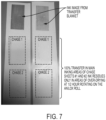
- the ink composition yield complete transfer rather than the usual splitting of lithographic ink.
- the inks are believed to be the first waterborne ink formulation demonstrating complete transfer from a digital offset blanket.
- the digital offset printing inks are free of (that is, do not contain) curable monomers, for example ultra-violet (UV) curable monomers.
- curable monomers for example ultra-violet (UV) curable monomers.
- UV curable monomers for example ultra-violet (UV) curable monomers.
- the ink compositions are suitable for many applications, and in particular for applications such as food and medical labels and packaging.
Landscapes
- Chemical & Material Sciences (AREA)
- Engineering & Computer Science (AREA)
- Organic Chemistry (AREA)
- Life Sciences & Earth Sciences (AREA)
- Materials Engineering (AREA)
- Wood Science & Technology (AREA)
- Chemical Kinetics & Catalysis (AREA)
- General Chemical & Material Sciences (AREA)
- Physics & Mathematics (AREA)
- Optics & Photonics (AREA)
- Thermal Sciences (AREA)
- Manufacturing & Machinery (AREA)
- Inks, Pencil-Leads, Or Crayons (AREA)
- Printing Methods (AREA)
Applications Claiming Priority (1)
| Application Number | Priority Date | Filing Date | Title |
|---|---|---|---|
| US15/997,746 US10907058B2 (en) | 2018-06-05 | 2018-06-05 | Aqueous ink composition comprising polyisoprene |
Publications (2)
| Publication Number | Publication Date |
|---|---|
| EP3578370A1 EP3578370A1 (en) | 2019-12-11 |
| EP3578370B1 true EP3578370B1 (en) | 2024-07-10 |
Family
ID=66866907
Family Applications (1)
| Application Number | Title | Priority Date | Filing Date |
|---|---|---|---|
| EP19177754.9A Active EP3578370B1 (en) | 2018-06-05 | 2019-05-31 | Aqueous ink composition comprising polyisoprene, process and printing process |
Country Status (7)
| Country | Link |
|---|---|
| US (1) | US10907058B2 (enExample) |
| EP (1) | EP3578370B1 (enExample) |
| JP (1) | JP2019210455A (enExample) |
| KR (1) | KR102483684B1 (enExample) |
| CN (1) | CN110564205B (enExample) |
| CA (1) | CA3044788C (enExample) |
| RU (1) | RU2019114125A (enExample) |
Families Citing this family (4)
| Publication number | Priority date | Publication date | Assignee | Title |
|---|---|---|---|---|
| JP7676860B2 (ja) * | 2021-03-22 | 2025-05-15 | セイコーエプソン株式会社 | インクジェットインク組成物、記録物の製造方法、記録物および記録装置 |
| JP7725930B2 (ja) * | 2021-08-12 | 2025-08-20 | セイコーエプソン株式会社 | インクジェット用組成物およびインクジェット記録方法 |
| EP4373893B1 (en) * | 2021-12-17 | 2025-08-13 | Sun Chemical B.V. | Thermally resistant aqueous inks |
| CN114806278B (zh) * | 2022-05-25 | 2023-04-21 | 胜宏科技(惠州)股份有限公司 | 一种耐碱性油墨、制备方法及应用 |
Family Cites Families (20)
| Publication number | Priority date | Publication date | Assignee | Title |
|---|---|---|---|---|
| JPS5688454A (en) * | 1979-12-21 | 1981-07-17 | Toyobo Co Ltd | Aqueous dispersion |
| US4990593A (en) * | 1988-10-14 | 1991-02-05 | Eastman Kodak Company | Water-dissipatable polyester resins and coatings prepared therefrom |
| US5684063A (en) * | 1996-06-17 | 1997-11-04 | Xerox Corporation | Ink process |
| US5958998A (en) * | 1998-02-05 | 1999-09-28 | Xerox Corporation | Ink jet inks |
| US20050192378A1 (en) | 2004-03-01 | 2005-09-01 | Yuh-Jye Uang | Printing ink composition and the method for printing |
| US7312011B2 (en) | 2005-01-19 | 2007-12-25 | Xerox Corporation | Super low melt and ultra low melt toners containing crystalline sulfonated polyester |
| US20120103212A1 (en) | 2010-10-29 | 2012-05-03 | Palo Alto Research Center Incorporated | Variable Data Lithography System |
| US9592699B2 (en) | 2011-04-27 | 2017-03-14 | Xerox Corporation | Dampening fluid for digital lithographic printing |
| DE102011052991B4 (de) | 2011-08-25 | 2013-12-24 | Gert Sieger | Verfahren zur Herstellung einer Druckform für den wasserlosen Offsetdruck |
| IN2014DN08032A (enExample) * | 2012-03-06 | 2015-05-01 | Oce Tech Bv | |
| US10308826B2 (en) * | 2013-02-06 | 2019-06-04 | Xerox Corporation | Stretchable ink composition |
| US9724909B2 (en) | 2013-12-23 | 2017-08-08 | Xerox Corporation | Methods for ink-based digital printing with high ink transfer efficiency |
| US9644105B2 (en) * | 2013-12-23 | 2017-05-09 | Xerox Corporation | Aqueous dispersible polymer inks |
| US9718970B2 (en) * | 2015-01-23 | 2017-08-01 | Xerox Corporation | Core-shell metal nanoparticle composite |
| US9617437B2 (en) * | 2015-05-07 | 2017-04-11 | Xerox Corporation | Anti-bacterial aqueous ink compositions comprising self-dispersed sulfonated polyester-silver nanoparticle composites |
| JP6718210B2 (ja) * | 2015-08-05 | 2020-07-08 | サカタインクス株式会社 | オフセット印刷用インキ組成物及びその製造方法、並びにオフセット印刷用インキ組成物調製用のゲル化ワニスの製造方法 |
| US10851251B2 (en) | 2015-11-03 | 2020-12-01 | Massachusetts Institute Of Technology | Block copolymer ink formulation for 3D printing and method of making a 3D printed radiofrequency (RF) device |
| US20180072899A1 (en) | 2016-09-12 | 2018-03-15 | Xerox Corporation | Phase-change digital advanced lithographic imaging inks with amide gellant transfer additives |
| US9822267B1 (en) | 2016-09-12 | 2017-11-21 | Xerox Corporation | Phase-change digital advanced lithographic imaging ink with polyester transfer additive |
| US20180105710A1 (en) * | 2016-10-14 | 2018-04-19 | Sensient Imaging Technologies | Aqueous inkjet ink compositions |
-
2018
- 2018-06-05 US US15/997,746 patent/US10907058B2/en active Active
-
2019
- 2019-05-08 RU RU2019114125A patent/RU2019114125A/ru unknown
- 2019-05-13 KR KR1020190055536A patent/KR102483684B1/ko active Active
- 2019-05-13 JP JP2019090415A patent/JP2019210455A/ja active Pending
- 2019-05-16 CN CN201910406585.XA patent/CN110564205B/zh active Active
- 2019-05-30 CA CA3044788A patent/CA3044788C/en active Active
- 2019-05-31 EP EP19177754.9A patent/EP3578370B1/en active Active
Also Published As
| Publication number | Publication date |
|---|---|
| KR102483684B1 (ko) | 2023-01-03 |
| KR20190138570A (ko) | 2019-12-13 |
| CA3044788C (en) | 2021-10-05 |
| JP2019210455A (ja) | 2019-12-12 |
| CN110564205B (zh) | 2022-11-25 |
| US10907058B2 (en) | 2021-02-02 |
| EP3578370A1 (en) | 2019-12-11 |
| RU2019114125A (ru) | 2020-11-09 |
| US20190367750A1 (en) | 2019-12-05 |
| CN110564205A (zh) | 2019-12-13 |
| CA3044788A1 (en) | 2019-12-05 |
Similar Documents
| Publication | Publication Date | Title |
|---|---|---|
| CA3044888C (en) | Aqueous ink composition comprising a polymer additive | |
| US10487228B2 (en) | Stretchable ink composition | |
| EP3578371B1 (en) | Waterborne clear ink compositions, process and printing process | |
| CA3044788C (en) | Aqueous ink composition comprising polyisoprene | |
| EP3851500A1 (en) | Ink composition and method of printing ink | |
| EP3578614B1 (en) | Sulfonated polyester ink | |
| EP3578372A1 (en) | Aqueous ink composition comprising polyurethane | |
| CA3044882C (en) | Ink composition comprising humectant blend |
Legal Events
| Date | Code | Title | Description |
|---|---|---|---|
| PUAI | Public reference made under article 153(3) epc to a published international application that has entered the european phase |
Free format text: ORIGINAL CODE: 0009012 |
|
| STAA | Information on the status of an ep patent application or granted ep patent |
Free format text: STATUS: THE APPLICATION HAS BEEN PUBLISHED |
|
| AK | Designated contracting states |
Kind code of ref document: A1 Designated state(s): AL AT BE BG CH CY CZ DE DK EE ES FI FR GB GR HR HU IE IS IT LI LT LU LV MC MK MT NL NO PL PT RO RS SE SI SK SM TR |
|
| AX | Request for extension of the european patent |
Extension state: BA ME |
|
| STAA | Information on the status of an ep patent application or granted ep patent |
Free format text: STATUS: REQUEST FOR EXAMINATION WAS MADE |
|
| 17P | Request for examination filed |
Effective date: 20200612 |
|
| RBV | Designated contracting states (corrected) |
Designated state(s): AL AT BE BG CH CY CZ DE DK EE ES FI FR GB GR HR HU IE IS IT LI LT LU LV MC MK MT NL NO PL PT RO RS SE SI SK SM TR |
|
| STAA | Information on the status of an ep patent application or granted ep patent |
Free format text: STATUS: EXAMINATION IS IN PROGRESS |
|
| 17Q | First examination report despatched |
Effective date: 20211221 |
|
| GRAP | Despatch of communication of intention to grant a patent |
Free format text: ORIGINAL CODE: EPIDOSNIGR1 |
|
| STAA | Information on the status of an ep patent application or granted ep patent |
Free format text: STATUS: GRANT OF PATENT IS INTENDED |
|
| INTG | Intention to grant announced |
Effective date: 20240108 |
|
| GRAS | Grant fee paid |
Free format text: ORIGINAL CODE: EPIDOSNIGR3 |
|
| GRAA | (expected) grant |
Free format text: ORIGINAL CODE: 0009210 |
|
| STAA | Information on the status of an ep patent application or granted ep patent |
Free format text: STATUS: THE PATENT HAS BEEN GRANTED |
|
| AK | Designated contracting states |
Kind code of ref document: B1 Designated state(s): AL AT BE BG CH CY CZ DE DK EE ES FI FR GB GR HR HU IE IS IT LI LT LU LV MC MK MT NL NO PL PT RO RS SE SI SK SM TR |
|
| REG | Reference to a national code |
Ref country code: CH Ref legal event code: EP |
|
| REG | Reference to a national code |
Ref country code: DE Ref legal event code: R096 Ref document number: 602019054881 Country of ref document: DE |
|
| REG | Reference to a national code |
Ref country code: LT Ref legal event code: MG9D |
|
| REG | Reference to a national code |
Ref country code: NL Ref legal event code: MP Effective date: 20240710 |
|
| PG25 | Lapsed in a contracting state [announced via postgrant information from national office to epo] |
Ref country code: PT Free format text: LAPSE BECAUSE OF FAILURE TO SUBMIT A TRANSLATION OF THE DESCRIPTION OR TO PAY THE FEE WITHIN THE PRESCRIBED TIME-LIMIT Effective date: 20241111 |
|
| REG | Reference to a national code |
Ref country code: AT Ref legal event code: MK05 Ref document number: 1701735 Country of ref document: AT Kind code of ref document: T Effective date: 20240710 |
|
| PG25 | Lapsed in a contracting state [announced via postgrant information from national office to epo] |
Ref country code: NL Free format text: LAPSE BECAUSE OF FAILURE TO SUBMIT A TRANSLATION OF THE DESCRIPTION OR TO PAY THE FEE WITHIN THE PRESCRIBED TIME-LIMIT Effective date: 20240710 |
|
| PG25 | Lapsed in a contracting state [announced via postgrant information from national office to epo] |
Ref country code: PT Free format text: LAPSE BECAUSE OF FAILURE TO SUBMIT A TRANSLATION OF THE DESCRIPTION OR TO PAY THE FEE WITHIN THE PRESCRIBED TIME-LIMIT Effective date: 20241111 Ref country code: NL Free format text: LAPSE BECAUSE OF FAILURE TO SUBMIT A TRANSLATION OF THE DESCRIPTION OR TO PAY THE FEE WITHIN THE PRESCRIBED TIME-LIMIT Effective date: 20240710 |
|
| PG25 | Lapsed in a contracting state [announced via postgrant information from national office to epo] |
Ref country code: NO Free format text: LAPSE BECAUSE OF FAILURE TO SUBMIT A TRANSLATION OF THE DESCRIPTION OR TO PAY THE FEE WITHIN THE PRESCRIBED TIME-LIMIT Effective date: 20241010 |
|
| PG25 | Lapsed in a contracting state [announced via postgrant information from national office to epo] |
Ref country code: PL Free format text: LAPSE BECAUSE OF FAILURE TO SUBMIT A TRANSLATION OF THE DESCRIPTION OR TO PAY THE FEE WITHIN THE PRESCRIBED TIME-LIMIT Effective date: 20240710 Ref country code: GR Free format text: LAPSE BECAUSE OF FAILURE TO SUBMIT A TRANSLATION OF THE DESCRIPTION OR TO PAY THE FEE WITHIN THE PRESCRIBED TIME-LIMIT Effective date: 20241011 Ref country code: FI Free format text: LAPSE BECAUSE OF FAILURE TO SUBMIT A TRANSLATION OF THE DESCRIPTION OR TO PAY THE FEE WITHIN THE PRESCRIBED TIME-LIMIT Effective date: 20240710 |
|
| PG25 | Lapsed in a contracting state [announced via postgrant information from national office to epo] |
Ref country code: BG Free format text: LAPSE BECAUSE OF FAILURE TO SUBMIT A TRANSLATION OF THE DESCRIPTION OR TO PAY THE FEE WITHIN THE PRESCRIBED TIME-LIMIT Effective date: 20240710 |
|
| PG25 | Lapsed in a contracting state [announced via postgrant information from national office to epo] |
Ref country code: LV Free format text: LAPSE BECAUSE OF FAILURE TO SUBMIT A TRANSLATION OF THE DESCRIPTION OR TO PAY THE FEE WITHIN THE PRESCRIBED TIME-LIMIT Effective date: 20240710 |
|
| PG25 | Lapsed in a contracting state [announced via postgrant information from national office to epo] |
Ref country code: AT Free format text: LAPSE BECAUSE OF FAILURE TO SUBMIT A TRANSLATION OF THE DESCRIPTION OR TO PAY THE FEE WITHIN THE PRESCRIBED TIME-LIMIT Effective date: 20240710 Ref country code: IS Free format text: LAPSE BECAUSE OF FAILURE TO SUBMIT A TRANSLATION OF THE DESCRIPTION OR TO PAY THE FEE WITHIN THE PRESCRIBED TIME-LIMIT Effective date: 20241110 |
|
| PG25 | Lapsed in a contracting state [announced via postgrant information from national office to epo] |
Ref country code: HR Free format text: LAPSE BECAUSE OF FAILURE TO SUBMIT A TRANSLATION OF THE DESCRIPTION OR TO PAY THE FEE WITHIN THE PRESCRIBED TIME-LIMIT Effective date: 20240710 |
|
| PG25 | Lapsed in a contracting state [announced via postgrant information from national office to epo] |
Ref country code: ES Free format text: LAPSE BECAUSE OF FAILURE TO SUBMIT A TRANSLATION OF THE DESCRIPTION OR TO PAY THE FEE WITHIN THE PRESCRIBED TIME-LIMIT Effective date: 20240710 Ref country code: RS Free format text: LAPSE BECAUSE OF FAILURE TO SUBMIT A TRANSLATION OF THE DESCRIPTION OR TO PAY THE FEE WITHIN THE PRESCRIBED TIME-LIMIT Effective date: 20241010 |
|
| PG25 | Lapsed in a contracting state [announced via postgrant information from national office to epo] |
Ref country code: RS Free format text: LAPSE BECAUSE OF FAILURE TO SUBMIT A TRANSLATION OF THE DESCRIPTION OR TO PAY THE FEE WITHIN THE PRESCRIBED TIME-LIMIT Effective date: 20241010 Ref country code: PL Free format text: LAPSE BECAUSE OF FAILURE TO SUBMIT A TRANSLATION OF THE DESCRIPTION OR TO PAY THE FEE WITHIN THE PRESCRIBED TIME-LIMIT Effective date: 20240710 Ref country code: NO Free format text: LAPSE BECAUSE OF FAILURE TO SUBMIT A TRANSLATION OF THE DESCRIPTION OR TO PAY THE FEE WITHIN THE PRESCRIBED TIME-LIMIT Effective date: 20241010 Ref country code: LV Free format text: LAPSE BECAUSE OF FAILURE TO SUBMIT A TRANSLATION OF THE DESCRIPTION OR TO PAY THE FEE WITHIN THE PRESCRIBED TIME-LIMIT Effective date: 20240710 Ref country code: IS Free format text: LAPSE BECAUSE OF FAILURE TO SUBMIT A TRANSLATION OF THE DESCRIPTION OR TO PAY THE FEE WITHIN THE PRESCRIBED TIME-LIMIT Effective date: 20241110 Ref country code: HR Free format text: LAPSE BECAUSE OF FAILURE TO SUBMIT A TRANSLATION OF THE DESCRIPTION OR TO PAY THE FEE WITHIN THE PRESCRIBED TIME-LIMIT Effective date: 20240710 Ref country code: GR Free format text: LAPSE BECAUSE OF FAILURE TO SUBMIT A TRANSLATION OF THE DESCRIPTION OR TO PAY THE FEE WITHIN THE PRESCRIBED TIME-LIMIT Effective date: 20241011 Ref country code: FI Free format text: LAPSE BECAUSE OF FAILURE TO SUBMIT A TRANSLATION OF THE DESCRIPTION OR TO PAY THE FEE WITHIN THE PRESCRIBED TIME-LIMIT Effective date: 20240710 Ref country code: ES Free format text: LAPSE BECAUSE OF FAILURE TO SUBMIT A TRANSLATION OF THE DESCRIPTION OR TO PAY THE FEE WITHIN THE PRESCRIBED TIME-LIMIT Effective date: 20240710 Ref country code: BG Free format text: LAPSE BECAUSE OF FAILURE TO SUBMIT A TRANSLATION OF THE DESCRIPTION OR TO PAY THE FEE WITHIN THE PRESCRIBED TIME-LIMIT Effective date: 20240710 Ref country code: AT Free format text: LAPSE BECAUSE OF FAILURE TO SUBMIT A TRANSLATION OF THE DESCRIPTION OR TO PAY THE FEE WITHIN THE PRESCRIBED TIME-LIMIT Effective date: 20240710 |
|
| REG | Reference to a national code |
Ref country code: DE Ref legal event code: R097 Ref document number: 602019054881 Country of ref document: DE |
|
| PG25 | Lapsed in a contracting state [announced via postgrant information from national office to epo] |
Ref country code: RO Free format text: LAPSE BECAUSE OF FAILURE TO SUBMIT A TRANSLATION OF THE DESCRIPTION OR TO PAY THE FEE WITHIN THE PRESCRIBED TIME-LIMIT Effective date: 20240710 Ref country code: SM Free format text: LAPSE BECAUSE OF FAILURE TO SUBMIT A TRANSLATION OF THE DESCRIPTION OR TO PAY THE FEE WITHIN THE PRESCRIBED TIME-LIMIT Effective date: 20240710 Ref country code: DK Free format text: LAPSE BECAUSE OF FAILURE TO SUBMIT A TRANSLATION OF THE DESCRIPTION OR TO PAY THE FEE WITHIN THE PRESCRIBED TIME-LIMIT Effective date: 20240710 |
|
| PG25 | Lapsed in a contracting state [announced via postgrant information from national office to epo] |
Ref country code: EE Free format text: LAPSE BECAUSE OF FAILURE TO SUBMIT A TRANSLATION OF THE DESCRIPTION OR TO PAY THE FEE WITHIN THE PRESCRIBED TIME-LIMIT Effective date: 20240710 |
|
| PG25 | Lapsed in a contracting state [announced via postgrant information from national office to epo] |
Ref country code: CZ Free format text: LAPSE BECAUSE OF FAILURE TO SUBMIT A TRANSLATION OF THE DESCRIPTION OR TO PAY THE FEE WITHIN THE PRESCRIBED TIME-LIMIT Effective date: 20240710 |
|
| PG25 | Lapsed in a contracting state [announced via postgrant information from national office to epo] |
Ref country code: IT Free format text: LAPSE BECAUSE OF FAILURE TO SUBMIT A TRANSLATION OF THE DESCRIPTION OR TO PAY THE FEE WITHIN THE PRESCRIBED TIME-LIMIT Effective date: 20240710 Ref country code: SK Free format text: LAPSE BECAUSE OF FAILURE TO SUBMIT A TRANSLATION OF THE DESCRIPTION OR TO PAY THE FEE WITHIN THE PRESCRIBED TIME-LIMIT Effective date: 20240710 |
|
| PLBE | No opposition filed within time limit |
Free format text: ORIGINAL CODE: 0009261 |
|
| STAA | Information on the status of an ep patent application or granted ep patent |
Free format text: STATUS: NO OPPOSITION FILED WITHIN TIME LIMIT |
|
| 26N | No opposition filed |
Effective date: 20250411 |
|
| PG25 | Lapsed in a contracting state [announced via postgrant information from national office to epo] |
Ref country code: SE Free format text: LAPSE BECAUSE OF FAILURE TO SUBMIT A TRANSLATION OF THE DESCRIPTION OR TO PAY THE FEE WITHIN THE PRESCRIBED TIME-LIMIT Effective date: 20240710 |
|
| REG | Reference to a national code |
Ref country code: CH Ref legal event code: H13 Free format text: ST27 STATUS EVENT CODE: U-0-0-H10-H13 (AS PROVIDED BY THE NATIONAL OFFICE) Effective date: 20251223 |
|
| PG25 | Lapsed in a contracting state [announced via postgrant information from national office to epo] |
Ref country code: LU Free format text: LAPSE BECAUSE OF NON-PAYMENT OF DUE FEES Effective date: 20250531 |
|
| PG25 | Lapsed in a contracting state [announced via postgrant information from national office to epo] |
Ref country code: CH Free format text: LAPSE BECAUSE OF NON-PAYMENT OF DUE FEES Effective date: 20250531 |
|
| REG | Reference to a national code |
Ref country code: BE Ref legal event code: MM Effective date: 20250531 |
|
| PG25 | Lapsed in a contracting state [announced via postgrant information from national office to epo] |
Ref country code: MC Free format text: LAPSE BECAUSE OF FAILURE TO SUBMIT A TRANSLATION OF THE DESCRIPTION OR TO PAY THE FEE WITHIN THE PRESCRIBED TIME-LIMIT Effective date: 20240710 |
|
| PG25 | Lapsed in a contracting state [announced via postgrant information from national office to epo] |
Ref country code: IE Free format text: LAPSE BECAUSE OF NON-PAYMENT OF DUE FEES Effective date: 20250531 |
|
| PG25 | Lapsed in a contracting state [announced via postgrant information from national office to epo] |
Ref country code: BE Free format text: LAPSE BECAUSE OF NON-PAYMENT OF DUE FEES Effective date: 20250531 |
|
| PG25 | Lapsed in a contracting state [announced via postgrant information from national office to epo] |
Ref country code: LT Free format text: LAPSE BECAUSE OF FAILURE TO SUBMIT A TRANSLATION OF THE DESCRIPTION OR TO PAY THE FEE WITHIN THE PRESCRIBED TIME-LIMIT Effective date: 20240710 |
|
| PGFP | Annual fee paid to national office [announced via postgrant information from national office to epo] |
Ref country code: GB Payment date: 20260421 Year of fee payment: 8 |
|
| PGFP | Annual fee paid to national office [announced via postgrant information from national office to epo] |
Ref country code: DE Payment date: 20260421 Year of fee payment: 8 |
|
| PGFP | Annual fee paid to national office [announced via postgrant information from national office to epo] |
Ref country code: FR Payment date: 20260421 Year of fee payment: 8 |
|
| PG25 | Lapsed in a contracting state [announced via postgrant information from national office to epo] |
Ref country code: CY Free format text: LAPSE BECAUSE OF FAILURE TO SUBMIT A TRANSLATION OF THE DESCRIPTION OR TO PAY THE FEE WITHIN THE PRESCRIBED TIME-LIMIT Effective date: 20240710 |