EP3576019B1 - Künstliche neuronale netzwerke - Google Patents
Künstliche neuronale netzwerke Download PDFInfo
- Publication number
- EP3576019B1 EP3576019B1 EP18174918.5A EP18174918A EP3576019B1 EP 3576019 B1 EP3576019 B1 EP 3576019B1 EP 18174918 A EP18174918 A EP 18174918A EP 3576019 B1 EP3576019 B1 EP 3576019B1
- Authority
- EP
- European Patent Office
- Prior art keywords
- neural network
- artificial neural
- mode
- receiver device
- communication channel
- Prior art date
- Legal status (The legal status is an assumption and is not a legal conclusion. Google has not performed a legal analysis and makes no representation as to the accuracy of the status listed.)
- Active
Links
Images
Classifications
-
- G—PHYSICS
- G06—COMPUTING OR CALCULATING; COUNTING
- G06N—COMPUTING ARRANGEMENTS BASED ON SPECIFIC COMPUTATIONAL MODELS
- G06N3/00—Computing arrangements based on biological models
- G06N3/02—Neural networks
- G06N3/04—Architecture, e.g. interconnection topology
- G06N3/045—Combinations of networks
-
- G—PHYSICS
- G06—COMPUTING OR CALCULATING; COUNTING
- G06F—ELECTRIC DIGITAL DATA PROCESSING
- G06F9/00—Arrangements for program control, e.g. control units
- G06F9/06—Arrangements for program control, e.g. control units using stored programs, i.e. using an internal store of processing equipment to receive or retain programs
- G06F9/46—Multiprogramming arrangements
- G06F9/50—Allocation of resources, e.g. of the central processing unit [CPU]
- G06F9/5061—Partitioning or combining of resources
- G06F9/5077—Logical partitioning of resources; Management or configuration of virtualized resources
-
- G—PHYSICS
- G06—COMPUTING OR CALCULATING; COUNTING
- G06N—COMPUTING ARRANGEMENTS BASED ON SPECIFIC COMPUTATIONAL MODELS
- G06N3/00—Computing arrangements based on biological models
- G06N3/02—Neural networks
- G06N3/04—Architecture, e.g. interconnection topology
- G06N3/044—Recurrent networks, e.g. Hopfield networks
- G06N3/0442—Recurrent networks, e.g. Hopfield networks characterised by memory or gating, e.g. long short-term memory [LSTM] or gated recurrent units [GRU]
-
- G—PHYSICS
- G06—COMPUTING OR CALCULATING; COUNTING
- G06N—COMPUTING ARRANGEMENTS BASED ON SPECIFIC COMPUTATIONAL MODELS
- G06N3/00—Computing arrangements based on biological models
- G06N3/02—Neural networks
- G06N3/04—Architecture, e.g. interconnection topology
- G06N3/0495—Quantised networks; Sparse networks; Compressed networks
-
- G—PHYSICS
- G06—COMPUTING OR CALCULATING; COUNTING
- G06N—COMPUTING ARRANGEMENTS BASED ON SPECIFIC COMPUTATIONAL MODELS
- G06N3/00—Computing arrangements based on biological models
- G06N3/02—Neural networks
- G06N3/08—Learning methods
- G06N3/082—Learning methods modifying the architecture, e.g. adding, deleting or silencing nodes or connections
-
- G—PHYSICS
- G06—COMPUTING OR CALCULATING; COUNTING
- G06N—COMPUTING ARRANGEMENTS BASED ON SPECIFIC COMPUTATIONAL MODELS
- G06N3/00—Computing arrangements based on biological models
- G06N3/02—Neural networks
- G06N3/08—Learning methods
- G06N3/09—Supervised learning
-
- G—PHYSICS
- G06—COMPUTING OR CALCULATING; COUNTING
- G06N—COMPUTING ARRANGEMENTS BASED ON SPECIFIC COMPUTATIONAL MODELS
- G06N3/00—Computing arrangements based on biological models
- G06N3/02—Neural networks
- G06N3/08—Learning methods
- G06N3/092—Reinforcement learning
-
- H—ELECTRICITY
- H03—ELECTRONIC CIRCUITRY
- H03M—CODING; DECODING; CODE CONVERSION IN GENERAL
- H03M7/00—Conversion of a code where information is represented by a given sequence or number of digits to a code where the same, similar or subset of information is represented by a different sequence or number of digits
- H03M7/30—Compression; Expansion; Suppression of unnecessary data, e.g. redundancy reduction
- H03M7/60—General implementation details not specific to a particular type of compression
- H03M7/6064—Selection of Compressor
- H03M7/607—Selection between different types of compressors
-
- H—ELECTRICITY
- H04—ELECTRIC COMMUNICATION TECHNIQUE
- H04B—TRANSMISSION
- H04B1/00—Details of transmission systems, not covered by a single one of groups H04B3/00 - H04B13/00; Details of transmission systems not characterised by the medium used for transmission
- H04B1/0003—Software-defined radio [SDR] systems, i.e. systems wherein components typically implemented in hardware, e.g. filters or modulators/demodulators, are implented using software, e.g. by involving an AD or DA conversion stage such that at least part of the signal processing is performed in the digital domain
Definitions
- Embodiments of the present disclosure relate to artificial neural networks (ANN). Some embodiments relate to apparatuses, some to methods, and some to computer programs.
- ANN artificial neural networks
- Machine learning is a field of computer science that gives computers the ability to learn without being explicitly programmed.
- the system learns from experience E with respect to some class of tasks T and performance measure P if its performance at tasks in T, as measured by P, improves with experience E.
- the system can often learn from prior training data to make predictions on future data.
- Machine learning includes wholly or partially supervised learning and wholly or partially unsupervised learning. It may enable discreet outputs (for example classification, clustering) and continuous outputs (for example regression).
- Machine learning may for example be implemented using different approaches such as cost function minimization, neural networks, support vector machines and Bayesian networks for example.
- An artificial neural network for example with one or more hidden layers, models a complex relationship between input vectors and output vectors.
- An artificial neural network comprises a number of highly interconnected processing elements (artificial neurons) that process information by their dynamic state response to external inputs.
- An artificial neural network is arranged as a directed graph whose nodes are artificial neurons and whose vertices are connections between artificial neurons.
- Each neuron can be configured to determine whether or not a weighted sum of its inputs causes an activation function to produce an output.
- an input layer is the first layer and receives at least some of its inputs from outside the ANN and an output layer is the final layer and provides at least some of its outputs outside the ANN.
- the layers between the first and final layer are hidden layers. For artificial neurons in the hidden layer(s) and the final layer, the inputs are outputs from the artificial neurons in the preceding layer.
- US5134396 discloses a method structure for the compression of data. Encoders, each comprising a neural network and matched decoders, each comprising a neural network are used. The appropriate encoder and matched decoder is selected according to the data to be compressed.
- An "apparatus” is a physical entity. It may be a component or a combination of components.
- Means references that part of a physical entity that perform a function. The part may be dedicated to that function or may perform other functions. The functionality can, for example, be included in hardware within circuits or included in software within instructions.
- Mode of operation refers to a state of a state machine.
- Trosk refers to a performed action.
- Transmitter device is a physical entity or part of a physical entity that transmits data.
- Receiveiver device is a physical entity or part of a physical entity that receives data.
- “Artificial neural network” is a machine learning network comprising a number of highly interconnected processing elements (artificial neurons) that process information by their dynamic state response to inputs including inputs dependent upon the dynamic state response of interconnected artificial neurons. It can be, for example, a shallow neural network, deep neural network (DNN), a recurrent neural network (RNN), Convolutional neural network (CNN), a Generative adversarial network (GAN), a Capsule Neural Network (CapsNet), etc.
- DNN deep neural network
- RNN recurrent neural network
- CNN Convolutional neural network
- GAN Generative adversarial network
- CapsNet Capsule Neural Network
- Partition means the physical division of an entity that operates as a whole into two physically separated entities.
- Communication channel refers to the link used for communication and includes both physical links and wireless links.
- Communication pipeline refers to the end to end communication of information.
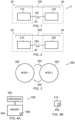
- FIG. 1 illustrates an example embodiment of a system 2 operating in a first mode of operation
- FIG. 2 illustrates an example embodiment of the system 2 operating in a second mode of operation.
- the system 2 enables performance of a first predetermined task by transferring data 40 from a transmitter device 20 to a receiver device 30 using a first artificial neural network 100.
- the first artificial neural network 100 is partitioned to the transmitter device 20 and the receiver device 30 across a first communication channel 130 between the transmitter device 20 and the receiver device 30.
- the first artificial neural network 100 comprises a first part 110 of the first artificial neural network 100 that is in the transmitter device 20 and a second part 120 of the first artificial neural network 100 that is in the receiver device 30.
- the first artificial neural network 100 is therefore physically divided into two different parts 110, 120 that are in communication via the communication channel 130.
- the first part 110 and the second part 120 of the first artificial neural network 100 operate together substantially simultaneously to provide the functionality of the first artificial neural network 100.
- the combination of the first artificial neural network 100 and the interconnecting first communication channel 130 provide a first communication pipeline from the transmitter device 20 to the receiver device 30.
- FIG. 1 therefore illustrates an example of an apparatus comprising means for operating a transmitter device 20 in a first mode of operation that enables performance of a first predetermined task by using, at the transmitter device 20, a first part 110 of a first partitioned artificial neural network 100 to transmit data 40 from the transmitter device 20 to a receiver device 30 using the first partitioned artificial neural network 100.
- the first partitioned artificial neural network 100 is partitioned to the transmitter device 20 and the receiver device 30 across the first communication channel 130 and comprises the first part 110 of the first artificial neural network 100 in the transmitter device 20 and a second part 120 of the first artificial neural network 100 in the receiver device 30.
- the figure also illustrates an apparatus comprising means for operating a receiver device 30 in a first mode of operation that enables performance of the first predetermined task by using, at the receiver device 30, the second part 120 of the first partitioned artificial neural network 100 to receive data 40 transmitted to the receiver device 30 from the first part 110 of the first partitioned artificial neural network 100 at the transmitter device 20.
- the first predetermined task may be a task performed by only the receiver device 20, in other examples it may be a task performed by only the transmitter device 30 and in other examples it may be a task performed by both the transmitter device 20 and the receiver device 30 or caused to be performed by one or more of those devices.
- FIG. 2 therefore illustrates an example of an apparatus comprising means for operating a transmitter device 20 in a second mode of operation that enables performance of a second predetermined task by using, at the transmitter device 20, a first part 210 of a second partitioned artificial neural network 200 to transmit data 40 from the transmitter device 20 to a receiver device 30 using the second partitioned artificial neural network 200.
- the second partitioned artificial neural network 200 is partitioned to the transmitter device 20 and the receiver device 30 across a second communication channel 230 and comprises a first part 210 of the second artificial neural network 200 in the transmitter device 20 and a second part 220 of the second artificial neural network 200 in the receiver device 30.
- the figure also illustrates an apparatus comprising means for operating the receiver device 30 in the second mode of operation that enables performance of the second predetermined task by using, at the receiver device 30, the second part 220 of the second partitioned artificial neural network 200 to receive data 40 transmitted to the receiver device 30 from the first part 210 of the second partitioned artificial neural network 200 at the transmitter device 20.
- the second predetermined task may be a task performed by only the receiver device 20, in other examples it may be a task performed by only the transmitter device 30 and in other examples it may be a task performed by both the transmitter device 20 and the receiver device 30 or caused to be performed by one or more of those devices.
- FIG. 3 illustrates an example embodiment of a method 300.
- the first mode of operation 302 is illustrated as a first state of a state machine and the second mode of operation 303 is illustrated as a second state of the state machine.
- the transition 303 from the first state to the second state causes a change in the mode of operation from the first mode 302 to the second mode 304.
- the transition 305 from the second state to the first state causes a change in the mode of operation from the second mode 304 to the first mode 302.
- the first and second modes are therefore mutually exclusive in this example.
- the state machine comprises only two states each of which corresponds to a particular mode.
- Each partitioned artificial neural network may enable performance of a different predetermined task by transferring data 40 from a first part in the transmitter device 20 to a second part in the receiver device 30 across a communication channel.
- the decision of whether to operate in the first mode 302 or the second mode 304 may be taken in the receiver device 20 or in the transmitter device 30 or in both devices contemporaneously.
- the method 300 therefore comprises: determining to operate in the first mode 302 or the second mode 304;
- An artificial neural network comprises a number of highly interconnected processing elements (artificial neurons) that process information by their dynamic state response to external inputs.
- An artificial neural network is arranged as a directed graph whose nodes are artificial neurons and whose vertices are connections between artificial neurons.
- Each neuron can be configured to determine whether or not a weighted sum of its inputs causes an activation function to produce an output.
- an input layer is the first layer and receives at least some of its inputs from outside the ANN and an output layer is the final layer and provides at least some of its outputs outside the ANN.
- the layers between the first and final layer are hidden layers. For artificial neurons in the hidden layer(s) and the final layer, the inputs are outputs from the artificial neurons in the preceding layer.
- An artificial neural network can be defined in hardware using a hardware component for each neuron and physically interconnected the hardware components to form the artificial neural network.
- each artificial neuron may be a different controller or other circuitry configured to perform the neuron's function.
- An artificial neural network can be defined in software for example using Python, Matlab or Octave.
- each artificial neuron may be simulated using programmed instructions that are executed by a controller.
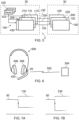
- FIG. 4A illustrates an example embodiment of a controller 400.
- Implementation of a controller 400 may be as controller circuitry.
- the controller 400 may be implemented in hardware alone, have certain aspects in software including firmware alone or can be a combination of hardware and software (including firmware).
- controller 400 may be implemented using instructions that enable hardware functionality, for example, by using executable instructions of a computer program 406 in a general-purpose or special-purpose processor 402 that may be stored on a computer readable storage medium (disk, memory etc) to be executed by such a processor 402.
- a general-purpose or special-purpose processor 402 may be stored on a computer readable storage medium (disk, memory etc) to be executed by such a processor 402.
- the processor 402 is configured to read from and write to the memory 404.
- the processor 402 may also comprise an output interface via which data and/or commands are output by the processor 402 and an input interface via which data and/or commands are input to the processor 402.
- the memory 404 stores a computer program 406 comprising computer program instructions (computer program code) that controls the operation of the apparatus 20, 30 when loaded into the processor 402.
- the computer program instructions, of the computer program 406, provide the logic and routines that enables the apparatus to perform the methods illustrated in FIG. 3 .
- the processor 402 by reading the memory 404 is able to load and execute the computer program 406.
- the apparatus 20, 30 therefore comprises:
- the at least one memory 404 and the computer program code configured to, with the at least one processor 402, cause an apparatus comprising a transmitter device at least to perform:
- the at least one memory 404 and the computer program code configured to, with the at least one processor 402, cause an apparatus comprising a receiver device at least to perform:
- the computer program 406 may arrive at the apparatus 20, 30 via any suitable delivery mechanism 410.
- the delivery mechanism 410 may be, for example, a machine readable medium, a computer-readable medium, a non-transitory computer-readable storage medium, a computer program product, a memory device, a record medium such as a Compact Disc Read-Only Memory (CD-ROM) or a Digital Versatile Disc (DVD) or a solid state memory, an article of manufacture that comprises or tangibly embodies the computer program 406.
- the delivery mechanism may be a signal configured to reliably transfer the computer program 406.
- the apparatus 20, 30 may propagate or transmit the computer program 406 comprising computer program instructions (computer program code) as a computer data signal.
- the computer program instructions are for causing an apparatus to perform at least the following:
- the computer program instructions may be comprised in a computer program, a non-transitory computer readable medium, a computer program product, a machine readable medium. In some but not necessarily all examples, the computer program instructions may be distributed over more than one computer program.
- memory 404 is illustrated as a single component/circuitry it may be implemented as one or more separate components/circuitry some or all of which may be integrated/removable and/or may provide permanent/semi-permanent/ dynamic/cached storage.
- processor 402 is illustrated as a single component/circuitry it may be implemented as one or more separate components/circuitry some or all of which may be integrated/removable.
- the processor 402 may be a single core or multi-core processor.
- references to 'computer-readable storage medium', 'computer program product', 'tangibly embodied computer program' etc. or a 'controller', 'computer', 'processor' etc. should be understood to encompass not only computers having different architectures such as single /multi- processor architectures and sequential (Von Neumann)/parallel architectures but also one or more specialized circuits such as field-programmable gate arrays (FPGA), application specific circuits (ASIC), GPUs (Graphics Processing Unit), NPUs (Neural Network Processing Unit), AI (Artificial Intelligence) accelerators, signal processing devices, other processing circuitry , or any combinations thereof.
- References to computer program, instructions, code etc. should be understood to encompass software for a programmable processor or firmware such as, for example, the programmable content of a hardware device whether instructions for a processor, or configuration settings for a fixed-function device, gate array or programmable logic device etc.
- circuitry may refer to one or more or all of the following:
- circuitry also covers an implementation of merely a hardware circuit or processor and its (or their) accompanying software and/or firmware.
- circuitry also covers, for example and if applicable to the particular claim element, a baseband integrated circuit for a mobile device or a similar integrated circuit in a server, a cellular network device, or other computing or network device.
- the blocks illustrated in the FIG. 3 may represent steps in a method and/or sections of code in the computer program 406.
- the illustration of a particular order to the blocks does not necessarily imply that there is a required or preferred order for the blocks and the order and arrangement of the block may be varied. Furthermore, it may be possible for some blocks to be omitted.
- FIG. 5 illustrates an example embodiment of a system 2, as previously described with relation to FIGS 1, 2, 3, 4A and 4B .
- a transmitter device 20 has a first mode of operation 302 that enables performance of a first predetermined task by using, at the transmitter device 20, a first part 110 of a first partitioned artificial neural network 100 to transmit data 40 from the transmitter device 20 to a receiver device 30 using the first partitioned artificial neural network.
- the first partitioned artificial neural network 100 is partitioned to the transmitter device 20 and the receiver device 30 across a first communication channel 130 between the transmitter device 20 and the receiver device 30 and comprises the first part 110 of the first artificial neural network 100 in the transmitter device 20 and the second part of the first artificial neural network 100 in the receiver device 30.
- the receiver device 30, in a first mode of operation 302, enables the performance of the first predetermined task by using, at the receiver 30, a second part 120 of the first partitioned artificial neural network 100 to receive data 40 transmitted to the receiver device 30 from the first part 110 of the first partitioned artificial neural network 100 at the transmitter device 20.
- the transmitter device 20, in a second mode of operation 304, enables performance of a second predetermined task by using, at the transmitter device 20, a first part 210 of a second partitioned artificial neural network 200 to transmit data 40 from the transmitter device 20 to the receiver device 30 using the second partitioned artificial neural network 200.
- the second partitioned artificial neural network 200 is partitioned to the transmitter device 20 and the receiver device 30 across a second communication channel 230 between the transmitter device 20 and the receiver device 30, and comprises the first part 210 of the second artificial neural network 200 in the transmitter device 20 and a second part 220 of the second artificial neural network 200 in the receiver device 30.
- the receiver device 30, in the second mode of operation 304, enables performance of the second predetermined task by using, at the receiver device 30, a second part 220 of the second partitioned artificial neural network 200 to receive data 40 transmitted to the receiver device 30 from the first part 210 of the second partitioned artificial neural network 200 at the transmitter device 20.
- the system 2 comprises one or more additional artificial neural networks for performing specific tasks that have a first part n10 partitioned to the transmitter device 20 and a second part n20 partitioned to the receiver device 30 and configured to receive data from the first part n10 transmitted in a communication channel n30.
- the system 2 may operate in, at least, the first mode 302 or the second mode 304.
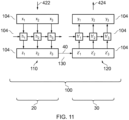
- the transmitter device 20 comprises or is coupled to one or more sensors 420.
- the one or more sensors 420 produce output data 422 that is input, as input data 422, to the first part of the partitioned artificial neural network that has been selected according to the current mode of operation.
- the data 422 from the one or more sensors 420 is provided to the first part 110 of the first partitioned artificial neural network 100.
- the input data 422 is provided to the first part 210 of the partitioned artificial neural network 200.
- the one or more sensors 420 that are used to provide the input data 422 in the first mode 302 may be the same or different to the one or more sensors 420 that are used to provide the input data 422 in the second mode of operation 304.
- the input data 422 is audio data that is captured at one or more microphones 420.
- respective input data 422 may be from the one or more of the sensors 420 such as: a still/video camera unit, an inertial measurement unit (IMU), a geolocation device such as a GPS (Global Positioning System) receiver, a proximity sensor, a barometer, a thermometer, a speed sensor, a radar, a LIDAR (Light Detection And Ranging), a user input device, a diagnostic or medical sensor, such as a PPG (Photoplethysmogram), an electromyographic (EMG) sensor, a pulse oximeter, or any combination thereof.
- the input data 422 may be one or more of Electrocardiography data (ECG) and EEG data (electroencephalography) from one or more respective sensors 420.
- ECG Electrocardiography data
- EEG electroencephalography
- the input data 422 is preprocessed at pre-processing circuitry 430 before it is input to the partitioned artificial neural network.
- Many different types of pre-processing may be performed.
- One example of pre-processing is quantization or other signal shaping. Quantization may, for example, be performed by passing only the most significant bits of the input data 422.
- the input data 422 is transferred from the transmitter device 20 to the receiver device 30 via a communication pipeline determined by the current mode of operation. If the current mode of operation is the first mode of operation 302, then the input data 422 is transferred via a first communication pipeline that comprises the first artificial neural network 100 partitioned by the first communication channel 130. If the current mode of operation is the second mode of operation 304, then the input data 422 is transferred via a second communication pipeline that comprises the second artificial neural network 200 partitioned by the second communication channel 230.
- the input data 422 is available at the transmitter device 20 and also at the receiver device 30.
- the decision to select to operate in the first mode of operation 302 or the second mode of operation 304 is based upon the input data 422. As previously described, this decision may be taken at the transmitter device 20, the receiver device 30 or at both the transmitter device 20 and the receiver device 30.
- the determination to operate in the first mode or the second mode occurs contemporaneously at the transmitter device 20 and the receiver device 30 so that the modes are coordinated. This ensures that the first and second parts of the artificial neural networks that are in communication relate to the same artificial neural network.
- the decision to select to operate in the first mode 302 or the second mode 304 is made at the receiver device 30 and communicated to the transmitter device 20. In some, but not necessarily all, examples, this communication may be via a feedback channel, for example a separate low bandwidth wireless channel.
- the data output from the first part of the partitioned artificial neural network may be encoded before it is transmitted on to the respective communication channel. This encoding may, for example, make the transmission of the data more robust to interference or noise.
- the data 40 transferred from the first part of the partitioned artificial neural network across the communication channel to the second part of that partitioned artificial neural network is encoded before transfer by the first part and decoded by the second part after transfer.
- the encoding may be performed by conjugate permutation, however, other types of encoding may be used, for example interleaving.
- the encoding may be performed by the first part of the partitioned artificial neural network and decoded by the second part of the partitioned artificial neural network.
- pre-processing may be used to encode data before it is provided to the first part of the partitioned artificial neural network.
- the first partitioned artificial neural network 100 and/or the second partitioned artificial neural network 200 may use the same encoding/decoding or may use different encoding/decoding or may not use encoding/decoding.
- the transmission and processing of input data 422 can be done on a single chip set at the transmitter device 20.
- the reception and processing of data 40 can be done on a single chip set at the receiver device 30.
- FIG. 6 illustrates an example embodiment of a wireless transmitter device 20, such as a headset device 500, e.g. a headphone device, earbuds, earphones, a virtual reality (VR) headset, or an augmented reality (AR) headset that is configured to communicate wirelessly 502 with a host device 504 which is configured to communicate wirelessly with the wireless headphone device 500.
- the wireless device 500 may be a wireless game controller, a sleeve control device or a wrist control device.
- the transmitter device 20 may be an loT device embedded with, or connected to, one or more sensor devices 420.
- the wireless headphone device 500 may be or may comprise the transmitter device 20 and the host device 504 may be or may comprise the receiver device 30.
- the combination of the wireless headphone device 500 and the host device 504 therefore provides a system 2 as previously described.
- the loT device 20 may be connected to the host device 504, for example, an intermediary device 30 (such as a mobile communication device, a mobile phone, a gateway, a router, an access point, a personal computer, a game console, a television, a vehicle, an infotainment system, an in-vehicle electronic control unit (ECU), a set-top box, or any combination thereof) or a cloud device 30 (such as a server) that executes the second partitioned artificial neural network.
- an intermediary device 30 such as a mobile communication device, a mobile phone, a gateway, a router, an access point, a personal computer, a game console, a television, a vehicle, an infotainment system, an in-vehicle electronic control unit (
- the wireless channel 502 used for communicating between the wireless headphone device 500 and the host device 504 provides the first and/or second communication channel 130, 230.
- the headphones may be any suitable type of headphones. They may for example be on-ear, in-ear or over-the-ear headphones.
- the host device 504 may be any suitable apparatus. It may for example be a smartphone, a server or any device with a processing unit for example.
- the headphone device 500 comprises one or more loudspeakers 506 one or more microphones 420, and/or other sensors 420, that capture input data 422 that is transmitted as data 40 through the partitioned artificial neural network associated with the current mode of operation.
- the artificial neural network is partitioned by the wireless communication channel 402. In the first mode of operation, the first partitioned artificial neural network 100 is used for transmitting the audio data, whereas in the second mode of operation the second partitioned artificial neural network 200 is used to transmit the audio data.
- FIGS 7A and 7B are an illustrative example of the different effect of using the first mode 302 and the second mode 304 on compression.
- FIG. 7A and FIG. 7B illustrate mode-dependent compression of a bandwidth 50.
- the bandwidth illustrates data transfer per second e.g. bits/s.
- FIG. 7A illustrates that, in this example, the bandwidth 50 is significantly decreased for transmission across the first communication channel 130 by the first part 110 of the first artificial neural network 100.
- FIG. 7B illustrates that the bandwidth 50 is also significantly decreased by the first part 210 of the second artificial neural network 200 before transmission via the second communication channel 230. It can be appreciated from the differences between FIGS 7A and 7B that the compression of data applied in the first mode 302 ( Fig 7A ) and in the second mode 304 ( FIG 7B ) is different.
- the first artificial neural network 100 is configured to perform a first compression on the data 40 in the first mode 302 and the second artificial neural network is configured to perform a second compression on the data 40 in the second mode 304, different to the first compression.
- the first compression is a compression for a first communications protocol. Additionally or alternatively, the first compression may also be optimized for the first predetermined task performed at the receiver device 30.
- the second compression is a compression for a second communications protocol.
- the compression may also be for a second predetermined task performed at the receiver device 30.
- the first compression and/or the second compression may be used to create a stream of the data 40.
- this stream may be a serial bit stream.
- the first mode may be associated with a particular communications protocol such as a Bluetooth (BT) or Bluetooth Low Energy (BLE) serial protocol and the second mode of operation may be associated with a different wireless communications protocol.
- BT Bluetooth
- BLE Bluetooth Low Energy
- the first compression and/or the second compression may be configured to enable a particular quality of audio.
- the quality of audio retained by the first compression may be better than the quality of audio retained by the second compression.
- bit stream length or the modulation used may be defined by the communications protocol.
- FIG. 8A and 8B schematically illustrates an example of how the partitioned artificial neural network 100 used changes when the mode of operation changes.
- Fig 8A illustrates a first partitioned artificial neural network 100
- FIG 8B illustrates a second partitioned artificial neural network 200.
- the artificial neural networks (ANN) 100, 200 comprise a number of highly interconnected processing elements (artificial neurons 102) that process information by their dynamic state response to inputs.
- the artificial neural network is arranged as a directed graph whose nodes are artificial neurons 102 and whose vertices are connections between artificial neurons.
- Each artificial neuron 102 can be configured to determine whether or not a weighted sum of its inputs causes an activation function to produce an output.
- This is a layered ANN.
- An input layer is the first (leftmost) layer and receives at least some of its inputs from outside the ANN and an output layer is the final (rightmost) layer and provides at least some of its outputs outside the ANN.
- the layers between the first and final layer are hidden layers 104.
- the inputs are outputs from the artificial neurons in the preceding layer.
- each of these artificial neurons 102 determines whether or not a weighted sum of its inputs causes an activation function to produce an output.
- the first part 110 of the artificial neural network 100 is separated from the second part 120 of the artificial neural network 100 by a first communication channel 130.
- a hidden part 106 which in this example is a final hidden layer 104, of the first part 110 of the first artificial neural network 100 is dependent upon a bandwidth of the first communication channel 130 and/or is dependent upon a communications protocol used for communicating via the first communication channel 130.
- the first part 110 of the first artificial neural network 100 has a first hidden part 106 (which may be a layer or layers 104) that, in use, provides data 40 to the first communication channel 130.
- the second part 120 of the first artificial neural network 100 has a second hidden part 108 (in a layer or layers 104) that, in use, receives data 40 from the first communication channel 130.
- the number of artificial neurons 102 in the first part 110 is dependent upon a bandwidth of the first communication channel 130.
- the number of neurons in the final hidden layer 106 of the first part 110 of the first artificial neural network 100 is dependent upon a bandwidth of the first communication channel 130.
- the first part 210 of the artificial neural network 200 is separated from the second part 220 of the artificial neural network 100 by a second communication channel 230.
- a hidden part 106 which in this example is a final hidden layer 104, of the first part 210 of the second artificial neural network 200 is dependent upon a bandwidth of the second communication channel 230 and/or is dependent upon a communications protocol used for communicating via the second communication channel 230.
- the first part 110 of the first artificial neural network 100 has a first hidden part 106 (which may be a layer or layers 104) that, in use, provides data 40 to the first communication channel 130.
- the second part 120 of the first artificial neural network 100 has a second hidden part 108 (in a layer or layers 104) that, in use, receives data 40 from the first communication channel 130.
- the number of artificial neurons 102 in the first part 210 is dependent upon a bandwidth of the second communication channel 230.
- the number of neurons in the final hidden layer 106 of the first part 210 of the second artificial neural network 200 is dependent upon a bandwidth of the second communication channel 230.
- the quantity of data provided via the communication channel 130 is controlled.
- the number of neurons 102 in the final hidden layer 106 may be determined by the particular communications protocol used for the first communication channel 130.
- the precisions used in the representation of the output of the final hidden layer 106 can be adjusted by the skilled practitioner to the bandwidth and accuracy requirements.
- weights for the combination of inputs need to be assigned at each artificial neuron 101.
- One option for performing this optimization is by using gradient descent. It is for example possible to forward-propagate training data 40 through the artificial neural network and then back-propagate an error signal produced by supervised learning to produce weight updates.
- the back-propagation algorithm requires the determination of a localized cost function and a gradient of that cost function. It is therefore desirable to use a cost function that is differentiable.
- any non-differentiable cost function in a continuous landscape can be made differentiable by approximation.
- the function sign(x) can be replaced by either tanh(cx) for c>0 or a piecewise linear function.
- the first part 110 of the first artificial neural network 100 and the second part 120 of the first artificial neural network are jointly trained as a single artificial neural network. This may, for example, be achieved by using back-propagation and a static or differentiable model of the communications channel 130.
- a differentiable model of the channel should be understood to be inclusive -any model can be made differentiable by simply inventing gradients. For example, modelling the channel as the identity function, produces as a gradient the identity.
- the output of the channel is a random variable Y depending on an "input" X.
- dY/dX, in direction t may be the expected value of Y(X + t) - Y(X), which a large enough function family F will eventually capture during training.
- Supervised learning may be used to train the weight of the first artificial neural network 100 by using training data that defines an expected performance, for example, an expected performance in relation to the first predetermined task. In this way the first artificial neural network can learn when the first predetermined task should or should not be performed in response to input data 422.
- the first part 210 of the second artificial neural network 200 and the second part 220 of the second artificial neural network 200 are jointly trained as a single artificial neural network. This may, for example, be achieved by using back-propagation and a static or differentiable model of the communications channel 230.
- Supervised learning may be used to train the weight of the second artificial neural network 200 by using training data that defines an expected performance, for example, an expected performance in relation to the second predetermined task. In this way the second artificial neural network can learn when the second predetermined task should or should not be performed in response to input data 422.
- the first part 110 of the first artificial neural network 100 and the second part 120 of the first artificial neural network 100 are jointly trained as a single artificial neural network to compensate for errors arising in the first communication channel 130.
- the routing of information throughout the pipeline has a large impact on errors which are correlated, such as packet loss. Interleaving can be used at the transmission part of the pipeline, and can be thought of as part of the design of the architecture.
- a single pipeline can provide both compression and built-in error correction that corrects for bit errors and dropped packets during transmission.
- Information reordering could also be learned from data; either by brute force by doing black box optimisation (or a random search) across a set of possible architectures, or by describing a set of changes that the system is allowed to perform to the architecture based on
- the latter can be implemented by using a Markov decision process that consists of: Set S of states s Set A of actions a for every state s in S
- Reward function R that depends on a triplet of state s, action taken a and the following state (if the state transition is not deterministic given a).
- this optimisation can be done at run-time to create an adaptive communications channel.
- the transmission noise can be modelled during training by adding a noise distribution during the training process to model transmission errors.
- the noise can either be ignored during the back-propagation or a synthetic gradient can be used.
- An advantage to this approach is that because the trained task output is robust to transmission noise, separate error correction can be omitted.
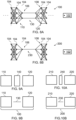
- FIG. 9A and FIG. 9B An alternative approach is to model the first communication channel 130 using an intermediate artificial neural network 140 during the joint training of the first part 110 and the second part 120 of the first joint network.
- FIG. 9A and FIG. 9B This is schematically illustrated in FIG. 9A and FIG. 9B .
- the first part 110 of the first artificial neural network 100, the second part 120 of the first artificial neural network 100 and a first intermediate artificial neural network 140 positioned between the first part 110 of the first artificial neural network 100 and the second part 120 of the first artificial neural network 100 are simultaneously and jointly trained.
- the first intermediate artificial neural network 140 simulates errors arising from the first communication channel 130.
- the first part 110, second part 120 and the first intermediate artificial neural network 140 are jointly trained as a single artificial neural network to compensate for errors arising in the first communication channel 130 as illustrated in FIG. 9A .
- the first part 110 of the first artificial neural network 100 and the second part 120 of the first artificial neural network 100, but not the first intermediate artificial neural network 140 are used as the first artificial neural network
- the second communication channel 230 can be modelled using an intermediate artificial neural network 240 during the joint training of the first part 210 and the second part 220 of the second network 100.
- This is schematically illustrated in FIG. 10A and FIG. 10B .
- the first part 210 of the second artificial neural network 200, the second part 220 of the second artificial neural network 200 and a second intermediate artificial neural network 240 positioned between the first part 210 and the second part 220 are simultaneously and jointly trained.
- the second intermediate artificial neural network 240 simulates errors arising from the second communication channel 230.
- the first part 210, second part 220 and the second intermediate artificial neural network 240 are jointly trained as a single artificial neural network to compensate for errors arising in the second communication channel 230 as illustrated in FIG. 10A .
- the first part 210 and the second part 220, but not the second intermediate artificial neural network 240 are used as the first artificial neural network 100 as illustrated in FIG 10B .
- the intermediate artificial neural network 140, 240 models the channel as an artificial neural network comprising a set of layers with probabilistic and deterministic behavior.
- the whole combination of the first part 110,210 intermediate artificial neural network 140, 240 and second part 120, 220 is trained, for example, using stochastic gradient descent and back-propagation. After discarding the first intermediate artificial neural network 140,240 the artificial neural network 100, 200 may be additionally trained. During this training certain layers may have fixed weightings while other layers may be allowed to vary within certain limits. This can be used to fine-tune the response.
- the first part of the partitioned artificial neural network 100, 200 may be a recurrent artificial neural network and/or the second part of the partitioned artificial neural network 100, 200 may be a recurrent artificial neural network.
- the feedback present in a recurrent artificial neural network may for example be present within the first part, within the second part or be from the second part to the first part via the communication channel 130, 230.
- the configuration of a partitioned artificial neural network 100, 200 may be dependent upon and adapted to computation limitations of the transmitter device 20 and/or the receiver device 30.
- the size or configuration of the first part of the partitioned artificial neural network may be determined by processing or memory limitations in the transmitter device 20.
- the size or configuration of the second part of the partitioned artificial neural network 100, 200 may be constrained by the processing and/or memory available at the receiver device 30.
- the predetermined task may be a task that is trained during training of the artificial neural network.
- it may relate to event detection.
- An event may, for example, be detection of a keyword, speech recognition or high quality encoding.
- the event detection may be used as a trigger to switch modes.
- a keyword detection mode all sound input from the microphone(s) is compressed to a low bandwidth, sufficient for the task of recognition of a single phrase to activate the speech recognition mode but insufficient to enable speech recognition.
- voice input from the microphone(s) 420 is compressed to a medium bandwidth so that speech to text is possible. This mode remains active until no more speech is detected.
- the sound input at the microphone(s) 420 is encoded to a high quality (high bandwidth) so that the receiver device 30 is able to enable reproduction of the original audio with high fidelity.
- any one of these different modes may be for example the first mode of operation 302 previously described and any of the other modes may be for example the second mode of operation 304 previously described. It will therefore be appreciated that these different modes can be effected by using partitioned artificial neural networks 100, 200 as described. Furthermore, the transitions between the different modes may be enabled using the partitioned artificial neural networks. Furthermore, a system 2, 300 may have more than two nodes and related artificial neural network or machine learning algorithms.
- tasks that may be performed include detection in video of motion detected data 40, speech recognition or speaker identification from audio data 40 or providing video for streaming for playback, providing video or image streaming for object recognition, IMU and/or GPS sensor data for movement detection and/or analysis, providing LIDAR data for 3D model creation and/or object detection, PPG
- tasks may, for example, comprise lowering a volume of output audio, opening an acoustic valve, turning off active noise cancellation when aware of the headphones 500 is being spoken to, switching on high quality streaming from the microphone.
- This output 424 is a task prediction.
- the value of z is quantized.
- a context y is determined based on z from the first part 110 and also optionally from other input at the receiver device 30. In this example, the receiver device 30 makes the decision to change the context and causes the state transition from the first mode 302 to the second mode 304 based on this input.
- the receiver device 30 transmits this decision back to the transmitter device 20 as a special context changing code. This may, for example, be transmitted via a separate bandwidth wireless channel.
- the h 1 and h' 1 can be a first part and a second part of a partitioned neural networks.
- the h 1 and h' 1 can be different neural networks based on the capabilities of the respective devices 20 and 30.
- the transmitter device 20 (or alternatively the receiver device 30) may have limited CPU, memory and/or power resources, and therefore runs shallow and/or smaller neural network with less hidden layers and/or neurons.
- h 1 and h' 1 can be either artificial neural networks (ANN) or any other type of machine learning (ML) algorithms. such as a support vector machine, or a Bayesian network.
- ANN artificial neural networks
- ML machine learning
- the context may not be determined in this way but may be determined by user input or programmatically, possibly by inferring a context based on inputs from the transmitter device 20 and the receiver device 30.
- the first part 110 of the first artificial neural network 100 receives as data 422 that is a pulse code modulated (PCM) encoded sound signal which is mapped to a bit string 40 whose length is determined by the Bluetooth Low Energy protocol used for transmission in the first communication channel 130.
- the second part 120 of the first artificial neural network receives the transmitted data 40. It is a recurrent artificial neural network configured for keyword recognition.
- the first part 110 and the second part 120 of the first artificial neural network 100 are trained simultaneously with stochastic gradient descent.
- the apparatus 20, 30 is configured to communicate data from the apparatus 20, 30 with or without local storage of the data in a memory 404 at the apparatus 20, 30 and with or without local processing of the data by circuitry or processors at the apparatus 20, 30.
- the data may, for example, be measurement data from or data produced by the processing of measurement data.
- the data may be stored in processed or unprocessed format remotely at one or more devices.
- the data may be stored in the Cloud.
- the data may be processed remotely at one or more devices.
- the data may be partially processed locally and partially processed remotely at one or more devices.
- the data may be communicated to the remote devices wirelessly via short range radio communications such as Wi-Fi or Bluetooth, for example, or over long range cellular radio links.
- the apparatus may comprise a communications interface such as, for example, a radio transceiver for communication of data.
- the apparatus 20, 30 may be part of the Internet of Things (IoT) forming part of a larger, distributed network.
- IoT Internet of Things
- the processing of the data may be for the purpose of health monitoring, data aggregation, patient monitoring, vital signs monitoring or other purposes.
- the above described examples find application as enabling components of: automotive systems; telecommunication systems; electronic systems including consumer electronic products; distributed computing systems; media systems for generating or rendering media content including audio, visual and audio visual content and mixed, mediated, virtual and/or augmented reality; personal systems including personal health systems or personal fitness systems; navigation systems; user interfaces also known as human machine interfaces; networks including cellular, non-cellular, and optical networks; ad-hoc networks; the internet; the internet of things; virtualized networks; and related software and services.
- a property of the instance can be a property of only that instance or a property of the class or a property of a sub-class of the class that includes some but not all of the instances in the class. It is therefore implicitly disclosed that a feature described with reference to one example but not with reference to another example, can where possible be used in that other example as part of a working combination but does not necessarily have to be used in that other example.
- 'a' or ⁇ the' is used in this document with an inclusive not an exclusive meaning. That is any reference to X comprising a/the Y indicates that X may comprise only one Y or may comprise more than one Y unless the context clearly indicates the contrary. If it is intended to use 'a' or ⁇ the' with an exclusive meaning then it will be made clear in the context. In some circumstances the use of 'at least one' or ⁇ one or more' may be used to emphasis an inclusive meaning but the absence of these terms should not be taken to infer and exclusive meaning.
- 'example' or 'for example' or 'can' or 'may' in the text denotes, whether explicitly stated or not, that such features or functions are present in at least the described example, whether described as an example or not, and that they can be, but are not necessarily, present in some of or all other examples.
- 'example', 'for example', 'can' or 'may' refers to a particular instance in a class of examples.
- a property of the instance can be a property of only that instance or a property of the class or a property of a sub-class of the class that includes some but not all of the instances in the class. It is therefore implicitly disclosed that a feature described with reference to one example but not with reference to another example, can where possible be used in that other example as part of a working combination but does not necessarily have to be used in that other example
Landscapes
- Engineering & Computer Science (AREA)
- Theoretical Computer Science (AREA)
- Physics & Mathematics (AREA)
- Software Systems (AREA)
- General Physics & Mathematics (AREA)
- General Engineering & Computer Science (AREA)
- General Health & Medical Sciences (AREA)
- Biomedical Technology (AREA)
- Data Mining & Analysis (AREA)
- Evolutionary Computation (AREA)
- Biophysics (AREA)
- Molecular Biology (AREA)
- Computing Systems (AREA)
- Computational Linguistics (AREA)
- Artificial Intelligence (AREA)
- Mathematical Physics (AREA)
- Life Sciences & Earth Sciences (AREA)
- Health & Medical Sciences (AREA)
- Computer Networks & Wireless Communication (AREA)
- Signal Processing (AREA)
- Mobile Radio Communication Systems (AREA)
Claims (15)
- Einrichtung, die Mittel für Folgendes umfasst Betreiben in einem ersten Betriebsmodus (302), der eine Durchführung einer ersten vorbestimmten Aufgabe durch Übertragen von Daten (40) von einer Sendervorrichtung (20) zu einer Empfängervorrichtung (30) unter Verwendung eines ersten künstlichen neuronalen Netzwerks (100) ermöglicht, das für die Sendervorrichtung (20) und die Empfängervorrichtung (30) über einen ersten Kommunikationskanal (130) zwischen der Sendervorrichtung (20) und der Empfängervorrichtung (30) partitioniert ist, wobei das partitionierte erste künstliche neuronale Netzwerk (100) einen ersten Teil (110) in der Sendervorrichtung (20) und einen zweiten Teil (120) in der Empfängervorrichtung (30) umfasst, wobei der erste und der zweite Teil (110, 120) als ein einzelnes künstliches neuronales Netzwerk trainiert wurden, um Fehler zu kompensieren, die im ersten Kommunikationskanal (130) auftreten;Betreiben in einem zweiten Betriebsmodus (304), der eine Durchführung einer zweiten vorbestimmten Aufgabe durch Übertragen von Daten (40) von der Sendervorrichtung (20) zur Empfängervorrichtung (30) unter Verwendung eines zweiten künstlichen neuronalen Netzwerks (200) ermöglicht, das für die Sendervorrichtung (20) und die Empfängervorrichtung (30) über einen zweiten Kommunikationskanal (230) zwischen der Sendervorrichtung (20) und der Empfängervorrichtung (30) partitioniert ist, wobei das partitionierte zweite künstliche neuronale Netzwerk (200) einen ersten Teil (210) in der Sendervorrichtung (20) und einen zweiten Teil (220) in der Empfängervorrichtung (30) umfasst; undBestimmen, im ersten Modus (302) oder im zweiten Modus (304) zu betreiben, wobei eine Entscheidung, das Betreiben im ersten Modus (302) oder im zweiten Modus (304) auszuwählen, an der Empfängervorrichtung (30) vorgenommen und zur Sendevorrichtung (20) kommuniziert wird.
- Einrichtung nach Anspruch 1, die für eine modusabhängige Komprimierung ausgelegt ist, wobei das erste künstliche neuronale Netzwerk dazu ausgelegt ist, eine erste Komprimierung an Eingangsdaten durchzuführen, und das zweite künstliche neuronale Netzwerk dazu ausgelegt ist, eine zweite Komprimierung an Eingangsdaten durchzuführen, die sich von der ersten Komprimierung unterscheidet.
- Einrichtung nach Anspruch 2, wobei die erste Komprimierung eine Komprimierung für ein erstes Kommunikationsprotokoll und/oder eine Komprimierung für die erste vorbestimmte Aufgabe an der Empfängervorrichtung ist und wobei die zweite Komprimierung eine Komprimierung für ein zweites Kommunikationsprotokoll und/oder eine Komprimierung für die zweite vorbestimmte Aufgabe an der Empfängervorrichtung ist.
- Einrichtung nach Anspruch 2, wobei die erste Komprimierung dazu ausgelegt ist, eine erste Qualität von Audio beizubehalten, wenn Eingangsaudiodaten (422) komprimiert werden, und wobei die zweite Komprimierung dazu ausgelegt ist, eine zweite Qualität von Audio, die sich von der ersten Qualität von Audio unterscheidet, beizubehalten, wenn Eingangsaudiodaten (422) komprimiert werden.
- Einrichtung nach Anspruch 2, wobei die erste vorbestimmte Aufgabe eine Spracherkennung ist und die erste Komprimierung dazu ausgelegt ist, Eingangsaudiodaten (422) auf eine erste Bandbreite zu komprimieren, mit der Sprache-zu-Text möglich ist, und wobei die zweite vorbestimmte Aufgabe eine Schlüsselwortdetektion ist und die zweite Komprimierung dazu ausgelegt ist, die Eingangsaudiodaten (422) auf eine zweite Bandbreite zu komprimieren, die kleiner ist als die erste Bandbreite und für die Aufgabe der Erkennung einer einzelnen Phrase ausreichend ist, um den Spracherkennungsmodus zu aktivieren, aber nicht ausreichend ist, um eine Durchführung der Spracherkennung zu ermöglichen.
- Einrichtung nach einem der vorhergehenden Ansprüche, wobei ein abschließender verborgener Teil (106) des ersten Teils (110) des ersten künstlichen neuronalen Netzwerks (100) von einer Bandbreite (50) des ersten Kommunikationskanals abhängig ist und/oder von einem Kommunikationsprotokoll abhängig ist, das zum Kommunizieren via den ersten Kommunikationskanal verwendet wird.
- Einrichtung nach einem der vorhergehenden Ansprüche, wobei der erste Teil des ersten künstlichen neuronalen Netzwerks einen ersten verborgenen Teil aufweist, der im Gebrauch dem ersten Kommunikationskanal Daten bereitstellt, der zweite Teil des ersten künstlichen neuronalen Netzwerks einen zweiten verborgenen Teil aufweist, der im Gebrauch Daten vom ersten Kommunikationskanal empfängt, und wobei die Anzahl von Neuronen im ersten verborgenen Teil von einer Bandbreite des ersten Kommunikationskanals abhängig ist.
- Einrichtung nach einem der vorhergehenden Ansprüche, wobei eine Entscheidung, einen Betrieb im ersten Modus oder im zweiten Modus auszuwählen, auf Eingangssensordaten basiert.
- Einrichtung nach einem der vorhergehenden Ansprüche, wobei sich die erste vorbestimmte Aufgabe und/oder die zweite vorbestimmte Aufgabe auf eine Ereignisdetektion beziehen und wobei eine Ereignisdetektion als ein Auslöser zum Umschalten von Betriebsmodi verwendet wird.
- Einrichtung nach einem der vorhergehenden Ansprüche, wobei die Sendervorrichtung (20) einen oder mehrere Sensoren (420) umfasst oder an dieselben gekoppelt ist, die Daten (422) produzieren, die im ersten Betriebsmodus (302) in das erste neuronale Netzwerk (100) und im zweiten Betriebsmodus (304) in das zweite künstliche neuronale Netzwerk (200) eingegeben werden, und wobei die erste vorbestimmte Aufgabe im ersten Betriebsmodus (302) an der Empfängervorrichtung (30) durchgeführt wird und wobei die zweite vorbestimmte Aufgabe im zweiten Betriebsmodus (304) an der Empfängervorrichtung (30) durchgeführt wird.
- Einrichtung nach einem der vorhergehenden Ansprüche, wobei Daten, die in das erste künstliche neuronale Netzwerk eingegeben werden, und Daten, die in das zweite künstliche neuronale Netzwerk eingegeben werden, Audiodaten von einem oder mehreren selben Mikrofonen (420) sind.
- Einrichtung nach einem der vorhergehenden Ansprüche, die als eine drahtlose Kopfhörervorrichtung (500) oder eine Vorrichtung zum Kommunizieren mit einer drahtlosen Kopfhörervorrichtung (500) ausgelegt ist.
- Einrichtung nach einem der vorhergehenden Ansprüche, wobei Daten, die vom ersten Teil des ersten künstlichen neuronalen Netzwerks über den ersten Kommunikationskanal zum zweiten Teil des ersten künstlichen neuronalen Netzwerks übertragen werden, vom ersten Teil des ersten künstlichen neuronalen Netzwerks vor der Übertragung codiert werden und nach der Übertragung vom zweiten Teil des ersten künstlichen neuronalen Netzwerks decodiert werden; und/oder
wobei Daten, die vom ersten Teil des zweiten künstlichen neuronalen Netzwerks über den zweiten Kommunikationskanal zum zweiten Teil des zweiten künstlichen neuronalen Netzwerks übertragen werden, vom ersten Teil des zweiten künstlichen neuronalen Netzwerks vor der Übertragung codiert werden und nach der Übertragung vom zweiten Teil des ersten künstlichen neuronalen Netzwerks decodiert werden. - Computerimplementiertes Verfahren, das Folgendes umfasst:Bestimmen, in einem ersten Modus oder in einem zweiten Modus zu betreiben, wobei eine Entscheidung, das Betreiben im ersten Modus (302) oder im zweiten Modus (304) auszuwählen, an einer Empfängervorrichtung (30) vorgenommen und zu einer Sendevorrichtung (20) kommuniziert wird;wenn bestimmt wird, im ersten Modus zu betreiben, Ermöglichen einer Durchführung einer ersten vorbestimmten Aufgabe durch Übertragen von Daten von der Sendervorrichtung (20) zur Empfängervorrichtung (30) unter Verwendung eines ersten künstlichen neuronalen Netzwerks (100), das für die Sendervorrichtung (20) und die Empfängervorrichtung (30) über einen ersten Kommunikationskanal (130) zwischen der Sendervorrichtung (20) und der Empfängervorrichtung (30) partitioniert ist, wobei das partitionierte erste künstliche neuronale Netzwerk (100) einen ersten Teil (110) in der Sendervorrichtung (20) und einen zweiten Teil (120) in der Empfängervorrichtung (30) umfasst, wobei der erste und der zweite Teil (110, 120) als ein einzelnes künstliches neuronales Netzwerk trainiert wurden, um Fehler zu kompensieren, die im ersten Kommunikationskanal (130) auftreten; undwenn bestimmt wird, im zweiten Modus zu betreiben, Ermöglichen einer Durchführung einer zweiten vorbestimmten Aufgabe durch Übertragen von Daten von der Sendervorrichtung (20) zur Empfängervorrichtung (30) unter Verwendung eines zweiten künstlichen neuronalen Netzwerks (200), das für die Sendervorrichtung (20) und die Empfängervorrichtung (30) über einen zweiten Kommunikationskanal (230) zwischen der Sendervorrichtung (20) und der Empfängervorrichtung (30) partitioniert ist, wobei das partitionierte zweite künstliche neuronale Netzwerk (200) einen ersten Teil (210) in der Sendervorrichtung (20) und einen zweiten Teil (210) in der Empfängervorrichtung (30) umfasst.
- Verfahren nach Anspruch 14, das Folgendes umfasst:gemeinsames Trainieren des ersten Teils des zweiten künstlichen neuronalen Netzwerks und des zweiten Teils des zweiten künstlichen neuronalen Netzwerks als ein einzelnes künstliches neuronales Netzwerk odergemeinsames Trainieren des ersten Teils des ersten künstlichen neuronalen Netzwerks und des zweiten Teils des ersten künstlichen neuronalen Netzwerks als ein einzelnes künstliches neuronales Netzwerk unter Verwendung einer Rückpropagierung und eines statischen oder differenzierbaren Modells des ersten Kommunikationskanals und/oder gemeinsames Trainieren des ersten Teils des zweiten künstlichen neuronalen Netzwerks und des zweiten Teils des zweiten künstlichen neuronalen Netzwerks als ein einzelnes künstliches neuronales Netzwerk unter Verwendung einer Rückpropagierung und eines statischen oder differenzierbaren Modells des zweiten Kommunikationskanals odergemeinsames Trainieren des ersten Teils des ersten künstlichen neuronalen Netzwerks und des zweiten Teils des ersten künstlichen neuronalen Netzwerks als ein einzelnes künstliches neuronales Netzwerk durch Anwenden eines überwachten Lernens unter Verwendung von Trainingsdaten, die eine Leistung der ersten vorbestimmten Aufgabe definieren, und/oder gemeinsames Trainieren des ersten Teils des zweiten künstlichen neuronalen Netzwerks und des zweiten Teils des zweiten künstlichen neuronalen Netzwerks als ein einzelnes künstliches neuronales Netzwerk durch Anwenden eines überwachten Lernens unter Verwendung von Trainingsdaten, die eine Leistung der zweiten vorbestimmten Aufgabe definieren; odergemeinsames Trainieren des ersten Teils des zweiten künstlichen neuronalen Netzwerks und des zweiten Teils des zweiten künstlichen neuronalen Netzwerks als ein einzelnes künstliches neuronales Netzwerk, um Fehler zu kompensieren, die im zweiten Kommunikationskanal auftreten; odergemeinsames Trainieren des ersten Teils des ersten künstlichen neuronalen Netzwerks, des zweiten Teils des ersten künstlichen neuronalen Netzwerks und eines ersten künstlichen neuronalen Zwischennetzwerks, das zwischen dem ersten Teil des ersten künstlichen neuronalen Netzwerks und dem zweiten Teil des ersten künstlichen neuronalen Netzwerks positioniert ist und Fehler simuliert, die vom ersten Kommunikationskanal auftreten, als ein einzelnes künstliches neuronales Netzwerk, um Fehler zu kompensieren, die im ersten Kommunikationskanal auftreten, wobei der erste Teil des ersten künstlichen neuronalen Netzwerks und der zweite Teil des ersten künstlichen neuronalen Netzwerks, nicht aber das erste künstliche neuronale Zwischennetzwerk, als das erste künstliche neuronale Netzwerk verwendet werden;
und/odergemeinsames Trainieren des ersten Teils des zweiten künstlichen neuronalen Netzwerks, des zweiten Teils des zweiten künstlichen neuronalen Netzwerks und eines zweiten künstlichen neuronalen Zwischennetzwerks, das zwischen dem ersten Teil des zweiten künstlichen neuronalen Netzwerks und dem zweiten Teil des zweiten künstlichen neuronalen Netzwerks positioniert ist und Fehler simuliert, die vom zweiten Kommunikationskanal auftreten, als ein einzelnes künstliches neuronales Netzwerk, um Fehler zu kompensieren, die im zweiten Kommunikationskanal auftreten, wobei der erste Teil des zweiten künstlichen neuronalen Netzwerks und der zweite Teil des zweiten künstlichen neuronalen Netzwerks, nicht aber das zweite künstliche neuronale Zwischennetzwerk, als das zweite künstliche neuronale Netzwerk verwendet werden.
Priority Applications (2)
| Application Number | Priority Date | Filing Date | Title |
|---|---|---|---|
| EP18174918.5A EP3576019B1 (de) | 2018-05-29 | 2018-05-29 | Künstliche neuronale netzwerke |
| US16/416,751 US11620497B2 (en) | 2018-05-29 | 2019-05-20 | Artificial neural networks |
Applications Claiming Priority (1)
| Application Number | Priority Date | Filing Date | Title |
|---|---|---|---|
| EP18174918.5A EP3576019B1 (de) | 2018-05-29 | 2018-05-29 | Künstliche neuronale netzwerke |
Publications (2)
| Publication Number | Publication Date |
|---|---|
| EP3576019A1 EP3576019A1 (de) | 2019-12-04 |
| EP3576019B1 true EP3576019B1 (de) | 2024-10-09 |
Family
ID=62486500
Family Applications (1)
| Application Number | Title | Priority Date | Filing Date |
|---|---|---|---|
| EP18174918.5A Active EP3576019B1 (de) | 2018-05-29 | 2018-05-29 | Künstliche neuronale netzwerke |
Country Status (2)
| Country | Link |
|---|---|
| US (1) | US11620497B2 (de) |
| EP (1) | EP3576019B1 (de) |
Families Citing this family (14)
| Publication number | Priority date | Publication date | Assignee | Title |
|---|---|---|---|---|
| KR102167798B1 (ko) * | 2018-08-13 | 2020-10-19 | 한국과학기술원 | 캡슐 네트워크 기반의 종단간 음성 인식 방법 및 장치 |
| KR20220025007A (ko) | 2019-08-14 | 2022-03-03 | 구글 엘엘씨 | 신경망 형성 구성 통신 |
| JP7341315B2 (ja) | 2019-08-14 | 2023-09-08 | グーグル エルエルシー | ディープニューラルネットワークに関する基地局とユーザ機器とのメッセージング |
| EP3808024B1 (de) | 2019-09-04 | 2022-03-16 | Google LLC | Feedback zur konfiguration einer neuronalen netzformation für drahtlose kommunikation |
| JP7404525B2 (ja) | 2019-10-31 | 2023-12-25 | グーグル エルエルシー | ネットワークスライシングのための機械学習アーキテクチャの決定 |
| US11886991B2 (en) | 2019-11-27 | 2024-01-30 | Google Llc | Machine-learning architectures for broadcast and multicast communications |
| US11689940B2 (en) | 2019-12-13 | 2023-06-27 | Google Llc | Machine-learning architectures for simultaneous connection to multiple carriers |
| US11663472B2 (en) | 2020-06-29 | 2023-05-30 | Google Llc | Deep neural network processing for a user equipment-coordination set |
| US20220067509A1 (en) * | 2020-09-02 | 2022-03-03 | Alibaba Group Holding Limited | System and method for learning from partial compressed representation |
| TWI763382B (zh) * | 2021-03-18 | 2022-05-01 | 宏碁股份有限公司 | 決定低周波電流強度的方法及電子裝置 |
| CN114224288B (zh) * | 2021-12-13 | 2023-10-31 | 中国人民解放军军事科学院军事医学研究院 | 检测癫痫脑电信号的微型胶囊神经网络训练方法及设备 |
| DE102022114248A1 (de) * | 2022-06-07 | 2023-12-07 | TCC GmbH | Verfahren sowie Vorhersagesystem zur Ermittlung der Eintrittswahrscheinlichkeit einer Sepsis eines Patienten |
| US12321667B2 (en) * | 2022-07-14 | 2025-06-03 | Becton, Dickinson And Company | Contactless control of physiological monitors |
| CN115294411B (zh) * | 2022-10-08 | 2022-12-30 | 国网浙江省电力有限公司 | 基于神经网络的电网输变电图像数据处理方法 |
Family Cites Families (28)
| Publication number | Priority date | Publication date | Assignee | Title |
|---|---|---|---|---|
| FR2646575A1 (fr) * | 1989-04-26 | 1990-11-02 | Labo Electronique Physique | Procede et structure pour la compression de donnees |
| CA2461830C (en) | 2001-09-26 | 2009-09-22 | Interact Devices | System and method for communicating media signals |
| US7660774B2 (en) | 2005-05-31 | 2010-02-09 | Honeywell International Inc. | Nonlinear neural network fault detection system and method |
| US8326781B2 (en) | 2007-09-27 | 2012-12-04 | Intel Mobile Communications GmbH | Method for the compressed transmission of data packet header fields in a packet-oriented data stream, method for compressing data packet header fields in a packet-oriented data stream, method for decompressing data packet header fields in a packet-oriented data stream, compression/decompression system, compression apparatus and decompression apparatus |
| US9711127B2 (en) * | 2011-09-19 | 2017-07-18 | Bitwave Pte Ltd. | Multi-sensor signal optimization for speech communication |
| US9153230B2 (en) | 2012-10-23 | 2015-10-06 | Google Inc. | Mobile speech recognition hardware accelerator |
| WO2014102722A1 (en) | 2012-12-26 | 2014-07-03 | Sia Technology Ltd. | Device, system, and method of controlling electronic devices via thought |
| US9295423B2 (en) | 2013-04-03 | 2016-03-29 | Toshiba America Electronic Components, Inc. | System and method for audio kymographic diagnostics |
| US20150206050A1 (en) * | 2014-01-23 | 2015-07-23 | Qualcomm Incorporated | Configuring neural network for low spiking rate |
| US10341785B2 (en) | 2014-10-06 | 2019-07-02 | Oticon A/S | Hearing device comprising a low-latency sound source separation unit |
| KR20170082571A (ko) | 2014-11-02 | 2017-07-14 | 엔고글 인크. | 스마트 오디오 헤드폰 시스템 |
| SE538331C2 (en) | 2014-11-21 | 2016-05-17 | Melaud Ab | Earphones with sensor controlled audio output |
| US10231056B2 (en) | 2014-12-27 | 2019-03-12 | Intel Corporation | Binaural recording for processing audio signals to enable alerts |
| US11080587B2 (en) | 2015-02-06 | 2021-08-03 | Deepmind Technologies Limited | Recurrent neural networks for data item generation |
| US9786270B2 (en) | 2015-07-09 | 2017-10-10 | Google Inc. | Generating acoustic models |
| US20170076195A1 (en) | 2015-09-10 | 2017-03-16 | Intel Corporation | Distributed neural networks for scalable real-time analytics |
| KR102450853B1 (ko) | 2015-11-30 | 2022-10-04 | 삼성전자주식회사 | 음성 인식 장치 및 방법 |
| CN109074512B (zh) | 2016-02-05 | 2023-05-09 | 渊慧科技有限公司 | 使用神经网络压缩图像 |
| EP3427495B1 (de) | 2016-03-11 | 2023-08-09 | Sonova AG | Hörhilfevorrichtung und verfahren mit automatischer sicherheitskontrolle |
| KR101729189B1 (ko) | 2016-03-15 | 2017-04-25 | 한림대학교 산학협력단 | 상황 인식 기반의 이어폰 출력을 제어하기 위한 장치, 이를 위한 방법 및 이 방법이 기록된 컴퓨터 판독 가능한 기록매체 |
| US20170311095A1 (en) | 2016-04-20 | 2017-10-26 | Starkey Laboratories, Inc. | Neural network-driven feedback cancellation |
| US10423830B2 (en) | 2016-04-22 | 2019-09-24 | Intel Corporation | Eye contact correction in real time using neural network based machine learning |
| CN106027809B (zh) | 2016-07-27 | 2019-08-20 | 维沃移动通信有限公司 | 一种音量的调节方法及移动终端 |
| JP2018084854A (ja) * | 2016-11-21 | 2018-05-31 | 日本電気株式会社 | センサデータ処理方法 |
| US10652565B1 (en) * | 2017-10-12 | 2020-05-12 | Amazon Technologies, Inc. | Image compression and decompression using embeddings |
| US11961000B2 (en) * | 2018-01-22 | 2024-04-16 | Qualcomm Incorporated | Lossy layer compression for dynamic scaling of deep neural network processing |
| US10944440B2 (en) * | 2018-04-11 | 2021-03-09 | Booz Allen Hamilton Inc. | System and method of processing a radio frequency signal with a neural network |
| CN112005298B (zh) * | 2018-05-11 | 2023-11-07 | 谷歌有限责任公司 | 时钟式层次变分编码器 |
-
2018
- 2018-05-29 EP EP18174918.5A patent/EP3576019B1/de active Active
-
2019
- 2019-05-20 US US16/416,751 patent/US11620497B2/en active Active
Also Published As
| Publication number | Publication date |
|---|---|
| US11620497B2 (en) | 2023-04-04 |
| EP3576019A1 (de) | 2019-12-04 |
| US20190370636A1 (en) | 2019-12-05 |
Similar Documents
| Publication | Publication Date | Title |
|---|---|---|
| EP3576019B1 (de) | Künstliche neuronale netzwerke | |
| KR102380689B1 (ko) | 시각 보조 음성 처리 | |
| US11403510B2 (en) | Processing sensor data | |
| US10986235B2 (en) | Headset and operating method thereof | |
| CN110249342A (zh) | 使用机器学习模型的自适应信道编码 | |
| Nguyen et al. | A contemporary survey on semantic communications: Theory of mind, generative ai, and deep joint source-channel coding | |
| CN107481728A (zh) | 背景声消除方法、装置及终端设备 | |
| US11218666B1 (en) | Enhanced audio and video capture and presentation | |
| Liu et al. | Context-aware semantic communication for the wireless networks | |
| US12212952B2 (en) | Generation of spatial sound signal from auditory perspective of individual | |
| CN119339174A (zh) | 模型训练方法、装置、设备及存储介质 | |
| EP4497133B1 (de) | Gebündelter multiraten-feedback-autocodierer | |
| KR102645659B1 (ko) | 뉴럴 네트워크 모델에 기반하여 무선 통신을 수행하는 장치 및 방법 | |
| CN117648966A (zh) | Ai模型训练方法、装置、设备及可读存储介质 | |
| US20250201255A1 (en) | Content-based switchable audio codec | |
| CN116982300A (zh) | 信号处理的方法及接收机 | |
| KR102826904B1 (ko) | 버추얼 캐릭터 기반 컨텐츠 생성 방법 | |
| TW202549309A (zh) | 基於通道條件更新機器學習編解碼器之參數 | |
| WO2026024689A1 (en) | Bundle encoding codec | |
| CN119450018A (zh) | 投影方法和装置 | |
| TW202549310A (zh) | 基於通道狀況更新機器學習編解碼器之參數 | |
| TW202547138A (zh) | 基於通道狀況更新機器學習編解碼器之參數 | |
| TW202548738A (zh) | 具有增加雜訊的音訊解碼 | |
| EP3992864A1 (de) | Partieller inferenzrahmen zur sequentiellen dnn-verarbeitung auf beschränkten vorrichtungen und akustische szenenklassifizierung unter verwendung dieses partiellen inferenzrahmens | |
| CN117952161A (zh) | 机器学习 |
Legal Events
| Date | Code | Title | Description |
|---|---|---|---|
| PUAI | Public reference made under article 153(3) epc to a published international application that has entered the european phase |
Free format text: ORIGINAL CODE: 0009012 |
|
| STAA | Information on the status of an ep patent application or granted ep patent |
Free format text: STATUS: THE APPLICATION HAS BEEN PUBLISHED |
|
| AK | Designated contracting states |
Kind code of ref document: A1 Designated state(s): AL AT BE BG CH CY CZ DE DK EE ES FI FR GB GR HR HU IE IS IT LI LT LU LV MC MK MT NL NO PL PT RO RS SE SI SK SM TR |
|
| AX | Request for extension of the european patent |
Extension state: BA ME |
|
| STAA | Information on the status of an ep patent application or granted ep patent |
Free format text: STATUS: REQUEST FOR EXAMINATION WAS MADE |
|
| 17P | Request for examination filed |
Effective date: 20200527 |
|
| RBV | Designated contracting states (corrected) |
Designated state(s): AL AT BE BG CH CY CZ DE DK EE ES FI FR GB GR HR HU IE IS IT LI LT LU LV MC MK MT NL NO PL PT RO RS SE SI SK SM TR |
|
| STAA | Information on the status of an ep patent application or granted ep patent |
Free format text: STATUS: EXAMINATION IS IN PROGRESS |
|
| 17Q | First examination report despatched |
Effective date: 20220111 |
|
| REG | Reference to a national code |
Ref legal event code: R079 Ipc: G06N0003045000 Ref country code: DE Ref legal event code: R079 Ref document number: 602018075120 Country of ref document: DE Free format text: PREVIOUS MAIN CLASS: G06N0003040000 Ipc: G06N0003045000 |
|
| GRAP | Despatch of communication of intention to grant a patent |
Free format text: ORIGINAL CODE: EPIDOSNIGR1 |
|
| STAA | Information on the status of an ep patent application or granted ep patent |
Free format text: STATUS: GRANT OF PATENT IS INTENDED |
|
| RIC1 | Information provided on ipc code assigned before grant |
Ipc: G06N 3/045 20230101AFI20240415BHEP |
|
| INTG | Intention to grant announced |
Effective date: 20240502 |
|
| GRAS | Grant fee paid |
Free format text: ORIGINAL CODE: EPIDOSNIGR3 |
|
| GRAA | (expected) grant |
Free format text: ORIGINAL CODE: 0009210 |
|
| STAA | Information on the status of an ep patent application or granted ep patent |
Free format text: STATUS: THE PATENT HAS BEEN GRANTED |
|
| AK | Designated contracting states |
Kind code of ref document: B1 Designated state(s): AL AT BE BG CH CY CZ DE DK EE ES FI FR GB GR HR HU IE IS IT LI LT LU LV MC MK MT NL NO PL PT RO RS SE SI SK SM TR |
|
| REG | Reference to a national code |
Ref country code: CH Ref legal event code: EP |
|
| REG | Reference to a national code |
Ref country code: DE Ref legal event code: R096 Ref document number: 602018075120 Country of ref document: DE |
|
| REG | Reference to a national code |
Ref country code: IE Ref legal event code: FG4D |
|
| REG | Reference to a national code |
Ref country code: LT Ref legal event code: MG9D |
|
| REG | Reference to a national code |
Ref country code: NL Ref legal event code: MP Effective date: 20241009 |
|
| REG | Reference to a national code |
Ref country code: AT Ref legal event code: MK05 Ref document number: 1731381 Country of ref document: AT Kind code of ref document: T Effective date: 20241009 |
|
| PG25 | Lapsed in a contracting state [announced via postgrant information from national office to epo] |
Ref country code: NL Free format text: LAPSE BECAUSE OF FAILURE TO SUBMIT A TRANSLATION OF THE DESCRIPTION OR TO PAY THE FEE WITHIN THE PRESCRIBED TIME-LIMIT Effective date: 20241009 |
|
| PG25 | Lapsed in a contracting state [announced via postgrant information from national office to epo] |
Ref country code: NL Free format text: LAPSE BECAUSE OF FAILURE TO SUBMIT A TRANSLATION OF THE DESCRIPTION OR TO PAY THE FEE WITHIN THE PRESCRIBED TIME-LIMIT Effective date: 20241009 |
|
| PG25 | Lapsed in a contracting state [announced via postgrant information from national office to epo] |
Ref country code: PT Free format text: LAPSE BECAUSE OF FAILURE TO SUBMIT A TRANSLATION OF THE DESCRIPTION OR TO PAY THE FEE WITHIN THE PRESCRIBED TIME-LIMIT Effective date: 20250210 Ref country code: HR Free format text: LAPSE BECAUSE OF FAILURE TO SUBMIT A TRANSLATION OF THE DESCRIPTION OR TO PAY THE FEE WITHIN THE PRESCRIBED TIME-LIMIT Effective date: 20241009 Ref country code: IS Free format text: LAPSE BECAUSE OF FAILURE TO SUBMIT A TRANSLATION OF THE DESCRIPTION OR TO PAY THE FEE WITHIN THE PRESCRIBED TIME-LIMIT Effective date: 20250209 |
|
| PG25 | Lapsed in a contracting state [announced via postgrant information from national office to epo] |
Ref country code: FI Free format text: LAPSE BECAUSE OF FAILURE TO SUBMIT A TRANSLATION OF THE DESCRIPTION OR TO PAY THE FEE WITHIN THE PRESCRIBED TIME-LIMIT Effective date: 20241009 |
|
| PG25 | Lapsed in a contracting state [announced via postgrant information from national office to epo] |
Ref country code: BG Free format text: LAPSE BECAUSE OF FAILURE TO SUBMIT A TRANSLATION OF THE DESCRIPTION OR TO PAY THE FEE WITHIN THE PRESCRIBED TIME-LIMIT Effective date: 20241009 |
|
| PG25 | Lapsed in a contracting state [announced via postgrant information from national office to epo] |
Ref country code: ES Free format text: LAPSE BECAUSE OF FAILURE TO SUBMIT A TRANSLATION OF THE DESCRIPTION OR TO PAY THE FEE WITHIN THE PRESCRIBED TIME-LIMIT Effective date: 20241009 |
|
| PG25 | Lapsed in a contracting state [announced via postgrant information from national office to epo] |
Ref country code: NO Free format text: LAPSE BECAUSE OF FAILURE TO SUBMIT A TRANSLATION OF THE DESCRIPTION OR TO PAY THE FEE WITHIN THE PRESCRIBED TIME-LIMIT Effective date: 20250109 |
|
| PG25 | Lapsed in a contracting state [announced via postgrant information from national office to epo] |
Ref country code: GR Free format text: LAPSE BECAUSE OF FAILURE TO SUBMIT A TRANSLATION OF THE DESCRIPTION OR TO PAY THE FEE WITHIN THE PRESCRIBED TIME-LIMIT Effective date: 20250110 Ref country code: LV Free format text: LAPSE BECAUSE OF FAILURE TO SUBMIT A TRANSLATION OF THE DESCRIPTION OR TO PAY THE FEE WITHIN THE PRESCRIBED TIME-LIMIT Effective date: 20241009 Ref country code: AT Free format text: LAPSE BECAUSE OF FAILURE TO SUBMIT A TRANSLATION OF THE DESCRIPTION OR TO PAY THE FEE WITHIN THE PRESCRIBED TIME-LIMIT Effective date: 20241009 |
|
| PG25 | Lapsed in a contracting state [announced via postgrant information from national office to epo] |
Ref country code: PL Free format text: LAPSE BECAUSE OF FAILURE TO SUBMIT A TRANSLATION OF THE DESCRIPTION OR TO PAY THE FEE WITHIN THE PRESCRIBED TIME-LIMIT Effective date: 20241009 |
|
| PG25 | Lapsed in a contracting state [announced via postgrant information from national office to epo] |
Ref country code: RS Free format text: LAPSE BECAUSE OF FAILURE TO SUBMIT A TRANSLATION OF THE DESCRIPTION OR TO PAY THE FEE WITHIN THE PRESCRIBED TIME-LIMIT Effective date: 20250109 |
|
| PG25 | Lapsed in a contracting state [announced via postgrant information from national office to epo] |
Ref country code: SM Free format text: LAPSE BECAUSE OF FAILURE TO SUBMIT A TRANSLATION OF THE DESCRIPTION OR TO PAY THE FEE WITHIN THE PRESCRIBED TIME-LIMIT Effective date: 20241009 |
|
| PGFP | Annual fee paid to national office [announced via postgrant information from national office to epo] |
Ref country code: DE Payment date: 20250402 Year of fee payment: 8 |
|
| PG25 | Lapsed in a contracting state [announced via postgrant information from national office to epo] |
Ref country code: DK Free format text: LAPSE BECAUSE OF FAILURE TO SUBMIT A TRANSLATION OF THE DESCRIPTION OR TO PAY THE FEE WITHIN THE PRESCRIBED TIME-LIMIT Effective date: 20241009 |
|
| PGFP | Annual fee paid to national office [announced via postgrant information from national office to epo] |
Ref country code: GB Payment date: 20250401 Year of fee payment: 8 |
|
| REG | Reference to a national code |
Ref country code: DE Ref legal event code: R097 Ref document number: 602018075120 Country of ref document: DE |
|
| PG25 | Lapsed in a contracting state [announced via postgrant information from national office to epo] |
Ref country code: EE Free format text: LAPSE BECAUSE OF FAILURE TO SUBMIT A TRANSLATION OF THE DESCRIPTION OR TO PAY THE FEE WITHIN THE PRESCRIBED TIME-LIMIT Effective date: 20241009 |
|
| PGFP | Annual fee paid to national office [announced via postgrant information from national office to epo] |
Ref country code: FR Payment date: 20250401 Year of fee payment: 8 |
|
| PG25 | Lapsed in a contracting state [announced via postgrant information from national office to epo] |
Ref country code: RO Free format text: LAPSE BECAUSE OF FAILURE TO SUBMIT A TRANSLATION OF THE DESCRIPTION OR TO PAY THE FEE WITHIN THE PRESCRIBED TIME-LIMIT Effective date: 20241009 |
|
| PG25 | Lapsed in a contracting state [announced via postgrant information from national office to epo] |
Ref country code: SK Free format text: LAPSE BECAUSE OF FAILURE TO SUBMIT A TRANSLATION OF THE DESCRIPTION OR TO PAY THE FEE WITHIN THE PRESCRIBED TIME-LIMIT Effective date: 20241009 |
|
| PG25 | Lapsed in a contracting state [announced via postgrant information from national office to epo] |
Ref country code: CZ Free format text: LAPSE BECAUSE OF FAILURE TO SUBMIT A TRANSLATION OF THE DESCRIPTION OR TO PAY THE FEE WITHIN THE PRESCRIBED TIME-LIMIT Effective date: 20241009 |
|
| PG25 | Lapsed in a contracting state [announced via postgrant information from national office to epo] |
Ref country code: IT Free format text: LAPSE BECAUSE OF FAILURE TO SUBMIT A TRANSLATION OF THE DESCRIPTION OR TO PAY THE FEE WITHIN THE PRESCRIBED TIME-LIMIT Effective date: 20241009 |
|
| PLBE | No opposition filed within time limit |
Free format text: ORIGINAL CODE: 0009261 |
|
| STAA | Information on the status of an ep patent application or granted ep patent |
Free format text: STATUS: NO OPPOSITION FILED WITHIN TIME LIMIT |
|
| PG25 | Lapsed in a contracting state [announced via postgrant information from national office to epo] |
Ref country code: SE Free format text: LAPSE BECAUSE OF FAILURE TO SUBMIT A TRANSLATION OF THE DESCRIPTION OR TO PAY THE FEE WITHIN THE PRESCRIBED TIME-LIMIT Effective date: 20241009 |
|
| 26N | No opposition filed |
Effective date: 20250710 |
|
| REG | Reference to a national code |
Ref country code: CH Ref legal event code: H13 Free format text: ST27 STATUS EVENT CODE: U-0-0-H10-H13 (AS PROVIDED BY THE NATIONAL OFFICE) Effective date: 20251223 |
|
| PG25 | Lapsed in a contracting state [announced via postgrant information from national office to epo] |
Ref country code: LU Free format text: LAPSE BECAUSE OF NON-PAYMENT OF DUE FEES Effective date: 20250529 |
|
| PG25 | Lapsed in a contracting state [announced via postgrant information from national office to epo] |
Ref country code: CH Free format text: LAPSE BECAUSE OF NON-PAYMENT OF DUE FEES Effective date: 20250531 |
|
| PG25 | Lapsed in a contracting state [announced via postgrant information from national office to epo] |
Ref country code: MC Free format text: LAPSE BECAUSE OF FAILURE TO SUBMIT A TRANSLATION OF THE DESCRIPTION OR TO PAY THE FEE WITHIN THE PRESCRIBED TIME-LIMIT Effective date: 20241009 |