EP3575871A1 - High heat-resistant composition and method of manufacturing three-dimensional substrate using the same - Google Patents
High heat-resistant composition and method of manufacturing three-dimensional substrate using the same Download PDFInfo
- Publication number
- EP3575871A1 EP3575871A1 EP19177442.1A EP19177442A EP3575871A1 EP 3575871 A1 EP3575871 A1 EP 3575871A1 EP 19177442 A EP19177442 A EP 19177442A EP 3575871 A1 EP3575871 A1 EP 3575871A1
- Authority
- EP
- European Patent Office
- Prior art keywords
- heat
- substrate
- resistant composition
- composition according
- group
- Prior art date
- Legal status (The legal status is an assumption and is not a legal conclusion. Google has not performed a legal analysis and makes no representation as to the accuracy of the status listed.)
- Granted
Links
Images





Classifications
-
- G—PHYSICS
- G03—PHOTOGRAPHY; CINEMATOGRAPHY; ANALOGOUS TECHNIQUES USING WAVES OTHER THAN OPTICAL WAVES; ELECTROGRAPHY; HOLOGRAPHY
- G03F—PHOTOMECHANICAL PRODUCTION OF TEXTURED OR PATTERNED SURFACES, e.g. FOR PRINTING, FOR PROCESSING OF SEMICONDUCTOR DEVICES; MATERIALS THEREFOR; ORIGINALS THEREFOR; APPARATUS SPECIALLY ADAPTED THEREFOR
- G03F7/00—Photomechanical, e.g. photolithographic, production of textured or patterned surfaces, e.g. printing surfaces; Materials therefor, e.g. comprising photoresists; Apparatus specially adapted therefor
- G03F7/0002—Lithographic processes using patterning methods other than those involving the exposure to radiation, e.g. by stamping
-
- C—CHEMISTRY; METALLURGY
- C08—ORGANIC MACROMOLECULAR COMPOUNDS; THEIR PREPARATION OR CHEMICAL WORKING-UP; COMPOSITIONS BASED THEREON
- C08L—COMPOSITIONS OF MACROMOLECULAR COMPOUNDS
- C08L83/00—Compositions of macromolecular compounds obtained by reactions forming in the main chain of the macromolecule a linkage containing silicon with or without sulfur, nitrogen, oxygen or carbon only; Compositions of derivatives of such polymers
- C08L83/04—Polysiloxanes
-
- C—CHEMISTRY; METALLURGY
- C09—DYES; PAINTS; POLISHES; NATURAL RESINS; ADHESIVES; COMPOSITIONS NOT OTHERWISE PROVIDED FOR; APPLICATIONS OF MATERIALS NOT OTHERWISE PROVIDED FOR
- C09D—COATING COMPOSITIONS, e.g. PAINTS, VARNISHES OR LACQUERS; FILLING PASTES; CHEMICAL PAINT OR INK REMOVERS; INKS; CORRECTING FLUIDS; WOODSTAINS; PASTES OR SOLIDS FOR COLOURING OR PRINTING; USE OF MATERIALS THEREFOR
- C09D11/00—Inks
- C09D11/02—Printing inks
- C09D11/03—Printing inks characterised by features other than the chemical nature of the binder
-
- C—CHEMISTRY; METALLURGY
- C09—DYES; PAINTS; POLISHES; NATURAL RESINS; ADHESIVES; COMPOSITIONS NOT OTHERWISE PROVIDED FOR; APPLICATIONS OF MATERIALS NOT OTHERWISE PROVIDED FOR
- C09D—COATING COMPOSITIONS, e.g. PAINTS, VARNISHES OR LACQUERS; FILLING PASTES; CHEMICAL PAINT OR INK REMOVERS; INKS; CORRECTING FLUIDS; WOODSTAINS; PASTES OR SOLIDS FOR COLOURING OR PRINTING; USE OF MATERIALS THEREFOR
- C09D167/00—Coating compositions based on polyesters obtained by reactions forming a carboxylic ester link in the main chain; Coating compositions based on derivatives of such polymers
-
- C—CHEMISTRY; METALLURGY
- C03—GLASS; MINERAL OR SLAG WOOL
- C03C—CHEMICAL COMPOSITION OF GLASSES, GLAZES OR VITREOUS ENAMELS; SURFACE TREATMENT OF GLASS; SURFACE TREATMENT OF FIBRES OR FILAMENTS MADE FROM GLASS, MINERALS OR SLAGS; JOINING GLASS TO GLASS OR OTHER MATERIALS
- C03C17/00—Surface treatment of glass, not in the form of fibres or filaments, by coating
- C03C17/006—Surface treatment of glass, not in the form of fibres or filaments, by coating with materials of composite character
- C03C17/008—Surface treatment of glass, not in the form of fibres or filaments, by coating with materials of composite character comprising a mixture of materials covered by two or more of the groups C03C17/02, C03C17/06, C03C17/22 and C03C17/28
- C03C17/009—Mixtures of organic and inorganic materials, e.g. ormosils and ormocers
-
- C—CHEMISTRY; METALLURGY
- C08—ORGANIC MACROMOLECULAR COMPOUNDS; THEIR PREPARATION OR CHEMICAL WORKING-UP; COMPOSITIONS BASED THEREON
- C08G—MACROMOLECULAR COMPOUNDS OBTAINED OTHERWISE THAN BY REACTIONS ONLY INVOLVING UNSATURATED CARBON-TO-CARBON BONDS
- C08G63/00—Macromolecular compounds obtained by reactions forming a carboxylic ester link in the main chain of the macromolecule
- C08G63/68—Polyesters containing atoms other than carbon, hydrogen and oxygen
- C08G63/695—Polyesters containing atoms other than carbon, hydrogen and oxygen containing silicon
-
- C—CHEMISTRY; METALLURGY
- C08—ORGANIC MACROMOLECULAR COMPOUNDS; THEIR PREPARATION OR CHEMICAL WORKING-UP; COMPOSITIONS BASED THEREON
- C08K—Use of inorganic or non-macromolecular organic substances as compounding ingredients
- C08K3/00—Use of inorganic substances as compounding ingredients
- C08K3/01—Use of inorganic substances as compounding ingredients characterized by their specific function
- C08K3/013—Fillers, pigments or reinforcing additives
-
- C—CHEMISTRY; METALLURGY
- C08—ORGANIC MACROMOLECULAR COMPOUNDS; THEIR PREPARATION OR CHEMICAL WORKING-UP; COMPOSITIONS BASED THEREON
- C08K—Use of inorganic or non-macromolecular organic substances as compounding ingredients
- C08K3/00—Use of inorganic substances as compounding ingredients
- C08K3/02—Elements
- C08K3/04—Carbon
-
- C—CHEMISTRY; METALLURGY
- C08—ORGANIC MACROMOLECULAR COMPOUNDS; THEIR PREPARATION OR CHEMICAL WORKING-UP; COMPOSITIONS BASED THEREON
- C08K—Use of inorganic or non-macromolecular organic substances as compounding ingredients
- C08K3/00—Use of inorganic substances as compounding ingredients
- C08K3/18—Oxygen-containing compounds, e.g. metal carbonyls
- C08K3/20—Oxides; Hydroxides
- C08K3/22—Oxides; Hydroxides of metals
-
- C—CHEMISTRY; METALLURGY
- C08—ORGANIC MACROMOLECULAR COMPOUNDS; THEIR PREPARATION OR CHEMICAL WORKING-UP; COMPOSITIONS BASED THEREON
- C08K—Use of inorganic or non-macromolecular organic substances as compounding ingredients
- C08K5/00—Use of organic ingredients
- C08K5/54—Silicon-containing compounds
- C08K5/541—Silicon-containing compounds containing oxygen
- C08K5/5415—Silicon-containing compounds containing oxygen containing at least one Si—O bond
- C08K5/5419—Silicon-containing compounds containing oxygen containing at least one Si—O bond containing at least one Si—C bond
-
- C—CHEMISTRY; METALLURGY
- C09—DYES; PAINTS; POLISHES; NATURAL RESINS; ADHESIVES; COMPOSITIONS NOT OTHERWISE PROVIDED FOR; APPLICATIONS OF MATERIALS NOT OTHERWISE PROVIDED FOR
- C09D—COATING COMPOSITIONS, e.g. PAINTS, VARNISHES OR LACQUERS; FILLING PASTES; CHEMICAL PAINT OR INK REMOVERS; INKS; CORRECTING FLUIDS; WOODSTAINS; PASTES OR SOLIDS FOR COLOURING OR PRINTING; USE OF MATERIALS THEREFOR
- C09D11/00—Inks
- C09D11/02—Printing inks
- C09D11/03—Printing inks characterised by features other than the chemical nature of the binder
- C09D11/037—Printing inks characterised by features other than the chemical nature of the binder characterised by the pigment
-
- C—CHEMISTRY; METALLURGY
- C09—DYES; PAINTS; POLISHES; NATURAL RESINS; ADHESIVES; COMPOSITIONS NOT OTHERWISE PROVIDED FOR; APPLICATIONS OF MATERIALS NOT OTHERWISE PROVIDED FOR
- C09D—COATING COMPOSITIONS, e.g. PAINTS, VARNISHES OR LACQUERS; FILLING PASTES; CHEMICAL PAINT OR INK REMOVERS; INKS; CORRECTING FLUIDS; WOODSTAINS; PASTES OR SOLIDS FOR COLOURING OR PRINTING; USE OF MATERIALS THEREFOR
- C09D11/00—Inks
- C09D11/02—Printing inks
- C09D11/10—Printing inks based on artificial resins
- C09D11/102—Printing inks based on artificial resins containing macromolecular compounds obtained by reactions other than those only involving unsaturated carbon-to-carbon bonds
-
- C—CHEMISTRY; METALLURGY
- C09—DYES; PAINTS; POLISHES; NATURAL RESINS; ADHESIVES; COMPOSITIONS NOT OTHERWISE PROVIDED FOR; APPLICATIONS OF MATERIALS NOT OTHERWISE PROVIDED FOR
- C09D—COATING COMPOSITIONS, e.g. PAINTS, VARNISHES OR LACQUERS; FILLING PASTES; CHEMICAL PAINT OR INK REMOVERS; INKS; CORRECTING FLUIDS; WOODSTAINS; PASTES OR SOLIDS FOR COLOURING OR PRINTING; USE OF MATERIALS THEREFOR
- C09D11/00—Inks
- C09D11/02—Printing inks
- C09D11/10—Printing inks based on artificial resins
- C09D11/102—Printing inks based on artificial resins containing macromolecular compounds obtained by reactions other than those only involving unsaturated carbon-to-carbon bonds
- C09D11/104—Polyesters
-
- C—CHEMISTRY; METALLURGY
- C09—DYES; PAINTS; POLISHES; NATURAL RESINS; ADHESIVES; COMPOSITIONS NOT OTHERWISE PROVIDED FOR; APPLICATIONS OF MATERIALS NOT OTHERWISE PROVIDED FOR
- C09D—COATING COMPOSITIONS, e.g. PAINTS, VARNISHES OR LACQUERS; FILLING PASTES; CHEMICAL PAINT OR INK REMOVERS; INKS; CORRECTING FLUIDS; WOODSTAINS; PASTES OR SOLIDS FOR COLOURING OR PRINTING; USE OF MATERIALS THEREFOR
- C09D11/00—Inks
- C09D11/30—Inkjet printing inks
- C09D11/32—Inkjet printing inks characterised by colouring agents
- C09D11/324—Inkjet printing inks characterised by colouring agents containing carbon black
-
- C—CHEMISTRY; METALLURGY
- C09—DYES; PAINTS; POLISHES; NATURAL RESINS; ADHESIVES; COMPOSITIONS NOT OTHERWISE PROVIDED FOR; APPLICATIONS OF MATERIALS NOT OTHERWISE PROVIDED FOR
- C09D—COATING COMPOSITIONS, e.g. PAINTS, VARNISHES OR LACQUERS; FILLING PASTES; CHEMICAL PAINT OR INK REMOVERS; INKS; CORRECTING FLUIDS; WOODSTAINS; PASTES OR SOLIDS FOR COLOURING OR PRINTING; USE OF MATERIALS THEREFOR
- C09D5/00—Coating compositions, e.g. paints, varnishes or lacquers, characterised by their physical nature or the effects produced; Filling pastes
- C09D5/18—Fireproof paints including high temperature resistant paints
-
- C—CHEMISTRY; METALLURGY
- C09—DYES; PAINTS; POLISHES; NATURAL RESINS; ADHESIVES; COMPOSITIONS NOT OTHERWISE PROVIDED FOR; APPLICATIONS OF MATERIALS NOT OTHERWISE PROVIDED FOR
- C09D—COATING COMPOSITIONS, e.g. PAINTS, VARNISHES OR LACQUERS; FILLING PASTES; CHEMICAL PAINT OR INK REMOVERS; INKS; CORRECTING FLUIDS; WOODSTAINS; PASTES OR SOLIDS FOR COLOURING OR PRINTING; USE OF MATERIALS THEREFOR
- C09D7/00—Features of coating compositions, not provided for in group C09D5/00; Processes for incorporating ingredients in coating compositions
- C09D7/40—Additives
- C09D7/60—Additives non-macromolecular
- C09D7/61—Additives non-macromolecular inorganic
-
- C—CHEMISTRY; METALLURGY
- C09—DYES; PAINTS; POLISHES; NATURAL RESINS; ADHESIVES; COMPOSITIONS NOT OTHERWISE PROVIDED FOR; APPLICATIONS OF MATERIALS NOT OTHERWISE PROVIDED FOR
- C09D—COATING COMPOSITIONS, e.g. PAINTS, VARNISHES OR LACQUERS; FILLING PASTES; CHEMICAL PAINT OR INK REMOVERS; INKS; CORRECTING FLUIDS; WOODSTAINS; PASTES OR SOLIDS FOR COLOURING OR PRINTING; USE OF MATERIALS THEREFOR
- C09D7/00—Features of coating compositions, not provided for in group C09D5/00; Processes for incorporating ingredients in coating compositions
- C09D7/40—Additives
- C09D7/60—Additives non-macromolecular
- C09D7/63—Additives non-macromolecular organic
-
- C—CHEMISTRY; METALLURGY
- C03—GLASS; MINERAL OR SLAG WOOL
- C03C—CHEMICAL COMPOSITION OF GLASSES, GLAZES OR VITREOUS ENAMELS; SURFACE TREATMENT OF GLASS; SURFACE TREATMENT OF FIBRES OR FILAMENTS MADE FROM GLASS, MINERALS OR SLAGS; JOINING GLASS TO GLASS OR OTHER MATERIALS
- C03C2217/00—Coatings on glass
- C03C2217/20—Materials for coating a single layer on glass
- C03C2217/29—Mixtures
-
- C—CHEMISTRY; METALLURGY
- C03—GLASS; MINERAL OR SLAG WOOL
- C03C—CHEMICAL COMPOSITION OF GLASSES, GLAZES OR VITREOUS ENAMELS; SURFACE TREATMENT OF GLASS; SURFACE TREATMENT OF FIBRES OR FILAMENTS MADE FROM GLASS, MINERALS OR SLAGS; JOINING GLASS TO GLASS OR OTHER MATERIALS
- C03C2217/00—Coatings on glass
- C03C2217/70—Properties of coatings
- C03C2217/72—Decorative coatings
-
- C—CHEMISTRY; METALLURGY
- C03—GLASS; MINERAL OR SLAG WOOL
- C03C—CHEMICAL COMPOSITION OF GLASSES, GLAZES OR VITREOUS ENAMELS; SURFACE TREATMENT OF GLASS; SURFACE TREATMENT OF FIBRES OR FILAMENTS MADE FROM GLASS, MINERALS OR SLAGS; JOINING GLASS TO GLASS OR OTHER MATERIALS
- C03C2217/00—Coatings on glass
- C03C2217/70—Properties of coatings
- C03C2217/73—Anti-reflective coatings with specific characteristics
-
- C—CHEMISTRY; METALLURGY
- C03—GLASS; MINERAL OR SLAG WOOL
- C03C—CHEMICAL COMPOSITION OF GLASSES, GLAZES OR VITREOUS ENAMELS; SURFACE TREATMENT OF GLASS; SURFACE TREATMENT OF FIBRES OR FILAMENTS MADE FROM GLASS, MINERALS OR SLAGS; JOINING GLASS TO GLASS OR OTHER MATERIALS
- C03C2217/00—Coatings on glass
- C03C2217/70—Properties of coatings
- C03C2217/78—Coatings specially designed to be durable, e.g. scratch-resistant
Definitions
- a heat-resistant composition and a method of manufacturing a three-dimensional substrate including a pattern printed using the heat-resistant composition are provided.
- a display unit such as a mobile phone, a digital camera, a navigation device for a transporter, a front glass unit of a vehicle, or the like, may include a pattern having a certain color for the purpose of preventing damage to the display unit and the glass unit, enlarging a display of the display unit and/or the glass unit, or decorating an edge of the display unit and/or the glass unit.
- a heat-resistant composition having excellent ultrahigh heat resistance, ease of chemical strengthening, and ease of alkaline cleaning, and a method of manufacturing a three-dimensional (3D) substrate on which a pattern is printed using the heat-resistant composition are provided.
- a heat-resistant composition includes: a binder resin including at least two of a silicone-modified polyester resin, a siloxane compound, or a silanol compound; a pigment including at least two of iron cobalt chromite black spinel (ICCB), copper chromite black spinel (CCB), iron chromite manganese (ICM), or carbon black; and a catalyst.
- a binder resin including at least two of a silicone-modified polyester resin, a siloxane compound, or a silanol compound
- a pigment including at least two of iron cobalt chromite black spinel (ICCB), copper chromite black spinel (CCB), iron chromite manganese (ICM), or carbon black
- ICCB iron cobalt chromite black spinel
- CB copper chromite black spinel
- ICM iron chromite manganese
- the siloxane compound may be a compound represented by following Formula 1: Formula 1 (R 1 3 SiO 1/2 ) 2 (R 1 R 2 SiO) a (R 2 2 SiO) b , wherein R 1 is a hydrogen atom, a substituted or unsubstituted C 1 -C 10 alkyl group, a C 2 -C 6 alkenyl group, a C 6 -C 12 aryl group, or a C 1 -C 6 alkoxy group, R 2 is a hydrogen atom, a C 1 -C 10 alkyl group, or a C 6 -C 12 aryl group, a and b are each independently 0 or an integer of 1 to 10,000, and a+b is an integer of 5 to 10,000.
- the silanol compound may include at least one of trimethylsilanol or dimethylsilanol.
- the binder resin may include a mixture of the silicone-modified polyester resin and the siloxane compound in a weight ratio of 1:1 to 1:9.
- the binder resin may include a mixture of the silicone-modified polyester resin, the siloxane compound, and the silanol compound in a weight ratio of 1 : 1-5 : 0.1-3.
- the pigment may include a mixture in which the ICCB and the carbon black are mixed in a weight ratio of 1:1 to 9:1.
- the pigment may include a mixture of the CCB and the carbon black in a weight ratio of 1:1 to 9:1.
- the pigment may include a mixture of the ICM and the carbon black in a weight ratio of 1:1 to 9:1.
- the pigment may include a mixture of the ICCB and the ICM in a weight ratio of 1:1 to 9:1.
- the catalyst may include a chelated titanate compound.
- the catalyst may be present in an amount of about 1 weight percent (wt%) to about 3 wt%, based on the total weight of the composition.
- the composition may be printed on a substrate in a thickness of about 10 micrometers ( ⁇ m) to about 20 ⁇ m.
- the substrate may include glass, polycarbonate (PC), poly(methyl methacrylate) (PMMA), polyimide (PI), polypropylene (PP), polyethylene (PE), polyethylene terephthalate (PET), polystyrene (PS), a copolyester thermoplastic elastomer (COP), or a combination thereof.
- PC polycarbonate
- PMMA poly(methyl methacrylate)
- PI polyimide
- PP polypropylene
- PE polyethylene
- PET polyethylene terephthalate
- PS polystyrene
- COP copolyester thermoplastic elastomer
- the composition may be a cured product formed by heating the composition at a temperature of about 190°C to about 220°C for about 30 minutes to about 2 hours.
- a method of manufacturing a 3D substrate including a pattern on a surface thereof includes: (a) applying the heat-resistant composition on a surface of a planar substrate to form a surface-treated planar substrate; and (b) three-dimensionally thermoforming the surface-treated planar substrate to provide the three-dimensional substrate.
- alkyl means a straight or branched chain, saturated, monovalent hydrocarbon group (e.g., methyl or hexyl).
- aryl means a monovalent group formed by the removal of one hydrogen atom from one or more rings of an arene (e.g., phenyl or naphthyl).
- alkoxy means an alkyl group that is linked via an oxygen (i.e., alkyl-O-), for example methoxy, ethoxy, and sec-butyloxy groups.
- siliconol means a silicon atom that is linked via an oxygen (i.e., Si-O-).
- the present invention relates to a heat-resistant composition, and more particularly, to a heat-resistant composition having ultrahigh heat resistance and ease of alkaline cleaning.
- a heat-resistant composition comprises a binder resin including at least two of a silicone-modified polyester resin, a siloxane compound, or a silanol compound; a pigment including at least two of iron cobalt chromite black spinel (ICCB), copper chromite black spinel (CCB), iron chromite manganese (ICM), or carbon black; and a catalyst.
- the catalyst may be, for example, a low-activity catalyst.
- the binder resin includes at least two of a silicone-modified polyester resin, a siloxane compound, or a silanol compound.
- the binder resin may include a combination of a silicone-modified polyester resin and a siloxane compound, or may include a combination of a silicone-modified polyester resin, a siloxane compound, and a silanol compound.
- the binder resin may include a mixture of a silicone-modified polyester resin and a siloxane compound in a weight ratio of 1:1 to 1:9, for example, 1:1 to 1:4, 1:1.5 to 1:2.4, and for example, 1:2.4.
- the binder resin may include a mixture of a silicone-modified polyester resin, a siloxane compound, and a silanol compound in a weight ratio of 1 : 1-5 : 0.1-3, for example, 1 : 1-2 : 0.6-1.4, 1 : 1.6-1.8 : 0.6-0.8 or 1 : 1.7 : 0.7.
- a composition of the binder is not limited thereto.
- the silicone-modified polyester resin is a polyester resin having an ester bond in a main chain thereof and which has been modified to include silicone.
- the silicone-modified polyester resin may be prepared by a condensation reaction between a silicone resin to which an alkoxy group is bonded, a polyfunctional alcohol monomer, and a polyfunctional carboxylic acid monomer.
- the silicone resin to which the alkoxy group is bonded may include an alkoxy group such as a methoxy group, an ethoxy group, or a butoxy group.
- the silicone resin to which the alkoxy group is bonded may further include a non-functional group such as a methyl group, a propyl group, or a phenyl group in a molecule thereof.
- the polyfunctional alcohol monomer may include, for example, at least one of ethylene glycol, propylene glycol, trimethylol propane, trimethylol ethane, cyclohexanedimethanol, neopentyl glycol, 2-butyl-2-ethyl-1,3-propanediol, 1,6-hexanediol, diethylene glycol, dipropylene glycol, tripropylene glycol, 1,3-butanediol, 1,4-butanediol, 1,5-pentanediol, triethylolpropane, glycerin, or pentaerythritol, but is not limited thereto.
- the polyfunctional carboxylic acid monomer may include, for example, at least one of phthalic anhydride, hexahydrophthalic anhydride, methylhexahydrophthalic anhydride, tetrahydrophthalic anhydride, methyltetrahydrophthalic anhydride, succinic anhydride, an isophthalic acid, an azelaic acid, maleic anhydride, or trimellitic anhydride, but is not limited thereto.
- the siloxane compound may include, for example, at least one of polydimethylsiloxane, methyl hydrogen polysiloxane, hexamethyl polysiloxane, or methyl phenyl polysiloxane, but is not limited thereto.
- the siloxane compound may include, for example, a compound represented by the following Formula 1.
- the siloxane compound is a compound represented by the following Formula 1.
- Formula 1 (R 1 3 SiO 1/2 ) 2 (R 1 R 2 SiO) a (R 2 2 SiO) b
- R 1 is a hydrogen atom, a substituted or unsubstituted C 1 -C 10 alkyl group, a C 2 -C 6 alkenyl group, a C 6 -C 12 aryl group, or a C 1 -C 6 alkoxy group
- R 2 is a hydrogen atom, a C 1 -C 10 alkyl group, or a C 6 -C 12 aryl group.
- R 1 may be a hydrogen atom, a substituted or unsubstituted C 1 -C 6 ( e.g . C 1 -C 3 ) alkyl group, a C 2 -C 6 alkenyl group, a C 6 -C 12 aryl group, or a C 1 -C 6 alkoxy group.
- R 2 may be a hydrogen atom, a C 1 -C 6 ( e.g. C 1 -C 3 ) alkyl group, or a C 6 -C 12 aryl group.
- the alkyl or alkenyl group may be linear or branched.
- the alkyl group may be, for example, a methyl group, an ethyl group, a propyl group, a butyl group, a pentyl group, a hexyl group, a cyclopentyl group, a cyclohexyl group, or the like.
- the alkyl group may be a methyl group, an ethyl group, or a propyl group.
- the aryl group may be, for example, a phenyl group, a tolyl group, a xylyl group, a naphthyl group, a biphenylene group, or the like.
- a and b are each independently 0 or an integer of 1 or greater, for example 1 to 10,000, and a+b may be an integer of 5 to 10,000.
- the silanol compound used in the present invention may be a compound including a silanol group ( ⁇ SiOH) in a molecule thereof.
- the silanol compound may include at least one of trimethylsilanol or dimethylsilanol, but is not limited thereto.
- the binder resin may be present in an amount of about 10 wt% to about 50 wt%, or about 15 wt% to about 45 wt%, about 20 wt% to about 40 wt%, or about 30 wt% to about 40 wt% ( e.g. 35 wt%) based on the total weight of the heat-resistant composition.
- a content of the binder resin is less than about 10 wt%, an adhesive force and a bonding strength of the heat-resistant composition to a substrate may be decreased. Accordingly, a printed layer may be peeled off of a substrate when exposed to a high temperature or an alkaline environment.
- the amount of the binder resin exceeds 50 wt% of the total weight of the heat-resistant composition, an amount of the pigment may be relatively decreased in the composition. Accordingly, the hiding power may be lowered.
- the pigment used in the present invention may include an oxide or a composite oxide of a transition metal element, such as, for example, iron (Fe), cobalt (Co), copper (Cu), chromium (Cr) or manganese (Mn).
- a transition metal element such as, for example, iron (Fe), cobalt (Co), copper (Cu), chromium (Cr) or manganese (Mn).
- the pigment includes at least two selected of iron cobalt chromite black spinel (ICCB), copper chromite black spinel (CCB), iron chromite manganese (ICM), or carbon black.
- the pigment may include a combination of ICCB and carbon black, a combination of CCB and carbon black, a combination of ICM and carbon black, or a combination of ICCB and ICM. Due to the combination of the pigment compounds, it is possible to prevent chromium (Cr) in the pigment from being oxidized and to inhibit reactivity of NO 3 - produced during heat strengthening, thereby preventing discoloration of the composition.
- Cr chromium
- the pigment may include a mixture in which ICCB and carbon black, CCB and carbon black, ICM and carbon black, or ICCB and ICM are mixed in a weight ratio of 1:1 to 9:1, for example, 2.3:1 to 9:1.
- ICCB and carbon black may be mixed in a weight ratio of 1:1 to 9:1, for example, 2.3:1 to 9:1 or 2.3:1 to 4:1
- CCB and carbon black may be mixed in a weight ratio of 1:1 to 9:1, or 2:1 to 9:1, or 3:1 to 9:1, for example, 9:1
- ICM and carbon black may be mixed in a weight ratio of 1:1 to 9:1, or 2:1 to 9:1, or 3:1 to 9:1, or for example, 4:1 to 9:1 or 5:1 to 9:1
- ICCB and ICM may be mixed in a weight ratio of 1:1 to 9:1, or 2:1 to 9:1, or 3:1 to 9:1, for example, 4:1 to 9:1.
- ICCB, ICM, and carbon black may be mixed in a weight ratio of 1 : 1 : 0.02 to 9 : 1 : 0.1, for example, 4 : 1 : 0.05 to 9 : 1 : 0.1.
- a mixture ratio in the pigment is not limited thereto.
- a combination in the pigment may be adjusted according to a maximum temperature of thermoforming according to a type and a composition of a substrate.
- the pigment may include a fine particle having a particle diameter of about 0.01 ⁇ m to about 20 ⁇ m, or about 0.05 ⁇ m to about 10 ⁇ m, or about 0.05 ⁇ m to about 5 ⁇ m.
- a particle diameter of a heat-resistant pigment is greater than about 20 ⁇ m, compactness of a sintered thin film is degraded, and the uniformity of a printed layer may be easily decreased.
- the particle diameter of the heat-resistant pigment is less than about 0.01 ⁇ m, the hiding power of the heat-resistant composition is lowered in a composition having a suitable viscosity for coating, and thus, the heat-resistant composition exhibits transparency, which is not suitable.
- an average particle diameter of the pigment particle is about 0.1 ⁇ m to about 5 ⁇ m, for example, about 2 ⁇ m or less, or about 1 ⁇ m or less.
- the average particle diameter is 5 ⁇ m or less, a dense sintered thin film may be formed on the substrate without impairing adhesion thereto even when only a small amount of the pigment particle is added.
- the particle diameter of the pigment particle is not limited to the above range.
- the pigment may be present in an amount of about 30 wt% to about 50 wt%, or about 30 wt% to about 45 wt%, or about 35 wt% to about 40 wt% ( e.g. 35 wt%), based on the total weight of the heat-resistant composition.
- a content of the pigment is less than about 30 wt%, the hiding power of the heat-resistant composition may be decreased.
- the content of the pigment exceeds about 50 wt%, the dispersibility of the pigment in the heat-resistant composition may be decreased, and thus, the uniformity of a printed layer may also be decreased.
- the catalyst used in heat-resistant composition may be a low activity catalyst, for example, a catalyst compound having reduced catalytic activity due to the blockage of one or more reaction sites in the catalyst.
- the low activity catalyst may include a chelated titanate compound, for example, a chelated titanate compound having two reaction sites.
- the chelated titanate may include, for example, a tetra(C 1 -C 10 alkoxy) titanate, such as tetra-isopropoxy titanate, tetra-methoxy titanate, tetra-octadecyloxy titanate, or diisopropyl bis(acetylacetonyl)titanate, but is not limited thereto.
- the catalyst may be tetra-isopropoxy titanate.
- the low activity catalyst may be present in an amount of about 1 wt% to about 3 wt%, or about 1 wt% to about 2.5 wt%, or about 1.5 wt% to about 2.5 wt% ( e.g. 2.0 wt%), based on the total weight of the composition.
- a content of the low activity catalyst is less than about 1 wt% or exceeds about 3 wt%, an adhesive force between the heat-resistant composition and a substrate may be decreased.
- the heat-resistant composition according an embodiment may further include a thickener, a dispersant, a defoamer, or a combination thereof as an additive.
- the thickener used in the heat-resistant composition functions to increase viscosity of the heat-resistant composition, which may be decreased when components such as a binder resin, a pigment, a low activity catalyst, and a solvent are mixed.
- the thickener may be, for example, fumed silica, but is not limited thereto.
- the thickener may be further included in an amount of about 0.1 wt% to about 5 wt%, or about 1 wt% to about 5 wt%, or about 1 wt% to about 2 wt%, based on the total weight of the composition.
- the dispersant is not particularly limited as long as the dispersant is capable of uniformly dispersing a pigment.
- the dispersant may be a polymeric dispersant having a functional group, such as a polyoxyalkylene side chain or a carboxylic acid side chain, attached to a main chain, such as MALIALIMTM series (NOF Corporation) or FLOWLENTM series (Kyoeisha Chemical Co. Ltd.).
- the dispersant may be further included in an amount of about 0.5 wt% to about 2 wt%, or about 0.75 to about 2 wt%, or about 1 to about 2 wt%, based on the total weight of the composition.
- an amount of the dispersant is less than about 0.5 wt%, a sufficient dispersion effect may not be obtained.
- the amount of the dispersant exceeds about 2 wt%, a further dispersion effect may not be obtained even when the dispersant is added in a large amount.
- the defoamer functions to inhibit bubbles from being formed when viscosity of the heat-resistant composition is increased.
- the heat-resistant composition may include butyl cellosolve (BCS), methyl isobutyl ketone (MIBK), propyl methoxy acetate (PMA), dibutyl ether (DBE), isobutanol, or a combination thereof, but is not limited thereto.
- the solvent may be butyl cellosolve (BCS).
- the solvent may be present in an amount of about 20 wt% to about 40 wt%, 20 wt% to about 30 wt%, or about 22 wt% to about 28 wt% ( e.g. 28 wt%), based on the total weight of the composition. Since the solvent has a high boiling point, volatilization of the solvent may be prevented, and compatibility may be secured. In addition, since phase separation of the solvent does not occur and milling properties are high, the solvent facilitates an ink manufacturing process. In addition, plate dryness and an increase in viscosity are small so that printing workability of the heat-resistant composition is excellent.
- the heat-resistant composition according to the present invention may have a viscosity of about 6,000 cps or less, for example, about 3,000 cps to 6,000 cps, or about 3,000 cps to about 5,000 cps.
- a viscosity of the high heat-resistant composition is less than 3,000 cps, flowability of the composition is high, and thus, the composition is difficult to control during a printing or coating process.
- the viscosity exceeds 6,000 cps, the heat-resistant composition adheres to an outlet from which the heat-resistant composition flows and is not discharged in the printing or coating process, or does not spread on a surface of the substrate after the printing or coating process is performed, and thus is not suitable for the process.
- a concentration of a solid content of the heat-resistant composition is not limited. However, in consideration of workability and the like, the solid content in the heat-resistant composition may be about 70 wt% to about 80 wt%, for example, about 72 wt% to about 78 wt%.
- the heat-resistant composition according to an embodiment may be used as an ink capable of being applied on a substrate to form a pattern.
- the heat-resistant composition may be printed on a substrate so as to have a thickness of about 10 ⁇ m to about 20 ⁇ m, or about 12 ⁇ m to about 18 ⁇ m.
- the heat-resistant composition may be applied as a layer on one or both surfaces of the substrate. At least one layer of the heat-resistant composition may be applied to one or both surfaces.
- the heat-resistant composition may be applied on the surface of the substrate through a printing or coating method.
- the heat-resistant composition may be applied through a screen printing method, an inkjet printing method, a dot printing method, a dip coating method, a spray coating method, a spin coating method, a silk screen printing method, a roll-to-roll (R2R) coating method, a pressure casting method, or a slip casting method, but is not limited thereto.
- the terms "printing” and “coating” may be used interchangeably herein, and refer to the application of at least one layer on a surface and may refer to each other even when solely used.
- the layer may be substantially uniform and may be present on an entire surface or on only a portion of a surface.
- the substrate may include at least one of glass, polycarbonate (PC), poly(methyl methacrylate) (PMMA), polyimide (PI), polypropylene (PP), polyethylene (PE), polyethylene terephthalate (PET), polystyrene (PS), or copolyester thermoplastic elastomer (COP).
- the substrate may have a thickness of about 50 ⁇ m or greater, or about 75 ⁇ m or greater or about 100 ⁇ m or greater, but is not limited thereto.
- the heat-resistant composition may be cured by heating the heat-resistant composition at a temperature of about 150°C or greater, or about 175°C or greater, or about 200°C or greater, for example, about 160°C to about 250°C, about 175°C to about 230°C, and for example, about 190°C to about 220°C for about 15 minutes to about 5 hours, specifically, for about 30 minutes to about 2 hours, based on single tone printing.
- the heat-resistant composition may be printed on the substrate, and then the heat-resistant composition may be cured by heating the high heat-resistant composition during the process of three-dimensional (3D) thermoforming of the substrate.
- a method has been used in which a planar substrate is first thermoformed into a desired 3D shape and then a pattern is printed on a surface of the 3D substrate using a non-heat resistant, pattern-forming ink. This is because when a pattern-forming ink is printed on a planar substrate and the substrate is then thermoformed at a high temperature of 600°C or greater, due to insufficient heat resistance of the pattern-forming ink, a pigment is oxidized and discolored, or a printed layer is broken or detached during cleaning of the coated 3D shape with an alkaline solution.
- a method of printing a black pattern on such a 3D shape has continuously caused problems such as the occurrence of a printing tolerance and a printing defect according to an exposure process after printing due to the 3D shape and a large area thereof.
- problems such as the occurrence of a printing tolerance and a printing defect according to an exposure process after printing due to the 3D shape and a large area thereof.
- a method of manufacturing a 3D substrate including a pattern on a surface thereof (a 3D substrate on which a pattern is printed), comprises: applying the heat-resistant composition according to an embodiment on a planar substrate to form a surface-treated planar and three-dimensionally thermoforming the surface-treated planar substrate to provide the three-dimensional substrate.
- the heat-resistant composition according to an embodiment may be applied in a pattern on the surface of the planar substrate.
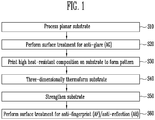
- FIG. 1 is a flowchart of the method of manufacturing the 3D substrate on which the pattern is printed according to an embodiment.
- the method of manufacturing the 3D substrate including the pattern according to the embodiment may additionally include processing the planar substrate (S10) and performing a surface-treatment for anti-glare (AG)(S20).
- the processing of the planar substrate (S10) means cutting and preparing a planar substrate having a predetermined dimension (size and shape) suitable for a product to which the planar substrate is to be applied.
- the surface-treatment for the AG (S20) may be performed by applying an AG composition on a surface of the planar substrate through printing or coating methods, or by chemically or physically etching the surface.
- the heat-resistant composition may be printed on the planar surface to form the pattern (S30).
- the 3D substrate on which the pattern is printed differs from a 3D substrate in which the planar substrate is first molded into a 3D shape and then an ink composition is applied to form a pattern, in that the heat-resistant composition is applied on the surface of the planar surface to form the pattern prior to the step of 3D thermoforming. Since the heat-resistant composition is applied on the planar substrate, it is possible to more easily perform the printing or coating process and ameliorate problems such as the occurrence of a printing tolerance and a printing defect, which are caused by directly applying an ink composition on a 3D substrate.
- the method of manufacturing the 3D substrate on which the pattern is printed includes three-dimensionally thermoforming the planar substrate on which the high heat-resistant composition is applied (S40).
- the thermoforming is performed under a high temperature condition in which the substrate is deformable.
- the substrate may be thermoformed by heating the substrate at a temperature of about 600°C to about 800°C for about 15 minutes to about 5 hours, for example, about 30 minutes to about 2 hours.
- the heat-resistant composition may be cured concurrently through the thermoforming.
- the three-dimensional thermoforming of the substrate may be performed through various methods.
- the thermoforming may be performed by pressing and molding the planar substrate on which the heat-resistant composition is printed, between an upper mold and a lower mold and at a high temperature sufficient to deform the substrate from a planar surface to a desired curved surface, but is not limited thereto.
- a protective layer made of a composition has previously been used on a substrate to be thermoformed, and prevents the printed layer from being discolored or damaged upon exposure to high temperature.
- the heat-resistant composition according to the embodiment has ultrahigh heat resistance, a protective layer is not needed.
- the method of manufacturing the 3D substrate on which the pattern is printed may include strengthening the 3D thermoformed substrate (S50) and performing a surface-treatment which includes the application of an anti-fingerprint (AF) and/or anti-reflection (AR) coating (S60).
- AF anti-fingerprint
- AR anti-reflection
- the strengthening of the substrate may be performed through heat strengthening or chemical strengthening, methods of which can be determined by those of skill in the art without undue experimentation.
- the surface treatment for the AF and/or the AR may be performed by printing or coating a combined AF/AR composition on the surface of the substrate, or by separately coating an AF composition and an AR composition on the surface of the substrate.
- a pattern may be formed on a display of an electronic device such as a mobile phone, a digital camera, and a navigation device, and on a peripheral portion of a front glass of a vehicle, but is not limited thereto.
- FIG. 2 is a plan view illustrating a 3D substrate on which a pattern is printed using a heat-resistant composition according to an embodiment.
- the substrate 1 on which the pattern is formed includes a pattern layer 120 printed on a 3D substrate 110.
- FIG. 3 is a cross-sectional view taken along line I-I' of FIG. 2 of the substrate 1 on which the pattern is formed.
- the pattern layer 120 is stacked on a surface of the substrate 110 and includes the heat-resistant composition, and an AG layer 130 and an AF/AR layer 140 are sequentially stacked on a surface of the substrate 110 opposite the pattern layer 120.
- Silicone-modified polyester resin contains methoxy reactant and 12 mol% terephthalic acid.
- Table 1 Example 1 2 3 4 5 6 Binder resin Silicone-modified polyester resin 7.0 10.5 10.5 14.0 14.0 17.5 Polysiloxane 28.0 24.5 24.5 21.0 21.0 17.5 Trimethylsilanol 0 0 0 0 0 0 0 Pigment ICCB 31.5 31.5 0 31.5 0 0 CCB 0 0 0 0 0 0 ICM 0 0 31.5 0 31.5 Carbon black 3.5 3.5 3.5 3.5 3.5 3.5 3.5 Low activity catalyst Tetra-isopropoxy titanate 2.0 2.0 2.0 2.0 2.0 2.0 2.0 2.0 2.0 Solvent BCS 28.0 28.0 28.0 28.0 Total weight ratio 100 100 100 100 100 100 100 100 100 100 100 100 100 100 100 100 100 100 100 100 100 100 100 100 100 100 100 100 100 100 100 100 100 100 100 100 100 100 100 100 100 100 100 100 100 100 100 100 100 100 100 100 Table 2 Example 7 8 9 10 11 12
- Comparative Example 1 Preparation of Comparative Ink Compositions
- Ink compositions to be compared with the above-described heat-resistant compositions of the Examples were prepared by mixing compounds having compositions shown in Table 3 below.
- Table 3 Comparative Example 1 2 3 4 5 6 Binder resin Silicone-modified polyester resin 35.0 0 10.5 10.5 10.5 10.5 Polysiloxane 0 35.0 17.5 17.5 17.5 17.5 Trimethylsilanol 0 0 7.0 7.0 7.0 7.0 Pigment ICCB 31.5 31.5 35.0 0 0 0 CCB 0 0 0 35.0 0 0 0 ICM 0 0 0 0 35.0 0 Carbon black 3.5 3.5 0 0 0 35.0 Low activity catalyst Tetra-isopropoxy titanate 2 2 2 2 2 2 2 2 2 2 2 Solvent BCS 28.0 28.0 28.0 28.0 28.0 Total weight ratio 100 100 100 100 100 100 100 100 100 100 100 100 100 100 100 100 100 100 100 100 100 100 100 100 100 100 100 100 100 100 100 100 100 100 100 100 100 100 100 100 100 100 100 100
- Viscosity of the compositions prepared in Examples 1 to 12 and Comparative Examples 1 to 6 were measured.
- compositions prepared in Examples 1 to 12 and Comparative Examples 1 to 6 were applied on a glass substrate. Specifically, each composition was printed on a 1 mm-thick planar glass substrate so as to have a thickness of 5.0 ⁇ m, and then, the glass substrate was dried.
- Optical density of a printed layer on a portion of the dried glass substrate was measured using an absorbance meter. Immediately after the printing, a surface of the printed layer of the dried glass substrate was cross-cut with a knife, and then, the dried glass substrate was immersed in hot water at a temperature of 100°C for 20 minutes. In order to confirm an adhesive force of each printed layer, a tape was attached to a surface of the cut printed layer and then removed. The adhesion was qualitatively assessed based on a relative scale ranging from 1B to 5B, with 5B corresponding to no removal of the cut printed layer and 1B corresponding to removal of 80-100% of the cut printed layer to which the tape is attached. Then, the darkness of each printed layer was visually evaluated based on a scale in which X means no discoloration and O means discoloration is present.
- the dried glass substrate was cleaned with a KOH aqueous solution (with pH 13) at a temperature of 65°C for 15 minutes, and then a tape was attached to the surface of the cut printed layer and removed to visually evaluate peeling-off and an adherence force of the printed layer.
- a KOH aqueous solution with pH 13
- the dried glass substrate was immersed in a 420°C KNO 3 aqueous solution for 5 hours, and then a tape was attached to the surface of the cut printed layer and removed to visually evaluate an adhesive force of the printed layer.
- compositions of Examples 1 to 12 exhibited excellent effects in each of the printing property evaluation, the cleaning evaluation, and the strengthening evaluation (see Tables 4 and 5 below). Specifically, since the composition of Example 11 had excellent thermal stability and alkali resistance, it could be confirmed that after the tape was peeled off, a clear cross-cut shape was observed on a surface of the printed layer, both after the printed layer was immersed in hot water and after the printed layer was cleaned with an alkali (see Example 11 of FIGs. 4A to 4D ).
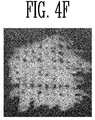
- Comparative Examples 1 and 2 only using a single binder, since the thermal stability was lower, an adhesive force after a heat treatment and an adhesive force in hot water appeared to be very low (see Table 6 below). Specifically, since the composition of Comparative Example 1 had low thermal stability and alkali resistance, it could be confirmed that the printed layer was peeled off to such an extent that a cross-cut shape could not be confirmed on a surface of the printed layer, either after the printed layer was immersed in hot water or after the printed layer was cleaned with an alkali (see Comparative Example 1 of FIGs. 4E to 4H ).
- Comparative Examples 3 to 6 only using a single pigment, in the case of Comparative Examples 3 to 5, it was confirmed that a printed layer was almost entirely peeled off during the adhesion force evaluation test after alkaline cleaning. In addition, in the case of Comparative Example 6, since thermal stability was lowered, an adhesive force after a heat treatment and an adhesive force in hot water appeared to be very low (see Table 6 below).
- a heat-resistant composition according to embodiments exhibits ultrahigh heat resistance so as to not be decomposed even when subjected to a heat treatment at an ultrahigh temperature of 800°C.
- a chemical strengthening process is performed on a glass substrate, there is no strengthening deviation between a region of the glass substrate printed with the high heat-resistant composition and a region of the glass substrate not printed with the heat-resistant composition.
- the high heat-resistant composition exhibits excellent ease of chemical strengthening and ease of cleaning such that a printed layer is not detached, cracked, and/or discolored.
- a planar substrate may be coated using the heat-resistant composition and then may be subjected to a three-dimensional thermoforming process. Therefore, embodiments provide a process of manufacturing a 3D substrate, in which a printing tolerance and exterior defects of a printed substrate are ameliorated to improve yield, and the difficulty of a manufacturing process is reduced to thereby decrease total manufacturing cost.
Landscapes
- Chemical & Material Sciences (AREA)
- Organic Chemistry (AREA)
- Chemical Kinetics & Catalysis (AREA)
- Life Sciences & Earth Sciences (AREA)
- Engineering & Computer Science (AREA)
- Materials Engineering (AREA)
- Wood Science & Technology (AREA)
- Health & Medical Sciences (AREA)
- Medicinal Chemistry (AREA)
- Polymers & Plastics (AREA)
- General Chemical & Material Sciences (AREA)
- Inorganic Chemistry (AREA)
- Composite Materials (AREA)
- Geochemistry & Mineralogy (AREA)
- Physics & Mathematics (AREA)
- General Physics & Mathematics (AREA)
- Compositions Of Macromolecular Compounds (AREA)
- Laminated Bodies (AREA)
Abstract
Description
- A heat-resistant composition and a method of manufacturing a three-dimensional substrate including a pattern printed using the heat-resistant composition.
- A display unit such as a mobile phone, a digital camera, a navigation device for a transporter, a front glass unit of a vehicle, or the like, may include a pattern having a certain color for the purpose of preventing damage to the display unit and the glass unit, enlarging a display of the display unit and/or the glass unit, or decorating an edge of the display unit and/or the glass unit.
- A heat-resistant composition having excellent ultrahigh heat resistance, ease of chemical strengthening, and ease of alkaline cleaning, and a method of manufacturing a three-dimensional (3D) substrate on which a pattern is printed using the heat-resistant composition are provided.
- A heat-resistant composition according to an embodiment includes: a binder resin including at least two of a silicone-modified polyester resin, a siloxane compound, or a silanol compound; a pigment including at least two of iron cobalt chromite black spinel (ICCB), copper chromite black spinel (CCB), iron chromite manganese (ICM), or carbon black; and a catalyst.
- In an embodiment, the siloxane compound may be a compound represented by following Formula 1:
Formula 1 (R1 3SiO1/2)2(R1R2SiO)a(R2 2SiO)b,
wherein R1 is a hydrogen atom, a substituted or unsubstituted C1-C10 alkyl group, a C2-C6 alkenyl group, a C6-C12 aryl group, or a C1-C6 alkoxy group, R2 is a hydrogen atom, a C1-C10 alkyl group, or a C6-C12 aryl group, a and b are each independently 0 or an integer of 1 to 10,000, and a+b is an integer of 5 to 10,000. - In an embodiment, the silanol compound may include at least one of trimethylsilanol or dimethylsilanol.
- In an embodiment, the binder resin may include a mixture of the silicone-modified polyester resin and the siloxane compound in a weight ratio of 1:1 to 1:9.
- In an embodiment, the binder resin may include a mixture of the silicone-modified polyester resin, the siloxane compound, and the silanol compound in a weight ratio of 1 : 1-5 : 0.1-3.
- In an embodiment, the pigment may include a mixture in which the ICCB and the carbon black are mixed in a weight ratio of 1:1 to 9:1.
- In an embodiment, the pigment may include a mixture of the CCB and the carbon black in a weight ratio of 1:1 to 9:1.
- In an embodiment, the pigment may include a mixture of the ICM and the carbon black in a weight ratio of 1:1 to 9:1.
- In an embodiment, the pigment may include a mixture of the ICCB and the ICM in a weight ratio of 1:1 to 9:1.
- In an embodiment, the catalyst may include a chelated titanate compound.
- In an embodiment, the catalyst may be present in an amount of about 1 weight percent (wt%) to about 3 wt%, based on the total weight of the composition.
- In an embodiment, the composition may be printed on a substrate in a thickness of about 10 micrometers (µm) to about 20 µm.
- In an embodiment, the substrate may include glass, polycarbonate (PC), poly(methyl methacrylate) (PMMA), polyimide (PI), polypropylene (PP), polyethylene (PE), polyethylene terephthalate (PET), polystyrene (PS), a copolyester thermoplastic elastomer (COP), or a combination thereof.
- In an embodiment, the composition may be a cured product formed by heating the composition at a temperature of about 190°C to about 220°C for about 30 minutes to about 2 hours.
- According to another embodiment, a method of manufacturing a 3D substrate including a pattern on a surface thereof, includes: (a) applying the heat-resistant composition on a surface of a planar substrate to form a surface-treated planar substrate; and (b) three-dimensionally thermoforming the surface-treated planar substrate to provide the three-dimensional substrate.
- At least some of the above and other features of the present invention are set out in the claims.
-
-
FIG. 1 is a flowchart of a method of manufacturing a three-dimensional (3D) substrate on which a pattern is printed, according to an embodiment; -
FIG. 2 is a top plan view illustrating a 3D substrate on which a pattern is printed using a heat-resistant composition according to an embodiment; -
FIG. 3 is a cross-sectional view taken along line I-I' ofFIG. 2 , and shows the substrate on which the pattern is formed, according to an embodiment; and -
FIGS. 4A to 4H are images of printed layers applied on a glass substrate and prepared in accordance with Example 11 (FIGS. 4A-4D ) and Comparative Example 1 (FIGS. 4E to 4H ), and which show the state of the printed layers after drying (FIGS. 4A ,4E ), the state of the printed layers after immersion in hot water (FIGS. 4B ,4F ), the state of the printed layers after alkaline cleaning (FIGS. 4C ,4G ), and the state of the printed layers after chemical strengthening (FIGS. 4D ,4H ). - The invention now will be described more fully hereinafter with reference to the accompanying drawings, in which various embodiments are shown. The invention can be modified in various different manners and may be embodied in various different forms. Specific embodiments will be described in detail with reference to the accompanying drawings. However, the present invention is not limited to the specific embodiments, but may include all modifications, equivalents and substitutions within the scope.
- It will be understood that when an element is referred to as being "on" another element, it can be directly on the other element or intervening elements may be present therebetween. In contrast, when an element is referred to as being "directly on" another element, there are no intervening elements present.
- It will be understood that, although the terms "first," "second," "third" etc. may be used herein to describe various elements, components, regions, layers and/or sections, these elements, components, regions, layers and/or sections should not be limited by these terms. These terms are only used to distinguish one element, component, region, layer or section from another element, component, region, layer or section. Thus, "a first element," "component," "region," "layer" or "section" discussed below could be termed a second element, component, region, layer or section without departing from the teachings herein.
- The terminology used herein is for the purpose of describing particular embodiments only and is not intended to be limiting. As used herein, the singular forms "a," "an," and "the" are intended to include the plural forms, including "at least one," unless the content clearly indicates otherwise. "At least one" is not to be construed as limiting "a" or "an." "Or" means "and/or." As used herein, the term "and/or" includes any and all combinations of one or more of the associated listed items. It will be further understood that the terms "comprises" and/or "comprising," or "includes" and/or "including" when used in this specification, specify the presence of stated features, regions, integers, steps, operations, elements, and/or components, but do not preclude the presence or addition of one or more other features, regions, integers, steps, operations, elements, components, and/or groups thereof.
- "About" or "approximately" as used herein is inclusive of the stated value and means within an acceptable range of deviation for the particular value as determined by one of ordinary skill in the art, considering the measurement in question and the error associated with measurement of the particular quantity (i.e., the limitations of the measurement system). For example, "about" can mean within one or more standard deviations, or within ± 30%, 20%, 10% or 5% of the stated value.
- As used herein, "alkyl" means a straight or branched chain, saturated, monovalent hydrocarbon group (e.g., methyl or hexyl).
- As used herein, "alkenyl" means a straight or branched chain, monovalent hydrocarbon group having at least one carbon-carbon double bond (e.g., ethenyl (-HC=CH2)).
- As used herein, "aryl" means a monovalent group formed by the removal of one hydrogen atom from one or more rings of an arene (e.g., phenyl or naphthyl).
- As used herein, "alkoxy" means an alkyl group that is linked via an oxygen (i.e., alkyl-O-), for example methoxy, ethoxy, and sec-butyloxy groups.
- As used herein, "silanol" means a silicon atom that is linked via an oxygen (i.e., Si-O-).
- The indicated number of carbon atoms in any of the above groups is exclusive of any substituents.
- Hereinafter, embodiments will be described in more detail.
- The present invention relates to a heat-resistant composition, and more particularly, to a heat-resistant composition having ultrahigh heat resistance and ease of alkaline cleaning.
- A heat-resistant composition according to an embodiment comprises a binder resin including at least two of a silicone-modified polyester resin, a siloxane compound, or a silanol compound; a pigment including at least two of iron cobalt chromite black spinel (ICCB), copper chromite black spinel (CCB), iron chromite manganese (ICM), or carbon black; and a catalyst. The catalyst may be, for example, a low-activity catalyst.
- The binder resin includes at least two of a silicone-modified polyester resin, a siloxane compound, or a silanol compound. For example, the binder resin may include a combination of a silicone-modified polyester resin and a siloxane compound, or may include a combination of a silicone-modified polyester resin, a siloxane compound, and a silanol compound. When a single binder resin is used, a printed layer peels off during alkaline cleaning and/or exhibits a relatively small adhesive force. However, hydrolysis is inhibited and adhesive force is improved when a combination of two or more binder resins is used.
- For example, the binder resin may include a mixture of a silicone-modified polyester resin and a siloxane compound in a weight ratio of 1:1 to 1:9, for example, 1:1 to 1:4, 1:1.5 to 1:2.4, and for example, 1:2.4. Alternatively, the binder resin may include a mixture of a silicone-modified polyester resin, a siloxane compound, and a silanol compound in a weight ratio of 1 : 1-5 : 0.1-3, for example, 1 : 1-2 : 0.6-1.4, 1 : 1.6-1.8 : 0.6-0.8 or 1 : 1.7 : 0.7. However, a composition of the binder is not limited thereto.
- The silicone-modified polyester resin is a polyester resin having an ester bond in a main chain thereof and which has been modified to include silicone. The silicone-modified polyester resin may be prepared by a condensation reaction between a silicone resin to which an alkoxy group is bonded, a polyfunctional alcohol monomer, and a polyfunctional carboxylic acid monomer.
- The silicone resin to which the alkoxy group is bonded may include an alkoxy group such as a methoxy group, an ethoxy group, or a butoxy group. The silicone resin to which the alkoxy group is bonded may further include a non-functional group such as a methyl group, a propyl group, or a phenyl group in a molecule thereof.
- The polyfunctional alcohol monomer may include, for example, at least one of ethylene glycol, propylene glycol, trimethylol propane, trimethylol ethane, cyclohexanedimethanol, neopentyl glycol, 2-butyl-2-ethyl-1,3-propanediol, 1,6-hexanediol, diethylene glycol, dipropylene glycol, tripropylene glycol, 1,3-butanediol, 1,4-butanediol, 1,5-pentanediol, triethylolpropane, glycerin, or pentaerythritol, but is not limited thereto.
- The polyfunctional carboxylic acid monomer may include, for example, at least one of phthalic anhydride, hexahydrophthalic anhydride, methylhexahydrophthalic anhydride, tetrahydrophthalic anhydride, methyltetrahydrophthalic anhydride, succinic anhydride, an isophthalic acid, an azelaic acid, maleic anhydride, or trimellitic anhydride, but is not limited thereto.
- As a compound including a siloxane bond in a molecule thereof, the siloxane compound may include, for example, at least one of polydimethylsiloxane, methyl hydrogen polysiloxane, hexamethyl polysiloxane, or methyl phenyl polysiloxane, but is not limited thereto.
- The siloxane compound may include, for example, a compound represented by the following
Formula 1. For example, the siloxane compound is a compound represented by the followingFormula 1.
Formula 1 (R1 3SiO1/2)2(R1R2SiO)a(R2 2SiO)b
InFormula 1, R1 is a hydrogen atom, a substituted or unsubstituted C1-C10 alkyl group, a C2-C6 alkenyl group, a C6-C12 aryl group, or a C1-C6 alkoxy group, and R2 is a hydrogen atom, a C1-C10 alkyl group, or a C6-C12 aryl group. For example, inFormula 1, R1 may be a hydrogen atom, a substituted or unsubstituted C1-C6 (e.g. C1-C3) alkyl group, a C2-C6 alkenyl group, a C6-C12 aryl group, or a C1-C6 alkoxy group. For example, inFormula 1, R2 may be a hydrogen atom, a C1-C6 (e.g. C1-C3) alkyl group, or a C6-C12 aryl group. The alkyl or alkenyl group may be linear or branched. The alkyl group may be, for example, a methyl group, an ethyl group, a propyl group, a butyl group, a pentyl group, a hexyl group, a cyclopentyl group, a cyclohexyl group, or the like. For example, the alkyl group may be a methyl group, an ethyl group, or a propyl group. The alkenyl group may be, for example, a vinyl group (-C=C-), a butenyl group, a pentenyl group, a hexenyl group, or the like. The aryl group may be, for example, a phenyl group, a tolyl group, a xylyl group, a naphthyl group, a biphenylene group, or the like. In addition, inFormula 1, a and b are each independently 0 or an integer of 1 or greater, for example 1 to 10,000, and a+b may be an integer of 5 to 10,000. - The silanol compound used in the present invention may be a compound including a silanol group (≡SiOH) in a molecule thereof. For example, the silanol compound may include at least one of trimethylsilanol or dimethylsilanol, but is not limited thereto.
- The binder resin may be present in an amount of about 10 wt% to about 50 wt%, or about 15 wt% to about 45 wt%, about 20 wt% to about 40 wt%, or about 30 wt% to about 40 wt% (e.g. 35 wt%) based on the total weight of the heat-resistant composition. When a content of the binder resin is less than about 10 wt%, an adhesive force and a bonding strength of the heat-resistant composition to a substrate may be decreased. Accordingly, a printed layer may be peeled off of a substrate when exposed to a high temperature or an alkaline environment. When the amount of the binder resin exceeds 50 wt% of the total weight of the heat-resistant composition, an amount of the pigment may be relatively decreased in the composition. Accordingly, the hiding power may be lowered.
- The pigment used in the present invention may include an oxide or a composite oxide of a transition metal element, such as, for example, iron (Fe), cobalt (Co), copper (Cu), chromium (Cr) or manganese (Mn). Specifically, the pigment includes at least two selected of iron cobalt chromite black spinel (ICCB), copper chromite black spinel (CCB), iron chromite manganese (ICM), or carbon black.
- For example, the pigment may include a combination of ICCB and carbon black, a combination of CCB and carbon black, a combination of ICM and carbon black, or a combination of ICCB and ICM. Due to the combination of the pigment compounds, it is possible to prevent chromium (Cr) in the pigment from being oxidized and to inhibit reactivity of NO3 - produced during heat strengthening, thereby preventing discoloration of the composition.
- For example, the pigment may include a mixture in which ICCB and carbon black, CCB and carbon black, ICM and carbon black, or ICCB and ICM are mixed in a weight ratio of 1:1 to 9:1, for example, 2.3:1 to 9:1. Specifically, in the pigment, ICCB and carbon black may be mixed in a weight ratio of 1:1 to 9:1, for example, 2.3:1 to 9:1 or 2.3:1 to 4:1; CCB and carbon black may be mixed in a weight ratio of 1:1 to 9:1, or 2:1 to 9:1, or 3:1 to 9:1, for example, 9:1 ; ICM and carbon black may be mixed in a weight ratio of 1:1 to 9:1, or 2:1 to 9:1, or 3:1 to 9:1, or for example, 4:1 to 9:1 or 5:1 to 9:1; and ICCB and ICM may be mixed in a weight ratio of 1:1 to 9:1, or 2:1 to 9:1, or 3:1 to 9:1, for example, 4:1 to 9:1. In addition, in the pigment, ICCB, ICM, and carbon black may be mixed in a weight ratio of 1 : 1 : 0.02 to 9 : 1 : 0.1, for example, 4 : 1 : 0.05 to 9 : 1 : 0.1. However, a mixture ratio in the pigment is not limited thereto. A combination in the pigment may be adjusted according to a maximum temperature of thermoforming according to a type and a composition of a substrate.
- The pigment may include a fine particle having a particle diameter of about 0.01 µm to about 20 µm, or about 0.05 µm to about 10 µm, or about 0.05 µm to about 5 µm. When a particle diameter of a heat-resistant pigment is greater than about 20 µm, compactness of a sintered thin film is degraded, and the uniformity of a printed layer may be easily decreased. In addition, when the particle diameter of the heat-resistant pigment is less than about 0.01 µm, the hiding power of the heat-resistant composition is lowered in a composition having a suitable viscosity for coating, and thus, the heat-resistant composition exhibits transparency, which is not suitable. In an embodiment, an average particle diameter of the pigment particle is about 0.1 µm to about 5 µm, for example, about 2 µm or less, or about 1 µm or less. When the average particle diameter is 5 µm or less, a dense sintered thin film may be formed on the substrate without impairing adhesion thereto even when only a small amount of the pigment particle is added. However, the particle diameter of the pigment particle is not limited to the above range.
- The pigment may be present in an amount of about 30 wt% to about 50 wt%, or about 30 wt% to about 45 wt%, or about 35 wt% to about 40 wt% (e.g. 35 wt%), based on the total weight of the heat-resistant composition. When a content of the pigment is less than about 30 wt%, the hiding power of the heat-resistant composition may be decreased. When the content of the pigment exceeds about 50 wt%, the dispersibility of the pigment in the heat-resistant composition may be decreased, and thus, the uniformity of a printed layer may also be decreased.
- The catalyst used in heat-resistant composition may be a low activity catalyst, for example, a catalyst compound having reduced catalytic activity due to the blockage of one or more reaction sites in the catalyst. Specifically, the low activity catalyst may include a chelated titanate compound, for example, a chelated titanate compound having two reaction sites. The chelated titanate may include, for example, a tetra(C1-C10 alkoxy) titanate, such as tetra-isopropoxy titanate, tetra-methoxy titanate, tetra-octadecyloxy titanate, or diisopropyl bis(acetylacetonyl)titanate, but is not limited thereto. In embodiments, the catalyst may be tetra-isopropoxy titanate.
- The low activity catalyst may be present in an amount of about 1 wt% to about 3 wt%, or about 1 wt% to about 2.5 wt%, or about 1.5 wt% to about 2.5 wt% (e.g. 2.0 wt%), based on the total weight of the composition. When a content of the low activity catalyst is less than about 1 wt% or exceeds about 3 wt%, an adhesive force between the heat-resistant composition and a substrate may be decreased.
- The heat-resistant composition according an embodiment may further include a thickener, a dispersant, a defoamer, or a combination thereof as an additive.
- The thickener used in the heat-resistant composition functions to increase viscosity of the heat-resistant composition, which may be decreased when components such as a binder resin, a pigment, a low activity catalyst, and a solvent are mixed. The thickener may be, for example, fumed silica, but is not limited thereto. The thickener may be further included in an amount of about 0.1 wt% to about 5 wt%, or about 1 wt% to about 5 wt%, or about 1 wt% to about 2 wt%, based on the total weight of the composition.
- The dispersant is not particularly limited as long as the dispersant is capable of uniformly dispersing a pigment. For example, the dispersant may be a polymeric dispersant having a functional group, such as a polyoxyalkylene side chain or a carboxylic acid side chain, attached to a main chain, such as MALIALIM™ series (NOF Corporation) or FLOWLEN™ series (Kyoeisha Chemical Co. Ltd.). The dispersant may be further included in an amount of about 0.5 wt% to about 2 wt%, or about 0.75 to about 2 wt%, or about 1 to about 2 wt%, based on the total weight of the composition. When an amount of the dispersant is less than about 0.5 wt%, a sufficient dispersion effect may not be obtained. When the amount of the dispersant exceeds about 2 wt%, a further dispersion effect may not be obtained even when the dispersant is added in a large amount.
- The defoamer functions to inhibit bubbles from being formed when viscosity of the heat-resistant composition is increased.
- As a solvent, the heat-resistant composition may include butyl cellosolve (BCS), methyl isobutyl ketone (MIBK), propyl methoxy acetate (PMA), dibutyl ether (DBE), isobutanol, or a combination thereof, but is not limited thereto. In embodiments, the solvent may be butyl cellosolve (BCS).
- The solvent may be present in an amount of about 20 wt% to about 40 wt%, 20 wt% to about 30 wt%, or about 22 wt% to about 28 wt% (e.g. 28 wt%), based on the total weight of the composition. Since the solvent has a high boiling point, volatilization of the solvent may be prevented, and compatibility may be secured. In addition, since phase separation of the solvent does not occur and milling properties are high, the solvent facilitates an ink manufacturing process. In addition, plate dryness and an increase in viscosity are small so that printing workability of the heat-resistant composition is excellent.
- The heat-resistant composition according to the present invention may have a viscosity of about 6,000 cps or less, for example, about 3,000 cps to 6,000 cps, or about 3,000 cps to about 5,000 cps. When the viscosity of the high heat-resistant composition is less than 3,000 cps, flowability of the composition is high, and thus, the composition is difficult to control during a printing or coating process. When the viscosity exceeds 6,000 cps, the heat-resistant composition adheres to an outlet from which the heat-resistant composition flows and is not discharged in the printing or coating process, or does not spread on a surface of the substrate after the printing or coating process is performed, and thus is not suitable for the process.
- A concentration of a solid content of the heat-resistant composition is not limited. However, in consideration of workability and the like, the solid content in the heat-resistant composition may be about 70 wt% to about 80 wt%, for example, about 72 wt% to about 78 wt%.
- The heat-resistant composition according to an embodiment, may be used as an ink capable of being applied on a substrate to form a pattern.
- The heat-resistant composition according to an embodiment, may be printed on a substrate so as to have a thickness of about 10 µm to about 20 µm, or about 12 µm to about 18 µm. The heat-resistant composition may be applied as a layer on one or both surfaces of the substrate. At least one layer of the heat-resistant composition may be applied to one or both surfaces.
- The heat-resistant composition according to an embodiment, may be applied on the surface of the substrate through a printing or coating method. Specifically, the heat-resistant composition may be applied through a screen printing method, an inkjet printing method, a dot printing method, a dip coating method, a spray coating method, a spin coating method, a silk screen printing method, a roll-to-roll (R2R) coating method, a pressure casting method, or a slip casting method, but is not limited thereto. The terms "printing" and "coating" may be used interchangeably herein, and refer to the application of at least one layer on a surface and may refer to each other even when solely used. The layer may be substantially uniform and may be present on an entire surface or on only a portion of a surface.
- The substrate may include at least one of glass, polycarbonate (PC), poly(methyl methacrylate) (PMMA), polyimide (PI), polypropylene (PP), polyethylene (PE), polyethylene terephthalate (PET), polystyrene (PS), or copolyester thermoplastic elastomer (COP). The substrate may have a thickness of about 50 µm or greater, or about 75 µm or greater or about 100 µm or greater, but is not limited thereto.
- The heat-resistant composition according to an embodiment, may be cured by heating the heat-resistant composition at a temperature of about 150°C or greater, or about 175°C or greater, or about 200°C or greater, for example, about 160°C to about 250°C, about 175°C to about 230°C, and for example, about 190°C to about 220°C for about 15 minutes to about 5 hours, specifically, for about 30 minutes to about 2 hours, based on single tone printing. Alternatively, the heat-resistant composition may be printed on the substrate, and then the heat-resistant composition may be cured by heating the high heat-resistant composition during the process of three-dimensional (3D) thermoforming of the substrate.
- To manufacture a 3D substrate on which a pattern is printed, a method has been used in which a planar substrate is first thermoformed into a desired 3D shape and then a pattern is printed on a surface of the 3D substrate using a non-heat resistant, pattern-forming ink. This is because when a pattern-forming ink is printed on a planar substrate and the substrate is then thermoformed at a high temperature of 600°C or greater, due to insufficient heat resistance of the pattern-forming ink, a pigment is oxidized and discolored, or a printed layer is broken or detached during cleaning of the coated 3D shape with an alkaline solution.
- Further, a method of printing a black pattern on such a 3D shape has continuously caused problems such as the occurrence of a printing tolerance and a printing defect according to an exposure process after printing due to the 3D shape and a large area thereof. As a result, there has been a demand for dimensional stability and exterior improvement in black pattern printing in a 3D substrate.
- A method of manufacturing a 3D substrate including a pattern on a surface thereof (a 3D substrate on which a pattern is printed), according to an embodiment, comprises: applying the heat-resistant composition according to an embodiment on a planar substrate to form a surface-treated planar and three-dimensionally thermoforming the surface-treated planar substrate to provide the three-dimensional substrate. The heat-resistant composition according to an embodiment, may be applied in a pattern on the surface of the planar substrate.
-
FIG. 1 is a flowchart of the method of manufacturing the 3D substrate on which the pattern is printed according to an embodiment. - As shown in
FIG. 1 , prior to printing the heat-resistant composition according to the embodiment on a surface of the planar substrate to form the pattern, the method of manufacturing the 3D substrate including the pattern according to the embodiment may additionally include processing the planar substrate (S10) and performing a surface-treatment for anti-glare (AG)(S20). - The processing of the planar substrate (S10) means cutting and preparing a planar substrate having a predetermined dimension (size and shape) suitable for a product to which the planar substrate is to be applied.
- The surface-treatment for the AG (S20) may be performed by applying an AG composition on a surface of the planar substrate through printing or coating methods, or by chemically or physically etching the surface.
- In the method of manufacturing the 3D substrate on which the pattern is printed, after the surface-treatment for the AG (S20), the heat-resistant composition may be printed on the planar surface to form the pattern (S30). The 3D substrate on which the pattern is printed differs from a 3D substrate in which the planar substrate is first molded into a 3D shape and then an ink composition is applied to form a pattern, in that the heat-resistant composition is applied on the surface of the planar surface to form the pattern prior to the step of 3D thermoforming. Since the heat-resistant composition is applied on the planar substrate, it is possible to more easily perform the printing or coating process and ameliorate problems such as the occurrence of a printing tolerance and a printing defect, which are caused by directly applying an ink composition on a 3D substrate.
- The method of manufacturing the 3D substrate on which the pattern is printed according to an embodiment, includes three-dimensionally thermoforming the planar substrate on which the high heat-resistant composition is applied (S40). The thermoforming is performed under a high temperature condition in which the substrate is deformable. For example, when the substrate is glass, the substrate may be thermoformed by heating the substrate at a temperature of about 600°C to about 800°C for about 15 minutes to about 5 hours, for example, about 30 minutes to about 2 hours. The heat-resistant composition may be cured concurrently through the thermoforming.
- The three-dimensional thermoforming of the substrate may be performed through various methods. For example, the thermoforming may be performed by pressing and molding the planar substrate on which the heat-resistant composition is printed, between an upper mold and a lower mold and at a high temperature sufficient to deform the substrate from a planar surface to a desired curved surface, but is not limited thereto.
- A protective layer made of a composition has previously been used on a substrate to be thermoformed, and prevents the printed layer from being discolored or damaged upon exposure to high temperature. However, since the heat-resistant composition according to the embodiment has ultrahigh heat resistance, a protective layer is not needed.
- After completing the 3D thermoforming of the substrate, the method of manufacturing the 3D substrate on which the pattern is printed, according to an embodiment, may include strengthening the 3D thermoformed substrate (S50) and performing a surface-treatment which includes the application of an anti-fingerprint (AF) and/or anti-reflection (AR) coating (S60).
- The strengthening of the substrate may be performed through heat strengthening or chemical strengthening, methods of which can be determined by those of skill in the art without undue experimentation.
- The surface treatment for the AF and/or the AR may be performed by printing or coating a combined AF/AR composition on the surface of the substrate, or by separately coating an AF composition and an AR composition on the surface of the substrate.
- According to the method of manufacturing the 3D substrate on which the pattern is printed according to an embodiment, a pattern may be formed on a display of an electronic device such as a mobile phone, a digital camera, and a navigation device, and on a peripheral portion of a front glass of a vehicle, but is not limited thereto.
-
FIG. 2 is a plan view illustrating a 3D substrate on which a pattern is printed using a heat-resistant composition according to an embodiment. - Referring to
FIG. 2 , it is possible to confirm a plan view of asubstrate 1 on which a pattern is formed, which is manufactured through the method of manufacturing the 3D substrate on which the pattern is printed according to an embodiment. Thesubstrate 1 on which the pattern is formed includes apattern layer 120 printed on a3D substrate 110. -
FIG. 3 is a cross-sectional view taken along line I-I' ofFIG. 2 of thesubstrate 1 on which the pattern is formed. - Referring to
FIG. 3 , in thesubstrate 1 on which the pattern is formed, thepattern layer 120 is stacked on a surface of thesubstrate 110 and includes the heat-resistant composition, and anAG layer 130 and an AF/AR layer 140 are sequentially stacked on a surface of thesubstrate 110 opposite thepattern layer 120. - Various heat-resistant compositions were prepared by combining compounds, and have the compositions shown in Tables 1 and 2 below.
- Silicone-modified polyester resin contains methoxy reactant and 12 mol% terephthalic acid.
Table 1 Example 1 2 3 4 5 6 Binder resin Silicone-modified polyester resin 7.0 10.5 10.5 14.0 14.0 17.5 Polysiloxane 28.0 24.5 24.5 21.0 21.0 17.5 Trimethylsilanol 0 0 0 0 0 0 Pigment ICCB 31.5 31.5 0 31.5 0 0 CCB 0 0 0 0 0 0 ICM 0 0 31.5 0 31.5 31.5 Carbon black 3.5 3.5 3.5 3.5 3.5 3.5 Low activity catalyst Tetra-isopropoxy titanate 2.0 2.0 2.0 2.0 2.0 2.0 Solvent BCS 28.0 28.0 28.0 28.0 28.0 28.0 Total weight ratio 100 100 100 100 100 100 Table 2 Example 7 8 9 10 11 12 Binder resin Silicone-modified polyester resin 10.5 10.5 10.5 10.5 10.5 10.5 Polysiloxane 17.5 17.5 17.5 17.5 17.5 10.5 Trimethylsilanol 7.0 7.0 7.0 7.0 7.0 14.0 Pigment ICCB 0 0 31.5 28.0 24.5 0 CCB 0 0 0 0 0 0 ICM 31.5 29.8 0 0 0 31.5 Carbon black 3.5 5.2 3.5 7.0 10.5 3.5 Low activity catalyst Tetra-isopropoxy titanate 2.0 2.0 2.0 2.0 2.0 2.0 Solvent BCS 28.0 28.0 28.0 28.0 28.0 28.0 Total weight ratio 100 100 100 100 100 100 - Ink compositions to be compared with the above-described heat-resistant compositions of the Examples, were prepared by mixing compounds having compositions shown in Table 3 below.
Table 3 Comparative Example 1 2 3 4 5 6 Binder resin Silicone-modified polyester resin 35.0 0 10.5 10.5 10.5 10.5 Polysiloxane 0 35.0 17.5 17.5 17.5 17.5 Trimethylsilanol 0 0 7.0 7.0 7.0 7.0 Pigment ICCB 31.5 31.5 35.0 0 0 0 CCB 0 0 0 35.0 0 0 ICM 0 0 0 0 35.0 0 Carbon black 3.5 3.5 0 0 0 35.0 Low activity catalyst Tetra-isopropoxy titanate 2 2 2 2 2 2 Solvent BCS 28.0 28.0 28.0 28.0 28.0 28.0 Total weight ratio 100 100 100 100 100 100 - In order to confirm physicochemical properties of the compositions prepared in Examples 1 to 12 and Comparative Examples 1 to 6, the following experiments were performed.
- Viscosity of the compositions prepared in Examples 1 to 12 and Comparative Examples 1 to 6 were measured.
- As a result of the experiments, the viscosity of Examples 1 to 12 and Comparative Examples 1 to 6 were confirmed to be in a range of 3,000 cps to 5,800 cps, and thus, Examples 1 to 12 and Comparative Examples 1 to 6 appeared to be suitable for use in a printing or coating process (see Tables 4 to 6 below).
- In order to confirm properties of the compositions prepared in Examples 1 to 12 and Comparative Examples 1 to 6, the compositions were applied on a glass substrate. Specifically, each composition was printed on a 1 mm-thick planar glass substrate so as to have a thickness of 5.0 µm, and then, the glass substrate was dried.
- Optical density of a printed layer on a portion of the dried glass substrate was measured using an absorbance meter. Immediately after the printing, a surface of the printed layer of the dried glass substrate was cross-cut with a knife, and then, the dried glass substrate was immersed in hot water at a temperature of 100°C for 20 minutes. In order to confirm an adhesive force of each printed layer, a tape was attached to a surface of the cut printed layer and then removed. The adhesion was qualitatively assessed based on a relative scale ranging from 1B to 5B, with 5B corresponding to no removal of the cut printed layer and 1B corresponding to removal of 80-100% of the cut printed layer to which the tape is attached. Then, the darkness of each printed layer was visually evaluated based on a scale in which X means no discoloration and O means discoloration is present.
- In order to evaluate adhesion (e.g., detergency) of the printed layer to the substrate, the dried glass substrate was cleaned with a KOH aqueous solution (with pH 13) at a temperature of 65°C for 15 minutes, and then a tape was attached to the surface of the cut printed layer and removed to visually evaluate peeling-off and an adherence force of the printed layer.
- In order to evaluate discoloration of the printed layer on the dried glass substrate after chemical strengthening, the dried glass substrate was immersed in a 420°C KNO3 aqueous solution for 5 hours, and then a tape was attached to the surface of the cut printed layer and removed to visually evaluate an adhesive force of the printed layer.
- The compositions of Examples 1 to 12 exhibited excellent effects in each of the printing property evaluation, the cleaning evaluation, and the strengthening evaluation (see Tables 4 and 5 below). Specifically, since the composition of Example 11 had excellent thermal stability and alkali resistance, it could be confirmed that after the tape was peeled off, a clear cross-cut shape was observed on a surface of the printed layer, both after the printed layer was immersed in hot water and after the printed layer was cleaned with an alkali (see Example 11 of
FIGs. 4A to 4D ). - However, in the case of Comparative Examples 1 and 2 only using a single binder, since the thermal stability was lower, an adhesive force after a heat treatment and an adhesive force in hot water appeared to be very low (see Table 6 below). Specifically, since the composition of Comparative Example 1 had low thermal stability and alkali resistance, it could be confirmed that the printed layer was peeled off to such an extent that a cross-cut shape could not be confirmed on a surface of the printed layer, either after the printed layer was immersed in hot water or after the printed layer was cleaned with an alkali (see Comparative Example 1 of
FIGs. 4E to 4H ). - In addition, among Comparative Examples 3 to 6 only using a single pigment, in the case of Comparative Examples 3 to 5, it was confirmed that a printed layer was almost entirely peeled off during the adhesion force evaluation test after alkaline cleaning. In addition, in the case of Comparative Example 6, since thermal stability was lowered, an adhesive force after a heat treatment and an adhesive force in hot water appeared to be very low (see Table 6 below).
Table 4 Example 1 2 3 4 5 6 Viscosity (cps) 5,600 5,400 5,000 4,000 4,200 3,500 Printing property evaluation O/D 1.5 1.7 3.0-3.2 3.1 3.1 2.7-3.0 Adhesive force (after printing) 5B 5B 5B 5B 5B 5B Adhesive force (hot water) 5B 5B 5B 5B 5B 5B Cleaning evaluation Peeling-off X X X X X X Adhesive force 4B 4B 4B 5B 5B 5B Chemical strengthening evaluation Discoloration X X X X X X X = none; O = present; O/D is optical density. Table 5 Example 7 8 9 10 11 12 Viscosity (cps) 4,200 4,500 4,100 3,200 3,000 3,600 Printing property evaluation O/D 3.9-4.2 3.8-4.2 2.2 3.3 4.3 4.3 Adhesive force (after printing) 5B 5B 5B 5B 5B 5B Adhesive force (hot water) 5B 3B 5B 5B 5B 5B Cleaning evaluation Peeling-off X X X X X X Adhesive force 5B 5B 5B 5B 5B 2B Chemical strengthening evaluation Discoloration X X X X X X Table 6 Comparative Example 1 2 3 4 5 6 Viscosity (cps) 5,800 4,500 3,800 4,000 4,300 4,400 Printing property evaluation O/D 4.1-4.3 4.0 3.8 3.2 3.5 2.0 Adhesive force (after printing) 5B 1B 5B 5B 5B 5B Adhesive force (hot water) 0B 0B 4B 4B 3B 0B Cleaning evaluation Peeling-off X ○ X X X X Adhesive force 0B 0B 1B 1B 1B 3B Chemical strengthening evaluation Discoloration ○ ○ X ○ X ○ - A heat-resistant composition according to embodiments exhibits ultrahigh heat resistance so as to not be decomposed even when subjected to a heat treatment at an ultrahigh temperature of 800°C. When a chemical strengthening process is performed on a glass substrate, there is no strengthening deviation between a region of the glass substrate printed with the high heat-resistant composition and a region of the glass substrate not printed with the heat-resistant composition. In addition, even during a chemical strengthening process and/or a cleaning process using a strong base solution, the high heat-resistant composition exhibits excellent ease of chemical strengthening and ease of cleaning such that a printed layer is not detached, cracked, and/or discolored.
- Due to the ultrahigh heat resistance, the ease of chemical strengthening, and the ease of cleaning, a planar substrate may be coated using the heat-resistant composition and then may be subjected to a three-dimensional thermoforming process. Therefore, embodiments provide a process of manufacturing a 3D substrate, in which a printing tolerance and exterior defects of a printed substrate are ameliorated to improve yield, and the difficulty of a manufacturing process is reduced to thereby decrease total manufacturing cost.
- Although embodiments have been referenced and described above, it will be understood that it is possible for those of ordinary skill in the art to implement modifications and variations on the present invention without departing from the concept and scope listed in the following appended claims.
- Therefore, the technical scope should not be limited to the contents described in the detailed description of the specification, but should be defined by the claims.
Claims (10)
- A heat-resistant composition comprising:a binder resin comprising at least two of a silicone-modified polyester resin, a siloxane compound, or a silanol compound;a pigment comprising at least two of iron cobalt chromite black spinel, copper chromite black spinel, iron chromite manganese, or carbon black; anda catalyst.
- A heat-resistant composition according to claim 1, wherein the siloxane compound is a compound represented by following Formula 1:
Formula 1 (R1 3SiO1/2)2(R1R2SiO)a(R2 2SiO)b,
wherein,R1 is a hydrogen atom, a C1-C10 alkyl group, a C2-C6 alkenyl group, a C6-C12 aryl group, or a C1-C6 alkoxy group,R2 is a hydrogen atom, a C1-C10 alkyl group, or a C6-C12 aryl group,a and b are each independently 0 or an integer of 1 to 10,000, and a+b is 5 to 10,000. - A heat-resistant composition according to claim 1 or claim 2, wherein the silanol compound includes at least one of trimethylsilanol or dimethylsilanol.
- A heat-resistant composition according to any one of claims 1 to 3, wherein the binder resin comprises a mixture of the silicone-modified polyester resin and the siloxane compound in a weight ratio of 1:1 to 1:9.
- A heat-resistant composition according to any one of claims 1 to 3, wherein the binder resin comprises a mixture of the silicone-modified polyester resin, the siloxane compound, and the silanol compound in a weight ratio of 1 : 1-5 : 0.1-3.
- A heat-resistant composition according to any one of claims 1 to 5, wherein the pigment comprises a mixture of one of iron cobalt chromite black spinel, copper chromite black spinel or iron chromite manganese, and the carbon black in a weight ratio of 1:1 to 9:1.
- A heat-resistant composition according to any one of claims 1 to 5, wherein the pigment includes a mixture of the iron cobalt chromite black spinel and the iron chromite manganese in a weight ratio of 1:1 to 9:1.
- A heat-resistant composition according to any one of claims 1 to 7, wherein the catalyst comprises a chelated titanate compound, and wherein the catalyst is present in an amount of about 1 weight percent to about 3 weight percent, based on the total weight of the composition.
- A product comprising:a substrate; anda heat-resistant composition according to any one of Claims 1 to 8, wherein the composition is printed on the substrate in a thickness of about 10 micrometers to about 20 micrometers, and wherein the substrate comprises glass, polycarbonate, poly(methyl methacrylate), polyimide, polypropylene, polyethylene, polyethylene terephthalate, polystyrene, a copolyester thermoplastic elastomer, or a combination thereof.
- A method of manufacturing a three-dimensional substrate comprising a pattern on a surface thereof, the method comprising:applying the heat-resistant composition according to any of claims 1 to 8 on a surface of a planar substrate to form a surface-treated planar substrate; andthree-dimensionally thermoforming the surface-treated planar substrate to provide the three-dimensional substrate.
Applications Claiming Priority (1)
| Application Number | Priority Date | Filing Date | Title |
|---|---|---|---|
| KR1020180062070A KR102243041B1 (en) | 2018-05-30 | 2018-05-30 | High heat resistant composition and method for preparing three-dimensional substrate using the same |
Publications (2)
| Publication Number | Publication Date |
|---|---|
| EP3575871A1 true EP3575871A1 (en) | 2019-12-04 |
| EP3575871B1 EP3575871B1 (en) | 2020-11-11 |
Family
ID=66866897
Family Applications (1)
| Application Number | Title | Priority Date | Filing Date |
|---|---|---|---|
| EP19177442.1A Active EP3575871B1 (en) | 2018-05-30 | 2019-05-29 | High heat-resistant composition and method of manufacturing three-dimensional substrate using the same |
Country Status (4)
| Country | Link |
|---|---|
| US (1) | US11613651B2 (en) |
| EP (1) | EP3575871B1 (en) |
| KR (1) | KR102243041B1 (en) |
| CN (1) | CN110551415B (en) |
Families Citing this family (2)
| Publication number | Priority date | Publication date | Assignee | Title |
|---|---|---|---|---|
| US20220017699A1 (en) * | 2020-07-20 | 2022-01-20 | Applied Materials, Inc. | Molecular space filler for binder jet ink |
| KR20230033137A (en) | 2021-08-27 | 2023-03-08 | 삼성디스플레이 주식회사 | Display device and manufacturing method thereof |
Citations (2)
| Publication number | Priority date | Publication date | Assignee | Title |
|---|---|---|---|---|
| US20140326236A1 (en) * | 2013-05-01 | 2014-11-06 | Brightsource Industries (Israel) Ltd. | High absorptivity, heat resistant coatings and related apparatus and methods |
| KR20180011466A (en) * | 2018-01-11 | 2018-02-01 | 삼성디스플레이 주식회사 | Method for preparing three-dimensional substrate |
Family Cites Families (11)
| Publication number | Priority date | Publication date | Assignee | Title |
|---|---|---|---|---|
| JPH0822994B2 (en) | 1990-11-08 | 1996-03-06 | 日立化成工業株式会社 | Paint composition and heat resistant paint |
| JPH05255638A (en) * | 1992-03-12 | 1993-10-05 | Hitachi Chem Co Ltd | Composition for coating and heat-resistant coating |
| MX2007004352A (en) | 2004-10-19 | 2007-05-04 | Valspar Sourcing Inc | Heat-resistant coating compositions, coated articles, and methods. |
| WO2006137560A1 (en) | 2005-06-24 | 2006-12-28 | Mitsubishi Chemical Corporation | Coating composition, process for production thereof, resin moldings and process for production of the moldings |
| US20070129470A1 (en) | 2005-12-05 | 2007-06-07 | Kuvshinnikova Olga I | Weatherable resinous composition with low heat storage and method |
| US8722835B2 (en) | 2007-09-17 | 2014-05-13 | Ppg Industries Ohio, Inc. | One component polysiloxane coating compositions and related coated substrates |
| GB2518819A (en) * | 2013-09-03 | 2015-04-08 | Jcco 330 Ltd | Improvements in and relating to pipe support systems |
| KR101987305B1 (en) | 2013-11-19 | 2019-06-10 | 삼성전기주식회사 | Insulating resin composition for printed circuit board and products having the same |
| KR102349012B1 (en) | 2014-09-05 | 2022-01-10 | 쓰리엠 이노베이티브 프로퍼티즈 컴파니 | Heat conformable curable adhesive films |
| KR101825545B1 (en) | 2014-09-25 | 2018-02-05 | 삼성에스디아이 주식회사 | Photosensitive resin composition and color filter using the same |
| KR101584492B1 (en) | 2015-08-17 | 2016-01-12 | (주)육일씨엔에쓰 | Method for manufacturing touch window glass for smart phone |
-
2018
- 2018-05-30 KR KR1020180062070A patent/KR102243041B1/en active Active
-
2019
- 2019-05-29 US US16/425,120 patent/US11613651B2/en active Active
- 2019-05-29 EP EP19177442.1A patent/EP3575871B1/en active Active
- 2019-05-30 CN CN201910461902.8A patent/CN110551415B/en active Active
Patent Citations (2)
| Publication number | Priority date | Publication date | Assignee | Title |
|---|---|---|---|---|
| US20140326236A1 (en) * | 2013-05-01 | 2014-11-06 | Brightsource Industries (Israel) Ltd. | High absorptivity, heat resistant coatings and related apparatus and methods |
| KR20180011466A (en) * | 2018-01-11 | 2018-02-01 | 삼성디스플레이 주식회사 | Method for preparing three-dimensional substrate |
Also Published As
| Publication number | Publication date |
|---|---|
| CN110551415B (en) | 2022-12-16 |
| US20190367731A1 (en) | 2019-12-05 |
| KR20190137191A (en) | 2019-12-11 |
| US11613651B2 (en) | 2023-03-28 |
| KR102243041B1 (en) | 2021-04-22 |
| EP3575871B1 (en) | 2020-11-11 |
| CN110551415A (en) | 2019-12-10 |
Similar Documents
| Publication | Publication Date | Title |
|---|---|---|
| CN1732199B (en) | Curable resin composition and cured product | |
| JP2010505662A (en) | Decorative plastic glazing assembly by film insert molding method | |
| KR101118750B1 (en) | Fabrication method of coating materials hybridized with high content colloidal ceramic sol and organic polymer and coating film thereof | |
| KR0175287B1 (en) | Label | |
| EP3575871B1 (en) | High heat-resistant composition and method of manufacturing three-dimensional substrate using the same | |
| CN104602826B (en) | Method for preparing multilayer silicones structure | |
| KR100843397B1 (en) | Polyester Resin Compositions, Catalyst for Polyester Production, Polyester Film, and Magnetic Recording Medium | |
| TWI728992B (en) | Epoxy resin composition, film-like epoxy resin composition and electronic device | |
| CN1332083A (en) | Casting mould for producing ceramic green-pressing sheet | |
| KR20050058356A (en) | Coating composition | |
| WO2021134433A1 (en) | A method for preparing electro-conductive silicone elastomer article | |
| CN102985458A (en) | Method for producing cured product and cured product | |
| US20170298250A1 (en) | Liquid coating compositions, processes for production thereof and use thereof | |
| CN109897539A (en) | A kind of flexibility high transparency high rigidity masking liquid composition and preparation method thereof | |
| JP4578128B2 (en) | Plastic molded product | |
| JP6753765B2 (en) | Liquid composition for film formation | |
| KR102155179B1 (en) | Ink Composition | |
| JP2004250521A (en) | Epoxy resin molding | |
| JP3043838B2 (en) | Silicone block copolymer and epoxy resin composition for molding | |
| TW200302849A (en) | Polymerizable composition and cured resin composition | |
| JP2015078291A (en) | Thermosetting resin composition, cured product thereof, and display member using the same | |
| CN111548668B (en) | Paint diluent, preparation method thereof, paint composition and engineering material product | |
| CN114395150A (en) | PET film and preparation method thereof, and PET protective film and preparation method thereof | |
| JP2006036972A (en) | Heat ray shielding synthetic resin laminate and method for producing the same | |
| JP6986408B2 (en) | Method for Producing Liquid Composition for Film Formation |
Legal Events
| Date | Code | Title | Description |
|---|---|---|---|
| PUAI | Public reference made under article 153(3) epc to a published international application that has entered the european phase |
Free format text: ORIGINAL CODE: 0009012 |
|
| STAA | Information on the status of an ep patent application or granted ep patent |
Free format text: STATUS: THE APPLICATION HAS BEEN PUBLISHED |
|
| AK | Designated contracting states |
Kind code of ref document: A1 Designated state(s): AL AT BE BG CH CY CZ DE DK EE ES FI FR GB GR HR HU IE IS IT LI LT LU LV MC MK MT NL NO PL PT RO RS SE SI SK SM TR |
|
| AX | Request for extension of the european patent |
Extension state: BA ME |
|
| STAA | Information on the status of an ep patent application or granted ep patent |
Free format text: STATUS: REQUEST FOR EXAMINATION WAS MADE |
|
| 17P | Request for examination filed |
Effective date: 20200327 |
|
| RBV | Designated contracting states (corrected) |
Designated state(s): AL AT BE BG CH CY CZ DE DK EE ES FI FR GB GR HR HU IE IS IT LI LT LU LV MC MK MT NL NO PL PT RO RS SE SI SK SM TR |
|
| GRAP | Despatch of communication of intention to grant a patent |
Free format text: ORIGINAL CODE: EPIDOSNIGR1 |
|
| STAA | Information on the status of an ep patent application or granted ep patent |
Free format text: STATUS: GRANT OF PATENT IS INTENDED |
|
| INTG | Intention to grant announced |
Effective date: 20200605 |
|
| GRAS | Grant fee paid |
Free format text: ORIGINAL CODE: EPIDOSNIGR3 |
|
| GRAA | (expected) grant |
Free format text: ORIGINAL CODE: 0009210 |
|
| STAA | Information on the status of an ep patent application or granted ep patent |
Free format text: STATUS: THE PATENT HAS BEEN GRANTED |
|
| AK | Designated contracting states |
Kind code of ref document: B1 Designated state(s): AL AT BE BG CH CY CZ DE DK EE ES FI FR GB GR HR HU IE IS IT LI LT LU LV MC MK MT NL NO PL PT RO RS SE SI SK SM TR |
|
| REG | Reference to a national code |
Ref country code: GB Ref legal event code: FG4D |
|
| REG | Reference to a national code |
Ref country code: CH Ref legal event code: EP |
|
| REG | Reference to a national code |
Ref country code: AT Ref legal event code: REF Ref document number: 1334065 Country of ref document: AT Kind code of ref document: T Effective date: 20201115 |
|
| REG | Reference to a national code |
Ref country code: DE Ref legal event code: R096 Ref document number: 602019001267 Country of ref document: DE |
|
| REG | Reference to a national code |
Ref country code: IE Ref legal event code: FG4D |
|
| REG | Reference to a national code |
Ref country code: NL Ref legal event code: MP Effective date: 20201111 |
|
| REG | Reference to a national code |
Ref country code: AT Ref legal event code: MK05 Ref document number: 1334065 Country of ref document: AT Kind code of ref document: T Effective date: 20201111 |
|
| PG25 | Lapsed in a contracting state [announced via postgrant information from national office to epo] |
Ref country code: FI Free format text: LAPSE BECAUSE OF FAILURE TO SUBMIT A TRANSLATION OF THE DESCRIPTION OR TO PAY THE FEE WITHIN THE PRESCRIBED TIME-LIMIT Effective date: 20201111 Ref country code: PT Free format text: LAPSE BECAUSE OF FAILURE TO SUBMIT A TRANSLATION OF THE DESCRIPTION OR TO PAY THE FEE WITHIN THE PRESCRIBED TIME-LIMIT Effective date: 20210311 Ref country code: RS Free format text: LAPSE BECAUSE OF FAILURE TO SUBMIT A TRANSLATION OF THE DESCRIPTION OR TO PAY THE FEE WITHIN THE PRESCRIBED TIME-LIMIT Effective date: 20201111 Ref country code: NO Free format text: LAPSE BECAUSE OF FAILURE TO SUBMIT A TRANSLATION OF THE DESCRIPTION OR TO PAY THE FEE WITHIN THE PRESCRIBED TIME-LIMIT Effective date: 20210211 Ref country code: GR Free format text: LAPSE BECAUSE OF FAILURE TO SUBMIT A TRANSLATION OF THE DESCRIPTION OR TO PAY THE FEE WITHIN THE PRESCRIBED TIME-LIMIT Effective date: 20210212 |
|
| PG25 | Lapsed in a contracting state [announced via postgrant information from national office to epo] |
Ref country code: AT Free format text: LAPSE BECAUSE OF FAILURE TO SUBMIT A TRANSLATION OF THE DESCRIPTION OR TO PAY THE FEE WITHIN THE PRESCRIBED TIME-LIMIT Effective date: 20201111 Ref country code: PL Free format text: LAPSE BECAUSE OF FAILURE TO SUBMIT A TRANSLATION OF THE DESCRIPTION OR TO PAY THE FEE WITHIN THE PRESCRIBED TIME-LIMIT Effective date: 20201111 Ref country code: IS Free format text: LAPSE BECAUSE OF FAILURE TO SUBMIT A TRANSLATION OF THE DESCRIPTION OR TO PAY THE FEE WITHIN THE PRESCRIBED TIME-LIMIT Effective date: 20210311 Ref country code: LV Free format text: LAPSE BECAUSE OF FAILURE TO SUBMIT A TRANSLATION OF THE DESCRIPTION OR TO PAY THE FEE WITHIN THE PRESCRIBED TIME-LIMIT Effective date: 20201111 Ref country code: SE Free format text: LAPSE BECAUSE OF FAILURE TO SUBMIT A TRANSLATION OF THE DESCRIPTION OR TO PAY THE FEE WITHIN THE PRESCRIBED TIME-LIMIT Effective date: 20201111 Ref country code: BG Free format text: LAPSE BECAUSE OF FAILURE TO SUBMIT A TRANSLATION OF THE DESCRIPTION OR TO PAY THE FEE WITHIN THE PRESCRIBED TIME-LIMIT Effective date: 20210211 |
|
| REG | Reference to a national code |
Ref country code: LT Ref legal event code: MG9D |
|
| PG25 | Lapsed in a contracting state [announced via postgrant information from national office to epo] |
Ref country code: HR Free format text: LAPSE BECAUSE OF FAILURE TO SUBMIT A TRANSLATION OF THE DESCRIPTION OR TO PAY THE FEE WITHIN THE PRESCRIBED TIME-LIMIT Effective date: 20201111 |
|
| PG25 | Lapsed in a contracting state [announced via postgrant information from national office to epo] |
Ref country code: SM Free format text: LAPSE BECAUSE OF FAILURE TO SUBMIT A TRANSLATION OF THE DESCRIPTION OR TO PAY THE FEE WITHIN THE PRESCRIBED TIME-LIMIT Effective date: 20201111 Ref country code: SK Free format text: LAPSE BECAUSE OF FAILURE TO SUBMIT A TRANSLATION OF THE DESCRIPTION OR TO PAY THE FEE WITHIN THE PRESCRIBED TIME-LIMIT Effective date: 20201111 Ref country code: EE Free format text: LAPSE BECAUSE OF FAILURE TO SUBMIT A TRANSLATION OF THE DESCRIPTION OR TO PAY THE FEE WITHIN THE PRESCRIBED TIME-LIMIT Effective date: 20201111 Ref country code: CZ Free format text: LAPSE BECAUSE OF FAILURE TO SUBMIT A TRANSLATION OF THE DESCRIPTION OR TO PAY THE FEE WITHIN THE PRESCRIBED TIME-LIMIT Effective date: 20201111 Ref country code: RO Free format text: LAPSE BECAUSE OF FAILURE TO SUBMIT A TRANSLATION OF THE DESCRIPTION OR TO PAY THE FEE WITHIN THE PRESCRIBED TIME-LIMIT Effective date: 20201111 Ref country code: LT Free format text: LAPSE BECAUSE OF FAILURE TO SUBMIT A TRANSLATION OF THE DESCRIPTION OR TO PAY THE FEE WITHIN THE PRESCRIBED TIME-LIMIT Effective date: 20201111 |
|
| REG | Reference to a national code |
Ref country code: DE Ref legal event code: R097 Ref document number: 602019001267 Country of ref document: DE |
|
| PG25 | Lapsed in a contracting state [announced via postgrant information from national office to epo] |
Ref country code: DK Free format text: LAPSE BECAUSE OF FAILURE TO SUBMIT A TRANSLATION OF THE DESCRIPTION OR TO PAY THE FEE WITHIN THE PRESCRIBED TIME-LIMIT Effective date: 20201111 |
|
| PLBE | No opposition filed within time limit |
Free format text: ORIGINAL CODE: 0009261 |
|
| STAA | Information on the status of an ep patent application or granted ep patent |
Free format text: STATUS: NO OPPOSITION FILED WITHIN TIME LIMIT |
|
| 26N | No opposition filed |
Effective date: 20210812 |
|
| PG25 | Lapsed in a contracting state [announced via postgrant information from national office to epo] |
Ref country code: IT Free format text: LAPSE BECAUSE OF FAILURE TO SUBMIT A TRANSLATION OF THE DESCRIPTION OR TO PAY THE FEE WITHIN THE PRESCRIBED TIME-LIMIT Effective date: 20201111 Ref country code: NL Free format text: LAPSE BECAUSE OF FAILURE TO SUBMIT A TRANSLATION OF THE DESCRIPTION OR TO PAY THE FEE WITHIN THE PRESCRIBED TIME-LIMIT Effective date: 20201111 Ref country code: AL Free format text: LAPSE BECAUSE OF FAILURE TO SUBMIT A TRANSLATION OF THE DESCRIPTION OR TO PAY THE FEE WITHIN THE PRESCRIBED TIME-LIMIT Effective date: 20201111 |
|
| PG25 | Lapsed in a contracting state [announced via postgrant information from national office to epo] |
Ref country code: SI Free format text: LAPSE BECAUSE OF FAILURE TO SUBMIT A TRANSLATION OF THE DESCRIPTION OR TO PAY THE FEE WITHIN THE PRESCRIBED TIME-LIMIT Effective date: 20201111 |
|
| PG25 | Lapsed in a contracting state [announced via postgrant information from national office to epo] |
Ref country code: ES Free format text: LAPSE BECAUSE OF FAILURE TO SUBMIT A TRANSLATION OF THE DESCRIPTION OR TO PAY THE FEE WITHIN THE PRESCRIBED TIME-LIMIT Effective date: 20201111 Ref country code: LU Free format text: LAPSE BECAUSE OF NON-PAYMENT OF DUE FEES Effective date: 20210529 Ref country code: MC Free format text: LAPSE BECAUSE OF FAILURE TO SUBMIT A TRANSLATION OF THE DESCRIPTION OR TO PAY THE FEE WITHIN THE PRESCRIBED TIME-LIMIT Effective date: 20201111 |
|
| REG | Reference to a national code |
Ref country code: BE Ref legal event code: MM Effective date: 20210531 |
|
| PG25 | Lapsed in a contracting state [announced via postgrant information from national office to epo] |
Ref country code: IE Free format text: LAPSE BECAUSE OF NON-PAYMENT OF DUE FEES Effective date: 20210529 |
|
| PG25 | Lapsed in a contracting state [announced via postgrant information from national office to epo] |
Ref country code: IS Free format text: LAPSE BECAUSE OF FAILURE TO SUBMIT A TRANSLATION OF THE DESCRIPTION OR TO PAY THE FEE WITHIN THE PRESCRIBED TIME-LIMIT Effective date: 20210311 |
|
| PG25 | Lapsed in a contracting state [announced via postgrant information from national office to epo] |
Ref country code: BE Free format text: LAPSE BECAUSE OF NON-PAYMENT OF DUE FEES Effective date: 20210531 |
|
| REG | Reference to a national code |
Ref country code: CH Ref legal event code: PL |
|
| PG25 | Lapsed in a contracting state [announced via postgrant information from national office to epo] |
Ref country code: LI Free format text: LAPSE BECAUSE OF NON-PAYMENT OF DUE FEES Effective date: 20220531 Ref country code: CH Free format text: LAPSE BECAUSE OF NON-PAYMENT OF DUE FEES Effective date: 20220531 |
|
| PG25 | Lapsed in a contracting state [announced via postgrant information from national office to epo] |
Ref country code: CY Free format text: LAPSE BECAUSE OF FAILURE TO SUBMIT A TRANSLATION OF THE DESCRIPTION OR TO PAY THE FEE WITHIN THE PRESCRIBED TIME-LIMIT Effective date: 20201111 |
|
| P01 | Opt-out of the competence of the unified patent court (upc) registered |
Effective date: 20230530 |
|
| PG25 | Lapsed in a contracting state [announced via postgrant information from national office to epo] |
Ref country code: HU Free format text: LAPSE BECAUSE OF FAILURE TO SUBMIT A TRANSLATION OF THE DESCRIPTION OR TO PAY THE FEE WITHIN THE PRESCRIBED TIME-LIMIT; INVALID AB INITIO Effective date: 20190529 |
|
| PG25 | Lapsed in a contracting state [announced via postgrant information from national office to epo] |
Ref country code: MK Free format text: LAPSE BECAUSE OF FAILURE TO SUBMIT A TRANSLATION OF THE DESCRIPTION OR TO PAY THE FEE WITHIN THE PRESCRIBED TIME-LIMIT Effective date: 20201111 |
|
| PG25 | Lapsed in a contracting state [announced via postgrant information from national office to epo] |
Ref country code: TR Free format text: LAPSE BECAUSE OF FAILURE TO SUBMIT A TRANSLATION OF THE DESCRIPTION OR TO PAY THE FEE WITHIN THE PRESCRIBED TIME-LIMIT Effective date: 20201111 |
|
| PG25 | Lapsed in a contracting state [announced via postgrant information from national office to epo] |
Ref country code: MT Free format text: LAPSE BECAUSE OF FAILURE TO SUBMIT A TRANSLATION OF THE DESCRIPTION OR TO PAY THE FEE WITHIN THE PRESCRIBED TIME-LIMIT Effective date: 20201111 |
|
| PGFP | Annual fee paid to national office [announced via postgrant information from national office to epo] |
Ref country code: DE Payment date: 20250422 Year of fee payment: 7 |
|
| PGFP | Annual fee paid to national office [announced via postgrant information from national office to epo] |
Ref country code: FR Payment date: 20250422 Year of fee payment: 7 |
|
| PGFP | Annual fee paid to national office [announced via postgrant information from national office to epo] |
Ref country code: GB Payment date: 20260324 Year of fee payment: 8 |