EP3575813B1 - Quantitative kartierung eines magnetresonanz-bildgebungsparameters durch datengetriebenes signalmodelllernen - Google Patents
Quantitative kartierung eines magnetresonanz-bildgebungsparameters durch datengetriebenes signalmodelllernen Download PDFInfo
- Publication number
- EP3575813B1 EP3575813B1 EP18175213.0A EP18175213A EP3575813B1 EP 3575813 B1 EP3575813 B1 EP 3575813B1 EP 18175213 A EP18175213 A EP 18175213A EP 3575813 B1 EP3575813 B1 EP 3575813B1
- Authority
- EP
- European Patent Office
- Prior art keywords
- mri
- data
- parameter
- determining
- value
- Prior art date
- Legal status (The legal status is an assumption and is not a legal conclusion. Google has not performed a legal analysis and makes no representation as to the accuracy of the status listed.)
- Active
Links
Images

Classifications
-
- G—PHYSICS
- G16—INFORMATION AND COMMUNICATION TECHNOLOGY [ICT] SPECIALLY ADAPTED FOR SPECIFIC APPLICATION FIELDS
- G16H—HEALTHCARE INFORMATICS, i.e. INFORMATION AND COMMUNICATION TECHNOLOGY [ICT] SPECIALLY ADAPTED FOR THE HANDLING OR PROCESSING OF MEDICAL OR HEALTHCARE DATA
- G16H50/00—ICT specially adapted for medical diagnosis, medical simulation or medical data mining; ICT specially adapted for detecting, monitoring or modelling epidemics or pandemics
- G16H50/20—ICT specially adapted for medical diagnosis, medical simulation or medical data mining; ICT specially adapted for detecting, monitoring or modelling epidemics or pandemics for computer-aided diagnosis, e.g. based on medical expert systems
-
- G—PHYSICS
- G01—MEASURING; TESTING
- G01R—MEASURING ELECTRIC VARIABLES; MEASURING MAGNETIC VARIABLES
- G01R33/00—Arrangements or instruments for measuring magnetic variables
- G01R33/20—Arrangements or instruments for measuring magnetic variables involving magnetic resonance
- G01R33/44—Arrangements or instruments for measuring magnetic variables involving magnetic resonance using nuclear magnetic resonance [NMR]
- G01R33/48—NMR imaging systems
- G01R33/50—NMR imaging systems based on the determination of relaxation times, e.g. T1 measurement by IR sequences; T2 measurement by multiple-echo sequences
-
- G—PHYSICS
- G01—MEASURING; TESTING
- G01R—MEASURING ELECTRIC VARIABLES; MEASURING MAGNETIC VARIABLES
- G01R33/00—Arrangements or instruments for measuring magnetic variables
- G01R33/20—Arrangements or instruments for measuring magnetic variables involving magnetic resonance
- G01R33/44—Arrangements or instruments for measuring magnetic variables involving magnetic resonance using nuclear magnetic resonance [NMR]
- G01R33/48—NMR imaging systems
- G01R33/54—Signal processing systems, e.g. using pulse sequences ; Generation or control of pulse sequences; Operator console
- G01R33/56—Image enhancement or correction, e.g. subtraction or averaging techniques, e.g. improvement of signal-to-noise ratio and resolution
- G01R33/5608—Data processing and visualization specially adapted for MR, e.g. for feature analysis and pattern recognition on the basis of measured MR data, segmentation of measured MR data, edge contour detection on the basis of measured MR data, for enhancing measured MR data in terms of signal-to-noise ratio by means of noise filtering or apodization, for enhancing measured MR data in terms of resolution by means for deblurring, windowing, zero filling, or generation of gray-scaled images, colour-coded images or images displaying vectors instead of pixels
-
- G—PHYSICS
- G06—COMPUTING OR CALCULATING; COUNTING
- G06F—ELECTRIC DIGITAL DATA PROCESSING
- G06F16/00—Information retrieval; Database structures therefor; File system structures therefor
- G06F16/20—Information retrieval; Database structures therefor; File system structures therefor of structured data, e.g. relational data
- G06F16/28—Databases characterised by their database models, e.g. relational or object models
- G06F16/284—Relational databases
- G06F16/288—Entity relationship models
-
- G—PHYSICS
- G06—COMPUTING OR CALCULATING; COUNTING
- G06N—COMPUTING ARRANGEMENTS BASED ON SPECIFIC COMPUTATIONAL MODELS
- G06N20/00—Machine learning
-
- G—PHYSICS
- G06—COMPUTING OR CALCULATING; COUNTING
- G06N—COMPUTING ARRANGEMENTS BASED ON SPECIFIC COMPUTATIONAL MODELS
- G06N3/00—Computing arrangements based on biological models
- G06N3/02—Neural networks
- G06N3/04—Architecture, e.g. interconnection topology
- G06N3/0499—Feedforward networks
-
- G—PHYSICS
- G06—COMPUTING OR CALCULATING; COUNTING
- G06N—COMPUTING ARRANGEMENTS BASED ON SPECIFIC COMPUTATIONAL MODELS
- G06N3/00—Computing arrangements based on biological models
- G06N3/02—Neural networks
- G06N3/08—Learning methods
- G06N3/09—Supervised learning
-
- G—PHYSICS
- G06—COMPUTING OR CALCULATING; COUNTING
- G06F—ELECTRIC DIGITAL DATA PROCESSING
- G06F16/00—Information retrieval; Database structures therefor; File system structures therefor
- G06F16/20—Information retrieval; Database structures therefor; File system structures therefor of structured data, e.g. relational data
- G06F16/22—Indexing; Data structures therefor; Storage structures
-
- G—PHYSICS
- G06—COMPUTING OR CALCULATING; COUNTING
- G06N—COMPUTING ARRANGEMENTS BASED ON SPECIFIC COMPUTATIONAL MODELS
- G06N3/00—Computing arrangements based on biological models
- G06N3/02—Neural networks
- G06N3/08—Learning methods
Definitions
- the present disclosure is directed, in general, to imaging techniques for imaging biological tissues, and more specifically to quantitative imaging in Magnetic Resonance Imaging (MRI).
- MRI Magnetic Resonance Imaging
- the contrast apparent in images acquired through classical MRI is the result of a combination of different physical parameters of underlying tissue(s), the particular MRI acquisition technique and its parameters.
- An approach for acquiring MR-based information on biological tissue is to directly measure one or more of its underlying physical properties, e.g. the tissue-specific T1 and T2 relaxation constants or the proton density PD.
- Those quantitative techniques are usually referred to as "parametric mapping” or “quantitative imaging” methods.
- the resulting image contrasts become more independent from the employed hardware, the applied imaging technique and the particular imaging parameters, because they directly probe the properties of the tissue.
- This facilitates comparability and thus clinical diagnosis and may enable building up a database of normal parametric values to which a newly scanned patient dataset can be compared. In other words, it provides the means to move from relative contrast information depending on many different factors towards an absolute measure of one or more separate physical properties.
- images encoding the quantitative parameters of interest are typically sampled multiple times, e.g. at different echo times using a multi-echo spin-echo (MESE) sequence to estimate the transverse relaxation time T2.
- MESE multi-echo spin-echo
- a signal model describing the relation between image intensities and relevant tissue properties is fitted onto these series of images (in the case of the MESE sequence that could e.g. be a simple mono-exponential T2-signal decay model), yielding a quantitative map.
- the chosen signal model is an approximation of reality by nature and may omit important components that drive the signal behavior beyond the quantitative parameter of interest due to the complex nature of the tissue microstructure (e.g. magnetization transfer effects) or system imperfections (e.g.
- a more detailed signal model uses a more complex analytical model known as "generating function" and incorporates one of the sources of error - the stimulated echoes - into the model (see for instance Lukzen et al., J. Magn. Reson. 2009, 196(2): 164-169 ), or Sumpf et al., IEEE Trans. Med. Imaging 2014, 33(12): 2213-2222 ).
- the generating function describes the relation between image intensities and relevant tissue properties better, it is more difficult to fit to the image series since the model has more independent variables, i.e. more mathematical degrees of freedom.
- additional regularization terms are often required to allow fitting of this ill-posed problem, which is usually tuned by yet more variables/regularization weights.
- An objective of the present invention is to propose an efficient and simple method and system for the quantitative mapping of biological tissue.
- the present invention proposes to use a machine learning method and system for determining parameters characterizing biological tissues as disclosed in the objects of the independent claims 1 and 9.
- the present invention proposes notably to learn a relation between
- the present invention concerns also an MRI system, as defined in independent claim 9, said system being configured for implementing the previously described machine learning method, said system comprising at least:
- Various disclosed embodiments include machine learning methods and corresponding systems and computer readable mediums for determining, for instance automatically determining, a value for a parameter from the relationship between a set of data acquired according to a second technique and a reference value acquired according to a first technique, wherein said relationship is obtained by training a machine learning algorithm on a learning dataset formed by said set of data and its corresponding reference value.
- FIGURES 1 and 2 discussed below, and the various embodiments used to describe the principles of the present disclosure in this patent document are by way of illustration only and should not be construed in any way to limit the scope of the disclosure. Those skilled in the art will understand that the principles of the present disclosure may be implemented in any suitably arranged device. The numerous innovative teachings of the present application will be described with reference to exemplary non-limiting embodiments.
- Figure 1 discloses in more details a machine learning method 100 for preferentially automatically determining a value (in particular a quantitative value) for a parameter, wherein determined values might be represented in a quantitative map, which enables characterizing a biological tissue of a patient.
- a value in particular a quantitative value
- FIG. 1 discloses in more details a machine learning method 100 for preferentially automatically determining a value (in particular a quantitative value) for a parameter, wherein determined values might be represented in a quantitative map, which enables characterizing a biological tissue of a patient.
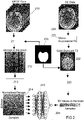
- the concept of the invention described in Figure 1 is then applied to a specific, non-limiting, case of MRI, wherein an example of quantification of T2 using a learnt signal model for a MESE sequence 210 with a single-echo spin-echo (SE) sequence 220 as gold-standard reference is taken.
- the first technique according to the invention uses a SE sequence 220 for quantifying T2 according to classical process and the second technique uses a MESE sequence 210 for quantifying T2 using a machine learning technique wherein the quantified T2 values obtained from the first technique are used as target output for the machine learning technique.
- reference values for a parameter are determined by the system according to the invention from a group of objects, for instance a group of subjects.
- Said parameter might be a physical parameter or a biological parameter.
- Said reference values also called gold-standard reference values, are values, preferentially quantitative values, of said parameter that are determined by the system according to a first technique.
- Said first technique is typically a time consuming technique that cannot be applied as such during clinical diagnosis. According to the present invention, said first technique is only used to create a learning dataset.
- the first technique is typically a known technique wherein the first set of data corresponds to a first signal intensity (or signal data) acquired by the system according to the invention for each object, the system being further configured for determining said value of the parameter for each object by fitting the signal intensity with a signal model. Each determined value for the parameter is then used as a reference value within the machine learning technique.
- the first signal intensity might be a SE signal intensity
- step 101 may comprise acquiring SE signal intensity (or data) for each object of the group of objects and determining quantitative gold-standard T2 values (T2 being thus the parameter whose values have to be determined) for each object from a single-slice, resolution- and orientation-matched single-echo spin-echo sequence.
- the gold-standard T2 values 222 are preferentially computed using a classical signal fitting 221 onto the spin-echo data.
- the system creates a learning dataset by associating for each object a second set of signal intensities (which corresponds in that case to said second set of data) and the T2 reference value determined from the first signal intensity using the first technique.
- a given gold-standard T2 reference value might be associated with a measured MESE signal evolution (i.e. signal decay) in a database.
- normalized signal decay 214 and gold-standard T2 value in the brain 224 preferentially obtained after application 223 of a brain mask 230 determined for each object, are stored in a database in order to create said learning dataset.
- the method according to the invention may comprise acquiring MESE signal intensities, for instance MESE images, from said group of objects.
- intracranial volume might be first segmented 211 to restrict the learning solely to brain tissue, wherein the object corresponding brain mask 230 is applied to the MESE data for this purpose.
- All MESE signal decays 212 are preferably normalized 213 by dividing the signal intensities by the L2-norm of the decay.
- the normalization of the signal decays, or more generally of data used as input within the machine learning algorithm, could be performed differently (different norm or different scale) depending on the used technique.
- the optional application of the brain mask 230 as previously described advantageously improves the final result.
- the system uses a machine learning technique for determining the value of the parameter from the second set of signal intensities, wherein said machine learning technique comprises using a machine learning algorithm for determining said value, and training said machine learning algorithm on the learning dataset wherein for each object the second signal intensity is used as input and the associated reference value as output target.
- the machine learning algorithm might be an artificial neuronal network 240 that is trained using the signal intensities of each echo as input and the gold-standard T2 value as target output.
- said artificial neuronal network 240 may comprise two layers with each 8 neurons and a root-mean-squared error to the gold-standard T2 as cost function.
- the training is preferentially performed with data from all available objects, i.e. with whole data of the learning dataset.
- the system determines a relationship between the signal intensity and the value of the parameter obtained for each object from the training of the machine learning algorithm on the learning dataset.
- the machine learning algorithm is typically used to learn the relationship between the decay and the T2 value.
- the system uses said relationship to determine the value of the parameter from a measured set of signal intensities for a new object. For instance and as illustrated in Fig. 2 , in order to reconstruct a new dataset (e.g. coming from the new object), every decay is fed to the previously trained artificial neuronal network to estimate T2 in each voxel of the new dataset, resulting in the desired quantitative value for the parameter based on the data driven signal model.
- the present invention proposes therefore to replace a fixed signal model with a learnt relationship between "true" values (i.e. based on the gold standard reference values) and the respective quantitative measurements can help eliminating many of the difficulties related to finding an appropriate model for a given problem.
- the data-driven approach proposed here is able to learn potential dirt effects in the acquired signal intensity, which are typically hard to model or even, cannot be modelled at all according to prior art technique.
- Another advantage is that no a priori knowledge has to be imposed regarding the assumed interaction of the tissue microstructure and the underlying MR physics.
- the application of a trained neural network is typically very fast, i.e. once the machine learning algorithm, like the artificial neuronal network 240 of Figure 2 , is trained, parametric maps can be obtained very quickly in contrast to typically slow fitting procedures.
- the present invention is not restricted to the specific embodiment of Figure 2 , but might be without effort generalizable to other quantification or determination of parameters since only a set of datasets acquired through the so-called second technique and gold-standard reference data acquired through the so-called first technique are required.
- the first technique and the second technique according to the reference might be the same, or are two different techniques.
- a different type of input data than a MESE dataset using a different sequence could be used as input for the machine learning algorithm.
- the invention could also be used for magnetic resonance fingerprinting (see Ma et al., Nature 2013, 495(7440): 187-192 ), where the fingerprint is the input and the multiparametric values are outputs of the artificial neuronal network.
- the machine learning technique described in the present invention and sometimes also referred to as artificial intelligence or data science tool may also use different approaches like a linear regression, a non-linear regression or convolutional neuronal networks.
Landscapes
- Engineering & Computer Science (AREA)
- Physics & Mathematics (AREA)
- Theoretical Computer Science (AREA)
- Health & Medical Sciences (AREA)
- General Physics & Mathematics (AREA)
- Data Mining & Analysis (AREA)
- General Engineering & Computer Science (AREA)
- Software Systems (AREA)
- Databases & Information Systems (AREA)
- Biomedical Technology (AREA)
- General Health & Medical Sciences (AREA)
- Artificial Intelligence (AREA)
- Mathematical Physics (AREA)
- Computing Systems (AREA)
- Medical Informatics (AREA)
- Evolutionary Computation (AREA)
- Public Health (AREA)
- Molecular Biology (AREA)
- Computational Linguistics (AREA)
- Biophysics (AREA)
- Life Sciences & Earth Sciences (AREA)
- Computer Vision & Pattern Recognition (AREA)
- High Energy & Nuclear Physics (AREA)
- Condensed Matter Physics & Semiconductors (AREA)
- Pathology (AREA)
- Epidemiology (AREA)
- Primary Health Care (AREA)
- Nuclear Medicine, Radiotherapy & Molecular Imaging (AREA)
- Radiology & Medical Imaging (AREA)
- Signal Processing (AREA)
- Magnetic Resonance Imaging Apparatus (AREA)
Claims (9)
- Maschinenlernverfahren zum Bestimmen eines Wertes für einen Magnetresonanz-Bildgebungsparameter (magnetic resonance imaging, MRI), wobei der Wert eine Charakterisierung eines biologischen Gewebes ermöglicht und das Verfahren Folgendes umfasst:- Bestimmen (101) von Referenzwerten für den MRI-Parameter aus einer Gruppe von Objekten, wobei eine erste MRI-Technik von einem MRI-System verwendet wird, um für jedes Objekt den Referenzwert aus einem ersten Satz von Daten zu bestimmen,- Erstellen (102) eines Lern-Datensatzes durch Zuordnen für jedes Objekt der Gruppe von Objekten eines zweiten Satzes von Daten und des zuvor aus dem ersten Satz von Daten bestimmten Referenzwerts, wobei der zweite Satz von Daten durch das MRI-System gemäß einer zweiten MRI-Technik zum Bestimmen von Werten des MRI-Parameters erfasst wird und dazu ausgebildet ist, eine Bestimmung des MRI-Parameters zu ermöglichen,- Verwenden (103) eines insbesondere durch das MRI-System implementierten Maschinenlernalgorithmus, der auf den Lern-Datensatz trainiert wird, um einen Wert des MRI-Parameters zu bestimmen, wobei der für jedes der Objekte erhaltene zweite Satz von Daten als Eingabe in dem Maschinenlernalgorithmus verwendet wird und dessen zugeordneter Referenzwert als Ausgabeziel für den Maschinenlernalgorithmus verwendet wird,- Bestimmen (104) einer Beziehung zwischen dem zweiten Satz von Daten und einem durch Trainieren des Maschinenlernalgorithmus auf den Lern-Datensatz für jedes Objekt erhaltenen Werts des MRI-Parameters,- Verwenden (105) der Beziehung, um aus einem weiteren Datensatz einen Wert für den MRI-Parameter eines neuen Objekts zu bestimmen, wobei der weitere Datensatz durch das MRI-System mittels der zweiten MRI-Technik erhalten worden ist, wobei der MRI-Parameter eine T2-Relaxationszeit ist und das Verfahren dadurch gekennzeichnet ist, dass die erste MRI-Technik eine Einzel-Echo Spin-Echo (SE)-Sequenz umfasst.
- Verfahren nach Anspruch 1, wobei die erste MRI-Technik das Anpassen des ersten Datensatzes mittels eines Signalmodells umfasst.
- Verfahren nach einem der vorhergehenden Ansprüche, wobei die zweite MRI-Technik eine Multi-Echo Spin-Echo (MESE)-Sequenz umfasst, derart, dass der zweite Datensatz MESE-Signalzerfälle (212) umfasst.
- Verfahren nach Anspruch 3, wobei eine Gehirnmaske auf die MESE-Signalzerfälle (212) und auf den ersten Datensatz angewendet wird.
- Verfahren nach Anspruch 3 oder 4, wobei die MESE-Signalzerfälle normalisiert werden.
- Verfahren nach einem der Ansprüche 1 bis 5, wobei der Maschinenlernalgorithmus ein künstliches neuronales Netz ist.
- Verfahren nach Anspruch 1 oder 2, wobei die zweite MRI-Technik die Methode des Magnetresonanz-Fingerabdrucks umfasst.
- Verfahren nach einem der Ansprüche 1 bis 7, wobei das Objekt ein Subjekt, ein Patient, Phantom-, Histologie- oder Tierdaten sein kann.
- Magnetresonanz-Bildgebungssystem (MRI-System), das dazu ausgebildet ist, einen Wert für einen Magnetresonanz-Bildgebungsparameter (MRI-Parameter) zu bestimmen, wobei das MRI-System dazu ausgebildet ist, einen ersten Satz von Daten aus jedem Objekt einer Gruppe von Daten zu erfassen und das MRI-System Folgendes umfasst:- eine Verarbeitungseinheit, die ausgebildet ist zum Bestimmen von Referenzwerten für den MRI-Parameter für jedes Objekt der Gruppe von Objekten durch eine erste MRI-Technik aus dem durch das MRI-System erfassten ersten Satz von Daten, wobei das MRI-System ferner dazu ausgebildet ist, einen zweiten Satz von Daten aus jedem Objekt der Gruppe von Objekten gemäß einer zweiten MRI-Technik zu erfassen, und das MRI-System ferner Folgendes umfasst:- eine Datenbank, in der ein Lern-Datensatz gespeichert ist, der für jedes Objekt der Gruppe von Objekten den zweiten Satz von Daten und den zuvor bestimmten Referenzwert umfasst und zuordnet, wobei der zweite Satz von Daten durch das MRI-System gemäß der zweiten MRI-Technik zum Bestimmen von Werten des MRI-Parameters erfasst wird,wobei die Verarbeitungseinheit ferner ausgebildet ist- zum Verwenden eines Maschinenlernalgorithmus, der auf den Lern-Datensatz trainiert wird, um aus dem zweiten Satz von Daten für jedes der Objekte einen Wert für den MRI-Parameter zu bestimmen, wobei der für jedes der Objekte erhaltene zweite Satz von Daten als Eingabe in dem Maschinenlernalgorithmus verwendet wird und dessen zugeordneter Referenzwert als Ausgabeziel für den Maschinenlernalgorithmus verwendet wird,- zum Bestimmen einer Beziehung zwischen dem zweiten Satz von Daten und einem durch Trainieren des Maschinenlernalgorithmus auf den Lern-Datensatz für jedes Objekt erhaltenen Werts des MRI-Parameters und- zum Verwenden (105) der Beziehung, um aus einem weiteren Datensatz einen Wert für den MRI-Parameter eines neuen Objekts zu bestimmen, wobei der weitere Datensatz durch das MRI-System mittels der zweiten MRI-Technik erfasst worden ist, wobei der MRI-Parameter eine T2-Relaxationszeit ist, wobei das MRI-System dadurch gekennzeichnet ist, dass es dazu ausgebildet ist, eine Einzel-Echo Spin-Echo (SE)-Sequenz als die erste MRI-Technik zu verwenden.
Priority Applications (2)
| Application Number | Priority Date | Filing Date | Title |
|---|---|---|---|
| EP18175213.0A EP3575813B1 (de) | 2018-05-30 | 2018-05-30 | Quantitative kartierung eines magnetresonanz-bildgebungsparameters durch datengetriebenes signalmodelllernen |
| US16/426,486 US11587675B2 (en) | 2018-05-30 | 2019-05-30 | Quantitative mapping by data-driven signal-model learning |
Applications Claiming Priority (1)
| Application Number | Priority Date | Filing Date | Title |
|---|---|---|---|
| EP18175213.0A EP3575813B1 (de) | 2018-05-30 | 2018-05-30 | Quantitative kartierung eines magnetresonanz-bildgebungsparameters durch datengetriebenes signalmodelllernen |
Publications (2)
| Publication Number | Publication Date |
|---|---|
| EP3575813A1 EP3575813A1 (de) | 2019-12-04 |
| EP3575813B1 true EP3575813B1 (de) | 2022-06-29 |
Family
ID=62492522
Family Applications (1)
| Application Number | Title | Priority Date | Filing Date |
|---|---|---|---|
| EP18175213.0A Active EP3575813B1 (de) | 2018-05-30 | 2018-05-30 | Quantitative kartierung eines magnetresonanz-bildgebungsparameters durch datengetriebenes signalmodelllernen |
Country Status (2)
| Country | Link |
|---|---|
| US (1) | US11587675B2 (de) |
| EP (1) | EP3575813B1 (de) |
Families Citing this family (5)
| Publication number | Priority date | Publication date | Assignee | Title |
|---|---|---|---|---|
| EP3575813B1 (de) * | 2018-05-30 | 2022-06-29 | Siemens Healthcare GmbH | Quantitative kartierung eines magnetresonanz-bildgebungsparameters durch datengetriebenes signalmodelllernen |
| DE102018125908A1 (de) * | 2018-10-18 | 2020-04-23 | Endress+Hauser Conducta Gmbh+Co. Kg | Verfahren zur Bestimmung einer Prozessgrößer mit einem Klassifikator zur Auswahl eines Messverfahrens |
| CN113391250B (zh) * | 2021-07-09 | 2022-11-29 | 清华大学 | 组织属性的多参数定量测试系统及其方法 |
| CN116068473A (zh) * | 2021-10-29 | 2023-05-05 | 通用电气精准医疗有限责任公司 | 生成磁共振图像的方法和磁共振成像系统 |
| IL313989A (en) * | 2022-01-04 | 2024-08-01 | Promaxo Inc | Relaxation-based magnetic resonance thermometry with a low-field single-sided mri scanner |
Family Cites Families (35)
| Publication number | Priority date | Publication date | Assignee | Title |
|---|---|---|---|---|
| US7444308B2 (en) * | 2001-06-15 | 2008-10-28 | Health Discovery Corporation | Data mining platform for bioinformatics and other knowledge discovery |
| BR0111742A (pt) * | 2000-06-19 | 2004-02-03 | Correlogic Systems Inc | Método heurìstico de classificação |
| US8463718B2 (en) * | 2000-08-07 | 2013-06-11 | Health Discovery Corporation | Support vector machine-based method for analysis of spectral data |
| EP1393196A4 (de) * | 2001-05-07 | 2007-02-28 | Health Discovery Corp | Kerne und verfahren zur auswahl von kernen zur verwendung in lernmaschinen |
| US20090132443A1 (en) * | 2007-11-16 | 2009-05-21 | Odilo Mueller | Methods and Devices for Analyzing Lipoproteins |
| WO2010030794A1 (en) * | 2008-09-10 | 2010-03-18 | Digital Infuzion, Inc. | Machine learning methods and systems for identifying patterns in data |
| EP2425356B1 (de) * | 2009-04-27 | 2019-03-13 | Cincinnati Children's Hospital Medical Center | Computerimplementiertes system und verfahren zur beurteilung eines neuropsychiatrischen zustandes einer person |
| WO2013016700A1 (en) * | 2011-07-27 | 2013-01-31 | The Research Foundation Of State University Of New York | Methods for generating predictive models for epithelial ovarian cancer and methods for identifying eoc |
| US9326684B2 (en) * | 2011-11-08 | 2016-05-03 | Covidien Lp | Magnetic enhancement in determination of physiological blood parameters |
| US20150220838A1 (en) * | 2012-06-21 | 2015-08-06 | Florian Martin | Systems and methods relating to network-based biomarker signatures |
| HK1222243A1 (zh) * | 2012-12-13 | 2017-06-23 | 麦太宝根有限公司 | 鉴定有发生2 型糖尿病风险的人 |
| EP2932289A1 (de) * | 2012-12-17 | 2015-10-21 | General Electric Company | In-vitro-magnetresonanzdetektion einer zielsubstanz |
| US10646595B2 (en) * | 2013-02-12 | 2020-05-12 | The Governing Council Of The University Of Toronto | Porphyrin compounds and their use as MRI contrast agents |
| US9466024B2 (en) * | 2013-03-15 | 2016-10-11 | Northrop Grumman Systems Corporation | Learning health systems and methods |
| JP6371554B2 (ja) * | 2014-03-28 | 2018-08-08 | 株式会社日立製作所 | 磁気共鳴イメージング装置 |
| US10761171B2 (en) * | 2015-06-22 | 2020-09-01 | Case Western Reserve University | Systems and methods for free-breathing three-dimensional magnetic resonance fingerprinting |
| US10869939B2 (en) * | 2015-08-03 | 2020-12-22 | Ramot At Tel-Aviv University Ltd. | Delivery system in micellar form having modular spectral response based on enzyme-responsive amphiphilic PEG-dendron hybrid polymers |
| US10548505B2 (en) * | 2016-03-15 | 2020-02-04 | Siemens Healthcare Gmbh | System and method for real-time MRI-guided object navigation |
| JP6703264B2 (ja) * | 2016-06-22 | 2020-06-03 | 富士通株式会社 | 機械学習管理プログラム、機械学習管理方法および機械学習管理装置 |
| US20180231626A1 (en) * | 2017-02-10 | 2018-08-16 | Case Western Reserve University | Systems and methods for magnetic resonance fingerprinting for quantitative breast imaging |
| US10846616B1 (en) * | 2017-04-28 | 2020-11-24 | Iqvia Inc. | System and method for enhanced characterization of structured data for machine learning |
| US11234657B2 (en) * | 2017-05-01 | 2022-02-01 | Rhode Island Hospital | Non-invasive measurement to predict post-surgery anterior cruciate ligament success |
| US10346974B2 (en) * | 2017-05-18 | 2019-07-09 | Toshiba Medical Systems Corporation | Apparatus and method for medical image processing |
| US11972355B2 (en) * | 2017-07-18 | 2024-04-30 | iQGateway LLC | Method and system for generating best performing data models for datasets in a computing environment |
| JP6898561B2 (ja) * | 2017-09-08 | 2021-07-07 | 富士通株式会社 | 機械学習プログラム、機械学習方法、および機械学習装置 |
| JP6898562B2 (ja) * | 2017-09-08 | 2021-07-07 | 富士通株式会社 | 機械学習プログラム、機械学習方法、および機械学習装置 |
| US11423325B2 (en) * | 2017-10-25 | 2022-08-23 | International Business Machines Corporation | Regression for metric dataset |
| US20200256856A1 (en) * | 2017-10-26 | 2020-08-13 | Essenlix Corporation | System and methods of image-based assay using crof and machine learning |
| WO2019113428A1 (en) * | 2017-12-08 | 2019-06-13 | Rensselaer Polytechnic Institute | A synergized pulsing-imaging network (spin) |
| US11426073B2 (en) * | 2018-04-27 | 2022-08-30 | Washington University | Imaging nerve function and pathologies using diffusion basis spectrum imaging |
| EP3575813B1 (de) * | 2018-05-30 | 2022-06-29 | Siemens Healthcare GmbH | Quantitative kartierung eines magnetresonanz-bildgebungsparameters durch datengetriebenes signalmodelllernen |
| WO2019229528A2 (en) * | 2018-05-30 | 2019-12-05 | Alexander Meyer | Using machine learning to predict health conditions |
| US20200334524A1 (en) * | 2019-04-17 | 2020-10-22 | Here Global B.V. | Edge learning |
| WO2021007075A1 (en) * | 2019-07-10 | 2021-01-14 | Becton, Dickinson And Company | Reconfigurable integrated circuits for adjusting cell sorting classification |
| US20220076157A1 (en) * | 2020-09-04 | 2022-03-10 | Aperio Global, LLC | Data analysis system using artificial intelligence |
-
2018
- 2018-05-30 EP EP18175213.0A patent/EP3575813B1/de active Active
-
2019
- 2019-05-30 US US16/426,486 patent/US11587675B2/en active Active
Also Published As
| Publication number | Publication date |
|---|---|
| EP3575813A1 (de) | 2019-12-04 |
| US20190371465A1 (en) | 2019-12-05 |
| US11587675B2 (en) | 2023-02-21 |
Similar Documents
| Publication | Publication Date | Title |
|---|---|---|
| Buonincontri et al. | Multi-site repeatability and reproducibility of MR fingerprinting of the healthy brain at 1.5 and 3.0 T | |
| Shams et al. | A comparison of in vivo MRI based cortical myelin mapping using T1w/T2w and R1 mapping at 3T | |
| US11587675B2 (en) | Quantitative mapping by data-driven signal-model learning | |
| Esses et al. | Automated image quality evaluation of T2‐weighted liver MRI utilizing deep learning architecture | |
| Rokem et al. | Evaluating the accuracy of diffusion MRI models in white matter | |
| Ben‐Eliezer et al. | Rapid and accurate T2 mapping from multi–spin‐echo data using Bloch‐simulation‐based reconstruction | |
| US11965946B2 (en) | Machine learning based processing of magnetic resonance data, including an uncertainty quantification | |
| Alexander | An introduction to computational diffusion MRI: the diffusion tensor and beyond | |
| Denis de Senneville et al. | RegQCNET: Deep quality control for image-to-template brain MRI affine registration | |
| EP4276756A2 (de) | Tumorgewebecharakterisierung mit multiparametrischer magnetresonanzbildgebung | |
| EP3617733A1 (de) | Verfahren und vorrichtung zur verarbeitung von magnetresonanzdaten unter verwendung maschinellen lernens | |
| Torop et al. | Deep learning using a biophysical model for robust and accelerated reconstruction of quantitative, artifact‐free and denoised images | |
| Jallais et al. | Introducing µGUIDE for quantitative imaging via generalized uncertainty-driven inference using deep learning | |
| Perrone et al. | D-BRAIN: anatomically accurate simulated diffusion MRI brain data | |
| Piredda et al. | Submillimeter T1 atlas for subject‐specific abnormality detection at 7T | |
| CN117689623A (zh) | 基于外梯度的自适应弥散磁共振微结构模型参数估计方法 | |
| Lim et al. | Fitting a directional microstructure model to diffusion-relaxation MRI data with self-supervised machine learning | |
| Economou et al. | Myelin water fraction in relation to fractional anisotropy and reading in 10-year-old children | |
| DE102010032825A1 (de) | Verfahren und Vorrichtung zur Magnetresonanzbildgebung | |
| Fang et al. | Deep learning for fast and spatially-constrained tissue quantification from highly-undersampled data in magnetic resonance fingerprinting (MRF) | |
| CN116888489A (zh) | 分析医学图像的方法 | |
| CN114127574A (zh) | 定量磁共振成像协议的验证 | |
| Mazzoni et al. | New developments in MRI: System characterization, technical advances and radiotherapy applications | |
| Fritz et al. | Longitudinal whole-human-brain quantitative MRI study on autolysis, fixation, rehydration, and shrinkage effects | |
| Ben-Eliezer | Advances in signal processing for relaxometry |
Legal Events
| Date | Code | Title | Description |
|---|---|---|---|
| PUAI | Public reference made under article 153(3) epc to a published international application that has entered the european phase |
Free format text: ORIGINAL CODE: 0009012 |
|
| STAA | Information on the status of an ep patent application or granted ep patent |
Free format text: STATUS: THE APPLICATION HAS BEEN PUBLISHED |
|
| AK | Designated contracting states |
Kind code of ref document: A1 Designated state(s): AL AT BE BG CH CY CZ DE DK EE ES FI FR GB GR HR HU IE IS IT LI LT LU LV MC MK MT NL NO PL PT RO RS SE SI SK SM TR |
|
| AX | Request for extension of the european patent |
Extension state: BA ME |
|
| STAA | Information on the status of an ep patent application or granted ep patent |
Free format text: STATUS: REQUEST FOR EXAMINATION WAS MADE |
|
| 17P | Request for examination filed |
Effective date: 20200519 |
|
| RBV | Designated contracting states (corrected) |
Designated state(s): AL AT BE BG CH CY CZ DE DK EE ES FI FR GB GR HR HU IE IS IT LI LT LU LV MC MK MT NL NO PL PT RO RS SE SI SK SM TR |
|
| GRAP | Despatch of communication of intention to grant a patent |
Free format text: ORIGINAL CODE: EPIDOSNIGR1 |
|
| STAA | Information on the status of an ep patent application or granted ep patent |
Free format text: STATUS: GRANT OF PATENT IS INTENDED |
|
| RIC1 | Information provided on ipc code assigned before grant |
Ipc: G06N 3/08 20060101ALI20220131BHEP Ipc: G01R 33/56 20060101ALI20220131BHEP Ipc: G01R 33/50 20060101AFI20220131BHEP |
|
| INTG | Intention to grant announced |
Effective date: 20220303 |
|
| GRAS | Grant fee paid |
Free format text: ORIGINAL CODE: EPIDOSNIGR3 |
|
| GRAA | (expected) grant |
Free format text: ORIGINAL CODE: 0009210 |
|
| STAA | Information on the status of an ep patent application or granted ep patent |
Free format text: STATUS: THE PATENT HAS BEEN GRANTED |
|
| AK | Designated contracting states |
Kind code of ref document: B1 Designated state(s): AL AT BE BG CH CY CZ DE DK EE ES FI FR GB GR HR HU IE IS IT LI LT LU LV MC MK MT NL NO PL PT RO RS SE SI SK SM TR |
|
| REG | Reference to a national code |
Ref country code: CH Ref legal event code: EP |
|
| REG | Reference to a national code |
Ref country code: AT Ref legal event code: REF Ref document number: 1501694 Country of ref document: AT Kind code of ref document: T Effective date: 20220715 |
|
| REG | Reference to a national code |
Ref country code: IE Ref legal event code: FG4D |
|
| REG | Reference to a national code |
Ref country code: DE Ref legal event code: R096 Ref document number: 602018037224 Country of ref document: DE |
|
| REG | Reference to a national code |
Ref country code: LT Ref legal event code: MG9D |
|
| PG25 | Lapsed in a contracting state [announced via postgrant information from national office to epo] |
Ref country code: SE Free format text: LAPSE BECAUSE OF FAILURE TO SUBMIT A TRANSLATION OF THE DESCRIPTION OR TO PAY THE FEE WITHIN THE PRESCRIBED TIME-LIMIT Effective date: 20220629 Ref country code: NO Free format text: LAPSE BECAUSE OF FAILURE TO SUBMIT A TRANSLATION OF THE DESCRIPTION OR TO PAY THE FEE WITHIN THE PRESCRIBED TIME-LIMIT Effective date: 20220929 Ref country code: LT Free format text: LAPSE BECAUSE OF FAILURE TO SUBMIT A TRANSLATION OF THE DESCRIPTION OR TO PAY THE FEE WITHIN THE PRESCRIBED TIME-LIMIT Effective date: 20220629 Ref country code: HR Free format text: LAPSE BECAUSE OF FAILURE TO SUBMIT A TRANSLATION OF THE DESCRIPTION OR TO PAY THE FEE WITHIN THE PRESCRIBED TIME-LIMIT Effective date: 20220629 Ref country code: GR Free format text: LAPSE BECAUSE OF FAILURE TO SUBMIT A TRANSLATION OF THE DESCRIPTION OR TO PAY THE FEE WITHIN THE PRESCRIBED TIME-LIMIT Effective date: 20220930 Ref country code: FI Free format text: LAPSE BECAUSE OF FAILURE TO SUBMIT A TRANSLATION OF THE DESCRIPTION OR TO PAY THE FEE WITHIN THE PRESCRIBED TIME-LIMIT Effective date: 20220629 Ref country code: BG Free format text: LAPSE BECAUSE OF FAILURE TO SUBMIT A TRANSLATION OF THE DESCRIPTION OR TO PAY THE FEE WITHIN THE PRESCRIBED TIME-LIMIT Effective date: 20220929 |
|
| REG | Reference to a national code |
Ref country code: NL Ref legal event code: MP Effective date: 20220629 |
|
| REG | Reference to a national code |
Ref country code: AT Ref legal event code: MK05 Ref document number: 1501694 Country of ref document: AT Kind code of ref document: T Effective date: 20220629 |
|
| PG25 | Lapsed in a contracting state [announced via postgrant information from national office to epo] |
Ref country code: RS Free format text: LAPSE BECAUSE OF FAILURE TO SUBMIT A TRANSLATION OF THE DESCRIPTION OR TO PAY THE FEE WITHIN THE PRESCRIBED TIME-LIMIT Effective date: 20220629 Ref country code: LV Free format text: LAPSE BECAUSE OF FAILURE TO SUBMIT A TRANSLATION OF THE DESCRIPTION OR TO PAY THE FEE WITHIN THE PRESCRIBED TIME-LIMIT Effective date: 20220629 |
|
| PG25 | Lapsed in a contracting state [announced via postgrant information from national office to epo] |
Ref country code: NL Free format text: LAPSE BECAUSE OF FAILURE TO SUBMIT A TRANSLATION OF THE DESCRIPTION OR TO PAY THE FEE WITHIN THE PRESCRIBED TIME-LIMIT Effective date: 20220629 |
|
| PG25 | Lapsed in a contracting state [announced via postgrant information from national office to epo] |
Ref country code: SM Free format text: LAPSE BECAUSE OF FAILURE TO SUBMIT A TRANSLATION OF THE DESCRIPTION OR TO PAY THE FEE WITHIN THE PRESCRIBED TIME-LIMIT Effective date: 20220629 Ref country code: SK Free format text: LAPSE BECAUSE OF FAILURE TO SUBMIT A TRANSLATION OF THE DESCRIPTION OR TO PAY THE FEE WITHIN THE PRESCRIBED TIME-LIMIT Effective date: 20220629 Ref country code: RO Free format text: LAPSE BECAUSE OF FAILURE TO SUBMIT A TRANSLATION OF THE DESCRIPTION OR TO PAY THE FEE WITHIN THE PRESCRIBED TIME-LIMIT Effective date: 20220629 Ref country code: PT Free format text: LAPSE BECAUSE OF FAILURE TO SUBMIT A TRANSLATION OF THE DESCRIPTION OR TO PAY THE FEE WITHIN THE PRESCRIBED TIME-LIMIT Effective date: 20221031 Ref country code: ES Free format text: LAPSE BECAUSE OF FAILURE TO SUBMIT A TRANSLATION OF THE DESCRIPTION OR TO PAY THE FEE WITHIN THE PRESCRIBED TIME-LIMIT Effective date: 20220629 Ref country code: EE Free format text: LAPSE BECAUSE OF FAILURE TO SUBMIT A TRANSLATION OF THE DESCRIPTION OR TO PAY THE FEE WITHIN THE PRESCRIBED TIME-LIMIT Effective date: 20220629 Ref country code: AT Free format text: LAPSE BECAUSE OF FAILURE TO SUBMIT A TRANSLATION OF THE DESCRIPTION OR TO PAY THE FEE WITHIN THE PRESCRIBED TIME-LIMIT Effective date: 20220629 |
|
| PG25 | Lapsed in a contracting state [announced via postgrant information from national office to epo] |
Ref country code: PL Free format text: LAPSE BECAUSE OF FAILURE TO SUBMIT A TRANSLATION OF THE DESCRIPTION OR TO PAY THE FEE WITHIN THE PRESCRIBED TIME-LIMIT Effective date: 20220629 Ref country code: IS Free format text: LAPSE BECAUSE OF FAILURE TO SUBMIT A TRANSLATION OF THE DESCRIPTION OR TO PAY THE FEE WITHIN THE PRESCRIBED TIME-LIMIT Effective date: 20221029 |
|
| REG | Reference to a national code |
Ref country code: DE Ref legal event code: R097 Ref document number: 602018037224 Country of ref document: DE |
|
| PG25 | Lapsed in a contracting state [announced via postgrant information from national office to epo] |
Ref country code: AL Free format text: LAPSE BECAUSE OF FAILURE TO SUBMIT A TRANSLATION OF THE DESCRIPTION OR TO PAY THE FEE WITHIN THE PRESCRIBED TIME-LIMIT Effective date: 20220629 |
|
| PG25 | Lapsed in a contracting state [announced via postgrant information from national office to epo] |
Ref country code: DK Free format text: LAPSE BECAUSE OF FAILURE TO SUBMIT A TRANSLATION OF THE DESCRIPTION OR TO PAY THE FEE WITHIN THE PRESCRIBED TIME-LIMIT Effective date: 20220629 Ref country code: CZ Free format text: LAPSE BECAUSE OF FAILURE TO SUBMIT A TRANSLATION OF THE DESCRIPTION OR TO PAY THE FEE WITHIN THE PRESCRIBED TIME-LIMIT Effective date: 20220629 |
|
| PLBE | No opposition filed within time limit |
Free format text: ORIGINAL CODE: 0009261 |
|
| STAA | Information on the status of an ep patent application or granted ep patent |
Free format text: STATUS: NO OPPOSITION FILED WITHIN TIME LIMIT |
|
| 26N | No opposition filed |
Effective date: 20230330 |
|
| PG25 | Lapsed in a contracting state [announced via postgrant information from national office to epo] |
Ref country code: SI Free format text: LAPSE BECAUSE OF FAILURE TO SUBMIT A TRANSLATION OF THE DESCRIPTION OR TO PAY THE FEE WITHIN THE PRESCRIBED TIME-LIMIT Effective date: 20220629 |
|
| REG | Reference to a national code |
Ref country code: CH Ref legal event code: PL |
|
| PG25 | Lapsed in a contracting state [announced via postgrant information from national office to epo] |
Ref country code: MC Free format text: LAPSE BECAUSE OF FAILURE TO SUBMIT A TRANSLATION OF THE DESCRIPTION OR TO PAY THE FEE WITHIN THE PRESCRIBED TIME-LIMIT Effective date: 20220629 |
|
| REG | Reference to a national code |
Ref country code: BE Ref legal event code: MM Effective date: 20230531 |
|
| PG25 | Lapsed in a contracting state [announced via postgrant information from national office to epo] |
Ref country code: MC Free format text: LAPSE BECAUSE OF FAILURE TO SUBMIT A TRANSLATION OF THE DESCRIPTION OR TO PAY THE FEE WITHIN THE PRESCRIBED TIME-LIMIT Effective date: 20220629 Ref country code: LU Free format text: LAPSE BECAUSE OF NON-PAYMENT OF DUE FEES Effective date: 20230530 Ref country code: LI Free format text: LAPSE BECAUSE OF NON-PAYMENT OF DUE FEES Effective date: 20230531 Ref country code: IT Free format text: LAPSE BECAUSE OF FAILURE TO SUBMIT A TRANSLATION OF THE DESCRIPTION OR TO PAY THE FEE WITHIN THE PRESCRIBED TIME-LIMIT Effective date: 20220629 Ref country code: CH Free format text: LAPSE BECAUSE OF NON-PAYMENT OF DUE FEES Effective date: 20230531 |
|
| REG | Reference to a national code |
Ref country code: DE Ref legal event code: R081 Ref document number: 602018037224 Country of ref document: DE Owner name: SIEMENS HEALTHINEERS AG, DE Free format text: FORMER OWNER: SIEMENS HEALTHCARE GMBH, MUENCHEN, DE Ref country code: IE Ref legal event code: MM4A |
|
| PG25 | Lapsed in a contracting state [announced via postgrant information from national office to epo] |
Ref country code: IE Free format text: LAPSE BECAUSE OF NON-PAYMENT OF DUE FEES Effective date: 20230530 |
|
| PG25 | Lapsed in a contracting state [announced via postgrant information from national office to epo] |
Ref country code: IE Free format text: LAPSE BECAUSE OF NON-PAYMENT OF DUE FEES Effective date: 20230530 |
|
| PG25 | Lapsed in a contracting state [announced via postgrant information from national office to epo] |
Ref country code: BE Free format text: LAPSE BECAUSE OF NON-PAYMENT OF DUE FEES Effective date: 20230531 |
|
| PG25 | Lapsed in a contracting state [announced via postgrant information from national office to epo] |
Ref country code: BG Free format text: LAPSE BECAUSE OF FAILURE TO SUBMIT A TRANSLATION OF THE DESCRIPTION OR TO PAY THE FEE WITHIN THE PRESCRIBED TIME-LIMIT Effective date: 20220629 |
|
| PG25 | Lapsed in a contracting state [announced via postgrant information from national office to epo] |
Ref country code: BG Free format text: LAPSE BECAUSE OF FAILURE TO SUBMIT A TRANSLATION OF THE DESCRIPTION OR TO PAY THE FEE WITHIN THE PRESCRIBED TIME-LIMIT Effective date: 20220629 |
|
| PGFP | Annual fee paid to national office [announced via postgrant information from national office to epo] |
Ref country code: GB Payment date: 20250610 Year of fee payment: 8 |
|
| PGFP | Annual fee paid to national office [announced via postgrant information from national office to epo] |
Ref country code: FR Payment date: 20250516 Year of fee payment: 8 |
|
| PG25 | Lapsed in a contracting state [announced via postgrant information from national office to epo] |
Ref country code: CY Free format text: LAPSE BECAUSE OF FAILURE TO SUBMIT A TRANSLATION OF THE DESCRIPTION OR TO PAY THE FEE WITHIN THE PRESCRIBED TIME-LIMIT; INVALID AB INITIO Effective date: 20180530 |
|
| PG25 | Lapsed in a contracting state [announced via postgrant information from national office to epo] |
Ref country code: HU Free format text: LAPSE BECAUSE OF FAILURE TO SUBMIT A TRANSLATION OF THE DESCRIPTION OR TO PAY THE FEE WITHIN THE PRESCRIBED TIME-LIMIT; INVALID AB INITIO Effective date: 20180530 |
|
| PGFP | Annual fee paid to national office [announced via postgrant information from national office to epo] |
Ref country code: DE Payment date: 20250718 Year of fee payment: 8 |
|
| PG25 | Lapsed in a contracting state [announced via postgrant information from national office to epo] |
Ref country code: TR Free format text: LAPSE BECAUSE OF FAILURE TO SUBMIT A TRANSLATION OF THE DESCRIPTION OR TO PAY THE FEE WITHIN THE PRESCRIBED TIME-LIMIT Effective date: 20220629 |