EP3574466B1 - Virtuelles spielsystem basierend auf vorherigen fähigkeitsbasierten ereignissen - Google Patents
Virtuelles spielsystem basierend auf vorherigen fähigkeitsbasierten ereignissen Download PDFInfo
- Publication number
- EP3574466B1 EP3574466B1 EP18746741.0A EP18746741A EP3574466B1 EP 3574466 B1 EP3574466 B1 EP 3574466B1 EP 18746741 A EP18746741 A EP 18746741A EP 3574466 B1 EP3574466 B1 EP 3574466B1
- Authority
- EP
- European Patent Office
- Prior art keywords
- audio
- processor
- visual
- frames
- clip
- Prior art date
- Legal status (The legal status is an assumption and is not a legal conclusion. Google has not performed a legal analysis and makes no representation as to the accuracy of the status listed.)
- Active
Links
Images







Classifications
-
- G—PHYSICS
- G06—COMPUTING OR CALCULATING; COUNTING
- G06Q—INFORMATION AND COMMUNICATION TECHNOLOGY [ICT] SPECIALLY ADAPTED FOR ADMINISTRATIVE, COMMERCIAL, FINANCIAL, MANAGERIAL OR SUPERVISORY PURPOSES; SYSTEMS OR METHODS SPECIALLY ADAPTED FOR ADMINISTRATIVE, COMMERCIAL, FINANCIAL, MANAGERIAL OR SUPERVISORY PURPOSES, NOT OTHERWISE PROVIDED FOR
- G06Q50/00—Information and communication technology [ICT] specially adapted for implementation of business processes of specific business sectors, e.g. utilities or tourism
-
- A—HUMAN NECESSITIES
- A63—SPORTS; GAMES; AMUSEMENTS
- A63F—CARD, BOARD, OR ROULETTE GAMES; INDOOR GAMES USING SMALL MOVING PLAYING BODIES; VIDEO GAMES; GAMES NOT OTHERWISE PROVIDED FOR
- A63F13/00—Video games, i.e. games using an electronically generated display having two or more dimensions
- A63F13/50—Controlling the output signals based on the game progress
- A63F13/52—Controlling the output signals based on the game progress involving aspects of the displayed game scene
-
- A—HUMAN NECESSITIES
- A63—SPORTS; GAMES; AMUSEMENTS
- A63F—CARD, BOARD, OR ROULETTE GAMES; INDOOR GAMES USING SMALL MOVING PLAYING BODIES; VIDEO GAMES; GAMES NOT OTHERWISE PROVIDED FOR
- A63F13/00—Video games, i.e. games using an electronically generated display having two or more dimensions
- A63F13/60—Generating or modifying game content before or while executing the game program, e.g. authoring tools specially adapted for game development or game-integrated level editor
- A63F13/65—Generating or modifying game content before or while executing the game program, e.g. authoring tools specially adapted for game development or game-integrated level editor automatically by game devices or servers from real world data, e.g. measurement in live racing competition
-
- A—HUMAN NECESSITIES
- A63—SPORTS; GAMES; AMUSEMENTS
- A63F—CARD, BOARD, OR ROULETTE GAMES; INDOOR GAMES USING SMALL MOVING PLAYING BODIES; VIDEO GAMES; GAMES NOT OTHERWISE PROVIDED FOR
- A63F13/00—Video games, i.e. games using an electronically generated display having two or more dimensions
- A63F13/80—Special adaptations for executing a specific game genre or game mode
- A63F13/828—Managing virtual sport teams
-
- G—PHYSICS
- G06—COMPUTING OR CALCULATING; COUNTING
- G06Q—INFORMATION AND COMMUNICATION TECHNOLOGY [ICT] SPECIALLY ADAPTED FOR ADMINISTRATIVE, COMMERCIAL, FINANCIAL, MANAGERIAL OR SUPERVISORY PURPOSES; SYSTEMS OR METHODS SPECIALLY ADAPTED FOR ADMINISTRATIVE, COMMERCIAL, FINANCIAL, MANAGERIAL OR SUPERVISORY PURPOSES, NOT OTHERWISE PROVIDED FOR
- G06Q50/00—Information and communication technology [ICT] specially adapted for implementation of business processes of specific business sectors, e.g. utilities or tourism
- G06Q50/34—Betting or bookmaking, e.g. Internet betting
-
- G—PHYSICS
- G06—COMPUTING OR CALCULATING; COUNTING
- G06T—IMAGE DATA PROCESSING OR GENERATION, IN GENERAL
- G06T1/00—General purpose image data processing
- G06T1/20—Processor architectures; Processor configuration, e.g. pipelining
-
- G—PHYSICS
- G06—COMPUTING OR CALCULATING; COUNTING
- G06T—IMAGE DATA PROCESSING OR GENERATION, IN GENERAL
- G06T1/00—General purpose image data processing
- G06T1/60—Memory management
-
- G—PHYSICS
- G06—COMPUTING OR CALCULATING; COUNTING
- G06T—IMAGE DATA PROCESSING OR GENERATION, IN GENERAL
- G06T11/00—Two-dimensional [2D] image generation
- G06T11/60—Creating or editing images; Combining images with text
-
- G—PHYSICS
- G07—CHECKING-DEVICES
- G07F—COIN-FREED OR LIKE APPARATUS
- G07F17/00—Coin-freed apparatus for hiring articles; Coin-freed facilities or services
- G07F17/32—Coin-freed apparatus for hiring articles; Coin-freed facilities or services for games, toys, sports, or amusements
- G07F17/3225—Data transfer within a gaming system, e.g. data sent between gaming machines and users
- G07F17/3227—Configuring a gaming machine, e.g. downloading personal settings, selecting working parameters
-
- G—PHYSICS
- G11—INFORMATION STORAGE
- G11B—INFORMATION STORAGE BASED ON RELATIVE MOVEMENT BETWEEN RECORD CARRIER AND TRANSDUCER
- G11B27/00—Editing; Indexing; Addressing; Timing or synchronising; Monitoring; Measuring tape travel
- G11B27/02—Editing, e.g. varying the order of information signals recorded on, or reproduced from, record carriers
- G11B27/031—Electronic editing of digitised analogue information signals, e.g. audio or video signals
-
- H—ELECTRICITY
- H04—ELECTRIC COMMUNICATION TECHNIQUE
- H04N—PICTORIAL COMMUNICATION, e.g. TELEVISION
- H04N21/00—Selective content distribution, e.g. interactive television or video on demand [VOD]
- H04N21/20—Servers specifically adapted for the distribution of content, e.g. VOD servers; Operations thereof
- H04N21/23—Processing of content or additional data; Elementary server operations; Server middleware
- H04N21/234—Processing of video elementary streams, e.g. splicing of video streams or manipulating encoded video stream scene graphs
- H04N21/23406—Processing of video elementary streams, e.g. splicing of video streams or manipulating encoded video stream scene graphs involving management of server-side video buffer
-
- H—ELECTRICITY
- H04—ELECTRIC COMMUNICATION TECHNIQUE
- H04N—PICTORIAL COMMUNICATION, e.g. TELEVISION
- H04N21/00—Selective content distribution, e.g. interactive television or video on demand [VOD]
- H04N21/40—Client devices specifically adapted for the reception of or interaction with content, e.g. set-top-box [STB]; Operations thereof
- H04N21/45—Management operations performed by the client for facilitating the reception of or the interaction with the content or administrating data related to the end-user or to the client device itself, e.g. learning user preferences for recommending movies, resolving scheduling conflicts
- H04N21/466—Learning process for intelligent management, e.g. learning user preferences for recommending movies
-
- H—ELECTRICITY
- H04—ELECTRIC COMMUNICATION TECHNIQUE
- H04N—PICTORIAL COMMUNICATION, e.g. TELEVISION
- H04N21/00—Selective content distribution, e.g. interactive television or video on demand [VOD]
- H04N21/40—Client devices specifically adapted for the reception of or interaction with content, e.g. set-top-box [STB]; Operations thereof
- H04N21/47—End-user applications
- H04N21/478—Supplemental services, e.g. displaying phone caller identification, shopping application
- H04N21/4781—Games
-
- H—ELECTRICITY
- H04—ELECTRIC COMMUNICATION TECHNIQUE
- H04N—PICTORIAL COMMUNICATION, e.g. TELEVISION
- H04N21/00—Selective content distribution, e.g. interactive television or video on demand [VOD]
- H04N21/80—Generation or processing of content or additional data by content creator independently of the distribution process; Content per se
- H04N21/81—Monomedia components thereof
- H04N21/8126—Monomedia components thereof involving additional data, e.g. news, sports, stocks, weather forecasts
-
- H—ELECTRICITY
- H04—ELECTRIC COMMUNICATION TECHNIQUE
- H04N—PICTORIAL COMMUNICATION, e.g. TELEVISION
- H04N21/00—Selective content distribution, e.g. interactive television or video on demand [VOD]
- H04N21/80—Generation or processing of content or additional data by content creator independently of the distribution process; Content per se
- H04N21/81—Monomedia components thereof
- H04N21/8146—Monomedia components thereof involving graphical data, e.g. 3D object, 2D graphics
-
- H—ELECTRICITY
- H04—ELECTRIC COMMUNICATION TECHNIQUE
- H04N—PICTORIAL COMMUNICATION, e.g. TELEVISION
- H04N21/00—Selective content distribution, e.g. interactive television or video on demand [VOD]
- H04N21/80—Generation or processing of content or additional data by content creator independently of the distribution process; Content per se
- H04N21/85—Assembly of content; Generation of multimedia applications
-
- G—PHYSICS
- G06—COMPUTING OR CALCULATING; COUNTING
- G06T—IMAGE DATA PROCESSING OR GENERATION, IN GENERAL
- G06T2200/00—Indexing scheme for image data processing or generation, in general
- G06T2200/28—Indexing scheme for image data processing or generation, in general involving image processing hardware
-
- G—PHYSICS
- G07—CHECKING-DEVICES
- G07F—COIN-FREED OR LIKE APPARATUS
- G07F17/00—Coin-freed apparatus for hiring articles; Coin-freed facilities or services
- G07F17/32—Coin-freed apparatus for hiring articles; Coin-freed facilities or services for games, toys, sports, or amusements
- G07F17/3286—Type of games
- G07F17/3288—Betting, e.g. on live events, bookmaking
Definitions
- This disclosure generally relates to a virtual gaming system.
- Virtual sports (“VS") games typically allow users to place wagers on a fictitious sequence of sporting events rather than on live or future sporting events. For example, an animation of the fictitious sequence is typically generated and displayed on a display screen (e.g., television) so that a user may view, and place a wager on, the animated sequence.
- a display screen e.g., television
- Generating the aforementioned animated sequence is typically a quite resource-intensive process. For example, motion capture devices are utilized to capture the imagery for the animation; processors then have to analyze the captured data and compose the animated sequence.
- processors then have to analyze the captured data and compose the animated sequence.
- generating the animated sequence is labor-intensive and time-consuming as humans are typically involved in performing the movements that are captured by a motion capture apparatus.
- the functioning of computers, which generate animated sequences for VS games is diminished by having to wait extended periods of time (e.g., days, weeks, months, etc.) for humans to perform the movements necessary as inputs for such computers to generate an animated sequence.
- US patent application publication no. 2016/0059135A1 (Wright et al ) describes a virtual interactive archive video sports game configured generate a virtual gaming match between two opponents.
- Wright discloses use of a processor that is operatively linked to a video database that holds a plurality of archive video clips from a plurality of prior recorded/filmed real sports events from an inter-related group of sports events.
- sports events may include any form of sporting event in league or tournament play.
- a virtual gaming system based on previous skill-based events is provided. Rather than generating an animation of fictitious events, which is computationally-intensive and labor-intensive, the virtual gaming system selects pre-recorded, or pre-captured, content to generate a fictitious sequence of events; thereby obviating utilization of inefficient technologies such as motion capture. Users may place a wager on the fictitious sequence of events, and for the avoidance of doubt the placing of wagers does not form part of the claimed invention but may be of help in understanding the claimed invention.
- the virtual gaming system improves upon the functioning of computers utilized to provide VS games with technologies other than motion capture. For instance, if pre-recorded data such as video clips was sent to a computer, those video clips would have typically been streamed simultaneously to the computer for playback with gaps between the video clips rather than the gapless playback performed by the virtual gaming system. Instead of having memory requirements for simultaneously receiving streamed video clips, the virtual gaming system obtains gapless playback by decoding frames in a pipeline. Through utilization of a buffer in a memory device, the virtual gaming system improves the functioning of a computer for non-animated sequences by reducing memory requirements.
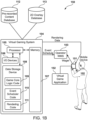
- Fig. 1A illustrates a virtual game configuration 100 that operates a virtual game in which a user 102 may place a wager from a virtual game console 101.
- the virtual game console 101 receives inputs from the user 102 (e.g., via touch screen inputs, button activations, hand gestures, etc.) and displays content associated with operation of the virtual game (e.g., via an integrated display screen).
- the virtual game console 101 receives inputs from the user 102, but the content associated with operation of the virtual game is displayed by, or projected onto, a display screen that is distinct from the virtual game console 101.
- the projection referred to herein is not limited to operation on a flat screen, or two-dimensional projection, as three-dimensional projection (e.g., via holographic projector) may be alternatively utilized to project the associated content.)
- An operator wager management system (“WMS”) 103 receives the wager from the virtual game console 101 (e.g., via a computerized network, telecommunications network, wired network, etc.). After receiving the wager, the operator WMS 103 awaits an outcome of the virtual game so that the operator WMS 103 may determine what prize, if any, is won by the user 102 and/or additional users. In other words, the operator WMS 103 is associated with a gaming entity (e.g., casino, lottery, etc.) whose responsibilities include, but are not limited to, receiving wagers and distributing prizes.
- a gaming entity e.g., casino, lottery, etc.
- the virtual gaming configuration 100 also includes a virtual gaming system 104 that schedules a virtual game and generates content to be displayed during the virtual game. Included as componentry within the virtual gaming system 104 are a processor 105, various input/output ("I/O") devices 106, a memory device 107, and a data storage device 108.
- the processor 105 executes various code within the memory device 107. For instance, the processor 105 retrieves game core logic code 109, event scheduler code 110, and rendering code 111 from the data storage device 108 for operation in the memory 107.
- the game core logic code 109 allows the processor 105 to operate the virtual game.
- the game core logic code 109 may have a rules-based approach that randomly selects content associated with the virtual game for display during the virtual game. Accordingly, the game core logic code 109 may require that random data be obtained from a certified random source (e.g., a particular random number generator (“RNG”)).
- RNG random number generator
- the event scheduler code 110 allows the processor 105 to schedule events for operation of the virtual game.
- the event scheduler code 110 may indicate that the virtual game is scheduled to be played every twenty minutes. (Other time intervals, specific times, etc. may be utilized instead.)
- the schedule of such time increments may be sent by the processor 105 executing the event scheduler code 110 according to a different time interval (e.g., daily transmission of schedule for virtual game operated at twenty minute intervals).
- the event scheduler code 110 allows the processor 105 to inform the operator WMS 103 that wagering is opened or closed for a particular iteration of the virtual game. Accordingly, the operator WMS 103 may receive wagers prior to and/or during the virtual game based on whether or not wagering is allowed at a given time, as determined by the processor 105 when executing the event scheduler code 110. The processor 105 may also send event results, as determined via execution of the event scheduler code 110, to the operator WMS 103.
- the communications between the virtual gaming system 104, or any componentry thereof, and the operator WMS 103 may be performed through a network (computerized, telecommunications, wired, etc.).
- the processor 105 may execute the rendering code 111 to select content for display during operation of the virtual game.
- the virtual gaming system 104 is in operable communication with a pre-recorded content database 112, which may store pre-recorded video clips of skill-based events occurring prior to initiation of the virtual game, and a 2D overlay database, which may store various data that may be appended to the pre-recorded video clips.
- the processor 105 determines an outcome of the virtual game, via execution of the game core logic code 109 (e.g., according to an RNG), the processor 105 may determine from the game core logic code 109 that the rendering code 111 is to be executed to compose rendering data for playback of the selected video clips and corresponding 2D overlay data.
- the processor 105 may send the rendering data through a network (computerized, telecommunications, wired, etc.) to the virtual gaming console 101 for display at the virtual gaming console 101.
- the processor 105 may send the rendering data to the operator WMS 103, which then sends the rendering data to the virtual gaming console 101.
- Fig. 1B illustrates a virtual game configuration 150 that is an alternative to the virtual game configuration 100 illustrated in Fig. 1A .
- the virtual game configuration 150 allows the user 102 to user a virtual game application 152 to operate the virtual game from a mobile computing device (e.g., smartphone, laptop, tablet device, smartwatch, smart wearable, etc.).
- the mobile computing device 151 is utilized by the user 102 to send a wager to the operator WMS 103 and receive rendering data for display at the mobile computing device 151.
- the mobile computing device 151 is utilized by the user 102 to send the wager to the operator WMS 103, but the virtual gaming system 104 sends the rendering data to a display device (e.g., television) that is distinct from the mobile computing device 151.
- a display device e.g., television
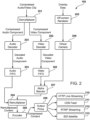
- Fig. 2 illustrates componentry of the rendering code 111 illustrated in Figs. 1A and 1B .
- the processor 105 when executing the game core logic code 109 and/or the rendering code 111, receives a plurality of compressed video clips from the pre-recorded content database 112; those clips may include video and/or audio content.
- the processor 105 when executing the rendering code 111, may compose a queue of video clips (e.g., in the order received).
- the processor 105 may then execute the rendering code 111 to compose the rendering data based on each video clip in turn.
- a compressed video clip that is at the front of the queue may be provided by the processor 105 to a demultiplexer 201, which demultiplexes the compressed video clip into its compressed video components and compressed audio components.
- the processor 105 provides the compressed audio component to an audio decoder 203, which decodes the compressed audio component into its uncompressed audio format, and the compressed video component to a video decoder 202, which decodes the compressed video component into its uncompressed video format.
- the uncompressed video component is added to a first-in, first-out (“FIFO") video queue, and the audio component is added to a FIFO audio queue that is distinct from the FIFO video queue.
- the FIFO queues may be stored in the memory device 107, the data storage device 108, or another non-transitory computer readable storage device.
- the current decoded video component outputted from the FIFO video queues is processed via the processor 105 executing the rendering code 111, the current decoded audio component, as determined by first positioning in the FIFO audio queue, is not processed until the processing of the decoded video component has completed.
- an audio/video clip is decomposed into its respective audio and video components (e.g., frames) to isolate the video component for processing individually from the audio component.
- the processor 105 may execute the rendering code 111 to utilize a re-multiplexer 204 to recompose an audio/video clip with the original audio component and the enhanced video component.
- the rendering code 111 retrieves the next video component from the FIFO video queue. Accordingly, the FIFO video queue allows for enough buffering so that uncompressed video frames being subsequently read by the processor 105 are not completely consumed before the video decoder 202 begins decoding uncompressed video frames of the next A/V clip.
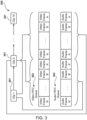
- Fig. 3 illustrates an example of a pipeline 300 that is utilized to process content for a VS game based on a series of previous skill-based events. For instance, a plurality of A/V clips 301, each corresponding to a previous skill-based event occurring prior to initiation of the VS game, may be played back-to-back in a certain order for the VS game. Audio and video FIFOs are generated for each of the A/V clips 301.
- a video FIFO queue 302 for a first clip 301 has video frame A in the first position since video frame A is the first frame of the first clip 301, and an audio FIFO queue 303 for the first clip 301 has the audio frame A in the first position since audio frame A is the first frame of the first clip 301.
- the processor 105 Prior to decoding the last video frame N in the video FIFO queue 302, the processor 105 ( Figs. 1A and 1B ) executes the rendering code 111 to ensure that enough of a buffer is present in the memory device 107 to allow the video decoder 202 ( Fig. 2 ) to write decompressed video frames from a second clip 301 to the memory device 107.
- the processor 105 executes, or previously executed, the rendering code 111 to free up memory that was previously occupied by video frames A through N of the first video FIFO queue 302; as a result, the memory device 107 has enough of a buffer for video frame A' of a second video FIFO queue 304.
- a threshold quantity of memory blocks are allocated to the memory device 107 to write the video frame A' to the buffer faster than the broadcast frame rate (e.g., twenty five frames per second for high-definition content) of the video frame N. Therefore, playback appears to the user 102 ( Fig. 1A ) or the user 152 ( Fig. 1B ) as being gapless (e.g., no gap appears between the first clips 301 and the second clip 301 during playback).
- the processor 105 By performing effective memory management, the processor 105 reduces memory requirements to improve the functioning of a computer. As A/V clips may exhaust large quantities of memory, conventional, simultaneous storage of A/V clips is ineffective for VS games (i.e., gaps between clips would result as too much memory from a current clip would consume memory necessary for a next clip).
- the pipeline 300 avoids the necessity of such significant memory requirements by managing memory according to FIFO on a per-clip basis to ensure adequate buffering for gapless playback of a series of video clips. Further, the pipeline 300 implementing such effective memory management allows for gapless playback to be rendered at the virtual gaming console 101 ( Fig. 1A ) or the mobile computing device 151 ( Fig. 1B ) - even without extra memory and/or software at the virtual gaming console 101 or the mobile computing device 151.
- the processor 105 executes the rendering code 111 to not only render a series of video clips, but also overlay data that enhances the video clips.
- the video clips may display a plurality of skill-based events as previously recorded (e.g., a plurality of soccer matches, football games, etc.); yet, such clips may alone not depict data directly related to an outcome of the VS game from the perspective of the user 102 ( Figs. 1A and 1B ). For instance, a VS game score, which depends on the outcomes of a plurality of different events, is not displayed by the clips themselves.
- the processor 105 may also receive overlay data to be rendered in conjunction with a corresponding A/V clip.
- the overlay data which may be pertinent to the VS game and/or the events associated with the A/V clips themselves, are dynamic - changing throughout the VS game to pique the interest of the user 102 ( Figs. 1A and 1B ).
- the overlay data may include changing data such as team names, event location, etc. as the VS game seamlessly advances from one clip to the next.
- the overlay data may be constant - persisting through at least a substantial portion, or possibly the entirety, of the VS game.
- the overlay data may include a color scheme associated with a team that appears in all, or a substantial portion, of the video clips.
- the rendering code 111 may include an off-screen renderer 205 that renders the overlay data not present in the on-screen rendering of the plurality of clips 301 illustrated in Fig. 3 .
- the off-screen render 205 utilizes web browser code (e.g., HTML5) to generate a layout, and perform rendering, of the overlay data in conjunction with the plurality of video clips 301.
- the off-screen renderer 205 may be an HTML5 renderer that instantiates a browser window in the memory device 107 ( Figs. 1A and 1B ).
- a webpage appearing in the browser window may be configured to have a transparent background according to an alpha variable. (In addition to conventional red, green, and blue (“RGB”) values, the alpha value is specific to transparency.) As an example, a webpage with an alpha value of zero will be fully transparent.
- RGB red, green, and blue
- the browser window generated by the off-screen renderer 205 may be updated to display the overlay data and a transparent portion for the remaining area of the browser window intended for the portion of the video clip over which no overlay data is intended to be present.
- the browser window may be updated to perform synchronized rendering of particular overlay data in conjunction with playback of a corresponding video frame of one of the A/V clips 301 illustrated in Fig. 3 .
- Updates to the web browser window may be recorded as data blocks of blue, green, red, and alpha ("BGRA") pixels in the memory device 107 ( Figs. 1A and 1B ).
- the array of BGRA pixels is represented as a video camera feed.
- a virtual camera 206 may be configured to represent itself as a camera device to the operating system (e.g., via a device driver, native communications with the operating system, etc.).
- a plurality of variables e.g., width, height, pixel format, color depth, etc.
- the virtual camera may receive the overlay data as HTML5, or other browser code, frames.
- the off-screen renderer 205 renders a web browser that is a camera feed for the virtual camera 206.
- the processor 105 executes the rendering code 111 to invoke an alpha blender 207 to blend the overlay data captured by the virtual camera 206 over the video frames from the video FIFO queue 302 ( Fig. 3 ).
- the processor 105 reads data at a synchronized frame rate (e.g., a broadcast frame rate for playback) from the video FIFO 302 and a BGRA array of pixels 401.
- a synchronized frame rate e.g., a broadcast frame rate for playback
- the alpha blender 207 may blend video frames with overlay data in a synchronized manner utilizing a variety of different approaches.
- the processor 105 executes the rendering code 111 to invoke a re-multiplexer 204 that re-multiplexes the de-multiplexed audio with the de-multiplexed, yet enhanced, video.
- the processor 105 executes the rendering code 111 to read the enhanced video frames from the alpha blender 207, or the memory device 107, and the audio from the audio FIFO queue 303.
- the processor 105 executes the rendering code 111 to invoke an encoder 208 (e.g., MPEG encoder) to encode the re-multiplexed content into a compressed format that may be broadcasted to the user 102 ( Figs. 1A and 1B ).
- an encoder 208 e.g., MPEG encoder
- the processor 105 may execute the rendering code 111 to invoke an output proxy 209 that receives the compressed content encoded by the encoder 208 (e.g., at a broadcast frame rate) and sends the compressed content to the user 102 (e.g., at the broadcast frame rate) via one or more output systems (e.g., HTTP live streaming 210, a streaming format 211 sent to a content distribution network ("CDN") for distribution to the user 102, a streaming format 212 such as Real-Time Messaging Protocol (“RTMP”) sent to a streaming service, a direct link to a Serial Digital Interface (“SDI”) feed 213 for satellite broadcast, local playback, a file writing service that saves video clips for subsequent broadcast, etc.).
- output systems e.g., HTTP live streaming 210, a streaming format 211 sent to a content distribution network (“CDN”) for distribution to the user 102, a streaming format 212 such as Real-Time Messaging Protocol (“RTMP”) sent to a streaming service, a direct link to a Serial Digital Interface
- various other components may be utilized to supplement the rendering of a VS game.
- the processor 105 may also invoke a picture-in-picture blender to blend overlay data as windows that are relatively small to a main window depicting the video frames of the original content.
- Such picture-in-picture windows may be specifically resized video clips or video clip files that are dynamically resized as necessary.
- the picture-in-picture rendering is performed without alpha transparency (i.e., the pixels from the smaller video completely overwrite the background pixels of the larger video).
- Audio may be obtained from a third-party source (e.g., a live commentary of a virtual event such as the VS game).
- a third-party source e.g., a live commentary of a virtual event such as the VS game.
- audio in addition to the audio that is broadcasted from the original event may be utilized with any rendering pipeline described herein.
- Figs. 5A -5J illustrate examples of renderings generated by the processor 105 executing the rendering code 111 illustrated in the virtual game configuration 100 of Figs. 1A and 1B .
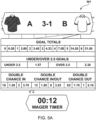
- Fig. 5A illustrates an introductory screen 501 that may be appended to the beginning of a sequence of A/V clips 301 ( Fig. 3 ) or overlaid on a particular A/V clip 301.
- the introductory screen 501 may include the names of participating teams (e.g., A and B), odds for various wagers, a timer for placing a wager in the VS game, etc.
- the introductory screen 501 displays data pertinent to the group of selected A/V clips for the VS game (e.g., odds for a total score in all of the selected clips) rather than data that just pertains solely to any one clip.
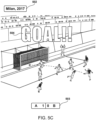
- Fig. 5B illustrates a snapshot of a pre-recorded soccer game.
- a data box 502 is overlaid onto the pre-recorded soccer game to depict the location and year of this particular A/V clip.
- a data box 503 is overlaid onto the pre-recorded soccer game to depict the team names and respective scores in the VS game.
- the score in the VS game is currently zero-zero, which may be quite different than the score for that soccer game at that juncture.
- one of the soccer players is kicking the soccer ball.
- Fig. 5C illustrates a subsequent snapshot of the soccer game from the same A/V clip 301 ( Fig. 3 ) in which the kicked ball reaches the goal to score one point for team A.
- the data box 503 is updated to reflect the score of the VS game having one goal for team A.
- text 504 stating "GOAL" is overlaid onto the pre-recorded soccer game.
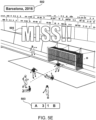
- Fig. 5D illustrates a snapshot of a second A/V clip 301 ( Fig. 3 ) that is selected to be rendered after the A/V clip 301 illustrated in Figs. 5B and 5C .
- the data box 502 is updated to reflect a change in the location and year of the actual soccer game.
- One of the soccer players is depicted in an attempt to score a goal.
- Fig. 5E illustrates that the player missed the goal. Accordingly, text 505 stating "MISS" is overlaid onto the pre-recorded soccer game.
- Fig. 5F illustrates a results screen 506 that may be appended to the end of a sequence of A/V clips 301 ( Fig. 3 ) or overlaid on a particular A/V clip 301.
- the results screen 506 may include game statistics, goal totals, etc. Therefore, the player 102 ( Figs. 1A and 1B ) of the VS game is able to view the results of the VS game.
- a picture-in-picture display may be utilized to display one or more additional skill-based events.
- the VS game may be based on a wager for multiple previously-recorded soccer games.
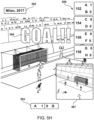
- Fig. 5G illustrates a snapshot of a pre-recorded soccer game with a picture-in-picture display 507 for other previously recorded soccer games.
- a panel 508 may be displayed in one portion (e.g., right side) of the screen to illustrate the scores of all, or some of, the soccer games. Further, the panel may be highlighted to indicate which game being displayed in the main screen or in the picture-in-picture display 507.
- Fig. 5H illustrates the text 504 stating "GOAL" for a goal scored in the main screen.
- Figs. 5A-5H are provided only as examples. Various other sporting events may be used for a VS game. Further, the configurations provided for herein may be used for various other skill-based events other than VS games.
- Fig. 6 illustrates a process 600 that may be utilized to generate gapless content for a VS game.
- the process 600 receives, with the processor 105 ( Figs. 1A and 1B ), a plurality of A/V clips 301 ( Fig. 3 ) in an ordered sequence for a VS game.
- Each of the plurality of A/V clips 301 corresponds to a sports-based event occurring prior to initiation of the VS game at a computing device.
- the process 600 writes, with the processor 105, one or more frames of a first A/V clip 301 to a buffer in a memory storage device 107, the one or more frames of the first A/V clip 301 being selected from the plurality of A/V clips 301.
- the process 600 allocates, with the processor 105 ( Fig. 1 ), a threshold quantity of memory blocks to the buffer.
- the threshold quantity of memory blocks being determined such that the processing speed of writing one or more frames of a second A/V clip 301 to the buffer is faster than a broadcast frame rate for broadcasting the first A/V clip.
- the broadcast frame rate is the rate (e.g., twenty five frames per second) at which content is broadcasted by a delivery mechanism (e.g., HTTP Live Streaming 210, CDN Feed 211, RTMP Streaming 212, SDI Satellite 213).
- the one or more frames of the second A/V clip 301 are selected from the plurality of A/V clips 301.
- the threshold quantity of memory blocks is based on the size (e.g., number of pixels) of the A/V clip 301. For example, one A/V clip 301 may have frames with more pixels than another A/V clip 301; thereby necessitating a larger quantity of memory blocks.
- the threshold quantity of memory blocks is based on a time that is necessary to write data to the buffer at a rate that is faster than the broadcast frame rate.
- the threshold quantity of memory blocks may be configured so that the processor 105 is writing data to the buffer one second faster than the broadcast frame rate at which data is being read from the buffer. Therefore, the processor 105 may dynamically determine the threshold quantity of memory blocks based on a variety of changing variables. Alternatively, the processor 105 may utilize a predetermined threshold quantity of memory blocks instead of performing a recalculation for each A/V clip.
- the processor 105 By adjusting the buffer based on the broadcast frame rate, the processor 105 ensures that the buffer always has enough data to be read before playback of previous frames has completed. Additionally, the buffer allows for reduced memory requirements as multiple A/V clips do not have to be simultaneously stored in the memory device 107.
- the process 600 writes, with the processor 105 ( Figs. 1A and 1B ), the one or more frames of the second A/V clip 301 to the allocated threshold quantity of memory blocks of the buffer. Further, at a process block 605, the processor 105 reads, at the broadcast frame rate, the one or more frames of the first A/V clip from the buffer and the one or more frames of the second A/V clip from the buffer. In addition, at a process block 606, the processor 105 sends, at the broadcast frame rate, a gapless set of content to a playback device.
- the gapless set of content comprises the one or more video frames of the first A/V clip 301 and the one or more video frames of the second A/V clip 301.
Landscapes
- Engineering & Computer Science (AREA)
- Multimedia (AREA)
- General Physics & Mathematics (AREA)
- Physics & Mathematics (AREA)
- Theoretical Computer Science (AREA)
- Signal Processing (AREA)
- Business, Economics & Management (AREA)
- Databases & Information Systems (AREA)
- Primary Health Care (AREA)
- Strategic Management (AREA)
- Tourism & Hospitality (AREA)
- Marketing (AREA)
- General Business, Economics & Management (AREA)
- Human Resources & Organizations (AREA)
- General Health & Medical Sciences (AREA)
- Economics (AREA)
- Health & Medical Sciences (AREA)
- Computer Graphics (AREA)
- Two-Way Televisions, Distribution Of Moving Picture Or The Like (AREA)
Claims (8)
- Computerprogrammprodukt, das eine computerlesbare Speichervorrichtung umfasst, das ein darauf gespeichertes computerlesbares Programm aufweist, wobei das computerlesbare Programm, wenn es von einem Prozessor (105) eines virtuellen Spielsystems (104) ausgeführt wird, das virtuelle Spielsystem (104) dazu veranlasst:mit dem Prozessor (105) eine Vielzahl von audiovisuellen Clips (301) aus einer Datenbank (112) in einer geordneten Reihenfolge für ein virtuelles Sportspiel zu empfangen, wobei jeder der Vielzahl von audiovisuellen Clips (301) einem Sportereignis entspricht, das vor dem Initiieren des virtuellen Sportspiels auf einer Rechenvorrichtung (101) stattfindet;mit dem Prozessor (105) eines oder mehrere Einzelbilder eines ersten audiovisuellen Clips (301) in einen Puffer in einer Speichervorrichtung (107) zu schreiben, wobei das eine oder die mehreren Einzelbilder des ersten audiovisuellen Clips (301) aus der Vielzahl von audiovisuellen Clips (301) ausgewählt sind;mit dem Prozessor (105) eine Schwellenmenge an Speicherblöcken für den Puffer zuzuweisen, wobei die Schwellenmenge an Speicherblöcken so bestimmt wird, dass die Verarbeitungsgeschwindigkeit beim Schreiben eines oder mehrerer Einzelbilder eines zweiten audiovisuellen Clips in den Puffer schneller ist als eine Sendebildrate zum Senden des ersten audiovisuellen Clips (301), wobei das eine oder die mehreren Einzelbilder des zweiten audiovisuellen Clips aus der Vielzahl von audiovisuellen Clips (301) ausgewählt sind;mit dem Prozessor (105) das eine oder die mehreren Einzelbilder des zweiten audiovisuellen Clips (301) mit ausreichender Pufferung so in die zugewiesene Schwellenmenge an Speicherblöcken des Puffers zu schreiben, dass unkomprimierte Videobilder des ersten audiovisuellen Clips, die anschließend vom Prozessor gelesen werden, vor dem Dekodieren der unkomprimierten Videobilder eines anschließenden audiovisuellen Clips der Vielzahl von audiovisuellen Clips in einer First-in-First-out-Warteschlange nicht vollständig aufgebraucht werden;mit dem Prozessor (105) mit der Sendebildrate das eine oder die mehreren Einzelbilder des ersten audiovisuellen Clips (301) aus dem Puffer und das eine oder die mehreren Einzelbilder des zweiten audiovisuellen Clips (301) aus dem Puffer zu lesen;mit dem Prozessor (105) den ersten audiovisuellen Clip (301) in einen ersten komprimierten Audioabschnitt und einen ersten komprimierten Videoabschnitt zu demultiplexen;mit dem Prozessor (105) den ersten komprimierten Audioabschnitt in einen ersten unkomprimierten Audioabschnitt und den ersten komprimierten Videoabschnitt in einen ersten unkomprimierten Videoabschnitt zu dekomprimieren;mit dem Prozessor (105) den ersten unkomprimierten Videoabschnitt durch Aufrufen eines Alpha-Mischers (207) mit Overlay-Daten zu verbessern, um die Overlay-Daten mit einer synchronisierten Bildrate zwischen den Overlay-Daten aus einem BGRA-Pixelarray und dem ersten unkomprimierten Videoabschnitt in der First-in-First-out-Warteschlange über den ersten unkomprimierten Videoabschnitt zu mischen, wobei das BGRA-Pixelarray eine Alpha-Variable umfasst, die die Transparenz für einen verbleibenden Bereich eines Browserfensters bestimmt, der einen anderen Abschnitt des ersten unkomprimierten Videoabschnitts als den anzeigt, in dem die Overlay-Daten gerendert werden;mit dem Prozessor (105) den verbesserten ersten unkomprimierten Videoabschnitt mit dem ersten unkomprimierten Audioabschnitt zu re-multiplexen;das re-multiplexte verbesserte erste unkomprimierte Video zu einem lückenlosen Satz von Inhalt zu komprimieren; undmit dem Prozessor (105) mit der Sendebildrate den lückenlosen Satz von Inhalt an eine Wiedergabevorrichtung (101) zu senden, wobei der lückenlose Satz von Inhalt das eine oder die mehreren Videobilder des ersten audiovisuellen Clips und das eine oder die mehreren Videobilder des zweiten audiovisuellen Clips umfasst.
- Computerprogrammprodukt nach Anspruch 1, wobei die Schwellenmenge an Speicherblöcken zumindest teilweise gemäß einer Größe eines Videobildes (301) bestimmt wird.
- Computerprogrammprodukt nach Anspruch 2, wobei die Größe des Videobildes auf einer Anzahl von Pixeln im Videobild basiert.
- Computerprogrammprodukt nach Anspruch 3, wobei die Schwellenmenge an Speicherblöcken gemäß einer Änderung der Größe des Videobildes dynamisch aktualisiert wird.
- Computerprogrammprodukt nach Anspruch 1, wobei die Schwellenmenge an Speicherblöcken zumindest teilweise gemäß einer vorbestimmten Zeitspanne bestimmt wird.
- Virtuelles Spielsystem (104), umfassend:eine Datenbank (112), die eine Vielzahl von audiovisuellen Clips (301) speichert;eine Speichervorrichtung (107), die einen Puffer mit einer Schwellenmenge an Speicherblöcken aufweist; undeinen Prozessor (105);wobei der Prozessor (105) von der Datenbank (112) die Vielzahl von audiovisuellen Clips (301) in einer geordneten Reihenfolge für ein virtuelles Sportspiel empfängt,eines oder mehrere Einzelbilder eines ersten audiovisuellen Clips (301) und in den Puffer schreibt,die Schwellenmenge an Speicherblöcken so zuweist, dass die Verarbeitungsgeschwindigkeit beim Schreiben eines oder mehrerer Einzelbilder eines zweiten audiovisuellen Clips (301) in den Puffer schneller ist als eine Sendebildrate zum Senden des ersten audiovisuellen Clips (301),das eine oder die mehreren Einzelbilder des zweiten audiovisuellen Clips (301) mit ausreichender Pufferung so in die zugewiesene Schwellenmenge an Speicherblöcken des Puffers schreibt, dass unkomprimierte Videobilder des ersten audiovisuellen Clips, die anschließend vom Prozessor gelesen werden, vor dem Dekodieren der unkomprimierten Videobilder eines anschließenden audiovisuellen Clips der Vielzahl von audiovisuellen Clips in einer First-in-First-out-Warteschlange nicht vollständig aufgebraucht werden,mit der Sendebildrate das eine oder die mehreren Einzelbilder des ersten audiovisuellen Clips (301) aus dem Puffer und das eine oder die mehreren Einzelbilder des zweiten audiovisuellen Clips (301) aus dem Puffer liest,mit dem Prozessor (105) den ersten audiovisuellen Clip (301) in einen ersten komprimierten Audioabschnitt und einen ersten komprimierten Videoabschnitt demultiplext,mit dem Prozessor (105) den ersten komprimierten Audioabschnitt in einen ersten unkomprimierten Audioabschnitt und den ersten komprimierten Videoabschnitt in einen ersten unkomprimierten Videoabschnitt dekomprimiert,mit dem Prozessor (105) den ersten unkomprimierten Videoabschnitt durch Aufrufen eines Alpha-Mischers (207) mit Overlay-Daten verbessert, um die Overlay-Daten mit einer synchronisierten Bildrate zwischen den Overlay-Daten aus einem BGRA-Pixelarray und dem ersten unkomprimierten Videoabschnitt in der First-in-First-out-Warteschlange über den ersten unkomprimierten Videoabschnitt zu mischen,mit dem Prozessor (105) den verbesserten ersten unkomprimierten Videoabschnitt mit dem ersten unkomprimierten Audioabschnitt re-multiplext,das re-multiplexte verbesserte erste unkomprimierte Video zu einem lückenlosen Satz von Inhalt komprimiert und mit der Sendebildrate den lückenlosen Satz von Inhalt an eine Wiedergabevorrichtung sendet, wobei der lückenlose Satz von Inhalt das eine oder die mehreren Videobilder des ersten audiovisuellen Clips (301) und das eine oder die mehreren Videobilder des zweiten audiovisuellen Clips umfasst, wobei jeder der Vielzahl von audiovisuellen Clips (301) einem Sportereignis entspricht, das vor dem Initiieren des virtuellen Sportspiels auf einer Rechenvorrichtung stattfindet,wobei das BGRA-Pixelarray eine Alpha-Variable umfasst, die die Transparenz für einen verbleibenden Bereich eines Browserfensters bestimmt, der einen anderen Abschnitt des ersten unkomprimierten Videoabschnitts anzeigt als den, in dem die Overlay-Daten gerendert werden.
- Virtuelles Spielsystem nach Anspruch 6, weiter umfassend einen Off-Screen-Renderer (205), der die Overlay-Daten erzeugt.
- Computerimplementiertes Verfahren, das von einem Prozessor (105) eines virtuellen Spielsystems (104) ausgeführt wird, wobei das computerimplementierte Verfahren umfasst:Empfangen, mit einem Prozessor (105), einer Vielzahl von audiovisuellen Clips in einer geordneten Reihenfolge für ein virtuelles Sportspiel, wobei jeder der Vielzahl von audiovisuellenClips einem Sportereignis entspricht, das vor dem Initiieren des virtuellen Sportspiels auf einer Rechenvorrichtung stattfindet;Schreiben, mit dem Prozessor (105), eines oder mehrerer Einzelbilder eines ersten audiovisuellen Clips in einen Puffer in einer Speichervorrichtung, wobei das eine oder die mehreren Einzelbilder des ersten audiovisuellen Clips aus der Vielzahl von audiovisuellen Clips ausgewählt sind;Zuweisen, mit dem Prozessor (105), einer Schwellenmenge an Speicherblöcken für den Puffer, wobei die Schwellenmenge an Speicherblöcken so bestimmt wird, dass die Verarbeitungsgeschwindigkeit beim Schreiben eines oder mehrerer Einzelbilder eines zweiten audiovisuellen Clips in den Puffer schneller ist als eine Sendebildrate zum Senden des ersten audiovisuellen Clips, wobei das eine oder die mehreren Einzelbilder des zweiten audiovisuellen Clips aus der Vielzahl von audiovisuellen Clips ausgewählt sind;Schreiben, mit dem Prozessor (105), des einen oder der mehreren Einzelbilder des zweiten audiovisuellen Clips mit ausreichender Pufferung so in die zugewiesene Schwellenmenge an Speicherblöcken des Puffers, dass unkomprimierte Videobilder des ersten audiovisuellen Clips, die anschließend vom Prozessor gelesen werden, vor dem Dekodieren der unkomprimierten Videobilder eines anschließenden audiovisuellen Clips der Vielzahl von audiovisuellen Clips in einer First-in-First-out-Warteschlange nicht vollständig aufgebraucht werden;Lesen, mit dem Prozessor (105) mit der Sendebildrate, des einen oder der mehreren Einzelbilder des ersten audiovisuellen Clips aus dem Puffer und des einen oder der mehreren Einzelbilder des zweiten audiovisuellen Clips aus dem Puffer;Demultiplexen, mit dem Prozessor (105), des ersten audiovisuellen Clips (301) in einen ersten komprimierten Audioabschnitt und einen ersten komprimierten Videoabschnitt;Dekomprimieren, mit dem Prozessor (105), des ersten komprimierten Audioabschnitts in einen ersten unkomprimierten Audioabschnitt und des ersten komprimierten Videoabschnitts in einen ersten unkomprimierten Videoabschnitt;Verbessern, mit dem Prozessor (105), des ersten unkomprimierten Videoabschnitts mit Overlay-Daten durch Aufrufen eines Alpha-Mischers (207), um die Overlay-Daten mit einer synchronisierten Bildrate zwischen den Overlay-Daten aus einem BGRA-Pixelarray und dem ersten unkomprimierten Videoabschnitt in der First-in-First-out-Warteschlange über den ersten unkomprimierten Videoabschnitt zu mischen, wobei das BGRA-Pixelarray eine Alpha-Variable umfasst, die die Transparenz für einen verbleibenden Bereich eines Browserfensters bestimmt, der einen anderen Abschnitt des ersten unkomprimierten Videoabschnitts als den anzeigt, in dem die Overlay-Daten gerendert werden;Re-Multiplexen, mit dem Prozessor (105), des verbesserten ersten unkomprimierten Videoabschnitts mit dem ersten unkomprimierten Audioabschnitt;Komprimieren des re-multiplexten verbesserten ersten unkomprimierten Videos zu einem lückenlosen Satz von Inhalt; undSenden, mit dem Prozessor (105) mit der Sendebildrate, des lückenlosen Satzes von Inhalt an eine Wiedergabevorrichtung, wobei der lückenlose Satz von Inhalt das eine oder die mehreren Videobilder des ersten audiovisuellen Clips und das eine oder die mehreren Videobilder des zweiten audiovisuellen Clips umfasst.
Applications Claiming Priority (2)
| Application Number | Priority Date | Filing Date | Title |
|---|---|---|---|
| US15/946,592 US10524008B2 (en) | 2018-04-05 | 2018-04-05 | Virtual gaming system based on previous skills-based events |
| PCT/IB2018/000643 WO2019193376A1 (en) | 2018-04-05 | 2018-05-31 | Virtual gaming system based on previous skills-based events |
Publications (2)
| Publication Number | Publication Date |
|---|---|
| EP3574466A1 EP3574466A1 (de) | 2019-12-04 |
| EP3574466B1 true EP3574466B1 (de) | 2023-08-30 |
Family
ID=63042059
Family Applications (1)
| Application Number | Title | Priority Date | Filing Date |
|---|---|---|---|
| EP18746741.0A Active EP3574466B1 (de) | 2018-04-05 | 2018-05-31 | Virtuelles spielsystem basierend auf vorherigen fähigkeitsbasierten ereignissen |
Country Status (3)
| Country | Link |
|---|---|
| US (1) | US10524008B2 (de) |
| EP (1) | EP3574466B1 (de) |
| WO (1) | WO2019193376A1 (de) |
Families Citing this family (4)
| Publication number | Priority date | Publication date | Assignee | Title |
|---|---|---|---|---|
| US11731047B2 (en) * | 2019-03-12 | 2023-08-22 | Fayble, LLC | Systems and methods for manipulation of outcomes for virtual sporting events |
| SG10201913152SA (en) | 2019-12-24 | 2021-07-29 | Sensetime Int Pte Ltd | Method And Apparatus For Detecting Dealing Sequence, Storage Medium And Electronic Device |
| CN111467798B (zh) | 2020-04-01 | 2021-09-21 | 腾讯科技(深圳)有限公司 | 游戏应用程序中的帧显示方法、装置、终端和存储介质 |
| US11354975B2 (en) | 2020-10-05 | 2022-06-07 | Vinod Khosla | Systems and methods of predictive gameplay |
Citations (1)
| Publication number | Priority date | Publication date | Assignee | Title |
|---|---|---|---|---|
| EP2104103A1 (de) * | 2008-03-20 | 2009-09-23 | British Telecommunications Public Limited Company | Montage digitaler Audio- und Videoclips |
Family Cites Families (5)
| Publication number | Priority date | Publication date | Assignee | Title |
|---|---|---|---|---|
| GB201415586D0 (en) * | 2014-09-03 | 2014-10-15 | Green Tim | Game system |
| US20180330574A1 (en) * | 2014-09-03 | 2018-11-15 | Highlight Games Limited | Virtual gaming system and method |
| US20150163562A1 (en) * | 2015-02-09 | 2015-06-11 | Martin Leventhal | Live and Pseudo-Live Video Feed Selection Based on Fantasy Sports Team |
| EP3488618B1 (de) * | 2016-07-21 | 2021-01-13 | Twitter, Inc. | Live-video-streamingdienste mit hervorgehobenen wiedergaben auf der grundlage von maschinellem lernen |
| US20220117348A2 (en) * | 2018-01-15 | 2022-04-21 | Zero Point Energy Inc. | Footwear apparatus for converting impact forces to electrical power |
-
2018
- 2018-04-05 US US15/946,592 patent/US10524008B2/en active Active
- 2018-05-31 WO PCT/IB2018/000643 patent/WO2019193376A1/en not_active Ceased
- 2018-05-31 EP EP18746741.0A patent/EP3574466B1/de active Active
Patent Citations (1)
| Publication number | Priority date | Publication date | Assignee | Title |
|---|---|---|---|---|
| EP2104103A1 (de) * | 2008-03-20 | 2009-09-23 | British Telecommunications Public Limited Company | Montage digitaler Audio- und Videoclips |
Also Published As
| Publication number | Publication date |
|---|---|
| EP3574466A1 (de) | 2019-12-04 |
| US20190311575A1 (en) | 2019-10-10 |
| US10524008B2 (en) | 2019-12-31 |
| WO2019193376A1 (en) | 2019-10-10 |
Similar Documents
| Publication | Publication Date | Title |
|---|---|---|
| US20180330574A1 (en) | Virtual gaming system and method | |
| US11918908B2 (en) | Overlaying content within live streaming video | |
| US10720011B2 (en) | Virtual gaming system based on previous skills-based events | |
| US10524008B2 (en) | Virtual gaming system based on previous skills-based events | |
| US10229651B2 (en) | Variable refresh rate video capture and playback | |
| US10467809B2 (en) | Methods and systems for presenting a video stream within a persistent virtual reality world | |
| US8665374B2 (en) | Interactive video insertions, and applications thereof | |
| US9272220B2 (en) | System and method for improving the graphics performance of hosted applications | |
| JP2022147265A5 (ja) | プログラム | |
| CN110476431A (zh) | 低时延移动设备视听流传输 | |
| US9682318B2 (en) | System and method for improving the graphics performance of hosted applications | |
| TW201216200A (en) | Multi-shader system and processing method thereof | |
| WO2019153723A1 (zh) | 视频画面显示方法、装置、电视机及存储介质 | |
| US20120115600A1 (en) | System and method for improving the graphics performance of hosted applications | |
| JP2019092186A (ja) | 配信サーバ、配信プログラムおよび端末 | |
| US20120108331A1 (en) | System and method for improving the graphics performance of hosted applications | |
| CN112262570B (zh) | 实时地自动修改高分辨率视频数据的方法和计算机系统 | |
| EP3682955A1 (de) | Streamfähige komprimierte geometrie für live-übertragung | |
| US11776507B1 (en) | Systems and methods for reducing display latency | |
| US8851999B2 (en) | System and method for improving the graphics performance of hosted applications | |
| CN113301425A (zh) | 视频播放方法、视频播放装置及电子设备 | |
| CN109348241B (zh) | 多人视频直播间中视频播放方法、装置和计算机设备 | |
| Kim et al. | Design and implementation for interactive augmented broadcasting system | |
| US9872000B2 (en) | Second screen device and system | |
| CN120499405A (zh) | 一种互动直播的方法、系统、电子设备及存储介质 |
Legal Events
| Date | Code | Title | Description |
|---|---|---|---|
| STAA | Information on the status of an ep patent application or granted ep patent |
Free format text: STATUS: UNKNOWN |
|
| STAA | Information on the status of an ep patent application or granted ep patent |
Free format text: STATUS: THE INTERNATIONAL PUBLICATION HAS BEEN MADE |
|
| PUAI | Public reference made under article 153(3) epc to a published international application that has entered the european phase |
Free format text: ORIGINAL CODE: 0009012 |
|
| STAA | Information on the status of an ep patent application or granted ep patent |
Free format text: STATUS: THE APPLICATION HAS BEEN PUBLISHED |
|
| AK | Designated contracting states |
Kind code of ref document: A1 Designated state(s): AL AT BE BG CH CY CZ DE DK EE ES FI FR GB GR HR HU IE IS IT LI LT LU LV MC MK MT NL NO PL PT RO RS SE SI SK SM TR |
|
| AX | Request for extension of the european patent |
Extension state: BA ME |
|
| STAA | Information on the status of an ep patent application or granted ep patent |
Free format text: STATUS: REQUEST FOR EXAMINATION WAS MADE |
|
| RBV | Designated contracting states (corrected) |
Designated state(s): AL AT BE BG CH CY CZ DE DK EE ES FI FR GB GR HR HU IE IS IT LI LT LU LV MC MK MT NL NO PL PT RO RS SE SI SK SM TR |
|
| 17P | Request for examination filed |
Effective date: 20191202 |
|
| STAA | Information on the status of an ep patent application or granted ep patent |
Free format text: STATUS: EXAMINATION IS IN PROGRESS |
|
| 17Q | First examination report despatched |
Effective date: 20200807 |
|
| DAV | Request for validation of the european patent (deleted) | ||
| DAX | Request for extension of the european patent (deleted) | ||
| REG | Reference to a national code |
Ref country code: DE Ref legal event code: R079 Free format text: PREVIOUS MAIN CLASS: G06Q0050000000 Ipc: G06Q0050340000 Ref country code: DE Ref legal event code: R079 Ref document number: 602018056443 Country of ref document: DE Free format text: PREVIOUS MAIN CLASS: G06Q0050000000 Ipc: G06Q0050340000 |
|
| RIC1 | Information provided on ipc code assigned before grant |
Ipc: G07F 17/32 20060101ALN20230130BHEP Ipc: H04N 21/81 20110101ALI20230130BHEP Ipc: A63F 13/52 20140101ALI20230130BHEP Ipc: H04N 21/234 20110101ALI20230130BHEP Ipc: A63F 13/828 20140101ALI20230130BHEP Ipc: A63F 13/65 20140101ALI20230130BHEP Ipc: G06Q 50/34 20120101AFI20230130BHEP |
|
| GRAP | Despatch of communication of intention to grant a patent |
Free format text: ORIGINAL CODE: EPIDOSNIGR1 |
|
| STAA | Information on the status of an ep patent application or granted ep patent |
Free format text: STATUS: GRANT OF PATENT IS INTENDED |
|
| RIC1 | Information provided on ipc code assigned before grant |
Ipc: G07F 17/32 20060101ALN20230224BHEP Ipc: H04N 21/81 20110101ALI20230224BHEP Ipc: A63F 13/52 20140101ALI20230224BHEP Ipc: H04N 21/234 20110101ALI20230224BHEP Ipc: A63F 13/828 20140101ALI20230224BHEP Ipc: A63F 13/65 20140101ALI20230224BHEP Ipc: G06Q 50/34 20120101AFI20230224BHEP |
|
| INTG | Intention to grant announced |
Effective date: 20230331 |
|
| RIN1 | Information on inventor provided before grant (corrected) |
Inventor name: GREEN, TIMOTHY, PATRICK JONATHAN Inventor name: LATTER, CHRIS Inventor name: WHITTLE, STEWART, JAMES Inventor name: WOOD, ANGUS |
|
| GRAS | Grant fee paid |
Free format text: ORIGINAL CODE: EPIDOSNIGR3 |
|
| GRAA | (expected) grant |
Free format text: ORIGINAL CODE: 0009210 |
|
| STAA | Information on the status of an ep patent application or granted ep patent |
Free format text: STATUS: THE PATENT HAS BEEN GRANTED |
|
| AK | Designated contracting states |
Kind code of ref document: B1 Designated state(s): AL AT BE BG CH CY CZ DE DK EE ES FI FR GB GR HR HU IE IS IT LI LT LU LV MC MK MT NL NO PL PT RO RS SE SI SK SM TR |
|
| RAP3 | Party data changed (applicant data changed or rights of an application transferred) |
Owner name: HIGHLIGHT GAMES LIMITED |
|
| REG | Reference to a national code |
Ref country code: GB Ref legal event code: FG4D |
|
| REG | Reference to a national code |
Ref country code: CH Ref legal event code: EP |
|
| REG | Reference to a national code |
Ref country code: DE Ref legal event code: R096 Ref document number: 602018056443 Country of ref document: DE |
|
| P01 | Opt-out of the competence of the unified patent court (upc) registered |
Effective date: 20230822 |
|
| REG | Reference to a national code |
Ref country code: IE Ref legal event code: FG4D |
|
| REG | Reference to a national code |
Ref country code: GR Ref legal event code: EP Ref document number: 20230401708 Country of ref document: GR Effective date: 20231113 |
|
| REG | Reference to a national code |
Ref country code: LT Ref legal event code: MG9D |
|
| REG | Reference to a national code |
Ref country code: NL Ref legal event code: MP Effective date: 20230830 |
|
| REG | Reference to a national code |
Ref country code: AT Ref legal event code: MK05 Ref document number: 1606400 Country of ref document: AT Kind code of ref document: T Effective date: 20230830 |
|
| PG25 | Lapsed in a contracting state [announced via postgrant information from national office to epo] |
Ref country code: IS Free format text: LAPSE BECAUSE OF FAILURE TO SUBMIT A TRANSLATION OF THE DESCRIPTION OR TO PAY THE FEE WITHIN THE PRESCRIBED TIME-LIMIT Effective date: 20231230 |
|
| PG25 | Lapsed in a contracting state [announced via postgrant information from national office to epo] |
Ref country code: SE Free format text: LAPSE BECAUSE OF FAILURE TO SUBMIT A TRANSLATION OF THE DESCRIPTION OR TO PAY THE FEE WITHIN THE PRESCRIBED TIME-LIMIT Effective date: 20230830 Ref country code: RS Free format text: LAPSE BECAUSE OF FAILURE TO SUBMIT A TRANSLATION OF THE DESCRIPTION OR TO PAY THE FEE WITHIN THE PRESCRIBED TIME-LIMIT Effective date: 20230830 Ref country code: NO Free format text: LAPSE BECAUSE OF FAILURE TO SUBMIT A TRANSLATION OF THE DESCRIPTION OR TO PAY THE FEE WITHIN THE PRESCRIBED TIME-LIMIT Effective date: 20231130 Ref country code: LV Free format text: LAPSE BECAUSE OF FAILURE TO SUBMIT A TRANSLATION OF THE DESCRIPTION OR TO PAY THE FEE WITHIN THE PRESCRIBED TIME-LIMIT Effective date: 20230830 Ref country code: LT Free format text: LAPSE BECAUSE OF FAILURE TO SUBMIT A TRANSLATION OF THE DESCRIPTION OR TO PAY THE FEE WITHIN THE PRESCRIBED TIME-LIMIT Effective date: 20230830 Ref country code: IS Free format text: LAPSE BECAUSE OF FAILURE TO SUBMIT A TRANSLATION OF THE DESCRIPTION OR TO PAY THE FEE WITHIN THE PRESCRIBED TIME-LIMIT Effective date: 20231230 Ref country code: HR Free format text: LAPSE BECAUSE OF FAILURE TO SUBMIT A TRANSLATION OF THE DESCRIPTION OR TO PAY THE FEE WITHIN THE PRESCRIBED TIME-LIMIT Effective date: 20230830 Ref country code: FI Free format text: LAPSE BECAUSE OF FAILURE TO SUBMIT A TRANSLATION OF THE DESCRIPTION OR TO PAY THE FEE WITHIN THE PRESCRIBED TIME-LIMIT Effective date: 20230830 Ref country code: AT Free format text: LAPSE BECAUSE OF FAILURE TO SUBMIT A TRANSLATION OF THE DESCRIPTION OR TO PAY THE FEE WITHIN THE PRESCRIBED TIME-LIMIT Effective date: 20230830 |
|
| PG25 | Lapsed in a contracting state [announced via postgrant information from national office to epo] |
Ref country code: PL Free format text: LAPSE BECAUSE OF FAILURE TO SUBMIT A TRANSLATION OF THE DESCRIPTION OR TO PAY THE FEE WITHIN THE PRESCRIBED TIME-LIMIT Effective date: 20230830 Ref country code: NL Free format text: LAPSE BECAUSE OF FAILURE TO SUBMIT A TRANSLATION OF THE DESCRIPTION OR TO PAY THE FEE WITHIN THE PRESCRIBED TIME-LIMIT Effective date: 20230830 |
|
| PG25 | Lapsed in a contracting state [announced via postgrant information from national office to epo] |
Ref country code: ES Free format text: LAPSE BECAUSE OF FAILURE TO SUBMIT A TRANSLATION OF THE DESCRIPTION OR TO PAY THE FEE WITHIN THE PRESCRIBED TIME-LIMIT Effective date: 20230830 |
|
| PG25 | Lapsed in a contracting state [announced via postgrant information from national office to epo] |
Ref country code: SM Free format text: LAPSE BECAUSE OF FAILURE TO SUBMIT A TRANSLATION OF THE DESCRIPTION OR TO PAY THE FEE WITHIN THE PRESCRIBED TIME-LIMIT Effective date: 20230830 Ref country code: RO Free format text: LAPSE BECAUSE OF FAILURE TO SUBMIT A TRANSLATION OF THE DESCRIPTION OR TO PAY THE FEE WITHIN THE PRESCRIBED TIME-LIMIT Effective date: 20230830 Ref country code: ES Free format text: LAPSE BECAUSE OF FAILURE TO SUBMIT A TRANSLATION OF THE DESCRIPTION OR TO PAY THE FEE WITHIN THE PRESCRIBED TIME-LIMIT Effective date: 20230830 Ref country code: EE Free format text: LAPSE BECAUSE OF FAILURE TO SUBMIT A TRANSLATION OF THE DESCRIPTION OR TO PAY THE FEE WITHIN THE PRESCRIBED TIME-LIMIT Effective date: 20230830 Ref country code: DK Free format text: LAPSE BECAUSE OF FAILURE TO SUBMIT A TRANSLATION OF THE DESCRIPTION OR TO PAY THE FEE WITHIN THE PRESCRIBED TIME-LIMIT Effective date: 20230830 Ref country code: CZ Free format text: LAPSE BECAUSE OF FAILURE TO SUBMIT A TRANSLATION OF THE DESCRIPTION OR TO PAY THE FEE WITHIN THE PRESCRIBED TIME-LIMIT Effective date: 20230830 Ref country code: PT Free format text: LAPSE BECAUSE OF FAILURE TO SUBMIT A TRANSLATION OF THE DESCRIPTION OR TO PAY THE FEE WITHIN THE PRESCRIBED TIME-LIMIT Effective date: 20240102 Ref country code: SK Free format text: LAPSE BECAUSE OF FAILURE TO SUBMIT A TRANSLATION OF THE DESCRIPTION OR TO PAY THE FEE WITHIN THE PRESCRIBED TIME-LIMIT Effective date: 20230830 |
|
| REG | Reference to a national code |
Ref country code: DE Ref legal event code: R097 Ref document number: 602018056443 Country of ref document: DE |
|
| PLBE | No opposition filed within time limit |
Free format text: ORIGINAL CODE: 0009261 |
|
| STAA | Information on the status of an ep patent application or granted ep patent |
Free format text: STATUS: NO OPPOSITION FILED WITHIN TIME LIMIT |
|
| PG25 | Lapsed in a contracting state [announced via postgrant information from national office to epo] |
Ref country code: SI Free format text: LAPSE BECAUSE OF FAILURE TO SUBMIT A TRANSLATION OF THE DESCRIPTION OR TO PAY THE FEE WITHIN THE PRESCRIBED TIME-LIMIT Effective date: 20230830 |
|
| 26N | No opposition filed |
Effective date: 20240603 |
|
| PG25 | Lapsed in a contracting state [announced via postgrant information from national office to epo] |
Ref country code: BG Free format text: LAPSE BECAUSE OF FAILURE TO SUBMIT A TRANSLATION OF THE DESCRIPTION OR TO PAY THE FEE WITHIN THE PRESCRIBED TIME-LIMIT Effective date: 20230830 |
|
| PG25 | Lapsed in a contracting state [announced via postgrant information from national office to epo] |
Ref country code: BG Free format text: LAPSE BECAUSE OF FAILURE TO SUBMIT A TRANSLATION OF THE DESCRIPTION OR TO PAY THE FEE WITHIN THE PRESCRIBED TIME-LIMIT Effective date: 20230830 |
|
| REG | Reference to a national code |
Ref country code: CH Ref legal event code: PL |
|
| PG25 | Lapsed in a contracting state [announced via postgrant information from national office to epo] |
Ref country code: MC Free format text: LAPSE BECAUSE OF FAILURE TO SUBMIT A TRANSLATION OF THE DESCRIPTION OR TO PAY THE FEE WITHIN THE PRESCRIBED TIME-LIMIT Effective date: 20230830 |
|
| PG25 | Lapsed in a contracting state [announced via postgrant information from national office to epo] |
Ref country code: LU Free format text: LAPSE BECAUSE OF NON-PAYMENT OF DUE FEES Effective date: 20240531 |
|
| PG25 | Lapsed in a contracting state [announced via postgrant information from national office to epo] |
Ref country code: MC Free format text: LAPSE BECAUSE OF FAILURE TO SUBMIT A TRANSLATION OF THE DESCRIPTION OR TO PAY THE FEE WITHIN THE PRESCRIBED TIME-LIMIT Effective date: 20230830 Ref country code: LU Free format text: LAPSE BECAUSE OF NON-PAYMENT OF DUE FEES Effective date: 20240531 Ref country code: CH Free format text: LAPSE BECAUSE OF NON-PAYMENT OF DUE FEES Effective date: 20240531 |
|
| REG | Reference to a national code |
Ref country code: BE Ref legal event code: MM Effective date: 20240531 |
|
| PG25 | Lapsed in a contracting state [announced via postgrant information from national office to epo] |
Ref country code: IE Free format text: LAPSE BECAUSE OF NON-PAYMENT OF DUE FEES Effective date: 20240531 |
|
| PG25 | Lapsed in a contracting state [announced via postgrant information from national office to epo] |
Ref country code: BE Free format text: LAPSE BECAUSE OF NON-PAYMENT OF DUE FEES Effective date: 20240531 |
|
| PGFP | Annual fee paid to national office [announced via postgrant information from national office to epo] |
Ref country code: DE Payment date: 20250528 Year of fee payment: 8 |
|
| PGFP | Annual fee paid to national office [announced via postgrant information from national office to epo] |
Ref country code: IT Payment date: 20250522 Year of fee payment: 8 |
|
| PGFP | Annual fee paid to national office [announced via postgrant information from national office to epo] |
Ref country code: FR Payment date: 20250526 Year of fee payment: 8 |
|
| PGFP | Annual fee paid to national office [announced via postgrant information from national office to epo] |
Ref country code: GR Payment date: 20250523 Year of fee payment: 8 |
|
| PGFP | Annual fee paid to national office [announced via postgrant information from national office to epo] |
Ref country code: TR Payment date: 20250513 Year of fee payment: 8 |
|
| PG25 | Lapsed in a contracting state [announced via postgrant information from national office to epo] |
Ref country code: CY Free format text: LAPSE BECAUSE OF FAILURE TO SUBMIT A TRANSLATION OF THE DESCRIPTION OR TO PAY THE FEE WITHIN THE PRESCRIBED TIME-LIMIT; INVALID AB INITIO Effective date: 20180531 |
|
| PG25 | Lapsed in a contracting state [announced via postgrant information from national office to epo] |
Ref country code: HU Free format text: LAPSE BECAUSE OF FAILURE TO SUBMIT A TRANSLATION OF THE DESCRIPTION OR TO PAY THE FEE WITHIN THE PRESCRIBED TIME-LIMIT; INVALID AB INITIO Effective date: 20180531 |
|
| PGFP | Annual fee paid to national office [announced via postgrant information from national office to epo] |
Ref country code: GB Payment date: 20260303 Year of fee payment: 9 |