EP3572451A1 - Heat shrinkable film and preparation method thereof - Google Patents
Heat shrinkable film and preparation method thereof Download PDFInfo
- Publication number
- EP3572451A1 EP3572451A1 EP18189120.1A EP18189120A EP3572451A1 EP 3572451 A1 EP3572451 A1 EP 3572451A1 EP 18189120 A EP18189120 A EP 18189120A EP 3572451 A1 EP3572451 A1 EP 3572451A1
- Authority
- EP
- European Patent Office
- Prior art keywords
- shrinkable film
- heat shrinkable
- heat
- shrinkage
- direction perpendicular
- Prior art date
- Legal status (The legal status is an assumption and is not a legal conclusion. Google has not performed a legal analysis and makes no representation as to the accuracy of the status listed.)
- Pending
Links
Classifications
-
- B—PERFORMING OPERATIONS; TRANSPORTING
- B29—WORKING OF PLASTICS; WORKING OF SUBSTANCES IN A PLASTIC STATE IN GENERAL
- B29C—SHAPING OR JOINING OF PLASTICS; SHAPING OF MATERIAL IN A PLASTIC STATE, NOT OTHERWISE PROVIDED FOR; AFTER-TREATMENT OF THE SHAPED PRODUCTS, e.g. REPAIRING
- B29C61/00—Shaping by liberation of internal stresses; Making preforms having internal stresses; Apparatus therefor
- B29C61/06—Making preforms having internal stresses, e.g. plastic memory
-
- B—PERFORMING OPERATIONS; TRANSPORTING
- B65—CONVEYING; PACKING; STORING; HANDLING THIN OR FILAMENTARY MATERIAL
- B65B—MACHINES, APPARATUS OR DEVICES FOR, OR METHODS OF, PACKAGING ARTICLES OR MATERIALS; UNPACKING
- B65B53/00—Shrinking wrappers, containers, or container covers during or after packaging
- B65B53/02—Shrinking wrappers, containers, or container covers during or after packaging by heat
-
- B—PERFORMING OPERATIONS; TRANSPORTING
- B29—WORKING OF PLASTICS; WORKING OF SUBSTANCES IN A PLASTIC STATE IN GENERAL
- B29C—SHAPING OR JOINING OF PLASTICS; SHAPING OF MATERIAL IN A PLASTIC STATE, NOT OTHERWISE PROVIDED FOR; AFTER-TREATMENT OF THE SHAPED PRODUCTS, e.g. REPAIRING
- B29C48/00—Extrusion moulding, i.e. expressing the moulding material through a die or nozzle which imparts the desired form; Apparatus therefor
- B29C48/001—Combinations of extrusion moulding with other shaping operations
- B29C48/0018—Combinations of extrusion moulding with other shaping operations combined with shaping by orienting, stretching or shrinking, e.g. film blowing
-
- B—PERFORMING OPERATIONS; TRANSPORTING
- B29—WORKING OF PLASTICS; WORKING OF SUBSTANCES IN A PLASTIC STATE IN GENERAL
- B29C—SHAPING OR JOINING OF PLASTICS; SHAPING OF MATERIAL IN A PLASTIC STATE, NOT OTHERWISE PROVIDED FOR; AFTER-TREATMENT OF THE SHAPED PRODUCTS, e.g. REPAIRING
- B29C48/00—Extrusion moulding, i.e. expressing the moulding material through a die or nozzle which imparts the desired form; Apparatus therefor
- B29C48/03—Extrusion moulding, i.e. expressing the moulding material through a die or nozzle which imparts the desired form; Apparatus therefor characterised by the shape of the extruded material at extrusion
- B29C48/07—Flat, e.g. panels
- B29C48/08—Flat, e.g. panels flexible, e.g. films
-
- B—PERFORMING OPERATIONS; TRANSPORTING
- B29—WORKING OF PLASTICS; WORKING OF SUBSTANCES IN A PLASTIC STATE IN GENERAL
- B29C—SHAPING OR JOINING OF PLASTICS; SHAPING OF MATERIAL IN A PLASTIC STATE, NOT OTHERWISE PROVIDED FOR; AFTER-TREATMENT OF THE SHAPED PRODUCTS, e.g. REPAIRING
- B29C48/00—Extrusion moulding, i.e. expressing the moulding material through a die or nozzle which imparts the desired form; Apparatus therefor
- B29C48/25—Component parts, details or accessories; Auxiliary operations
- B29C48/30—Extrusion nozzles or dies
- B29C48/305—Extrusion nozzles or dies having a wide opening, e.g. for forming sheets
-
- B—PERFORMING OPERATIONS; TRANSPORTING
- B29—WORKING OF PLASTICS; WORKING OF SUBSTANCES IN A PLASTIC STATE IN GENERAL
- B29C—SHAPING OR JOINING OF PLASTICS; SHAPING OF MATERIAL IN A PLASTIC STATE, NOT OTHERWISE PROVIDED FOR; AFTER-TREATMENT OF THE SHAPED PRODUCTS, e.g. REPAIRING
- B29C48/00—Extrusion moulding, i.e. expressing the moulding material through a die or nozzle which imparts the desired form; Apparatus therefor
- B29C48/25—Component parts, details or accessories; Auxiliary operations
- B29C48/88—Thermal treatment of the stream of extruded material, e.g. cooling
- B29C48/91—Heating, e.g. for cross linking
-
- B—PERFORMING OPERATIONS; TRANSPORTING
- B29—WORKING OF PLASTICS; WORKING OF SUBSTANCES IN A PLASTIC STATE IN GENERAL
- B29C—SHAPING OR JOINING OF PLASTICS; SHAPING OF MATERIAL IN A PLASTIC STATE, NOT OTHERWISE PROVIDED FOR; AFTER-TREATMENT OF THE SHAPED PRODUCTS, e.g. REPAIRING
- B29C48/00—Extrusion moulding, i.e. expressing the moulding material through a die or nozzle which imparts the desired form; Apparatus therefor
- B29C48/25—Component parts, details or accessories; Auxiliary operations
- B29C48/88—Thermal treatment of the stream of extruded material, e.g. cooling
- B29C48/911—Cooling
-
- B—PERFORMING OPERATIONS; TRANSPORTING
- B29—WORKING OF PLASTICS; WORKING OF SUBSTANCES IN A PLASTIC STATE IN GENERAL
- B29C—SHAPING OR JOINING OF PLASTICS; SHAPING OF MATERIAL IN A PLASTIC STATE, NOT OTHERWISE PROVIDED FOR; AFTER-TREATMENT OF THE SHAPED PRODUCTS, e.g. REPAIRING
- B29C48/00—Extrusion moulding, i.e. expressing the moulding material through a die or nozzle which imparts the desired form; Apparatus therefor
- B29C48/25—Component parts, details or accessories; Auxiliary operations
- B29C48/92—Measuring, controlling or regulating
-
- B—PERFORMING OPERATIONS; TRANSPORTING
- B29—WORKING OF PLASTICS; WORKING OF SUBSTANCES IN A PLASTIC STATE IN GENERAL
- B29C—SHAPING OR JOINING OF PLASTICS; SHAPING OF MATERIAL IN A PLASTIC STATE, NOT OTHERWISE PROVIDED FOR; AFTER-TREATMENT OF THE SHAPED PRODUCTS, e.g. REPAIRING
- B29C55/00—Shaping by stretching, e.g. drawing through a die; Apparatus therefor
- B29C55/005—Shaping by stretching, e.g. drawing through a die; Apparatus therefor characterised by the choice of materials
-
- B—PERFORMING OPERATIONS; TRANSPORTING
- B29—WORKING OF PLASTICS; WORKING OF SUBSTANCES IN A PLASTIC STATE IN GENERAL
- B29C—SHAPING OR JOINING OF PLASTICS; SHAPING OF MATERIAL IN A PLASTIC STATE, NOT OTHERWISE PROVIDED FOR; AFTER-TREATMENT OF THE SHAPED PRODUCTS, e.g. REPAIRING
- B29C55/00—Shaping by stretching, e.g. drawing through a die; Apparatus therefor
- B29C55/02—Shaping by stretching, e.g. drawing through a die; Apparatus therefor of plates or sheets
-
- B—PERFORMING OPERATIONS; TRANSPORTING
- B29—WORKING OF PLASTICS; WORKING OF SUBSTANCES IN A PLASTIC STATE IN GENERAL
- B29C—SHAPING OR JOINING OF PLASTICS; SHAPING OF MATERIAL IN A PLASTIC STATE, NOT OTHERWISE PROVIDED FOR; AFTER-TREATMENT OF THE SHAPED PRODUCTS, e.g. REPAIRING
- B29C55/00—Shaping by stretching, e.g. drawing through a die; Apparatus therefor
- B29C55/02—Shaping by stretching, e.g. drawing through a die; Apparatus therefor of plates or sheets
- B29C55/04—Shaping by stretching, e.g. drawing through a die; Apparatus therefor of plates or sheets uniaxial, e.g. oblique
-
- B—PERFORMING OPERATIONS; TRANSPORTING
- B29—WORKING OF PLASTICS; WORKING OF SUBSTANCES IN A PLASTIC STATE IN GENERAL
- B29C—SHAPING OR JOINING OF PLASTICS; SHAPING OF MATERIAL IN A PLASTIC STATE, NOT OTHERWISE PROVIDED FOR; AFTER-TREATMENT OF THE SHAPED PRODUCTS, e.g. REPAIRING
- B29C55/00—Shaping by stretching, e.g. drawing through a die; Apparatus therefor
- B29C55/02—Shaping by stretching, e.g. drawing through a die; Apparatus therefor of plates or sheets
- B29C55/04—Shaping by stretching, e.g. drawing through a die; Apparatus therefor of plates or sheets uniaxial, e.g. oblique
- B29C55/06—Shaping by stretching, e.g. drawing through a die; Apparatus therefor of plates or sheets uniaxial, e.g. oblique parallel with the direction of feed
-
- C—CHEMISTRY; METALLURGY
- C08—ORGANIC MACROMOLECULAR COMPOUNDS; THEIR PREPARATION OR CHEMICAL WORKING-UP; COMPOSITIONS BASED THEREON
- C08G—MACROMOLECULAR COMPOUNDS OBTAINED OTHERWISE THAN BY REACTIONS ONLY INVOLVING UNSATURATED CARBON-TO-CARBON BONDS
- C08G63/00—Macromolecular compounds obtained by reactions forming a carboxylic ester link in the main chain of the macromolecule
- C08G63/02—Polyesters derived from hydroxycarboxylic acids or from polycarboxylic acids and polyhydroxy compounds
- C08G63/12—Polyesters derived from hydroxycarboxylic acids or from polycarboxylic acids and polyhydroxy compounds derived from polycarboxylic acids and polyhydroxy compounds
- C08G63/16—Dicarboxylic acids and dihydroxy compounds
-
- C—CHEMISTRY; METALLURGY
- C08—ORGANIC MACROMOLECULAR COMPOUNDS; THEIR PREPARATION OR CHEMICAL WORKING-UP; COMPOSITIONS BASED THEREON
- C08G—MACROMOLECULAR COMPOUNDS OBTAINED OTHERWISE THAN BY REACTIONS ONLY INVOLVING UNSATURATED CARBON-TO-CARBON BONDS
- C08G63/00—Macromolecular compounds obtained by reactions forming a carboxylic ester link in the main chain of the macromolecule
- C08G63/02—Polyesters derived from hydroxycarboxylic acids or from polycarboxylic acids and polyhydroxy compounds
- C08G63/12—Polyesters derived from hydroxycarboxylic acids or from polycarboxylic acids and polyhydroxy compounds derived from polycarboxylic acids and polyhydroxy compounds
- C08G63/16—Dicarboxylic acids and dihydroxy compounds
- C08G63/18—Dicarboxylic acids and dihydroxy compounds the acids or hydroxy compounds containing carbocyclic rings
- C08G63/181—Acids containing aromatic rings
- C08G63/183—Terephthalic acids
-
- C—CHEMISTRY; METALLURGY
- C08—ORGANIC MACROMOLECULAR COMPOUNDS; THEIR PREPARATION OR CHEMICAL WORKING-UP; COMPOSITIONS BASED THEREON
- C08J—WORKING-UP; GENERAL PROCESSES OF COMPOUNDING; AFTER-TREATMENT NOT COVERED BY SUBCLASSES C08B, C08C, C08F, C08G or C08H
- C08J5/00—Manufacture of articles or shaped materials containing macromolecular substances
- C08J5/18—Manufacture of films or sheets
-
- C—CHEMISTRY; METALLURGY
- C08—ORGANIC MACROMOLECULAR COMPOUNDS; THEIR PREPARATION OR CHEMICAL WORKING-UP; COMPOSITIONS BASED THEREON
- C08L—COMPOSITIONS OF MACROMOLECULAR COMPOUNDS
- C08L67/00—Compositions of polyesters obtained by reactions forming a carboxylic ester link in the main chain; Compositions of derivatives of such polymers
- C08L67/02—Polyesters derived from dicarboxylic acids and dihydroxy compounds
-
- B—PERFORMING OPERATIONS; TRANSPORTING
- B29—WORKING OF PLASTICS; WORKING OF SUBSTANCES IN A PLASTIC STATE IN GENERAL
- B29C—SHAPING OR JOINING OF PLASTICS; SHAPING OF MATERIAL IN A PLASTIC STATE, NOT OTHERWISE PROVIDED FOR; AFTER-TREATMENT OF THE SHAPED PRODUCTS, e.g. REPAIRING
- B29C2948/00—Indexing scheme relating to extrusion moulding
- B29C2948/92—Measuring, controlling or regulating
- B29C2948/92009—Measured parameter
- B29C2948/92209—Temperature
-
- B—PERFORMING OPERATIONS; TRANSPORTING
- B29—WORKING OF PLASTICS; WORKING OF SUBSTANCES IN A PLASTIC STATE IN GENERAL
- B29C—SHAPING OR JOINING OF PLASTICS; SHAPING OF MATERIAL IN A PLASTIC STATE, NOT OTHERWISE PROVIDED FOR; AFTER-TREATMENT OF THE SHAPED PRODUCTS, e.g. REPAIRING
- B29C2948/00—Indexing scheme relating to extrusion moulding
- B29C2948/92—Measuring, controlling or regulating
- B29C2948/92323—Location or phase of measurement
- B29C2948/92476—Fluids, e.g. for temperature control or of environment
-
- B—PERFORMING OPERATIONS; TRANSPORTING
- B29—WORKING OF PLASTICS; WORKING OF SUBSTANCES IN A PLASTIC STATE IN GENERAL
- B29C—SHAPING OR JOINING OF PLASTICS; SHAPING OF MATERIAL IN A PLASTIC STATE, NOT OTHERWISE PROVIDED FOR; AFTER-TREATMENT OF THE SHAPED PRODUCTS, e.g. REPAIRING
- B29C2948/00—Indexing scheme relating to extrusion moulding
- B29C2948/92—Measuring, controlling or regulating
- B29C2948/92504—Controlled parameter
- B29C2948/92704—Temperature
-
- B—PERFORMING OPERATIONS; TRANSPORTING
- B29—WORKING OF PLASTICS; WORKING OF SUBSTANCES IN A PLASTIC STATE IN GENERAL
- B29K—INDEXING SCHEME ASSOCIATED WITH SUBCLASSES B29B, B29C OR B29D, RELATING TO MOULDING MATERIALS OR TO MATERIALS FOR MOULDS, REINFORCEMENTS, FILLERS OR PREFORMED PARTS, e.g. INSERTS
- B29K2067/00—Use of polyesters or derivatives thereof, as moulding material
-
- B—PERFORMING OPERATIONS; TRANSPORTING
- B29—WORKING OF PLASTICS; WORKING OF SUBSTANCES IN A PLASTIC STATE IN GENERAL
- B29K—INDEXING SCHEME ASSOCIATED WITH SUBCLASSES B29B, B29C OR B29D, RELATING TO MOULDING MATERIALS OR TO MATERIALS FOR MOULDS, REINFORCEMENTS, FILLERS OR PREFORMED PARTS, e.g. INSERTS
- B29K2105/00—Condition, form or state of moulded material or of the material to be shaped
- B29K2105/02—Condition, form or state of moulded material or of the material to be shaped heat shrinkable
-
- C—CHEMISTRY; METALLURGY
- C08—ORGANIC MACROMOLECULAR COMPOUNDS; THEIR PREPARATION OR CHEMICAL WORKING-UP; COMPOSITIONS BASED THEREON
- C08J—WORKING-UP; GENERAL PROCESSES OF COMPOUNDING; AFTER-TREATMENT NOT COVERED BY SUBCLASSES C08B, C08C, C08F, C08G or C08H
- C08J2367/00—Characterised by the use of polyesters obtained by reactions forming a carboxylic ester link in the main chain; Derivatives of such polymers
- C08J2367/02—Polyesters derived from dicarboxylic acids and dihydroxy compounds
-
- Y—GENERAL TAGGING OF NEW TECHNOLOGICAL DEVELOPMENTS; GENERAL TAGGING OF CROSS-SECTIONAL TECHNOLOGIES SPANNING OVER SEVERAL SECTIONS OF THE IPC; TECHNICAL SUBJECTS COVERED BY FORMER USPC CROSS-REFERENCE ART COLLECTIONS [XRACs] AND DIGESTS
- Y10—TECHNICAL SUBJECTS COVERED BY FORMER USPC
- Y10T—TECHNICAL SUBJECTS COVERED BY FORMER US CLASSIFICATION
- Y10T428/00—Stock material or miscellaneous articles
- Y10T428/13—Hollow or container type article [e.g., tube, vase, etc.]
- Y10T428/1328—Shrinkable or shrunk [e.g., due to heat, solvent, volatile agent, restraint removal, etc.]
Definitions
- Embodiments relate to a heat shrinkable film, which has a low heat shrinkage in the direction perpendicular to the main shrinkage direction, the heat shrinkage being not high even at a high temperature of 70°C or higher, and which is printable thereon, and a process for preparing the same.
- a heat shrinkable film refers to a film that tends to shrink to a shape before stretching thereof at a certain temperature or higher once it has been oriented by stretching thereof.
- a heat shrinkable film is used for shrinkable labels for various types of containers, bundle packaging, or cap seals.
- Polyvinyl chloride (PVC) films and oriented polystyrene (OPS) films have been used as heat shrinkable films for a long period of time.
- PVC heat shrinkable films has been regulated due to a problem of environmental pollution since they generate poisonous dioxins when incinerated.
- OPS heat shrinkable films have a disadvantage in that it is not suitable for shrinkable labels for glass, metal cans, or the like since they have an insufficient heat resistance.
- polyester-based heat shrinkable films having a high shrinkage and a high heat resistance have been developed to address the disadvantages of the PVC and OPS heat shrinkable films.
- Such a polyester-based heat shrinkable film can be used for metallic food containers. Since a food container has a direct impact on the human body, the container is subjected to a sterilization process at a high temperature for a predetermined time once the film has been applied to the container. In such event, however, a film applied to the surface of a food container by taking advantage of the mechanism that the film shrinks in the main shrinkage direction may also shrink in the direction perpendicular to the main shrinkage direction. This causes deformation, giving birth to a problem that the film fails to conform to the surface shape of the food container.
- the embodiments aim to provide a heat shrinkable film, which has a low heat shrinkage in the direction perpendicular to the main shrinkage direction, the heat shrinkage being not high even at a high temperature of 70°C or higher, and which is printable thereon, and a process for preparing the same.
- a heat shrinkable film which comprises a polyester resin, wherein the heat shrinkage characteristics in the direction perpendicular to the main shrinkage direction satisfy the following Relationships 1 and 2: ⁇ 15 % ⁇ ⁇ T 70 ⁇ 65 ⁇ 0 % 0 % ⁇ ⁇ T 100 ⁇ 95 ⁇ 5 %
- ⁇ T X-Y is a value obtained by subtracting the heat shrinkage of the heat shrinkable film in the direction perpendicular to the main shrinkage direction after the heat shrinkable film is immersed in a water bath for 10 seconds at Y°C from the heat shrinkage of the heat shrinkable film in the direction perpendicular to the main shrinkage direction after the heat shrinkable film is immersed in a water bath for 10 seconds at X°C.
- a process for preparing a heat shrinkable film which comprises preparing a polyester resin composition; extruding the composition to obtain an unstretched sheet; preheating the unstretched sheet at a preheating temperature (T1) of 100 to 110°C; stretching the preheated unstretched sheet in one direction to obtain a stretched sheet; thermally treating the stretched sheet at a thermal treatment temperature (T2) of 70 to 98°C; and cooling the thermally treated and stretched sheet to prepare the heat shrinkable film.
- T1 preheating temperature
- T2 thermal treatment temperature
- the heat shrinkable film according to the embodiment has an excellent shrinkage in the main shrinkage direction and a low heat shrinkage in the direction perpendicular to the main shrinkage direction, wherein this heat shrinkage is not high even at a high temperature of 70°C or higher.
- this heat shrinkage is not high even at a high temperature of 70°C or higher.
- the heat shrinkable film according to the embodiment is printable thereon.
- the process for preparing a heat shrinkable film according to the embodiment can provide a heat shrinkable film, which has a heat shrinkage in the direction perpendicular to the main shrinkage direction that is not high even at a high temperature and which is printable thereon. Since the film can serve as an economical and environmentally friendly film, it can be used in various ways.
- An embodiment provides a heat shrinkable film, which has a low heat shrinkage in the direction perpendicular to the main shrinkage direction, the heat shrinkage being not high even at a high temperature, and which is printable thereon.
- the heat shrinkable film according to the embodiment comprises a polyester resin.
- the polyester resin comprises a dicarboxylic acid component and a diol component.
- the dicarboxylic acid component may comprise an aromatic dicarboxylic acid such as terephthalic acid, dimethylterephthalic acid, isophthalic acid, naphthalene dicarboxylic acid, orthophthalic acid, and the like; an aliphatic dicarboxylic acid such as adipic acid, azelaic acid, sebacic acid, decanedicarboxylic acid, and the like; an alicyclic dicarboxylic acid; an ester thereof; and a combination thereof.
- aromatic dicarboxylic acid such as terephthalic acid, dimethylterephthalic acid, isophthalic acid, naphthalene dicarboxylic acid, orthophthalic acid, and the like
- an aliphatic dicarboxylic acid such as adipic acid, azelaic acid, sebacic acid, decanedicarboxylic acid, and the like
- an alicyclic dicarboxylic acid an ester thereof; and a combination thereof.
- the dicarboxylic acid component may comprise an aromatic dicarboxylic acid.
- the dicarboxylic acid component may comprise at least 80% by mole, at least 90% by mole, or at least 95% by mole of terephthalic acid, based on the total number of moles of the dicarboxylic acid component.
- the dicarboxylic acid component may be composed of terephthalic acid, dimethyl terephthalic acid, isophthalic acid, naphthalene dicarboxylic acid, orthophthalic acid, or a combination thereof.
- the dicarboxylic acid component may be composed of terephthalic acid, but it is not limited thereto.
- the diol component may comprise ethylene glycol (EG), diethylene glycol (DEG), cyclohexanedimethanol (CHDM), propanediol substituted or unsubstituted with an alkyl group, butanediol substituted or unsubstituted with an alkyl group, pentanediol substituted or unsubstituted with an alkyl group, hexanediol substituted or unsubstituted with an alkyl group, octanediol substituted or unsubstituted with an alkyl group, and a combination thereof.
- EG ethylene glycol
- DEG diethylene glycol
- CHDM cyclohexanedimethanol
- the diol component may comprise ethylene glycol (EG), diethylene glycol (DEG), 1,4-cyclohexanedimethanol, 1,3-propanediol, 1,2-octanediol, 1,3-octanediol, 2,3-butanediol, 1,3-butanediol, 1,4-butanediol, 1,5-pentanediol, neopentyl glycol, 2-butyl-2-ethyl-1,3-propanediol, 2,2-diethyl-1,5-pentanediol, 2,4-diethyl-1,5-pentanediol, 3-methyl-1,5-pentanediol, 1,1-dimethyl-1,5-pentanediol, or a combination thereof.
- EG ethylene glycol
- DEG diethylene glycol
- the diol component may comprise at least one selected from the group consisting of ethylene glycol (EG), diethylene glycol (DEG), neopentyl glycol (NPG), and cyclohexanedimethanol (CHDM), but it is not limited thereto.
- the diol component may be composed of at least one selected from the group consisting of ethylene glycol (EG), diethylene glycol (DEG), neopentyl glycol (NPG), and cyclohexanedimethanol (CHDM), but it is not limited thereto.
- the diol component may essentially comprise at least one selected from the group consisting of neopentyl glycol (NPG) and cyclohexanedimethanol (CHDM), but it is not limited thereto.
- the content of ethylene glycol in the diol component may be 50 to 80% by mole based on the total number of moles of the diol component. Specifically, the content of ethylene glycol may be 50 to 77% by mole, 60 to 75% by mole, 65 to 75% by mole, 65 to 71% by mole, or 69 to 71% by mole, based on the total number of moles of the diol component. But it is not limited thereto.
- the content of diethylene glycol in the diol component may be greater than 0 and up to 20% by mole based on the total number of moles of the diol component. Specifically, the content of diethylene glycol may be 1 to 15% by mole, 1 to 10% by mole, 5 to 15% by mole, 5 to 10% by mole, or 3 to 7% by mole, based on the total number of moles of the diol component. But it is not limited thereto.
- the sum of the contents of neopentyl glycol and cyclohexanedimethanol in the diol component may be 10 to 40% by mole based on the total number of moles of the diol component.
- the sum of the contents of neopentyl glycol and cyclohexanedimethanol in the diol component may be 10 to 35% by mole, 10 to 30% by mole, 15 to 35% by mole, 15 to 30% by mole, 20 to 30% by mole, 22 to 30% by mole, 22 to 26% by mole, or 24 to 26% by mole, based on the total number of moles of the diol component. But it is not limited thereto.
- the content of neopentyl glycol in the diol component may be 0 to 30% by mole based on the total number of moles of the diol component.
- the content of neopentyl glycol in the diol component may be 10 to 30% by mole, 20 to 30% by mole, 20 to less than 30% by mole, 20 to 28% by mole, 22 to 30% by mole, 24 to 30% by mole, 22 to 26% by mole, or 24 to 26% by mole, based on the total number of moles of the diol component. But it is not limited thereto.
- a heat shrinkable film having a heat shrinkage in the direction perpendicular to the main shrinkage direction that is not high even at a high temperature can be prepared.
- the film may excessively expand in the direction perpendicular to the main shrinkage direction, so that wrinkles or deformation may occur when the film is applied to a container.
- the amorphous region is unnecessarily larger, whereby the expansion coefficient would be increased due to low shrinkage characteristics in the direction perpendicular to the main shrinkage direction although the shrinkage characteristics in the main shrinkage direction could be improved.
- the content of cyclohexanedimethanol in the diol component may be 0 to 30% by mole based on the total number of moles of the diol component.
- the content of cyclohexanedimethanol in the diol component may be 10 to 30% by mole, 20 to 30% by mole, or 22 to 30% by mole, based on the total number of moles of the diol component. But it is not limited thereto.
- the diol component may comprise only one of neopentyl glycol and cyclohexanedimethanol. That is, if the diol component comprises neopentyl glycol, it does not comprise cyclohexanedimethanol; or if the diol component comprises cyclohexanedimethanol, it does not comprise neopentyl glycol.
- the diol component comprises neopentyl glycol without cyclohexanedimethanol among the above alternatives, it is more effective in achieving the object of the embodiment.
- the diol component may further comprise a monohydric alcohol component in addition to the dihydric alcohol components as described above.
- a monohydric alcohol component in addition to the dihydric alcohol components as described above.
- it may further comprise isopropyl alcohol (IPA) as the monohydric alcohol component.
- IPA isopropyl alcohol
- the content of the monohydric alcohol component may be 15 to 30% by mole, 18 to 25% by mole, or 20 to 25% by mole, based on the total number of moles of the diol component and the monohydric alcohol component, but it is not limited thereto.
- the dicarboxylic acid component and the diol component may be subjected to a transesterification reaction and then polymerization to thereby form a copolymerized polyester resin.
- the heat shrinkable film according to an embodiment has heat shrinkage characteristics in the direction perpendicular to the main shrinkage direction, which satisfy the following Relationships 1 and 2: ⁇ 15 % ⁇ ⁇ T 70 ⁇ 65 ⁇ 0 % 0 % ⁇ ⁇ T 100 ⁇ 95 ⁇ 5 % wherein ⁇ T X-Y is a value obtained by subtracting the heat shrinkage of the heat shrinkable film in the direction perpendicular to the main shrinkage direction after the heat shrinkable film is immersed in a water bath for 10 seconds at Y°C from the heat shrinkage of the heat shrinkable film in the direction perpendicular to the main shrinkage direction after the heat shrinkable film is immersed in a water bath for 10 seconds at X°C.
- ⁇ T 70-65 refers to a value obtained by subtracting the heat shrinkage of the heat shrinkable film in the direction perpendicular to the main shrinkage direction after the heat shrinkable film is immersed in a water bath for 10 seconds at 65°C from the heat shrinkage of the heat shrinkable film in the direction perpendicular to the main shrinkage direction after the heat shrinkable film is immersed in a water bath for 10 seconds at 70°C.
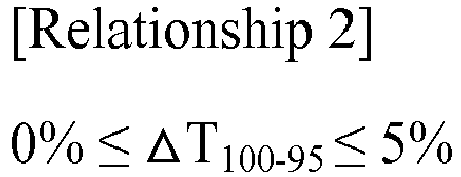
- ⁇ T 100-95 refers to a value obtained by subtracting the heat shrinkage of the heat shrinkable film in the direction perpendicular to the main shrinkage direction after the heat shrinkable film is immersed in a water bath for 10 seconds at 95°C from the heat shrinkage of the heat shrinkable film in the direction perpendicular to the main shrinkage direction after the heat shrinkable film is immersed in a water bath for 10 seconds at 100°C.
- the heat shrinkage is calculated by the equation of (a - b)/a ⁇ 100 in the unit of percent once the length (a) of a sample before being immersed in the hot water tank and the length (b) of the sample after being immersed in the hot water tank for 10 seconds have been measured.
- b is smaller than a, it means that the sample shrinks when immersed in the hot water tank, and the heat shrinkage would have a positive value.
- b is larger than a, it means that the sample expands when immersed in the hot water tank, and the heat shrinkage would have a negative value.
- a heat shrinkage is negative, the (heat) expansion has the same absolute value with the opposite sign. For example, when a heat shrinkage is -10%, the (heat) expansion is 10%.
- the maximum expansion in the direction perpendicular to the main shrinking direction of the heat shrinkable film may be 3 to 15%. Specifically, the maximum expansion in the direction perpendicular to the main shrinkage direction of the heat shrinkable film may be 3 to 12%, 5 to 12%, 5 to 11%, 5 to 10%, 5 to 8%, or 7 to 8%, but it is not limited thereto.
- the maximum expansion in the direction perpendicular to the main shrinkage direction of the heat shrinkable film is within the above range, even if the film applied to the surface of a food container is subjected to a sterilization process for a predetermined period of time at a high temperature, the film can be adhered to the surface of the container in a desired shape without significant deformation. Further, as a slight shrinkage occurs in the main shrinkage direction during the sterilization process at a high temperature, an insufficient shrinkage, if any, in the previous shrinkage step could be compensated.
- the maximum expansion is calculated from the minimum value of the heat shrinkage measured in the direction perpendicular to the main shrinkage direction after the film has been immersed in a water bath for 10 seconds at a specific temperature (for example, at a 5°C interval between 50 and 100°C).
- the minimum value of the heat shrinkage may be present between 70°C and 90°C.
- the heat shrinkable film may have a maximum expansion that is present between 70°C and 90°C.
- the heat shrinkable film may have a maximum expansion between 75°C and 90°C. More specifically, the heat shrinkable film may have a maximum expansion between 75°C and 85°C.
- the heat shrinkable film according to another embodiment may satisfy that T 75 is -12 to 0%, that T 80 is -15 to 0%, that T 85 is -10 to 0%, and optionally that T 90 is -10 to 5%.
- T Z refers to a heat shrinkage in the direction perpendicular to the main shrinkage direction after the heat shrinkable film has been immersed in a water bath for 10 seconds at Z°C.
- T 75 may be -12 to -3%, -12 to -5%, -10 to -5%, -9 to -5%, -10 to -6%, or -8 to -6%.
- T 80 may be -12 to -0.5%, -12 to -2%, -12 to -2.5% -12 to -3%, -10 to-2.5%, -8 to -2.5%, -7 to -2.5%, or -7 to -3%.
- T 85 may be -9 to -0.2%, -7 to -0.2%, -5 to -0.5%, -5 to -0.7%, -4.5 to-0.7%, or -4.3 to -0.7%.
- T 90 may be -10 to 2%, -7 to 2%, -7 to 1%, -3 to 1.5%, -2 to 1%, or -2 to 0.5%.
- the heat shrinkable film according to another embodiment may satisfy that all of T 75 , T 80 , and T 85 are less than 0%.
- the shrinkage characteristics of the film are optimized for the shape of a bottle when it is used as a general heat shrinkable film. Further, the shrinkage in the direction perpendicular to the main shrinkage direction is less likely to occur in the sterilization process under the high-temperature and high-pressure conditions.
- the heat of crystallization ( ⁇ Hc) of the heat shrinkable film as measured by differential scanning calorimetry (DSC) may be 0 to 30 J/g.
- the heat of crystallization ( ⁇ Hc) of the heat shrinkable film as measured by differential scanning calorimetry (DSC) may be 0 to 27 J/g, 0 to 20 J/g, 0 to 15 J/g, 0 to 10 J/g, 0 to 5 J/g, 0 to 2 J/g, or 0 to 1 J/g, but it is not limited thereto.
- the heat of crystallization refers to the amount of heat generated during crystallization as measured by differential scanning calorimetry (DSC). Specifically, the larger the heat of crystallization, the higher the crystallinity of the film. If the heat of crystallization is within the above range, it indicates that the film has a structure close to being amorphous. For example, if the heat of crystallization ( ⁇ Hc) is 0 J/g, it means that the film is composed of an amorphous structure having no crystallinity.
- the heat shrinkable film according to another embodiment may have heat shrinkage characteristics in the direction perpendicular to the main shrinkage direction that satisfy the following Relationships 1a and 2a: ⁇ 10 % ⁇ ⁇ T 70 ⁇ 65 ⁇ % 0 % ⁇ ⁇ T 100 ⁇ 95 ⁇ 2 %
- the heat shrinkable film may have heat shrinkage characteristics in the direction perpendicular to the main shrinkage direction that satisfy the following Relationships 1b and 2b: ⁇ 8 % ⁇ ⁇ T 70 ⁇ 65 ⁇ ⁇ 1 % 0.2 % ⁇ ⁇ T 100 ⁇ 95 ⁇ 1 %
- the heat shrinkable film may have heat shrinkage characteristics in the direction perpendicular to the main shrinkage direction that satisfy the following Relationships 1c and 2c: ⁇ 6 % ⁇ ⁇ T 70 ⁇ 65 ⁇ ⁇ 1.2 % 0.2 % ⁇ ⁇ T 100 ⁇ 95 ⁇ 0.7 %
- the film may shrink in conformation to the shape and size of a container. Thus, it can properly adhere to the surface shape of the container.
- the process for preparing a heat shrinkable film comprises preparing a polyester resin composition; extruding the composition to obtain an unstretched sheet; preheating the unstretched sheet at a preheating temperature (T1) of 100 to 110°C; stretching the preheated unstretched sheet in one direction to obtain a stretched sheet; thermally treating the stretched sheet at a thermal treatment temperature (T2) of 70 to 98°C; and cooling the thermally treated and stretched sheet to prepare the heat shrinkable film.
- T1 preheating temperature
- T2 thermal treatment temperature
- a polyester resin composition is prepared.
- the polyester resin contained in the polyester resin composition may comprise a dicarboxylic acid component and a diol component.
- the dicarboxylic acid component and the diol component may be mixed and subjected to a transesterification reaction.
- At least one catalyst selected from manganese acetate, calcium, and zinc may be used as a catalyst for the transesterification reaction.
- the amount of the catalyst used is preferably 0.02 to 0.2 part by weight based on 100 parts by weight of the dicarboxylic acid compound.
- At least one additive selected from silica, potassium, and magnesium; a stabilizer such as trimethyl phosphate; a polymerization catalyst selected from antimony trioxide and tetrabutylene titanate; and the like may be selectively added to carry out the reaction, to thereby prepare a copolymerized polyester resin composition.
- composition is extruded to obtain an unstretched sheet.
- the composition may be extruded through a T-die at an extrusion temperature of 260 to 300°C or 270 to 290°C and then cooled.
- the unstretched sheet obtained by extruding and cooling the composition may be fed to, and passed through, a roll at a speed of 50 m/min to 100 m/min or 50 m/min to 80 m/min.
- the desired thickness of the film can be adjusted by controlling the feed speed of the unstretched sheet.
- the thickness of the film may be adjusted to 35 to 75 ⁇ m or 40 to 50 ⁇ m at this step.
- the unstretched sheet is preheated at a preheating temperature (T1) of 100 to 110°C.
- the preheating temperature (T1) may be 103 to 107°C or 104 to 106°C.
- the preheating time at the preheating temperature (T1) may be 0.01 to 1 minute.
- the preheating time may be 0.05 to 0.5 minutes or 0.08 to 0.2 minutes, but it is not limited thereto.
- the preheated unstretched sheet is stretched in one direction to obtain a stretched sheet.
- the stretching may be carried out at a temperature lower than the preheating temperature (T1) by 20°C or more.
- the stretching temperature may be 60 to 90°C, 70 to 90°C, or 80 to 90°C, but it is not limited thereto.
- the stretching may be carried out at a stretching ratio of 3 to 5 times in one direction at the stretching temperature. Specifically, the stretching may be carried out at a stretching ratio of 3 to 4.5 times, 3.5 to 4.5 times, or 4 to 4.5 times in one direction, but it is not limited thereto.
- the stretched sheet is thermally treated at a thermal treatment temperature (T2) of 70 to 98°C.
- the thermal treatment temperature (T2) may be 70 to 95°C, 70 to 90°C, 70 to 85°C, or 70 to 80°C, but it is not limited thereto.
- the preheating temperature (T1) - the thermal treatment temperature (T2) is preferably 10 to 40°C.
- T1 - T2 may be 13 to 35°C, 11 to 34°C, 15 to 34°C, or 20 to 34°C.
- T1 - T2 satisfies the above range, the shrinkage in the main shrinkage direction and the heat shrinkage in the direction perpendicular to the main shrinkage direction can be controlled.
- the thermal treatment time at the thermal treatment temperature (T2) may be 0.01 to 1 minute.
- the thermal treatment time may be 0.05 to 0.5 minute or 0.08 to 0.2 minute, but it is not limited thereto.
- a heat shrinkable film that has a heat shrinkage in the direction perpendicular to the main shrinkage direction at a desired level and is printable thereon can be prepared through the process steps according to the embodiment.
- the thermally treated and stretched sheet is cooled to prepare the heat shrinkable film.
- the heat shrinkable film may be continuously produced through the above-described process.
- the process may further comprise the step of winding the cooled heat shrinkable film into a roll shape.
- the process may further comprise the step of printing on the heat shrinkable film.
- the printing step may be performed before or after the step of winding the heat shrinkable film.
- the heat shrinkable film has amorphous character, it is possible to directly print on the film itself.
- a heat shrinkable film is normally applied to the surface of a container once the surface of the container has been printed. This inconveniently involves the removal of the film and the printing in order to recycle the container.
- the heat shrinkable film prepared according to the embodiment is printable thereon.
- the container can be readily recycled.
- the heat shrinkable film prepared by the process for preparing a heat shrinkable film comprises a polyester resin and has heat shrinkage characteristics in the direction perpendicular to the main shrinkage direction that satisfy the above Relationships 1 and 2.
- the dicarboxylic acid component and the alcohol component in the kinds and contents shown in Table 1 below were charged to an autoclave equipped with a stirrer and a distillation tower.
- 0.007 parts by weight of manganese acetate as a transesterification catalyst was added per 100 parts by weight of the dicarboxylic acid component, followed by heating the mixture to 220°C and the removal of methanol produced as a byproduct to carry out the reaction.
- silica having an average particle diameter of 0.28 ⁇ m was added per 100 parts by weight of the dicarboxylic acid component, and 0.4 part by weight of trimethyl phosphate as a stabilizer was added. After 5 minutes, 0.035 part by weight of antimony trioxide and 0.005 part by weight of tetrabutylene titanate were added as a polymerization catalyst, followed by stirring for 10 minutes.
- reaction mixture was transferred to a second reactor equipped with a vacuum apparatus.
- the pressure was gradually reduced while the temperature was raised to 285°C, and the polymerization was carried out for about 210 minutes to thereby prepare a copolymerized polyester resin.
- a composition containing the polyester resin thus obtained was extruded through a T-die at 270°C and then cooled to thereby obtain an unstretched sheet.
- the unstretched sheet was fed to, and passed through, a roll at a speed of 55 m/min to thereby adjust the thickness of the sheet.
- the unstretched sheet was preheated at a preheating temperature (T1) of 100 to 110°C for 0.1 minute while it was transferred at a speed of 55 m/min.
- the unstretched sheet was stretched at a stretching ratio of 4 to 4.5 times in one direction at a stretching temperature lower than T1 by 20°C or more to thereby prepare a stretched sheet.
- the stretched sheet was subjected to thermal treatment at a thermal treatment temperature (T2) at which T1 - T2 satisfied the conditions shown in Table 2 below for 0.1 minute to thereby prepare a stretched sheet having a thickness of 40 ⁇ m.
- T2 thermal treatment temperature
- Each film thus produced was cut into a length of 300 mm (a, length of the sample before being immersed in a hot water bath) and a width of 15 mm.
- the cut sample was immersed in a water bath heated to a specific temperature for 10 seconds, and the length of the sample was then measured.
- the heat shrinkage was calculated by the equation of (a - b)/a ⁇ 100. The results are shown in Table 2 below.
- Heat shrinkage in the direction perpendicular to the main shrinkage direction heat shrinkage in the direction perpendicular to the main shrinkage direction after the sample was immersed in a water bath for 10 seconds at a specific temperature
- the specific dicarboxylic acid and diol components were employed in the specific amounts, and the preheating temperature and the thermal treatment temperature were adjusted to produce films in Examples 1 to 9.
- the heat of crystallization on DSC was 30 J/g or less, and the maximum expansion in the direction perpendicular to the main shrinkage direction was 3 to 15%, unlike Comparative Examples 1 and 2.
- the films had a heat expansion in the direction perpendicular to the main shrinkage direction that is not high at a high temperature, they are suitable as a shrinkable label for containers.
- the films are also economical since they are printable thereon.
Landscapes
- Engineering & Computer Science (AREA)
- Chemical & Material Sciences (AREA)
- Mechanical Engineering (AREA)
- Manufacturing & Machinery (AREA)
- Chemical Kinetics & Catalysis (AREA)
- Health & Medical Sciences (AREA)
- Medicinal Chemistry (AREA)
- Polymers & Plastics (AREA)
- Organic Chemistry (AREA)
- Materials Engineering (AREA)
- Physics & Mathematics (AREA)
- Thermal Sciences (AREA)
- Shaping By String And By Release Of Stress In Plastics And The Like (AREA)
- Manufacture Of Macromolecular Shaped Articles (AREA)
- Laminated Bodies (AREA)
Abstract
Description
- Embodiments relate to a heat shrinkable film, which has a low heat shrinkage in the direction perpendicular to the main shrinkage direction, the heat shrinkage being not high even at a high temperature of 70°C or higher, and which is printable thereon, and a process for preparing the same.
- A heat shrinkable film refers to a film that tends to shrink to a shape before stretching thereof at a certain temperature or higher once it has been oriented by stretching thereof. A heat shrinkable film is used for shrinkable labels for various types of containers, bundle packaging, or cap seals.
- Polyvinyl chloride (PVC) films and oriented polystyrene (OPS) films have been used as heat shrinkable films for a long period of time. However, the use of PVC heat shrinkable films has been regulated due to a problem of environmental pollution since they generate poisonous dioxins when incinerated. OPS heat shrinkable films have a disadvantage in that it is not suitable for shrinkable labels for glass, metal cans, or the like since they have an insufficient heat resistance.
- Hence, polyester-based heat shrinkable films having a high shrinkage and a high heat resistance have been developed to address the disadvantages of the PVC and OPS heat shrinkable films.
- Such a polyester-based heat shrinkable film can be used for metallic food containers. Since a food container has a direct impact on the human body, the container is subjected to a sterilization process at a high temperature for a predetermined time once the film has been applied to the container. In such event, however, a film applied to the surface of a food container by taking advantage of the mechanism that the film shrinks in the main shrinkage direction may also shrink in the direction perpendicular to the main shrinkage direction. This causes deformation, giving birth to a problem that the film fails to conform to the surface shape of the food container.
- Accordingly, there has been a demand for a polyester-based heat shrinkable film, which has a heat shrinkage in the direction perpendicular to the main shrinkage direction that is not high even at a high temperature.
- In order to meet the above demand, the embodiments aim to provide a heat shrinkable film, which has a low heat shrinkage in the direction perpendicular to the main shrinkage direction, the heat shrinkage being not high even at a high temperature of 70°C or higher, and which is printable thereon, and a process for preparing the same.
- According to an embodiment, there is provided a heat shrinkable film, which comprises a polyester resin, wherein the heat shrinkage characteristics in the direction perpendicular to the main shrinkage direction satisfy the following Relationships 1 and 2:


- According to another embodiment, there is provided a process for preparing a heat shrinkable film, which comprises preparing a polyester resin composition; extruding the composition to obtain an unstretched sheet; preheating the unstretched sheet at a preheating temperature (T1) of 100 to 110°C; stretching the preheated unstretched sheet in one direction to obtain a stretched sheet; thermally treating the stretched sheet at a thermal treatment temperature (T2) of 70 to 98°C; and cooling the thermally treated and stretched sheet to prepare the heat shrinkable film.
- The heat shrinkable film according to the embodiment has an excellent shrinkage in the main shrinkage direction and a low heat shrinkage in the direction perpendicular to the main shrinkage direction, wherein this heat shrinkage is not high even at a high temperature of 70°C or higher. Thus, even if the film applied to the surface of a food container is subjected to a sterilization process, it is not deformed. Therefore, the film can be advantageously used for food containers.
- In addition, the heat shrinkable film according to the embodiment is printable thereon. Thus, it is possible to remove the inconvenience of printing on the surface of the container in a conventional way, resulting in an advantage that the container can be readily recycled.
- Further, the process for preparing a heat shrinkable film according to the embodiment can provide a heat shrinkable film, which has a heat shrinkage in the direction perpendicular to the main shrinkage direction that is not high even at a high temperature and which is printable thereon. Since the film can serve as an economical and environmentally friendly film, it can be used in various ways.
- Hereinafter, the present invention will be described in detail with reference to embodiments. The embodiments are not limited to those described below. Rather, they can be modified into various forms as long as the gist of the invention is not altered.
- Throughout the description of the embodiments, the term "comprise" means that other elements may be included unless otherwise indicated.
- In addition, all numbers expressing quantities of components, reaction conditions, and the like used herein are to be understood as being modified by the term "about" unless otherwise indicated.
- An embodiment provides a heat shrinkable film, which has a low heat shrinkage in the direction perpendicular to the main shrinkage direction, the heat shrinkage being not high even at a high temperature, and which is printable thereon.
- The heat shrinkable film according to the embodiment comprises a polyester resin.
- The polyester resin comprises a dicarboxylic acid component and a diol component.
- The dicarboxylic acid component may comprise an aromatic dicarboxylic acid such as terephthalic acid, dimethylterephthalic acid, isophthalic acid, naphthalene dicarboxylic acid, orthophthalic acid, and the like; an aliphatic dicarboxylic acid such as adipic acid, azelaic acid, sebacic acid, decanedicarboxylic acid, and the like; an alicyclic dicarboxylic acid; an ester thereof; and a combination thereof.
- Specifically, the dicarboxylic acid component may comprise an aromatic dicarboxylic acid. For example, the dicarboxylic acid component may comprise at least 80% by mole, at least 90% by mole, or at least 95% by mole of terephthalic acid, based on the total number of moles of the dicarboxylic acid component.
- Alternatively, the dicarboxylic acid component may be composed of terephthalic acid, dimethyl terephthalic acid, isophthalic acid, naphthalene dicarboxylic acid, orthophthalic acid, or a combination thereof. For example, the dicarboxylic acid component may be composed of terephthalic acid, but it is not limited thereto.
- The diol component may comprise ethylene glycol (EG), diethylene glycol (DEG), cyclohexanedimethanol (CHDM), propanediol substituted or unsubstituted with an alkyl group, butanediol substituted or unsubstituted with an alkyl group, pentanediol substituted or unsubstituted with an alkyl group, hexanediol substituted or unsubstituted with an alkyl group, octanediol substituted or unsubstituted with an alkyl group, and a combination thereof.
- Specifically, the diol component may comprise ethylene glycol (EG), diethylene glycol (DEG), 1,4-cyclohexanedimethanol, 1,3-propanediol, 1,2-octanediol, 1,3-octanediol, 2,3-butanediol, 1,3-butanediol, 1,4-butanediol, 1,5-pentanediol, neopentyl glycol, 2-butyl-2-ethyl-1,3-propanediol, 2,2-diethyl-1,5-pentanediol, 2,4-diethyl-1,5-pentanediol, 3-methyl-1,5-pentanediol, 1,1-dimethyl-1,5-pentanediol, or a combination thereof.
- More specifically, the diol component may comprise at least one selected from the group consisting of ethylene glycol (EG), diethylene glycol (DEG), neopentyl glycol (NPG), and cyclohexanedimethanol (CHDM), but it is not limited thereto. Alternatively, the diol component may be composed of at least one selected from the group consisting of ethylene glycol (EG), diethylene glycol (DEG), neopentyl glycol (NPG), and cyclohexanedimethanol (CHDM), but it is not limited thereto.
- In addition, the diol component may essentially comprise at least one selected from the group consisting of neopentyl glycol (NPG) and cyclohexanedimethanol (CHDM), but it is not limited thereto.
- The content of ethylene glycol in the diol component may be 50 to 80% by mole based on the total number of moles of the diol component. Specifically, the content of ethylene glycol may be 50 to 77% by mole, 60 to 75% by mole, 65 to 75% by mole, 65 to 71% by mole, or 69 to 71% by mole, based on the total number of moles of the diol component. But it is not limited thereto.
- The content of diethylene glycol in the diol component may be greater than 0 and up to 20% by mole based on the total number of moles of the diol component. Specifically, the content of diethylene glycol may be 1 to 15% by mole, 1 to 10% by mole, 5 to 15% by mole, 5 to 10% by mole, or 3 to 7% by mole, based on the total number of moles of the diol component. But it is not limited thereto.
- The sum of the contents of neopentyl glycol and cyclohexanedimethanol in the diol component may be 10 to 40% by mole based on the total number of moles of the diol component. Specifically, the sum of the contents of neopentyl glycol and cyclohexanedimethanol in the diol component may be 10 to 35% by mole, 10 to 30% by mole, 15 to 35% by mole, 15 to 30% by mole, 20 to 30% by mole, 22 to 30% by mole, 22 to 26% by mole, or 24 to 26% by mole, based on the total number of moles of the diol component. But it is not limited thereto.
- Specifically, the content of neopentyl glycol in the diol component may be 0 to 30% by mole based on the total number of moles of the diol component. Specifically, the content of neopentyl glycol in the diol component may be 10 to 30% by mole, 20 to 30% by mole, 20 to less than 30% by mole, 20 to 28% by mole, 22 to 30% by mole, 24 to 30% by mole, 22 to 26% by mole, or 24 to 26% by mole, based on the total number of moles of the diol component. But it is not limited thereto.
- If the content of neopentyl glycol satisfies the above range, a heat shrinkable film having a heat shrinkage in the direction perpendicular to the main shrinkage direction that is not high even at a high temperature can be prepared. In particular, if the content of neopentyl glycol exceeds the above range, the film may excessively expand in the direction perpendicular to the main shrinkage direction, so that wrinkles or deformation may occur when the film is applied to a container. Specifically, if the content of neopentyl glycol exceeds the above range, the amorphous region is unnecessarily larger, whereby the expansion coefficient would be increased due to low shrinkage characteristics in the direction perpendicular to the main shrinkage direction although the shrinkage characteristics in the main shrinkage direction could be improved.
- In addition, the content of cyclohexanedimethanol in the diol component may be 0 to 30% by mole based on the total number of moles of the diol component. Specifically, the content of cyclohexanedimethanol in the diol component may be 10 to 30% by mole, 20 to 30% by mole, or 22 to 30% by mole, based on the total number of moles of the diol component. But it is not limited thereto.
- According to an embodiment, the diol component may comprise only one of neopentyl glycol and cyclohexanedimethanol. That is, if the diol component comprises neopentyl glycol, it does not comprise cyclohexanedimethanol; or if the diol component comprises cyclohexanedimethanol, it does not comprise neopentyl glycol.
- If the diol component comprises neopentyl glycol without cyclohexanedimethanol among the above alternatives, it is more effective in achieving the object of the embodiment.
- The diol component may further comprise a monohydric alcohol component in addition to the dihydric alcohol components as described above. For example, it may further comprise isopropyl alcohol (IPA) as the monohydric alcohol component.
- In such event, the content of the monohydric alcohol component may be 15 to 30% by mole, 18 to 25% by mole, or 20 to 25% by mole, based on the total number of moles of the diol component and the monohydric alcohol component, but it is not limited thereto.
- The dicarboxylic acid component and the diol component may be subjected to a transesterification reaction and then polymerization to thereby form a copolymerized polyester resin.
- The heat shrinkable film according to an embodiment has heat shrinkage characteristics in the direction perpendicular to the main shrinkage direction, which satisfy the following Relationships 1 and 2:


- That is, ΔT70-65 refers to a value obtained by subtracting the heat shrinkage of the heat shrinkable film in the direction perpendicular to the main shrinkage direction after the heat shrinkable film is immersed in a water bath for 10 seconds at 65°C from the heat shrinkage of the heat shrinkable film in the direction perpendicular to the main shrinkage direction after the heat shrinkable film is immersed in a water bath for 10 seconds at 70°C.
- In addition, ΔT100-95 refers to a value obtained by subtracting the heat shrinkage of the heat shrinkable film in the direction perpendicular to the main shrinkage direction after the heat shrinkable film is immersed in a water bath for 10 seconds at 95°C from the heat shrinkage of the heat shrinkable film in the direction perpendicular to the main shrinkage direction after the heat shrinkable film is immersed in a water bath for 10 seconds at 100°C.
- The heat shrinkage is calculated by the equation of (a - b)/a × 100 in the unit of percent once the length (a) of a sample before being immersed in the hot water tank and the length (b) of the sample after being immersed in the hot water tank for 10 seconds have been measured.
- That is, if b is smaller than a, it means that the sample shrinks when immersed in the hot water tank, and the heat shrinkage would have a positive value. On the other hand, if b is larger than a, it means that the sample expands when immersed in the hot water tank, and the heat shrinkage would have a negative value. If a heat shrinkage is negative, the (heat) expansion has the same absolute value with the opposite sign. For example, when a heat shrinkage is -10%, the (heat) expansion is 10%.
- In an embodiment, the maximum expansion in the direction perpendicular to the main shrinking direction of the heat shrinkable film may be 3 to 15%. Specifically, the maximum expansion in the direction perpendicular to the main shrinkage direction of the heat shrinkable film may be 3 to 12%, 5 to 12%, 5 to 11%, 5 to 10%, 5 to 8%, or 7 to 8%, but it is not limited thereto.
- If the maximum expansion in the direction perpendicular to the main shrinkage direction of the heat shrinkable film is within the above range, even if the film applied to the surface of a food container is subjected to a sterilization process for a predetermined period of time at a high temperature, the film can be adhered to the surface of the container in a desired shape without significant deformation. Further, as a slight shrinkage occurs in the main shrinkage direction during the sterilization process at a high temperature, an insufficient shrinkage, if any, in the previous shrinkage step could be compensated.
- The maximum expansion is calculated from the minimum value of the heat shrinkage measured in the direction perpendicular to the main shrinkage direction after the film has been immersed in a water bath for 10 seconds at a specific temperature (for example, at a 5°C interval between 50 and 100°C).
- According to an embodiment, when the heat shrinkage in the direction perpendicular to the main shrinkage direction of the heat shrinkable film is measured at an interval of 5°C between 50°C and 100°C, the minimum value of the heat shrinkage may be present between 70°C and 90°C. In other words, the heat shrinkable film may have a maximum expansion that is present between 70°C and 90°C.
- Specifically, the heat shrinkable film may have a maximum expansion between 75°C and 90°C. More specifically, the heat shrinkable film may have a maximum expansion between 75°C and 85°C.
- With respect to the heat shrinkage characteristics in the direction perpendicular to the main shrinkage direction, the heat shrinkable film according to another embodiment may satisfy that T75 is -12 to 0%, that T80 is -15 to 0%, that T85 is -10 to 0%, and optionally that T90 is -10 to 5%.
- In the above, TZ refers to a heat shrinkage in the direction perpendicular to the main shrinkage direction after the heat shrinkable film has been immersed in a water bath for 10 seconds at Z°C.
- Specifically, T75 may be -12 to -3%, -12 to -5%, -10 to -5%, -9 to -5%, -10 to -6%, or -8 to -6%.
- In addition, T80 may be -12 to -0.5%, -12 to -2%, -12 to -2.5% -12 to -3%, -10 to-2.5%, -8 to -2.5%, -7 to -2.5%, or -7 to -3%.
- In addition, T85 may be -9 to -0.2%, -7 to -0.2%, -5 to -0.5%, -5 to -0.7%, -4.5 to-0.7%, or -4.3 to -0.7%.
- In addition, T90 may be -10 to 2%, -7 to 2%, -7 to 1%, -3 to 1.5%, -2 to 1%, or -2 to 0.5%.
- With respect to the heat shrinkage characteristics in the direction perpendicular to the main shrinkage direction, the heat shrinkable film according to another embodiment may satisfy that all of T75, T80, and T85 are less than 0%.
- If the heat shrinkable film satisfies that T75, T80, and T85 are within the above range with respect to the heat shrinkage characteristics in the direction perpendicular to the main shrinkage direction, the shrinkage characteristics of the film are optimized for the shape of a bottle when it is used as a general heat shrinkable film. Further, the shrinkage in the direction perpendicular to the main shrinkage direction is less likely to occur in the sterilization process under the high-temperature and high-pressure conditions.
- According to an embodiment, the heat of crystallization (ΔHc) of the heat shrinkable film as measured by differential scanning calorimetry (DSC) may be 0 to 30 J/g. Specifically, the heat of crystallization (ΔHc) of the heat shrinkable film as measured by differential scanning calorimetry (DSC) may be 0 to 27 J/g, 0 to 20 J/g, 0 to 15 J/g, 0 to 10 J/g, 0 to 5 J/g, 0 to 2 J/g, or 0 to 1 J/g, but it is not limited thereto.
- The heat of crystallization (ΔHc) refers to the amount of heat generated during crystallization as measured by differential scanning calorimetry (DSC). Specifically, the larger the heat of crystallization, the higher the crystallinity of the film. If the heat of crystallization is within the above range, it indicates that the film has a structure close to being amorphous. For example, if the heat of crystallization (ΔHc) is 0 J/g, it means that the film is composed of an amorphous structure having no crystallinity.
- The heat shrinkable film according to another embodiment may have heat shrinkage characteristics in the direction perpendicular to the main shrinkage direction that satisfy the following Relationships 1a and 2a:


- Specifically, the heat shrinkable film may have heat shrinkage characteristics in the direction perpendicular to the main shrinkage direction that satisfy the following Relationships 1b and 2b:


- More specifically, the heat shrinkable film may have heat shrinkage characteristics in the direction perpendicular to the main shrinkage direction that satisfy the following Relationships 1c and 2c:


- If the heat shrinkage characteristics of the heat shrinkable film in the direction perpendicular to the main shrinkage direction satisfy the above-mentioned conditions, the film may shrink in conformation to the shape and size of a container. Thus, it can properly adhere to the surface shape of the container.
- Various characteristics such as the constituent components of the heat shrinkable film and the physical properties of the heat shrinkable film may be combined.
- The process for preparing a heat shrinkable film according to an embodiment comprises preparing a polyester resin composition; extruding the composition to obtain an unstretched sheet; preheating the unstretched sheet at a preheating temperature (T1) of 100 to 110°C; stretching the preheated unstretched sheet in one direction to obtain a stretched sheet; thermally treating the stretched sheet at a thermal treatment temperature (T2) of 70 to 98°C; and cooling the thermally treated and stretched sheet to prepare the heat shrinkable film.
- The process for preparing a heat shrinkable film, which has a heat shrinkage in the direction perpendicular to the main shrinkage direction that is not high even at a high temperature and which is printable thereon, is described in detail, as follows.
- First, a polyester resin composition is prepared.
- The polyester resin contained in the polyester resin composition may comprise a dicarboxylic acid component and a diol component. The dicarboxylic acid component and the diol component may be mixed and subjected to a transesterification reaction.
- In such event, at least one catalyst selected from manganese acetate, calcium, and zinc may be used as a catalyst for the transesterification reaction. The amount of the catalyst used is preferably 0.02 to 0.2 part by weight based on 100 parts by weight of the dicarboxylic acid compound.
- Upon completion of the transesterification reaction, at least one additive selected from silica, potassium, and magnesium; a stabilizer such as trimethyl phosphate; a polymerization catalyst selected from antimony trioxide and tetrabutylene titanate; and the like may be selectively added to carry out the reaction, to thereby prepare a copolymerized polyester resin composition.
- For details on the polyester resin, the dicarboxylic acid component, the diol component, and the like, the reader is referred to those described in the above section of
- Next, the composition is extruded to obtain an unstretched sheet.
- The composition may be extruded through a T-die at an extrusion temperature of 260 to 300°C or 270 to 290°C and then cooled.
- The unstretched sheet obtained by extruding and cooling the composition may be fed to, and passed through, a roll at a speed of 50 m/min to 100 m/min or 50 m/min to 80 m/min.
- In such event, the desired thickness of the film can be adjusted by controlling the feed speed of the unstretched sheet. For example, the thickness of the film may be adjusted to 35 to 75 µm or 40 to 50 µm at this step.
- Then, the unstretched sheet is preheated at a preheating temperature (T1) of 100 to 110°C.
- Specifically, the preheating temperature (T1) may be 103 to 107°C or 104 to 106°C.
- In addition, the preheating time at the preheating temperature (T1) may be 0.01 to 1 minute. Specifically, the preheating time may be 0.05 to 0.5 minutes or 0.08 to 0.2 minutes, but it is not limited thereto.
- Next, the preheated unstretched sheet is stretched in one direction to obtain a stretched sheet.
- The stretching may be carried out at a temperature lower than the preheating temperature (T1) by 20°C or more. Specifically, the stretching temperature may be 60 to 90°C, 70 to 90°C, or 80 to 90°C, but it is not limited thereto.
- The stretching may be carried out at a stretching ratio of 3 to 5 times in one direction at the stretching temperature. Specifically, the stretching may be carried out at a stretching ratio of 3 to 4.5 times, 3.5 to 4.5 times, or 4 to 4.5 times in one direction, but it is not limited thereto.
- Then, the stretched sheet is thermally treated at a thermal treatment temperature (T2) of 70 to 98°C.
- Specifically, the thermal treatment temperature (T2) may be 70 to 95°C, 70 to 90°C, 70 to 85°C, or 70 to 80°C, but it is not limited thereto.
- According to an embodiment, the preheating temperature (T1) - the thermal treatment temperature (T2) is preferably 10 to 40°C. For example, T1 - T2 may be 13 to 35°C, 11 to 34°C, 15 to 34°C, or 20 to 34°C.
- If T1 - T2 satisfies the above range, the shrinkage in the main shrinkage direction and the heat shrinkage in the direction perpendicular to the main shrinkage direction can be controlled.
- In addition, the thermal treatment time at the thermal treatment temperature (T2) may be 0.01 to 1 minute. Specifically, the thermal treatment time may be 0.05 to 0.5 minute or 0.08 to 0.2 minute, but it is not limited thereto.
- Even if a film is produced using the same dicarboxylic acid and diol components in the same amounts, the physical properties of the film thus produced may be significantly different depending on the specific process steps.
- A heat shrinkable film that has a heat shrinkage in the direction perpendicular to the main shrinkage direction at a desired level and is printable thereon can be prepared through the process steps according to the embodiment.
- Next, the thermally treated and stretched sheet is cooled to prepare the heat shrinkable film.
- The heat shrinkable film may be continuously produced through the above-described process.
- Then, the process may further comprise the step of winding the cooled heat shrinkable film into a roll shape.
- In addition, the process may further comprise the step of printing on the heat shrinkable film. At this time, the printing step may be performed before or after the step of winding the heat shrinkable film.
- Since the heat shrinkable film has amorphous character, it is possible to directly print on the film itself.
- In a conventional process, a heat shrinkable film is normally applied to the surface of a container once the surface of the container has been printed. This inconveniently involves the removal of the film and the printing in order to recycle the container.
- In contrast, the heat shrinkable film prepared according to the embodiment is printable thereon. Thus, it has an advantage that the container can be readily recycled.
- For details on the heat shrinkable film prepared according to the process for preparing a heat shrinkable film, the reader is referred to those described in the above section of <Heat Shrinkable Film>.
- For example, the heat shrinkable film prepared by the process for preparing a heat shrinkable film comprises a polyester resin and has heat shrinkage characteristics in the direction perpendicular to the main shrinkage direction that satisfy the above Relationships 1 and 2.
- In addition, various characteristics such as the constituent components of the heat shrinkable film and the physical properties of the heat shrinkable film may be combined.
- Hereinafter, the present invention will be described in more detail with reference to the following examples. However, these examples are set forth to illustrate the present invention, and the scope of the present invention is not limited thereto.
- The dicarboxylic acid component and the alcohol component in the kinds and contents shown in Table 1 below were charged to an autoclave equipped with a stirrer and a distillation tower. In addition, 0.007 parts by weight of manganese acetate as a transesterification catalyst was added per 100 parts by weight of the dicarboxylic acid component, followed by heating the mixture to 220°C and the removal of methanol produced as a byproduct to carry out the reaction.
- Upon completion of the transesterification reaction, 0.07 part by weight of silica having an average particle diameter of 0.28 µm was added per 100 parts by weight of the dicarboxylic acid component, and 0.4 part by weight of trimethyl phosphate as a stabilizer was added. After 5 minutes, 0.035 part by weight of antimony trioxide and 0.005 part by weight of tetrabutylene titanate were added as a polymerization catalyst, followed by stirring for 10 minutes.
- Subsequently, the reaction mixture was transferred to a second reactor equipped with a vacuum apparatus. The pressure was gradually reduced while the temperature was raised to 285°C, and the polymerization was carried out for about 210 minutes to thereby prepare a copolymerized polyester resin.
- A composition containing the polyester resin thus obtained was extruded through a T-die at 270°C and then cooled to thereby obtain an unstretched sheet. The unstretched sheet was fed to, and passed through, a roll at a speed of 55 m/min to thereby adjust the thickness of the sheet. Then, the unstretched sheet was preheated at a preheating temperature (T1) of 100 to 110°C for 0.1 minute while it was transferred at a speed of 55 m/min.
- Next, the unstretched sheet was stretched at a stretching ratio of 4 to 4.5 times in one direction at a stretching temperature lower than T1 by 20°C or more to thereby prepare a stretched sheet.
- Then, the stretched sheet was subjected to thermal treatment at a thermal treatment temperature (T2) at which T1 - T2 satisfied the conditions shown in Table 2 below for 0.1 minute to thereby prepare a stretched sheet having a thickness of 40 µm.
- Each film thus produced was cut into a length of 300 mm (a, length of the sample before being immersed in a hot water bath) and a width of 15 mm. The cut sample was immersed in a water bath heated to a specific temperature for 10 seconds, and the length of the sample was then measured. The heat shrinkage was calculated by the equation of (a - b)/a × 100. The results are shown in Table 2 below.
- A sample of each film thus produced was mounted on an equipment capable of measuring Tg, Tm, and Tc. The endotherm and exotherm of the sample were measured while the temperature was raised at a rate of 1 °C/min to obtain a heat flow graph with respect to the temperature. The heat of crystallization (ΔHc) was measured from this graph. The results are shown in Table 2 below.
[Table 1] Dicarboxylic acid Alcohol TPA DEG EG NPG CHDM IPA Ex. 1 100 5 71 24 - - Ex. 2 100 5 71 24 - - Ex. 3 100 5 69 26 - - Ex. 4 100 5 65 30 - - Ex. 5 100 5 65 30 - - Ex. 6 100 5 65 - 30 - Ex. 7 100 10 68 - 22 - Ex. 8 100 1 63 14 - 22 Ex. 9 100 5 71 24 - - C. Ex. 1 100 5 78 17 - - C. Ex. 2 100 5 78 17 - - [Table 2] T1 - T2 (°C) Heat flow on DSC (J/g) Heat shrinkage in the direction perpendicular to the main shrinkage direction (%) Max. expansion (%) ΔT70-65 ΔT100-95 75°C 80°C 85°C 90°C Ex. 1 27 0 -7 -3 -1 0.3 7 -4.7 0.4 Ex. 2 20 0 -6 -7 -4.3 -2 7 -1.4 0.7 Ex.3 34 0 -8 -4 -0.7 1.3 8 -5.3 0.3 Ex. 4 23 0 -11.7 -7.7 -1.3 -0.7 11.7 -4.4 1 Ex. 5 13 0 -9.7 -12 -9 -6 12 -2.3 1 Ex. 6 28 0 -5 -3 -1 2 5 -1 0 Ex. 7 21 0 0 -1 -5 -3 5 0 1 Ex. 8 35 27 -3 -2 -1 -0.3 3 -1.4 0.8 Ex. 9 11 0 -1.7 -4 -5 -6.3 6.3 -1.7 1 C. Ex. 1 35 46.8 -2 -1.7 0.7 2.3 2 0.4 0 C. Ex. 2 25 46.8 -1 -2 -0.7 1.7 2 0 -0.3 T1: preheating temperature
T2: thermal treatment temperature - Heat shrinkage in the direction perpendicular to the main shrinkage direction: heat shrinkage in the direction perpendicular to the main shrinkage direction after the sample was immersed in a water bath for 10 seconds at a specific temperature
- As confirmed from Tables 1 and 2, the specific dicarboxylic acid and diol components were employed in the specific amounts, and the preheating temperature and the thermal treatment temperature were adjusted to produce films in Examples 1 to 9. As a result, the heat of crystallization on DSC was 30 J/g or less, and the maximum expansion in the direction perpendicular to the main shrinkage direction was 3 to 15%, unlike Comparative Examples 1 and 2. Since the films had a heat expansion in the direction perpendicular to the main shrinkage direction that is not high at a high temperature, they are suitable as a shrinkable label for containers. The films are also economical since they are printable thereon.
Claims (15)
- A heat shrinkable film, which comprises a polyester resin,
wherein the heat shrinkage characteristics in the direction perpendicular to the main shrinkage direction satisfy the following Relationships 1 and 2:

- The heat shrinkable film of claim 1, wherein the polyester resin comprises a dicarboxylic acid component and a diol component, and
the diol component comprises at least one selected from the group consisting of ethylene glycol (EG), diethylene glycol (DEG), neopentyl glycol (NPG), and cyclohexanedimethanol (CHDM). - The heat shrinkable film of claim 2, wherein the content of ethylene glycol is 50 to 80% by mole based on the total number of moles of the diol component, and/or
the content of diethylene glycol is greater than 0 and up to 20% by mole based on the total number of moles of the diol component. - The heat shrinkable film of claim 2, wherein the sum of the contents of neopentyl glycol and cyclohexanedimethanol is 10 to 40% by mole based on the total number of moles of the diol component.
- The heat shrinkable film of claim 2, wherein the content of neopentyl glycol is 20 to 30% by mole based on the total number of moles of the diol component.
- The heat shrinkable film of any one of the preceding claims, whose maximum expansion in the direction perpendicular to the main shrinking direction is 3 to 15%, preferably wherein the maximum expansion of the heat shrinkable film is present between 70°C and 90°C when the heat shrinkage of the heat shrinkable film in the direction perpendicular to the main shrinkage direction is measured at an interval of 5°C between 50°C and 100°C.
- The heat shrinkable film of any one of the preceding claims, whose heat of crystallization (ΔHc) as measured by differential scanning calorimetry (DSC) is 0 to 30 J/g.
- The heat shrinkable film of any one of the preceding claims, which satisfies that T75 is -12 to 0%, that T80 is -15 to 0%, and that T85 is -10 to 0%, wherein TZ refers to a heat shrinkage in the direction perpendicular to the main shrinkage direction after the heat shrinkable film is immersed in a water bath for 10 seconds at Z°C.
- A process for preparing a heat shrinkable film, which comprises:preparing a polyester resin composition;extruding the composition to obtain an unstretched sheet;preheating the unstretched sheet at a preheating temperature (T1) of 100 to 110°C;stretching the preheated unstretched sheet in one direction to obtain a stretched sheet;thermally treating the stretched sheet at a thermal treatment temperature (T2) of 70 to 98°C; andcooling the thermally treated and stretched sheet to prepare the heat shrinkable film.
- The process for preparing a heat shrinkable film of claim 9, wherein the extrusion is carried out at 260 to 300°C.
- The process for preparing a heat shrinkable film of claim 9 or claim 10, wherein T1 - T2 is 10 to 40°C, and/or wherein the preheating is carried out for 0.01 to 1 minute.
- The process for preparing a heat shrinkable film of any one of claims 9-11, wherein the stretching is carried out at a stretching ratio of 3 to 5 times in one direction.
- The process for preparing a heat shrinkable film of any one of claims 9-12, further comprising printing on the heat shrinkable film.
- The process for preparing a heat shrinkable film of any one of claims 9-13, wherein the heat shrinkage characteristics of the heat shrinkable film in the direction perpendicular to the main shrinkage direction satisfy the following Relationships 1 and 2:

- The process for preparing a heat shrinkable film of any one of claims 9-14, wherein the heat shrinkable film comprises a polyester resin,
the polyester resin comprises a dicarboxylic acid component and a diol component,
the diol component comprises at least one selected from the group consisting of ethylene glycol (EG), diethylene glycol (DEG), neopentyl glycol (NPG), and cyclohexanedimethanol (CHDM), and
the sum of the contents of neopentyl glycol and cyclohexanedimethanol is 10 to 40% by mole based on the total number of moles of the diol component.
Applications Claiming Priority (1)
| Application Number | Priority Date | Filing Date | Title |
|---|---|---|---|
| KR1020180057715A KR102153670B1 (en) | 2018-05-21 | 2018-05-21 | Heat shrinkable film and preparation method thereof |
Publications (1)
| Publication Number | Publication Date |
|---|---|
| EP3572451A1 true EP3572451A1 (en) | 2019-11-27 |
Family
ID=64394490
Family Applications (1)
| Application Number | Title | Priority Date | Filing Date |
|---|---|---|---|
| EP18189120.1A Pending EP3572451A1 (en) | 2018-05-21 | 2018-08-15 | Heat shrinkable film and preparation method thereof |
Country Status (6)
| Country | Link |
|---|---|
| US (2) | US10994880B2 (en) |
| EP (1) | EP3572451A1 (en) |
| KR (1) | KR102153670B1 (en) |
| CN (1) | CN108908922B (en) |
| AU (1) | AU2018205116B2 (en) |
| TW (1) | TWI681989B (en) |
Cited By (3)
| Publication number | Priority date | Publication date | Assignee | Title |
|---|---|---|---|---|
| WO2020076747A1 (en) * | 2018-10-08 | 2020-04-16 | Eastman Chemical Company | Crystallizable shrinkable and thermoformable sheets made from reactor grade resins |
| US12116452B2 (en) | 2018-10-08 | 2024-10-15 | Eastman Chemical Company | Crystallizable shrinkable films and thermoformable sheets made from resins blends |
| EP4368661A4 (en) * | 2021-07-05 | 2025-07-23 | Sk Microworks Co Ltd | POLYESTER FILM AND HEAT-SHRINKABLE LABEL AND PACKAGING MATERIAL |
Families Citing this family (8)
| Publication number | Priority date | Publication date | Assignee | Title |
|---|---|---|---|---|
| CN109776771A (en) * | 2019-01-10 | 2019-05-21 | 山东中塑泰富科技有限公司 | A kind of Heat Shrinkage Film Polyester slice and preparation method thereof |
| CN110684184B (en) * | 2019-08-30 | 2022-06-28 | 江阴市华宏化纤有限公司 | Glycol modified PETG polyester chip and production process thereof |
| US12522695B2 (en) | 2019-10-08 | 2026-01-13 | Eastman Chemical Company | Catalyst systems for crystallizable reactor grade resins with recycled content |
| KR102258535B1 (en) * | 2019-10-31 | 2021-05-31 | 에스케이씨 주식회사 | Polyester film and method for reproducing polyester container using same |
| KR102446902B1 (en) * | 2020-10-22 | 2022-09-23 | 에스케이씨 주식회사 | Heat-shrinkable polyester film, and retort food comprising same |
| KR102469389B1 (en) * | 2020-10-22 | 2022-11-22 | 에스케이씨 주식회사 | Polyester film, heat-shrinkable label and packaging material comprising same |
| DE112020007527T5 (en) * | 2020-11-30 | 2023-06-07 | Bonset America Corporation | HEAT-SHRINKABLE POLYESTER FILM |
| KR102553960B1 (en) | 2021-07-05 | 2023-07-11 | 에스케이마이크로웍스 주식회사 | Polyester film, heat-shrinkable label and packaging comprising same |
Citations (4)
| Publication number | Priority date | Publication date | Assignee | Title |
|---|---|---|---|---|
| EP0349960A2 (en) * | 1988-07-05 | 1990-01-10 | Diafoil Hoechst Co., Ltd | Shrinkable polyester film |
| EP1418042A1 (en) * | 2001-07-11 | 2004-05-12 | Toyo Boseki Kabushiki Kaisha | Heat shrinkable polyester films and process for production thereof |
| EP2365025A1 (en) * | 2010-03-09 | 2011-09-14 | SKC Co., Ltd. | Heat-shrinkable polyester film |
| EP2631261A2 (en) * | 2010-10-20 | 2013-08-28 | SKC Co., Ltd | Heat-shrinkable polyester film |
Family Cites Families (20)
| Publication number | Priority date | Publication date | Assignee | Title |
|---|---|---|---|---|
| EP0267799B1 (en) | 1986-11-12 | 1993-08-18 | Diafoil Hoechst Co., Ltd | Shrinkable polyester film |
| JP2000229357A (en) * | 1999-02-09 | 2000-08-22 | Gunze Ltd | Heat-shrinkable film and container with the film fitted by heat-shrinking |
| US6362306B1 (en) | 1999-08-17 | 2002-03-26 | Eastman Chemical Company | Reactor grade copolyesters for shrink film applications |
| JP3678186B2 (en) | 2001-08-01 | 2005-08-03 | 東洋紡績株式会社 | Heat-shrinkable polyester film roll |
| JP2003147097A (en) * | 2001-11-13 | 2003-05-21 | Toyobo Co Ltd | Heat-shrinkable polyester film |
| WO2005037899A1 (en) * | 2003-10-21 | 2005-04-28 | Toyo Boseki Kabushiki Kaisha | Heat-shrinkable polyester-based film and heat-shrinkable polyester-based film roll |
| JP4968064B2 (en) | 2005-03-28 | 2012-07-04 | 東レ株式会社 | Biaxially oriented polyester film and metallic laminate film |
| KR100946163B1 (en) * | 2007-07-16 | 2010-03-11 | 도레이새한 주식회사 | Heat-shrinkable polyester film for improving curled shape problem and manufacturing method thereof |
| JP2009160788A (en) * | 2007-12-28 | 2009-07-23 | Toyobo Co Ltd | Heat-shrinkable polyester film and its manufacturing method |
| US20090227735A1 (en) | 2008-03-07 | 2009-09-10 | Eastman Chemical Company | Miscible polyester blends and shrinkable films prepared therefrom |
| CN102558517B (en) * | 2012-01-19 | 2014-03-19 | 姚雪远 | Ecological multifunctional ternary copolymerization PETG (Polyethylene Terephthalate Glycol) polyester, preparation method of polyester, and method for preparing unidirectional stretching heat-shrinkable film from polyester |
| US10329393B2 (en) | 2012-12-12 | 2019-06-25 | Eastman Chemical Company | Copolysters plasticized with polymeric plasticizer for shrink film applications |
| KR102082304B1 (en) * | 2013-05-02 | 2020-02-27 | 에스케이케미칼 주식회사 | Copolymer polyester resin and molded product using same |
| TWI616471B (en) | 2013-05-16 | 2018-03-01 | 東洋紡股份有限公司 | Heat shrinkable polyester-based film and packaging article |
| WO2014204156A2 (en) | 2013-06-17 | 2014-12-24 | 에스케이케미칼주식회사 | Heat-shrinkable film comprising copolymer polyester resin |
| WO2016067658A1 (en) * | 2014-10-30 | 2016-05-06 | 東洋紡株式会社 | Heat-shrinkable polyester film and package |
| JP6658513B2 (en) | 2015-03-20 | 2020-03-04 | 東洋紡株式会社 | Heat-shrinkable polyester film and package |
| JP6519331B2 (en) | 2015-06-11 | 2019-05-29 | 東洋紡株式会社 | Heat-shrinkable polyester film and package |
| JP6608722B2 (en) * | 2016-02-12 | 2019-11-20 | 株式会社フジシールインターナショナル | Shrink film and shrink label |
| CN107459636B (en) * | 2017-09-18 | 2021-04-13 | 江苏景宏新材料科技有限公司 | A kind of polyester heat shrinkable film with low initial shrinkage temperature and preparation method thereof |
-
2018
- 2018-05-21 KR KR1020180057715A patent/KR102153670B1/en active Active
- 2018-07-10 TW TW107123854A patent/TWI681989B/en active
- 2018-07-11 AU AU2018205116A patent/AU2018205116B2/en active Active
- 2018-07-24 US US16/043,589 patent/US10994880B2/en active Active
- 2018-08-02 CN CN201810871417.3A patent/CN108908922B/en active Active
- 2018-08-15 EP EP18189120.1A patent/EP3572451A1/en active Pending
-
2021
- 2021-03-31 US US17/219,452 patent/US11655062B2/en active Active
Patent Citations (4)
| Publication number | Priority date | Publication date | Assignee | Title |
|---|---|---|---|---|
| EP0349960A2 (en) * | 1988-07-05 | 1990-01-10 | Diafoil Hoechst Co., Ltd | Shrinkable polyester film |
| EP1418042A1 (en) * | 2001-07-11 | 2004-05-12 | Toyo Boseki Kabushiki Kaisha | Heat shrinkable polyester films and process for production thereof |
| EP2365025A1 (en) * | 2010-03-09 | 2011-09-14 | SKC Co., Ltd. | Heat-shrinkable polyester film |
| EP2631261A2 (en) * | 2010-10-20 | 2013-08-28 | SKC Co., Ltd | Heat-shrinkable polyester film |
Cited By (3)
| Publication number | Priority date | Publication date | Assignee | Title |
|---|---|---|---|---|
| WO2020076747A1 (en) * | 2018-10-08 | 2020-04-16 | Eastman Chemical Company | Crystallizable shrinkable and thermoformable sheets made from reactor grade resins |
| US12116452B2 (en) | 2018-10-08 | 2024-10-15 | Eastman Chemical Company | Crystallizable shrinkable films and thermoformable sheets made from resins blends |
| EP4368661A4 (en) * | 2021-07-05 | 2025-07-23 | Sk Microworks Co Ltd | POLYESTER FILM AND HEAT-SHRINKABLE LABEL AND PACKAGING MATERIAL |
Also Published As
| Publication number | Publication date |
|---|---|
| US10994880B2 (en) | 2021-05-04 |
| AU2018205116A1 (en) | 2019-12-05 |
| US20190352032A1 (en) | 2019-11-21 |
| US20210221546A1 (en) | 2021-07-22 |
| KR20190132783A (en) | 2019-11-29 |
| KR102153670B1 (en) | 2020-09-08 |
| TW202003649A (en) | 2020-01-16 |
| CN108908922A (en) | 2018-11-30 |
| AU2018205116B2 (en) | 2020-07-16 |
| CN108908922B (en) | 2020-12-18 |
| US11655062B2 (en) | 2023-05-23 |
| TWI681989B (en) | 2020-01-11 |
Similar Documents
| Publication | Publication Date | Title |
|---|---|---|
| US11655062B2 (en) | Heat shrinkable film and preparation method thereof | |
| US10800897B2 (en) | Heat shrinkable film and method for reproducing polyester container using same | |
| JP7439848B2 (en) | Heat-shrinkable polyester film and packaging | |
| EP3184580B1 (en) | Polyester-based thermal shrinkage film | |
| JPWO2020080051A1 (en) | Polyester resin for heat shrinkable film, heat shrinkable film, heat shrinkable label, and packaging | |
| WO2020026972A1 (en) | Copolyester raw material for amorphous film, heat-shrinkable polyester-based film, heat-shrinkable label, and package | |
| TW201141691A (en) | Heat-shrinkable polyester-based film, and process for producing the same, package | |
| CN114206999A (en) | Heat-shrinkable polyester film | |
| EP4368661A1 (en) | Polyester film, and heat-shrinkable label and packaging material comprising same | |
| JPH0827260A (en) | Heat shrinkable polyester film | |
| JP2004034451A (en) | Method for manufacturing heat-shrinkable polyester film | |
| WO2018110493A1 (en) | Heat-shrinkable polyester-based label, package, and method for producing heat-shrinkable polyester-based label | |
| JPH0825477A (en) | Heat shrinkable polyester film | |
| JPH0827285A (en) | Heat shrinkable polyester film | |
| JP2004051888A (en) | Heat shrinkable polyester film | |
| JP3448356B2 (en) | Heat shrinkable polyester film | |
| WO2022044959A1 (en) | Heat shrinkable polyester film, heat shrinkable label, and package | |
| JPH0615732A (en) | Heat shrinkable polyester film | |
| EP4234613A1 (en) | Heat-shrinkable polyester film, and retort food including same | |
| CN113905958B (en) | Heat-shrinkable polyester film having longitudinal (longitudinal) direction as main shrinkage direction | |
| JP2004255671A (en) | Heat-shrinkable polyester film | |
| JP2025533897A (en) | Polyester heat shrinkable film | |
| JP2003049006A (en) | Heat-shrinkable polyester film | |
| JPH06877A (en) | Heat-shrinkable polyester film | |
| JPH06155574A (en) | Heat-shrinkable polyester film |
Legal Events
| Date | Code | Title | Description |
|---|---|---|---|
| PUAI | Public reference made under article 153(3) epc to a published international application that has entered the european phase |
Free format text: ORIGINAL CODE: 0009012 |
|
| STAA | Information on the status of an ep patent application or granted ep patent |
Free format text: STATUS: THE APPLICATION HAS BEEN PUBLISHED |
|
| AK | Designated contracting states |
Kind code of ref document: A1 Designated state(s): AL AT BE BG CH CY CZ DE DK EE ES FI FR GB GR HR HU IE IS IT LI LT LU LV MC MK MT NL NO PL PT RO RS SE SI SK SM TR |
|
| AX | Request for extension of the european patent |
Extension state: BA ME |
|
| STAA | Information on the status of an ep patent application or granted ep patent |
Free format text: STATUS: REQUEST FOR EXAMINATION WAS MADE |
|
| 17P | Request for examination filed |
Effective date: 20200331 |
|
| RBV | Designated contracting states (corrected) |
Designated state(s): AL AT BE BG CH CY CZ DE DK EE ES FI FR GB GR HR HU IE IS IT LI LT LU LV MC MK MT NL NO PL PT RO RS SE SI SK SM TR |
|
| STAA | Information on the status of an ep patent application or granted ep patent |
Free format text: STATUS: EXAMINATION IS IN PROGRESS |
|
| 17Q | First examination report despatched |
Effective date: 20230626 |
|
| RAP1 | Party data changed (applicant data changed or rights of an application transferred) |
Owner name: SK MICROWORKS CO., LTD. |
|
| RAP3 | Party data changed (applicant data changed or rights of an application transferred) |
Owner name: MWSW CO., LTD. |
|
| RAP1 | Party data changed (applicant data changed or rights of an application transferred) |
Owner name: MICROWORKS CO., LTD. |