EP3572266A1 - Vehicular driving device - Google Patents
Vehicular driving device Download PDFInfo
- Publication number
- EP3572266A1 EP3572266A1 EP18822721.9A EP18822721A EP3572266A1 EP 3572266 A1 EP3572266 A1 EP 3572266A1 EP 18822721 A EP18822721 A EP 18822721A EP 3572266 A1 EP3572266 A1 EP 3572266A1
- Authority
- EP
- European Patent Office
- Prior art keywords
- motor
- vehicle
- housing
- linked
- support shaft
- Prior art date
- Legal status (The legal status is an assumption and is not a legal conclusion. Google has not performed a legal analysis and makes no representation as to the accuracy of the status listed.)
- Granted
Links
Images

Classifications
-
- B—PERFORMING OPERATIONS; TRANSPORTING
- B62—LAND VEHICLES FOR TRAVELLING OTHERWISE THAN ON RAILS
- B62D—MOTOR VEHICLES; TRAILERS
- B62D24/00—Connections between vehicle body and vehicle frame
- B62D24/04—Vehicle body mounted on resilient suspension for movement relative to the vehicle frame
-
- B—PERFORMING OPERATIONS; TRANSPORTING
- B60—VEHICLES IN GENERAL
- B60K—ARRANGEMENT OR MOUNTING OF PROPULSION UNITS OR OF TRANSMISSIONS IN VEHICLES; ARRANGEMENT OR MOUNTING OF PLURAL DIVERSE PRIME-MOVERS IN VEHICLES; AUXILIARY DRIVES FOR VEHICLES; INSTRUMENTATION OR DASHBOARDS FOR VEHICLES; ARRANGEMENTS IN CONNECTION WITH COOLING, AIR INTAKE, GAS EXHAUST OR FUEL SUPPLY OF PROPULSION UNITS IN VEHICLES
- B60K17/00—Arrangement or mounting of transmissions in vehicles
- B60K17/04—Arrangement or mounting of transmissions in vehicles characterised by arrangement, location or kind of gearing
- B60K17/16—Arrangement or mounting of transmissions in vehicles characterised by arrangement, location or kind of gearing of differential gearing
- B60K17/165—Arrangement or mounting of transmissions in vehicles characterised by arrangement, location or kind of gearing of differential gearing provided between independent half axles
-
- B—PERFORMING OPERATIONS; TRANSPORTING
- B60—VEHICLES IN GENERAL
- B60B—VEHICLE WHEELS; CASTORS; AXLES FOR WHEELS OR CASTORS; INCREASING WHEEL ADHESION
- B60B35/00—Axle units; Parts thereof ; Arrangements for lubrication of axles
- B60B35/12—Torque-transmitting axles
- B60B35/16—Axle housings
-
- B—PERFORMING OPERATIONS; TRANSPORTING
- B60—VEHICLES IN GENERAL
- B60B—VEHICLE WHEELS; CASTORS; AXLES FOR WHEELS OR CASTORS; INCREASING WHEEL ADHESION
- B60B35/00—Axle units; Parts thereof ; Arrangements for lubrication of axles
- B60B35/12—Torque-transmitting axles
- B60B35/18—Arrangement of bearings
-
- B—PERFORMING OPERATIONS; TRANSPORTING
- B60—VEHICLES IN GENERAL
- B60G—VEHICLE SUSPENSION ARRANGEMENTS
- B60G11/00—Resilient suspensions characterised by arrangement, location or kind of springs
- B60G11/02—Resilient suspensions characterised by arrangement, location or kind of springs having leaf springs only
- B60G11/04—Resilient suspensions characterised by arrangement, location or kind of springs having leaf springs only arranged substantially parallel to the longitudinal axis of the vehicle
-
- B—PERFORMING OPERATIONS; TRANSPORTING
- B60—VEHICLES IN GENERAL
- B60G—VEHICLE SUSPENSION ARRANGEMENTS
- B60G11/00—Resilient suspensions characterised by arrangement, location or kind of springs
- B60G11/02—Resilient suspensions characterised by arrangement, location or kind of springs having leaf springs only
- B60G11/10—Resilient suspensions characterised by arrangement, location or kind of springs having leaf springs only characterised by means specially adapted for attaching the spring to axle or sprung part of the vehicle
- B60G11/113—Mountings on the axle
-
- B—PERFORMING OPERATIONS; TRANSPORTING
- B60—VEHICLES IN GENERAL
- B60K—ARRANGEMENT OR MOUNTING OF PROPULSION UNITS OR OF TRANSMISSIONS IN VEHICLES; ARRANGEMENT OR MOUNTING OF PLURAL DIVERSE PRIME-MOVERS IN VEHICLES; AUXILIARY DRIVES FOR VEHICLES; INSTRUMENTATION OR DASHBOARDS FOR VEHICLES; ARRANGEMENTS IN CONNECTION WITH COOLING, AIR INTAKE, GAS EXHAUST OR FUEL SUPPLY OF PROPULSION UNITS IN VEHICLES
- B60K1/00—Arrangement or mounting of electrical propulsion units
-
- B—PERFORMING OPERATIONS; TRANSPORTING
- B60—VEHICLES IN GENERAL
- B60K—ARRANGEMENT OR MOUNTING OF PROPULSION UNITS OR OF TRANSMISSIONS IN VEHICLES; ARRANGEMENT OR MOUNTING OF PLURAL DIVERSE PRIME-MOVERS IN VEHICLES; AUXILIARY DRIVES FOR VEHICLES; INSTRUMENTATION OR DASHBOARDS FOR VEHICLES; ARRANGEMENTS IN CONNECTION WITH COOLING, AIR INTAKE, GAS EXHAUST OR FUEL SUPPLY OF PROPULSION UNITS IN VEHICLES
- B60K17/00—Arrangement or mounting of transmissions in vehicles
- B60K17/04—Arrangement or mounting of transmissions in vehicles characterised by arrangement, location or kind of gearing
- B60K17/16—Arrangement or mounting of transmissions in vehicles characterised by arrangement, location or kind of gearing of differential gearing
-
- B—PERFORMING OPERATIONS; TRANSPORTING
- B60—VEHICLES IN GENERAL
- B60K—ARRANGEMENT OR MOUNTING OF PROPULSION UNITS OR OF TRANSMISSIONS IN VEHICLES; ARRANGEMENT OR MOUNTING OF PLURAL DIVERSE PRIME-MOVERS IN VEHICLES; AUXILIARY DRIVES FOR VEHICLES; INSTRUMENTATION OR DASHBOARDS FOR VEHICLES; ARRANGEMENTS IN CONNECTION WITH COOLING, AIR INTAKE, GAS EXHAUST OR FUEL SUPPLY OF PROPULSION UNITS IN VEHICLES
- B60K17/00—Arrangement or mounting of transmissions in vehicles
- B60K17/04—Arrangement or mounting of transmissions in vehicles characterised by arrangement, location or kind of gearing
- B60K17/16—Arrangement or mounting of transmissions in vehicles characterised by arrangement, location or kind of gearing of differential gearing
- B60K17/18—Arrangement or mounting of transmissions in vehicles characterised by arrangement, location or kind of gearing of differential gearing in which the differential movement is obtained by resilient means
-
- B—PERFORMING OPERATIONS; TRANSPORTING
- B60—VEHICLES IN GENERAL
- B60K—ARRANGEMENT OR MOUNTING OF PROPULSION UNITS OR OF TRANSMISSIONS IN VEHICLES; ARRANGEMENT OR MOUNTING OF PLURAL DIVERSE PRIME-MOVERS IN VEHICLES; AUXILIARY DRIVES FOR VEHICLES; INSTRUMENTATION OR DASHBOARDS FOR VEHICLES; ARRANGEMENTS IN CONNECTION WITH COOLING, AIR INTAKE, GAS EXHAUST OR FUEL SUPPLY OF PROPULSION UNITS IN VEHICLES
- B60K5/00—Arrangement or mounting of internal-combustion or jet-propulsion units
- B60K5/12—Arrangement of engine supports
-
- B—PERFORMING OPERATIONS; TRANSPORTING
- B60—VEHICLES IN GENERAL
- B60K—ARRANGEMENT OR MOUNTING OF PROPULSION UNITS OR OF TRANSMISSIONS IN VEHICLES; ARRANGEMENT OR MOUNTING OF PLURAL DIVERSE PRIME-MOVERS IN VEHICLES; AUXILIARY DRIVES FOR VEHICLES; INSTRUMENTATION OR DASHBOARDS FOR VEHICLES; ARRANGEMENTS IN CONNECTION WITH COOLING, AIR INTAKE, GAS EXHAUST OR FUEL SUPPLY OF PROPULSION UNITS IN VEHICLES
- B60K5/00—Arrangement or mounting of internal-combustion or jet-propulsion units
- B60K5/12—Arrangement of engine supports
- B60K5/1208—Resilient supports
-
- B—PERFORMING OPERATIONS; TRANSPORTING
- B60—VEHICLES IN GENERAL
- B60K—ARRANGEMENT OR MOUNTING OF PROPULSION UNITS OR OF TRANSMISSIONS IN VEHICLES; ARRANGEMENT OR MOUNTING OF PLURAL DIVERSE PRIME-MOVERS IN VEHICLES; AUXILIARY DRIVES FOR VEHICLES; INSTRUMENTATION OR DASHBOARDS FOR VEHICLES; ARRANGEMENTS IN CONNECTION WITH COOLING, AIR INTAKE, GAS EXHAUST OR FUEL SUPPLY OF PROPULSION UNITS IN VEHICLES
- B60K5/00—Arrangement or mounting of internal-combustion or jet-propulsion units
- B60K5/12—Arrangement of engine supports
- B60K5/1208—Resilient supports
- B60K5/1216—Resilient supports characterised by the location of the supports relative to the motor or to each other
-
- B—PERFORMING OPERATIONS; TRANSPORTING
- B60—VEHICLES IN GENERAL
- B60G—VEHICLE SUSPENSION ARRANGEMENTS
- B60G2204/00—Indexing codes related to suspensions per se or to auxiliary parts
- B60G2204/10—Mounting of suspension elements
- B60G2204/19—Mounting of transmission differential
-
- B—PERFORMING OPERATIONS; TRANSPORTING
- B60—VEHICLES IN GENERAL
- B60L—PROPULSION OF ELECTRICALLY-PROPELLED VEHICLES; SUPPLYING ELECTRIC POWER FOR AUXILIARY EQUIPMENT OF ELECTRICALLY-PROPELLED VEHICLES; ELECTRODYNAMIC BRAKE SYSTEMS FOR VEHICLES IN GENERAL; MAGNETIC SUSPENSION OR LEVITATION FOR VEHICLES; MONITORING OPERATING VARIABLES OF ELECTRICALLY-PROPELLED VEHICLES; ELECTRIC SAFETY DEVICES FOR ELECTRICALLY-PROPELLED VEHICLES
- B60L2200/00—Type of vehicles
- B60L2200/36—Vehicles designed to transport cargo, e.g. trucks
-
- B—PERFORMING OPERATIONS; TRANSPORTING
- B60—VEHICLES IN GENERAL
- B60L—PROPULSION OF ELECTRICALLY-PROPELLED VEHICLES; SUPPLYING ELECTRIC POWER FOR AUXILIARY EQUIPMENT OF ELECTRICALLY-PROPELLED VEHICLES; ELECTRODYNAMIC BRAKE SYSTEMS FOR VEHICLES IN GENERAL; MAGNETIC SUSPENSION OR LEVITATION FOR VEHICLES; MONITORING OPERATING VARIABLES OF ELECTRICALLY-PROPELLED VEHICLES; ELECTRIC SAFETY DEVICES FOR ELECTRICALLY-PROPELLED VEHICLES
- B60L2270/00—Problem solutions or means not otherwise provided for
- B60L2270/10—Emission reduction
- B60L2270/14—Emission reduction of noise
- B60L2270/145—Structure borne vibrations
Definitions
- the present invention relates to a vehicle driving apparatus, and particularly to a vehicle driving apparatus suitable for an electrically powered commercial car.
- Patent Literature 1 As a vehicle driving apparatus in the related art, there is a known driving unit in which a driving motor and a speed reducer are provided integrally with a differential gear (see Patent Literature 1, for example).
- An example of an axle structure that can handle the variety of car ranks may include a rigid axle structure using axle housings that accommodate the axles.
- Patent Literature 1 International Publication No. 2014/148410
- the present invention has been made to solve at least part of the problem described above, and an object of the present invention is to provide a vehicle driving apparatus capable of handling a variety of car ranks and ensuring the reliability of a motor.
- the present invention has been made to solve at least part of the problem described above and can be achieved in the following aspects or application examples.
- a vehicle driving apparatus includes a driving unit housing that integrally accommodates a motor that drives a vehicle, a speed reducer that is linked to the motor, and a differential gear that is linked to the speed reducer and transmits driving force produced by the motor to driving wheels of the vehicle, an axle housing to which a differential-side housing of the driving unit housing is linked and which integrally accommodates drive shafts of the driving wheels, a first support that allows a first rotary support shaft linked to a vehicle body of the vehicle to be elastically linked to the axle housing and the axle housing to swing around the first rotary support shaft as a center of rotation so that the axle housing is supported by the vehicle body, and a second support that allows a second rotary support shaft linked to the vehicle body of the vehicle to be elastically linked to a motor-side housing of the driving unit housing and the motor-side housing to swing around the second rotary support shaft as a center of rotation so that the motor-side housing is supported by the vehicle body.
- the axle housing is thus supported by the vehicle body with the axle housing swinging around the first rotary support shaft as the center of rotation in the first support, whereas the motor-side housing is supported by the vehicle body with the motor-side housing swinging around the second rotary support shaft as the center of rotation in the second support, whereby only the motor-side housing can be supported in a suspended manner.
- the magnitude of vibration inputted to the motor can be reduced with respect to the magnitude of vibration inputted to the entire driving apparatus and hence the entire driving unit housing.
- the rigid axle structure can therefore be used to handle a variety of car ranks and ensure the reliability of the motor.
- the driving unit housing is preferably so supported that a motor shaft of the motor is close to the center of rotation of the first rotary support shaft. Since vibration hardly occurs at the center of rotation of the first rotary support shaft, which serves as the center of swing motion of the driving unit housing, configuring the motor shaft to be close to the center of rotation of the first rotary support shaft allows further reduction in vibration that propagates to the motor, whereby the reliability of the motor can be further effectively ensured.
- the vehicle driving apparatus and using the application examples described above is capable of handling a variety of car ranks and ensuring the reliability of a motor.
- FIG. 1 is a perspective view of a vehicle driving apparatus according to a first embodiment of the present invention.
- the vehicle driving apparatus 1 (hereinafter also simply referred to as driving apparatus) is incorporated in a rear section of an electrically powered commercial vehicle (hereinafter also referred to as vehicle), such as an electrically powered truck. It is noted that an obliquely lower side in FIG. 1 is the front side of the vehicle.
- a motor 2 as a driving source for travel is incorporated in the vehicle with a speed reducer 4 linked to the motor 2 and a differential 6 linked to the speed reducer 4.
- the driving force produced by the motor 2 is transmitted sequentially via the speed reducer 4, the differential 6, and a pair of drive shafts 8, which will be described later, to right and left wheels (driving wheels) 10, which will be described later.
- the wheels 10 are supported by respective side rails (vehicle body) 14, which extend via a suspension 12 in the vehicle frontward/rearward direction Y.
- the motor 2, the speed reducer 4, and the differential 6, which form the driving apparatus 1, are integrally accommodated in a driving unit housing 16.
- the driving unit housing 16 is generally formed of a differential-side housing 18, which accommodates the differential 6, a motor-side housing 20, which accommodates the motor 2 and the speed reducer 4, and a pair of axle housings 22, which accommodate a pair of drive shafts 8 in an integrated manner.
- the differential-side housing 18 is linked to the motor-side housing 20, specifically, the rear side thereof in the vehicle frontward/rearward direction Y, and the pair of axle housings 22 are linked to the differential-side housing 18, specifically, the opposite sides thereof in the vehicle width direction X.
- the suspension 12 is formed of the pair of axel housings 22, a pair of leaf springs 24, and other components, which form a rigid axle structure.
- the pair of leaf springs 24 extend in the vehicle frontward/rearward direction Y, and the opposite ends of each of the leaf springs 24 are suspended by the corresponding side rail 14 via first brackets (first supports) 26.
- the axle housings 22 are suspended by the respective leaf springs 24.
- the wheels 10 are thus elastically supported by the respective leaf springs 24.
- first hinge pin first rotary support shaft
- second bracket second support
- the opposite ends of the leaf springs 24 are each rotatably linked to the corresponding first bracket 26 via a first hinge pin (first rotary support shaft) 28.
- a second bracket (second support) 30 is fixed to a front portion of the motor-side housing 20.
- the second bracket 30 is so linked to a third bracket 34 as to be rotatable relative thereto via a second hinge pin (second rotary support shaft) 32.
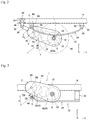
- FIG. 2 is a side view diagrammatically showing a structure that supports the driving apparatus 1.
- Cross members (vehicle body) 36 are located between the side rails and fixed thereto.
- the third bracket 34 is fixed to the cross members 36.
- Two reduction gears 38, which are linked to the motor 2, and a differential gear 40, which is linked to one of the reduction gears 38, are accommodated in the driving unit housing 16.
- the third bracket 34 may instead be fixed to the cross members 36 via hinge pins.
- the first hinge pin 28, which is provided in each of the first brackets 26, is inserted into a pin hole of the first bracket 26 via a rubber bush 46.
- the second hinge pin 32 which is provided in each of the second brackets 30, is inserted into a pin hole of the third bracket 34 via a rubber bush 48.
- the non-suspended support undesirably increases the magnitude of vibration inputted to the motor 2 incorporated as part of the driving apparatus 1.
- an electromagnetic coil is densely arranged, and the rotor rotates at high speed with the clearance between the electromagnetic coil and the inner wall of the motor-side housing 20 maintained at about several millimeters. Therefore, if large vibration resulting from a large magnitude of vibration inputted to the motor 2 causes the electromagnetic coil to come into contact and interfere with the inner wall of the motor-side housing 20, the reliability of the motor 2 could undesirably decrease.
- a front portion of the motor-side housing 20 is supported by the vehicle body via the second and third brackets 30, 34, so that at least the front portion of the motor-side housing 20 is directly suspended by the side rails 14 to achieve suspended support.
- the magnitude of the vibration inputted to the motor 2 can be reduced nearly to about 1/10 the magnitude of the vibration inputted to the entire driving apparatus 1 and hence the entire driving unit housing 16.
- the rigid axle structure can therefore be used to handle a variety of car ranks and ensure the reliability of the motor 2.
- the driving unit housing 16 primarily swings around the pin centers C of the first hinge pins 28 provided in the first brackets 26 that support the leaf springs 24 on the front side of the vehicle. Specifically, the driving unit housing 16 primarily swings around the pin centers C along a swing path T, which passes through the saddles 42, on which the leaf springs 24 are placed.
- the vibration of the driving unit housing 16 resulting from the swing motion thereof along the swing path T propagates, to no small extent, to the motor-side housing 20 and hence the motor 2.
- the driving unit housing 16 may be so disposed that the motor shaft 50 of the motor 2 is higher than the lowest surfaces of the leaf springs 24 in the vehicle height direction Z, as shown in FIG. 2 .
- the second bracket 30 and the second hinge pin 32 may be so disposed that the motor shaft 50 of the motor 2 is higher than the axis of rotation of the differential gear 40.
- the magnitude of the vibration that propagates to the motor 2 can thus be further reduced, whereby the reliability of the motor 2 can be further effectively ensured.
- the motor shaft 50 is allowed to be close to or coincide with the pin centers C of the first hinge pins 28 by in-advance consideration of the positions of the first and second brackets 26, 30 and the layout of the motor 2 in the structure that supports the driving unit housing 16.
- FIG. 3 is a side view diagrammatically showing a structure that supports the vehicle driving apparatus according to a second embodiment of the present invention. The same configurations as those in the first embodiment will not be described.
- An elastic support that forms the suspension 12 may be formed of a combination of the leaf springs 24 and air springs 52, as shown in FIG. 3 .
- the air springs 52 are each disposed between one end of the corresponding leaf spring 24 and the corresponding side rail 14.
- the motor-side housing 20 of the driving unit housing 16 is rotatably supported by the vehicle body via a hinge pin and a bracket that are not shown, and the differential-side housing 18 of the driving unit housing 16 is supported on the upper surfaces of the leaf springs 24 via support areas, which are not shown, of the axle housings 22.
- the entire driving unit housing 16 is allowed to swing while being supported by the leaf springs 24 and further allowed to move upward and downward while being supported by the air springs 52. Even in this case, since at least a front portion of the motor-side housing 20 can be directly suspended by the side rails 14 to achieve suspended support, the magnitude of the vibration inputted to the motor 2 can be reduced.
- the rigid axle structure can therefore be used to handle a variety of car ranks and ensure the reliability of the motor 2.
- the reliability of the motor 2 can further effectively ensured by minimizing the distance D between the center of the motor shaft 50 of the motor 2 and the pin centers C of the first hinge pins so that the motor shaft 50 is close to or coincides with the pin centers C of the first hinge pins 28.
- the axle housings 22 are supported by the vehicle body with the axle housings 22 swinging around the first hinge pins 28 as the center of rotation in the first bracket 26, whereas the motor-side housing 20 is supported by the vehicle body with the motor-side housing 20 swinging around the second hinge pin 32 as the center of rotation in the second bracket 30.
- the structure that supports the driving apparatus 1 is not limited to the exact forms in the first and second embodiments, and at least a front portion of the motor-side housing 20 only needs to be supported in a suspended manner.
- the driving unit housing 16 swings not only along the swing path T described above but around the pin center of the second hinge pin 32.
- the difference between the latter swing path and the swing path T described above is absorbed by the rubber plate 44 and the rubber bushes 46 and 48.
- Torsion of the vehicle body in the direction of rolling is also absorbed as appropriate by the rubber plate 44 and the rubber bushes 46 and 48.
- the magnitude of the vibration inputted to the motor 2 can therefore be further reduced, whereby the reliability of the motor 2 can further be effectively ensured.
- the driving apparatus 1 can, of course, be used in a variety of vehicles including passenger cars as well as electrically powered commercial cars, such as electrically powered trucks.
Landscapes
- Engineering & Computer Science (AREA)
- Mechanical Engineering (AREA)
- Chemical & Material Sciences (AREA)
- Combustion & Propulsion (AREA)
- Transportation (AREA)
- Arrangement Or Mounting Of Propulsion Units For Vehicles (AREA)
- Vehicle Body Suspensions (AREA)
- Motor Power Transmission Devices (AREA)
- Electric Propulsion And Braking For Vehicles (AREA)
- Vibration Prevention Devices (AREA)
Abstract
Description
- The present invention relates to a vehicle driving apparatus, and particularly to a vehicle driving apparatus suitable for an electrically powered commercial car.
- As a vehicle driving apparatus in the related art, there is a known driving unit in which a driving motor and a speed reducer are provided integrally with a differential gear (see
Patent Literature 1, for example). - Commercial cars, such as trucks, are classified into a variety of car ranks on a vehicle specification basis, and the vehicle width that allows incorporation of a driving apparatus also varies in accordance with the car rank. An example of an axle structure that can handle the variety of car ranks may include a rigid axle structure using axle housings that accommodate the axles.
- In the rigid axle structure, however, to incorporate the driving unit described above, since the entire driving unit is supported along with the axle housings in a non-suspended manner, the magnitude of vibration inputted to a motor incorporated in the driving unit increases, undesirably resulting in decrease in reliability of the motor.
- [Patent Literature 1] International Publication No.
2014/148410 - The present invention has been made to solve at least part of the problem described above, and an object of the present invention is to provide a vehicle driving apparatus capable of handling a variety of car ranks and ensuring the reliability of a motor.
- The present invention has been made to solve at least part of the problem described above and can be achieved in the following aspects or application examples.
- A vehicle driving apparatus according to the present application example includes a driving unit housing that integrally accommodates a motor that drives a vehicle, a speed reducer that is linked to the motor, and a differential gear that is linked to the speed reducer and transmits driving force produced by the motor to driving wheels of the vehicle, an axle housing to which a differential-side housing of the driving unit housing is linked and which integrally accommodates drive shafts of the driving wheels, a first support that allows a first rotary support shaft linked to a vehicle body of the vehicle to be elastically linked to the axle housing and the axle housing to swing around the first rotary support shaft as a center of rotation so that the axle housing is supported by the vehicle body, and a second support that allows a second rotary support shaft linked to the vehicle body of the vehicle to be elastically linked to a motor-side housing of the driving unit housing and the motor-side housing to swing around the second rotary support shaft as a center of rotation so that the motor-side housing is supported by the vehicle body.
- The axle housing is thus supported by the vehicle body with the axle housing swinging around the first rotary support shaft as the center of rotation in the first support, whereas the motor-side housing is supported by the vehicle body with the motor-side housing swinging around the second rotary support shaft as the center of rotation in the second support, whereby only the motor-side housing can be supported in a suspended manner. As a result, the magnitude of vibration inputted to the motor can be reduced with respect to the magnitude of vibration inputted to the entire driving apparatus and hence the entire driving unit housing. The rigid axle structure can therefore be used to handle a variety of car ranks and ensure the reliability of the motor.
- The driving unit housing is preferably so supported that a motor shaft of the motor is close to the center of rotation of the first rotary support shaft. Since vibration hardly occurs at the center of rotation of the first rotary support shaft, which serves as the center of swing motion of the driving unit housing, configuring the motor shaft to be close to the center of rotation of the first rotary support shaft allows further reduction in vibration that propagates to the motor, whereby the reliability of the motor can be further effectively ensured.
- The vehicle driving apparatus according to the present invention and using the application examples described above is capable of handling a variety of car ranks and ensuring the reliability of a motor.
-
- [
FIG. 1] FIG. 1 is a perspective view of a vehicle driving apparatus according to a first embodiment of the present invention. - [
FIG. 2] FIG. 2 is a side view diagrammatically showing a structure that supports the vehicle driving apparatus shown inFIG. 1 . - [
FIG. 3] FIG. 3 is a side view diagrammatically showing a structure that supports the vehicle driving apparatus according to a second embodiment of the present invention. - Embodiments of the present invention will be described below with reference to the drawings.
-
FIG. 1 is a perspective view of a vehicle driving apparatus according to a first embodiment of the present invention. The vehicle driving apparatus 1 (hereinafter also simply referred to as driving apparatus) is incorporated in a rear section of an electrically powered commercial vehicle (hereinafter also referred to as vehicle), such as an electrically powered truck. It is noted that an obliquely lower side inFIG. 1 is the front side of the vehicle. - A
motor 2 as a driving source for travel is incorporated in the vehicle with aspeed reducer 4 linked to themotor 2 and adifferential 6 linked to thespeed reducer 4. The driving force produced by themotor 2 is transmitted sequentially via thespeed reducer 4, thedifferential 6, and a pair ofdrive shafts 8, which will be described later, to right and left wheels (driving wheels) 10, which will be described later. Thewheels 10 are supported by respective side rails (vehicle body) 14, which extend via asuspension 12 in the vehicle frontward/rearward direction Y. - The
motor 2, the speed reducer 4, and thedifferential 6, which form thedriving apparatus 1, are integrally accommodated in adriving unit housing 16. Thedriving unit housing 16 is generally formed of a differential-side housing 18, which accommodates thedifferential 6, a motor-side housing 20, which accommodates themotor 2 and the speed reducer 4, and a pair ofaxle housings 22, which accommodate a pair ofdrive shafts 8 in an integrated manner. The differential-side housing 18 is linked to the motor-side housing 20, specifically, the rear side thereof in the vehicle frontward/rearward direction Y, and the pair ofaxle housings 22 are linked to the differential-side housing 18, specifically, the opposite sides thereof in the vehicle width direction X. - The
suspension 12 is formed of the pair ofaxel housings 22, a pair ofleaf springs 24, and other components, which form a rigid axle structure. The pair ofleaf springs 24 extend in the vehicle frontward/rearward direction Y, and the opposite ends of each of theleaf springs 24 are suspended by thecorresponding side rail 14 via first brackets (first supports) 26. Theaxle housings 22 are suspended by therespective leaf springs 24. Thewheels 10 are thus elastically supported by therespective leaf springs 24. - The opposite ends of the
leaf springs 24 are each rotatably linked to the correspondingfirst bracket 26 via a first hinge pin (first rotary support shaft) 28. A second bracket (second support) 30 is fixed to a front portion of the motor-side housing 20. Thesecond bracket 30 is so linked to athird bracket 34 as to be rotatable relative thereto via a second hinge pin (second rotary support shaft) 32. -
FIG. 2 is a side view diagrammatically showing a structure that supports thedriving apparatus 1. Cross members (vehicle body) 36 are located between the side rails and fixed thereto. Thethird bracket 34 is fixed to thecross members 36. Tworeduction gears 38, which are linked to themotor 2, and adifferential gear 40, which is linked to one of thereduction gears 38, are accommodated in thedriving unit housing 16. Thethird bracket 34 may instead be fixed to thecross members 36 via hinge pins. - In
FIG. 2 , roughly lowest portions of the lower surfaces of theleaf springs 24 are positioned immediately above thedrive shafts 8. That is, theaxle housings 22, which accommodate thedrive shafts 8, are suspended by theleaf springs 24, specifically,saddles 42 located on the lower surfaces of theleaf springs 24 viarubber plates 44. Instead, theaxle housings 22 may be suspended by the upper surfaces of theleaf springs 24. - The
first hinge pin 28, which is provided in each of thefirst brackets 26, is inserted into a pin hole of thefirst bracket 26 via arubber bush 46. On the other hand, thesecond hinge pin 32, which is provided in each of thesecond brackets 30, is inserted into a pin hole of thethird bracket 34 via arubber bush 48. As a result, theleaf springs 24, theaxle housings 22, and hence thedriving unit housing 16 are allowed to swing, and upward/downward vibration and other types of motion acting on thewheels 10 in the vehicle height direction Z are absorbed by therubber plates 44 and therubber bushes - Commercial cars, such as trucks, are classified into a variety of car ranks on a vehicle specification basis. The rigid axle structure using the axle housings can readily ensure a vehicle width that allows incorporation of the
driving apparatus 1 in accordance with the car rank. In a case where the drivingapparatus 1 is incorporated in such a rigid axle structure in the related art, however, all components that form thedriving apparatus 1, that is, themotor 2, thespeed reducer 4, and thedifferential 6 all are inevitably supported along with theaxle housings 22 via theleaf springs 24 in the vehicle height direction Z, or what is called non-suspended support is inevitably employed. - The non-suspended support undesirably increases the magnitude of vibration inputted to the
motor 2 incorporated as part of the drivingapparatus 1. In themotor 2, an electromagnetic coil is densely arranged, and the rotor rotates at high speed with the clearance between the electromagnetic coil and the inner wall of the motor-side housing 20 maintained at about several millimeters. Therefore, if large vibration resulting from a large magnitude of vibration inputted to themotor 2 causes the electromagnetic coil to come into contact and interfere with the inner wall of the motor-side housing 20, the reliability of themotor 2 could undesirably decrease. - On the other hand, it is known that when a running vehicle, for example, travels over a step, a member supported in a non-suspended manner vibrates at a frequency ranging from about 10 to 20 Hz, whereas a member supported in a suspended manner vibrates at a frequency ranging from about 2 to 3 Hz, which means that the magnitude of the vibration of the member supported in a suspended manner is suppressed to about 1/10 the magnitude of the vibration of the member supported in a non-suspended manner.
- In view of the fact described above, in the present embodiment, a front portion of the motor-
side housing 20 is supported by the vehicle body via the second andthird brackets side housing 20 is directly suspended by theside rails 14 to achieve suspended support. As a result, the magnitude of the vibration inputted to themotor 2 can be reduced nearly to about 1/10 the magnitude of the vibration inputted to theentire driving apparatus 1 and hence the entiredriving unit housing 16. The rigid axle structure can therefore be used to handle a variety of car ranks and ensure the reliability of themotor 2. - Further, the driving
unit housing 16 primarily swings around the pin centers C of the first hinge pins 28 provided in thefirst brackets 26 that support the leaf springs 24 on the front side of the vehicle. Specifically, the drivingunit housing 16 primarily swings around the pin centers C along a swing path T, which passes through thesaddles 42, on which theleaf springs 24 are placed. - The vibration of the driving
unit housing 16 resulting from the swing motion thereof along the swing path T propagates, to no small extent, to the motor-side housing 20 and hence themotor 2. However, considering that vibration hardly occurs at the center of swing motion along the swing path T in a theoretical sense, it is preferable to minimize the distance D between the center of amotor shaft 50 of themotor 2 and the pin centers C of the first hinge pins 28 so that themotor shaft 50 is close to or coincides with the pin centers C of the first hinge pins 28. - As a specific structure that allows the distance D between the center of the
motor shaft 50 of themotor 2 and the pin centers C of the first hinge pins 28 to be minimized, the drivingunit housing 16 may be so disposed that themotor shaft 50 of themotor 2 is higher than the lowest surfaces of theleaf springs 24 in the vehicle height direction Z, as shown inFIG. 2 . In other words, thesecond bracket 30 and thesecond hinge pin 32 may be so disposed that themotor shaft 50 of themotor 2 is higher than the axis of rotation of thedifferential gear 40. - The magnitude of the vibration that propagates to the
motor 2 can thus be further reduced, whereby the reliability of themotor 2 can be further effectively ensured. Themotor shaft 50 is allowed to be close to or coincide with the pin centers C of the first hinge pins 28 by in-advance consideration of the positions of the first andsecond brackets motor 2 in the structure that supports the drivingunit housing 16. -
FIG. 3 is a side view diagrammatically showing a structure that supports the vehicle driving apparatus according to a second embodiment of the present invention. The same configurations as those in the first embodiment will not be described. An elastic support that forms thesuspension 12 may be formed of a combination of theleaf springs 24 and air springs 52, as shown inFIG. 3 . InFIG. 3 , the air springs 52 are each disposed between one end of the correspondingleaf spring 24 and thecorresponding side rail 14. - The motor-
side housing 20 of the drivingunit housing 16 is rotatably supported by the vehicle body via a hinge pin and a bracket that are not shown, and the differential-side housing 18 of the drivingunit housing 16 is supported on the upper surfaces of theleaf springs 24 via support areas, which are not shown, of theaxle housings 22. The entiredriving unit housing 16 is allowed to swing while being supported by theleaf springs 24 and further allowed to move upward and downward while being supported by the air springs 52. Even in this case, since at least a front portion of the motor-side housing 20 can be directly suspended by the side rails 14 to achieve suspended support, the magnitude of the vibration inputted to themotor 2 can be reduced. - The rigid axle structure can therefore be used to handle a variety of car ranks and ensure the reliability of the
motor 2. The reliability of themotor 2 can further effectively ensured by minimizing the distance D between the center of themotor shaft 50 of themotor 2 and the pin centers C of the first hinge pins so that themotor shaft 50 is close to or coincides with the pin centers C of the first hinge pins 28. - The embodiments of the driving
apparatus 1 according to the present invention have been described above, but embodiments of the present invention are not limited to those described above. - For example, in the first embodiment, the
axle housings 22 are supported by the vehicle body with theaxle housings 22 swinging around the first hinge pins 28 as the center of rotation in thefirst bracket 26, whereas the motor-side housing 20 is supported by the vehicle body with the motor-side housing 20 swinging around thesecond hinge pin 32 as the center of rotation in thesecond bracket 30. However, the structure that supports the drivingapparatus 1 is not limited to the exact forms in the first and second embodiments, and at least a front portion of the motor-side housing 20 only needs to be supported in a suspended manner. - Further, the driving
unit housing 16 swings not only along the swing path T described above but around the pin center of thesecond hinge pin 32. The difference between the latter swing path and the swing path T described above is absorbed by therubber plate 44 and therubber bushes rubber plate 44 and therubber bushes motor 2 can therefore be further reduced, whereby the reliability of themotor 2 can further be effectively ensured. - The driving
apparatus 1 according to the present embodiment can, of course, be used in a variety of vehicles including passenger cars as well as electrically powered commercial cars, such as electrically powered trucks. -
- 1
- Vehicle driving apparatus
- 2
- Motor
- 4
- Speed reducer
- 8
- Drive shaft
- 10
- Wheel (driving wheel)
- 14
- Side rail (vehicle body)
- 16
- Driving unit housing
- 18
- Differential-side housing
- 20
- Motor-side housing
- 22
- Axle housing
- 26
- First bracket (first support)
- 28
- First hinge pin (first rotary support shaft)
- 30
- Second bracket (second support)
- 32
- Second hinge pin (second rotary support shaft)
- 36
- Cross member (vehicle body)
- 40
- Differential gear
- 50
- Motor shaft
Claims (2)
- A vehicle driving apparatus comprising:a driving unit housing that integrally accommodates a motor that drives a vehicle, a speed reducer that is linked to the motor, and a differential gear that is linked to the speed reducer and transmits driving force produced by the motor to driving wheels of the vehicle;an axle housing to which a differential-side housing of the driving unit housing is linked and which integrally accommodates drive shafts of the driving wheels;a first support that allows a first rotary support shaft linked to a vehicle body of the vehicle to be elastically linked to the axle housing and the axle housing to swing around the first rotary support shaft as a center of rotation so that the axle housing is supported by the vehicle body; anda second support that allows a second rotary support shaft linked to the vehicle body of the vehicle to be elastically linked to a motor-side housing of the driving unit housing and the motor-side housing to swing around the second rotary support shaft as a center of rotation so that the motor-side housing is supported by the vehicle body.
- The vehicle driving apparatus according to claim 1, wherein the driving unit housing is so supported that a motor shaft of the motor is close to the center of rotation of the first rotary support shaft.
Applications Claiming Priority (2)
| Application Number | Priority Date | Filing Date | Title |
|---|---|---|---|
| JP2017128452A JP6793095B2 (en) | 2017-06-30 | 2017-06-30 | Vehicle drive |
| PCT/JP2018/017532 WO2019003633A1 (en) | 2017-06-30 | 2018-05-02 | Vehicular driving device |
Publications (3)
| Publication Number | Publication Date |
|---|---|
| EP3572266A1 true EP3572266A1 (en) | 2019-11-27 |
| EP3572266A4 EP3572266A4 (en) | 2021-01-27 |
| EP3572266B1 EP3572266B1 (en) | 2022-10-19 |
Family
ID=64741413
Family Applications (1)
| Application Number | Title | Priority Date | Filing Date |
|---|---|---|---|
| EP18822721.9A Active EP3572266B1 (en) | 2017-06-30 | 2018-05-02 | Vehicle comprising a vehicular driving device |
Country Status (5)
| Country | Link |
|---|---|
| US (1) | US20200156707A1 (en) |
| EP (1) | EP3572266B1 (en) |
| JP (1) | JP6793095B2 (en) |
| CN (1) | CN110431033A (en) |
| WO (1) | WO2019003633A1 (en) |
Families Citing this family (7)
| Publication number | Priority date | Publication date | Assignee | Title |
|---|---|---|---|---|
| WO2019200272A1 (en) * | 2018-04-13 | 2019-10-17 | Dana Heavy Vehicle Systems Group, Llc | Support apparatus for an off-axle load |
| JP2019189171A (en) * | 2018-04-27 | 2019-10-31 | ダイムラー・アクチェンゲゼルシャフトDaimler AG | Drive unit support device |
| KR102777765B1 (en) * | 2019-12-03 | 2025-03-07 | 현대자동차주식회사 | Drive system of electric vehicle |
| US11701956B2 (en) * | 2020-10-01 | 2023-07-18 | GM Global Technology Operations LLC | Axle including a drive system for an electric vehicle |
| JP7535020B2 (en) | 2021-07-29 | 2024-08-15 | ダイムラー トラック エージー | Electric vehicles |
| EP4527654A1 (en) * | 2023-09-25 | 2025-03-26 | Scania CV AB | Electric drive axle arrangement and vehicle comprising the electric drive axle arrangement |
| WO2025186959A1 (en) * | 2024-03-06 | 2025-09-12 | 三菱自動車工業株式会社 | Rotary machine attachment structure for vehicle |
Family Cites Families (7)
| Publication number | Priority date | Publication date | Assignee | Title |
|---|---|---|---|---|
| GB781455A (en) * | 1952-07-09 | 1957-08-21 | Salzmann Willi Ernst | Improvements in or relating to the springing and suspension of vehicles |
| JPS508609A (en) * | 1973-06-01 | 1975-01-29 | ||
| JPS508609U (en) * | 1973-05-21 | 1975-01-29 | ||
| JPS5940946A (en) * | 1982-09-01 | 1984-03-06 | Nissan Motor Co Ltd | Support structure of power unit in vehicle |
| JPS5989225A (en) * | 1982-11-09 | 1984-05-23 | Nissan Motor Co Ltd | Power unit supporting structure |
| JP5952002B2 (en) * | 2012-01-23 | 2016-07-13 | Ntn株式会社 | Wheel drive device |
| EP2977251A1 (en) | 2013-03-18 | 2016-01-27 | Hitachi Automotive Systems, Ltd. | Drive device for electric vehicle |
-
2017
- 2017-06-30 JP JP2017128452A patent/JP6793095B2/en active Active
-
2018
- 2018-05-02 WO PCT/JP2018/017532 patent/WO2019003633A1/en not_active Ceased
- 2018-05-02 US US16/625,952 patent/US20200156707A1/en not_active Abandoned
- 2018-05-02 EP EP18822721.9A patent/EP3572266B1/en active Active
- 2018-05-02 CN CN201880018716.0A patent/CN110431033A/en active Pending
Also Published As
| Publication number | Publication date |
|---|---|
| CN110431033A (en) | 2019-11-08 |
| JP6793095B2 (en) | 2020-12-02 |
| EP3572266B1 (en) | 2022-10-19 |
| EP3572266A4 (en) | 2021-01-27 |
| JP2019010946A (en) | 2019-01-24 |
| US20200156707A1 (en) | 2020-05-21 |
| WO2019003633A1 (en) | 2019-01-03 |
Similar Documents
| Publication | Publication Date | Title |
|---|---|---|
| EP3572266B1 (en) | Vehicle comprising a vehicular driving device | |
| CN111032396A (en) | vehicle drive | |
| US10065663B2 (en) | Steering bogie and vehicle | |
| EP1724130B1 (en) | Bracket for an air spring | |
| US20040124019A1 (en) | Suspended wheel end powered through trailing arm | |
| WO2019021965A1 (en) | Drive device for electric truck | |
| CN107074254B (en) | Bogies for railway vehicles | |
| JPWO2006030532A1 (en) | Electric vehicle drive system | |
| JP6023519B2 (en) | Driving cart for railway vehicles | |
| CN103358840B (en) | Electric vehicle | |
| CN103459182A (en) | hub motor unit | |
| CN107953762A (en) | Vehicle bridge for motor vehicle | |
| CN108025754A (en) | For the drive component of rail vehicle, rail vehicle and manufacture method with drive component | |
| WO2016181795A1 (en) | Suspension structure for in-wheel motor drive device | |
| JP2017001407A (en) | Suspension structure for in-wheel motor drive device | |
| WO2019207985A1 (en) | Drive unit support device | |
| JP2019043275A (en) | Vehicle drive device | |
| CN223340380U (en) | Axle-bridge mechanism, bogie assembly, rail vehicles and rail transit systems | |
| US12600214B2 (en) | Vehicle motor | |
| CN113968256A (en) | Bogie and rail vehicle | |
| JP2021028182A (en) | Vehicular driving device | |
| JPS6226944B2 (en) | ||
| JP3401168B2 (en) | Axle support structure for bogies for railway vehicles | |
| CN109968973A (en) | A rear drive system of an electric logistics vehicle | |
| TW202612949A (en) | Transport vehicle |
Legal Events
| Date | Code | Title | Description |
|---|---|---|---|
| STAA | Information on the status of an ep patent application or granted ep patent |
Free format text: STATUS: THE INTERNATIONAL PUBLICATION HAS BEEN MADE |
|
| PUAI | Public reference made under article 153(3) epc to a published international application that has entered the european phase |
Free format text: ORIGINAL CODE: 0009012 |
|
| STAA | Information on the status of an ep patent application or granted ep patent |
Free format text: STATUS: REQUEST FOR EXAMINATION WAS MADE |
|
| 17P | Request for examination filed |
Effective date: 20190820 |
|
| AK | Designated contracting states |
Kind code of ref document: A1 Designated state(s): AL AT BE BG CH CY CZ DE DK EE ES FI FR GB GR HR HU IE IS IT LI LT LU LV MC MK MT NL NO PL PT RO RS SE SI SK SM TR |
|
| AX | Request for extension of the european patent |
Extension state: BA ME |
|
| DAV | Request for validation of the european patent (deleted) | ||
| DAX | Request for extension of the european patent (deleted) | ||
| A4 | Supplementary search report drawn up and despatched |
Effective date: 20210114 |
|
| RIC1 | Information provided on ipc code assigned before grant |
Ipc: B60K 5/12 20060101ALI20201223BHEP Ipc: B60K 1/00 20060101ALI20201223BHEP Ipc: B60B 35/16 20060101ALI20201223BHEP Ipc: B60K 17/16 20060101AFI20201223BHEP Ipc: B60L 15/00 20060101ALI20201223BHEP |
|
| STAA | Information on the status of an ep patent application or granted ep patent |
Free format text: STATUS: EXAMINATION IS IN PROGRESS |
|
| 17Q | First examination report despatched |
Effective date: 20211118 |
|
| RIC1 | Information provided on ipc code assigned before grant |
Ipc: B60G 11/04 20060101ALN20220331BHEP Ipc: B60G 11/113 20060101ALN20220331BHEP Ipc: B60K 5/12 20060101ALN20220331BHEP Ipc: B60B 35/16 20060101ALN20220331BHEP Ipc: B60L 15/00 20060101ALN20220331BHEP Ipc: B60K 1/00 20060101ALI20220331BHEP Ipc: B60K 17/16 20060101AFI20220331BHEP |
|
| GRAP | Despatch of communication of intention to grant a patent |
Free format text: ORIGINAL CODE: EPIDOSNIGR1 |
|
| STAA | Information on the status of an ep patent application or granted ep patent |
Free format text: STATUS: GRANT OF PATENT IS INTENDED |
|
| INTG | Intention to grant announced |
Effective date: 20220510 |
|
| GRAS | Grant fee paid |
Free format text: ORIGINAL CODE: EPIDOSNIGR3 |
|
| GRAA | (expected) grant |
Free format text: ORIGINAL CODE: 0009210 |
|
| STAA | Information on the status of an ep patent application or granted ep patent |
Free format text: STATUS: THE PATENT HAS BEEN GRANTED |
|
| AK | Designated contracting states |
Kind code of ref document: B1 Designated state(s): AL AT BE BG CH CY CZ DE DK EE ES FI FR GB GR HR HU IE IS IT LI LT LU LV MC MK MT NL NO PL PT RO RS SE SI SK SM TR |
|
| REG | Reference to a national code |
Ref country code: GB Ref legal event code: FG4D |
|
| REG | Reference to a national code |
Ref country code: CH Ref legal event code: EP |
|
| REG | Reference to a national code |
Ref country code: IE Ref legal event code: FG4D |
|
| REG | Reference to a national code |
Ref country code: DE Ref legal event code: R096 Ref document number: 602018042048 Country of ref document: DE |
|
| REG | Reference to a national code |
Ref country code: AT Ref legal event code: REF Ref document number: 1525367 Country of ref document: AT Kind code of ref document: T Effective date: 20221115 |
|
| REG | Reference to a national code |
Ref country code: LT Ref legal event code: MG9D |
|
| REG | Reference to a national code |
Ref country code: NL Ref legal event code: MP Effective date: 20221019 |
|
| REG | Reference to a national code |
Ref country code: AT Ref legal event code: MK05 Ref document number: 1525367 Country of ref document: AT Kind code of ref document: T Effective date: 20221019 |
|
| PG25 | Lapsed in a contracting state [announced via postgrant information from national office to epo] |
Ref country code: NL Free format text: LAPSE BECAUSE OF FAILURE TO SUBMIT A TRANSLATION OF THE DESCRIPTION OR TO PAY THE FEE WITHIN THE PRESCRIBED TIME-LIMIT Effective date: 20221019 |
|
| PG25 | Lapsed in a contracting state [announced via postgrant information from national office to epo] |
Ref country code: SE Free format text: LAPSE BECAUSE OF FAILURE TO SUBMIT A TRANSLATION OF THE DESCRIPTION OR TO PAY THE FEE WITHIN THE PRESCRIBED TIME-LIMIT Effective date: 20221019 Ref country code: PT Free format text: LAPSE BECAUSE OF FAILURE TO SUBMIT A TRANSLATION OF THE DESCRIPTION OR TO PAY THE FEE WITHIN THE PRESCRIBED TIME-LIMIT Effective date: 20230220 Ref country code: NO Free format text: LAPSE BECAUSE OF FAILURE TO SUBMIT A TRANSLATION OF THE DESCRIPTION OR TO PAY THE FEE WITHIN THE PRESCRIBED TIME-LIMIT Effective date: 20230119 Ref country code: LT Free format text: LAPSE BECAUSE OF FAILURE TO SUBMIT A TRANSLATION OF THE DESCRIPTION OR TO PAY THE FEE WITHIN THE PRESCRIBED TIME-LIMIT Effective date: 20221019 Ref country code: FI Free format text: LAPSE BECAUSE OF FAILURE TO SUBMIT A TRANSLATION OF THE DESCRIPTION OR TO PAY THE FEE WITHIN THE PRESCRIBED TIME-LIMIT Effective date: 20221019 Ref country code: ES Free format text: LAPSE BECAUSE OF FAILURE TO SUBMIT A TRANSLATION OF THE DESCRIPTION OR TO PAY THE FEE WITHIN THE PRESCRIBED TIME-LIMIT Effective date: 20221019 Ref country code: AT Free format text: LAPSE BECAUSE OF FAILURE TO SUBMIT A TRANSLATION OF THE DESCRIPTION OR TO PAY THE FEE WITHIN THE PRESCRIBED TIME-LIMIT Effective date: 20221019 |
|
| PG25 | Lapsed in a contracting state [announced via postgrant information from national office to epo] |
Ref country code: RS Free format text: LAPSE BECAUSE OF FAILURE TO SUBMIT A TRANSLATION OF THE DESCRIPTION OR TO PAY THE FEE WITHIN THE PRESCRIBED TIME-LIMIT Effective date: 20221019 Ref country code: PL Free format text: LAPSE BECAUSE OF FAILURE TO SUBMIT A TRANSLATION OF THE DESCRIPTION OR TO PAY THE FEE WITHIN THE PRESCRIBED TIME-LIMIT Effective date: 20221019 Ref country code: LV Free format text: LAPSE BECAUSE OF FAILURE TO SUBMIT A TRANSLATION OF THE DESCRIPTION OR TO PAY THE FEE WITHIN THE PRESCRIBED TIME-LIMIT Effective date: 20221019 Ref country code: IS Free format text: LAPSE BECAUSE OF FAILURE TO SUBMIT A TRANSLATION OF THE DESCRIPTION OR TO PAY THE FEE WITHIN THE PRESCRIBED TIME-LIMIT Effective date: 20230219 Ref country code: HR Free format text: LAPSE BECAUSE OF FAILURE TO SUBMIT A TRANSLATION OF THE DESCRIPTION OR TO PAY THE FEE WITHIN THE PRESCRIBED TIME-LIMIT Effective date: 20221019 Ref country code: GR Free format text: LAPSE BECAUSE OF FAILURE TO SUBMIT A TRANSLATION OF THE DESCRIPTION OR TO PAY THE FEE WITHIN THE PRESCRIBED TIME-LIMIT Effective date: 20230120 |
|
| P01 | Opt-out of the competence of the unified patent court (upc) registered |
Effective date: 20230601 |
|
| REG | Reference to a national code |
Ref country code: DE Ref legal event code: R097 Ref document number: 602018042048 Country of ref document: DE |
|
| PG25 | Lapsed in a contracting state [announced via postgrant information from national office to epo] |
Ref country code: SM Free format text: LAPSE BECAUSE OF FAILURE TO SUBMIT A TRANSLATION OF THE DESCRIPTION OR TO PAY THE FEE WITHIN THE PRESCRIBED TIME-LIMIT Effective date: 20221019 Ref country code: RO Free format text: LAPSE BECAUSE OF FAILURE TO SUBMIT A TRANSLATION OF THE DESCRIPTION OR TO PAY THE FEE WITHIN THE PRESCRIBED TIME-LIMIT Effective date: 20221019 Ref country code: EE Free format text: LAPSE BECAUSE OF FAILURE TO SUBMIT A TRANSLATION OF THE DESCRIPTION OR TO PAY THE FEE WITHIN THE PRESCRIBED TIME-LIMIT Effective date: 20221019 Ref country code: DK Free format text: LAPSE BECAUSE OF FAILURE TO SUBMIT A TRANSLATION OF THE DESCRIPTION OR TO PAY THE FEE WITHIN THE PRESCRIBED TIME-LIMIT Effective date: 20221019 Ref country code: CZ Free format text: LAPSE BECAUSE OF FAILURE TO SUBMIT A TRANSLATION OF THE DESCRIPTION OR TO PAY THE FEE WITHIN THE PRESCRIBED TIME-LIMIT Effective date: 20221019 |
|
| PLBE | No opposition filed within time limit |
Free format text: ORIGINAL CODE: 0009261 |
|
| STAA | Information on the status of an ep patent application or granted ep patent |
Free format text: STATUS: NO OPPOSITION FILED WITHIN TIME LIMIT |
|
| PG25 | Lapsed in a contracting state [announced via postgrant information from national office to epo] |
Ref country code: SK Free format text: LAPSE BECAUSE OF FAILURE TO SUBMIT A TRANSLATION OF THE DESCRIPTION OR TO PAY THE FEE WITHIN THE PRESCRIBED TIME-LIMIT Effective date: 20221019 Ref country code: AL Free format text: LAPSE BECAUSE OF FAILURE TO SUBMIT A TRANSLATION OF THE DESCRIPTION OR TO PAY THE FEE WITHIN THE PRESCRIBED TIME-LIMIT Effective date: 20221019 |
|
| 26N | No opposition filed |
Effective date: 20230720 |
|
| REG | Reference to a national code |
Ref country code: DE Ref legal event code: R081 Ref document number: 602018042048 Country of ref document: DE Owner name: DAIMLER TRUCK AG, DE Free format text: FORMER OWNER: DAIMLER AG, 70372 STUTTGART, DE Ref country code: DE Ref legal event code: R082 Ref document number: 602018042048 Country of ref document: DE Ref country code: DE Ref legal event code: R082 Ref document number: 602018042048 Country of ref document: DE Representative=s name: HOFSTETTER, SCHURACK & PARTNER - PATENT- UND R, DE |
|
| PG25 | Lapsed in a contracting state [announced via postgrant information from national office to epo] |
Ref country code: SI Free format text: LAPSE BECAUSE OF FAILURE TO SUBMIT A TRANSLATION OF THE DESCRIPTION OR TO PAY THE FEE WITHIN THE PRESCRIBED TIME-LIMIT Effective date: 20221019 |
|
| REG | Reference to a national code |
Ref country code: CH Ref legal event code: PL |
|
| PG25 | Lapsed in a contracting state [announced via postgrant information from national office to epo] |
Ref country code: MC Free format text: LAPSE BECAUSE OF FAILURE TO SUBMIT A TRANSLATION OF THE DESCRIPTION OR TO PAY THE FEE WITHIN THE PRESCRIBED TIME-LIMIT Effective date: 20221019 |
|
| REG | Reference to a national code |
Ref country code: BE Ref legal event code: MM Effective date: 20230531 |
|
| PG25 | Lapsed in a contracting state [announced via postgrant information from national office to epo] |
Ref country code: MC Free format text: LAPSE BECAUSE OF FAILURE TO SUBMIT A TRANSLATION OF THE DESCRIPTION OR TO PAY THE FEE WITHIN THE PRESCRIBED TIME-LIMIT Effective date: 20221019 Ref country code: LU Free format text: LAPSE BECAUSE OF NON-PAYMENT OF DUE FEES Effective date: 20230502 Ref country code: LI Free format text: LAPSE BECAUSE OF NON-PAYMENT OF DUE FEES Effective date: 20230531 Ref country code: CH Free format text: LAPSE BECAUSE OF NON-PAYMENT OF DUE FEES Effective date: 20230531 |
|
| REG | Reference to a national code |
Ref country code: IE Ref legal event code: MM4A |
|
| REG | Reference to a national code |
Ref country code: DE Ref legal event code: R082 Ref document number: 602018042048 Country of ref document: DE Representative=s name: HOFSTETTER, SCHURACK & PARTNER - PATENT- UND R, DE |
|
| PG25 | Lapsed in a contracting state [announced via postgrant information from national office to epo] |
Ref country code: IE Free format text: LAPSE BECAUSE OF NON-PAYMENT OF DUE FEES Effective date: 20230502 |
|
| PG25 | Lapsed in a contracting state [announced via postgrant information from national office to epo] |
Ref country code: IE Free format text: LAPSE BECAUSE OF NON-PAYMENT OF DUE FEES Effective date: 20230502 |
|
| PG25 | Lapsed in a contracting state [announced via postgrant information from national office to epo] |
Ref country code: IT Free format text: LAPSE BECAUSE OF FAILURE TO SUBMIT A TRANSLATION OF THE DESCRIPTION OR TO PAY THE FEE WITHIN THE PRESCRIBED TIME-LIMIT Effective date: 20221019 Ref country code: BE Free format text: LAPSE BECAUSE OF NON-PAYMENT OF DUE FEES Effective date: 20230531 |
|
| PG25 | Lapsed in a contracting state [announced via postgrant information from national office to epo] |
Ref country code: BG Free format text: LAPSE BECAUSE OF FAILURE TO SUBMIT A TRANSLATION OF THE DESCRIPTION OR TO PAY THE FEE WITHIN THE PRESCRIBED TIME-LIMIT Effective date: 20221019 |
|
| PG25 | Lapsed in a contracting state [announced via postgrant information from national office to epo] |
Ref country code: BG Free format text: LAPSE BECAUSE OF FAILURE TO SUBMIT A TRANSLATION OF THE DESCRIPTION OR TO PAY THE FEE WITHIN THE PRESCRIBED TIME-LIMIT Effective date: 20221019 |
|
| PGFP | Annual fee paid to national office [announced via postgrant information from national office to epo] |
Ref country code: DE Payment date: 20250528 Year of fee payment: 8 |
|
| PGFP | Annual fee paid to national office [announced via postgrant information from national office to epo] |
Ref country code: GB Payment date: 20250520 Year of fee payment: 8 |
|
| PGFP | Annual fee paid to national office [announced via postgrant information from national office to epo] |
Ref country code: FR Payment date: 20250526 Year of fee payment: 8 |
|
| PG25 | Lapsed in a contracting state [announced via postgrant information from national office to epo] |
Ref country code: CY Free format text: LAPSE BECAUSE OF FAILURE TO SUBMIT A TRANSLATION OF THE DESCRIPTION OR TO PAY THE FEE WITHIN THE PRESCRIBED TIME-LIMIT; INVALID AB INITIO Effective date: 20180502 |
|
| PG25 | Lapsed in a contracting state [announced via postgrant information from national office to epo] |
Ref country code: HU Free format text: LAPSE BECAUSE OF FAILURE TO SUBMIT A TRANSLATION OF THE DESCRIPTION OR TO PAY THE FEE WITHIN THE PRESCRIBED TIME-LIMIT; INVALID AB INITIO Effective date: 20180502 |
|
| PG25 | Lapsed in a contracting state [announced via postgrant information from national office to epo] |
Ref country code: TR Free format text: LAPSE BECAUSE OF FAILURE TO SUBMIT A TRANSLATION OF THE DESCRIPTION OR TO PAY THE FEE WITHIN THE PRESCRIBED TIME-LIMIT Effective date: 20221019 |