EP3572124B1 - System, computerprogrammprodukt und verfahren zur ionenbasierten strahlentherapieplanung - Google Patents
System, computerprogrammprodukt und verfahren zur ionenbasierten strahlentherapieplanung Download PDFInfo
- Publication number
- EP3572124B1 EP3572124B1 EP18173400.5A EP18173400A EP3572124B1 EP 3572124 B1 EP3572124 B1 EP 3572124B1 EP 18173400 A EP18173400 A EP 18173400A EP 3572124 B1 EP3572124 B1 EP 3572124B1
- Authority
- EP
- European Patent Office
- Prior art keywords
- path length
- treatment
- computer
- treatment volume
- robustness
- Prior art date
- Legal status (The legal status is an assumption and is not a legal conclusion. Google has not performed a legal analysis and makes no representation as to the accuracy of the status listed.)
- Active
Links
Images

Classifications
-
- A—HUMAN NECESSITIES
- A61—MEDICAL OR VETERINARY SCIENCE; HYGIENE
- A61N—ELECTROTHERAPY; MAGNETOTHERAPY; RADIATION THERAPY; ULTRASOUND THERAPY
- A61N5/00—Radiation therapy
- A61N5/10—X-ray therapy; Gamma-ray therapy; Particle-irradiation therapy
- A61N5/103—Treatment planning systems
- A61N5/1031—Treatment planning systems using a specific method of dose optimization
-
- A—HUMAN NECESSITIES
- A61—MEDICAL OR VETERINARY SCIENCE; HYGIENE
- A61N—ELECTROTHERAPY; MAGNETOTHERAPY; RADIATION THERAPY; ULTRASOUND THERAPY
- A61N5/00—Radiation therapy
- A61N5/10—X-ray therapy; Gamma-ray therapy; Particle-irradiation therapy
- A61N5/103—Treatment planning systems
-
- G—PHYSICS
- G16—INFORMATION AND COMMUNICATION TECHNOLOGY [ICT] SPECIALLY ADAPTED FOR SPECIFIC APPLICATION FIELDS
- G16H—HEALTHCARE INFORMATICS, i.e. INFORMATION AND COMMUNICATION TECHNOLOGY [ICT] SPECIALLY ADAPTED FOR THE HANDLING OR PROCESSING OF MEDICAL OR HEALTHCARE DATA
- G16H20/00—ICT specially adapted for therapies or health-improving plans, e.g. for handling prescriptions, for steering therapy or for monitoring patient compliance
- G16H20/40—ICT specially adapted for therapies or health-improving plans, e.g. for handling prescriptions, for steering therapy or for monitoring patient compliance relating to mechanical, radiation or invasive therapies, e.g. surgery, laser therapy, dialysis or acupuncture
-
- A—HUMAN NECESSITIES
- A61—MEDICAL OR VETERINARY SCIENCE; HYGIENE
- A61N—ELECTROTHERAPY; MAGNETOTHERAPY; RADIATION THERAPY; ULTRASOUND THERAPY
- A61N5/00—Radiation therapy
- A61N5/10—X-ray therapy; Gamma-ray therapy; Particle-irradiation therapy
- A61N5/103—Treatment planning systems
- A61N5/1031—Treatment planning systems using a specific method of dose optimization
- A61N2005/1034—Monte Carlo type methods; particle tracking
-
- A—HUMAN NECESSITIES
- A61—MEDICAL OR VETERINARY SCIENCE; HYGIENE
- A61N—ELECTROTHERAPY; MAGNETOTHERAPY; RADIATION THERAPY; ULTRASOUND THERAPY
- A61N5/00—Radiation therapy
- A61N5/10—X-ray therapy; Gamma-ray therapy; Particle-irradiation therapy
- A61N2005/1085—X-ray therapy; Gamma-ray therapy; Particle-irradiation therapy characterised by the type of particles applied to the patient
- A61N2005/1087—Ions; Protons
Definitions
- the present invention relates to determining robustness in ion-based radiotherapy treatment planning and the selection of beam directions in ion-based radiotherapy treatment planning.
- a radiotherapy treatment plan It is important to evaluate the quality of a radiotherapy treatment plan, to ensure that it will be delivered correctly and affect the patient in the desired way.
- the delivery of a radiotherapy treatment plan to a patient is affected by a number of factors, an important one being the patient's own anatomy. Structural variations in the patient's body will lead to scattering of particles, altering their path and therefore affecting the resulting dose distribution. The density of the structures traversed by the ion will also affect the path length.
- each ion will emit most of its energy towards the end of its path, creating what is known as the Bragg peak.
- a key issue in treatment planning is to ensure that the Bragg peaks of all beams are placed within the treatment volume, in such a way that all parts of the treatment volume receive the prescribed dose while minimizing dose to the surrounding volume.
- the position of the Bragg peak is affected by the kinetic energy Tp of each ion and by the properties of the tissue traversed by the ion.
- the values for Tp are selected so that the ions having the lowest energy will stop close to the nearest end of the treatment volume and the ions having the highest energy will stop close to the farthest end of the treatment volume, as seen from the radiation source. If there is a setup change, for example, if the patient moves so that the ion will traverse a different type of tissue, this will affect the position of the Bragg peak, which will in turn cause an error in the delivered dose.
- Radiotherapy treatment radiation is normally provided from a number of different directions around the patient, to maximize the dose to the target while keeping the dose to surrounding tissue low.
- An important part of dose planning is selecting appropriate beam directions.
- the geometrical path length and the Water Equivalent Path Length are of interest in dose planning.
- the WEPL is defined as the distance that is equivalent to that measured in water, taking into account the densities of the tissues traversed by the ion and the variation of stopping power ratio between water and the traversed media. It is usually calculated as the product of the distance in the considered materials times the density times the water to medium stopping power ratio.
- Some dose engines, for example, the Monte Carlo dose engine have functions for calculating the WEPL as a part of dose planning. Both the geometrical path length and the WEPL may be affected by setup errors.
- the geometrical path length may be affected in particular where the part of the patient's body where the beam enters has an irregular shape, such as the ear.
- the WEPL will be affected both by irregular shape and by variations in tissue density.
- the path length is most easily determined along a straight line from the entry point to the voxel concerned. More realistically, however, the path will not be a straight line.
- An alternative way of determining the path length is based on the average path length value of all simulated trajectories passing through the voxel. This is valid both for the geometrical path length and for the WEPL.
- the invention relates to a computer-based method for evaluating the robustness of a radiotherapy treatment plan for ion based radiotherapy, comprising the steps, performed in a processor, for a selected beam direction and of,
- the inventive method is useful for determining the robustness of a radiotherapy treatment plan that has already been computed.
- the step of using the quantity value involves determining the plan's robustness in inverse dependence of the path length variations for the beam directions used in the plan.
- the variations in accumulated path length associated with a particular beam direction are an indicator of how robust a treatment plan using this particular beam direction can be.
- a beam direction having uniform accumulated path lengths across the beam indicates tissue homogeneity and will be more robust than a beam direction for which the accumulated path lengths vary across the beam.
- the step of using the quantity value may involve selecting beam directions as part of treatment planning. Hence, the method enables the selection of suitable beam directions which will enable the generation of a robust treatment plan. This will be discussed in more detail below.
- the portion of the volume is typically a voxel, but it may also be defined in another suitable way, for example, as a group of voxels.
- a voxel preferably all voxels in the volume, or in the relevant part of the volume, are considered, either individually or in groups.
- the accumulated path length considered may be a geometrical path length. This will allow the patient's geometry to be considered, in particular any irregular shapes in the area where the beam enters the patient.
- the accumulated path length is a Water Equivalent Path Length, WEPL.
- WEPL Water Equivalent Path Length
- the information related to the quantity values for ions that reach the portion of the treatment volume preferably includes a value indicating an average of the path lengths traversed by at least two ions that will reach the portion of the treatment volume.
- the information related to the quantity values may be related to only one particle. It may also be calculated for the shortest path between the entry point and the voxel concerned.
- the accumulated path length is preferably computed and reported over the whole volume covered per beam, for all voxels in the volume or for a representative selection of voxels, for example every other voxel or every n th voxel, n being a suitable integer.
- the method preferably further comprises the step of displaying, in an image of the treatment volume, for each of the first and the second portion of the treatment volume, information representing the quantity value, to provide a visual indication of the robustness.
- One preferred way of displaying the information is by means of a colour scheme where colours are assigned to path length values.
- each quantity value is assigned a colour
- the step of displaying information representing the accumulated path length includes displaying a representation of the treatment volume, where each of the at least first and second portions of the treatment volume is displayed in the colour representing the path length calculated for that portion of the treatment volume.
- Another feasible way of displaying the information would be to assign an elevation level to each quantity value displaying information representing the path lengths includes displaying a 3-dimensional representation of the treatment volume, where each of the at least first and second portions of the treatment volume is displayed at the elevation level representing the path length calculated for that portion of the treatment volume.
- the distribution may be displayed in the form of a set of lines, or planes, through voxels having the same path length value. If the lines or planes are smooth and perpendicular to the beam direction, this will mean that the plan is robust. If the lines are irregular, this will indicate that a small change, for example, a movement of the patient, may significantly affect the dose.
- a dose calculation engine that will obtain the relevant path length information for each voxel as part of the calculation is used, as this will allow the calculations according to the invention to be performed with virtually no additional computational effort.
- a dose calculation engine providing such information regarding WEPL and geometrical path length is the Monte Carlo engine. Since the quantity value in this case is determined from a Monte Carlo propagation through the upstream anatomy, only the region traversed by particles that reach the respective voxel is considered. The region considered for each target voxel is sampled in an optimally importance weighted manner with respect to where the ion traverses.
- the steps of obtaining information and calculating the quantity value are performed for two or more beam directions, which will provide input data for selecting beam directions to use in the treatment plan.
- the robustness of each of at least two possible beam directions is determined by performing the steps of obtaining information and calculating a quantity value for each of the at least two possible beam directions and selecting at least one beam direction to be used in the treatment among the possible beam directions in dependence of their determined robustness.
- the more suitable beam directions will be the ones where the WEPL distribution indicates that a small setup error will not affect the dose.
- the method according to the invention also provides input data for radiation treatment planning, which will help make the resulting plan more robust.
- the selection of the at least one beam direction may be performed manually by an operator. In that case, a number of beam directions are considered and data indicating the variations in path length for each of the beam directions is displayed. The operator can then select beam directions for which the path length variations are acceptable and/or avoid beam directions having too great path length variations.
- the selection is made as part of a computer-implemented optimization.
- the optimization problem should include a penalty on the path length variations, that will lead to the selection of beam directions having the best values with respect to path length variations.
- the invention also relates to a computer program product comprising computer readable code means which, when executed in a computer, will cause the computer to perform the method as outlined above.
- the invention also relates to a non-transitory computer readable medium encoded with computer executable instructions which, when run in a first computer device will cause the device to perform the method.
- the invention also relates to a computer system comprising a processor, a data memory and a program memory, wherein the program memory comprises a computer program product or a non-transitory computer readable medium as defined above.
- Figure 1 illustrates schematically the accumulation of path length.
- a simplified section 1 through a patient is shown, and two beams of charged particles: a first beam 2 horizontally entering the patient from the left-hand side of the Figure and a second beam 3 entering the patient from the lower right corner of the Figure.
- the geometrical path length is only dependent on the geometrical distance traversed by the particle.
- a dashed line 4 illustrates a uniform geometrical depth in the patient in the beam direction, that is, following the outer contour of the patient.
- the Water Equivalent Path Length WEPL is affected by the geometrical distance traversed by the particles and by the type of tissue traversed, in particular the density of the tissue.
- the path of the particle through the patient is divided into portions ⁇ s.
- the portions are disproportionally big, and only a few of them are labelled.
- a typical value for ⁇ s is 2 mm.
- each portion corresponds to the path through one voxel, since this will enable the use of values already calculated in the dose engine, but other divisions may be used if feasible.
- the path length for one particle reaching a particular voxel is the sum of the path length values ⁇ s through all the voxels upstream of it, that is the voxels traversed by the particle to reach the particular voxel.
- the path for one particle is typically not a straight line.
- the geometrical path length is the distance from the particle's entry point into the patient, to the voxel concerned. This will normally be quite evenly distributed but may take on more complex forms in areas where the patient's contour is irregular, for example, where a beam traverses the ear.
- the WEPL may be calculated based on data per voxel accumulated during a forward MC dose calculation.
- the WEPL is accumulated per beam in every voxel that is traversed by a proton. After finishing the dose calculation, the 3D distribution of the average WEPL per voxel is calculated.
- FIG 2a is a schematic diagram of the WEPL depth profile for the first beam 1 of Figure 1 .
- the WEPL increases essentially linearly with increasing depth into the patient, indicating near homogeneous tissue in this simplified example. If the tissue is more inhomogeneous the curve will be less straight.
- Figure 2b is a schematic diagram of the variation of WEPL along a cross profile through the patient (i.e. perpendicular to the beam direction) as seen in one particular beam direction.
- the WEPL cross profile shows the WEPL values along the voxels at a particular depth in the patient.
- the WEPL cross profile will be vertical through the patient, perpendicular to the beam direction.
- the irregularity of the curve increases with increasing variation in tissue density across the patient and is an indicator of suitability of the beam direction for use in a radiotherapy treatment plan.
- An irregular curve is a sign that the beam direction will result in a less robust plan.
- a smooth curve is a sign that the beam direction may yield a robust plan in that a movement of the patient will not significantly affect the delivered dose.
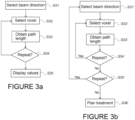
- Figure 3a is a schematic flow chart of a method for determining plan robustness according to the invention.
- a beam direction used in the plan is selected.
- the path length for each voxel is dependent on the beam direction, as both the geometrical distance from the point where the beam enters the patient to the voxel considered and the tissue type traversed, will be different for different beam directions.
- a voxel to be considered is selected and in step S33 a path length value representing the average path length traversed for particles reaching this voxel is calculated.
- the particles may stop in the voxel concerned or may continue to travel through the patient's body. The important thing is the accumulated path length upstream of the voxel.
- the path length may be the geometrical path length, or it may be the WEPL.
- the variation in geometrical path length will indicate how much the patient geometry will affect the treatment, in particular how irregular the patient's surface is around the entry point.
- the variation in WEPL will indicate the effect of both patient geometry and variations in tissue type.
- the geometrical path length as well as the WEPL values may in many cases be obtained directly from the dose engines.
- the Monte Carlo dose engine already calculates the geometrical path length and WEPL values for all voxels.
- Step S34 is a decision step to determine if path length should be determined for more voxels. If yes, the procedure reverts to step S32, if no, the procedure continues with step S35. It should be understood that steps S32 - S34 are shown for illustrative purposes. In the typical case, a number of voxels in the patient volume that is affected by the beam will be selected and the path lengths for all voxels will be provided in parallel. The voxels may be all voxels in the relevant patient volume, or may be a selection of voxels. For example, a sub-volume of the patient may be selected.
- a sub-volume it may be decided to obtain values for only one voxel or for a number of voxels, which are preferably evenly distributed across the sub-volume, for example every second or third voxel.
- step S35 When all path length values that should be displayed have been obtained, they are displayed, in step S35, typically superimposed on the image of the patient.
- the values may be displayed as a line in a 2D image, or as colour coded plane in 3D.
- the display will be indicative of the robustness of a plan using the beam direction.
- the method may be performed, and resulting data displayed, for more than one beam direction used in the plan.
- the method may also be used for treatment planning, to select suitable beam directions to be used in treatment, as shown in Figure 3b .
- step S31 ' involves selecting a beam direction that is considered for use in the plan.
- Steps S32', S33' and S34' are analogous to steps S32 - 34 of Figure 3a .
- the method is performed a number of times for different beam directions. This is indicated by step S35' which enables the return to step S31' to consider another beam direction.
- the beam directions displaying smooth iso-WEPL curves for lines indicating the same path length, or smooth parallel fields of voxels having the same path length, will be more robust than beam directions for which the curves are uneven.
- the method proceeds to step S36', in which the results are used. Based on the results of the method performed for several beam directions, beam directions that enable a robust plan may be selected.
- step S36' involves displaying the data in a similar way to S35, to enable the operator to make the selection.
- the result may be used in step S36' for an automatic planning algorithm arranged to place a penalty on path length variations. How to achieve this is well known to the person skilled in the art, and typically includes an objective function designed to limit the path length variations, or a constraint on the maximum allowed path length variations.
- the shape of the WEPL depth profile or the iso-WEPL plane is an indication of the robustness of a plan using the beam direction selected in step S31.
- Iso-WEPL lines are lines through voxels having the same WEPL or WEPL values within an interval
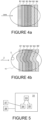
- Figure 4a and 4b illustrate iso-WEPL bands for two different situations.
- Figure 4a shows the distribution of the WEPL in a treatment volume 1, in an ideal situation, where the ions pass through a completely homogenous medium with a flat external surface. The direction of the incoming ions is perpendicular to the surface of the medium as indicated by the horizontal arrow.
- the six different iso-WEPL curves B1 - B6 are identified by different patterns: horizontal lines, vertical lines, and four different patterns of diagonal lines.
- Each iso-WEPL curve forms a band of WEPL values throughout the treatment volume substantially parallel to the surface of incidence of the ions, although they are shown as straight lines for simplicity. This illustrates that all voxels at the same geometrical path length in the direction of the beam will also be associated with essentially the same WEPLs.
- Figure 4b shows the distribution of the path length in a somewhat more realistic patient volume.
- a low density region 3 such as an air cavity, which is in the path 2 of the ions.
- This will cause ions traversing the low density region to experience a shorter WEPL contribution in that region than ions travelling the same geometrical distance through other types of tissue. Therefore, the path lengths in and around the air cavity 3 will take on a more irregular shape in the anatomical image, as illustrated by the iso-WEPL curves B1' - B6'.
- there is a ripple caused by the ions propagating through the low-density volume 3.
- Images such as the ones in Figures 4a and 4b provide an indication of the regularity of the WEPLs experienced by the ions propagating through the volume.
- a high amount of ripple or irregular shape of the WEPL bands indicates a lower robustness of the plan, in that a small movement of the patient, or other change to the setup, may cause a significant variation in the dose distribution actually delivered to the patient.
- the geometrical path length may be displayed in the same way as shown in Figures 4A and 4B .
- FIG. 5 is a schematic representation of a computer system in which the inventive method may be performed.
- a computer 31 comprises a processor 33, a data memory 34 and a program memory 35.
- a user input means 37, 38 is also present, in the form of a keyboard, a mouse, a joystick, voice recognition means or any other available user input means.
- the user input means may also be arranged to receive data from an external memory unit.
- a treatment plan to be evaluated is found in the data memory 34.
- the treatment plan may be generated in the computer 31, or received from another storage means in any way known in the art.
- the data memory 34 also holds deposited ion path length information for each voxel. As will be understood, the data memory 34 is only shown schematically. There may be several data memory units, each holding one or more different types of data, for example, one data memory for the treatment plan, one for the CT scans, etc..
- the program memory 35 holds a computer program arranged to control the processor to perform the plan evaluation according to the invention.
Landscapes
- Health & Medical Sciences (AREA)
- Engineering & Computer Science (AREA)
- Biomedical Technology (AREA)
- General Health & Medical Sciences (AREA)
- Public Health (AREA)
- Nuclear Medicine, Radiotherapy & Molecular Imaging (AREA)
- Veterinary Medicine (AREA)
- Animal Behavior & Ethology (AREA)
- Pathology (AREA)
- Life Sciences & Earth Sciences (AREA)
- Radiology & Medical Imaging (AREA)
- Surgery (AREA)
- Urology & Nephrology (AREA)
- Epidemiology (AREA)
- Medical Informatics (AREA)
- Primary Health Care (AREA)
- Radiation-Therapy Devices (AREA)
Claims (14)
- Computerbasiertes Verfahren zum Bewerten der Robustheit eines Strahlentherapiebehandlungsplans für eine ionenbasierte Strahlentherapie, umfassend die in einem Prozessor durchgeführten Schritte für eine ausgewählte Strahlrichtung und,- Erhalten von Informationen für jeden von mindestens einem ersten und einem zweiten Abschnitt in einem Behandlungsvolumen, das sich auf die akkumulierte Pfadlänge von Gewebe bezieht, die von Ionen durchquert wird, wenn sie den Abschnitt erreichen,- Berechnen eines Mengenwerts, der die kumulierte Pfadlänge für jeden des mindestens ersten und des zweiten Abschnitts darstellt,- Bestimmen der Robustheit des Strahlentherapiebehandlungsplans basierend auf den Mengenwerten für den ersten und den zweiten Abschnitt.
- Verfahren nach Anspruch 1, wobei die akkumulierte Pfadlänge eine wasseräquivalente Pfadlänge, WEPL, ist.
- Verfahren nach Anspruch 1, wobei die akkumulierte Pfadlänge eine geometrische Pfadlänge ist.
- Verfahren nach einem der vorstehenden Ansprüche, ferner umfassend den Schritt des Anzeigens, in einem Bild des Behandlungsvolumens, für jeden des ersten und des zweiten Abschnitts des Behandlungsvolumens, von Informationen, die den Mengenwert darstellen.
- Verfahren nach einem der vorstehenden Ansprüche, wobei die Informationen , die sich auf die akkumulierte Pfadlänge für Ionen beziehen, die den Abschnitt des Behandlungsvolumens erreichen, einen Wert einschließen, der einen Durchschnitt der akkumulierten Pfadlängen angibt, die von mindestens zwei Ionen durchquert werden, die den Abschnitt des Behandlungsvolumens erreichen.
- Verfahren nach Anspruch 4, wobei jedem Mengenwert eine Farbe zugewiesen wird und der Schritt des Anzeigens der Informationen, die den Mengenwert darstellen, das Anzeigen einer Darstellung des Behandlungsvolumens einschließt, wobei jeder des mindestens ersten und des zweiten Abschnitts des Behandlungsvolumens in der Farbe angezeigt wird, die den Mengenwert darstellt, der für diesen Abschnitt des Behandlungsvolumens berechnet wird.
- Verfahren nach Anspruch 4, wobei jedem Mengenwert ein Höhenniveau zugewiesen wird und der Schritt des Anzeigens der Informationen, die den Mengenwert darstellen, das Anzeigen einer dreidimensionalen Darstellung des Behandlungsvolumens einschließt, wobei jeder des mindestens ersten und des zweiten Abschnitts des Behandlungsvolumens auf dem Höhenniveau angezeigt wird, das die Pfadlänge darstellt, die für diesen Abschnitt des Behandlungsvolumens berechnet wird.
- Verfahren nach einem der vorstehenden Ansprüche, wobei der Schritt des Bestimmens der Robustheit eines Behandlungsplans das Bestimmen der Robustheit in umgekehrter Abhängigkeit der Pfadlängenvariationen für mindestens eine Strahlrichtung beinhaltet, die in dem Plan verwendet wird.
- Verfahren einer ionenbasierten Strahlentherapiebehandlungsplanung, umfassend das Bestimmen der Robustheit jeder von mindestens zwei möglichen Strahlrichtungen durch Durchführen des Verfahrens nach Anspruch 1 für eine erste und eine zweite ausgewählte Strahlrichtung und Auswählen mindestens einer der ersten und der zweiten Strahlrichtung, die in der Behandlung unter den möglichen Strahlrichtungen in Abhängigkeit von ihren Mengenwerten verwendet werden sollen.
- Verfahren einer Strahlentherapiebehandlungsplanung nach Anspruch 9, wobei die Auswahl der mindestens einen Strahlrichtung durch einen Bediener durchgeführt wird.
- Verfahren einer ionenbasierten Strahlentherapiebehandlungsplanung nach Anspruch 9, wobei die Auswahl als Teil einer computerimplementierten Optimierung vorgenommen wird.
- Computerprogrammprodukt, umfassend computerlesbare Codemittel, die, wenn sie auf einem Computer ausgeführt werden, den Computer veranlassen, das Verfahren nach einem der Ansprüche 1 bis 9 oder 11 durchzuführen.
- Nicht flüchtiges computerlesbares Medium, das mit computerausführbaren Anweisungen codiert ist, die, wenn sie auf einer ersten Computervorrichtung ablaufen, bewirken, dass die Vorrichtung das Verfahren nach einem der Ansprüche 1 bis 9 oder 11 durchführt.
- Computersystem, umfassend einen Prozessor (33), einen Datenspeicher (34) und einen Programmspeicher (35), wobei der Programmspeicher ein Computerprogrammprodukt nach Anspruch 12 oder ein nicht flüchtiges computerlesbares Medium nach Anspruch 13 umfasst.
Priority Applications (5)
| Application Number | Priority Date | Filing Date | Title |
|---|---|---|---|
| EP18173400.5A EP3572124B1 (de) | 2018-05-21 | 2018-05-21 | System, computerprogrammprodukt und verfahren zur ionenbasierten strahlentherapieplanung |
| JP2020564946A JP7368385B2 (ja) | 2018-05-21 | 2019-05-14 | イオンに基づく放射線治療計画作成のためのシステム、コンピュータプログラム製品、及び方法 |
| CN201980033324.6A CN112188917A (zh) | 2018-05-21 | 2019-05-14 | 用于基于离子的放射疗法治疗计划的系统、计算机程序产品和方法 |
| PCT/EP2019/062377 WO2019224054A1 (en) | 2018-05-21 | 2019-05-14 | System, computer program product and method for ion-based radiotherapy treatment planning |
| US17/053,876 US12544591B2 (en) | 2018-05-21 | 2019-05-14 | System, computer program product and method for ion-based radiotherapy treatment planning |
Applications Claiming Priority (1)
| Application Number | Priority Date | Filing Date | Title |
|---|---|---|---|
| EP18173400.5A EP3572124B1 (de) | 2018-05-21 | 2018-05-21 | System, computerprogrammprodukt und verfahren zur ionenbasierten strahlentherapieplanung |
Publications (2)
| Publication Number | Publication Date |
|---|---|
| EP3572124A1 EP3572124A1 (de) | 2019-11-27 |
| EP3572124B1 true EP3572124B1 (de) | 2024-05-08 |
Family
ID=62245163
Family Applications (1)
| Application Number | Title | Priority Date | Filing Date |
|---|---|---|---|
| EP18173400.5A Active EP3572124B1 (de) | 2018-05-21 | 2018-05-21 | System, computerprogrammprodukt und verfahren zur ionenbasierten strahlentherapieplanung |
Country Status (5)
| Country | Link |
|---|---|
| US (1) | US12544591B2 (de) |
| EP (1) | EP3572124B1 (de) |
| JP (1) | JP7368385B2 (de) |
| CN (1) | CN112188917A (de) |
| WO (1) | WO2019224054A1 (de) |
Families Citing this family (2)
| Publication number | Priority date | Publication date | Assignee | Title |
|---|---|---|---|---|
| EP4039325B1 (de) * | 2021-02-08 | 2024-06-26 | RaySearch Laboratories AB | Strahlungsmodulatoranordnung und strahlungsabgabevorrichtung zur verwendung in der ionenbasierten strahlentherapie und planungsverfahren für ionenbasierte strahlentherapie |
| EP4678227A1 (de) * | 2024-07-12 | 2026-01-14 | RaySearch Laboratories AB | Verfahren zur optimierung eines strahlungsbehandlungsplans |
Citations (1)
| Publication number | Priority date | Publication date | Assignee | Title |
|---|---|---|---|---|
| WO2013129258A1 (ja) * | 2012-02-28 | 2013-09-06 | 国立大学法人九州大学 | 粒子線ビーム方向決定システム、粒子線ビーム方向決定方法及び粒子線ビーム方向決定用コンピュータプログラム |
Family Cites Families (10)
| Publication number | Priority date | Publication date | Assignee | Title |
|---|---|---|---|---|
| US20130035588A1 (en) * | 2011-08-03 | 2013-02-07 | Siemens Corporation | Magnetic resonance imaging for therapy planning |
| US10369381B2 (en) * | 2014-09-02 | 2019-08-06 | Mayo Foundation For Medical Education And Research | System and method for robust intensity-modulated proton therapy planning |
| WO2016047194A1 (ja) * | 2014-09-24 | 2016-03-31 | 株式会社日立製作所 | 放射線治療計画装置、放射線治療計画方法および放射線治療システム |
| EP3081262B1 (de) * | 2015-04-14 | 2019-03-20 | RaySearch Laboratories AB | Ein verfahren, ein computerprogrammprodukt und ein system zur optimierung der bestrahlungsplanung |
| GB2539261A (en) * | 2015-06-12 | 2016-12-14 | Elekta ltd | Improvements in Dosimetry Techniques for Radiotherapy |
| US10417390B2 (en) * | 2015-06-30 | 2019-09-17 | Varian Medical Systems, Inc. | Methods and systems for radiotherapy treatment planning |
| CN109310881B (zh) * | 2016-06-14 | 2021-06-29 | 皇家飞利浦有限公司 | 质子治疗设备及其规划设备 |
| EP3305367A1 (de) * | 2016-10-07 | 2018-04-11 | Ion Beam Applications S.A. | Medizinische vorrichtung mit einer hadron-therapie-vorrichtung, einem mrt und einem hadron-radiografiesystem |
| EP3324318B1 (de) * | 2016-11-17 | 2024-06-05 | RaySearch Laboratories AB | System und verfahren zur ionenbasierten strahlentherapiebehandlung |
| CN107551411B (zh) * | 2017-08-17 | 2019-12-17 | 裴曦 | 针对射程不确定性的质子重离子调强放疗鲁棒优化方法 |
-
2018
- 2018-05-21 EP EP18173400.5A patent/EP3572124B1/de active Active
-
2019
- 2019-05-14 WO PCT/EP2019/062377 patent/WO2019224054A1/en not_active Ceased
- 2019-05-14 JP JP2020564946A patent/JP7368385B2/ja active Active
- 2019-05-14 CN CN201980033324.6A patent/CN112188917A/zh active Pending
- 2019-05-14 US US17/053,876 patent/US12544591B2/en active Active
Patent Citations (1)
| Publication number | Priority date | Publication date | Assignee | Title |
|---|---|---|---|---|
| WO2013129258A1 (ja) * | 2012-02-28 | 2013-09-06 | 国立大学法人九州大学 | 粒子線ビーム方向決定システム、粒子線ビーム方向決定方法及び粒子線ビーム方向決定用コンピュータプログラム |
Non-Patent Citations (1)
| Title |
|---|
| VANIA BATISTA ET AL: "Planning strategies for inter-fractional robustness in pancreatic patients treated with scanned carbon therapy", RADIATION ONCOLOGY, vol. 12, no. 1, 1 December 2017 (2017-12-01), XP055527138, DOI: 10.1186/s13014-017-0832-x * |
Also Published As
| Publication number | Publication date |
|---|---|
| US20210228906A1 (en) | 2021-07-29 |
| CN112188917A (zh) | 2021-01-05 |
| JP2021524782A (ja) | 2021-09-16 |
| WO2019224054A1 (en) | 2019-11-28 |
| US12544591B2 (en) | 2026-02-10 |
| EP3572124A1 (de) | 2019-11-27 |
| JP7368385B2 (ja) | 2023-10-24 |
Similar Documents
| Publication | Publication Date | Title |
|---|---|---|
| JP7132308B2 (ja) | イオン系放射線治療計画の評価のためのシステムおよび方法 | |
| US11413474B2 (en) | System and method for modelling of dose calculation in radiotherapy treatment planning | |
| EP2994195B1 (de) | Interaktives dosisgradientbasiertes optimierungsverfahren zur steuerung der imrt-abgabekomplexität | |
| US6714620B2 (en) | Radiation therapy treatment method | |
| EP2585854B1 (de) | System und verfahren zur messung und zur änderung einer gemessenen strahlendosis | |
| CN112904398B (zh) | 确定剂量分布的方法和设备 | |
| EP2759317A1 (de) | Bestrahlungsbehandlungsplanungssystem und Verfahren zur Bestrahlungsbehandlungsplanung | |
| CN107708803B (zh) | 剂量分布运算装置、粒子射线治疗装置及剂量分布运算方法 | |
| WO2014196052A1 (ja) | 粒子線治療装置および線量校正係数の設定方法 | |
| US12147734B2 (en) | Static device for use in radiotherapy treatment and design method for such a device | |
| US12544591B2 (en) | System, computer program product and method for ion-based radiotherapy treatment planning | |
| JP6196912B2 (ja) | 治療計画装置および治療計画情報を作成するプログラム | |
| EP3326694B1 (de) | System und verfahren zur ionenbasierten strahlentherapieplanung | |
| JP7357059B2 (ja) | パッシブイオン放射線治療計画のためのシステムおよび方法 | |
| CN105105780A (zh) | 动态楔形板控制点的生成方法及装置 | |
| JP2024141089A (ja) | 線量分布計算システム、プログラム及び線量分布計算方法 | |
| CN120515020A (zh) | 基于蒙特卡洛束流建模的剂量确定方法、装置、系统 |
Legal Events
| Date | Code | Title | Description |
|---|---|---|---|
| PUAI | Public reference made under article 153(3) epc to a published international application that has entered the european phase |
Free format text: ORIGINAL CODE: 0009012 |
|
| STAA | Information on the status of an ep patent application or granted ep patent |
Free format text: STATUS: THE APPLICATION HAS BEEN PUBLISHED |
|
| AK | Designated contracting states |
Kind code of ref document: A1 Designated state(s): AL AT BE BG CH CY CZ DE DK EE ES FI FR GB GR HR HU IE IS IT LI LT LU LV MC MK MT NL NO PL PT RO RS SE SI SK SM TR |
|
| AX | Request for extension of the european patent |
Extension state: BA ME |
|
| STAA | Information on the status of an ep patent application or granted ep patent |
Free format text: STATUS: REQUEST FOR EXAMINATION WAS MADE |
|
| 17P | Request for examination filed |
Effective date: 20200512 |
|
| RBV | Designated contracting states (corrected) |
Designated state(s): AL AT BE BG CH CY CZ DE DK EE ES FI FR GB GR HR HU IE IS IT LI LT LU LV MC MK MT NL NO PL PT RO RS SE SI SK SM TR |
|
| STAA | Information on the status of an ep patent application or granted ep patent |
Free format text: STATUS: EXAMINATION IS IN PROGRESS |
|
| 17Q | First examination report despatched |
Effective date: 20220302 |
|
| RAP3 | Party data changed (applicant data changed or rights of an application transferred) |
Owner name: RAYSEARCH LABORATORIES AB |
|
| P01 | Opt-out of the competence of the unified patent court (upc) registered |
Effective date: 20230731 |
|
| GRAP | Despatch of communication of intention to grant a patent |
Free format text: ORIGINAL CODE: EPIDOSNIGR1 |
|
| STAA | Information on the status of an ep patent application or granted ep patent |
Free format text: STATUS: GRANT OF PATENT IS INTENDED |
|
| INTG | Intention to grant announced |
Effective date: 20240123 |
|
| GRAS | Grant fee paid |
Free format text: ORIGINAL CODE: EPIDOSNIGR3 |
|
| GRAA | (expected) grant |
Free format text: ORIGINAL CODE: 0009210 |
|
| STAA | Information on the status of an ep patent application or granted ep patent |
Free format text: STATUS: THE PATENT HAS BEEN GRANTED |
|
| AK | Designated contracting states |
Kind code of ref document: B1 Designated state(s): AL AT BE BG CH CY CZ DE DK EE ES FI FR GB GR HR HU IE IS IT LI LT LU LV MC MK MT NL NO PL PT RO RS SE SI SK SM TR |
|
| REG | Reference to a national code |
Ref country code: GB Ref legal event code: FG4D |
|
| REG | Reference to a national code |
Ref country code: CH Ref legal event code: EP |
|
| REG | Reference to a national code |
Ref country code: DE Ref legal event code: R096 Ref document number: 602018069198 Country of ref document: DE |
|
| REG | Reference to a national code |
Ref country code: IE Ref legal event code: FG4D |
|
| REG | Reference to a national code |
Ref country code: LT Ref legal event code: MG9D |
|
| REG | Reference to a national code |
Ref country code: NL Ref legal event code: MP Effective date: 20240508 |
|
| PG25 | Lapsed in a contracting state [announced via postgrant information from national office to epo] |
Ref country code: IS Free format text: LAPSE BECAUSE OF FAILURE TO SUBMIT A TRANSLATION OF THE DESCRIPTION OR TO PAY THE FEE WITHIN THE PRESCRIBED TIME-LIMIT Effective date: 20240908 |
|
| PG25 | Lapsed in a contracting state [announced via postgrant information from national office to epo] |
Ref country code: BG Free format text: LAPSE BECAUSE OF FAILURE TO SUBMIT A TRANSLATION OF THE DESCRIPTION OR TO PAY THE FEE WITHIN THE PRESCRIBED TIME-LIMIT Effective date: 20240508 |
|
| PG25 | Lapsed in a contracting state [announced via postgrant information from national office to epo] |
Ref country code: FI Free format text: LAPSE BECAUSE OF FAILURE TO SUBMIT A TRANSLATION OF THE DESCRIPTION OR TO PAY THE FEE WITHIN THE PRESCRIBED TIME-LIMIT Effective date: 20240508 Ref country code: HR Free format text: LAPSE BECAUSE OF FAILURE TO SUBMIT A TRANSLATION OF THE DESCRIPTION OR TO PAY THE FEE WITHIN THE PRESCRIBED TIME-LIMIT Effective date: 20240508 |
|
| PG25 | Lapsed in a contracting state [announced via postgrant information from national office to epo] |
Ref country code: GR Free format text: LAPSE BECAUSE OF FAILURE TO SUBMIT A TRANSLATION OF THE DESCRIPTION OR TO PAY THE FEE WITHIN THE PRESCRIBED TIME-LIMIT Effective date: 20240809 |
|
| PG25 | Lapsed in a contracting state [announced via postgrant information from national office to epo] |
Ref country code: PT Free format text: LAPSE BECAUSE OF FAILURE TO SUBMIT A TRANSLATION OF THE DESCRIPTION OR TO PAY THE FEE WITHIN THE PRESCRIBED TIME-LIMIT Effective date: 20240909 |
|
| REG | Reference to a national code |
Ref country code: AT Ref legal event code: MK05 Ref document number: 1684513 Country of ref document: AT Kind code of ref document: T Effective date: 20240508 |
|
| PG25 | Lapsed in a contracting state [announced via postgrant information from national office to epo] |
Ref country code: NL Free format text: LAPSE BECAUSE OF FAILURE TO SUBMIT A TRANSLATION OF THE DESCRIPTION OR TO PAY THE FEE WITHIN THE PRESCRIBED TIME-LIMIT Effective date: 20240508 |
|
| PG25 | Lapsed in a contracting state [announced via postgrant information from national office to epo] |
Ref country code: ES Free format text: LAPSE BECAUSE OF FAILURE TO SUBMIT A TRANSLATION OF THE DESCRIPTION OR TO PAY THE FEE WITHIN THE PRESCRIBED TIME-LIMIT Effective date: 20240508 |
|
| PG25 | Lapsed in a contracting state [announced via postgrant information from national office to epo] |
Ref country code: AT Free format text: LAPSE BECAUSE OF FAILURE TO SUBMIT A TRANSLATION OF THE DESCRIPTION OR TO PAY THE FEE WITHIN THE PRESCRIBED TIME-LIMIT Effective date: 20240508 |
|
| PG25 | Lapsed in a contracting state [announced via postgrant information from national office to epo] |
Ref country code: PL Free format text: LAPSE BECAUSE OF FAILURE TO SUBMIT A TRANSLATION OF THE DESCRIPTION OR TO PAY THE FEE WITHIN THE PRESCRIBED TIME-LIMIT Effective date: 20240508 |
|
| PG25 | Lapsed in a contracting state [announced via postgrant information from national office to epo] |
Ref country code: LV Free format text: LAPSE BECAUSE OF FAILURE TO SUBMIT A TRANSLATION OF THE DESCRIPTION OR TO PAY THE FEE WITHIN THE PRESCRIBED TIME-LIMIT Effective date: 20240508 |
|
| PG25 | Lapsed in a contracting state [announced via postgrant information from national office to epo] |
Ref country code: PT Free format text: LAPSE BECAUSE OF FAILURE TO SUBMIT A TRANSLATION OF THE DESCRIPTION OR TO PAY THE FEE WITHIN THE PRESCRIBED TIME-LIMIT Effective date: 20240909 Ref country code: PL Free format text: LAPSE BECAUSE OF FAILURE TO SUBMIT A TRANSLATION OF THE DESCRIPTION OR TO PAY THE FEE WITHIN THE PRESCRIBED TIME-LIMIT Effective date: 20240508 Ref country code: NO Free format text: LAPSE BECAUSE OF FAILURE TO SUBMIT A TRANSLATION OF THE DESCRIPTION OR TO PAY THE FEE WITHIN THE PRESCRIBED TIME-LIMIT Effective date: 20240808 Ref country code: NL Free format text: LAPSE BECAUSE OF FAILURE TO SUBMIT A TRANSLATION OF THE DESCRIPTION OR TO PAY THE FEE WITHIN THE PRESCRIBED TIME-LIMIT Effective date: 20240508 Ref country code: LV Free format text: LAPSE BECAUSE OF FAILURE TO SUBMIT A TRANSLATION OF THE DESCRIPTION OR TO PAY THE FEE WITHIN THE PRESCRIBED TIME-LIMIT Effective date: 20240508 Ref country code: IS Free format text: LAPSE BECAUSE OF FAILURE TO SUBMIT A TRANSLATION OF THE DESCRIPTION OR TO PAY THE FEE WITHIN THE PRESCRIBED TIME-LIMIT Effective date: 20240908 Ref country code: HR Free format text: LAPSE BECAUSE OF FAILURE TO SUBMIT A TRANSLATION OF THE DESCRIPTION OR TO PAY THE FEE WITHIN THE PRESCRIBED TIME-LIMIT Effective date: 20240508 Ref country code: GR Free format text: LAPSE BECAUSE OF FAILURE TO SUBMIT A TRANSLATION OF THE DESCRIPTION OR TO PAY THE FEE WITHIN THE PRESCRIBED TIME-LIMIT Effective date: 20240809 Ref country code: FI Free format text: LAPSE BECAUSE OF FAILURE TO SUBMIT A TRANSLATION OF THE DESCRIPTION OR TO PAY THE FEE WITHIN THE PRESCRIBED TIME-LIMIT Effective date: 20240508 Ref country code: ES Free format text: LAPSE BECAUSE OF FAILURE TO SUBMIT A TRANSLATION OF THE DESCRIPTION OR TO PAY THE FEE WITHIN THE PRESCRIBED TIME-LIMIT Effective date: 20240508 Ref country code: BG Free format text: LAPSE BECAUSE OF FAILURE TO SUBMIT A TRANSLATION OF THE DESCRIPTION OR TO PAY THE FEE WITHIN THE PRESCRIBED TIME-LIMIT Effective date: 20240508 Ref country code: AT Free format text: LAPSE BECAUSE OF FAILURE TO SUBMIT A TRANSLATION OF THE DESCRIPTION OR TO PAY THE FEE WITHIN THE PRESCRIBED TIME-LIMIT Effective date: 20240508 Ref country code: RS Free format text: LAPSE BECAUSE OF FAILURE TO SUBMIT A TRANSLATION OF THE DESCRIPTION OR TO PAY THE FEE WITHIN THE PRESCRIBED TIME-LIMIT Effective date: 20240808 |
|
| REG | Reference to a national code |
Ref country code: CH Ref legal event code: PL |
|
| PG25 | Lapsed in a contracting state [announced via postgrant information from national office to epo] |
Ref country code: DK Free format text: LAPSE BECAUSE OF FAILURE TO SUBMIT A TRANSLATION OF THE DESCRIPTION OR TO PAY THE FEE WITHIN THE PRESCRIBED TIME-LIMIT Effective date: 20240508 |
|
| PG25 | Lapsed in a contracting state [announced via postgrant information from national office to epo] |
Ref country code: LU Free format text: LAPSE BECAUSE OF NON-PAYMENT OF DUE FEES Effective date: 20240521 |
|
| PG25 | Lapsed in a contracting state [announced via postgrant information from national office to epo] |
Ref country code: EE Free format text: LAPSE BECAUSE OF FAILURE TO SUBMIT A TRANSLATION OF THE DESCRIPTION OR TO PAY THE FEE WITHIN THE PRESCRIBED TIME-LIMIT Effective date: 20240508 |
|
| PG25 | Lapsed in a contracting state [announced via postgrant information from national office to epo] |
Ref country code: CZ Free format text: LAPSE BECAUSE OF FAILURE TO SUBMIT A TRANSLATION OF THE DESCRIPTION OR TO PAY THE FEE WITHIN THE PRESCRIBED TIME-LIMIT Effective date: 20240508 |
|
| PG25 | Lapsed in a contracting state [announced via postgrant information from national office to epo] |
Ref country code: RO Free format text: LAPSE BECAUSE OF FAILURE TO SUBMIT A TRANSLATION OF THE DESCRIPTION OR TO PAY THE FEE WITHIN THE PRESCRIBED TIME-LIMIT Effective date: 20240508 Ref country code: SK Free format text: LAPSE BECAUSE OF FAILURE TO SUBMIT A TRANSLATION OF THE DESCRIPTION OR TO PAY THE FEE WITHIN THE PRESCRIBED TIME-LIMIT Effective date: 20240508 |
|
| PG25 | Lapsed in a contracting state [announced via postgrant information from national office to epo] |
Ref country code: SM Free format text: LAPSE BECAUSE OF FAILURE TO SUBMIT A TRANSLATION OF THE DESCRIPTION OR TO PAY THE FEE WITHIN THE PRESCRIBED TIME-LIMIT Effective date: 20240508 |
|
| PG25 | Lapsed in a contracting state [announced via postgrant information from national office to epo] |
Ref country code: SM Free format text: LAPSE BECAUSE OF FAILURE TO SUBMIT A TRANSLATION OF THE DESCRIPTION OR TO PAY THE FEE WITHIN THE PRESCRIBED TIME-LIMIT Effective date: 20240508 Ref country code: SK Free format text: LAPSE BECAUSE OF FAILURE TO SUBMIT A TRANSLATION OF THE DESCRIPTION OR TO PAY THE FEE WITHIN THE PRESCRIBED TIME-LIMIT Effective date: 20240508 Ref country code: RO Free format text: LAPSE BECAUSE OF FAILURE TO SUBMIT A TRANSLATION OF THE DESCRIPTION OR TO PAY THE FEE WITHIN THE PRESCRIBED TIME-LIMIT Effective date: 20240508 Ref country code: LU Free format text: LAPSE BECAUSE OF NON-PAYMENT OF DUE FEES Effective date: 20240521 Ref country code: EE Free format text: LAPSE BECAUSE OF FAILURE TO SUBMIT A TRANSLATION OF THE DESCRIPTION OR TO PAY THE FEE WITHIN THE PRESCRIBED TIME-LIMIT Effective date: 20240508 Ref country code: DK Free format text: LAPSE BECAUSE OF FAILURE TO SUBMIT A TRANSLATION OF THE DESCRIPTION OR TO PAY THE FEE WITHIN THE PRESCRIBED TIME-LIMIT Effective date: 20240508 Ref country code: CZ Free format text: LAPSE BECAUSE OF FAILURE TO SUBMIT A TRANSLATION OF THE DESCRIPTION OR TO PAY THE FEE WITHIN THE PRESCRIBED TIME-LIMIT Effective date: 20240508 Ref country code: CH Free format text: LAPSE BECAUSE OF NON-PAYMENT OF DUE FEES Effective date: 20240531 |
|
| PG25 | Lapsed in a contracting state [announced via postgrant information from national office to epo] |
Ref country code: MC Free format text: LAPSE BECAUSE OF FAILURE TO SUBMIT A TRANSLATION OF THE DESCRIPTION OR TO PAY THE FEE WITHIN THE PRESCRIBED TIME-LIMIT Effective date: 20240508 Ref country code: IT Free format text: LAPSE BECAUSE OF FAILURE TO SUBMIT A TRANSLATION OF THE DESCRIPTION OR TO PAY THE FEE WITHIN THE PRESCRIBED TIME-LIMIT Effective date: 20240508 |
|
| REG | Reference to a national code |
Ref country code: DE Ref legal event code: R097 Ref document number: 602018069198 Country of ref document: DE |
|
| REG | Reference to a national code |
Ref country code: BE Ref legal event code: MM Effective date: 20240531 |
|
| PLBE | No opposition filed within time limit |
Free format text: ORIGINAL CODE: 0009261 |
|
| STAA | Information on the status of an ep patent application or granted ep patent |
Free format text: STATUS: NO OPPOSITION FILED WITHIN TIME LIMIT |
|
| 26N | No opposition filed |
Effective date: 20250211 |
|
| PG25 | Lapsed in a contracting state [announced via postgrant information from national office to epo] |
Ref country code: IE Free format text: LAPSE BECAUSE OF NON-PAYMENT OF DUE FEES Effective date: 20240521 |
|
| PG25 | Lapsed in a contracting state [announced via postgrant information from national office to epo] |
Ref country code: SI Free format text: LAPSE BECAUSE OF FAILURE TO SUBMIT A TRANSLATION OF THE DESCRIPTION OR TO PAY THE FEE WITHIN THE PRESCRIBED TIME-LIMIT Effective date: 20240508 Ref country code: BE Free format text: LAPSE BECAUSE OF NON-PAYMENT OF DUE FEES Effective date: 20240531 |
|
| PGFP | Annual fee paid to national office [announced via postgrant information from national office to epo] |
Ref country code: DE Payment date: 20250512 Year of fee payment: 8 |
|
| PGFP | Annual fee paid to national office [announced via postgrant information from national office to epo] |
Ref country code: GB Payment date: 20250514 Year of fee payment: 8 |
|
| PGFP | Annual fee paid to national office [announced via postgrant information from national office to epo] |
Ref country code: FR Payment date: 20250514 Year of fee payment: 8 |
|
| PG25 | Lapsed in a contracting state [announced via postgrant information from national office to epo] |
Ref country code: CY Free format text: LAPSE BECAUSE OF FAILURE TO SUBMIT A TRANSLATION OF THE DESCRIPTION OR TO PAY THE FEE WITHIN THE PRESCRIBED TIME-LIMIT; INVALID AB INITIO Effective date: 20180521 |
|
| PG25 | Lapsed in a contracting state [announced via postgrant information from national office to epo] |
Ref country code: HU Free format text: LAPSE BECAUSE OF FAILURE TO SUBMIT A TRANSLATION OF THE DESCRIPTION OR TO PAY THE FEE WITHIN THE PRESCRIBED TIME-LIMIT; INVALID AB INITIO Effective date: 20180521 |
|
| PG25 | Lapsed in a contracting state [announced via postgrant information from national office to epo] |
Ref country code: SE Free format text: LAPSE BECAUSE OF FAILURE TO SUBMIT A TRANSLATION OF THE DESCRIPTION OR TO PAY THE FEE WITHIN THE PRESCRIBED TIME-LIMIT Effective date: 20240508 |