EP3572057B1 - An mehrere transportmodi anpassbare patientenliegevorrichtung - Google Patents
An mehrere transportmodi anpassbare patientenliegevorrichtung Download PDFInfo
- Publication number
- EP3572057B1 EP3572057B1 EP19175486.0A EP19175486A EP3572057B1 EP 3572057 B1 EP3572057 B1 EP 3572057B1 EP 19175486 A EP19175486 A EP 19175486A EP 3572057 B1 EP3572057 B1 EP 3572057B1
- Authority
- EP
- European Patent Office
- Prior art keywords
- support apparatus
- patient support
- base
- patient
- drive
- Prior art date
- Legal status (The legal status is an assumption and is not a legal conclusion. Google has not performed a legal analysis and makes no representation as to the accuracy of the status listed.)
- Active
Links
Images







Classifications
-
- A—HUMAN NECESSITIES
- A61—MEDICAL OR VETERINARY SCIENCE; HYGIENE
- A61G—TRANSPORT, PERSONAL CONVEYANCES, OR ACCOMMODATION SPECIALLY ADAPTED FOR PATIENTS OR DISABLED PERSONS; OPERATING TABLES OR CHAIRS; CHAIRS FOR DENTISTRY; FUNERAL DEVICES
- A61G5/00—Chairs or personal conveyances specially adapted for patients or disabled persons, e.g. wheelchairs
- A61G5/006—Chairs or personal conveyances specially adapted for patients or disabled persons, e.g. wheelchairs convertible to stretchers or beds
-
- A—HUMAN NECESSITIES
- A61—MEDICAL OR VETERINARY SCIENCE; HYGIENE
- A61G—TRANSPORT, PERSONAL CONVEYANCES, OR ACCOMMODATION SPECIALLY ADAPTED FOR PATIENTS OR DISABLED PERSONS; OPERATING TABLES OR CHAIRS; CHAIRS FOR DENTISTRY; FUNERAL DEVICES
- A61G5/00—Chairs or personal conveyances specially adapted for patients or disabled persons, e.g. wheelchairs
- A61G5/04—Chairs or personal conveyances specially adapted for patients or disabled persons, e.g. wheelchairs motor-driven
- A61G5/041—Chairs or personal conveyances specially adapted for patients or disabled persons, e.g. wheelchairs motor-driven having a specific drive-type
- A61G5/043—Mid wheel drive
-
- A—HUMAN NECESSITIES
- A61—MEDICAL OR VETERINARY SCIENCE; HYGIENE
- A61G—TRANSPORT, PERSONAL CONVEYANCES, OR ACCOMMODATION SPECIALLY ADAPTED FOR PATIENTS OR DISABLED PERSONS; OPERATING TABLES OR CHAIRS; CHAIRS FOR DENTISTRY; FUNERAL DEVICES
- A61G5/00—Chairs or personal conveyances specially adapted for patients or disabled persons, e.g. wheelchairs
- A61G5/10—Parts, details or accessories
- A61G5/1005—Wheelchairs having brakes
- A61G5/101—Wheelchairs having brakes of the parking brake type, e.g. holding the wheelchair
-
- A—HUMAN NECESSITIES
- A61—MEDICAL OR VETERINARY SCIENCE; HYGIENE
- A61G—TRANSPORT, PERSONAL CONVEYANCES, OR ACCOMMODATION SPECIALLY ADAPTED FOR PATIENTS OR DISABLED PERSONS; OPERATING TABLES OR CHAIRS; CHAIRS FOR DENTISTRY; FUNERAL DEVICES
- A61G5/00—Chairs or personal conveyances specially adapted for patients or disabled persons, e.g. wheelchairs
- A61G5/10—Parts, details or accessories
- A61G5/1005—Wheelchairs having brakes
- A61G5/1032—Wheelchairs having brakes engaging an element of the drive or transmission, e.g. drive belt, electrodynamic brake
-
- A—HUMAN NECESSITIES
- A61—MEDICAL OR VETERINARY SCIENCE; HYGIENE
- A61G—TRANSPORT, PERSONAL CONVEYANCES, OR ACCOMMODATION SPECIALLY ADAPTED FOR PATIENTS OR DISABLED PERSONS; OPERATING TABLES OR CHAIRS; CHAIRS FOR DENTISTRY; FUNERAL DEVICES
- A61G5/00—Chairs or personal conveyances specially adapted for patients or disabled persons, e.g. wheelchairs
- A61G5/10—Parts, details or accessories
- A61G5/1005—Wheelchairs having brakes
- A61G5/1037—Wheelchairs having brakes manipulated by assisting person
-
- A—HUMAN NECESSITIES
- A61—MEDICAL OR VETERINARY SCIENCE; HYGIENE
- A61G—TRANSPORT, PERSONAL CONVEYANCES, OR ACCOMMODATION SPECIALLY ADAPTED FOR PATIENTS OR DISABLED PERSONS; OPERATING TABLES OR CHAIRS; CHAIRS FOR DENTISTRY; FUNERAL DEVICES
- A61G5/00—Chairs or personal conveyances specially adapted for patients or disabled persons, e.g. wheelchairs
- A61G5/10—Parts, details or accessories
- A61G5/1056—Arrangements for adjusting the seat
- A61G5/1059—Arrangements for adjusting the seat adjusting the height of the seat
-
- A—HUMAN NECESSITIES
- A61—MEDICAL OR VETERINARY SCIENCE; HYGIENE
- A61G—TRANSPORT, PERSONAL CONVEYANCES, OR ACCOMMODATION SPECIALLY ADAPTED FOR PATIENTS OR DISABLED PERSONS; OPERATING TABLES OR CHAIRS; CHAIRS FOR DENTISTRY; FUNERAL DEVICES
- A61G5/00—Chairs or personal conveyances specially adapted for patients or disabled persons, e.g. wheelchairs
- A61G5/10—Parts, details or accessories
- A61G5/1056—Arrangements for adjusting the seat
- A61G5/1067—Arrangements for adjusting the seat adjusting the backrest relative to the seat portion
-
- A—HUMAN NECESSITIES
- A61—MEDICAL OR VETERINARY SCIENCE; HYGIENE
- A61G—TRANSPORT, PERSONAL CONVEYANCES, OR ACCOMMODATION SPECIALLY ADAPTED FOR PATIENTS OR DISABLED PERSONS; OPERATING TABLES OR CHAIRS; CHAIRS FOR DENTISTRY; FUNERAL DEVICES
- A61G5/00—Chairs or personal conveyances specially adapted for patients or disabled persons, e.g. wheelchairs
- A61G5/10—Parts, details or accessories
- A61G5/1056—Arrangements for adjusting the seat
- A61G5/1075—Arrangements for adjusting the seat tilting the whole seat backwards
-
- A—HUMAN NECESSITIES
- A61—MEDICAL OR VETERINARY SCIENCE; HYGIENE
- A61G—TRANSPORT, PERSONAL CONVEYANCES, OR ACCOMMODATION SPECIALLY ADAPTED FOR PATIENTS OR DISABLED PERSONS; OPERATING TABLES OR CHAIRS; CHAIRS FOR DENTISTRY; FUNERAL DEVICES
- A61G7/00—Beds specially adapted for nursing; Devices for lifting patients or disabled persons
- A61G7/002—Beds specially adapted for nursing; Devices for lifting patients or disabled persons having adjustable mattress frame
- A61G7/015—Beds specially adapted for nursing; Devices for lifting patients or disabled persons having adjustable mattress frame divided into different adjustable sections, e.g. for Gatch position
-
- A—HUMAN NECESSITIES
- A61—MEDICAL OR VETERINARY SCIENCE; HYGIENE
- A61G—TRANSPORT, PERSONAL CONVEYANCES, OR ACCOMMODATION SPECIALLY ADAPTED FOR PATIENTS OR DISABLED PERSONS; OPERATING TABLES OR CHAIRS; CHAIRS FOR DENTISTRY; FUNERAL DEVICES
- A61G7/00—Beds specially adapted for nursing; Devices for lifting patients or disabled persons
- A61G7/002—Beds specially adapted for nursing; Devices for lifting patients or disabled persons having adjustable mattress frame
- A61G7/018—Control or drive mechanisms
-
- A—HUMAN NECESSITIES
- A61—MEDICAL OR VETERINARY SCIENCE; HYGIENE
- A61G—TRANSPORT, PERSONAL CONVEYANCES, OR ACCOMMODATION SPECIALLY ADAPTED FOR PATIENTS OR DISABLED PERSONS; OPERATING TABLES OR CHAIRS; CHAIRS FOR DENTISTRY; FUNERAL DEVICES
- A61G7/00—Beds specially adapted for nursing; Devices for lifting patients or disabled persons
- A61G7/05—Parts, details or accessories of beds
- A61G7/0525—Side-bolsters
-
- A—HUMAN NECESSITIES
- A61—MEDICAL OR VETERINARY SCIENCE; HYGIENE
- A61G—TRANSPORT, PERSONAL CONVEYANCES, OR ACCOMMODATION SPECIALLY ADAPTED FOR PATIENTS OR DISABLED PERSONS; OPERATING TABLES OR CHAIRS; CHAIRS FOR DENTISTRY; FUNERAL DEVICES
- A61G7/00—Beds specially adapted for nursing; Devices for lifting patients or disabled persons
- A61G7/05—Parts, details or accessories of beds
- A61G7/0528—Steering or braking devices for castor wheels
-
- A—HUMAN NECESSITIES
- A61—MEDICAL OR VETERINARY SCIENCE; HYGIENE
- A61G—TRANSPORT, PERSONAL CONVEYANCES, OR ACCOMMODATION SPECIALLY ADAPTED FOR PATIENTS OR DISABLED PERSONS; OPERATING TABLES OR CHAIRS; CHAIRS FOR DENTISTRY; FUNERAL DEVICES
- A61G7/00—Beds specially adapted for nursing; Devices for lifting patients or disabled persons
- A61G7/08—Apparatus for transporting beds
-
- A—HUMAN NECESSITIES
- A61—MEDICAL OR VETERINARY SCIENCE; HYGIENE
- A61G—TRANSPORT, PERSONAL CONVEYANCES, OR ACCOMMODATION SPECIALLY ADAPTED FOR PATIENTS OR DISABLED PERSONS; OPERATING TABLES OR CHAIRS; CHAIRS FOR DENTISTRY; FUNERAL DEVICES
- A61G2203/00—General characteristics of devices
- A61G2203/10—General characteristics of devices characterised by specific control means, e.g. for adjustment or steering
- A61G2203/12—Remote controls
-
- A—HUMAN NECESSITIES
- A61—MEDICAL OR VETERINARY SCIENCE; HYGIENE
- A61G—TRANSPORT, PERSONAL CONVEYANCES, OR ACCOMMODATION SPECIALLY ADAPTED FOR PATIENTS OR DISABLED PERSONS; OPERATING TABLES OR CHAIRS; CHAIRS FOR DENTISTRY; FUNERAL DEVICES
- A61G2203/00—General characteristics of devices
- A61G2203/10—General characteristics of devices characterised by specific control means, e.g. for adjustment or steering
- A61G2203/16—Touchpads
-
- A—HUMAN NECESSITIES
- A61—MEDICAL OR VETERINARY SCIENCE; HYGIENE
- A61G—TRANSPORT, PERSONAL CONVEYANCES, OR ACCOMMODATION SPECIALLY ADAPTED FOR PATIENTS OR DISABLED PERSONS; OPERATING TABLES OR CHAIRS; CHAIRS FOR DENTISTRY; FUNERAL DEVICES
- A61G2203/00—General characteristics of devices
- A61G2203/30—General characteristics of devices characterised by sensor means
- A61G2203/32—General characteristics of devices characterised by sensor means for force
-
- A—HUMAN NECESSITIES
- A61—MEDICAL OR VETERINARY SCIENCE; HYGIENE
- A61G—TRANSPORT, PERSONAL CONVEYANCES, OR ACCOMMODATION SPECIALLY ADAPTED FOR PATIENTS OR DISABLED PERSONS; OPERATING TABLES OR CHAIRS; CHAIRS FOR DENTISTRY; FUNERAL DEVICES
- A61G2203/00—General characteristics of devices
- A61G2203/30—General characteristics of devices characterised by sensor means
- A61G2203/34—General characteristics of devices characterised by sensor means for pressure
-
- A—HUMAN NECESSITIES
- A61—MEDICAL OR VETERINARY SCIENCE; HYGIENE
- A61G—TRANSPORT, PERSONAL CONVEYANCES, OR ACCOMMODATION SPECIALLY ADAPTED FOR PATIENTS OR DISABLED PERSONS; OPERATING TABLES OR CHAIRS; CHAIRS FOR DENTISTRY; FUNERAL DEVICES
- A61G2203/00—General characteristics of devices
- A61G2203/30—General characteristics of devices characterised by sensor means
- A61G2203/38—General characteristics of devices characterised by sensor means for torque
-
- A—HUMAN NECESSITIES
- A61—MEDICAL OR VETERINARY SCIENCE; HYGIENE
- A61G—TRANSPORT, PERSONAL CONVEYANCES, OR ACCOMMODATION SPECIALLY ADAPTED FOR PATIENTS OR DISABLED PERSONS; OPERATING TABLES OR CHAIRS; CHAIRS FOR DENTISTRY; FUNERAL DEVICES
- A61G5/00—Chairs or personal conveyances specially adapted for patients or disabled persons, e.g. wheelchairs
- A61G5/10—Parts, details or accessories
- A61G5/1089—Anti-tip devices
-
- A—HUMAN NECESSITIES
- A61—MEDICAL OR VETERINARY SCIENCE; HYGIENE
- A61G—TRANSPORT, PERSONAL CONVEYANCES, OR ACCOMMODATION SPECIALLY ADAPTED FOR PATIENTS OR DISABLED PERSONS; OPERATING TABLES OR CHAIRS; CHAIRS FOR DENTISTRY; FUNERAL DEVICES
- A61G7/00—Beds specially adapted for nursing; Devices for lifting patients or disabled persons
- A61G7/002—Beds specially adapted for nursing; Devices for lifting patients or disabled persons having adjustable mattress frame
- A61G7/005—Beds specially adapted for nursing; Devices for lifting patients or disabled persons having adjustable mattress frame tiltable around transverse horizontal axis, e.g. for Trendelenburg position
-
- A—HUMAN NECESSITIES
- A61—MEDICAL OR VETERINARY SCIENCE; HYGIENE
- A61G—TRANSPORT, PERSONAL CONVEYANCES, OR ACCOMMODATION SPECIALLY ADAPTED FOR PATIENTS OR DISABLED PERSONS; OPERATING TABLES OR CHAIRS; CHAIRS FOR DENTISTRY; FUNERAL DEVICES
- A61G7/00—Beds specially adapted for nursing; Devices for lifting patients or disabled persons
- A61G7/05—Parts, details or accessories of beds
- A61G7/0506—Head or foot boards
-
- A—HUMAN NECESSITIES
- A61—MEDICAL OR VETERINARY SCIENCE; HYGIENE
- A61G—TRANSPORT, PERSONAL CONVEYANCES, OR ACCOMMODATION SPECIALLY ADAPTED FOR PATIENTS OR DISABLED PERSONS; OPERATING TABLES OR CHAIRS; CHAIRS FOR DENTISTRY; FUNERAL DEVICES
- A61G7/00—Beds specially adapted for nursing; Devices for lifting patients or disabled persons
- A61G7/05—Parts, details or accessories of beds
- A61G7/0507—Side-rails
- A61G7/0508—Side-rails characterised by a particular connection mechanism
- A61G7/0509—Side-rails characterised by a particular connection mechanism sliding or pivoting downwards
-
- A—HUMAN NECESSITIES
- A61—MEDICAL OR VETERINARY SCIENCE; HYGIENE
- A61G—TRANSPORT, PERSONAL CONVEYANCES, OR ACCOMMODATION SPECIALLY ADAPTED FOR PATIENTS OR DISABLED PERSONS; OPERATING TABLES OR CHAIRS; CHAIRS FOR DENTISTRY; FUNERAL DEVICES
- A61G7/00—Beds specially adapted for nursing; Devices for lifting patients or disabled persons
- A61G7/05—Parts, details or accessories of beds
- A61G7/0507—Side-rails
- A61G7/0512—Side-rails characterised by customised length
- A61G7/0513—Side-rails characterised by customised length covering particular sections of the bed, e.g. one or more partial side-rail sections along the bed
- A61G7/0514—Side-rails characterised by customised length covering particular sections of the bed, e.g. one or more partial side-rail sections along the bed mounted to individual mattress supporting frame sections
-
- A—HUMAN NECESSITIES
- A61—MEDICAL OR VETERINARY SCIENCE; HYGIENE
- A61G—TRANSPORT, PERSONAL CONVEYANCES, OR ACCOMMODATION SPECIALLY ADAPTED FOR PATIENTS OR DISABLED PERSONS; OPERATING TABLES OR CHAIRS; CHAIRS FOR DENTISTRY; FUNERAL DEVICES
- A61G7/00—Beds specially adapted for nursing; Devices for lifting patients or disabled persons
- A61G7/05—Parts, details or accessories of beds
- A61G7/0507—Side-rails
- A61G7/0518—Side-rails quickly removable
-
- A—HUMAN NECESSITIES
- A61—MEDICAL OR VETERINARY SCIENCE; HYGIENE
- A61G—TRANSPORT, PERSONAL CONVEYANCES, OR ACCOMMODATION SPECIALLY ADAPTED FOR PATIENTS OR DISABLED PERSONS; OPERATING TABLES OR CHAIRS; CHAIRS FOR DENTISTRY; FUNERAL DEVICES
- A61G7/00—Beds specially adapted for nursing; Devices for lifting patients or disabled persons
- A61G7/05—Parts, details or accessories of beds
- A61G7/053—Aids for getting into, or out of, bed, e.g. steps, chairs, cane-like supports
Definitions
- the present disclosure is related to patient support apparatuses that are used for procedures and are operable to transport a patient from one location in a healthcare facility to a second location in the healthcare facility. More specifically, the present application is related to a patient support apparatus that is operable as both a procedural stretcher and a wheelchair.
- patients are often kept for extended periods in the emergency unit or an observation ward while test are run and the patient is under observation. Due to cost constraints, patients are not administratively admitted until it is determined that their acuity level qualifies for reimbursement for treatment as an in-patient. As such, the patient may spend an extended period in a space that is not a typical hospital room. From this location, the patient may be transported to other portions of the facility for diagnostic testing.
- the patient may be in significant discomfort, lack mobility, or be otherwise incapacitated. As such, there may be a need to move the patient to other areas in the facility without transferring the patient to another patient support apparatus or transport device. In other cases, the patient may be relatively mobile and independent. However, limiting the use of different patient support/transport devices reduces labor in cleaning the equipment between patients. In addition, there may be clinical advantages to the patient using a patient support apparatus as a transport, such as to promote the patient's independence. As such, there is a need for a patient support apparatus that is adaptable to multiple modes of transport to fill the various roles the transport equipment may fulfill in the patient intake process.
- Patient support apparatus in the form of a mobile vehicle are known.
- One such vehicle is described in EP 2 883 523 A1 , where the modular mobile vehicle with a ready-made vehicle body has an adjustable wheelbase having a wheelbase actuator and a seat module.
- the vehicle body has at least one motor, at least one rear wheel, two horizontally mounted guiding tubs, a front wheel frame slidably mounted around the two guiding tubes, and is extendably connected with the front wheel frame.
- US6793232B1 discloses a wheelchair for a patient comprising a support frame, at least two main wheels mounted on sides of the support frame and a seat base disposed upon the support frame.
- a stretcher topping may be mounted upon a laterally slidable storage compartment that may be affixed to the support frame.
- the seat base and the stretcher topping are configured for selectively raising and lowering the patient between first and second levels.
- At least one security beam is disposed on the wheelchair and may be configured as a hand hold for steadying the patient when transferring onto and off of the seat base.
- a patient support apparatus comprises a base having a variable length, a pair of telescopic lifts extending upwardly from the base, an upper frame supported on the telescopic lifts, the upper frame movable between a chair configuration and a bed configuration, and a pair of independent drive wheels positioned on lateral sides of the base.
- Each of the drive wheels receives an independent input from a patient supported on the patient support apparatus and responsive to the independent input from the patient to drive each of the drive wheels to move and control the direction of movement of the patient support apparatus over a floor supporting the patient support apparatus.
- Each drive wheel has a respective independent user input device accessible to the patient and connected to the respective drive wheel, the respective drive wheel responsive to a force applied to the respective user input device associated with the drive wheel.
- the patient support apparatus further comprises a removable barrier assembly coupled to a foot end of the upper frame.
- the patient support apparatus may further comprise a removable barrier assembly coupled to a head end of the upper frame.
- a removable barrier assembly comprises a fixed panel and a first movable panel pivotably coupled to the fixed panel providing a barrier at an end of the patient support apparatus, the movable panel movable between a barrier position providing a barrier along a portion of a lateral side of the patient support apparatus and an out of the way position.
- the removable barrier assembly further comprises a second movable panel pivotably coupled to the fixed panel on a side opposite the first movable panel, the second movable panel movable between a barrier position providing a barrier along a portion of the other lateral side of the patient support apparatus and an out of the way position.
- the first and second movable panels nest in their respective out of the way positions.
- a movable panel is pivotable about an axis that is obtuse to the respective barrier surfaces of the end panel and the movable panel.
- the base comprises at least a first extension that is movable relative to a main portion to extend the length of the base.
- the first extension is driven by a powered actuator to move the extension relative to the main portion.
- the base further comprises a second extension that is positioned on a side of the main portion of the base opposite the first extension, the second extension movable relative to the main portion to further extend the length of the base.
- the actuator is operable to simultaneously move both the first and second extensions to extend or retract the length of the base in unison.
- the extensions include casters that engage the floor.
- the casters of each of the extensions and the drive wheels may all engage the floor simultaneously.
- the base includes a pair of actuators that cooperate to extend and retract the first and second extensions.
- At least one of the extensions includes a brake operable to lock the casters of the respective extension to prevent the patient support apparatus from moving over the floor.
- the base includes a foot pedal that is actuable to cause the independent drive wheels to lock or unlock.
- each of the drive wheels is driven by a respective motor.
- the force applied by a user to a respective user input is multiplied by the motor to provide a drive signal that is larger than the input signal.
- each time a user actuates a respective user input the user input signal is applied to the respective drive wheel for an equivalent pulse and the drive wheel speed decays to mimic the action of a wheelchair.
- the user input will receive a signal in either a forward or rear direction and the drive signal of the motor will respond to the direction of the user input to control the speed and direction of the respective drive wheel such that variations in the user inputs to the respective drive wheels vary the relative speed of the respective drive wheels to thereby steer the patient support apparatus.
- a patient support apparatus may be movable between a bed configuration and a chair configuration, the patient support apparatus having an upper frame and a lift system for moving the upper frame vertically.
- the patient support apparatus comprises a base having a main portion supporting the lift system and a pair of extensions that are movable between an extended position when the patient support apparatus is in the bed configuration and a retracted position when the patient support apparatus is in the chair configuration, each of the pair of extensions extending from opposite longitudinal sides of the main portion, the extensions moving in unison to vary the length of the base based on the position of components of the upper frame.
- the extensions may move in proportion to one another.
- the movement of a first one of the pair of extensions relative to the main portion may be transferred directly to the second one of the pair of extensions to cause the extensions to move in proportion to one another.
- the movement of a first one of the pair of extensions may be caused by a drive that is interposed between the main portion and the first one of the pair of extensions, the drive extending and retracting to change the position of the extension relative to the main portion.
- a transmission may transfer the movement of the first one of the pair of extensions to the second one of the pair of extensions so that the movement of the drive is transferred through the transmission to the second one of the pair of extensions.
- the transmission may be interposed between the first one and the second one of the pair of extensions.
- the transmission may comprise a drive rack coupled to the first one of the pair of extensions, a follower rack coupled to the second one of the pair of extensions, and wherein a pinion is interposed between the drive rack and the follower rack to transfer motion of the drive rack to the follower rack to thereby move the second one of the pair of extensions in unison with the first one of the pair of extensions.
- the patient support apparatus may further comprise a controller operable to receive position information from drives that control the configuration of the upper frame, and wherein the signals from the position information of the drives that control the configuration of the upper frame are processed by the controller to determine the amount of extension necessary to stabilize the patient support apparatus, the controller causing the pair of extensions to move based on the position information of the drives that control the configuration of the upper frame to stabilize the patient support apparatus.
- the controller may be further operable to cause movement of the extensions to prevent interference with components of the upper frame, the decision to move the extensions being dependent on the position of one or more members of the upper frame.
- the extensions may be fully extended when the patient support apparatus is in the bed configuration and fully retracted when the patient support apparatus is in the chair configuration.
- the patient support apparatus may comprise a drive system including at least two inputs accessible by a user when the patient support apparatus is in the chair configuration, the user inputs providing a signal to the drive system to control the speed and direction of the patient support apparatus over a floor supporting the patient support apparatus based on the composite signal of the at least two inputs.
- the at least two inputs may each include a force sensor operable to detect both a direction and magnitude of a force applied to the respective user input.
- the drive system may include at least two drive wheels, the drive wheels responsive to the resultant input of the at least two user inputs.
- the two user inputs may be operable to cause the patient support apparatus to move forward, make a forward turn, move in reverse, and make a reverse turn.
- the user inputs may each be fixed relative to a respective drive wheel.
- the user inputs may each be movable with a respective drive wheel.
- the patient support apparatus may further comprise a controller which is operable to multiply the user input force to cause the wheels to be driven at a rate that offsets the weight of the patient support apparatus.
- the drive system may include a separate drive motor operable to drive respective drive wheel in either a forward or reverse direction.
- the present disclosure includes a patient support apparatus 10 that is convertible between a bed configuration shown in Fig. 1 and a chair/wheelchair configuration shown in Fig. 2 .
- the patient support apparatus 10 includes a base 12 that is expandable so that a first extension 14 and a second extension 16 may be extended from a central portion 18 of the base 12 to improve the stability of the patient support apparatus 10 in the bed configuration.
- the extensions 14 and 16 are retractable as shown in Fig. 2 to provide clearance for a foot section 30 when the patient support apparatus 10 is moved to the chair configuration.
- the central portion 18 of the base 12 supports a lift system 20 and a drive system 22, each of which will be discussed in further detail below.
- the upper frame 24 of the patient support apparatus 10 includes a head section 26, a seat section 28, and the foot section 30.
- the head section 26 and the foot section 30 are pivotable relative to the seat section 28, as will be discussed in further below.
- the patient support apparatus 10 also includes a head end barrier assembly 32 and a foot end barrier assembly 34.
- the lift system 20 includes lifts embodied as a telescopic head end column 36 and a telescopic foot end column 38, each of which is independently extendable so that the upper frame 24 may be tilted about a lateral horizontal axis 40 as indicated by arrow 42.
- the lifts 36 and 38 are each fixed to the central portion 18 of the base 12 and pivotably coupled to the upper frame 24 at separate locations so that extension or retraction of either one of the lifts 36 or 38 causes pivoting about the respective pivot axes 44 or 46 at the pivotable connections between the lifts 36 and 38 to cause tilting of the upper frame 24.
- the lifts 36 and 38 will generally cooperate to move in opposite directions to cause any desired tilting of the upper frame 24.
- the telescopic column lifts 36 and 38 may be embodied similar to the hi-lo lift units of the CareAssist ® ES Medical Surgical bed from Hill-Rom, Inc. of Batesville, Indiana.
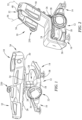
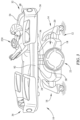
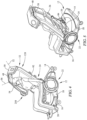
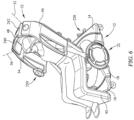
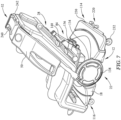
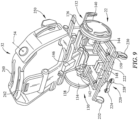
- the head end barrier assembly 32 includes a head end panel 48 that is fixed to the head section 26.
- a left hand head panel 50 is pivotably coupled to the head end panel 48 and pivotable about an axis 52 to move between the deployed position shown in Fig. 2 and a retracted position shown in Fig. 4 .
- a right hand head panel 54 is pivotably coupled to the panel 48 and pivotable about an axis 56 to a retracted position similar to the retracted position of panel 50 in Fig. 4 .
- the axes 52 and 56 are offset so that there is no interference between panels 50 and 54 when they are both in their respective retracted positions, but allow the panels 50 and 54 to offset with the panel 50 being positioned outboard of the panel 54.
- the head end barrier assembly 32 is secured to the upper frame 24 by a tab 60 which is received into a receiver 62 formed in a head end arm 64 of the upper frame 24.
- the tab 60 is formed to include a channel 66 which is engaged by a spring-loaded grip 58 which has a pawl (not shown) that is positioned in the channel 66 when the tab 60 is positioned in the receiver 62.
- the pawl of the grip 58 prevents the head end barrier assembly 32 from being removed unless a handle 68 is actuated, which disengages the pawl and allows the tab 60 to be removed from the head end arm 64 such that the entire head end barrier assembly 32 can be removed from the patient support apparatus 10.
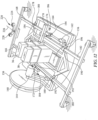
- Foot end barrier assembly 34 is removably coupled to a foot end arm 70 (seen in Fig. 11 ) in a manner similar to the way in which head end barrier assembly 32 is secured to the head end arm 64.
- the upper frame 24 includes the head end arm 64, the foot end arm 70, a thigh portion 72 and a seat portion 74.
- the seat portion 74 is pivotably coupled to the telescopic head end column 36 and a telescopic foot end column 38 and the movement of the telescopic head end column 36 and a telescopic foot end column 38 control the overall tilt of the head end arm 64, the foot end arm 70, the thigh portion 72 and the seat portion 74.
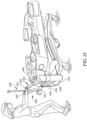
- the thigh portion 72 is pivotably coupled to the seat portion 74 and may be pivoted about an axis 80 to adjust the attitude of the thigh portion 72 relative to the seat portion 74 by a drive 82, shown kinematically in Figs. 17-19 .
- the head end arm 64 is also pivotably about an axis 86 and adjustable relative to the seat portion 74 as shown in Fig. 17 with a drive 84.
- the foot end arm 70 is pivotably coupled to the thigh portion 72 and pivotable about an axis 88 under the power of a drive 90.
- the upper frame 24 elements head end arm 64, foot end arm 70, thigh portion 72 and seat portion 74 may be adjusted between the chair configuration of Fig. 2 and the bed configuration shown in Fig. 1 .
- each of the head end arm 64, the foot end arm 70, the thigh portion 72 and the seat portion 74 have a width that is narrower than the width of a mattress 92 supported on the upper frame 24.
- the narrow width of the head end arm 64, the foot end arm 70, the thigh portion 72 and the seat portion 74 reduces the weight of the respective elements and improves the clearance under the mattress 92.
- the foot end arm 70 includes a pair of lateral beams 94 and 96 that extend from a main portion 98 to underlie the mattress 92.
- the mattress 92 is secured to the beams 94 and 96 by a fastening system that permits the mattress 92 to be removably secured to the beams 94 and 96, as well as the main portion 98 so that the mattress 92 may be fixed to the upper frame 24, while still being easily removed.
- the mattress 92 may include substrates (not shown) that provide some mechanical support where there is no underlying portion of the upper frame 24 and are secured to the components of the upper frame 24 by straps that include hook and loop fasteners.
- the thigh portion 72 includes a main portion 102 and a pair of beams 104 and 106 that extend laterally from the main portion 102.
- the seat portion 74 also includes a main portion 108 and a pair of laterally extending beams 110 and 112.
- the head end arm 64 includes a main portion 114, a head support 116 that is coupled to the main portion 114 with the head support 116 positioned at an angle relative to the main portion 114 to deflect the head end 120 of the mattress 92 to provide support for a patient's head, regardless of the position of the head end arm 64.
- the head support 116 may be adjustable relative to the main portion 114 about an axis to change the angle between the two so that the elevation of the patient's head may be adjusted.
- the head end arm 64 also includes two beams 122 and 124 that extend from the main portion 114 to the patient's right side and two beams 126 and 126 that extend toward the patient's right side from the main portion 114.
- the beams 122, 124, 126, and 128 also allow the mattress 92 to be secured to the head end arm 64 while providing reduced weight and clearance under the mattress 92.
- the drive system 22 includes a left drive unit 130 and a right drive unit 132.
- Each drive unit 130, 132 includes a respective drive wheel 134, 136 and a respective user input 138, 140.
- the user inputs 138, 140 are accessible by a patient seated on the patient support apparatus 10 when the patient support apparatus 10 is in the chair configuration.
- the user inputs 138, 140 allow the user to provide an input to propel the patient support apparatus 10 over the floor, similar to the functionality of a wheelchair.
- the drive system 22 may rely entirely upon the force applied by a user to the user inputs 138 and 140 which is transferred to the drive wheels 134, 136 to move the patient support apparatus 10.
- the drive system 22 includes respective left drive motor 142 and right drive motor 144 which react to the user inputs 138 and 140 to provide a drive signal to the respective drive motors 142 and 144 which then, in turn, drive the drive wheels 134 and 136.
- the action of the drive motors 142 and 144 is responsive to the magnitude of the inputs to the user inputs 138 and 140, but tend to multiply the force applied by the user so that the force input required by the user is reduced. This allows a user who is not strong enough to actually propel themselves across the floor to be independent.
- magnification of the user inputs 138 and 140 can be set to offset the weight of the patient support apparatus 10 that exceeds the weight of a typical wheelchair, overcoming the difficulties of having a stretcher/bed act as a wheelchair, while still allowing a user to control the motion of the patient support apparatus 10 as a typical wheelchair.
- the drive system 22 is controlled by a drive controller 156 which processes the user inputs 138 and 140 and provides appropriate drive signals to the motors 142 and 144 respectively.
- the battery module 148 is charged by a power supply 150, which is plugged into mains power 454 by a cord 444 when the patient support apparatus 10 is positioned in fixed location. When the patient support apparatus 10 is going to be moved, the cord 444 is disconnected from the mains power 454 and the patient support apparatus 10 is operated by the battery module 148.
- the motors 142 and 144, as well as the drives 82, 84, and 90, are all powered through the mains power 454.
- the battery module 148 is used to power the motors 142, 144 and drives 82, 84, and 90 as well as all of the control circuitry of the patient support apparatus 10.
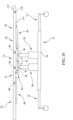
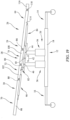
- the operation of the extendable base 12 includes the coordinated extension of the extensions 14 and 16 relative to the main portion 18 of the base 12.
- the movement of the extensions 14 and 16 is caused by the coordinated extension and retraction of two drives 160 and 162.
- Each of the drives 160 and 162 are fixed at one end to a frame 164 of the base 12.
- the opposite ends of the drives 160 and 162 are connected to respective beams 166 and 168 of the extension 14.
- the beams 166 and 168 are supported from a cross-bar 170 which includes respective yokes 172 and 174 which engage the beams 166 and 168 but permit relative movement of the beams 166 and 168 relative to the cross-bar 170.
- the cross-bar 170 is a component of the frame 164 so that the movement of the beams 166 and 168 is relative to the frame 164.
- the beams 166 and 168 are also engaged with another set of respective yokes 176 and 178 which are supported from a member 180 of the frame 164.
- the yokes 172 and 176 cooperate to guide the movement of the beam 166 relative to frame 164, while the yokes 174 and 178 cooperate to guide the movement of beam 168 relative to frame 164.
- Movement of the beams 166 and 168 drives 160 and 162 is also transferred to two beams 180 and 182 of the extension 16 through a pair of transmissions 184 and 186.
- the beam 180 is supported on the cross-bar 170 by a yoke 188 and on a member 190 of frame 164 by a yoke 192.
- the beam 182 is supported on the cross-bar 170 by a yoke 194 and the member 190 by a yoke 196.
- the movement of the beams 180 and 182 relative to the respective yokes 188, 192 and 194, 196 results in movement of the extension 16 relative to the frame 164 and main portion 18 of the base 12.
- the transmissions 184 and 186 cooperate to cause the movement of the extension 16 to be coordinated with and proportional to the movement of the extension 14.
- Each transmission comprises a drive rack 200, a follower rack 202, and a pinion 204.
- the drive rack 200 of each transmission 184 and 186 is positioned on the driven beams 166 and 168 of extension 14.
- the follower rack 202 of each transmission 184 and 186 is positioned on the beams 180 and 182 of the extension 16.
- the pinion 204 of each transmission 184 and 186 is positioned between the respective drive rack 200 and follower rack 202 and supported by the cross-bar 170.
- the pinion 204 is rotatable relative to the cross-bar 170 so that as the drive rack 200 is moved, teeth 210 of the drive rack 200 engages teeth 212 of the pinion 204 to cause the pinion 204 to rotate.
- the teeth 212 of the pinion 204 engage teeth 214 of the follower rack 202 such that the motion of the drive rack 200 is transferred through the pinion 204 to the follower rack 202, causing movement of the beams 180 and 182.
- the drives 160 and 162 are controlled by a controller 146 (shown in Fig. 9 ) which also controls the drives 82, 84, and 90 and the lifts 36 and 38.
- the length of the base 12 is controlled by the position of the extensions 14 and 16, but is dependent on the configuration of the upper frame 24 of the patient support apparatus 10.
- the extensions 14 and 16 are positioned to reduce the potential of tipping of the patient support apparatus 10 due to a cantilevered load being positioned to far from the center-of-gravity of the patient support apparatus 10. As the head section 26 and foot section 30 of the patient support apparatus 10 are moved to the chair configuration, the potential for a tipping issue to arise is reduced.
- the extensions 14 and 16 are controlled based on the position of the head section 26 and foot section 30.
- the controller 146 receives inputs to control the position of the head section 26 and foot section 30 and processes the positions of those components to move the extensions 14 and 16.
- the control of the position of the extensions 14 and 16 is controlled by logic on the controller 146, which, in turn, controls the operation of the drives 160 and 162.
- Each of the drives 160, 162, 82, 84, and 90 and the lifts 36 and 38 have internal sensors (not shown) that provide position information so that the controller 146 is able to discern the position of all of the components of the patient support apparatus 10 at any time and control the extensions 14 and 16 to mitigate the potential for tipping of the patient support apparatus 10 and to provide clearance for other components as necessary.
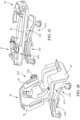
- the patient support apparatus 10 may also include an input pedal 220 (seen in Fig. 12 , for example) that is actuable by a user to choose a mobility mode of the patient support apparatus 10.
- the pedal 220 is supported on a cross-bar 222 of the extension 14 and is movable to three positions which correspond to three modes: neutral, as shown in Fig. 12 ; brake, which is achieved when a user steps on a pad 224 to cause the pedal 220 to rotate about its axis 226 to position pad 224 lower than a pad 228, and steer, which is achieved when user steps on the pad 228 and causes the pedal 220 to move to the pad 228 a to a position that is lower than the pad 224.
- the pedal 220 actuates a mechanical braking system to lock two casters 230 and 232 positioned on the extension 14 to prevent them from rotating about a horizontal axis and swiveling about a vertical axis, as is known in the art.
- a signal is sent to the drive controller 156 to cause the drive wheels 134 and 136 to be immobilized electrically to create two additional points to block the patient support apparatus 10 from movement relative to the floor.
- the casters 230 and 232 and the drive wheels 134 and 136 are all free to move independently to allow the patient support apparatus 10 to be moved in a free wheel mode over the floor.
- the casters 230 and 232 are placed in the neutral mode so that they are free to rotate and swivel, but the drive wheels 134 and 136 are placed under control of the drive controller 156 and driven by the motors 142 and 144 respectively.
- the patient support apparatus 10 includes a sensor assembly (not shown) which is operable to detect the position of the pedal 220 and provide that information to the drive controller 156.
- the mechanical structure that changes the mode of the casters 230 and 232 may be omitted and casters 230 and 232 may remain free to rotate and swivel in all modes.
- the locking of the patient support apparatus 10 relative to the floor is effected by the drive wheels 134 and 136 only.
- the user inputs 138 and 140 may move with the drive wheels 134 and 136 respectively, but are connected to the drive wheels 134 and 136 by load sensors (not shown) which sense torque applied to the user inputs 138 and 140 and the drive controller 156 responds to those inputs to mimic the operation of a wheelchair.
- the user inputs 138 and 140 may be fixed relative to the drive wheels 134 and 136 so that a user must apply a constant force to the user inputs 138 and 140 to provide a drive signal for the respective drive wheel 134 or 136. In this way, the user does not have to move their hands, but only applies a relative force to provide a relative input to the respective drive wheel 134 or 136, much like a zero-turn lawn mower or a skid steer apparatus.
- the patient support apparatus 10 also includes a caregiver responsive input 260 positioned in the head support 116.
- the caregiver input 260 is embodied as a strain gauge that is responsive to pressure applied to the head end panel 48 at either an upper grip 240 or lower grip 242 shown in Fig. 9 . Pressure on either of the grips 240 or 242 is sensed by the strain gauge 260 and is translated to a drive signal by the drive controller 156.
- the strain gauge 260 is configured to measure torque applied to the grips 240 or 242 to determine the relative drive speed of each of the drive wheels 134 and 136 to steer the patient support apparatus 10 from the input by the caregiver on the grip 240 or 242.
- the grips 240 and 242 are used when the patient support apparatus 10 is being used to transport the patient in a bed configuration, or when a caregiver has control over the patient support apparatus 10.
- the strain gauge 260 signal is provided by the caregiver applying pressure to the grip 240 or grip 242 overrides any input applied to the user inputs 138 or 140 as the caregiver control dominates the patient control of the patient support apparatus 10.
- a user may apply force in either a forward or rearward direction on the left side of the patient support apparatus 10 as indicated by arrow 262.
- the user may apply force in the forward or rearward direction on the left side of the patient support apparatus 10 as indicated by arrow 264.
- the various resulting motions of the patient support apparatus 10 are suggested by the arrows 266, 268, 270, and 272.
- the patient support apparatus 10 may make a reverse turn as suggested by arrow 266, a forward turn as suggest by arrow 268, or may move forward as indicated by arrow 270 or in reverse as indicated by arrow 272.
- the patient support apparatus 10 may further include a wireless pendant 250 which has user inputs typical of a patient support apparatus 10 that allows a user to provide inputs to the controller 146 wirelessly.
- the pendant 250 may communicate to the controller 146 using Bluetooth ® based protocol, but other wireless protocols may be employed as well.
- the pendant 250 may be connected to the controller 146 by a wired connection. The pendant 250 may be inductively charged when it is mounted to another component of the patient support apparatus 10.
- the pendant 250 includes a touchscreen graphical user interface (GUI) and any functions that are limited to an authorized caregiver are not displayed on the GUI until an authorized user is detected to be in the vicinity of the GUI by a locating and tracking system or by a wireless RFID signal from a caregiver identification tag or system.
- GUI touchscreen graphical user interface
- the pendant 250 is paired with a particular patient support apparatus 10 and if the pendant 250 is taken out of range of the patient support apparatus 10, the GUI will provide a message to return the pendant to the appropriate patient support apparatus 10.
- a further patient support apparatus 410 is shown in Figs. 20-21 has an upper frame 412 that functions similarly to the upper frame 24 discussed above.
- the patient support apparatus 410 utilizes a base 414 that does not have any extensions or any ability to extend and retract.
- the patient support apparatus 410 also utilizes a cantilevered lift system 416 that is similar to the lift system of the Century CC ® bed previously available from Hill-Rom Services, Inc. of Batesville, Indiana.
- the patient support apparatus 410 utilizes a typical brake-steer system, such as that available in the CareAssist ® ES bed discussed above.
- patient support apparatus 420 is similar to the patient support apparatus 410, but includes a head end structure 422 that provides support for accessories as well as a stowable push handle assembly 424.
- the structure 422 includes two posts 426 and 428 that extend upwardly from the base 414 of the patient support apparatus 420.
- the posts 426 and 428 have respective arms 432, 434 that extend outboard from each of the posts 426 and 428.
- the arms 432 and 434 each support an oxygen tank holder 436 with the arm 432 formed to include a receiver 430 for receiving an IV pole 438.
- the arm 434 supports a receiver 440 for securing a plug 442 of a power cord 444.
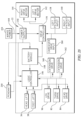
- a diagrammatic representation of the control system of the patient support apparatus 10 is disclosed.
- the lifts 36 and 38 and drives 82, 84, 90, 160, and 162 are controlled by the controller 146 as indicated by the solid arrows.
- the lifts 36 and 38 and drives 82, 84, 90, 160, and 162 include sensor that are used to determine the position of each and provide that information back to the controller 146 as suggested by the dotted lines.
- the drive controller 156 receives inputs from either the caregiver input 260 or the left patient input 138 and right patient input 140. This information is used to control the operation of the left drive motor 142 and right drive motor 144.
Landscapes
- Health & Medical Sciences (AREA)
- Life Sciences & Earth Sciences (AREA)
- Animal Behavior & Ethology (AREA)
- General Health & Medical Sciences (AREA)
- Public Health (AREA)
- Veterinary Medicine (AREA)
- Nursing (AREA)
- Invalid Beds And Related Equipment (AREA)
- Motorcycle And Bicycle Frame (AREA)
Claims (15)
- Patientenliegevorrichtung (10), umfassendeinen Unterbau (12) mit einer veränderlichen Länge;ein Paar Teleskopheber (36, 38), die sich von dem Unterbau nach oben erstrecken;einen oberen Rahmen (24), der auf den Teleskophebern (36, 38) gelagert ist, wobei der obere Rahmen (24) zwischen einer Stuhlkonfiguration und einer Bettkonfiguration beweglich ist; undein Paar unabhängiger Antriebsräder (134, 136), die an lateralen Seiten des Unterbaus (12) positioniert sind, wobei jedes der Antriebsräder (134, 136) eine unabhängige Eingabe von einem auf der Patientenliegevorrichtung (10) gelagerten Patienten erhält und auf die unabhängige Eingabe von dem Patienten reagiert, um jedes der Antriebsräder (1324, 136) in Bewegung zu versetzen und die Bewegungsrichtung der Patientenliegevorrichtung (10) über einen die Patientenliegevorrichtung (10) tragenden Fußboden zu steuern,wobei jedes Antriebsrad (134, 136) eine jeweilige unabhängige Benutzereingabevorrichtung (138, 140) hat, die für den Patienten zugänglich ist und mit dem jeweiligen Antriebsrad (134, 136) verbunden ist, wobei das jeweilige Antriebsrad (134, 136) auf eine Kraft reagiert, die auf die jeweilige dem Antriebsrad (134, 136) zugeordnete Benutzereingabevorrichtung (138, 140) angewendet wird.
- Patientenliegevorrichtung nach Anspruch 1, die ferner eine abnehmbare Schrankenanordnung umfasst, die mit einem Fußende des oberen Rahmens gekoppelt ist.
- Patientenliegevorrichtung nach Anspruch 2, wobei die abnehmbare Schrankenanordnung eine feste Platte und eine erste bewegliche Platte, die schwenkbar mit der festen Platte gekoppelt ist, umfasst, wobei die bewegliche Platte zwischen einer Schrankenstellung und einer aus dem Weg bewegten Stellung beweglich ist.
- Patientenliegevorrichtung nach Anspruch 3, wobei die entfernbare Schrankenanordnung ferner eine zweite bewegliche
Platte umfasst, die an einer der ersten beweglichen Platte entgegengesetzten Seite schwenkbar mit der festen Platte gekoppelt ist, wobei die zweite bewegliche Platte zwischen einer einschränkenden Stellung und einer aus dem Weg bewegten Stellung beweglich ist. - Patientenliegevorrichtung nach Anspruch 4, wobei die erste und die zweite bewegliche Platte in ihrer jeweiligen aus dem Weg bewegten Stellung nebeneinander liegen.
- Patientenliegevorrichtung nach Anspruch 3, 4 oder 5, wobei eine bewegliche Platte um eine Achse schwenkbar ist, die zu den jeweiligen Schrankenflächen der Endplatte und der beweglichen Platte stumpf ist.
- Patientenliegevorrichtung nach einem der vorhergehenden Ansprüche, wobei der Unterbau mindestens eine erste Verlängerung umfasst, die relativ zu einem Hauptteil beweglich ist, um die Länge des Unterbaus zu verlängern.
- Patientenliegevorrichtung nach Anspruch 7, wobei die erste Verlängerung von einem kraftbetriebenen Stellglied angetrieben wird, um die Verlängerung relativ zu dem Hauptteil zu bewegen.
- Patientenliegevorrichtung nach Anspruch 7 oder 8, wobei der Unterbau ferner eine zweite Verlängerung umfasst, die an einer der ersten Verlängerung entgegengesetzten Seite des Hauptteils des Unterbaus positioniert ist, wobei die zweite Verlängerung relativ zu dem Hauptteil beweglich ist, um die Länge des Unterbaus noch weiter zu verlängern.
- Patientenliegevorrichtung nach Anspruch 8 oder 9, wobei das Stellglied zum gleichzeitigen Bewegen sowohl der ersten als auch der zweiten Verlängerung zum gemeinsamen Verlängern oder Verkürzen der Länge des Unterbaus funktionell ist und/oder wobei der Unterbau ein Paar Stellglieder aufweist, die zum Ausfahren und Zurückziehen der ersten und der zweiten Verlängerung zusammenwirken.
- Patientenliegevorrichtung nach Anspruch 10, wobei die Verlängerungen Rollen aufweisen, die am Boden in Anlage sind, und wahlweise wobei die Rollen von jeder der Verlängerungen und die Antriebsräder alle gleichzeitig am Boden in Anlage sind und/oder wobei mindestens eine der Verlängerungen eine Bremse aufweist, die zum Feststellen der Rollen der jeweiligen Verlängerung, um zu verhindern, dass sich die Patientenliegevorrichtung über den Fußboden bewegt, funktionell ist.
- Patientenliegevorrichtung nach einem der vorhergehenden Ansprüche, wobei der Unterbau ein Pedal aufweist, das zum Veranlassen des Feststellens oder Lösens der unabhängigen Antriebsräder betätigt werden kann.
- Patientenliegevorrichtung nach Anspruch 12, wobei jedes der Antriebsräder von einem jeweiligen Motor angetrieben wird.
- Patientenliegevorrichtung nach Anspruch 13, wobei die von einem Benutzer auf eine jeweilige Benutzereingabevorrichtung (138, 140) angewendete Kraft durch den Motor vervielfacht wird, um ein Antriebssignal bereitzustellen, das größer als das Eingabesignal ist.
- Patientenliegevorrichtung nach Anspruch 14, die so konfiguriert ist, dass jedesmal, wenn ein Benutzer eine jeweilige Benutzereingabe betätigt, das Benutzereingabesignal für einen gleichwertigen Impuls an das jeweilige Antriebsrad angelegt wird und die Antriebsradgeschwindigkeit abnimmt, um das Verhalten eines Rollstuhls zu imitieren, und wobei die Benutzereingabe ein Signal in einer Vorwärts- oder Rückwärtsrichtung empfängt und das Antriebssignal des Motors auf die Richtung der Benutzereingabe reagiert, um die Geschwindigkeit und Richtung des jeweiligen Antriebsrads zu steuern, so dass Veränderungen der Benutzereingaben zu den jeweiligen Antriebsrädern die relative Geschwindigkeit der jeweiligen Antriebsräder verändern, um dadurch die Patientenliegevorrichtung zu lenken.
Applications Claiming Priority (1)
| Application Number | Priority Date | Filing Date | Title |
|---|---|---|---|
| US201862674369P | 2018-05-21 | 2018-05-21 |
Publications (3)
| Publication Number | Publication Date |
|---|---|
| EP3572057A2 EP3572057A2 (de) | 2019-11-27 |
| EP3572057A3 EP3572057A3 (de) | 2020-03-18 |
| EP3572057B1 true EP3572057B1 (de) | 2025-02-26 |
Family
ID=66625785
Family Applications (1)
| Application Number | Title | Priority Date | Filing Date |
|---|---|---|---|
| EP19175486.0A Active EP3572057B1 (de) | 2018-05-21 | 2019-05-20 | An mehrere transportmodi anpassbare patientenliegevorrichtung |
Country Status (2)
| Country | Link |
|---|---|
| US (3) | US11628102B2 (de) |
| EP (1) | EP3572057B1 (de) |
Families Citing this family (7)
| Publication number | Priority date | Publication date | Assignee | Title |
|---|---|---|---|---|
| US10744048B2 (en) * | 2018-04-09 | 2020-08-18 | Toyota Motor North America, Inc. | Wheelchair apparatuses including usage features |
| US11628102B2 (en) | 2018-05-21 | 2023-04-18 | Hill-Rom Services, Inc. | Patient support apparatus adaptable to multiple modes of transport |
| KR102927930B1 (ko) * | 2019-11-18 | 2026-02-19 | 엘지전자 주식회사 | 로봇 |
| CN111110472B (zh) * | 2019-12-30 | 2021-03-12 | 吉林大学 | 一体化护理床椅 |
| FR3108302B1 (fr) * | 2020-03-19 | 2023-05-19 | Ifp Energies Now | Système de propulsion électrique amovible pour un objet roulant comprenant un dispositif d’assise pliable |
| EP4415672A4 (de) * | 2021-10-13 | 2025-10-08 | Stryker Corp | Wägezellenanordnung für eine patientenliegevorrichtung |
| US11890244B2 (en) * | 2022-03-18 | 2024-02-06 | Chung-Hsiu Su | Wheeled nursing and medical device |
Citations (1)
| Publication number | Priority date | Publication date | Assignee | Title |
|---|---|---|---|---|
| US6793232B1 (en) * | 2003-04-28 | 2004-09-21 | O-Matic Corp. | Transport chair for a patient |
Family Cites Families (78)
| Publication number | Priority date | Publication date | Assignee | Title |
|---|---|---|---|---|
| US3380546A (en) * | 1966-02-14 | 1968-04-30 | Rodney R. Rabjohn | Traction drive for small vehicles |
| US3544127A (en) * | 1967-11-06 | 1970-12-01 | Peter V Dobson | Trucks |
| US3848883A (en) * | 1973-08-08 | 1974-11-19 | S Breacain | Wheelchair anti-tip apparatus |
| NO143484C (no) * | 1977-03-14 | 1981-02-25 | Sentralinstituttet For Ind For | Styrbart, motordrevet hjulunderstell. |
| US4422515A (en) * | 1981-07-29 | 1983-12-27 | The United States of America as represented by the Admin. of Veterans Affairs | Motorized wheel chair |
| US4613151A (en) | 1984-02-16 | 1986-09-23 | Kielczewski William J | High/low extension-lift power wheelchair |
| WO1989009590A1 (en) * | 1988-03-23 | 1989-10-19 | Robert Ferrand | Patient support system |
| WO1991000595A1 (de) | 1989-06-30 | 1991-01-10 | Telenorma Gmbh | Vorrichtung zum aufbringen von informationen auf einen optischen aufzeichnungsträger |
| SE9000037D0 (sv) | 1990-01-05 | 1990-01-05 | Sinpro Ab | Anordning foerlyftning och transport av objekt |
| US5083625A (en) * | 1990-07-02 | 1992-01-28 | Bleicher Joel N | Powdered maneuverable hospital cart |
| US5366036A (en) * | 1993-01-21 | 1994-11-22 | Perry Dale E | Power stand-up and reclining wheelchair |
| US6212714B1 (en) * | 1995-01-03 | 2001-04-10 | Hill-Rom, Inc. | Hospital bed and mattress having a retracting foot section |
| US7017208B2 (en) * | 1995-08-04 | 2006-03-28 | Hill-Rom Services, Inc. | Hospital bed |
| US5682631A (en) * | 1995-08-04 | 1997-11-04 | Hill-Rom, Inc. | Bed having a reduced-shear pivot and step deck combination |
| US5806111A (en) * | 1996-04-12 | 1998-09-15 | Hill-Rom, Inc. | Stretcher controls |
| CA2224388C (en) | 1996-04-12 | 2002-01-08 | Nippon Clean Engine Research Institute Co., Ltd. | Method of moving human body lying on his side |
| US7010369B2 (en) * | 1997-11-07 | 2006-03-07 | Hill-Rom Services, Inc. | Medical equipment controller |
| US6739006B2 (en) * | 1997-11-07 | 2004-05-25 | Hill-Rom Services, Inc. | Head section support for a surgical table apparatus |
| US6073289A (en) * | 1997-12-18 | 2000-06-13 | Hill-Rom, Inc. | Air fluidized bed |
| US6282738B1 (en) | 1998-08-07 | 2001-09-04 | Hill-Rom, Inc. | Ob/Gyn stretcher |
| US7834768B2 (en) * | 1999-03-05 | 2010-11-16 | Hill-Rom Services, Inc. | Obstruction detection apparatus for a bed |
| US6321878B1 (en) * | 1999-03-05 | 2001-11-27 | Hill-Rom Services, Inc. | Caster and braking system |
| US6398409B1 (en) * | 1999-03-16 | 2002-06-04 | Hill-Rom Services, Inc. | Patient support with digital X-ray cassette |
| US6427264B1 (en) * | 1999-03-19 | 2002-08-06 | Hill-Rom Services, Inc. | Gap filler for bed |
| US6330926B1 (en) * | 1999-09-15 | 2001-12-18 | Hill-Rom Services, Inc. | Stretcher having a motorized wheel |
| US6154690A (en) * | 1999-10-08 | 2000-11-28 | Coleman; Raquel | Multi-feature automated wheelchair |
| US6598247B1 (en) * | 1999-10-27 | 2003-07-29 | Hill-Rom Services, Inc. | Stretcher with mechanical power assist |
| AU2744701A (en) * | 1999-12-29 | 2001-07-09 | Hill-Rom Services, Inc. | Hospital bed |
| US6421854B1 (en) * | 2000-02-18 | 2002-07-23 | Hill-Rom Services, Inc. | Imaging stretcher |
| US7014000B2 (en) * | 2000-05-11 | 2006-03-21 | Hill-Rom Services, Inc. | Braking apparatus for a patient support |
| US8306635B2 (en) * | 2001-03-07 | 2012-11-06 | Motion Games, Llc | Motivation and enhancement of physical and mental exercise, rehabilitation, health and social interaction |
| US7090042B2 (en) * | 2001-03-12 | 2006-08-15 | Jervis B. Webb Company | Floating drive for vehicle |
| US20040124017A1 (en) * | 2001-03-30 | 2004-07-01 | Jones David Lane | Apparatus and method for weighing the occupant of a bed |
| WO2003020536A1 (en) * | 2001-09-05 | 2003-03-13 | Hill-Rom Services, Inc | Hospital bed wheel linkage apparatus |
| EP1425191B1 (de) * | 2001-09-05 | 2005-06-15 | Hill-Rom Services, Inc. | Krankenbett- lenkrollen- vorrichtung |
| US6752224B2 (en) * | 2002-02-28 | 2004-06-22 | Stryker Corporation | Wheeled carriage having a powered auxiliary wheel, auxiliary wheel overtravel, and an auxiliary wheel drive and control system |
| US7073220B2 (en) * | 2002-09-06 | 2006-07-11 | Hill-Rom Services, Inc. | Bed siderail having a latch |
| US6916056B2 (en) * | 2002-10-18 | 2005-07-12 | Godby Enterprises, Llc | Bariatric gurney and process |
| US7302717B2 (en) * | 2003-01-22 | 2007-12-04 | Hill-Rom Services, Inc. | Side and end brake/steer mechanism for stretchers |
| DE602004025337D1 (de) * | 2003-05-21 | 2010-03-18 | Hill Rom Services Inc | Krankenhausbett |
| US7690056B2 (en) * | 2004-03-26 | 2010-04-06 | Millennium Medical Products, Inc. | Stretcher supporter for a storable patient lift and transfer device and method for doing the same |
| US7886380B2 (en) * | 2004-07-28 | 2011-02-15 | Hill-Rom Services, Inc. | Hospital bed |
| AU2005277503A1 (en) * | 2004-08-16 | 2006-03-02 | Hill-Rom Services, Inc. | Home care equipment system |
| US20070182220A1 (en) | 2005-02-22 | 2007-08-09 | Walkinshaw Nathan R | Folding Chair Cot For Use With Emergency Vehicles |
| US7637464B2 (en) | 2006-01-19 | 2009-12-29 | Hill-Rom Services, Inc. | Patient support with mobile IV stand transport handle |
| US7922183B2 (en) * | 2006-01-19 | 2011-04-12 | Hill-Rom Services, Inc. | Stretcher having hand actuated wheel braking apparatus |
| EP2556811A1 (de) * | 2006-02-08 | 2013-02-13 | Hill-Rom Services, Inc. | Endplatte für Patientenauflagevorrichtung |
| US7953537B2 (en) | 2008-02-29 | 2011-05-31 | Hill-Rom Services, Inc. | Algorithm for power drive speed control |
| US8296884B2 (en) * | 2008-03-13 | 2012-10-30 | Hill-Rom Services, Inc. | Siderail gap filler |
| US8176584B2 (en) * | 2008-08-29 | 2012-05-15 | Hill-Rom Services, Inc. | Patient-support apparatus with movable top |
| US8752220B2 (en) * | 2009-07-10 | 2014-06-17 | Hill-Rom Services, Inc. | Systems for patient support, monitoring and treatment |
| US8437876B2 (en) * | 2009-08-07 | 2013-05-07 | Hill-Rom Services, Inc. | Patient health based support apparatus configuration |
| US8757308B2 (en) | 2009-09-10 | 2014-06-24 | Hill-Rom Services Inc. | Powered transport system and control methods |
| US8442738B2 (en) | 2009-10-12 | 2013-05-14 | Stryker Corporation | Speed control for patient handling device |
| US8607378B2 (en) * | 2010-03-09 | 2013-12-17 | Hill-Rom Services, Inc. | Caregiver assist device |
| US8844073B2 (en) * | 2010-06-07 | 2014-09-30 | Hill-Rom Services, Inc. | Apparatus for supporting and monitoring a person |
| US8646131B2 (en) * | 2010-07-30 | 2014-02-11 | Hill-Rom Services, Inc. | Variable height siderail |
| US8973187B2 (en) * | 2010-07-30 | 2015-03-10 | Hill-Rom Services, Inc. | Bed frame assembly with a lift system having a translatable carriage |
| US8713727B2 (en) * | 2010-07-30 | 2014-05-06 | Hill-Rom Services, Inc. | Siderail assembly for patient support apparatus |
| DE102010037710B4 (de) * | 2010-09-22 | 2016-03-17 | Alber Gmbh | Hilfsantriebsvorrichtung, Rollstuhl und Verfahren zur Ermittlung von physischen Leistungsdaten eines Rollstuhlfahrers |
| US8381337B2 (en) * | 2010-10-29 | 2013-02-26 | Hill-Rom Services, Inc. | Egress assist footboard |
| US8353071B2 (en) * | 2010-12-01 | 2013-01-15 | Hill-Rom Services, Inc. | Removable integrated board and partial foot section |
| US8266742B2 (en) * | 2010-12-06 | 2012-09-18 | Hill-Rom Services, Inc. | Biometric bed configuration |
| US8341779B2 (en) * | 2010-12-06 | 2013-01-01 | Hill-Rom Services, Inc. | Retractable foot caster supports |
| US20120246830A1 (en) * | 2011-03-31 | 2012-10-04 | Hornbach David W | Footboard egress design |
| CN102805691B (zh) | 2011-05-30 | 2016-04-13 | 朱盛楠 | 一种新型多功能医疗担架车 |
| US20130061392A1 (en) * | 2011-09-08 | 2013-03-14 | Robert Mark Zerhusen | Combination Perimeter Element and Support Boom |
| US8607388B1 (en) * | 2012-07-10 | 2013-12-17 | Hill-Rom Services, Inc. | Patient-support apparatus having patient entertainment projector |
| US9707143B2 (en) * | 2012-08-11 | 2017-07-18 | Hill-Rom Services, Inc. | Person support apparatus power drive system |
| JP6126479B2 (ja) * | 2012-09-14 | 2017-05-10 | ヤマハ発動機株式会社 | 車椅子用車輪、車椅子 |
| WO2015001640A1 (ja) * | 2013-07-04 | 2015-01-08 | ヤマハ発動機株式会社 | 車椅子用電動装置、当該車椅子用電動装置を備えた電動車椅子、および電動車椅子の駆動監視方法 |
| US10130536B2 (en) * | 2013-09-06 | 2018-11-20 | Stryker Corporation | Patient support usable with bariatric patients |
| CZ305564B6 (cs) * | 2013-11-07 | 2015-12-09 | MORAVSKĂť VĂťZKUM, s.r.o. | Robotické mobilní modifikovatelné lůžko |
| EP2883523A1 (de) | 2013-12-10 | 2015-06-17 | Hota Industrial MFG Co., Ltd. | Modulares mobiles Fahrzeug mit einem einstellbaren Achsstand |
| US9132051B2 (en) * | 2014-01-15 | 2015-09-15 | Hill-Rom Services, Inc. | Person support apparatuses with exercise functionalities |
| US10603234B2 (en) | 2016-03-30 | 2020-03-31 | Stryker Corporation | Patient support apparatuses with drive systems |
| US11389348B2 (en) * | 2018-03-29 | 2022-07-19 | Stryker Corporation | Patient transport apparatus having powered drive system utilizing dual mode user input control |
| US11628102B2 (en) | 2018-05-21 | 2023-04-18 | Hill-Rom Services, Inc. | Patient support apparatus adaptable to multiple modes of transport |
-
2019
- 2019-05-16 US US16/413,830 patent/US11628102B2/en active Active
- 2019-05-20 EP EP19175486.0A patent/EP3572057B1/de active Active
-
2023
- 2023-04-06 US US18/296,585 patent/US12336941B2/en active Active
-
2025
- 2025-06-20 US US19/244,137 patent/US20250312210A1/en active Pending
Patent Citations (1)
| Publication number | Priority date | Publication date | Assignee | Title |
|---|---|---|---|---|
| US6793232B1 (en) * | 2003-04-28 | 2004-09-21 | O-Matic Corp. | Transport chair for a patient |
Also Published As
| Publication number | Publication date |
|---|---|
| US11628102B2 (en) | 2023-04-18 |
| US12336941B2 (en) | 2025-06-24 |
| EP3572057A2 (de) | 2019-11-27 |
| EP3572057A3 (de) | 2020-03-18 |
| US20250312210A1 (en) | 2025-10-09 |
| US20190350780A1 (en) | 2019-11-21 |
| US20230248593A1 (en) | 2023-08-10 |
Similar Documents
| Publication | Publication Date | Title |
|---|---|---|
| US12336941B2 (en) | Patient support apparatus having detachable barrier assembly | |
| AU2020277119B2 (en) | Reconfigurable transport apparatus | |
| AU2019202383B2 (en) | Methods and systems for automatically articulating cots | |
| US20220202634A1 (en) | Patient Support Apparatus With Adaptive User Interface | |
| US10314754B2 (en) | Patient care and transport assembly | |
| US7073765B2 (en) | Apparatus for carrying medical equipment | |
| US9931259B2 (en) | Drive system for bed | |
| EP1912611B1 (de) | Patientenüberführungssystem | |
| EP1121084A2 (de) | Lagerbare patientenlift und transfervorrichtung | |
| US10806654B2 (en) | Motorized chair | |
| WO2011028761A2 (en) | Patient lifting and support device | |
| EP3581161B1 (de) | Rahmen zum transport einer trage und ladesystem | |
| RU2364384C1 (ru) | Тележка-подъемник для больных | |
| US10660811B2 (en) | Assistive toileting and weighing device | |
| US20120068838A1 (en) | Bariatric Patient Lift Apparatus | |
| EP4608349B1 (de) | Anordnung und verfahren zum transport eines rollstuhls zum transport von behinderten personen | |
| GB2472426A (en) | Load handling equipment with slidably mounted third pair of wheels |
Legal Events
| Date | Code | Title | Description |
|---|---|---|---|
| PUAI | Public reference made under article 153(3) epc to a published international application that has entered the european phase |
Free format text: ORIGINAL CODE: 0009012 |
|
| STAA | Information on the status of an ep patent application or granted ep patent |
Free format text: STATUS: THE APPLICATION HAS BEEN PUBLISHED |
|
| AK | Designated contracting states |
Kind code of ref document: A2 Designated state(s): AL AT BE BG CH CY CZ DE DK EE ES FI FR GB GR HR HU IE IS IT LI LT LU LV MC MK MT NL NO PL PT RO RS SE SI SK SM TR |
|
| AX | Request for extension of the european patent |
Extension state: BA ME |
|
| PUAL | Search report despatched |
Free format text: ORIGINAL CODE: 0009013 |
|
| AK | Designated contracting states |
Kind code of ref document: A3 Designated state(s): AL AT BE BG CH CY CZ DE DK EE ES FI FR GB GR HR HU IE IS IT LI LT LU LV MC MK MT NL NO PL PT RO RS SE SI SK SM TR |
|
| AX | Request for extension of the european patent |
Extension state: BA ME |
|
| RIC1 | Information provided on ipc code assigned before grant |
Ipc: A61G 7/053 20060101ALN20200212BHEP Ipc: A61G 5/04 20130101ALI20200212BHEP Ipc: A61G 5/10 20060101ALI20200212BHEP Ipc: A61G 7/05 20060101ALN20200212BHEP Ipc: A61G 7/015 20060101ALN20200212BHEP Ipc: A61G 7/018 20060101ALN20200212BHEP Ipc: A61G 7/08 20060101ALN20200212BHEP Ipc: A61G 7/005 20060101ALN20200212BHEP Ipc: A61G 5/00 20060101AFI20200212BHEP |
|
| STAA | Information on the status of an ep patent application or granted ep patent |
Free format text: STATUS: REQUEST FOR EXAMINATION WAS MADE |
|
| 17P | Request for examination filed |
Effective date: 20200918 |
|
| RBV | Designated contracting states (corrected) |
Designated state(s): AL AT BE BG CH CY CZ DE DK EE ES FI FR GB GR HR HU IE IS IT LI LT LU LV MC MK MT NL NO PL PT RO RS SE SI SK SM TR |
|
| STAA | Information on the status of an ep patent application or granted ep patent |
Free format text: STATUS: EXAMINATION IS IN PROGRESS |
|
| 17Q | First examination report despatched |
Effective date: 20220930 |
|
| GRAP | Despatch of communication of intention to grant a patent |
Free format text: ORIGINAL CODE: EPIDOSNIGR1 |
|
| STAA | Information on the status of an ep patent application or granted ep patent |
Free format text: STATUS: GRANT OF PATENT IS INTENDED |
|
| RIC1 | Information provided on ipc code assigned before grant |
Ipc: A61G 7/05 20060101ALN20240416BHEP Ipc: A61G 7/08 20060101ALN20240416BHEP Ipc: A61G 7/053 20060101ALN20240416BHEP Ipc: A61G 7/018 20060101ALN20240416BHEP Ipc: A61G 7/015 20060101ALN20240416BHEP Ipc: A61G 7/005 20060101ALN20240416BHEP Ipc: A61G 5/10 20060101ALI20240416BHEP Ipc: A61G 5/04 20130101ALI20240416BHEP Ipc: A61G 5/00 20060101AFI20240416BHEP |
|
| INTG | Intention to grant announced |
Effective date: 20240430 |
|
| GRAJ | Information related to disapproval of communication of intention to grant by the applicant or resumption of examination proceedings by the epo deleted |
Free format text: ORIGINAL CODE: EPIDOSDIGR1 |
|
| STAA | Information on the status of an ep patent application or granted ep patent |
Free format text: STATUS: EXAMINATION IS IN PROGRESS |
|
| GRAP | Despatch of communication of intention to grant a patent |
Free format text: ORIGINAL CODE: EPIDOSNIGR1 |
|
| STAA | Information on the status of an ep patent application or granted ep patent |
Free format text: STATUS: GRANT OF PATENT IS INTENDED |
|
| INTC | Intention to grant announced (deleted) | ||
| RIC1 | Information provided on ipc code assigned before grant |
Ipc: A61G 7/05 20060101ALN20240905BHEP Ipc: A61G 7/08 20060101ALN20240905BHEP Ipc: A61G 7/053 20060101ALN20240905BHEP Ipc: A61G 7/018 20060101ALN20240905BHEP Ipc: A61G 7/015 20060101ALN20240905BHEP Ipc: A61G 7/005 20060101ALN20240905BHEP Ipc: A61G 5/10 20060101ALI20240905BHEP Ipc: A61G 5/04 20130101ALI20240905BHEP Ipc: A61G 5/00 20060101AFI20240905BHEP |
|
| INTG | Intention to grant announced |
Effective date: 20240917 |
|
| GRAS | Grant fee paid |
Free format text: ORIGINAL CODE: EPIDOSNIGR3 |
|
| GRAA | (expected) grant |
Free format text: ORIGINAL CODE: 0009210 |
|
| STAA | Information on the status of an ep patent application or granted ep patent |
Free format text: STATUS: THE PATENT HAS BEEN GRANTED |
|
| AK | Designated contracting states |
Kind code of ref document: B1 Designated state(s): AL AT BE BG CH CY CZ DE DK EE ES FI FR GB GR HR HU IE IS IT LI LT LU LV MC MK MT NL NO PL PT RO RS SE SI SK SM TR |
|
| REG | Reference to a national code |
Ref country code: GB Ref legal event code: FG4D |
|
| REG | Reference to a national code |
Ref country code: CH Ref legal event code: EP |
|
| REG | Reference to a national code |
Ref country code: DE Ref legal event code: R096 Ref document number: 602019066405 Country of ref document: DE |
|
| REG | Reference to a national code |
Ref country code: IE Ref legal event code: FG4D |
|
| REG | Reference to a national code |
Ref country code: NL Ref legal event code: MP Effective date: 20250226 |
|
| PG25 | Lapsed in a contracting state [announced via postgrant information from national office to epo] |
Ref country code: RS Free format text: LAPSE BECAUSE OF FAILURE TO SUBMIT A TRANSLATION OF THE DESCRIPTION OR TO PAY THE FEE WITHIN THE PRESCRIBED TIME-LIMIT Effective date: 20250526 |
|
| PG25 | Lapsed in a contracting state [announced via postgrant information from national office to epo] |
Ref country code: FI Free format text: LAPSE BECAUSE OF FAILURE TO SUBMIT A TRANSLATION OF THE DESCRIPTION OR TO PAY THE FEE WITHIN THE PRESCRIBED TIME-LIMIT Effective date: 20250226 |
|
| PG25 | Lapsed in a contracting state [announced via postgrant information from national office to epo] |
Ref country code: PL Free format text: LAPSE BECAUSE OF FAILURE TO SUBMIT A TRANSLATION OF THE DESCRIPTION OR TO PAY THE FEE WITHIN THE PRESCRIBED TIME-LIMIT Effective date: 20250226 |
|
| PGFP | Annual fee paid to national office [announced via postgrant information from national office to epo] |
Ref country code: DE Payment date: 20250423 Year of fee payment: 7 |
|
| PG25 | Lapsed in a contracting state [announced via postgrant information from national office to epo] |
Ref country code: ES Free format text: LAPSE BECAUSE OF FAILURE TO SUBMIT A TRANSLATION OF THE DESCRIPTION OR TO PAY THE FEE WITHIN THE PRESCRIBED TIME-LIMIT Effective date: 20250226 |
|
| PGFP | Annual fee paid to national office [announced via postgrant information from national office to epo] |
Ref country code: GB Payment date: 20250423 Year of fee payment: 7 |
|
| REG | Reference to a national code |
Ref country code: LT Ref legal event code: MG9D |
|
| PG25 | Lapsed in a contracting state [announced via postgrant information from national office to epo] |
Ref country code: IS Free format text: LAPSE BECAUSE OF FAILURE TO SUBMIT A TRANSLATION OF THE DESCRIPTION OR TO PAY THE FEE WITHIN THE PRESCRIBED TIME-LIMIT Effective date: 20250626 Ref country code: NO Free format text: LAPSE BECAUSE OF FAILURE TO SUBMIT A TRANSLATION OF THE DESCRIPTION OR TO PAY THE FEE WITHIN THE PRESCRIBED TIME-LIMIT Effective date: 20250526 |
|
| PG25 | Lapsed in a contracting state [announced via postgrant information from national office to epo] |
Ref country code: NL Free format text: LAPSE BECAUSE OF FAILURE TO SUBMIT A TRANSLATION OF THE DESCRIPTION OR TO PAY THE FEE WITHIN THE PRESCRIBED TIME-LIMIT Effective date: 20250226 |
|
| PG25 | Lapsed in a contracting state [announced via postgrant information from national office to epo] |
Ref country code: HR Free format text: LAPSE BECAUSE OF FAILURE TO SUBMIT A TRANSLATION OF THE DESCRIPTION OR TO PAY THE FEE WITHIN THE PRESCRIBED TIME-LIMIT Effective date: 20250226 |
|
| PG25 | Lapsed in a contracting state [announced via postgrant information from national office to epo] |
Ref country code: LV Free format text: LAPSE BECAUSE OF FAILURE TO SUBMIT A TRANSLATION OF THE DESCRIPTION OR TO PAY THE FEE WITHIN THE PRESCRIBED TIME-LIMIT Effective date: 20250226 Ref country code: PT Free format text: LAPSE BECAUSE OF FAILURE TO SUBMIT A TRANSLATION OF THE DESCRIPTION OR TO PAY THE FEE WITHIN THE PRESCRIBED TIME-LIMIT Effective date: 20250626 |
|
| PGFP | Annual fee paid to national office [announced via postgrant information from national office to epo] |
Ref country code: FR Payment date: 20250423 Year of fee payment: 7 |
|
| PG25 | Lapsed in a contracting state [announced via postgrant information from national office to epo] |
Ref country code: GR Free format text: LAPSE BECAUSE OF FAILURE TO SUBMIT A TRANSLATION OF THE DESCRIPTION OR TO PAY THE FEE WITHIN THE PRESCRIBED TIME-LIMIT Effective date: 20250527 Ref country code: BG Free format text: LAPSE BECAUSE OF FAILURE TO SUBMIT A TRANSLATION OF THE DESCRIPTION OR TO PAY THE FEE WITHIN THE PRESCRIBED TIME-LIMIT Effective date: 20250226 |
|
| REG | Reference to a national code |
Ref country code: AT Ref legal event code: MK05 Ref document number: 1769945 Country of ref document: AT Kind code of ref document: T Effective date: 20250226 |
|
| PG25 | Lapsed in a contracting state [announced via postgrant information from national office to epo] |
Ref country code: SE Free format text: LAPSE BECAUSE OF FAILURE TO SUBMIT A TRANSLATION OF THE DESCRIPTION OR TO PAY THE FEE WITHIN THE PRESCRIBED TIME-LIMIT Effective date: 20250226 |
|
| PG25 | Lapsed in a contracting state [announced via postgrant information from national office to epo] |
Ref country code: SM Free format text: LAPSE BECAUSE OF FAILURE TO SUBMIT A TRANSLATION OF THE DESCRIPTION OR TO PAY THE FEE WITHIN THE PRESCRIBED TIME-LIMIT Effective date: 20250226 |
|
| PG25 | Lapsed in a contracting state [announced via postgrant information from national office to epo] |
Ref country code: DK Free format text: LAPSE BECAUSE OF FAILURE TO SUBMIT A TRANSLATION OF THE DESCRIPTION OR TO PAY THE FEE WITHIN THE PRESCRIBED TIME-LIMIT Effective date: 20250226 |
|
| PG25 | Lapsed in a contracting state [announced via postgrant information from national office to epo] |
Ref country code: IT Free format text: LAPSE BECAUSE OF FAILURE TO SUBMIT A TRANSLATION OF THE DESCRIPTION OR TO PAY THE FEE WITHIN THE PRESCRIBED TIME-LIMIT Effective date: 20250226 |
|
| PG25 | Lapsed in a contracting state [announced via postgrant information from national office to epo] |
Ref country code: AT Free format text: LAPSE BECAUSE OF FAILURE TO SUBMIT A TRANSLATION OF THE DESCRIPTION OR TO PAY THE FEE WITHIN THE PRESCRIBED TIME-LIMIT Effective date: 20250226 |
|
| PG25 | Lapsed in a contracting state [announced via postgrant information from national office to epo] |
Ref country code: CZ Free format text: LAPSE BECAUSE OF FAILURE TO SUBMIT A TRANSLATION OF THE DESCRIPTION OR TO PAY THE FEE WITHIN THE PRESCRIBED TIME-LIMIT Effective date: 20250226 Ref country code: EE Free format text: LAPSE BECAUSE OF FAILURE TO SUBMIT A TRANSLATION OF THE DESCRIPTION OR TO PAY THE FEE WITHIN THE PRESCRIBED TIME-LIMIT Effective date: 20250226 |
|
| PG25 | Lapsed in a contracting state [announced via postgrant information from national office to epo] |
Ref country code: RO Free format text: LAPSE BECAUSE OF FAILURE TO SUBMIT A TRANSLATION OF THE DESCRIPTION OR TO PAY THE FEE WITHIN THE PRESCRIBED TIME-LIMIT Effective date: 20250226 |
|
| PG25 | Lapsed in a contracting state [announced via postgrant information from national office to epo] |
Ref country code: SK Free format text: LAPSE BECAUSE OF FAILURE TO SUBMIT A TRANSLATION OF THE DESCRIPTION OR TO PAY THE FEE WITHIN THE PRESCRIBED TIME-LIMIT Effective date: 20250226 |
|
| REG | Reference to a national code |
Ref country code: DE Ref legal event code: R097 Ref document number: 602019066405 Country of ref document: DE |
|
| REG | Reference to a national code |
Ref country code: CH Ref legal event code: H13 Free format text: ST27 STATUS EVENT CODE: U-0-0-H10-H13 (AS PROVIDED BY THE NATIONAL OFFICE) Effective date: 20251223 |
|
| PLBE | No opposition filed within time limit |
Free format text: ORIGINAL CODE: 0009261 |
|
| STAA | Information on the status of an ep patent application or granted ep patent |
Free format text: STATUS: NO OPPOSITION FILED WITHIN TIME LIMIT |
|
| PG25 | Lapsed in a contracting state [announced via postgrant information from national office to epo] |
Ref country code: LU Free format text: LAPSE BECAUSE OF NON-PAYMENT OF DUE FEES Effective date: 20250520 |
|
| PG25 | Lapsed in a contracting state [announced via postgrant information from national office to epo] |
Ref country code: CH Free format text: LAPSE BECAUSE OF NON-PAYMENT OF DUE FEES Effective date: 20250531 |
|
| REG | Reference to a national code |
Ref country code: BE Ref legal event code: MM Effective date: 20250531 |
|
| PG25 | Lapsed in a contracting state [announced via postgrant information from national office to epo] |
Ref country code: MC Free format text: LAPSE BECAUSE OF FAILURE TO SUBMIT A TRANSLATION OF THE DESCRIPTION OR TO PAY THE FEE WITHIN THE PRESCRIBED TIME-LIMIT Effective date: 20250226 |
|
| 26N | No opposition filed |
Effective date: 20251127 |