EP3571504B1 - Kontaktloses verfahren zur messung zeitabhängiger rheologischer und polymerizationseigenschaften einer probe - Google Patents
Kontaktloses verfahren zur messung zeitabhängiger rheologischer und polymerizationseigenschaften einer probe Download PDFInfo
- Publication number
- EP3571504B1 EP3571504B1 EP18741276.2A EP18741276A EP3571504B1 EP 3571504 B1 EP3571504 B1 EP 3571504B1 EP 18741276 A EP18741276 A EP 18741276A EP 3571504 B1 EP3571504 B1 EP 3571504B1
- Authority
- EP
- European Patent Office
- Prior art keywords
- sample
- mechanical
- photo
- optical
- tweezograph
- Prior art date
- Legal status (The legal status is an assumption and is not a legal conclusion. Google has not performed a legal analysis and makes no representation as to the accuracy of the status listed.)
- Active
Links
Images







Classifications
-
- G—PHYSICS
- G01—MEASURING; TESTING
- G01N—INVESTIGATING OR ANALYSING MATERIALS BY DETERMINING THEIR CHEMICAL OR PHYSICAL PROPERTIES
- G01N33/00—Investigating or analysing materials by specific methods not covered by groups G01N1/00 - G01N31/00
- G01N33/48—Biological material, e.g. blood, urine; Haemocytometers
- G01N33/483—Physical analysis of biological material
- G01N33/487—Physical analysis of biological material of liquid biological material
- G01N33/49—Blood
- G01N33/4905—Determining clotting time of blood
-
- G—PHYSICS
- G01—MEASURING; TESTING
- G01N—INVESTIGATING OR ANALYSING MATERIALS BY DETERMINING THEIR CHEMICAL OR PHYSICAL PROPERTIES
- G01N21/00—Investigating or analysing materials by the use of optical means, i.e. using sub-millimetre waves, infrared, visible or ultraviolet light
- G01N21/17—Systems in which incident light is modified in accordance with the properties of the material investigated
- G01N21/1717—Systems in which incident light is modified in accordance with the properties of the material investigated with a modulation of one or more physical properties of the sample during the optical investigation, e.g. electro-reflectance
-
- G—PHYSICS
- G01—MEASURING; TESTING
- G01N—INVESTIGATING OR ANALYSING MATERIALS BY DETERMINING THEIR CHEMICAL OR PHYSICAL PROPERTIES
- G01N33/00—Investigating or analysing materials by specific methods not covered by groups G01N1/00 - G01N31/00
- G01N33/48—Biological material, e.g. blood, urine; Haemocytometers
- G01N33/50—Chemical analysis of biological material, e.g. blood, urine; Testing involving biospecific ligand binding methods; Immunological testing
- G01N33/86—Chemical analysis of biological material, e.g. blood, urine; Testing involving biospecific ligand binding methods; Immunological testing involving blood coagulating time or factors, or their receptors
-
- G—PHYSICS
- G01—MEASURING; TESTING
- G01N—INVESTIGATING OR ANALYSING MATERIALS BY DETERMINING THEIR CHEMICAL OR PHYSICAL PROPERTIES
- G01N21/00—Investigating or analysing materials by the use of optical means, i.e. using sub-millimetre waves, infrared, visible or ultraviolet light
- G01N21/17—Systems in which incident light is modified in accordance with the properties of the material investigated
- G01N21/1717—Systems in which incident light is modified in accordance with the properties of the material investigated with a modulation of one or more physical properties of the sample during the optical investigation, e.g. electro-reflectance
- G01N2021/1721—Electromodulation
-
- G—PHYSICS
- G01—MEASURING; TESTING
- G01N—INVESTIGATING OR ANALYSING MATERIALS BY DETERMINING THEIR CHEMICAL OR PHYSICAL PROPERTIES
- G01N21/00—Investigating or analysing materials by the use of optical means, i.e. using sub-millimetre waves, infrared, visible or ultraviolet light
- G01N21/17—Systems in which incident light is modified in accordance with the properties of the material investigated
- G01N21/1717—Systems in which incident light is modified in accordance with the properties of the material investigated with a modulation of one or more physical properties of the sample during the optical investigation, e.g. electro-reflectance
- G01N2021/1725—Modulation of properties by light, e.g. photoreflectance
-
- G—PHYSICS
- G01—MEASURING; TESTING
- G01N—INVESTIGATING OR ANALYSING MATERIALS BY DETERMINING THEIR CHEMICAL OR PHYSICAL PROPERTIES
- G01N21/00—Investigating or analysing materials by the use of optical means, i.e. using sub-millimetre waves, infrared, visible or ultraviolet light
- G01N21/17—Systems in which incident light is modified in accordance with the properties of the material investigated
- G01N21/1717—Systems in which incident light is modified in accordance with the properties of the material investigated with a modulation of one or more physical properties of the sample during the optical investigation, e.g. electro-reflectance
- G01N2021/1729—Piezomodulation
-
- G—PHYSICS
- G01—MEASURING; TESTING
- G01N—INVESTIGATING OR ANALYSING MATERIALS BY DETERMINING THEIR CHEMICAL OR PHYSICAL PROPERTIES
- G01N21/00—Investigating or analysing materials by the use of optical means, i.e. using sub-millimetre waves, infrared, visible or ultraviolet light
- G01N21/17—Systems in which incident light is modified in accordance with the properties of the material investigated
- G01N21/25—Colour; Spectral properties, i.e. comparison of effect of material on the light at two or more different wavelengths or wavelength bands
- G01N21/27—Colour; Spectral properties, i.e. comparison of effect of material on the light at two or more different wavelengths or wavelength bands using photo-electric detection ; circuits for computing concentration
- G01N21/272—Colour; Spectral properties, i.e. comparison of effect of material on the light at two or more different wavelengths or wavelength bands using photo-electric detection ; circuits for computing concentration for following a reaction, e.g. for determining photometrically a reaction rate (photometric cinetic analysis)
-
- G—PHYSICS
- G01—MEASURING; TESTING
- G01N—INVESTIGATING OR ANALYSING MATERIALS BY DETERMINING THEIR CHEMICAL OR PHYSICAL PROPERTIES
- G01N21/00—Investigating or analysing materials by the use of optical means, i.e. using sub-millimetre waves, infrared, visible or ultraviolet light
- G01N21/75—Systems in which material is subjected to a chemical reaction, the progress or the result of the reaction being investigated
- G01N21/77—Systems in which material is subjected to a chemical reaction, the progress or the result of the reaction being investigated by observing the effect on a chemical indicator
- G01N21/82—Systems in which material is subjected to a chemical reaction, the progress or the result of the reaction being investigated by observing the effect on a chemical indicator producing a precipitate or turbidity
Definitions
- the disclosed technology relates generally to noncontact methods, devices and systems for measuring polymerization of a sample.
- a system of one or more computers can be configured to perform particular operations or actions by virtue of having software, firmware, hardware, or a combination of them installed on the system that in operation causes or cause the system to perform the actions.
- One or more computer programs can be configured to perform particular operations or actions by virtue of including instructions that, when executed by data processing apparatus, cause the apparatus to perform the actions.
- One Example includes a noncontact, acoustic-tweezing method of measuring time-dependent rheological and polymerization properties of a sample including: levitating the sample, modulating the amplitude of acoustic pressure applied to the sample so as to induce deformation, capturing at least one image of the sample, collecting at least one photo-optical measurement and at least one mechanical measurement from the captured images of the levitating sample during deformation, and determining at least one rheological property of the sample.
- Other embodiments of this Example include corresponding computer systems, apparatus, and computer programs recorded on one or more computer storage devices, each configured to perform the actions of the methods.
- Implementations may include one or more of the following features.
- the method where the deformation is quasi-static or oscillatory.
- the method further including determining at least one kinetic property of sample polymerization.
- the method where the determined kinetic properties of sample polymerization are selected from the group including of: photo-optical tweezograph, mechanical tweezograph, reaction time, monomer formation rate, maximum monomer level, polymerization onset, polymerization rate, polymerization time, gel firmness and polymer network formation time.
- the method where the polymer network formation time is the time difference between the polymerization rate in a mechanical tweezograph and he monomer formation rate in a photo-optical tweezograph.
- the method where the rheological property is coagulation.
- the method where the at least one photo-optical measurement is selected from the group including of: light intensity, laser scattering intensity and turbidity.
- the method where the at least one mechanical measurement is elasticity.
- the method where the at least one image is photographic.
- the method where the at least one image is a laser scattering image.
- the method further including executing data analysis on the collected at least one photo-optical measurement and at least one mechanical measurement.
- the method where the sample is a biological material selected from the group including of: whole blood, blood plasma, mucus, sperm, lymph, synovial fluid, cerebrospinal fluid and soft biological tissue.
- the method where the sample is selected from the group including of: a polymer, a polymer gel and a polymeric liquid.
- the method where the at least one photo-optical measurement is selected from the group including of: average light intensity through central area of the sample and turbidity of the sample over time.
- the method where the one or more mechanical measurements are determined from quasi-static and oscillatory deformation of the sample for different acoustic pressure amplitudes at different times.
- the method where the one or more rheological property is selected from the group including of: elastic modulus, shear elasticity, shear viscosity, dynamic modulus, storage modulus, and loss modulus.
- the method where the fibrin network formation time (FNFT) is the time difference between the clotting rate (CR) in a mechanical tweezograph and the fibrin formation rate (FFR) in a photo-optical tweezograph.
- the method where the extracted coagulation kinetics data is selected from the group including of: photo-optical tweezograph, mechanical tweezograph, reaction time (RT), fibrin formation rate (FFR), maximum fibrin level (MFL), clot initiation time (CIT), clotting rate (CR), time to firm clot formation (TFCF), maximum clot firmness (MCF), and fibrin network formation time (FNFT).
- the method further including extracting coagulation kinetics data.
- the method further including evaluating functional levels of fibrinogen from at least one of RT, MFL, MCF, and FNFT data extracted from the photo-optical and mechanical tweezographs.
- the method further including evaluating functional levels of factor XIII.
- the method may also include from at least one of RT, MFL, MCF, and FNFT data extracted from the photo-optical and mechanical tweezographs.
- the method further including monitoring functional levels of fibrinogen or factor xiii to assess blood coagulation disorder.
- the method further including assessing the effects of a cross-linker from the determined polymerization kinetics.
- the method further including assessing the effects of cross-link breakers on the sample from the determined polymerization kinetics.
- the method further including extracting coagulation kinetics data.
- the method further including evaluating a functional level of fibrinogen.
- the method further including evaluating a functional level of Factor XIII.
- the method further including evaluating coagulation factor deficiency.
- the method may also include from at least one of RT, MFL, MCF, and FNFT data extracted from the photo-optical and mechanical tweezographs.
- the method further including monitoring functional levels of coagulation factors to assess blood coagulation disorder.
- One Example includes a noncontact, acoustic-tweezing system for measuring time-dependent rheological and polymerization properties of a sample including: a levitator configured to levitate the sample, an amplitude modulator configured to modulate acoustic pressure applied to the sample so as to induce deformation, a camera configured to capture at least one image of the sample and generate captured images, and an analysis system configured to: collect: at least one photo-optical measurement of the sample and at least one mechanical measurement of the sample. The system also includes capturing images during deformation. The system also includes determining at least one rheological property of the sample.
- the various embodiments disclosed or contemplated herein relate to a unique, integrated noncontact method for perioperative monitoring of whole blood or blood plasma coagulation.
- the disclosed systems, methods and devices relate to an acoustic tweezing polymerization analyzer (ATPA).
- the disclosed embodiments of the ATPA method, system and associated devices are referred to herein variously for brevity, including as the "ATPA method," though no specific modality is contemplated.
- the disclosed ATPA method provides technology to measure the dynamics of polymerization in polymeric or biological fluids including the steps such as monomer production and cross-linked polymer network formation.
- the ATPA method integrates photo-optical measurements (such as light intensity or turbidity changes in the sample over time) with mechanical measurements (such as changes in bulk deformability of the sample over time), though each of the photo-optical and mechanical methods can be utilized without the other portion.
- these measurements are taken simultaneously using one single drop of sample fluid levitating or "tweezing" in air or an aqueous medium by acoustic radiation forces.
- Various implementations of the ATPA methods, systems and devices are disclosed herein. While much of this discussion focuses on blood, it is well understood that other samples of biological and other material are clearly contemplated and would be readily recognized by one of skill in the art.
- the integrated photo-optical/mechanical method can measure the coagulation parameters of whole blood or blood plasma without exposing the blood sample to artificial reagents (ellagic acid, kaolin) or inducing sample contact with artificial surfaces.
- the method integrates "acoustic tweezing"-based photo-optical and mechanical tests to allow for accurate measurement of parameters of coagulation, including: reaction time (RT), fibrin formation rate (FFR), maximum fibrin level (MFL), clot initiation time (CIT), clotting rate (CR), time to firm clot formation (TFCT), maximum clot firmness (MCF), and fibrin network formation time (FNFT).
- the last parameter has not been measureable until the development of the presently disclosed ATPA method and associated systems and devices.
- the method can use the method to assess the functional levels of fibrinogen and Factor XIII in a blood sample, which are necessary for blood clot formation.
- the method can detect the activity of molecules involved in the polymerization process or in the formation and cross-linking of fibrous proteins in biological tissues.
- the integrated photo-optical and mechanical test is performed on the same sample drop during its levitation in the acoustic tweezing device.
- the data indicate that this integrated test provide the information about coagulation parameters (including the MCF) within 10 minutes (while current devices requiring at least 30 minutes) using the sample volume of just 4 microliters ( ⁇ 100 times less than the sample volume required in available coagulation analyzers).
- the system provides a method of measuring time-dependent rheological properties of a sample such as a biological sample, comprising several steps, none of which are essential.
- One step involves levitating the sample.
- Another step requires modulating the amplitude of acoustic pressure around the sample.
- Another step requires taking one or more images of the sample at different times.
- Another step requires taking one or more photo-optical measurements and one or more mechanical measurements from the one or more images. It would be apparent to one of skill in the art that certain of these steps may be performed in any order.
- Another step requires determining the one or more rheological properties of the sample at different times from the one or more mechanical measurements.
- Another step requires assessing the polymerization kinetics from the one or more rheological properties and one or more photo-optical measurements. It will be appreciated by those of skill in the art that various additional steps may be performed, and that certain of these steps may be performed in any order and any number of times.
- the tweezograph is the graph of sample deformability ("mechanical tweezograph”) or sample light intensity / turbidity ("photo-optical tweezograph”) versus time. All kinetic data are determined from tweezographs.
- reaction time refers to the onset of light intensity or turbidity change in a photo-optical tweezograph.
- polymerization onset or “clot initiation time” is the onset of sample deformability change in a mechanical tweezograph.
- “monomer formation rate” or “fibrin formation rate” is the time to reach the maximum rate light intensity or turbidity change in a photo-optical tweezograph.
- polymerization rate or “clotting rate” is the maximum rate of sample deformability change in a mechanical tweezograph.
- polymerization time is the time it takes to reach a plateau in a mechanical tweezograph.
- maximum monomer level or “maximum fibrin level” is the plateau value of light intensity or turbidity in a photo-optical tweezograph.
- polymer network formation time or “fibrin network formation time” is the time difference between reaching the "polymerization rate” or the CR in a mechanical tweezograph and the "monomer formation rate” or the FFR in a photo-optical tweezograph.
- the physical meaning of this parameter is the time delay between the processes of monomer formation and polymerization / clotting.
- the sample may be whole blood, blood plasma, mucus, sperm, lymph, synovial fluid, cerebrospinal fluid, soft biological tissue or other known biological material, a polymer, a polymer gel, a polymeric liquid.
- the functional level of a cross-linker in case of polymerization
- Factor XIII in case of coagulation
- the hemostasis process is the result of a delicate balance between pro- and anti-coagulants, platelets and blood cells. Due to a significant loss of blood during trauma or major surgery, patients often develop coagulopathy, a pathophysiological condition characterized by depletion of both pro- and anti-coagulants in blood. Coagulopathic patients are at high risks of both hemorrhage and thrombotic complications, which significant increase patient morbidity and mortality. The coagulation status of such patients could rapidly change from an anti- to pro-coagulant state during injury and resuscitation. Therefore, monitoring the coagulation status of coagulopathic patients, especially during blood transfusion or surgery is critical.
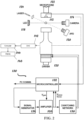
- FIG. 1A depicts a schematic overview of the acoustic tweezing system 1, comprising a levitator 100 that is in operational communication with an oscilloscope 102, a function generator 104, and an amplifier 106. As is shown in FIG.
- the levitator comprises a transducer 108, such as an acoustic transducer 108 and reflector 110.
- FIG. 1C shows a detailed depiction of a sample 112 being levitated according to this embodiment.
- the acoustic tweezing system 1 further comprises a camera 114 and an environmental control chamber.
- a further implementation of the levitator 100 comprising the function generator 104 and an amplifier 106 is further shown in FIG. 1E .
- FIG. 2 A further implementation of the acoustic tweezing system 1 is depicted in the implementation of FIG. 2 .
- the sample 112 is levitated above a driver 120 and below a microphone 122, wherein images can be captured via a camera 114 illuminated by a light source 118, such as an LED 118.
- the system 1 comprises a laser 124 and diode 126 such as an avalanche photodiode (APD) 126 for the capture and measurement of transmitted or scattered photo-optical signal at a defined wavelength range, therefore being configured to measure various optical properties of the levitated sample 112.
- a laser 124 and diode 126 such as an avalanche photodiode (APD) 126 for the capture and measurement of transmitted or scattered photo-optical signal at a defined wavelength range, therefore being configured to measure various optical properties of the levitated sample 112.
- APD avalanche photodiode
- the driver 120 and microphone 122 are in operable communication with an operations system 130.
- a microcontroller 132, signal generator 134, amplifier 106 and Z-matching network 136 are provided, such that an input signal can be generated and amplified before being sent to the transducer 108 resulting in the radiation vibration of the driver 120.
- the acoustic tweezing system 1 by placing a reflector at a specified distance from the transducer surface (either a full or half wavelength apart), the acoustic tweezing system 1 generates a standing wave field with pressure node and antinode with minimum and maximum pressure, respectively.
- the acoustic radiation pressure applied on the surface of the drop is able to levitate objects between the node and antinode, where the resulting acoustic radiation force balances gravity.
- a small drop of blood or other biological fluid 112 will be dripped into the opening, where it will be levitated in a standing acoustic wave field and forced into shape oscillation.
- the sample 112 is levitated above a driver 120 and below a microphone 122, wherein images can be captured via a camera 114 illuminated by a uniform soft light source 118, such as an LED 118.
- Greyscale images can be recorded at different frame per second (FPS) depending on the requirements of the experiment or implementation and stored in the data acquisition system through a communications system such as a high speed USB 3.0 cable, wireless transmission or the like for further shape deformation and/or photo-optical properties analysis by customized MATLAB program via a data acquisition system 142.
- Certain implementations feature at least one data acquisition system 142, which may include the oscilloscope and amplifier (depicted in FIG. 1A ), and other means of data acquisition and transmission as would be apparent to one of skill in the art.
- the shape deformation of the sample will be recorded using an optical camera 114 and analyzed on a computer 144 using theoretical and computational models.
- the rheological data are displayed on a monitor 146.
- Further implementations may comprise a pressure control system, a pressure vessel and/or housing, though these components are not essential.
- the driver or transducer consists of two 3.175-mm thick piezoelectric discs (Channel Industries, Santa Barbara, CA) and homemade aluminum bottom mass and horn to amplify and concentrate the radiation pressure.
- the working frequency of this transducer is nominally 30 kHz, requiring slight retuning to compensate for temperature shifts.
- the transducer and the reflector (an aluminum cylinder) were mounted either a full or half wavelength apart, and the assembly could be optionally inserted into a custom fabricated and sealed environmental chamber for pressure, temperature and humidity control or a 3-D positioning system custom built using parts bought from Thorlabs (Newton, NJ).
- the 30 kHz sinusoidal input signal was generated by a function synthesizer (Agilent 33220A, Santa Clara, CA) and amplified (Krohn-Hite 7500, Brockton, MA) before being sent to the transducer, whose resulting vibration creates an acoustic standing wave in the air gap between the transducer and the reflector.
- a function synthesizer Aligna, CA
- amplified Karl-Hite 7500, Brockton, MA
- Modulating Amplitude of Acoustic Pressure Various implementations require the variation of the acoustic pressure amplitude (often called a pressure sweep) in order to induce sample deformation. This step is accomplished by a way of a "mechanical" intervention, such as by varying the amplifier input voltage at a fixed frequency, or by varying the frequency at a fixed voltage input.
- the pressure sweep is completed in 30 s or less, which is much shorter than the blood clotting time.
- FNFT fibrin network formation time
- Another step requires taking one or more images of the sample by a camera at different times, as is discussed below in relation to the Examples surrounding FIGS. 3A-3B .
- Photo-Optical and Mechanical Measurements Another step requires taking one or more photo-optical measurements and one or more mechanical measurements from the one or more images, as is shown below in relation to the Examples surrounding FIGS. 3-10 .
- Another step requires determining the one or more rheological properties of the sample at different times from the one or more mechanical measurements, as is discussed below in relation to the Examples surrounding FIGS. 3-6 .
- Another step requires assessing the polymerization kinetics from the one or more rheological properties and one or more photo-optical measurements as discussed below in relation to the Examples surrounding FIG. 10 .
- the input is fixed at 400 mV, with frequency starting around 29.5kHz, which is always lower than the resonant frequency.
- sample deformation is induced by increasing the standing wave pressure amplitude. This is accomplished by slowly tune up frequency towards the resonant frequency.
- a sample drop is injected into the pressure field by syringe, an increased pressure is applied to trap the sample in the central area while pulling out the syringe. After the drop is levitated, the pressure will be decreased to an aspect ratio of about 1.2, which can be referred as "resting status,” to maintain stable status with minimum pressure on bulk surface.
- the compression process normally takes about 10 to 15 seconds and the information of vertical location and drop shape deformation is obtained by an acA1920-25um camera (Basler, Ahrensburg, Germany) at 4 FPS. After compression, pressure is reduced to "resting status" for holding until the next compression.
- the interval between compressions can be about 1-3 minutes, though it is understood that the duration, as with all of the above described steps, can depend on the implementation.
- the spatial resolution of the images can be, for example, 0.012 mm, as they were in one assessed implementation.
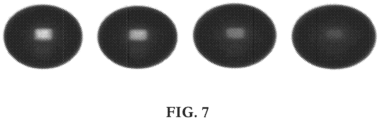
- FIG. 3A shows representative shapes of a whole blood sample undergoing an acoustic tweezing experiment according to one implementation.
- the quasi-static technique relies on the fact that, as the acoustic pressure amplitude changes (pressure sweep), the location and deformation of a sample drop are uniquely determined by its rheological properties and size as seen in this FIG. 3A , an increase in the deformation of the sample correlates with an increase in its vertical position. It is understood that with an increase in pressure (photos from left to right), the drop center lifts up and the drop experiences higher deformation.
- FIG. 3B is a mechanical tweezograph of citrated whole blood undergoes coagulation cascade, initiated by CaCl 2 solution.
- the slope of the initial portion of a location vs aspect ratio curve (which is an effective stress/strain curve) shown in FIG 3B represents elasticity or stiffness of the sample. It is understood that at least four kinetic parameters can be measured from the mechanical tweezograph: clot initiation time (CIT), time to firm clot formation (TFCF), clotting rate (CR), and maximum clot firmness (MCF).
- CIT clot initiation time
- TFCF time to firm clot formation
- CR clotting rate
- MCF maximum clot firmness
- This Example plots location, a measure of the acoustic stress applied to the drop to lift it, as a function of aspect ratio, a measure of the strain resulting from the applied acoustic stress ( FIG.3B ).
- the effective stress/strain curve shape begins at low aspect ratio, where the location increases approximately linearly with aspect ratio until the gel drop begins to yield, and thereafter the drop deforms more readily than its location increases.
- Slopes of the initial portion of location vs aspect ratio curves were obtained by linear regression, and quantified by calculating the angle of inclination to the horizontal (aspect ratio) axis.
- ⁇ arctan(m).
- the slope angle vs. time curves are referred to herein as "tweezographs.”
- FIGS. 3A-3B and 4A-4D demonstrate that quasi-static deformation tests can capture changes in the sample elasticity during gelation of those proteins.
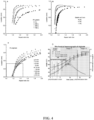
- the location vs. aspect ratio curves plotted in FIGS. 4A-4D depict the location compared to the aspect ratio for porcine gelatin and alginate samples obtained by increasing and decreasing pressure amplitude.
- This Example and FIGS. 4A-4D demonstrate that quasi-static acoustic tweezing is sensitive to changes in bulk elasticity occurring during gelation process.
- the sample location increases approximately linearly with aspect ratio until breaching the gravity-controlled limit. Beyond this limit, the drop deforms more readily without much changes in its location.
- the slope of the location vs. aspect ratio curve for gelatin increases with time until 13 min later, when the sample is fully gelled, as is shown in FIG. 4A .
- FIG. 4B shows the concentration dependence of gelatin drops at 2 min into an experiment, when they are partially gelled.
- the slope in the linear region of the location vs. aspect ratio curves increases with increasing gelatin concentration.
- FIG. 4C shows the full stress/strain curves at selected times up to 28 minutes.
- the box indicates the portion of the data for which linear regression was performed for location vs. aspect ratio to obtain h .
- the linear response region is restricted to the data in the bounding box in the lower left corner of FIG. 4C .
- the elastic modulus (firmness), as quantified by angle ⁇ , dramatically increases for 4% alginate at about 4 minutes after the alginate droplet injection into the levitator. After about 14 minutes, ⁇ begins to level off with increasing time, indicating the approach to the fully gelled state.
- Stage I initial gelation or coagulation
- Stage II rapid gelation or coagulation
- Stage III convergence to fully gelled or coagulated
- FIG. 4 confirms that in this Example and other related implementations, it is possible to take ⁇ as a measure of the sample elastic modulus, and the method itself is capable of measuring time dependent changes in the elastic modulus of reacting samples.
- Examples 4-6 show application of the quasi-static acoustic tweezing method to whole blood samples from human subjects with different heathy conditions to assess their whole blood coagulation status.
- Example 4 Application of The ATPA Method to Healthy Volunteer Whole Blood Samples and Identification of the Normal Ranges of Coagulation Parameters.
- the blood coagulation implementations involve fibrin polymerization and cross-linking, leading to the formation of a blood clot: a fibrin network with embedded red blood cells and platelets. It is understood that the blood clot - and its major constituents - demonstrate viscoelastic behavior. Previous studies have demonstrated that fibrinogen is cleaved into fibrin early in the coagulation process, and then Factor XIII cross-links fibrin, thus stabilizing the blood clot and increasing its elasticity (firmness). Therefore, for blood coagulation analysis, it is essential to have a technique which is highly sensitive to elasticity change.
- the mechanical tweezograph of citrated whole blood shows three stages of blood elasticity increase, similar to what observed during hydrogel gelation ( FIG. 4D ).
- Stage I normalized angle ( ⁇ / ⁇ 0 ) increases gradually as coagulation proceeds.
- Stage II initial mild increase in firmness
- Stage III leveling off
- the coagulation process converges at long times to roughly the same Stage III path, with normalized angle reaching MCF value of 5.27 ⁇ 0.16 (mean ⁇ SEM) at about 32 minutes.
- FIGS. 5A-5C demonstrate that the disclosed ATPA method is able to identify the impact of TF and Cytochalasin D on whole blood coagulation process.
- FIG. 5A depicts mechanical tweezographs of EDTA-treated whole blood with added CaCl 2 and exposed to 0.9% saline (8 drops), tissue factor (TF) (8 drops) or cytochalasin D (8 drops). All three groups had similar MCF.
- FIG. 5B depicts the effect of TF on ⁇ at selected times. Samples treated with TF are immediately stiffer compared to untreated group.
- FIG. 5C depicts the effect of cytochalasin D on ⁇ at selected times. Samples treated with cytochalasin D remain less stiff compared to untreated group through 14 minutes.
- samples treated with Cytochalasin D FIG. 5C ). display a longer Stage I with a delayed onset of Stage II, and thus remain less stiff relative to the untreated group.
- GPRP Gly-Pro-Arg-Pro
- Factor assay control (FACT) plasma which is blood plasma pooled from 30 or more healthy human donors, was purchased from George King Bio-Medical (Overland Park, KA). Low fibrinogen control plasma with concentration of 100 mg/dL was purchased from Fisher Scientific (Hampton, NH). A high fibrinogen solution with concentration of 4000 mg/dL was prepared as stock solution. Three different concentrations of fibrinogen (100, 300, and 500 mg/dL) in blood plasma were tested. GPRP was diluted in PBS at 100 mmol/L as stock solution. The final concentration of GPRP in blood plasma was 2, 4, or 8 mmol/L.
- FACT Factor assay control
- FIGS. 6A-6C show a three-stage increase in elasticity, similar to what was observed for whole blood.
- a change in fibrinogen concentration has no effect on sample elasticity during Stage I (first 5 minutes of measurement).
- Maximum clot firmness (MCF) of each group can be identified.
- MCF clot firmness
- the effect of fibrinogen on blood plasma becomes pronounced at Stage II, leading to different MCF values: 1.059 ⁇ 0.0003 at 100mg/dL, 1.085 ⁇ 0.0030 at 300mg/dL, and 1.112 ⁇ 0.0051 at 500mg/dL.
- R 2 0.90
- Example 6 Application of the ATPA Method to Tobacco Products Consuming Subjects and Identification of the Impact of Tobacco Products on Whole Blood Coagulation.
- Examples 7-10 establish the application of the ATPA method to the measurement of functional levels of coagulation factors in blood plasma: development of light intensity (optical density) reading of blood plasma and integration of photo-optical and mechanical data for measurement of the coagulation process.
- Example 7 Development of Photo-Optical Tweezographs for the Measurement Of Coagulation in Blood Plasma Samples.
- the coagulation status of patients is routinely measured by using platelet poor plasma (PPP) exposed to coagulation activators such as tissue factor (TF) or ellagic acid, which trigger the extrinsic and intrinsic pathways of coagulation, respectively.
- PPP platelet poor plasma
- coagulation activators such as tissue factor (TF) or ellagic acid
- PT prothrombin time
- ILR international normalized ratio
- aPTT active thromboplastin time
- RT reaction time
- the ATPA system and method provides a non-contact environment for coagulation measurement of blood plasma using photo-optical data.
- FACT Factor assay control
- KA Factor assay control
- Fisher Scientific Hampton, NH
- PT/aPTT activators and re-calcification solution were purchased from Thermo Fisher Scientific to reproduce the conditions used in commercial coagulation analyzers for PT and aPTT tests.
- this Example also features the unique air-triggered method to measure blood coagulation.
- the photo-optical tweezographs of coagulating blood plasma from this Example are shown in FIGS. 8A-8C .
- the tweezographs were normalized to 100% and the RT was defined as the time when the light intensity (in this case, darkness) reached 5% of its maximum value.
- the implementation further predicts that the ellagic acid-activated plasma samples start coagulation, on average, at 27 sec, which is within the range of aPTT values (25 - 35 sec) provided by the manufacturer. It is understood that at least two kinetic parameters can be measured from these implementations, including: reaction time (RT) and fibrin formation rate (FFR).
- RT reaction time
- FFR fibrin formation rate
- FIG. 8B depicts the photo-optical tweezographs of blood plasma samples with fibrinogen concentration of 100, 300, and 500 mg/dL. Maximum fibrin level (MFL) for each group has been measured from photo-optical tweezographs.
- Example 8 Development of An Integrated Photo-Optical / Mechanical Measurement of Blood Plasma Coagulation to Estimate the Functional Level of Factor XIII
- Factor XIII is the enzyme that crosslinks fibrin, thus forming a stabilized fibrin matrix.
- the Factor XIII deficiency in blood causes the vulnerable clot formation and severe bleeding tendency. Because the Factor XIII deficiency does not affect the fibrin formation process, the RT data such as PT and aPTT values are often within normal ranges.
- the concentration of Factor XIII in blood can be measured in specialized hematology laboratories using a very expensive, antibody-based method, and clinicians in hospitals often wait for weeks to get results back from these laboratories.
- the disclosed ATPA method provides a unique and simple way to measure the functional level of Factor XIII in blood samples.
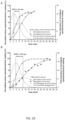
- FIGS. 10A-B show the photo-optical and mechanical tweezographs of A) FACT and B) Factor XIII deficient plasma, respectively. Specifically, the left axis is for mechanical tweezograph (green line) and the right axis is for photo-optical tweezograph (red line).
- the FNFT increases from 3.5 min in normal plasma (A) to 4.75 min to Factor XIII deficient plasma (B). Thus, this parameter can be used to detect the functional level of Factor XIII.
- Example 9 Application of the ATPA Method to Commercial Human Plasma Samples Including Factor Assay Control Samples and Plasma Samples with Coagulation Factor Deficiency to Identify the Impact of Single Factor Deficiency on Coagulation Process.
- This Example establishes standard and borderline coagulation curves using commercial factor assay control plasma. From these curves, it is possible to identify the impact of coagulation factors (e.g., fibrinogen, Factors V/VII/X/XII/XIII) and define normal ranges for the following coagulation parameters: reaction time (RT), clot initiation time (CIT), fibrin network formation time (FNFT), time to firm clot formation (TFCF), and maximum clot firmness (MCF).
- coagulation factors e.g., fibrinogen, Factors V/VII/X/XII/XIII
- FIGS. 11A-11B depict the RT of pool plasma (PP) and Factor VII-, Factor VIII-, Factor IX-, Factor X-, and Factor XIII-deficient plasma.
- the factor deficient plasma samples were exposed to tissue factor (PT test, extrinsic pathway of coagulation).
- tissue factor PT test, extrinsic pathway of coagulation
- FIG. 11B the factor deficient plasma samples were exposed to ellagic acid (aPTT test, intrinsic pathway of coagulation).
- aPTT test intrinsic pathway of coagulation
- Factor VII- and Factor X-deficient plasma samples showed a significant prolonged PT, as compared to PP samples, indicating a slow response to the extrinsic pathway of coagulation (vascular trauma) and thus a high risk of bleeding during trauma.
- Factor VIII-, Factor IX-, and Factor X-plasma showed a significant prolonged aPTT, as compared to PP samples, indicating a slow response to the intrinsic pathway of coagulation (blood contact with collagen or dysfunctional endothelium). Both PT and aPTT are prolonged in Factor X-deficient plasma, indicating a risk of excessive bleeding.
- the Examples of the ATPA method show that the various implementations of the disclosed acoustic tweezing-based photo-optical method can accurately measure the reaction time and fibrinogen levels in blood plasma.
- the Examples of the ATPA method also demonstrate that the MFL and MCF increase with an increase in the fibrinogen concentration.
- the disclosed examples of the ATPA method also show that the disclosed acoustic tweezing-based photo-optical method can accurately measure the reaction time, including PT/aPTT values, and fibrinogen levels in blood plasma. It also demonstrates that the MFL and MCF increase with an increase in the fibrinogen concentration.
- the disclosed Examples of the ATPA method also show that the disclosed ATPA method can identify functional deficiencies of coagulation factors such as Factors VII, VIII, IX, and X and is an unique method to measure the functional level of Factor XIII in blood samples.
- the integrated photo-optical and mechanical test is performed on the same sample drop during its levitation in the acoustic tweezing device.
- the data indicate that this integrated test provide the information about coagulation parameters (including the MCF) within 10 minutes (while current devices requiring at least 30 minutes) using the sample volume of just 4 microliters ( ⁇ 100 times less than the sample volume required in available coagulation analyzers).
- the disclosed embodiments of the ATPA method can also be used in the chemical and pharmaceutical industries, e.g., for cross-linked polymer formulations.
- the method can be used to assess the effects of various cross-linkers or cross-link breakers/inhibitors (used as drugs for treatment of fibrous disorders, cancer, neurodegenerative conditions) on the mechanical properties of soft biological tissues.
- the ATPA method uses a small volume of blood ( ⁇ 4 ⁇ L) and robust coagulation measurements compared to currently available contact techniques.
- the various implementations of the ATPA can monitor blood plasma coagulation status by both photo-optical and mechanical techniques. For example, by integrating photo-optical and mechanical measurements the time delay between fibrin formation and coagulation was determined, referred to as fibrin network formation time (FNFT).
- FNFT fibrin network formation time
- the non-contact ATPA technology is able to measure the rheological properties of sample fluids over time and can provide a unique assay for evaluation of polymerization kinetics of sample fluids and coagulation status of whole blood and blood plasma via a combination of photo-optical and mechanical tests.
- the disclosed ATPA method can create an air or liquid contact only environment via levitating a sample drop with acoustic radiation pressure.
- the information about fluid polymerization kinetics is obtained by measuring changes in deformability of a levitating fluid sample with time.
- the disclosed ATPA method can measure changes in deformability of whole blood or blood plasma samples, and generate a mechanical tweezograph reflecting the coagulation status of blood samples.
- the disclosed ATPA method is modified with integrated photo-optical and mechanical methods and can provide a unique bridge to perform two different types of assays on one blood drop, thus identify the abnormality of coagulation status.
- the disclosed implementations allow for the measurement of the reaction time of blood and other kinetic parameters of blood coagulation without exposing the blood sample to artificial reagents or inducing sample contact with artificial surfaces.
- This provides more natural environment for blood coagulation and thus makes the disclosed implementations more accurate in the assessment of a risk of bleeding or thrombosis than currently available blood coagulation assays.
- Ranges can be expressed herein as from “about” one particular value, and/or to "about” another particular value. When such a range is expressed, a further aspect includes from the one particular value and/or to the other particular value. Similarly, when values are expressed as approximations, by use of the antecedent "about,” it will be understood that the particular value forms a further aspect.
- each of the ranges are significant both in relation to the other endpoint, and independently of the other endpoint. It is also understood that there are a number of values disclosed herein, and that each value is also herein disclosed as “about” that particular value in addition to the value itself. For example, if the value “10” is disclosed, then “about 10” is also disclosed. It is also understood that each unit between two particular units are also disclosed. For example, if 10 and 15 are disclosed, then 11, 12, 13, and 14 are also disclosed.
Landscapes
- Health & Medical Sciences (AREA)
- Life Sciences & Earth Sciences (AREA)
- Engineering & Computer Science (AREA)
- Chemical & Material Sciences (AREA)
- Physics & Mathematics (AREA)
- Biomedical Technology (AREA)
- Hematology (AREA)
- Immunology (AREA)
- Analytical Chemistry (AREA)
- General Physics & Mathematics (AREA)
- Pathology (AREA)
- General Health & Medical Sciences (AREA)
- Biochemistry (AREA)
- Molecular Biology (AREA)
- Urology & Nephrology (AREA)
- Medicinal Chemistry (AREA)
- Food Science & Technology (AREA)
- Biophysics (AREA)
- Ecology (AREA)
- Chemical Kinetics & Catalysis (AREA)
- Biotechnology (AREA)
- Cell Biology (AREA)
- Microbiology (AREA)
- Mathematical Physics (AREA)
- Theoretical Computer Science (AREA)
- Spectroscopy & Molecular Physics (AREA)
- Plasma & Fusion (AREA)
- Investigating Or Analysing Biological Materials (AREA)
- Investigating Or Analysing Materials By Optical Means (AREA)
Claims (11)
- Kontaktloses Akustik-Tweezing-Verfahren zum Messen von zeitabhängigen rheologischen und Polymerisationseigenschaften einer Probe, umfassend:a. Levitieren der Probe (112) durch ein akustisches Tweezing-System (1);b. Modulieren der Amplitude von akustischem Druck, der durch das akustische Tweezing-System an die Probe angelegt wird, sodass eine Verformung der Probe hervorgerufen wird;c. Erfassen einer Mehrzahl von Bildern der Probe in Abhängigkeit von der Zeit;d. Sammeln photooptischer Messwerte, die ausgewählt sind aus der Gruppe bestehend aus Lichtintensität durch die Probe und Trübung der Probe im Laufe der Zeit, und mechanischer Messwerte, die Ort und Seitenverhältnis umfassen, anhand der erfassten Bilder der levitierenden Probe während der Verformung;e. Bestimmen mindestens einer rheologischen Eigenschaft der levitierenden Probe anhand der gesammelten mechanischen Messwerte; undf. Bestimmen mindestens einer kinetischen Eigenschaft der Probenpolymerisation,wobei das Bestimmen der mindestens einen kinetischen Eigenschaft der Probenpolymerisation:i. das Bestimmen eines photooptischen Tweezographen anhand der photooptischen Messwerte aus Schritt d, das Bestimmen eines mechanischen Tweezographen anhand der mechanischen Messungen aus Schritt d, das Bestimmen einer Monomerbildungsrate in dem photooptischen Tweezographen, das Bestimmen einer Polymerisationsrate in dem mechanischen Tweezographen und das Bestimmen einer Zeit der Bildung eines Polymernetzes als Zeitdifferenz zwischen der Polymerisationsrate in dem mechanischen Tweezographen und der Monomerbildungsrate in dem photooptischen Tweezographen umfasst; und gegebenenfalls zusätzlichii. anhand des photooptischen Tweezographen und/oder des mechanischen Tweezographen das Bestimmen von einem oder mehreren umfasst, die ausgewählt sind aus der Gruppe bestehend aus: Reaktionszeit, maximalem Monomergehalt, Einsetzen der Polymerisation, Polymerisationszeit und Gelfestigkeit.
- Verfahren nach Anspruch 1, wobei die Verformung quasistatisch oder oszillatorisch ist.
- Verfahren nach Anspruch 1, wobei die rheologische Eigenschaft Koagulation ist.
- Verfahren nach Anspruch 1, ferner umfassend das Bestimmen einer Elastizität der Probe anhand des mechanischen Tweezographen.
- Verfahren nach Anspruch 1, wobei das mindestens eine Bild photographisch ist.
- Verfahren nach Anspruch 1, ferner umfassend das Ausführen einer Datenanalyse an den gesammelten photooptischen Messungen und mechanischen Messungen.
- Verfahren nach Anspruch 1, wobei die Probe ein biologisches Material ist, das ausgewählt ist aus der Gruppe bestehend aus: Vollblut, Blutplasma, Schleim, Sperma, Lymphe, Synovialflüssigkeit, Zerebrospinalflüssigkeit und weichem biologischem Gewebe.
- Verfahren nach Anspruch 1, wobei die Probe ausgewählt ist aus der Gruppe bestehend aus: einem Polymer, einem Polymergel und einer polymeren Flüssigkeit.
- Verfahren nach Anspruch 1, wobei die photooptischen Messungen ausgewählt sind aus der Gruppe bestehend aus: durchschnittlicher Lichtintensität durch einen zentralen Bereich der Probe und Trübung der Probe im Laufe der Zeit.
- Verfahren nach Anspruch 1, wobei die mechanischen Messwerte anhand quasistatischer und oszillatorischer Verformung der Probe für unterschiedliche akustische Druckamplituden zu unterschiedlichen Zeiten bestimmt werden.
- Verfahren nach Anspruch 1, wobei die mindestens eine rheologische Eigenschaft ausgewählt ist aus der Gruppe bestehend aus: Elastizitätsmodul, Sherelastizität, Scherviskosität, dynamischem Modul, Speichermodul und Verlustmodul.
Applications Claiming Priority (2)
| Application Number | Priority Date | Filing Date | Title |
|---|---|---|---|
| US201762449404P | 2017-01-23 | 2017-01-23 | |
| PCT/US2018/014879 WO2018136949A1 (en) | 2017-01-23 | 2018-01-23 | Apparatus, systems and methods for integrative photo- optical/mechanical test for noncontact measurement of polymerization |
Publications (3)
| Publication Number | Publication Date |
|---|---|
| EP3571504A1 EP3571504A1 (de) | 2019-11-27 |
| EP3571504A4 EP3571504A4 (de) | 2020-10-28 |
| EP3571504B1 true EP3571504B1 (de) | 2024-11-27 |
Family
ID=62908409
Family Applications (1)
| Application Number | Title | Priority Date | Filing Date |
|---|---|---|---|
| EP18741276.2A Active EP3571504B1 (de) | 2017-01-23 | 2018-01-23 | Kontaktloses verfahren zur messung zeitabhängiger rheologischer und polymerizationseigenschaften einer probe |
Country Status (4)
| Country | Link |
|---|---|
| US (3) | US10823723B2 (de) |
| EP (1) | EP3571504B1 (de) |
| CA (1) | CA3051365C (de) |
| WO (1) | WO2018136949A1 (de) |
Families Citing this family (4)
| Publication number | Priority date | Publication date | Assignee | Title |
|---|---|---|---|---|
| US11214789B2 (en) | 2016-05-03 | 2022-01-04 | Flodesign Sonics, Inc. | Concentration and washing of particles with acoustics |
| CN113412420A (zh) * | 2019-02-04 | 2021-09-17 | 仪宝科技公司 | 流体性质测量装置和方法 |
| US12566124B2 (en) | 2020-01-27 | 2026-03-03 | The Administrators Of The Tulane Educational Fund | Apparatus, systems and methods for in vitro screening of complex biological fluids |
| US20240003799A1 (en) * | 2020-11-30 | 2024-01-04 | Viscop S.R.L. | Method of acquisition and analysis of coagulation haemostatic parameters of a blood sample |
Family Cites Families (10)
| Publication number | Priority date | Publication date | Assignee | Title |
|---|---|---|---|---|
| FR2580407B1 (fr) * | 1985-04-11 | 1987-06-26 | Vieillard Didier | Procede et appareil pour la mesure de la coagulation du plasma sanguin |
| US6114135A (en) | 1991-11-08 | 2000-09-05 | Goldstein; Sheldon | Multiple coagulation test system and method of using a multiple coagulation test system |
| US6321164B1 (en) | 1995-06-07 | 2001-11-20 | Akzo Nobel N.V. | Method and apparatus for predicting the presence of an abnormal level of one or more proteins in the clotting cascade |
| CA2434886A1 (en) * | 2001-01-19 | 2002-07-25 | Chemical Holovoice Ab | System and method for screening of nucleation tendency of a molecule in a levitated droplet |
| US7291310B2 (en) | 2002-12-17 | 2007-11-06 | The Regents Of The University Of Michigan | Microsystem for determining clotting time of blood and low-cost, single-use device for use therein |
| JP4611066B2 (ja) * | 2004-04-13 | 2011-01-12 | 三菱電機株式会社 | アバランシェフォトダイオード |
| EP2063273A1 (de) * | 2007-11-21 | 2009-05-27 | Pentapharm GmbH | Verfahren zur Beurteilung der fibrinogenen Verteilung in der Gerinnung |
| US20130344519A1 (en) * | 2012-06-25 | 2013-12-26 | Bayer Healthcare Llc | Methods and systems for assessment of turbidity kinetics (waveform analysis) in coagulation testing |
| US9291612B2 (en) * | 2012-07-16 | 2016-03-22 | Micropoint Bioscience, Inc. | Determining blood coagulation characteristics using residual accumulative conductive energy |
| US11333656B2 (en) | 2013-09-13 | 2022-05-17 | The Administrators Of The Tulane Educational Fund | Apparatus, systems and methods for non-contact rheological measurements of biological materials |
-
2018
- 2018-01-23 EP EP18741276.2A patent/EP3571504B1/de active Active
- 2018-01-23 CA CA3051365A patent/CA3051365C/en active Active
- 2018-01-23 US US16/478,249 patent/US10823723B2/en active Active
- 2018-01-23 WO PCT/US2018/014879 patent/WO2018136949A1/en not_active Ceased
-
2020
- 2020-10-27 US US17/081,213 patent/US11815506B2/en active Active
-
2023
- 2023-09-26 US US18/474,960 patent/US20240044867A1/en not_active Abandoned
Also Published As
| Publication number | Publication date |
|---|---|
| WO2018136949A1 (en) | 2018-07-26 |
| US20210109083A1 (en) | 2021-04-15 |
| US10823723B2 (en) | 2020-11-03 |
| EP3571504A1 (de) | 2019-11-27 |
| EP3571504A4 (de) | 2020-10-28 |
| US20240044867A1 (en) | 2024-02-08 |
| US20190353637A1 (en) | 2019-11-21 |
| CA3051365C (en) | 2024-03-05 |
| CA3051365A1 (en) | 2018-07-26 |
| US11815506B2 (en) | 2023-11-14 |
Similar Documents
| Publication | Publication Date | Title |
|---|---|---|
| US20240044867A1 (en) | Apparatus, Systems And Methods For Integrative Photo-Optical/Mechanical Test For Noncontact Measurement Of Polymerization | |
| US20240418702A1 (en) | Optical thromboelastography systems and methods | |
| JP7192944B2 (ja) | 血液凝固系解析装置、血液凝固系解析システム、血液凝固系解析方法、及び血液凝固系解析用プログラム、並びに、出血量予測装置、出血量予測システム、出血量予測方法、及び出血量予測用プログラム | |
| JP5016554B2 (ja) | エカリンと磁性粒子を含む乾式化学試薬を用いてフィブリノーゲンアッセイを行う方法 | |
| CN102308203B (zh) | 血液凝固系统分析装置以及用于分析血液凝固系统的方法 | |
| JP5655091B2 (ja) | 携帯式血液凝固モニタリング機器および血液凝固反応の評価方法 | |
| JP7824879B2 (ja) | 複雑な生物学的流体のインビトロスクリーニングのための装置、システムおよび方法 | |
| JP7009998B2 (ja) | 血液凝固系解析装置、血液凝固系解析システム、血液凝固系解析方法及び血液凝固系解析装置用パラメーターの決定方法 | |
| Schriner et al. | Platelet function in trauma: is current technology in function testing missing the mark in injured patients? | |
| US11998911B2 (en) | Microfluidic thromboelastometry instrument | |
| US10962495B2 (en) | Blood coagulation system analysis system, blood coagulation system analysis method, and blood coagulation system analysis program | |
| US20140064595A1 (en) | Apparatus and method for determining the coagulation time of blood | |
| KR102893038B1 (ko) | 혈전탄성도 테스트 장치 및 방법 | |
| CN114441780B (zh) | 一种用于即时凝血功能检测的检测系统及检测方法 | |
| Understedt et al. | Measurement of blood and plasma coagulation time using free oscillating rheometry | |
| US5783447A (en) | Hypercoagulability comparative determinants obtained using detection systems with variable force-induced energy inputs | |
| Maji et al. | A PMMA microfluidic dielectric sensor for blood coagulation monitoring at the point-of-care | |
| KR20250017591A (ko) | 혈액의 응고 역학을 특성화하기 위한 장치 | |
| RU2596926C2 (ru) | Способ оценки динамики и полноты ретракции (контракции) кровяного сгустка | |
| Baryshnikova | Other Coagulation Point-of-Care Tests |
Legal Events
| Date | Code | Title | Description |
|---|---|---|---|
| STAA | Information on the status of an ep patent application or granted ep patent |
Free format text: STATUS: THE INTERNATIONAL PUBLICATION HAS BEEN MADE |
|
| PUAI | Public reference made under article 153(3) epc to a published international application that has entered the european phase |
Free format text: ORIGINAL CODE: 0009012 |
|
| STAA | Information on the status of an ep patent application or granted ep patent |
Free format text: STATUS: REQUEST FOR EXAMINATION WAS MADE |
|
| 17P | Request for examination filed |
Effective date: 20190722 |
|
| AK | Designated contracting states |
Kind code of ref document: A1 Designated state(s): AL AT BE BG CH CY CZ DE DK EE ES FI FR GB GR HR HU IE IS IT LI LT LU LV MC MK MT NL NO PL PT RO RS SE SI SK SM TR |
|
| AX | Request for extension of the european patent |
Extension state: BA ME |
|
| RIN1 | Information on inventor provided before grant (corrected) |
Inventor name: LUO, DAISHEN Inventor name: KHISMATULLIN, DAMIR B. |
|
| DAV | Request for validation of the european patent (deleted) | ||
| DAX | Request for extension of the european patent (deleted) | ||
| A4 | Supplementary search report drawn up and despatched |
Effective date: 20200929 |
|
| RIC1 | Information provided on ipc code assigned before grant |
Ipc: G01N 21/17 20060101AFI20200923BHEP Ipc: G01N 33/86 20060101ALN20200923BHEP Ipc: G01N 33/49 20060101ALI20200923BHEP Ipc: G01N 21/82 20060101ALI20200923BHEP Ipc: G01N 21/27 20060101ALI20200923BHEP |
|
| REG | Reference to a national code |
Ref country code: DE Ref legal event code: R079 Free format text: PREVIOUS MAIN CLASS: G01N0033490000 Ipc: G01N0021170000 Ref country code: DE Ref legal event code: R079 Ref document number: 602018076967 Country of ref document: DE Free format text: PREVIOUS MAIN CLASS: G01N0033490000 Ipc: G01N0021170000 |
|
| GRAP | Despatch of communication of intention to grant a patent |
Free format text: ORIGINAL CODE: EPIDOSNIGR1 |
|
| STAA | Information on the status of an ep patent application or granted ep patent |
Free format text: STATUS: GRANT OF PATENT IS INTENDED |
|
| RIC1 | Information provided on ipc code assigned before grant |
Ipc: G01N 33/86 20060101ALN20220803BHEP Ipc: G01N 33/49 20060101ALI20220803BHEP Ipc: G01N 21/82 20060101ALI20220803BHEP Ipc: G01N 21/27 20060101ALI20220803BHEP Ipc: G01N 21/17 20060101AFI20220803BHEP |
|
| INTG | Intention to grant announced |
Effective date: 20220826 |
|
| GRAJ | Information related to disapproval of communication of intention to grant by the applicant or resumption of examination proceedings by the epo deleted |
Free format text: ORIGINAL CODE: EPIDOSDIGR1 |
|
| STAA | Information on the status of an ep patent application or granted ep patent |
Free format text: STATUS: REQUEST FOR EXAMINATION WAS MADE |
|
| STAA | Information on the status of an ep patent application or granted ep patent |
Free format text: STATUS: EXAMINATION IS IN PROGRESS |
|
| INTC | Intention to grant announced (deleted) | ||
| 17Q | First examination report despatched |
Effective date: 20230118 |
|
| GRAP | Despatch of communication of intention to grant a patent |
Free format text: ORIGINAL CODE: EPIDOSNIGR1 |
|
| STAA | Information on the status of an ep patent application or granted ep patent |
Free format text: STATUS: GRANT OF PATENT IS INTENDED |
|
| RIC1 | Information provided on ipc code assigned before grant |
Ipc: G01N 33/86 20060101ALN20240531BHEP Ipc: G01N 33/49 20060101ALI20240531BHEP Ipc: G01N 21/82 20060101ALI20240531BHEP Ipc: G01N 21/27 20060101ALI20240531BHEP Ipc: G01N 21/17 20060101AFI20240531BHEP |
|
| INTG | Intention to grant announced |
Effective date: 20240619 |
|
| GRAS | Grant fee paid |
Free format text: ORIGINAL CODE: EPIDOSNIGR3 |
|
| GRAA | (expected) grant |
Free format text: ORIGINAL CODE: 0009210 |
|
| STAA | Information on the status of an ep patent application or granted ep patent |
Free format text: STATUS: THE PATENT HAS BEEN GRANTED |
|
| AK | Designated contracting states |
Kind code of ref document: B1 Designated state(s): AL AT BE BG CH CY CZ DE DK EE ES FI FR GB GR HR HU IE IS IT LI LT LU LV MC MK MT NL NO PL PT RO RS SE SI SK SM TR |
|
| P01 | Opt-out of the competence of the unified patent court (upc) registered |
Free format text: CASE NUMBER: APP_57092/2024 Effective date: 20241018 |
|
| REG | Reference to a national code |
Ref country code: GB Ref legal event code: FG4D |
|
| REG | Reference to a national code |
Ref country code: CH Ref legal event code: EP |
|
| REG | Reference to a national code |
Ref country code: IE Ref legal event code: FG4D |
|
| REG | Reference to a national code |
Ref country code: DE Ref legal event code: R096 Ref document number: 602018076967 Country of ref document: DE |
|
| REG | Reference to a national code |
Ref country code: LT Ref legal event code: MG9D |
|
| REG | Reference to a national code |
Ref country code: NL Ref legal event code: MP Effective date: 20241127 |
|
| PG25 | Lapsed in a contracting state [announced via postgrant information from national office to epo] |
Ref country code: IS Free format text: LAPSE BECAUSE OF FAILURE TO SUBMIT A TRANSLATION OF THE DESCRIPTION OR TO PAY THE FEE WITHIN THE PRESCRIBED TIME-LIMIT Effective date: 20250327 Ref country code: HR Free format text: LAPSE BECAUSE OF FAILURE TO SUBMIT A TRANSLATION OF THE DESCRIPTION OR TO PAY THE FEE WITHIN THE PRESCRIBED TIME-LIMIT Effective date: 20241127 Ref country code: PT Free format text: LAPSE BECAUSE OF FAILURE TO SUBMIT A TRANSLATION OF THE DESCRIPTION OR TO PAY THE FEE WITHIN THE PRESCRIBED TIME-LIMIT Effective date: 20250327 |
|
| PG25 | Lapsed in a contracting state [announced via postgrant information from national office to epo] |
Ref country code: FI Free format text: LAPSE BECAUSE OF FAILURE TO SUBMIT A TRANSLATION OF THE DESCRIPTION OR TO PAY THE FEE WITHIN THE PRESCRIBED TIME-LIMIT Effective date: 20241127 Ref country code: NL Free format text: LAPSE BECAUSE OF FAILURE TO SUBMIT A TRANSLATION OF THE DESCRIPTION OR TO PAY THE FEE WITHIN THE PRESCRIBED TIME-LIMIT Effective date: 20241127 |
|
| REG | Reference to a national code |
Ref country code: AT Ref legal event code: MK05 Ref document number: 1746111 Country of ref document: AT Kind code of ref document: T Effective date: 20241127 |
|
| PG25 | Lapsed in a contracting state [announced via postgrant information from national office to epo] |
Ref country code: BG Free format text: LAPSE BECAUSE OF FAILURE TO SUBMIT A TRANSLATION OF THE DESCRIPTION OR TO PAY THE FEE WITHIN THE PRESCRIBED TIME-LIMIT Effective date: 20241127 |
|
| PG25 | Lapsed in a contracting state [announced via postgrant information from national office to epo] |
Ref country code: ES Free format text: LAPSE BECAUSE OF FAILURE TO SUBMIT A TRANSLATION OF THE DESCRIPTION OR TO PAY THE FEE WITHIN THE PRESCRIBED TIME-LIMIT Effective date: 20241127 |
|
| PG25 | Lapsed in a contracting state [announced via postgrant information from national office to epo] |
Ref country code: NO Free format text: LAPSE BECAUSE OF FAILURE TO SUBMIT A TRANSLATION OF THE DESCRIPTION OR TO PAY THE FEE WITHIN THE PRESCRIBED TIME-LIMIT Effective date: 20250227 |
|
| PG25 | Lapsed in a contracting state [announced via postgrant information from national office to epo] |
Ref country code: LV Free format text: LAPSE BECAUSE OF FAILURE TO SUBMIT A TRANSLATION OF THE DESCRIPTION OR TO PAY THE FEE WITHIN THE PRESCRIBED TIME-LIMIT Effective date: 20241127 Ref country code: AT Free format text: LAPSE BECAUSE OF FAILURE TO SUBMIT A TRANSLATION OF THE DESCRIPTION OR TO PAY THE FEE WITHIN THE PRESCRIBED TIME-LIMIT Effective date: 20241127 Ref country code: GR Free format text: LAPSE BECAUSE OF FAILURE TO SUBMIT A TRANSLATION OF THE DESCRIPTION OR TO PAY THE FEE WITHIN THE PRESCRIBED TIME-LIMIT Effective date: 20250228 |
|
| PG25 | Lapsed in a contracting state [announced via postgrant information from national office to epo] |
Ref country code: PL Free format text: LAPSE BECAUSE OF FAILURE TO SUBMIT A TRANSLATION OF THE DESCRIPTION OR TO PAY THE FEE WITHIN THE PRESCRIBED TIME-LIMIT Effective date: 20241127 |
|
| PG25 | Lapsed in a contracting state [announced via postgrant information from national office to epo] |
Ref country code: RS Free format text: LAPSE BECAUSE OF FAILURE TO SUBMIT A TRANSLATION OF THE DESCRIPTION OR TO PAY THE FEE WITHIN THE PRESCRIBED TIME-LIMIT Effective date: 20250227 |
|
| PG25 | Lapsed in a contracting state [announced via postgrant information from national office to epo] |
Ref country code: SM Free format text: LAPSE BECAUSE OF FAILURE TO SUBMIT A TRANSLATION OF THE DESCRIPTION OR TO PAY THE FEE WITHIN THE PRESCRIBED TIME-LIMIT Effective date: 20241127 |
|
| PG25 | Lapsed in a contracting state [announced via postgrant information from national office to epo] |
Ref country code: DK Free format text: LAPSE BECAUSE OF FAILURE TO SUBMIT A TRANSLATION OF THE DESCRIPTION OR TO PAY THE FEE WITHIN THE PRESCRIBED TIME-LIMIT Effective date: 20241127 |
|
| PG25 | Lapsed in a contracting state [announced via postgrant information from national office to epo] |
Ref country code: EE Free format text: LAPSE BECAUSE OF FAILURE TO SUBMIT A TRANSLATION OF THE DESCRIPTION OR TO PAY THE FEE WITHIN THE PRESCRIBED TIME-LIMIT Effective date: 20241127 |
|
| PG25 | Lapsed in a contracting state [announced via postgrant information from national office to epo] |
Ref country code: RO Free format text: LAPSE BECAUSE OF FAILURE TO SUBMIT A TRANSLATION OF THE DESCRIPTION OR TO PAY THE FEE WITHIN THE PRESCRIBED TIME-LIMIT Effective date: 20241127 |
|
| PG25 | Lapsed in a contracting state [announced via postgrant information from national office to epo] |
Ref country code: SK Free format text: LAPSE BECAUSE OF FAILURE TO SUBMIT A TRANSLATION OF THE DESCRIPTION OR TO PAY THE FEE WITHIN THE PRESCRIBED TIME-LIMIT Effective date: 20241127 |
|
| PG25 | Lapsed in a contracting state [announced via postgrant information from national office to epo] |
Ref country code: CZ Free format text: LAPSE BECAUSE OF FAILURE TO SUBMIT A TRANSLATION OF THE DESCRIPTION OR TO PAY THE FEE WITHIN THE PRESCRIBED TIME-LIMIT Effective date: 20241127 |
|
| PG25 | Lapsed in a contracting state [announced via postgrant information from national office to epo] |
Ref country code: IT Free format text: LAPSE BECAUSE OF FAILURE TO SUBMIT A TRANSLATION OF THE DESCRIPTION OR TO PAY THE FEE WITHIN THE PRESCRIBED TIME-LIMIT Effective date: 20241127 |
|
| REG | Reference to a national code |
Ref country code: DE Ref legal event code: R097 Ref document number: 602018076967 Country of ref document: DE |
|
| REG | Reference to a national code |
Ref country code: CH Ref legal event code: PL |
|
| PG25 | Lapsed in a contracting state [announced via postgrant information from national office to epo] |
Ref country code: SE Free format text: LAPSE BECAUSE OF FAILURE TO SUBMIT A TRANSLATION OF THE DESCRIPTION OR TO PAY THE FEE WITHIN THE PRESCRIBED TIME-LIMIT Effective date: 20241127 |
|
| PG25 | Lapsed in a contracting state [announced via postgrant information from national office to epo] |
Ref country code: LU Free format text: LAPSE BECAUSE OF NON-PAYMENT OF DUE FEES Effective date: 20250123 Ref country code: MC Free format text: LAPSE BECAUSE OF FAILURE TO SUBMIT A TRANSLATION OF THE DESCRIPTION OR TO PAY THE FEE WITHIN THE PRESCRIBED TIME-LIMIT Effective date: 20241127 |
|
| PLBE | No opposition filed within time limit |
Free format text: ORIGINAL CODE: 0009261 |
|
| STAA | Information on the status of an ep patent application or granted ep patent |
Free format text: STATUS: NO OPPOSITION FILED WITHIN TIME LIMIT |
|
| PG25 | Lapsed in a contracting state [announced via postgrant information from national office to epo] |
Ref country code: BE Free format text: LAPSE BECAUSE OF NON-PAYMENT OF DUE FEES Effective date: 20250131 |
|
| PG25 | Lapsed in a contracting state [announced via postgrant information from national office to epo] |
Ref country code: CH Free format text: LAPSE BECAUSE OF NON-PAYMENT OF DUE FEES Effective date: 20250131 |
|
| REG | Reference to a national code |
Ref country code: BE Ref legal event code: MM Effective date: 20250131 |
|
| 26N | No opposition filed |
Effective date: 20250828 |
|
| PG25 | Lapsed in a contracting state [announced via postgrant information from national office to epo] |
Ref country code: IE Free format text: LAPSE BECAUSE OF NON-PAYMENT OF DUE FEES Effective date: 20250123 |
|
| PGFP | Annual fee paid to national office [announced via postgrant information from national office to epo] |
Ref country code: GB Payment date: 20260113 Year of fee payment: 9 |
|
| PGFP | Annual fee paid to national office [announced via postgrant information from national office to epo] |
Ref country code: DE Payment date: 20260108 Year of fee payment: 9 |
|
| PGFP | Annual fee paid to national office [announced via postgrant information from national office to epo] |
Ref country code: FR Payment date: 20260113 Year of fee payment: 9 |
|
| PG25 | Lapsed in a contracting state [announced via postgrant information from national office to epo] |
Ref country code: CY Free format text: LAPSE BECAUSE OF FAILURE TO SUBMIT A TRANSLATION OF THE DESCRIPTION OR TO PAY THE FEE WITHIN THE PRESCRIBED TIME-LIMIT Effective date: 20241127 |
|
| PG25 | Lapsed in a contracting state [announced via postgrant information from national office to epo] |
Ref country code: TR Free format text: LAPSE BECAUSE OF FAILURE TO SUBMIT A TRANSLATION OF THE DESCRIPTION OR TO PAY THE FEE WITHIN THE PRESCRIBED TIME-LIMIT Effective date: 20241127 |
|
| PG25 | Lapsed in a contracting state [announced via postgrant information from national office to epo] |
Ref country code: LT Free format text: LAPSE BECAUSE OF FAILURE TO SUBMIT A TRANSLATION OF THE DESCRIPTION OR TO PAY THE FEE WITHIN THE PRESCRIBED TIME-LIMIT Effective date: 20241127 |