EP3569638A1 - Polymer containing silphenylene and polyether structures - Google Patents
Polymer containing silphenylene and polyether structures Download PDFInfo
- Publication number
- EP3569638A1 EP3569638A1 EP19172966.4A EP19172966A EP3569638A1 EP 3569638 A1 EP3569638 A1 EP 3569638A1 EP 19172966 A EP19172966 A EP 19172966A EP 3569638 A1 EP3569638 A1 EP 3569638A1
- Authority
- EP
- European Patent Office
- Prior art keywords
- independently
- formula
- integer
- polymer
- diyl
- Prior art date
- Legal status (The legal status is an assumption and is not a legal conclusion. Google has not performed a legal analysis and makes no representation as to the accuracy of the status listed.)
- Granted
Links
- 0 CC(CN)*NC Chemical compound CC(CN)*NC 0.000 description 1
Classifications
-
- C—CHEMISTRY; METALLURGY
- C08—ORGANIC MACROMOLECULAR COMPOUNDS; THEIR PREPARATION OR CHEMICAL WORKING-UP; COMPOSITIONS BASED THEREON
- C08G—MACROMOLECULAR COMPOUNDS OBTAINED OTHERWISE THAN BY REACTIONS ONLY INVOLVING UNSATURATED CARBON-TO-CARBON BONDS
- C08G77/00—Macromolecular compounds obtained by reactions forming a linkage containing silicon with or without sulfur, nitrogen, oxygen or carbon in the main chain of the macromolecule
- C08G77/48—Macromolecular compounds obtained by reactions forming a linkage containing silicon with or without sulfur, nitrogen, oxygen or carbon in the main chain of the macromolecule in which at least two but not all the silicon atoms are connected by linkages other than oxygen atoms
- C08G77/50—Macromolecular compounds obtained by reactions forming a linkage containing silicon with or without sulfur, nitrogen, oxygen or carbon in the main chain of the macromolecule in which at least two but not all the silicon atoms are connected by linkages other than oxygen atoms by carbon linkages
- C08G77/52—Macromolecular compounds obtained by reactions forming a linkage containing silicon with or without sulfur, nitrogen, oxygen or carbon in the main chain of the macromolecule in which at least two but not all the silicon atoms are connected by linkages other than oxygen atoms by carbon linkages containing aromatic rings
-
- C—CHEMISTRY; METALLURGY
- C08—ORGANIC MACROMOLECULAR COMPOUNDS; THEIR PREPARATION OR CHEMICAL WORKING-UP; COMPOSITIONS BASED THEREON
- C08G—MACROMOLECULAR COMPOUNDS OBTAINED OTHERWISE THAN BY REACTIONS ONLY INVOLVING UNSATURATED CARBON-TO-CARBON BONDS
- C08G77/00—Macromolecular compounds obtained by reactions forming a linkage containing silicon with or without sulfur, nitrogen, oxygen or carbon in the main chain of the macromolecule
- C08G77/04—Polysiloxanes
- C08G77/12—Polysiloxanes containing silicon bound to hydrogen
-
- C—CHEMISTRY; METALLURGY
- C08—ORGANIC MACROMOLECULAR COMPOUNDS; THEIR PREPARATION OR CHEMICAL WORKING-UP; COMPOSITIONS BASED THEREON
- C08G—MACROMOLECULAR COMPOUNDS OBTAINED OTHERWISE THAN BY REACTIONS ONLY INVOLVING UNSATURATED CARBON-TO-CARBON BONDS
- C08G12/00—Condensation polymers of aldehydes or ketones with only compounds containing hydrogen attached to nitrogen
- C08G12/02—Condensation polymers of aldehydes or ketones with only compounds containing hydrogen attached to nitrogen of aldehydes
- C08G12/26—Condensation polymers of aldehydes or ketones with only compounds containing hydrogen attached to nitrogen of aldehydes with heterocyclic compounds
- C08G12/263—Condensation polymers of aldehydes or ketones with only compounds containing hydrogen attached to nitrogen of aldehydes with heterocyclic compounds with at least two compounds covered by more than one of the groups C08G12/28 - C08G12/32
- C08G12/266—Condensation polymers of aldehydes or ketones with only compounds containing hydrogen attached to nitrogen of aldehydes with heterocyclic compounds with at least two compounds covered by more than one of the groups C08G12/28 - C08G12/32 one being melamine
-
- C—CHEMISTRY; METALLURGY
- C08—ORGANIC MACROMOLECULAR COMPOUNDS; THEIR PREPARATION OR CHEMICAL WORKING-UP; COMPOSITIONS BASED THEREON
- C08G—MACROMOLECULAR COMPOUNDS OBTAINED OTHERWISE THAN BY REACTIONS ONLY INVOLVING UNSATURATED CARBON-TO-CARBON BONDS
- C08G59/00—Polycondensates containing more than one epoxy group per molecule; Macromolecules obtained by polymerising compounds containing more than one epoxy group per molecule using curing agents or catalysts which react with the epoxy groups
- C08G59/02—Polycondensates containing more than one epoxy group per molecule
- C08G59/04—Polycondensates containing more than one epoxy group per molecule of polyhydroxy compounds with epihalohydrins or precursors thereof
- C08G59/06—Polycondensates containing more than one epoxy group per molecule of polyhydroxy compounds with epihalohydrins or precursors thereof of polyhydric phenols
- C08G59/066—Polycondensates containing more than one epoxy group per molecule of polyhydroxy compounds with epihalohydrins or precursors thereof of polyhydric phenols with chain extension or advancing agents
-
- C—CHEMISTRY; METALLURGY
- C08—ORGANIC MACROMOLECULAR COMPOUNDS; THEIR PREPARATION OR CHEMICAL WORKING-UP; COMPOSITIONS BASED THEREON
- C08G—MACROMOLECULAR COMPOUNDS OBTAINED OTHERWISE THAN BY REACTIONS ONLY INVOLVING UNSATURATED CARBON-TO-CARBON BONDS
- C08G61/00—Macromolecular compounds obtained by reactions forming a carbon-to-carbon link in the main chain of the macromolecule
- C08G61/02—Macromolecular compounds containing only carbon atoms in the main chain of the macromolecule, e.g. polyxylylenes
-
- C—CHEMISTRY; METALLURGY
- C08—ORGANIC MACROMOLECULAR COMPOUNDS; THEIR PREPARATION OR CHEMICAL WORKING-UP; COMPOSITIONS BASED THEREON
- C08G—MACROMOLECULAR COMPOUNDS OBTAINED OTHERWISE THAN BY REACTIONS ONLY INVOLVING UNSATURATED CARBON-TO-CARBON BONDS
- C08G65/00—Macromolecular compounds obtained by reactions forming an ether link in the main chain of the macromolecule
- C08G65/02—Macromolecular compounds obtained by reactions forming an ether link in the main chain of the macromolecule from cyclic ethers by opening of the heterocyclic ring
- C08G65/32—Polymers modified by chemical after-treatment
- C08G65/329—Polymers modified by chemical after-treatment with organic compounds
- C08G65/336—Polymers modified by chemical after-treatment with organic compounds containing silicon
-
- C—CHEMISTRY; METALLURGY
- C08—ORGANIC MACROMOLECULAR COMPOUNDS; THEIR PREPARATION OR CHEMICAL WORKING-UP; COMPOSITIONS BASED THEREON
- C08G—MACROMOLECULAR COMPOUNDS OBTAINED OTHERWISE THAN BY REACTIONS ONLY INVOLVING UNSATURATED CARBON-TO-CARBON BONDS
- C08G77/00—Macromolecular compounds obtained by reactions forming a linkage containing silicon with or without sulfur, nitrogen, oxygen or carbon in the main chain of the macromolecule
- C08G77/04—Polysiloxanes
- C08G77/14—Polysiloxanes containing silicon bound to oxygen-containing groups
-
- C—CHEMISTRY; METALLURGY
- C08—ORGANIC MACROMOLECULAR COMPOUNDS; THEIR PREPARATION OR CHEMICAL WORKING-UP; COMPOSITIONS BASED THEREON
- C08G—MACROMOLECULAR COMPOUNDS OBTAINED OTHERWISE THAN BY REACTIONS ONLY INVOLVING UNSATURATED CARBON-TO-CARBON BONDS
- C08G77/00—Macromolecular compounds obtained by reactions forming a linkage containing silicon with or without sulfur, nitrogen, oxygen or carbon in the main chain of the macromolecule
- C08G77/04—Polysiloxanes
- C08G77/20—Polysiloxanes containing silicon bound to unsaturated aliphatic groups
-
- C—CHEMISTRY; METALLURGY
- C08—ORGANIC MACROMOLECULAR COMPOUNDS; THEIR PREPARATION OR CHEMICAL WORKING-UP; COMPOSITIONS BASED THEREON
- C08G—MACROMOLECULAR COMPOUNDS OBTAINED OTHERWISE THAN BY REACTIONS ONLY INVOLVING UNSATURATED CARBON-TO-CARBON BONDS
- C08G77/00—Macromolecular compounds obtained by reactions forming a linkage containing silicon with or without sulfur, nitrogen, oxygen or carbon in the main chain of the macromolecule
- C08G77/04—Polysiloxanes
- C08G77/22—Polysiloxanes containing silicon bound to organic groups containing atoms other than carbon, hydrogen and oxygen
- C08G77/26—Polysiloxanes containing silicon bound to organic groups containing atoms other than carbon, hydrogen and oxygen nitrogen-containing groups
-
- C—CHEMISTRY; METALLURGY
- C08—ORGANIC MACROMOLECULAR COMPOUNDS; THEIR PREPARATION OR CHEMICAL WORKING-UP; COMPOSITIONS BASED THEREON
- C08G—MACROMOLECULAR COMPOUNDS OBTAINED OTHERWISE THAN BY REACTIONS ONLY INVOLVING UNSATURATED CARBON-TO-CARBON BONDS
- C08G77/00—Macromolecular compounds obtained by reactions forming a linkage containing silicon with or without sulfur, nitrogen, oxygen or carbon in the main chain of the macromolecule
- C08G77/04—Polysiloxanes
- C08G77/38—Polysiloxanes modified by chemical after-treatment
- C08G77/382—Polysiloxanes modified by chemical after-treatment containing atoms other than carbon, hydrogen, oxygen or silicon
- C08G77/388—Polysiloxanes modified by chemical after-treatment containing atoms other than carbon, hydrogen, oxygen or silicon containing nitrogen
-
- C—CHEMISTRY; METALLURGY
- C08—ORGANIC MACROMOLECULAR COMPOUNDS; THEIR PREPARATION OR CHEMICAL WORKING-UP; COMPOSITIONS BASED THEREON
- C08G—MACROMOLECULAR COMPOUNDS OBTAINED OTHERWISE THAN BY REACTIONS ONLY INVOLVING UNSATURATED CARBON-TO-CARBON BONDS
- C08G77/00—Macromolecular compounds obtained by reactions forming a linkage containing silicon with or without sulfur, nitrogen, oxygen or carbon in the main chain of the macromolecule
- C08G77/42—Block-or graft-polymers containing polysiloxane sequences
- C08G77/46—Block-or graft-polymers containing polysiloxane sequences containing polyether sequences
-
- C—CHEMISTRY; METALLURGY
- C08—ORGANIC MACROMOLECULAR COMPOUNDS; THEIR PREPARATION OR CHEMICAL WORKING-UP; COMPOSITIONS BASED THEREON
- C08G—MACROMOLECULAR COMPOUNDS OBTAINED OTHERWISE THAN BY REACTIONS ONLY INVOLVING UNSATURATED CARBON-TO-CARBON BONDS
- C08G77/00—Macromolecular compounds obtained by reactions forming a linkage containing silicon with or without sulfur, nitrogen, oxygen or carbon in the main chain of the macromolecule
- C08G77/60—Macromolecular compounds obtained by reactions forming a linkage containing silicon with or without sulfur, nitrogen, oxygen or carbon in the main chain of the macromolecule in which all the silicon atoms are connected by linkages other than oxygen atoms
-
- C—CHEMISTRY; METALLURGY
- C08—ORGANIC MACROMOLECULAR COMPOUNDS; THEIR PREPARATION OR CHEMICAL WORKING-UP; COMPOSITIONS BASED THEREON
- C08G—MACROMOLECULAR COMPOUNDS OBTAINED OTHERWISE THAN BY REACTIONS ONLY INVOLVING UNSATURATED CARBON-TO-CARBON BONDS
- C08G8/00—Condensation polymers of aldehydes or ketones with phenols only
- C08G8/38—Block or graft polymers prepared by polycondensation of aldehydes or ketones onto macromolecular compounds
-
- C—CHEMISTRY; METALLURGY
- C08—ORGANIC MACROMOLECULAR COMPOUNDS; THEIR PREPARATION OR CHEMICAL WORKING-UP; COMPOSITIONS BASED THEREON
- C08K—Use of inorganic or non-macromolecular organic substances as compounding ingredients
- C08K5/00—Use of organic ingredients
- C08K5/04—Oxygen-containing compounds
- C08K5/13—Phenols; Phenolates
-
- C—CHEMISTRY; METALLURGY
- C08—ORGANIC MACROMOLECULAR COMPOUNDS; THEIR PREPARATION OR CHEMICAL WORKING-UP; COMPOSITIONS BASED THEREON
- C08K—Use of inorganic or non-macromolecular organic substances as compounding ingredients
- C08K5/00—Use of organic ingredients
- C08K5/04—Oxygen-containing compounds
- C08K5/15—Heterocyclic compounds having oxygen in the ring
- C08K5/151—Heterocyclic compounds having oxygen in the ring having one oxygen atom in the ring
- C08K5/1515—Three-membered rings
-
- C—CHEMISTRY; METALLURGY
- C09—DYES; PAINTS; POLISHES; NATURAL RESINS; ADHESIVES; COMPOSITIONS NOT OTHERWISE PROVIDED FOR; APPLICATIONS OF MATERIALS NOT OTHERWISE PROVIDED FOR
- C09D—COATING COMPOSITIONS, e.g. PAINTS, VARNISHES OR LACQUERS; FILLING PASTES; CHEMICAL PAINT OR INK REMOVERS; INKS; CORRECTING FLUIDS; WOODSTAINS; PASTES OR SOLIDS FOR COLOURING OR PRINTING; USE OF MATERIALS THEREFOR
- C09D183/00—Coating compositions based on macromolecular compounds obtained by reactions forming in the main chain of the macromolecule a linkage containing silicon, with or without sulfur, nitrogen, oxygen, or carbon only; Coating compositions based on derivatives of such polymers
- C09D183/04—Polysiloxanes
- C09D183/08—Polysiloxanes containing silicon bound to organic groups containing atoms other than carbon, hydrogen, and oxygen
-
- C—CHEMISTRY; METALLURGY
- C09—DYES; PAINTS; POLISHES; NATURAL RESINS; ADHESIVES; COMPOSITIONS NOT OTHERWISE PROVIDED FOR; APPLICATIONS OF MATERIALS NOT OTHERWISE PROVIDED FOR
- C09D—COATING COMPOSITIONS, e.g. PAINTS, VARNISHES OR LACQUERS; FILLING PASTES; CHEMICAL PAINT OR INK REMOVERS; INKS; CORRECTING FLUIDS; WOODSTAINS; PASTES OR SOLIDS FOR COLOURING OR PRINTING; USE OF MATERIALS THEREFOR
- C09D183/00—Coating compositions based on macromolecular compounds obtained by reactions forming in the main chain of the macromolecule a linkage containing silicon, with or without sulfur, nitrogen, oxygen, or carbon only; Coating compositions based on derivatives of such polymers
- C09D183/10—Block or graft copolymers containing polysiloxane sequences
- C09D183/12—Block or graft copolymers containing polysiloxane sequences containing polyether sequences
-
- C—CHEMISTRY; METALLURGY
- C09—DYES; PAINTS; POLISHES; NATURAL RESINS; ADHESIVES; COMPOSITIONS NOT OTHERWISE PROVIDED FOR; APPLICATIONS OF MATERIALS NOT OTHERWISE PROVIDED FOR
- C09D—COATING COMPOSITIONS, e.g. PAINTS, VARNISHES OR LACQUERS; FILLING PASTES; CHEMICAL PAINT OR INK REMOVERS; INKS; CORRECTING FLUIDS; WOODSTAINS; PASTES OR SOLIDS FOR COLOURING OR PRINTING; USE OF MATERIALS THEREFOR
- C09D183/00—Coating compositions based on macromolecular compounds obtained by reactions forming in the main chain of the macromolecule a linkage containing silicon, with or without sulfur, nitrogen, oxygen, or carbon only; Coating compositions based on derivatives of such polymers
- C09D183/16—Coating compositions based on macromolecular compounds obtained by reactions forming in the main chain of the macromolecule a linkage containing silicon, with or without sulfur, nitrogen, oxygen, or carbon only; Coating compositions based on derivatives of such polymers in which all the silicon atoms are connected by linkages other than oxygen atoms
-
- G—PHYSICS
- G03—PHOTOGRAPHY; CINEMATOGRAPHY; ANALOGOUS TECHNIQUES USING WAVES OTHER THAN OPTICAL WAVES; ELECTROGRAPHY; HOLOGRAPHY
- G03F—PHOTOMECHANICAL PRODUCTION OF TEXTURED OR PATTERNED SURFACES, e.g. FOR PRINTING, FOR PROCESSING OF SEMICONDUCTOR DEVICES; MATERIALS THEREFOR; ORIGINALS THEREFOR; APPARATUS SPECIALLY ADAPTED THEREFOR
- G03F7/00—Photomechanical, e.g. photolithographic, production of textured or patterned surfaces, e.g. printing surfaces; Materials therefor, e.g. comprising photoresists; Apparatus specially adapted therefor
- G03F7/004—Photosensitive materials
- G03F7/038—Macromolecular compounds which are rendered insoluble or differentially wettable
-
- G—PHYSICS
- G03—PHOTOGRAPHY; CINEMATOGRAPHY; ANALOGOUS TECHNIQUES USING WAVES OTHER THAN OPTICAL WAVES; ELECTROGRAPHY; HOLOGRAPHY
- G03F—PHOTOMECHANICAL PRODUCTION OF TEXTURED OR PATTERNED SURFACES, e.g. FOR PRINTING, FOR PROCESSING OF SEMICONDUCTOR DEVICES; MATERIALS THEREFOR; ORIGINALS THEREFOR; APPARATUS SPECIALLY ADAPTED THEREFOR
- G03F7/00—Photomechanical, e.g. photolithographic, production of textured or patterned surfaces, e.g. printing surfaces; Materials therefor, e.g. comprising photoresists; Apparatus specially adapted therefor
- G03F7/004—Photosensitive materials
- G03F7/075—Silicon-containing compounds
- G03F7/0757—Macromolecular compounds containing Si-O, Si-C or Si-N bonds
-
- C—CHEMISTRY; METALLURGY
- C08—ORGANIC MACROMOLECULAR COMPOUNDS; THEIR PREPARATION OR CHEMICAL WORKING-UP; COMPOSITIONS BASED THEREON
- C08G—MACROMOLECULAR COMPOUNDS OBTAINED OTHERWISE THAN BY REACTIONS ONLY INVOLVING UNSATURATED CARBON-TO-CARBON BONDS
- C08G77/00—Macromolecular compounds obtained by reactions forming a linkage containing silicon with or without sulfur, nitrogen, oxygen or carbon in the main chain of the macromolecule
- C08G77/80—Siloxanes having aromatic substituents, e.g. phenyl side groups
-
- H—ELECTRICITY
- H05—ELECTRIC TECHNIQUES NOT OTHERWISE PROVIDED FOR
- H05K—PRINTED CIRCUITS; CASINGS OR CONSTRUCTIONAL DETAILS OF ELECTRIC APPARATUS; MANUFACTURE OF ASSEMBLAGES OF ELECTRICAL COMPONENTS
- H05K1/00—Printed circuits
- H05K1/02—Details
- H05K1/03—Use of materials for the substrate
- H05K1/0313—Organic insulating material
- H05K1/032—Organic insulating material consisting of one material
- H05K1/0326—Organic insulating material consisting of one material containing O
-
- H—ELECTRICITY
- H05—ELECTRIC TECHNIQUES NOT OTHERWISE PROVIDED FOR
- H05K—PRINTED CIRCUITS; CASINGS OR CONSTRUCTIONAL DETAILS OF ELECTRIC APPARATUS; MANUFACTURE OF ASSEMBLAGES OF ELECTRICAL COMPONENTS
- H05K1/00—Printed circuits
- H05K1/02—Details
- H05K1/03—Use of materials for the substrate
- H05K1/0313—Organic insulating material
- H05K1/032—Organic insulating material consisting of one material
- H05K1/0346—Organic insulating material consisting of one material containing N
-
- H—ELECTRICITY
- H05—ELECTRIC TECHNIQUES NOT OTHERWISE PROVIDED FOR
- H05K—PRINTED CIRCUITS; CASINGS OR CONSTRUCTIONAL DETAILS OF ELECTRIC APPARATUS; MANUFACTURE OF ASSEMBLAGES OF ELECTRICAL COMPONENTS
- H05K2201/00—Indexing scheme relating to printed circuits covered by H05K1/00
- H05K2201/01—Dielectrics
- H05K2201/0137—Materials
- H05K2201/0162—Silicon containing polymer, e.g. silicone
-
- H—ELECTRICITY
- H10—SEMICONDUCTOR DEVICES; ELECTRIC SOLID-STATE DEVICES NOT OTHERWISE PROVIDED FOR
- H10W—GENERIC PACKAGES, INTERCONNECTIONS, CONNECTORS OR OTHER CONSTRUCTIONAL DETAILS OF DEVICES COVERED BY CLASS H10
- H10W74/00—Encapsulations, e.g. protective coatings
- H10W74/40—Encapsulations, e.g. protective coatings characterised by their materials
- H10W74/47—Encapsulations, e.g. protective coatings characterised by their materials comprising organic materials, e.g. plastics or resins
- H10W74/476—Organic materials comprising silicon
Definitions
- This invention relates to a polymer containing silphenylene and polyether structures.
- Patent Document 1 discloses a photosensitive silicone composition having improved flexibility.
- Patent Document 2 discloses a photosensitive silicone composition based on a silphenylene structure-containing silicone polymer. Although this photosensitive silicone composition has improved chemical resistance to liquid photoresist strippers, the cured product can spall off from the substrate or crack during a thermal cycle test (repetitive 1,000 cycles of -25°C/10 min holding and 125°C/10 min holding). A further improvement in reliability is desired.
- An object of the invention is to provide a novel polymer which may be used to formulate a photosensitive composition having improved reliability.
- the inventors have found that the outstanding problem is solved by a polymer containing a silphenylene structure and a polyether structure.
- a polymer containing a silphenylene structure and a polyether structure in the backbone containing a silphenylene structure and a polyether structure in the backbone.
- the polymer preferably has an epoxy group and/or phenolic hydroxyl group.
- the polymer has a weight average molecular weight of 3,000 to 500,000.
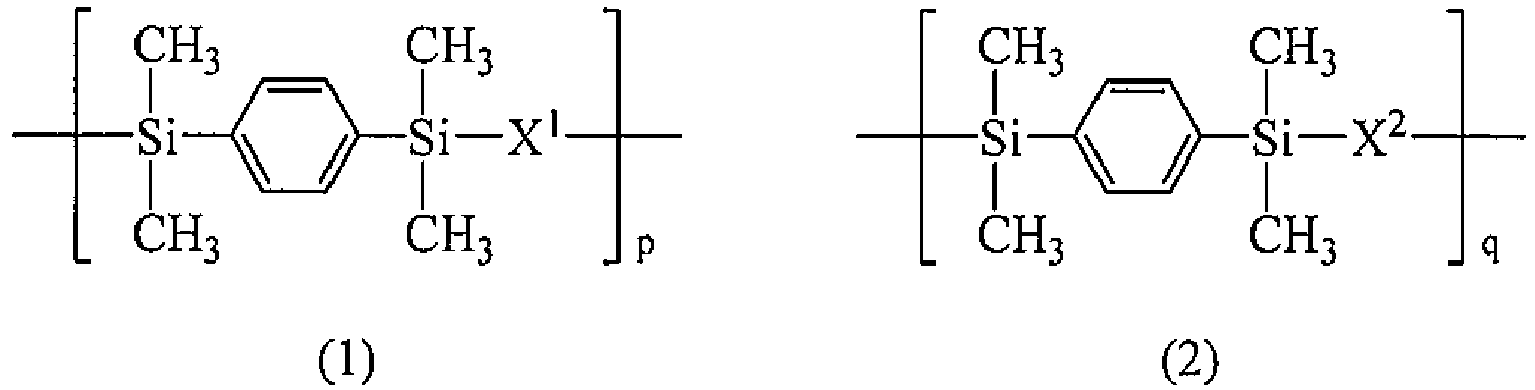
- the polymer is defined as comprising repeating units having the following formulae (1) to (4).
- X 1 is a divalent group having the following formula (X1)
- X 2 is a divalent group having the following formula (X2)
- X 3 is a divalent group having the following formula (X3)
- X 4 is a divalent group having the following formula (X4)
- R 1 and R 2 are each independently hydrogen or a C 1 -C 8 monovalent hydrocarbon group
- R 3 and R 4 are each independently hydrogen or methyl
- a 1 and a 2 are each independently an integer of 1 to 6
- n is an integer of 0 to 100.
- Y 1 is a single bond, methylene, propane-2,2-diyl, 1,1,1,3,3,3-hexafluoropropane-2,2-diyl or fluorene-9,9-diyl
- R 11 and R 12 are each independently hydrogen or methyl
- R 13 and R 14 are each independently a C 1 -C 4 alkyl or alkoxy group
- b 1 and b 2 are each independently an integer of 0 to 7
- c 1 and c 2 are each independently an integer of 0 to 2.
- Y 2 is a single bond, methylene, propane-2,2-diyl, 1,1,1,3,3,3-hexafluoropropane-2,2-diyl or fluorene-9,9-diyl
- R 21 and R 22 are each independently hydrogen or methyl
- R 23 and R 24 are each independently a C 1 -C 4 alkyl or alkoxy group
- d 1 and d 2 are each independently an integer of 0 to 7
- e 1 and e 2 are each independently an integer of 0 to 2.
- R 31 and R 32 are each independently hydrogen or methyl
- f 1 and f 2 are each independently an integer of 0 to 7.
- R 1 and R 2 each are hydrogen and n is an integer of 5 to 20.
- the inventive polymer is readily synthesizable and used to formulate a photosensitive composition having improved reliability.
- Cn-Cm means a group containing from n to m carbon atoms per group.
- the invention provides a polymer containing a silphenylene structure and a polyether structure in the backbone.
- the polymer preferably has an epoxy group and/or phenolic hydroxyl group.
- the polymer preferably comprises repeating units having the following formulae (1) to (4), which are sometimes designated repeating units (1) to (4), hereinafter.
- X 1 is a divalent group having the formula (X1).
- R 1 and R 2 are each independently hydrogen or a C 1 -C 8 monovalent hydrocarbon group
- R 3 and R 4 are each independently hydrogen or methyl
- a 1 and a 2 are each independently an integer of 1 to 6, preferably 1 to 4, and more preferably 1 or 2
- n is an integer of 0 to 100, preferably 1 to 50, and more preferably 5 to 20.
- the C 1 -C 8 monovalent hydrocarbon groups may be straight, branched or cyclic, and include, for example, monovalent aliphatic hydrocarbon groups such as C 1 -C 8 alkyl groups and C 2 -C 8 alkenyl groups and monovalent aromatic hydrocarbon groups such as C 6 -C 8 aryl groups and C 7 or C 8 aralkyl groups.
- Examples of the C 1 -C 8 alkyl group include methyl, ethyl, n-propyl, isopropyl, cyclopropyl, n-butyl, isobutyl, sec-butyl, tert-butyl, cyclobutyl, n-pentyl, cyclopentyl, n-hexyl, cyclohexyl, n-heptyl, and n-octyl.
- Examples of the alkenyl group include vinyl, propenyl, butenyl, and pentenyl.
- aryl group examples include phenyl, 2-methylphenyl, 3-methylphenyl, 4-methylphenyl, 2-ethylphenyl, 3-ethylphenyl, 4-ethylphenyl, and dimethylphenyl.
- aralkyl group examples include benzyl and phenethyl.
- R 1 and R 2 are preferably hydrogen or C 1 -C 8 alkyl groups, more preferably hydrogen or methyl.
- the alkylene oxide units with subscript n may be randomly or alternately arranged, or plural blocks of the same alkylene oxide units may be included.
- X 2 is a divalent group having the formula (X2).
- Y 1 is a single bond, methylene, propane-2,2-diyl, 1,1,1,3,3,3-hexafluoropropane-2,2-diyl or fluorene-9,9-diyl
- R 1 and R 12 are each independently hydrogen or methyl
- R 13 and R 14 are each independently a C 1 -C 4 alkyl or alkoxy group
- b 1 and b 2 are each independently an integer of 0 to 7
- c 1 and c 2 are each independently an integer of 0 to 2.
- the C 1 -C 4 alkyl group may be straight, branched or cyclic, and examples thereof include methyl, ethyl, n-propyl, isopropyl, cyclopropyl, n-butyl, isobutyl, sec-butyl, tert-butyl, and cyclobutyl.
- the C 1 -C 4 alkoxy group may be straight, branched or cyclic, and examples thereof include methoxy, ethoxy, n-propyloxy, isopropyloxy, cyclopropyloxy, n-butyloxy, isobutyloxy, sec-butyloxy, tert-butyloxy, and cyclobutyloxy.
- X 3 is a divalent group having the formula (X3).
- Y 2 is a single bond, methylene, propane-2,2-diyl, 1,1,1,3,3,3-hexafluoropropane-2,2-diyl or fluorene-9,9-diyl
- R 21 and R 22 are each independently hydrogen or methyl
- R 23 and R 24 are each independently a C 1 -C 4 alkyl or alkoxy group
- d 1 and d 2 are each independently an integer of 0 to 7
- e 1 and e 2 are each independently an integer of 0, 1 or 2.
- Examples of the C 1 -C 4 alkyl or alkoxy group are as exemplified in the description of formula (X2).
- X 4 is a divalent group having the formula (X4).
- R 31 and R 32 are each independently hydrogen or methyl, and f 1 and f 2 are each independently an integer of 0 to 7.
- the repeating units (1) to (4) may be arranged either randomly or blockwise.
- the inventive polymer preferably has a weight average molecular weight (Mw) of 3,000 to 500,000, more preferably 5,000 to 200,000. Polymers with Mw in the range are fully soluble in most common organic solvents. It is noted throughout the disclosure that Mw is measured by gel permeation chromatography (GPC) versus polystyrene standards using tetrahydrofuran as the elute.
- Mw weight average molecular weight
- the polymer may be composed of randomly or alternately arranged repeating units (1) to (4) or plural blocks each consisting of units of the same type.
- the polymer may be prepared by addition polymerization of a compound having the formula (5), a compound having the formula (X1'), and at least one compound selected from a compound having the formula (X2'), a compound having the formula (X3'), and a compound having the formula (X4'), all shown below, in the presence of a metal catalyst.
- Y 1 , Y 2 , R 1 to R 4 , R 11 to R 14 , R 21 to R 24 , R 31 , R 32 , a 1 , a 2 , b 1 , b 2 , c 1 , c 2 , d 1 , d 2 , e 1 , e 2 , f 1 , f 2 and n are as defined above.
- metal catalyst used herein examples include platinum group metals alone such as platinum (including platinum black), rhodium and palladium; platinum chlorides, chloroplatinic acids and chloroplatinates such as H 2 PtCl 4 ⁇ xH 2 O, H 2 PtCl 6 ⁇ xH 2 O, NaHPtCl 6 ⁇ xH 2 O, KHPtCl 6 ⁇ xH 2 O, Na 2 PtCl 6 ⁇ xH 2 O, K 2 PtCl 4 ⁇ xH 2 O, PtCl 4 ⁇ xH 2 O, PtCl 2 and Na 2 HPtCl 4 ⁇ xH 2 O, wherein x is preferably an integer of 0 to 6, more preferably 0 or 6; alcohol-modified chloroplatinic acids as described in USP 3,220,972 ; chloroplatinic acid-olefin complexes as described in USP 3,159,601 , USP 3,159,662 and USP 3,775,452 ; supported catalysts
- the catalyst is used in a catalytic amount, which is preferably 0.001 to 0.1% by weight of platinum group metal based on the total weight of the reactants for polymerization reaction.
- a solvent may be used if desired. Suitable solvents are hydrocarbon solvents such as toluene and xylene.
- the polymerization temperature is preferably selected in a range of 40 to 150°C, more preferably 60 to 120°C, such that the catalyst may not be deactivated and the polymerization be completed within a short time.
- the polymerization reaction is preferably completed within about 0.5 to about 100 hours, more preferably about 0.5 to about 30 hours for preventing moisture entry into the polymerization system. After the completion of polymerization reaction, the solvent if any is distilled off, obtaining the desired polymer.
- the reaction procedure is not particularly limited.
- the preferred procedure is by first mixing a compound having formula (X1') with one or more compounds selected from a compound having formula (X2'), a compound having formula (X3'), and a compound having formula (X4'), heating the mixture, adding a metal catalyst to the mixture, and then adding a compound having formula (5) dropwise over 0.1 to 5 hours.
- the reactants are preferably combined in such amounts that a molar ratio of hydrosilyl groups on the compound having formula (5) to the total of alkenyl groups on the compounds having formulae (X1'), (X2'), (X3'), and (X4') may range from 0.67/1 to 1.67/1, more preferably from 0.83/1 to 1.25/1.
- the Mw of the polymer may be controlled using a molecular weight control agent such as a monoallyl compound (e.g., o-allylphenol), monohydrosilane (e.g., triethylhydrosilane) or monohydrosiloxane.
- Mw weight average molecular weight
- GPC gel permeation chromatography
- monodisperse polystyrene standards using GPC columns TSKGEL Super HZM-H (Tosoh Corp.) under analytical conditions: flow rate 0.6 mL/min, tetrahydrofuran elute, and column temperature 40°C.
- Resin 1 had a Mw of 43,000. On 1 H-NMR spectroscopy (Bruker Corp.), Resin 1 was identified to be a polymer containing repeating units (1) and (2).
- a 3-L flask equipped with a stirrer, thermometer, nitrogen purge line and reflux condenser was charged with 172.0 g (0.40 mol) of the compound having formula (S-7), 53.9 g (0.10 mol) of the compound having formula (S-3a), and 2,000 g of toluene and heated at 70°C. Thereafter, 1.0 g of a toluene solution of chloroplatinic acid (platinum concentration 0.5 wt%) was added, and 97.0 g (0.50 mol) of the compound having formula (S-5) was added dropwise over 1 hour. The ratio of the total moles of hydrosilyl groups to the total moles of alkenyl groups was 1/1.
- Resin 2 had a Mw of 25,000. On 1 H-NMR spectroscopy (Bruker Corp.), Resin 2 was identified to be a polymer containing repeating units (1) and (3).
- a 3-L flask equipped with a stirrer, thermometer, nitrogen purge line and reflux condenser was charged with 106.0 g (0.40 mol) of the compound having formula (S-2), 53.9 g (0.10 mol) of the compound having formula (S-3a), and 2,000 g of toluene and heated at 70°C. Thereafter, 1.0 g of a toluene solution of chloroplatinic acid (platinum concentration 0.5 wt%) was added, and 97.0 g (0.50 mol) of the compound having formula (S-5) was added dropwise over 1 hour. The ratio of the total moles of hydrosilyl groups to the total moles of alkenyl groups was 1/1.
- Resin 3 had a Mw of 34,000. On 1 H-NMR spectroscopy (Bruker Corp.), Resin 3 was identified to be a polymer containing repeating units (1) and (4).
- Resin 4 had a Mw of 50,000. On 1 H-NMR spectroscopy (Bruker Corp.), Resin 4 was identified to be a polymer containing repeating units (1), (2), (3), and (4).
- the ratio of the total moles of hydrosilyl groups to the total moles of alkenyl groups was 1/1.
- the reaction solution was heated at 100°C and aged for 6 hours.
- Toluene was distilled off in vacuum from the reaction solution, yielding Resin 5.
- Resin 5 had a Mw of 58,000.
- Resins 1 to 5 are synthesized above, demonstrating that novel polymers containing a silphenylene structure and a polyether structure in the backbone are provided.
Landscapes
- Chemical & Material Sciences (AREA)
- Chemical Kinetics & Catalysis (AREA)
- Organic Chemistry (AREA)
- Medicinal Chemistry (AREA)
- Polymers & Plastics (AREA)
- Health & Medical Sciences (AREA)
- Physics & Mathematics (AREA)
- General Chemical & Material Sciences (AREA)
- Spectroscopy & Molecular Physics (AREA)
- General Physics & Mathematics (AREA)
- Materials Engineering (AREA)
- Wood Science & Technology (AREA)
- Engineering & Computer Science (AREA)
- Life Sciences & Earth Sciences (AREA)
- Silicon Polymers (AREA)
- Epoxy Resins (AREA)
- Polyethers (AREA)
Abstract
Description
- This non-provisional application claims priority under 35 U.S.C. §119(a) on Patent Application No.
2018-095338 filed in Japan on May 17, 2018 - This invention relates to a polymer containing silphenylene and polyether structures.
- In the prior art, photosensitive protective films for semiconductor devices and photosensitive dielectric films for multilayer printed circuit boards are formed of photosensitive polyimide, epoxy resin, and silicone compositions. While many photosensitive materials are known for the protection of such substrates and circuit boards, Patent Document 1 discloses a photosensitive silicone composition having improved flexibility.
- Patent Document 2 discloses a photosensitive silicone composition based on a silphenylene structure-containing silicone polymer. Although this photosensitive silicone composition has improved chemical resistance to liquid photoresist strippers, the cured product can spall off from the substrate or crack during a thermal cycle test (repetitive 1,000 cycles of -25°C/10 min holding and 125°C/10 min holding). A further improvement in reliability is desired.
-
- Patent Document 1:
JP-A 2002-088158 USP 6,590,010 ,EP 1186624 ) - Patent Document 2:
JP-A 2008-184571 USP 7,785,766 ,EP 1953183 ) - An object of the invention is to provide a novel polymer which may be used to formulate a photosensitive composition having improved reliability.
- The inventors have found that the outstanding problem is solved by a polymer containing a silphenylene structure and a polyether structure.
- According to the invention, there is provided a polymer containing a silphenylene structure and a polyether structure in the backbone.
- The polymer preferably has an epoxy group and/or phenolic hydroxyl group.
- Also preferably, the polymer has a weight average molecular weight of 3,000 to 500,000.
- Specifically, the polymer is defined as comprising repeating units having the following formulae (1) to (4).


- In a preferred embodiment, R1 and R2 each are hydrogen and n is an integer of 5 to 20.
- The inventive polymer is readily synthesizable and used to formulate a photosensitive composition having improved reliability.
- As used herein, the notation (Cn-Cm) means a group containing from n to m carbon atoms per group.
- The invention provides a polymer containing a silphenylene structure and a polyether structure in the backbone. The polymer preferably has an epoxy group and/or phenolic hydroxyl group.
- The polymer preferably comprises repeating units having the following formulae (1) to (4), which are sometimes designated repeating units (1) to (4), hereinafter.


- In formula (1), X1 is a divalent group having the formula (X1).

- The C1-C8 monovalent hydrocarbon groups may be straight, branched or cyclic, and include, for example, monovalent aliphatic hydrocarbon groups such as C1-C8 alkyl groups and C2-C8 alkenyl groups and monovalent aromatic hydrocarbon groups such as C6-C8 aryl groups and C7 or C8 aralkyl groups.
- Examples of the C1-C8 alkyl group include methyl, ethyl, n-propyl, isopropyl, cyclopropyl, n-butyl, isobutyl, sec-butyl, tert-butyl, cyclobutyl, n-pentyl, cyclopentyl, n-hexyl, cyclohexyl, n-heptyl, and n-octyl. Examples of the alkenyl group include vinyl, propenyl, butenyl, and pentenyl. Examples of the aryl group include phenyl, 2-methylphenyl, 3-methylphenyl, 4-methylphenyl, 2-ethylphenyl, 3-ethylphenyl, 4-ethylphenyl, and dimethylphenyl. Examples of the aralkyl group include benzyl and phenethyl.
- R1 and R2 are preferably hydrogen or C1-C8 alkyl groups, more preferably hydrogen or methyl.
- In formula (X1), the alkylene oxide units with subscript n may be randomly or alternately arranged, or plural blocks of the same alkylene oxide units may be included.
- In formula (2), X2 is a divalent group having the formula (X2).

- The C1-C4 alkyl group may be straight, branched or cyclic, and examples thereof include methyl, ethyl, n-propyl, isopropyl, cyclopropyl, n-butyl, isobutyl, sec-butyl, tert-butyl, and cyclobutyl. The C1-C4 alkoxy group may be straight, branched or cyclic, and examples thereof include methoxy, ethoxy, n-propyloxy, isopropyloxy, cyclopropyloxy, n-butyloxy, isobutyloxy, sec-butyloxy, tert-butyloxy, and cyclobutyloxy.
- In formula (3), X3 is a divalent group having the formula (X3).

- In formula (4), X4 is a divalent group having the formula (X4).

- In formulae (1) to (4), p, q, r and s indicative of contents (molar fractions) of repeating units (1), (2), (3), and (4) in the polymer, respectively, are numbers in the range: 0 < p < 1, 0 ≤ q < 1, 0 ≤ r < 1, 0 ≤ s < 1,0 < q+r+s < 1, and p+q+r+s = 1. From the aspects of film formation or handling, p, q, r and s are preferably numbers in the range: 0.1 ≤ p ≤ 0.9, 0 ≤ q ≤ 0.9, 0 ≤ r ≤ 0.9, 0 ≤ s ≤ 0.9, and 0.1 ≤ q+r+s ≤ 0.9, more preferably 0.2 ≤ p ≤ 0.8, 0 ≤ q ≤ 0.8, 0 ≤ r ≤ 0.8, 0 ≤ s ≤ 0.8, and 0.2 ≤ q+r+s ≤ 0.8, with the proviso that p+q+r+s = 1. The repeating units (1) to (4) may be arranged either randomly or blockwise.
- The inventive polymer preferably has a weight average molecular weight (Mw) of 3,000 to 500,000, more preferably 5,000 to 200,000. Polymers with Mw in the range are fully soluble in most common organic solvents. It is noted throughout the disclosure that Mw is measured by gel permeation chromatography (GPC) versus polystyrene standards using tetrahydrofuran as the elute.
- The polymer may be composed of randomly or alternately arranged repeating units (1) to (4) or plural blocks each consisting of units of the same type.
- The polymer may be prepared by addition polymerization of a compound having the formula (5), a compound having the formula (X1'), and at least one compound selected from a compound having the formula (X2'), a compound having the formula (X3'), and a compound having the formula (X4'), all shown below, in the presence of a metal catalyst.


- Examples of the metal catalyst used herein include platinum group metals alone such as platinum (including platinum black), rhodium and palladium; platinum chlorides, chloroplatinic acids and chloroplatinates such as H2PtCl4·xH2O, H2PtCl6·xH2O, NaHPtCl6·xH2O, KHPtCl6·xH2O, Na2PtCl6·xH2O, K2PtCl4·xH2O, PtCl4·xH2O, PtCl2 and Na2HPtCl4·xH2O, wherein x is preferably an integer of 0 to 6, more preferably 0 or 6; alcohol-modified chloroplatinic acids as described in
USP 3,220,972 ; chloroplatinic acid-olefin complexes as described inUSP 3,159,601 ,USP 3,159,662 andUSP 3,775,452 ; supported catalysts comprising platinum group metals such as platinum black and palladium on supports of alumina, silica and carbon; rhodium-olefin complexes; chlorotris(triphenylphosphine)rhodium (known as Wilkinson's catalyst); and complexes of platinum chlorides, chloroplatinic acids and chloroplatinates with vinyl-containing siloxanes, specifically vinyl-containing cyclosiloxanes. - The catalyst is used in a catalytic amount, which is preferably 0.001 to 0.1% by weight of platinum group metal based on the total weight of the reactants for polymerization reaction. In the polymerization reaction, a solvent may be used if desired. Suitable solvents are hydrocarbon solvents such as toluene and xylene. With respect to polymerization conditions, the polymerization temperature is preferably selected in a range of 40 to 150°C, more preferably 60 to 120°C, such that the catalyst may not be deactivated and the polymerization be completed within a short time. While the polymerization time varies with the type and amount of monomers, the polymerization reaction is preferably completed within about 0.5 to about 100 hours, more preferably about 0.5 to about 30 hours for preventing moisture entry into the polymerization system. After the completion of polymerization reaction, the solvent if any is distilled off, obtaining the desired polymer.
- The reaction procedure is not particularly limited. The preferred procedure is by first mixing a compound having formula (X1') with one or more compounds selected from a compound having formula (X2'), a compound having formula (X3'), and a compound having formula (X4'), heating the mixture, adding a metal catalyst to the mixture, and then adding a compound having formula (5) dropwise over 0.1 to 5 hours.
- The reactants are preferably combined in such amounts that a molar ratio of hydrosilyl groups on the compound having formula (5) to the total of alkenyl groups on the compounds having formulae (X1'), (X2'), (X3'), and (X4') may range from 0.67/1 to 1.67/1, more preferably from 0.83/1 to 1.25/1. The Mw of the polymer may be controlled using a molecular weight control agent such as a monoallyl compound (e.g., o-allylphenol), monohydrosilane (e.g., triethylhydrosilane) or monohydrosiloxane.
- Examples of the invention are given below by way of illustration and not by way of limitation. In Examples, the weight average molecular weight (Mw) is measured by gel permeation chromatography (GPC) versus monodisperse polystyrene standards using GPC columns TSKGEL Super HZM-H (Tosoh Corp.) under analytical conditions: flow rate 0.6 mL/min, tetrahydrofuran elute, and column temperature 40°C.
- The compounds used in polymer synthesis are shown below.


- A 3-L flask equipped with a stirrer, thermometer, nitrogen purge line and reflux condenser was charged with 156.8 g (0.40 mol) of the compound having formula (S-1), 53.9 g (0.10 mol) of the compound having formula (S-3a) (UNIOX from NOF Corp.), and 2,000 g of toluene and heated at 70°C. Thereafter, 1.0 g of a toluene solution of chloroplatinic acid (platinum concentration 0.5 wt%) was added, and 97.0 g (0.50 mol) of the compound having formula (S-5) was added dropwise over 1 hour. The ratio of the total moles of hydrosilyl groups to the total moles of alkenyl groups was 1/1. At the end of dropwise addition, the reaction solution was heated at 100°C and aged for 6 hours. Toluene was distilled off in vacuum from the reaction solution, yielding Resin 1. Resin 1 had a Mw of 43,000. On 1H-NMR spectroscopy (Bruker Corp.), Resin 1 was identified to be a polymer containing repeating units (1) and (2).
- A 3-L flask equipped with a stirrer, thermometer, nitrogen purge line and reflux condenser was charged with 172.0 g (0.40 mol) of the compound having formula (S-7), 53.9 g (0.10 mol) of the compound having formula (S-3a), and 2,000 g of toluene and heated at 70°C. Thereafter, 1.0 g of a toluene solution of chloroplatinic acid (platinum concentration 0.5 wt%) was added, and 97.0 g (0.50 mol) of the compound having formula (S-5) was added dropwise over 1 hour. The ratio of the total moles of hydrosilyl groups to the total moles of alkenyl groups was 1/1. At the end of dropwise addition, the reaction solution was heated at 100°C and aged for 6 hours. Toluene was distilled off in vacuum from the reaction solution, yielding Resin 2. Resin 2 had a Mw of 25,000. On 1H-NMR spectroscopy (Bruker Corp.), Resin 2 was identified to be a polymer containing repeating units (1) and (3).
- A 3-L flask equipped with a stirrer, thermometer, nitrogen purge line and reflux condenser was charged with 106.0 g (0.40 mol) of the compound having formula (S-2), 53.9 g (0.10 mol) of the compound having formula (S-3a), and 2,000 g of toluene and heated at 70°C. Thereafter, 1.0 g of a toluene solution of chloroplatinic acid (platinum concentration 0.5 wt%) was added, and 97.0 g (0.50 mol) of the compound having formula (S-5) was added dropwise over 1 hour. The ratio of the total moles of hydrosilyl groups to the total moles of alkenyl groups was 1/1. At the end of dropwise addition, the reaction solution was heated at 100°C and aged for 6 hours. Toluene was distilled off in vacuum from the reaction solution, yielding Resin 3. Resin 3 had a Mw of 34,000. On 1H-NMR spectroscopy (Bruker Corp.), Resin 3 was identified to be a polymer containing repeating units (1) and (4).
- A 3-L flask equipped with a stirrer, thermometer, nitrogen purge line and reflux condenser was charged with 9.8 g (0.025 mol) of the compound having formula (S-1), 10.8 g (0.025 mol) of the compound having formula (S-7), 13.3 g (0.05 mol) of the compound having formula (S-2), 215.6 g (0.40 mol) of the compound having formula (S-3a), and 2,000 g of toluene and heated at 70°C. Thereafter, 1.0 g of a toluene solution of chloroplatinic acid (platinum concentration 0.5 wt%) was added, and 97.0 g (0.50 mol) of the compound having formula (S-5) was added dropwise over 1 hour. The ratio of the total moles of hydrosilyl groups to the total moles of alkenyl groups was 1/1. At the end of dropwise addition, the reaction solution was heated at 100°C and aged for 6 hours. Toluene was distilled off in vacuum from the reaction solution, yielding Resin 4. Resin 4 had a Mw of 50,000. On 1H-NMR spectroscopy (Bruker Corp.), Resin 4 was identified to be a polymer containing repeating units (1), (2), (3), and (4).
- A 3-L flask equipped with a stirrer, thermometer, nitrogen purge line and reflux condenser was charged with 9.8 g (0.025 mol) of the compound having formula (S-1), 10.8 g (0.025 mol) of the compound having formula (S-7), 13.3 g (0.05 mol) of the compound having formula (S-2), 327.2 g (0.40 mol) of the compound having formula (S-3b), and 2,000 g of toluene and heated at 70°C. Thereafter, 1.0 g of a toluene solution of chloroplatinic acid (platinum concentration 0.5 wt%) was added, and 97.0 g (0.50 mol) of the compound having formula (S-5) was added dropwise over 1 hour. The ratio of the total moles of hydrosilyl groups to the total moles of alkenyl groups was 1/1. At the end of dropwise addition, the reaction solution was heated at 100°C and aged for 6 hours. Toluene was distilled off in vacuum from the reaction solution, yielding Resin 5. Resin 5 had a Mw of 58,000. On 1H-NMR spectroscopy (Bruker Corp.), Resin 5 was identified to be a polymer containing repeating units (1), (2), (3), and (4).
- Resins 1 to 5 are synthesized above, demonstrating that novel polymers containing a silphenylene structure and a polyether structure in the backbone are provided.
- Japanese Patent Application No.
2018-095338 - Although some preferred embodiments have been described, many modifications and variations may be made thereto in light of the above teachings. It is therefore to be understood that the invention may be practiced otherwise than as specifically described without departing from the scope of the appended claims.
Claims (6)
- A polymer containing a silphenylene structure and a polyether structure in the backbone.
- The polymer of claim 1, having an epoxy group and/or phenolic hydroxyl group.
- The polymer of claim 1 or 2, having a weight average molecular weight of 3,000 to 500,000.
- The polymer of any one of claims 1 to 3, comprising repeating units having the following formulae (1) to (4):




- The polymer of claim 4 wherein R1 and R2 each are hydrogen.
- The polymer of claim 4 or 5 wherein n is an integer of 5 to 20.
Applications Claiming Priority (1)
| Application Number | Priority Date | Filing Date | Title |
|---|---|---|---|
| JP2018095338A JP6919626B2 (en) | 2018-05-17 | 2018-05-17 | Polymers containing silphenylene skeleton and polyether skeleton |
Publications (2)
| Publication Number | Publication Date |
|---|---|
| EP3569638A1 true EP3569638A1 (en) | 2019-11-20 |
| EP3569638B1 EP3569638B1 (en) | 2020-09-23 |
Family
ID=66668670
Family Applications (1)
| Application Number | Title | Priority Date | Filing Date |
|---|---|---|---|
| EP19172966.4A Active EP3569638B1 (en) | 2018-05-17 | 2019-05-07 | Polymer containing silphenylene and polyether structures |
Country Status (6)
| Country | Link |
|---|---|
| US (1) | US10982053B2 (en) |
| EP (1) | EP3569638B1 (en) |
| JP (1) | JP6919626B2 (en) |
| KR (1) | KR102717408B1 (en) |
| CN (1) | CN110498926B (en) |
| TW (1) | TWI796481B (en) |
Families Citing this family (6)
| Publication number | Priority date | Publication date | Assignee | Title |
|---|---|---|---|---|
| JP6874584B2 (en) | 2017-08-09 | 2021-05-19 | 信越化学工業株式会社 | Photosensitive resin composition, photosensitive resin film, photosensitive dry film, laminate, and pattern forming method |
| JP6866802B2 (en) | 2017-08-09 | 2021-04-28 | 信越化学工業株式会社 | Silicone skeleton-containing polymer compound, photosensitive resin composition, photosensitive resin film, photosensitive dry film, laminate, and pattern forming method |
| JP6870657B2 (en) * | 2018-05-17 | 2021-05-12 | 信越化学工業株式会社 | Photosensitive resin composition, photosensitive dry film, and pattern forming method |
| US11548985B2 (en) | 2018-11-28 | 2023-01-10 | Shin-Etsu Chemical Co., Ltd. | Siloxane polymer containing isocyanuric acid and polyether skeletons, photosensitive resin composition, pattern forming process, and fabrication of opto-semiconductor device |
| JP7056541B2 (en) | 2018-12-19 | 2022-04-19 | 信越化学工業株式会社 | Photosensitive resin composition, photosensitive dry film and pattern forming method |
| EP4479479B1 (en) | 2022-05-17 | 2025-08-13 | Wacker Chemie AG | Silphenylene polymers |
Citations (11)
| Publication number | Priority date | Publication date | Assignee | Title |
|---|---|---|---|---|
| US3159601A (en) | 1962-07-02 | 1964-12-01 | Gen Electric | Platinum-olefin complex catalyzed addition of hydrogen- and alkenyl-substituted siloxanes |
| US3159662A (en) | 1962-07-02 | 1964-12-01 | Gen Electric | Addition reaction |
| US3220972A (en) | 1962-07-02 | 1965-11-30 | Gen Electric | Organosilicon process using a chloroplatinic acid reaction product as the catalyst |
| US3775452A (en) | 1971-04-28 | 1973-11-27 | Gen Electric | Platinum complexes of unsaturated siloxanes and platinum containing organopolysiloxanes |
| US5240971A (en) * | 1991-12-05 | 1993-08-31 | General Electric Company | UV-curable epoxysilicone-polyether block copolymers |
| JPH1180362A (en) * | 1997-08-29 | 1999-03-26 | Toray Dow Corning Silicone Co Ltd | Method for producing silphenylene silalkylene polymer |
| EP0927736A1 (en) * | 1997-12-29 | 1999-07-07 | Dow Corning Toray Silicone Company, Ltd. | Silphenylene polymer and composition containing same |
| EP1186624A1 (en) | 2000-09-12 | 2002-03-13 | Shin-Etsu Chemical Co., Ltd. | Organosiloxane polymers and photo-curable resin compositions |
| EP1953183A2 (en) | 2007-01-31 | 2008-08-06 | Shin-Etsu Chemical Co., Ltd. | Silphenylene-bearing polymer, photo-curable resin composition, patterning process, and substrate circuit protective film |
| EP3103835A1 (en) * | 2015-06-08 | 2016-12-14 | Shin-Etsu Chemical Co., Ltd. | Semiconductor apparatus, stacked semiconductor apparatus, encapsulated stacked-semiconductor apparatus, and method for manufacturing the same |
| JP2018095338A (en) | 2016-12-09 | 2018-06-21 | ダイヤモンドエンジニアリング株式会社 | Powder supply device |
Family Cites Families (29)
| Publication number | Priority date | Publication date | Assignee | Title |
|---|---|---|---|---|
| US4470831A (en) * | 1981-01-22 | 1984-09-11 | Toray Industries, Inc. | Permselective membrane |
| US4990546A (en) * | 1990-03-23 | 1991-02-05 | General Electric Company | UV-curable silphenylene-containing epoxy functional silicones |
| JPH0586188A (en) * | 1991-09-30 | 1993-04-06 | Kanegafuchi Chem Ind Co Ltd | Silicon hybrid material |
| US5346980A (en) * | 1992-04-14 | 1994-09-13 | Minnesota Mining And Manufacturing Company | Crosslinkable silarylene-siloxane copolymers |
| DE4433139A1 (en) * | 1994-09-16 | 1996-03-21 | Thera Ges Fuer Patente | Hydrophilized dental impression materials |
| JPH09302095A (en) * | 1996-05-10 | 1997-11-25 | Kanegafuchi Chem Ind Co Ltd | Curable composition, molded body and manufacturing method |
| US6080816A (en) * | 1997-11-10 | 2000-06-27 | E. I. Du Pont De Nemours And Company | Coatings that contain reactive silicon oligomers |
| ATE435883T1 (en) * | 2004-07-14 | 2009-07-15 | 3M Innovative Properties Co | DENTAL COMPOSITIONS WITH CARBOSILANE POLYMERS |
| CN101336263B (en) * | 2005-12-07 | 2012-02-01 | 大阪瓦斯株式会社 | Polysilane and resin composition containing polysilane |
| JP4549382B2 (en) * | 2007-12-14 | 2010-09-22 | 信越化学工業株式会社 | Novel silphenylene compound and process for producing the same |
| JPWO2009123032A1 (en) * | 2008-04-02 | 2011-07-28 | Jsr株式会社 | Composition containing silicon-containing polymer and cured product thereof |
| DE102009022631A1 (en) * | 2009-05-25 | 2010-12-16 | Evonik Goldschmidt Gmbh | Curable silyl group-containing compositions and their use |
| JP5310656B2 (en) | 2010-06-18 | 2013-10-09 | 信越化学工業株式会社 | Silphenylene-containing photocurable composition, pattern forming method using the same, and optical semiconductor device obtained by the method |
| US8796410B2 (en) * | 2011-05-23 | 2014-08-05 | Shin-Etsu Chemical Co., Ltd. | Polymer having silphenylene and siloxane structures, a method of preparing the same, an adhesive composition, an adhesive sheet, a protective material for a semiconductor device, and a semiconductor device |
| JP5788852B2 (en) * | 2011-11-01 | 2015-10-07 | 信越化学工業株式会社 | Fluorooxyalkylene group-containing polymer composition, surface treatment agent containing the composition, article treated with the surface treatment agent, and optical article |
| JP5846110B2 (en) | 2011-12-09 | 2016-01-20 | 信越化学工業株式会社 | Chemically amplified negative resist composition, photocurable dry film, method for producing the same, pattern forming method, and film for protecting electric / electronic parts |
| JP5942859B2 (en) * | 2012-01-27 | 2016-06-29 | 信越化学工業株式会社 | Silicone skeleton-containing polymer, resin composition, photocurable dry film |
| JP5767161B2 (en) * | 2012-05-08 | 2015-08-19 | 信越化学工業株式会社 | Temporary adhesive for wafer processing, wafer processing member using the same, wafer processed body, and method for producing thin wafer |
| JP2014006507A (en) * | 2012-06-01 | 2014-01-16 | Shin Etsu Chem Co Ltd | Photocurable resin composition, photocurable dry film, pattern formation method, coating for electric and electronic component protection, and electric and electronic component |
| JP6194862B2 (en) * | 2014-07-29 | 2017-09-13 | 信越化学工業株式会社 | Silicone skeleton-containing polymer compound, negative resist material, photo-curable dry film, pattern forming method, and film for protecting electrical and electronic parts |
| US10114287B2 (en) | 2014-10-02 | 2018-10-30 | Shin-Etsu Chemical Co., Ltd. | Silicone skeleton-containing polymer compound and method for producing same, chemically amplified negative resist composition, photo-curable dry film and method for producing same, patterning process, layered product, and substrate |
| JP6521091B2 (en) * | 2015-11-06 | 2019-05-29 | 信越化学工業株式会社 | Fluoropolyether group-containing polymer modified organosilicon compound, surface treating agent and article |
| JP6499102B2 (en) | 2016-03-04 | 2019-04-10 | 信越化学工業株式会社 | Positive photosensitive resin composition, photocurable dry film and method for producing the same, pattern forming method, and laminate |
| JP6616743B2 (en) * | 2016-06-30 | 2019-12-04 | 信越化学工業株式会社 | Silicone skeleton-containing polymer compound, photocurable resin composition, photocurable dry film, laminate, and pattern forming method |
| JP6798513B2 (en) | 2017-02-03 | 2020-12-09 | 信越化学工業株式会社 | Photosensitive resin composition, photosensitive dry film, photosensitive resin film, and pattern forming method |
| JP6866802B2 (en) * | 2017-08-09 | 2021-04-28 | 信越化学工業株式会社 | Silicone skeleton-containing polymer compound, photosensitive resin composition, photosensitive resin film, photosensitive dry film, laminate, and pattern forming method |
| JP6870657B2 (en) * | 2018-05-17 | 2021-05-12 | 信越化学工業株式会社 | Photosensitive resin composition, photosensitive dry film, and pattern forming method |
| US11548985B2 (en) * | 2018-11-28 | 2023-01-10 | Shin-Etsu Chemical Co., Ltd. | Siloxane polymer containing isocyanuric acid and polyether skeletons, photosensitive resin composition, pattern forming process, and fabrication of opto-semiconductor device |
| JP7056541B2 (en) * | 2018-12-19 | 2022-04-19 | 信越化学工業株式会社 | Photosensitive resin composition, photosensitive dry film and pattern forming method |
-
2018
- 2018-05-17 JP JP2018095338A patent/JP6919626B2/en active Active
-
2019
- 2019-05-07 EP EP19172966.4A patent/EP3569638B1/en active Active
- 2019-05-14 KR KR1020190056036A patent/KR102717408B1/en active Active
- 2019-05-16 TW TW108116886A patent/TWI796481B/en active
- 2019-05-16 CN CN201910405687.XA patent/CN110498926B/en active Active
- 2019-05-16 US US16/414,281 patent/US10982053B2/en active Active
Patent Citations (15)
| Publication number | Priority date | Publication date | Assignee | Title |
|---|---|---|---|---|
| US3159601A (en) | 1962-07-02 | 1964-12-01 | Gen Electric | Platinum-olefin complex catalyzed addition of hydrogen- and alkenyl-substituted siloxanes |
| US3159662A (en) | 1962-07-02 | 1964-12-01 | Gen Electric | Addition reaction |
| US3220972A (en) | 1962-07-02 | 1965-11-30 | Gen Electric | Organosilicon process using a chloroplatinic acid reaction product as the catalyst |
| US3775452A (en) | 1971-04-28 | 1973-11-27 | Gen Electric | Platinum complexes of unsaturated siloxanes and platinum containing organopolysiloxanes |
| US5240971A (en) * | 1991-12-05 | 1993-08-31 | General Electric Company | UV-curable epoxysilicone-polyether block copolymers |
| JPH1180362A (en) * | 1997-08-29 | 1999-03-26 | Toray Dow Corning Silicone Co Ltd | Method for producing silphenylene silalkylene polymer |
| EP0927736A1 (en) * | 1997-12-29 | 1999-07-07 | Dow Corning Toray Silicone Company, Ltd. | Silphenylene polymer and composition containing same |
| EP1186624A1 (en) | 2000-09-12 | 2002-03-13 | Shin-Etsu Chemical Co., Ltd. | Organosiloxane polymers and photo-curable resin compositions |
| JP2002088158A (en) | 2000-09-12 | 2002-03-27 | Shin Etsu Chem Co Ltd | Organosiloxane-based polymer compound, photocurable resin composition, pattern forming method, and coating for protecting substrate |
| US6590010B2 (en) | 2000-09-12 | 2003-07-08 | Shin-Etsu Chemicals, Co., Ltd. | Organosiloxane polymer, photo-curable resin composition, patterning process, and substrate protective coating |
| EP1953183A2 (en) | 2007-01-31 | 2008-08-06 | Shin-Etsu Chemical Co., Ltd. | Silphenylene-bearing polymer, photo-curable resin composition, patterning process, and substrate circuit protective film |
| JP2008184571A (en) | 2007-01-31 | 2008-08-14 | Shin Etsu Chem Co Ltd | Silphenylene skeleton-containing polymer compound, photocurable resin composition, pattern forming method, and film for protecting circuit board |
| US7785766B2 (en) | 2007-01-31 | 2010-08-31 | Shin-Etsu Chemical Co., Ltd. | Silphenylene-bearing polymer, photo-curable resin composition, patterning process, and substrate circuit protective film |
| EP3103835A1 (en) * | 2015-06-08 | 2016-12-14 | Shin-Etsu Chemical Co., Ltd. | Semiconductor apparatus, stacked semiconductor apparatus, encapsulated stacked-semiconductor apparatus, and method for manufacturing the same |
| JP2018095338A (en) | 2016-12-09 | 2018-06-21 | ダイヤモンドエンジニアリング株式会社 | Powder supply device |
Also Published As
| Publication number | Publication date |
|---|---|
| KR102717408B1 (en) | 2024-10-16 |
| EP3569638B1 (en) | 2020-09-23 |
| CN110498926B (en) | 2023-09-05 |
| CN110498926A (en) | 2019-11-26 |
| US20190352465A1 (en) | 2019-11-21 |
| TWI796481B (en) | 2023-03-21 |
| JP6919626B2 (en) | 2021-08-18 |
| TW202020002A (en) | 2020-06-01 |
| JP2019199553A (en) | 2019-11-21 |
| US10982053B2 (en) | 2021-04-20 |
| KR20190132234A (en) | 2019-11-27 |
Similar Documents
| Publication | Publication Date | Title |
|---|---|---|
| EP3569638B1 (en) | Polymer containing silphenylene and polyether structures | |
| KR100492650B1 (en) | Double Curing Fluid Adhesive | |
| KR101480587B1 (en) | Novel silphenylene skeleton containing silicone type polymer compound and method for producing the same | |
| EP3135679B1 (en) | Use of bis (alkoxysilyl-vinylene) group-containing silicon compounds as a curing agent for room temperature curable organopolysiloxane compositions | |
| CN114729129B (en) | Polyether modified siloxane, coating additive, coating composition, coating agent, coating, and preparation method of polyether modified siloxane | |
| KR0163961B1 (en) | Adhesive composition and its cured product | |
| EP3360914B1 (en) | Silicone-modified polybenzoxazole resin and making method | |
| US20200299462A1 (en) | Method for preparing ultraviolet (uv) curing polymethyl siloxane containing acrylate structure | |
| KR20180028030A (en) | Silane-modified copolymer, method for preparing the same and adhesion improver | |
| KR101574995B1 (en) | Organohydrogenpolysiloxane, making method, and addition-cure silicone composition | |
| CN120752289A (en) | Polymers containing a fluorene skeleton | |
| CN114729227B (en) | Water-based paint additive, water-based paint composition and coating agent | |
| US9683131B2 (en) | Low-temperature, fast curing coating composition and cured article | |
| JPH0327589B2 (en) | ||
| JP5671854B2 (en) | Addition-curing silicone composition | |
| JP5387524B2 (en) | Organohydrogenpolysiloxane and method for producing the same | |
| JP6580371B2 (en) | Room temperature curable polyorganosiloxane composition and electrical / electronic equipment | |
| CN118679211A (en) | Organopolysiloxane and room temperature-curable organopolysiloxane composition comprising the same | |
| JPH02123163A (en) | Curable fluorosilicone composition | |
| JP5762876B2 (en) | Epoxy resin curing agent and epoxy resin composition containing the epoxy resin curing agent | |
| CN119775567A (en) | Polymers containing fluorene skeleton | |
| US20170306097A1 (en) | Method for producing organofunctional silicone resins | |
| JPH06306297A (en) | Curable organopolysiloxane composition |
Legal Events
| Date | Code | Title | Description |
|---|---|---|---|
| PUAI | Public reference made under article 153(3) epc to a published international application that has entered the european phase |
Free format text: ORIGINAL CODE: 0009012 |
|
| STAA | Information on the status of an ep patent application or granted ep patent |
Free format text: STATUS: THE APPLICATION HAS BEEN PUBLISHED |
|
| AK | Designated contracting states |
Kind code of ref document: A1 Designated state(s): AL AT BE BG CH CY CZ DE DK EE ES FI FR GB GR HR HU IE IS IT LI LT LU LV MC MK MT NL NO PL PT RO RS SE SI SK SM TR |
|
| AX | Request for extension of the european patent |
Extension state: BA ME |
|
| STAA | Information on the status of an ep patent application or granted ep patent |
Free format text: STATUS: REQUEST FOR EXAMINATION WAS MADE |
|
| 17P | Request for examination filed |
Effective date: 20200327 |
|
| RBV | Designated contracting states (corrected) |
Designated state(s): AL AT BE BG CH CY CZ DE DK EE ES FI FR GB GR HR HU IE IS IT LI LT LU LV MC MK MT NL NO PL PT RO RS SE SI SK SM TR |
|
| GRAP | Despatch of communication of intention to grant a patent |
Free format text: ORIGINAL CODE: EPIDOSNIGR1 |
|
| STAA | Information on the status of an ep patent application or granted ep patent |
Free format text: STATUS: GRANT OF PATENT IS INTENDED |
|
| INTG | Intention to grant announced |
Effective date: 20200514 |
|
| GRAS | Grant fee paid |
Free format text: ORIGINAL CODE: EPIDOSNIGR3 |
|
| GRAA | (expected) grant |
Free format text: ORIGINAL CODE: 0009210 |
|
| STAA | Information on the status of an ep patent application or granted ep patent |
Free format text: STATUS: THE PATENT HAS BEEN GRANTED |
|
| AK | Designated contracting states |
Kind code of ref document: B1 Designated state(s): AL AT BE BG CH CY CZ DE DK EE ES FI FR GB GR HR HU IE IS IT LI LT LU LV MC MK MT NL NO PL PT RO RS SE SI SK SM TR |
|
| REG | Reference to a national code |
Ref country code: GB Ref legal event code: FG4D |
|
| REG | Reference to a national code |
Ref country code: CH Ref legal event code: EP |
|
| REG | Reference to a national code |
Ref country code: IE Ref legal event code: FG4D |
|
| REG | Reference to a national code |
Ref country code: DE Ref legal event code: R096 Ref document number: 602019000757 Country of ref document: DE Ref country code: AT Ref legal event code: REF Ref document number: 1316343 Country of ref document: AT Kind code of ref document: T Effective date: 20201015 |
|
| PG25 | Lapsed in a contracting state [announced via postgrant information from national office to epo] |
Ref country code: FI Free format text: LAPSE BECAUSE OF FAILURE TO SUBMIT A TRANSLATION OF THE DESCRIPTION OR TO PAY THE FEE WITHIN THE PRESCRIBED TIME-LIMIT Effective date: 20200923 Ref country code: NO Free format text: LAPSE BECAUSE OF FAILURE TO SUBMIT A TRANSLATION OF THE DESCRIPTION OR TO PAY THE FEE WITHIN THE PRESCRIBED TIME-LIMIT Effective date: 20201223 Ref country code: GR Free format text: LAPSE BECAUSE OF FAILURE TO SUBMIT A TRANSLATION OF THE DESCRIPTION OR TO PAY THE FEE WITHIN THE PRESCRIBED TIME-LIMIT Effective date: 20201224 Ref country code: BG Free format text: LAPSE BECAUSE OF FAILURE TO SUBMIT A TRANSLATION OF THE DESCRIPTION OR TO PAY THE FEE WITHIN THE PRESCRIBED TIME-LIMIT Effective date: 20201223 Ref country code: SE Free format text: LAPSE BECAUSE OF FAILURE TO SUBMIT A TRANSLATION OF THE DESCRIPTION OR TO PAY THE FEE WITHIN THE PRESCRIBED TIME-LIMIT Effective date: 20200923 Ref country code: HR Free format text: LAPSE BECAUSE OF FAILURE TO SUBMIT A TRANSLATION OF THE DESCRIPTION OR TO PAY THE FEE WITHIN THE PRESCRIBED TIME-LIMIT Effective date: 20200923 |
|
| REG | Reference to a national code |
Ref country code: AT Ref legal event code: MK05 Ref document number: 1316343 Country of ref document: AT Kind code of ref document: T Effective date: 20200923 |
|
| PG25 | Lapsed in a contracting state [announced via postgrant information from national office to epo] |
Ref country code: LV Free format text: LAPSE BECAUSE OF FAILURE TO SUBMIT A TRANSLATION OF THE DESCRIPTION OR TO PAY THE FEE WITHIN THE PRESCRIBED TIME-LIMIT Effective date: 20200923 Ref country code: RS Free format text: LAPSE BECAUSE OF FAILURE TO SUBMIT A TRANSLATION OF THE DESCRIPTION OR TO PAY THE FEE WITHIN THE PRESCRIBED TIME-LIMIT Effective date: 20200923 |
|
| REG | Reference to a national code |
Ref country code: NL Ref legal event code: MP Effective date: 20200923 |
|
| REG | Reference to a national code |
Ref country code: LT Ref legal event code: MG4D |
|
| PG25 | Lapsed in a contracting state [announced via postgrant information from national office to epo] |
Ref country code: CZ Free format text: LAPSE BECAUSE OF FAILURE TO SUBMIT A TRANSLATION OF THE DESCRIPTION OR TO PAY THE FEE WITHIN THE PRESCRIBED TIME-LIMIT Effective date: 20200923 Ref country code: PT Free format text: LAPSE BECAUSE OF FAILURE TO SUBMIT A TRANSLATION OF THE DESCRIPTION OR TO PAY THE FEE WITHIN THE PRESCRIBED TIME-LIMIT Effective date: 20210125 Ref country code: RO Free format text: LAPSE BECAUSE OF FAILURE TO SUBMIT A TRANSLATION OF THE DESCRIPTION OR TO PAY THE FEE WITHIN THE PRESCRIBED TIME-LIMIT Effective date: 20200923 Ref country code: EE Free format text: LAPSE BECAUSE OF FAILURE TO SUBMIT A TRANSLATION OF THE DESCRIPTION OR TO PAY THE FEE WITHIN THE PRESCRIBED TIME-LIMIT Effective date: 20200923 Ref country code: SM Free format text: LAPSE BECAUSE OF FAILURE TO SUBMIT A TRANSLATION OF THE DESCRIPTION OR TO PAY THE FEE WITHIN THE PRESCRIBED TIME-LIMIT Effective date: 20200923 Ref country code: LT Free format text: LAPSE BECAUSE OF FAILURE TO SUBMIT A TRANSLATION OF THE DESCRIPTION OR TO PAY THE FEE WITHIN THE PRESCRIBED TIME-LIMIT Effective date: 20200923 |
|
| PG25 | Lapsed in a contracting state [announced via postgrant information from national office to epo] |
Ref country code: IS Free format text: LAPSE BECAUSE OF FAILURE TO SUBMIT A TRANSLATION OF THE DESCRIPTION OR TO PAY THE FEE WITHIN THE PRESCRIBED TIME-LIMIT Effective date: 20210123 Ref country code: PL Free format text: LAPSE BECAUSE OF FAILURE TO SUBMIT A TRANSLATION OF THE DESCRIPTION OR TO PAY THE FEE WITHIN THE PRESCRIBED TIME-LIMIT Effective date: 20200923 Ref country code: AT Free format text: LAPSE BECAUSE OF FAILURE TO SUBMIT A TRANSLATION OF THE DESCRIPTION OR TO PAY THE FEE WITHIN THE PRESCRIBED TIME-LIMIT Effective date: 20200923 Ref country code: AL Free format text: LAPSE BECAUSE OF FAILURE TO SUBMIT A TRANSLATION OF THE DESCRIPTION OR TO PAY THE FEE WITHIN THE PRESCRIBED TIME-LIMIT Effective date: 20200923 Ref country code: ES Free format text: LAPSE BECAUSE OF FAILURE TO SUBMIT A TRANSLATION OF THE DESCRIPTION OR TO PAY THE FEE WITHIN THE PRESCRIBED TIME-LIMIT Effective date: 20200923 |
|
| REG | Reference to a national code |
Ref country code: DE Ref legal event code: R097 Ref document number: 602019000757 Country of ref document: DE |
|
| PG25 | Lapsed in a contracting state [announced via postgrant information from national office to epo] |
Ref country code: SK Free format text: LAPSE BECAUSE OF FAILURE TO SUBMIT A TRANSLATION OF THE DESCRIPTION OR TO PAY THE FEE WITHIN THE PRESCRIBED TIME-LIMIT Effective date: 20200923 |
|
| PLBE | No opposition filed within time limit |
Free format text: ORIGINAL CODE: 0009261 |
|
| STAA | Information on the status of an ep patent application or granted ep patent |
Free format text: STATUS: NO OPPOSITION FILED WITHIN TIME LIMIT |
|
| PG25 | Lapsed in a contracting state [announced via postgrant information from national office to epo] |
Ref country code: DK Free format text: LAPSE BECAUSE OF FAILURE TO SUBMIT A TRANSLATION OF THE DESCRIPTION OR TO PAY THE FEE WITHIN THE PRESCRIBED TIME-LIMIT Effective date: 20200923 |
|
| 26N | No opposition filed |
Effective date: 20210624 |
|
| PG25 | Lapsed in a contracting state [announced via postgrant information from national office to epo] |
Ref country code: IT Free format text: LAPSE BECAUSE OF FAILURE TO SUBMIT A TRANSLATION OF THE DESCRIPTION OR TO PAY THE FEE WITHIN THE PRESCRIBED TIME-LIMIT Effective date: 20200923 |
|
| PG25 | Lapsed in a contracting state [announced via postgrant information from national office to epo] |
Ref country code: LU Free format text: LAPSE BECAUSE OF NON-PAYMENT OF DUE FEES Effective date: 20210507 Ref country code: MC Free format text: LAPSE BECAUSE OF FAILURE TO SUBMIT A TRANSLATION OF THE DESCRIPTION OR TO PAY THE FEE WITHIN THE PRESCRIBED TIME-LIMIT Effective date: 20200923 |
|
| REG | Reference to a national code |
Ref country code: BE Ref legal event code: MM Effective date: 20210531 |
|
| PG25 | Lapsed in a contracting state [announced via postgrant information from national office to epo] |
Ref country code: IE Free format text: LAPSE BECAUSE OF NON-PAYMENT OF DUE FEES Effective date: 20210507 |
|
| PG25 | Lapsed in a contracting state [announced via postgrant information from national office to epo] |
Ref country code: BE Free format text: LAPSE BECAUSE OF NON-PAYMENT OF DUE FEES Effective date: 20210531 |
|
| REG | Reference to a national code |
Ref country code: CH Ref legal event code: PL |
|
| PG25 | Lapsed in a contracting state [announced via postgrant information from national office to epo] |
Ref country code: LI Free format text: LAPSE BECAUSE OF NON-PAYMENT OF DUE FEES Effective date: 20220531 Ref country code: CH Free format text: LAPSE BECAUSE OF NON-PAYMENT OF DUE FEES Effective date: 20220531 |
|
| PG25 | Lapsed in a contracting state [announced via postgrant information from national office to epo] |
Ref country code: NL Free format text: LAPSE BECAUSE OF NON-PAYMENT OF DUE FEES Effective date: 20200923 Ref country code: CY Free format text: LAPSE BECAUSE OF FAILURE TO SUBMIT A TRANSLATION OF THE DESCRIPTION OR TO PAY THE FEE WITHIN THE PRESCRIBED TIME-LIMIT Effective date: 20200923 |
|
| PG25 | Lapsed in a contracting state [announced via postgrant information from national office to epo] |
Ref country code: HU Free format text: LAPSE BECAUSE OF FAILURE TO SUBMIT A TRANSLATION OF THE DESCRIPTION OR TO PAY THE FEE WITHIN THE PRESCRIBED TIME-LIMIT; INVALID AB INITIO Effective date: 20190507 |
|
| PG25 | Lapsed in a contracting state [announced via postgrant information from national office to epo] |
Ref country code: SI Free format text: LAPSE BECAUSE OF FAILURE TO SUBMIT A TRANSLATION OF THE DESCRIPTION OR TO PAY THE FEE WITHIN THE PRESCRIBED TIME-LIMIT Effective date: 20200923 |
|
| GBPC | Gb: european patent ceased through non-payment of renewal fee |
Effective date: 20230507 |
|
| PG25 | Lapsed in a contracting state [announced via postgrant information from national office to epo] |
Ref country code: MK Free format text: LAPSE BECAUSE OF FAILURE TO SUBMIT A TRANSLATION OF THE DESCRIPTION OR TO PAY THE FEE WITHIN THE PRESCRIBED TIME-LIMIT Effective date: 20200923 Ref country code: GB Free format text: LAPSE BECAUSE OF NON-PAYMENT OF DUE FEES Effective date: 20230507 |
|
| PG25 | Lapsed in a contracting state [announced via postgrant information from national office to epo] |
Ref country code: MT Free format text: LAPSE BECAUSE OF FAILURE TO SUBMIT A TRANSLATION OF THE DESCRIPTION OR TO PAY THE FEE WITHIN THE PRESCRIBED TIME-LIMIT Effective date: 20200923 |
|
| PGFP | Annual fee paid to national office [announced via postgrant information from national office to epo] |
Ref country code: DE Payment date: 20250521 Year of fee payment: 7 |
|
| PGFP | Annual fee paid to national office [announced via postgrant information from national office to epo] |
Ref country code: FR Payment date: 20250528 Year of fee payment: 7 |
|
| PG25 | Lapsed in a contracting state [announced via postgrant information from national office to epo] |
Ref country code: TR Free format text: LAPSE BECAUSE OF FAILURE TO SUBMIT A TRANSLATION OF THE DESCRIPTION OR TO PAY THE FEE WITHIN THE PRESCRIBED TIME-LIMIT Effective date: 20200923 |