EP3568778B1 - System und verfahren für kontextgesteuerte intelligenz - Google Patents
System und verfahren für kontextgesteuerte intelligenz Download PDFInfo
- Publication number
- EP3568778B1 EP3568778B1 EP18741064.2A EP18741064A EP3568778B1 EP 3568778 B1 EP3568778 B1 EP 3568778B1 EP 18741064 A EP18741064 A EP 18741064A EP 3568778 B1 EP3568778 B1 EP 3568778B1
- Authority
- EP
- European Patent Office
- Prior art keywords
- information
- models
- model
- contextual information
- context
- Prior art date
- Legal status (The legal status is an assumption and is not a legal conclusion. Google has not performed a legal analysis and makes no representation as to the accuracy of the status listed.)
- Not-in-force
Links
Images








Classifications
-
- G—PHYSICS
- G06—COMPUTING OR CALCULATING; COUNTING
- G06V—IMAGE OR VIDEO RECOGNITION OR UNDERSTANDING
- G06V10/00—Arrangements for image or video recognition or understanding
- G06V10/10—Image acquisition
-
- G—PHYSICS
- G06—COMPUTING OR CALCULATING; COUNTING
- G06F—ELECTRIC DIGITAL DATA PROCESSING
- G06F11/00—Error detection; Error correction; Monitoring
- G06F11/30—Monitoring
- G06F11/3055—Monitoring arrangements for monitoring the status of the computing system or of the computing system component, e.g. monitoring if the computing system is on, off, available, not available
-
- G—PHYSICS
- G06—COMPUTING OR CALCULATING; COUNTING
- G06F—ELECTRIC DIGITAL DATA PROCESSING
- G06F11/00—Error detection; Error correction; Monitoring
- G06F11/30—Monitoring
- G06F11/34—Recording or statistical evaluation of computer activity, e.g. of down time, of input/output operation ; Recording or statistical evaluation of user activity, e.g. usability assessment
- G06F11/3409—Recording or statistical evaluation of computer activity, e.g. of down time, of input/output operation ; Recording or statistical evaluation of user activity, e.g. usability assessment for performance assessment
- G06F11/3433—Recording or statistical evaluation of computer activity, e.g. of down time, of input/output operation ; Recording or statistical evaluation of user activity, e.g. usability assessment for performance assessment for load management
-
- G—PHYSICS
- G06—COMPUTING OR CALCULATING; COUNTING
- G06F—ELECTRIC DIGITAL DATA PROCESSING
- G06F11/00—Error detection; Error correction; Monitoring
- G06F11/30—Monitoring
- G06F11/34—Recording or statistical evaluation of computer activity, e.g. of down time, of input/output operation ; Recording or statistical evaluation of user activity, e.g. usability assessment
- G06F11/3438—Recording or statistical evaluation of computer activity, e.g. of down time, of input/output operation ; Recording or statistical evaluation of user activity, e.g. usability assessment monitoring of user actions
-
- G—PHYSICS
- G06—COMPUTING OR CALCULATING; COUNTING
- G06F—ELECTRIC DIGITAL DATA PROCESSING
- G06F18/00—Pattern recognition
- G06F18/20—Analysing
- G06F18/21—Design or setup of recognition systems or techniques; Extraction of features in feature space; Blind source separation
- G06F18/214—Generating training patterns; Bootstrap methods, e.g. bagging or boosting
-
- G—PHYSICS
- G06—COMPUTING OR CALCULATING; COUNTING
- G06F—ELECTRIC DIGITAL DATA PROCESSING
- G06F18/00—Pattern recognition
- G06F18/20—Analysing
- G06F18/21—Design or setup of recognition systems or techniques; Extraction of features in feature space; Blind source separation
- G06F18/217—Validation; Performance evaluation; Active pattern learning techniques
-
- G—PHYSICS
- G06—COMPUTING OR CALCULATING; COUNTING
- G06F—ELECTRIC DIGITAL DATA PROCESSING
- G06F18/00—Pattern recognition
- G06F18/20—Analysing
- G06F18/24—Classification techniques
- G06F18/243—Classification techniques relating to the number of classes
- G06F18/24323—Tree-organised classifiers
-
- G—PHYSICS
- G06—COMPUTING OR CALCULATING; COUNTING
- G06F—ELECTRIC DIGITAL DATA PROCESSING
- G06F3/00—Input arrangements for transferring data to be processed into a form capable of being handled by the computer; Output arrangements for transferring data from processing unit to output unit, e.g. interface arrangements
- G06F3/01—Input arrangements or combined input and output arrangements for interaction between user and computer
- G06F3/017—Gesture based interaction, e.g. based on a set of recognized hand gestures
-
- G—PHYSICS
- G06—COMPUTING OR CALCULATING; COUNTING
- G06N—COMPUTING ARRANGEMENTS BASED ON SPECIFIC COMPUTATIONAL MODELS
- G06N20/00—Machine learning
-
- G—PHYSICS
- G06—COMPUTING OR CALCULATING; COUNTING
- G06N—COMPUTING ARRANGEMENTS BASED ON SPECIFIC COMPUTATIONAL MODELS
- G06N3/00—Computing arrangements based on biological models
- G06N3/02—Neural networks
- G06N3/04—Architecture, e.g. interconnection topology
- G06N3/0464—Convolutional networks [CNN, ConvNet]
-
- G—PHYSICS
- G06—COMPUTING OR CALCULATING; COUNTING
- G06N—COMPUTING ARRANGEMENTS BASED ON SPECIFIC COMPUTATIONAL MODELS
- G06N3/00—Computing arrangements based on biological models
- G06N3/02—Neural networks
- G06N3/08—Learning methods
-
- G—PHYSICS
- G06—COMPUTING OR CALCULATING; COUNTING
- G06N—COMPUTING ARRANGEMENTS BASED ON SPECIFIC COMPUTATIONAL MODELS
- G06N3/00—Computing arrangements based on biological models
- G06N3/02—Neural networks
- G06N3/08—Learning methods
- G06N3/09—Supervised learning
-
- G—PHYSICS
- G06—COMPUTING OR CALCULATING; COUNTING
- G06N—COMPUTING ARRANGEMENTS BASED ON SPECIFIC COMPUTATIONAL MODELS
- G06N5/00—Computing arrangements using knowledge-based models
- G06N5/02—Knowledge representation; Symbolic representation
- G06N5/022—Knowledge engineering; Knowledge acquisition
- G06N5/025—Extracting rules from data
-
- G—PHYSICS
- G06—COMPUTING OR CALCULATING; COUNTING
- G06T—IMAGE DATA PROCESSING OR GENERATION, IN GENERAL
- G06T11/00—Two-dimensional [2D] image generation
-
- G—PHYSICS
- G06—COMPUTING OR CALCULATING; COUNTING
- G06T—IMAGE DATA PROCESSING OR GENERATION, IN GENERAL
- G06T19/00—Manipulating three-dimensional [3D] models or images for computer graphics
- G06T19/006—Mixed reality
-
- G—PHYSICS
- G06—COMPUTING OR CALCULATING; COUNTING
- G06V—IMAGE OR VIDEO RECOGNITION OR UNDERSTANDING
- G06V20/00—Scenes; Scene-specific elements
- G06V20/20—Scenes; Scene-specific elements in augmented reality scenes
-
- G—PHYSICS
- G06—COMPUTING OR CALCULATING; COUNTING
- G06V—IMAGE OR VIDEO RECOGNITION OR UNDERSTANDING
- G06V20/00—Scenes; Scene-specific elements
- G06V20/70—Labelling scene content, e.g. deriving syntactic or semantic representations
-
- G—PHYSICS
- G06—COMPUTING OR CALCULATING; COUNTING
- G06V—IMAGE OR VIDEO RECOGNITION OR UNDERSTANDING
- G06V40/00—Recognition of biometric, human-related or animal-related patterns in image or video data
- G06V40/10—Human or animal bodies, e.g. vehicle occupants or pedestrians; Body parts, e.g. hands
- G06V40/16—Human faces, e.g. facial parts, sketches or expressions
-
- G—PHYSICS
- G09—EDUCATION; CRYPTOGRAPHY; DISPLAY; ADVERTISING; SEALS
- G09G—ARRANGEMENTS OR CIRCUITS FOR CONTROL OF INDICATING DEVICES USING STATIC MEANS TO PRESENT VARIABLE INFORMATION
- G09G5/00—Control arrangements or circuits for visual indicators common to cathode-ray tube indicators and other visual indicators
- G09G5/14—Display of multiple viewports
-
- H—ELECTRICITY
- H04—ELECTRIC COMMUNICATION TECHNIQUE
- H04L—TRANSMISSION OF DIGITAL INFORMATION, e.g. TELEGRAPHIC COMMUNICATION
- H04L67/00—Network arrangements or protocols for supporting network services or applications
- H04L67/01—Protocols
- H04L67/131—Protocols for games, networked simulations or virtual reality
-
- H—ELECTRICITY
- H04—ELECTRIC COMMUNICATION TECHNIQUE
- H04L—TRANSMISSION OF DIGITAL INFORMATION, e.g. TELEGRAPHIC COMMUNICATION
- H04L67/00—Network arrangements or protocols for supporting network services or applications
- H04L67/50—Network services
- H04L67/535—Tracking the activity of the user
-
- H—ELECTRICITY
- H04—ELECTRIC COMMUNICATION TECHNIQUE
- H04L—TRANSMISSION OF DIGITAL INFORMATION, e.g. TELEGRAPHIC COMMUNICATION
- H04L67/00—Network arrangements or protocols for supporting network services or applications
- H04L67/50—Network services
- H04L67/75—Indicating network or usage conditions on the user display
-
- G—PHYSICS
- G06—COMPUTING OR CALCULATING; COUNTING
- G06F—ELECTRIC DIGITAL DATA PROCESSING
- G06F18/00—Pattern recognition
- G06F18/20—Analysing
- G06F18/25—Fusion techniques
- G06F18/254—Fusion techniques of classification results, e.g. of results related to same input data
-
- G—PHYSICS
- G06—COMPUTING OR CALCULATING; COUNTING
- G06F—ELECTRIC DIGITAL DATA PROCESSING
- G06F3/00—Input arrangements for transferring data to be processed into a form capable of being handled by the computer; Output arrangements for transferring data from processing unit to output unit, e.g. interface arrangements
- G06F3/14—Digital output to display device ; Cooperation and interconnection of the display device with other functional units
-
- G—PHYSICS
- G09—EDUCATION; CRYPTOGRAPHY; DISPLAY; ADVERTISING; SEALS
- G09G—ARRANGEMENTS OR CIRCUITS FOR CONTROL OF INDICATING DEVICES USING STATIC MEANS TO PRESENT VARIABLE INFORMATION
- G09G2354/00—Aspects of interface with display user
Definitions
- One or more embodiments relate generally to artificial intelligence and machine learning, and in particular, to use of contextual information to enhance computer vision intelligence, such as selecting appropriate models and recommending actions.
- Electronic devices host a set of physical sensors and software mechanisms that have the ability to detect or estimate many elements of context. Cloud based services can further enrich the context.
- One or more embodiments provide for retrieving, by a device, contextual information based on at least one of an image, the device, user context, or a combination thereof.
- At least one model (where the term model may refer to a machine learning model, deep learning model, recognition model, etc.) is identified from multiple models based on the contextual information and at least one object recognized in an image based on at least one model.
- At least one icon is displayed at the device. The at least one icon being associated with at least one of an application, a service, or a combination thereof providing additional information. It should be noted that the terms "at least one of' refers to one or more than one of the elements that follow.
- a, b, c, or a combination thereof' may be interpreted as “a,” “b,” or “c” individually; or as “a” and “b” together in combination, as “b” and “c” together in combination; as “a” and “c” together in combination; or as “a,” “b” and “c” together in combination.
- FIG. 1 shows an electronic system 50 that may be employed with one or more embodiments for contextual driven intelligence.
- the electronic system 50 includes a first device 52, such as a client or a server, connected to a second device 56, such as a client or server.
- the first device 52 may communicate with the second device 56 with a communication path 54, such as a wireless or wired network.
- the first device 52 may be of any of a variety of networked devices.
- the first device 52 may couple directly or indirectly to the communication path 54 to communicate with the second device 56 or may be a stand-alone device.
- the electronic system 50 is described with the first device 52 as a display device, although it is understood that the first device 52 may be a variety of different types of devices.
- the first device 52 may also be a device for presenting images or a multi-media presentation.
- a multi-media presentation may be a presentation including sound, a sequence of streaming images or a video feed, or a combination thereof.
- the first device 52 may be a smart telephone device, wearable device, tablet device, camera device, video device, portable computing device, kiosk, gaming device, ultra-high definition TV (UHDTV) device, or any other type of display device (e.g., monitor, video panel, heads up display (HUD), etc.).
- UHDTV ultra-high definition TV
- the second device 56 may be any of a variety of centralized or decentralized computing devices, image or video transmission devices.
- the second device 56 may be a smart TV, a multimedia computer, a tablet, a laptop computer, a desktop computer, a video game console, grid-computing resources, a virtualized computer resource, cloud computing resource, routers, switches, peer-to-peer distributed computing devices, a media playback device, a Digital Video Disk (DVD) player, a three-dimension enabled DVD player, a recording device, such as a camera or video camera, or a combination thereof.
- the second device 56 may be a signal receiver for receiving broadcast or live stream signals, such as a television receiver, a cable box, a satellite dish receiver, or a web enabled device.
- the second device 56 may be centralized in a single room, distributed across different rooms, distributed across different geographical locations, embedded within a telecommunications network, etc.
- the second device 56 may have a means for coupling with the communication path 54 to communicate with the first device 52.
- the electronic system 50 is described with the second device 56 as a computing device, although it is understood that the second device 56 may be different types of devices. Also for illustrative purposes, the electronic system 50 is shown with the second device 56 and the first device 52 as end points of the communication path 54, although it is understood that the electronic system 50 may have a different partition between the first device 52, the second device 56, and the communication path 54. For example, the first device 52, the second device 56, or a combination thereof may also function as part of the communication path 54.
- the communication path 54 may be a variety of networks.
- the communication path 54 may include wireless communication, wired communication, optical, ultrasonic, or the combination thereof.
- Satellite communication, cellular communication, BLUETOOTH®, Infrared Data Association standard (IrDA), wireless fidelity (WiFi), and worldwide interoperability for microwave access (WiMAX) are examples of wireless communication that may be included in the communication path 54.
- Ethernet, digital subscriber line (DSL), fiber to the home (FTTH), high-definition multimedia interface (HDMI) cable, and plain old telephone service (POTS) are examples of wired communication that may be included in the communication path 54.
- the communication path 54 may traverse a number of network topologies and distances.
- the communication path 54 may include direct connection, personal area network (PAN), local area network (LAN), metropolitan area network (MAN), wide area network (WAN), a combination thereof, etc.
- PAN personal area network
- LAN local area network
- MAN metropolitan area network
- WAN wide area network
- One or more embodiments may provide processing for context-based model selection and activation of corresponding actions; context-based application launch by "real-world browsing" that directly takes a user from a camera view to an application or a web view associated with the recognized object; context amplification by activating additional models and new sources for visual context, which may in turn lead to further model activation; and additional sources of context by identifying user state and predicting user intent from multiple context sources.
- FIG. 2 shows an example architecture 200 for contextual driven intelligence, according to some embodiments.
- the camera 205 e.g., an intelligent camera
- the camera 205 detects objects and activities in the vicinity of a user. For example, camera imagery may be used to classify the location of the user ("home,” “office,” “beach,” etc.), to detect common objects, and to recognize specific faces and emotions.
- the intelligent camera 205 derives from advances in computer vision and artificial intelligence that make use of deep learning technology. Deep learning refers to a set of computational techniques for training deep multi-layer neural networks on very large datasets. These trained networks (“models”) may then be run on low-cost hardware such as that found in mobile phones.
- Contextual information may be used to enhance computer vision intelligence, such as selecting appropriate models, recommend actions that are relevant to the user, etc.
- models "DL models” or deep learning models, however, these models are referred to for just some embodiments and other types of models may also be used, such as those based on traditional machine learning or computer vision techniques.
- the architecture 200 may use a combination of DL models and traditional models.
- architecture 200 includes an electronic device (e.g., a mobile phone device, tablet, wearable device, a smart camera device, mobile computing device, etc.) including a camera 205, DL processing element 210, a context generation processing 220, intent prediction processing 240, layers 250, layer activation and recommendation processing 255, camera application 260, sensors 230, speech/voice input 231, Internet or network connection 232, and installed applications 233.
- an electronic device e.g., a mobile phone device, tablet, wearable device, a smart camera device, mobile computing device, etc.
- the DL processing element 210 may include visual classifier results 211, which are outputs from one or more deep learning engines and corresponding models.
- Model management processing 212 is responsible for monitoring and selecting/deselecting multiple models (e.g., model 1 - N, N being a positive integer), as well as maintaining the lifecycles of each model, including initialization and termination.
- the visual classifier results 211 are input to the recommendation processing 255.
- the context generation processing 220 may include a context analyzer 221 that receives context from static context 222, dynamic context 223, learned context 224, and inferred context 225.
- the static context 222 receives contextual information from static sources 226, for example, static user profile information, user preferences, device settings, etc.
- the dynamic context 223 receives contextual information 227, for example, global positioning system (GPS) information, time of day, user activity, weather, web events, etc.
- the learned context 224 receives contextual information 228, for example, application/app usage, application/app activity, device interaction, etc.
- the inferred context 225 receives contextual information 229 such as health activity, application/app usage patterns, browser cache, cookies, etc.
- the sensors 230, speech/voice input 231, Internet 232, and installed applications 233 may reside within a same electronic device as the camera 205, or be distributed among multiple electronic devices.
- FIG. 3 shows an example diagram 300 for context-based model selection, according to an embodiment.
- an activation engine 310 (of the layer activation and recommendation processing 255, FIG. 2 ) manages a set of layers/models 330, and receives information from context generation processing 220.
- Each layer (from layers 250, FIG. 2 ) comprises a provider (e.g., a mobile application, a web service, or a collection of information such as a database), a visualization 331 (e.g., an icon representing the provider), associated layer activation rules 335 and a model 336 (e.g., ML model, DL model, recognition model, etc.).
- a provider e.g., a mobile application, a web service, or a collection of information such as a database
- a visualization 331 e.g., an icon representing the provider
- associated layer activation rules 335 e.g., ML model, DL model, recognition model, etc.
- layer activation has two parts: model selection: determining when the layer's model 336 (if present) should be started (which means it will receive visual data, such as frames from the camera 205 ( FIG. 2 ) or other sources of imagery); and provider selection: determining when the provider and visualization 331 of the layer should be presented.
- model selection determining when the layer's model 336 (if present) should be started (which means it will receive visual data, such as frames from the camera 205 ( FIG. 2 ) or other sources of imagery); and provider selection: determining when the provider and visualization 331 of the layer should be presented.
- the layer visualization 331 appears and the user may select the layer. This selection may be via touch (e.g., the user taps on the layer icon on a touchscreen display of an electronic device, (e.g., a smartphone), voice (e.g., the user speaks the layer name) or by other forms of interaction such as pointing (e.g., via a mouse, a pen device, etc.).
- the provider presents information related to the
- the activation engine 310 is responsible for managing layer activation.
- a layer's activation rule is used by the activation engine 310 to determine when the layer should be activated.
- the activation rule can take many forms such as a rule-based system or a classifier built using traditional machine learning techniques.
- Example diagram 300 illustrates one embodiment of context-based model selection and layer activation.
- the context may include, but is not limited to, predicted visual labels (e.g., "computer mouse") from the currently running model(s) plus other forms of context such as location 321, intent 322, user preferences 323, audio context 324 and visual context 325.
- One example of contextual model selection and layer activation may include: visual label and layer keyword similarity above threshold.
- layer activation is triggered when a generic model predicts a visual label similar to a keyword associated with the layer. This layer is therefore activated and its associated specific model 336 is selected. For example, a shopping layer with icon "a” might be activated if some visual label is similar to keywords such as “shopping,” “electronics,” “books,” etc.
- Word vector models provide a good job grouping word meaning, thus things such as dot product (sum of element-wise multiplication) can capture similarity between words. For example, suppose the word vector for "computer mouse” is [0.1, -0.9, 0.0], and “electronics” is [0.2, -0.8, - 0.1], “food” is [-0.5, 0.1, 0.9], then using the vector dot products, "computer mouse” is more similar to “electronics” (0.74) than “food” (-0.14).
- word2vec distributed word vector models
- contextual model selection and layer activation may include: visual label confidence above threshold.
- layer activation by the activation engine 310 is triggered when a model predicts a visual label with confidence above a certain threshold.
- the "Food Network” layer could be activated if the "food model” recognizes something with confidence above 90%.
- contextual model selection and layer activation may include: visual label in specified set.
- layer activation by the activation engine 320 is triggered when a model 336 predicts a visual label, with confidence above a certain threshold, and appearing in a specified set.
- the "National Geographic” layer could be activated if a model predicts a "tiger” label or a "lion” label.
- contextual model selection and layer activation may include: matches to other forms of context (e.g., location, intent, user profile).
- a layer may be activated by the activation engine 320 if other (non-visual) parts of the contextual element match certain values.
- the "USED CAR SERVICE" layer might be activated if the user is located in a car lot based on GPS data.
- Model selection and layer activation by the activation engine 320 may be determined by some logical combination of the above. For example, when the user is at a grocery store and a grocery product is detected; then a layer providing nutritional information may be activated.
- third-parties can bid for keywords, location, etc. to obtain higher visibility on the device.
- a car company "F” has obtained the keyword "car” and provided an F layer that is installed on an electronic device. This means that if the contextual layer activation system with the activation engine 320 is running and a car is recognized then an F icon will appear and the user is one click away from the F web site or mobile application.
- users may customize layer activation. For example, a user may have preferred providers for electronics items, clothing, or restaurant recommendations.
- One of the challenges in implementing contextual activation is that a process is needed to measure the relevance of a particular layer to the current context.
- metrics of semantic similarity between words or word phrases is employed.
- FIG. 4 shows an example use 400 for context-based application launch, according to an embodiment.
- Example use 400 shows an example of model selection and application activation using the architecture 200.
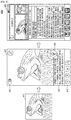
- the "SF Zoo” model will be automatically selected by the activation engine 310 ( FIG. 3 ), recognizing the object as "Oriental Fire-Bellied Toad” in the informational "card” 423 and enables launching the SF Zoo application using layer icon 424.
- the screen 420 of an electronic device e.g., a mobile telephone
- AR augmented reality
- icons 422 such as Internet search (e.g., GOOGLE®), dictionary search (e.g., WEBSTER'S®), video search (e.g., YOU TUBE®), a map application (e.g., GOOGLE MAPS®), etc.
- Internet search e.g., GOOGLE®
- dictionary search e.g., WEBSTER'S®
- video search e.g., YOU TUBE®
- a map application e.g., GOOGLE MAPS®
- model selection is initiated by the user, such as by tapping on the screen 420 (e.g., a first click) of a camera view captured by camera 205 ( FIG. 2 ), which triggers the contextual layer activation by the activation engine 310.
- the layers may be ordered based on their relevance to the contextual element, and the most relevant may be expanded to show more detail (e.g., the informational "card” 423 appearing at the bottom of the screen 420).
- ranking of layers may also take into account whether the layer is from a third-party or a built-in "generic" layer.
- the ranking of layers can be based on various contextual information such as user's profile and preferences, routine behaviors, time, location, and so on.
- Layer ranking can also integrate commercial considerations, a third-party layer may rank higher if the layer provider has a marketing contract for product promotion. For example, if the user taps on the layer icon 424 appearing in the informational "card" 423 (e.g., a second click), the provider for the layer is launched.
- the provider may be an application on the electronic device or a web site 430 accessed via a browser on the electronic device.
- the launch may take the user directly to an application view or web page associated with the visual that triggered the launch.
- This form of interaction is referred to as "real-world browsing” since the user simply taps on an object in the camera 205 view on the screen 420 to bring up an application view or web page (e.g., web site 430 web page) related to the object.
- the activation engine 310 runs continually and is constantly fed new frames from the camera 205. In this case, layer icons 422 appear spontaneously and only a single click is needed to launch the provider.
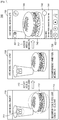
- FIG. 5 shows another example use 500 for context-based application launch, according to an embodiment.
- the architecture 200 determines using the context generation processing 220 that the user is "indoors, at library” and “reading.”
- the activation engine 310 selects the "NatGeo" model, which recognizes the same type of toad view 410, but shows the "NatGeo” icon 524 that enables launching the National Geographic web page 530.
- FIG. 6 shows an example 600 of context amplification including a context amplification feedback loop 630, according to the claimed invention.
- a context amplification feedback loop 630 between the context generation processing 220 and layers/models 330 which has the effect of "amplifying" the context.
- the example 600 shows a processing flow where physical sensing 620 (using sensors 230) and device usage information 625 are input to the context generation processing 220.
- Model Lifecycle Manager 610 of the model management processing 212 receives requests to start models 336 of the layers/models 330 from the activation engine 310.
- the model lifecycle manager 610 is responsible for initialization, and termination of models.
- the model lifecycle manager 610 may also play a role in load balancing (e.g., throttling recognition requests sent to models).
- load balancing e.g., throttling recognition requests sent to models.
- currently running models 336 of the layers/models 330 identify objects, visual labels are added to the context, additional layers are activated and further models 336 are activated, and more visuals are identified from newly activated models.
- FIG. 7 shows example 700 including exemplary uses 710, 720 and 730 of context amplification, according to the claimed invention.
- example use 710 suppose a fairly general object recognition model is running and it detects "food” 712 and “logo” 711 visual labels and the contextual element is "at restaurant” 715. This could lead to activation models 716 including a "food” recognition model specialized for objects found in restaurants, and a "logo" model specialized for logo recognition.
- MCDONALD'S® model 740 When these new models are started in use model 720 (food and logo), it might contribute labels 725 such as "hamburger” and "MCDONALD'S®” to the visual context, which in turn lead to further model activation in use 730 (MCDONALDS®) such as MCDONALD'S® model 740 being activated.
- MCDONALDS® further model activation in use 730
- MCDONALD'S® model 740 being activated.
- Activation of MCDONALD'S® model 740 brings up the MCDONALD'S® layer containing UI elements such as application icon of MCDONALD'S® 742 in the information card 741. Clicking on icon 742 will open MCDONALD'S® application if it is already installed on device.
- clicking on icon 742 can either prompt the user to install MCDONALD'S® application, or open MCDONALD'S® web site to provide further information of the recognized Big MacTM.
- a clear benefit of this approach is that the architecture 200 ( FIG. 2 ) is adaptive. There is no need for a complicated model manager that decides which models to run and which to stop. Instead the architecture 200 automatically makes these choices based on the context.
- a wide range of sources to model and infer context information are employed. This information is sourced from multiple sources within the electronic device or from the Internet 232 ( FIG. 2 ). In one embodiment, from the electronic device, there may be raw information and processed information from various sensors 230, voice commands/speech input 231 and installed applications 233. In another embodiment, from the Internet 232, information may arise regarding current activities, weather and other data. In yet another embodiment, various sources may be combined to generate multi-modal context, which is used to predict intent (e.g., using intent prediction processing 240, FIG. 2 ) and state of the user.
- FIG. 8 shows an example use 800 for scene recognition and sensor inputs resulting in context detection and application recommendation, according to an embodiment.
- user intent may be inferred by the context analyzer 221 by identifying the (contextual) state of the user.
- motion sensors may detect a user's current speed (e.g., walking, running, driving, flying, sitting, etc.), and a GPS sensor may detect rapid change in position of the electronic device (e.g., smart phone), leading to activity detection of the user as "walking.”
- This activity is provided to the context analyzer 221 to generate an intent vector, for example "sightseeing" being the current context of the user.
- the intent prediction processing 240 mechanism provides an actionable signal to the activation engine 310 ( FIGS. 3 , 6 ).
- the results of the visual classifiers are combined with an intent prediction mechanism by a context amplification process ( FIG. 6 ), which is fed to the activation engine 310.
- the example 800 includes a generic scene recognition result shown on display 810 of an electronic device, that is fed to the context analyzer 221 of the context generation processing 220 ( FIG. 2 ), along with readings from GPS and other sensors 620.
- the display 810 On the display 810 is shown the image of the lighthouse along with the information card 423 including icon 811, and icons 422.
- the resulting display 820 shows the results of detecting that the user is walking near a light house.
- This piece of location and motion context information is fed to the activation engine 310, which performs semantic analysis and suggests that the user is most likely doing sightseeing, therefore showing icons 830 for recommending relevant travel apps.
- the left side of the context analyzer 221 includes: a visual classifier result: light house, learned/ inferred context: outdoors, vacation in near future, and static context: leisure traveler.
- the right side of the context analyzer 221 includes: intent prediction: trip planning, and recommendations: Travel apps 830.
- the user interface for model selection and layer activation based upon vision recognition and user context can be used to assist selecting the most relevant contents, filtered from the vast amount of information identified by vision intelligence.
- objects detected in the center portion of a screen may provide more information than the objects in the boundary portions.
- the information of center objects may include a detailed description while information of a boundary object may only include keywords or indices.
- AR information will be provided with more details, whilst other objects that decrease in zoom or disappear from the screen have lower priority and little or no information will be provided.
- objects that gained focus on the screen are provided with detailed information. For example, if it is determined that a user is in a running car, the UI will provide less AR information for outside objects since it is hard for the user to read detailed information with the rapid changes of objects due to the speed of the car.
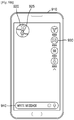
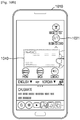
- FIGS. 9A-C show examples of a user interface when a landmark recognition layer is activated on an electronic device 910 (e.g., a smart phone), according to an embodiment.
- the screen of the electronic device 910 shows a map 920 and landmark marker 925 on the upper left-hand side of the screen.
- a set of related layers are displayed on the upper righthand side of the screen, including a messaging app 930.
- the messaging application can be used to share photos of the location.
- the information card shows location and icons 422 are displayed on the lower portion of the screen.
- FIG. 9B shows the screen of the electronic device 910 after activation of the messaging app 930 with a message space 940 for entering a message.
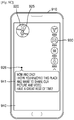
- FIG. 9C shows a written message 941 as being sent on the screen with a landmark identifier 926 associated with the message 941.
- FIGS. 10A-D show examples of a user interface with various layers activated, according to an embodiment.
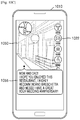
- FIG. 10A shows an object recognition layer (associated with the generic model) activated for an object captured by the camera (e.g., camera 205, FIG. 2 ) of electronic device 1010.
- a controller icon 1020 is selected and a group of apps 1030 are shown for selection.
- FIG. 10B shows a text and object recognition layer activated for a captured business card 1040, the layer displays a business card recognition app 1021.
- FIG. 10C shows a location and place (e.g., a landmark, etc.) recognition layer activated for an image 1050 captured by the camera, the layer displays a messaging app 1022.
- a location and place e.g., a landmark, etc.
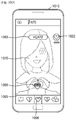
- FIG. 10D shows a sign (e.g., a face-and-gesture) recognition layer activated for an image of a girl 1070 making a heart symbol with her hands.
- the term "heart” is determined based on the girl's hand gesture 1066 and facial expression 1070.
- This layer displays a set of heart symbol 1065, and a selection of a specific heart symbol 1066 can be used to add to the girl's image 1070.
- the selected heart object 1066 may be placed over the girl's hand gesture location to create an augmented effect on the image.
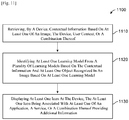
- FIG. 11 shows a block diagram for a process 1100 for contextual driven intelligence, according to some embodiments.
- process 1100 provides for retrieving, by a device (e.g., an electronic device 52, FIG. 1 , electronic device 910, FIGS. 9A-C , electronic device 1010, FIGS. 10A-D ) including architecture 200 ( FIG. 2 ), contextual information based on an image, the device, user context, or a combination thereof.
- Contextual information includes, but is not limited to: position information obtained using GPS, network-based position, and Wi-Fi data; activity information (e.g., walking, running, sitting, etc.) obtained using motion sensors (e.g.
- accelerometers, gyro scopes, magnetometers, etc. ); audio environment information (e.g. noisy, quiet, etc.) obtained using audio sensors; speech detection and understanding that can detect spoken words and sentences; text analysis that can estimate user sentiment (e.g., angry, happy, etc.), interest, and intent; data analysis that can discover information about the user's preferences and intent (e.g., time, application usage, search history, contacts, etc.) from data collected on device 1010; and cloud services that can further enrich the context (e.g., reverse geocoding that maps from GPS coordinates to addresses).
- context-aware user intent prediction methods available.
- user intent prediction e.g., using intent prediction processing 240, FIG.
- process 1100 provides for identifying at least one model from many models based on the contextual information and at least one object recognized in an image based on at least one model.
- process 1000 displays at least one icon at the device. The at least one icon being associated with an application, a service, or a combination thereof providing additional information.
- the contextual information may include: current time, velocity of the device, sensor information, user speech information, textual information, device application information, and location information.
- process 1100 may further include determining at least one learning model relevant to the contextual information.
- the at least one model is selected from one or more models based on contextual information to provide the additional information (e.g., from an application, a service, or a combination thereof), and the at least one learning model includes one or more additional models (e.g., models 336 ( FIG. 3 ).
- displaying the at least one icon at the device is based on at least one of a ranking of relevance of the model, a source of the model, or a combination thereof.
- process 1100 may further include activating the at least one model based on at least one of the relevance of the at least one model, and receiving input from a user interface of the device.
- Process 1100 may additionally include displaying a view specific to the at least one model, and enabling an additional model.
- process 1100 may include determining a visual label based on the contextual information.
- the contextual information may include camera data.
- Process 1100 may also include determining the relevance of the at least one model based on the visual label via a computation of at least one of: semantic similarity, visual label confidence, appearance in a specified set, or a combination thereof.
- process 1100 may also include inferring the contextual information based on data from an external service and sensors connected to the device.
- the contextual information further includes intent and state of a user of the device.
- Process 100 may additionally include filtering user-specific content from AR information to obtain the at least one object.
- objects in a center portion of a display of the device provide more AR information than objects in a boundary portion of the display, and zoomed in objects provide more AR information than other objects outside a zoomed in portion of the display.
- process 1100 may include determining the contextual information related to the device being in a moving vehicle, and providing less AR information for objects displayed on the device.
- FIG. 12 is an exemplary high-level block diagram showing an information processing system comprising a computer system 1200 useful for implementing disclosed embodiments.
- Computer system 1200 may be incorporated in a device 52, 56, FIG. 1 , electronic device 910 ( FIGS. 9A-C ), electronic device 1010 ( FIGS. 10A-D ), and include architecture 200 ( FIG. 2 ).
- the computer system 1200 includes one or more processors 1201, and can further include an electronic display device 1202 (for displaying video, graphics, text, and other data), a main memory 1203 (e.g., random access memory (RAM)), storage device 1204 (e.g., hard disk drive), removable storage device 1205 (e.g., removable storage drive, removable memory device, a magnetic tape drive, optical disk drive, computer readable medium having stored therein computer software and/or data), user interface device 1206 (e.g., keyboard, touch screen, keypad, pointing device), and a communication interface 1207 (e.g., modem, a network interface (such as an Ethernet card), a communications port, or a PCMCIA slot and card).
- a communication interface 1207 e.g., modem, a network interface (such as an Ethernet card), a communications port, or a PCMCIA slot and card).
- the communication interface 1207 allows software and data to be transferred between the computer system and external devices (e.g., over communication path 54, FIG. 1 ).
- the system 1200 further includes a communications infrastructure 1208 (e.g., a communications bus, cross-over bar, or network) to which the aforementioned devices/processors 1201 through 1207 are connected.
- a communications infrastructure 1208 e.g., a communications bus, cross-over bar, or network
- main memory 1203, storage device 1204 and removable storage device 1205, each by themselves or in any combination, may store instructions for the embodiments described above that may be executed by the one or more processors 1201.
- Information transferred via communications interface 1207 may be in the form of signals such as electronic, electromagnetic, optical, or other signals capable of being received by communications interface 1207, via a communication link that carries signals and may be implemented using wire or cable, fiber optics, a phone line, a cellular phone link, a radio frequency (RF) link, and/or other communication channels.
- Computer program instructions representing the block diagram and/or flowcharts herein may be loaded onto a computer, programmable data processing apparatus, or processing devices to cause a series of operations performed thereon to produce a computer implemented process.
- processing instructions for example 300 ( FIG. 3 ), example 600 ( FIG. 6 ), and example 800 ( FIG. 8 ) and processing instructions for process 1100 ( FIG. 11 ) may be stored as program instructions on the memory 1203, storage device 1204 and the removable storage device 1205 for execution by the processor 1201.
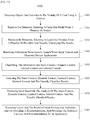
- FIG. 13 shows a block diagram for a process 1300 for context-based model selection and activation, according to some embodiments.
- objects and activities are detected in the vicinity of a user using a camera (e.g., camera 205, FIG. 2 ).
- process 1300 selects at least one model (e.g., a model 336, FIG. 3 ) from multiple models (e.g., using model management processing 212).
- At least one provider e.g., a mobile application, a web service, or a collection of information such as a database
- the results are visually classified (e.g., using visual classifier results 211 and the activation engine 310).
- information is received from sensors (e.g., sensors 230), speech/voice input (e.g., speech/voice input 231), Internet (e.g., Internet 232) and electronic device applications (e.g., installed applications 233).
- the information received in block 1340 is classified (e.g., by context generation processing 220) into static context (e.g., static context 222), dynamic context (e.g., dynamic context 223), learned context (e.g., learned context 224) and inferred context (e.g., inferred context 225).
- static context e.g., static context 222
- dynamic context e.g., dynamic context 223
- learned context e.g., learned context 224
- inferred context e.g., inferred context 225
- the static context, dynamic context, learned context, inferred context and the visually classified results are analyzed (e.g., by the context analyzer 221).
- intent is predicted (e.g., using the intent prediction processing 240) based on the analysis of the static context, dynamic context, learned context, inferred context and the visually classified results.
- process 1300 provides for receiving layers (e.g., layers 250) and the predicted intent (e.g., from the intent prediction processing 240) for layer(s) activation and for providing a recommendation (e.g., using layer activation and recommendation processing 255, the activation engine 310), and providing the activated layer(s) and recommendation to an application (e.g., camera application 260).
- layers e.g., layers 250
- the predicted intent e.g., from the intent prediction processing 240
- a recommendation e.g., using layer activation and recommendation processing 255, the activation engine 310
- an application e.g., camera application 260
- Embodiments have been described with reference to flowchart illustrations and/or block diagrams of methods, apparatus (systems) and computer program products. Each block of such illustrations/diagrams, or combinations thereof, can be implemented by computer program instructions.
- the computer program instructions when provided to a processor produce a machine, such that the instructions, which execute via the processor create means for implementing the functions/operations specified in the flowchart and/or block diagram.
- Each block in the flowchart /block diagrams may represent a hardware and/or software processor/process or logic. In alternative implementations, the functions noted in the blocks may occur out of the order noted in the figures, concurrently, etc.
- computer program medium “computer usable medium,” “computer readable medium”, and “computer program product,” are used to generally refer to media such as main memory, secondary memory, removable storage drive, a hard disk installed in hard disk drive, and signals. These computer program products are means for providing software to the computer system.
- the computer readable medium allows the computer system to read data, instructions, messages or message packets, and other computer readable information from the computer readable medium.
- the computer readable medium may include non-volatile memory, such as a floppy disk, ROM, flash memory, disk drive memory, a CD-ROM, and other permanent storage. It is useful, for example, for transporting information, such as data and computer instructions, between computer systems.
- Computer program instructions may be stored in a computer readable medium that can direct a computer, other programmable data processing apparatus, or other devices to function in a particular manner, such that the instructions stored in the computer readable medium produce an article of manufacture including instructions which implement the function/act specified in the flowchart and/or block diagram block or blocks.
- aspects of the embodiments may be embodied as a system, method or computer program product. Accordingly, aspects of the embodiments may take the form of an entirely hardware embodiment, an entirely software embodiment (including firmware, resident software, micro-code, etc.) or an embodiment combining software and hardware aspects that may all generally be referred to herein as a "circuit,” "processor” or “system.” Furthermore, aspects of the embodiments may take the form of a computer program product embodied in one or more computer readable medium(s) having computer readable program code embodied thereon.
- the computer readable medium may be a computer readable storage medium.
- a computer readable storage medium may be, for example, but not limited to, an electronic, magnetic, optical, electromagnetic, infrared, or semiconductor system, apparatus, or device, or any suitable combination of the foregoing.
- a computer readable storage medium may be any tangible medium that can contain, or store a program for use by or in connection with an instruction execution system, apparatus, or device.
- Computer program code for carrying out operations for aspects of one or more embodiments may be written in any combination of one or more programming languages, including an object-oriented programming language such as Java, Smalltalk, C++ or the like and conventional procedural programming languages, such as the "C" programming language or similar programming languages.
- the program code may execute entirely on the user's computer, partly on the user's computer, as a stand-alone software package, partly on the user's computer and partly on a remote computer or entirely on the remote computer or server.
- the remote computer may be connected to the user's computer through any type of network, including a local area network (LAN) or a wide area network (WAN), or the connection may be made to an external computer (for example, through the Internet using an Internet Service Provider).
- LAN local area network
- WAN wide area network
- Internet Service Provider for example, AT&T, MCI, Sprint, EarthLink, MSN, GTE, etc.
- These computer program instructions may also be stored in a computer readable medium that can direct a computer, other programmable data processing apparatus, or other devices to function in a particular manner, such that the instructions stored in the computer readable medium produce an article of manufacture including instructions which implement the function/act specified in the flowchart and/or block diagram block or blocks.
- the computer program instructions may also be loaded onto a computer, other programmable data processing apparatus, or other devices to cause a series of operational steps to be performed on the computer, other programmable apparatus or other devices to produce a computer implemented process such that the instructions which execute on the computer or other programmable apparatus provide processes for implementing the functions/acts specified in the flowchart and/or block diagram block or blocks.
- each block in the flowchart or block diagrams may represent a process, segment, or portion of instructions, which comprises one or more executable instructions for implementing the specified logical function(s).
- the functions noted in the block may occur out of the order noted in the figures.
- two blocks shown in succession may, in fact, be executed substantially concurrently, or the blocks may sometimes be executed in the reverse order, depending upon the functionality involved.
Landscapes
- Engineering & Computer Science (AREA)
- Theoretical Computer Science (AREA)
- Physics & Mathematics (AREA)
- General Engineering & Computer Science (AREA)
- General Physics & Mathematics (AREA)
- Data Mining & Analysis (AREA)
- Evolutionary Computation (AREA)
- Artificial Intelligence (AREA)
- Software Systems (AREA)
- Computing Systems (AREA)
- Computer Hardware Design (AREA)
- Life Sciences & Earth Sciences (AREA)
- Mathematical Physics (AREA)
- Computational Linguistics (AREA)
- Computer Vision & Pattern Recognition (AREA)
- Multimedia (AREA)
- Quality & Reliability (AREA)
- Signal Processing (AREA)
- Computer Networks & Wireless Communication (AREA)
- Bioinformatics & Cheminformatics (AREA)
- Evolutionary Biology (AREA)
- Bioinformatics & Computational Biology (AREA)
- Health & Medical Sciences (AREA)
- General Health & Medical Sciences (AREA)
- Human Computer Interaction (AREA)
- Biomedical Technology (AREA)
- Biophysics (AREA)
- Molecular Biology (AREA)
- Medical Informatics (AREA)
- Computer Graphics (AREA)
- Oral & Maxillofacial Surgery (AREA)
- User Interface Of Digital Computer (AREA)
Claims (12)
- Verfahren, umfassend:Abrufen, durch eine Vorrichtung (52), von kontextabhängigen Informationen auf der Grundlage mindestens eines aus einem Bild, der Vorrichtung (52), dem Benutzerkontext oder einer Kombination daraus;Identifizieren von zwei oder mehr Modellen aus einer Mehrzahl von Lernmodellen auf der Grundlage der kontextabhängigen Informationen und mindestens eines Objekts, erkannt in einem Bild auf der Grundlage mindestens eines visuellen Erkennungsmodells;Aktivieren der zwei oder mehr Modelle für das mindestens eine in dem Bild erkannte Objekt;Aktualisieren der kontextabhängigen Informationen durch Hinzufügen mindestens eines visuellen Labels, identifiziert durch die zwei oder mehr Modelle, zu den kontextabhängigen Informationen;Aktivieren eines zusätzlichen Modells aus der Mehrzahl von Lernmodellen auf der Grundlage der aktualisierten kontextabhängigen Informationen; undAnzeigen von Informationen, umfassend mindestens ein Icon, auf der Vorrichtung (52), wobei das mindestens eine Icon mit mindestens einem aus einer Anwendung, einem Dienst oder einer Kombination daraus, bereitstellend zusätzliche Informationen, verknüpft ist, wobei die zusätzlichen Informationen mit dem zusätzlichen Modell verknüpft sind.
- Verfahren nach Anspruch 1, wobei die kontextabhängigen Informationen mindestens eines aus der aktuellen Zeit, der Geschwindigkeit der Vorrichtung (52), Sensorinformationen, Benutzersprachinformationen, Textinformationen, Vorrichtungsanwendungsinformationen und Ortsinformationen umfassen und die zwei oder mehr Modelle jeweils mindestens eines aus einem Maschinenmodell, einem Modell des tiefen Lernens, einem Objekterkennungsmodell und einem generischen Modell umfassen.
- Verfahren nach Anspruch 1, wobei das Anzeigen des mindestens einen Icons auf der Vorrichtung (52) auf mindestens einem aus einer Rangordnung der Relevanz des zusätzlichen Modells, einer Quelle des zusätzlichen Modells oder einer Kombination daraus basiert, wobei die Quelle einen Speicher innerhalb der Vorrichtung (52) und/oder des Internets (232) angibt.
- Verfahren nach Anspruch 1, ferner umfassend:
Aktivieren der zwei oder mehr Modelle auf der Grundlage mindestens eines aus der Relevanz der zwei oder mehr Modelle, der Eingabe von einer Benutzeroberfläche der Vorrichtung (52) oder einer Kombination daraus. - Verfahren nach Anspruch 1, ferner umfassend:
Bestimmen einer Relevanz der zwei oder mehr Modelle auf der Grundlage eines visuellen Labels mittels einer Berechnung mindestens eines aus der semantischen Nähe, des Vertrauens des visuellen Labels, des Erscheinens in einer spezifizierten Menge oder einer Kombination daraus. - Verfahren nach Anspruch 2, ferner umfassend:
Inferieren der kontextabhängigen Informationen auf der Grundlage von Daten aus einem externen Dienst und an die Vorrichtung (52) gekoppelten Sensoren, wobei die kontextabhängigen Informationen ferner die Absicht und den Zustand eines Benutzers der Vorrichtung (52) aufweisen. - Verfahren nach Anspruch 2, ferner umfassend:
Bestimmen, ob die kontextabhängigen Informationen mit dem Vorhandensein der Vorrichtung (52) in einem sich bewegenden Fahrzeug in Beziehung stehen, und in einem solchen Fall, Bereitstellen von weniger Informationen der erweiterten Realität, augmented reality- AR, für auf der Vorrichtung (52) angezeigte Objekte. - Elektronische Vorrichtung (52), umfassend:einen Speicher (1203), der dazu konfiguriert ist, Befehle zu speichern;mindestens einen Prozessor (1201), der dazu konfiguriert ist, die Befehle auszuführen, um:kontextabhängige Informationen auf der Grundlage mindestens eines aus einem Bild, der elektronischen Vorrichtung (52), dem Benutzerkontext oder einer Kombination daraus abzurufen;zwei oder mehr Modelle aus einer Mehrzahl von Modellen auf der Grundlage der kontextabhängigen Informationen und mindestens eines Objekts, erkannt in einem Bild auf der Grundlage mindestens eines visuellen Erkennungsmodells, zu identifizieren;die zwei oder mehr Modelle für das mindestens eine in dem Bild erkannte Objekt zu aktivieren;die kontextabhängigen Informationen durch Hinzufügen mindestens eines visuellen Labels, identifiziert durch die zwei oder mehr Modelle, zu den kontextabhängigen Informationen zu aktualisieren;ein zusätzliches Modell aus der Mehrzahl von Lernmodellen auf der Grundlage der aktualisierten kontextabhängigen Informationen zu aktivieren; undInformationen, umfassend mindestens ein Icon, auf der elektronischen Vorrichtung (52) anzuzeigen, wobei das mindestens eine Icon mit mindestens einem aus einer Anwendung, einem Dienst oder einer Kombination daraus, bereitstellend zusätzliche Informationen, verknüpft ist, wobei die zusätzlichen Informationen mit dem zusätzlichen Modell verknüpft sind.
- Elektronische Vorrichtung (52) nach Anspruch 8, wobei:die kontextabhängigen Informationen mindestens eines aus der aktuellen Zeit, der Geschwindigkeit der Vorrichtung (52), Sensorinformationen, Benutzersprachinformationen, Textinformationen, Vorrichtungsanwendungsinformationen und Ortsinformationen umfassen;wobei der Prozessor (1201) ferner dazu konfiguriert ist, das mindestens eine Icon auf der elektronischen Vorrichtung (52) auf der Grundlage mindestens eines aus einer Rangordnung der Relevanz des zusätzlichen Modells, einer Quelle des zusätzlichen Modells oder einer Kombination daraus anzuzeigen, wobei die Quelle einen Speicher innerhalb der Vorrichtung (52) und/oder des Internets (232) angibt; undwobei jedes der zwei oder mehr Modelle mindestens eines aus einem Maschinenmodell, einem Modell des tiefen Lernens, einem Objekterkennungsmodell und einem generischen Modell umfasst.
- Elektronische Vorrichtung (52) nach Anspruch 9, wobei der mindestens eine Prozessor ferner dazu konfiguriert ist, die Befehle auszuführen, um:die zwei oder mehr Modelle auf der Grundlage mindestens eines aus der Relevanz jedes der zwei oder mehr Modelle, der Eingabe von einer Benutzeroberfläche der elektronischen Vorrichtung (52) oder einer Kombination daraus zu aktivieren; unddie Relevanz der zwei oder mehr Modelle auf der Grundlage eines visuellen Labels mittels einer Berechnung mindestens eines aus der semantischen Nähe, des Vertrauens des visuellen Labels, des Erscheinens in einer spezifizierten Menge oder einer Kombination daraus zu bestimmen.
- Elektronische Vorrichtung (52) nach Anspruch 9, wobei der mindestens eine Prozessor ferner dazu konfiguriert ist, die Befehle auszuführen, um:
die kontextabhängigen Informationen auf der Grundlage von Daten aus einem externen Dienst und an die elektronische Vorrichtung (52) gekoppelten Sensoren zu inferieren, wobei die kontextabhängigen Informationen ferner die Absicht und den Zustand eines Benutzers der elektronischen Vorrichtung (52) aufweisen. - Maschinell lesbarer Datenträger, umfassend einen Programmcode, der, wenn er durch mindestens einen Prozessor ausgeführt wird, bewirkt, dass der mindestens eine Prozessor ein Verfahren nach einem der Ansprüche 1 bis 7 durchführt.
Applications Claiming Priority (5)
| Application Number | Priority Date | Filing Date | Title |
|---|---|---|---|
| US201762448339P | 2017-01-19 | 2017-01-19 | |
| US201762448325P | 2017-01-19 | 2017-01-19 | |
| US201762472497P | 2017-03-16 | 2017-03-16 | |
| US15/841,157 US10909371B2 (en) | 2017-01-19 | 2017-12-13 | System and method for contextual driven intelligence |
| PCT/KR2018/000738 WO2018135833A1 (en) | 2017-01-19 | 2018-01-16 | System and method for contextual driven intelligence |
Publications (3)
| Publication Number | Publication Date |
|---|---|
| EP3568778A1 EP3568778A1 (de) | 2019-11-20 |
| EP3568778A4 EP3568778A4 (de) | 2019-11-27 |
| EP3568778B1 true EP3568778B1 (de) | 2021-03-10 |
Family
ID=68108734
Family Applications (1)
| Application Number | Title | Priority Date | Filing Date |
|---|---|---|---|
| EP18741064.2A Not-in-force EP3568778B1 (de) | 2017-01-19 | 2018-01-16 | System und verfahren für kontextgesteuerte intelligenz |
Country Status (5)
| Country | Link |
|---|---|
| US (1) | US10909371B2 (de) |
| EP (1) | EP3568778B1 (de) |
| KR (1) | KR102591583B1 (de) |
| CN (1) | CN110431514B (de) |
| WO (1) | WO2018135833A1 (de) |
Families Citing this family (16)
| Publication number | Priority date | Publication date | Assignee | Title |
|---|---|---|---|---|
| EP3559804B1 (de) | 2017-01-19 | 2024-03-06 | Samsung Electronics Co., Ltd. | Sichtintelligenzverwaltung für elektronische vorrichtungen |
| US10970577B1 (en) * | 2017-09-29 | 2021-04-06 | Snap Inc. | Machine learned single image icon identification |
| US10685233B2 (en) * | 2017-10-24 | 2020-06-16 | Google Llc | Sensor based semantic object generation |
| US10650239B2 (en) | 2018-07-25 | 2020-05-12 | At&T Intellectual Property I, L.P. | Context-based object location via augmented reality device |
| US20200050906A1 (en) * | 2018-08-07 | 2020-02-13 | Sap Se | Dynamic contextual data capture |
| EP3936964A4 (de) * | 2019-03-06 | 2022-04-20 | Sony Group Corporation | Kartenerzeugungsvorrichtung, kartenerzeugungsverfahren und programm |
| GB2582831A (en) * | 2019-04-05 | 2020-10-07 | Numbereight Tech Ltd | Data sharing |
| CN110286976B (zh) * | 2019-05-24 | 2021-10-01 | 华为技术有限公司 | 界面显示方法、装置、终端及存储介质 |
| CN111182205B (zh) * | 2019-12-30 | 2021-07-27 | 维沃移动通信有限公司 | 拍摄方法、电子设备及介质 |
| US11836640B2 (en) * | 2020-05-15 | 2023-12-05 | Motorola Mobility Llc | Artificial intelligence modules for computation tasks |
| US11743340B2 (en) * | 2020-06-10 | 2023-08-29 | Snap Inc. | Deep linking to augmented reality components |
| US11238660B2 (en) | 2020-06-10 | 2022-02-01 | Snap Inc. | Dynamic augmented reality components |
| US12100092B2 (en) | 2021-06-28 | 2024-09-24 | Snap Inc. | Integrating augmented reality into the web view platform |
| US20250053799A1 (en) * | 2023-08-07 | 2025-02-13 | Microsoft Technology Licensing, Llc | Context-aware and dynamic visualizations in applications |
| US20250118063A1 (en) * | 2023-10-04 | 2025-04-10 | Nec Laboratories America, Inc. | Automatic issue detection in models |
| DE102024121262A1 (de) * | 2024-07-25 | 2026-01-29 | Dr. Ing. H.C. F. Porsche Aktiengesellschaft | Verfahren zum Betrieb eines Empfehlungsdienstes, Computerprogramm, Kraftfahrzeug |
Family Cites Families (64)
| Publication number | Priority date | Publication date | Assignee | Title |
|---|---|---|---|---|
| US20050076004A1 (en) | 2003-09-30 | 2005-04-07 | Hiroyuki Yanagisawa | Computer, database generating method for electronic picture book service, photographed subject information providing method, recording medium, and computer data signal |
| US7565139B2 (en) | 2004-02-20 | 2009-07-21 | Google Inc. | Image-based search engine for mobile phones with camera |
| US7383260B2 (en) | 2004-08-03 | 2008-06-03 | International Business Machines Corporation | Method and apparatus for ontology-based classification of media content |
| EP1866738A4 (de) | 2005-03-18 | 2010-09-15 | Search Engine Technologies Llc | Suchmaschine, die rückmeldungen von benutzern zur verbesserung von suchergebnissen anwendet |
| US7475072B1 (en) | 2005-09-26 | 2009-01-06 | Quintura, Inc. | Context-based search visualization and context management using neural networks |
| WO2007129474A1 (ja) | 2006-05-10 | 2007-11-15 | Nikon Corporation | 被写体認識装置、被写体認識プログラム、および画像検索サービス提供方法 |
| US20080005067A1 (en) | 2006-06-28 | 2008-01-03 | Microsoft Corporation | Context-based search, retrieval, and awareness |
| US8788517B2 (en) | 2006-06-28 | 2014-07-22 | Microsoft Corporation | Intelligently guiding search based on user dialog |
| KR100793989B1 (ko) | 2006-07-11 | 2008-01-16 | 삼성전자주식회사 | 사진 카테고리 분류 방법 및 그 시스템 |
| US20080147730A1 (en) | 2006-12-18 | 2008-06-19 | Motorola, Inc. | Method and system for providing location-specific image information |
| US7707162B2 (en) | 2007-01-08 | 2010-04-27 | International Business Machines Corporation | Method and apparatus for classifying multimedia artifacts using ontology selection and semantic classification |
| KR20090090613A (ko) | 2008-02-21 | 2009-08-26 | 주식회사 케이티 | 멀티모달 대화형 이미지 관리 시스템 및 방법 |
| GB2492246B (en) | 2008-03-03 | 2013-04-10 | Videoiq Inc | Dynamic object classification |
| CA2726037A1 (en) | 2008-06-06 | 2009-12-10 | Thomson Licensing | System and method for similarity search of images |
| US8929877B2 (en) | 2008-09-12 | 2015-01-06 | Digimarc Corporation | Methods and systems for content processing |
| CN101727454A (zh) * | 2008-10-30 | 2010-06-09 | 日电(中国)有限公司 | 用于对象自动分类的方法和系统 |
| RU2501079C2 (ru) | 2009-01-16 | 2013-12-10 | Гугл Инк. | Визуализация структуры сайта и разрешение переходов сайта для результата поиска или связанной страницы |
| US8494215B2 (en) * | 2009-03-05 | 2013-07-23 | Microsoft Corporation | Augmenting a field of view in connection with vision-tracking |
| US8412531B2 (en) * | 2009-06-10 | 2013-04-02 | Microsoft Corporation | Touch anywhere to speak |
| MY147282A (en) | 2010-05-11 | 2012-11-30 | Mimos Berhad | System and method for use in image classification |
| KR101191913B1 (ko) | 2010-05-28 | 2012-10-17 | 한국항공대학교산학협력단 | 사용자 상황기반 검색을 통한 웹상의 상점정보를 제공하는 엠비언트 서비스 방법 |
| US8887163B2 (en) | 2010-06-25 | 2014-11-11 | Ebay Inc. | Task scheduling based on dependencies and resources |
| US9710760B2 (en) | 2010-06-29 | 2017-07-18 | International Business Machines Corporation | Multi-facet classification scheme for cataloging of information artifacts |
| CN107092614B (zh) | 2010-08-09 | 2021-04-20 | Sk 普兰尼特有限公司 | 集成图像搜索终端、设备及其服务方法 |
| US8990199B1 (en) | 2010-09-30 | 2015-03-24 | Amazon Technologies, Inc. | Content search with category-aware visual similarity |
| US8296142B2 (en) * | 2011-01-21 | 2012-10-23 | Google Inc. | Speech recognition using dock context |
| WO2012115550A1 (en) | 2011-02-24 | 2012-08-30 | Telefonaktiebolaget L M Ericsson (Publ) | Method and server for media classification |
| US9916538B2 (en) | 2012-09-15 | 2018-03-13 | Z Advanced Computing, Inc. | Method and system for feature detection |
| US9141707B2 (en) | 2012-07-19 | 2015-09-22 | Facebook, Inc. | Context-based object retrieval in a social networking system |
| JP5673624B2 (ja) | 2012-07-24 | 2015-02-18 | カシオ計算機株式会社 | オブジェクト検索装置、方法、およびプログラム |
| US20140032358A1 (en) | 2012-07-25 | 2014-01-30 | Aro, Inc. | Sharing Recommendation Agents |
| KR101844395B1 (ko) * | 2012-08-24 | 2018-04-02 | 엠파이어 테크놀로지 디벨롭먼트 엘엘씨 | 가상 현실 어플리케이션 |
| ES2879623T3 (es) | 2012-09-30 | 2021-11-22 | Saint Gobain Performance Plastics Corp | Conjunto de cojinete |
| US20150062114A1 (en) * | 2012-10-23 | 2015-03-05 | Andrew Ofstad | Displaying textual information related to geolocated images |
| US20140233800A1 (en) | 2013-02-15 | 2014-08-21 | Samsung Electronics Co., Ltd. | Method of tracking object and electronic device supporting the same |
| US9286323B2 (en) * | 2013-02-25 | 2016-03-15 | International Business Machines Corporation | Context-aware tagging for augmented reality environments |
| US10685487B2 (en) * | 2013-03-06 | 2020-06-16 | Qualcomm Incorporated | Disabling augmented reality (AR) devices at speed |
| US9573277B2 (en) | 2013-04-15 | 2017-02-21 | Alan Rosen | Intelligent visual humanoid robot and computer vision system programmed to perform visual artificial intelligence processes |
| JP6190887B2 (ja) | 2013-10-02 | 2017-08-30 | 株式会社日立製作所 | 画像検索システムおよび情報記録媒体 |
| CN105593811B (zh) * | 2013-10-31 | 2019-05-28 | 英特尔公司 | 经用户可选择图标的基于情境的消息创建 |
| CN103617285A (zh) | 2013-12-11 | 2014-03-05 | 百度在线网络技术(北京)有限公司 | 在移动终端中展现搜索结果的方法及装置 |
| US9619488B2 (en) | 2014-01-24 | 2017-04-11 | Microsoft Technology Licensing, Llc | Adaptable image search with computer vision assistance |
| JP6662782B2 (ja) * | 2014-02-07 | 2020-03-11 | サイランス・インコーポレイテッドCylance Inc. | 識別のためのアンサンブル機械学習を利用するアプリケーション実行コントロール |
| MX360261B (es) | 2014-02-10 | 2018-10-26 | Geenee Gmbh | Sistemas y metodos para reconocimiento basado en caracteristicas de imagenes. |
| CN106575365B (zh) | 2014-02-28 | 2020-09-22 | 河谷控股Ip有限责任公司 | 对象识别特点分析系统和方法 |
| US9535960B2 (en) | 2014-04-14 | 2017-01-03 | Microsoft Corporation | Context-sensitive search using a deep learning model |
| US10311303B2 (en) * | 2014-05-22 | 2019-06-04 | Sony Corporation | Information processing apparatus, information processing method, and program |
| US9547683B2 (en) * | 2014-05-30 | 2017-01-17 | Apple Inc. | Application suggestion features |
| US11170037B2 (en) | 2014-06-11 | 2021-11-09 | Kodak Alaris Inc. | Method for creating view-based representations from multimedia collections |
| US9639957B2 (en) | 2014-06-12 | 2017-05-02 | A9.Com, Inc. | Recommendations utilizing visual image analysis |
| US10579652B2 (en) | 2014-06-17 | 2020-03-03 | Microsoft Technology Licensing, Llc | Learning and using contextual content retrieval rules for query disambiguation |
| US9734426B2 (en) * | 2014-09-03 | 2017-08-15 | Sri International | Automated food recognition and nutritional estimation with a personal mobile electronic device |
| WO2016037311A1 (en) | 2014-09-09 | 2016-03-17 | Microsoft Technology Licensing, Llc | Variable-component deep neural network for robust speech recognition |
| US10417301B2 (en) | 2014-09-10 | 2019-09-17 | Adobe Inc. | Analytics based on scalable hierarchical categorization of web content |
| US9412361B1 (en) | 2014-09-30 | 2016-08-09 | Amazon Technologies, Inc. | Configuring system operation using image data |
| US10346726B2 (en) | 2014-12-15 | 2019-07-09 | Samsung Electronics Co., Ltd. | Image recognition method and apparatus, image verification method and apparatus, learning method and apparatus to recognize image, and learning method and apparatus to verify image |
| US20160203178A1 (en) | 2015-01-12 | 2016-07-14 | International Business Machines Corporation | Image search result navigation with ontology tree |
| US20160292507A1 (en) | 2015-03-30 | 2016-10-06 | Ziad Ghoson | Information Processing System and Method Using Image Recognition |
| US9495694B1 (en) | 2016-02-29 | 2016-11-15 | International Business Machines Corporation | Product recommendations based on analysis of social experiences |
| US9529500B1 (en) * | 2015-06-05 | 2016-12-27 | Apple Inc. | Application recommendation based on detected triggering events |
| KR102412307B1 (ko) | 2015-09-23 | 2022-06-24 | 엘지전자 주식회사 | 단말기 및 그 동작 방법 |
| US9875258B1 (en) | 2015-12-17 | 2018-01-23 | A9.Com, Inc. | Generating search strings and refinements from an image |
| US11100398B2 (en) * | 2016-06-30 | 2021-08-24 | Cogniac, Corp. | Operating machine-learning models on different platforms |
| EP3559804B1 (de) | 2017-01-19 | 2024-03-06 | Samsung Electronics Co., Ltd. | Sichtintelligenzverwaltung für elektronische vorrichtungen |
-
2017
- 2017-12-13 US US15/841,157 patent/US10909371B2/en active Active
-
2018
- 2018-01-16 EP EP18741064.2A patent/EP3568778B1/de not_active Not-in-force
- 2018-01-16 WO PCT/KR2018/000738 patent/WO2018135833A1/en not_active Ceased
- 2018-01-16 KR KR1020197022181A patent/KR102591583B1/ko active Active
- 2018-01-16 CN CN201880007738.7A patent/CN110431514B/zh active Active
Non-Patent Citations (1)
| Title |
|---|
| None * |
Also Published As
| Publication number | Publication date |
|---|---|
| CN110431514B (zh) | 2022-05-03 |
| KR102591583B1 (ko) | 2023-10-19 |
| CN110431514A (zh) | 2019-11-08 |
| WO2018135833A1 (en) | 2018-07-26 |
| EP3568778A4 (de) | 2019-11-27 |
| US20180204059A1 (en) | 2018-07-19 |
| EP3568778A1 (de) | 2019-11-20 |
| US10909371B2 (en) | 2021-02-02 |
| KR20190100353A (ko) | 2019-08-28 |
Similar Documents
| Publication | Publication Date | Title |
|---|---|---|
| US10909371B2 (en) | System and method for contextual driven intelligence | |
| KR102576344B1 (ko) | 비디오를 처리하기 위한 방법, 장치, 전자기기, 매체 및 컴퓨터 프로그램 | |
| KR102585234B1 (ko) | 전자 기기를 위한 비전 인텔리전스 관리 | |
| CA2956463C (en) | Generating recommended search queries on online social networks | |
| US9665765B2 (en) | Tag suggestions for images on online social networks | |
| JP5980432B2 (ja) | 拡張現実見本の生成 | |
| EP2932457B1 (de) | Anmerkungen zu inhaltsreaktionen | |
| US12111834B1 (en) | Ambient multi-device framework for agent companions | |
| US20190026367A1 (en) | Navigating video scenes using cognitive insights | |
| CA2913461C (en) | Tag suggestions for images on online social networks | |
| CN111247536A (zh) | 用于搜索相关图像的电子装置及其控制方法 | |
| US20170109339A1 (en) | Application program activation method, user terminal, and server | |
| KR20200040097A (ko) | 전자 장치 및 그 제어 방법 | |
| US20210065407A1 (en) | Context aware dynamic image augmentation | |
| US12105932B2 (en) | Context based interface options | |
| EP3232344B1 (de) | Erzeugung von kartenstapeln mit anfragen auf sozialen online-netzwerken | |
| Wang | A mobile world made of functions | |
| CN119484915A (zh) | 一种显示设备和语音标识推荐方法 |
Legal Events
| Date | Code | Title | Description |
|---|---|---|---|
| STAA | Information on the status of an ep patent application or granted ep patent |
Free format text: STATUS: THE INTERNATIONAL PUBLICATION HAS BEEN MADE |
|
| PUAI | Public reference made under article 153(3) epc to a published international application that has entered the european phase |
Free format text: ORIGINAL CODE: 0009012 |
|
| STAA | Information on the status of an ep patent application or granted ep patent |
Free format text: STATUS: REQUEST FOR EXAMINATION WAS MADE |
|
| 17P | Request for examination filed |
Effective date: 20190812 |
|
| AK | Designated contracting states |
Kind code of ref document: A1 Designated state(s): AL AT BE BG CH CY CZ DE DK EE ES FI FR GB GR HR HU IE IS IT LI LT LU LV MC MK MT NL NO PL PT RO RS SE SI SK SM TR |
|
| AX | Request for extension of the european patent |
Extension state: BA ME |
|
| A4 | Supplementary search report drawn up and despatched |
Effective date: 20191030 |
|
| RIC1 | Information provided on ipc code assigned before grant |
Ipc: G06K 9/62 20060101ALI20191024BHEP Ipc: G06F 11/30 20060101ALI20191024BHEP Ipc: G06N 3/08 20060101ALI20191024BHEP Ipc: H04L 29/06 20060101ALI20191024BHEP Ipc: G06N 5/02 20060101ALI20191024BHEP Ipc: G06K 9/00 20060101AFI20191024BHEP Ipc: G06F 11/34 20060101ALI20191024BHEP Ipc: G06F 3/01 20060101ALI20191024BHEP Ipc: H04L 29/08 20060101ALI20191024BHEP |
|
| DAV | Request for validation of the european patent (deleted) | ||
| DAX | Request for extension of the european patent (deleted) | ||
| REG | Reference to a national code |
Ref country code: DE Ref legal event code: R079 Ref document number: 602018013828 Country of ref document: DE Free format text: PREVIOUS MAIN CLASS: G06F0017300000 Ipc: G06K0009000000 |
|
| RIC1 | Information provided on ipc code assigned before grant |
Ipc: G06F 11/34 20060101ALI20200831BHEP Ipc: G09G 5/14 20060101ALI20200831BHEP Ipc: G06N 5/02 20060101ALI20200831BHEP Ipc: G06K 9/62 20060101ALI20200831BHEP Ipc: G06F 11/30 20060101ALI20200831BHEP Ipc: G06N 3/08 20060101ALI20200831BHEP Ipc: H04L 29/06 20060101ALI20200831BHEP Ipc: G06K 9/00 20060101AFI20200831BHEP Ipc: G06F 3/01 20060101ALI20200831BHEP Ipc: H04L 29/08 20060101ALI20200831BHEP |
|
| GRAP | Despatch of communication of intention to grant a patent |
Free format text: ORIGINAL CODE: EPIDOSNIGR1 |
|
| STAA | Information on the status of an ep patent application or granted ep patent |
Free format text: STATUS: GRANT OF PATENT IS INTENDED |
|
| INTG | Intention to grant announced |
Effective date: 20201020 |
|
| GRAS | Grant fee paid |
Free format text: ORIGINAL CODE: EPIDOSNIGR3 |
|
| GRAA | (expected) grant |
Free format text: ORIGINAL CODE: 0009210 |
|
| STAA | Information on the status of an ep patent application or granted ep patent |
Free format text: STATUS: THE PATENT HAS BEEN GRANTED |
|
| AK | Designated contracting states |
Kind code of ref document: B1 Designated state(s): AL AT BE BG CH CY CZ DE DK EE ES FI FR GB GR HR HU IE IS IT LI LT LU LV MC MK MT NL NO PL PT RO RS SE SI SK SM TR |
|
| REG | Reference to a national code |
Ref country code: GB Ref legal event code: FG4D |
|
| REG | Reference to a national code |
Ref country code: AT Ref legal event code: REF Ref document number: 1370648 Country of ref document: AT Kind code of ref document: T Effective date: 20210315 Ref country code: CH Ref legal event code: EP |
|
| REG | Reference to a national code |
Ref country code: IE Ref legal event code: FG4D |
|
| REG | Reference to a national code |
Ref country code: DE Ref legal event code: R096 Ref document number: 602018013828 Country of ref document: DE |
|
| REG | Reference to a national code |
Ref country code: LT Ref legal event code: MG9D |
|
| PG25 | Lapsed in a contracting state [announced via postgrant information from national office to epo] |
Ref country code: BG Free format text: LAPSE BECAUSE OF FAILURE TO SUBMIT A TRANSLATION OF THE DESCRIPTION OR TO PAY THE FEE WITHIN THE PRESCRIBED TIME-LIMIT Effective date: 20210610 Ref country code: FI Free format text: LAPSE BECAUSE OF FAILURE TO SUBMIT A TRANSLATION OF THE DESCRIPTION OR TO PAY THE FEE WITHIN THE PRESCRIBED TIME-LIMIT Effective date: 20210310 Ref country code: HR Free format text: LAPSE BECAUSE OF FAILURE TO SUBMIT A TRANSLATION OF THE DESCRIPTION OR TO PAY THE FEE WITHIN THE PRESCRIBED TIME-LIMIT Effective date: 20210310 Ref country code: GR Free format text: LAPSE BECAUSE OF FAILURE TO SUBMIT A TRANSLATION OF THE DESCRIPTION OR TO PAY THE FEE WITHIN THE PRESCRIBED TIME-LIMIT Effective date: 20210611 Ref country code: LT Free format text: LAPSE BECAUSE OF FAILURE TO SUBMIT A TRANSLATION OF THE DESCRIPTION OR TO PAY THE FEE WITHIN THE PRESCRIBED TIME-LIMIT Effective date: 20210310 Ref country code: NO Free format text: LAPSE BECAUSE OF FAILURE TO SUBMIT A TRANSLATION OF THE DESCRIPTION OR TO PAY THE FEE WITHIN THE PRESCRIBED TIME-LIMIT Effective date: 20210610 |
|
| REG | Reference to a national code |
Ref country code: AT Ref legal event code: MK05 Ref document number: 1370648 Country of ref document: AT Kind code of ref document: T Effective date: 20210310 |
|
| REG | Reference to a national code |
Ref country code: NL Ref legal event code: MP Effective date: 20210310 |
|
| PG25 | Lapsed in a contracting state [announced via postgrant information from national office to epo] |
Ref country code: LV Free format text: LAPSE BECAUSE OF FAILURE TO SUBMIT A TRANSLATION OF THE DESCRIPTION OR TO PAY THE FEE WITHIN THE PRESCRIBED TIME-LIMIT Effective date: 20210310 Ref country code: RS Free format text: LAPSE BECAUSE OF FAILURE TO SUBMIT A TRANSLATION OF THE DESCRIPTION OR TO PAY THE FEE WITHIN THE PRESCRIBED TIME-LIMIT Effective date: 20210310 Ref country code: SE Free format text: LAPSE BECAUSE OF FAILURE TO SUBMIT A TRANSLATION OF THE DESCRIPTION OR TO PAY THE FEE WITHIN THE PRESCRIBED TIME-LIMIT Effective date: 20210310 |
|
| PG25 | Lapsed in a contracting state [announced via postgrant information from national office to epo] |
Ref country code: NL Free format text: LAPSE BECAUSE OF FAILURE TO SUBMIT A TRANSLATION OF THE DESCRIPTION OR TO PAY THE FEE WITHIN THE PRESCRIBED TIME-LIMIT Effective date: 20210310 |
|
| PG25 | Lapsed in a contracting state [announced via postgrant information from national office to epo] |
Ref country code: AT Free format text: LAPSE BECAUSE OF FAILURE TO SUBMIT A TRANSLATION OF THE DESCRIPTION OR TO PAY THE FEE WITHIN THE PRESCRIBED TIME-LIMIT Effective date: 20210310 Ref country code: SM Free format text: LAPSE BECAUSE OF FAILURE TO SUBMIT A TRANSLATION OF THE DESCRIPTION OR TO PAY THE FEE WITHIN THE PRESCRIBED TIME-LIMIT Effective date: 20210310 Ref country code: EE Free format text: LAPSE BECAUSE OF FAILURE TO SUBMIT A TRANSLATION OF THE DESCRIPTION OR TO PAY THE FEE WITHIN THE PRESCRIBED TIME-LIMIT Effective date: 20210310 Ref country code: CZ Free format text: LAPSE BECAUSE OF FAILURE TO SUBMIT A TRANSLATION OF THE DESCRIPTION OR TO PAY THE FEE WITHIN THE PRESCRIBED TIME-LIMIT Effective date: 20210310 |
|
| REG | Reference to a national code |
Ref country code: DE Ref legal event code: R079 Ref document number: 602018013828 Country of ref document: DE Free format text: PREVIOUS MAIN CLASS: G06K0009000000 Ipc: G06V0010000000 |
|
| PG25 | Lapsed in a contracting state [announced via postgrant information from national office to epo] |
Ref country code: SK Free format text: LAPSE BECAUSE OF FAILURE TO SUBMIT A TRANSLATION OF THE DESCRIPTION OR TO PAY THE FEE WITHIN THE PRESCRIBED TIME-LIMIT Effective date: 20210310 Ref country code: RO Free format text: LAPSE BECAUSE OF FAILURE TO SUBMIT A TRANSLATION OF THE DESCRIPTION OR TO PAY THE FEE WITHIN THE PRESCRIBED TIME-LIMIT Effective date: 20210310 Ref country code: PT Free format text: LAPSE BECAUSE OF FAILURE TO SUBMIT A TRANSLATION OF THE DESCRIPTION OR TO PAY THE FEE WITHIN THE PRESCRIBED TIME-LIMIT Effective date: 20210712 Ref country code: PL Free format text: LAPSE BECAUSE OF FAILURE TO SUBMIT A TRANSLATION OF THE DESCRIPTION OR TO PAY THE FEE WITHIN THE PRESCRIBED TIME-LIMIT Effective date: 20210310 Ref country code: IS Free format text: LAPSE BECAUSE OF FAILURE TO SUBMIT A TRANSLATION OF THE DESCRIPTION OR TO PAY THE FEE WITHIN THE PRESCRIBED TIME-LIMIT Effective date: 20210710 |
|
| REG | Reference to a national code |
Ref country code: DE Ref legal event code: R097 Ref document number: 602018013828 Country of ref document: DE |
|
| PLBE | No opposition filed within time limit |
Free format text: ORIGINAL CODE: 0009261 |
|
| STAA | Information on the status of an ep patent application or granted ep patent |
Free format text: STATUS: NO OPPOSITION FILED WITHIN TIME LIMIT |
|
| PG25 | Lapsed in a contracting state [announced via postgrant information from national office to epo] |
Ref country code: ES Free format text: LAPSE BECAUSE OF FAILURE TO SUBMIT A TRANSLATION OF THE DESCRIPTION OR TO PAY THE FEE WITHIN THE PRESCRIBED TIME-LIMIT Effective date: 20210310 Ref country code: AL Free format text: LAPSE BECAUSE OF FAILURE TO SUBMIT A TRANSLATION OF THE DESCRIPTION OR TO PAY THE FEE WITHIN THE PRESCRIBED TIME-LIMIT Effective date: 20210310 Ref country code: DK Free format text: LAPSE BECAUSE OF FAILURE TO SUBMIT A TRANSLATION OF THE DESCRIPTION OR TO PAY THE FEE WITHIN THE PRESCRIBED TIME-LIMIT Effective date: 20210310 |
|
| PGFP | Annual fee paid to national office [announced via postgrant information from national office to epo] |
Ref country code: GB Payment date: 20211220 Year of fee payment: 5 |
|
| 26N | No opposition filed |
Effective date: 20211213 |
|
| PG25 | Lapsed in a contracting state [announced via postgrant information from national office to epo] |
Ref country code: SI Free format text: LAPSE BECAUSE OF FAILURE TO SUBMIT A TRANSLATION OF THE DESCRIPTION OR TO PAY THE FEE WITHIN THE PRESCRIBED TIME-LIMIT Effective date: 20210310 |
|
| PG25 | Lapsed in a contracting state [announced via postgrant information from national office to epo] |
Ref country code: IT Free format text: LAPSE BECAUSE OF FAILURE TO SUBMIT A TRANSLATION OF THE DESCRIPTION OR TO PAY THE FEE WITHIN THE PRESCRIBED TIME-LIMIT Effective date: 20210310 |
|
| PGFP | Annual fee paid to national office [announced via postgrant information from national office to epo] |
Ref country code: DE Payment date: 20211220 Year of fee payment: 5 |
|
| PG25 | Lapsed in a contracting state [announced via postgrant information from national office to epo] |
Ref country code: IS Free format text: LAPSE BECAUSE OF FAILURE TO SUBMIT A TRANSLATION OF THE DESCRIPTION OR TO PAY THE FEE WITHIN THE PRESCRIBED TIME-LIMIT Effective date: 20210710 |
|
| PG25 | Lapsed in a contracting state [announced via postgrant information from national office to epo] |
Ref country code: MC Free format text: LAPSE BECAUSE OF FAILURE TO SUBMIT A TRANSLATION OF THE DESCRIPTION OR TO PAY THE FEE WITHIN THE PRESCRIBED TIME-LIMIT Effective date: 20210310 |
|
| REG | Reference to a national code |
Ref country code: CH Ref legal event code: PL |
|
| REG | Reference to a national code |
Ref country code: BE Ref legal event code: MM Effective date: 20220131 |
|
| PG25 | Lapsed in a contracting state [announced via postgrant information from national office to epo] |
Ref country code: LU Free format text: LAPSE BECAUSE OF NON-PAYMENT OF DUE FEES Effective date: 20220116 |
|
| PG25 | Lapsed in a contracting state [announced via postgrant information from national office to epo] |
Ref country code: FR Free format text: LAPSE BECAUSE OF NON-PAYMENT OF DUE FEES Effective date: 20220131 Ref country code: BE Free format text: LAPSE BECAUSE OF NON-PAYMENT OF DUE FEES Effective date: 20220131 |
|
| PG25 | Lapsed in a contracting state [announced via postgrant information from national office to epo] |
Ref country code: LI Free format text: LAPSE BECAUSE OF NON-PAYMENT OF DUE FEES Effective date: 20220131 Ref country code: CH Free format text: LAPSE BECAUSE OF NON-PAYMENT OF DUE FEES Effective date: 20220131 |
|
| PG25 | Lapsed in a contracting state [announced via postgrant information from national office to epo] |
Ref country code: IE Free format text: LAPSE BECAUSE OF NON-PAYMENT OF DUE FEES Effective date: 20220116 |
|
| REG | Reference to a national code |
Ref country code: DE Ref legal event code: R119 Ref document number: 602018013828 Country of ref document: DE |
|
| GBPC | Gb: european patent ceased through non-payment of renewal fee |
Effective date: 20230116 |
|
| PG25 | Lapsed in a contracting state [announced via postgrant information from national office to epo] |
Ref country code: GB Free format text: LAPSE BECAUSE OF NON-PAYMENT OF DUE FEES Effective date: 20230116 Ref country code: DE Free format text: LAPSE BECAUSE OF NON-PAYMENT OF DUE FEES Effective date: 20230801 |
|
| PG25 | Lapsed in a contracting state [announced via postgrant information from national office to epo] |
Ref country code: MK Free format text: LAPSE BECAUSE OF FAILURE TO SUBMIT A TRANSLATION OF THE DESCRIPTION OR TO PAY THE FEE WITHIN THE PRESCRIBED TIME-LIMIT Effective date: 20210310 Ref country code: CY Free format text: LAPSE BECAUSE OF FAILURE TO SUBMIT A TRANSLATION OF THE DESCRIPTION OR TO PAY THE FEE WITHIN THE PRESCRIBED TIME-LIMIT Effective date: 20210310 |
|
| PG25 | Lapsed in a contracting state [announced via postgrant information from national office to epo] |
Ref country code: HU Free format text: LAPSE BECAUSE OF FAILURE TO SUBMIT A TRANSLATION OF THE DESCRIPTION OR TO PAY THE FEE WITHIN THE PRESCRIBED TIME-LIMIT; INVALID AB INITIO Effective date: 20180116 |
|
| PG25 | Lapsed in a contracting state [announced via postgrant information from national office to epo] |
Ref country code: MT Free format text: LAPSE BECAUSE OF FAILURE TO SUBMIT A TRANSLATION OF THE DESCRIPTION OR TO PAY THE FEE WITHIN THE PRESCRIBED TIME-LIMIT Effective date: 20210310 |
|
| PG25 | Lapsed in a contracting state [announced via postgrant information from national office to epo] |
Ref country code: TR Free format text: LAPSE BECAUSE OF FAILURE TO SUBMIT A TRANSLATION OF THE DESCRIPTION OR TO PAY THE FEE WITHIN THE PRESCRIBED TIME-LIMIT Effective date: 20210310 |