EP3567008B1 - Synthese von funktionalisierten gold-nanopartikeln und nanoverbindungen damit zur messung von saccharose oder stärke in zellen - Google Patents
Synthese von funktionalisierten gold-nanopartikeln und nanoverbindungen damit zur messung von saccharose oder stärke in zellen Download PDFInfo
- Publication number
- EP3567008B1 EP3567008B1 EP17887564.7A EP17887564A EP3567008B1 EP 3567008 B1 EP3567008 B1 EP 3567008B1 EP 17887564 A EP17887564 A EP 17887564A EP 3567008 B1 EP3567008 B1 EP 3567008B1
- Authority
- EP
- European Patent Office
- Prior art keywords
- solution
- aunps
- starch
- sucrose
- fluorescein
- Prior art date
- Legal status (The legal status is an assumption and is not a legal conclusion. Google has not performed a legal analysis and makes no representation as to the accuracy of the status listed.)
- Active
Links
Images



Classifications
-
- G—PHYSICS
- G01—MEASURING; TESTING
- G01N—INVESTIGATING OR ANALYSING MATERIALS BY DETERMINING THEIR CHEMICAL OR PHYSICAL PROPERTIES
- G01N21/00—Investigating or analysing materials by the use of optical means, i.e. using sub-millimetre waves, infrared, visible or ultraviolet light
- G01N21/62—Systems in which the material investigated is excited whereby it emits light or causes a change in wavelength of the incident light
- G01N21/63—Systems in which the material investigated is excited whereby it emits light or causes a change in wavelength of the incident light optically excited
- G01N21/64—Fluorescence; Phosphorescence
- G01N21/6428—Measuring fluorescence of fluorescent products of reactions or of fluorochrome labelled reactive substances, e.g. measuring quenching effects, using measuring "optrodes"
-
- B—PERFORMING OPERATIONS; TRANSPORTING
- B22—CASTING; POWDER METALLURGY
- B22F—WORKING METALLIC POWDER; MANUFACTURE OF ARTICLES FROM METALLIC POWDER; MAKING METALLIC POWDER; APPARATUS OR DEVICES SPECIALLY ADAPTED FOR METALLIC POWDER
- B22F1/00—Metallic powder; Treatment of metallic powder, e.g. to facilitate working or to improve properties
- B22F1/05—Metallic powder characterised by the size or surface area of the particles
- B22F1/054—Nanosized particles
-
- B—PERFORMING OPERATIONS; TRANSPORTING
- B22—CASTING; POWDER METALLURGY
- B22F—WORKING METALLIC POWDER; MANUFACTURE OF ARTICLES FROM METALLIC POWDER; MAKING METALLIC POWDER; APPARATUS OR DEVICES SPECIALLY ADAPTED FOR METALLIC POWDER
- B22F1/00—Metallic powder; Treatment of metallic powder, e.g. to facilitate working or to improve properties
- B22F1/10—Metallic powder containing lubricating or binding agents; Metallic powder containing organic material
- B22F1/102—Metallic powder coated with organic material
-
- B—PERFORMING OPERATIONS; TRANSPORTING
- B22—CASTING; POWDER METALLURGY
- B22F—WORKING METALLIC POWDER; MANUFACTURE OF ARTICLES FROM METALLIC POWDER; MAKING METALLIC POWDER; APPARATUS OR DEVICES SPECIALLY ADAPTED FOR METALLIC POWDER
- B22F1/00—Metallic powder; Treatment of metallic powder, e.g. to facilitate working or to improve properties
- B22F1/14—Treatment of metallic powder
-
- B—PERFORMING OPERATIONS; TRANSPORTING
- B22—CASTING; POWDER METALLURGY
- B22F—WORKING METALLIC POWDER; MANUFACTURE OF ARTICLES FROM METALLIC POWDER; MAKING METALLIC POWDER; APPARATUS OR DEVICES SPECIALLY ADAPTED FOR METALLIC POWDER
- B22F9/00—Making metallic powder or suspensions thereof
- B22F9/16—Making metallic powder or suspensions thereof using chemical processes
- B22F9/18—Making metallic powder or suspensions thereof using chemical processes with reduction of metal compounds
- B22F9/24—Making metallic powder or suspensions thereof using chemical processes with reduction of metal compounds starting from liquid metal compounds, e.g. solutions
-
- C—CHEMISTRY; METALLURGY
- C07—ORGANIC CHEMISTRY
- C07F—ACYCLIC, CARBOCYCLIC OR HETEROCYCLIC COMPOUNDS CONTAINING ELEMENTS OTHER THAN CARBON, HYDROGEN, HALOGEN, OXYGEN, NITROGEN, SULFUR, SELENIUM OR TELLURIUM
- C07F1/00—Compounds containing elements of Groups 1 or 11 of the Periodic Table
- C07F1/12—Gold compounds
-
- G—PHYSICS
- G01—MEASURING; TESTING
- G01N—INVESTIGATING OR ANALYSING MATERIALS BY DETERMINING THEIR CHEMICAL OR PHYSICAL PROPERTIES
- G01N33/00—Investigating or analysing materials by specific methods not covered by groups G01N1/00 - G01N31/00
- G01N33/48—Biological material, e.g. blood, urine; Haemocytometers
- G01N33/50—Chemical analysis of biological material, e.g. blood, urine; Testing involving biospecific ligand binding methods; Immunological testing
- G01N33/53—Immunoassay; Biospecific binding assay; Materials therefor
- G01N33/5308—Immunoassay; Biospecific binding assay; Materials therefor for analytes not provided for elsewhere, e.g. nucleic acids, uric acid, worms, mites
-
- G—PHYSICS
- G01—MEASURING; TESTING
- G01N—INVESTIGATING OR ANALYSING MATERIALS BY DETERMINING THEIR CHEMICAL OR PHYSICAL PROPERTIES
- G01N33/00—Investigating or analysing materials by specific methods not covered by groups G01N1/00 - G01N31/00
- G01N33/48—Biological material, e.g. blood, urine; Haemocytometers
- G01N33/50—Chemical analysis of biological material, e.g. blood, urine; Testing involving biospecific ligand binding methods; Immunological testing
- G01N33/58—Chemical analysis of biological material, e.g. blood, urine; Testing involving biospecific ligand binding methods; Immunological testing involving labelled substances
- G01N33/582—Chemical analysis of biological material, e.g. blood, urine; Testing involving biospecific ligand binding methods; Immunological testing involving labelled substances with fluorescent label
-
- G—PHYSICS
- G01—MEASURING; TESTING
- G01N—INVESTIGATING OR ANALYSING MATERIALS BY DETERMINING THEIR CHEMICAL OR PHYSICAL PROPERTIES
- G01N33/00—Investigating or analysing materials by specific methods not covered by groups G01N1/00 - G01N31/00
- G01N33/48—Biological material, e.g. blood, urine; Haemocytometers
- G01N33/50—Chemical analysis of biological material, e.g. blood, urine; Testing involving biospecific ligand binding methods; Immunological testing
- G01N33/58—Chemical analysis of biological material, e.g. blood, urine; Testing involving biospecific ligand binding methods; Immunological testing involving labelled substances
- G01N33/585—Chemical analysis of biological material, e.g. blood, urine; Testing involving biospecific ligand binding methods; Immunological testing involving labelled substances with a particulate label, e.g. coloured latex
- G01N33/587—Nanoparticles
-
- B—PERFORMING OPERATIONS; TRANSPORTING
- B22—CASTING; POWDER METALLURGY
- B22F—WORKING METALLIC POWDER; MANUFACTURE OF ARTICLES FROM METALLIC POWDER; MAKING METALLIC POWDER; APPARATUS OR DEVICES SPECIALLY ADAPTED FOR METALLIC POWDER
- B22F2301/00—Metallic composition of the powder or its coating
- B22F2301/25—Noble metals, i.e. Ag Au, Ir, Os, Pd, Pt, Rh, Ru
- B22F2301/255—Silver or gold
-
- B—PERFORMING OPERATIONS; TRANSPORTING
- B82—NANOTECHNOLOGY
- B82Y—SPECIFIC USES OR APPLICATIONS OF NANOSTRUCTURES; MEASUREMENT OR ANALYSIS OF NANOSTRUCTURES; MANUFACTURE OR TREATMENT OF NANOSTRUCTURES
- B82Y15/00—Nanotechnology for interacting, sensing or actuating, e.g. quantum dots as markers in protein assays or molecular motors
-
- B—PERFORMING OPERATIONS; TRANSPORTING
- B82—NANOTECHNOLOGY
- B82Y—SPECIFIC USES OR APPLICATIONS OF NANOSTRUCTURES; MEASUREMENT OR ANALYSIS OF NANOSTRUCTURES; MANUFACTURE OR TREATMENT OF NANOSTRUCTURES
- B82Y30/00—Nanotechnology for materials or surface science, e.g. nanocomposites
-
- B—PERFORMING OPERATIONS; TRANSPORTING
- B82—NANOTECHNOLOGY
- B82Y—SPECIFIC USES OR APPLICATIONS OF NANOSTRUCTURES; MEASUREMENT OR ANALYSIS OF NANOSTRUCTURES; MANUFACTURE OR TREATMENT OF NANOSTRUCTURES
- B82Y40/00—Manufacture or treatment of nanostructures
-
- B—PERFORMING OPERATIONS; TRANSPORTING
- B82—NANOTECHNOLOGY
- B82Y—SPECIFIC USES OR APPLICATIONS OF NANOSTRUCTURES; MEASUREMENT OR ANALYSIS OF NANOSTRUCTURES; MANUFACTURE OR TREATMENT OF NANOSTRUCTURES
- B82Y5/00—Nanobiotechnology or nanomedicine, e.g. protein engineering or drug delivery
-
- C—CHEMISTRY; METALLURGY
- C08—ORGANIC MACROMOLECULAR COMPOUNDS; THEIR PREPARATION OR CHEMICAL WORKING-UP; COMPOSITIONS BASED THEREON
- C08G—MACROMOLECULAR COMPOUNDS OBTAINED OTHERWISE THAN BY REACTIONS ONLY INVOLVING UNSATURATED CARBON-TO-CARBON BONDS
- C08G75/00—Macromolecular compounds obtained by reactions forming a linkage containing sulfur with or without nitrogen, oxygen, or carbon in the main chain of the macromolecule
- C08G75/26—Polythioesters
-
- C—CHEMISTRY; METALLURGY
- C08—ORGANIC MACROMOLECULAR COMPOUNDS; THEIR PREPARATION OR CHEMICAL WORKING-UP; COMPOSITIONS BASED THEREON
- C08K—Use of inorganic or non-macromolecular organic substances as compounding ingredients
- C08K2201/00—Specific properties of additives
- C08K2201/011—Nanostructured additives
-
- G—PHYSICS
- G01—MEASURING; TESTING
- G01N—INVESTIGATING OR ANALYSING MATERIALS BY DETERMINING THEIR CHEMICAL OR PHYSICAL PROPERTIES
- G01N21/00—Investigating or analysing materials by the use of optical means, i.e. using sub-millimetre waves, infrared, visible or ultraviolet light
- G01N21/62—Systems in which the material investigated is excited whereby it emits light or causes a change in wavelength of the incident light
- G01N21/63—Systems in which the material investigated is excited whereby it emits light or causes a change in wavelength of the incident light optically excited
- G01N21/64—Fluorescence; Phosphorescence
- G01N21/6428—Measuring fluorescence of fluorescent products of reactions or of fluorochrome labelled reactive substances, e.g. measuring quenching effects, using measuring "optrodes"
- G01N2021/6439—Measuring fluorescence of fluorescent products of reactions or of fluorochrome labelled reactive substances, e.g. measuring quenching effects, using measuring "optrodes" with indicators, stains, dyes, tags, labels, marks
- G01N2021/6441—Measuring fluorescence of fluorescent products of reactions or of fluorochrome labelled reactive substances, e.g. measuring quenching effects, using measuring "optrodes" with indicators, stains, dyes, tags, labels, marks with two or more labels
-
- G—PHYSICS
- G01—MEASURING; TESTING
- G01N—INVESTIGATING OR ANALYSING MATERIALS BY DETERMINING THEIR CHEMICAL OR PHYSICAL PROPERTIES
- G01N2400/00—Assays, e.g. immunoassays or enzyme assays, involving carbohydrates
- G01N2400/10—Polysaccharides, i.e. having more than five saccharide radicals attached to each other by glycosidic linkages; Derivatives thereof, e.g. ethers, esters
- G01N2400/12—Homoglycans, i.e. polysaccharides having a main chain consisting of one single sugar
- G01N2400/14—Homoglycans, i.e. polysaccharides having a main chain consisting of one single sugar alpha-D-Glucans, i.e. having alpha 1,n (n=3,4,6) linkages between saccharide units, e.g. pullulan
- G01N2400/16—Starch, amylose, amylopectin
-
- G—PHYSICS
- G01—MEASURING; TESTING
- G01N—INVESTIGATING OR ANALYSING MATERIALS BY DETERMINING THEIR CHEMICAL OR PHYSICAL PROPERTIES
- G01N31/00—Investigating or analysing non-biological materials by the use of the chemical methods specified in the subgroup; Apparatus specially adapted for such methods
- G01N31/22—Investigating or analysing non-biological materials by the use of the chemical methods specified in the subgroup; Apparatus specially adapted for such methods using chemical indicators
Definitions
- the present invention is related to the field of processes of measurement of sugars and starch in cells.
- a biosensor is generally defined as an analytical device that converts a biological response into a processable and quantifiable signal ( Lowe, C. R. Biosensors, Trends in Biotechnology 1984, 2 (3), 59-65 ).
- metal nanoparticles have been used as building blocks in the manufacture of biosensors, due to their ability to absorb radiation in a particular frequency spectrum and the resonance frequency of their surface plasmons.
- Conductive polymers and carbon nanotubes (CNT), among other carbon-based nanomaterials, are also widely used in the construction of biosensors due to their dimensional and chemical compatibility with biomolecules (G.A. Rivas, et al, 2007).
- the properties of the nanoparticles vary according to their size and composition, which facilitates various applications.
- the production of nanoparticles can be achieved through the application of chemical, physical or biological methods. Among them, considerable attention has been given to the biological methods for the synthesis of metallic nanoparticles, due to the great variety of resources available in nature (Kalishwaralal K, et al; Thakkar NK, et al, 2010).
- Glucose as the main source of energy in cellular metabolism, plays an important role in the natural growth of cells. Its lack or excess can produce a harmful influence on various functions. Sucrose and starch are glucose products used naturally for the transport and storage of energy, respectively.
- Tang et al 2008 describe a nanobiosensor to determine serum glucose based on a mixed system of quantum dots (QDs) conjugated with concanavalin A (ConA) and with gold nanoparticles (AuNPs) functionalized with thiolized ⁇ -cyclodextrin.
- QDs quantum dots
- AuNPs gold nanoparticles
- the sensing mechanism is based on the fluorescence resonant energy transfer (FRET) between the quantum dots of CdTe (cadmium telluride) as donors to the AuNPs as energy receptors.
- FRET fluorescence resonant energy transfer
- the AuNPs are displaced by the glucose that competes for the binding sites of the ConA, resulting in recovery of fluorescence normally attenuated by the quantum dots.
- the increase in fluorescence intensity is proportional to the concentration of glucose in a range between 0.10-50 mm.
- FRET Fluorescence Resonance Energy Transfer
- Bagal-Kestwal et al present a system of gold nanoparticles mediated by invertase on an onion membrane, and its application to the sensing of sucrose. Using visible ultraviolet spectrometry, they demonstrated the characteristic peak of nanoparticles decorated by invertase in an onion membrane of around 301 nm. Upon being excited at 320 nm in the presence of sucrose, the membrane exhibits a peak of photoemission at 348 nm. The lifetime of the fluorescence of the membrane modified with gold nanoparticles was 6.20 ns, compared to 2.47 ns for the membrane mediated by invertase without gold nanoparticles.
- Gold nanoparticles are prepared by Nabika et al using a citrate reduction method ( Colloids and Surfaces A: Physicochemical and Engineering Aspects, vol. 460, pages 236-239 ) but are then used in a study of chemical oscillators, rather than sucrose detection.
- the substrate comprises silicon, silicon dioxide, silicon nitride, diamond, quartz, magnesium fluoride (MgF 2 ), calcium fluoride (CaF 2 ), ZnSe, germanium, or a polymer.
- the biosensor object of analysis employs a noble metal, a transition metal, or an alkali metal.
- the application WO2016018798 discloses a nanoparticle comprising elemental metals and metal salts, said salts being selected from the group oxides, sulphides, selenides and tellurides.
- Said nanoparticle is a nanoparticle comprising a metal or metal alloy core and a metal shell, the core is selected from the group consisting of Au, Ag, Cu, Co, Fe, and Pt; the shell is selected from the group consisting of Au, Ag, Cu, Co, Fe, Pt, metal oxides thereof, and combinations thereof; preferred core/shell combinations are selected from the group consisting of Fe/Au, Fe/Fe 3 O 4 , and Au/Fe 2 O 3 .
- the quantum dot is composed of CdSe/ZnC - Cadmium Selenide (CdSe) / Zinc Sulfide (ZnS).
- the application US2009020048 teaches a sensor comprising one or more quantum dots capable of generating a fluorescent resonance energy transfer (FRET) that can be attenuated by donating energy to one or more metallic nanoparticles.
- the metal nanoparticle is selected from one or more groups of Au, Ag, Pt.
- the application KR20110122320 discloses a method for detecting nucleic acid comprising: A step of preparing quantum dots; a step of connecting a probe containing oligonucleotides of complementary sequences for a nucleic acid on the surface of the quantum dot to form a bioconjugate quantum probe-dot; the method further comprises a step of fluorescence signal detection by FRET.
- the quantum dot has a CdSe/ZnS structure.
- the surface of the quantum dot is encapsulated or modified with the hydroxy group (-OH), a carboxyl group (-COOH), amino group (-NH 2 ), or thiol group (-SH).
- the application DE102014203254 discloses the architecture of a nanoparticle where the donor and the acceptor is a luminophore.
- the quantum dot can be of the CdSe type (cadmium selenide) and has an organic coating (fluorophore).
- the present invention relates to the synthesis and functionalization process of gold nanoparticles functionalized with polymeric ligands and their subsequent use for the selective measurement of sucrose or starch in intracellular fluid.
- the invention discloses a nanocomposite for measuring the concentration of sucrose or starch in intracellular fluid.
- ligand should be understood as a molecule linked at one end and covalently to a metal atom of the AuNP and on the other to UDP-glucose, ADP-glucose or fluorescein.
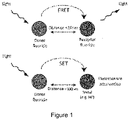
- FRET [1] Fluorescent Resonant Energy Transfer
- the spectrum of absorption (or excitation) of the receptor molecule must overlap with the emission spectrum of the donor molecule.
- the transfer of energy is not given by radiative means, but by coupling of opposite charges between the two molecules (dipole-dipole interactions), in a range of approximately 10 to 100 A. This occurs because the radius between the FRET pair is less than the wavelength of the energy released by the donor, resulting in near-field communication.
- the energy transfer efficiency of the FRET is inversely proportional to the distance between the donor and the receiver raised to the sixth power, which allows to measure with high precision the distance between the FRET pair.
- S0 base state
- S1 lowest vibrational level
- S0 base state
- the nanomaterial object of the present invention makes use of the SET phenomenon between low molecular weight fluorophores and functionalized metal nanoparticles (NPs) to allow the selective measurement of UDP-glucose (C 15 H 24 N 2 O 17 P 2 ) or ADP-glucose (C 16 H 25 N 5 O 15 P 2 ) in solution.
- NPs functionalized metal nanoparticles
- the presence of a fluorophore and a metallic NP with overlapping emission and reception spectra allows the use of the ratio of intensities to quantitatively detect the level or concentration of analytes present in solution.
- the NPs used in the nano sensor compound are of gold (Au), (hereinafter AuNPs).
- AuNPs have unique colorimetric, conductive, and optical properties that can be tuned based on their size, shape, and surrounding chemical environment. Therefore, although in the preferred embodiment of the invention AuNPs are related, the process is susceptible to the application of any type of ductile transition metal nanoparticles that are susceptible to absorption of fluorescence and plasmonic resonance.
- the distance limitation between the conventional FRET pair ( ⁇ 10nm) can be reduced by coupling surface plasmons in metalic NPs [6] which allows to extend the transfer of excited electronic energy between the FRET pair at distances close to 100 nm (10 times higher than in a conventional FRET pair) and at the same time it allows to attenuate different emission frequencies [7, 8], thanks to its high molar extinction coefficients and wide energy bandwidth [9, 10], in the range of visible to near infrared (i.e. it acts as a receptor fluorophore).
- the nano-sensor compound object of the present invention consists of AuNPs between 20 ⁇ 5nm in diameter as a chemically inert platform, functionalized with molecular elements for the selective detection of UDP-glucose and ADP-glucose.
- the detection mechanism involving the permeation of the analytes in the solvent with AuNPs and their selective interaction with the detection components causes changes in the intensity of detectable fluorescent emission.
- UDP-glucose and ADP-glucose play an important role as intermediates in the metabolism of sucrose and starch, respectively.
- sucrose production and starch synthesis are two main mechanisms for transport and carbon stock, respectively.
- Sucrose is the main transport form of photo assimilated carbon (from the consumption of carbon dioxide during the process of photosynthesis), as well as a source of skeletal carbon and energy for the organs that do not perform photosynthesis.
- plants form starch as a polymer, from the product of photosynthesis (glucose), and use it to store energy, indispensable for its growth.
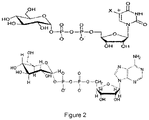
- Sucrose is produced in the cytosol and starch in cellular chloroplasts. Its synthesis processes share similar mechanisms, except that in the sucrose biosynthesis the UDP-glucose is given as metabolic intermediate and in the case of starch biosynthesis it is the ADP-glucose [12, 13].
- the invention employs the SET phenomenon between fluorescein ( Figure 3 ) as fluorophore donor of energized electronic energy, and AuNPs, as attenuators/quenchers of fluorescein fluorescence, to indirectly determine the concentration of sucrose/starch in solution.
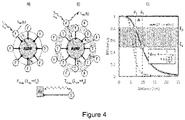
- the measurement mechanism is described graphically in Figure 4 .
- the energy transfer rate of a FRET pair ( k EnT ) to the product is related between the interacting elements of the donor (FD) and the receiver (FR), k EnT ⁇ F D F R .
- FD donor
- FR receiver
- Conventional FRET consists of two simple dipoles, such that k FRET ⁇ F D F R ⁇ (1/ d 3 )(1/ d 3 ) ⁇ 1/ d 6 .
- the Forster radius (R 0 ) is a function of the oscillator strength of the donor molecule and the receptor molecule, their mutual resonant energy, and the dipole addition vector. Typically, d ⁇ 100 ⁇ .
- the transfer rate for the SET is estimated as k SET ⁇ F D F R ⁇ (1/ d 3 ) (1/ d ) ⁇ 1/ d 4 .
- the interaction of the fluorophore with the metal surface changes depending on the distance regime.
- the radiative coupling rate dominates [15]; at intermediate distances (20-300 A), the transfer energy dominates [5]; and at long distances (> 500 A), fluorescent oscillations of the mirror-dipole take precedence [2].
- This allows identification of the nature of the energy transfer mechanism by interrogating the slope of the efficiency curve in energy transfer versus separation distance between the donor and the receiver.
- the mechanism for detecting and measuring the concentration of the analyte in solution is then derived by relating the distance between fluorescein and AuNP with the efficiency of fluorescence emission, as shown in Figure 4C).
- Figure 4C The mechanism for detecting and measuring the concentration of the analyte in solution is then derived by relating the distance between fluorescein and AuNP with the efficiency of fluorescence emission, as shown in Figure 4C).
- Each UDP-glucose molecule coupled to the AuNP by the carboxylic ligand reduces the SET efficiency by 3.75%, in other words, increases the net fluorescence of the system in the same proportion (i.e. assuming, as in this case, that the number of molecules to be sensed and the number of fluoresceins is the same).
- this separation distance should include the physical size of a UDP/ADP-glucose molecule and steric repulsions at finite temperature (300K), ⁇ could exceed 2 nm (a larger ⁇ further increases the net fluorescence of the system).
- the percentage effect is reduced in proportion to the total number of functional active sites available in solution, assuming the same number or more of fluoresceins. That is, if the number of active functional sites increases to 16, the total intensity is now distributed among 16 photons (instead of the 8 in the previous example) and the contribution per site will be 1.875%, and so on. Partial coverage states are measured with a resolution within the range of efficiency established by the two extreme states, points A and B in Figure 4C .
- E 1 - I D / I ⁇
- cw-PL continuous wave photoluminescence spectroscopy
- the present invention discloses a method of functionalizing gold nanoparticles synthesized with citric acid in solution to ensure its dispersion, and use of the polymeric ligands for the selective measurement of sucrose or starch in cells, comprising the following steps:
- v 1 For a defined volume (v 1 ) of solvent with an average pH of 7.2 (in the range for cytosol of 7.0-7.4 and 8.0 for the chloroplast stroma) and without electrophilic attack sensitive groups:
- the concentration c 2 would be estimated according to the number of active functional carboxylic sites, and directly proportional to the number of AuNPs/L, the size distribution of its size, the surface coverage of the ligands on the AuNPs and the functionalized surface coverage and with analytes bound by the carboxyl group that results in minimal energy.
- the measurement of these nucleotide sugars by the proposed nano-sensing system allows to derive the concentration of sucrose in the cytosol (or the concentration of starch in the chloroplast) in plants at a lower limit of nano-moles (10 -9 ), versus the lower limit using techniques in the state of the art of micro-moles (10 -6 ) [16] or traditional experimental techniques such as chromatography and mass spectrometry, which provide a resolution in the measurement of carbohydrate concentration in the scale of the milli-moles (10 -3 ).
- AuNPs are produced in a solvent by the chemical reduction of chloroauric acid (H[AuCl 4 ]) [17], although there are more precise and advanced methods to date [18-20].
- H[AuCl 4 ] chloroauric acid
- the solution is mixed rapidly in the presence of a reducing agent. This reduces the Au 3+ ions to neutral gold atoms. As more and more gold atoms form, the solution becomes super-saturated, and the gold begins to gradually precipitate in the form of sub-nanometric particles. The rest of the gold atoms adhere to the existing particles, and to achieve nanoparticles of uniform size the solution is vigorously stirred.
- a stabilizing agent that is physically absorbed i.e. low energy, non-covalent interaction
- a stabilizing agent that is physically absorbed i.e. low energy, non-covalent interaction
- citrate groups that introduce a net negative charge on the surface of the AuNPs (that is, a high Z potential). The electrostatic repulsion between surfaces leads to keeping the dispersed AuNPs in solution, as shown in Figure 6 .
- the uracil ring is characterized by having a carbon (C-5) susceptible to an electrophilic attack, because it has two carbonyl groups that activate the C-5, giving it a slightly more negative charge than would occur in the absence of such activating groups and a carbon susceptible to undergoing a nucleophilic attack, (C-6), which is the ⁇ -carbon of an ⁇ , ⁇ -unsaturated carbonyl system.
- C-5 carbon
- C-6 a carbon susceptible to undergoing a nucleophilic attack
- the positive or negative charges that are formed on the uracil ring during the reaction are stabilized by resonance within the ring, increasing the reactivity of said system.
- the functional chain SH(CH 2 ) 12 COOH linked by its sulfhydryl end to the surface of an AuNP interacts with the C-5 of the uracil ring, through the carbonyl carbon of its carboxyl terminus.
- the adenine ring allows the binding of the SH(CH 2 ) 12 COOH ligand to the reactive functional carboxylic group.
- Fluoresceins functionalized with the polymeric extension (c) have a covalent affinity for the residual group (R) with the nucleotide sugars of the UDP-glucose and ADP-glucose type.
- the composition of the Nanocomposite (nanosensor) object of the present invention incorporates Fluorescein in solution and gold Nanoparticles synthesized with citric acid in solution functionalized with the polymeric ligands SH(CH 2 ) 12 COOH, where the ligand SH(CH 2 ) 12 COOH has a length between 2 to 5 nm.
- Nanocomposite nanosensor object of the present invention is embodied in processes involving the measurement of sucrose or starch in cells.
Landscapes
- Health & Medical Sciences (AREA)
- Chemical & Material Sciences (AREA)
- Life Sciences & Earth Sciences (AREA)
- Engineering & Computer Science (AREA)
- Immunology (AREA)
- Molecular Biology (AREA)
- Physics & Mathematics (AREA)
- Urology & Nephrology (AREA)
- Hematology (AREA)
- Biomedical Technology (AREA)
- General Health & Medical Sciences (AREA)
- Analytical Chemistry (AREA)
- Biochemistry (AREA)
- General Physics & Mathematics (AREA)
- Pathology (AREA)
- Food Science & Technology (AREA)
- Medicinal Chemistry (AREA)
- Biotechnology (AREA)
- Cell Biology (AREA)
- Microbiology (AREA)
- Nanotechnology (AREA)
- Chemical Kinetics & Catalysis (AREA)
- Inorganic Chemistry (AREA)
- Optics & Photonics (AREA)
- Organic Chemistry (AREA)
- Nuclear Medicine, Radiotherapy & Molecular Imaging (AREA)
- Tropical Medicine & Parasitology (AREA)
- General Chemical & Material Sciences (AREA)
- Investigating, Analyzing Materials By Fluorescence Or Luminescence (AREA)
- Measuring Or Testing Involving Enzymes Or Micro-Organisms (AREA)
- Immobilizing And Processing Of Enzymes And Microorganisms (AREA)
- Apparatus Associated With Microorganisms And Enzymes (AREA)
Claims (6)
- Verfahren zum Messen von Saccharose oder Stärke in Zellen, dadurch gekennzeichnet, dass es die folgenden Schritte umfasst:a) Synthetisieren von Gold-Nanopartikeln in Lösung mit Zitronensäure;b) Funktionalisieren der synthetisierten Gold-Nanopartikel (a) mit den polymeren Liganden SH(CH2)12COOH;c) Hinzufügen einer halben Portion der in Schritt b) erhaltenen funktionalisierten AuNP-Nanopartikellösung zu einer Cytosol-Lösung;d) Ruhenlassen, bis thermisches Gleichgewicht der in c) erhaltenen Lösung erreicht ist;e) Hinzufügen von Fluorescein zur verbleibenden halben Portion der in c) erhaltenen Lösung von funktionalisierten AuNP;f) Hinzufügen der gleichen Konzentration von Fluorescein, die in Schritt e) erhalten wird, zur halben Portion von Lösung von in Cytosol funktionalisierten AuNP, die in Schritt d) erhalten wird;g) Berechnen der Differenz der Fluoreszenzintensitätsmessung zwischen der Lösung von funktionalisierten AuNP in e) und der Fluorescein-Lösung in f).
- Verfahren zum Messen von Saccharose oder Stärke in Zellen nach Anspruch 1, dadurch gekennzeichnet, dass im Schritt c) die funktionalisierten Gold-Nanopartikel (b) zu einer zellulären Chloroplast-Lösung hinzugefügt werden.
- Verfahren zum Messen von Saccharose oder Stärke in Zellen nach Anspruch 1, dadurch gekennzeichnet, dass die AuNP einen Durchmesser zwischen 20±5nm aufweisen.
- Verfahren zum Messen von Saccharose oder Stärke in Zellen nach Anspruch 1, dadurch gekennzeichnet, dass im Schritt c) die funktionalisierten Gold-Nanopartikel (b) zu einer zellulären Chloroplast-Lösung hinzugefügt werden.
- Nanoverbundstruktur zum Messen der Konzentration von Saccharose oder Stärke in Zellen, dadurch gekennzeichnet, dass sie umfasst:a) Fluorescein in Lösung;b) Gold-Nanopartikel, mit Zitronensäure in Lösung synthetisiert, mit den polymeren Liganden SH(CH2)12COOH funktionalisiert.
- Nanoverbundstruktur zum Messen der Konzentration von Saccharose oder Stärke in Zellen nach Anspruch 5, dadurch gekennzeichnet, dass der Ligand SH(CH2)12COOH eine Länge zwischen 2 und 5 nm aufweist.
Applications Claiming Priority (2)
| Application Number | Priority Date | Filing Date | Title |
|---|---|---|---|
| CONC2016/0006180A CO2016006180A1 (es) | 2016-12-30 | 2016-12-30 | Síntesis de nanopartículas de oro funcionalizadas y nanocompuesto que las contiene para la medición de sacarosa o almidón en celulas |
| PCT/IB2017/058461 WO2018122763A1 (es) | 2016-12-30 | 2017-12-28 | Síntesis de nanopartículas de oro funcionalizadas y nanocompuesto que las contiene para la medición de sacarosa o almidón en celulas |
Publications (3)
| Publication Number | Publication Date |
|---|---|
| EP3567008A1 EP3567008A1 (de) | 2019-11-13 |
| EP3567008A4 EP3567008A4 (de) | 2020-11-11 |
| EP3567008B1 true EP3567008B1 (de) | 2022-06-08 |
Family
ID=62707962
Family Applications (1)
| Application Number | Title | Priority Date | Filing Date |
|---|---|---|---|
| EP17887564.7A Active EP3567008B1 (de) | 2016-12-30 | 2017-12-28 | Synthese von funktionalisierten gold-nanopartikeln und nanoverbindungen damit zur messung von saccharose oder stärke in zellen |
Country Status (4)
| Country | Link |
|---|---|
| US (1) | US11413683B2 (de) |
| EP (1) | EP3567008B1 (de) |
| CO (1) | CO2016006180A1 (de) |
| WO (1) | WO2018122763A1 (de) |
Family Cites Families (5)
| Publication number | Priority date | Publication date | Assignee | Title |
|---|---|---|---|---|
| DE102006005464B3 (de) | 2006-02-07 | 2007-07-05 | Forschungszentrum Karlsruhe Gmbh | Verfahren zur primärseitigen Stickoxidminderung in einem zweistufigen Verbrennungsprozess |
| WO2011106057A2 (en) | 2009-12-04 | 2011-09-01 | Trustees Of Boston University | Nanostructure biosensors and systems and methods of use thereof |
| KR20110122320A (ko) | 2010-05-04 | 2011-11-10 | 경원대학교 산학협력단 | 형광공명에너지전이-기반 나노센서 시스템 및 이를 이용한 검출방법 |
| DE102014203254A1 (de) | 2014-02-24 | 2015-08-27 | Fraunhofer-Gesellschaft zur Förderung der angewandten Forschung e.V. | FRET-Drucksensor zur berührungsfreien Messung von Drücken |
| WO2016018798A1 (en) | 2014-07-28 | 2016-02-04 | Kansas State University Research Foundation | Nanosensors for detecting enzymatic activity in dairy production |
-
2016
- 2016-12-30 CO CONC2016/0006180A patent/CO2016006180A1/es unknown
-
2017
- 2017-12-28 EP EP17887564.7A patent/EP3567008B1/de active Active
- 2017-12-28 US US16/474,020 patent/US11413683B2/en active Active
- 2017-12-28 WO PCT/IB2017/058461 patent/WO2018122763A1/es not_active Ceased
Also Published As
| Publication number | Publication date |
|---|---|
| US20190381565A1 (en) | 2019-12-19 |
| WO2018122763A1 (es) | 2018-07-05 |
| US11413683B2 (en) | 2022-08-16 |
| EP3567008A1 (de) | 2019-11-13 |
| EP3567008A4 (de) | 2020-11-11 |
| CO2016006180A1 (es) | 2018-07-10 |
Similar Documents
| Publication | Publication Date | Title |
|---|---|---|
| Yaraki et al. | Metal nanoparticles‐enhanced biosensors: synthesis, design and applications in fluorescence enhancement and surface‐enhanced Raman scattering | |
| Costa-Fernández et al. | The use of luminescent quantum dots for optical sensing | |
| Sapsford et al. | Surface-immobilized self-assembled protein-based quantum dot nanoassemblies | |
| Zhao et al. | Composite QDs@ MIP nanospheres for specific recognition and direct fluorescent quantification of pesticides in aqueous media | |
| Silvi et al. | Luminescent sensors based on quantum dot–molecule conjugates | |
| Zhong | Nanomaterials in fluorescence-based biosensing | |
| Basabe-Desmonts et al. | Design of fluorescent materials for chemical sensing | |
| Clapp et al. | Förster resonance energy transfer investigations using quantum‐dot fluorophores | |
| Mayer et al. | A single molecule immunoassay by localized surface plasmon resonance | |
| Lin et al. | Gold nanoparticle probes for the detection of mercury, lead and copper ions | |
| Liu et al. | Studies on CdSe/L-cysteine quantum dots synthesized in aqueous solution for biological labeling | |
| Li et al. | Chemical sensors and biosensors for the detection of melamine | |
| US8263418B2 (en) | Sensors for detecting an analyte using silver nanoparticles | |
| KR100704011B1 (ko) | 금속나노입자와 양자점의 fret에 의한 생체분자특이결합 검출 방법 | |
| US20120101007A1 (en) | Silver nanoplates | |
| Naaz et al. | Tenfold enhancement of fluorescence quantum yield of water soluble silver nanoclusters for nano-molar level glucose sensing and precise determination of blood glucose level | |
| Zhang et al. | Fluorescence quenching of CdTe nanocrystals by bound gold nanoparticles in aqueous solution | |
| US20070275383A1 (en) | Novel Hybrid Probes with Heightened Luminescence | |
| CA2490765A1 (en) | Nano-sized optical fluorescence labels and uses thereof | |
| Chu et al. | Double-emission ratiometric fluorescent sensors composed of rare-earth-doped ZnS quantum dots for Hg2+ detection | |
| Tan et al. | One dimensional aggregates of silver nanoparticles induced by the stabilizer 2-mercaptobenzimidazole | |
| EP1608975B1 (de) | Sensor zum nachweis eines analyten mittels silbernanopartikeln | |
| Costas-Mora et al. | Quantum dot-based headspace single-drop microextraction technique for optical sensing of volatile species | |
| Burton et al. | Surface plasmon-enhanced aptamer-based fluorescence detection of cocaine using hybrid nanostructure of cadmium-free ZnSe/In2S3 core/shell quantum dots and gold nanoparticles | |
| Sergeev et al. | In situ-Synthesized cadmium sulfide quantum dots in pore-forming protein and polysaccharide matrices for optical biosensing applications |
Legal Events
| Date | Code | Title | Description |
|---|---|---|---|
| STAA | Information on the status of an ep patent application or granted ep patent |
Free format text: STATUS: THE INTERNATIONAL PUBLICATION HAS BEEN MADE |
|
| PUAI | Public reference made under article 153(3) epc to a published international application that has entered the european phase |
Free format text: ORIGINAL CODE: 0009012 |
|
| STAA | Information on the status of an ep patent application or granted ep patent |
Free format text: STATUS: REQUEST FOR EXAMINATION WAS MADE |
|
| 17P | Request for examination filed |
Effective date: 20190729 |
|
| AK | Designated contracting states |
Kind code of ref document: A1 Designated state(s): AL AT BE BG CH CY CZ DE DK EE ES FI FR GB GR HR HU IE IS IT LI LT LU LV MC MK MT NL NO PL PT RO RS SE SI SK SM TR |
|
| AX | Request for extension of the european patent |
Extension state: BA ME |
|
| DAV | Request for validation of the european patent (deleted) | ||
| DAX | Request for extension of the european patent (deleted) | ||
| A4 | Supplementary search report drawn up and despatched |
Effective date: 20201008 |
|
| RIC1 | Information provided on ipc code assigned before grant |
Ipc: B22F 1/00 20060101ALI20201002BHEP Ipc: B82Y 30/00 20110101AFI20201002BHEP Ipc: G01N 31/22 20060101ALN20201002BHEP Ipc: B22F 9/24 20060101ALI20201002BHEP |
|
| RAP1 | Party data changed (applicant data changed or rights of an application transferred) |
Owner name: PONTIFICIA UNIVERSIDAD JAVERIANA Owner name: CENTRO INTERNATIONAL DE AGRICULTURA TROPICAL - CIAT |
|
| REG | Reference to a national code |
Ref country code: DE Ref legal event code: R079 Ref document number: 602017058416 Country of ref document: DE Free format text: PREVIOUS MAIN CLASS: C01G0007000000 Ipc: B82Y0030000000 |
|
| GRAP | Despatch of communication of intention to grant a patent |
Free format text: ORIGINAL CODE: EPIDOSNIGR1 |
|
| STAA | Information on the status of an ep patent application or granted ep patent |
Free format text: STATUS: GRANT OF PATENT IS INTENDED |
|
| RIC1 | Information provided on ipc code assigned before grant |
Ipc: B82Y 40/00 20110101ALN20211202BHEP Ipc: B82Y 15/00 20110101ALN20211202BHEP Ipc: B82Y 5/00 20110101ALN20211202BHEP Ipc: G01N 31/22 20060101ALN20211202BHEP Ipc: B22F 9/24 20060101ALI20211202BHEP Ipc: B22F 1/00 20060101ALI20211202BHEP Ipc: B82Y 30/00 20110101AFI20211202BHEP |
|
| RIC1 | Information provided on ipc code assigned before grant |
Ipc: B82Y 40/00 20110101ALN20211207BHEP Ipc: B82Y 15/00 20110101ALN20211207BHEP Ipc: B82Y 5/00 20110101ALN20211207BHEP Ipc: G01N 31/22 20060101ALN20211207BHEP Ipc: B22F 9/24 20060101ALI20211207BHEP Ipc: B22F 1/00 20060101ALI20211207BHEP Ipc: B82Y 30/00 20110101AFI20211207BHEP |
|
| INTG | Intention to grant announced |
Effective date: 20211223 |
|
| GRAS | Grant fee paid |
Free format text: ORIGINAL CODE: EPIDOSNIGR3 |
|
| GRAA | (expected) grant |
Free format text: ORIGINAL CODE: 0009210 |
|
| STAA | Information on the status of an ep patent application or granted ep patent |
Free format text: STATUS: THE PATENT HAS BEEN GRANTED |
|
| AK | Designated contracting states |
Kind code of ref document: B1 Designated state(s): AL AT BE BG CH CY CZ DE DK EE ES FI FR GB GR HR HU IE IS IT LI LT LU LV MC MK MT NL NO PL PT RO RS SE SI SK SM TR |
|
| REG | Reference to a national code |
Ref country code: AT Ref legal event code: REF Ref document number: 1496815 Country of ref document: AT Kind code of ref document: T Effective date: 20220615 Ref country code: CH Ref legal event code: EP |
|
| REG | Reference to a national code |
Ref country code: DE Ref legal event code: R096 Ref document number: 602017058416 Country of ref document: DE |
|
| REG | Reference to a national code |
Ref country code: IE Ref legal event code: FG4D |
|
| REG | Reference to a national code |
Ref country code: LT Ref legal event code: MG9D |
|
| REG | Reference to a national code |
Ref country code: NL Ref legal event code: MP Effective date: 20220608 |
|
| PG25 | Lapsed in a contracting state [announced via postgrant information from national office to epo] |
Ref country code: SE Free format text: LAPSE BECAUSE OF FAILURE TO SUBMIT A TRANSLATION OF THE DESCRIPTION OR TO PAY THE FEE WITHIN THE PRESCRIBED TIME-LIMIT Effective date: 20220608 Ref country code: NO Free format text: LAPSE BECAUSE OF FAILURE TO SUBMIT A TRANSLATION OF THE DESCRIPTION OR TO PAY THE FEE WITHIN THE PRESCRIBED TIME-LIMIT Effective date: 20220908 Ref country code: LT Free format text: LAPSE BECAUSE OF FAILURE TO SUBMIT A TRANSLATION OF THE DESCRIPTION OR TO PAY THE FEE WITHIN THE PRESCRIBED TIME-LIMIT Effective date: 20220608 Ref country code: HR Free format text: LAPSE BECAUSE OF FAILURE TO SUBMIT A TRANSLATION OF THE DESCRIPTION OR TO PAY THE FEE WITHIN THE PRESCRIBED TIME-LIMIT Effective date: 20220608 Ref country code: GR Free format text: LAPSE BECAUSE OF FAILURE TO SUBMIT A TRANSLATION OF THE DESCRIPTION OR TO PAY THE FEE WITHIN THE PRESCRIBED TIME-LIMIT Effective date: 20220909 Ref country code: FI Free format text: LAPSE BECAUSE OF FAILURE TO SUBMIT A TRANSLATION OF THE DESCRIPTION OR TO PAY THE FEE WITHIN THE PRESCRIBED TIME-LIMIT Effective date: 20220608 Ref country code: ES Free format text: LAPSE BECAUSE OF FAILURE TO SUBMIT A TRANSLATION OF THE DESCRIPTION OR TO PAY THE FEE WITHIN THE PRESCRIBED TIME-LIMIT Effective date: 20220608 Ref country code: BG Free format text: LAPSE BECAUSE OF FAILURE TO SUBMIT A TRANSLATION OF THE DESCRIPTION OR TO PAY THE FEE WITHIN THE PRESCRIBED TIME-LIMIT Effective date: 20220908 |
|
| REG | Reference to a national code |
Ref country code: AT Ref legal event code: MK05 Ref document number: 1496815 Country of ref document: AT Kind code of ref document: T Effective date: 20220608 |
|
| PG25 | Lapsed in a contracting state [announced via postgrant information from national office to epo] |
Ref country code: RS Free format text: LAPSE BECAUSE OF FAILURE TO SUBMIT A TRANSLATION OF THE DESCRIPTION OR TO PAY THE FEE WITHIN THE PRESCRIBED TIME-LIMIT Effective date: 20220608 Ref country code: LV Free format text: LAPSE BECAUSE OF FAILURE TO SUBMIT A TRANSLATION OF THE DESCRIPTION OR TO PAY THE FEE WITHIN THE PRESCRIBED TIME-LIMIT Effective date: 20220608 |
|
| PG25 | Lapsed in a contracting state [announced via postgrant information from national office to epo] |
Ref country code: NL Free format text: LAPSE BECAUSE OF FAILURE TO SUBMIT A TRANSLATION OF THE DESCRIPTION OR TO PAY THE FEE WITHIN THE PRESCRIBED TIME-LIMIT Effective date: 20220608 |
|
| PG25 | Lapsed in a contracting state [announced via postgrant information from national office to epo] |
Ref country code: SM Free format text: LAPSE BECAUSE OF FAILURE TO SUBMIT A TRANSLATION OF THE DESCRIPTION OR TO PAY THE FEE WITHIN THE PRESCRIBED TIME-LIMIT Effective date: 20220608 Ref country code: SK Free format text: LAPSE BECAUSE OF FAILURE TO SUBMIT A TRANSLATION OF THE DESCRIPTION OR TO PAY THE FEE WITHIN THE PRESCRIBED TIME-LIMIT Effective date: 20220608 Ref country code: RO Free format text: LAPSE BECAUSE OF FAILURE TO SUBMIT A TRANSLATION OF THE DESCRIPTION OR TO PAY THE FEE WITHIN THE PRESCRIBED TIME-LIMIT Effective date: 20220608 Ref country code: PT Free format text: LAPSE BECAUSE OF FAILURE TO SUBMIT A TRANSLATION OF THE DESCRIPTION OR TO PAY THE FEE WITHIN THE PRESCRIBED TIME-LIMIT Effective date: 20221010 Ref country code: EE Free format text: LAPSE BECAUSE OF FAILURE TO SUBMIT A TRANSLATION OF THE DESCRIPTION OR TO PAY THE FEE WITHIN THE PRESCRIBED TIME-LIMIT Effective date: 20220608 Ref country code: CZ Free format text: LAPSE BECAUSE OF FAILURE TO SUBMIT A TRANSLATION OF THE DESCRIPTION OR TO PAY THE FEE WITHIN THE PRESCRIBED TIME-LIMIT Effective date: 20220608 Ref country code: AT Free format text: LAPSE BECAUSE OF FAILURE TO SUBMIT A TRANSLATION OF THE DESCRIPTION OR TO PAY THE FEE WITHIN THE PRESCRIBED TIME-LIMIT Effective date: 20220608 |
|
| PG25 | Lapsed in a contracting state [announced via postgrant information from national office to epo] |
Ref country code: PL Free format text: LAPSE BECAUSE OF FAILURE TO SUBMIT A TRANSLATION OF THE DESCRIPTION OR TO PAY THE FEE WITHIN THE PRESCRIBED TIME-LIMIT Effective date: 20220608 Ref country code: IS Free format text: LAPSE BECAUSE OF FAILURE TO SUBMIT A TRANSLATION OF THE DESCRIPTION OR TO PAY THE FEE WITHIN THE PRESCRIBED TIME-LIMIT Effective date: 20221008 |
|
| REG | Reference to a national code |
Ref country code: DE Ref legal event code: R097 Ref document number: 602017058416 Country of ref document: DE |
|
| PG25 | Lapsed in a contracting state [announced via postgrant information from national office to epo] |
Ref country code: AL Free format text: LAPSE BECAUSE OF FAILURE TO SUBMIT A TRANSLATION OF THE DESCRIPTION OR TO PAY THE FEE WITHIN THE PRESCRIBED TIME-LIMIT Effective date: 20220608 |
|
| PLBE | No opposition filed within time limit |
Free format text: ORIGINAL CODE: 0009261 |
|
| STAA | Information on the status of an ep patent application or granted ep patent |
Free format text: STATUS: NO OPPOSITION FILED WITHIN TIME LIMIT |
|
| PG25 | Lapsed in a contracting state [announced via postgrant information from national office to epo] |
Ref country code: DK Free format text: LAPSE BECAUSE OF FAILURE TO SUBMIT A TRANSLATION OF THE DESCRIPTION OR TO PAY THE FEE WITHIN THE PRESCRIBED TIME-LIMIT Effective date: 20220608 |
|
| 26N | No opposition filed |
Effective date: 20230310 |
|
| PG25 | Lapsed in a contracting state [announced via postgrant information from national office to epo] |
Ref country code: SI Free format text: LAPSE BECAUSE OF FAILURE TO SUBMIT A TRANSLATION OF THE DESCRIPTION OR TO PAY THE FEE WITHIN THE PRESCRIBED TIME-LIMIT Effective date: 20220608 |
|
| REG | Reference to a national code |
Ref country code: DE Ref legal event code: R119 Ref document number: 602017058416 Country of ref document: DE |
|
| REG | Reference to a national code |
Ref country code: CH Ref legal event code: PL |
|
| REG | Reference to a national code |
Ref country code: BE Ref legal event code: MM Effective date: 20221231 |
|
| PG25 | Lapsed in a contracting state [announced via postgrant information from national office to epo] |
Ref country code: LU Free format text: LAPSE BECAUSE OF NON-PAYMENT OF DUE FEES Effective date: 20221228 |
|
| PG25 | Lapsed in a contracting state [announced via postgrant information from national office to epo] |
Ref country code: LI Free format text: LAPSE BECAUSE OF NON-PAYMENT OF DUE FEES Effective date: 20221231 Ref country code: IE Free format text: LAPSE BECAUSE OF NON-PAYMENT OF DUE FEES Effective date: 20221228 Ref country code: DE Free format text: LAPSE BECAUSE OF NON-PAYMENT OF DUE FEES Effective date: 20230701 Ref country code: CH Free format text: LAPSE BECAUSE OF NON-PAYMENT OF DUE FEES Effective date: 20221231 |
|
| PG25 | Lapsed in a contracting state [announced via postgrant information from national office to epo] |
Ref country code: BE Free format text: LAPSE BECAUSE OF NON-PAYMENT OF DUE FEES Effective date: 20221231 |
|
| PG25 | Lapsed in a contracting state [announced via postgrant information from national office to epo] |
Ref country code: IT Free format text: LAPSE BECAUSE OF FAILURE TO SUBMIT A TRANSLATION OF THE DESCRIPTION OR TO PAY THE FEE WITHIN THE PRESCRIBED TIME-LIMIT Effective date: 20220608 |
|
| PG25 | Lapsed in a contracting state [announced via postgrant information from national office to epo] |
Ref country code: HU Free format text: LAPSE BECAUSE OF FAILURE TO SUBMIT A TRANSLATION OF THE DESCRIPTION OR TO PAY THE FEE WITHIN THE PRESCRIBED TIME-LIMIT; INVALID AB INITIO Effective date: 20171228 |
|
| PG25 | Lapsed in a contracting state [announced via postgrant information from national office to epo] |
Ref country code: CY Free format text: LAPSE BECAUSE OF FAILURE TO SUBMIT A TRANSLATION OF THE DESCRIPTION OR TO PAY THE FEE WITHIN THE PRESCRIBED TIME-LIMIT Effective date: 20220608 |
|
| PG25 | Lapsed in a contracting state [announced via postgrant information from national office to epo] |
Ref country code: MK Free format text: LAPSE BECAUSE OF FAILURE TO SUBMIT A TRANSLATION OF THE DESCRIPTION OR TO PAY THE FEE WITHIN THE PRESCRIBED TIME-LIMIT Effective date: 20220608 |
|
| PG25 | Lapsed in a contracting state [announced via postgrant information from national office to epo] |
Ref country code: MC Free format text: LAPSE BECAUSE OF FAILURE TO SUBMIT A TRANSLATION OF THE DESCRIPTION OR TO PAY THE FEE WITHIN THE PRESCRIBED TIME-LIMIT Effective date: 20220608 |
|
| PG25 | Lapsed in a contracting state [announced via postgrant information from national office to epo] |
Ref country code: MC Free format text: LAPSE BECAUSE OF FAILURE TO SUBMIT A TRANSLATION OF THE DESCRIPTION OR TO PAY THE FEE WITHIN THE PRESCRIBED TIME-LIMIT Effective date: 20220608 |
|
| PG25 | Lapsed in a contracting state [announced via postgrant information from national office to epo] |
Ref country code: MT Free format text: LAPSE BECAUSE OF FAILURE TO SUBMIT A TRANSLATION OF THE DESCRIPTION OR TO PAY THE FEE WITHIN THE PRESCRIBED TIME-LIMIT Effective date: 20220608 |
|
| PG25 | Lapsed in a contracting state [announced via postgrant information from national office to epo] |
Ref country code: BG Free format text: LAPSE BECAUSE OF FAILURE TO SUBMIT A TRANSLATION OF THE DESCRIPTION OR TO PAY THE FEE WITHIN THE PRESCRIBED TIME-LIMIT Effective date: 20220608 |
|
| PG25 | Lapsed in a contracting state [announced via postgrant information from national office to epo] |
Ref country code: BG Free format text: LAPSE BECAUSE OF FAILURE TO SUBMIT A TRANSLATION OF THE DESCRIPTION OR TO PAY THE FEE WITHIN THE PRESCRIBED TIME-LIMIT Effective date: 20220608 |
|
| PG25 | Lapsed in a contracting state [announced via postgrant information from national office to epo] |
Ref country code: TR Free format text: LAPSE BECAUSE OF FAILURE TO SUBMIT A TRANSLATION OF THE DESCRIPTION OR TO PAY THE FEE WITHIN THE PRESCRIBED TIME-LIMIT Effective date: 20220608 |
|
| PGFP | Annual fee paid to national office [announced via postgrant information from national office to epo] |
Ref country code: GB Payment date: 20251204 Year of fee payment: 9 |
|
| PGFP | Annual fee paid to national office [announced via postgrant information from national office to epo] |
Ref country code: FR Payment date: 20251211 Year of fee payment: 9 |