EP3566879B1 - Automatisiertes verfahren der digitalen herstellung von werkstücken - Google Patents
Automatisiertes verfahren der digitalen herstellung von werkstücken Download PDFInfo
- Publication number
- EP3566879B1 EP3566879B1 EP19173928.3A EP19173928A EP3566879B1 EP 3566879 B1 EP3566879 B1 EP 3566879B1 EP 19173928 A EP19173928 A EP 19173928A EP 3566879 B1 EP3566879 B1 EP 3566879B1
- Authority
- EP
- European Patent Office
- Prior art keywords
- sheet
- printed
- folded
- process according
- covers
- Prior art date
- Legal status (The legal status is an assumption and is not a legal conclusion. Google has not performed a legal analysis and makes no representation as to the accuracy of the status listed.)
- Active
Links
Images



Classifications
-
- B—PERFORMING OPERATIONS; TRANSPORTING
- B42—BOOKBINDING; ALBUMS; FILES; SPECIAL PRINTED MATTER
- B42C—BOOKBINDING
- B42C19/00—Multi-step processes for making books
- B42C19/02—Multi-step processes for making books starting with single sheets
-
- B—PERFORMING OPERATIONS; TRANSPORTING
- B42—BOOKBINDING; ALBUMS; FILES; SPECIAL PRINTED MATTER
- B42C—BOOKBINDING
- B42C1/00—Collating or gathering sheets combined with processes for permanently attaching together sheets or signatures or for interposing inserts
- B42C1/12—Machines for both collating or gathering and permanently attaching together the sheets or signatures
-
- B—PERFORMING OPERATIONS; TRANSPORTING
- B42—BOOKBINDING; ALBUMS; FILES; SPECIAL PRINTED MATTER
- B42C—BOOKBINDING
- B42C11/00—Casing-in
- B42C11/02—Machines or equipment for casing-in or applying covers to pamphlets, magazines, pads, or other paper-covered booklets
-
- B—PERFORMING OPERATIONS; TRANSPORTING
- B42—BOOKBINDING; ALBUMS; FILES; SPECIAL PRINTED MATTER
- B42C—BOOKBINDING
- B42C11/00—Casing-in
- B42C11/04—Machines or equipment for casing-in or applying covers to books
-
- B—PERFORMING OPERATIONS; TRANSPORTING
- B42—BOOKBINDING; ALBUMS; FILES; SPECIAL PRINTED MATTER
- B42C—BOOKBINDING
- B42C19/00—Multi-step processes for making books
-
- B—PERFORMING OPERATIONS; TRANSPORTING
- B42—BOOKBINDING; ALBUMS; FILES; SPECIAL PRINTED MATTER
- B42C—BOOKBINDING
- B42C19/00—Multi-step processes for making books
- B42C19/08—Conveying between operating stations in machines
-
- B—PERFORMING OPERATIONS; TRANSPORTING
- B42—BOOKBINDING; ALBUMS; FILES; SPECIAL PRINTED MATTER
- B42D—BOOKS; BOOK COVERS; LOOSE LEAVES; PRINTED MATTER CHARACTERISED BY IDENTIFICATION OR SECURITY FEATURES; PRINTED MATTER OF SPECIAL FORMAT OR STYLE NOT OTHERWISE PROVIDED FOR; DEVICES FOR USE THEREWITH AND NOT OTHERWISE PROVIDED FOR; MOVABLE-STRIP WRITING OR READING APPARATUS
- B42D15/00—Printed matter of special format or style not otherwise provided for
- B42D15/0073—Printed matter of special format or style not otherwise provided for characterised by shape or material of the sheets
- B42D15/008—Foldable or folded sheets
-
- B—PERFORMING OPERATIONS; TRANSPORTING
- B65—CONVEYING; PACKING; STORING; HANDLING THIN OR FILAMENTARY MATERIAL
- B65H—HANDLING THIN OR FILAMENTARY MATERIAL, e.g. SHEETS, WEBS, CABLES
- B65H45/00—Folding thin material
- B65H45/12—Folding articles or webs with application of pressure to define or form crease lines
- B65H45/14—Buckling folders
- B65H45/142—Pocket-type folders
-
- B—PERFORMING OPERATIONS; TRANSPORTING
- B65—CONVEYING; PACKING; STORING; HANDLING THIN OR FILAMENTARY MATERIAL
- B65H—HANDLING THIN OR FILAMENTARY MATERIAL, e.g. SHEETS, WEBS, CABLES
- B65H45/00—Folding thin material
- B65H45/12—Folding articles or webs with application of pressure to define or form crease lines
- B65H45/28—Folding in combination with cutting
-
- B—PERFORMING OPERATIONS; TRANSPORTING
- B65—CONVEYING; PACKING; STORING; HANDLING THIN OR FILAMENTARY MATERIAL
- B65H—HANDLING THIN OR FILAMENTARY MATERIAL, e.g. SHEETS, WEBS, CABLES
- B65H2301/00—Handling processes for sheets or webs
- B65H2301/30—Orientation, displacement, position of the handled material
- B65H2301/33—Modifying, selecting, changing orientation
- B65H2301/332—Turning, overturning
- B65H2301/3321—Turning, overturning kinetic therefor
- B65H2301/33216—Turning, overturning kinetic therefor about an axis perpendicular to the direction of displacement and to the surface of material
-
- B—PERFORMING OPERATIONS; TRANSPORTING
- B65—CONVEYING; PACKING; STORING; HANDLING THIN OR FILAMENTARY MATERIAL
- B65H—HANDLING THIN OR FILAMENTARY MATERIAL, e.g. SHEETS, WEBS, CABLES
- B65H2301/00—Handling processes for sheets or webs
- B65H2301/30—Orientation, displacement, position of the handled material
- B65H2301/33—Modifying, selecting, changing orientation
- B65H2301/332—Turning, overturning
- B65H2301/3322—Turning, overturning according to a determined angle
- B65H2301/33222—90°
Definitions
- the invention relates to the field of digital printing of printed books, in particular, the flexible production, on demand, of a single book or small series of identical books.
- the manufacture of printed works requires a certain number of steps including the printing of content on a medium, in particular paper or cardboard. , and the finishing of the work. It can also include the assembly of several printed contents, reformatting, cutting of unprinted margins / edges, binding, gluing, stapling, folding, cutting, ...
- the offset technique used for decades in printing, allows printing on large format sheets, for example A0 format, several pages of a book, from a carefully prepared blanket, so that a folding of the large-format sheet after printing results in a notebook, also called a signature. Sheets can be printed on both sides.
- a binding finish For large books, several notebooks of different content must be assembled before applying a binding finish, by sewing, gluing or stapling for example, with, if necessary, cutting the folded borders with a guillotine.
- this technique is only of interest for printing a large number of identical books.
- Digital printing has changed the way printers work, by making the printing of small series or even a single book economically accessible.
- laser or inkjet printing techniques make it possible to do away with the use of a blanket. It is then possible to print all the pages of the book in succession on a paper of size close to the desired final format.
- Printers store several sizes of paper and choose the starting size closest to the desired final size and adjust it, after printing, by cutting.
- no printer can print in A5 size, the printer selects an A4 starting sheet, prints the contents of the book, overlays all sheets in the correct order, cuts out the unprinted margins of the stack of sheets to keep only the final surface of the pages, glue the pages together or staple them then fold them, and finally assemble them to the appropriate blanket.
- This manufacturing process results in a great waste of paper.
- the cutting step being carried out on the immobilized sheet stack, it slows down the manufacturing process and generally requires the intervention of an operator who must move the stack of printed sheet to the cutter and then to the binding machine.
- the documents DE 195 39 930 A1 , US 2007/179037 A1 , US 2012/306141 A1 disclose automated methods and systems for manufacturing printed books using a sheet on which several pages are printed, said sheet being in particular transported and folded along different stations.
- edges is meant the side edges of the folded sheet parallel to the direction of feed.
- Cutting the edges is a step well known to printers. These edges can be cut continuously by blades or knives, for example circular, during the movement of the sheet.
- Edge trimming here not only eliminates lost edges, i.e. margins that cannot be printed due to technical limitations of printers, but also eliminates the edge of the folded sheet with folding, in order to obtain two superimposed unbound sheets.
- the sheets are therefore here half sheets, the side edges of which have been cut.
- the two sheets will thus advance at the same speed as the starting sheet. This is of great interest at the time of finishing the work, for example gluing, which finish is generally limited in the number of sheets per minute. Thanks to the method of the invention, the sheets arrive two by two, thus making it possible to double the rate.
- the method of the invention makes it possible to manufacture a series of works, identical or different, in content and / or in format. Each work can be made from several sheets successively subjected to the folding, pivoting and edge cutting stages.
- the sheet is moved along the feed direction, small edge in front, mainly for technical reasons related to the dimensions of the paper.
- small front edge or “small front side” is meant the shorter edge of the sheet which faces the feed direction.
- short edge first or its abbreviation “SEF” are more commonly used by those skilled in the art, even in French.
- large front edge or “large front side”, in English “long edge first” or “LEF” designates the advancement of the sheet with its longest side arranged perpendicular to the direction of feed.
- the sheets are printed "long side in front" in order to optimize the printing throughput.
- a plurality of pages are printed on a sheet 10, here 8 pages arranged on both sides.
- Sheet 10 is here, for example, in A3 format. It is printed with the long edge 12 in front, the small edge 13 being parallel to the direction followed by the sheet when printing.
- the sheet On leaving the printer, the sheet is driven in movement along a series of successive stations allowing the implementation of the following steps.
- step B the sheet 10 is held in its plane and rotated 90 ° with respect to the driving direction, here counterclockwise, in order to place it “small edge 13 in front.
- This step is necessary for the manufacture of books having a traditional format in their height-to-width ratio, such as books or catalogs. However, it is not necessary for other works having less common formats, much taller than they are wide, such as certain calendars or restaurant menus.
- step C the sheet 10 is folded in half, perpendicular to the feed direction.
- Half of the sheet comprising pages 4 and 5 is thus superimposed on half of the sheet comprising pages 1 and 8.
- the folded border 14 is shown here at the front, which facilitates the feeding of the folded sheet by the means for moving the sheet. If the folded edge 14 were at the back, the front of the sheet would have two edges 15 which could induce manufacturing defects, for example paper wrinkling or misalignment, if these two edges are not maintained. exactly superimposed during the training of the sheet. This problem does not arise when the folded edge 14 is at the front.
- step D the sheet 10 folded in half is rotated 90 °, here counterclockwise, relative to the feed direction.
- step E the edges of the folded sheet thus oriented are cut to obtain separate overlapping sheets 16 and 17.
- Sheet 16 here includes pages 4 and 5 (not shown) and sheet 17 includes pages 1 and 8.
- Folded border 14 is thus separated from the sheets by cutting the edge 18 also comprising lost edges or margins unnecessary to the work. The opposite lost edges are also eliminated by separation of the edges 19.
- these “lost edges” are margins which are not included in the edition of the work, but come from the technical constraints of the printers. Depending on the formats and printing techniques, these lost edges are more or less important.
- the sheets 16 and 17 thus superimposed and separated are driven further towards one or more finishing stations or may again undergo folding, pivoting and edge cutting steps.
- the A3 format described here is purely illustrative. Another starting format can be used, for example A0 or A4.
- the formats also include the RA and SRA uncut formats used by printers, which take into account the non-printable margins and the technical constraints of printers.
- the stations are here shown aligned along a linear feed direction, but it is obvious that the sheet does not necessarily move along a straight line.
- the sheet can be moved vertically, using mechanisms well known to printers, for example by means of rollers. During the process, it can be positioned as required in a horizontal plane and then a vertical plane or any other plane suitable for the proper implementation of the process. As the printing paper is relatively flexible, the paper feed can be organized in any direction suitable for process optimization.
- the sheet, folded or not, can also be driven laterally.
- a 90 ° pivoting can be done by rotating the sheet in the same plane while keeping the same direction of feed but also by changing the direction of feed of the sheet to 90 °, always in the same plane. , that is to say by a 90 ° elbow in line with the posts.
- page is meant both pages having real content, such as text or images for example, as pages without content, that is. ie blank pages.
- a step F the sheets 16 and 17 are folded in half perpendicular to the direction of feed, in order to superimpose pages 1 of sheet 17 and 4 of sheet 16 with pages 5 of sheet 16 and 8 of sheet 17.
- the pages obviously get along with their backs as described above, but which will not be mentioned here for reasons of clarity.
- a step F the sheets 16 and 17 thus folded are pivoted by 90 ° with respect to the driving direction.
- a step H the edges of the sheets 16 and 17 thus folded are cut along a border 24 to obtain four separate superimposed sheets 17a, 16a, 16b and 17b.
- the folded border 24 is thus separated from the sheets by cutting the edge 20 also comprising lost edges or margins unnecessary for the work.
- the opposite lost edges are also eliminated by separating the four superimposed edges 21.
- a helical knife can be used to make this cut.
- a knife consists of a blade installed along a roller under which a sheet or leaflets pass.
- the roller is disposed substantially, but not exactly, perpendicular to the driving direction.
- the blade is arranged on the roller so as to cut the sheet or sheets, in motion, perpendicular to the driving direction, by rotation of the roller.
- the blade is thus arranged in a helix along the length of the roller. The blade does not need to completely wind the roll.
- a detector can be arranged so as to detect the arrival of the sheet and to allow the synchronization of the rotation of the roll to cut the sheet or the sheets at the desired location.
- a helical knife module makes it possible, compared to the use of a guillotine knife, to avoid stopping the feeding of the sheets or of waiting for a stack of sheets to be cut and thus not to slow down the production rate.
- a creasing step can also be added, in particular before a folding step, or in anticipation of a subsequent folding.
- Creasing consists of making a groove in a sheet or leaflet in order to facilitate folding and / or to prevent the paper or cardboard from being damaged during folding. This step is well known to those skilled in the art and commonly applied in printing.
- roller registration / rotation systems making it possible to position the printed sheets against the registration border.
- a large number of rollers are arranged, slightly inclined in order to move the edge of the paper.
- a few rollers of rubber type material are inserted, which can rotate at higher speeds in order to drive one edge of the sheet more quickly than the other and thus induce a rotation of the sheet.
- the registration system thus makes it possible to both align and rotate the printed sheet.
- a similar roller system can similarly be used to rotate several superimposed sheets.
- the folding step can be implemented by any system known to those skilled in the art such as for example a pocket folder.
- a pocket folder an abutting sheet is deformed under the effect of the driving force to form a loop.
- the loop is then "caught" between two rollers which pinch the sheet at the fold and thus complete the fold.
- a registration / rotation system can be combined with a folding machine, an edge cutting system. Each system can be repeated several times.
- One or more creasing and / or helical cutting systems can also be added, as can any other system relevant to those skilled in the art.
- a system can comprise, one next to the other, at the output of the printer (not shown), two blocks 510 and 511.
- the first block 510 comprises a registration station or module 501 with or without rotation, a conveyor 502 and a pocket folder 503.
- the second block 511 comprises a registration and sheet rotation module 504, an edge cutting module 505 and a helical knife 506.
- Each of these modules has the functions described above and 'together allows the implementation of the method of the invention.
- certain optional modules, such as the helical knife 506, can be “bypassed”, that is to say that a sheet or a sheet can pass through this module without any action being applied to it.
- Blocks 510 and 511 are shown here on casters 507, to illustrate the great flexibility of the system. Other blocks offering additional functionality can easily be added or interspersed.
- the stacked sheets are then joined together to form the content block of the book.
- the binding can be carried out in several ways, such as for example by gluing or stapling. These binding steps are well known to those skilled in the art.
- the construction of the book ends with the assembly of the content block with a cover, when the book includes one.
- the cover of the book being printed separately, several methods are used to carry out this assembly.
- the pages composing the interior of the book are printed and prepared by a different system from that preparing the cover of the book.
- a single book is printed in many copies, it is fairly straightforward to assemble the content of the book with its cover, starting from a stock of contents and a stock of covers.
- the book covers are printed by a first printing system and stacked in a certain order in a cover storage bin.
- the first cover of the stack is identified by detection means, such as for example a barcode reader.
- the identification triggers the printing / production of the content of the book by a second system.
- the contents and the cover are then put together. The same steps are repeated for subsequent covers in the stack.
- steps can be managed by a computer server, not claimed in the present application, which receives, for each work, information of manufacture of the content block, information of manufacture of the cover and information of priority of manufacture of the material. work.
- the content block here designates, as specified above, the whole of a work with the exception of the cover.
- Feasibility here is the technical capacity of the equipment to produce the content block.
- the content block manufacturing system transmits availability information of its functions to the computer server.
- the blankets are placed in separate compartments of a blanket sorter, so that they can be removed at will.
- the other works can still be produced.
- a function of the content block making system becomes available again, for example when maintenance has taken place or if a heater has reached the temperature required for printing, the feasibility of the content blocks is reassessed, and the Content block production order list is updated, based on the order of priorities.
- the unavailability of a function even for a short period, does not block the process. This makes it possible, among other things, to avoid production backlogs, by optimizing the capacities of the manufacturing system.
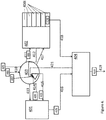
- the automated process for producing printed books each consisting of a content block 425 and a cover 426 comprises the following steps.
- a computer server 403 receives, for each work, information 405 for the manufacture of the content block 425, information 406 for the manufacture of the cover 426 and priority information 407. manufacture of the work.
- the content block manufacturing information includes all the information relating to the content, format, layout and binding mode of the pages, as well as information relating to the steps to be implemented, for example their nature or their order, to get the contained block ready to be assembled with the cover.
- the cover manufacturing information includes all information relating to content, format. They can also contain information about how the cover and the content block are assembled.
- the item's manufacturing priority information includes, for example, the timeframe within which manufacturing must be completed, the relative manufacturing priority of works in relation to each other, for example for customers who would have paid more for faster delivery.
- the computer server 403 sends the blanket manufacturing information 406 426 to a blanket manufacturing system 402 which fabricates the blanket 426 and places it in one of the bins 408i of a blanket sorter.
- a blanket manufacturing system 402 which fabricates the blanket 426 and places it in one of the bins 408i of a blanket sorter.
- Six 408i lockers are shown here, but many more can be provided as needed.
- System 402 may, at step 412, report the manufacture of the blanket and / or an identifier of the bin in which the blanket is placed.
- the cover manufacturing system is typically a system for printing the contents of the cover on the appropriate media and adjusting the format.
- it can also include creasing means, to facilitate the folding of the cover around the contained block, or surface treatment means (film-coating, lamination, etc.) or any other means deemed necessary by those skilled in the art. job.
- the bins of a cover sorter here refer to storage bins, designed to separately place the printed covers. Unlike existing systems, in which all the printed covers are stacked on top of each other as they are printed, in a single bin, each cover is here deposited in a separate bin. This makes it possible to pick up the covers separately, at will, regardless of the order in which they were printed and to manage various sizes of covers. It can be provided that each locker can only receive one cover, or that each locker can receive several identical covers. It is also possible to provide that each bin can receive several different covers, of the same format, or of different formats, or that each bin can receive all the covers corresponding to blocks of contents produced according to the same sequence of steps, or all of them. other wise arrangement, depending on the circumstances.
- step 413 the computer server 402 requests from a content block manufacturing system 401 information 409 of availability of its functions.
- the content block manufacturing system 401 returns (step 414) the information 409 of availability of its functions to the computer server 103.
- Content block manufacturing system feature availability information herein refers to a report on the operation of the items included in the content block manufacturing system.
- This information can, for example include the level of paper, the levels of ink available, depending on the colors, in the printer, the temperature of certain elements, information of paper jam at a particular module, etc. .
- the computer server 402 can request the finishing system 404 for information on the availability of its functions.
- Finishing System 404 is the module in which the covers are joined to the content blocks.
- the work availability information of the work finishing system 404 here refers to a report on the operation of the elements included in the work finishing system. This information can, for example include the functional availability of the different modules, the levels of consumables (glue, staples) available, the temperature of certain elements, information of paper jam at the level of a particular module, etc ...
- the computer server 403 analyzes the manufacturing priority information 407 based on the information 409 on the availability of functions of the contained block manufacturing system, the information 412 on the availability of covers and the information 421 on the availability of the functions of the system. finish 404, to prioritize and select feasible content blocks 425 to be fabricated.
- step 415 computer server 403 orders system 401 to manufacture the selected content block 425.
- the content block manufacturing system here refers to all the means necessary for printing, formatting, assembling and finishing the content block from a sheet. It may for example be a system as described above. It can also be any fully or partially automated system, usable in printing to prepare the contained block. Preferably, the system for manufacturing the contained block is the system described above comprising printing, folding, pivoting and edge cutting means.
- System 401 builds content block 425 and sends it in step 416 to finisher 404.
- step 417 the computer server 403 orders the removal of the cover 426 corresponding to the block of content 425 selected from its bin 408i.
- step 418 the system 402 extracts the cover from the bin 408i and sends it to the finisher 404.
- the physical step of extracting the cover to place it in the finisher 404 can take place. before ordering the manufacture of the content block, during its manufacture or even after the manufacture of the content block. Depending on the type of finishing system, it may be advantageous to use either option.
- step 419 the cover and the content block are assembled in the finisher 404 to form the printed book.
- finishing or assembly modules are well known to those skilled in the art.
- the method of the invention allows neither the unavailability of the cover nor the unavailability of the cover. certain functions of the equipment are factors limiting the productivity of the production line.
- the feasibility of the covers can also be communicated to the server by the cover manufacturing system.
- the feasibility of the covers can also be analyzed and intervene in the selection of the content blocks to be manufactured. For example, it seems wise to want to avoid, for example, that all the blanket bins are filled if none of the corresponding content blocks is feasible. It is therefore possible to order the manufacture of blankets subject to their feasibility and / or the availability of blanket storage means.
- Non-limiting examples of applications are, for example, the manufacture of personalized photo albums, the manufacture or reprint of books "on demand”.
- a book to have a unique identifier associated with the content and its cover.
- the server keeps this identifier in memory and associates it temporarily with the specific locker where the cover is placed.
- this same identifier is reused to identify the bin where the cover is placed in order to extract it.
- the unique identifier can for example be a bar code, a QR code, the ISBN code of the work if it is a published book, or any other code that can be envisaged by a person skilled in the art.
Landscapes
- Engineering & Computer Science (AREA)
- Mechanical Engineering (AREA)
- Folding Of Thin Sheet-Like Materials, Special Discharging Devices, And Others (AREA)
Claims (12)
- Automatisiertes Verfahren der Herstellung wenigstens eines bedruckten Werkstücks ausgehend von wenigstens einem Blatt, umfassend die Schritte, nach denen:- eine Vielzahl von Seiten (1, 4, 5, 8) des Werkstücks auf das Blatt (10) gedruckt wird (A),- in Verschiebung entlang einer Serie von Posten angetrieben wird, bei denen sukzessive,- das genannte bedruckte Blatt (10) in zwei zur Antriebsrichtung lotrechten Richtung einmal gefaltet wird (C);- das genannte bedruckte und gefaltete Blatt (10) in Bezug auf die Antriebsrichtung um 90° geschwenkt wird, dadurch gekennzeichnet, dass:- die Ränder (18, 19) des genannten bedruckten und gefalteten Blattes geschnitten (E) werden, um getrennt, übereinander gelagerte Schichten (16, 17) zu erhalten.
- Verfahren gemäß Anspruch 1, gemäß dem das bedruckte Werkstück ausgehend von mehreren Schichten hergestellt wird, wobei jedes Blatt denselben Schritten unterzogen wird.
- Verfahren gemäß einem der Ansprüche 1 und 2, gemäß dem mehrere bedruckte Werkstücke hergestellt werden, wobei alle Blätter des Werkstücks sukzessive denselben Schritten unterzogen werden.
- Verfahren gemäß einem der Ansprüche 1 bis 3, bei dem das Blatt (10) nach seinem Druck um 90° geschwenkt wird (B).
- Verfahren gemäß einem der Ansprüche 1 bis 4, umfassend die zusätzlichen Schritte, gemäß denen:- die in zwei getrennten, übereinander gelagerten Schichten (16, 17) lotrecht zur Antriebsrichtung gefaltet werden (F);- die gefalteten, getrennten, übereinander gelagerten Schichten (10, 17) in Bezug auf die Antriebsrichtung um 90° geschwenkt (G) werden und- die Ränder (20, 21) des gefalteten Blattes geschnitten werden (H), um getrennte, übereinander gelagerte Schichten (17a, 17b, 16a, 16b) zu erhalten.
- Verfahren gemäß einem der Ansprüche 1 bis 3, gemäß dem das Blatt (10) entlang der Antriebsrichtung mit dem kleinen Rand (13) voran verschoben wird.
- Verfahren gemäß einem der Ansprüche 1 bis 6, gemäß dem die Schichten (16, 17; 16a, 16b, 17a, 17b) einem Endbearbeitungsschritt unterzogen werden, in dem sie in einem Inhaltsblock fest verbunden werden.
- Verfahren gemäß den Ansprüchen 3 bis 7, bei dem die Abdeckungen (426) an den Inhaltsblöcken (425) der Werkstücke zusammengesetzt werden.
- Verfahren gemäß Anspruch 8, bei dem zum Zusammensetzen der Abdeckungen (426) an den Inhaltsblöcken (425):- die Machbarkeiten (429) der Herstellung der Inhaltsblöcke (425) der Werkstücke bestimmt werden;- eine Prioritätenreihenfolge (407) der Herstellung der Werkstücke festgelegt wird;- die an den Inhaltsblöcken zusammenzubauenden Abdeckungen (426) hergestellt werden;- die Herstellung der Inhaltsblöcke gemäß der absteigenden Prioritätsreihenfolge unter dem Vorbehalt der Machbarkeit angeordnet wird (413), wobei die Priorität auf der Herstellungspriorität liegt, und- die Inhaltsblöcke an den entsprechenden Abdeckungen zusammengebaut werden.
- Verfahren gemäß Anspruch 9, bei dem die Abdeckungen (426) in Fächern (408i) einer Sortiermaschine für Abdeckungen voneinander getrennt gelagert werden, um sie beliebig zu entnehmen.
- Automatisiertes System der Herstellung eines bedruckten Werkstücks, umfassend:- Druckmittel einer Vielzahl von Seiten auf einem Blatt (10) ;- Antriebsmittel des genannten bedruckten Blattes entlang einer Serie von Posten, umfassend wenigstens sukzessive:- Mittel zum einfachen Falten des genannten bedruckten Blattes (10) lotrecht zur Antriebsrichtung;- Schwenkmittel des genannten bedruckten und in Bezug auf die Antriebsrichtung um 90° gefalteten Blattes (10), dadurch gekennzeichnet, dass es umfasst:- Schneidmittel der Ränder (18, 19) des bedruckten und gefalteten Blattes (10), die zum Entfernen des Randes des gefalteten Blattes geeignet sind, umfassend die Faltung, um zwei nicht miteinander verbundene, übereinander gelagerte Schichten (16, 17) zu erhalten.
- Automatisiertes System gemäß Anspruch 11, umfassend wenigstens eines der Mittel der Liste, die aus Knickmitteln, Einbindungsmitteln, Zusammenbaumitteln und Endfertigungsmitteln gebildet ist.
Applications Claiming Priority (1)
| Application Number | Priority Date | Filing Date | Title |
|---|---|---|---|
| BE20185311A BE1026270B1 (fr) | 2018-05-11 | 2018-05-11 | Procede automatise de fabrication numerique d'ouvrages |
Publications (2)
| Publication Number | Publication Date |
|---|---|
| EP3566879A1 EP3566879A1 (de) | 2019-11-13 |
| EP3566879B1 true EP3566879B1 (de) | 2021-07-07 |
Family
ID=62455266
Family Applications (1)
| Application Number | Title | Priority Date | Filing Date |
|---|---|---|---|
| EP19173928.3A Active EP3566879B1 (de) | 2018-05-11 | 2019-05-10 | Automatisiertes verfahren der digitalen herstellung von werkstücken |
Country Status (3)
| Country | Link |
|---|---|
| US (1) | US10843498B2 (de) |
| EP (1) | EP3566879B1 (de) |
| BE (1) | BE1026270B1 (de) |
Families Citing this family (1)
| Publication number | Priority date | Publication date | Assignee | Title |
|---|---|---|---|---|
| BE1026264B1 (fr) | 2018-05-11 | 2019-12-13 | Bourg C P Sa | Méthode automatisée de production d'ouvrages imprimés |
Family Cites Families (7)
| Publication number | Priority date | Publication date | Assignee | Title |
|---|---|---|---|---|
| CH688720A5 (de) * | 1994-11-04 | 1998-01-30 | Hunkeler Jos Papierverarbeit | Vorrichtung zur Erstellung von Druckprodukten. |
| US7503555B2 (en) | 2004-08-09 | 2009-03-17 | Epac Technologies | System for and a method of producing a book on demand |
| US8425389B2 (en) * | 2006-02-01 | 2013-04-23 | Epac Technologies, Inc. | Method and a system for manufacturing printed products |
| NL2004352C2 (en) | 2010-03-05 | 2011-09-06 | Book Factory Systems B V | Small batch book production. |
| US20120306141A1 (en) * | 2011-06-03 | 2012-12-06 | Mcintyre Dale Frederick | Z-fold signature media |
| DE202014010654U1 (de) | 2014-07-22 | 2016-03-03 | Thomas Hütt | Anordnung zur Herstellung von Druckereierzeugnissen, insbesondere magazinartiger Druckereierzeugnisse |
| US20170129269A1 (en) * | 2015-11-11 | 2017-05-11 | Sasha Dobrovolsky | Automated book assembly system and method |
-
2018
- 2018-05-11 BE BE20185311A patent/BE1026270B1/fr not_active IP Right Cessation
-
2019
- 2019-05-09 US US16/407,529 patent/US10843498B2/en active Active
- 2019-05-10 EP EP19173928.3A patent/EP3566879B1/de active Active
Non-Patent Citations (1)
| Title |
|---|
| None * |
Also Published As
| Publication number | Publication date |
|---|---|
| EP3566879A1 (de) | 2019-11-13 |
| US10843498B2 (en) | 2020-11-24 |
| US20190344600A1 (en) | 2019-11-14 |
| BE1026270B1 (fr) | 2019-12-10 |
| BE1026270A1 (fr) | 2019-12-05 |
Similar Documents
| Publication | Publication Date | Title |
|---|---|---|
| EP1815405B1 (de) | System und verfahren zur herstellung eines buches auf anfrage | |
| CA2637259C (en) | A method and a system for manufacturing printed products | |
| US9538020B2 (en) | Work flow and finishing for print production of photograph images | |
| JP4424362B2 (ja) | 製本装置及び画像形成システム | |
| EP1477297A2 (de) | Verfahren zur Qualitätskontrolle von flächigen Gegenständen und Vorrichtung zur Durchführung des Verfahrens | |
| BE1026270B1 (fr) | Procede automatise de fabrication numerique d'ouvrages | |
| US8505897B2 (en) | Z-fold signature finishing system and printer | |
| US20100003108A1 (en) | Notch forming device, bookbinding apparatus and bookbinding system | |
| BE1026264B1 (fr) | Méthode automatisée de production d'ouvrages imprimés | |
| WO2014006483A1 (en) | Line for producing book blocks with pages glued two by two | |
| FR2502547A1 (fr) | Machine automatique a relier des documents, notamment des documents comptables, sous forme de fascicules, de differentes natures et de differents formats se succedant dans un ordre quelconque | |
| JP5939805B2 (ja) | 製本用折丁束作製装置 | |
| US8505898B2 (en) | Method for making a Z-fold signature | |
| US20120306141A1 (en) | Z-fold signature media | |
| EP1557388B1 (de) | Automatischer Falzapparat oder Vorrichtung zur Herstellung von Broschüren mit einer Auftragsvorrichtung für Verschlussaufkleber | |
| US6327439B1 (en) | Method and apparatus for manufacturing postcard-affixed photographic prints and photographic prints | |
| JP5970803B2 (ja) | 冊子状帳票作製用連続用紙、冊子状帳票、冊子状帳票の作製方法、冊子状帳票作製装置 | |
| JP5982930B2 (ja) | 冊子状帳票作製用連続用紙、冊子状帳票の作製方法および冊子状帳票作製装置 | |
| US20150166296A1 (en) | Folded booklet and method | |
| JP3417815B2 (ja) | 画像焼き付け方法及び葉書付き写真プリントの製造方法 | |
| WO2012166843A2 (en) | Method for making a z-fold signature | |
| JP2009280330A (ja) | 製本装置及び画像形成システム | |
| FR2932172A1 (fr) | Procede de decoupage et de pliage d'une bande de papier et dispositif correspondant. | |
| EP1916121A1 (de) | Herstellungsverfahren für Briefumschläge und Maschine zur Umsetzung dieses Verfahrens | |
| EP2569235A1 (de) | Verfahren zur herstellung grafischer produkte mittels digitaldruck und anschliessender bindung sowie dieses verfahren implementierende schnittstelleneinheit zwischen einem digitaldrucker und einer bindeeinheit |
Legal Events
| Date | Code | Title | Description |
|---|---|---|---|
| PUAI | Public reference made under article 153(3) epc to a published international application that has entered the european phase |
Free format text: ORIGINAL CODE: 0009012 |
|
| STAA | Information on the status of an ep patent application or granted ep patent |
Free format text: STATUS: THE APPLICATION HAS BEEN PUBLISHED |
|
| AK | Designated contracting states |
Kind code of ref document: A1 Designated state(s): AL AT BE BG CH CY CZ DE DK EE ES FI FR GB GR HR HU IE IS IT LI LT LU LV MC MK MT NL NO PL PT RO RS SE SI SK SM TR |
|
| AX | Request for extension of the european patent |
Extension state: BA ME |
|
| STAA | Information on the status of an ep patent application or granted ep patent |
Free format text: STATUS: REQUEST FOR EXAMINATION WAS MADE |
|
| 17P | Request for examination filed |
Effective date: 20200429 |
|
| RBV | Designated contracting states (corrected) |
Designated state(s): AL AT BE BG CH CY CZ DE DK EE ES FI FR GB GR HR HU IE IS IT LI LT LU LV MC MK MT NL NO PL PT RO RS SE SI SK SM TR |
|
| RIC1 | Information provided on ipc code assigned before grant |
Ipc: B65H 45/14 20060101ALI20201127BHEP Ipc: B42C 1/12 20060101ALI20201127BHEP Ipc: B65H 45/28 20060101ALI20201127BHEP Ipc: B42C 19/00 20060101ALI20201127BHEP Ipc: B42C 19/02 20060101ALI20201127BHEP Ipc: B42D 15/00 20060101ALI20201127BHEP Ipc: B42C 11/02 20060101AFI20201127BHEP Ipc: B65H 45/04 20060101ALI20201127BHEP Ipc: B42C 11/04 20060101ALI20201127BHEP |
|
| GRAP | Despatch of communication of intention to grant a patent |
Free format text: ORIGINAL CODE: EPIDOSNIGR1 |
|
| STAA | Information on the status of an ep patent application or granted ep patent |
Free format text: STATUS: GRANT OF PATENT IS INTENDED |
|
| INTG | Intention to grant announced |
Effective date: 20210112 |
|
| GRAS | Grant fee paid |
Free format text: ORIGINAL CODE: EPIDOSNIGR3 |
|
| GRAA | (expected) grant |
Free format text: ORIGINAL CODE: 0009210 |
|
| STAA | Information on the status of an ep patent application or granted ep patent |
Free format text: STATUS: THE PATENT HAS BEEN GRANTED |
|
| AK | Designated contracting states |
Kind code of ref document: B1 Designated state(s): AL AT BE BG CH CY CZ DE DK EE ES FI FR GB GR HR HU IE IS IT LI LT LU LV MC MK MT NL NO PL PT RO RS SE SI SK SM TR |
|
| REG | Reference to a national code |
Ref country code: GB Ref legal event code: FG4D Free format text: NOT ENGLISH |
|
| REG | Reference to a national code |
Ref country code: AT Ref legal event code: REF Ref document number: 1408201 Country of ref document: AT Kind code of ref document: T Effective date: 20210715 |
|
| REG | Reference to a national code |
Ref country code: DE Ref legal event code: R096 Ref document number: 602019005854 Country of ref document: DE |
|
| REG | Reference to a national code |
Ref country code: IE Ref legal event code: FG4D Free format text: LANGUAGE OF EP DOCUMENT: FRENCH |
|
| REG | Reference to a national code |
Ref country code: LT Ref legal event code: MG9D |
|
| REG | Reference to a national code |
Ref country code: NL Ref legal event code: MP Effective date: 20210707 |
|
| REG | Reference to a national code |
Ref country code: AT Ref legal event code: MK05 Ref document number: 1408201 Country of ref document: AT Kind code of ref document: T Effective date: 20210707 |
|
| PG25 | Lapsed in a contracting state [announced via postgrant information from national office to epo] |
Ref country code: ES Free format text: LAPSE BECAUSE OF FAILURE TO SUBMIT A TRANSLATION OF THE DESCRIPTION OR TO PAY THE FEE WITHIN THE PRESCRIBED TIME-LIMIT Effective date: 20210707 Ref country code: FI Free format text: LAPSE BECAUSE OF FAILURE TO SUBMIT A TRANSLATION OF THE DESCRIPTION OR TO PAY THE FEE WITHIN THE PRESCRIBED TIME-LIMIT Effective date: 20210707 Ref country code: SE Free format text: LAPSE BECAUSE OF FAILURE TO SUBMIT A TRANSLATION OF THE DESCRIPTION OR TO PAY THE FEE WITHIN THE PRESCRIBED TIME-LIMIT Effective date: 20210707 Ref country code: RS Free format text: LAPSE BECAUSE OF FAILURE TO SUBMIT A TRANSLATION OF THE DESCRIPTION OR TO PAY THE FEE WITHIN THE PRESCRIBED TIME-LIMIT Effective date: 20210707 Ref country code: HR Free format text: LAPSE BECAUSE OF FAILURE TO SUBMIT A TRANSLATION OF THE DESCRIPTION OR TO PAY THE FEE WITHIN THE PRESCRIBED TIME-LIMIT Effective date: 20210707 Ref country code: NO Free format text: LAPSE BECAUSE OF FAILURE TO SUBMIT A TRANSLATION OF THE DESCRIPTION OR TO PAY THE FEE WITHIN THE PRESCRIBED TIME-LIMIT Effective date: 20211007 Ref country code: NL Free format text: LAPSE BECAUSE OF FAILURE TO SUBMIT A TRANSLATION OF THE DESCRIPTION OR TO PAY THE FEE WITHIN THE PRESCRIBED TIME-LIMIT Effective date: 20210707 Ref country code: PT Free format text: LAPSE BECAUSE OF FAILURE TO SUBMIT A TRANSLATION OF THE DESCRIPTION OR TO PAY THE FEE WITHIN THE PRESCRIBED TIME-LIMIT Effective date: 20211108 Ref country code: BG Free format text: LAPSE BECAUSE OF FAILURE TO SUBMIT A TRANSLATION OF THE DESCRIPTION OR TO PAY THE FEE WITHIN THE PRESCRIBED TIME-LIMIT Effective date: 20211007 Ref country code: AT Free format text: LAPSE BECAUSE OF FAILURE TO SUBMIT A TRANSLATION OF THE DESCRIPTION OR TO PAY THE FEE WITHIN THE PRESCRIBED TIME-LIMIT Effective date: 20210707 Ref country code: LT Free format text: LAPSE BECAUSE OF FAILURE TO SUBMIT A TRANSLATION OF THE DESCRIPTION OR TO PAY THE FEE WITHIN THE PRESCRIBED TIME-LIMIT Effective date: 20210707 |
|
| PG25 | Lapsed in a contracting state [announced via postgrant information from national office to epo] |
Ref country code: PL Free format text: LAPSE BECAUSE OF FAILURE TO SUBMIT A TRANSLATION OF THE DESCRIPTION OR TO PAY THE FEE WITHIN THE PRESCRIBED TIME-LIMIT Effective date: 20210707 Ref country code: LV Free format text: LAPSE BECAUSE OF FAILURE TO SUBMIT A TRANSLATION OF THE DESCRIPTION OR TO PAY THE FEE WITHIN THE PRESCRIBED TIME-LIMIT Effective date: 20210707 Ref country code: GR Free format text: LAPSE BECAUSE OF FAILURE TO SUBMIT A TRANSLATION OF THE DESCRIPTION OR TO PAY THE FEE WITHIN THE PRESCRIBED TIME-LIMIT Effective date: 20211008 |
|
| REG | Reference to a national code |
Ref country code: DE Ref legal event code: R097 Ref document number: 602019005854 Country of ref document: DE |
|
| PG25 | Lapsed in a contracting state [announced via postgrant information from national office to epo] |
Ref country code: DK Free format text: LAPSE BECAUSE OF FAILURE TO SUBMIT A TRANSLATION OF THE DESCRIPTION OR TO PAY THE FEE WITHIN THE PRESCRIBED TIME-LIMIT Effective date: 20210707 |
|
| PLBE | No opposition filed within time limit |
Free format text: ORIGINAL CODE: 0009261 |
|
| STAA | Information on the status of an ep patent application or granted ep patent |
Free format text: STATUS: NO OPPOSITION FILED WITHIN TIME LIMIT |
|
| PG25 | Lapsed in a contracting state [announced via postgrant information from national office to epo] |
Ref country code: SM Free format text: LAPSE BECAUSE OF FAILURE TO SUBMIT A TRANSLATION OF THE DESCRIPTION OR TO PAY THE FEE WITHIN THE PRESCRIBED TIME-LIMIT Effective date: 20210707 Ref country code: SK Free format text: LAPSE BECAUSE OF FAILURE TO SUBMIT A TRANSLATION OF THE DESCRIPTION OR TO PAY THE FEE WITHIN THE PRESCRIBED TIME-LIMIT Effective date: 20210707 Ref country code: RO Free format text: LAPSE BECAUSE OF FAILURE TO SUBMIT A TRANSLATION OF THE DESCRIPTION OR TO PAY THE FEE WITHIN THE PRESCRIBED TIME-LIMIT Effective date: 20210707 Ref country code: EE Free format text: LAPSE BECAUSE OF FAILURE TO SUBMIT A TRANSLATION OF THE DESCRIPTION OR TO PAY THE FEE WITHIN THE PRESCRIBED TIME-LIMIT Effective date: 20210707 Ref country code: CZ Free format text: LAPSE BECAUSE OF FAILURE TO SUBMIT A TRANSLATION OF THE DESCRIPTION OR TO PAY THE FEE WITHIN THE PRESCRIBED TIME-LIMIT Effective date: 20210707 Ref country code: AL Free format text: LAPSE BECAUSE OF FAILURE TO SUBMIT A TRANSLATION OF THE DESCRIPTION OR TO PAY THE FEE WITHIN THE PRESCRIBED TIME-LIMIT Effective date: 20210707 |
|
| 26N | No opposition filed |
Effective date: 20220408 |
|
| PG25 | Lapsed in a contracting state [announced via postgrant information from national office to epo] |
Ref country code: IT Free format text: LAPSE BECAUSE OF FAILURE TO SUBMIT A TRANSLATION OF THE DESCRIPTION OR TO PAY THE FEE WITHIN THE PRESCRIBED TIME-LIMIT Effective date: 20210707 |
|
| REG | Reference to a national code |
Ref country code: CH Ref legal event code: PL |
|
| PG25 | Lapsed in a contracting state [announced via postgrant information from national office to epo] |
Ref country code: MC Free format text: LAPSE BECAUSE OF FAILURE TO SUBMIT A TRANSLATION OF THE DESCRIPTION OR TO PAY THE FEE WITHIN THE PRESCRIBED TIME-LIMIT Effective date: 20210707 Ref country code: LU Free format text: LAPSE BECAUSE OF NON-PAYMENT OF DUE FEES Effective date: 20220510 Ref country code: LI Free format text: LAPSE BECAUSE OF NON-PAYMENT OF DUE FEES Effective date: 20220531 Ref country code: CH Free format text: LAPSE BECAUSE OF NON-PAYMENT OF DUE FEES Effective date: 20220531 |
|
| PG25 | Lapsed in a contracting state [announced via postgrant information from national office to epo] |
Ref country code: IE Free format text: LAPSE BECAUSE OF NON-PAYMENT OF DUE FEES Effective date: 20220510 |
|
| P01 | Opt-out of the competence of the unified patent court (upc) registered |
Effective date: 20230428 |
|
| PG25 | Lapsed in a contracting state [announced via postgrant information from national office to epo] |
Ref country code: HU Free format text: LAPSE BECAUSE OF FAILURE TO SUBMIT A TRANSLATION OF THE DESCRIPTION OR TO PAY THE FEE WITHIN THE PRESCRIBED TIME-LIMIT; INVALID AB INITIO Effective date: 20190510 |
|
| PG25 | Lapsed in a contracting state [announced via postgrant information from national office to epo] |
Ref country code: MK Free format text: LAPSE BECAUSE OF FAILURE TO SUBMIT A TRANSLATION OF THE DESCRIPTION OR TO PAY THE FEE WITHIN THE PRESCRIBED TIME-LIMIT Effective date: 20210707 Ref country code: CY Free format text: LAPSE BECAUSE OF FAILURE TO SUBMIT A TRANSLATION OF THE DESCRIPTION OR TO PAY THE FEE WITHIN THE PRESCRIBED TIME-LIMIT Effective date: 20210707 |
|
| REG | Reference to a national code |
Ref country code: DE Ref legal event code: R082 Ref document number: 602019005854 Country of ref document: DE Representative=s name: STRAUS, ALEXANDER, DIPL.-CHEM.UNIV. DR.PHIL., DE |
|
| PG25 | Lapsed in a contracting state [announced via postgrant information from national office to epo] |
Ref country code: MT Free format text: LAPSE BECAUSE OF FAILURE TO SUBMIT A TRANSLATION OF THE DESCRIPTION OR TO PAY THE FEE WITHIN THE PRESCRIBED TIME-LIMIT Effective date: 20210707 |
|
| PGFP | Annual fee paid to national office [announced via postgrant information from national office to epo] |
Ref country code: DE Payment date: 20250528 Year of fee payment: 7 |
|
| PGFP | Annual fee paid to national office [announced via postgrant information from national office to epo] |
Ref country code: GB Payment date: 20250520 Year of fee payment: 7 |
|
| PGFP | Annual fee paid to national office [announced via postgrant information from national office to epo] |
Ref country code: BE Payment date: 20250526 Year of fee payment: 7 |
|
| PGFP | Annual fee paid to national office [announced via postgrant information from national office to epo] |
Ref country code: FR Payment date: 20250526 Year of fee payment: 7 |
|
| PG25 | Lapsed in a contracting state [announced via postgrant information from national office to epo] |
Ref country code: TR Free format text: LAPSE BECAUSE OF FAILURE TO SUBMIT A TRANSLATION OF THE DESCRIPTION OR TO PAY THE FEE WITHIN THE PRESCRIBED TIME-LIMIT Effective date: 20210707 |