EP3563580B1 - Handhabung von videosegmenten in einem video-stream - Google Patents
Handhabung von videosegmenten in einem video-stream Download PDFInfo
- Publication number
- EP3563580B1 EP3563580B1 EP16826753.2A EP16826753A EP3563580B1 EP 3563580 B1 EP3563580 B1 EP 3563580B1 EP 16826753 A EP16826753 A EP 16826753A EP 3563580 B1 EP3563580 B1 EP 3563580B1
- Authority
- EP
- European Patent Office
- Prior art keywords
- video
- sequence
- frames
- segment
- time
- Prior art date
- Legal status (The legal status is an assumption and is not a legal conclusion. Google has not performed a legal analysis and makes no representation as to the accuracy of the status listed.)
- Active
Links
Images




Classifications
-
- H—ELECTRICITY
- H04—ELECTRIC COMMUNICATION TECHNIQUE
- H04N—PICTORIAL COMMUNICATION, e.g. TELEVISION
- H04N21/00—Selective content distribution, e.g. interactive television or video on demand [VOD]
- H04N21/80—Generation or processing of content or additional data by content creator independently of the distribution process; Content per se
- H04N21/81—Monomedia components thereof
- H04N21/812—Monomedia components thereof involving advertisement data
-
- G—PHYSICS
- G06—COMPUTING OR CALCULATING; COUNTING
- G06V—IMAGE OR VIDEO RECOGNITION OR UNDERSTANDING
- G06V20/00—Scenes; Scene-specific elements
- G06V20/40—Scenes; Scene-specific elements in video content
- G06V20/49—Segmenting video sequences, i.e. computational techniques such as parsing or cutting the sequence, low-level clustering or determining units such as shots or scenes
-
- H—ELECTRICITY
- H04—ELECTRIC COMMUNICATION TECHNIQUE
- H04N—PICTORIAL COMMUNICATION, e.g. TELEVISION
- H04N21/00—Selective content distribution, e.g. interactive television or video on demand [VOD]
- H04N21/40—Client devices specifically adapted for the reception of or interaction with content, e.g. set-top-box [STB]; Operations thereof
- H04N21/43—Processing of content or additional data, e.g. demultiplexing additional data from a digital video stream; Elementary client operations, e.g. monitoring of home network or synchronising decoder's clock; Client middleware
- H04N21/44—Processing of video elementary streams, e.g. splicing a video clip retrieved from local storage with an incoming video stream or rendering scenes according to encoded video stream scene graphs
- H04N21/44016—Processing of video elementary streams, e.g. splicing a video clip retrieved from local storage with an incoming video stream or rendering scenes according to encoded video stream scene graphs involving splicing one content stream with another content stream, e.g. for substituting a video clip
-
- H—ELECTRICITY
- H04—ELECTRIC COMMUNICATION TECHNIQUE
- H04N—PICTORIAL COMMUNICATION, e.g. TELEVISION
- H04N21/00—Selective content distribution, e.g. interactive television or video on demand [VOD]
- H04N21/80—Generation or processing of content or additional data by content creator independently of the distribution process; Content per se
- H04N21/83—Generation or processing of protective or descriptive data associated with content; Content structuring
- H04N21/845—Structuring of content, e.g. decomposing content into time segments
- H04N21/8456—Structuring of content, e.g. decomposing content into time segments by decomposing the content in the time domain, e.g. in time segments
-
- H—ELECTRICITY
- H04—ELECTRIC COMMUNICATION TECHNIQUE
- H04N—PICTORIAL COMMUNICATION, e.g. TELEVISION
- H04N21/00—Selective content distribution, e.g. interactive television or video on demand [VOD]
- H04N21/80—Generation or processing of content or additional data by content creator independently of the distribution process; Content per se
- H04N21/85—Assembly of content; Generation of multimedia applications
- H04N21/854—Content authoring
- H04N21/8543—Content authoring using a description language, e.g. Multimedia and Hypermedia information coding Expert Group [MHEG], eXtensible Markup Language [XML]
Definitions
- Embodiments presented herein relate to a method, a video network node, a computer program, and a computer program product for determining a time offset for a video segment of a video stream using metadata.
- Communications systems for example implementing functionality of a content delivery network (CDN) can be used to serve content, such as video streams, to end-users with high availability and high performance.
- content such as video streams
- additional content such as advertisements
- advertisement insertion concerns the insertion of new advertisement segments into video streams
- advertisement replacement concerns the replacement of existing advertisement segments in video streams with new advertisement segments.
- Advertisement segments are commonly grouped together into consecutive sequences of advertisements, each such sequence being denoted an "advertisement break”.
- a television (TV) program may have a pre-roll advertisement break (comprising a sequence of advertisements before program start), any number of mid-roll advertisement breaks (each comprising a sequence of advertisements in the middle of the program), and a post-roll advertisement break (a sequence of advertisements after the end of the program).
- Pay TV operators usually sell advertisement slots for a certain time window. Two examples are called C 3 andC 7 .
- advertisements slots are sold for 3 days, and between the time the TV program was aired and until 3 days afterwards the advertisements must not be replaced. However, after the time period of 3 days, advertisement slots sold under the C 3 contract may be replaced with new advertisements.
- TV operators have metadata regarding which advertisements where inserted to the video stream, at what start and end times each advertisement is found in the stream, and what is the duration of each advertisement.
- metadata can be stored in log files.
- One mechanism for advertisement insertion and advertisement replacement could thus be to use the metadata as is, which describes approximately the start and end times of ad-breaks.
- the metadata of the log file is not well synchronized with the video stream, thus resulting in new advertisements being inserted in the middle of an existing advertisement, or replacing parts of TV programs and a prefix or a suffix of an existing advertisements with new advertisements instead of accurately replacing existing advertisements within an advertisement break with new advertisements.
- advertisements have been mentioned as an example where a video segment (as defined by a single advertisement or an entire advertisement break) is to be replaced or removed from a video stream, there are also other examples where a video segment is to be replaced or removed from a video stream.
- US 2014/196085 discloses methods and systems to insert advertisements and/or other supplemental or replacement content into a stream of video content.
- the methods and systems receive a request to replace a portion of video content currently playing at a client device with supplemental video content, such as an advertisement.
- the methods and systems determine one or more fingerprints of the video content plating at the client device, identify one or more frames of the video content at which to insert the supplemental video content based on the one or more fingerprints, and insert the supplemental video content at the identified one or moPre frames of the video content.
- WO 2014/178872 discloses a method and system for manipulating a manifest.
- a server receives a request for a manifest corresponding to a session identifier.
- the server retrieves from a session server a session manifest based on the session identifier.
- the server adjusts a session offset based on a difference in a session length represented by the session manifest from a session length represented by a previous session manifest corresponding to the session.
- the session manifest comprises an address of an ad break
- the server identifies in a cache at least one advertisement to be inserted into the session and replaces at least one address corresponding to at least one segment of the at least one advertisement in the session manifest based on the difference.
- the server transmits the session manifest to the smart appliance.
- An object of embodiments herein is to provide mechanisms for accurately identifying a video segment in a video stream.
- a method for determining a time offset for a video segment of a video stream using metadata comprises time information of at least one of a start time and an end time of the video segment.
- the method is performed by a video network node.
- the method comprises extracting a first video part and a second video part from the video stream. Each of the first video part and the second video part comprises a common video segment.
- the method comprises identifying a sequence of video frames in the first video part that represents the common video segment, wherein identifying the sequence of video frames comprises: identifying, in the first video part, a first sequence of video frames that is similar to a second sequence of video frames in the second video part, and wherein the first sequence of video frames has a time duration equal to the time duration of the video segment and determining that the first sequence of video frames is similar to the second sequence of video frames in the second video part using an image similarity measure between video frames in the first video part and video frames in the second video part.
- the method comprises determining the time offset based on a time difference between an end-point frame of the identified sequence of video frames and the time information in the metadata.
- a video network node for determining a time offset for a video segment of a video stream using metadata.
- the metadata comprises time information of at least one of a start time and an end time of the video segment.
- the video network node comprises processing circuitry and a storage medium.
- the storage medium stores instructions that, when executed by the processing circuitry, cause the video network node to perform operations, or steps.
- the operations, or steps cause the video network node to extract a first video part and a second video part from the video stream.
- Each of the first video part and the second video part comprises a common video segment.
- the operations, or steps, cause the video network node to identify a sequence of video frames in the first video part that represents the common video segment wherein identifying the sequence of video frames comprises: identifying, in the first video part, a first sequence of video frames that is similar to a second sequence of video frames in the second video part, and wherein the first sequence of video frames has a time duration equal to the time duration of the video segment and determining that the first sequence of video frames is similar to the second sequence of video frames in the second video part using an image similarity measure between video frames in the first video part and video frames in the second video part.
- the operations, or steps cause the video network node to determine the time offset based on a time difference between an end-point frame of the identified sequence of video frames and the time information in the metadata.
- a computer program for determining a time offset for a video segment of a video stream using metadata, the computer program comprising computer program code which, when run on a video network node, causes the video network node to perform operations, or steps.
- the operations, or steps cause the video network node to extract a first video part and a second video part from the video stream.
- Each of the first video part and the second video part comprises a common video segment.
- the operations, or steps, cause the video network node to identify a sequence of video frames in the first video part that represents the common video segment wherein identifying the sequence of video frames comprises: identifying, in the first video part, a first sequence of video frames that is similar to a second sequence of video frames in the second video part , and wherein the first sequence of video frames has a time duration equal to the time duration of the video segment and determining that the first sequence of video frames is similar to the second sequence of video frames in the second video part using an image similarity measure between video frames in the first video part and video frames in the second video part.
- the operations, or steps cause the video network node to determine the time offset based on a time difference between an end-point frame of the identified sequence of video frames and the time information in the metadata.
- this video network node, this computer program and this computer program product enable accurate identification of the video segment in the video stream. In turn, this enables efficient handling of video segments in the video stream.
- this method provides an accurate identification of the first and last frames of the video segment.
- this video network node, this computer program and this computer program product need a comparatively small search window to accurately find the first and last frames of the video segment.
- this method this video network node, this computer program and this computer program product enable, with the use of the metadata, to identify the video segment even when the content of the video segment appears for the first time in the video stream.
- this video network node, this computer program and this computer program product enable accurate determination of the time offset in scenarios where the time offset is caused by transcoding, re-encoding, or other processing operations occurring before the video stream is played out at a client node.
- this method this video network node, this computer program and this computer program product enable efficient separation of the video segment from the video stream such that the video segment can be replaced or removed.
- Fig. 1 is a schematic diagram illustrating a communications system 100 where embodiments presented herein can be applied.
- the communications system 100 could implement the functionality of a content delivery network and comprises a video streamer node 110, a video network node 1200, a manipulator node 130 (optional), a client node 140, and content databases 150, 160 acting as video servers streaming and serving Uniform Resource Locators (URLs) of the video segments to the client node 140.
- the video streamer node 110 issues metadata 120 (for example provided in a log file) which specifies advertisement breaks within a video stream.
- the metadata 120 could describe a unique identity for every advertisement and the approximated start time and end times of each advertisement.
- start time and end times of each advertisement as given by the metadata 120 could differ from only by a single video frame (corresponding to a duration in time of a fraction of a second) from the true start time and end times of each advertisement, to several video frames (corresponding to a duration in time of more than a second) from the true start time and end times of each advertisement.
- the start time and end times of each advertisement could be indicated by the insertion of cue-tones in the video stream, which indicate the exact position of the ad-breaks.
- not all video streams have cue-tones inserted.
- the client node 140 is configured to request a manifest 170 from the video network node 1200 upon playout of the video stream.
- the video network node 1200 returns a manipulated manifest 170 which contains segments of the video stream from the original Content Origin database 150.
- the video network node 1200 is configured to remove segments of old advertisements, and to insert segments of new advertisements with pointers, such as URLs, pointing to the Alternative Content Origin database 160 (instead of to the original advertisement segments in the Content Origin database 150).
- the decisions of where the advertisements are, that is, the decisions of which video segments to remove and where to insert the video segments of the new advertisements, are made based on the information supplied to the video network node 1200 by the metadata 120.
- the metadata may be supplied by the operator in terms of starting times of the original advertisements when the video streamer node 110 inserts the advertisements into the video stream for the first time.
- the video network node 1200 is configured, for example, to replace old advertisements within a recording of the video stream with new advertisements.
- the video network node 1200 relies on accurate metadata 120 describing where the existing advertisements are found.
- the metadata may not be accurate and hence the video network node 1200 may not be able to correctly replace the old advertisements with the new advertisements.
- the embodiments disclosed herein therefore relate to mechanisms for determining a time offset for a video segment of a video stream using metadata 120.
- the time offset results from the start time and end times of each advertisement as given by the metadata 120 not being accurate.
- a video network node 1200 a method performed by the video network node 1200, a computer program product comprising code, for example in the form of a computer program, that when run on a video network node 1200, causes the video network node 1200 to perform the method.
- Figs. 3 and 4 are flowcharts illustrating embodiments of methods for determining a time offset for a video segment 230' of a video stream 200 using metadata 120.
- the methods are performed by the video network node 1200.
- the methods are advantageously provided as computer programs 1420.
- FIG. 3 illustrating a method for determining a time offset for a video segment 230' of a video stream 200 using metadata 120 as performed by the video network node 1200 according to an embodiment.
- Parallel reference is made to Fig. 2
- the video network node 1200 obtains as input metadata 120 and an approximate start and/or end time of a video segment 230'.
- Fig. 2 at (a) and (b) schematically illustrates a video stream 200.
- Fig. 2 at (a) shows that metadata 120 points out a starting point of video segment 230'. That is, the metadata 120 comprises time information of at least one of a start time and an end time of the video segment 230'. Start times and end times given by the metadata 120 are only approximate, and the video network node 1200 is therefore configured to find this inaccuracy.
- Fig. 2 at (b) illustrates the true location of the video segment 230. This location differs by a time offset to from the approximate location of the video segment 230' as given by the metadata 120 in Fig.
- the video network node 1200 is configured to download parts of the video stream 200 in order to find the exact start time and/or end time of the video segment 230' using the downloaded parts together with the metadata 120. Particularly, the video network node 1200 is configured to perform step S102: S102: The video network node 1200 extracts a first video part 210 and a second video part 220 from the video stream 200, each of which comprising a common video segment 230, 240. That is, the first video part 210 and the second video part 220 are extracted such that they both comprise a common video segment 230, 240 representing content occurring in both the first video part 210 and the second video part 220.
- the first video part 210 has a duration t 3 and the second video part 220 has a duration t 5
- the common video segment 230, 240 has a duration t2 in the first video part 210 and a duration t 4 in the second video part 220.
- the video network node 1200 identifies a sequence of video frames in the first video part 210 that represents the common video segment 230, 240. That is, the identified sequence of video frames occurs somewhere in the first video part 210 and is thus a sub-part of the first video part 210.
- the video network node 1200 determines the time offset to based on a time difference between an end-point frame of the identified sequence of video frames and the time information in the metadata.
- the end-point frame could be either the first frame of the identified sequence of video frames or the last frame of the identified sequence of video frames. That is, in an embodiment the end-point frame of the sequence of video frames is a first occurring frame of the sequence of video frames, and the end-point frame constitutes the beginning of the video segment. In an alternative embodiment the end-point frame of the sequence of video frames is a last occurring frame of the sequence of video frames, and the end-point frame constitutes the ending of the video segment.
- the common video segment 230, 240 could be identical to the video segment 230'.
- the first video part 210 and the second video part 220 both comprise the content of the video segment (i.e., the content of the video segment 230' is identical to the content of the video segments 230 and 240).
- the end-point frame of the identified sequence is thus identical to an end-point frame of the video segment 230'. This is the case in the illustrative example of Fig. 2 .
- neither the first video part 210 nor the second video part 220 comprises the video segment 230'.
- the video network node 1200 can identify an end-point frame of the video segment 230' by adding (or subtracting) this know time difference to/from the end-point frame of the identified sequence in order to determine the time offset to.
- Embodiments relating to further details of determining the time offset to for the video segment 230' of the video stream 200 using the metadata 120 as performed by the video network node 1200 will now be disclosed.
- Fig. 4 illustrating methods for determining the time offset to for the video segment 230' of the video stream 200 using the metadata 120 as performed by the video network node 1200 according to further embodiments. It is assumed that steps S102, S106, S108 are performed as described above with reference to Fig. 3 and a thus repeated description thereof is therefore omitted.
- first video part 210 and the second video part 220 may be different ways.
- the first video part 210 and the second video part 220 are extracted such that they both comprise a common video segment 230, 240.
- the approximate start time and stop time of the video segment 230' is known.
- first video part 210 and the second video part 220 could be selected to at least comprise content corresponding to the video segment 230'.
- the first video part 210 and the second video part 220 could thus be extracted by downloading the video stream 200 from approximate start time - ⁇ t and until approximate end time + ⁇ t.
- ⁇ t is taken to be large enough to contain the maximum approximation error of the metadata.
- the value of ⁇ t could correspond to a single video frame (corresponding to a duration in time of a fraction of a second) up to several video frames (corresponding to a duration in time of more than a second).
- step S106 There may be different ways to perform the identifying in step S106. Embodiments relating thereto will now be described in turn.
- the metadata 120 comprises time information of at least one of a start time and an end time of the video segment 230'.
- the metadata 120 comprises information of a time duration of the video segment 230'. The sequence of video frames could then in above step S106 be identified such that it has a time duration equal to the time duration of the video segment.
- the sequence of video frames could in step S106 be identified using a similarity measure.
- the video network node 1200 is configured to perform step Sio6a as part of step S106 in order to identify the sequence of video frames:
- Sio6a The video network node 1200 identifies, in the first video part 210, a first sequence of video frames that is similar to a second sequence of video frames in the second video part 220.
- a condition for this first sequence of video frames is that it has a time duration equal to the time duration of the video segment (as given by the metadata 120).
- the common video segment 230, 240 could be identical to the video segment 230'.
- the common video segment 230, 240 is part of the first video part 210 the first sequence of video frames as identified in step Sio6a could be identical to the video segment 230'.
- the first sequence of video frames as identified in step Sio6a could be adjacent the video segment 230' or even further separated from the video segment 230', again assuming that there is a known time difference between the sequence of video frames in the first video part 210 and the video segment 230'.
- step Sio6a There could be different ways to identify first sequence of video frames in step Sio6a.
- an image similarity measure is determined for all combinations (or a subset thereof) of video frames between the first video part 210 and the second video part 220.
- the video network node 1200 is configured to perform step Sio6a as part of step S106 in order to identify the sequence of video frames: Sio6b:
- the video network node 1200 determines that the first sequence of video frames (as identified in step sio6a) in the first video part 210 is similar to the second sequence of video frames in the second video part 220 using an image similarity measure between video frames in the first video part 210 and video frames in the second video part 220.
- image similarity measures that could be applied in the determination in step Sio6b.
- the image similarity measure is determined using the video frames of the first video part 210 and the second video part 220 as is, or the image similarity measure is determined using processed video frames of the first video part 210 and the second video part 220.
- One way to process the video frames is to subject the video frames to similarity hashing.
- the image similarity measure is thus determined using similarity hashes of video frames in the first video part 210 and similarity hashes of video frames in the second video part 220.
- the similarity hashes that is, to perform similarity hashing on the video frames).
- perceptual hashing In general terms, perceptual hashing is the use of an algorithm that produces a snippet, or fingerprint, of various forms of multimedia. Perceptual hash functions are analogous if features are similar, whereas cryptographic hashing relies on the avalanche effect of a small change in input value creating a drastic change in output value. Further aspects of the similarity hashing will be described below with reference to Fig. 5 .
- Fig. 5 is a schematic illustration of similarity hashing according to an embodiment.
- Input as defined by the first video part 210 and the second video part 220 are decoded by a decoder 510 (possibly using down-sampling as in step S104 to reduce the frame rate) to produce respective sequences of frames 520a, 520b (denoted Frames1 and Frames2 in Fig. 5 ).
- the video frames 520a, 520b are then subjected to similarity hashing 530, producing respective image hashes 540a, 540b (denoted Hashes1 and Hashes2 in Fig. 5 ).
- Each frame is thus represented by its own image hash.
- Every image hash of a frame of the first video part 210 could be compared with every image hash of a frame of the second video part 220. Alternatively, only a selected subset of the image hashes of the first video part 210 are compared to the same selected subset of image hashes of the second video part 220. The higher the similarity measure, the more similar two frames are.
- S(i,j) the image similarity score between the i:th frame of the first video part 210 and the j:th frame of the second video part 220.
- S(i,j) is determined by comparing the image hash of frame i with the image hash of frame j using an appropriate distance measure (e.g. dot-product).
- Fig. 6 is a schematic illustration of a similarity matrix 600 according to an embodiment.
- Fig. 6 shows the similarity matrix 600 which holds at position (i,j) the similarity score S(i,j).
- darker entries in the similarity matrix 600 represent higher similarity score and lighter entries in the similarity matrix 600 represent lower similarity score.
- the maximum entry per row in the similarity matrix 600 can be stored in a first vector 630a for the first video part 210 and the maximum entry per column in the similarity matrix 600 can be stored in a second vector 630b for the second video part 220.
- the similarity matrix 600 can be interpreted as a heat-map.
- a search can be made for the diagonal 610 in the similarity matrix 600 with the maximum similarity score.
- This diagonal 610 yields the time value of step Sio6c (by multiplying the number frames skipped from the main diagonal of the similarity matrix 600 in order to reach the diagonal 610 with the frame rate of the first video part 210). Further aspects of searching for the diagonal 610 in the similarity matrix 600 will be disclosed below with reference to Fig. 11 .
- the image similarity measure is maximized when the first sequence of video frames and the second sequence of video frames match each other.
- the video network node 1200 is configured to perform step Sio6c as part of step S106:
- Sio6c The video network node 1200 determines, in relation to a first occurring frame of the first video part 210, a time value that maximizes the image similarity measure. The time offset to is then determined based on the time value.
- the time offset to is identical to the time value determined in step Sio6c. Otherwise, the known time difference between the sequence of video frames in the first video part 210 and the video segment 230' needs to be added to the time value determined in step Sio6c to yield the time offset to.
- the image similarity measure could in step Sio6b be determined to comprise a sequence of image similarity values. It could be that the sequence of image similarity values comprises isolated high image similarity values. Such isolated high image similarity values could be removed from the image similarity measure when determining the time value in step Sio6c. That is, isolated high values 620 in the similarity matrix 600 could be removed before searching for the diagonal 610 in order to reduce the possibility of false positives. Thus, elements representing isolated high image similarity values could be removed from the matrix when determining the time value. This enables isolated high image similarity values to be removed from the image similarity measure.
- the similarity matrix 600 does not necessarily need to be a square matrix; it will be a rectangular (non-square) matrix in case the first video part 210 and the second video part 220 do not result in the same number of image hashes (for example by the first video part 210 and the second video part 220 not containing the same number of frames).
- the first video part 210 and/or the second video part 220 could be down-sampled before steps S106 and S108 are performed.
- the video network node 1200 is configured to perform step S104 before steps S106 and S108: S104: The video network node 1200 down-samples at least one of the first video part 210 and the second video part 220 before identifying the sequence of video frames in step S106.
- Down-sampling generally refers to reducing the frame rate of the first video part 210 and/or the second video part 220, such as using only every k:th frame, where k >1 is an integer, or any other subset of frames. However, this does not exclude that, additionally or alternatively, the resolution of the individual frames could be reduced.
- steps S104, S106, and S108 could be iteratively performed at least two times. That is, step S106 of identifying the sequence of video frames could be repeated for a new first video part and a new second video part.
- the new first video part and the new second video part are determined based on the sequence of video frames identified using the down-sampled at least one of the first video part and the second video part. For example, the new first video part and the new second video part could selected based on the time value determined in step sio6c that maximizes the image similarity measure.
- a first approximation of the time offset to could be found using a down-sampled first video part 210 and a down-sampled second video part 220 in an initial search window
- a second, refined, approximation of the time offset to could be found using a down-sampled first video part 210 and a down-sampled second video part 220 in a refined search window
- the refined search window is selected based on the time value determined in step s106c that maximizes the image similarity measure in the initial search window.
- the video network node 1200 removes at least part of the video segment 230', for example to replace it with a new video segment.
- the video network node 1200 is configured to perform step S110a: S110a: The video network node 1200 removes at least part of the video segment 230' from the video stream 200 using the end-point frame of the identified sequence of video frames as reference.
- the video network node 1200 removes the entire video segment 230', or even that the video network node 1200 removes more than just the video segment 230', such as the video segment 230' and an adjacent video segment or the video segment 230' and another video segment separated from the video segment 230' by a known time difference. This could be in a case where the video segment 230' is a first video segment of a composite video segment, and, for example, where the first video part 210 comprises the composite video segment.
- the video network node 1200 could, for example, be configured to analyze the manifest 170 for the video stream 200 that the client node 140 requests, and to remove only the video segment corresponding to an advertisement break, thus allowing the replacement of the one or more of the advertisements of the advertisement break with a video segment corresponding to one or more new advertisements in a precise, frame-accurate manner, even when the metadata 120 is inaccurate.
- the video network node 1200 does not perform any manipulation of the video stream 200, such as removal or replacement of the video segment 230', but instead informs the manifest manipulator node 130 of the determined time offset to (for the manifest manipulator 130 to perform such manipulation).
- the video network node 1200 is configured to perform step S110b: S110b: The video network node 1200 provides information of the time offset to to a manifest manipulator node 130.
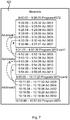
- Fig. 7 gives an illustrative example of metadata 120.
- metadata in Fig. 7 there are 3 advertisement breaks, denoted Ad-break1, Ad-break2, and Ad-break3.
- Ad-break1 starts with advertisement Ad-3801 and ends with advertisement Ad-3807;
- ad-break2 starts with advertisement Ad-3805 and ends with advertisement Ad-3811;
- ad-break3 starts with advertisement Ad-3809 and ends with advertisement ad-3810.
- Ad-break2 comprises a segment denoted Ad-3805 that occurs also in Ad-break1.
- Ad-3805 in Ad-break2 is adjacent Ad-3808 which does not occur in Ad-break1.
- pairs of ad-breaks could be found such that the first advertisement of the first ad-break appears somewhere within the second ad-break.
- Ad-3805 is the first advertisement in ad-break2 and it appears somewhere within ad-break1 (as its fifth advertisement), so the pair (ad-break2, ad-break1) has this property that the first advertisement of the first ad-break in the pair appears somewhere within the second ad-break of the pair.
- Ad-3809 appears as the first advertisement in ad-break3 and somewhere within ad-break2 (it is the third advertisement in ad-break2) so (ad-break3, ad-break2) is also a pair of advertisement breaks which has this property that the first advertisement of the first ad-break in the pair appears somewhere within the second ad-break of the pair.
- Ad-break3 the third advertisement in ad-break2
- Ad-break3 ad-break2
- Fig. 8 is a schematic diagram illustrating a part 100' of the communications system in Fig. 1 .
- Fig. 8 schematically illustrates a video network node 1200 taking as input the metadata 120 (only part of the metadata of Fig.7 is shown) and the video stream 200 from the video streamer node 110 as input and produces as output to a database 810 an accurate start time and end time of Ad-break2.
- the database data representing the identifier of Ad-break2
- the start time of Ad-break2 as given by the metadata the end time of Ad-break2 as given by the metadata
- the determined accurate start time of Ad-break2 as determined by the video network node 1200 is stored.
- Fig. 9 is a flowchart of a particular embodiment for determining the time offset to for the video segment 230' of the video stream 200 using the metadata 120 as performed by the video network node 1200 based on at least some of the above disclosed embodiments.
- the video network node 1200 receives a request from a client node 140 to playout the video stream 200 starting at time t.
- step S202 The video network node 1200 checks if the time t is close to an advertisement break. If no, step S203 is entered, and if yes, step S204 is entered.
- S203 The video network node 1200 enables playout of the requested video stream 200 starting at time t at the client node 140.
- step S204 The video network node 1200 checks if t is already stored in a database of fixed times (Already-Fixed-Times-DB). If no, step S205 is entered, and if yes, step S207 is entered.
- the video network node 1200 determines an initial start time t' from the time t and ⁇ t (see above for a definition of ⁇ t).
- the video network node 1200 determines the exact start and end time of the advertisement break.
- the variable t' is fixed to represent the exact start time of the advertisement break and stored in Already-Fixed-Times-DB together with t.
- the video network node 1200 retrieves the exact start time t' from the Already-Fixed-Times-DB using t.
- the video network node 1200 enables playout of the requested video stream 200 from time t to time t' at the client node 140.
- S209 The video network node 1200 replaces the original advertisement with a new advertisement to be played out at the client node 140 starting at time t'.
- Fig. 10 is a flowchart of a particular embodiment for determining the time difference based on at least some of the above disclosed embodiments.
- the video network node 1200 extracts a first video part (denoted video1) and a second video part (denoted video2) from the video stream, each of which comprising a common video segment 230, 240.
- step S302 The video network node 1200 checks if the first video part is shorter than the second video part. If yes, step S303 is entered, and else step S304 is entered.
- the video network node 1200 replaces the annotation of the first video part and the second video part with each other such that the first video part is longer than the second video part.
- the video network node 1200 identifies the first seconds, Y_Preff, of the first video part and denotes this part of the first video part as Prefix1.
- the video network node 1200 searches for Prefix1 in the second video part using an image similarity measure, e.g., as described with reference to Fig. 6 .
- step S306 The video network node 1200 checks if a matching part in the second video part is found. If yes, step S307 is entered, and if no, step S308 is entered.
- the video network node 1200 outputs the time value that maximizes the image similarity measure in step S305.
- the video network node 1200 identifies the last seconds, Y_Suff, of the first video part and denotes this part of the first video part as Suffix1.
- the video network node 1200 searches for Suffix1 in the second video part using an image similarity measure, e.g., as described with reference to Fig. 6 .
- Fig. 11 is a flowchart of an embodiment for searching for the diagonal 610 in the similarity matrix 600.
- the video network node 1200 searches the first vector 630 for the next sequence consecutive entries of (approximately) length X of high similarities (i.e., a sequence of length X whose total similarity score is above a threshold).
- the video network node 1200 searches for a diagonal 610 starting at the row indicated by the first entry in the sequence found in step S401.
- step S403 The video network node 1200 checks if a diagonal 610 is found. If no, step S404 is entered, and if yes, step S405 is entered.
- Step S404 The video network node 1200 determines that the video segment 230' was not found, and hence that no advertisement break was found. Step S401 is entered once again.
- S405 The video network node 1200 determines that the video segment 230' was found, and hence that an advertisement break was found.
- the video network node 1200 outputs the start and stop times of the video segment 230'.
- Fig. 12 schematically illustrates, in terms of a number of functional units, the components of a video network node 1200 according to an embodiment.
- Processing circuitry 1210 is provided using any combination of one or more of a suitable central processing unit (CPU), multiprocessor, microcontroller, digital signal processor (DSP), etc., capable of executing software instructions stored in a computer program product 1410 (as in Fig. 14 ), e.g. in the form of a storage medium 1230.
- the processing circuitry 1210 may further be provided as at least one application specific integrated circuit (ASIC), or field programmable gate array (FPGA).
- ASIC application specific integrated circuit
- FPGA field programmable gate array
- the processing circuitry 1210 is configured to cause the video network node 1200 to perform a set of operations, or steps, S102-S110b, S201-S209, S301-S310, S401-S406, as disclosed above.
- the storage medium 1230 may store the set of operations
- the processing circuitry 1210 may be configured to retrieve the set of operations from the storage medium 1230 to cause the video network node 1200 to perform the set of operations.
- the set of operations may be provided as a set of executable instructions.
- the processing circuitry 1210 is thereby arranged to execute methods as disclosed herein.
- the storage medium 1230 may also comprise persistent storage, which, for example, can be any single one or combination of magnetic memory, optical memory, solid state memory or even remotely mounted memory.
- the video network node 1200 may further comprise a communications interface 1220 at least configured for communications with other entities and devices. As such the communications interface 1220 may comprise one or more transmitters and receivers, comprising analogue and digital components.
- the processing circuitry 1210 controls the general operation of the video network node 1200 e.g. by sending data and control signals to the communications interface 1220 and the storage medium 1230, by receiving data and reports from the communications interface 1220, and by retrieving data and instructions from the storage medium 1230.
- Other components, as well as the related functionality, of the video network node 1200 are omitted in order not to obscure the concepts presented herein.
- Fig. 13 schematically illustrates, in terms of a number of functional modules, the components of a video network node 1200 according to an embodiment.
- the video network node 1200 of Fig. 13 comprises a number of functional modules; an extract module 1210a configured to perform step S102, an identify module 1210c configured to perform step S106, and a determine module 1210i configured to perform step S108.
- the video network node 1200 of Fig. 13 schematically illustrates, in terms of a number of functional modules, the components of a video network node 1200 according to an embodiment.
- the video network node 1200 of Fig. 13 comprises a number of functional modules; an extract module 1210a configured to perform step S102, an identify module 1210c configured to perform step S106, and a determine module 1210i configured to perform step S108.
- 13 may further comprise a number of optional functional modules, such as any of a down-sample module 1210b configured to perform step S104, an identify module 1210d configured to perform step Sio6a, a determine module 1210e configured to perform step Sio6b, a determine module 1210f configured to perform step Sio6c, a remove module 1210h configured to perform step S110a, and a provide module 1210i configured to perform step S110b.
- optional functional modules such as any of a down-sample module 1210b configured to perform step S104, an identify module 1210d configured to perform step Sio6a, a determine module 1210e configured to perform step Sio6b, a determine module 1210f configured to perform step Sio6c, a remove module 1210h configured to perform step S110a, and a provide module 1210i configured to perform step S110b.
- each functional module 1210a-1210i may in one embodiment be implemented only in hardware and in another embodiment with the help of software, i.e., the latter embodiment having computer program instructions stored on the storage medium 1230 which when run on the processing circuitry 1210 makes the video network node 1200 perform the corresponding steps mentioned above in conjunction with Fig 13 .
- the modules correspond to parts of a computer program, they do not need to be separate modules therein, but the way in which they are implemented in software is dependent on the programming language used.
- one or more or all functional modules 1210 a-1210 i may be implemented by the processing circuitry 1210 , possibly in cooperation with the communications interface 1220 and/or the storage medium 1230.
- the processing circuitry 1210 may thus be configured to from the storage medium 1230 fetch instructions as provided by a functional module 1210 a-1210 i and to execute these instructions, thereby performing any steps as disclosed herein.
- the video network node 1200 may be provided as a standalone device or as a part of at least one further device.
- the video network node 1200 may be provided in the manifest manipulator node 130.
- functionality of the video network node 1200 may be distributed between at least two devices, or nodes. These at least two nodes, or devices, may either be part of the same network part or may be spread between at least two such network parts.
- a first portion of the instructions performed by the video network node 1200 may be executed in a first device, and a second portion of the of the instructions performed by the video network node 1200 may be executed in a second device; the herein disclosed embodiments are not limited to any particular number of devices on which the instructions performed by the video network node 1200 may be executed.
- the methods according to the herein disclosed embodiments are suitable to be performed by a video network node 1200 residing in a cloud computational environment. Therefore, although a single processing circuitry 1210 is illustrated in Fig. 12 the processing circuitry 1210 may be distributed among a plurality of devices, or nodes. The same applies to the functional modules 1210 a-1210 i of Fig. 13 and the computer program 1420 of Fig. 14 (see below).
- Fig. 14 shows one example of a computer program product 1410 comprising computer readable storage medium 1430.
- a computer program 1420 can be stored, which computer program 1420 can cause the processing circuitry 1210 and thereto operatively coupled entities and devices, such as the communications interface 1220 and the storage medium 1230, to execute methods according to embodiments described herein.
- the computer program 1420 and/or computer program product 1410 may thus provide means for performing any steps as herein disclosed.
- the computer program product 1410 is illustrated as an optical disc, such as a CD (compact disc) or a DVD (digital versatile disc) or a Blu-Ray disc.
- the computer program product 1410 could also be embodied as a memory, such as a random access memory (RAM), a read-only memory (ROM), an erasable programmable read-only memory (EPROM), or an electrically erasable programmable read-only memory (EEPROM) and more particularly as a non-volatile storage medium of a device in an external memory such as a USB (Universal Serial Bus) memory or a Flash memory, such as a compact Flash memory.
- the computer program 1420 is here schematically shown as a track on the depicted optical disk, the computer program 1420 can be stored in any way which is suitable for the computer program product 1410.
Landscapes
- Engineering & Computer Science (AREA)
- Multimedia (AREA)
- Signal Processing (AREA)
- Theoretical Computer Science (AREA)
- Business, Economics & Management (AREA)
- Marketing (AREA)
- Computing Systems (AREA)
- Physics & Mathematics (AREA)
- General Physics & Mathematics (AREA)
- Computer Security & Cryptography (AREA)
- Two-Way Televisions, Distribution Of Moving Picture Or The Like (AREA)
Claims (14)
- Verfahren zum Bestimmen eines Zeitversatzes (to) für ein Videosegment (230') eines Video-Streams (200) unter Verwendung von Metadaten (120), wobei die Metadaten (120) eine Zeitinformation von mindestens einer von einer Startzeit und einer Endzeit des Videosegments (230') umfassen, wobei das Verfahren von einem Videonetzknoten (1200) durchgeführt wird, wobei das Verfahren dadurch gekennzeichnet ist, dass es Folgendes umfasst:Extrahieren (S102) eines ersten Videoteils (210) und eines zweiten Videoteils (220) aus dem Video-Stream (200), von denen jeder ein gemeinsames Videosegment (230, 240) umfasst;Identifizieren (S106a) einer Sequenz von Videoframes in dem ersten Videoteil (210), die das gemeinsame Videosegment (230, 240) darstellt, wobei das Identifizieren der Sequenz von Videoframes Folgendes umfasst:Identifizieren (S106a), in dem ersten Videoteil, einer ersten Sequenz von Videoframes, die einer zweiten Sequenz von Videoframes in dem zweiten Videoteil (220) ähnlich ist, und wobei die erste Sequenz von Videoframes eine Zeitdauer hat, die gleich der Zeitdauer des Videosegments (230') ist, undBestimmen (S106b), dass die erste Sequenz von Videoframes der zweiten Sequenz von Videoframes in dem zweiten Videoteil ähnlich ist, und zwar unter Verwendung eines Bildähnlichkeitsmaßes zwischen Videoframes in dem ersten Videoteil und Videoframes in dem zweiten Videoteil; undBestimmen (S108) des Zeitversatzes (to) beruhend auf einer Zeitdifferenz zwischen einem Endpunktframe der identifizierten Sequenz von Videoframes und der Zeitinformation in den Metadaten.
- Verfahren nach Anspruch 1, wobei die Metadaten eine Information über die Zeitdauer des Videosegments umfassen und wobei die Sequenz von Videoframes so identifiziert wird, dass sie eine Zeitdauer aufweist, die gleich der Zeitdauer des Videosegments ist.
- Verfahren nach Anspruch 1 oder 2, wobei die erste Sequenz von Videoframes identisch mit dem Videosegment (230') ist oder wobei die erste Sequenz von Videoframes an das Videosegment (230') angrenzt.
- Verfahren nach Anspruch 1, wobei das Bildähnlichkeitsmaß unter Verwendung von Ähnlichkeits-Hashes von Videoframes in dem ersten Videoteil und Ähnlichkeits-Hashes von Videoframes in dem zweiten Videoteil bestimmt wird.
- Verfahren nach Anspruch 1, ferner umfassend:
Bestimmen (S106c), in Bezug auf einen ersten auftretenden Frame des ersten Videoteils, eines Zeitwerts, der das Bildähnlichkeitsmaß maximiert, und wobei der Zeitversatz (to) beruhend auf dem Zeitwert bestimmt wird. - Verfahren nach Anspruch 5, wobei das Bildähnlichkeitsmaß eine Sequenz von Bildähnlichkeitswerten umfasst und wobei isolierte hohe Bildähnlichkeitswerte bei der Bestimmung des Zeitwerts aus dem Bildähnlichkeitsmaß entfernt werden.
- Verfahren nach einem der vorstehenden Ansprüche, ferner umfassend:
Abwärtsabtasten (S104) von mindestens einem des ersten Videoteils und des zweiten Videoteils vor dem Identifizieren der Sequenz von Videoframes. - Verfahren nach Anspruch 7, wobei der Schritt des Identifizierens der Sequenz von Videoframes für einen neuen ersten Videoteil und einen neuen zweiten Videoteil wiederholt wird, wobei der neue erste Videoteil und der neue zweite Videoteil beruhend auf der Sequenz von Videoframes bestimmt werden, die unter Verwendung des abwärts abgetasteten mindestens einen des ersten Videoteils und des zweiten Videoteils identifiziert wird.
- Verfahren nach einem der vorstehenden Ansprüche, wobei der Endpunktframe der Sequenz von Videoframes ein erster auftretender Frame der Sequenz von Videoframes ist und wobei der Endpunktframe den Beginn des Videosegments darstellt oder wobei der Endpunktframe der Sequenz von Videoframes ein letzter auftretender Frame der Sequenz von Videoframes ist und wobei der Endpunktframe das Ende des Videosegments darstellt.
- Verfahren nach einem der vorstehenden Ansprüche, ferner umfassend:
Entfernen (S110a) mindestens eines Teils des Videosegments (230') aus dem Video-Stream (200) unter Verwendung des Endpunktframes der identifizierten Sequenz von Videoframes als Referenz. - Verfahren nach einem der Ansprüche 1 bis 10, ferner umfassend:
Bereitstellen (S110b) einer Information über den Zeitversatz (to) an einen manifesten Manipulatorknoten (130). - Verfahren nach einem der vorstehenden Ansprüche, wobei das Videosegment ein erstes Videosegment eines zusammengesetzten Videosegments ist und wobei der erste Videoteil das zusammengesetzte Videosegment umfasst.
- Videonetzknoten (1200) zum Bestimmen eines Zeitversatzes (to) für ein Videosegment (230') eines Video-Streams (200) unter Verwendung von Metadaten (120), wobei die Metadaten (120) eine Zeitinformation von mindestens einer von einer Startzeit und einer Endzeit des Videosegments (230') umfassen, wobei der Videonetzknoten (1200) eine Verarbeitungsschaltung (1210) umfasst, wobei die Verarbeitungsschaltung dadurch gekennzeichnet ist, dass sie konfiguriert ist, um den Videonetzknoten (1200) zu Folgendem zu veranlassen:Extrahieren eines ersten Videoteils (210) und eines zweiten Videoteils (220) aus dem Video-Stream (200), von denen jeder ein gemeinsames Videosegment (230, 240) umfasst;Identifizieren einer Sequenz von Videoframes in dem ersten Videoteil (210), die das gemeinsame Videosegment (230, 240) darstellt, wobei das Identifizieren der Sequenz von Videoframes Folgendes umfasst:Identifizieren, in dem ersten Videoteil (210), einer ersten Sequenz von Videoframes, die einer zweiten Sequenz von Videoframes in dem zweiten Videoteil (220) ähnlich ist, und wobei die erste Sequenz von Videoframes eine Zeitdauer aufweist, die gleich der Zeitdauer des Videosegments ist; undBestimmen, dass die erste Sequenz von Videoframes der zweiten Sequenz von Videoframes in dem zweiten Videoteil ähnlich ist, und zwar unter Verwendung eines Bildähnlichkeitsmaßes zwischen Videoframes in dem ersten Videoteil und Videoframes in dem zweiten Videoteil; undBestimmen des Zeitversatzes (to) beruhend auf einer Zeitdifferenz zwischen einem Endpunktframe der identifizierten Sequenz von Videoframes und der Zeitinformation in den Metadaten.
- Computerprogramm (1420) zum Bestimmen eines Zeitversatzes (to) für ein Videosegment (230') eines Video-Streams (200) unter Verwendung von Metadaten (120), wobei die Metadaten (120) eine Zeitinformation von mindestens einer von einer Startzeit und einer Endzeit des Videosegments (230') umfassen, wobei das Computerprogramm einen Computercode umfasst, der, wenn er auf der Verarbeitungsschaltung (1210) eines Videonetzknotens (1200) ausgeführt wird, den Videonetzknoten (1200) zu Folgendem veranlasst:Extrahieren (S102) eines ersten Videoteils (210) und eines zweiten Videoteils (220) aus dem Video-Stream (200), von denen jeder ein gemeinsames Videosegment (230, 240) umfasst;Identifizieren einer Sequenz von Videoframes in dem ersten Videoteil (210), die das gemeinsame Videosegment (230, 240) darstellt, wobei das Identifizieren der Sequenz von Videoframes Folgendes umfasst:Identifizieren, in dem ersten Videoteil (210), einer ersten Sequenz von Videoframes, die einer zweiten Sequenz von Videoframes in dem zweiten Videoteil (220) ähnlich ist, und wobei die erste Sequenz von Videoframes eine Zeitdauer aufweist, die gleich der Zeitdauer des Videosegments ist; undBestimmen, dass die erste Sequenz von Videoframes der zweiten Sequenz von Videoframes in dem zweiten Videoteil ähnlich ist, und zwar unter Verwendung eines Bildähnlichkeitsmaßes zwischen Videoframes in dem ersten Videoteil und Videoframes in dem zweiten Videoteil; undBestimmen (S108) des Zeitversatzes (to) beruhend auf einer Zeitdifferenz zwischen einem Endpunktframe der identifizierten Sequenz von Videoframes und der Zeitinformation in den Metadaten.
Applications Claiming Priority (1)
| Application Number | Priority Date | Filing Date | Title |
|---|---|---|---|
| PCT/EP2016/082847 WO2018121865A1 (en) | 2016-12-29 | 2016-12-29 | Handling of video segments in a video stream |
Publications (2)
| Publication Number | Publication Date |
|---|---|
| EP3563580A1 EP3563580A1 (de) | 2019-11-06 |
| EP3563580B1 true EP3563580B1 (de) | 2021-04-14 |
Family
ID=57821937
Family Applications (1)
| Application Number | Title | Priority Date | Filing Date |
|---|---|---|---|
| EP16826753.2A Active EP3563580B1 (de) | 2016-12-29 | 2016-12-29 | Handhabung von videosegmenten in einem video-stream |
Country Status (3)
| Country | Link |
|---|---|
| US (1) | US11044520B2 (de) |
| EP (1) | EP3563580B1 (de) |
| WO (1) | WO2018121865A1 (de) |
Families Citing this family (17)
| Publication number | Priority date | Publication date | Assignee | Title |
|---|---|---|---|---|
| CN107748750A (zh) * | 2017-08-30 | 2018-03-02 | 百度在线网络技术(北京)有限公司 | 相似视频查找方法、装置、设备及存储介质 |
| ES2901638T3 (es) * | 2018-05-17 | 2022-03-23 | Fraunhofer Ges Forschung | Dispositivo y método para detectar concordancias parciales entre una primera señal variable en el tiempo y una segunda señal variable en el tiempo |
| US10976949B1 (en) * | 2018-07-10 | 2021-04-13 | Amazon Technologies, Inc. | Archiving of streaming data |
| US10984246B2 (en) | 2019-03-13 | 2021-04-20 | Google Llc | Gating model for video analysis |
| US11449545B2 (en) | 2019-05-13 | 2022-09-20 | Snap Inc. | Deduplication of media file search results |
| CN112291484B (zh) * | 2019-07-23 | 2022-11-29 | 腾讯科技(深圳)有限公司 | 视频合成方法、装置、电子设备及存储介质 |
| US10841666B1 (en) * | 2020-03-31 | 2020-11-17 | Amazon Technologies, Inc. | Generation of points of insertion of directed content into a video asset |
| US11849183B2 (en) * | 2020-06-29 | 2023-12-19 | Vbrick Systems, Inc. | Video security system |
| CN116058057B (zh) | 2020-08-31 | 2025-09-16 | 华为技术有限公司 | 一种视频数据的传输方法、装置 |
| US11507616B2 (en) * | 2020-09-03 | 2022-11-22 | General Electric Company | Inspection systems and methods including image retrieval module |
| US11727052B2 (en) | 2020-09-03 | 2023-08-15 | General Electric Company | Inspection systems and methods including image retrieval module |
| US20220264171A1 (en) * | 2021-02-12 | 2022-08-18 | Roku, Inc. | Use of In-Band Data to Facilitate Ad Harvesting for Dynamic Ad Replacement |
| US11336930B1 (en) * | 2021-12-23 | 2022-05-17 | Alphonso Inc. | System and method for automatically identifying locations in video content for inserting advertisement breaks |
| CN114501061B (zh) * | 2022-01-25 | 2024-03-15 | 上海影谱科技有限公司 | 一种基于物体检测的视频帧对齐方法及系统 |
| CN114550070B (zh) * | 2022-03-08 | 2024-09-17 | 腾讯科技(深圳)有限公司 | 视频片段的识别方法、装置、设备以及存储介质 |
| US11849173B1 (en) * | 2022-03-28 | 2023-12-19 | Amazon Technologies, Inc. | Computer-implemented methods for quality of service optimization using a content adaptive slate image |
| CN115243073B (zh) * | 2022-07-22 | 2024-05-14 | 腾讯科技(深圳)有限公司 | 一种视频处理方法、装置、设备及存储介质 |
Family Cites Families (4)
| Publication number | Priority date | Publication date | Assignee | Title |
|---|---|---|---|---|
| KR101371574B1 (ko) * | 2005-11-29 | 2014-03-14 | 구글 인코포레이티드 | 매스 미디어를 위한 사회적 및 상호작용 애플리케이션 |
| US9510044B1 (en) * | 2008-06-18 | 2016-11-29 | Gracenote, Inc. | TV content segmentation, categorization and identification and time-aligned applications |
| US9794642B2 (en) | 2013-01-07 | 2017-10-17 | Gracenote, Inc. | Inserting advertisements into video content |
| MX359563B (es) | 2013-05-02 | 2018-10-01 | Comcast Cable Communications Man Llc | Método y sistema para manipulación eficiente de manifiestos. |
-
2016
- 2016-12-29 US US16/473,424 patent/US11044520B2/en active Active
- 2016-12-29 EP EP16826753.2A patent/EP3563580B1/de active Active
- 2016-12-29 WO PCT/EP2016/082847 patent/WO2018121865A1/en not_active Ceased
Non-Patent Citations (1)
| Title |
|---|
| None * |
Also Published As
| Publication number | Publication date |
|---|---|
| WO2018121865A1 (en) | 2018-07-05 |
| US20200154165A1 (en) | 2020-05-14 |
| EP3563580A1 (de) | 2019-11-06 |
| US11044520B2 (en) | 2021-06-22 |
Similar Documents
| Publication | Publication Date | Title |
|---|---|---|
| EP3563580B1 (de) | Handhabung von videosegmenten in einem video-stream | |
| US12425532B2 (en) | Network storage device and method | |
| CN102222103B (zh) | 视频内容的匹配关系的处理方法及装置 | |
| US9654815B2 (en) | Advertising detection in adaptive bitrate streaming | |
| EP2982131B1 (de) | Systeme und verfahren zur echtzeiterkennung von fernsehwerbung mithilfe einer datenbank für automatisierte inhaltserkennung | |
| US10026446B2 (en) | Intelligent playback method for video records based on a motion information and apparatus thereof | |
| US12236980B1 (en) | Method and apparatus for frame accurate high resolution video editing in cloud using live video streams | |
| US20160173941A1 (en) | Providing Related Episode Content | |
| WO2017080428A1 (zh) | 流媒体频道录制、回看方法、装置、服务器及存储介质 | |
| CN110740353B (zh) | 请求识别方法及装置 | |
| WO2019128724A1 (zh) | 数据处理方法及装置 | |
| JP2009118461A (ja) | ビデオ・ストリームに対するリアル・タイム新規イベント検出のシステムおよび方法 | |
| EP3573327B1 (de) | Verfahren und vorrichtung zur anzeige eines zielobjekts | |
| US9836535B2 (en) | Method and system for content retrieval based on rate-coverage optimization | |
| CN111246314A (zh) | 时移直播方法、服务端装置、客户端装置及直播系统 | |
| US11386548B2 (en) | Method, apparatus and computer program product for storing images of a scene | |
| US10219047B1 (en) | Media content matching using contextual information | |
| US20160127679A1 (en) | Computed information for metadata extraction applied to transcoding | |
| JP2016529794A (ja) | 断片化の前にコンテンツに透かしを入れるための方法およびシステム | |
| US10178415B2 (en) | Chapter detection in multimedia streams via alignment of multiple airings | |
| EP3293647B1 (de) | Verfahren zum speichern von essenzdaten in mediendateisystemen | |
| US20200186797A1 (en) | Image processing apparatus and data receiving apparatus, and methods thereof | |
| KR102781239B1 (ko) | 전자 장치 및 그 제어 방법 | |
| KR101716109B1 (ko) | 복수의 영상의 시간 동기화 방법 및 이러한 방법을 사용하는 멀티 영상 재생 시스템 | |
| KR102085036B1 (ko) | 시간 기준을 이용한 영상 검색장치, 방법 및 컴퓨터로 읽을 수 있는 기록매체 |
Legal Events
| Date | Code | Title | Description |
|---|---|---|---|
| STAA | Information on the status of an ep patent application or granted ep patent |
Free format text: STATUS: UNKNOWN |
|
| STAA | Information on the status of an ep patent application or granted ep patent |
Free format text: STATUS: THE INTERNATIONAL PUBLICATION HAS BEEN MADE |
|
| PUAI | Public reference made under article 153(3) epc to a published international application that has entered the european phase |
Free format text: ORIGINAL CODE: 0009012 |
|
| STAA | Information on the status of an ep patent application or granted ep patent |
Free format text: STATUS: REQUEST FOR EXAMINATION WAS MADE |
|
| 17P | Request for examination filed |
Effective date: 20190711 |
|
| AK | Designated contracting states |
Kind code of ref document: A1 Designated state(s): AL AT BE BG CH CY CZ DE DK EE ES FI FR GB GR HR HU IE IS IT LI LT LU LV MC MK MT NL NO PL PT RO RS SE SI SK SM TR |
|
| AX | Request for extension of the european patent |
Extension state: BA ME |
|
| STAA | Information on the status of an ep patent application or granted ep patent |
Free format text: STATUS: EXAMINATION IS IN PROGRESS |
|
| DAV | Request for validation of the european patent (deleted) | ||
| DAX | Request for extension of the european patent (deleted) | ||
| 17Q | First examination report despatched |
Effective date: 20200406 |
|
| GRAP | Despatch of communication of intention to grant a patent |
Free format text: ORIGINAL CODE: EPIDOSNIGR1 |
|
| STAA | Information on the status of an ep patent application or granted ep patent |
Free format text: STATUS: GRANT OF PATENT IS INTENDED |
|
| INTG | Intention to grant announced |
Effective date: 20200612 |
|
| GRAJ | Information related to disapproval of communication of intention to grant by the applicant or resumption of examination proceedings by the epo deleted |
Free format text: ORIGINAL CODE: EPIDOSDIGR1 |
|
| STAA | Information on the status of an ep patent application or granted ep patent |
Free format text: STATUS: EXAMINATION IS IN PROGRESS |
|
| GRAP | Despatch of communication of intention to grant a patent |
Free format text: ORIGINAL CODE: EPIDOSNIGR1 |
|
| STAA | Information on the status of an ep patent application or granted ep patent |
Free format text: STATUS: GRANT OF PATENT IS INTENDED |
|
| INTC | Intention to grant announced (deleted) | ||
| INTG | Intention to grant announced |
Effective date: 20201112 |
|
| GRAS | Grant fee paid |
Free format text: ORIGINAL CODE: EPIDOSNIGR3 |
|
| GRAA | (expected) grant |
Free format text: ORIGINAL CODE: 0009210 |
|
| STAA | Information on the status of an ep patent application or granted ep patent |
Free format text: STATUS: THE PATENT HAS BEEN GRANTED |
|
| AK | Designated contracting states |
Kind code of ref document: B1 Designated state(s): AL AT BE BG CH CY CZ DE DK EE ES FI FR GB GR HR HU IE IS IT LI LT LU LV MC MK MT NL NO PL PT RO RS SE SI SK SM TR |
|
| REG | Reference to a national code |
Ref country code: GB Ref legal event code: FG4D |
|
| REG | Reference to a national code |
Ref country code: CH Ref legal event code: EP |
|
| REG | Reference to a national code |
Ref country code: DE Ref legal event code: R096 Ref document number: 602016056199 Country of ref document: DE |
|
| REG | Reference to a national code |
Ref country code: IE Ref legal event code: FG4D |
|
| REG | Reference to a national code |
Ref country code: AT Ref legal event code: REF Ref document number: 1383528 Country of ref document: AT Kind code of ref document: T Effective date: 20210515 |
|
| REG | Reference to a national code |
Ref country code: NL Ref legal event code: FP |
|
| REG | Reference to a national code |
Ref country code: LT Ref legal event code: MG9D |
|
| REG | Reference to a national code |
Ref country code: AT Ref legal event code: MK05 Ref document number: 1383528 Country of ref document: AT Kind code of ref document: T Effective date: 20210414 |
|
| PG25 | Lapsed in a contracting state [announced via postgrant information from national office to epo] |
Ref country code: LT Free format text: LAPSE BECAUSE OF FAILURE TO SUBMIT A TRANSLATION OF THE DESCRIPTION OR TO PAY THE FEE WITHIN THE PRESCRIBED TIME-LIMIT Effective date: 20210414 Ref country code: FI Free format text: LAPSE BECAUSE OF FAILURE TO SUBMIT A TRANSLATION OF THE DESCRIPTION OR TO PAY THE FEE WITHIN THE PRESCRIBED TIME-LIMIT Effective date: 20210414 Ref country code: HR Free format text: LAPSE BECAUSE OF FAILURE TO SUBMIT A TRANSLATION OF THE DESCRIPTION OR TO PAY THE FEE WITHIN THE PRESCRIBED TIME-LIMIT Effective date: 20210414 Ref country code: BG Free format text: LAPSE BECAUSE OF FAILURE TO SUBMIT A TRANSLATION OF THE DESCRIPTION OR TO PAY THE FEE WITHIN THE PRESCRIBED TIME-LIMIT Effective date: 20210714 Ref country code: AT Free format text: LAPSE BECAUSE OF FAILURE TO SUBMIT A TRANSLATION OF THE DESCRIPTION OR TO PAY THE FEE WITHIN THE PRESCRIBED TIME-LIMIT Effective date: 20210414 |
|
| PG25 | Lapsed in a contracting state [announced via postgrant information from national office to epo] |
Ref country code: GR Free format text: LAPSE BECAUSE OF FAILURE TO SUBMIT A TRANSLATION OF THE DESCRIPTION OR TO PAY THE FEE WITHIN THE PRESCRIBED TIME-LIMIT Effective date: 20210715 Ref country code: IS Free format text: LAPSE BECAUSE OF FAILURE TO SUBMIT A TRANSLATION OF THE DESCRIPTION OR TO PAY THE FEE WITHIN THE PRESCRIBED TIME-LIMIT Effective date: 20210814 Ref country code: LV Free format text: LAPSE BECAUSE OF FAILURE TO SUBMIT A TRANSLATION OF THE DESCRIPTION OR TO PAY THE FEE WITHIN THE PRESCRIBED TIME-LIMIT Effective date: 20210414 Ref country code: NO Free format text: LAPSE BECAUSE OF FAILURE TO SUBMIT A TRANSLATION OF THE DESCRIPTION OR TO PAY THE FEE WITHIN THE PRESCRIBED TIME-LIMIT Effective date: 20210714 Ref country code: PL Free format text: LAPSE BECAUSE OF FAILURE TO SUBMIT A TRANSLATION OF THE DESCRIPTION OR TO PAY THE FEE WITHIN THE PRESCRIBED TIME-LIMIT Effective date: 20210414 Ref country code: PT Free format text: LAPSE BECAUSE OF FAILURE TO SUBMIT A TRANSLATION OF THE DESCRIPTION OR TO PAY THE FEE WITHIN THE PRESCRIBED TIME-LIMIT Effective date: 20210816 Ref country code: SE Free format text: LAPSE BECAUSE OF FAILURE TO SUBMIT A TRANSLATION OF THE DESCRIPTION OR TO PAY THE FEE WITHIN THE PRESCRIBED TIME-LIMIT Effective date: 20210414 Ref country code: RS Free format text: LAPSE BECAUSE OF FAILURE TO SUBMIT A TRANSLATION OF THE DESCRIPTION OR TO PAY THE FEE WITHIN THE PRESCRIBED TIME-LIMIT Effective date: 20210414 |
|
| REG | Reference to a national code |
Ref country code: DE Ref legal event code: R097 Ref document number: 602016056199 Country of ref document: DE |
|
| PG25 | Lapsed in a contracting state [announced via postgrant information from national office to epo] |
Ref country code: CZ Free format text: LAPSE BECAUSE OF FAILURE TO SUBMIT A TRANSLATION OF THE DESCRIPTION OR TO PAY THE FEE WITHIN THE PRESCRIBED TIME-LIMIT Effective date: 20210414 Ref country code: DK Free format text: LAPSE BECAUSE OF FAILURE TO SUBMIT A TRANSLATION OF THE DESCRIPTION OR TO PAY THE FEE WITHIN THE PRESCRIBED TIME-LIMIT Effective date: 20210414 Ref country code: EE Free format text: LAPSE BECAUSE OF FAILURE TO SUBMIT A TRANSLATION OF THE DESCRIPTION OR TO PAY THE FEE WITHIN THE PRESCRIBED TIME-LIMIT Effective date: 20210414 Ref country code: ES Free format text: LAPSE BECAUSE OF FAILURE TO SUBMIT A TRANSLATION OF THE DESCRIPTION OR TO PAY THE FEE WITHIN THE PRESCRIBED TIME-LIMIT Effective date: 20210414 Ref country code: RO Free format text: LAPSE BECAUSE OF FAILURE TO SUBMIT A TRANSLATION OF THE DESCRIPTION OR TO PAY THE FEE WITHIN THE PRESCRIBED TIME-LIMIT Effective date: 20210414 Ref country code: SK Free format text: LAPSE BECAUSE OF FAILURE TO SUBMIT A TRANSLATION OF THE DESCRIPTION OR TO PAY THE FEE WITHIN THE PRESCRIBED TIME-LIMIT Effective date: 20210414 Ref country code: SM Free format text: LAPSE BECAUSE OF FAILURE TO SUBMIT A TRANSLATION OF THE DESCRIPTION OR TO PAY THE FEE WITHIN THE PRESCRIBED TIME-LIMIT Effective date: 20210414 |
|
| PLBE | No opposition filed within time limit |
Free format text: ORIGINAL CODE: 0009261 |
|
| STAA | Information on the status of an ep patent application or granted ep patent |
Free format text: STATUS: NO OPPOSITION FILED WITHIN TIME LIMIT |
|
| 26N | No opposition filed |
Effective date: 20220117 |
|
| PG25 | Lapsed in a contracting state [announced via postgrant information from national office to epo] |
Ref country code: IS Free format text: LAPSE BECAUSE OF FAILURE TO SUBMIT A TRANSLATION OF THE DESCRIPTION OR TO PAY THE FEE WITHIN THE PRESCRIBED TIME-LIMIT Effective date: 20210814 Ref country code: AL Free format text: LAPSE BECAUSE OF FAILURE TO SUBMIT A TRANSLATION OF THE DESCRIPTION OR TO PAY THE FEE WITHIN THE PRESCRIBED TIME-LIMIT Effective date: 20210414 |
|
| PG25 | Lapsed in a contracting state [announced via postgrant information from national office to epo] |
Ref country code: MC Free format text: LAPSE BECAUSE OF FAILURE TO SUBMIT A TRANSLATION OF THE DESCRIPTION OR TO PAY THE FEE WITHIN THE PRESCRIBED TIME-LIMIT Effective date: 20210414 Ref country code: IT Free format text: LAPSE BECAUSE OF FAILURE TO SUBMIT A TRANSLATION OF THE DESCRIPTION OR TO PAY THE FEE WITHIN THE PRESCRIBED TIME-LIMIT Effective date: 20210414 |
|
| REG | Reference to a national code |
Ref country code: CH Ref legal event code: PL |
|
| REG | Reference to a national code |
Ref country code: BE Ref legal event code: MM Effective date: 20211231 |
|
| PG25 | Lapsed in a contracting state [announced via postgrant information from national office to epo] |
Ref country code: LU Free format text: LAPSE BECAUSE OF NON-PAYMENT OF DUE FEES Effective date: 20211229 Ref country code: IE Free format text: LAPSE BECAUSE OF NON-PAYMENT OF DUE FEES Effective date: 20211229 |
|
| PG25 | Lapsed in a contracting state [announced via postgrant information from national office to epo] |
Ref country code: FR Free format text: LAPSE BECAUSE OF NON-PAYMENT OF DUE FEES Effective date: 20211231 Ref country code: BE Free format text: LAPSE BECAUSE OF NON-PAYMENT OF DUE FEES Effective date: 20211231 |
|
| PG25 | Lapsed in a contracting state [announced via postgrant information from national office to epo] |
Ref country code: LI Free format text: LAPSE BECAUSE OF NON-PAYMENT OF DUE FEES Effective date: 20211231 Ref country code: CH Free format text: LAPSE BECAUSE OF NON-PAYMENT OF DUE FEES Effective date: 20211231 |
|
| PG25 | Lapsed in a contracting state [announced via postgrant information from national office to epo] |
Ref country code: CY Free format text: LAPSE BECAUSE OF FAILURE TO SUBMIT A TRANSLATION OF THE DESCRIPTION OR TO PAY THE FEE WITHIN THE PRESCRIBED TIME-LIMIT Effective date: 20210414 |
|
| PG25 | Lapsed in a contracting state [announced via postgrant information from national office to epo] |
Ref country code: HU Free format text: LAPSE BECAUSE OF FAILURE TO SUBMIT A TRANSLATION OF THE DESCRIPTION OR TO PAY THE FEE WITHIN THE PRESCRIBED TIME-LIMIT; INVALID AB INITIO Effective date: 20161229 |
|
| PG25 | Lapsed in a contracting state [announced via postgrant information from national office to epo] |
Ref country code: MK Free format text: LAPSE BECAUSE OF FAILURE TO SUBMIT A TRANSLATION OF THE DESCRIPTION OR TO PAY THE FEE WITHIN THE PRESCRIBED TIME-LIMIT Effective date: 20210414 |
|
| PG25 | Lapsed in a contracting state [announced via postgrant information from national office to epo] |
Ref country code: MT Free format text: LAPSE BECAUSE OF FAILURE TO SUBMIT A TRANSLATION OF THE DESCRIPTION OR TO PAY THE FEE WITHIN THE PRESCRIBED TIME-LIMIT Effective date: 20210414 |
|
| PGFP | Annual fee paid to national office [announced via postgrant information from national office to epo] |
Ref country code: DE Payment date: 20241227 Year of fee payment: 9 |
|
| PG25 | Lapsed in a contracting state [announced via postgrant information from national office to epo] |
Ref country code: TR Free format text: LAPSE BECAUSE OF FAILURE TO SUBMIT A TRANSLATION OF THE DESCRIPTION OR TO PAY THE FEE WITHIN THE PRESCRIBED TIME-LIMIT Effective date: 20210414 |
|
| PGFP | Annual fee paid to national office [announced via postgrant information from national office to epo] |
Ref country code: GB Payment date: 20251229 Year of fee payment: 10 |
|
| PGFP | Annual fee paid to national office [announced via postgrant information from national office to epo] |
Ref country code: NL Payment date: 20251226 Year of fee payment: 10 |