EP3563385B1 - Empfängergesundheitssysteme und verfahren für eine echtzeit-positionsplattform - Google Patents
Empfängergesundheitssysteme und verfahren für eine echtzeit-positionsplattform Download PDFInfo
- Publication number
- EP3563385B1 EP3563385B1 EP17885660.5A EP17885660A EP3563385B1 EP 3563385 B1 EP3563385 B1 EP 3563385B1 EP 17885660 A EP17885660 A EP 17885660A EP 3563385 B1 EP3563385 B1 EP 3563385B1
- Authority
- EP
- European Patent Office
- Prior art keywords
- event
- beacon
- health
- location
- rtls
- Prior art date
- Legal status (The legal status is an assumption and is not a legal conclusion. Google has not performed a legal analysis and makes no representation as to the accuracy of the status listed.)
- Active
Links
Images






Classifications
-
- G—PHYSICS
- G16—INFORMATION AND COMMUNICATION TECHNOLOGY [ICT] SPECIALLY ADAPTED FOR SPECIFIC APPLICATION FIELDS
- G16H—HEALTHCARE INFORMATICS, i.e. INFORMATION AND COMMUNICATION TECHNOLOGY [ICT] SPECIALLY ADAPTED FOR THE HANDLING OR PROCESSING OF MEDICAL OR HEALTHCARE DATA
- G16H40/00—ICT specially adapted for the management or administration of healthcare resources or facilities; ICT specially adapted for the management or operation of medical equipment or devices
- G16H40/20—ICT specially adapted for the management or administration of healthcare resources or facilities; ICT specially adapted for the management or operation of medical equipment or devices for the management or administration of healthcare resources or facilities, e.g. managing hospital staff or surgery rooms
-
- G—PHYSICS
- G06—COMPUTING OR CALCULATING; COUNTING
- G06F—ELECTRIC DIGITAL DATA PROCESSING
- G06F9/00—Arrangements for program control, e.g. control units
- G06F9/06—Arrangements for program control, e.g. control units using stored programs, i.e. using an internal store of processing equipment to receive or retain programs
- G06F9/46—Multiprogramming arrangements
- G06F9/54—Interprogram communication
- G06F9/542—Event management; Broadcasting; Multicasting; Notifications
-
- G—PHYSICS
- G16—INFORMATION AND COMMUNICATION TECHNOLOGY [ICT] SPECIALLY ADAPTED FOR SPECIFIC APPLICATION FIELDS
- G16H—HEALTHCARE INFORMATICS, i.e. INFORMATION AND COMMUNICATION TECHNOLOGY [ICT] SPECIALLY ADAPTED FOR THE HANDLING OR PROCESSING OF MEDICAL OR HEALTHCARE DATA
- G16H40/00—ICT specially adapted for the management or administration of healthcare resources or facilities; ICT specially adapted for the management or operation of medical equipment or devices
- G16H40/60—ICT specially adapted for the management or administration of healthcare resources or facilities; ICT specially adapted for the management or operation of medical equipment or devices for the operation of medical equipment or devices
- G16H40/67—ICT specially adapted for the management or administration of healthcare resources or facilities; ICT specially adapted for the management or operation of medical equipment or devices for the operation of medical equipment or devices for remote operation
-
- G—PHYSICS
- G16—INFORMATION AND COMMUNICATION TECHNOLOGY [ICT] SPECIALLY ADAPTED FOR SPECIFIC APPLICATION FIELDS
- G16H—HEALTHCARE INFORMATICS, i.e. INFORMATION AND COMMUNICATION TECHNOLOGY [ICT] SPECIALLY ADAPTED FOR THE HANDLING OR PROCESSING OF MEDICAL OR HEALTHCARE DATA
- G16H80/00—ICT specially adapted for facilitating communication between medical practitioners or patients, e.g. for collaborative diagnosis, therapy or health monitoring
-
- H—ELECTRICITY
- H04—ELECTRIC COMMUNICATION TECHNIQUE
- H04L—TRANSMISSION OF DIGITAL INFORMATION, e.g. TELEGRAPHIC COMMUNICATION
- H04L67/00—Network arrangements or protocols for supporting network services or applications
- H04L67/01—Protocols
- H04L67/12—Protocols specially adapted for proprietary or special-purpose networking environments, e.g. medical networks, sensor networks, networks in vehicles or remote metering networks
-
- H—ELECTRICITY
- H04—ELECTRIC COMMUNICATION TECHNIQUE
- H04W—WIRELESS COMMUNICATION NETWORKS
- H04W4/00—Services specially adapted for wireless communication networks; Facilities therefor
- H04W4/02—Services making use of location information
- H04W4/029—Location-based management or tracking services
-
- H—ELECTRICITY
- H04—ELECTRIC COMMUNICATION TECHNIQUE
- H04W—WIRELESS COMMUNICATION NETWORKS
- H04W4/00—Services specially adapted for wireless communication networks; Facilities therefor
- H04W4/80—Services using short range communication, e.g. near-field communication [NFC], radio-frequency identification [RFID] or low energy communication
Definitions
- This disclosure relates generally to healthcare environments, and, more particularly, to methods and apparatus to facilitate proximity detection and location tracking.
- RTLS Real-time location systems monitor asset distribution and usage, providing actionable information to help control costs and improve the quality and efficiency of care.
- RFID Radio Frequency Identification
- IR infrared
- RFID and IR-based sensors are highly susceptible to drift due to interference in the environment (e.g., a patient room) and cross talk between locations that are physically separated, but have a line of sight between them (e.g., two patient rooms across the hall from each other).
- US 2016/0066137 discloses a system for determining real time location of leaf node device, the system including at least one battery-powered Bluetooth Low Energy (BLE) enabled leaf node device, wherein the at least one leaf node device is associated with a corresponding monitored asset; and at least one beam forming reader node in communication, via BLE, with the at least one leaf node, the reader node creating a plurality of sectorized beams in a plurality of sectors and collecting data related to the at least one leaf node device from at least one of the plurality of sectors, wherein a location processing facility determines the real-time location of the at least one leaf node device based on the data collected by the beam forming reader node.
- BLE Bluetooth Low Energy
- the example RTLS health processor includes an event processor to process an event included in a message from an RTLS device to identify event information related to the RTLS device, the event relating to a health of the RTLS device and the event information including an event type and an event detail.
- the example RTLS health processor includes a health analyzer to compare the event detail to a prescribed bound for the event type, the event relating to a health of the device.
- the example RTLS health processor includes an output generator to, when the event information is outside the prescribed bound, trigger a response to address the event with respect to the RTLS device.
- Certain examples provide a computer-readable storage medium including instructions that, when executed, cause a processor to be configured to implement a real time location system (RTLS) health processor.
- the example RTLS health processor is to include an event processor to process an event included in a message from an RTLS device to identify event information related to the RTLS device, the event relating to a health of the RTLS device and the event information including an event type and an event detail.
- the example RTLS health processor is to include a health analyzer to compare the event detail to a prescribed bound for the event type, the event relating to a health of the device.
- the example RTLS health processor is to include an output generator to, when the event information is outside the prescribed bound, trigger a response to address the event with respect to the RTLS device.
- Certain examples provide a processor-implemented method for a real time location system (RTLS).
- the example method includes processing, using a processor, an event included in a message from an RTLS device to identify event information related to the RTLS device, the event relating to a health of the RTLS device and the event information including an event type and an event detail.
- the example method includes comparing, using the processor, the event detail to a prescribed bound for the event type, the event relating to a health of the device.
- the example method includes, when the event information is outside the prescribed bound, triggering, using the processor, a response to address the event with respect to the RTLS device.
- the articles “a,” “an,” and “the” are intended to mean that there are one or more of the elements.
- the terms “comprising,” “including,” and “having” are intended to be inclusive and mean that there may be additional elements other than the listed elements.
- one object e.g., a material, element, structure, member, etc.
- one object can be connected to or coupled to another object regardless of whether the one object is directly connected or coupled to the other object or whether there are one or more intervening objects between the one object and the other object.
- a module, unit, or system may include a computer processor, controller, and/or other logic-based device that performs operations based on instructions stored on a tangible and non-transitory computer readable storage medium, such as a computer memory.
- a module, unit, engine, or system may include a hard-wired device that performs operations based on hard-wired logic of the device.
- Various modules, units, engines, and/or systems shown in the attached figures may represent the hardware that operates based on software or hardwired instructions, the software that directs hardware to perform the operations, or a combination thereof.
- references to "one embodiment” or “an embodiment” of the present disclosure are not intended to be interpreted as excluding the existence of additional embodiments that also incorporate the recited features.
- beacons such as low-energy (e.g., Bluetooth Low Energy (BLE), etc.) beacons are captured by receivers.
- Software associated with the receivers captures, analyzes, and filters the collected location data, which can then be forwarded to a cloud-based server and associated software, which can facilitate crowd-sourcing to further analyze the data.
- BLE Bluetooth Low Energy
- beacons can be tracked and data can be exchanged without opening ceilings or drilling walls to run cables in a lengthy, invasive installation. Instead, a wireless beacon-receiver tracking network can be configured in days, rather than months. Certain examples enable location tracking of equipment for inspection and preventative maintenance, equipment location for patient care, and analysis and insight into collected data regarding how, when, and how often equipment is used.
- beacon-based data can be made available to users via Web-based interface and associated application.
- the Web-based interface can be accessible via a desktop computer, laptop, tablet computer, smart phone, etc.
- Location asset data can be integrated with other management system(s), for example.
- An example system disclosed herein includes one or more beacon tags affixed to assets within the environment and that transmit (e.g., periodically, aperiodically and/or as a one-time event) beacon messages.
- the beacon messages are received by a mobile reader badge that listens for beacon messages transmitted in the environment.
- disclosed example reader badges (sometimes referred to herein as "readers,” “badges” or “mobile wireless bridges") may include a network interface to receive beacon messages transmitted via low power Bluetooth Low Energy (BLE).
- BLE Bluetooth Low Energy
- the reader badges process the received beacon messages and communicate information obtained from the beacon messages to one or more real-time location services (RTLS) servers via a communication infrastructure.
- RTLS real-time location services
- disclosed example reader badges may aggregate and communicate a batch of beacon messages (e.g., a threshold number of beacon messages, a threshold interval of time (e.g., a window of interest), etc.) to an RTLS server via a Wi-Fi infrastructure (e.g., a wireless network).
- the RTLS server processes the received batch of beacon messages to facilitate real-time location tracking of the resources in the environment.
- the RTLS server may report the location of resources via charts, graphs, tables, etc.
- Real-time location services enable improved patient workflow via proximity detection and location tracking in a healthcare environment, such as a hospital.
- Location tracking can be used to locate resources such as mobile assets (e.g., patients, intravenous (IV) pumps, telemetry units, wheelchairs, etc.) within the hospital.
- location tracking can be used to locate a "lost" or "missing" IV pump within a patient's room.
- Proximity detection facilitates an improved understanding of how interactions occur during the patient workflow. For example, based on the proximity to a soap dispenser, a user (e.g., a system administrator) can determine whether a caretaker washed their hands prior to interacting with a patient.
- beacon tags are installed throughout a location or building.
- beacon tags can be affixed to stationary assets (e.g., patient room entry ways, sinks, water fountains, hallways, etc.) and mobile assets such as hospital beds, IV pumps, soap dispensers, etc.
- the beacon tags are also included in disposable patient tags provided to the patient upon admission of a hospital stay. Beacon tags are low-cost, low-power transmitters of beacon messages.
- a beacon message (sometimes referred to herein as a "beacon") includes information about the beacon tag such as a unique identifier (e.g., a tag identifier such as a media access control (MAC) address) and a tag type identifier (e.g., whether the beacon tag is affixed to a fixed-location asset or to a mobile asset).
- the beacon tags broadcast (e.g., advertise, communicate, transmit, etc.) beacon messages at preset frequencies (e.g., ten times a second, once a second, once a minute, etc.).
- a beacon tag affixed to a fixed-location asset may broadcast beacon messages ten times a second
- a beacon tag affixed to a mobile asset may broadcast beacon messages at relatively shorter intervals (e.g., once a second).
- a reader badge is a mobile wireless bridge that facilitates mobile tracking by "listening" and receiving beacon messages broadcast by beacon tags.
- the reader badge includes a BLE controller to receive connection-less beacon messages broadcast by beacon tags.
- the reader badge also includes a Wi-Fi controller to establish a connection with an RTLS server.
- the reader badge may be worn or transported by hospital caregivers. For example, a reader badge may be worn as a lanyard or clipped to the caregiver's clothing. As the caregiver moves about the hospital, the reader badge passively collects beacon messages and communicates reader messages to an RTLS server at the backend of the system.
- Example reader badges disclosed herein include a proximity engine to process the beacon messages and determine distance from the source (e.g., the beacon tag that broadcast the corresponding beacon message).
- a hospital room may include a first beacon tag affixed to a door, a second beacon tag affixed to an infusion pump, a third beacon tag affixed to a bed, and a fourth beacon tag included in a patient tag (e.g., a disposable bracelet including patient identification information such as name, sex, date of birth information).
- the reader badge may receive beacon messages from each of the beacon tags.
- the proximity engine can determine the RSSI strength for each of the beacon messages and associate RSSI strength with a respective beacon tag.
- the proximity engine determines which beacon tags are proximate (e.g., near or closely located) to the reader badge. For example, the proximity engine can compare the RSSI strength of a beacon message to a threshold and if the RSSI strength satisfies the threshold (e.g., the RSSI strength is greater than a threshold), the proximity engine identifies the source beacon tag as proximate to the reader badge. In some examples, the proximity engine discards beacon messages that are not proximate to the reader badge.
- beacon receivers can be plugged into alternating current power outlets throughout a hospital.
- the beacon receivers capture transmissions from beacon tags moving around them and then forward the unique identifiers of those tags via the hospital's Wi-Fi network to a cloud-based server.
- Hospitals can view location information based on that data.
- the beacon tags can be attached to an asset and/or be worn by staff members or patients, for example.
- mobile BLE receivers in the form of a badge device can be worn by clinical personnel. As with the fixed receivers, these badge devices also capture beacon transmissions and forward the data via the Wi-Fi network.
- the system can use big-data analytics and crowd-sourcing to expand the solutions range and real-time accuracy. Users can then use a Web-based application to easily find assets (e.g., the closest assets, all assets of one type, a specific device, etc.). For example, if a staff member were looking for a clean infusion pump, he or she could make a request via an application on his or her tablet and then access location data related only to items within the same zone in which they are located, for example.
- assets e.g., the closest assets, all assets of one type, a specific device, etc.
- Example systems and methods disclosed herein include an RTLS server that monitors and/or reports tracking location and interactions between people and assets in an environment.
- the RTLS server can aggregate reader messages from the one or more reader badges included in an environment (e.g., the hospital).
- the RTLS server may be in connection with the reader badges via a wireless Intranet network (e.g., a wireless local area network, etc.) and/or a wireless Internet connection.
- a wireless Intranet network e.g., a wireless local area network, etc.
- RTLS tracking with a small footprint becomes increasingly important. Additionally, as a hospital's inventory of healthcare equipment gets leaner, the equipment is likely to be cleaned more often. Therefore, an asset tracking beacon should withstand frequent, repeated cleaning with harsh disinfecting chemicals.
- CMMS computerized maintenance management system
- source system can organize and monitor assets and can remove and reassociate beacons from one asset to another asset on demand.
- Beacons can be installed on ergonomic items that do not have flat surfaces. Beacons can be developed with housings to withstand rigorous healthcare cleaning protocols while maintaining a small footprint to not disturb normal usage of equipment to which the beacon is applied.
- a quality of location data provided by a real time location platform can depend on health of devices deployed to receive sensory and/or location events. If deployed devices are not functioning as intended, the location data produced by the system may be inaccurate/unreliable. To help ensure accurate location data, support teams can monitor system health, isolate problematic devices and correct the problems through reconfiguration/replacement/upgrades/etc.
- Certain examples provide receiver health methods and systems for real time location platforms. Certain examples define a mechanism and associated application programming interface (API) specification by which location receivers deployed as part of a real time location platform can transmit system health information using an event-based messaging framework. The data/events provided can be captured and utilized to maintain the system and help ensure improved or optimal performance.
- API application programming interface
- Devices used to implement a real time location platform may have numerous dependencies, including a reliable power supply (e.g., battery, outlet, etc.), network connectivity and acceptable environmental conditions (e.g. min/max operating temperature, etc.). With a large number of devices deployed, it is not feasible or cost effective to manually inspect each device in the field on a regular basis. Certain examples facilitate device self-reporting of health status and associated system events to help maintain a functioning system.
- a reliable power supply e.g., battery, outlet, etc.
- network connectivity e.g. min/max operating temperature, etc.
- location devices are designed to submit event data (e.g., as JavaScript Object Notation (JSON) documents, etc.) to a service interface (e.g., a representational state transfer (REST) or RESTful service interface, etc.).
- event data e.g., as JavaScript Object Notation (JSON) documents, etc.
- service interface e.g., a representational state transfer (REST) or RESTful service interface, etc.
- REST representational state transfer
- Events include a set of base (e.g., header, etc.) attributes that are used for ongoing system health management.
- each event includes a details section where attributes/data specific to an event type can be included.
- receiver health includes a set of events defined for receiver devices (e.g., Bluetooth receiver devices, BLE receiver devices, etc.).
- the set of events can be defined according to an API, for example.
- a gateway client API includes a service interface specification or API for the RESTful service used by the device to post receiver health events, etc.
- Certain examples provide a centralized health and monitoring capability for large scale systems that include a plurality of devices deployed in a wide range of environments. Without such monitoring, deployed systems may fall into disrepair over time and/or the costs of monitoring/maintaining such systems may threaten the commercial viability of the dependent products, for example.
- Certain examples when utilized, result in improved system performance, higher customer satisfaction, higher return on investment for the customer, lower cost of ownership for the customer, lower support costs for the supplier and increased profit margin for the supplier, etc.
- Types and details of health events reported by devices can be extended/modified in a variety of ways to propose a "unique" set of health events.
- the mechanisms/protocols by which the events are delivered e.g. JSON/XML/CSV or HTTP/JMS/SMTP, etc.
- captured can also be varied to propose a "unique" solution, for example.
- Real-time location services facilitate tracking people and assets in an industrial setting, such as a hospital.
- the example RTLS system described herein is designed to create location awareness of assets by capturing location and proximity information from beacon tags installed throughout the hospital.
- Examples disclosed herein utilize reader badges worn by healthcare workers (e.g., doctors, nurses, administrators, janitors, etc.) that receive beacon messages from beacon tags that are installed in and/or affixed to assets such as hallways, rooms, equipment, patients, etc. for which location and/or proximity information is to be collected between the beacon tags and the tagged asset.
- the beacon tags may broadcast beacon messages including a unique identifier (e.g., a signature, a MAC address, a serial number, etc.) associated with the corresponding beacon tags.
- a unique identifier e.g., a signature, a MAC address, a serial number, etc.
- the reader badges aggregate the beacon messages and transmit a batch of beacon messages to an RTLS server for processing.
- the example RTLS server disclosed herein processes the beacon messages to create location awareness through proximity and probability.
- beacon tags are installed in and/or attached to fixed-location (e.g., placed on stationary (or near stationary)) assets.
- fixed-location e.g., placed on stationary (or near stationary)
- some "known location” beacon tags may be affixed to hallways, doors, windows, sinks, etc.
- the RTLS server utilizes the beacon messages received from "known location" beacon tags to determine a location for the reader badge.
- beacon tags are affixed to mobile assets such as equipment.
- some "mobile location” beacon tags may be affixed to beds, wheelchairs, patients, etc.
- the RTLS server utilizes the beacon messages received from the "mobile location" beacon tags to determine what assets are near the corresponding reader badges (e.g., the reader badge that aggregated and transmitted a batch of beacon messages).
- comparing the asset locations during different timestamp intervals may be useful in determining how the assets were moved and/or when caregivers interacted with the assets.
- a wheelchair e.g., a mobile-location asset
- the wheelchair is affixed with a mobile-location asset beacon tag and that the first patient room is affixed with a fixed-location asset beacon tag.
- the caregiver location is assigned to the first patient room based on the beacon messages broadcast by the first patient room beacon tag.
- the wheelchair location since the wheelchair is "seen" in the same location, the wheelchair location may also be updated to the first patient room.
- the caregiver while the caregiver is in the first patient room, their reader badge collects beacon messages broadcast by the wheelchair beacon tag and the first patient room beacon tag. If the caregiver begins moving the wheelchair (e.g., from the first patient room to a second patient room), their reader badge will continue to collect beacon tags broadcast by the first patient room badge tag, but will also begin collecting beacon messages broadcast by a second patient room beacon tag. In the illustrated example, once the caregiver enters the second patient room, the caregiver location is updated to the second patient room. Additionally, in the illustrated example, since the wheelchair is still "seen" by the caregiver (e.g., the wheelchair location is determined to be proximate to the caregiver), the location of the wheelchair is also updated to the second patient room.
- the "crowd" e.g., the caregivers
- an RTLS server may analyze the different snapshots to facilitate proximity detection and location tracking of assets in an environment.
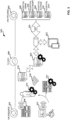
- FIG. 1 an example environment 100 in which examples disclosed herein may be implemented to facilitate proximity detection and location tracking using a mobile wireless bridge is illustrated.
- the example environment 100 of FIG. 1 includes example beacon tags 105, an example reader badge 125 and an example real-time location services (RTLS) server 155.
- RTLS real-time location services
- the beacon tags 105 are implemented using low-power BLE transmitters and include a single coin-cell battery.
- the single coin-cell battery provides power to the corresponding beacon tag 105 for two or more years.
- beacon tags 105 are installed throughout the environment 100 on two types of assets.
- one or more beacon tag(s) 105 may be located on (e.g., affixed to) fixed-location assets such as doors, rooms, hallways, water fountains, etc.
- one or more beacon tag(s) 105 may be located on (e.g., affixed to) mobile-location assets such as patients (e.g., inserted within a patient tag), beds, IV pumps, wheelchairs, etc.
- FIG. 1 includes only two beacon tags 105, other environments are likely to include additional beacon tags.
- different environments may include tens, hundreds and/or thousands of beacon tags affixed to assets.
- accuracy of the proximity detection and location tracking of assets in an environment is increased and/or decreased based on adding or reducing the number of beacon tags placed in the environment.
- the example beacon tags 105 periodically advertise their presence in the environment 100.
- the beacon tags 105 may broadcast example beacon messages 110 every one second.
- the beacon tags 105 may broadcast beacon messages 110 aperiodically and/or as a one-time event.
- the beacon tags 105 may broadcast beacon messages 110 at different time intervals. For example, beacon tags 105 located on fixed-location assets may broadcast beacon messages 110 every two seconds, while beacon tags 105 located on mobile-location assets may broadcast beacon messages 110 every second.
- the reader badge 125 generates example reader messages 130 in response to receiving the beacon messages 110.
- the reader badge 125 may create a reader message 130 including the tag identifying information 115 and the tag-type identifying information 120 included in the beacon message 110 and append example badge identifying information 135, an example timestamp 140, example signal strength information 145, and example channel identifying information 150.
- the badge identifying information 135 is a string of alphanumeric characters that uniquely identifies the reader badge 110 (e.g., a MAC address, a serial number, an alphanumeric signature, etc.).
- the example timestamp 140 identifies a date and/or time (e.g., January 1, 2015, 9:10:04 pm) when the beacon message 110 was received by the reader badge 125.
- the example signal strength information 145 identifies signal strength of the beacon message 110 when it was received by the reader badge 125 (e.g., a received signal strength indication (RSSI) value).
- the example channel identifying information 150 identifies a channel on which the beacon message 110 was received (e.g., a Bluetooth frequency channel such as channel 37, channel 38 or channel 39).
- the reader badge 125 periodically communicates a group (e.g., a batch) of reader messages 130 to the RTLS server 155.
- the reader badge 125 may transmit one or more reader messages 130 that were collected over a period of time (e.g., thirty seconds).
- the reader badge 125 may communicate one or more reader message(s) 130 aperiodically and/or as a one-time event.
- the reader badge 125 may collect a threshold number of reader messages 130 prior to transmitting the collected reader messages 130 to the RTLS server 155.
- the reader badge 125 transmits the reader messages 130 as they are created by the reader badge 125.
- the RTLS server 155 utilizes the reader messages 130 to facilitate proximity detection and location tracking of assets in the environment 100.
- the RTLS server 155 selects a portion of reader messages 130 received from the reader badge 125 to determine a location of the reader badge 125.
- the RTLS server 155 may process the reader messages 130 to identify a first subset of reader messages 130 (e.g., one or more reader messages) that were received by the reader badge 125 during a first window of interest (e.g., a five second window) and that were fixed-location asset tag type (e.g., based on the tag-type information 120 included in the first subset of reader messages).
- a first subset of reader messages 130 e.g., one or more reader messages
- a first window of interest e.g., a five second window
- fixed-location asset tag type e.g., based on the tag-type information 120 included in the first subset of reader messages.
- the RTLS server 155 classifies mobile-location assets as relatively-near assets when the signal strength information 155 does not satisfy the first threshold and the second threshold. For example, the RTLS server 155 may classify mobile-location assets as relatively-near assets when the RSSI value is less than (-40) decibels and greater than (-60) decibels.
- the asset-location of the mobile-location asset may be updated based on, for example, the location of the reader badge 125 that collected the beacon message 110 emitted from the mobile-location asset (e.g., by the beacon tag 105 affixed to the mobile-location asset).
- the example RTLS server 155 of FIG. 1 discards the reader message 130 and the RTLS server 155 makes not change to the location of the mobile-location asset and/or the asset-location confidence score associated with the mobile-location asset.
- the reader badge 125 may have collected a relatively weak beacon message emitted from a mobile-location asset passing through the hallway outside of the patient room #1.
- the reader badge 125 may filter such beacon messages (e.g., beacon messages 110 that are associated with weak (e.g., low) RSSI values) rather than communicate the weak beacon messages to the RTLS server 155.
- high signal strength e.g., an RSSI value greater than (-40) decibels, etc.
- RSSI value greater than (-40) decibels, etc.
- the location of the mobile-location asset may be assumed to be the same as the location of the reader badge 125.
- the example RTLS server 155 of FIG. 1 updates the location of the mobile-location asset to the location of the reader badge 125.
- the example RTLS server 155 of FIG. 1 compares the current location associated with the mobile-location asset to the location of the reader badge 125. In the illustrated example, the RTLS server 155 increases the asset-location confidence score of the mobile-location asset when the current asset-location is the same as the location of the reader badge 125. For example, the mobile-location asset is "seen" in the same location as it is currently assigned. In some examples when the current asset-location is not the same as the location of the reader badge 125, the example RTLS server 155 decreases the asset-location confidence score of the mobile-location asset.
- the example RTLS server 155 compares the asset-location confidence score of the mobile-location asset to a location threshold and, when the asset-location confidence score fails to satisfy the location threshold (e.g., is less than the location threshold), the RTLS server 155 updates the asset-location of the mobile-location asset to the location of the reader badge 125 that received the corresponding beacon message 110.
- the example environment 100 includes an example dock module 165.
- the example dock module 165 may be used to charge one or more reader badges 125.
- the dock module 165 receives beacon messages 110 from beacon tags 105 and/or transmits reader messages 130 to the RTLS server 155.
- FIG. 2 illustrates various components included in an example beacon tag 202, an example beacon badge 204, an example hub module 206 and example dock module 208.
- the beacon tag 202 includes one or more BLE chips (labeled "Beacon") 210 to transmit beacon messages 110, one or more power sources 214 (e.g., one or more coin-cell batteries) and a system-on-a-chip (SOC) 212 to manage the one or more BLE chips 210 and the one or more power sources 214.
- BLE chips labeled "Beacon”
- power sources 214 e.g., one or more coin-cell batteries
- SOC system-on-a-chip
- the example beacon badge 204 includes one or more BLE chips 216 (labeled "transceiver") to receive beacon messages 106a -109a, one or more Wi-Fi chips 218 to communicate with a wireless network (e.g., the example network 160), one or more power sources (e.g., one or more batteries) 222, one or more sensors 224 (e.g., a motion sensor, an accelerometer, a gyroscope, etc.) and a system-on-a-chip (SOC) 220 to manage the one or more BLE chips 216, the one or more Wi-Fi chips 218, the one or more power sources 222 and the one or more sensors 224.
- the example beacon badge 204 also includes an example module connector 226 to connect the beacon badge 204 to the example hub module 206 and/or the dock module 208.
- the beacon badge 204 is connectable to the example hub module 206.
- the connection between the beacon badge 204 and the hub module 206 may include a mechanical connection, an electrical connection, or combinations thereof.
- the hub module 206 may be used to track asset interactions with fixed locations.
- fixed locations include soap dispensers, beds, walls, equipment, etc.
- fixed locations may include wall sconces, light fixtures, mirrors, shelving, and other such fixed locations.
- the hub module 206 may be leveraged to identify particular locations.
- the beacon badge 204 may be coupled, via a badge connection 234, to a hub module 206 placed on an entrance to a restricted area to identify when a person wearing a beacon tag 202 enters (or approaches) the restricted area.
- the hub module 206 includes a system-on-a-chip (SOC) 228 to manage components of the hub module 206, one or more power sources 230 (e.g., one or more batteries and an external power source (e.g., an AC/DC connection)) to extend the battery life and capabilities of the beacon badge 204, one or more sensors 232 communicatively coupled to the SOC 228, and a badge connection 234 for connecting the beacon badge 204 to the hub module 206.
- SOC system-on-a-chip
- the beacon badge 204 may be connectable (e.g., mechanically coupled, electronically coupled, etc.) to the example dock module 208.
- the dock module 208 may be used to charge one or more beacon badges 204.
- the dock module 208 includes an external power connector 236 (e.g., an AC connector), a charging indicator 238 to indicate whether the beacon badge 204 is charged or charging, and a badge connection 240 for connecting the beacon badge 204 to the dock module 208.
- the dock module 208 is portable.
- the dock module 208 may be placed throughout one or more environments, such as at cash registers, podiums, counters, nursing stations, break rooms, hallways, etc., and a caregiver may couple their beacon badge 204 to the dock module 208, via a badge connection 240, when they are off-duty.
- FIG. 3 illustrates an example environment 300 illustrating interaction between premises 302, 304 via a cloud 306.
- one or more fixed beacons 308 and one or more mobile beacons 310 are positioned in a facility 302 (e.g., a hospital, clinic, etc.).
- the beacons 308, 310 are affixed (e.g., permanently affixed, removably affixed, etc.) to locations, assets, etc.
- the fixed beacon 308 can be mounted on a wall at a location in the facility 302 at which asset(s) may be located to provide a location to a receiver.
- the mobile beacon 310 can be affixed (e.g., permanently, removably, etc.) to an item to be located and tracked (e.g., an intravenous (IV) pump, imaging scanner (e.g., x-ray, CT, ultrasound, etc.), crash cart, lab cart, etc.), for example.
- IV intravenous
- imaging scanner e.g., x-ray, CT, ultrasound, etc.
- crash cart e.g., lab cart, etc.
- the beacons 308, 310 are detected and read (e.g., via Bluetooth TM , Bluetooth Low Energy (BLE), near field communication (NFC), etc.) by one or more mobile receivers 312 and/or fixed receivers 314, for example.
- the mobile receiver 312 includes logic to process its location (e.g., with respect to the fixed beacon 308, etc.).
- the mobile receiver 312 can be worn by a person and/or mobile asset to create a crowdsourced environment in which the mobile receiver 312 interacts with beacons 308, 310 and informs the system 300 of the receiver 312 location and presence of beacon(s) 308, 310 within range of the location, for example.
- the fixed receiver 314 is configured with its location in the facility 302.
- the fixed receiver 314 can be mounted on a wall in a location where crowdsourcing is reduced (e.g., storage locations, enclosed locations, etc.) to interact with beacons 308, 310 and inform the system 300 of the receiver 314 location and presence of beacon(s) 308, 310 within range of the location, for example.
- the mobile receiver(s) 312 and fixed receiver(s) 314 process which asset(s) are located within range (e.g., as indicated mobile beacon(s) 310 and/or fixed beacon(s) 308, etc.) and notify other component(s) of the system 300.
- the receiver(s) 312, 314 communicate over a channel 316, such as Wi-Fi, etc., with a middleware gateway 318 to transmit information regarding beacon 308, 310 location to a middleware engine 320.
- the middleware gateway 318 can be an edge device, gateway device, hub, and/or other electronic device to interface between the premises 302 and the cloud 306, for example.
- the middleware engine 320 can reside on the cloud 306 to process received beacon 308, 310 and receiver 312, 314 data and calculate location information.
- the middleware engine 320 can also publish location events to one or more receiving/subscribing recipients, for example.
- one or more consuming applications 322 access location data from the middleware engine 320 via the cloud 306 to leverage the location data for scheduling, tracking, (re)ordering, maintenance, billing, protocol compliance, treatment evaluation, employee evaluation, resource evaluation, and/or other resource management application(s), etc.
- an application programming interface (API) 324 provides location awareness data for consumption by one or more hospital applications 326-332 at a second facility (e.g., hospital, clinic, etc.) 304.
- CMMS hospital computerized maintenance management system
- a hospital bed management system 328, and/or other hospital system 330, hospital application 332, etc. can receive and process asset location information via the API 324.
- FIG. 4 illustrates an example architecture 400 of the hospital network 302 and the cloud 306 of FIG. 3 .
- the hospital network 302 communicates with the cloud 306 via the middleware or location gateway 318, which can be divided (as shown in the example of FIG. 4 ) into a client location gateway 318a and a server location gateway 318b.
- the example hospital network 302 includes a badge configuration tool 402 used to configure a badge 414 (e.g., a hospital staff badge, smart phone, etc.) for one or more parameters such as Wi-Fi network, gateway connectivity, gateway security credential/certificate, etc.
- the tool 402 can communicate with the badge 414 via Wi-Fi, Bluetooth, NFC, etc.
- the badge 414 communicates with the client location gateway 318a to provide location information to the cloud 306.
- firmware 404 can communicate with the badge 414 to update firmware, settings, etc., on the badge 414.
- the example firmware 404 can provide and/or be associated with a software development kit (SDK) to enable integration of application(s) into the badge 414, for example.
- SDK software development kit
- the firmware 404 can provide notifications, offers, and/or other customizations to the badge 414 and/or a user/wearer of the badge 414, for example.
- the example hospital network 302 of FIG. 4 also includes a location toolbox application 406, which communicates with a beacon 416 (e.g., a Bluetooth beacon, BLE beacon, etc.) and/or a hub 408 (e.g., via Bluetooth, BLE, etc.).
- the beacon 416 and/or hub 408 can also communicate with the badge 414 and/or the client location gateway 318a, for example.
- the toolbox 406 provides configuration and/or authorization application(s), setting(s), configuration(s), etc., for the hub 408, badge 414, and/or beacon 416, etc.
- the toolbox 406 can be used to set beaconing frequency, beacon range, beacon transmission mode, etc.
- the toolbox 406, beacon 416, and/or badge 414 can communicate via the hub 408 with the client location gateway 318a, etc.
- the example hospital network 302 of FIG. 4 can also include a passive reader 410, access point 412, and passive tag 418.
- the Wi-Fi access point 412 helps relay locating information by presence (e.g., in the facility 302), zone (e.g., in a particular area of the facility 302), location (e.g., actual location), etc.
- the passive tag 418 and passive reader 410 can interact to provide location information in the hospital network 302 to the client location gateway 318a, for example.
- a get time request can be implemented as a JSON formatted object including a time, such as a UNIX time, POSIX time, Epoch time, UTC time, etc., for example.
- a firmware update can be implemented as a binary file providing an application/octet stream to a target device 502-506, for example.
- a system health request can be implemented, for example, as a JSON formatted object including an event type, device MAC address, timestamp, firmware version, depth of discharge (e.g., percent of battery life remaining, etc.), temperature (e.g., device temperature in Fahrenheit, Celsius, etc.), details (e.g., any additional details provided for the event), etc.
- the user interface device 440 (e.g., executed by and/or working in conjunction with the health processor 530, etc.) provides a plurality of views showing asset status information for a facility.
- the interface 440 provides a Web-based device health console that includes a site overview providing information for some or all RTLS devices at the site.
- an example GUI running on the interface device 440 can provide a site overview, fixed receiver view, mobile receiver view, fixed beacon view, mobile beacon view, and/or event view, etc.
- the example overview provides a health overview of a gateway 318 and/or other edge device 510 through which health information is provided by monitored device(s) 502-506. For example, connection status, data routing travel time, event throughput, etc., can be measured and reported via the example console.
- the example fixed beacon view provides a fixed beacon MAC address, battery life remaining, anchor location, and timestamp and address of the last mobile receiver that saw the fixed beacon. If a fixed beacon has not been detected by a mobile receiver for a certain time interval (e.g., in the past hour, etc.), the beacon will show as offline. The offline status indicates that the beacon is masked from a receiver, the beacon is out of battery, or the closest receiver is out of battery, for example. The location of the beacon represents the last place that the mobile receiver saw the fixed beacon and a timestamp at which that sighting occurred, for example.
- the example mobile beacon view provides a mobile beacon MAC address, battery life remaining, timestamp and address of the last receiver to see the mobile beacon, and information regarding the location of the fixed device (e.g., fixed receiver, fixed beacon, etc.) with respect to which the mobile beacon is positioned. If a mobile beacon has not been detected for a certain time interval (e.g., in the past hour, etc.), the beacon will show as offline. The offline status indicates that the beacon is masked from a receiver, the beacon is out of battery, or the closest receiver is out of battery, for example. The location of the beacon represents the last place that the receiver saw the fixed beacon and a timestamp at which that sighting occurred, for example.
- the fixed device e.g., fixed receiver, fixed beacon, etc.
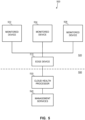
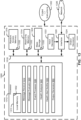
- FIG. 6 illustrates an example implementation of the cloud health processor 530.
- the processor 530 includes a message receiver 610, a message evaluator 620, an event processor 630, a health analyzer 640, a health alert notifier 650, and an output generator 660.
- the event processor 630 provides the message details and event type to the health analyzer. Based on the event type, the example health analyzer 640 compares the details of the event to a threshold, range, standard, norm, etc. If the event is within normal or expected behavior, the event can be logged via the output generator 660. If the event is outside and/or otherwise deviates from the prescribed bound(s), the health alert notifier 650 can be triggered in response to the event.
- FIG. 7 illustrates an example implementation of the monitored device 502, 504, 506 (with the example monitoring device 502 shown in FIG. 7 for purposes of example illustration only).
- the monitored devices 502-506 can include one or more beacons, badges, and/or receivers 308, 310, 312, 314, 408, 410, 412, 414, 416, 418, etc.
- the monitored device 502 includes a memory 710, a health monitor 720, a processor 730, and a communication interface 740.
- the example memory 710 stores identification data for the device 502 as well as instructions for execution by the processor 730 of the device 502.
- the memory 710 can store status and/or other health information for the device 502 as determined by the health monitor 720, for example.
- the message evaluator 620 sends the message to the event processor 630.
- the example event processor 630 processes the health message to identify an event type indicated by the message. For example, the message may indicate an on charge event, off charge event, forced reboot event, unforced reboot/system error event, Wi-Fi reconnect event, heartbeat event, etc. Based on the event type, the event processor 630 processes the details of the event.
- the event processor 630 provides the message details and event type to the health analyzer. Based on the event type, the example health analyzer 640 compares the details of the event to a threshold, range, standard, norm, etc. If the event is within normal or expected behavior, the event can be logged via the output generator 660. If the event is outside and/or otherwise deviates from the prescribed bound(s), the health alert notifier 650 can be triggered in response to the event.
- the health alert notifier 650 can generate a response message or instruction to the device via the output generator 660 to adjust a level, setting, mode, etc., in response to the event (e.g., not charging enough, not charging properly, irregular heartbeat, reboot needed, etc.) such as to send a message to a user, automatically adjust a device setting, trigger a maintenance request, alert hospital staff to a failing device, change in setting/configuration warranted, etc.
- the output generator 660 can provide an update and/or other message to the device and/or a third party (e.g., beacon/site management services 420, badge configuration services 430, consuming product(s) 432, etc.) to repair, replace, and/or adjust the affected device(s).
- An alert, update, and/or other message can be generated to help ensure reliable operation and uptime of the RTLS system 300, 400, for example.
- FIG. 8 depicts an example state diagram 800 illustrating example health states of a monitored device 502-506.
- the example state diagram 800 can be stored as a state machine to alter the memory 710 and configure the processor 730 as directed by the health monitor 720 of the device 502-506, for example.
- a plurality of states can include an operating state 810, offline state 820, error state 830, low power state 840, no heartbeat state 850, configuration state 860, reset state 870, reboot state 880, etc.
- the monitored device 502-506 can transition among states 810-880 according to the example state machine 800.
- the monitored device 502-506 can transition to the operating state 810 when operating normally according to its configuration.
- the monitored device 502-506 can transition to the offline state 820 when the device 502-506 cannot find a network connected (e.g., to a gateway, Wi-Fi, etc.), for example.
- the monitored device 502-506 can transition to the error state 830 when it detects a problem with its operation, an issue/error outside its defined states, etc.
- the monitored device 502-506 can transition to the low power state 840 when the battery of the device 502-506, available wall outlet power, etc., is running low on power, for example.
- the monitored device 502-506 can transition into the no heartbeat state 850 when it has not detected another device's heartbeat for a certain time interval, for example.
- the monitored device 502-506 can transition into the configuration state 860 when the monitored device 502-506 is being configured and/or otherwise set up in its configuration mode. For example, a technician can set up the monitored device 502-506 in configuration mode.
- the health processor 530, gateway 318 (e.g., 318a and/or 318b, etc.), another device 502-506, etc., can trigger the configuration state 860 at the monitored device 502-506 to adjust parameter(s)/setting(s) of the device 502-506, for example.
- the monitored device 502-506 can transition into the reset state 870 when instructed to reset its settings to its default settings, for example.
- a technician, health processor 530, gateway 318, another device 502-506, etc. can trigger the reset state 870 to reset the monitored device 502-506 to its factory default.
- the monitored device 502-506 can transition into the reboot state 880 when a reboot is triggered for the device 502-506 (e.g., by a technician, health processor 530, gateway 318, another device 502-506, etc.), for example.
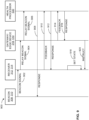
- FIG. 9 shows an example data flow 900 between a beacon (e.g., a fixed 308 or mobile beacon 310, etc.), a receiver (e.g., a fixed 314 or mobile receiver 312, etc.), and the cloud health processor 530 via the gateway 318.
- the beacon 308, 310 provides a signal (e.g., a heartbeat, a ping, a status signal, etc.) within its range.
- the beacon 308, 310 broadcasts a signal in its communication range to identify itself and provide its status.
- the receiver 312, 314 relays the beacon signal to the gateway 318/edge device 510.
- the receiver 312, 314 receives the beacon signal when in range of the beacon 308, 310 and packages information from the received beacon signal and generates a communication for the gateway 318/edge device 510.
- the health processor 530 generates a response (e.g., configuration, reset, reboot, error, acknowledgement, etc.) to return, via the gateway 318/edge device 510, to the receiver 312, 314 (and/or through the receiver 312, 314 to the beacon 308, 310).
- a response e.g., configuration, reset, reboot, error, acknowledgement, etc.
- the receiver 312, 314 receives no beacon signal, then the receiver 312, 314 provides feedback to the gateway 318/edge device 510 to be routed to the health processor 530 regarding the missing/unavailable/offline/erroring beacon 308, 310, for example.
- the health processor 530 (and/or its gateway 318/edge device 510, etc.) can log the information and generate a response (e.g., to the receiver 312, 314, to the gateway 318/edge device 510, to the beacon 308, 310, to a service request, etc.).
- the gateway 318/edge device 510 can trigger a response and/or send an alert to the health processor 530 regarding the missing/unavailable/offline/erroring receiver 312, 314, for example.
- the health processor 530 (and/or its gateway 318/edge device 510, etc.) can log the information and generate a response (e.g., to the receiver 312, 314, to the gateway 318/edge device 510, to a service request, etc.).
- the receiver 312, 314 can enter an offline 820 or error 830 state, for example, until, at 920, receiving an instruction such as a reset, reboot, heartbeat communication from the gateway 318/edge device 510, etc.
- FIGS. 1-9 While example implementations of the systems 100, 300, 400, 500 are illustrated in FIGS. 1-9 , one or more of the elements, processes and/or devices illustrated in FIGS. 1-9 may be combined, divided, re-arranged, omitted, eliminated and/or implemented in any other way. Further, the example components of FIGS. 1-9 can be implemented by hardware, software, firmware and/or any combination of hardware, software and/or firmware. Thus, for example, any of the example components of FIGS. 1-9 can be implemented by one or more analog or digital circuit(s), logic circuits, programmable processor(s), application specific integrated circuit(s) (ASIC(s)), programmable logic device(s) (PLD(s)) and/or field programmable logic device(s) (FPLD(s)).
- ASIC application specific integrated circuit
- PLD programmable logic device
- FPLD field programmable logic device
- FIGS. 1-9 When reading any of the apparatus or system claims of this patent to cover a purely software and/or firmware implementation, at least one of the example components of FIGS. 1-9 is/are hereby expressly defined to include a tangible computer readable storage device or storage disk such as a memory (e.g., a read only memory (ROM), hard drive, flash memory, other volatile and/or non-volatile memory, etc.), a digital versatile disk (DVD), a compact disk (CD), a Blu-ray disk, etc. storing the software and/or firmware.
- the example systems of FIGS. 1-9 can include one or more elements, processes and/or devices in addition to, or instead of, those illustrated in FIGS. 1-9 , and/or may include more than one of any or all of the illustrated elements, processes and devices.
- FIGS. 10-12 Flowcharts representative of example machine readable instructions for implementing the systems, states, and data flows of FIGS. 1-9 are shown in FIGS. 10-12 .
- the machine readable instructions comprise program(s) for execution by a processor such as the processor 1312 shown in the example processor platform 1300 discussed below in connection with FIG. 13 .
- the program(s) can be embodied in software stored on a tangible computer readable storage medium such as a CD-ROM, a floppy disk, a hard drive, a DVD, a Blu-ray disk, or a memory associated with the processor 1312, but the entire program and/or parts thereof can alternatively be executed by a device other than the processor 1312 and/or embodied in firmware or dedicated hardware.
- example program(s) are described with reference to the flowcharts illustrated in FIGS. 10-12 , many other methods of implementing the example systems may alternatively be used. For example, the order of execution of the blocks may be changed, and/or some of the blocks described may be changed, eliminated, or combined.
- the example process(es) of FIGS. 10-12 can be implemented using coded instructions (e.g., computer and/or machine readable instructions) stored on a tangible computer readable storage medium such as a hard disk drive, a flash memory, a ROM, a CD, a DVD, a cache, a random-access memory (RAM) and/or any other storage device or storage disk in which information is stored for any duration (e.g., for extended time periods, permanently, for brief instances, for temporarily buffering, and/or for caching of the information).
- coded instructions e.g., computer and/or machine readable instructions
- a tangible computer readable storage medium such as a hard disk drive, a flash memory, a ROM, a CD, a DVD, a cache, a random-access memory (RAM) and/or any other storage device or storage disk in which information is stored for any duration (e.g., for extended time periods, permanently, for brief instances, for temporarily buffering, and/or for caching of the information).
- tangible computer readable storage medium and “tangible machine readable storage medium” are used interchangeably. Additionally or alternatively, the example process(es) of FIGS. 10-12 can be implemented using coded instructions (e.g., computer and/or machine readable instructions) stored on a non-transitory computer and/or machine readable medium such as a hard disk drive, a flash memory, a read-only memory, a compact disk, a digital versatile disk, a cache, a random-access memory and/or any other storage device or storage disk in which information is stored for any duration (e.g., for extended time periods, permanently, for brief instances, for temporarily buffering, and/or for caching of the information).
- coded instructions e.g., computer and/or machine readable instructions
- a non-transitory computer and/or machine readable medium such as a hard disk drive, a flash memory, a read-only memory, a compact disk, a digital versatile disk, a cache, a random-access memory and/or any other storage device or
- non-transitory computer readable medium is expressly defined to include any type of computer readable storage device and/or storage disk and to exclude propagating signals and to exclude transmission media.
- phrase "at least" is used as the transition term in a preamble of a claim, it is open-ended in the same manner as the term “comprising" is open ended.
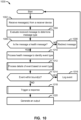
- FIG. 10 illustrates a flow diagram of an example method 1000 to monitor receiver and/or other device health in a real time location system.
- messages are monitored to detect a message from a receiver.
- the example message receiver 610 monitors for a message from a receiver (e.g., from one or more devices 502-506 including one or more beacons, badges, and/or receivers 308, 310, 312, 314, 408, 410, 412, 414, 416, 418, etc.).
- the message is evaluated to determine a message type.
- the example message evaluator 620 evaluates the received message to determine a message type associated with the message (e.g., location message, firmware message, time message, receiver configuration message, health message, etc.). At block 1006, the message type is compared to a health message type. If the message is not a health message, then, at block 1008, the message is redirected for further processing. For example, when the message is not a receiver health message, the message evaluator 620 sends the message to another processor, such as the location engine 428, site builder 424, consuming product(s) 432, etc.
- a message type associated with the message e.g., location message, firmware message, time message, receiver configuration message, health message, etc.
- the message type is compared to a health message type. If the message is not a health message, then, at block 1008, the message is redirected for further processing. For example, when the message is not a receiver health message, the message evaluator 620 sends the message to another processor, such as
- the health message is processed to identify an event type indicated by the health message.
- the message evaluator 620 sends the message to the event processor 630.
- the example event processor 630 processes the health message to identify an event type indicated by the message.
- the message may indicate an on-charge event, off-charge event, forced reboot event, unforced reboot/system error event, Wi-Fi reconnect event, heartbeat event, etc.
- the event processor 630 processes the details of the event. For example, the event processor 630 digests information associated with the event type and additional details if provided in the message.
- the event is compared to prescribed bound(s) for the event.
- the event processor 630 provides the message details and event type to the health analyzer. Based on the event type, the example health analyzer 640 compares the details of the event to a threshold, range, standard, norm, etc.
- the event is logged. For example, the event can be logged via the output generator 660.
- a response to the event is triggered. For example, the health alert notifier 650 can be triggered in response to the event.
- the health alert notifier 650 can generate a response message or instruction to the device via the output generator 660 to adjust a level, setting, mode, etc., in response to the event (e.g., not charging enough, not charging properly, irregular heartbeat, reboot/reset needed, reconfiguration warranted, etc.) such as to send a message to a user, automatically adjust a device setting, trigger a maintenance request, alert hospital staff to a failing device, change in setting/configuration warranted, etc.
- the event e.g., not charging enough, not charging properly, irregular heartbeat, reboot/reset needed, reconfiguration warranted, etc.
- an output is provided.
- the output generator 660 can provide an update and/or other message to the device and/or a third party (e.g., beacon/site management services 420, badge configuration services 430, consuming product(s) 432, etc.) to repair, replace, and/or adjust the affected device(s).
- a third party e.g., beacon/site management services 420, badge configuration services 430, consuming product(s) 432, etc.
- An alert, update, and/or other message can be generated to help ensure reliable operation and uptime of the RTLS system 300, 400, for example.
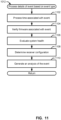
- FIG. 11 provides further detail regarding an example implementation of processing an event based on the identified event type (block 1012 of the example of FIG. 10 ).
- a time associated with the event is processed.
- the received message for the event can include a time associated with the event that is processed by the event processor 630 to determine a timestamp associated with the event and/or a related message, a time since last response, time since heartbeat, etc.
- firmware is verified.
- the received message for the event can include an indication of firmware version for the associated device 502-506, and the event processor 630 can determine whether or not the device 502-506 has the latest and/or proper firmware.
- system health is evaluated.
- the event processor 630 and/or health analyzer 640 can evaluate event contents to determine an error code, indication of device 502-506 state, time since epoch, device battery life remaining, device temperature, and/or other event detail to determine a system health of the device 502-506 (e.g., a receiver, etc.).
- receiver configuration is determined.
- the health processor 530 can stored receiver configuration information, which can then be analyzed and compared to the evaluation of the system health and other event information such that the event processor 630, health analyzer 640, etc., of the health processor 530 can determine whether the receiver configuration is contributing to and/or otherwise causing the event, an adjustment to the receiver configuration can remedy an issue associated with the event, etc.
- an analysis of the event is generated based on the time, firmware verification, system health evaluation, and receiver configuration determination.
- the health processor 530 and its components can analyze the event based on timing (e.g., time of occurrence, time since last contact, time interval, etc.), firmware (e.g., old version, incorrect/inapplicable version, etc.), system health, receiver configuration, etc., to develop an understanding of the event, an impact of the event, and potential next action(s) for the event.
- the analysis of the event by the event processor 630 can determine whether or not the event fits within expected, allowed, and/or other operational bounds for the receiver, that type of event, etc. Control can then return to block 1014 at which the event is determined to be within or outside its bounds, or example.
- each receiver sends details regarding its system health to an API hosted by the edge device 510 and/or health processor 530 based on execution of certain events (e.g., on-charge, off-charge, forced reboot, unforced reboot/system error, network reconnect, heartbeat, etc.), and the health processor 530 can evaluate such health details to determine a response/next action, etc.
- certain events e.g., on-charge, off-charge, forced reboot, unforced reboot/system error, network reconnect, heartbeat, etc.
- FIG. 12 provides further detail regarding an example implementation of triggering a response to the event (block 1018 of the example of FIG. 10 ).
- the processing of the event is reviewed to determine the type and nature of the event.
- the event is reviewed by the health processor 530 to determine whether the event affects the operation of a receiver, an edge device, beacon, etc., such as an unresponsive receiver, a receiver not getting a beacon signal, a receiver having low battery, a receiver recently rebooted, etc.
- the output generator 660 can provide an update and/or other message to the device and/or a third party (e.g., beacon/site management services 420, badge configuration services 430, consuming product(s) 432, etc.) to repair, replace, and/or adjust the affected device(s).
- a third party e.g., beacon/site management services 420, badge configuration services 430, consuming product(s) 432, etc.
- An alert, update, and/or other message can be generated to help ensure reliable operation and uptime of the RTLS system 300, 400, for example.
- Reconfiguration information, a reboot or reset instruction, Wi-Fi credentials, etc. can be provided in response to the event, for example.
- reconfiguration information is provided for output at block 1020 to the device 502-506.
- receiver parameters can be adjusted to operate on a different frequency, with a different time interval, looking for another beacon, at a different power level, with a heartbeat adjustment, etc.
- a reset command is sent for output at block 1020 to the device 502-506 to reset the device 502-506 in a default or factory state, etc.
- a reboot command is sent for output at block 1020 to the affected device 502-506 to reboot or restart the device 502-506.
- a log entry is generated to be conveyed to a user, another system, etc., in the output of block 1020.
- a maintenance request is generated for output at block 1020 to a service center, operator, scheduling system, maintenance professional, etc.
- an alert is generated for output at block 1020 to an operator, other system, service center, log, user interface, etc.
- an alarm e.g., an alphanumeric, audible, visual, haptic, and/or other alarm
- a charging reminder can be generated as an alert, for example.
- control returns to block 1204. Otherwise, control returns to block 1020 to generate an output.
- FIG. 13 is a block diagram of an example processor platform 1300 capable of executing the instructions of FIGS. 10-12 to implement the example systems and components disclosed and described herein with respect to FIGS. 1-9 .
- the processor platform 1300 can be, for example, a server, a personal computer, or any other type of computing device.
- the processor platform 1300 of the illustrated example includes a processor 1312.
- the processor 1312 of the illustrated example is hardware.
- the processor 1312 can be implemented by one or more integrated circuits, logic circuits, microprocessors or controllers from any desired family or manufacturer.
- the processor 1312 of the illustrated example includes a local memory 1313 (e.g., a cache).
- the processor 1312 of the illustrated example executes the instructions to implement the example message receiver 610, the example message evaluator 620, the example event processor 630, the example health analyzer 640, the example health alert notifier 650, the example output generator 660, and/or, more generally, the example health processor of FIGS. 3-6 .
- the processor 1312 of the illustrated example is in communication with a main memory including a volatile memory 1314 and a non-volatile memory 1316 via a bus 1318.
- the volatile memory 1314 may be implemented by Synchronous Dynamic Random Access Memory (SDRAM), Dynamic Random Access Memory (DRAM), RAMBUS Dynamic Random Access Memory (RDRAM) and/or any other type of random access memory device.
- SDRAM Synchronous Dynamic Random Access Memory
- DRAM Dynamic Random Access Memory
- RDRAM RAMBUS Dynamic Random Access Memory
- the non-volatile memory 1316 may be implemented by flash memory and/or any other desired type of memory device. Access to the main memory 1314, 1316 is controlled by a memory controller.
- the processor platform 1300 of the illustrated example also includes an interface circuit 1320.
- the interface circuit 1320 may be implemented by any type of interface standard, such as an Ethernet interface, a universal serial bus (USB), and/or a PCI express interface.
- one or more input devices 1322 are connected to the interface circuit 1320.
- the input device(s) 1322 permit(s) a user to enter data and commands into the processor 1312.
- the input device(s) can be implemented by, for example, an audio sensor, a microphone, a camera (still or video), a keyboard, a button, a mouse, a touchscreen, a track-pad, a trackball, isopoint and/or a voice recognition system.
- One or more output devices 1324 are also connected to the interface circuit 1320 of the illustrated example.
- the output devices 1324 can be implemented, for example, by display devices (e.g., a light emitting diode (LED), an organic light emitting diode (OLED), a liquid crystal display, a cathode ray tube display (CRT), a touchscreen, a tactile output device, a printer and/or speakers).
- the interface circuit 1320 of the illustrated example thus, typically includes a graphics driver card, a graphics driver chip or a graphics driver processor.
- the interface circuit 1320 of the illustrated example also includes a communication device such as a transmitter, a receiver, a transceiver, a modem and/or network interface card to facilitate exchange of data with external machines (e.g., computing devices of any kind) via a network 1326 (e.g., an Ethernet connection, a digital subscriber line (DSL), a telephone line, coaxial cable, a cellular telephone system, etc.).
- a communication device such as a transmitter, a receiver, a transceiver, a modem and/or network interface card to facilitate exchange of data with external machines (e.g., computing devices of any kind) via a network 1326 (e.g., an Ethernet connection, a digital subscriber line (DSL), a telephone line, coaxial cable, a cellular telephone system, etc.).
- DSL digital subscriber line
- the processor platform 1300 of the illustrated example also includes one or more mass storage devices 1328 for storing software and/or data.
- mass storage devices 1328 include floppy disk drives, hard drive disks, compact disk drives, Blu-ray disk drives, RAID systems, and digital versatile disk (DVD) drives.
- the coded instructions 1332 of FIGS. 9-12 may be stored in the mass storage device 1328, in the volatile memory 1314, in the non-volatile memory 1316, and/or on a removable tangible computer readable storage medium such as a CD or DVD.
- example disclosures uniquely eliminate the expensive and difficult-to-maintain infrastructure.
- An example benefit of the disclosed techniques includes determining location awareness of assets in the industrial setting without constructing a new infrastructure.
- the location awareness of assets is determined by "crowd-sourcing" probability proximity locations of the assets.
- While prior RTLS systems and associated devices did not have an ability to provide health status information and communicate between a processor and device(s) to update configuration, restart/reset, alert, and/or otherwise respond to a health event, certain examples provide receivers, beacons, badges, and/or other RTLS devices with electronic circuitry and programming to store, communicate, and respond to health status events. Certain examples provide a health processor, embedded in an edge device and/or implemented in a cloud, that processes system health events and communicates with and controls the RTLS devices to address such health events.
- certain examples not only provide new technology previously absent from RTLS devices and associated systems but also provide an ecosystem and infrastructure to help ensure improved RTLS uptime, reliability, automated maintenance/configurability/troubleshooting, and accuracy for health asset monitoring, tracking, and management.
Landscapes
- Engineering & Computer Science (AREA)
- Health & Medical Sciences (AREA)
- Medical Informatics (AREA)
- Biomedical Technology (AREA)
- General Health & Medical Sciences (AREA)
- Epidemiology (AREA)
- Public Health (AREA)
- Primary Health Care (AREA)
- General Business, Economics & Management (AREA)
- Business, Economics & Management (AREA)
- Computer Networks & Wireless Communication (AREA)
- Signal Processing (AREA)
- Software Systems (AREA)
- Theoretical Computer Science (AREA)
- General Engineering & Computer Science (AREA)
- Pathology (AREA)
- General Physics & Mathematics (AREA)
- Computing Systems (AREA)
- Physics & Mathematics (AREA)
- Multimedia (AREA)
- Alarm Systems (AREA)
- Position Fixing By Use Of Radio Waves (AREA)
Claims (13)
- Einrichtung, die Folgendes umfasst:
ein Echtzeit-Positionssystem, RTLS, das einen Cloud-Gesundheitsprozessor (530) beinhaltet, wobei der Cloud-Gesundheitsprozessor (530) Folgendes beinhaltet:einen Ereignisprozessor (630) zum Verarbeiten eines Ereignisses, das in einer Nachricht von einer RTLS-Vorrichtung beinhaltet ist, um Ereignisinformationen zu identifizieren, die sich auf die RTLS-Vorrichtung beziehen, wobei das Ereignis sich auf einen Zustand der RTLS-Vorrichtung bezieht und die Ereignisinformationen einen Ereignistyp und ein Ereignisdetail beinhalten, wobei der Zustand der RTLS-Vorrichtung mindestens einen Neustartstatus der RTLS-Vorrichtung beinhaltet,einen Gesundheitsanalysator (640) zum Vergleichen des Ereignisdetails mit einer vorgeschriebenen Grenze für den Ereignistyp, wobei sich das Ereignis auf den Zustand der RTLS-Vorrichtung bezieht; undeinen Ausgabegenerator (660) zum Auslösen, wenn sich die Ereignisinformationen außerhalb der vorgeschriebenen Grenze befinden, einer Antwort zum Adressieren des Ereignisses mit Bezug auf die RTLS-Vorrichtung, wobei die Antwort eine Ladeerinnerung und/oder eine Leistungspegelanpassung und/oder einen Alarm und/oder einen Neustart und/oder eine Herzschlaganpassung beinhaltet. - Einrichtung nach Anspruch 1, wobei der Zustand der RTLS-Vorrichtung einen Leistungspegel der RTLS-Vorrichtung und/oder eine Konnektivität der RTLS-Vorrichtung und/oder einen Herzschlag der RTLS-Vorrichtung beinhaltet.
- Einrichtung nach Anspruch 1, wobei, wenn sich die Ereignisinformationen innerhalb der vorgeschriebenen Grenze befinden, der Ausgabegenerator das Ereignis protokollieren soll.
- Einrichtung nach Anspruch 1, wobei die RTLS-Vorrichtung einen festen Empfänger und/oder einen mobilen Empfänger zum Empfangen eines Signals von einem festen Beacon und/oder einem mobilen Beacon und/oder einem Badge beinhaltet.
- Einrichtung nach Anspruch 1, wobei die RTLS-Vorrichtung mit dem Gesundheitsprozessor über eine Anwendungsprogrammierschnittstelle kommunizieren soll.
- Einrichtung nach Anspruch 1, wobei der Gesundheitsprozessor als Cloud-basierter Gesundheitsprozessor zu implementieren ist.
- Einrichtung nach Anspruch 1, wobei die Einrichtung auf einer Edge-Vorrichtung zu implementieren ist, die mit einer Cloud kommuniziert.
- Einrichtung nach Anspruch 1, wobei die Einrichtung ferner eine Benutzerschnittstellenvorrichtung zum Bereitstellen einer Konsole beinhaltet, die Informationen bezüglich der RTLS-Vorrichtung und des Ereignisses zur Interaktion anzeigt.
- Prozessorimplementiertes Verfahren für ein Echtzeit-Positionssystem, RTLS, wobei das Verfahren Folgendes umfasst:Verarbeiten (1004), unter Verwendung eines Cloud-Gesundheitsprozessors (530), eines Ereignisses, das in einer Nachricht von einer RTLS-Vorrichtung beinhaltet ist, um Ereignisinformationen zu identifizieren (1006, 1010), die sich auf die RTLS-Vorrichtung beziehen, wobei das Ereignis sich auf einen Zustand der RTLS-Vorrichtung bezieht und die Ereignisinformationen einen Ereignistyp und ein Ereignisdetail beinhalten, wobei der Zustand der RTLS-Vorrichtung mindestens einen Neustartstatus der RTLS-Vorrichtung beinhaltet,Vergleichen (1014), unter Verwendung des Cloud-Gesundheitsprozessors (530),des Ereignisdetails mit einer vorgeschriebenen Grenze für den Ereignistyp, wobei sich das Ereignis auf den Zustand der RTLS-Vorrichtung bezieht; und,wenn die Ereignisinformationen außerhalb der vorgeschriebenen Grenze liegen, Auslösen (1018) unter Verwendung des Cloud-Gesundheitsprozessors (530),einer Antwort zum Adressieren des Ereignisses mit Bezug auf die RTLS-Vorrichtung, wobei die Antwort eine Ladeerinnerung und/oder eine Leistungspegelanpassung und/oder einen Alarm und/oder einen Neustart und/oder eine Herzschlaganpassung beinhaltet.
- Verfahren nach Anspruch 9, wobei der Zustand der RTLS-Vorrichtung einen Leistungspegel der RTLS-Vorrichtung und/oder eine Konnektivität der RTLS-Vorrichtung und/oder einen Herzschlag der RTLS-Vorrichtung beinhaltet.
- Verfahren nach Anspruch 9, das ferner, wenn sich die Ereignisinformationen innerhalb der vorgeschriebenen Grenze befinden, Protokollieren des Ereignisses beinhaltet.
- Verfahren nach Anspruch 9, wobei die RTLS-Vorrichtung einen festen Empfänger und/oder einen mobilen Empfänger zum Empfangen eines Signals von einem festen Beacon und/oder einem mobilen Beacon und/oder einem Badge beinhaltet.
- Verfahren nach Anspruch 9, das ferner das Bereitstellen, über eine Benutzerschnittstelle, einer Konsole beinhaltet, die zur Interaktion Informationen bezüglich der RTLS-Vorrichtung und des Ereignisses anzeigt.
Applications Claiming Priority (2)
| Application Number | Priority Date | Filing Date | Title |
|---|---|---|---|
| US201662441201P | 2016-12-31 | 2016-12-31 | |
| PCT/US2017/069065 WO2018126199A1 (en) | 2016-12-31 | 2017-12-29 | Receiver health systems and methods for a real time location platform |
Publications (3)
| Publication Number | Publication Date |
|---|---|
| EP3563385A1 EP3563385A1 (de) | 2019-11-06 |
| EP3563385A4 EP3563385A4 (de) | 2020-05-13 |
| EP3563385B1 true EP3563385B1 (de) | 2025-03-05 |
Family
ID=62710030
Family Applications (1)
| Application Number | Title | Priority Date | Filing Date |
|---|---|---|---|
| EP17885660.5A Active EP3563385B1 (de) | 2016-12-31 | 2017-12-29 | Empfängergesundheitssysteme und verfahren für eine echtzeit-positionsplattform |
Country Status (4)
| Country | Link |
|---|---|
| US (1) | US11222726B2 (de) |
| EP (1) | EP3563385B1 (de) |
| CN (1) | CN110326055A (de) |
| WO (1) | WO2018126199A1 (de) |
Families Citing this family (21)
| Publication number | Priority date | Publication date | Assignee | Title |
|---|---|---|---|---|
| US11107575B1 (en) * | 2017-02-22 | 2021-08-31 | Deborah T Bullington | Lighting system for medical appointment progress tracking |
| US10646171B2 (en) | 2017-10-13 | 2020-05-12 | J. Brasch Co., Llc | Assistive technology for operating nursing homes and other health care facilities |
| US11403888B2 (en) * | 2018-09-24 | 2022-08-02 | Gojo Industries, Inc. | Method and system for using data packet beaconing to determine compliance with protocols |
| US10692364B1 (en) * | 2019-02-28 | 2020-06-23 | Honeywell International Inc. | Security systems integration |
| IT201900008814A1 (it) * | 2019-06-13 | 2020-12-13 | Luca Biffani | Metodo e sistema di gestione dei processi sanitari |
| GB2622999B (en) * | 2019-09-25 | 2024-06-19 | Exacttrak Ltd | Asset Tracker |
| GB2588085B (en) | 2019-09-25 | 2024-04-17 | Exacttrak Ltd | Asset Tracker |
| US11004325B2 (en) * | 2019-09-26 | 2021-05-11 | International Business Machines Corporation | Smartphone based reminding system for forgotten objects |
| US11430565B2 (en) | 2020-03-10 | 2022-08-30 | Medtronic, Inc. | Inventory tracking system with availability identification |
| WO2021184144A1 (en) * | 2020-03-16 | 2021-09-23 | Qualcomm Incorporated | Method of efficiently providing pathhistory in c-v2x |
| US11322252B2 (en) * | 2020-04-28 | 2022-05-03 | Phoenix Children's Hospital, Inc. | System and methods for asset tracking |
| US20210374366A1 (en) * | 2020-05-27 | 2021-12-02 | Stanley Convergent Security Solutions, Inc. | Location system and method for tracking infected individuals |
| CN113744863B (zh) * | 2020-05-29 | 2024-09-13 | 京东方科技集团股份有限公司 | 健康数据管理方法、设备及系统 |
| WO2022026400A1 (en) * | 2020-07-27 | 2022-02-03 | C3-Wireless, Llc | Systems for real time location services (rtls) |
| CN114446306A (zh) * | 2020-10-30 | 2022-05-06 | 宝洁公司 | 用于自动化儿童护理产品的库存生成和跟踪的无触摸、语音助理和/或跟踪系统和方法 |
| US12235860B2 (en) * | 2021-09-26 | 2025-02-25 | Thinaer, Inc. | Data acquisition management system and method thereof |
| US12267220B2 (en) * | 2022-09-07 | 2025-04-01 | Roblox Corporation | Available uptime monitoring |
| US20240224220A1 (en) * | 2023-01-03 | 2024-07-04 | Celona, Inc. | Method and Apparatus for Event Triggered Positioning of Enterprise Premises Equipment in a Wireless Network |
| WO2025072220A1 (en) * | 2023-09-27 | 2025-04-03 | Sovato Health, Inc. | Systems and methods for remotely controlling robotic surgery |
| US20250099193A1 (en) * | 2023-09-27 | 2025-03-27 | Sovato Health, Inc. | Systems and methods for remotely controlling robotic surgery |
| US12064202B1 (en) | 2023-11-15 | 2024-08-20 | Sovato Health, Inc. | Systems and methods for allowing remote robotic surgery |
Family Cites Families (19)
| Publication number | Priority date | Publication date | Assignee | Title |
|---|---|---|---|---|
| US6471087B1 (en) * | 1997-07-31 | 2002-10-29 | Larry Shusterman | Remote patient monitoring system with garment and automated medication dispenser |
| US7404520B2 (en) * | 2004-04-28 | 2008-07-29 | Symbol Technologies, Inc. | System and method for providing location information in transaction processing |
| US7539532B2 (en) * | 2006-05-12 | 2009-05-26 | Bao Tran | Cuffless blood pressure monitoring appliance |
| US7899006B2 (en) * | 2006-12-05 | 2011-03-01 | Zebra Enterprise Solutions Corp. | Location system for wireless local area network (WLAN) using RSSI and time difference of arrival (TDOA) processing |
| US8750971B2 (en) * | 2007-05-24 | 2014-06-10 | Bao Tran | Wireless stroke monitoring |
| US8477046B2 (en) * | 2009-05-05 | 2013-07-02 | Advanced Technologies Group, LLC | Sports telemetry system for collecting performance metrics and data |
| US11244745B2 (en) * | 2010-01-22 | 2022-02-08 | Deka Products Limited Partnership | Computer-implemented method, system, and apparatus for electronic patient care |
| US8682377B1 (en) * | 2010-08-26 | 2014-03-25 | Sprint Spectrum L.P. | Systems and methods for adjusting the power control settings in a wireless communication network |
| US8639232B2 (en) * | 2010-09-30 | 2014-01-28 | Qualcomm Incorporated | System and method to manage processes of a mobile device based on available power resources |
| WO2013058985A1 (en) * | 2011-10-17 | 2013-04-25 | Kimmel Zebadiah M | Method and apparatus for detecting deterioration of health status |
| JP5592863B2 (ja) * | 2011-11-02 | 2014-09-17 | 株式会社日立ハイテクノロジーズ | 真空処理装置および被処理体の搬送方法 |
| CA2803617A1 (en) * | 2012-01-27 | 2013-07-27 | 2301362 Ontario Limited | System and apparatus for provisioning services in an event venue |
| TW201424550A (zh) * | 2012-12-04 | 2014-06-16 | Hon Hai Prec Ind Co Ltd | 風扇控制系統及風扇控制方法 |
| US9584965B2 (en) * | 2014-07-25 | 2017-02-28 | General Electric Company | Methods and apparatus to facilitate proximity detection and location tracking |
| WO2016036991A1 (en) * | 2014-09-03 | 2016-03-10 | CloudLeaf, Inc. | Systems, methods and devices for asset status determination |
| US20190205941A1 (en) * | 2014-12-31 | 2019-07-04 | Ebay Inc. | Post-purchase usage analytics to prompt reselling of items in an online marketplace |
| US20170124365A1 (en) * | 2015-10-29 | 2017-05-04 | Industrial Bank Of Korea | Real-time locating system-based bidirectional performance imaging system |
| US10354104B2 (en) * | 2016-05-31 | 2019-07-16 | Infinate Leap Holdings, LLC | Real-time location system (RTLS) tag with battery and energy harvesting, which transmits a location signal when the battery is inoperative |
| US20170262955A1 (en) * | 2017-05-26 | 2017-09-14 | Mediatek Inc. | Scene-Aware Power Manager For GPU |
-
2017
- 2017-12-29 EP EP17885660.5A patent/EP3563385B1/de active Active
- 2017-12-29 CN CN201780087129.2A patent/CN110326055A/zh active Pending
- 2017-12-29 US US16/474,793 patent/US11222726B2/en active Active
- 2017-12-29 WO PCT/US2017/069065 patent/WO2018126199A1/en not_active Ceased
Also Published As
| Publication number | Publication date |
|---|---|
| US11222726B2 (en) | 2022-01-11 |
| WO2018126199A1 (en) | 2018-07-05 |
| US20190326015A1 (en) | 2019-10-24 |
| EP3563385A4 (de) | 2020-05-13 |
| EP3563385A1 (de) | 2019-11-06 |
| CN110326055A (zh) | 2019-10-11 |
Similar Documents
| Publication | Publication Date | Title |
|---|---|---|
| EP3563385B1 (de) | Empfängergesundheitssysteme und verfahren für eine echtzeit-positionsplattform | |
| US10983579B2 (en) | Healthcare asset tracker apparatus and methods | |
| EP3563594B1 (de) | Bakenprotokollsysteme und -verfahren für echtzeitlokalisierungsplattform | |
| US11330397B2 (en) | System for continuously determining location of electronic tags with methods to achieve low power consumption | |
| US11626004B2 (en) | Methods and systems for improving infection control in a facility | |
| US20180293478A1 (en) | Healthcare beacon device configuration systems and methods | |
| US7099895B2 (en) | System and method for performing object association using a location tracking system | |
| CA2736946C (en) | A system and method for performing object association based on interaction time using a location tracking system | |
| US10410499B2 (en) | Identifying an identity of a person detected in a monitored location | |
| US9549282B1 (en) | Verification of wireless transmitter articles in proximity to registered devices | |
| US9396447B2 (en) | Systems and methods for monitoring a headcount | |
| US20160021169A1 (en) | Method and System for High-Latency Data Collection from Sensors | |
| CA3210928A1 (en) | Generating and displaying metrics of interest based on motion data | |
| US10346651B2 (en) | Low cost, wide area RFID system | |
| EP3196854A1 (de) | Innenraumaktivitätserkennung auf grundlage von etikettenverfolgung | |
| US10475326B2 (en) | System and method for tracking interaction between monitored population and unmonitored population | |
| WO2021174229A2 (en) | Method and apparatus for patient monitoring | |
| US20170098045A1 (en) | Location-based automated staff-to-patient assignment system and method | |
| US11843994B2 (en) | Asset tracking system using signal profiles | |
| KR20240151821A (ko) | 신호 프로파일들을 사용하는 자산 추적 시스템 | |
| Terranova | Patient Indoor Positioning: Leveraging Wearable Technology for Location Awareness | |
| WO2024126569A1 (en) | Systems and methods for determining locations of assets |
Legal Events
| Date | Code | Title | Description |
|---|---|---|---|
| STAA | Information on the status of an ep patent application or granted ep patent |
Free format text: STATUS: THE INTERNATIONAL PUBLICATION HAS BEEN MADE |
|
| PUAI | Public reference made under article 153(3) epc to a published international application that has entered the european phase |
Free format text: ORIGINAL CODE: 0009012 |
|
| STAA | Information on the status of an ep patent application or granted ep patent |
Free format text: STATUS: REQUEST FOR EXAMINATION WAS MADE |
|
| 17P | Request for examination filed |
Effective date: 20190725 |
|
| AK | Designated contracting states |
Kind code of ref document: A1 Designated state(s): AL AT BE BG CH CY CZ DE DK EE ES FI FR GB GR HR HU IE IS IT LI LT LU LV MC MK MT NL NO PL PT RO RS SE SI SK SM TR |
|
| AX | Request for extension of the european patent |
Extension state: BA ME |
|
| REG | Reference to a national code |
Ref country code: DE Ref legal event code: R079 Free format text: PREVIOUS MAIN CLASS: G16H0080000000 Ipc: H04W0004029000 |
|
| DAV | Request for validation of the european patent (deleted) | ||
| DAX | Request for extension of the european patent (deleted) | ||
| A4 | Supplementary search report drawn up and despatched |
Effective date: 20200415 |
|
| RIC1 | Information provided on ipc code assigned before grant |
Ipc: H04W 4/80 20180101ALI20200407BHEP Ipc: G16H 80/00 20180101ALI20200407BHEP Ipc: G16H 40/67 20180101ALI20200407BHEP Ipc: H04W 4/029 20180101AFI20200407BHEP |
|
| STAA | Information on the status of an ep patent application or granted ep patent |
Free format text: STATUS: EXAMINATION IS IN PROGRESS |
|
| 17Q | First examination report despatched |
Effective date: 20210409 |
|
| P01 | Opt-out of the competence of the unified patent court (upc) registered |
Effective date: 20230528 |
|
| GRAP | Despatch of communication of intention to grant a patent |
Free format text: ORIGINAL CODE: EPIDOSNIGR1 |
|
| STAA | Information on the status of an ep patent application or granted ep patent |
Free format text: STATUS: GRANT OF PATENT IS INTENDED |
|
| INTG | Intention to grant announced |
Effective date: 20241010 |
|
| GRAS | Grant fee paid |
Free format text: ORIGINAL CODE: EPIDOSNIGR3 |
|
| GRAA | (expected) grant |
Free format text: ORIGINAL CODE: 0009210 |
|
| STAA | Information on the status of an ep patent application or granted ep patent |
Free format text: STATUS: THE PATENT HAS BEEN GRANTED |
|
| AK | Designated contracting states |
Kind code of ref document: B1 Designated state(s): AL AT BE BG CH CY CZ DE DK EE ES FI FR GB GR HR HU IE IS IT LI LT LU LV MC MK MT NL NO PL PT RO RS SE SI SK SM TR |
|
| REG | Reference to a national code |
Ref country code: GB Ref legal event code: FG4D |
|
| REG | Reference to a national code |
Ref country code: CH Ref legal event code: EP |
|
| REG | Reference to a national code |
Ref country code: DE Ref legal event code: R096 Ref document number: 602017088221 Country of ref document: DE |
|
| REG | Reference to a national code |
Ref country code: IE Ref legal event code: FG4D |
|
| RAP2 | Party data changed (patent owner data changed or rights of a patent transferred) |
Owner name: GE PRECISION HEALTHCARE LLC |
|
| REG | Reference to a national code |
Ref country code: DE Ref legal event code: R081 Ref document number: 602017088221 Country of ref document: DE Owner name: GE PRECISION HEALTHCARE LLC, WAUWATOSA, US Free format text: FORMER OWNER: GENERAL ELECTRIC COMPANY, SCHENECTADY, NY, US |
|
| PG25 | Lapsed in a contracting state [announced via postgrant information from national office to epo] |
Ref country code: RS Free format text: LAPSE BECAUSE OF FAILURE TO SUBMIT A TRANSLATION OF THE DESCRIPTION OR TO PAY THE FEE WITHIN THE PRESCRIBED TIME-LIMIT Effective date: 20250605 |
|
| PG25 | Lapsed in a contracting state [announced via postgrant information from national office to epo] |
Ref country code: FI Free format text: LAPSE BECAUSE OF FAILURE TO SUBMIT A TRANSLATION OF THE DESCRIPTION OR TO PAY THE FEE WITHIN THE PRESCRIBED TIME-LIMIT Effective date: 20250305 |
|
| REG | Reference to a national code |
Ref country code: NL Ref legal event code: MP Effective date: 20250305 |
|
| PG25 | Lapsed in a contracting state [announced via postgrant information from national office to epo] |
Ref country code: ES Free format text: LAPSE BECAUSE OF FAILURE TO SUBMIT A TRANSLATION OF THE DESCRIPTION OR TO PAY THE FEE WITHIN THE PRESCRIBED TIME-LIMIT Effective date: 20250305 |
|
| REG | Reference to a national code |
Ref country code: LT Ref legal event code: MG9D |
|
| PG25 | Lapsed in a contracting state [announced via postgrant information from national office to epo] |
Ref country code: NO Free format text: LAPSE BECAUSE OF FAILURE TO SUBMIT A TRANSLATION OF THE DESCRIPTION OR TO PAY THE FEE WITHIN THE PRESCRIBED TIME-LIMIT Effective date: 20250605 |
|
| PG25 | Lapsed in a contracting state [announced via postgrant information from national office to epo] |
Ref country code: HR Free format text: LAPSE BECAUSE OF FAILURE TO SUBMIT A TRANSLATION OF THE DESCRIPTION OR TO PAY THE FEE WITHIN THE PRESCRIBED TIME-LIMIT Effective date: 20250305 |
|
| PG25 | Lapsed in a contracting state [announced via postgrant information from national office to epo] |
Ref country code: LV Free format text: LAPSE BECAUSE OF FAILURE TO SUBMIT A TRANSLATION OF THE DESCRIPTION OR TO PAY THE FEE WITHIN THE PRESCRIBED TIME-LIMIT Effective date: 20250305 |
|
| PG25 | Lapsed in a contracting state [announced via postgrant information from national office to epo] |
Ref country code: GR Free format text: LAPSE BECAUSE OF FAILURE TO SUBMIT A TRANSLATION OF THE DESCRIPTION OR TO PAY THE FEE WITHIN THE PRESCRIBED TIME-LIMIT Effective date: 20250606 Ref country code: BG Free format text: LAPSE BECAUSE OF FAILURE TO SUBMIT A TRANSLATION OF THE DESCRIPTION OR TO PAY THE FEE WITHIN THE PRESCRIBED TIME-LIMIT Effective date: 20250305 |
|
| REG | Reference to a national code |
Ref country code: AT Ref legal event code: MK05 Ref document number: 1774065 Country of ref document: AT Kind code of ref document: T Effective date: 20250305 |
|
| PG25 | Lapsed in a contracting state [announced via postgrant information from national office to epo] |
Ref country code: NL Free format text: LAPSE BECAUSE OF FAILURE TO SUBMIT A TRANSLATION OF THE DESCRIPTION OR TO PAY THE FEE WITHIN THE PRESCRIBED TIME-LIMIT Effective date: 20250305 |
|
| PG25 | Lapsed in a contracting state [announced via postgrant information from national office to epo] |
Ref country code: SE Free format text: LAPSE BECAUSE OF FAILURE TO SUBMIT A TRANSLATION OF THE DESCRIPTION OR TO PAY THE FEE WITHIN THE PRESCRIBED TIME-LIMIT Effective date: 20250305 |
|
| PG25 | Lapsed in a contracting state [announced via postgrant information from national office to epo] |
Ref country code: SM Free format text: LAPSE BECAUSE OF FAILURE TO SUBMIT A TRANSLATION OF THE DESCRIPTION OR TO PAY THE FEE WITHIN THE PRESCRIBED TIME-LIMIT Effective date: 20250305 |
|
| PG25 | Lapsed in a contracting state [announced via postgrant information from national office to epo] |
Ref country code: PT Free format text: LAPSE BECAUSE OF FAILURE TO SUBMIT A TRANSLATION OF THE DESCRIPTION OR TO PAY THE FEE WITHIN THE PRESCRIBED TIME-LIMIT Effective date: 20250707 |
|
| PG25 | Lapsed in a contracting state [announced via postgrant information from national office to epo] |
Ref country code: PL Free format text: LAPSE BECAUSE OF FAILURE TO SUBMIT A TRANSLATION OF THE DESCRIPTION OR TO PAY THE FEE WITHIN THE PRESCRIBED TIME-LIMIT Effective date: 20250305 Ref country code: IT Free format text: LAPSE BECAUSE OF FAILURE TO SUBMIT A TRANSLATION OF THE DESCRIPTION OR TO PAY THE FEE WITHIN THE PRESCRIBED TIME-LIMIT Effective date: 20250305 |
|
| PG25 | Lapsed in a contracting state [announced via postgrant information from national office to epo] |
Ref country code: AT Free format text: LAPSE BECAUSE OF FAILURE TO SUBMIT A TRANSLATION OF THE DESCRIPTION OR TO PAY THE FEE WITHIN THE PRESCRIBED TIME-LIMIT Effective date: 20250305 |
|
| PG25 | Lapsed in a contracting state [announced via postgrant information from national office to epo] |
Ref country code: EE Free format text: LAPSE BECAUSE OF FAILURE TO SUBMIT A TRANSLATION OF THE DESCRIPTION OR TO PAY THE FEE WITHIN THE PRESCRIBED TIME-LIMIT Effective date: 20250305 Ref country code: CZ Free format text: LAPSE BECAUSE OF FAILURE TO SUBMIT A TRANSLATION OF THE DESCRIPTION OR TO PAY THE FEE WITHIN THE PRESCRIBED TIME-LIMIT Effective date: 20250305 |
|
| PG25 | Lapsed in a contracting state [announced via postgrant information from national office to epo] |
Ref country code: RO Free format text: LAPSE BECAUSE OF FAILURE TO SUBMIT A TRANSLATION OF THE DESCRIPTION OR TO PAY THE FEE WITHIN THE PRESCRIBED TIME-LIMIT Effective date: 20250305 |
|
| PG25 | Lapsed in a contracting state [announced via postgrant information from national office to epo] |
Ref country code: SK Free format text: LAPSE BECAUSE OF FAILURE TO SUBMIT A TRANSLATION OF THE DESCRIPTION OR TO PAY THE FEE WITHIN THE PRESCRIBED TIME-LIMIT Effective date: 20250305 |
|
| PG25 | Lapsed in a contracting state [announced via postgrant information from national office to epo] |
Ref country code: IS Free format text: LAPSE BECAUSE OF FAILURE TO SUBMIT A TRANSLATION OF THE DESCRIPTION OR TO PAY THE FEE WITHIN THE PRESCRIBED TIME-LIMIT Effective date: 20250705 |
|
| REG | Reference to a national code |
Ref country code: DE Ref legal event code: R097 Ref document number: 602017088221 Country of ref document: DE |
|
| PGFP | Annual fee paid to national office [announced via postgrant information from national office to epo] |
Ref country code: DE Payment date: 20251126 Year of fee payment: 9 |
|
| PGFP | Annual fee paid to national office [announced via postgrant information from national office to epo] |
Ref country code: GB Payment date: 20251119 Year of fee payment: 9 |
|
| PLBE | No opposition filed within time limit |
Free format text: ORIGINAL CODE: 0009261 |
|
| STAA | Information on the status of an ep patent application or granted ep patent |
Free format text: STATUS: NO OPPOSITION FILED WITHIN TIME LIMIT |
|
| PG25 | Lapsed in a contracting state [announced via postgrant information from national office to epo] |
Ref country code: DK Free format text: LAPSE BECAUSE OF FAILURE TO SUBMIT A TRANSLATION OF THE DESCRIPTION OR TO PAY THE FEE WITHIN THE PRESCRIBED TIME-LIMIT Effective date: 20250305 |
|
| REG | Reference to a national code |
Ref country code: CH Ref legal event code: L10 Free format text: ST27 STATUS EVENT CODE: U-0-0-L10-L00 (AS PROVIDED BY THE NATIONAL OFFICE) Effective date: 20260114 |
|
| PGFP | Annual fee paid to national office [announced via postgrant information from national office to epo] |
Ref country code: FR Payment date: 20251120 Year of fee payment: 9 |
|
| 26N | No opposition filed |
Effective date: 20251208 |