EP3561892B1 - Organic light-emitting device - Google Patents
Organic light-emitting device Download PDFInfo
- Publication number
- EP3561892B1 EP3561892B1 EP17887386.5A EP17887386A EP3561892B1 EP 3561892 B1 EP3561892 B1 EP 3561892B1 EP 17887386 A EP17887386 A EP 17887386A EP 3561892 B1 EP3561892 B1 EP 3561892B1
- Authority
- EP
- European Patent Office
- Prior art keywords
- group
- compound
- stirred
- mmol
- result
- Prior art date
- Legal status (The legal status is an assumption and is not a legal conclusion. Google has not performed a legal analysis and makes no representation as to the accuracy of the status listed.)
- Active
Links
Images


Classifications
-
- H—ELECTRICITY
- H10—SEMICONDUCTOR DEVICES; ELECTRIC SOLID-STATE DEVICES NOT OTHERWISE PROVIDED FOR
- H10K—ORGANIC ELECTRIC SOLID-STATE DEVICES
- H10K85/00—Organic materials used in the body or electrodes of devices covered by this subclass
- H10K85/60—Organic compounds having low molecular weight
- H10K85/615—Polycyclic condensed aromatic hydrocarbons, e.g. anthracene
-
- C—CHEMISTRY; METALLURGY
- C09—DYES; PAINTS; POLISHES; NATURAL RESINS; ADHESIVES; COMPOSITIONS NOT OTHERWISE PROVIDED FOR; APPLICATIONS OF MATERIALS NOT OTHERWISE PROVIDED FOR
- C09K—MATERIALS FOR MISCELLANEOUS APPLICATIONS, NOT PROVIDED FOR ELSEWHERE
- C09K11/00—Luminescent materials, e.g. electroluminescent or chemiluminescent
- C09K11/06—Luminescent materials, e.g. electroluminescent or chemiluminescent containing organic luminescent materials
-
- H—ELECTRICITY
- H10—SEMICONDUCTOR DEVICES; ELECTRIC SOLID-STATE DEVICES NOT OTHERWISE PROVIDED FOR
- H10K—ORGANIC ELECTRIC SOLID-STATE DEVICES
- H10K50/00—Organic light-emitting devices
- H10K50/10—OLEDs or polymer light-emitting diodes [PLED]
- H10K50/11—OLEDs or polymer light-emitting diodes [PLED] characterised by the electroluminescent [EL] layers
-
- H—ELECTRICITY
- H10—SEMICONDUCTOR DEVICES; ELECTRIC SOLID-STATE DEVICES NOT OTHERWISE PROVIDED FOR
- H10K—ORGANIC ELECTRIC SOLID-STATE DEVICES
- H10K50/00—Organic light-emitting devices
- H10K50/10—OLEDs or polymer light-emitting diodes [PLED]
- H10K50/11—OLEDs or polymer light-emitting diodes [PLED] characterised by the electroluminescent [EL] layers
- H10K50/125—OLEDs or polymer light-emitting diodes [PLED] characterised by the electroluminescent [EL] layers specially adapted for multicolour light emission, e.g. for emitting white light
- H10K50/13—OLEDs or polymer light-emitting diodes [PLED] characterised by the electroluminescent [EL] layers specially adapted for multicolour light emission, e.g. for emitting white light comprising stacked EL layers within one EL unit
-
- H—ELECTRICITY
- H10—SEMICONDUCTOR DEVICES; ELECTRIC SOLID-STATE DEVICES NOT OTHERWISE PROVIDED FOR
- H10K—ORGANIC ELECTRIC SOLID-STATE DEVICES
- H10K50/00—Organic light-emitting devices
- H10K50/10—OLEDs or polymer light-emitting diodes [PLED]
- H10K50/14—Carrier transporting layers
- H10K50/15—Hole transporting layers
-
- H—ELECTRICITY
- H10—SEMICONDUCTOR DEVICES; ELECTRIC SOLID-STATE DEVICES NOT OTHERWISE PROVIDED FOR
- H10K—ORGANIC ELECTRIC SOLID-STATE DEVICES
- H10K50/00—Organic light-emitting devices
- H10K50/10—OLEDs or polymer light-emitting diodes [PLED]
- H10K50/14—Carrier transporting layers
- H10K50/16—Electron transporting layers
-
- H—ELECTRICITY
- H10—SEMICONDUCTOR DEVICES; ELECTRIC SOLID-STATE DEVICES NOT OTHERWISE PROVIDED FOR
- H10K—ORGANIC ELECTRIC SOLID-STATE DEVICES
- H10K50/00—Organic light-emitting devices
- H10K50/10—OLEDs or polymer light-emitting diodes [PLED]
- H10K50/18—Carrier blocking layers
-
- H—ELECTRICITY
- H10—SEMICONDUCTOR DEVICES; ELECTRIC SOLID-STATE DEVICES NOT OTHERWISE PROVIDED FOR
- H10K—ORGANIC ELECTRIC SOLID-STATE DEVICES
- H10K85/00—Organic materials used in the body or electrodes of devices covered by this subclass
- H10K85/60—Organic compounds having low molecular weight
- H10K85/615—Polycyclic condensed aromatic hydrocarbons, e.g. anthracene
- H10K85/622—Polycyclic condensed aromatic hydrocarbons, e.g. anthracene containing four rings, e.g. pyrene
-
- H—ELECTRICITY
- H10—SEMICONDUCTOR DEVICES; ELECTRIC SOLID-STATE DEVICES NOT OTHERWISE PROVIDED FOR
- H10K—ORGANIC ELECTRIC SOLID-STATE DEVICES
- H10K85/00—Organic materials used in the body or electrodes of devices covered by this subclass
- H10K85/60—Organic compounds having low molecular weight
- H10K85/649—Aromatic compounds comprising a hetero atom
- H10K85/654—Aromatic compounds comprising a hetero atom comprising only nitrogen as heteroatom
-
- H—ELECTRICITY
- H10—SEMICONDUCTOR DEVICES; ELECTRIC SOLID-STATE DEVICES NOT OTHERWISE PROVIDED FOR
- H10K—ORGANIC ELECTRIC SOLID-STATE DEVICES
- H10K85/00—Organic materials used in the body or electrodes of devices covered by this subclass
- H10K85/60—Organic compounds having low molecular weight
- H10K85/649—Aromatic compounds comprising a hetero atom
- H10K85/657—Polycyclic condensed heteroaromatic hydrocarbons
-
- H—ELECTRICITY
- H10—SEMICONDUCTOR DEVICES; ELECTRIC SOLID-STATE DEVICES NOT OTHERWISE PROVIDED FOR
- H10K—ORGANIC ELECTRIC SOLID-STATE DEVICES
- H10K85/00—Organic materials used in the body or electrodes of devices covered by this subclass
- H10K85/60—Organic compounds having low molecular weight
- H10K85/649—Aromatic compounds comprising a hetero atom
- H10K85/657—Polycyclic condensed heteroaromatic hydrocarbons
- H10K85/6572—Polycyclic condensed heteroaromatic hydrocarbons comprising only nitrogen in the heteroaromatic polycondensed ring system, e.g. phenanthroline or carbazole
-
- H—ELECTRICITY
- H10—SEMICONDUCTOR DEVICES; ELECTRIC SOLID-STATE DEVICES NOT OTHERWISE PROVIDED FOR
- H10K—ORGANIC ELECTRIC SOLID-STATE DEVICES
- H10K50/00—Organic light-emitting devices
- H10K50/10—OLEDs or polymer light-emitting diodes [PLED]
- H10K50/14—Carrier transporting layers
- H10K50/16—Electron transporting layers
- H10K50/165—Electron transporting layers comprising dopants
-
- H—ELECTRICITY
- H10—SEMICONDUCTOR DEVICES; ELECTRIC SOLID-STATE DEVICES NOT OTHERWISE PROVIDED FOR
- H10K—ORGANIC ELECTRIC SOLID-STATE DEVICES
- H10K50/00—Organic light-emitting devices
- H10K50/10—OLEDs or polymer light-emitting diodes [PLED]
- H10K50/17—Carrier injection layers
- H10K50/171—Electron injection layers
-
- H—ELECTRICITY
- H10—SEMICONDUCTOR DEVICES; ELECTRIC SOLID-STATE DEVICES NOT OTHERWISE PROVIDED FOR
- H10K—ORGANIC ELECTRIC SOLID-STATE DEVICES
- H10K50/00—Organic light-emitting devices
- H10K50/10—OLEDs or polymer light-emitting diodes [PLED]
- H10K50/19—Tandem OLEDs
-
- H—ELECTRICITY
- H10—SEMICONDUCTOR DEVICES; ELECTRIC SOLID-STATE DEVICES NOT OTHERWISE PROVIDED FOR
- H10K—ORGANIC ELECTRIC SOLID-STATE DEVICES
- H10K50/00—Organic light-emitting devices
- H10K50/80—Constructional details
- H10K50/805—Electrodes
- H10K50/81—Anodes
-
- H—ELECTRICITY
- H10—SEMICONDUCTOR DEVICES; ELECTRIC SOLID-STATE DEVICES NOT OTHERWISE PROVIDED FOR
- H10K—ORGANIC ELECTRIC SOLID-STATE DEVICES
- H10K50/00—Organic light-emitting devices
- H10K50/80—Constructional details
- H10K50/805—Electrodes
- H10K50/82—Cathodes
Definitions
- the present application relates to an organic light emitting device.
- An electroluminescent device is one type of self-emissive display devices, and has an advantage of having a wide viewing angle, and a high response speed as well as having an excellent contrast.
- An organic light emitting device has a structure disposing an organic thin film between two electrodes. When a voltage is applied to an organic light emitting device having such a structure, electrons and holes injected from the two electrodes bind and pair in the organic thin film, and light emits as these annihilate.
- the organic thin film may be formed in a single layer or a multilayer as necessary.
- a material of the organic thin film may have a light emitting function as necessary.
- compounds capable of forming a light emitting layer themselves may be used alone, or compounds capable of performing a role of a host or a dopant of a host-dopant-based light emitting layer may also be used.
- compounds capable of performing roles of hole injection, hole transfer, electron blocking, hole blocking, electron transfer, and electron injection may also be used as a material of the organic thin film.
- the present application is directed to providing an organic light emitting device comprising a compound having a specific substituent.
- the present application provides an organic light emitting device according to claim 1.
- a hetero-cyclic compound can be used as an organic material layer material of an organic light emitting device.
- the hetero-cyclic compound can be used as a material of a hole injection layer, a hole transfer layer, a light emitting layer, an electron transfer layer, an electron injection layer, or a charge generation layer in an organic light emitting device.
- a hetero-cyclic compound as represented can be used as a material of an electron transfer layer or a charge generation layer in an organic light emitting device.
- using the hetero-cyclic compound as represented in an organic light emitting device lowers a driving voltage of the device, enhances light efficiency, and can enhance a lifetime property of the device with thermal stability of the compound.
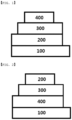
- FIG. 1 to FIG. 4 are diagrams each schematically illustrating a lamination structure of an organic light emitting device according to one embodiment of the present application.
- An organic light emitting device comprises an anode, a cathode and one or more organic material layers provided between the anode and the cathode, wherein one or more layers of the organic material layers comprise a hetero-cyclic compound represented by any one of the Chemical Formulae 2 to 6.
- L may be a direct bond; a substituted or unsubstituted C 6 to C 60 arylene group; or a substituted or unsubstituted C 2 to C 60 heteroarylene group.
- L may be a substituted or unsubstituted C 6 to C 40 arylene group; or a substituted or unsubstituted C 2 to C 40 heteroarylene group.
- L may be a C 6 to C 40 arylene group; or a C 2 to C 40 heteroarylene group.
- L may be a phenylene group; a biphenylene group; a naphthylene group; a phenanthrenylene group; a triphenylenylene group; an anthracenylene group; or a pyrenylene group.
- L may be a divalent pyridine group; a divalent phenanthroline group; a divalent pyrimidine group; or a divalent quinoline group.
- R, R' and R" are the same as or different from each other, and may be each independently hydrogen; a substituted or unsubstituted C 1 to C 60 alkyl group; or a substituted or unsubstituted C 6 to C 60 aryl group.
- R, R' and R" are the same as or different from each other, and may be each independently hydrogen; a C 1 to C 60 alkyl group; or a C 6 to C 60 aryl group.
- R, R' and R" are the same as or different from each other, and may be each independently a phenyl group.
- L may be selected from among the following structural formulae, but is not limited thereto.
- R9 is a phenyl group.
- a substituent linking two or more substituents may comprise a biphenyl group.
- a biphenyl group may be an aryl group, or may be interpreted as a substituent linking two phenyl groups.
- the additional substituents may be further substituted.
- R, R' and R" are the same as or different from each other, and each independently hydrogen; deuterium; -CN; a substituted or unsubstituted C 1 to C 60 alkyl group; a substituted or unsubstituted C 3 to C 60 cycloalkyl group; a substituted or unsubstituted C 6 to C 60 aryl group; or a substituted or unsubstituted C 2 to C 60 heteroaryl group.
- substituted means a hydrogen atom bonding to a carbon atom of a compound is changed to another substituent, and the position of substitution is not limited as long as it is a position at which the hydrogen atom is substituted, that is, a position at which a substituent can substitute, and when two or more substituents substitute, the two or more substituents may be the same as or different from each other.
- the halogen may be fluorine, chlorine, bromine or iodine.
- the alkyl group comprises linear or branched having 1 to 60 carbon atoms, and may be further substituted with other substituents.
- the number of carbon atoms of the alkyl group may be from 1 to 60, specifically from 1 to 40 and more specifically from 1 to 20.
- Specific examples thereof may comprise a methyl group, an ethyl group, a propyl group, an n-propyl group, an isopropyl group, a butyl group, an n-butyl group, an isobutyl group, a tert-butyl group, a sec-butyl group, a 1-methyl-butyl group, a 1-ethylbutyl group, a pentyl group, an n-pentyl group, an isopentyl group, a neopentyl group, a tert-pentyl group, a hexyl group, an n-hexyl group, a 1-methylpentyl group, a 2-methylpentyl group, a 4-methyl-2-pentyl group, a 3,3-dimethylbutyl group, a 2-ethylbutyl group, a heptyl group, an n-heptyl group,
- the alkenyl group comprises linear or branched having 2 to 60 carbon atoms, and may be further substituted with other substituents.
- the number of carbon atoms of the alkenyl group may be from 2 to 60, specifically from 2 to 40 and more specifically from 2 to 20.
- Specific examples thereof may comprise a vinyl group, a 1-propenyl group, an isopropenyl group, a 1-butenyl group, a 2-butenyl group, a 3-butenyl group, a 1-pentenyl group, a 2-pentenyl group, a 3-pentenyl group, a 3-methyl-1-butenyl group, a 1,3-butadienyl group, an allyl group, a 1-phenylvinyl-1-yl group, a 2-phenylvinyl-1-yl group, a 2,2-diphenylvinyl-1-yl group, a 2-phenyl-2-(naphthyl-1-yl)vinyl-1-yl group, a 2,2-bis(diphenyl-1-yl)vinyl-1-yl group, a stilbenyl group, and a styrenyl group, but are not limited thereto.
- the alkynyl group comprises linear or branched having 2 to 60 carbon atoms, and may be further substituted with other substituents.
- the number of carbon atoms of the alkynyl group may be from 2 to 60, specifically from 2 to 40 and more specifically from 2 to 20.
- the cycloalkyl group comprises monocyclic or multicyclic having 3 to 60 carbon atoms, and may be further substituted with other substituents.
- the multicyclic means a group in which the cycloalkyl group is directly linked to or fused with other cyclic groups.
- the other cyclic groups may be a cycloalkyl group, but may also be different types of cyclic groups such as a heterocycloalkyl group, an aryl group and a heteroaryl group.
- the number of carbon groups of the cycloalkyl group may be from 3 to 60, specifically from 3 to 40 and more specifically from 5 to 20.
- Specific examples thereof may comprise a cyclopropyl group, a cyclobutyl group, a cyclopentyl group, a 3-methylcyclopentyl group, a 2,3-dimethylcyclopentyl group, a cyclohexyl group, a 3-methylcyclohexyl group, a 4-methylcyclohexyl group, a 2,3-dimethylcyclohexyl group, a 3,4,5-trimethylcyclohexyl group, a 4-tert-butylcyclohexyl group, a cycloheptyl group, and a cyclooctyl group, but are not limited thereto.
- the heterocycloalkyl group comprises O, S, Se, N or Si as a heteroatom, comprises monocyclic or multicyclic having 2 to 60 carbon atoms, and may be further substituted with other substituents.
- the multicyclic means a group in which the heterocycloalkyl group is directly linked to or fused with other cyclic groups.
- the other cyclic groups may be a heterocycloalkyl group, but may also be different types of cyclic groups such as a cycloalkyl group, an aryl group and a heteroaryl group.
- the number of carbon atoms of the heterocycloalkyl group may be from 2 to 60, specifically from 2 to 40 and more specifically from 3 to 20.
- the aryl group comprises monocyclic or multicyclic having 6 to 60 carbon atoms, and may be further substituted with other substituents.
- the multicyclic means a group in which the aryl group is directly linked to or fused with other cyclic groups.
- the other cyclic groups may be an aryl group, but may also be different types of cyclic groups such as a cycloalkyl group, a heterocycloalkyl group and a heteroaryl group.
- the aryl group comprises a spiro group.
- the number of carbon atoms of the aryl group may be from 6 to 60, specifically from 6 to 40 and more specifically from 6 to 25.
- aryl group may comprise a phenyl group, a biphenyl group, a triphenyl group, a naphthyl group, an anthryl group, a chrysenyl group, a phenanthrenyl group, a perylenyl group, a fluoranthenyl group, a triphenylenyl group, a phenalenyl group, a pyrenyl group, a tetracenyl group, a pentacenyl group, a fluorenyl group, an indenyl group, an acenaphthylenyl group, a benzofluorenyl group, a spirobifluorenyl group, and a 2,3-dihydro-1H-indenyl group, and a fused ring thereof, but are not limited thereto.
- the spiro group is a group comprising a spiro structure, and may have 15 to 60 carbon atoms.
- the spiro group may comprise a structure in which a 2,3-dihydro-1H-indene group or a cyclohexane group spiro bonds to a fluorenyl group.
- the following spiro group may comprise any one of the groups having the following structural formulae.
- the heteroaryl group comprises O, S, Se, N or Si as a heteroatom, comprises monocyclic or multicyclic having 2 to 60 carbon atoms, and may be further substituted with other substituents.
- the multicyclic means a group in which the heteroaryl group is directly linked to or fused with other cyclic groups.
- the other cyclic groups may be a heteroaryl group, but may also be different types of cyclic groups such as a cycloalkyl group, a heterocycloalkyl group and an aryl group.
- the number of carbon atoms of the heteroaryl group may be from 2 to 60, specifically from 2 to 40 and more specifically from 3 to 25.
- heteroaryl group may comprise a pyridyl group, a pyrrolyl group, a pyrimidyl group, a pyridazinyl group, a furanyl group, a thiophene group, an imidazolyl group, a pyrazolyl group, an oxazolyl group, an isoxazolyl group, a thiazolyl group, an isothiazolyl group, a triazolyl group, a furazanyl group, an oxadiazolyl group, a thiadiazolyl group, a dithiazolyl group, a tetrazolyl group, a pyranyl group, a thiopyranyl group, a diazinyl group, an oxazinyl group, a thiazinyl group, a dioxynyl group, a triazinyl group, a tetrazinyl group, a te
- the amine group may be selected from the group consisting of a monoalkylamine group; a monoarylamine group; a monoheteroarylamine group; -NH 2 ; a dialkylamine group; a diarylamine group; a diheteroarylamine group; an alkylarylamine group; an alkylheteroarylamine group; and an arylheteroarylamine group, and although not particularly limited thereto, the number of carbon atoms is preferably from 1 to 30.
- the amine group may comprise a methylamine group, a dimethylamine group, an ethylamine group, a diethylamine group, a phenylamine group, a naphthylamine group, a biphenylamine group, a dibiphenylamine group, an anthracenylamine group, a 9-methyl-anthracenylamine group, a diphenylamine group, a phenylnaphthylamine group, a ditolylamine group, a phenyltolylamine group, a triphenylamine group, a biphenylnaphthylamine group, a phenylbiphenylamine group, a biphenylfluorenylamine group, a phenyltriphenylenylamine group, and a biphenyltriphenylenylamine group, but are not limited thereto.
- the arylene group means the aryl group having two bonding sites, that is, a divalent group. Descriptions on the aryl group provided above may be applied thereto except for each being a divalent.
- the heteroarylene group means the heteroaryl group having two bonding sites, that is, a divalent group. Descriptions on the heteroaryl group provided above may be applied thereto except for each being a divalent.
- the hetero-cyclic compound may be represented by any one of the following compounds, but is not limited thereto.
- substituents to the structure of Chemical Formulae 2-6, compounds having unique properties of the introduced substituents may be synthesized.
- substituents normally used as a hole injection layer material, a hole transfer layer material, a light emitting layer material, an electron transfer layer material and a charge generation layer material used for manufacturing an organic light emitting device to the core structure, materials satisfying conditions required for each organic material layer may be synthesized.
- the energy band gap may be finely controlled, and meanwhile, properties at interfaces between organic materials are enhanced, and material applications may become diverse.
- the hetero-cyclic compound has excellent thermal stability with a high glass transition temperature (Tg). Such an increase in the thermal stability becomes an important factor in providing driving stability to a device.
- the hetero-cyclic compound may be prepared through a multistep chemical reaction. Some intermediate compounds are prepared first, and the compound of Chemical Formulae 2-6 1 may be prepared from the intermediate compounds. More specifically, the hetero-cyclic compound may be prepared based on preparation examples to be described below.
- the organic light emitting device may be manufactured using common organic light emitting device manufacturing methods and materials except that one or more organic material layers are formed using the hetero-cyclic compound described above.
- the hetero-cyclic compound may be formed into an organic material layer through a solution coating method as well as a vacuum deposition method when manufacturing the organic light emitting device.
- the solution coating method means spin coating, dip coating, inkjet printing, screen printing, a spray method, or roll coating, but is not limited thereto.
- the organic light emitting device comprises an anode, a cathode, and one or more organic material layers provided between the anode and the cathode, wherein one or more layers of the organic material layers comprise the hetero-cyclic compound represented by Chemical Formula 1.
- FIGs. 1 to 3 illustrate a lamination order of electrodes and organic material layers of an organic light emitting device according to one embodiment of the present application.
- the scope of the present application is not limited to these diagrams, and structures of organic light emitting devices known in the art may also be used in the present application.
- FIG. 1 illustrates an organic light emitting device in which an anode (200), an organic material layer (300) and a cathode (400) are consecutively laminated on a substrate (100).
- the structure is not limited to such a structure, and as illustrated in FIG. 2 , an organic light emitting device in which a cathode, an organic material layer and an anode are consecutively laminated on a substrate may also be obtained.
- FIG. 3 illustrates a case of the organic material layer being a multilayer.
- the organic light emitting device according to FIG. 3 comprises a hole injection layer (301), a hole transfer layer (302), a light emitting layer (303), a hole blocking layer (304), an electron transfer layer (305) and an electron injection layer (306).
- a hole injection layer 301
- a hole transfer layer 302
- a light emitting layer 303
- a hole blocking layer a hole blocking layer
- an electron transfer layer (305)
- an electron injection layer (306).
- the scope of the present application is not limited to such a lamination structure, and as necessary, other layers except the light emitting layer may not be included, and other necessary functional layers may be further included.
- the organic light emitting device comprises an anode, a cathode, and two or more stacks provided between the anode and the cathode, wherein the two or more stacks each independently comprise a light emitting layer, a charge generation layer is included between the two or more stacks, and the charge generation layer includes the hetero-cyclic compound represented by Chemical Formulae 2-6.
- the organic light emitting device comprises an anode, a first stack provided on the anode and comprising a first light emitting layer, a charge generation layer provided on the first stack, a second stack provided on the charge generation layer and comprising a second light emitting layer, and a cathode provided on the second stack.
- the charge generation layer may comprise the hetero-cyclic compound represented by any one of Chemical Formulae 2-6.
- the first stack and the second stack may each independently further comprise one or more types of the hole injection layer, the hole transfer layer, the hole blocking layer, the electron transfer layer, the electron injection layer described above.
- the charge generation layer may be an N-type charge generation layer, and the charge generation layer may further comprise a dopant known in the art in addition to the hetero-cyclic compound represented by any one of Chemical Formulae 2-6.
- an organic light emitting device having a 2-stack tandem structure is schematically illustrated in FIG. 4 .
- the first electron blocking layer, the first bole blocking layer, and the second hole blocking layer described in FIG. 4 may not be included in some cases.
- the organic light emitting device according to the present specification may be manufactured using materials and methods known in the art except that one or more layers of the organic material layers comprise the hetero-cyclic compound represented by any one of Chemical Formulae 2-6.
- the hetero-cyclic compound represented by Chemical Formulae 2-6 may form one or more layers of the organic material layers of the organic light emitting device alone. However, as necessary, the hetero-cyclic compound represented by Chemical Formulae 2-6 may be mixed with other materials to form the organic material layers.
- the hetero-cyclic compound represented by Chemical Formulae 2-6 may be used as a material of the charge generation layer in the organic light emitting device.
- the hetero-cyclic compound represented by Chemical Formulae 2-6 may be used as a material of the electron transfer layer, the hole blocking layer, or the light emitting layer in the organic light emitting device.
- the hetero-cyclic compound represented by Chemical Formulae 2-6 may be used as a material of the electron transfer layer, the hole transfer layer or the light emitting layer in the organic light emitting device.
- hetero-cyclic compound represented by Chemical Formulae 2-6 may be used as a material of the light emitting layer in the organic light emitting device.
- the hetero-cyclic compound represented by Chemical Formulae 2-6 may be used as a phosphorescent host material of the light emitting layer in the organic light emitting device.
- anode material materials having relatively large work function may be used, and transparent conductive oxides, metals, or conductive polymers may be used.
- the anode material comprise metals such as vanadium, chromium, copper, zinc and gold, or alloys thereof; metal oxides such as zinc oxide, indium oxide, indium tin oxide (ITO) and indium zinc oxide (IZO); combinations of metals and oxides such as ZnO:Al or SnO 2 :Sb; conductive polymers such as poly(3-methylthiophene), poly[3,4-(ethylene-1,2-dioxy)thiophene] (PEDOT), polypyrrole and polyaniline, but are not limited thereto.
- cathode material materials having relatively small work function may be used, and metals, metal oxides, or conductive polymers may be used.
- specific examples of the cathode material comprise metals such as magnesium, calcium, sodium, potassium, titanium, indium, yttrium, lithium, gadolinium, aluminum, silver, tin and lead, or alloys thereof;and multilayer structure materials such as LiF/Al or LiO 2 /Al, but are not limited thereto.
- hole injection material known hole injection materials may be used, and for example, phthalocyanine compounds such as copper phthalocyanine disclosed in US Patent No. 4,356,429 , or starburst-type amine derivatives such as tris(4-carbazoyl-9-ylphenyl)amine (TCTA), 4,4',4"-tri[phenyl(m-tolyl)amino]triphenylamine (m-MTDATA) or 1,3,5-tris[4-(3-methylphenylphenylamino)phenyl]benzene (m-MTDAPB) described in the literature [ Advanced Material, 6, p.677 (1994 )], polyaniline/dodecylbenzene sulfonic acid, poly(3,4-ethylenedioxythiophene)/poly(4-styrenesulfonate), polyaniline/camphor sulfonic acid or polyaniline/poly(4-styrene-sulfonate) that
- pyrazoline derivatives arylamine-based derivatives, stilbene derivatives, or triphenyldiamine derivatives may be used, and low molecular or high molecular materials may also be used.
- LiF is typically used in the art, however, the present application is not limited thereto.
- red, green or blue light emitting materials may be used, and as necessary, two or more light emitting materials may be mixed and used.
- fluorescent materials may also be used as the light emitting material, however, phosphorescent materials may also be used.
- materials emitting light by bonding electrons and holes injected from an anode and a cathode, respectively, may be used alone, however, materials having a host material and a dopant material involved in light emission together may also be used.
- the organic light emitting device may be a top-emission type, a bottom-emission type or a dual-emission type depending on the materials used.
- the hetero-cyclic compound may also be used in an organic electronic device comprising an organic solar cell, an organic photo conductor, or an organic transistor under a similar principle used in the organic light emitting device.
- SM1 160 g, 0.53 mol, 1 eq.
- SM2 77.5 g, 0.635 mol, 1.2 eq.
- 1,4-Dioxane was introduced thereto in 1600 ml each, and the results were stirred.
- Pd(PPh 3 ) 4 30.6 g, 0.026 mol, 0.05 eq.
- K 3 PO 4 337 g, 1.59 mol, 3.0 eq.
- SM1 100 g, 0.438 mol, 1 eq.
- SM2 113 g, 0.635 mol, 1.5 eq.
- 1,4-dioxane 1500 ml
- Pd(PPh 3 ) 4 25.3 g, 0.021 mol, 0.05 eq.
- K 3 PO 4 280 g, 1.315 mol, 3.0 eq.
- Liquid Compound H-1 was obtained (76 g, 63.3%) in the same synthesis manner as G-1.
- Liquid Compound H-2 was obtained (133 g, 100%) in the same synthesis manner as G-2.
- Solid Compound H-3 was obtained (93 g, 76%) in the same synthesis manner as G-3.
- Solid Compound H-4 was obtained (82 g, 79%) in the same synthesis manner as G-4.
- dibenzo[b,d]furan-4-ylboronic acid 80 g, 377.3 mmol, 1 eq.
- 2-bromoaniline 77.9 g, 452.8 mmol, 1.2 eq.
- Pd(PPh 3 ) 4 (13.1 g, 11.3 mmol, 0.03 eq.
- K 3 PO 4 240.3 g, 1131.9 mmol, 3 eq.
- the temperature was lowered to room temperature, then H 2 O and MC were introduced thereto, and the result was stirred.
- Solid Compound L-3 was obtained (162.8 g, 74%) in the same synthesis manner as A-3.
- Solid Compound L-4 was obtained (52.1 g, 84%) in the same synthesis manner as A-4.
- Solid Compound M-3 was obtained (162.8 g, 74%) in the same synthesis manner as A-3.
- Solid Compound M-4 was obtained (52.1 g, 84%) in the same synthesis manner as A-4.
- Solid Compound P-3 was obtained (80 g, 88%) in the same synthesis manner as E-3.
- Solid Compound P-4 was obtained (85.6 g, 73%) in the same synthesis manner as E-4.
- Solid Compound P-5 was obtained (49 g, 79%) in the same synthesis manner as E-5.
- Solid Compound Q-3 was obtained (80 g, 88%) in the same synthesis manner as E-3.
- Solid Compound Q-4 was obtained (85.6 g, 73%) in the same synthesis manner as E-4.
- Solid Compound Q-5 was obtained (49 g, 79%) in the same synthesis manner as E-5.
- Liquid Compound R-2 was obtained (133 g, 100%) in the same synthesis manner as G-2.
- Solid Compound R-3 was obtained (93 g, 76%) in the same synthesis manner as G-3.
- Solid Compound R-4 was obtained (82 g, 79%) in the same synthesis manner as G-4.
- Liquid Compound S-2 was obtained (133 g, 100%) in the same synthesis manner as G-2.
- Solid Compound S-3 was obtained (93 g, 76%) in the same synthesis manner as G-3.
- Solid Compound S-4 was obtained (82 g, 79%) in the same synthesis manner as G-4.
- Solid Compound T-2 was obtained (47 g, 99%) in the same synthesis manner as 1-2.
- Target Compound T-3 was obtained (71%) in the same synthesis manner as I-3.
- Target Compound T-4 was obtained (84%) in the same synthesis manner as I-4.
- Solid Compound U-2 was obtained (47 g, 99%) in the same synthesis manner as I-2.
- Target Compound U-3 was obtained (71%) in the same synthesis manner as I-3.
- Target Compound U-4 was obtained (84%) in the same synthesis manner as I-4.
- Solid Compound V-2 was obtained (200 g, 92.1%) in the same synthesis manner as K-2.
- Solid Compound V-3 was obtained (120 g, 61.8%) in the same synthesis manner as K-3.
- Solid Compound V-4 was obtained (100 g, 77.0%) in the same synthesis manner as K-4.
- Solid Compound X-2 was obtained (200 g, 92.1%) in the same synthesis manner as K-2.
- Solid Compound X-3 was obtained (120 g, 61.8%) in the same synthesis manner as K-3.
- Solid Compound X-4 was obtained (100 g, 77.0%) in the same synthesis manner as K-4.
- a glass substrate on which ITO was coated as a thin film to a thickness of 1500 ⁇ was cleaned with distilled water ultrasonic waves. After the cleaning with distilled water was finished, the substrate was ultrasonic cleaned with solvents such as acetone, methanol and isopropyl alcohol, then dried, and UVO treatment was carried out for 5 minutes in a UV cleaner using UV. After that, the substrate was transferred to a plasma cleaner (PT), and plasma treatment was carried out under vacuum for ITO work function and remaining film removal, and the substrate was transferred to a thermal deposition apparatus for organic deposition.
- PT plasma cleaner
- a hole transfer layer was formed first by thermal vacuum depositing TAPC to a thickness of 300 ⁇ . After forming the hole transfer layer, a light emitting layer was thermal vacuum deposited thereon as follows. The light emitting layer was deposited to 300 ⁇ by doping FIrpic in 8% as a blue phosphorescent dopant to TCz1, a host. An electron transfer layer was formed to 400 ⁇ using TmPyPB, and then a charge generation layer was formed to 100 ⁇ by doping Cs 2 CO 3 in 20% to a compound described in the following Table 3.
- a hole injection layer was formed first by thermal vacuum depositing MoO 3 to a thickness of 50 ⁇ .
- a hole transfer layer a common layer, was formed by doping MoO 3 to TAPC in 20% and forming to 100 ⁇ , and then depositing TAPC to 300 ⁇ .
- an electron injection layer was formed on the electron transfer layer by depositing lithium fluoride (LiF) to a thickness of 10 ⁇ , and then a cathode was formed on the electron injection layer by depositing an aluminum (Al) cathode to a thickness of 1,200 ⁇ to manufacture an organic light emitting device.
- LiF lithium fluoride
- Al aluminum
- Example 1 1-1 7.13 69.21 (0.221, 0,439) 40 Example 2 1-6 6.23 66.12 (0.221, 0,428) 44 Example 3 1-14 7.55 60.25 (0.225, 0,430) 30 Example 4 1-26 7.69 61.33 (0.230, 0,429) 35 Example 5 1-27 7.75 64.59 (0.226, 0,429) 34 Example 6 2-1 7.57 63.70 (0.222, 0,428) 29 Example 7 2-14 7.81 61.28 (0.227, 0,427) 30 Example 8 2-27 7.63 65.21 (0.222, 0,431) 31 Example 9 3-1 7.33 60.00 (0.225, 0,426) 33 Example 10 3-10 7.62 71.05 (0.224, 0,424) 45 Example 11 3-14 7.82 61.15 (0.221, 0,425) 38 Example 12 3-27 7.74 60.32 (0.220, 0,429) 36 Example 13 4-1 7.11 70.
- the organic light emitting devices using the charge generation layer material of the 2-stack white organic light emitting device of the present disclosure had a low driving voltage and improved light emission efficiency compared to Comparative Examples 1.
- Compounds 1-1, 1-6, 1-26, 3-10, 4-1, 4-5, 6-10, 6-14, 7-5, 8-39, 9-5, 10-5, 12-5, 13-2, 13-5, 13-13, 13-18, 13-19 were significantly excellent in all of driving, efficiency and lifetime.
- the compound of the present disclosure used as an N-type charge generation layer formed with an invented skeleton having proper length, strength and flat property and a proper hetero-compound capable of binding with metals is doped with an alkali metal or an alkali-earth metal to form a gap state within the N-type charge generation layer, and electrons produced from a P-type charge generation layer are readily injected to the electron transfer layer through the gap state produced within the N-type charge generation layer.
- the P-type charge generation layer favorably carried out electron injection and electron transfer to the N-type charge generation layer, and as a result, it is considered that a driving voltage of the organic light emitting device decreased, and efficiency and lifetime were improved.
- a glass substrate on which ITO was coated as a thin film to a thickness of 1500 ⁇ was cleaned with distilled water ultrasonic waves. After the cleaning with distilled water was finished, the substrate was ultrasonic cleaned with solvents such as acetone, methanol and isopropyl alcohol, then dried, and UVO treatment was carried out for 5 minutes in a UV cleaner using UV. After that, the substrate was transferred to a plasma cleaner (PT), and plasma treatment was carried out under vacuum for ITO work function and remaining film removal, and the substrate was transferred to a thermal deposition apparatus for organic deposition. On the ITO transparent electrode (anode), organic materials were formed in a single-stack structure.
- solvents such as acetone, methanol and isopropyl alcohol
- HAT-CN As a hole injection layer, HAT-CN was deposited to a thickness of 50 ⁇ , and subsequently, a hole transfer layer was formed by doping DNTPD within 10% to NPD, depositing the result to a thickness of 1500 ⁇ , and continuously depositing TCTA to a thickness of 200 ⁇ . Subsequently, a light emitting layer comprising a t-Bu-perylene dopant in an ADN host was formed to a thickness of 250 ⁇ .
- Alq 3 an electron transfer layer, was formed to a thickness of 250 ⁇ , and an N-type charge transfer layer was formed to a thickness of 100 ⁇ by doping Li, an alkali metal, to a compound described in the following Table 4, and Al, a cathode, was formed to a thickness of approximately 1,000 ⁇ to manufacture an organic light emitting device.
- the organic light emitting devices using the charge generation layer material of the blue organic light emitting device of the present disclosure had a low driving voltage and improved light emission efficiency compared to Comparative Examples 2.
- Compounds 1-1, 1-6, 1-26, 3-10, 4-1, 4-5, 6-10, 6-14, 7-5, 8-39, 9-5, 10-5, 12-5, 13-2, 13-6, 13-9, 13-13, 13-14, 13-17, 13-21 were significantly excellent in all of driving, efficiency and lifetime.
- the compound of the present disclosure used as an N-type charge generation layer formed with an invented skeleton having proper length, strength and flat property and a proper hetero-compound capable of binding with metals is doped with an alkali metal or an alkali-earth metal to form a gap state within the N-type charge generation layer, and electrons produced from a P-type charge generation layer are readily injected to the electron transfer layer through the gap state produced within the N-type charge generation layer.
- the P-type charge generation layer favorably carried out electron injection and electron transfer to the N-type charge generation layer, and as a result, it is considered that a driving voltage of the organic light emitting device decreased, and efficiency and lifetime were improved.
Landscapes
- Physics & Mathematics (AREA)
- Chemical & Material Sciences (AREA)
- Engineering & Computer Science (AREA)
- Materials Engineering (AREA)
- Spectroscopy & Molecular Physics (AREA)
- Optics & Photonics (AREA)
- Organic Chemistry (AREA)
- Electroluminescent Light Sources (AREA)
- Nitrogen Condensed Heterocyclic Rings (AREA)
- Nitrogen And Oxygen Or Sulfur-Condensed Heterocyclic Ring Systems (AREA)
Description
- The present application relates to an organic light emitting device.
- An electroluminescent device is one type of self-emissive display devices, and has an advantage of having a wide viewing angle, and a high response speed as well as having an excellent contrast.
- An organic light emitting device has a structure disposing an organic thin film between two electrodes. When a voltage is applied to an organic light emitting device having such a structure, electrons and holes injected from the two electrodes bind and pair in the organic thin film, and light emits as these annihilate. The organic thin film may be formed in a single layer or a multilayer as necessary.
- A material of the organic thin film may have a light emitting function as necessary. For example, as a material of the organic thin film, compounds capable of forming a light emitting layer themselves may be used alone, or compounds capable of performing a role of a host or a dopant of a host-dopant-based light emitting layer may also be used. In addition thereto, compounds capable of performing roles of hole injection, hole transfer, electron blocking, hole blocking, electron transfer, and electron injection may also be used as a material of the organic thin film.
- Development of an organic thin film material has been continuously required for enhancing performance, lifetime or efficiency of an organic light emitting device.
-
EP3165527A1 ,KR20160129781A KR20160124623A KR20160082067A WO2016/068633A2 ,WO2016/064088A2 ,KR20160046703A KR20160041019A KR20160008819A US2015/349275A1 ,US2016/204357A1 ,US2015/243908A1 ,US2015/243895A1 ,WO2015/099508A1 ,EP3088392A1 ,KR20160002408A KR20130135178A WO2016/003171A1 disclose hetero-cyclic compounds and organic light emitting devices using the same. - The present application is directed to providing an organic light emitting device comprising a compound having a specific substituent.
- The present application provides an organic light emitting device according to claim 1.
- Further embodiments are disclosed in the dependent claims.
- A hetero-cyclic compound can be used as an organic material layer material of an organic light emitting device. The hetero-cyclic compound can be used as a material of a hole injection layer, a hole transfer layer, a light emitting layer, an electron transfer layer, an electron injection layer, or a charge generation layer in an organic light emitting device. Particularly, a hetero-cyclic compound as represented can be used as a material of an electron transfer layer or a charge generation layer in an organic light emitting device. In addition, using the hetero-cyclic compound as represented in an organic light emitting device lowers a driving voltage of the device, enhances light efficiency, and can enhance a lifetime property of the device with thermal stability of the compound.
-
FIG. 1 to FIG. 4 are diagrams each schematically illustrating a lamination structure of an organic light emitting device according to one embodiment of the present application. -
- 100:
- Substrate
- 200:
- Anode
- 300:
- Organic Material Layer
- 301:
- Hole Injection Layer
- 302:
- Hole Transfer Layer
- 303:
- Light Emitting Layer
- 304:
- Hole Blocking Layer
- 305:
- Electron Transfer Layer
- 306:
- Electron Injection Layer
- 400:
- Cathode
- Hereinafter, the present application will be described in detail.
- An organic light emitting device according to one embodiment of the present application comprises an anode, a cathode and one or more organic material layers provided between the anode and the cathode, wherein one or more layers of the organic material layers comprise a hetero-cyclic compound represented by any one of the Chemical Formulae 2 to 6.
- In one embodiment of the present application, L may be a direct bond; a substituted or unsubstituted C6 to C60 arylene group; or a substituted or unsubstituted C2 to C60 heteroarylene group.
- In another embodiment, L may be a substituted or unsubstituted C6 to C40 arylene group; or a substituted or unsubstituted C2 to C40 heteroarylene group.
- In another embodiment, L may be a C6 to C40 arylene group; or a C2 to C40 heteroarylene group.
- In another embodiment, L may be a phenylene group; a biphenylene group; a naphthylene group; a phenanthrenylene group; a triphenylenylene group; an anthracenylene group; or a pyrenylene group.
- In another embodiment, L may be a divalent pyridine group; a divalent phenanthroline group; a divalent pyrimidine group; or a divalent quinoline group.
- In one embodiment of the present application, R, R' and R" are the same as or different from each other, and may be each independently hydrogen; a substituted or unsubstituted C1 to C60 alkyl group; or a substituted or unsubstituted C6 to C60 aryl group.
- In another embodiment, R, R' and R" are the same as or different from each other, and may be each independently hydrogen; a C1 to C60 alkyl group; or a C6 to C60 aryl group.
- In another embodiment, R, R' and R" are the same as or different from each other, and may be each independently a phenyl group.
- In one embodiment of the present application, L may be selected from among the following structural formulae, but is not limited thereto.




- In another embodiment, R9 is a phenyl group.
- In the present specification, the term "substituted or unsubstituted" means being substituted with one or more substituents selected from the group consisting of deuterium; a halogen group; -CN; a C1 to C60 alkyl group; a C2 to C60 alkenyl group; a C2 to C60 alkynyl group; a C3 to C60 cycloalkyl group; a C2 to C60 heterocycloalkyl group; a C6 to C60 aryl group; a C2 to C60 heteroaryl group; -SiRR'R"; -P (=O) RR' ; a C1 to C20 alkylamine group; a C6 to C60 arylamine group; and a C2 to C60 heteroarylamine group, or being unsubstituted, or being substituted with a substituent bonding two or more of the above-mentioned substituents, or being substituted, or being substituted with a substituent linking two or more substituents selected from among the above-mentioned substituents, or being unsubstituted. For example, "a substituent linking two or more substituents" may comprise a biphenyl group. In other words, a biphenyl group may be an aryl group, or may be interpreted as a substituent linking two phenyl groups. The additional substituents may be further substituted. R, R' and R" are the same as or different from each other, and each independently hydrogen; deuterium; -CN; a substituted or unsubstituted C1 to C60 alkyl group; a substituted or unsubstituted C3 to C60 cycloalkyl group; a substituted or unsubstituted C6 to C60 aryl group; or a substituted or unsubstituted C2 to C60 heteroaryl group.
- According to one embodiment of the present application, the "substituted or unsubstituted" means being substituted with one or more substituents selected from the group consisting of deuterium, a halogen group, -CN, SiRR'R", P(=O)RR', a C1 to C20 linear or branched alkyl group, a C6 to C60 aryl group, and a C2 to C60 heteroaryl group, or being unsubstituted, and
R, R' and R" are the same as or different from each other, and each independently hydrogen; deuterium; -CN; a C1 to C60 alkyl group unsubstituted or substituted with deuterium, a halogen group, -CN, a C1 to C20 alkyl group, a C6 to C60 aryl group and a C2 to C60 heteroaryl group; a C3 to C60 cycloalkyl group unsubstituted or substituted with deuterium, halogen, - CN, a C1 to C20 alkyl group, a C6 to C60 aryl group and a C2 to C60 heteroaryl group; a C6 to C60 aryl group unsubstituted or substituted with deuterium, halogen, -CN, a C1 to C20 alkyl group, a C6 to C60 aryl group and a C2 to C60 heteroaryl group; or a C2 to C60 heteroaryl group unsubstituted or substituted with deuterium, halogen, -CN, a C1 to C20 alkyl group, a C6 to C60 aryl group and a C2 to C60 heteroaryl group. - The term "substituted" means a hydrogen atom bonding to a carbon atom of a compound is changed to another substituent, and the position of substitution is not limited as long as it is a position at which the hydrogen atom is substituted, that is, a position at which a substituent can substitute, and when two or more substituents substitute, the two or more substituents may be the same as or different from each other.
- In the present specification, the halogen may be fluorine, chlorine, bromine or iodine.
- In the present specification, the alkyl group comprises linear or branched having 1 to 60 carbon atoms, and may be further substituted with other substituents. The number of carbon atoms of the alkyl group may be from 1 to 60, specifically from 1 to 40 and more specifically from 1 to 20. Specific examples thereof may comprise a methyl group, an ethyl group, a propyl group, an n-propyl group, an isopropyl group, a butyl group, an n-butyl group, an isobutyl group, a tert-butyl group, a sec-butyl group, a 1-methyl-butyl group, a 1-ethylbutyl group, a pentyl group, an n-pentyl group, an isopentyl group, a neopentyl group, a tert-pentyl group, a hexyl group, an n-hexyl group, a 1-methylpentyl group, a 2-methylpentyl group, a 4-methyl-2-pentyl group, a 3,3-dimethylbutyl group, a 2-ethylbutyl group, a heptyl group, an n-heptyl group, a 1-methylhexyl group, a cyclopentylmethyl group, a cyclohexylmethyl group, an octyl group, an n-octyl group, a tert-octyl group, a 1-methylheptyl group, a 2-ethylhexyl group, a 2-propylpentyl group, an n-nonyl group, a 2,2-dimethylheptyl group, a 1-ethyl-propyl group, a 1,1-dimethyl-propyl group, an isohexyl group, a 2-methylpentyl group, a 4-methylhexyl group, and a 5-methylhexyl group, but are not limited thereto.
- In the present specification, the alkenyl group comprises linear or branched having 2 to 60 carbon atoms, and may be further substituted with other substituents. The number of carbon atoms of the alkenyl group may be from 2 to 60, specifically from 2 to 40 and more specifically from 2 to 20. Specific examples thereof may comprise a vinyl group, a 1-propenyl group, an isopropenyl group, a 1-butenyl group, a 2-butenyl group, a 3-butenyl group, a 1-pentenyl group, a 2-pentenyl group, a 3-pentenyl group, a 3-methyl-1-butenyl group, a 1,3-butadienyl group, an allyl group, a 1-phenylvinyl-1-yl group, a 2-phenylvinyl-1-yl group, a 2,2-diphenylvinyl-1-yl group, a 2-phenyl-2-(naphthyl-1-yl)vinyl-1-yl group, a 2,2-bis(diphenyl-1-yl)vinyl-1-yl group, a stilbenyl group, and a styrenyl group, but are not limited thereto.
- In the present specification, the alkynyl group comprises linear or branched having 2 to 60 carbon atoms, and may be further substituted with other substituents. The number of carbon atoms of the alkynyl group may be from 2 to 60, specifically from 2 to 40 and more specifically from 2 to 20.
- In the present specification, the cycloalkyl group comprises monocyclic or multicyclic having 3 to 60 carbon atoms, and may be further substituted with other substituents. Herein, the multicyclic means a group in which the cycloalkyl group is directly linked to or fused with other cyclic groups. Herein, the other cyclic groups may be a cycloalkyl group, but may also be different types of cyclic groups such as a heterocycloalkyl group, an aryl group and a heteroaryl group. The number of carbon groups of the cycloalkyl group may be from 3 to 60, specifically from 3 to 40 and more specifically from 5 to 20. Specific examples thereof may comprise a cyclopropyl group, a cyclobutyl group, a cyclopentyl group, a 3-methylcyclopentyl group, a 2,3-dimethylcyclopentyl group, a cyclohexyl group, a 3-methylcyclohexyl group, a 4-methylcyclohexyl group, a 2,3-dimethylcyclohexyl group, a 3,4,5-trimethylcyclohexyl group, a 4-tert-butylcyclohexyl group, a cycloheptyl group, and a cyclooctyl group, but are not limited thereto.
- In the present specification, the heterocycloalkyl group comprises O, S, Se, N or Si as a heteroatom, comprises monocyclic or multicyclic having 2 to 60 carbon atoms, and may be further substituted with other substituents. Herein, the multicyclic means a group in which the heterocycloalkyl group is directly linked to or fused with other cyclic groups. Herein, the other cyclic groups may be a heterocycloalkyl group, but may also be different types of cyclic groups such as a cycloalkyl group, an aryl group and a heteroaryl group. The number of carbon atoms of the heterocycloalkyl group may be from 2 to 60, specifically from 2 to 40 and more specifically from 3 to 20.
- In the present specification, the aryl group comprises monocyclic or multicyclic having 6 to 60 carbon atoms, and may be further substituted with other substituents. Herein, the multicyclic means a group in which the aryl group is directly linked to or fused with other cyclic groups. Herein, the other cyclic groups may be an aryl group, but may also be different types of cyclic groups such as a cycloalkyl group, a heterocycloalkyl group and a heteroaryl group. The aryl group comprises a spiro group. The number of carbon atoms of the aryl group may be from 6 to 60, specifically from 6 to 40 and more specifically from 6 to 25. Specific examples of the aryl group may comprise a phenyl group, a biphenyl group, a triphenyl group, a naphthyl group, an anthryl group, a chrysenyl group, a phenanthrenyl group, a perylenyl group, a fluoranthenyl group, a triphenylenyl group, a phenalenyl group, a pyrenyl group, a tetracenyl group, a pentacenyl group, a fluorenyl group, an indenyl group, an acenaphthylenyl group, a benzofluorenyl group, a spirobifluorenyl group, and a 2,3-dihydro-1H-indenyl group, and a fused ring thereof, but are not limited thereto.
- In the present specification, the spiro group is a group comprising a spiro structure, and may have 15 to 60 carbon atoms. For example, the spiro group may comprise a structure in which a 2,3-dihydro-1H-indene group or a cyclohexane group spiro bonds to a fluorenyl group. Specifically, the following spiro group may comprise any one of the groups having the following structural formulae.

- In the present specification, the heteroaryl group comprises O, S, Se, N or Si as a heteroatom, comprises monocyclic or multicyclic having 2 to 60 carbon atoms, and may be further substituted with other substituents. Herein, the multicyclic means a group in which the heteroaryl group is directly linked to or fused with other cyclic groups. Herein, the other cyclic groups may be a heteroaryl group, but may also be different types of cyclic groups such as a cycloalkyl group, a heterocycloalkyl group and an aryl group. The number of carbon atoms of the heteroaryl group may be from 2 to 60, specifically from 2 to 40 and more specifically from 3 to 25. Specific examples of the heteroaryl group may comprise a pyridyl group, a pyrrolyl group, a pyrimidyl group, a pyridazinyl group, a furanyl group, a thiophene group, an imidazolyl group, a pyrazolyl group, an oxazolyl group, an isoxazolyl group, a thiazolyl group, an isothiazolyl group, a triazolyl group, a furazanyl group, an oxadiazolyl group, a thiadiazolyl group, a dithiazolyl group, a tetrazolyl group, a pyranyl group, a thiopyranyl group, a diazinyl group, an oxazinyl group, a thiazinyl group, a dioxynyl group, a triazinyl group, a tetrazinyl group, a quinolyl group, an isoquinolyl group, a quinazolinyl group, an isoquinazolinyl group, a qninozolinyl group, a naphthyridyl group, an acridinyl group, a phenanthridinyl group, an imidazopyridinyl group, a diazanaphthalenyl group, a triazaindene group, an indolyl group, an indolizinyl group, a benzothiazolyl group, a benzoxazolyl group, a benzimidazolyl group, a benzothiophene group, a benzofuran group, a dibenzothiophene group, a dibenzofuran group, a carbazolyl group, a benzocarbazolyl group, a dibenzocarbazolyl group, a phenazinyl group, a dibenzosilole group, spirobi(dibenzosilole), a dihydrophenazinyl group, a phenoxazinyl group, a phenanthridyl group, an imidazopyridinyl group, a thienyl group, an indolo[2,3-a]carbazolyl group, an indolo[2,3-b]carbazolyl group, an indolinyl group, a 10,11-dihydro-dibenzo[b,f]azepine group, a 9,10-dihydroacridinyl group, a phenanthrazinyl group, a phenothiazinyl group, a phthalazinyl group, a naphthyridinyl group, a phenanthrolinyl group, a benzo[c][1,2,5]thiadiazolyl group, a 5,10-dihydrobenzo[b,e][1,4]azasilinyl group, a pyrazolo[1,5-c]quinazolinyl group, a pyrido[1,2-b]indazolyl group, a pyrido[1,2-a]imidazo[1,2-e]indolinyl group, and a 5,11-dihydroindeno[1,2-b]carbazolyl group, but are not limited thereto.
- In the present specification, the amine group may be selected from the group consisting of a monoalkylamine group; a monoarylamine group; a monoheteroarylamine group; -NH2; a dialkylamine group; a diarylamine group; a diheteroarylamine group; an alkylarylamine group; an alkylheteroarylamine group; and an arylheteroarylamine group, and although not particularly limited thereto, the number of carbon atoms is preferably from 1 to 30. Specific examples of the amine group may comprise a methylamine group, a dimethylamine group, an ethylamine group, a diethylamine group, a phenylamine group, a naphthylamine group, a biphenylamine group, a dibiphenylamine group, an anthracenylamine group, a 9-methyl-anthracenylamine group, a diphenylamine group, a phenylnaphthylamine group, a ditolylamine group, a phenyltolylamine group, a triphenylamine group, a biphenylnaphthylamine group, a phenylbiphenylamine group, a biphenylfluorenylamine group, a phenyltriphenylenylamine group, and a biphenyltriphenylenylamine group, but are not limited thereto.
- In the present specification, the arylene group means the aryl group having two bonding sites, that is, a divalent group. Descriptions on the aryl group provided above may be applied thereto except for each being a divalent. In addition, the heteroarylene group means the heteroaryl group having two bonding sites, that is, a divalent group. Descriptions on the heteroaryl group provided above may be applied thereto except for each being a divalent.
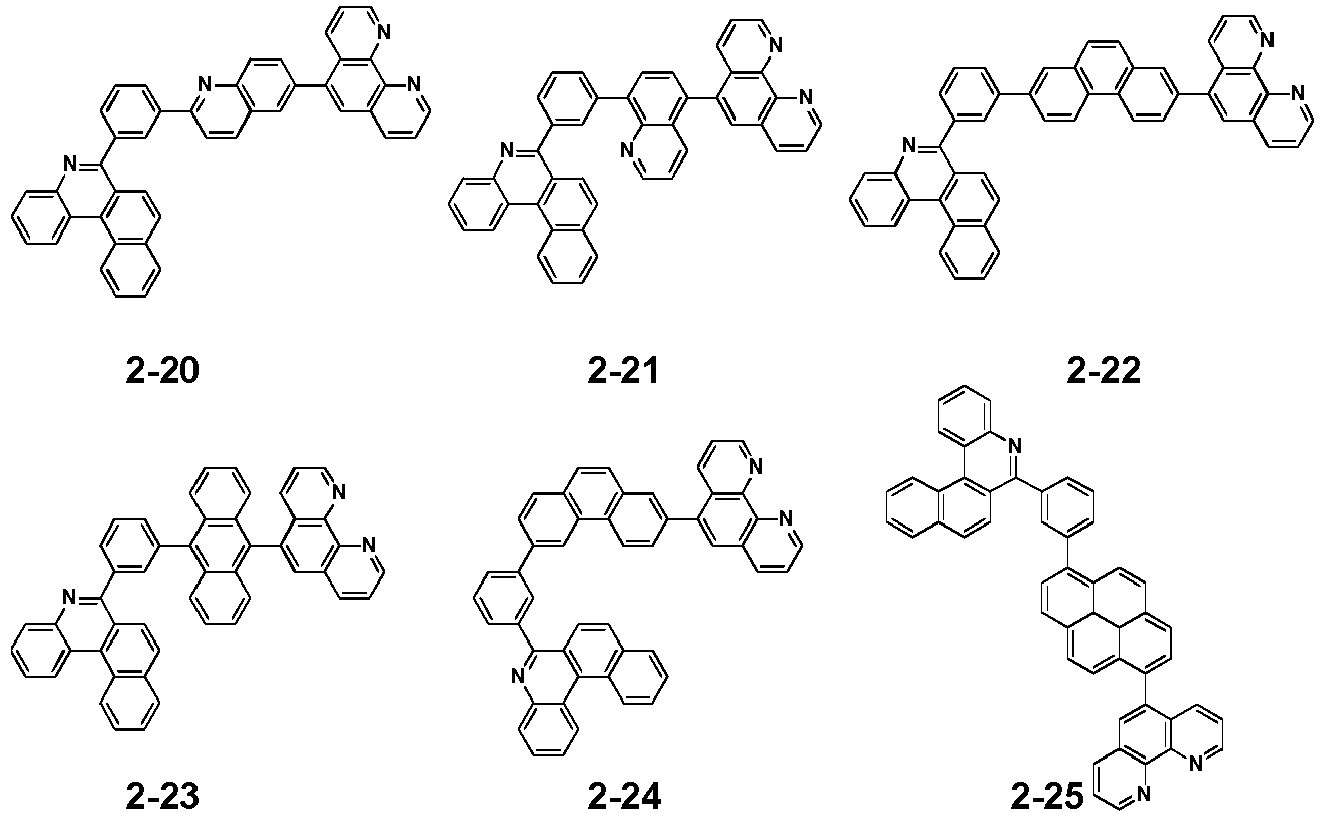
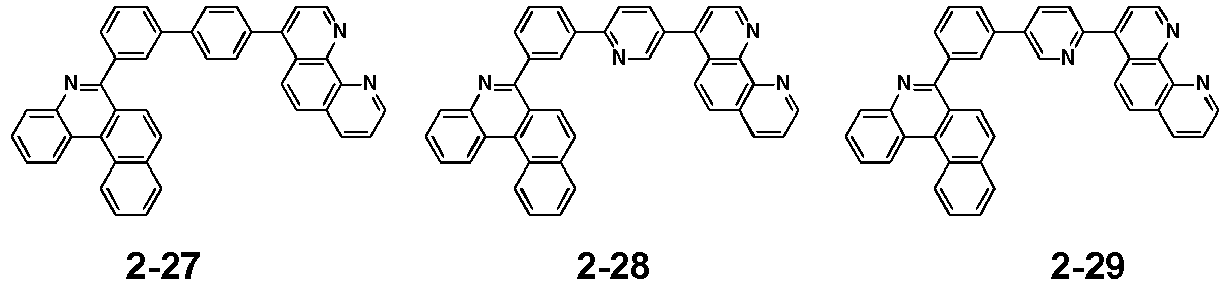
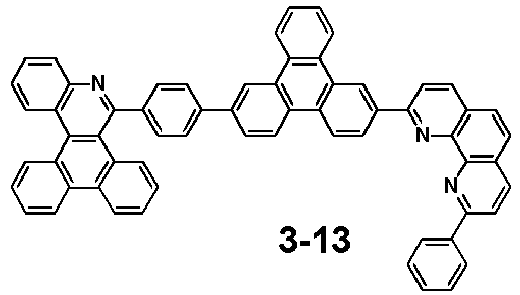
- According to one embodiment of the present application, the hetero-cyclic compound may be represented by any one of the following compounds, but is not limited thereto.








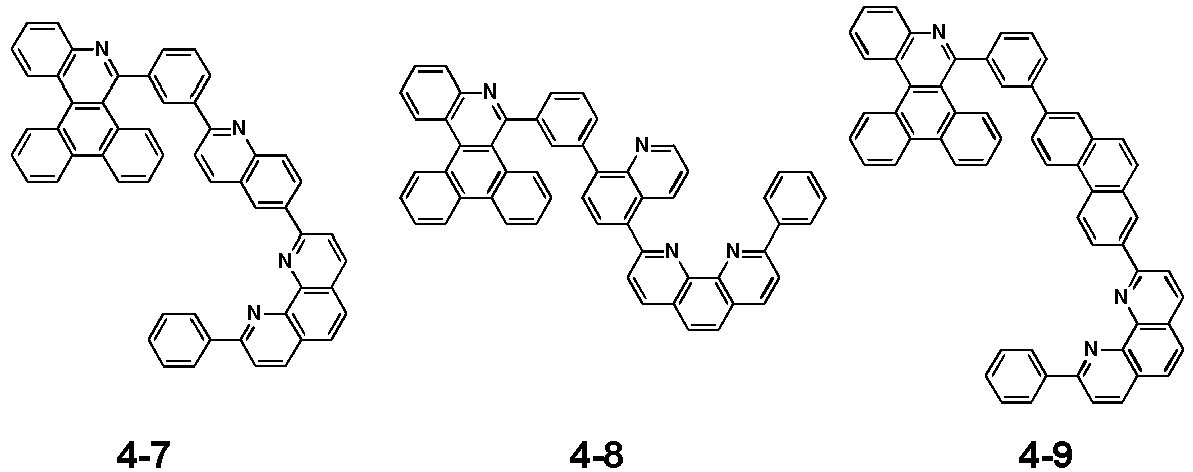





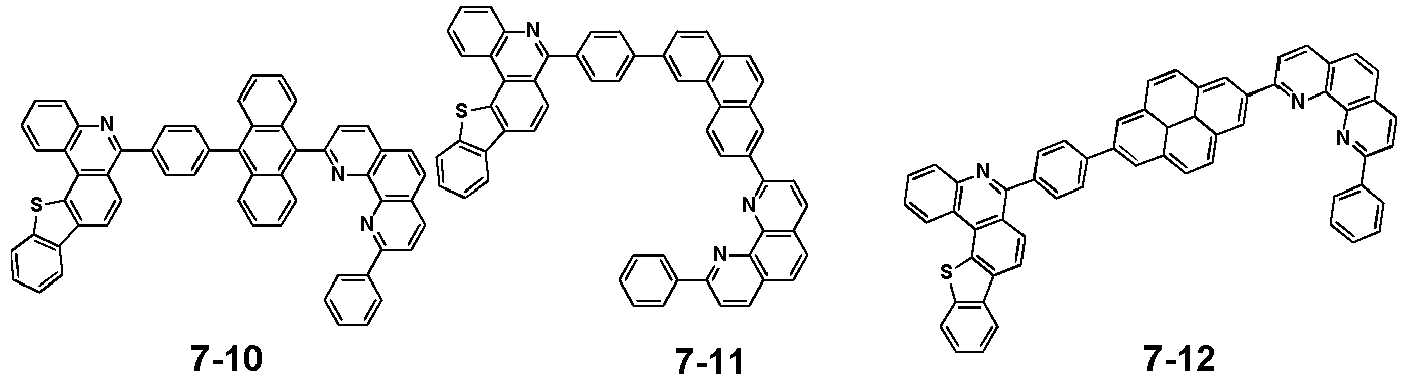


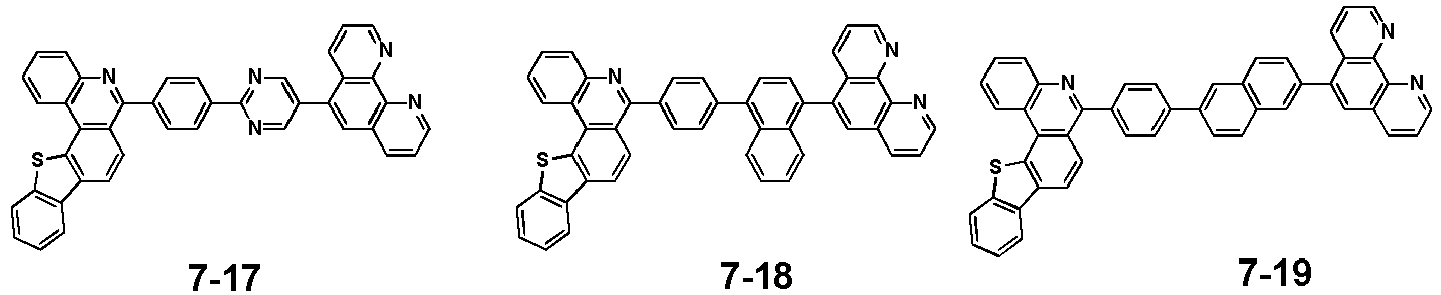


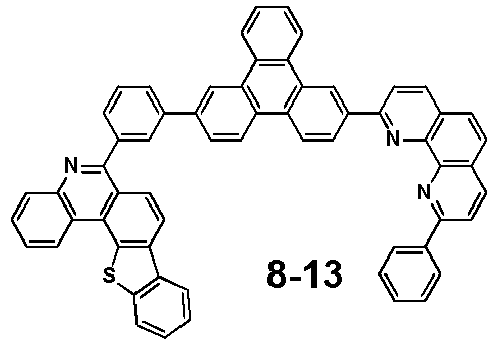


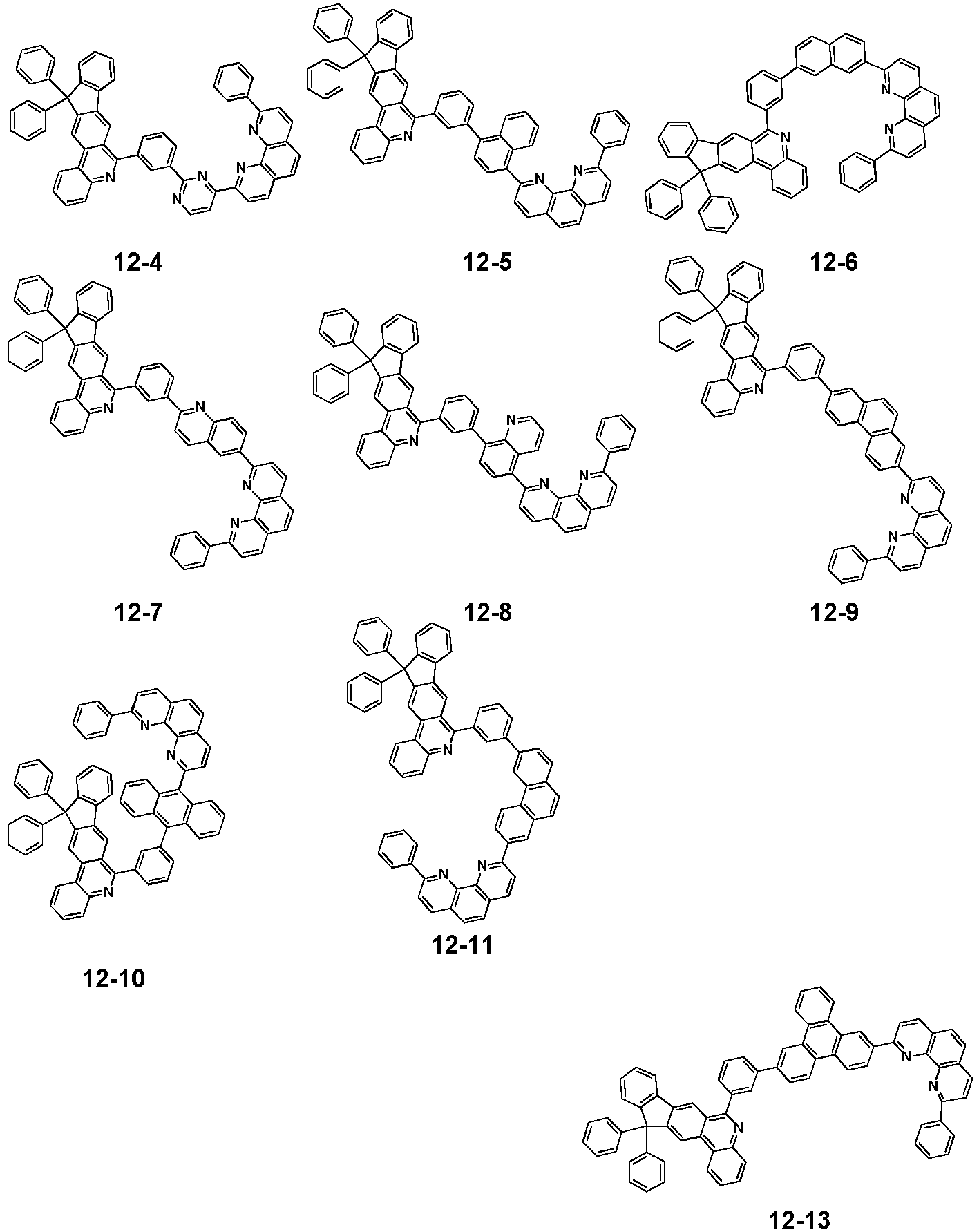


- In addition, by introducing various substituents to the structure of Chemical Formulae 2-6, compounds having unique properties of the introduced substituents may be synthesized. For example, by introducing substituents normally used as a hole injection layer material, a hole transfer layer material, a light emitting layer material, an electron transfer layer material and a charge generation layer material used for manufacturing an organic light emitting device to the core structure, materials satisfying conditions required for each organic material layer may be synthesized.
- In addition, by introducing various substituents to the structure of Chemical Formulae 2-6, the energy band gap may be finely controlled, and meanwhile, properties at interfaces between organic materials are enhanced, and material applications may become diverse.
- Meanwhile, the hetero-cyclic compound has excellent thermal stability with a high glass transition temperature (Tg). Such an increase in the thermal stability becomes an important factor in providing driving stability to a device.
- The hetero-cyclic compound may be prepared through a multistep chemical reaction. Some intermediate compounds are prepared first, and the compound of Chemical Formulae 2-6 1 may be prepared from the intermediate compounds. More specifically, the hetero-cyclic compound may be prepared based on preparation examples to be described below.
- The organic light emitting device according to one embodiment of the present application may be manufactured using common organic light emitting device manufacturing methods and materials except that one or more organic material layers are formed using the hetero-cyclic compound described above.
- The hetero-cyclic compound may be formed into an organic material layer through a solution coating method as well as a vacuum deposition method when manufacturing the organic light emitting device. Herein, the solution coating method means spin coating, dip coating, inkjet printing, screen printing, a spray method, or roll coating, but is not limited thereto.
- Specifically, the organic light emitting device according to one embodiment of the present application comprises an anode, a cathode, and one or more organic material layers provided between the anode and the cathode, wherein one or more layers of the organic material layers comprise the hetero-cyclic compound represented by Chemical Formula 1.
-
FIGs. 1 to 3 illustrate a lamination order of electrodes and organic material layers of an organic light emitting device according to one embodiment of the present application. However, the scope of the present application is not limited to these diagrams, and structures of organic light emitting devices known in the art may also be used in the present application. -
FIG. 1 illustrates an organic light emitting device in which an anode (200), an organic material layer (300) and a cathode (400) are consecutively laminated on a substrate (100). However, the structure is not limited to such a structure, and as illustrated inFIG. 2 , an organic light emitting device in which a cathode, an organic material layer and an anode are consecutively laminated on a substrate may also be obtained. -
FIG. 3 illustrates a case of the organic material layer being a multilayer. The organic light emitting device according toFIG. 3 comprises a hole injection layer (301), a hole transfer layer (302), a light emitting layer (303), a hole blocking layer (304), an electron transfer layer (305) and an electron injection layer (306). However, the scope of the present application is not limited to such a lamination structure, and as necessary, other layers except the light emitting layer may not be included, and other necessary functional layers may be further included. - In addition, the organic light emitting device according to one embodiment of the present application comprises an anode, a cathode, and two or more stacks provided between the anode and the cathode, wherein the two or more stacks each independently comprise a light emitting layer, a charge generation layer is included between the two or more stacks, and the charge generation layer includes the hetero-cyclic compound represented by Chemical Formulae 2-6.
- In addition, the organic light emitting device according to one embodiment of the present application comprises an anode, a first stack provided on the anode and comprising a first light emitting layer, a charge generation layer provided on the first stack, a second stack provided on the charge generation layer and comprising a second light emitting layer, and a cathode provided on the second stack. Herein, the charge generation layer may comprise the hetero-cyclic compound represented by any one of Chemical Formulae 2-6. In addition, the first stack and the second stack may each independently further comprise one or more types of the hole injection layer, the hole transfer layer, the hole blocking layer, the electron transfer layer, the electron injection layer described above.
- The charge generation layer may be an N-type charge generation layer, and the charge generation layer may further comprise a dopant known in the art in addition to the hetero-cyclic compound represented by any one of Chemical Formulae 2-6.
- As the organic light emitting device according to one embodiment of the present application, an organic light emitting device having a 2-stack tandem structure is schematically illustrated in
FIG. 4 . - Herein, the first electron blocking layer, the first bole blocking layer, and the second hole blocking layer described in
FIG. 4 may not be included in some cases. - The organic light emitting device according to the present specification may be manufactured using materials and methods known in the art except that one or more layers of the organic material layers comprise the hetero-cyclic compound represented by any one of Chemical Formulae 2-6.
- The hetero-cyclic compound represented by Chemical Formulae 2-6may form one or more layers of the organic material layers of the organic light emitting device alone. However, as necessary, the hetero-cyclic compound represented by Chemical Formulae 2-6 may be mixed with other materials to form the organic material layers.
- The hetero-cyclic compound represented by Chemical Formulae 2-6 may be used as a material of the charge generation layer in the organic light emitting device.
- The hetero-cyclic compound represented by Chemical Formulae 2-6 may be used as a material of the electron transfer layer, the hole blocking layer, or the light emitting layer in the organic light emitting device. As one example, the hetero-cyclic compound represented by Chemical Formulae 2-6 may be used as a material of the electron transfer layer, the hole transfer layer or the light emitting layer in the organic light emitting device.
- In addition, the hetero-cyclic compound represented by Chemical Formulae 2-6 may be used as a material of the light emitting layer in the organic light emitting device. As one example, the hetero-cyclic compound represented by Chemical Formulae 2-6 may be used as a phosphorescent host material of the light emitting layer in the organic light emitting device.
- In the organic light emitting device according to one embodiment of the present application, materials other than the hetero-cyclic compound of Chemical Formulae 2-6 are illustrated below, however, these are for illustrative purposes only and not for limiting the scope of the present application, and may be replaced by materials known in the art.
- As the anode material, materials having relatively large work function may be used, and transparent conductive oxides, metals, or conductive polymers may be used. Specific examples of the anode material comprise metals such as vanadium, chromium, copper, zinc and gold, or alloys thereof; metal oxides such as zinc oxide, indium oxide, indium tin oxide (ITO) and indium zinc oxide (IZO); combinations of metals and oxides such as ZnO:Al or SnO2:Sb; conductive polymers such as poly(3-methylthiophene), poly[3,4-(ethylene-1,2-dioxy)thiophene] (PEDOT), polypyrrole and polyaniline, but are not limited thereto.
- As the cathode material, materials having relatively small work function may be used, and metals, metal oxides, or conductive polymers may be used. Specific examples of the cathode material comprise metals such as magnesium, calcium, sodium, potassium, titanium, indium, yttrium, lithium, gadolinium, aluminum, silver, tin and lead, or alloys thereof;and multilayer structure materials such as LiF/Al or LiO2/Al, but are not limited thereto.
- As the hole injection material, known hole injection materials may be used, and for example, phthalocyanine compounds such as copper phthalocyanine disclosed in
US Patent No. 4,356,429 , or starburst-type amine derivatives such as tris(4-carbazoyl-9-ylphenyl)amine (TCTA), 4,4',4"-tri[phenyl(m-tolyl)amino]triphenylamine (m-MTDATA) or 1,3,5-tris[4-(3-methylphenylphenylamino)phenyl]benzene (m-MTDAPB) described in the literature [Advanced Material, 6, p.677 (1994)], polyaniline/dodecylbenzene sulfonic acid, poly(3,4-ethylenedioxythiophene)/poly(4-styrenesulfonate), polyaniline/camphor sulfonic acid or polyaniline/poly(4-styrene-sulfonate) that are conductive polymers having solubility, and the like, may be used. - As the hole transfer material, pyrazoline derivatives, arylamine-based derivatives, stilbene derivatives, or triphenyldiamine derivatives may be used, and low molecular or high molecular materials may also be used.
- As the electron transfer material, metal complexes of oxadiazole derivatives, anthraquinodimethane and derivatives thereof, benzoquinone and derivatives thereof, naphthoquinone and derivatives thereof, anthraquinone and derivatives thereof, tetracyanoanthraquinodimethane and derivatives thereof, fluorenone derivatives, diphenyldicyanoethylene and derivatives thereof, diphenoquinone derivatives, 8-hydroxyquinoline and derivatives thereof, may be used, and high molecular materials may also be used as well as low molecular materials.
- As examples of the electron injection material, LiF is typically used in the art, however, the present application is not limited thereto.
- As the light emitting material, red, green or blue light emitting materials may be used, and as necessary, two or more light emitting materials may be mixed and used. In addition, fluorescent materials may also be used as the light emitting material, however, phosphorescent materials may also be used. As the light emitting material, materials emitting light by bonding electrons and holes injected from an anode and a cathode, respectively, may be used alone, however, materials having a host material and a dopant material involved in light emission together may also be used.
- The organic light emitting device according to one embodiment of the present application may be a top-emission type, a bottom-emission type or a dual-emission type depending on the materials used.
- The hetero-cyclic compound may also be used in an organic electronic device comprising an organic solar cell, an organic photo conductor, or an organic transistor under a similar principle used in the organic light emitting device.
- Hereinafter, the present specification will be described in more detail with reference to examples, however, these are for illustrative purposes only, and the scope of the present application is not limited thereto.
-

- To a flask, 2-bromoaniline (80.0 g, 0.465 mol, 1 eq.) and Tol/EtOH/H2O=5:1:1 (1600, 320, 320) were introduced, and then 1-naphthylboronic acid (95.98 g, 0.558 mol, 1.2 eq.), Pd(PPh3)4 (26.87 g, 0.0233 mol, 0.05 eq.) and K2CO3 (192.82 g, 1.39 mol, 3 eq.) were introduced thereto. The result was stirred for 18 hours at 90°C. When the reaction was completed, the temperature was lowered to room temperature, then H2O and EA were introduced thereto, and the result was stirred. The produced yellow solids were filtered and removed. The mixture was extracted with ethyl acetate (EA), moisture in the organic layer was removed using Na2SO4, the result was filtered, and the solvent was concentrated. Solid Compound A-1 was obtained (84.0 g, 82%).
- To a flask, 2-(naphthalen-1-yl)aniline (83.62 g, 0.381 mol, 1 eq.) and then tetrahydrofuran (THF, 1672 mL) were introduced. After that, TEA (158.6 ml, 1.71 mol, 3 eq.), and 4-bromobenzoyl chloride (125.5 g, 0.572 mol) dissolved in THF (50 ml) were added thereto at 0°C, and the result was stirred for 2 hours at room temperature. After the reaction was completed, EA and H2O were layer separated, and the organic layer was washed several times with H2O. Moisture in the organic layer was removed using Na2SO4, the result was filtered, and the solvent was concentrated. After adding methylene chloride (MC, 100 ml) to the (brown oil) concentrated residue, the result was filtered to remove white solids, and then concentrated. Compound A-2 was obtained (162.0 g, 99%).
- To a flask, 4-bromo-N-(2-(naphthalen-1-yl)phenyl)benzamide (151.9 g, 0.507 mol, 1 eq.) and then nitrobenzene (1519 mL) were introduced, and POCl3 (28.64 ml, 0.234 mol, 0.5 eq.) was introduced thereto. After that, the result was stirred for 18 hours at 150°C. After removing the nitrobenzene using a rotary evaporator, the organic layer dissolved in MC was neutralized by washing several times with a saturated NaHCO3 solution, then dried using MgSO4 and concentrated. EA was added to the concentrated residue for precipitation. After adding a small amount of EA thereto, the result was stirred for 1 hour at room temperature and then filtered (removing side spot). After that, hexane was added thereto, the result was stirred for 1 hour, filtered (removing residual nitrobenzene), and then dried. Solid Compound A-3 was obtained (82.5 g, 61%).
- After dissolving A-3 (50.0 g, 130.0 mmol, 1 eq.) in DMF, bis(pinacolato)diborone (40.0 g, 156.0 mmol, 1.2 eq.), Pd(dppf)2Cl2 (5.3 g, 6.5 mmol, 0.05 eq.) and KOAc (38.0 g, 390.0 mmol, 3 eq.) were added thereto at room temperature, and the result was stirred for 18 hours at 80°C. After the reaction was completed, the layers were separated with purified water and ethyl acetate. The organic solvent layer was washed several times with purified water and brine, dehydrated and then vacuum dried. After dissolving the residue with dichloromethane, florosil was added thereto, and the result was stirred for 30 minutes. The result was passed through silica gel/celite. Solid Compound A-4 was obtained (55.0 g, 98%).
- After dissolving A-4 (10.0 g, 23.18 mmol, 1 eq.) in dioxane/H2O (5:1), 2-(4-bromophenyl)-9-phenyl-1,10-phenanthroline (9.2 g, 23.18 mmol, 1 eq.), Pd(PPh3)4 (1.34 g, 1.159 mmol, 0.05 eq.) and K3PO4 (14.76 g, 69.54 mmol, 3 eq.) were added thereto, and the result was stirred for 3 hours at 80°C. After adding purified water and ethyl acetate thereto, the result was solidified, stirred for 1 hour, and then filtered. The filtered solids were heated with ethyl acetate, toluene and MeOH, and stirred. Solid Compound 1-1 was obtained (12.97 g, 77%).
-

- After dissolving A-4 (10.0 g, 23.18 mmol, 1 eq.) in dioxane/H2O (5:1), 2-(6-bromonaphthalen-2-yl)-9-phenyl-1,10-phenanthroline (10.69 g, 23.18 mmol, 1 eq.), Pd(PPh3)4 (1.34 g, 1.159 mmol, 0.05 eq.) and K3PO4 (14.76 g, 69.54 mmol, 3 eq.) were added thereto, and the result was stirred for 3 hours at 80°C. After adding purified water and ethyl acetate thereto, the result was solidified, stirred for 1 hour, and then filtered. The filtered solids were heated with ethyl acetate, toluene and MeOH, and stirred. Solid Compound 1-6 was obtained (8.62 g, 61%).
-
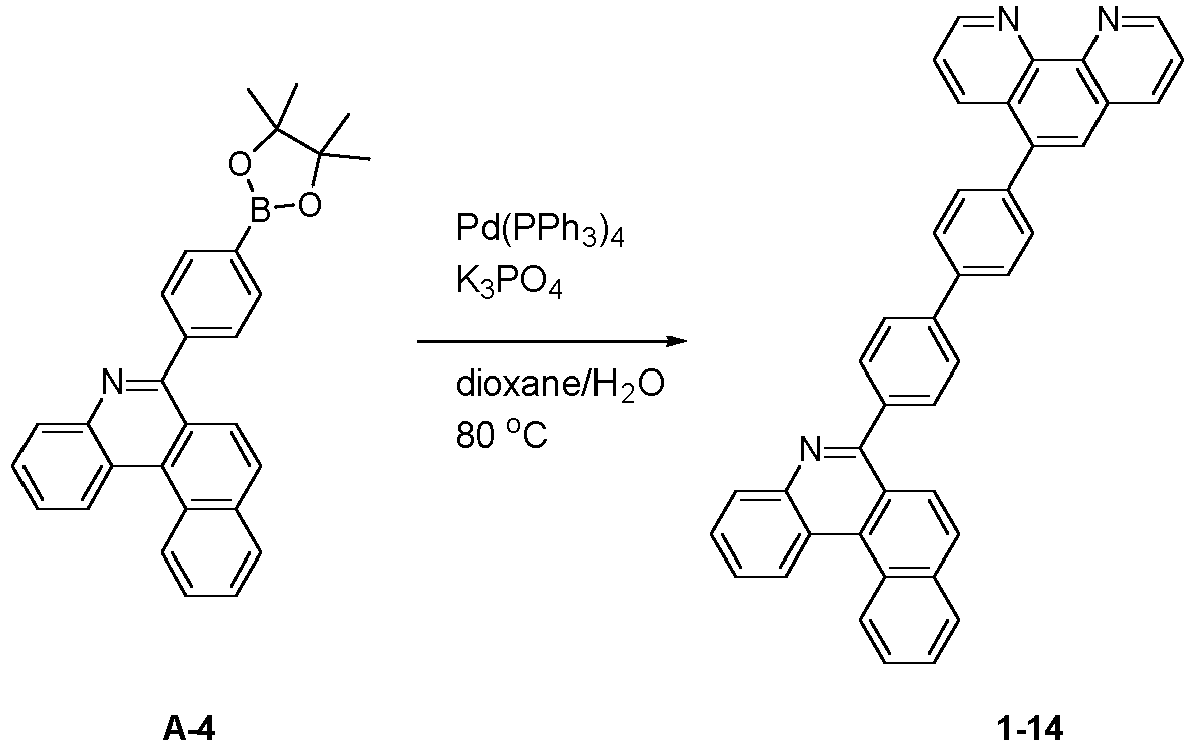
- After dissolving A-4 (10.0 g, 23.18 mmol, 1 eq.) in dioxane/H2O (5:1), 5-(4-bromophenyl)-1,10-phenanthroline (7.77 g, 23.18 mmol, 1 eq.), Pd(PPh3)4 (1.34 g, 1.159 mmol, 0.05 eq.) and K3PO4 (14.76 g, 69.54 mmol, 3 eq.) were added thereto, and the result was stirred for 3 hours at 80°C. After adding purified water and ethyl acetate thereto, the result was solidified, stirred for 1 hour, and then filtered. The filtered solids were heated with ethyl acetate, toluene and MeOH, and stirred. Solid Compound 1-14 was obtained (13.64 g, 81%).
-

- After dissolving A-4 (10.0 g, 23.18 mmol, 1 eq.) in dioxane/H2O (5:1), 5-(7-bromotriphenylen-2-yl)-1,10-phenanthroline (13 g, 23.18 mmol, 1 eq.), Pd(PPh3)4 (1.34 g, 1.159 mmol, 0.05 eq.) and K3PO4 (14.76 g, 69.54 mmol, 3 eq.) were added thereto, and the result was stirred for 3 hours at 80°C. After adding purified water and ethyl acetate thereto, the result was solidified, stirred for 1 hour, and then filtered. The filtered solids were heated with ethyl acetate, toluene and MeOH, and stirred. Solid Compound 1-26 was obtained (16.46 g, 70%).
-

- After dissolving A-4 (10.0 g, 1 eq.) in dioxane/H2O (5:1), 4-(4-bromophenyl)-1,10-phenanthroline (7.7 g, 1 eq.), Pd(PPh3)4 (1.34 g, 1.159 mmol, 0.05 eq.) and K3PO4 (14.76 g, 69.54 mmol, 3 eq.) were added thereto, and the result was stirred for 3 hours at 80°C. After adding purified water and ethyl acetate thereto, the result was solidified, stirred for 1 hour, and then filtered. The filtered solids were heated with ethyl acetate, toluene and MeOH, and stirred. Solid Compound 1-27 was obtained (10.27 g, 61%).
-

- To a flask, 2-bromoaniline (80.0 g, 0.465 mol, 1 eq.) and Tol/EtOH/H2O=5:1:1 (1600, 320, 320) were introduced, and then 1-naphthylboronic acid (95.98 g, 0.558 mol, 1.2 eq.), Pd(PPh3)4 (26.87 g, 0.0233 mol, 0.05 eq.) and K2CO3 (192.82 g, 1.39 mol, 3 eq.) were introduced thereto. The result was stirred for 18 hours at 90°C. When the reaction was completed, the temperature was lowered to room temperature, then H2O and EA were introduced thereto, and the result was stirred. The produced yellow solids were filtered and removed. The mixture was extracted with ethyl acetate (EA), moisture in the organic layer was removed using Na2SO4, the result was filtered, and the solvent was concentrated. Solid Compound A-1 was obtained (84.0 g, 82%).
- To a flask, 2-(naphthalen-1-yl)aniline (83.62 g, 0.381 mol, 1 eq.) and then THF (1672 mL) were introduced. After that, TEA (158.6 ml, 1.71 mol, 3 eq.), and 3-bromobenzoyl chloride (125.5 g, 0.572 mol) dissolved in THF (50 ml) were added thereto at 0°C, and the result was stirred for 2 hours at room temperature. After the reaction was completed, layers were separated with EA and H2O, and the organic layer was washed several times with H2O. Moisture in the organic layer was removed using Na2SO4, the result was filtered, and the solvent was concentrated. After adding MC (100 ml) to the (brown oil) concentrated residue, the result was filtered to remove white solids, and then concentrated. Solid Compound B-2 was obtained (162.0 g, 99%).
- To a flask, 3-bromo-N-(2-(naphthalen-1-yl)phenyl)benzamide (151.9 g, 0.507 mol, 1 eq.) and then nitrobenzene (1519 mL) were introduced, and POCl3 (28.64 ml, 0.234 mol, 0.5 eq.) was introduced thereto. After that, the result was stirred for 18 hours at 150°C. After removing the nitrobenzene using a rotary evaporator, the organic layer dissolved in MC was neutralized by washing several times with a saturated NaHCO3 solution, then dried using MgSO4 and concentrated. EA was added to the concentrated residue for precipitation. After adding a small amount of EA thereto, the result was stirred for 1 hour at room temperature and then filtered (removing side spot). After that, hexane was added thereto, the result was stirred for 1 hour, filtered (removing residual nitrobenzene), and then dried. Solid Compound B-3 was obtained (104.1 g, 77%).
- After dissolving B-3 (50.0 g, 130.0 mmol, 1 eq.) in DMF, bis(pinacolato)diborone (40.0 g, 156.0 mmol, 1.2 eq.), Pd(dppf)2Cl2 (5.3 g, 6.5 mmol, 0.05 eq.) and KOAc (38.0 g, 390.0 mmol, 3 eq.) were added thereto at room temperature, and the result was stirred for 18 hours at 80°C. After the reaction was completed, the layers were separated with purified water and ethyl acetate. The organic solvent layer was washed several times with purified water and brine, dehydrated and then vacuum dried. After dissolving the residue with dichloromethane, florosil was added thereto, and the result was stirred for 30 minutes. The result was passed through silica gel/celite. Solid Compound B-4 was obtained (53.9 g, 96%).
- After dissolving B-4 (10.0 g, 23.18 mmol, 1 eq.) in dioxane/H2O (5:1), 2-(4-bromophenyl)-9-phenyl-1,10-phenanthroline (9.2 g, 23.18 mmol, 1 eq.), Pd(PPh3)4 (1.34 g, 1.159 mmol, 0.05 eq.) and K3PO4 (14.76 g, 69.54 mmol, 3 eq.) were added thereto, and the result was stirred for 3 hours at 80°C. After adding purified water and ethyl acetate thereto, the result was solidified, stirred for 1 hour, and then filtered. The filtered solids were heated with ethyl acetate, toluene and MeOH, and stirred. Solid Compound 2-1 was obtained (10.61 g, 63%).
-

- After dissolving B-4 (10.0 g, 23.18 mmol, 1 eq.) in dioxane/H2O (5:1), 5-(4-bromophenyl)-1,10-phenanthroline (7.77 g, 23.18 mmol, 1 eq.), Pd(PPh3)4 (1.34 g, 1.159 mmol, 0.05 eq.) and K3PO4 (14.76 g, 69.54 mmol, 3 eq.) were added thereto, and the result was stirred for 3 hours at 80°C. After adding purified water and ethyl acetate thereto, the result was solidified, stirred for 1 hour, and then filtered. The filtered solids were heated with ethyl acetate, toluene and MeOH, and stirred. Solid Compound 2-14 was obtained (14.82 g, 88%).
-
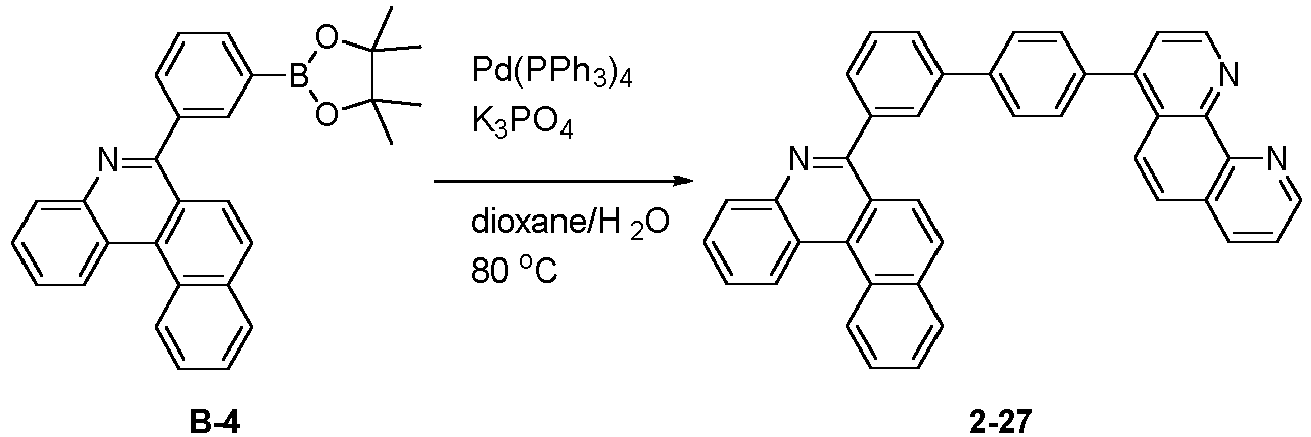
- After dissolving B-4 (10.0 g, 23.18 mmol, 1 eq.) in dioxane/H2O (5:1), 4-(4-bromophenyl)-1,10-phenanthroline (7.77 g, 23.18 mmol, 1 eq.), Pd(PPh3)4 (1.34 g, 1.159 mmol, 0.05 eq.) and K3PO4 (14.76 g, 69.54 mmol, 3 eq.) were added thereto, and the result was stirred for 3 hours at 80°C. After adding purified water and ethyl acetate thereto, the result was solidified, stirred for 1 hour, and then filtered. The filtered solids were heated with ethyl acetate, toluene and MeOH, and stirred. Solid Compound 2-27 was obtained (11.78 g, 70%).
-

- To a 3000 mL 2-neck round bottomed flask, 2-bromoaniline (55.0 g, 0.3197 mol, 1 eq.) and phenanthren-9-yl boronic acid (106.5 g, 0.479 mol, 1.5 eq.) were introduced, and dissolved in 1,4-dioxane (1000 ml). To the round bottomed flask, Pd(PPh3)4 (18.5 g, 0.016 mol, 0.05 eq.) and K3PO4 (203.6 g, 0.9591 mol, 3.0 eq.) were introduced. To the flask of 2), H2O (200 ml) was slowly introduced, and the result was stirred for 2 hours under reflux. After cooling the mixed solution to room temperature, the organic layer was extracted with MC. The result was column purified using a mixed solvent of MC:hexane=1:2 to obtain white solid Compound C-1 (63 g, 73%).
- White solid Compound C-2 was obtained (85 g, 99%) in the same synthesis manner as A-2.
- White solid Compound C-3 was obtained (71 g, 87%) in the same synthesis manner as A-3.
- White solid Compound C-4 was obtained (66 g, 99%) in the same synthesis manner as A-4.
-

- After dissolving C-4 (10.0 g, 20.77 mmol, 1 eq.) in dioxane/H2O (5:1), 2-(4-bromophenyl)-9-phenyl-1,10-phenanthroline (8.5 g, 20.77 mmol, 1 eq.), Pd(PPh3)4 (1.2 g, 1.039 mmol, 0.05 eq.) and K3PO4 (13.2 g, 62.31 mmol, 3 eq.) were added thereto, and the result was stirred for 3 hours at 80°C. After adding purified water and ethyl acetate thereto, the result was solidified, stirred for 1 hour, and then filtered. The filtered solids were heated with ethyl acetate, toluene and MeOH, and stirred. Solid Compound 3-1 was obtained (10.13 g, 80%).
-

- After dissolving C-4 (10.0 g, 20.77 mmol, 1 eq.) in dioxane/H2O (5:1), 2-(10-bromoanthracen-9-yl)-9-phenyl-1,10-phenanthroline (10.6 g, 20.77 mmol, 1 eq.), Pd(PPh3)4 (1.2 g, 1.039 mmol, 0.05 eq.) and K3PO4 (13.2 g, 62.31 mmol, 3 eq.) were added thereto, and the result was stirred for 3 hours at 80°C. After adding purified water and ethyl acetate thereto, the result was solidified, stirred for 1 hour, and then filtered. The filtered solids were heated with ethyl acetate, toluene and MeOH, and stirred. Solid Compound 3-10 was obtained (9.14 g, 62%).
-

- After dissolving C-4 (10.0 g, 20.77 mmol, 1 eq.) in dioxane/H2O (5:1), 5-(4-bromophenyl)-1,10-phenanthroline (6.96 g, 20.77 mmol, 1 eq.), Pd(PPh3)4 (1.2 g, 1.039 mmol, 0.05 eq.) and K3PO4 (13.2 g, 62.31 mmol, 3 eq.) were added thereto, and the result was stirred for 3 hours at 80°C. After adding purified water and ethyl acetate thereto, the result was solidified, stirred for 1 hour, and then filtered. The filtered solids were heated with ethyl acetate, toluene and MeOH, and stirred. Solid Compound 3-14 was obtained (7.34 g, 58%).
-

- After dissolving C-4 (10.0 g, 20.77 mmol, 1 eq.) in dioxane/H2O (5:1), 4-(4-bromophenyl)-1,10-phenanthroline (6.96 g, 20.77 mmol, 1 eq.), Pd(PPh3)4 (1.2 g, 1.039 mmol, 0.05 eq.) and K3PO4 (13.2 g, 62.31 mmol, 3 eq.) were added thereto, and the result was stirred for 3 hours at 80°C. After adding purified water and ethyl acetate thereto, the result was solidified, stirred for 1 hour, and then filtered. The filtered solids were heated with ethyl acetate, toluene and MeOH, and stirred. Solid Compound 3-27 was obtained (88.6 g, 70%).
-

- White solid Compound D-2 was obtained (85 g, 99%) in the same synthesis manner as A-2.
- White solid Compound D-3 was obtained (71 g, 87%) in the same synthesis manner as A-3.
- White solid Compound D-4 was obtained (66 g, 99%) in the same synthesis manner as A-4.
-

- After dissolving D-4 (10.0 g, 20.77 mmol, 1 eq.) in dioxane/H2O (5:1), 2-(4-bromophenyl)-9-phenyl-1,10-phenanthroline (8.5 g, 20.77 mmol, 1 eq.), Pd(PPh3)4 (1.2 g, 1.039 mmol, 0.05 eq.) and K3PO4 (13.2 g, 62.31 mmol, 3 eq.) were added thereto, and the result was stirred for 3 hours at 80°C. After adding purified water and ethyl acetate thereto, the result was solidified, stirred for 1 hour, and then filtered. The filtered solids were heated with ethyl acetate, toluene and MeOH, and stirred. Solid Compound 4-1 was obtained (11.1 g, 88%).
-

- After dissolving D-4 (10.0 g, 20.77 mmol, 1 eq.) in dioxane/H2O (5:1), 2-(4-bromophenyl)-9-phenyl-1,10-phenanthroline (8.5 g, 20.77 mmol, 1 eq.), Pd(PPh3)4 (1.2 g, 1.039 mmol, 0.05 eq.) and K3PO4 (13.2 g, 62.31 mmol, 3 eq.) were added thereto, and the result was stirred for 3 hours at 80°C. After adding purified water and ethyl acetate thereto, the result was solidified, stirred for 1 hour, and then filtered. The filtered solids were heated with ethyl acetate, toluene and MeOH, and stirred. Solid Compound 4-5 was obtained (10.96 g, 80%).
-

- After dissolving D-4 (10.0 g, 20.77 mmol, 1 eq.) in dioxane/H2O (5:1), 5-(2-bromopyrimidin-5-yl)-1,10-phenanthroline (7 g, 20.77 mmol, 1 eq.), Pd(PPh3)4 (1.2 g, 1.039 mmol, 0.05 eq.) and K3PO4 (13.2 g, 62.31 mmol, 3 eq.) were added thereto, and the result was stirred for 7 hours at 80°C. After adding purified water and ethyl acetate thereto, the result was solidified, stirred for 1 hour, and then filtered. The filtered solids were heated with ethyl acetate, toluene and MeOH, and stirred. Solid Compound 4-17 was obtained (6.99 g, 55%).
-
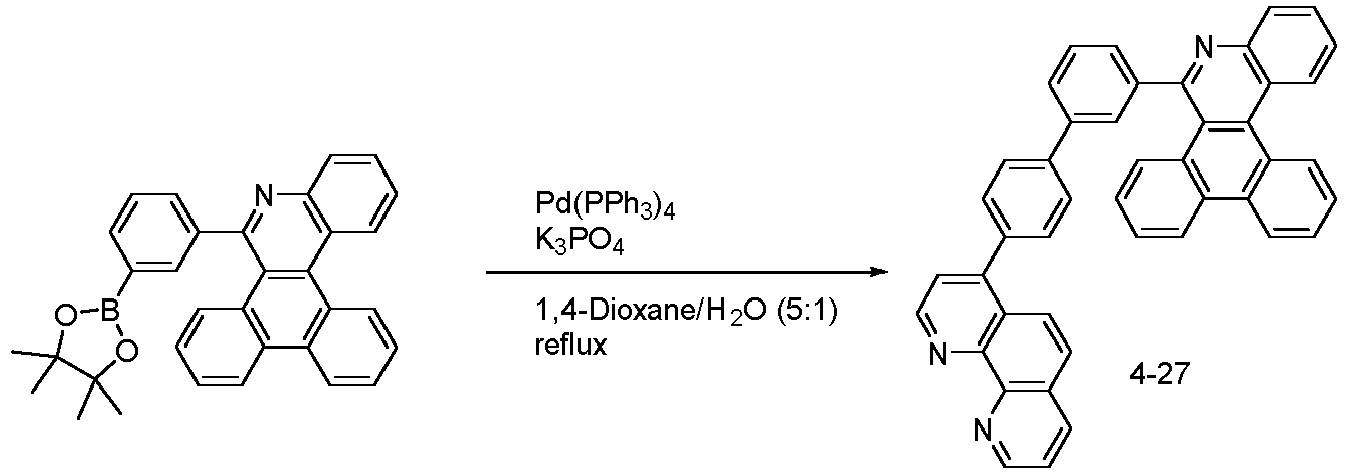
- After dissolving D-4 (10.0 g, 20.77 mmol, 1 eq.) in dioxane/H2O (5:1), 2-(4-bromophenyl)-1,10-phenanthroline (6.96 g, 20.77 mmol, 1 eq.), Pd(PPh3)4 (1.2 g, 1.039 mmol, 0.05 eq.) and K3PO4 13.2 g, 62.31 mmol, 3 eq.) were added thereto, and the result was stirred for 3 hours at 80°C. After adding purified water and ethyl acetate thereto, the result was solidified, stirred for 1 hour, and then filtered. The filtered solids were heated with ethyl acetate, toluene and MeOH, and stirred. Solid Compound 4-27 was obtained (8.83 g, 77.7%).
-

- To two 5000 ml 3-neck round bottomed flasks, SM1 (160 g, 0.53 mol, 1 eq.) and SM2 (77.5 g, 0.635 mol, 1.2 eq.) were introduced each in half. 1,4-Dioxane was introduced thereto in 1600 ml each, and the results were stirred. To the round bottomed flasks, Pd(PPh3)4 (30.6 g, 0.026 mol, 0.05 eq.) and K3PO4 (337 g, 1.59 mol, 3.0 eq.) were introduced dividing in half. To the round bottomed flask, H2O (400 ml) was slowly introduced, and the result was stirred for 3 hours under reflux. The mixed solution was cooled to room temperature, and then extracted with MC/H2O (separated into black organic layer+red water layer). The organic layer was concentrated and then filtered using methanol. The result was all dissolved in toluene, then passed through silica gel, and the filtrate was separated and then concentrated. Solid Compound E-1 was obtained (92.4 g, 58.4%).
- To a 3000 ml 2-neck round bottomed flask, E-1 Compound (92.4 g, 0.31 mol, 1.0 eq.) was introduced, and dissolved by introducing acetic acid (460 ml) and ethanol (1800 ml) thereto. Iron powder (86 g, 1.54 mol, 5.0 eq.) was slowly added thereto, and the result was stirred for 12 hours under reflux. Attention needed to be given so that the stirring bar was not hardened. After cooling the solution to room temperature, distilled water was added in excess (approximately 1000 ml). The result was neutralized with NaHCO3 (pH 7 to 8). Black solids floating on the solution was filtered, and the filtrate was concentrated. The concentrate was extracted with MC/H2O, and then washed with brine. After concentrating the organic solvent of the extract, the result was recrystallized with MC/Hex. Solid Compound E-2 was obtained (54 g, 65%).
- After dissolving E-2 product (42.0 g, 0.156 mol, 1 eq.) in THF (300 ml) in a 3000 ml 1-neck round bottomed flask, triethylamine (64 ml, 0.468 mol, 3.0 eq.) was introduced thereto. The round bottomed flask was cooled to 0°C (ice bath), and 4-bromobenzoyl chloride (40.7 g, 0.18 mol, 1.2 eq.) dissolved in THF (200 ml) was slowly added dropwise thereto. After stirring the result for approximately 10 minutes at 0°C, the temperature was slowly raised to room temperature, and the result was stirred for 2 hours. The result was stirred for a few minutes after adding H2O (200 ml) thereto, and the solvent was vacuum distilled. After dissolving the concentrate in MC (minimum amount), EA was added in excess (approximately 1000 ml). Solid Compound E-3 was obtained (80 g, 88%).
- To a 2000 ml 2-neck round bottomed flask, E-3 (80 g, 0.177 mol, 1 eq.) was introduced and dissolved in nitrobenzene (1600 ml). To the round bottomed flask, POCl3 (10 ml, 0.106 mol, 0.6 eq.) was added dropwise at room temperature, and the result was stirred for 1 hour at an external temperature of 160°C. The solvent (nitrobenzene) of the reaction mixture was removed through distillation. After dissolving the concentrate in MC, the result was neutralized with saturated NaHCO3 (pH=8). The result was extracted with MC/H2O, and the organic solvent was concentrated. The result was slurried with EA, and then filtered. Solid Compound E-4 was obtained (85.6 g, 73%).
- Compound E-4 (56.0 g, 0.129 mol, 1.0 eq.), bis(pinacolato) diboron (39.3 g, 0.155 mol, 1.2 eq.), potassium acetate (38 g, 0.387 mol, 3.0 eq.) and PdCl2(dppf) (4.7 g, 0.00645 mol, 0.05 eq.) were introduced to 1,4-dioxane (1000 ml) in a 2000 ml round bottomed flask, and the result was stirred for 1 hour under a reflux condition. After cooling the reaction mixture to room temperature, the solids were filtered while washing the filtration substance with MC. After extracting the filtrate with MC/H2O, the organic layer was dried using MgSO4. After concentrating the organic solvent, the solution dissolved in toluene was passed through silica gel (partially washed with toluene, and washed with MC and MC:EA=9:1 to obtain orange filtrate). After concentrating the filtrate, the result was recrystallized with EA in a small amount and hexane in excess to filter solids. Solid Compound E-5 was obtained (49 g, 79%).
- After dissolving E-5 (10.0 g, 20.77 mmol, 1 eq.) in dioxane/H2O (5:1), 2-(4-bromophenyl)-9-phenyl-1,10-phenanthroline (8.55 g, 20.77 mmol, 1 eq.), Pd(PPh3)4 (1.2 g, 1.039 mmol, 0.05 eq.) and K3PO4 (13.2 g, 62.31 mmol, 3 eq.) were added thereto, and the result was stirred for 3 hours at 80°C. After adding purified water and ethyl acetate thereto, the result was solidified, stirred for 1 hour, and then filtered. The filtered solids were heated with ethyl acetate, toluene and MeOH, and stirred. Solid Compound 5-1 was obtained (8.74 g, 69%).
-
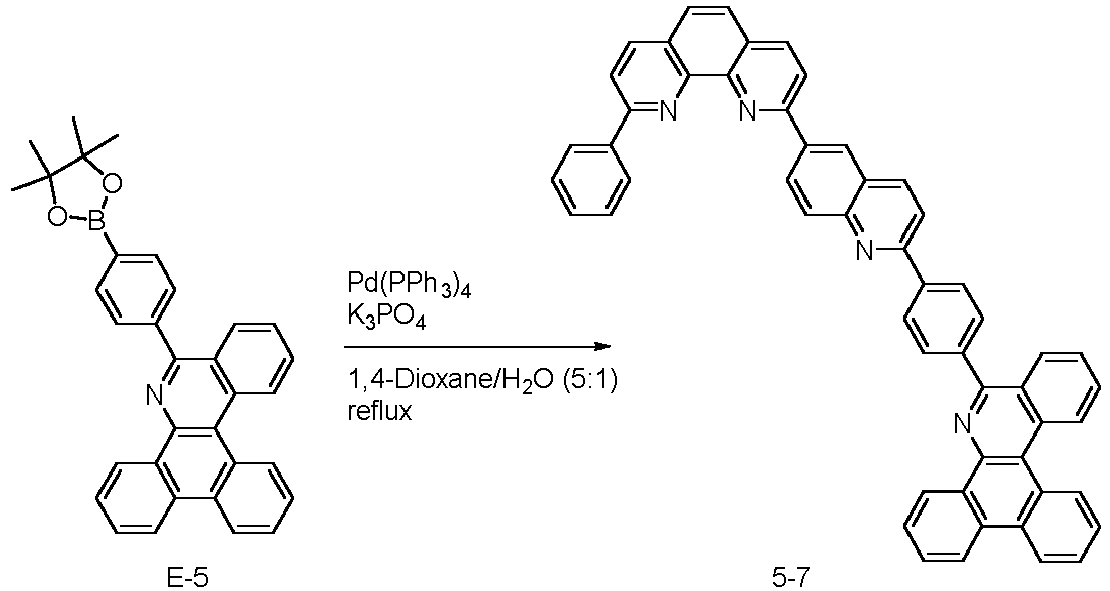
- After dissolving E-5 (10.0 g, 20.77 mmol, 1 eq.) in dioxane/H2O (5:1), 2-(2-bromoquinolin-6-yl)-9-phenyl-1,10-phenanthroline (9.6 g, 20.77 mmol, 1 eq.), Pd(PPh3)4 (1.2 g, 1.039 mmol, 0.05 eq.) and K3PO4 (13.2 g, 62.31 mmol, 3 eq.) were added thereto, and the result was stirred for 3 hours at 80°C. After adding purified water and ethyl acetate thereto, the result was solidified, stirred for 1 hour, and then filtered. The filtered solids were heated with ethyl acetate, toluene and MeOH, and stirred. Solid Compound 5-7 was obtained (11.4 g, 83%).
-

- After dissolving E-5 (10.0 g, 20.77 mmol, 1 eq.) in dioxane/H2O (5:1), 5-(8-bromoquinolin-5-yl)-1,10-phenanthroline (8 g, 20.77 mmol, 1 eq.), Pd(PPh3)4 (1.2 g, 1.039 mmol, 0.05 eq.) and K3PO4 (13.2 g, 62.31 mmol, 3 eq.) were added thereto, and the result was stirred for 3 hours at 80°C. After adding purified water and ethyl acetate thereto, the result was solidified, stirred for 1 hour, and then filtered. The filtered solids were heated with ethyl acetate, toluene and MeOH, and stirred. Solid Compound 5-21 was obtained (7.7 g, 56%).
-

- After dissolving E-5 (10.0 g, 20.77 mmol, 1 eq.) in dioxane/H2O (5:1), 4-(7-bromopyren-1-yl)-1,10-phenanthroline (9.54 g, 20.77 mmol, 1 eq.), Pd(PPh3)4 (1.2 g, 1.039 mmol, 0.05 eq.) and K3PO4 (13.2 g, 62.31 mmol, 3 eq.) were added thereto, and the result was stirred for 3 hours at 80°C. After adding purified water and ethyl acetate thereto, the result was solidified, stirred for 1 hour, and then filtered. The filtered solids were heated with ethyl acetate, toluene and MeOH, and stirred. Solid Compound 5-38 was obtained (10.8 g, 71%).
-

- White solid Compound F-1 was obtained (92.4 g, 58.4%) in the same synthesis manner as E-1.
- White Solid Compound F-2 was obtained (54 g, 65%) in the same synthesis manner as E-2.
- White solid Compound F-3 was obtained (80 g, 88%) in the same synthesis manner as E-3.
- White solid Compound F-4 was obtained (85.6 g, 73%) in the same synthesis manner as E-4.
- White solid Compound F-5 was obtained (49 g, 79%) in the same synthesis manner as E-5.
- After dissolving F-5 (10.0 g, 20.77 mmol, 1 eq.) in dioxane/H2O (5:1), 2-(4-bromophenyl)-9-phenyl-1,10-phenanthroline (8.55 g, 20.77 mmol, 1 eq.), Pd(PPh3)4 (1.2 g, 1.039 mmol, 0.05 eq.) and K3PO4 (13.2 g, 62.31 mmol, 3 eq.) were added thereto, and the result was stirred for 3 hours at 80°C. After adding purified water and ethyl acetate thereto, the result was solidified, stirred for 1 hour, and then filtered. The filtered solids were heated with ethyl acetate, toluene and MeOH, and stirred. Solid Compound 6-1 was obtained (9.74 g, 69%).
-

- After dissolving F-5 (10.0 g, 20.77 mmol, 1 eq.) in dioxane/H2O (5:1), 2-(4-bromonaphthalen-1-yl)-9-phenyl-1,10-phenanthroline (9.57 g, 20.77 mmol, 1 eq.), Pd(PPh3)4 (1.2 g, 1.039 mmol, 0.05 eq.) and K3PO4 (13.2 g, 62.31 mmol, 3 eq.) were added thereto, and the result was stirred for 3 hours at 80°C. After adding purified water and ethyl acetate thereto, the result was solidified, stirred for 1 hour, and then filtered. The filtered solids were heated with ethyl acetate, toluene and MeOH, and stirred. Solid Compound 6-5 was obtained (10.5 g, 69%).
-

- After dissolving F-5 (10.0 g, 20.77 mmol, 1 eq.) in dioxane/H2O (5:1), 2-(10-bromoanthracen-9-yl)-9-phenyl-1,10-phenanthroline (10.6 g, 20.77 mmol, 1 eq.), Pd(PPh3)4 (1.2 g, 1.039 mmol, 0.05 eq.) and K3PO4 (13.2 g, 62.31 mmol, 3 eq.) were added thereto, and the result was stirred for 3 hours at 80°C. After adding purified water and ethyl acetate thereto, the result was solidified, stirred for 1 hour, and then filtered. The filtered solids were heated with ethyl acetate, toluene and MeOH, and stirred. Solid Compound 6-10 was obtained (8.8 g, 54%) .
-

- After dissolving F-5 (10.0 g, 20.77 mmol, 1 eq.) in dioxane/H2O (5:1), 5-(4-bromophenyl)-1,10-phenanthroline (6.9 g, 20.77 mmol, 1 eq.), Pd(PPh3)4 (1.2 g, 1.039 mmol, 0.05 eq.) and K3PO4 (13.2 g, 62.31 mmol, 3 eq.) were added thereto, and the result was stirred for 3 hours at 80°C. After adding purified water and ethyl acetate thereto, the result was solidified, stirred for 1 hour, and then filtered. The filtered solids were heated with ethyl acetate, toluene and MeOH, and stirred. Solid Compound 6-14 was obtained (7.5 g, 60%).
-
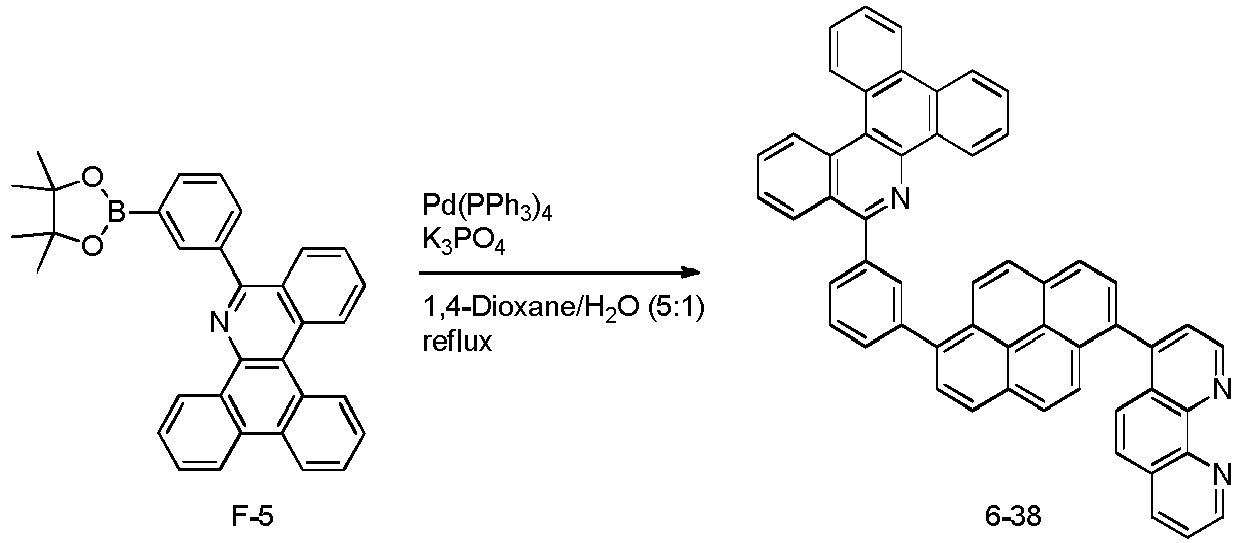
- After dissolving F-5 (10.0 g, 20.77 mmol, 1 eq.) in dioxane/H2O (5:1), 4-(6-bromopyren-1-yl)-1,10-phenanthroline (9.54 g, 20.77 mmol, 1 eq.), Pd(PPh3)4 (1.2 g, 1.039 mmol, 0.05 eq.) and K3PO4 (13.2 g, 62.31 mmol, 3 eq.) were added thereto, and the result was stirred for 3 hours at 80°C. After adding purified water and ethyl acetate thereto, the result was solidified, stirred for 1 hour, and then filtered. The filtered solids were heated with ethyl acetate, toluene and MeOH, and stirred. Solid Compound 6-38 was obtained (10 g, 65%) .
-

- To a 3000 ml 3-neck round bottomed flask, SM1 (100 g, 0.438 mol, 1 eq.) and SM2 (113 g, 0.635 mol, 1.5 eq.) were introduced, and stirred after introducing 1,4-dioxane (1500 ml) thereto. To the round bottomed flask, Pd(PPh3)4 (25.3 g, 0.021 mol, 0.05 eq.) and K3PO4 (280 g, 1.315 mol, 3.0 eq.) were introduced. H2O (200 ml) was slowly added to the round bottomed flask, and the result was stirred for 3 hours under reflux. The mixed solution was cooled to room temperature, and then extracted with EA/H2O. After concentrating the organic layer, the result was silica gel columned (eluent MC:Hex=1:3) for separation, and then concentrated. Liquid Compound G-1 was obtained (76 g, 63.3%).
- After dissolving G-1 product (76 g, 0.276 mol, 1 eq.) in MC (800 ml) in a 2000 ml 1-neck round bottomed flask, triethylamine (41 ml, 0.295 mol, 1.1 eq.) was introduced thereto. The round bottomed flask was cooled to 0°C (ice bath), and 4-bromobenzoyl chloride (38 ml, 0.295 mol, 1.1 eq.) dissolved in MC (150 ml) was slowly added dropwise thereto. After stirring the result for approximately 10 minutes at 0°C, the temperature was slowly raised to room temperature, and the result was stirred for 2 hours. The result was stirred for a few minutes after adding H2O (200 ml) thereto, and the solvent was vacuum distilled and concentrated. Liquid Compound G-2 was obtained (133 g, 100%).
- To a 3000 ml 2-neck round bottomed flask, G-2 (133 g, 0.290 mol, 1 eq.) was introduced and dissolved in nitrobenzene (1300 ml). To the round bottomed flask, POCl3 (31 ml, 0.275 mol, 0.95 eq.) was added dropwise at room temperature, and the result was stirred for 4 hours at an external temperature of 150°C. Saturated NaHCO3 and EA were added in excess to produce yellow solids. After that, only the solids were collected through filtration, and the solids were washed with H2O, MeOH, EA and hexane. Solid Compound G-3 was obtained (93 g, 76%).
- Compound G-3 (93 g, 0.211 mol, 1.0 eq.), bis(pinacolato) diboron (107 g, 0.422 mol, 2 eq.), potassium acetate (62 g, 0.633 mol, 3.0 eq.) and PdCl2(dppf) (7.8 g, 0.0105 mol, 0.05 eq.) were introduced to 1,4-dioxane (1000 ml) in a 2000 ml round bottomed flask, and the result was stirred for 2 hours under a reflux condition. After cooling the reaction mixture to room temperature, the solids were filtered while washing the filtration substance with MC. After concentrating the organic solvent, the solution dissolved in 1,2-dichlorobenzene while hot was passed through silica gel. After concentrating the filtrate, the result was dissolved in MC and filtered using silica gel. Solid Compound G-4 was obtained (82 g, 79%).
- After dissolving G-4 (10.1 g, 2.77 mmol, 1 eq.) in dioxane/H2O (5:1), 2-(4-bromophenyl)-9-phenyl-1,10-phenanthroline (8.55 g, 20.77 mmol, 1 eq.), Pd(PPh3)4 (1.2 g, 1.039 mmol, 0.05 eq.) and K3PO4 (13.2 g, 62.31 mmol, 3 eq.) were added thereto, and the result was stirred for 3 hours at 80°C. After adding purified water and ethyl acetate thereto, the result was solidified, stirred for 1 hour, and then filtered. The filtered solids were heated with ethyl acetate, toluene and MeOH, and stirred. Solid Compound 7-1 was obtained (9.32 g, 65%) .
-

- After dissolving G-4 (10.1 g, 20.77 mmol, 1 eq.) in dioxane/H2O (5:1), 2-(4-bromonaphthalen-1-yl)-9-phenyl-1,10-phenanthroline (9.7 g, 20.77 mmol, 1 eq.), Pd(PPh3)4 (1.2 g, 1.039 mmol, 0.05 eq.) and K3PO4 (13.2 g, 62.31 mmol, 3 eq.) were added thereto, and the result was stirred for 3 hours at 80°C. After adding purified water and ethyl acetate thereto, the result was solidified, stirred for 1 hour, and then filtered. The filtered solids were heated with ethyl acetate, toluene and MeOH, and stirred. Solid Compound 7-5 was obtained (8.9 g, 58%) .
-
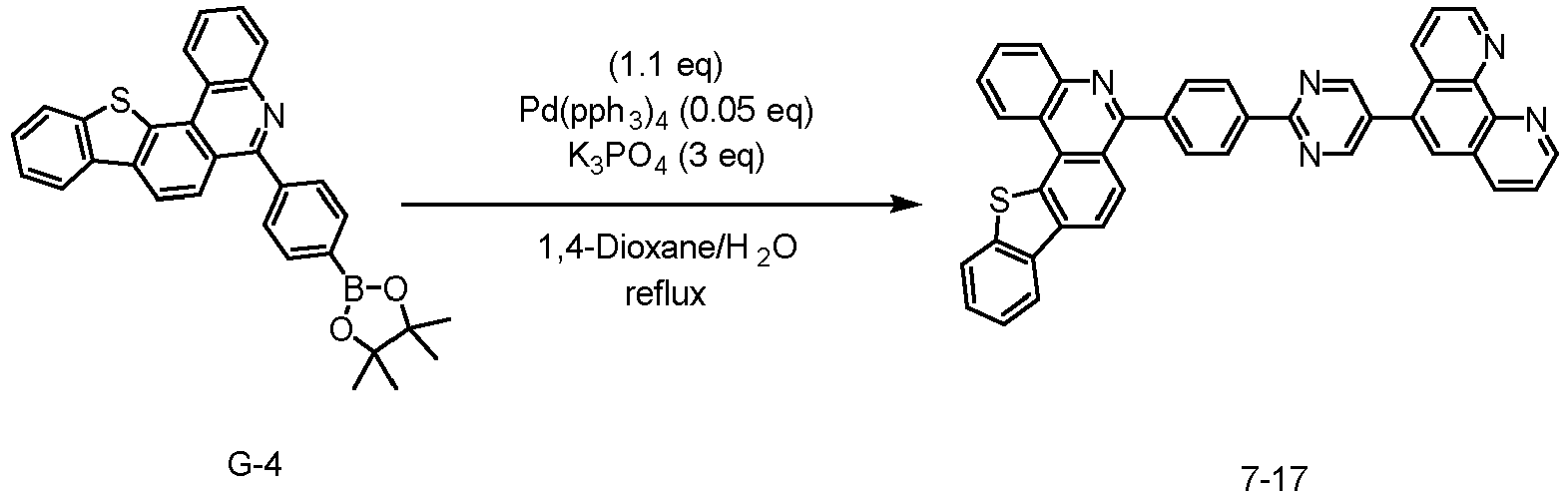
- After dissolving G-4 (10.1 g, 20.77 mmol, 1 eq.) in dioxane/H2O (5:1), 5-(2-bromopyrimidin-5-yl)-1,10-phenanthroline (6.9 g, 20.77 mmol, 1 eq.), Pd(PPh3)4 (1.2 g, 1.039 mmol, 0.05 eq.) and K3PO4 (13.2 g, 62.31 mmol, 3 eq.) were added thereto, and the result was stirred for 3 hours at 80°C. After adding purified water and ethyl acetate thereto, the result was solidified, stirred for 1 hour, and then filtered. The filtered solids were heated with ethyl acetate, toluene and MeOH, and stirred. Solid Compound 7-17 was obtained (6.4 g, 50%) .
-

- After dissolving G-4 (10.1 g, 20.77 mmol, 1 eq.) in dioxane/H2O (5:1), 4-(8-bromoquinolin-5-yl)-1,10-phenanthroline (8.1 g, 20.77 mmol, 1 eq.), Pd(PPh3)4 (1.2 g, 1.039 mmol, 0.05 eq.) and K3PO4 (13.2 g, 62.31 mmol, 3 eq.) were added thereto, and the result was stirred for 3 hours at 80°C. After adding purified water and ethyl acetate thereto, the result was solidified, stirred for 1 hour, and then filtered. The filtered solids were heated with ethyl acetate, toluene and MeOH, and stirred. Solid Compound 7-34 was obtained (6.5 g, 47%) .
-

- After dissolving G-4 (10.1 g, 20.77 mmol, 1 eq.) in dioxane/H2O (5:1), 4-(7-bromotriphenylen-2-yl)-1,10-phenanthroline (10.1 g, 20.77 mmol, 1 eq.), Pd(PPh3)4 (1.2 g, 1.039 mmol, 0.05 eq.) and K3PO4 (13.2 g, 62.31 mmol, 3 eq.) were added thereto, and the result was stirred for 3 hours at 80°C. After adding purified water and ethyl acetate thereto, the result was solidified, stirred for 1 hour, and then filtered. The filtered solids were heated with ethyl acetate, toluene and MeOH, and stirred. Solid Compound 7-39 was obtained (8.4 g, 53%) .
-

- Liquid Compound H-1 was obtained (76 g, 63.3%) in the same synthesis manner as G-1.
- Liquid Compound H-2 was obtained (133 g, 100%) in the same synthesis manner as G-2.
- Solid Compound H-3 was obtained (93 g, 76%) in the same synthesis manner as G-3.
- Solid Compound H-4 was obtained (82 g, 79%) in the same synthesis manner as G-4.
- After dissolving H-4 (10.1 g, 2.77 mmol, 1 eq.) in dioxane/H2O (5:1), 2-(4-bromophenyl)-9-phenyl-1,10-phenanthroline (8.55 g, 20.77 mmol, 1 eq.), Pd(PPh3)4 (1.2 g, 1.039 mmol, 0.05 eq.) and K3PO4 (13.2 g, 62.31 mmol, 3 eq.) were added thereto, and the result was stirred for 3 hours at 80°C. After adding purified water and ethyl acetate thereto, the result was solidified, stirred for 1 hour, and then filtered. The filtered solids were heated with ethyl acetate, toluene and MeOH, and stirred. Solid Compound 8-1 was obtained (9.32 g, 65%) .
-

- After dissolving H-4 (10.1 g, 20.77 mmol, 1 eq.) in dioxane/H2O (5:1), 2-(4-bromonaphthalen-1-yl)-9-phenyl-1,10-phenanthroline (9.5 g, 20.77 mmol, 1 eq.), Pd(PPh3)4 (1.2 g, 1.039 mmol, 0.05 eq.) and K3PO4 (13.2 g, 62.31 mmol, 3 eq.) were added thereto, and the result was stirred for 3 hours at 80°C. After adding purified water and ethyl acetate thereto, the result was solidified, stirred for 1 hour, and then filtered. The filtered solids were heated with ethyl acetate, toluene and MeOH, and stirred. Solid Compound 8-5 was obtained (8.6 g, 56%) .
-
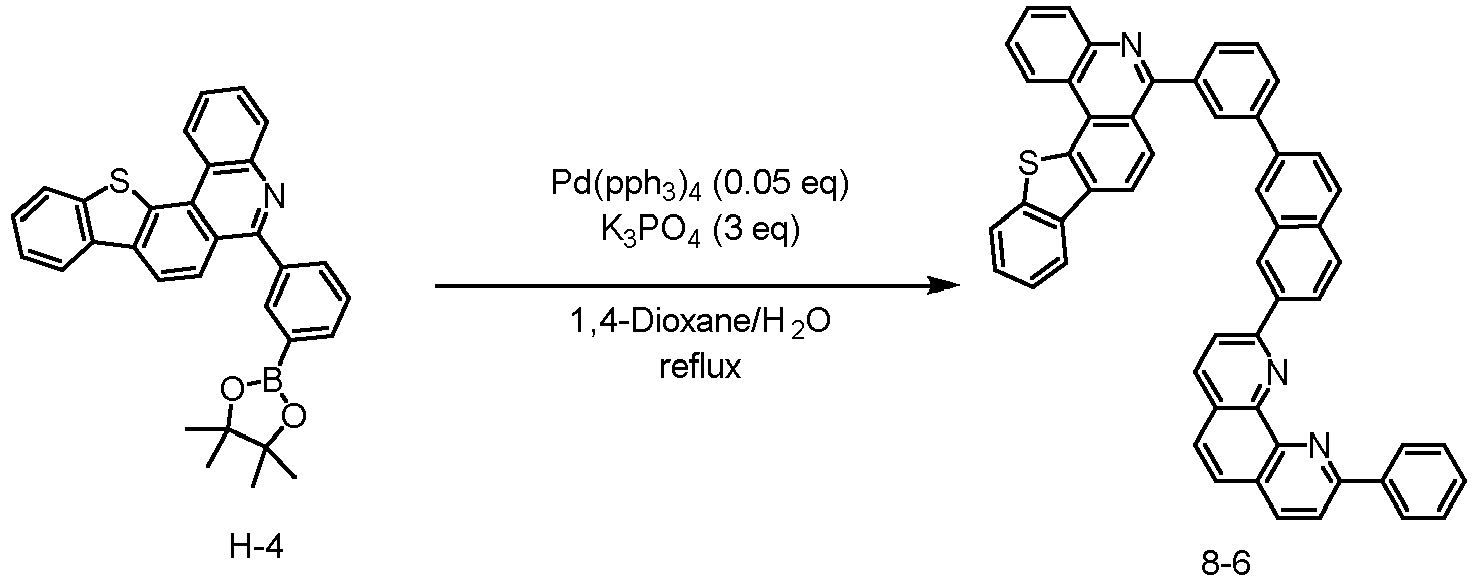
- After dissolving H-4 (10.1 g, 20.77 mmol, 1 eq.) in dioxane/H2O (5:1), 2-(7-bromonaphthalen-2-yl)-9-phenyl-1,10-phenanthroline (9.5 g, 20.77 mmol, 1 eq.), Pd(PPh3)4 (1.2 g, 1.039 mmol, 0.05 eq.) and K3PO4 (13.2 g, 62.31 mmol, 3 eq.) were added thereto, and the result was stirred for 3 hours at 80°C. After adding purified water and ethyl acetate thereto, the result was solidified, stirred for 1 hour, and then filtered. The filtered solids were heated with ethyl acetate, toluene and MeOH, and stirred. Solid Compound 8-6 was obtained (7.6 g, 50%) .
-

- After dissolving H-4 (10.1 g, 20.77 mmol, 1 eq.) in dioxane/H2O (5:1), 5-(6-bromonaphthalen-2-yl)-1,10-phenanthroline (7.9 g, 20.77 mmol, 1 eq.), Pd(PPh3)4 (1.2 g, 1.039 mmol, 0.05 eq.) and K3PO4 (13.2 g, 62.31 mmol, 3 eq.) were added thereto, and the result was stirred for 3 hours at 80°C. After adding purified water and ethyl acetate thereto, the result was solidified, stirred for 1 hour, and then filtered. The filtered solids were heated with ethyl acetate, toluene and MeOH, and stirred. Solid Compound 8-19 was obtained (7.8 g, 57%).
-

- After dissolving H-4 (10.1 g, 20.77 mmol, 1 eq.) in dioxane/H2O (5:1), 4-(6-bromopyren-1-yl)-1,10-phenanthroline (9.5 g, 20.77 mmol, 1 eq.), Pd(PPh3)4 (1.2 g, 1.039 mmol, 0.05 eq.) and K3PO4 (13.2 g, 62.31 mmol, 3 eq.) were added thereto, and the result was stirred for 3 hours at 80°C. After adding purified water and ethyl acetate thereto, the result was solidified, stirred for 1 hour, and then filtered. The filtered solids were heated with ethyl acetate, toluene and MeOH, and stirred. Solid Compound 8-38 was obtained (7.7 g, 50%) .
-

- To a flask, dibenzo[b,d]furan-4-ylboronic acid (80 g, 377.3 mmol, 1 eq.), 2-bromoaniline (77.9 g, 452.8 mmol, 1.2 eq.), Pd(PPh3)4 (13.1 g, 11.3 mmol, 0.03 eq.), K3PO4 (240.3 g, 1131.9 mmol, 3 eq.) and 1,4-dioxane/H2O=5:1 (800, 160) were introduced, and the result was stirred for 1 hour at 120°C. When the reaction was completed, the temperature was lowered to room temperature, then H2O and MC were introduced thereto, and the result was stirred. The mixture was extracted with MC, moisture in the organic layer was removed using MgSO4, the result was filtered, and the solvent was concentrated. The concentration-completed mixture was column separated using MC:Hex (1:4, 1:3, 1:1). Solid Compound 1-1(27 g, 55%) was obtained.
- To a flask, I-1 (27 g, 104.1 mmol, 1.0 eq.) was introduced, and was all dissolved in MC (250 mL). After that, TEA (14.6 ml, 104.1 mmol, 1.0 eq.) was introduced thereto, and the result was stirred for approximately 15 minutes. After adding 4-bromobenzoyl chloride (25.1 g, 114.5 mmol, 1.0 eq.) dissolved in a small amount of MC thereto at 0°C, the result was stirred for 1 hour while maintaining the temperature. After the reaction was completed, hexane was added in excess thereto to produce solids, and the result was filtered. The filtered solids were washed with hexane. Solid Compound I-2 was obtained (47 g, 99%).
- To a flask, 3-bromo-N-(2-(dibenzo[b,d]furan-4-yl)phenyl)benzamide (47.5 g, 107.46 mmol, 1.0 eq.) and then nitrobenzene (400 mL) were introduced, and POCl3 (12.1 ml, 107.46 mmol, 1.0 eq.) was introduced thereto. After that, the result was stirred for 12 hours at 150°C. When the reaction was completed, the temperature was lowered to room temperature, and then sodium bicarbonate was slowly added thereto. The organic material was extracted with MC, and after removing the solvent, MeOH was added to the concentrated residue, and the result was stirred and filtered to obtain target Compound I-3 (71%) .
- To a flask, 6-(4-bromophenyl)benzofuro[3,2-k]phenanthridine (18.3 g, 43.1 mmol, 1.0 eq.), bis(pinacolato)diboron (21.9 g, 86.3 mmol, 2.0 eq.), Pd(dppf)Cl2 (1.58 g, 2.15 mmol, 0.05 eq.) and KOAc (12.7 g, 129.3 mmol, 3.0 eq.) were introduced, the result was stirred for 2 hours at 120°C after introducing 1,4-dioxane (150 mL) thereto,. When the reaction was completed, the result was extracted with MC and H2O, and the organic layer was dried with MgSO4. The result was filtered and concentrated. Solids produced after the concentration were slurried with MeOH, and then washed with a small amount of MeOH and hexane to obtain target Compound I-4 (84%) .
- To a flask, 6-(4-(4,4,5,5-tetramethyl-1,3,2-dioxaborolan-2-yl)phenyl)benzofuro[3,2-k]phenanthridine (10 g, 21.2 mmol, 1 eq.), 2-(4-bromophenyl)-9-phenyl-1,10-phenanthroline (0.9 eq.), Pd(PPh3)4 (0.10 eq.), K3PO4 (3 eq.) and 1,4-dioxane/H2O=5:1 (200, 40) were introduced, and the result was stirred for 1 hour at 120°C. When the reaction was completed, the temperature was lowered to room temperature, then H2O and MC were introduced thereto, and the result was stirred. The mixture was extracted with MC, moisture in the organic layer was removed using MgSO4, the result was filtered, and the solvent was concentrated. The concentration-completed mixture was column separated using MC:Hex. Solid Compound 9-1(12 g, 86%) was obtained.
-
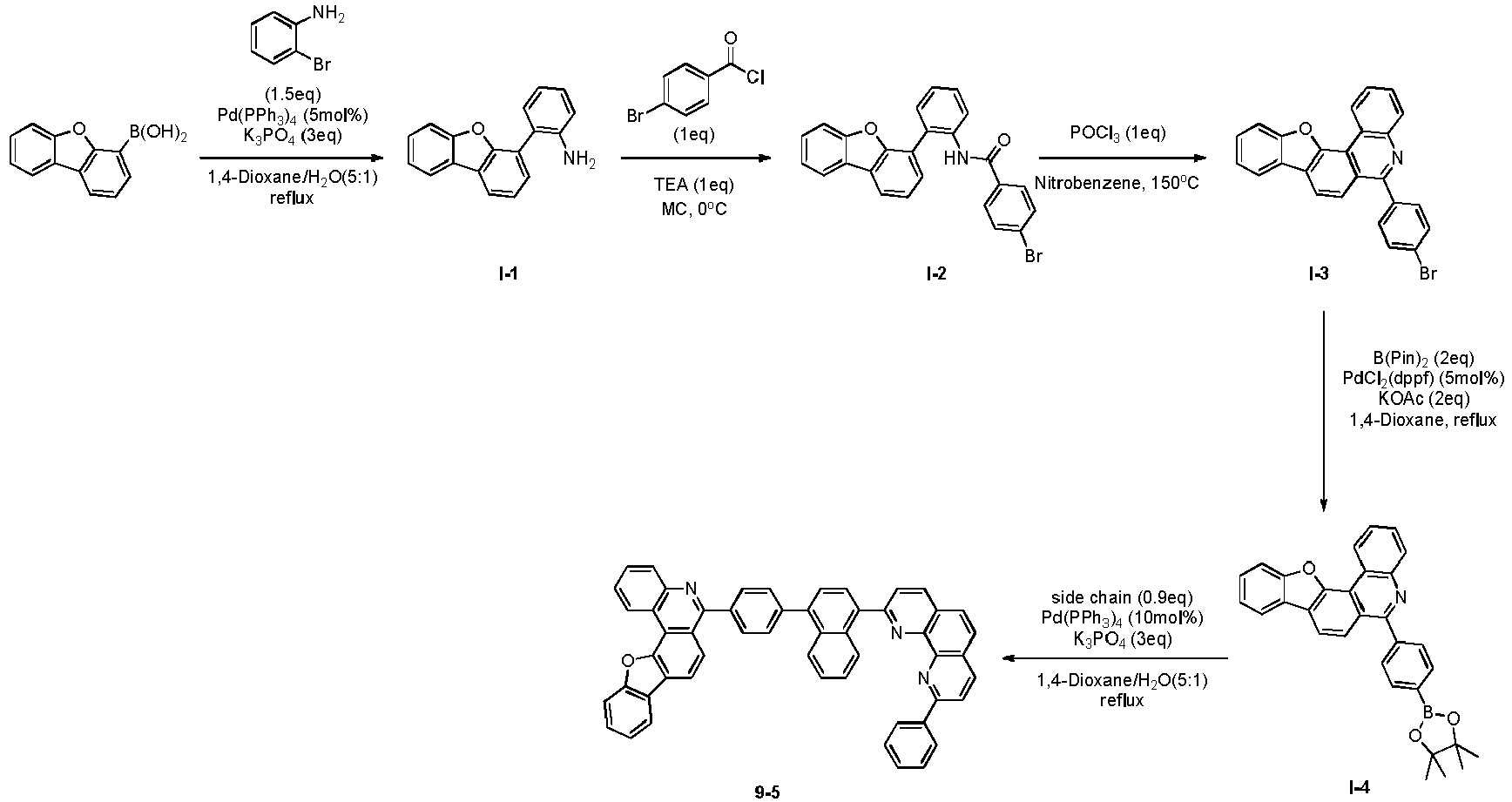
- To a flask, 6-(4-(4,4,5,5-tetramethyl-1,3,2-dioxaborolan-2-yl)phenyl)benzofuro[3,2-k]phenanthridine (10 g, 21.2 mmol, 1 eq.), 2-(4-bromonaphthalen-1-yl)-9-phenyl-1,10-phenanthroline (0.9 eq.), Pd(PPh3)4 (0.10 eq.), K3PO4 (3 eq.) and 1,4-dioxane/H2O=5:1 (200, 40) were introduced, and the result was stirred for 1 hour at 120°C. When the reaction was completed, the temperature was lowered to room temperature, then H2O and MC were introduced thereto, and the result was stirred. The mixture was extracted with MC, moisture in the organic layer was removed using MgSO4, the result was filtered, and the solvent was concentrated. The concentration-completed mixture was column separated using MC:Hex. Solid Compound 9-5 (11 g, 75%) was obtained.
-

- To a flask, 6-(4-(4,4,5,5-tetramethyl-1,3,2-dioxaborolan-2-yl)phenyl)benzofuro[3,2-k]phenanthridine (10 g, 21.2 mmol, 1 eq.), 5-(4-bromophenyl)-1,10-phenanthroline (0.9 eq.), Pd(PPh3)4 (0.10 eq.), K3PO4 (3 eq.) and 1,4-dioxane/H2O=5:1 (200, 40) were introduced, and the result was stirred for 1 hour at 120°C. When the reaction was completed, the temperature was lowered to room temperature, then H2O and MC were introduced thereto, and the result was stirred. The mixture was extracted with MC, moisture in the organic layer was removed using MgSO4, the result was filtered, and the solvent was concentrated. The concentration-completed mixture was column separated using MC:Hex. Solid Compound 9-14 (9.3 g, 73%) was obtained.
-

- To a flask, 6-(4-(4,4,5,5-tetramethyl-1,3,2-dioxaborolan-2-yl)phenyl)benzofuro[3,2-k]phenanthridine (10 g, 21.2 mmol, 1 eq.), 5-(4-bromonaphthalen-1-yl)-1,10-phenanthroline (0.9 eq.), Pd(PPh3)4 (0.10 eq.), K3PO4 (3 eq.) and 1,4-dioxane/H2O=5:1 (200, 40) were introduced, and the result was stirred for 1 hour at 120°C. When the reaction was completed, the temperature was lowered to room temperature, then H2O and MC were introduced thereto, and the result was stirred. The mixture was extracted with MC, moisture in the organic layer was removed using MgSO4, the result was filtered, and the solvent was concentrated. The concentration-completed mixture was column separated using MC:Hex. Solid Compound 9-18 (11.2 g, 81%) was obtained.
-

- To a flask, I-1 (27 g, 104.1 mmol, 1.0 eq.) was introduced, and was all dissolved in MC (250 mL). After that, TEA (14.6 ml, 104.1 mmol, 1.0 eq.) was introduced thereto, and the result was stirred for approximately 15 minutes. After adding 4-bromobenzoyl chloride (25.1 g, 114.5 mmol, 1.0 eq.) dissolved in a small amount of MC thereto at 0°C, the result was stirred for 1 hour while maintaining the temperature. After the reaction was completed, hexane was added in excess thereto to produce solids, and the result was filtered. The filtered solids were washed with hexane. Solid Compound J-2 (47 g, 99%) was obtained.
- To a flask, J-2 (47 g, 103.0 mmol, 1.0 eq.) and then nitrobenzene (400 mL) were introduced, and POCl3 (1.0 eq.) was introduced thereto. After that, the result was stirred for 12 hours at 150°C. When the reaction was completed, the temperature was lowered to room temperature, and then sodium bicarbonate was slowly added thereto. The organic material was extracted with MC, and after removing the solvent, MeOH was added to the concentrated residue, and the result was stirred and filtered to obtain target Compound J-3 (32 g, 73%).
- To a flask, J-3 (32 g, 75.2 mmol, 1.0 eq.), bis(pinacolato)diboron (2.0 eq.), Pd(dppf)Cl2 (0.05 eq.) and KOAc (3.0 eq.) were introduced, the result was stirred for 2 hours at 120°C after introducing 1,4-dioxane (150 mL) thereto. When the reaction was completed, the result was extracted with MC and H2O, and the organic layer was dried with MgSO4. The result was filtered and concentrated. Solids produced after the concentration were slurried with MeOH, and then washed with a small amount of MeOH and hexane to obtain target Compound J-4 (29 g, 61.6 mmol, 82%) .
- To a flask, 6-(3-(4,4,5,5-tetramethyl-1,3,2-dioxaborolan-2-yl)phenyl)benzofuro[3,2-k]phenanthridine (10 g, 21.2 mmol, 1 eq.), 2-(4-bromophenyl)-9-phenyl-1,10-phenanthroline (0.9 eq.), Pd(PPh3)4 (0.10 eq.), K3PO4 (3 eq.) and 1,4-dioxane/H2O=5:1 (200, 40) were introduced, and the result was stirred for 1 hour at 120°C. When the reaction was completed, the temperature was lowered to room temperature, then H2O and MC were introduced thereto, and the result was stirred. The mixture was extracted with MC, moisture in the organic layer was removed using MgSO4, the result was filtered, and the solvent was concentrated. The concentration-completed mixture was column separated using MC:Hex. Solid Compound 10-1 (12 g, 84%) was obtained.
-

- To a flask, 6-(3-(4,4,5,5-tetramethyl-1,3,2-dioxaborolan-2-yl)phenyl)benzofuro[3,2-k]phenanthridine (10 g, 21.2 mmol, 1 eq.), 2-(4-bromonaphthalen-1-yl)-9-phenyl-1,10-phenanthroline (0.9 eq.), Pd(PPh3)4 (0.10 eq.), K3PO4 (3 eq.) and 1,4-dioxane/H2O=5:1 (200, 40) were introduced, and the result was stirred for 1 hour at 120°C. When the reaction was completed, the temperature was lowered to room temperature, then H2O and MC were introduced thereto, and the result was stirred. The mixture was extracted with MC, moisture in the organic layer was removed using MgSO4, the result was filtered, and the solvent was concentrated. The concentration-completed mixture was column separated using MC:Hex. Solid Compound 10-5 (12.5 g, 81%) was obtained.
-

- To a flask, 6-(3-(4,4,5,5-tetramethyl-1,3,2-dioxaborolan-2-yl)phenyl)benzofuro[3,2-k]phenanthridine (10 g, 21.2 mmol, 1 eq.), 5-(4-bromophenyl)-1,10-phenanthroline (0.9 eq.), Pd(PPh3)4 (0.10 eq.), K3PO4 (3 eq.) and 1,4-dioxane/H2O=5:1 (200, 40) were introduced, and the result was stirred for 1 hour at 120°C. When the reaction was completed, the temperature was lowered to room temperature, then H2O and MC were introduced thereto, and the result was stirred. The mixture was extracted with MC, moisture in the organic layer was removed using MgSO4, the result was filtered, and the solvent was concentrated. The concentration-completed mixture was column separated using MC:Hex. Solid Compound 10-14 (9.8 g, 77%) was obtained.
-

- To a flask, 6-(3-(4,4,5,5-tetramethyl-1,3,2-dioxaborolan-2-yl)phenyl)benzofuro[3,2-k]phenanthridine (10 g, 21.2 mmol, 1 eq.), 5-(4-bromonaphthalen-1-yl)-1,10-phenanthroline (0.9 eq.), Pd(PPh3)4 (0.10 eq.), K3PO4 (3 eq.) and 1,4-dioxane/H2O=5:1 (200, 40) were introduced, and the result was stirred for 1 hour at 120°C. When the reaction was completed, the temperature was lowered to room temperature, then H2O and MC were introduced thereto, and the result was stirred. The mixture was extracted with MC, moisture in the organic layer was removed using MgSO4, the result was filtered, and the solvent was concentrated. The concentration-completed mixture was column separated using MC:Hex. Solid Compound 10-18 (10.8 g, 79%) was obtained.
-

- To a flask, 2-bromoaniline (80.0 g, 0.465 mol, 1 eq.) and Tol/EtOH/H2O=5:1:1 (1600, 320, 320) were introduced, and then (9,9-diphenyl-9H-fluoren-2-yl)boronic acid (202.15 g, 0.558 mol, 1.2 eq.), Pd(PPh3)4 (26.87 g, 0.0233 mol, 0.05 eq.) and K2CO3 (192.82 g, 1.39 mol, 3 eq.) were introduced thereto. The result was stirred for 18 hours at 90°C. When the reaction was completed, the temperature was lowered to room temperature, then H2O and EA were introduced thereto, and the result was stirred. The produced yellow solids were filtered and removed. The mixture was extracted with EA, moisture in the organic layer was removed using Na2SO4, the result was filtered, and the solvent was concentrated. Solid Compound K-1 was obtained (150.0 g, 78.9%).
- To a flask, 2-(9,9-diphenyl-9H-fluoren-2-yl)aniline (150 g, 0.366 mol, 1 eq.) and then THF (2000 mL) were introduced. After that, TEA (111 g, 1.09 mol, 3 eq.), and 4-bromobenzoyl chloride (120.5 g, 0.549 mol) dissolved in THF (100 mL) were added thereto at 0°C, and the result was stirred for 2 hours at room temperature. After the reaction was completed, the layers were separated with EA and H2O, and the organic layer was washed several times with H2O. Moisture in the organic layer was removed using Na2SO4, the result was filtered, and the solvent was concentrated. After adding MC (100 mL) to the (brown oil) concentrated residue, the result was filtered to remove white solids, and then concentrated. Solid Compound K-2 was obtained (200 g, 92.1%).
- To a flask, 4-bromo-N-(2-(9,9-diphenyl-9H-fluoren-2-yl)phenyl)benzamide (200 g, 0.337 mol, 1 eq.) and then nitrobenzene (2000 mL) were introduced, and POCl3 (25.8 g, 0.168 mol, 0.5 eq.) was introduced thereto. After that, the result was stirred for 18 hours at 150°C. After removing the nitrobenzene using a rotary evaporator, the organic layer dissolved in MC was neutralized by washing several times with a saturated NaHCO3 solution, then dried using MgSO4 and concentrated. EA was added to the concentrated residue for precipitation. After adding a small amount of EA thereto, the result was stirred for 1 hour at room temperature and then filtered (removing side spot). After that, hexane was added thereto, the result was stirred for 1 hour, filtered (removing residual nitrobenzene), and then dried. Solid Compound K-3 was obtained (120 g, 61.8%).
- After dissolving 6-(4-bromophenyl)-12,12-diphenyl-12H-indeno[1,2-j]phenanthridine (120 g, 0.208 mol, 1 eq.) in DMF, bis(pinacolato)diborone (63.4 g, 0.250 mol, 1.2 eq.), Pd(dppf)2Cl2 (7.6 g, 0.010 mol, 0.05 eq.) and KOAc (61.5 g, 0.626 mol, 3 eq.) were added thereto at room temperature, and the result was stirred for 18 hours at 80°C. After the reaction was completed, the layers were separated with purified water and ethyl acetate. The organic solvent layer was washed several times with purified water and brine, dehydrated and then vacuum dried. After dissolving the residue with dichloromethane, florosil was added thereto, and the result was stirred for 30 minutes. The result was passed through silica gel/celite. Solid Compound K-4 was obtained (100 g, 77.0%).
- After dissolving 12,12-diphenyl-6-(4-(4,4,5,5-tetramethyl-1,3,2-dioxaborolan-2-yl)phenyl)-12H-indeno[1,2-j]phenanthridine (10.0 g, 0.016 mol, 1 eq.) in dioxane/H2O (5:1), 2-(4-bromophenyl)-9-phenyl-1,10-phenanthroline (7.27 g, 0.017 mol, 1.1 eq.), Pd(PPh3)4 (1.0 g, 0.0009 mol, 0.05 eq.) and K3PO4 (10.24 g, 0.048 mol, 3 eq.) were added thereto, and the result was stirred for 3 hours at 80°C. After adding purified water and ethyl acetate thereto, the result was solidified, stirred for 1 hour, and then filtered. The filtered solids were heated with ethyl acetate, toluene and MeOH, and stirred. Solid Compound 11-1 was obtained (10.5 g, 79.0%).
-

- After dissolving 12,12-diphenyl-6-(4-(4,4,5,5-tetramethyl-1,3,2-dioxaborolan-2-yl)phenyl)-12H-indeno[1,2-j]phenanthridine (10.0 g, 0.016 mol, 1 eq.) in dioxane/H2O (5:1), 2-(4-bromonaphthalen-1-yl)-9-phenyl-1,10-phenanthroline (8.16 g, 0.017 mol, 1.1 eq.), Pd(PPh3)4 (1.0 g, 0.0009 mol, 0.05 eq.) and K3PO4 (10.24 g, 0.048 mol, 3 eq.) were added thereto, and the result was stirred for 3 hours at 80°C. After adding purified water and ethyl acetate thereto, the result was solidified, stirred for 1 hour, and then filtered. The filtered solids were heated with ethyl acetate, toluene and MeOH, and stirred. Solid Compound 11-5 was obtained (11 g, 78.0%) .
-

- After dissolving 12,12-diphenyl-6-(4-(4,4,5,5-tetramethyl-1,3,2-dioxaborolan-2-yl)phenyl)-12H-indeno[1,2-j]phenanthridine (10.0 g, 0.016 mol, 1 eq.) in dioxane/H2O (5:1), 2-(10-bromoanthracen-9-yl)-9-phenyl-1,10-phenanthroline (9.05 g, 0.017 mol, 1.1 eq.), Pd(PPh3)4 (1.0 g, 0.0009 mol, 0.05 eq.) and K3PO4 (10.24 g, 0.048 mol, 3 eq.) were added thereto, and the result was stirred for 3 hours at 80°C. After adding purified water and ethyl acetate thereto, the result was solidified, stirred for 1 hour, and then filtered. The filtered solids were heated with ethyl acetate, toluene and MeOH, and stirred. Solid Compound 11-10 was obtained (10 g, 67.1%).
-

- After dissolving 12,12-diphenyl-6-(4-(4,4,5,5-tetramethyl-1,3,2-dioxaborolan-2-yl)phenyl)-12H-indeno[1,2-j]phenanthridine (10.0 g, 0.016 mol, 1 eq.) in dioxane/H2O (5:1), 5-(4-bromophenyl)-1,10-phenanthroline (5.93 g, 0.017 mol, 1.1 eq.), Pd(PPh3)4 (1.0 g, 0.0009 mol, 0.05 eq.) and K3PO4 (10.24 g, 0.048 mol, 3 eq.) were added thereto, and the result was stirred for 3 hours at 80°C. After adding purified water and ethyl acetate thereto, the result was solidified, stirred for 1 hour, and then filtered. The filtered solids were heated with ethyl acetate, toluene and MeOH, and stirred. Solid Compound 11-14 was obtained (9 g, 74.6%).
-

- After dissolving 12,12-diphenyl-6-(4-(4,4,5,5-tetramethyl-1,3,2-dioxaborolan-2-yl)phenyl)-12H-indeno[1,2-j]phenanthridine (10.0 g, 0.016 mol, 1 eq.) in dioxane/H2O (5:1), 4-(4-bromophenyl)-1,10-phenanthroline (5.93 g, 0.017 mol, 1.1 eq.), Pd(PPh3)4 (1.0 g, 0.0009 mol, 0.05 eq.) and K3PO4 (10.24 g, 0.048 mol, 3 eq.) were added thereto, and the result was stirred for 3 hours at 80°C. After adding purified water and ethyl acetate thereto, the result was solidified, stirred for 1 hour, and then filtered. The filtered solids were heated with ethyl acetate, toluene and MeOH, and stirred. Solid Compound 11-27 was obtained (8.5 g, 70.3%).
-

- To a flask, 2-(9,9-diphenyl-9H-fluoren-2-yl)aniline (150 g, 0.366 mol, 1 eq.) and then THF (2000 mL) were introduced. After that, TEA (111 g, 1.09 mol, 3 eq.), and 3-bromobenzoyl chloride (120.5 g, 0.549 mol) dissolved in THF (100 mL) were added thereto at 0°C, and the result was stirred for 2 hours at room temperature. After the reaction was completed, the layers were separated with EA and H2O, and the organic layer was washed several times with H2O. Moisture in the organic layer was removed using Na2SO4, the result was filtered, and the solvent was concentrated. After adding MC (100 mL) to the (brown oil) concentrated residue, the result was filtered to remove white solids, and then concentrated. Solid Compound L-1 was obtained (185 g, 85.2%).
- To a flask, 3-bromo-N-(2-(9,9-diphenyl-9H-fluoren-2-yl)phenyl)benzamide (185 g, 0.312 mol, 1 eq.) and then nitrobenzene (1850 mL) were introduced, and POCl3 (23.9 g, 0.156 mol, 0.5 eq.) was introduced thereto. After that, the result was stirred for 18 hours at 150°C. After removing the nitrobenzene using a rotary evaporator, the organic layer dissolved in MC was neutralized by washing several times with a saturated NaHCO3 solution, then dried using MgSO4 and concentrated. EA was added to the concentrated residue for precipitation. After adding a small amount of EA thereto, the result was stirred for 1 hour at room temperature and then filtered (removing side spot). After that, hexane was added thereto, the result was stirred for 1 hour, filtered (removing residual nitrobenzene), and then dried. Solid Compound L-2 was obtained (106 g, 59.1%).
- After dissolving 6-(3-bromophenyl)-12,12-diphenyl-12H-indeno[1,2-j]phenanthridine (106 g, 0.184 mol, 1 eq.) in DMF, bis(pinacolato)diborone (56.2 g, 0.221 mol, 1.2 eq.), Pd(dppf)2Cl2 (6.7 g, 0.009 mol, 0.05 eq.) and KOAc (54.3 g, 0.553 mol, 3 eq.) were added thereto at room temperature, and the result was stirred for 18 hours at 80°C. After the reaction was completed, the layers were separated with purified water and ethyl acetate. The organic solvent layer was washed several times with purified water and brine, dehydrated and then vacuum dried. After dissolving the residue with dichloromethane, florosil was added thereto, and the result was stirred for 30 minutes. The result was passed through silica gel/celite. Solid Compound L-3 was obtained (95 g, 83.2%).
- After dissolving 12,12-diphenyl-6-(3-(4,4,5,5-tetramethyl-1,3,2-dioxaborolan-2-yl)phenyl)-12H-indeno[1,2-j]phenanthridine (10.0 g, 0.016 mol, 1 eq.) in dioxane/H2O (5:1), 2-(4-bromophenyl)-9-phenyl-1,10-phenanthroline (7.27 g, 0.017 mol, 1.1 eq.), Pd(PPh3)4 (1.0 g, 0.0009 mol, 0.05 eq.) and K3PO4 (10.24 g, 0.048 mol, 3 eq.) were added thereto, and the result was stirred for 3 hours at 80°C. After adding purified water and ethyl acetate thereto, the result was solidified, stirred for 1 hour, and then filtered. The filtered solids were heated with ethyl acetate, toluene and MeOH, and stirred. Solid Compound 12-1 was obtained (11 g, 82.8%).
-

- After dissolving 12,12-diphenyl-6-(3-(4,4,5,5-tetramethyl-1,3,2-dioxaborolan-2-yl)phenyl)-12H-indeno[1,2-j]phenanthridine 10.0 g, 0.016 mol, 1 eq.) in dioxane/H2O (5:1), 2-(4-bromonaphthalen-1-yl)-9-phenyl-1,10-phenanthroline (8.16 g, 0.017 mol, 1.1 eq.), Pd(PPh3)4 (1.0 g, 0.0009 mol, 0.05 eq.) and K3PO4 (10.24 g, 0.048 mol, 3 eq.) were added thereto, and the result was stirred for 3 hours at 80°C. After adding purified water and ethyl acetate thereto, the result was solidified, stirred for 1 hour, and then filtered. The filtered solids were heated with ethyl acetate, toluene and MeOH, and stirred. Solid Compound 12-5 was obtained (10.4 g, 73.8%).
-

- After dissolving 12,12-diphenyl-6-(3-(4,4,5,5-tetramethyl-1,3,2-dioxaborolan-2-yl)phenyl)-12H-indeno[1,2-j]phenanthridine (10.0 g, 0.016 mol, 1 eq.) in dioxane/H2O (5:1), 2-(10-bromoanthracen-9-yl)-9-phenyl-1,10-phenanthroline (9.05 g, 0.017 mol, 1.1 eq.), Pd(PPh3)4 (1.0 g, 0.0009 mol, 0.05 eq.) and K3PO4 (10.24 g, 0.048 mol, 3 eq.) were added thereto, and the result was stirred for 3 hours at 80°C. After adding purified water and ethyl acetate thereto, the result was solidified, stirred for 1 hour, and then filtered. The filtered solids were heated with ethyl acetate, toluene and MeOH, and stirred. Solid Compound 12-10 was obtained (11 g, 73.8%).
-
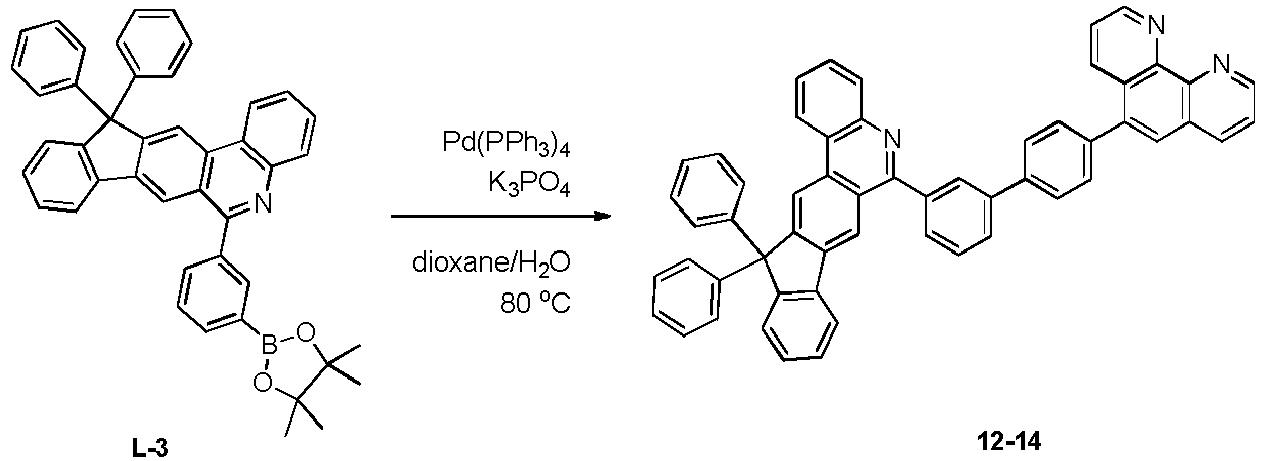
- After dissolving 12,12-diphenyl-6-(3-(4,4,5,5-tetramethyl-1,3,2-dioxaborolan-2-yl)phenyl)-12H-indeno[1,2-j]phenanthridine (10.0 g, 0.016 mol, 1 eq.) in dioxane/H2O (5:1), 5-(4-bromophenyl)-1,10-phenanthroline (5.93 g, 0.017 mol, 1.1 eq.), Pd(PPh3)4 (1.0 g, 0.0009 mol, 0.05 eq.) and K3PO4 (10.24 g, 0.048 mol, 3 eq.) were added thereto, and the result was stirred for 3 hours at 80°C. After adding purified water and ethyl acetate thereto, the result was solidified, stirred for 1 hour, and then filtered. The filtered solids were heated with ethyl acetate, toluene and MeOH, and stirred. Solid Compound 12-14 was obtained (8.8 g, 72.8%).
-

- After dissolving 12,12-diphenyl-6-(3-(4,4,5,5-tetramethyl-1,3,2-dioxaborolan-2-yl)phenyl)-12H-indeno[1,2-j]phenanthridine (10.0 g, 0.016 mol, 1 eq.) in dioxane/H2O (5:1), 4-(4-bromophenyl)-1,10-phenanthroline (5.93 g, 0.017 mol, 1.1 eq.), Pd(PPh3)4 (1.0 g, 0.0009 mol, 0.05 eq.) and K3PO4 (10.24 g, 0.048 mol, 3 eq.) were added thereto, and the result was stirred for 3 hours at 80°C. After adding purified water and ethyl acetate thereto, the result was solidified, stirred for 1 hour, and then filtered. The filtered solids were heated with ethyl acetate, toluene and MeOH, and stirred. Solid Compound 12-27 was obtained (9 g, 74.4%).
-

- After dissolving A-4 (10.0 g, 23.18 mmol, 1 eq.) in dioxane/H2O (5:1), 2-bromo-9-phenyl-1,10-phenanthroline (7.76 g, 23.18 mmol, 1 eq.), Pd(PPh3)4 (1.34 g, 1.159 mmol, 0.05 eq.) and K3PO4 (14.76 g, 69.54 mmol, 3 eq.) were added thereto, and the result was stirred for 3 hours at 80°C. After adding purified water and ethyl acetate thereto, the result was solidified, stirred for 1 hour, and then filtered. The filtered solids were heated with ethyl acetate, toluene and MeOH, and stirred. Solid Compound 13-1 was obtained (7.9 g, 61%).
-

- After dissolving B-4 (10.0 g, 23.18 mmol, 1 eq.) in dioxane/H2O (5:1), 2-bromo-9-phenyl-1,10-phenanthroline (7.76 g, 23.18 mmol, 1 eq.), Pd(PPh3)4 (1.34 g, 1.159 mmol, 0.05 eq.) and K3PO4 (14.76 g, 69.54 mmol, 3 eq.) were added thereto, and the result was stirred for 3 hours at 80°C. After adding purified water and ethyl acetate thereto, the result was solidified, stirred for 1 hour, and then filtered. The filtered solids were heated with ethyl acetate, toluene and MeOH, and stirred. Solid Compound 13-2 was obtained (8.8 g, 68%).
-

- Compound L-2 was obtained (130.9 g, 76%) in the same synthesis manner as A-2.
- Solid Compound L-3 was obtained (162.8 g, 74%) in the same synthesis manner as A-3.
- Solid Compound L-4 was obtained (52.1 g, 84%) in the same synthesis manner as A-4.
- After dissolving L-4 (11.1 g, 23.18 mmol, 1 eq.) in dioxane/ H2O (5:1), 2-bromo-9-phenyl-1,10-phenanthroline (7.7 g, 23.18 mmol, 1 eq.), Pd(PPh3)4 (1.34 g, 1.159 mmol, 0.05 eq.) and K3PO4 (14.76 g, 69.54 mmol, 3 eq.) were added thereto, and the result was stirred for 3 hours at 80°C. After adding purified water and ethyl acetate thereto, the result was solidified, stirred for 1 hour, and then filtered. The filtered solids were heated with ethyl acetate, toluene and MeOH, and stirred. Solid Compound 13-3 was obtained (8.6 g, 61%).
-

- Compound M-2 was obtained (130.9 g, 76%) in the same synthesis manner as A-2.
- Solid Compound M-3 was obtained (162.8 g, 74%) in the same synthesis manner as A-3.
- Solid Compound M-4 was obtained (52.1 g, 84%) in the same synthesis manner as A-4.
- After dissolving M-4 (11.1 g, 23.18 mmol, 1 eq.) in dioxane/H2O (5:1), 2-bromo-9-phenyl-1,10-phenanthroline (7.7 g, 23.18 mmol, 1 eq.), Pd(PPh3)4 (1.34 g, 1.159 mmol, 0.05 eq.) and K3PO4 (14.76 g, 69.54 mmol, 3 eq.) were added thereto, and the result was stirred for 3 hours at 80°C. After adding purified water and ethyl acetate thereto, the result was solidified, stirred for 1 hour, and then filtered. The filtered solids were heated with ethyl acetate, toluene and MeOH, and stirred. Solid Compound 13-4 was obtained (9.0 g, 64%).
-

- After dissolving C-4 (10.0 g, 20.77 mmol, 1 eq.) in dioxane/H2O (5:1), 2-bromo-9-phenyl-1,10-phenanthroline (6.9 g, 20.77 mmol, 1 eq.), Pd(PPh3)4 (1.2 g, 1.039 mmol, 0.05 eq.) and K3PO4 (13.2 g, 62.31 mmol, 3 eq.) were added thereto, and the result was stirred for 3 hours at 80°C. After adding purified water and ethyl acetate thereto, the result was solidified, stirred for 1 hour, and then filtered. The filtered solids were heated with ethyl acetate, toluene and MeOH, and stirred. Solid Compound 13-5 was obtained (8.4 g, 67%).
-

- After dissolving D-5 (10.0 g, 20.77 mmol, 1 eq.) in dioxane/H2O (5:1), 2-bromo-9-phenyl-1,10-phenanthroline (6.9 g, 20.77 mmol, 1 eq.), Pd(PPh3)4 (1.2 g, 1.039 mmol, 0.05 eq.) and K3PO4 (13.2 g, 62.31 mmol, 3 eq.) were added thereto, and the result was stirred for 3 hours at 80°C. After adding purified water and ethyl acetate thereto, the result was solidified, stirred for 1 hour, and then filtered. The filtered solids were heated with ethyl acetate, toluene and MeOH, and stirred. Solid Compound 13-6 was obtained (10.3 g, 82%).
-

- White solid Compound N-2 was obtained (85 g, 99%) in the same synthesis manner as A-2.
- White solid Compound N-3 was obtained (71 g, 87%) in the same synthesis manner as A-3.
- White solid Compound N-4 was obtained (66 g, 99%) in the same synthesis manner as A-4.
-

- After dissolving N-4 (10.9 g, 20.77 mmol, 1 eq.) in dioxane/H2O (5:1), 2-bromo-9-phenyl-1,10-phenanthroline (6.9 g, 20.77 mmol, 1 eq.), Pd(PPh3)4 (1.2 g, 1.039 mmol, 0.05 eq.) and K3PO4 (13.2 g, 62.31 mmol, 3 eq.) were added thereto, and the result was stirred for 3 hours at 80°C. After adding purified water and ethyl acetate thereto, the result was solidified, stirred for 1 hour, and then filtered. The filtered solids were heated with ethyl acetate, toluene and MeOH, and stirred. Solid Compound 13-7 was obtained (10.9 g, 80%).
-

- White solid Compound O-2 was obtained (85 g, 99%) in the same synthesis manner as A-2.
- White solid Compound O-3 was obtained (71 g, 87%) in the same synthesis manner as A-3.
- White solid Compound O-4 was obtained (66 g, 99%) in the same synthesis manner as A-4.
-

- After dissolving O-4 (10.9 g, 20.77 mmol, 1 eq.) in dioxane/H2O (5:1), 2-bromo-9-phenyl-1,10-phenanthroline (6.9 g, 20.77 mmol, 1 eq.), Pd(PPh3)4 (1.2 g, 1.039 mmol, 0.05 eq.) and K3PO4 (13.2 g, 62.31 mmol, 3 eq.) were added thereto, and the result was stirred for 3 hours at 80°C. After adding purified water and ethyl acetate thereto, the result was solidified, stirred for 1 hour, and then filtered. The filtered solids were heated with ethyl acetate, toluene and MeOH, and stirred. Solid Compound 13-8 was obtained (9.9 g, 73%).
-

- After dissolving E-5 (10.0 g, 20.77 mmol, 1 eq.) in dioxane/H2O (5:1), 2-bromo-9-phenyl-1,10-phenanthroline (6.9 g, 20.77 mmol, 1 eq.), Pd(PPh3)4 (1.2 g, 1.039 mmol, 0.05 eq.) and K3PO4 (13.2 g, 62.31 mmol, 3 eq.) were added thereto, and the result was stirred for 3 hours at 80°C. After adding purified water and ethyl acetate thereto, the result was solidified, stirred for 1 hour, and then filtered. The filtered solids were heated with ethyl acetate, toluene and MeOH, and stirred. Solid Compound 13-9 was obtained (10.0 g, 79%).
-

- After dissolving F-5 (10.0 g, 20.77 mmol, 1 eq.) in dioxane/H2O (5:1), 2-bromo-9-phenyl-1,10-phenanthroline (6.9 g, 20.77 mmol, 1 eq.), Pd(PPh3)4 (1.2 g, 1.039 mmol, 0.05 eq.) and K3PO4 (13.2 g, 62.31 mmol, 3 eq.) were added thereto, and the result was stirred for 3 hours at 80°C. After adding purified water and ethyl acetate thereto, the result was solidified, stirred for 1 hour, and then filtered. The filtered solids were heated with ethyl acetate, toluene and MeOH, and stirred. Solid Compound 13-10 was obtained (8.73 g, 69%).
-

- Solid Compound P-3 was obtained (80 g, 88%) in the same synthesis manner as E-3.
- Solid Compound P-4 was obtained (85.6 g, 73%) in the same synthesis manner as E-4.
- Solid Compound P-5 was obtained (49 g, 79%) in the same synthesis manner as E-5.
- After dissolving P-5 (10.0 g, 20.77 mmol, 1 eq.) in dioxane/H2O (5:1), 2-bromo-9-phenyl-1,10-phenanthroline (6.9 g, 20.77 mmol, 1 eq.), Pd(PPh3)4 (1.2 g, 1.039 mmol, 0.05 eq.) and K3PO4 (13.2 g, 62.31 mmol, 3 eq.) were added thereto, and the result was stirred for 3 hours at 80°C. After adding purified water and ethyl acetate thereto, the result was solidified, stirred for 1 hour, and then filtered. The filtered solids were heated with ethyl acetate, toluene and MeOH, and stirred. Solid Compound 13-11 was obtained (7.7 g, 62%).
-

- Solid Compound Q-3 was obtained (80 g, 88%) in the same synthesis manner as E-3.
- Solid Compound Q-4 was obtained (85.6 g, 73%) in the same synthesis manner as E-4.
- Solid Compound Q-5 was obtained (49 g, 79%) in the same synthesis manner as E-5.
- After dissolving Q-5 (10.0 g, 20.77 mmol, 1 eq.) in dioxane/H2O (5:1), 2-bromo-9-phenyl-1,10-phenanthroline (6.9 g, 20.77 mmol, 1 eq.), Pd(PPh3)4 (1.2 g, 1.039 mmol, 0.05 eq.) and K3PO4 (13.2 g, 62.31 mmol, 3 eq.) were added thereto, and the result was stirred for 3 hours at 80°C. After adding purified water and ethyl acetate thereto, the result was solidified, stirred for 1 hour, and then filtered. The filtered solids were heated with ethyl acetate, toluene and MeOH, and stirred. Solid Compound 13-12 was obtained (8.77 g, 70%).
-

- After dissolving G-4 (10.1 g, 20.77 mmol, 1 eq.) in dioxane/H2O (5:1), 2-bromo-9-phenyl-1,10-phenanthroline (6.9 g, 20.77 mmol, 1 eq.), Pd(PPh3)4 (1.2 g, 1.039 mmol, 0.05 eq.) and K3PO4 (13.2 g, 62.31 mmol, 3 eq.) were added thereto, and the result was stirred for 3 hours at 80°C. After adding purified water and ethyl acetate thereto, the result was solidified, stirred for 1 hour, and then filtered. The filtered solids were heated with ethyl acetate, toluene and MeOH, and stirred. Solid Compound 13-13 was obtained (8.9 g, 70%).
-
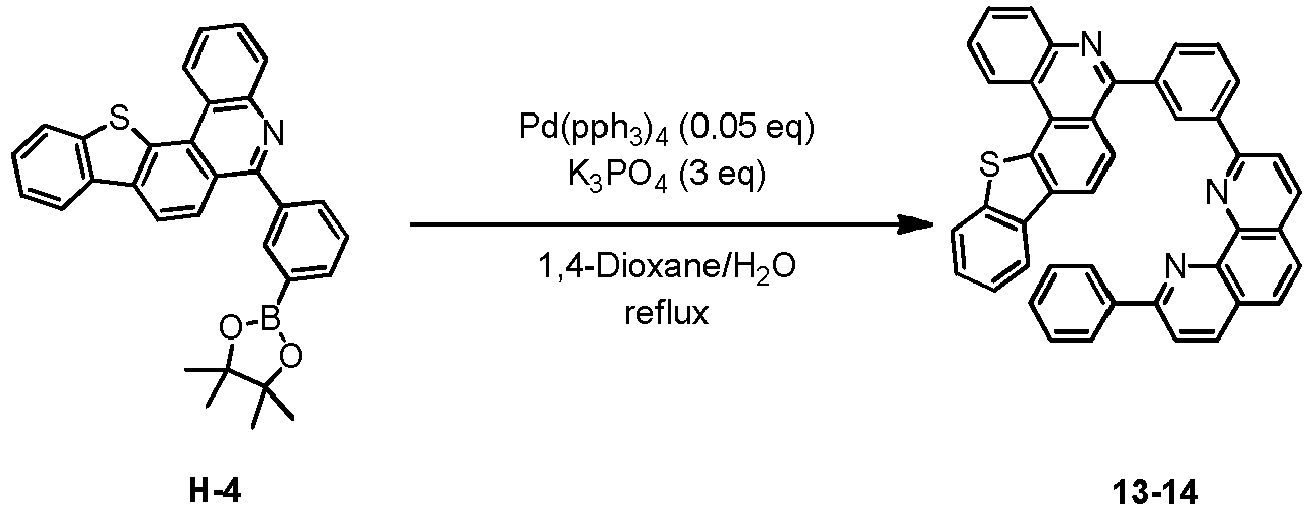
- After dissolving H-4 (10.1 g, 20.77 mmol, 1 eq.) in dioxane/H2O (5:1), 2-bromo-9-phenyl-1,10-phenanthroline (6.9 g, 20.77 mmol, 1 eq.), Pd(PPh3)4 (1.2 g, 1.039 mmol, 0.05 eq.) and K3PO4 (13.2 g, 62.31 mmol, 3 eq.) were added thereto, and the result was stirred for 3 hours at 80°C. After adding purified water and ethyl acetate thereto, the result was solidified, stirred for 1 hour, and then filtered. The filtered solids were heated with ethyl acetate, toluene and MeOH, and stirred. Solid Compound 13-14 was obtained (7.6 g, 59%).
-

- Liquid Compound R-2 was obtained (133 g, 100%) in the same synthesis manner as G-2.
- Solid Compound R-3 was obtained (93 g, 76%) in the same synthesis manner as G-3.
- Solid Compound R-4 was obtained (82 g, 79%) in the same synthesis manner as G-4.
- After dissolving R-4 (11.1 g, 20.77 mmol, 1 eq.) in dioxane/H2O (5:1), 2-bromo-9-phenyl-1,10-phenanthroline (6.9 g, 20.77 mmol, 1 eq.), Pd(PPh3)4 (1.2 g, 1.039 mmol, 0.05 eq.) and K3PO4 (13.2 g, 62.31 mmol, 3 eq.) were added thereto, and the result was stirred for 3 hours at 80°C. After adding purified water and ethyl acetate thereto, the result was solidified, stirred for 1 hour, and then filtered. The filtered solids were heated with ethyl acetate, toluene and MeOH, and stirred. Solid Compound 13-15 was obtained (11.9 g, 86%).
-

- Liquid Compound S-2 was obtained (133 g, 100%) in the same synthesis manner as G-2.
- Solid Compound S-3 was obtained (93 g, 76%) in the same synthesis manner as G-3.
- Solid Compound S-4 was obtained (82 g, 79%) in the same synthesis manner as G-4.
- After dissolving S-4 (11.1 g, 20.77 mmol, 1 eq.) in dioxane/H2O (5:1), 2-bromo-9-phenyl-1,10-phenanthroline (6.9 g, 20.77 mmol, 1 eq.), Pd(PPh3)4 (1.2 g, 1.039 mmol, 0.05 eq.) and K3PO4 (13.2 g, 62.31 mmol, 3 eq.) were added thereto, and the result was stirred for 3 hours at 80°C. After adding purified water and ethyl acetate thereto, the result was solidified, stirred for 1 hour, and then filtered. The filtered solids were heated with ethyl acetate, toluene and MeOH, and stirred. Solid Compound 13-16 was obtained (9.1 g, 66%).
-

- 1-4 (10 g, 0.021 mol, 1 eq.), 2-bromo-9-phenyl-1,10-phenanthroline (7.1 g, 0.021 mol, 1 eq.), Pd(PPh3)4 (0.05 eq.), K3PO4 (3 eq.) and 1,4-dioxane/H2O=5:1 (200, 40) were introduced, and the result was stirred for 1 hour at 120°C. When the reaction was completed, the temperature was lowered to room temperature, then H2O and MC were introduced thereto, and the result was stirred. The mixture was extracted with MC, moisture in the organic layer was removed using MgSO4, the result was filtered, and the solvent was concentrated. The concentration-completed mixture was column separated using MC:Hex. Solid Compound 13-17 (9.5 g, 75%) was obtained.
-

- J-4 (10 g, 0.021 mol, 1 eq.), 2-bromo-9-phenyl-1,10-phenanthroline (7.1 g, 0.021 mol, 1 eq.), Pd(PPh3)4 (0.05 eq.), K3PO4 (3 eq.) and 1,4-dioxane/H2O=5:1 (200, 40) were introduced, and the result was stirred for 1 hour at 120°C. When the reaction was completed, the temperature was lowered to room temperature, then H2O and MC were introduced thereto, and the result was stirred. The mixture was extracted with MC, moisture in the organic layer was removed using MgSO4, the result was filtered, and the solvent was concentrated. The concentration-completed mixture was column separated using MC:Hex. Solid Compound 13-18 (10.2 g, 80%) was obtained.
-

- Solid Compound T-2 was obtained (47 g, 99%) in the same synthesis manner as 1-2.
- Target Compound T-3 was obtained (71%) in the same synthesis manner as I-3.
- Target Compound T-4 was obtained (84%) in the same synthesis manner as I-4.
- To a flask, T-4 (10 g, 0.019 mol, 1 eq.), 2-bromo-9-phenyl-1,10-phenanthroline (6.5 g, 0.016 mol, 1 eq.), Pd(PPh3)4 (0.05 eq.), K3PO4 (3 eq.) and 1,4-dioxane/H2O=5:1 (200, 40) were introduced, and the result was stirred for 1 hour at 120°C. When the reaction was completed, the temperature was lowered to room temperature, then H2O and MC were introduced thereto, and the result was stirred. The mixture was extracted with MC, moisture in the organic layer was removed using MgSO4, the result was filtered, and the solvent was concentrated. The concentration-completed mixture was column separated using MC:Hex. Solid Compound 13-19 (10 g, 80%) was obtained.
-

- Solid Compound U-2 was obtained (47 g, 99%) in the same synthesis manner as I-2.
- Target Compound U-3 was obtained (71%) in the same synthesis manner as I-3.
- Target Compound U-4 was obtained (84%) in the same synthesis manner as I-4.
- To a flask, U-4 (10 g, 0.019 mol, 1 eq.), 2-bromo-9-phenyl-1,10-phenanthroline (6.5 g, 0.019 mol. 1 eq.), Pd(PPh3)4 (0.05 eq.), K3PO4 (3 eq.) and 1,4-dioxane/H2O=5:1 (200, 40) were introduced, and the result was stirred for 1 hour at 120°C. When the reaction was completed, the temperature was lowered to room temperature, then H2O and MC were introduced thereto, and the result was stirred. The mixture was extracted with MC, moisture in the organic layer was removed using MgSO4, the result was filtered, and the solvent was concentrated. The concentration-completed mixture was column separated using MC:Hex. Solid Compound 13-20 (11.0 g, 88%) was obtained.
-

- After dissolving K-4 (11.0 g, 0.016 mol, 1 eq.) in dioxane/H2O (5:1), 2-bromo-9-phenyl-1,10-phenanthroline (5.93 g, 0.017 mol, 1 eq.), Pd(PPh3)4 (1.0 g, 0.0009 mol, 0.05 eq.) and K3PO4 (10.24 g, 0.048 mol, 3 eq.) were added thereto, and the result was stirred for 3 hours at 80°C. After adding purified water and ethyl acetate thereto, the result was solidified, stirred for 1 hour, and then filtered. The filtered solids were heated with ethyl acetate, toluene and MeOH, and stirred. Solid Compound 13-21 was obtained (8.0 g, 60.3%).
-

- After dissolving L-4 (11.0 g, 0.016 mol, 1 eq.) in dioxane/H2O (5:1), 2-bromo-9-phenyl-1,10-phenanthroline (5.93 g, 0.017 mol, 1 eq.), Pd(PPh3)4 (1.0 g, 0.0009 mol, 0.05 eq.) and K3PO4 (10.24 g, 0.048 mol, 3 eq.) were added thereto, and the result was stirred for 3 hours at 80°C. After adding purified water and ethyl acetate thereto, the result was solidified, stirred for 1 hour, and then filtered. The filtered solids were heated with ethyl acetate, toluene and MeOH, and stirred. Solid Compound 13-22 was obtained (8.4 g, 63.3%).
-

- Solid Compound V-2 was obtained (200 g, 92.1%) in the same synthesis manner as K-2.
- Solid Compound V-3 was obtained (120 g, 61.8%) in the same synthesis manner as K-3.
- Solid Compound V-4 was obtained (100 g, 77.0%) in the same synthesis manner as K-4.
- After dissolving V-4 (11.9 g, 0.016 mol, 1 eq.) in dioxane/H2O (5:1), 2-bromo-9-phenyl-1,10-phenanthroline (5.93 g, 0.017 mol, 1 eq.), Pd(PPh3)4 (1.0 g, 0.0009 mol, 0.05 eq.) and K3PO4 (10.24 g, 0.048 mol, 3 eq.) were added thereto, and the result was stirred for 3 hours at 80°C. After adding purified water and ethyl acetate thereto, the result was solidified, stirred for 1 hour, and then filtered. The filtered solids were heated with ethyl acetate, toluene and MeOH, and stirred. Solid Compound 13-23 was obtained (10.1 g, 71.3%).
-

- Solid Compound X-2 was obtained (200 g, 92.1%) in the same synthesis manner as K-2.
- Solid Compound X-3 was obtained (120 g, 61.8%) in the same synthesis manner as K-3.
- Solid Compound X-4 was obtained (100 g, 77.0%) in the same synthesis manner as K-4.
- After dissolving X-4 (11.9 g, 0.014 mol, 1 eq.) in dioxane/H2O (5:1), 2-bromo-9-phenyl-1,10-phenanthroline (5.93 g, 0.017 mol, 1 eq.), Pd(PPh3)4 (1.0 g, 0.0009 mol, 0.05 eq.) and K3PO4 (10.24 g, 0.048 mol, 3 eq.) were added thereto, and the result was stirred for 3 hours at 80°C. After adding purified water and ethyl acetate thereto, the result was solidified, stirred for 1 hour, and then filtered. The filtered solids were heated with ethyl acetate, toluene and MeOH, and stirred. Solid Compound 13-24 was obtained (8.9 g, 62.9%).
- Compounds were prepared in the same manner as in the preparation examples, and the synthesis identification results are shown in Table 1 and Table 2.
[Table 1] Compou nd 1H NMR (CDCl3, 200 Mz) 1-1 δ=8.71 (d, 2H), 8.69 (d, 4H), 8.54 (d, 1H), 8.33 (d, 2H), 8.20 (d, 2H), 7.99∼7.85 (m, 9H), 7.70∼7.49 (m, 7H), 7.29 (d, 2H) 1-6 δ=8.91 (s, 1H), 8.71 (d, 2H), 8.69 (d, 2H), 8.54 (d, 1H), 8.39 (d, 1H), 8.33 (d, 2H), 8.20 (d, 2H), 7.99-7.85 (m, 9H), 7.70∼7.49 (m, 8H), 7.38 (d, 1H), 7.29 (d, 2H) 1-14 δ=8.80 (d, 1H), 8.69 (d, 2H), 8.67 (d, 1H), 8.54-8.44 (d, 3H), 8.20 (d, 1H), 7.99∼7.94 (m, 3H), 7.85 (t, 3H), 7.70∼7.53 (m, 6H), 7.32 (s, 1H), 7.25 (d, 4H) 1-26 δ=9.60 (d, 1H), 9.27 (s, 2H), 8.80 (d, 1H), 8.79 (d, 1H), 8. 67∼8. 69 (d, 3H), 8.54∼8.30 (m, 7H), 8.20 (d, 1H), 7.99∼7.85 (m, 6H),7.70∼7.53 (m, 8H), 7.32 (s, 1H) 1-27 δ=8.87 (d, 1H), 8.80 (d, 1H), 8.69 (d, 2H), 8.54 (d, 1H), 8.45 (d, 1H), 8.20 (d, 1H), 8.12 (d, 1H), 7.99∼7.82 (m, 7H), 7.70∼7.53 (m, 5H), 7.25 (d, 4H), 7.15 (d, 1H) 2-1 δ=8.71 (d, 2H), 8.69 (d, 2H), 8.54 (d, 1H), 8.33 (d, 2H), 8.20 (D, 2H), 7.99∼7.85 (m, 7H), 7.73∼7.53 (m, 9H) 7.29 (d, 2H) 2-14 δ=8.80 (d, 1H), 8.67 (d, 1H), 8.54∼8.44 (d, 3H), 8.33 (d, 2H), 8.20 (d, 1H), 7.99 (d, 2H), 7.94 (d, 1H), 7.85 (t, 1H), 7.73∼7.53 (m, 8H), 7.32 (d, 1H), 7.25 (d, 4H) 2-27 δ=8.87 (d, 1H), 8.80 (d, 1H), 8.54 (d, 1H), 8.45 (d, 1H), 8.33 (d, 2H), 8.20 (d, 1H), 8.12 (d, 1H), 7.99 (d, 2H), 7.94 (d, 1H), 7.85 (t, 1H), 7.82 (d, 1H), 7.70-7.53 (m, 7H), 7.25 (s, 4H), 7.15 (d, 1H) 3-1 δ=9.08 (d, 2H), 8.71 (d, 2H), 8.69 (d, 4H), 8.33 (d, 2H), 8.20 (d, 2H), 8.17 (d, 2H), 7.94-7.85 (m, 7H), 7.70-7.49 (m, 8H), 7.29 (d, 2H) 3-10 δ=9.08 (d, 2H), 8.71 (d, 2H), 8.69 (d, 2H), 8.33 (d, 2H), 8.22 (d, 2H), 8.20 (d, 2H), 8.19∼8.17 (d, 4H), 7.94∼7.85 (m, 3H), 7.70∼7.40 (m, 12H), 7.29∼7.25 (m, 4H) 3-14 δ=9.08 (d, 2H), 8.80 (d, 1H), 8.67 (d, 1H), 8.69 (d, 2H), 8.50 (d, 1H), 8.44 (d, 1H), 8.20 (d, 1H), 8.17 (d, 2H), 7.94 (d, 1H), 7.85 (t, 3H), 7.70-7.56 (m, 7H) 3-27 δ=9.08 (d, 2H), 8.87 (d, 1H), 8.80 (d, 1H), 8.69 (d, 2H), 8.45 (d, 1H), 8.20 (d, 1H), 8.17 (d, 1H), 8.12 (d, 1H), 7.94 (d, 1H), 7.85 (t, 3H), 7.82 (d, 1H), 7.70 (t, 3H), 7.62 (t, 2H), 7.25 (S, 4H), 7.15 (d, 1H) 4-1 δ=9.08 (d, 2H), 8.71 (d, 2H), 8.69 (d, 2H), 8.33 (d, 4H), 8.20 (d, 2H), 8.17 (d, 2H), 7.94 (d, 1H), 7.90 (d, 1H), 7.85 (t, 3H), 7.73∼7.49 (m, 10H), 7.29 (d,2H) 4-5 δ=9.08 (d, 2H), 9.02 (d, 1H), 8.95 (d, 1H), 8.71 (d, 2H), 8.45 (d, 1H), 8.33 (d, 4H), 8.20∼8.17 (m, 4H), 7.94∼7.85 (m, 4H), 7.73∼7.46 (m, 12H), 7.29 (d, 2H) 4-17 δ=9.26 (s, 2H), 9.08 (d, 2H), 8.80 (d, 2H), 8.50 (d, 1H), 8.46 (d, 1H), 8.38-8.33 (d, 3H), 8.20 (d, 1H), 8.17 (d, 2H), 7.94∼7.62 (m, 11H) 4-27 δ=9.08 (d, 2H), 8.80-8.87 (d, 2H), 8.45 (d, 1H), 8.33 (d, 2H), 8.20∼8.12 (d, 4H), 7.94 (d, 1H), 7.85∼7.82 (t, 2H), 7.73∼7.56 (m, 8H), 7.25 (s, 4H), 7.15 (d, 1H) 5-1 δ=9.08 (d, 1H), 8.98 (d, 1H), 8.71-8.69 (m, 6H), 8.33 (d, 2H), 8.20-8.11 (m, 3H), 7.99 (d, 1H), 7.90-7.83 (m, 6H), 7.70∼7.49 (m, 9H), 7.29 (d, 2H) 5-7 δ=9.08 (d, 1H), 9.89 (d, 1H), 8.82 (d, 1H), 8.71 (d, 2H), 8.69 (d, 4H), 8.47 (s, 1H), 8.33 (d, 2H), 8.25∼8.11 (m, 4H), 7.99 (d, 1H), 7.90∼7.83 (d, 2H), 7.70∼7.55 (m, 9H), 7.29 (d, 3H) 5-21 δ=9.08 (d, 1H), 8.89 (d, 1H), 8.80 (d, 1H), 8.74 (d, 1H), 8.69 (d, 2H), 8.67 (d, 1H), 8.50 (d, 1H), 8.44 (d, 1H), 8.49 (d, 1H), 8.17∼8.11 (d, 2H), 7.99∼7.92 (d, 2H), 7.83 (d, 1H), 7.74∼7.56 (m, 9H), 7.43 (t, 1H), 7.32∼7.25 (d, 3H) 5-38 δ=9.08 (d, 1H), 8.89 (d, 1H), 8.80 (d, 1H), 8.87 (d, 1H), 8.69 (d, 2H), 8.52-8.46 (s, 2H), 8.45 (d, 1H), 8.22∼8.08 (m, 6H), 7.99∼7.82 (m, 7H), 7.70∼7.56 (m, 8H), 7.15 (d, 1H) 6-1 δ=9.08 (d, 1H), 8.89 (d, 1H), 8.71 (d, 2H), 8.69 (d, 2H), 8.33 (d, 4H), 8.20 (d, 1H), 8.17 (s, 1H), 8.11 (s, 1H), 7.99 (d, 1H), 7.90∼7.85 (m, 4H), 7.73∼7.49 (m, 11H), 7.29 (d, 2H) 6-5 δ=9.08 (d, 1H), 9.02 (d, 1H), 8.98 (d, 1H), 8.95 (d, 1H), 8.71 (d, 2H), 8.45 (d, 1H), 8.33 (m, 4H), 8.20-8.11 (m, 3H), 7.99 (d, 1H), 7.90 (d, 1H), 7.84 (d, 1H), 7.83 (d, 1H), 7.73∼7.46 (m, 13H), 7.29 (d, 2H) 6-10 δ=9.08 (d, 1H), 8.89 (d, 1H), 8.71 (d, 2H), 8.33 (d, 4H), 8.22∼8.11 (m, 7H), 7.61 (d, 1H), 7.90 (d, 1H), 7.83 (d, 1H), 7.70∼7.40 (m, 15H), 7.29 (d, 2H) 6-14 δ=9.08 (d, 1H), 8.89 (d, 1H), 8.80 (d, 1H), 8.67 (d, 1H), 8.50 (d, 1H), 8.44 (d, 1H), 8.33 (d, 2H), 8.17 (d, 1H), 8.11 (d, 1H), 7.99 (d, 1H), 7.83 (d, 1H), 7.73∼7.56 (m, 10H), 7.32 (s, 1H), 7.25 (d, 4H) 6-38 δ=9.08 (d, 1H), 8.89 (d, 1H), 8.87 (d, 1H), 8.80 (d, 1H), 8.52-8.45 (d, 2H), 8.33 (t, 2H), 8.28 (d, 1H), 8.17∼8.11 (m, 5H), 7.99∼7.92 (d, 3H), 7.83∼7.56 (m, 13H), 7.15 (d, 1H) 7-1 δ=8.71 (d, 2H), 8.69 (d, 4H), 8.45 (d, 1H), 8.33 (d, 2H), 8.20 (d, 2H), 7.94∼7.85 (m, 9H), 7.70 (t, 1H), 7.62∼7.49 (m, 6H), 7.29 (d, 2H) 7-5 δ=9.02 (d, 1H), 8.95 (d, 1H), 8.71 (d, 2H), 8.69 (d, 2H), 8.45 (d, 2H), 8.33 (d, 2H), 8.20 (d, 2H), 7.99∼7.84 (m, 6H), 7.70∼7.46 (m, 9H), 7.29 (d, 2H), 7.25 (d, 2H) 7-17 δ=9.26 (s, 2H), 8.80 (d, 2H), 8.69 (d, 2H), 8.50 (d, 1H), 8.46 (d, 1H), 8.20 (d, 1H), 7.94∼7.56 (m, 13H) 7-34 δ=8.80 (d, 1H), 8.87 (d, 2H), 8.69 (d, 2H), 8.45 (d, 3H), 8.20∼8.14 (m, 4H), 7.99∼7.82 (m, 5H), 7.70∼7.49 (m, 6H), 7.25 (d, 2H), 7.15 (d, 1H) 7-39 δ=9.60 (d, 1H), 9.27 (s, 2H), 8.87 (d, 1H), 8.80 (d, 1H), 8.79 (d, 1H), 8.69 (d, 2H), 8.45 (d, 2H), 8.37 (d, 2H), 8.30 (d, 2H), 8.20 (d, 1H), 8.12 (d, 1H), 7.99 (d, 1H), 7.94∼7.82 (m, 7H), 7.70-7.49 (m, 7H), 7.15 (d, 1H) 8-1 δ=8.71 (d, 2H), 8.69 (d, 2H), 8.45 (d, 1H), 8.33 (d, 4H), 8.20 (d, 1H), 7.99∼7.85(m, 7H), 7.73∼7.49 (m, 9H), 7.29 (d, 2H) 8-5 δ=9.02 (d, 1H), 8.95 (d, 1H), 8.71 (d, 2H), 8.45 (d, 2H), 8.33 (d, 4H), 8.20 (d, 2H), 7.94∼7.84 (m, 6H), 7.73∼7.46 (m, 11H), 7.29 (d, 2H) 8-6 δ=8.83 (s, 1H), 8.71 (d, 2H), 8.45 (d, 1H), 8.38∼8.33 (m, 5H), 8.20 (d, 1H), 8.12(d, 1H), 7.99∼7.85 (m, 6H), 7.73-7.49 (m, 10H), 7.38 (d, 1H), 7.29 (d, 2H) 8-19 δ=8.80 (d, 1H), 8.67 (d, 1H), 8.50 (d, 1H), 8.45∼8.44 (d, 2H), 8.33 (d, 2H), 8.20 (d, 1H), 7.99∼7.85 (m, 6H), 7.73∼7.40 (m, 12H), 7.32 (s, 1H) 8-39 δ=8.87 (d, 1H), 8.80 (d, 1H), 8.52 (d, 1H), 8.45 (d, 2H), 8.33-8.15 (m, 7H), 7.99-7.49 (m, 16H), 7.15 (d, 1H) 9-1 δ=7.32-7.55 (m, 8H), 7.60 (t, 1H), 7.66 (d, 1H), 7.78 (t, 1H), 7.81-7.89 (m, 6H), 7.92 (d, 1H), 7.98-8.10 (m, 4H), 8.30 (d, 2H), 8.81 (d, 4H) 9-5 δ=7.28-7.38 (m, 6H), 7.47 (t, 1H), 7.54-7.55 (m, 5H), 7.60 (t, 1H), 7.66 (d, 1H), 7.78-7.81 (m, 2H), 7.89-7.92 (m, 2H), 7.98 (d, 1H), 8.04-8.10 (m, 5H), 8.30 (d, 2H), 8.52-8.55 (m, 3H), 8.81 (d, 2H) 9-14 δ=7.25 (m, 4H), 7.32-7.38 (m, 2H), 7.55 (d, 1H), 7.58 (m, 2H), 7.60 (t, 1H), 7.65-7.66 (2H), 7.78 (t, 1H), 7.88-7.89 (m, 3H), 7.92 (d, 1H), 7.98 (d, 1H), 8.06 (d, 1H), 8.38 (d, 2H), 8.81-8.83 (m, 3H) 9-18 δ=7.28-7.38 (m, 4H), 7.55-7.58 (m, 5H), 7.60 (t, 1H), 7.65-7.66 (m, 2H), 7.78 (t, 1H), 7.89 (d, 1H), 7.92 (d, 1H), 7.98-8.01 (m, 3H), 8.06 (d, 1H), 8.38 (m, 2H), 8.55 (d, 2H), 8.81-8.83 (m, 4H) 10-1 δ=7.32-7.38 (m, 4H), 7.47 (t, 1H), 7.54-7.55 (m, 4H), 7.60 *m, 2H), 7.66 (d, 1H), 7.78 (t, 1H), 7.81 (d, 1H_), 7.88 (d, 2H), 7.98-8.10 (m, 4H), 8.06-8.10 (m, 4H), 8.21 (s, 1H), 8.26-8.30 (m, 3H), 8.81 (d, 2H) 10-5 δ=7.32-7.38 (m, 4H), 7.47 (t, 1H), 7.54-7.55 (m, 6H), 7.60 (m, 2H), 7.78-7.81 (m, 2H), 7.89 (d, 1H), 7.92 (d, 1H), 7.98 (d, 1H), 8.04-8.06 (m, 3H), 8.10 (d, 2H), 8.21 (s, 1H), 8.26-8.30 (m, 3H), 8.52-8.55 (m, 3H) 10-14 δ=7.25 (s, 4H), 7.32-7.38 (m, 2H), 7.54-7.66 (m, 8H), 7.78 (t, 1H), 7.89 (d, 1H), 7.92 (d, 1H), 7.98 (d, 1H), 8.06 (d, 1H), 8.21 (s, 1H), 8.26 (d, 1H), 8.38 (d, 1H), 8.83 (d, 1H) 10-18 δ=7.32-7.38 (m, 2H), 7.54-7.66 (m, 10H), 7.78 (t, 1H), 7.89 (d, 1H), 7.92 (s, 2H), 8.01 (s, 2H), 8.06 (d, 1H), 8.21 (s, 1H), 8.26 (d, 1H), 8.38 (d, 2H), 8.55 (d, 2H), 8.83 (d, 2H) 11-1 δ=8.81(4H, d), 8.30(2H, d), 8.10∼7.98(7H, m), 7.88∼7.78(6H, m), 7.54∼7.23(16H, m), 7.11(4H, m) 11-5 δ=8.81(2H, d), 8.55(3H, m), 8.30(2H, m), 8.10∼7.98(8H, m), 7.81 (2H, m), 7.60∼7.24(20H, m), 7.11(4H, m) 11-10 δ=8.81(2H, d), 8.30(2H, d), 8.10∼7.91(11H, m), 7.81(2H, m), 7.60∼7.24(22H, m), 7.11(4H, m) 11-14 δ=8.83(4H, m), 8.38(2H, d), 8.09∼7.98(4H, m), 7.88(2H, d), 7.78(1H, t), 7.65∼7.58(6H, m) 7.44(1H, t) 7.33∼7.24(11H, m), 7.11(4H, m) 11-27 δ=8.81(4H, m), 8.38(1H, d), 8.09∼7.98(5H, m), 7.88∼7.78(4H, m), 7.58(4H, m) 7.48(2H, m) 7.33∼7.24(11H, m), 7.11(4H, m) 12-1 δ=8.81(2H, d), 8.30(4H, m), 8.10∼7.98(7H, m), 7.88∼7.78(4H, m), 7.60∼7.23(18H, m), 7.11(4H, m) 12-5 δ=8.55(3H, m), 8.30(4H, m), 8.10∼7.98(8H, m), 7.81 (2H, m), 7.60∼7.26(20H, m), 7.11(4H, m) 12-10 δ=8.30(4H, m), 8.10∼7.91(11H, m), 7.81(2H, m), 7.60∼7.24(22H, m), 7.11(4H, m) 12-14 δ=8.83(2H, d), 8.38(2H, d), 8.26(2H, d), 8.09∼7.98(4H, m), 7.78(1H, t), 7.65∼7.54(8H, m) 7.44(1H, t) 7.33∼7.25(11H, m), 7.11(4H, m) 12-27 δ=8.82(2H, m), 8.38(1H, d), 8.26(2H, d), 8.09-7.98(5H, m), 7.78(2H, m), 7.60∼7.44(8H, m), 7.33∼7.25(11H, m), 7.11(4H, m) 13-1 δ=8.71(2H, d), 8.69(4H, d), 8.54(1H, d), 8.33(2H, d), 8.20(2H, d), 7.99∼7.85(5H, m), 7.70∼7.49(7H, m), 7.29(2H, d) 13-2 δ=8.72(1H, s), 8.71(2H, d), 8.54(1H, d), 8.33(4H, d) ,8.20(2H, d), 7.99∼7.85(5H, m), 7.61∼7.49(8H, m), 7.29(2H, d) 13-3 δ=8.97(2H, d), 8.71∼7.68(4H, m), 8.54(1H, d), 8.33(2H, d), 8.20(2H, d), 7.99∼7.85(5H, m), 7.70∼7.49(9H, m), 7.29(2H, d) 13-4 δ=8.85(2H, s), 8.71(2H, d), 8.54(1H, d), 8.37∼8.33(4H, m), 8.20(2H, d), 7.99∼7.85(7H, m), 7.70∼7.49(7H, m), 7.29(2H, d) 13-5 δ=9.08(2H, d), 8.71∼8.69(6H, m), 8.33(2H, d), 8.20∼8.17(4H, m), 7.94∼7.85(3H, m), 7.70∼7.49(8H, m), 7.29(2H, d) 13-6 δ=9.08(2H, d), 8.71(3H, m), 8.33(4H, d), 8.20∼8.17(4H, m), 7.94∼7.85(3H, m), 7.73∼7.49(9H, m), 7.29(2H, d) 13-7 δ=9.08(2H, d), 8.79(2H, d), 8.71∼8.68(4H, m), 8.33(2H, d), 8.20∼8.17(4H, m), 7.94∼7.85(3H, m), 7.70∼7.49(10H, m), 7.29(2H, d) 13-8 δ=9.08(2H, d), 8.85(2H, s), 8.71(2H, d), 8.37∼8.33(4H, m), 8.20∼8.17(4H, m), 7.93∼7.85(5H, m), 7.70∼7.49(8H, m), 7.29(2H, d) 13-9 δ=9.08 (1H, d), 8.89(1H, d), 8.71∼8.69(6H, m), 8.33(2H, d), 8.20∼8.11(3H, m), 7.99(1H, d), 7.90∼7.83(2H, d), 7.70∼7.49(9H, m), 7.29(2H, d) 13-10 δ=9.08(1H, d), 8.98(1H, d), 8.72∼8.71(3H, d), 8.33(4H, d), 8.20∼8.11(3H, m), 7.99(1H, d), 8.90∼7.83(2H, d), 7.70∼7.49(10H, m), 7.29(2H, d) 13-11 δ=9.08(1H, d), 8.98∼8.97(3H, d), 8.71∼8.68(4H, m), 8.33(2H, d), 8.20∼8.11(3H, m), 7.99(1H, d), 7.90∼7.83(2H, d), 7.70∼7.49(11H, m), 7.29(2H, d) 13-12 δ=9.08(1H, d), 8.98 (1H, d), 8.85(2H, d), 8.71(2H, d), 8.37∼8.33(4H, m), 8.20∼8.11(3H, m), 7.99∼7.83(5H, m), 7.70∼7.49(9H, m), 7.29(2H, d) 13-13 δ=8.71(2H, d), 8.69(4H, d), 8.45(1H, d), 8.33(2H, d), 8.20(2H, d), 7.99-7.85(5H, m), 7.70-7.49(8H, m), 7.29(2H, d) 13-14 δ=8.72~8.71(3H, m), 8.45(1H, d), 8.33(4H, d), 8.20(2H, d), 7.99∼7.85(5H, m), 7.70∼7.49(8H, m), 7.29(2H, d) 13-15 δ=8.97(2H, d), 8.71-8.69(4H, m), 8.45(1H, d), 8.33(2H, d), 8.20(2H, d), 7.94∼7.85(5H, m), 7.70∼7.49(9H, m), 7.29(2H, d) 13-16 δ=8.85(2H, d), 8.71(2H, d), 8.45~8.33(5H, m), 8.20(2H, d), 7.99∼7.85(7H, m), 7.70∼7.49(7H, m), 7.29(2H, d) 13-17 δ=8.71~8.69(6H, d), 8.33(2H, d), 8.20(2H, d), 7.98∼7.85(5H, m), 7.70∼7.49(6H, m), 7.39∼7.29(4H, m) 13-18 δ=8.72~8.71(3H, m), 8.33(4H, d), 8.20(2H, d), 7.99∼7.84(5H, m), 7.73-7.29(11H, m) 13-19 δ=8.97 (2H, d), 8.71∼8.68(4H, m), 8.33(2H, d), 8.20(2H, d), 7.98∼7.85(5H, m), 7.70∼7.29(11H, m) 13-20 δ=8.85(2H, d), 8.71(2H, d), 8.37∼8.33(4H, m), 8.20(2H, d), 7.98∼7.85(7H, m), 7.70∼7.29(10H, m) 13-21 δ=8.71~8.69(6H, m), 8.33(2H, d), 8.24∼8.20(3H, m), 7.94∼7.85(4H, m), 7.74∼7.70(3H, m), 7.57∼7.49(4H, m), 7.38(1H, t), 7.26∼7.18(12H, m) 13-22 δ=8.72~8.71(3H, m), 8.33-8.20(7H, m), 7.94∼7.84(4H, m), 7.73∼7.70(4H, m), 7.57∼7.49(4H, m), 7.38∼7.18(13H, m) 13-23 δ=8.97(2H, d), 8.71-8.68(3H, m), 8.33(2H, d), 8.24∼8.20(3H, m), 7.94∼7.85(4H, m), 7.74∼7.70(3H, m), 7.59∼7.49(6H, m), 7.38∼7.18(13H, m) 13-24 δ=8.85(2H, d), 8.71(2H, d), 8.37∼8.33(4H, m), 8.24∼8.20(3H, m), 7.94∼7.85(6H, m), 7.74∼7.70(3H, m), 7.57∼7.49(4H, m), 7.38∼7.18(13H, m) [Table 2] Compound FD-MS Compound FD-MS 1-1 m/z=635.77 1-2 m/z=636.75 (C40H29N3=635.23) (C46H28N4=636.23) 1-3 m/z=636.75 1-4 m/z=637.74 (C46H28N4=636.23) (C45H27N5=637.22) 1-5 m/z=685.83 1-6 m/z=685.83 (C51H31N3=685.25) (C51H31N3=685.25) 1-7 m/z=686.81 1-8 m/z=686.81 (C50H30N4=686.24) (C50H30N4=686.24) 1-9 m/z=735.89 1-10 m/z=735.89 (C55H33N3=735.26) (C55H33N3=735.26) 1-11 m/z=735.89 1-12 m/z=761.92 (C55H33N3=735.26) (C57H35N3=761.28) 1-13 m/z=785.95 1-14 m/z=559.67 (C59H35N3=785.28) (C41H25N3=559.20) 1-15 m/z=560.66 1-16 m/z=560.66 (C40H24N4=560.20) (C40H24N4=560.20) 1-17 m/z=561.65 1-18 m/z=609.73 (C39H23N5=561.20) (C41H5N3=609.22) 1-19 m/z=609.73 1-20 m/z=610.72 (C41H25N3=609.22) (C44H26N4=610.22) 1-21 m/z=610.72 1-22 m/z=659.79 (C44H26N4=610.22) (C49H29N3=659.24) 1-23 m/z=659.79 1-24 m/z=659.79 (C49H29N3=659.24) (C49H29N3=659.24) 1-25 m/z=685.83 1-26 m/z=685.83 (C51H31N3=685.25) (C51H31N3=685.25) 1-27 m/z=559.67 1-28 m/z=560.66 (C41H25N3=559.20) (C40H24N4=560.20) 1-29 m/z=560.66 1-30 m/z=560.66 (C40H24N4=560.20) (C40H24N4=560.20) 1-31 m/z=609.73 1-32 m/z=609.73 (C45H27N3=609.22) (C45H27N3=609.22) 1-33 m/z=610.72 1-34 m/z=610.72 (C44H26N4=610.22) (C44H26N4=610.22) 1-35 m/z=659.79 1-36 m/z=659.79 (C49H29N3=659.24) (C49H29N3=659.24) 1-37 m/z=659.79 1-38 m/z=685.83 (C49H29N3=659.24) (C51H31N3=685.25) 1-39 m/z=709.85 (C53H31N3=709.25) 2-1 m/z=635.77 2-2 m/z=626.75 (C47H29N3=635.23 (C46H28N4=636.23) 2-3 m/z=636.75 2-4 m/z=637.74 (C46H28N4=636.23) (C45H27N5=367.22) 2-5 m/z=685.83 2-6 m/z=685.83 (C51H31N3=685.22) (C51H31N3=685.25) 2-7 m/z=686.81 2-8 m/z=686.81 (C50H30N4=686.24) (C50H30N4=686.24) 2-9 m/z=735.89 2-10 m/z=735.89 (C55H33N3=735.26) (C55H33N3=735.26) 2-11 m/z=735.89 2-12 m/z=761.92 (C55H33N3=735.26) (C57H35N3=761.28) 2-13 m/z=785.98 2-14 m/z=559.67 (C59H35N3=785.28) (C41H25N3=559.20) 2-15 m/z=560.66 2-16 m/z=560.66 (C40H24N4=560.20) (C40H24N4=560.20) 2-17 m/z=561.65 2-18 m/z=609.73 (C39H23N5=561.20) (C41H5N3=609.22) 2-19 m/z=609.73 2-20 m/z=610.72 (C41H25N3=609.22) (C44H26N4=610.22) 2-21 m/z=610.72 2-22 m/z=659.79 (C44H26N4=610.22) (C49H29N3=659.24) 2-23 m/z=659.79 2-24 m/z=659.79 (C49H29N3=659.24) (C49H29N3=659.24) 2-25 m/z=685.83 2-26 m/z=685.83 (C51H31N3=685.25) (C51H31N3=685.25) 2-27 m/z=559.67 2-28 m/z=560.66 (C41H25N3=559.20) (C40H24N4=560.20) 2-29 m/z=560.66 2-30 m/z=560.66 (C40H24N4=560.20) (C40H24N4=560.20) 2-31 m/z=609.73 2-32 m/z=609.73 (C45H27N3=609.22) (C45H27N3=609.22) 2-33 m/z=610.72 2-34 m/z=610.72 (C44H26N4=610.22) (C44H26N4=610.22) 2-35 m/z=659.79 2-36 m/z=659.79 (C49H29N3=659.24) (C49H29N3=659.24) 2-37 m/z=659.79 2-38 m/z=685.83 (C49H29N3=659.24) (C51H31N3=685.25) 2-39 m/z=709.85 (C53H31N3=709.25) 3-1 m/z=685.83 3-2 m/z=686.81 (C51H31N3=685.25) (C50H30N4=686.24) 3-3 m/z=686.81 3-4 m/z=687.80 (C50H30N4=686.24) (C49H29N5=687.24) 3-5 m/z=735.89 3-6 m/z=735.89 (C55H33N3=735.26) (C55H33N3=735.26) 3-7 m/z=736.87 3-8 m/z=736.87 (C54H32N4=736.26) (C54H32N4=736.26) 3-9 m/z=785.95 3-10 m/z=785.95 (C59H35N3=785.28) (C59H35N3=785.28) 3-11 m/z=785.95 3-12 m/z=811.98 (C59H35N3=785.28) (C61H37N3=811.29) 3-13 m/z=836.01 3-14 m/z=609.73 (C63H37N3=835.29) (C45H27N3=609.22) 3-15 m/z=610.72 3-16 m/z=610.72 (C44H26N4=610.22) (C44H26N4=610.22) 3-17 m/z=611.71 3-18 m/z=659.79 (C43H25N5=611.21) (C49H29N3=659.24) 3-19 m/z=659.79 3-20 m/z=660.78 (C49H29N3=659.24) (C48H28N4=660.23) 3-21 m/z=660.78 3-22 m/z=709.85 (C48H28N4=660.23) (C53H31N3=709.25) 3-23 m/z=709.85 3-24 m/z=709.85 (C53H31N3=709.25) (C53H31N3=709.25) 3-25 m/z=735.89 3-26 m/z=759.91 (C55H33N3=735.27) (C57H33N3=759.27) 3-27 m/z=609.73 3-28 m/z=610.72 (C45H27N3=609.22) (C44H26N4=610.22) 3-29 m/z=610.72 3-30 m/z=611.71 (C44H26N4=610.22) (C43H25N5=611.21) 3-31 m/z=659.79 3-32 m/z=659.79 (C49H29N3=659.24) (C49H29N3=659.24) 3-33 m/z=660.78 3-34 m/z=660.78 (C48H28N4=660.23) (C48H28N4=660.23) 3-35 m/z=709.85 3-36 m/z=709.85 (C53H31N3=709.25) (C53H31N3=709.25) 3-37 m/z=709.85 3-38 m/z=735.89 (C53H31N3=709.25) (C55H33N3=735.27) 3-39 m/z=759.91 (C57H33N3=759.27) 4-1 m/z=685.83 4-2 m/z=686.81 (C51H31N3=685.25) (C50H30N4=686.24) 4-3 m/z=686.81 4-4 m/z=687.80 (C50H30N4=686.24) (C49H29N5=687.24) 4-5 m/z=735.89 4-6 m/z=735.89 (C55H33N3=735.26) (C55H33N3=735.26) 4-7 m/z=736.87 4-8 m/z=736.87 (C54H32N4=736.26) (C54H32N4=736.26) 4-9 m/z=785.95 4-10 m/z=785.95 (C59H35N3=785.28) (C59H35N3=785.28) 4-11 m/z=785.95 4-12 m/z=811.98 (C59H35N3=785.28) (C61H37N3=811.29) 4-13 m/z=836.01 4-14 m/z=609.73 (C63H37N3=835.29) (C45H27N3=609.22) 4-15 m/z=610.72 4-16 m/z=610.72 (C44H26N4=610.22) (C44H26N4=610.22) 4-17 m/z=611.71 4-18 m/z=659.79 (C43H25N5=611.21) (C49H29N3=659.24) 4-19 m/z=659.79 4-20 m/z=660.78 (C49H29N3=659.24) (C48H28N4=660.23) 4-21 m/z=660.78 4-22 m/z=709.85 (C48H28N4=660.23) (C53H31N3=709.25) 4-23 m/z=709.85 4-24 m/z=709.85 (C53H31N3=709.25) (C53H31N3=709.25) 4-25 m/z=735.89 4-26 m/z=759.91 (C55H33N3=735.27) (C57H33N3=759.27) 4-27 m/z=609.73 4-28 m/z=610.72 (C45H27N3=609.22) (C44H26N4=610.22) 4-29 m/z=610.72 4-30 m/z=611.71 (C44H26N4=610.22) (C43H25N5=611.21) 4-31 m/z=659.79 4-32 m/z=659.79 (C49H29N3=659.24) (C49H29N3=659.24) 4-33 m/z=660.78 4-34 m/z=660.78 (C48H28N4=660.23) (C48H28N4=660.23) 4-35 m/z=709.85 4-36 m/z=709.85 (C53H31N3=709.25) (C53H31N3=709.25) 4-37 m/z=709.85 4-38 m/z=735.89 (C53H31N3=709.25) (C55H33N3=735.27) 4-39 m/z=759.91 (C57H33N3=759.27) 5-1 m/z=685.83 5-2 m/z=686.81 (C51H31N3=685.25) (C50H30N4=686.24) 5-3 m/z=686.81 5-4 m/z=687.80 (C50H30N4=686.24) (C49H29N5=687.24) 5-5 m/z=735.89 5-6 m/z=735.89 (C55H33 m3=735.26) (C55H33N3=737.26) 5-7 m/z=736.87 5-8 m/z=736.87 (C54H32N4=736.26) (C54H32N4=736.26) 5-9 m/z=785.95 5-10 m/z=785.95 (C59H35N3=785.28) (C59H35N3=785.28) 5-11 m/z=785.95 5-12 m/z=811.98 (C59H35N3=785.28) (C61H37N3=811.29) 5-13 m/z=836.01 5-14 m/z=609.73 (C63H37N3=835.29) (C45H27N3=609.22) 5-15 m/z=610.72 5-16 m/z=610.72 (C44H26N4=610.22) (C44H26N4=610.22) 5-17 m/z=611.71 5-18 m/z=659.79 (C43H25N5=611.21) (C49H29N3=659.24) 5-19 m/z=659.79 5-20 m/z=660.78 (C49H29N3=659.24) (C48H28N4=660.23) 5-21 m/z=660.78 5-22 m/z=709.85 (C48H28N4=660.23) (C53H31N3=709.25) 5-23 m/z=709.85 5-24 m/z=709.85 (C53H31N3=709.25) (C53H31N3=709.25) 5-25 m/z=735.89 5-26 m/z=759.91 (C55H33N3=735.27) (C57H33N3=759.27) 5-27 m/z=609.73 5-28 m/z=610.72 (C45H27N3=609.22) (C44H26N4=610.22) 5-29 m/z=610.72 5-30 m/z=611.71 (C44H26N4=610.22) (C43H25N5=611.21) 5-31 m/z=659.79 5-32 m/z=659.79 (C49H29N3=659.24) (C49H29N3=659.24) 5-33 m/z=660.78 5-34 m/z=660.78 (C48H28N4=660.23) (C48H28N4=660.23) 5-35 m/z=709.85 5-36 m/z=709.85 (C53H31N3=709.25) (C53H31N3=709.25) 5-37 m/z=709.85 5-38 m/z=735.89 (C53H31N3=709.25) (C55H33N3=735.27) 5-39 m/z=759.91 (C57H33N3=759.27) 6-1 m/z=685.83 6-2 m/z=686.81 (C51H31N3=685.25) (C50H30N4=686.24) 6-3 m/z=686.81 6-4 m/z=687.80 (C50H30N4=686.24) (C49H29N5=687.24) 6-5 m/z=735.89 6-6 m/z=735.89 (C55H33N3=735.26) (C55H33N3=735.26) 6-7 m/z=736.87 6-8 m/z=736.87 (C54H32N4=736.26) (C54H32N4=736.26) 6-9 m/z=785.95 6-10 m/z=785.95 (C59H35N3=785.28) (C59H35N3=785.28) 6-11 m/z=785.95 6-12 m/z=811.98 (C59H35N3=785.28) (C61H37N3=811.29) 6-13 m/z=836.01 6-14 m/z=609.73 (C63H37N3=835.29) (C45H27N3=609.22) 6-15 m/z=610.72 6-16 m/z=610.72 (C44H26N4=610.22) (C44H26N4=610.22) 6-17 m/z=611.71 6-18 m/z=659.79 (C43H25N5=611.21) (C49H29N3=659.24) 6-19 m/z=659.79 6-20 m/z=660.78 (C49H29N3=659.24) (C48H28N4=660.23) 6-21 m/z=660.78 6-22 m/z=709.85 (C48H28N4=660.23) (C53H31N3=709.25) 6-23 m/z=709.85 6-24 m/z=709.85 (C53H31N3=709.25) (C53H31N3=709.25) 6-25 m/z=735.89 6-26 m/z=759.91 (C55H33N3=735.27) (C57H33N3=759.27) 6-27 m/z=609.73 6-28 m/z=610.72 (C45H27N3=609.22) (C44H26N4=610.22) 6-29 m/z=610.72 6-30 m/z=611.71 (C44H26N4=610.22) (C43H25N5=611.21) 6-31 m/z=659.79 6-32 m/z=659.79 (C49H29N3=659.24) (C49H29N3=659.24) 6-33 m/z=660.78 6-34 m/z=660.78 (C48H28N4=660.23) (C48H28N4=660.23) 6-35 m/z=709.85 6-36 m/z=709.85 (C53H31N3=709.25) (C53H31N3=709.25) 6-37 m/z=709.85 6-38 m/z=735.89 (C53H31N3=709.25) (C55H33N3=735.27) 6-39 m/z=759.91 (C57H33N3=759.27) 7-1 m/z=691.85 7-2 m/z=692.84 (C49H29N3S=691.20) (C48H28N4S=692.20) 7-3 m/z=692.84 7-4 m/z=693.82 (C48H28N4S=692.20) (C47H27N5S=693.19) 7-5 m/z=741.91 7-6 m/z=741.91 (C53H31N3S=741.22) (C53H31N3S=741.22) 7-7 m/z=742.90 7-8 m/z=742.90 (C52H30N4S=742.21) (C52H30N4S=742.21) 7-9 m/z=791.97 7-10 m/z=791.97 (C57H33N3S=791.24) (C57H33N3S=791.24) 7-11 m/z=791.97 7-12 m/z=818.01 (C57H33N3S=791.24) (C59H35N3S=817.25) 7-13 m/z=842.03 7-14 m/z=615.75 (C61H35N3S=841.25) (C43H25N3S=615.18) 7-15 m/z=616.74 7-16 m/z=616.74 (C42H24N4S=616.17) (C42H24N4S=616.17) 7-17 m/z=617.73 7-18 m/z=665.81 (C41H23N5S=617.17) (C47H27N3S=665.19) 7-19 m/z=665.81 7-20 m/z=666.80 (C47H27N3S=665.19) (C46H26N4S=666.19) 7-21 m/z=666.80 7-22 m/z=715.87 (C46H26N4S=666.19) (C51H29N3S=715.21) 7-23 m/z=715.87 7-24 m/z=715.87 (C51H29N3S=715.21) (C51H29N3S=715.21) 7-25 m/z=741.91 7-26 m/z=765.93 (C53H31N3S=741.22) (C55H31N3S=765.22) 7-27 m/z=615.75 7-28 m/z=616.74 (C43H25N3S=615.18) (C42H24N4S=616.17) 7-29 m/z=616.74 7-30 m/z=617.73 (C42H24N4S=616.17) (C41H23N5S=617.17) 7-31 m/z=665.81 7-32 m/z=665.81 (C47H27N3S=665.19) (C47H27N3S=665.19) 7-33 m/z=666.80 7-34 m/z=666.80 (C46H26N4S=666.19) (C46H26N4S=666.19) 7-35 m/z=715.87 7-36 m/z=715.87 (C51H29N3S=715.21) (C51H29N3S=715.21) 7-37 m/z=715.87 7-38 m/z=741.91 (C51H29N3S=715.21) (C53H31N3S=741.22) 7-39 m/z=765.93 (C55H31N3S=765.22) 8-1 m/z=691.85 8-2 m/z=692.84 (C49H29N3S=691.20) (C48H28N4S=692.20) 8-3 m/z=692.84 8-4 m/z=693.82 (C48H28N4S=692.20) (C47H27N5S=693.19) 8-5 m/z=741.91 8-6 m/z=741.91 (C53H31N3S=741.22) (C53H31N3S=741.22) 8-7 m/z=742.90 8-8 m/z=742.90 (C52H30N4S=742.21) (C52H30N4S=742.21) 8-9 m/z=791.97 8-10 m/z=791.97 (C57H33N3S=791.24) (C57H33N3S=791.24) 8-11 m/z=791.97 8-12 m/z=818.01 (C57H33N3S=791.24) (C59H35N3S=817.25) 8-13 m/z=842.03 8-14 m/z=615.75 (C61H35N3S=841.25) (C43H25N3S=615.18) 8-15 m/z=616.74 8-16 m/z=616.74 (C42H24N4S=616.17) (C42H24N4S=616.17) 8-17 m/z=617.73 8-18 m/z=665.81 (C41H23N5S=617.17) (C47H27N3S=665.19) 8-19 m/z=665.81 8-20 m/z=666.80 (C47H27N3S=665.19) (C46H26N4S=666.19) 8-21 m/z=666.80 8-22 m/z=715.87 (C46H26N4S=666.19) (C51H29N3S=715.21) 8-23 m/z=715.87 8-24 m/z=715.87 (C51H29N3S=715.21) (C51H29N3S=715.21) 8-25 m/z=741.91 8-26 m/z=765.93 (C53H31N3S=741.22) (C55H31N3S=765.22) 8-27 m/z=615.75 8-28 m/z=616.74 (C43H25N3S=615.18) (C42H24N4S=616.17) 8-29 m/z=616.74 8-30 m/z=617.73 (C42H24N4S=616.17) (C41H23N5S=617.17) 8-31 m/z=665.81 8-32 m/z=665.81 (C47H27N3S=665.19) (C47H27N3S=665.19) 8-33 m/z=666.80 8-34 m/z=666.80 (C46H26N4S=666.19) (C46H26N4S=666.19) 8-35 m/z=715.87 8-36 m/z=715.87 (C51H29N3S=715.21) (C51H29N3S=715.21) 8-37 m/z=715.87 8-38 m/z=741.91 (C51H29N3S=715.21) (C53H31N3S=741.22) 8-39 m/z=765.93 (C55H31N3S=765.22) 9-1 m/z=675.79 9-2 m/z=676.77 (C49H29N3O=675.23) (C48H28N4O=676.22) 9-3 m/z=676.77 9-4 m/z=677.76 (C48H28N4O=676.22) (C47H27N5O=677.22) 9-5 m/z=725.85 9-6 m/z=725.85 (C53H31N3O=725.24) (C53H31N3O=725.24) 9-7 m/z=726.83 9-8 m/z=726.83 (C52H30N4O=726.24) (C52H30N4O=726.24) 9-9 m/z=775.91 9-10 m/z=775.91 (C57H33N3O=775.26) (C57H33N3O=775.26) 9-11 m/z=775.91 9-12 m/z=801.94 (C57H33N3O=775.26) (C59H35H3O=801.27) 9-13 m/z=825.97 9-14 m/z=599.69 (C61H35N3O=825.27) (C43H25N3O=599.20) 9-15 m/z=600.68 9-16 m/z=600.68 (C42H24N4O=600.20) (C42H24N4O=600.20) 9-17 m/z=601.67 9-18 m/z=649.75 (C41H23N5O=601.19) (C47H27N3O=649.22) 9-19 m/z=649.75 9-20 m/z=650.74 (C47H27N3O=649.22) (C46H26N4O=650.21) 99-21 m/z=650.74 9-22 m/z=699.81 (C46H26N4O=650.21) (C51H29N3O=699.23) 9-23 m/z=699.81 9-24 m/z=699.81 (C51H29N3O=699.23) (C51H29N3O=699.23) 9-25 m/z=725.85 9-26 m/z=749.87 (C53H31N3O=725.25) (C55H31N3O=749.25) 9-27 m/z=599.69 9-28 m/z=600.68 (C43H25N3O=599.20) (C42H24N4O=600.20) 9-29 m/z=600.68 9-30 m/z=601.67 (C42H24N4O=600.20) (C41H23N5O=601.19) 9-31 m/z=649.75 9-32 m/z=649.75 (C47H27N3O=649.22) (C47H27N3O=649.22) 9-33 m/z=650.74 9-34 m/z=650.74 (C46H26N4O=650.21) (C46H26N4O=650.21) 9-35 m/z=699.81 9-36 m/z=699.81 (C51H29N3O=699.23) (C51H29N3O=699.23) 9-37 m/z=699.81 9-38 m/z=725.85 (C51H29N3O=699.23) (C53H31N3O=725.25) 9-39 m/z=749.87 (C55H31N3O=749.25) 10-1 m/z=675.79 10-2 m/z=676.77 (C49H29N3O=675.23) (C48H28N4O=676.22) 10-3 m/z=676.77 10-4 m/z=677.76 (C48H28N4O=676.22) (C47H27N5O=677.22) 10-5 m/z=725.85 10-6 m/z=725.85 (C53H31N3O=725.24) (C53H31N3O=725.24) 10-7 m/z=726.83 10-8 m/z=726.83 (C52H30N4O=726.24) (C52H30N4O=726.24) 10-9 m/z=775.91 10-10 m/z=775.91 (C57H33N3O=775.26) (C57H33N3O=775.26) 10-11 m/z=775.91 10-12 m/z=801.94 (C57H33N3O=775.26) (C59H35N3O=801.27) 10-13 m/z=825.97 10-14 m/z=599.69 (C61H35N3O=825.27) (C43H25N3O=599.20) 10-15 m/z=600.68 10-16 m/z=600.68 (C42H24N4O=600.20) (C42H24N4O=600.20) 10-17 m/z=601.67 10-18 m/z=649.75 (C41H23N5O=601.19) (C47H27N3O=649.22) 10-19 m/z=649.75 10-20 m/z=650.74 (C47H27N3O=649.22) (C46H26N4O=650.21) 10-21 m/z=650.74 10-22 m/z=699.81 (C46H26N4O=650.21) (C51H29N3O=699.23) 10-23 m/z=699.81 10-24 m/z=699.81 (C51H29N3O=699.23) (C51H29N3O=699.23) 10-25 m/z=725.85 10-26 m/z=749.87 (C53H31N3O=725.25) (C55H31N3O=749.25) 10-27 m/z=599.69 10-28 m/z=600.68 (C43H25N3O=599.20) (C42H24N4O=600.20) 10-29 m/z=600.68 10-30 m/z=601.67 (C42H24N4O=600.20) (C41H23N5O=601.19) 10-31 m/z=649.75 10-32 m/z=649.75 (C47H27N3O=649.22) (C47H27N3O=649.22) 10-33 m/z=650.74 10-34 m/z=650.74 (C46H26N4O=650.21) (C46H26N4O=650.21) 10-35 m/z=699.81 10-36 m/z=699.81 (C51H29N3O=699.23) (C51H29N3O=699.23) 10-37 m/z=699.81 10-38 m/z=725.85 (C51H29N3O=699.23) (C53H31N3O=725.25) 10-39 m/z=749.87 (C55H31N3O=749.25) 11-1 m/z=826.01 11-2 m/z=827.00 (C62H38N3=825.31) (C61H38N4=826.31) 11-3 m/z=827.00 11-4 m/z=827.99 (C61H38N4=826.31) (C60H37N5=827.30) 11-5 m/z=876.07 11-6 m/z=876.07 (C66H41N3=875.33) (C66H41N3=875.33) 11-7 m/z=877.06 11-8 m/z=877.06 (C65H40N4=876.32) (C65H40N4=876.32) 11-9 m/z=926.13 11-10 m/z=926.13 (C70H43N3=925.34) (C70N43N3=925.34) 11-11 m/z=926.13 11-12 m/z=952.17 (C70H43N3=925.34) (C72H45N3=951.36) 11-13 m/z=976.19 11-14 m/z=749.92 (C74H45N3=975.36) (C56H35N3=749.28) 11-15 m/z=750.90 11-16 m/z=750.90 (C55H34N3=750.28) (C55H34N3=750.28) 11-17 m/z=751.89 11-18 m/z=799.98 (C54H33N5=751.27) (C60H37N3=799.30) 11-19 m/z=799.98 11-20 m/z=800.97 (C60H37N3=799.30) (C59H36N4=800.29) 11-21 m/z=800.97 11-22 m/z=850.04 (C59H36N4=800.29) (C64H39N3=849.31) 11-23 m/z=850.04 11-24 m/z=850.04 (C64H39N3=849.31) (C64H39N3=849.31) 11-25 m/z=876.07 11-26 m/z=900.10 (C66H41N3=875.33) (C68H41N3=899.33) 11-27 m/z=749.92 11-28 m/z=750.90 (C56H35N3=749.28) (C55H34N3=750.28) 11-29 m/z=750.90 11-30 m/z=751.89 (C55H34N3=750.28) (C54H33N5=751.27) 11-31 m/z=799.98 11-32 m/z=799.98 (C60H37N3=799.30) (C60H37N3=799.30) 11-33 m/z=800.97 11-34 m/z=800.97 (C59H36N4=800.29) (C59H36N4=800.29) 11-35 m/z=850.04 11-36 m/z=850.04 (C64H39N3=849.31) (C64H39N3=849.31) 11-37 m/z=850.04 11-38 m/z=876.07 (C64H39N3=849.31) (C66H41N3=875.33) 11-39 m/z=900.10 (C68H41N3=899.33) 12-1 m/z=826.01 12-2 m/z=827.00 (C62H39N3=825.31) (C61H38N4=826.31) 12-3 m/z=827.00 12-4 m/z=827.99 (C61H38N4=826.31) (C60H37N5=827.30) 12-5 m/z=876.07 12-6 m/z=876.07 (C66H41N3=875.33) (C66H41N3=875.33) 12-7 m/z=877.06 12-8 m/z=877.06 (C65H40N4=876.32) (C65H40N4=876.32) 12-9 m/z=926.13 12-10 m/z=926.13 (C70H43N3=925.34) (C70H43N3=925.34) 12-11 m/z=926.13 12-12 m/z=952.17 (C70H43N3=925.34) (C72H45N3=951.36) 12-13 m/z=976.19 12-14 m/z=749.92 (C74H45N3=975.36) (C56H35N3=749.28) 12-15 m/z=750.90 12-16 m/z=750.90 (C55H34N3=750.28) (C55H34N3=750.28) 12-17 m/z=751.89 12-18 m/z=799.98 (C54H33N5=751.27) (C60H37N3=799.30) 12-19 m/z=799.98 12-20 m/z=800.97 (C60H37N3=799.30) (C59H36N4=800.29) 12-21 m/z=800.97 12-22 m/z=850.04 (C59H36N4=800.29) (C64H39N3=849.31) 12-23 m/z=850.04 12-24 m/z=850.04 (C64H39N3=849.31) (C64H39N3=849.31) 12-25 m/z=876.07 12-26 m/z=900.10 (C66H41N3=875.33) (C68H41N3=899.33) 12-27 m/z=749.92 12-28 m/z=750.90 (C56H35N3=749.28) (C55H34N3=750.28) 12-29 m/z=750.90 12-30 m/z=751.89 (C55H34N3=750.28) (C54H33N5=751.27) 12-31 m/z=799.98 12-32 m/z=799.98 (C60H37N3=799.30) (C60H37N3=799.30) 12-33 m/z=800.97 12-34 m/z=800.97 (C59H36N4=800.29) (C59H36N4=800.29) 12-35 m/z=850.04 12-36 m/z=850.04 (C64H39N3=849.31) (C64H39N3=849.31) 12-37 m/z=850.04 12-38 m/z=876.07 (C64H39N3=849.31) (C66H41N3=875.33) 12-39 m/z=900.10 (C68H41N3=899.33) 13-1 m/z=559.67 13-2 m/z=559.67 (C41H25N3=599.20) (C41H25N3=559.20) 13-3 m/z=609.73 13-4 m/z=609.73 (C45H27N3=609.22) (C45H27N3=609.22) 13-5 m/z=609.73 13-6 m/z=609.73 (C45H27N3-609.22) (C45H27N3=609.22) 13-7 m/z=659.79 13-8 m/z=659.79 (C49H29N3=659.23) (C49H29N3=659.23) 13-9 m/z=609.73 13-10 m/z=609.73 (C45H27N3=609.22) (C45H27N3=609.22) 13-11 m/z=659.79 13-12 m/z=659.79 (C49H29N3=659.23) (C49H29N3=659.23) 13-13 m/z=614.75 13-14 m/z=615.75 (C43H25N3S=614.17) (C43H25N3S=615.17) 13-15 m/z=665.81 13-16 m/z=665.81 (C47H27N3S=665.19) (C47H27N3S=665.19) 13-17 m/z=599.69 13-18 m/z=599.69 (C43H25N3)=599.20) (C43H25N3)=599.20) 13-19 m/z=649.75 13-20 m/z=649.75 (C47H27N3O=649.21) (C47H27N3O=649.21) 13-21 m/z=749.91 13-22 m/z=749.91 (C56H35N3=749.28) (C56H35N3=749.28) 13-23 m/z=799.97 13-24 m/z=799.97 (C60H37N3=799.29) (C60H37N3=799.29) - A glass substrate on which ITO was coated as a thin film to a thickness of 1500 Å was cleaned with distilled water ultrasonic waves. After the cleaning with distilled water was finished, the substrate was ultrasonic cleaned with solvents such as acetone, methanol and isopropyl alcohol, then dried, and UVO treatment was carried out for 5 minutes in a UV cleaner using UV. After that, the substrate was transferred to a plasma cleaner (PT), and plasma treatment was carried out under vacuum for ITO work function and remaining film removal, and the substrate was transferred to a thermal deposition apparatus for organic deposition.
- On the transparent ITO electrode (anode), organic materials were formed in a two-stack white organic light emitting divice (WOLED) structure. As for the first stack, a hole transfer layer was formed first by thermal vacuum depositing TAPC to a thickness of 300 Å. After forming the hole transfer layer, a light emitting layer was thermal vacuum deposited thereon as follows. The light emitting layer was deposited to 300 Å by doping FIrpic in 8% as a blue phosphorescent dopant to TCz1, a host. An electron transfer layer was formed to 400 Å using TmPyPB, and then a charge generation layer was formed to 100 Å by doping Cs2CO3 in 20% to a compound described in the following Table 3.
- As for the second stack, a hole injection layer was formed first by thermal vacuum depositing MoO3 to a thickness of 50 Å. A hole transfer layer, a common layer, was formed by doping MoO3 to TAPC in 20% and forming to 100 Å, and then depositing TAPC to 300 Å. After depositing a light emitting layer to 300 Å thereon by doping Ir(ppy)3, a green phosphorescent dopant, in 8% to TCz1, a host, an electron transfer layer was formed to 600 Å using TmPyPB. Lastly, an electron injection layer was formed on the electron transfer layer by depositing lithium fluoride (LiF) to a thickness of 10 Å, and then a cathode was formed on the electron injection layer by depositing an aluminum (Al) cathode to a thickness of 1,200 Å to manufacture an organic light emitting device.
- Meanwhile, all the organic compounds required to manufacture the OLED device were vacuum sublimation purified under 10-6 torr to 10-8 torr by each material to be used in the OLED manufacture.

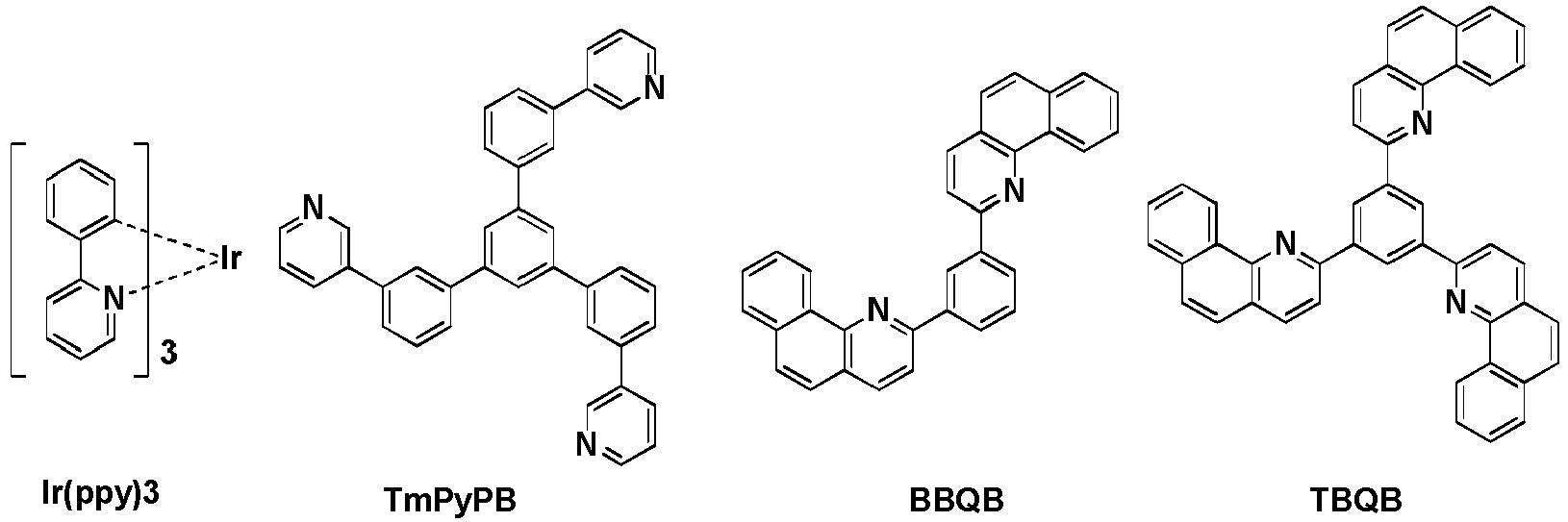
- For the organic light emitting devices manufactured as above, electroluminescent light emission (EL) characteristics were measured using M7000 manufactured by McScience Inc., and with the measurement results, T95 when standard luminance was 3,500 cd/m2 was measured using a lifetime test system (M6000) manufactured by McScience Inc.. Results of measuring a driving voltage, light emission efficiency, external quantum efficiency and a color coordinate (CIE) of the white organic light emitting devices manufactured according to the present disclosure are as shown in Table 3.
[Table 3] Compo und Driving Voltage (V) Light Emission Efficiency (cd/A) CIE (x, y) Lifetime (T95) Example 1 1-1 7.13 69.21 (0.221, 0,439) 40 Example 2 1-6 6.23 66.12 (0.221, 0,428) 44 Example 3 1-14 7.55 60.25 (0.225, 0,430) 30 Example 4 1-26 7.69 61.33 (0.230, 0,429) 35 Example 5 1-27 7.75 64.59 (0.226, 0,429) 34 Example 6 2-1 7.57 63.70 (0.222, 0,428) 29 Example 7 2-14 7.81 61.28 (0.227, 0,427) 30 Example 8 2-27 7.63 65.21 (0.222, 0,431) 31 Example 9 3-1 7.33 60.00 (0.225, 0,426) 33 Example 10 3-10 7.62 71.05 (0.224, 0,424) 45 Example 11 3-14 7.82 61.15 (0.221, 0,425) 38 Example 12 3-27 7.74 60.32 (0.220, 0,429) 36 Example 13 4-1 7.11 70.03 (0.223, 0,428) 40 Example 14 4-5 6.92 69.81 (0.225, 0,428) 39 Example 15 4-17 8.23 59.90 (0.224, 0,427) 29 Example 16 4-27 7.50 61.15 (0.224, 0,426) 33 Example 17 5-1 7.76 64.32 (0.226, 0,423) 35 Example 18 5-7 8.01 59.05 (0.224, 0,431) 28 Example 19 5-21 7.99 60.01 (0.222, 0,430) 27 Example 20 5-38 7.36 63.51 (0.221, 0,431) 35 Example 21 6-1 7.87 61.21 (0.224, 0,428) 36 Example 22 6-5 7.88 64.73 (0.223, 0,427) 33 Example 23 6-10 7.22 73.57 (0.222, 0,426) 40 Example 24 6-14 7.43 77.06 (0.222, 0,425) 44 Example 25 6-38 7.69 63.32 (0.221, 0,424) 36 Example 26 7-1 7.72 64.53 (0.220, 0,428) 37 Example 27 7-5 7.60 76.55 (0.219, 0,424) 41 Example 28 7-17 8.11 60.09 (0.218, 0,425) 30 Example 29 7-34 7.53 64.13 (0.219, 0,423) 33 Example 30 7-39 7.77 62.11 (0.220, 0,430) 36 Example 31 8-1 7.93 60.95 (0.225, 0,431) 37 Example 32 8-5 7.61 64.37 (0.226, 0,433) 30 Example 33 8-6 7.84 58.09 (0.227, 0,420) 31 Example 34 8-19 8.40 59.32 (0.226 0,429) 30 Example 35 8-39 6.88 70.05 (0.223, 0,428) 44 Example 36 9-1 7.33 68.37 (0.221, 0,427) 35 Example 37 9-5 7.89 69.54 (0.221, 0,426) 46 Example 38 9-14 8.42 61.37 (0.223, 0,428) 27 Example 39 9-18 8.33 60.00 (0.221, 0,427) 28 Example 40 10-1 8.00 64.16 (0.220, 0,428) 31 Example 41 10-5 7.77 69.13 (0.223, 0,428) 49 Example 42 10-14 8.13 59.06 (0.225, 0,427) 30 Example 43 10-18 8.23 62.79 (0.227, 0,428) 28 Example 44 11-1 7.89 66.56 (0.226, 0,429) 37 Example 45 11-5 7.67 67.13 (0.223, 0,430) 36 Example 46 11-10 7.92 64.32 (0.225, 0,431) 33 Example 47 11-14 7.99 58.00 (0.222, 0,433) 24 Example 48 11-27 8.00 59.03 (0.222, 0,428) 28 Example 49 12-1 8.13 60.51 (0.219, 0,428) 29 Example 50 12-5 7.01 78.11 (0.218, 0,429) 44 Example 51 12-10 7.77 68.11 (0.221, 0,428) 31 Example 52 12-14 8.22 58.77 (0.223, 0,430) 24 Example 53 12-27 8.31 59.15 (0.223, 0,431) 27 Example 54 13-1 7.55 63.40 (0.222, 0,428) 58 Example 55 13-2 7.82 61.18 (0.227, 0,427) 54 Example 56 13-3 7.88 65.21 (0.222, 0,430) 55 Example 57 13-4 7.89 65.11 (0.225, 0,430) 57 Example 58 13-5 7.66 71.05 (0.224, 0,424) 66 Example 59 13-6 7.60 70.16 (0.220, 0,428) 67 Example 60 13-7 7.81 69.37 (0.223, 0,428) 61 Example 61 13-8 7.88 68.70 (0.222, 0,428) 62 Example 62 13-9 7.81 65.28 (0.227, 0,427) 57 Example 63 13-10 7.80 65.21 (0.227, 0,426) 58 Example 64 13-11 7.68 65.00 (0.227, 0,426) 56 Example 65 13-12 7.62 65.05 (0.227, 0,426) 57 Example 66 13-13 7.21 72.38 (0.223, 0,428) 62 Example 67 13-14 7.22 71.37 (0.223, 0,428) 63 Example 68 13-15 7.34 70.22 (0.222, 0,427) 63 Example 69 13-16 7.33 70.20 (0.223, 0,428) 63 Example 70 13-17 7.33 67.21 (0.221, 0,427) 65 Example 71 13-18 7.32 71.25 (0.220, 0,428) 66 Example 72 13-19 7.41 72.14 (0.220, 0,428) 67 Example 73 13-20 7.40 66.55 (0.221, 0,427) 61 Example 74 13-21 8.00 64.16 (0.223, 0,428) 51 Example 75 13-22 8.11 64.37 (0.223, 0,428) 52 Example 76 13-23 8.21 63.31 (0.223, 0,427) 58 Example 77 13-24 8.20 63.11 (0.223, 0,428) 58 Comparati ve Example 1-1 TmPyP 1B 8.57 54.61 (0.212, 0.433) 40 Comparati ve Example 1-2 BBQB 8.43 54.11 (0.220, 0,429) 46 Comparati ve Example 1-3 TBQB 8.47 54.90 (0.222, 0,430) 48 - As shown from the results of Table 3, the organic light emitting devices using the charge generation layer material of the 2-stack white organic light emitting device of the present disclosure had a low driving voltage and improved light emission efficiency compared to Comparative Examples 1. Particularly, it was identified that Compounds 1-1, 1-6, 1-26, 3-10, 4-1, 4-5, 6-10, 6-14, 7-5, 8-39, 9-5, 10-5, 12-5, 13-2, 13-5, 13-13, 13-18, 13-19 were significantly excellent in all of driving, efficiency and lifetime.
- The presumed reason for such results is that the compound of the present disclosure used as an N-type charge generation layer formed with an invented skeleton having proper length, strength and flat property and a proper hetero-compound capable of binding with metals is doped with an alkali metal or an alkali-earth metal to form a gap state within the N-type charge generation layer, and electrons produced from a P-type charge generation layer are readily injected to the electron transfer layer through the gap state produced within the N-type charge generation layer. Accordingly, the P-type charge generation layer favorably carried out electron injection and electron transfer to the N-type charge generation layer, and as a result, it is considered that a driving voltage of the organic light emitting device decreased, and efficiency and lifetime were improved.
- A glass substrate on which ITO was coated as a thin film to a thickness of 1500 Å was cleaned with distilled water ultrasonic waves. After the cleaning with distilled water was finished, the substrate was ultrasonic cleaned with solvents such as acetone, methanol and isopropyl alcohol, then dried, and UVO treatment was carried out for 5 minutes in a UV cleaner using UV. After that, the substrate was transferred to a plasma cleaner (PT), and plasma treatment was carried out under vacuum for ITO work function and remaining film removal, and the substrate was transferred to a thermal deposition apparatus for organic deposition. On the ITO transparent electrode (anode), organic materials were formed in a single-stack structure. As a hole injection layer, HAT-CN was deposited to a thickness of 50 Å, and subsequently, a hole transfer layer was formed by doping DNTPD within 10% to NPD, depositing the result to a thickness of 1500 Å, and continuously depositing TCTA to a thickness of 200 Å. Subsequently, a light emitting layer comprising a t-Bu-perylene dopant in an ADN host was formed to a thickness of 250 Å. Next, Alq3, an electron transfer layer, was formed to a thickness of 250 Å, and an N-type charge transfer layer was formed to a thickness of 100 Å by doping Li, an alkali metal, to a compound described in the following Table 4, and Al, a cathode, was formed to a thickness of approximately 1,000 Å to manufacture an organic light emitting device.


- For the organic light emitting devices manufactured as above, electroluminescent light emission (EL) characteristics were measured using M7000 manufactured by McScience Inc., and with the measurement results, T95 when standard luminance was 750 cd/m2 was measured using a lifetime test system (M6000) manufactured by McScience Inc.. Results of measuring a driving voltage, light emission efficiency, external quantum efficiency and a color coordinate (CIE) of the blue organic electroluminescent devices manufactured according to the present disclosure are as shown in Table 4.
[Table 4] Compoun d Driving Voltage (V) Light Emission Efficiency (cd/A) CIE (x, y) Lifetime (T95) Example 54 1-1 4.32 8.23 (0.135 0.111) 41 Example 55 1-6 4.42 8.03 (0.133 0.113) 43 Example 56 1-14 4.92 6.46 (0.134 0.112) 31 Example 57 1-26 4.99 6.55 (0.135 0.111) 34 Example 58 1-27 5.03 6.62 (0.132 0.109) 33 Example 59 2-1 5.32 7.10 (0.131 0.111) 30 Example 60 2-14 5.35 7.55 (0.134 0.111) 31 Example 61 2-27 4.90 7.63 (0.135 0.110) 31 Example 62 3-1 5.13 7.76 (0.134 0.113) 33 Example 63 3-10 4.55 7.97 (0.135 0.112) 44 Example 64 3-14 5.13 7.23 (0.135 0.111) 38 Example 65 3-27 5.03 6.97 (0.136 0.115) 36 Example 66 4-1 4.62 7.99 (0.137 0.108) 39 Example 67 4-5 4.72 8.08 (0.130 0.107) 40 Example 68 4-17 5.63 6.46 (0.131 0.108) 28 Example 69 4-27 5.45 6.77 (0.132 0.111) 32 Example 70 5-1 5.40 7.11 (0.133 0.110) 35 Example 71 5-7 5.77 6.75 (0.134 0.108) 28 Example 72 5-21 5.65 6.55 (0.132 0.113) 27 Example 73 5-38 5.03 6.97 (0.131 0.115) 35 Example 74 6-1 5.45 7.11 (0.136 0.117) 36 Example 75 6-5 5.21 6.90 (0.134 0.119) 33 Example 76 6-10 4.32 7.99 (0.135 0.111) 41 Example 77 6-14 4.17 8.03 (0.137 0.111) 46 Example 78 6-38 5.55 7.73 (0.134 0.106) 35 Example 79 7-1 5.28 7.66 (0.135 0.115) 35 Example 80 7-5 4.38 8.32 (0.132 0.114) 40 Example 81 7-17 5.71 6.44 (0.134 0.112) 30 Example 82 7-34 5.55 7.10 (0.134 0.111) 33 Example 83 7-39 5.46 7.09 (0.136 0.111) 36 Example 84 8-1 5.67 7.11 (0.131 0.113) 37 Example 85 8-5 5.66 7.35 (0.132 0.109) 30 Example 86 8-6 5.73 6.44 (0.135 0.108) 31 Example 87 8-19 5.76 6.46 (0.134 0.117) 30 Example 88 8-39 4.69 7.98 (0.134 0.116) 43 Example 89 9-1 5.76 7.54 (0.133 0.112) 34 Example 90 9-5 4.62 7.66 (0.133 0.111) 44 Example 91 9-14 5.77 6.59 (0.135 0.108) 26 Example 92 9-18 5.71 6.95 (0.133 0.111) 27 Example 93 10-1 5.54 7.08 (0.131 0.110) 32 Example 94 10-5 4.41 8.00 (0.132 0.110) 49 Example 95 10-14 5.77 6.50 (0.130 0.113) 30 Example 96 10-18 5.80 6.23 (0.136 0.112) 28 Example 97 11-1 5.19 7.11 (0.134 0.111) 37 Example 98 11-5 5.68 7.00 (0.139 0.109) 36 Example 99 11-10 5.16 7.62 (0.135 0.109) 33 Example 100 11-14 5.75 6.29 (0.131 0.111) 24 Example 101 11-27 5.83 6.35 (0.132 0.110) 30 Example 102 12-1 5.81 6.67 (0.133 0.110) 33 Example 103 12-5 4.72 7.90 (0.133 0.113) 44 Example 104 12-10 5.53 7.61 (0.133 0.112) 32 Example 105 12-14 5.69 6.13 (0.134 0.111) 25 Example 106 12-27 5.79 6.37 (0.135 0.110) 26 Example 107 13-1 4.90 7.00 (0.133, 0.113) 37 Example 108 13-2 4.72 7.44 (0.134, 0.111) 45 Example 109 13-3 5.11 6.85 (0.135, 0.113) 30 Example 110 13-4 5.08 6.99 (0.134, 0.113) 30 Example 112 13-5 5.01 6.81 (0.134, 0.113) 29 Example 113 13-6 4.88 7.91 (0.134, 0.110) 43 Example 114 13-7 5.21 6.67 (0.133, 0.111) 29 Example 115 13-8 5.16 6.81 (0.133, 0.111) 29 Example 116 13-9 4.61 7.44 (0.132, 0.110) 40 Example 117 13-10 4.71 7.30 (0.134, 0.110) 37 Example 118 13-11 4.90 6.90 (0.135, 0.112) 36 Example 119 13-12 4.71 7.41 (0.134, 0.110) 41 Example 120 13-13 4.71 7.41 (0.135, 0.110) 41 Example 121 13-14 4.72 7.45 (0.135, 0.110) 37 Example 122 13-15 5.01 6.90 (0.132, 0.110) 38 Example 123 13-16 5.01 7.01 (0.133, 0.111) 37 Example 124 13-17 4.90 7.44 (0.134, 0.111) 42 Example 125 13-18 5.01 6.90 (0.132, 0.110) 38 Example 126 13-19 5.01 7.01 (0.132, 0.111) 37 Example 127 13-20 5.01 7.01 (0.133, 0.111) 37 Example 128 13-21 4.89 7.90 (0.133, 0.110) 40 Example 129 13-22 5.03 6.90 (0.132, 0.110) 38 Example 130 13-23 5.41 6.51 (0.134, 0.111) 34 Example 131 13-24 5.39 6.60 (0.134, 0.111) 32 Comparati ve Example 2-1 Bphen 5.82 6.23 (0.136, 0.110) 27 Comparati ve Example 2-2 BBQB 5.80 6.12 (0.134, 0.111) 26 Comparati ve Example 2-3 TBQB 5.84 6.19 (0.134, 0111) 26 - As shown from the results of Table 4, the organic light emitting devices using the charge generation layer material of the blue organic light emitting device of the present disclosure had a low driving voltage and improved light emission efficiency compared to Comparative Examples 2. Particularly, it was identified that Compounds 1-1, 1-6, 1-26, 3-10, 4-1, 4-5, 6-10, 6-14, 7-5, 8-39, 9-5, 10-5, 12-5, 13-2, 13-6, 13-9, 13-13, 13-14, 13-17, 13-21 were significantly excellent in all of driving, efficiency and lifetime.
- The presumed reason for such results is that the compound of the present disclosure used as an N-type charge generation layer formed with an invented skeleton having proper length, strength and flat property and a proper hetero-compound capable of binding with metals is doped with an alkali metal or an alkali-earth metal to form a gap state within the N-type charge generation layer, and electrons produced from a P-type charge generation layer are readily injected to the electron transfer layer through the gap state produced within the N-type charge generation layer. Accordingly, the P-type charge generation layer favorably carried out electron injection and electron transfer to the N-type charge generation layer, and as a result, it is considered that a driving voltage of the organic light emitting device decreased, and efficiency and lifetime were improved.
Claims (8)
- An organic light emitting device comprising:an anode (200);a cathode (400); andone or more organic material layers (300) provided between the anode (200) and the cathode (400),wherein one or more layers of the organic material layers (300) comprise a heterocyclic compound represented by any one of the following Chemical Formulae 2 to 6:


 in Chemical Formulae 2 to 6,X is S; O; NR; or CR'R";R1 to R8 are the same as or different from each other, and each independently hydrogen; deuterium; a halogen group; -CN; a substituted or unsubstituted C1 to C60 alkyl group; a substituted or unsubstituted C2 to C60 alkenyl group; a substituted or unsubstituted C2 to C60 alkynyl group; a substituted or unsubstituted C1 to C60 alkoxy group; a substituted or unsubstituted C3 to C60 cycloalkyl group; a substituted or unsubstituted C2 to C60 heterocycloalkyl group; a substituted or unsubstituted C6 to C60 aryl group; a substituted or unsubstituted C2 to C60 heteroaryl group; -SiRR'R"; -P(=O)RR'; and an amine group unsubstituted or substituted with a C1 to C20 alkyl group, a C6 to C60 aryl group, or a C2 to C60 heteroaryl group;L is a direct bond, a substituted or unsubstituted C6 to C60 arylene group, or a C2 to C60 heteroarylene group;m is an integer of 0 to 4;n is an integer of 1 to 4; andR, R' and R" are the same as or different from each other, and each independently hydrogen; deuterium; -CN; a substituted or unsubstituted C1 to C60 alkyl group; a substituted or unsubstituted C3 to C60 cycloalkyl group; a substituted or unsubstituted C6 to C60 aryl group; or a substituted or unsubstituted C2 to C60 heteroaryl group,characterized in that Z of Formulae 2 to 6 is selected from among the following structural formulae:
 in the structural formulae, R9 is a C6 to C60 aryl group.
 - The organic light emitting device of Claim 1, wherein L is selected from among the following structural formulae:


- The organic light emitting device of Claim 1, wherein the hetero-cyclic compound is represented by any one of the following compounds:


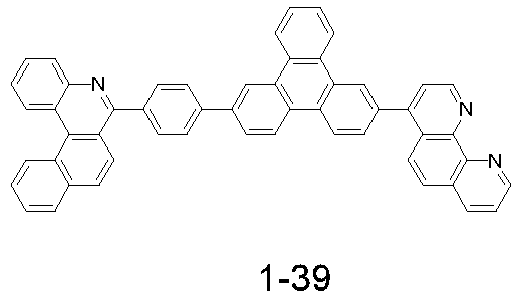

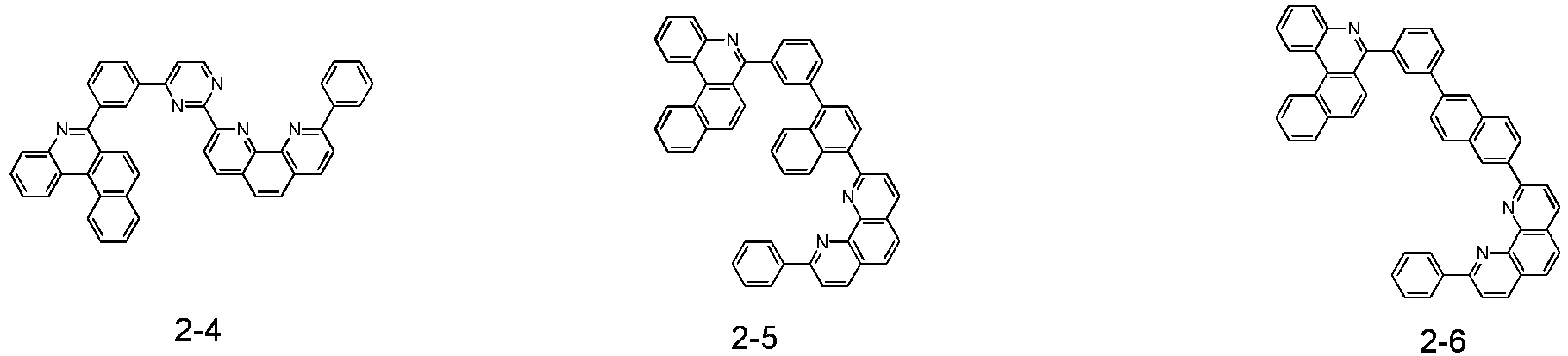


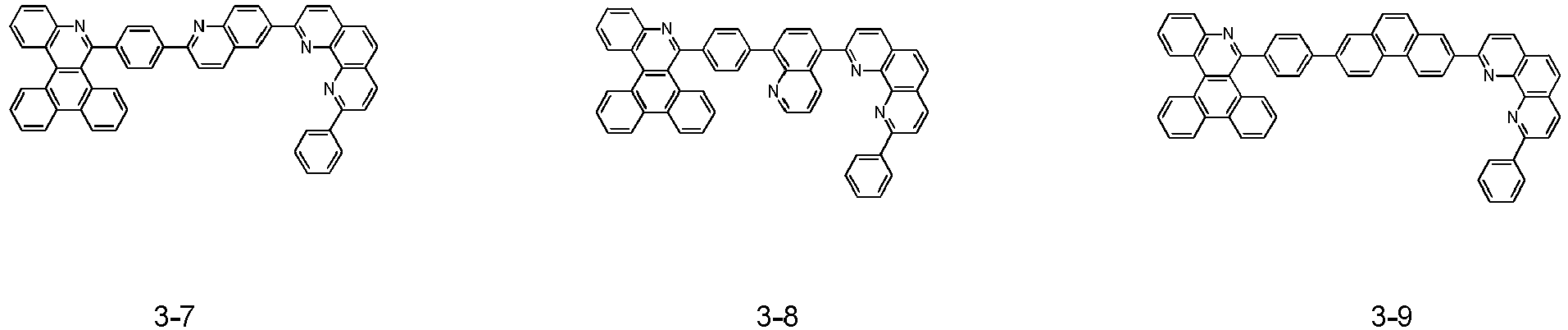


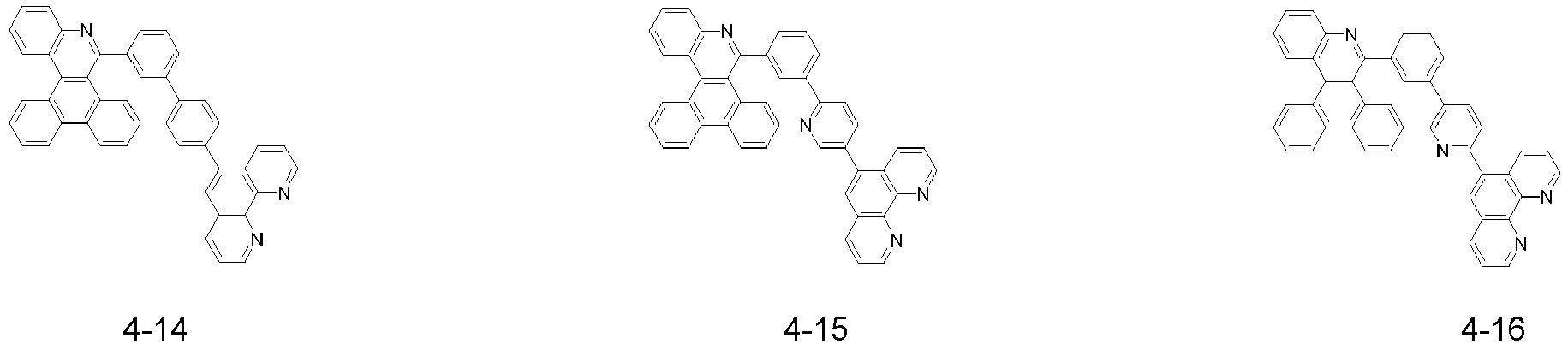


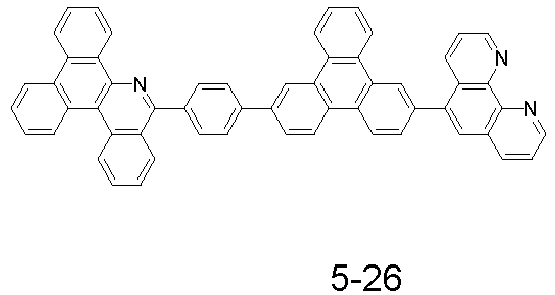


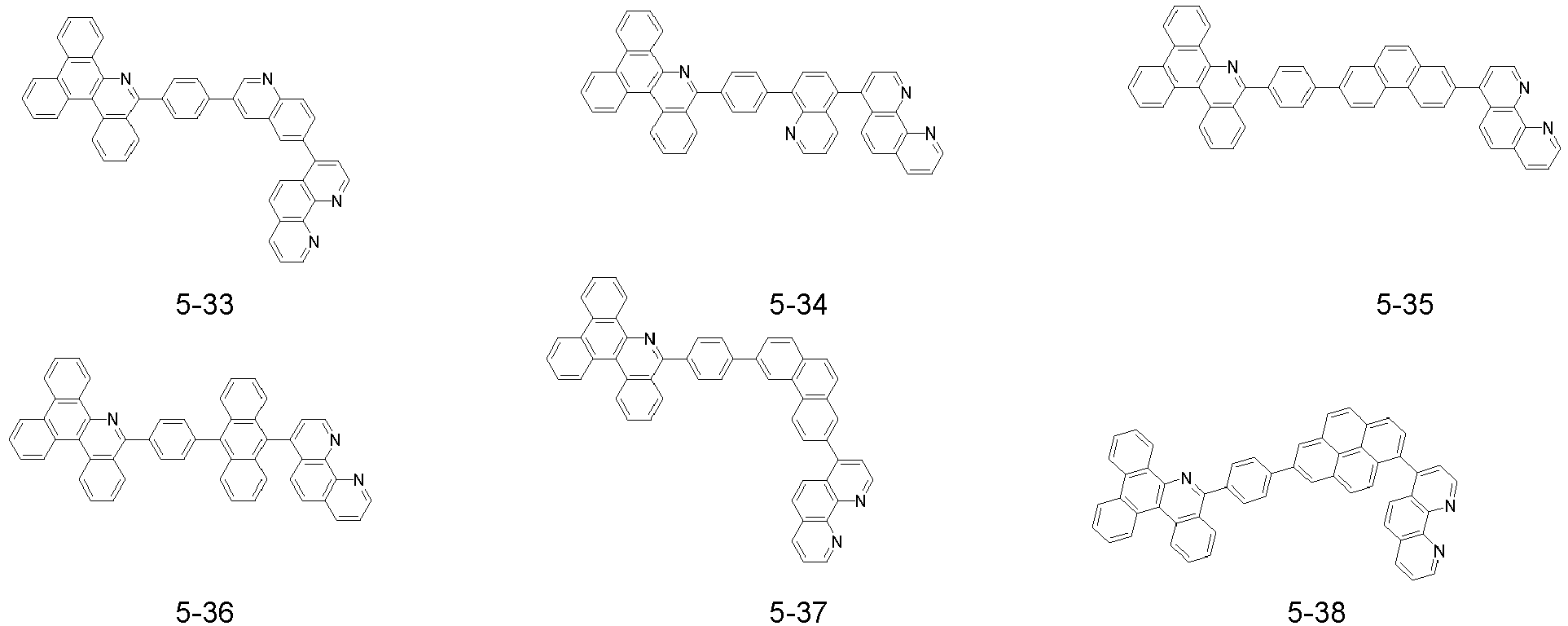
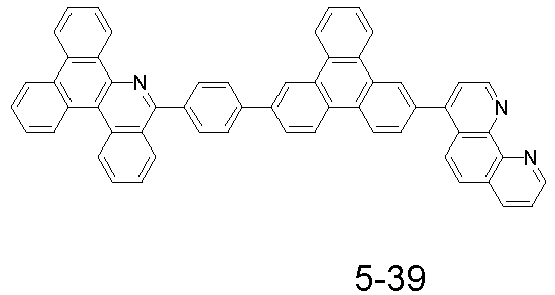


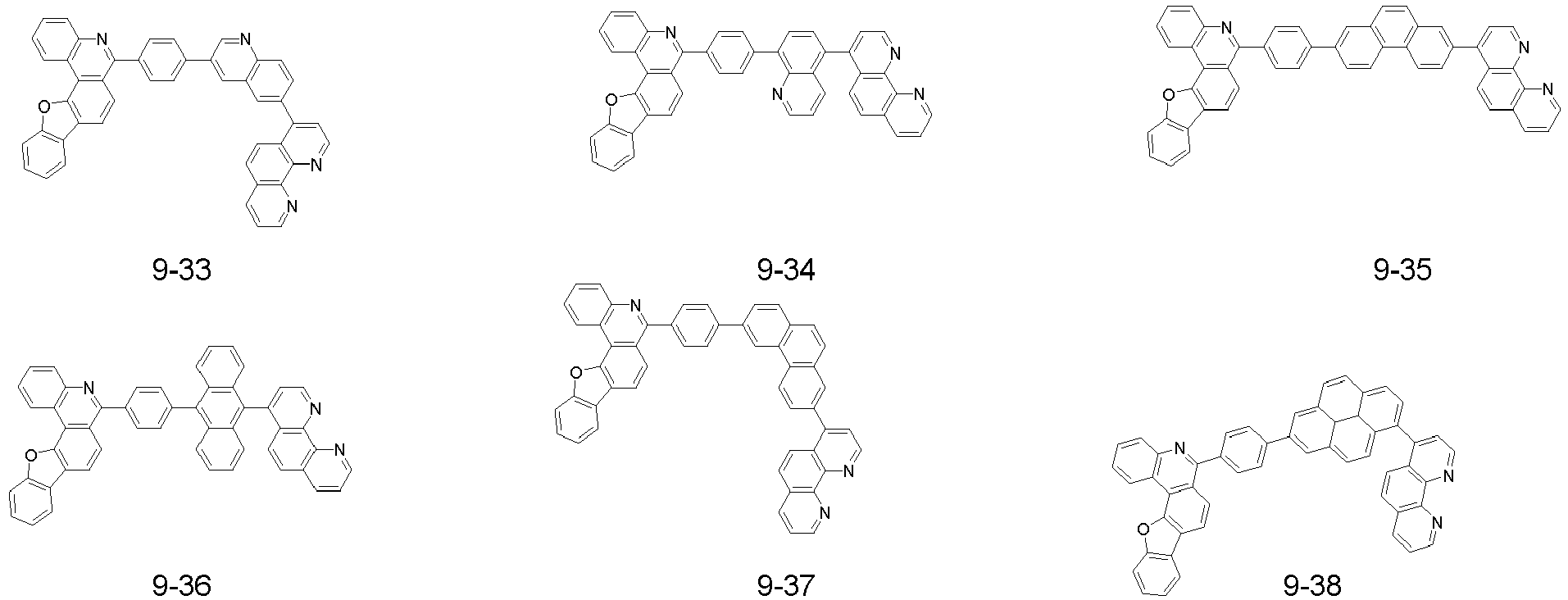


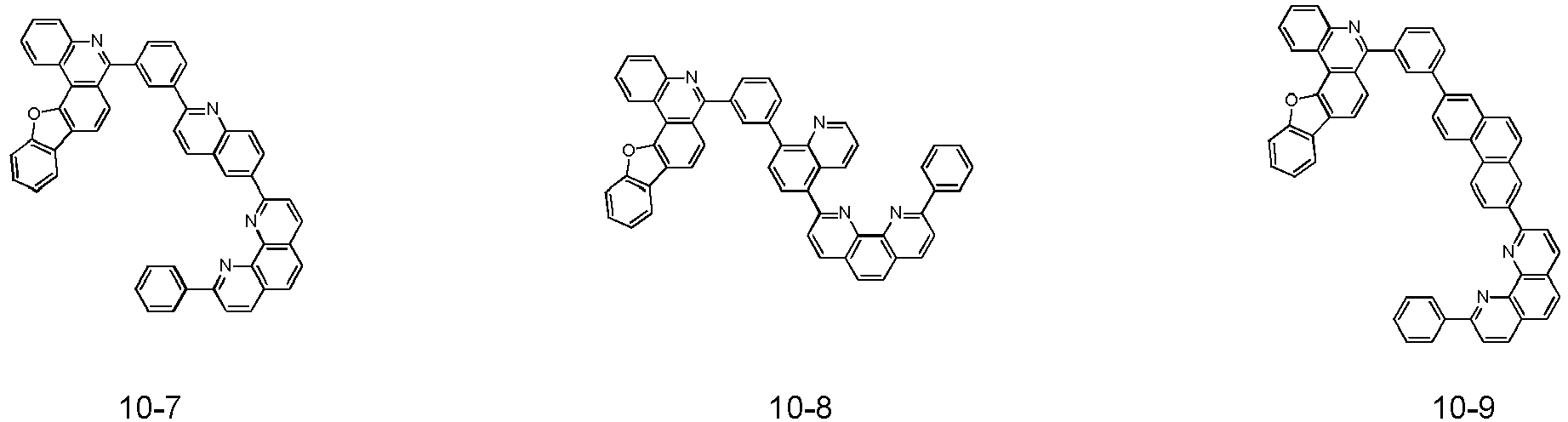





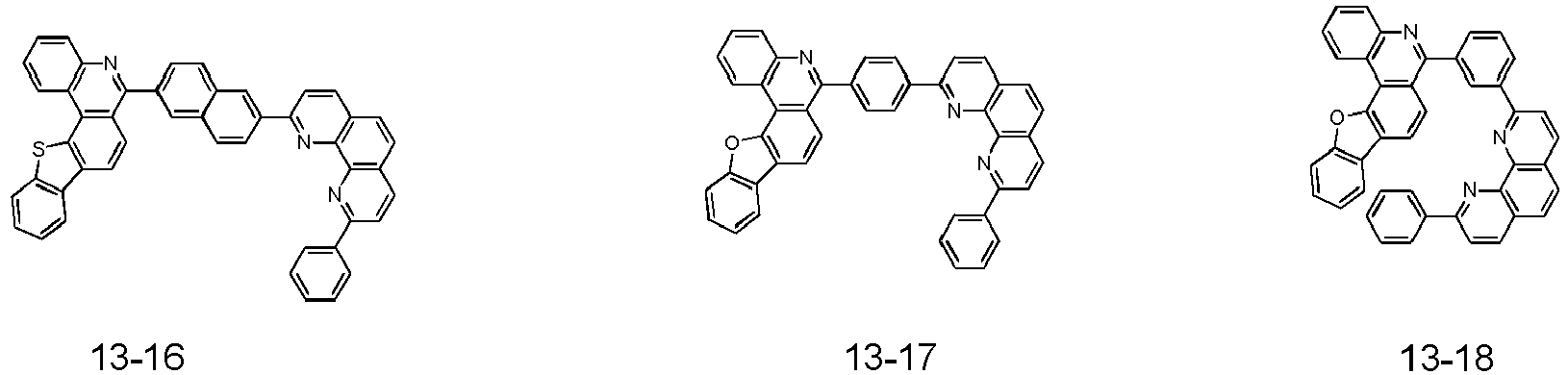


- The organic light emitting device of Claim 1, wherein the organic material layer (300) comprises at least one of a hole blocking layer (304), an electron injection layer (306) and an electron transfer layer (305), and at least one of the hole blocking layer (304), the electron injection layer (306) and the electron transfer layer (305) comprises the hetero-cyclic compound.
- The organic light emitting device of Claim 1, wherein the organic material layer (300) comprises a light emitting layer (303), and the light emitting layer (303) comprises the hetero-cyclic compound.
- The organic light emitting device of Claim 1, wherein the layer that comprises the hetero-cyclic compound is selected from a hole injection layer (301), a hole transfer layer (302), and a layer carrying out hole injection and hole transfer at the same time.
- The organic light emitting device of Claim 1, wherein the organic material layer (300) comprises a charge generation layer, and the charge generation layer comprises the hetero-cyclic compound.
- The organic light emitting device of Claim 1 comprising:an anode (200);a first stack provided on the anode (200) and comprising a first light emitting layer;a charge generation layer provided on the first stack;a second stack provided on the charge generation layer and comprising a second light emitting layer; anda cathode (400) provided on the second stack.
Applications Claiming Priority (2)
| Application Number | Priority Date | Filing Date | Title |
|---|---|---|---|
| KR20160179082 | 2016-12-26 | ||
| PCT/KR2017/015011 WO2018124588A1 (en) | 2016-12-26 | 2017-12-19 | Organic light-emitting device |
Publications (3)
| Publication Number | Publication Date |
|---|---|
| EP3561892A1 EP3561892A1 (en) | 2019-10-30 |
| EP3561892A4 EP3561892A4 (en) | 2020-07-29 |
| EP3561892B1 true EP3561892B1 (en) | 2023-05-10 |
Family
ID=62709642
Family Applications (1)
| Application Number | Title | Priority Date | Filing Date |
|---|---|---|---|
| EP17887386.5A Active EP3561892B1 (en) | 2016-12-26 | 2017-12-19 | Organic light-emitting device |
Country Status (7)
| Country | Link |
|---|---|
| US (1) | US11302873B2 (en) |
| EP (1) | EP3561892B1 (en) |
| JP (1) | JP6783952B2 (en) |
| KR (1) | KR102098158B1 (en) |
| CN (1) | CN110121794B (en) |
| TW (1) | TWI657124B (en) |
| WO (1) | WO2018124588A1 (en) |
Families Citing this family (14)
| Publication number | Priority date | Publication date | Assignee | Title |
|---|---|---|---|---|
| KR102206995B1 (en) * | 2017-12-13 | 2021-01-22 | 엘지디스플레이 주식회사 | Organic compounds and organic light emitting diode and organic light emittind display device having the same |
| KR102529109B1 (en) * | 2018-08-07 | 2023-05-03 | 엘지디스플레이 주식회사 | Light emitting diode and electroluminescent display device including the same |
| KR102089307B1 (en) * | 2018-09-19 | 2020-03-16 | 엘티소재주식회사 | Heterocyclic compound and organic light emitting device comprising the same |
| KR102110833B1 (en) | 2018-12-06 | 2020-05-14 | 엘티소재주식회사 | Heterocyclic compound and organic light emitting device comprising the same |
| CN109608452B (en) | 2018-12-24 | 2020-12-04 | 武汉天马微电子有限公司 | Organic compound, display panel and display device |
| KR102290366B1 (en) | 2019-07-22 | 2021-08-19 | 엘티소재주식회사 | Heterocyclic compound and organic light emitting device comprising same |
| KR102219562B1 (en) | 2019-08-23 | 2021-02-24 | 엘티소재주식회사 | Heterocyclic compound and organic light emitting device using the same |
| CN111548350A (en) * | 2020-04-16 | 2020-08-18 | 苏州久显新材料有限公司 | Polycyclic aromatic hydrocarbon aza-naphthalene derivative, synthetic method and electronic device thereof |
| CN112194670A (en) * | 2020-09-18 | 2021-01-08 | 上海大学 | An organic compound and an organic electroluminescent device using the same |
| CN113444109B (en) * | 2020-09-30 | 2025-01-10 | 浙江华显光电科技有限公司 | A condensed ring organic compound and an organic electroluminescent device using the same |
| JPWO2022172116A1 (en) * | 2021-02-12 | 2022-08-18 | ||
| WO2022172130A1 (en) * | 2021-02-12 | 2022-08-18 | 株式会社半導体エネルギー研究所 | Light-emitting device, light-emitting apparatus, electronic equipment, and lighting apparatus |
| KR102789941B1 (en) * | 2022-08-09 | 2025-04-07 | 엘티소재주식회사 | Heterocyclic compound, organic light-emitting device comprising same |
| CN118307471B (en) * | 2024-06-11 | 2024-08-30 | 广东工业大学 | Novel azaphenanthrene structural compound and synthesis method thereof |
Family Cites Families (24)
| Publication number | Priority date | Publication date | Assignee | Title |
|---|---|---|---|---|
| US4356429A (en) | 1980-07-17 | 1982-10-26 | Eastman Kodak Company | Organic electroluminescent cell |
| US6936961B2 (en) | 2003-05-13 | 2005-08-30 | Eastman Kodak Company | Cascaded organic electroluminescent device having connecting units with N-type and P-type organic layers |
| KR101640636B1 (en) | 2012-05-31 | 2016-07-18 | 주식회사 엘지화학 | New heterocyclic compounds and organic electronic device using the same |
| KR102081119B1 (en) | 2012-10-31 | 2020-02-25 | 엘지디스플레이 주식회사 | Organic light emitting device and organic light emitting display device using the same |
| KR101499356B1 (en) * | 2013-06-28 | 2015-03-05 | 주식회사 엘지화학 | Hetero-cyclic compound and organic light emitting device comprising the same |
| KR101546788B1 (en) | 2013-12-27 | 2015-08-24 | 희성소재 (주) | Hetero-cyclic compound and organic light emitting device using the same |
| WO2015099508A1 (en) * | 2013-12-27 | 2015-07-02 | 희성소재(주) | Heterocyclic compound and organic light emitting device using same |
| US9871208B2 (en) | 2014-02-26 | 2018-01-16 | Samsung Display Co., Ltd. | Condensed cyclic compound and organic light-emitting device including the same |
| US20150243895A1 (en) * | 2014-02-26 | 2015-08-27 | Samsung Display Co., Ltd. | Compound and organic light-emitting device including the same |
| KR101808677B1 (en) * | 2014-06-02 | 2017-12-14 | 삼성디스플레이 주식회사 | Condensed compounds and organic light-emitting devices including the same |
| KR101558495B1 (en) * | 2014-06-27 | 2015-10-12 | 희성소재 (주) | Polycyclic compound and organic light emitting device using the same |
| KR101579289B1 (en) * | 2014-06-30 | 2015-12-22 | 희성소재 (주) | Hetero-cyclic compound and organic light emitting device using the same |
| WO2016003171A1 (en) * | 2014-06-30 | 2016-01-07 | 희성소재(주) | Heterocyclic compound and organic light emitting element using same |
| KR101743075B1 (en) | 2014-07-11 | 2017-06-02 | 희성소재 (주) | Hetero-cyclic compound and organic light emitting device using the same |
| KR20160008819A (en) * | 2014-07-15 | 2016-01-25 | 희성소재 (주) | Hetero-cyclic compound and organic light emitting device using the same |
| KR20160041019A (en) * | 2014-10-06 | 2016-04-15 | 희성소재 (주) | Hetero-cyclic compound and organic light emitting device using the same |
| KR102359840B1 (en) * | 2014-10-21 | 2022-02-09 | 덕산네오룩스 주식회사 | Compound for organic electronic element, organic electronic element using the same, and an electronic device thereof |
| WO2016064088A2 (en) * | 2014-10-21 | 2016-04-28 | 덕산네오룩스 주식회사 | Compound for organic electric device, organic electric device using same, and electronic device using same |
| TWI706936B (en) * | 2014-10-29 | 2020-10-11 | Lt素材股份有限公司 | Multicyclic compound including nitrogen and organic light emitting device using the same |
| KR102295197B1 (en) | 2014-12-30 | 2021-09-01 | 엘티소재주식회사 | Compound and organic light emitting device using the same |
| KR20160124623A (en) * | 2015-04-20 | 2016-10-28 | 희성소재 (주) | Multicyclic compound including nitrogen and organic light emitting device using the same |
| KR101837029B1 (en) * | 2015-04-30 | 2018-03-12 | 희성소재(주) | Multicyclic compound and organic light emitting device using the same |
| KR102541452B1 (en) * | 2015-11-04 | 2023-06-09 | 삼성디스플레이 주식회사 | Compound and Organic light emitting device comprising same |
| KR20170090139A (en) * | 2016-01-28 | 2017-08-07 | 주식회사 랩토 | Triazine derivatives linked with fused cyclic phenanthridinyl group, and organic electroluminescent device including the same |
-
2017
- 2017-12-19 CN CN201780081340.3A patent/CN110121794B/en active Active
- 2017-12-19 JP JP2019555547A patent/JP6783952B2/en active Active
- 2017-12-19 EP EP17887386.5A patent/EP3561892B1/en active Active
- 2017-12-19 US US16/462,852 patent/US11302873B2/en active Active
- 2017-12-19 KR KR1020170175214A patent/KR102098158B1/en active Active
- 2017-12-19 WO PCT/KR2017/015011 patent/WO2018124588A1/en not_active Ceased
- 2017-12-21 TW TW106145056A patent/TWI657124B/en active
Also Published As
| Publication number | Publication date |
|---|---|
| TWI657124B (en) | 2019-04-21 |
| KR20180075398A (en) | 2018-07-04 |
| EP3561892A1 (en) | 2019-10-30 |
| US11302873B2 (en) | 2022-04-12 |
| JP6783952B2 (en) | 2020-11-11 |
| TW201829736A (en) | 2018-08-16 |
| JP2020504911A (en) | 2020-02-13 |
| KR102098158B1 (en) | 2020-04-08 |
| CN110121794A (en) | 2019-08-13 |
| CN110121794B (en) | 2023-04-04 |
| WO2018124588A1 (en) | 2018-07-05 |
| US20200066996A1 (en) | 2020-02-27 |
| EP3561892A4 (en) | 2020-07-29 |
Similar Documents
| Publication | Publication Date | Title |
|---|---|---|
| EP3561892A1 (en) | Organic light-emitting device | |
| EP3611173B1 (en) | Organic light emitting element and composition for organic material layer in organic light emitting element | |
| KR102155550B1 (en) | Hetero-cyclic compound and organic light emitting device using the same | |
| EP3604296B1 (en) | Organic light emitting element and composition for organic material layer in organic light emitting element | |
| EP3351536B1 (en) | Organic light-emitting device | |
| EP3305792B1 (en) | Nitrogen-containing condensed cyclic compound and organic light emitting element using same | |
| EP3366749B1 (en) | Composition for organic optoelectronic element, organic optoelectronic element, and display device | |
| CN110612293B (en) | Novel compound and organic light emitting device including the same | |
| EP3483146B1 (en) | Heterocyclic compound and organic light emitting device using same | |
| CN108602836B (en) | Heterocyclic compound and organic electroluminescent element comprising same | |
| EP3763720B1 (en) | Compound and organic light emitting device comprising same | |
| EP3263555A1 (en) | Hetero ring compound and organic luminescent element comprising same | |
| EP3208271B1 (en) | Nitrogen-containing polycyclic compound and organic light emitting element using same | |
| KR20170052521A (en) | Compound, material for organic electroluminescent element, organic electroluminescent element, and electronic device | |
| EP4446315A1 (en) | Compound and organic light-emitting device comprising same | |
| KR20190058859A (en) | Hetero-cyclic compound and organic light emitting device using the same | |
| JP6058531B2 (en) | Organic electroluminescence device | |
| US20190288218A1 (en) | Heterocyclic compound and organic light-emitting element using same | |
| CN114899344B (en) | Organic electroluminescent device | |
| CN115811921B (en) | An organic electroluminescent device |
Legal Events
| Date | Code | Title | Description |
|---|---|---|---|
| STAA | Information on the status of an ep patent application or granted ep patent |
Free format text: STATUS: THE INTERNATIONAL PUBLICATION HAS BEEN MADE |
|
| PUAI | Public reference made under article 153(3) epc to a published international application that has entered the european phase |
Free format text: ORIGINAL CODE: 0009012 |
|
| STAA | Information on the status of an ep patent application or granted ep patent |
Free format text: STATUS: REQUEST FOR EXAMINATION WAS MADE |
|
| 17P | Request for examination filed |
Effective date: 20190509 |
|
| AK | Designated contracting states |
Kind code of ref document: A1 Designated state(s): AL AT BE BG CH CY CZ DE DK EE ES FI FR GB GR HR HU IE IS IT LI LT LU LV MC MK MT NL NO PL PT RO RS SE SI SK SM TR |
|
| AX | Request for extension of the european patent |
Extension state: BA ME |
|
| DAV | Request for validation of the european patent (deleted) | ||
| DAX | Request for extension of the european patent (deleted) | ||
| RAP1 | Party data changed (applicant data changed or rights of an application transferred) |
Owner name: LT MATERIALS CO., LTD. |
|
| A4 | Supplementary search report drawn up and despatched |
Effective date: 20200701 |
|
| RIC1 | Information provided on ipc code assigned before grant |
Ipc: C09K 11/06 20060101ALI20200625BHEP Ipc: H01L 51/50 20060101ALI20200625BHEP Ipc: H01L 51/00 20060101AFI20200625BHEP |
|
| STAA | Information on the status of an ep patent application or granted ep patent |
Free format text: STATUS: EXAMINATION IS IN PROGRESS |
|
| 17Q | First examination report despatched |
Effective date: 20220214 |
|
| REG | Reference to a national code |
Ref country code: DE Ref legal event code: R079 Free format text: PREVIOUS MAIN CLASS: H01L0051000000 Ipc: H10K0085600000 Ref country code: DE Ref legal event code: R079 Ref document number: 602017068750 Country of ref document: DE Free format text: PREVIOUS MAIN CLASS: H01L0051000000 Ipc: H10K0085600000 |
|
| GRAP | Despatch of communication of intention to grant a patent |
Free format text: ORIGINAL CODE: EPIDOSNIGR1 |
|
| STAA | Information on the status of an ep patent application or granted ep patent |
Free format text: STATUS: GRANT OF PATENT IS INTENDED |
|
| RIC1 | Information provided on ipc code assigned before grant |
Ipc: H10K 50/19 20230101ALN20230209BHEP Ipc: H10K 50/17 20230101ALN20230209BHEP Ipc: C09K 11/06 20060101ALI20230209BHEP Ipc: H10K 85/60 20230101AFI20230209BHEP |
|
| INTG | Intention to grant announced |
Effective date: 20230224 |
|
| GRAS | Grant fee paid |
Free format text: ORIGINAL CODE: EPIDOSNIGR3 |
|
| GRAA | (expected) grant |
Free format text: ORIGINAL CODE: 0009210 |
|
| STAA | Information on the status of an ep patent application or granted ep patent |
Free format text: STATUS: THE PATENT HAS BEEN GRANTED |
|
| AK | Designated contracting states |
Kind code of ref document: B1 Designated state(s): AL AT BE BG CH CY CZ DE DK EE ES FI FR GB GR HR HU IE IS IT LI LT LU LV MC MK MT NL NO PL PT RO RS SE SI SK SM TR |
|
| REG | Reference to a national code |
Ref country code: GB Ref legal event code: FG4D |
|
| REG | Reference to a national code |
Ref country code: AT Ref legal event code: REF Ref document number: 1568066 Country of ref document: AT Kind code of ref document: T Effective date: 20230515 Ref country code: CH Ref legal event code: EP |
|
| REG | Reference to a national code |
Ref country code: DE Ref legal event code: R096 Ref document number: 602017068750 Country of ref document: DE |
|
| REG | Reference to a national code |
Ref country code: IE Ref legal event code: FG4D |
|
| P01 | Opt-out of the competence of the unified patent court (upc) registered |
Effective date: 20230530 |
|
| REG | Reference to a national code |
Ref country code: LT Ref legal event code: MG9D |
|
| REG | Reference to a national code |
Ref country code: NL Ref legal event code: MP Effective date: 20230510 |
|
| REG | Reference to a national code |
Ref country code: AT Ref legal event code: MK05 Ref document number: 1568066 Country of ref document: AT Kind code of ref document: T Effective date: 20230510 |
|
| PG25 | Lapsed in a contracting state [announced via postgrant information from national office to epo] |
Ref country code: SE Free format text: LAPSE BECAUSE OF FAILURE TO SUBMIT A TRANSLATION OF THE DESCRIPTION OR TO PAY THE FEE WITHIN THE PRESCRIBED TIME-LIMIT Effective date: 20230510 Ref country code: PT Free format text: LAPSE BECAUSE OF FAILURE TO SUBMIT A TRANSLATION OF THE DESCRIPTION OR TO PAY THE FEE WITHIN THE PRESCRIBED TIME-LIMIT Effective date: 20230911 Ref country code: NO Free format text: LAPSE BECAUSE OF FAILURE TO SUBMIT A TRANSLATION OF THE DESCRIPTION OR TO PAY THE FEE WITHIN THE PRESCRIBED TIME-LIMIT Effective date: 20230810 Ref country code: NL Free format text: LAPSE BECAUSE OF FAILURE TO SUBMIT A TRANSLATION OF THE DESCRIPTION OR TO PAY THE FEE WITHIN THE PRESCRIBED TIME-LIMIT Effective date: 20230510 Ref country code: ES Free format text: LAPSE BECAUSE OF FAILURE TO SUBMIT A TRANSLATION OF THE DESCRIPTION OR TO PAY THE FEE WITHIN THE PRESCRIBED TIME-LIMIT Effective date: 20230510 Ref country code: AT Free format text: LAPSE BECAUSE OF FAILURE TO SUBMIT A TRANSLATION OF THE DESCRIPTION OR TO PAY THE FEE WITHIN THE PRESCRIBED TIME-LIMIT Effective date: 20230510 |
|
| PG25 | Lapsed in a contracting state [announced via postgrant information from national office to epo] |
Ref country code: RS Free format text: LAPSE BECAUSE OF FAILURE TO SUBMIT A TRANSLATION OF THE DESCRIPTION OR TO PAY THE FEE WITHIN THE PRESCRIBED TIME-LIMIT Effective date: 20230510 Ref country code: PL Free format text: LAPSE BECAUSE OF FAILURE TO SUBMIT A TRANSLATION OF THE DESCRIPTION OR TO PAY THE FEE WITHIN THE PRESCRIBED TIME-LIMIT Effective date: 20230510 Ref country code: LV Free format text: LAPSE BECAUSE OF FAILURE TO SUBMIT A TRANSLATION OF THE DESCRIPTION OR TO PAY THE FEE WITHIN THE PRESCRIBED TIME-LIMIT Effective date: 20230510 Ref country code: LT Free format text: LAPSE BECAUSE OF FAILURE TO SUBMIT A TRANSLATION OF THE DESCRIPTION OR TO PAY THE FEE WITHIN THE PRESCRIBED TIME-LIMIT Effective date: 20230510 Ref country code: IS Free format text: LAPSE BECAUSE OF FAILURE TO SUBMIT A TRANSLATION OF THE DESCRIPTION OR TO PAY THE FEE WITHIN THE PRESCRIBED TIME-LIMIT Effective date: 20230910 Ref country code: HR Free format text: LAPSE BECAUSE OF FAILURE TO SUBMIT A TRANSLATION OF THE DESCRIPTION OR TO PAY THE FEE WITHIN THE PRESCRIBED TIME-LIMIT Effective date: 20230510 Ref country code: GR Free format text: LAPSE BECAUSE OF FAILURE TO SUBMIT A TRANSLATION OF THE DESCRIPTION OR TO PAY THE FEE WITHIN THE PRESCRIBED TIME-LIMIT Effective date: 20230811 |
|
| PG25 | Lapsed in a contracting state [announced via postgrant information from national office to epo] |
Ref country code: FI Free format text: LAPSE BECAUSE OF FAILURE TO SUBMIT A TRANSLATION OF THE DESCRIPTION OR TO PAY THE FEE WITHIN THE PRESCRIBED TIME-LIMIT Effective date: 20230510 |
|
| PG25 | Lapsed in a contracting state [announced via postgrant information from national office to epo] |
Ref country code: SK Free format text: LAPSE BECAUSE OF FAILURE TO SUBMIT A TRANSLATION OF THE DESCRIPTION OR TO PAY THE FEE WITHIN THE PRESCRIBED TIME-LIMIT Effective date: 20230510 |
|
| PG25 | Lapsed in a contracting state [announced via postgrant information from national office to epo] |
Ref country code: SM Free format text: LAPSE BECAUSE OF FAILURE TO SUBMIT A TRANSLATION OF THE DESCRIPTION OR TO PAY THE FEE WITHIN THE PRESCRIBED TIME-LIMIT Effective date: 20230510 Ref country code: SK Free format text: LAPSE BECAUSE OF FAILURE TO SUBMIT A TRANSLATION OF THE DESCRIPTION OR TO PAY THE FEE WITHIN THE PRESCRIBED TIME-LIMIT Effective date: 20230510 Ref country code: RO Free format text: LAPSE BECAUSE OF FAILURE TO SUBMIT A TRANSLATION OF THE DESCRIPTION OR TO PAY THE FEE WITHIN THE PRESCRIBED TIME-LIMIT Effective date: 20230510 Ref country code: EE Free format text: LAPSE BECAUSE OF FAILURE TO SUBMIT A TRANSLATION OF THE DESCRIPTION OR TO PAY THE FEE WITHIN THE PRESCRIBED TIME-LIMIT Effective date: 20230510 Ref country code: DK Free format text: LAPSE BECAUSE OF FAILURE TO SUBMIT A TRANSLATION OF THE DESCRIPTION OR TO PAY THE FEE WITHIN THE PRESCRIBED TIME-LIMIT Effective date: 20230510 Ref country code: CZ Free format text: LAPSE BECAUSE OF FAILURE TO SUBMIT A TRANSLATION OF THE DESCRIPTION OR TO PAY THE FEE WITHIN THE PRESCRIBED TIME-LIMIT Effective date: 20230510 |
|
| REG | Reference to a national code |
Ref country code: DE Ref legal event code: R097 Ref document number: 602017068750 Country of ref document: DE |
|
| PLBE | No opposition filed within time limit |
Free format text: ORIGINAL CODE: 0009261 |
|
| STAA | Information on the status of an ep patent application or granted ep patent |
Free format text: STATUS: NO OPPOSITION FILED WITHIN TIME LIMIT |
|
| 26N | No opposition filed |
Effective date: 20240213 |
|
| PG25 | Lapsed in a contracting state [announced via postgrant information from national office to epo] |
Ref country code: SI Free format text: LAPSE BECAUSE OF FAILURE TO SUBMIT A TRANSLATION OF THE DESCRIPTION OR TO PAY THE FEE WITHIN THE PRESCRIBED TIME-LIMIT Effective date: 20230510 |
|
| PG25 | Lapsed in a contracting state [announced via postgrant information from national office to epo] |
Ref country code: SI Free format text: LAPSE BECAUSE OF FAILURE TO SUBMIT A TRANSLATION OF THE DESCRIPTION OR TO PAY THE FEE WITHIN THE PRESCRIBED TIME-LIMIT Effective date: 20230510 Ref country code: IT Free format text: LAPSE BECAUSE OF FAILURE TO SUBMIT A TRANSLATION OF THE DESCRIPTION OR TO PAY THE FEE WITHIN THE PRESCRIBED TIME-LIMIT Effective date: 20230510 |
|
| REG | Reference to a national code |
Ref country code: CH Ref legal event code: PL |
|
| PG25 | Lapsed in a contracting state [announced via postgrant information from national office to epo] |
Ref country code: LU Free format text: LAPSE BECAUSE OF NON-PAYMENT OF DUE FEES Effective date: 20231219 |
|
| PG25 | Lapsed in a contracting state [announced via postgrant information from national office to epo] |
Ref country code: MC Free format text: LAPSE BECAUSE OF FAILURE TO SUBMIT A TRANSLATION OF THE DESCRIPTION OR TO PAY THE FEE WITHIN THE PRESCRIBED TIME-LIMIT Effective date: 20230510 |
|
| GBPC | Gb: european patent ceased through non-payment of renewal fee |
Effective date: 20231219 |
|
| REG | Reference to a national code |
Ref country code: BE Ref legal event code: MM Effective date: 20231231 |
|
| PG25 | Lapsed in a contracting state [announced via postgrant information from national office to epo] |
Ref country code: MC Free format text: LAPSE BECAUSE OF FAILURE TO SUBMIT A TRANSLATION OF THE DESCRIPTION OR TO PAY THE FEE WITHIN THE PRESCRIBED TIME-LIMIT Effective date: 20230510 Ref country code: LU Free format text: LAPSE BECAUSE OF NON-PAYMENT OF DUE FEES Effective date: 20231219 |
|
| REG | Reference to a national code |
Ref country code: IE Ref legal event code: MM4A |
|
| PG25 | Lapsed in a contracting state [announced via postgrant information from national office to epo] |
Ref country code: IE Free format text: LAPSE BECAUSE OF NON-PAYMENT OF DUE FEES Effective date: 20231219 |
|
| PG25 | Lapsed in a contracting state [announced via postgrant information from national office to epo] |
Ref country code: GB Free format text: LAPSE BECAUSE OF NON-PAYMENT OF DUE FEES Effective date: 20231219 |
|
| PG25 | Lapsed in a contracting state [announced via postgrant information from national office to epo] |
Ref country code: BE Free format text: LAPSE BECAUSE OF NON-PAYMENT OF DUE FEES Effective date: 20231231 |
|
| PG25 | Lapsed in a contracting state [announced via postgrant information from national office to epo] |
Ref country code: CH Free format text: LAPSE BECAUSE OF NON-PAYMENT OF DUE FEES Effective date: 20231231 |
|
| PG25 | Lapsed in a contracting state [announced via postgrant information from national office to epo] |
Ref country code: IE Free format text: LAPSE BECAUSE OF NON-PAYMENT OF DUE FEES Effective date: 20231219 Ref country code: GB Free format text: LAPSE BECAUSE OF NON-PAYMENT OF DUE FEES Effective date: 20231219 Ref country code: CH Free format text: LAPSE BECAUSE OF NON-PAYMENT OF DUE FEES Effective date: 20231231 Ref country code: BE Free format text: LAPSE BECAUSE OF NON-PAYMENT OF DUE FEES Effective date: 20231231 |
|
| PG25 | Lapsed in a contracting state [announced via postgrant information from national office to epo] |
Ref country code: BG Free format text: LAPSE BECAUSE OF FAILURE TO SUBMIT A TRANSLATION OF THE DESCRIPTION OR TO PAY THE FEE WITHIN THE PRESCRIBED TIME-LIMIT Effective date: 20230510 |
|
| PG25 | Lapsed in a contracting state [announced via postgrant information from national office to epo] |
Ref country code: BG Free format text: LAPSE BECAUSE OF FAILURE TO SUBMIT A TRANSLATION OF THE DESCRIPTION OR TO PAY THE FEE WITHIN THE PRESCRIBED TIME-LIMIT Effective date: 20230510 |
|
| PG25 | Lapsed in a contracting state [announced via postgrant information from national office to epo] |
Ref country code: CY Free format text: LAPSE BECAUSE OF FAILURE TO SUBMIT A TRANSLATION OF THE DESCRIPTION OR TO PAY THE FEE WITHIN THE PRESCRIBED TIME-LIMIT; INVALID AB INITIO Effective date: 20171219 |
|
| PG25 | Lapsed in a contracting state [announced via postgrant information from national office to epo] |
Ref country code: HU Free format text: LAPSE BECAUSE OF FAILURE TO SUBMIT A TRANSLATION OF THE DESCRIPTION OR TO PAY THE FEE WITHIN THE PRESCRIBED TIME-LIMIT; INVALID AB INITIO Effective date: 20171219 |
|
| PG25 | Lapsed in a contracting state [announced via postgrant information from national office to epo] |
Ref country code: TR Free format text: LAPSE BECAUSE OF FAILURE TO SUBMIT A TRANSLATION OF THE DESCRIPTION OR TO PAY THE FEE WITHIN THE PRESCRIBED TIME-LIMIT Effective date: 20230510 |
|
| PGFP | Annual fee paid to national office [announced via postgrant information from national office to epo] |
Ref country code: DE Payment date: 20251104 Year of fee payment: 9 |
|
| PGFP | Annual fee paid to national office [announced via postgrant information from national office to epo] |
Ref country code: FR Payment date: 20251117 Year of fee payment: 9 |