EP3088392A1 - Heterocyclic compound and organic light emitting device using same - Google Patents
Heterocyclic compound and organic light emitting device using same Download PDFInfo
- Publication number
- EP3088392A1 EP3088392A1 EP14875512.7A EP14875512A EP3088392A1 EP 3088392 A1 EP3088392 A1 EP 3088392A1 EP 14875512 A EP14875512 A EP 14875512A EP 3088392 A1 EP3088392 A1 EP 3088392A1
- Authority
- EP
- European Patent Office
- Prior art keywords
- compound
- monocyclic
- substituted
- unsubstituted
- polycyclic
- Prior art date
- Legal status (The legal status is an assumption and is not a legal conclusion. Google has not performed a legal analysis and makes no representation as to the accuracy of the status listed.)
- Granted
Links
- 0 C1/C=C/C=C/C(/c2nc(-c3cnccc3)cc(-c3cc(-c4cccc(-c5nc(cccc6)c6c6c5ccc5ccccc65)c4)ccc3)c2)=C/*1 Chemical compound C1/C=C/C=C/C(/c2nc(-c3cnccc3)cc(-c3cc(-c4cccc(-c5nc(cccc6)c6c6c5ccc5ccccc65)c4)ccc3)c2)=C/*1 0.000 description 24
- RDWOKNADTSWGGB-UHFFFAOYSA-N Nc1ccccc1-c1cccc2ccccc12 Chemical compound Nc1ccccc1-c1cccc2ccccc12 RDWOKNADTSWGGB-UHFFFAOYSA-N 0.000 description 4
- WWKCGWQJBPFVIG-UHFFFAOYSA-N [O-][N+](c1ccccc1-c1cccc2ccccc12)=O Chemical compound [O-][N+](c1ccccc1-c1cccc2ccccc12)=O WWKCGWQJBPFVIG-UHFFFAOYSA-N 0.000 description 3
- DLKQHBOKULLWDQ-UHFFFAOYSA-N Brc1cccc2c1cccc2 Chemical compound Brc1cccc2c1cccc2 DLKQHBOKULLWDQ-UHFFFAOYSA-N 0.000 description 2
- BYJYFQASVBOVCC-UHFFFAOYSA-N O=P(c1ccccc1)(c1ccccc1)c(cc1)ccc1-c1c(cc(-c(cc2)ccc2-c2c[n](cccc3)c3n2)c2ccccc22)c2c(cccc2)c2n1 Chemical compound O=P(c1ccccc1)(c1ccccc1)c(cc1)ccc1-c1c(cc(-c(cc2)ccc2-c2c[n](cccc3)c3n2)c2ccccc22)c2c(cccc2)c2n1 BYJYFQASVBOVCC-UHFFFAOYSA-N 0.000 description 2
- BBKODVGGWDONTR-UHFFFAOYSA-N O=P(c1ccccc1)(c1ccccc1)c(cc1)ccc1-c1c(cc(-c(cc2)ccc2-c2nc(-c3ccccc3)nc(-c(cc3)ccc3-c3ccccc3)c2)c2ccccc22)c2c(cccc2)c2n1 Chemical compound O=P(c1ccccc1)(c1ccccc1)c(cc1)ccc1-c1c(cc(-c(cc2)ccc2-c2nc(-c3ccccc3)nc(-c(cc3)ccc3-c3ccccc3)c2)c2ccccc22)c2c(cccc2)c2n1 BBKODVGGWDONTR-UHFFFAOYSA-N 0.000 description 2
- DXMXHPQTUIZIRR-UHFFFAOYSA-N O=P(c1ccccc1)(c1ccccc1)c(cc1)ccc1-c1c(cc(c2ccccc22)-c3ccc(ccc4c5nccc4)c5n3)c2c(cccc2)c2n1 Chemical compound O=P(c1ccccc1)(c1ccccc1)c(cc1)ccc1-c1c(cc(c2ccccc22)-c3ccc(ccc4c5nccc4)c5n3)c2c(cccc2)c2n1 DXMXHPQTUIZIRR-UHFFFAOYSA-N 0.000 description 2
- KFSZRVZCRVEJRW-UHFFFAOYSA-N c(cc1)cc(c2c3cccc2)c1[n]3-c(cc1)ccc1-c(cc1)ccc1-c1nc2ccccc2c2c1ccc1c2cccc1 Chemical compound c(cc1)cc(c2c3cccc2)c1[n]3-c(cc1)ccc1-c(cc1)ccc1-c1nc2ccccc2c2c1ccc1c2cccc1 KFSZRVZCRVEJRW-UHFFFAOYSA-N 0.000 description 2
- FZKIMYWCAYLRBH-UHFFFAOYSA-N c(cc1)cc(c2c3cccc2)c1[n]3-c(cc1)ccc1-c1c(ccc2ccccc22)c2c(cccc2)c2n1 Chemical compound c(cc1)cc(c2c3cccc2)c1[n]3-c(cc1)ccc1-c1c(ccc2ccccc22)c2c(cccc2)c2n1 FZKIMYWCAYLRBH-UHFFFAOYSA-N 0.000 description 2
- XFCPCXBRTXZXKR-UHFFFAOYSA-N c(cc1)cc(c2ccccc22)c1[n]2-c1cc(-c(cc2)ccc2-c2nc3ccccc3c3c2ccc2c3cccc2)ccc1 Chemical compound c(cc1)cc(c2ccccc22)c1[n]2-c1cc(-c(cc2)ccc2-c2nc3ccccc3c3c2ccc2c3cccc2)ccc1 XFCPCXBRTXZXKR-UHFFFAOYSA-N 0.000 description 2
- MPWGDIGFLRDEAZ-UHFFFAOYSA-N c(cc1)cc(c2ccccc22)c1[n]2-c1cccc(-c2c(ccc3ccccc33)c3c(cccc3)c3n2)c1 Chemical compound c(cc1)cc(c2ccccc22)c1[n]2-c1cccc(-c2c(ccc3ccccc33)c3c(cccc3)c3n2)c1 MPWGDIGFLRDEAZ-UHFFFAOYSA-N 0.000 description 2
- JVBOKEGGHFVZEC-UHFFFAOYSA-N c(cc1)cc(cc2)c1cc2-c1c(c(-c2nc(-c3cc4ccccc4cc3)nc(-c3cc(cccc4)c4cc3)n2)cc2ccccc22)c2c(cccc2)c2n1 Chemical compound c(cc1)cc(cc2)c1cc2-c1c(c(-c2nc(-c3cc4ccccc4cc3)nc(-c3cc(cccc4)c4cc3)n2)cc2ccccc22)c2c(cccc2)c2n1 JVBOKEGGHFVZEC-UHFFFAOYSA-N 0.000 description 2
- IPUUTQZQRWPFLW-UHFFFAOYSA-N c(cc1)cc(cc2)c1cc2-c1nc(c(-c2nc(-c(cc3)ccc3-c3cccc4c3nccc4)nc(-c(cc3)ccc3-c3c4ncccc4ccc3)n2)ccc2)c2c2c(cccc3)c3ccc12 Chemical compound c(cc1)cc(cc2)c1cc2-c1nc(c(-c2nc(-c(cc3)ccc3-c3cccc4c3nccc4)nc(-c(cc3)ccc3-c3c4ncccc4ccc3)n2)ccc2)c2c2c(cccc3)c3ccc12 IPUUTQZQRWPFLW-UHFFFAOYSA-N 0.000 description 2
- YZCLQJHMRXQCDF-UHFFFAOYSA-N c(cc1)cc(cc2)c1cc2-c1nc(cccc2)c2c(c2c3cccc2)c1cc3-c1nc(-c2c3ncccc3ccc2)nc(-c2c3ncccc3ccc2)n1 Chemical compound c(cc1)cc(cc2)c1cc2-c1nc(cccc2)c2c(c2c3cccc2)c1cc3-c1nc(-c2c3ncccc3ccc2)nc(-c2c3ncccc3ccc2)n1 YZCLQJHMRXQCDF-UHFFFAOYSA-N 0.000 description 2
- MULSKEUONUGTHD-UHFFFAOYSA-N c(cc1)cc(cc2)c1cc2-c1nc(cccc2)c2c(c2c3cccc2)c1cc3-c1nc(-c2nc3ccccc3cc2)nc(-c2nc3ccccc3cc2)n1 Chemical compound c(cc1)cc(cc2)c1cc2-c1nc(cccc2)c2c(c2c3cccc2)c1cc3-c1nc(-c2nc3ccccc3cc2)nc(-c2nc3ccccc3cc2)n1 MULSKEUONUGTHD-UHFFFAOYSA-N 0.000 description 2
- VDAARFBASFYQKL-UHFFFAOYSA-N c(cc1)ccc1-c(cc1)ccc1-c1nc(-c2cc(-c3cccc(-c4nc5ccccc5c5c4ccc4c5cccc4)c3)ccc2)nc(-c2ccccc2)c1 Chemical compound c(cc1)ccc1-c(cc1)ccc1-c1nc(-c2cc(-c3cccc(-c4nc5ccccc5c5c4ccc4c5cccc4)c3)ccc2)nc(-c2ccccc2)c1 VDAARFBASFYQKL-UHFFFAOYSA-N 0.000 description 2
- QQGCSXIMHJPVCQ-UHFFFAOYSA-N c(cc1)ccc1-c1nc(-c(c2c3cccc2)cc2c3c(cccc3)c3nc2-c2cc(cccc3)c3cc2)nc(-c2ccccc2)n1 Chemical compound c(cc1)ccc1-c1nc(-c(c2c3cccc2)cc2c3c(cccc3)c3nc2-c2cc(cccc3)c3cc2)nc(-c2ccccc2)n1 QQGCSXIMHJPVCQ-UHFFFAOYSA-N 0.000 description 2
- ANTOSQGRTRMMTN-UHFFFAOYSA-N c1ccc(cc(cc2)-c3c(cc(c4ccccc44)-c5nc(-c(cc6)ccc6-c6nc7ccccc7cc6)nc(-c(cc6)ccc6-c6ccc(cccc7)c7n6)n5)c4c(cccc4)c4n3)c2c1 Chemical compound c1ccc(cc(cc2)-c3c(cc(c4ccccc44)-c5nc(-c(cc6)ccc6-c6nc7ccccc7cc6)nc(-c(cc6)ccc6-c6ccc(cccc7)c7n6)n5)c4c(cccc4)c4n3)c2c1 ANTOSQGRTRMMTN-UHFFFAOYSA-N 0.000 description 2
- NGQYHKKZPXEZKP-UHFFFAOYSA-N c1ccc(cc(cc2)-c3nc(cccc4)c4c(c4c5cccc4)c3cc5-c3nc(-c4cc5ccccc5c5ccccc45)nc(-c4cc(cccc5)c5c5c4cccc5)n3)c2c1 Chemical compound c1ccc(cc(cc2)-c3nc(cccc4)c4c(c4c5cccc4)c3cc5-c3nc(-c4cc5ccccc5c5ccccc45)nc(-c4cc(cccc5)c5c5c4cccc5)n3)c2c1 NGQYHKKZPXEZKP-UHFFFAOYSA-N 0.000 description 2
- RLNIJXMPXIQIOY-UHFFFAOYSA-N c1ccc(cc(cc2)-c3nc(cccc4)c4c4c3ccc3c4cccc3-c3nc(-c(cc4)ccc4-c4ncccc4)nc(-c(cc4)ccc4-c4ncccc4)n3)c2c1 Chemical compound c1ccc(cc(cc2)-c3nc(cccc4)c4c4c3ccc3c4cccc3-c3nc(-c(cc4)ccc4-c4ncccc4)nc(-c(cc4)ccc4-c4ncccc4)n3)c2c1 RLNIJXMPXIQIOY-UHFFFAOYSA-N 0.000 description 2
- FSMIQSHJNDRAAO-UHFFFAOYSA-N c1ccc2c3c(cccc4)c4nc(-c4cc(-c5nc(-c6ccncc6)nc(-c6ccncc6)n5)ccn4)c3ccc2c1 Chemical compound c1ccc2c3c(cccc4)c4nc(-c4cc(-c5nc(-c6ccncc6)nc(-c6ccncc6)n5)ccn4)c3ccc2c1 FSMIQSHJNDRAAO-UHFFFAOYSA-N 0.000 description 2
- HYHFJXQRQCNQRW-UHFFFAOYSA-N Bc1cc(O)ccc1[N+]([O-])=O Chemical compound Bc1cc(O)ccc1[N+]([O-])=O HYHFJXQRQCNQRW-UHFFFAOYSA-N 0.000 description 1
- XPPZHNMLPDIYQI-UHFFFAOYSA-N Bc1ccccc1[N+]([O-])=O Chemical compound Bc1ccccc1[N+]([O-])=O XPPZHNMLPDIYQI-UHFFFAOYSA-N 0.000 description 1
- JUAUISBJWLWNKH-UHFFFAOYSA-N BrC1C=CCC2C3C1C3CCC2 Chemical compound BrC1C=CCC2C3C1C3CCC2 JUAUISBJWLWNKH-UHFFFAOYSA-N 0.000 description 1
- VXIJYXRYDBGRKY-UHFFFAOYSA-N Brc(c1c2cccc1)cc1c2c2ccccc2nc1-c1cc2ccccc2cc1 Chemical compound Brc(c1c2cccc1)cc1c2c2ccccc2nc1-c1cc2ccccc2cc1 VXIJYXRYDBGRKY-UHFFFAOYSA-N 0.000 description 1
- XCXVFWDDKKQBMP-UHFFFAOYSA-N Brc(c1c2cccc1)cnc2-c1nc(cccc2)c2c2c1ccc1ccccc21 Chemical compound Brc(c1c2cccc1)cnc2-c1nc(cccc2)c2c2c1ccc1ccccc21 XCXVFWDDKKQBMP-UHFFFAOYSA-N 0.000 description 1
- OLEJNHLTTXSKCB-UHFFFAOYSA-N Brc(c1c2nccc1)ccc2-c1nc(cccc2)c2c2c1ccc1ccccc21 Chemical compound Brc(c1c2nccc1)ccc2-c1nc(cccc2)c2c2c1ccc1ccccc21 OLEJNHLTTXSKCB-UHFFFAOYSA-N 0.000 description 1
- IBGUDZMIAZLJNY-UHFFFAOYSA-N Brc(c1ccccc11)ccc1Br Chemical compound Brc(c1ccccc11)ccc1Br IBGUDZMIAZLJNY-UHFFFAOYSA-N 0.000 description 1
- FLBPDGQEVRBGRV-UHFFFAOYSA-N Brc1ccnc(-c2nc(cccc3)c3c3c2ccc2ccccc32)c1 Chemical compound Brc1ccnc(-c2nc(cccc3)c3c3c2ccc2ccccc32)c1 FLBPDGQEVRBGRV-UHFFFAOYSA-N 0.000 description 1
- ZGUYZCWKFUCTGF-UHFFFAOYSA-N C1C=CC=CC1c1cccc(-c2nc(cccc3)c3c(-c3cccc(C(c4c5c(cccc6)c6cc4)=NC4C5=CC=CC4)c3)n2)c1 Chemical compound C1C=CC=CC1c1cccc(-c2nc(cccc3)c3c(-c3cccc(C(c4c5c(cccc6)c6cc4)=NC4C5=CC=CC4)c3)n2)c1 ZGUYZCWKFUCTGF-UHFFFAOYSA-N 0.000 description 1
- HCHSQAOISJNMEF-UHFFFAOYSA-N C1C=Cc2ccc3c(-c4cc(-c5nc(C6C=CC(c7ccccc7)=CC6)nc6c5cccc6)ccc4)nc(cccc4)c4c3c2C1 Chemical compound C1C=Cc2ccc3c(-c4cc(-c5nc(C6C=CC(c7ccccc7)=CC6)nc6c5cccc6)ccc4)nc(cccc4)c4c3c2C1 HCHSQAOISJNMEF-UHFFFAOYSA-N 0.000 description 1
- KYOUMRPFFCUPNV-UHFFFAOYSA-N CC(C12)C=CC(P(c3ccccc3)(c3ccccc3)=O)=C1N=C(c1cc3ccccc3cc1)c1c2c2ccccc2cc1 Chemical compound CC(C12)C=CC(P(c3ccccc3)(c3ccccc3)=O)=C1N=C(c1cc3ccccc3cc1)c1c2c2ccccc2cc1 KYOUMRPFFCUPNV-UHFFFAOYSA-N 0.000 description 1
- XYZMPMGKXVKIEG-UHFFFAOYSA-N CC1(C)OB(c(cc2)ccc2-c2nc(cccc3)c3c3c(cccc4)c4ccc23)OC1(C)C Chemical compound CC1(C)OB(c(cc2)ccc2-c2nc(cccc3)c3c3c(cccc4)c4ccc23)OC1(C)C XYZMPMGKXVKIEG-UHFFFAOYSA-N 0.000 description 1
- NETBREIJRILDRI-UHFFFAOYSA-N CC1(C)OB(c2ccnc(-c3c(ccc4ccccc44)c4c(cccc4)c4n3)c2)OC1(C)C Chemical compound CC1(C)OB(c2ccnc(-c3c(ccc4ccccc44)c4c(cccc4)c4n3)c2)OC1(C)C NETBREIJRILDRI-UHFFFAOYSA-N 0.000 description 1
- MSVIBTYAFACHJA-UHFFFAOYSA-N CC1(C=C(C=C2)O)C2=CC=CC1c1ccccc1[N+]([O-])=O Chemical compound CC1(C=C(C=C2)O)C2=CC=CC1c1ccccc1[N+]([O-])=O MSVIBTYAFACHJA-UHFFFAOYSA-N 0.000 description 1
- HNFSCJPCOSLBFL-UHFFFAOYSA-N CC1C(c2nc(-c3ccc(C)cc3)nc(-c3ccnc(-c4c(ccc5ccccc55)c5c(cccc5)c5n4)c3)n2)=CC=C(C)C1 Chemical compound CC1C(c2nc(-c3ccc(C)cc3)nc(-c3ccnc(-c4c(ccc5ccccc55)c5c(cccc5)c5n4)c3)n2)=CC=C(C)C1 HNFSCJPCOSLBFL-UHFFFAOYSA-N 0.000 description 1
- IGNUPRJAURILDO-UHFFFAOYSA-N CCc1nc(cccc2)c2[n]1-c(cc1)ccc1-c1cccc(-c2nc(cccc3)c3c3c(cccc4)c4ccc23)c1 Chemical compound CCc1nc(cccc2)c2[n]1-c(cc1)ccc1-c1cccc(-c2nc(cccc3)c3c3c(cccc4)c4ccc23)c1 IGNUPRJAURILDO-UHFFFAOYSA-N 0.000 description 1
- KDSJQPPEOFHGMR-UHFFFAOYSA-N CCc1nc(cccc2)c2[n]1-c1cc(-c2cccc(-c3nc(cccc4)c4c4c3ccc3ccccc43)c2)ccc1 Chemical compound CCc1nc(cccc2)c2[n]1-c1cc(-c2cccc(-c3nc(cccc4)c4c4c3ccc3ccccc43)c2)ccc1 KDSJQPPEOFHGMR-UHFFFAOYSA-N 0.000 description 1
- GETBYMSIUFRYOF-UHFFFAOYSA-N CCc1nc(cccc2)c2[n]1-c1cc(-c2nc(cccc3)c3c3c(cccc4)c4ccc23)ccc1 Chemical compound CCc1nc(cccc2)c2[n]1-c1cc(-c2nc(cccc3)c3c3c(cccc4)c4ccc23)ccc1 GETBYMSIUFRYOF-UHFFFAOYSA-N 0.000 description 1
- VQOCMSKUALYMRL-UHFFFAOYSA-N CN1C=CC(c2ccnc3c2cccc3)=CC1c1c(ccc2ccccc22)c2c(cccc2)c2n1 Chemical compound CN1C=CC(c2ccnc3c2cccc3)=CC1c1c(ccc2ccccc22)c2c(cccc2)c2n1 VQOCMSKUALYMRL-UHFFFAOYSA-N 0.000 description 1
- QXHRROQZIFUCEF-UHFFFAOYSA-N Cc(cc1)ccc1-c1nc(-c2ccc(C)cc2)nc(-c2cccc(-c3nc(cccc4)c4c4c(cccc5)c5ccc34)n2)n1 Chemical compound Cc(cc1)ccc1-c1nc(-c2ccc(C)cc2)nc(-c2cccc(-c3nc(cccc4)c4c4c(cccc5)c5ccc34)n2)n1 QXHRROQZIFUCEF-UHFFFAOYSA-N 0.000 description 1
- SADDZISVXAERGM-UHFFFAOYSA-N Nc(c(-c1cccc2c1cccc2)c1)ccc1O Chemical compound Nc(c(-c1cccc2c1cccc2)c1)ccc1O SADDZISVXAERGM-UHFFFAOYSA-N 0.000 description 1
- DUUSBGDFCUJQTK-UHFFFAOYSA-N Nc1ccccc1-c(cc1)c(cccc2)c2c1Br Chemical compound Nc1ccccc1-c(cc1)c(cccc2)c2c1Br DUUSBGDFCUJQTK-UHFFFAOYSA-N 0.000 description 1
- JGGKTJQZHWGZMI-UHFFFAOYSA-N Nc1ccccc1-c1cccc(cc2)c1cc2O Chemical compound Nc1ccccc1-c1cccc(cc2)c1cc2O JGGKTJQZHWGZMI-UHFFFAOYSA-N 0.000 description 1
- HUWJXYFUAWSQOJ-UHFFFAOYSA-N O=C(c(c1c2cccc1)ncc2Br)Nc1ccccc1-c1cccc2ccccc12 Chemical compound O=C(c(c1c2cccc1)ncc2Br)Nc1ccccc1-c1cccc2ccccc12 HUWJXYFUAWSQOJ-UHFFFAOYSA-N 0.000 description 1
- RHKKHGOHKWZZOT-UHFFFAOYSA-N O=C(c(c1c2cccn1)ccc2Br)Nc(cccc1)c1-c1cccc2ccccc12 Chemical compound O=C(c(c1c2cccn1)ccc2Br)Nc(cccc1)c1-c1cccc2ccccc12 RHKKHGOHKWZZOT-UHFFFAOYSA-N 0.000 description 1
- MEVTURRFACALQI-UHFFFAOYSA-N O=C(c1cc(Br)ccn1)Cl Chemical compound O=C(c1cc(Br)ccn1)Cl MEVTURRFACALQI-UHFFFAOYSA-N 0.000 description 1
- PZOPKMTVTXCYIX-UHFFFAOYSA-N O=C(c1cc(Br)ccn1)Nc1ccccc1-c1cccc2ccccc12 Chemical compound O=C(c1cc(Br)ccn1)Nc1ccccc1-c1cccc2ccccc12 PZOPKMTVTXCYIX-UHFFFAOYSA-N 0.000 description 1
- DWMDUHOUYSFIGM-UHFFFAOYSA-N O=P(c1ccccc1)(c1ccccc1)c(cc1)ccc1-c(cc1)ccc1-c(cc1)ccc1-c1c(ccc2ccccc22)c2c(cccc2)c2n1 Chemical compound O=P(c1ccccc1)(c1ccccc1)c(cc1)ccc1-c(cc1)ccc1-c(cc1)ccc1-c1c(ccc2ccccc22)c2c(cccc2)c2n1 DWMDUHOUYSFIGM-UHFFFAOYSA-N 0.000 description 1
- MIMQDYDZKKMZEG-UHFFFAOYSA-N O=P(c1ccccc1)(c1ccccc1)c(cc1)ccc1-c(cc1)ccc1-c1c(ccc2ccccc22)c2c(cccc2)c2n1 Chemical compound O=P(c1ccccc1)(c1ccccc1)c(cc1)ccc1-c(cc1)ccc1-c1c(ccc2ccccc22)c2c(cccc2)c2n1 MIMQDYDZKKMZEG-UHFFFAOYSA-N 0.000 description 1
- ZKXMYDUCSVLJQQ-UHFFFAOYSA-N O=P(c1ccccc1)(c1ccccc1)c(cc1)ccc1-c1c(cc(-c(cc2)ccc2-c2nc(-c3ccccc3)nc(-c3ccccc3)c2)c2ccccc22)c2c(cccc2)c2n1 Chemical compound O=P(c1ccccc1)(c1ccccc1)c(cc1)ccc1-c1c(cc(-c(cc2)ccc2-c2nc(-c3ccccc3)nc(-c3ccccc3)c2)c2ccccc22)c2c(cccc2)c2n1 ZKXMYDUCSVLJQQ-UHFFFAOYSA-N 0.000 description 1
- WMRDAUIWALXDIJ-UHFFFAOYSA-N O=P(c1ccccc1)(c1ccccc1)c(cc1)ccc1-c1c(cc(-c2ccc(c3ccccc3c3c4cccc3)c4c2)c2ccccc22)c2c(cccc2)c2n1 Chemical compound O=P(c1ccccc1)(c1ccccc1)c(cc1)ccc1-c1c(cc(-c2ccc(c3ccccc3c3c4cccc3)c4c2)c2ccccc22)c2c(cccc2)c2n1 WMRDAUIWALXDIJ-UHFFFAOYSA-N 0.000 description 1
- NHSUNTOYJMBASA-UHFFFAOYSA-N O=P(c1ccccc1)(c1ccccc1)c(cc1)ccc1-c1ccc2c(c(cccc3)c3cc3)c3c(-c3cc4ccccc4cc3)nc2c1 Chemical compound O=P(c1ccccc1)(c1ccccc1)c(cc1)ccc1-c1ccc2c(c(cccc3)c3cc3)c3c(-c3cc4ccccc4cc3)nc2c1 NHSUNTOYJMBASA-UHFFFAOYSA-N 0.000 description 1
- MMUVLEORGIZCIG-UHFFFAOYSA-N O=P(c1ccccc1)(c1ccccc1)c(cc1)ccc1-c1cccc2c(c3ccccc3cc3)c3c(-c3cc4ccccc4cc3)nc12 Chemical compound O=P(c1ccccc1)(c1ccccc1)c(cc1)ccc1-c1cccc2c(c3ccccc3cc3)c3c(-c3cc4ccccc4cc3)nc12 MMUVLEORGIZCIG-UHFFFAOYSA-N 0.000 description 1
- ZQSIQPDVTMFDNR-UHFFFAOYSA-N O=P(c1ccccc1)(c1ccccc1)c(cc1)ccc1-c1nc(cccc2)c2c2c1cc(-c1cc(cccc3)c3nc1)c1ccccc21 Chemical compound O=P(c1ccccc1)(c1ccccc1)c(cc1)ccc1-c1nc(cccc2)c2c2c1cc(-c1cc(cccc3)c3nc1)c1ccccc21 ZQSIQPDVTMFDNR-UHFFFAOYSA-N 0.000 description 1
- LPCBGCDIXVFUPA-UHFFFAOYSA-N O=P(c1ccccc1)(c1ccccc1)c1cc(-c2cc(-c3nc(cccc4)c4c4c3ccc3ccccc43)ccc2)ccc1 Chemical compound O=P(c1ccccc1)(c1ccccc1)c1cc(-c2cc(-c3nc(cccc4)c4c4c3ccc3ccccc43)ccc2)ccc1 LPCBGCDIXVFUPA-UHFFFAOYSA-N 0.000 description 1
- QVTXDIQNGNIPKE-UHFFFAOYSA-N O=P(c1ccccc1)(c1ccccc1)c1cc2nc(C3=CC4C=CC=CC4C=C3)c(ccc3c4cccc3)c4c2cc1 Chemical compound O=P(c1ccccc1)(c1ccccc1)c1cc2nc(C3=CC4C=CC=CC4C=C3)c(ccc3c4cccc3)c4c2cc1 QVTXDIQNGNIPKE-UHFFFAOYSA-N 0.000 description 1
- XHJAXEGQHZCFPD-UHFFFAOYSA-N O=P(c1ccccc1)(c1ccccc1)c1cccc(-c2c(cc(-c(cc3)cc4c3c(cccc3)c3c3ccccc43)c3ccccc33)c3c(cccc3)c3n2)c1 Chemical compound O=P(c1ccccc1)(c1ccccc1)c1cccc(-c2c(cc(-c(cc3)cc4c3c(cccc3)c3c3ccccc43)c3ccccc33)c3c(cccc3)c3n2)c1 XHJAXEGQHZCFPD-UHFFFAOYSA-N 0.000 description 1
- KXUYCIMUKGXYMF-UHFFFAOYSA-N O=P(c1ccccc1)(c1ccccc1)c1cccc(-c2c(cc(-c(cc3)ccc3-c3nc(-c4ccccc4)nc(-c(cc4)ccc4-c4ccccc4)c3)c3ccccc33)c3c(cccc3)c3n2)c1 Chemical compound O=P(c1ccccc1)(c1ccccc1)c1cccc(-c2c(cc(-c(cc3)ccc3-c3nc(-c4ccccc4)nc(-c(cc4)ccc4-c4ccccc4)c3)c3ccccc33)c3c(cccc3)c3n2)c1 KXUYCIMUKGXYMF-UHFFFAOYSA-N 0.000 description 1
- DVUDSCAVGRZJTG-UHFFFAOYSA-N O=P(c1ccccc1)(c1ccccc1)c1cccc(-c2c(cc(-c(cc3)ccc3-c3nc(cccc4)c4[n]3-c3ccccc3)c3ccccc33)c3c(cccc3)c3n2)c1 Chemical compound O=P(c1ccccc1)(c1ccccc1)c1cccc(-c2c(cc(-c(cc3)ccc3-c3nc(cccc4)c4[n]3-c3ccccc3)c3ccccc33)c3c(cccc3)c3n2)c1 DVUDSCAVGRZJTG-UHFFFAOYSA-N 0.000 description 1
- BLULKIFLMRWOGU-UHFFFAOYSA-N O=P(c1ccccc1)(c1ccccc1)c1cccc(-c2c(cc(c3ccccc33)-c4ccc(ccc5cccnc55)c5n4)c3c(cccc3)c3n2)c1 Chemical compound O=P(c1ccccc1)(c1ccccc1)c1cccc(-c2c(cc(c3ccccc33)-c4ccc(ccc5cccnc55)c5n4)c3c(cccc3)c3n2)c1 BLULKIFLMRWOGU-UHFFFAOYSA-N 0.000 description 1
- GRHQAUHZHNOUAI-UHFFFAOYSA-N O=P(c1ccccc1)(c1ccccc1)c1cccc(-c2c(cc(c3ccccc33)-c4cccc(-c5ncccc5)n4)c3c(cccc3)c3n2)c1 Chemical compound O=P(c1ccccc1)(c1ccccc1)c1cccc(-c2c(cc(c3ccccc33)-c4cccc(-c5ncccc5)n4)c3c(cccc3)c3n2)c1 GRHQAUHZHNOUAI-UHFFFAOYSA-N 0.000 description 1
- VYZZRNDPXQHOEN-UHFFFAOYSA-N O=P(c1ccccc1)(c1ccccc1)c1cccc(-c2c(cc(c3ccccc33)-c4nc(-c5ccccc5)nc(-c5ccccc5)c4)c3c(cccc3)c3n2)c1 Chemical compound O=P(c1ccccc1)(c1ccccc1)c1cccc(-c2c(cc(c3ccccc33)-c4nc(-c5ccccc5)nc(-c5ccccc5)c4)c3c(cccc3)c3n2)c1 VYZZRNDPXQHOEN-UHFFFAOYSA-N 0.000 description 1
- MPXMDWRBZOBGSF-UHFFFAOYSA-N O=P(c1ccccc1)(c1ccccc1)c1cccc(-c2c(cc(c3ccccc33)-c4nc(-c5ccccc5)nc(-c5ccccn5)c4)c3c(cccc3)c3n2)c1 Chemical compound O=P(c1ccccc1)(c1ccccc1)c1cccc(-c2c(cc(c3ccccc33)-c4nc(-c5ccccc5)nc(-c5ccccn5)c4)c3c(cccc3)c3n2)c1 MPXMDWRBZOBGSF-UHFFFAOYSA-N 0.000 description 1
- FMGODZWPLIIHLM-UHFFFAOYSA-N O=P(c1ccccc1)(c1ccccc1)c1cccc(-c2c(cc(c3ccccc33)-c4nc(-c5ccccc5)nc5c4cccc5)c3c(cccc3)c3n2)c1 Chemical compound O=P(c1ccccc1)(c1ccccc1)c1cccc(-c2c(cc(c3ccccc33)-c4nc(-c5ccccc5)nc5c4cccc5)c3c(cccc3)c3n2)c1 FMGODZWPLIIHLM-UHFFFAOYSA-N 0.000 description 1
- AKURJOCQQXEWLC-UHFFFAOYSA-N Oc(cc1)cc2c1ccc1c(-c3cc4ccccc4cc3)nc(cccc3)c3c21 Chemical compound Oc(cc1)cc2c1ccc1c(-c3cc4ccccc4cc3)nc(cccc3)c3c21 AKURJOCQQXEWLC-UHFFFAOYSA-N 0.000 description 1
- VEJYWANFMJKCQT-UHFFFAOYSA-N Oc(cc1-c2cccc3ccccc23)ccc1NC(C1=Cc(cccc2)c2C=CC1)=O Chemical compound Oc(cc1-c2cccc3ccccc23)ccc1NC(C1=Cc(cccc2)c2C=CC1)=O VEJYWANFMJKCQT-UHFFFAOYSA-N 0.000 description 1
- NWCOXSGLOMCSPA-UHFFFAOYSA-N Oc1cc(c(-c2ccccc2NC(c2cc(cccc3)c3cc2)=O)ccc2)c2cc1 Chemical compound Oc1cc(c(-c2ccccc2NC(c2cc(cccc3)c3cc2)=O)ccc2)c2cc1 NWCOXSGLOMCSPA-UHFFFAOYSA-N 0.000 description 1
- PJRXIIFRDDJZSP-UHFFFAOYSA-N Oc1cc(c(Br)ccc2)c2cc1 Chemical compound Oc1cc(c(Br)ccc2)c2cc1 PJRXIIFRDDJZSP-UHFFFAOYSA-N 0.000 description 1
- YHYOSVPAPPBJIT-UHFFFAOYSA-N Oc1ccc2nc(-c3cc4ccccc4cc3)c3ccc(cccc4)c4c3c2c1 Chemical compound Oc1ccc2nc(-c3cc4ccccc4cc3)c3ccc(cccc4)c4c3c2c1 YHYOSVPAPPBJIT-UHFFFAOYSA-N 0.000 description 1
- XNROMIDQZNNHSV-UHFFFAOYSA-N [O-][N+](c(c(-c1cccc2c1cccc2)c1)ccc1O)=O Chemical compound [O-][N+](c(c(-c1cccc2c1cccc2)c1)ccc1O)=O XNROMIDQZNNHSV-UHFFFAOYSA-N 0.000 description 1
- LJYOQAYRHZTKLH-UHFFFAOYSA-N c(cc1)cc(c2ccccc22)c1[n]2-c1cc(-c(cc2)ccc2-c2c(ccc3c4cccc3)c4c(cccc3)c3n2)cc(-[n]2c3ccccc3c3c2cccc3)c1 Chemical compound c(cc1)cc(c2ccccc22)c1[n]2-c1cc(-c(cc2)ccc2-c2c(ccc3c4cccc3)c4c(cccc3)c3n2)cc(-[n]2c3ccccc3c3c2cccc3)c1 LJYOQAYRHZTKLH-UHFFFAOYSA-N 0.000 description 1
- WMRXUOQISPYNQV-UHFFFAOYSA-N c(cc1)cc(c2ccccc22)c1[n]2-c1cc(-c2cc(-c3nc(cccc4)c4c4c3ccc3c4cccc3)ccc2)cc(-[n]2c3ccccc3c3c2cccc3)c1 Chemical compound c(cc1)cc(c2ccccc22)c1[n]2-c1cc(-c2cc(-c3nc(cccc4)c4c4c3ccc3c4cccc3)ccc2)cc(-[n]2c3ccccc3c3c2cccc3)c1 WMRXUOQISPYNQV-UHFFFAOYSA-N 0.000 description 1
- JPACREQTUDFQSP-UHFFFAOYSA-N c(cc1)cc(cc2)c1c1c2c(-c(cc2)ccc2-c2nc(-c3cc(cccc4)c4c4c3cccc4)nc(-c3cc4ccccc4c4ccccc34)c2)nc2c1cccc2 Chemical compound c(cc1)cc(cc2)c1c1c2c(-c(cc2)ccc2-c2nc(-c3cc(cccc4)c4c4c3cccc4)nc(-c3cc4ccccc4c4ccccc34)c2)nc2c1cccc2 JPACREQTUDFQSP-UHFFFAOYSA-N 0.000 description 1
- NOMCNNJEICXRKT-UHFFFAOYSA-N c(cc1)cc(cc2)c1c1c2c(-c(cc2)ccc2-c2nc(-c3ccccn3)nc(-c3ncccc3)n2)nc2ccccc12 Chemical compound c(cc1)cc(cc2)c1c1c2c(-c(cc2)ccc2-c2nc(-c3ccccn3)nc(-c3ncccc3)n2)nc2ccccc12 NOMCNNJEICXRKT-UHFFFAOYSA-N 0.000 description 1
- XSXZIHFPYYVJKX-UHFFFAOYSA-N c(cc1)cc(cc2)c1c1c2c(-c2nc(-c3c(cccn4)c4ccc3)ccc2)nc2ccccc12 Chemical compound c(cc1)cc(cc2)c1c1c2c(-c2nc(-c3c(cccn4)c4ccc3)ccc2)nc2ccccc12 XSXZIHFPYYVJKX-UHFFFAOYSA-N 0.000 description 1
- NJMCBCYJHAEXRJ-UHFFFAOYSA-N c(cc1)cc(cc2)c1cc2-c1c(cc(-c(cc2)ccc2-c2cccc(-c3ncccc3)n2)c2ccccc22)c2c(cccc2)c2n1 Chemical compound c(cc1)cc(cc2)c1cc2-c1c(cc(-c(cc2)ccc2-c2cccc(-c3ncccc3)n2)c2ccccc22)c2c(cccc2)c2n1 NJMCBCYJHAEXRJ-UHFFFAOYSA-N 0.000 description 1
- DWCIMTHLZJJTHN-UHFFFAOYSA-N c(cc1)cc(cc2)c1cc2-c1c(cc(-c2cc(-c3cccc(-c4cc(-c5ccncc5)nc(-c5ccncc5)c4)c3)ccc2)c2ccccc22)c2c(cccc2)c2n1 Chemical compound c(cc1)cc(cc2)c1cc2-c1c(cc(-c2cc(-c3cccc(-c4cc(-c5ccncc5)nc(-c5ccncc5)c4)c3)ccc2)c2ccccc22)c2c(cccc2)c2n1 DWCIMTHLZJJTHN-UHFFFAOYSA-N 0.000 description 1
- BXPFPSRHLSMSFY-UHFFFAOYSA-N c(cc1)cc(cc2)c1cc2-c1c(cc(-c2cccc(-c3cc(-c4cccnc4)nc(-c4cnccc4)c3)c2)c2ccccc22)c2c(cccc2)c2n1 Chemical compound c(cc1)cc(cc2)c1cc2-c1c(cc(-c2cccc(-c3cc(-c4cccnc4)nc(-c4cnccc4)c3)c2)c2ccccc22)c2c(cccc2)c2n1 BXPFPSRHLSMSFY-UHFFFAOYSA-N 0.000 description 1
- YIEHPLSROVYSLP-UHFFFAOYSA-N c(cc1)cc(cc2)c1cc2-c1c(cc(-c2cccc(-c3cc(-c4ccncc4)nc(-c4ccncc4)c3)c2)c2ccccc22)c2c(cccc2)c2n1 Chemical compound c(cc1)cc(cc2)c1cc2-c1c(cc(-c2cccc(-c3cc(-c4ccncc4)nc(-c4ccncc4)c3)c2)c2ccccc22)c2c(cccc2)c2n1 YIEHPLSROVYSLP-UHFFFAOYSA-N 0.000 description 1
- ZXNMPUOWZSRTHT-UHFFFAOYSA-N c(cc1)cc(cc2)c1cc2-c1cc(-c(cc2)ccc2-c2nc3ccccc3c3c(cccc4)c4ccc23)nc(-c2cc3ccccc3cc2)n1 Chemical compound c(cc1)cc(cc2)c1cc2-c1cc(-c(cc2)ccc2-c2nc3ccccc3c3c(cccc4)c4ccc23)nc(-c2cc3ccccc3cc2)n1 ZXNMPUOWZSRTHT-UHFFFAOYSA-N 0.000 description 1
- XUEWTARIPXTKEW-UHFFFAOYSA-N c(cc1)cc(cc2)c1cc2-c1cc(-c2cc3ccccc3cc2)nc(-c2cc(-c(cc3)ccc3-c3nc4ccccc4c4c3ccc3c4cccc3)ccc2)n1 Chemical compound c(cc1)cc(cc2)c1cc2-c1cc(-c2cc3ccccc3cc2)nc(-c2cc(-c(cc3)ccc3-c3nc4ccccc4c4c3ccc3c4cccc3)ccc2)n1 XUEWTARIPXTKEW-UHFFFAOYSA-N 0.000 description 1
- XXYGSXGGQWROAK-UHFFFAOYSA-N c(cc1)cc(cc2)c1cc2-c1nc(-c(cc2)ccc2-c2cccc(-c3c(ccc4c5cccc4)c5c(cccc4)c4n3)c2)nc2c1cccc2 Chemical compound c(cc1)cc(cc2)c1cc2-c1nc(-c(cc2)ccc2-c2cccc(-c3c(ccc4c5cccc4)c5c(cccc4)c4n3)c2)nc2c1cccc2 XXYGSXGGQWROAK-UHFFFAOYSA-N 0.000 description 1
- HJQDKVOHFZJOMR-UHFFFAOYSA-N c(cc1)cc(cc2)c1cc2-c1nc(cccc2)c2c2c1ccc1c2ccc(-c2cc(-c3nc(cccc4)c4cc3)nc(-c3nc(cccc4)c4cc3)c2)c1 Chemical compound c(cc1)cc(cc2)c1cc2-c1nc(cccc2)c2c2c1ccc1c2ccc(-c2cc(-c3nc(cccc4)c4cc3)nc(-c3nc(cccc4)c4cc3)c2)c1 HJQDKVOHFZJOMR-UHFFFAOYSA-N 0.000 description 1
- MAWZUSCRVYQILI-UHFFFAOYSA-N c(cc1)cc(cc2)c1cc2-c1nc2ccccc2c2c1cc(-c1cc(-c(cc3)ccc3-c3nc4ccccc4cc3)nc(-c(cc3)ccc3-c3nc4ccccc4cc3)c1)c1c2cccc1 Chemical compound c(cc1)cc(cc2)c1cc2-c1nc2ccccc2c2c1cc(-c1cc(-c(cc3)ccc3-c3nc4ccccc4cc3)nc(-c(cc3)ccc3-c3nc4ccccc4cc3)c1)c1c2cccc1 MAWZUSCRVYQILI-UHFFFAOYSA-N 0.000 description 1
- GGZMBSXFPRRTBY-UHFFFAOYSA-N c(cc1)cc2c1[s]c(-c(cc1)ccc1-c(cc1)ccc1-c1nc(cccc3)c3c3c(cccc4)c4ccc13)n2 Chemical compound c(cc1)cc2c1[s]c(-c(cc1)ccc1-c(cc1)ccc1-c1nc(cccc3)c3c3c(cccc4)c4ccc13)n2 GGZMBSXFPRRTBY-UHFFFAOYSA-N 0.000 description 1
- SQGNUEPWSSSQBH-UHFFFAOYSA-N c(cc1)cc2c1c(-c1ccc(-c3nc(cccc4)c4c4c3ccc3ccccc43)nc1)ccc2 Chemical compound c(cc1)cc2c1c(-c1ccc(-c3nc(cccc4)c4c4c3ccc3ccccc43)nc1)ccc2 SQGNUEPWSSSQBH-UHFFFAOYSA-N 0.000 description 1
- RLTKHCUKMXAAIX-UHFFFAOYSA-N c(cc1)cc2c1c(-c1nc(-c3c(cccc4)c4ccc3)nc(-c(c3c4cccc3)ncc4-c3c(ccc4ccccc44)c4c(cccc4)c4n3)n1)ccc2 Chemical compound c(cc1)cc2c1c(-c1nc(-c3c(cccc4)c4ccc3)nc(-c(c3c4cccc3)ncc4-c3c(ccc4ccccc44)c4c(cccc4)c4n3)n1)ccc2 RLTKHCUKMXAAIX-UHFFFAOYSA-N 0.000 description 1
- XURLLICWSPPSHL-UHFFFAOYSA-N c(cc1)cc2c1c1c(cccc3)c3nc(-c3nc(-c4nc(-c5ccncc5)nc(-c5ccncc5)n4)ccc3)c1cc2 Chemical compound c(cc1)cc2c1c1c(cccc3)c3nc(-c3nc(-c4nc(-c5ccncc5)nc(-c5ccncc5)n4)ccc3)c1cc2 XURLLICWSPPSHL-UHFFFAOYSA-N 0.000 description 1
- YBAMJVZKXUXMOU-UHFFFAOYSA-N c(cc1)ccc1-[n]1c(-c2cc(-c(cc3)ccc3-c(cc3)ccc3-c3c(ccc4ccccc44)c4c(cccc4)c4n3)ccc2)nc2c1cccc2 Chemical compound c(cc1)ccc1-[n]1c(-c2cc(-c(cc3)ccc3-c(cc3)ccc3-c3c(ccc4ccccc44)c4c(cccc4)c4n3)ccc2)nc2c1cccc2 YBAMJVZKXUXMOU-UHFFFAOYSA-N 0.000 description 1
- BPQWGGPHYODFEI-UHFFFAOYSA-N c(cc1)ccc1-[n]1c(-c2ccc(-c3c(ccc4ccccc44)c4c(cccc4)c4n3)nc2)nc2c1cccc2 Chemical compound c(cc1)ccc1-[n]1c(-c2ccc(-c3c(ccc4ccccc44)c4c(cccc4)c4n3)nc2)nc2c1cccc2 BPQWGGPHYODFEI-UHFFFAOYSA-N 0.000 description 1
- JMIOLCWZAUZDNI-UHFFFAOYSA-N c(cc1)ccc1-c(cc1)ccc1-c1cc(-c(c2c3cccc2)ncc3-c2c(ccc3c4cccc3)c4c(cccc3)c3n2)nc(-c2ccccc2)n1 Chemical compound c(cc1)ccc1-c(cc1)ccc1-c1cc(-c(c2c3cccc2)ncc3-c2c(ccc3c4cccc3)c4c(cccc3)c3n2)nc(-c2ccccc2)n1 JMIOLCWZAUZDNI-UHFFFAOYSA-N 0.000 description 1
- SYSIEHIBIGZFAY-UHFFFAOYSA-N c(cc1)ccc1-c(cc1)ccc1-c1nc(-c2cc(-c3cccc(-c4nc(cccc5)c5c5c4ccc4c5cccc4)c3)ccc2)nc(-c(cc2)ccc2-c2ccccc2)c1 Chemical compound c(cc1)ccc1-c(cc1)ccc1-c1nc(-c2cc(-c3cccc(-c4nc(cccc5)c5c5c4ccc4c5cccc4)c3)ccc2)nc(-c(cc2)ccc2-c2ccccc2)c1 SYSIEHIBIGZFAY-UHFFFAOYSA-N 0.000 description 1
- MZNNPQSQAQWAFM-UHFFFAOYSA-N c(cc1)ccc1-c(cc1)ccc1-c1nc(-c2ccccc2)cc(-c(c2c3cccc2)ncc3-c2c(ccc3ccccc33)c3c(cccc3)c3n2)n1 Chemical compound c(cc1)ccc1-c(cc1)ccc1-c1nc(-c2ccccc2)cc(-c(c2c3cccc2)ncc3-c2c(ccc3ccccc33)c3c(cccc3)c3n2)n1 MZNNPQSQAQWAFM-UHFFFAOYSA-N 0.000 description 1
- HUBDGMOOESIMEK-UHFFFAOYSA-N c(cc1)ccc1-c(cc1)ccc1-c1nc(-c2ccccc2)nc(-c(cc2)ccc2-c2ccccc2)c1-c1cccc(-c2nc(cccc3)c3c3c2ccc2ccccc32)c1 Chemical compound c(cc1)ccc1-c(cc1)ccc1-c1nc(-c2ccccc2)nc(-c(cc2)ccc2-c2ccccc2)c1-c1cccc(-c2nc(cccc3)c3c3c2ccc2ccccc32)c1 HUBDGMOOESIMEK-UHFFFAOYSA-N 0.000 description 1
- SYNFCWCKDKGZPB-UHFFFAOYSA-N c(cc1)ccc1-c1c(cc(-c(cc2)ccc2-c2c(ccc3c4cccc3)c4nc3c(cccc4)c4ccc23)c2ccccc22)c2c(cccc2)c2n1 Chemical compound c(cc1)ccc1-c1c(cc(-c(cc2)ccc2-c2c(ccc3c4cccc3)c4nc3c(cccc4)c4ccc23)c2ccccc22)c2c(cccc2)c2n1 SYNFCWCKDKGZPB-UHFFFAOYSA-N 0.000 description 1
- PFUZRWDEMCSICS-UHFFFAOYSA-N c(cc1)ccc1-c1cc(-c(c2c3cccc2)ncc3-c2c(ccc3ccccc33)c3c(cccc3)c3n2)nc(-c2ccccc2)n1 Chemical compound c(cc1)ccc1-c1cc(-c(c2c3cccc2)ncc3-c2c(ccc3ccccc33)c3c(cccc3)c3n2)nc(-c2ccccc2)n1 PFUZRWDEMCSICS-UHFFFAOYSA-N 0.000 description 1
- VYXOIWDRXFBVHD-UHFFFAOYSA-N c(cc1)ccc1-c1cc(-c(cc2)ccc2-c2cc(-c(cc3)ccc3-c3c(ccc4ccccc44)c4c(cccc4)c4n3)ccc2)nc(-c2ccccc2)n1 Chemical compound c(cc1)ccc1-c1cc(-c(cc2)ccc2-c2cc(-c(cc3)ccc3-c3c(ccc4ccccc44)c4c(cccc4)c4n3)ccc2)nc(-c2ccccc2)n1 VYXOIWDRXFBVHD-UHFFFAOYSA-N 0.000 description 1
- UBZXJZDZOWUXPV-UHFFFAOYSA-N c(cc1)ccc1-c1cc(-c(cc2)ccc2-c2nc(cccc3)c3c3c2ccc2ccccc32)nc(-c2ccccc2)n1 Chemical compound c(cc1)ccc1-c1cc(-c(cc2)ccc2-c2nc(cccc3)c3c3c2ccc2ccccc32)nc(-c2ccccc2)n1 UBZXJZDZOWUXPV-UHFFFAOYSA-N 0.000 description 1
- ZXYCVQKWRSPTQB-UHFFFAOYSA-N c(cc1)ccc1-c1cc(-c2ccccc2)nc(-c(cc2)cc3c2c2c(cccc4)c4ccc2c(-c2cc4ccccc4cc2)n3)n1 Chemical compound c(cc1)ccc1-c1cc(-c2ccccc2)nc(-c(cc2)cc3c2c2c(cccc4)c4ccc2c(-c2cc4ccccc4cc2)n3)n1 ZXYCVQKWRSPTQB-UHFFFAOYSA-N 0.000 description 1
- JWQYWOXEIFXMRN-UHFFFAOYSA-N c(cc1)ccc1-c1cc(-c2ccccc2)nc(-c2cc(-c(cc3)ccc3-c3nc(cccc4)c4c4c3ccc3ccccc43)ccc2)n1 Chemical compound c(cc1)ccc1-c1cc(-c2ccccc2)nc(-c2cc(-c(cc3)ccc3-c3nc(cccc4)c4c4c3ccc3ccccc43)ccc2)n1 JWQYWOXEIFXMRN-UHFFFAOYSA-N 0.000 description 1
- HVERLIXRKUPSJX-UHFFFAOYSA-N c(cc1)ccc1-c1cc(-c2nc(-c3ccccc3)nc(-c3cccc(-c4ccccc4)c3)c2-c2cccc(-c3nc(cccc4)c4c4c3ccc3ccccc43)c2)ccc1 Chemical compound c(cc1)ccc1-c1cc(-c2nc(-c3ccccc3)nc(-c3cccc(-c4ccccc4)c3)c2-c2cccc(-c3nc(cccc4)c4c4c3ccc3ccccc43)c2)ccc1 HVERLIXRKUPSJX-UHFFFAOYSA-N 0.000 description 1
- LOLJZFZSPVBYAR-UHFFFAOYSA-N c(cc1)ccc1-c1ccc(-c2nc(cccc3)c3c3c(cccc4)c4ccc23)nc1 Chemical compound c(cc1)ccc1-c1ccc(-c2nc(cccc3)c3c3c(cccc4)c4ccc23)nc1 LOLJZFZSPVBYAR-UHFFFAOYSA-N 0.000 description 1
- NWXRRPKHDRNLQN-UHFFFAOYSA-N c(cc1)ccc1-c1cccc(-c2nc(-c(cc3)ccc3-c3cccc(-c4c(ccc5c6cccc5)c6c(cccc5)c5n4)c3)nc3c2cccc3)c1 Chemical compound c(cc1)ccc1-c1cccc(-c2nc(-c(cc3)ccc3-c3cccc(-c4c(ccc5c6cccc5)c6c(cccc5)c5n4)c3)nc3c2cccc3)c1 NWXRRPKHDRNLQN-UHFFFAOYSA-N 0.000 description 1
- QTFNVJXJEBKCJM-UHFFFAOYSA-N c(cc1)ccc1-c1nc(-c(cc2)ccc2-c2cc(-c(cc3)ccc3-c3c(ccc4ccccc44)c4c(cccc4)c4n3)ccc2)nc(-c2ccccc2)c1 Chemical compound c(cc1)ccc1-c1nc(-c(cc2)ccc2-c2cc(-c(cc3)ccc3-c3c(ccc4ccccc44)c4c(cccc4)c4n3)ccc2)nc(-c2ccccc2)c1 QTFNVJXJEBKCJM-UHFFFAOYSA-N 0.000 description 1
- SAIBLMTVBHXYBE-UHFFFAOYSA-N c(cc1)ccc1-c1nc(-c(cc2)ccc2-c2cccc(-c3nc(cccc4)c4c4c3ccc3ccccc43)c2)nc2c1cccc2 Chemical compound c(cc1)ccc1-c1nc(-c(cc2)ccc2-c2cccc(-c3nc(cccc4)c4c4c3ccc3ccccc43)c2)nc2c1cccc2 SAIBLMTVBHXYBE-UHFFFAOYSA-N 0.000 description 1
- XCVCGVCPXDNFTF-UHFFFAOYSA-N c(cc1)ccc1-c1nc(-c2cccc3c2cccc3)c(-c2cccc(-c3nc(cccc4)c4c4c3ccc3ccccc43)c2)c(-c2c(cccc3)c3ccc2)n1 Chemical compound c(cc1)ccc1-c1nc(-c2cccc3c2cccc3)c(-c2cccc(-c3nc(cccc4)c4c4c3ccc3ccccc43)c2)c(-c2c(cccc3)c3ccc2)n1 XCVCGVCPXDNFTF-UHFFFAOYSA-N 0.000 description 1
- OFRWPLZRKYPSAK-UHFFFAOYSA-N c(cc1)ccc1-c1nc(-c2ccccc2)nc(-c(c2c3cccc2)ncc3-c2c(ccc3ccccc33)c3c(cccc3)c3n2)n1 Chemical compound c(cc1)ccc1-c1nc(-c2ccccc2)nc(-c(c2c3cccc2)ncc3-c2c(ccc3ccccc33)c3c(cccc3)c3n2)n1 OFRWPLZRKYPSAK-UHFFFAOYSA-N 0.000 description 1
- KNRFOAKOCOHKJU-UHFFFAOYSA-N c(cc1)ccc1-c1nc(-c2ccccc2)nc(-c(cc2)ccc2-c2c(cc(-c3cccc4c3cccc4)c3ccccc33)c3c(cccc3)c3n2)n1 Chemical compound c(cc1)ccc1-c1nc(-c2ccccc2)nc(-c(cc2)ccc2-c2c(cc(-c3cccc4c3cccc4)c3ccccc33)c3c(cccc3)c3n2)n1 KNRFOAKOCOHKJU-UHFFFAOYSA-N 0.000 description 1
- MVYZFVBHMCGGJC-UHFFFAOYSA-N c(cc1)ccc1-c1nc(-c2ccccc2)nc(-c(cc2)ccc2-c2nc(cccc3)c3c3c2cc(-c2cc4ccccc4cc2)c2ccccc32)n1 Chemical compound c(cc1)ccc1-c1nc(-c2ccccc2)nc(-c(cc2)ccc2-c2nc(cccc3)c3c3c2cc(-c2cc4ccccc4cc2)c2ccccc32)n1 MVYZFVBHMCGGJC-UHFFFAOYSA-N 0.000 description 1
- JXEUPXCAIPTBFV-UHFFFAOYSA-N c(cc1)ccc1-c1nc(-c2ccccc2)nc(-c(cc2)ccc2-c2nc3ccccc3c(c3c4cccc3)c2cc4-c2nc(-c3ccccc3)nc(-c3ccccc3)n2)n1 Chemical compound c(cc1)ccc1-c1nc(-c2ccccc2)nc(-c(cc2)ccc2-c2nc3ccccc3c(c3c4cccc3)c2cc4-c2nc(-c3ccccc3)nc(-c3ccccc3)n2)n1 JXEUPXCAIPTBFV-UHFFFAOYSA-N 0.000 description 1
- UQZYGLPZBVPEBK-UHFFFAOYSA-N c(cc1)ccc1-c1nc(-c2ccccc2)nc(-c(cc2)ccc2-c2nc3ccccc3c3c2cc(-c2ccc(c4ccccc4c4ccccc44)c4c2)c2c3cccc2)n1 Chemical compound c(cc1)ccc1-c1nc(-c2ccccc2)nc(-c(cc2)ccc2-c2nc3ccccc3c3c2cc(-c2ccc(c4ccccc4c4ccccc44)c4c2)c2c3cccc2)n1 UQZYGLPZBVPEBK-UHFFFAOYSA-N 0.000 description 1
- WOQISYHFWNSEHM-UHFFFAOYSA-N c(cc1)ccc1-c1nc(-c2ccccc2)nc(-c(cc2)ccc2-c2nc3ccccc3c3c2ccc2c3cccc2)n1 Chemical compound c(cc1)ccc1-c1nc(-c2ccccc2)nc(-c(cc2)ccc2-c2nc3ccccc3c3c2ccc2c3cccc2)n1 WOQISYHFWNSEHM-UHFFFAOYSA-N 0.000 description 1
- KCOVHQPYBMGKEX-UHFFFAOYSA-N c(cc1)ccc1-c1nc(-c2ccccc2)nc(-c2ccccc2)c1-c1cccc(-c2nc(cccc3)c3c3c2ccc2ccccc32)c1 Chemical compound c(cc1)ccc1-c1nc(-c2ccccc2)nc(-c2ccccc2)c1-c1cccc(-c2nc(cccc3)c3c3c2ccc2ccccc32)c1 KCOVHQPYBMGKEX-UHFFFAOYSA-N 0.000 description 1
- VIGNMAXIBJUCAB-UHFFFAOYSA-N c(cc1)ccc1-c1nc(ccc(-c(cc2)ccc2-c2nc(cccc3)c3c3c2ccc2ccccc32)c2)c2[s]1 Chemical compound c(cc1)ccc1-c1nc(ccc(-c(cc2)ccc2-c2nc(cccc3)c3c3c2ccc2ccccc32)c2)c2[s]1 VIGNMAXIBJUCAB-UHFFFAOYSA-N 0.000 description 1
- AVAHJKPUSUCYCP-UHFFFAOYSA-N c(cc1)ccc1-c1nc(cccc2)c2[n]1-c1cc(-c2cccc(-c3nc(cccc4)c4c4c3ccc3ccccc43)c2)ccc1 Chemical compound c(cc1)ccc1-c1nc(cccc2)c2[n]1-c1cc(-c2cccc(-c3nc(cccc4)c4c4c3ccc3ccccc43)c2)ccc1 AVAHJKPUSUCYCP-UHFFFAOYSA-N 0.000 description 1
- DGRALHREEWUMNZ-UHFFFAOYSA-N c(cc1)ccc1-c1nc2cc(-c(cc3)ccc3-c3nc4ccccc4c4c3ccc3c4cccc3)ccc2[s]1 Chemical compound c(cc1)ccc1-c1nc2cc(-c(cc3)ccc3-c3nc4ccccc4c4c3ccc3c4cccc3)ccc2[s]1 DGRALHREEWUMNZ-UHFFFAOYSA-N 0.000 description 1
- UQQSDDROFSVUMQ-UHFFFAOYSA-N c(cc1)ccc1-c1nc2ccccc2[n]1-c(cc1)ccc1-c1cccc(-c(cc2)ccc2-c2c(ccc3ccccc33)c3c(cccc3)c3n2)c1 Chemical compound c(cc1)ccc1-c1nc2ccccc2[n]1-c(cc1)ccc1-c1cccc(-c(cc2)ccc2-c2c(ccc3ccccc33)c3c(cccc3)c3n2)c1 UQQSDDROFSVUMQ-UHFFFAOYSA-N 0.000 description 1
- RKCVLLVUYLHVCA-UHFFFAOYSA-N c(cc1cc2)ccc1c1c2c(-c(c2c3cccn2)ccc3-c2nc(-c3cccc4c3cccn4)nc(-c3c(cccn4)c4ccc3)n2)nc2c1cccc2 Chemical compound c(cc1cc2)ccc1c1c2c(-c(c2c3cccn2)ccc3-c2nc(-c3cccc4c3cccn4)nc(-c3c(cccn4)c4ccc3)n2)nc2c1cccc2 RKCVLLVUYLHVCA-UHFFFAOYSA-N 0.000 description 1
- WWZXAKTZVAKQEA-UHFFFAOYSA-N c(cc1cc2)ccc1c1c2c(-c(cc2)ccc2-c2cc(-c3cccnc3)nc(-c3cnccc3)c2)nc2c1cccc2 Chemical compound c(cc1cc2)ccc1c1c2c(-c(cc2)ccc2-c2cc(-c3cccnc3)nc(-c3cnccc3)c2)nc2c1cccc2 WWZXAKTZVAKQEA-UHFFFAOYSA-N 0.000 description 1
- IJVIDPLDJSKREJ-UHFFFAOYSA-N c(cc1cc2)ccc1c1c2c(-c(cc2)ccc2-c2cc(-c3ccncc3)nc(-c3ccncc3)c2)nc2c1cccc2 Chemical compound c(cc1cc2)ccc1c1c2c(-c(cc2)ccc2-c2cc(-c3ccncc3)nc(-c3ccncc3)c2)nc2c1cccc2 IJVIDPLDJSKREJ-UHFFFAOYSA-N 0.000 description 1
- GUXKQMFBHMEPJE-UHFFFAOYSA-N c(cc1cc2)ccc1c1c2c(-c2cc(-c3cccc(-c4cc(-c5ccccn5)nc(-c5ncccc5)c4)c3)ccc2)nc2c1cccc2 Chemical compound c(cc1cc2)ccc1c1c2c(-c2cc(-c3cccc(-c4cc(-c5ccccn5)nc(-c5ncccc5)c4)c3)ccc2)nc2c1cccc2 GUXKQMFBHMEPJE-UHFFFAOYSA-N 0.000 description 1
- SWFZQEDWQRVCKK-UHFFFAOYSA-N c1c(-c(cc2)ccc2-c(cc2)ccc2-c2c(ccc3ccccc33)c3c(cccc3)c3n2)nc2[n]1cccc2 Chemical compound c1c(-c(cc2)ccc2-c(cc2)ccc2-c2c(ccc3ccccc33)c3c(cccc3)c3n2)nc2[n]1cccc2 SWFZQEDWQRVCKK-UHFFFAOYSA-N 0.000 description 1
- VEQZJDXNWKATCJ-UHFFFAOYSA-N c1c(-c2cccc(-c(cc3)ccc3-c3nc(cccc4)c4c4c3ccc3ccccc43)c2)nc2[n]1cccc2 Chemical compound c1c(-c2cccc(-c(cc3)ccc3-c3nc(cccc4)c4c4c3ccc3ccccc43)c2)nc2[n]1cccc2 VEQZJDXNWKATCJ-UHFFFAOYSA-N 0.000 description 1
- JXNJDLMLFOCELA-UHFFFAOYSA-N c1c(-c2ccccc2)nc(cc2)[n]1cc2-c(cc1)ccc1-c1nc(cccc2)c2c2c1ccc1ccccc21 Chemical compound c1c(-c2ccccc2)nc(cc2)[n]1cc2-c(cc1)ccc1-c1nc(cccc2)c2c2c1ccc1ccccc21 JXNJDLMLFOCELA-UHFFFAOYSA-N 0.000 description 1
- ZEEQNMDGNVMEBW-UHFFFAOYSA-N c1c(-c2ccccc2)nc2[n]1ccc(-c(cc1)ccc1-c1nc(cccc3)c3c3c1ccc1ccccc31)c2 Chemical compound c1c(-c2ccccc2)nc2[n]1ccc(-c(cc1)ccc1-c1nc(cccc3)c3c3c1ccc1ccccc31)c2 ZEEQNMDGNVMEBW-UHFFFAOYSA-N 0.000 description 1
- BAXFHSMITLQGMJ-UHFFFAOYSA-N c1c(c(cccc2)c2nc2-c3ccccc3)[n]2nc1-c(cc1)ccc1-c(cc1)ccc1-c(cc1)ccc1-c1c(ccc2ccccc22)c2c(cccc2)c2n1 Chemical compound c1c(c(cccc2)c2nc2-c3ccccc3)[n]2nc1-c(cc1)ccc1-c(cc1)ccc1-c(cc1)ccc1-c1c(ccc2ccccc22)c2c(cccc2)c2n1 BAXFHSMITLQGMJ-UHFFFAOYSA-N 0.000 description 1
- WUSSSJHRZYAQBX-UHFFFAOYSA-N c1c(c(cccc2)c2nc2-c3ccccc3)[n]2nc1-c(cc1)ccc1-c1cccc(-c(cc2)ccc2-c2c(ccc3ccccc33)c3c(cccc3)c3n2)c1 Chemical compound c1c(c(cccc2)c2nc2-c3ccccc3)[n]2nc1-c(cc1)ccc1-c1cccc(-c(cc2)ccc2-c2c(ccc3ccccc33)c3c(cccc3)c3n2)c1 WUSSSJHRZYAQBX-UHFFFAOYSA-N 0.000 description 1
- SOQNCKQZFOHHEX-UHFFFAOYSA-N c1cc2ccc3c(-c(c4c5cccn4)ccc5-c4nc(-c5nccc6c5cccc6)nc(-c5c(cccc6)c6ccn5)n4)nc4ccccc4c3c2cc1 Chemical compound c1cc2ccc3c(-c(c4c5cccn4)ccc5-c4nc(-c5nccc6c5cccc6)nc(-c5c(cccc6)c6ccn5)n4)nc4ccccc4c3c2cc1 SOQNCKQZFOHHEX-UHFFFAOYSA-N 0.000 description 1
- PFBZOSLUFKDCCE-UHFFFAOYSA-N c1cc2ccc3c(-c(cc4)ccc4-c4cccc(-c5nc(-c6cc(cccc7)c7c7c6cccc7)cc(-c6cc7ccccc7c7c6cccc7)n5)c4)nc4ccccc4c3c2cc1 Chemical compound c1cc2ccc3c(-c(cc4)ccc4-c4cccc(-c5nc(-c6cc(cccc7)c7c7c6cccc7)cc(-c6cc7ccccc7c7c6cccc7)n5)c4)nc4ccccc4c3c2cc1 PFBZOSLUFKDCCE-UHFFFAOYSA-N 0.000 description 1
- XFTNFFFAYZSKDU-UHFFFAOYSA-N c1cc2ccc3c(-c4nc(-c5ccnc6c5cccc6)ccc4)nc(cccc4)c4c3c2cc1 Chemical compound c1cc2ccc3c(-c4nc(-c5ccnc6c5cccc6)ccc4)nc(cccc4)c4c3c2cc1 XFTNFFFAYZSKDU-UHFFFAOYSA-N 0.000 description 1
- ZQRZVXBMGHQEIR-UHFFFAOYSA-N c1cc2cccc(-c3cc(-c(cc4)ccc4-c4nc5ccccc5c5c4ccc4c5cccc4)nc(-c4cccc5c4cccc5)n3)c2cc1 Chemical compound c1cc2cccc(-c3cc(-c(cc4)ccc4-c4nc5ccccc5c5c4ccc4c5cccc4)nc(-c4cccc5c4cccc5)n3)c2cc1 ZQRZVXBMGHQEIR-UHFFFAOYSA-N 0.000 description 1
- DRJRRUPPEKOYLK-UHFFFAOYSA-N c1cc2cccc(-c3cc(-c4cccc5c4cccc5)nc(-c4cc(-c(cc5)ccc5-c5c(ccc6ccccc66)c6c(cccc6)c6n5)ccc4)n3)c2cc1 Chemical compound c1cc2cccc(-c3cc(-c4cccc5c4cccc5)nc(-c4cc(-c(cc5)ccc5-c5c(ccc6ccccc66)c6c(cccc6)c6n5)ccc4)n3)c2cc1 DRJRRUPPEKOYLK-UHFFFAOYSA-N 0.000 description 1
- VXJRJSIGSIHQPS-UHFFFAOYSA-N c1cc2cccc(-c3nc(-c(cc4)ccc4-c4cccc(-c5c(ccc6c7cccc6)c7c(cccc6)c6n5)c4)nc4c3cccc4)c2cc1 Chemical compound c1cc2cccc(-c3nc(-c(cc4)ccc4-c4cccc(-c5c(ccc6c7cccc6)c7c(cccc6)c6n5)c4)nc4c3cccc4)c2cc1 VXJRJSIGSIHQPS-UHFFFAOYSA-N 0.000 description 1
- ILUUHBHVFIELPN-UHFFFAOYSA-N c1cc2cccc(-c3nc(-c(cc4)ccc4-c4nc5ccccc5c5c4ccc4c5cccc4)nc(-c4cccc5c4cccc5)n3)c2cc1 Chemical compound c1cc2cccc(-c3nc(-c(cc4)ccc4-c4nc5ccccc5c5c4ccc4c5cccc4)nc(-c4cccc5c4cccc5)n3)c2cc1 ILUUHBHVFIELPN-UHFFFAOYSA-N 0.000 description 1
- KZOZBCMGTNQFGE-UHFFFAOYSA-N c1ccc(cc(cc2)-c(c3ccc(cccc4)c4c3c3ccc4)nc3c4-c3nc(-c4cc5ccccc5c5ccccc45)cc(-c4cc(cccc5)c5c5ccccc45)n3)c2c1 Chemical compound c1ccc(cc(cc2)-c(c3ccc(cccc4)c4c3c3ccc4)nc3c4-c3nc(-c4cc5ccccc5c5ccccc45)cc(-c4cc(cccc5)c5c5ccccc45)n3)c2c1 KZOZBCMGTNQFGE-UHFFFAOYSA-N 0.000 description 1
- LKDSFMYPTKBJPF-UHFFFAOYSA-N c1ccc(cc(cc2)-c3c(cc(-c(cc4)ccc4-c4cccc(-c5cc(-c6ccccn6)nc(-c6ncccc6)c5)c4)c4c5cccc4)c5c(cccc4)c4n3)c2c1 Chemical compound c1ccc(cc(cc2)-c3c(cc(-c(cc4)ccc4-c4cccc(-c5cc(-c6ccccn6)nc(-c6ncccc6)c5)c4)c4c5cccc4)c5c(cccc4)c4n3)c2c1 LKDSFMYPTKBJPF-UHFFFAOYSA-N 0.000 description 1
- RSIOPZROMUUDSC-UHFFFAOYSA-N c1ccc(cc(cc2)-c3c(cc(-c(cc4)ccc4-c4cccc(-c5cccnc5)n4)c4ccccc44)c4c(cccc4)c4n3)c2c1 Chemical compound c1ccc(cc(cc2)-c3c(cc(-c(cc4)ccc4-c4cccc(-c5cccnc5)n4)c4ccccc44)c4c(cccc4)c4n3)c2c1 RSIOPZROMUUDSC-UHFFFAOYSA-N 0.000 description 1
- LSORMNSHPKFJCY-UHFFFAOYSA-N c1ccc(cc(cc2)-c3c(cc(-c(cc4)ccc4-c4cccc(-c5ccncc5)n4)c4ccccc44)c4c(cccc4)c4n3)c2c1 Chemical compound c1ccc(cc(cc2)-c3c(cc(-c(cc4)ccc4-c4cccc(-c5ccncc5)n4)c4ccccc44)c4c(cccc4)c4n3)c2c1 LSORMNSHPKFJCY-UHFFFAOYSA-N 0.000 description 1
- CUJWMWGSLOHQRD-UHFFFAOYSA-N c1ccc(cc(cc2)-c3c(cc(-c4cccc(-c5cc(-c6ccccn6)nc(-c6ccccn6)c5)c4)c4ccccc44)c4c(cccc4)c4n3)c2c1 Chemical compound c1ccc(cc(cc2)-c3c(cc(-c4cccc(-c5cc(-c6ccccn6)nc(-c6ccccn6)c5)c4)c4ccccc44)c4c(cccc4)c4n3)c2c1 CUJWMWGSLOHQRD-UHFFFAOYSA-N 0.000 description 1
- FRJDKCUQCBUGFN-UHFFFAOYSA-N c1ccc(cc(cc2)-c3c(cc(-c4cccc(-c5cccc(-c6cc(-c7cccnc7)nc(-c7cnccc7)c6)c5)c4)c4ccccc44)c4c(cccc4)c4n3)c2c1 Chemical compound c1ccc(cc(cc2)-c3c(cc(-c4cccc(-c5cccc(-c6cc(-c7cccnc7)nc(-c7cnccc7)c6)c5)c4)c4ccccc44)c4c(cccc4)c4n3)c2c1 FRJDKCUQCBUGFN-UHFFFAOYSA-N 0.000 description 1
- LCZFXPCYVFORAJ-UHFFFAOYSA-N c1ccc(cc(cc2)-c3c(cc(-c4cccc(-c5cccc(-c6cccc(-c7ccncc7)n6)c5)c4)c4ccccc44)c4c(cccc4)c4n3)c2c1 Chemical compound c1ccc(cc(cc2)-c3c(cc(-c4cccc(-c5cccc(-c6cccc(-c7ccncc7)n6)c5)c4)c4ccccc44)c4c(cccc4)c4n3)c2c1 LCZFXPCYVFORAJ-UHFFFAOYSA-N 0.000 description 1
- ZVLWBBDQJWVCEZ-UHFFFAOYSA-N c1ccc(cc(cc2)-c3c(cc(-c4cccc(-c5cccc(-c6cccc(-c7cnccc7)n6)c5)c4)c4ccccc44)c4c(cccc4)c4n3)c2c1 Chemical compound c1ccc(cc(cc2)-c3c(cc(-c4cccc(-c5cccc(-c6cccc(-c7cnccc7)n6)c5)c4)c4ccccc44)c4c(cccc4)c4n3)c2c1 ZVLWBBDQJWVCEZ-UHFFFAOYSA-N 0.000 description 1
- TUXAKPRZATWSAJ-UHFFFAOYSA-N c1ccc(cc(cc2)-c3c(cc(-c4cccc(-c5cccc(-c6cccc(-c7ncccc7)n6)c5)c4)c4ccccc44)c4c(cccc4)c4n3)c2c1 Chemical compound c1ccc(cc(cc2)-c3c(cc(-c4cccc(-c5cccc(-c6cccc(-c7ncccc7)n6)c5)c4)c4ccccc44)c4c(cccc4)c4n3)c2c1 TUXAKPRZATWSAJ-UHFFFAOYSA-N 0.000 description 1
- YRMGRRPFTAUGFA-UHFFFAOYSA-N c1ccc(cc(cc2)-c3cc(-c4cc(cccc5)c5cc4)nc(-c(c4ccccc44)cc5c4c(cccc4)c4nc5-c4cc(cccc5)c5cc4)n3)c2c1 Chemical compound c1ccc(cc(cc2)-c3cc(-c4cc(cccc5)c5cc4)nc(-c(c4ccccc44)cc5c4c(cccc4)c4nc5-c4cc(cccc5)c5cc4)n3)c2c1 YRMGRRPFTAUGFA-UHFFFAOYSA-N 0.000 description 1
- HHDBLFAYACTMPR-UHFFFAOYSA-N c1ccc(cc(cc2)-c3ccc(-c4nc(cccc5)c5c5c4ccc4ccccc54)nc3)c2c1 Chemical compound c1ccc(cc(cc2)-c3ccc(-c4nc(cccc5)c5c5c4ccc4ccccc54)nc3)c2c1 HHDBLFAYACTMPR-UHFFFAOYSA-N 0.000 description 1
- TXSCDZIBYMADPF-UHFFFAOYSA-N c1ccc(cc(cc2)-c3nc(-c4cc5ccccc5cc4)nc(-c(c4c5cccc4)ncc5-c4c(ccc5ccccc55)c5c(cccc5)c5n4)n3)c2c1 Chemical compound c1ccc(cc(cc2)-c3nc(-c4cc5ccccc5cc4)nc(-c(c4c5cccc4)ncc5-c4c(ccc5ccccc55)c5c(cccc5)c5n4)n3)c2c1 TXSCDZIBYMADPF-UHFFFAOYSA-N 0.000 description 1
- OZAQQAIPMCXPPY-UHFFFAOYSA-N c1ccc2[s]c(-c3cccc(-c(cc4)ccc4-c4nc(cccc5)c5c5c4ccc4ccccc54)c3)nc2c1 Chemical compound c1ccc2[s]c(-c3cccc(-c(cc4)ccc4-c4nc(cccc5)c5c5c4ccc4ccccc54)c3)nc2c1 OZAQQAIPMCXPPY-UHFFFAOYSA-N 0.000 description 1
- JKDSMABQFRYQDY-UHFFFAOYSA-N c1ccc2c3c(cccc4)c4nc(-c4cc(-c5cccc(-c6ccccn6)n5)ccc4)c3ccc2c1 Chemical compound c1ccc2c3c(cccc4)c4nc(-c4cc(-c5cccc(-c6ccccn6)n5)ccc4)c3ccc2c1 JKDSMABQFRYQDY-UHFFFAOYSA-N 0.000 description 1
- LSPAXRKNMBAEFC-UHFFFAOYSA-N c1ccc2c3c(cccc4)c4nc(-c4cc(-c5cccc6c5cccn6)ccn4)c3ccc2c1 Chemical compound c1ccc2c3c(cccc4)c4nc(-c4cc(-c5cccc6c5cccn6)ccn4)c3ccc2c1 LSPAXRKNMBAEFC-UHFFFAOYSA-N 0.000 description 1
- SCUBVMIROHKAQZ-UHFFFAOYSA-N c1ccc2c3c(cccc4)c4nc(-c4cc(-c5nc(-c6cccnc6)ccc5)ccc4)c3ccc2c1 Chemical compound c1ccc2c3c(cccc4)c4nc(-c4cc(-c5nc(-c6cccnc6)ccc5)ccc4)c3ccc2c1 SCUBVMIROHKAQZ-UHFFFAOYSA-N 0.000 description 1
- OGZJQVCOWWPDQR-UHFFFAOYSA-N c1ccc2c3c(cccc4)c4nc(-c4nc(-c5nccc6c5cccc6)ccc4)c3ccc2c1 Chemical compound c1ccc2c3c(cccc4)c4nc(-c4nc(-c5nccc6c5cccc6)ccc4)c3ccc2c1 OGZJQVCOWWPDQR-UHFFFAOYSA-N 0.000 description 1
Images










Classifications
-
- C—CHEMISTRY; METALLURGY
- C07—ORGANIC CHEMISTRY
- C07D—HETEROCYCLIC COMPOUNDS
- C07D401/00—Heterocyclic compounds containing two or more hetero rings, having nitrogen atoms as the only ring hetero atoms, at least one ring being a six-membered ring with only one nitrogen atom
- C07D401/14—Heterocyclic compounds containing two or more hetero rings, having nitrogen atoms as the only ring hetero atoms, at least one ring being a six-membered ring with only one nitrogen atom containing three or more hetero rings
-
- C—CHEMISTRY; METALLURGY
- C07—ORGANIC CHEMISTRY
- C07D—HETEROCYCLIC COMPOUNDS
- C07D221/00—Heterocyclic compounds containing six-membered rings having one nitrogen atom as the only ring hetero atom, not provided for by groups C07D211/00 - C07D219/00
- C07D221/02—Heterocyclic compounds containing six-membered rings having one nitrogen atom as the only ring hetero atom, not provided for by groups C07D211/00 - C07D219/00 condensed with carbocyclic rings or ring systems
- C07D221/04—Ortho- or peri-condensed ring systems
- C07D221/06—Ring systems of three rings
- C07D221/10—Aza-phenanthrenes
- C07D221/12—Phenanthridines
-
- C—CHEMISTRY; METALLURGY
- C07—ORGANIC CHEMISTRY
- C07D—HETEROCYCLIC COMPOUNDS
- C07D221/00—Heterocyclic compounds containing six-membered rings having one nitrogen atom as the only ring hetero atom, not provided for by groups C07D211/00 - C07D219/00
- C07D221/02—Heterocyclic compounds containing six-membered rings having one nitrogen atom as the only ring hetero atom, not provided for by groups C07D211/00 - C07D219/00 condensed with carbocyclic rings or ring systems
- C07D221/04—Ortho- or peri-condensed ring systems
- C07D221/18—Ring systems of four or more rings
-
- C—CHEMISTRY; METALLURGY
- C07—ORGANIC CHEMISTRY
- C07D—HETEROCYCLIC COMPOUNDS
- C07D401/00—Heterocyclic compounds containing two or more hetero rings, having nitrogen atoms as the only ring hetero atoms, at least one ring being a six-membered ring with only one nitrogen atom
- C07D401/02—Heterocyclic compounds containing two or more hetero rings, having nitrogen atoms as the only ring hetero atoms, at least one ring being a six-membered ring with only one nitrogen atom containing two hetero rings
- C07D401/04—Heterocyclic compounds containing two or more hetero rings, having nitrogen atoms as the only ring hetero atoms, at least one ring being a six-membered ring with only one nitrogen atom containing two hetero rings directly linked by a ring-member-to-ring-member bond
-
- C—CHEMISTRY; METALLURGY
- C07—ORGANIC CHEMISTRY
- C07D—HETEROCYCLIC COMPOUNDS
- C07D401/00—Heterocyclic compounds containing two or more hetero rings, having nitrogen atoms as the only ring hetero atoms, at least one ring being a six-membered ring with only one nitrogen atom
- C07D401/02—Heterocyclic compounds containing two or more hetero rings, having nitrogen atoms as the only ring hetero atoms, at least one ring being a six-membered ring with only one nitrogen atom containing two hetero rings
- C07D401/10—Heterocyclic compounds containing two or more hetero rings, having nitrogen atoms as the only ring hetero atoms, at least one ring being a six-membered ring with only one nitrogen atom containing two hetero rings linked by a carbon chain containing aromatic rings
-
- C—CHEMISTRY; METALLURGY
- C07—ORGANIC CHEMISTRY
- C07D—HETEROCYCLIC COMPOUNDS
- C07D417/00—Heterocyclic compounds containing two or more hetero rings, at least one ring having nitrogen and sulfur atoms as the only ring hetero atoms, not provided for by group C07D415/00
- C07D417/02—Heterocyclic compounds containing two or more hetero rings, at least one ring having nitrogen and sulfur atoms as the only ring hetero atoms, not provided for by group C07D415/00 containing two hetero rings
- C07D417/04—Heterocyclic compounds containing two or more hetero rings, at least one ring having nitrogen and sulfur atoms as the only ring hetero atoms, not provided for by group C07D415/00 containing two hetero rings directly linked by a ring-member-to-ring-member bond
-
- C—CHEMISTRY; METALLURGY
- C07—ORGANIC CHEMISTRY
- C07D—HETEROCYCLIC COMPOUNDS
- C07D417/00—Heterocyclic compounds containing two or more hetero rings, at least one ring having nitrogen and sulfur atoms as the only ring hetero atoms, not provided for by group C07D415/00
- C07D417/02—Heterocyclic compounds containing two or more hetero rings, at least one ring having nitrogen and sulfur atoms as the only ring hetero atoms, not provided for by group C07D415/00 containing two hetero rings
- C07D417/10—Heterocyclic compounds containing two or more hetero rings, at least one ring having nitrogen and sulfur atoms as the only ring hetero atoms, not provided for by group C07D415/00 containing two hetero rings linked by a carbon chain containing aromatic rings
-
- C—CHEMISTRY; METALLURGY
- C07—ORGANIC CHEMISTRY
- C07D—HETEROCYCLIC COMPOUNDS
- C07D471/00—Heterocyclic compounds containing nitrogen atoms as the only ring hetero atoms in the condensed system, at least one ring being a six-membered ring with one nitrogen atom, not provided for by groups C07D451/00 - C07D463/00
- C07D471/02—Heterocyclic compounds containing nitrogen atoms as the only ring hetero atoms in the condensed system, at least one ring being a six-membered ring with one nitrogen atom, not provided for by groups C07D451/00 - C07D463/00 in which the condensed system contains two hetero rings
- C07D471/04—Ortho-condensed systems
-
- C—CHEMISTRY; METALLURGY
- C07—ORGANIC CHEMISTRY
- C07D—HETEROCYCLIC COMPOUNDS
- C07D487/00—Heterocyclic compounds containing nitrogen atoms as the only ring hetero atoms in the condensed system, not provided for by groups C07D451/00 - C07D477/00
- C07D487/02—Heterocyclic compounds containing nitrogen atoms as the only ring hetero atoms in the condensed system, not provided for by groups C07D451/00 - C07D477/00 in which the condensed system contains two hetero rings
- C07D487/04—Ortho-condensed systems
-
- C—CHEMISTRY; METALLURGY
- C07—ORGANIC CHEMISTRY
- C07F—ACYCLIC, CARBOCYCLIC OR HETEROCYCLIC COMPOUNDS CONTAINING ELEMENTS OTHER THAN CARBON, HYDROGEN, HALOGEN, OXYGEN, NITROGEN, SULFUR, SELENIUM OR TELLURIUM
- C07F7/00—Compounds containing elements of Groups 4 or 14 of the Periodic Table
- C07F7/02—Silicon compounds
- C07F7/08—Compounds having one or more C—Si linkages
- C07F7/0803—Compounds with Si-C or Si-Si linkages
- C07F7/081—Compounds with Si-C or Si-Si linkages comprising at least one atom selected from the elements N, O, halogen, S, Se or Te
- C07F7/0812—Compounds with Si-C or Si-Si linkages comprising at least one atom selected from the elements N, O, halogen, S, Se or Te comprising a heterocyclic ring
-
- C—CHEMISTRY; METALLURGY
- C07—ORGANIC CHEMISTRY
- C07F—ACYCLIC, CARBOCYCLIC OR HETEROCYCLIC COMPOUNDS CONTAINING ELEMENTS OTHER THAN CARBON, HYDROGEN, HALOGEN, OXYGEN, NITROGEN, SULFUR, SELENIUM OR TELLURIUM
- C07F7/00—Compounds containing elements of Groups 4 or 14 of the Periodic Table
- C07F7/02—Silicon compounds
- C07F7/08—Compounds having one or more C—Si linkages
- C07F7/0803—Compounds with Si-C or Si-Si linkages
- C07F7/081—Compounds with Si-C or Si-Si linkages comprising at least one atom selected from the elements N, O, halogen, S, Se or Te
- C07F7/0812—Compounds with Si-C or Si-Si linkages comprising at least one atom selected from the elements N, O, halogen, S, Se or Te comprising a heterocyclic ring
- C07F7/0816—Compounds with Si-C or Si-Si linkages comprising at least one atom selected from the elements N, O, halogen, S, Se or Te comprising a heterocyclic ring said ring comprising Si as a ring atom
-
- C—CHEMISTRY; METALLURGY
- C07—ORGANIC CHEMISTRY
- C07F—ACYCLIC, CARBOCYCLIC OR HETEROCYCLIC COMPOUNDS CONTAINING ELEMENTS OTHER THAN CARBON, HYDROGEN, HALOGEN, OXYGEN, NITROGEN, SULFUR, SELENIUM OR TELLURIUM
- C07F9/00—Compounds containing elements of Groups 5 or 15 of the Periodic Table
- C07F9/02—Phosphorus compounds
- C07F9/547—Heterocyclic compounds, e.g. containing phosphorus as a ring hetero atom
- C07F9/553—Heterocyclic compounds, e.g. containing phosphorus as a ring hetero atom having one nitrogen atom as the only ring hetero atom
- C07F9/576—Six-membered rings
- C07F9/5765—Six-membered rings condensed with carbocyclic rings or carbocyclic ring systems
-
- C—CHEMISTRY; METALLURGY
- C07—ORGANIC CHEMISTRY
- C07F—ACYCLIC, CARBOCYCLIC OR HETEROCYCLIC COMPOUNDS CONTAINING ELEMENTS OTHER THAN CARBON, HYDROGEN, HALOGEN, OXYGEN, NITROGEN, SULFUR, SELENIUM OR TELLURIUM
- C07F9/00—Compounds containing elements of Groups 5 or 15 of the Periodic Table
- C07F9/02—Phosphorus compounds
- C07F9/547—Heterocyclic compounds, e.g. containing phosphorus as a ring hetero atom
- C07F9/645—Heterocyclic compounds, e.g. containing phosphorus as a ring hetero atom having two nitrogen atoms as the only ring hetero atoms
- C07F9/6503—Five-membered rings
- C07F9/6506—Five-membered rings having the nitrogen atoms in positions 1 and 3
- C07F9/65068—Five-membered rings having the nitrogen atoms in positions 1 and 3 condensed with carbocyclic rings or carbocyclic ring systems
-
- C—CHEMISTRY; METALLURGY
- C07—ORGANIC CHEMISTRY
- C07F—ACYCLIC, CARBOCYCLIC OR HETEROCYCLIC COMPOUNDS CONTAINING ELEMENTS OTHER THAN CARBON, HYDROGEN, HALOGEN, OXYGEN, NITROGEN, SULFUR, SELENIUM OR TELLURIUM
- C07F9/00—Compounds containing elements of Groups 5 or 15 of the Periodic Table
- C07F9/02—Phosphorus compounds
- C07F9/547—Heterocyclic compounds, e.g. containing phosphorus as a ring hetero atom
- C07F9/6515—Heterocyclic compounds, e.g. containing phosphorus as a ring hetero atom having three nitrogen atoms as the only ring hetero atoms
- C07F9/6521—Six-membered rings
-
- C—CHEMISTRY; METALLURGY
- C07—ORGANIC CHEMISTRY
- C07F—ACYCLIC, CARBOCYCLIC OR HETEROCYCLIC COMPOUNDS CONTAINING ELEMENTS OTHER THAN CARBON, HYDROGEN, HALOGEN, OXYGEN, NITROGEN, SULFUR, SELENIUM OR TELLURIUM
- C07F9/00—Compounds containing elements of Groups 5 or 15 of the Periodic Table
- C07F9/02—Phosphorus compounds
- C07F9/547—Heterocyclic compounds, e.g. containing phosphorus as a ring hetero atom
- C07F9/6558—Heterocyclic compounds, e.g. containing phosphorus as a ring hetero atom containing at least two different or differently substituted hetero rings neither condensed among themselves nor condensed with a common carbocyclic ring or ring system
- C07F9/65583—Heterocyclic compounds, e.g. containing phosphorus as a ring hetero atom containing at least two different or differently substituted hetero rings neither condensed among themselves nor condensed with a common carbocyclic ring or ring system each of the hetero rings containing nitrogen as ring hetero atom
-
- C—CHEMISTRY; METALLURGY
- C07—ORGANIC CHEMISTRY
- C07F—ACYCLIC, CARBOCYCLIC OR HETEROCYCLIC COMPOUNDS CONTAINING ELEMENTS OTHER THAN CARBON, HYDROGEN, HALOGEN, OXYGEN, NITROGEN, SULFUR, SELENIUM OR TELLURIUM
- C07F9/00—Compounds containing elements of Groups 5 or 15 of the Periodic Table
- C07F9/02—Phosphorus compounds
- C07F9/547—Heterocyclic compounds, e.g. containing phosphorus as a ring hetero atom
- C07F9/6561—Heterocyclic compounds, e.g. containing phosphorus as a ring hetero atom containing systems of two or more relevant hetero rings condensed among themselves or condensed with a common carbocyclic ring or ring system, with or without other non-condensed hetero rings
- C07F9/65616—Heterocyclic compounds, e.g. containing phosphorus as a ring hetero atom containing systems of two or more relevant hetero rings condensed among themselves or condensed with a common carbocyclic ring or ring system, with or without other non-condensed hetero rings containing the ring system having three or more than three double bonds between ring members or between ring members and non-ring members, e.g. purine or analogs
-
- C—CHEMISTRY; METALLURGY
- C09—DYES; PAINTS; POLISHES; NATURAL RESINS; ADHESIVES; COMPOSITIONS NOT OTHERWISE PROVIDED FOR; APPLICATIONS OF MATERIALS NOT OTHERWISE PROVIDED FOR
- C09K—MATERIALS FOR MISCELLANEOUS APPLICATIONS, NOT PROVIDED FOR ELSEWHERE
- C09K11/00—Luminescent materials, e.g. electroluminescent or chemiluminescent
- C09K11/02—Use of particular materials as binders, particle coatings or suspension media therefor
- C09K11/025—Use of particular materials as binders, particle coatings or suspension media therefor non-luminescent particle coatings or suspension media
-
- C—CHEMISTRY; METALLURGY
- C09—DYES; PAINTS; POLISHES; NATURAL RESINS; ADHESIVES; COMPOSITIONS NOT OTHERWISE PROVIDED FOR; APPLICATIONS OF MATERIALS NOT OTHERWISE PROVIDED FOR
- C09K—MATERIALS FOR MISCELLANEOUS APPLICATIONS, NOT PROVIDED FOR ELSEWHERE
- C09K11/00—Luminescent materials, e.g. electroluminescent or chemiluminescent
- C09K11/06—Luminescent materials, e.g. electroluminescent or chemiluminescent containing organic luminescent materials
-
- H—ELECTRICITY
- H10—SEMICONDUCTOR DEVICES; ELECTRIC SOLID-STATE DEVICES NOT OTHERWISE PROVIDED FOR
- H10K—ORGANIC ELECTRIC SOLID-STATE DEVICES
- H10K50/00—Organic light-emitting devices
-
- H—ELECTRICITY
- H10—SEMICONDUCTOR DEVICES; ELECTRIC SOLID-STATE DEVICES NOT OTHERWISE PROVIDED FOR
- H10K—ORGANIC ELECTRIC SOLID-STATE DEVICES
- H10K50/00—Organic light-emitting devices
- H10K50/10—OLEDs or polymer light-emitting diodes [PLED]
- H10K50/11—OLEDs or polymer light-emitting diodes [PLED] characterised by the electroluminescent [EL] layers
-
- H—ELECTRICITY
- H10—SEMICONDUCTOR DEVICES; ELECTRIC SOLID-STATE DEVICES NOT OTHERWISE PROVIDED FOR
- H10K—ORGANIC ELECTRIC SOLID-STATE DEVICES
- H10K50/00—Organic light-emitting devices
- H10K50/10—OLEDs or polymer light-emitting diodes [PLED]
- H10K50/14—Carrier transporting layers
- H10K50/16—Electron transporting layers
-
- H—ELECTRICITY
- H10—SEMICONDUCTOR DEVICES; ELECTRIC SOLID-STATE DEVICES NOT OTHERWISE PROVIDED FOR
- H10K—ORGANIC ELECTRIC SOLID-STATE DEVICES
- H10K50/00—Organic light-emitting devices
- H10K50/10—OLEDs or polymer light-emitting diodes [PLED]
- H10K50/17—Carrier injection layers
- H10K50/171—Electron injection layers
-
- H—ELECTRICITY
- H10—SEMICONDUCTOR DEVICES; ELECTRIC SOLID-STATE DEVICES NOT OTHERWISE PROVIDED FOR
- H10K—ORGANIC ELECTRIC SOLID-STATE DEVICES
- H10K85/00—Organic materials used in the body or electrodes of devices covered by this subclass
- H10K85/40—Organosilicon compounds, e.g. TIPS pentacene
-
- H—ELECTRICITY
- H10—SEMICONDUCTOR DEVICES; ELECTRIC SOLID-STATE DEVICES NOT OTHERWISE PROVIDED FOR
- H10K—ORGANIC ELECTRIC SOLID-STATE DEVICES
- H10K85/00—Organic materials used in the body or electrodes of devices covered by this subclass
- H10K85/60—Organic compounds having low molecular weight
- H10K85/615—Polycyclic condensed aromatic hydrocarbons, e.g. anthracene
-
- H—ELECTRICITY
- H10—SEMICONDUCTOR DEVICES; ELECTRIC SOLID-STATE DEVICES NOT OTHERWISE PROVIDED FOR
- H10K—ORGANIC ELECTRIC SOLID-STATE DEVICES
- H10K85/00—Organic materials used in the body or electrodes of devices covered by this subclass
- H10K85/60—Organic compounds having low molecular weight
- H10K85/615—Polycyclic condensed aromatic hydrocarbons, e.g. anthracene
- H10K85/622—Polycyclic condensed aromatic hydrocarbons, e.g. anthracene containing four rings, e.g. pyrene
-
- H—ELECTRICITY
- H10—SEMICONDUCTOR DEVICES; ELECTRIC SOLID-STATE DEVICES NOT OTHERWISE PROVIDED FOR
- H10K—ORGANIC ELECTRIC SOLID-STATE DEVICES
- H10K85/00—Organic materials used in the body or electrodes of devices covered by this subclass
- H10K85/60—Organic compounds having low molecular weight
- H10K85/615—Polycyclic condensed aromatic hydrocarbons, e.g. anthracene
- H10K85/624—Polycyclic condensed aromatic hydrocarbons, e.g. anthracene containing six or more rings
-
- H—ELECTRICITY
- H10—SEMICONDUCTOR DEVICES; ELECTRIC SOLID-STATE DEVICES NOT OTHERWISE PROVIDED FOR
- H10K—ORGANIC ELECTRIC SOLID-STATE DEVICES
- H10K85/00—Organic materials used in the body or electrodes of devices covered by this subclass
- H10K85/60—Organic compounds having low molecular weight
- H10K85/615—Polycyclic condensed aromatic hydrocarbons, e.g. anthracene
- H10K85/626—Polycyclic condensed aromatic hydrocarbons, e.g. anthracene containing more than one polycyclic condensed aromatic rings, e.g. bis-anthracene
-
- H—ELECTRICITY
- H10—SEMICONDUCTOR DEVICES; ELECTRIC SOLID-STATE DEVICES NOT OTHERWISE PROVIDED FOR
- H10K—ORGANIC ELECTRIC SOLID-STATE DEVICES
- H10K85/00—Organic materials used in the body or electrodes of devices covered by this subclass
- H10K85/60—Organic compounds having low molecular weight
- H10K85/631—Amine compounds having at least two aryl rest on at least one amine-nitrogen atom, e.g. triphenylamine
- H10K85/633—Amine compounds having at least two aryl rest on at least one amine-nitrogen atom, e.g. triphenylamine comprising polycyclic condensed aromatic hydrocarbons as substituents on the nitrogen atom
-
- H—ELECTRICITY
- H10—SEMICONDUCTOR DEVICES; ELECTRIC SOLID-STATE DEVICES NOT OTHERWISE PROVIDED FOR
- H10K—ORGANIC ELECTRIC SOLID-STATE DEVICES
- H10K85/00—Organic materials used in the body or electrodes of devices covered by this subclass
- H10K85/60—Organic compounds having low molecular weight
- H10K85/649—Aromatic compounds comprising a hetero atom
- H10K85/654—Aromatic compounds comprising a hetero atom comprising only nitrogen as heteroatom
-
- H—ELECTRICITY
- H10—SEMICONDUCTOR DEVICES; ELECTRIC SOLID-STATE DEVICES NOT OTHERWISE PROVIDED FOR
- H10K—ORGANIC ELECTRIC SOLID-STATE DEVICES
- H10K85/00—Organic materials used in the body or electrodes of devices covered by this subclass
- H10K85/60—Organic compounds having low molecular weight
- H10K85/649—Aromatic compounds comprising a hetero atom
- H10K85/657—Polycyclic condensed heteroaromatic hydrocarbons
-
- H—ELECTRICITY
- H10—SEMICONDUCTOR DEVICES; ELECTRIC SOLID-STATE DEVICES NOT OTHERWISE PROVIDED FOR
- H10K—ORGANIC ELECTRIC SOLID-STATE DEVICES
- H10K85/00—Organic materials used in the body or electrodes of devices covered by this subclass
- H10K85/60—Organic compounds having low molecular weight
- H10K85/649—Aromatic compounds comprising a hetero atom
- H10K85/657—Polycyclic condensed heteroaromatic hydrocarbons
- H10K85/6572—Polycyclic condensed heteroaromatic hydrocarbons comprising only nitrogen in the heteroaromatic polycondensed ring system, e.g. phenanthroline or carbazole
-
- C—CHEMISTRY; METALLURGY
- C09—DYES; PAINTS; POLISHES; NATURAL RESINS; ADHESIVES; COMPOSITIONS NOT OTHERWISE PROVIDED FOR; APPLICATIONS OF MATERIALS NOT OTHERWISE PROVIDED FOR
- C09K—MATERIALS FOR MISCELLANEOUS APPLICATIONS, NOT PROVIDED FOR ELSEWHERE
- C09K2211/00—Chemical nature of organic luminescent or tenebrescent compounds
- C09K2211/10—Non-macromolecular compounds
- C09K2211/1003—Carbocyclic compounds
- C09K2211/1007—Non-condensed systems
-
- C—CHEMISTRY; METALLURGY
- C09—DYES; PAINTS; POLISHES; NATURAL RESINS; ADHESIVES; COMPOSITIONS NOT OTHERWISE PROVIDED FOR; APPLICATIONS OF MATERIALS NOT OTHERWISE PROVIDED FOR
- C09K—MATERIALS FOR MISCELLANEOUS APPLICATIONS, NOT PROVIDED FOR ELSEWHERE
- C09K2211/00—Chemical nature of organic luminescent or tenebrescent compounds
- C09K2211/10—Non-macromolecular compounds
- C09K2211/1003—Carbocyclic compounds
- C09K2211/1011—Condensed systems
-
- C—CHEMISTRY; METALLURGY
- C09—DYES; PAINTS; POLISHES; NATURAL RESINS; ADHESIVES; COMPOSITIONS NOT OTHERWISE PROVIDED FOR; APPLICATIONS OF MATERIALS NOT OTHERWISE PROVIDED FOR
- C09K—MATERIALS FOR MISCELLANEOUS APPLICATIONS, NOT PROVIDED FOR ELSEWHERE
- C09K2211/00—Chemical nature of organic luminescent or tenebrescent compounds
- C09K2211/10—Non-macromolecular compounds
- C09K2211/1018—Heterocyclic compounds
- C09K2211/1025—Heterocyclic compounds characterised by ligands
- C09K2211/1029—Heterocyclic compounds characterised by ligands containing one nitrogen atom as the heteroatom
-
- C—CHEMISTRY; METALLURGY
- C09—DYES; PAINTS; POLISHES; NATURAL RESINS; ADHESIVES; COMPOSITIONS NOT OTHERWISE PROVIDED FOR; APPLICATIONS OF MATERIALS NOT OTHERWISE PROVIDED FOR
- C09K—MATERIALS FOR MISCELLANEOUS APPLICATIONS, NOT PROVIDED FOR ELSEWHERE
- C09K2211/00—Chemical nature of organic luminescent or tenebrescent compounds
- C09K2211/10—Non-macromolecular compounds
- C09K2211/1018—Heterocyclic compounds
- C09K2211/1025—Heterocyclic compounds characterised by ligands
- C09K2211/1029—Heterocyclic compounds characterised by ligands containing one nitrogen atom as the heteroatom
- C09K2211/1037—Heterocyclic compounds characterised by ligands containing one nitrogen atom as the heteroatom with sulfur
-
- C—CHEMISTRY; METALLURGY
- C09—DYES; PAINTS; POLISHES; NATURAL RESINS; ADHESIVES; COMPOSITIONS NOT OTHERWISE PROVIDED FOR; APPLICATIONS OF MATERIALS NOT OTHERWISE PROVIDED FOR
- C09K—MATERIALS FOR MISCELLANEOUS APPLICATIONS, NOT PROVIDED FOR ELSEWHERE
- C09K2211/00—Chemical nature of organic luminescent or tenebrescent compounds
- C09K2211/10—Non-macromolecular compounds
- C09K2211/1018—Heterocyclic compounds
- C09K2211/1025—Heterocyclic compounds characterised by ligands
- C09K2211/1044—Heterocyclic compounds characterised by ligands containing two nitrogen atoms as heteroatoms
-
- C—CHEMISTRY; METALLURGY
- C09—DYES; PAINTS; POLISHES; NATURAL RESINS; ADHESIVES; COMPOSITIONS NOT OTHERWISE PROVIDED FOR; APPLICATIONS OF MATERIALS NOT OTHERWISE PROVIDED FOR
- C09K—MATERIALS FOR MISCELLANEOUS APPLICATIONS, NOT PROVIDED FOR ELSEWHERE
- C09K2211/00—Chemical nature of organic luminescent or tenebrescent compounds
- C09K2211/10—Non-macromolecular compounds
- C09K2211/1018—Heterocyclic compounds
- C09K2211/1025—Heterocyclic compounds characterised by ligands
- C09K2211/1059—Heterocyclic compounds characterised by ligands containing three nitrogen atoms as heteroatoms
-
- C—CHEMISTRY; METALLURGY
- C09—DYES; PAINTS; POLISHES; NATURAL RESINS; ADHESIVES; COMPOSITIONS NOT OTHERWISE PROVIDED FOR; APPLICATIONS OF MATERIALS NOT OTHERWISE PROVIDED FOR
- C09K—MATERIALS FOR MISCELLANEOUS APPLICATIONS, NOT PROVIDED FOR ELSEWHERE
- C09K2211/00—Chemical nature of organic luminescent or tenebrescent compounds
- C09K2211/10—Non-macromolecular compounds
- C09K2211/1018—Heterocyclic compounds
- C09K2211/1025—Heterocyclic compounds characterised by ligands
- C09K2211/1096—Heterocyclic compounds characterised by ligands containing other heteroatoms
Definitions
- the present invention relates to a novel heterocyclic compound and an organic light emitting device including the same.
- An electroluminescent device is a self-luminous display device, and has advantages in that the device has a wide viewing angle, an excellent contrast, and quick response time.
- An organic light emitting device has a structure in which an organic thin film is arranged between two electrodes. When voltage is applied to an organic light emitting device having such a structure, light is emitted by electrons and holes injected from the two electrodes being dissipated after the electrons and holes are bonded and make a pair in the organic thin film.
- the organic thin film may be formed as monolayer or a multilayer as necessary.
- Materials of the organic thin film may have a light emitting function as necessary.
- a material of the organic thin film compounds capable of forming a light emitting layer alone may be used, or compounds capable of performing as a host or a dopant of a host-dopant-based light emitting layer may also be used.
- compounds capable of performing hole injection, hole transport, electron blocking, hole blocking, electron transport, electron injection, or the like may also be used as a material of the organic thin film.
- the present invention has been made in an effort to provide a novel heterocyclic compound and an organic light emitting device including the same.
- An exemplary embodiment of the present invention provides a compound of the following chemical formula 1: wherein in the chemical formula 1,
- Another exemplary embodiment of the present invention provides an organic light emitting device including: an anode; a cathode; and one or more organic material layers provided between the anode and the cathode, wherein one or more of the organic material layers include the compound of the chemical formula 1.
- a compound described in the present specification may be used as a material of an organic material layer of an organic light emitting device.
- the compound may be used as a hole injection material, a hole transport material, a light emitting material, a hole blocking material, an electron transport material, an electron injection material, or the like, in an organic light emitting device.
- the compound may be used as a host material of a phosphorescent light emitting layer in an organic light emitting device.
- a compound described in the present specification may be expressed by the chemical formula 1.
- the compound of the chemical formula 1 may be used as a material of an organic material layer of an organic light emitting device due to the above-described structural properties of a core structure and a substituent.
- substituents selected from the group consisting of linear or branche
- the substituent bonded to two or more substituents may be a biphenyl group. That is, the biphenyl group may be an aryl group or can be construed as a substituent bonded to two phenyl groups.
- the R, R', and R" are the same as or different from each other, and are each independently one selected from the group consisting of hydrogen; deuterium; linear or branched C 1 to C 60 alkyl substituted or unsubstituted with linear or branched C 1 to C 60 alkyl, C 6 to C 60 monocyclic or polycyclic aryl, or C 2 to C 60 monocyclic or polycyclic heteroaryl; C 6 to C 60 monocyclic or polycyclic aryl unsubstituted or substituted with linear or branched C 1 to C 60 alkyl, C 6 to C 60 monocyclic or polycyclic aryl, or C 2 to C 60 monocyclic or polycyclic heteroaryl; and C 2 to C 60 monocyclic or polycyclic heteroaryl unsubstituted or substituted with linear or branched C 1 to C 60 alkyl, C 6 to C 60 monocyclic or polycyclic aryl, or C 2 to C 60 monocyclic or polycyclic heteroaryl.
- R, R', and R" are the same as or different from each other, and are each independently one selected from the group consisting of hydrogen; deuterium; linear or branched C 1 to C 60 alkyl substituted or unsubstituted with linear or branched C 1 to C 60 alkyl, C 6 to C 60 monocyclic or polycyclic aryl, or C 2 to C 60 monocyclic or polycyclic heteroaryl; C 6 to C 60 monocyclic or polycyclic aryl unsubstituted or substituted with linear or branched C 1 to C 60 alkyl, C 6 to C 60 monocyclic or polycyclic aryl, or C 2 to C 60 monocyclic or polycyclic heteroaryl; and C 2 to C 60 monocyclic or polycyclic heteroaryl unsubstituted or substituted with linear or branched C 1 to C 60 alkyl, C 6 to C 60 monocyclic or polycyclic aryl, or C 2 to C 60 monocyclic or polycyclic heteroaryl.
- alkyl includes linear or branched alkyl having 1 to 60 carbon atoms, and may be further substituted with other substituents.
- the number of carbon atoms of the alkyl may be 1 to 60, specifically 1 to 40, and more specifically 1 to 20.
- alkenyl includes linear or branched alkenyl having 2 to 60 carbon atoms, and may be further substituted with other substituents.
- the number of carbon atoms of the alkenyl may be 2 to 60, specifically 2 to 40, and more specifically 2 to 20.
- alkynyl includes linear or branched alkynyl having 2 to 60 carbon atoms, and may be further substituted with other substituents.
- the number of carbon atoms of the alkynyl may be 2 to 60, specifically 2 to 40, and more specifically 2 to 20.
- cycloalkyl includes monocyclic or polycyclic cycloalkyl having 3 to 60 carbon atoms, and may be further substituted with other substituents.
- polycyclic means a group in which cycloalkyl is directly bonded to or fused with other ring groups.
- other ring groups may be cycloalkyl, but may also be other types of ring groups, for example, heterocycloalkyl, aryl, heteroaryl, or the like.
- the number of carbon atoms of the cycloalkyl may be 3 to 60, specifically 3 to 40, and more specifically 5 to 20.
- heterocycloalkyl includes S, Se, N, or Si as a heteroatom, includes monocyclic or polycyclic heterocycloalkyl having 2 to 60 carbon atoms, and may be further substituted with other substituents.
- polycyclic means a group in which heterocycloalkyl is directly bonded to or fused with other ring groups.
- other ring groups may be heterocycloalkyl, but may also be other types of ring groups, for example, cycloalkyl, aryl, heteroaryl, or the like.
- the number of carbon atoms of the heterocycloalkyl may be 2 to 60, specifically 2 to 40, and more specifically 3 to 20.
- aryl includes monocyclic or polycyclic aryl having 6 to 60 carbon atoms, and may be further substituted with other substituents.
- polyclic means a group in which aryl is directly bonded to or fused with other ring groups.
- other ring groups may be aryl, but may also be other types of ring groups, for example, cycloalkyl, heterocycloalkyl, heteroaryl, or the like.
- the aryl includes a spiro group.
- the number of carbon atoms of the aryl may be 6 to 60, specifically 6 to 40, and more specifically 6 to 25.
- aryl examples include phenyl, biphenyl, triphenyl, naphthyl, anthracenyl, chrysenyl, benzo chrysenyl, phenanthrenyl, perylenyl, fluoranthenyl, triphenylenyl, phenalenyl, pyrenyl, tetracenyl, pentacenyl, indenyl, acenaphthylenyl, fluorenyl, spirobifluorenyl, or fused rings thereof, but are not limited thereto.
- the spiro group is a group including a spiro structure, and may have 15 to 60 carbon atoms.
- the spiro group may include a structure in which a 2,3-dihydro-1H-indene group or a cyclohexane group is spiro-bonded to a fluorene group.
- the spiro group includes a group of the following structural formulas.
- heteroaryl includes S, O, Se, N, or Si as a heteroatom, includes monocyclic or polycyclic heteroaryl having 2 to 60 carbon atoms, and may be further substituted with other substituents.
- polycyclic means a group in which heteroaryl is directly bonded to or fused with other ring groups.
- other ring groups may be heteroaryl, but may also be other types of ring groups, for example, cycloalkyl, heterocycloalkyl, aryl, or the like.
- the number of carbon atoms of the heteroaryl may be 2 to 60, specifically 2 to 40, and more specifically 3 to 25.
- heteroaryl examples include pyridyl, imidazol pyridyl, pyrolyl, pyrimidyl, pyridazinyl, furanyl, a thiophene group, imidazolyl, benzimidazolyl, pyrazolyl, oxazolyl, isoxazolyl, thiazolyl, benzo thiazolyl, isothiazolyl, triazolyl, furazanyl, oxadiazolyl, thiadiazolyl, dithiazolyl, tetrazolyl, pyranyl, thiopyranyl, diazinyl, oxazinyl, thiazinyl, dioxynyl, triazinyl, tetrazinyl, quinolinyl, isoquinolinyl, quinazolinyl, isoquinazolinyl, pyrazoloquinazolinyl, imidazo
- arylene and heteroarylene can be construed in the same manner as the above-described aryl and heteroaryl, respectively, except that arylene and heteroarylene are divalent groups.
- R1 is substituted or unsubstituted C 6 to C 60 monocyclic or polycyclic aryl; or substituted or unsubstituted C 2 to C 60 monocyclic or polycyclic heteroaryl.
- R1 is substituted or unsubstituted C 6 to C 20 monocyclic or polycyclic aryl; or substituted or unsubstituted C 2 to C 20 monocyclic or polycyclic heteroaryl.
- R1 is substituted or unsubstituted C 6 to C 20 monocyclic or polycyclic aryl.
- R1 is substituted or unsubstituted phenyl, substituted or unsubstituted naphthyl, substituted or unsubstituted biphenyl, or substituted or unsubstituted phenanthrenyl.
- R1 is phenyl, naphthyl, biphenyl, or phenanthrenyl, and may further include a substituent.
- R2 to R11 are hydrogen or deuterium.
- R2 to R11 are hydrogen.
- At least one of R2 to R11 is selected from the group consisting of linear or branched substituted or unsubstituted C 1 to C 60 alkyl; linear or branched substituted or unsubstituted C 2 to C 60 alkenyl; linear or branched substituted or unsubstituted C 2 to C 60 alkynyl; linear or branched substituted or unsubstituted C 1 to C 60 alkoxy; linear or branched substituted or unsubstituted C 6 to C 60 aryloxy; substituted or unsubstituted C 3 to C 60 monocyclic or polycyclic cycloalkyl; substituted or unsubstituted C 2 to C 60 monocyclic or polycyclic heterocycloalkyl; substituted or unsubstituted C 6 to C 60 monocyclic or polycyclic aryl; substituted or unsubstituted C 2 to C 60 monocyclic or polycyclic heteroaryl; -
- At least one of the R1 to R11 is -(A)m-(B)n
- A is selected from the group consisting of substituted or unsubstituted C 6 to C 60 monocyclic or polycyclic arylene; and substituted or unsubstituted C 2 to C 60 monocyclic or polycyclic heteroarylene
- substituted or unsubstituted refers to a group that may be substituted or may not be further substituted with a substituent selected from the group consisting of linear or branched C 1 to C 60 alkyl; C 6 to C 60 monocyclic or polycyclic aryl; C 2 to C 60 monocyclic or polycyclic heteroaryl.
- At least one of the R1 to R11 is -(A)m-(B)n
- A is selected from the group consisting of C 6 to C 60 monocyclic or polycyclic arylene unsubstituted or substituted with linear or branched C 1 to C 60 alkyl, C 6 to C 60 monocyclic or polycyclic aryl, or C 2 to C 60 monocyclic or polycyclic heteroaryl; and C 2 to C 60 monocyclic or polycyclic heteroarylene unsubstituted or substituted with linear or branched C 1 to C 60 alkyl, C 6 to C 60 monocyclic or polycyclic aryl, or C 2 to C 60 monocyclic or polycyclic heteroaryl
- B is selected from the group consisting of hydrogen; deuterium; linear or branched C 1 to C 60 alkyl unsubstituted or substituted with linear or branched C 1 to C 60 alkyl, C 6 to C 60 monocyclic or polycyclic aryl
- A is selected from the group consisting of substituted or unsubstituted C 6 to C 30 monocyclic or polycyclic arylene; and substituted or unsubstituted C 2 to C 30 monocyclic or polycyclic heteroarylene.
- A may be substituted or unsubstituted C 6 to C 30 monocyclic to pentacyclic arylene.
- the arylene may be selected from the group consisting of phenylene, biphenylene, naphthylene, anthracenylene, phenanthrenylene, triphenylenylene, chrysenylene, benzo chrysenylene, fluorenylene, and spirobifluorenylene, and may be further substituted with C 1 to C 10 alkyl; C 6 to C 30 aryl; or C 2 to C 30 heteroaryl.
- A may be substituted or unsubstituted C 2 to C 30 monocyclic to pentacyclic heteroarylene.
- the heteroarylene may include at least one selected from the group consisting of N, S, Si, and O as a heteroatom.
- the heteroarylene may be selected from the group consisting of pyridylene, imidazopyridylene, pyrimidylene, triazinylene, carbazolylene, benzimidazolylene, benzocarbazolylene, dibenzocarbazolylene, quinolinylene, isoquinolinylene, quinazolinylene, pyrazoloquinazolinylene, imidazoquinazolinylene, thiazolylene, benzothiazolylene, phenanthrolinylene, phenanthridinylene, dibenzo acridinylene, xylolylene, benzoxylolylene, dibenzoxylolylene, and spirobidibenzoxylolylene, and may be further substituted with C 1 to C 10 alkyl; C 6 to C 30 aryl; or C 2 to C 30 heteroaryl.
- B may be substituted or unsubstituted C 6 to C 30 monocyclic to pentacyclic aryl.
- the aryl may be selected from the group consisting of phenyl, biphenyl, naphthyl, anthracenyl, phenanthrenyl, triphenylenyl, chrysenyl, benzo chrysenyl, fluorenyl, and spirobifluorenyl, and may be further substituted with C 1 to C 10 alkyl; C 6 to C 30 aryl; or C 2 to C 30 heteroaryl.
- B may be substituted or unsubstituted C 2 to C 30 monocyclic to pentacyclic heteroaryl.
- the heteroaryl may include at least one selected from the group consisting of N, S, Si, and O as a heteroatom.
- the heteroaryl may be selected from the group consisting of pyridyl, imidazopyridyl, pyrimidyl, triazinyl, carbazolyl, benzimidazolyl, benzocarbazolyl, dibenzocarbazolyl, quinolinyl, isoquinolinyl, quinazolinyl, pyrazoloquinazolinyl, imidazoquinazolinyl, thiazolyl, benzothiazolyl, phenanthrolinyl, phenanthridinyl, dibenzo acridinyl, xylolyl, benzoxylolyl, dibenzoxylolyl, and spirobidibenzoxylolyl, and may be further substituted with C 1 to C 10 alkyl; C 6 to C 30 aryl; or C 2 to C 30 heteroaryl.
- B may be - SiRR'R", and the R, R', and R" are the same as or different from each other, and may be each independently linear or branched substituted or unsubstituted C 1 to C 60 alkyl; substituted or unsubstituted C 6 to C 60 monocyclic or polycyclic aryl; and substituted or unsubstituted C 2 to C 60 monocyclic or polycyclic heteroaryl.
- B may be - SiRR'R", and the R, R', and R" are the same as or different from each other, and may be each independently C 6 to C 30 monocyclic or polycyclic aryl; and C 2 to C 30 monocyclic or polycyclic heteroaryl, and may be further substituted with C 1 to C 10 alkyl; C 6 to C 30 aryl; or C 2 to C 30 heteroaryl.
- B may be - SiRR'R", and the R, R', and R" are the same as or different from each other, and may be each independently phenyl, biphenyl, naphthyl, or anthracenyl.
- A may be selected from the group consisting of substituted or unsubstituted C 6 to C 60 monocyclic or polycyclic arylene; and substituted or unsubstituted C 2 to C 60 monocyclic or polycyclic heteroarylene, and B may be hydrogen or deuterium.
- A may be selected from the group consisting of phenylene, biphenylene, naphthylene, anthracenylene, phenanthrenylene, triphenylenylene, chrysenylene, benzo chrysenylene, fluorenylene, and spirobifluorenylene, pyridylene, imidazopyridylene, pyrimidylene, triazinylene, carbazolylene, benzimidazolylene, benzocarbazolylene, dibenzocarbazolylene, quinolinylene, isoquinolinylene, quinazolinylene, pyrazoloquinazolinylene, imidazoquinazolinylene, thiazolylene, benzothiazolylene, phenanthrolinylene, phenanthridinylene, dibenzo acridinylene, xylolylene, benzoxylolylene
- A may be selected from the group consisting of phenylene, biphenylene, naphthylene, anthracenylene, phenanthrenylene, triphenylenylene, chrysenylene, benzo chrysenylene, fluorenylene, and spirobifluorenylene, pyridylene, imidazopyridylene, pyrimidylene, triazinylene, carbazolylene, benzimidazolylene, benzocarbazolylene, dibenzocarbazolylene, quinolinylene, isoquinolinylene, quinazolinylene, pyrazoloquinazolinylene, imidazoquinazolinylene, thiazolylene, benzothiazolylene, phenanthrolinylene, phenanthridinylene, dibenzo acridinylene, xylolylene, benzoxylolylene
- A may be selected from the group consisting of substituted or unsubstituted C 6 to C 60 monocyclic or polycyclic arylene and substituted or unsubstituted C 2 to C 60 monocyclic or polycyclic heteroarylene
- B may be selected from the group consisting of substituted or unsubstituted C 6 to C 60 monocyclic or polycyclic aryl.
- A may be selected from the group consisting of phenylene, biphenylene, naphthylene, anthracenylene, phenanthrenylene, triphenylenylene, chrysenylene, benzo chrysenylene, fluorenylene, and spirobifluorenylene, pyridylene, imidazopyridylene, pyrimidylene, triazinylene, carbazolylene, benzimidazolylene, benzocarbazolylene, dibenzocarbazolylene, quinolinylene, isoquinolinylene, quinazolinylene, pyrazoloquinazolinylene, imidazoquinazolinylene, thiazolylene, benzothiazolylene, phenanthrolinylene, phenanthridinylene, dibenzo acridinylene, xylolylene, benzoxylolylene
- A may be selected from the group consisting of phenylene, biphenylene, naphthylene, anthracenylene, phenanthrenylene, triphenylenylene, chrysenylene, benzo chrysenylene, fluorenylene, and spirobifluorenylene, pyridylene, imidazopyridylene, pyrimidylene, triazinylene, carbazolylene, benzimidazolylene, benzocarbazolylene, dibenzocarbazolylene, quinolinylene, isoquinolinylene, quinazolinylene, pyrazoloquinazolinylene, imidazoquinazolinylene, thiazolylene, benzothiazolylene, phenanthrolinylene, phenanthridinylene, dibenzo acridinylene, xylolylene, benzoxylolylene
- A may be selected from the group consisting of substituted or unsubstituted C 6 to C 60 monocyclic or polycyclic arylene and substituted or unsubstituted C 2 to C 60 monocyclic or polycyclic heteroarylene
- B may be selected from the group consisting of substituted or unsubstituted C 2 to C 60 monocyclic or polycyclic heteroaryl.
- A may be selected from the group consisting of phenylene, biphenylene, naphthylene, anthracenylene, phenanthrenylene, triphenylenylene, chrysenylene, benzo chrysenylene, fluorenylene, and spirobifluorenylene, pyridylene, imidazopyridylene, pyrimidylene, triazinylene, carbazolylene, benzimidazolylene, benzocarbazolylene, dibenzocarbazolylene, quinolinylene, isoquinolinylene, quinazolinylene, pyrazoloquinazolinylene, imidazoquinazolinylene, thiazolylene, benzothiazolylene, phenanthrolinylene, phenanthridinylene, dibenzo acridinylene, xylolylene, benzoxylolylene
- A may be selected from the group consisting of phenylene, biphenylene, naphthylene, anthracenylene, phenanthrenylene, triphenylenylene, chrysenylene, benzo chrysenylene, fluorenylene, and spirobifluorenylene, pyridylene, imidazopyridylene, pyrimidylene, triazinylene, carbazolylene, benzimidazolylene, benzocarbazolylene, dibenzocarbazolylene, quinolinylene, isoquinolinylene, quinazolinylene, pyrazoloquinazolinylene, imidazoquinazolinylene, thiazolylene, benzothiazolylene, phenanthrolinylene, phenanthridinylene, dibenzo acridinylene, xylolylene, benzoxylolylene
- A may be substituted or unsubstituted C 6 to C 60 monocyclic or polycyclic arylene
- B may be -SiRR'R", and the R, R', and R" are the same as or different from each other, and may be each independently one selected from the group consisting of hydrogen; deuterium; linear or branched substituted or unsubstituted C 1 to C 60 alkyl; substituted or unsubstituted C 6 to C 60 monocyclic or polycyclic aryl; and substituted or unsubstituted C 2 to C 60 monocyclic or polycyclic heteroaryl.
- A may be selected from the group consisting of phenylene, biphenylene, naphthylene, anthracenylene, phenanthrenylene, triphenylenylene, chrysenylene, benzo chrysenylene, fluorenylene, and spirobifluorenylene, and may be further substituted with C 1 to C 10 alkyl; C 6 to C 30 aryl; or C 2 to C 30 heteroaryl, and B is -SiRR'R", and the R, R', and R" are the same as or different from each other, and may be each independently one selected from the group consisting of phenyl, biphenyl, naphthyl, and anthracenyl, and may be further substituted with C 1 to C 10 alkyl; C 6 to C 30 aryl; or C 2 to C 30 heteroaryl.
- A may be selected from the group consisting of phenylene, biphenylene, naphthylene, anthracenylene, phenanthrenylene, triphenylenylene, chrysenylene, benzo chrysenylene, fluorenylene, and spirobifluorenylene, and may be further substituted with at least one substituent selected from the group consisting of methyl, ethyl, propyl, phenyl, biphenyl, naphthyl, anthracenyl, phenanthrenyl, pyridyl, and pyrimidyl, and B is -SiRR'R", and the R, R', and R" are the same as or different from each other, and may be each independently one selected from the group consisting of phenyl, biphenyl, naphthyl, and anthracenyl, and may be further substituted with at least one substituent selected from the group
- A may be substituted or unsubstituted C 6 to C 60 monocyclic or polycyclic arylene
- the R and R' are the same as or different from each other, and may be each independently one selected from the group consisting of hydrogen; deuterium; linear or branched substituted or unsubstituted C 1 to C 60 alkyl; substituted or unsubstituted C 6 to C 60 monocyclic or polycyclic aryl; and substituted or unsubstituted C 2 to C 60 monocyclic or polycyclic heteroaryl.
- A is substituted or unsubstituted C 6 to C 60 monocyclic or polycyclic arylene
- B is substituted or unsubstituted N-containing C 2 to C 60 monocyclic or polycyclic heteroaryl.
- A may be selected from the group consisting of phenylene, biphenylene, naphthylene, anthracenylene, phenanthrenylene, triphenylenylene, chrysenylene, benzo chrysenylene, fluorenylene, and spirobifluorenylene, and may be further substituted with at least one substituent selected from the group consisting of methyl, ethyl, propyl, phenyl, biphenyl, naphthyl, anthracenyl, phenanthrenyl, pyridyl, and pyrimidyl
- B may be pyridyl substituted or unsubstituted with at least one substituent selected from the group consising of methyl, ethyl, propyl, phenyl, biphenyl, naphthyl, anthracenyl, phenanthrenyl, pyridyl, and pyrimidyl
- B may be
- A may be selected from the group consisting of phenylene, biphenylene, naphthylene, anthracenylene, phenanthrenylene, triphenylenylene, chrysenylene, benzo chrysenylene, fluorenylene, and spirobifluorenylene, and may be further substituted with C 1 to C 10 alkyl; C 6 to C 30 aryl; or C 2 to C 30 heteroaryl, and B may be pyrimidyl unsubstituted or substituted with at least one substituent selected from the group consising of methyl, ethyl, propyl, phenyl, biphenyl, naphthyl, anthracenyl, phenanthrenyl, pyridyl, and pyrimidyl.
- A may be selected from the group consisting of phenylene, biphenylene, naphthylene, anthracenylene, phenanthrenylene, triphenylenylene, chrysenylene, benzo chrysenylene, fluorenylene, and spirobifluorenylene, and may be further substituted with at least one substituent selected from the group consisting of methyl, ethyl, propyl, phenyl, biphenyl, naphthyl, anthracenyl, phenanthrenyl, pyridyl, and pyrimidyl
- B may be imidazopyridyl unsubstituted or substituted with at least one substituent selected from the group consising of methyl, ethyl, propyl, phenyl, biphenyl, naphthyl, anthracenyl, phenanthrenyl, pyridyl, and
- A may be selected from the group consisting of phenylene, biphenylene, naphthylene, anthracenylene, phenanthrenylene, triphenylenylene, chrysenylene, benzo chrysenylene, fluorenylene, and spirobifluorenylene, and may be further substituted with at least one substituent selected from the group consisting of methyl, ethyl, propyl, phenyl, biphenyl, naphthyl, anthracenyl, phenanthrenyl, pyridyl, and pyrimidyl
- B may be triazinyl unsubstituted or substituted with at least one substituent selected from the group consising of methyl, ethyl, propyl, phenyl, biphenyl, naphthyl, anthracenyl, phenanthrenyl, pyridyl, and pyrimidyl
- B may be tri
- A may be selected from the group consisting of phenylene, biphenylene, naphthylene, anthracenylene, phenanthrenylene, triphenylenylene, chrysenylene, benzo chrysenylene, fluorenylene, and spirobifluorenylene, and may be further substituted with at least one substituent selected from the group consisting of methyl, ethyl, propyl, phenyl, biphenyl, naphthyl, anthracenyl, phenanthrenyl, pyridyl, and pyrimidyl
- B may be carbazolyl ussubstituted or substituted with at least one substituent selected from the group consising of methyl, ethyl, propyl, phenyl, biphenyl, naphthyl, anthracenyl, phenanthrenyl, pyridyl, and pyrimidyl
- B may be carbazo
- A may be selected from the group consisting of phenylene, biphenylene, naphthylene, anthracenylene, phenanthrenylene, triphenylenylene, chrysenylene, benzo chrysenylene, fluorenylene, and spirobifluorenylene, and may be further substituted with at least one substituent selected from the group consisting of methyl, ethyl, propyl, phenyl, biphenyl, naphthyl, anthracenyl, phenanthrenyl, pyridyl, and pyrimidyl
- B may be quinolinyl unsubstituted or substituted with at least one substituent selected from the group consising of methyl, ethyl, propyl, phenyl, biphenyl, naphthyl, anthracenyl, phenanthrenyl, pyridyl, and pyrimidyl
- B may be qui
- A may be selected from the group consisting of phenylene, biphenylene, naphthylene, anthracenylene, phenanthrenylene, triphenylenylene, chrysenylene, benzo chrysenylene, fluorenylene, and spirobifluorenylene, and may be further substituted with at least one substituent selected from the group consisting of methyl, ethyl, propyl, phenyl, biphenyl, naphthyl, anthracenyl, phenanthrenyl, pyridyl, and pyrimidyl
- B may be quinazolinyl unsubstituted or substituted with at least one substituent selected from the group consising of methyl, ethyl, propyl, phenyl, biphenyl, naphthyl, anthracenyl, phenanthrenyl, pyridyl, and
- A may be selected from the group consisting of phenylene, biphenylene, naphthylene, anthracenylene, phenanthrenylene, triphenylenylene, chrysenylene, benzo chrysenylene, fluorenylene, and spirobifluorenylene, and may be further substituted with at least one substituent selected from the group consisting of methyl, ethyl, propyl, phenyl, biphenyl, naphthyl, anthracenyl, phenanthrenyl, pyridyl, and pyrimidyl
- B may be pyrazoloquinazolinyl unsubstituted or substituted with at least one substituent selected from the group consising of methyl, ethyl, propyl, phenyl, biphenyl, naphthyl, anthracenyl, phenanthrenyl, pyrid
- A may be selected from the group consisting of phenylene, biphenylene, naphthylene, anthracenylene, phenanthrenylene, triphenylenylene, chrysenylene, benzo chrysenylene, fluorenylene, and spirobifluorenylene, and may be further substituted with at least one substituent selected from the group consisting of methyl, ethyl, propyl, phenyl, biphenyl, naphthyl, anthracenyl, phenanthrenyl, pyridyl, and pyrimidyl
- B may be phenanthrolinyl unsubstituted or substituted with at least one substituent selected from the group consising of methyl, ethyl, propyl, phenyl, biphenyl, naphthyl, anthracenyl, phenanthrenyl, pyridyl, and
- A may be selected from the group consisting of phenylene, biphenylene, naphthylene, anthracenylene, phenanthrenylene, triphenylenylene, chrysenylene, benzo chrysenylene, fluorenylene, and spirobifluorenylene, and may be further substituted with at least one substituent selected from the group consisting of methyl, ethyl, propyl, phenyl, biphenyl, naphthyl, anthracenyl, phenanthrenyl, pyridyl, and pyrimidyl
- B may be benzimidazolyl unsubstituted or substituted with at least one substituent selected from the group consising of methyl, ethyl, propyl, phenyl, biphenyl, naphthyl, anthracenyl, phenanthrenyl, pyridyl, and
- A may be selected from the group consisting of phenylene, biphenylene, naphthylene, anthracenylene, phenanthrenylene, triphenylenylene, chrysenylene, benzo chrysenylene, fluorenylene, and spirobifluorenylene, and may be further substituted with at least one substituent selected from the group consisting of methyl, ethyl, propyl, phenyl, biphenyl, naphthyl, anthracenyl, phenanthrenyl, pyridyl, and pyrimidyl
- B may be benzothiazolyl unsubstituted or substituted with at least one substituent selected from the group consising of methyl, ethyl, propyl, phenyl, biphenyl, naphthyl, anthracenyl, phenanthrenyl, pyridyl, and pyrimidyl
- B may be
- A may be selected from the group consisting of phenylene, biphenylene, naphthylene, anthracenylene, phenanthrenylene, triphenylenylene, chrysenylene, benzo chrysenylene, fluorenylene, and spirobifluorenylene, and may be further substituted with at least one substituent selected from the group consisting of methyl, ethyl, propyl, phenyl, biphenyl, naphthyl, anthracenyl, phenanthrenyl, pyridyl, and pyrimidyl
- B may be dibenzo acridinyl unsubstituted or substituted with at least one substituent selected from the group consising of methyl, ethyl, propyl, phenyl, biphenyl, naphthyl, anthracenyl, phenanthrenyl, pyridyl,
- the R1 is -(A)m-(B)n, and the A, B, m, and n are the same as described above.
- At least two of the R1 to R11 are -(A)m-(B)n, and the A, B, m, and n are the same as described above.
- A, B, m, and n may be one of identical to or different from each other in the two or more -(A)m-(B)n.
- the R1 and at least one of the R2 to R11 are -(A)m-(B)n, and the A, B, m, and n are the same as described above.
- At least one of the R1 to R10 is -(A)m-(B)n, and the A, B, m, and n are the same as described above.
- the R1 to R10 are -(A)m-(B)n, and the A, B, m, and n are the same as described above.
- the other substituent than -(A)m-(B)n among the R1 to R11 is hydrogen may be hydrogen or deuterium.
- m is an integer of 1, 2, or 3.
- n is an integer of 1 or 2.
- the chemical formula 1 can be selected from the following chemical formulas:
- the compounds described above may be prepared based on the preparation examples described below.
- the following preparation examples are representative examples, but if necessary, substituents may be added or excluded and positions of substituents may be changed. Further, based on technologies known in the art, starting materials, reactants, reaction conditions, and the like may be changed. If necessary, kinds or positions of the substituents at the other positions may be modified by those skilled in the art using technologies known in the art.
- R1 is naphthyl
- a compound having a substituent "-R" at any one of R2 to R11 may be prepared according to the following reaction equations 1 to 19.
- the R1 may be changed to other aryl groups or heteroaryl groups instead of naphthyl by using materials and methods known in the art.
- R is the same as defined for R2 to R11.
- R1 is "-phenylene-R”
- a compound may be prepared according to the following reaction equation 10.
- phenylene may be changed to other arylene or heteroarylene instead of phenylene by using materials and methods known in the art.
- R1 in Formula 1 is "-heteroarylene-R"
- the compounds may be prepared by the following Reaction Formulae 11 to 19.
- the organic light emitting device includes an anode, a cathode, and one or more organic material layers provided between the anode and the cathode, wherein one or more layers of the organic material layers include the compound of the chemical formula 1.
- FIGS. 1 to 3 illustrate examples of laminating order of electrodes and organic material layers of an organic light emitting device according to exemplary embodiments of the present invention.
- FIGS. 1 to 3 illustrate examples of laminating order of electrodes and organic material layers of an organic light emitting device according to exemplary embodiments of the present invention.
- these drawings are not provided for limiting the scope of the present invention, and the structure of the organic light emitting device known in the art can also be applied to the present invention.
- an organic light emitting device in which an anode 200, an organic material layer 300, and a cathode 400 are laminated in sequence on a substrate 100 is illustrated by the diagram.
- the structure of the organic light emitting device is not limited to this structure only, and as illustrated in FIG. 2 , an organic light emitting device in which a cathode, an organic material layer, and an anode are laminated in sequence on a substrate may also be included.
- FIG. 3 illustrates the case where the organic material layer is a multilayer.
- An organic light emitting device illustrated in FIG. 3 includes a hole injection layer 301, a hole transport layer 302, a light emitting layer 303, a hole blocking layer 304, an electron transport layer 305, and an electron injection layer 306.
- the scope of the present invention is not limited to this laminated structure, and when necessary, other layers except the light emitting layer may not be included, and other necessary layers having other functions may be added.
- An organic light emitting device may be prepared using materials and methods known in the art except that the compound of the chemical formula 1 is included in one or more layers of the organic material layers.
- the compound of the chemical formula 1 may form one or more layers of the organic material layers alone in an organic light emitting device. However, when necessary, the compound of the chemical formula 1 may be mixed with other materials to form the organic material layers.
- the compound of the chemical formula 1 may be used as a hole injection material, a hole transport material, a light emitting material, a hole blocking material, an electron transport material, an electron injection material, or the like, in an organic light emitting device.
- the compound of the chemical formula 1 may be used as an electron injection and/or transport layer material in an organic light emitting device.
- the compound of the chemical formula 1 may be used as an electron transport layer material in an organic light emitting device.
- the compound of the chemical formula 1 may be used as a light emitting layer material in an organic light emitting device.
- the compound of the chemical formula 1 may be used as a host material of a phosphorescent light emitting layer in an organic light emitting device.
- anode material materials having relatively large work function may be used, and transparent conductive oxides, metals, conductive polymers, or the like may be used.
- cathode material materials having relatively small work function may be used, and metals, metal oxides, conductive polymers, or the like may be used.
- hole injection materials known in the art may be used, and for example, phthalocyanine compounds such as copper phthalocyanine disclosed in U.S. Pat. No. 4,356,429 , or starbust-type amine derivatives disclosed in a literature [Advanced Material, 6, p.
- TCTA TCTA
- m-MTDATA m-MTDAPB
- Pani/DBSA polyaniline/dodecylbenzenesulfonic acid
- PEDOT/PSS poly(3,4-ethylenedioxythiophene)/poly(4-styrenesulfonate)
- Pani/CSA polyaniline/camphor sulfonic acid
- PANI/PSS polyaniline/poly(4-styrene-sulfonate
- a pyrazoline derivative an arylamine-based derivative, a stilbene derivative, a triphenyldiamine derivative, or the like may be used, and a low molecular or high molecular material may also be used.
- the electron injection material for example, LiF is typically used in the related industry.
- the present invention is not limited thereto.
- a red, green, or blue light emitting material may be used, and when necessary, two or more light emitting materials may be mixed and used. Further, as the light emitting material, a fluorescent material may be used and a phosphorescent material may also be used. As the light emitting material, materials that emit light alone by bonding the holes and the electrons injected from an anode and a cathode, respectively, may be used. However, materials in which a host material and a dopant material are both involved in light emitting may also be used.
- a phosphorescent dopant material to be used together may employ those known in the art.
- phosphorescent dopant materials of LL'MX, LL'L"M, LMXX', L2MX, and L3M may be used, but the present invention is not limited thereto.
- L, L', L", X, and X' are not equivalent, bidentate ligands, and M is a metal that forms octahedral complexes.
- M may be iridium, platinum, osmium, or the like.
- L is an anionic bidentate ligand which coordinates to M via an sp2 hybridized carbon and a heteroatom, and X functions to trap electrons or holes.
- Non-limiting examples of the L may include 2-(1-naphthyl) benzoxazole, (2-phenylbenzoxazole), (2-phenylbenzothiazole), (2- phenylbenzothiazole), (7,8-benzoquinoline), (thienylpyridine), phenylpyridine, benzothienylpyridine, 3-methoxy-2-phenylpyridine, thienylpyridine, and tolylpyridine.
- Non-limiting examples of the X may include acetylacetonate (acac), hexafluoroacetylacetonate, salicylidene, picolinate, and 8-hydroxyquinolinate.
- the organic layer was dried using anhydrous MgSO 4 , and after the solvent was removed with a rotary evaporator, the resultant reaction product was purified by column chromatography using dichloromethane and hexane as a developing solvent, and 14.1 g (75%) of the target compound 103-6 was obtained.
- the organic layer was dried using anhydrous MgSO 4 , and after the solvent was removed with a rotary evaporator, the resultant reaction product was purified by column chromatography using dichloromethane and hexane as a developing solvent, and the target compound 103-3 (13.3 g, 86%) was obtained.
- the organic layer was dried using anhydrous MgSO 4 , and after the solvent was removed with a rotary evaporator, the resultant reaction product was purified by column chromatography using dichloromethane and methanol as a developing solvent, and the target compound 103-1 (3.6 g, 43%) was obtained.
- the organic layer was dried using anhydrous MgSO 4 , and after the solvent was removed with a rotary evaporator, the resultant reaction product was purified by column chromatography using dichloromethane and hexane as a developing solvent, and 4.3 g (80%) of the target compound 103 was obtained.
- a compound 2-nitrophenylboronic acid (10 g, 59.9 mmol), 1,5-dibromonaphthalene (51 g, 179 mmol), Pd(PPh 3 ) 2 Cl 2 (2.1 g, 3.0 mmol), 2M K 2 CO 3 aqueous solution (70 ml), toluene (200 ml), and ethanol (100 ml) were added and then, refluxed for 12 hours. After the reaction was completed, the resultant reaction product was cooled to room temperature and then extracted with distilled water and EA.
- the organic layer was dried using anhydrous MgSO 4 , and after the solvent was removed with a rotary evaporator, the resultant reaction product was purified by column chromatography using dichloromethane and hexane as a developing solvent, and 12.8 g (65%) of the target compound 12-5 was obtained.
- the organic layer was dried using anhydrous MgSO 4 , and after the solvent was removed with a rotary evaporator, the resultant reaction product was purified by column chromatography using dichloromethane and hexane as a developing solvent, and the target compound 12-3 (15.3 g, 90%) was obtained.
- the organic layer was dried using anhydrous MgSO 4 , and after the solvent was removed with a rotary evaporator, the resultant reaction product was purified by column chromatography using dichloromethane and methanol as a developing solvent, and the target compound 12-1 (5.9 g, 56%) was obtained.
- the organic layer was dried using anhydrous MgSO 4 , and after the solvent was removed with a rotary evaporator, the resultant reaction product was purified by column chromatography using dichloromethane and hexane as a developing solvent, and 7.6 g (78%) of the target compound 12 was obtained.
- the organic layer was dried using anhydrous MgSO 4 , and after the solvent was removed with a rotary evaporator, the resultant reaction product was purified by column chromatography using dichloromethane and hexane as a developing solvent, and the target compound 48-7 (16.7 g, 83%) was obtained.
- the organic layer was dried using anhydrous MgSO 4 , and after the solvent was removed with a rotary evaporator, the resultant reaction product was purified by column chromatography using dichloromethane and hexane as a developing solvent, and the target compound 48-5 (19.8 g, 84%) was obtained.
- the organic layer was dried using anhydrous MgSO 4 , and after the solvent was removed with a rotary evaporator, the resultant reaction product was purified by column chromatography using dichloromethane and methanol as a developing solvent, and the target compound 48-3 (14.0 g, 95%) was obtained.
- the organic layer was dried using anhydrous MgSO 4 , and after the solvent was removed with a rotary evaporator, the resultant reaction product was purified by column chromatography using dichloromethane and hexane as a developing solvent, and 14.4 g (78%) of the target compound 48-1 was obtained.
- the organic layer was dried using anhydrous MgSO 4 , and after the solvent was removed with a rotary evaporator, the resultant reaction product was purified by column chromatography using dichloromethane and hexane as a developing solvent, and 12.7 g (65%) of the target compound 48 was obtained.
- a compound 2-nitrophenylboronic acid (10 g, 59.9 mmol), 8-bromo-2-naphthol (20.0 g, 89.8 mmol), Pd(PPh 3 ) 2 Cl 2 (2.1 g, 3.0 mmol), 2M K 2 CO 3 aqueous solution (70 ml), toluene (200 ml), and ethanol (100 ml) were added and then, refluxed for 12 hours. After the reaction was completed, the resultant reaction product was cooled to room temperature and then extracted with distilled water and EA.
- the organic layer was dried using anhydrous MgSO 4 , and after the solvent was removed with a rotary evaporator, the resultant reaction product was purified by column chromatography using dichloromethane and hexane as a developing solvent, and the target compound 29-5 (14.4 g, 91%) was obtained.
- the organic layer was dried using anhydrous MgSO 4 , and after the solvent was removed with a rotary evaporator, the resultant reaction product was purified by column chromatography using dichloromethane and hexane as a developing solvent, and the target compound 29-3 (17.8 g, 86%) was obtained.
- the organic layer was dried using anhydrous MgSO 4 , and after the solvent was removed with a rotary evaporator, the resultant reaction product was purified by column chromatography using dichloromethane and hexane as a developing solvent, and 12.3 g (68%) of the target compound 29 was obtained.
- the organic layer was dried using anhydrous MgSO 4 , and after the solvent was removed with a rotary evaporator, the resultant reaction product was purified by column chromatography using dichloromethane and hexane as a developing solvent, and the target compound 30-5 (8.1 g, 51%) was obtained.
- the organic layer was dried using anhydrous MgSO 4 , and after the solvent was removed with a rotary evaporator, the resultant reaction product was purified by column chromatography using dichloromethane and hexane as a developing solvent, and the target compound 30-3 (9.6 g, 82%) was obtained.
- the organic layer was dried using anhydrous MgSO 4 , and after the solvent was removed with a rotary evaporator, the resultant reaction product was purified by column chromatography using dichloromethane and hexane as a developing solvent, and 4.3 g (52%) of the target compound 30 was obtained.
- the organic layer was dried using anhydrous MgSO 4 , and after the solvent was removed with a rotary evaporator, the resultant reaction product was purified by column chromatography using dichloromethane and methanol as a developing solvent, and the target compound 40-6 (5.9 g, 59%) was obtained.
- the organic layer was dried using anhydrous MgSO 4 , and after the solvent was removed with a rotary evaporator, the resultant reaction product was purified by column chromatography using dichloromethane and hexane as a developing solvent, and the target compound 40-5 (4.9 g, 69%) was obtained.
- the organic layer was dried using anhydrous MgSO 4 , and after the solvent was removed with a rotary evaporator, the resultant reaction product was purified by column chromatography using dichloromethane and hexane as a developing solvent, and the target compound 40-3 (6.3 g, 88%) was obtained.
- the organic layer was dried using anhydrous MgSO 4 , and after the solvent was removed with a rotary evaporator, the resultant reaction product was purified by column chromatography using dichloromethane and hexane as a developing solvent, and 3.3 g (51%) of the target compound 40 was obtained.
- R is 9,10-bis(2-naphthyl)anthracenyl
- the organic layer was dried using anhydrous MgSO 4 , and after the solvent was removed with a rotary evaporator, the resultant reaction product was purified by column chromatography using dichloromethane and methanol as a developing solvent, and the target compound 10-6 (5.7 g, 57%) was obtained.
- the organic layer was dried using anhydrous MgSO 4 , and after the solvent was removed with a rotary evaporator, the resultant reaction product was purified by column chromatography using dichloromethane and hexane as a developing solvent, and the target compound 10-5 (5.1 g, 74%) was obtained.
- the organic layer was dried using anhydrous MgSO 4 , and after the solvent was removed with a rotary evaporator, the resultant reaction product was purified by column chromatography using dichloromethane and hexane as a developing solvent, and the target compound 10-3 (6.70 g, 91%) was obtained.
- the organic layer was dried using anhydrous MgSO 4 , and after the solvent was removed with a rotary evaporator, the resultant reaction product was purified by column chromatography using dichloromethane and hexane as a developing solvent, and 5.4 g (56%) of the target compound 10 was obtained.
- the organic layer was dried using anhydrous MgSO 4 , and after the solvent was removed with a rotary evaporator, the resultant reaction product was purified by column chromatography using dichloromethane and methanol as a developing solvent, and the target compound 106-6 (4.44 g, 53%) was obtained.
- the organic layer was dried using anhydrous MgSO 4 , and after the solvent was removed with a rotary evaporator, the resultant reaction product was purified by column chromatography using dichloromethane and hexane as a developing solvent, and the target compound 106-5 (5.07 g, 79%) was obtained.
- the organic layer was dried using anhydrous MgSO 4 , and after the solvent was removed with a rotary evaporator, the resultant reaction product was purified by column chromatography using dichloromethane and hexane as a developing solvent, and the target compound 106-3 (6.55 g, 89%) was obtained.
- the organic layer was dried using anhydrous MgSO 4 , and after the solvent was removed with a rotary evaporator, the resultant reaction product was purified by column chromatography using dichloromethane and hexane as a developing solvent, and 5.1 g (63%) of the target compound 106 was obtained.
- the organic layer was dried using anhydrous MgSO 4 , and after the solvent was removed with a rotary evaporator, the resultant reaction product was purified by column chromatography using dichloromethane and methanol as a developing solvent, and the target compound 107-6 (4.60 g, 55%) was obtained.
- the organic layer was dried using anhydrous MgSO 4 , and after the solvent was removed with a rotary evaporator, the resultant reaction product was purified by column chromatography using dichloromethane and hexane as a developing solvent, and the target compound 107-5 (5.48 g, 82%) was obtained.
- the organic layer was dried using anhydrous MgSO 4 , and after the solvent was removed with a rotary evaporator, the resultant reaction product was purified by column chromatography using dichloromethane and hexane as a developing solvent, and the target compound 107-3 (8.92 g, 92%) was obtained.
- the organic layer was dried using anhydrous MgSO 4 , and after the solvent was removed with a rotary evaporator, the resultant reaction product was purified by column chromatography using dichloromethane and hexane as a developing solvent, and 7.6 g (66%) of the target compound 107 was obtained.
- the organic layer was dried using anhydrous MgSO 4 , and after the solvent was removed with a rotary evaporator, the resultant reaction product was purified by column chromatography using dichloromethane and hexane as a developing solvent, and the target compound 187-4 (5.48 g, 61%) was obtained.
- the organic layer was dried using anhydrous MgSO 4 , and after the solvent was removed with a rotary evaporator, the resultant reaction product was purified by column chromatography using dichloromethane and hexane as a developing solvent, and the target compound 187-2 (13.6 g, 94%) was obtained.
- the organic layer was dried using anhydrous MgSO 4 , and after the solvent was removed with a rotary evaporator, the resultant reaction product was purified by column chromatography using dichloromethane and hexane as a developing solvent, and the target compound 187 (8.9 g, 68%) was obtained.
- the organic layer was dried using anhydrous MgSO 4 , and after the solvent was removed with a rotary evaporator, the resultant reaction product was purified by column chromatography using dichloromethane and hexane as a developing solvent, and the target compound 201-4 (5.48 g, 61%) was obtained.
- the organic layer was dried using anhydrous MgSO 4 , and after the solvent was removed with a rotary evaporator, the resultant reaction product was purified by column chromatography using dichloromethane and hexane as a developing solvent, and the target compound 201-2 (13.6 g, 94%) was obtained.
- the organic layer was dried using anhydrous MgSO 4 , and after the solvent was removed with a rotary evaporator, the resultant reaction product was purified by column chromatography using dichloromethane and hexane as a developing solvent, and the target compound 112 (10.4 g,, 72%) was obtained.
- the organic layer was dried using anhydrous MgSO 4 , and after the solvent was removed with a rotary evaporator, the resultant reaction product was purified by column chromatography using dichloromethane and hexane as a developing solvent, and the target compound 124 (10.4 g,, 72%) was obtained.
- the organic layer was dried using anhydrous MgSO 4 , and after the solvent was removed with a rotary evaporator, the resultant reaction product was purified by column chromatography using dichloromethane and hexane as a developing solvent, and the target compound 189 (11.0 g, 68%) was obtained.
- the organic layer was dried using anhydrous MgSO 4 , and after the solvent was removed with a rotary evaporator, the resultant reaction product was purified by column chromatography using dichloromethane and hexane as a developing solvent, and the target compound 227-1 (10.0 g, 89%) was obtained.
- the organic layer was dried using anhydrous MgSO 4 , and after the solvent was removed with a rotary evaporator, the resultant reaction product was purified by column chromatography using dichloromethane and hexane as a developing solvent, and the target compound 227 (8.2 g, 48%) was obtained.
- the organic layer was dried using anhydrous MgSO 4 , and after the solvent was removed with a rotary evaporator, the resultant reaction product was purified by column chromatography using dichloromethane and hexane as a developing solvent, and the target compound 238 (6.0 g, 48%) was obtained.
- the organic layer was dried using anhydrous MgSO 4 , and after the solvent was removed with a rotary evaporator, the resultant reaction product was purified by column chromatography using dichloromethane and hexane as a developing solvent, and the target compound 325 (10.5 g, 85%) was obtained.
- the organic layer was dried using anhydrous MgSO 4 , and after the solvent was removed with a rotary evaporator, the resultant reaction product was purified by column chromatography using dichloromethane and hexane as a developing solvent, and the target compound 365 (7.2 g, 53%) was obtained.
- the organic layer was dried using anhydrous MgSO 4 , and after the solvent was removed with a rotary evaporator, the resultant reaction product was purified by column chromatography using dichloromethane and hexane as a developing solvent, and the target compound 390 (7.0 g, 49%) was obtained.
- the organic layer was dried using anhydrous MgSO 4 , and after the solvent was removed with a rotary evaporator, the resultant reaction product was purified by column chromatography using dichloromethane and hexane as a developing solvent, and the target compound 457 (8.6 g, 64%) was obtained.
- the organic layer was dried using anhydrous MgSO 4 , and after the solvent was removed with a rotary evaporator, the resultant reaction product was purified by column chromatography using dichloromethane and hexane as a developing solvent, and the target compound 219 (8.6 g, 69%) was obtained.
- the organic layer was dried using anhydrous MgSO 4 , and after the solvent was removed with a rotary evaporator, the resultant reaction product was purified by column chromatography using dichloromethane and hexane as a developing solvent, and the target compound 802 (7.5 g, 60%) was obtained.
- the organic layer was dried using anhydrous MgSO 4 , and after the solvent was removed with a rotary evaporator, the resultant reaction product was purified by column chromatography using dichloromethane and hexane as a developing solvent, and the target compound 812 (10.7 g, 65%) was obtained.
- the organic layer was dried using anhydrous MgSO 4 , and after the solvent was removed with a rotary evaporator, the resultant reaction product was purified by column chromatography using dichloromethane and hexane as a developing solvent, and the target compound 815 (8.5 g, 68%) was obtained.
- the organic layer was dried using anhydrous MgSO 4 , and after the solvent was removed with a rotary evaporator, the resultant reaction product was purified by column chromatography using dichloromethane and hexane as a developing solvent, and the target compound 1 (8.5 g, 68%) was obtained.
- the organic layer was dried using anhydrous MgSO 4 , and after the solvent was removed with a rotary evaporator, the resultant reaction product was purified by column chromatography using dichloromethane and hexane as a developing solvent, and the target compound 75 (8.5 g, 68%) was obtained.
- the organic layer was dried using anhydrous MgSO 4 , and after the solvent was removed with a rotary evaporator, the resultant reaction product was purified by column chromatography using dichloromethane and hexane as a developing solvent, and the target compound 75 (11.1 g, 87%) was obtained.
- the organic layer was dried using anhydrous MgSO 4 , and after the solvent was removed with a rotary evaporator, the resultant reaction product was purified by column chromatography using dichloromethane and hexane as a developing solvent, and the target compound 509 (6.3 g, 49%) was obtained.
- the organic layer was dried using anhydrous MgSO 4 , and after the solvent was removed with a rotary evaporator, the resultant reaction product was purified by column chromatography using dichloromethane and hexane as a developing solvent, and the target compound 530 (10.2 g, 67%) was obtained.
- the organic layer was dried using anhydrous MgSO 4 , and after the solvent was removed with a rotary evaporator, the resultant reaction product was purified by column chromatography using dichloromethane and hexane as a developing solvent, and the target compound 566 (9.35 g, 72%) was obtained.
- the organic layer was dried using anhydrous MgSO 4 , and after the solvent was removed with a rotary evaporator, the resultant reaction product was purified by column chromatography using dichloromethane and hexane as a developing solvent, and the target compound 655 (10.1 g, 61%) was obtained.
- the organic layer was dried using anhydrous MgSO 4 , and after the solvent was removed with a rotary evaporator, the resultant reaction product was purified by column chromatography using dichloromethane and hexane as a developing solvent, and the target compound 245-2 (13.6 g, 94%) was obtained.
- the organic layer was dried using anhydrous MgSO 4 , and after the solvent was removed with a rotary evaporator, the resultant reaction product was purified by column chromatography using dichloromethane and hexane as a developing solvent, and the target compound 509 (6.6 g, 54%) was obtained.
- the organic layer was dried using anhydrous MgSO 4 , and after the solvent was removed with a rotary evaporator, the resultant reaction product was purified by column chromatography using dichloromethane and hexane as a developing solvent, and the target compound 784-2 (21.5 g, 98%) was obtained.
- the organic layer was dried using anhydrous MgSO 4 , and after the solvent was removed with a rotary evaporator, the resultant reaction product was purified by column chromatography using dichloromethane and hexane as a developing solvent, and the target compound 758-6 (13.3 g, 87%) was obtained.
- the organic layer was dried using anhydrous MgSO 4 , and after the solvent was removed with a rotary evaporator, the resultant reaction product was purified by column chromatography using EA as a developing solvent, and the target compound 758-5 (13.1 g, 89%) was obtained.
- the organic layer was dried using anhydrous MgSO 4 , and after the solvent was removed with a rotary evaporator, the resultant reaction product was purified by column chromatography using dichloromethane and hexane as a developing solvent, and the target compound 758-4 (11.0 g, 85%) was obtained.
- the target compound 758-2 (14.1 g, 99%) was obtained by the same preparation method as Compound 187-2 in the preparation example 10 except that Compound 758-3 was used instead of Compound 187-3.
- the target compound 758-1 (8.9 g, 65%) was obtained by the same preparation method as Compound 187-1 in the preparation example 10 except that Compound 758-2 was used instead of Compound 187-2.
- the target compound 758 (8.5 g, 80%) was obtained by the same preparation method as Compound 201-1 in the preparation example 10 except that Compound 758-1 was used instead of Compound 201-1.
- the target compound 760-6 was obtained by the same preparation method as Compound 758-6 in the preparation example 36 except that 1-phenyl-2-(4-(4,4,5,5-tetramethyl-1,3,2-dioxaborolan-2-yl)phenyl)-1H-benzo[d]imidazole was used instead of (4,6-diphenyl-1,3,5-triazin-2-yl)boronic acid.
- the target compound 760-5 was obtained by the same preparation method as Compound 758-5 in the preparation example 36 except that Compound 760-6 was used instead of Compound 758-6.
- the target compound 760-4 was obtained by the same preparation method as Compound 758-4 in the preparation example 36 except that Compound 760-5 was used instead of Compound 758-5.
- the target compound 760-3 was obtained by the same preparation method as Compound 758-3 in the preparation example 36 except that Compound 760-4 was used instead of Compound 758-4.
- the target compound 760-2 was obtained by the same preparation method as Compound 187-2 in the preparation example 10 except that Compound 760-3 was used instead of Compound 187-3.
- the target compound 760-1 was obtained by the same preparation method as Compound 187-1 in the preparation example 10 except that Compound 760-2 was used instead of Compound 187-2.
- the target compound 760 was obtained by the same preparation method as Compound 201-1 in the preparation example 10 except that Compound 760-1 was used instead of Compound 201-1.
- the target compound 762-6 was obtained by the same preparation method as Compound 758-6 in the preparation example 36 except that 4,4,5,5-tetramethyl-2-(triphenylene-2-yl)-1,3,2-dioxaborolan was used instead of (4,6-diphenyl-1,3,5-triazin-2-yl)boronic acid.
- the target compound 762-5 was obtained by the same preparation method as Compound 758-5 in the preparation example 36 except that Compound 762-6 was used instead of Compound 758-6.
- the target compound 762-4 was obtained by the same preparation method as Compound 758-4 in the preparation example 36 except that Compound 762-5 was used instead of Compound 758-5.
- the target compound 762-3 was obtained by the same preparation method as Compound 758-3 in the preparation example 36 except that Compound 762-4 was used instead of Compound 758-4.
- the target compound 762-2 was obtained by the same preparation method as Compound 187-2 in the preparation example 10 except that Compound 762-3 was used instead of Compound 187-3.
- the target compound 762-1 was obtained by the same preparation method as Compound 187-1 in the preparation example 10 except that Compound 762-2 was used instead of Compound 187-2.
- the target compound 762 was obtained by the same preparation method as Compound 201-1 in the preparation example 10 except that Compound 762-1 was used instead of Compound 201-1.
- the organic layer was dried using anhydrous MgSO 4 , and after the solvent was removed with a rotary evaporator, the resultant reaction product was purified by column chromatography using dichloromethane and hexane as a developing solvent, and the target compound 788 (8.9 g, 51 %) was obtained.
- Target Compound 853-3 (12.8 g, 87%).
- Target Compound 853-1 (8.1 g, 91%).
- Target Compound 853 (8.5 g, 84%).
- Target Compound 855 (10.2 g, 82%).
- Target Compound 857 (8.7 g, 87%).
- Target Compound 877-2 (15 g, 81.9%).
- Target Compound 877 (11.4 g, 71 %) was obtained by performing the preparation in the same manner as the preparation of Compound 201-1 in Preparation Example 10, except that Compound 877-1 was used instead of Compound 201-1.
- Target Compound 885-1 (9.8 g, 87%) was obtained by performing the preparation in the same manner as the preparation of Compound 853-1 in Preparation Example 40, except that Compound 877-1 was used instead of Compound 853-2.
- Target Compound 885 (10.3 g, 81%).
- Target Compound 895-3 was obtained by performing the preparation in the same manner as the preparation of Compound 187-2 in Preparation Example 10, except that 5-bromopyrimidine-2-carbonyl chloride was used instead of 4-bromobenzoyl chloride.
- Target Compound 895-2 was obtained by performing the preparation in the same manner as the preparation of Compound 187-1 in Preparation Example 10, except that Compound 895-3 was used instead of Compound 187-2.
- Target Compound 895-1 was obtained by performing the preparation in the same manner as the preparation of Compound 227-1 in Preparation Example 15, except that Compound 895-2 was used instead of Compound 187-1.
- Target Compound 895 was obtained by performing the preparation in the same manner as the preparation of Compound 815 in Preparation Example 24, except that Compound 895-1 was used instead of Compound 227-1.
- Target Compound 898 was obtained by performing the preparation in the same manner as the preparation of Compound 201 in Preparation Example 11, except that Compound 895-2 was used instead of Compound 201-1.
- Target Compound 905 was obtained by performing the preparation in the same manner as in the preparation of Compound 815 in Preparation Example 24, except that in Preparation Example 24, Compound 895-1 was used instead of Compound 227-1, and 2-([1,1'-biphenyl]-4-yl)-4-bromo-6-phenylpyrimidine was used instead of 2-bromo-4,6-diphenyl-1,3,5-triazine.
- Target Compound 920-3 was obtained by performing the preparation in the same manner as the preparation of Compound 187-2 in Preparation Example 10, except that 5-bromopyrazine-2-carbonyl chloride was used instead of 4-bromobenzoyl chloride.
- Target Compound 920-2 was obtained by performing the preparation in the same manner as the preparation of Compound 187-1 in Preparation Example 10, except that Compound 920-3 was used instead of Compound 187-2.
- Target Compound 920-1 was obtained by performing the preparation in the same manner as the preparation of Compound 227-1 in Preparation Example 15, except that Compound 920-2 was used instead of Compound 187-1.
- Target Compound 920 was obtained by performing the preparation in the same manner as the preparation of Compound 187 in Preparation Example 10, except that Compound 920-1 was used instead of Compound 227-1.
- Target Compound 925 was obtained by performing the preparation in the same manner as in the preparation of Compound 815 in Preparation Example 24, except that in Preparation Example 24, Compound 920-1 was used instead of Compound 227-1, and 2,4-di([1,1'-biphenyl]-4-yl)-6-bromopyridine was used instead of 2-bromo-4,6-diphenyl-1,3,5-triazine.
- Target Compound 947-3 was obtained by performing the preparation in the same manner as in the preparation of Compound 187-2 in Preparation Example 10, except that 4-bromoisoquinoline-1-carbonyl chloride was used instead of 4-bromobenzoyl chloride.
- Target Compound 947-2 was obtained by performing the preparation in the same manner as the preparation of Compound 187-1 in Preparation Example 10, except that Compound 947-3 was used instead of Compound 187-2.
- Target Compound 947-1 was obtained by performing the preparation in the same manner as the preparation of Compound 227-1 in Preparation Example 15, except that Compound 947-2 was used instead of Compound 187-1.
- Target Compound 947 was obtained by performing the preparation in the same manner as in the preparation of Compound 227 in Preparation Example 15, except that Compound 947-1 was used as a starting material, and a compound 2-([1,1'-biphenyl]-4-yl)-4-bromo-6-phenylpyridine was used instead of a compound 2-bromo-9,10-di(naphthalen-2-yl)anthracene.
- Target Compound 949-3 was obtained by performing the preparation in the same manner as in the preparation of Compound 187-2 in Preparation Example 10, except that a compound 4-bromoisoquinoline-1-carbonyl chloride was used instead of 4-bromobenzoyl chloride.
- Target Compound 949-2 was obtained by performing the preparation in the same manner as the preparation of Compound 187-1 in Preparation Example 10, except that Compound 949-3 was used instead of Compound 187-2.
- Target Compound 949-1 was obtained by performing the preparation in the same manner as the preparation of Compound 227-1 in Preparation Example 15, except that Compound 949-2 was used instead of Compound 187-1.
- Target Compound 949 was obtained by performing the preparation in the same manner as in the preparation of Compound 227 in Preparation Example 15, except that Compound 949-1 was used as a starting material, and a compound 2-bromo-4,6-di(naphthalen-2-yl)-1,3,5-triazine was used instead of a compound 2-bromo-9,10-di(naphthalen-2-yl)anthracene.
- Target Compound 972-3 was obtained by performing the preparation in the same manner as in the preparation of Compound 187-2 in Preparation Example 10, except that a compound 5-bromoquinoline-8-carbonyl chloride was used instead of 4-bromobenzoyl chloride.
- Target Compound 972-2 was obtained by performing the preparation in the same manner as the preparation of Compound 187-1 in Preparation Example 10, except that Compound 972-3 was used instead of Compound 187-2.
- Target Compound 972-1 was obtained by performing the preparation in the same manner as the preparation of Compound 227-1 in Preparation Example 15, except that Compound 972-2 was used instead of Compound 187-1.
- Target Compound 972 was obtained by performing the preparation in the same manner as in the preparation of Compound 227 in Preparation Example 15, except that Compound 972-1 was used as a starting material, and a compound 2-bromo-4,6-di(pyridin-2-yl)-1,3,5-triazine was used instead of a compound 2-bromo-9,10-di(naphthalen-2-yl)anthracene.
- Target Compound 974-3 was obtained by performing the preparation in the same manner as in the preparation of Compound 187-2 in Preparation Example 10, except that a compound 5-bromoquinoline-8-carbonyl chloride was used instead of 4-bromobenzoyl chloride.
- Target Compound 974-2 was obtained by performing the preparation in the same manner as the preparation of Compound 187-1 in Preparation Example 10, except that Compound 974-3 was used instead of Compound 187-2.
- Target Compound 974-1 was obtained by performing the preparation in the same manner as the preparation of Compound 227-1 in Preparation Example 15, except that Compound 974-2 was used instead of Compound 187-1.
- Target Compound 974 was obtained by performing the preparation in the same manner as in the preparation of Compound 227 in Preparation Example 15, except that Compound 974-1 was used as a starting material, and a compound 2-bromo-4,6-di(pyridin-4-yl)-1,3,5-triazine was used instead of a compound 2-bromo-9,10-di(naphthalen-2-yl)anthracene.
- Target Compound 977-3 was obtained by performing the preparation in the same manner as in the preparation of Compound 187-2 in Preparation Example 10, except that a compound 5-bromoquinoline-8-carbonyl chloride was used instead of 4-bromobenzoyl chloride.
- Target Compound 977-2 was obtained by performing the preparation in the same manner as the preparation of Compound 187-1 in Preparation Example 10, except that Compound 977-3 was used instead of Compound 187-2.
- Target Compound 977-1 was obtained by performing the preparation in the same manner as the preparation of Compound 227-1 in Preparation Example 15, except that Compound 977-2 was used instead of Compound 187-1.
- Target Compound 977 was obtained by performing the preparation in the same manner as in the preparation of Compound 227 in Preparation Example 15, except that Compound 977-1 was used as a starting material, and a compound 5,5'-(6-bromo-1,3,5-triazine-2,4-diyl)diquinoline was used instead of a compound 2-bromo-9,10-di(naphthalen-2-yl)anthracene.
- Target Compound 981-3 was obtained by performing the preparation in the same manner as the preparation of Compound 187-2 in Preparation Example 10, except that 4-bromo-1-naphthoyl chloride was used instead of the compound 4-bromobenzoyl chloride.
- Target Compound 981-2 was obtained by performing the preparation in the same manner as the preparation of Compound 187-1 in Preparation Example 10, except that Compound 981-3 was used instead of Compound 187-2.
- Target Compound 981-1 was obtained by performing the preparation in the same manner as the preparation of Compound 758-5 in Preparation Example 36, except that Compound 981-2 was used instead of Compound 758-6.
- Target Compound 981 was obtained by performing the preparation in the same manner as the preparation of Compound 219 in Preparation Example 21, except that Compound 981-1 was used instead of Compound 227-1.
- Target Compound 982 was obtained by performing the preparation in the same manner as the preparation of Compound 201 in Preparation Example 11, except that Compound 981-2 was used instead of Compound 201-1.
- Target Compound 993 was obtained by performing the preparation in the same manner as the preparation of Compound 981 in Preparation Example 55, except that 2-chloro-4,6-di(pyridin-2-yl)-1,3,5-triazine was used instead of the compound 2-chloro-4,6-diphenylpyrimidine.
- Target Compound 1009-3 was obtained by performing the preparation in the same manner as the preparation of Compound 187-2 in Preparation Example 10, except that 4-bromopicolinoyl chloride was used instead of the compound 4-bromobenzoyl chloride.
- Target Compound 1009-2 was obtained by performing the preparation in the same manner as the preparation of Compound 187-1 in Preparation Example 10, except that Compound 1009-3 was used instead of Compound 187-2.
- Target Compound 1009-1 was obtained by performing the preparation in the same manner as the preparation of Compound 758-5 in Preparation Example 36, except that Compound 1009-2 was used instead of Compound 758-6.
- Target Compound 1009 was obtained by performing the preparation in the same manner as the preparation of Compound 227 in Preparation Example 15, except that Compound 1009-1 was used instead of Compound 227-1.
- Target Compound 1017 was obtained by performing the preparation in the same manner as in the preparation of Compound 1009 in Preparation Example 58, except that 2-chloro-4,6-di(pyridin-4-yl)-1,3,5-triazine was used instead of the compound 2-bromo-9,10-di(naphthalen-2-yl)anthracene.
- Target Compound 1025-3 was obtained by performing the preparation in the same manner as the preparation of Compound 187-2 in Preparation Example 10, except that 6-bromopicolinoyl chloride was used instead of the compound 4-bromobenzoyl chloride.
- Target Compound 1025-2 was obtained by performing the preparation in the same manner as the preparation of Compound 187-1 in Preparation Example 10, except that Compound 1025-3 was used instead of Compound 187-2.
- Target Compound 1025-1 was obtained by performing the preparation in the same manner as the preparation of Compound 758-5 in Preparation Example 36, except that Compound 1025-2 was used instead of Compound 758-6.
- Target Compound 1025 was obtained by performing the preparation in the same manner as the preparation of Compound 187 in Preparation Example 10, except that Compound 1025-1 was used instead of Compound 187-1.
- the compound of the chemical formula 1 was prepared according to the above-described preparation examples except that kinds or positions of the substituents are modified. Synthesis thereof was checked,and the check results were as listed in Table 1 and Table 2, and illustrated in FIG. 4 to FIG. 59 .
- FIG. 4 to FIG. 25 are graphs each illustrating a PL (Photoluminescence) or LTPL (Low Temperature Photoluminescence) emission/absorption spectrum of a compound in a specific UV wavelength region.
- PL was measured at room temperature using an LS55 luminescent spectrometer manufactured by Perkin Elmer, and LTPL was measured using an F7000 luminescent spectrometer manufactured by HITACHI, and analyzed using liquid nitrogen under low-temperature conditions of -196°C (77K).
- FIG. 4 is a graph illustrating a PL spectrum of a compound 1 at a wavelength of 259 nm.
- FIG. 5 is a graph illustrating an LTPL spectrum of the compound 1 at a wavelength of 388 nm.
- FIG. 6 is a graph illustrating a PL spectrum of a compound 75 at a wavelength of 271 nm.
- FIG. 7 is a graph illustrating an LTPL spectrum of the compound 75 at a wavelength of 356 nm.
- FIG. 8 is a graph illustrating a PL spectrum of a compound 100 at a wavelength of 281 nm.
- FIG. 9 is a graph illustrating an LTPL spectrum of the compound 100 at a wavelength of 381 nm.
- FIG. 10 is a graph illustrating a PL spectrum of a compound 106 at a wavelength of 317 nm.
- FIG. 11 is a graph illustrating an LTPL spectrum of the compound 106 at a wavelength of 381 nm.
- FIG. 12 is a graph illustrating a PL spectrum of a compound 112 at a wavelength of 267 nm.
- FIG. 13 is a graph illustrating an LTPL spectrum of the compound 112 at a wavelength of 323 nm.
- FIG. 14 is a graph illustrating a PL spectrum of a compound 124 at a wavelength of 284 nm.
- FIG. 15 is a graph illustrating an LTPL spectrum of the compound 124 at a wavelength of 382 nm.
- FIG. 16 is a graph illustrating a PL spectrum of a compound 168 at a wavelength of 305 nm.
- FIG. 17 is a graph illustrating an LTPL spectrum of the compound 168 at a wavelength of 387 nm.
- FIG. 18 is a graph illustrating a PL spectrum of a compound 189 at a wavelength of 284 nm.
- FIG. 19 is a graph illustrating an LTPL spectrum of the compound 189 at a wavelength of 284 nm.
- FIG. 20 is a graph illustrating a PL spectrum of a compound 201 at a wavelength of 282 nm.
- FIG. 21 is a graph illustrating an LTPL spectrum of the compound 201 at a wavelength of 282 nm.
- FIG. 22 is a graph illustrating a PL spectrum of a compound 227 at a wavelength of 229 nm.
- FIG. 23 is a graph illustrating an LTPL spectrum of the compound 227 at a wavelength of 323 nm.
- FIG. 24 is a graph illustrating a PL spectrum of a compound 238 at a wavelength of 277 nm.
- FIG. 25 is a graph illustrating an LTPL spectrum of the compound 238 at a wavelength of 382 nm.
- FIG. 26 is a graph illustrating a PL spectrum of a compound 325 at a wavelength of 270 nm.
- FIG. 27 is a graph illustrating an LTPL spectrum of the compound 325 at a wavelength of 381 nm.
- FIG. 28 is a graph illustrating a PL spectrum of a compound 365 at a wavelength of 285 nm.
- FIG. 29 is a graph illustrating an LTPL spectrum of the compound 365 at a wavelength of 381 nm.
- FIG. 30 is a graph illustrating a PL spectrum of a compound 390 at a wavelength of 283 nm.
- FIG. 31 is a graph illustrating an LTPL spectrum of the compound 390 at a wavelength of 381 nm.
- FIG. 32 is a graph illustrating a PL spectrum of a compound 457 at a wavelength of 321 nm.
- FIG. 33 is a graph illustrating an LTPL spectrum of the compound 457 at a wavelength of 321 nm.
- FIG. 34 is a graph illustrating a PL spectrum of a compound 492 at a wavelength of 285 nm.
- FIG. 35 is a graph illustrating an LTPL spectrum of the compound 492 at a wavelength of 381 nm.
- FIG. 36 is a graph illustrating a PL spectrum of a compound 504 at a wavelength of 223 nm.
- FIG. 37 is a graph illustrating an LTPL spectrum of the compound 504 at a wavelength of 387 nm.
- FIG. 38 is a graph illustrating a PL spectrum of a compound 530 at a wavelength of 227 nm.
- FIG. 39 is a graph illustrating an LTPL spectrum of the compound 530 at a wavelength of 387 nm.
- FIG. 40 is a graph illustrating a PL spectrum of a compound 566 at a wavelength of 294 nm.
- FIG. 41 is a graph illustrating an LTPL spectrum of the compound 566 at a wavelength of 387 nm.
- FIG. 42 is a graph illustrating a PL spectrum of a compound 655 at a wavelength of 254 nm.
- FIG. 43 is a graph illustrating an LTPL spectrum of the compound 655 at a wavelength of 370 nm.
- FIG. 44 is a graph illustrating a PL spectrum of a compound 758 at a wavelength of 311 nm.
- FIG. 45 is a graph illustrating an LTPL spectrum of the compound 758 at a wavelength of 282 nm.
- FIG. 46 is a graph illustrating a PL spectrum of a compound 760 at a wavelength of 301 nm.
- FIG. 47 is a graph illustrating an LTPL spectrum of the compound 760 at a wavelength of 388 nm.
- FIG. 48 is a graph illustrating a PL spectrum of a compound 762 at a wavelength of 260 nm.
- FIG. 49 is a graph illustrating an LTPL spectrum of the compound 762 at a wavelength of 290 nm.
- FIG. 50 is a graph illustrating a PL spectrum of a compound 784 at a wavelength of 282 nm.
- FIG. 51 is a graph illustrating an LTPL spectrum of the compound 784 at a wavelength of 382 nm.
- FIG. 52 is a graph illustrating a PL spectrum of a compound 802 at a wavelength of 257 nm.
- FIG. 53 is a graph illustrating an LTPL spectrum of the compound 802 at a wavelength of 381 nm.
- FIG. 54 is a graph illustrating a PL spectrum of a compound 809 at a wavelength of 280 nm.
- FIG. 55 is a graph illustrating an LTPL spectrum of the compound 809 at a wavelength of 381 nm.
- FIG. 56 is a graph illustrating a PL spectrum of a compound 812 at a wavelength of 239 nm.
- FIG. 57 is a graph illustrating an LTPL spectrum of the compound 812 at a wavelength of 382 nm.
- FIG. 58 is a graph illustrating a PL spectrum of a compound 815 at a wavelength of 275 nm.
- FIG. 59 is a graph illustrating an LTPL spectrum of the compound 815 at a wavelength of 362 nm.
- the y-axis represents intensity and the x-axis represents a wavelength (unit: nm).
- a transparent electrode ITO thin film obtained from an OLED glass was ultrasonic cleaned using trichloroethylene, acetone, ethanol, and distilled water in sequence for each 5 minutes, and was used after being put into isopropanol.
- an ITO substrate was installed in a vacuum deposition apparatus. Thereafter, within a vacuum chamber, 4,4', 4"-tris(N,N-(2-naphthyl)-phenylamino)triphenyl amine (2-TNATA) was vacuum-deposited to a thickness of 600 ⁇ on the ITO so as to form a hole injection layer.
- 2,4', 4"-tris(N,N-(2-naphthyl)-phenylamino)triphenyl amine (2-TNATA) was vacuum-deposited to a thickness of 600 ⁇ on the ITO so as to form a hole injection layer.
- N,N'-bis( ⁇ -naphthyl)-N,N'-diphenyl-4,4'-diamine was vacuum-deposited to a thickness of 300 ⁇ on the hole injection layer so as to form a hole transport layer.
- a light emitting layer was vacuum-deposited to a thickness of 200 ⁇ on the hole transport layer with a blue emission host material H1 and a blue emission dopant material D1 at a mixing ratio of 95 : 5.
- a compound of the following structural formula E1 was deposited to a thickness of 300 ⁇ on the light emitting layer so as to form an electron transport layer.
- lithium fluoride LiF
- A1 was deposited as a cathode to a thickness of 1000 ⁇ on the electron injection layer, thereby manufacturing an OLED device.
- each of all the organic compounds necessary for manufacturing of an OLED device was vacuumed, sublimed, and purified under 10 -6 to 10 -8 torr, and used for manufacturing OLED.
- Organic electroluminescent devices of the example 1 to the example 52 were manufactured in the same manner as the comparative example 1 except that the compounds as prepared in the above-described preparation examples and listed in the following Table 3 were used instead of E1 used for forming the electron transport layer in the comparative example 1.
- each organic electroluminescent device using a compound according to the exemplary embodiment of the present application as an electron transport layer material has a low driving voltage, an improved luminescent efficiency, and a remarkably improved life span, as compared with the comparative example 1.
- the compounds according to the present application are excellent in electron transport, and if they are used in a cell, driving characteristics can be improved. Due to a hole blocking function caused by a low HOMO value of the compound, the number of holes shifted from a light emitting layer to a layer comprising the compound according to the present application is reduced, and, thus, it is possible to improve a luminescent efficiency and a life span.
Landscapes
- Chemical & Material Sciences (AREA)
- Organic Chemistry (AREA)
- Engineering & Computer Science (AREA)
- Materials Engineering (AREA)
- Physics & Mathematics (AREA)
- Spectroscopy & Molecular Physics (AREA)
- Biochemistry (AREA)
- Molecular Biology (AREA)
- General Health & Medical Sciences (AREA)
- Life Sciences & Earth Sciences (AREA)
- Health & Medical Sciences (AREA)
- Optics & Photonics (AREA)
- Electroluminescent Light Sources (AREA)
- Nitrogen Condensed Heterocyclic Rings (AREA)
- Plural Heterocyclic Compounds (AREA)
- Other In-Based Heterocyclic Compounds (AREA)
Abstract
Description
- This application claims priority to and the benefit of Korean Patent Application No.
10-2013-0164764 10-2014-0127878 - The present invention relates to a novel heterocyclic compound and an organic light emitting device including the same.
- An electroluminescent device is a self-luminous display device, and has advantages in that the device has a wide viewing angle, an excellent contrast, and quick response time.
- An organic light emitting device has a structure in which an organic thin film is arranged between two electrodes. When voltage is applied to an organic light emitting device having such a structure, light is emitted by electrons and holes injected from the two electrodes being dissipated after the electrons and holes are bonded and make a pair in the organic thin film. The organic thin film may be formed as monolayer or a multilayer as necessary.
- Materials of the organic thin film may have a light emitting function as necessary. For example, as a material of the organic thin film, compounds capable of forming a light emitting layer alone may be used, or compounds capable of performing as a host or a dopant of a host-dopant-based light emitting layer may also be used. In addition to these, compounds capable of performing hole injection, hole transport, electron blocking, hole blocking, electron transport, electron injection, or the like, may also be used as a material of the organic thin film.
- There have been continuous demands for the development of organic thin film materials in order to improve the performance, life span, or efficiency of an organic light emitting device.
- The present invention has been made in an effort to provide a novel heterocyclic compound and an organic light emitting device including the same.
- An exemplary embodiment of the present invention provides a compound of the following chemical formula 1:

- R1 is substituted or unsubstituted C6 to C60 monocyclic or polycyclic aryl; or substituted or unsubstituted C2 to C60 monocyclic or polycyclic heteroaryl;
- R2 to R11 are the same as or different from each other, and are each independently one selected from the group consisting of hydrogen; deuterium; halogen; linear or branched substituted or unsubstituted C1 to C60 alkyl; linear or branched substituted or unsubstituted C2 to C60 alkenyl; linear or branched substituted or unsubstituted C2 to C60 alkynyl; linear or branched substituted or unsubstituted C1 to C60 alkoxy; linear or branched substituted or unsubstituted C6 to C60 aryloxy; substituted or unsubstituted C3 to C60 monocyclic or polycyclic cycloalkyl; substituted or unsubstituted C2 to C60 monocyclic or polycyclic heterocycloalkyl; substituted or unsubstituted C6 to C60 monocyclic or polycyclic aryl; substituted or unsubstituted C2 to C60 monocyclic or polycyclic heteroaryl; -SiRR'R";-P(=O)RR'; substituted or unsubstituted C1 to C20 alkylamine; substituted or unsubstituted C6 to C60 monocyclic or polycyclic arylamine; and substituted or unsubstituted C2 to C60 monocyclic or polycyclic heteroarylamine; and
- R, R', and R" are the same as or different from each other, and are each independently one selected from the group consisting of hydrogen; deuterium; linear or branched substituted or unsubstituted C1 to C60 alkyl; substituted or unsubstituted C6 to C60 monocyclic or polycyclic aryl; and substituted or unsubstituted C2 to C60 monocyclic or polycyclic heteroaryl.
- Another exemplary embodiment of the present invention provides an organic light emitting device including: an anode; a cathode; and one or more organic material layers provided between the anode and the cathode, wherein one or more of the organic material layers include the compound of the chemical formula 1.
- According to the exemplary embodiments of the present invention, a compound described in the present specification may be used as a material of an organic material layer of an organic light emitting device. The compound may be used as a hole injection material, a hole transport material, a light emitting material, a hole blocking material, an electron transport material, an electron injection material, or the like, in an organic light emitting device. Further, the compound may be used as a host material of a phosphorescent light emitting layer in an organic light emitting device.
-
-
FIGS. 1 to 3 illustrate examples of laminating order of electrodes and organic material layers of an organic light emitting device according to exemplary embodiments of the present invention. -
FIG. 4 is a graph illustrating a PL spectrum of a compound 1 at a wavelength of 259 nm. -
FIG. 5 is a graph illustrating an LTPL spectrum of the compound 1 at a wavelength of 388 nm. -
FIG. 6 is a graph illustrating a PL spectrum of a compound 75 at a wavelength of 271 nm. -
FIG. 7 is a graph illustrating an LTPL spectrum of the compound 75 at a wavelength of 356 nm. -
FIG. 8 is a graph illustrating a PL spectrum of acompound 100 at a wavelength of 281 nm. -
FIG. 9 is a graph illustrating an LTPL spectrum of thecompound 100 at a wavelength of 381 nm. -
FIG. 10 is a graph illustrating a PL spectrum of a compound 106 at a wavelength of 317 nm. -
FIG. 11 is a graph illustrating an LTPL spectrum of the compound 106 at a wavelength of 381 nm. -
FIG. 12 is a graph illustrating a PL spectrum of a compound 112 at a wavelength of 267 nm. -
FIG. 13 is a graph illustrating an LTPL spectrum of the compound 112 at a wavelength of 323 nm. -
FIG. 14 is a graph illustrating a PL spectrum of a compound 124 at a wavelength of 284 nm. -
FIG. 15 is a graph illustrating an LTPL spectrum of the compound 124 at a wavelength of 382 nm. -
FIG. 16 is a graph illustrating a PL spectrum of a compound 168 at a wavelength of 305 nm. -
FIG. 17 is a graph illustrating an LTPL spectrum of the compound 168 at a wavelength of 387 nm. -
FIG. 18 is a graph illustrating a PL spectrum of a compound 189 at a wavelength of 284 nm. -
FIG. 19 is a graph illustrating an LTPL spectrum of the compound 189 at a wavelength of 284 nm. -
FIG. 20 is a graph illustrating a PL spectrum of a compound 201 at a wavelength of 282 nm. -
FIG. 21 is a graph illustrating an LTPL spectrum of the compound 201 at a wavelength of 282 nm. -
FIG. 22 is a graph illustrating a PL spectrum of a compound 227 at a wavelength of 229 nm. -
FIG. 23 is a graph illustrating an LTPL spectrum of the compound 227 at a wavelength of 323 nm. -
FIG. 24 is a graph illustrating a PL spectrum of a compound 238 at a wavelength of 277 nm. -
FIG. 25 is a graph illustrating an LTPL spectrum of the compound 238 at a wavelength of 382 nm. -
FIG. 26 is a graph illustrating a PL spectrum of a compound 325 at a wavelength of 270 nm. -
FIG. 27 is a graph illustrating an LTPL spectrum of the compound 325 at a wavelength of 381 nm. -
FIG. 28 is a graph illustrating a PL spectrum of a compound 365 at a wavelength of 285 nm. -
FIG. 29 is a graph illustrating an LTPL spectrum of the compound 365 at a wavelength of 381 nm. -
FIG. 30 is a graph illustrating a PL spectrum of a compound 390 at a wavelength of 283 nm. -
FIG. 31 is a graph illustrating an LTPL spectrum of the compound 390 at a wavelength of 381 nm. -
FIG. 32 is a graph illustrating a PL spectrum of a compound 457 at a wavelength of 321 nm. -
FIG. 33 is a graph illustrating an LTPL spectrum of the compound 457 at a wavelength of 321 nm. -
FIG. 34 is a graph illustrating a PL spectrum of a compound 492 at a wavelength of 285 nm. -
FIG. 35 is a graph illustrating an LTPL spectrum of the compound 492 at a wavelength of 381 nm. -
FIG. 36 is a graph illustrating a PL spectrum of a compound 504 at a wavelength of 223 nm. -
FIG. 37 is a graph illustrating an LTPL spectrum of the compound 504 at a wavelength of 387 nm. -
FIG. 38 is a graph illustrating a PL spectrum of a compound 530 at a wavelength of 277 nm. -
FIG. 39 is a graph illustrating an LTPL spectrum of the compound 530 at a wavelength of 387 nm. -
FIG. 40 is a graph illustrating a PL spectrum of a compound 566 at a wavelength of 294 nm. -
FIG. 41 is a graph illustrating an LTPL spectrum of the compound 566 at a wavelength of 387 nm. -
FIG. 42 is a graph illustrating a PL spectrum of a compound 655 at a wavelength of 254 nm. -
FIG. 43 is a graph illustrating an LTPL spectrum of the compound 655 at a wavelength of 370 nm. -
FIG. 44 is a graph illustrating a PL spectrum of a compound 758 at a wavelength of 311 nm. -
FIG. 45 is a graph illustrating an LTPL spectrum of the compound 758 at a wavelength of 282 nm. -
FIG. 46 is a graph illustrating a PL spectrum of acompound 760 at a wavelength of 301 nm. -
FIG. 47 is a graph illustrating an LTPL spectrum of thecompound 760 at a wavelength of 388 nm. -
FIG. 48 is a graph illustrating a PL spectrum of a compound 762 at a wavelength of 260 nm. -
FIG. 49 is a graph illustrating an LTPL spectrum of the compound 762 at a wavelength of 290 nm. -
FIG. 50 is a graph illustrating a PL spectrum of a compound 784 at a wavelength of 282 nm. -
FIG. 51 is a graph illustrating an LTPL spectrum of the compound 784 at a wavelength of 382 nm. -
FIG. 52 is a graph illustrating a PL spectrum of a compound 802 at a wavelength of 257 nm. -
FIG. 53 is a graph illustrating an LTPL spectrum of the compound 802 at a wavelength of 381 nm. -
FIG. 54 is a graph illustrating a PL spectrum of a compound 809 at a wavelength of 280 nm. -
FIG. 55 is a graph illustrating an LTPL spectrum of the compound 809 at a wavelength of 381 nm. -
FIG. 56 is a graph illustrating a PL spectrum of a compound 812 at a wavelength of 239 nm. -
FIG. 57 is a graph illustrating an LTPL spectrum of the compound 812 at a wavelength of 382 nm. -
FIG. 58 is a graph illustrating a PL spectrum of a compound 815 at a wavelength of 275 nm. -
FIG. 59 is a graph illustrating an LTPL spectrum of the compound 815 at a wavelength of 362 nm. -
- 100 Substrate
- 200 Anode
- 300 Organic material layer
- 301 Hole injection layer
- 302 Hole transport layer
- 303 Light emitting layer
- 304 Hole blocking layer
- 305 Electron transport layer
- 306 Electron injection layer
- 400 Cathode
- Hereinafter, the present invention will be described in detail.
- A compound described in the present specification may be expressed by the chemical formula 1. To be specific, the compound of the chemical formula 1 may be used as a material of an organic material layer of an organic light emitting device due to the above-described structural properties of a core structure and a substituent.
- In the present specification, the term "substituted or unsubstituted" refers to a group that may be substituted or may not be further substituted with one or more substituents selected from the group consisting of linear or branched C1 to C60 alkyl; linear or branched C2 to C60 alkenyl; linear or branched C2 to C60 alkynyl; C3 to C60 monocyclic or polycyclic cycloalkyl; C2 to C60 monocyclic or polycyclic heterocycloalkyl; C6 to C60 monocyclic or polycyclic aryl; C2 to C60 monocyclic or polycyclic heteroaryl; -SiRR'R"; -P(=O)RR'; C1 to C20 alkylamine; C6 to C60 monocyclic or polycyclic arylamine; and C2 to C60 monocyclic or polycyclic heteroarylamine, or a substituent bonded to two or more selected from the substituents. For example, "the substituent bonded to two or more substituents" may be a biphenyl group. That is, the biphenyl group may be an aryl group or can be construed as a substituent bonded to two phenyl groups. The R, R', and R" are the same as or different from each other, and are each independently one selected from the group consisting of hydrogen; deuterium; linear or branched C1 to C60 alkyl substituted or unsubstituted with linear or branched C1 to C60 alkyl, C6 to C60 monocyclic or polycyclic aryl, or C2 to C60 monocyclic or polycyclic heteroaryl; C6 to C60 monocyclic or polycyclic aryl unsubstituted or substituted with linear or branched C1 to C60 alkyl, C6 to C60 monocyclic or polycyclic aryl, or C2 to C60 monocyclic or polycyclic heteroaryl; and C2 to C60 monocyclic or polycyclic heteroaryl unsubstituted or substituted with linear or branched C1 to C60 alkyl, C6 to C60 monocyclic or polycyclic aryl, or C2 to C60 monocyclic or polycyclic heteroaryl.
- According to an exemplary embodiment of the present invention, the term "substituted or unsubstituted" refers to a group that may be substituted or may not be further substituted with one or more substituents selected from the group consisting of linear or branched C1 to C60 alkyl; C6 to C60 monocyclic or polycyclic aryl; C2 to C60 monocyclic or polycyclic heteroaryl; -SiRR'R"; and -P(=O)RR', or a substituent bonded to two or more selected from the substituents, and
- R, R', and R" are the same as or different from each other, and are each independently one selected from the group consisting of hydrogen; deuterium; linear or branched C1 to C60 alkyl substituted or unsubstituted with linear or branched C1 to C60 alkyl, C6 to C60 monocyclic or polycyclic aryl, or C2 to C60 monocyclic or polycyclic heteroaryl; C6 to C60 monocyclic or polycyclic aryl unsubstituted or substituted with linear or branched C1 to C60 alkyl, C6 to C60 monocyclic or polycyclic aryl, or C2 to C60 monocyclic or polycyclic heteroaryl; and C2 to C60 monocyclic or polycyclic heteroaryl unsubstituted or substituted with linear or branched C1 to C60 alkyl, C6 to C60 monocyclic or polycyclic aryl, or C2 to C60 monocyclic or polycyclic heteroaryl. In the present specification, alkyl includes linear or branched alkyl having 1 to 60 carbon atoms, and may be further substituted with other substituents. The number of carbon atoms of the alkyl may be 1 to 60, specifically 1 to 40, and more specifically 1 to 20.
- In the present specification, alkenyl includes linear or branched alkenyl having 2 to 60 carbon atoms, and may be further substituted with other substituents. The number of carbon atoms of the alkenyl may be 2 to 60, specifically 2 to 40, and more specifically 2 to 20.
- In the present specification, alkynyl includes linear or branched alkynyl having 2 to 60 carbon atoms, and may be further substituted with other substituents. The number of carbon atoms of the alkynyl may be 2 to 60, specifically 2 to 40, and more specifically 2 to 20.
- In the present specification, cycloalkyl includes monocyclic or polycyclic cycloalkyl having 3 to 60 carbon atoms, and may be further substituted with other substituents. Herein, the term "polycyclic" means a group in which cycloalkyl is directly bonded to or fused with other ring groups. Herein, the term "other ring groups" may be cycloalkyl, but may also be other types of ring groups, for example, heterocycloalkyl, aryl, heteroaryl, or the like. The number of carbon atoms of the cycloalkyl may be 3 to 60, specifically 3 to 40, and more specifically 5 to 20.
- In the present specification, heterocycloalkyl includes S, Se, N, or Si as a heteroatom, includes monocyclic or polycyclic heterocycloalkyl having 2 to 60 carbon atoms, and may be further substituted with other substituents. Herein, the term "polycyclic" means a group in which heterocycloalkyl is directly bonded to or fused with other ring groups. Herein, the term "other ring groups" may be heterocycloalkyl, but may also be other types of ring groups, for example, cycloalkyl, aryl, heteroaryl, or the like. The number of carbon atoms of the heterocycloalkyl may be 2 to 60, specifically 2 to 40, and more specifically 3 to 20.
- In the present specification, aryl includes monocyclic or polycyclic aryl having 6 to 60 carbon atoms, and may be further substituted with other substituents. Herein, the term "polyclic" means a group in which aryl is directly bonded to or fused with other ring groups. Herein, the term "other ring groups" may be aryl, but may also be other types of ring groups, for example, cycloalkyl, heterocycloalkyl, heteroaryl, or the like. The aryl includes a spiro group. The number of carbon atoms of the aryl may be 6 to 60, specifically 6 to 40, and more specifically 6 to 25. Specific examples of the aryl include phenyl, biphenyl, triphenyl, naphthyl, anthracenyl, chrysenyl, benzo chrysenyl, phenanthrenyl, perylenyl, fluoranthenyl, triphenylenyl, phenalenyl, pyrenyl, tetracenyl, pentacenyl, indenyl, acenaphthylenyl, fluorenyl, spirobifluorenyl, or fused rings thereof, but are not limited thereto.
- In the present specification, the spiro group is a group including a spiro structure, and may have 15 to 60 carbon atoms. For example, the spiro group may include a structure in which a 2,3-dihydro-1H-indene group or a cyclohexane group is spiro-bonded to a fluorene group. To be specific, the spiro group includes a group of the following structural formulas.

- In the present specification, heteroaryl includes S, O, Se, N, or Si as a heteroatom, includes monocyclic or polycyclic heteroaryl having 2 to 60 carbon atoms, and may be further substituted with other substituents. Herein, the term "polycyclic" means a group in which heteroaryl is directly bonded to or fused with other ring groups. Herein, the term "other ring groups" may be heteroaryl, but may also be other types of ring groups, for example, cycloalkyl, heterocycloalkyl, aryl, or the like. The number of carbon atoms of the heteroaryl may be 2 to 60, specifically 2 to 40, and more specifically 3 to 25. Specific examples of the heteroaryl include pyridyl, imidazol pyridyl, pyrolyl, pyrimidyl, pyridazinyl, furanyl, a thiophene group, imidazolyl, benzimidazolyl, pyrazolyl, oxazolyl, isoxazolyl, thiazolyl, benzo thiazolyl, isothiazolyl, triazolyl, furazanyl, oxadiazolyl, thiadiazolyl, dithiazolyl, tetrazolyl, pyranyl, thiopyranyl, diazinyl, oxazinyl, thiazinyl, dioxynyl, triazinyl, tetrazinyl, quinolinyl, isoquinolinyl, quinazolinyl, isoquinazolinyl, pyrazoloquinazolinyl, imidazoquinazolinyl, naphtyridyl, acridinyl, dibenzo acridinyl, phenanthridinyl, phenanthrolinyl, imidazopyridinyl, diazanaphthalenyl, triazaindene, indolyl, indolizinyl, benzothiazolyl, benzoxazolyl, benzimidazolyl, a benzothiophene group, a benzofuran group, a dibenzothiophene group, a dibenzofuran group, carbazolyl, benzocarbazolyl, dibenzocarbazolyl, phenazinyl, benzoxylolyl, dibenzoxylolyl, spirobidibenzoxylolyl, or fused rings thereof, but are not limited thereto.
- In the present specification, arylene and heteroarylene can be construed in the same manner as the above-described aryl and heteroaryl, respectively, except that arylene and heteroarylene are divalent groups.
- According to an exemplary embodiment of the present invention, R1 is substituted or unsubstituted C6 to C60 monocyclic or polycyclic aryl; or substituted or unsubstituted C2 to C60 monocyclic or polycyclic heteroaryl.
- According to an exemplary embodiment of the present invention, R1 is substituted or unsubstituted C6 to C20 monocyclic or polycyclic aryl; or substituted or unsubstituted C2 to C20 monocyclic or polycyclic heteroaryl.
- According to an exemplary embodiment of the present invention, R1 is substituted or unsubstituted C6 to C20 monocyclic or polycyclic aryl.
- According to an exemplary embodiment of the present invention, R1 is substituted or unsubstituted phenyl, substituted or unsubstituted naphthyl, substituted or unsubstituted biphenyl, or substituted or unsubstituted phenanthrenyl.
- According to an exemplary embodiment of the present invention, R1 is phenyl, naphthyl, biphenyl, or phenanthrenyl, and may further include a substituent.
- According to an exemplary embodiment of the present invention, R2 to R11 are hydrogen or deuterium.
- According to an exemplary embodiment of the present invention, R2 to R11 are hydrogen.
- According to an exemplary embodiment of the present invention, at least one of R2 to R11 is selected from the group consisting of linear or branched substituted or unsubstituted C1 to C60 alkyl; linear or branched substituted or unsubstituted C2 to C60 alkenyl; linear or branched substituted or unsubstituted C2 to C60 alkynyl; linear or branched substituted or unsubstituted C1 to C60 alkoxy; linear or branched substituted or unsubstituted C6 to C60 aryloxy; substituted or unsubstituted C3 to C60 monocyclic or polycyclic cycloalkyl; substituted or unsubstituted C2 to C60 monocyclic or polycyclic heterocycloalkyl; substituted or unsubstituted C6 to C60 monocyclic or polycyclic aryl; substituted or unsubstituted C2 to C60 monocyclic or polycyclic heteroaryl; -SiRR'R"; -P(=O)RR'; substituted or unsubstituted C1 to C20 alkylamine; substituted or unsubstituted C6 to C60 monocyclic or polycyclic arylamine; and substituted or unsubstituted C2 to C60 monocyclic or polycyclic heteroarylamine, and R, R', and R" are the same as or different from each other, and are each independently one selected from the group consisting of hydrogen; deuterium; linear or branched substituted or unsubstituted C1 to C60 alkyl; substituted or unsubstituted C6 to C60 monocyclic or polycyclic aryl; and substituted or unsubstituted C2 to C60 monocyclic or polycyclic heteroaryl.
- According to an exemplary embodiment of the present invention, at least one of R2 to R11 is selected from the group consisting of substituted or unsubstituted C6 to C60 monocyclic or polycyclic aryl; substituted or unsubstituted C2 to C60 monocyclic or polycyclic heteroaryl; -SiRR'R"; -P(=O)RR'; substituted or unsubstituted C1 to C20 alkylamine; substituted or unsubstituted C6 to C60 monocyclic or polycyclic arylamine; and substituted or unsubstituted C2 to C60 monocyclic or polycyclic heteroarylamine, and R, R', and R" are the same as or different from each other, and are each independently one selected from the group consisting of hydrogen; deuterium; linear or branched substituted or unsubstituted C1 to C60 alkyl; substituted or unsubstituted C6 to C60 monocyclic or polycyclic aryl; and substituted or unsubstituted C2 to C60 monocyclic or polycyclic heteroaryl.
- According to an exemplary embodiment of the present invention, at least one of R2 to R11 is substituted or unsubstituted C6 to C60 monocyclic or polycyclic aryl; substituted or unsubstituted C2 to C60 monocyclic or polycyclic heteroaryl; -SiRR'R"; or -P(=O)RR', and R, R', and R" are the same as or different from each other, and are each independently one selected from the group consisting of hydrogen; deuterium; linear or branched substituted or unsubstituted C1 to C60 alkyl; substituted or unsubstituted C6 to C60 monocyclic or polycyclic aryl; and substituted or unsubstituted C2 to C60 monocyclic or polycyclic heteroaryl.
- According to an exemplary embodiment of the present invention, at least one of R2 to R11 is substituted or unsubstituted C6 to C60 monocyclic or polycyclic aryl; substituted or unsubstituted C2 to C60 monocyclic or polycyclic heteroaryl; -SiRR'R"; or -P(=O)RR', and R, R', and R" are the same as or different from each other, and are each independently one selected from the group consisting of hydrogen; deuterium; linear or branched substituted or unsubstituted C1 to C60 alkyl; substituted or unsubstituted C6 to C60 monocyclic or polycyclic aryl; and substituted or unsubstituted C2 to C60 monocyclic or polycyclic heteroaryl, and the other substituents are hydorgen or deuterium.
- According to an exemplary embodiment of the present invention, one of R2 to R11 is substituted or unsubstituted C6 to C60 monocyclic or polycyclic aryl; substituted or unsubstituted C2 to C60 monocyclic or polycyclic heteroaryl; -SiRR'R"; or -P(=O)RR', and R, R', and R" are the same as or different from each other, and are each independently one selected from the group consisting of hydrogen; deuterium; linear or branched substituted or unsubstituted C1 to C60 alkyl; substituted or unsubstituted C6 to C60 monocyclic or polycyclic aryl; and substituted or unsubstituted C2 to C60 monocyclic or polycyclic heteroaryl, and the other substituents are hydorgen or deuterium.
- According to an exemplary embodiment of the present invention, the RIO is a hydrogen; deuterium; substituted or unsubstituted C6 to C60 monocyclic or polycyclic aryl; substituted or unsubstituted C2 to C60 monocyclic or polycyclic heteroaryl; SiRR'R"; or-P(=O)RR', and the R, R', and R" are the same as or different from each other, and are each independently one selected from the group consisting of hydrogen; deuterium; linear or branched substituted or unsubstituted C1 to C60 alkyl; substituted or unsubstituted C6 to C60 monocyclic or polycyclic aryl; and substituted or unsubstituted C2 to C60 monocyclic or polycyclic heteroaryl.
- According to an exemplary embodiment of the present invention, at least one of the R1 to R11 is -(A)m-(B)n,
A is selected from the group consisting of substituted or unsubstituted C6 to C60 monocyclic or polycyclic arylene; and substituted or unsubstituted C2 to C60 monocyclic or polycyclic heteroarylene,
B is selected from the group consisting of hydrogen; deuterium; linear or branched substituted or unsubstituted C1 to C60 alkyl; substituted or unsubstituted C6 to C60 monocyclic or polycyclic aryl; substituted or unsubstituted C2 to C60 monocyclic or polycyclic heteroaryl; -SiRR'R"; and -P(=O)RR', and the R, R', and R" are the same as or different from each other, and are each independently one selected from the group consisting of hydrogen; deuterium; linear or branched substituted or unsubstituted C1 to C60 alkyl; substituted or unsubstituted C6 to C60 monocyclic or polycyclic aryl; and substituted or unsubstituted C2 to C60 monocyclic or polycyclic heteroaryl,
m is an integer of 1 to 5,
n is an integer of 1 to 3, and
when m and n are independently integers of 2 or more, multiple A and B are the same as or different from each other. - According to an exemplary embodiment of the present invention, with respect to the A and B, the term "substituted or unsubstituted" refers to a group that may be substituted or may not be further substituted with a substituent selected from the group consisting of linear or branched C1 to C60 alkyl; C6 to C60 monocyclic or polycyclic aryl; C2 to C60 monocyclic or polycyclic heteroaryl.
- According to an exemplary embodiment of the present invention, among the R1 to R11, the substituent which is not -(A)m-(B)n may be selected from the group consisting of hydrogen; deuterium; linear or branched C1 to C60 alkyl; C6 to C60 monocyclic or polycyclic aryl; C2 to C60 monocyclic or polycyclic heteroaryl; -SiRR'R"; or -P(=O)RR', and the R, R', and R" are the same as or different from each other, and are each independently one selected from the group consisting of hydrogen; deuterium; linear or branched C1 to C60 alkyl; C6 to C60 monocyclic or polycyclic aryl; and C2 to C60 monocyclic or polycyclic heteroaryl.
- According to an exemplary embodiment of the present invention, at least one of the R1 to R11 is -(A)m-(B)n,
A is selected from the group consisting of C6 to C60 monocyclic or polycyclic arylene unsubstituted or substituted with linear or branched C1 to C60 alkyl, C6 to C60 monocyclic or polycyclic aryl, or C2 to C60 monocyclic or polycyclic heteroaryl; and C2 to C60 monocyclic or polycyclic heteroarylene unsubstituted or substituted with linear or branched C1 to C60 alkyl, C6 to C60 monocyclic or polycyclic aryl, or C2 to C60 monocyclic or polycyclic heteroaryl,
B is selected from the group consisting of hydrogen; deuterium; linear or branched C1 to C60 alkyl unsubstituted or substituted with linear or branched C1 to C60 alkyl, C6 to C60 monocyclic or polycyclic aryl, or C2 to C60 monocyclic or polycyclic heteroaryl; C6 to C60 monocyclic or polycyclic aryl umsubstituted or substituted with linear or branched C1 to C60 alkyl, C6 to C60 monocyclic or polycyclic aryl, or C2 to C60 monocyclic or polycyclic heteroaryl; C2 to C60 monocyclic or polycyclic heteroaryl unsubstituted or substituted with linear or branched C1 to C60 alkyl, C6 to C60 monocyclic or polycyclic aryl, or C2 to C60 monocyclic or polycyclic heteroaryl; -SiRR'R"; and -P(=O)RR', and the R, R', and R" are the same as or different from each other, and are each independently one selected from the group consisting of hydrogen; deuterium; linear or branched C1 to C60 alkyl substituted or unsubstituted with linear or branched C1 to C60 alkyl, C6 to C60 monocyclic or polycyclic aryl, or C2 to C60 monocyclic or polycyclic heteroaryl; C6 to C60 monocyclic or polycyclic aryl unsubstituted or substituted with linear or branched C1 to C60 alkyl, C6 to C60 monocyclic or polycyclic aryl, or C2 to C60 monocyclic or polycyclic heteroaryl; and C2 to C60 monocyclic or polycyclic heteroaryl unsubstituted or substituted with linear or branched C1 to C60 alkyl, C6 to C60 monocyclic or polycyclic aryl, or C2 to C60 monocyclic or polycyclic heteroaryl,
m is an integer of 1 to 5,
n is an integer of 1 to 3,
when m and n are independently integers of 2 or more, multiple A and B are the same as or different from each other, and
the other substituent is selected from the group consisting of hydrogen; deuterium; linear or branched C1 to C60 alkyl; C6 to C60 monocyclic or polycyclic aryl; C2 to C60 monocyclic or polycyclic heteroaryl; -SiRR'R"; or -P(=O)RR', and the R, R', and R" are the same as or different from each other, and are each independently one selected from the group consisting of hydrogen; deuterium; linear or branched C1 to C60 alkyl; C6 to C60 monocyclic or polycyclic aryl; and C2 to C60 monocyclic or polycyclic heteroaryl. - According to an exemplary embodiment of the present invention, A is selected from the group consisting of substituted or unsubstituted C6 to C30 monocyclic or polycyclic arylene; and substituted or unsubstituted C2 to C30 monocyclic or polycyclic heteroarylene.
- According to an exemplary embodiment of the present invention, B is selected from the group consisting of hydrogen; deuterium; linear or branched substituted or unsubstituted C1 to C60 alkyl; substituted or unsubstituted C6 to C20 monocyclic or polycyclic aryl; substituted or unsubstituted C2 to C30 monocyclic or polycyclic heteroaryl; -SiRR'R"; and-P(=O)RR', and the R, R', and R" are the same as or different from each other, and are each independently one selected from the group consisting of linear or branched substituted or unsubstituted C1 to C30 alkyl; substituted or unsubstituted C6 to C30 monocyclic or polycyclic aryl; and substituted or unsubstituted C2 to C30 monocyclic or polycyclic heteroaryl.
- According to an exemplary embodiment of the present invention, A may be substituted or unsubstituted C6 to C30 monocyclic to pentacyclic arylene. For example, the arylene may be selected from the group consisting of phenylene, biphenylene, naphthylene, anthracenylene, phenanthrenylene, triphenylenylene, chrysenylene, benzo chrysenylene, fluorenylene, and spirobifluorenylene, and may be further substituted with C1 to C10 alkyl; C6 to C30 aryl; or C2 to C30 heteroaryl.
- According to an exemplary embodiment of the present invention, A may be substituted or unsubstituted C2 to C30 monocyclic to pentacyclic heteroarylene. The heteroarylene may include at least one selected from the group consisting of N, S, Si, and O as a heteroatom. For example, the heteroarylene may be selected from the group consisting of pyridylene, imidazopyridylene, pyrimidylene, triazinylene, carbazolylene, benzimidazolylene, benzocarbazolylene, dibenzocarbazolylene, quinolinylene, isoquinolinylene, quinazolinylene, pyrazoloquinazolinylene, imidazoquinazolinylene, thiazolylene, benzothiazolylene, phenanthrolinylene, phenanthridinylene, dibenzo acridinylene, xylolylene, benzoxylolylene, dibenzoxylolylene, and spirobidibenzoxylolylene, and may be further substituted with C1 to C10 alkyl; C6 to C30 aryl; or C2 to C30 heteroaryl.
- According to an exemplary embodiment of the present invention, B may be substituted or unsubstituted C6 to C30 monocyclic to pentacyclic aryl. For example, the aryl may be selected from the group consisting of phenyl, biphenyl, naphthyl, anthracenyl, phenanthrenyl, triphenylenyl, chrysenyl, benzo chrysenyl, fluorenyl, and spirobifluorenyl, and may be further substituted with C1 to C10 alkyl; C6 to C30 aryl; or C2 to C30 heteroaryl.
- According to an exemplary embodiment of the present invention, B may be substituted or unsubstituted C2 to C30 monocyclic to pentacyclic heteroaryl. The heteroaryl may include at least one selected from the group consisting of N, S, Si, and O as a heteroatom. For example, the heteroaryl may be selected from the group consisting of pyridyl, imidazopyridyl, pyrimidyl, triazinyl, carbazolyl, benzimidazolyl, benzocarbazolyl, dibenzocarbazolyl, quinolinyl, isoquinolinyl, quinazolinyl, pyrazoloquinazolinyl, imidazoquinazolinyl, thiazolyl, benzothiazolyl, phenanthrolinyl, phenanthridinyl, dibenzo acridinyl, xylolyl, benzoxylolyl, dibenzoxylolyl, and spirobidibenzoxylolyl, and may be further substituted with C1 to C10 alkyl; C6 to C30 aryl; or C2 to C30 heteroaryl.
- According to an exemplary embodiment of the present invention, B may be-P(=O)RR', and the R and R' are the same as or different from each other, and may be each independently linear or branched substituted or unsubstituted C1 to C60 alkyl; substituted or unsubstituted C6 to C60 monocyclic or polycyclic aryl; and substituted or unsubstituted C2 to C60 monocyclic or polycyclic heteroaryl.
- According to an exemplary embodiment of the present invention, B may be-P(=O)RR', and the R and R' are the same as or different from each other, and may be each independently C6 to C30 monocyclic or polycyclic aryl; and C2 to C30 monocyclic or polycyclic heteroaryl, and may be further substituted with C1 to C10 alkyl; C6 to C30 aryl; or C2 to C30 heteroaryl.
- According to an exemplary embodiment of the present invention, B may be-P(=O)RR', and the R and R' are the same as or different from each other, and may be each independently phenyl, biphenyl, naphthyl, or anthracenyl.
- According to an exemplary embodiment of the present invention, B may be - SiRR'R", and the R, R', and R" are the same as or different from each other, and may be each independently linear or branched substituted or unsubstituted C1 to C60 alkyl; substituted or unsubstituted C6 to C60 monocyclic or polycyclic aryl; and substituted or unsubstituted C2 to C60 monocyclic or polycyclic heteroaryl.
- According to an exemplary embodiment of the present invention, B may be - SiRR'R", and the R, R', and R" are the same as or different from each other, and may be each independently C6 to C30 monocyclic or polycyclic aryl; and C2 to C30 monocyclic or polycyclic heteroaryl, and may be further substituted with C1 to C10 alkyl; C6 to C30 aryl; or C2 to C30 heteroaryl.
- According to an exemplary embodiment of the present invention, B may be - SiRR'R", and the R, R', and R" are the same as or different from each other, and may be each independently phenyl, biphenyl, naphthyl, or anthracenyl.
- According to an exemplary embodiment of the present invention, A may be selected from the group consisting of substituted or unsubstituted C6 to C60 monocyclic or polycyclic arylene; and substituted or unsubstituted C2 to C60 monocyclic or polycyclic heteroarylene, and B may be hydrogen or deuterium.
- According to an exemplary embodiment of the present invention, A may be selected from the group consisting of phenylene, biphenylene, naphthylene, anthracenylene, phenanthrenylene, triphenylenylene, chrysenylene, benzo chrysenylene, fluorenylene, and spirobifluorenylene, pyridylene, imidazopyridylene, pyrimidylene, triazinylene, carbazolylene, benzimidazolylene, benzocarbazolylene, dibenzocarbazolylene, quinolinylene, isoquinolinylene, quinazolinylene, pyrazoloquinazolinylene, imidazoquinazolinylene, thiazolylene, benzothiazolylene, phenanthrolinylene, phenanthridinylene, dibenzo acridinylene, xylolylene, benzoxylolylene, dibenzoxylolylene, and spirobidibenzoxylolylene and may be further substituted with C1 to C10 alkyl; C6 to C30 aryl; or C2 to C30 heteroaryl, and B may be hydrogen or deuterium.
- According to an exemplary embodiment of the present invention, A may be selected from the group consisting of phenylene, biphenylene, naphthylene, anthracenylene, phenanthrenylene, triphenylenylene, chrysenylene, benzo chrysenylene, fluorenylene, and spirobifluorenylene, pyridylene, imidazopyridylene, pyrimidylene, triazinylene, carbazolylene, benzimidazolylene, benzocarbazolylene, dibenzocarbazolylene, quinolinylene, isoquinolinylene, quinazolinylene, pyrazoloquinazolinylene, imidazoquinazolinylene, thiazolylene, benzothiazolylene, phenanthrolinylene, phenanthridinylene, dibenzo acridinylene, xylolylene, benzoxylolylene, dibenzoxylolylene, and spirobidibenzoxylolylene and may be further substituted with at least one substituent selected from the group consisting of methyl, ethyl, propyl, phenyl, biphenyl, naphthyl, anthracenyl, phenanthrenyl, pyridyl, and pyrimidyl, and B may be hydrogen or deuterium.
- According to an exemplary embodiment of the present invention, A may be selected from the group consisting of substituted or unsubstituted C6 to C60 monocyclic or polycyclic arylene and substituted or unsubstituted C2 to C60 monocyclic or polycyclic heteroarylene, and B may be selected from the group consisting of substituted or unsubstituted C6 to C60 monocyclic or polycyclic aryl.
- According to an exemplary embodiment of the present invention, A may be selected from the group consisting of phenylene, biphenylene, naphthylene, anthracenylene, phenanthrenylene, triphenylenylene, chrysenylene, benzo chrysenylene, fluorenylene, and spirobifluorenylene, pyridylene, imidazopyridylene, pyrimidylene, triazinylene, carbazolylene, benzimidazolylene, benzocarbazolylene, dibenzocarbazolylene, quinolinylene, isoquinolinylene, quinazolinylene, pyrazoloquinazolinylene, imidazoquinazolinylene, thiazolylene, benzothiazolylene, phenanthrolinylene, phenanthridinylene, dibenzo acridinylene, xylolylene, benzoxylolylene, dibenzoxylolylene, and spirobidibenzoxylolylene and may be further substituted with C1 to C10 alkyl; C6 to C30 aryl; or C2 to C30 heteroaryl, and
B may be selected from the group consisting of phenyl, biphenyl, naphthyl, anthracenyl, phenanthrenyl, triphenylenyl, chrysenyl, benzo chrysenyl, fluorenyl, and spirobifluorenyl and may be further substituted with C1 to C10 alkyl; C6 to C30 aryl; or C2 to C30 heteroaryl. - According to an exemplary embodiment of the present invention, A may be selected from the group consisting of phenylene, biphenylene, naphthylene, anthracenylene, phenanthrenylene, triphenylenylene, chrysenylene, benzo chrysenylene, fluorenylene, and spirobifluorenylene, pyridylene, imidazopyridylene, pyrimidylene, triazinylene, carbazolylene, benzimidazolylene, benzocarbazolylene, dibenzocarbazolylene, quinolinylene, isoquinolinylene, quinazolinylene, pyrazoloquinazolinylene, imidazoquinazolinylene, thiazolylene, benzothiazolylene, phenanthrolinylene, phenanthridinylene, dibenzo acridinylene, xylolylene, benzoxylolylene, dibenzoxylolylene, and spirobidibenzoxylolylene and may be further substituted with at least one substituent selected from the group consisting of methyl, ethyl, propyl, phenyl, biphenyl, naphthyl, anthracenyl, phenanthrenyl, pyridyl, and pyrimidyl, and
B may be selected from the group consisting of phenyl, biphenyl, naphthyl, anthracenyl, phenanthrenyl, triphenylenyl, chrysenyl, benzo chrysenyl, fluorenyl, and spirobifluorenyl and may be further substituted with at least one substituent selected from the group consisting of methyl, ethyl, propyl, phenyl, biphenyl, naphthyl, anthracenyl, phenanthrenyl, pyridyl, and pyrimidyl. - According to an exemplary embodiment of the present invention, A may be selected from the group consisting of substituted or unsubstituted C6 to C60 monocyclic or polycyclic arylene and substituted or unsubstituted C2 to C60 monocyclic or polycyclic heteroarylene, and B may be selected from the group consisting of substituted or unsubstituted C2 to C60 monocyclic or polycyclic heteroaryl.
- According to an exemplary embodiment of the present invention, A may be selected from the group consisting of phenylene, biphenylene, naphthylene, anthracenylene, phenanthrenylene, triphenylenylene, chrysenylene, benzo chrysenylene, fluorenylene, and spirobifluorenylene, pyridylene, imidazopyridylene, pyrimidylene, triazinylene, carbazolylene, benzimidazolylene, benzocarbazolylene, dibenzocarbazolylene, quinolinylene, isoquinolinylene, quinazolinylene, pyrazoloquinazolinylene, imidazoquinazolinylene, thiazolylene, benzothiazolylene, phenanthrolinylene, phenanthridinylene, dibenzo acridinylene, xylolylene, benzoxylolylene, dibenzoxylolylene, and spirobidibenzoxylolylene and may be further substituted with C1 to C10 alkyl; C6 to C30 aryl; or C2 to C30 heteroaryl, and
B may be selected from the group consisting of pyridyl, imidazopyridyl, pyrimidyl, triazinyl, carbazolyl, benzimidazolyl, benzocarbazolyl, dibenzocarbazolyl, quinolinyl, isoquinolinyl, quinazolinyl, pyrazoloquinazolinyl, imidazoquinazolinyl, thiazolyl, benzothiazolyl, phenanthrolinyl, phenanthridinyl, dibenzo acridinyl, xylolyl, benzoxylolyl, dibenzoxylolyl, and spirobidibenzoxylolyl, and may be further substituted with C1 to C10 alkyl; C6 to C30 aryl; or C2 to C30 heteroaryl. - According to an exemplary embodiment of the present invention, A may be selected from the group consisting of phenylene, biphenylene, naphthylene, anthracenylene, phenanthrenylene, triphenylenylene, chrysenylene, benzo chrysenylene, fluorenylene, and spirobifluorenylene, pyridylene, imidazopyridylene, pyrimidylene, triazinylene, carbazolylene, benzimidazolylene, benzocarbazolylene, dibenzocarbazolylene, quinolinylene, isoquinolinylene, quinazolinylene, pyrazoloquinazolinylene, imidazoquinazolinylene, thiazolylene, benzothiazolylene, phenanthrolinylene, phenanthridinylene, dibenzo acridinylene, xylolylene, benzoxylolylene, dibenzoxylolylene, and spirobidibenzoxylolylene and may be further substituted with at least one substituent selected from the group consisting of methyl, ethyl, propyl, phenyl, biphenyl, naphthyl, anthracenyl, phenanthrenyl, pyridyl, and pyrimidyl, and
B may be selected from the group consisting of pyridyl, imidazopyridyl, pyrimidyl, triazinyl, carbazolyl, benzimidazolyl, benzocarbazolyl, dibenzocarbazolyl, quinolinyl, isoquinolinyl, quinazolinyl, pyrazoloquinazolinyl, imidazoquinazolinyl, thiazolyl, benzothiazolyl, phenanthrolinyl, phenanthridinyl, dibenzo acridinyl, xylolyl, benzoxylolyl, dibenzoxylolyl, and spirobidibenzoxylolyl, and may be further substituted with at least one substituent selected from the group consisting of methyl, ethyl, propyl, phenyl, biphenyl, naphthyl, anthracenyl, phenanthrenyl, pyridyl, and pyrimidyl. - According to an exemplary embodiment of the present invention, A may be substituted or unsubstituted C6 to C60 monocyclic or polycyclic arylene, B may be -SiRR'R", and the R, R', and R" are the same as or different from each other, and may be each independently one selected from the group consisting of hydrogen; deuterium; linear or branched substituted or unsubstituted C1 to C60 alkyl; substituted or unsubstituted C6 to C60 monocyclic or polycyclic aryl; and substituted or unsubstituted C2 to C60 monocyclic or polycyclic heteroaryl.
- According to an exemplary embodiment of the present invention, A may be selected from the group consisting of phenylene, biphenylene, naphthylene, anthracenylene, phenanthrenylene, triphenylenylene, chrysenylene, benzo chrysenylene, fluorenylene, and spirobifluorenylene, and may be further substituted with C1 to C10 alkyl; C6 to C30 aryl; or C2 to C30 heteroaryl, and
B is -SiRR'R", and the R, R', and R" are the same as or different from each other, and may be each independently one selected from the group consisting of phenyl, biphenyl, naphthyl, and anthracenyl, and may be further substituted with C1 to C10 alkyl; C6 to C30 aryl; or C2 to C30 heteroaryl. - According to an exemplary embodiment of the present invention, A may be selected from the group consisting of phenylene, biphenylene, naphthylene, anthracenylene, phenanthrenylene, triphenylenylene, chrysenylene, benzo chrysenylene, fluorenylene, and spirobifluorenylene, and may be further substituted with at least one substituent selected from the group consisting of methyl, ethyl, propyl, phenyl, biphenyl, naphthyl, anthracenyl, phenanthrenyl, pyridyl, and pyrimidyl, and
B is -SiRR'R", and the R, R', and R" are the same as or different from each other, and may be each independently one selected from the group consisting of phenyl, biphenyl, naphthyl, and anthracenyl, and may be further substituted with at least one substituent selected from the group consisting of methyl, ethyl, propyl, phenyl, biphenyl, naphthyl, anthracenyl, phenanthrenyl, pyridyl, and pyrimidyl. - According to an exemplary embodiment of the present invention, A may be substituted or unsubstituted C6 to C60 monocyclic or polycyclic arylene, B may be -P(=O)RR', and the R and R' are the same as or different from each other, and may be each independently one selected from the group consisting of hydrogen; deuterium; linear or branched substituted or unsubstituted C1 to C60 alkyl; substituted or unsubstituted C6 to C60 monocyclic or polycyclic aryl; and substituted or unsubstituted C2 to C60 monocyclic or polycyclic heteroaryl.
- According to an exemplary embodiment of the present invention, A may be selected from the group consisting of phenylene, biphenylene, naphthylene, anthracenylene, phenanthrenylene, triphenylenylene, chrysenylene, benzo chrysenylene, fluorenylene, and spirobifluorenylene, and may be further substituted with C1 to C10 alkyl; C6 to C30 aryl; or C2 to C30 heteroaryl, and
B is -P(=O)RR', and the R and R' are the same as or different from each other, and may be each independently one selected from the group consisting of phenyl, biphenyl, naphthyl, and anthracenyl, and may be further substituted with C1 to C10 alkyl; C6 to C30 aryl; or C2 to C30 heteroaryl. - According to an exemplary embodiment of the present invention, A may be selected from the group consisting of phenylene, biphenylene, naphthylene, anthracenylene, phenanthrenylene, triphenylenylene, chrysenylene, benzo chrysenylene, fluorenylene, and spirobifluorenylene, and may be further substituted with at least one substituent selected from the group consisting of methyl, ethyl, propyl, phenyl, biphenyl, naphthyl, anthracenyl, phenanthrenyl, pyridyl, and pyrimidyl, and
B is -P(=O)RR', and the R and R' are the same as or different from each other, and may be each independently one selected from the group consisting of phenyl, biphenyl, naphthyl, and anthracenyl, and may be further substituted with at least one substituent selected from the group consisting of methyl, ethyl, propyl, phenyl, biphenyl, naphthyl, anthracenyl, phenanthrenyl, pyridyl, and pyrimidyl. - According to an exemplary embodiment of the present invention, A is substituted or unsubstituted C6 to C60 monocyclic or polycyclic arylene, and B is substituted or unsubstituted N-containing C2 to C60 monocyclic or polycyclic heteroaryl.
- According to an exemplary embodiment of the present invention, A may be selected from the group consisting of phenylene, biphenylene, naphthylene, anthracenylene, phenanthrenylene, triphenylenylene, chrysenylene, benzo chrysenylene, fluorenylene, and spirobifluorenylene, and may be further substituted with at least one substituent selected from the group consisting of methyl, ethyl, propyl, phenyl, biphenyl, naphthyl, anthracenyl, phenanthrenyl, pyridyl, and pyrimidyl,
B may be pyridyl substituted or unsubstituted with at least one substituent selected from the group consising of methyl, ethyl, propyl, phenyl, biphenyl, naphthyl, anthracenyl, phenanthrenyl, pyridyl, and pyrimidyl. - According to an exemplary embodiment of the present invention, A may be selected from the group consisting of phenylene, biphenylene, naphthylene, anthracenylene, phenanthrenylene, triphenylenylene, chrysenylene, benzo chrysenylene, fluorenylene, and spirobifluorenylene, and may be further substituted with C1 to C10 alkyl; C6 to C30 aryl; or C2 to C30 heteroaryl, and
B may be pyrimidyl unsubstituted or substituted with at least one substituent selected from the group consising of methyl, ethyl, propyl, phenyl, biphenyl, naphthyl, anthracenyl, phenanthrenyl, pyridyl, and pyrimidyl. - According to an exemplary embodiment of the present invention, A may be selected from the group consisting of phenylene, biphenylene, naphthylene, anthracenylene, phenanthrenylene, triphenylenylene, chrysenylene, benzo chrysenylene, fluorenylene, and spirobifluorenylene, and may be further substituted with at least one substituent selected from the group consisting of methyl, ethyl, propyl, phenyl, biphenyl, naphthyl, anthracenyl, phenanthrenyl, pyridyl, and pyrimidyl,
B may be imidazopyridyl unsubstituted or substituted with at least one substituent selected from the group consising of methyl, ethyl, propyl, phenyl, biphenyl, naphthyl, anthracenyl, phenanthrenyl, pyridyl, and pyrimidyl. - According to an exemplary embodiment of the present invention, A may be selected from the group consisting of phenylene, biphenylene, naphthylene, anthracenylene, phenanthrenylene, triphenylenylene, chrysenylene, benzo chrysenylene, fluorenylene, and spirobifluorenylene, and may be further substituted with at least one substituent selected from the group consisting of methyl, ethyl, propyl, phenyl, biphenyl, naphthyl, anthracenyl, phenanthrenyl, pyridyl, and pyrimidyl,
B may be triazinyl unsubstituted or substituted with at least one substituent selected from the group consising of methyl, ethyl, propyl, phenyl, biphenyl, naphthyl, anthracenyl, phenanthrenyl, pyridyl, and pyrimidyl. - According to an exemplary embodiment of the present invention, A may be selected from the group consisting of phenylene, biphenylene, naphthylene, anthracenylene, phenanthrenylene, triphenylenylene, chrysenylene, benzo chrysenylene, fluorenylene, and spirobifluorenylene, and may be further substituted with at least one substituent selected from the group consisting of methyl, ethyl, propyl, phenyl, biphenyl, naphthyl, anthracenyl, phenanthrenyl, pyridyl, and pyrimidyl,
B may be carbazolyl ussubstituted or substituted with at least one substituent selected from the group consising of methyl, ethyl, propyl, phenyl, biphenyl, naphthyl, anthracenyl, phenanthrenyl, pyridyl, and pyrimidyl. - According to an exemplary embodiment of the present invention, A may be selected from the group consisting of phenylene, biphenylene, naphthylene, anthracenylene, phenanthrenylene, triphenylenylene, chrysenylene, benzo chrysenylene, fluorenylene, and spirobifluorenylene, and may be further substituted with at least one substituent selected from the group consisting of methyl, ethyl, propyl, phenyl, biphenyl, naphthyl, anthracenyl, phenanthrenyl, pyridyl, and pyrimidyl,
B may be quinolinyl unsubstituted or substituted with at least one substituent selected from the group consising of methyl, ethyl, propyl, phenyl, biphenyl, naphthyl, anthracenyl, phenanthrenyl, pyridyl, and pyrimidyl. - According to an exemplary embodiment of the present invention, A may be selected from the group consisting of phenylene, biphenylene, naphthylene, anthracenylene, phenanthrenylene, triphenylenylene, chrysenylene, benzo chrysenylene, fluorenylene, and spirobifluorenylene, and may be further substituted with at least one substituent selected from the group consisting of methyl, ethyl, propyl, phenyl, biphenyl, naphthyl, anthracenyl, phenanthrenyl, pyridyl, and pyrimidyl,
B may be quinazolinyl unsubstituted or substituted with at least one substituent selected from the group consising of methyl, ethyl, propyl, phenyl, biphenyl, naphthyl, anthracenyl, phenanthrenyl, pyridyl, and pyrimidyl. - According to an exemplary embodiment of the present invention, A may be selected from the group consisting of phenylene, biphenylene, naphthylene, anthracenylene, phenanthrenylene, triphenylenylene, chrysenylene, benzo chrysenylene, fluorenylene, and spirobifluorenylene, and may be further substituted with at least one substituent selected from the group consisting of methyl, ethyl, propyl, phenyl, biphenyl, naphthyl, anthracenyl, phenanthrenyl, pyridyl, and pyrimidyl,
B may be pyrazoloquinazolinyl unsubstituted or substituted with at least one substituent selected from the group consising of methyl, ethyl, propyl, phenyl, biphenyl, naphthyl, anthracenyl, phenanthrenyl, pyridyl, and pyrimidyl. - According to an exemplary embodiment of the present invention, A may be selected from the group consisting of phenylene, biphenylene, naphthylene, anthracenylene, phenanthrenylene, triphenylenylene, chrysenylene, benzo chrysenylene, fluorenylene, and spirobifluorenylene, and may be further substituted with at least one substituent selected from the group consisting of methyl, ethyl, propyl, phenyl, biphenyl, naphthyl, anthracenyl, phenanthrenyl, pyridyl, and pyrimidyl,
B may be phenanthrolinyl unsubstituted or substituted with at least one substituent selected from the group consising of methyl, ethyl, propyl, phenyl, biphenyl, naphthyl, anthracenyl, phenanthrenyl, pyridyl, and pyrimidyl. - According to an exemplary embodiment of the present invention, A may be selected from the group consisting of phenylene, biphenylene, naphthylene, anthracenylene, phenanthrenylene, triphenylenylene, chrysenylene, benzo chrysenylene, fluorenylene, and spirobifluorenylene, and may be further substituted with at least one substituent selected from the group consisting of methyl, ethyl, propyl, phenyl, biphenyl, naphthyl, anthracenyl, phenanthrenyl, pyridyl, and pyrimidyl,
B may be benzimidazolyl unsubstituted or substituted with at least one substituent selected from the group consising of methyl, ethyl, propyl, phenyl, biphenyl, naphthyl, anthracenyl, phenanthrenyl, pyridyl, and pyrimidyl. - According to an exemplary embodiment of the present invention, A may be selected from the group consisting of phenylene, biphenylene, naphthylene, anthracenylene, phenanthrenylene, triphenylenylene, chrysenylene, benzo chrysenylene, fluorenylene, and spirobifluorenylene, and may be further substituted with at least one substituent selected from the group consisting of methyl, ethyl, propyl, phenyl, biphenyl, naphthyl, anthracenyl, phenanthrenyl, pyridyl, and pyrimidyl,
B may be benzothiazolyl unsubstituted or substituted with at least one substituent selected from the group consising of methyl, ethyl, propyl, phenyl, biphenyl, naphthyl, anthracenyl, phenanthrenyl, pyridyl, and pyrimidyl. - According to an exemplary embodiment of the present invention, A may be selected from the group consisting of phenylene, biphenylene, naphthylene, anthracenylene, phenanthrenylene, triphenylenylene, chrysenylene, benzo chrysenylene, fluorenylene, and spirobifluorenylene, and may be further substituted with at least one substituent selected from the group consisting of methyl, ethyl, propyl, phenyl, biphenyl, naphthyl, anthracenyl, phenanthrenyl, pyridyl, and pyrimidyl,
B may be dibenzo acridinyl unsubstituted or substituted with at least one substituent selected from the group consising of methyl, ethyl, propyl, phenyl, biphenyl, naphthyl, anthracenyl, phenanthrenyl, pyridyl, and pyrimidyl. - According to an exemplary embodiment of the present invention, the R1 is -(A)m-(B)n, and the A, B, m, and n are the same as described above.
- According to an exemplary embodiment of the present invention, at least two of the R1 to R11 are -(A)m-(B)n, and the A, B, m, and n are the same as described above.
- According to an exemplary embodiment of the present invention, when two or more of the R1 to R11 are -(A)m-(B)n, A, B, m, and n may be one of identical to or different from each other in the two or more -(A)m-(B)n.
- According to an exemplary embodiment of the present invention, the R1 and at least one of the R2 to R11 are -(A)m-(B)n, and the A, B, m, and n are the same as described above.
- According to an exemplary embodiment of the present invention, at least one of the R1 to R10 is -(A)m-(B)n, and the A, B, m, and n are the same as described above.
- According to an exemplary embodiment of the present invention, the R1 to R10 are -(A)m-(B)n, and the A, B, m, and n are the same as described above.
- According to an exemplary embodiment of the present invention, the other substituent than -(A)m-(B)n among the R1 to R11 is hydrogen may be hydrogen or deuterium.
- According to an exemplary embodiment of the present invention, m is an integer of 1, 2, or 3.
- According to an exemplary embodiment of the present invention, n is an integer of 1 or 2.
- According to an exemplary embodiment of the present invention, the chemical formula 1 can be selected from the following chemical formulas:


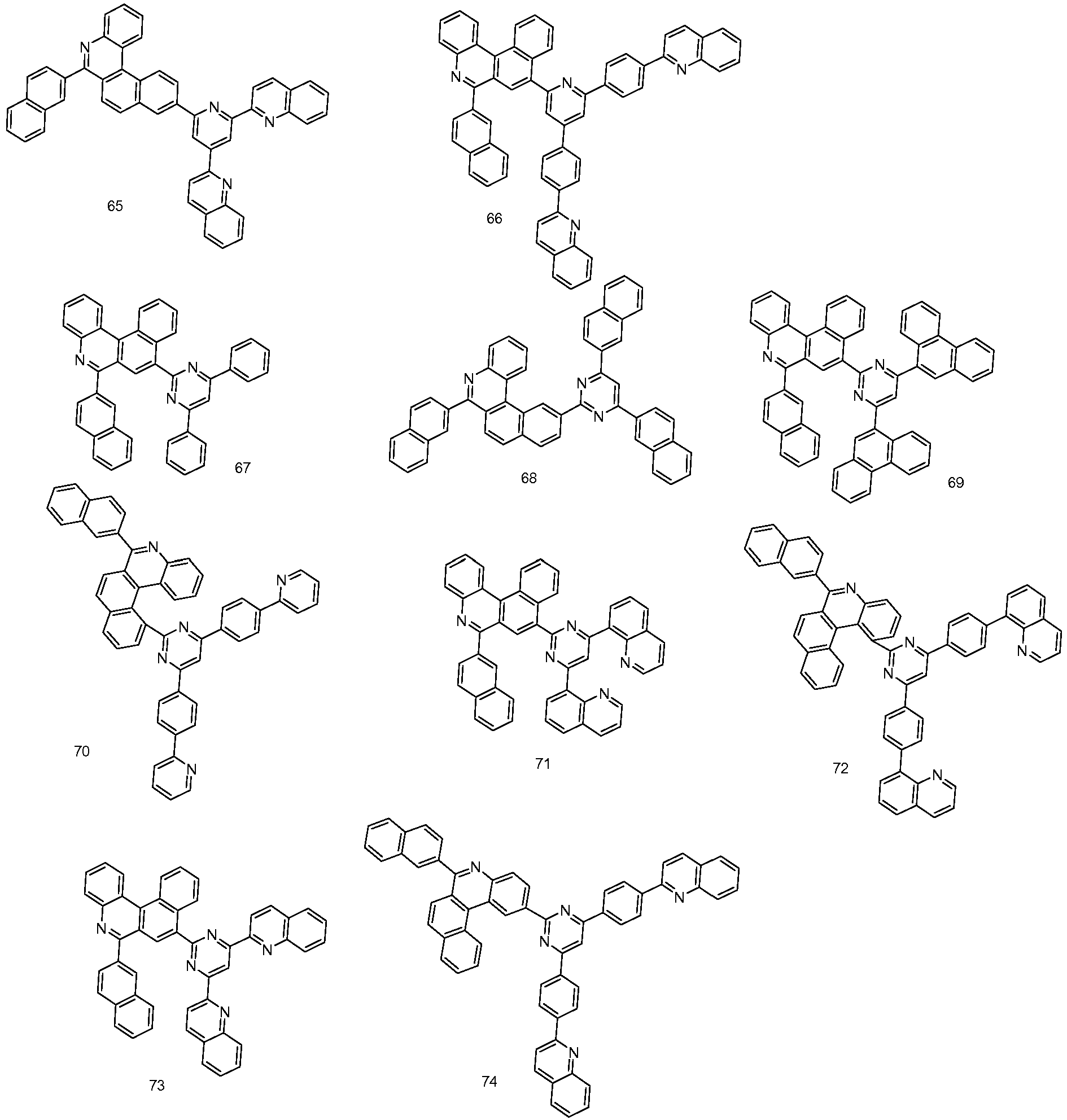


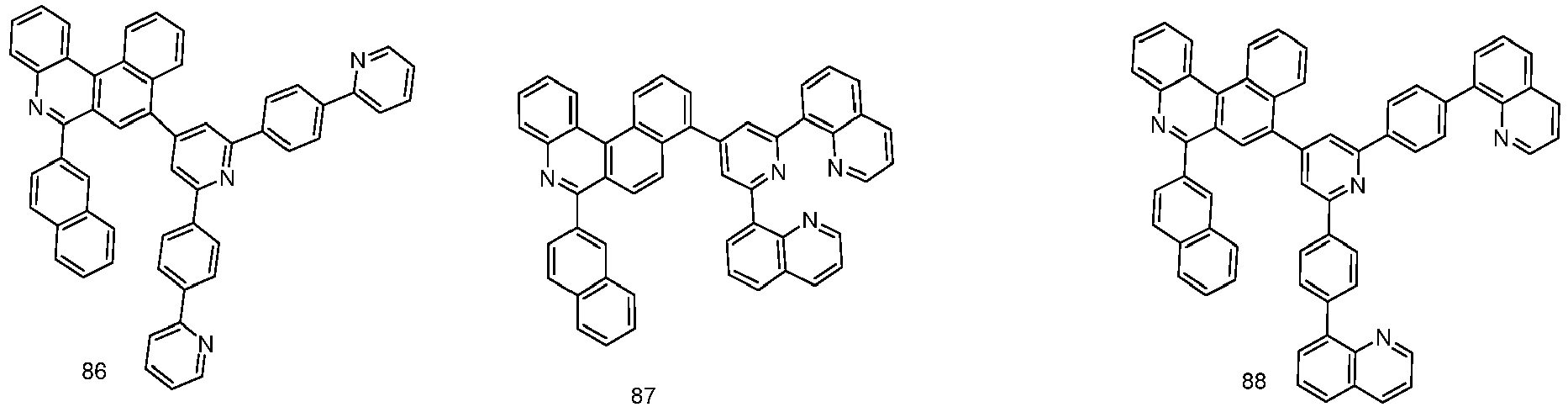


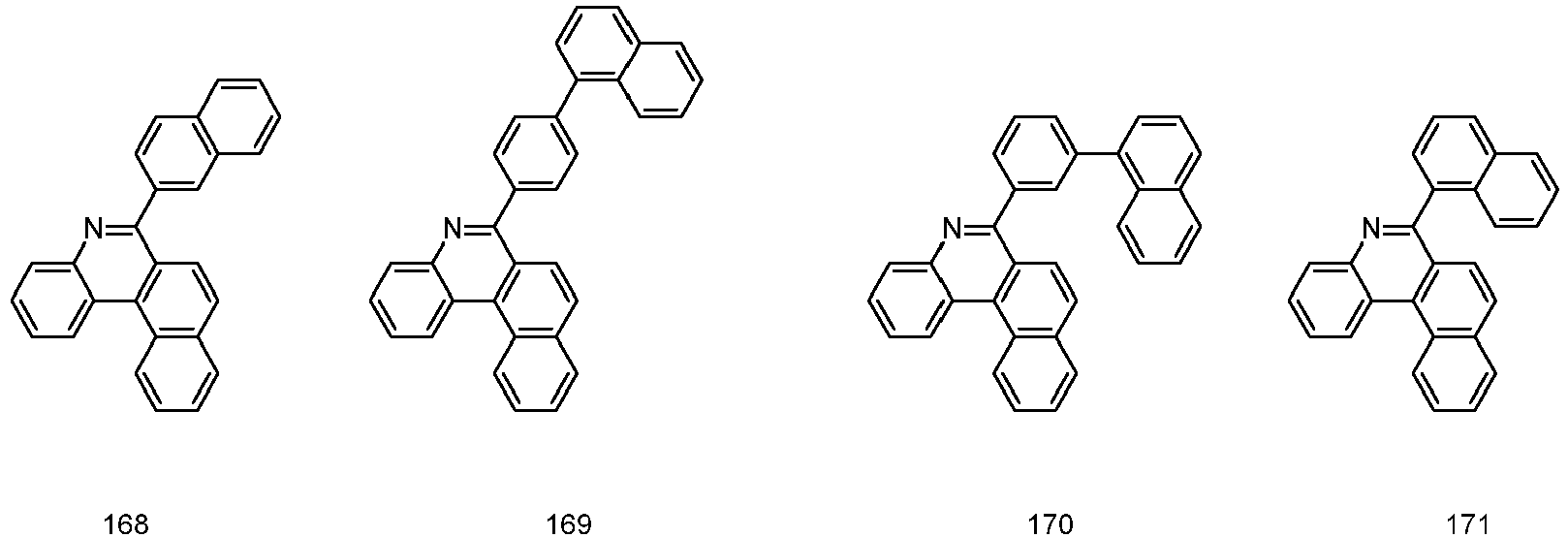


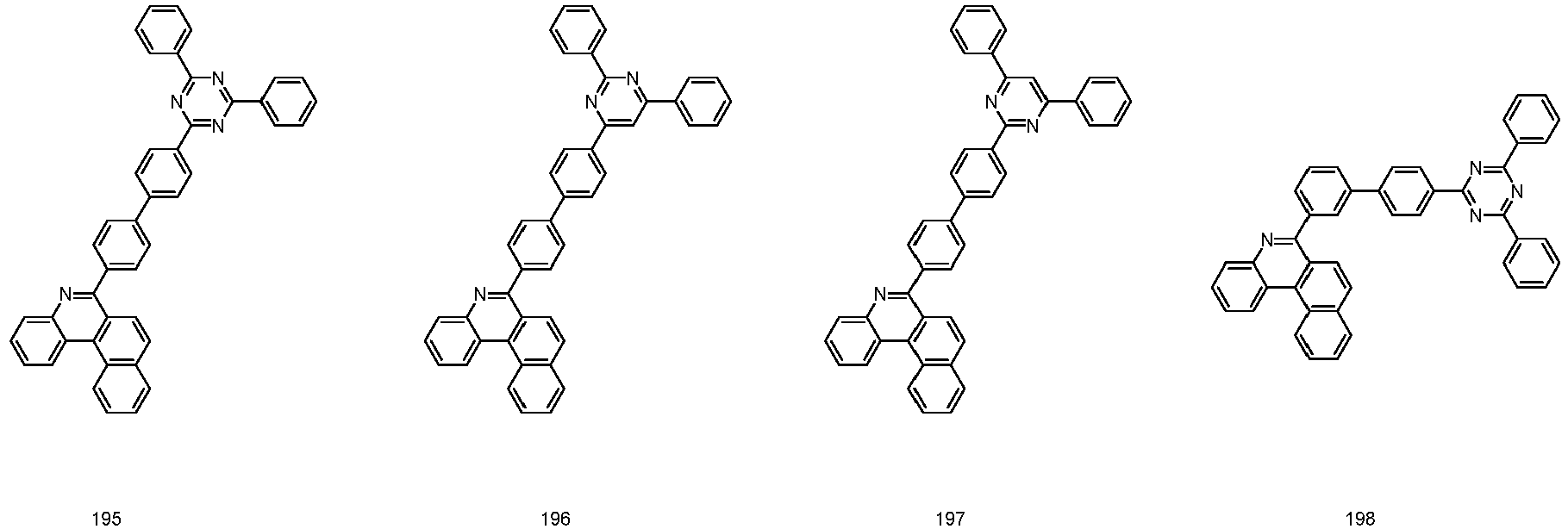
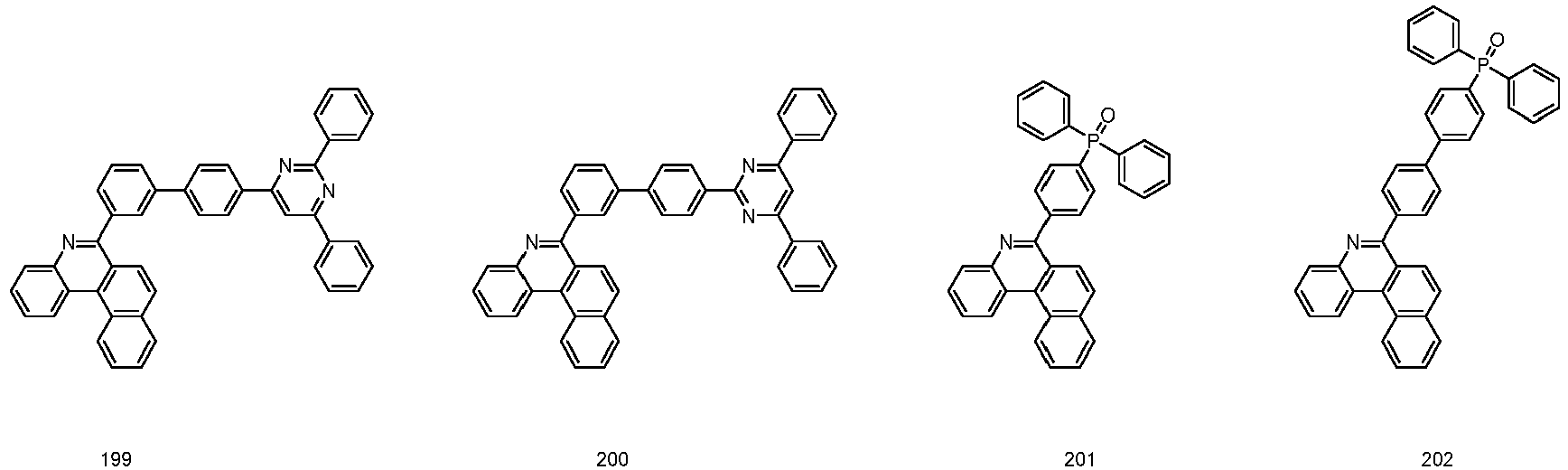


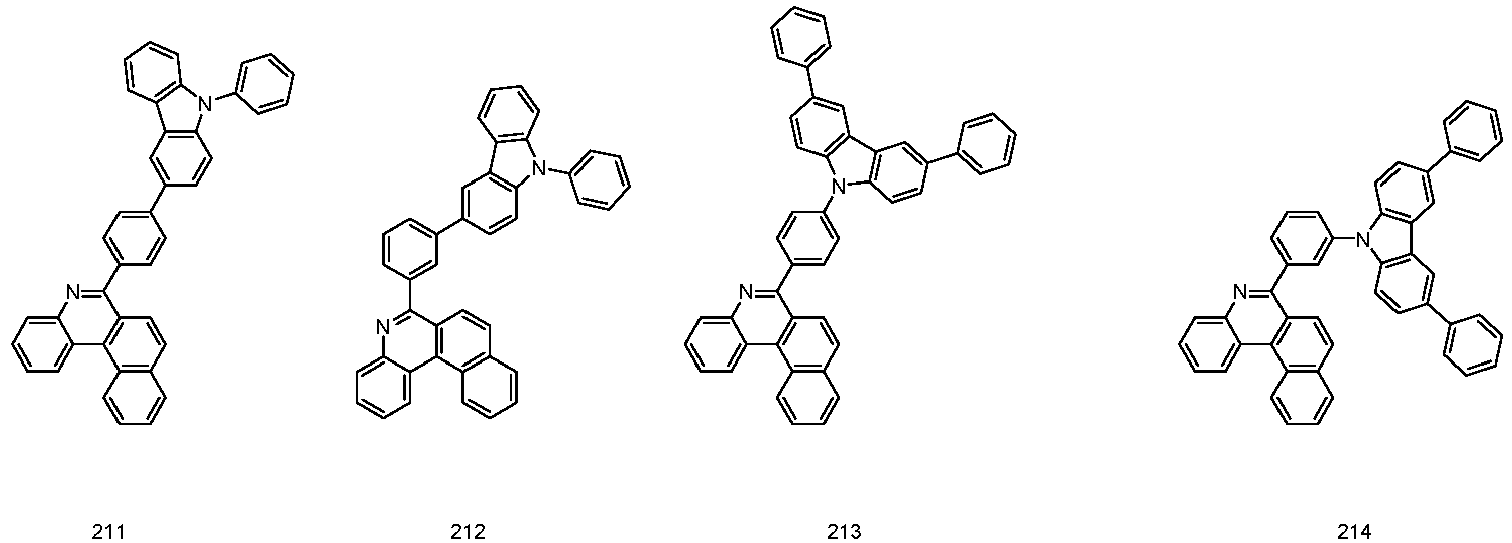


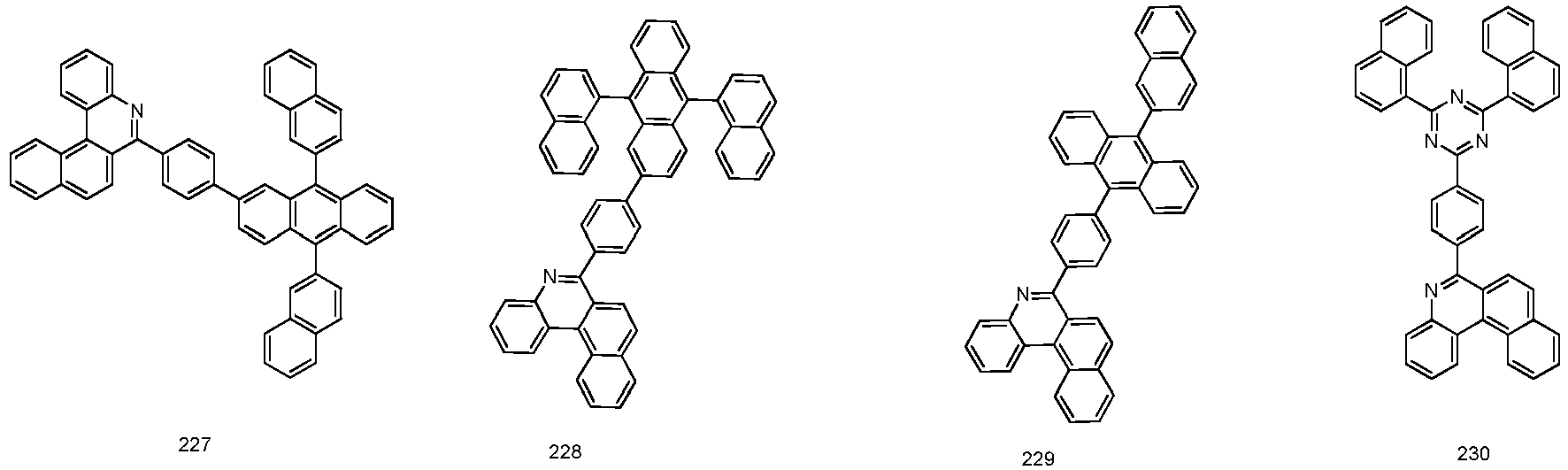


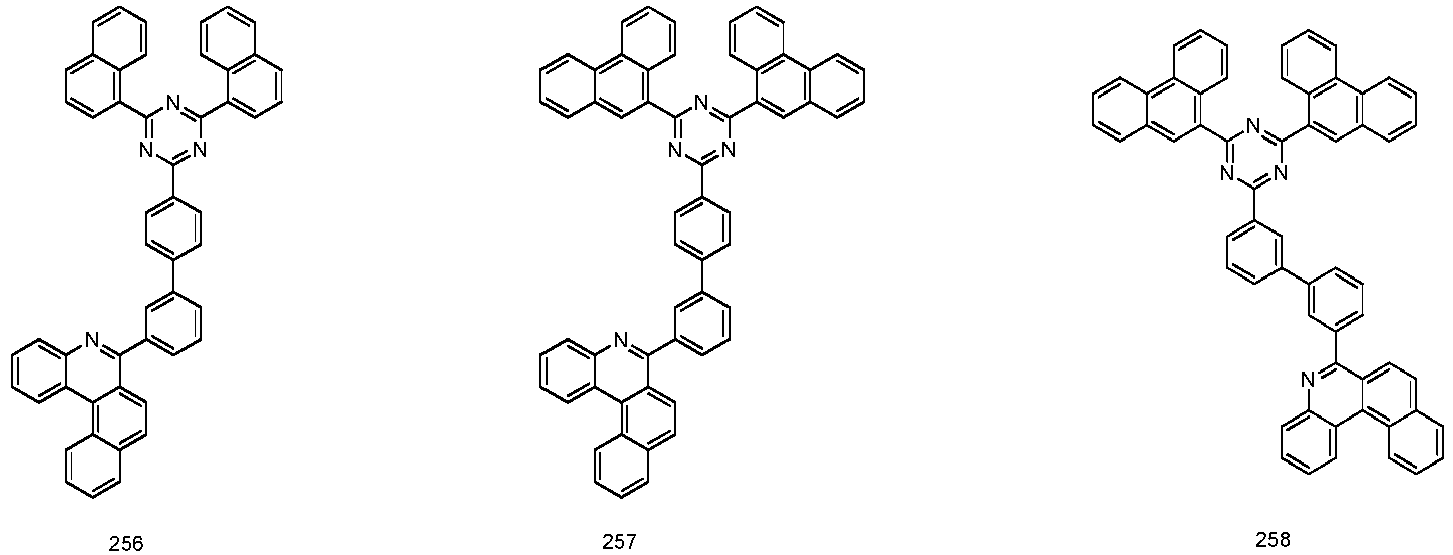
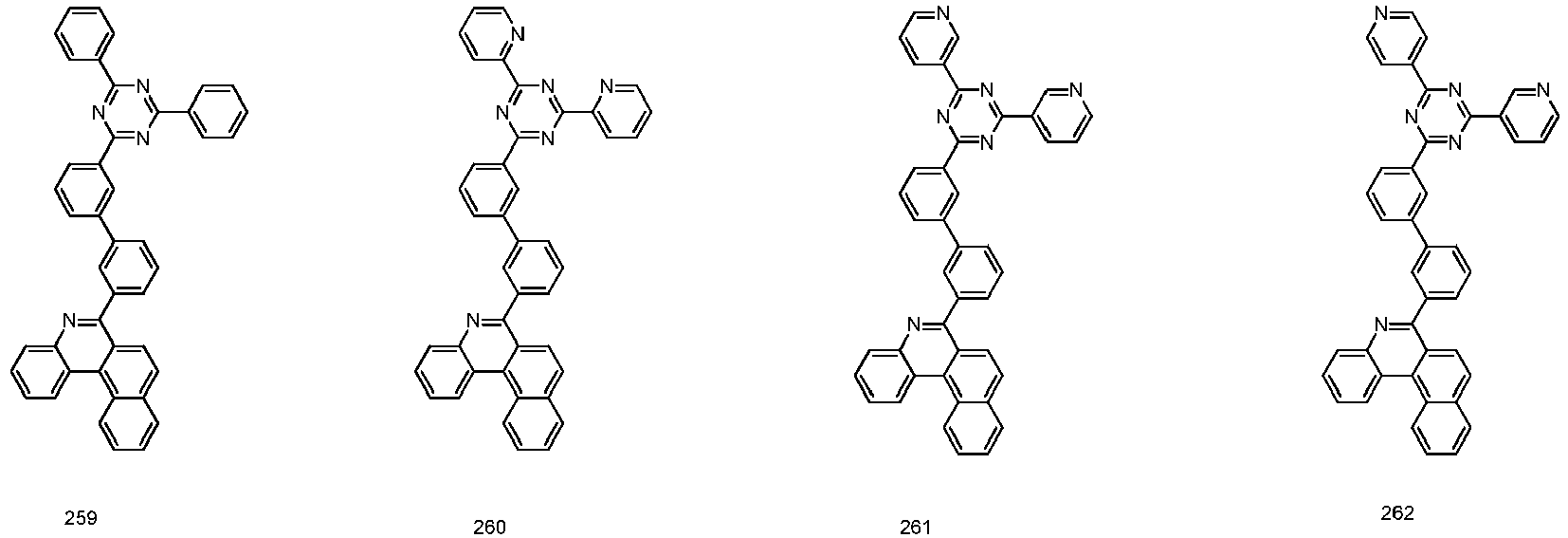


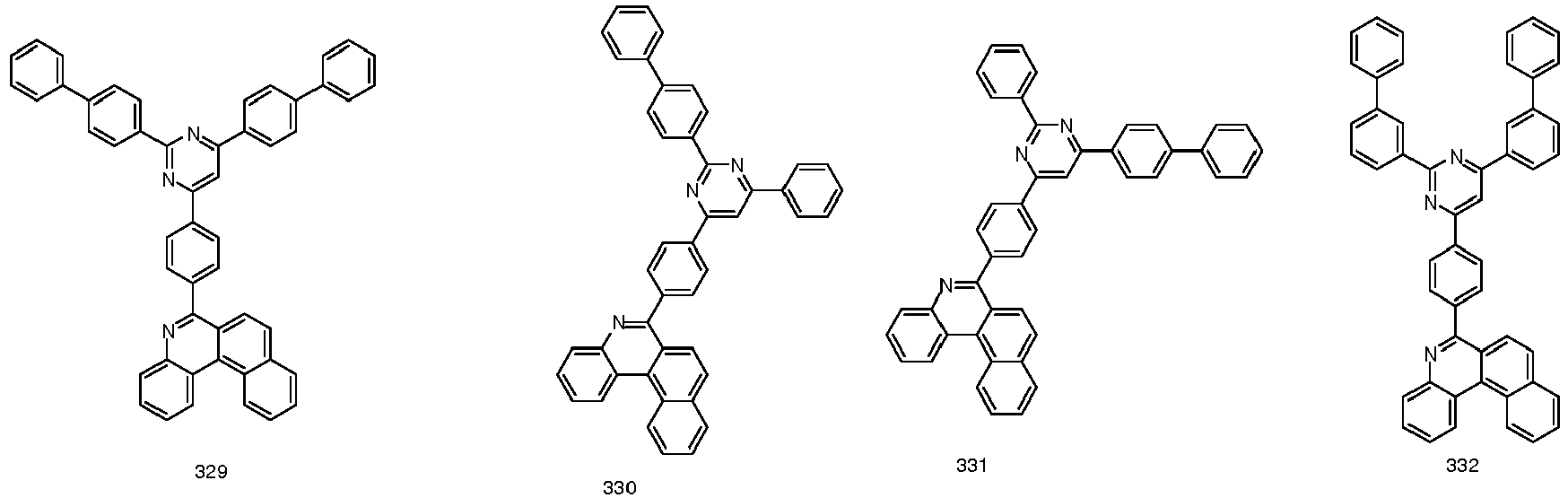


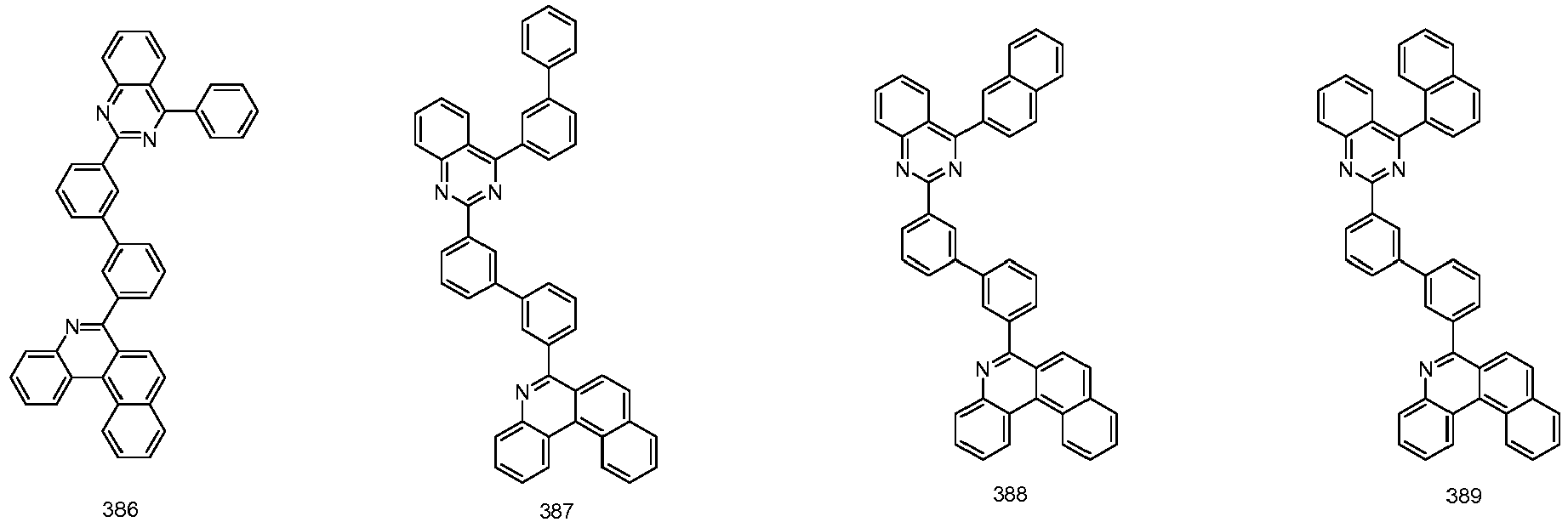


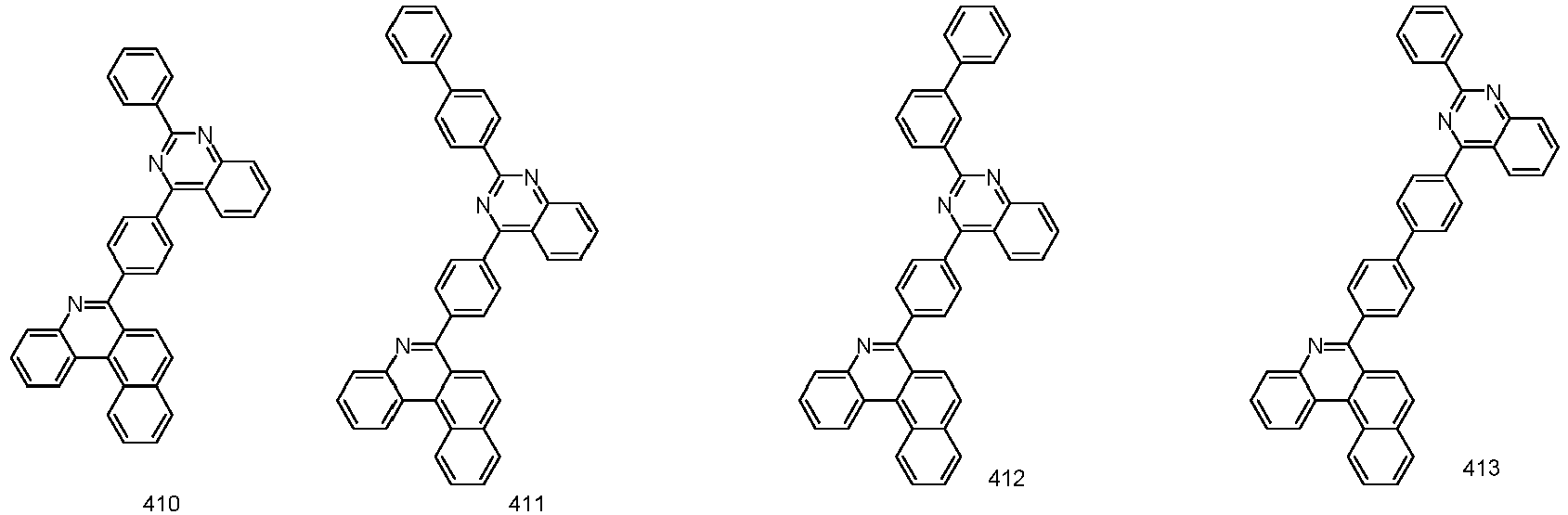





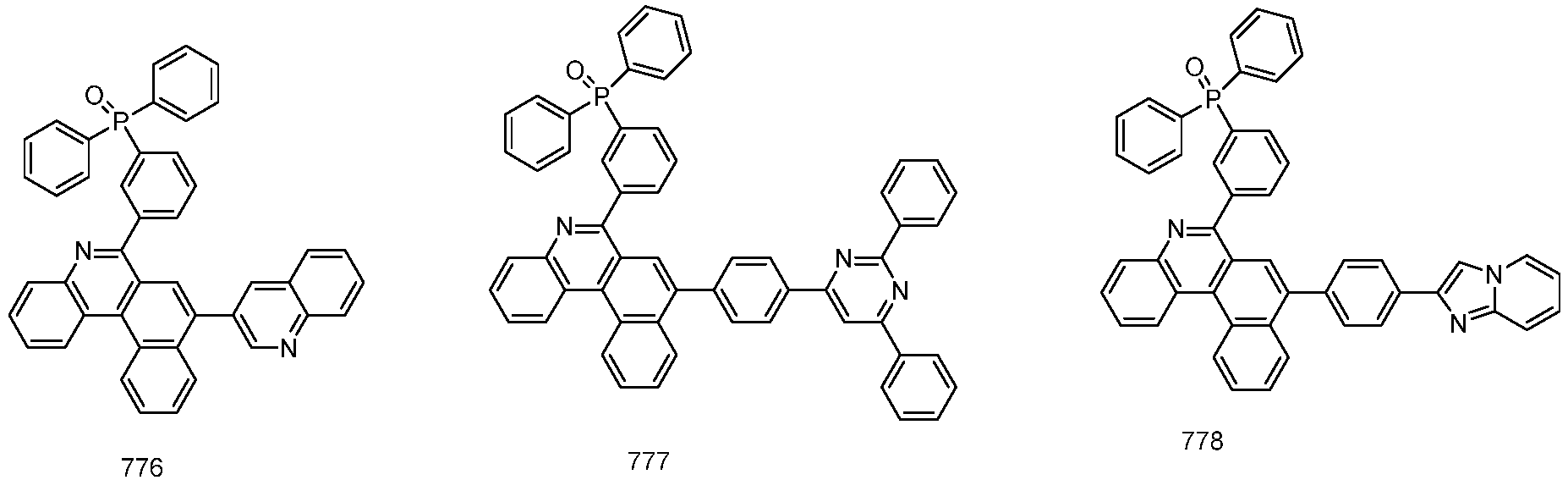


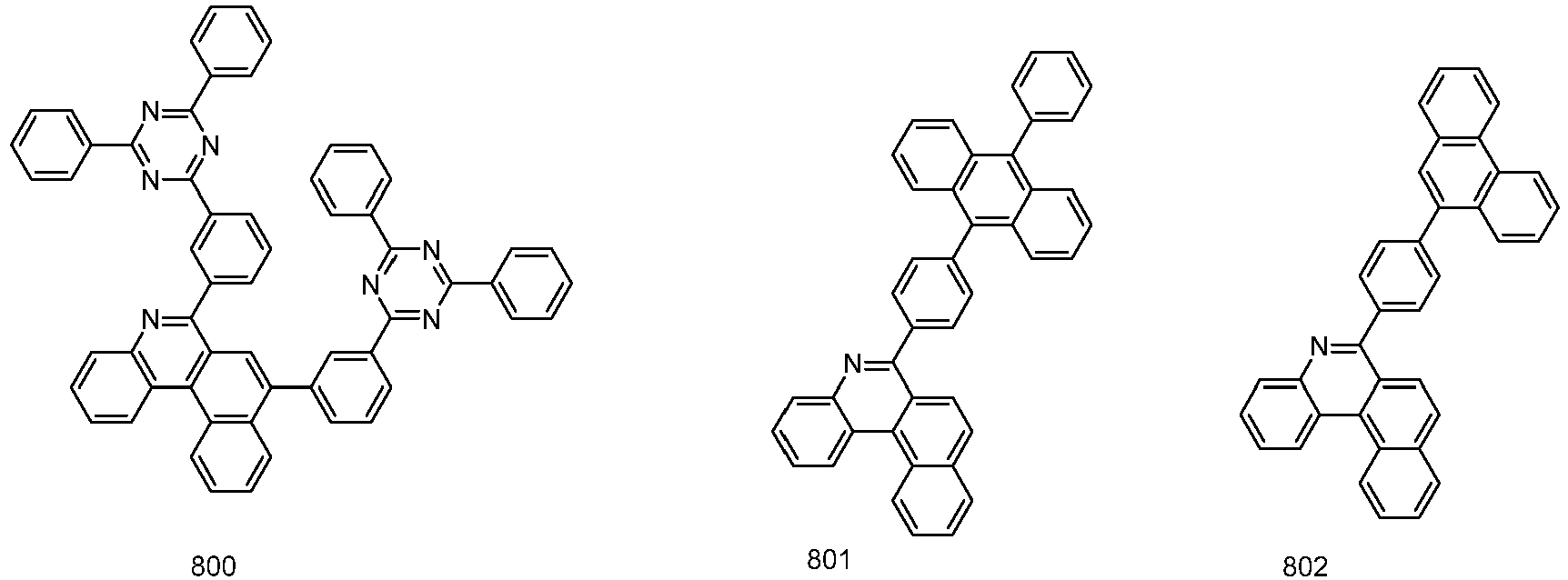


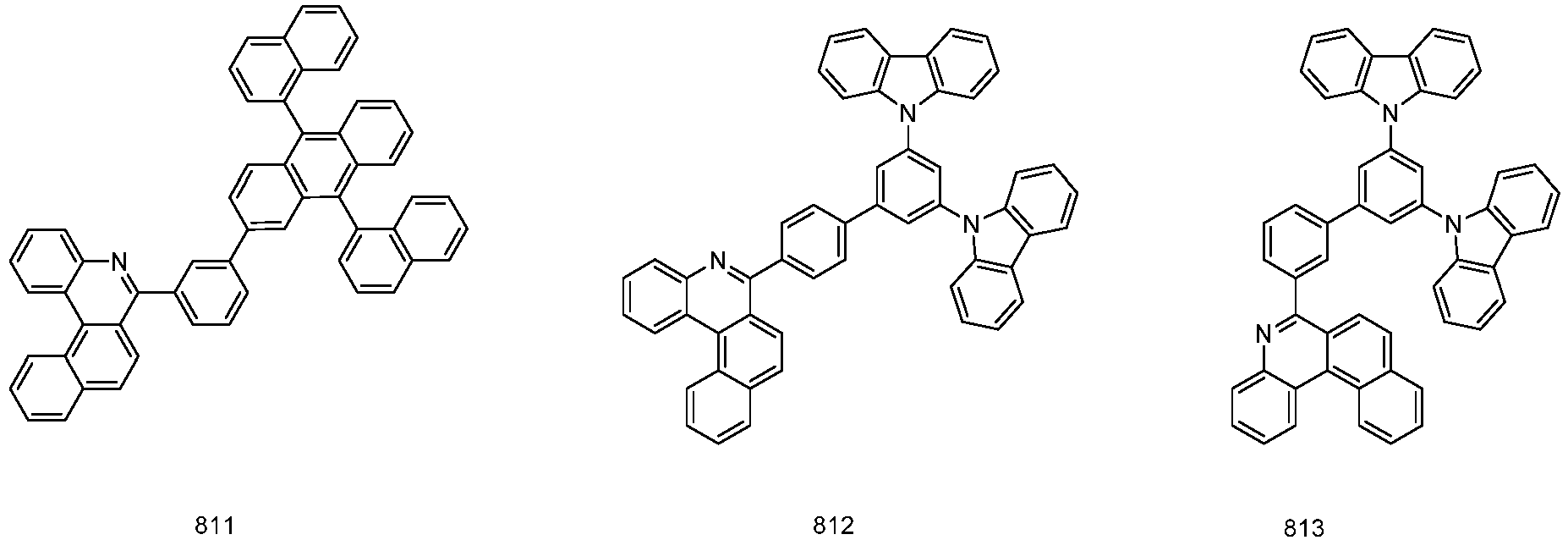


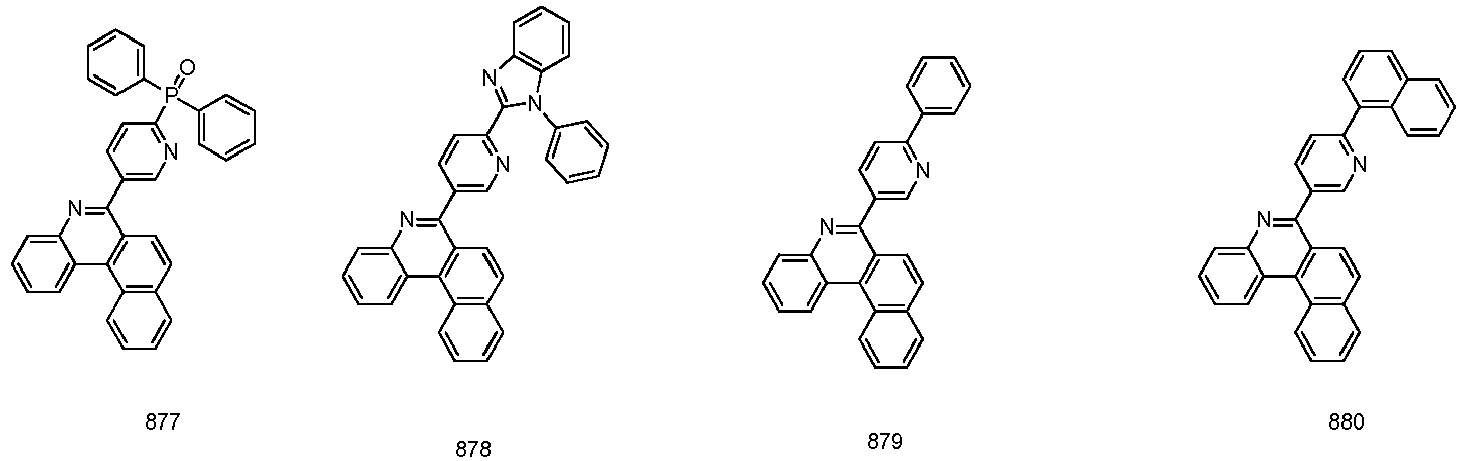


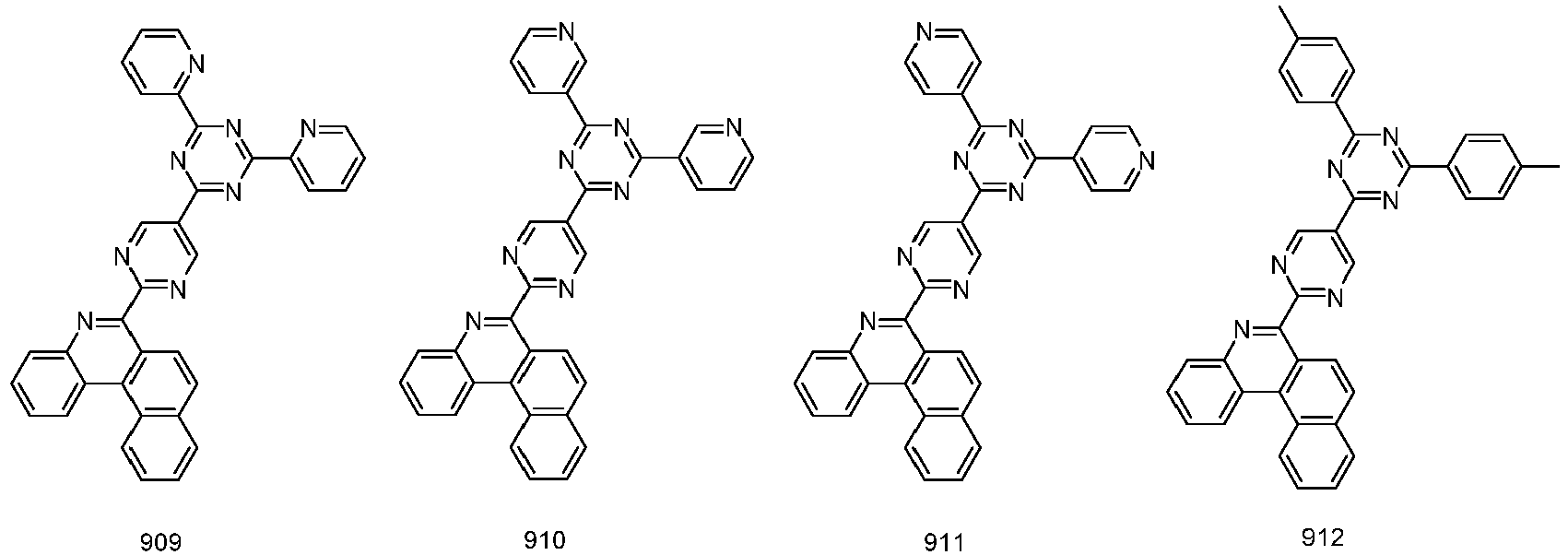


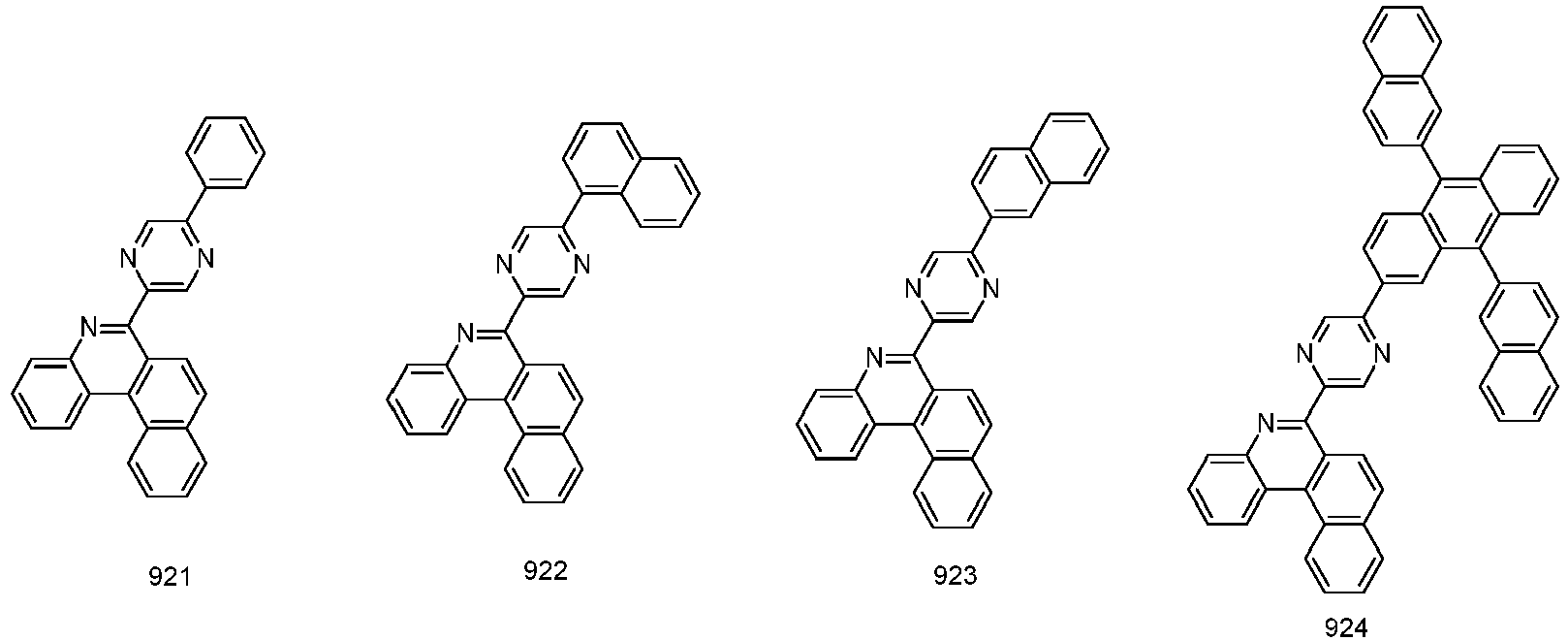


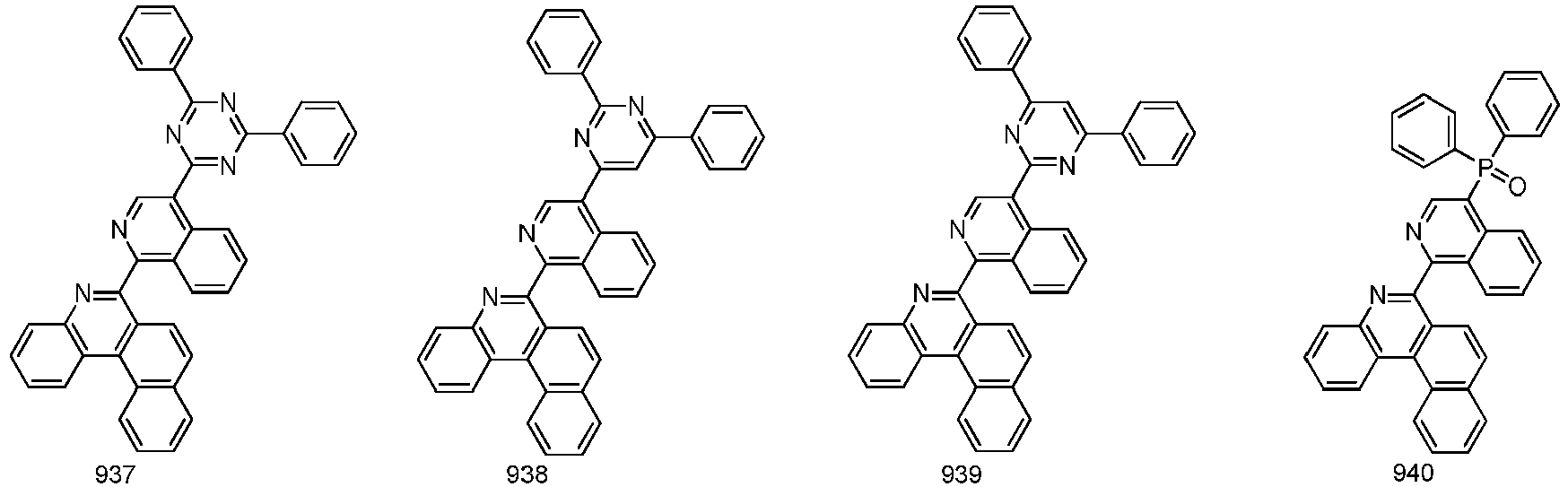


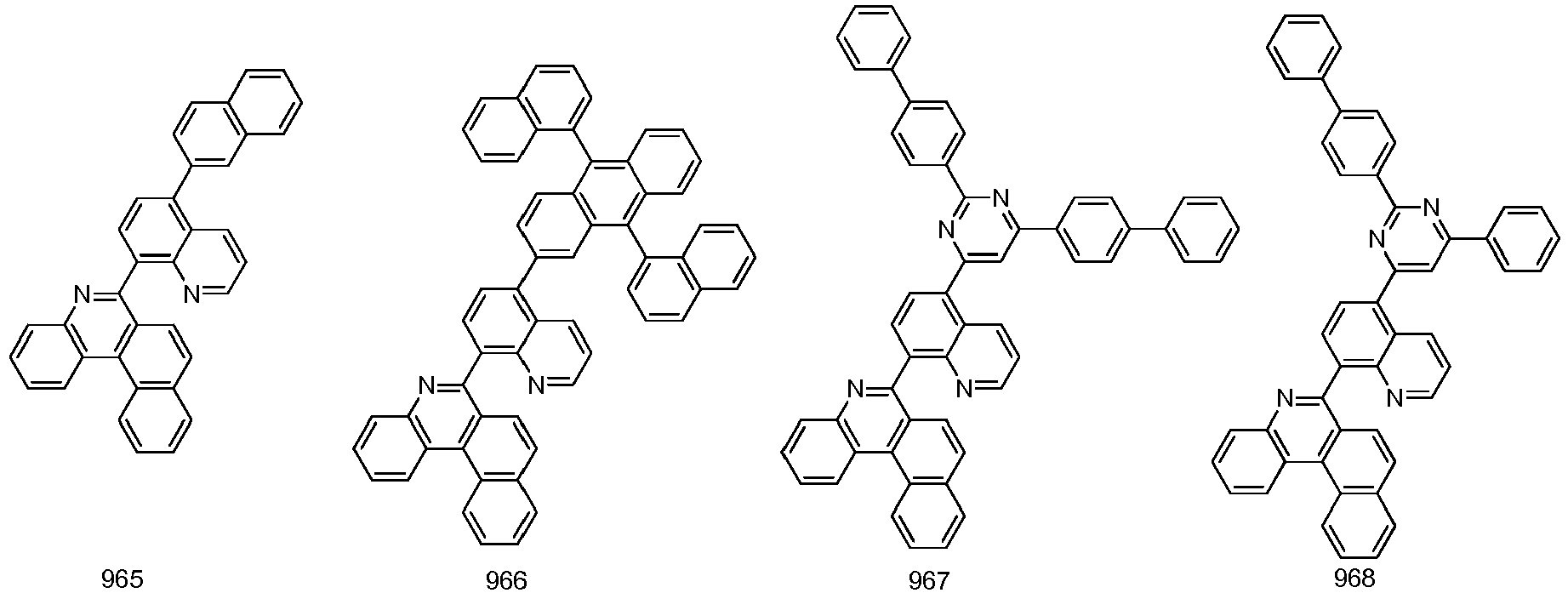


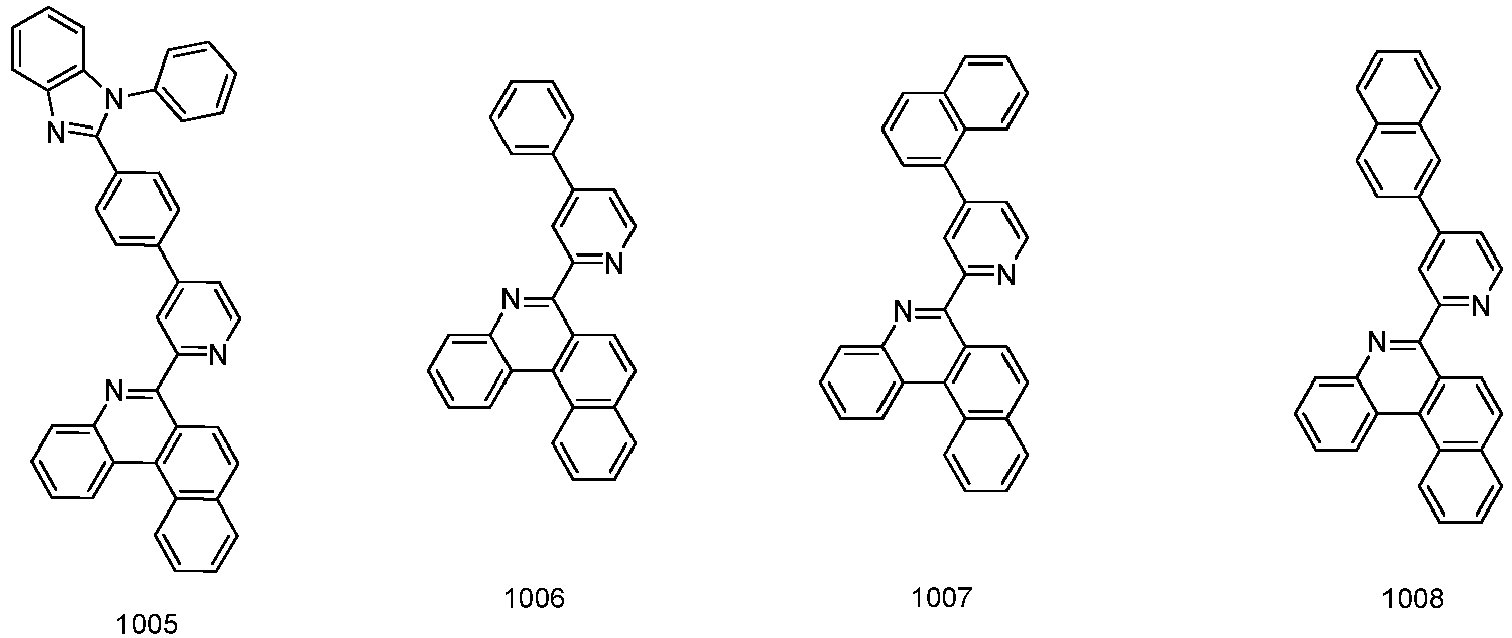


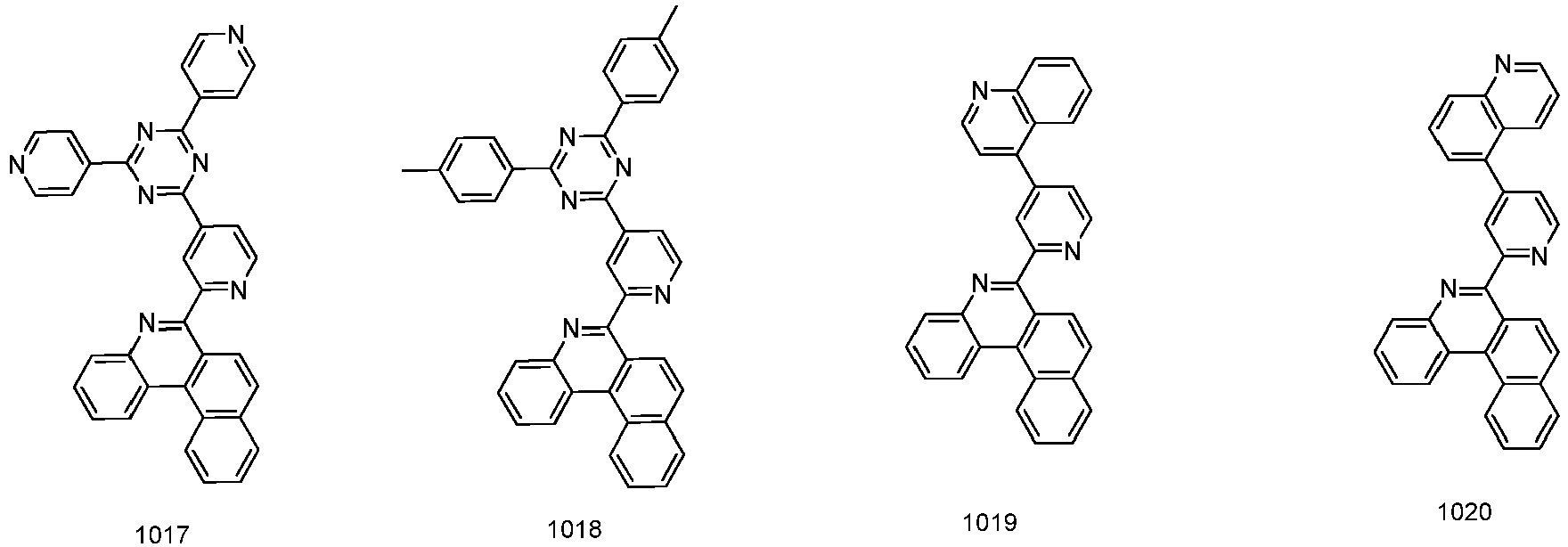


- The compounds described above may be prepared based on the preparation examples described below. The following preparation examples are representative examples, but if necessary, substituents may be added or excluded and positions of substituents may be changed. Further, based on technologies known in the art, starting materials, reactants, reaction conditions, and the like may be changed. If necessary, kinds or positions of the substituents at the other positions may be modified by those skilled in the art using technologies known in the art.
- For example, in the chemical formula 1, if R1 is naphthyl, a compound having a substituent "-R" at any one of R2 to R11 may be prepared according to the following reaction equations 1 to 19. The R1 may be changed to other aryl groups or heteroaryl groups instead of naphthyl by using materials and methods known in the art.


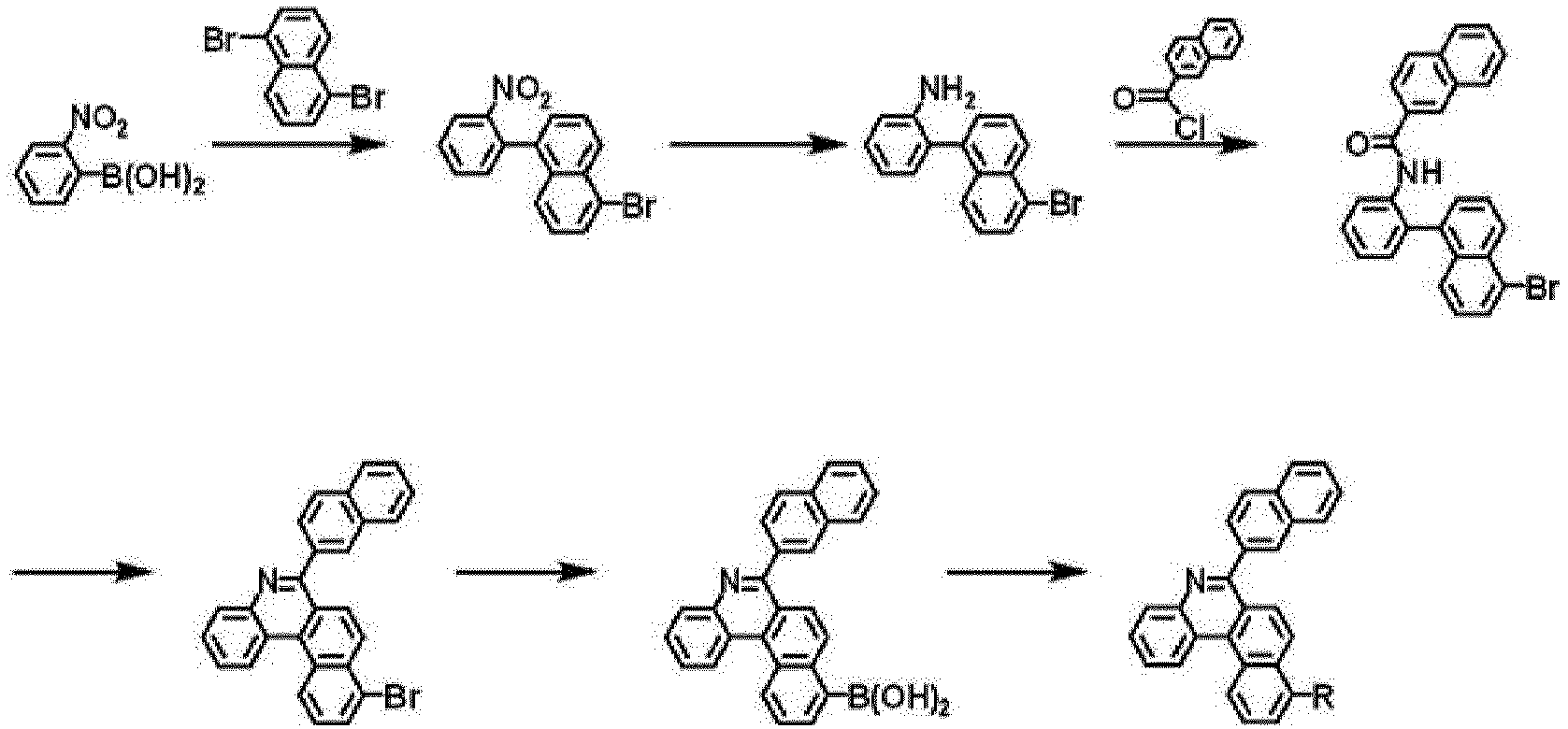


- In the above reaction equations 1 to 9, R is the same as defined for R2 to R11.
- For example, in the chemical formula 1, if R1 is "-phenylene-R", a compound may be prepared according to the following
reaction equation 10. In the "-phenylene-R", phenylene may be changed to other arylene or heteroarylene instead of phenylene by using materials and methods known in the art.

- In the
reaction equation 10, "-phenylene-R" is the same as defined for R1. - Further, when R1 in Formula 1 is "-heteroarylene-R", the compounds may be prepared by the following
Reaction Formulae 11 to 19.


- Anotehr exemplary embodiment of the present invention provides an organic light emitting device including the compound of the chemical formula 1. To be specific, the organic light emitting device includes an anode, a cathode, and one or more organic material layers provided between the anode and the cathode, wherein one or more layers of the organic material layers include the compound of the chemical formula 1.
-
FIGS. 1 to 3 illustrate examples of laminating order of electrodes and organic material layers of an organic light emitting device according to exemplary embodiments of the present invention. However, these drawings are not provided for limiting the scope of the present invention, and the structure of the organic light emitting device known in the art can also be applied to the present invention. - Referring to
FIG. 1 , an organic light emitting device in which ananode 200, anorganic material layer 300, and acathode 400 are laminated in sequence on asubstrate 100 is illustrated by the diagram. However, the structure of the organic light emitting device is not limited to this structure only, and as illustrated inFIG. 2 , an organic light emitting device in which a cathode, an organic material layer, and an anode are laminated in sequence on a substrate may also be included. -
FIG. 3 illustrates the case where the organic material layer is a multilayer. An organic light emitting device illustrated inFIG. 3 includes ahole injection layer 301, ahole transport layer 302, alight emitting layer 303, ahole blocking layer 304, anelectron transport layer 305, and anelectron injection layer 306. However, the scope of the present invention is not limited to this laminated structure, and when necessary, other layers except the light emitting layer may not be included, and other necessary layers having other functions may be added. - An organic light emitting device according to the present invention may be prepared using materials and methods known in the art except that the compound of the chemical formula 1 is included in one or more layers of the organic material layers.
- The compound of the chemical formula 1 may form one or more layers of the organic material layers alone in an organic light emitting device. However, when necessary, the compound of the chemical formula 1 may be mixed with other materials to form the organic material layers.
- The compound of the chemical formula 1 may be used as a hole injection material, a hole transport material, a light emitting material, a hole blocking material, an electron transport material, an electron injection material, or the like, in an organic light emitting device. In an example, the compound of the chemical formula 1 may be used as an electron injection and/or transport layer material in an organic light emitting device. Further, in another example, the compound of the chemical formula 1 may be used as an electron transport layer material in an organic light emitting device. Furthermore, in another example, the compound of the chemical formula 1 may be used as a light emitting layer material in an organic light emitting device. Moreover, in another example, the compound of the chemical formula 1 may be used as a host material of a phosphorescent light emitting layer in an organic light emitting device.
- In the organic light emitting device according to the present invention, other materials than the compound of the chemical formula 1 are illustrated below, but they are for illustrative purposes only, and are not intended to limit the scope of the present invention, and can be substituted with materials known in the art.
- As the anode material, materials having relatively large work function may be used, and transparent conductive oxides, metals, conductive polymers, or the like may be used.
- As the cathode material, materials having relatively small work function may be used, and metals, metal oxides, conductive polymers, or the like may be used.
- As the hole injection material, hole injection materials known in the art may be used, and for example, phthalocyanine compounds such as copper phthalocyanine disclosed in
U.S. Pat. No. 4,356,429 , or starbust-type amine derivatives disclosed in a literature [Advanced Material, 6, p. 677 (1994)], such as TCTA, m-MTDATA, m-MTDAPB, Pani/DBSA (polyaniline/dodecylbenzenesulfonic acid) or PEDOT/PSS (poly(3,4-ethylenedioxythiophene)/poly(4-styrenesulfonate)), Pani/CSA (polyaniline/camphor sulfonic acid) or PANI/PSS (polyaniline/poly(4-styrene-sulfonate), which is a conductive polymer having solubility, or the like, may be used. - As the hole transport material, a pyrazoline derivative, an arylamine-based derivative, a stilbene derivative, a triphenyldiamine derivative, or the like may be used, and a low molecular or high molecular material may also be used.
- As the electron transport material, an oxadiazole derivative, anthraquinodimethane and a derivative thereof, benzoquinone and a derivative thereof, naphthoquinone and a derivative thereof, anthraquinone and a derivative thereof, tetracyanoanthraquinodimethane and a derivative thereof, a fluorenone derivative, diphenyldicyanoethylene and a derivative thereof, a diphenoquinone derivative, 8-hydroxyquinoline and a metal complex of a derivative thereof, or the like, may be used, and a high molecular material as well as a low molecular material may also be used.
- As the electron injection material, for example, LiF is typically used in the related industry. However, the present invention is not limited thereto.
- As the light emitting material, a red, green, or blue light emitting material may be used, and when necessary, two or more light emitting materials may be mixed and used. Further, as the light emitting material, a fluorescent material may be used and a phosphorescent material may also be used. As the light emitting material, materials that emit light alone by bonding the holes and the electrons injected from an anode and a cathode, respectively, may be used. However, materials in which a host material and a dopant material are both involved in light emitting may also be used.
- If the compound according to the present invention is used as a phosphorescent host material, a phosphorescent dopant material to be used together may employ those known in the art.
- For example, phosphorescent dopant materials of LL'MX, LL'L"M, LMXX', L2MX, and L3M may be used, but the present invention is not limited thereto.
- Herein, L, L', L", X, and X' are not equivalent, bidentate ligands, and M is a metal that forms octahedral complexes.
- M may be iridium, platinum, osmium, or the like.
- L is an anionic bidentate ligand which coordinates to M via an sp2 hybridized carbon and a heteroatom, and X functions to trap electrons or holes. Non-limiting examples of the L may include 2-(1-naphthyl) benzoxazole, (2-phenylbenzoxazole), (2-phenylbenzothiazole), (2- phenylbenzothiazole), (7,8-benzoquinoline), (thienylpyridine), phenylpyridine, benzothienylpyridine, 3-methoxy-2-phenylpyridine, thienylpyridine, and tolylpyridine. Non-limiting examples of the X may include acetylacetonate (acac), hexafluoroacetylacetonate, salicylidene, picolinate, and 8-hydroxyquinolinate.
- More specific examples will be described below, but the present invention is not limited thereto.


- Hereinafter, the present invention will be described in more detail with reference to examples, however, it is to be understood that these are for illustrative purposes only, and are not intended to limit the scope of the present invention.
-

- A compound 1-bromo-2-nitrobenzene (15 g, 76.9 mmol), 1-naphthaleneboronic acid (14.5 g, 84.6 mmol), Pd(PPh3)2Cl2 (2.7 g, 3.85 mmol), 2M K2CO3 aqueous solution (70 ml), toluene (200 ml), and ethanol (100 ml) were added and then, refluxed for 12 hours. After the reaction was completed, the resultant reaction product was cooled to room temperature and then extracted with distilled water and EA. The organic layer was dried using anhydrous MgSO4, and after the solvent was removed with a rotary evaporator, the resultant reaction product was purified by column chromatography using dichloromethane and hexane as a developing solvent, and 14.1 g (75%) of the target compound 103-6 was obtained.
- After Compound 103-6 (14.1 g, 43.1 mmol) was dissolved in dichloromethane (300 ml), N-bromosuccinimide (7.6 g, 43.4 mmol) was added thereto, and the resultant reaction product was stirred at room temperature for 12 hours. After the reaction was completed, the resultant reaction product was extracted with distilled water and EA. The organic layer was dried using anhydrous MgSO4, and after the solvent was removed with a rotary evaporator, the resultant reaction product was purified by column chromatography using dichloromethane and hexane as a developing solvent, and the target compound 103-5 (11.4 g, 81%) was obtained.
- 11.4 g (34.9 mmol) of Compound 103-5 was dissolved in methanol and then substituted with nitrogen. After Pd/C (10 wt%) was added thereto, the resultant reaction product was substituted with hydrogen and stirred at room temperature for 1 hour. After the reaction was completed, the resultant reaction product was allowed to pass through a Cellite, and the target compound 103-4 (10.2 g, 98%) was obtained.
- After Compound 103-4 (10.2 g, 34.2 mmol) was dissolved in THF, TEA (14 ml, 102.6 mmol) and 2-naphthoyl chloride (9.7 g, 51.3 mmol) were added thereto at 0°C. Then, a temperature was increased to room temperature and the resultant reaction product was stirred for 4 hours. After the reaction was completed, the resultant reaction product was extracted with distilled water and EA. The organic layer was dried using anhydrous MgSO4, and after the solvent was removed with a rotary evaporator, the resultant reaction product was purified by column chromatography using dichloromethane and hexane as a developing solvent, and the target compound 103-3 (13.3 g, 86%) was obtained.
- After Compound 103-3 (13.3 g, 29.4 mmol) was dissolved in nitrobenzene, POCl3 (0.5 ml, 5.88 mmol) was added thereto at room temperature. Then, the resultant reaction product was stirred at 150°C for 18 hours. After the reaction was completed, the resultant reaction product was neutralized with NaHCO3 and extracted with EA. The organic layer was dried using anhydrous MgSO4, and after the solvent was removed with a rotary evaporator, the resultant reaction product was purified by column chromatography using dichloromethane and methanol as a developing solvent, and the target compound 103-2 (9.7 g, 73%) was obtained.
- After Compound 103-2 (9.7 g, 21.4 mmol) was dissolved in THF, 2.5 M n-BuLi (10.2 ml, 25.6 mmol) was slowly added dropwise thereto at -78°C. Then, the resultant reaction product was stirred for 30 minutes. After trimethylborate was added thereto, a temperature was increased to room temperature and the resultant reaction product was stirred for 1 hour. After the reaction was completed, HCl was added thereto with stirring for 1 hour and the resultant reaction product was extracted with distilled water and EA. The organic layer was dried using anhydrous MgSO4, and after the solvent was removed with a rotary evaporator, the resultant reaction product was purified by column chromatography using dichloromethane and methanol as a developing solvent, and the target compound 103-1 (3.6 g, 43%) was obtained.
- Compound 103-1 (3.6 g, 9.20 mmol), 1-phenyl-1H-benzo[d]imidazole-2-phenylboronic acid (5.4 g, 13.8 mmol), Pd(PPh3)4 (0.53 g, 0.46 mmol), 2M K2CO3 aqueous solution (70 ml), toluene (200 ml), and ethanol (100 ml) were added and then, refluxed for 12 hours. After the reaction was completed, the resultant reaction product was cooled to room temperature and then extracted with distilled water and EA. The organic layer was dried using anhydrous MgSO4, and after the solvent was removed with a rotary evaporator, the resultant reaction product was purified by column chromatography using dichloromethane and hexane as a developing solvent, and 4.3 g (80%) of the target compound 103 was obtained.
-

- A compound 2-nitrophenylboronic acid (10 g, 59.9 mmol), 1,5-dibromonaphthalene (51 g, 179 mmol), Pd(PPh3)2Cl2 (2.1 g, 3.0 mmol), 2M K2CO3 aqueous solution (70 ml), toluene (200 ml), and ethanol (100 ml) were added and then, refluxed for 12 hours. After the reaction was completed, the resultant reaction product was cooled to room temperature and then extracted with distilled water and EA. The organic layer was dried using anhydrous MgSO4, and after the solvent was removed with a rotary evaporator, the resultant reaction product was purified by column chromatography using dichloromethane and hexane as a developing solvent, and 12.8 g (65%) of the target compound 12-5 was obtained.
- Compound 12-5 (12.8 g, 38.9 mmol) was dissolved in methanol and then substituted with nitrogen. After Pd/C (10 wt%) was added thereto, the resultant reaction product was substituted with hydrogen and stirred at room temperature for 1 hour. After the reaction was completed, the resultant reaction product was allowed to pass through a Cellite, and the target compound 12-4 (11.2 g, 97%) was obtained.
- After Compound 12-4 (11.2 g, 37.7 mmol) was dissolved in THF, TEA (15.6 ml, 113.1 mmol) and 2-naphthoyl chloride (10.7 g, 56.5 mmol) were added thereto at 0°C. Then, a temperature was increased to room temperature and the resultant reaction product was stirred for 4 hours. After the reaction was completed, the resultant reaction product was extracted with distilled water and EA. The organic layer was dried using anhydrous MgSO4, and after the solvent was removed with a rotary evaporator, the resultant reaction product was purified by column chromatography using dichloromethane and hexane as a developing solvent, and the target compound 12-3 (15.3 g, 90%) was obtained.
- After Compound 12-3 (15.3 g, 33.9 mmol) was dissolved in nitrobenzene, POCl3 (0.63 ml, 6.78 mmol) was added thereto at room temperature. Then, the resultant reaction product was stirred at 150°C for 18 hours. After the reaction was completed, the resultant reaction product was neutralized with NaHCO3 and extracted with EA. The organic layer was dried using anhydrous MgSO4, and after the solvent was removed with a rotary evaporator, the resultant reaction product was purified by column chromatography using dichloromethane and methanol as a developing solvent, and the target compound 12-2 (11.6 g, 79%) was obtained.
- After Compound 12-2 (11.6 g, 26.7 mmol) was dissolved in THF, 2.5 M n-BuLi (12.8 ml, 32.0 mmol) was slowly added dropwise thereto at -78°C. Then, the resultant reaction product was stirred for 30 minutes. After trimethylborate (8.9 ml, 80.1 mmol) was added thereto, a temperature was increased to room temperature and the resultant reaction product was stirred for 1 hour. After the reaction was completed, HCl was added thereto with stirring for 1 hour and the resultant reaction product was extracted with distilled water and EA. The organic layer was dried using anhydrous MgSO4, and after the solvent was removed with a rotary evaporator, the resultant reaction product was purified by column chromatography using dichloromethane and methanol as a developing solvent, and the target compound 12-1 (5.9 g, 56%) was obtained.
- Compound 12-1 (5.9 g, 14.9 mmol), 9-bromo-10-(2-naphthyl)anthracene (6.2 g, 16.4 mmol), Pd(PPh3)4 (0.86 g, 0.74 mmol), 2M K2CO3 aqueous solution (30 ml), toluene (120 ml), and ethanol (30 ml) were added and then, refluxed for 12 hours. After the reaction was completed, the resultant reaction product was cooled to room temperature and then extracted with distilled water and EA. The organic layer was dried using anhydrous MgSO4, and after the solvent was removed with a rotary evaporator, the resultant reaction product was purified by column chromatography using dichloromethane and hexane as a developing solvent, and 7.6 g (78%) of the
target compound 12 was obtained. -

- A compound 2-nitrophenylboronic acid (10 g, 59.9 mmol), 1-bromo-6-methoxy-naphthalen (42.4 g, 179 mmol), Pd(PPh3)2Cl2 (2.1 g, 3.0 mmol), 2M K2CO3 aqueous solution (70 ml), toluene (200 ml), and ethanol (100 ml) were added and then, refluxed for 12 hours. After the reaction was completed, the resultant reaction product was cooled to room temperature and then extracted with distilled water and EA. The organic layer was dried using anhydrous MgSO4, and after the solvent was removed with a rotary evaporator, the resultant reaction product was purified by column chromatography using dichloromethane and hexane as a developing solvent, and the target compound 48-7 (16.7 g, 83%) was obtained.
- Compound 48-7 (16.7 g, 59.8 mmol) was dissolved in methanol and then substituted with nitrogen. After Pd/C (10 wt%) was added thereto, the resultant reaction product was substituted with hydrogen and stirred at room temperature for 1 hour. After the reaction was completed, the resultant reaction product was allowed to pass through a Cellite, and the target compound 48-6 (14.6 g, 98%) was obtained.
- After Compound 48-6 (14.6 g, 58.5 mmol) was dissolved in THF, TEA (24.3 ml, 175.6 mmol) and 2-naphthoyl chloride (16.7 g, 87.7 mmol) were added thereto at 0°C. Then, a temperature was increased to room temperature and the resultant reaction product was stirred for 4 hours. After the reaction was completed, the resultant reaction product was extracted with distilled water and EA. The organic layer was dried using anhydrous MgSO4, and after the solvent was removed with a rotary evaporator, the resultant reaction product was purified by column chromatography using dichloromethane and hexane as a developing solvent, and the target compound 48-5 (19.8 g, 84%) was obtained.
- After Compound 48-5 (19.8 g, 49.1 mmol) was dissolved in nitrobenzene, POCl3 (0.92 ml, 9.82 mmol) was added thereto at room temperature. Then, the resultant reaction product was stirred at 150°C for 18 hours. After the reaction was completed, the resultant reaction product was neutralized with NaHCO3 and extracted with EA. The organic layer was dried using anhydrous MgSO4, and after the solvent was removed with a rotary evaporator, the resultant reaction product was purified by column chromatography using dichloromethane and methanol as a developing solvent, and the target compound 48-4 (15.3 g, 81%) was obtained.
- After Compound 48-4 (15.3 g, 39.7 mmol) was dissolved in dichloromethane, boron tribromide (1 M in dichloromethane) (59.5 ml, 59.5 mmol) was added thereto at a time at 0°C. Then, the resultant reaction product was stirred at room temperature for 18 hours. After the reaction was completed, the resultant reaction product was neutralized with NaHCO3 at 0°C and extracted with distilled water and EA. The organic layer was dried using anhydrous MgSO4, and after the solvent was removed with a rotary evaporator, the resultant reaction product was purified by column chromatography using dichloromethane and methanol as a developing solvent, and the target compound 48-3 (14.0 g, 95%) was obtained.
- After Compound 48-3 (14.0 g, 37.7 mmol) was dissolved in dichloromethane, pyridine (4.5 ml, 56.5 mmol) was added thereto and triflic anhydride was added dropwise thereto at 0°C. Then, the resultant reaction product was stirred at room temperature for 5 hours. After the reaction was completed, the reaction solution was allowed to pass through silica. The filtrate was removed with a rotary evaporator. Then, the resultant reaction product was purified by column chromatography using dichloromethane and methanol as a developing solvent, and the target compound 48-2 (18.2 g, 96%) was obtained.
- Compound 48-2 (18.2 g, 36.2 mmol) 1-bromo-3-iodinebenzene (12.2 g, 43.4 mmol), Pd(PPh3)4 (2.09 g, 1.81 mmol), 2M K2CO3 aqueous solution (80 ml), toluene (400 ml), and ethanol (80 ml) were added and then, refluxed for 12 hours. After the reaction was completed, the resultant reaction product was cooled to room temperature and extracted with distilled water and EA. The organic layer was dried using anhydrous MgSO4, and after the solvent was removed with a rotary evaporator, the resultant reaction product was purified by column chromatography using dichloromethane and hexane as a developing solvent, and 14.4 g (78%) of the target compound 48-1 was obtained.
- Compound 48-1 (14.4 g, 28.2 mmol), 13H-dibenzo[a,i]carbazole (9.0 g, 33.8 mmol), Pd(PPh3)4 (1.6 g, 1.41 mmol), 2M K2CO3 aqueous solution (60 ml), toluene (300 ml), and ethanol (60 ml) were added and then, refluxed for 12 hours. After the reaction was completed, the resultant reaction product was cooled to room temperature and then extracted with distilled water and EA. The organic layer was dried using anhydrous MgSO4, and after the solvent was removed with a rotary evaporator, the resultant reaction product was purified by column chromatography using dichloromethane and hexane as a developing solvent, and 12.7 g (65%) of the target compound 48 was obtained.
-

- A compound 2-nitrophenylboronic acid (10 g, 59.9 mmol), 8-bromo-2-naphthol (20.0 g, 89.8 mmol), Pd(PPh3)2Cl2 (2.1 g, 3.0 mmol), 2M K2CO3 aqueous solution (70 ml), toluene (200 ml), and ethanol (100 ml) were added and then, refluxed for 12 hours. After the reaction was completed, the resultant reaction product was cooled to room temperature and then extracted with distilled water and EA. The organic layer was dried using anhydrous MgSO4, and after the solvent was removed with a rotary evaporator, the resultant reaction product was purified by column chromatography using dichloromethane and hexane as a developing solvent, and the target compound 29-5 (14.4 g, 91%) was obtained.
- Compound 29-5 (14.4 g, 54.5 mmol) was dissolved in methanol and then substituted with nitrogen. After Pd/C (10 wt%) was added thereto, the resultant reaction product was substituted with hydrogen and stirred at room temperature for 1 hour. After the reaction was completed, the resultant reaction product was allowed to pass through a Cellite, and the target compound 29-4 (12.5 g, 98%) was obtained.
- After Compound 29-4 (12.5 g, 53.4 mmol) was dissolved in THF, TEA (22.2 ml, 160.2 mmol) and 2-naphthoyl chloride (15.2 g, 80.1 mmol) were added thereto at 0°C. Then, a temperature was increased to room temperature and the resultant reaction product was stirred for 4 hours. After the reaction was completed, the resultant reaction product was extracted with distilled water and EA. The organic layer was dried using anhydrous MgSO4, and after the solvent was removed with a rotary evaporator, the resultant reaction product was purified by column chromatography using dichloromethane and hexane as a developing solvent, and the target compound 29-3 (17.8 g, 86%) was obtained.
- After Compound 29-3 (17.8 g, 45.9 mmol) was dissolved in nitrobenzene, POCl3 (0.86 ml, 9.18 mmol) was added thereto at room temperature. Then, the resultant reaction product was stirred at 150°C for 18 hours. After the reaction was completed, the resultant reaction product was neutralized with NaHCO3 and extracted with EA. The organic layer was dried using anhydrous MgSO4, and after the solvent was removed with a rotary evaporator, the resultant reaction product was purified by column chromatography using dichloromethane and methanol as a developing solvent, and the target compound 29-2 (14.1 g, 83%) was obtained.
- After Compound 29-2 (14.1 g, 38.0 mmol) was dissolved in dichloromethane, pyridine (4.6 ml, 57.1 mmol) was added thereto and triflic anhydride (9.6 ml, 57 mmol) was added dropwise thereto at 0°C. Then, the resultant reaction product was stirred at room temperature for 5 hours. After the reaction was completed, the reaction solution was allowed to pass through silica. The filtrate was removed with a rotary evaporator. Then, the resultant reaction product was purified by column chromatography using dichloromethane and methanol as a developing solvent, and the target compound 29-1 (17.6 g, 92%) was obtained.
- Compound 29-1 (17.6 g, 34.9 mmol), carbazole (7.00 g, 41.9 mmol), Pd(PPh3)4 (4.03 g, 3.49 mmol), 2M K2CO3 aqueous solution (80 ml), toluene (400 ml), and ethanol (80 ml) were added and then, refluxed for 12 hours. After the reaction was completed, the resultant reaction product was cooled to room temperature and then extracted with distilled water and EA. The organic layer was dried using anhydrous MgSO4, and after the solvent was removed with a rotary evaporator, the resultant reaction product was purified by column chromatography using dichloromethane and hexane as a developing solvent, and 12.3 g (68%) of the target compound 29 was obtained.
-

- A compound 2-nitrophenylboronic acid (10 g, 59.9 mmol), 1-hydroxy-8-bromonaphthalene (20.0 g, 89.8 mmol), Pd(PPh3)2Cl2 (2.1 g, 3.0 mmol), 2M K2CO3 aqueous solution (70 ml), toluene (200 ml), and ethanol (100 ml) were added and then, refluxed for 12 hours. After the reaction was completed, the resultant reaction product was cooled to room temperature and then extracted with distilled water and EA. The organic layer was dried using anhydrous MgSO4, and after the solvent was removed with a rotary evaporator, the resultant reaction product was purified by column chromatography using dichloromethane and hexane as a developing solvent, and the target compound 30-5 (8.1 g, 51%) was obtained.
- Compound 30-5 (8.1 g, 30.5 mmol) was dissolved in methanol and then substituted with nitrogen. After Pd/C (10 wt%) was added thereto, the resultant reaction product was substituted with hydrogen and stirred at room temperature for 1 hour. After the reaction was completed, the resultant reaction product was allowed to pass through a Cellite, and the target compound 30-4 (12.5 g, 99%) was obtained.
- After Compound 30-4 (7.1 g, 30.1 mmol) was dissolved in THF, TEA (12.5 ml, 90.3 mmol) and 2-naphthoyl chloride (8.6 g, 45.1 mmol) were added thereto at 0°C. Then, a temperature was increased to room temperature and the resultant reaction product was stirred for 4 hours. After the reaction was completed, the resultant reaction product was extracted with distilled water and EA. The organic layer was dried using anhydrous MgSO4, and after the solvent was removed with a rotary evaporator, the resultant reaction product was purified by column chromatography using dichloromethane and hexane as a developing solvent, and the target compound 30-3 (9.6 g, 82%) was obtained.
- After Compound 30-3 (9.6 g, 24.6 mmol) was dissolved in nitrobenzene, POCl3 (0.46 ml, 4.92 mmol) was added thereto at room temperature. Then, the resultant reaction product was stirred at 150°C for 18 hours. After the reaction was completed, the resultant reaction product was neutralized with NaHCO3 and extracted with EA. The organic layer was dried using anhydrous MgSO4, and after the solvent was removed with a rotary evaporator, the resultant reaction product was purified by column chromatography using dichloromethane and methanol as a developing solvent, and the target compound 30-2 (7.31 g, 80%) was obtained.
- After Compound 30-2 (7.31 g, 19.7 mmol) was dissolved in dichloromethane, pyridine (2.3 ml, 29.5 mmol) was added thereto and triflic anhydride (4.98 ml, 29.5 mmol) was added dropwise thereto at 0°C. Then, the resultant reaction product was stirred at room temperature for 5 hours. After the reaction was completed, the reaction solution was allowed to pass through silica. The filtrate was removed with a rotary evaporator. Then, the resultant reaction product was purified by column chromatography using dichloromethane and methanol as a developing solvent, and the target compound 30-1 (8.03 g, 81%) was obtained.
- Compound 30-1 (8.03 g, 15.9 mmol), carbazole (3.98 g, 23.8 mmol), Pd(PPh3)4 (0.91 g, 0.795 mmol), 2M K2CO3 aqueous solution (70 ml), toluene (350 ml), and ethanol (70 ml) were added and then, refluxed for 12 hours. After the reaction was completed, the resultant reaction product was cooled to room temperature and then extracted with distilled water and EA. The organic layer was dried using anhydrous MgSO4, and after the solvent was removed with a rotary evaporator, the resultant reaction product was purified by column chromatography using dichloromethane and hexane as a developing solvent, and 4.3 g (52%) of the
target compound 30 was obtained. -

- A compound 2-bromo-3-nitrophenol (10 g, 45.8 mmol) was dissolved in THF, 2.5 M n-BuLi (21.9 ml, 54.9 mmol) was slowly added dropwise thereto at -78°C. Then, the resultant reaction product was stirred for 30 minutes. After trimethylborate (14.2ml, 137 mmol) was added thereto, a temperature was increased to room temperature and the resultant reaction product was stirred for 1 hour. After the reaction was completed, HCl was added thereto with stirring for 1 hour and the resultant reaction product was extracted with distilled water and EA. The organic layer was dried using anhydrous MgSO4, and after the solvent was removed with a rotary evaporator, the resultant reaction product was purified by column chromatography using dichloromethane and methanol as a developing solvent, and the target compound 40-6 (5.9 g, 59%) was obtained.
- Compound 40-6 (5.9 g, 27.0 mmol), 1-bromonaphthalen (8.3 g, 40.5 mmol), Pd(PPh3)2Cl2 (1.5 g, 1.35 mmol), 2M K2CO3 aqueous solution (25 ml), toluene (120 ml), and ethanol (25 ml) were added and then, refluxed for 12 hours. After the reaction was completed, the resultant reaction product was cooled to room temperature and then extracted with distilled water and EA. The organic layer was dried using anhydrous MgSO4, and after the solvent was removed with a rotary evaporator, the resultant reaction product was purified by column chromatography using dichloromethane and hexane as a developing solvent, and the target compound 40-5 (4.9 g, 69%) was obtained.
- Compound 40-5 (4.9 g, 18.6 mmol) was dissolved in methanol and then substituted with nitrogen. After Pd/C (10 wt%) was added thereto, the resultant reaction product was substituted with hydrogen and stirred at room temperature for 1 hour. After the reaction was completed, the resultant reaction product was allowed to pass through a Cellite, and the target compound 40-4 (4.3 g, 99%) was obtained.
- After Compound 40-4 (4.3 g, 18.4 mmol) was dissolved in THF, TEA (7.6 ml, 55.2 mmol) and 2-naphthoyl chloride (5.2 g, 27.6 mmol) were added thereto at 0°C. Then, a temperature was increased to room temperature and the resultant reaction product was stirred for 4 hours. After the reaction was completed, the resultant reaction product was extracted with distilled water and EA. The organic layer was dried using anhydrous MgSO4, and after the solvent was removed with a rotary evaporator, the resultant reaction product was purified by column chromatography using dichloromethane and hexane as a developing solvent, and the target compound 40-3 (6.3 g, 88%) was obtained.
- After Compound 40-3 (6.3 g, 16.2 mmol) was dissolved in nitrobenzene, POCl3 (0.30 ml, 3.24 mmol) was added thereto at room temperature. Then, the resultant reaction product was stirred at 150°C for 18 hours. After the reaction was completed, the resultant reaction product was neutralized with NaHCO3 and extracted with EA. The organic layer was dried using anhydrous MgSO4, and after the solvent was removed with a rotary evaporator, the resultant reaction product was purified by column chromatography using dichloromethane and methanol as a developing solvent, and the target compound 40-2 (5.17 g, 86%) was obtained.
- After Compound 40-2 (5.17 g, 13.9 mmol) was dissolved in dichloromethane, pyridine (1.6 ml, 20.8 mmol) was added thereto and triflic anhydride (5.27 ml, 20.8 mmol) was added dropwise thereto at 0°C. Then, the resultant reaction product was stirred at room temperature for 5 hours. After the reaction was completed, the reaction solution was allowed to pass through silica. The filtrate was removed with a rotary evaporator. Then, the resultant reaction product was purified by column chromatography using dichloromethane and methanol as a developing solvent, and the target compound 40-1 (5.94 g, 85%) was obtained.
- After Compound 40-1 (5.94 g, 11.8 mmol), 9,9-dimethylfluorene-2-boronic acid (4.83 g, 17.7 mmol), Pd(PPh3)4 (0.68 g, 0.590 mmol), 2M K2CO3 aqueous solution (45 ml), toluene (250 ml), and ethanol (45 ml) were added and then, refluxed for 12 hours. After the reaction was completed, the resultant reaction product was cooled to room temperature and extracted with distilled water and EA. The organic layer was dried using anhydrous MgSO4, and after the solvent was removed with a rotary evaporator, the resultant reaction product was purified by column chromatography using dichloromethane and hexane as a developing solvent, and 3.3 g (51%) of the
target compound 40 was obtained. -

- After a compound 3-bromo-4-nitrophenol (10 g, 45.8 mmol) was dissolved in THF, 2.5 M n-BuLi (21.9 ml, 54.9 mmol) was slowly added dropwise thereto at -78°C. Then, the resultant reaction product was stirred for 30 minutes. After trimethylborate (14.2 ml, 137 mmol) was added thereto, a temperature was increased to room temperature and the resultant reaction product was stirred for 1 hour. After the reaction was completed, HCl was added thereto with stirring for 1 hour and the resultant reaction product was extracted with distilled water and EA. The organic layer was dried using anhydrous MgSO4, and after the solvent was removed with a rotary evaporator, the resultant reaction product was purified by column chromatography using dichloromethane and methanol as a developing solvent, and the target compound 10-6 (5.7 g, 57%) was obtained.
- Compound 10-6 (5.7 g, 26.1 mmol),1-bromonaphthalen (8.1 g, 39.1 mmol), Pd(PPh3)2Cl2 (1.5 g, 1.30 mmol), 2M K2CO3 aqueous solution (25 ml), toluene (120 ml), and ethanol (25 ml) were added and then, refluxed for 12 hours. After the reaction was completed, the resultant reaction product was cooled to room temperature and then extracted with distilled water and EA. The organic layer was dried using anhydrous MgSO4, and after the solvent was removed with a rotary evaporator, the resultant reaction product was purified by column chromatography using dichloromethane and hexane as a developing solvent, and the target compound 10-5 (5.1 g, 74%) was obtained.
- Compound 10-5 (5.1 g, 19.3 mmol) was dissolved in methanol and then substituted with nitrogen. After Pd/C (10 wt%) was added thereto, the resultant reaction product was substituted with hydrogen and stirred at room temperature for 1 hour. After the reaction was completed, the resultant reaction product was allowed to pass through a Cellite, and the target compound 10-4 (4.45 g, 98%) was obtained.
- After Compound 10-4 (4.45 g, 18.9 mmol) was dissolved in THF, TEA (7.8 ml, 56.7 mmol) and 2-naphthoyl chloride (5.40 g, 28.3 mmol) were added thereto at 0°C. Then, a temperature was increased to room temperature and the resultant reaction product was stirred for 4 hours. After the reaction was completed, the resultant reaction product was extracted with distilled water and EA. The organic layer was dried using anhydrous MgSO4, and after the solvent was removed with a rotary evaporator, the resultant reaction product was purified by column chromatography using dichloromethane and hexane as a developing solvent, and the target compound 10-3 (6.70 g, 91%) was obtained.
- After Compound 10-3 (6.70 g, 17.2 mmol) was dissolved in nitrobenzene, POCl3 (0.52 ml, 3.44 mmol) was added thereto at room temperature. Then, the resultant reaction product was stirred at 150°C for 18 hours. After the reaction was completed, the resultant reaction product was neutralized with NaHCO3 and extracted with EA. The organic layer was dried using anhydrous MgSO4, and after the solvent was removed with a rotary evaporator, the resultant reaction product was purified by column chromatography using dichloromethane and methanol as a developing solvent, and the target compound 10-2 (5.62 g, 88%) was obtained.
- After Compound 10-2 (5.62 g, 15.1 mmol) was dissolved in dichloromethane, pyridine (1.8 ml, 22.6 mmol) was added thereto and triflic anhydride (3.82 ml, 22.6 mmol) was added dropwise thereto at 0°C. Then, the resultant reaction product was stirred at room temperature for 5 hours. After the reaction was completed, the reaction solution was allowed to pass through silica. The filtrate was removed with a rotary evaporator. Then, the resultant reaction product was purified by column chromatography using dichloromethane and methanol as a developing solvent, and the target compound 10-1 (6.23 g, 82%) was obtained.
- After Compound 10-1 (6.23 g, 12.3 mmol), 9,10-bis(2-naphthyl)anthracene-2-boronic acid (7.51 g, 14.7 mmol), Pd(PPh3)4 (0.71 g, 0.615 mmol), 2M K2CO3 aqueous solution (45 ml), toluene (250 ml), and ethanol (45 ml) were added and then, refluxed for 12 hours. After the reaction was completed, the resultant reaction product was cooled to room temperature and extracted with distilled water and EA. The organic layer was dried using anhydrous MgSO4, and after the solvent was removed with a rotary evaporator, the resultant reaction product was purified by column chromatography using dichloromethane and hexane as a developing solvent, and 5.4 g (56%) of the
target compound 10 was obtained. -

- After a compound 4-bromo-5-nitrophenol (10 g, 45.8 mmol) was dissolved in THF, 2.5 M n-BuLi (21.9 ml, 54.9 mmol) was slowly added dropwise thereto at -78°C. Then, the resultant reaction product was stirred for 30 minutes. After trimethylborate (14.2 ml, 137 mmol) was added thereto, a temperature was increased to room temperature and the resultant reaction product was stirred for 1 hour. After the reaction was completed, HCl was added thereto with stirring for 1 hour and the resultant reaction product was extracted with distilled water and EA. The organic layer was dried using anhydrous MgSO4, and after the solvent was removed with a rotary evaporator, the resultant reaction product was purified by column chromatography using dichloromethane and methanol as a developing solvent, and the target compound 106-6 (4.44 g, 53%) was obtained.
- Compound 106-6 (4.44 g, 24.2 mmol),1-bromonaphthalen (7.5 g, 36.3 mmol), Pd(PPh3)2Cl2 (0.98 g, 1.21 mmol), 2M K2CO3 aqueous solution (25 ml), toluene (120 ml), and ethanol (25 ml) were added and then, refluxed for 12 hours. After the reaction was completed, the resultant reaction product was cooled to room temperature and then extracted with distilled water and EA. The organic layer was dried using anhydrous MgSO4, and after the solvent was removed with a rotary evaporator, the resultant reaction product was purified by column chromatography using dichloromethane and hexane as a developing solvent, and the target compound 106-5 (5.07 g, 79%) was obtained.
- Compound 106-5 (5.07 g, 19.1 mmol) was dissolved in methanol and then substituted with nitrogen. After Pd/C (10 wt%) was added thereto, the resultant reaction product was substituted with hydrogen and stirred at room temperature for 1 hour. After the reaction was completed, the resultant reaction product was allowed to pass through a Cellite, and the target compound 106-4 (4.44 g, 98%) was obtained.
- After Compound 106-4 (4.44 g, 18.9 mmol) was dissolved in THF, TEA (7.8 ml, 56.7 mmol) and 2-naphthoyl chloride (5.40 g, 28.3 mmol) were added thereto at 0°C. Then, a temperature was increased to room temperature and the resultant reaction product was stirred for 4 hours. After the reaction was completed, the resultant reaction product was extracted with distilled water and EA. The organic layer was dried using anhydrous MgSO4, and after the solvent was removed with a rotary evaporator, the resultant reaction product was purified by column chromatography using dichloromethane and hexane as a developing solvent, and the target compound 106-3 (6.55 g, 89%) was obtained.
- After Compound 106-3 (6.55 g, 16.8 mmol) was dissolved in nitrobenzene, POCl3 (0.31 ml, 3.36 mmol) was added thereto at room temperature. Then, the resultant reaction product was stirred at 150°C for 18 hours. After the reaction was completed, the resultant reaction product was neutralized with NaHCO3 and extracted with EA. The organic layer was dried using anhydrous MgSO4, and after the solvent was removed with a rotary evaporator, the resultant reaction product was purified by column chromatography using dichloromethane and methanol as a developing solvent, and the target compound 106-2 (5.74 g, 92%) was obtained.
- After Compound 106-2 (5.74 g, 15.4 mmol) was dissolved in dichloromethane, pyridine (1.8 ml, 22.6 mmol) was added thereto and triflic anhydride (3.82 ml, 22.6 mmol) was added dropwise thereto at 0°C. Then, the resultant reaction product was stirred at room temperature for 5 hours. After the reaction was completed, the reaction solution was allowed to pass through silica. The filtrate was removed with a rotary evaporator. Then, the resultant reaction product was purified by column chromatography using dichloromethane and methanol as a developing solvent, and the target compound 106-1 (6.59 g, 85%) was obtained.
- After Compound 106-1 (6.59 g, 13.1 mmol), 1-phenyl-1H-benzo[d]imidazole-2-phenylboronic acid (5.48 g, 15.7 mmol), Pd(PPh3)4 (0.75 g, 0.655 mmol), 2M K2CO3 aqueous solution (45 ml), toluene (250 ml), and ethanol (45 ml) were added and then, refluxed for 12 hours. After the reaction was completed, the resultant reaction product was cooled to room temperature and extracted with distilled water and EA. The organic layer was dried using anhydrous MgSO4, and after the solvent was removed with a rotary evaporator, the resultant reaction product was purified by column chromatography using dichloromethane and hexane as a developing solvent, and 5.1 g (63%) of the target compound 106 was obtained.
-

- After a compound 4-bromo-5-nitrophenol (10 g, 45.8 mmol) was dissolved in THF, 2.5 M n-BuLi (21.9 ml, 54.9 mmol) was slowly added dropwise thereto at -78°C. Then, the resultant reaction product was stirred for 30 minutes. After trimethylborate (14.2 ml, 137 mmol) was added thereto, a temperature was increased to room temperature and the resultant reaction product was stirred for 1 hour. After the reaction was completed, HCl was added thereto with stirring for 1 hour and the resultant reaction product was extracted with distilled water and EA. The organic layer was dried using anhydrous MgSO4, and after the solvent was removed with a rotary evaporator, the resultant reaction product was purified by column chromatography using dichloromethane and methanol as a developing solvent, and the target compound 107-6 (4.60 g, 55%) was obtained.
- Compound 107-6 (4.60 g, 25.2 mmol),1-bromonaphthalen (7.8 g, 37.7 mmol), Pd(PPh3)2Cl2 (1.02 g, 1.26 mmol), 2M K2CO3 aqueous solution (20 ml), toluene (100 ml), and ethanol (20 ml) were added and then, refluxed for 12 hours. After the reaction was completed, the resultant reaction product was cooled to room temperature and then extracted with distilled water and EA. The organic layer was dried using anhydrous MgSO4, and after the solvent was removed with a rotary evaporator, the resultant reaction product was purified by column chromatography using dichloromethane and hexane as a developing solvent, and the target compound 107-5 (5.48 g, 82%) was obtained.
- Compound 107-5 (5.48 g, 20.6 mmol) was dissolved in methanol and then substituted with nitrogen. After Pd/C (10 wt%) was added thereto, the resultant reaction product was substituted with hydrogen and stirred at room temperature for 1 hour. After the reaction was completed, the resultant reaction product was allowed to pass through a Cellite, and the target compound 107-4 (5.87 g, 99%) was obtained.
- After Compound 107-4 (5.84 g, 24.9 mmol) was dissolved in THF, TEA (10.3 ml, 74.7 mmol) and 2-naphthoyl chloride (7.12 g, 37.3 mmol) were added thereto at 0°C. Then, a temperature was increased to room temperature and the resultant reaction product was stirred for 4 hours. After the reaction was completed, the resultant reaction product was extracted with distilled water and EA. The organic layer was dried using anhydrous MgSO4, and after the solvent was removed with a rotary evaporator, the resultant reaction product was purified by column chromatography using dichloromethane and hexane as a developing solvent, and the target compound 107-3 (8.92 g, 92%) was obtained.
- After Compound 107-3 (8.92 g, 45.8 mmol) was dissolved in nitrobenzene, POCl3 (0.43 ml, 45.8 mmol) was added thereto at room temperature. Then, the resultant reaction product was stirred at 150°C for 18 hours. After the reaction was completed, the resultant reaction product was neutralized with NaHCO3 and extracted with EA. The organic layer was dried using anhydrous MgSO4, and after the solvent was removed with a rotary evaporator, the resultant reaction product was purified by column chromatography using dichloromethane and methanol as a developing solvent, and the target compound 107-2 (7.99 g, 94%) was obtained.
- After Compound 107-2 (7.99 g, 21.5 mmol) was dissolved in dichloromethane, pyridine (2.59 ml, 32.2 mmol) was added thereto and triflic anhydride (5.44 ml, 32.2 mmol) was added dropwise thereto at 0°C. Then, the resultant reaction product was stirred at room temperature for 5 hours. After the reaction was completed, the reaction solution was allowed to pass through silica. The filtrate was removed with a rotary evaporator. Then, the resultant reaction product was purified by column chromatography using dichloromethane and methanol as a developing solvent, and the target compound 107-1 (9.31 g, 86%) was obtained.
- After Compound 107-1 (9.31 g, 18.5 mmol), 1-phenylphenyl-1H-benzo[d]imidazole-2-phenylboronic acid (7.75 g, 22.2 mmol), Pd(PPh3)4 (1.06 g, 0.925 mmol), 2M K2CO3 aqueous solution (40 ml), toluene (200 ml), and ethanol (40 ml) were added and then, refluxed for 12 hours. After the reaction was completed, the resultant reaction product was cooled to room temperature and extracted with distilled water and EA. The organic layer was dried using anhydrous MgSO4, and after the solvent was removed with a rotary evaporator, the resultant reaction product was purified by column chromatography using dichloromethane and hexane as a developing solvent, and 7.6 g (66%) of the target compound 107 was obtained.
-

- A compound 1-bromo-2-nitrobenzene (10 g, 59.9 mmol), 1-naphthaleneboronic acid (15 g, 89.8 mmol), Pd(PPh3)4 (7.0 g, 5.99 mmol), 2M K2CO3 aqueous solution (40 ml), toluene (200 ml), and ethanol (40 ml) were added and then, refluxed for 3 hours. After the reaction was completed, the resultant reaction product was cooled to room temperature and then extracted with distilled water and EA. The organic layer was dried using anhydrous MgSO4, and after the solvent was removed with a rotary evaporator, the resultant reaction product was purified by column chromatography using dichloromethane and hexane as a developing solvent, and the target compound 187-4 (5.48 g, 61%) was obtained.
- After Compound 187-4 (9.10 g, 36.5 mmol) was dissolved in methanol and then substituted with nitrogen. After Pd/C (10 wt%) was added thereto, the resultant reaction product was substituted with hydrogen and stirred at room temperature for 1 hour. After the reaction was completed, the resultant reaction product was allowed to pass through a Cellite, and the target compound 187-3 (7.92 g, 99%) was obtained.
- After Compound 187-3 (7.92 g, 36.1 mmol) was dissolved in THF, TEA (15.0 ml, 108 mmol) and 4-bromobenzoyl chloride (11.8 g, 54.1 mmol) were added thereto at 0°C. Then, a temperature was increased to room temperature and the resultant reaction product was stirred for 2 hours. After the reaction was completed, the resultant reaction product was extracted with distilled water and EA. The organic layer was dried using anhydrous MgSO4, and after the solvent was removed with a rotary evaporator, the resultant reaction product was purified by column chromatography using dichloromethane and hexane as a developing solvent, and the target compound 187-2 (13.6 g, 94%) was obtained.
- After Compound 187-2 (13.6 g, 33.9 mmol) was dissolved in nitrobenzene, POCl3 (1.58 ml, 16.9 mmol) was added thereto at room temperature. Then, the resultant reaction product was stirred at 150°C for 18 hours. After the reaction was completed, the resultant reaction product was neutralized with NaHCO3 and extracted with EA. The organic layer was dried using anhydrous MgSO4, and after the solvent was removed with a rotary evaporator, the resultant reaction product was purified by column chromatography using dichloromethane and methanol as a developing solvent, and the target compound 187-1 (8.85 g, 68%) was obtained.
- Compound 187-1 (8.85 g, 23.0 mmol), 1-phenyl-1H-benzo[d]imidazole-2-phenylboronic acid (11.8 g, 29.9 mmol), Pd(PPh3)4 (1.32 g, 1.15 mmol), 2M K2CO3 aqueous solution (40 ml), toluene (200 ml), and ethanol (40 ml) were added and then, refluxed for 12 hours. After the reaction was completed, the resultant reaction product was cooled to room temperature and then extracted with distilled water and EA. The organic layer was dried using anhydrous MgSO4, and after the solvent was removed with a rotary evaporator, the resultant reaction product was purified by column chromatography using dichloromethane and hexane as a developing solvent, and the target compound 187 (8.9 g, 68%) was obtained.
-

- A compound 1-bromo-2-nitrobenzene (10 g, 59.9 mmol), 1-naphthaleneboronic acid (15 g, 89.8 mmol), Pd(PPh3)4 (7.0 g, 5.99 mmol), 2M K2CO3 aqueous solution (40 ml), toluene (200 ml), and ethanol (40 ml) were added and then, refluxed for 3 hours. After the reaction was completed, the resultant reaction product was cooled to room temperature and then extracted with distilled water and EA. The organic layer was dried using anhydrous MgSO4, and after the solvent was removed with a rotary evaporator, the resultant reaction product was purified by column chromatography using dichloromethane and hexane as a developing solvent, and the target compound 201-4 (5.48 g, 61%) was obtained.
- Compound 201-4 (9.10 g, 36.5 mmol) was dissolved in methanol and then substituted with nitrogen. After Pd/C (10 wt%) was added thereto, the resultant reaction product was substituted with hydrogen and stirred at room temperature for 1 hour. After the reaction was completed, the resultant reaction product was allowed to pass through a Cellite, and the target compound 201-3 (7.92 g, 99%) was obtained.
- After Compound 201-3 (7.92 g, 36.1 mmol) was dissolved in THF, TEA (15.0 ml, 108 mmol) and 4-bromobenzoyl chloride (11.8 g, 54.1 mmol) were added thereto at 0°C. Then, a temperature was increased to room temperature and the resultant reaction product was stirred for 2 hours. After the reaction was completed, the resultant reaction product was extracted with distilled water and EA. The organic layer was dried using anhydrous MgSO4, and after the solvent was removed with a rotary evaporator, the resultant reaction product was purified by column chromatography using dichloromethane and hexane as a developing solvent, and the target compound 201-2 (13.6 g, 94%) was obtained.
- After Compound 201-2 (13.6 g, 33.9 mmol) was dissolved in nitrobenzene, POCl3 (1.58 ml, 16.9 mmol) was added thereto at room temperature. Then, the resultant reaction product was stirred at 150°C for 18 hours. After the reaction was completed, the resultant reaction product was neutralized with NaHCO3 and extracted with EA. The organic layer was dried using anhydrous MgSO4, and after the solvent was removed with a rotary evaporator, the resultant reaction product was purified by column chromatography using dichloromethane and methanol as a developing solvent, and the target compound 201-1 (8.85 g, 68%) was obtained.
- After Compound 201-1 (8.85 g, 23.0 mmol) was dissolved in THF, 2.5 M n-BuLi (11.9 ml, 29.9 mmol) was slowly added dropwise thereto at -78°C. Then, the resultant reaction product was stirred for 30 minutes. After chlorodiphenylphosphine (14.2 ml, 29.9 mmol) was added thereto, the resultant reaction product was stirred for 1 hour. After the reaction was completed, methanol was added thereto with stirring for 1 hour and the resultant reaction product was extracted with distilled water and EA. After the organic layer was dried using anhydrous MgSO4, the solvent was removed with a rotary evaporator. After dichloromethane (210 ml) was added to the concentrate and dissolved therein, H2O2 (7.0 ml) was added thereto with stirring at room temperature for 3 hours. After the reaction was completed, the resultant reaction product was extracted with distilled water and EA. The organic layer was dried using anhydrous MgSO4, and after the solvent was removed with a rotary evaporator, toluene was added thereto and heated to be dissolved. Then, the resultant reaction product was recrystallized, and the target compound 201 (9.42 g, 81%) was obtained.
-
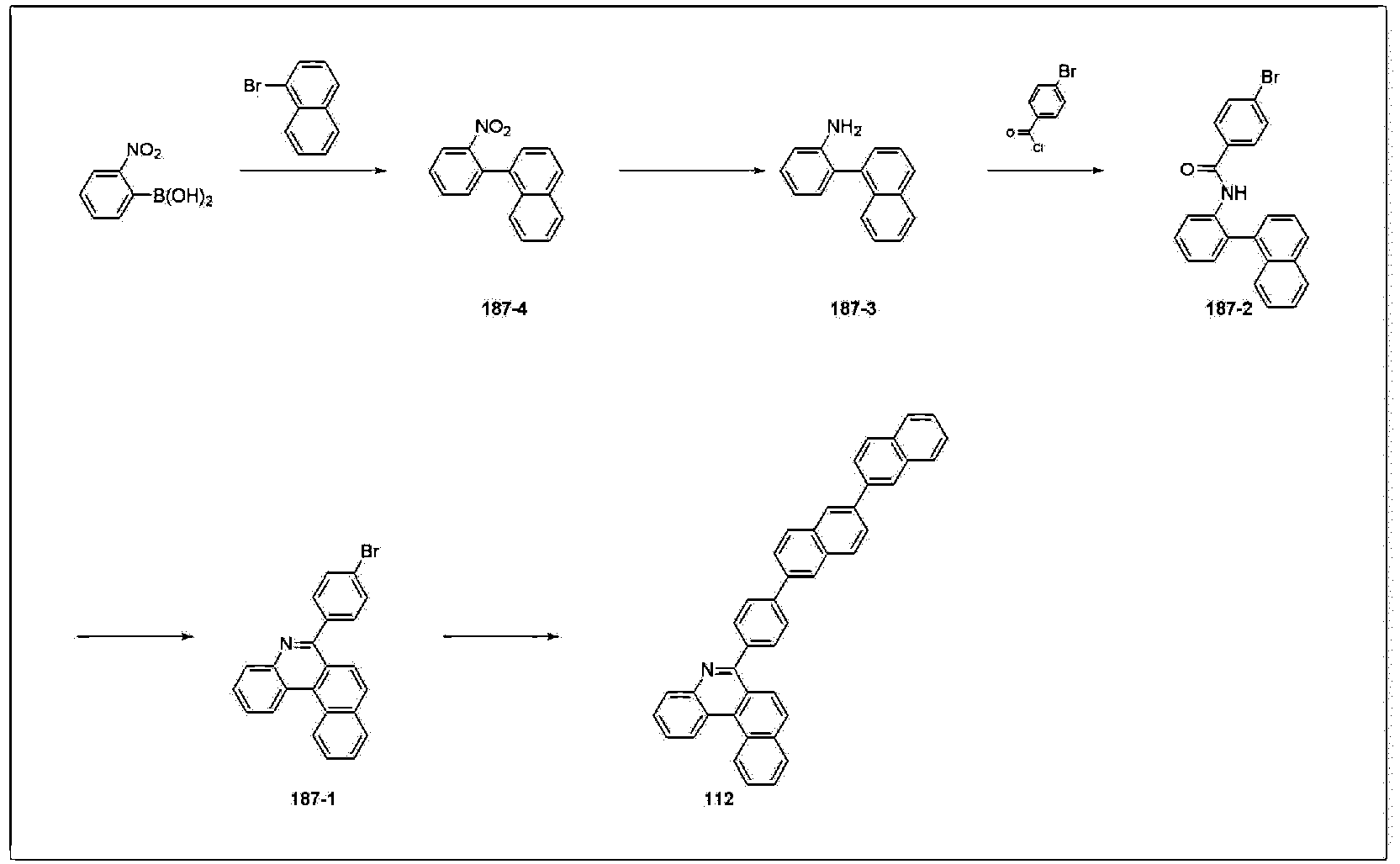
- Compound 187-1 (10.0 g, 26.0 mmol), [2,2'-binaphthalen]-6-ylboronic acid (11.6 g, 39.0 mmol), Pd(PPh3)4 (1.50 g, 1.30 mmol), 2M K2CO3 aqueous solution (40 ml), toluene (200 ml), and ethanol (40 ml) were added and then, refluxed for 12 hours. After the reaction was completed, the resultant reaction product was cooled to room temperature and then extracted with distilled water and EA. The organic layer was dried using anhydrous MgSO4, and after the solvent was removed with a rotary evaporator, the resultant reaction product was purified by column chromatography using dichloromethane and hexane as a developing solvent, and the target compound 112 (10.4 g,, 72%) was obtained.
-

- Compound 187-1 (10.0 g, 26.0 mmol), quinolin-3-ylboronic acid (6.7 g, 39.0 mmol), Pd(PPh3)4 (1.50 g, 1.30 mmol), 2M K2CO3 aqueous solution (40 ml), toluene (200 ml), and ethanol (40 ml) were added and then, refluxed for 12 hours. After the reaction was completed, the resultant reaction product was cooled to room temperature and then extracted with distilled water and EA. The organic layer was dried using anhydrous MgSO4, and after the solvent was removed with a rotary evaporator, the resultant reaction product was purified by column chromatography using dichloromethane and hexane as a developing solvent, and the target compound 124 (10.4 g,, 72%) was obtained.
-

- Compound 187-1 (10.0 g, 26.0 mmol), (4-(2-phenylpyrazolo[1,5-c]quinazolin-5-yl)phenyl)boronic acid (14.2 g, 39.0 mmol), Pd(PPh3)4 (1.50 g, 1.30 mmol), 2M K2CO3 aqueous solution (40 ml), toluene (200 ml), and ethanol (40 ml) were added and then, refluxed for 12 hours. After the reaction was completed, the resultant reaction product was cooled to room temperature and then extracted with distilled water and EA. The organic layer was dried using anhydrous MgSO4, and after the solvent was removed with a rotary evaporator, the resultant reaction product was purified by column chromatography using dichloromethane and hexane as a developing solvent, and the target compound 189 (11.0 g, 68%) was obtained.
-

- Compound 187-1 (10.0 g, 26.0 mmol), bis(pinacolato)diborone (8.0 g, 31.2 mmol), Pd(dppf)2Cl2 (1.06 g, 1.3 mmol), potassium acetate (7.6 g, 78.0 mmol), and DMF (200 ml) were added and then, refluxed for 18 hours. After the reaction was completed, the resultant reaction product was cooled to room temperature and then extracted with distilled water and EA. The organic layer was dried using anhydrous MgSO4, and after the solvent was removed with a rotary evaporator, the resultant reaction product was purified by column chromatography using dichloromethane and hexane as a developing solvent, and the target compound 227-1 (10.0 g, 89%) was obtained.
- Compound 227-1 (10.0 g, 23.2 mmol), 2-bromo-9,10-di(naphthalene-2-yl)anthracene (17.7 g, 34.8 mmol), Pd(PPh3)4 (1.34 g, 1.16 mmol), 2M K2CO3 aqueous solution (40 ml), toluene (200 ml), and ethanol (40 ml) were added and then, refluxed for 12 hours. After the reaction was completed, the resultant reaction product was cooled to room temperature and then extracted with distilled water and EA. The organic layer was dried using anhydrous MgSO4, and after the solvent was removed with a rotary evaporator, the resultant reaction product was purified by column chromatography using dichloromethane and hexane as a developing solvent, and the target compound 227 (8.2 g, 48%) was obtained.
-
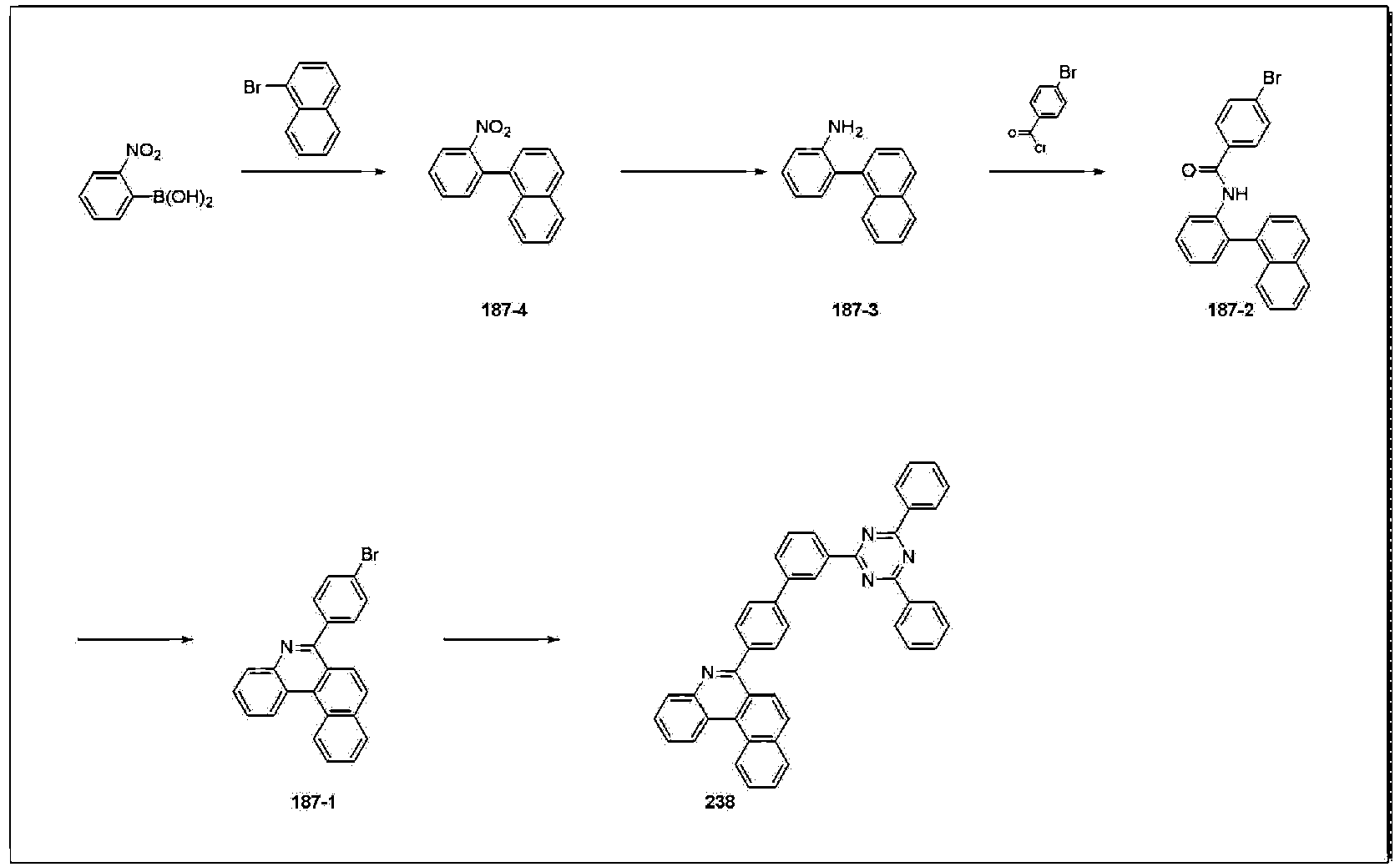
- Compound 187-1 (10.0 g, 26.0 mmol), 2,4-diphenyl-6-(3-(4,4,5,5-tetramethyl-1,3,2-dioxaborolan-2-yl)phenyl)-1,3,5-triazine (17.0 g, 39.0 mmol), Pd(PPh3)4 (1.50 g, 1.30 mmol), 2M K2CO3 aqueous solution (40 ml), toluene (200 ml), and ethanol (40 ml) were added and then, refluxed for 12 hours. After the reaction was completed, the resultant reaction product was cooled to room temperature and then extracted with distilled water and EA. The organic layer was dried using anhydrous MgSO4, and after the solvent was removed with a rotary evaporator, the resultant reaction product was purified by column chromatography using dichloromethane and hexane as a developing solvent, and the target compound 238 (6.0 g, 48%) was obtained.
-

- Compound 227-1 (10.0 g, 23.2 mmol), 4-bromo-2,6-diphenylpyrimidine (10.7 g, 34.8 mmol), Pd(PPh3)4 (1.34 g, 1.16 mmol), 2M K2CO3 aqueous solution (40 ml), toluene (200 ml), and ethanol (40 ml) were added and then, refluxed for 12 hours. After the reaction was completed, the resultant reaction product was cooled to room temperature and then extracted with distilled water and EA. The organic layer was dried using anhydrous MgSO4, and after the solvent was removed with a rotary evaporator, the resultant reaction product was purified by column chromatography using dichloromethane and hexane as a developing solvent, and the target compound 325 (10.5 g, 85%) was obtained.
-

- Compound 227-1 (10.0 g, 23.2 mmol), 4-([1,1'-biphenyl]-4-yl)-2-bromoquinazoline (12.5 g, 34.8 mmol), Pd(PPh3)4 (1.34 g, 1.16 mmol), 2M K2CO3 aqueous solution (40 ml), toluene (200 ml), and ethanol (40 ml) were added and then, refluxed for 12 hours. After the reaction was completed, the resultant reaction product was cooled to room temperature and then extracted with distilled water and EA. The organic layer was dried using anhydrous MgSO4, and after the solvent was removed with a rotary evaporator, the resultant reaction product was purified by column chromatography using dichloromethane and hexane as a developing solvent, and the target compound 365 (7.2 g, 53%) was obtained.
-

- Compound 227-1 (10.0 g, 23.2 mmol), 5-bromo-2,4,6-triphenylpyrimidine (13.5 g, 34.8 mmol), Pd(PPh3)4 (1.34 g, 1.16 mmol), 2M K2CO3 aqueous solution (40 ml), toluene (200 ml), and ethanol (40 ml) were added and then, refluxed for 12 hours. After the reaction was completed, the resultant reaction product was cooled to room temperature and then extracted with distilled water and EA. The organic layer was dried using anhydrous MgSO4, and after the solvent was removed with a rotary evaporator, the resultant reaction product was purified by column chromatography using dichloromethane and hexane as a developing solvent, and the target compound 390 (7.0 g, 49%) was obtained.
-

- Compound 187-1 (10.0 g, 26.0 mmol), 2-(4-(4,4,5,5-tetramethyl-1,3,2-dioxaborolan-2-yl)phenyl)benzo[d]thiazole (13.2 g, 39.0 mmol), Pd(PPh3)4 (1.50 g, 1.30 mmol), 2M K2CO3 aqueous solution (40 ml), toluene (200 ml), and ethanol (40 ml) were added and then, refluxed for 12 hours. After the reaction was completed, the resultant reaction product was cooled to room temperature and then extracted with distilled water and EA. The organic layer was dried using anhydrous MgSO4, and after the solvent was removed with a rotary evaporator, the resultant reaction product was purified by column chromatography using dichloromethane and hexane as a developing solvent, and the target compound 457 (8.6 g, 64%) was obtained.
-

- Compound 227-1 (10.0 g, 23.2 mmol), 2-chloro-4,6-diphenylpyrimidine (9.3 g, 34.8 mmol), Pd(PPh3)4 (1.34 g, 1.16 mmol), 2M K2CO3 aqueous solution (40 ml), toluene (200 ml), and ethanol (40 ml) were added and then, refluxed for 12 hours. After the reaction was completed, the resultant reaction product was cooled to room temperature and then extracted with distilled water and EA. The organic layer was dried using anhydrous MgSO4, and after the solvent was removed with a rotary evaporator, the resultant reaction product was purified by column chromatography using dichloromethane and hexane as a developing solvent, and the target compound 219 (8.6 g, 69%) was obtained.
-

- Compound 187-1 (10.0 g, 26.0 mmol), phenanthren-9-ylboronic acid (8.6 g, 39.0 mmol), Pd(PPh3)4 (1.50 g, 1.30 mmol), 2M K2CO3 aqueous solution (40 ml), toluene (200 ml), and ethanol (40 ml) were added and then, refluxed for 12 hours. After the reaction was completed, the resultant reaction product was cooled to room temperature and then extracted with distilled water and EA. The organic layer was dried using anhydrous MgSO4, and after the solvent was removed with a rotary evaporator, the resultant reaction product was purified by column chromatography using dichloromethane and hexane as a developing solvent, and the target compound 802 (7.5 g, 60%) was obtained.
-
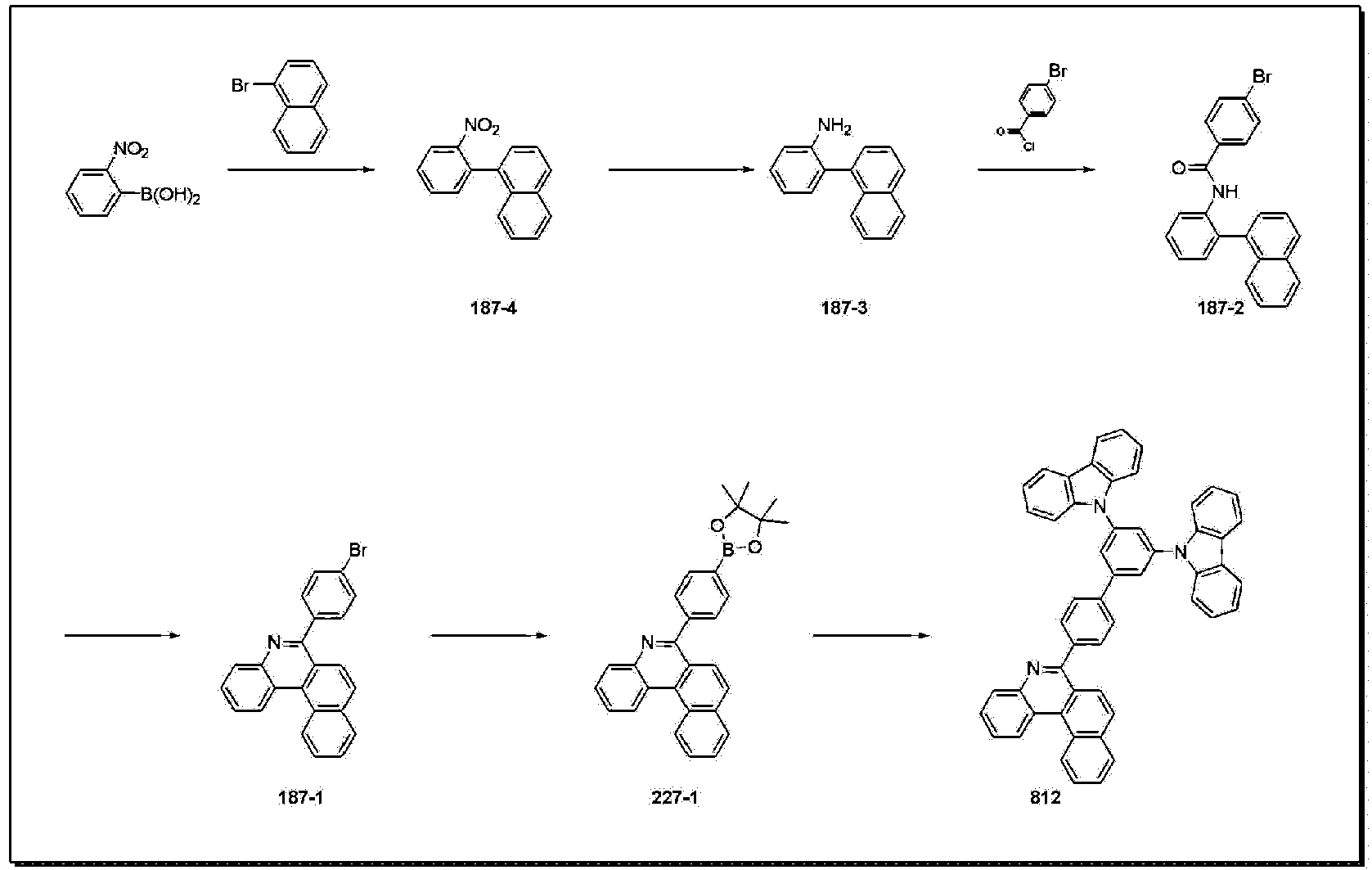
- Compound 227-1 (10.0 g, 23.2 mmol), 9,9'-(5-bromo-1,3-phenylene)bis(9H-carbazole) (17.0 g, 34.8 mmol), Pd(PPh3)4 (1.34 g, 1.16 mmol), 2M K2CO3 aqueous solution (40 ml), toluene (200 ml), and ethanol (40 ml) were added and then, refluxed for 12 hours. After the reaction was completed, the resultant reaction product was cooled to room temperature and then extracted with distilled water and EA. The organic layer was dried using anhydrous MgSO4, and after the solvent was removed with a rotary evaporator, the resultant reaction product was purified by column chromatography using dichloromethane and hexane as a developing solvent, and the target compound 812 (10.7 g, 65%) was obtained.
-

- Compound 227-1 (10.0 g, 23.2 mmol), 2-chloro-4,6-diphenyl-1,3,5-triazine (9.3 g, 34.8 mmol), Pd(PPh3)4 (1.34 g, 1.16 mmol), 2M K2CO3 aqueous solution (40 ml), toluene (200 ml), and ethanol (40 ml) were added and then, refluxed for 12 hours. After the reaction was completed, the resultant reaction product was cooled to room temperature and then extracted with distilled water and EA. The organic layer was dried using anhydrous MgSO4, and after the solvent was removed with a rotary evaporator, the resultant reaction product was purified by column chromatography using dichloromethane and hexane as a developing solvent, and the target compound 815 (8.5 g, 68%) was obtained.
-

- Compound 103-1 (10.0 g, 25.0 mmol), 2-bromotriphenylene (11.5 g, 37.5 mmol), Pd(PPh3)4 (1.44 g, 1.25 mmol), 2M K2CO3 aqueous solution (40 ml), toluene (200 ml), and ethanol (40 ml) were added and then, refluxed for 12 hours. After the reaction was completed, the resultant reaction product was cooled to room temperature and then extracted with distilled water and EA. The organic layer was dried using anhydrous MgSO4, and after the solvent was removed with a rotary evaporator, the resultant reaction product was purified by column chromatography using dichloromethane and hexane as a developing solvent, and the target compound 1 (8.5 g, 68%) was obtained.
-

- Compound 103-1 (10.0 g, 25.0 mmol), 2-chloro-4,6-diphenyl-1,3,5-triazine (10.0 g, 37.5 mmol), Pd(PPh3)4 (1.44 g, 1.25 mmol), 2M K2CO3 aqueous solution (40 ml), toluene (200 ml), and ethanol (40 ml) were added and then, refluxed for 12 hours. After the reaction was completed, the resultant reaction product was cooled to room temperature and then extracted with distilled water and EA. The organic layer was dried using anhydrous MgSO4, and after the solvent was removed with a rotary evaporator, the resultant reaction product was purified by column chromatography using dichloromethane and hexane as a developing solvent, and the target compound 75 (8.5 g, 68%) was obtained.
-

- After Compound 103-2 (8.85 g, 23.0 mmol) was dissolved in THF, 2.5 M n-BuLi (11.9 ml, 29.9 mmol) was slowly added dropwise thereto at -78°C. Then, the resultant reaction product was stirred for 30 minutes. After chlorodiphenylphosphine (14.2 ml, 29.9 mmol) was added thereto, the resultant reaction product was stirred for 1 hour. After the reaction was completed, methanol was added thereto with stirring for 1 hour and the resultant reaction product was extracted with distilled water and EA. After the organic layer was dried using anhydrous MgSO4, the solvent was removed with a rotary evaporator. After dichloromethane (210 ml) was added to the concentrate and dissolved therein, hydrogen peroxide (7.0 ml) was added thereto with stirring at room temperature for 3 hours. After the reaction was completed, the resultant reaction product was extracted with distilled water and EA. The organic layer was dried using anhydrous MgSO4, and after the solvent was removed with a rotary evaporator, toluene was added thereto and heated to be dissolved. Then, the resultant reaction product was recrystallized, and the target compound 100 (9.42 g, 81%) was obtained.
-

- Compound 103-1 (10.0 g, 25.0 mmol), 1-bromo-4-iodobenzene (10.6 g, 37.5 mmol), Pd(PPh3)4 (1.44 g, 1.25 mmol), 2M K2CO3 aqueous solution (40 ml), toluene (200 ml), and ethanol (40 ml) were added and then, refluxed for 12 hours. After the reaction was completed, the resultant reaction product was cooled to room temperature and then extracted with distilled water and EA. The organic layer was dried using anhydrous MgSO4, and after the solvent was removed with a rotary evaporator, the resultant reaction product was purified by column chromatography using dichloromethane and hexane as a developing solvent, and the target compound 75 (11.1 g, 87%) was obtained.
- After Compound 504-1 (11.1 g, 21.7 mmol) was dissolved in THF, 2.5 M n-BuLi (26.1 ml, 65.1 mmol) was slowly added dropwise thereto at -78°C. Then, the resultant reaction product was stirred for 30 minutes. After chlorodiphenylphosphine (6.2 ml, 32.5 mmol) was added thereto, the resultant reaction product was stirred for 1 hour. After the reaction was completed, methanol was added thereto with stirring for 1 hour and the resultant reaction product was extracted with distilled water and EA. After the organic layer was dried using anhydrous MgSO4, the solvent was removed with a rotary evaporator. After dichloromethane (210 ml) was added to the concentrate and dissolved therein, hydrogen peroxide (7.0 ml) was added thereto with stirring at room temperature for 3 hours. After the reaction was completed, the resultant reaction product was extracted with distilled water and EA. The organic layer was dried using anhydrous MgSO4, and after the solvent was removed with a rotary evaporator, toluene was added thereto and heated to be dissolved. Then, the resultant reaction product was recrystallized, and the target compound 504 (11.0 g, 80%) was obtained.
-

- Compound 504-1 (10.0 g, 19.6 mmol), (4,6-diphenyl-1,3,5-triazin-2-yl)boronic acid (8.1 g, 29.3 mmol), Pd(PPh3)4 (1.13 g, 0.98 mmol), 2M K2CO3 aqueous solution (40 ml), toluene (200 ml), and ethanol (40 ml) were added and then, refluxed for 12 hours. After the reaction was completed, the resultant reaction product was cooled to room temperature and then extracted with distilled water and EA. The organic layer was dried using anhydrous MgSO4, and after the solvent was removed with a rotary evaporator, the resultant reaction product was purified by column chromatography using dichloromethane and hexane as a developing solvent, and the target compound 509 (6.3 g, 49%) was obtained.
-

- Compound 103-2 (10.0 g, 23.0 mmol), 2,4-diphenyl-6-(3-(4,4,5,5-tetramethyl-1,3,2-dioxaborolan-2-yl)phenyl)-1,3,5-triazine (15.0 g, 34.5 mmol), Pd(PPh3)4 (1.32 g, 1.15 mmol), 2M K2CO3 aqueous solution (40 ml), toluene (200 ml), and ethanol (40 ml) were added and then, refluxed for 12 hours. After the reaction was completed, the resultant reaction product was cooled to room temperature and then extracted with distilled water and EA. The organic layer was dried using anhydrous MgSO4, and after the solvent was removed with a rotary evaporator, the resultant reaction product was purified by column chromatography using dichloromethane and hexane as a developing solvent, and the target compound 530 (10.2 g, 67%) was obtained.
-

- Compound 103-2 (10.0 g, 23.0 mmol), 2-phenyl-5-(4,4,5,5-tetramethyl-1,3,2-dioxaborolan-2-yl)benzo[d]thiazole (11.6 g, 34.5 mmol), Pd(PPh3)4 (1.32 g, 1.15 mmol), 2M K2CO3 aqueous solution (40 ml), toluene (200 ml), and ethanol (40 ml) were added and then, refluxed for 12 hours. After the reaction was completed, the resultant reaction product was cooled to room temperature and then extracted with distilled water and EA. The organic layer was dried using anhydrous MgSO4, and after the solvent was removed with a rotary evaporator, the resultant reaction product was purified by column chromatography using dichloromethane and hexane as a developing solvent, and the target compound 566 (9.35 g, 72%) was obtained.
-

- Compound 103-1 (10.0 g, 25.0 mmol), 5-bromo-2,4,6-triphenylpyrimidine (14.5 g, 37.5 mmol), Pd(PPh3)4 (1.44 g, 1.25 mmol), 2M K2CO3 aqueous solution (40 ml), toluene (200 ml), and ethanol (40 ml) were added and then, refluxed for 12 hours. After the reaction was completed, the resultant reaction product was cooled to room temperature and then extracted with distilled water and EA. The organic layer was dried using anhydrous MgSO4, and after the solvent was removed with a rotary evaporator, the resultant reaction product was purified by column chromatography using dichloromethane and hexane as a developing solvent, and the target compound 655 (10.1 g, 61%) was obtained.
-

- After Compound 187-3 (7.92 g, 36.1 mmol) was dissolved in THF, TEA (15.0 ml, 108 mmol) and 3-bromobenzoyl chloride (11.8 g, 54.1 mmol) were added thereto at 0°C. Then, a temperature was increased to room temperature and the resultant reaction product was stirred for 2 hours. After the reaction was completed, the resultant reaction product was extracted with distilled water and EA. The organic layer was dried using anhydrous MgSO4, and after the solvent was removed with a rotary evaporator, the resultant reaction product was purified by column chromatography using dichloromethane and hexane as a developing solvent, and the target compound 245-2 (13.6 g, 94%) was obtained.
- After Compound 245-2 (13.6 g, 33.9 mmol) was dissolved in nitrobenzene, POCl3 (1.58 ml, 16.9 mmol) was added thereto at room temperature. Then, the resultant reaction product was stirred at 150°C for 18 hours. After the reaction was completed, the resultant reaction product was neutralized with NaHCO3 and extracted with EA. The organic layer was dried using anhydrous MgSO4, and after the solvent was removed with a rotary evaporator, the resultant reaction product was purified by column chromatography using dichloromethane and methanol as a developing solvent, and the target compound 245-1 (8.85 g, 68%) was obtained.
- Compound 245-1 (8.85 g, 22.9 mmol), (4,6-diphenyl-1,3,5-triazin-2-yl)boronic acid (9.5 g, 34.3 mmol), Pd(PPh3)4 (1.32 g, 1.14 mmol), 2M K2CO3 aqueous solution (40 ml), toluene (200 ml), and ethanol (40 ml) were added and then, refluxed for 12 hours. After the reaction was completed, the resultant reaction product was cooled to room temperature and then extracted with distilled water and EA. The organic layer was dried using anhydrous MgSO4, and after the solvent was removed with a rotary evaporator, the resultant reaction product was purified by column chromatography using dichloromethane and hexane as a developing solvent, and the target compound 509 (6.6 g, 54%) was obtained.
-

- After Compound 245-1 (10.0 g, 26.0 mmol) was dissolved in THF, 2.5 M n-BuLi (13.5 ml, 33.8 mmol) was slowly added dropwise thereto at -78°C. Then, the resultant reaction product was stirred for 30 minutes. After chlorodiphenylphosphine (6.2 ml, 33.8 mmol) was added thereto, the resultant reaction product was stirred for 1 hour. After the reaction was completed, methanol was added thereto with stirring for 1 hour and the resultant reaction product was extracted with distilled water and EA. After the organic layer was dried using anhydrous MgSO4, the solvent was removed with a rotary evaporator. After dichloromethane (210 ml) was added to the concentrate and dissolved therein, hydrogen peroxide (7.0 ml) was added thereto with stirring at room temperature for 3 hours. After the reaction was completed, the resultant reaction product was extracted with distilled water and EA. The organic layer was dried using anhydrous MgSO4, and after the solvent was removed with a rotary evaporator, toluene was added thereto and heated to be dissolved. Then, the resultant reaction product was recrystallized, and the target compound 809 (10.6 g, 81%) was obtained.
-

- After Compound 187-3 (10.0 g, 45.6 mmol) was dissolved in THF, TEA (19.0 ml, 136 mmol) and 3,5-dibromobenzoyl chloride (11.8 g, 68.4 mmol) were added thereto at 0°C. Then, a temperature was increased to room temperature and the resultant reaction product was stirred for 2 hours. After the reaction was completed, the resultant reaction product was extracted with distilled water and EA. The organic layer was dried using anhydrous MgSO4, and after the solvent was removed with a rotary evaporator, the resultant reaction product was purified by column chromatography using dichloromethane and hexane as a developing solvent, and the target compound 784-2 (21.5 g, 98%) was obtained.
- After Compound 784-2 (21.5 g, 44.7 mmol) was dissolved in nitrobenzene, POCl3 (2.09 ml, 22.4 mmol) was added thereto at room temperature. Then, the resultant reaction product was stirred at 150°C for 18 hours. After the reaction was completed, the resultant reaction product was neutralized with NaHCO3 and extracted with EA. The organic layer was dried using anhydrous MgSO4, and after the solvent was removed with a rotary evaporator, the resultant reaction product was purified by column chromatography using dichloromethane and methanol as a developing solvent, and the target compound 784-1 (13.5 g, 65%) was obtained.
- After Compound 245-1 (13.5 g, 29.1 mmol) was dissolved in THF, 2.5 M n-BuLi (30.2 ml, 75.6 mmol) was slowly added dropwise thereto at -78°C. Then, the resultant reaction product was stirred for 30 minutes. After chlorodiphenylphosphine (13.9 ml, 75.6 mmol) was added thereto, the resultant reaction product was stirred for 1 hour. After the reaction was completed, methanol was added thereto with stirring for 1 hour and the resultant reaction product was extracted with distilled water and EA. After the organic layer was dried using anhydrous MgSO4, the solvent was removed with a rotary evaporator. After dichloromethane (450 ml) was added to the concentrate and dissolved therein, hydrogen peroxide (15.0 ml) was added thereto with stirring at room temperature for 3 hours. After the reaction was completed, the resultant reaction product was extracted with distilled water and EA. The organic layer was dried using anhydrous MgSO4, and after the solvent was removed with a rotary evaporator, toluene was added thereto and heated to be dissolved. Then, the resultant reaction product was recrystallized, and the target compound 784 (17.4 g, 85%) was obtained.
-

- A compound 1,4-dibromobenzene (10.0 g, 34.9 mmol), (4,6-diphenyl-1,3,5-triazin-2-yl)boronic acid (10.6 g, 38.4 mmol), Pd(PPh3)4 (2.01 g, 1.74 mmol), 2M K2CO3 aqueous solution (40 ml), toluene (200 ml), and ethanol (40 ml) were added and then, refluxed for 12 hours. After the reaction was completed, the resultant reaction product was cooled to room temperature and then extracted with distilled water and EA. The organic layer was dried using anhydrous MgSO4, and after the solvent was removed with a rotary evaporator, the resultant reaction product was purified by column chromatography using dichloromethane and hexane as a developing solvent, and the target compound 758-6 (13.3 g, 87%) was obtained.
- Compound 758-6 (13.3 g, 30.4 mmol), bis(pinacolato)diborone (9.25 g, 36.4 mmol), Pd(dppf)2Cl2 (1.24 g, 1.52 mmol), KOAc (8.95 g, 91.2 mmol), and DMF (250 ml) were added and then, refluxed for 12 hours. After the reaction was completed, the resultant reaction product was cooled to room temperature and then extracted with distilled water and EA. The organic layer was dried using anhydrous MgSO4, and after the solvent was removed with a rotary evaporator, the resultant reaction product was purified by column chromatography using EA as a developing solvent, and the target compound 758-5 (13.1 g, 89%) was obtained.
- Compound 758-5 (13.1 g, 27.0 mmol), 1-bromo-2-nitrobenzene (8.19 g, 40.6 mmol), Pd(PPh3)4 (1.56 g, 1.35 mmol), 2M K2CO3 aqueous solution (40 ml), toluene (200 ml), and ethanol (40 ml) were added and then, refluxed for 12 hours. After the reaction was completed, the resultant reaction product was cooled to room temperature and then extracted with distilled water and EA. The organic layer was dried using anhydrous MgSO4, and after the solvent was removed with a rotary evaporator, the resultant reaction product was purified by column chromatography using dichloromethane and hexane as a developing solvent, and the target compound 758-4 (11.0 g, 85%) was obtained.
- Compound 758-4 (11.0 g, 23.0 mmol) was dissolved in methanol and then substituted with nitrogen. After Pd/C (10 wt%) was added thereto, the resultant reaction product was substituted with hydrogen and stirred at room temperature for 1 hour. After the reaction was completed, the resultant reaction product was allowed to pass through a Cellite, and the target compound 758-3 (10.1 g, 98%) was obtained.
- The target compound 758-2 (14.1 g, 99%) was obtained by the same preparation method as Compound 187-2 in the preparation example 10 except that Compound 758-3 was used instead of Compound 187-3.
- The target compound 758-1 (8.9 g, 65%) was obtained by the same preparation method as Compound 187-1 in the preparation example 10 except that Compound 758-2 was used instead of Compound 187-2.
- The target compound 758 (8.5 g, 80%) was obtained by the same preparation method as Compound 201-1 in the preparation example 10 except that Compound 758-1 was used instead of Compound 201-1.
-

- The target compound 760-6 was obtained by the same preparation method as Compound 758-6 in the preparation example 36 except that 1-phenyl-2-(4-(4,4,5,5-tetramethyl-1,3,2-dioxaborolan-2-yl)phenyl)-1H-benzo[d]imidazole was used instead of (4,6-diphenyl-1,3,5-triazin-2-yl)boronic acid.
- The target compound 760-5 was obtained by the same preparation method as Compound 758-5 in the preparation example 36 except that Compound 760-6 was used instead of Compound 758-6.
- The target compound 760-4 was obtained by the same preparation method as Compound 758-4 in the preparation example 36 except that Compound 760-5 was used instead of Compound 758-5.
- The target compound 760-3 was obtained by the same preparation method as Compound 758-3 in the preparation example 36 except that Compound 760-4 was used instead of Compound 758-4.
- The target compound 760-2 was obtained by the same preparation method as Compound 187-2 in the preparation example 10 except that Compound 760-3 was used instead of Compound 187-3.
- The target compound 760-1 was obtained by the same preparation method as Compound 187-1 in the preparation example 10 except that Compound 760-2 was used instead of Compound 187-2.
- The
target compound 760 was obtained by the same preparation method as Compound 201-1 in the preparation example 10 except that Compound 760-1 was used instead of Compound 201-1. -

- The target compound 762-6 was obtained by the same preparation method as Compound 758-6 in the preparation example 36 except that 4,4,5,5-tetramethyl-2-(triphenylene-2-yl)-1,3,2-dioxaborolan was used instead of (4,6-diphenyl-1,3,5-triazin-2-yl)boronic acid.
- The target compound 762-5 was obtained by the same preparation method as Compound 758-5 in the preparation example 36 except that Compound 762-6 was used instead of Compound 758-6.
- The target compound 762-4 was obtained by the same preparation method as Compound 758-4 in the preparation example 36 except that Compound 762-5 was used instead of Compound 758-5.
- The target compound 762-3 was obtained by the same preparation method as Compound 758-3 in the preparation example 36 except that Compound 762-4 was used instead of Compound 758-4.
- The target compound 762-2 was obtained by the same preparation method as Compound 187-2 in the preparation example 10 except that Compound 762-3 was used instead of Compound 187-3.
- The target compound 762-1 was obtained by the same preparation method as Compound 187-1 in the preparation example 10 except that Compound 762-2 was used instead of Compound 187-2.
- The target compound 762 was obtained by the same preparation method as Compound 201-1 in the preparation example 10 except that Compound 762-1 was used instead of Compound 201-1.
-

- Compound 758-1 (8.9 g, 22.9 mmol), (4,6-diphenyl-1,3,5-triazin-2-yl)boronic acid (9.5 g, 34.3 mmol), Pd(PPh3)4 (1.32 g, 1.14 mmol), 2M K2CO3 aqueous solution (40 ml), toluene (200 ml), and ethanol (40 ml) were added and then, refluxed for 12 hours. After the reaction was completed, the resultant reaction product was cooled to room temperature and then extracted with distilled water and EA. The organic layer was dried using anhydrous MgSO4, and after the solvent was removed with a rotary evaporator, the resultant reaction product was purified by column chromatography using dichloromethane and hexane as a developing solvent, and the target compound 788 (8.9 g, 51 %) was obtained.
-

- Compound 187-3 (7.92 g, 36.1 mmol) was dissolved in THF, TEA (15.0 ml, 108 mmol) and 5-bromopicolinoyl chloride (11.9 g, 54.1 mmol) were added thereto at 0°C, and then the resulting mixture was warmed to room temperature and stirred for 3 hours. After the reaction was completed, extraction was performed with distilled water and MC. After the organic layer was dried over anhydrous MgSO4, the solvent was removed by a rotary evaporator, the resulting product was filtered with silica gel, and then purification was performed by column chromatography using dichloromethane and hexane as a developing solvent to obtain Target Compound 853-3 (12.8 g, 87%).
- After Compound 853-3 (12.8 g, 31.7 mmol) was dissolved in nitrobenzene, POCl3 (2.96 ml, 31.7 mmol) was added thereto at room temperature, and then the resulting mixture was stirred at 150°C for 18 hours. After the reaction was completed, the resulting product was neutralized with NaHCO3, and then extracted with MC. After the organic layer was dried over anhydrous MgSO4, the solvent was removed by a rotary evaporator, and then purification was performed by column chromatography using dichloromethane and hexane as a developing solvent to obtain Target Compound 853-1 (7.9 g, 64%).
- Compound 853-2 (7.9 g, 20.5 mmol), bis(pinacolato)diborone (10.4 g, 41 mmol), Pd(dppf)2Cl2 (746 mg, 1.02 mmol), potassium acetate (6.0 g, 61.5 mmol), and DMF (70 ml) were mixed, and then the resulting mixture was refluxed for 18 hours. After the reaction was completed, the mixture was cooled to room temperature, and then extracted with distilled water and MC. After the organic layer was dried over anhydrous MgSO4, the solvent was removed by a rotary evaporator, and then purification was performed by column chromatography using dichloromethane and EA as a developing solvent to obtain Target Compound 853-1 (8.1 g, 91%).
- Compound 853-1 (8.1 g, 18.7 mmol), 2-chloro-4,6-diphenyl-1,3,5-triazine (5.0 g, 18.7 mmol), Pd(PPh3)4 (2.1 g, 1.87 mmol), a 2 M K2CO3 aqueous solution (40 ml), toluene (200 ml), and ethanol (40 ml) were mixed, and then the resulting mixture was refluxed for 12 hours. After the reaction was completed, the mixture was cooled to room temperature, and then extracted with distilled water and MC. After the organic layer was dried over anhydrous MgSO4, the solvent was removed by a rotary evaporator, and purification was performed by column chromatography using dichloromethane and EA as a developing solvent to obtain Target Compound 853 (8.5 g, 84%).
-

- Compound 853-1 (10 g, 23.13 mmol), 4-bromo-2,6-diphenylpyridine (6.16 g, 23.13 mmol), Pd(PPh3)4 (2.6g, 2.3 mmol), a 2 M K2CO3 aqueous solution (40 ml), toluene (200 ml), and ethanol (40 ml) were mixed, and then the resulting mixture was refluxed for 8 hours. After the reaction was completed, the mixture was cooled to room temperature, and then extracted with distilled water and MC. After the organic layer was dried over anhydrous MgSO4, the solvent was removed by a rotary evaporator, and purification was performed by column chromatography using dichloromethane and EA as a developing solvent to obtain Target Compound 855 (10.2 g, 82%).
-

- Compound 853-1 (10 g, 23.13 mmol), 4-bromo-2,6-diphenylpyridine (6.16 g, 23.13 mmol), Pd(PPh3)4 (2.6g, 2.3 mmol), a 2 M K2CO3 aqueous solution (40 ml), toluene (200 ml), and ethanol (40 ml) were mixed, and then the resulting mixture was refluxed for 8 hours. After the reaction was completed, the mixture was cooled to room temperature, and then extracted with distilled water and MC. After the organic layer was dried over anhydrous MgSO4, the solvent was removed by a rotary evaporator, and purification was performed by column chromatography using dichloromethane and EA as a developing solvent to obtain Target Compound 857 (8.7 g, 87%).
-

- Compound 187-3 (10 g, 45.6 mmol) was dissolved in THF, TEA (19.1 ml, 136.8 mmol) and 6-bromonicotinoyl chloride (12 g, 54.72 mmol) were added thereto at 0°C, and then the resulting mixture was warmed to room temperature and stirred for 3 hours. After the reaction was completed, extraction was performed with distilled water and MC. After the organic layer was dried over anhydrous MgSO4, the solvent was removed by a rotary evaporator, the resulting product was filtered with silica gel, and then purification was performed by column chromatography using dichloromethane and hexane as a developing solvent to obtain Target Compound 877-2 (15 g, 81.9%).
- After Compound 877-2 (15 g, 37.2 mmol) was dissolved in nitrobenzene, POCl3 (3.47 ml, 37.2 mmol) was added thereto at room temperature, and then the resulting mixture was stirred at 150°C for 18 hours. After the reaction was completed, the resulting product was neutralized with NaHCO3, and then extracted with MC. After the organic layer was dried over anhydrous MgSO4, the solvent was removed by a rotary evaporator, and then purification was performed by column chromatography using dichloromethane and methanol as a developing solvent to obtain Target Compound 877-1 (12.2 g, 85%).
- Target Compound 877 (11.4 g, 71 %) was obtained by performing the preparation in the same manner as the preparation of Compound 201-1 in Preparation Example 10, except that Compound 877-1 was used instead of Compound 201-1.
-
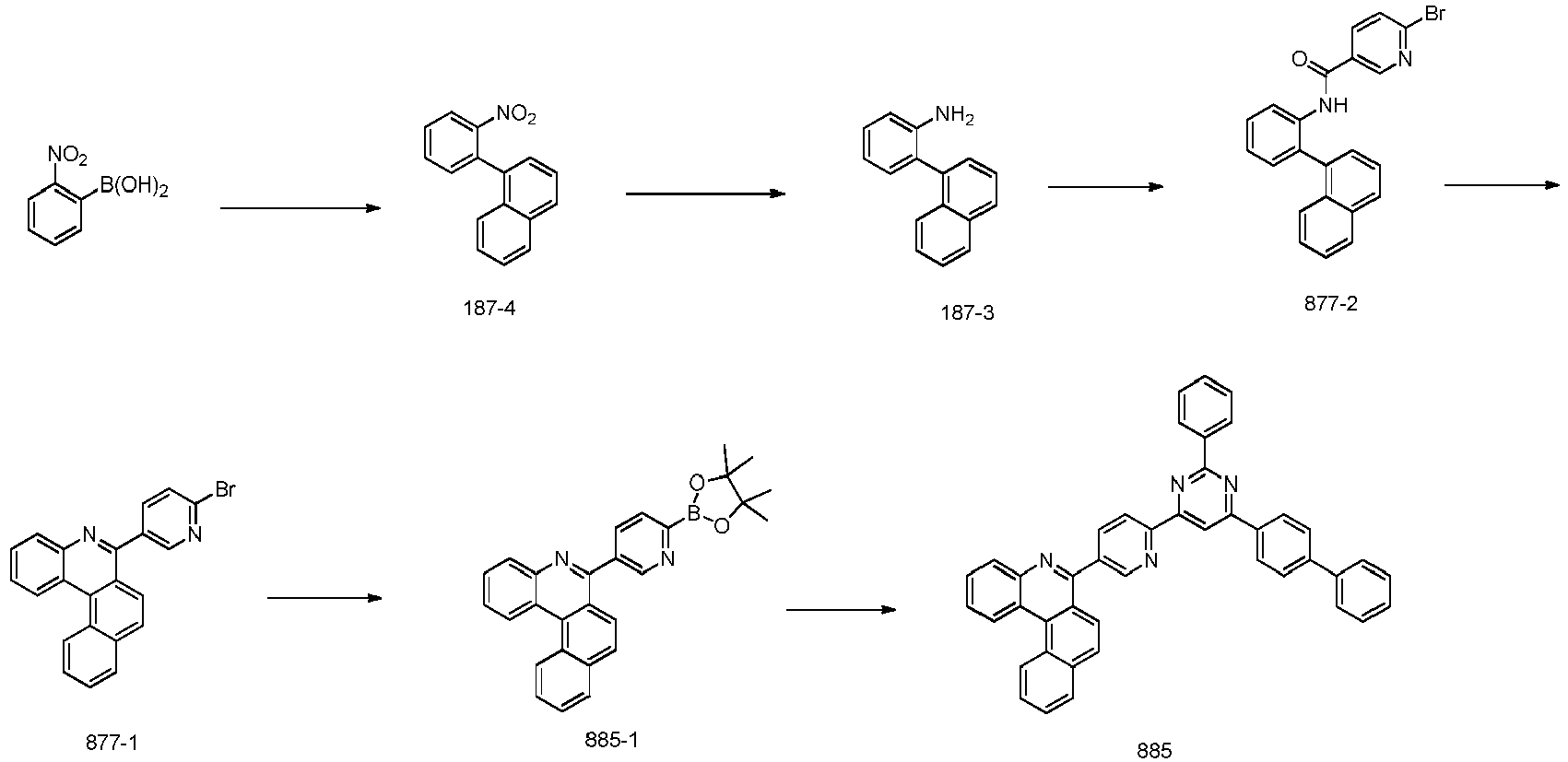
- Target Compound 885-1 (9.8 g, 87%) was obtained by performing the preparation in the same manner as the preparation of Compound 853-1 in Preparation Example 40, except that Compound 877-1 was used instead of Compound 853-2.
- Compound 885-1 (9 g, 20.8 mmol), 4-([1,1'-biphenyl]-4-yl)-6-bromo-2-phenylpyridine (8.05 g, 20.8 mmol), Pd(PPh3)4 (2.3 g, 2.0 mmol), a 2 M K2CO3 aqueous solution (40 ml), toluene (200 ml), and ethanol (40 ml) were mixed, and then the resulting mixture was refluxed for 8 hours. After the reaction was completed, the mixture was cooled to room temperature, and then extracted with distilled water and MC. After the organic layer was dried over anhydrous MgSO4, the solvent was removed by a rotary evaporator, and purification was performed by column chromatography using dichloromethane and EA as a developing solvent to obtain Target Compound 885 (10.3 g, 81%).
-

- Target Compound 895-3 was obtained by performing the preparation in the same manner as the preparation of Compound 187-2 in Preparation Example 10, except that 5-bromopyrimidine-2-carbonyl chloride was used instead of 4-bromobenzoyl chloride.
- Target Compound 895-2 was obtained by performing the preparation in the same manner as the preparation of Compound 187-1 in Preparation Example 10, except that Compound 895-3 was used instead of Compound 187-2.
- Target Compound 895-1 was obtained by performing the preparation in the same manner as the preparation of Compound 227-1 in Preparation Example 15, except that Compound 895-2 was used instead of Compound 187-1.
- Target Compound 895 was obtained by performing the preparation in the same manner as the preparation of Compound 815 in Preparation Example 24, except that Compound 895-1 was used instead of Compound 227-1.
-

- Target Compound 898 was obtained by performing the preparation in the same manner as the preparation of Compound 201 in Preparation Example 11, except that Compound 895-2 was used instead of Compound 201-1.
-

- Target Compound 905 was obtained by performing the preparation in the same manner as in the preparation of Compound 815 in Preparation Example 24, except that in Preparation Example 24, Compound 895-1 was used instead of Compound 227-1, and 2-([1,1'-biphenyl]-4-yl)-4-bromo-6-phenylpyrimidine was used instead of 2-bromo-4,6-diphenyl-1,3,5-triazine.
-

- Target Compound 920-3 was obtained by performing the preparation in the same manner as the preparation of Compound 187-2 in Preparation Example 10, except that 5-bromopyrazine-2-carbonyl chloride was used instead of 4-bromobenzoyl chloride.
- Target Compound 920-2 was obtained by performing the preparation in the same manner as the preparation of Compound 187-1 in Preparation Example 10, except that Compound 920-3 was used instead of Compound 187-2.
- Target Compound 920-1 was obtained by performing the preparation in the same manner as the preparation of Compound 227-1 in Preparation Example 15, except that Compound 920-2 was used instead of Compound 187-1.
- Target Compound 920 was obtained by performing the preparation in the same manner as the preparation of Compound 187 in Preparation Example 10, except that Compound 920-1 was used instead of Compound 227-1.
-

- Target Compound 925 was obtained by performing the preparation in the same manner as in the preparation of Compound 815 in Preparation Example 24, except that in Preparation Example 24, Compound 920-1 was used instead of Compound 227-1, and 2,4-di([1,1'-biphenyl]-4-yl)-6-bromopyridine was used instead of 2-bromo-4,6-diphenyl-1,3,5-triazine.
-

- Target Compound 947-3 was obtained by performing the preparation in the same manner as in the preparation of Compound 187-2 in Preparation Example 10, except that 4-bromoisoquinoline-1-carbonyl chloride was used instead of 4-bromobenzoyl chloride.
- Target Compound 947-2 was obtained by performing the preparation in the same manner as the preparation of Compound 187-1 in Preparation Example 10, except that Compound 947-3 was used instead of Compound 187-2.
- Target Compound 947-1 was obtained by performing the preparation in the same manner as the preparation of Compound 227-1 in Preparation Example 15, except that Compound 947-2 was used instead of Compound 187-1.
- Target Compound 947 was obtained by performing the preparation in the same manner as in the preparation of Compound 227 in Preparation Example 15, except that Compound 947-1 was used as a starting material, and a compound 2-([1,1'-biphenyl]-4-yl)-4-bromo-6-phenylpyridine was used instead of a compound 2-bromo-9,10-di(naphthalen-2-yl)anthracene.
-

- Target Compound 949-3 was obtained by performing the preparation in the same manner as in the preparation of Compound 187-2 in Preparation Example 10, except that a compound 4-bromoisoquinoline-1-carbonyl chloride was used instead of 4-bromobenzoyl chloride.
- Target Compound 949-2 was obtained by performing the preparation in the same manner as the preparation of Compound 187-1 in Preparation Example 10, except that Compound 949-3 was used instead of Compound 187-2.
- Target Compound 949-1 was obtained by performing the preparation in the same manner as the preparation of Compound 227-1 in Preparation Example 15, except that Compound 949-2 was used instead of Compound 187-1.
- Target Compound 949 was obtained by performing the preparation in the same manner as in the preparation of Compound 227 in Preparation Example 15, except that Compound 949-1 was used as a starting material, and a compound 2-bromo-4,6-di(naphthalen-2-yl)-1,3,5-triazine was used instead of a compound 2-bromo-9,10-di(naphthalen-2-yl)anthracene.
-

- Target Compound 972-3 was obtained by performing the preparation in the same manner as in the preparation of Compound 187-2 in Preparation Example 10, except that a compound 5-bromoquinoline-8-carbonyl chloride was used instead of 4-bromobenzoyl chloride.
- Target Compound 972-2 was obtained by performing the preparation in the same manner as the preparation of Compound 187-1 in Preparation Example 10, except that Compound 972-3 was used instead of Compound 187-2.
- Target Compound 972-1 was obtained by performing the preparation in the same manner as the preparation of Compound 227-1 in Preparation Example 15, except that Compound 972-2 was used instead of Compound 187-1.
- Target Compound 972 was obtained by performing the preparation in the same manner as in the preparation of Compound 227 in Preparation Example 15, except that Compound 972-1 was used as a starting material, and a compound 2-bromo-4,6-di(pyridin-2-yl)-1,3,5-triazine was used instead of a compound 2-bromo-9,10-di(naphthalen-2-yl)anthracene.
-

- Target Compound 974-3 was obtained by performing the preparation in the same manner as in the preparation of Compound 187-2 in Preparation Example 10, except that a compound 5-bromoquinoline-8-carbonyl chloride was used instead of 4-bromobenzoyl chloride.
- Target Compound 974-2 was obtained by performing the preparation in the same manner as the preparation of Compound 187-1 in Preparation Example 10, except that Compound 974-3 was used instead of Compound 187-2.
- Target Compound 974-1 was obtained by performing the preparation in the same manner as the preparation of Compound 227-1 in Preparation Example 15, except that Compound 974-2 was used instead of Compound 187-1.
- Target Compound 974 was obtained by performing the preparation in the same manner as in the preparation of Compound 227 in Preparation Example 15, except that Compound 974-1 was used as a starting material, and a compound 2-bromo-4,6-di(pyridin-4-yl)-1,3,5-triazine was used instead of a compound 2-bromo-9,10-di(naphthalen-2-yl)anthracene.
-

- Target Compound 977-3 was obtained by performing the preparation in the same manner as in the preparation of Compound 187-2 in Preparation Example 10, except that a compound 5-bromoquinoline-8-carbonyl chloride was used instead of 4-bromobenzoyl chloride.
- Target Compound 977-2 was obtained by performing the preparation in the same manner as the preparation of Compound 187-1 in Preparation Example 10, except that Compound 977-3 was used instead of Compound 187-2.
- Target Compound 977-1 was obtained by performing the preparation in the same manner as the preparation of Compound 227-1 in Preparation Example 15, except that Compound 977-2 was used instead of Compound 187-1.
- Target Compound 977 was obtained by performing the preparation in the same manner as in the preparation of Compound 227 in Preparation Example 15, except that Compound 977-1 was used as a starting material, and a
compound 5,5'-(6-bromo-1,3,5-triazine-2,4-diyl)diquinoline was used instead of a compound 2-bromo-9,10-di(naphthalen-2-yl)anthracene. -

- Target Compound 981-3 was obtained by performing the preparation in the same manner as the preparation of Compound 187-2 in Preparation Example 10, except that 4-bromo-1-naphthoyl chloride was used instead of the compound 4-bromobenzoyl chloride.
- Target Compound 981-2 was obtained by performing the preparation in the same manner as the preparation of Compound 187-1 in Preparation Example 10, except that Compound 981-3 was used instead of Compound 187-2.
- Target Compound 981-1 was obtained by performing the preparation in the same manner as the preparation of Compound 758-5 in Preparation Example 36, except that Compound 981-2 was used instead of Compound 758-6.
- Target Compound 981 was obtained by performing the preparation in the same manner as the preparation of Compound 219 in Preparation Example 21, except that Compound 981-1 was used instead of Compound 227-1.
-

- Target Compound 982 was obtained by performing the preparation in the same manner as the preparation of Compound 201 in Preparation Example 11, except that Compound 981-2 was used instead of Compound 201-1.
-

- Target Compound 993 was obtained by performing the preparation in the same manner as the preparation of Compound 981 in Preparation Example 55, except that 2-chloro-4,6-di(pyridin-2-yl)-1,3,5-triazine was used instead of the compound 2-chloro-4,6-diphenylpyrimidine.
-

- Target Compound 1009-3 was obtained by performing the preparation in the same manner as the preparation of Compound 187-2 in Preparation Example 10, except that 4-bromopicolinoyl chloride was used instead of the compound 4-bromobenzoyl chloride.
- Target Compound 1009-2 was obtained by performing the preparation in the same manner as the preparation of Compound 187-1 in Preparation Example 10, except that Compound 1009-3 was used instead of Compound 187-2.
- Target Compound 1009-1 was obtained by performing the preparation in the same manner as the preparation of Compound 758-5 in Preparation Example 36, except that Compound 1009-2 was used instead of Compound 758-6.
- Target Compound 1009 was obtained by performing the preparation in the same manner as the preparation of Compound 227 in Preparation Example 15, except that Compound 1009-1 was used instead of Compound 227-1.
-

- Target Compound 1017 was obtained by performing the preparation in the same manner as in the preparation of Compound 1009 in Preparation Example 58, except that 2-chloro-4,6-di(pyridin-4-yl)-1,3,5-triazine was used instead of the compound 2-bromo-9,10-di(naphthalen-2-yl)anthracene.
-

- Target Compound 1025-3 was obtained by performing the preparation in the same manner as the preparation of Compound 187-2 in Preparation Example 10, except that 6-bromopicolinoyl chloride was used instead of the compound 4-bromobenzoyl chloride.
- Target Compound 1025-2 was obtained by performing the preparation in the same manner as the preparation of Compound 187-1 in Preparation Example 10, except that Compound 1025-3 was used instead of Compound 187-2.
- Target Compound 1025-1 was obtained by performing the preparation in the same manner as the preparation of Compound 758-5 in Preparation Example 36, except that Compound 1025-2 was used instead of Compound 758-6.
- Target Compound 1025 was obtained by performing the preparation in the same manner as the preparation of Compound 187 in Preparation Example 10, except that Compound 1025-1 was used instead of Compound 187-1.
- The compound of the chemical formula 1 was prepared according to the above-described preparation examples except that kinds or positions of the substituents are modified. Synthesis thereof was checked,and the check results were as listed in Table 1 and Table 2, and illustrated in
FIG. 4 to FIG. 59 . - The following Table 1 lists 1H NMR(CDCl3, 200 Mz) measurement data, and the following Table 2 lists measurement data obtained by an FD-spectrometer (FD-MS: Field desorption mass spectrometry).
[Table 1] Compound 1H NMR(CDCl3, 200Mz) 1 7.52-7.55 (2H, m), 7.58-7.70 (4H, m), 7.72 (1H, t), 7.80-7.92 (5H, m), 7.97-8.04 (3H, m), 8.20-8.23 (2H, m), 8.35 (1H, s), 8.45 (1H, d), 8.58 (1H, d), 8.65-8.68 (3H, m), 8.74 (1H, d), 8.79 (1H, s), 9.15 (1H, d), 9.32 (1H, d) 3 7.59-7.70 (8H, m), 7.85 (1H, t), 7.90 (1H, d), 7.92 (1H, d), 7.94-8.07 (5H, m), 8.20 (1H, d), 8.37 (1H, d), 8.43-8.46 (2H, m), 8.54 (2H, m), 8.79 (1H, d), 8.85 (1H, s), 9.11 (1H, d) 5 7.59-7.70 (10H, m), 7.84 (1H, t), 7.90-7.94 (3H, m), 8.00 (1H, d), 8.06 (2H, d), 8.79 (1H, s), 8.20 (1H, s), 8.35 (2H, m), 8.54 (1H, d), 8.57 (1H, d), 8.85 (2H, s), 9.27 (1H, s) 9 7.38-7.47 (5H, m), 7.55-7.63 (10H, m), 7.70 (1H, t), 7.85 (1H, t), 7.94-8.09 (11H, m), 8.20 (3H, m), 8.37-8.42 (2H, m), 8.54 (2H, m), 8.85 (1H, s), 8.99 (1H, s) 10 7.38-7.47 (5H, m), 7.53-7.61 (11H, m), 7.94-8.06 (12H, m), 8.09 (1H, d), 8.20 (2H, m), 8.31 (1H, s), 8.37 (1H, d), 8.42 (1H, d), 8.54 (1H, s), 8.85 (1H, d), 8.99 (1H, s) 11 7.37-7.38 (5H, m), 7.55-7.70 (8H, m), 7.85 (1H, t), 7.94-8.09 (7H, m), 8.20-8.21 (5H, m), 8.37 (1H, d), 8.54 (2H, d), 8.85 (1H, s) 12 7.35-7.38 (5H, m), 7.55 (1H, s), 7.59-7.63 (5H, m), 7.70 (1H, t), 7.77 (1H, t), 7.85 (1H, t), 7.94 (1H, d), 7.99-8.01 (3H, m), 8.06-8.09 (4H, m), 8.20-8.21 (5H, m), 8.37 (1H, d), 8.50 (1H, d), 8.85 (1H, s), 8.91 (1H, d) 14 7.37-7.38 (5H, t), 7.41-7.46 (4H, m), 7.53-7.65 (7H, m), 7.79 (2H, d), 7.98-8.06 (6H, m), 8.14 (1H, d), 8.18 (1H, d), 8.21 (4H, d), 8.37 (1H, d), 8.54 (1H, d), 8.85 (1H, s), 9.01 (1H, d) 16 7.37-7.41 (6H, m), 7.49 (4H, t), 7.53 (1H, t), 7.59-7.65 (5H, m), 7.75 (4H, d), 7.98-8.00 (4H, m), 8.04 (3H, s), 8.06 (2H, d), 8.14 (1H, d), 8.21 (4H, d), 8.37 (1H, d), 8.54 (1H, d), 8.85 (1H, s) 17 7.25 (4H, m), 7.37-7.46 (7H, m), 7.59-7.61 (8H, m), 7.70 (1H, t), 7.79 (2H, d), 7.85 (1H, t), 7.94-8.00 (6H, m), 8.06-8.07 (3H, m), 8.20-8.22 (4H, m), 8.37 (1H, d), 8.54 (2H, m), 8.85 (1H, s) 20 7.38 (1H, d), 7.55-7.62 (6H, m), 7.70-7.71 (3H, m), 7.85-7.87 (3H, m), 7.94-8.00 (3H, m), 8.04 (1H, d), 8.06 (2H, d), 8.20-8.23 (2H, m), 8.37 (1H, d), 8.69 (2H, d), 8.85 (1H, s), 9.57 (1H, s) 26 7.23 (1H, t), 7.32 (1H, d), 7.38-7.40 (2H, m), 7.59-7.62 (3H, m), 7.70 (1H, t), 7.74 (1H, t), 7.85 (4H, m), 7.94-8.00 (4H, m), 8.06 (2H, d), 8.20 (1H, d), 8.32 (1H, s), 8.37 (1H, d), 8.55-8.59 (3H, m), 8.69 (2H, d), 8.85 (1H, s), 9.18 (1H, d), 9.39 (1H, s) 29 7.16-7.20 (2H, m), 7.35 (1H, t), 7.50 (1H, t), 7.59-7.61 (5H, m), 7.70 (1H, t), 7.85 (1H, t), 7.94-8.06 (6H, m), 8.12 (1H, d), 8.19-8.21 (2H, m), 8.37 (1H, d), 8.55 (1H, d), 8.85 (1H, s), 8.97 (1H, m) 30 7.16-7.20 (2H, m), 7.35 (1H, t), 7.50 (1H, t), 7.58-7.62 (5H, m), 7.70 (1H, t), 7.79 (1H, t), 7.85 (1H, t), 7.94-8.00 (4H, m), 8.06-8.08 (2H, m), 8.11 (1H, d), 8.19-8.20 (2H, m), 8.37 (1H, d), 8.55 (1H, d), 8.85 (1H, s) 34 7.41-7.49 (7H, m), 7.53-7.62 (6H, m), 7.65-7.68 (2H, m), 7.75-7.77 (5H, m), 7.89 (2H, s), 7.98-8.00 (5H, m), 8.06 (2H, d), 8.13-8.14 (2H, m), 8.21 (1H, s), 8.30 (1H, d), 8.37 (1H, d), 8.54 (1H, d), 8.85 (1H, s) 36 7.16-7.20 (2H, m), 7.35 (1H, t), 7.47-7.68 (10H, m), 7.84-8.00 (5H, m), 8.06 (2H, d), 8.09 (1H, d), 8.19-8.21 (2H, m), 8.31 (1H, d), 8.37 (1H, d), 8.54-8.56 (2H, m), 8.85 (1H, s) 39 1.69 (6H, s), 7.28, 1H, t), 7.38 (1H, t), 7.55-7.61 (5H, m), 7.70 (1H, t), 7.78 (1H, d), 7.85-7.94 (4H, m), 8.00-8.09 (5H, m), 8.20 (1H, d), 8.37 (1H, d), 8.54 (2H, m), 8.85 (1H, s) 40 1.69 (6H, s), 7.28 (1H, t), 7.38 (1H, t), 7.53-7.55 (2H, m), 7.59-7.62 (4H, m), 7.78-7.79 (2H, m), 7.87-7.90 (4H, m), 7.99-8.00 (3H, m), 8.06-8.09 (3H, m), 8.37 (1H, d), 8.54 (1H, d), 8.85 (1H, s) 42 7.0-7.18 (6H, m), 7.26-7.28 (5H, m), 7.38 (1H, t), 7.55-7.61 (3H, m), 7.78 (1H, d), 7.89-7.90 (2H, m), 7.94-8.09 (8H, m), 8.31 (1H, d), 8.37 (1H, d), 8.54 (1H, d), 8.85 (1H, s) 44 7.35-7.38 (7H, m), 7.46-7.47 (5H, m), 7.53-7.65 (8H, m), 7.87 (1H, d), 7.98-8.00 (4H, m), 8.06-8.08 (4H, m), 8.14 (1H, d), 8.37 (1H, d), 8.54 (1H, d), 8.85 (1H, s) 48 7.38 (1H, d), 7.47 (1H, d), 7.55-7.72 (12H, m), 7.85 (1H, t), 7.88 (1H, d), 7.94-8.06 (5H, m), 8.11-8.13 (3H, m), 8.20-8.23 (3H, m), 8.37 (1H, d), 8.43 (1H, d), 8.51 (2H, d), 8.85 (1H, s) 57 7.53-7.61 (6H, m), 7.70 (1H, t), 7.83-7.85 (3H, m), 7.94 (1H, d), 7.96 (2H, d), 8.00-8.06 (5H, m), 8.20-8.22 (2H, m), 8.37-8.41 (5H, m), 8.85 (1H, s), 8.97 (2H, m), 9.14 (2H, s) 63 7.59-7.62 (5H, m), 7.70 (1H, t), 7.85-7.87 (3H, m), 7.94-8.00 (4H, m), 8.06 (2H, d), 8.20-8.22 (5H, m), 8.37-8.41 (2H, m), 8.49-8.50 (3H, m), 8.85 (1H, s), 8.94 (2H, d), 9.02-9.07 (2H, m) 65 7.53-7.63 (6H, m), 7.70 (1H, t), 7.83-7.85 (3H, m), 7.94-8.06 (9H, m), 8.17-8.20 (2H, m), 8.37-8.41 (4H, m), 8.57 (1H, s), 8.65 (1H, d), 8.85 (2H, s), 9.39 (1H, s) 68 7.59-7.62 (7H, m), 7.70 (1H, t), 7.85 (1H, t), 7.93-8.06 (14H, m), 8.20-8.23 (2H, m), 8.37 (1H, d), 8.46-8.49 (4H, m), 8.85 (1H, s) 75 7.48 (t, 4H), 7.59 (2H, t), 7.64-7.66 (2H, m), 7.80 (1H, t), 7.85-7.92 (3H, m), 8.04 (1H, m), 8.10 (1H, m), 8.17 (2H, m), 8.46 (2H, d), 8.66 (4H, d), 9.11 (1H, d), 9.27 (1H, d), 9.41 (2H, m) 77 7.59-7.70 (13H, m), 7.85-8.06 (9H, m), 8.17-8.21 (4H, m), 8.37 (1H, d), 8.84-8.85 (3H, m), 8.97 (2H, m), 9.08 (2H, d) 78 6.90 (2H, t), 7.14 (2H, d), 7.38 (2H, t), 7.59-7.70 (4H, m), 7.85 (1H, t), 7.94-8.06 (11H, m), 8.20 (1, d), 8.37 (3H, d), 8.69 (4H, d), 8.85 (1H, s), 9.07 (1H, d) 81 7.53-7.70 (9H, m), 7.83-7.85 (3H, m), 7.94-.06 (8H, m), 8.20-8.21 (2H, m), 8.37 (1H, d), 8.65 (2H, d), 8.85 (1H, s), 8.97 (2H, m) 82 7.29 (2H, d), 7.54-7.70 (7H, m), 7.85 (3H, t), 7.94-8.00 (12H, m), 8.20-8.21 (2H, m), 8.37 (1H, d), 8.69-8.71 (6H, m), 8.85 (1H, s), 8.97 (2H, m) 83 7.49-7.70 (13H, m), 7.73 (1H, t), 7.85 (1H, t), 7.94 (2H, m), 8.00 (1H, d), 8.06-8.08 (3H, m), 8.20 (3H, m), 8.29 (4H, d), 8.37 (1H, d), 8.54 (2H, m), 8.85 (1H, s) 89 7.53 (2H, t), 7.59-7.70 (5H, m), 7.72 (1H, d), 7.83-7.85 (3H, m), 7.96-8.06 (9H, m), 8.17-8.20 (2H, m), 8.37-8.41 (5H, m), 8.85 (1H, s), 9.14 (2H, s) 91 7.49-7.62 (11H, m), 7.94-8.00 (7H, m), 8.06 (2H, d), 8.23-8.25 (2H, m), 8.37-8.39 (3H, m), 8.54 (1H, d), 8.85 (1H, s) 93 7.53-7.70 (13H, m), 7.88-7.90 (3H, m), 7.99 (2H, d), 8.00-8.06 (5H, m), 8.17 (2H, d), 8.23 (1H, s), 8.30 (1H, d), 8.37 (1H, d), 8.43 (1H, d), 8.54 (1H, d), 8.84-8.85 (3H, m), 9.08 (2H, d) 95 7.52-7.62 (7H, m), 7.87 (2H, t), 7.99-8.10 (7H, m), 8.23-8.24 (2H, m), 8.37 (1H, d), 8.50-8.54 (3H, m), 8.63 (2H, d), 8.85 (1H, s), 8.94 (2H, d) 99 7.50-7.61 (10H, d), 7.70 (1H, t), 7.85 (1H, t), 7.94 (1H, d), 8.00 (1H, d), 8.06 (2H, d), 8.20-8.21 (2H, m), 8.36-8.37 (5H, m), 8.85 (1H, s), 8.97 (2H, m) 100 7.14-7.16 (6H, m), 7.51-7.58 (7H, m), 7.66 (1H, s), 7.67 (1H, t), 7.76-7.80 (4H, m), 7.84 (1H, s), 7.90 (2H, t), 8.41 (1H, d), 8.88 (1H, d), 9.05 (1H, d), 9.20 (1H, d) 103 7.22-7.31 (1H, m), 7.32-7.36 (3H, m), 7.41-7.50 (5H, m), 7.53-7.58 (2H, m), 7.65-7.69 (3H, m), 7.72-7.91 (9H, m), 8.02 (2H, d), 8.26 (1H, s), 8.40 (1H, d), 9.06 (1H, d), 9.23 (1H, d) 105 7.28 (1H, t), 7.38 (2H, d), 7.48-7.53 (3H, m), 7.59-7.62 (6H, m), 7.70-7.73 (2H, m), 7.81 (1H, d), 7.85 (1H, t), 7.94-7.95 (2H, d), 8.00 (1H, d), 8.05-8.07 (3H, m), 8.20 (1H, d), 8.37-8.38 (2H, m), 8.54-8.56 (3H, m), 8.85 (1H, s) 106 7.27-735 (3H, m), 7.37-7.41 (3H, m), 7.50-7.58 (3H, m), 7.64-7.66 (2H, m), 7.70-7.84 (10H, m), 7.88-7.93 (2H, m), 8.02-8.06 (2H, m), 8.38 (1H, d), 9.08 (1H, d), 9.20 (1H, d) 107 7.25-7.28 (3H, m), 7.38 (2H, d), 7.48 (2H, t), 7.53 (2H, t), 7.59-7.62 (5H, m), 7.65 (1H, t), 7.81 (1H, d), 7.96-8.00 (6H, m), 8.06 (2H, d), 8.14 (1H, d), 8.37 (1H, d), 8.54-8.56 (2H, m), 8.85 (1H, s) 109 7.41-7.53 (4H, m), 7.61-7.62 (2H, m), 7.70 (1H, d), 7.75 (2H, d), 7.85-7.94(4H, m), 7.99 (2H, d), 8.20 (1H, d), 8.54 (1H, d), 8.69 (2H, d) 112 7.38-7.40 (3H, m), 7.53-7.66 (8H, m), 7.70 (1H, t), 7.85 (3H, m), 7.94-7.99 (6H, m), 8.06-8.09 (2H, m), 8.20 (1H, d), 8.54 (1H, d), 8.69 (2H, d) 113 7.38 (1H, d), 7.53-7.70 (7H, m), 7.83-7.85 (3H, m), 7.94 (1H, d), 7.99 (2H, d), 8.06-8.09 (2H, m), 8.20 (1H, d), 8.54 (1H, d), 8.69 (2H, d) 116 7.25 (2H, d), 7.39 (1H, t), 7.52 (2H, t), 7.61-7.62 (2H, m), 7.70 (1H, t), 7.77 (1H, t), 7.85 (1H, t), 7.94-7.99 (2H, m), 8.09 (1H, d), 8.20 (2H, d), 8.50-8.54 (2H, m), 8.69 (2H, d), 8.95 (1H, d) 117 7.25 (4H, s), 7.38 (1H, d), 7.53-7.70 (7H, m), 7.83-7.86 (3H, m), 7.94-7.99 (4H, m), 8.06-8.09 (2H, m), 8.20 (1H, d), 8.54 (1H, d), 8.69 (2H, d) 121 6.90 (1H, t), 7.14 (1H, d), 7.38 (1H, t), 7.53 (1H, t), 7.61-7.62 (2H, m), 7.70 (1H, t), 7.85 (1H, t), 7.94 (1H, d), 7.99 (2H, d), 8.20 (1H, d), 8.37 (1H, d), 8.54 (1H, d), 8.69 (4H, m) 124 7.62 (1H, t), 7.73-7.85 (5H, m), 7.91-7.95 (6H, m), 8.08 (2H, d), 8.22 (1H, d), 8.43 (2H, d), 9.09 (1H, d), 9.21 (1H, d), 9.31 (1H, s) 127 7.25-7.31 (3H, m), 7.53 (1H, t), 7.60-7.63 (3H, m), 7.70 (1H, t), 7.81-7.85 (2H, m), 7.94-7.99 (3H, m), 8.16-8.20 (2H, m), 8.51-8.54 (2H, m), 8.69 (2H, d), 9.19 (1H, s) 129 7.53-7.75 (7H, m), 7.85-7.99 (8H, m), 8.20 (1H, d), 8.43-8.46 (2H, m), 8.54 (1H, d), 8.69-8.71 (3H, m), 9.11 (1H, d) 132 7.23-7.28 (7H, m), 7.36-7.38 (2H, m), 7.48-7.53 (4H, m), 7.60-7.63 (3H, m), 7.70 (1H, t), 7.81-7.85 (4H, m), 7.94-7.96 (5H, m), 8.20 (1H, d), 8.54-8.56 (2H, m), 8.69 (2H, m) 134 6.53 (1H, s), 7.22-7.25 (6H, m), 7.49-7.62 (7H, m), 7.70 (1H, t), 7.83-7.85 (5H, m), 7.94-7.99 (5H, m), 8.06 (2H, d), 8.13 (1H, d), 8.20 (1H, d), 8.54 (1H, d), 8.69 (2H, d) 140 7.23-7.25 (6H, m), 7.45-7.53 (7H, m), 7.61-7.62 (2H, m), 7.70 (1H, t), 7.83-7.85 (3H, m), 7.94-7.99 (5H, m), 8.21 (1H, d), 8.32-8.36 (4H, m), 8.54 (1H, d), 8.69 (2H, d) 146 7.50-7.53 (7H, m), 7.61-7.62 (2H, m), 7.70-7.77 (5H, m), 7.83-7.85 (3H, m), 7.94-7.99 (7H, m), 8.20 (1H, d), 8.54 (1H, d), 8.69 (2H, d) 148 7.16-7.20 (2H, m), 7.35 (1H, t), 7.50-7.62 (5H, m), 7.70 (1H, t), 7.83-7.85 (3H, m), 7.91-7.94 (6H, m), 7.99 (2H, d), 8.19-8.20 (2H, m), 8.54-8.55 (2H, m), 8.69 (2H, d) 153 7.16 (2H, t), 7.35 (2H, t), 7.47-7.53 (4H, m), 7.58-7.70 (8H, m), 7.77-7.89 (7H, m), 7.94-7.99 (7H, m), 8.20-8.21 (2H, m), 8.54-8.56 (3H, m), 8.69 (2H, d) 158 7.41-7.53 (7H, m), 7.61-7.77 (8H, m), 7.85-7.94 (10H, m), 7.98-8.00 (3H, m), 8.13 (1H, d), 8.20 (1H, d), 8.30 (1H, d), 8.54 (1H, d), 8.69 (2H, d) 162 7.25 (4H, s), 7.35-7.38 (9H, m), 7.46-7.53 (7H, m), 7.61-7.65 (4H, m), 7.70 (1H, t), 7.85-7.87 (5H, m), 7.94-7.99 (3H, m), 8.20 (1H, d), 8.54 (1H, d), 8.69 (2H, d) 187 7.25-7.28 (3H, m), 7.38-7.53 (6H, m), 7.61-7.62 (3H, m), 7.70 (1H, t), 7.81-7.85 (4H, m), 7.94-7.99 (5H, m), 8.20 (1H, d), 8.54-8.56 (2H, m), 8.69 (2H, d) 189 7.36 (1H, s), 7.42 (1H, t), 7.50 (2H, t), 7.61 (1H, t), 7.69 (1H, t), 7.72-7.80 (4H, m), 7.88-7.94 (7H, m), 8.03-8.10 (6H, m), 8.40 (1H, d), 8.71 (2H, d), 9.08 (1H, d), 9.20 (1H, d) 201 7.50-7.54 (4H, m), 7.61 (2H, t), 7.76-7.89 (14H, m), 8.07 (1H, d), 8.36 (1H, d), 9.08 (1H, d), 9.19 (1H, d) 219 7.49-7.55 (7H, m), 7.61-7.62 (2H, m), 7.70 (1H, t), 7.85 (1H, t), 7.94-7.99 (9H, m), 8.20-8.23 (2H, m), 8.54 (1H, d), 8.69 (2H, d) 220 7.49-7.51 (6H, m), 7.59-7.61 (4H, m), 7.70 (1H, t), 7.75-7.77 (4H, m), 7.85 (3H, t), 7.94-7.97 (5H, m), 8.00 (1H, d), 8.05-8.07 (3H, m), 8.20 (1H, d), 8.37 (1H, d), 8.52-8.54 (2H, m), 8.85 (1H, s) 226 7.25 (4H, s), 7.53 (1H, t), 7.61-7.62 (2H, m), 7.65-7.67 (2H, m), 7.70-7.72 (3H, m), 7.83-7.85 (5H, m), 7.94 (1H, d), 7.97-7.99 (2H, m), 8.11-8.13 (4H, m), 8.20 (1H, d), 8.51-8.54 (3H, m), 8.67-8.69 (2H, m) 227 7.31-7.34 (2H, m), 7.60-7.65 (4H, m), 7.68-7.80 (13H, m), 7.84-7.90 (2H, m), 7.96-8.03 (4H, m), 8.06-8.08 (5H, m), 8.15 (2H, t), 8.33 (1H, d), 9.05 (1H, d), 9.18 (1H, d) 238 7.59-7.66 (7H, m), 7.70-7.83 (4H, m), 7.87 (1H, t), 7.93-7.98 (7H, m), 8.08-8.10 (1H, m), 8.16 (1H, d), 8.48 (1H, m), 8.84 (5H, d), 9.09-9.12 (2H, m), 9.23 (1H, d) 245 7.50 (6H,m), 7.53 (1H, t), 7.61-7.62 (m, 2H), 7.70 (1H, t), 7.73 (1H, t), 7.85 (1H, t), 7.94-7.99 (3H, m), 8.20 (1H, d), 8.33-8.38 (7H, m), 8.54 (1H, d) 325 7.44-7.54 (6H, m), 7.67-7.73 (3H, m), 7.77 (1H, t), 7.83 (1H, d), 7.90 (2H, d), 7.97 (1H, d), 8.01 (1H, d), 8.05 (1H, s)8.27 (2H, d), 8.36 (1H, d), 8.46 (2H, d), 8.72 (2H, d), 9.02 (1H, d), 9.14 (1H, d) 365 7.43 (1H, t), 7.54 (2H, t), 7.60 (1H, t), 7.71-7.79 (4H, m), 7.84-7.96 (8H, m), 8.05 (4H, t), 8.25 (2H, t), 8.43 (1H, d), 8.97 (2H, d), 9.09 (1H, d), 9.19 (1H, d) 390 7.21-7.24 (3H, m), 7.37-7.35 (6H, m), 7.50-7.54 (9H, m), 7.74-7.90 (6H, m), 8.06 (1H, m), 8.67 (2H, d), 9.05 (1H, d), 9.16 (1H, d) 457 7.39 (1H, t), 7.52 (1H, t), 7.71-7.77 (3H, m), 7.79-7.87 (7H, m), 7.92 (2H, t), 8.04-8.06 (2H, m), 8.10 (1H, d), 8.21 (2H, d), 8.41 (1H, d), 9.06 (1H, d), 9.19 (1H, d) 492 7.54-7.61 (6H, m), 7.73-7.85 (4H, m), 7.89-7.95 (3H, m), 8.04-8.07 (3H, m), 8.33-8.35 (4H, m), 8.42 (1H, d), 8.96 (2H, d), 9.10 (1H, d), 9.22 (1H, d) 504 7.50-7.51 (6H, m), 7.59-7.61 (4H, m), 7.70 (1H, t), 7.75-7.77 (4H, m), 7.85 (1H, t), 7.94-7.97 (5H, m), 8.00 (1H, d), 8.06-8.07 (3H, m), 8.20 (1H, d), 8.37 (1H, d), 8.54 (2H, m), 8.85 (1H, s) 509 7.50 (6H, m), 7.59-7.61 (4H, m), 7.70 (1H, t), 7.85 (1H, t), 7.94 (1H, d), 8.00 (1H, d), 8.06 (2H, d), 8.21 (2H, d), 8.36-8.37 (5H, m), 8.85 (1H, s), 8.97 (2H, d) 530 7.39 (1H, t), 7.48 (1H, t), 7.53-7.60 (6H, m), 7.67-7.75 (3H, m), 7.79-7.86 (4H, m), 7.91-8.02 (3H, m), 8.14 (2H, d), 8.33 (1H, s), 8.44 (1H, d), 8.76 (4H, d), 8.83 (1H, d), 8.91 (1H, s), 9.15 (1H, d), 9.31 (1H, d) 566 7.49-7.55 (6H, m), 7.71 (1H, t), 7.78-7.97 (7H, m), 8.04 (1H, d), 8.06-8.10 (3H, m), 8.15 (1H, d), 8.21 (1H, s), 8.28 (1H, s), 8.43 (1H, d), 9.13 (1H, d), 9.29 (1H, d) 655 6.94 (1H, d), 7.11 (4H, t), 7.21 (2H, t), 7.34 (4H, d), 7.50-7.57 (6H, m), 7.70 (1H, t), 7.73-7.78 (3H, m), 7.81-7.90 (4H, m), 7.97 (1H, s), 8.40 (1H, d), 8.64-8.67 (2H, m), 9.02 (1H, d), 9.15 (1H, d) 758 7.42-7.45 (4H, m), 7.51-7.55 (8H, m), 7.70-7.89 (8H, m), 7.96-8.00 (2H, m), 8.07-8.09 (2H, m), 8.13 (1H, s), 8.20-8.23 (4H, m), 8.41 (2H, m), 8.98 (1H, s), 9.05-9.11 (2H, m), 9.21 (1H, d) 760 7.26-7.31 (3H, m), 7.36 (1H, t), 7.43-7.46 (4H, m), 7.49-7.59 (9H, m), 7.69 (1H, t), 7.74-7.80 (8H, m), 7.82-7.94 (6H, m), 8.05 (1H, d), 8.38 (1H, d), 9.07 (1H, d), 9.21 (1H, d) 762 7.39-7.43 (4H, m), 7.48-7.52 (2H, m), 7.59 (1H, t), 7.65-7.70 (8H, m), 7.77-7.89 (6H, mm), 7.93-7.95 (2H, m), 8.04 (1H, s), 8.20 (1H, d), 8.39 (1H, d), 8.56 (1H, d), 8.67-8.74 (3H, m), 8.75 (1H, s), 8.80 (1H, d), 9.12 (1H, d), 9.27 (1H, d) 784 7.43-7.46 (8H, m), 7.52-7.55 (4H, m), 7.66-7.83 (14H, m), 7.96-8.05 (2H, m), 8.28 (1H, d), 8.38 (2H, d), 9.04 (1H, d), 9.15 (1H, d) 788 7.49-7.52 (12H, m), 7.59 (2H, m), 7.70 (1H, t), 7.85 (1H, t), 7.94-7.96 (3H, m), 8.20-8.21 (2H, m), 8.34-8.36 (3H, m), 8.69 (2H, d), 8.96-8.97 (2H, m) 802 7.60-7.88 (11H, m), 7.93-7.98 (4H, m), 8.08-8.14 (2H, m), 8.18 (1H, d), 8.48 (1H, d), 8.77 (1H, d), 8.83 (1H, d), 9.11 (1H, d), 9.24 (1H, d) 809 7.37-7.41 (4H, m), 7.44-7.48 (2H, m), 7.62-7.77 (10H, m), 7.82-7.87 (1H, m), 7.95-7.98 (3H, m), 8.98 (1H, d), 9.08 (1H, d) 812 7.16-7.20 (4H, m), 7.35 (2H, t), 7.50-7.61 (8H, m), 7.70 (1H, t), 7.84-7.85 (3H, m), 7.94-7.99 (5H, m), 8.17-8.20 (5H, m), 8.54-8.55 (3H, m), 8.69 (2H, d) 815 7.59-7.66 (8H, m), 7.81-7.83 (2H, m), 7.99-8.05 (4H, m), 8.11 (1H, d), 8.84 (5H, d), 9.03 (2H, d), 9.12 (1H, d), 9.23 (1H, d) 853 δ = 8.99 (1H, s), 8.81 (1H, s), 8.54 (1H, m), 8.28 (4H, d), 8.16 (1H, m), 8.06 (1H, d), 7.98∼7.88 (3H, m), 7.78 (1H, t), 7.67∼7.41 (10H, m) 855 δ = 8.99 (1H, d), 8.81 (1H, s), 8.59 (1H, s), 8.54 (1H, m), 8.16 (1H, m), 8.06 (1H, d), 7.98∼7.78 (8H, m), 7.67∼7.41 (10H, m) 857 δ = 8.99 (1H, d), 8.81 (1H, s), 8.56∼8.54 (2H, m), 8.16 (1H, m), 8.06∼7.92 (4H, m), 7.67∼7.45 (10H, m), 7.22 (2H, m) 877 δ = 9.09 (1H, s), 8.54 (1H, m), 8.39 (1H, d), 8.16 (1H, m), 8.06 (1H, d), 7.98∼7.92 (2H, dd), 7.78∼7.60 (9H, m), 7.45∼7.38 (7H, m) 885 δ = 9.38 (1H, s), 9.19 (1H, s), 8.54 (2H, m), 8.30∼8.28 (4H, m), 8.16∼8.06 (3H, m), 7.98∼7.78 (5H, m), 7.67∼7.41 (12H, m) 895 δ = 9.37(2H, S), 8.54(1H, d), 8.36(4H, m), 8.14(1H, t), 7.99∼7.96(3H, m), 7.83(1H, t), 7.69∼7.50(10H, m) 898 δ = 9.26(2H, s), 8.54(1H, d), 8.14(1H, d), 7.99∼7.96(3H, m), 7.83∼7.69(6H, m), 9.62∼7.51(9H, m) 905 δ = 9.37(2H, s), 8.54(1H, d), 8.41(1H, s), 8.14(1H, t), 7.99∼7.94(7H, m), 7.83(1H, t), 7.69∼7.51(9H, m) 920 δ = 8.80(2H, d), 8.79(2H, s), 8.56∼8.54(2H, t), 8.14(1H, d), 8.00∼7.96(3H, m), 7.83∼7.81(2H, m), 7.69∼7.53(8H, m), 7.38(2H, d), 7.28(1H, t) 925 δ = 8.97(1H, s), 8.79(2H, s), 8.54(1H, d), 8.30(2H, d), 8.14(1H, d), 7.99∼7.96(5H, t), 7.83∼7.75(7H, m), 7.67∼7.41(10H, m), 7.25(1H, d) 947 7.25 (2H, d), 7.41-7.83 (16H, m), 7.94-7.99 (8H, m), 8.14 (1H, s), 8.41 (1H, s), 8.54 (1H, d), 8.96 (1H, s) 949 7.53-7.69 (10H, m), 7.73-7.83 (2H, m), 7.96-8.16 (1H, m), 8.49-8.54 (3H, m), 8.96 (1H, s), 9.09 (2H, s) 972 7.40 (2H, t), 7.53-7.70 (5H, m), 7.85-7.99 (6H, m), 8.20-8.24 (3H, m), 8.42-8.59 (5H, m), 8.94-8.99 (2H, m) 974 7.53-7.69 (6H, m), 7.80-7.83 (2H, m), 7.96-7.99 (4H, m), 8.14 (1H, d), 8.25 (4H, d), 8.54 (1H, d), 8.81 (4H, d), 8.96 (1H, s) 977 7.53-7.70 (1H, m), 7.85 (1H, t), 7.94-8.08 (7H, m), 8.20-8.23 (3H, m), 8.42-8.54 (5H, m), 8.94-8.99 (4H, m) 981 δ = 9.54 (1H, s), 8.54 (1H, d), 8.37 (1H, s), 8.14 (d, 1H), 7.99 (3H, m), 7.94-7.96 (5H, m), 7.83 (2H, m), 7.49-7.69 (12H, m) 982 9.55 (1H, s), 8.54 (1H, d), 8.14 (1H, d), 7.69-7.99 (4H, m), 7.83 (2H, m), 7.75-7.77 (4H, m), 7.68-7.69 (2H, m), 7.61-7.62 )3H, m), 7.53 (1H, t), 7.50-7.51 (6H, m) 993 9.54 (1H, s), 8.59 (2H, d), 8.54 (1H, d), 8.24 (2H, d), 8.14 (1H, d), 7.66-7.99 (4H, m), 7.83 (1H, d), 7.83-7.85 (4H, m), 7.68-7.69 (2H, m), 7.61-7.62 (3H, m), 7.53 (1H, t), 7.40 (2H, t) 1009 9.40 (1H, s), 9.13 (1H, s), 8.54-8.59 (2H, m), 8.36 (1H, d), 8.20 (2H, d), 8.14 (2H, m), 8.06-8.09 (4H, m), 7.96-7.99 (5H, m), 7.83 (1H, t), 7.76 (1H, d), 7.69 (1H, t), 7.60-7.63 (6H, m), 7.53-7.55 (3H, m), 7.47 (2H, t), 7.38 (2H, d) 1017 9.40 (1H, s), 8.81 (4H, m), 8.54-8.59 (2H, m), 8.25-8.27 (4H, m), 8.14 (2H, m), 7.96-7.99 (3H, m), 7.83 (1H, t), 7.69 (1H, t), 7.61-7.62 (2H, m), 7.53 (1H, t) 1025 8.78 (1H, d), 8.69 (2H, d), 8.54-8.56 (2H, m), 8.14 (1H, d), 7.96-7.99 (5H, m), 7.81-7.83 (2H, m), 7.69 (1H, t), 7.61-7.63 (3H, m), 7.52-7.53 (2H, m), 7.48 (2H, t), 7.37-7.38 (3H, m), 7.28 (1H, t), 6.88 (1H, d) [Table 2] Compound FD-MS Compound FD-MS 1 m/z= 581.21 C45H27N =581.72 2 m/z= 581.21 C45H27N =581.72 3 m/z= 531.20 C41H25N =531.66 4 m/z= 531.20 C41H25N =531.66 5 m/z= 581.21 C45H27N =581.72 6 m/z= 581.21 C45H27N =581.72 7 m/z= 783.29 C61H37N =783.97 8 m/z= 783.29 C61H37N =783.97 9 m/z= 783.29 C61H37N =783.97 10 m/z= 783.29 C61H37N =783.97 11 m/z= 657.25 C51H31N =657.82 12 m/z= 657.25 C51H31N =657.82 13 m/z= 733.28 C57H35N =733.91 14 m/z= 733.28 C57H35N =733.91 15 m/z= 759.29 C59H37N =759.95 16 m/z= 759.29 C59H37N =759.95 17 m/z= 835.32 C65H41N =836.05 18 m/z= 835.32 C65H41N =836.05 19 m/z= 558.21 C42H26N2=558.68 20 m/z= 558.21 C42H26N2=558.68 21 m/z= 634.24 C48H30N2=634.78 22 m/z= 634.24 C48H30N2=634.78 23 m/z= 585.22 C43H27N3=585.71 24 m/z= 585.22 C43H27N3=585.71 25 m/z= 662.25 C48H30N4=662.80 26 m/z= 662.25 C48H30N4=662.80 27 m/z= 608.23 C46H28N2=608.74 28 m/z= 608.23 C46H28N2=608.74 29 m/z= 520.19 C39H24N2=520.63 30 m/z= 520.19 C39H24N2=520.63 31 m/z= 672.26 C51H32N2=672.83 32 m/z= 672.26 C51H32N2=672.83 33 m/z= 748.29 C57H36N2=748.93 34 m/z= 748.29 C57H36N2=748.93 35 m/z= 596.23 C45H28N2=596.73 36 m/z= 596.23 C45H28N2=596.73 37 m/z= 669.25 C52H31N =669.83 38 m/z= 669.25 C52H31N =669.83 39 m/z= 547.23 C42H29N =547.70 40 m/z= 547.23 C42H29N =547.70 41 m/z= 671.26 C52H33N =671.84 42 m/z= 671.26 C52H33N =671.84 43 m/z= 687.24 C51H33NSi =687.92 44 m/z= 687.24 C51H33NSi =687.92 45 m/z= 685.22 C51H31NSi =685.90 46 m/z= 685.22 C51H31NSi =685.90 47 m/z= 696.26 C53H32N2=696.85 48 m/z= 696.26 C53H32N2=696.85 49 m/z= 631.23 C49H29N =631.78 50 m/z= 631.23 C49H29N =631.78 51 m/z= 584.23 C44H28N2=584.72 52 m/z= 684.26 C52H32N2=684.84 53 m/z= 784.29 C60H36N2=784.96 54 m/z= 738.28 C54H34N4=738.89 55 m/z= 686.25 C50H30N4=686.82 56 m/z= 838.31 C62H38N4=839.01 57 m/z= 686.25 C50H30N4=686.82 58 m/z= 838.31 C62H38N4= 839.01 59 m/z= 584.23 C44H28N2=584.72 60 m/z= 684.26 C52H32N2=684.84 61 m/z= 784.29 C60H36N2=784.96 62 m/z= 738.28 C54H34N4=738.89 63 m/z= 686.25 C50H30N4=686.82 64 m/z= 838.31 C62H38N4=839.01 65 m/z= 686.25 C50H30N4=686.82 66 m/z= 838.31 C62H38N4=839.01 67 m/z= 585.22 C43H27N3=585.71 68 m/z= 685.25 C51H31N3=685.83 69 m/z= 785.28 C59H35N3=785.95 70 m/z= 739.27 C53H33N5=739.88 71 m/z= 687.24 C49H29N5=687.81 72 m/z= 839.30 C61H37N5= 840.00 73 m/z= 687.24 C49H29N5=687.81 74 m/z= 839.30 C61H37N5=840.00 75 m/z= 586.22 C42H26N4=586.70 76 m/z= 686.25 C50H30N4=686.82 77 m/z= 786.28 C58H34N4=786.94 78 m/z= 740.27 C52H32N6=740.87 79 m/z= 688.24 C48H28N6=688.79 80 m/z= 840.30 C60H36N6=840.99 81 m/z= 688.24 C48H28N6=688.79 82 m/z= 840.30 C60H36N6=840.99 83 m/z= 660.26 C50H32N2=660.82 84 m/z= 760.29 C58H36N2=760.94 85 m/z= 784.29 C60H36N2=784.96 86 m/z= 738.28 C54H34N4=738.89 87 m/z= 686.25 C50H30N4=686.82 88 m/z= 838.31 C62H38N4=839.01 89 m/z= 686.25 C50H30N4=686.82 90 m/z= 838.31 C62H38N4=839.01 91 m/z= 585.22 C43H27N3=585.71 92 m/z= 685.25 C51H31N3=685.83 93 m/z= 785.28 C59H35N3=785.95 94 m/z= 739.27 C53H33N5=739.88 95 m/z= 687.24 C49H29N5=687.81 96 m/z= 839.30 C61H37N5=840.00 97 m/z= 687.24 C49H29N5=687.81 98 m/z= 839.30 C61H37N5=840.00 99 m/z= 586.22 C42H26N4=586.70 100 m/z= 555.18 C39H26NOP=555.62 101 m/z= 555.18 C39H26NOP=555.62 102 m/z= 623.24 C46H29N3=623.76 103 m/z= 623.24 C46H29N3=623.76 104 m/z= 623.24 C46H29N3=623.76 105 m/z= 623.24 C46H29N3=623.76 106 m/z= 623.24 C46H29N3=623.76 107 m/z= 623.24 C46H29N3=623.76 108 m/z= 674.25 C49H30N4=674.81 109 m/z= 381.15 C29H19N =381.48 110 m/z= 457.18 C35H23N457.58 111 m/z= 457.18 C35H23N =457.58 112 m/z= 557.21 C43H27N=557.70 113 m/z= 431.17 C33H21N =431.54 114 m/z= 507.20 C39H25N=507.64 115 m/z= 507.20 C39H25N =507.64 116 m/z= 431.17 C33H21N=431.54 117 m/z= 507.20 C39H25N =507.64 118 m/z= 481.18 C37H23N=481.60 119 m/z= 557.21 C43H27N =557.70 120 m/z= 557.21 C43H27N=557.70 121 m/z= 382.15 C28H18N2=382.47 122 m/z= 459.17 C33H21N3=459.55 123 m/z= 459.17 C33H21N3=459.55 124 m/z= 432.16 C32H20N2=432.53 125 m/z= 508.19 C38H24N2=508.62 126 m/z= 508.19 C38H24N2=508.62 127 m/z= 432.16 C32H20N2=432.53 128 m/z= 508.19 C38H24N2=508.62 129 m/z= 481.18 C37H23N =481.60 130 m/z= 558.21 C42H26N2=558.68 131 m/z= 558.21 C42H26N2=558.68 132 m/z= 649.25 C48H31N3=649.80 133 m/z= 649.25 C48H31N3=649.80 134 m/z= 700.26 C51H32N4=700.84 135 m/z= 624.23 C45H28N4=624.75 136 m/z= 649.25 C48H31N3=649.80 137 m/z= 649.25 C48H31N3=649.80 138 m/z= 700.26 C51H32N4=700.84 139 m/z= 700.26 C51H32N4=700.84 140 m/z= 688.26 C50H32N4=688.83 141 m/z= 687.27 C51H33N3=687.85 142 m/z= 687.27 C51H33N3=687.85 143 m/z= 688.26 C50H32N4=688.83 144 m/z= 687.27 C51H33N3=687.85 145 m/z= 687.27 C51H33N3=687.85 146 m/z= 581.19 C41H28NOP=581.65 147 m/z= 657.22 C47H32NOP =657.75 148 m/z= 546.21 C41H26N2=546.67 149 m/z= 546.21 C41H26N2=546.67 150 m/z= 622.24 C47H30N2=622.77 151 m/z= 622.24 C47H30N2=622.77 152 m/z= 787.30 C59H37N3=787.97 153 m/z= 787.30 C59H37N3=787.97 154 m/z= 863.33 C65H41N3=864.06 155 m/z= 863.33 C65H41N3=864.06 156 m/z= 622.24 C47H30N2=622.77 157 m/z= 622.24 C47H30N2=622.77 158 m/z= 698.27 C53H34N2=698.87 159 m/z= 698.27 C53H34N2=698.87 160 m/z= 863.33 C65H41N3=864.06 161 m/z= 787.30 C59H37N3=787.97 162 m/z= 715.27 C53H37NSi=715.97 163 m/z= 715.27 C53H37NSi =715.97 164 m/z= 305.12 C23H15N=305.38 165 m/z= 381.15 C29H19N =381.48 166 m/z= 381.15 C29H19N=381.48 167 m/z= 481.18 C37H23N =481.60 168 m/z= 355.14 C27H17N=355.44 169 m/z= 431.17 C33H21N =431.54 170 m/z= 431.17 C33H21N=431.54 171 m/z= 355.14 C27H17N =355.44 172 m/z= 431.17 C33H21N=431.54 173 m/z= 405.15 C31H19N =405.50 174 m/z= 481.18 C37H23N=481.60 175 m/z= 481.18 C37H23N =481.60 176 m/z= 306.12 C22H14N2=306.37 177 m/z= 383.14 C27H17N3=383.45 178 m/z= 383.14 C27H17N3=383.45 179 m/z= 356.13 C26H16N2=356.43 180 m/z= 432.16 C32H20N2=432.53 181 m/z= 432.16 C32H20N2=432.53 182 m/z= 356.13 C26H16N2=356.43 183 m/z= 432.16 C32H20N2=432.53 184 m/z= 405.15 C31H19N=405.50 185 m/z= 482.18 C36H22N2=482.59 186 m/z= 482.18 C36H22N2=482.59 187 m/z= 573.22 C42H27N3=573.70 188 m/z= 573.22 C42H27N3=573.70 189 m/z= 624.23 C45H28N4=624.75 190 m/z= 548.20 C39H24N4=548.65 191 m/z= 573.22 C42H27N3=573.70 192 m/z= 573.22 C42H27N3=573.70 193 m/z= 624.23 C45H28N4=624.75 194 m/z= 624.23 C45H28N4=624.75 195 m/z= 612.23 C44H28N4=612.74 196 m/z= 611.24 C45H29N3=611.75 197 m/z= 611.24 C45H29N3=611.75 198 m/z= 612.23 C44H28N4=612.74 199 m/z= 611.24 C45H29N3=611.75 200 m/z= 611.24 C45H29N3=611.75 201 m/z= 505.16 C35H24NOP =505.56 202 m/z= 581.19 C41H28NOP=581.65 203 m/z= 470.18 C35H22N2=470.57 204 m/z= 470.18 C35H22N2=470.57 205 m/z= 546.21 C41H26N2=546.67 206 m/z= 546.21 C41H26N2=546.67 207 m/z= 711.27 C53H33N3 =711.87 208 m/z= 711.27 C53H33N3=711.87 209 m/z= 787.30 C59H37N3=787.97 210 m/z= 787.30 C59H37N3=787.97 211 m/z= 546.21 C41H26N2=546.67 212 m/z= 546.21 C41H26N2=546.67 213 m/z= 622.24 C47H30N2=622.77 214 m/z= 622.24 C47H30N2=622.77 215 m/z= 787.30 C59H37N3=787.97 216 m/z= 711.27 C53H33N3=711.87 217 m/z= 639.24 C47H33NSi =639.87 218 m/z= 639.24 C47H33NSi=639.87 219 m/z= 535.20 C39H25N3=535.65 220 m/z= 631.21 C45H30NOP=631.71 221 m/z= 555.18 C39H26NOP =555.62 222 m/z= 631.21 C45H30NOP =631.71 223 m/z= 555.18 C39H26NOP =555.62 224 m/z= 631.21 C45H30NOP=631.71 225 m/z= 658.24 C50H30N2=658.80 226 m/z= 658.24 C50H30N2=658.80 227 m/z= 733.28 C57H35N=733.91 228 m/z= 733.28 C57H35N=733.91 229 m/z= 607.23 C47H29N=607.76 230 m/z= 636.23 C46H28N4=636.76 231 m/z= 736.26 C54H32N4=736.88 232 m/z= 614.22 C42H26N6=614.71 233 m/z= 614.22 C42H26N6=614.71 234 m/z= 614.22 C42H26N6=614.71 235 m/z= 712.26 C52H32N4=712.86 236 m/z= 712.26 C52H32N4=712.86 237 m/z= 812.29 C60H36N4=812.98 238 m/z= 612.23 C44H28N4=612.74 239 m/z= 614.22 C42H26N6=614.71 240 m/z= 614.22 C42H26N6=614.71 241 m/z= 614.22 C42H26N6=614.71 242 m/z= 712.26 C52H32N4=712.86 243 m/z= 712.26 C52H32N4=712.86 244 m/z= 812.29 C60H36N4=812.98 245 m/z= 812.29 C60H36N4=812.98 246 m/z= 538.19 C36H22N6=538.61 247 m/z= 538.19 C36H22N6=538.61 248 m/z= 538.19 C36H22N6=538.61 249 m/z= 636.23 C46H28N4=636.76 250 m/z= 636.23 C46H28N4=636.76 251 m/z= 736.26 C54H32N4=736.88 252 m/z= 614.22 C42H26N6=614.71 253 m/z= 614.22 C42H26N6=614.71 254 m/z= 614.22 C42H26N6=614.71 255 m/z= 712.26 C52H32N4=712.86 256 m/z= 712.26 C52H32N4=712.86 257 m/z= 812.29 C60H36N4=812.98 258 m/z= 812.29 C60H36N4=812.98 259 m/z= 612.23 C44H28N4= 612.74 260 m/z= 614.22 C42H26N6=614.71 261 m/z= 614.22 C42H26N6=614.71 262 m/z= 614.22 C42H26N6=614.71 263 m/z= 712.26 C52H32N4 =712.86 264 m/z= 712.26 C52H32N4=712.86 265 m/z= 635.24 C47H29N3=635.77 266 m/z= 635.24 C47H29N3=635.77 267 m/z= 735.27 C55H33N3=735.89 268 m/z= 735.27 C55H33N3=735.89 269 m/z= 611.24 C45H29N3=611.75 270 m/z= 611.24 C45H29N3=611.75 271 m/z= 687.27 C51H33N3=687.85 272 m/z= 687.27 C51H33N3=687.85 273 m/z= 611.24 C45H29N3=611.75 274 m/z= 611.24 C45H29N3=611.75 275 m/z= 711.27 C53H33N3=711.87 276 m/z= 811.30 C61H37N3=811.99 277 m/z= 763.30 C57H37N3=763.94 278 m/z= 687.27 C51H33N3=687.85 279 m/z= 687.27 C51H33N3=687.85 280 m/z= 763.30 C57H37N3=763.94 281 m/z= 687.27 C51H33N3=687.85 282 m/z= 687.27 C51H33N3=687.85 283 m/z= 763.30 C57H37N3=763.94 284 m/z= 687.27 C51H33N3=687.85 285 m/z= 687.27 C51H33N3=687.85 286 m/z= 611.24 C45H29N3=611.75 287 m/z= 711.27 C53H33N3=711.87 288 m/z= 711.27 C53H33N3=711.87 289 m/z= 811.30 C61H37N3=811.99 290 m/z= 763.30 C57H37N3=763.94 291 m/z= 687.27 C51H33N3=687.85 292 m/z= 687.27 C51H33N3=687.85 293 m/z= 635.24 C47H29N3=635.77 294 m/z= 635.24 C47H29N3=635.77 295 m/z= 735.27 C55H33N3=735.89 296 m/z= 687.27 C51H33N3=687.85 297 m/z= 611.24 C45H29N3=611.75 298 m/z= 611.24 C45H29N3=611.75 299 m/z= 687.27 C51H33N3=687.85 300 m/z= 611.24 C45H29N3=611.75 301 m/z= 611.24 C45H29N3=611.75 302 m/z= 711.27 C53H33N3=711.87 303 m/z= 711.27 C53H33N3=711.87 304 m/z= 811.30 C61H37N3=811.99 305 m/z= 763.30 C57H37N3=763.94 306 m/z= 687.27 C51H33N3=687.85 307 m/z= 687.27 C51H33N3=687.85 308 m/z= 763.30 C57H37N3=763.94 309 m/z= 687.27 C51H33N3=687.85 310 m/z= 687.27 C51H33N3=687.85 311 m/z= 611.24 C45H29N3=611.75 312 m/z= 611.24 C45H29N3=611.75 313 m/z= 711.27 C53H33N3=711.87 314 m/z= 811.30 C61H37N3=811.99 315 m/z= 763.30 C57H37N3=763.94 316 m/z= 687.27 C51H33N3=687.85 317 m/z= 687.27 C51H33N3=687.85 318 m/z= 763.30 C57H37N3=763.94 319 m/z= 687.27 C51H33N3=687.85 320 m/z= 687.27 C51H33N3=687.85 321 m/z= 763.30 C57H37N3=763.94 322 m/z= 687.27 C51H33N3=687.85 323 m/z= 687.27 C51H33N3=687.85 324 m/z= 763.30 C57H37N3=763.94 325 m/z= 535.20 C39H25N3=535.65 326 m/z= 635.24 C47H29N3=635.77 327 m/z= 635.24 C47H29N3=635.77 328 m/z= 735.27 C55H33N3=735.89 329 m/z= 687.27 C51H33N3=687.85 330 m/z= 610.24 C46H30N2=610.76 331 m/z= 610.24 C46H30N2=610.76 332 m/z= 611.24 C45H29N3=611.75 333 m/z= 611.24 C45H29N3=611.75 334 m/z= 611.24 C45H29N3=611.75 335 m/z= 536.20 C38H24N4=536.64 336 m/z= 612.23 C44H28N4=612.74 337 m/z= 612.23 C44H28N4=612.74 338 m/z= 711.27 C53H33N3=711.87 339 m/z= 711.27 C53H33N3=711.87 340 m/z= 612.23 C44H28N4=612.74 341 m/z= 711.27 C53H33N3=711.87 342 m/z= 711.27 C53H33N3=711.87 343 m/z= 811.30 C61H37N3=811.99 344 m/z= 763.30 C57H37N3=763.94 345 m/z= 687.27 C51H33N3=687.85 346 m/z= 687.27 C51H33N3=687.85 347 m/z= 763.30 C57H37N3=763.94 348 m/z= 687.27 C51H33N3=687.85 349 m/z= 687.27 C51H33N3=687.85 350 m/z= 612.23 C44H28N4=612.74 351 m/z= 688.26 C50H32N4=688.83 352 m/z= 688.26 C50H32N4=688.83 353 m/z= 711.27 C53H33N3=711.87 354 m/z= 711.27 C53H33N3=711.87 355 m/z= 811.30 C61H37N3=811.99 356 m/z= 763.30 C57H37N3=763.94 357 m/z= 687.27 C51H33N3=687.85 358 m/z= 687.27 C51H33N3=687.85 359 m/z= 763.30 C57H37N3=763.94 360 m/z= 687.27 C51H33N3=687.85 361 m/z= 687.27 C51H33N3=687.85 362 m/z= 612.23 C44H28N4=612.74 363 m/z= 688.26 C50H32N4=688.83 364 m/z= 688.26 C50H32N4=688.83 365 m/z= 585.22 C43H27N3=585.71 366 m/z= 509.19 C37H23N3=509.61 367 m/z= 585.22 C43H27N3=585.71 368 m/z= 559.20 C41H25N3=559.67 369 m/z= 559.20 C41H25N3=559.67 370 m/z= 585.22 C43H27N3=585.71 371 m/z= 661.25 C49H31N3=661.81 372 m/z= 635.24 C47H29N3=635.77 373 m/z= 635.24 C47H29N3=635.77 374 m/z= 585.22 C43H27N3=585.71 375 m/z= 661.25 C49H31N3=661.81 376 m/z= 635.24 C47H29N3=635.77 377 m/z= 635.24 C47H29N3=635.77 378 m/z= 509.19 C37H23N3=509.61 379 m/z= 585.22 C43H27N3=585.71 380 m/z= 559.20 C41H25N3=559.67 381 m/z= 559.20 C41H25N3=559.67 382 m/z= 585.22 C43H27N3=585.71 383 m/z= 661.25 C49H31N3=661.81 384 m/z= 635.24 C47H29N3=635.77 385 m/z= 635.24 C47H29N3=635.77 386 m/z= 585.22 C43H27N3=585.71 387 m/z= 661.25 C49H31N3=661.81 388 m/z= 635.24 C47H29N3=635.77 389 m/z= 635.24 C47H29N3=635.77 390 m/z= 611.24 C45H29N3=611.75 391 m/z= 763.30 C57H37N3=763.94 392 m/z= 763.30 C57H37N3=763.94 393 m/z= 711.27 C53H33N3=711.87 394 m/z= 711.27 C53H33N3=711.87 395 m/z= 687.27 C51H33N3=687.85 396 m/z= 687.27 C51H33N3=687.85 397 m/z= 661.25 C49H31N3=661.81 398 m/z= 661.25 C49H31N3=661.81 399 m/z= 711.27 C53H33N3=711.87 400 m/z= 661.25 C49H31N3=661.81 401 m/z= 711.27 C53H33N3=711.87 402 m/z= 611.24 C45H29N3=611.75 403 m/z= 763.30 C57H37N3=763.94 404 m/z= 763.30 C57H37N3=763.94 405 m/z= 711.27 C53H33N3=711.87 406 m/z= 711.27 C53H33N3=711.87 407 m/z= 687.27 C51H33N3=687.85 408 m/z= 687.27 C51H33N3=687.85 409 m/z= 687.27 C51H33N3=687.85 410 m/z= 509.19 C37H23N3=509.61 411 m/z= 585.22 C43H27N3=585.71 412 m/z= 585.22 C43H27N3=585.71 413 m/z= 585.22 C43H27N3=585.71 414 m/z= 661.25 C49H31N3=661.81 415 m/z= 661.25 C49H31N3=661.81 416 m/z= 585.22 C43H27N3=585.71 417 m/z= 661.25 C49H31N3=661.81 418 m/z= 661.25 C49H31N3=661.81 419 m/z= 661.25 C49H31N3=661.81 420 m/z= 559.20 C41H25N3=559.67 421 m/z= 559.20 C41H25N3=559.67 422 m/z= 509.19 C37H23N3=509.61 423 m/z= 585.22 C43H27N3=585.71 424 m/z= 585.22 C43H27N3=585.71 425 m/z= 585.22 C43H27N3=585.71 426 m/z= 661.25 C49H31N3=661.81 427 m/z= 661.25 C49H31N3=661.81 428 m/z= 585.22 C43H27N3=585.71 429 m/z= 661.25 C49H31N3=661.81 430 m/z= 483.17 C35H21N3=483.57 431 m/z= 559.20 C41H25N3559.67 432 m/z= 559.20 C41H25N3=559.67 433 m/z= 483.17 C35H21N3=483.57 434 m/z= 497.19 C36H23N3=497.60 435 m/z= 497.19 C36H23N3=497.60 436 m/z= 497.19 C36H23N3=497.60 437 m/z= 497.19 C36H23N3=497.60 438 m/z= 497.19 C36H23N3=497.60 439 m/z= 497.19 C36H23N3=497.60 440 m/z= 497.19 C36H23N3=497.60 441 m/z= 497.19 C36H23N3=497.60 442 m/z= 449.19 C32H23N3=449.56 443 m/z= 449.19 C32H23N3=449.56 444 m/z= 525.22 C38H27N3=525.65 445 m/z= 525.22 C38H27N3=525.65 446 m/z= 525.22 C38H27N3=525.65 447 m/z= 449.19 C32H23N3=449.56 448 m/z= 573.22 C42H27N3=573.70 449 m/z= 449.19 C32H23N3=449.56 450 m/z= 525.22 C38H27N3=525.65 451 m/z= 525.22 C38H27N3=525.65 452 m/z= 573.22 C42H27N3=573.70 453 m/z= 525.22 C38H27N3=525.65 454 m/z= 525.22 C38H27N3=525.65 455 m/z= 449.19 C32H23N3=449.56 456 m/z= 573.22 C42H27N3=573.70 457 m/z= 514.15 C36H22N2S514.65 458 m/z= 514.15 C36H22N2S=514.65 459 m/z= 514.15 C36H22N2S=514.65 460 m/z= 514.15 C36H22N2S=514.65 461 m/z= 514.15 C36H22N2S=514.65 462 m/z= 514.15 C36H22N2S=514.65 463 m/z= 514.15 C36H22N2S514.65 464 m/z= 514.15 C36H22N2S=514.65 465 m/z= 534.21 C40H26N2=534.66 466 m/z= 610.24 C46H30N2=610.76 467 m/z= 536.20 C38H24N4=536.64 468 m/z= 536.20 C38H24N4=536.64 469 m/z= 536.20 C38H24N4=536.64 470 m/z= 612.23 C44H28N4=612.74 471 m/z= 612.23 C44H28N4=612.74 472 m/z= 612.23 C44H28N4=612.74 473 m/z= 459.17 C33H21N3=459.55 474 m/z= 459.17 C33H21N3=459.55 475 m/z= 535.20 C39H25N3=535.65 476 m/z= 535.20 C39H25N3=535.65 477 m/z= 535.20 C39H25N3=535.65 478 m/z= 534.21 C40H26N2=534.66 479 m/z= 610.24 C46H30N2=610.76 480 m/z= 536.20 C38H24N4=536.64 481 m/z= 536.20 C38H24N4=536.64 482 m/z= 536.20 C38H24N4=536.64 483 m/z= 612.23 C44H28N4=612.74 484 m/z= 612.23 C44H28N4=612.74 485 m/z= 612.23 C44H28N4=612.74 486 m/z= 459.17 C33H21N3=459.55 487 m/z= 459.17 C33H21N3=459.55 488 m/z= 459.17 C33H2lN3=459.55 489 m/z= 535.20 C39H25N3=535.65 490 m/z= 535.20 C39H25N3=535.65 491 m/z= 535.20 C39H25N3=535.65 492 m/z= 611.24 C45H29N3=611.75 493 m/z= 859.32 C67H41N =860.07 494 m/z= 859.32 C67H41N=860.07 495 m/z= 733.28 C57H35N =733.91 496 m/z= 733.28 C57H35N=733.91 497 m/z= 683.26 C53H33N =683.85 498 m/z= 607.23 C47H29N=607.76 499 m/z= 859.32 C67H41N =860.07 500 m/z= 859.32 C67H41N=860.07 501 m/z= 683.26 C53H33N =683.85 502 m/z= 607.23 C47H29N=607.76 503 m/z= 707.24 C51H34NOP=707.81 504 m/z= 631.21 C45H30NOP=631.71 505 m/z= 707.24 C51H34NOP=707.81 506 m/z= 707.24 C51H34NOP=707.81 507 m/z= 837.31 C63H39N3=838.03 508 m/z= 837.31 C63H39N3=838.03 509 m/z= 662.25 C48H30N4=662.80 510 m/z= 664.24 C46H28N6=664.77 511 m/z= 664.24 C46H28N6=664.77 512 m/z= 664.24 C46H28N6=664.77 513 m/z= 762.28 C56H34N4=762.92 514 m/z= 762.28 C56H34N4=762.92 515 m/z= 862.31 C64H38N4=863.04 516 m/z= 738.28 C54H34N4=738.89 517 m/z= 740.27 C52H32N6=740.87 518 m/z= 740.27 C52H32N6=740.87 519 m/z= 740.27 C52H32N6=740.87 520 m/z= 838.31 C62H38N4=839.01 521 m/z= 838.31 C62H38N4=839.01 522 m/z= 938.34 C70H42N4=939.13 523 m/z= 738.28 C54H34N4738.89 524 m/z= 740.27 C52H32N6=740.87 525 m/z= 740.27 C52H32N6=740.87 526 m/z= 740.27 C52H32N6740.87 527 m/z= 838.31 C62H38N4=839.01 528 m/z= 838.31 C62H38N4=839.01 529 m/z= 938.34 C70H42N4939.13 530 m/z= 662.25 C48H30N4=662.80 531 m/z= 664.24 C46H28N6=664.77 532 m/z= 664.24 C46H28N6=664.77 533 m/z= 664.24 C46H28N6=664.77 534 m/z= 762.28 C56H34N4=762.92 535 m/z= 762.28 C56H34N4=762.92 536 m/z= 862.31 C64H38N4=863.04 537 m/z= 738.28 C54H34N4=738.89 538 m/z= 740.27 C52H32N6=740.87 539 m/z= 740.27 C52H32N6=740.87 540 m/z= 740.27 C52H32N6=740.87 541 m/z= 838.31 C62H38N4=839.01 542 m/z= 838.31 C62H38N4=839.01 543 m/z= 938.34 C70H42N4=939.13 544 m/z= 738.28 C54H34N4=738.89 545 m/z= 740.27 C52H32N6=740.87 546 m/z= 740.27 C52H32N6=740.87 547 m/z= 740.27 C52H32N6740.87 548 m/z= 838.31 C62H38N4=839.01 549 m/z= 838.31 C62H38N4=839.01 550 m/z= 938.34 C70H42N4=939.13 551 m/z= 761.28 C57H35N3=761.93 552 m/z= 761.28 C57H35N3=761.93 553 m/z= 861.31 C65H39N3=862.05 554 m/z= 813.31 C61H39N3=814.00 555 m/z= 737.28 C55H35N3=737.91 556 m/z= 813.31 C61H39N3=814.00 557 m/z= 737.28 C55H35N3=737.91 558 m/z= 737.28 C55H35N3=737.91 559 m/z= 837.31 C63H39N3=838.03 560 m/z= 837.31 C63H39N3=838.03 561 m/z= 937.35 C71H43N3938.15 562 m/z= 889.35 C67H43N3=890.10 563 m/z= 813.31 C61H39N3=814.00 564 889.35 C67H43N3=890.10 565 m/z= 813.31 C61H39N3=814.00 566 m/z= 564.17 C40H24N2S =564.71 567 m/z= 661.25 C49H31N3=661.81 568 m/z= 761.28 C57H35N3=761.93 569 m/z= 761.28 C57H35N3761.93 570 m/z= 861.31 C65H39N3=862.05 571 m/z= 813.31 C61H39N3=814.00 572 m/z= 737.28 C55H35N3=737.91 573 m/z= 813.31 C61H39N3=814.00 574 m/z= 737.28 C55H35N3=737.91 575 m/z= 662.25 C48H30N4=662.80 576 m/z= 738.28 C54H34N4=738.89 577 m/z= 738.28 C54H34N4=738.89 578 m/z= 737.28 C55H35N3=737.91 579 m/z= 837.31 C63H39N3=838.03 580 m/z= 837.31 C63H39N3=838.03 581 m/z= 937.35 C71H43N3=938.15 582 m/z= 889.35 C67H43N3=890.10 583 m/z= 813.31 C61H39N3=814.00 584 m/z= 889.35 C67H43N3=890.10 585 m/z= 813.31 C61H39N3=814.00 586 m/z= 738.28 C54H34N4=738.89 587 m/z= 814.31 C60H38N4=814.99 588 m/z= 814.31 C60H38N4=814.99 589 m/z= 737.28 C55H35N3=737.91 590 m/z= 837.31 C63H39N3=838.03 591 m/z= 837.31 C63H39N3=838.03 592 m/z= 937.35 C71H43N3=938.15 593 m/z= 889.35 C67H43N3=890.10 594 m/z= 813.31 C61H39N3=814.00 595 m/z= 889.35 C67H43N3=890.10 596 m/z= 813.31 C61H39N3=814.00 597 m/z= 738.28 C54H34N4=738.89 598 m/z= 814.31 C60H38N4=814.99 599 m/z= 814.31 C60H38N4=814.99 600 m/z= 661.25 C49H31N3=661.81 601 m/z= 761.28 C57H35N3=761.93 602 m/z= 761.28 C57H35N3=761.93 603 m/z= 861.31 C65H39N3=862.05 604 m/z= 813.31 C61H39N3=814.00 605 m/z= 737.28 C55H35N3=737.91 606 m/z= 813.31 C61H39N3=814.00 607 m/z= 737.28 C55H35N3=737.91 608 m/z= 662.25 C48H30N4=662.80 609 m/z= 738.28 C54H34N4=738.89 610 m/z= 738.28 C54H34N4=738.89 611 m/z= 837.31 C63H39N3=838.03 612 m/z= 837.31 C63H39N3=838.03 613 m/z= 937.35 C71H43N3=938.15 614 m/z= 889.35 C67H43N3=890.10 615 m/z= 813.31 C61H39N3=814.00 616 m/z= 889.35 C67H43N3=890.10 617 m/z= 813.31 C61H39N3=814.00 618 m/z= 737.28 C55H35N3=737.91 619 m/z= 837.31 C63H39N3=838.03 620 m/z= 837.31 C63H39N3=838.03 621 m/z= 37.35 C71H43N3=938.15 622 m/z= 889.35 C67H43N3=890.10 623 m/z= 813.31 C61H39N3=814.00 624 m/z= 889.35 C67H43N3=890.10 625 m/z= 813.31 C61H39N3=814.00 626 m/z= 738.28 C54H34N4=738.89 627 m/z= 814.31 C60H38N4=814.99 628 m/z= 814.31 C60H38N4=814.99 629 m/z= 711.27 C53H33N3=711.87 630 m/z= 635.24 C47H29N3=635.77 631 m/z= 711.27 C53H33N3=711.87 632 m/z= 685.25 C51H31N3=685.83 633 m/z= 685.25 C51H31N3=685.83 634 m/z= 685.25 C51H31N3=685.83 635 m/z= 787.30 C59H37N3=787.97 636 m/z= 761.28 C57H35N3=761.93 637 m/z= 761.28 C57H35N3=761.93 638 m/z= 761.28 C57H35N3=761.93 639 m/z= 787.30 C59H37N3=787.97 640 m/z= 761.28 C57H35N3=761.93 641 m/z= 711.27 C53H33N3=711.87 642 m/z= 711.27 C53H33N3=711.87 643 m/z= 635.24 C47H29N3=635.77 644 m/z= 711.27 C53H33N3=711.87 645 m/z= 685.25 C51H31N3=685.83 646 m/z= 685.25 C51H31N3=685.83 647 m/z= 711.27 C53H33N3=711.87 648 m/z= 787.30 C59H37N3=787.97 649 m/z= 761.28 C57H35N3=761.93 650 m/z= 761.28 C57H35N3=761.93 651 m/z= 711.27 C53H33N3=711.87 652 m/z= 787.30 C59H37N3=787.97 653 m/z= 761.28 C57H35N3=761.93 654 m/z= 761.28 C57H35N3=761.93 655 m/z= 737.28 C55H35N3=737.91 656 m/z= 889.35 C67H43N3=890.10 657 m/z= 889.35 C67H43N3=890.10 658 m/z= 837.31 C63H39N3=838.03 659 m/z= 837.31 C63H39N3=838.03 660 m/z= 813.31 C61H39N3=814.00 661 m/z= 813.31 C61H39N3=814.00 662 m/z= 787.30 C59H37N3=787.97 663 m/z= 787.30 C59H37N3=787.97 664 m/z= 837.31 C63H39N3=838.03 665 m/z= 737.28 C55H35N3=737.91 666 m/z= 889.35 C67H43N3=890.10 667 m/z= 889.35 C67H43N3=890.10 668 m/z= 837.31 C63H39N3=838.03 669 m/z= 837.31 C63H39N3=838.03 670 m/z= 813.31 C61H39N3=814.00 671 m/z= 813.31 C61H39N3=814.00 672 m/z= 787.30 C59H37N3=787.97 673 m/z= 787.30 C59H37N3=787.97 674 m/z= 837.31 C63H39N3=838.03 675 m/z= 635.24 C47H29N3=635.77 676 m/z= 711.27 C53H33N3=711.87 677 m/z= 711.27 C53H33N3=711.87 678 m/z= 711.27 C53H33N3=711.87 679 m/z= 787.30 C59H37N3=787.97 680 m/z= 787.30 C59H37N3=787.97 681 m/z= 711.27 C53H33N3=711.87 682 m/z= 787.30 C59H37N3=787.97 683 m/z= 787.30 C59H37N3=787.97 684 m/z= 635.24 C47H29N3=635.77 685 m/z= 711.27 C53H33N3=711.87 686 m/z= 711.27 C53H33N3=711.87 687 m/z= 711.27 C53H33N3=711.87 688 m/z= 787.30 C59H37N3=787.97 689 m/z= 787.30 C59H37N3=787.97 690 m/z= 711.27 C53H33N3=711.87 691 m/z= 787.30 C59H37N3=787.97 692 m/z= 609.22 C45H27N3=609.73 693 m/z= 685.25 C51H31N3=685.83 694 m/z= 685.25 C51H31N3=685.83 695 m/z= 787.30 C59H37N3=787.97 696 m/z= 609.22 C45H27N3=609.73 697 m/z= 685.25 C51H31N3=685.83 698 m/z= 685.25 C51H31N3=685.83 699 m/z= 623.24 C46H29N3=623.76 700 m/z= 623.24 C46H29N3=623.76 701 m/z= 623.24 C46H29N3=623.76 702 m/z= 623.24 C46H29N3=623.76 703 m/z= 623.24 C46H29N3=623.76 704 m/z= 623.24 C46H29N3=623.76 705 m/z= 623.24 C46H29N3=623.76 706 m/z= 623.24 C46H29N3=623.76 707 m/z= 575.24 C42H29N3=575.71 708 m/z= 651.27 C48H33N3=651.81 709 m/z= 651.27 C48H33N3=651.81 710 m/z= 699.27 C52H33N3=699.86 711 m/z= 651.27 C48H33N3=651.81 712 m/z= 651.27 C48H33N3=651.81 713 m/z= 575.24 C42H29N3=575.71 714 m/z= 699.27 C52H33N3=699.86 715 m/z= 575.24 C42H29N3=575.71 716 m/z= 651.27 C48H33N3=651.81 717 m/z= 651.27 C48H33N3=651.81 718 m/z= 699.27 C52H33N3=699.86 719 m/z= 651.27 C48H33N3=651.81 720 m/z= 651.27 C48H33N3=651.81 721 m/z= 575.24 C42H29N3=575.71 722 m/z= 699.27 C52H33N3=699.86 723 m/z= 640.20 C46H28N2S =640.80 724 m/z= 640.20 C46H28N2S =640.80 725 m/z= 640.20 C46H28N2S =640.80 726 m/z= 640.20 C46H28N2S =640.80 727 m/z= 640.20 C46H28N2S =640.80 728 m/z= 640.20 C46H28N2S =640.80 729 m/z= 640.20 C46H28N2S =640.80 730 m/z= 640.20 C46H28N2S =640.80 731 m/z= 660.26 C50H32N2=660.82 732 m/z= 736.29 C56H36N2=736.92 733 m/z= 662.25 C48H30N4=662.80 734 m/z= 662.25 C48H30N4=662.80 735 m/z= 662.25 C48H30N4=662.80 736 m/z= 738.28 C54H34N4=738.89 737 m/z= 738.28 C54H34N4=738.89 738 m/z= 738.28 C54H34N4=738.89 739 m/z= 585.22 C43H27N3=585.71 740 m/z= 585.22 C43H27N3=585.71 741 m/z= 585.22 C43H27N3=585.71 742 m/z= 661.25 C49H31N3=661.81 743 m/z= 661.25 C49H31N3=661.81 744 m/z= 661.25 C49H31N3=661.81 745 m/z= 736.29 C56H36N2=736.92 746 m/z= 662.25 C48H30N4=662.80 747 m/z= 738.28 C54H34N4=738.89 748 m/z= 662.25 C48H30N4=662.80 749 m/z= 662.25 C48H30N4=662.80 750 m/z= 738.28 C54H34N4=738.89 751 m/z= 585.22 C43H27N3=585.71 752 m/z= 585.22 C43H27N3=585.71 753 m/z= 585.22 C43H27N3=585.71 754 m/z= 661.25 C49H31N3=661.81 755 m/z= 661.25 C49H31N3=661.81 756 m/z= 661.25 C49H31N3=661.81 757 m/z= 738.28 C54H34N4=738.89 758 m/z= 735.24 C51H34N3OP=735.83 759 m/z= 735.24 C51H34N3OP =735.83 760 m/z= 773.26 C54H36N3OP=773.88 761 m/z= 632.20 C44H29N2OP=632.70 762 m/z= 731.24 C53H34NOP=731.83 763 m/z= 811.28 C57H38N3OP =811.92 764 m/z= 697.23 C48H32N3OP=697.78 765 m/z= 887.31 C63H42N3OP =888.02 766 m/z= 683.21 C47H30N3OP=683.75 767 m/z= 709.23 C49H32N3OP =709.79 768 m/z= 759.24 C53H34N3OP=759.85 769 m/z= 773.26 C54H36N3OP =773.88 770 m/z= 659.21 C45H30N3OP=659.73 771 m/z= 736.24 C50H33N4OP=736.81 772 m/z= 735.24 C51H34N3OP735.83 773 m/z= 773.26 C54H36N3OP=773.88 774 m/z= 735.24 C51H34N3OP=735.83 775 m/z= 731.24 C53H34NOP =731.83 776 m/z= 632.20 C44H29N2OP=632.70 777 m/z= 811.28 C57H38N3OP =811.92 778 m/z= 697.23 C48H32N3OP=697.78 779 m/z= 887.31 C63H42N3OP =888.02 780 m/z= 683.21 C47H30N3OP=683.75 781 m/z= 709.23 C49H32N3OP =709.79 782 m/z= 759.24 C53H34N3OP=759.85 783 m/z= 773.26 C54H36N3OP =773.88 784 m/z= 705.20 C47H33NO2P2=705.73 785 m/z= 659.21 C45H30N3OP =659.73 786 m/z= 736.24 C50H33N4OP=736.81 787 m/z= 762.28 C56H34N4=762.92 788 m/z= 767.28 C53H33N7=767.90 789 m/z= 662.25 C48H30N4=662.80 790 m/z= 662.25 C48H30N4=662.80 791 m/z= 843.31 C59H37N7=843.99 792 m/z= 843.31 C59H37N7=843.99 793 m/z= 762.28 C56H34N4=762.92 794 m/z= 767.28 C53H33N7=767.90 795 m/z= 612.23 C44H28N4=612.74 796 m/z= 612.23 C44H28N4=612.74 797 m/z= 662.25 C48H30N4=662.80 798 m/z= 662.25 C48H30N4=662.80 799 m/z= 843.31 C59H37N7=843.99 800 m/z= 843.31 C59H37N7=843.99 801 m/z= 557.21 C43H27N =557.70 802 m/z= 481.18 C37H23N=481.60 803 m/z= 733.28 C57H35N =733.91 804 m/z= 607.23 C47H29N=607.76 805 m/z= 607.23 C47H29N =607.76 806 m/z= 557.21 C43H27N=557.70 807 m/z= 607.23 C47H29N =607.76 808 m/z= 581.19 C41H28NOP=581.65 809 m/z= 505.16 C35H24NOP =505.56 810 m/z= 581.19 C41H28NOP=581.65 811 m/z= 733.28 C57H35N =733.91 812 m/z= 711.27 C53H33N3=711.87 813 m/z= 711.27 C53H33N3=711.87 814 m/z= 581.19 C41H28NOP=581.65 815 m/z= 536.20 C38H24N4=536.64 816 m/z= 538.19 C36H22N6=538.61 817 m/z= 481.18 C37H23N =481.60 818 m/z= 538.19 C36H22N6=538.61 819 m/z= 538.19 C36H22N6=538.61 820 m/z= 636.23 C46H28N4=636.76 821 m/z= 564.17 C40H24N2S =564.71 822 m/z= 767.28 C53H33N7=767.90 823 m/z= 811.30 C61H37N3=811.99 824 m/z= 687.27 C51H33N3=687.85 825 m/z= 687.27 C51H33N3=687.85 826 m/z= 612.23 C44H28N4=612.74 827 m/z= 688.26 C50H32N4=688.83 828 m/z= 688.26 C50H32N4=688.83 829 m/z= 711.27 C53H33N3711.87 830 m/z= 711.27 C53H33N3=711.87 831 m/z= 811.30 C61H37N3=811.99 832 m/z= 763.30 C57H37N3=763.94 833 m/z= 687.27 C51H33N3=687.85 834 m/z= 687.27 C51H33N3=687.85 835 m/z= 763.30 C57H37N3=763.94 836 m/z= 687.27 C51H33N3=687.85 837 m/z= 687.27 C51H33N3=687.85 838 m/z= 612.23 C44H28N4=612.74 839 m/z= 688.26 C50H32N4=688.83 840 m/z= 688.26 C50H32N4=688.83 841 m/z= 535.20 C39H25N3535.65 842 m/z= 635.24 C47H29N3=635.77 843 m/z= 635.24 C47H29N3=635.77 844 m/z= 735.27 C55H33N3=735.89 845 m/z= 687.27 C51H33N3=687.85 846 m/z= 611.24 C45H29N3=611.75 847 m/z= 611.24 C45H29N3=611.75 848 m/z= 687.27 C51H33N3=687.85 849 m/z= 611.24 C45H29N3=611.75 850 m/z= 611.24 C45H29N3=611.75 851 m/z= 536.20 C38H24N4=536.64 852 m/z= 612.23 C44H28N4=612.74 Compound FD-MS Compound FD-MS 853 m/z= 537.61(C37H23N5=537.20) 854 m/z= 536.62(C38H24N4=536.20) 855 m/z= 536.62(C38H24N4=536.20) 856 m/z= 506.53(C34H23N2OP=506.15) 857 m/z= 498.58(C35H22N4=498.18) 858 m/z= 382.46(C28H18N2=382.15) 859 m/z= 432.51(C32H20N2=432.16) 860 m/z= 432.51(C32H20N2=432.16) 861 m/z= 734.88(C56H34N2=734.27) 862 m/z= 688.82(C50H32N4=688.26) 863 m/z= 612.72(C44H28N4=612.23) 864 m/z= 612.72(C44H28N4=612.23) 865 m/z= 637.73(C45H27N5=637.23) 866 m/z= 637.73(C45H27N5=637.23) 867 m/z= 539.59(C35H21N7=539.19) 868 m/z= 539.59(C35H21N7=539.19) 869 m/z= 539.59(C35H21N7=539.19) 870 m/z= 565.67(C39H27N5=565.23) 871 m/z= 433.50(C31H19N3=433.16) 872 m/z= 433.50(C31H19N3=433.16) 873 m/z= 433.50(C31H19N3=433.16) 874 m/z= 537.61(C37H23N5=537.20) 875 m/z= 536.62(C38H24N4=536.20) 876 m/z= 536.62(C38H24N4=536.20) 877 m/z= 506.53(C34H23N2OP=506.15) 878 m/z= 498.58(C35H22N4=498.18) 879 m/z= 382.46(C28H18N2=382.15) 880 m/z= 432.51(C32H20N2=432.16) 881 m/z= 432.51(C32H20N2=432.16) 882 m/z= 734.88(C56H34N2=734.27) 883 m/z= 688.82(C50H32N4=688.26) 884 m/z= 612.72(C44H28N4=612.23) 885 m/z= 612.72(C44H28N4=612.23) 886 m/z= 637.73(C45H27N5=637.23) 887 m/z= 637.73(C45H27N5=637.23) 888 m/z= 539.59(C35H21N7=539.19) 889 m/z= 539.59(C35H21N7=539.19) 890 m/z= 539.59(C35H21N7=539.19) 891 m/z= 565.67(C39H27N5=565.23) 892 m/z= 433.50(C31H19N3=433.16) 893 m/z= 433.50(C31H19N3=433.16) 894 m/z= 433.50(C31H19N3=433.16) 895 m/z= 538.19(C36H22N6=538.61) 896 m/z= 537.20(C37H23N5=537.63) 897 m/z= 537.20(C37H23N5=537.63) 898 m/z= 507.15(C33H22N3OP=507.53) 899 m/z= 575.21(C40H25N5=575.67) 900 m/z= 383.14(C27H17N3=383.45) 901 m/z= 433.16(C31H19N3=433.51) 902 m/z= 433.16(C31H19N3=433.51) 903 m/z= 735.27(C55H33N3=735.89) 904 m/z= 689.26(C49H31N5=689.82) 905 m/z= 613.23(C43H27N5=613.72) 906 m/z= 613.23(C43H27N5=613.72) 907 m/z= 638.22(C44H26N6=638.73) 908 m/z= 638.22(C44H26N6=638.73) 909 m/z= 540.18(C34H20N8=540.59) 910 m/z= 540.18(C34H20N8=540.59) 911 m/z= 540.18(C34H20N8=540.59) 912 m/z= 566.22(C38H26N6=566.67) 913 m/z= 434.15(C30H18N4=434.50) 914 m/z= 434.15(C30H18N4=434.50) 915 m/z= 434.15(C30H18N4=434.50) 916 m/z= 538.19(C36H22N6=538.61) 917 m/z= 537.20(C37H23N5=537.63) 918 m/z= 537.20(C37H23N5=537.63) 919 m/z= 507.15(C33H22N3OP=507.53) 920 m/z= 575.21(C40H25N5=575.67) 921 m/z= 383.14(C27H17N3=383.45) 922 m/z= 433.16(C31H19N3=433.51) 923 m/z= 433.16(C31H19N3=433.51) 924 m/z= 735.27(C55H33N3=735.89) 925 m/z= 689.26(C49H31N5=689.82) 926 m/z= 613.23(C43H27N5=613.72) 927 m/z= 613.23(C43H27N5=613.72) 928 m/z= 638.22(C44H26N6=638.73) 929 m/z= 638.22(C44H26N6=638.73) 930 m/z= 540.18(C34H20N8=540.59) 931 m/z= 540.18(C34H20N8=540.59) 932 m/z= 540.18(C34H20N8=540.59) 933 m/z= 566.22(C38H26N6=566.67) 934 m/z= 434.15(C30H18N4=434.50) 935 m/z= 434.15(C30H18N4=434.50) 936 m/z= 434.15(C30H18N4=434.50) 937 m/z= 587.69 (C41H25N5= 587.21) 938 m/z= 586.70 (C42H26N4= 586.22) 939 m/z= 586.70 (C42H26N4= 586.22) 940 m/z= 556.60 (C38H25N2OP=556.17) 941 m/z= 548.65 (C39H24N4= 548.20) 942 m/z= 432.53 (C32H20N2= 432.16) 943 m/z= 482.59 (C36H22N2= 482.18) 944 m/z= 482.59 (C36H22N2= 482.18) 945 m/z= 784.96 (C60H36N2= 784.29) 946 m/z= 738.89 (C54H34N4= 738.28) 947 m/z= 662.80 (C48H30N4= 662.25) 948 m/z= 662.80 (C48H30N4= 662.25) 949 m/z= 687.81 (C49H29N5= 687.24) 950 m/z= 687.81 (C49H29N5= 687.24) 951 m/z= 589.66 (C39H23N7= 589.20) 952 m/z= 589.66 (C39H23N7= 589.20) 953 m/z= 589.66 (C39H23N7= 589.20) 954 m/z= 615.74 (C43H29N5= 615.24) 955 m/z= 689.78 (C47H27N7= 689.23) 956 m/z= 689.78 (C47H27N7= 689.23) 957 m/z= 689.78 (C47H27N7= 689.23) 958 m/z= 587.69 (C41H25N5= 587.21) 959 m/z= 586.70 (C42H26N4= 586.22) 960 m/z= 586.70 (C42H26N4= 586.22) 961 m/z= 556.60(C38H25N2OP=556.17) 962 m/z= 548.65 (C39H24N4= 548.20) 963 m/z= 432.53 (C32H20N2= 432.16) 964 m/z= 482.59 (C36H22N2= 482.18) 965 m/z= 482.59 (C36H22N2= 482.18) 966 m/z= 784.96 (C60H36N2= 784.29) 967 m/z= 738.89 (C54H34N4= 738.28) 968 m/z= 662.80 (C48H30N4= 662.25) 969 m/z= 662.80 (C48H30N4= 662.25) 970 m/z= 687.81 (C49H29N5= 687.24) 971 m/z= 687.81 (C49H29N5= 687.24) 972 m/z= 589.66 (C39H23N7= 589.20) 973 m/z= 589.66 (C39H23N7= 589.20) 974 m/z= 589.66 (C39H23N7= 589.20) 975 m/z= 615.74 (C43H29N5= 615.24) 976 m/z= 689.78 (C47H27N7= 689.23) 977 m/z= 689.78 (C47H27N7= 689.23) 978 m/z= 689.78 (C47H27N7= 689.23) 979 m/z= 587.21 (C41H25N5=587.69) 980 m/z= 586.22 (C42H26N4=586.70) 981 m/z= 586.22 (C42H26N4=586.70) 982 m/z= 556.17(C38H25N2OP=556.60) 983 m/z= 624.23 (C45H28N4=624.75) 984 m/z= 432.16 (C32H20N2=432.53) 985 m/z= 482.18 (C36H22N2=482.59) 986 m/z= 482.18 (C36H22N2=482.59) 987 m/z= 784.29 (C60H36N2=784.96) 988 m/z= 738.28 (C54H34N4=738.89) 989 m/z= 662.25 (C48H30N4=662.80) 990 m/z= 662.25 (C48H30N4=662.80) 991 m/z= 687.24 (C49H29N5=687.81) 992 m/z= 687.24 (C49H29N5=687.81) 993 m/z= 589.20 (C39H23N7=589.66) 994 m/z= 589.20 (C39H23N7=589.66) 995 m/z= 589.20 (C39H23N7=589.66) 996 m/z= 615.24 (C43H29N5=615.74) 997 m/z= 483.17 (C35H21N3=483.57) 998 m/z= 483.17 (C35H21N3=483.57) 999 m/z= 483.17 (C35H21N3=483.57) 1000 m/z= 433.16 (C31H19N3=433.51) 1001 m/z= 537.20 (C37H23N5=537.63) 1002 m/z= 536.20 (C38H24N4=536.64) 1003 m/z= 536.20 (C38H24N4=536.64) 1004 m/z= 506.15(C34H23N2OP=506.54) 1005 m/z= 574.22 (C41H26N4=574.69) 1006 m/z= 382.15 (C28H18N2=382.47) 1007 m/z= 432.16 (C32H20N2=432.53) 1008 m/z= 432.16 (C32H20N2=432.53) 1009 m/z= 734.27 (C56H34N2=734.90) 1010 m/z= 688.26 (C50H32N4=688.83) 1011 m/z= 612.23 (C44H28N4=612.74) 1012 m/z= 612.23 (C44H28N4=612.74) 1013 m/z= 637.23 (C45H27N5=637.75) 1014 m/z= 637.23 (C45H27N5=637.75) 1015 m/z= 539.19 (C35H21N7=539.60) 1016 m/z= 539.19 (C35H21N7=539.60) 1017 m/z= 539.19 (C35H21N7=539.60) 1018 m/z= 565.23 (C39H27N5=565.68) 1019 m/z= 433.16 (C31H19N3=433.51) 1020 m/z= 433.16 (C31H19N3=433.51) 1021 m/z= 537.20 (C37H23N5=537.63) 1022 m/z= 536.20 (C38H24N4=536.64) 1023 m/z= 536.20 (C38H24N4=536.64) 1024 m/z= 506.15(C34H23N2OP=506.54) 1025 m/z= 574.22 (C41H26N4=574.69) 1026 m/z= 382.15 (C28H18N2=382.47) 1027 m/z= 432.16 (C32H20N2=432.53) 1028 m/z= 432.16 (C32H20N2=432.53) 1029 m/z= 734.27 (C56H34N2=734.90) 1030 m/z= 688.26 (C50H32N4=688.83) 1031 m/z= 612.23 (C44H28N4=612.74) 1032 m/z= 612.23 (C44H28N4=612.74) 1033 m/z=: 637.23 (C45H27N5=637.75) 1034 m/z= 637.23 (C45H27N5=637.75) 1035 m/z= 539.19 (C35H21N7=539.60) 1036 m/z= 539.19 (C35H21N7=539.60) 1037 m/z= 539.19 (C35H21N7=539.60) 1038 m/z= 565.23 (C39H27N5=565.68) 1039 m/z= 433.16 (C31H19N3=433.51) 1040 m/z= 433.16 (C31H19N3=433.51) 1041 m/z= 433.16 (C31H19N3=433.51) - Further,
FIG. 4 to FIG. 25 are graphs each illustrating a PL (Photoluminescence) or LTPL (Low Temperature Photoluminescence) emission/absorption spectrum of a compound in a specific UV wavelength region. - PL was measured at room temperature using an LS55 luminescent spectrometer manufactured by Perkin Elmer, and LTPL was measured using an F7000 luminescent spectrometer manufactured by HITACHI, and analyzed using liquid nitrogen under low-temperature conditions of -196°C (77K).
-
FIG. 4 is a graph illustrating a PL spectrum of a compound 1 at a wavelength of 259 nm. -
FIG. 5 is a graph illustrating an LTPL spectrum of the compound 1 at a wavelength of 388 nm. -
FIG. 6 is a graph illustrating a PL spectrum of a compound 75 at a wavelength of 271 nm. -
FIG. 7 is a graph illustrating an LTPL spectrum of the compound 75 at a wavelength of 356 nm. -
FIG. 8 is a graph illustrating a PL spectrum of acompound 100 at a wavelength of 281 nm. -
FIG. 9 is a graph illustrating an LTPL spectrum of thecompound 100 at a wavelength of 381 nm. -
FIG. 10 is a graph illustrating a PL spectrum of a compound 106 at a wavelength of 317 nm. -
FIG. 11 is a graph illustrating an LTPL spectrum of the compound 106 at a wavelength of 381 nm. -
FIG. 12 is a graph illustrating a PL spectrum of a compound 112 at a wavelength of 267 nm. -
FIG. 13 is a graph illustrating an LTPL spectrum of the compound 112 at a wavelength of 323 nm. -
FIG. 14 is a graph illustrating a PL spectrum of a compound 124 at a wavelength of 284 nm. -
FIG. 15 is a graph illustrating an LTPL spectrum of the compound 124 at a wavelength of 382 nm. -
FIG. 16 is a graph illustrating a PL spectrum of a compound 168 at a wavelength of 305 nm. -
FIG. 17 is a graph illustrating an LTPL spectrum of the compound 168 at a wavelength of 387 nm. -
FIG. 18 is a graph illustrating a PL spectrum of a compound 189 at a wavelength of 284 nm. -
FIG. 19 is a graph illustrating an LTPL spectrum of the compound 189 at a wavelength of 284 nm. -
FIG. 20 is a graph illustrating a PL spectrum of a compound 201 at a wavelength of 282 nm. -
FIG. 21 is a graph illustrating an LTPL spectrum of the compound 201 at a wavelength of 282 nm. -
FIG. 22 is a graph illustrating a PL spectrum of a compound 227 at a wavelength of 229 nm. -
FIG. 23 is a graph illustrating an LTPL spectrum of the compound 227 at a wavelength of 323 nm. -
FIG. 24 is a graph illustrating a PL spectrum of a compound 238 at a wavelength of 277 nm. -
FIG. 25 is a graph illustrating an LTPL spectrum of the compound 238 at a wavelength of 382 nm. -
FIG. 26 is a graph illustrating a PL spectrum of a compound 325 at a wavelength of 270 nm. -
FIG. 27 is a graph illustrating an LTPL spectrum of the compound 325 at a wavelength of 381 nm. -
FIG. 28 is a graph illustrating a PL spectrum of a compound 365 at a wavelength of 285 nm. -
FIG. 29 is a graph illustrating an LTPL spectrum of the compound 365 at a wavelength of 381 nm. -
FIG. 30 is a graph illustrating a PL spectrum of a compound 390 at a wavelength of 283 nm. -
FIG. 31 is a graph illustrating an LTPL spectrum of the compound 390 at a wavelength of 381 nm. -
FIG. 32 is a graph illustrating a PL spectrum of a compound 457 at a wavelength of 321 nm. -
FIG. 33 is a graph illustrating an LTPL spectrum of the compound 457 at a wavelength of 321 nm. -
FIG. 34 is a graph illustrating a PL spectrum of a compound 492 at a wavelength of 285 nm. -
FIG. 35 is a graph illustrating an LTPL spectrum of the compound 492 at a wavelength of 381 nm. -
FIG. 36 is a graph illustrating a PL spectrum of a compound 504 at a wavelength of 223 nm. -
FIG. 37 is a graph illustrating an LTPL spectrum of the compound 504 at a wavelength of 387 nm. -
FIG. 38 is a graph illustrating a PL spectrum of a compound 530 at a wavelength of 227 nm. -
FIG. 39 is a graph illustrating an LTPL spectrum of the compound 530 at a wavelength of 387 nm. -
FIG. 40 is a graph illustrating a PL spectrum of a compound 566 at a wavelength of 294 nm. -
FIG. 41 is a graph illustrating an LTPL spectrum of the compound 566 at a wavelength of 387 nm. -
FIG. 42 is a graph illustrating a PL spectrum of a compound 655 at a wavelength of 254 nm. -
FIG. 43 is a graph illustrating an LTPL spectrum of the compound 655 at a wavelength of 370 nm. -
FIG. 44 is a graph illustrating a PL spectrum of a compound 758 at a wavelength of 311 nm. -
FIG. 45 is a graph illustrating an LTPL spectrum of the compound 758 at a wavelength of 282 nm. -
FIG. 46 is a graph illustrating a PL spectrum of acompound 760 at a wavelength of 301 nm. -
FIG. 47 is a graph illustrating an LTPL spectrum of thecompound 760 at a wavelength of 388 nm. -
FIG. 48 is a graph illustrating a PL spectrum of a compound 762 at a wavelength of 260 nm. -
FIG. 49 is a graph illustrating an LTPL spectrum of the compound 762 at a wavelength of 290 nm. -
FIG. 50 is a graph illustrating a PL spectrum of a compound 784 at a wavelength of 282 nm. -
FIG. 51 is a graph illustrating an LTPL spectrum of the compound 784 at a wavelength of 382 nm. -
FIG. 52 is a graph illustrating a PL spectrum of a compound 802 at a wavelength of 257 nm. -
FIG. 53 is a graph illustrating an LTPL spectrum of the compound 802 at a wavelength of 381 nm. -
FIG. 54 is a graph illustrating a PL spectrum of a compound 809 at a wavelength of 280 nm. -
FIG. 55 is a graph illustrating an LTPL spectrum of the compound 809 at a wavelength of 381 nm. -
FIG. 56 is a graph illustrating a PL spectrum of a compound 812 at a wavelength of 239 nm. -
FIG. 57 is a graph illustrating an LTPL spectrum of the compound 812 at a wavelength of 382 nm. -
FIG. 58 is a graph illustrating a PL spectrum of a compound 815 at a wavelength of 275 nm. -
FIG. 59 is a graph illustrating an LTPL spectrum of the compound 815 at a wavelength of 362 nm. - In the PL/LTPL graphs as illustrated in
FIG. 4 to FIG. 59 , the y-axis represents intensity and the x-axis represents a wavelength (unit: nm). - First, a transparent electrode ITO thin film obtained from an OLED glass (manufactured by Samsung Corning Co., Ltd.) was ultrasonic cleaned using trichloroethylene, acetone, ethanol, and distilled water in sequence for each 5 minutes, and was used after being put into isopropanol.
- Then, an ITO substrate was installed in a vacuum deposition apparatus. Thereafter, within a vacuum chamber, 4,4', 4"-tris(N,N-(2-naphthyl)-phenylamino)triphenyl amine (2-TNATA) was vacuum-deposited to a thickness of 600 Å on the ITO so as to form a hole injection layer.
- Then, N,N'-bis(α-naphthyl)-N,N'-diphenyl-4,4'-diamine (NPB) was vacuum-deposited to a thickness of 300 Å on the hole injection layer so as to form a hole transport layer.
- Thereafter, a light emitting layer was vacuum-deposited to a thickness of 200 Å on the hole transport layer with a blue emission host material H1 and a blue emission dopant material D1 at a mixing ratio of 95 : 5.


- Then, a compound of the following structural formula E1 was deposited to a thickness of 300 Å on the light emitting layer so as to form an electron transport layer.

- Thereafter, lithium fluoride (LiF) was deposited as an electron injection layer to a thickness of 10 Å on the electron transport layer, and A1 was deposited as a cathode to a thickness of 1000 Å on the electron injection layer, thereby manufacturing an OLED device.
- Meanwhile, each of all the organic compounds necessary for manufacturing of an OLED device was vacuumed, sublimed, and purified under 10-6 to 10-8 torr, and used for manufacturing OLED.
- Organic electroluminescent devices of the example 1 to the example 52 were manufactured in the same manner as the comparative example 1 except that the compounds as prepared in the above-described preparation examples and listed in the following Table 3 were used instead of E1 used for forming the electron transport layer in the comparative example 1.
- Driving voltage, efficiency, color coordinate, and life span of the organic electroluminescent devices respectively manufactured in the above-described comparative example 1 and examples 1 to 39 were measured at a
luminescent brightness 700 cd/m2, and the results thereof were as listed in the following Table 3. - Herein, the life span was measured using an M6000PMX manufactured by McScience Co., Ltd.
[Table 3] Electron transport layer material Luminescent brightness (cd/m2) Driving voltage (V) Efficiency (cd/A) Color coordinate (x,y) Life span (T50) x y Comparative Example 1 E1 700 4.70 4.50 0.150 0.180 330 Example 1 Compound 1 700 4.73 6.07 0.148 0.186 25 Example 2 Compound 75 700 4.61 4.48 0.149 0.167 566 Example 3 Compound 100 700 5.14 3.21 0.148 0.177 442 Example 4 Compound 103 700 4.65 5.10 0.148 0.17 132 Example 5 Compound 106 700 4.84 5.00 0.148 0.182 145 Example 6 Compound 112 700 4.13 5.47 0.153 0.182 144 Example 7 Compound 124 700 4.18 5.80 0.15 0.167 68 Example 8 Compound 189 700 4.94 4.77 0.149 0.171 187 Example 9 Compound 201 700 5.72 4.04 0.153 0.169 590 Example 10 Compound 227 700 4.32 5.27 0.153 0.166 146 Example 11 Compound 238 700 4.61 4.56 0.153 0.175 672 Example 12 Compound 245 700 4.37 4.94 0.153 0.177 595 Example 13 Compound 325 700 4.33 5.64 0.153 0.18 84 Example 14 Compound 365 700 4.86 4.41 0.153 0.172 288 Example 15 Compound 390 700 4.01 5.70 0.15 0.167 96 Example 16 Compound 457 700 4.63 5.31 0.148 0.167 150 Example 17 Compound 219 700 4.20 5.94 0.149 0.169 32 Example 18 Compound 504 700 4.58 4.48 0.149 0.167 547 Example 19 Compound 509 700 4.60 4.53 0.153 0.167 557 Example 20 Compound 530 700 4.96 4.18 0.15 0.167 557 Example 21 Compound 566 700 4.57 4.94 0.148 0.169 384 Example 22 Compound 655 700 4.25 4.33 0.149 0.167 240 Example 23 Compound 758 700 4.72 4.47 0.149 0.168 576 Example 24 Compound 760 700 4.84 4.33 0.153 0.167 595 Example 25 Compound 762 700 4.98 4.37 0.15 0.165 624 Example 26 Compound 784 700 5.31 4.55 0.148 0.17 518 Example 27 Compound 788 700 4.96 4.71 0.149 0.168 672 Example 28 Compound 802 700 5.46 5.02 0.153 0.167 240 Example 29 Compound 809 700 5.55 4.07 0.15 0.169 169 Example 30 Compound 812 700 6.09 4.20 0.148 0.167 115 Example 31 Compound 815 700 4.84 4.49 0.149 0.165 660 Example 32 Compound 853 700 4.84 5.00 0.148 0.182 25 Example 33 Compound 855 700 4.84 5.00 0.148 0.182 366 Example 34 Compound 857 700 4.13 5.47 0.153 0.182 442 Example 35 Compound 877 700 4.32 5.27 0.153 0.166 132 Example 36 Compound 885 700 4.61 4.56 0.153 0.175 145 Example 37 Compound 895 700 4.37 4.94 0.153 0.177 144 Example 38 Compound 898 700 4.33 5.64 0.153 0.180 68 Example 39 Compound 905 700 4.84 5.00 0.148 0.182 187 Example 40 Compound 920 700 4.13 5.47 0.153 0.182 490 Example 41 Compound 925 700 4.32 5.27 0.153 0.166 146 Example 42 Compound 947 700 4.61 4.56 0.153 0.175 372 Example 43 Compound 949 700 4.84 5.00 0.148 0.182 395 Example 44 Compound 972 700 4.13 5.47 0.153 0.182 84 Example 45 Compound 974 700 4.32 5.27 0.153 0.166 288 Example 46 Compound 977 700 4.61 4.56 0.153 0.175 96 Example 47 Compound 981 700 4.37 4.94 0.153 0.177 150 Example 48 Compound 982 700 4.33 5.64 0.153 0.180 32 Example 49 Compound 993 700 4.32 5.27 0.153 0.166 347 Example 50 Compound 1009 700 4.61 4.56 0.153 0.175 357 Example 51 Compound 1017 700 4.37 4.94 0.153 0.177 457 Example 52 Compound 1025 700 4.33 5.64 0.153 0.180 384 - As can be seen from the results listed in Table 3, each organic electroluminescent device using a compound according to the exemplary embodiment of the present application as an electron transport layer material has a low driving voltage, an improved luminescent efficiency, and a remarkably improved life span, as compared with the comparative example 1.
- That is, the compounds according to the present application are excellent in electron transport, and if they are used in a cell, driving characteristics can be improved. Due to a hole blocking function caused by a low HOMO value of the compound, the number of holes shifted from a light emitting layer to a layer comprising the compound according to the present application is reduced, and, thus, it is possible to improve a luminescent efficiency and a life span.
Claims (13)
- A compound of the following chemical formula 1:
 R1 is substituted or unsubstituted C6 to C60 monocyclic or polycyclic aryl; or substituted or unsubstituted C2 to C60 monocyclic or polycyclic heteroaryl;R2 to R11 are the same as or different from each other, and are each independently one selected from the group consisting of hydrogen; deuterium; halogen; linear or branched substituted or unsubstituted C1 to C60 alkyl; linear or branched substituted or unsubstituted C2 to C60 alkenyl; linear or branched substituted or unsubstituted C2 to C60 alkynyl; linear or branched substituted or unsubstituted C1 to C60 alkoxy; linear or branched substituted or unsubstituted C6 to C60 aryloxy; substituted or unsubstituted C3 to C60 monocyclic or polycyclic cycloalkyl; substituted or unsubstituted C2 to C60 monocyclic or polycyclic heterocycloalkyl; substituted or unsubstituted C6 to C60 monocyclic or polycyclic aryl; substituted or unsubstituted C2 to C60 monocyclic or polycyclic heteroaryl; -SiRR'R";-P(=O)RR'; substituted or unsubstituted C1 to C20 alkylamine; substituted or unsubstituted C6 to C60 monocyclic or polycyclic arylamine; and substituted or unsubstituted C2 to C60 monocyclic or polycyclic heteroarylamine; andR, R', and R" R11 are the same as or different from each other, and are each independently one selected from the group consisting of hydrogen; deuterium; linear or branched substituted or unsubstituted C1 to C60 alkyl; substituted or unsubstituted C6 to C60 monocyclic or polycyclic aryl; and substituted or unsubstituted C2 to C60 monocyclic or polycyclic heteroaryl.
 - The compound of claim 1, wherein the term "substituted or unsubstituted" refers to a group that is substituted or is not further substituted with one or more substituents selected from the group consisting of linear or branched C1 to C60 alkyl; linear or branched C2 to C60 alkenyl; linear or branched C2 to C60 alkynyl; C3 to C60 monocyclic or polycyclic cycloalkyl; C2 to C60 monocyclic or polycyclic heterocycloalkyl; C6 to C60 monocyclic or polycyclic aryl; C2 to C60 monocyclic or polycyclic heteroaryl; -SiRR'R"; -P(=O)RR'; C1 to C20 alkylamine; C6 to C60 monocyclic or polycyclic arylamine; and C2 to C60 monocyclic or polycyclic heteroarylamine; or a substituent bonded to two or more selected from the substituents, and
R, R', and R" are the same as or different from each other, and are each independently one selected from the group consisting of hydrogen; deuterium; linear or branched C1 to C60 alkyl unsubstituted or substituted with linear or branched C1 to C60 alkyl, C6 to C60 monocyclic or polycyclic aryl, or C2 to C60 monocyclic or polycyclic heteroaryl; C6 to C60 monocyclic or polycyclic aryl unsubstituted or substituted with linear or branched C1 to C60 alkyl, C6 to C60 monocyclic or polycyclic aryl, or C2 to C60 monocyclic or polycyclic heteroaryl; and C2 to C60 monocyclic or polycyclic heteroaryl unsubstituted or substituted with linear or branched C1 to C60 alkyl, C6 to C60 monocyclic or polycyclic aryl, or C2 to C60 monocyclic or polycyclic heteroaryl. - The compound of claim 1, wherein at least one of the R1 to R11 is -(A)m-(B)n,
A is selected from the group consisting of substituted or unsubstituted C6 to C60 monocyclic or polycyclic arylene; and substituted or unsubstituted C2 to C60 monocyclic or polycyclic heteroarylene,
B is selected from the group consisting of hydrogen; deuterium; linear or branched substituted or unsubstituted C1 to C60 alkyl; substituted or unsubstituted C6 to C60 monocyclic or polycyclic aryl; substituted or unsubstituted C2 to C60 monocyclic or polycyclic heteroaryl; -SiRR'R"; and -P(=O)RR', and the R, R', and R" are the same as or different from each other, and are each independently one selected from the group consisting of hydrogen; deuterium; linear or branched substituted or unsubstituted C1 to C60 alkyl; substituted or unsubstituted C6 to C60 monocyclic or polycyclic aryl; and substituted or unsubstituted C2 to C60 monocyclic or polycyclic heteroaryl,
m is an integer of 1 to 5,
n is an integer of 1 to 3, and
when m and n are independently integers of 2 or more, multiple A and B are the same as or different from each other. - The compound of claim 1, wherein at least one of the R1 to R11 is -(A)m-(B)n,
A is selected from the group consisting of C6 to C60 monocyclic or polycyclic arylene unsubstituted or substituted with linear or branched C1 to C60 alkyl, C6 to C60 monocyclic or polycyclic aryl, or C2 to C60 monocyclic or polycyclic heteroaryl; and C2 to C60 monocyclic or polycyclic heteroarylene unsubstituted or substituted with linear or branched C1 to C60 alkyl, C6 to C60 monocyclic or polycyclic aryl, or C2 to C60 monocyclic or polycyclic heteroaryl,
B is selected from the group consisting of hydrogen; deuterium; linear or branched C1 to C60 alkyl unsubstituted or substituted with linear or branched C1 to C60 alkyl, C6 to C60 monocyclic or polycyclic aryl, or C2 to C60 monocyclic or polycyclic heteroaryl; C6 to C60 monocyclic or polycyclic aryl unsubstituted or substituted with linear or branched C1 to C60 alkyl, C6 to C60 monocyclic or polycyclic aryl, or C2 to C60 monocyclic or polycyclic heteroaryl; C2 to C60 monocyclic or polycyclic heteroaryl unsubstituted or substituted with linear or branched C1 to C60 alkyl, C6 to C60 monocyclic or polycyclic aryl, or C2 to C60 monocyclic or polycyclic heteroaryl; -SiRR'R"; and -P(=O)RR', and the R, R', and R" are the same as or different from each other, and are each independently one selected from the group consisting of hydrogen; deuterium; linear or branched C1 to C60 alkyl unsubstituted or substituted with linear or branched C1 to C60 alkyl, C6 to C60 monocyclic or polycyclic aryl, or C2 to C60 monocyclic or polycyclic heteroaryl; C6 to C60 monocyclic or polycyclic aryl unsubstituted or substituted with linear or branched C1 to C60 alkyl, C6 to C60 monocyclic or polycyclic aryl, or C2 to C60 monocyclic or polycyclic heteroaryl; and C2 to C60 monocyclic or polycyclic heteroaryl unsubstituted or substituted with linear or branched C1 to C60 alkyl, C6 to C60 monocyclic or polycyclic aryl, or C2 to C60 monocyclic or polycyclic heteroaryl,
m is an integer of 1 to 5,
n is an integer of 1 to 3,
when m and n are independently integers of 2 or more, multiple A and B are the same as or different from each other, and
the other substituent is selected from the group consisting of hydrogen; deuterium; linear or branched C1 to C60 alkyl; C6 to C60 monocyclic or polycyclic aryl; C2 to C60 monocyclic or polycyclic heteroaryl; -SiRR'R"; or -P(=O)RR', and the R, R', and R" are the same as or different from each other, and are each independently one selected from the group consisting of hydrogen; linear or branched C1 to C60 alkyl; C6 to C60 monocyclic or polycyclic aryl; and C2 to C60 monocyclic or polycyclic heteroaryl. - The compound of claim 1, wherein the R1 is substituted or unsubstituted C6 to C20 monocyclic or polycyclic aryl; or substituted or unsubstituted C2 to C20 monocyclic or polycyclic heteroaryl.
- The compound of claim 1, wherein the R2 to R11 are hydrogen or deuterium.
- The compound of claim 1, wherein at least one of the R2 to R11 is selected from the group consisting of substituted or unsubstituted C6 to C60 monocyclic or polycyclic aryl; substituted or unsubstituted C2 to C60 monocyclic or polycyclic heteroaryl; -SiRR'R";-P(=O)RR'; substituted or unsubstituted C1 to C20 alkylamine; substituted or unsubstituted C6 to C60 monocyclic or polycyclic arylamine; and substituted or unsubstituted C2 to C60 monocyclic or polycyclic heteroarylamine, and the R, R', and R" are the same as or different from each other, and are each independently one selected from the group consisting of hydrogen; deuterium; linear or branched substituted or unsubstituted C1 to C60 alkyl; substituted or unsubstituted C6 to C60 monocyclic or polycyclic aryl; and substituted or unsubstituted C2 to C60 monocyclic or polycyclic heteroaryl.
- The compound of claim 1, wherein one of the R2 to R11 is substituted or unsubstituted C6 to C60 monocyclic or polycyclic aryl; substituted or unsubstituted C2 to C60 monocyclic or polycyclic heteroaryl; -SiRR'R"; or -P(=O)RR', and the R, R', and R" are the same as or different from each other, and are each independently one selected from the group consisting of hydrogen; deuterium; linear or branched substituted or unsubstituted C1 to C60 alkyl; substituted or unsubstituted C6 to C60 monocyclic or polycyclic aryl; and substituted or unsubstituted C2 to C60 monocyclic or polycyclic heteroaryl.
- The compound of claim 1, wherein the chemical formula 1 is selected from the following chemical formulas:


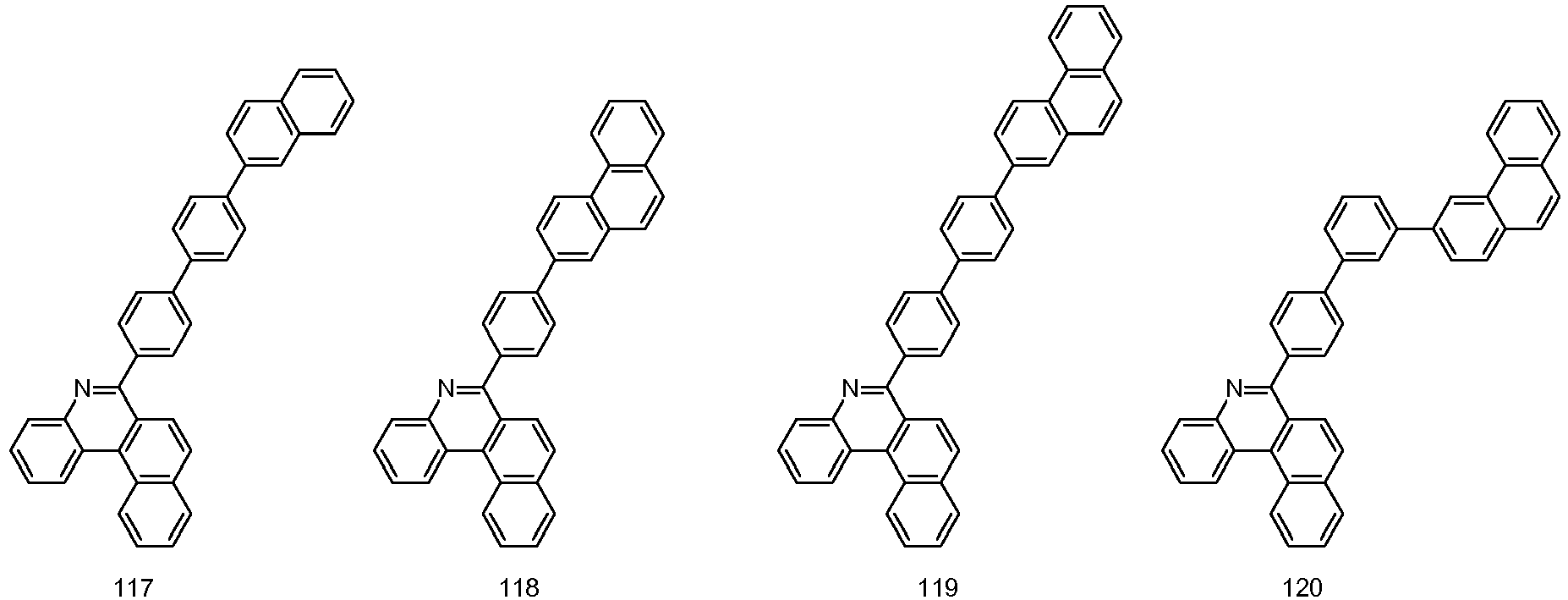


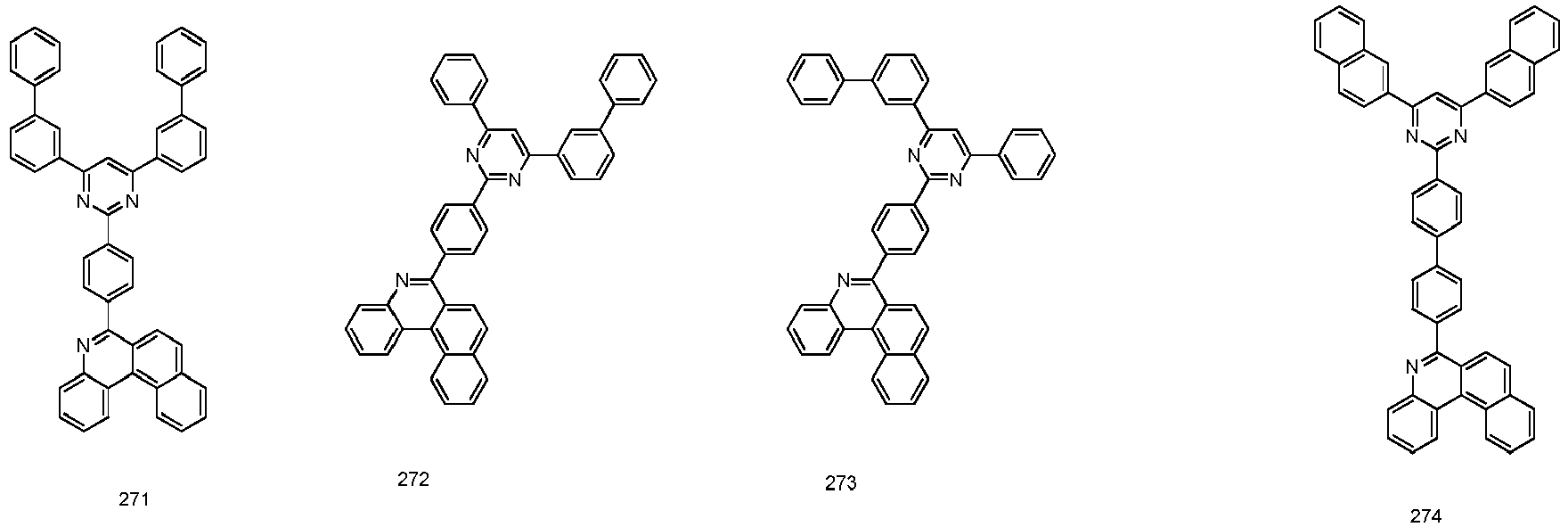


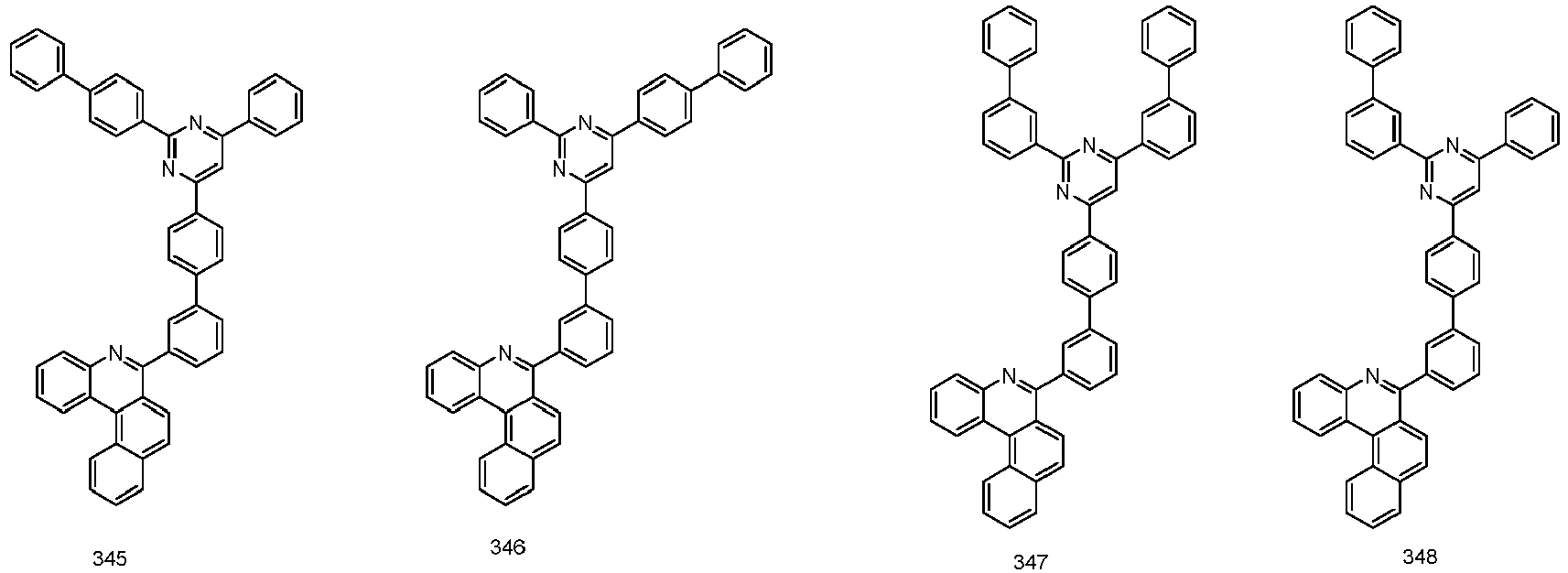


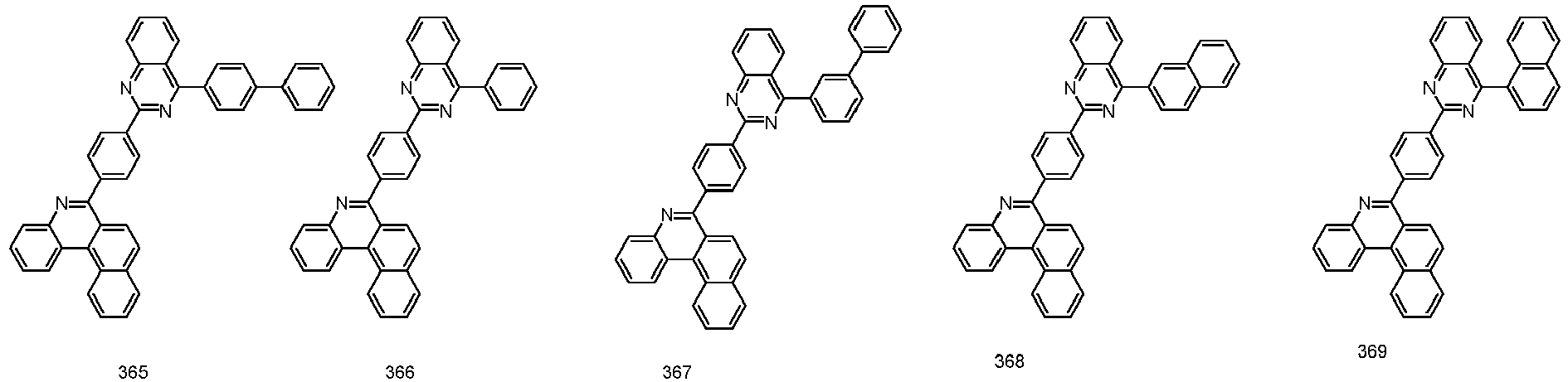


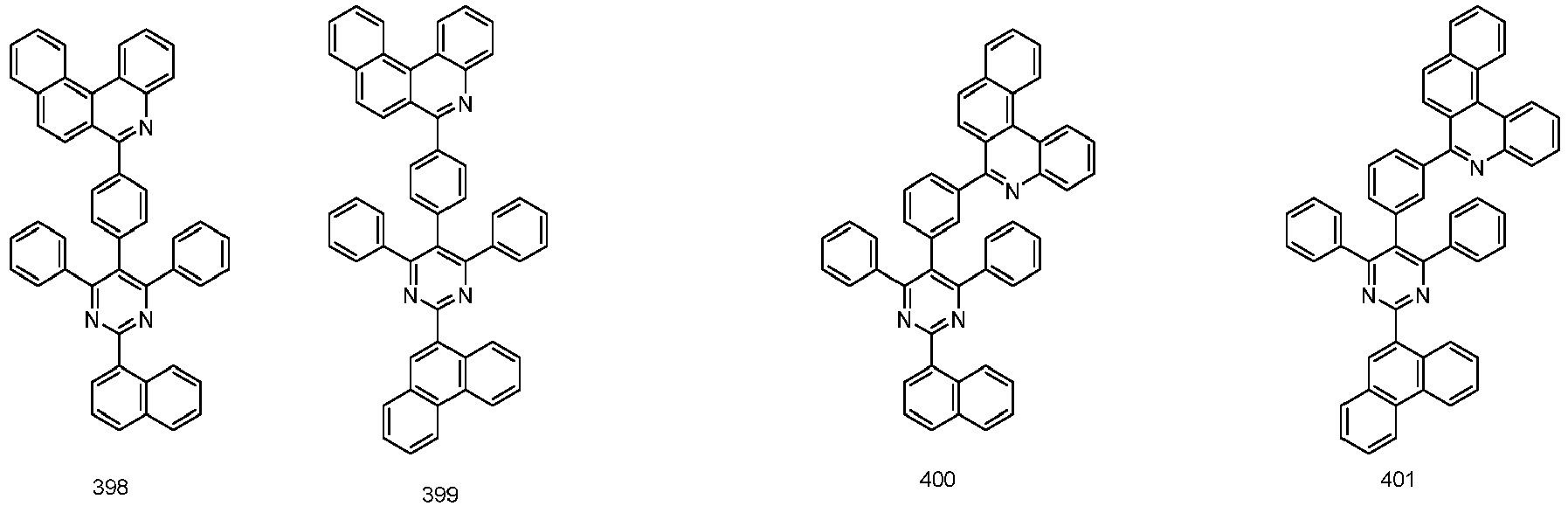


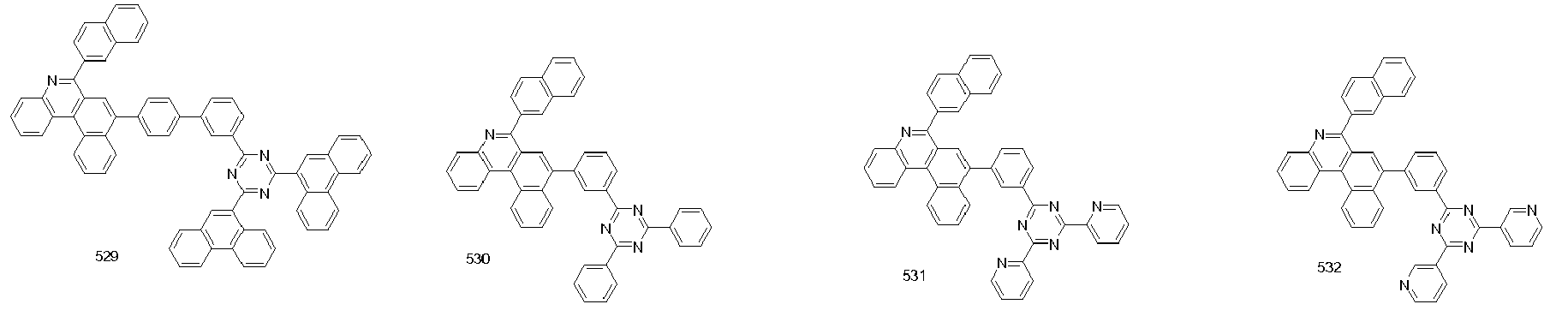


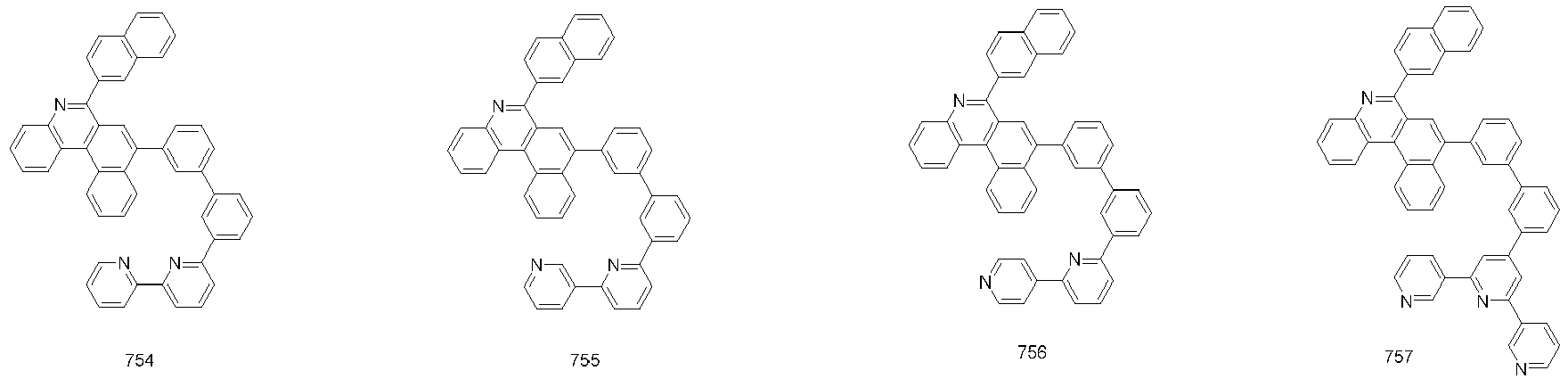

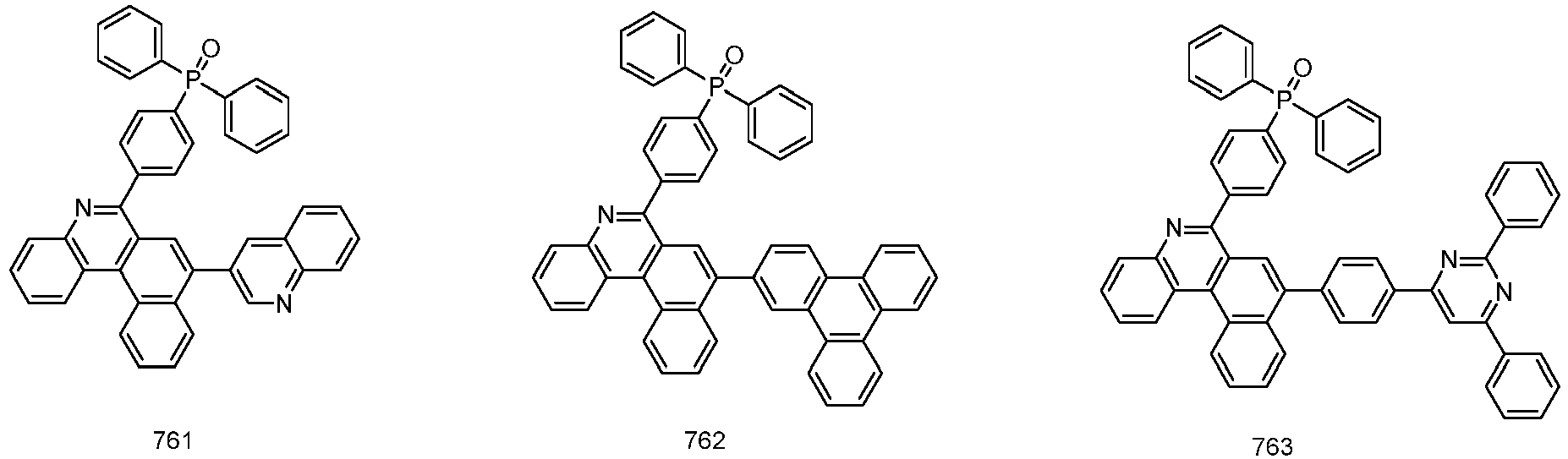


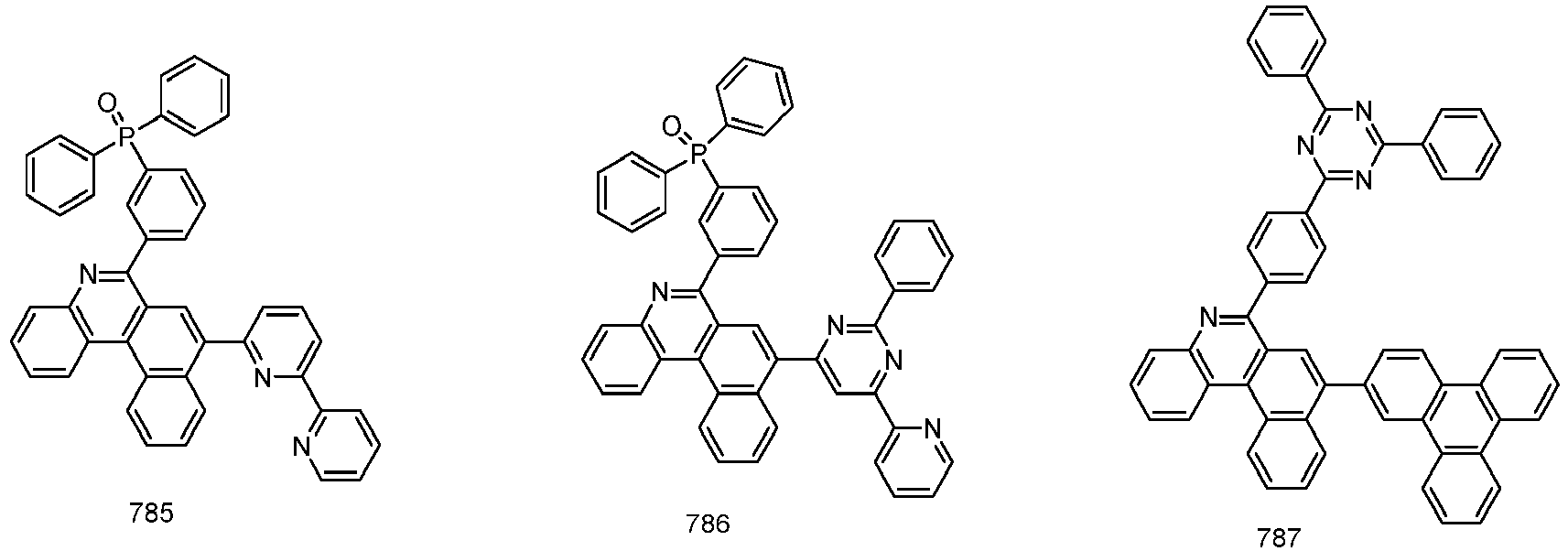


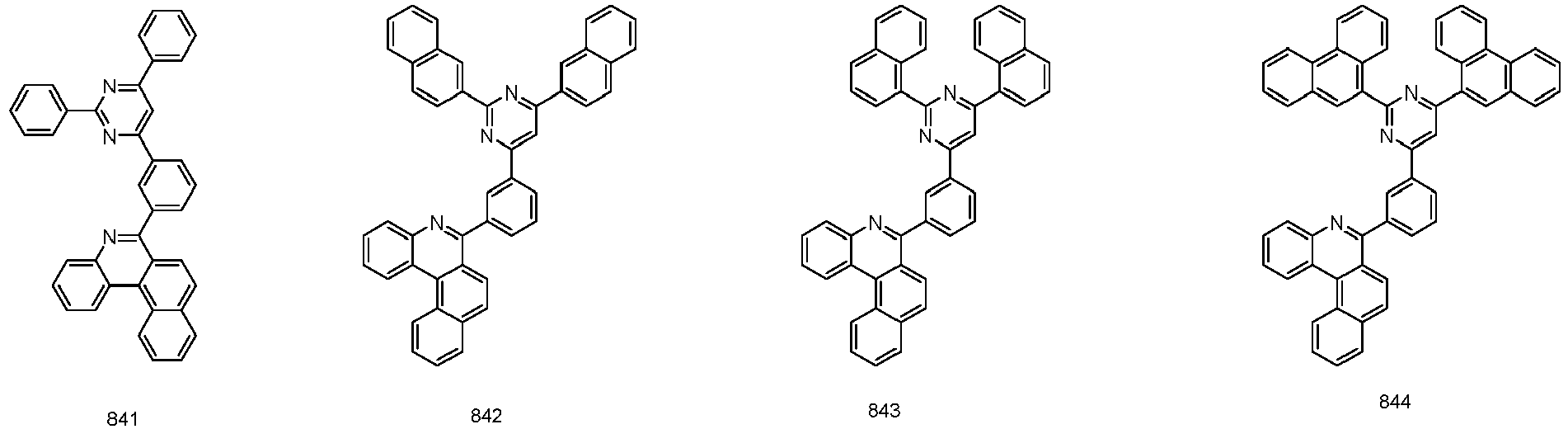


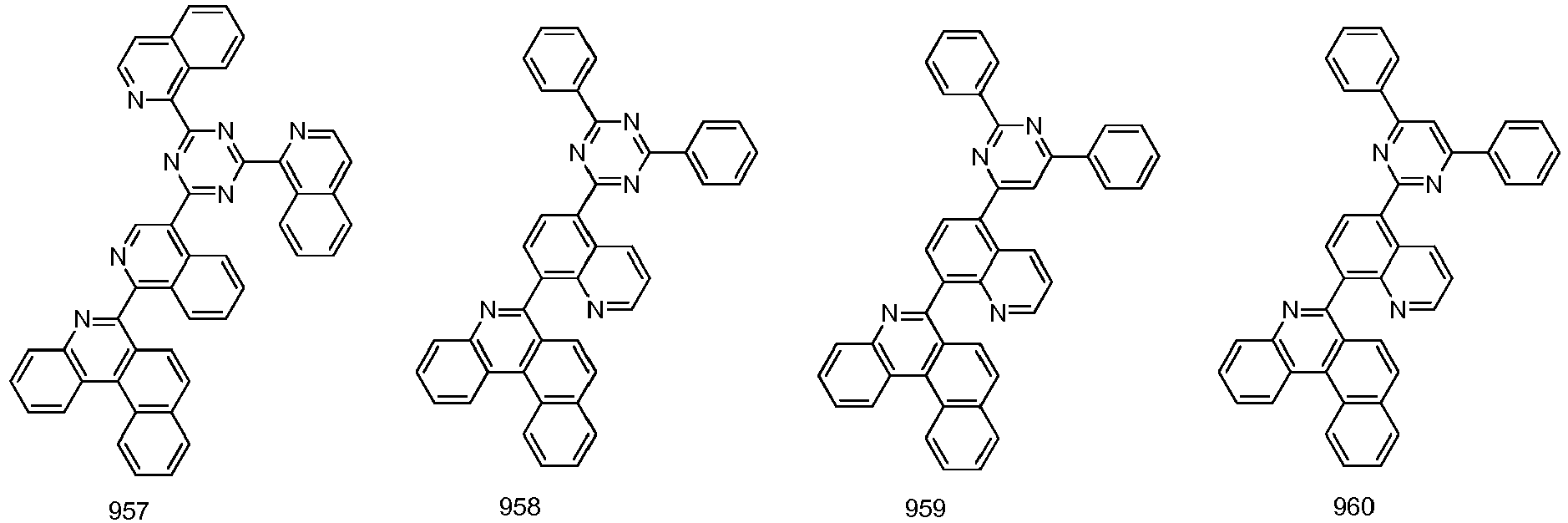

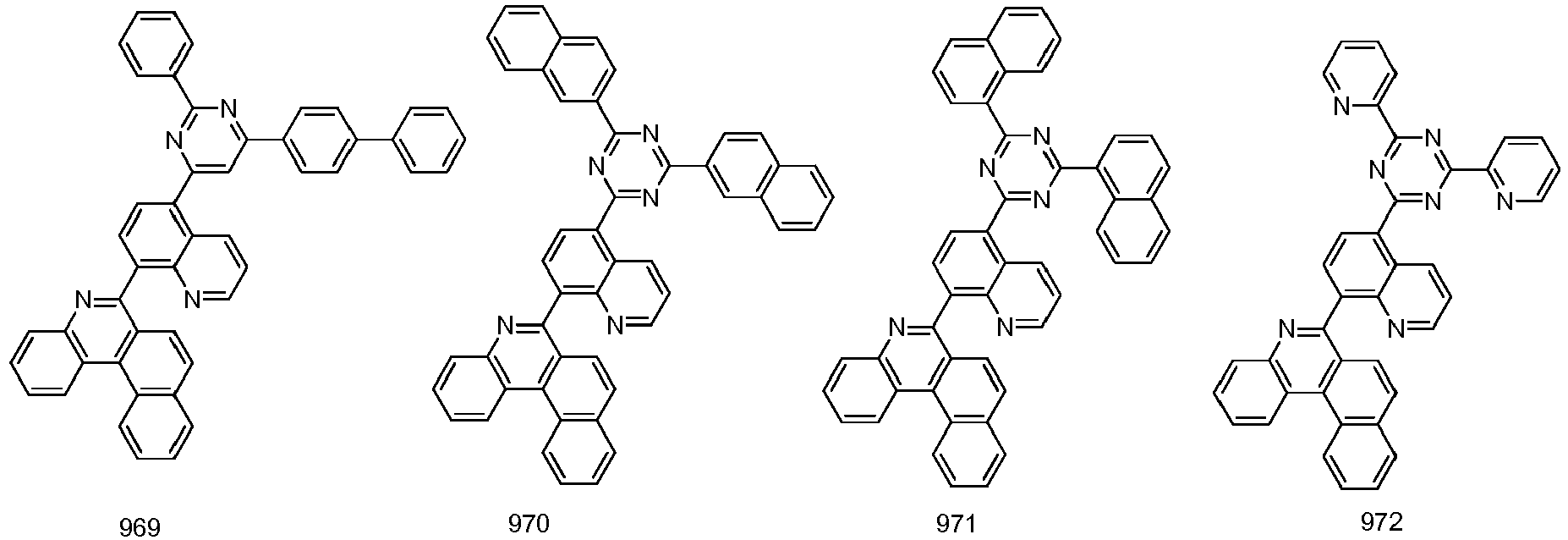


- An organic light emitting device comprising:an anode;a cathode; andone or more organic material layers provided between the anode and the cathode,wherein one or more layers of the organic material layers include the compound of any one of claims 1 to 9.
- The organic light emitting device of claim 10, wherein an organic material layer including the compound of the chemical formula 1 is at least one selected from a hole injection layer, a hole transport layer, a light emitting layer, a hole blocking layer, an electron transport layer, and an electron injection layer.
- The organic light emitting device of claim 10, wherein an organic material layer including the compound of the chemical formula 1 is a light emitting layer.
- The organic light emitting device of claim 10, wherein an organic material layer including the compound of the chemical formula 1 is an electron injection layer or an electron transport layer.
Applications Claiming Priority (3)
| Application Number | Priority Date | Filing Date | Title |
|---|---|---|---|
| KR20130164764 | 2013-12-27 | ||
| KR1020140127878A KR101546788B1 (en) | 2013-12-27 | 2014-09-24 | Hetero-cyclic compound and organic light emitting device using the same |
| PCT/KR2014/012936 WO2015099508A1 (en) | 2013-12-27 | 2014-12-26 | Heterocyclic compound and organic light emitting device using same |
Publications (4)
| Publication Number | Publication Date |
|---|---|
| EP3088392A1 true EP3088392A1 (en) | 2016-11-02 |
| EP3088392A4 EP3088392A4 (en) | 2017-05-10 |
| EP3088392B1 EP3088392B1 (en) | 2020-03-11 |
| EP3088392B8 EP3088392B8 (en) | 2020-04-22 |
Family
ID=53790070
Family Applications (1)
| Application Number | Title | Priority Date | Filing Date |
|---|---|---|---|
| EP14875512.7A Active EP3088392B8 (en) | 2013-12-27 | 2014-12-26 | Heterocyclic compound and organic light emitting device using same |
Country Status (6)
| Country | Link |
|---|---|
| US (1) | US9728731B2 (en) |
| EP (1) | EP3088392B8 (en) |
| JP (1) | JP6218938B2 (en) |
| KR (4) | KR101546788B1 (en) |
| CN (2) | CN108191761B (en) |
| TW (1) | TWI555735B (en) |
Cited By (2)
| Publication number | Priority date | Publication date | Assignee | Title |
|---|---|---|---|---|
| US10662157B2 (en) | 2016-04-06 | 2020-05-26 | Sumitomo Chemical Company, Limited | Heterocyclic compound |
| EP3561892A4 (en) * | 2016-12-26 | 2020-07-29 | LT Materials Co., Ltd. | ORGANIC LIGHT-EMITTING DEVICE |
Families Citing this family (28)
| Publication number | Priority date | Publication date | Assignee | Title |
|---|---|---|---|---|
| US20150243895A1 (en) * | 2014-02-26 | 2015-08-27 | Samsung Display Co., Ltd. | Compound and organic light-emitting device including the same |
| US9871208B2 (en) | 2014-02-26 | 2018-01-16 | Samsung Display Co., Ltd. | Condensed cyclic compound and organic light-emitting device including the same |
| US9847498B2 (en) | 2014-04-14 | 2017-12-19 | Universal Display Corporation | Organic electroluminescent materials and devices |
| US10008679B2 (en) | 2014-04-14 | 2018-06-26 | Universal Display Corporation | Organic electroluminescent materials and devices |
| CN107406415B (en) * | 2015-01-20 | 2021-02-19 | 保土谷化学工业株式会社 | Pyrimidine derivative and organic electroluminescent device |
| KR102180763B1 (en) * | 2015-08-31 | 2020-11-19 | 엘티소재주식회사 | Hetero-cyclic compound and organic light emitting device using the same |
| KR102686339B1 (en) * | 2016-06-02 | 2024-07-19 | 솔루스첨단소재 주식회사 | Organic compounds and organic electro luminescence device comprising the same |
| JP6862767B2 (en) * | 2016-11-01 | 2021-04-21 | 東ソー株式会社 | Triazine compounds, their production methods, production intermediates, and applications |
| CN110036013B (en) * | 2016-11-30 | 2022-04-12 | Lt素材株式会社 | Heterocyclic compound and organic light-emitting device using the same |
| KR101947622B1 (en) | 2016-11-30 | 2019-02-14 | 엘티소재주식회사 | Hetero-cyclic compound and organic light emitting device using the same |
| CN110431680B (en) * | 2017-03-15 | 2022-07-08 | 保土谷化学工业株式会社 | Organic electroluminescent element |
| EP3477720B1 (en) * | 2017-03-30 | 2020-03-18 | LG Chem, Ltd. | Organic light emitting element |
| KR102298231B1 (en) * | 2017-10-19 | 2021-09-07 | 엘티소재주식회사 | Hetero-cyclic compound and organic light emitting device using the same |
| KR102552271B1 (en) | 2017-10-27 | 2023-07-07 | 삼성디스플레이 주식회사 | Condensed compound and organic light emitting device comprising the same |
| KR102530627B1 (en) * | 2017-12-26 | 2023-05-10 | 엘티소재주식회사 | Heterocyclic compound and organic light emitting device comprising the same |
| JP7364139B2 (en) * | 2018-03-02 | 2023-10-18 | エスケー インコーポレイテッド | Compounds, organic light emitting devices, and display devices |
| KR102176868B1 (en) * | 2018-03-22 | 2020-11-10 | 주식회사 엘지화학 | Compound and organic light emitting device comprising same |
| WO2019240471A1 (en) * | 2018-06-11 | 2019-12-19 | 주식회사 엘지화학 | Heterocyclic compound and organic light-emitting device comprising same |
| JP2021514931A (en) * | 2018-09-28 | 2021-06-17 | エルティー・マテリアルズ・カンパニー・リミテッドLT Materials Co., Ltd. | Heterocyclic compounds and organic light emitting devices containing them |
| TWI692471B (en) * | 2018-10-23 | 2020-05-01 | 昱鐳光電科技股份有限公司 | Phenyl biphenylpyrimidines compounds and organic electroluminescent devices using the same |
| JP7495231B2 (en) * | 2019-02-08 | 2024-06-04 | 住友化学株式会社 | Compound and light-emitting device using same |
| KR102219562B1 (en) | 2019-08-23 | 2021-02-24 | 엘티소재주식회사 | Heterocyclic compound and organic light emitting device using the same |
| CN114621142B (en) * | 2022-03-30 | 2024-01-19 | 武汉天马微电子有限公司 | An organic compound and its application |
| KR102831753B1 (en) | 2022-05-03 | 2025-07-11 | 오페주식회사 | Spacing device for multi-purpose harvester having a power transmission unit with a variable structure |
| KR102734915B1 (en) * | 2022-06-21 | 2024-11-29 | 엘티소재주식회사 | Heterocyclic compound, organic light-emitting device comprising same, composition for organic material layer of organic light-emitting device comprising same and manufacturing method for organic light-emitting device |
| KR20240002210A (en) * | 2022-06-27 | 2024-01-04 | 주식회사 엘지화학 | Compound and organic light emitting device comprising the same |
| CN115724826B (en) * | 2022-10-27 | 2025-02-11 | 上海八亿时空先进材料有限公司 | A heterocyclic compound and its application |
| CN119431318B (en) * | 2023-08-07 | 2025-10-17 | 陕西莱特光电材料股份有限公司 | Organic compound, organic electroluminescent device and electronic device comprising the same |
Family Cites Families (8)
| Publication number | Priority date | Publication date | Assignee | Title |
|---|---|---|---|---|
| US4356429A (en) * | 1980-07-17 | 1982-10-26 | Eastman Kodak Company | Organic electroluminescent cell |
| EP2031670B1 (en) * | 2006-06-22 | 2013-11-27 | Idemitsu Kosan Co., Ltd. | Organic electroluminescent device employing heterocycle-containing arylamine derivative |
| KR101067069B1 (en) * | 2009-03-09 | 2011-09-22 | 부경대학교 산학협력단 | Method for preparing phenanthridine derivative using trifluoroacetic acid |
| EP2550691A1 (en) * | 2010-03-23 | 2013-01-30 | Merck Patent GmbH | Materials for organic electroluminescent devices |
| KR101722027B1 (en) * | 2012-05-03 | 2017-04-03 | 삼성디스플레이 주식회사 | A condensed-cyclic compound and an organic light emitting diode comprising the same |
| KR101640636B1 (en) * | 2012-05-31 | 2016-07-18 | 주식회사 엘지화학 | New heterocyclic compounds and organic electronic device using the same |
| JP6174819B2 (en) * | 2013-09-30 | 2017-08-02 | エルジー・ケム・リミテッド | Heterocyclic compound and organic light emitting device using the same |
| US9871208B2 (en) | 2014-02-26 | 2018-01-16 | Samsung Display Co., Ltd. | Condensed cyclic compound and organic light-emitting device including the same |
-
2014
- 2014-09-24 KR KR1020140127878A patent/KR101546788B1/en active Active
- 2014-12-26 US US14/898,342 patent/US9728731B2/en active Active
- 2014-12-26 KR KR1020140191096A patent/KR101838694B1/en active Active
- 2014-12-26 CN CN201810153276.1A patent/CN108191761B/en active Active
- 2014-12-26 EP EP14875512.7A patent/EP3088392B8/en active Active
- 2014-12-26 CN CN201480038480.9A patent/CN105358533B/en active Active
- 2014-12-26 JP JP2016518287A patent/JP6218938B2/en active Active
- 2014-12-27 TW TW103145903A patent/TWI555735B/en active
-
2015
- 2015-03-03 KR KR1020150029783A patent/KR20150077382A/en not_active Withdrawn
- 2015-05-08 KR KR1020150064458A patent/KR101838689B1/en active Active
Cited By (3)
| Publication number | Priority date | Publication date | Assignee | Title |
|---|---|---|---|---|
| US10662157B2 (en) | 2016-04-06 | 2020-05-26 | Sumitomo Chemical Company, Limited | Heterocyclic compound |
| US11124480B2 (en) | 2016-04-06 | 2021-09-21 | Sumitomo Chemical Company, Limited | Heterocyclic compound |
| EP3561892A4 (en) * | 2016-12-26 | 2020-07-29 | LT Materials Co., Ltd. | ORGANIC LIGHT-EMITTING DEVICE |
Also Published As
| Publication number | Publication date |
|---|---|
| JP6218938B2 (en) | 2017-10-25 |
| EP3088392B8 (en) | 2020-04-22 |
| US20160380208A1 (en) | 2016-12-29 |
| JP2016528177A (en) | 2016-09-15 |
| CN108191761B (en) | 2021-12-21 |
| KR101546788B1 (en) | 2015-08-24 |
| KR20150077382A (en) | 2015-07-07 |
| EP3088392B1 (en) | 2020-03-11 |
| CN108191761A (en) | 2018-06-22 |
| TWI555735B (en) | 2016-11-01 |
| TW201538486A (en) | 2015-10-16 |
| EP3088392A4 (en) | 2017-05-10 |
| CN105358533B (en) | 2018-08-28 |
| KR20150077271A (en) | 2015-07-07 |
| KR101838689B1 (en) | 2018-03-14 |
| CN105358533A (en) | 2016-02-24 |
| KR20150077383A (en) | 2015-07-07 |
| US9728731B2 (en) | 2017-08-08 |
| KR101838694B1 (en) | 2018-03-14 |
| KR20150077369A (en) | 2015-07-07 |
Similar Documents
| Publication | Publication Date | Title |
|---|---|---|
| EP3088392B1 (en) | Heterocyclic compound and organic light emitting device using same | |
| EP3162797B1 (en) | Polycyclic compound and organic light emitting device using same | |
| EP2860783B1 (en) | Organic optoelectric device and display device | |
| CN108699058B (en) | Hetero-fused phenylquinazolines and their use in electronic devices | |
| KR102004231B1 (en) | Polycyclic compound including pyrazole and organic light emitting device using the same | |
| EP3214073B1 (en) | Nitrogen-containing polycyclic compound and organic light emitting element using same | |
| EP3075737B1 (en) | Benzimidazolo[1,2-a]benzimidazole carrying aryl- or heteroarylnitril groups for organic light emitting diodes | |
| KR101474713B1 (en) | New material for transporting electron and organic electroluminescent device using the same | |
| KR20170131398A (en) | Organic electroluminescence devices, electronic devices, and compounds | |
| CN107266481A (en) | Organic electric-field light-emitting element material, organic electric-field light-emitting element, display device and lighting device | |
| KR101548686B1 (en) | New material for transporting electron and organic electroluminescent device using the same | |
| EP3214085B1 (en) | Heterocyclic compound and organic light-emitting element using same | |
| CN107406415A (en) | Pyrimidine Derivatives and Organic Electroluminescent Devices | |
| KR20200056811A (en) | Heterocyclic compound and organic light emitting device comprising the same | |
| KR20190033911A (en) | Heterocyclic compound and organic light emitting device comprising the same | |
| KR20200053359A (en) | Heterocyclic compound and organic light emitting device comprising the same | |
| CN116848077A (en) | Compound and organic electroluminescent element using the same | |
| JP2016081972A (en) | Organic electroluminescent element, electronic apparatus, and composition | |
| JPWO2020111140A1 (en) | Condensation ring compounds, their manufacturing methods, and materials for organic electroluminescence devices |
Legal Events
| Date | Code | Title | Description |
|---|---|---|---|
| PUAI | Public reference made under article 153(3) epc to a published international application that has entered the european phase |
Free format text: ORIGINAL CODE: 0009012 |
|
| 17P | Request for examination filed |
Effective date: 20151204 |
|
| AK | Designated contracting states |
Kind code of ref document: A1 Designated state(s): AL AT BE BG CH CY CZ DE DK EE ES FI FR GB GR HR HU IE IS IT LI LT LU LV MC MK MT NL NO PL PT RO RS SE SI SK SM TR |
|
| AX | Request for extension of the european patent |
Extension state: BA ME |
|
| DAX | Request for extension of the european patent (deleted) | ||
| A4 | Supplementary search report drawn up and despatched |
Effective date: 20170412 |
|
| RIC1 | Information provided on ipc code assigned before grant |
Ipc: C09K 11/06 20060101ALI20170406BHEP Ipc: C07D 221/12 20060101AFI20170406BHEP Ipc: H01L 51/50 20060101ALI20170406BHEP |
|
| STAA | Information on the status of an ep patent application or granted ep patent |
Free format text: STATUS: EXAMINATION IS IN PROGRESS |
|
| 17Q | First examination report despatched |
Effective date: 20181219 |
|
| GRAP | Despatch of communication of intention to grant a patent |
Free format text: ORIGINAL CODE: EPIDOSNIGR1 |
|
| STAA | Information on the status of an ep patent application or granted ep patent |
Free format text: STATUS: GRANT OF PATENT IS INTENDED |
|
| INTG | Intention to grant announced |
Effective date: 20191029 |
|
| GRAS | Grant fee paid |
Free format text: ORIGINAL CODE: EPIDOSNIGR3 |
|
| GRAA | (expected) grant |
Free format text: ORIGINAL CODE: 0009210 |
|
| STAA | Information on the status of an ep patent application or granted ep patent |
Free format text: STATUS: THE PATENT HAS BEEN GRANTED |
|
| AK | Designated contracting states |
Kind code of ref document: B1 Designated state(s): AL AT BE BG CH CY CZ DE DK EE ES FI FR GB GR HR HU IE IS IT LI LT LU LV MC MK MT NL NO PL PT RO RS SE SI SK SM TR |
|
| REG | Reference to a national code |
Ref country code: GB Ref legal event code: FG4D |
|
| REG | Reference to a national code |
Ref country code: CH Ref legal event code: EP |
|
| REG | Reference to a national code |
Ref country code: AT Ref legal event code: REF Ref document number: 1242986 Country of ref document: AT Kind code of ref document: T Effective date: 20200315 |
|
| REG | Reference to a national code |
Ref country code: DE Ref legal event code: R081 Ref document number: 602014062354 Country of ref document: DE Owner name: LT MATERIALS CO., LTD., YONGIN-SI, KR Free format text: FORMER OWNER: HEESUNG MATERIAL LTD., YONGIN-CITY, GYEONGGI-DO, KR Ref country code: DE Ref legal event code: R096 Ref document number: 602014062354 Country of ref document: DE |
|
| REG | Reference to a national code |
Ref country code: IE Ref legal event code: FG4D |
|
| RAP2 | Party data changed (patent owner data changed or rights of a patent transferred) |
Owner name: LT MATERIALS CO., LTD. |
|
| PG25 | Lapsed in a contracting state [announced via postgrant information from national office to epo] |
Ref country code: NO Free format text: LAPSE BECAUSE OF FAILURE TO SUBMIT A TRANSLATION OF THE DESCRIPTION OR TO PAY THE FEE WITHIN THE PRESCRIBED TIME-LIMIT Effective date: 20200611 Ref country code: RS Free format text: LAPSE BECAUSE OF FAILURE TO SUBMIT A TRANSLATION OF THE DESCRIPTION OR TO PAY THE FEE WITHIN THE PRESCRIBED TIME-LIMIT Effective date: 20200311 Ref country code: FI Free format text: LAPSE BECAUSE OF FAILURE TO SUBMIT A TRANSLATION OF THE DESCRIPTION OR TO PAY THE FEE WITHIN THE PRESCRIBED TIME-LIMIT Effective date: 20200311 |
|
| REG | Reference to a national code |
Ref country code: NL Ref legal event code: MP Effective date: 20200311 |
|
| PG25 | Lapsed in a contracting state [announced via postgrant information from national office to epo] |
Ref country code: GR Free format text: LAPSE BECAUSE OF FAILURE TO SUBMIT A TRANSLATION OF THE DESCRIPTION OR TO PAY THE FEE WITHIN THE PRESCRIBED TIME-LIMIT Effective date: 20200612 Ref country code: HR Free format text: LAPSE BECAUSE OF FAILURE TO SUBMIT A TRANSLATION OF THE DESCRIPTION OR TO PAY THE FEE WITHIN THE PRESCRIBED TIME-LIMIT Effective date: 20200311 Ref country code: SE Free format text: LAPSE BECAUSE OF FAILURE TO SUBMIT A TRANSLATION OF THE DESCRIPTION OR TO PAY THE FEE WITHIN THE PRESCRIBED TIME-LIMIT Effective date: 20200311 Ref country code: LV Free format text: LAPSE BECAUSE OF FAILURE TO SUBMIT A TRANSLATION OF THE DESCRIPTION OR TO PAY THE FEE WITHIN THE PRESCRIBED TIME-LIMIT Effective date: 20200311 Ref country code: BG Free format text: LAPSE BECAUSE OF FAILURE TO SUBMIT A TRANSLATION OF THE DESCRIPTION OR TO PAY THE FEE WITHIN THE PRESCRIBED TIME-LIMIT Effective date: 20200611 |
|
| REG | Reference to a national code |
Ref country code: LT Ref legal event code: MG4D |
|
| PG25 | Lapsed in a contracting state [announced via postgrant information from national office to epo] |
Ref country code: NL Free format text: LAPSE BECAUSE OF FAILURE TO SUBMIT A TRANSLATION OF THE DESCRIPTION OR TO PAY THE FEE WITHIN THE PRESCRIBED TIME-LIMIT Effective date: 20200311 |
|
| PG25 | Lapsed in a contracting state [announced via postgrant information from national office to epo] |
Ref country code: CZ Free format text: LAPSE BECAUSE OF FAILURE TO SUBMIT A TRANSLATION OF THE DESCRIPTION OR TO PAY THE FEE WITHIN THE PRESCRIBED TIME-LIMIT Effective date: 20200311 Ref country code: LT Free format text: LAPSE BECAUSE OF FAILURE TO SUBMIT A TRANSLATION OF THE DESCRIPTION OR TO PAY THE FEE WITHIN THE PRESCRIBED TIME-LIMIT Effective date: 20200311 Ref country code: IS Free format text: LAPSE BECAUSE OF FAILURE TO SUBMIT A TRANSLATION OF THE DESCRIPTION OR TO PAY THE FEE WITHIN THE PRESCRIBED TIME-LIMIT Effective date: 20200711 Ref country code: RO Free format text: LAPSE BECAUSE OF FAILURE TO SUBMIT A TRANSLATION OF THE DESCRIPTION OR TO PAY THE FEE WITHIN THE PRESCRIBED TIME-LIMIT Effective date: 20200311 Ref country code: SK Free format text: LAPSE BECAUSE OF FAILURE TO SUBMIT A TRANSLATION OF THE DESCRIPTION OR TO PAY THE FEE WITHIN THE PRESCRIBED TIME-LIMIT Effective date: 20200311 Ref country code: SM Free format text: LAPSE BECAUSE OF FAILURE TO SUBMIT A TRANSLATION OF THE DESCRIPTION OR TO PAY THE FEE WITHIN THE PRESCRIBED TIME-LIMIT Effective date: 20200311 Ref country code: EE Free format text: LAPSE BECAUSE OF FAILURE TO SUBMIT A TRANSLATION OF THE DESCRIPTION OR TO PAY THE FEE WITHIN THE PRESCRIBED TIME-LIMIT Effective date: 20200311 Ref country code: PT Free format text: LAPSE BECAUSE OF FAILURE TO SUBMIT A TRANSLATION OF THE DESCRIPTION OR TO PAY THE FEE WITHIN THE PRESCRIBED TIME-LIMIT Effective date: 20200805 |
|
| REG | Reference to a national code |
Ref country code: AT Ref legal event code: MK05 Ref document number: 1242986 Country of ref document: AT Kind code of ref document: T Effective date: 20200311 |
|
| REG | Reference to a national code |
Ref country code: DE Ref legal event code: R097 Ref document number: 602014062354 Country of ref document: DE |
|
| PLBE | No opposition filed within time limit |
Free format text: ORIGINAL CODE: 0009261 |
|
| STAA | Information on the status of an ep patent application or granted ep patent |
Free format text: STATUS: NO OPPOSITION FILED WITHIN TIME LIMIT |
|
| PG25 | Lapsed in a contracting state [announced via postgrant information from national office to epo] |
Ref country code: ES Free format text: LAPSE BECAUSE OF FAILURE TO SUBMIT A TRANSLATION OF THE DESCRIPTION OR TO PAY THE FEE WITHIN THE PRESCRIBED TIME-LIMIT Effective date: 20200311 Ref country code: IT Free format text: LAPSE BECAUSE OF FAILURE TO SUBMIT A TRANSLATION OF THE DESCRIPTION OR TO PAY THE FEE WITHIN THE PRESCRIBED TIME-LIMIT Effective date: 20200311 Ref country code: DK Free format text: LAPSE BECAUSE OF FAILURE TO SUBMIT A TRANSLATION OF THE DESCRIPTION OR TO PAY THE FEE WITHIN THE PRESCRIBED TIME-LIMIT Effective date: 20200311 Ref country code: AT Free format text: LAPSE BECAUSE OF FAILURE TO SUBMIT A TRANSLATION OF THE DESCRIPTION OR TO PAY THE FEE WITHIN THE PRESCRIBED TIME-LIMIT Effective date: 20200311 |
|
| 26N | No opposition filed |
Effective date: 20201214 |
|
| PG25 | Lapsed in a contracting state [announced via postgrant information from national office to epo] |
Ref country code: PL Free format text: LAPSE BECAUSE OF FAILURE TO SUBMIT A TRANSLATION OF THE DESCRIPTION OR TO PAY THE FEE WITHIN THE PRESCRIBED TIME-LIMIT Effective date: 20200311 Ref country code: SI Free format text: LAPSE BECAUSE OF FAILURE TO SUBMIT A TRANSLATION OF THE DESCRIPTION OR TO PAY THE FEE WITHIN THE PRESCRIBED TIME-LIMIT Effective date: 20200311 |
|
| REG | Reference to a national code |
Ref country code: CH Ref legal event code: PL |
|
| GBPC | Gb: european patent ceased through non-payment of renewal fee |
Effective date: 20201226 |
|
| PG25 | Lapsed in a contracting state [announced via postgrant information from national office to epo] |
Ref country code: MC Free format text: LAPSE BECAUSE OF FAILURE TO SUBMIT A TRANSLATION OF THE DESCRIPTION OR TO PAY THE FEE WITHIN THE PRESCRIBED TIME-LIMIT Effective date: 20200311 |
|
| REG | Reference to a national code |
Ref country code: BE Ref legal event code: MM Effective date: 20201231 |
|
| PG25 | Lapsed in a contracting state [announced via postgrant information from national office to epo] |
Ref country code: LU Free format text: LAPSE BECAUSE OF NON-PAYMENT OF DUE FEES Effective date: 20201226 Ref country code: IE Free format text: LAPSE BECAUSE OF NON-PAYMENT OF DUE FEES Effective date: 20201226 |
|
| PG25 | Lapsed in a contracting state [announced via postgrant information from national office to epo] |
Ref country code: LI Free format text: LAPSE BECAUSE OF NON-PAYMENT OF DUE FEES Effective date: 20201231 Ref country code: GB Free format text: LAPSE BECAUSE OF NON-PAYMENT OF DUE FEES Effective date: 20201226 Ref country code: CH Free format text: LAPSE BECAUSE OF NON-PAYMENT OF DUE FEES Effective date: 20201231 |
|
| PG25 | Lapsed in a contracting state [announced via postgrant information from national office to epo] |
Ref country code: TR Free format text: LAPSE BECAUSE OF FAILURE TO SUBMIT A TRANSLATION OF THE DESCRIPTION OR TO PAY THE FEE WITHIN THE PRESCRIBED TIME-LIMIT Effective date: 20200311 Ref country code: MT Free format text: LAPSE BECAUSE OF FAILURE TO SUBMIT A TRANSLATION OF THE DESCRIPTION OR TO PAY THE FEE WITHIN THE PRESCRIBED TIME-LIMIT Effective date: 20200311 Ref country code: CY Free format text: LAPSE BECAUSE OF FAILURE TO SUBMIT A TRANSLATION OF THE DESCRIPTION OR TO PAY THE FEE WITHIN THE PRESCRIBED TIME-LIMIT Effective date: 20200311 |
|
| PG25 | Lapsed in a contracting state [announced via postgrant information from national office to epo] |
Ref country code: MK Free format text: LAPSE BECAUSE OF FAILURE TO SUBMIT A TRANSLATION OF THE DESCRIPTION OR TO PAY THE FEE WITHIN THE PRESCRIBED TIME-LIMIT Effective date: 20200311 Ref country code: AL Free format text: LAPSE BECAUSE OF FAILURE TO SUBMIT A TRANSLATION OF THE DESCRIPTION OR TO PAY THE FEE WITHIN THE PRESCRIBED TIME-LIMIT Effective date: 20200311 |
|
| PG25 | Lapsed in a contracting state [announced via postgrant information from national office to epo] |
Ref country code: BE Free format text: LAPSE BECAUSE OF NON-PAYMENT OF DUE FEES Effective date: 20201231 |
|
| P01 | Opt-out of the competence of the unified patent court (upc) registered |
Effective date: 20230530 |
|
| PGFP | Annual fee paid to national office [announced via postgrant information from national office to epo] |
Ref country code: DE Payment date: 20251104 Year of fee payment: 12 |
|
| PGFP | Annual fee paid to national office [announced via postgrant information from national office to epo] |
Ref country code: FR Payment date: 20251117 Year of fee payment: 12 |