EP3561120A1 - Austenite steel material having superb abrasion resistance and toughness, and method for producing same - Google Patents
Austenite steel material having superb abrasion resistance and toughness, and method for producing same Download PDFInfo
- Publication number
- EP3561120A1 EP3561120A1 EP17882436.3A EP17882436A EP3561120A1 EP 3561120 A1 EP3561120 A1 EP 3561120A1 EP 17882436 A EP17882436 A EP 17882436A EP 3561120 A1 EP3561120 A1 EP 3561120A1
- Authority
- EP
- European Patent Office
- Prior art keywords
- steel material
- less
- excluding
- hot
- austenite
- Prior art date
- Legal status (The legal status is an assumption and is not a legal conclusion. Google has not performed a legal analysis and makes no representation as to the accuracy of the status listed.)
- Withdrawn
Links
Images

Classifications
-
- C—CHEMISTRY; METALLURGY
- C21—METALLURGY OF IRON
- C21D—MODIFYING THE PHYSICAL STRUCTURE OF FERROUS METALS; GENERAL DEVICES FOR HEAT TREATMENT OF FERROUS OR NON-FERROUS METALS OR ALLOYS; MAKING METAL MALLEABLE, e.g. BY DECARBURISATION OR TEMPERING
- C21D1/00—General methods or devices for heat treatment, e.g. annealing, hardening, quenching or tempering
- C21D1/18—Hardening; Quenching with or without subsequent tempering
-
- C—CHEMISTRY; METALLURGY
- C22—METALLURGY; FERROUS OR NON-FERROUS ALLOYS; TREATMENT OF ALLOYS OR NON-FERROUS METALS
- C22C—ALLOYS
- C22C38/00—Ferrous alloys, e.g. steel alloys
- C22C38/18—Ferrous alloys, e.g. steel alloys containing chromium
- C22C38/38—Ferrous alloys, e.g. steel alloys containing chromium with more than 1.5% by weight of manganese
-
- C—CHEMISTRY; METALLURGY
- C21—METALLURGY OF IRON
- C21D—MODIFYING THE PHYSICAL STRUCTURE OF FERROUS METALS; GENERAL DEVICES FOR HEAT TREATMENT OF FERROUS OR NON-FERROUS METALS OR ALLOYS; MAKING METAL MALLEABLE, e.g. BY DECARBURISATION OR TEMPERING
- C21D1/00—General methods or devices for heat treatment, e.g. annealing, hardening, quenching or tempering
- C21D1/56—General methods or devices for heat treatment, e.g. annealing, hardening, quenching or tempering characterised by the quenching agents
- C21D1/60—Aqueous agents
-
- C—CHEMISTRY; METALLURGY
- C21—METALLURGY OF IRON
- C21D—MODIFYING THE PHYSICAL STRUCTURE OF FERROUS METALS; GENERAL DEVICES FOR HEAT TREATMENT OF FERROUS OR NON-FERROUS METALS OR ALLOYS; MAKING METAL MALLEABLE, e.g. BY DECARBURISATION OR TEMPERING
- C21D6/00—Heat treatment of ferrous alloys
- C21D6/002—Heat treatment of ferrous alloys containing Cr
-
- C—CHEMISTRY; METALLURGY
- C21—METALLURGY OF IRON
- C21D—MODIFYING THE PHYSICAL STRUCTURE OF FERROUS METALS; GENERAL DEVICES FOR HEAT TREATMENT OF FERROUS OR NON-FERROUS METALS OR ALLOYS; MAKING METAL MALLEABLE, e.g. BY DECARBURISATION OR TEMPERING
- C21D6/00—Heat treatment of ferrous alloys
- C21D6/005—Heat treatment of ferrous alloys containing Mn
-
- C—CHEMISTRY; METALLURGY
- C21—METALLURGY OF IRON
- C21D—MODIFYING THE PHYSICAL STRUCTURE OF FERROUS METALS; GENERAL DEVICES FOR HEAT TREATMENT OF FERROUS OR NON-FERROUS METALS OR ALLOYS; MAKING METAL MALLEABLE, e.g. BY DECARBURISATION OR TEMPERING
- C21D6/00—Heat treatment of ferrous alloys
- C21D6/008—Heat treatment of ferrous alloys containing Si
-
- C—CHEMISTRY; METALLURGY
- C21—METALLURGY OF IRON
- C21D—MODIFYING THE PHYSICAL STRUCTURE OF FERROUS METALS; GENERAL DEVICES FOR HEAT TREATMENT OF FERROUS OR NON-FERROUS METALS OR ALLOYS; MAKING METAL MALLEABLE, e.g. BY DECARBURISATION OR TEMPERING
- C21D8/00—Modifying the physical properties of ferrous metals or ferrous alloys by deformation combined with, or followed by, heat treatment
- C21D8/02—Modifying the physical properties of ferrous metals or ferrous alloys by deformation combined with, or followed by, heat treatment during manufacturing of plates or strips
- C21D8/0221—Modifying the physical properties of ferrous metals or ferrous alloys by deformation combined with, or followed by, heat treatment during manufacturing of plates or strips characterised by the working steps
- C21D8/0226—Hot rolling
-
- C—CHEMISTRY; METALLURGY
- C21—METALLURGY OF IRON
- C21D—MODIFYING THE PHYSICAL STRUCTURE OF FERROUS METALS; GENERAL DEVICES FOR HEAT TREATMENT OF FERROUS OR NON-FERROUS METALS OR ALLOYS; MAKING METAL MALLEABLE, e.g. BY DECARBURISATION OR TEMPERING
- C21D8/00—Modifying the physical properties of ferrous metals or ferrous alloys by deformation combined with, or followed by, heat treatment
- C21D8/02—Modifying the physical properties of ferrous metals or ferrous alloys by deformation combined with, or followed by, heat treatment during manufacturing of plates or strips
- C21D8/0247—Modifying the physical properties of ferrous metals or ferrous alloys by deformation combined with, or followed by, heat treatment during manufacturing of plates or strips characterised by the heat treatment
- C21D8/0263—Modifying the physical properties of ferrous metals or ferrous alloys by deformation combined with, or followed by, heat treatment during manufacturing of plates or strips characterised by the heat treatment following hot rolling
-
- C—CHEMISTRY; METALLURGY
- C21—METALLURGY OF IRON
- C21D—MODIFYING THE PHYSICAL STRUCTURE OF FERROUS METALS; GENERAL DEVICES FOR HEAT TREATMENT OF FERROUS OR NON-FERROUS METALS OR ALLOYS; MAKING METAL MALLEABLE, e.g. BY DECARBURISATION OR TEMPERING
- C21D9/00—Heat treatment, e.g. annealing, hardening, quenching or tempering, adapted for particular articles; Furnaces therefor
- C21D9/0062—Heat-treating apparatus with a cooling or quenching zone
-
- C—CHEMISTRY; METALLURGY
- C21—METALLURGY OF IRON
- C21D—MODIFYING THE PHYSICAL STRUCTURE OF FERROUS METALS; GENERAL DEVICES FOR HEAT TREATMENT OF FERROUS OR NON-FERROUS METALS OR ALLOYS; MAKING METAL MALLEABLE, e.g. BY DECARBURISATION OR TEMPERING
- C21D9/00—Heat treatment, e.g. annealing, hardening, quenching or tempering, adapted for particular articles; Furnaces therefor
- C21D9/46—Heat treatment, e.g. annealing, hardening, quenching or tempering, adapted for particular articles; Furnaces therefor for sheet metals
-
- C—CHEMISTRY; METALLURGY
- C22—METALLURGY; FERROUS OR NON-FERROUS ALLOYS; TREATMENT OF ALLOYS OR NON-FERROUS METALS
- C22C—ALLOYS
- C22C38/00—Ferrous alloys, e.g. steel alloys
- C22C38/002—Ferrous alloys, e.g. steel alloys containing In, Mg, or other elements not provided for in one single group C22C38/001 - C22C38/60
-
- C—CHEMISTRY; METALLURGY
- C22—METALLURGY; FERROUS OR NON-FERROUS ALLOYS; TREATMENT OF ALLOYS OR NON-FERROUS METALS
- C22C—ALLOYS
- C22C38/00—Ferrous alloys, e.g. steel alloys
- C22C38/02—Ferrous alloys, e.g. steel alloys containing silicon
-
- C—CHEMISTRY; METALLURGY
- C22—METALLURGY; FERROUS OR NON-FERROUS ALLOYS; TREATMENT OF ALLOYS OR NON-FERROUS METALS
- C22C—ALLOYS
- C22C38/00—Ferrous alloys, e.g. steel alloys
- C22C38/06—Ferrous alloys, e.g. steel alloys containing aluminium
-
- C—CHEMISTRY; METALLURGY
- C22—METALLURGY; FERROUS OR NON-FERROUS ALLOYS; TREATMENT OF ALLOYS OR NON-FERROUS METALS
- C22C—ALLOYS
- C22C38/00—Ferrous alloys, e.g. steel alloys
- C22C38/18—Ferrous alloys, e.g. steel alloys containing chromium
- C22C38/20—Ferrous alloys, e.g. steel alloys containing chromium with copper
-
- C—CHEMISTRY; METALLURGY
- C21—METALLURGY OF IRON
- C21D—MODIFYING THE PHYSICAL STRUCTURE OF FERROUS METALS; GENERAL DEVICES FOR HEAT TREATMENT OF FERROUS OR NON-FERROUS METALS OR ALLOYS; MAKING METAL MALLEABLE, e.g. BY DECARBURISATION OR TEMPERING
- C21D2211/00—Microstructure comprising significant phases
- C21D2211/001—Austenite
Definitions
- the present disclosure relates to an austenitic steel material having excellent wear resistance and toughness, and a method of manufacturing the same.
- An austenitic steel material may be used for various purposes due to characteristics thereof such as process hardenability, non-magnetic properties, and the like.
- carbon steel having ferrite and martensite as a main structure has a limitation in properties thereof
- austenite steel material has been increasingly used as a substitutable material which may overcome disadvantages of the carbon steel.
- High manganese steel or Hadfield steel has excellent wear resistance, and has thus been widely used as a wear resistance component in various industries.
- To improve wear resistance of a steel material there have been constant attempts to increase an austenite structure and abrasion resistance by adding a high content of carbon and including a large amount of manganese.
- a high content of carbon in high manganese steel may generate carbides formed along a grain boundary at a high temperature such that properties of a steel material, particularly ductility of a steel material, may greatly degrade.
- high manganese steel manufactured by the above-described method may have excellent wear resistance in a general mechanical wear environment, but it may be difficult for such high manganese steel to implement wear resistance in an environment accompanying abrasion and wear. Thus, it may be difficult to apply such high manganese steel in a harsh environment in which complex wear of steel may occur.
- austenite steel material which may secure both of wear resistance and toughness by preventing the formation of carbides based on contents of carbon and manganese.
- An aspect of the present disclosure is to provide an austenitic steel material having excellent wear resistance and toughness.
- Another aspect of the present disclosure is to provide a method for manufacturing an austenitic steel material having excellent wear resistance and toughness.
- an austenitic steel material having excellent wear resistance and toughness comprising, by wt%, 0.6 to 1.9% of carbon (C), 12 to 22% of manganese (Mn), 5% or less of chromium (Cr) (excluding 0%), 5% or less of copper (Cu) (excluding 0%), 0.5% or less of aluminum (Al) (excluding 0%), 1.0% or less of silicon (Si) (excluding 0%), 0.1% or less of phosphorous (P) (including 0%), 0.02% or less of sulfur (S) (including 0%), and a balance of Fe and inevitable impurities, and comprising, by an area fraction, austenite of 97% or higher (including 100%) and carbides of 3% or lower (including 0%), as a microstructure.
- a grain size of austenite may be 500 ⁇ m or less.
- a method of manufacturing an austenitic steel material having excellent wear resistance and toughness comprising preparing a slab comprising, by wt%, 0.6 to 1.9% of carbon (C), 12 to 22% of manganese (Mn), 5% or less of chromium (Cr) (excluding 0%), 5% or less of copper (Cu) (excluding 0%), 0.5% or less of aluminum (Al) (excluding 0%), 1.0% or less of silicon (Si) (excluding 0%), 0.1% or less of phosphorous (P) (including 0%), 0.02% or less of sulfur (S) (including 0%), and a balance of Fe and inevitable impurities; reheating the slab at 1050°C or higher; obtaining a hot-rolled steel material by hot-rolling the reheated slab at a finish rolling temperature of 800°C or higher; and performing a heat treatment in which the hot-rolled steel material is maintained for a maintaining time (minutes) satisfying Relational Expression 2, at a
- an austenitic steel material having excellent wear resistance and toughness which may secure both wear resistance and toughness may be provided.
- FIG. 1 is optical microscope images of a microstructure before and after a heat treatment of inventive steel 4.
- example embodiments may be provided to more completely describe the present disclosure to a person having ordinary knowledge in the art.
- example embodiments of the present disclosure may be modified in various manners, and a scope of the present disclosure is not limited to embodiments described below.
- the term “comprise” may indicate that a certain element may further be included, not excluding another element, unless otherwise indicated.
- An austenitic steel material having excellent wear resistance and toughness may comprise, by wt%, 0.6 to 1.9% of carbon (C), 12 to 22% of manganese (Mn), 5% or less of chromium (Cr) (excluding 0%), 5% or less of copper (Cu) (excluding 0%), 0.5% or less of aluminum (Al) (excluding 0%), 1.0% or less of silicon (Si) (excluding 0%), 0.1% or less of phosphorous (P) (including 0%), 0.02% or less of sulfur (S) (including 0%), and a balance of Fe and inevitable impurities
- the austenitic steel material may include, by an area fraction, austenite of 97% or higher (including 100%) and carbides of 3% or lower (including 0%), as a microstructure.
- Carbon is an austenite stabilizing element which may improve a uniform elongation rate, and may be advantageous to improving strength and process hardenability.
- an upper limit content of carbon it may be preferable to increase a content of carbon.
- an upper limit content of carbon it may be preferable to limit an upper limit content of carbon to be 1.9%.
- a more preferable content of carbon may be 0.7 to 1.7%.
- a content of manganese may be 12 to 22%.
- Manganese is an important element which may stabilize austenite, and may improve a uniform elongation rate.
- a content of manganese is less than 12%, stability of austenite may degrade such that a martensite structure may be formed during a rolling process in a manufacturing process, and accordingly, a sufficient austenite structure may not be secured, such that it may be difficult to secure a sufficient uniform elongation rate.
- a content of copper (Cu) may be 5% or less.
- Copper may have a significantly low solid solution degree in carbides, and may slowly disperse in austenite such that copper may be concentrated on a carbide interfacial surface nucleated with austenite. Accordingly, copper may interfere with dispersion of carbon such that copper may effectively slow down the growth of carbides, and may thus have an effect of preventing the formation of carbides.
- copper may be added, and a preferable content of copper to obtain the effect of preventing carbides may be 0.05% or higher.
- Copper may also improve corrosion resistance of the steel material. When a content of copper exceeds 5%, hot press workability of the steel may degrade. Thus, it may be preferable to limit an upper limit content of copper to be 5%.
- a more preferable content of copper may be 4% or less.
- a content of chromium (Cr) may be 5% or less.
- chromium When an appropriate content of chromium is added, chromium may be solute in austenite and may increase strength of the steel material.
- Chromium is also an element which may improve corrosion resistance of the steel material. However, chromium may decrease toughness by forming carbides on an austenite grain boundary.
- a content of chromium to be added in the present disclosure in consideration of relationships with carbon and other elements to be added. It may be preferable to limit an upper limit content of chromium to be 5% to prevent the formation of carbides.
- a more preferable content of chromium may be 4% or less.
- Aluminum (Al) 0.5% or less (excluding 0%) and Silicon (Si): 1.0% or less (excluding 0%)
- Aluminum (Al) and silicon (Si) are elements which may be added as deoxidizers during a steel making process.
- the steel material of the present disclosure may include aluminum (Al) and silicon (Si) within the above-mentioned composition ranges limited as above.
- Phosphorous (P) 0.1% or less (including 0%) and sulfur (S): 0.02% or less (including 0%)
- Phosphorous (P) and sulfur (S) are representative impurities. Excessive addition of phosphorous and sulfur may cause quality degradation. Thus, it may be preferable to limit a content of phosphorous to be 0.1% or less and a content of sulfur to be 0.02% or less.
- the steel material of the present disclosure may include a remainder of Fe and other inevitable impurities.
- impurities may be inevitably added from raw materials or a surrounding environment, and thus, impurities may not be excluded.
- the austenitic steel material having excellent wear resistance and toughness may have a microstructure including, by an area fraction, austenite of 97% or higher (including 100%), and carbides of 3% or lower (including 0%).
- carbides When a fraction of carbides exceeds 3%, carbides may be precipitated on an austenite grain boundary, which may cause breakage of a grain boundary, and impact toughness of the steel material may greatly decrease.
- a fraction of carbides may be 3% or lower in area fraction.
- a grain size of austenite may be 500 ⁇ m or less.
- the steel material As a microstructure of the steel material is formed of carbides of 3% or lower in area fraction and an austenite structure having a gain size of 500 ⁇ m or less, the steel material having improved wear resistance and toughness may be provided.
- a preferable thickness of the austenite steel material may be 4mm or higher, and a more preferable thickness may be 4 to 50mm.
- the austenite steel material may have a wear amount of 2.0g or less and impact toughness of 100J or higher.
- the method of manufacturing an austenitic steel material having excellent wear resistance and toughness may comprise preparing a slab comprising, by wt%, 0.6 to 1.9% of carbon (C), 12 to 22% of manganese (Mn), 5% or less of chromium (Cr) (excluding 0%), 5% or less of copper (Cu) (excluding 0%), 0.5% or less of aluminum (Al) (excluding 0%), 1.0% or less of silicon (Si) (excluding 0%), 0.1% or less of phosphorous (P) (including 0%), 0.02% or less of sulfur (S) (including 0%), and a balance of Fe and inevitable impurities; reheating the slab at 1050°C or higher; obtaining a hot-rolled steel material by hot-rolling the reheated slab at a finish rolling temperature of 800°C or higher; and performing a heat treatment in which the hot-rolled steel material is maintained for a maintaining time (minutes) satisfying Relational Expression 2 at a heat treatment temperature (T) satisfying Relational Expression 1 below, and
- a slab may be reheated before hot-rolling the slab.
- the slab may be reheated for a casting structure of the slab, segregation, solid solution and homogenization of secondary phases in the reheating process.
- the slab may need to be reheated to 1050°C or higher to secure a sufficient temperature during a hot-rolling process.
- the slab may be reheated at 1050 to 1250°C.
- the reheating temperature is less than 1050°C, homogenization of the structure may not be sufficient, and a temperature of a heating furnace may significantly decrease such that deformation resistance may increase during a hot-rolling process.
- a segregation region in a casting structure may be partially melted, and surface quality may be deteriorated.
- the reheated slab may be hot-rolled, thereby obtaining a hot-rolled steel material.
- a hot-press finish rolling temperature may be 800°C or higher during the hot-rolling, and it may be more preferable to limit the hot-press finish rolling temperature to be 800°C or higher and a non-recrystallization temperature (Tnr) or lower.
- the steel material of the present disclosure may not accompany phase transformation, and a control of carbide precipitation may be performed in a subsequent heat treatment process. Thus, it may not be necessary to accurately control the temperature during the hot-rolling.
- the rolling may be performed only in consideration of a target product size, and thus, a process limitation in relation to a temperature control may be resolved. However, if the rolling is performed at an excessively low temperature, rolling load may significantly increase, and it may thus be preferable to finish the rolling at the above-mentioned temperature or higher.
- a hot-rolled steel material having a thickness of 4 to 50mm may be manufactured.
- a thickness of the hot-rolled steel material is 50mm or greater, it may be difficult to machine-cut the material, and the material may need to be gas-cut. Also, a material deviation caused by a difference in degree of carbide precipitation may occur due to a cooling deviation between a surface portion and a central portion during a cooling process.
- a heat treatment process in which the hot-rolled steel material obtained as above may be maintained for a maintaining time (minute) satisfying Relational Expression (2) at a heat treatment temperature (T) satisfying Relational Expression (1) below, and the hot-rolled steel material may be water-cooled to 500°C or lower at a cooling speed of 10°C/sec or higher, may be performed.
- Mn T is a heat treatment temperature (°C)
- [C], [Cr] and [Mn] each indicate wt% of each element) t + 10 ⁇ maintaining time ⁇ t + 30 (t is a thickness of a steel sheet(mm))
- the hot-rolled steel material may be heated at a temperature of 530 + 285 [C] + 44 [Cr] or higher in which carbides may be actively solute to reduce the heat treatment time, and it may be required to maintain the hot-rolled steel material at a temperature of 1446 - 174 [C] - 3.9 [Mn] or lower to prevent a segregation region from being partially melted due to excessive heating.
- the hot-rolled steel material may need to be maintained for t(thickness of steel sheet)+10 minutes or longer depending on a thickness of the steel material to secure the time for sufficient solid solution of carbides.
- the hot-rolled steel material is maintained for an excessive period of time, strength may decrease due to coarsening of a grain size, and thus, the maintaining time may be limited to be t (thickness of steel sheet) +10 minutes or less.
- Cooling Speed 10°C/sec or higher, and Cooling Stop Temperature of 500°C or less
- a rapid cooling process may be helpful to secure a high solid solution degree of C and N in a casting structure.
- it may be preferable to perform the cooling to 500°C or lower at the speed of 10°C/sec or higher.
- a more preferable cooling speed may be 15°C/sec or higher, and a more preferable cooling stop temperature may be 450°C or lower.
- an austenitic steel material having excellent wear resistance and toughness which has a microstructure comprising, by an area fraction, austenite of 97% or higher (including 100%), and carbides of 3% or lower (including 0%), may be manufactured.
- a grain size of austenite may be 500 ⁇ m or less.
- the austenite steel material may have a wear amount of 2.0g or lower and impact toughness of 100J or higher.
- toughness may improve by securing an uniform and highly stable austenite phase
- a limitation in controlling carbides during a rolling process may be overcome by effectively controlling carbides through a heat treatment
- a process efficiency and quality may improve by resolving a limitation in improving toughness.
- an austenitic steel material which may be effectively applied in the fields requiring wear resistance and high toughness in the overall fields of mining, transporting, and storing or the field of industrial machines in the oil and gas industries, where a large amount of wear of the steel material occurs, may be provided.
- a slab having a composition as in Table 1 below was reheated at 1150°C, and was hot-rolled under a hot-press finish rolling temperature condition of 950°C, thereby manufacturing a hot-rolled steel material having a thickness of 12mm. Thereafter, a heat treatment was performed on the hot-rolled steel material under a heat treatment condition as in Table 2 below, thereby manufacturing a hot-rolled steel material.
- a microstructure, yield strength, a uniform elongation rate, and impact toughness of the hot-rolled steel material manufactured as above were measured, and the results were listed in Table 3 below.
- wear resistance of the hot-rolled steel material was measured, and the result was also listed in Table 3 below.
- a wear test was conducted in accordance with G65 regulations of American society of testing materials International (ASTM), and an amount of wear of the steel material was measured.
- ASTM American society of testing materials International
- Table 3 "not conducted” indicates that the wear test was not conducted, and as strength, an elongation rate, and impact toughness were already deteriorated, an additional wear test was not conducted.
- inventive steels 1 to 5 which satisfied overall composition systems and manufacturing conditions of the present disclosure had the amount of wear of 2.0g or less, which is excellent wear resistance, and secured impact toughness of 100J or higher.
- comparative steel 1 As for comparative steel 1, sufficient strength was not secured as a content of carbon was significantly low. Accordingly, the amount of wear exceeded 2.0g, a reference value . In comparative steel 2, carbides increased due to excessive addition of carbon, and accordingly, comparative steel 2 had low impact toughness.
- comparative steel 3 As for comparative steel 3, a stable austenite phase was not formed due to insufficient content of manganese, and as martensite was formed, comparative steel 3 had low impact toughness. Also, comparative steel 4 had low impact toughness due to excessive content of chromium.
- Comparative steels 5 to 10 did not satisfy the heat treatment condition ranges such that comparative steels 5 to 10 had low impact toughness due to excessive residue and precipitation of carbides. Also, when the heat treatment was excessively performed, strength decreased due to coarsening of an austenite grain such that wear resistance decreased.
Landscapes
- Chemical & Material Sciences (AREA)
- Engineering & Computer Science (AREA)
- Materials Engineering (AREA)
- Mechanical Engineering (AREA)
- Metallurgy (AREA)
- Organic Chemistry (AREA)
- Physics & Mathematics (AREA)
- Thermal Sciences (AREA)
- Crystallography & Structural Chemistry (AREA)
- Heat Treatment Of Steel (AREA)
- Heat Treatment Of Sheet Steel (AREA)
Abstract
Description
- The present disclosure relates to an austenitic steel material having excellent wear resistance and toughness, and a method of manufacturing the same.
- An austenitic steel material may be used for various purposes due to characteristics thereof such as process hardenability, non-magnetic properties, and the like. Specifically, as carbon steel having ferrite and martensite as a main structure has a limitation in properties thereof, an austenite steel material has been increasingly used as a substitutable material which may overcome disadvantages of the carbon steel.
- With the growth of the mining industry and the oil and gas industries, wear of a use steel material has become a significant problem in mining, transporting, refining, and storing processes. As fossil fuels for substituting for petroleum, the development of oil sands has been actively conducted, and wear of a steel material caused by slurry including oil, pebbles, sands, and the like, has been considered an important cause for increasing producing costs . Accordingly, demand for the development and application of a steel material having excellent wear resistance and toughness has increased.
- High manganese steel or Hadfield steel has excellent wear resistance, and has thus been widely used as a wear resistance component in various industries. To improve wear resistance of a steel material, there have been constant attempts to increase an austenite structure and abrasion resistance by adding a high content of carbon and including a large amount of manganese.
- However, a high content of carbon in high manganese steel may generate carbides formed along a grain boundary at a high temperature such that properties of a steel material, particularly ductility of a steel material, may greatly degrade.
- To prevent the precipitation of carbides on a grain boundary described above, a method of manufacturing high manganese steel by performing a water-printing heat treatment or performing a solution treatment at a high temperature, performing a hot working, and performing rapid cooling at room temperature has been suggested.
- However, high manganese steel manufactured by the above-described method may have excellent wear resistance in a general mechanical wear environment, but it may be difficult for such high manganese steel to implement wear resistance in an environment accompanying abrasion and wear. Thus, it may be difficult to apply such high manganese steel in a harsh environment in which complex wear of steel may occur.
- Thus, it may be necessary to develop an austenite steel material which may secure both of wear resistance and toughness by preventing the formation of carbides based on contents of carbon and manganese.
- (Reference 1) Korean Laid-Open Patent Publication No.
2010-0106649 - An aspect of the present disclosure is to provide an austenitic steel material having excellent wear resistance and toughness.
- Another aspect of the present disclosure is to provide a method for manufacturing an austenitic steel material having excellent wear resistance and toughness.
- According to an aspect of the present disclosure, an austenitic steel material having excellent wear resistance and toughness is provided, the austenitic steel material comprising, by wt%, 0.6 to 1.9% of carbon (C), 12 to 22% of manganese (Mn), 5% or less of chromium (Cr) (excluding 0%), 5% or less of copper (Cu) (excluding 0%), 0.5% or less of aluminum (Al) (excluding 0%), 1.0% or less of silicon (Si) (excluding 0%), 0.1% or less of phosphorous (P) (including 0%), 0.02% or less of sulfur (S) (including 0%), and a balance of Fe and inevitable impurities, and comprising, by an area fraction, austenite of 97% or higher (including 100%) and carbides of 3% or lower (including 0%), as a microstructure.
- Preferably, a grain size of austenite may be 500 µm or less.
- According to another aspect of the present disclosure, a method of manufacturing an austenitic steel material having excellent wear resistance and toughness is provided, the method comprising preparing a slab comprising, by wt%, 0.6 to 1.9% of carbon (C), 12 to 22% of manganese (Mn), 5% or less of chromium (Cr) (excluding 0%), 5% or less of copper (Cu) (excluding 0%), 0.5% or less of aluminum (Al) (excluding 0%), 1.0% or less of silicon (Si) (excluding 0%), 0.1% or less of phosphorous (P) (including 0%), 0.02% or less of sulfur (S) (including 0%), and a balance of Fe and inevitable impurities; reheating the slab at 1050°C or higher; obtaining a hot-rolled steel material by hot-rolling the reheated slab at a finish rolling temperature of 800°C or higher; and performing a heat treatment in which the hot-rolled steel material is maintained for a maintaining time (minutes) satisfying Relational Expression 2, at a heat treatment temperature (T) satisfying Relational Expression 1 below, and the hot-rolled steel material is water-cooled to 500°C or lower at a cooling speed of 10°C/sec or higher, [Relational Expression 1] : 530 + 285 [C] + 44 [Cr] < T < 1446 - 174 [C] - 3.9 [Mn], where T is a heat treatment temperature (°C), and [C], [Cr] and [Mn] each indicate wt% of each element, and [Relational Expression 2] : t+10 < maintaining time < t+30, where T is a thickness of a steel sheet (mm).
- According to an aspect of the present disclosure, by controlling carbides in a microstructure through a heat treatment, an austenitic steel material having excellent wear resistance and toughness which may secure both wear resistance and toughness may be provided.
-
FIG. 1 is optical microscope images of a microstructure before and after a heat treatment of inventive steel 4. - Hereinafter, preferable example embodiments of the present disclosure will be described.
- However, the example embodiments may be provided to more completely describe the present disclosure to a person having ordinary knowledge in the art.
- Also, the example embodiments of the present disclosure may be modified in various manners, and a scope of the present disclosure is not limited to embodiments described below.
- Also, in the specification, the term "comprise" may indicate that a certain element may further be included, not excluding another element, unless otherwise indicated.
- In the description below, an austenitic steel material having excellent wear resistance and toughness according to an example embodiment of the present disclosure will be described in detail.
- An austenitic steel material having excellent wear resistance and toughness according to an aspect of the present disclosure may comprise, by wt%, 0.6 to 1.9% of carbon (C), 12 to 22% of manganese (Mn), 5% or less of chromium (Cr) (excluding 0%), 5% or less of copper (Cu) (excluding 0%), 0.5% or less of aluminum (Al) (excluding 0%), 1.0% or less of silicon (Si) (excluding 0%), 0.1% or less of phosphorous (P) (including 0%), 0.02% or less of sulfur (S) (including 0%), and a balance of Fe and inevitable impurities, and the austenitic steel material may include, by an area fraction, austenite of 97% or higher (including 100%) and carbides of 3% or lower (including 0%), as a microstructure.
- A composition and composition ranges of the steel material will be described.
- It may be preferable to limit a content of carbon (C) to 0.6 to 1.9%.
- Carbon is an austenite stabilizing element which may improve a uniform elongation rate, and may be advantageous to improving strength and process hardenability.
- When a content of carbon is less than 0.6%, it may be difficult to form stable austenite at room temperature such that there may be the problem in which it may be difficult to secure sufficient strength and process hardenability.
- When a content of carbon exceeds 1.9%, a large amount of carbides may be precipitated such that a uniform elongation rate may decrease, and it may thus be difficult to secure an excellent elongation rate. Also, wear resistance may degrade, and early breakage may occur.
- To improve wear resistance, it may be preferable to increase a content of carbon. However, even though the precipitation of carbides is prevented through a heat treatment, there may be a limitation in solid solution of carbon, and there may be a risk of deterioration of properties of the steel material. Thus, it may be preferable to limit an upper limit content of carbon to be 1.9%.
- A more preferable content of carbon may be 0.7 to 1.7%.
- It may be preferable to limit a content of manganese to be 12 to 22%.
- Manganese is an important element which may stabilize austenite, and may improve a uniform elongation rate.
- It may be preferable to include 12% or higher of manganese to obtain austenite as a main structure in the steel material of the present disclosure.
- When a content of manganese is less than 12%, stability of austenite may degrade such that a martensite structure may be formed during a rolling process in a manufacturing process, and accordingly, a sufficient austenite structure may not be secured, such that it may be difficult to secure a sufficient uniform elongation rate.
- When a content of manganese exceeds 22%, manufacturing costs may greatly increase, corrosion resistance may degrade due to the excessive addition of manganese, and internal oxidation may occur greatly during heating in a manufacturing process such that the problem of degradation of surface quality may occur.
- It may be preferable to limit a content of copper (Cu) to be 5% or less.
- Copper may have a significantly low solid solution degree in carbides, and may slowly disperse in austenite such that copper may be concentrated on a carbide interfacial surface nucleated with austenite. Accordingly, copper may interfere with dispersion of carbon such that copper may effectively slow down the growth of carbides, and may thus have an effect of preventing the formation of carbides. In the present disclosure, to obtain such an effect, copper may be added, and a preferable content of copper to obtain the effect of preventing carbides may be 0.05% or higher.
- Copper may also improve corrosion resistance of the steel material. When a content of copper exceeds 5%, hot press workability of the steel may degrade. Thus, it may be preferable to limit an upper limit content of copper to be 5%.
- A more preferable content of copper may be 4% or less.
- It may be preferable to limit a content of chromium (Cr) to be 5% or less.
- When an appropriate content of chromium is added, chromium may be solute in austenite and may increase strength of the steel material.
- Chromium is also an element which may improve corrosion resistance of the steel material. However, chromium may decrease toughness by forming carbides on an austenite grain boundary.
- Thus, it may be preferable to determine a content of chromium to be added in the present disclosure in consideration of relationships with carbon and other elements to be added. It may be preferable to limit an upper limit content of chromium to be 5% to prevent the formation of carbides.
- When a content of chromium exceeds 5%, it may be difficult to effectively prevent the formation of chromium-based carbides on an austenite grain boundary, and accordingly, impact toughness may decrease.
- A more preferable content of chromium may be 4% or less.
- Aluminum (Al) and silicon (Si) are elements which may be added as deoxidizers during a steel making process. The steel material of the present disclosure may include aluminum (Al) and silicon (Si) within the above-mentioned composition ranges limited as above.
- Phosphorous (P) and sulfur (S) are representative impurities. Excessive addition of phosphorous and sulfur may cause quality degradation. Thus, it may be preferable to limit a content of phosphorous to be 0.1% or less and a content of sulfur to be 0.02% or less.
- The steel material of the present disclosure may include a remainder of Fe and other inevitable impurities.
- In a general manufacturing process, inevitable impurities may be inevitably added from raw materials or a surrounding environment, and thus, impurities may not be excluded.
- A person skilled in the art may be aware of the impurities, and thus, the descriptions of the impurities may not be provided in the present disclosure.
- The austenitic steel material having excellent wear resistance and toughness according to a preferable aspect of the present disclosure may have a microstructure including, by an area fraction, austenite of 97% or higher (including 100%), and carbides of 3% or lower (including 0%).
- When a fraction of carbides exceeds 3%, carbides may be precipitated on an austenite grain boundary, which may cause breakage of a grain boundary, and impact toughness of the steel material may greatly decrease.
- Thus, it may be preferable to limit a fraction of carbides to be 3% or lower in area fraction.
- Thus, when a fraction of carbides satisfies 3% or lower in area fraction, excellent strength and elongation rate of an austenite-based steel material may be secured, which are unique characteristics of an austenite-based steel material, and process hardenability may improve such that hardness may increase due to process hardening of the material, thereby securing excellent wear resistance.
- Preferably, a grain size of austenite may be 500 µm or less.
- As a microstructure of the steel material is formed of carbides of 3% or lower in area fraction and an austenite structure having a gain size of 500 µm or less, the steel material having improved wear resistance and toughness may be provided.
- A preferable thickness of the austenite steel material may be 4mm or higher, and a more preferable thickness may be 4 to 50mm.
- The austenite steel material may have a wear amount of 2.0g or less and impact toughness of 100J or higher.
- In the description below, a method of manufacturing an austenitic steel material having excellent wear resistance and toughness will be described.
- The method of manufacturing an austenitic steel material having excellent wear resistance and toughness may comprise preparing a slab comprising, by wt%, 0.6 to 1.9% of carbon (C), 12 to 22% of manganese (Mn), 5% or less of chromium (Cr) (excluding 0%), 5% or less of copper (Cu) (excluding 0%), 0.5% or less of aluminum (Al) (excluding 0%), 1.0% or less of silicon (Si) (excluding 0%), 0.1% or less of phosphorous (P) (including 0%), 0.02% or less of sulfur (S) (including 0%), and a balance of Fe and inevitable impurities; reheating the slab at 1050°C or higher; obtaining a hot-rolled steel material by hot-rolling the reheated slab at a finish rolling temperature of 800°C or higher; and performing a heat treatment in which the hot-rolled steel material is maintained for a maintaining time (minutes) satisfying Relational Expression 2 at a heat treatment temperature (T) satisfying Relational Expression 1 below, and the hot-rolled steel material is water-cooled to 500°C or lower at a cooling speed of 10°C/sec or higher.


- A slab may be reheated before hot-rolling the slab.
- The slab may be reheated for a casting structure of the slab, segregation, solid solution and homogenization of secondary phases in the reheating process.
- The slab may need to be reheated to 1050°C or higher to secure a sufficient temperature during a hot-rolling process. Preferably, the slab may be reheated at 1050 to 1250°C.
- When the reheating temperature is less than 1050°C, homogenization of the structure may not be sufficient, and a temperature of a heating furnace may significantly decrease such that deformation resistance may increase during a hot-rolling process.
- When the reheating temperature exceeds 1250°C, a segregation region in a casting structure may be partially melted, and surface quality may be deteriorated.
- The reheated slab may be hot-rolled, thereby obtaining a hot-rolled steel material.
- It may be preferable to limit a hot-press finish rolling temperature to be 800°C or higher during the hot-rolling, and it may be more preferable to limit the hot-press finish rolling temperature to be 800°C or higher and a non-recrystallization temperature (Tnr) or lower.
- The steel material of the present disclosure may not accompany phase transformation, and a control of carbide precipitation may be performed in a subsequent heat treatment process. Thus, it may not be necessary to accurately control the temperature during the hot-rolling. The rolling may be performed only in consideration of a target product size, and thus, a process limitation in relation to a temperature control may be resolved. However, if the rolling is performed at an excessively low temperature, rolling load may significantly increase, and it may thus be preferable to finish the rolling at the above-mentioned temperature or higher.
- Through the hot-rolling, a hot-rolled steel material having a thickness of 4 to 50mm, preferably, may be manufactured.
- When a thickness of the hot-rolled steel material is 50mm or greater, it may be difficult to machine-cut the material, and the material may need to be gas-cut. Also, a material deviation caused by a difference in degree of carbide precipitation may occur due to a cooling deviation between a surface portion and a central portion during a cooling process.
- A heat treatment process, in which the hot-rolled steel material obtained as above may be maintained for a maintaining time (minute) satisfying Relational Expression (2) at a heat treatment temperature (T) satisfying Relational Expression (1) below, and the hot-rolled steel material may be water-cooled to 500°C or lower at a cooling speed of 10°C/sec or higher, may be performed.


- As for the heat treatment temperature, the hot-rolled steel material may be heated at a temperature of 530 + 285 [C] + 44 [Cr] or higher in which carbides may be actively solute to reduce the heat treatment time, and it may be required to maintain the hot-rolled steel material at a temperature of 1446 - 174 [C] - 3.9 [Mn] or lower to prevent a segregation region from being partially melted due to excessive heating.
- As for the heat treatment time, the hot-rolled steel material may need to be maintained for t(thickness of steel sheet)+10 minutes or longer depending on a thickness of the steel material to secure the time for sufficient solid solution of carbides. When the hot-rolled steel material is maintained for an excessive period of time, strength may decrease due to coarsening of a grain size, and thus, the maintaining time may be limited to be t (thickness of steel sheet) +10 minutes or less.
- When the cooling speed is less than 10°C/sec, or when the cooling stop temperature exceeds 500°C, carbides may be precipitated such that an elongation rate may degrade.
- A rapid cooling process may be helpful to secure a high solid solution degree of C and N in a casting structure. Thus, it may be preferable to perform the cooling to 500°C or lower at the speed of 10°C/sec or higher.
- A more preferable cooling speed may be 15°C/sec or higher, and a more preferable cooling stop temperature may be 450°C or lower.
- According to the method of manufacturing an austenitic steel material in accordance with another aspect of the present discourse, an austenitic steel material having excellent wear resistance and toughness which has a microstructure comprising, by an area fraction, austenite of 97% or higher (including 100%), and carbides of 3% or lower (including 0%), may be manufactured.
- Preferably, a grain size of austenite may be 500 µm or less.
- The austenite steel material may have a wear amount of 2.0g or lower and impact toughness of 100J or higher.
- According to a preferable example embodiment of the present disclosure, toughness may improve by securing an uniform and highly stable austenite phase, a limitation in controlling carbides during a rolling process may be overcome by effectively controlling carbides through a heat treatment, and a process efficiency and quality may improve by resolving a limitation in improving toughness. Accordingly, an austenitic steel material which may be effectively applied in the fields requiring wear resistance and high toughness in the overall fields of mining, transporting, and storing or the field of industrial machines in the oil and gas industries, where a large amount of wear of the steel material occurs, may be provided.
- In the description below, an example embodiment of the present disclosure will be described in greater detail. It should be noted that the exemplary embodiments are provided to describe the present disclosure in greater detail, and to not limit the scope of rights of the present disclosure. The scope of rights of the present disclosure may be determined on the basis of the subject matters recited in the claims and the matters reasonably inferred from the subject matters.
- A slab having a composition as in Table 1 below was reheated at 1150°C, and was hot-rolled under a hot-press finish rolling temperature condition of 950°C, thereby manufacturing a hot-rolled steel material having a thickness of 12mm. Thereafter, a heat treatment was performed on the hot-rolled steel material under a heat treatment condition as in Table 2 below, thereby manufacturing a hot-rolled steel material.
- A microstructure, yield strength, a uniform elongation rate, and impact toughness of the hot-rolled steel material manufactured as above were measured, and the results were listed in Table 3 below.
- Also, wear resistance of the hot-rolled steel material was measured, and the result was also listed in Table 3 below. As for the wear resistance test, a wear test was conducted in accordance with G65 regulations of American society of testing materials International (ASTM), and an amount of wear of the steel material was measured. In Table 3, "not conducted" indicates that the wear test was not conducted, and as strength, an elongation rate, and impact toughness were already deteriorated, an additional wear test was not conducted.
- Also, images of microstructures of inventive steel 4 before and after a heat treatment were observed, and the results were listed in Table 1.
[Table 1] Classification Element Composition (weight%) C Mn Si Al Cr Cu P S Inventive Steel 1 0.63 21.1 0.43 0.035 4.8 3.8 0.031 0.005 Inventive Steel 2 0.91 16.5 0.07 0.055 1.2 1.6 0.024 0.011 Inventive Steel 3 0.79 18.1 0.015 0.121 2.7 4.2 0.022 0.005 Inventive Steel 4 1.18 19.4 0.21 0.039 3.4 0.05 0.018 0.005 Inventive Steel 5 1.83 12.3 0.085 0.264 0.04 0.3 0.011 0.015 Comparative Steel 1 0.32 19.3 0.017 0.078 0.023 0.025 0.015 0.009 Comparative Steel 2 1.94 16.8 0.098 0.046 0.11 0.1 0.016 0.004 Comparative Steel 3 0.38 11.4 0.046 0.039 0.22 0.15 0.015 0.005 Comparative Steel 4 1.09 19.6 0.15 0.078 5.6 0.09 0.017 0.008 Comparative Steel 5 1.52 16.5 0.11 0.043 1.8 0.9 0.016 0.007 Comparative Steel 6 1.52 16.5 0.11 0.043 1.8 0.9 0.016 0.007 Comparative Steel 7 1.52 16.5 0.11 0.043 1.8 0.9 0.016 0.007 Comparative Steel 8 1.52 16.5 0.11 0.043 1.8 0.9 0.016 0.007 Comparative Steel 9 1.52 16.5 0.11 0.043 1.8 0.9 0.016 0.007 Comparative Steel 10 1.52 16.5 0.11 0.043 1.8 0.9 0.016 0.007 [Table 2] Classification Heat Treatment Conditions Temperature (°C) Time (minutes) Cooling Speed (°C/s) Cooling Stop Temperature (°C) Inventive Steel 1 951 25 70 320 Inventive Steel 2 905 25 72 320 Inventive Steel 3 907 25 70 310 Inventive Steel 4 1022 25 69 250 Inventive Steel 5 1056 25 75 180 Comparative Steel 1 899 25 73 270 Comparative Steel 2 1090 25 65 250 Comparative Steel 3 900 25 74 300 Comparative Steel 4 1100 25 71 240 Comparative Steel 5 852 25 72 250 Comparative Steel 6 1185 25 70 250 Comparative Steel 7 1055 5 67 150 Comparative Steel 8 1055 75 72 190 Comparative Steel 9 1055 25 3.8 320 Comparative Steel 10 1055 25 65 650 
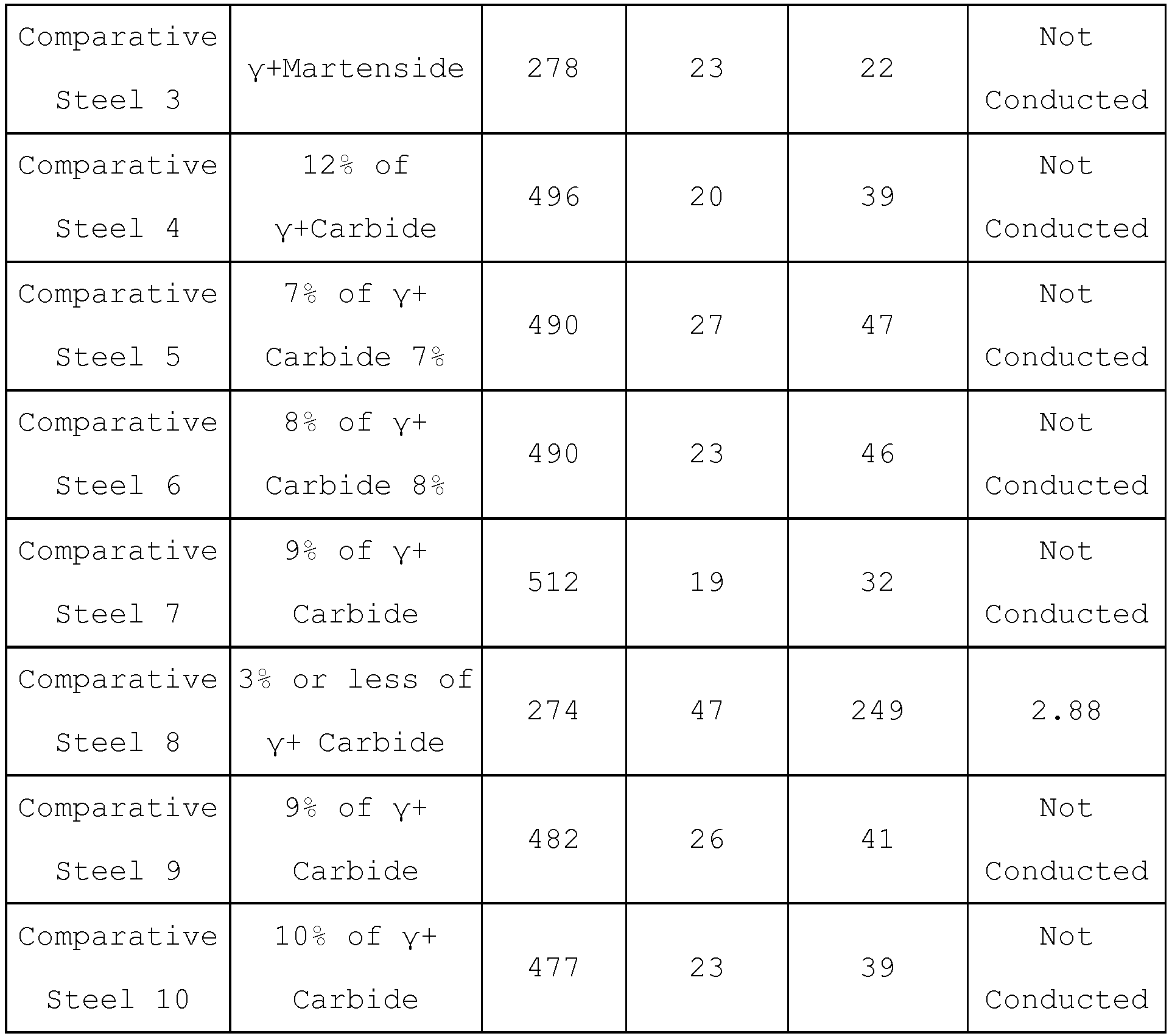
- As indicated in Tables 1 to 3, inventive steels 1 to 5 which satisfied overall composition systems and manufacturing conditions of the present disclosure had the amount of wear of 2.0g or less, which is excellent wear resistance, and secured impact toughness of 100J or higher.
- As for comparative steel 1, sufficient strength was not secured as a content of carbon was significantly low. Accordingly, the amount of wear exceeded 2.0g, a reference value . In comparative steel 2, carbides increased due to excessive addition of carbon, and accordingly, comparative steel 2 had low impact toughness.
- As for comparative steel 3, a stable austenite phase was not formed due to insufficient content of manganese, and as martensite was formed, comparative steel 3 had low impact toughness. Also, comparative steel 4 had low impact toughness due to excessive content of chromium.
- Comparative steels 5 to 10 did not satisfy the heat treatment condition ranges such that comparative steels 5 to 10 had low impact toughness due to excessive residue and precipitation of carbides. Also, when the heat treatment was excessively performed, strength decreased due to coarsening of an austenite grain such that wear resistance decreased.
- Also, as indicated in
FIG. 1 showing microstructure images of inventive steel 4 before and after the heat treatment, in the hot-rolled steel material before the heat treatment, carbides were precipitated along the austenite grain boundary, but after the heat treatment, a fully austenitic structure with sufficient solute carbides was obtained. - While exemplary embodiments have been shown and described above, the scope of the present disclosure is not limited thereto, and it will be apparent to those skilled in the art that modifications and variations could be made without departing from the scope of the present invention as defined by the appended claims.
Claims (11)
- An austenitic steel material having excellent wear resistance and toughness, comprising:by wt%, 0.6 to 1.9% of carbon, 12 to 22% of manganese, 5% or less of chromium, excluding 0%, 5% or less of copper, excluding 0%, 0.5% or less of aluminum, excluding 0%, 1.0% or less of silicon, excluding 0%, 0.1% or less of phosphorous, including 0%, 0.02% or less of sulfur, including 0%, and a balance of Fe and inevitable impurities,wherein the austenitic steel material comprises, by an area fraction, austenite of 97% or higher, including 100% and carbides of 3% or lower, including 0%, as a microstructure.
- The austenitic steel material of claim 1, wherein a grain size of austenite is 500 µm or less.
- The austenitic steel material of claim 1, wherein a thickness of the steel material is 4 to 50mm.
- The austenitic steel material of claim 1, wherein the steel material has a wear amount of 2.0g or less and impact toughness of 100J or higher.
- A method of manufacturing an austenitic steel material having excellent wear resistance and toughness, comprising:preparing a slab comprising, by wt%, 0.6 to 1.9% of carbon, 12 to 22% of manganese, 5% or less of chromium, excluding 0%, 5% or less of copper, excluding 0%, 0.5% or less of aluminum, excluding 0%, 1.0% or less of silicon, excluding 0%, 0.1% or less of phosphorous, including 0%, 0.02% or less of sulfur, including 0%, and a balance of Fe and inevitable impurities;reheating the slab at 1050°C or higher;obtaining a hot-rolled steel material by hot-rolling the reheated slab at a finish rolling temperature of 800°C or higher; andperforming a heat treatment in which the hot-rolled steel material is maintained for a maintaining time, minutes, satisfying Relational Expression 2, at a heat treatment temperature, T, satisfying Relational Expression 1 below, and the hot-rolled steel material is water-cooled to 500°C or lower at a cooling speed of 10°C/sec or higher,


- The method of claim 5, wherein a temperature of the reheating the slab is 1050 to 1250°C.
- The method of claim 5, wherein a finish rolling temperature of the hot-rolling is 800°C or higher and a non-recrystallization temperature, Tnr, or lower.
- The method of claim 5, wherein a thickness of the hot-rolled steel material is 4 to 50mm.
- The method of claim 5, wherein the steel material has a microstructure comprising, by an area fraction, austenite of 97% or higher, including 100%, and carbides of 3% or lower, including 0%.
- The method of claim 9, wherein a grain size of austenite is 500 µm or less.
- The method of claim 9, wherein the steel material has a wear amount of 2.0g or less and impact toughness of 100J or higher.
Applications Claiming Priority (2)
| Application Number | Priority Date | Filing Date | Title |
|---|---|---|---|
| KR1020160178235A KR101917473B1 (en) | 2016-12-23 | 2016-12-23 | Austenitic steel having excellent wear resistance and toughness and method for manufacturing thereof |
| PCT/KR2017/015211 WO2018117676A1 (en) | 2016-12-23 | 2017-12-21 | Austenite steel material having superb abrasion resistance and toughness, and method for producing same |
Publications (2)
| Publication Number | Publication Date |
|---|---|
| EP3561120A1 true EP3561120A1 (en) | 2019-10-30 |
| EP3561120A4 EP3561120A4 (en) | 2019-11-13 |
Family
ID=62626859
Family Applications (1)
| Application Number | Title | Priority Date | Filing Date |
|---|---|---|---|
| EP17882436.3A Withdrawn EP3561120A4 (en) | 2016-12-23 | 2017-12-21 | Austenite steel material having superb abrasion resistance and toughness, and method for producing same |
Country Status (7)
| Country | Link |
|---|---|
| US (1) | US11566308B2 (en) |
| EP (1) | EP3561120A4 (en) |
| JP (1) | JP6980788B2 (en) |
| KR (1) | KR101917473B1 (en) |
| CN (1) | CN110114493B (en) |
| CA (1) | CA3047956C (en) |
| WO (1) | WO2018117676A1 (en) |
Cited By (1)
| Publication number | Priority date | Publication date | Assignee | Title |
|---|---|---|---|---|
| WO2021087576A1 (en) * | 2019-11-07 | 2021-05-14 | Weir Minerals Australia Ltd | Alloy for high-stress gouging abrasion |
Families Citing this family (7)
| Publication number | Priority date | Publication date | Assignee | Title |
|---|---|---|---|---|
| KR102020381B1 (en) * | 2017-12-22 | 2019-09-10 | 주식회사 포스코 | Steel having excellent wear resistnat properties and method for manufacturing the same |
| KR102164074B1 (en) | 2018-12-19 | 2020-10-13 | 주식회사 포스코 | Steel material for brake disc of motor vehicle having excellent wear resistance and high temperature strength and method of manufacturing the same |
| KR102488498B1 (en) * | 2019-12-19 | 2023-01-19 | 주식회사 포스코 | Austenite based steel for disc brake having execellent wear resistance at high temperature and method for manufacturing the same |
| CN116745454A (en) * | 2020-12-21 | 2023-09-12 | 浦项股份有限公司 | Austenitic high manganese steel for disc brakes |
| EP4532785A1 (en) * | 2022-06-02 | 2025-04-09 | ArcelorMittal | High manganese hot rolled steel and a method of production thereof |
| CN116083813A (en) * | 2023-01-05 | 2023-05-09 | 鞍钢集团矿业有限公司 | N microalloyed high manganese steel and heat treatment method and application thereof |
| CN117660849B (en) * | 2024-01-31 | 2024-06-04 | 成都先进金属材料产业技术研究院股份有限公司 | Phosphorus-controlled 00Cr21Ni13Mn5N high-nitrogen austenitic stainless steel and production method thereof |
Family Cites Families (22)
| Publication number | Priority date | Publication date | Assignee | Title |
|---|---|---|---|---|
| JPS5844725B2 (en) | 1978-03-01 | 1983-10-05 | 住友金属工業株式会社 | Manufacturing method of non-magnetic steel wire and steel bar |
| JPH06128631A (en) | 1992-10-20 | 1994-05-10 | Nippon Steel Corp | Method for producing high manganese ultra high strength steel with excellent low temperature toughness |
| KR100320959B1 (en) * | 1996-12-30 | 2002-06-20 | 전선기 | METHOD FOR MANUFACTURING HIGH Mn-STEEL EXCELLENT IN IMPACT TOUGHNESS AT ULTRA LOW TEMPERATURE |
| US6572713B2 (en) | 2000-10-19 | 2003-06-03 | The Frog Switch And Manufacturing Company | Grain-refined austenitic manganese steel casting having microadditions of vanadium and titanium and method of manufacturing |
| FR2857980B1 (en) | 2003-07-22 | 2006-01-13 | Usinor | PROCESS FOR MANUFACTURING HIGH-STRENGTH FERRO-CARBON-MANGANESE AUSTENITIC STEEL SHEET, EXCELLENT TENACITY AND COLD SHAPINGABILITY, AND SHEETS THUS PRODUCED |
| JP4324072B2 (en) * | 2004-10-21 | 2009-09-02 | 新日本製鐵株式会社 | Lightweight high strength steel with excellent ductility and its manufacturing method |
| BRPI0419185A (en) | 2004-11-03 | 2007-12-18 | Thyssenkrupp Steel Ag | steel plate or tape of superior strength, having twip properties, and process for its manufacture by direct strip casting |
| FR2878257B1 (en) * | 2004-11-24 | 2007-01-12 | Usinor Sa | PROCESS FOR MANUFACTURING AUSTENITIC STEEL SHEET, FER-CARBON-MANGANIZED WITH VERY HIGH RESISTANCE AND ELONGATION CHARACTERISTICS, AND EXCELLENT HOMOGENEITY |
| EP1878811A1 (en) * | 2006-07-11 | 2008-01-16 | ARCELOR France | Process for manufacturing iron-carbon-manganese austenitic steel sheet with excellent resistance to delayed cracking, and sheet thus produced |
| KR101080727B1 (en) | 2009-03-24 | 2011-11-07 | 기아자동차주식회사 | Ultra-high strength twip steel sheets and the manufacturing method thereof |
| JP5406686B2 (en) * | 2009-11-30 | 2014-02-05 | 株式会社神戸製鋼所 | Non-magnetic steel |
| EP2520684B9 (en) | 2009-12-28 | 2017-01-04 | Posco | Austenite steel material having superior ductility |
| KR20120065464A (en) | 2010-12-13 | 2012-06-21 | 주식회사 포스코 | Austenitic lightweight high strength hot rolled steel sheet having excellent yield-ratio and ductility and method for manufacturing the same |
| RU2013124834A (en) | 2011-02-24 | 2015-03-27 | Киоо Соо РО | METHOD FOR MAKING A MULTI-LEVEL MEMBER MANAGEMENT SERVICE |
| JP5618932B2 (en) * | 2011-07-22 | 2014-11-05 | 株式会社神戸製鋼所 | Non-magnetic steel wire rod or bar, and method for producing the same |
| WO2013100613A1 (en) | 2011-12-28 | 2013-07-04 | 주식회사 포스코 | Wear resistant austenitic steel having superior machinability and ductility method for producing same |
| US20140261918A1 (en) * | 2013-03-15 | 2014-09-18 | Exxonmobil Research And Engineering Company | Enhanced wear resistant steel and methods of making the same |
| US10597760B2 (en) | 2013-07-26 | 2020-03-24 | Nippon Steel Corporation | High-strength steel material for oil well and oil well pipes |
| KR20150075305A (en) | 2013-12-25 | 2015-07-03 | 주식회사 포스코 | Steels for low temperature services having superior yield strength and method for production thereof |
| KR101543916B1 (en) * | 2013-12-25 | 2015-08-11 | 주식회사 포스코 | Steels for low temperature services having superior deformed surface quality and method for production thereof |
| KR20160075927A (en) * | 2014-12-19 | 2016-06-30 | 주식회사 포스코 | The steel sheet having excellent strength and toughness at the center of thickness and method for manufacturing the same |
| KR101647227B1 (en) * | 2014-12-24 | 2016-08-10 | 주식회사 포스코 | Low temperature steels having superior surface quality and method for production thereof |
-
2016
- 2016-12-23 KR KR1020160178235A patent/KR101917473B1/en active Active
-
2017
- 2017-12-21 WO PCT/KR2017/015211 patent/WO2018117676A1/en not_active Ceased
- 2017-12-21 EP EP17882436.3A patent/EP3561120A4/en not_active Withdrawn
- 2017-12-21 CN CN201780078825.7A patent/CN110114493B/en active Active
- 2017-12-21 JP JP2019533453A patent/JP6980788B2/en active Active
- 2017-12-21 US US16/471,874 patent/US11566308B2/en active Active
- 2017-12-21 CA CA3047956A patent/CA3047956C/en active Active
Cited By (4)
| Publication number | Priority date | Publication date | Assignee | Title |
|---|---|---|---|---|
| WO2021087576A1 (en) * | 2019-11-07 | 2021-05-14 | Weir Minerals Australia Ltd | Alloy for high-stress gouging abrasion |
| CN114787407A (en) * | 2019-11-07 | 2022-07-22 | 伟尔矿物澳大利亚私人有限公司 | Alloy for high stress gouging erosion |
| CN114787407B (en) * | 2019-11-07 | 2023-10-17 | 伟尔矿物澳大利亚私人有限公司 | Alloy for high stress gouging abrasion |
| AU2020378914B2 (en) * | 2019-11-07 | 2023-11-02 | Weir Minerals Australia Ltd | Alloy for high-stress gouging abrasion |
Also Published As
| Publication number | Publication date |
|---|---|
| KR101917473B1 (en) | 2018-11-09 |
| WO2018117676A1 (en) | 2018-06-28 |
| EP3561120A4 (en) | 2019-11-13 |
| JP6980788B2 (en) | 2021-12-15 |
| CN110114493B (en) | 2021-09-03 |
| CA3047956C (en) | 2023-03-14 |
| US20200140981A1 (en) | 2020-05-07 |
| CN110114493A (en) | 2019-08-09 |
| US11566308B2 (en) | 2023-01-31 |
| CA3047956A1 (en) | 2018-06-28 |
| KR20180074293A (en) | 2018-07-03 |
| JP2020509198A (en) | 2020-03-26 |
Similar Documents
| Publication | Publication Date | Title |
|---|---|---|
| US11566308B2 (en) | Austenitic steel material having excellent abrasion resistance and toughness and manufacturing method the same | |
| JP7018510B2 (en) | Wear-resistant steel with excellent hardness and impact toughness and its manufacturing method | |
| KR20140123111A (en) | Boron-added high strength bolt steel having excellent delayed fracture resistance and high strength bolt | |
| JP7368461B2 (en) | Wear-resistant steel with excellent hardness and impact toughness and its manufacturing method | |
| JP7508469B2 (en) | Ultra-high strength steel plate with excellent shear workability and its manufacturing method | |
| CN111511952B (en) | Wear-resistant steel having excellent hardness and impact toughness and method for manufacturing same | |
| JP6691967B2 (en) | High hardness and wear resistant steel excellent in toughness and cutting crack resistance, and method for producing the same | |
| CN110139942A (en) | High hardness wear-resistant steel and its manufacturing method | |
| CN108474089A (en) | Thick steel plate having excellent low-temperature toughness and hydrogen-induced cracking resistance and manufacturing method thereof | |
| CN111542637B (en) | High-strength austenite-based high-manganese steel and method for producing the same | |
| JP2018512509A (en) | Parts having a bainite structure having high strength characteristics and manufacturing method | |
| EP4265782A1 (en) | High-yield-ratio ultra-high-strength steel sheet having excellent thermal stability, and manufacturing method therefor | |
| KR101920973B1 (en) | Austenitic steel having excellent surface properties and method for manufacturing thereof | |
| WO2017144419A1 (en) | Hot formed part and method for producing it | |
| CN111448326A (en) | General ferritic stainless steel having excellent hot workability and method for manufacturing same | |
| EP4640903A1 (en) | Steel plate having high strength and excellent low-temperature impact toughness and method for manufacturing same | |
| KR101714929B1 (en) | Austenitic steel having excellent wear resistance and method for manufacturing the same | |
| KR102451005B1 (en) | High-strength steel sheet having excellent thermal stability and method for mnufacturing thereof | |
| KR101657824B1 (en) | Wear resistant steel having excellent middle and high temperature hardness and method for manufacturing the same | |
| EP4435136A1 (en) | Hot-rolled steel plate and steel tube having excellent abrasion resistance, and manufacturing method thereof | |
| KR20240105702A (en) | Hot rolled steel having high sour resistance and method of manufacturing the same | |
| KR20250101532A (en) | High strength hot rolled steel, method of manufacturing the same, and electric resistance welding pipe using the same | |
| KR20240101160A (en) | Medium carbon steel wire rod for shaft having good heat treatment property and method of manufacturing the same | |
| KR20220087847A (en) | Wire rod and parts with improved delayed fracture resisitance and method for manufacturing the same | |
| KR20140106961A (en) | Method for setting hot-rolling temperature |
Legal Events
| Date | Code | Title | Description |
|---|---|---|---|
| STAA | Information on the status of an ep patent application or granted ep patent |
Free format text: STATUS: THE INTERNATIONAL PUBLICATION HAS BEEN MADE |
|
| PUAI | Public reference made under article 153(3) epc to a published international application that has entered the european phase |
Free format text: ORIGINAL CODE: 0009012 |
|
| STAA | Information on the status of an ep patent application or granted ep patent |
Free format text: STATUS: REQUEST FOR EXAMINATION WAS MADE |
|
| 17P | Request for examination filed |
Effective date: 20190712 |
|
| AK | Designated contracting states |
Kind code of ref document: A1 Designated state(s): AL AT BE BG CH CY CZ DE DK EE ES FI FR GB GR HR HU IE IS IT LI LT LU LV MC MK MT NL NO PL PT RO RS SE SI SK SM TR |
|
| AX | Request for extension of the european patent |
Extension state: BA ME |
|
| A4 | Supplementary search report drawn up and despatched |
Effective date: 20191011 |
|
| RIC1 | Information provided on ipc code assigned before grant |
Ipc: C22C 38/20 20060101ALI20191007BHEP Ipc: C22C 38/38 20060101AFI20191007BHEP Ipc: C22C 38/00 20060101ALI20191007BHEP Ipc: C21D 8/02 20060101ALI20191007BHEP Ipc: C21D 1/18 20060101ALI20191007BHEP Ipc: C21D 1/60 20060101ALI20191007BHEP Ipc: C22C 38/06 20060101ALI20191007BHEP Ipc: C22C 38/02 20060101ALI20191007BHEP Ipc: C21D 9/46 20060101ALI20191007BHEP Ipc: C21D 6/00 20060101ALI20191007BHEP |
|
| DAV | Request for validation of the european patent (deleted) | ||
| DAX | Request for extension of the european patent (deleted) | ||
| STAA | Information on the status of an ep patent application or granted ep patent |
Free format text: STATUS: EXAMINATION IS IN PROGRESS |
|
| 17Q | First examination report despatched |
Effective date: 20200907 |
|
| STAA | Information on the status of an ep patent application or granted ep patent |
Free format text: STATUS: THE APPLICATION HAS BEEN WITHDRAWN |
|
| 18W | Application withdrawn |
Effective date: 20210108 |