EP3559780B1 - Verfahren und anordnung zur handhabung von haptischem feedback - Google Patents
Verfahren und anordnung zur handhabung von haptischem feedback Download PDFInfo
- Publication number
- EP3559780B1 EP3559780B1 EP16819917.2A EP16819917A EP3559780B1 EP 3559780 B1 EP3559780 B1 EP 3559780B1 EP 16819917 A EP16819917 A EP 16819917A EP 3559780 B1 EP3559780 B1 EP 3559780B1
- Authority
- EP
- European Patent Office
- Prior art keywords
- object model
- virtual object
- controller
- real object
- haptic
- Prior art date
- Legal status (The legal status is an assumption and is not a legal conclusion. Google has not performed a legal analysis and makes no representation as to the accuracy of the status listed.)
- Active
Links
Images




Classifications
-
- G—PHYSICS
- G06—COMPUTING OR CALCULATING; COUNTING
- G06F—ELECTRIC DIGITAL DATA PROCESSING
- G06F3/00—Input arrangements for transferring data to be processed into a form capable of being handled by the computer; Output arrangements for transferring data from processing unit to output unit, e.g. interface arrangements
- G06F3/01—Input arrangements or combined input and output arrangements for interaction between user and computer
- G06F3/011—Arrangements for interaction with the human body, e.g. for user immersion in virtual reality
-
- A—HUMAN NECESSITIES
- A63—SPORTS; GAMES; AMUSEMENTS
- A63F—CARD, BOARD, OR ROULETTE GAMES; INDOOR GAMES USING SMALL MOVING PLAYING BODIES; VIDEO GAMES; GAMES NOT OTHERWISE PROVIDED FOR
- A63F13/00—Video games, i.e. games using an electronically generated display having two or more dimensions
- A63F13/25—Output arrangements for video game devices
- A63F13/28—Output arrangements for video game devices responding to control signals received from the game device for affecting ambient conditions, e.g. for vibrating players' seats, activating scent dispensers or affecting temperature or light
-
- A—HUMAN NECESSITIES
- A63—SPORTS; GAMES; AMUSEMENTS
- A63F—CARD, BOARD, OR ROULETTE GAMES; INDOOR GAMES USING SMALL MOVING PLAYING BODIES; VIDEO GAMES; GAMES NOT OTHERWISE PROVIDED FOR
- A63F13/00—Video games, i.e. games using an electronically generated display having two or more dimensions
- A63F13/55—Controlling game characters or game objects based on the game progress
- A63F13/57—Simulating properties, behaviour or motion of objects in the game world, e.g. computing tyre load in a car race game
-
- G—PHYSICS
- G06—COMPUTING OR CALCULATING; COUNTING
- G06F—ELECTRIC DIGITAL DATA PROCESSING
- G06F3/00—Input arrangements for transferring data to be processed into a form capable of being handled by the computer; Output arrangements for transferring data from processing unit to output unit, e.g. interface arrangements
- G06F3/01—Input arrangements or combined input and output arrangements for interaction between user and computer
- G06F3/011—Arrangements for interaction with the human body, e.g. for user immersion in virtual reality
- G06F3/014—Hand-worn input/output arrangements, e.g. data gloves
-
- G—PHYSICS
- G06—COMPUTING OR CALCULATING; COUNTING
- G06F—ELECTRIC DIGITAL DATA PROCESSING
- G06F3/00—Input arrangements for transferring data to be processed into a form capable of being handled by the computer; Output arrangements for transferring data from processing unit to output unit, e.g. interface arrangements
- G06F3/01—Input arrangements or combined input and output arrangements for interaction between user and computer
- G06F3/016—Input arrangements with force or tactile feedback as computer generated output to the user
-
- G—PHYSICS
- G06—COMPUTING OR CALCULATING; COUNTING
- G06F—ELECTRIC DIGITAL DATA PROCESSING
- G06F3/00—Input arrangements for transferring data to be processed into a form capable of being handled by the computer; Output arrangements for transferring data from processing unit to output unit, e.g. interface arrangements
- G06F3/01—Input arrangements or combined input and output arrangements for interaction between user and computer
- G06F3/048—Interaction techniques based on graphical user interfaces [GUI]
- G06F3/0481—Interaction techniques based on graphical user interfaces [GUI] based on specific properties of the displayed interaction object or a metaphor-based environment, e.g. interaction with desktop elements like windows or icons, or assisted by a cursor's changing behaviour or appearance
- G06F3/04815—Interaction with a metaphor-based environment or interaction object displayed as three-dimensional [3D], e.g. changing the user viewpoint with respect to the environment or object
-
- G—PHYSICS
- G06—COMPUTING OR CALCULATING; COUNTING
- G06T—IMAGE DATA PROCESSING OR GENERATION, IN GENERAL
- G06T13/00—Animation
- G06T13/20—Three-dimensional [3D] animation
- G06T13/40—Three-dimensional [3D] animation of characters, e.g. humans, animals or virtual beings
-
- A—HUMAN NECESSITIES
- A63—SPORTS; GAMES; AMUSEMENTS
- A63F—CARD, BOARD, OR ROULETTE GAMES; INDOOR GAMES USING SMALL MOVING PLAYING BODIES; VIDEO GAMES; GAMES NOT OTHERWISE PROVIDED FOR
- A63F2300/00—Features of games using an electronically generated display having two or more dimensions, e.g. on a television screen, showing representations related to the game
- A63F2300/80—Features of games using an electronically generated display having two or more dimensions, e.g. on a television screen, showing representations related to the game specially adapted for executing a specific type of game
- A63F2300/8082—Virtual reality
Definitions
- the present disclosure relates to a method and arrangements for handling haptic feedback in a haptic feedback enabled system.
- the haptic Internet can be seen as a next step towards mobile networking. It is currently possible to communicate efficiently over both voice and video, but in a future networked society it is envisioned that people will be able to also communicate the sense of touch via suitable devices, commonly referred to as haptic devices.
- suitable devices commonly referred to as haptic devices.
- Mobile haptic devices are particularly relevant for various types of commercial applications, such as e.g. Virtual Reality (VR) and Augmented Reality (AR), where a complete immersion of the user is to be achieved.
- Haptic technology can be used for robotic surgery, as described e.g.
- Haptic perception can be described as comprising kinaesthetic and tactile sense and presently relates to the sensation of e.g. size, shape, mass, texture, friction, and stiffness objects or materials.
- Kinaesthetic information refers to the information perceived when moving joints, muscles and tendons
- tactile information refers to information retrieved via the skin, e.g. via a tactile glove.
- haptics One commercial application of haptics is to allow users to feel different objects/surfaces remotely.
- objects/surfaces are required to be rendered and displayed in real-time, where the physical and geometric characteristics are acquired by one or multiple sensors, e.g. by taking a photo with a camera and scratching a remotely located object with a smartphone and by acquiring and using signals captured by one of the smartphones sensors, such as an accelerometer, and the camera, to create a haptic model of the object.
- Objects/surfaces may also be virtual, where their physical and geometric characteristics are stored in one or multiple databases and retrieved by a haptic device and viewed on a visual device on request. The latter type of objects/surfaces may be visualised via a handheld device, such as e.g.
- a smartphone directly or may be viewed via any type of 2D or 3D display, including a Head Mounted Display (HMD).
- HMD Head Mounted Display
- a typical use case is that of a user that is interested in buying a product, such as e.g. a furniture, pillow or a tile.
- the user chooses to not only watch the product remotely via a homepage, but also wants to be able to remotely feel the physical and/or geometrical characteristics of the product, or at least a part of the product, to get a better and more complete impression of the product before making the final decision.
- a 3D visual model can typically be constructed from video, captured by a video camera, and depth data, captured by 3D sensors.
- the captured object is typically stored and displayed as point clouds or meshes.
- Point cloud models use vertices to describe all the points that compose the cloud, while a mesh is a collection of vertices edges and faces that define the shape of a polyhedral object.
- a haptic model is composed by geometrical and physical characteristics of the object, where a geometric component, such as e.g. shape or size, is typically encoded in depth data, captured by 3D sensors, while physical characteristics, such as e.g. stiffness, friction, temperature or texture, are typically defined for each point/surface of the geometric model.
- the physical properties are typically acquired by suitable sensors, such as e.g. accelerometers, force sensors, position sensors, cameras and spectrometers.
- a problem with an arrangement with applying haptic feedback as suggested above, is, however, that it can be difficult to provide haptic feedback of virtual objects from a haptic device in a sufficiently efficient and realistic manner.
- haptic feedback Another problem related to haptic feedback is that a virtual object is rendered "in the air", thereby requiring all haptic feedback to be provided by the haptic device. Furthermore, a user rendering a virtual object "in the air” is effected by the so called “gorilla arm syndrome", where the users arms typically will become tired after a very short time, typically within less than 90 seconds. Hence, there is a need to develop a method which do not require the user to always keep the arms unsupported in the air in order to be able to interact with a virtual object.
- a user does not have to render a virtual object in the air, but can render the object in a more relaxed manner, thanks to an assisting real object. Furthermore, actuation of actuators of a haptic device can be reduced, if a real object is used when rendering.
- a method for providing haptic feedback of virtual objects by combining the sensation provided by one or more haptic actuators actuating on a virtual object "on top of", or with the assistance of, a real object.
- a user wanting to render a virtual object haptically and visually can, instead of actuating with a haptic device in the free air, select a suitable real object to actuate on.
- suitable we here mean an object which have one or more characteristics which is/are similar to, or within a specific interval of, one or more corresponding characteristics of interest during rendering.
- the haptic device can be instructed to actuate according to the virtual object model, using the real object model as a reference, whereby the virtual object model is being modified based on the real object model in the region where the user is actuating on the real object with a haptic device.
- the actuators of the haptic device need to be actuated to a lesser extent, which results in less power consumption at the haptic rendering device.
- the user will be able to actuate in a more relaxed manner on the real object, and will be provided with haptic feedback from real objects instead of emulated haptic feedback, hence improving the user experience.
- geometric characteristics of real objects can be fully or partially utilized as long as a suitable real object is chosen. Although the given examples are limited to making use of geometric characteristics, it is to be understood that use of real objects can improve user experience and/or power consumption efficiency also with respect to other characteristics, including physical properties such as e.g. stiffness, friction or texture.
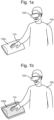
- Fig. 1a is illustrating a user 100, wearing a visual device, here represented by a Head Mounted Device (HMD) 120, for visually rendering a virtual object (not shown), when actuating on a real object 130a, via a haptic device, here represented by a haptic glove 110 worn by the user 100.
- HMD 120 is used to exemplify the visual device
- a haptic glove 110 is used as a haptic device
- the suggested mechanism can be applied when using any type of visual device, including 2D or 3D devices, which can be used in combination with a haptic device, as well as any type of haptic device, such as e.g.
- a joystick which can be used in combination with a visual device, as shown herein. It is also to be understood that this document has a focus on the haptic rendering of a virtual object, whereas the visual rendering, being executed in parallel to the haptic rendering, is executed according to any conventional visual rendering technique, which, as such, is out of scope of this presentation.
- the real object 130a is to be selected so that it has certain characteristics which are sufficiently similar to the corresponding characteristics of a virtual object of interest, i.e. within a certain range, to be handled by the respective actuator/s of the haptic device 110.
- objects located in the vicinity of the user 100 or which can be located by the user 100 in a certain way are registered in a database or any other storage.
- Fig. 1b is illustrating the same user 100 as in Fig. 1a , wearing the same HMD 120 and the same haptic glove 110. However, while the user 100 of Fig. 1a is actuating on the real object 130a, Fig. 1b is illustrating the virtual object 130b which is actually seen by the user 100 via the HMD 120 when actuating on the real object 130a, via the haptic glove 110. It is to be understood that the real object 130a used by the user 100 shall be selected based on characteristics which are relevant for the haptic rendering experience, such that, if e.g.
- a real object having at least a region with a similar texture should be chosen, while in case instead the friction of a surface of a virtual object is of interest, the real object to be chosen should have a similar friction.
- similar we here mean a property lying within a certain, acceptable range.
- FIG. 2a is illustrating a user's finger 200, wearing a haptic glove 210, moving over a surface 220 of a real object, in a conventional manner, i.e. without rendering any virtual object.
- the user When no haptic functionality is activated in the haptic glove 201, the user, to at least some extent, can feel the shape and texture of the surface 220 through the haptic glove 210.
- Fig 2b is illustrating another scenario, where a user has activated the haptic glove 201, so that the surface of a virtual object can be rendered.
- the figure is showing a surface of a real object 220b where one or more actuators, here represented by actuator 240, is/are actuating on the user's finger 200 so that, when the user is moving the finger 200 over the surface of a virtual object 230b, making use of a surface of a real object 220b, the two surfaces are basically following each other in regions A-C.
- the actuator 240 will not need to be actuated in region A and C, while a very moderate actuation is needed in region B.
- region D the real surface 220b goes flat, while the virtual object surface 230b, takes on a more irregular shape, meaning that more, varying actuation is needed by actuator 240. Still, even in region D, the use of the real object 220b will result in that the required actuation of actuator 240 will be less than what would have been the case without use of the real object 220b.
- Fig. 2c is illustrating another scenario, where a curved real object surface 220c is used when a user's finger 200 is moved over the real object surface 220c and a flat virtual object surface 230c.
- This scenario describes how it is possible to switch between using the method suggested herein and rendering in a conventional way.
- the activation of the actuator 240 will oscillate depending on the variation between the two surfaces, and the user will experience a very flat, virtual surface, when moving along the curvy real object surface 220c.
- a real object is used when the users finger is moving over regions A, C and E, while it is assume that the difference between the virtual object and the real object are too big in the remaining regions, meaning that, in regions B, D and F the haptic glove 210 is used in a conventional way.
- Fig. 2d is showing yet another scenario, showing that a real object, which to a large extent differs considerably from a virtual object, still can be usable for rendering if a sufficient part of the real object is found to have similar characteristics, i.e. also when only a specific part of the real object needs to be used for rendering.
- a real object surface 220d has a curved shape in region A-C, while the surface is very flat in region D.
- a virtual object, having surface 230d which is very similar in shape to the real object 220d, does only exist in region D. Even though the real object 220d does not seem to be suitable when actuating on virtual object 230d in most of the shown regions, it is very suitable in region D, where minor or no actuation at all is needed.
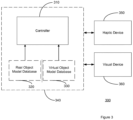
- Fig 3 is a schematic overview of a system 300, configured to execute the mechanism, as described herein, for capturing and processing visual and haptic data.
- the system 300 comprise a controller 310, which may have access to a first database, here referred to as a real object model database 320, which is storing, models of real objects, from hereinafter referred to as real object models of real objects which can be used when rendering a virtual object with assistance of a real object, and a second database, here referred to as a virtual object model database 330, which is storing virtual object models, available for rendering.
- a first database here referred to as a real object model database 320
- real object models of real objects from hereinafter referred to as real object models of real objects which can be used when rendering a virtual object with assistance of a real object
- a second database here referred to as a virtual object model database 330, which is storing virtual object models, available for rendering.
- databases 320,330 Even though illustrated as separate databases 320,330, it is to be understood that, alternatively one single database, or more than two databases, may be used, as long as models of real object, as well as virtual objects, can be accessible by the server 310.
- relevant data of a real object model and/or a virtual object model is acquired by the controller directly from an application or from the haptic device. In the latter case no real object model database and/or virtual object model database will be required.
- the complexity of the two mentioned models may vary, both with respect to the detail of description of a complete object, as well as level of detail of different parts of the object.
- the controller 310 and the one or more databases 320,330 form part of a server 340, or any other type of network node, capable of providing a mechanism as described herein, is connected to storage means capable of storing the databases if one or both of the mentioned databases are used.
- the controller 310 is also capable of interacting with a haptic device 350 and a visual device 360, where the visual device comprises a display for visually displaying a virtual object to a user, to retrieve data from one or more databases 320,330 and/or from the haptic 350 and visual device 330 so that visual and haptic information can be rendered accordingly to a user as the user is interacting with a stored virtual object with assistance of a real object.
- 3D objects can e.g. be stored and rendered as point clouds or as meshes on a 3D display.
- Point cloud models use vertices to describe all the points that compose a point cloud, while a mesh constitutes a collection of vertices, edges and faces that define the shape of a polyhedral object.
- the controller 310 form part of the visual device 330 or the haptic device 350.
- the mentioned controlling functionality 310 can be distributed over two or more of the server 340, the haptic device 350 and the visual device 360.
- a real object can e.g. be captured, using a camera of the visual device, after which the real object is identified as a specific real object to which a real object model is accessible to the server.
- the haptic device is configured to provide haptic feedback to a user, based on a haptic object model.
- a haptic object model is typically composed of geometric and physical characteristics of a scene, object or plurality of objects, selected by a user. Geometric characteristics, such as e.g. form, size etc., are typically captured by 3D sensors, while physical characteristics, such as e.g. stiffness, texture, friction, force etc., are typically acquired from suitable sensors, such as e.g. accelerometers, force and position sensors, cameras etc.
- a method executable by a processor such as the one mentioned above, will now be described in further detail with respect to the flow chart of Fig 4a .
- an application capable of executing the suggested method, is run on the processor.
- data of a virtual object model is acquired by the processor. This is typically achieved by a user, browsing on a web page or an application, selecting a virtual object to be rendered. If a real object is to be used when rendering the selected virtual object, also a real object is selected by the user. Alternatively, such a selection is done completely or partly automatically by the processor.
- a user having selected a virtual object may enter one or more characteristics, such as e.g.
- a real object model is acquired. Again object models of real objects available to the user may be selected manually or provided automatically or semi-automatically to the user, thereby enabling the user or processor, or a combination of both, to select a suitable real object.
- the user may have the option to enter characteristics of interest, where these characteristics can be compared to characteristics of real objects, stored in the real object model database or any other data source. Again any type of conventional user interface can be used for manually entering such options.
- a match between the virtual object model and the selected real object model is executed, as indicated with step 4:40.
- Such a match will typically include limiting of the virtual object model and real object model to a specific area or region of the two object, in order to provide a correct and advantageous user experience with respect to the selected one or more characteristics.
- a limitation could be achieved by way of executing an automatic or semi-automatic procedure. More specifically, a user may, during the mentioned matching procedure, select a certain part of a product for further investigation, or, based on user input, the processor may be configured to choose a specific region for which relevant capabilities are advantageous for a positive user experience.
- one or more most preferred real object will be available.
- this real object can be selected, as indicated with step 4:50, while if this is not the case, the user will instead need to render the virtual object without any assistance of any real object, i.e. in a conventional way.
- Whether or not a real object is usable may depend on issues such as e.g. capabilities of the haptic device, and/or the quality of the data provided to the processor.
- the virtual object model is modified with respect to the selected and user real object.
- one or more characteristics can be weighted higher e.g. if selected previously by the user or the system.
- the modified virtual object model can now be used for rending the selected virtual object with assistance of the selected real object.
- step 4:100 in Fig. 4a the described process is repeated as long as there are more haptic data, together with associated position data.
- the process may also offer the user to change real object to use during rendering, as indicated with step 4:80 and/or to change virtual object to render, as indicated with step 4:90.
- step 4:50 may comprise the further action of determining whether the selected real object model is usable. If the required conditions are not fulfilled, no modifications of the virtual object model will be executed in step 4:60 and instead the unmodified virtual object model will be applied in a conventional manner.
- the suggested method can be applied when applicable, while it is bypassed in e.g. regions of a real object where the quality of the real object model is below a certain threshold value.
- Different real objects may also be used for different parts of a virtual object.
- insufficient quality of a real object, or a result from step 4:50 which does not fulfil predefined minimum requirements, may result in that in step 4:90, another, more suitable real object is suggested to the user.
- the suggested method can be restarted from step 4:10, using the new real object on the respective section of the virtual object.
- Fig. 4b is showing a method for considering a real object when rendering a virtual object according to alternative embodiments. Only the two optional steps 4:30 and 4:70, which differs from Fig 4a , will be described herein, where one, or both of these optional steps, can be applied.
- step 4:30 of Fig. 4b data indicative of actuation is received from a haptic device, together with relevant positioning data, indicating the position of the haptic device on the two objects. This is applicable e.g. when only a specific, limited region of the mentioned objects is to be rendered.
- step 4:70 of Fig. 4b indicates how the modified virtual object model is provided to a haptic device, typically by transmitting this data to the haptic device and the display device.
- a user wants to visually and haptically explore a new sofa before deciding whether or not to buy it online.
- the relevant virtual characteristics of the sofa are therefore retrieved as a part of a virtual object model via an application, running on, or in association with, a visual device, such as e.g. a HMD.
- a visual device such as e.g. a HMD.
- the user also is equipped with a haptic device, e.g. one haptic glove or a pair of haptic gloves, which allow the user to feel wanted characteristics of the sofa.
- the user may be located at home, where a variety of real objects are available and where the respective real object models are stored in a home server or in a database, available to the application.
- the user may e.g.
- the described method can be executed accordingly.
- the processor acquires relevant data, which data is used to modify the virtual object model, such that the real object can be used, as described above.
- the modified virtual object model to be used as input by the rendering device will only indicate the mismatch between the virtual and the real object, instead of completely considering the virtual object model.
- the selected cushion has smaller dimensions than the sofa and is geometrically different, only a limited flat part of the sofa is selected for rendering. This part may e.g. be specifically indicated visually to the user.
- the HDM visually renders the correct colour of the virtual object, in order to allow the user to get the impression that he or she is actually both seeing and touching the virtual sofa, instead of the real cushion available at the user's location.
- the actuation required at the haptic actuators, actuating based on the modified virtual object model can be reduced, since the haptic actuators will not have to render the complete virtual object texture.
- the haptic actuators will not have to render the complete virtual object texture.
- the user resting his or her hand on the cushion during rendering, will not go tired in the used arm or arms as soon as would have been the case if rendering free in the air with the haptic device.
- the user experience is improved, since 90% of the texture felt by the user is a real object texture rather than an emulated texture.
- the haptic device initially communicates its characteristics, such as e.g. one or more of an indication of available actuators, type of actuators, range of amplitude and/or frequency for texture rendering, range of friction coefficients, range of stiffness coefficients or range of temperature feedback, to the controller.
- the haptic device may also communicate its battery levels to the processor, which may e.g. be used such that the described process is automatically activated when the battery level is below a certain battery level.
- the processor specifies only certain specific characteristics to the haptic device, so that only those characteristics are provided to the processor.
- the mentioned searching and matching for a suitable real object can be executed with respect to one or more features of characteristics of the two models. Selection of such characteristics may, as already mentioned, be selected by the user, may be pre-defined or may depend on the characteristics of a haptic device used by the user. In the latter case, characteristics to consider may e.g. depend on type of available actuators, current battery level or the impact one or more of the actuators have on the energy consumption of the haptic device during rendering. Characteristics may also be considered as a combination of the mentioned alternatives, such that e.g. some characteristics are automatically chosen by default, enabling the user to make correction to the automatic choice more or less manually.
- the process mentioned above is performed so that the number of active actuators of the haptic device is minimized, while the matching of the models exceeds a specific threshold level.
- the selection is made with a focus on minimization of the energy consumption, while the matching of the models exceeds a specific threshold level.
- the focus instead lies on maximizing the matching between one or more selected characteristics.
- a focus instead lies on the distance of the user and the real objects.
- the real object for which one or more characteristics exceeds a respective threshold, that is located closest to the user is selected.
- only real objects within reach of the user could be considered.
- a specific characteristics such as e.g. texture or friction, that is of particular importance for the rendering is selected.
- exploration of a selected virtual object can be executed only considering the selected characteristics.
- a haptic device may be able to operate within an interval X ⁇ [Xmin, Xmax] of specific characteristics of a selected virtual object, while a real object, available to the user, is able to provide a level Y of that same feature.
- the mentioned reasoning is only valid for Y ⁇ V, since the haptic device is normally unable to remove or subtract haptic characteristics, but is normally only able to add haptic characteristics on top of the respective real object model characteristics.
- the values of the haptic object, as well as the real object characteristics are assumed to be invariant in space and time. However, these parameters may be space dependent, i.e. X(p), V(p), Y(p), V*(p), where p disclose 2D or 3D coordinates of an object in space.
- variables X, V, Y and V* are given without specifying if they are fixed, dynamic and/or space dependent.
- V* V - Y ⁇ ⁇ , where ⁇ is a setup parameter, determining when such haptic characteristics are removed from a virtual object.
- ⁇ is a setup parameter, determining when such haptic characteristics are removed from a virtual object.
- the given parameter ⁇ is given by human perception limitations, which is defined as a Just Noticeable Difference (JND), and which is documented for several haptic characteristics in the art. In this way, further energy reduction can be performed.
- JND Just Noticeable Difference
- the real object provides a level Y of friction, here low friction, while the virtual object of interest requires a level V > Y of friction, here higher friction.
- the same principle will be used for providing other characteristics, such as e.g. texture or temperature.
- Haptic feedback with respect to stiffness can e.g. be obtained via the Phantom Omni, the Exo Glove or NormalTouch.
- Characteristics, such as friction and texture can e.g. be provided via the previously mentioned devices, as well as with the Tactai Touch or the GloveOne haptic glove device.
- Haptic temperature related feedback may be provided by temperature actuators, added to the devices mentioned above.
- the controller contains and loads the real object models of all objects located within a radius, Z, around the user.
- the user's position is retrieved using sensors placed in the HDM, the haptic device or other devices.
- the server is able to perform a better suggestion of which real object the user should interact with.
- the controller 500 of Fig. 5 comprise at least one processor, here represented by one processor 510, and a memory 520, where the at least one processor 510 is a central processing unit (CPU), multiprocessor, microcontroller, or a digital signal processor (DSP), which is capable of executing instructions, or executable code, stored in the memory 520.
- the at least one processor 510 may be configured as one or more application specific integrated circuits (ASIC), or as one or more field programmable gate arrays (FPGA).
- the memory 520 may e.g. comprise magnetic memory, optical memory, solid state memory or even remotely mounted memory.
- the controller 500 also comprises communication means for enabling communication between the processor 500 and haptic and visual devices (not shown), here illustrated as a first communication interface 530a, e.g. serving as a receiving interface, and a second communication interface 530b, e.g. serving as a transmitting interface.
- Communication may be provided via any type of conventional wireless or wireline communication, such as e.g. Wifi, Bluetooth and/or cellular communication.
- the processor 510 when instructions are executed by the processor 510, the processor 510 is configured to cause the controller 500 to acquire a virtual object model of a relevant virtual object, selected by a user, and to acquire at least one real object model of a relevant real object.
- the real object model can be acquired manually, automatically, or as a combination of both.
- the processor 510 is also caused to match at least a part of the virtual object model to at least a part of one of the at least one real object model, according to at least one matching criteria. Based on the matching, it is possible to determining whether or not an available real object can be used for assisting rendering of a virtual object. If one or more real objects are considered to be usable, the controller 500 is caused to select the best matching real object. Which real object that is considered to be the best object depends on the criteria which is used in the matching procedure. Next the controller 500 is caused to modify at least a part of the virtual object model with respect to the at least part of the selected real object model.
- the controller may be configured to acquire the virtual object model from a database, which may form part of, or be accessible to, the controller or a rendering device, which is in connection with the controller.
- the real object model may be acquired from a database, such as e.g. a real object model database.
- the controller 500 may be configured to use haptic device characteristics as matching criteria.
- the applied criteria is mutually weighted, so that criteria can be considered according to its considered relevance.
- a number of different considerations can be taken, alone or in combination. Such considerations may include e.g. choosing a match which results in a minimizing of the number of actuators of the haptic device that need to be considered. According to an alternative embodiment, instead the energy consumption may be minimized, with respect to one or more haptic device characteristics. According to yet another embodiment, instead a maximizing of a match between one or more haptic device characteristics is decisive, while, according to yet another embodiment, the distance between the haptic device and the real objects is considered so that, e.g. the closest located object, fulfilling at least a minimum requirement is selected.
- the controller is configured to modify the virtual object model according to the applied criteria, so that actual actuation needed by a haptic device is reduced with respect to a real object model, whenever a real object is considered to be useful.
- the controller is configured to execute such a modification by subtracting haptic device characteristics of the real object model from the virtual object model. Once the modification has been executed, the controller will be able to participate in the rendering of the virtual object e.g. by applying the modified model on a rendering device. This can e.g. be achieved by providing or transmitting the modified virtual object model to a haptic device. If the controller receives data, indicating actuation on a real object, together with positioning data, indicating the position of the actuation on the real object, such information will be modified as described above, so that rendering can be compensated for, accordingly.
- a first acquiring module 610 is configured to acquire a virtual object model, corresponding to step 4:10 of Fig. 4a and 4b
- a second acquiring module 620 is configured to acquire a real object model, corresponding to step 4:20 of fig 4a and 4b
- a matching module 630 is configured to match the acquired virtual object model with the acquired real object model, corresponding to step 4:40 of Fig 4a and 4b
- a selecting module 640 is configured to select a best matching real object, based on the applied selection criteria, corresponding to step 4:50 of Fig.
- a modifying module 660 is configured to modify the virtual object model, which also comprise a receiving module 650, configured to receive data from rendering devices, and possibly also configured to receive data indicative of actuation and positioning data from a haptic device, so that such data can be matched accordingly, corresponding to step 4:30 of Fig 4b .
- the controller 600 comprises a transmitting module 670, configured to transmit data to rendering devices, which may include transmission of modified virtual object model to the haptic device.
- a computer program 530 comprising executable instructions, which when run by a controller 500 causes the controller 500 to execute the functionality as described above is also suggested.
- a computer program 530 is provided as a computer program product 540 on which the mentioned computer program 530 is stored, and may e.g. be provided in the form of an optical disc, such as e.g. a Compact Disc (CD), a Digital Versatile Disc (DVD) or a Blu-Ray disc.
- the computer program product 540 can alternatively be provided as a memory, such as e.g.
- RAM random access memory
- ROM read-only memory
- EPROM erasable programmable read-only memory
- EEPROM electrically erasable programmable read-only memory
- RAM random access memory
- ROM read-only memory
- EPROM erasable programmable read-only memory
- EEPROM electrically erasable programmable read-only memory
- nonvolatile storage medium of a device in an external memory such as e.g. a USB (Universal Serial Bus) memory or a Flash memory, such as e.g. a compact Flash memory.
- USB Universal Serial Bus
- Flash memory such as e.g. a compact Flash memory.
- modules suitable to execute any of the methods described above may be configured in a plurality of alternative ways in order to be able to execute the suggested procedure actions.
Landscapes
- Engineering & Computer Science (AREA)
- General Engineering & Computer Science (AREA)
- Theoretical Computer Science (AREA)
- Human Computer Interaction (AREA)
- Physics & Mathematics (AREA)
- General Physics & Mathematics (AREA)
- Multimedia (AREA)
- User Interface Of Digital Computer (AREA)
Claims (17)
- Verfahren, ausgeführt in einer Steuereinheit, zum Anpassen des Modells eines virtuellen Objekts, umfassend:- Erfassen (4:10) eines Modells eines virtuellen Objekts eines virtuellen Objekts;- Erfassen (4:20) zumindest eines Modells eines realen Objekts eines realen Objekts;- Abstimmen (4:40), gemäß zumindest einem Abstimmungskriterium, zumindest eines Teils des Modells eines virtuellen Objekts mit zumindest einem Teil eines des zumindest einen Modells eines realen Objekts, wobei die Abstimmungskriterien ein haptisches Merkmal umfassen;- Auswählen (4:50) des Modells eines realen Objekts, welches am besten mit dem zumindest einen Teil des Modells eines virtuellen Objekts abgestimmt ist, und- Modifizieren (4:60) des zumindest einen Teils des Modells eines virtuellen Objekts in Bezug auf den zumindest einen Teil des ausgewählten Modells eines realen Objekts,dadurch gekennzeichnet, dass der modifizierte Teil des Modells eines virtuellen Objekts nur die Nichtabstimmung zwischen dem Modell eines virtuellen Objekts und dem ausgewählten Modell eines realen Objekts angibt.
- Verfahren nach Anspruch 1, wobei das Modell eines virtuellen Objekts aus einer Datenbank einer beliebigen von der Steuereinheit oder einer für die Steuereinheit zugänglichen Renderingvorrichtung erfasst wird oder für diese zugänglich ist.
- Verfahren nach einem der vorstehenden Ansprüche, wobei die Abstimmungskriterien zumindest ein Merkmal einer haptischen Vorrichtung umfassen.
- Verfahren nach Anspruch 3, wobei die Abstimmungskriterien eine Vielzahl von Merkmalen einer haptischen Vorrichtung umfassen, wobei die Merkmale einer haptischen Vorrichtung gemäß berücksichtigter Relevanz gewichtet sind.
- Verfahren nach Anspruch 3 oder 4, wobei das Abstimmen Bestimmen der besten Abstimmung zwischen dem zumindest einen Teil des Modells eines virtuellen Objekts und dem zumindest einen Teil des zumindest einen Modells eines realen Objekts durch Berücksichtigen zumindest eines der folgenden umfasst:- Minimieren der Zahl der Betätiger der haptischen Vorrichtung, welche berücksichtigt werden müssen;- Minimieren des zum Rendern benötigten Energieverbrauchs in Bezug auf ein oder mehrere der Merkmale einer haptischen Vorrichtung;- Maximieren des Abstimmens eines oder mehrerer Merkmale einer haptischen Vorrichtung zwischen den Modellen eines realen Objekts und dem Modell eines virtuellen Objekts, oder- Bestimmen des realen Objekts, welches sich der haptischen Vorrichtung am nächsten befindet, für welche eine Abstimmungsstufe erhalten wird.
- Steuereinheit (600) zum Anpassen des Modells eines virtuellen Objekts, wobei die Steuereinheit (600) umfasst:- ein erstes Erfassungsmodul (610) zum Erfassen des Modells eines virtuellen Objekts eines virtuellen Objekts;- ein zweites Erfassungsmodul (620) zum Erfassen zumindest eines Modells eines realen Objekts eines realen Objekts;- ein Abstimmungsmodul (630) zum Abstimmen, gemäß zumindest einem Abstimmungskriterium, zumindest eines Teils des Modells eines virtuellen Objekts mit zumindest einem Teil eines des zumindest einen Modells eines realen Objekts, wobei die Abstimmungskriterien ein haptisches Merkmal umfassen;- ein Auswahlmodul (640) zum Auswählen des Modells eines realen Objekts, welches am besten mit dem zumindest einen Teil des Modells eines virtuellen Objekts abgestimmt ist, und- ein Modifizierungsmodul (660) zum Modifizieren des zumindest einen Teils des Modells eines virtuellen Objekts in Bezug auf den zumindest einen Teil des ausgewählten Modells eines realen Objekts,dadurch gekennzeichnet, dass der modifizierte Teil des Modells eines virtuellen Objekts nur die Nichtabstimmung zwischen dem Modell eines virtuellen Objekts und dem ausgewählten Modell eines realen Objekts angibt.
- Steuereinheit (500) nach Anspruch 6, wobei die Steuereinheit (500) konfiguriert ist, um das Modell eines virtuellen Objekts aus einer Datenbank (330) einer beliebigen von der Steuereinheit (500) oder einer für die Steuereinheit zugänglichen Renderingvorrichtung (350, 360) zu erfassen oder für diese zugänglich ist.
- Steuereinheit (500) nach Anspruch 6 oder 7, wobei die Steuereinheit (500) konfiguriert ist, um zumindest ein Modell eines realen Objekts aus einer Datenbank (320) zu erfassen.
- Steuereinheit (500) nach einem der Ansprüche 6-8, wobei die Steuereinheit (500) konfiguriert ist, um zumindest ein Merkmal einer haptischen Vorrichtung als Abstimmungskriterien zu verwenden.
- Steuereinheit (500) nach Anspruch 8, wobei die Steuereinheit (500) konfiguriert ist, um Abstimmungskriterien zu berücksichtigen, welche eine Vielzahl von Merkmalen einer haptischen Vorrichtung umfassen, wobei die Merkmale einer haptischen Vorrichtung gemäß berücksichtigter Relevanz gewichtet sind.
- Steuereinheit (500) nach Anspruch 8 oder 9, wobei die Steuereinheit (500) konfiguriert ist, um das Abstimmen durch Bestimmen der besten Abstimmung zwischen dem zumindest einen Teil des Modells eines virtuellen Objekts und dem zumindest einen Teil des zumindest einen Modells eines realen Objekts durch Berücksichtigen zumindest eines der folgenden auszuführen:- Minimieren der Zahl der Betätiger der haptischen Vorrichtung (350), welche berücksichtigt werden müssen;- Minimieren des zum Rendern benötigten Energieverbrauchs in Bezug auf ein oder mehrere der Merkmale einer haptischen Vorrichtung;- Maximieren des Abstimmens eines oder mehrerer Merkmale einer haptischen Vorrichtung zwischen den Modellen eines realen Objekts und dem Modell eines virtuellen Objekts, oder- Bestimmen des realen Objekts, welches sich der haptischen Vorrichtung (350) am nächsten befindet, für welche eine Abstimmungsstufe erhalten wird.
- Steuereinheit (500) nach einem der Ansprüche 6-11, wobei die Steuereinheit (500) konfiguriert ist, um die Modifizierung durch Subtrahieren eines bestimmten Werts zumindest eines Merkmals einer haptischen Vorrichtung des ausgewählten realen Objekts von einem zugehörigen Wert des virtuellen Objekts auszuführen.
- Steuereinheit (500) nach einem der Ansprüche 6-11, wobei die Steuereinheit (500) konfiguriert ist, um standortabhängige Informationen, welche anzeigen, wo in der Renderingvorrichtung das modifizierte Modell eines virtuellen Objekts gerendert werden soll, an eine Renderingvorrichtung zu übertragen, welche für die Steuereinheit zugänglich ist.
- Steuereinheit (500) nach einem der Ansprüche 6-13, wobei die Steuereinheit (500) konfiguriert ist, um von einer haptischen Vorrichtung (350) Daten zu empfangen, welche Betätigung in dem realen Objekt und eine Position von Betätigung in dem realen Objekt anzeigen.
- Steuereinheit (500) nach einem der Ansprüche 6-14, wobei die Steuereinheit (500) konfiguriert ist, um das modifizierte Modells eines virtuellen Objekts für eine haptische Vorrichtung bereitzustellen.
- Computerprogramm (530) zum Anpassen des Modells eines virtuellen Objekts, wobei das Computerprogramm (600) ausführbare Anweisungen umfasst, welche, wenn von einer Steuereinheit (500, 600) ausgeführt, die Steuereinheit (500, 600) veranlassen:- das Modell eines virtuellen Objekts eines virtuellen Objekts zu erfassen;- zumindest ein Modell eines realen Objekts eines realen Objekts zu erfassen;- gemäß zumindest einem Abstimmungskriterium zumindest einen Teil des Modells eines virtuellen Objekts mit zumindest einem Teil eines des zumindest einen Modells eines realen Objekts abzustimmen, wobei die Abstimmungskriterien ein haptisches Merkmal umfassen;- das Modell eines realen Objekts auszuwählen, welches am besten mit dem zumindest einen Teil des Modells eines virtuellen Objekts abgestimmt ist, und- den zumindest einen Teil des Modells eines virtuellen Objekts in Bezug auf den zumindest einen Teil des ausgewählten Modells eines realen Objekts zu modifizieren,dadurch gekennzeichnet, dass der modifizierte Teil des Modells eines virtuellen Objekts nur die Nichtabstimmung zwischen dem Modell eines virtuellen Objekts und dem ausgewählten Modell eines realen Objekts angibt.
- Computerprogrammprodukt (540), umfassend ein Computerprogramm (530) nach Anspruch 16 und ein computerlesbares Speichermedium (520), auf welchem das Computerprogramm gespeichert ist.
Applications Claiming Priority (1)
| Application Number | Priority Date | Filing Date | Title |
|---|---|---|---|
| PCT/EP2016/082183 WO2018113952A1 (en) | 2016-12-21 | 2016-12-21 | A method and arrangement for handling haptic feedback |
Publications (2)
| Publication Number | Publication Date |
|---|---|
| EP3559780A1 EP3559780A1 (de) | 2019-10-30 |
| EP3559780B1 true EP3559780B1 (de) | 2023-02-01 |
Family
ID=57681591
Family Applications (1)
| Application Number | Title | Priority Date | Filing Date |
|---|---|---|---|
| EP16819917.2A Active EP3559780B1 (de) | 2016-12-21 | 2016-12-21 | Verfahren und anordnung zur handhabung von haptischem feedback |
Country Status (4)
| Country | Link |
|---|---|
| US (3) | US11204643B2 (de) |
| EP (1) | EP3559780B1 (de) |
| CN (2) | CN110100222B (de) |
| WO (1) | WO2018113952A1 (de) |
Families Citing this family (5)
| Publication number | Priority date | Publication date | Assignee | Title |
|---|---|---|---|---|
| EP3559780B1 (de) | 2016-12-21 | 2023-02-01 | Telefonaktiebolaget LM Ericsson (PUBL) | Verfahren und anordnung zur handhabung von haptischem feedback |
| US20200026354A1 (en) * | 2018-07-17 | 2020-01-23 | Immersion Corporation | Adaptive haptic effect rendering based on dynamic system identification |
| CN112634462A (zh) * | 2020-12-21 | 2021-04-09 | 上海影创信息科技有限公司 | Ar眼镜的温度匹配增强真实感方法和系统 |
| US12541281B2 (en) * | 2022-09-07 | 2026-02-03 | Meta Platforms Technologies, Llc | Opportunistic adaptive tangible user interfaces for use in extended reality environments |
| CN115454250B (zh) * | 2022-09-20 | 2024-11-26 | 北京字跳网络技术有限公司 | 用于增强现实交互的方法、装置、设备和存储介质 |
Citations (1)
| Publication number | Priority date | Publication date | Assignee | Title |
|---|---|---|---|---|
| WO2017044398A1 (en) * | 2015-09-09 | 2017-03-16 | Microsoft Technology Licensing, Llc | Tactile interaction in virtual environments |
Family Cites Families (23)
| Publication number | Priority date | Publication date | Assignee | Title |
|---|---|---|---|---|
| US8010180B2 (en) * | 2002-03-06 | 2011-08-30 | Mako Surgical Corp. | Haptic guidance system and method |
| US20060209019A1 (en) * | 2004-06-01 | 2006-09-21 | Energid Technologies Corporation | Magnetic haptic feedback systems and methods for virtual reality environments |
| DE102005027203A1 (de) * | 2005-06-13 | 2006-12-14 | Mühlburger, Nobert | Haptik-Benutzerschnittstelle, Eingabeelement, insbesondere Eingabestift, für die Haptik-Benutzerschnittstelle, System und Verfahren zum Modellieren von mehrdimensionalen Objekten auf Grundlage der Haptik-Benutzerschnittstelle |
| US8819591B2 (en) * | 2009-10-30 | 2014-08-26 | Accuray Incorporated | Treatment planning in a virtual environment |
| JP2014149712A (ja) * | 2013-02-01 | 2014-08-21 | Sony Corp | 情報処理装置、端末装置、情報処理方法及びプログラム |
| US10281987B1 (en) * | 2013-08-09 | 2019-05-07 | Leap Motion, Inc. | Systems and methods of free-space gestural interaction |
| CN106456250B (zh) * | 2013-08-13 | 2019-10-08 | 波士顿科学国际有限公司 | 解剖项的计算机可视化 |
| US9645654B2 (en) * | 2013-12-04 | 2017-05-09 | Leap Motion, Inc. | Initializing predictive information for free space gesture control and communication |
| US9740296B2 (en) * | 2013-12-16 | 2017-08-22 | Leap Motion, Inc. | User-defined virtual interaction space and manipulation of virtual cameras in the interaction space |
| CN106133796B (zh) * | 2014-03-25 | 2019-07-16 | 苹果公司 | 用于在真实环境的视图中表示虚拟对象的方法和系统 |
| US9746984B2 (en) * | 2014-08-19 | 2017-08-29 | Sony Interactive Entertainment Inc. | Systems and methods for providing feedback to a user while interacting with content |
| US20160133230A1 (en) * | 2014-11-11 | 2016-05-12 | Bent Image Lab, Llc | Real-time shared augmented reality experience |
| US20160170508A1 (en) * | 2014-12-11 | 2016-06-16 | Toyota Motor Engineering & Manufacturing North America, Inc. | Tactile display devices |
| US10353532B1 (en) * | 2014-12-18 | 2019-07-16 | Leap Motion, Inc. | User interface for integrated gestural interaction and multi-user collaboration in immersive virtual reality environments |
| US9478109B2 (en) * | 2014-12-29 | 2016-10-25 | Immersion Corporation | Virtual sensor in a virtual environment |
| US9767613B1 (en) * | 2015-01-23 | 2017-09-19 | Leap Motion, Inc. | Systems and method of interacting with a virtual object |
| US9696795B2 (en) * | 2015-02-13 | 2017-07-04 | Leap Motion, Inc. | Systems and methods of creating a realistic grab experience in virtual reality/augmented reality environments |
| US9911232B2 (en) * | 2015-02-27 | 2018-03-06 | Microsoft Technology Licensing, Llc | Molding and anchoring physically constrained virtual environments to real-world environments |
| US9836117B2 (en) * | 2015-05-28 | 2017-12-05 | Microsoft Technology Licensing, Llc | Autonomous drones for tactile feedback in immersive virtual reality |
| US10048769B2 (en) * | 2015-11-18 | 2018-08-14 | Ted Selker | Three-dimensional computer-aided-design system user interface |
| US20180053351A1 (en) * | 2016-08-19 | 2018-02-22 | Intel Corporation | Augmented reality experience enhancement method and apparatus |
| US10504295B2 (en) * | 2016-09-27 | 2019-12-10 | Duke University | Systems and methods for using sensing of real object position, trajectory, or attitude to enable user interaction with a virtual object |
| EP3559780B1 (de) * | 2016-12-21 | 2023-02-01 | Telefonaktiebolaget LM Ericsson (PUBL) | Verfahren und anordnung zur handhabung von haptischem feedback |
-
2016
- 2016-12-21 EP EP16819917.2A patent/EP3559780B1/de active Active
- 2016-12-21 WO PCT/EP2016/082183 patent/WO2018113952A1/en not_active Ceased
- 2016-12-21 CN CN201680091758.8A patent/CN110100222B/zh active Active
- 2016-12-21 US US16/470,783 patent/US11204643B2/en active Active
- 2016-12-21 CN CN202410272104.1A patent/CN118034499A/zh active Pending
-
2021
- 2021-10-12 US US17/499,342 patent/US11675439B2/en active Active
-
2023
- 2023-05-08 US US18/313,969 patent/US12197651B2/en active Active
Patent Citations (1)
| Publication number | Priority date | Publication date | Assignee | Title |
|---|---|---|---|---|
| WO2017044398A1 (en) * | 2015-09-09 | 2017-03-16 | Microsoft Technology Licensing, Llc | Tactile interaction in virtual environments |
Also Published As
| Publication number | Publication date |
|---|---|
| EP3559780A1 (de) | 2019-10-30 |
| US20220026991A1 (en) | 2022-01-27 |
| US11204643B2 (en) | 2021-12-21 |
| US20230273685A1 (en) | 2023-08-31 |
| CN110100222B (zh) | 2024-03-29 |
| WO2018113952A1 (en) | 2018-06-28 |
| US11675439B2 (en) | 2023-06-13 |
| CN118034499A (zh) | 2024-05-14 |
| CN110100222A (zh) | 2019-08-06 |
| US20190339777A1 (en) | 2019-11-07 |
| US12197651B2 (en) | 2025-01-14 |
Similar Documents
| Publication | Publication Date | Title |
|---|---|---|
| US11675439B2 (en) | Method and arrangement for handling haptic feedback | |
| JP7540112B2 (ja) | 視野周辺の視覚的背光 | |
| US11681372B2 (en) | Touch enabling process, haptic accessory, and core haptic engine to enable creation and delivery of tactile-enabled experiences with virtual objects | |
| US12541281B2 (en) | Opportunistic adaptive tangible user interfaces for use in extended reality environments | |
| JP2017182495A (ja) | 情報処理装置、情報処理方法及びプログラム | |
| US12316804B2 (en) | Method for and a communication device adapted to modify the shape of the device | |
| Guo et al. | Synchronous mixed reality (SMR): A personalized virtual‐real fusion framework with high immersion and effective interaction | |
| CN115755636A (zh) | 一种设备控制方法、装置、电子设备及存储介质 | |
| JP2019133533A (ja) | 情報処理装置、情報処理方法、および、情報処理装置用プログラム | |
| CN112558776A (zh) | 基于虚拟现实环境的人机交互方法及装置 | |
| Costes et al. | Haptic material: A holistic approach for haptic texture mapping | |
| WO2022201922A1 (ja) | 情報処理装置、情報処理方法及び情報処理システム | |
| US20250390198A1 (en) | Techniques for presenting augmented-reality content in multiple presentation modes based on real-world context, and devices, systems, and methods thereof | |
| US20260010236A1 (en) | Using a gesture to invoke or banish an ai assistant, and systems and methods of use thereof | |
| JP2026074866A (ja) | システム | |
| WO2024263168A1 (en) | Reconstruction of user avatars in virtual apparel assistant | |
| JP2026070195A (ja) | システム | |
| WO2025212715A1 (en) | Electrical stimulation from a wristband with augmented reality visual effects for remote haptic sensations in the hand, and systems and methods of use thereof | |
| JP2021105778A (ja) | 触感提示システム、触感提示システムのローカル端末およびサーバ装置ならびに触感提示方法および触感提示プログラム | |
| WO2026055210A1 (en) | Methods for presenting route guidance at an augmented reality headset and devices and systems thereof | |
| JP4513620B2 (ja) | 情報処理装置、情報処理装置におけるデータ呈示方法 | |
| Kurosu | Human-Computer |
Legal Events
| Date | Code | Title | Description |
|---|---|---|---|
| STAA | Information on the status of an ep patent application or granted ep patent |
Free format text: STATUS: UNKNOWN |
|
| STAA | Information on the status of an ep patent application or granted ep patent |
Free format text: STATUS: THE INTERNATIONAL PUBLICATION HAS BEEN MADE |
|
| PUAI | Public reference made under article 153(3) epc to a published international application that has entered the european phase |
Free format text: ORIGINAL CODE: 0009012 |
|
| STAA | Information on the status of an ep patent application or granted ep patent |
Free format text: STATUS: REQUEST FOR EXAMINATION WAS MADE |
|
| 17P | Request for examination filed |
Effective date: 20190610 |
|
| AK | Designated contracting states |
Kind code of ref document: A1 Designated state(s): AL AT BE BG CH CY CZ DE DK EE ES FI FR GB GR HR HU IE IS IT LI LT LU LV MC MK MT NL NO PL PT RO RS SE SI SK SM TR |
|
| AX | Request for extension of the european patent |
Extension state: BA ME |
|
| DAV | Request for validation of the european patent (deleted) | ||
| DAX | Request for extension of the european patent (deleted) | ||
| STAA | Information on the status of an ep patent application or granted ep patent |
Free format text: STATUS: EXAMINATION IS IN PROGRESS |
|
| 17Q | First examination report despatched |
Effective date: 20210407 |
|
| GRAP | Despatch of communication of intention to grant a patent |
Free format text: ORIGINAL CODE: EPIDOSNIGR1 |
|
| STAA | Information on the status of an ep patent application or granted ep patent |
Free format text: STATUS: GRANT OF PATENT IS INTENDED |
|
| RIC1 | Information provided on ipc code assigned before grant |
Ipc: A63F 13/57 20140101ALI20220530BHEP Ipc: A63F 13/28 20140101ALI20220530BHEP Ipc: G06F 3/04815 20220101ALI20220530BHEP Ipc: G06F 3/01 20060101AFI20220530BHEP |
|
| INTG | Intention to grant announced |
Effective date: 20220617 |
|
| RIN1 | Information on inventor provided before grant (corrected) |
Inventor name: TAYAMON, SOMA Inventor name: ANDERSSON, LARS Inventor name: ARAUJO, JOSE |
|
| GRAJ | Information related to disapproval of communication of intention to grant by the applicant or resumption of examination proceedings by the epo deleted |
Free format text: ORIGINAL CODE: EPIDOSDIGR1 |
|
| STAA | Information on the status of an ep patent application or granted ep patent |
Free format text: STATUS: EXAMINATION IS IN PROGRESS |
|
| INTC | Intention to grant announced (deleted) | ||
| GRAS | Grant fee paid |
Free format text: ORIGINAL CODE: EPIDOSNIGR3 |
|
| STAA | Information on the status of an ep patent application or granted ep patent |
Free format text: STATUS: GRANT OF PATENT IS INTENDED |
|
| GRAA | (expected) grant |
Free format text: ORIGINAL CODE: 0009210 |
|
| STAA | Information on the status of an ep patent application or granted ep patent |
Free format text: STATUS: THE PATENT HAS BEEN GRANTED |
|
| AK | Designated contracting states |
Kind code of ref document: B1 Designated state(s): AL AT BE BG CH CY CZ DE DK EE ES FI FR GB GR HR HU IE IS IT LI LT LU LV MC MK MT NL NO PL PT RO RS SE SI SK SM TR |
|
| REG | Reference to a national code |
Ref country code: GB Ref legal event code: FG4D |
|
| REG | Reference to a national code |
Ref country code: CH Ref legal event code: EP Ref country code: AT Ref legal event code: REF Ref document number: 1547086 Country of ref document: AT Kind code of ref document: T Effective date: 20230215 |
|
| REG | Reference to a national code |
Ref country code: DE Ref legal event code: R096 Ref document number: 602016077717 Country of ref document: DE |
|
| REG | Reference to a national code |
Ref country code: IE Ref legal event code: FG4D |
|
| REG | Reference to a national code |
Ref country code: LT Ref legal event code: MG9D |
|
| REG | Reference to a national code |
Ref country code: NL Ref legal event code: MP Effective date: 20230201 |
|
| P01 | Opt-out of the competence of the unified patent court (upc) registered |
Effective date: 20230523 |
|
| REG | Reference to a national code |
Ref country code: AT Ref legal event code: MK05 Ref document number: 1547086 Country of ref document: AT Kind code of ref document: T Effective date: 20230201 |
|
| PG25 | Lapsed in a contracting state [announced via postgrant information from national office to epo] |
Ref country code: RS Free format text: LAPSE BECAUSE OF FAILURE TO SUBMIT A TRANSLATION OF THE DESCRIPTION OR TO PAY THE FEE WITHIN THE PRESCRIBED TIME-LIMIT Effective date: 20230201 Ref country code: PT Free format text: LAPSE BECAUSE OF FAILURE TO SUBMIT A TRANSLATION OF THE DESCRIPTION OR TO PAY THE FEE WITHIN THE PRESCRIBED TIME-LIMIT Effective date: 20230601 Ref country code: NO Free format text: LAPSE BECAUSE OF FAILURE TO SUBMIT A TRANSLATION OF THE DESCRIPTION OR TO PAY THE FEE WITHIN THE PRESCRIBED TIME-LIMIT Effective date: 20230501 Ref country code: NL Free format text: LAPSE BECAUSE OF FAILURE TO SUBMIT A TRANSLATION OF THE DESCRIPTION OR TO PAY THE FEE WITHIN THE PRESCRIBED TIME-LIMIT Effective date: 20230201 Ref country code: LV Free format text: LAPSE BECAUSE OF FAILURE TO SUBMIT A TRANSLATION OF THE DESCRIPTION OR TO PAY THE FEE WITHIN THE PRESCRIBED TIME-LIMIT Effective date: 20230201 Ref country code: LT Free format text: LAPSE BECAUSE OF FAILURE TO SUBMIT A TRANSLATION OF THE DESCRIPTION OR TO PAY THE FEE WITHIN THE PRESCRIBED TIME-LIMIT Effective date: 20230201 Ref country code: HR Free format text: LAPSE BECAUSE OF FAILURE TO SUBMIT A TRANSLATION OF THE DESCRIPTION OR TO PAY THE FEE WITHIN THE PRESCRIBED TIME-LIMIT Effective date: 20230201 Ref country code: ES Free format text: LAPSE BECAUSE OF FAILURE TO SUBMIT A TRANSLATION OF THE DESCRIPTION OR TO PAY THE FEE WITHIN THE PRESCRIBED TIME-LIMIT Effective date: 20230201 Ref country code: AT Free format text: LAPSE BECAUSE OF FAILURE TO SUBMIT A TRANSLATION OF THE DESCRIPTION OR TO PAY THE FEE WITHIN THE PRESCRIBED TIME-LIMIT Effective date: 20230201 |
|
| PG25 | Lapsed in a contracting state [announced via postgrant information from national office to epo] |
Ref country code: SE Free format text: LAPSE BECAUSE OF FAILURE TO SUBMIT A TRANSLATION OF THE DESCRIPTION OR TO PAY THE FEE WITHIN THE PRESCRIBED TIME-LIMIT Effective date: 20230201 Ref country code: PL Free format text: LAPSE BECAUSE OF FAILURE TO SUBMIT A TRANSLATION OF THE DESCRIPTION OR TO PAY THE FEE WITHIN THE PRESCRIBED TIME-LIMIT Effective date: 20230201 Ref country code: IS Free format text: LAPSE BECAUSE OF FAILURE TO SUBMIT A TRANSLATION OF THE DESCRIPTION OR TO PAY THE FEE WITHIN THE PRESCRIBED TIME-LIMIT Effective date: 20230601 Ref country code: GR Free format text: LAPSE BECAUSE OF FAILURE TO SUBMIT A TRANSLATION OF THE DESCRIPTION OR TO PAY THE FEE WITHIN THE PRESCRIBED TIME-LIMIT Effective date: 20230502 Ref country code: FI Free format text: LAPSE BECAUSE OF FAILURE TO SUBMIT A TRANSLATION OF THE DESCRIPTION OR TO PAY THE FEE WITHIN THE PRESCRIBED TIME-LIMIT Effective date: 20230201 |
|
| PG25 | Lapsed in a contracting state [announced via postgrant information from national office to epo] |
Ref country code: SM Free format text: LAPSE BECAUSE OF FAILURE TO SUBMIT A TRANSLATION OF THE DESCRIPTION OR TO PAY THE FEE WITHIN THE PRESCRIBED TIME-LIMIT Effective date: 20230201 Ref country code: RO Free format text: LAPSE BECAUSE OF FAILURE TO SUBMIT A TRANSLATION OF THE DESCRIPTION OR TO PAY THE FEE WITHIN THE PRESCRIBED TIME-LIMIT Effective date: 20230201 Ref country code: EE Free format text: LAPSE BECAUSE OF FAILURE TO SUBMIT A TRANSLATION OF THE DESCRIPTION OR TO PAY THE FEE WITHIN THE PRESCRIBED TIME-LIMIT Effective date: 20230201 Ref country code: DK Free format text: LAPSE BECAUSE OF FAILURE TO SUBMIT A TRANSLATION OF THE DESCRIPTION OR TO PAY THE FEE WITHIN THE PRESCRIBED TIME-LIMIT Effective date: 20230201 Ref country code: CZ Free format text: LAPSE BECAUSE OF FAILURE TO SUBMIT A TRANSLATION OF THE DESCRIPTION OR TO PAY THE FEE WITHIN THE PRESCRIBED TIME-LIMIT Effective date: 20230201 |
|
| REG | Reference to a national code |
Ref country code: DE Ref legal event code: R097 Ref document number: 602016077717 Country of ref document: DE |
|
| PG25 | Lapsed in a contracting state [announced via postgrant information from national office to epo] |
Ref country code: SK Free format text: LAPSE BECAUSE OF FAILURE TO SUBMIT A TRANSLATION OF THE DESCRIPTION OR TO PAY THE FEE WITHIN THE PRESCRIBED TIME-LIMIT Effective date: 20230201 |
|
| PLBE | No opposition filed within time limit |
Free format text: ORIGINAL CODE: 0009261 |
|
| STAA | Information on the status of an ep patent application or granted ep patent |
Free format text: STATUS: NO OPPOSITION FILED WITHIN TIME LIMIT |
|
| 26N | No opposition filed |
Effective date: 20231103 |
|
| PG25 | Lapsed in a contracting state [announced via postgrant information from national office to epo] |
Ref country code: SI Free format text: LAPSE BECAUSE OF FAILURE TO SUBMIT A TRANSLATION OF THE DESCRIPTION OR TO PAY THE FEE WITHIN THE PRESCRIBED TIME-LIMIT Effective date: 20230201 |
|
| PG25 | Lapsed in a contracting state [announced via postgrant information from national office to epo] |
Ref country code: IT Free format text: LAPSE BECAUSE OF FAILURE TO SUBMIT A TRANSLATION OF THE DESCRIPTION OR TO PAY THE FEE WITHIN THE PRESCRIBED TIME-LIMIT Effective date: 20230201 |
|
| REG | Reference to a national code |
Ref country code: CH Ref legal event code: PL |
|
| PG25 | Lapsed in a contracting state [announced via postgrant information from national office to epo] |
Ref country code: LU Free format text: LAPSE BECAUSE OF NON-PAYMENT OF DUE FEES Effective date: 20231221 |
|
| PG25 | Lapsed in a contracting state [announced via postgrant information from national office to epo] |
Ref country code: MC Free format text: LAPSE BECAUSE OF FAILURE TO SUBMIT A TRANSLATION OF THE DESCRIPTION OR TO PAY THE FEE WITHIN THE PRESCRIBED TIME-LIMIT Effective date: 20230201 |
|
| REG | Reference to a national code |
Ref country code: BE Ref legal event code: MM Effective date: 20231231 |
|
| PG25 | Lapsed in a contracting state [announced via postgrant information from national office to epo] |
Ref country code: MC Free format text: LAPSE BECAUSE OF FAILURE TO SUBMIT A TRANSLATION OF THE DESCRIPTION OR TO PAY THE FEE WITHIN THE PRESCRIBED TIME-LIMIT Effective date: 20230201 Ref country code: LU Free format text: LAPSE BECAUSE OF NON-PAYMENT OF DUE FEES Effective date: 20231221 |
|
| REG | Reference to a national code |
Ref country code: IE Ref legal event code: MM4A |
|
| PG25 | Lapsed in a contracting state [announced via postgrant information from national office to epo] |
Ref country code: IE Free format text: LAPSE BECAUSE OF NON-PAYMENT OF DUE FEES Effective date: 20231221 |
|
| PG25 | Lapsed in a contracting state [announced via postgrant information from national office to epo] |
Ref country code: BE Free format text: LAPSE BECAUSE OF NON-PAYMENT OF DUE FEES Effective date: 20231231 |
|
| PG25 | Lapsed in a contracting state [announced via postgrant information from national office to epo] |
Ref country code: FR Free format text: LAPSE BECAUSE OF NON-PAYMENT OF DUE FEES Effective date: 20231231 |
|
| PG25 | Lapsed in a contracting state [announced via postgrant information from national office to epo] |
Ref country code: CH Free format text: LAPSE BECAUSE OF NON-PAYMENT OF DUE FEES Effective date: 20231231 |
|
| PG25 | Lapsed in a contracting state [announced via postgrant information from national office to epo] |
Ref country code: IE Free format text: LAPSE BECAUSE OF NON-PAYMENT OF DUE FEES Effective date: 20231221 Ref country code: FR Free format text: LAPSE BECAUSE OF NON-PAYMENT OF DUE FEES Effective date: 20231231 Ref country code: CH Free format text: LAPSE BECAUSE OF NON-PAYMENT OF DUE FEES Effective date: 20231231 Ref country code: BE Free format text: LAPSE BECAUSE OF NON-PAYMENT OF DUE FEES Effective date: 20231231 |
|
| PG25 | Lapsed in a contracting state [announced via postgrant information from national office to epo] |
Ref country code: BG Free format text: LAPSE BECAUSE OF FAILURE TO SUBMIT A TRANSLATION OF THE DESCRIPTION OR TO PAY THE FEE WITHIN THE PRESCRIBED TIME-LIMIT Effective date: 20230201 |
|
| PG25 | Lapsed in a contracting state [announced via postgrant information from national office to epo] |
Ref country code: BG Free format text: LAPSE BECAUSE OF FAILURE TO SUBMIT A TRANSLATION OF THE DESCRIPTION OR TO PAY THE FEE WITHIN THE PRESCRIBED TIME-LIMIT Effective date: 20230201 |
|
| PG25 | Lapsed in a contracting state [announced via postgrant information from national office to epo] |
Ref country code: CY Free format text: LAPSE BECAUSE OF FAILURE TO SUBMIT A TRANSLATION OF THE DESCRIPTION OR TO PAY THE FEE WITHIN THE PRESCRIBED TIME-LIMIT; INVALID AB INITIO Effective date: 20161221 |
|
| PG25 | Lapsed in a contracting state [announced via postgrant information from national office to epo] |
Ref country code: HU Free format text: LAPSE BECAUSE OF FAILURE TO SUBMIT A TRANSLATION OF THE DESCRIPTION OR TO PAY THE FEE WITHIN THE PRESCRIBED TIME-LIMIT; INVALID AB INITIO Effective date: 20161221 |
|
| PG25 | Lapsed in a contracting state [announced via postgrant information from national office to epo] |
Ref country code: TR Free format text: LAPSE BECAUSE OF FAILURE TO SUBMIT A TRANSLATION OF THE DESCRIPTION OR TO PAY THE FEE WITHIN THE PRESCRIBED TIME-LIMIT Effective date: 20230201 |
|
| PGFP | Annual fee paid to national office [announced via postgrant information from national office to epo] |
Ref country code: GB Payment date: 20251229 Year of fee payment: 10 |
|
| PGFP | Annual fee paid to national office [announced via postgrant information from national office to epo] |
Ref country code: DE Payment date: 20251229 Year of fee payment: 10 |