EP3558237B1 - System for targeted application of topical agents to an isolated body part - Google Patents
System for targeted application of topical agents to an isolated body part Download PDFInfo
- Publication number
- EP3558237B1 EP3558237B1 EP17851940.1A EP17851940A EP3558237B1 EP 3558237 B1 EP3558237 B1 EP 3558237B1 EP 17851940 A EP17851940 A EP 17851940A EP 3558237 B1 EP3558237 B1 EP 3558237B1
- Authority
- EP
- European Patent Office
- Prior art keywords
- membrane
- applicator
- body part
- skin
- membranes
- Prior art date
- Legal status (The legal status is an assumption and is not a legal conclusion. Google has not performed a legal analysis and makes no representation as to the accuracy of the status listed.)
- Active
Links
Images


Classifications
-
- A—HUMAN NECESSITIES
- A45—HAND OR TRAVELLING ARTICLES
- A45D—HAIRDRESSING OR SHAVING EQUIPMENT; EQUIPMENT FOR COSMETICS OR COSMETIC TREATMENTS, e.g. FOR MANICURING OR PEDICURING
- A45D44/00—Other cosmetic or toiletry articles, e.g. for hairdressers' rooms
- A45D44/002—Masks for cosmetic treatment of the face
-
- A—HUMAN NECESSITIES
- A45—HAND OR TRAVELLING ARTICLES
- A45D—HAIRDRESSING OR SHAVING EQUIPMENT; EQUIPMENT FOR COSMETICS OR COSMETIC TREATMENTS, e.g. FOR MANICURING OR PEDICURING
- A45D40/00—Casings or accessories specially adapted for storing or handling solid or pasty toiletry or cosmetic substances, e.g. shaving soaps or lipsticks
- A45D40/30—Masks for marking lips or eyelashes
-
- A—HUMAN NECESSITIES
- A45—HAND OR TRAVELLING ARTICLES
- A45D—HAIRDRESSING OR SHAVING EQUIPMENT; EQUIPMENT FOR COSMETICS OR COSMETIC TREATMENTS, e.g. FOR MANICURING OR PEDICURING
- A45D44/00—Other cosmetic or toiletry articles, e.g. for hairdressers' rooms
-
- A—HUMAN NECESSITIES
- A61—MEDICAL OR VETERINARY SCIENCE; HYGIENE
- A61K—PREPARATIONS FOR MEDICAL, DENTAL OR TOILETRY PURPOSES
- A61K8/00—Cosmetics or similar toiletry preparations
- A61K8/02—Cosmetics or similar toiletry preparations characterised by special physical form
-
- A—HUMAN NECESSITIES
- A61—MEDICAL OR VETERINARY SCIENCE; HYGIENE
- A61K—PREPARATIONS FOR MEDICAL, DENTAL OR TOILETRY PURPOSES
- A61K8/00—Cosmetics or similar toiletry preparations
- A61K8/02—Cosmetics or similar toiletry preparations characterised by special physical form
- A61K8/0212—Face masks
-
- A—HUMAN NECESSITIES
- A61—MEDICAL OR VETERINARY SCIENCE; HYGIENE
- A61K—PREPARATIONS FOR MEDICAL, DENTAL OR TOILETRY PURPOSES
- A61K8/00—Cosmetics or similar toiletry preparations
- A61K8/02—Cosmetics or similar toiletry preparations characterised by special physical form
- A61K8/0241—Containing particulates characterized by their shape and/or structure
-
- A—HUMAN NECESSITIES
- A61—MEDICAL OR VETERINARY SCIENCE; HYGIENE
- A61K—PREPARATIONS FOR MEDICAL, DENTAL OR TOILETRY PURPOSES
- A61K8/00—Cosmetics or similar toiletry preparations
- A61K8/18—Cosmetics or similar toiletry preparations characterised by the composition
- A61K8/30—Cosmetics or similar toiletry preparations characterised by the composition containing organic compounds
- A61K8/33—Cosmetics or similar toiletry preparations characterised by the composition containing organic compounds containing oxygen
- A61K8/36—Carboxylic acids; Salts or anhydrides thereof
- A61K8/368—Carboxylic acids; Salts or anhydrides thereof with carboxyl groups directly bound to carbon atoms of aromatic rings
-
- A—HUMAN NECESSITIES
- A61—MEDICAL OR VETERINARY SCIENCE; HYGIENE
- A61P—SPECIFIC THERAPEUTIC ACTIVITY OF CHEMICAL COMPOUNDS OR MEDICINAL PREPARATIONS
- A61P17/00—Drugs for dermatological disorders
- A61P17/10—Anti-acne agents
-
- A—HUMAN NECESSITIES
- A61—MEDICAL OR VETERINARY SCIENCE; HYGIENE
- A61Q—SPECIFIC USE OF COSMETICS OR SIMILAR TOILETRY PREPARATIONS
- A61Q19/00—Preparations for care of the skin
-
- B—PERFORMING OPERATIONS; TRANSPORTING
- B32—LAYERED PRODUCTS
- B32B—LAYERED PRODUCTS, i.e. PRODUCTS BUILT-UP OF STRATA OF FLAT OR NON-FLAT, e.g. CELLULAR OR HONEYCOMB, FORM
- B32B38/00—Ancillary operations in connection with laminating processes
- B32B38/10—Removing layers, or parts of layers, mechanically or chemically
-
- B—PERFORMING OPERATIONS; TRANSPORTING
- B33—ADDITIVE MANUFACTURING TECHNOLOGY
- B33Y—ADDITIVE MANUFACTURING, i.e. MANUFACTURING OF THREE-DIMENSIONAL [3D] OBJECTS BY ADDITIVE DEPOSITION, ADDITIVE AGGLOMERATION OR ADDITIVE LAYERING, e.g. BY 3D PRINTING, STEREOLITHOGRAPHY OR SELECTIVE LASER SINTERING
- B33Y80/00—Products made by additive manufacturing
-
- B—PERFORMING OPERATIONS; TRANSPORTING
- B44—DECORATIVE ARTS
- B44C—PRODUCING DECORATIVE EFFECTS; MOSAICS; TARSIA WORK; PAPERHANGING
- B44C3/00—Processes, not specifically provided for elsewhere, for producing ornamental structures
- B44C3/02—Superimposing layers
-
- A—HUMAN NECESSITIES
- A61—MEDICAL OR VETERINARY SCIENCE; HYGIENE
- A61K—PREPARATIONS FOR MEDICAL, DENTAL OR TOILETRY PURPOSES
- A61K2800/00—Properties of cosmetic compositions or active ingredients thereof or formulation aids used therein and process related aspects
- A61K2800/80—Process related aspects concerning the preparation of the cosmetic composition or the storage or application thereof
- A61K2800/87—Application Devices; Containers; Packaging
-
- A—HUMAN NECESSITIES
- A61—MEDICAL OR VETERINARY SCIENCE; HYGIENE
- A61M—DEVICES FOR INTRODUCING MEDIA INTO, OR ONTO, THE BODY; DEVICES FOR TRANSDUCING BODY MEDIA OR FOR TAKING MEDIA FROM THE BODY; DEVICES FOR PRODUCING OR ENDING SLEEP OR STUPOR
- A61M35/00—Devices for applying media, e.g. remedies, on the human body
- A61M35/10—Wearable devices, e.g. garments, glasses or masks
-
- B—PERFORMING OPERATIONS; TRANSPORTING
- B32—LAYERED PRODUCTS
- B32B—LAYERED PRODUCTS, i.e. PRODUCTS BUILT-UP OF STRATA OF FLAT OR NON-FLAT, e.g. CELLULAR OR HONEYCOMB, FORM
- B32B7/00—Layered products characterised by the relation between layers; Layered products characterised by the relative orientation of features between layers, or by the relative values of a measurable parameter between layers, i.e. products comprising layers having different physical, chemical or physicochemical properties; Layered products characterised by the interconnection of layers
- B32B7/04—Interconnection of layers
- B32B7/06—Interconnection of layers permitting easy separation
-
- B—PERFORMING OPERATIONS; TRANSPORTING
- B33—ADDITIVE MANUFACTURING TECHNOLOGY
- B33Y—ADDITIVE MANUFACTURING, i.e. MANUFACTURING OF THREE-DIMENSIONAL [3D] OBJECTS BY ADDITIVE DEPOSITION, ADDITIVE AGGLOMERATION OR ADDITIVE LAYERING, e.g. BY 3D PRINTING, STEREOLITHOGRAPHY OR SELECTIVE LASER SINTERING
- B33Y10/00—Processes of additive manufacturing
Definitions
- the present invention relates to a system for targeted application of topical agents to an isolated body part. More specifically, the present invention is directed to a system for treating common consumer skin flaws including an applicator mask having a three-dimensional shape corresponding to the isolated body part used in combination with an active substance containing membrane structure for delivery of active substance in the membrane structure to the skin of the consumer, and methods of using the system.
- Ageless, flawless, youthful skin appearance is the desire of many people around the world.
- Common skin flaws include: acne, age spots, birthmarks, dry skin, eczema, hyperpigmentation, large pores, moles, psoriasis, rosacea, scars, sun spots, under eye circles, warts, and wrinkles.
- facial mask sheet or cloth like materials are homogeneous structures which are worn across the entire face. Such sheets are also known for use on other isolated body parts such as arms, hands, legs, or feet.
- These types of products are not personalized for consumers in terms of treatments, size and configuration to perfectly fit a consumer's anatomy and treat a consumer's personal needs. For instance, in facial treatments, the same facial treatment ingredient is applied to chin, cheeks and to nose, despite significant differences among the skin conditions found on the chin, cheek and nose in different patients.
- two-dimensional skin care sheet-like products are not able to precisely deliver target the delivery of benefit agents to isolated body parts of the human body such as face, such as arms, hands, legs, or feet. They are not personalized for consumers in terms of treatments, size and configuration to perfectly fit a consumer's anatomy and treat a consumer's personal needs. Needed to avoid these limitations are systems for targeted application of topical agents to an isolated body part, as well as methods of using the system.
- a makeup application component that includes a three-dimensional mask, a transfer layer, and a pigment layer.
- a surface curve of a first surface of the three-dimensional mask corresponds to a surface curve of a face of a user.
- the transfer layer covers the first surface of the three-dimensional mask.
- the transfer layer is provided with a first surface and a second surface that are opposite each other. The first surface of the transfer layer clings to the first surface of the three-dimensional mask, and the pigment layer is attached to the second surface of the transfer layer.
- an applicator mask having an applicator surface having a three dimensional shape corresponding to the isolated body part; and at least one membrane releasably disposed on the applicator surface and having an outer surface in facing relation with the applicator surface and inner adhesive surface opposite thereof.
- the membrane includes one or more benefit agents disposed in one or more treatment zones.
- a method for targeted application of topical agents to an isolated body part comprising the steps of capturing an image of the isolated body part, transforming the image data to mathematical model of the geometry of the isolated body part, forming an applicator mask having an applicator surface having a three dimensional shape corresponding to the isolated body part, forming a releasable membrane on the applicator surface of the applicator mask comprising one or more benefit agents disposed in one or more treatment zones of the applicator, where the adhesion of the membrane to the isolated body part is greater than the adhesion of the membrane to the applicator surface, disposing the applicator mask on the isolated body part so that the releasable membrane is in contact with the isolated body part, and removing the applicator mask from the isolated body part so that the membrane remains in contact with the isolated body part.
- the present invention relates to systems for the administration of active substances to the skin of a consumer and methods employing the system.
- the following description is presented to enable one of ordinary skill in the art to make and use the invention.
- Various modifications to the embodiments and the generic principles and features described herein will be readily apparent to those skilled in the art.
- the present invention is not intended to be limited to the embodiments shown, but is to be accorded the widest scope consistent with the appended claims, which define the invention.
- topical and variants thereof mean of or applied to an isolated part of the body. This includes, without limitation skin, mucosa, and enamel.
- “benefit agent” means an ingredient or material that provides a benefit, e.g., improves, relieves, reduces, or treats symptoms or conditions of the skin, ether cosmetic or therapeutic.
- the method for treating common consumer skin flaws described herein uses an applicator having a three-dimensional shape corresponding to the isolated body part used in combination with a benefit agent containing membrane structure for delivery of benefiting agent substance in the membrane structure to the skin of the consumer, and methods of using the system.
- the three-dimensional conformal applicator has varying personalized area-specific treatment zones to enable the treatment application more effectively. With a three-dimensional conformal applicator matched to the individual user's body part profile as physical guides, the application becomes easier and more effective, and can help in locating specific target zones to the precise area for applications.
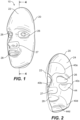
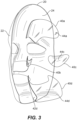
- FIGs. 1 and 2 are front and rear perspective views, respectively, of a first embodiment of a skin treatment system 10 which may be used in the present invention.
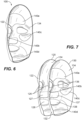
- FIG. 3 is a rear exploded view of system 10.
- Skin treatment system 10 includes applicator 20 having a first surface 22, and a second surface 24 .
- applicator 20 is shown as a facial mask.
- Applicator 20 in this embodiment has eye openings 26, a nose opening 27 , and a mouth opening 28, and is sized to cover the full face of the user. It is important to note that in other facial mask type embodiments, applicator 20 may be sized to partially cover the face of the user, and may be without any of the openings described above.
- active membranes 40a, 40b, 40c, and 40d Disposed on second surface 24 of applicator 20 are active membranes 40a, 40b, 40c, and 40d. This plurality of active membranes is releasably disposed on second surface 24 of applicator 20, and contain one or more benefit agents. Active membranes 40a, 40b, 40c, and 40d have first surfaces and second surfaces. FIG. 3 shows first surface 42d of active membrane 40d, as well as second surfaces 44a , 44c, and 44d of active membranes 40a, 40c, and 40d, respectively. The bond between applicator 20 and active membranes 40a, 40b, 40c, and 40d occur between second surface 24 of applicator 20 and first surfaces of the active membranes.
- Active membrane 40a is located in the forehead region of facial mask applicator 20, while active membranes 40b and 40c are located in the cheek region of facial mask applicator 20 and active membrane 40d is located in the chin region of facial mask applicator 20.
- the embodiment shown has an applicator 20 with four releasably disposed active membranes (40a, 40b, 40c, and 40d), other embodiments may have more or less releasably disposed membranes.
- Some embodiments may have one or more active membrane, or two or more active membranes, or four or more active membranes, or six or more active membranes, or eight or more active membranes, or twelve or more active membranes. The number and location of active membranes 40 depend on the common consumer skin flaw(s) being treated.
- Active membranes 40 contain one or more benefit agents.
- active membranes may contain two, three, four, or more benefit agents.
- each active membrane may contain the same beneficial agent(s), or each active membrane may contain different beneficial agent(s).
- individual active membranes may contain more than one benefit agent.
- different regions of the active membrane may contain different active agents, or may contain a gradient of active agent from one region to another. For example, the active agent may have a lower concentration proximate the edges to "feather" the treatment effect.
- Active membranes 40 may also have a variety of shapes, depending on the location of skin treatment. Possible shapes of the footprint left by active membranes 40 include, but are not limited to, squares, rectangles, triangles, circles, ovals, kidneys, stars, crosses, characters, etc. The corners of such shapes, if any, may be angular or curved to reduce potential lift/removal points.
- the zone of the treatment could be greater than about 1,000 cm 2 , about 1,000 cm 2 , or about 100 cm 2 , or about 10 cm 2 , or about 1 cm 2 , or less than 1 cm 2 .
- FIGs. 4 and 5 are side cross sectional views of system 10 along the 4---4 plane of FIG. 1 disposed on a user's face prior to, as well as after, removal of the applicator portion of the system.
- the figures show sections of applicator 20 with first surface 22 and second surface 24, active membranes 40a and 40d with first surfaces 42a, 42d and second surfaces 44a, 44d, and user's face 50 with face surface 52.
- the sections of applicator 20 seen in the figures are those above nose opening 27, between nose opening 27 and mouth opening 28, and below mouth opening 28.
- FIG. 4 shows that when skin treatment system 10 is disposed on the user's face 50, second surfaces 44a, 44d of active membranes 40a and 40d are in contact with surface 52 of face 50 .
- Second surface 24 of applicator 20 remains in contact with first surfaces 42a, 42d of active membranes 40a and 40d until removed by the user. Removal of applicator 20 by the user results in the structure shown in FIG. 5 .
- second surfaces 44a , 44d of active membranes 40a and 40d remains in contact with surface 52 of face 50 at the treatment zone.
- second surface 24 of applicator 20 releasably attaches to first surfaces 42a , 42d of active membranes 40a and 40d.
- the attachment strength of applicator 20 to active membranes 40a and 40d is less than the adhesive strength of membranes 40a and 40d to skin. So, when applicator 20 is removed by the user, active membranes 40a and 40d remains adhered to skin 50. In some embodiments, membranes 40a and 40d are held in place by spot application of adhesive.
- the shear strength of applicator 20 to active membranes 40a and 40d is less than the shear strength of membranes 40a and 40d to skin. So, when applicator 20 is removed by the user, active membranes 40a and 40d remains adhered to skin 50.
- a plurality of releasable membranes is formed in a stack on the applicator surface of the applicator mask, each releasable membrane comprising one or more benefit agents disposed in one or more treatment zones of the applicator.
- the adhesion of the membrane to the isolated body part is greater than the adhesion of the membrane to the applicator surface and to an adjacent membrane in the stack.
- FIGs. 6 and 7 are views of a second face embodiment of the system 100 of the present invention.
- FIG. 5 is a rear perspective
- FIG. 7 is a rear exploded view of system 100 .
- the skin treatment system 100 includes applicator 120 having a first surface 122 , and a second surface 124.
- applicator 120 is shown as a facial mask.
- Applicator 120 in this embodiment has eye openings 126, a nose opening 127 , and a mouth opening 128, and is sized to cover the full face of the user. It is important to note that in other facial mask type embodiments, applicator 120 may be sized to partially cover the face of the user, and may be without any of the openings described above.
- membrane 130 Disposed on second surface 124 of applicator 120 is membrane 130, which is releasably disposed on second surface 124 of applicator 120 .
- Membrane 130 has a first surface 132, and a second surface 134, and has active regions 140a, 140b , 140c, and 140d which contain one or more benefit agents.
- the bond between applicator 120 and membrane 130 occurs between second surface 124 of applicator 120 and first surface 132 of the membrane 130.
- Membrane 130 in this embodiment has eye openings 136, a nose opening 137, and a mouth opening 138, and is sized to cover the full face of the user. It is important to note that in other embodiments, membrane 130 may be sized to partially cover the face of the user, and may be without any of the openings described above.
- active region 140a is located in the forehead region of facial mask applicator 120, while active regions 140b and 140c are located in the cheek region of facial mask applicator 120 and active region 140d is located in the chin region of facial mask applicator 120 .
- the embodiment shown has an applicator 120 having releasably disposed membrane 130 with four active regions (140a, 140b, 140c, and 140d), other embodiments may have membranes 130 with more or less active regions. Some embodiments may have one or more active regions, or two or more active regions, or four or more active regions, or six or more active regions, or eight or more active regions, or twelve or more active regions. The number and location of the active regions 140 depend on the common consumer skin flaw(s) being treated.
- active regions 140 contain one or more benefit agents.
- active regions may contain two, three, four, or more benefit agents.
- each active region may contain the same beneficial agent(s), or each active region may contain different beneficial agent(s).
- Active regions 140 may also have a variety of shapes, depending on the location of skin treatment. Possible shapes of the active regions 140 include, but are not limited to, squares, rectangles, triangles, circles, ovals, kidneys, stars, crosses, characters, etc.
- the zone of the treatment could be greater than about 1,000 cm 2 , about 1,000 cm 2 , or about 100 cm 2 , or about 10 cm 2 , or about 1 cm 2 , or less than 1 cm 2 .
- second surface 124 of applicator 120 releasably attaches to first surface 132 of membrane 130.
- the attachment strength of applicator 120 to membrane 130 is less than the adhesive strength of membrane 130 to skin. So, when applicator 120 is removed by the user, membrane 130 remains adhered to the skin at the location of the treatment zone.
- FIGs. 8 and 9 are views of a third face embodiment of the system 200 of the present invention.
- FIG. 8 is a rear perspective
- FIG. 9 is a rear exploded view of system 200 .
- the skin treatment system 200 includes applicator 220 having a first surface 222 , and a second surface 224.
- applicator 220 is shown as a facial mask.
- Applicator 220 in this embodiment has eye openings 226, a nose opening 227, and a mouth opening 228 , and is sized to cover the full face of the user. It is important to note that in other facial mask type embodiments, applicator 220 may be sized to partially cover the face of the user, and may be without any of the openings described above.
- membrane 230 Disposed on second surface 224 of applicator 220 is membrane 230, which is releasably disposed on second surface 224 of applicator 220.
- Membrane 230 has a first surface 232, and a second surface 234. The bond between applicator 220 and membrane 230 occurs between second surface 224 of applicator 220 and first surface 232 of membrane 230.
- Membrane 230 in this embodiment has eye openings 236, a nose opening 237, and a mouth opening 238, and is sized to cover the full face of the user. It is important to note that in other embodiments, membrane 230 may be sized to partially cover the face of the user, and may be without any of the openings described above.
- active membranes 240a, 240b, 240c, and 240d Disposed on second surface 234 of membrane 230 are active membranes 240a, 240b, 240c, and 240d. In some embodiments, these active membranes are releasably disposed on second surface 234 of membrane 230, and contain one or more benefit agents. Active membranes 240a, 240b, 240c, and 240d have first surfaces and second surfaces. FIG. 9 shows first surface 242d of membrane 240d, as well as second surfaces 244a, 244c , and 244d of active membranes 240a, 240c, and 240d, respectively. The bond between membrane 230 and active membranes 240a, 240c , and 240d occur between second surface 234 of membrane 230 and first surfaces of the membranes.
- active membrane 240a is located in the forehead region of membrane 230, while active membranes 240b and 240c are located in the cheek region of membrane 230 and active membrane 240d is located in the chin region of membrane 230 .
- the embodiment shown has a membrane 230 with four active membranes (240a, 240b, 240c, and 240d;), other embodiments may have more or less active membranes.
- Some embodiments may have one or more active membranes, or two or more active membranes, or four or more active membranes, or six or more active membranes, or eight or more active membranes, or twelve or more active membranes.
- the number and location of the active membranes 240 depend on the common consumer skin flaw(s) being treated.
- active membranes 240 contain one or more benefit agents.
- membranes may contain two, three, four, or more benefit agents.
- each active membrane may contain the same beneficial agent(s), or each active membrane may contain different beneficial agent(s).
- Active membranes 240 may also have a variety of shapes, depending on the location of skin treatment. Possible shapes of the active membranes 240 include, but are not limited to, squares, rectangles, triangles, circles, ovals, kidneys, stars, crosses, characters, etc.
- the zone of the treatment could be greater than about 1,000 cm 2 , about 1,000 cm 2 , or about 100 cm 2 , or about 10 cm 2 , or about 1 cm 2 , or less than 1 cm 2 .
- second surface 224 of applicator 220 releasably attaches to first surface 232 of membrane 230.
- the attachment strength of applicator 220 to membrane 230 is less than the adhesive strength of membrane 230 to skin. So, when applicator 220 is removed by the user, membrane 230 remains adhered to the skin at the location of the treatment zone.
- skin treatment systems 10, 100 and 200 in the embodiments of the present invention use applicators 20, 120 and 220 in the form of a facial mask
- skin treatment systems may also be used on other isolated body parts, such as arms, hands, legs, or feet for example
- applicators 20, 120 and 220 will be shaped as appropriate for other isolated body parts.
- Applicators 20, 120 and 220 are made of a flexible, biocompatible material which is capable of forming to the site of treatment on the skin of the consumer.
- materials include, but are not limited to: polyolefins like poly(ethylene) (PE) or poly(propylene) (PP); poly(tetrafluoroethylene) (PTFE); poly(vinyl chloride) (PVC); silicones like poly(dimethyl silane) (PDMS); polyacylates like poly(methyl methacrylate) (PMMA) or poly(hydroxyethyl methacrylate) (pHEMA); polyesters like polyethylene terephthalate) (PET), poly(glycolic acid) (PGA), poly-L-lactic acid (PLA), or polydioxanone (PDO); polyethers like polyether ether ketone (PEEK) or polyether sulfone (PES); polyamide (Nylon); or polyurethane (PU),
- PE polyolefins like poly(ethylene) (PE)
- the attachment strength of the applicator to the membrane is less than the adhesive strength of the membranes to skin. So, when the applicator is removed by the user, the membrane remains adhered to the skin at the location of treatment zone.
- This relative adhesive strength is provided by modifying the material of the applicator, at least on the second surface (24, 124, or 224) of the applicator (the surface that is directed toward the skin during use), or the first surface (42, 132, or 232) of the membrane (the surface that is directed away from the skin during use). Adding a tackifier to the material in the applicator or the membrane can increase the attachment strength between the two.
- the attachment strength between the applicator (20, 120 or 220) and the accompanying membrane (40, 130, or 240) is also affected by the surface texture of the surface of the applicator in contact with the membrane. Imparting a texture, such as a plurality of parallel grooves, a bead-blasted texture, and the like, can increase the attachment strength therebetween.
- Membranes 40, 130, and 240 of the present invention are provided in forms that are comfortable to wear and readily removable after remaining in place for an extended period of time, e.g., at least half an hour, or at least one hour, or at least about six (6) to eight (8) hours, or at least about twelve (12) hours, or about twenty-four (24) hours, if desired.
- Membranes 40, 130, and 240 are readily removable either by low adhesion to skin, or upon application of water thereto. By readily removable upon application of water thereto, it is meant that the membrane structure may dissolve or disintegrate upon application of water to the membrane structure, such that it may be removed from the skin without scrubbing, or the like. In some embodiments, the membranes may lose adhesion overtime and fall off of the sight.
- Membranes 40, 130, and 240 preferably are a topically-applied skin care film, patch, applique, etc. (hereinafter "film structure" for the sake of convenience, without intent to limit) that preferably is relatively flexible.
- Membranes 40, 130, and 240 of the present invention preferably are relatively thin and flexible, as described in further detail below, so that they preferably readily conform to the user's skin and are comfortable to wear, both because of the flexibility and conformability, as well as from the thinness.
- Membranes 40, 130 , and 240 of the present invention intended for extended wear preferably are also formed to be aesthetically elegant without either peeling, wrinkling, cracking, or appearing greasy or tacky, or otherwise unpleasant or unsightly in nature.
- Membranes 40, 130, and 240 preferably are formed with sufficient rigidity and integrity to be able to withstand normal use when on the skin. For instance, membranes 40, 130 , and 240 of the invention preferably are formed with sufficient strength to stay intact on the skin when exposed to normal external forces that the skin may experience, e.g., rubbing of clothing, pillow, etc.
- membranes 40, 130, and 240 of the present invention may be formed to have structural integrity.
- structural integrity is to be understood as the physical capability of the membranes to maintain a substantially monolithic form or structure and to resist tearing or fracture while being manipulated independent of the applicator.
- structural integrity of membranes 40, 130, and 240 of the present invention preferably also contributes to the membranes' ability to remain intact during manipulation and use, and to conform to the contours of the application site to which they are applied, as discussed in further detail below. For instance, it is desirable that each membrane have sufficient structural integrity so that the membrane does not readily tear when manipulated, worn, or otherwise used.
- selection of one or more film formers that contribute to a product's ability to achieve a pliable, cohesive, and continuous covering on an application site such as skin is one manner of achieving the desired structural integrity of a membrane of the present invention.
- selection of one or more plasticizers for producing or promoting plasticity and flexibility and reducing brittleness is another manner of achieving the desired structural integrity of a membrane of the present invention.
- the structural integrity of membranes 40, 130, and 240 of the present invention typically may be correlated with the tensile strength or modulus and thickness of their structure. In connection with the present invention, structural integrity typically increases as thickness and yield strength increase. However, such properties must be balanced with their effect on whether the membrane is comfortable to be worn, as discussed in further detail below.
- Tensile strength contributes to the structural integrity of membranes 40, 130, and 240 used in accordance with principles of the present invention for such purposes as handling and/or removing the membranes 40, 130, and 240 from the skin.
- Tensile strength affects, inter alia, whether the membrane resists being fractured when being handled and/or removed from the skin.
- membranes 40, 130, and 240 of the present invention preferably have an elastic modulus of about 500 psi to about 10,000 psi.
- An elastic modulus of about 2,500 psi has been found in one embodiment to provide the desired stiffness to be comfortable during use.
- Typical samples with a 3 ⁇ 4 inch (1.905 cm) width and a 0.1mm thickness have a rupture-strength of about 2 lbf (pound force), although it will be appreciated that a useful range of rupture strengths is from about 0.5 lbf to about 5 lbf.
- the membrane's adhesion values are preferably between 225 gms/25mm to 1500 gms/25mm (8-50 oz/in).
- the adhesion values may be as large as 3000 gms/25mm (100 oz/in).
- the shear values for the membrane are preferably greater than 250-500 minutes on a PSTC-107 (ASTM D3654) - procedure A.
- the adhesion between the applicator and the membrane is preferably about 2-3 oz/in or 10-20% lower adhesion than the adhesion between the membrane and the topical surface to which it is applied (whichever is higher). If membranes are stacked in the applicator, a similar relation between adhesion of the body-contacting membrane to the topical surface and the adhesion of the body-contacting membrane to an adjacent membrane can be used.
- the thickness of the membrane also affects structural integrity.
- the thickness of a membrane of the present invention may be between about 0.05 mm to about 2 mm, and preferably between about 0.05 mm and 0.3 mm.
- a thickness of approximately 0.1 mm has been found to provide the desired mechanical properties for handling, applying, and ultimately removing the membrane, such that the membrane maintains its structural integrity throughout such use, as well as while being worn on a given application site, as discussed in further detail below.
- membranes 40, 130, and 240 of the present invention are self-adhesive, i.e., the membrane adheres to a user's skin upon contact with the skin, preferably without additional steps, such as addition of another composition, such as water.
- water soluble bio adhesive polymers can be used for enhancing skin adhesive property.
- examples useful for the invention include, but are not limited to, cellulose and its derivatives, polyvinyl pyrrolidone, water soluble celluloses, polyvinyl alcohol, ethylene maleic anhydride copolymer, methylvinyl ether maleic anhydride copolymer, acrylic acid copolymers, anionic polymers of methacrylic acid and methacrylate, cationic polymers with dimethyl-aminoethyl ammonium functional groups, polyethylene oxides, water soluble polyamide or polyester, polyethylene glycol, water soluble acrylic polymers, water soluble polyesters, hydroxyalkyl starches, casein, gelatin, solubilized proteins, polyacrylamide, polyamines, polyquatemium amines, styrene maleic anhydride resins, polyethylene anilnes,
- the water soluble carbohydrate can form hydrogen or covalent bonding to the water soluble or hydrophilic polymer in the
- the adhesive quality of membranes 40, 130, and 240 of the present invention are preferably capable of fixing the membrane to the skin of a user for an extended period of time, as discussed herein above, without irritating the skin.
- the membrane is capable of adhering to the application site for as long as reasonable and/or indicated to have a membrane in place at such site.
- an upper temporal limit to adhesion time is not important, since the user or wearer typically will want to remove the membrane before the membrane would naturally wear off of the application site on its own.
- the amount of time a membrane of the present invention is to adhere to a given application site is dictated by the amount of time the application area can withstand not being exposed to water. For instance, it will be appreciated that some surgical sites are not to be exposed to water for extended periods of time, such as several days. Membranes for application to such sites should accordingly be capable of adhering to such site for so long as the site is not exposed to water, if desired.
- the adhesive preferably is selected for application onto a skin surface which typically is not considered to be moist, in contrast with mucosal tissue. It will be appreciated that by being capable of adhering to the user's skin, the membrane simply is capable of adhering, but need not necessarily adhere if such property is not desired or unnecessary for a particular application.
- membranes 40, 130, and 240 of the present invention preferably are formed to remain adhered to the application site for an extended period of time, as described above, tion skin-contacting surfaces (first surfaces 42, 132, and 244 of membranes 40, 130, and 240, respectively), preferably have desirable properties and features to facilitate such an intended use of the membrane. For instance, because a membrane is designed to adhere to an application site, if the membrane is designed to adhere to an application site for an extended period of time, then an adhesive outwardly-facing surface may unintentionally or inadvertently adhere to another surface or object during use of the membrane.
- non skin-contacting surfaces first surfaces 42, 132, and 244 of membranes 40, 130 , and 240 , respectively
- first surfaces 42, 132, and 244 are non-tacky; not adhesive, and create low or no static when rubbed.
- first surfaces 42, 132, and 244 rub against or are rubbed by something or otherwise contacts or is contacted by another surface or Membranes 40, 130, and 240, the membranes 40, 130, and 240 should not adhere to such surface or membrane.
- Membranes 40, 130, and 240 may be tinted or pigmented to match the skin tone of the user so to be aesthetically pleasing, or at least not unaesthetic or unsightly, when worn.
- Membranes 40, 130, and 240 may be formed to be clear to be discrete in situ. Further properties may be selected to render membranes 40, 130, and 240 of the present invention visually discrete when in situ so that if the membrane is worn during the day its noticeability is minimized as much as possible. For instance, the thinner the membrane is, the less visible the structure typically is. In addition, or alternatively, the color, texture (e.g., rough, slick, smooth, or otherwise textured such as an "orange peel" surface to match substantially the texture of the skin to which the membrane is applied so that the membrane is not starkly smooth relative to the skin with its natural imperfections), shine (shiny or dull depending on application site), etc., may be modified as desired to facilitate blending in of the membrane with the application site.
- the color, texture e.g., rough, slick, smooth, or otherwise textured such as an "orange peel" surface to match substantially the texture of the skin to which the membrane is applied so that the membrane is not starkly smooth relative to the skin with its natural
- membranes 40, 130, and 240 of the present invention may be configured to be worn for an extended period of time (e.g., more than an hour, such as described above, and/or even overnight), the membrane preferably is formed or configured to be comfortable when worn.
- a variety of factors may be considered in achieving the desired comfort and level of comfort, including, without limitation, tactile properties, material thickness (affecting not only durability, but also weight on the application site), stiffness and permeability.
- Tactile properties that may contribute to comfort include smoothness, and / or stickiness of the adhesive used to adhere the membrane structure to a selected application site, etc.
- Additional tactile properties that may contribute to comfort include softness, smoothness, and texture of the membrane, such as determined by modulus of elasticity and coefficient of friction (rather than merely the aesthetic aspects of such properties).
- Thickness affects a variety of additional factors, including stiffness - a stiffer membrane typically being less comfortable than a less stiff membrane.
- Material properties (a function of the composition of the material, independent of form) as well as structural properties (the form of the membrane) may affect the achievable comfort level of a membrane used in accordance with principles of the present invention when worn by a user. It will be appreciated that all the desired properties for a membrane used in accordance with principles of the present invention must be balanced, wherein some properties complementary, yet others have opposing dimensions. With regard to comfort, it will be appreciated that properties contributing to comfort must be balanced with properties contributing to structural integrity.
- flexibility about a single, bending direction; generally, flexibility is considered a combination of thickness and flexural modulus
- stretchability in a single axial direction; generally, stretchability is considered a combination of thickness and elastic modulus
- conformability generally considered a combination of flexibility and physical shape in multiple directions, about complex surface.
- Comfort may be achieved by minimizing both the thickness and the elastic modulus.
- flexibility and stretchability are both functions of the elastic modulus of the material. More particularly, flexibility generally is dictated by the thickness of the material as well as the flexural modulus. Stretchability is a function of thickness and elastic modulus.
- the elastic modulus generally affects how rubbery or brittle a material is, and is tied to comfort because it determines flexibility of the material. Increasing the flexural or elastic modulus of a material makes the material less flexible or stretchable, respectively. Specifically, a higher flexural or elastic modulus results in a stiffer material, so the material consequently is less flexible and less stretchable. Given a constant flexural or elastic modulus, a higher material thickness will make the material less flexible or stretchable. As may be appreciated, comfort may be achieved by minimizing thickness of a given film to the lowest practical limit.
- the lower limit is dictated by providing enough structure to handle and manipulate the self-supporting adhesive film and to facilitate application and removal of the self-supporting adhesive film.
- the elastic modulus is most strongly linked to comfort. The lower the elastic modulus, the more comfortable the film structure typically is.
- An elastic modulus of from about 500 psi to about 10,000 psi provides an acceptable degree of comfort for a user, with a more preferred range of elastic modulus of from about 1,000 psi to about 5,000 psi, with a preferred elastic modulus of about 2,500 psi.
- Conformability such as the ability to conform to a given site (typically a surface with a complex curvature), not only involves flexibility, in general, but also relates to multidirectional flexibility and stretchability (e.g., so the membrane may stretch if placed over a joint). Conformability generally must be defined in terms of the physical shape or contour of the application site, and is determined with respect to a surface in conjunction with flexibility.
- a membrane may need to have a particular planar shape to be able to conform to a complex surface.
- a membrane used in accordance with principles of the present invention has substantially the same properties in all directions.
- membranes 40, 130, and 240 used in accordance with principles of the present invention are to remain on the application site for an extended period of time, such membrane preferably has a desired degree of breathability . Breathability may also be important for obtaining desired skin moisturization or proper skin moisture content balance for the functionality of the membrane in providing such benefit. Breathability relates to and is a function of oxygen exchange, which affects skin barrier as well as consumer perception. Breathability also is a function of water transmission. Membranes 40, 130, and 240 used in accordance with principles of the present invention preferably are sufficiently breathable so that the skin moisture content remains balanced.
- the breathability of the membrane preferably may be selected to facilitate such moisturization, as discussed in further detail below.
- a semi-occlusive film will at least partially inhibit water loss and therefore hold moisture within the skin.
- Membranes 40, 130 , and 240 used in accordance with principles of the present invention preferably provide resistance to moisture transmission, and may have a moisture transmission rate of approximately 50-150 grams of water per hour per square meter. Such membrane has been found to block or occlude evaporation that would occur without a film barrier by approximately 87%.
- Membranes 40, 130, and 240 used in accordance with principles of the invention, as further described below, may be semi-occlusive (preferably approximately 50-85% occlusive) not only to maintain breathability, but also to provide other benefits discovered to result from covering the application site with a semi-occlusive membrane.
- membranes 40, 130, and 240 of the present invention may comprise a top layer to further contribute to the overall semi-occlusive nature of the membrane.
- a top layer may function in conjunction with a hygroscopic skin-contacting layer. Once such a skin-contacting layer hydrates further, it may further lose structural integrity, and transform from a film-type substance to a gel phase without structural integrity independent of a top layer.
- the layer thus essentially caps and contains the skin-contacting surface at the application site so that the skin-contacting surface can hydrate the application site.
- membranes 40, 130, and 240 used in accordance with principles of the present invention dissolve or disintegrate with only the addition of water.
- no mechanical agitation is required to facilitate the removal of the self-supporting adhesive film.
- membranes 40, 130, and 240 used in the present invention preferably completely dissolves within the parameters of a typical consumer washing regimen for the application site if no membrane is present, so no additional washing time is required by the consumer.
- membranes 40, 130 , and 240 used in the present invention are quick-dissolving for ready removal from the application site on the user (when washing one's face, preferably less than about 5 minutes, and even less than about 1 minute, and even about 30 seconds after addition of a water thereto).
- the membrane can be removed with a wet cloth, sheet, or pad made of woven or nonwoven materials.
- Tire primary mechanical strength of the membrane is created by the film former (preferably polyvinyl alcohol (PVA)), which for membranes which breakdown with exposure to water, typically is also selected based on its ability to permit ready breakdown of the membrane as desired.
- the film former preferably is selected to achieve the desired ability to dissolve or disintegrate the membrane for removal upon application of water thereto, and may be the first component of the membrane composition that is selected, other components being selected to interact as desired with the already-selected film former. Flexibility is achieved by the addition of a plasticizer, such as glycerin, to the film former.
- Film formers and/or plasticizers typically are the primary contributors to structural integrity, and are typically a component of the composition used to form the outwardly-facing top layer with properties such as described above.
- Exemplary film formers and plasticizers are set forth in greater detail below.
- PVA can be 70% by weight of the dry ingredients of a film structure used in accordance with principles of the present invention, with glycerin at 20% by weight.
- the glycerin can range from as little as 10% to 30% by weight of the film structure, and the PVA can be as much as 90% by weight of the dry ingredients.
- hydrophilic film-forming polymers suitable for producing the topical skin membranes 40, 130 , and 240 used in the present invention may be of synthetic, semisynthetic, or natural origin.
- Such hydrophilic film forming polymers include, without limitation, cellulose ethers, polyvinyl alcohols, polyvinyl acetate, polyvinyl pyrrolidone, polysaccharides, as well as derivatives, copolymers or polymers thereof.
- the multi-layer topical skin membrane may be made into a wide variety of product forms that include but are not limited to the form films.
- the membranes 40 and 240, as well as the active regions 140 of the present invention contain at least one active substance, active agent, or benefit agent.
- the benefit agents that may be used in film structures of the invention include cosmetic agents and therapeutic agents. Such substances may be any of a variety of compositions, including, without limitation, hyaluronic acid; hydroxyl acids (e.g., glycolic acid, lactic acid, malic acid, salicylic acid, citric acid, tartaric acid); anti-acne agents (e.g., salicylic acid, retinol, retinoids, or other keratolytics, and benzoyl peroxide, or other antimicrobial agents used to treat acne); shine control agents (e.g., rice protein, cotton powder, elubiol (dichlorophenyl-imidazoltioxolan); a retinoid or its derivative such as tretinoin, isotretinoin, inotretinide, adapalene,
- the substances may affect the skin in any of a variety of manners, such as by moisturizing; enhancing skin tone or color (such as with pigments); treating or at least mitigating various skin conditions (such as dry or severe dry skin, eczema, psoriasis, atopic dermatitis, allergic rashes, acne, blackheads, pustules, comedones, rosacea, shingles, wrinkles, cold sores, herpes, corns, warts, sunburn, insect bites, poison ivy, etc.); applying a mechanical force (such as shrinkage) to smooth wrinkles; or, more generally, treating or mitigating the symptoms and appearance of undesired skin imperfections (such as under eye dark circle, redness of acne, fine lines and wrinkles, post inflammatory hyperpigmentation (PIH), redness, inflammation, cellulite, wrinkles, age spots, mottled pigmentation, dark spots, liver spots, under eye puffiness); removing unwanted facial or body hair; aiding in wound healing
- lotions, creams, oils, and even masks may be applied to skin to treat or otherwise to affect the skin.
- Such personal or consumer healthcare substances are absorbed into the skin generally following the principles of diffusion, under which the rate of diffusion or transport across the skin is correlated with the difference in active concentration on both sides of the skin.
- a system and method comprise at least (a) an imaging device system that capture user's digital face geometry and images of face condition for skin analysis, and feeds its outputs to a center computer system comprising a connection center, cloud based-hub computing data system where the digital data of user's face geometry and images of face condition can be uploaded, stored and shared, (b) a 2D to 3D reconstruction and artificial intelligent (machine learning) algorithms for geometry and appearance reconstruction, (c) a skin feature database for skin comparison and grading, (d) skin analysis algorithms that provide skin analysis output images, face maps, evaluation results and treatment recommendations to user, (e) an internet portal site provided for user access for inputs and treatment selections.
- Outputs from the central computer system are provided for download to local computer, treatment formulator, and 3D printing or digital computational thermo-vacuum former and 6-axis robot treatment-deposition device which deposit various treatments onto membrane to face of mask body to generate a personalized conformal facial mask with area-specific personalized treatment for that particular user. Similar approach can be applied to individual patch or a group of patches.
- a method for targeted application of topical agents to an isolated body part comprising the steps of capturing an image of the isolated body part, transforming the image data to mathematical model of the geometry of the isolated body part, forming an applicator mask having an applicator surface having a three dimensional shape corresponding to the isolated body part, forming a releasable membrane on the applicator surface of the applicator mask comprising one or more benefit agents disposed in one or more treatment zones of the applicator, where the adhesion of the membrane to the isolated body part is greater than the adhesion of the membrane to the applicator surface, disposing the applicator mask on the isolated body part so that the releasable membrane is in contact with the isolated body part, and removing the applicator mask from the isolated body part so that the membrane remains in contact with the isolated body part.
- a system scans a patient's body part positioned in the field of scan, and being scanned by an imaging device.
- This imaging device is capable of sensing many characteristics (shapes and micro geometries) from the patient's body part. For instance, device may sense local body geometry shape with white light (LED), infrared emissions from area of increased heat, reflectivity sensing oiliness or dryness of skin, and local body defects (micro-geometry) such as spots, wrinkles, blemishes, texture, pores, UV spots, brown spots red areas, porphyrins, acne, etc. with different light sources, for example, commercial available image device VISTA, VISIONFACE 1000D, Sony Beauty Explorer, and the like.
- LED white light
- micro-geometry local body defects
- VISTA commercial available image device
- VISIONFACE 1000D Sony Beauty Explorer
- the imaging device provides an output which is in electrical communication to a central computer system where the computer software and associated computing device is programmed to process the data and generate a customized skin profile for that individual user showing various skin conditions and corresponding locations of skin conditions in the captured images.
- the system is also programmed to generate recommendations for treatment of various skin conditions identified in the skin profile. All the data captured from user will be output to a center computer system comprising a connection center, cloud based-hub computing data system where the digital data of user's face geometry and images of face skin condition can be uploaded, stored and shared for downstream process.
- imaging devices that can be used for capturing local body shape in the present invention include, for example, Digital 3D scanner Go!scan20 TM from CREAFORM, ISENSE from 3D system, ARTEC SPIDER, NIKON MODELMAKER MMCx, OPTIX 500S form 3D Digital CORP, etc.
- the face image of the present invention may be captured with digital 3 D scanner such as Go!scan20 TM , or with high end digital camera or video camera, or just a consumer grade camera, such as, for example, a cell phone through 2D to 3D reconstruction software algorithm.
- digital 3 D scanner such as Go!scan20 TM
- high end digital camera or video camera or just a consumer grade camera, such as, for example, a cell phone through 2D to 3D reconstruction software algorithm.
- more than one image of the user is captured, each from a different angle such that an analysis can be accomplished, for example, of the entire face.
- positioning information is acquired with respect to the captured images.
- the acquired positioning information on the images may be analyzed to determine surface topography for mapping local body defect area or treatment areas.
- a 3D model of the anatomically customized mask is created using multidimensional data from an individual's face.
- the data may be acquired through 3D scanner, multiple image or video cameras and digital 2D to 3D reconstruction software, point cloud or triangulate scans from digital image scanners, or any number of 3D modeling technologies.
- software in the system may further customize the mask applicator 20 to provide automatically rendering, cleaning scan noise and enhanced functionally aesthetics.
- Digital 3D images of entire face for example, captured with digital 3D scanner Go!Scan20 TM can be formatted and digitally stored in central computer system where computer software Geomagic Design X from 3D system provide 3D rendering and cleaning noise of the 3D scanned data, and associated software (e.g., Solidworks or Inventor) is programmed to process the 3D rendering data and generate a 3D model for applicator 20.
- the 3D model then can be downloading to 3D printer to print the applicator 20 by utilizing plastic thermoset material or plastic materials.
- One the example of the present invention provides a customized mask applicator formed utilizing 3D printing technologies for conforming to the unique facial features of the user.
- the mask applicator 20 embodiments of the present invention are customizable for each user to provide matching contours of the human face for increased comfort when the mask is worn.
- the customized, contoured facial mask applicator face portion is constructed and configured to cover and to contact a corresponding contoured surface area of human face, is unitarily and integrally formed by 3D printing technology, and is formed of non-toxic synthetic material, thermoset plastic or plastic.
- a soft plastic layer or rubberlike layer is provided on the surface that contacts the face of user.
- thermoplastic, thermoplastic powders, and thermoset photopolymer can be utilized to form applicator 20 with different type of thermoplastic, thermoplastic powders, and thermoset photopolymer.
- FDM Fused deposition modeling
- FFF Fused filament fabrication
- SLA Stereo lithography
- DLP Digital Light Processing
- DLP Powder bed and inkjet head 3D printing
- SHS Selective heat sintering
- SLS Selective Laser sintering
- applicators in the present invention can be formed by utilizing Stratasys Connex 3 3D printer with so called digital materials (include primary material: TANGOPLUS FLX930 and secondary material: VEROCLEAR RDG 810, or VEROWHITEPLUS RGD835) controlled with different layer's softness between 35 to 95 Shore Hardness (A).
- digital materials include primary material: TANGOPLUS FLX930 and secondary material: VEROCLEAR RDG 810, or VEROWHITEPLUS RGD835
- Applicator 20 then can be physically transferred to 6-axis robot treatment-deposition device which deposit prefer benefit agents on to second surface 24 of applicator 20 .
- Example 1 Formation of skin treatment system 200 .
- a user with the desire to treat acne in several regions of her face uses an imaging device system to capture her digital face geometry as well as images of face condition for skin analysis.
- the image output is sent to a center computer system comprising a connection center, cloud based-hub computing data system where the digital data of her face geometry and images of face condition can be uploaded, stored and shared with a mask forming system.
- the face forming system creates an individualized skin treatment system 200, in the form of an acne treatment facial mask for the user.
- Skin treatment system 200 includes applicator 220 having a first surface 222, and a second surface 224 .
- Applicator 220 comprised of poly(ethylene) is formed using a thermo-vacuum former (Formech thermos-vacuum former machine 300XQ) with a mold cavity in the shape of a human face, at conditions required to mold the PE into the face-mask shape.
- the temperature is about 260° F to about 360° F, and the vacuum is between about 750 mbar to about 914 mbar).
- the applicator 220 is formed using a Stratasys 3D printer Connex 3X and Objet 24 with model material VEROWHITEPLUS RGD835 and support material Sup705 (temperature 73° C for both material during 3D printing process).
- Second surface 224 of applicator 220 is treated with a release agent such as a cross-linkable silicone solution.
- Membrane 230 is disposed on second surface 224 of applicator 220 using a 6-axis robot treatment-deposition device, such as a DENSO Model: VP-6242E/GM device.
- Table 1 shows several formulations which are used to form membrane 230.
- Table 1 Compositions for membrane 230 (wt%).
- Ingredients 230A 230B 230C 230D Selvol 805 16.86 16.86 16.86 16.86 Vitacel Oat Fiber HF600-30 11.82 11.82 11.82 Salicyclic Acid, USP, Powder 1.14 1.25 1.02 1.06 Polysorbate 80 1.80 1.80 1.80 1.8 Dow Corning 2501 Cosmetic Wax 1.24 1.24 1.24 1.24 Kester Wax K-24 1.24 1.24 1.24 Glycerin 99.7%, USP 10.30 10.30 1 0.30 10.3 Lactic Acid, Ritalac LA 5.61 5.61 5.61 5.61 Water, Purified 50.00 49.89 50.11 50.07 TOTAL (wt%) 100.00 100.00 100.00 100.00 100.00 100.00 100.00 100.00 100.00 100.00 100.00 100.00 100.00 100.00 100.00 100.00 100.00 100.00 100.00 100.00 100.00 100.00 100.00 100.00 100.00 100.00 100.00 100.00 100.00 100.00 100.00 100.00 10
- Membrane 230 has a first surface 232, and a second surface 234 .
- Active regions 240a, 240b, 240c, and 240d which contain the acne treatment benefit agents. are formed using a 6-axis robot treatment-deposition device.
- Table 2 shows several formulations which are used to form active regions 240.
- Table 2 Compositions for active regions 240 (wt%).
- the membrane is then transferable from the applicator to the user's isolated body part. After a desired treatment time, the membrane may be removed from the user with a soap and water wash.
Landscapes
- Health & Medical Sciences (AREA)
- Life Sciences & Earth Sciences (AREA)
- Public Health (AREA)
- Veterinary Medicine (AREA)
- Animal Behavior & Ethology (AREA)
- General Health & Medical Sciences (AREA)
- Epidemiology (AREA)
- Birds (AREA)
- Dermatology (AREA)
- Engineering & Computer Science (AREA)
- Chemical & Material Sciences (AREA)
- Materials Engineering (AREA)
- Manufacturing & Machinery (AREA)
- General Chemical & Material Sciences (AREA)
- Chemical Kinetics & Catalysis (AREA)
- Medicinal Chemistry (AREA)
- Nuclear Medicine, Radiotherapy & Molecular Imaging (AREA)
- Organic Chemistry (AREA)
- Pharmacology & Pharmacy (AREA)
- Bioinformatics & Cheminformatics (AREA)
- Emergency Medicine (AREA)
- Mechanical Engineering (AREA)
- Cosmetics (AREA)
- Medicinal Preparation (AREA)
- Media Introduction/Drainage Providing Device (AREA)
- Application Of Or Painting With Fluid Materials (AREA)
- Coating Apparatus (AREA)
- Medicines That Contain Protein Lipid Enzymes And Other Medicines (AREA)
- Pharmaceuticals Containing Other Organic And Inorganic Compounds (AREA)
- Medicines Containing Plant Substances (AREA)
Applications Claiming Priority (2)
| Application Number | Priority Date | Filing Date | Title |
|---|---|---|---|
| US201662437815P | 2016-12-22 | 2016-12-22 | |
| PCT/US2017/067793 WO2018119176A1 (en) | 2016-12-22 | 2017-12-21 | System for targeted application of topical agents to an isolated body part |
Publications (3)
| Publication Number | Publication Date |
|---|---|
| EP3558237A1 EP3558237A1 (en) | 2019-10-30 |
| EP3558237C0 EP3558237C0 (en) | 2024-04-17 |
| EP3558237B1 true EP3558237B1 (en) | 2024-04-17 |
Family
ID=61683877
Family Applications (1)
| Application Number | Title | Priority Date | Filing Date |
|---|---|---|---|
| EP17851940.1A Active EP3558237B1 (en) | 2016-12-22 | 2017-12-21 | System for targeted application of topical agents to an isolated body part |
Country Status (13)
| Country | Link |
|---|---|
| US (2) | US10842242B2 (https=) |
| EP (1) | EP3558237B1 (https=) |
| JP (1) | JP7077322B2 (https=) |
| KR (1) | KR102420686B1 (https=) |
| CN (1) | CN110139639B (https=) |
| AU (1) | AU2017379067B2 (https=) |
| BR (2) | BR112019012706B1 (https=) |
| CA (1) | CA3048112A1 (https=) |
| ES (1) | ES2980301T3 (https=) |
| MX (2) | MX395264B (https=) |
| RU (1) | RU2754665C2 (https=) |
| WO (1) | WO2018119176A1 (https=) |
| ZA (1) | ZA201904780B (https=) |
Families Citing this family (19)
| Publication number | Priority date | Publication date | Assignee | Title |
|---|---|---|---|---|
| JP6872742B2 (ja) * | 2016-06-30 | 2021-05-19 | 学校法人明治大学 | 顔画像処理システム、顔画像処理方法及び顔画像処理プログラム |
| WO2019245992A1 (en) | 2018-06-19 | 2019-12-26 | Proctor Summer | Beauty applicator systems and related methods |
| US11172751B2 (en) * | 2018-12-19 | 2021-11-16 | The Procter & Gamble Company | Method of defining a treatment area of an applicator for registration with a condition to be treated |
| US20200197677A1 (en) * | 2018-12-19 | 2020-06-25 | The Procter & Gamble Company | Applicator with Gradient Supplied Actives and Methods of Making the Same |
| CN110200816A (zh) * | 2019-05-20 | 2019-09-06 | 上普(北京)生物科技有限公司 | 3d打印外敷膜的方法、3d打印外敷膜及外敷膜组件 |
| FR3097729B1 (fr) * | 2019-06-28 | 2022-06-24 | Oreal | Procédé de mise en forme d’un applicateur en vue de l’application d’une composition cosmétique |
| JP2021037233A (ja) * | 2019-09-05 | 2021-03-11 | イビデン株式会社 | 美顔マスクを製造販売するビジネス方法 |
| JP2021037234A (ja) * | 2019-09-05 | 2021-03-11 | イビデン株式会社 | 美顔マスクの製造方法及び美顔マスクの使用方法 |
| US11865036B2 (en) * | 2019-09-27 | 2024-01-09 | L'oreal | Integrated heater on facial skincare mask |
| US11582566B2 (en) | 2019-12-02 | 2023-02-14 | Gn Hearing A/S | Hearing instrument charger device and system, and a method of manufacturing a holder therefor |
| EP4076135A1 (en) * | 2019-12-18 | 2022-10-26 | Carl Zeiss Meditec AG | Personalized patient interface for ophthalmic devices |
| GB2606955B (en) * | 2020-01-06 | 2024-07-24 | Kao Corp | Sheet-providing method and sheet-providing system |
| CN111658987B (zh) * | 2020-06-03 | 2021-10-22 | 青岛谷力互联科技有限公司 | 一种基于ai人脸识别的面部加湿器 |
| BR202020025444U2 (pt) * | 2020-12-11 | 2021-06-08 | Dermyah Inovacoes Em Beleza E Bem Estar Ltda | bioimpressora 3d utilizando células tronco vegetais aplicada à recriação de tecido cutâneo para rejuvenescimento facial e biomáscara facial a partir de bioimpressão 3d |
| US11765525B2 (en) | 2020-12-11 | 2023-09-19 | Gn Hearing A/S | Hearing instrument charger device and system, and a method of manufacturing a holder therefor |
| CN112873852B (zh) * | 2020-12-28 | 2022-12-06 | 陇东学院 | 一种基于3d打印技术的化妆方法 |
| CN114288195B (zh) * | 2021-12-27 | 2023-01-17 | 广东丸美生物技术股份有限公司 | 一种3d打印用水凝胶基质及其制备方法和应用 |
| KR102705275B1 (ko) * | 2022-11-17 | 2024-09-09 | 대전보건대학교 산학협력단 | 탈부착식 마스크 |
| JP7773809B1 (ja) * | 2024-09-21 | 2025-11-20 | 政代 ウィルソン | 顔用ケア具 |
Family Cites Families (33)
| Publication number | Priority date | Publication date | Assignee | Title |
|---|---|---|---|---|
| US5942065A (en) * | 1996-05-23 | 1999-08-24 | Internatural Designs, Inc. | Sticker combinable skin adhesive decal and process for making same |
| EP0947189B1 (en) * | 1996-08-13 | 2005-04-13 | Nitto Denko Corporation | Wet tacky compositions, plaster patches comprising the same, and methods for using the same |
| JPH11137338A (ja) * | 1997-11-14 | 1999-05-25 | Shiseido Co Ltd | パック及びその使用方法 |
| US5965154A (en) * | 1998-03-17 | 1999-10-12 | Plc Holding, L.L.C. | Adhesive matrix type transdermal patch and method of manufacturing same |
| US7658942B2 (en) * | 2000-04-12 | 2010-02-09 | The Procter & Gamble Company | Cosmetic devices |
| US20020192415A1 (en) * | 2001-06-15 | 2002-12-19 | 3M Innovative Properties Company | Stack of adhesive articles |
| US20030167556A1 (en) * | 2002-03-05 | 2003-09-11 | Consumers Choice Systems, Inc. | Methods and devices for transdermal delivery of anti-aging compounds for treatment and prevention of facial or neck skin aging |
| TW200628137A (en) * | 2004-10-27 | 2006-08-16 | Uni Charm Corp | Body-worn humidifier |
| CA2585398A1 (en) * | 2004-11-12 | 2006-05-18 | The Procter & Gamble Company | Treatment articles capable of conforming to an underlying shape |
| US20060104931A1 (en) * | 2004-11-12 | 2006-05-18 | Takeshi Fukutome | Cosmetic treatment article comprising substrate and gel composition |
| GB2455926B (en) * | 2006-01-30 | 2010-09-01 | Axellis Ltd | Method of preparing a medical restraint |
| US20080053476A1 (en) * | 2006-08-29 | 2008-03-06 | Lahood Richard | Cosmetics Applicator |
| US20090053416A1 (en) * | 2006-12-22 | 2009-02-26 | Irina Iosilevich | Camouflage mask and method of mask use |
| US8597667B2 (en) * | 2008-05-09 | 2013-12-03 | Elc Management Llc | Targeted and individualized cosmetic delivery |
| US8358348B2 (en) | 2008-05-09 | 2013-01-22 | Elc Management Llc | Method and system for automatic or manual evaluation to provide targeted and individualized delivery of cosmetic actives in a mask or patch form |
| US8425477B2 (en) * | 2008-09-16 | 2013-04-23 | Elc Management Llc | Method and system for providing targeted and individualized delivery of cosmetic actives |
| US8491926B2 (en) | 2008-09-16 | 2013-07-23 | Elc Management Llc | Method and system for automatic or manual evaluation to provide targeted and individualized delivery of cosmetic actives in a mask or patch form |
| US8372130B2 (en) * | 2009-01-23 | 2013-02-12 | Forever Young International, Inc. | Temperature controlled facial mask with area-specific treatments |
| JP5042284B2 (ja) * | 2009-07-31 | 2012-10-03 | 株式会社 資生堂 | 美顔用マスク及びこれを用いた美容方法 |
| US8211413B2 (en) * | 2010-01-11 | 2012-07-03 | You See, Llc | Method and composition for preventing coloring of the skin adjacent the hairline when dying a person's hair |
| US20140146190A1 (en) | 2012-11-28 | 2014-05-29 | Fatemeh Mohammadi | Method And System For Automated Or Manual Evaluation To provide Targeted And Individualized Delivery Of Cosmetic Actives In A Mask Or Patch Form |
| US20140261430A1 (en) | 2013-03-15 | 2014-09-18 | Lucy Carol Davis | Facial Mask Apparatus and Method of Making |
| JP2015081240A (ja) * | 2013-10-22 | 2015-04-27 | 有限会社ローヤル化研 | 美容用パック |
| KR101563516B1 (ko) | 2013-12-27 | 2015-10-27 | 주식회사 그린기술 | 맞춤형 마스크 및 그 제조방법 |
| US10463823B2 (en) * | 2014-03-10 | 2019-11-05 | Morpheus Medical Solutions, LLC | Facial mask and method of making |
| US9867449B2 (en) * | 2014-06-20 | 2018-01-16 | Richard Joseph LaHood, SR. | System and method of manufacturing a three-dimensional cosmetic product |
| TWI533819B (zh) * | 2014-07-04 | 2016-05-21 | 宗經投資股份有限公司 | 化妝組件 |
| US20190254937A1 (en) * | 2014-08-22 | 2019-08-22 | Alps South Europe, S.R.O. | Self-Adherent Therapeutic Material |
| US20160089309A1 (en) | 2014-09-29 | 2016-03-31 | Elc Management Llc | Targeted and individualized delivery of skincare treatments with microcurrent in a mask or patch form |
| US10897978B2 (en) * | 2014-10-21 | 2021-01-26 | The Procter & Gamble Company | Method of improving skin appearance |
| US20160128919A1 (en) * | 2014-11-06 | 2016-05-12 | Dagmar Bjork SVEINE | Non-invasive and long lasting skin darkening devices, compositions, and methods of use for body contouring |
| RU2598306C1 (ru) * | 2015-06-02 | 2016-09-20 | Юрий Иванович Литницкий | Способ изготовления декоративно-художественных изделий и декоративно-художественное изделие |
| EP3520648A4 (en) * | 2016-09-27 | 2020-01-01 | Panasonic Intellectual Property Management Co., Ltd. | THIN FILM AND THIN FILM PROCESSING |
-
2017
- 2017-12-20 US US15/848,963 patent/US10842242B2/en active Active
- 2017-12-21 EP EP17851940.1A patent/EP3558237B1/en active Active
- 2017-12-21 WO PCT/US2017/067793 patent/WO2018119176A1/en not_active Ceased
- 2017-12-21 BR BR112019012706-2A patent/BR112019012706B1/pt active IP Right Grant
- 2017-12-21 BR BR122021013712A patent/BR122021013712A8/pt not_active Application Discontinuation
- 2017-12-21 AU AU2017379067A patent/AU2017379067B2/en active Active
- 2017-12-21 CA CA3048112A patent/CA3048112A1/en active Pending
- 2017-12-21 MX MX2021013731A patent/MX395264B/es unknown
- 2017-12-21 MX MX2019007548A patent/MX389300B/es unknown
- 2017-12-21 CN CN201780080333.1A patent/CN110139639B/zh active Active
- 2017-12-21 KR KR1020197021172A patent/KR102420686B1/ko active Active
- 2017-12-21 JP JP2019534347A patent/JP7077322B2/ja active Active
- 2017-12-21 RU RU2019122410A patent/RU2754665C2/ru active
- 2017-12-21 ES ES17851940T patent/ES2980301T3/es active Active
-
2019
- 2019-07-19 ZA ZA2019/04780A patent/ZA201904780B/en unknown
-
2020
- 2020-10-20 US US17/075,071 patent/US20210093072A1/en not_active Abandoned
Also Published As
| Publication number | Publication date |
|---|---|
| RU2019122410A (ru) | 2021-01-22 |
| CN110139639B (zh) | 2022-12-06 |
| RU2754665C2 (ru) | 2021-09-06 |
| JP7077322B2 (ja) | 2022-05-30 |
| WO2018119176A1 (en) | 2018-06-28 |
| ZA201904780B (en) | 2022-04-28 |
| AU2017379067B2 (en) | 2023-04-06 |
| CN110139639A (zh) | 2019-08-16 |
| BR112019012706A8 (pt) | 2022-07-26 |
| US20210093072A1 (en) | 2021-04-01 |
| CA3048112A1 (en) | 2018-06-28 |
| KR102420686B1 (ko) | 2022-07-15 |
| RU2019122410A3 (https=) | 2021-02-20 |
| EP3558237A1 (en) | 2019-10-30 |
| EP3558237C0 (en) | 2024-04-17 |
| MX395264B (es) | 2025-03-25 |
| BR112019012706B1 (pt) | 2022-11-16 |
| AU2017379067A1 (en) | 2019-06-27 |
| MX389300B (es) | 2025-03-20 |
| MX2019007548A (es) | 2019-10-24 |
| BR122021013712A8 (pt) | 2022-10-11 |
| BR122021013712A2 (https=) | 2019-11-19 |
| US20180206616A1 (en) | 2018-07-26 |
| KR20190099266A (ko) | 2019-08-26 |
| JP2020514275A (ja) | 2020-05-21 |
| ES2980301T3 (es) | 2024-09-30 |
| MX2021013731A (es) | 2022-09-01 |
| US10842242B2 (en) | 2020-11-24 |
| BR112019012706A2 (pt) | 2019-11-19 |
Similar Documents
| Publication | Publication Date | Title |
|---|---|---|
| EP3558237B1 (en) | System for targeted application of topical agents to an isolated body part | |
| EP3518864B1 (en) | Kit and method for topical delivery of benefits | |
| US10897978B2 (en) | Method of improving skin appearance | |
| EP3310326B1 (en) | Multi-layer topically-applied article for providing a benefit to skin | |
| EP3644917B1 (en) | Multi-functional personalized patch with therapeutic properties | |
| HK40015054B (en) | System for targeted application of topical agents to an isolated body part | |
| HK40015054A (en) | System for targeted application of topical agents to an isolated body part | |
| HK40007178A (en) | System for targeted application of topical agents to an isolated body part | |
| HK40011818B (en) | Kit and method for topical delivery of benefits | |
| HK40011818A (en) | Kit and method for topical delivery of benefits | |
| JP2005029526A (ja) | 皮膚外用剤 | |
| HK40024610A (en) | Multi-functional personalized patch with therapeutic properties | |
| HK40024610B (en) | Multi-functional personalized patch with therapeutic properties |
Legal Events
| Date | Code | Title | Description |
|---|---|---|---|
| STAA | Information on the status of an ep patent application or granted ep patent |
Free format text: STATUS: UNKNOWN |
|
| STAA | Information on the status of an ep patent application or granted ep patent |
Free format text: STATUS: THE INTERNATIONAL PUBLICATION HAS BEEN MADE |
|
| PUAI | Public reference made under article 153(3) epc to a published international application that has entered the european phase |
Free format text: ORIGINAL CODE: 0009012 |
|
| STAA | Information on the status of an ep patent application or granted ep patent |
Free format text: STATUS: REQUEST FOR EXAMINATION WAS MADE |
|
| 17P | Request for examination filed |
Effective date: 20190702 |
|
| AK | Designated contracting states |
Kind code of ref document: A1 Designated state(s): AL AT BE BG CH CY CZ DE DK EE ES FI FR GB GR HR HU IE IS IT LI LT LU LV MC MK MT NL NO PL PT RO RS SE SI SK SM TR |
|
| AX | Request for extension of the european patent |
Extension state: BA ME |
|
| DAV | Request for validation of the european patent (deleted) | ||
| DAX | Request for extension of the european patent (deleted) | ||
| REG | Reference to a national code |
Ref country code: HK Ref legal event code: DE Ref document number: 40015054 Country of ref document: HK |
|
| STAA | Information on the status of an ep patent application or granted ep patent |
Free format text: STATUS: EXAMINATION IS IN PROGRESS |
|
| 17Q | First examination report despatched |
Effective date: 20201029 |
|
| RAP1 | Party data changed (applicant data changed or rights of an application transferred) |
Owner name: JOHNSON & JOHNSON CONSUMER INC. |
|
| GRAP | Despatch of communication of intention to grant a patent |
Free format text: ORIGINAL CODE: EPIDOSNIGR1 |
|
| STAA | Information on the status of an ep patent application or granted ep patent |
Free format text: STATUS: GRANT OF PATENT IS INTENDED |
|
| INTG | Intention to grant announced |
Effective date: 20230331 |
|
| RAP1 | Party data changed (applicant data changed or rights of an application transferred) |
Owner name: JOHNSON & JOHNSON CONSUMER INC. |
|
| GRAJ | Information related to disapproval of communication of intention to grant by the applicant or resumption of examination proceedings by the epo deleted |
Free format text: ORIGINAL CODE: EPIDOSDIGR1 |
|
| STAA | Information on the status of an ep patent application or granted ep patent |
Free format text: STATUS: EXAMINATION IS IN PROGRESS |
|
| INTC | Intention to grant announced (deleted) | ||
| GRAP | Despatch of communication of intention to grant a patent |
Free format text: ORIGINAL CODE: EPIDOSNIGR1 |
|
| STAA | Information on the status of an ep patent application or granted ep patent |
Free format text: STATUS: GRANT OF PATENT IS INTENDED |
|
| INTG | Intention to grant announced |
Effective date: 20230926 |
|
| GRAS | Grant fee paid |
Free format text: ORIGINAL CODE: EPIDOSNIGR3 |
|
| GRAA | (expected) grant |
Free format text: ORIGINAL CODE: 0009210 |
|
| STAA | Information on the status of an ep patent application or granted ep patent |
Free format text: STATUS: THE PATENT HAS BEEN GRANTED |
|
| AK | Designated contracting states |
Kind code of ref document: B1 Designated state(s): AL AT BE BG CH CY CZ DE DK EE ES FI FR GB GR HR HU IE IS IT LI LT LU LV MC MK MT NL NO PL PT RO RS SE SI SK SM TR |
|
| REG | Reference to a national code |
Ref country code: GB Ref legal event code: FG4D |
|
| REG | Reference to a national code |
Ref country code: CH Ref legal event code: EP |
|
| REG | Reference to a national code |
Ref country code: IE Ref legal event code: FG4D Ref country code: DE Ref legal event code: R096 Ref document number: 602017081141 Country of ref document: DE |
|
| U01 | Request for unitary effect filed |
Effective date: 20240513 |
|
| U07 | Unitary effect registered |
Designated state(s): AT BE BG DE DK EE FI FR IT LT LU LV MT NL PT SE SI Effective date: 20240524 |
|
| REG | Reference to a national code |
Ref country code: ES Ref legal event code: FG2A Ref document number: 2980301 Country of ref document: ES Kind code of ref document: T3 Effective date: 20240930 |
|
| PG25 | Lapsed in a contracting state [announced via postgrant information from national office to epo] |
Ref country code: IS Free format text: LAPSE BECAUSE OF FAILURE TO SUBMIT A TRANSLATION OF THE DESCRIPTION OR TO PAY THE FEE WITHIN THE PRESCRIBED TIME-LIMIT Effective date: 20240817 |
|
| PG25 | Lapsed in a contracting state [announced via postgrant information from national office to epo] |
Ref country code: HR Free format text: LAPSE BECAUSE OF FAILURE TO SUBMIT A TRANSLATION OF THE DESCRIPTION OR TO PAY THE FEE WITHIN THE PRESCRIBED TIME-LIMIT Effective date: 20240417 |
|
| PG25 | Lapsed in a contracting state [announced via postgrant information from national office to epo] |
Ref country code: GR Free format text: LAPSE BECAUSE OF FAILURE TO SUBMIT A TRANSLATION OF THE DESCRIPTION OR TO PAY THE FEE WITHIN THE PRESCRIBED TIME-LIMIT Effective date: 20240718 |
|
| PG25 | Lapsed in a contracting state [announced via postgrant information from national office to epo] |
Ref country code: PL Free format text: LAPSE BECAUSE OF FAILURE TO SUBMIT A TRANSLATION OF THE DESCRIPTION OR TO PAY THE FEE WITHIN THE PRESCRIBED TIME-LIMIT Effective date: 20240417 |
|
| PG25 | Lapsed in a contracting state [announced via postgrant information from national office to epo] |
Ref country code: PL Free format text: LAPSE BECAUSE OF FAILURE TO SUBMIT A TRANSLATION OF THE DESCRIPTION OR TO PAY THE FEE WITHIN THE PRESCRIBED TIME-LIMIT Effective date: 20240417 Ref country code: NO Free format text: LAPSE BECAUSE OF FAILURE TO SUBMIT A TRANSLATION OF THE DESCRIPTION OR TO PAY THE FEE WITHIN THE PRESCRIBED TIME-LIMIT Effective date: 20240717 Ref country code: IS Free format text: LAPSE BECAUSE OF FAILURE TO SUBMIT A TRANSLATION OF THE DESCRIPTION OR TO PAY THE FEE WITHIN THE PRESCRIBED TIME-LIMIT Effective date: 20240817 Ref country code: HR Free format text: LAPSE BECAUSE OF FAILURE TO SUBMIT A TRANSLATION OF THE DESCRIPTION OR TO PAY THE FEE WITHIN THE PRESCRIBED TIME-LIMIT Effective date: 20240417 Ref country code: GR Free format text: LAPSE BECAUSE OF FAILURE TO SUBMIT A TRANSLATION OF THE DESCRIPTION OR TO PAY THE FEE WITHIN THE PRESCRIBED TIME-LIMIT Effective date: 20240718 Ref country code: RS Free format text: LAPSE BECAUSE OF FAILURE TO SUBMIT A TRANSLATION OF THE DESCRIPTION OR TO PAY THE FEE WITHIN THE PRESCRIBED TIME-LIMIT Effective date: 20240717 |
|
| U20 | Renewal fee for the european patent with unitary effect paid |
Year of fee payment: 8 Effective date: 20241107 |
|
| RAP4 | Party data changed (patent owner data changed or rights of a patent transferred) |
Owner name: KENVUE BRANDS LLC |
|
| U1H | Name or address of the proprietor changed after the registration of the unitary effect |
Owner name: KENVUE BRANDS LLC; US |
|
| REG | Reference to a national code |
Ref country code: DE Ref legal event code: R097 Ref document number: 602017081141 Country of ref document: DE |
|
| PG25 | Lapsed in a contracting state [announced via postgrant information from national office to epo] |
Ref country code: CZ Free format text: LAPSE BECAUSE OF FAILURE TO SUBMIT A TRANSLATION OF THE DESCRIPTION OR TO PAY THE FEE WITHIN THE PRESCRIBED TIME-LIMIT Effective date: 20240417 |
|
| PG25 | Lapsed in a contracting state [announced via postgrant information from national office to epo] |
Ref country code: SK Free format text: LAPSE BECAUSE OF FAILURE TO SUBMIT A TRANSLATION OF THE DESCRIPTION OR TO PAY THE FEE WITHIN THE PRESCRIBED TIME-LIMIT Effective date: 20240417 Ref country code: RO Free format text: LAPSE BECAUSE OF FAILURE TO SUBMIT A TRANSLATION OF THE DESCRIPTION OR TO PAY THE FEE WITHIN THE PRESCRIBED TIME-LIMIT Effective date: 20240417 |
|
| PG25 | Lapsed in a contracting state [announced via postgrant information from national office to epo] |
Ref country code: SM Free format text: LAPSE BECAUSE OF FAILURE TO SUBMIT A TRANSLATION OF THE DESCRIPTION OR TO PAY THE FEE WITHIN THE PRESCRIBED TIME-LIMIT Effective date: 20240417 |
|
| PG25 | Lapsed in a contracting state [announced via postgrant information from national office to epo] |
Ref country code: SM Free format text: LAPSE BECAUSE OF FAILURE TO SUBMIT A TRANSLATION OF THE DESCRIPTION OR TO PAY THE FEE WITHIN THE PRESCRIBED TIME-LIMIT Effective date: 20240417 Ref country code: SK Free format text: LAPSE BECAUSE OF FAILURE TO SUBMIT A TRANSLATION OF THE DESCRIPTION OR TO PAY THE FEE WITHIN THE PRESCRIBED TIME-LIMIT Effective date: 20240417 Ref country code: RO Free format text: LAPSE BECAUSE OF FAILURE TO SUBMIT A TRANSLATION OF THE DESCRIPTION OR TO PAY THE FEE WITHIN THE PRESCRIBED TIME-LIMIT Effective date: 20240417 Ref country code: CZ Free format text: LAPSE BECAUSE OF FAILURE TO SUBMIT A TRANSLATION OF THE DESCRIPTION OR TO PAY THE FEE WITHIN THE PRESCRIBED TIME-LIMIT Effective date: 20240417 |
|
| PLBE | No opposition filed within time limit |
Free format text: ORIGINAL CODE: 0009261 |
|
| STAA | Information on the status of an ep patent application or granted ep patent |
Free format text: STATUS: NO OPPOSITION FILED WITHIN TIME LIMIT |
|
| 26N | No opposition filed |
Effective date: 20250120 |
|
| PG25 | Lapsed in a contracting state [announced via postgrant information from national office to epo] |
Ref country code: MC Free format text: LAPSE BECAUSE OF FAILURE TO SUBMIT A TRANSLATION OF THE DESCRIPTION OR TO PAY THE FEE WITHIN THE PRESCRIBED TIME-LIMIT Effective date: 20240417 |
|
| PG25 | Lapsed in a contracting state [announced via postgrant information from national office to epo] |
Ref country code: IE Free format text: LAPSE BECAUSE OF NON-PAYMENT OF DUE FEES Effective date: 20241221 |
|
| U20 | Renewal fee for the european patent with unitary effect paid |
Year of fee payment: 9 Effective date: 20251110 |
|
| REG | Reference to a national code |
Ref country code: CH Ref legal event code: U11 Free format text: ST27 STATUS EVENT CODE: U-0-0-U10-U11 (AS PROVIDED BY THE NATIONAL OFFICE) Effective date: 20260101 |
|
| PGFP | Annual fee paid to national office [announced via postgrant information from national office to epo] |
Ref country code: GB Payment date: 20251030 Year of fee payment: 9 |
|
| PGFP | Annual fee paid to national office [announced via postgrant information from national office to epo] |
Ref country code: ES Payment date: 20260112 Year of fee payment: 9 |
|
| PGFP | Annual fee paid to national office [announced via postgrant information from national office to epo] |
Ref country code: CH Payment date: 20260101 Year of fee payment: 9 |