EP3558102B1 - System and method for iterative classification using neurophysiological signals - Google Patents
System and method for iterative classification using neurophysiological signals Download PDFInfo
- Publication number
- EP3558102B1 EP3558102B1 EP17883157.4A EP17883157A EP3558102B1 EP 3558102 B1 EP3558102 B1 EP 3558102B1 EP 17883157 A EP17883157 A EP 17883157A EP 3558102 B1 EP3558102 B1 EP 3558102B1
- Authority
- EP
- European Patent Office
- Prior art keywords
- image
- images
- neural network
- target
- score
- Prior art date
- Legal status (The legal status is an assumption and is not a legal conclusion. Google has not performed a legal analysis and makes no representation as to the accuracy of the status listed.)
- Active
Links
Images





Classifications
-
- G—PHYSICS
- G06—COMPUTING OR CALCULATING; COUNTING
- G06F—ELECTRIC DIGITAL DATA PROCESSING
- G06F3/00—Input arrangements for transferring data to be processed into a form capable of being handled by the computer; Output arrangements for transferring data from processing unit to output unit, e.g. interface arrangements
- G06F3/01—Input arrangements or combined input and output arrangements for interaction between user and computer
- G06F3/011—Arrangements for interaction with the human body, e.g. for user immersion in virtual reality
- G06F3/015—Input arrangements based on nervous system activity detection, e.g. brain waves [EEG] detection, electromyograms [EMG] detection, electrodermal response detection
-
- G—PHYSICS
- G06—COMPUTING OR CALCULATING; COUNTING
- G06F—ELECTRIC DIGITAL DATA PROCESSING
- G06F18/00—Pattern recognition
- G06F18/20—Analysing
- G06F18/21—Design or setup of recognition systems or techniques; Extraction of features in feature space; Blind source separation
- G06F18/214—Generating training patterns; Bootstrap methods, e.g. bagging or boosting
-
- G—PHYSICS
- G06—COMPUTING OR CALCULATING; COUNTING
- G06F—ELECTRIC DIGITAL DATA PROCESSING
- G06F18/00—Pattern recognition
- G06F18/20—Analysing
- G06F18/22—Matching criteria, e.g. proximity measures
-
- G—PHYSICS
- G06—COMPUTING OR CALCULATING; COUNTING
- G06F—ELECTRIC DIGITAL DATA PROCESSING
- G06F18/00—Pattern recognition
- G06F18/20—Analysing
- G06F18/23—Clustering techniques
-
- G—PHYSICS
- G06—COMPUTING OR CALCULATING; COUNTING
- G06F—ELECTRIC DIGITAL DATA PROCESSING
- G06F18/00—Pattern recognition
- G06F18/20—Analysing
- G06F18/24—Classification techniques
- G06F18/241—Classification techniques relating to the classification model, e.g. parametric or non-parametric approaches
- G06F18/2411—Classification techniques relating to the classification model, e.g. parametric or non-parametric approaches based on the proximity to a decision surface, e.g. support vector machines
-
- G—PHYSICS
- G06—COMPUTING OR CALCULATING; COUNTING
- G06F—ELECTRIC DIGITAL DATA PROCESSING
- G06F18/00—Pattern recognition
- G06F18/20—Analysing
- G06F18/24—Classification techniques
- G06F18/243—Classification techniques relating to the number of classes
- G06F18/2433—Single-class perspective, e.g. one-against-all classification; Novelty detection; Outlier detection
-
- G—PHYSICS
- G06—COMPUTING OR CALCULATING; COUNTING
- G06F—ELECTRIC DIGITAL DATA PROCESSING
- G06F3/00—Input arrangements for transferring data to be processed into a form capable of being handled by the computer; Output arrangements for transferring data from processing unit to output unit, e.g. interface arrangements
- G06F3/01—Input arrangements or combined input and output arrangements for interaction between user and computer
- G06F3/017—Gesture based interaction, e.g. based on a set of recognized hand gestures
-
- G—PHYSICS
- G06—COMPUTING OR CALCULATING; COUNTING
- G06N—COMPUTING ARRANGEMENTS BASED ON SPECIFIC COMPUTATIONAL MODELS
- G06N20/00—Machine learning
- G06N20/20—Ensemble learning
-
- G—PHYSICS
- G06—COMPUTING OR CALCULATING; COUNTING
- G06N—COMPUTING ARRANGEMENTS BASED ON SPECIFIC COMPUTATIONAL MODELS
- G06N3/00—Computing arrangements based on biological models
- G06N3/02—Neural networks
- G06N3/04—Architecture, e.g. interconnection topology
- G06N3/045—Combinations of networks
-
- G—PHYSICS
- G06—COMPUTING OR CALCULATING; COUNTING
- G06N—COMPUTING ARRANGEMENTS BASED ON SPECIFIC COMPUTATIONAL MODELS
- G06N3/00—Computing arrangements based on biological models
- G06N3/02—Neural networks
- G06N3/04—Architecture, e.g. interconnection topology
- G06N3/045—Combinations of networks
- G06N3/0455—Auto-encoder networks; Encoder-decoder networks
-
- G—PHYSICS
- G06—COMPUTING OR CALCULATING; COUNTING
- G06N—COMPUTING ARRANGEMENTS BASED ON SPECIFIC COMPUTATIONAL MODELS
- G06N3/00—Computing arrangements based on biological models
- G06N3/02—Neural networks
- G06N3/04—Architecture, e.g. interconnection topology
- G06N3/0464—Convolutional networks [CNN, ConvNet]
-
- G—PHYSICS
- G06—COMPUTING OR CALCULATING; COUNTING
- G06N—COMPUTING ARRANGEMENTS BASED ON SPECIFIC COMPUTATIONAL MODELS
- G06N3/00—Computing arrangements based on biological models
- G06N3/02—Neural networks
- G06N3/08—Learning methods
- G06N3/088—Non-supervised learning, e.g. competitive learning
-
- G—PHYSICS
- G06—COMPUTING OR CALCULATING; COUNTING
- G06N—COMPUTING ARRANGEMENTS BASED ON SPECIFIC COMPUTATIONAL MODELS
- G06N3/00—Computing arrangements based on biological models
- G06N3/02—Neural networks
- G06N3/08—Learning methods
- G06N3/0895—Weakly supervised learning, e.g. semi-supervised or self-supervised learning
-
- G—PHYSICS
- G06—COMPUTING OR CALCULATING; COUNTING
- G06N—COMPUTING ARRANGEMENTS BASED ON SPECIFIC COMPUTATIONAL MODELS
- G06N3/00—Computing arrangements based on biological models
- G06N3/02—Neural networks
- G06N3/08—Learning methods
- G06N3/09—Supervised learning
-
- G—PHYSICS
- G06—COMPUTING OR CALCULATING; COUNTING
- G06N—COMPUTING ARRANGEMENTS BASED ON SPECIFIC COMPUTATIONAL MODELS
- G06N3/00—Computing arrangements based on biological models
- G06N3/02—Neural networks
- G06N3/08—Learning methods
- G06N3/091—Active learning
-
- G—PHYSICS
- G06—COMPUTING OR CALCULATING; COUNTING
- G06T—IMAGE DATA PROCESSING OR GENERATION, IN GENERAL
- G06T7/00—Image analysis
- G06T7/0002—Inspection of images, e.g. flaw detection
- G06T7/0012—Biomedical image inspection
-
- G—PHYSICS
- G06—COMPUTING OR CALCULATING; COUNTING
- G06V—IMAGE OR VIDEO RECOGNITION OR UNDERSTANDING
- G06V10/00—Arrangements for image or video recognition or understanding
- G06V10/20—Image preprocessing
- G06V10/255—Detecting or recognising potential candidate objects based on visual cues, e.g. shapes
-
- G—PHYSICS
- G06—COMPUTING OR CALCULATING; COUNTING
- G06V—IMAGE OR VIDEO RECOGNITION OR UNDERSTANDING
- G06V10/00—Arrangements for image or video recognition or understanding
- G06V10/40—Extraction of image or video features
- G06V10/44—Local feature extraction by analysis of parts of the pattern, e.g. by detecting edges, contours, loops, corners, strokes or intersections; Connectivity analysis, e.g. of connected components
- G06V10/443—Local feature extraction by analysis of parts of the pattern, e.g. by detecting edges, contours, loops, corners, strokes or intersections; Connectivity analysis, e.g. of connected components by matching or filtering
- G06V10/449—Biologically inspired filters, e.g. difference of Gaussians [DoG] or Gabor filters
- G06V10/451—Biologically inspired filters, e.g. difference of Gaussians [DoG] or Gabor filters with interaction between the filter responses, e.g. cortical complex cells
- G06V10/454—Integrating the filters into a hierarchical structure, e.g. convolutional neural networks [CNN]
-
- G—PHYSICS
- G06—COMPUTING OR CALCULATING; COUNTING
- G06V—IMAGE OR VIDEO RECOGNITION OR UNDERSTANDING
- G06V10/00—Arrangements for image or video recognition or understanding
- G06V10/70—Arrangements for image or video recognition or understanding using pattern recognition or machine learning
- G06V10/764—Arrangements for image or video recognition or understanding using pattern recognition or machine learning using classification, e.g. of video objects
-
- G—PHYSICS
- G06—COMPUTING OR CALCULATING; COUNTING
- G06V—IMAGE OR VIDEO RECOGNITION OR UNDERSTANDING
- G06V10/00—Arrangements for image or video recognition or understanding
- G06V10/70—Arrangements for image or video recognition or understanding using pattern recognition or machine learning
- G06V10/77—Processing image or video features in feature spaces; using data integration or data reduction, e.g. principal component analysis [PCA] or independent component analysis [ICA] or self-organising maps [SOM]; Blind source separation
- G06V10/778—Active pattern-learning, e.g. online learning of image or video features
- G06V10/7784—Active pattern-learning, e.g. online learning of image or video features based on feedback from supervisors
- G06V10/7788—Active pattern-learning, e.g. online learning of image or video features based on feedback from supervisors the supervisor being a human, e.g. interactive learning with a human teacher
-
- G—PHYSICS
- G06—COMPUTING OR CALCULATING; COUNTING
- G06V—IMAGE OR VIDEO RECOGNITION OR UNDERSTANDING
- G06V10/00—Arrangements for image or video recognition or understanding
- G06V10/70—Arrangements for image or video recognition or understanding using pattern recognition or machine learning
- G06V10/82—Arrangements for image or video recognition or understanding using pattern recognition or machine learning using neural networks
-
- G—PHYSICS
- G06—COMPUTING OR CALCULATING; COUNTING
- G06T—IMAGE DATA PROCESSING OR GENERATION, IN GENERAL
- G06T2207/00—Indexing scheme for image analysis or image enhancement
- G06T2207/20—Special algorithmic details
- G06T2207/20081—Training; Learning
-
- G—PHYSICS
- G06—COMPUTING OR CALCULATING; COUNTING
- G06T—IMAGE DATA PROCESSING OR GENERATION, IN GENERAL
- G06T2207/00—Indexing scheme for image analysis or image enhancement
- G06T2207/20—Special algorithmic details
- G06T2207/20084—Artificial neural networks [ANN]
-
- G—PHYSICS
- G06—COMPUTING OR CALCULATING; COUNTING
- G06T—IMAGE DATA PROCESSING OR GENERATION, IN GENERAL
- G06T2207/00—Indexing scheme for image analysis or image enhancement
- G06T2207/30—Subject of image; Context of image processing
- G06T2207/30004—Biomedical image processing
- G06T2207/30016—Brain
Definitions
- the present invention in some embodiments thereof, relates to a Brain Computer Interface (BCI) and, more particularly, but not exclusively, system and method for iterative classification using neurophysiological signals.
- BCI Brain Computer Interface
- Electroencephalography a noninvasive recording technique, is one of the commonly used systems for monitoring brain activity. EEG data is simultaneously collected from a multitude of channels at a high temporal resolution, yielding high dimensional data matrices for the representation of single trial brain activity. In addition to its unsurpassed temporal resolution, EEG is non-invasive, wearable, and more affordable than other neuroimaging techniques, and is thus a prime choice for any type of practical BCI.
- Typical classifiers use a sample data to learn a mapping rule by which other test data can be classified into one of two or more categories. Classifiers can be roughly divided to linear and non-linear methods. Non-linear classifiers, such as Neural Networks, Hidden Markov Model and k-nearest neighbor, can approximate a wide range of functions, allowing discrimination of complex data structures. While non-linear classifiers have the potential to capture complex discriminative functions, their complexity can also cause overfitting and carry heavy computational demands, making them less suitable for real-time applications.
- Linear classifiers are less complex and are thus more robust to data overfitting. Linear classifiers perform particularly well on data that can be linearly separated.
- Fisher Linear discriminant (FLD), linear Support Vector Machine (SVM) and Logistic Regression (LR) are examples of linear classifiers.
- FLD finds a linear combination of features that maps the data of two classes onto a separable projection axis. The criterion for separation is defined as the ratio of the distance between the classes mean to the variance within the classes.
- SVM finds a separating hyper-plane that maximizes the margin between the two classes.
- LR projects the data onto a logistic function.
- WO2014/170897 discloses a method for conduction of single trial classification of EEG signals of a human subject generated responsive to a series of images containing target images and non-target images.
- the method comprises: obtaining the EEG signals in a spatio-temporal representation comprising time points and respective spatial distribution of the EEG signals; classifying the time points independently, using a linear discriminant classifier, to compute spatio-temporal discriminating weights; using the spatio-temporal discriminating weights to amplify the spatio-temporal representation by the spatio-temporal discriminating weights at tempo-spatial points respectively, to create a spatially-weighted representation; using Principal Component Analysis (PCA) on a temporal domain for dimensionality reduction, separately for each spatial channel of the EEG signals, to create a PCA projection; applying the PCA projection to the spatially-weighted representation onto a first plurality of principal components, to create a temporally approximated spatially weighted representation containing for each spatial channel, PCA
- Geva et al discloses a method of classifying an image.
- a computer vision procedure is applied to the image to detect therein candidate image regions suspected as being occupied by a target.
- An observer is presented with each candidate image region as a visual stimulus, while collecting neurophysiological signals from the observer's brain.
- the neurophysiological signals are processed to identify a neurophysiological event indicative of a detection of the target by the observer.
- An existence of the target in the image is determined based on the identification of the neurophysiological event.
- the present invention provides method of training an image classification neural network according to claim 1, a system for training an image classification neural network according to claim 13, and methods of classifying an image according to claims 14 and 15.
- a method of training an image classification neural network comprising: presenting by a display a first plurality of images to an observer as a visual stimulus, while collecting neurophysiological signals from a brain of the observer; processing by the data processor the neurophysiological signals to identify a neurophysiological event indicative of a detection of a target by the observer in at least one image of the first plurality of images, wherein the processing comprises calculating a score describing a probability that the target exists in the image or the similarity between an object the image and the target.
- the method comprises training the image classification neural network to identify the target in the image, based on the identification of the neurophysiological event by assigning the score to the image and feeding the image back to the image classification neural network; and storing the trained image classification neural network in a computer-readable storage medium.
- the method comprises applying unsupervised clustering to a second plurality of images, and selecting the first plurality of images from the second plurality of images based on the unsupervised clustering.
- the method comprises applying the trained image classification neural network to a second plurality of images to detect therein candidate images suspected as being occupied by the target, wherein the second plurality of images comprises at least one image of the first plurality of images.
- the method further comprises re-defining the second plurality of images, wherein at least one image of the redefined second plurality of images is a candidate image as detected by the trained image classification neural network.
- the method further comprises repeating the presentation, the collection and processing of the neurophysiological signals, and the training for at least one image of the redefined first plurality of images, thereby iteratively training the image classification neural network.
- the method comprises applying unsupervised clustering to the second plurality of images, and selecting the first plurality of images from the second plurality of images based on the unsupervised clustering.
- the method comprises randomly selecting the first plurality of images from the second plurality of images.
- the method comprises receiving a reference image including the target, and selecting the first plurality of images from the second plurality of images responsively to the reference image.
- the image classification neural network is a convolutional neural network.
- the image classification neural network comprises a first neural subnetwork configured for receiving and processing the neurophysiological data, a second neural subnetwork configured for receiving and processing the second plurality of images, and a shared subnetwork having a neural network layer receiving and combining outputs from both the first neural subnetwork and the second neural subnetwork.
- the image classification neural network is a convolutional neural network and at least one of the first and the second neural subnetworks is a convolutional neural subnetwork.
- the image classification neural network comprises a first separate output layer for the first neural subnetwork outputting a first score, and second separate output layer for the second neural subnetwork outputting a second score
- the method comprises combining the first score with the second score to a combined score, labeling the image with the combined score, and using the label in at least one iteration of the training.
- the combined score is a weighted sum of the first and the second score.
- the method comprises scoring the neurophysiological event using the neurophysiological signals, wherein the training is based at least in part on the score.
- the method comprises using the score for determining a level of similarity of the target to an object in an image observed by the observer.
- the method comprises presenting to the observer a stimulus describing the target prior to the presentation of the first plurality of images, wherein the stimulus comprises at least one stimulus selected from the group consisting of a visual stimulus, a textual stimulus, an auditory stimulus and an olfactory stimulus.
- the method comprises presenting to the observer a stimulus complementary to the target prior to the presentation of the first plurality of images, wherein the stimulus comprises at least one stimulus selected from the group consisting of a visual stimulus, a textual stimulus, an auditory stimulus and an olfactory stimulus.
- a system for training an image classification neural network comprising: a neurophysiological signal collection system, configured for collecting neurophysiological signals from a brain of an observer; and a data processor, communicating with the neurophysiological signal collection system and being configured for executing the method as delineated above and optionally and preferably detailed hereinbelow.
- a method of classifying an image comprising: executing the method to train the image classification neural network; and applying the trained image classification neural network to the image to determine an existence of the target in the image based on a score generated by an output layer of the trained image classification neural network.
- a method of classifying an image comprising: applying to the image the method as delineated above and optionally and preferably detailed hereinbelow; applying the trained image classification neural network to the image to determine whether the image is suspected as being occupied by a target; presenting the image to the observer as a visual stimulus, while collecting neurophysiological signals from a brain of the observer; determining an existence of the target in the image based, at least in part, on the identification of the neurophysiological event.
- a system for image classification comprising: a neurophysiological signal collection system, configured for collecting neurophysiological signals from a brain of an observer; and a data processor, communicating with the neurophysiological signal collection system and being configured for executing the method as delineated above and optionally and preferably detailed hereinbelow.
- Implementation of the method and/or system of embodiments of the invention can involve performing or completing selected tasks manually, automatically, or a combination thereof. Moreover, according to actual instrumentation and equipment of embodiments of the method and/or system of the invention, several selected tasks could be implemented by hardware, by software or by firmware or by a combination thereof using an operating system.
- a data processor such as a computing platform for executing a plurality of instructions.
- the data processor includes a volatile memory for storing instructions and/or data and/or a non-volatile storage, for example, a magnetic hard-disk and/or removable media, for storing instructions and/or data.
- a network connection is provided as well.
- a display and/or a user input device such as a keyboard or mouse are optionally provided as well.
- the present invention in some embodiments thereof, relates to a Brain Computer Interface (BCI) and, more particularly, but not exclusively, system and method for iterative classification using neurophysiological signals.
- BCI Brain Computer Interface
- Visual object classification by computer vision is very fast and accurate provided the sought object is well defined and its exemplars are available in the training dataset.
- visual data interpretation tasks have to deal with a wide variety of potential targets or even unknown targets that do not match examples from the training set.
- the Inventors also found that the targets definition might change during the interpretation task.
- the human visual perception can handle such challenges with high accuracy.
- the Inventors realize that in the case of large high resolution images or large sets of discrete images, it may require tens of minutes or even hours to analyze the images and detect targets or objects of interest in them, since the throughput of human analyst is low (for example, it might take a few seconds to manually scan a single image).
- the Inventors therefore devised a technique that combines Rapid Serial Visual Presentation (RSVP) of images, with EEG acquisition, preferably real-time EEG acquisition (e.g., within less than 1 second).
- the inventive technique can be used for classification at a rate which is much faster compared to traditional classification techniques.
- the method and system of the present embodiments optionally and preferably provide an iterative process in which the training of a neural network is iteratively updated based on the output of human observer's classification, wherein an input pertaining to the human observer's classification is extracted from EEG signal recorded while the human observer's performs the classification. Then, the output of the updated neural network is optionally and preferably used to select an updated set of images which is iteratively shown to the human observer.
- the technique of the present embodiments can be applied for large images, such as, but not limited to, aerial images or high resolution images from cameras covering wide areas.
- the technique of the present embodiments can alternative be applied to sets of images, e.g., set containing 10 or more, or 50 or more, or 250 or more, or 1250 or more images, wherein at least a portion of the images contain a target, and the method and system of the present embodiments identifies or label those images.
- the technique of the present embodiments can be applied for a single image or automatically determining whether the single image contains a target.
- the technique of the present embodiments can be used both for binary identification of an image or an image portion containing a target, and for non-binary classification of an image or an image portion, wherein the binary classification provides a binary score indicative whether or not the image or image portion contains the target, and the non-binary classification provides a non-binary score indicative of the likelihood that the image or an image portion contains the target, or the level of similarity between the target and an object in the image or image portion.
- any of the binary score and the non-binary score is used for training of the neural network.
- At least part of the operations described herein can be can be implemented by a data processing system, e.g., a dedicated circuitry or a general purpose computer, configured for receiving data and executing the operations described below. At least part of the operations can be implemented by a cloud-computing facility at a remote location.
- a data processing system e.g., a dedicated circuitry or a general purpose computer, configured for receiving data and executing the operations described below.
- At least part of the operations can be implemented by a cloud-computing facility at a remote location.
- Computer programs implementing the method of the present embodiments can commonly be distributed to users by a communication network or on a distribution medium such as, but not limited to, a floppy disk, a CD-ROM, a flash memory device and a portable hard drive. From the communication network or distribution medium, the computer programs can be copied to a hard disk or a similar intermediate storage medium. The computer programs can be run by loading the code instructions either from their distribution medium or their intermediate storage medium into the execution memory of the computer, configuring the computer to act in accordance with the method of this invention. All these operations are well-known to those skilled in the art of computer systems.
- Processer circuit such as a DSP, microcontroller, FPGA, ASIC, etc., or any other conventional and/or dedicated computing system.
- the method of the present embodiments can be embodied in many forms. For example, it can be embodied in on a tangible medium such as a computer for performing the method operations. It can be embodied on a computer readable medium, comprising computer readable instructions for carrying out the method operations. In can also be embodied in electronic device having digital computer capabilities arranged to run the computer program on the tangible medium or execute the instruction on a computer readable medium.
- Some embodiments of the present invention concern a method and system suitable for training an image classification neural network.
- Neural networks are a class of computer implemented techniques based on a concept of inter-connected "neurons.”
- neurons contain data values, each of which affects the value of a connected neuron according to connections with pre-defined strengths, and whether the sum of connections to each particular neuron meets a pre-defined threshold.
- connection strengths and threshold values a process also referred to as training
- a neural network can achieve efficient recognition of images and characters.
- these neurons are grouped into layers in order to make connections between groups more obvious and to each computation of values.
- Each layer of the network may have differing numbers of neurons, and these may or may not be related to particular qualities of the input data.
- each of the neurons in a particular layer is connected to and provides input value to those in the next layer. These input values are then summed and this sum compared to a bias, or threshold. If the value exceeds the threshold for a particular neuron, that neuron then holds a positive value which can be used as input to neurons in the next layer of neurons. This computation continues through the various layers of the neural network, until it reaches a final layer. At this point, the output of the neural network routine can be read from the values in the final layer.
- convolutional neural networks or subnetworks operate by associating an array of values with each neuron.
- this array can be thought of as a small patch of the image to be classified.
- the transformation of a neuron value for the subsequent layer is generalized from multiplication to convolution. This implies that the connection strengths are convolution kernels rather than scalar values. These more complex transformations involve more complex neural network matrices.
- a matrix in a fully-connected network or subnetwork comprises an array of number values
- each matrix entry is a patch of pixels.
- the neural network to be trained is optionally and preferably, but not necessarily, a convolutional neural network.
- a representative example of an image classification neural network suitable for the present embodiments is described hereinunder.
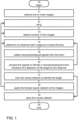
- FIG. 1 is a flowchart diagram of the method according to various exemplary embodiments of the present invention. It is to be understood that, unless otherwise defined, the operations described hereinbelow can be executed either contemporaneously or sequentially in many combinations or orders of execution. Specifically, the ordering of the flowchart diagrams is not to be considered as limiting. For example, two or more operations, appearing in the following description or in the flowchart diagrams in a particular order, can be executed in a different order (e.g., a reverse order) or substantially contemporaneously. Additionally, several operations described below are optional and may not be executed.
- the method begins at 10 and optionally and preferably continues to 11 at which one or more input images is received.
- the received image is large (e.g., a aerial image or an image captured by a camera covering a wide field-of-view, e.g ., a panoramic image)
- the method optionally and preferably continues to 12 at which the image is tiled into a plurality of tiles, each to be used by the method as a separate input image.
- the method can receive a plurality of input images at 11, in which case 12 can be skipped.
- the method receives a plurality of images, and tiles one or more or each of these images.
- any input image received at 11 can be used by the method for training the image classification neural network, whether or not it is tiled.
- the method optionally and preferably continues to 13 at which a portion of the images is selected. This can be done in more than one way.
- the images are selected randomly, according to a uniform distribution or any other distribution.
- a reference image that includes a target is received, and the portion is selected responsively to reference image.
- a coarse image processing procedure can be applied to select images that have a similarity level higher than a predetermined threshold to the reference image.
- at least a few images that have a similarity level lower than a predetermined threshold are also selected, to allow better training.
- the ratio of images with high similarity to images with low similarity to the reference image can optionally and preferably be from about 1 to about 10.
- an initial target model can be built by augmenting the reference image ( e.g., by creating rotated images), and an unsupervised autoencoder can be used to learn the features representing the reference image.
- the portion of the images can be selected based on distances from the mean image.
- the ratio of images with long distance (e.g ., above a predetermined threshold) to images with short distance (e.g ., less than a predetermined threshold) image can optionally and preferably be from about 1 to about 10.
- unsupervised clustering is applied to the images, and the portion is selected based on the unsupervised clustering.
- Clusters may match different types of objects presented in the images, with one of the clusters being objects resembling the targets.
- the method can sample a portion of the clusters, and select several images from each cluster.
- the ratio of images from the cluster of images resembling the target to images from other clusters can optionally and preferably be from about 1 to about 10.
- the largest cluster can contain distracting features. In some embodiments, this cluster is omitted to reduce the amount of data to be reviewed by the observer.
- the images or, more preferably, the portion of the images is presented to an observer as a visual stimulus, and at 15 neurophysiological signals are collected from a brain of observer. Operation 15 is preferably executed contemporaneously with the visual stimulus 14, so that the collected signals include also signals that are indicative of the observer's response to the visual stimulus.
- the images are preferably presented serially at a sufficiently high rate. Such presentation is referred to as Rapid Serial Visual Presentation (RSVP).
- the rate is preferably selected so that it can cope with overlapping responses in a rapid series of visual presentation.
- Representative presentation rates suitable for the present embodiments are from about 2 Hz to about 20 Hz or from about 2 Hz to about 15 Hz or from about 2 Hz to about 10 Hz or from about 5 Hz to about 20 Hz or from about 5 Hz to about 15 Hz or from about 5 Hz to about 10 Hz.
- the neurophysiological signals are preferably encephalogram (EG) signals, such as electroencephalogram (EEG) signals or magnetoencephalogram (MEG) signals.
- EG encephalogram
- EEG electroencephalogram
- MEG magnetoencephalogram
- Other types of signals are also contemplated, but the present inventors found that EEG signals are preferred.
- the EEG signals are preferably collected, optionally and preferably simultaneously, from a multiplicity of electrodes (e.g ., at least 4 or at least 16 or at least 32 or at least 64 electrodes), and optionally and preferably at a sufficiently high temporal resolution.
- signals are sampled at a sampling rate of at least 150 Hz or at least 200 Hz or at least 250 Hz, e.g ., about 256 Hz.
- a low-pass filter of is employed to prevent aliasing of high frequencies.
- a typical cutoff frequency for the low pass filter is, without limitation, about 51 Hz.
- one or more of the following frequency bands can be defined: delta band (typically from about 1 Hz to about 4 Hz), theta band (typically from about 3 to about 8 Hz), alpha band (typically from about 7 to about 13 Hz), low beta band (typically from about 12 to about 18 Hz), beta band (typically from about 17 to about 23 Hz), and high beta band (typically from about 22 to about 30 Hz).
- delta band typically from about 1 Hz to about 4 Hz
- theta band typically from about 3 to about 8 Hz
- alpha band typically from about 7 to about 13 Hz
- low beta band typically from about 12 to about 18 Hz
- beta band typically from about 17 to about 23 Hz
- high beta band typically from about 22 to about 30 Hz.
- Higher frequency bands such as, but not limited to, gamma band (typically from about 30 to about 80 Hz), are also contemplated.
- Electrodes can be placed at one or more, optionally and preferably all, of the following locations: two on the mastoid processes, two horizontal EOG channels positioned at the outer canthi of the left and right eyes, two vertical EOG channels, one below and one above the right eye, and a channel on the tip of the nose.
- the method continues to 16 at which the neurophysiological signals are processed to identify a neurophysiological event indicative of a detection of the target by the observer.
- the observer is provided with a priori knowledge regarding the target that is to be identified in the image.
- the observer can be presented with a stimulus describing the target and the observer can be asked to memorize the target.
- the stimulus describing the target can be of any type, including, without limitation, a visual stimulus (e.g ., an image of the target), a textual stimulus (e.g., a written description of the target), an auditory stimulus ( e.g., an oral description of the target), an olfactory stimulus (e.g ., a sample having an odor similar to an odor of the target).
- a visual stimulus e.g ., an image of the target
- a textual stimulus e.g., a written description of the target
- an auditory stimulus e.g., an oral description of the target
- an olfactory stimulus e.g ., a sample having an odor similar to an odor of the target.
- the observer is presented with a stimulus that is complementary to the target.
- the observer can be requested to memories an object wherein the target is defined
- the processing 16 can be done in more than one way. Following is a description of several techniques that can be used for identifying a neurophysiological event in the neurophysiological signals.
- the processing typically includes a digitization procedure that generates digital data from the signals. These data are typically arranged as a spatiotemporal matrix, in which the spatial dimension corresponds to electrode location on the scalp of the observer, and the temporal dimension is a discretization of the time axis into a plurality of time points or epochs, that may or may not be overlapped.
- the data can then be subjected to a dimensionality reduction procedure for mapping the data onto a lower dimensional space.
- the processing may optionally, but not necessarily, be based on frequency-bands relevant to target detection. Specifically, the processing may be primarily based on the P300 EEG wave.
- the processing is preferably automatic and can be based on supervised or unsupervised learning from training data sets.
- Learning techniques that are useful for identifying a target detection events include, without limitation, Common Spatial Patterns (CSP), autoregressive models (AR) and Principal Component Analysis (PCA).
- CSP extracts spatial weights to discriminate between two classes, by maximizing the variance of one class while minimizing the variance of the second class.
- AR instead focuses on temporal, rather than spatial, correlations in a signal that may contain discriminative information.
- Discriminative AR coefficients can be selected using a linear classifier.
- PCA is particularly useful for unsupervised learning.
- PCA maps the data onto a new, typically uncorrelated space, where the axes are ordered by the variance of the projected data samples along the axes, and only axes that reflect most of the variance are maintained. The result is a new representation of the data that retains maximal information about the original data yet provides effective dimensionality reduction.
- Another method useful for identifying a target detection event employs spatial Independent Component Analysis (ICA) to extract a set of spatial weights and obtain maximally independent spatial-temporal sources.
- ICA spatial Independent Component Analysis
- a parallel ICA stage is performed in the frequency domain to learn spectral weights for independent time-frequency components.
- PCA can be used separately on the spatial and spectral sources to reduce the dimensionality of the data.
- Each feature set can be classified separately using Fisher Linear Discriminants (FLD) and can then optionally and preferably be combined using naive Bayes fusion, by multiplication of posterior probabilities).
- FLD Fisher Linear Discriminants
- the spatial projection can be implemented, for example, as a linear transformation of signals into underlying source space or as ICA.
- the temporal projection can serve as a filter.
- the dual projections can be implemented on non-overlapping time windows of the single-trial data matrix, resulting in a scalar representing a score per window. The windows' scores can be summed or classified to provide a classification score for the entire single trial.
- One option is, for example, to learn the optimal time window for each channel separately and then train the spatial terms.
- the method employs a Spatially Weighted Fisher Linear Discriminant (SWFLD) classifier to the neurophysiological signals.
- SWFLD Spatially Weighted Fisher Linear Discriminant
- This classifier can be obtained by executing at least some of the following operations. Time points can be classified independently to compute a spatiotemporal matrix of discriminating weights. This matrix can then be used for amplifying the original spatiotemporal matrix by the discriminating weights at each spatiotemporal point, thereby providing a spatially-weighted matrix.
- SWFLD Spatially Weighted Fisher Linear Discriminant
- the SWFLD is supplemented by PCA.
- PCA is optionally and preferably applied on the temporal domain, separately and independently for each spatial channel. This represents the time series data as a linear combination of components.
- PCA is optionally and preferably also applied independently on each row vector of the spatially weighted matrix.
- This matrix of reduced dimensionality can then be concatenated to provide a feature representation vector, representing the temporally approximated, spatially weighted activity of the signal.
- An FLD classifier can then be trained on the feature vectors to classify the spatiotemporal matrices into one of two classes. In the present embodiments, one class corresponds to a target identification event, and another class corresponds to other events. More details regarding the SWFLD classifier according to some embodiments of the present invention is provided in the Examples section that follows.
- the method employs a neural network classifier, more preferably a convolutional neural network (CNN) classifier, to the neurophysiological signals.
- CNN convolutional neural network
- the CNN receives the signals as a spatiotemporal matrix and produces a score, typically in the range [0, 1] which estimates the probability that the presented visual stimulus is a target.
- the network can optionally and preferably be trained using stochastic gradient descent (SGD) to minimize a logistic regression cost function.
- SGD stochastic gradient descent
- the CNN comprises a first convolution layer applying spatial filtering for each of a plurality of time points characterizing the neurophysiological signals, a second convolution layer applying temporal filtering to outputs provided by the first convolution layer, and optionally and preferably also a third convolution layer applying temporal filtering to outputs provided by the second convolution layer.
- the second and third convolution layers typically learn temporal patterns in the signal that represent the change in amplitude of the spatial maps learned by the first layer, and therefore advantageous since they improve the classification accuracy.
- the CNN can also comprise two or more fully connected layers each providing a non-linear combination of the outputs provided by a layer preceding the respective fully connected layer.
- a first fully connected layer preferably receives output from the third convolutional layer (when a third convolutional layer is employed) or the second convolutional layer (preferably, but not necessarily, when a third convolutional layer is not employed).
- a second fully connected layer preferably receives output from the first from the first fully connected layer.
- the CNN comprises two or more pooling layers, e.g ., max-pooling layers, to reduce dimensionality. More details regarding the preferred CNN is provided in the Examples section that follows.
- the processing 16 comprises calculating a score describing the probability that a target exists in the image or the similarity between an object in the presented image and the target.
- the score is calculated using the respective classifier. For example, when the classifier is an SWFLD classifier, a Fisher score can be calculated, and when the classifier is a CNN classifier, the score can be the output of the logistic regression layer of the CNN.
- the method employs an observer-specific score normalization function for normalizing the calculated score.
- an observer-specific score normalization function is typically prepared at a training stage in which the method is repeatedly executed for the same observer using a training dataset of images, wherein each image of the dataset is classified as either containing or not containing the target.
- the observer-specific score normalization function can also be target specific, in which case the training stage is repeated for each target to be detected. However, this need not necessarily be the case, since, for some applications, it may not be necessary to repeat the training for each target, since the observer's ability to detect different targets may be similar, particularly when the different targets belong to the same category ( e.g ., different vehicles, different faces, etc .).
- a first score distribution function is calculated for target classified as containing the target, and a second score distribution function is calculated for target classified as not containing the target.
- the first and second score distribution functions can have a predetermined shape in the score space. Typically the shape is localized.
- Representative examples of types of distribution functions suitable for use as first and second score distribution functions including, without limitation, a Gaussian, a Lorenzian and a modified Bessel function.
- the normalized score can be compared to a predetermined confidence threshold to determine the level of confidence of the identified detection event.
- the method optionally and preferably loops back to 14 to re-present the respective image region or group of image regions to the observer and re-calculate the normalized score.
- two different types of classifiers are used and a score that weighs the scores provided by the individual classifiers is computed.
- the method can apply an SWFLD classifier and calculate a SWFLD classification score based on the SWFLD classifier, applies a CNN classifier and calculate a CNN classification score based on the CNN classifier, and combines the SWFLD score and the CNN score.
- the combination of the two score may optionally and preferably be preceded by a score rescaling operation that brings the two scores to similar scale.
- the aforementioned normalization using the first and second score distribution functions can also serve for rescaling the scores.
- the method processes the neurophysiological signals to identify eye blinks.
- the method when there is a positive identification of an eye blink during a presentation of an image region or group of image regions to the observer, the method optionally and preferably loops back to 14 and re-presents the respective image region or group of image regions to the observer.
- Eye blinks can be identified using any technique known in the art, such as the technique disclosed in U.S. Patent No. 5,513,649 and U.S. Published Application No. 20150018704 .
- the method proceeds to 17 at which the image classification neural network is trained to identify the target in the image, based on the identification of the neurophysiological event. This is done by assigning a score to the image and feeding the image back to the image classification neural network.
- the label or score can be binary in which case it can assume one value (e.g ., "1") when the image is identified as containing the target, and another value ( e.g ., "0") when the image is identified as not containing the target.
- the label or score can be non-binary in which case it can assume a value within a range of discrete or continuous values indicative of the likelihood that the image contains the target or the similarity between the target and an object in the image.
- the score is the score calculated at 16.
- the method updates the training.
- the training or retraining can be applied to one or more layers of the image classification neural network, as desired.
- the training or retraining can be applied to one or more of the last hidden layers which contain less generic and more details-specific features.
- the training or retraining can be applied to the output layer of the image classification neural network. In some embodiments of the present invention the training or retraining is applied to all the layers of the network.
- the method optionally and preferably proceeds to 18 at which the trained image classification neural network is applied to at least a portion, more preferably all, the images received at 11 to detect therein candidate images suspected as being occupied by the target.
- the detection by the network is then used for re-defining the images. For example, the number of images can be reduced so that the ratio between candidate images suspected as being occupied by the target and images suspected as being not occupied by the target is within a predetermined ratio interval ( e.g ., between 1 and 10).
- At least one image of the redefined set of images is a optionally and preferably a candidate image as detected by the trained image classification neural network.
- the method can then loop back to 13 or 14 and repeat at least some of the operations described herein so that the image classification neural network is trained using the neurophysiological signals in an iterative manner.
- the method can loop back to 12 instead of 13 or 14 so that the redefining can be executed by re-tiling the larger input image into a plurality of images.
- the method can proceed to 19 at which the image classification neural network is stored in a computer-readable storage medium.
- the method ends at 20.
- the advantage of using method 10 over Geva et al is that the brain's ability to process visual stimuli is automatically used for training an artificial neural network, unlike the situation in Geva et al where the training does not use information obtained from the neurophysiological signal. This significantly improves the ability of the artificial neural network to accurately classify images, once trained, and reduces the training time, hence also the required computer resources.
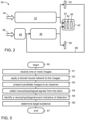
- FIG. 2 is a schematic illustration of an image classification neural network 30 which can be trained using the method and system of the present embodiments, and which can at least in part be used, once trained ( e.g ., using the method and system of the present embodiments) for classifying an image.
- Neural network 30 preferably comprises a first neural subnetwork 32 configured for receiving and processing neurophysiological data 34, a second neural subnetwork 36 configured for receiving and processing images 38, and a shared subnetwork 40 having a neural network layer 42 receiving and combining outputs from both first neural subnetwork 32 and second neural subnetwork 36.
- Shared subnetwork 40 can also have one or more additional neural network layers e.g., one or more hidden layers 44 and an output layer 46.
- Neural network layer 42 is preferably a concatenation layer that concatenates the output features of the two subnetworks 32 and 36.
- Hidden layer 44 of shared subnetwork 40 can be a fully connected layer and the output layer can be a softmax layer.
- Subnetworks 32 and 36 are optionally and preferably structured for supervised machine learning.
- the output of neural subnetwork 32 can optionally and preferably be fed as a feedback 58 to subnetwork 36.
- the output layer of subnetwork 36 provides a binary or non-binary score for a particular image processed by subnetwork 32
- the score can be used to label the particular image.
- the image and the associated label can be fed into the subnetwork 36, thereby facilitating a supervised or semi-supervised learning of subnetwork 36.
- Network 30 optionally and preferably comprises an autoencoder subnetwork 48 that receives the images 38 extracts features from the images and provides them as input to subnetwork 36.
- autoencoder subnetwork 48 is employed during the training of network 30 and is not employed for image classification after network 30.
- autoencoder subnetwork 48 is preferably structured for unsupervised machine learning. The advantage of having autoencoder subnetwork 48 is that it allows a better training of subnetwork 36.
- autoencoder subnetwork 48 is optionally and preferably fed by images labeled as not containing the target.
- the autoencoder subnetwork 48 extracts from the images features of non-targets. This simulates a scenario in which the shape of the target is unknown.
- Autoencoder subnetwork 48 learns features that model images containing non-targets.
- autoencoder subnetwork 48 can optionally and preferably fed by additional images, wherein the additional images may include images that are not associated with any label (namely images for which there is no knowledge whether or not they contain the target), and/or images that are associated with a binary or no-binary label or score.
- Autoencoder subnetwork 48 can be a CNN having, aside for input and output layers, two or more sets of parallel feature map layers and one or more fully connected layers.
- One or more of the sets of parallel feature map layers can perform convolution and feed vectors of features to the fully connected layer(s).
- the fully connected layer(s) are optionally and preferably smaller in size (number of neuron elements) than the feature map layers, and can serve for encoding the features received from the of parallel feature map layers.
- One or more other sets of parallel feature map layers can receive the encoded features from the fully connected layer(s), and reconstructs or approximately reconstructs the feature vectors by performing deconvolution to the encoded features.
- the size of these feature map layers is optionally and preferably larger than the size of the fully connected layer, and is preferably selected such that the dimensionality of the reconstructed feature vectors is the same or approximately the same as the feature vectors generated from the images 38.
- the output layer(s) optionally and preferably concatenates the reconstructed feature vectors to restore the size of the input images 38.
- a convolutional kernel can be used to feed the set(s) of parallel feature map layers by the input layers.
- a down-sampling kernel e.g., a max pooling kernel
- An up-sampling kernel can optionally and preferably be used to feed one of the sets of parallel feature map layers by the fully connected layers.
- Second neural subnetwork 36 can be a CNN having input layers, one or more sets of parallel feature map layers, and one or more output layers.
- a convolutional kernel can be used to receive features from the input layers and provide features to a set parallel feature map layers, and a down-sampling kernel (e.g., a max pooling kernel) can optionally and preferably be used between sets of parallel feature map layers.
- the output layer (that is concatenated at layer 42 of subnetwork 40 ) is optionally and preferably a fully connected layer, optionally and preferably receiving features from the last set of parallel feature map layers.
- First neural subnetwork 32 can be a CNN having an input layer, one or more sets of parallel feature map layers, and one or more output layers.
- Convolutional kernels and down-sampling kernels e.g., a max pooling kernel
- a convolutional kernel is optionally and preferably used between the input layer and the first set of parallel feature map layers.
- subnetwork 40 combines the output of subnetworks 32 and 36 it was found by the Inventors of the present invention that it is also beneficial to split the output of at last one of subnetworks 32 and 36 such that the respective output are combined by shared subnetwork 40 but are also processed separately. This can be done by means of an additional neural network layer or an additional subnetwork that receives the output of the respective subnetwork but not the other subnetwork. Shown in FIG. 2 is a first additional neural network layer 52 that receives the output of subnetwork 32 and a second neural network layer 56 that receives the output of subnetwork 36. Each of the additional layers 52 and 56 can separately calculate a score using the output vector of the respective subnetwork.
- an image can be assigned with a first detection score as calculated by layer 52, and a second detection score as calculated by layer 56. These scores can be compared or combined, for example, using a weighted sum.
- Subnetworks 48 and 30, including output layer 56 can be used without subnetworks 32 for generating a training subset of images. This is particularly useful when the number of images in the training set is large and it is desired to initially classify the images by a machine (e.g., a network including subnetworks 48 and 30 and output layer 56 but does not include subnetworks 32 ) before presenting them to the human observer.
- the output of layer 56 can be used to initially select a training subset of images, for example, only images suspected as containing the target, or both images suspected as containing the target and images suspected as not-containing the target with a predetermined ratio therebetween.
- one or more training iterations can be executed without autoencoder subnetwork 48 but using both subnetworks 32 and 36. In these iterations, the output of layer 52 is fed into subnetwork 36, bypassing autoencoder subnetwork 48.
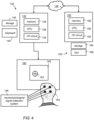
- FIG. 3 is a flowchart diagram of a method suitable for image classification, according to some embodiments of the present invention.
- the method begins at 60 and continues to 61 at which one or more images are received.
- image is optionally and preferably tiled into a plurality of tiles, each to be used by the method as a separate input image as further detailed hereinabove.
- the method can receive a plurality of input images at 61. Also contemplated are embodiments in which the method receives a plurality of images, and tiles one or more or each of these images.
- the method proceeds to 62 at which a trained image classification neural network 30, is applied to each image to detect candidate images suspected as being occupied by a target.
- the method optionally and preferably proceeds to 63 at which an observer is presented with each of the candidate images as a visual stimulus, to 64 at which neurophysiological signals are collecting from the observers brain, and to 65 at which the neurophysiological signals are processed to identify a neurophysiological event indicative of a detection of the target by the observer as further detailed hereinabove.
- the method can then proceed to 66 at which an existence of target in the image is determined based, at least in part, on the identification of neurophysiological event.
- the determination 66 can be binary, in which case the image is assigned with a binary score which can assume one value (e.g.
- the determination 66 can alternatively be non-binary, in which case the image is assigned with a non-binary score which can assume a value within a range of discrete or continuous values indicative of the likelihood that the image contains the target or the similarity between the target and an object in the image.
- the score can be, for example, the score calculated during the processing of the neurophysiological signals as further detailed hereinabove.
- the method ends at 67.
- the advantage of using method 60 is that the observer is presented only with images that have been preliminarily identified by the neural network as candidate images. This significantly improves the detection accuracy, reduces the processing time, and observer's fatigue.
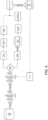
- System 130 comprises a data processor 132, a display 160 communicating with data processor 132, and a neurophysiological signal collection system 146.
- System 130 can be used for executing any of the operations, e.g ., all the operations of the methods described above.
- System 130 can be a stationary target identification system, or be, or combined with, a mobile system, such as, but not limited to, a virtual reality system of augmented reality system.
- Neurophysiological signal collection system 146 optionally and preferably communicates with 132 and is configured for collecting neurophysiological signals from a brain of an observer presented with an image 148 as a visual stimulus for detecting a target 153 in image 148.
- Data processor 132 typically comprises an input/output (I/O) circuit 134, a data processing circuit 136, such as a central processing unit (CPU), e.g., a microprocessor, and a memory 138 which typically includes both volatile memory and non-volatile memory.
- I/O circuit 134 is used to communicate information in appropriately structured form to and from other CPU 136 and other devices or networks external to system 130.
- CPU 136 is in communication with I/O circuit 134 and memory 138.
- Display device 160 is shown in communication with data processor 132, typically via I/O circuit 134.
- Data processor 132 issues to display device 160 graphical and/or textual output images generated by CPU 136.
- a keyboard 142 can also be in communication with data processor 132, typically via I/O circuit 134.
- remote computer 150 which may optionally and preferably be used according to some embodiments of the present invention and which can similarly include a hardware processor 152, an I/O circuit 154, a hardware CPU 156, a hardware memory 158.
- remote computer 160 can include a graphical user interface 166.
- I/O circuits 134 and 154 of system 130 and computer 150 can operate as transceivers that communicate information with each other via a wired or wireless communication.
- system 130 and computer 150 can communicate via a network 140, such as a local area network (LAN), a wide area network (WAN) or the Internet.
- LAN local area network
- WAN wide area network
- Any of processors 132 and 152 can in some embodiments be a part of a cloud computing resource of a cloud computing facility.
- Client 130 and server 150 computers can further comprise one or more computer-readable storage media 144, 164, respectively.
- Media 144 and 164 are preferably non-transitory storage media storing computer code instructions for executing selected operations of as further detailed herein, and processors 132 and 152 execute these code instructions.
- the code instructions can be run by loading the respective code instructions into the respective execution memories 138 and 158 of the respective processors 132 and 152.
- Each of storage media 144 and 164 can store program instructions which, when read by the respective processor, cause the processor to execute the methods as described herein.
- Neurophysiological signal collection system 144 optionally and preferably communicates with data processor 132 and is configured for collecting neurophysiological signals from a brain of an observer 162 as further detailed hereinabove.
- data processor 132 of system 130 is configured for executing the method described herein.
- the image(s) used by the method can be retrieved by processor 132 from storage 144 or be transmitted from computer 150 to processor 152 over network 140.
- one or more images are retrieved by processor 132 from storage 144 and one or more images are transmitted from computer 150 to processor 152 over network 140.
- images forming a training set can be retrieved from storage 144, and images to be classified by the method of the present embodiments can be transmitted over network 140.
- a detection score can be transmitted from system 130 to computer 150 for displaying the detection score and optionally and preferably also the image on GUI 166.
- compositions, method or structure may include additional ingredients, steps and/or parts, but only if the additional ingredients, steps and/or parts do not materially alter the basic and novel characteristics of the claimed composition, method or structure.
- a compound or “at least one compound” may include a plurality of compounds, including mixtures thereof.
- range format is merely for convenience and brevity and should not be construed as an inflexible limitation on the scope of the invention. Accordingly, the description of a range should be considered to have specifically disclosed all the possible subranges as well as individual numerical values within that range. For example, description of a range such as from 1 to 6 should be considered to have specifically disclosed subranges such as from 1 to 3, from 1 to 4, from 1 to 5, from 2 to 4, from 2 to 6, from 3 to 6 etc., as well as individual numbers within that range, for example, 1, 2, 3, 4, 5, and 6. This applies regardless of the breadth of the range.
- This example describes a representative implementation of the technique of the present embodiments.
- the implementation is described for the case of a large input image that is tiled by the method.
- One of ordinary skills in the art, provided with the details described herein would know how to implement at the technique also for the case of individual images of an image set.
- an experienced human observer is optionally and preferably presented, preferably in a RSVP mode, with those parts of the image that may contain potential targets or objects of interest in order to increase the observer's efficiency.
- other parts of the image are not presented to the observer.
- Some embodiments of the invention provide an iterative process that streamlines the procedure of image selection to be shown to human observer using output of visual object recognition neural network, and improves the training of the neural network using the output of human observer's classification.
- a representative framework includes one or more of the following operations.
- FIG. 5 schematically illustrates the representative implementation, according to some embodiments of the present invention.
- Examples 2 and 3 below include results of simulation which was run using the framework shown in FIG. 1 on a large satellite image. Labels were introduced to simulate the EEG classification stage (see stage 6 above).
- the accuracy of the detection and the efficiency of the training can be optionally and preferably improved using a multimodal EEG-Image neural network for image classification, illustrated in FIG. 6 .
- the network optionally and preferably receives as input an image and a single-trial EEG data corresponding to the brain response for this image.
- the network is trained to classify these inputs into a detection score using a feature-level fusion. Specifically, the network learns features separately for each type of data, and later joins these features for the final layers. This also allows the network to use features from both modalities to provide a detection score and to identify, for example, when one of the modalities would not have enough support.
- the targets to be classified may be unknown or vary. In such cases, the image part of the network cannot be trained on target images.
- the unsupervised autoencoder model is firstly used to train the network on only images that do not contain the target ("semi-supervised network").
- the autoencoder model learns how to reconstruct the images from the features, and produces features that represent pertinent information about the images. Then, the features extracted by the autoencoder are used as input to the multimodal network, instead of the original images.
- Another input is the labeled EEG data.
- the network optionally and preferably starts with separate layers for each input, continues with a layer that concatenates features from each input and ends with a final classification layer. Examples 2 and 3, below, include results of application of the multimodal network on imagery data.
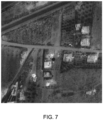
- the input image to the framework was a large aerial image shown in FIG. 7 .
- the target was defined as man-made buildings.
- the input image included a total of 101 targets.
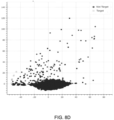
- FIG. 8A shows an initial map describing the input image. Yellow symbols describe objects identified as targets and purple symbols describe objects identified as non-targets.
- FIG. 8B shows the map after the first iteration.
- the portion of the images to be presented to the observer that was selected randomly constituted about 1.5% of the total number of images, and the portion of the images to be presented to the observer that was selected by clustering was about 10%.
- the number of target in RSVP was 24, and the number of non-target in RSVP was 276.
- FIG. 8C shows the map after the second iteration.
- the portion of the images to be presented to the observer that was selected randomly constituted about 1.5% of the total number of images, and the portion of the images to be presented to the observer that was selected by clustering was about 10.2%.
- the number of target in RSVP was 76, and the number of non-target in RSVP was 224.
- FIG. 8D shows the map after the third iteration.
- the portion of the images to be presented to the observer that was selected randomly constituted about 1.5% of the total number of images, and the portion of the images to be presented to the observer that was selected by clustering was about 10.19%.
- the number of target in RSVP was 1, and the number of non-target in RSVP was 299.
- the technique optionally and preferably was able to identify all the targets with 100% accuracy and with no false positive detections.
- Three additional performance analyses were conducted. In a first additional performance analysis the EEG network shown in FIG. 6 was evaluated, in a second additional performance analysis the image network in FIG. 6 was evaluated, and in a third additional performance analysis the combination of the EEG network and the image network of FIG. 6 , without the autoencoder, was evaluated. In these three analyses, the images were a priori labeled as either containing or not containing the target (binary labeling), and the binary labels were fed to the respective network for supervised learning.
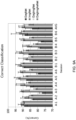
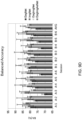
- FIGs. 9A-D compare the performance of the multimodal network shown in FIG. 6 , with the performance other networks.
- FIG. 9A shows histograms describing percentage of correct classification
- FIG. 9B shows histograms describing hit percentages
- FIG. 9C shows histograms describing percentage of false alarms
- FIG. 9D shows histograms describing balanced accuracy.
- the results designated EEGIMGAeNet correspond to the multimodal network with autoencoder shown in FIG. 6
- the results designated EegNet correspond to the EEG network in FIG. 6
- the results designated ImgNet correspond to the Image network in FIG. 6
- the results designated EegImgNet correspond to the combination of the EEG network and the Image network of FIG. 6 without the autoencoder.
Landscapes
- Engineering & Computer Science (AREA)
- Theoretical Computer Science (AREA)
- Physics & Mathematics (AREA)
- General Physics & Mathematics (AREA)
- Evolutionary Computation (AREA)
- Data Mining & Analysis (AREA)
- Artificial Intelligence (AREA)
- General Engineering & Computer Science (AREA)
- General Health & Medical Sciences (AREA)
- Health & Medical Sciences (AREA)
- Computer Vision & Pattern Recognition (AREA)
- Software Systems (AREA)
- Life Sciences & Earth Sciences (AREA)
- Computing Systems (AREA)
- Biomedical Technology (AREA)
- Multimedia (AREA)
- Databases & Information Systems (AREA)
- Molecular Biology (AREA)
- Medical Informatics (AREA)
- Mathematical Physics (AREA)
- Computational Linguistics (AREA)
- Biophysics (AREA)
- Evolutionary Biology (AREA)
- Bioinformatics & Cheminformatics (AREA)
- Bioinformatics & Computational Biology (AREA)
- Human Computer Interaction (AREA)
- Neurosurgery (AREA)
- Neurology (AREA)
- Dermatology (AREA)
- Biodiversity & Conservation Biology (AREA)
- Nuclear Medicine, Radiotherapy & Molecular Imaging (AREA)
- Radiology & Medical Imaging (AREA)
- Quality & Reliability (AREA)
- Image Analysis (AREA)
- Measurement And Recording Of Electrical Phenomena And Electrical Characteristics Of The Living Body (AREA)
Applications Claiming Priority (2)
| Application Number | Priority Date | Filing Date | Title |
|---|---|---|---|
| US201662437065P | 2016-12-21 | 2016-12-21 | |
| PCT/IB2017/058297 WO2018116248A1 (en) | 2016-12-21 | 2017-12-21 | System and method for iterative classification using neurophysiological signals |
Publications (3)
| Publication Number | Publication Date |
|---|---|
| EP3558102A1 EP3558102A1 (en) | 2019-10-30 |
| EP3558102A4 EP3558102A4 (en) | 2020-07-22 |
| EP3558102B1 true EP3558102B1 (en) | 2024-11-20 |
Family
ID=62626017
Family Applications (1)
| Application Number | Title | Priority Date | Filing Date |
|---|---|---|---|
| EP17883157.4A Active EP3558102B1 (en) | 2016-12-21 | 2017-12-21 | System and method for iterative classification using neurophysiological signals |
Country Status (7)
| Country | Link |
|---|---|
| US (2) | US11580409B2 (enExample) |
| EP (1) | EP3558102B1 (enExample) |
| JP (1) | JP6998959B2 (enExample) |
| CN (1) | CN110139597B (enExample) |
| CA (1) | CA3046939A1 (enExample) |
| IL (1) | IL267518B2 (enExample) |
| WO (1) | WO2018116248A1 (enExample) |
Families Citing this family (35)
| Publication number | Priority date | Publication date | Assignee | Title |
|---|---|---|---|---|
| WO2018116248A1 (en) | 2016-12-21 | 2018-06-28 | Innereye Ltd. | System and method for iterative classification using neurophysiological signals |
| EP3537346A1 (en) * | 2018-03-09 | 2019-09-11 | Tata Consultancy Services Limited | Method and system for incorporating regression into stacked auto encoder (sae) |
| KR102695519B1 (ko) * | 2018-07-02 | 2024-08-14 | 삼성전자주식회사 | 영상 모델 구축 장치 및 방법 |
| GB2575852B (en) * | 2018-07-26 | 2021-06-09 | Advanced Risc Mach Ltd | Image processing |
| US11158063B2 (en) * | 2018-07-30 | 2021-10-26 | Hewlett Packard Enterprise Development Lp | Objects and features neural network |
| WO2020028352A1 (en) * | 2018-07-31 | 2020-02-06 | Washington University | Methods and systems for segmenting organs in images using a cnn-based correction network |
| KR102608981B1 (ko) * | 2018-10-24 | 2023-12-01 | 한국전자통신연구원 | 향 시각화 시스템 및 방법 |
| US12114989B2 (en) | 2018-12-04 | 2024-10-15 | Brainvivo Ltd. | Apparatus and method for utilizing a brain feature activity map database to characterize content |
| JP7103237B2 (ja) * | 2019-01-09 | 2022-07-20 | 株式会社明電舎 | 流量予測装置及び流量予測方法 |
| US11715043B2 (en) * | 2019-03-01 | 2023-08-01 | Apple Inc. | Semantics preservation for machine learning models deployed as dependent on other machine learning models |
| US10878298B2 (en) * | 2019-03-06 | 2020-12-29 | Adobe Inc. | Tag-based font recognition by utilizing an implicit font classification attention neural network |
| US10803231B1 (en) | 2019-03-29 | 2020-10-13 | Adobe Inc. | Performing tag-based font retrieval using combined font tag recognition and tag-based font retrieval neural networks |
| US10984560B1 (en) * | 2019-03-29 | 2021-04-20 | Amazon Technologies, Inc. | Computer vision using learnt lossy image compression representations |
| CN110084309B (zh) * | 2019-04-30 | 2022-06-21 | 北京市商汤科技开发有限公司 | 特征图放大方法、装置和设备及计算机可读存储介质 |
| US20210018896A1 (en) * | 2019-07-16 | 2021-01-21 | Carnegie Mellon University | Methods and Systems for Noninvasive Mind-Controlled Devices |
| KR102758527B1 (ko) * | 2019-10-29 | 2025-01-21 | 현대자동차주식회사 | 뇌파 신호를 이용한 이미지 생성 장치 및 방법 |
| US11361189B2 (en) * | 2019-12-03 | 2022-06-14 | Ping An Technology (Shenzhen) Co., Ltd. | Image generation method and computing device |
| CN111338482B (zh) * | 2020-03-04 | 2023-04-25 | 太原理工大学 | 一种基于监督自编码的脑控字符拼写识别方法及系统 |
| CN111783942B (zh) * | 2020-06-08 | 2023-08-01 | 北京航天自动控制研究所 | 一种基于卷积循环神经网络的脑认知过程模拟方法 |
| WO2022115100A1 (en) * | 2020-11-25 | 2022-06-02 | Hewlett-Packard Development Company, L.P. | Identifying anomaly location |
| JP2024505611A (ja) * | 2021-01-14 | 2024-02-07 | ブランヴィヴォ リミテッド | 一般的なコンテンツの脳反応モデルを使用した専門分野固有のコンテンツの分類 |
| CN112800971B (zh) * | 2021-01-29 | 2024-07-16 | 深圳市商汤科技有限公司 | 神经网络训练及点云数据处理方法、装置、设备和介质 |
| US12412098B2 (en) | 2021-03-04 | 2025-09-09 | Samsung Electronics Co., Ltd. | Apparatus and method for neural architecture searching with target data |
| CN113116306A (zh) * | 2021-04-21 | 2021-07-16 | 复旦大学 | 一种基于听觉诱发脑电信号分析的意识障碍辅助诊断系统 |
| CN113095297B (zh) * | 2021-05-11 | 2022-07-15 | 昆明理工大学 | 一种基于一维投影跟踪眼动速率的疲劳检测方法 |
| WO2022241320A1 (en) * | 2021-05-14 | 2022-11-17 | Google Llc | Neural networks with feedforward spatial transformation units |
| CN113995423B (zh) * | 2021-06-21 | 2022-12-02 | 西安电子科技大学 | 基于相位保持网络的连续快速视觉演示脑电信号分类方法 |
| CN114931388B (zh) * | 2022-04-26 | 2024-11-01 | 广东医科大学 | 基于并行超顺磁聚类算法的神经元峰电位分类方法、装置、存储介质及计算机设备 |
| EP4300265A1 (en) * | 2022-06-29 | 2024-01-03 | Copysan Communicaciones, SL | Method, system and computer programs for the automatic labeling of images for defect detection |
| US20240119123A1 (en) * | 2022-10-11 | 2024-04-11 | Dell Products L.P. | Determination of event types from autoencoder-based unsupervised event detection |
| US20240160288A1 (en) * | 2022-11-15 | 2024-05-16 | Micron Technology, Inc. | Neuronal to memory device communication |
| US20240257971A1 (en) * | 2023-02-01 | 2024-08-01 | Arizona Board Of Regents On Behalf Of The University Of Arizona | Virtual reality neuropsychological assessment |
| CN116383600A (zh) * | 2023-03-16 | 2023-07-04 | 上海外国语大学 | 一种单试次脑电波信号分析方法和系统 |
| CN117056831A (zh) * | 2023-10-13 | 2023-11-14 | 南京龙垣信息科技有限公司 | 基于卷积神经网络的内心独白识别方法 |
| CN117494061A (zh) * | 2024-01-03 | 2024-02-02 | 中国科学院自动化研究所 | 用户兴趣挖掘方法、装置、电子设备及介质 |
Family Cites Families (40)
| Publication number | Priority date | Publication date | Assignee | Title |
|---|---|---|---|---|
| US5513649A (en) | 1994-03-22 | 1996-05-07 | Sam Technology, Inc. | Adaptive interference canceler for EEG movement and eye artifacts |
| US6278961B1 (en) * | 1997-07-02 | 2001-08-21 | Nonlinear Solutions, Inc. | Signal and pattern detection or classification by estimation of continuous dynamical models |
| WO2005101298A2 (en) * | 2004-04-14 | 2005-10-27 | Imperial Innovations Limited | Estimation of within-class matrix in image classification |
| US8374687B2 (en) | 2006-01-21 | 2013-02-12 | Honeywell International Inc. | Rapid serial visual presentation triage prioritization based on user state assessment |
| US8244475B2 (en) * | 2007-12-27 | 2012-08-14 | Teledyne Scientific & Imaging, Llc | Coupling human neural response with computer pattern analysis for single-event detection of significant brain responses for task-relevant stimuli |
| JP5544620B2 (ja) * | 2010-09-01 | 2014-07-09 | 独立行政法人産業技術総合研究所 | 意思伝達支援装置及び方法 |
| US9269046B2 (en) | 2012-01-18 | 2016-02-23 | Brainscope Company, Inc. | Method and device for multimodal neurological evaluation |
| US8792974B2 (en) | 2012-01-18 | 2014-07-29 | Brainscope Company, Inc. | Method and device for multimodal neurological evaluation |
| US9111125B2 (en) * | 2013-02-08 | 2015-08-18 | Apple Inc. | Fingerprint imaging and quality characterization |
| WO2014142962A1 (en) * | 2013-03-15 | 2014-09-18 | Intel Corporation | Brain computer interface (bci) system based on gathered temporal and spatial patterns of biophysical signals |
| WO2014170897A1 (en) | 2013-04-14 | 2014-10-23 | Yissum Research Development Company Of The Hebrew University Of Jerusalem Ltd. | Classifying eeg signals in response to visual stimulus |
| TWI508702B (zh) | 2013-07-10 | 2015-11-21 | 國立交通大學 | 即時多通道自動眼動雜訊去除器 |
| US9436279B2 (en) * | 2014-03-31 | 2016-09-06 | Rovi Guides, Inc. | Systems and methods for controlling user devices based on brain activity |
| WO2015183737A1 (en) * | 2014-05-30 | 2015-12-03 | The Regents Of The University Of Michigan | Brain-computer interface for facilitating direct selection of multiple-choice answers and the identification of state changes |
| US10130813B2 (en) | 2015-02-10 | 2018-11-20 | Neuropace, Inc. | Seizure onset classification and stimulation parameter selection |
| IL239191A0 (en) * | 2015-06-03 | 2015-11-30 | Amir B Geva | Image sorting system |
| US11071501B2 (en) * | 2015-08-14 | 2021-07-27 | Elucid Bioiwaging Inc. | Quantitative imaging for determining time to adverse event (TTE) |
| US10413724B2 (en) * | 2015-10-23 | 2019-09-17 | Hrl Laboratories, Llc | Method for low latency automated closed-loop synchronization of neurostimulation interventions to neurophysiological activity |
| CN105868712A (zh) * | 2016-03-28 | 2016-08-17 | 中国人民解放军信息工程大学 | 基于后验概率模型的脑电与机器视觉目标图像检索方法 |
| KR102707594B1 (ko) * | 2016-11-11 | 2024-09-19 | 삼성전자주식회사 | 홍채 영역 추출 방법 및 장치 |
| WO2018116248A1 (en) | 2016-12-21 | 2018-06-28 | Innereye Ltd. | System and method for iterative classification using neurophysiological signals |
| US10546242B2 (en) * | 2017-03-03 | 2020-01-28 | General Electric Company | Image analysis neural network systems |
| US20190035113A1 (en) * | 2017-07-27 | 2019-01-31 | Nvidia Corporation | Temporally stable data reconstruction with an external recurrent neural network |
| US11154251B2 (en) * | 2018-02-10 | 2021-10-26 | The Governing Council Of The University Of Toronto | System and method for classifying time series data for state identification |
| WO2019213221A1 (en) | 2018-05-01 | 2019-11-07 | Blackthorn Therapeutics, Inc. | Machine learning-based diagnostic classifier |
| EP3674999A1 (en) * | 2018-12-27 | 2020-07-01 | Bull SAS | Method of classification of images among different classes |
| EP3674994A1 (en) * | 2018-12-27 | 2020-07-01 | Bull SAS | Method of blocking or passing messages sent via a firewall based on parsing of symbols strings contained in messages among different keywords |
| US11423118B2 (en) * | 2019-01-07 | 2022-08-23 | Massachusetts Institute Of Technology | Model agnostic time series analysis via matrix estimation |
| US11481578B2 (en) * | 2019-02-22 | 2022-10-25 | Neuropace, Inc. | Systems and methods for labeling large datasets of physiological records based on unsupervised machine learning |
| US11562278B2 (en) * | 2019-05-16 | 2023-01-24 | Siemens Aktiengesellschaft | Quantum machine learning algorithm for knowledge graphs |
| US10803646B1 (en) * | 2019-08-19 | 2020-10-13 | Neon Evolution Inc. | Methods and systems for image and voice processing |
| US11593617B2 (en) * | 2019-12-31 | 2023-02-28 | X Development Llc | Reservoir computing neural networks based on synaptic connectivity graphs |
| US11620487B2 (en) * | 2019-12-31 | 2023-04-04 | X Development Llc | Neural architecture search based on synaptic connectivity graphs |
| CA3174390A1 (en) * | 2020-04-03 | 2021-10-07 | Aifred Health | Systems and methods for treatment selection |
| US11468288B2 (en) * | 2020-07-28 | 2022-10-11 | Oken Technologies, Inc. | Method of and system for evaluating consumption of visual information displayed to a user by analyzing user's eye tracking and bioresponse data |
| US12354256B2 (en) * | 2020-10-19 | 2025-07-08 | Northwestern University | Brain feature prediction using geometric deep learning on graph representations of medical image data |
| KR102321601B1 (ko) * | 2020-11-19 | 2021-11-05 | 주식회사 휴런 | 뇌 영상을 이용한 알츠하이머병의 생물학적 분류 장치 및 방법 |
| JP7552287B2 (ja) * | 2020-11-25 | 2024-09-18 | セイコーエプソン株式会社 | 物体検出方法、物体検出装置、及び、コンピュータープログラム |
| US20220301718A1 (en) * | 2021-03-16 | 2022-09-22 | Seshadri Paravastu | System, Device, and Method of Determining Anisomelia or Leg Length Discrepancy (LLD) of a Subject by Using Image Analysis and Machine Learning |
| US11645836B1 (en) * | 2022-06-30 | 2023-05-09 | Intuit Inc. | Adversarial detection using discriminator model of generative adversarial network architecture |
-
2017
- 2017-12-21 WO PCT/IB2017/058297 patent/WO2018116248A1/en not_active Ceased
- 2017-12-21 CN CN201780081627.6A patent/CN110139597B/zh active Active
- 2017-12-21 JP JP2019533183A patent/JP6998959B2/ja active Active
- 2017-12-21 US US16/471,587 patent/US11580409B2/en active Active
- 2017-12-21 IL IL267518A patent/IL267518B2/en unknown
- 2017-12-21 CA CA3046939A patent/CA3046939A1/en active Pending
- 2017-12-21 EP EP17883157.4A patent/EP3558102B1/en active Active
-
2023
- 2023-02-08 US US18/107,037 patent/US12001607B2/en active Active
Also Published As
| Publication number | Publication date |
|---|---|
| IL267518A (en) | 2019-08-29 |
| CN110139597B (zh) | 2022-12-30 |
| US11580409B2 (en) | 2023-02-14 |
| CN110139597A (zh) | 2019-08-16 |
| JP2020502683A (ja) | 2020-01-23 |
| US20200193299A1 (en) | 2020-06-18 |
| CA3046939A1 (en) | 2018-06-28 |
| EP3558102A1 (en) | 2019-10-30 |
| US12001607B2 (en) | 2024-06-04 |
| EP3558102A4 (en) | 2020-07-22 |
| IL267518B1 (en) | 2023-12-01 |
| JP6998959B2 (ja) | 2022-01-18 |
| US20230185377A1 (en) | 2023-06-15 |
| IL267518B2 (en) | 2024-04-01 |
| WO2018116248A1 (en) | 2018-06-28 |
Similar Documents
| Publication | Publication Date | Title |
|---|---|---|
| US12001607B2 (en) | System and method for iterative classification using neurophysiological signals | |
| JP6959419B2 (ja) | ブレインコンピュータインタフェースによる画像の分類 | |
| Kesav et al. | Efficient and low complex architecture for detection and classification of Brain Tumor using RCNN with Two Channel CNN | |
| EP2986203B1 (en) | Classifying eeg signals in response to visual stimulus | |
| Fridman et al. | Cognitive load estimation in the wild | |
| CN116348042A (zh) | 用於量化注意力的方法及系統 | |
| Harati et al. | Discriminating clinical phases of recovery from major depressive disorder using the dynamics of facial expression | |
| CN113011340B (zh) | 一种基于视网膜图像的心血管手术指标风险分类方法及系统 | |
| Zafeiriou et al. | Probabilistic slow features for behavior analysis | |
| He et al. | What catches the eye? Visualizing and understanding deep saliency models | |
| Samek et al. | Multiple kernel learning for brain-computer interfacing | |
| Mao et al. | Design of deep convolutional networks for prediction of image rapid serial visual presentation events | |
| Tseng et al. | Deep learning on natural viewing behaviors to differentiate children with fetal alcohol spectrum disorder | |
| Karaduman et al. | Determining the demands of disabled people by artificial intelligence methods | |
| Sharma et al. | Machine learning predictive models for autism spectrum disorder using eye-tracking technology | |
| Mathews et al. | Design deep convolutional polynomial network for student emotion recognition using improved chimp optimization and multi-level feature fusion from facial expressions | |
| Paul et al. | Optimal Features Selection for Human Activity Recognition (HAR) System Using Deep Learning Architectures [J] | |
| Yeh | OICNet: Online Independent Component Analysis Network for EEG Source Separation | |
| Thom | Attributes in Face Processing: Novel Methods for Explanation, Training, and Representation | |
| CN121943323A (zh) | 基于动态脑功能轨迹与疾病子空间投影的脑磁图分析方法、装置、电子设备及存储介质 | |
| NC et al. | Static Hand Gesture Recognition using Score Fusion of CNN based RGB-D Net | |
| Borza | A Deep Learning Approach to Hair Segmentation and Color | |
| Cheikh | Monitoring Neurological Disorder Patients via Deep Learning Based Facial Expressions Analysis | |
| Li et al. | Spatial filter subspace optimization based on mutual information |
Legal Events
| Date | Code | Title | Description |
|---|---|---|---|
| STAA | Information on the status of an ep patent application or granted ep patent |
Free format text: STATUS: THE INTERNATIONAL PUBLICATION HAS BEEN MADE |
|
| PUAI | Public reference made under article 153(3) epc to a published international application that has entered the european phase |
Free format text: ORIGINAL CODE: 0009012 |
|
| STAA | Information on the status of an ep patent application or granted ep patent |
Free format text: STATUS: REQUEST FOR EXAMINATION WAS MADE |
|
| 17P | Request for examination filed |
Effective date: 20190712 |
|
| AK | Designated contracting states |
Kind code of ref document: A1 Designated state(s): AL AT BE BG CH CY CZ DE DK EE ES FI FR GB GR HR HU IE IS IT LI LT LU LV MC MK MT NL NO PL PT RO RS SE SI SK SM TR |
|
| AX | Request for extension of the european patent |
Extension state: BA ME |
|
| DAV | Request for validation of the european patent (deleted) | ||
| DAX | Request for extension of the european patent (deleted) | ||
| REG | Reference to a national code |
Ref country code: DE Ref legal event code: R079 Free format text: PREVIOUS MAIN CLASS: A61B0005000000 Ipc: G06F0003010000 Ref document number: 602017086303 Country of ref document: DE |
|
| A4 | Supplementary search report drawn up and despatched |
Effective date: 20200622 |
|
| RIC1 | Information provided on ipc code assigned before grant |
Ipc: G06K 9/62 20060101ALI20200616BHEP Ipc: G06N 3/04 20060101ALI20200616BHEP Ipc: G06N 3/08 20060101ALI20200616BHEP Ipc: G06F 3/01 20060101AFI20200616BHEP Ipc: G06K 9/32 20060101ALI20200616BHEP Ipc: G06K 9/46 20060101ALI20200616BHEP |
|
| STAA | Information on the status of an ep patent application or granted ep patent |
Free format text: STATUS: EXAMINATION IS IN PROGRESS |
|
| 17Q | First examination report despatched |
Effective date: 20211129 |
|
| P01 | Opt-out of the competence of the unified patent court (upc) registered |
Effective date: 20230921 |
|
| GRAP | Despatch of communication of intention to grant a patent |
Free format text: ORIGINAL CODE: EPIDOSNIGR1 |
|
| STAA | Information on the status of an ep patent application or granted ep patent |
Free format text: STATUS: GRANT OF PATENT IS INTENDED |
|
| RIC1 | Information provided on ipc code assigned before grant |
Ipc: G06V 10/764 20220101ALI20240606BHEP Ipc: G06V 10/44 20220101ALI20240606BHEP Ipc: G06V 10/778 20220101ALI20240606BHEP Ipc: G06V 10/82 20220101ALI20240606BHEP Ipc: G06V 10/20 20220101ALI20240606BHEP Ipc: G06N 3/045 20230101ALI20240606BHEP Ipc: G06F 18/2433 20230101ALI20240606BHEP Ipc: G06N 3/088 20230101ALI20240606BHEP Ipc: G06N 3/08 20060101ALI20240606BHEP Ipc: G06N 3/04 20060101ALI20240606BHEP Ipc: G06F 3/01 20060101AFI20240606BHEP |
|
| INTG | Intention to grant announced |
Effective date: 20240705 |
|
| GRAS | Grant fee paid |
Free format text: ORIGINAL CODE: EPIDOSNIGR3 |
|
| GRAA | (expected) grant |
Free format text: ORIGINAL CODE: 0009210 |
|
| STAA | Information on the status of an ep patent application or granted ep patent |
Free format text: STATUS: THE PATENT HAS BEEN GRANTED |
|
| AK | Designated contracting states |
Kind code of ref document: B1 Designated state(s): AL AT BE BG CH CY CZ DE DK EE ES FI FR GB GR HR HU IE IS IT LI LT LU LV MC MK MT NL NO PL PT RO RS SE SI SK SM TR |
|
| RAP3 | Party data changed (applicant data changed or rights of an application transferred) |
Owner name: INNEREYE LTD. |
|
| REG | Reference to a national code |
Ref country code: GB Ref legal event code: FG4D |
|
| RIN1 | Information on inventor provided before grant (corrected) |
Inventor name: ANTMAN, URI Inventor name: DEOUELL, LEON Y. Inventor name: VAISMAN, SERGEY Inventor name: MANOR, RAN EL Inventor name: NETZER, EITAN Inventor name: GEVA, AMIR B. |
|
| REG | Reference to a national code |
Ref country code: CH Ref legal event code: EP |
|
| REG | Reference to a national code |
Ref country code: DE Ref legal event code: R096 Ref document number: 602017086303 Country of ref document: DE |
|
| REG | Reference to a national code |
Ref country code: IE Ref legal event code: FG4D |
|
| REG | Reference to a national code |
Ref country code: LT Ref legal event code: MG9D |
|
| REG | Reference to a national code |
Ref country code: NL Ref legal event code: MP Effective date: 20241120 |
|
| PG25 | Lapsed in a contracting state [announced via postgrant information from national office to epo] |
Ref country code: IS Free format text: LAPSE BECAUSE OF FAILURE TO SUBMIT A TRANSLATION OF THE DESCRIPTION OR TO PAY THE FEE WITHIN THE PRESCRIBED TIME-LIMIT Effective date: 20250320 Ref country code: PT Free format text: LAPSE BECAUSE OF FAILURE TO SUBMIT A TRANSLATION OF THE DESCRIPTION OR TO PAY THE FEE WITHIN THE PRESCRIBED TIME-LIMIT Effective date: 20250320 Ref country code: HR Free format text: LAPSE BECAUSE OF FAILURE TO SUBMIT A TRANSLATION OF THE DESCRIPTION OR TO PAY THE FEE WITHIN THE PRESCRIBED TIME-LIMIT Effective date: 20241120 |
|
| PG25 | Lapsed in a contracting state [announced via postgrant information from national office to epo] |
Ref country code: FI Free format text: LAPSE BECAUSE OF FAILURE TO SUBMIT A TRANSLATION OF THE DESCRIPTION OR TO PAY THE FEE WITHIN THE PRESCRIBED TIME-LIMIT Effective date: 20241120 Ref country code: NL Free format text: LAPSE BECAUSE OF FAILURE TO SUBMIT A TRANSLATION OF THE DESCRIPTION OR TO PAY THE FEE WITHIN THE PRESCRIBED TIME-LIMIT Effective date: 20241120 |
|
| REG | Reference to a national code |
Ref country code: AT Ref legal event code: MK05 Ref document number: 1744173 Country of ref document: AT Kind code of ref document: T Effective date: 20241120 |
|
| PG25 | Lapsed in a contracting state [announced via postgrant information from national office to epo] |
Ref country code: BG Free format text: LAPSE BECAUSE OF FAILURE TO SUBMIT A TRANSLATION OF THE DESCRIPTION OR TO PAY THE FEE WITHIN THE PRESCRIBED TIME-LIMIT Effective date: 20241120 |
|
| PG25 | Lapsed in a contracting state [announced via postgrant information from national office to epo] |
Ref country code: ES Free format text: LAPSE BECAUSE OF FAILURE TO SUBMIT A TRANSLATION OF THE DESCRIPTION OR TO PAY THE FEE WITHIN THE PRESCRIBED TIME-LIMIT Effective date: 20241120 |
|
| PG25 | Lapsed in a contracting state [announced via postgrant information from national office to epo] |
Ref country code: NO Free format text: LAPSE BECAUSE OF FAILURE TO SUBMIT A TRANSLATION OF THE DESCRIPTION OR TO PAY THE FEE WITHIN THE PRESCRIBED TIME-LIMIT Effective date: 20250220 |
|
| PG25 | Lapsed in a contracting state [announced via postgrant information from national office to epo] |
Ref country code: LV Free format text: LAPSE BECAUSE OF FAILURE TO SUBMIT A TRANSLATION OF THE DESCRIPTION OR TO PAY THE FEE WITHIN THE PRESCRIBED TIME-LIMIT Effective date: 20241120 Ref country code: GR Free format text: LAPSE BECAUSE OF FAILURE TO SUBMIT A TRANSLATION OF THE DESCRIPTION OR TO PAY THE FEE WITHIN THE PRESCRIBED TIME-LIMIT Effective date: 20250221 Ref country code: AT Free format text: LAPSE BECAUSE OF FAILURE TO SUBMIT A TRANSLATION OF THE DESCRIPTION OR TO PAY THE FEE WITHIN THE PRESCRIBED TIME-LIMIT Effective date: 20241120 |
|
| PG25 | Lapsed in a contracting state [announced via postgrant information from national office to epo] |
Ref country code: PL Free format text: LAPSE BECAUSE OF FAILURE TO SUBMIT A TRANSLATION OF THE DESCRIPTION OR TO PAY THE FEE WITHIN THE PRESCRIBED TIME-LIMIT Effective date: 20241120 |
|
| PG25 | Lapsed in a contracting state [announced via postgrant information from national office to epo] |
Ref country code: RS Free format text: LAPSE BECAUSE OF FAILURE TO SUBMIT A TRANSLATION OF THE DESCRIPTION OR TO PAY THE FEE WITHIN THE PRESCRIBED TIME-LIMIT Effective date: 20250220 |
|
| PG25 | Lapsed in a contracting state [announced via postgrant information from national office to epo] |
Ref country code: SM Free format text: LAPSE BECAUSE OF FAILURE TO SUBMIT A TRANSLATION OF THE DESCRIPTION OR TO PAY THE FEE WITHIN THE PRESCRIBED TIME-LIMIT Effective date: 20241120 |
|
| PG25 | Lapsed in a contracting state [announced via postgrant information from national office to epo] |
Ref country code: DK Free format text: LAPSE BECAUSE OF FAILURE TO SUBMIT A TRANSLATION OF THE DESCRIPTION OR TO PAY THE FEE WITHIN THE PRESCRIBED TIME-LIMIT Effective date: 20241120 |
|
| PG25 | Lapsed in a contracting state [announced via postgrant information from national office to epo] |
Ref country code: EE Free format text: LAPSE BECAUSE OF FAILURE TO SUBMIT A TRANSLATION OF THE DESCRIPTION OR TO PAY THE FEE WITHIN THE PRESCRIBED TIME-LIMIT Effective date: 20241120 |
|
| PG25 | Lapsed in a contracting state [announced via postgrant information from national office to epo] |
Ref country code: RO Free format text: LAPSE BECAUSE OF FAILURE TO SUBMIT A TRANSLATION OF THE DESCRIPTION OR TO PAY THE FEE WITHIN THE PRESCRIBED TIME-LIMIT Effective date: 20241120 |
|
| PG25 | Lapsed in a contracting state [announced via postgrant information from national office to epo] |
Ref country code: SK Free format text: LAPSE BECAUSE OF FAILURE TO SUBMIT A TRANSLATION OF THE DESCRIPTION OR TO PAY THE FEE WITHIN THE PRESCRIBED TIME-LIMIT Effective date: 20241120 |
|
| PG25 | Lapsed in a contracting state [announced via postgrant information from national office to epo] |
Ref country code: CZ Free format text: LAPSE BECAUSE OF FAILURE TO SUBMIT A TRANSLATION OF THE DESCRIPTION OR TO PAY THE FEE WITHIN THE PRESCRIBED TIME-LIMIT Effective date: 20241120 |
|
| PG25 | Lapsed in a contracting state [announced via postgrant information from national office to epo] |
Ref country code: IT Free format text: LAPSE BECAUSE OF FAILURE TO SUBMIT A TRANSLATION OF THE DESCRIPTION OR TO PAY THE FEE WITHIN THE PRESCRIBED TIME-LIMIT Effective date: 20241120 |
|
| REG | Reference to a national code |
Ref country code: CH Ref legal event code: PL |
|
| PG25 | Lapsed in a contracting state [announced via postgrant information from national office to epo] |
Ref country code: LU Free format text: LAPSE BECAUSE OF NON-PAYMENT OF DUE FEES Effective date: 20241221 |
|
| REG | Reference to a national code |
Ref country code: DE Ref legal event code: R097 Ref document number: 602017086303 Country of ref document: DE |
|
| PG25 | Lapsed in a contracting state [announced via postgrant information from national office to epo] |
Ref country code: SE Free format text: LAPSE BECAUSE OF FAILURE TO SUBMIT A TRANSLATION OF THE DESCRIPTION OR TO PAY THE FEE WITHIN THE PRESCRIBED TIME-LIMIT Effective date: 20241120 |
|
| PG25 | Lapsed in a contracting state [announced via postgrant information from national office to epo] |
Ref country code: MC Free format text: LAPSE BECAUSE OF FAILURE TO SUBMIT A TRANSLATION OF THE DESCRIPTION OR TO PAY THE FEE WITHIN THE PRESCRIBED TIME-LIMIT Effective date: 20241120 |
|
| PLBE | No opposition filed within time limit |
Free format text: ORIGINAL CODE: 0009261 |
|
| STAA | Information on the status of an ep patent application or granted ep patent |
Free format text: STATUS: NO OPPOSITION FILED WITHIN TIME LIMIT |
|
| REG | Reference to a national code |
Ref country code: BE Ref legal event code: MM Effective date: 20241231 |
|
| PG25 | Lapsed in a contracting state [announced via postgrant information from national office to epo] |
Ref country code: BE Free format text: LAPSE BECAUSE OF NON-PAYMENT OF DUE FEES Effective date: 20241231 |
|
| PG25 | Lapsed in a contracting state [announced via postgrant information from national office to epo] |
Ref country code: CH Free format text: LAPSE BECAUSE OF NON-PAYMENT OF DUE FEES Effective date: 20241231 |
|
| 26N | No opposition filed |
Effective date: 20250821 |
|
| PG25 | Lapsed in a contracting state [announced via postgrant information from national office to epo] |
Ref country code: IE Free format text: LAPSE BECAUSE OF NON-PAYMENT OF DUE FEES Effective date: 20241221 |
|
| PG25 | Lapsed in a contracting state [announced via postgrant information from national office to epo] |
Ref country code: CY Free format text: LAPSE BECAUSE OF FAILURE TO SUBMIT A TRANSLATION OF THE DESCRIPTION OR TO PAY THE FEE WITHIN THE PRESCRIBED TIME-LIMIT Effective date: 20241120 |
|
| PG25 | Lapsed in a contracting state [announced via postgrant information from national office to epo] |
Ref country code: TR Free format text: LAPSE BECAUSE OF FAILURE TO SUBMIT A TRANSLATION OF THE DESCRIPTION OR TO PAY THE FEE WITHIN THE PRESCRIBED TIME-LIMIT Effective date: 20241120 |
|
| PG25 | Lapsed in a contracting state [announced via postgrant information from national office to epo] |
Ref country code: HU Free format text: LAPSE BECAUSE OF FAILURE TO SUBMIT A TRANSLATION OF THE DESCRIPTION OR TO PAY THE FEE WITHIN THE PRESCRIBED TIME-LIMIT; INVALID AB INITIO Effective date: 20171221 |
|
| PG25 | Lapsed in a contracting state [announced via postgrant information from national office to epo] |
Ref country code: SI Free format text: LAPSE BECAUSE OF FAILURE TO SUBMIT A TRANSLATION OF THE DESCRIPTION OR TO PAY THE FEE WITHIN THE PRESCRIBED TIME-LIMIT Effective date: 20241120 |
|
| PG25 | Lapsed in a contracting state [announced via postgrant information from national office to epo] |
Ref country code: LT Free format text: LAPSE BECAUSE OF FAILURE TO SUBMIT A TRANSLATION OF THE DESCRIPTION OR TO PAY THE FEE WITHIN THE PRESCRIBED TIME-LIMIT Effective date: 20241120 |
|
| PGFP | Annual fee paid to national office [announced via postgrant information from national office to epo] |
Ref country code: GB Payment date: 20260629 Year of fee payment: 9 |
|
| PGFP | Annual fee paid to national office [announced via postgrant information from national office to epo] |
Ref country code: DE Payment date: 20260622 Year of fee payment: 9 |
|
| PGFP | Annual fee paid to national office [announced via postgrant information from national office to epo] |
Ref country code: FR Payment date: 20260629 Year of fee payment: 9 |