EP3558098B1 - Systems and methods for a respiratory sensor - Google Patents
Systems and methods for a respiratory sensor Download PDFInfo
- Publication number
- EP3558098B1 EP3558098B1 EP17832634.4A EP17832634A EP3558098B1 EP 3558098 B1 EP3558098 B1 EP 3558098B1 EP 17832634 A EP17832634 A EP 17832634A EP 3558098 B1 EP3558098 B1 EP 3558098B1
- Authority
- EP
- European Patent Office
- Prior art keywords
- respiratory sensor
- respiratory
- excitation signal
- circuit
- sensor
- Prior art date
- Legal status (The legal status is an assumption and is not a legal conclusion. Google has not performed a legal analysis and makes no representation as to the accuracy of the status listed.)
- Active
Links
Images




Classifications
-
- A—HUMAN NECESSITIES
- A61—MEDICAL OR VETERINARY SCIENCE; HYGIENE
- A61B—DIAGNOSIS; SURGERY; IDENTIFICATION
- A61B5/00—Measuring for diagnostic purposes; Identification of persons
- A61B5/08—Measuring devices for evaluating the respiratory organs
- A61B5/087—Measuring breath flow
- A61B5/0878—Measuring breath flow using temperature sensing means
-
- A—HUMAN NECESSITIES
- A61—MEDICAL OR VETERINARY SCIENCE; HYGIENE
- A61B—DIAGNOSIS; SURGERY; IDENTIFICATION
- A61B5/00—Measuring for diagnostic purposes; Identification of persons
- A61B5/0002—Remote monitoring of patients using telemetry, e.g. transmission of vital signals via a communication network
- A61B5/0026—Remote monitoring of patients using telemetry, e.g. transmission of vital signals via a communication network characterised by the transmission medium
- A61B5/0028—Body tissue as transmission medium, i.e. transmission systems where the medium is the human body
-
- A—HUMAN NECESSITIES
- A61—MEDICAL OR VETERINARY SCIENCE; HYGIENE
- A61B—DIAGNOSIS; SURGERY; IDENTIFICATION
- A61B5/00—Measuring for diagnostic purposes; Identification of persons
- A61B5/08—Measuring devices for evaluating the respiratory organs
- A61B5/0803—Recording apparatus specially adapted therefor
-
- A—HUMAN NECESSITIES
- A61—MEDICAL OR VETERINARY SCIENCE; HYGIENE
- A61B—DIAGNOSIS; SURGERY; IDENTIFICATION
- A61B5/00—Measuring for diagnostic purposes; Identification of persons
- A61B5/68—Arrangements of detecting, measuring or recording means, e.g. sensors, in relation to patient
- A61B5/6801—Arrangements of detecting, measuring or recording means, e.g. sensors, in relation to patient specially adapted to be attached to or worn on the body surface
- A61B5/6813—Specially adapted to be attached to a specific body part
- A61B5/6814—Head
- A61B5/6819—Nose
-
- A—HUMAN NECESSITIES
- A61—MEDICAL OR VETERINARY SCIENCE; HYGIENE
- A61B—DIAGNOSIS; SURGERY; IDENTIFICATION
- A61B5/00—Measuring for diagnostic purposes; Identification of persons
- A61B5/72—Signal processing specially adapted for physiological signals or for diagnostic purposes
- A61B5/7228—Signal modulation applied to the input signal sent to patient or subject; Demodulation to recover the physiological signal
-
- A—HUMAN NECESSITIES
- A61—MEDICAL OR VETERINARY SCIENCE; HYGIENE
- A61B—DIAGNOSIS; SURGERY; IDENTIFICATION
- A61B5/00—Measuring for diagnostic purposes; Identification of persons
- A61B5/74—Details of notification to user or communication with user or patient; User input means
- A61B5/742—Details of notification to user or communication with user or patient; User input means using visual displays
-
- A—HUMAN NECESSITIES
- A61—MEDICAL OR VETERINARY SCIENCE; HYGIENE
- A61B—DIAGNOSIS; SURGERY; IDENTIFICATION
- A61B5/00—Measuring for diagnostic purposes; Identification of persons
- A61B5/74—Details of notification to user or communication with user or patient; User input means
- A61B5/7475—User input or interface means, e.g. keyboard, pointing device, joystick
Definitions
- the respiratory sensor is configured to detect a respiratory rate (e.g., breath rate) of the patient, which is monitored by a clinician.
- the conventional respiratory sensor may be bands positioned around a rib cage and abdomen of a patient having sinusoid coils. The respiratory rate is determined based on changes in impedance of the sinusoid coils based on movement by the patient while breathing.
- the conventional respiratory sensors are noisy and susceptible to motion artifacts based on movement not related to breathing of the patient.
- Lorenzo Javier ET AL “Modulated Frequency Selective Surfaces for Wearable RFID and Senor Applications”
- XP011624917 describes a transponder based on a modulated frequency selective surface (FSS) as an alternative based on backscattering communication for wearable applications.
- File transponder is composed of an array of dipoles loaded with varactor diodes to modulate the backscatter response. The information is obtained by changing the cross section of the FSS. The detuning and the power loss of the transponder when in contact with the body are studied
- WO 2016/065180 describes a method of and system for detecting a gas or vapor which includes providing a sensor comprising an electrode pair in electrical contact with a layer of porous material, the porous material layer having water adsorbed on its surface; contacting the sensor with a gas or vapor sample to be analysed; applying a voltage across the electrode pair of the sensor; and measuring a response, the response correlating to the presence of a target gas or vapor.
- a method (e.g., for respiratory monitoring of a patient) is provided.
- the method includes adjusting an electrical characteristic of a respiratory sensor based on a property of interest of the airflow path, receiving an excitation signal, and generating a response based on the excitation signal and the electrical characteristic.
- a system e.g., a respiratory monitoring system
- the system includes a respiratory sensor positioned within an airflow path of a patient and in contact with a body of the patient.
- the respiratory sensor having an electrical characteristic that varies based on a property of interest of the airflow path.
- the system further includes a transmission circuit communicatively coupled to the respiratory sensor using a communication channel within the body.
- the transmission circuit is configured to transmit an excitation signal to the respiratory sensor.
- the respiratory sensor is configured to generate a response based on the excitation signal and the electrical characteristic.
- the system also includes a controller circuit operably coupled to the transmission circuit.
- the controller circuit is configured to determine at least one of a temperature or flow rate of the airflow path based on the electrical characteristic.
- the functional blocks are not necessarily indicative of the division between hardware circuitry.
- one or more of the functional blocks e.g., processors or memories
- the programs may be stand-alone programs, may be incorporated as subroutines in an operating system, may be functions in an installed software package, and the like. It should be understood that the various embodiments are not limited to the arrangements and instrumentality shown in the drawings.
- Various embodiments described herein include systems and methods for a respiratory sensor for a medical monitoring system that does not require an internal power source.
- the respiratory sensor is positioned within an airflow of the nose wirelessly and without a separate battery for the respiration sensor.
- the medical monitoring system is formed by separate transceivers, the respiratory sensor and a transmission circuit, which will provide wireless or on body excitation signal and then a sensor part that will reflect that signal back.
- the electrical characteristics (e.g., frequency, amplitude) of the excitation signal is received by the respiratory sensor and may be adjusted as a reflected signal modulated at proportional to an airflow of gas or change in temperature.
- the respiratory sensor may be communicatively coupled to the transmission circuit utilizing on/in body transceiver configured to transmit the excitation signal and listen the reflected signal from the respirator sensor.
- the transmission circuit may be external from the body and located for example in the hub or hospital infrastructure.
- the respiratory sensor of the nose may be modulated by the excitation signal utilizing radio frequency (RF) or acoustic (for example Sonar pulses).
- the respiratory sensor may include, for example, a resonator loop (e.g., inductor, metal spiral), and a capacitor. Additionally or alternatively, the resonator loop may be configured to attached the respiratory sensor to the patient.
- the one or more electrical characteristics of the capacitor are adjusted based on the ambient temperature of the respiratory sensor.
- the respiratory sensor receives the excitation pulse and is configured to generate a response based on the excitation pulse and the electrical characteristics of the respiratory sensor. For example, the electrical characteristics of the capacitor adjusts the resonance frequency of the respiratory sensor, which in turn modifies and/or adjusts the received excitation pulse that is reflected to the transmission circuit having a different frequency.
- the respiratory sensor may include a resistor. The one or more electrical characteristics of the resistor (e.g., based on the temperature coefficients) adjusts based on the ambient temperature an amplitude of the excited signal of the generated response by the respiratory sensor.
- a technical effect of the various embodiments allows an extremely small respiratory sensor to the nose without the need of cable or power.
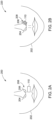
- Figures 2A-B are positions 200, 220 of various embodiments of the respiratory sensor 110 with respect to a patient 202.
- the positions 200, 220 of the respiratory sensor 110 are shown having the respiratory sensor 110 within the airflow path of the patient 202.
- the airflow path may be aligned and/or proximate to the nostrils 204, 206 of a nose 208 of the patient 202.
- ambient air is inhaled through the nostrils 204, 206 and subsequently exhaled through the nostrils 204, 206.
- Figure 2A illustrates the respiratory sensor 110 positioned below one of the nostrils 206. As ambient air is inhaled and/or exhaled through the nostrils 206, the respiratory sensor 110 is exposed to the flow of the ambient air traversing the nostril 206.
- Figure 2B illustrates the respiratory sensor 110 coupled to one of the nostrils 206.
- the respiratory sensor 110 may include a coil (e.g., inductor) configured to mechanically couple the respiratory sensor 110 to the nostril 206.
- a coil e.g., inductor
- the respiratory sensor 110 is exposed to the flow of the ambient air traversing the nostril 206.
- the transmission circuit 112 may be configured to transmit an excitation signal and/or receive the response generated by the respiratory sensor 110 utilizing body-coupled communication (BBC).
- BBC body-coupled communication
- the transmission circuit 112 may represent a capacitor having each terminal of the capacitor in contact with the body.
- this body-coupled communication is referred to as "near-field intra-body communication”.
- the BBC communication is described in U.S. Patent Nos. 6,992,565, 6,777,992 , 6,223,018, 5,914,701 , and 8,633,809 , which are incorporated herein by reference in their entireties.
- the BCC enables the transmission circuit 112 and the respirator sensor 110 to exchange information through capacitive or galvanic coupling.
- the transmission circuit 112 may be positioned proximate to the respirator sensor 110 such that an RF circuit of the respiratory sensor 110 is positioned within the magnetic field.
- the RF circuit may include an antenna (e.g., inductor, coil) configured to generate a current when positioned within the magnetic field of the transmission circuit 112. The current generated by the RF circuit may supply power to the other components of the respiratory sensor 110.
- the transmission circuit 112 and the respiratory sensor 110 are communicatively coupled with each other.
- the controller circuit 102 may be configured to generate the excitation signal, which is transmitted by the transmission circuit 110.
- the excitation signal may represent a sinusoidal and/or digital signal having a set of predetermined electrical characteristics.
- the predetermined electrical characteristics may represent an amplitude, frequency, and/or the like of the excitation pulse.
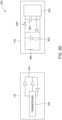
- FIGS 3A-D are schematic diagrams 300, 330, 360, 370 of various embodiments of the respiratory sensor 110.
- each schematic diagram 300, 330, 360, 370 may include at least one of a capacitor 302, an inductor 304, and/or a resistor 306.
- the temperature coefficient may be ⁇ 100 parts per million (ppm) having a reference temperature of 25 degrees Celsius.
- the temperature of the capacitor 302 increases to approximately 36 degrees Celsius (e.g., temperature change of 11 degrees Celsius), which shifts the capacitance of the capacitor 302 based on the temperature coefficient.
- the capacitor 302 may be 2 pF based on the temperature change of 11 degrees and the temperature coefficient of ⁇ 1000 ppm the capacitance of the capacitor 302 may be adjusted by ⁇ 0.022 pF (e.g., 2.022 pF, 1.978 pF).
- the adjustment in the capacitance of the capacitor 302 adjusts the resonance frequency of the respiratory sensor 110 based on the inductor 304 and the capacitor 302.
- Figure 4 is a graphical illustration 400 of the excitation signal 406 and the response 408, in accordance with an embodiment.
- the excitation signal 406 and the response 408 are shown along a horizontal axis 402 representing time.
- a vertical axis 404 may represent an amplitude (e.g., voltage, current).
- the excitation signal 406 is configured by the controller circuit 102 and transmitted by the transmission circuit 112.
- the excitation signal 406 is shown as a sinusoidal waveform in the graphical illustration 400, however in various embodiments the excitation signal 406 may be a digital and/or binary signal.
- the excitation signal 406 may have a set of predetermined electrical characteristics.
- the controller circuit 102 may configure the excitation signal 406 to have a frequency of 10 MHz having a period 410. It may noted that the excitation signal 406 may have a different frequency than 10 MHz such as greater than 1 MHz (e.g., 100 MHz, 400 MHz, 1 GHz).
- the transmission circuit 112 receives the response 408 generated by the respiratory sensor 110.
- the response 408 represents a modified reflection of the excitation signal 406 based on the electrical characteristics of the respiratory sensor 110, such as the capacitor 302.
- the controller circuit 102 is configured to analyze the response 408 to determine the at least one of the temperature or flow rate of the airflow path based on the temperature coefficient of the capacitor 302.
- the change in amplitude 502 is based on the resistance of the resistor 306. Based on the change in amplitude the controller circuit 102 may calculate the change in resistance of the resistor 306 relative to the resistance value stored in the memory 108.
- the memory 108 may store the electrical characteristics of the inductor 304, the capacitor 302, the resistor 306, and the temperature coefficients of the resistor and capacitor.
- the controller circuit 102 utilizing the adjusted resistance may determine the temperature of the respiratory sensor 110 representing a temperature of the airflow path based on the temperature coefficient and the electrical characteristics of the respiratory sensor 110. Additionally alternatively, the controller circuit 102 may compare the temperature value determined from the capacitance (e.g., change in frequency) and the resistance (e.g., change in amplitude). For example, the controller circuit 102 may calculate an average temperature value of the respiratory sensor 110 based on the temperature determinations from the change in frequency and change in amplitude.
- the respiratory sensor 110 may have at least one of the capacitor 302, the inductor 304, and the resistor 306.
- the schematic diagram 360 illustrates the respiratory sensor 110 having the inductor 304 and the resistor 306.
- the controller circuit 102 may determine the temperature and/or flow rate based on changes in the electrical characteristics, such as the change in amplitude of the response relative to the excitation signal.
- the controller circuit 102 may calculate a respiratory rate based on the temperature changes.
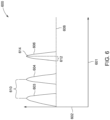
- Figure 6 is a graphical illustration 600 of temperature changes of the respiratory sensor 110, in accordance with an embodiment.
- the temperature changes are plotted along a horizontal axis 601 representing time and a vertical axis 602 representing temperature.
- the temperature changes are illustrated as temperature peaks 603-606.
- the peaks 603-606 may correspond to a series of temperature values determined by the controller circuit 102 based on the electrical characteristics of the respiratory sensor 110.
- the excitation signal 406 may be continually and/or repeatedly transmitted by the transmission circuit 112 at a sample rate and/or set period of time.
- the controller circuit 102 may generate the excitation signal 406, which is transmitted by the transmission circuit 112, every 50 ms.
- the controller circuit 102 may determine a flow rate based on the electrical characteristics of the respiratory sensor 110.
- the flow rate of the ambient air along the airflow path corresponds to a rate of temperature change of the respiratory sensor 110.
- the rate of temperature change may be based on a peak time 612.
- the peak time 612 may represent a length of time for the temperature of the respiratory sensor 110 to transition from a first temperature (e.g., the room temperature 608) to a second temperate (e.g., a peak temperature 614).
- a surface area of the respiratory sensor 110 within the airflow path may be stored in the memory 108.
- the surface area may represent a surface area of the capacitor 302 and/or the resistor 306. Based on a rate of temperature change and the surface area, the controller circuit 102 may determine a flowrate.
Landscapes
- Health & Medical Sciences (AREA)
- Life Sciences & Earth Sciences (AREA)
- Engineering & Computer Science (AREA)
- Animal Behavior & Ethology (AREA)
- Public Health (AREA)
- Pathology (AREA)
- Physics & Mathematics (AREA)
- Biomedical Technology (AREA)
- Heart & Thoracic Surgery (AREA)
- Medical Informatics (AREA)
- Molecular Biology (AREA)
- Surgery (AREA)
- Veterinary Medicine (AREA)
- General Health & Medical Sciences (AREA)
- Biophysics (AREA)
- Physiology (AREA)
- Pulmonology (AREA)
- Otolaryngology (AREA)
- Computer Networks & Wireless Communication (AREA)
- Artificial Intelligence (AREA)
- Computer Vision & Pattern Recognition (AREA)
- Psychiatry (AREA)
- Signal Processing (AREA)
- Measurement Of The Respiration, Hearing Ability, Form, And Blood Characteristics Of Living Organisms (AREA)
- Measuring And Recording Apparatus For Diagnosis (AREA)
Description
- The subject matter herein relates generally to systems and methods for a respiratory sensor for a medical monitoring system that does not require an internal power source.
- When a patient is admitted into a healthcare facility, the patient is often connected to a plurality of sensors in contact with the patient, such as wearable sensors, cardiac sensor, breathing or respiratory sensor, and/or the like. The respiratory sensor is configured to detect a respiratory rate (e.g., breath rate) of the patient, which is monitored by a clinician. The conventional respiratory sensor may be bands positioned around a rib cage and abdomen of a patient having sinusoid coils. The respiratory rate is determined based on changes in impedance of the sinusoid coils based on movement by the patient while breathing. However, the conventional respiratory sensors are noisy and susceptible to motion artifacts based on movement not related to breathing of the patient.
- Lorenzo Javier ET AL: "Modulated Frequency Selective Surfaces for Wearable RFID and Senor Applications" XP011624917 describes a transponder based on a modulated frequency selective surface (FSS) as an alternative based on backscattering communication for wearable applications. File transponder is composed of an array of dipoles loaded with varactor diodes to modulate the backscatter response. The information is obtained by changing the cross section of the FSS. The detuning and the power loss of the transponder when in contact with the body are studied
- Phil Corbishley ET AL: "Breathing Detection: Towards a Miniaturized, Wearable, Battery-Operated Monitoring System" XP011198920 describes challenges associated with noninvasive, continuous, wearable, and long-term breathing monitoring. The characteristics of an acoustic breathing signal from a miniature sensor are studied in the presence of sources of noise and interference artifacts that affect the signal.
US 2010/069769 A1 describes another respiratory monitoring system. -
WO 2016/065180 describes a method of and system for detecting a gas or vapor which includes providing a sensor comprising an electrode pair in electrical contact with a layer of porous material, the porous material layer having water adsorbed on its surface; contacting the sensor with a gas or vapor sample to be analysed; applying a voltage across the electrode pair of the sensor; and measuring a response, the response correlating to the presence of a target gas or vapor. - The current invention is defined by the appended independent claims 1 and 8. Preferred embodiments are provided in the dependent claims.
- In an embodiment a method (e.g., for respiratory monitoring of a patient) is provided. The method includes adjusting an electrical characteristic of a respiratory sensor based on a property of interest of the airflow path, receiving an excitation signal, and generating a response based on the excitation signal and the electrical characteristic.
- In an embodiment a system (e.g., a respiratory monitoring system) is provided. The system includes a respiratory sensor positioned within an airflow path of a patient and in contact with a body of the patient. The respiratory sensor having an electrical characteristic that varies based on a property of interest of the airflow path. The system further includes a transmission circuit communicatively coupled to the respiratory sensor using a communication channel within the body. The transmission circuit is configured to transmit an excitation signal to the respiratory sensor. The respiratory sensor is configured to generate a response based on the excitation signal and the electrical characteristic. The system also includes a controller circuit operably coupled to the transmission circuit. The controller circuit is configured to determine at least one of a temperature or flow rate of the airflow path based on the electrical characteristic.
-
-
Figure 1 is a block diagram of an embodiment of a medical monitoring system. -
Figures 2A-B are positions of various embodiments of the respiratory sensor with respect to a patient. -
Figures 3A-D are schematic diagrams of various embodiments of a respiratory sensor. -
Figure 4 is a graphical illustration of an excitation signal and a response, in accordance with an embodiment. -
Figure 5 is a graphical illustration of an excitation signal and a response, in accordance with an embodiment. -
Figure 6 is a graphical illustration of temperature changes of a respiratory sensor, in accordance with an embodiment. -
Figure 7 is a flow chart of a method for respiratory monitoring of a patient, in accordance with an embodiment. - The following detailed description of certain embodiments will be better understood when read in conjunction with the appended drawings. To the extent that the figures illustrate diagrams of the functional modules of various embodiments, the functional blocks are not necessarily indicative of the division between hardware circuitry. Thus, for example, one or more of the functional blocks (e.g., processors or memories) may be implemented in a single piece of hardware (e.g., a general purpose signal processor or a block of random access memory, hard disk, or the like). Similarly, the programs may be stand-alone programs, may be incorporated as subroutines in an operating system, may be functions in an installed software package, and the like. It should be understood that the various embodiments are not limited to the arrangements and instrumentality shown in the drawings.
- As used herein, an element or step recited in the singular and proceeded with the word "a" or "an" should be understood as not excluding plural of said elements or steps, unless such exclusion is explicitly stated. Furthermore, references to "one embodiment" of the present invention are not intended to be interpreted as excluding the existence of additional embodiments that also incorporate the recited features. Moreover, unless explicitly stated to the contrary, embodiments "comprising" or "having" an element or a plurality of elements having a particular property may include additional elements not having that property.
- Various embodiments described herein include systems and methods for a respiratory sensor for a medical monitoring system that does not require an internal power source. The respiratory sensor is positioned within an airflow of the nose wirelessly and without a separate battery for the respiration sensor. The medical monitoring system is formed by separate transceivers, the respiratory sensor and a transmission circuit, which will provide wireless or on body excitation signal and then a sensor part that will reflect that signal back. The electrical characteristics (e.g., frequency, amplitude) of the excitation signal is received by the respiratory sensor and may be adjusted as a reflected signal modulated at proportional to an airflow of gas or change in temperature.
- Optionally, the respiratory sensor may be communicatively coupled to the transmission circuit utilizing on/in body transceiver configured to transmit the excitation signal and listen the reflected signal from the respirator sensor. Additionally or alternatively, the transmission circuit may be external from the body and located for example in the hub or hospital infrastructure. The respiratory sensor of the nose may be modulated by the excitation signal utilizing radio frequency (RF) or acoustic (for example Sonar pulses).
- The respiratory sensor may include, for example, a resonator loop (e.g., inductor, metal spiral), and a capacitor. Additionally or alternatively, the resonator loop may be configured to attached the respiratory sensor to the patient. The one or more electrical characteristics of the capacitor (e.g., based on the temperature coefficients) are adjusted based on the ambient temperature of the respiratory sensor. The respiratory sensor receives the excitation pulse and is configured to generate a response based on the excitation pulse and the electrical characteristics of the respiratory sensor. For example, the electrical characteristics of the capacitor adjusts the resonance frequency of the respiratory sensor, which in turn modifies and/or adjusts the received excitation pulse that is reflected to the transmission circuit having a different frequency. Additionally or alternatively, the respiratory sensor may include a resistor. The one or more electrical characteristics of the resistor (e.g., based on the temperature coefficients) adjusts based on the ambient temperature an amplitude of the excited signal of the generated response by the respiratory sensor.
- A technical effect of the various embodiments allows an extremely small respiratory sensor to the nose without the need of cable or power.
-
Figure 1 is a block diagram of an embodiment of a medical monitoring system (MMS) 100. TheMMS 100 may include atransmission circuit 112 and arespiratory sensor 110. In connection withFigures 2A-B therespiratory sensor 110 is positioned within an airflow path of a patient. It may be noted that therespiratory sensor 110 may be positioned in alternative positions relative to thenose 208 and/or thenostrils -
Figures 2A-B arepositions respiratory sensor 110 with respect to apatient 202. Thepositions respiratory sensor 110 are shown having therespiratory sensor 110 within the airflow path of thepatient 202. For example, the airflow path may be aligned and/or proximate to thenostrils nose 208 of thepatient 202. During respiratory action by the patient, ambient air is inhaled through thenostrils nostrils Figure 2A illustrates therespiratory sensor 110 positioned below one of thenostrils 206. As ambient air is inhaled and/or exhaled through thenostrils 206, therespiratory sensor 110 is exposed to the flow of the ambient air traversing thenostril 206. -
Figure 2B illustrates therespiratory sensor 110 coupled to one of thenostrils 206. For example, therespiratory sensor 110 may include a coil (e.g., inductor) configured to mechanically couple therespiratory sensor 110 to thenostril 206. As ambient air is inhaled and/or exhaled through thenostrils 206, therespiratory sensor 110 is exposed to the flow of the ambient air traversing thenostril 206. - Returning to
Figure 1 , thetransmission circuit 112 may be configured to be communicatively coupled to therespiratory sensor 110, such that thetransmission circuit 112 can generate an excitation signal and receive a response from therespiratory sensor 110. - For example, the
transmission circuit 112 may be configured to transmit an excitation signal and/or receive the response generated by therespiratory sensor 110 utilizing body-coupled communication (BBC). For example, thetransmission circuit 112 may represent a capacitor having each terminal of the capacitor in contact with the body. Sometimes this body-coupled communication is referred to as "near-field intra-body communication". The BBC communication is described inU.S. Patent Nos. 6,992,565, 6,777,992 ,6,223,018, 5,914,701 , and8,633,809 , which are incorporated herein by reference in their entireties. The BCC enables thetransmission circuit 112 and therespirator sensor 110 to exchange information through capacitive or galvanic coupling. Thetransmission circuit 112 may be configured to utilize the body of the patient as a communication channel. For example, thetransmission circuit 112 and therespiratory sensor 110 are in contact with the body of the patient. Thetransmission circuit 112 may generate an electric field on a surface of the body corresponding to the excitation signal. The transmission circuit 122 is capacitively or galvanicly coupled to therespiratory sensor 110. The excitation signal is transmitted by modulating electric fields and either capacitively or galvanicly coupling tiny currents (e.g., pico amperes) into the body. The body conducts the tiny current to therespiratory sensor 110. - Additionally or alternatively, the
transmission circuit 112 may include an RF circuit (not shown) configured to transmit the excitation signal to therespiratory sensor 110. The RF circuit may include a transmitter, a receiver, a transmitter and a receiver (e.g., a transceiver), and/or the like. Optionally, the RF circuit may be configured to receive information using the NFC protocol. The NFC protocol may be a short range wireless communication protocol defined in ISO/IEC 18092/ECMA-340, ISO/IEC 21481/ECMA-352, ISO/IEC 14443, and/or the like. For example, thetransmission circuit 112 is configured to generate a magnetic field via the RF circuit, representing the excitation signal. Thetransmission circuit 112 may be positioned proximate to therespirator sensor 110 such that an RF circuit of therespiratory sensor 110 is positioned within the magnetic field. For example, the RF circuit may include an antenna (e.g., inductor, coil) configured to generate a current when positioned within the magnetic field of thetransmission circuit 112. The current generated by the RF circuit may supply power to the other components of therespiratory sensor 110. As the RF circuit of therespiratory sensor 110 is within the magnetic field of thetransmission circuit 112, thetransmission circuit 112 and therespiratory sensor 110 are communicatively coupled with each other. - The
MMS 100 may include acontroller circuit 102 and amemory 108. Thecontroller circuit 102 is communicatively coupled to thememory 108 and thetransmission circuit 110. Thecontroller circuit 102 may include and/or represent one or more hardware circuits or circuitry that include, are connected with, or that both include and are connected with one or more processors, controllers, and/or other hardware logic-based devices. Additionally or alternatively, thecontroller circuit 102 may execute one or more programmed instructions stored on a tangible and non-transitory computer readable medium (e.g., memory 108) to perform one or more operations as described herein. - The
controller circuit 102 may be configured to generate the excitation signal, which is transmitted by thetransmission circuit 110. For example, the excitation signal may represent a sinusoidal and/or digital signal having a set of predetermined electrical characteristics. The predetermined electrical characteristics may represent an amplitude, frequency, and/or the like of the excitation pulse. - The
controller circuit 102 may receive the response generated by therespiratory sensor 110 via thetransmission circuit 112. Thecontroller circuit 102 may be configured to identify a difference between the excitation pulse and the response. For example, the response represents a modified and/or adjusted excitation pulse reflected and/or generated by therespiratory sensor 110 based on electrical characteristics of therespirator sensor 110 representative of a property of interest (e.g., temperature, flow rate, and/or the like) of the airflow path. Based on the changes in frequency, amplitude, and/or the like between the excitation pulse and the response, thecontroller circuit 102 may be configured to determine at least one of the temperature, flow rate of the airflow path, and/or the like based on the electrical characteristic of the response. - For example, based on the components (e.g., inductor, capacitor, resistor) of the
respiratory sensor 110, as shown inFigures 3A-C , and the changes in electrical characteristics of the response relative to the excitation signal thecontroller circuit 102 may determine the property of interest. -
Figures 3A-D are schematic diagrams 300, 330, 360, 370 of various embodiments of therespiratory sensor 110. For example, each schematic diagram 300, 330, 360, 370 may include at least one of acapacitor 302, aninductor 304, and/or aresistor 306. - The schematic diagram 300 illustrates the
respiratory sensor 110 having thecapacitor 302 and theinductor 304. Thecapacitor 302 may be configured to be a communication circuit of therespiratory sensor 110. For example, thecapacitor 302 may be capacitively coupled to thetransmission circuit 112 to form a communication channel within thebody 202 of the patient. Additionally or alternatively, theinductor 304 may be configured as an RF circuit. For example, theinductor 304 may be configured to receive the excitation signal corresponding to a magnetic field generated by thetransmission circuit 112. - Additionally or alternatively, the electrical characteristics of the
capacitor 302 is affected by the ambient temperature. For example, the capacitance of thecapacitor 302 may be based on a temperature coefficient (e.g., temperature coefficient of capacitance) of thecapacitor 302. Changes in ambient temperature of thecapacitor 302 relative to a reference temperature adjusts the capacitance defined by the temperature coefficient. The ambient temperature of thecapacitor 302 is adjusted based on the respiratory actions of the patient. For example, when the air of the airflow path is exhaled through thenostrils respiratory sensor 110 having thecapacitor 302 is increased, which adjusts the electrical characteristics of therespiratory sensor 110. When therespiratory sensor 110 generates the response, the response corresponds to the excitation pulse modified by the electrical characteristics of therespiratory sensor 110. - For example, the temperature coefficient may be ±100 parts per million (ppm) having a reference temperature of 25 degrees Celsius. As the patient exhales, the temperature of the
capacitor 302 increases to approximately 36 degrees Celsius (e.g., temperature change of 11 degrees Celsius), which shifts the capacitance of thecapacitor 302 based on the temperature coefficient. For example, thecapacitor 302 may be 2 pF based on the temperature change of 11 degrees and the temperature coefficient of ±1000 ppm the capacitance of thecapacitor 302 may be adjusted by ± 0.022 pF (e.g., 2.022 pF, 1.978 pF). The adjustment in the capacitance of thecapacitor 302 adjusts the resonance frequency of therespiratory sensor 110 based on theinductor 304 and thecapacitor 302. The resonance frequency of therespiratory sensor 110 may represent a frequency adjustment to the excitation pulse modified by the electrical characteristics (e.g., change in capacitance) based on the property of interest (e.g., temperature) of the airflow path. For example, theinductor 304 may be 0.2 pH such that at the reference temperature of 25 degrees Celsius the resonance frequency of therespiratory sensor 110 may be approximately 7.96 MHz. Based on the ambient temperature increasing to 36 degrees Celsius, the resonance frequency of therespiratory sensor 110 may be at approximate 7.91 MHz or 8 MHz. - The schematic diagram 370 illustrates the
respiratory sensor 110 communicatively coupled to thetransmission circuit 112 utilizing a modulated digital signal. The modulated digital signal may be transmitted using an RF field (e.g., traversing in the air) viainductors transmission circuit 112 and therespiratory sensor 110. - The
transmission circuit 112 is illustrated having atransceiver 375 conductively coupled to theinductor 374. Thetransceiver 375 with theinductor 374 is configured to generate the modulated digital signal representing the excitation signal via a magnetic field generated by theinductor 374. The modulated digital signal is received by therespiratory sensor 110 via theinductor 304. Based on the modulated digital signal, electrical power (e.g., current) is generated by theinductor 304 and is received by adiode 378. Based on the current generated by theinductor 304, a voltage potential is provided by thediode 378 activating acontroller 379. Thecontroller 379 may be embodied in hardware, such as a processor, application specific integrated circuit, or other logic-based device, that performs functions or operations based on one or more sets of instructions (e.g., software). The instructions on which the hardware operates may be stored on a tangible and non-transitory (e.g., not a transient signal) computer readable storage medium (e.g., memory). Alternatively, one or more of the sets of instructions that direct operations of the hardware may be hard-wired into the logic of the hardware. Thecontroller 379 may be configured to generate a modulated digital signal representing a response based on the excitation signal received from thetransmission circuit 112 and the electrical characteristics of therespiratory sensor 110. - In connection with
Figure 4 , thecontroller circuit 102 is configured to identify a difference between anexcitation signal 406 and aresponse 408 to determine at least one of the temperature or flow rate based on the different. For example, the electrical characteristics of the respiratory sensor 1110 represents an adjusted frequency of theexcitation signal 406 -
Figure 4 is agraphical illustration 400 of theexcitation signal 406 and theresponse 408, in accordance with an embodiment. Theexcitation signal 406 and theresponse 408 are shown along ahorizontal axis 402 representing time. Avertical axis 404 may represent an amplitude (e.g., voltage, current). For example, theexcitation signal 406 is configured by thecontroller circuit 102 and transmitted by thetransmission circuit 112. Theexcitation signal 406 is shown as a sinusoidal waveform in thegraphical illustration 400, however in various embodiments theexcitation signal 406 may be a digital and/or binary signal. Theexcitation signal 406 may have a set of predetermined electrical characteristics. For example, thecontroller circuit 102 may configure theexcitation signal 406 to have a frequency of 10 MHz having aperiod 410. It may noted that theexcitation signal 406 may have a different frequency than 10 MHz such as greater than 1 MHz (e.g., 100 MHz, 400 MHz, 1 GHz). Thetransmission circuit 112 receives theresponse 408 generated by therespiratory sensor 110. Theresponse 408 represents a modified reflection of theexcitation signal 406 based on the electrical characteristics of therespiratory sensor 110, such as thecapacitor 302. Thecontroller circuit 102 is configured to analyze theresponse 408 to determine the at least one of the temperature or flow rate of the airflow path based on the temperature coefficient of thecapacitor 302. For example, thecontroller circuit 102 may determine a frequency of the response based on aperiod 412 of theresponse 408. Based on theperiod 412 thecontroller circuit 102 may calculate the frequency of theresponse 408 to be 8 MHz. Thecontroller circuit 102 may compare the frequency of theexcitation signal 406 and theresponse 408 to determine the difference, such as 2 MHz. Based on the 8 MHz frequency of theresponse 408, thecontroller circuit 102 may determine a temperature of therespiratory sensor 110. - For example, the
memory 108 may store the electrical characteristics of the inductor 304 (e.g., 2 pH) and the capacitor 302 (e.g., 2 pF), and the temperature coefficients (e.g., ±1000 ppm of the capacitor 302). Based on the frequency of 8 MHz, thecontroller circuit 102 may determine the capacitance of thecapacitor 302 to be approximately 1.978 pF. Thecontroller circuit 102 utilizing the adjusted capacitance may determine the temperature based on the temperature coefficient to be 36 degrees Celsius, representing a temperature of the airflow path. - Returning to
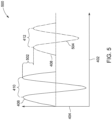
Figure 3B , the schematic diagram 330 illustrates therespiratory sensor 110 having thecapacitor 302, theinductor 304 , and theresistor 306. The electrical characteristics of thecapacitor 302 and theresistor 306 are affected by the ambient temperature. For example, the resistance of theresistor 306 may be based on a temperature coefficient (e.g., temperature coefficient of resistance) of theresistor 306. Similar to and/or the same as the relationship of the temperature coefficient with thecapacitor 304, changes in ambient temperature of theresistor 306 relative to a reference temperature adjusts the resistance defined by the temperature coefficient. In connection withFigure 5 , the electrical characteristics of theresistor 306 modifies theexcitation signal 406 by generating aresponse 504 having an adjustedamplitude 502. For example, the electrical characteristics of the respiratory sensor 1110 represents an adjusted frequency and/or amplitude of theexcitation signal 406 -
Figure 5 is agraphical illustration 500 of theexcitation signal 406 and theresponse 504, in accordance with an embodiment. Theresponse 504 represents a modified reflection of theexcitation signal 406 based on the electrical characteristics of therespiratory sensor 110, such as thecapacitor 302 and theresistor 306. Thecontroller circuit 102 is configured to analyze theresponse 408 to determine the at least one of the temperature or flow rate of the airflow path based on the temperature coefficient of thecapacitor 302. As described above in reference toFigure 4 , thecontroller circuit 102 may be configured to identify a change in frequency of theresponse signal 504 relative to theexcitation signal 406. In another example, thecontroller circuit 102 may determine a change inamplitude 502 of theresponse 504 relative to theexcitation signal 406. The change inamplitude 502 is based on the resistance of theresistor 306. Based on the change in amplitude thecontroller circuit 102 may calculate the change in resistance of theresistor 306 relative to the resistance value stored in thememory 108. For example, thememory 108 may store the electrical characteristics of theinductor 304, thecapacitor 302, theresistor 306, and the temperature coefficients of the resistor and capacitor. Thecontroller circuit 102 utilizing the adjusted resistance may determine the temperature of therespiratory sensor 110 representing a temperature of the airflow path based on the temperature coefficient and the electrical characteristics of therespiratory sensor 110. Additionally alternatively, thecontroller circuit 102 may compare the temperature value determined from the capacitance (e.g., change in frequency) and the resistance (e.g., change in amplitude). For example, thecontroller circuit 102 may calculate an average temperature value of therespiratory sensor 110 based on the temperature determinations from the change in frequency and change in amplitude. - It may be noted that the
respiratory sensor 110 may have at least one of thecapacitor 302, theinductor 304, and theresistor 306. In connection withFigure 3C , the schematic diagram 360 illustrates therespiratory sensor 110 having theinductor 304 and theresistor 306. For example, thecontroller circuit 102 may determine the temperature and/or flow rate based on changes in the electrical characteristics, such as the change in amplitude of the response relative to the excitation signal. - In connection with
Figure 6 , thecontroller circuit 102 may calculate a respiratory rate based on the temperature changes.Figure 6 is agraphical illustration 600 of temperature changes of therespiratory sensor 110, in accordance with an embodiment. The temperature changes are plotted along ahorizontal axis 601 representing time and avertical axis 602 representing temperature. For example, the temperature changes are illustrated as temperature peaks 603-606. The peaks 603-606 may correspond to a series of temperature values determined by thecontroller circuit 102 based on the electrical characteristics of therespiratory sensor 110. For example, theexcitation signal 406 may be continually and/or repeatedly transmitted by thetransmission circuit 112 at a sample rate and/or set period of time. Thecontroller circuit 102 may generate theexcitation signal 406, which is transmitted by thetransmission circuit 112, every 50 ms. Additionally or alternatively, the rate at which theexcitation signal 406 is transmitted is based on a characteristics (e.g., age, weight, height) of the patient. For example, an infant may generally have a higher respiratory rate (e.g., 25-40 breaths per minute) than an adult (e.g., over 18 years old) patient (e.g., 12-18 breaths per minute). Thecontroller circuit 102 may increase the sample rate of which theexcitation signal 406 is transmitted by thetransmission circuit 112 for an infant relative to an adult patient. - Based on the temperature peaks 603-606, the
controller circuit 102 may determine a respiratory rate of the patient. For example, the temperature peaks 603-606 correspond to an increase in temperature corresponding to an inhalation of the ambient air of the airflow path into thebody 202 of the patient relative to aroom temperature 608. Thecontroller circuit 102 is configured to identify the peaks 603-606, and based on a position of the peaks 603-606 relative to each other along thehorizontal axis 601, representing time, determine the respiratory rate of the patient. For example, thecontroller circuit 102 may calculates aperiod 610 between temperature peaks 603-604 is 4 seconds representing a respiratory rate of 15 breaths per minute. Additionally or alternatively, thecontroller circuit 102 may calculate an average respiratory rate based on more than two peaks 603-606. - Optionally, the
controller circuit 102 may determine a flow rate based on the electrical characteristics of therespiratory sensor 110. The flow rate of the ambient air along the airflow path corresponds to a rate of temperature change of therespiratory sensor 110. For example, the rate of temperature change may be based on apeak time 612. Thepeak time 612 may represent a length of time for the temperature of therespiratory sensor 110 to transition from a first temperature (e.g., the room temperature 608) to a second temperate (e.g., a peak temperature 614). A surface area of therespiratory sensor 110 within the airflow path may be stored in thememory 108. The surface area may represent a surface area of thecapacitor 302 and/or theresistor 306. Based on a rate of temperature change and the surface area, thecontroller circuit 102 may determine a flowrate. -
Figure 7 is a flow chart of amethod 700 for respiratory monitoring of a patient, in accordance with an embodiment. Themethod 700, for example, may employ structures or aspects of various embodiments (e.g., systems and/or methods) discussed herein. In various embodiments, certain steps (or operations) may be omitted or added, certain steps may be combined, certain steps may be performed simultaneously, certain steps may be performed concurrently, certain steps may be split into multiple steps, certain steps may be performed in a different order, or certain steps or series of steps may be re-performed in an iterative fashion. In various embodiments, portions, aspects, and/or variations of themethod 700 may be used as one or more algorithms to direct hardware to perform one or more operations described herein. - Beginning at 702, the
respiratory sensor 110 is configured to be positioned within an airflow path of a patient. For example in connection withFigures 2A-B , at least a portion of therespiratory sensor 110 may be positioned proximate to one ormore nostrils respiratory sensor 110 is such that at least one or more components (e.g., at least one of the capacitor, inductor, resistor) of therespiratory sensor 110 is exposed to changes in direction and/or speed of the ambient air based on a respiratory action (e.g., inhale, exhale) of the patient. - At 704, the
respiratory sensor 110 is configured to adjust an electrical characteristic based on a property of interest of the airflow path. For example, the property of interest may correspond to a temperature or flow rate of the airflow path. As air along the airflow path is transitioned (e.g., inhaled, exhaled) a temperature of the components (e.g.,capacitor 302, resistor 306) is changed. The electrical characteristics are adjusted corresponding to the temperature coefficients of the components of therespiratory sensor 110. - At 706, the
respiratory sensor 110 is configured to receive theexcitation signal 406. For example, thecontroller circuit 102 may generate theexcitation signal 406 having predetermined electrical characteristics (e.g., frequency, amplitude). Theexcitation signal 406 may be transmitted by thetransmission circuit 112. For example, thetransmission circuit 112 may be capacitively coupled to therespiratory sensor 110, and communicate theexcitation signal 406 utilizing a communication channel within the body. In another example, thetransmission circuit 112 may include an RF circuit configured to transmit theexcitation signal 406 using a magnetic field. - At 708, the
respiratory sensor 110 is configured to generate a response (e.g., theresponse 408, 504) based on the excitation pulse and the electrical characteristics. For example, therespiratory sensor 110 may reflect theexcitation pulse 406 to form the response. The electrical characteristics of therespiratory sensor 110 modifies and/or adjusts theexcitation pulse 406 to form the response. For example, the frequency of theexcitation pulse 406 may be adjusted based on the resonance frequency of therespiratory sensor 110. In another example, an amplitude of theexcitation pulse 406 may be adjusted based on a resistance of therespiratory sensor 110. - At 710, the
controller circuit 102 is configured to identify a difference between theexcitation signal 406 and the response. For example, thecontroller circuit 102 may receive the response via thetransmission circuit 112. Thecontroller circuit 102 may compare the electrical characteristics of the excitation signal 406 (e.g., frequency, amplitude) to identify differences of the response relative to theexcitation signal 406. - At 712, the
controller circuit 102 is configured to determine at least one of a temperature or a flow rate of the airflow path based on the electrical characteristics. The electrical characteristics of therespiratory sensor 110 is represented by the difference between theexcitation signal 406 and the response. For example, thecontroller circuit 102 may identify a frequency change of the response relative to theexcitation signal 406. Thecontroller circuit 102 may determine the capacitance based on the frequency of the response and compare the capacitance to the capacitance at a reference temperature stored in thememory 108. Based on the temperature coefficient of thecapacitor 302, thecontroller circuit 102 can determine the temperature change corresponding to the change in capacitance to result in the electrical characteristics of the frequency of therespiratory sensor 110. In another, thecontroller circuit 102 may identify an amplitude change of the response relative to theexcitation signal 406. Thecontroller circuit 102 may determine the resistance based on the amplitude of the response and compare the resistance to the resistance at a reference temperature stored in thememory 108. Based on the temperature coefficient of theresistor 306, thecontroller circuit 102 can determine the temperature change corresponding to the change in resistance to result in the electrical characteristics of the amplitude of therespiratory sensor 110. - It should be noted that the various embodiments may be implemented in hardware, software or a combination thereof. The various embodiments and/or components, for example, the modules, or components and controllers therein, also may be implemented as part of one or more computers or processors. The computer or processor may include a computing device, an input device, a display unit and an interface, for example, for accessing the Internet. The computer or processor may include a microprocessor. The microprocessor may be connected to a communication bus. The computer or processor may also include a memory. The memory may include Random Access Memory (RAM) and Read Only Memory (ROM). The computer or processor further may include a storage device, which may be a hard disk drive or a removable storage drive such as a solid-state drive, optical disk drive, and the like. The storage device may also be other similar means for loading computer programs or other instructions into the computer or processor.
- As used herein, the term "computer," "subsystem," "circuit" or "module" may include a processor-based or microprocessor-based system including systems using microcontrollers, reduced instruction set computers (RISC), ASICs, logic circuits, and any other circuit or processor capable of executing the functions described herein. The above examples are exemplary only, and are thus not intended to limit in any way the definition and/or meaning of the term computer," "subsystem," "circuit" or "module". The one or more processors execute a set of instructions that are stored in one or more storage elements, in order to process input data. The storage elements may also store data or other information as desired or needed. The storage element may be in the form of an information source or a physical memory element within a processing machine.
- The set of instructions may include various commands that instruct the computer or processor as a processing machine to perform specific operations such as the methods and processes of the various embodiments. The set of instructions may be in the form of a software program. The software may be in various forms such as system software or application software and which may be embodied as a tangible and non-transitory computer readable medium. Further, the software may be in the form of a collection of separate programs or modules, a program module within a larger program or a portion of a program module. The software also may include modular programming in the form of object-oriented programming. The processing of input data by the processing machine may be in response to operator commands, or in response to results of previous processing, or in response to a request made by another processing machine.
- As used herein, a structure, limitation, or element that is "configured to" perform a task or operation is particularly structurally formed, constructed, or adapted in a manner corresponding to the task or operation. For purposes of clarity and the avoidance of doubt, an object that is merely capable of being modified to perform the task or operation is not "configured to" perform the task or operation as used herein. Instead, the use of "configured to" as used herein denotes structural adaptations or characteristics, and denotes structural requirements of any structure, limitation, or element that is described as being "configured to" perform the task or operation. For example, a controller circuit, processor, or computer that is "configured to" perform a task or operation may be understood as being particularly structured to perform the task or operation (e.g., having one or more programs or instructions stored thereon or used in conjunction therewith tailored or intended to perform the task or operation, and/or having an arrangement of processing circuitry tailored or intended to perform the task or operation). For the purposes of clarity and the avoidance of doubt, a general purpose computer (which may become "configured to" perform the task or operation if appropriately programmed) is not "configured to" perform a task or operation unless or until specifically programmed or structurally modified to perform the task or operation.
- As used herein, the terms "software" and "firmware" are interchangeable, and include any computer program stored in memory for execution by a computer, including RAM memory, ROM memory, EPROM memory, EEPROM memory, and nonvolatile RAM (NVRAM) memory. The above memory types are exemplary only, and are thus not limiting as to the types of memory usable for storage of a computer program.
- It is to be understood that the above description is intended to be illustrative, and not restrictive. For example, the above-described embodiments (and/or aspects thereof) may be used in combination with each other. In addition, many modifications may be made to adapt a particular situation or material to the teachings of the various embodiments without departing from their scope. While the dimensions and types of materials described herein are intended to define the parameters of the various embodiments, they are by no means limiting and are merely exemplary. Many other embodiments will be apparent to those of skill in the art upon reviewing the above description. The scope of the various embodiments should, therefore, be determined with reference to the appended claims. In the appended claims, the terms "including" and "in which" are used as the plain-English equivalents of the respective terms "comprising" and "wherein." Moreover, in the following claims, the terms "first," "second," and "third," etc. are used merely as labels, and are not intended to impose numerical requirements on their objects.
- This written description uses examples to disclose the various embodiments, including the best mode, and also to enable any person skilled in the art to practice the various embodiments, including making and using any devices or systems and performing any incorporated methods. The patentable scope of the various embodiments is defined by the claims.
Claims (14)
- A respiratory monitoring system (100) comprising:a respiratory sensor (110) configured to be positioned within an airflow path of a patient (202), the respiratory sensor (110) having an electrical characteristic that varies based on a property of interest of the airflow path, the respiratory sensor (110) comprising a communication circuit communicatively coupled to the transmission circuit (112) using a communication channel within a body of the patient (202), the communication circuit and the transmission circuit (112) being in contact with the body; anda transmission circuit (112) configured to be communicatively coupled to the respiratory sensor (110), wherein the transmission circuit (112) is configured to transmit a wireless or on body excitation signal (406) to the respiratory sensor (110), the respiratory sensor (110) is configured to generate a response based on the excitation signal (406) and the electrical characteristic.
- The respiratory monitoring system (100) of claim 1, wherein the response corresponds to the excitation signal (406) modified by the electrical characteristic.
- The respiratory monitoring system (100) of claim 1, further comprising a controller circuit (102) operably coupled to the transmission circuit (112), wherein the controller circuit (102) is configured to determine at least one of a temperature or flow rate of the airflow path based on the electrical characteristic.
- The respiratory monitoring system (100) of claim 3, wherein the respiratory sensor (110) includes at least one of a capacitor (302), a resistor (306) or an inductor (304) having a predetermined temperature coefficient that represents the electrical characteristic, the controller circuit (102) configured to analyze the response to determine the at least one of the temperature or flow rate of the airflow path based on the predetermined temperature coefficient.
- The respiratory monitoring system (100) of claim 4, wherein the controller circuit (102) configured to identify a difference between the excitation signal (406) and the response to determine the at least one of the temperature or flow rate based on the difference.
- The respiratory monitoring system (100) of claim 1, wherein the respiratory sensor (110) and the transmission circuit (112) include RF circuits, the RF circuit of the respiratory sensor (110) is configured to receive the excitation signal (406).
- The respiratory monitoring system (100) of claim 1, wherein the electrical characteristic represents an adjusted frequency or amplitude of the excitation signal.
- A method for respiratory monitoring of a patient, using the system of any preceding claim, the method comprising:
positioning the transmission circuit and the respiratory sensor in contact with a body of the patient, wherein the respiratory sensor includes a communication circuit communicatively coupled to the transmission circuit using a communication channel within the body of the patient;adjusting an electrical characteristic of a respiratory sensor based on a property of interest of an airflow path;transmitting, from the transmission circuit, a wireless or on body excitation signal to the respiratory sensor;receiving, at the respiratory sensor, the excitation signal;generating a response based on the excitation signal and the electrical characteristic. - The method of claim 8, further comprising determining at least one of a temperature or flow rate of the airflow path based on the electrical characteristic and identifying a difference between the excitation signal and response, wherein the determining operation is based on the difference.
- The method of claim 8, wherein the generating operation includes modifying the excitation signal based on the electrical characteristic.
- The method of claim 8, further comprising positioning the respiratory sensor within an airflow path of a patient.
- The method of claim 8, wherein the respiratory sensor includes at least one of a capacitor, a resistor or an inductor having a predetermined temperature coefficient that represents the electrical characteristic.
- The method of claim 8
wherein the respiratory sensor and the transmission circuit include RF circuits, the receiving operation includes receiving the excitation signal from the RF circuit of the respiratory sensor. - The method of claim 8, wherein the electrical characteristic represents an adjusted frequency or amplitude of the excitation signal.
Applications Claiming Priority (2)
| Application Number | Priority Date | Filing Date | Title |
|---|---|---|---|
| US15/385,259 US10987025B2 (en) | 2016-12-20 | 2016-12-20 | Systems and methods for a respiratory sensor |
| PCT/US2017/066402 WO2018118643A1 (en) | 2016-12-20 | 2017-12-14 | Systems and methods for a respiratory sensor |
Publications (2)
| Publication Number | Publication Date |
|---|---|
| EP3558098A1 EP3558098A1 (en) | 2019-10-30 |
| EP3558098B1 true EP3558098B1 (en) | 2024-07-10 |
Family
ID=61007790
Family Applications (1)
| Application Number | Title | Priority Date | Filing Date |
|---|---|---|---|
| EP17832634.4A Active EP3558098B1 (en) | 2016-12-20 | 2017-12-14 | Systems and methods for a respiratory sensor |
Country Status (4)
| Country | Link |
|---|---|
| US (1) | US10987025B2 (en) |
| EP (1) | EP3558098B1 (en) |
| CN (1) | CN110300544B (en) |
| WO (1) | WO2018118643A1 (en) |
Families Citing this family (1)
| Publication number | Priority date | Publication date | Assignee | Title |
|---|---|---|---|---|
| CN111839461B (en) * | 2020-07-27 | 2022-11-22 | 歌尔科技有限公司 | Sensor and intelligent wearable equipment |
Citations (3)
| Publication number | Priority date | Publication date | Assignee | Title |
|---|---|---|---|---|
| US20100069769A1 (en) * | 2008-09-12 | 2010-03-18 | Dymedix Corporation | Wireless pyro/piezo sensor base station |
| WO2016065180A1 (en) * | 2014-10-22 | 2016-04-28 | President And Fellows Of Harvard College | Detecting gases and respiration by the conductivity of water within a porous substrate sensor |
| US20160338624A1 (en) * | 2015-05-18 | 2016-11-24 | Pacesetter, Inc. | Device and Method for Sensing Blood Glucose |
Family Cites Families (17)
| Publication number | Priority date | Publication date | Assignee | Title |
|---|---|---|---|---|
| EP0824799B1 (en) | 1995-05-08 | 2002-08-21 | Massachusetts Institute Of Technology | System for non-contact sensing and signalling using human body as signal transmission medium |
| US6223018B1 (en) | 1996-12-12 | 2001-04-24 | Nippon Telegraph And Telephone Corporation | Intra-body information transfer device |
| EP1045947B1 (en) | 1998-09-14 | 2005-01-26 | Koninklijke Philips Electronics N.V. | Electronic communications system |
| DE60102331T2 (en) | 2000-09-08 | 2005-03-17 | Matsushita Electric Works, Ltd., Kadoma | Data transmission system using a human body as a signal transmission path |
| US6777992B2 (en) | 2002-04-04 | 2004-08-17 | The Regents Of The University Of Michigan | Low-power CMOS flip-flop |
| JP2007209597A (en) * | 2006-02-10 | 2007-08-23 | Ngk Spark Plug Co Ltd | Respiratory state monitoring device, respiratory sensor, and respiratory state monitoring system |
| US8308641B2 (en) * | 2006-02-28 | 2012-11-13 | Koninklijke Philips Electronics N.V. | Biometric monitor with electronics disposed on or in a neck collar |
| US20090112115A1 (en) * | 2007-10-29 | 2009-04-30 | Jung-Tang Huang | Apparatus for detecting human's breathing |
| EP2241033B1 (en) * | 2007-12-20 | 2017-06-14 | Koninklijke Philips N.V. | Electrode diversity for body-coupled communication systems |
| WO2009149336A2 (en) * | 2008-06-06 | 2009-12-10 | Salter Labs | Adaptive temperature sensor for breath monitoring device |
| US20090306528A1 (en) * | 2008-06-06 | 2009-12-10 | Salter Labs | Adaptive temperature sensor for breath monitoring device |
| WO2009158421A1 (en) * | 2008-06-24 | 2009-12-30 | Dymedix Corporation | Respiratory air temperature and pressure information adaptor |
| US8434479B2 (en) * | 2009-02-27 | 2013-05-07 | Covidien Lp | Flow rate compensation for transient thermal response of hot-wire anemometers |
| WO2011019091A1 (en) * | 2009-08-13 | 2011-02-17 | 帝人ファーマ株式会社 | Device for calculating respiratory waveform information and medical device using respiratory waveform information |
| US8907287B2 (en) * | 2010-12-01 | 2014-12-09 | Hill-Rom Services, Inc. | Patient monitoring system |
| CN103424133B (en) * | 2012-05-10 | 2018-07-17 | 飞利浦知识产权企业有限公司 | System and method for measuring the variable impedance element in wireless sensor |
| US20150295562A1 (en) * | 2014-04-11 | 2015-10-15 | Mangilal Agarwal | Low Power Wireless Sensor System with Ring Oscillator And Sensors for Use in Monitoring of Physiological Data |
-
2016
- 2016-12-20 US US15/385,259 patent/US10987025B2/en active Active
-
2017
- 2017-12-14 EP EP17832634.4A patent/EP3558098B1/en active Active
- 2017-12-14 WO PCT/US2017/066402 patent/WO2018118643A1/en not_active Ceased
- 2017-12-14 CN CN201780085620.1A patent/CN110300544B/en active Active
Patent Citations (3)
| Publication number | Priority date | Publication date | Assignee | Title |
|---|---|---|---|---|
| US20100069769A1 (en) * | 2008-09-12 | 2010-03-18 | Dymedix Corporation | Wireless pyro/piezo sensor base station |
| WO2016065180A1 (en) * | 2014-10-22 | 2016-04-28 | President And Fellows Of Harvard College | Detecting gases and respiration by the conductivity of water within a porous substrate sensor |
| US20160338624A1 (en) * | 2015-05-18 | 2016-11-24 | Pacesetter, Inc. | Device and Method for Sensing Blood Glucose |
Also Published As
| Publication number | Publication date |
|---|---|
| CN110300544B (en) | 2022-07-26 |
| CN110300544A (en) | 2019-10-01 |
| US20180168483A1 (en) | 2018-06-21 |
| WO2018118643A1 (en) | 2018-06-28 |
| EP3558098A1 (en) | 2019-10-30 |
| US10987025B2 (en) | 2021-04-27 |
Similar Documents
| Publication | Publication Date | Title |
|---|---|---|
| Wang et al. | Rf-ecg: Heart rate variability assessment based on cots rfid tag array | |
| CN111264015B (en) | Wireless power transmission device and control method thereof | |
| CN106999090B (en) | Apparatus and method for estimating the value of a physiological property | |
| US20200386879A1 (en) | Detection and identification of a human from characteristic signals | |
| US11259715B2 (en) | Monitoring and diagnostics systems and methods | |
| EP3565476B1 (en) | A stethoscope apparatus and a method of processing breathing sounds produced by a subject | |
| EP3384843B1 (en) | Determining breathing attributes by a detection device | |
| JP2019512304A (en) | Method, apparatus, server and system for detecting and monitoring vital signs | |
| CN101578064A (en) | System for determining the position of a medical instrument | |
| US9882610B1 (en) | Near field communication sensor system | |
| KR20180088156A (en) | In vivo glucose sensing microsystem and apparatus | |
| EP4099897A1 (en) | System, method and computer program product for remote measurement of vital signs | |
| EP3488778B1 (en) | Device for electromagnetic structural characterization | |
| EP3558098B1 (en) | Systems and methods for a respiratory sensor | |
| EP3214409B1 (en) | Inductive sensor for position/orientation sensing | |
| Konings et al. | Improved distance metrics for histogram-based device-free localization | |
| US20120101773A1 (en) | Method and device for measuring conductivity information and corresponding markers | |
| WO2017157989A1 (en) | A method, system and apparatus for measuring a physiological characteristic of a subject | |
| US20230404418A1 (en) | System and method for cardiovascular health monitoring | |
| EP4287664A1 (en) | Method and apparatus for wireless communication | |
| KR20220156198A (en) | System and method for measuring biometric information | |
| AU2022319629B2 (en) | Livestock heart rate measurement with bolus sensor | |
| EP3811863A1 (en) | Using amplitude modulation (am) of electrocardiogram (ecg) signal recorded by an implant to monitor breathing | |
| KR20250121750A (en) | non contact sleep apnea detection system | |
| Caldara et al. | Development of a potentially implantable pressure sensing platform with RFID interface |
Legal Events
| Date | Code | Title | Description |
|---|---|---|---|
| STAA | Information on the status of an ep patent application or granted ep patent |
Free format text: STATUS: UNKNOWN |
|
| STAA | Information on the status of an ep patent application or granted ep patent |
Free format text: STATUS: THE INTERNATIONAL PUBLICATION HAS BEEN MADE |
|
| PUAI | Public reference made under article 153(3) epc to a published international application that has entered the european phase |
Free format text: ORIGINAL CODE: 0009012 |
|
| STAA | Information on the status of an ep patent application or granted ep patent |
Free format text: STATUS: REQUEST FOR EXAMINATION WAS MADE |
|
| 17P | Request for examination filed |
Effective date: 20190716 |
|
| AK | Designated contracting states |
Kind code of ref document: A1 Designated state(s): AL AT BE BG CH CY CZ DE DK EE ES FI FR GB GR HR HU IE IS IT LI LT LU LV MC MK MT NL NO PL PT RO RS SE SI SK SM TR |
|
| AX | Request for extension of the european patent |
Extension state: BA ME |
|
| DAV | Request for validation of the european patent (deleted) | ||
| DAX | Request for extension of the european patent (deleted) | ||
| STAA | Information on the status of an ep patent application or granted ep patent |
Free format text: STATUS: EXAMINATION IS IN PROGRESS |
|
| P01 | Opt-out of the competence of the unified patent court (upc) registered |
Effective date: 20230528 |
|
| 17Q | First examination report despatched |
Effective date: 20230710 |
|
| GRAP | Despatch of communication of intention to grant a patent |
Free format text: ORIGINAL CODE: EPIDOSNIGR1 |
|
| STAA | Information on the status of an ep patent application or granted ep patent |
Free format text: STATUS: GRANT OF PATENT IS INTENDED |
|
| INTG | Intention to grant announced |
Effective date: 20240313 |
|
| GRAS | Grant fee paid |
Free format text: ORIGINAL CODE: EPIDOSNIGR3 |
|
| GRAA | (expected) grant |
Free format text: ORIGINAL CODE: 0009210 |
|
| STAA | Information on the status of an ep patent application or granted ep patent |
Free format text: STATUS: THE PATENT HAS BEEN GRANTED |
|
| AK | Designated contracting states |
Kind code of ref document: B1 Designated state(s): AL AT BE BG CH CY CZ DE DK EE ES FI FR GB GR HR HU IE IS IT LI LT LU LV MC MK MT NL NO PL PT RO RS SE SI SK SM TR |
|
| REG | Reference to a national code |
Ref country code: CH Ref legal event code: EP |
|
| REG | Reference to a national code |
Ref country code: DE Ref legal event code: R096 Ref document number: 602017083234 Country of ref document: DE |
|
| REG | Reference to a national code |
Ref country code: LT Ref legal event code: MG9D |
|
| REG | Reference to a national code |
Ref country code: NL Ref legal event code: MP Effective date: 20240710 |
|
| PG25 | Lapsed in a contracting state [announced via postgrant information from national office to epo] |
Ref country code: PT Free format text: LAPSE BECAUSE OF FAILURE TO SUBMIT A TRANSLATION OF THE DESCRIPTION OR TO PAY THE FEE WITHIN THE PRESCRIBED TIME-LIMIT Effective date: 20241111 |
|
| REG | Reference to a national code |
Ref country code: AT Ref legal event code: MK05 Ref document number: 1701269 Country of ref document: AT Kind code of ref document: T Effective date: 20240710 |
|
| PG25 | Lapsed in a contracting state [announced via postgrant information from national office to epo] |
Ref country code: NL Free format text: LAPSE BECAUSE OF FAILURE TO SUBMIT A TRANSLATION OF THE DESCRIPTION OR TO PAY THE FEE WITHIN THE PRESCRIBED TIME-LIMIT Effective date: 20240710 |
|
| PG25 | Lapsed in a contracting state [announced via postgrant information from national office to epo] |
Ref country code: PT Free format text: LAPSE BECAUSE OF FAILURE TO SUBMIT A TRANSLATION OF THE DESCRIPTION OR TO PAY THE FEE WITHIN THE PRESCRIBED TIME-LIMIT Effective date: 20241111 Ref country code: NL Free format text: LAPSE BECAUSE OF FAILURE TO SUBMIT A TRANSLATION OF THE DESCRIPTION OR TO PAY THE FEE WITHIN THE PRESCRIBED TIME-LIMIT Effective date: 20240710 |
|
| PGFP | Annual fee paid to national office [announced via postgrant information from national office to epo] |
Ref country code: DE Payment date: 20241121 Year of fee payment: 8 |
|
| PG25 | Lapsed in a contracting state [announced via postgrant information from national office to epo] |
Ref country code: NO Free format text: LAPSE BECAUSE OF FAILURE TO SUBMIT A TRANSLATION OF THE DESCRIPTION OR TO PAY THE FEE WITHIN THE PRESCRIBED TIME-LIMIT Effective date: 20241010 |
|
| PG25 | Lapsed in a contracting state [announced via postgrant information from national office to epo] |
Ref country code: GR Free format text: LAPSE BECAUSE OF FAILURE TO SUBMIT A TRANSLATION OF THE DESCRIPTION OR TO PAY THE FEE WITHIN THE PRESCRIBED TIME-LIMIT Effective date: 20241011 Ref country code: FI Free format text: LAPSE BECAUSE OF FAILURE TO SUBMIT A TRANSLATION OF THE DESCRIPTION OR TO PAY THE FEE WITHIN THE PRESCRIBED TIME-LIMIT Effective date: 20240710 Ref country code: PL Free format text: LAPSE BECAUSE OF FAILURE TO SUBMIT A TRANSLATION OF THE DESCRIPTION OR TO PAY THE FEE WITHIN THE PRESCRIBED TIME-LIMIT Effective date: 20240710 |
|
| PGFP | Annual fee paid to national office [announced via postgrant information from national office to epo] |
Ref country code: GB Payment date: 20241122 Year of fee payment: 8 |
|
| PG25 | Lapsed in a contracting state [announced via postgrant information from national office to epo] |
Ref country code: BG Free format text: LAPSE BECAUSE OF FAILURE TO SUBMIT A TRANSLATION OF THE DESCRIPTION OR TO PAY THE FEE WITHIN THE PRESCRIBED TIME-LIMIT Effective date: 20240710 |
|
| PGFP | Annual fee paid to national office [announced via postgrant information from national office to epo] |
Ref country code: FR Payment date: 20241121 Year of fee payment: 8 |
|
| PG25 | Lapsed in a contracting state [announced via postgrant information from national office to epo] |
Ref country code: LV Free format text: LAPSE BECAUSE OF FAILURE TO SUBMIT A TRANSLATION OF THE DESCRIPTION OR TO PAY THE FEE WITHIN THE PRESCRIBED TIME-LIMIT Effective date: 20240710 |
|
| PG25 | Lapsed in a contracting state [announced via postgrant information from national office to epo] |
Ref country code: IS Free format text: LAPSE BECAUSE OF FAILURE TO SUBMIT A TRANSLATION OF THE DESCRIPTION OR TO PAY THE FEE WITHIN THE PRESCRIBED TIME-LIMIT Effective date: 20241110 Ref country code: AT Free format text: LAPSE BECAUSE OF FAILURE TO SUBMIT A TRANSLATION OF THE DESCRIPTION OR TO PAY THE FEE WITHIN THE PRESCRIBED TIME-LIMIT Effective date: 20240710 |
|
| PG25 | Lapsed in a contracting state [announced via postgrant information from national office to epo] |
Ref country code: HR Free format text: LAPSE BECAUSE OF FAILURE TO SUBMIT A TRANSLATION OF THE DESCRIPTION OR TO PAY THE FEE WITHIN THE PRESCRIBED TIME-LIMIT Effective date: 20240710 |
|
| PG25 | Lapsed in a contracting state [announced via postgrant information from national office to epo] |
Ref country code: ES Free format text: LAPSE BECAUSE OF FAILURE TO SUBMIT A TRANSLATION OF THE DESCRIPTION OR TO PAY THE FEE WITHIN THE PRESCRIBED TIME-LIMIT Effective date: 20240710 Ref country code: RS Free format text: LAPSE BECAUSE OF FAILURE TO SUBMIT A TRANSLATION OF THE DESCRIPTION OR TO PAY THE FEE WITHIN THE PRESCRIBED TIME-LIMIT Effective date: 20241010 |
|
| PG25 | Lapsed in a contracting state [announced via postgrant information from national office to epo] |
Ref country code: RS Free format text: LAPSE BECAUSE OF FAILURE TO SUBMIT A TRANSLATION OF THE DESCRIPTION OR TO PAY THE FEE WITHIN THE PRESCRIBED TIME-LIMIT Effective date: 20241010 Ref country code: PL Free format text: LAPSE BECAUSE OF FAILURE TO SUBMIT A TRANSLATION OF THE DESCRIPTION OR TO PAY THE FEE WITHIN THE PRESCRIBED TIME-LIMIT Effective date: 20240710 Ref country code: NO Free format text: LAPSE BECAUSE OF FAILURE TO SUBMIT A TRANSLATION OF THE DESCRIPTION OR TO PAY THE FEE WITHIN THE PRESCRIBED TIME-LIMIT Effective date: 20241010 Ref country code: LV Free format text: LAPSE BECAUSE OF FAILURE TO SUBMIT A TRANSLATION OF THE DESCRIPTION OR TO PAY THE FEE WITHIN THE PRESCRIBED TIME-LIMIT Effective date: 20240710 Ref country code: IS Free format text: LAPSE BECAUSE OF FAILURE TO SUBMIT A TRANSLATION OF THE DESCRIPTION OR TO PAY THE FEE WITHIN THE PRESCRIBED TIME-LIMIT Effective date: 20241110 Ref country code: HR Free format text: LAPSE BECAUSE OF FAILURE TO SUBMIT A TRANSLATION OF THE DESCRIPTION OR TO PAY THE FEE WITHIN THE PRESCRIBED TIME-LIMIT Effective date: 20240710 Ref country code: GR Free format text: LAPSE BECAUSE OF FAILURE TO SUBMIT A TRANSLATION OF THE DESCRIPTION OR TO PAY THE FEE WITHIN THE PRESCRIBED TIME-LIMIT Effective date: 20241011 Ref country code: FI Free format text: LAPSE BECAUSE OF FAILURE TO SUBMIT A TRANSLATION OF THE DESCRIPTION OR TO PAY THE FEE WITHIN THE PRESCRIBED TIME-LIMIT Effective date: 20240710 Ref country code: ES Free format text: LAPSE BECAUSE OF FAILURE TO SUBMIT A TRANSLATION OF THE DESCRIPTION OR TO PAY THE FEE WITHIN THE PRESCRIBED TIME-LIMIT Effective date: 20240710 Ref country code: BG Free format text: LAPSE BECAUSE OF FAILURE TO SUBMIT A TRANSLATION OF THE DESCRIPTION OR TO PAY THE FEE WITHIN THE PRESCRIBED TIME-LIMIT Effective date: 20240710 Ref country code: AT Free format text: LAPSE BECAUSE OF FAILURE TO SUBMIT A TRANSLATION OF THE DESCRIPTION OR TO PAY THE FEE WITHIN THE PRESCRIBED TIME-LIMIT Effective date: 20240710 |
|
| REG | Reference to a national code |
Ref country code: DE Ref legal event code: R097 Ref document number: 602017083234 Country of ref document: DE |
|
| PG25 | Lapsed in a contracting state [announced via postgrant information from national office to epo] |
Ref country code: SM Free format text: LAPSE BECAUSE OF FAILURE TO SUBMIT A TRANSLATION OF THE DESCRIPTION OR TO PAY THE FEE WITHIN THE PRESCRIBED TIME-LIMIT Effective date: 20240710 Ref country code: RO Free format text: LAPSE BECAUSE OF FAILURE TO SUBMIT A TRANSLATION OF THE DESCRIPTION OR TO PAY THE FEE WITHIN THE PRESCRIBED TIME-LIMIT Effective date: 20240710 Ref country code: DK Free format text: LAPSE BECAUSE OF FAILURE TO SUBMIT A TRANSLATION OF THE DESCRIPTION OR TO PAY THE FEE WITHIN THE PRESCRIBED TIME-LIMIT Effective date: 20240710 |
|
| PG25 | Lapsed in a contracting state [announced via postgrant information from national office to epo] |
Ref country code: EE Free format text: LAPSE BECAUSE OF FAILURE TO SUBMIT A TRANSLATION OF THE DESCRIPTION OR TO PAY THE FEE WITHIN THE PRESCRIBED TIME-LIMIT Effective date: 20240710 |
|
| PG25 | Lapsed in a contracting state [announced via postgrant information from national office to epo] |
Ref country code: CZ Free format text: LAPSE BECAUSE OF FAILURE TO SUBMIT A TRANSLATION OF THE DESCRIPTION OR TO PAY THE FEE WITHIN THE PRESCRIBED TIME-LIMIT Effective date: 20240710 |
|
| PG25 | Lapsed in a contracting state [announced via postgrant information from national office to epo] |
Ref country code: SK Free format text: LAPSE BECAUSE OF FAILURE TO SUBMIT A TRANSLATION OF THE DESCRIPTION OR TO PAY THE FEE WITHIN THE PRESCRIBED TIME-LIMIT Effective date: 20240710 Ref country code: IT Free format text: LAPSE BECAUSE OF FAILURE TO SUBMIT A TRANSLATION OF THE DESCRIPTION OR TO PAY THE FEE WITHIN THE PRESCRIBED TIME-LIMIT Effective date: 20240710 |
|
| PLBE | No opposition filed within time limit |
Free format text: ORIGINAL CODE: 0009261 |
|
| STAA | Information on the status of an ep patent application or granted ep patent |
Free format text: STATUS: NO OPPOSITION FILED WITHIN TIME LIMIT |
|
| 26N | No opposition filed |
Effective date: 20250411 |
|
| PG25 | Lapsed in a contracting state [announced via postgrant information from national office to epo] |
Ref country code: MC Free format text: LAPSE BECAUSE OF FAILURE TO SUBMIT A TRANSLATION OF THE DESCRIPTION OR TO PAY THE FEE WITHIN THE PRESCRIBED TIME-LIMIT Effective date: 20240710 |
|
| REG | Reference to a national code |
Ref country code: DE Ref legal event code: R081 Ref document number: 602017083234 Country of ref document: DE Owner name: GE PRECISION HEALTHCARE LLC, WAUKESHA, US Free format text: FORMER OWNER: GENERAL ELECTRIC COMPANY, SCHENECTADY, NY, US |
|
| REG | Reference to a national code |
Ref country code: CH Ref legal event code: PL |
|
| PG25 | Lapsed in a contracting state [announced via postgrant information from national office to epo] |
Ref country code: LU Free format text: LAPSE BECAUSE OF NON-PAYMENT OF DUE FEES Effective date: 20241214 |
|
| REG | Reference to a national code |
Ref country code: GB Ref legal event code: 732E Free format text: REGISTERED BETWEEN 20250807 AND 20250813 |
|
| PG25 | Lapsed in a contracting state [announced via postgrant information from national office to epo] |
Ref country code: SE Free format text: LAPSE BECAUSE OF FAILURE TO SUBMIT A TRANSLATION OF THE DESCRIPTION OR TO PAY THE FEE WITHIN THE PRESCRIBED TIME-LIMIT Effective date: 20240710 |
|
| REG | Reference to a national code |
Ref country code: BE Ref legal event code: MM Effective date: 20241231 |
|
| PG25 | Lapsed in a contracting state [announced via postgrant information from national office to epo] |
Ref country code: BE Free format text: LAPSE BECAUSE OF NON-PAYMENT OF DUE FEES Effective date: 20241231 |
|
| PG25 | Lapsed in a contracting state [announced via postgrant information from national office to epo] |
Ref country code: CH Free format text: LAPSE BECAUSE OF NON-PAYMENT OF DUE FEES Effective date: 20241231 |
|
| PG25 | Lapsed in a contracting state [announced via postgrant information from national office to epo] |
Ref country code: IE Free format text: LAPSE BECAUSE OF NON-PAYMENT OF DUE FEES Effective date: 20241214 |