EP3557717B1 - Systèmes de protection de batterie - Google Patents
Systèmes de protection de batterie Download PDFInfo
- Publication number
- EP3557717B1 EP3557717B1 EP19166748.4A EP19166748A EP3557717B1 EP 3557717 B1 EP3557717 B1 EP 3557717B1 EP 19166748 A EP19166748 A EP 19166748A EP 3557717 B1 EP3557717 B1 EP 3557717B1
- Authority
- EP
- European Patent Office
- Prior art keywords
- protection
- protection module
- signal
- battery cells
- battery
- Prior art date
- Legal status (The legal status is an assumption and is not a legal conclusion. Google has not performed a legal analysis and makes no representation as to the accuracy of the status listed.)
- Active
Links
Images


Classifications
-
- H—ELECTRICITY
- H02—GENERATION; CONVERSION OR DISTRIBUTION OF ELECTRIC POWER
- H02H—EMERGENCY PROTECTIVE CIRCUIT ARRANGEMENTS
- H02H3/00—Emergency protective circuit arrangements for automatic disconnection directly responsive to an undesired change from normal electric working condition with or without subsequent reconnection ; integrated protection
- H02H3/02—Details
- H02H3/021—Details concerning the disconnection itself, e.g. at a particular instant, particularly at zero value of current, disconnection in a predetermined order
-
- H—ELECTRICITY
- H02—GENERATION; CONVERSION OR DISTRIBUTION OF ELECTRIC POWER
- H02J—ELECTRIC POWER NETWORKS; CIRCUIT ARRANGEMENTS OR SYSTEMS FOR SUPPLYING OR DISTRIBUTING ELECTRIC POWER; SYSTEMS FOR STORING ELECTRIC ENERGY
- H02J7/00—Circuit arrangements for charging or discharging batteries or for supplying loads from batteries
- H02J7/60—Circuit arrangements for charging or discharging batteries or for supplying loads from batteries including safety or protection arrangements
- H02J7/663—Circuit arrangements for charging or discharging batteries or for supplying loads from batteries including safety or protection arrangements using battery or load disconnect circuits
-
- G—PHYSICS
- G01—MEASURING; TESTING
- G01R—MEASURING ELECTRIC VARIABLES; MEASURING MAGNETIC VARIABLES
- G01R19/00—Arrangements for measuring currents or voltages or for indicating presence or sign thereof
- G01R19/165—Indicating that current or voltage is either above or below a predetermined value or within or outside a predetermined range of values
- G01R19/16533—Indicating that current or voltage is either above or below a predetermined value or within or outside a predetermined range of values characterised by the application
- G01R19/16538—Indicating that current or voltage is either above or below a predetermined value or within or outside a predetermined range of values characterised by the application in AC or DC supplies
- G01R19/16542—Indicating that current or voltage is either above or below a predetermined value or within or outside a predetermined range of values characterised by the application in AC or DC supplies for batteries
-
- G—PHYSICS
- G01—MEASURING; TESTING
- G01R—MEASURING ELECTRIC VARIABLES; MEASURING MAGNETIC VARIABLES
- G01R31/00—Arrangements for testing electric properties; Arrangements for locating electric faults; Arrangements for electrical testing characterised by what is being tested not provided for elsewhere
- G01R31/36—Arrangements for testing, measuring or monitoring the electrical condition of accumulators or electric batteries, e.g. capacity or state of charge [SoC]
- G01R31/364—Battery terminal connectors with integrated measuring arrangements
-
- G—PHYSICS
- G01—MEASURING; TESTING
- G01R—MEASURING ELECTRIC VARIABLES; MEASURING MAGNETIC VARIABLES
- G01R31/00—Arrangements for testing electric properties; Arrangements for locating electric faults; Arrangements for electrical testing characterised by what is being tested not provided for elsewhere
- G01R31/36—Arrangements for testing, measuring or monitoring the electrical condition of accumulators or electric batteries, e.g. capacity or state of charge [SoC]
- G01R31/382—Arrangements for monitoring battery or accumulator variables, e.g. SoC
- G01R31/3835—Arrangements for monitoring battery or accumulator variables, e.g. SoC involving only voltage measurements
-
- H—ELECTRICITY
- H01—ELECTRIC ELEMENTS
- H01M—PROCESSES OR MEANS, e.g. BATTERIES, FOR THE DIRECT CONVERSION OF CHEMICAL ENERGY INTO ELECTRICAL ENERGY
- H01M10/00—Secondary cells; Manufacture thereof
- H01M10/42—Methods or arrangements for servicing or maintenance of secondary cells or secondary half-cells
- H01M10/48—Accumulators combined with arrangements for measuring, testing or indicating the condition of cells, e.g. the level or density of the electrolyte
- H01M10/482—Accumulators combined with arrangements for measuring, testing or indicating the condition of cells, e.g. the level or density of the electrolyte for several batteries or cells simultaneously or sequentially
-
- H—ELECTRICITY
- H01—ELECTRIC ELEMENTS
- H01M—PROCESSES OR MEANS, e.g. BATTERIES, FOR THE DIRECT CONVERSION OF CHEMICAL ENERGY INTO ELECTRICAL ENERGY
- H01M50/00—Constructional details or processes of manufacture of the non-active parts of electrochemical cells other than fuel cells, e.g. hybrid cells
- H01M50/50—Current conducting connections for cells or batteries
- H01M50/569—Constructional details of current conducting connections for detecting conditions inside cells or batteries, e.g. details of voltage sensing terminals
-
- H—ELECTRICITY
- H02—GENERATION; CONVERSION OR DISTRIBUTION OF ELECTRIC POWER
- H02H—EMERGENCY PROTECTIVE CIRCUIT ARRANGEMENTS
- H02H3/00—Emergency protective circuit arrangements for automatic disconnection directly responsive to an undesired change from normal electric working condition with or without subsequent reconnection ; integrated protection
- H02H3/08—Emergency protective circuit arrangements for automatic disconnection directly responsive to an undesired change from normal electric working condition with or without subsequent reconnection ; integrated protection responsive to excess current
- H02H3/093—Emergency protective circuit arrangements for automatic disconnection directly responsive to an undesired change from normal electric working condition with or without subsequent reconnection ; integrated protection responsive to excess current with timing means
-
- H—ELECTRICITY
- H02—GENERATION; CONVERSION OR DISTRIBUTION OF ELECTRIC POWER
- H02H—EMERGENCY PROTECTIVE CIRCUIT ARRANGEMENTS
- H02H7/00—Emergency protective circuit arrangements specially adapted for specific types of electric machines or apparatus or for sectionalised protection of cable or line systems, and effecting automatic switching in the event of an undesired change from normal working conditions
- H02H7/18—Emergency protective circuit arrangements specially adapted for specific types of electric machines or apparatus or for sectionalised protection of cable or line systems, and effecting automatic switching in the event of an undesired change from normal working conditions for batteries; for accumulators
-
- H—ELECTRICITY
- H02—GENERATION; CONVERSION OR DISTRIBUTION OF ELECTRIC POWER
- H02J—ELECTRIC POWER NETWORKS; CIRCUIT ARRANGEMENTS OR SYSTEMS FOR SUPPLYING OR DISTRIBUTING ELECTRIC POWER; SYSTEMS FOR STORING ELECTRIC ENERGY
- H02J7/00—Circuit arrangements for charging or discharging batteries or for supplying loads from batteries
- H02J7/60—Circuit arrangements for charging or discharging batteries or for supplying loads from batteries including safety or protection arrangements
- H02J7/64—Circuit arrangements for charging or discharging batteries or for supplying loads from batteries including safety or protection arrangements against overvoltage
-
- H—ELECTRICITY
- H02—GENERATION; CONVERSION OR DISTRIBUTION OF ELECTRIC POWER
- H02J—ELECTRIC POWER NETWORKS; CIRCUIT ARRANGEMENTS OR SYSTEMS FOR SUPPLYING OR DISTRIBUTING ELECTRIC POWER; SYSTEMS FOR STORING ELECTRIC ENERGY
- H02J7/00—Circuit arrangements for charging or discharging batteries or for supplying loads from batteries
- H02J7/80—Circuit arrangements for charging or discharging batteries or for supplying loads from batteries including monitoring or indicating arrangements
- H02J7/82—Control of state of charge [SOC]
-
- G—PHYSICS
- G01—MEASURING; TESTING
- G01R—MEASURING ELECTRIC VARIABLES; MEASURING MAGNETIC VARIABLES
- G01R31/00—Arrangements for testing electric properties; Arrangements for locating electric faults; Arrangements for electrical testing characterised by what is being tested not provided for elsewhere
- G01R31/36—Arrangements for testing, measuring or monitoring the electrical condition of accumulators or electric batteries, e.g. capacity or state of charge [SoC]
-
- G—PHYSICS
- G01—MEASURING; TESTING
- G01R—MEASURING ELECTRIC VARIABLES; MEASURING MAGNETIC VARIABLES
- G01R31/00—Arrangements for testing electric properties; Arrangements for locating electric faults; Arrangements for electrical testing characterised by what is being tested not provided for elsewhere
- G01R31/36—Arrangements for testing, measuring or monitoring the electrical condition of accumulators or electric batteries, e.g. capacity or state of charge [SoC]
- G01R31/3644—Constructional arrangements
- G01R31/3646—Constructional arrangements for indicating electrical conditions or variables, e.g. visual or audible indicators
-
- H—ELECTRICITY
- H01—ELECTRIC ELEMENTS
- H01M—PROCESSES OR MEANS, e.g. BATTERIES, FOR THE DIRECT CONVERSION OF CHEMICAL ENERGY INTO ELECTRICAL ENERGY
- H01M10/00—Secondary cells; Manufacture thereof
- H01M10/42—Methods or arrangements for servicing or maintenance of secondary cells or secondary half-cells
- H01M10/425—Structural combination with electronic components, e.g. electronic circuits integrated to the outside of the casing
-
- H—ELECTRICITY
- H01—ELECTRIC ELEMENTS
- H01M—PROCESSES OR MEANS, e.g. BATTERIES, FOR THE DIRECT CONVERSION OF CHEMICAL ENERGY INTO ELECTRICAL ENERGY
- H01M10/00—Secondary cells; Manufacture thereof
- H01M10/42—Methods or arrangements for servicing or maintenance of secondary cells or secondary half-cells
- H01M10/48—Accumulators combined with arrangements for measuring, testing or indicating the condition of cells, e.g. the level or density of the electrolyte
-
- Y—GENERAL TAGGING OF NEW TECHNOLOGICAL DEVELOPMENTS; GENERAL TAGGING OF CROSS-SECTIONAL TECHNOLOGIES SPANNING OVER SEVERAL SECTIONS OF THE IPC; TECHNICAL SUBJECTS COVERED BY FORMER USPC CROSS-REFERENCE ART COLLECTIONS [XRACs] AND DIGESTS
- Y02—TECHNOLOGIES OR APPLICATIONS FOR MITIGATION OR ADAPTATION AGAINST CLIMATE CHANGE
- Y02E—REDUCTION OF GREENHOUSE GAS [GHG] EMISSIONS, RELATED TO ENERGY GENERATION, TRANSMISSION OR DISTRIBUTION
- Y02E60/00—Enabling technologies; Technologies with a potential or indirect contribution to GHG emissions mitigation
- Y02E60/10—Energy storage using batteries
Definitions
- FIG. 1 illustrates a circuit diagram of a conventional battery protection system 100.
- the protection system 100 includes a primary protection module 108 and a secondary protection module 102.
- the primary protection module 108 protects the battery cells 104 from an over/under voltage condition, over current condition, short circuit condition, and over/under temperature condition.
- the secondary protection module 102 provides a backup protection to the battery cells 104 by, e.g., keeping the battery cells 104 from an abnormal condition such as over-voltage condition.
- the protection module 102 when the battery cells 104 are charged by a charger (not shown) coupled to the terminals PACK+ and PACK-, if the secondary protection module 102 detects an abnormal condition in the battery cells 104, then the protection module 102 generates a protection signal 110 to turn on the switch MN1 to burn the fuse 106 such that the battery cells 104 are disconnected from the charger. Additionally, in order to avoid wrong detection, when the protection module 102 detects a sign of abnormal condition in the battery cells 104, the protection module 102 delays the outputting of the protection signal 110 for a preset time interval ⁇ T1 (e.g., one, two, or four seconds, or the like). If the protection module 102 determines that the abnormal status lasts for the preset time interval ⁇ T1, then the protection module 102 confirms that an abnormal condition occurs in the battery cells 104.
- a preset time interval ⁇ T1 e.g., one, two, or four seconds, or the like.
- the protection system 100 in FIG. 1 is used to protect a battery pack that includes a small number, e.g., five, of battery cells. In order to protect a battery pack that includes more number of battery cells, two or more of the secondary protection modules 102 are used.
- FIG. 2A illustrates a circuit diagram of a conventional battery protection system 200A that includes secondary protection modules 202 and 212.
- the protection module 202 (hereinafter, low-side module) monitors the battery cells 204
- the protection module 212 (hereinafter, high-side module) monitors the battery cells 214. If a sign of abnormal condition in the battery cells 204 is detected, then the low-side module 202 starts to count time. After a preset time interval ⁇ T1 (e.g., one, two, or four seconds, or the like), if the low-side module 202 confirms that an abnormal condition is presented in the battery cells 204, then the low-side module 202 outputs a protection signal 210 to burn the fuse 206.
- ⁇ T1 e.g., one, two, or four seconds, or the like
- the high-side module 212 outputs a protection signal 216 after the preset time interval ⁇ T1 .
- the low-side module 202 receives, at its monitoring terminal BAT5, the protection signal 216 from the high-side module 212, and generates the protection signal 210 to burn the fuse 206 in response to the protection signal 216.
- the battery protection system 200A can protect both sets of the battery cells 204 and 214 from an abnormal condition.
- the low-side module 202 when the low-side module 202 receives the protection signal 216 from the high-side module 212, the low-side module 202 also delays the outputting of the protection signal 210 for the preset time interval ⁇ T1 .
- time delay ⁇ T2 may be too long, and the protection system 200A may not be able to protect the battery cells 214 in time.
- FIG. 2B illustrates a circuit diagram of another conventional battery protection system 200B.
- the battery protection system 200B is similar to the abovementioned battery protection system 200A except that in the battery protection system 200B, the protection signal 216 from the high-side module 212 is output to control a switch MN2, instead of being output to the low-side module 202.
- the high-side module 212 outputs a protection signal 216 to turn on the switch MN2 to burn the fuse 206.
- the high-side module 212 delays the outputting of the protection signal 216 for a preset time interval ⁇ T1.
- the battery protection system 200B includes resistors R1, R2, R4, R5, R6, and switches MN1 and MP1, and these elements constitute a level shifter. More specifically, if an abnormal condition in the battery cells 204 is detected, then the low-side module 202 outputs a protection signal 210.
- the level shifter shifts a voltage level of the protection signal 210 to a higher voltage level to turn on the switch MN2 to burn the fuse 206.
- the protection signal 210 turns on the switch MN1 to pull down a gate voltage of the switch MP 1.
- the switch MP 1 is turn on to pull up a gate voltage of the switch MN2.
- the switch MN2 is turned on to burn the fuse 206.
- the low-side module 202 also delays the outputting of the protection signal 210 for the preset time interval ⁇ T1.
- the battery protection system 200B in FIG. 2B may provide better protection to the battery cells 204 and 214.
- the level shifter includes the resistors R1, R2, R4, R5, R6, and the switches MN1 and MP1, and therefore increases the PCB (printed circuit board) size of the protection system 200B, and increase the power consumption.
- Prior art document US 2010/0141219 A1 refers to a battery pack comprising battery cells, a primary battery protection circuit, a filter, a secondary safety circuit, a fuse element, and a secondary battery protection circuit with over voltage transient protection.
- the primary battery protection circuit monitors a number of conditions including the voltage level of each of the battery cells and provides charge and discharge control signals.
- the voltage level of each of the battery cells are also monitored by the secondary safety circuit providing a signal to the fuse element to blow or open the fuse element if a voltage level of one of the cells is greater than an over voltage threshold level for a sustained time interval.
- the secondary battery protection circuit provides for over voltage transient protection to protect the battery cells if the voltage level of one of the cells is greater than an over voltage threshold level for a time interval less or equal to a transient time interval.
- Charge and discharge control signals are provided by primary battery protection circuit to secondary battery protection circuit controlling charging switch and discharging switch, respectively.
- the primary protection circuit controls the charging and discharging of the battery and control balancing of a battery cell included in the battery.
- the primary protection circuit generates a charging control signal Sc and a discharging control signal Sd for measuring the voltages of the battery cells and for controlling the charging/discharging control switch.
- the primary protection circuit further generates a fuse control signal for controlling a fuse device.
- the secondary protection circuit measures the voltages of the battery cells to determine whether one or more of the battery cells is operating at normally. If an abnormality is detected in the battery cells or if the fuse control signal is transmitted from the primary protection circuit, the secondary protection circuit induces an electric current in the fuse device.
- Prior art document US 2010/0264881 A1 refers to a battery protection circuit comprising a battery voltage detection circuit configured to detect a battery voltage via power terminals VDD and VSS, and to determine whether the battery voltage reaches a voltage protection threshold. If so, the battery voltage detection circuit outputs an effective trigger signal, otherwise outputs an ineffective trigger signal.
- a delay circuit is configured to receive the trigger signal from the battery voltage detection circuit. The delay circuit outputs an effective status signal as a response if the trigger signal is maintained effective continuously over a predetermined delay time, otherwise outputs an ineffective status signal. If both the trigger signal and the status signal are effective, a protection driver enters a driving state and outputs corresponding drive signal via a protection terminal.
- the protection driver enters a testing state in which the battery protection circuit is tested.
- the power terminal VDD is coupled to a voltage simulating the battery voltage adjusted with a predetermined voltage interval of e.g. 10 mV successively wherein the effective status signal introduced by the delay circuit is neglected such that the battery protection circuit can be tested quickly.
- Prior art document US 2012/0280572 A1 refers to a battery system comprising battery cells, a control circuit, a switch, a capacitor, a fuse and a charger.
- the control circuit detects cell parameters of the battery cells and determines whether the cells are in a normal condition or an abnormal condition accordingly.
- the control circuit sets a delay time T TH wherein the control signal is generated if the battery cells remain in the abnormal condition after the delay time expires.
- the control circuit is capable of operating in a normal mode and a test mode to determine the time threshold T TH .
- the delay circuit In the normal mode, the delay circuit generates the control signal if the battery cells remain in the over-voltage condition for a period of time equal to or greater than the time threshold T TH_NORMAL .
- the delay circuit In the test mode, the delay circuit generates the control signal if the battery cells remain in the over-voltage condition for a period of time equal to or greater than the time threshold T TH_TEST .
- a battery protection system includes multiple protection modules.
- Each protection module includes a set of monitoring terminals, an output terminal, a switching terminal, and detection circuitry coupled to the monitoring terminals, the output terminal, and the switching terminal.
- the monitoring terminals are operable for monitoring a status of a set of battery cells.
- the output terminal is operable for outputting a protection signal if an abnormal condition in the battery cells is detected.
- the switching terminal is operable for receiving a switching signal.
- the detection circuitry switches from a normal-working mode to a fast-test mode, wherein in said fast test mode a series of tests are performed on the protection module to make sure that the protection module works properly.
- the protection modules include a first protection module generating a first protection signal to protect a first set of battery cells and a second protection module generating a second protection signal to protect a second set of battery cells.
- the switching terminal of the first protection module and a monitoring terminal of the first protection module are coupled to the second protection module and operable for receiving a signal from the output terminal of the second protection module.
- Said battery protection system may further comprise a fuse, coupled to said plurality of battery cells, and configured to be controlled by a first protection signal output from the output terminal of said first protection module.
- said first protection module may be configured to monitor a status of a first plurality of battery cells
- said second protection module may be configured to monitor a status of a second plurality of battery cells, and wherein if an abnormal condition in said second plurality of battery cells is detected, then said second protection module configured to output said first protection signal to burn said fuse.
- said abnormal condition may comprise an over-voltage condition.
- the detection circuitry of said first protection module may be configured to switch from said normal-working mode to said fast-test mode.
- the detection circuitry of said first protection module may comprise:
- said plurality of cell voltages may comprise cell voltages of a first plurality of battery cells coupled to said first protection module and cell voltages of a second plurality of battery cells coupled to said second protection module, and wherein a signal at monitoring terminal of said first protection module may be configured to be controlled according to a status of said cell voltages of said second plurality of battery cells.
- said fast-test detection circuit may comprise a comparator configured to compare a voltage difference between said switching terminal of said first protection module and said first monitoring terminal of said first protection module with a threshold voltage and may generate a result signal to control said delay circuit according to the comparison.
- a battery pack comprises a first plurality of battery cells; a second plurality of battery cells coupled to said first plurality of battery cells; a first protection module coupled to said first plurality of battery cells; and a second protection module coupled to said second plurality of battery cells
- Each protection module of said first and second protection modules comprises: a plurality of monitoring terminals operable for monitoring a status of a corresponding plurality of battery cells of said first and second pluralities of battery cells; an output terminal operable for outputting a protection signal if an abnormal condition in said corresponding plurality of battery cells is detected; a switching terminal operable for receiving a switching signal; and detection circuitry, coupled to said monitoring terminals, said output terminal, and said switching terminal, and configured to switch from a normal-working mode to a fast-test mode in response to said switching signal, delay outputting of said protection signal for a first time interval if said abnormal condition is detected in said normal-working mode, and delay outputting of said protection signal for a second time interval, less than said first time interval, if said
- said battery pack may further comprise a fuse, coupled to said first and second pluralities of battery cells, and configured to be controlled by a first protection signal output from the output terminal of said first protection module.
- said first protection module may be configured to monitor a status of said first plurality of battery cells
- said second protection module may be configured to monitor a status of said second plurality of battery cells, and wherein if an abnormal condition in said second plurality of battery cells is detected, then said second protection module may be configured to output a second protection signal to said first monitoring terminal of said first protection module, and said output terminal of said first protection module may be configured to output said first protection signal to burn said fuse.
- said abnormal condition may comprise an over-voltage condition.
- the detection circuitry of said first protection module may be configured to switch from said normal-working mode to said fast-test mode.
- the detection circuitry of said first protection module may comprise:
- said plurality of cell voltages may comprise cell voltages of said first plurality of battery cells and cell voltages of said second plurality of battery, and wherein a signal at said first monitoring terminal may be configured to be controlled according to a status of said cell voltages of said second plurality of battery cells.
- said fast-test detection circuit comprises a comparator configured to compare a voltage difference between said switching terminal of said first protection module and said first monitoring terminal of said first protection module with a threshold voltage and generate a result signal to control said delay circuit according to the comparison.
- a method for protecting a battery pack comprising a first plurality of battery cells and a second plurality of battery cells.
- the method comprises: monitoring, via a plurality of monitoring terminals of a first protection module, a status of said first plurality of battery cells; outputting, through a first output terminal of said first protection module, a first protection signal if an abnormal condition in said first plurality of battery cells is detected; receiving, at a switching terminal of said first protection module, a switching signal; controlling said first protection module to switch from a normal-working mode to a fast-test mode in response to said switching signal, wherein in said fast test mode a series of tests are performed on the protection module to make sure that the protection module works properly; delaying outputting of said first protection signal for a first time interval if said abnormal condition is detected in said normal-working mode; delaying outputting of said first protection signal for a second time interval, less than said first time interval, if said abnormal condition is detected in said fast-test mode; monitoring, using a second protection module,
- said method may further comprise: controlling a fuse, coupled to said first and second pluralities of battery cells, using said first protection signal.
- said method may further comprise: outputting, through said first output terminal of said first protection module, said first protection signal to burn said fuse if said first monitoring terminal of said first protection module receives said second protection signal from said second protection module.
- said method may further comprise: controlling said first protection module to switch from said normal-working mode to said fast-test mode if said switching terminal of said first protection module receives said second protection signal from said second protection module.
- said method may further comprise:
- said method may further comprise:
- An embodiment according to the present invention provides a battery protection system that includes multiple protection modules for protecting multiple sets of battery cells.
- the protection module can selectively operate in a normal-working mode or a fast-test mode. If an abnormal condition in the battery cells is detected in the normal-working mode, then the protection module can output a protection signal after a first time interval ⁇ TN (e.g., one, two, or four seconds, or the like); or if the abnormal condition is detected in the fast-test mode, then the protection module can output the protection signal after a second time interval ⁇ TF that is much less than the first time interval ⁇ TN.
- ⁇ TN e.g., one, two, or four seconds, or the like
- a first protection module can generate a first protection signal to protect a first set of battery cells, and/or receive a second protection signal from a second protection module to generate the first protection signal to protect a second set of battery cells. Additionally, the second protection signal can control the first protection module to operate in the fast-test mode.
- the delay from the detection of an abnormal condition in the second set of battery cells to the outputting of the first protection signal can be approximately equal to the sum of the first and second time intervals, e.g., ⁇ TN+ ⁇ TF.
- the second time interval ⁇ TF is relatively short, e.g., sixteen or thirty-two milliseconds, or the like, and therefore the time delay ⁇ TN+ ⁇ TF is relatively short compared with the time delay ⁇ T2 mentioned in relation to the conventional battery protection system 200A.
- the level shifter mentioned in relation to the conventional battery protection system 200B is omitted, and therefore the battery protection system in an embodiment according to the present invention can have a smaller PCB size and consume less power.
- FIG. 3 illustrates a circuit diagram of an example of a battery protection system in a battery pack 300, in an embodiment of the present invention.
- the battery pack 300 includes a first set of battery cells 304 and a second set of battery cells 314.
- the battery protection system includes a primary protection circuitry 308, secondary protection modules 302 and 312, and a fuse 306.
- the primary protection circuitry 308 can protection the battery cells 304 and 314 from, e.g., an over voltage condition, under voltage condition, over current condition, short circuit condition, over temperature condition, and/or under temperature condition, etc. If the protection circuitry 308 does not function or breaks down, then the secondary protection modules 302 and 312 can provide a backup protection to the battery cells 304 and 314 by, e.g., burning the fuse 306.
- each of the protection modules 302 and 312 have similar circuit structures and functions.
- each of the protection modules 302 and 312 can include a set of monitoring terminals (e.g., labeled "BAT1,” “BAT2,” ..., "BAT5") operable for monitoring a status of a set of battery cells (e.g., 304 or 314), an output terminal (e.g., labeled "OV") operable for outputting a protection signal (e.g., S OV1 or S OV2 ) if an abnormal condition (e.g., over-voltage condition) in the battery cells is detected, and a switching terminal (e.g., labeled "VCC”) operable for receiving a switching signal.
- a set of monitoring terminals e.g., labeled "BAT1," "BAT2,” ..., "BAT5"
- an output terminal e.g., labeled "OV”
- a protection signal e.g., S OV1 or S
- the switching terminal VCC can also be used as a power input terminal that receives power supply such that the protection module can operate.
- the protection module e.g., 302 or 312 includes detection circuitry coupled to the abovementioned terminals. The detection circuitry can determine whether an abnormal condition (e.g., over-voltage condition) is presented according to the information received at the monitoring terminals. In response to detection of the abnormal condition, the detection circuitry can generate a protection signal after a predetermined time delay. The detection circuitry can also switch from a normal-working mode to a fast-test mode in response the abovementioned switching signal.
- an abnormal condition e.g., over-voltage condition
- the protection module 302 or 312 detects a sign of abnormal condition in the battery cells, the protection module does not output a protection signal immediately. Instead, the protection module waits for a time interval ⁇ TN (e.g., one, two, or four seconds, or the like). When the time interval ⁇ TN expires, if the protection module still detects the sign of abnormal condition, then the protection module confirms that an abnormal condition is presented, and generates the protection signal.
- a protection module e.g., 302 or 312
- IC integrated circuit
- a voltage signal (hereinafter, switching signal) at the switching terminal VCC can control the protection module to selectively operate in a normal-working mode or a fast-test mode. For example, if a voltage level of the switching signal is in a normal operating voltage range of the protection module (e.g., the protection module receives a supply voltage that is in the normal operation voltage range), then the protection module operates in the normal-working mode.
- the detection circuitry delays the outputting of the protection signal for a first time interval ⁇ TN (e.g., one, two, or four seconds, or the like). If the switching signal is higher than a preset voltage level, e.g., VBAT5+5V, then the protection module operates in the fast-test mode. "VBAT5" represents a voltage level at the monitoring terminal BAT5. If the abnormal condition of the battery cells is detected in the fast-test mode, then the detection circuitry delays the outputting of the protection signal for a second time interval ⁇ TF (e.g., sixteen or thirty-two milliseconds, or the like) less than the first time interval ⁇ TN.
- a second time interval ⁇ TF e.g., sixteen or thirty-two milliseconds, or the like
- the protection module 302 (hereinafter, first protection module) monitors a status of a first set of battery cells 304 via its monitoring terminals BAT1-BAT3, and the protection module 312 (hereinafter, second protection module) monitors a status of a second set of battery cells 314 via its monitoring terminals BAT1-BAT4. Additionally, the switching terminal VCC of the first protection module 302 and a first monitoring terminal BAT5 of the first protection module 302 are coupled to the second protection module 312 and operable for receiving a signal from the output terminal OV of the second protection module 312. In the example of FIG.
- the first monitoring terminal BAT5 of the first protection module 302 is coupled to the second protection module 312 via a resister R FT , and receives the signal from the output terminal OV of the second protection module 312 via the resister R FT . If an abnormal condition in the first set of battery cells 304 is detected, then the first protection module 302 outputs, at its output terminal OV, a first protection signal S OV1 with a delay of a first time interval ⁇ TN (e.g., one, two, or four seconds, or the like).
- the first protection signal S OV1 can control a circuit 310 (e.g., including a switch coupled between the fuse 306 and ground) to burn the fuse 306.
- the second protection module 312 If an abnormal condition in the second set of battery cells 314 is detected, then the second protection module 312 outputs a second protection signal S OV2 .. with a delay of the first time interval ⁇ TN, to the first monitoring terminal BAT5 of the first protection module 302. In response to the second protection signal S OV2 .. the first protection module 302 also outputs, at its output terminal OV, a first protection signal S OV1 to burn the fuse 306.
- the battery protection system in an embodiment according to the present invention can protect multiple sets of battery cells using multiple protection modules.
- the switching terminal VCC of the first protection module 302 can also receive the second protection signal S OV2 from the output terminal OV of the second protection module 312. In response to the second protection signal S OV2 ..
- the detection circuitry of the first protection module 302 can switch from the normal-working mode to the fast-test mode.
- the delay of outputting the protection signal S OV1 in the fast-test mode can be set to be a second time interval ⁇ TF (e.g., sixteen or thirty-two milliseconds, or the like) that is much less than the first time interval ⁇ TN (e.g., one, two, or four seconds, or the like).
- ⁇ TN+ ⁇ TF from the detection of an abnormal condition in the second set of battery cells 314 to the outputting of the first protection signal S OV1 is relatively short compared with the time delay ⁇ T2 (e.g., 2 ⁇ ⁇ T1) mentioned in relation to the conventional battery protection system 200A.
- FIG. 4 illustrates a schematic diagram of an example of detection circuitry 402 in the first protection module 302, in an embodiment of the present invention.
- the second protection module 312 can have a similar circuit structure.
- FIG. 4 is described in combination with FIG. 3 .
- the detection circuitry 402 includes a monitoring circuit 418 coupled to the monitoring terminals BAT1-BAT5, a delay circuit 428 coupled to the monitoring circuit 418, and a fast-test detection circuit 432 coupled to the delay circuit 428.
- the monitoring circuit 418 monitors a status of a set of cell voltages and generates an indication signal 430 if a cell voltage of the cell voltages is greater than a reference voltage V REF ⁇ (R D1 +R D2 )/R D1 .
- the monitoring circuit 418 can include a set of comparators 422_1, 422_2, ..., 422_5. Each of the comparators can compare a corresponding signal, e.g., V 1 , V 2 , ..., or V 5 , indicative of a voltage difference V DIS between two adjacent terminals of the monitoring terminals VSS, BAT1, BAT2, ..., BAT5 with a reference voltage V REF .
- the comparator If the corresponding signal, e.g., V 1 , V 2 , ..., or V 5 , is greater than the reference voltage V REF , e.g., indicating that the corresponding voltage difference V DIS is greater than the reference voltage V REp ⁇ (R D1 +R D2 )/R D1 , then the comparator outputs a corresponding signal OV1, OV2, ..., or OV5 to an OR gate 424. Thus, the OR gate 424 outputs an indication signal 430.
- a voltage difference between the terminals VSS and BAT1, a voltage difference between the terminals BAT1 and BAT2, and a voltage difference between the terminals BAT2 and BAT3 are respectively indicative of cell voltages of the first set of battery cells 304.
- a voltage signal at the first monitoring terminal BAT5 is controlled according to a status of cell voltages of the second set of battery cells 314, and therefore a voltage difference between the terminals BAT4 and BAT5 is indicative of the status of cell voltages of the battery cells 314.
- the abovementioned cell voltages monitored by the monitoring circuit 418 can include cell voltages of the first set of battery cells 304 and cell voltages of the second set of battery cells 314.
- a voltage signal at the first monitoring terminal BAT5 of the first protection module 302 is controlled according to a status of cell voltages of the second set of battery cells 314. More specifically, taking FIG. 3 for example, the output terminal OV of the second protection module 312 (hereinafter, second output terminal OV) is coupled to the first set of battery cells 304 via resistors R FT and R OV , and the first monitoring terminal BAT5 of the first protection module 302 is coupled to a connection node of the resistors R FT and R OV .
- a voltage drop across the resistor R OV is controlled by a voltage at the second output terminal OV.
- a second protection signal S OV2 at the second output terminal OV can be high enough to cause the voltage drop across the resistor R OV to be greater than the abovementioned reference voltage V REF ⁇ (R D1 +R D2 )/R D1 .
- the delay circuit 428 starts to count time in response to the indication signal 430, and generates a first protection signal 434 with a predetermined time delay ⁇ T.
- the delay circuit 428 includes a timer 426.
- the timer 426 can include an arbitrary circuit that is capable of counting time.
- the timer 426 may include a capacitor controlled by a preset current.
- the preset current starts charging (or discharging) the capacitor such that a voltage of the capacitor changes.
- the timer 426 generates a signal to a buffer and the buffer outputs the protection signal 434.
- the time delay ⁇ T can be controlled by controlling the preset current and/or the specified amount of the voltage change. For instance, the time delay ⁇ T can decrease by increasing the preset current or by reducing the specified amount of voltage change.
- the fast-test detection circuit 432 controls the delay circuit 428 to change the predetermined time delay ⁇ T from the first time interval ⁇ TN to the second time interval ⁇ TF.
- the fast-test detection circuit 432 includes a comparator 432.
- the comparator 432 can compare a voltage difference between the switching terminal VCC and the first monitoring terminal BAT5 with a threshold voltage V TH , and generate a result signal TEST MD to control the delay circuit 428 according to the comparison.
- a voltage level of the second protection signal S OV2 is high enough to cause a voltage drop across the resistor R FT , e.g., representing the voltage difference between the terminals VCC and BAT5, to be greater than the threshold voltage V TH .
- the delay circuit 428 outputs a protection signal 434, with a delay of the first time interval ⁇ TN, to protect the battery cells 304.
- an abnormal condition such as over-voltage condition in the second set of battery cells 314 is detected, e.g., via the terminals BAT4 and BAT5
- the delay circuit 428 outputs a protection signal 434, with a delay of the second time interval ⁇ TF, to protect the battery cells 314.
- the time delay from the moment when the second protection module 312 detects a sign of abnormal condition in the second set of battery cells 314 to the moment when the first protection module 302 outputs the protection signal 434 can be approximately equal to ⁇ TN+ ⁇ TF.
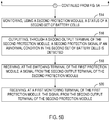
- FIG. 5A and FIG. 5B illustrate a flowchart of examples of operations performed by a battery protection system 300, in an embodiment of the present invention.
- FIG. 5A and FIG. 5B are described in combination with FIG. 3 and FIG. 4 .
- specific steps are disclosed in FIG. 5A and FIG. 5B , such steps are examples for illustrative purposes. That is, embodiments according to the present invention are well suited to performing various other steps or variations of the steps recited in FIG. 5A and FIG. 5B .
- a first protection module 302 monitors a status of a first set of battery cells 304 via a set of monitoring terminals. For example, the first protection module 302 monitors cell voltages of the battery cells 304 and determines whether a cell voltage of the cell voltages is greater than a reference voltage. If a cell voltage of the cell voltages is greater than a reference voltage, then the first protection module 302 starts to count time. When a predetermined time interval expires, if the cell voltage is still greater than the reference voltage, then the first protection module 302 determines that an abnormal condition, e.g., over-voltage condition, is presented in the battery cells 304.
- an abnormal condition e.g., over-voltage condition
- the first protection module 302 outputs, via its first output terminal OV, a first protection signal S OV1 if an abnormal condition, e.g., over-voltage condition, in the battery cells 304 is detected.
- an abnormal condition e.g., over-voltage condition
- the first protection module 302 receives, at its switching terminal VCC, a switching signal, e.g., S OV2 .
- the first protection module 302 switches from a normal-working mode to a fast-test mode in response the switching signal, e.g., S OV2 .
- the first protection module 302 delays the outputting of the first protection signal S OV1 for a first time interval ⁇ TN (e.g., one, two, or four seconds, or the like) if the abnormal condition is detected in the normal-working mode.
- a first time interval ⁇ TN e.g., one, two, or four seconds, or the like
- the first protection module 302 delays the outputting of the first protection signal S OV1 for a second time interval ⁇ TF (e.g., sixteen or thirty-two milliseconds, or the like), less than the first time interval ⁇ TN, if the abnormal condition is detected in the fast-test mode.
- a second time interval ⁇ TF e.g., sixteen or thirty-two milliseconds, or the like
- a second protection module 312 monitors a status of a second set of battery cells 314. For example, the second protection module 312 monitors cell voltages of the battery cells 314 and determines whether a cell voltage of the cell voltages is greater than a reference voltage. If a cell voltage of the cell voltages is greater than a reference voltage, then the second protection module 312 starts to count time. When a predetermined time interval expires, if the cell voltage is still greater than the reference voltage, then the second protection module 312 determines that an abnormal condition, e.g., over-voltage condition, is presented in the battery cells 314.
- an abnormal condition e.g., over-voltage condition
- the second protection module 312 outputs, via its second output terminal OV, a second protection signal S OV2 if an abnormal condition, e.g., over-voltage condition, in the battery cells 314 is detected.
- an abnormal condition e.g., over-voltage condition
- the first protection module 302 receives, at its switching terminal VCC, a signal, e.g., S OV2 .. from the second output terminal OV of the second protection module 312.
- the first protection module 302 also receives, at its first monitoring terminal BAT5, the signal, e.g., S OV2 .. from the second output terminal OV of the second protection module 312.
Landscapes
- Engineering & Computer Science (AREA)
- Power Engineering (AREA)
- Chemical & Material Sciences (AREA)
- Chemical Kinetics & Catalysis (AREA)
- Electrochemistry (AREA)
- General Chemical & Material Sciences (AREA)
- Manufacturing & Machinery (AREA)
- Physics & Mathematics (AREA)
- General Physics & Mathematics (AREA)
- Secondary Cells (AREA)
- Protection Of Static Devices (AREA)
- Charge And Discharge Circuits For Batteries Or The Like (AREA)
Claims (15)
- Système de protection de batterie (300) comprenant :
une pluralité de modules de protection (302, 312), chaque module de protection desdits modules de protection comprenant :une pluralité de terminaux de surveillance (BAT1, ..., BAT5) exploitables pour surveiller un état d'une pluralité de cellules de batterie ;un terminal de sortie (OV) exploitable pour sortir un signal de protection (SOV1, 434, SOV2) si une situation anormale est détectée dans lesdites cellules de batterie ;un terminal de commutation (VCC) exploitable pour recevoir un signal de commutation etun circuit de détection (402) couplé auxdits terminaux de surveillance (BAT1, ..., BAT5), audit terminal de sortie (OV) et audit terminal de commutation (VCC) et configuré pour commuter d'un mode de travail normal à un mode de test rapide en réponse audit signal de commutation, cependant que, dans ledit mode de test rapide, une série de tests est réalisée sur le module de protection (302, 312) pour s'assurer que le module de protection travaille correctement, retarder la sortie dudit signal de protection (SOV1, 434, SOV2) pendant un premier intervalle de temps (ΔTN) si ladite situation anormale est détectée dans ledit mode de travail normal et retarder la sortie dudit signal de protection (SOV1, 434, SOV2) pendant un second intervalle de temps (ΔTF) inférieur audit premier intervalle de temps (ΔTN) si ladite situation anormale est détectée dans ledit mode de test rapide, cependant que lesdits modules de protection comprennent un premier module de protection (302) pour générer un premier signal de protection (SOV1)pour protéger un premier ensemble de cellules de batterie (304) et un second module de protection (312) pour générer un second signal de protection (SOV2) pour protéger un second ensemble de cellules de batterie (314) et que le terminal de commutation (VCC) dudit premier module de protection (302) et un premier terminal de surveillance (BAT5) dudit premier module de protection (302) sont couplés audit second module de protection (312) et sont exploitables pour recevoir un signal (SOV2) du terminal de sortie (OV) dudit second module de protection (312). - Système de protection de batterie (300) selon la revendication 1 comprenant de plus un fusible (306) couplé à ladite pluralité de cellules de batterie et configuré pour être commandé par ledit premier signal de protection (SOV1)sorti par le terminal de sortie (OV) dudit premier module de protection (302).
- Système de protection de batterie (300) selon la revendication 2, cependant que ledit premier module de protection (302) est configuré pour surveiller un état de ladite première pluralité de cellules de batterie (304) et ledit second module de protection (312) est configuré pour surveiller un état de ladite seconde pluralité de cellules de batterie (314) et cependant que, si une situation anormale est détectée dans ladite seconde pluralité de cellules de batterie, ledit second module de protection (312) est configuré pour sortir un second signal de protection (SOV2) audit premier terminal de surveillance (BAT5) dudit premier module de protection (302) et ledit terminal de sortie (OV) dudit premier module de protection (302) est configuré pour sortir ledit premier signal de protection (SOV1)pour brûler ledit fusible (306).
- Système de protection de batterie (300) selon l'une quelconque des revendications précédentes, cependant que ladite situation anormale comprend une situation de surtension.
- Système de protection de batterie (300) selon l'une quelconque des revendications précédentes, cependant que, si ledit terminal de commutation (VCC) dudit premier module de protection (302) reçoit un signal de protection (SOV2) dudit terminal de sortie (OV) dudit second module de protection (312), le circuit de détection (402) dudit premier module de protection (302) est configuré pour commuter dudit mode de travail normal audit mode de test rapide.
- Système de protection de batterie (300) selon l'une quelconque des revendications précédentes, cependant que le circuit de détection (402) dudit premier module de protection (302) comprend :un circuit de surveillance (418) couplé auxdits terminaux de surveillance (BAT1, ..., BAT5) dudit premier module de protection (302) et configuré pour surveiller un état d'une pluralité de tensions de cellules et générer un signal d'indication (430) si une tension de cellule desdites tensions de cellules est supérieure à une tension de référence (VREF) ;un circuit de retard (428) couplé audit circuit de surveillance (418) et configuré pour compter le temps en réponse audit signal d'indication (430) et générer un premier signal de protection (SOV1)avec un retard prédéterminé etun circuit de détection de test rapide (432) couplé audit circuit de retard (428) et configuré pour commander ledit circuit de retard pour changer ledit retard de temps prédéterminé dudit premier intervalle de temps (ΔTN) audit second intervalle de temps (ΔTF) si ledit circuit de détection de test rapide (432) reçoit,au terminal de commutation (VCC) dudit premier module de protection (302), un second signal de protection (SOV2) dudit terminal de sortie (OV) dudit second module de protection (312).
- Système de protection de batterie (300) selon la revendication 6, cependant que ladite pluralité de tensions de cellules de ladite première pluralité de cellules de batterie (304) couplées audit premier module de protection (302) et des tensions de cellules de ladite seconde pluralité de cellules de batterie (314) couplées audit second module de protection (312) et cependant qu'un signal audit premier terminal de surveillance (BAT5) dudit premier module de protection (302) est configuré pour être commandé selon un état desdites tensions de cellules de ladite seconde pluralité de cellules de batterie (314).
- Système de protection de batterie (300) selon la revendication 6 ou 7, cependant que ledit circuit de détection de test rapide (432) comprend un comparateur configuré pour comparer une différence de tension entre ledit terminal de commutation (VCC) dudit premier module de protection (302) et ledit premier terminal de surveillance (BAT5) dudit premier module de protection (302) avec une tension de seuil (VTH) et générer un signal de résultat pour commander ledit circuit de retard (428) conformément à la comparaison.
- Bloc batterie comprenant un système de protection de batterie (300) selon l'une quelconque des revendications précédentes et comprenant une première pluralité de cellules de batterie (304) couplées à un premier module de protection (302) dans ledit système de protection de batterie et une seconde pluralité de cellules de batterie (314) couplées à ladite première pluralité de cellules de batterie (304) et à un second module de protection (312) dans ledit système de protection de batterie (300).
- Procédé de protection d'un bloc batterie comprenant une première pluralité de cellules de batterie (304) et une seconde pluralité de cellules de batterie (314), ledit procédé comprenant :la surveillance d'un état de ladite première pluralité de cellules de batterie (304) par une pluralité de terminaux de surveillance (BAT1, ..., BAT5) d'un premier module de protection (302) ;la sortie d'un premier signal de protection (SOV1) par un premier terminal de sortie (OV) dudit premier module de protection (302) si une situation anormale est détectée dans ladite première pluralité de cellules de batterie (304) ;la réception d'un signal de commutation sur un terminal de commutation (VCC) dudit premier module de protection (302) ;la commande dudit premier module de protection (302) pour commuter d'un mode de travail normal à un mode de test rapide en réponse audit signal de commutation (VCC), cependant que, dans ledit mode de test rapide, une série de tests est réalisée sur le module de protection pour s'assurer que le module de protection travaille correctement ;le retard de la sortie dudit premier signal de protection (SOV) pendant un premier intervalle de temps (ΔTN) si ladite situation anormale est détectée dans ledit mode de travail normal ;le retard de la sortie dudit premier signal de protection (SOV1) pendant un second intervalle de temps (ΔTF) inférieur audit premier intervalle de temps (ΔTN) si ladite situation anormale est détectée dans ledit mode de test rapide ;la surveillance d'un état de ladite seconde pluralité de cellules de batterie (314) en utilisant un second module de protection (312) etla sortie d'un second signal de protection (SOV2) par un second terminal de sortie (OV) dudit second module de protection (312) si une situation anormale est détectée dans ladite seconde pluralité de cellules de batterie,cependant que le procédé comprend de plus :la réception d'un signal dudit second terminal de sortie (OV) dudit second module de protection (312) sur ledit terminal de commutation (VCC) dudit premier module de protection (302) etla réception dudit signal dudit second terminal de sortie (OV) dudit second module de protection (312) sur un premier terminal de surveillance (BAT5) dudit premier module de protection (302).
- Procédé selon la revendication 10 comprenant de plus :
la commande d'un fusible (306) couplé à ladite première et à ladite seconde pluralité de cellules de batteries (304, 314) qui utilise ledit premier signal de protection (SOV1). - Procédé selon la revendication 10 ou la revendication 11 comprenant de plus :
la sortie dudit premier signal de protection (SOV1) par ledit premier terminal de sortie (OV) dudit premier module de protection (302) pour brûler ledit fusible (306) si ledit premier terminal de surveillance (BAT5) dudit premier module de protection (302) reçoit ledit second signal de protection (SOV2) dudit second module de protection (312). - Procédé selon l'une quelconque des revendications 10 à 12 comprenant de plus :
la commande dudit premier module de protection (302) pour commuter dudit mode de travail normal audit mode de test rapide si ledit terminal de commutation (VCC) dudit premier module de protection (302) reçoit ledit second signal de protection (SOV2) dudit second module de protection (312). - Procédé selon l'une quelconque des revendications 10 à 13 comprenant de plus :la surveillance d'un état d'une pluralité de tensions de cellules en utilisant un circuit de surveillance (418) dans ledit premier module de protection (302) ;la génération d'un signal d'indication (430) si une tension de cellule desdites tensions de cellules est supérieure à une tension de référence (VREF) ;le démarrage du compte de temps en réponse audit signal d'indication (430) ;la génération dudit premier signal de protection (SOV1) après un retard de temps prédéterminé en utilisant un circuit de retard (428) dans ledit premier module de protection (302) etle changement dudit retard de temps prédéterminé dudit premier intervalle de temps (ΔTN) audit second intervalle de temps (ΔTF) si ledit second signal de protection (SOV2) est reçu sur ledit terminal de commutation (VCC) dudit premier module de protection (302).
- Procédé selon la revendication 14 comprenant de plus :la comparaison d'une différence de tension (VDIS) entre ledit terminal de commutation (VCC) dudit premier module de protection (302) et ledit premier terminal de surveillance (BAT5) dudit premier module de protection (302) avec une tension de seuil (VTH) etla commande dudit circuit de retard (428) conformément à la comparaison.
Applications Claiming Priority (1)
| Application Number | Priority Date | Filing Date | Title |
|---|---|---|---|
| GB1806415.4A GB2563489B (en) | 2018-04-19 | 2018-04-19 | Battery protection systems |
Publications (2)
| Publication Number | Publication Date |
|---|---|
| EP3557717A1 EP3557717A1 (fr) | 2019-10-23 |
| EP3557717B1 true EP3557717B1 (fr) | 2020-12-16 |
Family
ID=62236145
Family Applications (1)
| Application Number | Title | Priority Date | Filing Date |
|---|---|---|---|
| EP19166748.4A Active EP3557717B1 (fr) | 2018-04-19 | 2019-04-02 | Systèmes de protection de batterie |
Country Status (6)
| Country | Link |
|---|---|
| US (1) | US10978867B2 (fr) |
| EP (1) | EP3557717B1 (fr) |
| JP (1) | JP7225011B2 (fr) |
| CN (1) | CN110391644B (fr) |
| ES (1) | ES2849624T3 (fr) |
| GB (1) | GB2563489B (fr) |
Cited By (1)
| Publication number | Priority date | Publication date | Assignee | Title |
|---|---|---|---|---|
| EP3985826B1 (fr) * | 2020-10-15 | 2025-12-03 | ABB Schweiz AG | Système de protection et de vérification de batterie |
Families Citing this family (9)
| Publication number | Priority date | Publication date | Assignee | Title |
|---|---|---|---|---|
| KR102515607B1 (ko) * | 2018-05-28 | 2023-03-28 | 삼성에스디아이 주식회사 | 스위치 제어 회로 및 이를 포함하는 배터리 팩 |
| GB2565006B (en) * | 2018-11-09 | 2021-09-08 | O2Micro International Ltd | Battery protection systems |
| CN113036710B (zh) * | 2019-12-09 | 2025-02-18 | 北京小米移动软件有限公司 | 获取电池状态的方法及装置、电池、电子设备、存储介质 |
| CN113824091B (zh) * | 2020-06-18 | 2025-12-16 | 力智电子股份有限公司 | 电池二次保护电路及其模式切换方法 |
| TWI775100B (zh) * | 2020-06-22 | 2022-08-21 | 宏碁股份有限公司 | 電池模組 |
| TWI775542B (zh) * | 2021-07-26 | 2022-08-21 | 宏碁股份有限公司 | 避免意外關機之行動裝置及控制方法 |
| CN116247754A (zh) * | 2021-12-07 | 2023-06-09 | 华润微集成电路(无锡)有限公司 | 电池保护芯片、电池系统及电池保护方法 |
| EP4451502A4 (fr) * | 2022-03-25 | 2025-06-25 | Xiamen Hechu Energy Technology Co., Ltd. | Module de batterie à contrôle total de courant et système de stockage d'énergie de batterie à contrôle total de courant |
| WO2026064746A1 (fr) * | 2024-09-20 | 2026-03-26 | Black & Decker Inc. | Système et procédé de surveillance pour bloc-batterie |
Family Cites Families (21)
| Publication number | Priority date | Publication date | Assignee | Title |
|---|---|---|---|---|
| JP4392103B2 (ja) * | 2000-03-30 | 2009-12-24 | セイコーインスツル株式会社 | 充放電制御回路および充電式電源装置 |
| JP3948435B2 (ja) * | 2003-06-16 | 2007-07-25 | 株式会社リコー | 2次電池保護用icとそれを用いたバッテリパックおよび電子機器 |
| US7589499B2 (en) * | 2004-03-25 | 2009-09-15 | O2Micro International Limited | Over voltage transient controller |
| US8618805B2 (en) | 2004-03-25 | 2013-12-31 | 02Micro, Inc. | Battery pack with a battery protection circuit |
| JP4092580B2 (ja) * | 2004-04-30 | 2008-05-28 | 新神戸電機株式会社 | 多直列電池制御システム |
| JP4539582B2 (ja) * | 2006-02-21 | 2010-09-08 | ミツミ電機株式会社 | 充電保護回路 |
| JP4864730B2 (ja) | 2007-01-05 | 2012-02-01 | ルネサスエレクトロニクス株式会社 | 電池電圧監視装置 |
| US7679332B2 (en) * | 2007-06-23 | 2010-03-16 | Neotec Semiconductor Ltd. | Delay time control circuit in a battery protector to reduce delay time |
| JP5123585B2 (ja) * | 2007-07-06 | 2013-01-23 | セイコーインスツル株式会社 | バッテリ保護ic及びバッテリ装置 |
| CN103441472B (zh) | 2009-04-21 | 2016-03-30 | 无锡中感微电子股份有限公司 | 一种电池保护电路 |
| US8219333B2 (en) | 2010-06-29 | 2012-07-10 | O2Micro, Inc | Battery management systems for protecting batteries from fault conditions |
| US8450976B2 (en) | 2010-10-29 | 2013-05-28 | O2Micro, Inc. | Power topology with battery charging and discharge current protection capabilities |
| US20120280572A1 (en) | 2011-05-05 | 2012-11-08 | O2Micro, Inc. | Battery systems and controllers |
| KR101440888B1 (ko) | 2011-12-27 | 2014-09-17 | 삼성에스디아이 주식회사 | 배터리 보호 회로 |
| CN203522160U (zh) | 2013-10-22 | 2014-04-02 | 深圳众鑫凯科技有限公司 | 带二次过压及欠压保护功能的电池保护电路 |
| JP6477200B2 (ja) * | 2015-04-24 | 2019-03-06 | ミツミ電機株式会社 | 電池保護システム、電池保護装置、及び電池保護方法 |
| CN205070405U (zh) | 2015-09-25 | 2016-03-02 | 新源国宏科技(北京)有限公司 | 一种具有二次保护功能的模拟非均衡bms保护板 |
| EP3416231B8 (fr) * | 2016-02-10 | 2021-07-07 | Kabushiki Kaisha Toshiba | Module de batterie et système de batterie de stockage |
| CN107202958B (zh) | 2016-03-17 | 2020-09-22 | 伊姆西Ip控股有限责任公司 | 用于测试电池的状况的方法和设备 |
| CN205724851U (zh) | 2016-04-18 | 2016-11-23 | 深圳市智锂能源科技有限公司 | 一种电动车动力电池二次保护系统 |
| CN206452101U (zh) | 2017-02-09 | 2017-08-29 | 厦门市普星电子科技有限公司 | 一种双节锂电池保护电路 |
-
2018
- 2018-04-19 GB GB1806415.4A patent/GB2563489B/en active Active
-
2019
- 2019-03-26 US US16/365,395 patent/US10978867B2/en active Active
- 2019-04-02 ES ES19166748T patent/ES2849624T3/es active Active
- 2019-04-02 EP EP19166748.4A patent/EP3557717B1/fr active Active
- 2019-04-12 CN CN201910293716.8A patent/CN110391644B/zh active Active
- 2019-04-12 JP JP2019076340A patent/JP7225011B2/ja active Active
Non-Patent Citations (1)
| Title |
|---|
| None * |
Cited By (1)
| Publication number | Priority date | Publication date | Assignee | Title |
|---|---|---|---|---|
| EP3985826B1 (fr) * | 2020-10-15 | 2025-12-03 | ABB Schweiz AG | Système de protection et de vérification de batterie |
Also Published As
| Publication number | Publication date |
|---|---|
| GB2563489A (en) | 2018-12-19 |
| JP2019198216A (ja) | 2019-11-14 |
| CN110391644A (zh) | 2019-10-29 |
| GB2563489B (en) | 2019-12-04 |
| GB2563489A8 (en) | 2018-12-26 |
| JP7225011B2 (ja) | 2023-02-20 |
| US20190326746A1 (en) | 2019-10-24 |
| GB201806415D0 (en) | 2018-06-06 |
| ES2849624T3 (es) | 2021-08-19 |
| CN110391644B (zh) | 2022-04-26 |
| EP3557717A1 (fr) | 2019-10-23 |
| US10978867B2 (en) | 2021-04-13 |
Similar Documents
| Publication | Publication Date | Title |
|---|---|---|
| EP3557717B1 (fr) | Systèmes de protection de batterie | |
| KR101149186B1 (ko) | 충방전 제어 회로 및 충전식 전원 장치 | |
| JP5036556B2 (ja) | リチウムイオンまたはリチウムポリマーのバッテリをバランス充電するための方法 | |
| EP2339716B1 (fr) | Bloc batterie et son procédé de détection d'ouverture de ligne | |
| KR102049148B1 (ko) | 배터리 디바이스 및 배터리 보호 방법 | |
| US8618805B2 (en) | Battery pack with a battery protection circuit | |
| US8618806B2 (en) | Circuits and methods for cell number detection | |
| JP4080408B2 (ja) | 電池用保護icおよびそれを利用した電池パック | |
| TWI432748B (zh) | 組電池之保護用半導體裝置,包括該保護用半導體裝置之電池組,及電子裝置 | |
| JP3296385B2 (ja) | 電池の電圧検出回路 | |
| US20120280572A1 (en) | Battery systems and controllers | |
| JP2001283932A (ja) | 充放電制御回路および充電式電源装置 | |
| US20240069112A1 (en) | Battery hazard detection | |
| KR100328888B1 (ko) | 충방전 제어회로 | |
| KR101539692B1 (ko) | Fet 센싱을 이용하는 bmu 테스트 시스템 및 bmu 테스트 방법 | |
| US20200079240A1 (en) | Battery pack, battery management system, and method therefor | |
| JP2018125969A (ja) | 蓄電池のヒューズ判定回路 | |
| CN115166473B (zh) | 电池保护芯片的测试电路、电池保护芯片测试装置与方法 | |
| GB2577814A (en) | Battery protection systems | |
| KR102609004B1 (ko) | 배터리 모듈 | |
| JP2008199828A (ja) | 電池パック | |
| US20240077543A1 (en) | Battery Pack and Current Monitoring Method Thereof | |
| CN211908435U (zh) | 一种实现锂电池组安全充电的保护电路 | |
| JPH1189099A (ja) | 充放電制御回路 | |
| JP2015154556A (ja) | 蓄電装置の電流遮断検出回路及び電流遮断検出方法 |
Legal Events
| Date | Code | Title | Description |
|---|---|---|---|
| PUAI | Public reference made under article 153(3) epc to a published international application that has entered the european phase |
Free format text: ORIGINAL CODE: 0009012 |
|
| STAA | Information on the status of an ep patent application or granted ep patent |
Free format text: STATUS: THE APPLICATION HAS BEEN PUBLISHED |
|
| AK | Designated contracting states |
Kind code of ref document: A1 Designated state(s): AL AT BE BG CH CY CZ DE DK EE ES FI FR GB GR HR HU IE IS IT LI LT LU LV MC MK MT NL NO PL PT RO RS SE SI SK SM TR |
|
| AX | Request for extension of the european patent |
Extension state: BA ME |
|
| STAA | Information on the status of an ep patent application or granted ep patent |
Free format text: STATUS: REQUEST FOR EXAMINATION WAS MADE |
|
| 17P | Request for examination filed |
Effective date: 20200423 |
|
| RBV | Designated contracting states (corrected) |
Designated state(s): AL AT BE BG CH CY CZ DE DK EE ES FI FR GB GR HR HU IE IS IT LI LT LU LV MC MK MT NL NO PL PT RO RS SE SI SK SM TR |
|
| GRAP | Despatch of communication of intention to grant a patent |
Free format text: ORIGINAL CODE: EPIDOSNIGR1 |
|
| STAA | Information on the status of an ep patent application or granted ep patent |
Free format text: STATUS: GRANT OF PATENT IS INTENDED |
|
| INTG | Intention to grant announced |
Effective date: 20200710 |
|
| GRAS | Grant fee paid |
Free format text: ORIGINAL CODE: EPIDOSNIGR3 |
|
| GRAA | (expected) grant |
Free format text: ORIGINAL CODE: 0009210 |
|
| STAA | Information on the status of an ep patent application or granted ep patent |
Free format text: STATUS: THE PATENT HAS BEEN GRANTED |
|
| AK | Designated contracting states |
Kind code of ref document: B1 Designated state(s): AL AT BE BG CH CY CZ DE DK EE ES FI FR GB GR HR HU IE IS IT LI LT LU LV MC MK MT NL NO PL PT RO RS SE SI SK SM TR |
|
| REG | Reference to a national code |
Ref country code: GB Ref legal event code: FG4D |
|
| REG | Reference to a national code |
Ref country code: IE Ref legal event code: FG4D |
|
| REG | Reference to a national code |
Ref country code: DE Ref legal event code: R096 Ref document number: 602019001730 Country of ref document: DE |
|
| REG | Reference to a national code |
Ref country code: AT Ref legal event code: REF Ref document number: 1346484 Country of ref document: AT Kind code of ref document: T Effective date: 20210115 |
|
| PG25 | Lapsed in a contracting state [announced via postgrant information from national office to epo] |
Ref country code: FI Free format text: LAPSE BECAUSE OF FAILURE TO SUBMIT A TRANSLATION OF THE DESCRIPTION OR TO PAY THE FEE WITHIN THE PRESCRIBED TIME-LIMIT Effective date: 20201216 Ref country code: RS Free format text: LAPSE BECAUSE OF FAILURE TO SUBMIT A TRANSLATION OF THE DESCRIPTION OR TO PAY THE FEE WITHIN THE PRESCRIBED TIME-LIMIT Effective date: 20201216 Ref country code: GR Free format text: LAPSE BECAUSE OF FAILURE TO SUBMIT A TRANSLATION OF THE DESCRIPTION OR TO PAY THE FEE WITHIN THE PRESCRIBED TIME-LIMIT Effective date: 20210317 Ref country code: NO Free format text: LAPSE BECAUSE OF FAILURE TO SUBMIT A TRANSLATION OF THE DESCRIPTION OR TO PAY THE FEE WITHIN THE PRESCRIBED TIME-LIMIT Effective date: 20210316 |
|
| REG | Reference to a national code |
Ref country code: AT Ref legal event code: MK05 Ref document number: 1346484 Country of ref document: AT Kind code of ref document: T Effective date: 20201216 |
|
| REG | Reference to a national code |
Ref country code: NL Ref legal event code: MP Effective date: 20201216 |
|
| PG25 | Lapsed in a contracting state [announced via postgrant information from national office to epo] |
Ref country code: LV Free format text: LAPSE BECAUSE OF FAILURE TO SUBMIT A TRANSLATION OF THE DESCRIPTION OR TO PAY THE FEE WITHIN THE PRESCRIBED TIME-LIMIT Effective date: 20201216 Ref country code: SE Free format text: LAPSE BECAUSE OF FAILURE TO SUBMIT A TRANSLATION OF THE DESCRIPTION OR TO PAY THE FEE WITHIN THE PRESCRIBED TIME-LIMIT Effective date: 20201216 Ref country code: BG Free format text: LAPSE BECAUSE OF FAILURE TO SUBMIT A TRANSLATION OF THE DESCRIPTION OR TO PAY THE FEE WITHIN THE PRESCRIBED TIME-LIMIT Effective date: 20210316 |
|
| PG25 | Lapsed in a contracting state [announced via postgrant information from national office to epo] |
Ref country code: NL Free format text: LAPSE BECAUSE OF FAILURE TO SUBMIT A TRANSLATION OF THE DESCRIPTION OR TO PAY THE FEE WITHIN THE PRESCRIBED TIME-LIMIT Effective date: 20201216 Ref country code: HR Free format text: LAPSE BECAUSE OF FAILURE TO SUBMIT A TRANSLATION OF THE DESCRIPTION OR TO PAY THE FEE WITHIN THE PRESCRIBED TIME-LIMIT Effective date: 20201216 |
|
| REG | Reference to a national code |
Ref country code: LT Ref legal event code: MG9D |
|
| PG25 | Lapsed in a contracting state [announced via postgrant information from national office to epo] |
Ref country code: CZ Free format text: LAPSE BECAUSE OF FAILURE TO SUBMIT A TRANSLATION OF THE DESCRIPTION OR TO PAY THE FEE WITHIN THE PRESCRIBED TIME-LIMIT Effective date: 20201216 Ref country code: SK Free format text: LAPSE BECAUSE OF FAILURE TO SUBMIT A TRANSLATION OF THE DESCRIPTION OR TO PAY THE FEE WITHIN THE PRESCRIBED TIME-LIMIT Effective date: 20201216 Ref country code: SM Free format text: LAPSE BECAUSE OF FAILURE TO SUBMIT A TRANSLATION OF THE DESCRIPTION OR TO PAY THE FEE WITHIN THE PRESCRIBED TIME-LIMIT Effective date: 20201216 Ref country code: EE Free format text: LAPSE BECAUSE OF FAILURE TO SUBMIT A TRANSLATION OF THE DESCRIPTION OR TO PAY THE FEE WITHIN THE PRESCRIBED TIME-LIMIT Effective date: 20201216 Ref country code: RO Free format text: LAPSE BECAUSE OF FAILURE TO SUBMIT A TRANSLATION OF THE DESCRIPTION OR TO PAY THE FEE WITHIN THE PRESCRIBED TIME-LIMIT Effective date: 20201216 Ref country code: PT Free format text: LAPSE BECAUSE OF FAILURE TO SUBMIT A TRANSLATION OF THE DESCRIPTION OR TO PAY THE FEE WITHIN THE PRESCRIBED TIME-LIMIT Effective date: 20210416 Ref country code: LT Free format text: LAPSE BECAUSE OF FAILURE TO SUBMIT A TRANSLATION OF THE DESCRIPTION OR TO PAY THE FEE WITHIN THE PRESCRIBED TIME-LIMIT Effective date: 20201216 |
|
| REG | Reference to a national code |
Ref country code: ES Ref legal event code: FG2A Ref document number: 2849624 Country of ref document: ES Kind code of ref document: T3 Effective date: 20210819 |
|
| PG25 | Lapsed in a contracting state [announced via postgrant information from national office to epo] |
Ref country code: AT Free format text: LAPSE BECAUSE OF FAILURE TO SUBMIT A TRANSLATION OF THE DESCRIPTION OR TO PAY THE FEE WITHIN THE PRESCRIBED TIME-LIMIT Effective date: 20201216 Ref country code: PL Free format text: LAPSE BECAUSE OF FAILURE TO SUBMIT A TRANSLATION OF THE DESCRIPTION OR TO PAY THE FEE WITHIN THE PRESCRIBED TIME-LIMIT Effective date: 20201216 |
|
| REG | Reference to a national code |
Ref country code: DE Ref legal event code: R097 Ref document number: 602019001730 Country of ref document: DE |
|
| PG25 | Lapsed in a contracting state [announced via postgrant information from national office to epo] |
Ref country code: IS Free format text: LAPSE BECAUSE OF FAILURE TO SUBMIT A TRANSLATION OF THE DESCRIPTION OR TO PAY THE FEE WITHIN THE PRESCRIBED TIME-LIMIT Effective date: 20210416 |
|
| PLBE | No opposition filed within time limit |
Free format text: ORIGINAL CODE: 0009261 |
|
| STAA | Information on the status of an ep patent application or granted ep patent |
Free format text: STATUS: NO OPPOSITION FILED WITHIN TIME LIMIT |
|
| PG25 | Lapsed in a contracting state [announced via postgrant information from national office to epo] |
Ref country code: AL Free format text: LAPSE BECAUSE OF FAILURE TO SUBMIT A TRANSLATION OF THE DESCRIPTION OR TO PAY THE FEE WITHIN THE PRESCRIBED TIME-LIMIT Effective date: 20201216 |
|
| 26N | No opposition filed |
Effective date: 20210917 |
|
| PG25 | Lapsed in a contracting state [announced via postgrant information from national office to epo] |
Ref country code: DK Free format text: LAPSE BECAUSE OF FAILURE TO SUBMIT A TRANSLATION OF THE DESCRIPTION OR TO PAY THE FEE WITHIN THE PRESCRIBED TIME-LIMIT Effective date: 20201216 Ref country code: MC Free format text: LAPSE BECAUSE OF FAILURE TO SUBMIT A TRANSLATION OF THE DESCRIPTION OR TO PAY THE FEE WITHIN THE PRESCRIBED TIME-LIMIT Effective date: 20201216 |
|
| PG25 | Lapsed in a contracting state [announced via postgrant information from national office to epo] |
Ref country code: LU Free format text: LAPSE BECAUSE OF NON-PAYMENT OF DUE FEES Effective date: 20210402 |
|
| REG | Reference to a national code |
Ref country code: BE Ref legal event code: MM Effective date: 20210430 |
|
| PG25 | Lapsed in a contracting state [announced via postgrant information from national office to epo] |
Ref country code: SI Free format text: LAPSE BECAUSE OF FAILURE TO SUBMIT A TRANSLATION OF THE DESCRIPTION OR TO PAY THE FEE WITHIN THE PRESCRIBED TIME-LIMIT Effective date: 20201216 |
|
| PG25 | Lapsed in a contracting state [announced via postgrant information from national office to epo] |
Ref country code: IE Free format text: LAPSE BECAUSE OF NON-PAYMENT OF DUE FEES Effective date: 20210402 |
|
| PG25 | Lapsed in a contracting state [announced via postgrant information from national office to epo] |
Ref country code: IS Free format text: LAPSE BECAUSE OF FAILURE TO SUBMIT A TRANSLATION OF THE DESCRIPTION OR TO PAY THE FEE WITHIN THE PRESCRIBED TIME-LIMIT Effective date: 20210416 |
|
| PG25 | Lapsed in a contracting state [announced via postgrant information from national office to epo] |
Ref country code: BE Free format text: LAPSE BECAUSE OF NON-PAYMENT OF DUE FEES Effective date: 20210430 |
|
| REG | Reference to a national code |
Ref country code: ES Ref legal event code: PC2A Owner name: O2MICRO INTERNATIONAL LTD. Effective date: 20220914 |
|
| REG | Reference to a national code |
Ref country code: DE Ref legal event code: R081 Ref document number: 602019001730 Country of ref document: DE Owner name: O2MICRO INTERNATIONAL LTD., GEORGE TOWN, KY Free format text: FORMER OWNER: O2MICRO, INC., SANTA CLARA, CALIF., US |
|
| REG | Reference to a national code |
Ref country code: GB Ref legal event code: 732E Free format text: REGISTERED BETWEEN 20220908 AND 20220914 |
|
| REG | Reference to a national code |
Ref country code: CH Ref legal event code: PL |
|
| PG25 | Lapsed in a contracting state [announced via postgrant information from national office to epo] |
Ref country code: LI Free format text: LAPSE BECAUSE OF NON-PAYMENT OF DUE FEES Effective date: 20220430 Ref country code: CH Free format text: LAPSE BECAUSE OF NON-PAYMENT OF DUE FEES Effective date: 20220430 |
|
| PG25 | Lapsed in a contracting state [announced via postgrant information from national office to epo] |
Ref country code: CY Free format text: LAPSE BECAUSE OF FAILURE TO SUBMIT A TRANSLATION OF THE DESCRIPTION OR TO PAY THE FEE WITHIN THE PRESCRIBED TIME-LIMIT Effective date: 20201216 |
|
| PG25 | Lapsed in a contracting state [announced via postgrant information from national office to epo] |
Ref country code: HU Free format text: LAPSE BECAUSE OF FAILURE TO SUBMIT A TRANSLATION OF THE DESCRIPTION OR TO PAY THE FEE WITHIN THE PRESCRIBED TIME-LIMIT; INVALID AB INITIO Effective date: 20190402 |
|
| PG25 | Lapsed in a contracting state [announced via postgrant information from national office to epo] |
Ref country code: MK Free format text: LAPSE BECAUSE OF FAILURE TO SUBMIT A TRANSLATION OF THE DESCRIPTION OR TO PAY THE FEE WITHIN THE PRESCRIBED TIME-LIMIT Effective date: 20201216 |
|
| PG25 | Lapsed in a contracting state [announced via postgrant information from national office to epo] |
Ref country code: MT Free format text: LAPSE BECAUSE OF FAILURE TO SUBMIT A TRANSLATION OF THE DESCRIPTION OR TO PAY THE FEE WITHIN THE PRESCRIBED TIME-LIMIT Effective date: 20201216 |
|
| PGFP | Annual fee paid to national office [announced via postgrant information from national office to epo] |
Ref country code: DE Payment date: 20250429 Year of fee payment: 7 |
|
| PGFP | Annual fee paid to national office [announced via postgrant information from national office to epo] |
Ref country code: ES Payment date: 20250505 Year of fee payment: 7 Ref country code: GB Payment date: 20250428 Year of fee payment: 7 |
|
| PGFP | Annual fee paid to national office [announced via postgrant information from national office to epo] |
Ref country code: IT Payment date: 20250422 Year of fee payment: 7 |
|
| PGFP | Annual fee paid to national office [announced via postgrant information from national office to epo] |
Ref country code: FR Payment date: 20250425 Year of fee payment: 7 |
|
| PG25 | Lapsed in a contracting state [announced via postgrant information from national office to epo] |
Ref country code: TR Free format text: LAPSE BECAUSE OF FAILURE TO SUBMIT A TRANSLATION OF THE DESCRIPTION OR TO PAY THE FEE WITHIN THE PRESCRIBED TIME-LIMIT Effective date: 20201216 |