EP3557714A1 - Verfahren zum zuordnen jedes zählers einer mehrerer zähler bei einer triphase-abfahrt eines transformators, verfahren zum bestimmen der topologie eines netzes und eines zugehörigen geräts - Google Patents
Verfahren zum zuordnen jedes zählers einer mehrerer zähler bei einer triphase-abfahrt eines transformators, verfahren zum bestimmen der topologie eines netzes und eines zugehörigen geräts Download PDFInfo
- Publication number
- EP3557714A1 EP3557714A1 EP19170418.8A EP19170418A EP3557714A1 EP 3557714 A1 EP3557714 A1 EP 3557714A1 EP 19170418 A EP19170418 A EP 19170418A EP 3557714 A1 EP3557714 A1 EP 3557714A1
- Authority
- EP
- European Patent Office
- Prior art keywords
- cpt
- counters
- counter
- similarity
- group
- Prior art date
- Legal status (The legal status is an assumption and is not a legal conclusion. Google has not performed a legal analysis and makes no representation as to the accuracy of the status listed.)
- Pending
Links
Images





Classifications
-
- H—ELECTRICITY
- H02—GENERATION; CONVERSION OR DISTRIBUTION OF ELECTRIC POWER
- H02J—ELECTRIC POWER NETWORKS; CIRCUIT ARRANGEMENTS OR SYSTEMS FOR SUPPLYING OR DISTRIBUTING ELECTRIC POWER; SYSTEMS FOR STORING ELECTRIC ENERGY
- H02J3/00—Circuit arrangements for AC mains or AC distribution networks
- H02J3/26—Arrangements for eliminating or reducing asymmetry in polyphase networks
-
- H—ELECTRICITY
- H02—GENERATION; CONVERSION OR DISTRIBUTION OF ELECTRIC POWER
- H02J—ELECTRIC POWER NETWORKS; CIRCUIT ARRANGEMENTS OR SYSTEMS FOR SUPPLYING OR DISTRIBUTING ELECTRIC POWER; SYSTEMS FOR STORING ELECTRIC ENERGY
- H02J13/00—Circuit arrangements for providing remote monitoring or remote control of equipment in a power distribution network
- H02J13/12—Monitoring network conditions, e.g. electrical magnitudes or operational status
-
- Y—GENERAL TAGGING OF NEW TECHNOLOGICAL DEVELOPMENTS; GENERAL TAGGING OF CROSS-SECTIONAL TECHNOLOGIES SPANNING OVER SEVERAL SECTIONS OF THE IPC; TECHNICAL SUBJECTS COVERED BY FORMER USPC CROSS-REFERENCE ART COLLECTIONS [XRACs] AND DIGESTS
- Y02—TECHNOLOGIES OR APPLICATIONS FOR MITIGATION OR ADAPTATION AGAINST CLIMATE CHANGE
- Y02E—REDUCTION OF GREENHOUSE GAS [GHG] EMISSIONS, RELATED TO ENERGY GENERATION, TRANSMISSION OR DISTRIBUTION
- Y02E40/00—Technologies for an efficient electrical power generation, transmission or distribution
- Y02E40/50—Arrangements for eliminating or reducing asymmetry in polyphase networks
-
- Y—GENERAL TAGGING OF NEW TECHNOLOGICAL DEVELOPMENTS; GENERAL TAGGING OF CROSS-SECTIONAL TECHNOLOGIES SPANNING OVER SEVERAL SECTIONS OF THE IPC; TECHNICAL SUBJECTS COVERED BY FORMER USPC CROSS-REFERENCE ART COLLECTIONS [XRACs] AND DIGESTS
- Y02—TECHNOLOGIES OR APPLICATIONS FOR MITIGATION OR ADAPTATION AGAINST CLIMATE CHANGE
- Y02E—REDUCTION OF GREENHOUSE GAS [GHG] EMISSIONS, RELATED TO ENERGY GENERATION, TRANSMISSION OR DISTRIBUTION
- Y02E60/00—Enabling technologies; Technologies with a potential or indirect contribution to GHG emissions mitigation
-
- Y—GENERAL TAGGING OF NEW TECHNOLOGICAL DEVELOPMENTS; GENERAL TAGGING OF CROSS-SECTIONAL TECHNOLOGIES SPANNING OVER SEVERAL SECTIONS OF THE IPC; TECHNICAL SUBJECTS COVERED BY FORMER USPC CROSS-REFERENCE ART COLLECTIONS [XRACs] AND DIGESTS
- Y04—INFORMATION OR COMMUNICATION TECHNOLOGIES HAVING AN IMPACT ON OTHER TECHNOLOGY AREAS
- Y04S—SYSTEMS INTEGRATING TECHNOLOGIES RELATED TO POWER NETWORK OPERATION, COMMUNICATION OR INFORMATION TECHNOLOGIES FOR IMPROVING THE ELECTRICAL POWER GENERATION, TRANSMISSION, DISTRIBUTION, MANAGEMENT OR USAGE, i.e. SMART GRIDS
- Y04S10/00—Systems supporting electrical power generation, transmission or distribution
- Y04S10/30—State monitoring, e.g. fault, temperature monitoring, insulator monitoring, corona discharge
Definitions
- the technical field of the invention is that of the mapping of electrical networks.
- the present invention relates to a method of associating each counter of a plurality of meters with a three-phase output of a transformer, a method of determining the topology of a network and an associated device.
- the invention offers a solution to the problems mentioned above, by using the link that exists between each phase of a three-phase departure in order to determine the topology of a network without having to carry out measurements at the transformer level, but only at the level of the transformers. counters to characterize.
- the principles of this measure make it insensitive to measurement anomalies such as the failure to take into account one or more meters or even the existence of "wild withdrawals".
- the invention it is therefore possible to associate each counter to a group and thus to a three-phase start. Since this three-phase starter is itself associated with a transformer, the method according to a first aspect of the invention thus makes it possible to associate each counter of a plurality of meters with a three-phase output of a transformer.
- the inventors have indeed discovered that it is possible to use the link that exists between the different phases of a three-phase departure. This link is reflected for example by the fact that a change in consumption on one phase will have an impact on the voltage of the other two phases of the three-phase trip. The measurement of this link is made in the invention by means of voltage measurements made by meters. Indeed, in general, if two voltages measured by two different counters have a negative similarity, for example that they are negatively correlated, then these counters are in principle connected to two different phases of the same three-phase start.
- the measurement of similarity can for example be carried out by means of a Pearson correlation or by a calculation of a regression coefficient (this aspect will be detailed later).
- the voltages measured by two meters connected to two phases of the same three-phase start do not necessarily have negative similarity.
- this similarity becomes negative.
- the voltages measured by three counters each connected to a phase of a three-phase start will have negative similarities two by two.
- the method according to a first aspect of the invention may have one or more additional characteristics among the following, considered individually or in any technically possible combination.
- the method according to a first aspect of the invention further comprises, before the step of determining the similarity between each voltage measurement of each counter of the plurality of counters, a step of pretreatment of the measurement of the voltage performed by each counter over the measurement period.
- the operation of the method is improved by ensuring that the data are purged of all or part of the measures likely to affect the relevance of the results obtained, for example by removing the component due to voltage variations at the transformer.
- the step of grouping the pairs of counters is performed only on the pairs of counters having a similarity lower than -0.2.
- the method does not take into account the pair formed by these two counters, which improves the results obtained by the method according to a first aspect of the invention.
- the grouping makes it possible to associate each group with a three-phase start of the network and therefore with a transformer of the network.
- the ranking sub-step present at the beginning of the grouping step improves the reliability of said grouping.
- the fact of merging two groups only if there are two links between these two groups makes it possible to further improve the reliability of the grouping.
- the distance between two counters is equal to the absolute value of the similarity between the two counters when said similarity is negative and the zero value when said similarity is positive
- the method comprises a step of creating three subgroups, each subgroup being constructed so that the average distance between two different subgroup counters is as large as possible and the average distance between two counters belonging to the same subgroup is as small as possible, preferably zero, each subgroup corresponding to a three-phase departure phase associated with the group in question.
- the distance between two counters is equal to the absolute value of the similarity between the two counters when said similarity is negative and the zero value when said similarity is positive, and in which, for each group, the method comprises a step of implementing a clustering algorithm so as to obtain three clusters of counters, each cluster corresponding to a three-phase departure phase associated with the group in question.
- each counter with a subgroup and thus with a phase of a three-phase start, each phase being itself associated with a subgroup.
- a method according to the invention makes it possible, by using the same principles as the method according to a first aspect of the invention, to produce a complete topology of the network starting from the setting up of triplets of meters.
- the method according to a third aspect of the invention comprises, after the step of determining the two other counters of the plurality of counters with which the counter considered has the most similarities negative, a triplette sorting step obtained so that triplets having a score below a predetermined threshold value are not taken into account.
- this sorting avoids that triplets with a low score lead to merge two groups that should not have been.
- a fourth aspect of the invention relates to an electronic device comprising means configured to implement a method according to a first aspect, a second aspect or a third aspect of the invention.
- a fifth aspect of the invention relates to a computer program comprising instructions that lead the device according to a fourth aspect of the invention to perform the steps of the method according to a first aspect, a second aspect or a third aspect of the invention. .
- a sixth aspect of the invention relates to a computer readable medium on which the computer program according to a fifth aspect of the invention is stored.
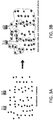
- a first embodiment of a first aspect of the invention illustrated in Figures 1 to 3 relates to a method 100 for associating each CPT counter of a plurality of CPT counters with a three-phase DTP output of a transformer TRS among at least one transformer TRS, preferably among a plurality of transformers TRS, each transformer TRS comprising at least a three-phase DTP feeder, each three-phase DTP feeder comprising three DDP phases, and each CPT counter being connected to one and only one DDP phase.
- the method 100 comprises a step 1ED of determining the similarity between each voltage measurement of each counter CPT of the plurality of counters CPT so as to form a plurality of pairs of counters CPT, each measurement of voltage being made over a period called period measurement, each pair of CPT meters being associated with a similarity.
- the similarity can for example be a correlation such as a Pearson correlation.
- the similarity is determined by a calculation of regression coefficients. For this, for each counter CPT N , a step of determining the voltage V N of the counter CPT N is carried out from a linear combination of the voltages and / or the powers of the other counters CPT, the coefficient associated with each counter then representing the similarity between the counter CPT N and the counter associated with the coefficient.
- the similarity between the counter CPT i and the counter CPT j is given by the value of K j .
- the similarity is zero when two counters belong to the same set and has a value given by the linear regression otherwise.
- the advantage of this definition of the similarity is that it makes it possible to obtain, at the end of the grouping step 1ER, pairs of CPT counters having a negative similarity according to their similarity, not only a grouping by departure. three-phase as with the other definitions of similarity presented above, but also a grouping by departure of phase.
- the similarity between two counters is obtained by a calculation of the partial correlation matrix, this matrix being able for example be obtained by inverting the covariance matrix.
- This method of calculating similarity has the advantage of keeping only the remarkable links between counters: each counter is connected only to those allowing to describe its variations. When two counters are not linked (zero link in the matrix), their similarity is zero. When two counters are linked, their similarity is equal to this link.
- this calculation is done by forcing the matrix to be hollow (that is to say by increasing the number of zeros during the estimation of the matrix), so as to reduce the number of links between counters (for example using a GraphicalLasso estimator), and thus to have more similarities equal to zero.
- a similarity can be defined as a level of resemblance between two signals, which can be calculated solely from these two signals (eg correlation or covariance), or taking other signals into account as well (eg regression coefficient or partial correlation).
- each pair that can be made with the CPT counters of the plurality of counters CPT is associated with a similarity, said similarity being calculated between the voltages measured at each counter CPT of said pair.
- a matrix of all the similarities between the two-by-two counters is thus obtained.
- each CPT meter measures the voltage at regular intervals and records the temporal evolution of this voltage and this measurement is used to calculate the similarity.
- a measurement of the voltage comprises a plurality of points, each point corresponding to a value of the voltage at a given instant.
- the similarity between two CPT counters must be understood as the similarity calculated between the voltage measured at said CPT counters for a given period, the so-called measuring period. For this reason in the following, the similarity between the voltage measurement performed by a first CPT counter and the measurement of the voltage performed by a second CPT counter will also be called similarity between the first CPT counter and the second CPT counter for the sake of brevity .
- the method 100 also comprises a step 1 ER of grouping of CPT counter couples having a negative similarity so as to form a plurality of groups, each group being associated with a three-phase DTP output.
- a step 1 ER of grouping of CPT counter couples having a negative similarity so as to form a plurality of groups, each group being associated with a three-phase DTP output.
- couples that have a similarity less than or equal to zero, preferably less than -0.2 are taken into account for the grouping step 1ER.
- This makes it possible not to take into account the low-discriminating couples for the determination of the topology. Indeed, it is "easy" to find positive similarities, even on different departures (because the ways to consume can be similar), while it is more rare to find negative similarities between two departures.
- this grouping step can be performed in several ways.
- a clustering method for example a k means method .
- affinity propagation the latter allowing to determine the optimal number of groups.
- the grouping step does not necessarily require prior knowledge of the number of three-phase starts present on the network. Note that, in general, when comparing meters with negative similarities, we can use a clustering algorithm with the distance of the value of the modified similarities so as to keep only the absolute values of the negative values, the positive values being suppressed. Similarly, when grouping counters with positive similarities, we can keep only the positive values.
- each counter CPT of a group with a three-phase DTP, and consequently the transformer TRS comprising said three-phase DTP.
- this grouping method can in some cases lead to assigning a CPT counter to the wrong group and therefore to a bad three-phase DTP.
- each counter CPT of a group with a three-phase DTP, and consequently the transformer TRS comprising said three-phase DTP.
- the method 100 comprises, before step 1 ED of determining the similarity between each voltage measurement of each CPT counter of the plurality of CPT counters, a step 1PT of preprocessing of the voltage measurement performed by each CPT counter over the measurement period.
- the pretreatment step 1PT comprises a substep of frequency filtering of the voltage measurements.
- the filter may include a bandpass filter that retains only a given frequency range.
- the filter may be a high-pass filter so as to retain only the high frequencies and thus suppress daily variations.
- a Butterworth filter may be used.
- the pretreatment step 1PT comprises a substep of suppressing the measurements of the voltage when the latter are zero during a given time interval, for example over a day.
- the pretreatment step 1PT comprises a sub-step of deleting the points in the measurements deviating abnormally from the other points of the same measurement, called outliers , for example the points which represent a value that moves away from the mean by more than 3 standard deviations.
- the aberrant deletion sub-step is preferably performed first.
- the similarity calculation can be done on the remaining data (and therefore on a modified measurement period corresponding to the said remaining data) or else the deleted data can be substituted for new data obtained by interpolations. as will be described later.
- the pretreatment step 1PT comprises a sub-step of synchronizing the measurements, for example using a cross-correlation method. Such a method is known to those skilled in the art and will not be described here.
- the pretreatment step 1PT comprises an interpolation sub-step such that the number of points per measurement is identical for all the measurements of the reference electrical quantity, for example by linear interpolation. This interpolation also makes it possible to complete any missing data.
- the pretreatment step 1PT comprises a substep of determining a sub-period, said improved sub-period, said sub-period comprising one or more parts of the measurement period, the calculation of similarity between the different counters then being performed on said improved subperiod.
- This improved sub-period may for example correspond to a period during which the network is more unbalanced.
- unbalanced network is meant that each phase of a three-phase trip consumes different amounts of current and a large neutral current is created.
- a period of imbalance can be chosen as the period during which the power consumption is greater than the average (therefore more likely to have a significant imbalance), for example at the peak of the evening, or the noon in the presence of panels solar. It is also possible to determine this period of imbalance by measuring all the voltages at the same time and choosing the moments where the standard deviation is the most important.
- the pretreatment step 1PT comprises a sub-step of deriving the signal measured by each counter, the derivative possibly being a first-order or higher-order derivative. This makes it possible in particular to measure the similarities concerning the variations of tension and no longer the tension itself.
- the pretreatment step 1PT includes a substep of suppressing the component due to variations in the one or more TRS transformers.
- the substep of suppressing the component due to variations in the at least one of the TRS transformers can be accomplished by subtracting the measured voltage at the transformer. This component can be measured by a concentrator located at each TRS transformer.
- the voltage is the same for all three-phase DTP outputs of the considered TRS transformer, but possibly different for each of the DDP phases (ie the first DDP phases of the three-phase DTP outputs will have the same voltage the second DDP phases of the three-phase DTP feeders will have the same voltage and the third DDP phases of the three-phase DTP feeders will have the same voltage).
- the voltage of a transformer TRS may be approximated as being equal to the voltage averaged over the three DDP phases of each three-phase DTP output (or of a three-phase reference DTP output) and then subtracted from the voltage measured on each counter.
- CPT connected to the considered TRS transformer This assumes however that each CPT has already been associated with a TRS transformer (which is the case when one is interested in a single transformer TRS) which is not always possible.
- the sub-step of removing the component due to changes in the TRS transformer or transformers can be achieved by averaging all the voltages measured at CPT counters to find their common base, then subtracting from each voltage the component parallel to this common base.
- the voltage at a transformer TRS is approximated by the average of the voltages measured at the counters CPT attached to said transformer TRS, then this voltage is subtracted from the voltage measured at each of the counters CPT attached to said transformer TRS .
- the subtraction of the common base can also be done for each voltage, subtracting the projection of said voltage on said common base (using for example the dot product).
- the common base is directly subtracted from each voltage.
- the substep of suppressing the component due to changes in the at least one of the TRS transformers can be accomplished by performing principal component analysis or independent component analysis and suppressing the first one or more vectors.
- a principal component analysis on all the voltages of a transformer TRS is carried out so as to obtain the main axes, the first axes being the most important. If the influence of the transformer TRS is important, and as it impacts all the measured voltages at the counters CPT, then this tension should be found in the first axis.
- the distance between two counters CPT is defined as equal to the absolute value of the similarity between the two counters CPT considered when said similarity is negative and the value zero when said similarity is positive.
- the method 100 includes a step of creating three subgroups, the subgroups being constructed so that the average distance between two counters CPT of different subgroups is as large as possible and that the average distance between two CPT counters belonging to the same subgroup is as small as possible, each subgroup corresponding to a DDP phase of the three-phase DTP feed associated with the group considered.
- the distance between two counters CPT is defined as equal to the absolute value of the similarity between the two counters CPT considered when said similarity is negative and the value zero when said similarity is positive.
- the method 100 comprises, for each group (in other words the CPT counters associated with a given three-phase DTP output), a step of implementing a clustering algorithm so as to obtain three counter clusters, each cluster corresponding to a DDP phase of the associated three-phase DTP output to the group in question.
- the clustering algorithm may for example be the Kmeans algorithm or self-organizing card type (for example Kohonen cards).
- the method 100 comprises for each counter CPT of the group, a step of determining the other two CPT counters of the group with which the CPT counter considered has the most negative similarities, the three counters thus determined forming a triplette associated with a score, the counters of a triplette always having a negative similarity two by two.
- a plurality of triplets is obtained, each triplette being associated with a score.
- the score may for example be equal to the absolute value of the average of the similarities between each counter CPT of the triplette considered.
- the method 100 then comprises a step of determining the triplette having the highest score, referred to as the reference triplet.
- the method 100 also comprises a step of associating a subgroup with each counter CPT of the reference triplette.
- This association will make it possible to associate the other counters CPT of the group (those not belonging to the triplette of reference), to each subgroup and thus to a DDP phase of the three-phase DTP departure.
- This association will be done according to the similarities between the CPT counters of the triplette of the reference triplette and the counters CPT to associate. For this, two situations must be distinguished.
- the counter CPT to be associated has a negative similarity with two and only two of the three CPT counters of the reference triplet, then said counter CPT is associated with the counter subgroup CPT of the reference triplet with which it presents the similarity the higher.
- the method comprises, for each subgroup among the three subgroups, a sub-step of determining the counter CPT associated with said subgroup with which the counter CPT considered the lowest similarity, said counter CPT intermediate, so as to obtain an intermediate CPT counter subgroup.
- the counter CPT associated with said subgroup with which the counter CPT considered the lowest similarity, said counter CPT intermediate, so as to obtain an intermediate CPT counter subgroup.
- each of these intermediate CPT counters there are three counters CPT intermediate each of these intermediate CPT counters being associated with a subgroup among the three subgroups.
- the method then comprises, if the counter considered has a negative similarity with each intermediate CPT counter, a substep of classification of said counter as being difficult to classify, the latter being then associated with no subgroup. Indeed, if the counter considered has a negative similarity with the three counters intermediate, then it is better to set it aside using for example another method to assign a phase DDP.
- the method comprises a sub-step of associating the CPT counter considered to the subgroup associated with the intermediate CPT counter with which the counter CPT considered has a positive similarity or zero.
- the method comprises a step of classifying said counter CPT as being difficult to classify, which is not associated with any subgroups.
- the non-associated counter CPT may possibly be associated later using another technique.
- the method according to a first aspect of the invention makes it possible to associate each CTP counter with a three-phase DTP output (or even with a DDP phase of a three-phase DTP output). Once such an association is known, it may be interesting to know the topology of the CPT counters at each three-phase DPT feeder, ie how the different CPT counters are connected to each other.
- an embodiment of a second aspect of the invention illustrated in FIG. figure 4 and at the figure 5 relates to a method 200 for determining the topology of a plurality of CPT meters of a three-phase DTP output. It is interesting to note that in the case where several three-phase DTP outputs are present, it is possible to implement said method for each of them in order to obtain the topology of a part of the network or of the network as a whole.
- the three-phase DPT output comprises three DDP phases, each CPT counter of the plurality of CPT counters being connected to one and a single DDP phase of the three-phase CPT counter.
- the method 200 firstly comprises, for each counter CPT of the plurality of counters, a step 2ED1 for determining the two other counters CPT of the plurality of counters CPT with which the counter CPT considered has the most negative similarities, the three CPT counters thus determined forming a triplette associated with a score.
- the score may for example be equal to the absolute value of the average of the similarities between each counter CPT of the triplette considered.
- said CPT counters must have a negative similarity in pairs.
- a plurality of triplets is obtained, each being associated with a score, and it remains only to connect them to determine the topology at the three-phase DTP considered.
- the method 200 comprises a step 2ED2 for determining the distance between each of the previously obtained triplets, said distance between two triplets depending on the similarities between the counters of each of the two triplets. For example, to find the distance, we start by matching the CPT counters of the two triplets in pairs according to their DDP phase. For example, by finding the three pairs of CPT counters that are positively correlated and that maximize the quadratic sum of the three correlations. Once the three pairs are found, the distance can be obtained from these three correlations. For example, it is determined by calculating the absolute value of the average of the three correlations corresponding to the three pairs formed minus 1 (in other words: abs ( mean ( correlations between counters of each pair ) -1))
- the CPT counters are first matched, finding the three pairs of CPT counters that are positively correlated and maximizing the quadratic sum of the three correlations.
- the three pairs thus obtained are (a, e), (b, d) and (c, f).
- the distance can be obtained from these three correlations.
- the distance between these two triplets is then given by the previously detailed calculation. It is important to note that when the same CPT counter belongs to both triplets, the calculated correlation between this CPT counter itself is equal to 1.
- the similarity between two CPT counters is obtained at using a correlation, but other methods for calculating the distance between two triplets can be considered depending on the method used to determine the similarity between two CPT meters.
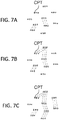
- This step is followed by a step 2ED3 of determining the triplet with the highest score, referred to as the reference triplette ( Figure 5A ).
- This reference triplet will serve as a starting point to set up the topology.
- the method 200 then comprises a step 2EC1 of connection to the closest triplette (for example according to the distance previously defined) of the reference triplette to said reference triplette so as to form two connected triplets ( Figure 5B ).
- the method comprises a step 2ED4 for determining the triplette closest to a connected triplette and a step 2EC2 connecting said triplet not yet connected to the connected triplette which it is closest ( Figure 5C ), these two steps 2ED4, 2EC2 being repeated until the set of triplets are connected.
- each CPT counter of the first triplette is connected to a counter CPT of the second triplette (they are therefore connected to the same phase).
- each CPT counter of the first triplette is matched to a counter CPT of the second triplet when determining the distance between the first triplette and the second triplette.
- a counter can belong to several triplets.
- each counter when connecting two triplets having a common CPT counter, the two nodes corresponding to this counter CPT are merged to form a single node, the connections between this node and the node of the previous or next triplette being adapted accordingly.
- the step 2ED1 for determining the two other CPT counters of the plurality of CPT counters with which the counter CPT considered has the most negative similarities is preceded by a pretreatment step as described in the context of the method according to a first aspect of the invention.
- the method 200 for determining the topology of a plurality of CPT counters of a previously described three-phase DTP output in order to obtain the topology of a network, it is first of all necessary to associate each CPT counter with a start.
- three-phase DTP for example by implementing a method 100 according to a first aspect of the invention
- determine the topology three-phase DTP feedstock by three-phase DTP feed using a method 200 according to a second aspect of the invention. invention.
- an embodiment of a third aspect of the invention illustrated in FIG. figure 6 and at the figure 7 relates to a method 300 for determining the topology of a network.
- the network comprises a plurality of counters CPT and at least one transformer TRS, preferably a plurality of transformers TRS, each transformer TRS comprising at least one three-phase output DTP, each three-phase DTP comprising three phases DDP, and each counter CPT being connected to one and only one phase DDP.
- the method 300 comprises, for each counter CPT of the plurality of counters CPT, a step 3ED1 for determining the two other counters CPT of the plurality of counters CPT with which the counter CPT considered has the most negative similarity, the three counters CPT thus determined forming a triplette associated with a score.
- the score may for example be equal to the absolute value of the average of the similarities between each counter CPT of the triplette considered.
- said CPT counters must have a negative similarity in pairs.
- the method 300 then comprises a step 3ET of sorting the triplets obtained so that the triplets having a score below a predetermined threshold value (for example a threshold equal to the average value of the scores minus the standard deviation of said scores) are not taken into account.
- a predetermined threshold value for example a threshold equal to the average value of the scores minus the standard deviation of said scores.
- the method then comprises a step 3ED2 for determining the distance separating the triplets two by two.
- the method 300 comprises a step 3EC for connecting the triplets comprising a sub-step of determining, the two triplets closest to each other and not yet connected to each other and a sub-step of connecting the two triplets as well as determined.
- a set of connected triplets form a group and the substeps of the connecting step of the triplets being repeated until a number of groups is equal to a predetermined value.
- the predetermined value is for example the number of three-phase DTP mains outlets or even the number of TRS transformers of the network if it is desired to group together the outputs of each transformer.
- a plurality of triplette groups is obtained, each group corresponding to a three-phase DTP or a TRS transformer.
- the triplette connections to each other within a given group make it possible to know the topology at the three-phase DTP or the TRS transformer corresponding to said group.
- connection mode triplettes between them is identical to the connection mode used in the implementation of a method 200 according to a second aspect of the invention.
- each CPT counter of the first triplet is connected to a counter CPT of the second triplette (they are therefore connected to the same phase).
- a counter can belong to several triplets. In this case, as illustrated in figure 5D on which each counter is represented by a node, when connecting two triplets having a common CPT counter, the two nodes corresponding to this counter CPT are merged to form a single node, the connections between this node and the node of the previous or next triplette being adapted accordingly.
- the step 3ED1 for determining the two other CPT counters of the plurality of CPT counters with which the counter CPT considered has the most negative similarity is preceded by a preprocessing step as described in the context of the method 100 according to a first aspect of the invention.
- a fourth aspect of the invention illustrated in figure 8 relates to a device DI for implementing a method according to a first aspect, a second aspect or a third aspect of the invention.
- each transformer TRS comprises at minus a three-phase DTP output
- each three-phase DTP feeder includes three DDP phase starts.
- the device comprises a processing means MT, said processing means MT being configured so that the device is able to implement a method according to a first aspect, a second aspect or a third aspect of the invention.
- the processing means may, for example, take the form of a processor associated with a memory, an FPGA ( Field Programmable Gate Array ) or an ASIC ( Application-Specific Integrated Circuit).
- each counter CPT is able to measure the voltage at said counter CPT.
- the device comprises means MR for receiving the measurements made at each counter CPT to be associated. It can be a wired connection, for example an Ethernet connection or even a wireless connection, for example Wifi® or Bluetooth®.
- the set of measurements performed at each CPT counter is centralized at one or more servers, and the device DI then comprises means for receiving the data corresponding to said measurements sent by said servers.
Landscapes
- Engineering & Computer Science (AREA)
- Power Engineering (AREA)
- Measuring Phase Differences (AREA)
Applications Claiming Priority (1)
| Application Number | Priority Date | Filing Date | Title |
|---|---|---|---|
| FR1853510A FR3080456B1 (fr) | 2018-04-20 | 2018-04-20 | Procede d'association de chaque compteur d'une pluralite de compteurs a un depart triphase d'un transformateur, procede de determination de la topologie d'un reseau et dispositif associe |
Publications (1)
| Publication Number | Publication Date |
|---|---|
| EP3557714A1 true EP3557714A1 (de) | 2019-10-23 |
Family
ID=62684933
Family Applications (1)
| Application Number | Title | Priority Date | Filing Date |
|---|---|---|---|
| EP19170418.8A Pending EP3557714A1 (de) | 2018-04-20 | 2019-04-19 | Verfahren zum zuordnen jedes zählers einer mehrerer zähler bei einer triphase-abfahrt eines transformators, verfahren zum bestimmen der topologie eines netzes und eines zugehörigen geräts |
Country Status (2)
| Country | Link |
|---|---|
| EP (1) | EP3557714A1 (de) |
| FR (1) | FR3080456B1 (de) |
Cited By (3)
| Publication number | Priority date | Publication date | Assignee | Title |
|---|---|---|---|---|
| CN110940938A (zh) * | 2019-11-13 | 2020-03-31 | 国网上海市电力公司 | 一种用户电表与变压器连接关系检测装置及检测方法 |
| CN110940873A (zh) * | 2019-11-13 | 2020-03-31 | 国网上海市电力公司 | 用户电表与变压器拓扑关系检测装置及检测方法 |
| CN112485525A (zh) * | 2020-11-27 | 2021-03-12 | 中国电力科学研究院有限公司 | 一种变压器相位的识别方法及装置、设备、存储介质 |
Citations (1)
| Publication number | Priority date | Publication date | Assignee | Title |
|---|---|---|---|---|
| CA2915674A1 (fr) * | 2015-12-17 | 2017-06-17 | Francois Leonard | Mise a jour d'une topologie d'un reseau de distribution par reattribution successive des compteurs |
-
2018
- 2018-04-20 FR FR1853510A patent/FR3080456B1/fr not_active Expired - Fee Related
-
2019
- 2019-04-19 EP EP19170418.8A patent/EP3557714A1/de active Pending
Patent Citations (1)
| Publication number | Priority date | Publication date | Assignee | Title |
|---|---|---|---|---|
| CA2915674A1 (fr) * | 2015-12-17 | 2017-06-17 | Francois Leonard | Mise a jour d'une topologie d'un reseau de distribution par reattribution successive des compteurs |
Cited By (4)
| Publication number | Priority date | Publication date | Assignee | Title |
|---|---|---|---|---|
| CN110940938A (zh) * | 2019-11-13 | 2020-03-31 | 国网上海市电力公司 | 一种用户电表与变压器连接关系检测装置及检测方法 |
| CN110940873A (zh) * | 2019-11-13 | 2020-03-31 | 国网上海市电力公司 | 用户电表与变压器拓扑关系检测装置及检测方法 |
| CN112485525A (zh) * | 2020-11-27 | 2021-03-12 | 中国电力科学研究院有限公司 | 一种变压器相位的识别方法及装置、设备、存储介质 |
| CN112485525B (zh) * | 2020-11-27 | 2022-12-20 | 中国电力科学研究院有限公司 | 一种变压器相位的识别方法及装置、设备、存储介质 |
Also Published As
| Publication number | Publication date |
|---|---|
| FR3080456A1 (fr) | 2019-10-25 |
| FR3080456B1 (fr) | 2022-02-04 |
Similar Documents
| Publication | Publication Date | Title |
|---|---|---|
| EP3391507B1 (de) | Aktualisieren einer topologie eines verteilungsnetzes durch sukzessives neuzuweisen der zähler | |
| EP3414701B1 (de) | Verfahren und system zur anonymisierung von datenbank gespeichert daten | |
| EP3557714A1 (de) | Verfahren zum zuordnen jedes zählers einer mehrerer zähler bei einer triphase-abfahrt eines transformators, verfahren zum bestimmen der topologie eines netzes und eines zugehörigen geräts | |
| WO2020077443A1 (fr) | Reconstruction d'une topologie d'un réseau de distribution électrique | |
| HK1247699A1 (zh) | 一种用户异常行为检测方法,装置和系统 | |
| WO2015036453A1 (fr) | Procede, dispositif et systeme d'estimation de l'etat de charge d'une batterie | |
| CN102110098B (zh) | 网络信息推荐方法及系统 | |
| CN110277961B (zh) | 光伏组串故障检测方法及装置 | |
| CN112684301A (zh) | 一种电网故障的检测方法和装置 | |
| CN116090353B (zh) | 产品剩余寿命预测方法和装置、电子设备及存储介质 | |
| EP3081949A1 (de) | Verfahren zur erkennung von betrügerischen handlungen in einem stromversorgungsnetz | |
| CN112328463A (zh) | 一种日志监控方法及装置 | |
| EP3698261A1 (de) | Verfahren zur bestimmung von parametern eines vereinfachten modells eines energiespeichersystems, steuerverfahren unter verwendung eines solchen modells und zugehörige vorrichtung | |
| FR3028114A1 (fr) | Procede de diagnostic d'un systeme photovoltaique | |
| KR101928822B1 (ko) | 사물 인터넷 환경에서 낯선 기기에 대한 사용자 신뢰도 계산 시스템 및 방법 | |
| EP3001208B1 (de) | System zum erkennen einer elektrischen störung, und entsprechendes verfahren | |
| EP3242412B1 (de) | Verfahren zur synchronisierung einer elektronischen vorrichtung auf einem periodischen alternativen signal, und entsprechendes telekommunikationsverfahren | |
| EP2680158A2 (de) | Verfahren zur Bestimmung eines fehlenden Wertes unter gesammelten Daten für eine Vielzahl von Individuen in einer Vielzahl von Momenten | |
| EP2363781B1 (de) | Verfahren zur Reduzierung des Energieverbrauchs eines elektronischen Endgeräts, entsprechendes Endgerät und entsprechendes Computerprogramm | |
| FR2979451A1 (fr) | Procede de determination de la part de la consommation electrique liee aux temperatures exterieures | |
| CN107958032A (zh) | 一种有效的动态网络节点影响力度量方法 | |
| CN114065533A (zh) | 电力客服系统波动监测方法 | |
| EP4386403B1 (de) | Verfahren und vorrichtung zur bestimmung eines die zukünftigen nutzung einer batterie repräsentativen belastungsprofils für eine bestimmte anwendung | |
| FR2991056A1 (fr) | Systeme electronique a capteurs integres, procede d'estimation de valeur de grandeur physique de fonctionnement et programme d'ordinateur correspondant | |
| Antonakaki et al. | Evolving twitter: an experimental analysis of graph properties of the social graph |
Legal Events
| Date | Code | Title | Description |
|---|---|---|---|
| PUAI | Public reference made under article 153(3) epc to a published international application that has entered the european phase |
Free format text: ORIGINAL CODE: 0009012 |
|
| STAA | Information on the status of an ep patent application or granted ep patent |
Free format text: STATUS: THE APPLICATION HAS BEEN PUBLISHED |
|
| AK | Designated contracting states |
Kind code of ref document: A1 Designated state(s): AL AT BE BG CH CY CZ DE DK EE ES FI FR GB GR HR HU IE IS IT LI LT LU LV MC MK MT NL NO PL PT RO RS SE SI SK SM TR |
|
| AX | Request for extension of the european patent |
Extension state: BA ME |
|
| STAA | Information on the status of an ep patent application or granted ep patent |
Free format text: STATUS: REQUEST FOR EXAMINATION WAS MADE |
|
| 17P | Request for examination filed |
Effective date: 20200430 |
|
| RBV | Designated contracting states (corrected) |
Designated state(s): AL AT BE BG CH CY CZ DE DK EE ES FI FR GB GR HR HU IE IS IT LI LT LU LV MC MK MT NL NO PL PT RO RS SE SI SK SM TR |
|
| STAA | Information on the status of an ep patent application or granted ep patent |
Free format text: STATUS: EXAMINATION IS IN PROGRESS |
|
| 17Q | First examination report despatched |
Effective date: 20200928 |
|
| GRAP | Despatch of communication of intention to grant a patent |
Free format text: ORIGINAL CODE: EPIDOSNIGR1 |
|
| STAA | Information on the status of an ep patent application or granted ep patent |
Free format text: STATUS: GRANT OF PATENT IS INTENDED |
|
| INTG | Intention to grant announced |
Effective date: 20230413 |
|
| GRAJ | Information related to disapproval of communication of intention to grant by the applicant or resumption of examination proceedings by the epo deleted |
Free format text: ORIGINAL CODE: EPIDOSDIGR1 |
|
| STAA | Information on the status of an ep patent application or granted ep patent |
Free format text: STATUS: EXAMINATION IS IN PROGRESS |
|
| INTC | Intention to grant announced (deleted) | ||
| RAP3 | Party data changed (applicant data changed or rights of an application transferred) |
Owner name: MONDRAGON CARDENAS, ARTURO Owner name: DADOUCHI, FLORIAN Owner name: ODIT-E |
|
| RAP3 | Party data changed (applicant data changed or rights of an application transferred) |
Owner name: ODIT-E |
|
| RAP1 | Party data changed (applicant data changed or rights of an application transferred) |
Owner name: SAGECOM ENERGY & TELECOM |
|
| RAP3 | Party data changed (applicant data changed or rights of an application transferred) |
Owner name: SAGEMCOM ENERGY & TELECOM SAS |
|
| GRAP | Despatch of communication of intention to grant a patent |
Free format text: ORIGINAL CODE: EPIDOSNIGR1 |
|
| STAA | Information on the status of an ep patent application or granted ep patent |
Free format text: STATUS: GRANT OF PATENT IS INTENDED |