EP3556044B1 - Method for transmitting encrypted packets in a communication network - Google Patents
Method for transmitting encrypted packets in a communication network Download PDFInfo
- Publication number
- EP3556044B1 EP3556044B1 EP16819045.2A EP16819045A EP3556044B1 EP 3556044 B1 EP3556044 B1 EP 3556044B1 EP 16819045 A EP16819045 A EP 16819045A EP 3556044 B1 EP3556044 B1 EP 3556044B1
- Authority
- EP
- European Patent Office
- Prior art keywords
- size
- padding
- random
- packet
- minimum
- Prior art date
- Legal status (The legal status is an assumption and is not a legal conclusion. Google has not performed a legal analysis and makes no representation as to the accuracy of the status listed.)
- Active
Links
Images


Classifications
-
- H—ELECTRICITY
- H04—ELECTRIC COMMUNICATION TECHNIQUE
- H04L—TRANSMISSION OF DIGITAL INFORMATION, e.g. TELEGRAPHIC COMMUNICATION
- H04L9/00—Cryptographic mechanisms or cryptographic arrangements for secret or secure communications; Network security protocols
- H04L9/06—Cryptographic mechanisms or cryptographic arrangements for secret or secure communications; Network security protocols the encryption apparatus using shift registers or memories for block-wise or stream coding, e.g. DES systems or RC4; Hash functions; Pseudorandom sequence generators
- H04L9/0618—Block ciphers, i.e. encrypting groups of characters of a plain text message using fixed encryption transformation
-
- G—PHYSICS
- G06—COMPUTING OR CALCULATING; COUNTING
- G06F—ELECTRIC DIGITAL DATA PROCESSING
- G06F7/00—Methods or arrangements for processing data by operating upon the order or content of the data handled
- G06F7/58—Random or pseudo-random number generators
- G06F7/588—Random number generators, i.e. based on natural stochastic processes
-
- H—ELECTRICITY
- H04—ELECTRIC COMMUNICATION TECHNIQUE
- H04L—TRANSMISSION OF DIGITAL INFORMATION, e.g. TELEGRAPHIC COMMUNICATION
- H04L63/00—Network architectures or network communication protocols for network security
- H04L63/04—Network architectures or network communication protocols for network security for providing a confidential data exchange among entities communicating through data packet networks
- H04L63/0428—Network architectures or network communication protocols for network security for providing a confidential data exchange among entities communicating through data packet networks wherein the data content is protected, e.g. by encrypting or encapsulating the payload
- H04L63/0435—Network architectures or network communication protocols for network security for providing a confidential data exchange among entities communicating through data packet networks wherein the data content is protected, e.g. by encrypting or encapsulating the payload wherein the sending and receiving network entities apply symmetric encryption, i.e. same key used for encryption and decryption
-
- H—ELECTRICITY
- H04—ELECTRIC COMMUNICATION TECHNIQUE
- H04L—TRANSMISSION OF DIGITAL INFORMATION, e.g. TELEGRAPHIC COMMUNICATION
- H04L2209/00—Additional information or applications relating to cryptographic mechanisms or cryptographic arrangements for secret or secure communication H04L9/00
- H04L2209/20—Manipulating the length of blocks of bits, e.g. padding or block truncation
Definitions
- the present invention relates to the field of communication networks.
- the present invention relates to a method for transmitting encrypted packets in a communication network.
- the present invention relates to a node for communication network configured to implement such method, to a communication network comprising such node and to a computer program product performing the method steps when the product is run on a computer.
- a packet-switched communication network data are transmitted in the form of packets that are routed from a source node to a destination node through possible intermediate nodes.
- exemplary packet-switched networks are IP (Internet Protocol) networks, Ethernet networks and MPLS (Multi-Protocol Label Switching) networks.
- encryption is a process of encoding packets before their transmission, so that only authorized parties can read their content. Hence, encryption does not prevent eavesdropping as such, but denies the packet content to unauthorized parties.
- packets are encrypted by applying thereto an encryption algorithm, so as to obtain an encrypted packet.
- encryption algorithms include block cipher encryption algorithms.
- Such encryption algorithms typically operate on fixed-sized groups of bytes, called “blocks”. Hence, given a block size of B bytes, application of the encryption algorithm causes the packet size to be rounded up to the nearest integer multiple of B.
- encrypted packets also typically comprise an overhead of size OH, which typically comprises security information e.g. for authentication purposes or the like.
- IPsec Internet Protocol Security
- IP Internet Protocol
- IPsec provides for encrypting each IP packet transmitted during a certain IP session.
- ESP Encapsulating Security Payload
- the deterministic relationship between size of plaintext packets and size of encrypted packets may be detrimental to the network security.
- the technique pad to MTU, it masks shorter packets (all the plaintext packets are padded to the same size MTU, independently of their original size) but, as a drawback, it typically entails a consistent waste of bandwidth.
- the MTU is 1500 bytes.
- the typical average size of IP packets transmitted over the Internet ranges between 500 bytes and 600 bytes. This means that the bandwidth needed for transmitting an encrypted packet padded according to pad to MTU is about tripled by the padding.
- the Applicant has tackled the problem of providing a method for transmitting encrypted packets in a communication network which overcomes the aforesaid drawbacks.
- the Applicant has tackled the problem of providing a method for transmitting encrypted packets in a communication network making use of a padding technique for hiding the plaintext packet sizes, which allows efficiently hiding the shorter plaintexts packet sizes and which, at the same time, allows reducing the bandwidth consumption entailed by the padding.
- the above drawbacks are solved by padding each plaintext packet, before its encryption, with a padding content whose padding size is randomly selected, independently for each plaintext packet, in a range comprised between a minimum padding size PS min and a maximum padding size PS max , wherein for each plaintext packet whose size is lower than a predefined minimum packet size TS min , the minimum padding size PS min is equal to the difference between the predefined minimum packet size TS min and the plaintext packet size.
- the randomly padded plaintext packets are then encrypted and transmitted.
- the random padding advantageously brings all the plaintext packets, before encryption, to sizes randomly ranging in a range inferiorly limited by the predefined minimum packet size TS min .
- choosing the padding size so as to bring the plaintext packets to random sizes advantageously entails a bandwidth consumption lower than padding all the plaintext packets to a same maximum packet size.
- the bandwidth consumption entailed by the padding of the present invention is advantageously reduced in comparison to the above technique pad to MTU.
- choosing the padding size so as to bring the plaintext packet to a random size comprised in a range inferiorly limited by the predefined minimum packet size TS min advantageously results in an efficient hiding of the shorter plaintext packet sizes, namely of those lower than the minimum packet size TS min .
- the present invention provides a method for transmitting encrypted packets from a first node to a second node of a communication network, the method comprising, at the first node:
- the minimum padding size is set equal to 0.
- the maximum padding size is equal to the difference between a predefined maximum packet size and the plaintext packet size.
- the padding size is selected as a random integer Z comprised between a minimum value X and a maximum value Y, where Z is the padding size expressed in number of blocks of B bytes, X is the minimum padding size expressed in number of blocks of B bytes and Y is the maximum padding size expressed in number of blocks of B bytes, step b) comprising encrypting the padded plaintext packet by applying a block cipher encryption algorithm with a block size of B bytes.
- the random integer Z is selected by drawing one or more values of a discrete random variable z having a probability mass function p Z ( z ), the probability mass function p Z ( z ) being constant for z comprised between X and Y.
- the probability mass function p Z ( z ) is variable over time and/or on a client or session basis.
- the probability mass function p Z ( z ) is a linearly decreasing function for z comprised between X and Y.
- the probability mass function p Z ( z ) is a non linearly decreasing function for z comprised between X and Y.
- the random integer Z is preferably selected by:
- the random integer number Z is preferably selected by:
- the random integer number Z is selected by:
- the random integer number Z is selected by:
- the present invention provides a node for a packet switched communication network, the node comprising:
- the present invention provides a communication network comprising at least a node as set forth above.
- the present invention provides a computer program product loadable in the memory of a computer and including software code portions for performing the steps of the method as set forth above, when the product is run on said computer.
- FIG. 1 schematically shows an exemplary packet-switched communication network 100 implementing the method for transmitting encrypted packets according to embodiments of the present invention.
- the communication network 100 may be an IP network, an Ethernet network, an MPLS network or any other known type of packet-switched communication network.
- the communication network 100 comprises a plurality of nodes reciprocally interconnected by links according to any known topology.
- the communication network 100 comprises a first node 1 and a second node 2.
- the first node 1 is preferably configured to transmit a flow of encrypted packets 4 to the second node 2.
- the first node 1 preferably comprises a padding unit 11, an encryption unit 12 and a transmitter 13.
- the padding unit 1 is preferably configured to receive a flow of plaintext packets 4" and to pad each packet, thereby providing a flow of padded plaintext packets 4'.
- the flow of plaintext packets 4" may be either generated at the first node 1, or it may be received at the first node 1 from a packet source comprised in or external to the communication network 100. Besides, the flow of plaintext packets 4" may be addressed to the second node 2 or to a packet destination comprised in or external to the communication network 1.
- the flow of plaintext packets 4" may comprise packets generated by a same source node and addressed to a same destination node.
- the flow of plaintext packets 4" may be a "macro-flow" comprising packets generated by different source nodes and/or addressed to different destination nodes, which only share a length of their paths between the first node 1 and the second node 2.
- the encryption unit 12 is preferably configured to receive the flow of padded plaintext packets 4' from the padding unit 11 and to encrypt them, so as to provide the encrypted packet flow 4.
- the transmitter 13 is finally configured to receive the encrypted packet flow 4 from the encryption unit 12 and to transmit it to the second node 2.
- the padding unit 11 receives a plaintext packet (step 300), it preferably pads it to a random packet size comprised between a predefined minimum packet size TS min and a predefined maximum packet size TS max .
- the padding unit 11 preferably calculates a maximum padding size PS max as the difference between said predefined maximum packet size TS max and the plaintext packet size L (step 301).
- the predefined maximum packet size TS max has a same value for all the received plaintext packets, independently of their size.
- the predefined maximum packet size TS max is equal to the maximum packet size allowed by the transmission protocol of the plaintext packets.
- the maximum packet size allowed by the IP protocol is 1504 bytes.
- the padding unit 11 preferably determines whether the size L of the plaintext packet received at step 300 is lower than a predefined minimum packet size TS min (step 302).
- the predefined minimum packet size TS min is preferably selected based on the statistical distribution of the size of plaintext packets.
- the minimum packet size TS min is preferably selected so that 30%, more preferably 40%, even more preferably 50% of the plaintext packets is shorter than TS min . This way, if a padded plaintext packet of length TS min is found, it is almost impossible making any assumption on its original size L. For instance, for IP networks the minimum packet size TS min may be set to 128 bytes or 256 bytes.
- the padding unit 11 preferably calculates a minimum padding size PS min as the difference between said predefined minimum packet size TS min and the plaintext packet size L (step 303).
- the padding unit 11 preferably sets the minimum padding size PS min equal to 0 (step 304).
- the padding unit 11 preferably determines a padding size PS for the plaintext packet received at step 300 (step 305).
- the padding unit PS preferably randomly selects the padding size PS in a range comprised between the minimum padding size PS min calculated at step 303 or 304 and the maximum padding size PS max calculated at step 301. Further details on the random selection of the padding size PS according to preferred embodiments of the present invention will be provided herein below.
- the padding unit 11 preferably generates a padding content of size PS as determined at step 305 (step 306).
- the padding content is predetermined and known also at the node N2 receiving the encrypted packet flow 4.
- the padding content may be one bit equal to "1” followed by PS-1 (in bits) bits equal to "0". This way, the node N2 may readily recognize the padding content after decryption, and remove it in order to recover the plaintext packet.
- the padding unit 11 then preferably adds the padding content generated at step 306 to the plaintext packet (step 307), thereby providing to the encryption unit 12 a padded plaintext packet having a random size comprised between the predefined minimum packet size TS min and the predefined maximum packet size TS max .
- the encryption unit 12 preferably encrypts the padded plaintext packet (step 308), thereby providing to the transmitter 13 an encrypted packet.
- the encryption step may be carried out according to any known encryption protocol, such as e.g. HMAC-SHA1/SHA2, TripleDES-CBC, AES-CBC or AES-GCM.
- the transmitter 13 finally transmits the encrypted packet to the second node N2 through the communication network 100.
- the random padding of the flow chart of Figure 3 therefore brings all the plaintext packets, before encryption, to sizes randomly ranging between the predefined minimum packet size TS min and the predefined maximum packet size TS max . This advantageously allows efficiently masking the shorter plaintexts packet sizes and, at the same time, reducing the bandwidth consumption entailed by the padding.
- choosing the padding size PS so as to bring the plaintext packet to a random size comprised in a range superiorly limited by the maximum packet size TS max advantageously entails a bandwidth consumption lower than padding all the plaintext packets to such maximum packet size TS max . Therefore, even if the maximum packet size TS max is set equal to the maximum packet size MTU allowed by the transmission protocol of the plaintext packets, the bandwidth consumption entailed by the padding according to the present invention is advantageously reduced in comparison with the above technique pad to MTU.
- choosing the padding size PS so as to bring the plaintext packet to a random size comprised in a range inferiorly limited by the predefined minimum packet size TS min advantageously results in an efficient masking of the shorter plaintext packet sizes, namely of those lower than the minimum packet size TS min .
- Encrypted packets carrying plaintext packets shorter than TS min can not indeed be distinguished from encrypted packets carrying plaintext packets longer than TS min .
- the step 305 of randomly selecting the padding size PS in a range comprised between the minimum padding size PS min and the maximum padding size PS max will be described in further detail.
- the encryption algorithm applied by the encryption unit 12 to the plaintext packets at step 308 is a block cipher encryption algorithm with a block size of B bytes (e.g. 16 bytes).
- first of all the value of L is preferably rounded up to the nearest integer multiple of B.
- predefined minimum packet size TS min and predefined maximum packet size TS max are preferably set equal to integer multiples of B.
- the maximum padding size PS max is preferably calculated as a difference between the predefined maximum packet size TS max and the rounded up value of L.
- the padding unit 11 compares the rounded up value of L with the minimum packet size TS min . Then, if the rounded up value of L is lower than the minimum packet size TS min , at step 303 the minimum padding size PS min is preferably calculated as a difference between the predefined minimum packet size TS max and the rounded up value of L. Otherwise, PS min is set equal to 0 (step 304).
- the padding size PS is preferably selected as a random integer multiple of B comprised between the minimum padding size PS min and the maximum padding size PS max .
- the padding content is generated, whose size is equal to the padding size PS as selected at step 305, increased by the difference between the rounded up value of L and the original value of L.
- TS max may be set equal to 1504 bytes (namely, 94 blocks of 16 bytes) and TS min may be set e.g. equal to 128 bytes (namely, 8 blocks of 16 bytes).
- TS min may be set e.g. equal to 128 bytes (namely, 8 blocks of 16 bytes).
- an IP packet of exemplary size L equal to 100 bytes is received, the value of L is preferably rounded up to 112 bytes, namely the nearest multiple integer of 16 bytes.
- the padding size PS is preferably selected as a random integer multiple of B comprised between the minimum padding size PS min and the maximum padding size PS max .
- the padding size PS may be preferably selected as a random integer Z comprised between X and Y, wherein Z is the padding size PS expressed as number of blocks (namely, PS/B), X is the minimum padding size PS min expressed as number of blocks (namely, PS min /B) and Y is the maximum padding size PS max expressed as number of blocks (namely, PS max /B).
- Z is a random integer selected in the range comprised between 1 and 87.
- the value of Z is provided by drawing one or more values of a discrete random variable z having a certain probability mass function p Z ( z ), which - as known - is the function which gives the probability that the discrete random variable z has a certain value.
- the probability mass function p Z ( z ) may be designed in different ways.
- the probability mass function p Z ( z ) of the discrete random variable z is uniform between X and Y, meaning that all the integer numbers comprised between X and Y have a same probability of being selected.
- the padding unit 11 preferably assigns to Z to first drawn value of the discrete random variable z. This results in a size of the padded plaintext packet statistically uniformly distributed between the minimum packet length TS min and the maximum packet length TS max .
- the probability mass function p Z ( z ) is not constant between X and Y, meaning that the integer numbers comprised between X and Y have different probabilities of being drawn.
- the values of A and B may be calculated by applying the following constraints:
- the value RP is preferably set in order to balance a trade-off between cost due to the extra-bandwidth required by padding and capability of hiding the plaintext packets size.
- the higher RP the lower the extra-bandwidth required by padding.
- the higher RP the lower the capability of hiding the original sizes of the plaintext packets.
- RP is preferably comprised between 2 and 5.
- the value of the probability mass function p Z ( z ) for each value of z comprised between X and Y may then be determined by replacing the calculated values of A and B in equation [4] above.
- the first element AP(1) is preferably set to a certain value, e.g. RP(Y-X).
- the first array AP(i) allows determining the values of the probability mass function p Z ( z ) for each value of z comprised between X and Y.
- the padding unit 11 may execute the following algorithm.
- a random number R is drawn in a range comprised between 1 and APC(N).
- the probability mass function of the random variable r providing the random integer R is constant for r between 1 and APC(N), while it is 0 for r ⁇ 1 and r >APC(N).
- the drawn random number R is then preferably compared with every element of the second array APC(i) in an ordered way, starting from the first element APC(1).
- This procedure may be formalized as follows:
- shorter encrypted packets certainly derive from shorter plaintext packets.
- TS min the predefined minimum size
- a statistical distribution of the encrypted packets concentrated towards the minimum packet size TS min enhances the "hiding" effect, because shorter encrypted packets become more frequent.
- identification of shorter encrypted packets carrying shorter plaintext packets amongst such an increased number of shorter encrypted packets becomes more difficult.
- the padding unit 11 in order to provide a padding size Z (in number of blocks) randomly chosen between X and Y with a not linearly decreasing probability mass function p Z ( z ) between X and Y, at step 305 the padding unit 11 preferably performs the following steps:
- the probability mass function p R ( r ) of the random variable r providing the random integer R is constant between 1 and a predefined maximum number of draws NMS, while it is zero for r ⁇ 1 and r >NMS.
- NMS is preferably comprised between 2 and 4.
- the probability mass function p T ( t ) of the random variable t providing the R random integers T 1 , T 2 , ... T R is constant between X and Y, while it is zero for t ⁇ X and t >Y.
- Z is equal to Y only when Y is the minimum amongst the R drawn random integers T 1 , T 2 , ... T R . This situation only happens if:
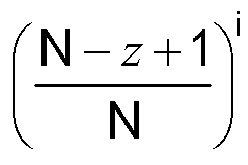
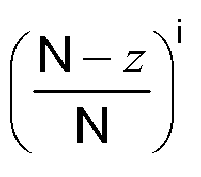
- the probability that the padding size Z is equal to a certain value z comprised between X and Y may be determined as follows.
- N * NMS is the probability of having a single draw providing a certain value
- N ⁇ z + 1 N i is the probability of having a number R of draws equal to i and all providing values ⁇ z
- N ⁇ z N i is the probability of having a number R of draws equal to i providing values > z.
- the padding unit 11 in order to provide a padding size Z (in number of blocks) randomly chosen between X and Y with a not linearly decreasing probability mass function p Z ( z ) between X and Y, at step 305 the padding unit 11 preferably performs the following steps:
- the probability mass function p R ( r ) of the random variable r providing the random integer R is constant between 1 and a predefined maximum number of draws NMS, while it is zero for r ⁇ 1 and r >NMS.
- the probability mass function p S ( s ) of the random variable s providing the random integer S is constant between 1 and R, while it is zero for s ⁇ 1 and s >R.
- the probability mass function p T ( t ) of the random variable t providing the S random integers T 1 , T 2 , ... T S is constant between X and Y, while it is zero for t ⁇ X and t >Y.
- the probability mass function p S ( S ) of the random variable s may indeed be determined by considering that the value s is obtained if two events occur, namely (i) the first draw provides a value of R equal to r ⁇ s and (ii) the second draw provides a value of S equal to s .
- the probability of (i) is 1/NMS, while the probability of (ii) is 1/ r .
- first and second non-linear probability mass functions as described above are obtained by performing a single-step draw and a two-step draw, respectively, of the number of draws providing the set of integers whose minimum is set equal to Z
- a non-linear probability mass function may be obtained by performing an N-step draw of the number of draws providing the set of integers whose minimum is set equal to Z.
- R 1 is drawn between 1 and NMS
- R 2 is drawn between 1 and R 1
- R 3 is drawn between 1 and R 2 and so on, until the random number R N is drawn.
- R N random integers are drawn between X and Y, and Z is set equal to their minimum.
- the probability mass function p Z ( z ) of the random variable z providing the padding size Z preferably is variable over time.
- the slope of the probability mass function p Z ( z ) may be varied over time.
- the probability mass function p Z ( z ) is changed based on the network access point (e.g. enodeB for LTE networks).
- New values of the maximum number of draws NMS and of the ratio RP may be provided every Tb seconds.
- the duration of Tb may be also changed, e.g. it may be randomly selected in as range comprised between a minimum duration and a maximum duration.
- the probability mass function p Z ( z ) is changed on a client or session basis, e.g. for each mobile terminal connected to the communication network 100.
- both the maximum number of draws NMS and the ratio RP are preferably selected. If a client is connected beyond a certain maximum time, its NMS and RP may be varied over time.
- the first technique is simpler but more expensive, while the second technique is more complex but less expensive, from the network operator point of view.
- NMS varies between 2 and 4.
Landscapes
- Engineering & Computer Science (AREA)
- Computer Security & Cryptography (AREA)
- Computer Networks & Wireless Communication (AREA)
- Signal Processing (AREA)
- General Physics & Mathematics (AREA)
- General Engineering & Computer Science (AREA)
- Physics & Mathematics (AREA)
- Theoretical Computer Science (AREA)
- Computing Systems (AREA)
- Computational Mathematics (AREA)
- Computer Hardware Design (AREA)
- Mathematical Analysis (AREA)
- Mathematical Optimization (AREA)
- Pure & Applied Mathematics (AREA)
- Data Exchanges In Wide-Area Networks (AREA)
Description
- The present invention relates to the field of communication networks. In particular, the present invention relates to a method for transmitting encrypted packets in a communication network. Further, the present invention relates to a node for communication network configured to implement such method, to a communication network comprising such node and to a computer program product performing the method steps when the product is run on a computer.
- In a packet-switched communication network, data are transmitted in the form of packets that are routed from a source node to a destination node through possible intermediate nodes. Exemplary packet-switched networks are IP (Internet Protocol) networks, Ethernet networks and MPLS (Multi-Protocol Label Switching) networks.
- In order to increase security of the network and protect it against eavesdropping, encryption techniques are known. As known, encryption is a process of encoding packets before their transmission, so that only authorized parties can read their content. Hence, encryption does not prevent eavesdropping as such, but denies the packet content to unauthorized parties.
- Typically, packets (also termed herein after "plaintext packets") are encrypted by applying thereto an encryption algorithm, so as to obtain an encrypted packet. Several encryption algorithms are known, including block cipher encryption algorithms. Such encryption algorithms typically operate on fixed-sized groups of bytes, called "blocks". Hence, given a block size of B bytes, application of the encryption algorithm causes the packet size to be rounded up to the nearest integer multiple of B.
- Besides, encrypted packets also typically comprise an overhead of size OH, which typically comprises security information e.g. for authentication purposes or the like.
- Hence, the size L' of an encrypted packet is typically higher than the size L of the corresponding plaintext packet, the relationship between L and L' being known a priori and depending both from the block length B ad the overhead length OH according to the following equation:

- For instance, Internet Protocol Security (IPsec) is a protocol suite for secure Internet Protocol (IP) which provides for encrypting each IP packet transmitted during a certain IP session. IPsec in particular provides for encrypting IP packets using a block cipher encryption algorithm (HMAC-SHA1/SHA2, TripleDES-CBC, AES-CBC or AES-GCM) with a block size of B=16 bytes. Furthermore, the Encapsulating Security Payload (ESP) - which is a member of the IPsec protocol suite defining the format of IPsec packets - provides for inserting an overhead of OH=122 bytes in each encrypted packet (also termed IPsec packet). The size L' (in bytes) of an IPsec packet therefore depends on the size L (in bytes) of the corresponding IP packet according to the following equation:

- The deterministic relationship between size of plaintext packets and size of encrypted packets may be detrimental to the network security.
- Indeed, as disclosed by Wojciech Mazurczyk et al., "Information Hiding in Communication Networks: Fundamentals, Mechanisms, Applications, and Countermeasures", John Wiley & Sons, 29 February 2016, pages 119 and 120, while encryption hides packet contents, traffic patterns, such as packet timings and packet size, can potentially reveal critical information about the content being communicated. In particular, analysing the packet sizes of encrypted web traffic can give away the identities of the websites visited by users. To counter this, several proposals have suggested to pad encrypted packets to conceal the actual size of plaintext packets. The proposed padding techniques include:
- 1. session random padding: a padding size p is randomly chosen from a set {0, 8, 16, ... M-I}, where I the plaintext packet size before padding and M is the maximum transmission unit (MTU), namely the size of the largest protocol data unit defined in the protocol's standard. Hence, every plaintext packet to be transmitted in certain session is padded with a dummy plaintext of size p;
- 2. packet random padding: every single packet is padded with a dummy content of a randomly chosen size, independently chosen across all the packets in a session;
- 3. linear padding: packets are padded so that all packet sizes are increased to the nearest multiple of 128 bytes, or the MTU, whichever is smaller;
- 4. exponential padding: all packets are padded to the nearest power of 2, or the MTU, whichever is smaller;
- 5. mice-elephants padding: the packets smaller than 128 bytes are padded to 128 bytes; all the other packets are padded to the MTU; and
- 6. pad to MTU: all packets are padded to the MTU size.
- Kevin P. Dyer, et al. "Peek-a-Boo, I Still See You: Why Efficient Traffic Analysis Countermeasures Fail", Security and Privacy (SP), 2012, IEEE Symposium on, IEEE, 20 May 2012, pages 332-346, considers the setting of HTTP traffic over encrypted tunnels, as used to conceal the identity of websites visited by a user. Within this framework, traffic analyss (TA) attacks can accurately identify the website a user visits despite the use of encryption. The document discloses general-purpose TA countermeasures, in particular nine known countermeasures that are vulnerable to simple attacks that exploit coarse features of traffic (e.g. total time and bandwidth). The considered countermeasures include ones like those standardized by TLS, SSH, and IPsec, and even more complex ones like tra traffic morphing scheme of Wright et al..
- The Applicant has noticed that the known padding techniques cited above have some drawbacks.
- As to the techniques session random padding, packet random padding, linear padding, exponential padding and mice-elephants padding, they disadvantageously are not capable of efficiently masking shorter packets. Indeed, according to such techniques, shorter encrypted packets (where "shorter" is referred to the statistical distribution of the encrypted packet sizes) can derive only from shorter plaintext packets (where "shorter" is referred to the statistical distribution of the plaintext packet sizes). This disadvantageously enables an unauthorized party eavesdropping a flow of encrypted packets to easily identify amongst them the ones carrying shorter plaintext packets.
- As to the technique pad to MTU, it masks shorter packets (all the plaintext packets are padded to the same size MTU, independently of their original size) but, as a drawback, it typically entails a consistent waste of bandwidth. For example, according to the IP protocol the MTU is 1500 bytes. However, the typical average size of IP packets transmitted over the Internet ranges between 500 bytes and 600 bytes. This means that the bandwidth needed for transmitting an encrypted packet padded according to pad to MTU is about tripled by the padding.
- In view of the above, the Applicant has tackled the problem of providing a method for transmitting encrypted packets in a communication network which overcomes the aforesaid drawbacks.
- In particular, the Applicant has tackled the problem of providing a method for transmitting encrypted packets in a communication network making use of a padding technique for hiding the plaintext packet sizes, which allows efficiently hiding the shorter plaintexts packet sizes and which, at the same time, allows reducing the bandwidth consumption entailed by the padding.
- According to embodiments of the present invention, the above drawbacks are solved by padding each plaintext packet, before its encryption, with a padding content whose padding size is randomly selected, independently for each plaintext packet, in a range comprised between a minimum padding size PSmin and a maximum padding size PSmax, wherein for each plaintext packet whose size is lower than a predefined minimum packet size TSmin, the minimum padding size PSmin is equal to the difference between the predefined minimum packet size TSmin and the plaintext packet size.
- The randomly padded plaintext packets are then encrypted and transmitted.
- This way, the random padding advantageously brings all the plaintext packets, before encryption, to sizes randomly ranging in a range inferiorly limited by the predefined minimum packet size TSmin.
- On the one hand, choosing the padding size so as to bring the plaintext packets to random sizes advantageously entails a bandwidth consumption lower than padding all the plaintext packets to a same maximum packet size. Hence, the bandwidth consumption entailed by the padding of the present invention is advantageously reduced in comparison to the above technique pad to MTU.
- On the other hand, choosing the padding size so as to bring the plaintext packet to a random size comprised in a range inferiorly limited by the predefined minimum packet size TSmin advantageously results in an efficient hiding of the shorter plaintext packet sizes, namely of those lower than the minimum packet size TSmin.
- According to a first aspect, the present invention provides a method for transmitting encrypted packets from a first node to a second node of a communication network, the method comprising, at the first node:
- a) padding a plaintext packet with a padding content, thereby providing a padded plaintext packet;
- b) providing an encrypted packet by encrypting the padded plaintext packet; and
- c) transmitting the encrypted packet from the first node to the second node,
- Preferably, if the size of the plaintext packet is equal to or higher than the predefined minimum packet size, the minimum padding size is set equal to 0.
- Preferably, the maximum padding size is equal to the difference between a predefined maximum packet size and the plaintext packet size.
- According to some embodiments, the padding size is selected as a random integer Z comprised between a minimum value X and a maximum value Y, where Z is the padding size expressed in number of blocks of B bytes, X is the minimum padding size expressed in number of blocks of B bytes and Y is the maximum padding size expressed in number of blocks of B bytes, step b) comprising encrypting the padded plaintext packet by applying a block cipher encryption algorithm with a block size of B bytes.
- Preferably, the random integer Z is selected by drawing one or more values of a discrete random variable z having a probability mass function pZ(z), the probability mass function pZ(z) being constant for z comprised between X and Y.
- According to other embodiments, the random integer Z is selected by drawing one or more values of a discrete random variable z having a probability mass function pZ(z), the probability mass function pZ(z) being a decreasing function for z comprised between X and Y, the probability mass function pZ(z) having a maximum value at z =X and a minimum value at z =Y, the ratio between the maximum value and the minimum value having a value RP.
- Optionally, the probability mass function pZ(z) is variable over time and/or on a client or session basis.
- According to first variants, the probability mass function pZ(z) is a linearly decreasing function for z comprised between X and Y.
- According to second variants, the probability mass function pZ(z) is a non linearly decreasing function for z comprised between X and Y.
- According to the first variants, the random integer Z is preferably selected by:
- providing a first array AP(j), j being an index ranging between 1 and N=Y-X+1, with AP(j-1)-AP(j)=RP-1;
- providing a second array APC(i), i being an index ranging between 1 and N=Y-X+1, wherein:

- drawing a random number R in a range comprised between 1 and APC(N), the probability mass function of the random variable r providing the random integer R being constant for r between 1 and APC(N);
- the random number R is compared with every element of the second array APC(i) in an ordered way, starting from the first element APC(1) and, the first time the random number R results to be lower than or equal to one element APC(i*) of the second array, then Z is set equal to X+i*-1.
- According to the second variants, the random integer number Z is preferably selected by:
- drawing a random integer R comprised between 1 and a maximum number of draws NMS, indicating the number of draws to be performed;
- drawing R random integers comprised between X and Y; and
- setting Z equal to the minimum one amongst the R drawn random integers,
- Alternatively, the random integer number Z is selected by:
- drawing a number N>1 of random integers R1, R2, ... RN, R1 being selected between 1 and a maximum number of draws NMS and Ri with i>1 being selected between 1 and Ri-1;
- drawing RN random integers comprised between X and Y; and
- setting Z equal to the minimum one amongst the RN drawn random integers,
- Still alternatively, the random integer number Z is selected by:
- drawing N>1 random integers R1, R2, ... RN comprised between 1 and a maximum number of draws NMS;
- setting Rmin equal to the minimum one amongst the N random integers R1, R2, ... RN;
- drawing Rmin random integers comprised between X and Y; and
- setting Z equal to the minimum one amongst the Rmin drawn random integers,
- According to a second aspect, the present invention provides a node for a packet switched communication network, the node comprising:
- a padding unit configured to pad a plaintext packet with a padding content, thereby providing a padded plaintext packet;
- an encryption unit configured to provide an encrypted packet by encrypting the padded plaintext packet; and
- a transmitting unit configured to transmit the encrypted packet from the node to a further node of the communication network,
- According to a third aspect, the present invention provides a communication network comprising at least a node as set forth above.
- According to a fourth aspect, the present invention provides a computer program product loadable in the memory of a computer and including software code portions for performing the steps of the method as set forth above, when the product is run on said computer.
- The present invention will become clearer from the following detailed description, given by way of example and not of limitation, to be read with reference to the accompanying drawings, wherein:
-
Figure 1 schematically shows an exemplary packet-switched network implementing the method according to embodiments of the present invention; -
Figure 2 schematically shows in further detail a node of the network ofFigure 1 ; -
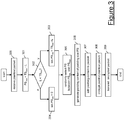
Figure 3 is a flow chart of the operation of the node shown inFigure 2 ; -
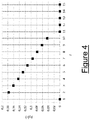
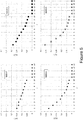
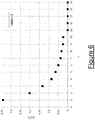
Figures 4 ,5 and6 show exemplary probability mass functions according to three advantageous variants of the present invention; and -
Figure 7 shows results of numerical simulations carried out by the Applicant. -
Figure 1 schematically shows an exemplary packet-switchedcommunication network 100 implementing the method for transmitting encrypted packets according to embodiments of the present invention. Thecommunication network 100 may be an IP network, an Ethernet network, an MPLS network or any other known type of packet-switched communication network. - The
communication network 100 comprises a plurality of nodes reciprocally interconnected by links according to any known topology. In particular, thecommunication network 100 comprises afirst node 1 and asecond node 2. - As it will be described in further detail herein after, the
first node 1 is preferably configured to transmit a flow ofencrypted packets 4 to thesecond node 2. - In particular, as shown in
Figure 2 , thefirst node 1 preferably comprises apadding unit 11, anencryption unit 12 and atransmitter 13. - The
padding unit 1 is preferably configured to receive a flow ofplaintext packets 4" and to pad each packet, thereby providing a flow of padded plaintext packets 4'. - The flow of
plaintext packets 4" may be either generated at thefirst node 1, or it may be received at thefirst node 1 from a packet source comprised in or external to thecommunication network 100. Besides, the flow ofplaintext packets 4" may be addressed to thesecond node 2 or to a packet destination comprised in or external to thecommunication network 1. - Further, the flow of
plaintext packets 4" may comprise packets generated by a same source node and addressed to a same destination node. Alternatively, the flow ofplaintext packets 4" may be a "macro-flow" comprising packets generated by different source nodes and/or addressed to different destination nodes, which only share a length of their paths between thefirst node 1 and thesecond node 2. - By referring again to
Figure 2 , theencryption unit 12 is preferably configured to receive the flow of padded plaintext packets 4' from thepadding unit 11 and to encrypt them, so as to provide theencrypted packet flow 4. - The
transmitter 13 is finally configured to receive theencrypted packet flow 4 from theencryption unit 12 and to transmit it to thesecond node 2. - The processing of each plaintext packet by the
first node 1 will be now described in further detail with reference to the flow chart ofFigure 3 . - As the
padding unit 11 receives a plaintext packet (step 300), it preferably pads it to a random packet size comprised between a predefined minimum packet size TSmin and a predefined maximum packet size TSmax. - In particular, if L is the size of the received plaintext packet received at
step 300, thepadding unit 11 preferably calculates a maximum padding size PSmax as the difference between said predefined maximum packet size TSmax and the plaintext packet size L (step 301). Preferably, the predefined maximum packet size TSmax has a same value for all the received plaintext packets, independently of their size. According to preferred embodiments, the predefined maximum packet size TSmax is equal to the maximum packet size allowed by the transmission protocol of the plaintext packets. - For instance, in case of IP packets, the maximum packet size allowed by the IP protocol is 1504 bytes. Hence, at
step 301, the predefined maximum packet size TSmax may be set equal to 1504 bytes, and accordingly the maximum padding size PSmax for a plaintext IP packet of size L (in bytes) may be calculated as PSmax = 1504 - L. - Then, the
padding unit 11 preferably determines whether the size L of the plaintext packet received atstep 300 is lower than a predefined minimum packet size TSmin (step 302). The predefined minimum packet size TSmin is preferably selected based on the statistical distribution of the size of plaintext packets. In particular, the minimum packet size TSmin is preferably selected so that 30%, more preferably 40%, even more preferably 50% of the plaintext packets is shorter than TSmin. This way, if a padded plaintext packet of length TSmin is found, it is almost impossible making any assumption on its original size L. For instance, for IP networks the minimum packet size TSmin may be set to 128 bytes or 256 bytes. - If the size L of the received plaintext packet is lower than the predefined minimum packet size TSmin, the
padding unit 11 preferably calculates a minimum padding size PSmin as the difference between said predefined minimum packet size TSmin and the plaintext packet size L (step 303). - If, instead, the size L of the received plaintext packet is equal to or higher than the predefined minimum packet size TSmin, the
padding unit 11 preferably sets the minimum padding size PSmin equal to 0 (step 304). - Then, the
padding unit 11 preferably determines a padding size PS for the plaintext packet received at step 300 (step 305). To this purpose, the padding unit PS preferably randomly selects the padding size PS in a range comprised between the minimum padding size PSmin calculated atstep step 301. Further details on the random selection of the padding size PS according to preferred embodiments of the present invention will be provided herein below. - Then, the
padding unit 11 preferably generates a padding content of size PS as determined at step 305 (step 306). Preferably, the padding content is predetermined and known also at the node N2 receiving theencrypted packet flow 4. For instance, the padding content may be one bit equal to "1" followed by PS-1 (in bits) bits equal to "0". This way, the node N2 may readily recognize the padding content after decryption, and remove it in order to recover the plaintext packet. - The
padding unit 11 then preferably adds the padding content generated atstep 306 to the plaintext packet (step 307), thereby providing to the encryption unit 12 a padded plaintext packet having a random size comprised between the predefined minimum packet size TSmin and the predefined maximum packet size TSmax. - The
encryption unit 12 preferably encrypts the padded plaintext packet (step 308), thereby providing to thetransmitter 13 an encrypted packet. The encryption step may be carried out according to any known encryption protocol, such as e.g. HMAC-SHA1/SHA2, TripleDES-CBC, AES-CBC or AES-GCM. - The
transmitter 13 finally transmits the encrypted packet to the second node N2 through thecommunication network 100. - The random padding of the flow chart of
Figure 3 therefore brings all the plaintext packets, before encryption, to sizes randomly ranging between the predefined minimum packet size TSmin and the predefined maximum packet size TSmax. This advantageously allows efficiently masking the shorter plaintexts packet sizes and, at the same time, reducing the bandwidth consumption entailed by the padding. - On the one hand, indeed, choosing the padding size PS so as to bring the plaintext packet to a random size comprised in a range superiorly limited by the maximum packet size TSmax advantageously entails a bandwidth consumption lower than padding all the plaintext packets to such maximum packet size TSmax. Therefore, even if the maximum packet size TSmax is set equal to the maximum packet size MTU allowed by the transmission protocol of the plaintext packets, the bandwidth consumption entailed by the padding according to the present invention is advantageously reduced in comparison with the above technique pad to MTU.
- On the other hand, choosing the padding size PS so as to bring the plaintext packet to a random size comprised in a range inferiorly limited by the predefined minimum packet size TSmin advantageously results in an efficient masking of the shorter plaintext packet sizes, namely of those lower than the minimum packet size TSmin. Encrypted packets carrying plaintext packets shorter than TSmin can not indeed be distinguished from encrypted packets carrying plaintext packets longer than TSmin.
- The
step 305 of randomly selecting the padding size PS in a range comprised between the minimum padding size PSmin and the maximum padding size PSmax will be described in further detail. - Herein after, by way of non limiting example, it is assumed that the encryption algorithm applied by the
encryption unit 12 to the plaintext packets atstep 308 is a block cipher encryption algorithm with a block size of B bytes (e.g. 16 bytes). - Under this assumption, upon reception of a plaintext packet of size L at
step 300, first of all the value of L is preferably rounded up to the nearest integer multiple of B. Furthermore, the predefined minimum packet size TSmin and predefined maximum packet size TSmax are preferably set equal to integer multiples of B. - Then, at
step 301 the maximum padding size PSmax is preferably calculated as a difference between the predefined maximum packet size TSmax and the rounded up value of L. - Similarly, at
step 302 thepadding unit 11 compares the rounded up value of L with the minimum packet size TSmin. Then, if the rounded up value of L is lower than the minimum packet size TSmin, atstep 303 the minimum padding size PSmin is preferably calculated as a difference between the predefined minimum packet size TSmax and the rounded up value of L. Otherwise, PSmin is set equal to 0 (step 304). - Then, at
step 305 the padding size PS is preferably selected as a random integer multiple of B comprised between the minimum padding size PSmin and the maximum padding size PSmax. - Then, at
step 306 the padding content is generated, whose size is equal to the padding size PS as selected atstep 305, increased by the difference between the rounded up value of L and the original value of L. - For instance, with reference to the above example of IP and IPsec protocols, if the block size B is equal to 16 bytes, TSmax may be set equal to 1504 bytes (namely, 94 blocks of 16 bytes) and TSmin may be set e.g. equal to 128 bytes (namely, 8 blocks of 16 bytes). If an IP packet of exemplary size L equal to 100 bytes is received, the value of L is preferably rounded up to 112 bytes, namely the nearest multiple integer of 16 bytes. At
step 301 the maximum padding size PSmax is therefore calculated as the difference between TSmax and the rounded up value of L, namely 1504-112=1392 bytes. Further, since the rounded up value of L (112 bytes) is lower than TSmin (128 bytes), atstep 303 the minimum padding size PSmin is calculated as the difference between TSmin and the rounded up value of L, namely 128-112=16 bytes. Then, atstep 305 the padding size PS is preferably selected as a random integer multiple of B=16 bytes comprised between the minimum padding size PSmin=16 bytes and the maximum padding size PSmax=1392 bytes, e.g. PS=400 bytes (namely, 25 blocks of 16 bytes). Hence, atstep 306, a padding content is generated, whose size is equal to PS=400 bytes increased by 112-100=12 bytes, namely 412 bytes. This provides a padded plaintext packet of 100+412=512 bytes. The resulting padded plaintext packet size is an integer multiple of the block size B=16 bytes, and hence the block cipher encryption algorithm may be applied thereto. - As described above, in case of a block cipher encryption algorithm at
step 305 the padding size PS is preferably selected as a random integer multiple of B comprised between the minimum padding size PSmin and the maximum padding size PSmax. - Equivalently, at
step 305 the padding size PS may be preferably selected as a random integer Z comprised between X and Y, wherein Z is the padding size PS expressed as number of blocks (namely, PS/B), X is the minimum padding size PSmin expressed as number of blocks (namely, PSmin/B) and Y is the maximum padding size PSmax expressed as number of blocks (namely, PSmax/B). According to the above example, X is equal to PSmin/B = 16 bytes/16 bytes = 1, while Y is equal to PSmax/B = 1392 bytes/16 bytes = 87. Hence, Z is a random integer selected in the range comprised between 1 and 87. - More specifically, the value of Z is provided by drawing one or more values of a discrete random variable z having a certain probability mass function pZ(z), which - as known - is the function which gives the probability that the discrete random variable z has a certain value. The probability mass function pZ(z) may be designed in different ways.
- According to an embodiment, the probability mass function pZ(z) of the discrete random variable z is uniform between X and Y, meaning that all the integer numbers comprised between X and Y have a same probability of being selected. The probability mass function pz(z) is therefore as follows:


- By applying the constraint [3] to the probability mass function pZ(z) as per equation [2], the value of the real constant k results to be 1/(Y-X+1).
- According to this embodiment, the
padding unit 11 preferably assigns to Z to first drawn value of the discrete random variable z. This results in a size of the padded plaintext packet statistically uniformly distributed between the minimum packet length TSmin and the maximum packet length TSmax. - According to other embodiments, the probability mass function pZ(z) is not constant between X and Y, meaning that the integer numbers comprised between X and Y have different probabilities of being drawn. In particular, according to advantageous embodiments, the probability mass function pZ(z) is decreasing from a maximum value at z =X and a minimum value at z =Y.
- According to an advantageous variant, the probability mass function pZ(z) linearly decreasing from its maximum value at z =X to its minimum value at z =Y. The probability mass function pZ(z) according to this variant is therefore as follows:

- (i) the summation of all the values of the probability mass function pZ(z) for z comprised between X and Y equals 1, see above equation [3]; and
- (ii) the ratio between its maximum value at z =X and its minimum value at z =Y is equal to a desired value RP>1, namely:

- The value RP is preferably set in order to balance a trade-off between cost due to the extra-bandwidth required by padding and capability of hiding the plaintext packets size. The higher RP, the lower the extra-bandwidth required by padding. However, the higher RP, the lower the capability of hiding the original sizes of the plaintext packets. To balance such trade-off, RP is preferably comprised between 2 and 5. The value of the probability mass function pZ(z) for each value of z comprised between X and Y may then be determined by replacing the calculated values of A and B in equation [4] above.
- These values may also be calculated as follows.
- First of all, a first array AP(j) is provided, j being an index ranging between 1 and N=Y-
X+ 1. The elements of the first array AP(j) have linearly decreasing values from j=1 to j=N. In particular, the difference between consecutive elements AP(j-1)-AP(j) is constant and equal to Δ=RP-1. This way, the value of the first element AP(1) is RP times the value of the last element AP(N). - The first element AP(1) is preferably set to a certain value, e.g. RP(Y-X). The values of the other elements AP(j) with j>1 are calculated accordingly, namely:

- The first array AP(i) allows determining the values of the probability mass function pZ(z) for each value of z comprised between X and Y. In particular, each value of the probability mass function pZ(z) is obtained by dividing the corresponding element of the first array AP(j) by the summation of all the elements of the first array AP(j), as follows:

- According to an embodiment of the present invention, in order to provide Z as the value of a random variable z having a probability mass function pZ(z) linearly decreasing from its maximum value at z =X to its minimum value at z =Y, at
step 305 thepadding unit 11 may execute the following algorithm. - First of all, a second array APC(i) is preferably provided, where i is an index ranging between 1 and N=Y-
X+ 1. Each element of the second array APC(i) is preferably calculated based on the values of the elements of the first array AP(j) as follows:
- By applying this formula, it follows that the elements of the second array APC(i) have increasing values and that the last element of the array APC(N) has the following value:

- For instance, if X=1, Y=10 and RP=3, the elements of the first array AP(j) have the following values: AP(i)=27, AP(2)=25, AP(3)=23, ... AP(10)=9. Hence, the elements of the second array APC(i) (i=1, ... Y-X+1) are as follows:
- APC(1)=AP(1)=27;
- APC(2)=AP(1)+AP(2)=27+25=52;
- APC(3)=AP(1)+AP(2)+AP(3)=52+22=75.
- And so on.
- Then, a random number R is drawn in a range comprised between 1 and APC(N). Preferably, the probability mass function of the random variable r providing the random integer R is constant for r between 1 and APC(N), while it is 0 for r<1 and r>APC(N).
- The drawn random number R is then preferably compared with every element of the second array APC(i) in an ordered way, starting from the first element APC(1). The first time the random number R results to be lower than or equal to one element APC(i*) of the second array, then Z is set equal to X+i*-1.
- For instance, with reference to the above exemplary values of APC(i), it is assumed that R=55. This number R=55 is firstly compared with APC(1)=27. Since R=55 is higher than APC(1)=27, R=55 is then compared with the subsequent element APC(2)=52. Since R=55 is still higher than APC(2)=52, R=55 is then compared with the subsequent element APC(3)=75. Since R=55 is finally lower than APC(3)=75, i*=3 and therefore Z is set equal to X+i*-1=1+3-1=3. This procedure may be formalized as follows:
wherein, if the size of the plaintext packet is lower than a predefined minimum packet size, the minimum padding size is equal to the difference between the predefined minimum packet size and the plaintext packet size.
wherein the probability mass function of the random variable providing the R random integers is constant between X and Y.
wherein the probability mass function of the random variable providing the RN random integers is constant between X and Y.
wherein the probability mass function pT(t) of the random variable t providing the Rmin random integers is constant between X and Y.
wherein, if the size of the plaintext packet is lower than a predefined minimum packet size, the padding unit is configured to set the minimum padding size equal to the difference between the predefined minimum packet size and the plaintext packet size.
  Z=-1;
  i=0;
  r=random(1,APC(Y-X+1))
  while (Z=-1)
      i=i+1
      if r≤APC(i) then Z=X+i-1
  endwhile
- providing a random integer R indicating the number of draws to be performed;
- drawing R random integers T1, T2, ... TR comprised between X and Y; and
- setting Z equal to the minimum one amongst the R drawn random integers, namely Z = min{T1, T2, ... TR}.
  R=random(1,NMS);
  Z=Y;
  for i=1 to R
    temp=random (X, Y) ;
     if (temp<Z) then Z=temp;
  end.
- (i) a single draw is performed (R=1), whose result is Y; or
- (ii) R>1 draws are performed, and the result is always Y.



- providing a random integer R comprised between 1 and NMS, indicating the number of draws to be performed;
- providing a random integer S comprised between 1 and R;
- drawing S random integers T1, T2, ... TS comprised between X and Y; and
- setting Z equal to the minimum one amongst the S drawn random integers, namely Z = min{T1, T2, ... TS}.


Claims (15)
- A method for transmitting encrypted packets (4) from a first node (1) to a second node (2) of a communication network (100), said method comprising, at said first node (1):a) padding a plaintext packet (4") with a padding content, thereby providing a padded plaintext packet (4');b) providing an encrypted packet (4) by encrypting said padded plaintext packet (4'); andc) transmitting said encrypted packet (4) from said first node (1) to said second node (2),wherein said padding content has a padding size (PS) and wherein step a) comprises randomly selecting said padding size (PS) in a range comprised between a minimum padding size (PSmin) and a maximum padding size (PSmax), wherein, if the size (L) of said plaintext packet (4") is lower than a predefined minimum packet size (TSmin), said minimum padding size (PSmin) is equal to the difference between said predefined minimum packet size (TSmin) and the plaintext packet size (L).
- The method according to claim 1 wherein, if said size (L) of said plaintext packet (4") is equal to or higher than said predefined minimum packet size (TSmin), said minimum padding size PSmin is set equal to 0.
- The method according to claim 1 or 2, wherein said maximum padding size (PSmax) is equal to the difference between a predefined maximum packet size (TSmax) and said plaintext packet size (L).
- The method according to any of the preceding claims, wherein said padding size (PS) is selected as a random integer Z comprised between a minimum value X and a maximum value Y, where Z is said padding size (PS) expressed in number of blocks of B bytes, X is said minimum padding size (PSmin) expressed in number of blocks of B bytes and Y is said maximum padding size (PSmax) expressed in number of blocks of B bytes, step b) comprising encrypting said padded plaintext packet (4') by applying a block cipher encryption algorithm with a block size of B bytes.
- The method according to claim 4, wherein said random integer Z is selected by drawing one or more values of a discrete random variable z having a probability mass function pZ(z), said probability mass function pZ(z) being constant for z comprised between X and Y.
- The method according to claim 4, wherein said random integer Z is selected by drawing one or more values of a discrete random variable z having a probability mass function pZ(z), said probability mass function pZ(z) being a decreasing function for z comprised between X and Y, said probability mass function pZ(z) having a maximum value at z=X and a minimum value at z=y, the ratio between said maximum value and said minimum value having a value RP.
- The method according to claim 6, wherein said probability mass function pZ(z) is variable over time and/or on a client or session basis.
- The method according to claim 6 or 7, wherein said probability mass function pZ(z) is a linearly decreasing function for z comprised between X and Y.
- The method according to claim 6 or 7, wherein said probability mass function pZ(z) is a non linearly decreasing function for z comprised between X and Y.
- The method according to claim 8, wherein said random integer Z is selected by:• providing a first array AP(j), j being an index ranging between 1 and N=Y-X+1, with AP(j-1)-AP(j)=RP-1;• providing a second array APC(i), i being an index ranging between 1 and N=Y-X+1, wherein:
 • drawing a random number R in a range comprised between 1 and APC(N), the probability mass function of the random variable r providing the random integer R being constant for r between 1 and APC(N);• the random number R is compared with every element of said second array APC(i) in an ordered way, starting from the first element APC(1) and, the first time said random number R results to be lower than or equal to one element APC(i*) of said second array, then Z is set equal to X+i*-1.
 - The method according to claim 9, wherein said random integer number Z is selected by:• drawing a random integer R comprised between 1 and a maximum number of draws NMS, indicating the number of draws to be performed;• drawing R random integers T1, T2, ... TR comprised between X and Y; and• setting Z equal to the minimum one amongst said R drawn random integers T1, T2, ... TR,wherein the probability mass function pR(r) of the random variable r providing the random integer R is constant between 1 and NMS, and
wherein the probability mass function pT(t) of the random variable t providing the R random integers T1, T2, ... TR is constant between X and Y. - The method according to claim 9, wherein said random integer number Z is selected by:• drawing a number N>1 of random integers R1, R2, ... RN, R1 being selected between 1 and a maximum number of draws NMS and Ri with i>1 being selected between 1 and Ri-1;• drawing RN random integers comprised between X and Y; and• setting Z equal to the minimum one amongst said RN drawn random integers,wherein the probability mass function pR(r) of the random variable r providing the N random integers R1, R2, ... RN is constant, and
wherein the probability mass function pT(t) of the random variable t providing the RN random integers is constant between X and Y. - The method according to claim 9, wherein said random integer number Z is selected by:• drawing N>1 random integers R1, R2, ... RN comprised between 1 and a maximum number of draws NMS;• setting Rmin equal to the minimum one amongst said N random integers R1, R2, ... RN;• drawing Rmin random integers comprised between X and Y; and• setting Z equal to the minimum one amongst said Rmin drawn random integers,wherein the probability mass function pR(r) of the random variable r providing the N random integers R1, R2, ... RN is constant between 1 and NMS, and
wherein the probability mass function pT(t) of the random variable t providing the Rmin random integers is constant between X and Y. - A node (1) for a packet switched communication network (100), said node (1) comprising:• a padding unit (11) configured to pad a plaintext packet (4") with a padding content, thereby providing a padded plaintext packet (4');• an encryption unit (12) configured to provide an encrypted packet (4) by encrypting said padded plaintext packet (4'); and• a transmitting unit (13) configured to transmit said encrypted packet (4) from said node (1) to a further node (2) of said communication network (100),wherein said padding unit (11) is configured to generate said padding content with a padding size (PS), by randomly selecting said padding size (PS) in a range comprised between a minimum padding size (PSmin) and a maximum padding size (PSmax), wherein, if the size (L) of said plaintext packet (4") is lower than a predefined minimum packet size (TSmin), said padding unit (11) is configured to set said minimum padding size (PSmin) equal to the difference between said predefined minimum packet size (TSmin) and the plaintext packet size (L).
- A communication network (100) comprising at least a node (1) according to claim 14.
Applications Claiming Priority (1)
| Application Number | Priority Date | Filing Date | Title |
|---|---|---|---|
| PCT/EP2016/081140 WO2018108274A1 (en) | 2016-12-15 | 2016-12-15 | Method for transmitting encrypted packets in a communication network |
Publications (2)
| Publication Number | Publication Date |
|---|---|
| EP3556044A1 EP3556044A1 (en) | 2019-10-23 |
| EP3556044B1 true EP3556044B1 (en) | 2021-08-11 |
Family
ID=57614355
Family Applications (1)
| Application Number | Title | Priority Date | Filing Date |
|---|---|---|---|
| EP16819045.2A Active EP3556044B1 (en) | 2016-12-15 | 2016-12-15 | Method for transmitting encrypted packets in a communication network |
Country Status (3)
| Country | Link |
|---|---|
| US (1) | US11258581B2 (en) |
| EP (1) | EP3556044B1 (en) |
| WO (1) | WO2018108274A1 (en) |
Families Citing this family (1)
| Publication number | Priority date | Publication date | Assignee | Title |
|---|---|---|---|---|
| US11115184B2 (en) * | 2017-05-22 | 2021-09-07 | Micro Focus Llc | Format preserving encryption with padding |
Family Cites Families (6)
| Publication number | Priority date | Publication date | Assignee | Title |
|---|---|---|---|---|
| US6704871B1 (en) * | 1997-09-16 | 2004-03-09 | Safenet, Inc. | Cryptographic co-processor |
| US6918034B1 (en) * | 1999-09-29 | 2005-07-12 | Nokia, Corporation | Method and apparatus to provide encryption and authentication of a mini-packet in a multiplexed RTP payload |
| US20030156715A1 (en) * | 2001-06-12 | 2003-08-21 | Reeds James Alexander | Apparatus, system and method for validating integrity of transmitted data |
| US8127130B2 (en) | 2006-04-18 | 2012-02-28 | Advanced Communication Concepts, Inc. | Method and system for securing data utilizing reconfigurable logic |
| US9673983B2 (en) | 2012-09-14 | 2017-06-06 | Qualcomm Incorporated | Apparatus and method for protecting message data |
| US10303795B2 (en) * | 2014-09-10 | 2019-05-28 | Amazon Technologies, Inc. | Read descriptors at heterogeneous storage systems |
-
2016
- 2016-12-15 EP EP16819045.2A patent/EP3556044B1/en active Active
- 2016-12-15 US US16/468,194 patent/US11258581B2/en active Active
- 2016-12-15 WO PCT/EP2016/081140 patent/WO2018108274A1/en not_active Ceased
Non-Patent Citations (1)
| Title |
|---|
| None * |
Also Published As
| Publication number | Publication date |
|---|---|
| EP3556044A1 (en) | 2019-10-23 |
| WO2018108274A1 (en) | 2018-06-21 |
| US20190334696A1 (en) | 2019-10-31 |
| US11258581B2 (en) | 2022-02-22 |
Similar Documents
| Publication | Publication Date | Title |
|---|---|---|
| JP7008725B2 (en) | Methods and systems for improved authenticated encryption in counter-based cryptosystems | |
| AlFardan et al. | On the security of RC4 in TLS and WPA | |
| Hintaw et al. | A robust security scheme based on enhanced symmetric algorithm for MQTT in the Internet of Things | |
| US20070255947A1 (en) | Methods and systems for incremental crypto processing of fragmented packets | |
| US9083528B2 (en) | Authentication of encrypted data blocks | |
| US12021999B2 (en) | Devices and methods for the generating and authentication of at least one data packet to be transmitted in a bus system (BU), in particular of a motor vehicle | |
| Wu et al. | Lightweight security protocols for the Internet of Things | |
| US11405407B2 (en) | Data packet sending method, network device, control device, and network system | |
| Schmidbauer et al. | Challenging channels: Encrypted covert channels within challenge-response authentication | |
| EP3729716B1 (en) | Stream ciphering | |
| EP3556044B1 (en) | Method for transmitting encrypted packets in a communication network | |
| US11115187B2 (en) | Apparatus and method for block ciphers for real-time data transmission | |
| Amaran et al. | Lightweight security for MQTT-SN | |
| Nir et al. | Algorithm implementation requirements and usage guidance for the internet key exchange protocol version 2 (Ikev2) | |
| US20020196945A1 (en) | Key sharing system, public key cryptosystem, signature system, key sharing apparatus, encryption apparatus, decryption apparatus, signature apparatus, authentication apparatus, key sharing method, encryption method, decryption method, signature method, authentication method, and programs | |
| Mohamed | Cryptography concepts: Confidentiality | |
| Chiwariro et al. | Security in Publish/Subscribe Protocol for Internet of Things | |
| KR20200028782A (en) | Method and apparatus for encrypting data based on patterned cipher block for real-time data communication | |
| Noura et al. | E3sn: efficient security scheme for sensor networks | |
| JP2011223385A (en) | Encryption communication apparatus | |
| krishna Chaitanya et al. | Simple And Efficient Data Encryption Algorithm | |
| Mohamed | Wireless Communication Systems: Confidentiality: Encryption and Decryption | |
| Ali et al. | 18 Authentication of User | |
| Malekzadeh et al. | Protected control packets to prevent denial of services attacks in IEEE 802.11 wireless networks | |
| JPH11145951A (en) | Lost communication method |
Legal Events
| Date | Code | Title | Description |
|---|---|---|---|
| STAA | Information on the status of an ep patent application or granted ep patent |
Free format text: STATUS: UNKNOWN |
|
| STAA | Information on the status of an ep patent application or granted ep patent |
Free format text: STATUS: THE INTERNATIONAL PUBLICATION HAS BEEN MADE |
|
| PUAI | Public reference made under article 153(3) epc to a published international application that has entered the european phase |
Free format text: ORIGINAL CODE: 0009012 |
|
| STAA | Information on the status of an ep patent application or granted ep patent |
Free format text: STATUS: REQUEST FOR EXAMINATION WAS MADE |
|
| 17P | Request for examination filed |
Effective date: 20190701 |
|
| AK | Designated contracting states |
Kind code of ref document: A1 Designated state(s): AL AT BE BG CH CY CZ DE DK EE ES FI FR GB GR HR HU IE IS IT LI LT LU LV MC MK MT NL NO PL PT RO RS SE SI SK SM TR |
|
| AX | Request for extension of the european patent |
Extension state: BA ME |
|
| DAV | Request for validation of the european patent (deleted) | ||
| DAX | Request for extension of the european patent (deleted) | ||
| STAA | Information on the status of an ep patent application or granted ep patent |
Free format text: STATUS: EXAMINATION IS IN PROGRESS |
|
| 17Q | First examination report despatched |
Effective date: 20200519 |
|
| GRAP | Despatch of communication of intention to grant a patent |
Free format text: ORIGINAL CODE: EPIDOSNIGR1 |
|
| STAA | Information on the status of an ep patent application or granted ep patent |
Free format text: STATUS: GRANT OF PATENT IS INTENDED |
|
| INTG | Intention to grant announced |
Effective date: 20210302 |
|
| GRAS | Grant fee paid |
Free format text: ORIGINAL CODE: EPIDOSNIGR3 |
|
| GRAA | (expected) grant |
Free format text: ORIGINAL CODE: 0009210 |
|
| STAA | Information on the status of an ep patent application or granted ep patent |
Free format text: STATUS: THE PATENT HAS BEEN GRANTED |
|
| AK | Designated contracting states |
Kind code of ref document: B1 Designated state(s): AL AT BE BG CH CY CZ DE DK EE ES FI FR GB GR HR HU IE IS IT LI LT LU LV MC MK MT NL NO PL PT RO RS SE SI SK SM TR |
|
| REG | Reference to a national code |
Ref country code: CH Ref legal event code: EP |
|
| REG | Reference to a national code |
Ref country code: DE Ref legal event code: R096 Ref document number: 602016062119 Country of ref document: DE |
|
| REG | Reference to a national code |
Ref country code: IE Ref legal event code: FG4D Ref country code: AT Ref legal event code: REF Ref document number: 1420497 Country of ref document: AT Kind code of ref document: T Effective date: 20210915 |
|
| REG | Reference to a national code |
Ref country code: LT Ref legal event code: MG9D |
|
| REG | Reference to a national code |
Ref country code: NL Ref legal event code: MP Effective date: 20210811 |
|
| REG | Reference to a national code |
Ref country code: AT Ref legal event code: MK05 Ref document number: 1420497 Country of ref document: AT Kind code of ref document: T Effective date: 20210811 |
|
| PG25 | Lapsed in a contracting state [announced via postgrant information from national office to epo] |
Ref country code: LT Free format text: LAPSE BECAUSE OF FAILURE TO SUBMIT A TRANSLATION OF THE DESCRIPTION OR TO PAY THE FEE WITHIN THE PRESCRIBED TIME-LIMIT Effective date: 20210811 Ref country code: BG Free format text: LAPSE BECAUSE OF FAILURE TO SUBMIT A TRANSLATION OF THE DESCRIPTION OR TO PAY THE FEE WITHIN THE PRESCRIBED TIME-LIMIT Effective date: 20211111 Ref country code: AT Free format text: LAPSE BECAUSE OF FAILURE TO SUBMIT A TRANSLATION OF THE DESCRIPTION OR TO PAY THE FEE WITHIN THE PRESCRIBED TIME-LIMIT Effective date: 20210811 Ref country code: HR Free format text: LAPSE BECAUSE OF FAILURE TO SUBMIT A TRANSLATION OF THE DESCRIPTION OR TO PAY THE FEE WITHIN THE PRESCRIBED TIME-LIMIT Effective date: 20210811 Ref country code: ES Free format text: LAPSE BECAUSE OF FAILURE TO SUBMIT A TRANSLATION OF THE DESCRIPTION OR TO PAY THE FEE WITHIN THE PRESCRIBED TIME-LIMIT Effective date: 20210811 Ref country code: FI Free format text: LAPSE BECAUSE OF FAILURE TO SUBMIT A TRANSLATION OF THE DESCRIPTION OR TO PAY THE FEE WITHIN THE PRESCRIBED TIME-LIMIT Effective date: 20210811 Ref country code: PT Free format text: LAPSE BECAUSE OF FAILURE TO SUBMIT A TRANSLATION OF THE DESCRIPTION OR TO PAY THE FEE WITHIN THE PRESCRIBED TIME-LIMIT Effective date: 20211213 Ref country code: NO Free format text: LAPSE BECAUSE OF FAILURE TO SUBMIT A TRANSLATION OF THE DESCRIPTION OR TO PAY THE FEE WITHIN THE PRESCRIBED TIME-LIMIT Effective date: 20211111 Ref country code: RS Free format text: LAPSE BECAUSE OF FAILURE TO SUBMIT A TRANSLATION OF THE DESCRIPTION OR TO PAY THE FEE WITHIN THE PRESCRIBED TIME-LIMIT Effective date: 20210811 Ref country code: SE Free format text: LAPSE BECAUSE OF FAILURE TO SUBMIT A TRANSLATION OF THE DESCRIPTION OR TO PAY THE FEE WITHIN THE PRESCRIBED TIME-LIMIT Effective date: 20210811 |
|
| PG25 | Lapsed in a contracting state [announced via postgrant information from national office to epo] |
Ref country code: PL Free format text: LAPSE BECAUSE OF FAILURE TO SUBMIT A TRANSLATION OF THE DESCRIPTION OR TO PAY THE FEE WITHIN THE PRESCRIBED TIME-LIMIT Effective date: 20210811 Ref country code: LV Free format text: LAPSE BECAUSE OF FAILURE TO SUBMIT A TRANSLATION OF THE DESCRIPTION OR TO PAY THE FEE WITHIN THE PRESCRIBED TIME-LIMIT Effective date: 20210811 Ref country code: GR Free format text: LAPSE BECAUSE OF FAILURE TO SUBMIT A TRANSLATION OF THE DESCRIPTION OR TO PAY THE FEE WITHIN THE PRESCRIBED TIME-LIMIT Effective date: 20211112 |
|
| PG25 | Lapsed in a contracting state [announced via postgrant information from national office to epo] |
Ref country code: NL Free format text: LAPSE BECAUSE OF FAILURE TO SUBMIT A TRANSLATION OF THE DESCRIPTION OR TO PAY THE FEE WITHIN THE PRESCRIBED TIME-LIMIT Effective date: 20210811 |
|
| PG25 | Lapsed in a contracting state [announced via postgrant information from national office to epo] |
Ref country code: DK Free format text: LAPSE BECAUSE OF FAILURE TO SUBMIT A TRANSLATION OF THE DESCRIPTION OR TO PAY THE FEE WITHIN THE PRESCRIBED TIME-LIMIT Effective date: 20210811 |
|
| REG | Reference to a national code |
Ref country code: DE Ref legal event code: R097 Ref document number: 602016062119 Country of ref document: DE |
|
| PG25 | Lapsed in a contracting state [announced via postgrant information from national office to epo] |
Ref country code: SM Free format text: LAPSE BECAUSE OF FAILURE TO SUBMIT A TRANSLATION OF THE DESCRIPTION OR TO PAY THE FEE WITHIN THE PRESCRIBED TIME-LIMIT Effective date: 20210811 Ref country code: SK Free format text: LAPSE BECAUSE OF FAILURE TO SUBMIT A TRANSLATION OF THE DESCRIPTION OR TO PAY THE FEE WITHIN THE PRESCRIBED TIME-LIMIT Effective date: 20210811 Ref country code: RO Free format text: LAPSE BECAUSE OF FAILURE TO SUBMIT A TRANSLATION OF THE DESCRIPTION OR TO PAY THE FEE WITHIN THE PRESCRIBED TIME-LIMIT Effective date: 20210811 Ref country code: EE Free format text: LAPSE BECAUSE OF FAILURE TO SUBMIT A TRANSLATION OF THE DESCRIPTION OR TO PAY THE FEE WITHIN THE PRESCRIBED TIME-LIMIT Effective date: 20210811 Ref country code: CZ Free format text: LAPSE BECAUSE OF FAILURE TO SUBMIT A TRANSLATION OF THE DESCRIPTION OR TO PAY THE FEE WITHIN THE PRESCRIBED TIME-LIMIT Effective date: 20210811 Ref country code: AL Free format text: LAPSE BECAUSE OF FAILURE TO SUBMIT A TRANSLATION OF THE DESCRIPTION OR TO PAY THE FEE WITHIN THE PRESCRIBED TIME-LIMIT Effective date: 20210811 |
|
| PLBE | No opposition filed within time limit |
Free format text: ORIGINAL CODE: 0009261 |
|
| STAA | Information on the status of an ep patent application or granted ep patent |
Free format text: STATUS: NO OPPOSITION FILED WITHIN TIME LIMIT |
|
| 26N | No opposition filed |
Effective date: 20220512 |
|
| PG25 | Lapsed in a contracting state [announced via postgrant information from national office to epo] |
Ref country code: MC Free format text: LAPSE BECAUSE OF FAILURE TO SUBMIT A TRANSLATION OF THE DESCRIPTION OR TO PAY THE FEE WITHIN THE PRESCRIBED TIME-LIMIT Effective date: 20210811 |
|
| REG | Reference to a national code |
Ref country code: CH Ref legal event code: PL |
|
| PG25 | Lapsed in a contracting state [announced via postgrant information from national office to epo] |
Ref country code: SI Free format text: LAPSE BECAUSE OF FAILURE TO SUBMIT A TRANSLATION OF THE DESCRIPTION OR TO PAY THE FEE WITHIN THE PRESCRIBED TIME-LIMIT Effective date: 20210811 |
|
| REG | Reference to a national code |
Ref country code: BE Ref legal event code: MM Effective date: 20211231 |
|
| PG25 | Lapsed in a contracting state [announced via postgrant information from national office to epo] |
Ref country code: LU Free format text: LAPSE BECAUSE OF NON-PAYMENT OF DUE FEES Effective date: 20211215 Ref country code: IE Free format text: LAPSE BECAUSE OF NON-PAYMENT OF DUE FEES Effective date: 20211215 |
|
| PG25 | Lapsed in a contracting state [announced via postgrant information from national office to epo] |
Ref country code: BE Free format text: LAPSE BECAUSE OF NON-PAYMENT OF DUE FEES Effective date: 20211231 |
|
| PG25 | Lapsed in a contracting state [announced via postgrant information from national office to epo] |
Ref country code: LI Free format text: LAPSE BECAUSE OF NON-PAYMENT OF DUE FEES Effective date: 20211231 Ref country code: CH Free format text: LAPSE BECAUSE OF NON-PAYMENT OF DUE FEES Effective date: 20211231 |
|
| PG25 | Lapsed in a contracting state [announced via postgrant information from national office to epo] |
Ref country code: CY Free format text: LAPSE BECAUSE OF FAILURE TO SUBMIT A TRANSLATION OF THE DESCRIPTION OR TO PAY THE FEE WITHIN THE PRESCRIBED TIME-LIMIT Effective date: 20210811 |
|
| P01 | Opt-out of the competence of the unified patent court (upc) registered |
Effective date: 20230528 |
|
| P02 | Opt-out of the competence of the unified patent court (upc) changed |
Effective date: 20230531 |
|
| PG25 | Lapsed in a contracting state [announced via postgrant information from national office to epo] |
Ref country code: HU Free format text: LAPSE BECAUSE OF FAILURE TO SUBMIT A TRANSLATION OF THE DESCRIPTION OR TO PAY THE FEE WITHIN THE PRESCRIBED TIME-LIMIT; INVALID AB INITIO Effective date: 20161215 |
|
| PG25 | Lapsed in a contracting state [announced via postgrant information from national office to epo] |
Ref country code: MK Free format text: LAPSE BECAUSE OF FAILURE TO SUBMIT A TRANSLATION OF THE DESCRIPTION OR TO PAY THE FEE WITHIN THE PRESCRIBED TIME-LIMIT Effective date: 20210811 |
|
| PG25 | Lapsed in a contracting state [announced via postgrant information from national office to epo] |
Ref country code: MT Free format text: LAPSE BECAUSE OF FAILURE TO SUBMIT A TRANSLATION OF THE DESCRIPTION OR TO PAY THE FEE WITHIN THE PRESCRIBED TIME-LIMIT Effective date: 20210811 |
|
| PGFP | Annual fee paid to national office [announced via postgrant information from national office to epo] |
Ref country code: IT Payment date: 20241216 Year of fee payment: 9 |
|
| PGFP | Annual fee paid to national office [announced via postgrant information from national office to epo] |
Ref country code: DE Payment date: 20241219 Year of fee payment: 9 |
|
| PG25 | Lapsed in a contracting state [announced via postgrant information from national office to epo] |
Ref country code: TR Free format text: LAPSE BECAUSE OF FAILURE TO SUBMIT A TRANSLATION OF THE DESCRIPTION OR TO PAY THE FEE WITHIN THE PRESCRIBED TIME-LIMIT Effective date: 20210811 |
|
| PGFP | Annual fee paid to national office [announced via postgrant information from national office to epo] |
Ref country code: GB Payment date: 20251229 Year of fee payment: 10 |
|
| PGFP | Annual fee paid to national office [announced via postgrant information from national office to epo] |
Ref country code: FR Payment date: 20251222 Year of fee payment: 10 |