EP3554959B1 - Scented packaging - Google Patents
Scented packaging Download PDFInfo
- Publication number
- EP3554959B1 EP3554959B1 EP16874099.1A EP16874099A EP3554959B1 EP 3554959 B1 EP3554959 B1 EP 3554959B1 EP 16874099 A EP16874099 A EP 16874099A EP 3554959 B1 EP3554959 B1 EP 3554959B1
- Authority
- EP
- European Patent Office
- Prior art keywords
- product
- cap
- vessel
- product package
- fragrance
- Prior art date
- Legal status (The legal status is an assumption and is not a legal conclusion. Google has not performed a legal analysis and makes no representation as to the accuracy of the status listed.)
- Active
Links
Images



Classifications
-
- B—PERFORMING OPERATIONS; TRANSPORTING
- B65—CONVEYING; PACKING; STORING; HANDLING THIN OR FILAMENTARY MATERIAL
- B65D—CONTAINERS FOR STORAGE OR TRANSPORT OF ARTICLES OR MATERIALS, e.g. BAGS, BARRELS, BOTTLES, BOXES, CANS, CARTONS, CRATES, DRUMS, JARS, TANKS, HOPPERS, FORWARDING CONTAINERS; ACCESSORIES, CLOSURES, OR FITTINGS THEREFOR; PACKAGING ELEMENTS; PACKAGES
- B65D51/00—Closures not otherwise provided for
- B65D51/24—Closures not otherwise provided for combined or co-operating with auxiliary devices for non-closing purposes
-
- B—PERFORMING OPERATIONS; TRANSPORTING
- B65—CONVEYING; PACKING; STORING; HANDLING THIN OR FILAMENTARY MATERIAL
- B65D—CONTAINERS FOR STORAGE OR TRANSPORT OF ARTICLES OR MATERIALS, e.g. BAGS, BARRELS, BOTTLES, BOXES, CANS, CARTONS, CRATES, DRUMS, JARS, TANKS, HOPPERS, FORWARDING CONTAINERS; ACCESSORIES, CLOSURES, OR FITTINGS THEREFOR; PACKAGING ELEMENTS; PACKAGES
- B65D2203/00—Decoration means, markings, information elements, contents indicators
- B65D2203/12—Audible, olfactory or visual signalling means
-
- B—PERFORMING OPERATIONS; TRANSPORTING
- B67—OPENING, CLOSING OR CLEANING BOTTLES, JARS OR SIMILAR CONTAINERS; LIQUID HANDLING
- B67B—APPLYING CLOSURE MEMBERS TO BOTTLES JARS, OR SIMILAR CONTAINERS; OPENING CLOSED CONTAINERS
- B67B3/00—Closing bottles, jars or similar containers by applying caps
- B67B3/20—Closing bottles, jars or similar containers by applying caps by applying and rotating preformed threaded caps
Definitions
- Packaging of consumer items is important in attracting the attention of a potential customer such that the buyer will consider purchasing a product.
- Packaging that is attractive, appears to be of high quality, and conveys product details will often influence a consumer to purchase the product.
- product flavor is also often an important purchase consideration.
- a potential consumer may select the product based, at least in part, on product fragrance.
- the sensory qualities of flavor and fragrance are often described on product packaging using descriptive indicia such as text and/or graphics. While the descriptive indicia may provide a general indication of the sensory quality of the product, descriptive indicia can be subjective and may give a consumer an inaccurate understanding of the product contents and sensory qualities. As such, the actual flavor or fragrance of the product may vary from the user's expectations that are solely based on the text and/or graphics and may, in turn, lead to the customer's dissatisfaction with the product.
- scent packaging that allows a potential customer to experience the fragrance of a product, or an emulation of the fragrance, within the package may be referred to herein as "scent packaging” or a “scent package.”
- scent packaging As aromas are closely physiologically linked with flavor, fragrances delivered by scent packaging may further be used to provide a consumer with an indication of the flavor or taste of the product.
- scent packaging continuously delivers a fragrance because the packaging does not seal the fragrance-producing material from the outside air, and thus the fragrance may become depleted before the product is sold and may also cross-contaminate the fragrance from adjacent scent packages having different fragrances.
- some scent packaging may use a substance embedded with a scent-emitting chemical that emulates the scent of the product within, and this substance may negatively affect the product within if it comes in contact with the product.
- Such conventional scent packaging may not ensure that the scent-emitting chemical is physically separated from the product, and the substance may thus negatively interact with the product, either before or after sale of the product.
- WO 2006/004665 A2 refers to a bottle container having a dispensing closure placed thereon.
- the dispensing closure has a base that screws onto a threaded neck section of the bottle container.
- An orifice is disposed through a base that enables a scented product to flow through the base from an interior of the bottle.
- a flip cap is provided for selectively sealing the orifice.
- a tamper resistant seal is placed over a top of the bottle container.
- EP 1 721 621 A1 refers to a package containing a product.
- the package comprises an opening which is sealed with an aluminum foil seal and a plastic lid joined to the main body of the bottle via a hinge.
- An enclosure is formed between the package and an internal surface of the plastic lid. 2 grams of perfume releasing hot melt adhesive are attached to the internal surface of said the plastic lid. The enclosure is saturated with a perfumed headspace.
- WO 00/53508 A1 relates to a container in the form of a bottle, having a threaded neck, and containing a liquid product.
- the bottle is provided with a removable cap.
- the container is provided with a device comprising a cap liner directly carried by the cap of the bottle and impregnated with a volatile substance.
- the cap liner is assembled with a polymeric diffusion membrane which covers the surface of the cap liner facing the interior of the bottle.
- WO 2007/052227 A2 refers to a container including a perfuming means located within a space under a closure. The perfuming means is fitted into the closure by way of a friction fit around an orifice.
- US 5 635 229 A refers to an aromatic member which encompasses a removable cap having an interior threaded base, for engagement with threads on a bottle, and a flip-open lid. An interior of the lid is covered with a layer of absorbent material onto which a scent is instilled. A thin removable plastic film covers the absorbent material prior to use. When the lid is snapped closed, a dispensing opening on the base is sealed.
- a product package comprising: a vessel defining an orifice; a product disposed within the vessel and configured to be dispensed from the vessel through the orifice; a cap that is configured to be attached to the vessel, wherein the cap is repositionable from a closed position to an open position, and from the open position to the closed position, wherein the cap comprises:a base; a top; a hinge that movably attaches the base to the top; a dispensing tip defining an opening, wherein the product package is configured to dispense the product from the opening defined by the dispensing tip; and a ring protruding from an inner surface of the top, wherein the ring encircles an end of the dispensing tip and the opening when the cap is in the closed position.
- a product package may include a vessel defining an orifice, a product disposed within the vessel and configured to be dispensed from the vessel through the orifice, a cap that is configured to be attached to the vessel, wherein the cap is repositionable from a closed position to an open position, and from the open position to the closed position, a seal positioned over the orifice and configured to seal the product within the vessel, and a scented material having a fragrance.
- the scented material is attached to a surface of the seal, and the product package is configured to release the fragrance of the scented material to an exterior of the product package when the cap is in the open position and to substantially prevent the release of the fragrance to the exterior of the product package when the cap is in the closed position.
- the seal may be configured to be removed to allow the product to be dispensed from the vessel, and the scented material may be configured to be removed simultaneously with a removal of the seal.
- the vessel may further include a threaded end, where the cap may be configured to be screwed onto the threaded end to place the cap in the closed position, and configured to be unscrewed from the threaded end to place the cap in the open position.
- the product package may include optional text and/or graphics on the exterior of the product package that inform a consumer that the product package includes the fragrance that may be sampled by moving the cap from the closed position to the open position.
- the product may be one of a toothpaste, a mouthwash, a deodorant, an antiperspirant, a perfume, a powder, and a lotion.
- aA product package in another implementation, includes a vessel defining an orifice, a product disposed within the vessel and configured to be dispensed from the vessel through the orifice, a cap that is configured to be attached to the vessel, wherein the cap is repositionable from a closed position to an open position, and from the open position to the closed position, and a scented material having a fragrance, wherein the scented material is attached to the cap.
- the product package is configured to release the fragrance of the scented material to an exterior of the product package when the cap is in the open position and to substantially prevent the release of the fragrance to the exterior of the product package when the cap is in the closed position.
- the cap includes a base, a top, a hinge that movably attaches the base to the top, and a dispensing tip defining an opening.
- the product package is configured to dispense the product from the opening defined by the dispensing tip.
- the cap further includes a ring protruding from an inner surface of the top, wherein the ring encircles an end of the dispensing tip and the opening when the product package is in the closed position.
- the scented material is disposed in a pattern around the ring.
- the cap may be configured to be removed from the vessel to provide access to a seal that blocks the orifice, and the seal may be configured to be removed to allow the product to be dispensed from the vessel.
- the vessel may optionally include a threaded end where the cap is configured to be unscrewed from the threaded end to provide the access to the seal.
- the product may be one of a toothpaste, a mouthwash, a deodorant, an antiperspirant, a perfume, a powder, and a lotion.
- a method for manufacturing a product package includes disposing a product into a vessel, the vessel defining an orifice, wherein the product is configured to be dispensed from the vessel through the orifice.
- the method further includes providing a seal and a cap, attaching a scented material to at least one of the seal and the cap, and attaching the seal to the vessel, wherein the seal is configured to seal the product within the vessel.
- the method further includes attaching the cap to the vessel, wherein the cap is repositionable from a closed position to an open position to release a fragrance from the scented material to an exterior of the product package, and from the open position to the closed position thereby substantially preventing the release of the fragrance to the exterior of the product package.
- the attaching of the scented material to the at least one of the seal and the cap may include attaching the scented material to the seal.
- the vessel may include a lip that defines the orifice, and the attaching of the seal to the vessel may further include attaching the seal to the lip.
- the seal may be configured to be removed from the lip prior to dispensing the product from the vessel.
- the attaching of the scented material to the at least one of the seal and the cap may include attaching the scented material to the cap.
- the attaching of the cap to the vessel may include screwing the cap onto a threaded end of the vessel.
- the disposing of the product into the vessel may include disposing one of a toothpaste, a mouthwash, a deodorant, an antiperspirant, a perfume, a powder, and a lotion into the vessel.
- ranges are used as shorthand for describing each and every value that is within the range. Any value within the range can be selected as the terminus of the range. In the event of a conflict in a definition in the present disclosure and that of a cited reference, the present disclosure controls.
- the present teachings described herein include a product package that allows a consumer to sample or smell a fragrance, aroma, and/or scent that emanates from a scented material within the package at the point of sale.
- the scent may be provided by any suitable carrier material, such by (or including) a natural material, a synthetic material, a gel, a solid, a liquid, etc., that is impregnated with a scent or otherwise releases, emits, diffuses, produces, or gives off a scent.
- suitable scented materials are known in the art.
- the scent packaging releases little or no scent and, when in an open state, the scent packaging releases a scent that is suitable for sampling or smelling by a consumer.
- a seal may provide complete sealing of the fragrance within the product package to prevent the release of the fragrance to the exterior of the product package such that no human-detectable amount of fragrance is released.
- the seal may be imperfect such that a small (e.g., barely human-detectable) amount of fragrance is released in the closed position, where the release of the fragrance is diminished but not completely eliminated. This may be referred to as “substantially sealed” and substantially prevents the release of fragrance to the exterior of the product package.
- substantially sealed may refer to a seal that limits the diminishment of the strength of the fragrance from the scented material to a 20% or less reduction over a 90 day period at room temperature, or to a 10% or less reduction over a 90 day period at room temperature.
- the term “sealed” includes product packages that are “substantially sealed” and the term “substantially sealed” includes product packages that are “sealed,” unless otherwise indicated.
- the scent released by the scented material may be provided by a chemical(s) that releases a fragrance that is a replica, likeness, emulation, or facsimile of the fragrance of the product, such as the same fragrance-inducing chemical(s) that is used in the product composition.
- the scented material may release a first fragrance that is similar, substantially similar, or the same as a second fragrance released by the product.
- the scent may be provided by a carrier material impregnated with an amount of the product itself, in which case the first fragrance released by the scented material may be the same as the second fragrance released by the product.
- the scent may be provided by a carrier material impregnated with an amount of the product itself, with the carrier material contributing an odor(s) to the first fragrance that is dissimilar from the second fragrance released by the product, such that the first fragrance is only similar or substantially similar to the second fragrance.
- the product may have a scent and the scented material may release a fragrance, where the fragrance is, or approximates, the scent.
- the fragrance may be released from the product package for as long as the product package remains in the open position. For example, the product package may be placed into the open position for one second or more, 30 seconds or more, or one minute or more, and the fragrance will be continuously released by the scented material from the product package for one second or more, 30 seconds or more, or one minute or more, respectively. Once the product package is placed into the closed position, the product package becomes sealed.
- FIG. 1 A first configuration of a product package or product dispenser 100 that provides a scent package according to the present teachings is depicted in the exploded perspective depiction of FIG. 1 and the assembled side view of FIG. 2 .
- a product package in accordance with the present teachings may include structures that, for clarity and simplicity, have not been depicted in the figures, and that various depicted structures may be removed or modified.
- the product package 100 of FIGS. 1 and 2 includes a receptacle, container, or vessel 102 and a product 104 that may be stored within, and may be dispensed from, the vessel 102 during use by a user.
- the product package 100 further includes, a seal 106, for example a removable seal 106, and a cap 108, for example a removable cap 108.
- the vessel 102 may be flexible, semi-rigid, rigid, or combinations thereof, and may be provided in the form of a tube, a bottle, or another suitable form.
- the vessel 102 may include a body 110 and an end 112 including an orifice 114. A lip 120 of the end 112 may define the orifice 114.
- the vessel 102 may further include a shoulder 116 positioned between, and attached to, the body 110 and the end 112.
- the end 112 of the vessel 102 may include threads 118 that mate with threads of the cap 108 (on the interior of the cap 108 and not depicted for simplicity) to provide or allow an attachment of the cap 108 to the threaded end 112 of the vessel 102 as depicted in FIG. 2 , although other cap attachment techniques, as are known in the art, are contemplated.
- the product 104 may be sealed or contained within the vessel 102 using the seal 106, for example, to reduce or prevent contamination, leakage, and/or deterioration of the product 104 prior to sale.
- the seal 106 may be or include, for example, a laminate that includes a foil such as a metal foil, a plastic or other polymer, etc.
- the seal 106 may be attached to the lip 120 of the end 112 using, for example, an adhesive 122, a heat sealing technique, or another technique or combination of techniques. Other types of seals as are known in the art are contemplated.
- the seal 106 may be removed or punctured by the product purchaser after the purchaser has taken the product home for use.
- the product 104 may be in the form of a liquid, a paste, a gel, a solid, or another suitable form.
- the product 104 may be, for example, a personal care product such as toothpaste, mouthwash, deodorant, antiperspirant, perfume, lotion, or powder, or another product.
- the cap 108 of FIGS. 1 and 2 includes a base 130, a top 132, and a hinge 134 that movably attaches the base 130 to the top 132.
- the hinge 134 may bend or flex to allow the top 132 pivot away from the base 130 and open, thereby exposing a dispensing tip 136 having an opening 138, and to pivot toward the base 130 and close onto the base 130 such that the top 132 covers the dispensing tip 136.
- the top 132 of the cap 108 includes a ring 140 protruding from an inner surface 142 of the top 132.
- the ring 140 encircles the end of the tip 136 and the opening 138 of the tip 136 when the cap 108 is in a closed position.
- the ring 140 and the portion of the inner surface 142 within the ring 140 block the opening 138 and reduce or prevent the unwanted dispensing of the product 104 from the opening 138 when the top 132 is closed onto the base 130, as depicted in FIG. 2 , where the cap 108, and thus the product package 100, is in the closed position.
- the hinged cap 108 may allow dispensing of the product 104 from the opening 138 when the top 132, and thus the cap 108 and the product package 100, is in an open position of FIG. 1 .
- the cap 108 is thus repositionable from the closed position to the open positon and from the open position to the closed position.
- FIG. 1 further depicts a scented material 144 positioned on the inner surface 142 of the top 132, and within the cap 108.
- FIG. 1 depicts the scented material 144 positioned or disposed in a circular pattern that encircles the ring 140, although it is contemplated that the scented material 144 may be positioned at other locations of the base 130 or top 132 that are within the cavity formed when the top 132 is closed on the base 130. For one example or another location (not individually depicted for simplicity), the scented material 144 may be disposed in dot(s) around the inner sidewalls of the top 132. When the cap 108 is in the open position of FIG.
- the scented material 144 is exposed and releases a scent, aroma, or fragrance 146 to an exterior of the product package 100.
- the scented material 144, and the fragrance 146 released therefrom is partially or completely sealed within the product package 100, such that little or none of the fragrance is released from the cavity formed when the top 132 is closed on the base 130 of the cap 108.
- the scented material 144 may be or include a natural material, a synthetic material, a gel, a solid, a liquid, etc., that is impregnated with a fragrance 146 or otherwise releases, emits, diffuses, produces, or gives off a fragrance 146. Suitable scent-releasing materials are known in the art.
- the fragrance 146 may be provided by a chemical(s) that releases a fragrance that is a replica, likeness, or facsimile of the fragrance of the product 104.
- the chemical(s) may be the same fragrance-producing chemical(s) that is a component of the product 104.
- the fragrance 146 may be provided by an amount of the product 104 itself used as, or as a component of, the scented material 144.
- the product package 100 may further include text and/or graphical indicia 148 on the exterior of the product package 100 that includes text and/or graphics that informs a consumer that the product package 100 includes a fragrance 146 that may be sampled by opening the top 132 of the cap 108 or otherwise moving or repositioning the product package 100 from the closed position to the open position. While the product package 100 is displayed, for example, on a store shelf before purchase, the scented material 144 is sealed within the cap 108, and thus the scented package 100 releases little or none of the fragrance 146 to the exterior of the product package 100. Upon opening the cap 108 or otherwise placing the cap 108 in the open position, the fragrance 146 released by the scented material 144 may be sampled or smelled by the consumer before purchase.
- the fragrance 146 released by the scented material 144 is contained within the interior of the product package 100, (e.g., within the cavity formed when the top 132 is closed on the base 130), with little or none of the fragrance 146 being released exterior to the product package 100.
- the seal 106 blocks the orifice 114. Further, the seal 106 provides a barrier that maintains a physical separation between the scented material 144 and the product 104.
- the consumer may remove the cap 108, for example, by rotating and unscrewing the cap 108 from the threads 118.
- the consumer may then remove the seal 106 to expose the product 104 within the vessel 102, for example, by peeling the seal 106 from the lip 120.
- the seal 106 may be discarded and the cap 108 may be replaced onto the vessel 102, for example, by rotating and screwing the cap 108 onto the threads 118.
- the product 104 may then be dispensed from the product package 100, for example, by placing the cap 108 in the open position and applying pressure to the body 110 of the vessel 102 and to the product 104 therein such that the product 104 is forced out of the orifice 114, into the dispensing tip 136, and out of the opening 138.
- the ring 140 may reduce or prevent physical contact between the product 104 and the scented material 144.
- the product package 100 may be modified from that depicted based, at least in part, on the characteristics of the product 104, such as the viscosity of the product being dispensed.
- the product package 100 may also be modified based, at least in part, on other considerations such as cost, form factor, design, etc.
- the cap 108 may be a flip-top cap 108 as depicted, a screw cap, a friction fit cap, or another cap design that includes a selectably sealed or semi-sealed cavity.
- the product package 100 may include other structures, such as a roller ball or a spray pump in place of or in conjunction with the dispensing tip 136, depending on the product being dispensed as well as the design of the product package 100.
- the scented material 144 may remain within the cap 108 during use of the product 104 and the product package 100 by the consumer, and the product package may be discarded by the consumer, for example, once the product 104 within the vessel 110 has been depleted.
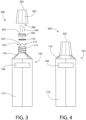
- FIG. 3 Another product package 300 in accordance with an implementation of the present teachings is depicted in the exploded perspective view of FIG. 3 and the assembled view of FIG. 4 .
- this implementation is discussed with reference to various like-numbered structures as described above and their description are not repeated.
- the product package 300 of this implementation is not part of the present invention, but is nevertheless useful to understand this invention. It will be appreciated that the product package 300 of this implementation may include other structures that, for clarity and simplicity, have not been depicted, while depicted structures may be removed or modified.
- the product package 300 of FIGS. 3 and 4 includes a cap 302, for example, a screw cap 302 having interior threads (not depicted for simplicity) that mate with threads 118 of end 112.
- the cap 302 may thus be attached to, or removed from, the end 112 of the vessel 102 by either screwing, or unscrewing, the cap 302 relative to the threads 118 of the vessel 102.
- the product package 300 further includes a scented material 304 attached, for example permanently attached, to a surface of the seal 106 such that, when the seal 106 is attached to the lip 120, the seal 106 is positioned between the lip 120 and the scented material 304.
- the seal 106 thus provides a barrier and maintains physical separation between the scented material 304 and the product 104 that is positioned or located inside of the vessel 102.
- the cap 302 is dimensioned such that when the cap 302 is screwed all the way onto the vessel 102 (e.g., when the cap 302 touches, or is at its closest point to, the shoulder 116 of the vessel 102 as depicted in FIG. 4 ), there is an interior space or cavity 306 between the top of the scented material 304 and the top 305 of the cap 302.
- the scented material 304 is positioned within the space or cavity 306 in the cap 302.
- the scented material 304 is sealed, or substantially sealed, within the cavity 306 of the cap 302, and thus scented package 300 does not release, or does not significantly release, the fragrance 146 to the exterior of the product package 300.
- the fragrance 146 released by the scented material 304 may be sampled or smelled by the consumer before purchasing or buying the product.
- the fragrance 146 released by the scented material 304 is contained within the cavity 306 in the interior of the product package 300, with little or none of the fragrance 146 being released exterior to the product package 300.
- the consumer may remove the cap 302, for example, by rotating and unscrewing the cap 302 from the threads 118.
- the consumer may then remove the seal 106 along with the scented material 304, for example, by peeling the seal 106 from the lip 120.
- the product 104 may then be dispensed from the product package 100, for example, by applying pressure to the body 110 of the vessel 102 and to the product 104 therein such that the product 104 is forced out of the orifice 114.
- the scented material 304 of product package 300 is removed from the product package 300 simultaneously with the removal of the seal 106, and may be discarded with the seal 106.
- the scented material 304 is removed with no additional effort by the consumer, as the seal 106 is designed to be removed to provide access to the product 104 within the vessel 102 such that the product 104 may be dispensed from the vessel 102 through the orifice 114. Removal and discarding of the scented material 304 along with the seal 106, for example, reduces or prevents physical contact between the product 104 and the scented material 304.
- the scented material 304 may be positioned on an interior surface of the cap 302, such as on the interior surface of the top 305 of the cap 302. In this implementation, the scented material 304 may remain with the cap 302 and eventually discarded with the product package 300, for example, after the product 104 has been depleted. Moreover, it is contemplated that the scented material may be placed on both the seal and the cap in one or more of the implementations discussed herein.
- FIG. 5 is a flow chart depicting an example of a method 500 for dispensing a product from a product package in accordance with an implementation of the present teachings.
- the method 500 may proceed by operation or use of one or more of the structures depicted in the figures described above, and thus is described with reference to FIGS. 1-4 ; however, it will be appreciated that the method 500 is not limited to any particular structure unless expressly stated herein.
- the method begins at 502, where a product package 100, 300 is repositioned from a closed position to an open position, thereby releasing a fragrance 146 from a scented material 144, 304 of the product package 100, 300.
- the product package 100, 300 may be repositioned from the open position to the closed position, thereby sealing the fragrance 146 within the product package 100, 300 to at least a significant extent.
- These method acts may be performed, for example, by a consumer in a store prior to purchase of the product package 100, 300 and/or at home after purchasing the product.
- a cap 108, 302 may be removed to expose a seal 106 positioned over an orifice 114 of a vessel 102.
- the seal 106 provides a barrier between the scented material 144, 304 and the product 104 within the vessel 102 of the product package 100, 300 as at 506.
- the exposed seal 106 may be removed by the consumer from the product package 100, 300 to expose the product 104 within the product package 100, 300, thus providing the product 104 a path to exit the vessel 102.
- the scented material 304 may be simultaneously removed from the product package 300 as at 510.
- the cap 108, 302 may be replaced onto the vessel 102, and the product 104 may be dispensed from the vessel 102 through the orifice 114 as at 514.
- the method 500 when initially dispensing the product 104 from the vessel 102 after removing the seal 106, the method 500 may include reversing method acts 512 and 514.
- the product 104 after removing the seal 106 to expose the product 104 within the vessel 102 (which, in an implementation, may also include simultaneously removing the scented material 304 as at 510), the product 104 may be dispensed from the vessel 102 through the orifice 114 prior to replacing the cap 108, 302.
- FIG. 6 is a flow chart depicting an example of a method 600 for manufacturing a product package in accordance with an implementation of the present teachings.
- the method 600 may proceed by operation or use of one or more of the structures depicted in the figures described above, and thus is described with reference to FIGS. 1-4 ; however, it will be appreciated that the method 600 is not limited to any particular structure unless expressly stated herein.
- the method 600 for manufacturing a product package 100, 300 begins by disposing a product 104 into a vessel 102, the vessel 102 defining an orifice 114, wherein the product 104 is configured to be dispensed from the vessel 102 through the orifice 114.
- the method 600 further includes providing a seal 106 and a cap 108, 302, as at 604, and attaching a scented material 144, 304 to at least one of the seal 106 and the cap 108, 302, as at 606.
- the seal 106 is attached to the vessel 102, for example, to a lip 120 that defines the orifice 114, where the seal 106 is configured to seal the product 104 within the vessel 102.
- the seal 106 may be attached to the vessel 102 after disposing the product 104 into the vessel 102, while in other implementations the seal 106 may be attached to the vessel 102 prior to disposing the produce within the vessel, or example, through an opening at an end of the vessel 102 opposite the lip 120 and the orifice 114.
- the method 600, at 610, further includes attaching the cap 108, 302 to the vessel 102, where the cap 108, 302 is repositionable from a closed position to an open position to release a fragrance 146 from the scented material 144, 304 to an exterior of the product package 100, 300, and from the open position to the closed position thereby substantially preventing the release of the fragrance 146 to the exterior of the product package 100, 300.
- Various implementations of the present teachings thus provide a product package or scent package that allows a consumer to sample or smell a product fragrance at the point of sale.
- the fragrance When the product package is in a closed position, the fragrance is enclosed within the product package, for example, within the cap or lid of the product package.
- the fragrance When the product package is in an open position, the fragrance is released from the product package and is available for sampling or smelling by a consumer.
- fragrances delivered by scent packaging may further be used to provide a consumer with an indication of the flavor or taste of the product.
- one or more of the acts depicted herein may be carried out in one or more separate acts and/or phases.
- the terms “including,” “includes,” “having,” “has,” “with,” or variants thereof are used in either the detailed description and the claims, such terms are intended to be inclusive in a manner similar to the term “comprising.”
- the term “at least one of” is used to mean one or more of the listed items can be selected.
- the term “one or more of” with respect to a listing of items such as, for example, A and B, means A alone, B alone, or A and B.
- the term “at least one of” is used to mean one or more of the listed items can be selected.
- the term “on” used with respect to two materials, one “on” the other, means at least some contact between the materials, while “over” means the materials are in proximity, but possibly with one or more additional intervening materials such that contact is possible but not required. Neither “on” nor “over” implies any directionality as used herein.
- the term “conformal” describes a coating material in which angles of the underlying material are preserved by the conformal material. The term “about” indicates that the value listed may be somewhat altered, as long as the alteration does not result in nonconformance of the process or structure to the described teachings.
- “exemplary” indicates the description is used as an example, rather than implying that it is an ideal. Other aspects of the present teachings will be apparent to those skilled in the art from consideration of the specification and practice of the disclosure herein. It is intended that the specification and examples be considered as exemplary only, with a true scope of the present teachings being indicated by the following claims.
- Terms of relative position as used in this application are defined based on a plane parallel to the conventional plane or working surface of a workpiece, regardless of the orientation of the workpiece.
- the term “horizontal” or “lateral” as used in this application is defined as a plane parallel to the conventional plane or working surface of a workpiece, regardless of the orientation of the workpiece.
- the term “vertical” refers to a direction perpendicular to the horizontal. Terms such as “on,” “side” (as in “sidewall”), “higher,” “lower,” “over,” “top,” and “under” are defined with respect to the conventional plane or working surface being on the top surface of the workpiece, regardless of the orientation of the workpiece.
Landscapes
- Engineering & Computer Science (AREA)
- Mechanical Engineering (AREA)
- Closures For Containers (AREA)
- Packaging Of Annular Or Rod-Shaped Articles, Wearing Apparel, Cassettes, Or The Like (AREA)
- Packages (AREA)
Description
- Packaging of consumer items is important in attracting the attention of a potential customer such that the buyer will consider purchasing a product. Packaging that is attractive, appears to be of high quality, and conveys product details will often influence a consumer to purchase the product. For oral care products such as toothpaste, mouthwash, etc., product flavor is also often an important purchase consideration. For personal care products such as deodorants, antiperspirants, powders, lotions, etc., a potential consumer may select the product based, at least in part, on product fragrance.
- The sensory qualities of flavor and fragrance are often described on product packaging using descriptive indicia such as text and/or graphics. While the descriptive indicia may provide a general indication of the sensory quality of the product, descriptive indicia can be subjective and may give a consumer an inaccurate understanding of the product contents and sensory qualities. As such, the actual flavor or fragrance of the product may vary from the user's expectations that are solely based on the text and/or graphics and may, in turn, lead to the customer's dissatisfaction with the product.
- Developed to avoid this dissatisfaction, various conventional scent packaging designs are known. Packaging that allows a potential customer to experience the fragrance of a product, or an emulation of the fragrance, within the package may be referred to herein as "scent packaging" or a "scent package." As aromas are closely physiologically linked with flavor, fragrances delivered by scent packaging may further be used to provide a consumer with an indication of the flavor or taste of the product.
- Various types of conventional scent packaging suffer from various problems. For example, some scent packaging continuously delivers a fragrance because the packaging does not seal the fragrance-producing material from the outside air, and thus the fragrance may become depleted before the product is sold and may also cross-contaminate the fragrance from adjacent scent packages having different fragrances. For another example, some scent packaging may use a substance embedded with a scent-emitting chemical that emulates the scent of the product within, and this substance may negatively affect the product within if it comes in contact with the product. Such conventional scent packaging may not ensure that the scent-emitting chemical is physically separated from the product, and the substance may thus negatively interact with the product, either before or after sale of the product.
- Scent packaging that, for example, overcomes one or more problems of conventional scent packaging would be a welcome addition to the art.
WO 2006/004665 A2 refers to a bottle container having a dispensing closure placed thereon. The dispensing closure has a base that screws onto a threaded neck section of the bottle container. An orifice is disposed through a base that enables a scented product to flow through the base from an interior of the bottle. A flip cap is provided for selectively sealing the orifice. A tamper resistant seal is placed over a top of the bottle container.
EP 1 721 621 A1 refers to a package containing a product. The package comprises an opening which is sealed with an aluminum foil seal and a plastic lid joined to the main body of the bottle via a hinge. An enclosure is formed between the package and an internal surface of the plastic lid. 2 grams of perfume releasing hot melt adhesive are attached to the internal surface of said the plastic lid. The enclosure is saturated with a perfumed headspace.
WO 00/53508 A1
WO 2007/052227 A2 refers to a container including a perfuming means located within a space under a closure. The perfuming means is fitted into the closure by way of a friction fit around an orifice.
US 5 635 229 A refers to an aromatic member which encompasses a removable cap having an interior threaded base, for engagement with threads on a bottle, and a flip-open lid. An interior of the lid is covered with a layer of absorbent material onto which a scent is instilled. A thin removable plastic film covers the absorbent material prior to use. When the lid is snapped closed, a dispensing opening on the base is sealed.
US-A-2016/068315 discloses the following features of claim 1: a product package, comprising: a vessel defining an orifice;a product disposed within the vessel and configured to be dispensed from the vessel through the orifice; a cap that is configured to be attached to the vessel, wherein the cap is repositionable from a closed position to an open position, and from the open position to the closed position, wherein the cap comprises:a base; a top; a hinge that movably attaches the base to the top; a dispensing tip defining an opening, wherein the product package is configured to dispense the product from the opening defined by the dispensing tip; and a ring protruding from an inner surface of the top, wherein the ring encircles an end of the dispensing tip and the opening when the cap is in the closed position. - Further areas of applicability of the present invention will become apparent from the detailed description provided hereinafter. It should be understood that the detailed description and specific examples, while indicating some preferred aspects of the invention, are intended for purposes of illustration only and are not intended to limit the scope of the invention. The present invention relates to a product package as defined in claim 1 and to a method as defined in claim 4. Preferred embodiments are defined by the dependent claims.
- A product package may include a vessel defining an orifice, a product disposed within the vessel and configured to be dispensed from the vessel through the orifice, a cap that is configured to be attached to the vessel, wherein the cap is repositionable from a closed position to an open position, and from the open position to the closed position, a seal positioned over the orifice and configured to seal the product within the vessel, and
a scented material having a fragrance. The scented material is attached to a surface of the seal, and the product package is configured to release the fragrance of the scented material to an exterior of the product package when the cap is in the open position and to substantially prevent the release of the fragrance to the exterior of the product package when the cap is in the closed position. - Optionally, the seal may be configured to be removed to allow the product to be dispensed from the vessel, and the scented material may be configured to be removed simultaneously with a removal of the seal. The vessel may further include a threaded end, where the cap may be configured to be screwed onto the threaded end to place the cap in the closed position, and configured to be unscrewed from the threaded end to place the cap in the open position.
- The product package may include optional text and/or graphics on the exterior of the product package that inform a consumer that the product package includes the fragrance that may be sampled by moving the cap from the closed position to the open position. The product may be one of a toothpaste, a mouthwash, a deodorant, an antiperspirant, a perfume, a powder, and a lotion.
- In another implementation, aA product package includes a vessel defining an orifice, a product disposed within the vessel and configured to be dispensed from the vessel through the orifice, a cap that is configured to be attached to the vessel, wherein the cap is repositionable from a closed position to an open position, and from the open position to the closed position, and a scented material having a fragrance, wherein the scented material is attached to the cap. The product package is configured to release the fragrance of the scented material to an exterior of the product package when the cap is in the open position and to substantially prevent the release of the fragrance to the exterior of the product package when the cap is in the closed position.
- The cap includes a base, a top, a hinge that movably attaches the base to the top, and a dispensing tip defining an opening. The product package is configured to dispense the product from the opening defined by the dispensing tip. The cap further includes a ring protruding from an inner surface of the top, wherein the ring encircles an end of the dispensing tip and the opening when the product package is in the closed position. The scented material is disposed in a pattern around the ring. Optionally, the cap may be configured to be removed from the vessel to provide access to a seal that blocks the orifice, and the seal may be configured to be removed to allow the product to be dispensed from the vessel.
- The vessel may optionally include a threaded end where the cap is configured to be unscrewed from the threaded end to provide the access to the seal. The product may be one of a toothpaste, a mouthwash, a deodorant, an antiperspirant, a perfume, a powder, and a lotion.
- A method for manufacturing a product package includes disposing a product into a vessel, the vessel defining an orifice, wherein the product is configured to be dispensed from the vessel through the orifice. The method further includes providing a seal and a cap, attaching a scented material to at least one of the seal and the cap, and attaching the seal to the vessel, wherein the seal is configured to seal the product within the vessel. The method further includes attaching the cap to the vessel, wherein the cap is repositionable from a closed position to an open position to release a fragrance from the scented material to an exterior of the product package, and from the open position to the closed position thereby substantially preventing the release of the fragrance to the exterior of the product package.
- The attaching of the scented material to the at least one of the seal and the cap may include attaching the scented material to the seal. Further, the vessel may include a lip that defines the orifice, and the attaching of the seal to the vessel may further include attaching the seal to the lip. The seal may be configured to be removed from the lip prior to dispensing the product from the vessel. The attaching of the scented material to the at least one of the seal and the cap may include attaching the scented material to the cap.
- The attaching of the cap to the vessel may include screwing the cap onto a threaded end of the vessel. The disposing of the product into the vessel may include disposing one of a toothpaste, a mouthwash, a deodorant, an antiperspirant, a perfume, a powder, and a lotion into the vessel.
- The present invention will become more fully understood from the detailed description and the accompanying drawings, wherein:
-
FIG. 1 is an exploded view of a product package according to an implementation of the present teachings. -
FIG. 2 is an assembled side view of theFIG. 1 product package; -
FIG. 3 is an exploded view of a product package according to another implementation of the present teachings. -
FIG. 4 is an assembled side view of theFIG. 3 product package. -
FIG. 5 is a flow chart depicting a method for dispensing a product from a product package according to another implementation of the present teachings. -
FIG. 6 is a flow chart depicting a method for manufacturing a product package in accordance with another implementation of the present teachings. - It should be noted that some details of the figures have been simplified and are drawn to facilitate understanding of the present teachings rather than to maintain strict structural accuracy, detail, and scale.
- The following description of various preferred aspects are merely exemplary in nature and are in no way intended to limit the present teachings, their application, or uses.
- As used throughout, ranges are used as shorthand for describing each and every value that is within the range. Any value within the range can be selected as the terminus of the range. In the event of a conflict in a definition in the present disclosure and that of a cited reference, the present disclosure controls.
- The present teachings described herein include a product package that allows a consumer to sample or smell a fragrance, aroma, and/or scent that emanates from a scented material within the package at the point of sale. The scent may be provided by any suitable carrier material, such by (or including) a natural material, a synthetic material, a gel, a solid, a liquid, etc., that is impregnated with a scent or otherwise releases, emits, diffuses, produces, or gives off a scent. Suitable scented materials are known in the art. When in a closed state, the presently described scent packaging releases little or no scent and, when in an open state, the scent packaging releases a scent that is suitable for sampling or smelling by a consumer. It will be appreciated that, in an aspect of the present teachings, a seal may provide complete sealing of the fragrance within the product package to prevent the release of the fragrance to the exterior of the product package such that no human-detectable amount of fragrance is released. In another aspect, the seal may be imperfect such that a small (e.g., barely human-detectable) amount of fragrance is released in the closed position, where the release of the fragrance is diminished but not completely eliminated. This may be referred to as "substantially sealed" and substantially prevents the release of fragrance to the exterior of the product package. In an aspect, "substantially sealed" may refer to a seal that limits the diminishment of the strength of the fragrance from the scented material to a 20% or less reduction over a 90 day period at room temperature, or to a 10% or less reduction over a 90 day period at room temperature. For purposes of this application, the term "sealed" includes product packages that are "substantially sealed" and the term "substantially sealed" includes product packages that are "sealed," unless otherwise indicated.
- The scent released by the scented material may be provided by a chemical(s) that releases a fragrance that is a replica, likeness, emulation, or facsimile of the fragrance of the product, such as the same fragrance-inducing chemical(s) that is used in the product composition. In this instance, the scented material may release a first fragrance that is similar, substantially similar, or the same as a second fragrance released by the product. In other instances, the scent may be provided by a carrier material impregnated with an amount of the product itself, in which case the first fragrance released by the scented material may be the same as the second fragrance released by the product. In yet another instance, the scent may be provided by a carrier material impregnated with an amount of the product itself, with the carrier material contributing an odor(s) to the first fragrance that is dissimilar from the second fragrance released by the product, such that the first fragrance is only similar or substantially similar to the second fragrance. Thus the product may have a scent and the scented material may release a fragrance, where the fragrance is, or approximates, the scent. The fragrance may be released from the product package for as long as the product package remains in the open position. For example, the product package may be placed into the open position for one second or more, 30 seconds or more, or one minute or more, and the fragrance will be continuously released by the scented material from the product package for one second or more, 30 seconds or more, or one minute or more, respectively. Once the product package is placed into the closed position, the product package becomes sealed.
- A first configuration of a product package or
product dispenser 100 that provides a scent package according to the present teachings is depicted in the exploded perspective depiction ofFIG. 1 and the assembled side view ofFIG. 2 . It will be appreciated that a product package in accordance with the present teachings may include structures that, for clarity and simplicity, have not been depicted in the figures, and that various depicted structures may be removed or modified. Theproduct package 100 ofFIGS. 1 and 2 includes a receptacle, container, orvessel 102 and aproduct 104 that may be stored within, and may be dispensed from, thevessel 102 during use by a user. Theproduct package 100 further includes, aseal 106, for example aremovable seal 106, and acap 108, for example aremovable cap 108. - The
vessel 102 may be flexible, semi-rigid, rigid, or combinations thereof, and may be provided in the form of a tube, a bottle, or another suitable form. Thevessel 102 may include abody 110 and anend 112 including anorifice 114. Alip 120 of theend 112 may define theorifice 114. Thevessel 102 may further include ashoulder 116 positioned between, and attached to, thebody 110 and theend 112. Theend 112 of thevessel 102 may includethreads 118 that mate with threads of the cap 108 (on the interior of thecap 108 and not depicted for simplicity) to provide or allow an attachment of thecap 108 to the threadedend 112 of thevessel 102 as depicted inFIG. 2 , although other cap attachment techniques, as are known in the art, are contemplated. - During manufacture, the
product 104 may be sealed or contained within thevessel 102 using theseal 106, for example, to reduce or prevent contamination, leakage, and/or deterioration of theproduct 104 prior to sale. Theseal 106 may be or include, for example, a laminate that includes a foil such as a metal foil, a plastic or other polymer, etc. Theseal 106 may be attached to thelip 120 of theend 112 using, for example, an adhesive 122, a heat sealing technique, or another technique or combination of techniques. Other types of seals as are known in the art are contemplated. Theseal 106 may be removed or punctured by the product purchaser after the purchaser has taken the product home for use. - The
product 104 may be in the form of a liquid, a paste, a gel, a solid, or another suitable form. Theproduct 104 may be, for example, a personal care product such as toothpaste, mouthwash, deodorant, antiperspirant, perfume, lotion, or powder, or another product. - The
cap 108 ofFIGS. 1 and 2 includes abase 130, a top 132, and ahinge 134 that movably attaches the base 130 to the top 132. During use, thehinge 134 may bend or flex to allow the top 132 pivot away from thebase 130 and open, thereby exposing adispensing tip 136 having anopening 138, and to pivot toward thebase 130 and close onto the base 130 such that the top 132 covers the dispensingtip 136. The top 132 of thecap 108 includes aring 140 protruding from aninner surface 142 of the top 132. Thering 140 encircles the end of thetip 136 and theopening 138 of thetip 136 when thecap 108 is in a closed position. Thering 140 and the portion of theinner surface 142 within thering 140 block theopening 138 and reduce or prevent the unwanted dispensing of theproduct 104 from theopening 138 when the top 132 is closed onto thebase 130, as depicted inFIG. 2 , where thecap 108, and thus theproduct package 100, is in the closed position. Conversely, the hingedcap 108 may allow dispensing of theproduct 104 from theopening 138 when the top 132, and thus thecap 108 and theproduct package 100, is in an open position ofFIG. 1 . Thecap 108 is thus repositionable from the closed position to the open positon and from the open position to the closed position. -
FIG. 1 further depicts ascented material 144 positioned on theinner surface 142 of the top 132, and within thecap 108.FIG. 1 depicts thescented material 144 positioned or disposed in a circular pattern that encircles thering 140, although it is contemplated that thescented material 144 may be positioned at other locations of the base 130 or top 132 that are within the cavity formed when the top 132 is closed on thebase 130. For one example or another location (not individually depicted for simplicity), thescented material 144 may be disposed in dot(s) around the inner sidewalls of the top 132. When thecap 108 is in the open position ofFIG. 1 , thescented material 144 is exposed and releases a scent, aroma, orfragrance 146 to an exterior of theproduct package 100. When thecap 108 is in the closed position ofFIG. 2 , thescented material 144, and thefragrance 146 released therefrom, is partially or completely sealed within theproduct package 100, such that little or none of the fragrance is released from the cavity formed when the top 132 is closed on thebase 130 of thecap 108. As described above, thescented material 144 may be or include a natural material, a synthetic material, a gel, a solid, a liquid, etc., that is impregnated with afragrance 146 or otherwise releases, emits, diffuses, produces, or gives off afragrance 146. Suitable scent-releasing materials are known in the art. Thefragrance 146 may be provided by a chemical(s) that releases a fragrance that is a replica, likeness, or facsimile of the fragrance of theproduct 104. In some instances, the chemical(s) may be the same fragrance-producing chemical(s) that is a component of theproduct 104. In other instances, thefragrance 146 may be provided by an amount of theproduct 104 itself used as, or as a component of, thescented material 144. - The
product package 100 may further include text and/orgraphical indicia 148 on the exterior of theproduct package 100 that includes text and/or graphics that informs a consumer that theproduct package 100 includes afragrance 146 that may be sampled by opening the top 132 of thecap 108 or otherwise moving or repositioning theproduct package 100 from the closed position to the open position. While theproduct package 100 is displayed, for example, on a store shelf before purchase, thescented material 144 is sealed within thecap 108, and thus thescented package 100 releases little or none of thefragrance 146 to the exterior of theproduct package 100. Upon opening thecap 108 or otherwise placing thecap 108 in the open position, thefragrance 146 released by thescented material 144 may be sampled or smelled by the consumer before purchase. When thecap 108 is closed or otherwise placed in the closed position, thefragrance 146 released by thescented material 144 is contained within the interior of theproduct package 100, (e.g., within the cavity formed when the top 132 is closed on the base 130), with little or none of thefragrance 146 being released exterior to theproduct package 100. Before purchase, theseal 106 blocks theorifice 114. Further, theseal 106 provides a barrier that maintains a physical separation between thescented material 144 and theproduct 104. - After purchasing the
product package 100, the consumer may remove thecap 108, for example, by rotating and unscrewing thecap 108 from thethreads 118. The consumer may then remove theseal 106 to expose theproduct 104 within thevessel 102, for example, by peeling theseal 106 from thelip 120. Theseal 106 may be discarded and thecap 108 may be replaced onto thevessel 102, for example, by rotating and screwing thecap 108 onto thethreads 118. Theproduct 104 may then be dispensed from theproduct package 100, for example, by placing thecap 108 in the open position and applying pressure to thebody 110 of thevessel 102 and to theproduct 104 therein such that theproduct 104 is forced out of theorifice 114, into the dispensingtip 136, and out of theopening 138. - After removing the
seal 106 and replacing thecap 108, thering 140 may reduce or prevent physical contact between theproduct 104 and thescented material 144. - It is contemplated that the
product package 100, for example, thecap 108 design, may be modified from that depicted based, at least in part, on the characteristics of theproduct 104, such as the viscosity of the product being dispensed. Theproduct package 100 may also be modified based, at least in part, on other considerations such as cost, form factor, design, etc. For example, thecap 108 may be a flip-top cap 108 as depicted, a screw cap, a friction fit cap, or another cap design that includes a selectably sealed or semi-sealed cavity. Theproduct package 100 may include other structures, such as a roller ball or a spray pump in place of or in conjunction with the dispensingtip 136, depending on the product being dispensed as well as the design of theproduct package 100. - In the implementation of
FIGS. 1 and 2 , thescented material 144 may remain within thecap 108 during use of theproduct 104 and theproduct package 100 by the consumer, and the product package may be discarded by the consumer, for example, once theproduct 104 within thevessel 110 has been depleted. - Another
product package 300 in accordance with an implementation of the present teachings is depicted in the exploded perspective view ofFIG. 3 and the assembled view ofFIG. 4 . For ease of explanation, this implementation is discussed with reference to various like-numbered structures as described above and their description are not repeated. Theproduct package 300 of this implementation is not part of the present invention, but is nevertheless useful to understand this invention. It will be appreciated that theproduct package 300 of this implementation may include other structures that, for clarity and simplicity, have not been depicted, while depicted structures may be removed or modified. - The
product package 300 ofFIGS. 3 and 4 includes acap 302, for example, ascrew cap 302 having interior threads (not depicted for simplicity) that mate withthreads 118 ofend 112. Thecap 302 may thus be attached to, or removed from, theend 112 of thevessel 102 by either screwing, or unscrewing, thecap 302 relative to thethreads 118 of thevessel 102. Theproduct package 300 further includes ascented material 304 attached, for example permanently attached, to a surface of theseal 106 such that, when theseal 106 is attached to thelip 120, theseal 106 is positioned between thelip 120 and thescented material 304. Theseal 106 thus provides a barrier and maintains physical separation between thescented material 304 and theproduct 104 that is positioned or located inside of thevessel 102. - Additionally, the
cap 302 is dimensioned such that when thecap 302 is screwed all the way onto the vessel 102 (e.g., when thecap 302 touches, or is at its closest point to, theshoulder 116 of thevessel 102 as depicted inFIG. 4 ), there is an interior space orcavity 306 between the top of thescented material 304 and the top 305 of thecap 302. Thus, when thecap 302 is attached to thevessel 102 as depicted inFIG. 4 , thescented material 304 is positioned within the space orcavity 306 in thecap 302. While theproduct package 300 is displayed, for example, on a store shelf, thescented material 304 is sealed, or substantially sealed, within thecavity 306 of thecap 302, and thusscented package 300 does not release, or does not significantly release, thefragrance 146 to the exterior of theproduct package 300. When a potential consumer removes thecap 302 or otherwise places theproduct package 300 in the open position, for example, in a store, thefragrance 146 released by thescented material 304 may be sampled or smelled by the consumer before purchasing or buying the product. When thecap 302 is attached to theend 112, or theproduct package 300 is otherwise placed in the closed position, thefragrance 146 released by thescented material 304 is contained within thecavity 306 in the interior of theproduct package 300, with little or none of thefragrance 146 being released exterior to theproduct package 300. - In order to use the
product 104 after purchasing theproduct package 300, the consumer may remove thecap 302, for example, by rotating and unscrewing thecap 302 from thethreads 118. The consumer may then remove theseal 106 along with thescented material 304, for example, by peeling theseal 106 from thelip 120. Theproduct 104 may then be dispensed from theproduct package 100, for example, by applying pressure to thebody 110 of thevessel 102 and to theproduct 104 therein such that theproduct 104 is forced out of theorifice 114. - In contrast to the
product package 100 ofFIGS. 1 and 2 , thescented material 304 ofproduct package 300 is removed from theproduct package 300 simultaneously with the removal of theseal 106, and may be discarded with theseal 106. Thescented material 304 is removed with no additional effort by the consumer, as theseal 106 is designed to be removed to provide access to theproduct 104 within thevessel 102 such that theproduct 104 may be dispensed from thevessel 102 through theorifice 114. Removal and discarding of thescented material 304 along with theseal 106, for example, reduces or prevents physical contact between theproduct 104 and thescented material 304. - It is further contemplated that the
scented material 304 may be positioned on an interior surface of thecap 302, such as on the interior surface of the top 305 of thecap 302. In this implementation, thescented material 304 may remain with thecap 302 and eventually discarded with theproduct package 300, for example, after theproduct 104 has been depleted. Moreover, it is contemplated that the scented material may be placed on both the seal and the cap in one or more of the implementations discussed herein. -
FIG. 5 is a flow chart depicting an example of amethod 500 for dispensing a product from a product package in accordance with an implementation of the present teachings. Themethod 500 may proceed by operation or use of one or more of the structures depicted in the figures described above, and thus is described with reference toFIGS. 1-4 ; however, it will be appreciated that themethod 500 is not limited to any particular structure unless expressly stated herein. - The method begins at 502, where a
product package fragrance 146 from ascented material product package product package fragrance 146 within theproduct package product package product 104, acap seal 106 positioned over anorifice 114 of avessel 102. Theseal 106 provides a barrier between thescented material product 104 within thevessel 102 of theproduct package seal 106 may be removed by the consumer from theproduct package product 104 within theproduct package vessel 102. Optionally, while removing theseal 106, and for example with thescented material 304 attached to a surface of theseal 106, thescented material 304 may be simultaneously removed from theproduct package 300 as at 510. Subsequently, at 512, thecap vessel 102, and theproduct 104 may be dispensed from thevessel 102 through theorifice 114 as at 514. - It will be appreciated that while the
method 500 is described as a series of acts or events, the present teachings are not limited by the ordering of such acts or events. For example, when initially dispensing theproduct 104 from thevessel 102 after removing theseal 106, themethod 500 may include reversing method acts 512 and 514. In other words, after removing theseal 106 to expose theproduct 104 within the vessel 102 (which, in an implementation, may also include simultaneously removing thescented material 304 as at 510), theproduct 104 may be dispensed from thevessel 102 through theorifice 114 prior to replacing thecap -
FIG. 6 is a flow chart depicting an example of amethod 600 for manufacturing a product package in accordance with an implementation of the present teachings. Themethod 600 may proceed by operation or use of one or more of the structures depicted in the figures described above, and thus is described with reference toFIGS. 1-4 ; however, it will be appreciated that themethod 600 is not limited to any particular structure unless expressly stated herein. - At 602, the
method 600 for manufacturing aproduct package product 104 into avessel 102, thevessel 102 defining anorifice 114, wherein theproduct 104 is configured to be dispensed from thevessel 102 through theorifice 114. Themethod 600 further includes providing aseal 106 and acap scented material seal 106 and thecap seal 106 is attached to thevessel 102, for example, to alip 120 that defines theorifice 114, where theseal 106 is configured to seal theproduct 104 within thevessel 102. In various implementations, theseal 106 may be attached to thevessel 102 after disposing theproduct 104 into thevessel 102, while in other implementations theseal 106 may be attached to thevessel 102 prior to disposing the produce within the vessel, or example, through an opening at an end of thevessel 102 opposite thelip 120 and theorifice 114. Themethod 600, at 610, further includes attaching thecap vessel 102, where thecap fragrance 146 from thescented material product package fragrance 146 to the exterior of theproduct package - Various implementations of the present teachings thus provide a product package or scent package that allows a consumer to sample or smell a product fragrance at the point of sale. When the product package is in a closed position, the fragrance is enclosed within the product package, for example, within the cap or lid of the product package. When the product package is in an open position, the fragrance is released from the product package and is available for sampling or smelling by a consumer. As aromas are closely physiologically linked with flavor, fragrances delivered by scent packaging according to the present implementations may further be used to provide a consumer with an indication of the flavor or taste of the product.
- While the present teachings have been illustrated with respect to one or more implementations, alterations and/or modifications can be made to the illustrated examples without departing from the scope of the appended claims. For example, it will be appreciated that while the process is described as a series of acts or events, the present teachings are not limited by the ordering of such acts or events. Some acts may occur in different orders and/or concurrently with other acts or events apart from those described herein. Also, not all process stages may be required to implement a methodology in accordance with one or more aspects of the present teachings. It will be appreciated that structural components and/or processing stages can be added or existing structural components and/or processing stages can be removed or modified. The invention is, however, defined in the claims. Further, one or more of the acts depicted herein may be carried out in one or more separate acts and/or phases. Furthermore, to the extent that the terms "including," "includes," "having," "has," "with," or variants thereof are used in either the detailed description and the claims, such terms are intended to be inclusive in a manner similar to the term "comprising." The term "at least one of" is used to mean one or more of the listed items can be selected. As used herein, the term "one or more of" with respect to a listing of items such as, for example, A and B, means A alone, B alone, or A and B. The term "at least one of" is used to mean one or more of the listed items can be selected. Further, in the discussion and claims herein, the term "on" used with respect to two materials, one "on" the other, means at least some contact between the materials, while "over" means the materials are in proximity, but possibly with one or more additional intervening materials such that contact is possible but not required. Neither "on" nor "over" implies any directionality as used herein. The term "conformal" describes a coating material in which angles of the underlying material are preserved by the conformal material. The term "about" indicates that the value listed may be somewhat altered, as long as the alteration does not result in nonconformance of the process or structure to the described teachings. Finally, "exemplary" indicates the description is used as an example, rather than implying that it is an ideal. Other aspects of the present teachings will be apparent to those skilled in the art from consideration of the specification and practice of the disclosure herein. It is intended that the specification and examples be considered as exemplary only, with a true scope of the present teachings being indicated by the following claims.
- Terms of relative position as used in this application are defined based on a plane parallel to the conventional plane or working surface of a workpiece, regardless of the orientation of the workpiece. The term "horizontal" or "lateral" as used in this application is defined as a plane parallel to the conventional plane or working surface of a workpiece, regardless of the orientation of the workpiece. The term "vertical" refers to a direction perpendicular to the horizontal. Terms such as "on," "side" (as in "sidewall"), "higher," "lower," "over," "top," and "under" are defined with respect to the conventional plane or working surface being on the top surface of the workpiece, regardless of the orientation of the workpiece.
Claims (6)
- A product package (100), comprising:a vessel (102) defining an orifice (114);a product (104) disposed within the vessel (102) and configured to be dispensed from the vessel (102) through the orifice (114);a cap (108) that is configured to be attached to the vessel (102), wherein the cap (108) is repositionable from a closed position to an open position, and from the open position to the closed position; anda scented material (144) having a fragrance, wherein the scented material (144) is attached to the cap (108),wherein the product package (100) is configured to release the fragrance of the scented material (144) to an exterior of the product package (100) when the cap (108) is in the open position and to substantially prevent the release of the fragrance to the exterior of the product package (100) when the cap (108) is in the closed position,wherein the cap (108) comprises:a base (130);a top (132);a hinge (134) that movably attaches the base (130) to the top (132);a dispensing tip (136) defining an opening (138), wherein the product package (100) is configured to dispense the product (104) from the opening (138) defined by the dispensing tip (136); anda ring (140) protruding from an inner surface (142) of the top (132),wherein the ring (140) encircles an end of the dispensing tip (136) and the opening (138) when the cap (108) is in the closed position, wherein the scented material (144) is disposed in a pattern around the ring (140), whereinthe ring (140) and a portion of the inner surface (142) within the ring (140) are configured to block the opening (138) when the cap (108) is in the closed position.
- The product package of claim 1, wherein the product (104) is one of a toothpaste, a mouthwash, a deodorant, an antiperspirant, a perfume, a powder, and a lotion.
- The product package of claim 1, further comprising text and/or graphics (148) on the exterior of the product package (100), wherein the text and/or graphics (148) are configured to inform a consumer that the product package (100) includes the fragrance that may be sampled by moving the cap (108) from the closed position to the open position.
- A method for manufacturing a product package (100), comprising:disposing a product (104) into a vessel (102), the vessel (102) defining an orifice (114), wherein the product (104) is configured to be dispensed from the vessel (102) through the orifice (114);providing a seal (106) and a cap (108), wherein the cap (108) comprises a base (130), a top (132), a hinge (134), a dispensing tip (136) and a ring (140), wherein the hinge (134) movably attaches the base (130) to the top (132), wherein the dispensing tip (136) defines an opening (138), wherein the product package (100) is configured to dispense the product (104) from the opening (138) defined by the dispensing tip (136), wherein the ring (140) protrudes from an inner surface (142) of the top (132), and wherein the ring (140) encircles an end of the dispensing tip (136) and the opening (138) when the cap (108) is in a closed position;attaching a scented material (144) in a pattern around the ring (140);attaching the seal (106) to the vessel (102), wherein the seal (106) is configured to seal the product (104) within the vessel (102); andattaching the cap (108) to the vessel (102), wherein the cap (108) is repositionable from the closed position to an open position to release a fragrance from the scented material to an exterior of the product package (100), and from the open position to the closed position thereby substantially preventing the release of the fragrance to the exterior of the product package (100).
- The method of claim 4, wherein the attaching of the cap (108) to the vessel (102) comprises screwing the cap (108) onto a threaded end (112) of the vessel (102).
- The method of claim 4, wherein the disposing of the product (104) into the vessel (102) comprises disposing one of a toothpaste, a mouthwash, a deodorant, an antiperspirant, a perfume, a powder, and a lotion into the vessel.
Applications Claiming Priority (1)
| Application Number | Priority Date | Filing Date | Title |
|---|---|---|---|
| PCT/US2016/066660 WO2018111262A1 (en) | 2016-12-14 | 2016-12-14 | Scented packaging |
Publications (2)
| Publication Number | Publication Date |
|---|---|
| EP3554959A1 EP3554959A1 (en) | 2019-10-23 |
| EP3554959B1 true EP3554959B1 (en) | 2023-11-29 |
Family
ID=59034835
Family Applications (1)
| Application Number | Title | Priority Date | Filing Date |
|---|---|---|---|
| EP16874099.1A Active EP3554959B1 (en) | 2016-12-14 | 2016-12-14 | Scented packaging |
Country Status (6)
| Country | Link |
|---|---|
| US (1) | US20190367229A1 (en) |
| EP (1) | EP3554959B1 (en) |
| CN (1) | CN110072782A (en) |
| AU (1) | AU2016432164B2 (en) |
| MX (1) | MX2019006435A (en) |
| WO (1) | WO2018111262A1 (en) |
Families Citing this family (6)
| Publication number | Priority date | Publication date | Assignee | Title |
|---|---|---|---|---|
| US11386811B2 (en) | 2019-07-29 | 2022-07-12 | James L. Bartlein | Aroma flavor |
| IT202000000919A1 (en) * | 2020-01-20 | 2021-07-20 | Agf88 Holding Srl | CONTAINER WITH INTERNAL PERFUMER |
| WO2022055706A1 (en) * | 2020-09-10 | 2022-03-17 | Colgate-Palmolive Company | Packaged product and method of manufacturing and using the same |
| CN113180442A (en) * | 2021-05-20 | 2021-07-30 | 龙景辉 | Drinking vessel with additional fragrance |
| JP2024544186A (en) * | 2021-11-30 | 2024-11-28 | エアー アップ グループ ゲーエムベーハー | Attachment for a drinking device for nasally absorbing flavoring substances and drinking device |
| IT202200021189A1 (en) * | 2022-10-14 | 2024-04-14 | Ziliani Auto Srl | Scented cap and container including said cap |
Citations (1)
| Publication number | Priority date | Publication date | Assignee | Title |
|---|---|---|---|---|
| US20160068315A1 (en) * | 2014-09-10 | 2016-03-10 | John Karl Hintz | Auto-Alert Toothpaste Cap and Methods of Delivering an Audio Alert |
Family Cites Families (6)
| Publication number | Priority date | Publication date | Assignee | Title |
|---|---|---|---|---|
| US5635229A (en) * | 1995-03-20 | 1997-06-03 | Ray; Kenneth W. | Beverage container including an affixed scent disbursement means for enhancing perceived flavor of the beverage |
| CA2362744A1 (en) * | 1999-03-05 | 2000-09-14 | Firmenich S.A. | Perfuming device for perfuming the headspace of a container |
| WO2006004665A2 (en) * | 2004-06-28 | 2006-01-12 | Steven Landau | Scented closure for a container that utilizes a tamper resistant seal |
| EP1721621A1 (en) * | 2005-05-09 | 2006-11-15 | The Procter & Gamble Company | Perfume releasing packages |
| EP1943151A2 (en) * | 2005-11-01 | 2008-07-16 | The Procter and Gamble Company | Container with perfuming means |
| CN105947395B (en) * | 2016-06-30 | 2018-03-06 | 兰庆天 | A kind of novel package bottle cap |
-
2016
- 2016-12-14 EP EP16874099.1A patent/EP3554959B1/en active Active
- 2016-12-14 MX MX2019006435A patent/MX2019006435A/en unknown
- 2016-12-14 US US16/469,489 patent/US20190367229A1/en not_active Abandoned
- 2016-12-14 AU AU2016432164A patent/AU2016432164B2/en active Active
- 2016-12-14 WO PCT/US2016/066660 patent/WO2018111262A1/en not_active Ceased
- 2016-12-14 CN CN201680091534.7A patent/CN110072782A/en active Pending
Patent Citations (1)
| Publication number | Priority date | Publication date | Assignee | Title |
|---|---|---|---|---|
| US20160068315A1 (en) * | 2014-09-10 | 2016-03-10 | John Karl Hintz | Auto-Alert Toothpaste Cap and Methods of Delivering an Audio Alert |
Also Published As
| Publication number | Publication date |
|---|---|
| EP3554959A1 (en) | 2019-10-23 |
| MX2019006435A (en) | 2019-08-21 |
| AU2016432164A1 (en) | 2019-06-27 |
| WO2018111262A1 (en) | 2018-06-21 |
| US20190367229A1 (en) | 2019-12-05 |
| CN110072782A (en) | 2019-07-30 |
| AU2016432164B2 (en) | 2020-05-14 |
Similar Documents
| Publication | Publication Date | Title |
|---|---|---|
| AU2016432164B2 (en) | Scented packaging | |
| EP2225164B1 (en) | Container for a liquid | |
| US7815387B2 (en) | Device for applying a product | |
| US8002487B2 (en) | Spreadable food dispenser | |
| EP3458163B1 (en) | Device for separately dispensing materials for use together on human skin | |
| US20090078786A1 (en) | Closure for Dispensing Fragrance from the Closure | |
| US20040000596A1 (en) | Scent dispensing device | |
| JP3627181B2 (en) | Roll-on coater | |
| JP2002179161A (en) | Supply pots for viscous products | |
| US20080220107A1 (en) | Nasal spray apparatus | |
| US9016521B2 (en) | Product dispenser package for personal use | |
| EP2623431A1 (en) | Product dispensing apparatus with sample holder | |
| US7695209B2 (en) | Stopper for the neck of a fluid product reservoir | |
| US8192100B2 (en) | Fluid applicator device and method of using same | |
| MX2013008763A (en) | Consumer care packaging. | |
| CN113163924A (en) | Device for preparing a cosmetic composition and associated preparation method | |
| CN110278708B (en) | Container lid and package with lid | |
| EP1921943B1 (en) | Content-reservoir/ product-applicator assemblies, and packages | |
| US20140332024A1 (en) | Multi-compartment container for sun screen application | |
| EP0869080A1 (en) | Container for dispensing liquid or pasty products | |
| EP3108430B1 (en) | Container | |
| US20050284498A1 (en) | Package including an overcap having an integral compartment for a secondary product | |
| WO2000044258A2 (en) | Package | |
| WO2025257512A1 (en) | Rechargeable multidose applicator | |
| WO2018224972A1 (en) | Container, particularly for medical, pharmaceutical, cosmetic, food products or the like |
Legal Events
| Date | Code | Title | Description |
|---|---|---|---|
| STAA | Information on the status of an ep patent application or granted ep patent |
Free format text: STATUS: UNKNOWN |
|
| STAA | Information on the status of an ep patent application or granted ep patent |
Free format text: STATUS: THE INTERNATIONAL PUBLICATION HAS BEEN MADE |
|
| PUAI | Public reference made under article 153(3) epc to a published international application that has entered the european phase |
Free format text: ORIGINAL CODE: 0009012 |
|
| STAA | Information on the status of an ep patent application or granted ep patent |
Free format text: STATUS: REQUEST FOR EXAMINATION WAS MADE |
|
| 17P | Request for examination filed |
Effective date: 20190605 |
|
| AK | Designated contracting states |
Kind code of ref document: A1 Designated state(s): AL AT BE BG CH CY CZ DE DK EE ES FI FR GB GR HR HU IE IS IT LI LT LU LV MC MK MT NL NO PL PT RO RS SE SI SK SM TR |
|
| AX | Request for extension of the european patent |
Extension state: BA ME |
|
| DAV | Request for validation of the european patent (deleted) | ||
| DAX | Request for extension of the european patent (deleted) | ||
| STAA | Information on the status of an ep patent application or granted ep patent |
Free format text: STATUS: EXAMINATION IS IN PROGRESS |
|
| 17Q | First examination report despatched |
Effective date: 20220218 |
|
| GRAP | Despatch of communication of intention to grant a patent |
Free format text: ORIGINAL CODE: EPIDOSNIGR1 |
|
| STAA | Information on the status of an ep patent application or granted ep patent |
Free format text: STATUS: GRANT OF PATENT IS INTENDED |
|
| INTG | Intention to grant announced |
Effective date: 20230619 |
|
| GRAS | Grant fee paid |
Free format text: ORIGINAL CODE: EPIDOSNIGR3 |
|
| GRAA | (expected) grant |
Free format text: ORIGINAL CODE: 0009210 |
|
| STAA | Information on the status of an ep patent application or granted ep patent |
Free format text: STATUS: THE PATENT HAS BEEN GRANTED |
|
| AK | Designated contracting states |
Kind code of ref document: B1 Designated state(s): AL AT BE BG CH CY CZ DE DK EE ES FI FR GB GR HR HU IE IS IT LI LT LU LV MC MK MT NL NO PL PT RO RS SE SI SK SM TR |
|
| P01 | Opt-out of the competence of the unified patent court (upc) registered |
Effective date: 20231019 |
|
| REG | Reference to a national code |
Ref country code: GB Ref legal event code: FG4D |
|
| REG | Reference to a national code |
Ref country code: CH Ref legal event code: EP |
|
| REG | Reference to a national code |
Ref country code: DE Ref legal event code: R096 Ref document number: 602016084464 Country of ref document: DE |
|
| REG | Reference to a national code |
Ref country code: IE Ref legal event code: FG4D |
|
| REG | Reference to a national code |
Ref country code: LT Ref legal event code: MG9D |
|
| REG | Reference to a national code |
Ref country code: NL Ref legal event code: MP Effective date: 20231129 |
|
| PG25 | Lapsed in a contracting state [announced via postgrant information from national office to epo] |
Ref country code: GR Free format text: LAPSE BECAUSE OF FAILURE TO SUBMIT A TRANSLATION OF THE DESCRIPTION OR TO PAY THE FEE WITHIN THE PRESCRIBED TIME-LIMIT Effective date: 20240301 |
|
| PG25 | Lapsed in a contracting state [announced via postgrant information from national office to epo] |
Ref country code: IS Free format text: LAPSE BECAUSE OF FAILURE TO SUBMIT A TRANSLATION OF THE DESCRIPTION OR TO PAY THE FEE WITHIN THE PRESCRIBED TIME-LIMIT Effective date: 20240329 |
|
| PG25 | Lapsed in a contracting state [announced via postgrant information from national office to epo] |
Ref country code: LT Free format text: LAPSE BECAUSE OF FAILURE TO SUBMIT A TRANSLATION OF THE DESCRIPTION OR TO PAY THE FEE WITHIN THE PRESCRIBED TIME-LIMIT Effective date: 20231129 |
|
| PG25 | Lapsed in a contracting state [announced via postgrant information from national office to epo] |
Ref country code: ES Free format text: LAPSE BECAUSE OF FAILURE TO SUBMIT A TRANSLATION OF THE DESCRIPTION OR TO PAY THE FEE WITHIN THE PRESCRIBED TIME-LIMIT Effective date: 20231129 |
|
| PG25 | Lapsed in a contracting state [announced via postgrant information from national office to epo] |
Ref country code: LT Free format text: LAPSE BECAUSE OF FAILURE TO SUBMIT A TRANSLATION OF THE DESCRIPTION OR TO PAY THE FEE WITHIN THE PRESCRIBED TIME-LIMIT Effective date: 20231129 Ref country code: IS Free format text: LAPSE BECAUSE OF FAILURE TO SUBMIT A TRANSLATION OF THE DESCRIPTION OR TO PAY THE FEE WITHIN THE PRESCRIBED TIME-LIMIT Effective date: 20240329 Ref country code: GR Free format text: LAPSE BECAUSE OF FAILURE TO SUBMIT A TRANSLATION OF THE DESCRIPTION OR TO PAY THE FEE WITHIN THE PRESCRIBED TIME-LIMIT Effective date: 20240301 Ref country code: ES Free format text: LAPSE BECAUSE OF FAILURE TO SUBMIT A TRANSLATION OF THE DESCRIPTION OR TO PAY THE FEE WITHIN THE PRESCRIBED TIME-LIMIT Effective date: 20231129 Ref country code: BG Free format text: LAPSE BECAUSE OF FAILURE TO SUBMIT A TRANSLATION OF THE DESCRIPTION OR TO PAY THE FEE WITHIN THE PRESCRIBED TIME-LIMIT Effective date: 20240229 |
|
| REG | Reference to a national code |
Ref country code: AT Ref legal event code: MK05 Ref document number: 1635915 Country of ref document: AT Kind code of ref document: T Effective date: 20231129 |
|
| PG25 | Lapsed in a contracting state [announced via postgrant information from national office to epo] |
Ref country code: NL Free format text: LAPSE BECAUSE OF FAILURE TO SUBMIT A TRANSLATION OF THE DESCRIPTION OR TO PAY THE FEE WITHIN THE PRESCRIBED TIME-LIMIT Effective date: 20231129 |
|
| PG25 | Lapsed in a contracting state [announced via postgrant information from national office to epo] |
Ref country code: SE Free format text: LAPSE BECAUSE OF FAILURE TO SUBMIT A TRANSLATION OF THE DESCRIPTION OR TO PAY THE FEE WITHIN THE PRESCRIBED TIME-LIMIT Effective date: 20231129 Ref country code: RS Free format text: LAPSE BECAUSE OF FAILURE TO SUBMIT A TRANSLATION OF THE DESCRIPTION OR TO PAY THE FEE WITHIN THE PRESCRIBED TIME-LIMIT Effective date: 20231129 Ref country code: PL Free format text: LAPSE BECAUSE OF FAILURE TO SUBMIT A TRANSLATION OF THE DESCRIPTION OR TO PAY THE FEE WITHIN THE PRESCRIBED TIME-LIMIT Effective date: 20231129 Ref country code: NO Free format text: LAPSE BECAUSE OF FAILURE TO SUBMIT A TRANSLATION OF THE DESCRIPTION OR TO PAY THE FEE WITHIN THE PRESCRIBED TIME-LIMIT Effective date: 20240229 Ref country code: NL Free format text: LAPSE BECAUSE OF FAILURE TO SUBMIT A TRANSLATION OF THE DESCRIPTION OR TO PAY THE FEE WITHIN THE PRESCRIBED TIME-LIMIT Effective date: 20231129 Ref country code: LV Free format text: LAPSE BECAUSE OF FAILURE TO SUBMIT A TRANSLATION OF THE DESCRIPTION OR TO PAY THE FEE WITHIN THE PRESCRIBED TIME-LIMIT Effective date: 20231129 Ref country code: HR Free format text: LAPSE BECAUSE OF FAILURE TO SUBMIT A TRANSLATION OF THE DESCRIPTION OR TO PAY THE FEE WITHIN THE PRESCRIBED TIME-LIMIT Effective date: 20231129 |
|
| PG25 | Lapsed in a contracting state [announced via postgrant information from national office to epo] |
Ref country code: DK Free format text: LAPSE BECAUSE OF FAILURE TO SUBMIT A TRANSLATION OF THE DESCRIPTION OR TO PAY THE FEE WITHIN THE PRESCRIBED TIME-LIMIT Effective date: 20231129 |
|
| PG25 | Lapsed in a contracting state [announced via postgrant information from national office to epo] |
Ref country code: AT Free format text: LAPSE BECAUSE OF FAILURE TO SUBMIT A TRANSLATION OF THE DESCRIPTION OR TO PAY THE FEE WITHIN THE PRESCRIBED TIME-LIMIT Effective date: 20231129 Ref country code: CZ Free format text: LAPSE BECAUSE OF FAILURE TO SUBMIT A TRANSLATION OF THE DESCRIPTION OR TO PAY THE FEE WITHIN THE PRESCRIBED TIME-LIMIT Effective date: 20231129 |
|
| PG25 | Lapsed in a contracting state [announced via postgrant information from national office to epo] |
Ref country code: SK Free format text: LAPSE BECAUSE OF FAILURE TO SUBMIT A TRANSLATION OF THE DESCRIPTION OR TO PAY THE FEE WITHIN THE PRESCRIBED TIME-LIMIT Effective date: 20231129 |
|
| PG25 | Lapsed in a contracting state [announced via postgrant information from national office to epo] |
Ref country code: SM Free format text: LAPSE BECAUSE OF FAILURE TO SUBMIT A TRANSLATION OF THE DESCRIPTION OR TO PAY THE FEE WITHIN THE PRESCRIBED TIME-LIMIT Effective date: 20231129 Ref country code: SK Free format text: LAPSE BECAUSE OF FAILURE TO SUBMIT A TRANSLATION OF THE DESCRIPTION OR TO PAY THE FEE WITHIN THE PRESCRIBED TIME-LIMIT Effective date: 20231129 Ref country code: RO Free format text: LAPSE BECAUSE OF FAILURE TO SUBMIT A TRANSLATION OF THE DESCRIPTION OR TO PAY THE FEE WITHIN THE PRESCRIBED TIME-LIMIT Effective date: 20231129 Ref country code: IT Free format text: LAPSE BECAUSE OF FAILURE TO SUBMIT A TRANSLATION OF THE DESCRIPTION OR TO PAY THE FEE WITHIN THE PRESCRIBED TIME-LIMIT Effective date: 20231129 Ref country code: EE Free format text: LAPSE BECAUSE OF FAILURE TO SUBMIT A TRANSLATION OF THE DESCRIPTION OR TO PAY THE FEE WITHIN THE PRESCRIBED TIME-LIMIT Effective date: 20231129 Ref country code: DK Free format text: LAPSE BECAUSE OF FAILURE TO SUBMIT A TRANSLATION OF THE DESCRIPTION OR TO PAY THE FEE WITHIN THE PRESCRIBED TIME-LIMIT Effective date: 20231129 Ref country code: CZ Free format text: LAPSE BECAUSE OF FAILURE TO SUBMIT A TRANSLATION OF THE DESCRIPTION OR TO PAY THE FEE WITHIN THE PRESCRIBED TIME-LIMIT Effective date: 20231129 Ref country code: AT Free format text: LAPSE BECAUSE OF FAILURE TO SUBMIT A TRANSLATION OF THE DESCRIPTION OR TO PAY THE FEE WITHIN THE PRESCRIBED TIME-LIMIT Effective date: 20231129 |
|
| REG | Reference to a national code |
Ref country code: CH Ref legal event code: PL |
|
| PG25 | Lapsed in a contracting state [announced via postgrant information from national office to epo] |
Ref country code: PT Free format text: LAPSE BECAUSE OF FAILURE TO SUBMIT A TRANSLATION OF THE DESCRIPTION OR TO PAY THE FEE WITHIN THE PRESCRIBED TIME-LIMIT Effective date: 20240401 |
|
| PG25 | Lapsed in a contracting state [announced via postgrant information from national office to epo] |
Ref country code: LU Free format text: LAPSE BECAUSE OF NON-PAYMENT OF DUE FEES Effective date: 20231214 |
|
| PG25 | Lapsed in a contracting state [announced via postgrant information from national office to epo] |
Ref country code: MC Free format text: LAPSE BECAUSE OF FAILURE TO SUBMIT A TRANSLATION OF THE DESCRIPTION OR TO PAY THE FEE WITHIN THE PRESCRIBED TIME-LIMIT Effective date: 20231129 |
|
| REG | Reference to a national code |
Ref country code: BE Ref legal event code: MM Effective date: 20231231 |
|
| PG25 | Lapsed in a contracting state [announced via postgrant information from national office to epo] |
Ref country code: PT Free format text: LAPSE BECAUSE OF FAILURE TO SUBMIT A TRANSLATION OF THE DESCRIPTION OR TO PAY THE FEE WITHIN THE PRESCRIBED TIME-LIMIT Effective date: 20240401 Ref country code: MC Free format text: LAPSE BECAUSE OF FAILURE TO SUBMIT A TRANSLATION OF THE DESCRIPTION OR TO PAY THE FEE WITHIN THE PRESCRIBED TIME-LIMIT Effective date: 20231129 Ref country code: LU Free format text: LAPSE BECAUSE OF NON-PAYMENT OF DUE FEES Effective date: 20231214 |
|
| REG | Reference to a national code |
Ref country code: DE Ref legal event code: R097 Ref document number: 602016084464 Country of ref document: DE |
|
| PLBE | No opposition filed within time limit |
Free format text: ORIGINAL CODE: 0009261 |
|
| STAA | Information on the status of an ep patent application or granted ep patent |
Free format text: STATUS: NO OPPOSITION FILED WITHIN TIME LIMIT |
|
| REG | Reference to a national code |
Ref country code: IE Ref legal event code: MM4A |
|
| PG25 | Lapsed in a contracting state [announced via postgrant information from national office to epo] |
Ref country code: IE Free format text: LAPSE BECAUSE OF NON-PAYMENT OF DUE FEES Effective date: 20231214 |
|
| PG25 | Lapsed in a contracting state [announced via postgrant information from national office to epo] |
Ref country code: BE Free format text: LAPSE BECAUSE OF NON-PAYMENT OF DUE FEES Effective date: 20231231 |
|
| PG25 | Lapsed in a contracting state [announced via postgrant information from national office to epo] |
Ref country code: CH Free format text: LAPSE BECAUSE OF NON-PAYMENT OF DUE FEES Effective date: 20231231 |
|
| PG25 | Lapsed in a contracting state [announced via postgrant information from national office to epo] |
Ref country code: SI Free format text: LAPSE BECAUSE OF FAILURE TO SUBMIT A TRANSLATION OF THE DESCRIPTION OR TO PAY THE FEE WITHIN THE PRESCRIBED TIME-LIMIT Effective date: 20231129 |
|
| PG25 | Lapsed in a contracting state [announced via postgrant information from national office to epo] |
Ref country code: SI Free format text: LAPSE BECAUSE OF FAILURE TO SUBMIT A TRANSLATION OF THE DESCRIPTION OR TO PAY THE FEE WITHIN THE PRESCRIBED TIME-LIMIT Effective date: 20231129 Ref country code: IE Free format text: LAPSE BECAUSE OF NON-PAYMENT OF DUE FEES Effective date: 20231214 Ref country code: CH Free format text: LAPSE BECAUSE OF NON-PAYMENT OF DUE FEES Effective date: 20231231 Ref country code: BE Free format text: LAPSE BECAUSE OF NON-PAYMENT OF DUE FEES Effective date: 20231231 |
|
| 26N | No opposition filed |
Effective date: 20240830 |
|
| PG25 | Lapsed in a contracting state [announced via postgrant information from national office to epo] |
Ref country code: FI Free format text: LAPSE BECAUSE OF FAILURE TO SUBMIT A TRANSLATION OF THE DESCRIPTION OR TO PAY THE FEE WITHIN THE PRESCRIBED TIME-LIMIT Effective date: 20231129 |
|
| PG25 | Lapsed in a contracting state [announced via postgrant information from national office to epo] |
Ref country code: CY Free format text: LAPSE BECAUSE OF FAILURE TO SUBMIT A TRANSLATION OF THE DESCRIPTION OR TO PAY THE FEE WITHIN THE PRESCRIBED TIME-LIMIT; INVALID AB INITIO Effective date: 20161214 |
|
| PG25 | Lapsed in a contracting state [announced via postgrant information from national office to epo] |
Ref country code: HU Free format text: LAPSE BECAUSE OF FAILURE TO SUBMIT A TRANSLATION OF THE DESCRIPTION OR TO PAY THE FEE WITHIN THE PRESCRIBED TIME-LIMIT; INVALID AB INITIO Effective date: 20161214 |
|
| PG25 | Lapsed in a contracting state [announced via postgrant information from national office to epo] |
Ref country code: TR Free format text: LAPSE BECAUSE OF FAILURE TO SUBMIT A TRANSLATION OF THE DESCRIPTION OR TO PAY THE FEE WITHIN THE PRESCRIBED TIME-LIMIT Effective date: 20231129 |
|
| PGFP | Annual fee paid to national office [announced via postgrant information from national office to epo] |
Ref country code: GB Payment date: 20251229 Year of fee payment: 10 |
|
| PGFP | Annual fee paid to national office [announced via postgrant information from national office to epo] |
Ref country code: FR Payment date: 20251226 Year of fee payment: 10 |
|
| PGFP | Annual fee paid to national office [announced via postgrant information from national office to epo] |
Ref country code: DE Payment date: 20251229 Year of fee payment: 10 |