EP3554744B1 - Method and device for regulating a strand casting system - Google Patents
Method and device for regulating a strand casting system Download PDFInfo
- Publication number
- EP3554744B1 EP3554744B1 EP17808939.7A EP17808939A EP3554744B1 EP 3554744 B1 EP3554744 B1 EP 3554744B1 EP 17808939 A EP17808939 A EP 17808939A EP 3554744 B1 EP3554744 B1 EP 3554744B1
- Authority
- EP
- European Patent Office
- Prior art keywords
- mold
- roller
- strand
- variations
- rollers
- Prior art date
- Legal status (The legal status is an assumption and is not a legal conclusion. Google has not performed a legal analysis and makes no representation as to the accuracy of the status listed.)
- Active
Links
Images

Classifications
-
- B—PERFORMING OPERATIONS; TRANSPORTING
- B22—CASTING; POWDER METALLURGY
- B22D—CASTING OF METALS; CASTING OF OTHER SUBSTANCES BY THE SAME PROCESSES OR DEVICES
- B22D11/00—Continuous casting of metals, i.e. casting in indefinite lengths
- B22D11/16—Controlling or regulating processes or operations
- B22D11/20—Controlling or regulating processes or operations for removing cast stock
- B22D11/208—Controlling or regulating processes or operations for removing cast stock for aligning the guide rolls
-
- B—PERFORMING OPERATIONS; TRANSPORTING
- B22—CASTING; POWDER METALLURGY
- B22D—CASTING OF METALS; CASTING OF OTHER SUBSTANCES BY THE SAME PROCESSES OR DEVICES
- B22D11/00—Continuous casting of metals, i.e. casting in indefinite lengths
- B22D11/12—Accessories for subsequent treating or working cast stock in situ
- B22D11/128—Accessories for subsequent treating or working cast stock in situ for removing
-
- B—PERFORMING OPERATIONS; TRANSPORTING
- B22—CASTING; POWDER METALLURGY
- B22D—CASTING OF METALS; CASTING OF OTHER SUBSTANCES BY THE SAME PROCESSES OR DEVICES
- B22D11/00—Continuous casting of metals, i.e. casting in indefinite lengths
- B22D11/16—Controlling or regulating processes or operations
- B22D11/18—Controlling or regulating processes or operations for pouring
-
- B—PERFORMING OPERATIONS; TRANSPORTING
- B22—CASTING; POWDER METALLURGY
- B22D—CASTING OF METALS; CASTING OF OTHER SUBSTANCES BY THE SAME PROCESSES OR DEVICES
- B22D11/00—Continuous casting of metals, i.e. casting in indefinite lengths
- B22D11/16—Controlling or regulating processes or operations
- B22D11/18—Controlling or regulating processes or operations for pouring
- B22D11/181—Controlling or regulating processes or operations for pouring responsive to molten metal level or slag level
-
- B—PERFORMING OPERATIONS; TRANSPORTING
- B22—CASTING; POWDER METALLURGY
- B22D—CASTING OF METALS; CASTING OF OTHER SUBSTANCES BY THE SAME PROCESSES OR DEVICES
- B22D11/00—Continuous casting of metals, i.e. casting in indefinite lengths
- B22D11/16—Controlling or regulating processes or operations
- B22D11/20—Controlling or regulating processes or operations for removing cast stock
-
- B—PERFORMING OPERATIONS; TRANSPORTING
- B22—CASTING; POWDER METALLURGY
- B22D—CASTING OF METALS; CASTING OF OTHER SUBSTANCES BY THE SAME PROCESSES OR DEVICES
- B22D11/00—Continuous casting of metals, i.e. casting in indefinite lengths
- B22D11/16—Controlling or regulating processes or operations
- B22D11/20—Controlling or regulating processes or operations for removing cast stock
- B22D11/201—Controlling or regulating processes or operations for removing cast stock responsive to molten metal level or slag level
-
- G—PHYSICS
- G01—MEASURING; TESTING
- G01F—MEASURING VOLUME, VOLUME FLOW, MASS FLOW OR LIQUID LEVEL; METERING BY VOLUME
- G01F23/00—Indicating or measuring liquid level or level of fluent solid material, e.g. indicating in terms of volume or indicating by means of an alarm
Definitions
- the present invention relates to a method for controlling a continuous casting plant, wherein the continuous caster has a mold and a strand guide downstream of the mold, wherein liquid metal is poured into the mold, in particular via an inflow device, which solidifies on the walls of the mold, so that a metal strand with a solidified strand shell and a core that is still liquid is formed, the metal strand being pulled out of the mold by means of spaced-apart rollers of the strand guide, a measured variable being determined which correlates with the fluctuation of the mold level forming in the mold, this measurement variable is processed with the integration of at least one arithmetic rule and to reduce the fluctuations in the mold level is used.
- the invention also includes a corresponding device.
- the process can be used in continuous casting.
- the process can be used advantageously in all continuous casting processes with high casting speeds, because here a highly dynamic regulation / control of the casting level is increasingly necessary.
- Strand pumping occurs to a particular degree in continuous casting plants in which the pitch of the rolls in the strand guide is constant over longer sections (i.e. several rolls following one another in the transport direction of the strand have the same distance from one another).
- harmonic waves also occur. It was found that strand pumping only occurs above an empirically determined critical casting speed, which in turn depends on the equipment used and the operating mode. However, a limitation of the casting speed is not acceptable from the point of view of a steady trend towards capacity increases.
- a technical control method for damping the bath or mold level fluctuations is already from the DE 102 14 497 A1 known.
- the current consumption is measured on one or more driver rollers and the current consumption measured values are taken into account as a correction value for the quantity control when the molten metal is fed from the intermediate vessel into the continuous casting mold the current consumption measured value is fed into a control loop as a disturbance variable.
- Changes in the power consumption which are caused, for example, by a change in the casting speed, or cyclically recurring disturbances in the power consumption values, for example caused by roller movements of out-of-round driving rollers, are filtered out in advance from the measured power consumption signal.
- the control method described is not suitable, for example, to compensate input dead times, so that only part of the bath level movements that can be attributed to the string pumping can always be eliminated.
- the observer comprises a model of the continuous casting mold, by means of which the observer determines an expected value for the mold level.
- the observer has a number of oscillation compensators, by means of which, on the basis of the difference between the height of the pouring level and the expected value, an interference component related to a respective interference frequency is determined. The sum of the interference components corresponds to the compensation value.
- the control of the mold level is achieved by adjusting the inflow device of the mold, which only has a low dynamic having. This means that it is not possible, for example, to compensate for the frequencies of greater than or equal to 0.6 Hz that occur during continuous casting from a speed greater than or equal to 2 m / min, which cause irregularities in the steel product and thus reduce the quality of the product. So far, the problem of "high frequency bulging", that is to say the warpage compensation of the string pumping with frequencies greater than or equal to 0.6 Hz, has not yet been solved in the documents of the prior art.
- the method should be able to compensate for vibrations of the string pumping in a frequency range greater than or equal to 0.6 Hz.
- this object is achieved by a method for controlling a continuous caster, wherein the continuous caster has a mold and a strand guide downstream of the mold, wherein liquid metal is poured into the mold, in particular via an inflow device, which solidifies on the walls of the mold, so that a metal strand with a solidified strand shell and a core that is still liquid is formed, wherein the metal strand is pulled out of the mold by means of spaced-apart rollers of the strand guide, whereby a measured variable is determined which correlates with the fluctuation of the mold level forming in the mold, this measured variable is processed with the integration of at least one arithmetic rule and used to reduce the fluctuations in the meniscus.
- the mutual distance between opposing rollers of the strand guide is changed cyclically before the point of solidification, namely by cyclically changing the roller distance from opposing rollers of the strand guide in the opposite direction to the fluctuations in the meniscus.
- a movement that regulates the fluctuations is thus brought about by the calculation rule by means of the adjusted rollers of the strand guide.
- the mutual distance between opposing rollers, between which the strand is guided, has a direct effect on the liquid core of the strand and directly changes the pouring level, the fluctuations in the pouring level are corrected immediately.
- This enables a more precise and dynamic control of the meniscus. Smaller fluctuations in the meniscus result in an improvement in the quality of the strand or the final slab product, such as a reduction in inclusions or avoidance of cracks.
- in-phase vibrations with higher frequencies can also be generated by changing the roller spacing.
- the movement of the inflow device determines the amount of liquid metal that gets into the mold, is transferred more slowly to the mold level because liquid metal still below the inflow device flows into the mold when the position of the inflow device is changed.
- the inflow device can only be used to change the position of the inflow device in the correct phase at lower frequencies, or this additional, non-compensable dynamic can only achieve a lower controller quality.
- a control or regulation of the pouring level can be achieved by changing the mutual spacing of opposing rollers.
- the strand lies between opposing rollers.
- the method only requires adjustable rollers, which are arranged in front of the solidification point.
- the point of solidification seen along the strand guide, is the place where the core of the strand or the slab is already solid.
- a regulation or control of the meniscus is only possible before solidification, i.e. where the strand or slab is still liquid in the core.
- the rollers, the mutual spacing of which is changed in order to reduce the fluctuations in the meniscus, can, but need not be those rollers that are driven to pull the metal strand out of the mold.
- the mutual distance between opposing rollers of the strand guide is changed cyclically.
- “Cyclically changed” means that opposing roles periodically change their mutual spacing.
- the method according to the invention can be used as the only regulating or control method for the meniscus (in combination with the flow control of the inflow device), or also in combination with other regulating or control methods for the mold level by the inflow device.
- the individual regulation or control methods can be operated independently of one another.
- the cyclical changes can be in a frequency range of up to greater than or equal to 0.6 Hz, preferably up to 5 Hz.
- the change in the roller spacing can therefore take place with frequencies that are also greater than or equal to 0.6 Hz, in particular up to 5 Hz.
- the regulating or control method according to the invention for reducing the fluctuations in the meniscus is combined with other regulating or control methods to reduce the fluctuations in the meniscus, for example with the control method mentioned above using the inflow device of the mold, that or could other methods cover a lower frequency range (e.g. from 0 to 0.6 Hz), while the method according to the invention only covers the higher frequency range (e.g. from 0.6 to 1 Hz, from 0.6 to 2 Hz, from 0.6 to 3 Hz, from 0.6 to 4 Hz or from 0.6 to 5 Hz).
- roller segments with one or more rollers each are arranged along the strand guide on both sides (i.e. opposite one another with respect to the strand), at least one roller segment being adjusted normal to the strand guide direction.
- roller segment also includes so-called grids, which are typically arranged directly below the mold. With "normal to the strand guiding direction” is meant here any adjustment that is essentially normal to the strand guiding direction. This includes both pivoting and parallel displacement of a roller segment.
- the strand guide is usually divided into several segments along the strand guide direction, each segment contains two opposing roller segments.
- a roller segment arranged near the mold is advantageously adjusted.
- at least one roller segment of the first segment is adjusted.
- the uppermost roller segment ie the one closest to the mold, is adjusted.
- the great gain from the actuator that intervenes directly enables maximum dynamics.
- the factor relating to the change in the roller spacing in the uppermost segment and its influence on the meniscus is typically around 1:10 (pivotable segments) or 1:20 (segments moving in parallel). This means that an increase in the distance between the rollers by 0.1 mm causes the meniscus in the mold to fall by 1 mm or 2 mm.
- only small changes in the roller spacing are required, which can be achieved in a very short time in order to be able to compensate for high frequencies of the string pumping of up to 5 Hz.
- At least one roller segment is pivoted.
- the pivot axis is preferably closer to the mold, so that the part of the roller segment that is further away from the mold is deflected more strongly.
- the outer roller segment that is, the one on the outwardly curved side of the strand guide, could be fixed, for example realized by a fixed outer frame.
- the opposite roller segment i.e. the one on the inwardly curved side of the strand guide, is pivoted.
- it has, for example, an inner frame which carries the rollers and which is pivotably mounted. But it would also be conceivable that the inner roller segment is fixedly attached and the outer roller segment is pivoted relative to the inner roller segment.
- At least one roller segment is adjusted in parallel alignment to an opposite roller segment arranged along the strand guide, which in turn enables selective adjustment of the roller spacing between individual roller segments and rollers.
- the outer roller segment that is, the one on the outwardly curved side of the strand guide, could be fixed, for example realized by a fixed outer frame.
- the opposite roller segment that is, the one on the inwardly curved side of the strand guide, is then shifted translationally in the direction of the outer roller segment. It would also be conceivable here that, conversely, the inner roller segment is fixed, while the opposite outer roller segment is shifted in a translatory manner.
- the volume of liquid metal in the core of the strand can be determined and a conclusion can be drawn about a relative change in the mold level.
- At least one roller segment is adjusted by an adjusting device which comprises at least one hydraulic or electromechanical actuator (e.g. hydraulic cylinder or electric spindle drive).
- a proportional valve is preferably used for at least one hydraulic cylinder in order to enable an optimal reaction time with regard to the setting of the roller spacing with regard to fluctuations in the mold level.
- One embodiment of the invention provides that one or more frequencies of the fluctuations in the pouring level are detected in a frequency range from 0 to 5 Hz, preferably simultaneously, and the fluctuations are compensated for by means of cyclically opposite changes in the roller spacing of rollers of the strand guide.
- An alternative embodiment of the invention provides that one or more frequencies of the fluctuations in the meniscus are detected in a first frequency range, preferably simultaneously, and the fluctuations are compensated for by means of cyclically opposing movements of the inflow device (the mold), further frequencies of the fluctuations in the meniscus is detected in a second frequency range and the fluctuations are compensated for by means of cyclically opposite changes in the roller spacing of rollers of the strand guide, the second frequency range being above the first frequency range.
- This embodiment variant has the advantage that low-frequency fluctuations in the meniscus, as before, can be compensated for by regulating the inflow device of the mold, while only the higher-frequency fluctuations in the mold level are compensated for by regulating the distance between the rollers. There is thus the possibility of retrofitting existing regulations for the low-frequency fluctuations with an additional regulation of the distance between the rollers.
- Either the control for the inflow device and / or the control for the roller spacing could be implemented with the help of a so-called observer, as shown in A 50301/2016.
- an observer is understood to be a system that reconstructs non-measurable variables (states) from known input variables (e.g. manipulated variables or measurable disturbance variables) and output variables (measured variables) of an observed reference system. To do this, it simulates the observed reference system as a model and uses a controller to track the measurable state variables that are therefore comparable with the reference system. This prevents a model from generating an error that grows over time.
- the method variant with two frequency ranges preferably has a first observer who determines a first compensation value for a target position of the inflow device on the basis of frequencies of the first frequency range, and a second observer who determines a second compensation value for the roller spacing of the rollers of the strand guide on the basis of frequencies of the second frequency range is determined.
- the mold level in the mold is regulated both by the inflow into the mold and by the guidance of the metal strand, preferably in the uppermost segment, after the mold. It is also advantageous that by separating the observers from different actuators (on the one hand the first compensation value for the target position of the inflow device in the case of the first observer and on the other hand the second compensation value for the roller spacing of the rollers of the strand guide), no interference between the observers or no negative ones The observers can influence one another.
- the first observer works in a frequency range less than or equal to 0.6 Hz and the second observer in a frequency range greater than or equal to 0.6 Hz, preferably between 0.6 and 5 Hz.
- the separate frequency ranges of the two observers have the advantage that there can be no interference between the observers due to the overlapping of the frequency windows, so that, for example, the setpoint for the actuator of the mold level control remains the same (in the case of no bulges) or smaller than in the case without secondary compensation. In this way, fluctuations in the mold level are additionally reduced and quality losses in the steel product are greatly reduced.
- a possible device for carrying out the method according to the invention comprises means for introducing a metal melt into a mold, a strand guide comprising rollers and a measuring device for measuring fluctuations in the meniscus, which is connected to a control device.
- An adjusting device connected to the control device is provided, which is designed to reduce, in particular compensate for, fluctuations in the meniscus due to cyclical changes in the roller spacing from opposing rollers of the strand guide counter to the fluctuations in the meniscus.
- the adjusting device is designed for cyclical changes in the roller spacing in a frequency range up to greater than or equal to 0.6 Hz, preferably up to 5 Hz.
- the adjusting device can comprise at least one hydraulic or electromechanical actuator, such as a hydraulic cylinder or an electric spindle drive.
- the adjustment device can be designed for cyclical changes in the roller spacing in a frequency range from 0 Hz, preferably up to 5 Hz, for example with hydraulic or electromechanical actuators such as a hydraulic cylinder or an electric spindle drive.
- a plurality of roller segments are arranged along the strand guide on both sides, with at least a roller segment can be adjusted normal to the strand guide direction by means of the adjustment device.
- At least one roller segment can be adjustable in the uppermost, ie first, segment. At least one roller segment can be pivoted. Or at least one roller segment can be adjusted in a parallel alignment to an opposite roller segment arranged along the strand guide.
- a variant of the device according to the invention provides that one or more frequencies of the fluctuations in the mold level can be detected in a first frequency range, preferably simultaneously, by means of the measuring device, and these fluctuations can be compensated for by means of cyclically opposite movements of an inflow device of the mold and that by means of the measuring device further frequencies of the fluctuations in the meniscus can be detected in a second frequency range and that these fluctuations can be compensated for by means of the adjusting device by means of cyclically opposite changes in the roller spacing of the rollers of the strand guide, the second frequency range being above the first frequency range.
- the second observer comprises the same components as the first observer and works analogously, with the difference that it specifies a second compensation value, namely not the inflow device for the mold, but the adjustment device, which is located in - preferably the uppermost segment - the strand guide is located.
- the method according to the invention and the device according to the invention can be applied to existing continuous casting plants with the above requirements and represents a significant improvement in the quality of continuously cast steel at a significantly higher casting speed and thus increased productivity.
- This new type of mold level control enables highly dynamic effects that could not be regulated up to now, e.g. highly dynamic string pumping with frequencies above 0.6 Hz.
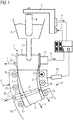
- a continuous caster has a mold 1.
- Liquid metal 3, for example liquid steel or liquid aluminum, is poured into the mold 1 via a dip tube 2.
- the inflow of the liquid metal 3 into the mold 1 is set by means of an inflow device 4.
- Is shown in Fig. 1 an embodiment of the inflow device 4 as a sealing plug.
- a position p of the inflow device 4 corresponds to a stroke position of the sealing plug.
- the inflow device 4 can be designed as a slide.
- the closed position p corresponds to the slide position.
- the liquid metal 3 located in the mold is cooled by means of cooling devices (not shown), so that it solidifies on the walls 1a of the mold 1 and thus forms a strand shell.
- a core 6 is still liquid. It only freezes later.
- the strand shell 5 and the core 6 together form a metal strand 7.
- the metal strand 7 is supported by means of a strand guide 8 and withdrawn from the mold 9.
- the strand guide 8 is arranged downstream of the mold 1. It has several roller segments 8a, which in turn have rollers 8b. Of the roller segments 8a and the rollers 8b are in Fig. 1 only a few shown. By means of the rollers 8b, the metal strand 7 is drawn out of the mold 1 at a withdrawal speed v.
- the liquid metal 3 forms a pour level 9 in the mold 1.
- the pour level 9 should be kept as constant as possible. Therefore - both in the prior art and in the present embodiment variant of the invention - the position p of the inflow device 4 is adjusted in order to adjust the inflow of the liquid metal 3 into the mold 1 accordingly.
- a measuring device 10 (known per se) is used to determine a height h of the meniscus 9 detected.
- the height h is fed to a control device 11 for the continuous caster.
- the control device 11 determines a manipulated variable S for the inflow device 4 according to a regulating method, which is explained in more detail below.
- the inflow device 4 is then controlled accordingly by the control device 11.
- the control device 11 outputs the manipulated variable S to an adjustment device 12 for the inflow device 4.
- roller spacings which correspond to the drawn strand thickness d, can be specifically adapted.
- at least one roller segment 8a has a fixed outer frame in the first segment, here approximately the roller segment 8a located directly below the mold 1 on the left.
- the opposite roller segment 8a, or the inner frame supporting it, can be pivoted about a pivot axis 23 which runs normal to the plane of the drawing.
- the pivot axis 23 can coincide with an axis of rotation of a roller 8b, here with the axis of rotation of the upper roller 8b, but could of course also be provided at another point.
- the top left roller segment 8a i.e. its outer frame, for example, could be fixed and the upper right roller segment 8a, i.e. its inner frame, for example, could be shifted parallel to and away from the left roller segment 8a normal to the strand guiding direction.
- each roller segment 8a has three rollers 8b on each side. But there could also be only two or more than three rollers 8b per roller segment 8a.
- Adjusting devices 24 are accordingly also provided in all segments 8a up to the solidification point D. The adjusting devices 24 can adjust the roller segments 8a in each case by pivoting or by parallel displacement, as already in Fig. 1 explained.
- the inner roller segment 8a of the first (top) segment is adjusted by pivoting about the pivot axis 23, the inner roller segment 8a of the second segment by parallel movement by means of two adjustment devices 24.
- the connection of the adjustment devices 24 to the control device 11 is not shown here.
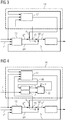
- the control device 11 implemented - see Fig. 3 - Among other things, a mold level regulator 13.
- the mold level regulator 13 is supplied with the height h of the mold level 9.
- a setpoint value h * for the height h of the meniscus 9 is also fed to the mold level controller 13.
- Further signals are also fed to the mold level controller 13.
- the further signals can be, for example, the width and the thickness of the cast metal strand 7 (or more generally the cross section of the metal strand 7), the withdrawal speed v (or its target value), 1 and others.
- the mold level controller 13 determines, based on the deviation of the height h of the mold level 9 from the setpoint h *, in particular a preliminary setpoint position p '* for the inflow device 4.
- the mold level controller 13 can use the other signals for its parameterization and / or to determine a precontrol signal pV .
- the control device 11 also implements a first observer 14.
- the first observer 14 is supplied with the height h of the mold level 9 and its target value h *, the further signals and a final target position p * for the inflow device 4.
- the first observer 14 determines a first compensation value k.
- the first compensation value k is applied to the preliminary target position p '* and the final target position p * is thus determined.
- the manipulated variable S with which the inflow device 4 is controlled is then determined.
- the control device 11 implements a subordinate position controller (not shown) for this purpose.
- first and second observers 14, 25 are not people, but rather functional blocks implemented in the control device 11.
- the difference between the preliminary target position p '* and the final target position p * corresponds to that of first observer 14 determined first compensation value k. Since the first compensation value k is determined by the first observer 14 and is therefore known to the first observer 14, the provisional target position p ′ * can also be supplied to the first observer 14 as an alternative to the final target position p *. Because due to the fact that the first compensation value k is known to the first observer 14, the first observer 14 can easily determine the final desired position p * from the preliminary desired position p ′ *.
- a tapping point 15, at which the (preliminary or final) target position p '*, p * is tapped, can thus, as required, be before or after a node 16 at which the first compensation value k is switched to the provisional target position p' *.
- the tapping point 15 should, however, lie in front of a node 16 'at which the pilot control signal pV is applied.
- the first observer 14 has a determination block 17.
- the height h of the mold level 9, the other signals and the final target position p * are fed to the determination block 17.
- the determination block 17 has a model of the continuous casting plant. Using the model, the determination block 17 uses the additional signals and the final target position p * to determine an expected (ie model-based calculated) height for the mold level 9. Using the expected height, the determination block 17 then determines an expected (ie model-based calculated) fluctuation value ⁇ h for the Height h of the meniscus 9, that is, the short-term fluctuation. For example, the determination block 17 can average the height h of the meniscus 9 and subtract the resulting mean value from the expected height. The determined fluctuation value ⁇ h thus reflects the expected fluctuation in the height h of the meniscus 9. Based on the fluctuation value ⁇ h, the determination block 17 then determines the first compensation value k.
- the first observer 14 with the determination block 17 is shown again.
- the determination block 17 is as shown in FIG Fig. 4 however, only one of several components of the first observer 14.
- the first observer 14 additionally has a first analysis element 18.
- the fluctuation value ⁇ h is fed to the first analysis element 18.
- the first analysis element 18 uses this to determine the frequency components of the fluctuation value ⁇ h.
- a second analysis element 19 is preferably also present.
- An additional signal Z is fed to the second analysis element 19.
- the second analysis element 19 determines the frequency components of the additional signal Z from this.
- the additional signal Z can be a pull-out force F with which the metal strand 7 is pulled out of the mold 1 by the rollers 8b of the strand guide 8.
- the pull-out force F is directed parallel to the pull-off speed v.
- it can be the withdrawal speed v itself.
- a force signal F 'as additional signal Z with which (at least) one of the roller segments 8a of the strand guide 8 is applied.
- the direction to which the force signal F 'is related is orthogonal to the withdrawal speed v.
- the additional signal Z can be a local strand thickness d, which is measured by means of a measuring device 21 in the strand guide 8.
- the first analysis element 18 feeds the frequency components determined by it to a selection element 22. If available, this also applies in an analogous manner to the second analysis element 19.
- the selection element 22 determines the wavelengths at which the associated frequency component of the fluctuation value ⁇ h, possibly also the associated frequency component of the additional signal Z, is above a threshold value S1, S2.
- the determination block 17 filters the height h of the pouring level 9 and the final target position p * for the wavelengths ⁇ i selected by the selection element 22.
- the determination block 17 determines the first compensation value k only on the basis of the filtered height h of the meniscus 9 and the filtered final target position p *.
- the determination block 17 does not take into account the other frequency components of the height h of the meniscus 9 and the final desired position p * in the context of the determination of the first compensation value k.
- the selection member 22 can also be predetermined wave ranges. In this case, the predetermined wave ranges represent an additional selection criterion.
- wavelengths at which the associated frequency component of the fluctuation value ⁇ h, possibly also the associated frequency component of the additional signal Z is above the respective threshold value S1, S2 are only selected if they are also within one of the predetermined wavelength ranges. Otherwise, they are not selected even if the associated frequency component of the fluctuation value ⁇ h, possibly also the associated frequency component of the additional signal Z, is above the respective threshold value S1, S2.
- the second observer 25 has identical components as the first observer 14, analyzes frequencies of the strand pumping after the mold 1 and specifies a second compensation value k ′ for the adjustment device 24.
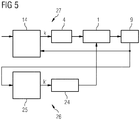
- a control circuit is shown which comprises a first and a second observer 14, 25.
- the first observer 14 specifies a first compensation value k for the inflow device 4 of the mold 1, as a result of which the mold level 9 in the mold 1 is regulated.
- the first observer 14 and the inflow device 4 of the mold 1 together represent a standard system for regulating the mold level 9 of the mold 1, which is used to compensate for frequencies in the first frequency range and thus represents a controller 27 for frequencies of the mold
- This single control method could be the second observer 25, but also another control or regulation method.
- the second observer or another sole control or regulation method would generally cover a larger frequency range than with two regulation methods. This frequency range could then cover, for example, the frequencies from 0 to 0.6 Hz, from 0 to 1 Hz, from 0 to 2 Hz, from 0 to 3 Hz, from 0 to 4 Hz or from 0 to 5 Hz.
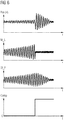
- Fig. 6 shows an example of suppressing cyclic oscillation.
- the time t is plotted along the horizontal axis.
- the position of the inflow device 4, labeled “Pos (4)” is shown in the first (top) illustration, and the height of the meniscus in the mold 1, labeled "M_L”, in the second illustration third illustration of the steel flow from the mold 1, labeled "St_Fl”.
- both the position of the inflow device 4 changes cyclically, as does the height of the meniscus and consequently the flow of steel from the mold.
- the cyclical fluctuations of the meniscus “M_L” are reduced.
- the mutual spacing of the rollers 8b in the uppermost segment would be changed cyclically in order to reduce the fluctuations in the pouring level.
Landscapes
- Engineering & Computer Science (AREA)
- Mechanical Engineering (AREA)
- Physics & Mathematics (AREA)
- Fluid Mechanics (AREA)
- General Physics & Mathematics (AREA)
- Continuous Casting (AREA)
Description
Die vorliegende Erfindung betrifft ein Verfahren zum Regeln einer Stranggießanlage,
wobei die Stranggießanlage eine Kokille und eine der Kokille nachgeordnete Strangführung aufweist,
wobei in die Kokille, insbesondere über eine Zuflusseinrichtung, flüssiges Metall gegossen wird, das an Wänden der Kokille erstarrt, so dass sich ein Metallstrang mit einer erstarrten Strangschale und einem noch flüssigem Kern bildet,
wobei der Metallstrang mittels beabstandet angeordneter Rollen der Strangführung aus der Kokille ausgezogen wird, wobei eine Messgröße ermittelt wird, die mit der Schwankung des sich in der Kokille ausbildenden Gießspiegels korreliert, diese Messgröße unter Einbindung von zumindest einer Rechenvorschrift verarbeitet und zur Verringerung der Schwankungen des Gießspiegels herangezogen wird. Die Erfindung umfasst auch eine entsprechende Vorrichtung.The present invention relates to a method for controlling a continuous casting plant,
wherein the continuous caster has a mold and a strand guide downstream of the mold,
wherein liquid metal is poured into the mold, in particular via an inflow device, which solidifies on the walls of the mold, so that a metal strand with a solidified strand shell and a core that is still liquid is formed,
the metal strand being pulled out of the mold by means of spaced-apart rollers of the strand guide, a measured variable being determined which correlates with the fluctuation of the mold level forming in the mold, this measurement variable is processed with the integration of at least one arithmetic rule and to reduce the fluctuations in the mold level is used. The invention also includes a corresponding device.
Das Verfahren kann beim kontinuierlichen Stranggießen eingesetzt werden. Generell kann das Verfahren bei allen Stranggießverfahren mit hohen Gießgeschwindigkeiten vorteilhaft angewendet werden, weil hier eine hochdynamische Regelung/Steuerung des Gießspiegels verstärkt notwendig ist.The process can be used in continuous casting. In general, the process can be used advantageously in all continuous casting processes with high casting speeds, because here a highly dynamic regulation / control of the casting level is increasingly necessary.
Beim kontinuierlichen Stranggießen ist es aus metallurgischer Sicht für die Ausbildung einer einheitlichen rissfreien Strangschale und einer homogenen, fehlerfreien Bramme generell von großer Bedeutung, dass Gießspiegelschwankungen in einem geforderten engen Toleranzbereich liegen.In the case of continuous casting, from a metallurgical point of view, it is essential for the formation of a uniform, crack-free strand shell and a homogeneous, defect-free slab It is generally of great importance that the mold level fluctuations are within a required narrow tolerance range.
Aufgrund der verschieden Phänomene, die den Gießspiegel beeinflussen, ist eine Regelung notwendig, um diesen konstant zu halten. Zu diesen Phänomenen zählen
- 1. Transiente Flüsse in die Kokille über die Zuflusseinrichtung:
- Verstopfen der Zuflusseinrichtung, die als Stopfen oder Schieber ausbildet sein kann, Verstopfen des Tauchrohres bzw. das Loslösen und Freispülen dieser Verstopfungen,
- Änderungen der Spülgasmenge (bei Stopfen wird meist in der Stopfenmitte Argon zur Erzeugung eines Überdrucks im Tauchrohr (Verhindern der Ansaugung von Luft) eingeblasen, was Turbulenzen im Stahlbad in der Kokille verursachen kann),
- Verteilergewichtsschwankungen verursacht z.B. durch nicht ideale Regelung des Zuflusses der Pfanne in den Verteiler (Verteiler=Zwischengefäß zwischen Pfanne und Kokille). Durch diese Druckänderung wird bei gleicher Stopfenöffnung ein anderer Durchfluss erzeugt, welchem mit Regelung entgegengewirkt werden muss,
- Viskositätsänderung des Stahls bei z.B. Pfannenwechsel.
- 2. Veränderung des Volumens an Flüssigstahl in der Kokille:
- Formatänderung in der Kokille
- Gießspiegel-Sollwertänderung (z.B. um Verschleißerscheinungen an dem Tauchrohr zu reduzieren)
- 3. Transiente Flüsse aus der Kokille:
- Strangpumpen
- Gießgeschwindigkeitsänderungen
- Verbogene Rollen
- Beabsichtigte Änderungen des Gießspaltes (z.B. Soft reduction)
- 1.Transient flows into the mold via the inflow device:
- Clogging of the inflow device, which can be designed as a plug or slide, clogging of the immersion tube or the loosening and flushing of these blockages,
- Changes in the amount of purging gas (in the case of stoppers, argon is usually blown in the middle of the stopper to generate an overpressure in the immersion tube (preventing the suction of air), which can cause turbulence in the steel bath in the mold),
- Fluctuations in the weight of the distributor are caused, for example, by non-ideal regulation of the inflow from the ladle into the distributor (distributor = intermediate vessel between ladle and mold). Due to this pressure change, a different flow rate is generated with the same plug opening, which must be counteracted with control.
- Changes in the viscosity of the steel when changing the ladle, for example.
- 2. Change in the volume of liquid steel in the mold:
- Format change in the mold
- Change of the mold level setpoint (e.g. to reduce signs of wear on the immersion tube)
- 3. Transient flows from the mold:
- Strand pumps
- Casting speed changes
- Bent rollers
- Intended changes to the casting gap (e.g. soft reduction)
All diese angeführten Phänomene führen zu Änderungen im Gießspiegel und diesen Änderungen muss entgegengewirkt werden. Da viele der Phänomene sehr plötzlich und unerwartet auftreten, spielt die Dynamik der Regelung eine sehr große Rolle.All of these listed phenomena lead to changes in the mold level and these changes must be counteracted become. Since many of the phenomena occur very suddenly and unexpectedly, the dynamics of the control play a very important role.
Vermehrt bei speziellen Stahlqualitäten, z. B. peritektischen Stählen oder ferritischen rostfreien Stählen, kommt es während des kontinuierlichen Gießvorganges zu einem unregelmäßig auftretenden Heben und Senken des Badspiegels (=zyklisch), das als "Strangpumpen" ("bulging", "mold level hunting") bekannt ist. Beim Strangpumpen ist ein ermittelbarer Zusammenhang zwischen einer mit dem Strangpumpen korrelierenden Messgröße und der Gießspiegelbewegung feststellbar. Es ist ein Merkmal dieser zyklisch auftretenden Störung, dass sie bei einer bestimmten Gießgeschwindigkeit mit einer Periodendauer auftritt, die in etwa der durchschnittlichen Rollenteilung (also dem Abstand der Rollen in Transportrichtung des Strangs) mindestens eines Bereiches der Strangführung entspricht. Im besonderen Maße tritt das Strangpumpen bei Stranggießanlagen auf, bei denen die Rollenteilung in der Strangführung über längere Abschnitte konstant ist (also mehrere in Transportrichtung des Strangs aufeinanderfolgende Rollen den gleichen Abstand zueinander haben). Neben der Grundwelle treten auch harmonische Oberwellen auf. Es konnte festgestellt werden, dass das Strangpumpen nur oberhalb einer empirisch zu ermittelnden kritischen Gießgeschwindigkeit auftritt, die wiederum von verwendetem Betriebsmittel und von der Betriebsweise abhängt. Eine Beschränkung der Gießgeschwindigkeit ist jedoch aus Sicht eines steten Trends zu Kapazitätssteigerungen nicht akzeptabel.Increasingly with special steel grades, e.g. B. peritectic steels or ferritic stainless steels, during the continuous casting process there is an irregular raising and lowering of the bath level (= cyclical), which is known as "bulk pumps" ("bulging", "mold level hunting"). In strand pumping, a determinable relationship between a measured variable correlating with strand pumping and the mold level movement can be established. It is a feature of this cyclically occurring disturbance that it occurs at a certain casting speed with a period which corresponds approximately to the average roller pitch (i.e. the distance between the rollers in the transport direction of the strand) of at least one area of the strand guide. Strand pumping occurs to a particular degree in continuous casting plants in which the pitch of the rolls in the strand guide is constant over longer sections (i.e. several rolls following one another in the transport direction of the strand have the same distance from one another). In addition to the fundamental wave, harmonic waves also occur. It was found that strand pumping only occurs above an empirically determined critical casting speed, which in turn depends on the equipment used and the operating mode. However, a limitation of the casting speed is not acceptable from the point of view of a steady trend towards capacity increases.
Ein regeltechnisches Verfahren zur Dämpfung der Bad- oder Gießspiegelschwankungen ist etwa bereits aus der
Aus der Patentanmeldung A 50301/2016 ist ein Regelverfahren für den Gießspiegel einer Stranggießanlage bekannt, wo die Höhe des Gießspiegels, der Sollwert für die Höhe des Gießspiegels sowie weitere Signale und die vorläufige oder eine endgültige Sollstellung einem Regler zugeführt werden und der Regler einen Kompensationswert ermittelt, der auf die vorläufige Sollstellung aufgeschaltet wird, so dass die endgültige Sollstellung, anhand derer in Verbindung mit der Iststellung der Zuflusseinrichtung eine Stellgröße für die Zuflusseinrichtung der Kokille ermittelt wird, mit der um den Kompensationswert korrigierten vorläufigen Sollstellung korrespondiert.From patent application A 50301/2016 a control method for the meniscus of a continuous caster is known, where the height of the meniscus, the setpoint for the height of the meniscus as well as other signals and the preliminary or a final setpoint position are fed to a controller and the controller determines a compensation value , which is switched to the provisional target position so that the final target position, based on which a manipulated variable for the inflow device of the mold is determined in conjunction with the actual position of the inflow device, corresponds to the provisional target position corrected by the compensation value.
Aus der
Bei den genannten Veröffentlichungen ist die Regelung des Gießspiegels durch die Einstellung der Zuflusseinrichtung der Kokille verwirklicht, welche nur eine niedrige Dynamik aufweist. Damit ist es nicht möglich, beispielsweise die beim kontinuierlichen Stranggießen ab einer Geschwindigkeit von größer gleich 2m/min auftretenden Frequenzen von größer gleich 0,6 Hz auszugleichen, welche Unregelmäßigkeiten im Stahlerzeugnis verursachen und somit die Qualität des Erzeugnisses mindern. Bislang wurde das Problem des "high frequency bulging", also der Wölbungskompensation des Strangpumpens mit Frequenzen größer gleich 0,6 Hz, noch nicht in den Dokumenten des Stands der Technik gelöst.In the publications mentioned, the control of the mold level is achieved by adjusting the inflow device of the mold, which only has a low dynamic having. This means that it is not possible, for example, to compensate for the frequencies of greater than or equal to 0.6 Hz that occur during continuous casting from a speed greater than or equal to 2 m / min, which cause irregularities in the steel product and thus reduce the quality of the product. So far, the problem of "high frequency bulging", that is to say the warpage compensation of the string pumping with frequencies greater than or equal to 0.6 Hz, has not yet been solved in the documents of the prior art.
Es ist daher eine Aufgabe der vorliegenden Erfindung die Nachteile des Stands der Technik zu überwinden und ein Verfahren zum Regeln einer Stranggießanlage vorzuschlagen, mittels dem eine höhere Dynamik und eine bessere Güte des Gießspiegels erreicht werden kann. Insbesondere sollen mit dem Verfahren Schwingungen des Strangpumpens auch in einem Frequenzbereich größer gleich 0,6 Hz ausgeglichen werden können.It is therefore an object of the present invention to overcome the disadvantages of the prior art and to propose a method for controlling a continuous caster by means of which higher dynamics and a better quality of the meniscus can be achieved. In particular, the method should be able to compensate for vibrations of the string pumping in a frequency range greater than or equal to 0.6 Hz.
Diese Aufgabe wird erfindungsgemäß gelöst durch ein Verfahren zum Regeln einer Stranggießanlage,
wobei die Stranggießanlage eine Kokille und eine der Kokille nachgeordnete Strangführung aufweist,
wobei in die Kokille, insbesondere über eine Zuflusseinrichtung, flüssiges Metall gegossen wird, das an Wänden der Kokille erstarrt, so dass sich ein Metallstrang mit einer erstarrten Strangschale und einem noch flüssigem Kern bildet,
wobei der Metallstrang mittels beabstandet angeordneter Rollen der Strangführung aus der Kokille ausgezogen wird, wobei eine Messgröße ermittelt wird, die mit der Schwankung des sich in der Kokille ausbildenden Gießspiegels korreliert, diese Messgröße unter Einbindung von zumindest einer Rechenvorschrift verarbeitet und zur Verringerung der Schwankungen des Gießspiegels herangezogen wird. Dabei ist vorgesehen, dass zur Verringerung der Schwankungen des Gießspiegels der gegenseitige Abstand von einander gegenüberliegenden Rollen der Strangführung vor dem Durcherstarrungspunkt zyklisch geändert wird, nämlich durch zyklische, den Schwankungen des Gießspiegels gegenläufige Änderung des Rollenabstands von einander gegenüberliegenden Rollen der Strangführung.According to the invention, this object is achieved by a method for controlling a continuous caster,
wherein the continuous caster has a mold and a strand guide downstream of the mold,
wherein liquid metal is poured into the mold, in particular via an inflow device, which solidifies on the walls of the mold, so that a metal strand with a solidified strand shell and a core that is still liquid is formed,
wherein the metal strand is pulled out of the mold by means of spaced-apart rollers of the strand guide, whereby a measured variable is determined which correlates with the fluctuation of the mold level forming in the mold, this measured variable is processed with the integration of at least one arithmetic rule and used to reduce the fluctuations in the meniscus. It is provided that, in order to reduce the fluctuations in the meniscus, the mutual distance between opposing rollers of the strand guide is changed cyclically before the point of solidification, namely by cyclically changing the roller distance from opposing rollers of the strand guide in the opposite direction to the fluctuations in the meniscus.
Es wird somit durch die Rechenvorschrift mittels der angestellten Rollen der Strangführung eine die Schwankungen ausregelnde Bewegung bewirkt. Der gegenseitige Abstand von einander gegenüberliegenden Rollen, zwischen denen der Strang geführt wird, wirkt sich direkt auf den flüssigen Kern des Strangs aus und verändert direkt den Gießspiegel, die Schwankungen des Gießspiegels werden sofort korrigiert. Dadurch wird eine genauere und dynamischere Regelung des Gießspiegels ermöglicht. Geringere Schwankungen des Gießspiegels bewirken wieder eine Qualitätsverbesserung des Strangs bzw. des Brammenendprodukts, wie z.B. eine Reduktion von Einschlüssen oder eine Rissvermeidung. Somit können auch phasenrichtig Schwingungen mit höheren Frequenzen durch Änderungen des Rollenabstands erzeugt werden. Die Bewegung der Zuflusseinrichtung hingegen, welche die Menge an flüssigem Metall festlegt, die in die Kokille gelangt, überträgt sich langsamer auf den Gießspiegel, weil ja noch unterhalb der Zuflusseinrichtung befindliches flüssiges Metall in die Kokille strömt, wenn die Stellung der Zuflusseinrichtung geändert wird. Insofern kann mit der Zuflusseinrichtung ein phasenrichtiges Ändern der Stellung der Zuflusseinrichtung nur bei niedrigeren Frequenzen erreicht werden bzw. kann durch diese zusätzliche, nicht kompensierbare Dynamik nur eine geringere Reglergüte erreicht werden.A movement that regulates the fluctuations is thus brought about by the calculation rule by means of the adjusted rollers of the strand guide. The mutual distance between opposing rollers, between which the strand is guided, has a direct effect on the liquid core of the strand and directly changes the pouring level, the fluctuations in the pouring level are corrected immediately. This enables a more precise and dynamic control of the meniscus. Smaller fluctuations in the meniscus result in an improvement in the quality of the strand or the final slab product, such as a reduction in inclusions or avoidance of cracks. Thus, in-phase vibrations with higher frequencies can also be generated by changing the roller spacing. The movement of the inflow device, on the other hand, which determines the amount of liquid metal that gets into the mold, is transferred more slowly to the mold level because liquid metal still below the inflow device flows into the mold when the position of the inflow device is changed. To this extent, the inflow device can only be used to change the position of the inflow device in the correct phase at lower frequencies, or this additional, non-compensable dynamic can only achieve a lower controller quality.
Erfindungsgemäß kann durch die Änderung des gegenseitigen Abstands von einander gegenüberliegenden Rollen eine Steuerung bzw. Regelung des Gießspiegels erreicht werden. Zwischen einander gegenüberliegenden Rollen liegt der Strang.According to the invention, a control or regulation of the pouring level can be achieved by changing the mutual spacing of opposing rollers. The strand lies between opposing rollers.
Das Verfahren benötigt lediglich anstellbare Rollen, welche vor dem Durcherstarrungspunkt angeordnet sind. Der Durcherstarrungspunkt ist, längs der Strangführung gesehen, jener Ort, wo der Kern des Strangs bzw. der Bramme bereits fest ist. Eine Regelung oder Steuerung des Gießspiegels ist aber nur vor der Durcherstarrung möglich, also dort, wo der Strang bzw. die Bramme im Kern noch flüssig ist. Die Rollen, deren gegenseitiger Abstand zur Verringerung der Schwankungen des Gießspiegels geändert wird, können, müssen aber nicht jene Rollen sein, die angetrieben sind, um den Metallstrang aus der Kokille zu ziehen.The method only requires adjustable rollers, which are arranged in front of the solidification point. The point of solidification, seen along the strand guide, is the place where the core of the strand or the slab is already solid. A regulation or control of the meniscus is only possible before solidification, i.e. where the strand or slab is still liquid in the core. The rollers, the mutual spacing of which is changed in order to reduce the fluctuations in the meniscus, can, but need not be those rollers that are driven to pull the metal strand out of the mold.
Der gegenseitige Abstand von einander gegenüberliegenden Rollen der Strangführung wird erfindungsgemäß zyklisch geändert. "Zyklisch geändert" bedeutet, dass einander gegenüberliegende Rollen periodisch ihren gegenseitigen Abstand zueinander ändern.According to the invention, the mutual distance between opposing rollers of the strand guide is changed cyclically. "Cyclically changed" means that opposing roles periodically change their mutual spacing.
Dabei kann das erfindungsgemäße Verfahren als einziges Regel- bzw. Steuerverfahren für den Gießspiegel eingesetzt werden (in Kombination mit der Durchflussregelung der Zuflusseinrichtung), oder auch in Kombination mit anderen Regel- bzw. Steuerverfahren für den Gießspiegel durch die Zuflusseinrichtung. Bei einer Kombination von Regel- bzw. Steuerverfahren können die einzelnen Regel- bzw. Steuerverfahren unabhängig voneinander betrieben werden.The method according to the invention can be used as the only regulating or control method for the meniscus (in combination with the flow control of the inflow device), or also in combination with other regulating or control methods for the mold level by the inflow device. With a combination of regulation or control methods, the individual regulation or control methods can be operated independently of one another.
Insbesondere wenn (auch) das Strangpumpen ("Bulging") ausgeglichen werden soll, können die zyklischen Änderungen in einem Frequenzbereich bis zu größer gleich 0,6 Hz, vorzugsweise bis 5 Hz, liegen. Die Änderung des Rollenabstands kann also mit Frequenzen erfolgen, die auch größer gleich 0,6 Hz sind, die insbesondere bis zu 5 Hz betragen.In particular if the bulk pumping ("bulging") is to be compensated for, the cyclical changes can be in a frequency range of up to greater than or equal to 0.6 Hz, preferably up to 5 Hz. The change in the roller spacing can therefore take place with frequencies that are also greater than or equal to 0.6 Hz, in particular up to 5 Hz.
So können etwa, falls nur das auf die Rollen wirkende Regel- bzw. Steuerverfahren angewendet wird, die zyklischen Änderungen des Rollenabstands im Frequenzbereich von 0 bis 0,6 Hz, von 0 bis 1 Hz, von 0 bis 2 Hz, von 0 bis 3 Hz, von 0 bis 4 Hz oder von 0 bis 5 Hz liegen. Wenn das erfindungsgemäße Regel- bzw. Steuerverfahren zur Verringerung der Schwankungen des Gießspiegels mit anderen Regel- bzw. Steuerverfahren zur Verringerung der Schwankungen des Gießspiegels kombiniert wird, etwa mit den eingangs genannten Regelverfahren unter Verwendung der Zuflusseinrichtung der Kokille, so könnte das bzw. könnten die anderen Verfahren einen niedrigeren Frequenzbereich abdecken (z.B. von 0 bis 0,6 Hz), während das erfindungsgemäße Verfahren nur den höheren Frequenzbereich abdeckt (z.B. von 0,6 bis 1 Hz, von 0,6 bis 2 Hz, von 0,6 bis 3 Hz, von 0,6 bis 4 Hz oder von 0,6 bis 5 Hz) .For example, if only the regulation or control method that acts on the rollers is used, the cyclical changes in the roller spacing in the frequency range from 0 to 0.6 Hz, from 0 to 1 Hz, from 0 to 2 Hz, from 0 to 3 Hz, from 0 to 4 Hz or from 0 to 5 Hz. If the regulating or control method according to the invention for reducing the fluctuations in the meniscus is combined with other regulating or control methods to reduce the fluctuations in the meniscus, for example with the control method mentioned above using the inflow device of the mold, that or could other methods cover a lower frequency range (e.g. from 0 to 0.6 Hz), while the method according to the invention only covers the higher frequency range (e.g. from 0.6 to 1 Hz, from 0.6 to 2 Hz, from 0.6 to 3 Hz, from 0.6 to 4 Hz or from 0.6 to 5 Hz).
In einer weiteren bevorzugten Ausführungsvariante des erfindungsgemäßen Verfahrens ist es vorgesehen, dass entlang der Strangführung beidseitig (also bezüglich des Strangs einander gegenüberliegend) mehrere Rollensegmente mit jeweils einer oder mehreren Rollen angeordnet sind, wobei zumindest ein Rollensegment normal zur Strangführungsrichtung verstellt wird. Der Begriff Rollensegment inkludiert auch sogenannte Gitter (="Grids") welche typischer Weise direkt unterhalb der Kokille angeordnet sind. Mit "normal zur Strangführungsrichtung" ist hier jede Verstellung gemeint, die im Wesentlichen normal zur Strangführungsrichtung verläuft. Dies umfasst sowohl ein Verschwenken als auch ein paralleles Verschieben eines Rollensegments. Die Strangführung ist in der Regel längs der Strangführungsrichtung in mehrere Segmente unterteilt, jedes Segment enthält zwei einander gegenüberliegende Rollensegmente.In a further preferred embodiment of the method according to the invention it is provided that several roller segments with one or more rollers each are arranged along the strand guide on both sides (i.e. opposite one another with respect to the strand), at least one roller segment being adjusted normal to the strand guide direction. The term roller segment also includes so-called grids, which are typically arranged directly below the mold. With "normal to the strand guiding direction" is meant here any adjustment that is essentially normal to the strand guiding direction. This includes both pivoting and parallel displacement of a roller segment. The strand guide is usually divided into several segments along the strand guide direction, each segment contains two opposing roller segments.
Vorteilhaft wird ein nahe der Kokille angeordnetes Rollensegment verstellt. Insofern kann vorgesehen sein, dass zumindest ein Rollensegment des ersten Segments verstellt wird. Es kann also vorgesehen sein, dass das oberste, also der Kokille am nächsten liegende, Rollensegment verstellt wird. Die große Verstärkung vom Aktor, der direkt eingreift, ermöglicht höchste Dynamik. Der Faktor bezüglich der Änderung des Rollenabstands im obersten Segment und sein Einfluss auf den Gießspiegel beträgt typischer Weise etwa 1:10 (schwenkbare Segmente) bzw. 1:20 (parallel verfahrende Segmente). Das bedeutet, dass durch eine Vergrößerung des Rollenabstands von 0,1 mm ein Fall des Gießspiegels in der Kokille um 1mm bzw. 2mm bewirkt wird. Hierdurch werden nur kleine Änderungen des Rollenabstands benötigt, welche in sehr kurzer Zeit bewerkstelligt werden können, um hohe Frequenzen des Strangpumpens mit bis zu 5 Hz kompensieren zu können.A roller segment arranged near the mold is advantageously adjusted. In this respect it can be provided that at least one roller segment of the first segment is adjusted. It can therefore be provided that the uppermost roller segment, ie the one closest to the mold, is adjusted. The great gain from the actuator that intervenes directly, enables maximum dynamics. The factor relating to the change in the roller spacing in the uppermost segment and its influence on the meniscus is typically around 1:10 (pivotable segments) or 1:20 (segments moving in parallel). This means that an increase in the distance between the rollers by 0.1 mm causes the meniscus in the mold to fall by 1 mm or 2 mm. As a result, only small changes in the roller spacing are required, which can be achieved in a very short time in order to be able to compensate for high frequencies of the string pumping of up to 5 Hz.
Durch die selektive Verstellung von einzelnen Rollensegmenten mit jeweils mehreren Rollen normal zur Strangführungsrichtung wird der Abstand zwischen gegenüber angeordneten Rollen den Schwankungen des Gießspiegels gegenläufig verringert, um Frequenzen der Schwankungen des Gießspiegels zu kompensieren. Durch diese Kompensation wird die Stabilität des kontinuierlichen Stranggießens deutlich erhöht und bei gleichbleibender Qualität des Stahlerzeugnisses werden hohe Gießgeschwindigkeiten ermöglicht.Through the selective adjustment of individual roller segments, each with several rollers normal to the strand guiding direction, the distance between oppositely arranged rollers is reduced in the opposite direction to the fluctuations in the meniscus in order to compensate for frequencies of the fluctuations in the meniscus. This compensation significantly increases the stability of continuous casting and enables high casting speeds while maintaining the same quality of the steel product.
Gemäß einer bevorzugten Ausführungsvariante des erfindungsgemäßen Verfahrens ist vorgesehen, dass zumindest ein Rollensegment verschwenkt wird. Die Schwenkachse liegt dabei vorzugsweise näher an der Kokille, sodass der von der Kokille weiter entfernte Teil des Rollensegments stärker ausgelenkt wird. Das äußere Rollensegment, also jenes an der nach außen gekrümmten Seite der Strangführung, könnte dabei fix sein, etwa durch einen feststehenden Außenrahmen verwirklicht sein. Das gegenüberliegende Rollensegment, also jenes an der nach innen gekrümmten Seite der Strangführung, wird verschwenkt. Es weist dazu z.B. einen Innenrahmen auf, der die Rollen trägt und der verschwenkbar gelagert ist. Denkbar wäre aber auch, dass das innere Rollensegment fix angebracht ist und das äußere Rollensegment gegenüber dem inneren Rollensegment verschwenkt wird.According to a preferred embodiment of the method according to the invention, it is provided that at least one roller segment is pivoted. The pivot axis is preferably closer to the mold, so that the part of the roller segment that is further away from the mold is deflected more strongly. The outer roller segment, that is, the one on the outwardly curved side of the strand guide, could be fixed, for example realized by a fixed outer frame. The opposite roller segment, i.e. the one on the inwardly curved side of the strand guide, is pivoted. For this purpose it has, for example, an inner frame which carries the rollers and which is pivotably mounted. But it would also be conceivable that the inner roller segment is fixedly attached and the outer roller segment is pivoted relative to the inner roller segment.
Alternativ zum Verschwenken von Rollensegmenten kann vorgesehen sein, dass zumindest ein Rollensegment in paralleler Ausrichtung zu einem gegenüber liegenden, entlang der Strangführung angeordneten Rollensegment verstellt wird, wodurch wiederum eine selektive Anpassung des Rollenabstands zwischen einzelnen Rollensegmenten und Rollen ermöglicht wird. Das äußere Rollensegment, also jenes an der nach außen gekrümmten Seite der Strangführung, könnte dabei fix sein, etwa durch einen feststehenden Außenrahmen verwirklicht sein. Das gegenüberliegende Rollensegment, also jenes an der nach innen gekrümmten Seite der Strangführung, wird dann in Richtung des äußeren Rollensegments translatorisch verschoben. Denkbar wäre auch hier, dass umgekehrt das innere Rollensegment fix ist, während das gegenüberliegende äußere Rollensegment translatorisch verschoben wird.As an alternative to pivoting roller segments, it can be provided that at least one roller segment is adjusted in parallel alignment to an opposite roller segment arranged along the strand guide, which in turn enables selective adjustment of the roller spacing between individual roller segments and rollers. The outer roller segment, that is, the one on the outwardly curved side of the strand guide, could be fixed, for example realized by a fixed outer frame. The opposite roller segment, that is, the one on the inwardly curved side of the strand guide, is then shifted translationally in the direction of the outer roller segment. It would also be conceivable here that, conversely, the inner roller segment is fixed, while the opposite outer roller segment is shifted in a translatory manner.
Durch den Abstand der Rollen zweier gegenüberliegender Rollensegmente kann das Volumen an flüssigem Metall im Kern des Stranges ermittelt und somit ein Rückschluss auf eine relative Gießspiegeländerung gezogen werden.Due to the distance between the rollers of two opposite roller segments, the volume of liquid metal in the core of the strand can be determined and a conclusion can be drawn about a relative change in the mold level.
Gemäß einer besonders bevorzugten Ausführungsvariante des erfindungsgemäßen Verfahrens wird zumindest ein Rollensegment durch eine Verstellvorrichtung verstellt, welche zumindest einen hydraulischen oder elektromechanischen Aktuator (z.B. Hydraulikzylinder oder elektrischer Spindelantrieb) umfasst. Um eine optimale Reaktionszeit bezüglich der Einstellung des Rollenabstands im Hinblick auf Gießspiegelschwankungen zu ermöglichen, wird vorzugsweise ein Proportionalventil für zumindest einen hydraulischen Zylinder verwendet.According to a particularly preferred variant of the method according to the invention, at least one roller segment is adjusted by an adjusting device which comprises at least one hydraulic or electromechanical actuator (e.g. hydraulic cylinder or electric spindle drive). A proportional valve is preferably used for at least one hydraulic cylinder in order to enable an optimal reaction time with regard to the setting of the roller spacing with regard to fluctuations in the mold level.
Eine Ausführungsform der Erfindung sieht vor, dass eine oder mehrere Frequenzen der Schwankungen des Gießspiegels in einem Frequenzbereich von 0 bis 5Hz, vorzugsweise gleichzeitig, detektiert und die Schwankungen mittels zyklisch gegenläufiger Änderung des Rollenabstands von Rollen der Strangführung ausgeglichen werden.One embodiment of the invention provides that one or more frequencies of the fluctuations in the pouring level are detected in a frequency range from 0 to 5 Hz, preferably simultaneously, and the fluctuations are compensated for by means of cyclically opposite changes in the roller spacing of rollers of the strand guide.
Eine dazu alternative Ausführungsform der Erfindung sieht vor, dass eine oder mehrere Frequenzen der Schwankungen des Gießspiegels in einem ersten Frequenzbereich, vorzugweise gleichzeitig, detektiert werden und die Schwankungen mittels zyklisch gegenläufiger Bewegungen der Zuflusseinrichtung (der Kokille) ausgeglichen werden, weitere Frequenzen der Schwankungen des Gießspiegels in einem zweiten Frequenzbereich detektiert und die Schwankungen mittels zyklisch gegenläufiger Änderung des Rollenabstands von Rollen der Strangführung ausgeglichen werden, wobei der zweite Frequenzbereich über dem ersten Frequenzbereich liegt.An alternative embodiment of the invention provides that one or more frequencies of the fluctuations in the meniscus are detected in a first frequency range, preferably simultaneously, and the fluctuations are compensated for by means of cyclically opposing movements of the inflow device (the mold), further frequencies of the fluctuations in the meniscus is detected in a second frequency range and the fluctuations are compensated for by means of cyclically opposite changes in the roller spacing of rollers of the strand guide, the second frequency range being above the first frequency range.
Diese Ausführungsvariante hat den Vorteil, dass niederfrequente Schwankungen des Gießspiegels, wie bisher, durch Regelung der Zuflusseinrichtung der Kokille ausgeglichen werden können, während nur die höherfrequenten Schwankungen des Gießspiegels durch die Regelung des Abstands der Rollen ausgeglichen werden. Es besteht somit die Möglichkeit bestehende Regelungen für die niederfrequenten Schwankungen mit einer zusätzlichen Regelung des Abstands der Rollen nachzurüsten.This embodiment variant has the advantage that low-frequency fluctuations in the meniscus, as before, can be compensated for by regulating the inflow device of the mold, while only the higher-frequency fluctuations in the mold level are compensated for by regulating the distance between the rollers. There is thus the possibility of retrofitting existing regulations for the low-frequency fluctuations with an additional regulation of the distance between the rollers.
Dabei könnten entweder die Regelung für die Zuflusseinrichtung und/oder die Regelung für den Rollenabstand mit Hilfe eines sogenannten Beobachters realisiert werden, wie dies in der A 50301/2016 gezeigt ist. Unter einem Beobachter versteht man entsprechend der Regelungstechnik ein System, das aus bekannten Eingangsgrößen (z. B. Stellgrößen oder messbaren Störgrößen) und Ausgangsgrößen (Messgrößen) eines beobachteten Referenzsystems nicht messbare Größen (Zustände) rekonstruiert. Dazu bildet er das beobachtete Referenzsystem als Modell nach und führt mit einem Regler die messbaren, und deshalb mit dem Referenzsystem vergleichbaren, Zustandsgrößen nach. So wird vermieden, dass ein Modell einen über die Zeit wachsenden Fehler generiert.Either the control for the inflow device and / or the control for the roller spacing could be implemented with the help of a so-called observer, as shown in A 50301/2016. According to control engineering, an observer is understood to be a system that reconstructs non-measurable variables (states) from known input variables (e.g. manipulated variables or measurable disturbance variables) and output variables (measured variables) of an observed reference system. To do this, it simulates the observed reference system as a model and uses a controller to track the measurable state variables that are therefore comparable with the reference system. This prevents a model from generating an error that grows over time.
Vorzugsweise weist die Verfahrensvariante mit zwei Frequenzbereichen einen ersten Beobachter auf, der einen ersten Kompensationswert für eine Sollstellung der Zuflusseinrichtung auf Basis von Frequenzen des ersten Frequenzbereichs ermittelt, und einen zweiten Beobachter, der einen zweiten Kompensationswert für den Rollenabstand der Rollen der Strangführung auf Basis von Frequenzen des zweiten Frequenzbereichs ermittelt.The method variant with two frequency ranges preferably has a first observer who determines a first compensation value for a target position of the inflow device on the basis of frequencies of the first frequency range, and a second observer who determines a second compensation value for the roller spacing of the rollers of the strand guide on the basis of frequencies of the second frequency range is determined.
Hierdurch wird der Gießspiegel in der Kokille sowohl durch den Zufluss in die Kokille als auch durch die Führung des Metallstranges, vorzugsweise im obersten Segment, nach der Kokille geregelt. Außerdem ist vorteilhaft, dass durch die Separation der Beobachter auf verschiedene Aktuatoren (einerseits der erste Kompensationswert für die Sollstellung der Zuflusseinrichtung im Fall des ersten Beobachters und andererseits der zweite Kompensationswert für den Rollenabstand der Rollen der Strangführung), keine Störung zwischen den Beobachtern beziehungsweise keine negative Beeinflussung der Beobachter untereinander entstehen kann.As a result, the mold level in the mold is regulated both by the inflow into the mold and by the guidance of the metal strand, preferably in the uppermost segment, after the mold. It is also advantageous that by separating the observers from different actuators (on the one hand the first compensation value for the target position of the inflow device in the case of the first observer and on the other hand the second compensation value for the roller spacing of the rollers of the strand guide), no interference between the observers or no negative ones The observers can influence one another.
In einer besonders bevorzugten Ausführungsvariante des Verfahrens mit zwei Frequenzbereichen arbeitet der erste Beobachter in einem Frequenzbereich kleiner gleich 0,6 Hz und der zweite Beobachter in einem Frequenzbereich von größer gleich 0,6 Hz, vorzugsweise zwischen 0,6 bis 5 Hz,. Durch die getrennten Frequenzbereiche der zwei Beobachter ergibt sich der Vorteil, dass es nicht zu Interferenzen zwischen den Beobachtern durch Überlappung der Frequenzfenster kommen kann, wodurch zum Beispiel der Sollwert für den Aktuator der Gießspiegelregelung gleich bleibt (im Falle keiner Wölbungen) oder kleiner als im Falle ohne sekundärer Kompensation. Hierdurch werden Gießspiegelschwankungen zusätzlich reduziert und Qualitätsverluste des Stahlerzeugnisses stark vermindert. Hierzu gilt es zu erwähnen, dass im Stand der Technik bislang kein Verfahren bekannt ist, welches Frequenzen der Schwankungen des Gießspiegels von größer gleich 0,6 Hz kompensieren kann, weshalb durch die Verwendung des erfindungsgemäßen Verfahrens hohe Gießgeschwindigkeiten bei hoher Qualität des Stahlerzeugnisses verwendet werden können, wodurch sich die Produktivität von Anlagen zum kontinuierlichen Strangguss bzw. zur kontinuierlichen Banderzeugung deutlich erhöht.In a particularly preferred embodiment of the method with two frequency ranges, the first observer works in a frequency range less than or equal to 0.6 Hz and the second observer in a frequency range greater than or equal to 0.6 Hz, preferably between 0.6 and 5 Hz. The separate frequency ranges of the two observers have the advantage that there can be no interference between the observers due to the overlapping of the frequency windows, so that, for example, the setpoint for the actuator of the mold level control remains the same (in the case of no bulges) or smaller than in the case without secondary compensation. In this way, fluctuations in the mold level are additionally reduced and quality losses in the steel product are greatly reduced. In this regard, it should be mentioned that the prior art has not yet known any method which can compensate for frequencies of fluctuations in the meniscus greater than or equal to 0.6 Hz, which is why the use of the According to the method according to the invention, high casting speeds with high quality of the steel product can be used, which significantly increases the productivity of systems for continuous casting or for continuous strip production.
Eine mögliche Vorrichtung zur Durchführung des erfindungsgemäßen Verfahrens umfasst Mittel zur Einbringung einer Metallschmelze in eine Kokille, eine Strangführung umfassend Rollen und eine Messeinrichtung zur Messung von Schwankungen des Gießspiegels, die mit einer Steuereinrichtung verbunden ist. Dabei ist eine mit der Steuereinrichtung verbundene Verstellvorrichtung vorgesehen, welche dazu ausgebildet ist Schwankungen des Gießspiegels durch zyklische, den Schwankungen des Gießspiegels gegenläufige Änderung des Rollenabstands von einander gegenüberliegenden Rollen der Strangführung zu verringern, insbesondere auszugleichen.A possible device for carrying out the method according to the invention comprises means for introducing a metal melt into a mold, a strand guide comprising rollers and a measuring device for measuring fluctuations in the meniscus, which is connected to a control device. An adjusting device connected to the control device is provided, which is designed to reduce, in particular compensate for, fluctuations in the meniscus due to cyclical changes in the roller spacing from opposing rollers of the strand guide counter to the fluctuations in the meniscus.
Wie bereits im Zusammenhang mit dem Verfahren besprochen, kann vorgesehen sein, dass die Verstellvorrichtung für zyklische Änderungen des Rollenabstands in einem Frequenzbereich bis zu größer gleich 0,6 Hz, vorzugsweise bis 5 Hz, ausgelegt ist. Die Verstellvorrichtung kann zumindest einen hydraulischen oder elektromechanischen Aktuator, wie einen hydraulischen Zylinder oder einen elektrischen Spindelantrieb, umfassen. Selbstverständlich kann die Verstellvorrichtung für zyklische Änderungen des Rollenabstands in einem Frequenzbereich ab 0 Hz, vorzugsweise bis 5 Hz, ausgelegt sein, etwa ebenso mit hydraulischen oder elektromechanischen Aktuatoren, wie einem hydraulischen Zylinder oder einem elektrischen Spindelantrieb.As already discussed in connection with the method, it can be provided that the adjusting device is designed for cyclical changes in the roller spacing in a frequency range up to greater than or equal to 0.6 Hz, preferably up to 5 Hz. The adjusting device can comprise at least one hydraulic or electromechanical actuator, such as a hydraulic cylinder or an electric spindle drive. Of course, the adjustment device can be designed for cyclical changes in the roller spacing in a frequency range from 0 Hz, preferably up to 5 Hz, for example with hydraulic or electromechanical actuators such as a hydraulic cylinder or an electric spindle drive.
Wie ebenfalls bereits im Zusammenhang mit dem Verfahren besprochen, kann vorgesehen sein, dass entlang der Strangführung beidseitig mehrere Rollensegmente mit jeweils einer oder mehreren Rollen angeordnet sind, wobei zumindest ein Rollensegment mittels der Verstellvorrichtung normal zur Strangführungsrichtung verstellbar ist.As already discussed in connection with the method, it can be provided that a plurality of roller segments, each with one or more rollers, are arranged along the strand guide on both sides, with at least a roller segment can be adjusted normal to the strand guide direction by means of the adjustment device.
Beispielsweise kann im obersten, also ersten, Segment zumindest ein Rollensegment verstellbar sein. Dabei kann zumindest ein Rollensegment verschwenkbar sein. Oder zumindest ein Rollensegment ist in paralleler Ausrichtung zu einem gegenüber liegenden, entlang der Strangführung angeordneten Rollensegment verstellbar. Vorzugsweise werden die Rollensegmente so verstellt, dass keine sprunghaften Segmentübergänge (=Dickenänderungen) entstehen, dies wird "verlinkt verfahren" genannt.For example, at least one roller segment can be adjustable in the uppermost, ie first, segment. At least one roller segment can be pivoted. Or at least one roller segment can be adjusted in a parallel alignment to an opposite roller segment arranged along the strand guide. The roller segments are preferably adjusted in such a way that there are no sudden segment transitions (= changes in thickness); this is called "linked movement".
Entsprechend zur Verfahrensvariante mit zwei Frequenzbereichen sieht eine Variante der erfindungsgemäßen Vorrichtung vor, dass mittels der Messeinrichtung eine oder mehrere Frequenzen der Schwankungen des Gießspiegels in einem ersten Frequenzbereich, vorzugsweise gleichzeitig, detektierbar sind und diese Schwankungen mittels zyklisch gegenläufiger Bewegungen einer Zuflusseinrichtung der Kokille ausgleichbar sind, und dass mittels der Messeinrichtung weitere Frequenzen der Schwankungen des Gießspiegels in einem zweiten Frequenzbereich detektierbar sind und diese Schwankungen mittels zyklisch gegenläufiger Änderung des Rollenabstands von Rollen der Strangführung mittels der Verstellvorrichtung ausgleichbar sind, wobei der zweite Frequenzbereich über dem ersten Frequenzbereich liegt.Corresponding to the method variant with two frequency ranges, a variant of the device according to the invention provides that one or more frequencies of the fluctuations in the mold level can be detected in a first frequency range, preferably simultaneously, by means of the measuring device, and these fluctuations can be compensated for by means of cyclically opposite movements of an inflow device of the mold and that by means of the measuring device further frequencies of the fluctuations in the meniscus can be detected in a second frequency range and that these fluctuations can be compensated for by means of the adjusting device by means of cyclically opposite changes in the roller spacing of the rollers of the strand guide, the second frequency range being above the first frequency range.
Dies kann beispielsweise wieder mittels eines ersten und/oder eines zweiten Beobachters ausgeführt sein. Der zweite Beobachter umfasst die gleichen Bestandteile wie der erste Beobachter und funktioniert analog, mit dem Unterschied, dass er einen zweiten Kompensationswert vorgibt, und zwar nicht der Zuflusseinrichtung für die Kokille, sondern der Verstellvorrichtung, die sich in - vorzugsweise dem obersten Segment - der Strangführung befindet.This can again be carried out, for example, by means of a first and / or a second observer. The second observer comprises the same components as the first observer and works analogously, with the difference that it specifies a second compensation value, namely not the inflow device for the mold, but the adjustment device, which is located in - preferably the uppermost segment - the strand guide is located.
Das erfindungsgemäße Verfahren bzw. die erfindungsgemäße Vorrichtung ist auf bestehende Stranggießanlagen mit obig genannten Anforderungen anwendbar und stellt eine deutliche Verbesserung der Qualität von kontinuierlich gegossenem Stahl bei einer deutlich höheren Gießgeschwindigkeit und dadurch gesteigerten Produktivität dar. Durch diese neue Art der Gießspiegelregelung wird es ermöglicht hochdynamische Effekte, die bis dato nicht ausregelbar waren, zu unterdrücken, z.B. hochdynamisches Strangpumpen mit Frequenzen über 0,6 Hz.The method according to the invention and the device according to the invention can be applied to existing continuous casting plants with the above requirements and represents a significant improvement in the quality of continuously cast steel at a significantly higher casting speed and thus increased productivity. This new type of mold level control enables highly dynamic effects that could not be regulated up to now, e.g. highly dynamic string pumping with frequencies above 0.6 Hz.
Die Erfindung wird nun anhand eines Ausführungsbeispiels näher erläutert. Die Zeichnungen sind beispielhaft und sollen den Erfindungsgedanken zwar darlegen, ihn aber keinesfalls einengen oder gar abschließend wiedergeben.
- Fig. 1
- zeigt eine schematische Ansicht eines Abschnittes einer erfindungsgemäßen Stranggießanlage,
- Fig. 2
- zeigt eine schematische Ansicht einer erfindungsgemäßen Strangführung,
- Fig. 3
- zeigt den schematischen Aufbau einer Steuereinrichtung des Standes der Technik,
- Fig. 4
- zeigt Details des ersten Beobachters aus
Fig. 3 , - Fig. 5
- zeigt schematisch einen erfindungsgemäßen Kontrollkreis umfassend einen ersten und zweiten Beobachter,
- Fig. 6
- zeigt den zeitlichen Verlauf verschiedener Größen bei der Regelung einer Stranggießanlage.
- Fig. 1
- shows a schematic view of a section of a continuous caster according to the invention,
- Fig. 2
- shows a schematic view of a strand guide according to the invention,
- Fig. 3
- shows the schematic structure of a control device of the prior art,
- Fig. 4
- shows details of the first observer
Fig. 3 , - Fig. 5
- shows schematically a control circuit according to the invention comprising a first and second observer,
- Fig. 6
- shows the variation over time of various variables in the control of a continuous caster.
Gemäß
Das in der Kokille befindliche flüssige Metall 3 wird mittels Kühleinrichtungen (nicht dargestellt) gekühlt, so dass es an Wänden 1a der Kokille 1 erstarrt und sich somit eine Strangschale bildet. Ein Kern 6 ist jedoch noch flüssig. Er erstarrt erst später. Die Strangschale 5 und der Kern 6 bilden zusammen einen Metallstrang 7. Der Metallstrang 7 wird mittels einer Strangführung 8 gestützt und aus der Kokille 9 abgezogen. Die Strangführung 8 ist der Kokille 1 nachgeordnet. Sie weist mehrere Rollensegmente 8a auf, die ihrerseits wieder Rollen 8b aufweisen. Von den Rollensegmenten 8a und den Rollen 8b sind in
Das flüssige Metall 3 bildet in der Kokille 1 einen Gießspiegel 9. Der Gießspiegel 9 soll möglichst konstant gehalten werden. Daher wird - sowohl im Stand der Technik als auch bei der vorliegenden Ausführungsvariante der Erfindung - die Stellung p der Zuflusseinrichtung 4 nachgeführt, um den Zufluss des flüssigen Metalls 3 in die Kokille 1 entsprechend einzustellen. Mittels einer (an sich bekannten) Messeinrichtung 10 wird eine Höhe h des Gießspiegels 9 erfasst. Die Höhe h wird einer Steuereinrichtung 11 für die Stranggießanlage zugeführt. Die Steuereinrichtung 11 ermittelt gemäß einem Regelverfahren, das nachstehend näher erläutert wird, eine Stellgröße S für die Zuflusseinrichtung 4. Die Zuflusseinrichtung 4 wird sodann von der Steuereinrichtung 11 entsprechend angesteuert. In der Regel gibt die Steuereinrichtung 11 die Stellgröße S an eine Verstelleinrichtung 12 für die Zuflusseinrichtung 4 aus. Bei der Verstelleinrichtung 12 kann es sich beispielsweise um eine Hydraulikzylindereinheit handeln. Frequenzen des Strangpumpens nach der Kokille werden messtechnisch erfasst und/oder gemäß f=vc/pRoll ∗n ermittelt, wobei Vc der Abzugsgeschwindigkeit des Stranges, f der Wölbungsfrequenz, n der Anzahl der harmonischen Frequenzen (1,2 etc.) und pRoll den Rollenabständen entspricht.The
Mittels Schwenkachse 23 und/oder Verstellvorrichtung 24 können die Rollenabstände, welche der eingezeichneten Strangdicke d entsprechen, gezielt angepasst werden. Dies kann, wie hier in
Nicht in
Alternativ zum Verschwenken könnte das linke oberste Rollensegment 8a, also etwa dessen Außenrahmen, fest sein und das rechte obere Rollensegment 8a, also etwa dessen Innenrahmen, normal zur Strangführungsrichtung zum linken Rollensegment 8a hin und von diesem weg parallel verschoben werden. Dadurch ändert sich der Rollenabstand aller Rollenpaare jeweils um den gleichen Betrag. Dies könnte ebenfalls mit einem oder mehreren (entlang der Strangbreite und/oder entlang der Strangführungsrichtung verteilte) hydraulischen Zylindern erfolgen.As an alternative to pivoting, the top
In
Die Steuereinrichtung 11 implementiert - siehe
Die Steuereinrichtung 11 implementiert weiterhin einen ersten Beobachter 14. Dem ersten Beobachter 14 werden die Höhe h des Gießspiegels 9 und deren Sollwert h*, die weiteren Signale und eine endgültige Sollstellung p* für die Zuflusseinrichtung 4 zugeführt. Der erste Beobachter 14 ermittelt einen ersten Kompensationswert k. Der erste Kompensationswert k wird auf die vorläufige Sollstellung p'* aufgeschaltet und so die endgültige Sollstellung p* ermittelt. Anhand der Abweichung der Iststellung p von der endgültigen Sollstellung p* wird dann die Stellgröße S ermittelt, mit der die Zuflusseinrichtung 4 angesteuert wird. In der Regel implementiert die Steuereinrichtung 11 hierzu einen unterlagerten Positionsregler (nicht dargestellt).The control device 11 also implements a
Der guten Ordnung halber sei nochmals betont, dass es sich bei dem ersten und zweiten Beobachter 14, 25 nicht um Personen handelt, sondern um in der Steuereinrichtung 11 implementierte Funktionsblöcke.For the sake of clarity, it should be emphasized again that the first and
Die Differenz zwischen der vorläufigen Sollstellung p'* und der endgültigen Sollstellung p* korrespondiert mit dem vom ersten Beobachter 14 ermittelten ersten Kompensationswert k. Da der erste Kompensationswert k vom ersten Beobachter 14 ermittelt wird und dem ersten Beobachter 14 daher bekannt ist, kann dem ersten Beobachter 14 alternativ zur endgültigen Sollstellung p* auch die vorläufige Sollstellung p'* zugeführt werden. Denn aufgrund des Umstands, dass der erste Kompensationswert k dem ersten Beobachter 14 bekannt ist, kann der erste Beobachter 14 ohne weiteres aus der vorläufigen Sollstellung p'* die endgültige Sollstellung p* ermitteln. Ein Abgreifpunkt 15, an dem die (vorläufige oder endgültige) Sollstellung p'*, p* abgegriffen wird, kann somit nach Bedarf vor oder nach einem Knotenpunkt 16 liegen, an dem der erste Kompensationswert k auf die vorläufige Sollstellung p'* aufgeschaltet wird. Der Abgreifpunkt 15 sollte jedoch vor einem Knotenpunkt 16' liegen, an dem das Vorsteuersignal pV aufgeschaltet wird.The difference between the preliminary target position p '* and the final target position p * corresponds to that of
Der erste Beobachter 14 weist einen Ermittlungsblock 17 auf. Dem Ermittlungsblock 17 werden die Höhe h des Gießspiegels 9, die weiteren Signale und die endgültige Sollstellung p* zugeführt. Der Ermittlungsblock 17 weist ein Modell der Stranggießanlage auf. Mittels des Modells ermittelt der Ermittlungsblock 17 anhand der weiteren Signale und der endgültigen Sollstellung p* eine erwartete (d.h. modellgestützt berechnete) Höhe für den Gießspiegel 9. Anhand der erwarteten Höhe ermittelt der Ermittlungsblock 17 sodann einen erwarteten (d.h. modellgestützt berechneten) Schwankungswert δh für die Höhe h des Gießspiegels 9, das heißt die kurzfristige Schwankung. Beispielsweise kann der Ermittlungsblock 17 eine Mittelung der Höhe h des Gießspiegels 9 vornehmen und den sich ergebenden Mittelwert von der erwarteten Höhe subtrahieren. Der ermittelte Schwankungswert δh spiegelt somit die erwartete Schwankung der Höhe h des Gießspiegels 9 wider. Anhand des Schwankungswerts δh ermittelt der Ermittlungsblock 17 sodann den ersten Kompensationswert k.The
Die bisher in Verbindung mit
Bei dem Zusatzsignal Z kann es sich um eine Auszugskraft F handeln, mit der der Metallstrang 7 von den Rollen 8b der Strangführung 8 aus der Kokille 1 ausgezogen wird. Die Auszugskraft F ist parallel zur Abzugsgeschwindigkeit v gerichtet. Alternativ kann es sich um die Abzugsgeschwindigkeit v selbst handeln. Diese beiden Alternativen sind bevorzugt. Es ist jedoch ebenso möglich, als Zusatzsignal Z beispielsweise ein Kraftsignal F' heranzuziehen, mit dem (mindestens) eines der Rollensegmente 8a der Strangführung 8 beaufschlagt wird. Die Richtung, auf die das Kraftsignal F' bezogen ist, ist orthogonal zur Abzugsgeschwindigkeit v. Wiederum alternativ kann es sich bei dem Zusatzsignal Z um eine lokale Strangdicke d handeln, die mittels einer Messeinrichtung 21 in der Strangführung 8 gemessen wird. Das erste Analyseelement 18 führt die von ihm ermittelten Frequenzanteile einem Auswahlglied 22 zu. Falls vorhanden, gilt dies in analoger Weise auch für das zweite Analyseelement 19. Das Auswahlglied 22 ermittelt in Verbindung mit der Abzugsgeschwindigkeit v die zugehörigen Wellenlängen, die mit den Frequenzanteilen des Schwankungswerts δh und gegebenenfalls auch des Zusatzsignals Z korrespondieren. Die Abzugsgeschwindigkeit v wird zu diesem Zweck dem ersten Beobachter 14 und innerhalb des ersten Beobachters 14 dem Auswahlglied 22 zugeführt. Das Auswahlglied 22 ermittelt die Wellenlängen, bei denen der zugehörige Frequenzanteil des Schwankungswertes δh gegebenenfalls auch der zugehörige Frequenzanteil des Zusatzsignals Z oberhalb eines Schwellenwertes S1, S2 liegt. Der jeweilige Schwellenwert S1, S2 kann individuell für die Frequenzanteile des Schwankungswertes δh einerseits und die Frequenzanteile des Zusatzsignals Z andererseits bestimmt sein. Diese Wellenlängen werden vom Auswahlglied 22 vorselektiert. Innerhalb jeweils in sich zusammenhängender Bereiche von vorselektierten Wellenlängen des Schwankungswerts δh bestimmt das Auswahlglied 22 sodann diejenigen Wellenlängen λi (i = 1, 2, 3, ...), bei denen der jeweilige Frequenzanteil des Schwankungswerts δh ein Maximum annimmt. Die Anzahl an Wellenlängen λi ist nicht beschränkt. Diese Wellenlängen λi selektiert das Auswahlglied 22 (endgültig). Die selektierten Wellenlängen λi führt das Auswahlglied 22 dem Ermittlungsblock 17 zu. Der Ermittlungsblock 17 führt für die vom Auswahlglied 22 selektierten Wellenlängen λi eine Filterung der Höhe h des Gießspiegels 9 und der endgültigen Sollstellung p* durch. Den ersten Kompensationswert k ermittelt der Ermittlungsblock 17 lediglich anhand der gefilterten Höhe h des Gießspiegels 9 und der gefilterten endgültigen Sollstellung p*. Die anderen Frequenzanteile der Höhe h des Gießspiegels 9 und der endgültigen Sollstellung p* lässt der Ermittlungsblock 17 im Rahmen der Ermittlung des ersten Kompensationswerts k unberücksichtigt. Dem Auswahlglied 22 können weiterhin vorbestimmte Wellenbereiche vorgegeben sein. In diesem Fall stellen die vorbestimmten Wellenbereiche ein zusätzliches Auswahlkriterium dar. Insbesondere werden Wellenlängen, bei denen der zugehörige Frequenzanteil des Schwankungswertes δh gegebenenfalls auch der zugehörige Frequenzanteil des Zusatzsignals Z oberhalb des jeweiligen Schwellenwertes S1, S2 liegt, nur dann selektiert, wenn sie zusätzlich innerhalb eines der vorbestimmten Wellenlängenbereiche liegen. Anderenfalls werden sie auch dann nicht selektiert, wenn der zugehörige Frequenzanteil des Schwankungswertes δh gegebenenfalls auch der zugehörige Frequenzanteil des Zusatzsignals Z oberhalb des jeweiligen Schwellenwertes S1, S2 liegt.The additional signal Z can be a pull-out force F with which the metal strand 7 is pulled out of the mold 1 by the
Wie bereits zuvor erwähnt, weist der zweite Beobachter 25 identische Bestandteile wie der erste Beobachter 14 auf, analysiert Frequenzen des Strangpumpens nach der Kokille 1 und gibt einen zweiten Kompensationswert k' für die Verstellvorrichtung 24 vor. In
Statt des ersten Beobachters 14, der die Zuflusseinrichtung 4 der Kokille 1 steuert bzw. regelt, könnte ein anderes Regelverfahren vorgesehen sein, und/oder statt des zweiten Beobachters 25, der die Verstellvorrichtung 24 der Rollen 8b steuert bzw. regelt, könnte ein anderes Regelverfahren vorgesehen sein.Instead of the
Es könnte auch nur ein einziges Regelverfahren vorgesehen sein, dass nur die Verstellvorrichtung 24 der Rollen 8b steuert bzw. regelt, während die Zuflusseinrichtung 4 der Kokille 1 gar nicht zum Ausregeln der Schwankungen des Gießspiegels verwendet wird. Dieses einzige Regelverfahren könnte der zweite Beobachter 25 sein, aber auch ein anderes Steuer- oder Regelverfahren. Dabei würde der zweite Beobachter bzw. ein anderes alleiniges Steuer- oder Regelverfahren in der Regel einen größeren Frequenzbereich abdecken als bei zwei Regelverfahren. Dieser Frequenzbereich könnte dann z.B. die Frequenzen von 0 bis 0,6 Hz, von 0 bis 1 Hz, von 0 bis 2 Hz, von 0 bis 3 Hz, von 0 bis 4 Hz oder von 0 bis 5 Hz abdecken.It could also be provided only a single control method that only controls or regulates the adjusting
- 11
- KokilleMold
- 1a1a
- Wände der KokilleWalls of the mold
- 22
- TauchrohrDip tube
- 33
- flüssiges Metallliquid metal
- 44th
- ZuflusseinrichtungInflow device
- 55
- StrangschaleStrand shell
- 66th
- Kerncore
- 77th
- MetallstrangMetal strand
- 88th
- StrangführungStrand guide
- 8a8a
- RollensegmenteRoller segments
- 8b8b
- Rollenroll
- 99
- GießspiegelMold level
- 1010
- MesseinrichtungMeasuring device
- 1111
- SteuereinrichtungControl device
- 1212
- VerstelleinrichtungAdjusting device
- 1313
- GießspiegelreglerMold level regulator
- 1414th
- erster Beobachterfirst observer
- 1515th
- AbgreifpunktTapping point
- 16, 16'16, 16 '
- KnotenpunkteNodes
- 1717th
- ErmittlungsblockInvestigation block
- 18, 1918, 19
- AnalyseelementeAnalysis elements
- 2020th
- TemperatursensorTemperature sensor
- 2121st
- MesseinrichtungMeasuring device
- 2222nd
- AuswahlgliedSelection member
- 2323
- SchwenkachseSwivel axis
- 2424
- VerstellvorrichtungAdjusting device
- 2525th
- zweiter Beobachtersecond observer
- 2626th
- Controller für Frequenzen des 2. FrequenzbereichsController for frequencies of the 2nd frequency range
- 2727
- Controller für Frequenzen des 1. FrequenzbereichsController for frequencies of the 1st frequency range
- DD.
- DurcherstarrungspunktFreezing point
- dd
- StrangdickeStrand thickness
- FF.
- AuszugskraftPull-out force
- F'F '
- KraftsignalForce signal
- hH
- Höhe des GießspiegelsHeight of the mold level
- h*H*
- Sollwert für die Höhe des GießspiegelsSetpoint for the height of the meniscus
- kk
- erster Kompensationswertfirst compensation value
- k'k '
- zweiter Kompensationswertsecond compensation value
- pp
- Stellung der ZuflusseinrichtungPosition of the inflow device
- p*, p'*p *, p '*
- SollstellungenDebit positions
- pVpV
- VorsteuersignalPilot signal
- SS.
- StellgrößeManipulated variable
- S1, S2S1, S2
- SchwellenwerteThresholds
- TT
- Temperaturtemperature
- vv
- AbzugsgeschwindigkeitTake-off speed
- ZZ
- ZusatzsignalAdditional signal
- δhδh
- SchwankungswertFluctuation value
Claims (17)
- Method for regulating a strand casting plant,
wherein the strand casting plant comprises a mold (1) and a strand guide (8) downstream of the mold (1),
wherein liquid metal (3) is poured into the mold (1), in particular via an inflow unit (4), which liquid metal solidifies on walls (1a) of the mold (1), so that a metal strand (7) having a solidified strand shell (5) and a still liquid core (6) forms,
wherein the metal strand (7) is drawn out of the mold (1) by means of rollers (8b) of the strand guide (8) arranged spaced apart,
wherein a measured variable is determined, which correlates with the variation of the casting level forming in the mold, this measured variable is processed with incorporation of at least one computing rule and is used to reduce the variations of the casting level,
characterized in that the mutual spacing of opposing rollers (8b) of the strand guide before the complete solidification point (D) is cyclically changed to reduce the variations of the casting level, namely by cyclic change, opposing the variations of the casting level, of the roller spacing of opposing rollers (8b) of the strand guide (8). - Method according to Claim 1, characterized in that the cyclic changes are in a frequency range up to greater than or equal to 0.6 Hz, preferably up to 5 Hz.
- Method according to Claim 1 or 2, characterized in that multiple roller segments (8a) each having one or more rollers (8b) are arranged on both sides along the strand guide (8), wherein at least one roller segment (8a) is adjusted normally in relation to the strand guide direction.
- Method according to Claim 3, characterized in that at least one roller segment (8a) of the first segment is adjusted.
- Method according to Claim 3 or 4, characterized in that at least one roller segment (8a) is pivoted.
- Method according to any one of Claims 3 to 5, characterized in that at least one roller segment (8a) is adjusted in parallel alignment in relation to an opposing roller segment (8a).
- Method according to any one of Claims 1 to 6, characterized in that at least one roller, in particular a roller segment (8a), is adjusted by an adjustment device (24), which comprises at least one electromechanical or hydraulic actuator.
- Method according to any one of Claims 1 to 7, characterized in that frequencies of the variations of the casting level in a frequency range from 0 to 5 Hz are detected and the variations are offset by means of cyclically opposing change of the roller spacing of rollers (8b) of the strand guide (8).
- Method according to any one of Claims 1 to 7, characterized in that frequencies of the variations of the casting level in a first frequency range are detected and the variations are offset by means of cyclically opposing movements of the inflow unit (4), further frequencies of the variations of the casting level in a second frequency range are detected and the variations are offset by means of cyclically opposing change of the roller spacing of rollers (8b) of the strand guide (8), wherein the second frequency range is greater than the first frequency range.
- Device for carrying out a method according to any one of Claims 1 to 9, comprising means for introducing a metal melt into a mold (1), a strand guide (8) comprising rollers (8b), a measuring unit (10) for measuring variations of the casting level, which is connected to a control unit (11), characterized in that an adjustment device (24) connected to the control unit (11) is provided, which is designed to reduce, in particular offset variations of the casting level by cyclic change, opposing the variations of the casting level, of the roller spacing of opposing rollers (8b) of the strand guide (8).
- Device according to Claim 10, characterized in that the adjustment device (24) is designed for cyclic changes of the roller spacing in a frequency range up to greater than or equal to 0.6 Hz, preferably up to 5 Hz.
- Device according to Claim 10 or 11, characterized in that the adjustment device (24) comprises at least one hydraulic or electromechanical actuator.
- Device according to any one of Claims 10 to 12, characterized in that multiple roller segments (8a) each having one or more rollers (8b) are arranged on both sides along the strand guide (8), wherein at least one roller segment (8a) is adjustable normally in relation to the strand guide direction by means of the adjustment device (24).
- Device according to Claim 13, characterized in that at least one roller segment (8a) of the first segment is adjustable.
- Device according to Claim 13 or 14, characterized in that at least one roller segment (8a) is pivotable.
- Device according to any one of Claims 13 to 15, characterized in that at least one roller segment (8a) is adjustable in parallel alignment in relation to an opposing roller segment (8a) arranged along the strand guide (8).
- Device according to any one of Claims 10 to 16, characterized in that frequencies of the variations of the casting level in a first frequency range are detectable by means of the measuring unit (10) and these variations can be offset by means of cyclically opposing movements of an inflow unit (4) of the mold (1), and in that further frequencies of the variations of the casting level in a second frequency range are detectable by means of the measuring unit (10) and these variations can be offset by means of cyclically opposing change of the roller spacing of rollers (8b) of the strand guide (8) by means of the adjustment device (24), wherein the second frequency range is greater than the first frequency range.
Applications Claiming Priority (2)
| Application Number | Priority Date | Filing Date | Title |
|---|---|---|---|
| ATA51133/2016A AT519390B1 (en) | 2016-12-13 | 2016-12-13 | Method and device for controlling a continuous caster |
| PCT/EP2017/081615 WO2018108652A1 (en) | 2016-12-13 | 2017-12-06 | Method and device for regulating a strand casting system |
Publications (2)
| Publication Number | Publication Date |
|---|---|
| EP3554744A1 EP3554744A1 (en) | 2019-10-23 |
| EP3554744B1 true EP3554744B1 (en) | 2020-08-26 |
Family
ID=60574620
Family Applications (1)
| Application Number | Title | Priority Date | Filing Date |
|---|---|---|---|
| EP17808939.7A Active EP3554744B1 (en) | 2016-12-13 | 2017-12-06 | Method and device for regulating a strand casting system |
Country Status (6)
| Country | Link |
|---|---|
| US (1) | US11110512B2 (en) |
| EP (1) | EP3554744B1 (en) |
| KR (1) | KR102386742B1 (en) |
| CN (1) | CN110062672B (en) |
| AT (1) | AT519390B1 (en) |
| WO (1) | WO2018108652A1 (en) |
Families Citing this family (4)
| Publication number | Priority date | Publication date | Assignee | Title |
|---|---|---|---|---|
| CN112808959B (en) * | 2019-11-16 | 2022-07-15 | 上海梅山钢铁股份有限公司 | Method for replacing tundish of crystallizer at high liquid level and capable of improving success rate |
| CN113102707B (en) * | 2021-03-29 | 2022-07-01 | 中国重型机械研究院股份公司 | Billet ejection system and method of billet continuous casting machine |
| EP4140616A1 (en) * | 2021-08-25 | 2023-03-01 | Primetals Technologies Austria GmbH | Method and device for regulating a continuous casting machine |
| CN114918393B (en) * | 2022-06-09 | 2024-07-19 | 吉林建龙钢铁有限责任公司 | Method for controlling periodic fluctuation of liquid level of medium-low carbon steel crystallizer |
Family Cites Families (15)
| Publication number | Priority date | Publication date | Assignee | Title |
|---|---|---|---|---|
| US4597048A (en) * | 1983-09-07 | 1986-06-24 | United States Steel Corporation | Digital flow regulation of liquid-level control for a continuous casting mold |
| DE19745547A1 (en) * | 1996-11-08 | 1999-06-02 | Mannesmann Ag | Process and plant for the continuous casting of thin slabs |
| JP3318742B2 (en) * | 1999-01-14 | 2002-08-26 | 住友重機械工業株式会社 | Mold level control device for continuous casting equipment |
| DE19951262C1 (en) * | 1999-10-25 | 2001-04-05 | Sms Demag Ag | Strand guidance roller frame used in continuous casting of thin steel slab from static mold, has adjustable roller spacing, to de-tune undesirable oscillations causing strand bulging |
| AT410409B (en) | 2001-04-03 | 2003-04-25 | Voest Alpine Ind Anlagen | METHOD FOR CONTINUOUSLY casting metal melts, AND CONTINUOUS CASTING SYSTEM FOR IMPLEMENTING THE METHOD |
| DE102004002783A1 (en) | 2004-01-20 | 2005-08-04 | Sms Demag Ag | Method and device for determining the position of the sump tip in the casting strand in the continuous casting of liquid metals, in particular of liquid steel materials |
| AT502525B1 (en) * | 2005-10-12 | 2008-05-15 | Voest Alpine Ind Anlagen | METHOD FOR CONTINUOUSLY GRAZING A METAL MELT |
| DE102006018757A1 (en) * | 2006-04-22 | 2007-10-25 | Sms Demag Ag | Method for determining the roll spacings of support rollers and strand guide framework of a continuous casting plant for casting liquid metals, in particular liquid steel materials |
| DE102008025548A1 (en) * | 2008-05-28 | 2009-12-03 | Sms Siemag Aktiengesellschaft | Strand guide, in particular for a continuous steel slab caster |
| EP2272605A1 (en) | 2009-06-24 | 2011-01-12 | Siemens AG | Regulation method for the casting mirror of a continuous casting mould |
| CN101920316B (en) * | 2010-08-03 | 2015-08-19 | 中国重型机械研究院有限公司 | A kind of method for reforming continuous casting machine solving liquid level fluctuation of crystallizer |
| KR101360552B1 (en) * | 2011-12-19 | 2014-02-11 | 주식회사 포스코 | Continuous Casting Device |
| AT514734A1 (en) * | 2013-05-03 | 2015-03-15 | Tbr Casting Technologies Gmbh | Method and device for controlling the liquid metal level in a continuous casting mold |
| CN104275448A (en) * | 2014-10-27 | 2015-01-14 | 大连理工大学 | An online detection method for peritectic steel continuous casting slab belly |
| AT518461B1 (en) | 2016-04-11 | 2019-12-15 | Primetals Technologies Austria GmbH | Mold level control with disturbance variable compensation |
-
2016
- 2016-12-13 AT ATA51133/2016A patent/AT519390B1/en active
-
2017
- 2017-12-06 US US16/466,313 patent/US11110512B2/en active Active
- 2017-12-06 KR KR1020197016831A patent/KR102386742B1/en active Active
- 2017-12-06 CN CN201780077251.1A patent/CN110062672B/en active Active
- 2017-12-06 WO PCT/EP2017/081615 patent/WO2018108652A1/en not_active Ceased
- 2017-12-06 EP EP17808939.7A patent/EP3554744B1/en active Active
Non-Patent Citations (1)
| Title |
|---|
| None * |
Also Published As
| Publication number | Publication date |
|---|---|
| AT519390A1 (en) | 2018-06-15 |
| AT519390B1 (en) | 2020-09-15 |
| EP3554744A1 (en) | 2019-10-23 |
| WO2018108652A1 (en) | 2018-06-21 |
| CN110062672A (en) | 2019-07-26 |
| US20190308238A1 (en) | 2019-10-10 |
| KR20190094368A (en) | 2019-08-13 |
| CN110062672B (en) | 2022-04-05 |
| KR102386742B1 (en) | 2022-04-13 |
| US11110512B2 (en) | 2021-09-07 |
Similar Documents
| Publication | Publication Date | Title |
|---|---|---|
| AT519390B1 (en) | Method and device for controlling a continuous caster | |
| DE102015223788A1 (en) | Method of continuous casting of a metal strand and cast strand obtained by this method | |
| AT410767B (en) | METHOD AND DEVICE FOR THE CONTINUOUS PRODUCTION OF A ROLLED METAL STRIP FROM A METAL MELT | |
| EP3515634B1 (en) | Controlling the narrow-side conicity of a continuous casting mould: method and device | |
| EP1536900B2 (en) | Method for commencing a casting process | |
| EP3173166B1 (en) | Method and device for setting the width of a continuously cast metal strand | |
| EP2906369B1 (en) | Width-altering system for strip-shaped rolled material | |
| EP3733323B1 (en) | Method and continuous casting plant for casting a cast strand | |
| DE19817034A1 (en) | Continuous casting of thin metal slabs | |
| AT518461B1 (en) | Mold level control with disturbance variable compensation | |
| WO2023025669A1 (en) | Method and device for regulating a strand casting system | |
| AT502525B1 (en) | METHOD FOR CONTINUOUSLY GRAZING A METAL MELT | |
| DE10122118A1 (en) | Method and device for the continuous casting of blocks, slabs and thin slabs | |
| AT410409B (en) | METHOD FOR CONTINUOUSLY casting metal melts, AND CONTINUOUS CASTING SYSTEM FOR IMPLEMENTING THE METHOD | |
| AT525046B1 (en) | Compact, energy-saving and highly dynamic hydraulic drive for oscillating a mold of a continuous casting machine | |
| EP1731243A2 (en) | Mmethod and device for continuously casting molten metals,particularly molten metal steels,with strand guide comprising guide roller segments | |
| EP3703883B1 (en) | Continuous casting line having individual roller engagement | |
| DE102005049151A1 (en) | Extruding liquid metals, especially steel, comprises controlling the temperature to the solidification point before the tip region | |
| EP3706933B1 (en) | Strand guide segment and continuous casting plant | |
| EP1827735A1 (en) | Method and device for continuous casting of metals | |
| EP1467828A2 (en) | Casting device | |
| EP3944910A1 (en) | Method for producing a cast strand in a continuous casting machine | |
| DE19633738A1 (en) | Method and device for casting a strand of liquid material |
Legal Events
| Date | Code | Title | Description |
|---|---|---|---|
| STAA | Information on the status of an ep patent application or granted ep patent |
Free format text: STATUS: UNKNOWN |
|
| STAA | Information on the status of an ep patent application or granted ep patent |
Free format text: STATUS: THE INTERNATIONAL PUBLICATION HAS BEEN MADE |
|
| PUAI | Public reference made under article 153(3) epc to a published international application that has entered the european phase |
Free format text: ORIGINAL CODE: 0009012 |
|
| STAA | Information on the status of an ep patent application or granted ep patent |
Free format text: STATUS: REQUEST FOR EXAMINATION WAS MADE |
|
| 17P | Request for examination filed |
Effective date: 20190715 |
|
| AK | Designated contracting states |
Kind code of ref document: A1 Designated state(s): AL AT BE BG CH CY CZ DE DK EE ES FI FR GB GR HR HU IE IS IT LI LT LU LV MC MK MT NL NO PL PT RO RS SE SI SK SM TR |
|
| AX | Request for extension of the european patent |
Extension state: BA ME |
|
| DAV | Request for validation of the european patent (deleted) | ||
| DAX | Request for extension of the european patent (deleted) | ||
| REG | Reference to a national code |
Ref country code: DE Ref legal event code: R079 Ref document number: 502017006975 Country of ref document: DE Free format text: PREVIOUS MAIN CLASS: B22D0011200000 Ipc: B22D0011180000 |
|
| GRAP | Despatch of communication of intention to grant a patent |
Free format text: ORIGINAL CODE: EPIDOSNIGR1 |
|
| STAA | Information on the status of an ep patent application or granted ep patent |
Free format text: STATUS: GRANT OF PATENT IS INTENDED |
|
| RIC1 | Information provided on ipc code assigned before grant |
Ipc: B22D 11/18 20060101AFI20200408BHEP Ipc: B22D 11/20 20060101ALI20200408BHEP |
|
| INTG | Intention to grant announced |
Effective date: 20200430 |
|
| GRAS | Grant fee paid |
Free format text: ORIGINAL CODE: EPIDOSNIGR3 |
|
| GRAA | (expected) grant |
Free format text: ORIGINAL CODE: 0009210 |
|
| STAA | Information on the status of an ep patent application or granted ep patent |
Free format text: STATUS: THE PATENT HAS BEEN GRANTED |
|
| AK | Designated contracting states |
Kind code of ref document: B1 Designated state(s): AL AT BE BG CH CY CZ DE DK EE ES FI FR GB GR HR HU IE IS IT LI LT LU LV MC MK MT NL NO PL PT RO RS SE SI SK SM TR |
|
| REG | Reference to a national code |
Ref country code: GB Ref legal event code: FG4D Free format text: NOT ENGLISH |
|
| REG | Reference to a national code |
Ref country code: CH Ref legal event code: EP |
|
| REG | Reference to a national code |
Ref country code: DE Ref legal event code: R096 Ref document number: 502017006975 Country of ref document: DE |
|
| REG | Reference to a national code |
Ref country code: AT Ref legal event code: REF Ref document number: 1305893 Country of ref document: AT Kind code of ref document: T Effective date: 20200915 |
|
| REG | Reference to a national code |
Ref country code: IE Ref legal event code: FG4D Free format text: LANGUAGE OF EP DOCUMENT: GERMAN |
|
| REG | Reference to a national code |
Ref country code: LT Ref legal event code: MG4D |
|
| PG25 | Lapsed in a contracting state [announced via postgrant information from national office to epo] |
Ref country code: SE Free format text: LAPSE BECAUSE OF FAILURE TO SUBMIT A TRANSLATION OF THE DESCRIPTION OR TO PAY THE FEE WITHIN THE PRESCRIBED TIME-LIMIT Effective date: 20200826 Ref country code: PT Free format text: LAPSE BECAUSE OF FAILURE TO SUBMIT A TRANSLATION OF THE DESCRIPTION OR TO PAY THE FEE WITHIN THE PRESCRIBED TIME-LIMIT Effective date: 20201228 Ref country code: FI Free format text: LAPSE BECAUSE OF FAILURE TO SUBMIT A TRANSLATION OF THE DESCRIPTION OR TO PAY THE FEE WITHIN THE PRESCRIBED TIME-LIMIT Effective date: 20200826 Ref country code: BG Free format text: LAPSE BECAUSE OF FAILURE TO SUBMIT A TRANSLATION OF THE DESCRIPTION OR TO PAY THE FEE WITHIN THE PRESCRIBED TIME-LIMIT Effective date: 20201126 Ref country code: NO Free format text: LAPSE BECAUSE OF FAILURE TO SUBMIT A TRANSLATION OF THE DESCRIPTION OR TO PAY THE FEE WITHIN THE PRESCRIBED TIME-LIMIT Effective date: 20201126 Ref country code: GR Free format text: LAPSE BECAUSE OF FAILURE TO SUBMIT A TRANSLATION OF THE DESCRIPTION OR TO PAY THE FEE WITHIN THE PRESCRIBED TIME-LIMIT Effective date: 20201127 Ref country code: LT Free format text: LAPSE BECAUSE OF FAILURE TO SUBMIT A TRANSLATION OF THE DESCRIPTION OR TO PAY THE FEE WITHIN THE PRESCRIBED TIME-LIMIT Effective date: 20200826 Ref country code: HR Free format text: LAPSE BECAUSE OF FAILURE TO SUBMIT A TRANSLATION OF THE DESCRIPTION OR TO PAY THE FEE WITHIN THE PRESCRIBED TIME-LIMIT Effective date: 20200826 |
|
| REG | Reference to a national code |
Ref country code: NL Ref legal event code: MP Effective date: 20200826 |
|
| PG25 | Lapsed in a contracting state [announced via postgrant information from national office to epo] |
Ref country code: IS Free format text: LAPSE BECAUSE OF FAILURE TO SUBMIT A TRANSLATION OF THE DESCRIPTION OR TO PAY THE FEE WITHIN THE PRESCRIBED TIME-LIMIT Effective date: 20201226 Ref country code: LV Free format text: LAPSE BECAUSE OF FAILURE TO SUBMIT A TRANSLATION OF THE DESCRIPTION OR TO PAY THE FEE WITHIN THE PRESCRIBED TIME-LIMIT Effective date: 20200826 Ref country code: PL Free format text: LAPSE BECAUSE OF FAILURE TO SUBMIT A TRANSLATION OF THE DESCRIPTION OR TO PAY THE FEE WITHIN THE PRESCRIBED TIME-LIMIT Effective date: 20200826 Ref country code: RS Free format text: LAPSE BECAUSE OF FAILURE TO SUBMIT A TRANSLATION OF THE DESCRIPTION OR TO PAY THE FEE WITHIN THE PRESCRIBED TIME-LIMIT Effective date: 20200826 Ref country code: NL Free format text: LAPSE BECAUSE OF FAILURE TO SUBMIT A TRANSLATION OF THE DESCRIPTION OR TO PAY THE FEE WITHIN THE PRESCRIBED TIME-LIMIT Effective date: 20200826 |
|
| PG25 | Lapsed in a contracting state [announced via postgrant information from national office to epo] |
Ref country code: DK Free format text: LAPSE BECAUSE OF FAILURE TO SUBMIT A TRANSLATION OF THE DESCRIPTION OR TO PAY THE FEE WITHIN THE PRESCRIBED TIME-LIMIT Effective date: 20200826 Ref country code: CZ Free format text: LAPSE BECAUSE OF FAILURE TO SUBMIT A TRANSLATION OF THE DESCRIPTION OR TO PAY THE FEE WITHIN THE PRESCRIBED TIME-LIMIT Effective date: 20200826 Ref country code: RO Free format text: LAPSE BECAUSE OF FAILURE TO SUBMIT A TRANSLATION OF THE DESCRIPTION OR TO PAY THE FEE WITHIN THE PRESCRIBED TIME-LIMIT Effective date: 20200826 Ref country code: EE Free format text: LAPSE BECAUSE OF FAILURE TO SUBMIT A TRANSLATION OF THE DESCRIPTION OR TO PAY THE FEE WITHIN THE PRESCRIBED TIME-LIMIT Effective date: 20200826 Ref country code: SM Free format text: LAPSE BECAUSE OF FAILURE TO SUBMIT A TRANSLATION OF THE DESCRIPTION OR TO PAY THE FEE WITHIN THE PRESCRIBED TIME-LIMIT Effective date: 20200826 |
|
| REG | Reference to a national code |
Ref country code: DE Ref legal event code: R097 Ref document number: 502017006975 Country of ref document: DE |
|
| PG25 | Lapsed in a contracting state [announced via postgrant information from national office to epo] |
Ref country code: ES Free format text: LAPSE BECAUSE OF FAILURE TO SUBMIT A TRANSLATION OF THE DESCRIPTION OR TO PAY THE FEE WITHIN THE PRESCRIBED TIME-LIMIT Effective date: 20200826 Ref country code: AL Free format text: LAPSE BECAUSE OF FAILURE TO SUBMIT A TRANSLATION OF THE DESCRIPTION OR TO PAY THE FEE WITHIN THE PRESCRIBED TIME-LIMIT Effective date: 20200826 |
|
| PG25 | Lapsed in a contracting state [announced via postgrant information from national office to epo] |
Ref country code: SK Free format text: LAPSE BECAUSE OF FAILURE TO SUBMIT A TRANSLATION OF THE DESCRIPTION OR TO PAY THE FEE WITHIN THE PRESCRIBED TIME-LIMIT Effective date: 20200826 |
|
| PLBE | No opposition filed within time limit |
Free format text: ORIGINAL CODE: 0009261 |
|
| STAA | Information on the status of an ep patent application or granted ep patent |
Free format text: STATUS: NO OPPOSITION FILED WITHIN TIME LIMIT |
|
| REG | Reference to a national code |
Ref country code: CH Ref legal event code: PL |
|
| 26N | No opposition filed |
Effective date: 20210527 |
|
| PG25 | Lapsed in a contracting state [announced via postgrant information from national office to epo] |
Ref country code: SI Free format text: LAPSE BECAUSE OF FAILURE TO SUBMIT A TRANSLATION OF THE DESCRIPTION OR TO PAY THE FEE WITHIN THE PRESCRIBED TIME-LIMIT Effective date: 20200826 Ref country code: MC Free format text: LAPSE BECAUSE OF FAILURE TO SUBMIT A TRANSLATION OF THE DESCRIPTION OR TO PAY THE FEE WITHIN THE PRESCRIBED TIME-LIMIT Effective date: 20200826 |
|
| REG | Reference to a national code |
Ref country code: BE Ref legal event code: MM Effective date: 20201231 |
|
| PG25 | Lapsed in a contracting state [announced via postgrant information from national office to epo] |
Ref country code: LU Free format text: LAPSE BECAUSE OF NON-PAYMENT OF DUE FEES Effective date: 20201206 Ref country code: IE Free format text: LAPSE BECAUSE OF NON-PAYMENT OF DUE FEES Effective date: 20201206 Ref country code: FR Free format text: LAPSE BECAUSE OF NON-PAYMENT OF DUE FEES Effective date: 20201231 |
|
| PG25 | Lapsed in a contracting state [announced via postgrant information from national office to epo] |
Ref country code: CH Free format text: LAPSE BECAUSE OF NON-PAYMENT OF DUE FEES Effective date: 20201231 Ref country code: LI Free format text: LAPSE BECAUSE OF NON-PAYMENT OF DUE FEES Effective date: 20201231 |
|
| PG25 | Lapsed in a contracting state [announced via postgrant information from national office to epo] |
Ref country code: TR Free format text: LAPSE BECAUSE OF FAILURE TO SUBMIT A TRANSLATION OF THE DESCRIPTION OR TO PAY THE FEE WITHIN THE PRESCRIBED TIME-LIMIT Effective date: 20200826 Ref country code: MT Free format text: LAPSE BECAUSE OF FAILURE TO SUBMIT A TRANSLATION OF THE DESCRIPTION OR TO PAY THE FEE WITHIN THE PRESCRIBED TIME-LIMIT Effective date: 20200826 Ref country code: CY Free format text: LAPSE BECAUSE OF FAILURE TO SUBMIT A TRANSLATION OF THE DESCRIPTION OR TO PAY THE FEE WITHIN THE PRESCRIBED TIME-LIMIT Effective date: 20200826 |
|
| PG25 | Lapsed in a contracting state [announced via postgrant information from national office to epo] |
Ref country code: MK Free format text: LAPSE BECAUSE OF FAILURE TO SUBMIT A TRANSLATION OF THE DESCRIPTION OR TO PAY THE FEE WITHIN THE PRESCRIBED TIME-LIMIT Effective date: 20200826 |
|
| PG25 | Lapsed in a contracting state [announced via postgrant information from national office to epo] |
Ref country code: BE Free format text: LAPSE BECAUSE OF NON-PAYMENT OF DUE FEES Effective date: 20201231 |
|
| GBPC | Gb: european patent ceased through non-payment of renewal fee |
Effective date: 20211206 |
|
| PG25 | Lapsed in a contracting state [announced via postgrant information from national office to epo] |
Ref country code: GB Free format text: LAPSE BECAUSE OF NON-PAYMENT OF DUE FEES Effective date: 20211206 |
|
| REG | Reference to a national code |
Ref country code: AT Ref legal event code: MM01 Ref document number: 1305893 Country of ref document: AT Kind code of ref document: T Effective date: 20221206 |
|
| PG25 | Lapsed in a contracting state [announced via postgrant information from national office to epo] |
Ref country code: AT Free format text: LAPSE BECAUSE OF NON-PAYMENT OF DUE FEES Effective date: 20221206 |
|
| PG25 | Lapsed in a contracting state [announced via postgrant information from national office to epo] |
Ref country code: AT Free format text: LAPSE BECAUSE OF NON-PAYMENT OF DUE FEES Effective date: 20221206 |
|
| REG | Reference to a national code |
Ref country code: DE Ref legal event code: R082 Ref document number: 502017006975 Country of ref document: DE Representative=s name: LINDNER BLAUMEIER, PATENT- UND RECHTSANWAELTE,, DE |
|
| PGFP | Annual fee paid to national office [announced via postgrant information from national office to epo] |
Ref country code: DE Payment date: 20251211 Year of fee payment: 9 |
|
| PGFP | Annual fee paid to national office [announced via postgrant information from national office to epo] |
Ref country code: IT Payment date: 20251223 Year of fee payment: 9 |
|
| PGFP | Annual fee paid to national office [announced via postgrant information from national office to epo] |
Ref country code: AT Payment date: 20260410 Year of fee payment: 5 |