EP3553945B1 - Dachziegel mit steckverbindung und entsprechende gesamtheit der dachabdeckung - Google Patents
Dachziegel mit steckverbindung und entsprechende gesamtheit der dachabdeckung Download PDFInfo
- Publication number
- EP3553945B1 EP3553945B1 EP19168339.0A EP19168339A EP3553945B1 EP 3553945 B1 EP3553945 B1 EP 3553945B1 EP 19168339 A EP19168339 A EP 19168339A EP 3553945 B1 EP3553945 B1 EP 3553945B1
- Authority
- EP
- European Patent Office
- Prior art keywords
- retaining
- tile
- edge
- photovoltaic module
- housing
- Prior art date
- Legal status (The legal status is an assumption and is not a legal conclusion. Google has not performed a legal analysis and makes no representation as to the accuracy of the status listed.)
- Active
Links
Images
Classifications
-
- H—ELECTRICITY
- H02—GENERATION; CONVERSION OR DISTRIBUTION OF ELECTRIC POWER
- H02S—GENERATION OF ELECTRIC POWER BY CONVERSION OF INFRARED RADIATION, VISIBLE LIGHT OR ULTRAVIOLET LIGHT, e.g. USING PHOTOVOLTAIC [PV] MODULES
- H02S20/00—Supporting structures for PV modules
- H02S20/20—Supporting structures directly fixed to an immovable object
- H02S20/22—Supporting structures directly fixed to an immovable object specially adapted for buildings
- H02S20/23—Supporting structures directly fixed to an immovable object specially adapted for buildings specially adapted for roof structures
- H02S20/25—Roof tile elements
-
- H—ELECTRICITY
- H02—GENERATION; CONVERSION OR DISTRIBUTION OF ELECTRIC POWER
- H02S—GENERATION OF ELECTRIC POWER BY CONVERSION OF INFRARED RADIATION, VISIBLE LIGHT OR ULTRAVIOLET LIGHT, e.g. USING PHOTOVOLTAIC [PV] MODULES
- H02S40/00—Components or accessories in combination with PV modules, not provided for in groups H02S10/00 - H02S30/00
- H02S40/30—Electrical components
- H02S40/34—Electrical components comprising specially adapted electrical connection means to be structurally associated with the PV module, e.g. junction boxes
-
- Y—GENERAL TAGGING OF NEW TECHNOLOGICAL DEVELOPMENTS; GENERAL TAGGING OF CROSS-SECTIONAL TECHNOLOGIES SPANNING OVER SEVERAL SECTIONS OF THE IPC; TECHNICAL SUBJECTS COVERED BY FORMER USPC CROSS-REFERENCE ART COLLECTIONS [XRACs] AND DIGESTS
- Y02—TECHNOLOGIES OR APPLICATIONS FOR MITIGATION OR ADAPTATION AGAINST CLIMATE CHANGE
- Y02B—CLIMATE CHANGE MITIGATION TECHNOLOGIES RELATED TO BUILDINGS, e.g. HOUSING, HOUSE APPLIANCES OR RELATED END-USER APPLICATIONS
- Y02B10/00—Integration of renewable energy sources in buildings
- Y02B10/10—Photovoltaic [PV]
-
- Y—GENERAL TAGGING OF NEW TECHNOLOGICAL DEVELOPMENTS; GENERAL TAGGING OF CROSS-SECTIONAL TECHNOLOGIES SPANNING OVER SEVERAL SECTIONS OF THE IPC; TECHNICAL SUBJECTS COVERED BY FORMER USPC CROSS-REFERENCE ART COLLECTIONS [XRACs] AND DIGESTS
- Y02—TECHNOLOGIES OR APPLICATIONS FOR MITIGATION OR ADAPTATION AGAINST CLIMATE CHANGE
- Y02E—REDUCTION OF GREENHOUSE GAS [GHG] EMISSIONS, RELATED TO ENERGY GENERATION, TRANSMISSION OR DISTRIBUTION
- Y02E10/00—Energy generation through renewable energy sources
- Y02E10/50—Photovoltaic [PV] energy
Definitions
- the present invention relates to the field of so-called sloping roofs made of interlocking clay tiles, but also of concrete, or even of composite material and more particularly to the integration of photovoltaic panels on the tiles.
- an interlocking tile comprises a curved or wavy or flat body, said body having a head edge, a foot edge or nose, opposite the head edge, and two opposite side edges connecting the head edge to the foot edge .
- the interlocking tile comprises at least one interlocking member extending at least partially along a lateral edge and shaped to cooperate with an adjacent tile positioned laterally on or under said interlocking tile.
- the leading edge is equipped with an interlocking portion extending at least partially over said leading edge and configured to cooperate with a lower portion or with the lower edge of an upper tile.
- certain interlocking tiles allow a variation of the lateral pitch of implementation allowing precise adaptation to the different roof geometries.
- standard tile is understood to mean a plain square tile without the arrangements provided according to the invention.
- interlocking tile according to the invention is understood to mean a plain square tile having the arrangements provided by the invention.
- plain square tile is understood to mean a construction element used in the building as a building roofing piece, and is commonly referred to as a plain square tile.
- Elements whose shape allows the roof to be finished, such as the ridge, the chimney surround, the borders, the half-tiles for a "crossed” laying, the ventilation tiles, the glass tiles to let in the light of the day in certain parts of the roof, are accessory tiles.
- the accessory tiles cannot, by their shape and their function, cover the roof on their own, unlike plain square tiles.
- photovoltaic panels can be installed superimposed on a roof.
- this solution does not take into account the overall aesthetics of the roof and fixing the panels can compromise the waterproofing of the roof because it requires crossing the layer of tiles with fasteners.
- Another solution is to couple each tile with a photovoltaic sensor. The coupling can be done in an integrated way: the tile having a housing receiving the sensor or else in a superimposed way: the sensor is pressed on the tile which is dimensioned to receive the sensor.
- EP 1071137 A2 describes a describes an interlocking roof tile comprising a device for retaining at least part of a photovoltaic module.
- the invention aims to remedy all or part of the aforementioned drawbacks and in particular to propose a plurality of interlocking tiles allowing the installation and integration of a photovoltaic panel on a roof while protecting the connection elements of the photovoltaic panel. external aggressions and by guaranteeing a very fast assembly on the roof, as simple as the installation of the tiles in themselves and respecting the overall aesthetics and the sealing of the roof.
- the invention therefore relates to an interlocking roof tile according to the subject of claim 1.
- the interlocking tile according to the invention makes it possible to preserve the aesthetics of the tiles of the roof while allowing the simple fixing and the discreet maintenance of a photovoltaic module on the roof without compromising the sealing of the roof.
- the housing is made in the body of the tile, the general shape and the external dimensions of the tile are preserved, in fact, said tile according to the invention fits into the roof in an aesthetically homogeneous manner, and with the same waterproofing guarantee as the other roof tiles.
- the retaining device has an internal volume shaped to accommodate and guide the connectors of the photovoltaic module out of the roof, which makes it possible to maintain the tightness of the roof in a continuous and durable manner. Thanks to this tile configuration, the use of individual tiles on the entire roof and the possibility of freely varying the lateral (longitudinal) pitch of the tiles are preserved.
- the term “photovoltaic module” is understood to mean an element which operates as a direct current electric generator in the presence of solar radiation, consisting of a set of photovoltaic cells electrically connected together.
- the cells arranged in at least one row are inserted between a layer of glass on the upper face, and an insulating film on the lower face.
- the glass-cell-film assembly has previously been assembled into a sealed unit, and is generally presented as a glass plate approximately 5mm thick, provided on its back with an outlet for the connection cables, also sealed .
- the term "connectivity" means all the techniques related to the physical connections of the electrical connections not inserted inside the modules as well as the energy conductors, that is to say the connectors and cables.
- the housing is shaped to receive the retaining device in partial or total recess.
- the housing comprises a first housing part, called the central housing part, extending over the central portion of the body of the tile.
- the housing comprises a second part, called the housing head part, contiguous to the central housing part, and in the form of a channel extending from the central housing part, to the leading edge of the tile.
- the housing is a blind recess in the body of the tile.
- the housing is similar to a partial disbursement of the body of the tile.
- the fittings on the tile are mostly limited to housing, which makes it possible not to impact the sealing of the tile.
- the housing can be completed by a third part, called housing foot part, provided on the surface of the tile towards the foot edge, and depending on the case up to the foot edge of the tile and having a flat surface slightly raised or slightly recessed or on the surface of the tile.
- the retaining device comprises at least one first retaining part called the lower retaining part, configured to be fixed in the housing.
- the first retaining element is arranged on the lower retaining piece.
- the lower retaining retaining piece is in the form of an elongated tongue comprising a first portion intended to occupy the housing and preferably configured to at least partially occupy the central part of the housing. Even more preferably, the first portion of the lower retaining retainer is positioned partly in the central housing part and partly in the head housing part.
- the lower retaining part of the retaining device comprises a second portion shaped to occupy the head part of the housing.
- the lower retaining retaining piece is arranged to stop any water infiltrations which would attempt to rise by capillarity towards the leading edge of the tile.
- the first portion and the second portion of the lower retaining retaining piece are planar and coplanar.
- the lower retaining retaining piece comprises a third portion, aligned with the first portion of the retaining piece lower retainer and opposite the second portion of the lower retainer with respect to the first portion of the lower retainer, and intended and shaped to be housed on the flat part of the lower portion of the tile and/or directly on the lower portion of the tile.
- the third portion of the lower retaining retaining piece is shaped to at least partially occupy the foot part of the housing.
- the third portion of the lower retainer piece is flat and extends in a plane substantially parallel to the plane in which the first portion of the lower retainer piece extends.
- the third portion of the lower retaining retaining piece comprises a free end on which the first retaining element is arranged.
- the first retaining element is in the form of a hook and is oriented towards the central portion and the upper portion of the tile.
- the first retaining element is configured to receive a first edge of the photovoltaic module and to hold said first edge only by embedding said first edge in the first retaining element.
- the lower retaining piece is fixed in the housing of the tile preferably permanently, for example by gluing.
- the retaining device comprises at least one second retaining part called the upper retaining part, connected to the lower retaining part and delimiting with the lower retaining part the internal volume of the retaining device.
- the upper retaining part is arranged at a distance from the lower retaining part.
- the upper retaining piece is in the overall form of a tongue.
- the upper retaining part comprises a first portion configured to be arranged facing the first portion of the lower retaining part.
- the upper retaining piece further comprises a second portion positioned towards the leading edge of the tile, and arranged in the extension of the first portion of the upper retaining piece.
- the upper retaining piece comprises, at one end, a return oriented towards the first portion of the upper retaining piece.
- the return makes it possible to stop any infiltrations driven by the wind.
- the second portion of the upper retaining piece further comprises, over at least part of its length, at least one fin arranged laterally with respect to the second portion and configured to partially close the internal volume.
- the upper retaining piece comprises two fins positioned on either side of the second portion of said upper retaining piece.
- the first portion of the upper retaining piece and the second portion of the upper retaining piece extend in parallel planes.
- the second retaining element is arranged on the upper retaining part and preferably on the free end of the first portion of the upper retaining part.
- the second retaining element is in the form of an extension and is oriented towards the central portion and the lower portion of the tile.
- the second retaining element is configured to receive a second edge of the photovoltaic module and to hold said second edge only by embedding said second edge in the second retaining element.
- the upper retaining piece can be in the form of a jumper.
- the second portion of the upper retaining piece is intended to cooperate with a tile of the roof of a rank higher than that of the tile according to the invention.
- the retaining device cooperates directly with the tile of the roof of a higher row and intended to be positioned at least partially on the tile according to the invention.
- the tile of the roof of a higher row partially covers the tile according to the invention so as to secure the closure of the retaining device.
- the retaining device can be made in one piece in one piece.
- the lower retaining piece and the upper retaining piece are made in one piece in the form of a stamped profile.
- the retaining device comprises at least one connecting element, preferably two connecting elements, configured to connect the lower retaining part with the upper retaining part.
- each connecting element projects from the first portion of the lower retaining part in a plane substantially perpendicular to that and joining the first portion of the upper retaining part.
- the retainer can be made in at least two pieces joined together.
- the lower retaining part constitutes a separate part from the upper retaining part, the connection of the two retaining parts being either modifiable or permanent.
- modified connection means a connection which allows removability of the attachments relative to each other or else temporary detachment of the attachments, for example by cooperation of complementary form of the type: clipping, rubbing, embedding, etc.
- the term “permanent connection” is understood to mean a connection which is permanent so as to prevent easy detachment of the two parts from one another, for example: gluing, welding, screwing, etc.
- the lower retaining piece further comprises at least one connecting element configured to connect the lower retaining piece with the upper retaining piece.
- the at least connecting element extends projecting from the first portion of the lower retaining part in a plane substantially perpendicular to that in which the first portion of the lower retaining part extends .
- the at least one connecting element is shaped to cooperate by form complementarity with a complementary connecting element equipping the upper retaining part.
- the lower retaining part comprises two connecting elements, arranged on either side of the first portion of the lower retaining part.
- each connecting element is shaped to cooperate with a complementary connecting element fitted to the upper retaining part.
- the upper retaining piece further comprises at least one complementary connecting element configured to connect the upper retaining piece with the lower retaining piece.
- the at least complementary connecting element extends projecting from the first portion of the upper retaining part in a plane substantially perpendicular to that in which the first portion of the upper retaining part is extends.
- the at least one complementary connecting element is shaped to cooperate by shape complementarity with a connecting element equipping the lower retaining part.
- the upper retaining part comprises two complementary connecting elements, arranged on either side of the first portion of the upper retaining part.
- each complementary connecting element is shaped to cooperate with a connecting element fitted to the lower retaining part.
- the upper retaining piece is clipped onto the lower retaining piece via the connecting element(s).
- the first portion of the lower retaining piece equipped with connecting elements has a U-shaped cross-section.
- the first portion of the upper retaining piece equipped with connecting elements has an inverted U-shaped cross-section.
- the tile comprises a first side edge and a second side edge.
- the first side edge and the second side edge are arranged facing each other and connect the top edge to the bottom edge.
- the first lateral edge comprises at least one first interlocking member.
- the first interlocking member is in the form of a projecting fin extending laterally from the body of the tile.
- the second lateral edge comprises a second interlocking member.
- the tile comprises an inner surface and an outer surface opposite the inner face.
- the term "inner surface of a tile” means the surface arranged facing the sealing screen and/or the framework of the roof.
- the second interlocking member is positioned on the interior surface of the tile.
- the body of the tile can be curved or wavy or flat.
- the body of the tile when the tile is curved, the body of the tile comprises a longitudinal curve of overall frustoconical or cylindrical shape.
- the upper retaining part in the mounting position, when the retaining device is housed in the housing, the upper retaining part forms a flat on the curve of the tile.
- the tile further comprises a flat part provided on the lower portion of the tile, the flat part being arranged tangentially to the curve of the lower portion of the tile.
- the flat part is preferably positioned at the top of the curve of the lower portion of the tile.
- the invention also relates to a roof assembly comprising at least one tile according to the invention and a photovoltaic module comprising a connector and at least a first edge and a second edge opposite said first edge, said photovoltaic module being arranged at least part tangentially or on the tile according to the invention, so that the internal volume of the retaining device of the tile according to the invention is shaped to house at least partially the connectors of the photovoltaic module and the first retaining element and the second element retainer being configured to cooperate respectively with the first edge of the photovoltaic module and the second edge of the photovoltaic module.
- a photovoltaic module it is possible to adapt a photovoltaic module to one or more tiles according to the invention while preserving the capacity of the variation in the pitch of implementation of the tiles on the roof, with respect to the longitudinal axis of the roof and also relative to a transverse axis of the roof.
- the assembly comprises at least two tiles according to the invention at a distance from each other or laterally adjacent so that the photovoltaic module is held by at least two retaining devices each equipping a tile according to the invention.
- a roofing element has a length defined not by the longest side of said roofing element but by its mounting orientation on the roof, but from the upward facing edge of the roof to the downward facing edge of the roof; the width of the roofing element being defined from an edge oriented towards a first side of the roof to the opposite edge oriented towards the second side of the roof.
- each tile of the set is shaped to allow a variation of a lateral center distance with an adjacent tile.
- the first interlocking member coming to be housed under the body of the adjacent tile and cooperating with a complementary interlocking member it is possible to vary laterally the distance between the bodies of each tile, which makes it possible to adapt the number of tiles per row according to the sometimes irregular geometry of the roof to be covered.
- each photovoltaic module rests on one or more tiles according to the invention, framing, depending on the case, one or several standard tiles.
- the photovoltaic module can extend over a single tile longitudinally, but preserves the ability to vary its longitudinal position by one row. successive on the previous row.
- the standard tiles of the roof are positioned and the positioning zones of the photovoltaic module are selected.
- tiles according to the invention are placed on at least one row of tiles.
- the photovoltaic module is embedded in the retaining elements provided for this purpose, and one slides the connection of the module in the retaining device fitted to one of the tiles specific to the invention. Then, the internal volume of each interlocking tile according to the invention is closed with its upper retaining piece.
- each tile specific to the invention is secured by placing the tiles of the upper row to complete the roof. These tiles may themselves be fitted tiles with a retaining system.
- the photovoltaic module used in the invention preferably consists of a certain number of receiver cells encapsulated between a sheet of glass and an insulating plastic film, the connectors being placed on the back of the plastic film. insulating.
- the contact zones between the photovoltaic module and respectively the parts of the retaining device will be covered with a shock-absorbing substance such as an elastic deformable material of the elastomer type to prevent degradation by local erosion of the photovoltaic module and making it possible to overcome the differences in flatness and to increase friction with the photovoltaic module.
- a shock-absorbing substance such as an elastic deformable material of the elastomer type to prevent degradation by local erosion of the photovoltaic module and making it possible to overcome the differences in flatness and to increase friction with the photovoltaic module.
- the fixing of the photovoltaic module on the tile or tiles according to the invention is simple and quick to implement on the roof, and strong enough to withstand the forces induced by wind resistance.
- the fixing of the upper retaining parts on the lower retaining parts is such that only a human and voluntary action can generate the separation of these parts and the disengagement of the modules. The maintenance of the modules is therefore ensured in a sustainable manner over time.
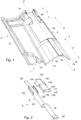
- the interlocking tile 1 comprises a body 2 having an upper portion 3 on which is formed a leading edge 3a, a lower portion 4 on which is formed a foot edge 4a opposite the leading edge 3a and a central portion 5 arranged between the upper portion 3 and the lower portion 4, as illustrated in figure 1 .
- the tile 1 comprises a first side edge 7a and a second side edge 7b.
- the first side edge 7a and the second side edge 7b are arranged facing each other and connect the head edge 3a to the foot edge 4a.
- the first side edge 7a comprises at least one first interlocking member 7c, which is in the form of a projecting fin extending laterally from the body 2 of the tile 1.
- the second lateral edge 7b comprises a second interlocking member 7d positioned on the inner surface of the tile 1.
- the tile 1 further comprises a housing 6 extending at least partially at least in the central portion 5 along a longitudinal axis XX of the tile. More particularly and as illustrated in figure 1 , the housing 6 comprises a first part called the central housing part 6a extending over the central portion 5 of the body 2 of the tile 1 and a second part called the housing head part 6b contiguous to the central housing part 6a.
- the housing head part 6b is in the form of a channel extending from the central housing part 6a of housing 6 to the head edge 3a of the tile 1.
- housing 6 is a blind recess in body 2 of tile 1.
- the body 2 of the tile 1 can be curved or corrugated or flat.
- the tiles have a curve 1a but this example and not limiting and the characteristics of the invention are compatible with different shapes of body 2 of tile 1.
- the tile 1 comprises in addition, a third part called the housing foot part 6c formed on the lower portion 4 of the tile 1, the housing foot part is a flat part or a hollowed part 6c arranged tangentially to the curve 1a of the lower portion 4 of the tile 1.
- the housing foot part 6c is preferably positioned at the top of the curve 1a of the lower portion 4.
- the tile 1 comprises a retaining device 8 for at least part of a photovoltaic module 101, said retaining device 8 being shaped to be housed at least partially in the housing 6 so as to fill at least partially, and preferably entirely, the housing 6.
- the retaining device 8 intended to be introduced into the housing 6 of the tile 1 as will be seen later.
- the retaining device 8 comprises a lower retaining piece 9 configured to be fixed in the housing 6 of the tile 1 and an upper retaining piece 10 connected to the lower retaining piece 9 and delimiting with the latter an internal volume 11 ( seen in figure 6 ), which will be detailed later in the description.
- the lower retaining part 9 is in the form of an elongated tab comprising a first portion 9a intended to occupy the housing 6 and preferably configured to at least partially occupy the central part of the housing 6a and more particularly at least partially the central housing part 6a and at least partly the housing head part 6b.
- the lower retaining part 9 comprises a second portion 9b shaped to occupy the housing head part 6b.
- the first portion 9a and the second portion 9b of the lower retaining part 9 of the retaining device 8 are flat and coplanar.
- the lower retaining piece 9 comprises a third portion 9c, aligned with the first portion 9a of the lower retaining piece 9 and opposite the second portion 9b of the lower retaining piece 9 with respect to the first portion 9a of the lower retaining part 9.
- the third portion 9c of the lower retaining part 9 is flat and extends in a plane substantially parallel to the plane in which the first portion 9a of the lower retaining part 9 extends .
- the third portion 9c of the lower retaining part 9 is intended and shaped to be housed on the housing foot part 6c of the lower portion 4 of tile 1 and/or directly on the lower portion 4 of tile 1, depending on the geometry of tile 1.
- the third portion 9c of the lower retaining part 9 comprises a free end on which is arranged a first retaining element 9d of a photovoltaic module 101.
- the first retaining element 9d is in the form of a hook and is oriented towards the central portion 5 of the tile 1 and the upper portion 3 of the tile 1 so that the first retaining element 9d is configured to receive a first edge 101a of the photovoltaic module 101 and to maintain said first edge 101a only by embedding said first edge 101a in the first retaining element 9d.
- the upper part 10 of the retaining device 8 is arranged at a distance from the lower retaining part 9. Like the lower retaining part 9, the upper retaining part 10 of the retaining device 8 is in the overall form of a tab.
- the upper retaining part 10 of the retaining device 8 comprises a first portion 10a configured to be arranged facing the first portion 9a of the lower retaining part 9 of the retaining device 8.
- the upper part of restraint 10 further comprises a second portion 10b arranged in the extension of the first portion 10a of the upper retaining part 10, the second portion 10b of the upper retaining part 10 being configured to be positioned facing at least one part of the second portion 9b of the lower retaining part 9 of the retaining device 8, the first portion 10a of the upper retaining part 10 and the second portion 10b of the upper retaining part 10 extending in parallel planes.
- the second portion 10b of the upper retaining part 10 comprises at one free end a return 10c oriented towards the first portion 10a of the upper retaining part 10.
- the second portion 10b of the upper retaining part 10 comprises two fins 10d positioned on either side of the second portion 10b and arranged laterally with respect to the second portion 10b and configured to partially close the internal volume 11 of the retaining device 8.
- a second retaining element 10f of a photovoltaic module 101 is arranged on the upper part of retainer 10 of the retainer 8 and preferably on the free end of the first portion 10a of the upper retainer 10.
- the second retainer 10f is in the form of an extension and is oriented towards the central portion 5 and the lower portion 4 of the tile 1 so that the second retaining element 10f is configured to receive a second edge 101b of the photovoltaic module 101 and to hold said second edge 101b only by embedding said second edge 101b in the second retaining element 10f.
- the retaining device 8 is made of two parts joined together respectively constituting the lower retaining part 9 and the upper retaining part 10 of the retaining device 8, the connection of the two parts being preferentially modifiable.
- the lower retaining part 9 comprises two connecting elements 12a, 12b, arranged on either side of the first portion 9a of the lower retaining part 9 of the retaining device 8 and configured to connect the lower retaining part 9 with the upper retaining part 10 of the retaining device 8.
- Each connecting element 12a, 12b extends projecting from the first portion 9a of the lower retaining part 9 of the retaining device 8 in a plane substantially perpendicular to that in which the first portion 9a extends.
- Each connecting element 12a, 12b is shaped to cooperate by form complementarity with a complementary connecting element 13a, 13b fitted to the upper retaining part 10 of the retaining device 8.
- Each complementary connecting element 13a, 13b extends projecting from the first portion 10a of the upper retaining part 10 of the retaining device 8 in a plane substantially perpendicular to that in which the first portion 10a extends and are arranged on either side of the first portion 10a of the part upper retainer 10 of the retainer 8.
- the upper retainer 10 is clipped onto the lower retainer 9 via the connecting elements 12a, 13a, 12b, 13b.
- the retaining device 8 can be made in one piece in one piece.
- the lower retaining part 9 and the upper retaining part 10 of the retaining device 8 are made in one piece in the form of a machined profile and the retaining device 8 preferably comprises two connecting elements, configured to connect the lower retaining part 9 with the upper retaining part 10 of the retaining device 8.
- each connecting element projects from the first portion 9a of the lower retaining part 9 of the retaining device.
- the tile 1 according to the invention is illustrated with the retaining device 8.
- the housing 6 is shaped to receive the retaining device 8 in partial or total recess so that the upper retaining part 10 of the retaining device 8 forms a flat on the curve 1a of the tile 1.
- the lower retaining part 9 of the retaining device 8 is fixed in the housing 6 of the tile 1 permanently, for example by gluing.
- one or more rows of standard tiles 102 are positioned and the zones for positioning the photovoltaic module 101 are selected.
- the zones for positioning the photovoltaic module 101 are selected.
- at least two tiles 1 according to the invention in at least one row of tiles the tiles 1 according to the invention being already equipped with at least the lower retaining part 9 of the retaining device 8 or not.
- the lower retaining part 9 of the retaining device 8 or the retaining device 8 is positioned in the tiles specific to the invention if this is not already do.
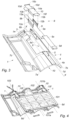
- the photovoltaic module 101 is embedded in the retaining elements 9d, 10f provided for this purpose, and the connectors 103 of the module 101 are slid into the internal volume 11 of the retaining device 8 fitted to one of the tiles specific to the invention as illustrated in figure 4 And 6 . Then, if this is not done, the internal volume 11 of the retaining device 8 is closed with the upper retaining piece 10 of the retaining device 8. Before the last step, the tiles are electrically connected in series. Finally, the retaining device 8 of each tile 1 specific to the invention is secured by placing the tiles of the upper row to complete the roof as illustrated in figure 5 .
- the assembly according to the invention comprises two interlocking tiles 1 according to the invention and a standard spacer tile 102 positioned between the two interlocking tiles 1 according to the invention, and a photovoltaic module 101.
- the center distance between tiles 1, 102 is variable.
- the upper tile 102 can slide longitudinally, depending on the mounting pitch (pitch) suitable for any roof.
- the position of the photovoltaic module 101 is indexed on the tile 1 on the left by referring to the illustration of the figure 4 , to guarantee the exit of the cables in the path which leads them under the tile 102 located above.
- tile 1 according to the invention on the right, with reference to the figure 4 has a free position vis-à-vis the photovoltaic module 101, which therefore allows a relative pitch of the variable tiles to adapt to the dimensions of the roof.
- FIG 5 is represented the same assembly as in figure 4 , with two standard 102 tiles arranged on the top row.
- the intermediate standard tile 102 between the two tiles 1 according to the invention can be omitted.
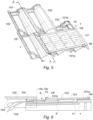
- FIG. 6 illustrates a sectional view along the axis AA of the figure 5 .
- the second portion 10b of the upper retaining piece 10 of the retaining device 8 cooperates with a tile 102, of the roof of a rank higher than that of the tile 1 according to the invention.
- the retaining device 8 cooperates directly with the tile 102 of the roof of a higher row.
- the tile 102 of the roof of a higher row partially covers the tile 1 according to the invention so as to secure the closure of the retaining device 8.
- the connectors 103 of the photovoltaic module 101 are housed in the internal volume 11 of the retaining device 8 and between the lower retaining part 9 and the upper retaining part 10 of the retaining device 8.
- the connector cable 103 runs under the photovoltaic module 101, then under the upper retaining part 10 to emerge in protected area under the roof, so that the connectors 104 are not exposed to moisture.
Landscapes
- Engineering & Computer Science (AREA)
- Architecture (AREA)
- Civil Engineering (AREA)
- Structural Engineering (AREA)
- Roof Covering Using Slabs Or Stiff Sheets (AREA)
Claims (5)
- Falzdachziegel (1), umfassend mindestens einen Körper (2), der Folgendes umfasst:- Einen oberen Abschnitt (3), an dem eine Kopfkante (3a) vorgesehen ist,- einem unteren Abschnitt (4), an dem gegenüber der Kopfkante (3a) eine Fußkante (4a) vorgesehen ist,- einen zentralen Abschnitt (5), der zwischen dem oberen Abschnitt (3) und dem unteren Abschnitt (4) angeordnet ist,dadurch gekennzeichnet, dass der Ziegel (1) ferner Folgendes umfasst:- Mindestens ein Gehäuse (6), umfassend einen ersten Teil, den zentralen Gehäuseteil (6a), der sich über den zentralen Abschnitt (5) des Körpers (2) der Ziegel (1) erstreckt, und einen zweiten Teil, den Gehäusekopfteil (6b), der an den zentralen Gehäuseteil (6a) angrenzt und die Form eines Kanals aufweist, der sich vom zentralen Gehäuseteil (6a) bis zur Kopfkante (3a) erstreckt,- mindestens eine Haltevorrichtung (8) mindestens eines Teils eines Photovoltaikmoduls (101), wobei die Haltevorrichtung (8) mindestens ein unteres Halteteil (9), das dazu eingerichtet ist, im Gehäuse (6) fixiert zu werden, und mindestens ein oberes Halteteil (10) umfasst, das mit dem unteren Halteteil (9) verbunden ist und mit dem unteren Halteteil (9) ein Innenvolumen (11) abgrenzt, das ausgebildet ist, um einen Steckverbinder (103) des Photovoltaikmoduls (101) mindestens teilweise aufzunehmen, wobei das untere Haltestück (9) mindestens ein Verbindungselement (12a, 12b) umfasst, das dazu eingerichtet ist, das untere Halteteil (9) mit dem oberen Halteteil (10) zu verbinden, wobei die Haltevorrichtung (8) mindestens ein erstes Halteelement (9d) einer ersten Kante (101a) des Photovoltaikmoduls (101) und mindestens ein zweites Halteelement (10f) einer gegenüberliegenden zweiten Kante (101b) des Photovoltaikmoduls (101) umfasst, wobei das erste Halteelement (9d) am unteren Halteteil (9) angeordnet ist und das zweite Halteelement (10f) am oberen Halteteil (10) angeordnet ist, wobei die Haltevorrichtung (8) ausgebildet ist, um mindestens teilweise in dem Gehäuse (6) untergebracht zu werden, um das Gehäuse (6) mindestens teilweise und vorzugsweise vollständig auszufüllen.
- Ziegel nach dem vorhergehenden Anspruch, wobei die Haltevorrichtung (8) einstückig oder aus mindestens zwei miteinander verbundenen Stücken gefertigt ist.
- Dachanordnung, umfassend mindestens einen Ziegel (1) nach einem der vorhergehenden Ansprüche und ein Photovoltaikmodul (101), umfassend einen Steckverbinder (103) und mindestens eine erste Kante (101a) und eine gegenüberliegende zweite Kante (101b), wobei das Photovoltaikmodul mindestens teilweise tangential oder auf dem Ziegel (1) angeordnet ist, so dass das Innenvolumen (11) der Haltevorrichtung (8) des Ziegels (1) ausgebildet ist, um den Steckverbinder (103) des Photovoltaikmoduls (101) mindestens teilweise aufzunehmen, und das erste Halteelement (9d) und das zweite Halteelement (10f) dazu eingerichtet sind, jeweils mit der ersten Kante (101a) des Photovoltaikmoduls (101) und der zweiten Kante (101b) des Photovoltaikmoduls (101) zusammenzuwirken.
- Anordnung nach dem vorhergehenden Anspruch, umfassend mindestens zwei Ziegel (1) nach einem der Ansprüche 1 bis 2, die im Abstand voneinander oder seitlich nebeneinander angeordnet sind, so dass das Photovoltaikmodul (101) von mindestens zwei Haltevorrichtungen (8) gehalten wird, die jeweils einen Ziegel (1) ausrüsten.
- Anordnung nach Anspruch 4, wobei jeder Ziegel (1) der Anordnung ausgebildet ist, um eine Variation des seitlichen Achsabstands zu einem benachbarten Ziegel zu ermöglichen.
Applications Claiming Priority (1)
| Application Number | Priority Date | Filing Date | Title |
|---|---|---|---|
| FR1853168A FR3080241B1 (fr) | 2018-04-11 | 2018-04-11 | Tuile a emboitement et ensemble de toiture associe |
Publications (3)
| Publication Number | Publication Date |
|---|---|
| EP3553945A1 EP3553945A1 (de) | 2019-10-16 |
| EP3553945C0 EP3553945C0 (de) | 2023-08-02 |
| EP3553945B1 true EP3553945B1 (de) | 2023-08-02 |
Family
ID=65494163
Family Applications (1)
| Application Number | Title | Priority Date | Filing Date |
|---|---|---|---|
| EP19168339.0A Active EP3553945B1 (de) | 2018-04-11 | 2019-04-10 | Dachziegel mit steckverbindung und entsprechende gesamtheit der dachabdeckung |
Country Status (3)
| Country | Link |
|---|---|
| EP (1) | EP3553945B1 (de) |
| ES (1) | ES2958083T3 (de) |
| FR (1) | FR3080241B1 (de) |
Families Citing this family (2)
| Publication number | Priority date | Publication date | Assignee | Title |
|---|---|---|---|---|
| CN111446909B (zh) * | 2020-04-20 | 2021-01-19 | 江西巨兵新能源有限公司 | 一种光伏瓦组件 |
| CN119582719A (zh) * | 2024-12-12 | 2025-03-07 | 晶科能源股份有限公司 | 一种光伏构件 |
Family Cites Families (7)
| Publication number | Priority date | Publication date | Assignee | Title |
|---|---|---|---|---|
| DE4227929A1 (de) * | 1992-08-22 | 1994-03-10 | Horst Wagner | Dachziegel/Dachstein |
| JP2000226908A (ja) * | 1999-02-08 | 2000-08-15 | Sekisui Chem Co Ltd | 太陽電池付き屋根瓦及びその製造方法 |
| EP1071137A3 (de) * | 1999-07-21 | 2007-03-21 | Kaneka Corporation | Dachziegel mit einem photovoltaischen Modul zum Erzeugen von elektrischer Energie |
| JP4531960B2 (ja) * | 2000-10-10 | 2010-08-25 | 株式会社カネカ | 太陽電池モジュール瓦 |
| US20040221886A1 (en) * | 2003-02-26 | 2004-11-11 | Kyocera Corporation | Solar cell module and solar cell array using same |
| FR2972471B1 (fr) * | 2011-03-10 | 2016-03-18 | Centurywatt | Revetement d'un pan de toiture muni de panneaux photovoltaiques lamines ou bi-verre standard |
| US20120240490A1 (en) * | 2011-03-25 | 2012-09-27 | Gangemi Ronald J | Roof mounted photovoltaic system with accessible panel electronics |
-
2018
- 2018-04-11 FR FR1853168A patent/FR3080241B1/fr not_active Expired - Fee Related
-
2019
- 2019-04-10 EP EP19168339.0A patent/EP3553945B1/de active Active
- 2019-04-10 ES ES19168339T patent/ES2958083T3/es active Active
Also Published As
| Publication number | Publication date |
|---|---|
| FR3080241B1 (fr) | 2020-03-27 |
| EP3553945A1 (de) | 2019-10-16 |
| EP3553945C0 (de) | 2023-08-02 |
| FR3080241A1 (fr) | 2019-10-18 |
| ES2958083T3 (es) | 2024-02-01 |
Similar Documents
| Publication | Publication Date | Title |
|---|---|---|
| EP2697574B1 (de) | Plattenstützvorrichtung | |
| EP3303723B1 (de) | Platte, anordnung der platten und zugehöriges dach | |
| CA2931337C (fr) | Panneau, assemblage de panneaux et toiture associee | |
| EP3304728B1 (de) | Elektrische verbindungsvorrichtung für ein photovoltaiksystem | |
| FR2580312A2 (fr) | Element de paroi ou de toiture constitue d'un noyau en mousse et de couches de recouvrement metalliques | |
| FR2931932A1 (fr) | Dispositif de support de modules de recuperation d'energie solaire, unite de recuperation d'energie solaire et procede de montage de modules de recuperation d'energie solaire. | |
| EP2077589A1 (de) | Modulares Baulement mit photovoltaischem Modul | |
| EP3549256B1 (de) | Elektrische verbindungsvorrichtung für ein fotovoltaiksystem | |
| FR3102196A1 (fr) | Tuile photovoltaïque plate, procédé de pose et couverture obtenue | |
| EP2034249B1 (de) | Einrichtung umfassend mehrere Solarpaneele und Vorrichtung zu deren Einbau auf einem Dach | |
| EP3304727B1 (de) | Elektrische verbindungsvorrichtung für ein photovoltaiksystem | |
| WO2012120208A2 (fr) | Revêtement d'un pan de toiture muni de panneaux photovoltaïques lamines ou bi-verre standard | |
| EP3553945A1 (de) | Dachziegel mit steckverbindung und entsprechende gesamtheit der dachabdeckung | |
| EP3480942B1 (de) | Befestigungsvorrichtung eines solarpaneels auf dem dach | |
| EP3181775B1 (de) | Gründach | |
| EP3409084B1 (de) | Kabelbaumanschlussplatte | |
| FR3046296A1 (fr) | Dispositif photovoltaique avec boitier de jonction electrique, procede de fabrication et utilisation dudit dispositif | |
| FR2963089A1 (fr) | Structure de maintien en position de panneaux photovoltaiques par rapport a un bati | |
| EP3319835B1 (de) | Beleuchtungsvorrichtungselement zur reduzierung der wasserretention in der nähe einer dichtung | |
| EP2458646A2 (de) | Realisierungssystem einer Wand zur Trockenaufstellung eines Gebäudes mit Hilfe von Sonnenkollektoren | |
| EP0320343A1 (de) | Abdichtungselement, insbesondere Firstabdichtung, mit biegsamen Dichtungsstreifen | |
| FR2963412A1 (fr) | Dispositif d'installation pour panneaux solaires sur une structure de batiment | |
| EP0102431A1 (de) | Vorgefertigtes Element für Eindeckungsplatten, insbesondere für Dächer | |
| FR3154130A1 (fr) | Système de fixation d’au moins un module photovoltaïque sur une surface de couverture et surface de couverture comprenant un tel système de fixation | |
| FR2921758A1 (fr) | Dispositif destine a la captation du rayonnement solaire |
Legal Events
| Date | Code | Title | Description |
|---|---|---|---|
| PUAI | Public reference made under article 153(3) epc to a published international application that has entered the european phase |
Free format text: ORIGINAL CODE: 0009012 |
|
| STAA | Information on the status of an ep patent application or granted ep patent |
Free format text: STATUS: THE APPLICATION HAS BEEN PUBLISHED |
|
| AK | Designated contracting states |
Kind code of ref document: A1 Designated state(s): AL AT BE BG CH CY CZ DE DK EE ES FI FR GB GR HR HU IE IS IT LI LT LU LV MC MK MT NL NO PL PT RO RS SE SI SK SM TR |
|
| AX | Request for extension of the european patent |
Extension state: BA ME |
|
| STAA | Information on the status of an ep patent application or granted ep patent |
Free format text: STATUS: REQUEST FOR EXAMINATION WAS MADE |
|
| 17P | Request for examination filed |
Effective date: 20200417 |
|
| RBV | Designated contracting states (corrected) |
Designated state(s): AL AT BE BG CH CY CZ DE DK EE ES FI FR GB GR HR HU IE IS IT LI LT LU LV MC MK MT NL NO PL PT RO RS SE SI SK SM TR |
|
| STAA | Information on the status of an ep patent application or granted ep patent |
Free format text: STATUS: EXAMINATION IS IN PROGRESS |
|
| 17Q | First examination report despatched |
Effective date: 20211117 |
|
| GRAP | Despatch of communication of intention to grant a patent |
Free format text: ORIGINAL CODE: EPIDOSNIGR1 |
|
| STAA | Information on the status of an ep patent application or granted ep patent |
Free format text: STATUS: GRANT OF PATENT IS INTENDED |
|
| INTG | Intention to grant announced |
Effective date: 20230509 |
|
| GRAS | Grant fee paid |
Free format text: ORIGINAL CODE: EPIDOSNIGR3 |
|
| GRAA | (expected) grant |
Free format text: ORIGINAL CODE: 0009210 |
|
| STAA | Information on the status of an ep patent application or granted ep patent |
Free format text: STATUS: THE PATENT HAS BEEN GRANTED |
|
| AK | Designated contracting states |
Kind code of ref document: B1 Designated state(s): AL AT BE BG CH CY CZ DE DK EE ES FI FR GB GR HR HU IE IS IT LI LT LU LV MC MK MT NL NO PL PT RO RS SE SI SK SM TR |
|
| REG | Reference to a national code |
Ref country code: GB Ref legal event code: FG4D Free format text: NOT ENGLISH |
|
| REG | Reference to a national code |
Ref country code: CH Ref legal event code: EP |
|
| REG | Reference to a national code |
Ref country code: DE Ref legal event code: R096 Ref document number: 602019033868 Country of ref document: DE |
|
| REG | Reference to a national code |
Ref country code: IE Ref legal event code: FG4D Free format text: LANGUAGE OF EP DOCUMENT: FRENCH |
|
| U01 | Request for unitary effect filed |
Effective date: 20230811 |
|
| U07 | Unitary effect registered |
Designated state(s): AT BE BG DE DK EE FI FR IT LT LU LV MT NL PT SE SI Effective date: 20230818 |
|
| PG25 | Lapsed in a contracting state [announced via postgrant information from national office to epo] |
Ref country code: GR Free format text: LAPSE BECAUSE OF FAILURE TO SUBMIT A TRANSLATION OF THE DESCRIPTION OR TO PAY THE FEE WITHIN THE PRESCRIBED TIME-LIMIT Effective date: 20231103 |
|
| PG25 | Lapsed in a contracting state [announced via postgrant information from national office to epo] |
Ref country code: IS Free format text: LAPSE BECAUSE OF FAILURE TO SUBMIT A TRANSLATION OF THE DESCRIPTION OR TO PAY THE FEE WITHIN THE PRESCRIBED TIME-LIMIT Effective date: 20231202 |
|
| PG25 | Lapsed in a contracting state [announced via postgrant information from national office to epo] |
Ref country code: RS Free format text: LAPSE BECAUSE OF FAILURE TO SUBMIT A TRANSLATION OF THE DESCRIPTION OR TO PAY THE FEE WITHIN THE PRESCRIBED TIME-LIMIT Effective date: 20230802 Ref country code: NO Free format text: LAPSE BECAUSE OF FAILURE TO SUBMIT A TRANSLATION OF THE DESCRIPTION OR TO PAY THE FEE WITHIN THE PRESCRIBED TIME-LIMIT Effective date: 20231102 Ref country code: IS Free format text: LAPSE BECAUSE OF FAILURE TO SUBMIT A TRANSLATION OF THE DESCRIPTION OR TO PAY THE FEE WITHIN THE PRESCRIBED TIME-LIMIT Effective date: 20231202 Ref country code: HR Free format text: LAPSE BECAUSE OF FAILURE TO SUBMIT A TRANSLATION OF THE DESCRIPTION OR TO PAY THE FEE WITHIN THE PRESCRIBED TIME-LIMIT Effective date: 20230802 Ref country code: GR Free format text: LAPSE BECAUSE OF FAILURE TO SUBMIT A TRANSLATION OF THE DESCRIPTION OR TO PAY THE FEE WITHIN THE PRESCRIBED TIME-LIMIT Effective date: 20231103 |
|
| REG | Reference to a national code |
Ref country code: ES Ref legal event code: FG2A Ref document number: 2958083 Country of ref document: ES Kind code of ref document: T3 Effective date: 20240201 |
|
| PG25 | Lapsed in a contracting state [announced via postgrant information from national office to epo] |
Ref country code: PL Free format text: LAPSE BECAUSE OF FAILURE TO SUBMIT A TRANSLATION OF THE DESCRIPTION OR TO PAY THE FEE WITHIN THE PRESCRIBED TIME-LIMIT Effective date: 20230802 |
|
| U20 | Renewal fee for the european patent with unitary effect paid |
Year of fee payment: 6 Effective date: 20240319 |
|
| PG25 | Lapsed in a contracting state [announced via postgrant information from national office to epo] |
Ref country code: SM Free format text: LAPSE BECAUSE OF FAILURE TO SUBMIT A TRANSLATION OF THE DESCRIPTION OR TO PAY THE FEE WITHIN THE PRESCRIBED TIME-LIMIT Effective date: 20230802 Ref country code: RO Free format text: LAPSE BECAUSE OF FAILURE TO SUBMIT A TRANSLATION OF THE DESCRIPTION OR TO PAY THE FEE WITHIN THE PRESCRIBED TIME-LIMIT Effective date: 20230802 Ref country code: CZ Free format text: LAPSE BECAUSE OF FAILURE TO SUBMIT A TRANSLATION OF THE DESCRIPTION OR TO PAY THE FEE WITHIN THE PRESCRIBED TIME-LIMIT Effective date: 20230802 Ref country code: SK Free format text: LAPSE BECAUSE OF FAILURE TO SUBMIT A TRANSLATION OF THE DESCRIPTION OR TO PAY THE FEE WITHIN THE PRESCRIBED TIME-LIMIT Effective date: 20230802 |
|
| REG | Reference to a national code |
Ref country code: DE Ref legal event code: R097 Ref document number: 602019033868 Country of ref document: DE |
|
| PLBE | No opposition filed within time limit |
Free format text: ORIGINAL CODE: 0009261 |
|
| STAA | Information on the status of an ep patent application or granted ep patent |
Free format text: STATUS: NO OPPOSITION FILED WITHIN TIME LIMIT |
|
| 26N | No opposition filed |
Effective date: 20240503 |
|
| PG25 | Lapsed in a contracting state [announced via postgrant information from national office to epo] |
Ref country code: MC Free format text: LAPSE BECAUSE OF FAILURE TO SUBMIT A TRANSLATION OF THE DESCRIPTION OR TO PAY THE FEE WITHIN THE PRESCRIBED TIME-LIMIT Effective date: 20230802 |
|
| PG25 | Lapsed in a contracting state [announced via postgrant information from national office to epo] |
Ref country code: MC Free format text: LAPSE BECAUSE OF FAILURE TO SUBMIT A TRANSLATION OF THE DESCRIPTION OR TO PAY THE FEE WITHIN THE PRESCRIBED TIME-LIMIT Effective date: 20230802 |
|
| REG | Reference to a national code |
Ref country code: CH Ref legal event code: PL |
|
| GBPC | Gb: european patent ceased through non-payment of renewal fee |
Effective date: 20240410 |
|
| PG25 | Lapsed in a contracting state [announced via postgrant information from national office to epo] |
Ref country code: GB Free format text: LAPSE BECAUSE OF NON-PAYMENT OF DUE FEES Effective date: 20240410 |
|
| PG25 | Lapsed in a contracting state [announced via postgrant information from national office to epo] |
Ref country code: GB Free format text: LAPSE BECAUSE OF NON-PAYMENT OF DUE FEES Effective date: 20240410 Ref country code: CH Free format text: LAPSE BECAUSE OF NON-PAYMENT OF DUE FEES Effective date: 20240430 |
|
| PG25 | Lapsed in a contracting state [announced via postgrant information from national office to epo] |
Ref country code: IE Free format text: LAPSE BECAUSE OF NON-PAYMENT OF DUE FEES Effective date: 20240410 |
|
| U21 | Renewal fee for the european patent with unitary effect paid with additional fee |
Year of fee payment: 7 Effective date: 20250522 |
|
| PG25 | Lapsed in a contracting state [announced via postgrant information from national office to epo] |
Ref country code: CY Free format text: LAPSE BECAUSE OF FAILURE TO SUBMIT A TRANSLATION OF THE DESCRIPTION OR TO PAY THE FEE WITHIN THE PRESCRIBED TIME-LIMIT; INVALID AB INITIO Effective date: 20190410 |
|
| PG25 | Lapsed in a contracting state [announced via postgrant information from national office to epo] |
Ref country code: HU Free format text: LAPSE BECAUSE OF FAILURE TO SUBMIT A TRANSLATION OF THE DESCRIPTION OR TO PAY THE FEE WITHIN THE PRESCRIBED TIME-LIMIT; INVALID AB INITIO Effective date: 20190410 |
|
| PGFP | Annual fee paid to national office [announced via postgrant information from national office to epo] |
Ref country code: ES Payment date: 20250715 Year of fee payment: 7 |
|
| U20 | Renewal fee for the european patent with unitary effect paid |
Year of fee payment: 8 Effective date: 20260316 |
|
| PG25 | Lapsed in a contracting state [announced via postgrant information from national office to epo] |
Ref country code: TR Free format text: LAPSE BECAUSE OF FAILURE TO SUBMIT A TRANSLATION OF THE DESCRIPTION OR TO PAY THE FEE WITHIN THE PRESCRIBED TIME-LIMIT Effective date: 20230802 |