EP3553771B1 - Panneau structuré avec renfort(s) structural(aux) - Google Patents
Panneau structuré avec renfort(s) structural(aux) Download PDFInfo
- Publication number
- EP3553771B1 EP3553771B1 EP19166905.0A EP19166905A EP3553771B1 EP 3553771 B1 EP3553771 B1 EP 3553771B1 EP 19166905 A EP19166905 A EP 19166905A EP 3553771 B1 EP3553771 B1 EP 3553771B1
- Authority
- EP
- European Patent Office
- Prior art keywords
- rib
- skin
- panel
- trajectory
- ribs
- Prior art date
- Legal status (The legal status is an assumption and is not a legal conclusion. Google has not performed a legal analysis and makes no representation as to the accuracy of the status listed.)
- Active
Links
Images




Classifications
-
- G—PHYSICS
- G10—MUSICAL INSTRUMENTS; ACOUSTICS
- G10K—SOUND-PRODUCING DEVICES; METHODS OR DEVICES FOR PROTECTING AGAINST, OR FOR DAMPING, NOISE OR OTHER ACOUSTIC WAVES IN GENERAL; ACOUSTICS NOT OTHERWISE PROVIDED FOR
- G10K11/00—Methods or devices for transmitting, conducting or directing sound in general; Methods or devices for protecting against, or for damping, noise or other acoustic waves in general
- G10K11/16—Methods or devices for protecting against, or for damping, noise or other acoustic waves in general
- G10K11/162—Selection of materials
- G10K11/168—Plural layers of different materials, e.g. sandwiches
-
- B—PERFORMING OPERATIONS; TRANSPORTING
- B64—AIRCRAFT; AVIATION; COSMONAUTICS
- B64D—EQUIPMENT FOR FITTING IN OR TO AIRCRAFT; FLIGHT SUITS; PARACHUTES; ARRANGEMENT OR MOUNTING OF POWER PLANTS OR PROPULSION TRANSMISSIONS IN AIRCRAFT
- B64D29/00—Power-plant nacelles, fairings or cowlings
-
- B—PERFORMING OPERATIONS; TRANSPORTING
- B64—AIRCRAFT; AVIATION; COSMONAUTICS
- B64C—AEROPLANES; HELICOPTERS
- B64C1/00—Fuselages; Constructional features common to fuselages, wings, stabilising surfaces or the like
- B64C1/40—Sound or heat insulation, e.g. using insulation blankets
-
- F—MECHANICAL ENGINEERING; LIGHTING; HEATING; WEAPONS; BLASTING
- F02—COMBUSTION ENGINES; HOT-GAS OR COMBUSTION-PRODUCT ENGINE PLANTS
- F02C—GAS-TURBINE PLANTS; AIR INTAKES FOR JET-PROPULSION PLANTS; CONTROLLING FUEL SUPPLY IN AIR-BREATHING JET-PROPULSION PLANTS
- F02C7/00—Features, components parts, details or accessories, not provided for in, or of interest apart form groups F02C1/00 - F02C6/00; Air intakes for jet-propulsion plants
- F02C7/24—Heat or noise insulation
-
- G—PHYSICS
- G10—MUSICAL INSTRUMENTS; ACOUSTICS
- G10K—SOUND-PRODUCING DEVICES; METHODS OR DEVICES FOR PROTECTING AGAINST, OR FOR DAMPING, NOISE OR OTHER ACOUSTIC WAVES IN GENERAL; ACOUSTICS NOT OTHERWISE PROVIDED FOR
- G10K11/00—Methods or devices for transmitting, conducting or directing sound in general; Methods or devices for protecting against, or for damping, noise or other acoustic waves in general
- G10K11/16—Methods or devices for protecting against, or for damping, noise or other acoustic waves in general
- G10K11/172—Methods or devices for protecting against, or for damping, noise or other acoustic waves in general using resonance effects
-
- Y—GENERAL TAGGING OF NEW TECHNOLOGICAL DEVELOPMENTS; GENERAL TAGGING OF CROSS-SECTIONAL TECHNOLOGIES SPANNING OVER SEVERAL SECTIONS OF THE IPC; TECHNICAL SUBJECTS COVERED BY FORMER USPC CROSS-REFERENCE ART COLLECTIONS [XRACs] AND DIGESTS
- Y02—TECHNOLOGIES OR APPLICATIONS FOR MITIGATION OR ADAPTATION AGAINST CLIMATE CHANGE
- Y02T—CLIMATE CHANGE MITIGATION TECHNOLOGIES RELATED TO TRANSPORTATION
- Y02T50/00—Aeronautics or air transport
- Y02T50/60—Efficient propulsion technologies, e.g. for aircraft
Definitions
- This disclosure relates generally to structured panels and, more particularly for example, to a structured panel that attenuates sound generated by a gas turbine engine for an aircraft propulsion system.
- Acoustic panels may be used in various applications to attenuate noise.
- An acoustic panel for example, may be configured with a nacelle of an aircraft propulsion system to attenuate noise generated by a gas turbine engine.
- Such an acoustic panel typically includes a honeycomb core connected between a perforated face skin and a solid, non-perforated back skin.
- the honeycomb core includes a plurality of resonating chambers. These resonating chambers are tuned by selecting a desired chamber length and, thus, core thickness that corresponds to a specific target frequency of noise to be attenuated. Increasing the core thickness, for example, will typically tune the resonating chambers for attenuating lower frequency noise. Conversely, decreasing the core thickness will typically tune the resonating chambers for attenuating higher frequency noise.
- EP 3,205,574 discloses a structural panel for attenuating noise with corrugated support walls.
- US 9,704,467 discloses an acoustic panel with corrugated baffles septums.
- a panel is provided for attenuating noise as claimed in claim 1.
- the first trajectory may be offset from the second trajectory by an acute angle.
- the first trajectory may be perpendicular to the second trajectory.
- the first rib may run into the second rib.
- the first rib may be discrete from the second rib.
- the element of the panel may also include at least one third rib.
- the third rib may extend along a third trajectory that may be non-parallel with the first trajectory.
- the third trajectory may be parallel with the second trajectory.
- the second rib and the third rib may each be coincident with the first rib.
- the element of the panel may also include a fourth rib.
- the fourth rib may extend along a fourth trajectory that may be non-parallel with the second trajectory.
- the first rib and the fourth rib may each intersect with the second rib and the third rib.
- the core may be configured from or otherwise include composite material.
- the panel may be configured as a panel for a nacelle of an aircraft propulsion system.
- the present disclosure includes structured panels such as, but not limited to, acoustic panels for attenuating sound; e.g., noise.
- Each structured panel may include one or more structural reinforcements, such as rib structures, for increasing rigidity, strength, stability (i.e., resistance to buckling) and/or other metrics of structural integrity of that panel.
- structural reinforcements such as rib structures
- the following disclosure will first describe a general panel configuration without structural reinforcements and then describe how one or more structural reinforcements may be added to one or more elements (e.g., components) of the panel to increase rigidity, strength, stability and/or other metrics of structural integrity of that panel.
- FIG. 1 is a partial, perspective block diagram illustration of an acoustic panel 100 for attenuating noise.
- This acoustic panel 100 may be configured to attenuate noise generated by an aircraft propulsion system such as, for example, a turbofan propulsion system or a turbojet propulsion system.
- the acoustic panel 100 may be configured with a nacelle of the propulsion system.
- the acoustic panel 100 may be configured as or with an inner or outer barrel, a translating sleeve of a thrust reverser, a blocker door, etc.
- the acoustic panel 100 may be configured with another component / structure of the aircraft such as its fuselage or a wing.
- the acoustic panel 100 may be configured to also or alternatively attenuate aircraft related noise other than that generated by the propulsion system.
- the acoustic panel 100 of the present disclosure may alternatively be configured for non-aircraft applications.
- the acoustic panel 100 extends longitudinally along an x-axis.
- the acoustic panel 100 extends laterally along a y-axis.
- the acoustic panel 100 extends vertically along a z-axis.
- the term "vertical" is used herein to describe a depthwise panel direction and is not limited to a gravitational up/down direction.
- the x-y plane is shown as a generally flat plane. However, in other embodiments, the x-y plane and, thus, the acoustic panel 100 may be curved and/or follow an undulating geometry.
- the x-y plane and, thus, the acoustic panel 100 may be arcuate, cylindrical or conical with or without radial undulations.
- the vertical direction may change at different locations along the x-y plane; e.g., the vertical direction may be a radial direction for a cylindrical or conical acoustic panel.
- the acoustic panel 100 includes a perforated first (e.g., face) skin 102, a solid non-perforated second (e.g., back) skin 104 and a cellular core 106.
- the cellular core 106 is disposed and extends vertically between the first skin 102 and the second skin 104.
- the cellular core 106 is also connected to the first skin 102 and the second skin 104.
- the cellular core 106 may be fused, adhered, welded, brazed and/or otherwise bonded to the first skin 102 and/or the second skin 104.
- the cellular core 106 may also or alternatively be mechanically fastened to the first skin 102 and/or the second skin 104.
- the cellular core 106 may be formed integral with the first skin 102 and/or the second skin 104 as a monolithic body using, for example, additive manufacturing. However, the present disclosure is not limited to any particular manufacturing methods.
- the first skin 102 may be configured as a relatively thin sheet or layer of material that extends longitudinally and laterally along the x-y plane.
- This first skin material may include, but is not limited to, a polymer, a fiber reinforced composite (e.g., fiberglass composite, carbon fiber composite, aramid fiber composite, composite reinforced by any combination of glass, carbon, aramid or other fibers, etc.), metal, alloys, metal matrix composite, ceramic, or ceramic matrix composite, or a combination thereof.
- the first skin 102 has a vertical thickness 108 that extends vertically between opposing side surfaces 110 and 112.
- the first skin 102 includes a plurality of perforations 114; e.g., apertures such as through-holes (see also FIG.1 ). Each of these perforations 114 extends generally vertically through the first skin 102 between its side surfaces 110 and 112. The perforations 114 may be non-uniform through the thickness 108 and/or may be non-perpendicular to the side surfaces 110 and/or 112.
- the second skin 104 may be configured as a relatively thin sheet or layer of (e.g., continuous and uninterrupted) material that extends longitudinally and laterally along the x-y plane (see FIG. 1 ).
- This second skin material may include, but is not limited to, a polymer, a fiber reinforced composite (e.g., fiberglass composite, carbon fiber composite, aramid fiber composite, composite reinforced by any combination of glass, carbon, aramid or other fibers, etc.), metal, alloys, metal matrix composite, ceramic, or ceramic matrix composite, or a combination thereof.
- the second skin material may be the same as or different than the first skin material.
- the second skin 104 has a vertical thickness 116 that extends vertically between opposing side surfaces 118 and 120.
- This vertical thickness 116 may be substantially equal to or different (e.g., greater or less) than the vertical thickness 108 of the first skin 102.
- the thickness 108 of the first skin 102 and/or the thickness 116 the second skin 104 may be uniform or non-uniform along the x-y plane.
- the cellular core 106 extends longitudinally and laterally along the x-y plane.
- the cellular core 106 has a vertical thickness 122 that extends vertically between opposing core sides, which sides are respectively abutted against the first skin 102 and the second skin 104.
- the vertical thickness 122 may be substantially greater than the vertical thicknesses 108 and 116 of the first skin 102 and/or the second skin 104, respectively.
- the vertical thickness 122 for example, may be at least ten to forty times (10-40x), or more, greater than the vertical thicknesses 108, and 116; however, the acoustic panel 100 of the present disclosure is not limited to such an exemplary embodiment.
- the cellular core 106 includes a plurality of solid non-perforated walls 124 (e.g., cavity sidewalls) and one or more arrays of corrugations 126.
- the walls 124 and corrugations 126 are arranged together to configure the cellular core 106 as an open cavity (e.g., open cell) structure.
- This open cavity structure forms a plurality of cavities 128 (each including divided sub-cavities 128A and 128B) vertically between the first skin 102 and the second skin 104.
- Each of these cavities 128 may be fluidly coupled with one or more respective perforations 114 in the first skin 102 (see FIG. 2 ).
- each of the walls 124 has a length that extends longitudinally along the x-axis.
- Each of the walls 124 has a thickness that extends laterally along the y-axis.
- each of the walls 124 has a height that extends vertically between the first skin 102 and the second skin 104.
- Each of the walls 124 is, at least, partially (or completely) connected to or otherwise engaged with the first skin 102 and/or the second skin 104.
- Each of the exemplary walls 124 of FIG. 4 is orientated substantially perpendicular to the first skin 102 and the second skin 104; e.g., at a ninety-degree angle to the skins 102 and 104.
- one or more of the walls 124 may be angularly offset from the first skin 102 and/or the second skin 104 by a non-ninety-degree angle; e.g., an acute included angle or an obtuse angle.
- the walls 124 are arranged generally parallel with one another; see also FIG. 3 .
- the walls 124 are laterally spaced from one another along the y-axis so as to respectively form the cavities 128 between the walls 124.
- Each of the walls 124 shown in FIG. 4 therefore respectively forms lateral sides of adjacent cavities 128 on either side of the respective wall 124.
- Each of the walls 124 thereby also fluidly separates those cavities 128 on either side of the wall 124.
- each of the corrugations 126 in each array are disposed and extend laterally between a laterally adjacent pair of the walls 124; see also FIG. 4 .
- Each of the corrugations 126 includes a solid non-perforated baffle 130 and a porous (e.g., perforated) septum 132.
- one or more or each of the corrugations 126 includes only porous (e.g. perforated) septa 132, or only solid non-perforated baffles 130 in an alternating periodic or non-periodic pattern along the y-axis or the x-axis or both.
- the baffle 130 has a width extending laterally between opposing lateral sides. These lateral sides are, at least, partially (or completely) connected to or otherwise engaged with a respective laterally adjacent pair of the walls 124.
- the baffle 130 has a length extending vertically and longitudinally between opposing top and bottom ends 134 and 136. Note, the terms "top” and “bottom” are used above to describe ends of the baffle 130 as situated in the drawings and are not intended to limit the baffle 130 or the acoustic panel 100 to such an exemplary gravitational orientation.
- the septum 132 has a width extending laterally between opposing lateral sides. These lateral sides are connected to or otherwise engaged with a respective laterally adjacent pair of the walls 124.
- the septum 132 has a length extending vertically and longitudinally between opposing top and bottom ends 138 and 140. Note, the terms “top” and “bottom” are used above to describe ends of the septum 132 as situated in the drawings and are not intended to limit the septum 132 or the acoustic panel 100 to such an exemplary gravitational orientation.
- the septum 132 includes one or more perforations 142.
- the perforations 142 are configured as through holes.
- the perforations 142 may be formed by interconnected pores in the septum 132 where the septum material, for example, has an open cell porous structure.
- the top end 134 of the baffle 130 is connected, at least, partially (or completely) to or otherwise engaged with the first skin 102. This top end 134 is also longitudinally connected to the top end 138 of the septum 132 at an interface 144 between the baffle 130 and the septum 132.
- the bottom end 136 of the baffle 130 is connected to or otherwise engaged with the second skin 104. This bottom end 136 is also longitudinally connected to the bottom end 140 of a septum 132 of an adjacent one of the corrugations 126 at an interface 146.
- the baffle 130 extends vertically between the first skin 102 and the second skin 104 and longitudinally between the septums 132.
- the baffle 130 is therefore angularly offset from the first skin 102 and the second skin 104 by an included angle 148; e.g., between 30-60 degrees.
- This angle 148 is an acute angle such as, but not limited to, about forty-five degrees (45°).
- the top end 138 of the septum 132 is, at least, partially (or completely) connected to or otherwise engaged with the first skin 102. This top end 138 is also longitudinally connected to the top end 134 of the baffle 130 as described above.
- the bottom end 140 of the septum 132 is, at least, partially (or completely) connected to or otherwise engaged with the second skin 104. This bottom end 140 is also longitudinally connected to the bottom end 136 of a baffle 130 of an adjacent one of the corrugations 126 at an interface; e.g., the interface 146.
- the septum 132 extends vertically between the first skin 102 and the second skin 104 and longitudinally between the baffles 130.
- the septum 132 is therefore angularly offset from the first skin 102 and the second skin 104 by an included angle 150; e.g., between 30-60 degrees.
- This angle 150 may be an acute angle such as, but not limited to, about forty-five degrees (45°).
- the angle 150 may be substantially equal to the angle 148 as shown in FIG. 5 .
- the angle 150 may be different from the angle 148; e.g., a larger or smaller acute angle, or a right angle.
- the angle 150 may be about ninety degrees and the angle 148 may be about forty-five degrees as shown in FIG. 6 .
- each of the cavities 128 extends longitudinally between and is formed by a longitudinally adjacent pair of the baffles 130.
- Each septum 132 is disposed within and divides a respective one of the cavities 128 into fluidly coupled sub-cavities 128A and 128B. More particularly, the perforations 142 in the septum 132 fluidly couple the sub-cavities 128A and 128B together.
- Each of the cavities 128 forms a resonance chamber 152.
- a length 154 of the resonance chamber 152 extends diagonally (e.g., longitudinally and vertically) between the first skin 102 and the second skin 104 and through a respective one of the septums 132.
- the length 154 of the resonance chamber 152 therefore is longer than the vertical thickness 122 of the cellular core 106. This enables noise attenuation of relatively low frequency noise without increasing the vertical thickness 152 of the cellular core 106 and, thus, a vertical thickness of the acoustic panel 100.
- each resonance chamber 152 may receive noise waves through the perforations 114 in the first skin 102.
- the resonance chamber 152 may reverse the phase of one or more frequencies of those sound waves using known acoustic reflection principles and subsequently direct the reverse phase sound waves out of the acoustic panel 100 through the perforations 114 to destructively interfere with other incoming noise waves.
- the cellular core 106 may be constructed from any suitable material or materials.
- the cellular core 106 may be constructed from a polymer, a fiber reinforced composite (e.g., fiberglass composite, carbon fiber composite, aramid fiber composite, composite reinforced by any combination of glass, carbon, aramid or other fibers), metal, alloys, metal matrix composite, ceramic, or ceramic matrix composite, or a combination thereof.
- One or more of components of the cellular core 106 may be constructed from the same or a like material.
- one or more of the components of the cellular core 106 may be constructed from a different material than one or more of the other components of the cellular core 106.
- the cellular core 106 may be constructed from the same material(s) as the first skin 102 and/or the second skin 104, or a different material or materials.
- one or more elements of the acoustic panel 100 are configured with one or more structural reinforcements. These structural reinforcements are provided to increase rigidity, stability, strength and/or structural integrity of the corresponding element(s) as well as the acoustic panel 100 as a whole. Examples of the one or more elements include, but are not limited to: (A) one, some or each of the baffles 130; (B) one, some or each of the septums 132; and (C) one, some or each of the walls 124.
- One or more structural reinforcements may also or alternatively be configured with one or more other elements of the acoustic panel 100.
- one or more structural elements may be configured with the first skin 102 and/or the second skin 104.
- FIG. 7 illustrates a portion of an acoustic panel element 156A configured with a first exemplary structural reinforcement 158A.
- the acoustic panel element 156A can be one or more of the walls 124, or the corrugations 126, or both, or combinations thereof. In another exemplary case the acoustic panel element 156A can be the first skin 102, or the second skin 104, or both, or combinations thereof in part or in their entirety.
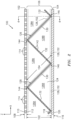
- the structural reinforcement 158A is configured as or otherwise includes a network of interconnected ribs. In particular, the structural reinforcement 158A of FIG.
- each rib 160A, 162A may be a stamped and/or otherwise formed element (e.g., protrusion) that projects out from a respective surface / side of the acoustic panel element 156A.
- the first rib 160A extends along a first trajectory 164A and the second rib 162A extends along a second trajectory 166A.
- the term "trajectory” may describe a centerline that follows along a length of a feature, where that length is greater than other dimensions (e.g., a width and/or a thickness) of the feature.
- the first trajectory 164A and the second trajectory 166A are straight-line trajectories; however, in other embodiments, one or both of these trajectories 164A and 166A may alternatively be curved or otherwise convoluted line trajectories.
- the first trajectory 164A of the first rib 160A is non-parallel with the second trajectory 166A of the second rib 162A.
- the first trajectory 164A and the first rib 160A of FIG. 7 for example, are perpendicular and coincident with the second trajectory 166A and the second rib 162A.
- an included angle between the first and the second trajectories 164B and 166B and ribs 160B and 162B of the structural reinforcement 158B on the acoustic panel element 156B may be acute (or obtuse) as shown in FIG. 8 for example.
- the first rib 160A intersects and thereby runs into the second rib 162A.
- the first rib 160A of FIG.7 bisects the second rib 162A and the second rib 162A bisects the first rib 160A.
- the first rib 160A may serve to minimize risk of bending / buckling of the acoustic panel element 156A portion along an axis running parallel or acutely angled relative to its first trajectory 164A.
- the second rib 162A may serve to minimize risk of bending / buckling of the acoustic panel element 156A portion along an axis running parallel or acutely angled relative to its second trajectory 166A.
- FIG. 9 illustrates another acoustic panel element 156C portion configured with a second exemplary structural reinforcement 168.
- This structural reinforcement 168 includes the first rib 160C and a plurality of the second ribs 162C; however, a similar arrangement may be made with a single second rib 162C and a plurality of the first ribs 160C in other embodiments.
- the terms "first” and "second” are used to describe the ribs in order of introduction; thus, the first ribs 160C may include a first rib 160C, a second rib 160C, a third rib 160C, etc.
- the second ribs 162C may include a first rib 162C, a second rib 162C, a third rib 160C, etc.
- the second trajectories 166C of the second ribs 162C may be parallel (or substantially parallel; e.g., up to one to ten degrees offset) with one another and, thus, non-parallel with the first trajectory 164C.
- the included angles between the first and the second trajectories 164C and 166C and ribs 160C and 162C of the structural reinforcement 168 on the acoustic panel element 156C may be 90°, or acute, or obtuse.
- the first rib 160C may bisect each or some of the second ribs 162C.
- FIG. 10 illustrates another acoustic panel element 156D portion configured with a third exemplary structural reinforcement 170.
- This structural reinforcement 170 includes a plurality of the first ribs 160D and a plurality of the second ribs 162D.
- first and second are used to describe the ribs in order of introduction; thus, the first ribs 160D may include a first rib 160D, a second rib 160D, a third rib 160D, etc. and the second ribs 162D may include a first rib 162D, a second rib 162D, a third rib 160D, etc.
- the first trajectories 164D of the first ribs 160D may be parallel (or substantially parallel; e.g., up to one to five degrees offset) with one other.
- the second trajectories 166D of the second ribs 162D may be parallel with one another and, thus, non-parallel with the first trajectories 164D.
- This configuration of first and second ribs 160D and 162D is in the form of a grid.
- Each of the first ribs 160D may intersect each or some of the second ribs 162D, and each of the second ribs 162D may intersect each or some of the first ribs 160D.
- the included angles between the first and the second trajectories 164D and 166D and ribs 160D and 162D of the structural reinforcement 170 on the acoustic panel element 156D may be 90°, acute, or obtuse.
- the first ribs 160A, 160B, 160C, 160D (generally referred to as "160") run right-and-left and the second ribs 162A, 162B, 162C, 162D (generally referred to as "162") run up-and-down relative to the acoustic panel element 156A, 156B, 156C, 156D (generally referred to as "156") portion.
- 160 the first ribs 160A, 160B, 160C, 160D
- 162 run up-and-down relative to the acoustic panel element 156A, 156B, 156C, 156D (generally referred to as "156") portion.
- any of these exemplary structural reinforcements may be reoriented such that the second ribs 162 run right-and-left and the first ribs 160 run up-and-down relative to the acoustic panel element 156 portion.
- any of the exemplary structural reinforcements may be reoriented such that the first and the second ribs 160 and 162 run diagonally or along another angle relative to the acoustic panel element 156 portion.
- the first rib 160E runs along the first trajectory 164E diagonally from a top-left end to a bottom-right end.
- the second rib 162E runs along the second trajectory 166E diagonally from a top-right end to a bottom-left end.
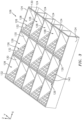
- a respective acoustic core element 156F may be configured with a single structural reinforcement 172 (e.g., any of the afore-described structural reinforcements 158A, or 158B, or 168, or 170), for example as shown in FIG. 12 .
- a respective acoustic core element 156G may be configured with a plurality of discrete structural reinforcements 174A-D (e.g., any of the afore-described structural reinforcements 158A, or 158B, or 168, or 170), for example as shown in FIG. 13 .
- the 12 and 13 may include respective ribs 160F, G and 162F, G, respectively.
- the ribs 160G and 162G of the structural reinforcement 174A are discrete (e.g., do not intersect or touch) any of the other structural reinforcements 174B-D or their respective ribs.
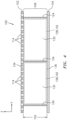
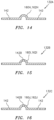
- one, some or each of the ribs (e.g., 160H, 162H) of the structural reinforcement may be non-perforated, for example as shown in FIG. 14 .
- one, some or each of the ribs (e.g., 1601, 160J, 162I, 162J) of the structural reinforcement may be perforated (142B), for example as shown on the septums 132B and 132C in FIGS. 15 and 16 .
- the perforations 142 may also be included on portions of the septum 132C not occupied by (e.g., adjacent to and around) the ribs (e.g., 160, 162), for example as shown in FIGS. 16 and 14 .
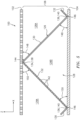
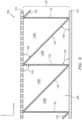
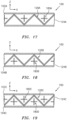
- the structural reinforcements 180A may be located (e.g., only vertically) between the corrugations 126A and the first skin 102A, for example as shown in FIG. 17 .
- the structural reinforcements 180B may be located (e.g., only vertically) between the corrugations 126B and the second skin 104B, for example as shown in FIG. 18 .
- the structural reinforcements 180C and 180D may be located both (e.g., vertically) between the corrugations 126C and the first skin 102C as well as (e.g., vertically) between the corrugations 126C and the second skin 104C.
- ribs of a structural reinforcement may be arranged on a common side of the acoustic panel portion as generally shown in the figures discussed above.
- the ribs (e.g., 160K, 162K) of the acoustic panel element 156K may be arranged on opposing sides of the acoustic panel portion, for example as shown in FIG. 20 .
- the first skin 102 and/or the second skin 104 may each be configured with one or more of the structural reinforcements described above.
- the skin 102A, 104A of FIG. 21 includes at least one structural reinforcement 182, which includes at least one first rib 160L and at least one second rib 162L.
- the perforations 114 through the first skin 102A are not included on portions of the ribs 160L and 162L. In another embodiment the perforations 114 through the first skin 102A are included on portions of the ribs 160L and 162L.
Landscapes
- Engineering & Computer Science (AREA)
- Physics & Mathematics (AREA)
- Acoustics & Sound (AREA)
- Multimedia (AREA)
- Chemical & Material Sciences (AREA)
- Combustion & Propulsion (AREA)
- Aviation & Aerospace Engineering (AREA)
- Mechanical Engineering (AREA)
- General Engineering & Computer Science (AREA)
- Soundproofing, Sound Blocking, And Sound Damping (AREA)
Claims (12)
- Panneau pour atténuer le son, comprenant :un premier revêtement perforé (102) ;un second revêtement (104) ; etune âme (106) formant une pluralité de cavités (128) verticalement entre le premier revêtement perforé (102) et le second revêtement (104), l'âme (106) comportant un réseau d'ondulations (126) qui comportent un premier déflecteur (130), un second déflecteur (130) et un premier septum (132) ;les cavités (128) comportant une première cavité (128) formée longitudinalement entre le premier déflecteur (130) et le second déflecteur (130), et la première cavité (128) est couplée fluidiquement avec des perforations (114) dans le premier revêtement (102) ; etle premier septum (132) s'étendant du premier revêtement (102) et du premier déflecteur (130) au second revêtement (104) et au second déflecteur (130), et le premier septum (132) divisant la première cavité (128) en sous-cavités couplées fluidiquement (128A, 128B) ;dans lequel au moins l'un du premier déflecteur (130) ou du septum (132) comprend au moins une première nervure (160) et au moins une deuxième nervure (162), caractérisé en ce que la première nervure (160) s'étend le long d'une première trajectoire et la deuxième nervure (162) s'étend le long d'une deuxième trajectoire non parallèle à la première trajectoire.
- Panneau selon la revendication 1, dans lequel la première trajectoire est décalée de la deuxième trajectoire d'un angle aigu.
- Panneau selon la revendication 1, dans lequel la première trajectoire est perpendiculaire à la deuxième trajectoire.
- Panneau selon l'une quelconque des revendications 1, 2 ou 3, dans lequel la première nervure (160) rencontre la deuxième nervure (162).
- Panneau selon l'une quelconque des revendications 1, 2 ou 3, dans lequel la première nervure (160) est distincte de la deuxième nervure (162).
- Panneau selon une quelconque revendication précédente, dans lequell'élément du panneau comprend en outre au moins une troisième nervure (162C) ; etla troisième nervure (162C) s'étend selon une troisième trajectoire non parallèle à la première trajectoire.
- Panneau selon la revendication 6, dans lequel la troisième trajectoire est parallèle à la deuxième trajectoire.
- Panneau selon la revendication 6 ou 7, dans lequel la deuxième nervure (162C) et la troisième nervure (162C) coïncident chacune avec la première nervure (160).
- Système selon la revendication 6, 7 ou 8, dans lequell'élément du panneau comprend en outre une quatrième nervure (160D) ; etla quatrième nervure (160D) s'étend selon une quatrième trajectoire non parallèle à la deuxième trajectoire.
- Panneau selon la revendication 9, dans lequel la première nervure (160D) et la quatrième nervure (160D) croisent chacune la deuxième nervure (162D) et la troisième nervure (162D).
- Panneau selon une quelconque revendication précédente, dans lequel l'âme (106) comprend un matériau composite.
- Panneau selon une quelconque revendication précédente, dans lequel le panneau est configuré comme un panneau pour une nacelle d'un système de propulsion d'aéronef.
Applications Claiming Priority (1)
| Application Number | Priority Date | Filing Date | Title |
|---|---|---|---|
| US15/943,963 US10906659B2 (en) | 2018-04-03 | 2018-04-03 | Structured panel with structural reinforcement(s) |
Publications (2)
| Publication Number | Publication Date |
|---|---|
| EP3553771A1 EP3553771A1 (fr) | 2019-10-16 |
| EP3553771B1 true EP3553771B1 (fr) | 2023-05-31 |
Family
ID=66091981
Family Applications (1)
| Application Number | Title | Priority Date | Filing Date |
|---|---|---|---|
| EP19166905.0A Active EP3553771B1 (fr) | 2018-04-03 | 2019-04-02 | Panneau structuré avec renfort(s) structural(aux) |
Country Status (3)
| Country | Link |
|---|---|
| US (1) | US10906659B2 (fr) |
| EP (1) | EP3553771B1 (fr) |
| CN (1) | CN110341931A (fr) |
Families Citing this family (4)
| Publication number | Priority date | Publication date | Assignee | Title |
|---|---|---|---|---|
| US11433990B2 (en) * | 2018-07-09 | 2022-09-06 | Rohr, Inc. | Active laminar flow control system with composite panel |
| US11767776B2 (en) * | 2020-09-04 | 2023-09-26 | The Boeing Company | Propulsion flow path duct systems and methods |
| US12078125B2 (en) | 2021-09-13 | 2024-09-03 | Rohr, Inc. | Low-frequency acoustic center body |
| EP4302980B1 (fr) | 2022-07-08 | 2025-04-23 | Rohr, Inc. | Motif de formation pour noyau cellulaire par pliage de matériau |
Family Cites Families (72)
| Publication number | Priority date | Publication date | Assignee | Title |
|---|---|---|---|---|
| US2333343A (en) | 1937-04-22 | 1943-11-02 | Armzen Company | Method of making structural materials |
| US3011602A (en) | 1959-07-13 | 1961-12-05 | Lockheed Aircraft Corp | Panel construction |
| US3025122A (en) | 1960-11-25 | 1962-03-13 | American Air Filter Co | Mounting arrangement |
| US3341395A (en) | 1962-12-03 | 1967-09-12 | Solar Reflection Room Corp | Lightweight structural panel |
| US3380206A (en) | 1965-09-29 | 1968-04-30 | Soundlock Corp | Lay-in acoustical ceiling panel with flexible diaphragms |
| US3439774A (en) | 1966-01-21 | 1969-04-22 | Boeing Co | Sound energy absorbing apparatus |
| US3542152A (en) | 1968-04-08 | 1970-11-24 | Gen Electric | Sound suppression panel |
| US3639106A (en) | 1968-05-06 | 1972-02-01 | Burnley Engineering Products L | Acoustic panel |
| US3507355A (en) | 1969-05-22 | 1970-04-21 | Rohr Corp | Multi-layer face material for sound absorptive duct lining material |
| US3969563A (en) | 1969-08-28 | 1976-07-13 | Hollis Sr Russell E | Protective wall structure |
| GB1274343A (en) | 1970-02-24 | 1972-05-17 | Rolls Royce | Improvements in or relating to acoustic linings |
| US3734234A (en) | 1971-11-08 | 1973-05-22 | Lockheed Aircraft Corp | Sound absorption structure |
| FR2191025B1 (fr) | 1972-07-04 | 1975-03-07 | Aerospatiale | |
| GB1406844A (en) | 1972-09-01 | 1975-09-17 | Short Brothers & Harland Ltd | Sound absorbing panels |
| US3821999A (en) | 1972-09-05 | 1974-07-02 | Mc Donnell Douglas Corp | Acoustic liner |
| US3831710A (en) | 1973-01-24 | 1974-08-27 | Lockheed Aircraft Corp | Sound absorbing panel |
| US3850261A (en) | 1973-03-01 | 1974-11-26 | Gen Electric | Wide band width single layer sound suppressing panel |
| US3819007A (en) | 1973-04-27 | 1974-06-25 | Lockheed Aircraft Corp | Controllable laminar sound absorptive structure |
| US3910374A (en) | 1974-03-18 | 1975-10-07 | Rohr Industries Inc | Low frequency structural acoustic attenuator |
| US3948346A (en) | 1974-04-02 | 1976-04-06 | Mcdonnell Douglas Corporation | Multi-layered acoustic liner |
| US4189027A (en) | 1976-08-19 | 1980-02-19 | United Technologies Corporation | Sound suppressor liners |
| US4240519A (en) | 1979-07-02 | 1980-12-23 | United Technologies Corporation | Acoustical turbine engine tail pipe plug |
| US4859517A (en) | 1987-03-16 | 1989-08-22 | Hexcel Corporation | Formable honeycomb panel |
| US5634306A (en) | 1991-11-06 | 1997-06-03 | Riegelman; Harry M. | Composite framing member construction for windows and doors |
| US5431980A (en) | 1993-02-01 | 1995-07-11 | Mccarthy; Daniel J. | Formable cellular material with synclastic behavior |
| US5498462A (en) | 1994-04-01 | 1996-03-12 | Hexcel Corporation | High thermal conductivity non-metallic honeycomb |
| US5923003A (en) | 1996-09-09 | 1999-07-13 | Northrop Grumman Corporation | Extended reaction acoustic liner for jet engines and the like |
| US5997985A (en) | 1998-09-10 | 1999-12-07 | Northrop Grumman Corporation | Method of forming acoustic attenuation chambers using laser processing of multi-layered polymer films |
| US6725541B1 (en) | 2000-01-21 | 2004-04-27 | Rolls-Royce Plc | Flow directing element and a method of manufacturing a flow directing element |
| US6598701B1 (en) | 2000-06-30 | 2003-07-29 | 3M Innovative Properties Company | Shaped microperforated polymeric film sound absorbers and methods of manufacturing the same |
| US6949282B2 (en) | 2000-07-07 | 2005-09-27 | Delphi Technologies, Inc. | Contoured crushable composite structural members and methods for making the same |
| US7297390B2 (en) | 2002-01-28 | 2007-11-20 | Simmons Richard A | Structural polymer core assembly, method of manufacture and method of use |
| CN1281404C (zh) | 2002-03-26 | 2006-10-25 | 宇部日东化成株式会社 | 空心结构板及其制造方法、制造装置以及吸音结构板 |
| GB0223697D0 (en) | 2002-10-14 | 2002-11-20 | Rolls Royce Plc | Acoustic liner for gas turbine engineers |
| US6871725B2 (en) | 2003-02-21 | 2005-03-29 | Jeffrey Don Johnson | Honeycomb core acoustic unit with metallurgically secured deformable septum, and method of manufacture |
| ATE431206T1 (de) | 2003-11-20 | 2009-05-15 | Otkrytoe Aktsionernoe Obschest | Verfahren zur herstellung von sandwichplatten mit zickzackförmigem, gewelltem kern |
| US20130266772A1 (en) | 2004-06-15 | 2013-10-10 | John S. Fujii | Three-dimensional wood fiber structural composites |
| US7784283B2 (en) | 2006-05-03 | 2010-08-31 | Rohr, Inc. | Sound-absorbing exhaust nozzle center plug |
| RU2413654C2 (ru) | 2006-05-24 | 2011-03-10 | Эйрбас Дойчланд Гмбх | Многослойный элемент для звукопоглощающей внутренней обшивки транспортного средства, преимущественно самолета |
| US20110100747A1 (en) | 2006-05-24 | 2011-05-05 | Airbus Operations Gmbh | Sandwich element for the sound-absorbing inner cladding of means of transport, especially for the sound-absorbing inner cladding of aircraft |
| US7721995B2 (en) * | 2006-12-13 | 2010-05-25 | The Boeing Company | Rib support for wing panels |
| FR2912833B1 (fr) | 2007-02-20 | 2009-08-21 | Airbus France Sas | Panneau pour le traitement acoustique |
| FR2915522A1 (fr) | 2007-04-30 | 2008-10-31 | Airbus France Sas | Panneau acoustique a caracteristique acoustique variable |
| FR2922152B1 (fr) | 2007-10-16 | 2009-11-20 | Aircelle Sa | Structure a ame alveolaire pour panneau acoustique |
| FR2925463B1 (fr) | 2007-12-21 | 2010-04-23 | Airbus France | Structure pour le traitement acoustique plus particulierement adaptee a une entree d'air d'une nacelle d'aeronef |
| FR2930764B1 (fr) | 2008-04-30 | 2010-05-07 | Airbus France | Panneau d'attenuation d'ondes intercale entre une motorisation et une entree d'air d'une nacelle d'aeronef |
| US7959109B2 (en) | 2008-07-02 | 2011-06-14 | The Boeing Company | Dual valve apparatus for aircraft engine ice protection and related methods |
| DE102008051241B4 (de) | 2008-10-10 | 2011-06-16 | Airbus Operations Gmbh | Schalldämpfer für ein Hilfstriebwerk eines Flugzeugs |
| GB0820597D0 (en) | 2008-11-11 | 2008-12-17 | Rolls Royce Plc | A noise reduction device |
| CN101649818B (zh) | 2009-09-17 | 2011-07-20 | 秦皇岛耀华玻璃钢股份公司 | 隔音降噪型风力发电机机舱罩 |
| FR2953058B1 (fr) | 2009-11-23 | 2017-11-03 | Aircelle Sa | Peau acoustique pour un panneau acoustique d'une nacelle d'aeronef |
| EP2595877B1 (fr) * | 2010-07-20 | 2016-05-11 | Airbus Operations GmbH | Élément de structure comportant au moins un panneau de revêtement supportant la charge principale et une structure support destinée à renforcer le panneau de revêtement supportant la charge principale, et corps d'écoulement comportant un tel élément de structure |
| DE102011008921A1 (de) | 2011-01-19 | 2012-07-19 | Rolls-Royce Deutschland Ltd & Co Kg | Gasturbinenabgaskonus |
| US8955643B2 (en) | 2011-04-20 | 2015-02-17 | Dresser-Rand Company | Multi-degree of freedom resonator array |
| EP2530010B1 (fr) | 2011-06-02 | 2013-09-18 | Bell Helicopter Textron Inc. | Panneau intégralement raidi |
| FR2979385A1 (fr) | 2011-08-22 | 2013-03-01 | Snecma | Panneau d'isolation acoustique pour turbomachine et turbomachine comportant un tel panneau |
| FR2983835B1 (fr) | 2011-12-13 | 2014-02-21 | Airbus Operations Sas | Procede de realisation d'un panneau pour le traitement acoustique |
| US20140349082A1 (en) | 2013-05-21 | 2014-11-27 | The Boeing Company | Folded Core Panel |
| US8820477B1 (en) | 2013-07-29 | 2014-09-02 | The Boeing Company | Acoustic panel |
| US10184398B2 (en) | 2013-10-17 | 2019-01-22 | Rohr, Inc. | Acoustic structural panel with slanted core |
| US9284726B2 (en) | 2014-04-04 | 2016-03-15 | The Boeing Company | Pyramid waffle core structure and method of fabrication |
| US9592918B2 (en) | 2014-06-23 | 2017-03-14 | Rohr, Inc. | Acoustic liner |
| US10040537B2 (en) * | 2015-01-15 | 2018-08-07 | The Boeing Company | Laminate composite wing structures |
| US9650963B2 (en) * | 2015-01-29 | 2017-05-16 | Rohr, Inc. | Acoustic structural panel with herringbone core |
| CN104723616B (zh) | 2015-03-17 | 2016-07-06 | 西安交通大学 | 一种轻质正交波纹夹芯复合结构及其制备方法 |
| US9761216B2 (en) * | 2016-02-10 | 2017-09-12 | Rohr, Inc. | Acoustic panel with angled corrugated core structures |
| US9764818B2 (en) * | 2016-02-10 | 2017-09-19 | Rohr, Inc. | Structural, cellular core with corrugated support walls |
| US9704467B1 (en) | 2016-04-15 | 2017-07-11 | Rohr, Inc. | Acoustic panel with corrugated baffles and septums |
| US9978354B2 (en) | 2016-04-15 | 2018-05-22 | Rohr, Inc. | Acoustic panel with vertical stiffeners |
| EP3281861B1 (fr) * | 2016-08-11 | 2019-10-02 | AIRBUS HELICOPTERS DEUTSCHLAND GmbH | Aéronef à voilure tournante équipé d'un fuselage qui comprend au moins un panneau durci structurel |
| US10309305B2 (en) | 2016-11-18 | 2019-06-04 | Rohr, Inc. | Acoustic panel with sidewall stringers |
| US10414481B2 (en) | 2017-02-14 | 2019-09-17 | Rohr, Inc. | Method for forming a structural panel |
-
2018
- 2018-04-03 US US15/943,963 patent/US10906659B2/en active Active
-
2019
- 2019-04-02 EP EP19166905.0A patent/EP3553771B1/fr active Active
- 2019-04-03 CN CN201910265943.XA patent/CN110341931A/zh active Pending
Also Published As
| Publication number | Publication date |
|---|---|
| CN110341931A (zh) | 2019-10-18 |
| US10906659B2 (en) | 2021-02-02 |
| US20190300188A1 (en) | 2019-10-03 |
| EP3553771A1 (fr) | 2019-10-16 |
Similar Documents
| Publication | Publication Date | Title |
|---|---|---|
| EP3671728B1 (fr) | Panneau de structure comportant une ou plusieurs structures à panneaux multiples | |
| EP3324400B1 (fr) | Panneau acoustique avec longerons de paroi latérale | |
| EP3232434B1 (fr) | Panneau acoustique avec raidisseurs verticaux | |
| EP3748627B1 (fr) | Panneau acoustique doté d'un ou de plusieurs raidisseurs structurels | |
| EP3422342B1 (fr) | Panneau acoustique avec chambre de pliage | |
| EP3324401B1 (fr) | Panneau acoustique avec longerons de paroi latérale | |
| EP3232435B1 (fr) | Panneau acoustique ayant des réflecteurs et des cloisons ondulés | |
| EP3206203B1 (fr) | Panneau acoustique ayant des structures de noyau ondulées inclinées | |
| EP3205574B1 (fr) | Noyau cellulaire structural ayant des parois de support ondulées | |
| EP3594936B1 (fr) | Panneau structuré à revêtement et parois latérales intégrées | |
| EP3553771A1 (fr) | Panneau structuré avec renfort(s) structural(aux) | |
| US20190061276A1 (en) | Method for forming a structural panel | |
| US20240271572A1 (en) | Acoustic panel with multiple layer corrugated core | |
| US20250282485A1 (en) | Aircraft acoustic panel with perforated cavity walls |
Legal Events
| Date | Code | Title | Description |
|---|---|---|---|
| PUAI | Public reference made under article 153(3) epc to a published international application that has entered the european phase |
Free format text: ORIGINAL CODE: 0009012 |
|
| STAA | Information on the status of an ep patent application or granted ep patent |
Free format text: STATUS: THE APPLICATION HAS BEEN PUBLISHED |
|
| AK | Designated contracting states |
Kind code of ref document: A1 Designated state(s): AL AT BE BG CH CY CZ DE DK EE ES FI FR GB GR HR HU IE IS IT LI LT LU LV MC MK MT NL NO PL PT RO RS SE SI SK SM TR |
|
| AX | Request for extension of the european patent |
Extension state: BA ME |
|
| STAA | Information on the status of an ep patent application or granted ep patent |
Free format text: STATUS: REQUEST FOR EXAMINATION WAS MADE |
|
| 17P | Request for examination filed |
Effective date: 20191120 |
|
| RBV | Designated contracting states (corrected) |
Designated state(s): AL AT BE BG CH CY CZ DE DK EE ES FI FR GB GR HR HU IE IS IT LI LT LU LV MC MK MT NL NO PL PT RO RS SE SI SK SM TR |
|
| STAA | Information on the status of an ep patent application or granted ep patent |
Free format text: STATUS: EXAMINATION IS IN PROGRESS |
|
| 17Q | First examination report despatched |
Effective date: 20201029 |
|
| GRAP | Despatch of communication of intention to grant a patent |
Free format text: ORIGINAL CODE: EPIDOSNIGR1 |
|
| STAA | Information on the status of an ep patent application or granted ep patent |
Free format text: STATUS: GRANT OF PATENT IS INTENDED |
|
| INTG | Intention to grant announced |
Effective date: 20221114 |
|
| GRAS | Grant fee paid |
Free format text: ORIGINAL CODE: EPIDOSNIGR3 |
|
| GRAA | (expected) grant |
Free format text: ORIGINAL CODE: 0009210 |
|
| STAA | Information on the status of an ep patent application or granted ep patent |
Free format text: STATUS: THE PATENT HAS BEEN GRANTED |
|
| AK | Designated contracting states |
Kind code of ref document: B1 Designated state(s): AL AT BE BG CH CY CZ DE DK EE ES FI FR GB GR HR HU IE IS IT LI LT LU LV MC MK MT NL NO PL PT RO RS SE SI SK SM TR |
|
| REG | Reference to a national code |
Ref country code: GB Ref legal event code: FG4D Ref country code: CH Ref legal event code: EP |
|
| REG | Reference to a national code |
Ref country code: DE Ref legal event code: R096 Ref document number: 602019029447 Country of ref document: DE |
|
| REG | Reference to a national code |
Ref country code: AT Ref legal event code: REF Ref document number: 1571430 Country of ref document: AT Kind code of ref document: T Effective date: 20230615 |
|
| REG | Reference to a national code |
Ref country code: IE Ref legal event code: FG4D |
|
| REG | Reference to a national code |
Ref country code: LT Ref legal event code: MG9D |
|
| REG | Reference to a national code |
Ref country code: NL Ref legal event code: MP Effective date: 20230531 |
|
| REG | Reference to a national code |
Ref country code: AT Ref legal event code: MK05 Ref document number: 1571430 Country of ref document: AT Kind code of ref document: T Effective date: 20230531 |
|
| PG25 | Lapsed in a contracting state [announced via postgrant information from national office to epo] |
Ref country code: SE Free format text: LAPSE BECAUSE OF FAILURE TO SUBMIT A TRANSLATION OF THE DESCRIPTION OR TO PAY THE FEE WITHIN THE PRESCRIBED TIME-LIMIT Effective date: 20230531 Ref country code: NO Free format text: LAPSE BECAUSE OF FAILURE TO SUBMIT A TRANSLATION OF THE DESCRIPTION OR TO PAY THE FEE WITHIN THE PRESCRIBED TIME-LIMIT Effective date: 20230831 Ref country code: ES Free format text: LAPSE BECAUSE OF FAILURE TO SUBMIT A TRANSLATION OF THE DESCRIPTION OR TO PAY THE FEE WITHIN THE PRESCRIBED TIME-LIMIT Effective date: 20230531 Ref country code: AT Free format text: LAPSE BECAUSE OF FAILURE TO SUBMIT A TRANSLATION OF THE DESCRIPTION OR TO PAY THE FEE WITHIN THE PRESCRIBED TIME-LIMIT Effective date: 20230531 |
|
| PG25 | Lapsed in a contracting state [announced via postgrant information from national office to epo] |
Ref country code: RS Free format text: LAPSE BECAUSE OF FAILURE TO SUBMIT A TRANSLATION OF THE DESCRIPTION OR TO PAY THE FEE WITHIN THE PRESCRIBED TIME-LIMIT Effective date: 20230531 Ref country code: PL Free format text: LAPSE BECAUSE OF FAILURE TO SUBMIT A TRANSLATION OF THE DESCRIPTION OR TO PAY THE FEE WITHIN THE PRESCRIBED TIME-LIMIT Effective date: 20230531 Ref country code: NL Free format text: LAPSE BECAUSE OF FAILURE TO SUBMIT A TRANSLATION OF THE DESCRIPTION OR TO PAY THE FEE WITHIN THE PRESCRIBED TIME-LIMIT Effective date: 20230531 Ref country code: LV Free format text: LAPSE BECAUSE OF FAILURE TO SUBMIT A TRANSLATION OF THE DESCRIPTION OR TO PAY THE FEE WITHIN THE PRESCRIBED TIME-LIMIT Effective date: 20230531 Ref country code: LT Free format text: LAPSE BECAUSE OF FAILURE TO SUBMIT A TRANSLATION OF THE DESCRIPTION OR TO PAY THE FEE WITHIN THE PRESCRIBED TIME-LIMIT Effective date: 20230531 Ref country code: IS Free format text: LAPSE BECAUSE OF FAILURE TO SUBMIT A TRANSLATION OF THE DESCRIPTION OR TO PAY THE FEE WITHIN THE PRESCRIBED TIME-LIMIT Effective date: 20230930 Ref country code: HR Free format text: LAPSE BECAUSE OF FAILURE TO SUBMIT A TRANSLATION OF THE DESCRIPTION OR TO PAY THE FEE WITHIN THE PRESCRIBED TIME-LIMIT Effective date: 20230531 Ref country code: GR Free format text: LAPSE BECAUSE OF FAILURE TO SUBMIT A TRANSLATION OF THE DESCRIPTION OR TO PAY THE FEE WITHIN THE PRESCRIBED TIME-LIMIT Effective date: 20230901 |
|
| PG25 | Lapsed in a contracting state [announced via postgrant information from national office to epo] |
Ref country code: FI Free format text: LAPSE BECAUSE OF FAILURE TO SUBMIT A TRANSLATION OF THE DESCRIPTION OR TO PAY THE FEE WITHIN THE PRESCRIBED TIME-LIMIT Effective date: 20230531 |
|
| PG25 | Lapsed in a contracting state [announced via postgrant information from national office to epo] |
Ref country code: SK Free format text: LAPSE BECAUSE OF FAILURE TO SUBMIT A TRANSLATION OF THE DESCRIPTION OR TO PAY THE FEE WITHIN THE PRESCRIBED TIME-LIMIT Effective date: 20230531 |
|
| PG25 | Lapsed in a contracting state [announced via postgrant information from national office to epo] |
Ref country code: SM Free format text: LAPSE BECAUSE OF FAILURE TO SUBMIT A TRANSLATION OF THE DESCRIPTION OR TO PAY THE FEE WITHIN THE PRESCRIBED TIME-LIMIT Effective date: 20230531 Ref country code: SK Free format text: LAPSE BECAUSE OF FAILURE TO SUBMIT A TRANSLATION OF THE DESCRIPTION OR TO PAY THE FEE WITHIN THE PRESCRIBED TIME-LIMIT Effective date: 20230531 Ref country code: RO Free format text: LAPSE BECAUSE OF FAILURE TO SUBMIT A TRANSLATION OF THE DESCRIPTION OR TO PAY THE FEE WITHIN THE PRESCRIBED TIME-LIMIT Effective date: 20230531 Ref country code: PT Free format text: LAPSE BECAUSE OF FAILURE TO SUBMIT A TRANSLATION OF THE DESCRIPTION OR TO PAY THE FEE WITHIN THE PRESCRIBED TIME-LIMIT Effective date: 20231002 Ref country code: EE Free format text: LAPSE BECAUSE OF FAILURE TO SUBMIT A TRANSLATION OF THE DESCRIPTION OR TO PAY THE FEE WITHIN THE PRESCRIBED TIME-LIMIT Effective date: 20230531 Ref country code: DK Free format text: LAPSE BECAUSE OF FAILURE TO SUBMIT A TRANSLATION OF THE DESCRIPTION OR TO PAY THE FEE WITHIN THE PRESCRIBED TIME-LIMIT Effective date: 20230531 Ref country code: CZ Free format text: LAPSE BECAUSE OF FAILURE TO SUBMIT A TRANSLATION OF THE DESCRIPTION OR TO PAY THE FEE WITHIN THE PRESCRIBED TIME-LIMIT Effective date: 20230531 |
|
| REG | Reference to a national code |
Ref country code: DE Ref legal event code: R097 Ref document number: 602019029447 Country of ref document: DE |
|
| PLBE | No opposition filed within time limit |
Free format text: ORIGINAL CODE: 0009261 |
|
| STAA | Information on the status of an ep patent application or granted ep patent |
Free format text: STATUS: NO OPPOSITION FILED WITHIN TIME LIMIT |
|
| PG25 | Lapsed in a contracting state [announced via postgrant information from national office to epo] |
Ref country code: SI Free format text: LAPSE BECAUSE OF FAILURE TO SUBMIT A TRANSLATION OF THE DESCRIPTION OR TO PAY THE FEE WITHIN THE PRESCRIBED TIME-LIMIT Effective date: 20230531 |
|
| 26N | No opposition filed |
Effective date: 20240301 |
|
| PG25 | Lapsed in a contracting state [announced via postgrant information from national office to epo] |
Ref country code: SI Free format text: LAPSE BECAUSE OF FAILURE TO SUBMIT A TRANSLATION OF THE DESCRIPTION OR TO PAY THE FEE WITHIN THE PRESCRIBED TIME-LIMIT Effective date: 20230531 Ref country code: IT Free format text: LAPSE BECAUSE OF FAILURE TO SUBMIT A TRANSLATION OF THE DESCRIPTION OR TO PAY THE FEE WITHIN THE PRESCRIBED TIME-LIMIT Effective date: 20230531 |
|
| PG25 | Lapsed in a contracting state [announced via postgrant information from national office to epo] |
Ref country code: BG Free format text: LAPSE BECAUSE OF FAILURE TO SUBMIT A TRANSLATION OF THE DESCRIPTION OR TO PAY THE FEE WITHIN THE PRESCRIBED TIME-LIMIT Effective date: 20230531 |
|
| PG25 | Lapsed in a contracting state [announced via postgrant information from national office to epo] |
Ref country code: MC Free format text: LAPSE BECAUSE OF FAILURE TO SUBMIT A TRANSLATION OF THE DESCRIPTION OR TO PAY THE FEE WITHIN THE PRESCRIBED TIME-LIMIT Effective date: 20230531 |
|
| PG25 | Lapsed in a contracting state [announced via postgrant information from national office to epo] |
Ref country code: MC Free format text: LAPSE BECAUSE OF FAILURE TO SUBMIT A TRANSLATION OF THE DESCRIPTION OR TO PAY THE FEE WITHIN THE PRESCRIBED TIME-LIMIT Effective date: 20230531 Ref country code: BG Free format text: LAPSE BECAUSE OF FAILURE TO SUBMIT A TRANSLATION OF THE DESCRIPTION OR TO PAY THE FEE WITHIN THE PRESCRIBED TIME-LIMIT Effective date: 20230531 |
|
| REG | Reference to a national code |
Ref country code: CH Ref legal event code: PL |
|
| PG25 | Lapsed in a contracting state [announced via postgrant information from national office to epo] |
Ref country code: LU Free format text: LAPSE BECAUSE OF NON-PAYMENT OF DUE FEES Effective date: 20240402 |
|
| REG | Reference to a national code |
Ref country code: BE Ref legal event code: MM Effective date: 20240430 |
|
| PG25 | Lapsed in a contracting state [announced via postgrant information from national office to epo] |
Ref country code: LU Free format text: LAPSE BECAUSE OF NON-PAYMENT OF DUE FEES Effective date: 20240402 |
|
| PG25 | Lapsed in a contracting state [announced via postgrant information from national office to epo] |
Ref country code: BE Free format text: LAPSE BECAUSE OF NON-PAYMENT OF DUE FEES Effective date: 20240430 |
|
| PG25 | Lapsed in a contracting state [announced via postgrant information from national office to epo] |
Ref country code: BE Free format text: LAPSE BECAUSE OF NON-PAYMENT OF DUE FEES Effective date: 20240430 Ref country code: CH Free format text: LAPSE BECAUSE OF NON-PAYMENT OF DUE FEES Effective date: 20240430 |
|
| PG25 | Lapsed in a contracting state [announced via postgrant information from national office to epo] |
Ref country code: IE Free format text: LAPSE BECAUSE OF NON-PAYMENT OF DUE FEES Effective date: 20240402 |
|
| PGFP | Annual fee paid to national office [announced via postgrant information from national office to epo] |
Ref country code: DE Payment date: 20250319 Year of fee payment: 7 |
|
| PG25 | Lapsed in a contracting state [announced via postgrant information from national office to epo] |
Ref country code: CY Free format text: LAPSE BECAUSE OF FAILURE TO SUBMIT A TRANSLATION OF THE DESCRIPTION OR TO PAY THE FEE WITHIN THE PRESCRIBED TIME-LIMIT; INVALID AB INITIO Effective date: 20190402 |
|
| PG25 | Lapsed in a contracting state [announced via postgrant information from national office to epo] |
Ref country code: HU Free format text: LAPSE BECAUSE OF FAILURE TO SUBMIT A TRANSLATION OF THE DESCRIPTION OR TO PAY THE FEE WITHIN THE PRESCRIBED TIME-LIMIT; INVALID AB INITIO Effective date: 20190402 |
|
| PG25 | Lapsed in a contracting state [announced via postgrant information from national office to epo] |
Ref country code: TR Free format text: LAPSE BECAUSE OF FAILURE TO SUBMIT A TRANSLATION OF THE DESCRIPTION OR TO PAY THE FEE WITHIN THE PRESCRIBED TIME-LIMIT Effective date: 20230531 |
|
| P01 | Opt-out of the competence of the unified patent court (upc) registered |
Free format text: CASE NUMBER: UPC_APP_0017971_3553771/2025 Effective date: 20251217 |
|
| PGFP | Annual fee paid to national office [announced via postgrant information from national office to epo] |
Ref country code: GB Payment date: 20260320 Year of fee payment: 8 |
|
| PGFP | Annual fee paid to national office [announced via postgrant information from national office to epo] |
Ref country code: FR Payment date: 20260319 Year of fee payment: 8 |