EP3553023A1 - Fibre conductrice étirable et son procédé de fabrication - Google Patents
Fibre conductrice étirable et son procédé de fabrication Download PDFInfo
- Publication number
- EP3553023A1 EP3553023A1 EP19167003.3A EP19167003A EP3553023A1 EP 3553023 A1 EP3553023 A1 EP 3553023A1 EP 19167003 A EP19167003 A EP 19167003A EP 3553023 A1 EP3553023 A1 EP 3553023A1
- Authority
- EP
- European Patent Office
- Prior art keywords
- conductive fiber
- metal
- elastic fiber
- conductive
- fiber
- Prior art date
- Legal status (The legal status is an assumption and is not a legal conclusion. Google has not performed a legal analysis and makes no representation as to the accuracy of the status listed.)
- Withdrawn
Links
Images



Classifications
-
- D—TEXTILES; PAPER
- D06—TREATMENT OF TEXTILES OR THE LIKE; LAUNDERING; FLEXIBLE MATERIALS NOT OTHERWISE PROVIDED FOR
- D06M—TREATMENT, NOT PROVIDED FOR ELSEWHERE IN CLASS D06, OF FIBRES, THREADS, YARNS, FABRICS, FEATHERS OR FIBROUS GOODS MADE FROM SUCH MATERIALS
- D06M11/00—Treating fibres, threads, yarns, fabrics or fibrous goods made from such materials, with inorganic substances or complexes thereof; Such treatment combined with mechanical treatment, e.g. mercerising
- D06M11/83—Treating fibres, threads, yarns, fabrics or fibrous goods made from such materials, with inorganic substances or complexes thereof; Such treatment combined with mechanical treatment, e.g. mercerising with metals; with metal-generating compounds, e.g. metal carbonyls; Reduction of metal compounds on textiles
-
- D—TEXTILES; PAPER
- D06—TREATMENT OF TEXTILES OR THE LIKE; LAUNDERING; FLEXIBLE MATERIALS NOT OTHERWISE PROVIDED FOR
- D06M—TREATMENT, NOT PROVIDED FOR ELSEWHERE IN CLASS D06, OF FIBRES, THREADS, YARNS, FABRICS, FEATHERS OR FIBROUS GOODS MADE FROM SUCH MATERIALS
- D06M23/00—Treatment of fibres, threads, yarns, fabrics or fibrous goods made from such materials, characterised by the process
- D06M23/08—Processes in which the treating agent is applied in powder or granular form
-
- H—ELECTRICITY
- H01—ELECTRIC ELEMENTS
- H01B—CABLES; CONDUCTORS; INSULATORS; SELECTION OF MATERIALS FOR THEIR CONDUCTIVE, INSULATING OR DIELECTRIC PROPERTIES
- H01B1/00—Conductors or conductive bodies characterised by the conductive materials; Selection of materials as conductors
- H01B1/02—Conductors or conductive bodies characterised by the conductive materials; Selection of materials as conductors mainly consisting of metals or alloys
- H01B1/023—Alloys based on aluminium
-
- B—PERFORMING OPERATIONS; TRANSPORTING
- B82—NANOTECHNOLOGY
- B82Y—SPECIFIC USES OR APPLICATIONS OF NANOSTRUCTURES; MEASUREMENT OR ANALYSIS OF NANOSTRUCTURES; MANUFACTURE OR TREATMENT OF NANOSTRUCTURES
- B82Y30/00—Nanotechnology for materials or surface science, e.g. nanocomposites
-
- D—TEXTILES; PAPER
- D01—NATURAL OR MAN-MADE THREADS OR FIBRES; SPINNING
- D01F—CHEMICAL FEATURES IN THE MANUFACTURE OF ARTIFICIAL FILAMENTS, THREADS, FIBRES, BRISTLES OR RIBBONS; APPARATUS SPECIALLY ADAPTED FOR THE MANUFACTURE OF CARBON FILAMENTS
- D01F1/00—General methods for the manufacture of artificial filaments or the like
- D01F1/02—Addition of substances to the spinning solution or to the melt
- D01F1/09—Addition of substances to the spinning solution or to the melt for making electroconductive or anti-static filaments
-
- D—TEXTILES; PAPER
- D06—TREATMENT OF TEXTILES OR THE LIKE; LAUNDERING; FLEXIBLE MATERIALS NOT OTHERWISE PROVIDED FOR
- D06M—TREATMENT, NOT PROVIDED FOR ELSEWHERE IN CLASS D06, OF FIBRES, THREADS, YARNS, FABRICS, FEATHERS OR FIBROUS GOODS MADE FROM SUCH MATERIALS
- D06M2101/00—Chemical constitution of the fibres, threads, yarns, fabrics or fibrous goods made from such materials, to be treated
- D06M2101/16—Synthetic fibres, other than mineral fibres
- D06M2101/30—Synthetic polymers consisting of macromolecular compounds obtained otherwise than by reactions only involving carbon-to-carbon unsaturated bonds
- D06M2101/38—Polyurethanes
Definitions
- the present disclosure relates to a conductive fiber and a method of manufacturing the same.
- Existing conductive fibers which are commercially available and can be purchased in the market, generally have a fiber surface coated with a metal. Although such conductive fibers exhibit superior electrical performance due to the metal coating, the metal coating may be cracked due to external stimuli such as stretching or bending. Accordingly, existing conductive fibers have low stability.
- the present invention has been made in view of the above problems, and it is one object of the present invention to provide a stretchable conductive fiber having improved electrical characteristics and mechanical stability and a method of manufacturing the same.
- a conductive fiber including an elastic fiber constituted of a plurality of filaments and having a hierarchical structure; and a metal nanoshell coated on the elastic fiber, wherein the elastic fiber includes a plurality of metal nanoparticles, the metal nanoparticles forming a network structure wherein the metal nanoparticles 120 are electrically connected to each other.
- the elastic fiber may include a repeat unit that is classified into a first segment and a second segment, wherein the first and second segments have different strengths, and a segment having higher strength of the first and second segments generates a stick slip motion by strain.
- the filaments may be arranged in parallel with each other, and portions where the filaments are in contact are bonded to each other.
- the metal nanoparticles and the metal nanoshell may be formed through metal ions absorption into the elastic fiber and reduction of the absorbed metal ions.
- the absorption and reduction of the metal ions may be performed one to ten times.
- the metal may be a noble metal.
- the number of the filaments may be 2 to 100.
- the filaments may have an average diameter of 5 ⁇ m to 100 ⁇ m.
- the metal nanoparticles may be included in a content of 60 to 90 % by weight.
- the metal nanoparticles may have an average diameter of 0.1 nm to 200 nm.
- the metal nanoshell may have an average thickness of 10 nm to 3 ⁇ m.
- the conductive fiber according to an embodiment of the present disclosure may be used in any one selected from the group consisting of a strain sensor, a temperature sensor, and a heater.
- a method of manufacturing a conductive fiber including: preparing an elastic fiber that is constituted of a plurality of filaments and has a hierarchical structure; absorbing metal ions into the elastic fiber; and reducing the absorbed metal ions.
- an element such as a layer, a film, a region, and a constituent
- the element can be directly on another element or an intervening element can be present.
- FIGS. 1A and 1B illustrate a conductive fiber according to an embodiment of the present disclosure.
- FIG. 1A illustrates a perspective view of a conductive fiber according to an embodiment of the present disclosure
- FIG. 1B illustrates a sectional view of a conductive fiber according to an embodiment of the present disclosure.
- a conductive fiber 100 includes an elastic fiber 110, a plurality of metal nanoparticles 120 included in the elastic fiber 110, and a metal nanoshell 130 coated on the elastic fiber 110.
- the elastic fiber 110 is, for example, an elastic fiber such as rubber.
- the elastic fiber 110 may be a kind of a polyurethane-based fiber.
- at least 85 % or more of fiber formation materials of the elastic fiber 110 may contain a polyurethane bond, whereby the elastic fiber 110 may have high stretchability.
- polyurethane which is a polymer compound having a urethane bond (-NHCOO-), has properties of both an amide (-NHCO-) and an ester (-CO-). That is, polyurethane has a structure wherein a urethane group is substituted for an amide group (-CONH-) of nylon, and thus, has one more oxygen atom than nylon.
- the elastic fiber 110 may be manufactured to have various chemical structures using various methods.
- a method of manufacturing the elastic fiber 110 may include two steps: a step of reacting polyol with a large amount of diisocyanate to prepare a prepolymer; and a step of polymerizing the prepolymer with diamine having a low molecular weight to increase a polymerization degree.
- the elastic fiber 110 may be a copolymer and may include a repeat unit including first and second segments separated from each other.
- the first and second segments may have different strengths.
- the elastic fiber 110 may be constituted of a repeat unit including a soft segment, as the first segment, and a hard segment, as the second segment having greater strength than the first segment. That is, the elastic fiber 110 may have a di-block copolymer structure including a repeat unit that is constituted of a soft segment and a hard segment. Such a copolymer may have a linear structure.
- the soft segment may provide stretchability to the copolymer
- the hard segment may provide mechanical strength to the copolymer due to intermolecular bonding of the hard segment.
- the elastic fiber 110 may exhibit elasticity due to stretchability of the soft segment and the mechanical strength of the hard segment.
- urethane and urea groups included in the hard segment may respectively form hydrogen bonds, thereby being present in a kind of a crystalline form.
- a stick slip motion may occur when the hard segment having greater strength than the soft segment is strained.
- Such a stick slip motion refers to a phenomenon wherein a plurality of hard segments is bonded in a layered state due to hydrogen bonds to form a crystalline structure and, due to external stress, some of the layers of the hard segments are pushed back and bonded again in a misaligned shape.
- the elastic fiber 110 is constituted of a plurality of filaments 110a and has a hierarchical structure.
- the hierarchical structure of the elastic fiber 110 refers to a shape wherein the filaments 110a are arranged parallel to each other, and portions where the filaments 110a are in contact are bonded to each other.
- the elastic fiber 110 may have a shape wherein the filaments 110a are bonded to each other and thus constitute one fiber.
- the number of the filaments 110a may be, for example, 2 to 100, but the present disclosure is not limited thereto.
- An average diameter of the filaments 110a of the elastic fiber 110 may be, for example, 5 ⁇ m to 100 ⁇ m, preferably 5 ⁇ m to 30 ⁇ m, but the present disclosure is not limited thereto.
- the metal nanoparticles 120 are included in the elastic fiber 110.
- the metal nanoparticles 120 may be included in an inside and on a surface of the elastic fiber 110.
- the metal nanoparticles 120 may be included in each of the filaments 110a of the elastic fiber 110, i.e., in an inside and on a surface of each of the filaments 110a.
- the metal nanoparticles 120 included in the elastic fiber 110 have a network structure wherein the metal nanoparticles 120 are electrically connected to each other.
- FIG. 2 illustrates an enlarged segment of a filament 100a of a conductive fiber 100 according to an embodiment of the present disclosure.
- the metal nanoparticles 120 are included in the filaments 110a and have a network structure wherein the metal nanoparticles 120 are electrically connected to each other.
- the network structure refers to a network structure wherein unit particles or elements are arranged in any direction and connected to each other.
- the metal nanoparticles 120 may be formed of, for example, a noble metal such as gold (Au), silver (Ag), platinum (Pt), or iridium (Ir). In an embodiment, the metal nanoparticles 120 may be a plurality of silver nanoparticles.
- a noble metal such as gold (Au), silver (Ag), platinum (Pt), or iridium (Ir).
- the metal nanoparticles 120 may be a plurality of silver nanoparticles.
- the metal nanoparticles 120 may be included in a high content of 60 to 90 % by weight in the elastic fiber 110, but the present disclosure is not limited thereto.
- the metal nanoparticles 120 may have a concentration gradient wherein a concentration is decreased from a surface of the elastic fiber 110 to the center thereof.
- the metal nanoparticles 120 may have, for example, an average diameter of 0.1 nm to 200 nm, but the present disclosure is not limited thereto.
- the conductive fiber 100 is based on the highly stretchable elastic fiber 110 and the elastic fiber 110 includes the metal nanoparticles 120 having a network structure. Accordingly, the conductive fiber 100 may have high stretchability and high conductivity.
- the conductive fiber 100 is not partially strained or is differently strained due to a hierarchical structure of the elastic fiber 110, in which the filaments 110a bonded to each other in parallel are arranged, and a molecular structure of the elastic fiber 110, by which a stick slip motion may occur, when the conductive fiber 100 is strained, a network structure of the metal nanoparticles 120 may be efficiently maintained along a portion, which is less strained, of the filaments 110a.
- the conductive fiber 100 may minimize loss of electrical connection among the metal nanoparticles 120, and may maintain electrical connection without loss of electrical conductivity even under higher strain. That is, the conductive fiber 100 may have higher electrical conductivity even under higher strain due to a micro scale hierarchical structure and nanoscale molecular structure of the elastic fiber 110.
- the metal nanoshell 130 is formed to be coated on the elastic fiber 110.
- the metal nanoshell 130 may be constituted of a plurality of metal nanoparticles and may have a shell shape wherein the elastic fiber 110 is coated with the metal nanoparticles.
- the metal nanoshell 130 may be formed of, for example, a noble metal such as gold (Au), silver (Ag), platinum (Pt), or iridium (Ir). In an embodiment, the metal nanoshell 130 may be a silver nanoshell.
- a noble metal such as gold (Au), silver (Ag), platinum (Pt), or iridium (Ir).
- the metal nanoshell 130 may be a silver nanoshell.
- An average thickness of the metal nanoshell 130 may be, for example, 10 nm to 3 ⁇ m, but the present disclosure is not limited thereto.
- the metal nanoshell 130 is formed to coat the elastic fiber 110. Since the metal nanoshell 130 is a pure metal component rather than a complex including a polymer, initial electrical conductivity of the conductive fiber 100 may be improved.
- each portion of the filaments 110a may be subjected to different strain rates.
- a degree to which the metal nanoshell 130 holds the respective filaments 110a with respect to external strain depends upon a ratio of the metal nanoshell 130 to the diameter or cross-sectional area of each of the filaments 110a. Accordingly, the shapes of strain applied to the respective filaments 110a may be different.
- conductive fiber portions occupied by the metal nanoshell 130 may be considered not to be strained although external strain is applied, Since such conductive fiber portions are locally present in the filaments 110a, an overall efficient network may be maintained.
- the metal nanoparticles 120 and the metal nanoshell 130 may be formed by absorbing metal ions into the elastic fiber 110 and reducing the absorbed metal ions.
- FIG. 3 illustrates a flowchart of a method of manufacturing a conductive fiber according to an embodiment of the present disclosure.
- a method of manufacturing the conductive fiber according to an embodiment of the present disclosure includes a step of preparing an elastic fiber (S110), a step of absorbing metal ions into the elastic fiber (S120), and a step of reducing the absorbed metal ions (S130).
- an elastic fiber constituted of a plurality of filaments and having a hierarchical structure is prepared.
- the elastic fiber may be manufactured to have various chemical structures using various methods such as wet spinning or dry spinning.
- the elastic fiber is immersed in a solution containing metal ions for a predetermined time. Subsequently, the elastic fiber is removed from the metal ions-containing solution and a remaining solvent is evaporated for a predetermined time, whereby metal ions are absorbed into the elastic fiber.
- a large amount (40 % by weight) of AgCF 3 COO, as a precursor, is dissolved in ethanol as a solvent, thereby preparing a silver ions-containing solution in which a large amount of silver ions (Ag + ) is dissolved.
- the elastic fiber is immersed in the silver ions-containing solution for about 30 minutes. Subsequently, the elastic fiber is removed from the solution and remaining ethanol is evaporated at room temperature for about five minutes, whereby a large amount of silver ions is present in an inside and on a surface of the elastic fiber.
- the metal ions absorbed into the elastic fiber may be reduced into metal nanoparticles and a metal nanoshell using a reducing agent.
- a reducing agent such as hydrazine hydrate, formaldehyde, or sodium borohydride (NaBH 4 )
- the elastic fiber is washed with water such that the reducing agent is removed.
- a metal nanoshell is formed on a surface of the elastic fiber.
- S120 and S130 may be repeated.
- the step of absorbing metal ions into the elastic fiber (S120) and the step of reducing the metal ions absorbed into the elastic fiber (S130) may be performed once or repeated several times to several tens of times, for example, two to ten times.
- the metal nanoparticles and the metal nanoshell may have a concentration gradient wherein a concentration is decreased from a surface of the elastic fiber to the center thereof.
- the concentration of a metal may be saturated.
- the conductive fiber 100 may be utilized for various applications, such as a strain sensor, a temperature sensor, and a heater, by controlling the concentrations of metal nanoparticles and metal nanoshell.
- a conductive fiber used in a heater may include silver nanoparticles and a silver nanoshell at a higher concentration than a conductive fiber used in a strain sensor.
- a strain sensor as a sensor sensing a strain rate according to tensile strain, is constituted of a plurality of filaments and includes an elastic fiber having a hierarchical structure and a metal nanoshell coated on the elastic fiber.
- the elastic fiber includes a plurality of metal nanoparticles, and the metal nanoparticles form an electrically interconnected network structure and may be included in a conductive fiber.
- a strain sensor may include an electrode part and a sensing part.
- the electrode part may include the conductive fiber. That is, the conductive fiber according to an embodiment of the present disclosure may be used in a strain sensor, particularly may be used in an electrode part of the strain sensor.
- the strain sensor may be a strain sensor applicable to a wearable article.
- the wearable article may be, for example, a garment, a bag, a hat, gloves, or the like. That is, the conductive fiber according to an embodiment of the present disclosure may be used in a strain sensor applicable to wearable articles.
- An elastic fiber (Creora (210d), manufactured by Hyosung, filament number: 14) was prepared.
- the elastic fiber was immersed in the prepared silver ions-containing solution. After 30 minutes, the elastic fiber was removed from the solution and remaining ethanol was evaporated at room temperature (25 °C) for about five minutes, whereby silver ions were absorbed into an inside and onto a surface of the elastic fiber.
- the shape of the conductive fiber manufactured according to Example 1 was observed by means of a scanning electron microscope (SEM).
- FIGS. 4A and 4B illustrate scanning electron microscope (SEM) images of a conductive fiber according to an embodiment of the present disclosure.
- FIG. 4A illustrates a side-view SEM image of the conductive fiber manufactured in Example 1
- FIG. 4B illustrates a top-view SEM image thereof.
- the conductive fiber manufactured in Example 1 is constituted of a plurality of filaments, is based on an elastic fiber having a hierarchical structure, includes a plurality of metal nanoparticles with a network structure included in the elastic fiber, and is coated with a metal nanoshell, as illustrated in FIG. 1 .
- the conductive fiber manufactured in Example 1 was subjected to energy dispersive spectrometry (EDS) analysis.
- EDS energy dispersive spectrometry
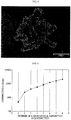
- FIG. 5 illustrates an energy dispersive spectrometry (EDS) image of a conductive fiber according to an embodiment of the present disclosure.
- EDS energy dispersive spectrometry
- FIG. 5 is an EDS image illustrating metal nanoparticles distribution of the conductive fiber of Example 1 shown in the sectional SEM image ( FIG. 4A ).
- metal nanoparticles are uniformly distributed also inside the conductive fiber manufactured in Example 1 and form a network thereinside.
- FIG. 6 is a graph illustrating electrical conductivity dependent upon the number of metal ions absorption and reduction of a conductive fiber according to an embodiment of the present disclosure.
- electrical conductivity was measured whenever metal ions were absorbed into an elastic fiber and the absorbed metal ions were reduced, upon manufacture of the conductive fiber according to Example 1.
- the electrical conductivity of the conductive fiber increased as the frequency of metal ions absorption into the conductive fiber manufactured in Example 1 and reduction of the absorbed metal ions increased.
- the conductive fiber exhibited a conductivity of about 20,000 S/cm.
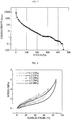
- FIG. 7 is a graph illustrating electrical conductivity relative to tensile strain of a conductive fiber according to an embodiment of the present disclosure.
- Example 1 retains electrical performance thereof even if the length thereof is increased to about 5.5 times the original length.
- the electrical conductivity of the conductive fiber is continuously decreased as the length thereof continuously increases. From these result, it can be confirmed that the conductive fiber is applicable as a strain sensor.
- FIG. 8 is a graph illustrating mechanical characteristics (stress) relative to tensile strain of a conductive fiber according to an embodiment of the present disclosure.
- FIG. 9 is a graph illustrating a change in resistance dependent upon the number of stretching of a conductive fiber according to an embodiment of the present disclosure.
- a conductive fiber according to an embodiment of the present disclosure is constituted of a plurality of filaments and uses an elastic fiber having a hierarchical structure, thereby exhibiting improved stretchability and mechanical stability.
- the conductive fiber according to an embodiment of the present disclosure uses a plurality of metal nanoparticles that are included in the elastic fiber and have an electrically interconnected network structure, thereby exhibiting improved electrical characteristics.
- a conductive fiber having improved electrical characteristics and mechanical stability may be applied to a strain sensor, a temperature sensor, a heater, and the like.
Landscapes
- Engineering & Computer Science (AREA)
- Textile Engineering (AREA)
- Chemical Or Physical Treatment Of Fibers (AREA)
- Transmission And Conversion Of Sensor Element Output (AREA)
Applications Claiming Priority (1)
| Application Number | Priority Date | Filing Date | Title |
|---|---|---|---|
| JP2018075742A JP2019183321A (ja) | 2018-04-10 | 2018-04-10 | 伸縮可能な導電性繊維及びその製造方法 |
Publications (1)
| Publication Number | Publication Date |
|---|---|
| EP3553023A1 true EP3553023A1 (fr) | 2019-10-16 |
Family
ID=66092034
Family Applications (1)
| Application Number | Title | Priority Date | Filing Date |
|---|---|---|---|
| EP19167003.3A Withdrawn EP3553023A1 (fr) | 2018-04-10 | 2019-04-03 | Fibre conductrice étirable et son procédé de fabrication |
Country Status (2)
| Country | Link |
|---|---|
| EP (1) | EP3553023A1 (fr) |
| JP (1) | JP2019183321A (fr) |
Cited By (1)
| Publication number | Priority date | Publication date | Assignee | Title |
|---|---|---|---|---|
| US20230235501A1 (en) * | 2020-06-22 | 2023-07-27 | National Research Council Of Canada | A method for fabricating conductive yarns and fabrics at room temperature |
Citations (6)
| Publication number | Priority date | Publication date | Assignee | Title |
|---|---|---|---|---|
| KR100760652B1 (ko) | 2006-01-26 | 2007-10-04 | 인하대학교 산학협력단 | 은 나노입자 함유 폴리우레탄 나노섬유 매트의 제조방법 |
| EP2557207A1 (fr) * | 2011-08-10 | 2013-02-13 | Samsung Electronics Co., Ltd. | Nanofibres conductrices extensibles, électrode extensible les utilisant et procédé de production de nanofibres conductrices extensibles |
| KR20140017335A (ko) | 2012-07-31 | 2014-02-11 | 삼성전자주식회사 | 신축 전도성 복합사, 그 제조방법 및 이를 포함하는 신축 전도성 복합 방적사 |
| US20160122941A1 (en) * | 2014-10-29 | 2016-05-05 | Industry-Academic Cooperation Foundation, Yonsei University | Conductive yarn, conductive yarn based pressure sensor and methods for producing them |
| KR20160053759A (ko) | 2015-06-29 | 2016-05-13 | 연세대학교 산학협력단 | 전도성 나노섬유 및 이의 제조 방법, 그리고 전도성 나노섬유 기반 압력 센서 및 이의 제조 방법 |
| TWI601867B (zh) * | 2016-07-22 | 2017-10-11 | 國立臺北科技大學 | 彈性導電纖維結構及包含其之光電元件 |
-
2018
- 2018-04-10 JP JP2018075742A patent/JP2019183321A/ja active Pending
-
2019
- 2019-04-03 EP EP19167003.3A patent/EP3553023A1/fr not_active Withdrawn
Patent Citations (6)
| Publication number | Priority date | Publication date | Assignee | Title |
|---|---|---|---|---|
| KR100760652B1 (ko) | 2006-01-26 | 2007-10-04 | 인하대학교 산학협력단 | 은 나노입자 함유 폴리우레탄 나노섬유 매트의 제조방법 |
| EP2557207A1 (fr) * | 2011-08-10 | 2013-02-13 | Samsung Electronics Co., Ltd. | Nanofibres conductrices extensibles, électrode extensible les utilisant et procédé de production de nanofibres conductrices extensibles |
| KR20140017335A (ko) | 2012-07-31 | 2014-02-11 | 삼성전자주식회사 | 신축 전도성 복합사, 그 제조방법 및 이를 포함하는 신축 전도성 복합 방적사 |
| US20160122941A1 (en) * | 2014-10-29 | 2016-05-05 | Industry-Academic Cooperation Foundation, Yonsei University | Conductive yarn, conductive yarn based pressure sensor and methods for producing them |
| KR20160053759A (ko) | 2015-06-29 | 2016-05-13 | 연세대학교 산학협력단 | 전도성 나노섬유 및 이의 제조 방법, 그리고 전도성 나노섬유 기반 압력 센서 및 이의 제조 방법 |
| TWI601867B (zh) * | 2016-07-22 | 2017-10-11 | 國立臺北科技大學 | 彈性導電纖維結構及包含其之光電元件 |
Non-Patent Citations (2)
| Title |
|---|
| JAEHONG LEE ET AL: "Highly Sensitive Multifilament Fiber Strain Sensors with Ultrabroad Sensing Range for Textile Electronics", ACS NANO, vol. 12, no. 5, 4 April 2018 (2018-04-04), US, pages 4259 - 4268, XP055603598, ISSN: 1936-0851, DOI: 10.1021/acsnano.7b07795 * |
| JAEHONG LEE ET AL: "Supporting Information Highly Sensitive Multifilament Fiber Strain Sensors with Ultra- Broad Sensing Range for Textile Electronics", 4 April 2018 (2018-04-04), XP055604029, Retrieved from the Internet <URL:https://pubs.acs.org/doi/suppl/10.1021/acsnano.7b07795/suppl_file/nn7b07795_si_005.pdf> [retrieved on 20190710] * |
Cited By (1)
| Publication number | Priority date | Publication date | Assignee | Title |
|---|---|---|---|---|
| US20230235501A1 (en) * | 2020-06-22 | 2023-07-27 | National Research Council Of Canada | A method for fabricating conductive yarns and fabrics at room temperature |
Also Published As
| Publication number | Publication date |
|---|---|
| JP2019183321A (ja) | 2019-10-24 |
Similar Documents
| Publication | Publication Date | Title |
|---|---|---|
| Gao et al. | Advances in wearable strain sensors based on electrospun fibers | |
| Wang et al. | Mechanically flexible conductors for stretchable and wearable e‐skin and e‐textile devices | |
| Tiwari et al. | The state of understanding of ionic polymer metal composite architecture: a review | |
| Jason et al. | Resistive electronic skin | |
| EP2557207B1 (fr) | Nanofibres conductrices extensibles, électrode extensible les utilisant et procédé de production de nanofibres conductrices extensibles | |
| Lan et al. | Ultrathin MXene/polymer coatings with an alternating structure on fabrics for enhanced electromagnetic interference shielding and fire-resistant protective performances | |
| Mirabedini et al. | Developments in conducting polymer fibres: from established spinning methods toward advanced applications | |
| Wang et al. | Fabrication of high-performance wearable strain sensors by using CNTs-coated electrospun polyurethane nanofibers | |
| Tang et al. | Highly stretchable core–sheath fibers via wet-spinning for wearable strain sensors | |
| US20180102201A1 (en) | Stretchable conductive fiber and method of manufacturing the same | |
| Wang et al. | Surface silverized meta-aramid fibers prepared by bio-inspired poly (dopamine) functionalization | |
| US20120251824A1 (en) | Stretchable Conductive Nanofibers, Stretchable Fiber Electrode Using The Same And Method For Producing The Same | |
| Lin et al. | Superior stretchable conductors by electroless plating of copper on knitted fabrics | |
| KR101079775B1 (ko) | 전기방사에 이은 무전해 도금을 통한 전기 전도성 나노섬유 제조 방법 | |
| KR102521507B1 (ko) | 금속나노벨트와 탄소나노소재 복합체를 이용한 전도성 섬유 및 그 제조방법 | |
| CN110073732B (zh) | 柔性电磁波屏蔽材料、电磁波屏蔽型电路模块及电子设备 | |
| KR20140015897A (ko) | 그래핀과 금속산화물 나노튜브의 복합체, 그의 제조 방법 및 이를 포함하는 센서 | |
| Shin et al. | Electronic textiles based on highly conducting poly (vinyl alcohol)/carbon nanotube/silver nanobelt hybrid fibers | |
| US11387053B2 (en) | Aramid fiber electrode and preparation method therefor | |
| KR20150094491A (ko) | 전도성 신축성 섬유, 상기 섬유를 포함하는 직물, 및 이들의 제조방법 | |
| JP2021515854A (ja) | ナノ材料被覆繊維 | |
| Sun et al. | Core-sheath smart polymer fiber composites with high elasticity and thermal conductivity | |
| EP3553023A1 (fr) | Fibre conductrice étirable et son procédé de fabrication | |
| JP2007533109A (ja) | 電気的伝導性エラストマ、それを製造する方法及びそれを含む物品 | |
| Li et al. | Facile approach to fabricate oriented porous PDMS composites for movements monitoring and identifying motion patterns |
Legal Events
| Date | Code | Title | Description |
|---|---|---|---|
| PUAI | Public reference made under article 153(3) epc to a published international application that has entered the european phase |
Free format text: ORIGINAL CODE: 0009012 |
|
| 17P | Request for examination filed |
Effective date: 20190403 |
|
| AK | Designated contracting states |
Kind code of ref document: A1 Designated state(s): AL AT BE BG CH CY CZ DE DK EE ES FI FR GB GR HR HU IE IS IT LI LT LU LV MC MK MT NL NO PL PT RO RS SE SI SK SM TR |
|
| AX | Request for extension of the european patent |
Extension state: BA ME |
|
| STAA | Information on the status of an ep patent application or granted ep patent |
Free format text: STATUS: THE APPLICATION IS DEEMED TO BE WITHDRAWN |
|
| 18D | Application deemed to be withdrawn |
Effective date: 20200603 |