EP3552847B1 - Tire - Google Patents
Tire Download PDFInfo
- Publication number
- EP3552847B1 EP3552847B1 EP19168073.5A EP19168073A EP3552847B1 EP 3552847 B1 EP3552847 B1 EP 3552847B1 EP 19168073 A EP19168073 A EP 19168073A EP 3552847 B1 EP3552847 B1 EP 3552847B1
- Authority
- EP
- European Patent Office
- Prior art keywords
- groove
- tire
- tread
- main
- width
- Prior art date
- Legal status (The legal status is an assumption and is not a legal conclusion. Google has not performed a legal analysis and makes no representation as to the accuracy of the status listed.)
- Active
Links
Images


Classifications
-
- B—PERFORMING OPERATIONS; TRANSPORTING
- B60—VEHICLES IN GENERAL
- B60C—VEHICLE TYRES; TYRE INFLATION; TYRE CHANGING; CONNECTING VALVES TO INFLATABLE ELASTIC BODIES IN GENERAL; DEVICES OR ARRANGEMENTS RELATED TO TYRES
- B60C11/00—Tyre tread bands; Tread patterns; Anti-skid inserts
- B60C11/03—Tread patterns
- B60C11/13—Tread patterns characterised by the groove cross-section, e.g. for buttressing or preventing stone-trapping
- B60C11/1307—Tread patterns characterised by the groove cross-section, e.g. for buttressing or preventing stone-trapping with special features of the groove walls
- B60C11/1315—Tread patterns characterised by the groove cross-section, e.g. for buttressing or preventing stone-trapping with special features of the groove walls having variable inclination angles, e.g. warped groove walls
-
- B—PERFORMING OPERATIONS; TRANSPORTING
- B60—VEHICLES IN GENERAL
- B60C—VEHICLE TYRES; TYRE INFLATION; TYRE CHANGING; CONNECTING VALVES TO INFLATABLE ELASTIC BODIES IN GENERAL; DEVICES OR ARRANGEMENTS RELATED TO TYRES
- B60C11/00—Tyre tread bands; Tread patterns; Anti-skid inserts
- B60C11/03—Tread patterns
- B60C11/0306—Patterns comprising block rows or discontinuous ribs
- B60C11/0309—Patterns comprising block rows or discontinuous ribs further characterised by the groove cross-section
-
- B—PERFORMING OPERATIONS; TRANSPORTING
- B60—VEHICLES IN GENERAL
- B60C—VEHICLE TYRES; TYRE INFLATION; TYRE CHANGING; CONNECTING VALVES TO INFLATABLE ELASTIC BODIES IN GENERAL; DEVICES OR ARRANGEMENTS RELATED TO TYRES
- B60C11/00—Tyre tread bands; Tread patterns; Anti-skid inserts
- B60C11/03—Tread patterns
- B60C11/13—Tread patterns characterised by the groove cross-section, e.g. for buttressing or preventing stone-trapping
- B60C11/1376—Three dimensional block surfaces departing from the enveloping tread contour
- B60C11/1392—Three dimensional block surfaces departing from the enveloping tread contour with chamfered block edges
-
- B—PERFORMING OPERATIONS; TRANSPORTING
- B60—VEHICLES IN GENERAL
- B60C—VEHICLE TYRES; TYRE INFLATION; TYRE CHANGING; CONNECTING VALVES TO INFLATABLE ELASTIC BODIES IN GENERAL; DEVICES OR ARRANGEMENTS RELATED TO TYRES
- B60C11/00—Tyre tread bands; Tread patterns; Anti-skid inserts
- B60C11/03—Tread patterns
- B60C2011/0337—Tread patterns characterised by particular design features of the pattern
- B60C2011/0339—Grooves
- B60C2011/0341—Circumferential grooves
- B60C2011/0353—Circumferential grooves characterised by width
Definitions
- the present invention relates to a tire having, in a tread portion, a main groove that extends continuously in a tire circumferential direction.
- Japanese Laid-Open Patent Publication No. 5-338412 discloses a tire having, in a tread portion, main grooves that extend continuously in the tire circumferential direction.
- the main groove has a groove wall surface that extends so as to be tilted in a direction in which the groove width is reduced from a groove bottom surface toward a tread surface.
- the main groove exhibits good drainage performance also when the tread portion has been worn.
- a corner portion of a land portion between a tread surface of the tread portion and the groove wall surface of the main groove tends to have an acute angle.
- the corner portion is deformed when contacting with the ground, and thus receives little shearing force and eventually receives only low wear energy. Therefore, the corner portion of the land portion tends to cause abnormal wear in which wear concentrates on other portions.
- the corner portion has problems that stiffness of the tread portion is reduced, and, in particular, steering stability is poor when the tire is a new one.
- EP 1 116 604 A2 discloses a tire comprising a tread provided with three circumferentially extending fine grooves with enlarged groove bottom portions.
- JP 2002 211211 A discloses a tire comprising features according to a related technology.
- US 3 770 04 A also discloses a tire comprising features according to a related technology.
- JP S58 136502 A discloses a tire having a tread portion in which a main groove includes a first portion extending in a depth direction of the main groove and having a constant width and a second portion extending in the depth direction and having an arc shape with increasing and decreasing width.
- US 2 327 057 A discloses a tire comprising features according to a related technology.
- the present invention is made in view of the aforementioned circumstances, and a main object of the present invention is to provide a tire that can exhibit excellent wet performance over a long period of time while maintaining wear resistance and steering stability.
- the present invention is directed to a tire according to claim 1.
- the tread portion has at least one main groove that extends continuously in a tire circumferential direction.
- the main groove includes a first portion that extends in a depth direction of the main groove so as to have an almost constant groove width, and a second portion that has a groove width which increases from the first portion toward a groove bottom, on a transverse cross-section orthogonal to a length direction of the main groove.
- a depth from a tread surface of the tread portion to the boundary between the first portion and the second portion is 0.40 to 0.50 times a maximum depth of the main groove.
- One groove wall of the main groove and the other groove wall of the main groove are line-symmetric with respect to a center line of the main groove in a tire axial direction, on the transverse cross-section of the tire of the present invention.
- the main groove extends linearly along the tire circumferential direction.
- the first portion preferably extends from a groove edge of the main groove in the depth direction of the main groove.
- At least one of groove walls of the second portion is smoothly curved and recessed outward in a width direction of the main groove, on the transverse cross-section of the tire of the present invention.
- At least one of the groove walls of the second portion preferably includes a tilted portion that extends so as to be tilted in a direction in which a groove width of the main groove increases from a boundary between the first portion and the second portion, on the transverse cross-section of the tire of the present invention.
- An angle of the tilted portion relative to a normal line that passes through the groove edge of the main groove is preferably 10 to 70°.
- a difference between a groove width of the first portion and a maximum groove width of the second portion is preferably 3.0 to 6.0 mm.
- a groove bottom face of the main groove preferably extends linearly in the tire axial direction, on the transverse cross-section of the tire of the present invention.
- the main groove preferably extends in the tire circumferential direction so as to maintain a shape of the transverse cross-section.
- the main groove may zigzag in the tire circumferential direction.
- An angle of a groove wall of the first portion relative to the line normal to a tread is preferably 0 to 5° on the transverse cross-section of the tire of the present invention.
- An angle of each groove wall of the first portion relative to the line normal to the tread is preferably less than 1.0° on the transverse cross-section of the tire of the present invention.
- the tread portion of the tire according to the present invention has at least one main groove that extends continuously in the tire circumferential direction.
- the main groove includes the first portion that extends in the depth direction of the main groove so as to have an almost constant groove width, and the second portion that has a groove width which increases from the first portion toward a groove bottom, on the transverse cross-section orthogonal to the length direction of the main groove.
- the tire of the present invention can exhibit excellent wet performance over a long period of time due to the second portion having the groove width that increases toward the groove bottom.
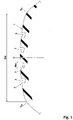
- FIG. 1 is a transverse cross-sectional view of a tread portion 2 of a tire 1 according to the present embodiment.
- FIG. 1 shows a meridian cross-section that includes a tire rotation axis in a normal state of the tire 1.
- the tire 1 is preferably used as, for example, a pneumatic tire for passenger cars.
- the present invention is not limited to such an example.
- the tire 1 of the present invention may be used as, for example, a heavy duty tire.
- the "normal state” represents a state in which a tire is mounted to a normal rim and is inflated with air to a normal internal pressure, and no load is applied to the tire.
- dimensions of components of the tire and the like are represented by values measured in the normal state.
- the "normal rim” represents a rim that is defined by a standard, in a standard system including the standard with which the tire complies, for each tire, and is, for example, the "standard rim” in the JATMA standard, the "Design Rim” in the TRA standard, or the “Measuring Rim” in the ETRTO standard.
- the "normal internal pressure” represents an air pressure that is defined by a standard, in a standard system including the standard with which the tire complies, for each tire, and is the “maximum air pressure” in the JATMA standard, the maximum value recited in the table "TIRE LOAD LIMITS AT VARIOUS COLD INFLATION PRESSURES" in the TRA standard, or the “INFLATION PRESSURE” in the ETRTO standard.
- the tread portion 2 has four main grooves 3 that extend continuously in the tire circumferential direction.
- a groove width Wa of each main groove 3 is 3.0% to 6.0% of a tread width TW.
- the groove width Wa is a length between groove edges that appear on a tread surface of the tread portion 2.
- the tread width TW is a distance, in the tire axial direction, from one of tread ends Te to the other of the tread ends Te in the normal state.
- each main groove 3 preferably has a groove depth of, for example, 5 to 10 mm.
- the tread end Te is a ground contact position at the outermost side in the tire axial direction in a state where a normal load is applied to the tire 1 in the normal state and the tire 1 is brought into contact with a plane at a camber angle of 0°.
- the "normal load” represents a load that is defined by a standard, in a standard system including the standard with which the tire complies, for each tire, and is "maximum load capacity" in the JATMA standard, the maximum value recited in the table "TIRE LOAD LIMITS AT VARIOUS COLD INFLATION PRESSURES" in the TRA standard, or the "LOAD CAPACITY" in the ETRTO standard.
- FIG. 2 is an enlarged plan view of the main groove 3. As shown in FIG. 2 , the main groove 3 extends linearly along the tire circumferential direction. According to an alternative example not according to the invention, the main groove 3 may zigzag in the tire circumferential direction.
- FIG. 3 is a cross-sectional view of the main groove 3 as taken along a line A-A.
- the main groove 3 includes a first portion 6 which extends in the depth direction of the main groove 3 so as to have an almost constant groove width, and a second portion 7 that has a groove width that increases from the first portion 6 toward the groove bottom.
- the first portion 6 that extends so as to have an almost constant groove width includes a mode in which an angle between one of the groove walls of the first portion 6 and the other of the groove walls thereof is 0 to 5°.
- the angle is less than 1.0°.
- an angle of each groove wall of the first portion 6 relative to the line normal to the tread is 0 to 5° and more preferably less than 1.0°.
- the line normal to the tread is a line that passes through a groove edge of the main groove 3 and is orthogonal to the tread surface on the transverse cross-section of the tire.
- the tire 1 of the present invention as described above is a new tire in which the first portion 6 of the main groove 3 remains unworn, or is a tire in an initial stage of wear, a corner portion 8 of a land portion which is defined by the tread surface of the tread portion 2 and the groove wall of the main groove 3 is inhibited from having an acute angle. Therefore, while steering stability is maintained, abnormal wear in the tread portion 2 can be reduced.
- the tire of the present invention can exhibit excellent wet performance over a long period of time due to the second portion 7 having the groove width that increases toward the groove bottom.
- the first portion 6 preferably extends, for example, from a groove edge 3e of the main groove 3 in the depth direction of the main groove 3.
- the first portion 6 having such a structure can assuredly maintain steering stability obtained in the case of the tire being a new one. Furthermore, the first portion 6 having such a structure contributes to assuredly increasing of an area of the tread surface of the tread portion 2 so that grip force can be made high, as compared to a groove of which the groove width is gradually reduced from the groove edge. Furthermore, in the first portion 6, the groove width is unlikely to change even when ground contact pressure acts, and pumping sound at the time of ground contact can be reduced, as compared to a groove of which the groove width is gradually reduced from the groove edge.
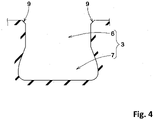
- the main groove 3 of the present invention may include, for example, a chamfered portion 9 formed from a tilted surface, between the first portion 6 and the tread surface of the tread portion 2, as in another embodiment shown in FIG. 4 .
- a depth d2 from the tread surface of the tread portion 2 to a boundary 10 between the first portion 6 and the second portion 7 is 0.40 to 0.50 times a maximum depth d1 of the main groove.
- the main groove 3 having such a structure allows well-balanced improvement of steering stability and wet performance.
- the main groove 3 having such a structure prevents a groove volume from being excessively great, and contributes to reduction of air column resonance sound.
- the second portion 7 for example, at least one of groove walls 7a is smoothly curved, and recessed outward in the width direction of the main groove 3. In the present embodiment, both the groove walls are smoothly curved and recessed. Furthermore, in the second portion 7, the groove width is gradually increased toward the groove bottom.
- the second portion 7 having such a structure facilitates removal of a main-groove-forming rib of a vulcanization mold from the tread portion 2 in vulcanization molding (hereinafter, this effect may be referred to as "improve demoldability").
- the first portion 6 has a constant groove width toward the depth direction of the main groove. Therefore, when the rib of the vulcanization mold is removed from the tread portion 2, damage near the boundary 10 can be reduced.
- the groove width is gradually reduced toward the groove bottom in a region on the outer side of the second portion 7 in the tire radial direction, the direction in which the groove wall tilts is changed at the boundary 10. Therefore, a portion near the boundary 10 may be easily damaged in vulcanization molding.
- At least one of the groove walls 7a of the second portion 7 includes a tilted portion 14 that extends so as to be tilted in a direction in which the groove width of the main groove 3 increases from the boundary 10 between the second portion 7 and the first portion 6.
- An angle ⁇ 1 of the tilted portion 14 relative to the normal line that passes through the groove edge 3e of the main groove 3 is preferably not less than 10°, more preferably not less than 20°, and even more preferably not less than 25°, and preferably not greater than 70°, more preferably not greater than 50°, and even more preferably not greater than 30°.
- the second portion 7 having such a structure exhibits the above-described effects while exhibiting excellent demoldability.
- An outermost side portion 12 of the second portion 7 is positioned, for example, outward of the groove edge 3e of the main groove 3.
- a maximum groove width W2 of the second portion 7 is preferably 1.15 to 1.25 times a groove width W1 of the first portion 6.
- the main groove 3 having such a structure exhibits excellent drainage performance while enhancing wear resistance.
- a difference between the groove width W1 of the first portion 6 and the maximum groove width W2 of the second portion 7 is preferably not less than 3.0 mm and more preferably not less than 4.0 mm, and preferably not greater than 6.0 mm and more preferably not greater than 5.0 mm.
- One groove wall 3a of the main groove 3 and the other groove wall 3b of the main groove 3 are line-symmetric with respect to the center line of the main groove 3 in the tire axial direction.
- the main groove 3 having such a structure allows the groove walls on both sides to be equally worn, and eventually allows wear resistance to be improved.
- a groove bottom face 13 of the main groove 3 preferably extends linearly in the tire axial direction.
- a portion, of the groove bottom face 13, near the center in the tire axial direction is unlikely to be bent, and the groove volume of the main groove 3 is unlikely to be reduced even in a state where stress in the tire axial direction acts on the tread portion 2. Therefore, cornering performance at a wet road surface is improved.
- the outermost side portion 12 of the second portion 7 preferably extends parallel to the groove edge 3e of the main groove 3.
- the entirety of the main groove 3 preferably extends in the tire circumferential direction so as to maintain the transverse cross-sectional shape described above.
- the main groove 3 having such a structure even when wear of the tread portion 2 is developed, the groove edge 3e that appears on the outer surface thereof maintains the linear shape so that uneven wear near the groove edge 3e can be reduced.
- the main groove 3 may be formed, for example, so as to increase or reduce the groove width of the second portion 7 in the tire circumferential direction.
- Pneumatic tires each having the above-described main groove and having the size of 185/65R15 were produced as sample tires based on the specifications indicated in Table 1.
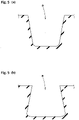
- a tire that had a main groove having a cross-sectional shape shown in FIG. 5 (a) was produced as the sample tire.
- the groove width of the main groove a was gradually reduced from the groove edge of the main groove toward the groove bottom.
- a tire that had a main groove having a cross-sectional shape shown in FIG. 5 (b) was produced as the sample tire.
- the groove width of the main groove a was gradually increased from the groove edge of the main groove toward the groove bottom.
- the groove volume of the main groove is equal to the groove volume of the main groove of example 1.
- test tire was tested for steering stability, wet performance after wear, and presence or absence of abnormal wear. Specifications common to all the test tires and the test method are as follows.
Landscapes
- Engineering & Computer Science (AREA)
- Mechanical Engineering (AREA)
- Tires In General (AREA)
Description
- The present invention relates to a tire having, in a tread portion, a main groove that extends continuously in a tire circumferential direction.
-
Japanese Laid-Open Patent Publication No. 5-338412 - The main groove exhibits good drainage performance also when the tread portion has been worn. However, in the tire, a corner portion of a land portion between a tread surface of the tread portion and the groove wall surface of the main groove tends to have an acute angle. The corner portion is deformed when contacting with the ground, and thus receives little shearing force and eventually receives only low wear energy. Therefore, the corner portion of the land portion tends to cause abnormal wear in which wear concentrates on other portions. Furthermore, the corner portion has problems that stiffness of the tread portion is reduced, and, in particular, steering stability is poor when the tire is a new one.
-
EP 1 116 604 A2 discloses a tire comprising a tread provided with three circumferentially extending fine grooves with enlarged groove bottom portions. -
JP 2002 211211 A -
US 3 770 04 A also discloses a tire comprising features according to a related technology. -
JP S58 136502 A -
US 2 327 057 A discloses a tire comprising features according to a related technology. - The present invention is made in view of the aforementioned circumstances, and a main object of the present invention is to provide a tire that can exhibit excellent wet performance over a long period of time while maintaining wear resistance and steering stability.
- The present invention is directed to a tire according to claim 1. The tread portion has at least one main groove that extends continuously in a tire circumferential direction. The main groove includes a first portion that extends in a depth direction of the main groove so as to have an almost constant groove width, and a second portion that has a groove width which increases from the first portion toward a groove bottom, on a transverse cross-section orthogonal to a length direction of the main groove.
- In the tire of the present invention, a depth from a tread surface of the tread portion to the boundary between the first portion and the second portion is 0.40 to 0.50 times a maximum depth of the main groove.
- One groove wall of the main groove and the other groove wall of the main groove are line-symmetric with respect to a center line of the main groove in a tire axial direction, on the transverse cross-section of the tire of the present invention.
- In the tire of the present invention, the main groove extends linearly along the tire circumferential direction.
- In the tire of the present invention, the first portion preferably extends from a groove edge of the main groove in the depth direction of the main groove.
- Preferably, at least one of groove walls of the second portion is smoothly curved and recessed outward in a width direction of the main groove, on the transverse cross-section of the tire of the present invention.
- At least one of the groove walls of the second portion preferably includes a tilted portion that extends so as to be tilted in a direction in which a groove width of the main groove increases from a boundary between the first portion and the second portion, on the transverse cross-section of the tire of the present invention. An angle of the tilted portion relative to a normal line that passes through the groove edge of the main groove is preferably 10 to 70°.
- In the tire of the present invention, a difference between a groove width of the first portion and a maximum groove width of the second portion is preferably 3.0 to 6.0 mm.
- A groove bottom face of the main groove preferably extends linearly in the tire axial direction, on the transverse cross-section of the tire of the present invention.
- In the tire of the present invention, the main groove preferably extends in the tire circumferential direction so as to maintain a shape of the transverse cross-section.
- According to an alternative example not according to the invention, the main groove may zigzag in the tire circumferential direction.
- An angle of a groove wall of the first portion relative to the line normal to a tread is preferably 0 to 5° on the transverse cross-section of the tire of the present invention.
- An angle of each groove wall of the first portion relative to the line normal to the tread is preferably less than 1.0° on the transverse cross-section of the tire of the present invention.
- The tread portion of the tire according to the present invention has at least one main groove that extends continuously in the tire circumferential direction. The main groove includes the first portion that extends in the depth direction of the main groove so as to have an almost constant groove width, and the second portion that has a groove width which increases from the first portion toward a groove bottom, on the transverse cross-section orthogonal to the length direction of the main groove.
- When the tire as described above is a new tire in which the first portion of the main groove remains unworn, or is a tire in an initial stage of wear, a corner portion of a land portion which is defined by the main grooves is inhibited from having an acute angle. Therefore, while steering stability is maintained, abnormal wear in the tread portion can be reduced.
- Furthermore, in a state where the first portion of the main groove is worn and lost, the tire of the present invention can exhibit excellent wet performance over a long period of time due to the second portion having the groove width that increases toward the groove bottom.
-
-
FIG. 1 is a transverse cross-sectional view of a tread portion of a tire according to one embodiment; -
FIG. 2 is an enlarged plan view of a main groove shown inFIG. 1 ; -
FIG. 3 is a cross-sectional view taken along a line A-A inFIG. 2 ; -
FIG. 4 is an enlarged cross-sectional view of a main groove according to another embodiment of the present invention; -
FIG. 5(a) is an enlarged cross-sectional view of a main groove of comparative example 1; and -
FIG. 5 (b) is an enlarged cross-sectional view of a main groove of comparative example 2. - An embodiment of the present invention will be described below with reference to the drawings.
-
FIG. 1 is a transverse cross-sectional view of atread portion 2 of a tire 1 according to the present embodiment.FIG. 1 shows a meridian cross-section that includes a tire rotation axis in a normal state of the tire 1. In the present embodiment, the tire 1 is preferably used as, for example, a pneumatic tire for passenger cars. However, the present invention is not limited to such an example. The tire 1 of the present invention may be used as, for example, a heavy duty tire. - The "normal state" represents a state in which a tire is mounted to a normal rim and is inflated with air to a normal internal pressure, and no load is applied to the tire. Hereinafter, unless otherwise specified, dimensions of components of the tire and the like are represented by values measured in the normal state.
- The "normal rim" represents a rim that is defined by a standard, in a standard system including the standard with which the tire complies, for each tire, and is, for example, the "standard rim" in the JATMA standard, the "Design Rim" in the TRA standard, or the "Measuring Rim" in the ETRTO standard.
- The "normal internal pressure" represents an air pressure that is defined by a standard, in a standard system including the standard with which the tire complies, for each tire, and is the "maximum air pressure" in the JATMA standard, the maximum value recited in the table "TIRE LOAD LIMITS AT VARIOUS COLD INFLATION PRESSURES" in the TRA standard, or the "INFLATION PRESSURE" in the ETRTO standard.
- As shown in
FIG. 1 , thetread portion 2 has fourmain grooves 3 that extend continuously in the tire circumferential direction. - A groove width Wa of each
main groove 3 is 3.0% to 6.0% of a tread width TW. The groove width Wa is a length between groove edges that appear on a tread surface of thetread portion 2. The tread width TW is a distance, in the tire axial direction, from one of tread ends Te to the other of the tread ends Te in the normal state. In the case of the pneumatic tire for passenger cars, eachmain groove 3 preferably has a groove depth of, for example, 5 to 10 mm. - The tread end Te is a ground contact position at the outermost side in the tire axial direction in a state where a normal load is applied to the tire 1 in the normal state and the tire 1 is brought into contact with a plane at a camber angle of 0°.
- The "normal load" represents a load that is defined by a standard, in a standard system including the standard with which the tire complies, for each tire, and is "maximum load capacity" in the JATMA standard, the maximum value recited in the table "TIRE LOAD LIMITS AT VARIOUS COLD INFLATION PRESSURES" in the TRA standard, or the "LOAD CAPACITY" in the ETRTO standard.
-
FIG. 2 is an enlarged plan view of themain groove 3. As shown inFIG. 2 , themain groove 3 extends linearly along the tire circumferential direction. According to an alternative example not according to the invention, themain groove 3 may zigzag in the tire circumferential direction. -
FIG. 3 is a cross-sectional view of themain groove 3 as taken along a line A-A. As shown inFIG. 3 , on the transverse cross-section orthogonal to the length direction of themain groove 3, themain groove 3 includes afirst portion 6 which extends in the depth direction of themain groove 3 so as to have an almost constant groove width, and asecond portion 7 that has a groove width that increases from thefirst portion 6 toward the groove bottom. In consideration of, for example, shrinkage of the carcass and deformation of a groove wall in vulcanization molding, "thefirst portion 6 that extends so as to have an almost constant groove width" includes a mode in which an angle between one of the groove walls of thefirst portion 6 and the other of the groove walls thereof is 0 to 5°. In a more preferable mode, the angle is less than 1.0°. In the present embodiment, an angle of each groove wall of thefirst portion 6 relative to the line normal to the tread is 0 to 5° and more preferably less than 1.0°. The line normal to the tread is a line that passes through a groove edge of themain groove 3 and is orthogonal to the tread surface on the transverse cross-section of the tire. When a small angle is formed between one of the groove walls and the other of the groove walls, each groove wall of thefirst portion 6 is preferably tilted in the direction in which the groove width is reduced toward the groove bottom. In the present embodiment, onegroove wall 3a of thefirst portion 6 and theother groove wall 3b thereof are disposed parallel to each other. - When the tire 1 of the present invention as described above is a new tire in which the
first portion 6 of themain groove 3 remains unworn, or is a tire in an initial stage of wear, acorner portion 8 of a land portion which is defined by the tread surface of thetread portion 2 and the groove wall of themain groove 3 is inhibited from having an acute angle. Therefore, while steering stability is maintained, abnormal wear in thetread portion 2 can be reduced. - Furthermore, in a state where the
first portion 6 of themain groove 3 is worn and lost, the tire of the present invention can exhibit excellent wet performance over a long period of time due to thesecond portion 7 having the groove width that increases toward the groove bottom. - The
first portion 6 preferably extends, for example, from agroove edge 3e of themain groove 3 in the depth direction of themain groove 3. Thefirst portion 6 having such a structure can assuredly maintain steering stability obtained in the case of the tire being a new one. Furthermore, thefirst portion 6 having such a structure contributes to assuredly increasing of an area of the tread surface of thetread portion 2 so that grip force can be made high, as compared to a groove of which the groove width is gradually reduced from the groove edge. Furthermore, in thefirst portion 6, the groove width is unlikely to change even when ground contact pressure acts, and pumping sound at the time of ground contact can be reduced, as compared to a groove of which the groove width is gradually reduced from the groove edge. - The
main groove 3 of the present invention may include, for example, a chamferedportion 9 formed from a tilted surface, between thefirst portion 6 and the tread surface of thetread portion 2, as in another embodiment shown inFIG. 4 . - As shown in
FIG. 3 , a depth d2 from the tread surface of thetread portion 2 to aboundary 10 between thefirst portion 6 and thesecond portion 7 is 0.40 to 0.50 times a maximum depth d1 of the main groove. Themain groove 3 having such a structure allows well-balanced improvement of steering stability and wet performance. Themain groove 3 having such a structure prevents a groove volume from being excessively great, and contributes to reduction of air column resonance sound. - In the
second portion 7, for example, at least one ofgroove walls 7a is smoothly curved, and recessed outward in the width direction of themain groove 3. In the present embodiment, both the groove walls are smoothly curved and recessed. Furthermore, in thesecond portion 7, the groove width is gradually increased toward the groove bottom. Thesecond portion 7 having such a structure facilitates removal of a main-groove-forming rib of a vulcanization mold from thetread portion 2 in vulcanization molding (hereinafter, this effect may be referred to as "improve demoldability"). - In the present embodiment, particularly, the
first portion 6 has a constant groove width toward the depth direction of the main groove. Therefore, when the rib of the vulcanization mold is removed from thetread portion 2, damage near theboundary 10 can be reduced. For example, when the groove width is gradually reduced toward the groove bottom in a region on the outer side of thesecond portion 7 in the tire radial direction, the direction in which the groove wall tilts is changed at theboundary 10. Therefore, a portion near theboundary 10 may be easily damaged in vulcanization molding. - At least one of the
groove walls 7a of thesecond portion 7 includes a tiltedportion 14 that extends so as to be tilted in a direction in which the groove width of themain groove 3 increases from theboundary 10 between thesecond portion 7 and thefirst portion 6. An angle θ1 of the tiltedportion 14 relative to the normal line that passes through thegroove edge 3e of themain groove 3 is preferably not less than 10°, more preferably not less than 20°, and even more preferably not less than 25°, and preferably not greater than 70°, more preferably not greater than 50°, and even more preferably not greater than 30°. Thesecond portion 7 having such a structure exhibits the above-described effects while exhibiting excellent demoldability. - An
outermost side portion 12 of thesecond portion 7 is positioned, for example, outward of thegroove edge 3e of themain groove 3. For example, a maximum groove width W2 of thesecond portion 7 is preferably 1.15 to 1.25 times a groove width W1 of thefirst portion 6. Themain groove 3 having such a structure exhibits excellent drainage performance while enhancing wear resistance. - In order to improve wet performance while demoldability is assured, a difference between the groove width W1 of the
first portion 6 and the maximum groove width W2 of thesecond portion 7 is preferably not less than 3.0 mm and more preferably not less than 4.0 mm, and preferably not greater than 6.0 mm and more preferably not greater than 5.0 mm. - One
groove wall 3a of themain groove 3 and theother groove wall 3b of themain groove 3 are line-symmetric with respect to the center line of themain groove 3 in the tire axial direction. Themain groove 3 having such a structure allows the groove walls on both sides to be equally worn, and eventually allows wear resistance to be improved. - For example, a groove bottom face 13 of the
main groove 3 preferably extends linearly in the tire axial direction. In themain groove 3 having such a structure, a portion, of thegroove bottom face 13, near the center in the tire axial direction is unlikely to be bent, and the groove volume of themain groove 3 is unlikely to be reduced even in a state where stress in the tire axial direction acts on thetread portion 2. Therefore, cornering performance at a wet road surface is improved. - As shown in
FIG. 2 , theoutermost side portion 12 of thesecond portion 7 preferably extends parallel to thegroove edge 3e of themain groove 3. - In a more preferable mode, the entirety of the
main groove 3 preferably extends in the tire circumferential direction so as to maintain the transverse cross-sectional shape described above. In themain groove 3 having such a structure, even when wear of thetread portion 2 is developed, thegroove edge 3e that appears on the outer surface thereof maintains the linear shape so that uneven wear near thegroove edge 3e can be reduced. However, the present invention is not limited to such an example. Themain groove 3 may be formed, for example, so as to increase or reduce the groove width of thesecond portion 7 in the tire circumferential direction. - The tire according to one embodiment of the present invention has been described above in detail. However, the present invention is not limited to the above-described specific embodiment, and various modifications can be devised within the scope of the appended claims.
- Pneumatic tires each having the above-described main groove and having the size of 185/65R15 were produced as sample tires based on the specifications indicated in Table 1. As comparative example 1, a tire that had a main groove having a cross-sectional shape shown in
FIG. 5 (a) was produced as the sample tire. In the tire of comparative example 1, the groove width of the main groove a was gradually reduced from the groove edge of the main groove toward the groove bottom. As comparative example 2, a tire that had a main groove having a cross-sectional shape shown inFIG. 5 (b) was produced as the sample tire. In the tire of comparative example 2, the groove width of the main groove a was gradually increased from the groove edge of the main groove toward the groove bottom. In each comparative example, the groove volume of the main groove is equal to the groove volume of the main groove of example 1. - Each test tire was tested for steering stability, wet performance after wear, and presence or absence of abnormal wear. Specifications common to all the test tires and the test method are as follows.
- Test vehicle: engine displacement of 2000 cc, front wheel drive vehicle
- Position at which test tire was mounted: all wheels
- Rim: 15×6.0J
- Tire internal pressure: 220 kPa for front wheel, 210 kPa for rear wheel
- Sensory evaluation was made by a driver for steering stability when the test vehicle ran on a dry road surface in the case of each tire being new. The result is indicated as scores with the score of comparative example 1 being 100. The greater the value of the score is, the more excellent steering stability is.
- Sensory evaluation was made by a driver for running performance on a wet road surface in a state where the tread portion was worn such that the depth of the main groove was 50% of the depth of the main groove in the case of each tire being new. The result is indicated as scores with the score of comparative example 1 being 100. The greater the value of the score is, the more excellent wet performance after wear is.
- Presence or absence of abnormal wear in the tread portion was confirmed after the vehicle ran on a dry road surface for 5000 km. "Good" represents absence of abnormal wear. "Poor" represents presence of such abnormal wear that the corner portion of the land portion remained unworn and wear concentrated on other portions.
- The test results are indicated in Table 1.


- According to the test results, it was confirmed that the tires of examples exhibited excellent wet perfomance even in a worn state while maintaining steering stability obtained in the case of each tire being new. Furthermore, it was confirmed that the tires of examples allowed reduction of abnormal wear in the tread portions, and has excellent wear resistance.
Claims (9)
- A tire (1) comprisinga tread portion (2), whereinthe tread portion (2) has four main grooves (3) extending continuously linearly along a tire circumferential direction, each main groove (3) includes a first portion (6) that extends in a depth direction of the main groove (3) so as to have an almost constant groove width, and a second portion (7) that has a groove width which increases from the first portion (6) toward a groove bottom, on a transverse cross-section orthogonal to a length direction of the main groove (3), andone groove wall (3a) of the main groove (3) and the other groove wall (3b) of the main groove (3) are line-symmetric with respect to a center line of the main groove (3) in a tire axial direction, on the transverse cross-section,whereina groove width (Wa) of each main groove (3), which is a length between groove edges that appear on a tread surface of the tread portion (2), is 3.0% to 6.0% of a tread width (TW), the tread width (TW) being a distance, in the tire axial direction, from one of tread ends (Te) to the other of the tread ends (Te) in the normal state, wherein a tread end (Te) is a ground contact position at the outermost side in the tire axial direction in a state where a normal load is applied to the tire (1) in the normal state and the tire (1) is brought into contact with a plane at a camber angle of 0°, the normal state being a state in which the tire (1) is mounted to a normal rim and is inflated with air to a normal internal pressure, and no load is applied to the tire (1), anda depth (d2) from a tread surface of the tread portion (2) to the boundary (10) between the first portion (6) and the second portion (7) is 0.40 to 0.50 times a maximum depth (d1) of the main grooves (3).
- The tire (1) according to claim 1, wherein the first portion (6) extends from a groove edge (3e) of the main grooves (3) in the depth direction of the main grooves (3).
- The tire (1) according to claim 1 or 2, wherein at least one of groove walls (7a) of the second portion (7) is smoothly curved and recessed outward in a width direction of the main grooves (3), on the transverse cross-section.
- The tire (1) according to any one of claims 1 to 3, whereinat least one of the groove walls (7a) of the second portion (7) includes a tilted portion (14) that extends so as to be tilted in a direction in which a groove width of the main grooves (3) increases from a boundary (10) between the first portion (6) and the second portion (7), on the transverse cross-section, andan angle of the tilted portion (14) relative to a normal line that passes through the groove edge (3e) of the main grooves (3) is 10 to 70°.
- The tire (1) according to any one of claims 1 to 4, wherein a difference between a groove width (W1) of the first portion (6) and a maximum groove width (W2) of the second portion (7) is 3.0 to 6.0 mm.
- The tire (1) according to any one of claims 1 to 5, wherein a groove bottom face (13) of the main grooves (3) extends linearly in the tire axial direction, on the transverse cross-section.
- The tire (1) according to any one of claims 1 to 6, wherein the main grooves (3) extend in the tire circumferential direction so as to maintain a shape of the transverse cross-section.
- The tire (1) according to any one of claims 1 to 7, wherein an angle of a groove wall of the first portion (6) relative to the line normal to a tread is 0 to 5° on the transverse cross-section.
- The tire (1) according to any one of claims 1 to 8, wherein an angle of each groove wall of the first portion (6) relative to the line normal to the tread is less than 1.0° on the transverse cross-section.
Applications Claiming Priority (1)
| Application Number | Priority Date | Filing Date | Title |
|---|---|---|---|
| JP2018076338A JP7172106B2 (en) | 2018-04-11 | 2018-04-11 | tire |
Publications (2)
| Publication Number | Publication Date |
|---|---|
| EP3552847A1 EP3552847A1 (en) | 2019-10-16 |
| EP3552847B1 true EP3552847B1 (en) | 2022-09-07 |
Family
ID=66102932
Family Applications (1)
| Application Number | Title | Priority Date | Filing Date |
|---|---|---|---|
| EP19168073.5A Active EP3552847B1 (en) | 2018-04-11 | 2019-04-09 | Tire |
Country Status (2)
| Country | Link |
|---|---|
| EP (1) | EP3552847B1 (en) |
| JP (1) | JP7172106B2 (en) |
Families Citing this family (4)
| Publication number | Priority date | Publication date | Assignee | Title |
|---|---|---|---|---|
| JP7539310B2 (en) * | 2020-12-16 | 2024-08-23 | 株式会社ブリヂストン | Pneumatic radial tires for passenger cars |
| JP2022095315A (en) * | 2020-12-16 | 2022-06-28 | 株式会社ブリヂストン | Pneumatic radial tire for passenger car |
| JP7701207B2 (en) * | 2021-08-04 | 2025-07-01 | 株式会社ブリヂストン | tire |
| JP2023178048A (en) * | 2022-06-03 | 2023-12-14 | 住友ゴム工業株式会社 | tire |
Family Cites Families (13)
| Publication number | Priority date | Publication date | Assignee | Title |
|---|---|---|---|---|
| US2327057A (en) * | 1939-08-23 | 1943-08-17 | Goodrich Co B F | Tire tread |
| FR1163341A (en) * | 1956-12-18 | 1958-09-24 | Mft Fr Pneumatiques Michelin | Improvements to tire treads for vehicles |
| US3770040A (en) * | 1971-09-15 | 1973-11-06 | De Cicco M Augusta | Tire with safety indicator means |
| JPS58136502A (en) * | 1982-02-08 | 1983-08-13 | Sumitomo Rubber Ind Ltd | Tire tread |
| JP3096357B2 (en) | 1992-06-04 | 2000-10-10 | 住友ゴム工業株式会社 | Heavy duty pneumatic tires |
| JP3101555B2 (en) * | 1995-11-28 | 2000-10-23 | 住友ゴム工業株式会社 | Pneumatic tire |
| JP3450953B2 (en) * | 1995-12-18 | 2003-09-29 | 住友ゴム工業株式会社 | Passenger car tires |
| US6412531B1 (en) | 1999-07-15 | 2002-07-02 | Michelin Recherche Et Technique S.A. | Tire tread having groove walls with compound contours |
| JP4615655B2 (en) * | 2000-01-17 | 2011-01-19 | 株式会社ブリヂストン | Pneumatic tire |
| JP2002211211A (en) | 2001-01-12 | 2002-07-31 | Bridgestone Corp | Pneumatic radial tire |
| JP4955022B2 (en) | 2009-01-06 | 2012-06-20 | 東洋ゴム工業株式会社 | Pneumatic tire |
| DE102015205006A1 (en) | 2015-03-19 | 2016-09-22 | Continental Reifen Deutschland Gmbh | Vehicle tires |
| DE102015215455A1 (en) | 2015-08-13 | 2017-02-16 | Continental Reifen Deutschland Gmbh | Vehicle tires |
-
2018
- 2018-04-11 JP JP2018076338A patent/JP7172106B2/en active Active
-
2019
- 2019-04-09 EP EP19168073.5A patent/EP3552847B1/en active Active
Also Published As
| Publication number | Publication date |
|---|---|
| EP3552847A1 (en) | 2019-10-16 |
| JP7172106B2 (en) | 2022-11-16 |
| JP2019182246A (en) | 2019-10-24 |
Similar Documents
| Publication | Publication Date | Title |
|---|---|---|
| EP3178668B1 (en) | Pneumatic tire | |
| CN106985618B (en) | Tyre for vehicle wheels | |
| EP3552847B1 (en) | Tire | |
| KR102569782B1 (en) | Tire | |
| JP7310434B2 (en) | tire | |
| CN114103558B (en) | Tire with a tire body | |
| JP2020196286A (en) | tire | |
| EP3689642B1 (en) | Tire | |
| US20200262248A1 (en) | Pneumatic tyre, tyre mold and method for manufacturing pneumatic tyre using the same | |
| EP3354484B1 (en) | Tire | |
| CN112009177B (en) | Tire with a tire body | |
| CN110091676B (en) | Tyre for vehicle wheels | |
| JP7669775B2 (en) | tire | |
| EP4245571B1 (en) | Tire | |
| EP3925797B1 (en) | Tire | |
| CN112046205A (en) | Tyre for vehicle wheels | |
| EP3970996B1 (en) | Tire | |
| US20220339965A1 (en) | Tire | |
| US11691459B2 (en) | Tire | |
| JP7669781B2 (en) | tire | |
| JP7625855B2 (en) | tire | |
| EP4245572B1 (en) | Tire | |
| JP7707719B2 (en) | Pneumatic tires | |
| JP7683290B2 (en) | tire | |
| JP7643039B2 (en) | tire |
Legal Events
| Date | Code | Title | Description |
|---|---|---|---|
| PUAI | Public reference made under article 153(3) epc to a published international application that has entered the european phase |
Free format text: ORIGINAL CODE: 0009012 |
|
| STAA | Information on the status of an ep patent application or granted ep patent |
Free format text: STATUS: THE APPLICATION HAS BEEN PUBLISHED |
|
| AK | Designated contracting states |
Kind code of ref document: A1 Designated state(s): AL AT BE BG CH CY CZ DE DK EE ES FI FR GB GR HR HU IE IS IT LI LT LU LV MC MK MT NL NO PL PT RO RS SE SI SK SM TR |
|
| AX | Request for extension of the european patent |
Extension state: BA ME |
|
| STAA | Information on the status of an ep patent application or granted ep patent |
Free format text: STATUS: REQUEST FOR EXAMINATION WAS MADE |
|
| 17P | Request for examination filed |
Effective date: 20200317 |
|
| RBV | Designated contracting states (corrected) |
Designated state(s): AL AT BE BG CH CY CZ DE DK EE ES FI FR GB GR HR HU IE IS IT LI LT LU LV MC MK MT NL NO PL PT RO RS SE SI SK SM TR |
|
| STAA | Information on the status of an ep patent application or granted ep patent |
Free format text: STATUS: EXAMINATION IS IN PROGRESS |
|
| 17Q | First examination report despatched |
Effective date: 20200428 |
|
| GRAP | Despatch of communication of intention to grant a patent |
Free format text: ORIGINAL CODE: EPIDOSNIGR1 |
|
| STAA | Information on the status of an ep patent application or granted ep patent |
Free format text: STATUS: GRANT OF PATENT IS INTENDED |
|
| INTG | Intention to grant announced |
Effective date: 20220523 |
|
| RIN1 | Information on inventor provided before grant (corrected) |
Inventor name: NAKAJIMA, KOICHI |
|
| GRAS | Grant fee paid |
Free format text: ORIGINAL CODE: EPIDOSNIGR3 |
|
| GRAA | (expected) grant |
Free format text: ORIGINAL CODE: 0009210 |
|
| STAA | Information on the status of an ep patent application or granted ep patent |
Free format text: STATUS: THE PATENT HAS BEEN GRANTED |
|
| AK | Designated contracting states |
Kind code of ref document: B1 Designated state(s): AL AT BE BG CH CY CZ DE DK EE ES FI FR GB GR HR HU IE IS IT LI LT LU LV MC MK MT NL NO PL PT RO RS SE SI SK SM TR |
|
| REG | Reference to a national code |
Ref country code: GB Ref legal event code: FG4D |
|
| REG | Reference to a national code |
Ref country code: CH Ref legal event code: EP Ref country code: AT Ref legal event code: REF Ref document number: 1516731 Country of ref document: AT Kind code of ref document: T Effective date: 20220915 |
|
| REG | Reference to a national code |
Ref country code: IE Ref legal event code: FG4D |
|
| REG | Reference to a national code |
Ref country code: DE Ref legal event code: R096 Ref document number: 602019019146 Country of ref document: DE |
|
| REG | Reference to a national code |
Ref country code: LT Ref legal event code: MG9D |
|
| REG | Reference to a national code |
Ref country code: NL Ref legal event code: MP Effective date: 20220907 |
|
| PG25 | Lapsed in a contracting state [announced via postgrant information from national office to epo] |
Ref country code: SE Free format text: LAPSE BECAUSE OF FAILURE TO SUBMIT A TRANSLATION OF THE DESCRIPTION OR TO PAY THE FEE WITHIN THE PRESCRIBED TIME-LIMIT Effective date: 20220907 Ref country code: RS Free format text: LAPSE BECAUSE OF FAILURE TO SUBMIT A TRANSLATION OF THE DESCRIPTION OR TO PAY THE FEE WITHIN THE PRESCRIBED TIME-LIMIT Effective date: 20220907 Ref country code: NO Free format text: LAPSE BECAUSE OF FAILURE TO SUBMIT A TRANSLATION OF THE DESCRIPTION OR TO PAY THE FEE WITHIN THE PRESCRIBED TIME-LIMIT Effective date: 20221207 Ref country code: LV Free format text: LAPSE BECAUSE OF FAILURE TO SUBMIT A TRANSLATION OF THE DESCRIPTION OR TO PAY THE FEE WITHIN THE PRESCRIBED TIME-LIMIT Effective date: 20220907 Ref country code: LT Free format text: LAPSE BECAUSE OF FAILURE TO SUBMIT A TRANSLATION OF THE DESCRIPTION OR TO PAY THE FEE WITHIN THE PRESCRIBED TIME-LIMIT Effective date: 20220907 Ref country code: FI Free format text: LAPSE BECAUSE OF FAILURE TO SUBMIT A TRANSLATION OF THE DESCRIPTION OR TO PAY THE FEE WITHIN THE PRESCRIBED TIME-LIMIT Effective date: 20220907 |
|
| REG | Reference to a national code |
Ref country code: AT Ref legal event code: MK05 Ref document number: 1516731 Country of ref document: AT Kind code of ref document: T Effective date: 20220907 |
|
| PG25 | Lapsed in a contracting state [announced via postgrant information from national office to epo] |
Ref country code: HR Free format text: LAPSE BECAUSE OF FAILURE TO SUBMIT A TRANSLATION OF THE DESCRIPTION OR TO PAY THE FEE WITHIN THE PRESCRIBED TIME-LIMIT Effective date: 20220907 Ref country code: GR Free format text: LAPSE BECAUSE OF FAILURE TO SUBMIT A TRANSLATION OF THE DESCRIPTION OR TO PAY THE FEE WITHIN THE PRESCRIBED TIME-LIMIT Effective date: 20221208 |
|
| PG25 | Lapsed in a contracting state [announced via postgrant information from national office to epo] |
Ref country code: SM Free format text: LAPSE BECAUSE OF FAILURE TO SUBMIT A TRANSLATION OF THE DESCRIPTION OR TO PAY THE FEE WITHIN THE PRESCRIBED TIME-LIMIT Effective date: 20220907 Ref country code: RO Free format text: LAPSE BECAUSE OF FAILURE TO SUBMIT A TRANSLATION OF THE DESCRIPTION OR TO PAY THE FEE WITHIN THE PRESCRIBED TIME-LIMIT Effective date: 20220907 Ref country code: PT Free format text: LAPSE BECAUSE OF FAILURE TO SUBMIT A TRANSLATION OF THE DESCRIPTION OR TO PAY THE FEE WITHIN THE PRESCRIBED TIME-LIMIT Effective date: 20230109 Ref country code: ES Free format text: LAPSE BECAUSE OF FAILURE TO SUBMIT A TRANSLATION OF THE DESCRIPTION OR TO PAY THE FEE WITHIN THE PRESCRIBED TIME-LIMIT Effective date: 20220907 Ref country code: CZ Free format text: LAPSE BECAUSE OF FAILURE TO SUBMIT A TRANSLATION OF THE DESCRIPTION OR TO PAY THE FEE WITHIN THE PRESCRIBED TIME-LIMIT Effective date: 20220907 Ref country code: AT Free format text: LAPSE BECAUSE OF FAILURE TO SUBMIT A TRANSLATION OF THE DESCRIPTION OR TO PAY THE FEE WITHIN THE PRESCRIBED TIME-LIMIT Effective date: 20220907 |
|
| PG25 | Lapsed in a contracting state [announced via postgrant information from national office to epo] |
Ref country code: SK Free format text: LAPSE BECAUSE OF FAILURE TO SUBMIT A TRANSLATION OF THE DESCRIPTION OR TO PAY THE FEE WITHIN THE PRESCRIBED TIME-LIMIT Effective date: 20220907 Ref country code: PL Free format text: LAPSE BECAUSE OF FAILURE TO SUBMIT A TRANSLATION OF THE DESCRIPTION OR TO PAY THE FEE WITHIN THE PRESCRIBED TIME-LIMIT Effective date: 20220907 Ref country code: IS Free format text: LAPSE BECAUSE OF FAILURE TO SUBMIT A TRANSLATION OF THE DESCRIPTION OR TO PAY THE FEE WITHIN THE PRESCRIBED TIME-LIMIT Effective date: 20230107 Ref country code: EE Free format text: LAPSE BECAUSE OF FAILURE TO SUBMIT A TRANSLATION OF THE DESCRIPTION OR TO PAY THE FEE WITHIN THE PRESCRIBED TIME-LIMIT Effective date: 20220907 |
|
| REG | Reference to a national code |
Ref country code: DE Ref legal event code: R097 Ref document number: 602019019146 Country of ref document: DE |
|
| P01 | Opt-out of the competence of the unified patent court (upc) registered |
Effective date: 20230510 |
|
| PG25 | Lapsed in a contracting state [announced via postgrant information from national office to epo] |
Ref country code: NL Free format text: LAPSE BECAUSE OF FAILURE TO SUBMIT A TRANSLATION OF THE DESCRIPTION OR TO PAY THE FEE WITHIN THE PRESCRIBED TIME-LIMIT Effective date: 20220907 Ref country code: AL Free format text: LAPSE BECAUSE OF FAILURE TO SUBMIT A TRANSLATION OF THE DESCRIPTION OR TO PAY THE FEE WITHIN THE PRESCRIBED TIME-LIMIT Effective date: 20220907 |
|
| PLBE | No opposition filed within time limit |
Free format text: ORIGINAL CODE: 0009261 |
|
| STAA | Information on the status of an ep patent application or granted ep patent |
Free format text: STATUS: NO OPPOSITION FILED WITHIN TIME LIMIT |
|
| PG25 | Lapsed in a contracting state [announced via postgrant information from national office to epo] |
Ref country code: DK Free format text: LAPSE BECAUSE OF FAILURE TO SUBMIT A TRANSLATION OF THE DESCRIPTION OR TO PAY THE FEE WITHIN THE PRESCRIBED TIME-LIMIT Effective date: 20220907 |
|
| 26N | No opposition filed |
Effective date: 20230608 |
|
| PG25 | Lapsed in a contracting state [announced via postgrant information from national office to epo] |
Ref country code: SI Free format text: LAPSE BECAUSE OF FAILURE TO SUBMIT A TRANSLATION OF THE DESCRIPTION OR TO PAY THE FEE WITHIN THE PRESCRIBED TIME-LIMIT Effective date: 20220907 |
|
| REG | Reference to a national code |
Ref country code: CH Ref legal event code: PL |
|
| GBPC | Gb: european patent ceased through non-payment of renewal fee |
Effective date: 20230409 |
|
| PG25 | Lapsed in a contracting state [announced via postgrant information from national office to epo] |
Ref country code: LU Free format text: LAPSE BECAUSE OF NON-PAYMENT OF DUE FEES Effective date: 20230409 |
|
| REG | Reference to a national code |
Ref country code: BE Ref legal event code: MM Effective date: 20230430 |
|
| PG25 | Lapsed in a contracting state [announced via postgrant information from national office to epo] |
Ref country code: MC Free format text: LAPSE BECAUSE OF FAILURE TO SUBMIT A TRANSLATION OF THE DESCRIPTION OR TO PAY THE FEE WITHIN THE PRESCRIBED TIME-LIMIT Effective date: 20220907 |
|
| PG25 | Lapsed in a contracting state [announced via postgrant information from national office to epo] |
Ref country code: GB Free format text: LAPSE BECAUSE OF NON-PAYMENT OF DUE FEES Effective date: 20230409 |
|
| PG25 | Lapsed in a contracting state [announced via postgrant information from national office to epo] |
Ref country code: MC Free format text: LAPSE BECAUSE OF FAILURE TO SUBMIT A TRANSLATION OF THE DESCRIPTION OR TO PAY THE FEE WITHIN THE PRESCRIBED TIME-LIMIT Effective date: 20220907 Ref country code: LI Free format text: LAPSE BECAUSE OF NON-PAYMENT OF DUE FEES Effective date: 20230430 Ref country code: GB Free format text: LAPSE BECAUSE OF NON-PAYMENT OF DUE FEES Effective date: 20230409 Ref country code: CH Free format text: LAPSE BECAUSE OF NON-PAYMENT OF DUE FEES Effective date: 20230430 |
|
| REG | Reference to a national code |
Ref country code: IE Ref legal event code: MM4A |
|
| PG25 | Lapsed in a contracting state [announced via postgrant information from national office to epo] |
Ref country code: BE Free format text: LAPSE BECAUSE OF NON-PAYMENT OF DUE FEES Effective date: 20230430 |
|
| PG25 | Lapsed in a contracting state [announced via postgrant information from national office to epo] |
Ref country code: IE Free format text: LAPSE BECAUSE OF NON-PAYMENT OF DUE FEES Effective date: 20230409 |
|
| PG25 | Lapsed in a contracting state [announced via postgrant information from national office to epo] |
Ref country code: IE Free format text: LAPSE BECAUSE OF NON-PAYMENT OF DUE FEES Effective date: 20230409 |
|
| PG25 | Lapsed in a contracting state [announced via postgrant information from national office to epo] |
Ref country code: IT Free format text: LAPSE BECAUSE OF FAILURE TO SUBMIT A TRANSLATION OF THE DESCRIPTION OR TO PAY THE FEE WITHIN THE PRESCRIBED TIME-LIMIT Effective date: 20220907 |
|
| PG25 | Lapsed in a contracting state [announced via postgrant information from national office to epo] |
Ref country code: BG Free format text: LAPSE BECAUSE OF FAILURE TO SUBMIT A TRANSLATION OF THE DESCRIPTION OR TO PAY THE FEE WITHIN THE PRESCRIBED TIME-LIMIT Effective date: 20220907 |
|
| PG25 | Lapsed in a contracting state [announced via postgrant information from national office to epo] |
Ref country code: BG Free format text: LAPSE BECAUSE OF FAILURE TO SUBMIT A TRANSLATION OF THE DESCRIPTION OR TO PAY THE FEE WITHIN THE PRESCRIBED TIME-LIMIT Effective date: 20220907 |
|
| PGFP | Annual fee paid to national office [announced via postgrant information from national office to epo] |
Ref country code: DE Payment date: 20250305 Year of fee payment: 7 |
|
| PG25 | Lapsed in a contracting state [announced via postgrant information from national office to epo] |
Ref country code: CY Free format text: LAPSE BECAUSE OF FAILURE TO SUBMIT A TRANSLATION OF THE DESCRIPTION OR TO PAY THE FEE WITHIN THE PRESCRIBED TIME-LIMIT; INVALID AB INITIO Effective date: 20190409 |
|
| PG25 | Lapsed in a contracting state [announced via postgrant information from national office to epo] |
Ref country code: HU Free format text: LAPSE BECAUSE OF FAILURE TO SUBMIT A TRANSLATION OF THE DESCRIPTION OR TO PAY THE FEE WITHIN THE PRESCRIBED TIME-LIMIT; INVALID AB INITIO Effective date: 20190409 |
|
| PG25 | Lapsed in a contracting state [announced via postgrant information from national office to epo] |
Ref country code: TR Free format text: LAPSE BECAUSE OF FAILURE TO SUBMIT A TRANSLATION OF THE DESCRIPTION OR TO PAY THE FEE WITHIN THE PRESCRIBED TIME-LIMIT Effective date: 20220907 |
|
| PGFP | Annual fee paid to national office [announced via postgrant information from national office to epo] |
Ref country code: FR Payment date: 20260309 Year of fee payment: 8 |