EP3552550B1 - Auf maschinenlernen basierende kontrastmittelverabreichung - Google Patents
Auf maschinenlernen basierende kontrastmittelverabreichung Download PDFInfo
- Publication number
- EP3552550B1 EP3552550B1 EP19167260.9A EP19167260A EP3552550B1 EP 3552550 B1 EP3552550 B1 EP 3552550B1 EP 19167260 A EP19167260 A EP 19167260A EP 3552550 B1 EP3552550 B1 EP 3552550B1
- Authority
- EP
- European Patent Office
- Prior art keywords
- patient
- contrast agent
- data
- contrast
- scan
- Prior art date
- Legal status (The legal status is an assumption and is not a legal conclusion. Google has not performed a legal analysis and makes no representation as to the accuracy of the status listed.)
- Active
Links
Images




Classifications
-
- A—HUMAN NECESSITIES
- A61—MEDICAL OR VETERINARY SCIENCE; HYGIENE
- A61B—DIAGNOSIS; SURGERY; IDENTIFICATION
- A61B6/00—Apparatus or devices for radiation diagnosis; Apparatus or devices for radiation diagnosis combined with radiation therapy equipment
- A61B6/50—Apparatus or devices for radiation diagnosis; Apparatus or devices for radiation diagnosis combined with radiation therapy equipment specially adapted for specific body parts; specially adapted for specific clinical applications
- A61B6/504—Apparatus or devices for radiation diagnosis; Apparatus or devices for radiation diagnosis combined with radiation therapy equipment specially adapted for specific body parts; specially adapted for specific clinical applications for diagnosis of blood vessels, e.g. by angiography
-
- A—HUMAN NECESSITIES
- A61—MEDICAL OR VETERINARY SCIENCE; HYGIENE
- A61B—DIAGNOSIS; SURGERY; IDENTIFICATION
- A61B5/00—Measuring for diagnostic purposes; Identification of persons
- A61B5/72—Signal processing specially adapted for physiological signals or for diagnostic purposes
- A61B5/7235—Details of waveform analysis
- A61B5/7264—Classification of physiological signals or data, e.g. using neural networks, statistical classifiers, expert systems or fuzzy systems
- A61B5/7267—Classification of physiological signals or data, e.g. using neural networks, statistical classifiers, expert systems or fuzzy systems involving training the classification device
-
- A—HUMAN NECESSITIES
- A61—MEDICAL OR VETERINARY SCIENCE; HYGIENE
- A61B—DIAGNOSIS; SURGERY; IDENTIFICATION
- A61B6/00—Apparatus or devices for radiation diagnosis; Apparatus or devices for radiation diagnosis combined with radiation therapy equipment
- A61B6/02—Arrangements for diagnosis sequentially in different planes; Stereoscopic radiation diagnosis
- A61B6/03—Computed tomography [CT]
- A61B6/032—Transmission computed tomography [CT]
-
- A—HUMAN NECESSITIES
- A61—MEDICAL OR VETERINARY SCIENCE; HYGIENE
- A61B—DIAGNOSIS; SURGERY; IDENTIFICATION
- A61B6/00—Apparatus or devices for radiation diagnosis; Apparatus or devices for radiation diagnosis combined with radiation therapy equipment
- A61B6/02—Arrangements for diagnosis sequentially in different planes; Stereoscopic radiation diagnosis
- A61B6/03—Computed tomography [CT]
- A61B6/037—Emission tomography
-
- A—HUMAN NECESSITIES
- A61—MEDICAL OR VETERINARY SCIENCE; HYGIENE
- A61B—DIAGNOSIS; SURGERY; IDENTIFICATION
- A61B6/00—Apparatus or devices for radiation diagnosis; Apparatus or devices for radiation diagnosis combined with radiation therapy equipment
- A61B6/48—Diagnostic techniques
- A61B6/481—Diagnostic techniques involving the use of contrast agents
-
- A—HUMAN NECESSITIES
- A61—MEDICAL OR VETERINARY SCIENCE; HYGIENE
- A61B—DIAGNOSIS; SURGERY; IDENTIFICATION
- A61B6/00—Apparatus or devices for radiation diagnosis; Apparatus or devices for radiation diagnosis combined with radiation therapy equipment
- A61B6/50—Apparatus or devices for radiation diagnosis; Apparatus or devices for radiation diagnosis combined with radiation therapy equipment specially adapted for specific body parts; specially adapted for specific clinical applications
- A61B6/507—Apparatus or devices for radiation diagnosis; Apparatus or devices for radiation diagnosis combined with radiation therapy equipment specially adapted for specific body parts; specially adapted for specific clinical applications for determination of haemodynamic parameters, e.g. perfusion CT
-
- A—HUMAN NECESSITIES
- A61—MEDICAL OR VETERINARY SCIENCE; HYGIENE
- A61B—DIAGNOSIS; SURGERY; IDENTIFICATION
- A61B6/00—Apparatus or devices for radiation diagnosis; Apparatus or devices for radiation diagnosis combined with radiation therapy equipment
- A61B6/54—Control of apparatus or devices for radiation diagnosis
- A61B6/545—Control of apparatus or devices for radiation diagnosis involving automatic set-up of acquisition parameters
-
- A—HUMAN NECESSITIES
- A61—MEDICAL OR VETERINARY SCIENCE; HYGIENE
- A61B—DIAGNOSIS; SURGERY; IDENTIFICATION
- A61B6/00—Apparatus or devices for radiation diagnosis; Apparatus or devices for radiation diagnosis combined with radiation therapy equipment
- A61B6/58—Testing, adjusting or calibrating thereof
- A61B6/582—Calibration
- A61B6/583—Calibration using calibration phantoms
-
- A—HUMAN NECESSITIES
- A61—MEDICAL OR VETERINARY SCIENCE; HYGIENE
- A61M—DEVICES FOR INTRODUCING MEDIA INTO, OR ONTO, THE BODY; DEVICES FOR TRANSDUCING BODY MEDIA OR FOR TAKING MEDIA FROM THE BODY; DEVICES FOR PRODUCING OR ENDING SLEEP OR STUPOR
- A61M5/00—Devices for bringing media into the body in a subcutaneous, intra-vascular or intramuscular way; Accessories therefor, e.g. filling or cleaning devices, arm-rests
- A61M5/007—Devices for bringing media into the body in a subcutaneous, intra-vascular or intramuscular way; Accessories therefor, e.g. filling or cleaning devices, arm-rests for contrast media
-
- G—PHYSICS
- G01—MEASURING; TESTING
- G01R—MEASURING ELECTRIC VARIABLES; MEASURING MAGNETIC VARIABLES
- G01R33/00—Arrangements or instruments for measuring magnetic variables
- G01R33/20—Arrangements or instruments for measuring magnetic variables involving magnetic resonance
- G01R33/44—Arrangements or instruments for measuring magnetic variables involving magnetic resonance using nuclear magnetic resonance [NMR]
- G01R33/48—NMR imaging systems
- G01R33/54—Signal processing systems, e.g. using pulse sequences ; Generation or control of pulse sequences; Operator console
- G01R33/56—Image enhancement or correction, e.g. subtraction or averaging techniques, e.g. improvement of signal-to-noise ratio and resolution
- G01R33/5601—Image enhancement or correction, e.g. subtraction or averaging techniques, e.g. improvement of signal-to-noise ratio and resolution involving use of a contrast agent for contrast manipulation, e.g. a paramagnetic, super-paramagnetic, ferromagnetic or hyperpolarised contrast agent
-
- G—PHYSICS
- G06—COMPUTING OR CALCULATING; COUNTING
- G06F—ELECTRIC DIGITAL DATA PROCESSING
- G06F30/00—Computer-aided design [CAD]
- G06F30/20—Design optimisation, verification or simulation
-
- G—PHYSICS
- G06—COMPUTING OR CALCULATING; COUNTING
- G06N—COMPUTING ARRANGEMENTS BASED ON SPECIFIC COMPUTATIONAL MODELS
- G06N20/00—Machine learning
-
- G—PHYSICS
- G06—COMPUTING OR CALCULATING; COUNTING
- G06N—COMPUTING ARRANGEMENTS BASED ON SPECIFIC COMPUTATIONAL MODELS
- G06N3/00—Computing arrangements based on biological models
- G06N3/02—Neural networks
-
- G—PHYSICS
- G06—COMPUTING OR CALCULATING; COUNTING
- G06N—COMPUTING ARRANGEMENTS BASED ON SPECIFIC COMPUTATIONAL MODELS
- G06N3/00—Computing arrangements based on biological models
- G06N3/02—Neural networks
- G06N3/04—Architecture, e.g. interconnection topology
- G06N3/0499—Feedforward networks
-
- G—PHYSICS
- G06—COMPUTING OR CALCULATING; COUNTING
- G06N—COMPUTING ARRANGEMENTS BASED ON SPECIFIC COMPUTATIONAL MODELS
- G06N3/00—Computing arrangements based on biological models
- G06N3/02—Neural networks
- G06N3/08—Learning methods
- G06N3/09—Supervised learning
-
- G—PHYSICS
- G06—COMPUTING OR CALCULATING; COUNTING
- G06T—IMAGE DATA PROCESSING OR GENERATION, IN GENERAL
- G06T5/00—Image enhancement or restoration
- G06T5/90—Dynamic range modification of images or parts thereof
- G06T5/92—Dynamic range modification of images or parts thereof based on global image properties
-
- G—PHYSICS
- G16—INFORMATION AND COMMUNICATION TECHNOLOGY [ICT] SPECIALLY ADAPTED FOR SPECIFIC APPLICATION FIELDS
- G16H—HEALTHCARE INFORMATICS, i.e. INFORMATION AND COMMUNICATION TECHNOLOGY [ICT] SPECIALLY ADAPTED FOR THE HANDLING OR PROCESSING OF MEDICAL OR HEALTHCARE DATA
- G16H20/00—ICT specially adapted for therapies or health-improving plans, e.g. for handling prescriptions, for steering therapy or for monitoring patient compliance
- G16H20/10—ICT specially adapted for therapies or health-improving plans, e.g. for handling prescriptions, for steering therapy or for monitoring patient compliance relating to drugs or medications, e.g. for ensuring correct administration to patients
- G16H20/17—ICT specially adapted for therapies or health-improving plans, e.g. for handling prescriptions, for steering therapy or for monitoring patient compliance relating to drugs or medications, e.g. for ensuring correct administration to patients delivered via infusion or injection
-
- G—PHYSICS
- G16—INFORMATION AND COMMUNICATION TECHNOLOGY [ICT] SPECIALLY ADAPTED FOR SPECIFIC APPLICATION FIELDS
- G16H—HEALTHCARE INFORMATICS, i.e. INFORMATION AND COMMUNICATION TECHNOLOGY [ICT] SPECIALLY ADAPTED FOR THE HANDLING OR PROCESSING OF MEDICAL OR HEALTHCARE DATA
- G16H40/00—ICT specially adapted for the management or administration of healthcare resources or facilities; ICT specially adapted for the management or operation of medical equipment or devices
- G16H40/60—ICT specially adapted for the management or administration of healthcare resources or facilities; ICT specially adapted for the management or operation of medical equipment or devices for the operation of medical equipment or devices
- G16H40/63—ICT specially adapted for the management or administration of healthcare resources or facilities; ICT specially adapted for the management or operation of medical equipment or devices for the operation of medical equipment or devices for local operation
-
- A—HUMAN NECESSITIES
- A61—MEDICAL OR VETERINARY SCIENCE; HYGIENE
- A61M—DEVICES FOR INTRODUCING MEDIA INTO, OR ONTO, THE BODY; DEVICES FOR TRANSDUCING BODY MEDIA OR FOR TAKING MEDIA FROM THE BODY; DEVICES FOR PRODUCING OR ENDING SLEEP OR STUPOR
- A61M2205/00—General characteristics of the apparatus
- A61M2205/50—General characteristics of the apparatus with microprocessors or computers
-
- G—PHYSICS
- G06—COMPUTING OR CALCULATING; COUNTING
- G06N—COMPUTING ARRANGEMENTS BASED ON SPECIFIC COMPUTATIONAL MODELS
- G06N20/00—Machine learning
- G06N20/10—Machine learning using kernel methods, e.g. support vector machines [SVM]
-
- G—PHYSICS
- G06—COMPUTING OR CALCULATING; COUNTING
- G06N—COMPUTING ARRANGEMENTS BASED ON SPECIFIC COMPUTATIONAL MODELS
- G06N3/00—Computing arrangements based on biological models
- G06N3/02—Neural networks
- G06N3/08—Learning methods
-
- G—PHYSICS
- G06—COMPUTING OR CALCULATING; COUNTING
- G06T—IMAGE DATA PROCESSING OR GENERATION, IN GENERAL
- G06T2207/00—Indexing scheme for image analysis or image enhancement
- G06T2207/10—Image acquisition modality
- G06T2207/10028—Range image; Depth image; 3D point clouds
-
- G—PHYSICS
- G06—COMPUTING OR CALCULATING; COUNTING
- G06T—IMAGE DATA PROCESSING OR GENERATION, IN GENERAL
- G06T2207/00—Indexing scheme for image analysis or image enhancement
- G06T2207/10—Image acquisition modality
- G06T2207/10072—Tomographic images
-
- G—PHYSICS
- G06—COMPUTING OR CALCULATING; COUNTING
- G06T—IMAGE DATA PROCESSING OR GENERATION, IN GENERAL
- G06T2207/00—Indexing scheme for image analysis or image enhancement
- G06T2207/20—Special algorithmic details
- G06T2207/20081—Training; Learning
-
- G—PHYSICS
- G06—COMPUTING OR CALCULATING; COUNTING
- G06T—IMAGE DATA PROCESSING OR GENERATION, IN GENERAL
- G06T2207/00—Indexing scheme for image analysis or image enhancement
- G06T2207/20—Special algorithmic details
- G06T2207/20084—Artificial neural networks [ANN]
-
- G—PHYSICS
- G06—COMPUTING OR CALCULATING; COUNTING
- G06T—IMAGE DATA PROCESSING OR GENERATION, IN GENERAL
- G06T2207/00—Indexing scheme for image analysis or image enhancement
- G06T2207/30—Subject of image; Context of image processing
- G06T2207/30004—Biomedical image processing
- G06T2207/30101—Blood vessel; Artery; Vein; Vascular
- G06T2207/30104—Vascular flow; Blood flow; Perfusion
Definitions
- This disclosure relates to medical imaging generally, and more specifically to contrast-enhanced imaging.
- Dynamic contrast-enhanced (DCE) imaging provides dynamic information about the flow of an injected contrast agent through blood vessels to different tissues. Tissues with substantially different blood flow rates appear in a DCE image with contrasting tones.
- DCE enables analysis of blood vessels generated by a brain tumor. The concentration of the contrast agent is measured as it passes from the blood vessels to the extracellular space of the tissue and as it goes back to the blood vessels, and magnetic resonance (MR) or computed tomography (CT) images are reconstructed from the concentration data.
- MR magnetic resonance
- CT computed tomography
- the amount of contrast agent injected into the patient can be reduced for patient safety.
- a tradeoff can be made between reduction in the amount of contrast agent injected into the patient and contrast enhancement
- Document US2018032841 A1 may be considered to disclose a system comprising: a non-transitory, machine readable storage medium storing contrast enhancement data, at least one patient attribute of a patient and at least one processor configured to generate a protocol, based on the contrast enhancement data and the at least one patient attribute; and also to disclose the corresponding method.
- a method comprises inputting contrast enhancement data for at least one organ of a patient, at least one patient attribute of the patient, and a test bolus data or bolus tracking data to a regressor; receiving a contrast agent administration protocol from the regressor, based on the contrast enhancement data, the at least one patient attribute and the test bolus or bolus tracking data; and injecting a contrast agent into the patient according to the received contrast agent administration protocol.
- the contrast agent administration protocol includes at least one of the group consisting of a contrast agent amount and a contrast agent injection function.
- the method can further comprise: receiving a value of a scan delay between an injection of the contrast agent and a scan, waiting for at least a period of time according to the scan delay after the injecting, and performing a computed tomography scan or magnetic resonance scan after the waiting.
- the method can comprise: inputting a quality metric based on the computed tomography scan or magnetic resonance scan, and using machine learning to reduce the contrast agent amount of a subsequent computed tomography scan or magnetic resonance scan or increase an image contrast of the subsequent computed tomography scan or magnetic resonance scan based on the quality metric.
- the contrast agent injection function includes a respective contrast agent injection function for each of a plurality of organs.
- the simulator can have a multi-compartment model relating the contrast agent amount and a distribution of the contrast agent at a plurality of different locations within a body of the patient as a function of time, in particular the multi-compartment model can further comprise a compartment corresponding to a lesion.
- Preferred is a method, wherein the contrast agent injection function is selected from a plurality of previously stored contrast distributions for each of a plurality of organs.
- the patient attribute includes at least one of the group consisting of a patient weight, a patient surface area, a patient age, a patient height or a marker.
- the method can further comprise: capturing a depth image of the patient; and estimating the patient attribute based on the depth image and based on a computational phantom or a database containing previously collected patient data.
- a system comprises a simulator for modeling flow of a contrast agent through a body and generating contrast enhancement data.
- a non-transitory, machine readable storage medium stores the contrast enhancement data, at least one patient attribute of a patient, and a test bolus or bolus tracking data of the patient.
- At least one processor includes a regressor configured to generate a contrast agent administration protocol, based on the contrast enhancement data and the at least one patient attribute.
- Preferred is a system, wherein the regressor includes a neural network.
- the simulator has a multi-compartment model relating the contrast agent amount and a distribution of the contrast agent at a plurality of different locations within the patient as a function of time, in particular wherein the multi-compartment model has respective compartments for at least one organ and at least one blood vessel of the patient.
- the regressor has a plurality of coefficients machine-learned by inputting a plurality of patient parameters and a plurality of injection protocols to a simulator; by simulating flow of a contrast agent through a plurality of patients' bodies using the simulator; and by providing the contrast enhancement data based on the simulating, for use in the regressor.
- Preferred is a system, wherein the regressor performs support vector regression.
- a non-transitory, machine-readable storage medium is encoded with instructions for controlling a processor, such that when the processor executes the instructions, the processor performs a method comprising: simulating flow of a contrast agent through a body and generating contrast enhancement data from the simulating; inputting at least one patient attribute of a patient to a regressor trained using the contrast enhancement data; and using the regressor to generate a scan delay between an injection of a contrast agent and a scan, such that performance of the scan after the injection and the scan delay captures an image of an organ with a peak contrast agent concentration in the organ.
- a non-transitory, machine-readable storage medium wherein the simulating includes using a multi-compartment model relating a contrast agent amount and a distribution of the contrast agent at a plurality of different locations within a body of the patient as a function of time.
- the multi-compartment model can have respective compartments for at least two of at least one organ and at least one blood vessel of a patient, in particular the method can further comprise additional training of the regressor using at least one of functional test data or phantom data.
- the system according the second aspect of the disclosure and the non-transitory, machine-readable storage medium according the third aspect of the disclosure respectively are configured to perform a method according to the first aspect of the disclosure.
- This disclosure can provide fast, patient-specific estimation of an optimal contrast injection protocol, for organ-specific imaging applications.
- the system and method can provide the greatest image contrast.
- the system and method can minimize the amount of contrast agent injected into the patient.
- the system can determine and implement an optimal, patient-specific contrast agent administration protocol and scan delay (i.e., delay between contrast agent injection and scanning) corresponding to the patient's cardiac output.
- scan delay i.e., delay between contrast agent injection and scanning
- the system and methods may lead to better image quality at significantly lower doses of contrast agent.
- the scan times can also be reduced significantly, while simultaneously maintaining high image quality.
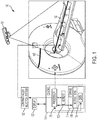
- FIG. 1 shows a scanner system 100, including a control device 110 for controlling a scanner 105.
- the scanner 105 can be an magnetic resonance (MR) scanner, such as a "MAGNETOM VIDA”TM scanner, a computed tomography (CT) scanner, such as a "SOMATOM CONFIDENCE RT Pro”TM CT Scanner, a PET scanner, such as the "BIOGRAPH HORIZON”TM PET/CT scanner, or an ultrasound scanner, such as the "ACUSON SC2000PRIME”TM cardiovascular ultrasound system, all sold by Siemens Medical Solutions USA, Inc. of Malvern, PA.
- MR magnetic resonance
- CT computed tomography
- PET scanner such as the "BIOGRAPH HORIZON”TM PET/CT scanner
- ultrasound scanner such as the "ACUSON SC2000PRIME”TM cardiovascular ultrasound system, all sold by Siemens Medical Solutions USA, Inc. of Malvern, PA.
- the scanner can include an automated contrast agent injection system 120 automatic control of the injection profile, as provided by "CARE CONTRAST” TM in the "SOMATOM” TM scanner by Siemens Medical Solutions USA, Inc. of Malvern, PA, where the contrast injector can be connected to the CT scanner, enabling synchronized injection and scanning.
- the control device 110 has a processor 111 using machine learning to predict a scanning protocol for contrast enhancement imaging an internal organ (not shown) of the subject based on the prediction.
- the processor 111 is configured (e.g., by software) for controlling the scanner 105 based on the predicted contrast agent amount, injection profile, and delay between injecting the contrast agent and performing the scan.
- the processor 111 can issue commands to the automated contrast agent injection system 120, to inject a selected dosage of CA according to the predicted injection protocol. These are only examples, and other scanner makes and models may be used.
- the processor 111 can have user input/output devices, such as a display 122, which can be a touch-screen capable of receiving user inputs and displaying outputs. Other input devices (e.g., keyboard or pointing device, not shown) may be included.
- the processor 111 can include an embedded processor, a computer, a microcontroller, an application specific integrated circuit (ASIC), a programmable gate array, or the like.
- the control device 110 includes a main memory 112, which can include a non-transitory, machine readable storage medium such as dynamic random access memory (DRAM).
- the secondary memory comprises a non-transitory, machine readable storage medium 114, such as a solid-state drive, hard disk drive (HDD) and/or removable storage drive, which can include a solid state memory, an optical disk drive, a flash drive, a magnetic tape drive, or the like.
- the non-transitory, machine readable storage medium 114 can include tangibly store therein computer software instructions 116 for causing the scanner 105 to perform various operations (described herein) and data 118.
- the injection system 120 can perform calibrated injections to patients, starting from a multi-dose solution of iodine, fluorodeoxyglucose (FDG), or other radiopharmaceuticals.
- the scanner 100 is not equipped with an automated injection system 120, in which case a separate injection system (not shown) may be used.
- some systems can include an external injection system (not shown), such as the "IRISTM" Radiopharmaceutical Multidose Injector sold by Comecer S.p.A. of Castel Bolognese, Italy.
- the injection system 120 has a wired or wireless communications link with the processor 111, for automatically transmitting dosage, contrast agent application protocol and scan delay to the injection system 120.
- the processor 111 receives a value of a scan delay from a regressor (e.g., neural network) 220, to be used between an injection of the contrast agent and a scan from the neural network.
- the processor waits for approximately a period of time according to the scan delay after the injecting, and initiates performing a computed tomography scan or magnetic resonance scan (using the scanner) after the waiting.
- the injection begins upon expiration of the scan delay.
- the injection is timed so that the injection straddles the time of peak contrast agent concentration in the organ of interest, and the mid-point of the injection coincides with the time of peak contrast agent concentration.
- the system 100 can include a two-dimensional (2D) or three-dimensional (3D) camera 101.
- the 2D or 3D camera 101 captures an image of the patient before the scanning.
- the image can be used to estimate one or more patient attributes, such as patient height or weight, used by the control device 110.
- FIG. 2 is a block diagram of a system for determining contrast agent application protocol and scan delay in real-time, based on a test bolus data or bolus tracking data, for immediate use in contrast enhanced scanning while the patient is still on the scanner bed.
- Contrast agent uptake in the human body can be modeled using a simulator implementing a multi-compartment model 212 for modeling flow of a contrast agent through a body and generating contrast enhancement data.
- the contrast propagation through each compartment in the model 212 can be represented through a set of coupled differential equations, which can be solved to obtain the contrast agent concentration at any given location as a function of time.
- the results of the model 212 depend on the patient internal parameters, which can be personalized to the patient's attributes 214 (age, body mass, height, pathological condition, cardiac output, etc.). Once the model 212 is suitably parametrized, the model 212 can then be computationally "inverted".
- this includes computing the initial contrast agent injection protocol that is used to obtain a desired contrast density curve at a given location. For instance, for scanning the liver, a desired contrast agent density curve at the liver can be input, and then the model can be inverted to compute the contrast agent administration protocol that should be followed, based on the contrast enhancement data and patient attributes.
- Numerical solutions of the differential equations characterizing the multi-compartment models 212 may be computationally demanding and time consuming, a trained regressor (neural network) 220 provides sufficient acceleration to determine the contrast agent application protocol 233 within the clinical workflow.
- the neural network 220 is a deep neural network.
- the neural network 220 is configured to perform support vector regression.
- the neural network 220 trained with contrast enhancement data 211 from the model 212 can generate a contrast agent administration protocol 223 about 80 times as fast as the numerical solution of the differential equations of the PBPK model 212.
- the trained neural network 220 can generate the contrast agent administration protocol 233 immediately, and the generated contrast agent administration protocol 233 can be implemented while the patient is still on the scanner bed.
- the regressor e.g., neural network
- the regressor 220 can generate the contrast agent application protocol 233 and scan delay 234 parameters corresponding to the desired contrast enhancement in any targeted organ or blood vessel.
- the personalized model parameters 211, 213, 214, 215 from the offline numerical solution stage become training input parameters to the contrast propagation regressor (e.g., neural network) 220.
- This regressor e.g., neural network
- an optimal contrast agent application protocol 233 is selected based on the patient-specific model parameters 232.
- CA administration protocol 233 and scan delay 234 One approach to achieve significant acceleration of determining the CA administration protocol 233 and scan delay 234 is through the use of machine learning algorithms.
- the regressor e.g., neural network
- the regressor learns the relationship between the inputs (CA administration curve of test bolus data or bolus tracking data 231 and patient attribute, such as 2D or 3D image 232 from camera 101) and the outputs (resulting contrast agent application protocol 233 and scan delay 234).
- a large database 210 of the inputs (multi-compartment model 212, contrast agent application protocols 213, patient attributes 214 and, in some embodiments, image quality 215) and outputs (contrast enhancement data 211, also referred to herein as "synthetic data") is used to train a machine learning system (regressor 220).
- the regressor 220 learns to determine the relationship between the inputs and outputs, to determine an optimum contrast agent application protocol 233 and scan delay 234 given the test bolus data or bolus tracking data 231 and 2D or 3D image 232 from camera 101.
- the regressor 220 is a deep neural network having a plurality of coefficients.
- the coefficients are machine-learned by inputting a plurality of patient parameters (attributes) 214 and a plurality of contrast agent injection protocols 213 to a simulator 212, simulating flow of a contrast agent through a plurality of patients' bodies using the simulator 212, and providing the contrast enhancement data 211 based on the simulating, for use in the neural network.
- a large training dataset 210 is used to cover the domain of patient attributes.
- the available medical image data sets from past patients may not be large enough to train the regressor 220.
- any combination of data obtained by methods (1) to (3) can be used to provide enough training data.
- the regressor 220 can include multiple models, each looking at the input-output relationship for a specific blood vessel compartment or organ.
- One example is the machine learning based fractional flow reserve (FFR) prediction model, which has shown high accuracy compared to the numerical solution of the differential equations of the underlying physics model, while providing an 80-fold acceleration in the computational run-time.
- FFR fractional flow reserve
- the machine learning model in regressor 220 can also take account of any constraints the injection system may impose on the contrast agent application protocol 233. For instance, the regressor 220 can accommodate limits placed on the peak injection rate, total volume injected, smoothness of the injection curve etc. For instance, if a constant injection rate is desired, the regressor 220 can produce a specific injection rate which would minimize the contrast agent volume, to get as close as possible to the desired contrast distribution at the target organ.
- the system in FIG. 2 provides model personalization using a data-driven approach.
- the patient attributes 214 and contrast agent administration protocols 213 are input to the multi-compartment model 212, which numerically solves the differential equations to generate contrast enhancement data 211, as indicated by dashed arrows.
- each image (of previous patients) can be augmented with a quantitative "image quality" metric 215.
- the operator can input a quality metric based on the image obtained from a computed tomography scan or magnetic resonance scan.
- the image quality metric 215 can either be computed algorithmically based on different image features (for instance, contrast), or annotated by a clinical team, or a combination of both.
- the contrast enhancement data 211, contrast agent application protocol 213, patient attributes 214, and in some cases, image quality 215 can then form the training dataset 210 to input to the regressor 220.
- the regressor 220 takes into account the combination of different patient attributes 214 (e.g., either input or estimated from 2D or 3D image 232 from camera 101), along with the image quality 215 (if available), contrast enhancement data 211, scan delay (i.e., time difference between injection and image acquisition) and other features from the test bolus data or bolus tracking data 231 to learn a functional mapping between the features from the test bolus or bolus tracking scan image 231 and contrast agent application protocol 233 and scan delay 234 providing the optimal image quality.
- the operator can use the machine learning to reduce the contrast agent amount of a subsequent computed tomography scan or magnetic resonance scan or increase an image contrast of the subsequent computed tomography scan or magnetic resonance scan based on the quality metric.
- the training data 210 can include the contrast enhancement data 211 (obtained from the multi-compartment model 212), contrast agent application protocol 213, patient attributes 214, and in some cases, image quality 215.
- contrast enhancement data 211 obtained from the multi-compartment model 212
- contrast agent application protocol 213, patient attributes 214 obtained from the multi-compartment model 212
- image quality 215. Once trained based on the database 210 of past patient image acquisitions and/or phantom data and/or synthetic data covering a wide range of patient attributes 214, regressor 220 can provide patient-specific contrast agent application protocol 233 and scan delay 234 for any given test bolus data or bolus tracking data 231 and patient attributes or 2D or 3D image 232.
- cardiac output can be estimated from a test bolus data or bolus tracking data 231, which can be input to regressor 220.
- Information acquired from the test bolus data or bolus tracking data 231 with additional patient attributes or 2D or 3D image data 232 for all the organs and vessels can enhance accuracy.
- the regressor 220 can be applied to a test bolus data or bolus tracking data 231 of a new patient.
- the test bolus data or bolus tracking data 231 can be performed with a low dose injection of the contrast agent.
- the information from the test bolus data or bolus tracking data 231 is combined with patient attributes 232 (which can be input directly or estimated based on a 2D or 3D image from camera 101) and input to the regressor 220 to find a contrast agent application protocol 233 and scan delay 234 to optimize the correlation between the contrast intensity at a given location and the patient attributes 214 during an imaging scan.
- Patient attributes (e.g., height, weight) 232 can be input directly, or in some embodiments, a 2D or 3D image of the patient (indicative of one or more attributes of the patient) is also captured using a digital camera 101.
- the input patient parameters 232 can be estimated based on the 2D or 3D image.
- the network or regressor 220 uses input patient attributes 232, along with a set of features computed on the test bolus data or bolus tracking data 231 to infer the patient-specific model parameters (e.g., the contrast agent application protocol 233 and scan delay 234).
- a 3D avatar mesh of the subject is formed based on a 2.5D or 3D image from the camera 101, as disclosed in US 2015/0213646 A1 (Appl. No.: 14/604,829, filed Jan. 26, 2015 ).
- the height or other spatial attribute of the patient can be determined from the 3D avatar mesh.
- a depth camera image of the subject is converted to a 3D point cloud.
- a plurality of anatomical landmarks are detected in the 3D point cloud.
- a 3D avatar mesh is initialized by aligning a template mesh to the 3D point cloud based on the detected anatomical landmarks.
- a personalized 3D avatar mesh of the subject is then generated by optimizing the 3D avatar mesh using a trained parametric deformable model (PDM).
- PDM parametric deformable model
- a physiologically based pharmacokinetic (PBPK) model 212 can simulate contrast agent propagation in the human body. Simplified effective models are provided for each organ, parametrized by a reduced set of parameters to address the forward model of contrast propagation, given the initial injection curve. An exemplary systems model is shown in FIG. 3 .
- model-based optimization can be used for selecting the contrast agent injection protocols.
- FIG. 3 shows an example of a multi-compartment model for blood and contrast agent flow through the body.
- FIG. 3 is a sample schematic diagram of a physiologically based pharmacokinetic (PBPK) model of a human body.
- the model can predict absorption, distribution, and metabolism of the contrast agent within the body, beginning with injection.
- each block (3, 8, 11, 14, 16, 20, 21, 23, 25, 28, 29, 32 and 36) represents an organ compartment
- each ellipse (1, 2, 4-7, 9-10, 12, 13, 15, 17-19, 22, 24, 26, 27, 30-31, 33-35, and 37) represents a blood vessel compartment.
- Table 1 lists the compartments of the model of FIG. 3 and their respective descriptions, according to one example.
- the compartments in Table 1 are numbered in the order in which they appear in FIG. 3 .
- the heart is represented by three separate compartments: the left heart, right heart, and heart muscle. Because of the negligible amount of perfusion occurring in left and right heart, they are assumed to be vessel compartments.
- Table 1 only includes the organs' names (except aorta), and the vessels are named with their compartment numbers (except aorta). Although the nodes of the model begin with the right heart (compartment No.
- the injection can be performed at any injection site (compartment), and the contrast agent flows to the remaining compartments in the order listed, and after the iliac vein (compartment No. 37) flows the right heart (compartment No. 1) and continues in order.
- TABLE 1 Estimated Blood Distribution in the Vascular System, Blood Flow Rate, and Capillary Volumes Used in PBPK Model Compartment Type Blood Flow Rate (mL/sec) Intravascular Volume (mL) Extracellular Volume (mL) 1.
- Right heart Vessel 29.0 180 0 2. Pulmonary artery Vessel 108.3 130 0 3. Lung parenchyma Organ 108.3 150 144 4. Pulmonary vein Vessel 108.3 160 0 5.
- the flows of contrast agent into and out of each organ, and changes in concentration within the organ can be expressed by a respective differential equation.
- the differential equations for each organ can indicate that blood flow rate out of the organ equals blood flow rate into the organ, while the rate of change in CA concentration in the organ varies with the blood flow rate through the organ and the difference between the input CA concentration and the output CA concentration.
- This set of differential equations is described in Sahbaee, Pooyan, et al. "The effect of contrast agent on radiation dose at CT: part I. Incorporation of contrast agent dynamics in anthropomorphic phantoms.” Radiology 283.3 (2017): 739-748 .
- the set of differential equations can be solved numerically, to predict absorption, distribution and metabolism. Numerical solutions for a large PBPK model, such as model 212, may be computationally expensive.
- the contrast agent flow in the model of FIG. 3 is described by approximately 300 differential equations.
- the computational models based on the solution of large sets of coupled differential equations have a long computational time.
- the differential equations for the model 212 are solved many (e.g., 10,000) times over the domain of contrast agent administration protocols 213 and patient attributes 214, to generate a large set of contrast enhancement data 211.
- This dataset 210 can be generated a single time, prior to training.
- the regressor 220 can generate contrast agent administration protocols 233 and scan delay 234 in real time during patient contrast enhanced image scanning.
- the 37-compartment model of FIG. 3 is just an example. Any multi-compartmented model can be used, in accordance with the desired accuracy and/or desired computation time and complexity.
- the model of FIG. 3 includes a single compartment for the small intestine and a single compartment for the large intestine.
- the small intestine and/or large intestine could be modeled as two or more compartments.
- the disclosed system can be applied for any organs with more than one input "vessel" (e.g., liver) and/or for any organ having more than one output vessel.
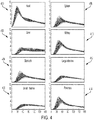
- FIG. 4 shows sets of contrast enhancement data 211 generated by the multi-compartmented model 212.
- Separate contrast enhancement data are provided for each organ.
- the data include several contrast enhancement curves for each of: heart 400, liver 402, stomach 404, small intestine 406, spleen 408, kidney 410, large intestine 412, and pancreas 414.
- the various curves for each organ correspond to different inputs (e.g., contrast agent application protocols 213 and/or patient attributes 214).
- the model can further include one or more lesion compartments connected to one or more organs and/or blood vessels.
- a model including a separate lesion compartment can be more realistically representative of patients.
- a lesion compartment 3a may be added to represent a tumor on a patient's lung.
- the training dataset 210 also includes a plurality of different contrast agent administration protocols 213.
- FIG 5 shows an example of a set 213 of contrast agent administration protocols 500-505.
- Each contrast agent administration protocols e.g., 500
- the contrast agent is injected at a constant rate for a first period, and then the injection stops.
- the amount of contrast agent injected per unit of time can vary. For example, the amount of contrast agent injected per unit of time can ramp up during a first period, remain constant during a second period, ramp down during a third period, and then remain at zero. This is only an example, and other injection profiles can be used.
- a neural network can be trained using "synthetic data" generated by numerical solution of the multi-compartment model.
- the training set includes a diverse group (e.g., 10,000) of patient examples covering the domain of patient characteristics (age, sex, weight, height, etc.) and contrast agent administration protocols.
- the synthetic data may be supplemented with clinical patient data and/or phantom data (e.g., XCAT phantom data) to ensure that the training set is sufficiently large.
- an application can use the neural network to generate imaging protocol parameters (contrast agent dosage, injection profile, and delay between injection and scan) in real-time conditions, enabling simple user workflows.
- a real-time test bolus or bolus tracking scan is performed using a low dosage of a contrast agent (CA), and a test bolus enhancement curve is generated.
- the test bolus enhancement curve from test bolus or bolus tracking scan 231 and the patient attributes or 2D or 3D image 232 are then input to the neural network 220, which generates the parameters of the contrast agent administration protocol 233 and the scan delay 234.
- the resulting imaging protocol maximizes contrast with a minimum contrast agent amount.
- the synthetic data generated by the multi-compartment PBPK model 212 can be used to feed and train a deep learning network or regressor 220 to predict the contrast agent injection function for a desired enhancement in different organs.
- the PBPK model can provide any desired number of contrast enhancement perfusion data as function of time, throughout the domain of patient characteristics, for training the contrast-enhancement prediction machine learning network.
- CA administration protocol 233 properly orchestrated with the scan parameters (e.g., scan timing) enhances medical imaging, maintains high image quality, for any medical scanner technology using contrast enhancement in clinical practice.
- scan parameters e.g., scan timing
- the regressor 220 is trained using samples throughout the domain of patient types (patient size, body mass index, etc.) the acquired images are of consistent quality regardless of patient characteristics. This also supports any downstream applications which use the medical images. For instance, in the cardiac use case, consistent gray values across patients will enable much more accurate determination of coronary centerline, and enable more accurate lumen segmentation.
- FIG. 6 is a schematic diagram of the system in its configuration for clinical use.
- the trained regressor 220 e.g., neural network
- the regressor 220 uses these inputs to accurately predict the cardiac output for individual patients, and consequently provide more precise individual contrast enhancement curves in different organs.
- the regressor 220 can provide respective contrast injection curves 233 (contrast agent application protocol) for the heart, spleen, liver, kidney, stomach, large intestine, small intestine, and pancreas.
- the regressor 220 also provides a contrast enhancement curve 600, from which the maximum contrast agent concentration 602 and the scan delay 234 corresponding to the maximum concentration value 602 can be determined. These outputs are then used immediately for contrast imaging while the patient is still on the bed.
- the quantity of contrast agent, contrast agent administration protocol, and the scan delay are based on the outputs of the regressor 220.
- the computation time of solving the differential equations of the PBPK model 212 does not pose an impediment to patient-specific scan protocol generation using the regressor 220.
- the regressor 220 uses the previously trained regressor 220 and fine-tuning the different patient-specific parameters 232 (e.g., cardiac output, age, sex, organ and vessel sizes), injection protocol parameters (e.g., iodine concentration, volume, and injection rate) 233 and scan delay 234, the system can collect numerous contrast enhancement data in different organs.
- the inputs to the PBPK model 212 are patient specific, they are independent of the neural network 220 and independent of the imaging scanner make and model.
- a training set 210 including synthetic data from the PBPK model 212 is generated, the same training set 210 can be used to determine the injection protocol for any scanner. Also, the same training set can be used to train a variety of machine learning systems (e.g., a variety of deep neural networks) to generate the injection protocols.
- the network or regressor 220 can be used in a variety of embodiments. For example,
- the system includes a non-transitory machine readable storage medium 114 containing a plurality of different "desired contrast distributions" for each organ.
- the system can include a regressor 220 configured for receiving the test bolus or bolus tracking enhancement curve 231 and fetching the desired contrast distribution ( FIG. 4 ) corresponding to the organ of interest, and generating a respective contrast agent administration protocol (e.g., injection function).
- the processor 111 system can provide touch-based interfaces for displaying data and prompts, and for receiving user inputs.
- a touch screen display 122 FIG. 1
- the system can provide voice-activated or natural language interfaces, so the operator can speak voice commands to instruct the system (e.g., to acquire a coronary image).
- the system prompts the operator for approval of an estimate of the dose and the generated injection curve, before automatically commencing injection.
- the system 100 is configured to receive an operator input rating the quality of each scan upon completion.
- the system 100 is configured to incorporate the rating data for continuously learning the best injection protocols to minimize dose and contrast volume, while maximizing image quality.
- the learning machine of regressor 220 can learn from the difference between the prediction results and real data.
- the system 100 is configured to prompt the operator to select from one or more past cases in which the output image contrast was high.
- the network or regressor 220 calibrates or adapts itself to new patients based on the selected past case(s), to obtain images having similar quality or better quality.
- a summary of the machine learning from a plurality of scanner systems can be collected periodically and used to identify best practices, which can be disseminated to improve network or regressor 220 performance over the installed fleet of scanners.
- the methods and system described herein may be at least partially embodied in the form of computer-implemented processes and apparatus for practicing those processes.
- the disclosed methods may also be at least partially embodied in the form of tangible, non-transitory machine readable storage media encoded with computer program code.
- the media may include, for example, RAMs, ROMs, CD-ROMs, DVD-ROMs, BD-ROMs, hard disk drives, flash memories, or any other non-transitory machine-readable storage medium, wherein, when the computer program code is loaded into and executed by a computer, the computer becomes an apparatus for practicing the method.
- the methods may also be at least partially embodied in the form of a computer into which computer program code is loaded and/or executed, such that, the computer becomes a special purpose computer for practicing the methods.
- the computer program code segments configure the processor to create specific logic circuits.
- the methods may alternatively be at least partially embodied in a digital signal processor formed of application specific integrated circuits for performing the methods.
Landscapes
- Health & Medical Sciences (AREA)
- Engineering & Computer Science (AREA)
- Life Sciences & Earth Sciences (AREA)
- Physics & Mathematics (AREA)
- Medical Informatics (AREA)
- General Health & Medical Sciences (AREA)
- Biomedical Technology (AREA)
- Public Health (AREA)
- Biophysics (AREA)
- Molecular Biology (AREA)
- Animal Behavior & Ethology (AREA)
- Heart & Thoracic Surgery (AREA)
- Veterinary Medicine (AREA)
- Theoretical Computer Science (AREA)
- Surgery (AREA)
- Nuclear Medicine, Radiotherapy & Molecular Imaging (AREA)
- Pathology (AREA)
- High Energy & Nuclear Physics (AREA)
- Radiology & Medical Imaging (AREA)
- Optics & Photonics (AREA)
- Artificial Intelligence (AREA)
- General Physics & Mathematics (AREA)
- Evolutionary Computation (AREA)
- Mathematical Physics (AREA)
- General Engineering & Computer Science (AREA)
- Software Systems (AREA)
- Computing Systems (AREA)
- Data Mining & Analysis (AREA)
- Computational Linguistics (AREA)
- Epidemiology (AREA)
- Oral & Maxillofacial Surgery (AREA)
- Dentistry (AREA)
- Vascular Medicine (AREA)
- Primary Health Care (AREA)
- Signal Processing (AREA)
- Computer Vision & Pattern Recognition (AREA)
- Bioinformatics & Cheminformatics (AREA)
- Chemical & Material Sciences (AREA)
- Medicinal Chemistry (AREA)
- Pulmonology (AREA)
Claims (17)
- Verfahren, umfassend:Eingeben von Kontrastverstärkungsdaten (211) für mindestens ein Organ eines Patienten, mindestens ein Patientenattribut des Patienten und Testbolusdaten oder Bolusnachverfolgungsdaten (231) in einen trainierten Regressor (220), wobei der besagte Regressor ein neuronales Netzwerk (220) ist;Empfangen eines Kontrastmittelverabreichungsprotokolls (233) von dem Regressor (220), basierend auf den Kontrastverstärkungsdaten (211), dem mindestens einen Patientenattribut und den Testbolus- oder Bolusnachverfolgungsdaten (231).
- Verfahren nach Anspruch 1, wobei das Kontrastmittelverabreichungsprotokoll (233) mindestens eines aus der Gruppe bestehend aus einer Kontrastmittelmenge und einer Kontrastmittelinjektionsfunktion umfasst.
- Verfahren nach Anspruch 2, ferner umfassend:Empfangen eines Wertes einer Scanverzögerung (234) zwischen einer Injektion des Kontrastmittels und einem Scan,Warten für mindestens eine Zeitspanne entsprechend der Scanverzögerung (234) nach der Injektion, undDurchführen eines Computertomographie-Scans oder eines Magnetresonanz-Scans nach dem Warten, insbesondere weiter umfassend:Eingeben einer Qualitätsmetrik basierend auf dem Computertomographie-Scan oder Magnetresonanz-Scan, undVerwenden von maschinellem Lernen, um die Kontrastmittelmenge eines nachfolgenden Computertomographie-Scans oder Magnetresonanz-Scans zu reduzieren oder einen Bildkontrast des nachfolgenden Computertomographie-Scans oder Magnetresonanz-Scans basierend auf der Qualitätsmetrik zu erhöhen.
- Verfahren nach einem der vorhergehenden Ansprüche, wobei die Kontrastmittelinjektionsfunktion eine jeweilige Kontrastmittelinjektionsfunktion für jedes einer Mehrzahl von Organen umfasst.
- Verfahren nach einem der vorhergehenden Ansprüche, wobei der Regressor (220) trainiert wird durch:Eingeben einer Vielzahl von Patientenparametern und einer Vielzahl von Injektionsprotokollen in einen Simulator (212);Simulieren des Flusses eines Kontrastmittels durch eine Vielzahl von Patientenkörpern unter Verwendung des Simulators (212); undBereitstellen einer Vielzahl von Kontrastverstärkungsdaten (211) basierend auf der Simulation.
- Verfahren nach Anspruch 5, wobei der Regressor (220) eine Support-Vektor-Regression durchführt.
- Verfahren nach Anspruch 5 oder 6, ferner umfassend ein Bereitstellen zusätzlicher Kontrastverstärkungsdaten auf der Grundlage gemessener Patientendaten oder Phantomdaten.
- Verfahren nach einem der vorhergehenden Ansprüche 5 bis 7, wobei der Simulator (212) ein Multikompartiment-Modell (212) aufweist, das die Kontrastmittelmenge und eine Verteilung des Kontrastmittels an einer Vielzahl von verschiedenen Orten innerhalb eines Körpers des Patienten als Funktion der Zeit in Beziehung setzt.
- Verfahren nach Anspruch 8, wobei das Multikompartiment-Modell (212) entsprechende Kompartimente für mindestens ein Organ und mindestens ein Blutgefäß des Patienten aufweist, insbesondere wobei das Multikompartiment-Modell (212) ferner ein Kompartiment umfasst, das einer Läsion entspricht.
- Verfahren nach einem der vorhergehenden Ansprüche, wobei die Kontrastmittelinjektionsfunktion aus einer Vielzahl von zuvor gespeicherten Kontrastverteilungen für jedes einer Vielzahl von Organen ausgewählt wird.
- Verfahren nach einem der vorhergehenden Ansprüche, wobei das Patientenattribut mindestens eines aus der Gruppe bestehend aus einem Patientengewicht, einer Patientenoberfläche, einem Patientenalter, einer Patientengröße oder einem Marker umfasst.
- Verfahren nach einem der vorhergehenden Ansprüche, ferner umfassend:Erfassen eines Tiefenbildes des Patienten; undSchätzen des Patientenattributs auf der Basis des Tiefenbildes und auf der Basis eines Berechnungsphantoms oder einer Datenbank mit zuvor gesammelten Patientendaten.
- System (100), umfassend:einen Simulator (212) zum Modellieren des Flusses eines Kontrastmittels durch einen Körper und zum Erzeugen von Kontrastverstärkungsdaten (211);ein nicht-transitorisches, maschinenlesbares Speichermedium, das die Kontrastverstärkungsdaten (211), mindestens ein Patientenattribut eines Patienten und einen Testbolus oder Bolusnachverfolgungsdaten (231) des Patienten speichert; undmindestens einen Prozessor (111), der einen trainierten Regressor (220) umfasst, wobei der Regressor ein neuronales Netzwerk (220) ist, das so konfiguriert ist, dass es ein Kontrastmittelverabreichungsprotokoll (233) auf der Grundlage der Kontrastverstärkungsdaten (211) und des mindestens einen Patientenattributs erzeugt.
- System nach Anspruch 13, wobei der Simulator (212) ein Multikompartiment-Modell (212) aufweist, das die Kontrastmittelmenge und eine Verteilung des Kontrastmittels an einer Vielzahl von verschiedenen Orten innerhalb des Patienten als Funktion der Zeit in Beziehung setzt, insbesondere wobei das Multikompartiment-Modell (212) entsprechende Kompartimente für mindestens ein Organ und mindestens ein Blutgefäß des Patienten aufweist.
- System nach einem der vorhergehenden Ansprüche 13 bis 14, wobei der Regressor (220) eine Vielzahl von Koeffizienten aufweist, die maschinell gelernt werden durch:Eingeben einer Vielzahl von Patientenparametern und einer Vielzahl von Injektionsprotokollen in einen Simulator (212);Simulieren des Flusses eines Kontrastmittels durch eine Vielzahl von Patientenkörpem unter Verwendung des Simulators (212); undBereitstellen der Kontrastverstärkungsdaten (211) basierend auf der Simulation, zur Verwendung im Regressor (220).
- System nach einem der vorangehenden Ansprüche 13 bis 15, wobei der Regressor (220) ferner so konfiguriert ist, dass er einen Wert einer Scan-Verzögerung zwischen einer Injektion des Kontrastmittels in den Patienten und einem Scan erzeugt, und das System ferner einen Computertomographie-Scanner oder einen Magnetresonanz-Scanner zum Erfassen der Testbolusdaten oder Bolusnachverfolgungsdaten (231) und zum Erfassen medizinischer Bilddaten mit der Injektion des Kontrastmittels und einem durch die Scan-Verzögerung (234) getrennten Scan umfasst.
- System nach einem der vorhergehenden Ansprüche 13 bis 16, wobei der Regressor (220) eine Support-Vektor-Regression durchführt.
Applications Claiming Priority (1)
| Application Number | Priority Date | Filing Date | Title |
|---|---|---|---|
| US15/950,430 US10925565B2 (en) | 2018-04-11 | 2018-04-11 | Machine-learning based contrast agent administration |
Publications (2)
| Publication Number | Publication Date |
|---|---|
| EP3552550A1 EP3552550A1 (de) | 2019-10-16 |
| EP3552550B1 true EP3552550B1 (de) | 2021-02-17 |
Family
ID=66092150
Family Applications (1)
| Application Number | Title | Priority Date | Filing Date |
|---|---|---|---|
| EP19167260.9A Active EP3552550B1 (de) | 2018-04-11 | 2019-04-04 | Auf maschinenlernen basierende kontrastmittelverabreichung |
Country Status (3)
| Country | Link |
|---|---|
| US (1) | US10925565B2 (de) |
| EP (1) | EP3552550B1 (de) |
| CN (1) | CN110364238B (de) |
Families Citing this family (21)
| Publication number | Priority date | Publication date | Assignee | Title |
|---|---|---|---|---|
| US11690950B2 (en) * | 2019-11-01 | 2023-07-04 | GE Precision Healthcare LLC | Methods and systems for timing a second contrast bolus |
| US11564648B2 (en) * | 2019-11-01 | 2023-01-31 | GE Precision Healthcare LLC | Methods and systems for an adaptive multi-phase angiography scan |
| US11350896B2 (en) * | 2019-11-01 | 2022-06-07 | GE Precision Healthcare LLC | Methods and systems for an adaptive four-zone perfusion scan |
| US12059546B2 (en) * | 2019-11-01 | 2024-08-13 | GE Precision Healthcare LLC | Methods and systems for adaptive timing of a second contrast bolus |
| US11341636B2 (en) * | 2019-11-01 | 2022-05-24 | GE Precision Healthcare LLC | Methods and systems for an adaptive five-zone perfusion scan |
| CN111462857A (zh) * | 2020-03-31 | 2020-07-28 | 上海联影医疗科技有限公司 | 一种注射协议确定方法、装置、医疗影像设备及介质 |
| LT6911B (lt) * | 2020-07-17 | 2022-05-10 | Vilniaus Universitetas | Ultragarsinio tyrimo ir ultragarsinio tyrimo su kontrastine medžiaga vaizdų bei duomenų analizės sistema kasos patologijų ankstyvajai diagnostikai atlikti automatiniu būdu |
| WO2022051460A1 (en) * | 2020-09-02 | 2022-03-10 | Roblox Corporation | 3d asset generation from 2d images |
| DE102020212335A1 (de) | 2020-09-30 | 2022-03-31 | Siemens Healthcare Gmbh | Verfahren zur Ansteuerung eines Bildgebungsgeräts zur Erfassung eines kontrastmittelverstärkten Bilddatensatzes |
| TWI792592B (zh) * | 2020-12-29 | 2023-02-11 | 財團法人工業技術研究院 | 電腦輔助入針系統和電腦輔助入針方法 |
| US12171460B2 (en) | 2020-12-29 | 2024-12-24 | Industrial Technology Research Institute | Computer-assisted needle insertion system and computer-assisted needle insertion method |
| JP7602929B2 (ja) * | 2021-02-16 | 2024-12-19 | キヤノンメディカルシステムズ株式会社 | 画像処理装置 |
| US11995831B2 (en) * | 2021-04-09 | 2024-05-28 | Wisconsin Alumni Research Foundation | Method and apparatus for optimizing the use of contrast agents during medical imaging |
| EP4113537A1 (de) * | 2021-06-30 | 2023-01-04 | Guerbet | Verfahren zum trainieren eines vorhersagemodells oder zur verarbeitung von mindestens einem vorkontrastbild, das unter verwendung des vorhersagemodells ein körperteil vor einer injektion von kontrastmittel darstellt |
| MX2023015463A (es) * | 2021-10-15 | 2024-04-10 | Bracco Imaging Spa | Simulacion de imagenes con dosis mas alta de agente de contraste en aplicaciones de obtencion de imagenes medicas. |
| US12493954B2 (en) * | 2022-01-25 | 2025-12-09 | Fujifilm Corporation | Medical image processing device, method for operating medical image processing device, and program |
| JP2023108575A (ja) * | 2022-01-25 | 2023-08-04 | 富士フイルム株式会社 | 医用画像処理装置、医用画像処理装置の動作方法及びプログラム |
| EP4362042A1 (de) | 2022-10-31 | 2024-05-01 | Siemens Healthineers AG | Schätzung der pharmakokinetik eines kontrastmittels durch ein analytisches modell eines kardiovaskulären systems und/oder einen algorithmus eines neuronalen netzwerks |
| WO2024260802A1 (en) * | 2023-06-20 | 2024-12-26 | Koninklijke Philips N.V. | Rotational scan spin delay with injector coupling |
| DE102023208903A1 (de) | 2023-09-13 | 2024-09-26 | Siemens Healthineers Ag | Optimierung eines Kontrastmittelinjektionsprotokolls für ein Bildgebungsverfahren |
| EP4560646A1 (de) * | 2023-11-22 | 2025-05-28 | Koninklijke Philips N.V. | Verfahren zur verwendung in der kontrastmedizinischen bildgebung |
Family Cites Families (13)
| Publication number | Priority date | Publication date | Assignee | Title |
|---|---|---|---|---|
| US6904306B1 (en) * | 2002-01-23 | 2005-06-07 | Koninklijke Philips Electronics N.V. | Method and apparatus for evaluation of contrast agent uptake based on derived parametric images |
| DE102006032991B4 (de) * | 2006-07-17 | 2015-03-26 | Siemens Aktiengesellschaft | Verfahren und Rechnereinheit zur Einstellung einer Spritzenpumpe für eine Bildaufnahme |
| EP2170165B1 (de) | 2007-07-17 | 2018-12-05 | Bayer Healthcare LLC | Systeme zur bestimmung von parametern für ein verfahren zur schätzung der kardiopulmonalen funktion und zur flüssigkeitsabgabe |
| US9524582B2 (en) | 2014-01-28 | 2016-12-20 | Siemens Healthcare Gmbh | Method and system for constructing personalized avatars using a parameterized deformable mesh |
| US9449145B2 (en) * | 2014-04-22 | 2016-09-20 | Heartflow, Inc. | Systems and methods for virtual contrast agent simulation and computational fluid dynamics (CFD) to compute functional significance of stenoses |
| US9349178B1 (en) | 2014-11-24 | 2016-05-24 | Siemens Aktiengesellschaft | Synthetic data-driven hemodynamic determination in medical imaging |
| DE102015222853A1 (de) * | 2015-11-19 | 2017-05-24 | Siemens Healthcare Gmbh | Verfahren zum automatischen Ermitteln eines Kontrastmittel-Injektionsprotokolls |
| US20170258982A1 (en) | 2016-03-10 | 2017-09-14 | Bayer Healthcare Llc | System and methods for pre-injection pressure prediction in injection procedures |
| JP6942721B2 (ja) * | 2016-04-15 | 2021-09-29 | バクスアルタ インコーポレイティッド | 薬物動態学的薬物投与計画を提供する方法及び装置 |
| US10049301B2 (en) | 2016-08-01 | 2018-08-14 | Siemens Healthcare Gmbh | Medical scanner teaches itself to optimize clinical protocols and image acquisition |
| US20180071452A1 (en) | 2016-09-13 | 2018-03-15 | Siemens Healthcare Gmbh | System and Method for Optimizing Contrast Imaging of a Patient |
| US10277889B2 (en) * | 2016-12-27 | 2019-04-30 | Qualcomm Incorporated | Method and system for depth estimation based upon object magnification |
| US10726128B2 (en) * | 2017-07-24 | 2020-07-28 | Crowdstrike, Inc. | Malware detection using local computational models |
-
2018
- 2018-04-11 US US15/950,430 patent/US10925565B2/en active Active
-
2019
- 2019-04-04 EP EP19167260.9A patent/EP3552550B1/de active Active
- 2019-04-11 CN CN201910289772.4A patent/CN110364238B/zh active Active
Non-Patent Citations (1)
| Title |
|---|
| None * |
Also Published As
| Publication number | Publication date |
|---|---|
| CN110364238A (zh) | 2019-10-22 |
| US20190313990A1 (en) | 2019-10-17 |
| EP3552550A1 (de) | 2019-10-16 |
| US10925565B2 (en) | 2021-02-23 |
| CN110364238B (zh) | 2024-04-26 |
Similar Documents
| Publication | Publication Date | Title |
|---|---|---|
| EP3552550B1 (de) | Auf maschinenlernen basierende kontrastmittelverabreichung | |
| US12223649B2 (en) | Systems and methods for medical acquisition processing and machine learning for anatomical assessment | |
| US20230320789A1 (en) | System and method for processing electronic images for vascular tree generation | |
| US10299862B2 (en) | Three-dimensional quantitative heart hemodynamics in medical imaging | |
| EP3277169B1 (de) | Systeme und verfahren zur abschätzung von virtuellen durchblutungsbildern | |
| US10162932B2 (en) | Method and system for multi-scale anatomical and functional modeling of coronary circulation | |
| AU2020349121B2 (en) | System, method, and computer program product for predicting, anticipating, and/or assessing tissue characteristics | |
| US9462952B2 (en) | System and method for estimating artery compliance and resistance from 4D cardiac images and pressure measurements | |
| CN104217398B (zh) | 图像处理装置、图像处理方法和医学图像设备 | |
| US9317915B2 (en) | Computed-tomography system and method for determining volume information for a body | |
| CN105303550B (zh) | 图像处理装置及图像处理方法 | |
| WO2017148332A1 (zh) | 一种灌注分析方法与设备 | |
| Gomez et al. | Optimal B-spline mapping of flow imaging data for imposing patient-specific velocity profiles in computational hemodynamics | |
| Jainandunsing et al. | 3-dimensional right ventricular volume assessment | |
| EP4687098A1 (de) | Verfahren und system zur segmentierung einer anatomischen struktur in einem medizinischen bild | |
| Schwemmer | 3-D Imaging of Coronary Vessels Using C-arm CT | |
| CN118941470A (zh) | 骨转移功能医学影像生成方法、装置、设备、介质及产品 | |
| Enescu | Spatio-temporal image analysis with application to cancer |
Legal Events
| Date | Code | Title | Description |
|---|---|---|---|
| PUAI | Public reference made under article 153(3) epc to a published international application that has entered the european phase |
Free format text: ORIGINAL CODE: 0009012 |
|
| STAA | Information on the status of an ep patent application or granted ep patent |
Free format text: STATUS: REQUEST FOR EXAMINATION WAS MADE |
|
| 17P | Request for examination filed |
Effective date: 20190404 |
|
| AK | Designated contracting states |
Kind code of ref document: A1 Designated state(s): AL AT BE BG CH CY CZ DE DK EE ES FI FR GB GR HR HU IE IS IT LI LT LU LV MC MK MT NL NO PL PT RO RS SE SI SK SM TR |
|
| AX | Request for extension of the european patent |
Extension state: BA ME |
|
| RBV | Designated contracting states (corrected) |
Designated state(s): AL AT BE BG CH CY CZ DE DK EE ES FI FR GB GR HR HU IE IS IT LI LT LU LV MC MK MT NL NO PL PT RO RS SE SI SK SM TR |
|
| GRAP | Despatch of communication of intention to grant a patent |
Free format text: ORIGINAL CODE: EPIDOSNIGR1 |
|
| STAA | Information on the status of an ep patent application or granted ep patent |
Free format text: STATUS: GRANT OF PATENT IS INTENDED |
|
| INTG | Intention to grant announced |
Effective date: 20201110 |
|
| RIN1 | Information on inventor provided before grant (corrected) |
Inventor name: SAHBAEE BAGHERZADEH, POOYAN Inventor name: RAPAKA, SAIKIRAN |
|
| GRAS | Grant fee paid |
Free format text: ORIGINAL CODE: EPIDOSNIGR3 |
|
| GRAA | (expected) grant |
Free format text: ORIGINAL CODE: 0009210 |
|
| STAA | Information on the status of an ep patent application or granted ep patent |
Free format text: STATUS: THE PATENT HAS BEEN GRANTED |
|
| AK | Designated contracting states |
Kind code of ref document: B1 Designated state(s): AL AT BE BG CH CY CZ DE DK EE ES FI FR GB GR HR HU IE IS IT LI LT LU LV MC MK MT NL NO PL PT RO RS SE SI SK SM TR |
|
| REG | Reference to a national code |
Ref country code: GB Ref legal event code: FG4D |
|
| REG | Reference to a national code |
Ref country code: CH Ref legal event code: EP |
|
| REG | Reference to a national code |
Ref country code: DE Ref legal event code: R096 Ref document number: 602019002481 Country of ref document: DE |
|
| REG | Reference to a national code |
Ref country code: AT Ref legal event code: REF Ref document number: 1360393 Country of ref document: AT Kind code of ref document: T Effective date: 20210315 |
|
| REG | Reference to a national code |
Ref country code: IE Ref legal event code: FG4D |
|
| REG | Reference to a national code |
Ref country code: LT Ref legal event code: MG9D |
|
| REG | Reference to a national code |
Ref country code: NL Ref legal event code: MP Effective date: 20210217 |
|
| PG25 | Lapsed in a contracting state [announced via postgrant information from national office to epo] |
Ref country code: BG Free format text: LAPSE BECAUSE OF FAILURE TO SUBMIT A TRANSLATION OF THE DESCRIPTION OR TO PAY THE FEE WITHIN THE PRESCRIBED TIME-LIMIT Effective date: 20210517 Ref country code: GR Free format text: LAPSE BECAUSE OF FAILURE TO SUBMIT A TRANSLATION OF THE DESCRIPTION OR TO PAY THE FEE WITHIN THE PRESCRIBED TIME-LIMIT Effective date: 20210518 Ref country code: HR Free format text: LAPSE BECAUSE OF FAILURE TO SUBMIT A TRANSLATION OF THE DESCRIPTION OR TO PAY THE FEE WITHIN THE PRESCRIBED TIME-LIMIT Effective date: 20210217 Ref country code: FI Free format text: LAPSE BECAUSE OF FAILURE TO SUBMIT A TRANSLATION OF THE DESCRIPTION OR TO PAY THE FEE WITHIN THE PRESCRIBED TIME-LIMIT Effective date: 20210217 Ref country code: LT Free format text: LAPSE BECAUSE OF FAILURE TO SUBMIT A TRANSLATION OF THE DESCRIPTION OR TO PAY THE FEE WITHIN THE PRESCRIBED TIME-LIMIT Effective date: 20210217 Ref country code: NO Free format text: LAPSE BECAUSE OF FAILURE TO SUBMIT A TRANSLATION OF THE DESCRIPTION OR TO PAY THE FEE WITHIN THE PRESCRIBED TIME-LIMIT Effective date: 20210517 Ref country code: PT Free format text: LAPSE BECAUSE OF FAILURE TO SUBMIT A TRANSLATION OF THE DESCRIPTION OR TO PAY THE FEE WITHIN THE PRESCRIBED TIME-LIMIT Effective date: 20210617 |
|
| REG | Reference to a national code |
Ref country code: AT Ref legal event code: MK05 Ref document number: 1360393 Country of ref document: AT Kind code of ref document: T Effective date: 20210217 |
|
| PG25 | Lapsed in a contracting state [announced via postgrant information from national office to epo] |
Ref country code: SE Free format text: LAPSE BECAUSE OF FAILURE TO SUBMIT A TRANSLATION OF THE DESCRIPTION OR TO PAY THE FEE WITHIN THE PRESCRIBED TIME-LIMIT Effective date: 20210217 Ref country code: PL Free format text: LAPSE BECAUSE OF FAILURE TO SUBMIT A TRANSLATION OF THE DESCRIPTION OR TO PAY THE FEE WITHIN THE PRESCRIBED TIME-LIMIT Effective date: 20210217 Ref country code: NL Free format text: LAPSE BECAUSE OF FAILURE TO SUBMIT A TRANSLATION OF THE DESCRIPTION OR TO PAY THE FEE WITHIN THE PRESCRIBED TIME-LIMIT Effective date: 20210217 Ref country code: RS Free format text: LAPSE BECAUSE OF FAILURE TO SUBMIT A TRANSLATION OF THE DESCRIPTION OR TO PAY THE FEE WITHIN THE PRESCRIBED TIME-LIMIT Effective date: 20210217 Ref country code: LV Free format text: LAPSE BECAUSE OF FAILURE TO SUBMIT A TRANSLATION OF THE DESCRIPTION OR TO PAY THE FEE WITHIN THE PRESCRIBED TIME-LIMIT Effective date: 20210217 |
|
| PG25 | Lapsed in a contracting state [announced via postgrant information from national office to epo] |
Ref country code: IS Free format text: LAPSE BECAUSE OF FAILURE TO SUBMIT A TRANSLATION OF THE DESCRIPTION OR TO PAY THE FEE WITHIN THE PRESCRIBED TIME-LIMIT Effective date: 20210617 |
|
| PG25 | Lapsed in a contracting state [announced via postgrant information from national office to epo] |
Ref country code: CZ Free format text: LAPSE BECAUSE OF FAILURE TO SUBMIT A TRANSLATION OF THE DESCRIPTION OR TO PAY THE FEE WITHIN THE PRESCRIBED TIME-LIMIT Effective date: 20210217 Ref country code: EE Free format text: LAPSE BECAUSE OF FAILURE TO SUBMIT A TRANSLATION OF THE DESCRIPTION OR TO PAY THE FEE WITHIN THE PRESCRIBED TIME-LIMIT Effective date: 20210217 Ref country code: SM Free format text: LAPSE BECAUSE OF FAILURE TO SUBMIT A TRANSLATION OF THE DESCRIPTION OR TO PAY THE FEE WITHIN THE PRESCRIBED TIME-LIMIT Effective date: 20210217 Ref country code: AT Free format text: LAPSE BECAUSE OF FAILURE TO SUBMIT A TRANSLATION OF THE DESCRIPTION OR TO PAY THE FEE WITHIN THE PRESCRIBED TIME-LIMIT Effective date: 20210217 |
|
| REG | Reference to a national code |
Ref country code: DE Ref legal event code: R097 Ref document number: 602019002481 Country of ref document: DE |
|
| PG25 | Lapsed in a contracting state [announced via postgrant information from national office to epo] |
Ref country code: DK Free format text: LAPSE BECAUSE OF FAILURE TO SUBMIT A TRANSLATION OF THE DESCRIPTION OR TO PAY THE FEE WITHIN THE PRESCRIBED TIME-LIMIT Effective date: 20210217 Ref country code: RO Free format text: LAPSE BECAUSE OF FAILURE TO SUBMIT A TRANSLATION OF THE DESCRIPTION OR TO PAY THE FEE WITHIN THE PRESCRIBED TIME-LIMIT Effective date: 20210217 Ref country code: SK Free format text: LAPSE BECAUSE OF FAILURE TO SUBMIT A TRANSLATION OF THE DESCRIPTION OR TO PAY THE FEE WITHIN THE PRESCRIBED TIME-LIMIT Effective date: 20210217 Ref country code: MC Free format text: LAPSE BECAUSE OF FAILURE TO SUBMIT A TRANSLATION OF THE DESCRIPTION OR TO PAY THE FEE WITHIN THE PRESCRIBED TIME-LIMIT Effective date: 20210217 |
|
| PLBE | No opposition filed within time limit |
Free format text: ORIGINAL CODE: 0009261 |
|
| STAA | Information on the status of an ep patent application or granted ep patent |
Free format text: STATUS: NO OPPOSITION FILED WITHIN TIME LIMIT |
|
| PG25 | Lapsed in a contracting state [announced via postgrant information from national office to epo] |
Ref country code: LU Free format text: LAPSE BECAUSE OF NON-PAYMENT OF DUE FEES Effective date: 20210404 |
|
| REG | Reference to a national code |
Ref country code: BE Ref legal event code: MM Effective date: 20210430 |
|
| 26N | No opposition filed |
Effective date: 20211118 |
|
| PG25 | Lapsed in a contracting state [announced via postgrant information from national office to epo] |
Ref country code: AL Free format text: LAPSE BECAUSE OF FAILURE TO SUBMIT A TRANSLATION OF THE DESCRIPTION OR TO PAY THE FEE WITHIN THE PRESCRIBED TIME-LIMIT Effective date: 20210217 Ref country code: ES Free format text: LAPSE BECAUSE OF FAILURE TO SUBMIT A TRANSLATION OF THE DESCRIPTION OR TO PAY THE FEE WITHIN THE PRESCRIBED TIME-LIMIT Effective date: 20210217 |
|
| PG25 | Lapsed in a contracting state [announced via postgrant information from national office to epo] |
Ref country code: SI Free format text: LAPSE BECAUSE OF FAILURE TO SUBMIT A TRANSLATION OF THE DESCRIPTION OR TO PAY THE FEE WITHIN THE PRESCRIBED TIME-LIMIT Effective date: 20210217 |
|
| PG25 | Lapsed in a contracting state [announced via postgrant information from national office to epo] |
Ref country code: IT Free format text: LAPSE BECAUSE OF FAILURE TO SUBMIT A TRANSLATION OF THE DESCRIPTION OR TO PAY THE FEE WITHIN THE PRESCRIBED TIME-LIMIT Effective date: 20210217 Ref country code: IE Free format text: LAPSE BECAUSE OF NON-PAYMENT OF DUE FEES Effective date: 20210404 |
|
| PG25 | Lapsed in a contracting state [announced via postgrant information from national office to epo] |
Ref country code: IS Free format text: LAPSE BECAUSE OF FAILURE TO SUBMIT A TRANSLATION OF THE DESCRIPTION OR TO PAY THE FEE WITHIN THE PRESCRIBED TIME-LIMIT Effective date: 20210617 |
|
| PG25 | Lapsed in a contracting state [announced via postgrant information from national office to epo] |
Ref country code: BE Free format text: LAPSE BECAUSE OF NON-PAYMENT OF DUE FEES Effective date: 20210430 |
|
| REG | Reference to a national code |
Ref country code: CH Ref legal event code: PL |
|
| PG25 | Lapsed in a contracting state [announced via postgrant information from national office to epo] |
Ref country code: LI Free format text: LAPSE BECAUSE OF NON-PAYMENT OF DUE FEES Effective date: 20220430 Ref country code: CH Free format text: LAPSE BECAUSE OF NON-PAYMENT OF DUE FEES Effective date: 20220430 |
|
| PG25 | Lapsed in a contracting state [announced via postgrant information from national office to epo] |
Ref country code: CY Free format text: LAPSE BECAUSE OF FAILURE TO SUBMIT A TRANSLATION OF THE DESCRIPTION OR TO PAY THE FEE WITHIN THE PRESCRIBED TIME-LIMIT Effective date: 20210217 |
|
| PG25 | Lapsed in a contracting state [announced via postgrant information from national office to epo] |
Ref country code: HU Free format text: LAPSE BECAUSE OF FAILURE TO SUBMIT A TRANSLATION OF THE DESCRIPTION OR TO PAY THE FEE WITHIN THE PRESCRIBED TIME-LIMIT; INVALID AB INITIO Effective date: 20190404 |
|
| REG | Reference to a national code |
Ref country code: DE Ref legal event code: R081 Ref document number: 602019002481 Country of ref document: DE Owner name: SIEMENS HEALTHINEERS AG, DE Free format text: FORMER OWNER: SIEMENS HEALTHCARE GMBH, MUENCHEN, DE |
|
| PG25 | Lapsed in a contracting state [announced via postgrant information from national office to epo] |
Ref country code: MK Free format text: LAPSE BECAUSE OF FAILURE TO SUBMIT A TRANSLATION OF THE DESCRIPTION OR TO PAY THE FEE WITHIN THE PRESCRIBED TIME-LIMIT Effective date: 20210217 |
|
| PG25 | Lapsed in a contracting state [announced via postgrant information from national office to epo] |
Ref country code: TR Free format text: LAPSE BECAUSE OF FAILURE TO SUBMIT A TRANSLATION OF THE DESCRIPTION OR TO PAY THE FEE WITHIN THE PRESCRIBED TIME-LIMIT Effective date: 20210217 |
|
| PG25 | Lapsed in a contracting state [announced via postgrant information from national office to epo] |
Ref country code: MT Free format text: LAPSE BECAUSE OF FAILURE TO SUBMIT A TRANSLATION OF THE DESCRIPTION OR TO PAY THE FEE WITHIN THE PRESCRIBED TIME-LIMIT Effective date: 20210217 |
|
| PGFP | Annual fee paid to national office [announced via postgrant information from national office to epo] |
Ref country code: DE Payment date: 20250620 Year of fee payment: 7 |
|
| PGFP | Annual fee paid to national office [announced via postgrant information from national office to epo] |
Ref country code: GB Payment date: 20250507 Year of fee payment: 7 |
|
| PGFP | Annual fee paid to national office [announced via postgrant information from national office to epo] |
Ref country code: FR Payment date: 20250411 Year of fee payment: 7 |