EP3552397B1 - Détection de flux en direct similaires ingérés en avance du contenu de référence - Google Patents
Détection de flux en direct similaires ingérés en avance du contenu de référence Download PDFInfo
- Publication number
- EP3552397B1 EP3552397B1 EP17784746.4A EP17784746A EP3552397B1 EP 3552397 B1 EP3552397 B1 EP 3552397B1 EP 17784746 A EP17784746 A EP 17784746A EP 3552397 B1 EP3552397 B1 EP 3552397B1
- Authority
- EP
- European Patent Office
- Prior art keywords
- media item
- segment
- probe
- similarity
- probe media
- Prior art date
- Legal status (The legal status is an assumption and is not a legal conclusion. Google has not performed a legal analysis and makes no representation as to the accuracy of the status listed.)
- Active
Links
Images



Classifications
-
- H—ELECTRICITY
- H04—ELECTRIC COMMUNICATION TECHNIQUE
- H04L—TRANSMISSION OF DIGITAL INFORMATION, e.g. TELEGRAPHIC COMMUNICATION
- H04L65/00—Network arrangements, protocols or services for supporting real-time applications in data packet communication
- H04L65/60—Network streaming of media packets
- H04L65/75—Media network packet handling
- H04L65/762—Media network packet handling at the source
-
- G—PHYSICS
- G06—COMPUTING OR CALCULATING; COUNTING
- G06V—IMAGE OR VIDEO RECOGNITION OR UNDERSTANDING
- G06V20/00—Scenes; Scene-specific elements
- G06V20/40—Scenes; Scene-specific elements in video content
- G06V20/46—Extracting features or characteristics from the video content, e.g. video fingerprints, representative shots or key frames
-
- H—ELECTRICITY
- H04—ELECTRIC COMMUNICATION TECHNIQUE
- H04L—TRANSMISSION OF DIGITAL INFORMATION, e.g. TELEGRAPHIC COMMUNICATION
- H04L65/00—Network arrangements, protocols or services for supporting real-time applications in data packet communication
- H04L65/60—Network streaming of media packets
- H04L65/61—Network streaming of media packets for supporting one-way streaming services, e.g. Internet radio
-
- H—ELECTRICITY
- H04—ELECTRIC COMMUNICATION TECHNIQUE
- H04N—PICTORIAL COMMUNICATION, e.g. TELEVISION
- H04N21/00—Selective content distribution, e.g. interactive television or video on demand [VOD]
- H04N21/20—Servers specifically adapted for the distribution of content, e.g. VOD servers; Operations thereof
- H04N21/21—Server components or server architectures
- H04N21/218—Source of audio or video content, e.g. local disk arrays
- H04N21/2187—Live feed
-
- H—ELECTRICITY
- H04—ELECTRIC COMMUNICATION TECHNIQUE
- H04N—PICTORIAL COMMUNICATION, e.g. TELEVISION
- H04N21/00—Selective content distribution, e.g. interactive television or video on demand [VOD]
- H04N21/20—Servers specifically adapted for the distribution of content, e.g. VOD servers; Operations thereof
- H04N21/23—Processing of content or additional data; Elementary server operations; Server middleware
- H04N21/234—Processing of video elementary streams, e.g. splicing of video streams or manipulating encoded video stream scene graphs
- H04N21/23418—Processing of video elementary streams, e.g. splicing of video streams or manipulating encoded video stream scene graphs involving operations for analysing video streams, e.g. detecting features or characteristics
-
- H—ELECTRICITY
- H04—ELECTRIC COMMUNICATION TECHNIQUE
- H04N—PICTORIAL COMMUNICATION, e.g. TELEVISION
- H04N21/00—Selective content distribution, e.g. interactive television or video on demand [VOD]
- H04N21/20—Servers specifically adapted for the distribution of content, e.g. VOD servers; Operations thereof
- H04N21/23—Processing of content or additional data; Elementary server operations; Server middleware
- H04N21/242—Synchronisation processes, e.g. processing of PCR [Programme Clock References]
-
- H—ELECTRICITY
- H04—ELECTRIC COMMUNICATION TECHNIQUE
- H04N—PICTORIAL COMMUNICATION, e.g. TELEVISION
- H04N21/00—Selective content distribution, e.g. interactive television or video on demand [VOD]
- H04N21/20—Servers specifically adapted for the distribution of content, e.g. VOD servers; Operations thereof
- H04N21/27—Server based end-user applications
- H04N21/274—Storing end-user multimedia data in response to end-user request, e.g. network recorder
- H04N21/2743—Video hosting of uploaded data from client
-
- H—ELECTRICITY
- H04—ELECTRIC COMMUNICATION TECHNIQUE
- H04N—PICTORIAL COMMUNICATION, e.g. TELEVISION
- H04N21/00—Selective content distribution, e.g. interactive television or video on demand [VOD]
- H04N21/40—Client devices specifically adapted for the reception of or interaction with content, e.g. set-top-box [STB]; Operations thereof
- H04N21/43—Processing of content or additional data, e.g. demultiplexing additional data from a digital video stream; Elementary client operations, e.g. monitoring of home network or synchronising decoder's clock; Client middleware
- H04N21/4302—Content synchronisation processes, e.g. decoder synchronisation
-
- H—ELECTRICITY
- H04—ELECTRIC COMMUNICATION TECHNIQUE
- H04N—PICTORIAL COMMUNICATION, e.g. TELEVISION
- H04N21/00—Selective content distribution, e.g. interactive television or video on demand [VOD]
- H04N21/60—Network structure or processes for video distribution between server and client or between remote clients; Control signalling between clients, server and network components; Transmission of management data between server and client, e.g. sending from server to client commands for recording incoming content stream; Communication details between server and client
- H04N21/61—Network physical structure; Signal processing
- H04N21/6106—Network physical structure; Signal processing specially adapted to the downstream path of the transmission network
- H04N21/6125—Network physical structure; Signal processing specially adapted to the downstream path of the transmission network involving transmission via Internet
-
- H—ELECTRICITY
- H04—ELECTRIC COMMUNICATION TECHNIQUE
- H04N—PICTORIAL COMMUNICATION, e.g. TELEVISION
- H04N21/00—Selective content distribution, e.g. interactive television or video on demand [VOD]
- H04N21/80—Generation or processing of content or additional data by content creator independently of the distribution process; Content per se
- H04N21/83—Generation or processing of protective or descriptive data associated with content; Content structuring
- H04N21/845—Structuring of content, e.g. decomposing content into time segments
Definitions
- This disclosure relates to the field of content sharing platforms and, in particular, detecting similar live stream content ingested ahead of the reference content.
- Social networks connecting via the Internet allow users to connect to and share information with each other.
- Many social networks include a content sharing aspect that allows users to upload, view, and share content, such as video items, image items, audio items, and so on.
- Other users of the social network may comment on the shared content, discover new content, locate updates, share content, and otherwise interact with the provided content.
- the shared content may include content from professional content creators, e.g., movie clips, TV clips, and music video items, as well as content from amateur content creators, e.g., video blogging and short original video items.
- a “live-stream” may be a live broadcast or transmission of a live event, where the media item (for example an audio, visual or audio-visual media item of the event) is transmitted substantially concurrently as the event occurs (although usually subject to a slight time delay caused in the process of uploading the media item to the content platform and the content platform transmitting the media item).
- the media item for example an audio, visual or audio-visual media item of the event
- US 9 207 964 proposes that distribution of various processing tasks is performed for a plurality of comparison objects, such as videos and/or other media content in a matching system.
- the plurality of comparison objects can include at least one feature that is compared to at least one feature of a plurality of reference objects to determine whether a match occurs in the comparison.
- Task descriptions corresponding to the processing tasks are distributed with the different processing tasks to a task pool.
- Matching components select at least one task from the task pool based on the task descriptions.
- US 2015/0143519 proposes systems and methods modifying a presentation of media content in response to a detected violation.
- media content such as a media stream broadcasted by a user to other users can be monitored.
- the broadcasted media stream can be fingerprinted and compared to a fingerprint repository that includes entries associated with media content that is copyrighted or otherwise considered a violation. If the fingerprint matches entries included in the fingerprint repository, then the media stream can be modified such as modified to terminate.
- a media item such as a video item (also referred to as "a video") may be uploaded to a content sharing platform by a video owner (e.g., a video creator or a video publisher who is authorized to upload the video item on behalf of the video creator) for transmission as a live-stream of an event for consumption by users of the content sharing platform via their user devices.
- a live-stream may be a live broadcast or transmission of a live event, where the video item is concurrently transmitted as the event occurs.
- the video owner (who is also a user of the content sharing platform) may desire to prevent other users from uploading video items similar to the owner uploaded video item to the content sharing platform, prevent the similar video items from being transmitted as live-streams of the event, or to impose some limitations on the use of the similar video items on the content sharing platform.
- a user may upload another video item to the content sharing platform for transmission as another live-stream of the event.
- the user uploaded video item (referred to herein as a probe video item) may be scanned against a database of signatures such as fingerprints of various video items including a fingerprint of the owner uploaded video item (referred to herein as a reference video item), to determine if the user uploaded video item (the probe video item) is similar to any video item represented in the database.
- the video owner may decide what should happen to the probe video item (e.g., whether a notification should be sent to a user account associated with the probe video item, or whether the probe video item should be muted, blocked, removed, monetized, tracked, etc.).
- the probe video item may be uploaded to the content sharing platform prior to the upload of the reference video item. For instance, the upload of the reference video item may be delayed due to latency issues stemming from the owner's infrastructure limitations.
- determining that the probe video item is similar to the reference video item may present challenges at least because the reference video item may not be available for comparison with the probe video item.
- some systems determine if the probe media item is similar to any reference media item by taking a large chunk (e.g., 10 minutes) of the probe media item, and periodically performing lookups (e.g., comparisons to reference media items) to determine if the probe media item is similar to any reference media item.
- the large chunks include a significant amount of data and a single lookup using such a large chunk may be determinative as to whether the probe media item is similar to any reference media item.
- the same large chunk may be used to perform periodic lookups. Performing lookups using large chunks of data requires significant computational and storage resources, especially when dealing with large collections of media items and large amounts of data traffic.
- aspects of the present disclosure address the above-mentioned and other deficiencies by performing, after a delay period, a lookup of a first segment of the probe media item transmitted as a live-stream to determine that the first segment of the probe media item is similar to a first segment of a reference media item, and by performing, after the delay period and responsive to the previous lookup, a lookup of a second segment of the probe media item to determine that the second segment is similar to a second segment of a reference media item.
- the reference media item may be transmitted as another live-stream of the event and received subsequent to the probe media item.
- the reference to "performing, after a delay period, a lookup of a first segment of the probe media item" means that the first segment of the probe media item is compared to a segment of the reference media item that was received later, by a time equal to the delay time, than the first segment of the probe media item, and so on.
- live-stream similarity detection may refer to performing a comparison between multiple segments of two media items (e.g., probe media item and reference media item) to determine a similarity between the two media items, where the reference media item is received prior to, at the same time as, or before the probe media item that is transmitted as a live stream of an event. Similarity may be an agreement or correspondence in the details or features between two media items.
- the probability of similarity may be a measure of the likelihood that two media items are similar, where 100% probability of similarity may indicate that two media items are an exact match and 0% probability of similarity may indicate that two media items are completely different.
- aspects of the present disclosure result in significant reduction of storage resources and significant reduction of computational (processing) resources because live-stream similarity detection compares segments of probe media item that are appreciably smaller (e.g., 1 min) than large data chunks and compares different small segments after a defined delay period rather than the same large data chunks periodically.
- probe media item may refer to a media item (e.g., an electronic file of a media item).
- a probe video item refers to a video item.
- probe segment may refer to a segment of a probe media item.
- probe fingerprint may refer to one or more fingerprints of the probe media item.
- reference media item may refer to another media item.
- reference video item refers to another video item.
- reference segment may refer to a segment of the reference media item.
- reference fingerprint may refer to one or more fingerprints of the reference media item.
- FIG. 1 illustrates an example system architecture 100, in accordance with one implementation of the disclosure.
- the system architecture 100 includes client devices 110A through 110Z, a network 105, a data store 106, a content sharing platform 120, and a server 130.
- network 105 may include a public network (e.g., the Internet), a private network (e.g., a local area network (LAN) or wide area network (WAN)), a wired network (e.g., Ethernet network), a wireless network (e.g., an 802.11 network or a Wi-Fi network), a cellular network (e.g., a Long Term Evolution (LTE) network), routers, hubs, switches, server computers, and/or a combination thereof.
- a public network e.g., the Internet
- a private network e.g., a local area network (LAN) or wide area network (WAN)
- a wired network e.g., Ethernet network
- a wireless network e.g., an 802.11 network or a Wi-Fi network
- a cellular network e.g., a Long Term Evolution (LTE) network
- the data store 106 may be a memory (e.g., random access memory), a cache, a drive (e.g., a hard drive), a flash drive, a database system, or another type of component or device capable of storing data.
- the data store 106 may also include multiple storage components (e.g., multiple drives or multiple databases) that may also span multiple computing devices (e.g., multiple server computers).
- data store 106 stores media items, such as video items, or fingerprints representative of segments of the media items. Fingerprints representative of segments of a media item may be referred to herein as "fingerprints.”
- the client devices 110A through 110Z may each include computing devices such as personal computers (PCs), laptops, mobile phones, smart phones, tablet computers, netbook computers, network-connected televisions, etc. In some implementations, client devices 110A through 110Z may also be referred to as "user devices.” Each client device includes a media viewer 111.
- the media viewers 111 may be applications that allow users to view or upload content, such as images, video items, web pages, documents, etc.
- the media viewer 111 may be a web browser that can access, retrieve, present, and/or navigate content (e.g., web pages such as Hyper Text Markup Language (HTML) pages, digital media items, etc.) served by a web server.
- HTML Hyper Text Markup Language
- the media viewer 111 may render, display, and/or present the content (e.g., a web page, a media viewer) to a user.
- the media viewer 111 may also include an embedded media player (e.g., a Flash ® player or an HTML5 player) that is embedded in a web page (e.g., a web page that may provide information about a product sold by an online merchant).
- an embedded media player e.g., a Flash ® player or an HTML5 player
- a web page e.g., a web page that may provide information about a product sold by an online merchant.
- the media viewer 111 may be a standalone application (e.g., a mobile application or app) that allows users to view digital media items (e.g., digital video items, digital images, electronic books, etc.).
- the media viewer 111 may be a content sharing platform application for users to record, edit, and/or upload content for sharing on the content sharing platform.
- the media viewers 111 may be provided to the client devices 110A through 110Z by the server 130 and/or content sharing platform 120.
- the media viewers 111 may be embedded media players that are embedded in web pages provided by the content sharing platform 120.
- the media viewers 111 may be applications that are downloaded from the server 130.
- functions described in one implementation as being performed by the content sharing platform 120 can also be performed on the client devices 110A through 110Z in other implementations, if appropriate.
- functionality attributed to a particular component can be performed by different or multiple components operating together.
- the content sharing platform 120 can also be accessed as a service provided to other systems or devices through appropriate application programming interfaces, and thus is not limited to use in websites.
- the content sharing platform 120 may be one or more computing devices (such as a rackmount server, a router computer, a server computer, a personal computer, a mainframe computer, a laptop computer, a tablet computer, a desktop computer, etc.), data stores (e.g., hard disks, memories, databases), networks, software components, and/or hardware components that may be used to provide a user with access to media items and/or provide the media items to the user.
- the content sharing platform 120 may allow a user to consume, upload, search for, approve of ("like"), disapprove of ("dislike"), and/or comment on media items.
- the content sharing platform 120 may also include a website (e.g., a webpage) or application back-end software that may be used to provide a user with access to the media items.
- a "user” may be represented as a single individual.
- other implementations of the disclosure encompass a "user” being an entity controlled by a set of users and/or an automated source.
- a set of individual users federated as a community in a social network may be considered a "user”.
- an automated consumer may be an automated ingestion pipeline, such as a topic channel, of the content sharing platform 120.
- the content sharing platform 120 may include multiple channels (e.g., channels A through Z).
- a channel can be data content available from a common source or data content having a common topic, theme, or substance.
- the data content can be digital content chosen by a user, digital content made available by a user, digital content uploaded by a user, digital content chosen by a content provider, digital content chosen by a broadcaster, etc.
- a channel X can include videos Y and Z.
- a channel can be associated with an owner, who is a user that can perform actions on the channel.
- Different activities can be associated with the channel based on the owner's actions, such as the owner making digital content available on the channel, the owner selecting (e.g., liking) digital content associated with another channel, the owner commenting on digital content associated with another channel, etc.
- the activities associated with the channel can be collected into an activity feed for the channel.
- Users, other than the owner of the channel can subscribe to one or more channels in which they are interested.
- the concept of "subscribing” may also be referred to as “liking”, “following”, “friending”, and so on.
- the user can be presented with information from the channel's activity feed. If a user subscribes to multiple channels, the activity feed for each channel to which the user is subscribed can be combined into a syndicated activity feed. Information from the syndicated activity feed can be presented to the user.
- Channels may have their own feeds. For example, when navigating to a home page of a channel on the content sharing platform, feed items produced by that channel may be shown on the channel home page.
- Users may have a syndicated feed, which is a feed including at least a subset of the content items from all of the channels to which the user is subscribed.
- Syndicated feeds may also include content items from channels that the user is not subscribed. For example, the content sharing platform 120 or other social networks may insert recommended content items into the user's syndicated feed, or may insert content items associated with a related connection of the user in the syndicated feed.
- Each channel may include one or more media items 121.
- a media item 121 can include, and are not limited to, digital video, digital movies, digital photos, digital music, audio content, melodies, website content, social media updates, electronic books (ebooks), electronic magazines, digital newspapers, digital audio books, electronic journals, web blogs, real simple syndication (RSS) feeds, electronic comic books, software applications, etc.
- media item 121 is also referred to as content or a content item.
- a media item 121 may be consumed via the Internet and/or via a mobile device application.
- a video item is used as an example of a media item 121 throughout this document.
- "media,” media item,” “online media item,” “digital media,” “digital media item,” “content,” and “content item” can include an electronic file that can be executed or loaded using software, firmware or hardware configured to present the digital media item to an entity.
- the content sharing platform 120 may store the media items 121 using the data store 106.
- the content sharing platform 120 may store video items and/or fingerprints as electronic files in one or more formats using data store 106.
- the server 130 may be one or more computing devices (e.g., a rackmount server, a server computer, etc.).
- the server 130 may be included in the content sharing platform 120, be an independent system or be part of another system/platform.
- the server 130 may include a live-stream similarity detection module 140.
- the live-stream similarity detection module 140 enables the detection of a similarity between a probe media item that is uploaded to the content sharing platform 120 (e.g., as part of a channel or an independent media item) for transmission as a live-stream of an event, and a reference media item that is uploaded to the content sharing platform 120 (e.g., as part of a channel or an independent media item) for transmission as another livestream of the event.
- live-stream similarity detection module 140 may generate fingerprints of the media items (probe media item or reference media item) upon being received to facilitate the comparison of the media items.
- client device 110A-110Z may include a client-side fingerprint generator (not shown) that enables the generation of fingerprints for a media item.
- Client-side fingerprint generator may perform implementations of the disclosure independently of live-stream similarity detection module 140 of server 130, or may work in conjunction with live-stream similarity detection module 140.
- live-stream similarity detection module 140 performing implementations of the disclosure, it may be understood that functionality of live-stream similarity detection module 140 may be similarly performed solely by, or in conjunction with, a client-side fingerprint generator at client device 110A-110Z.
- the probe media item and the reference media item are video items.
- a video item is a set of sequential video frames (e.g., image frames) representing a scene in motion. For example, a series of sequential video frames may be captured continuously or later reconstructed to produce animation.
- Video items may be presented in various formats including, but not limited to, analog, digital, two-dimensional and three-dimensional video. Further, video items may include movies, video clips or any set of animated images to be displayed in sequence.
- a video item may be stored as a video file that includes a video component and an audio component.
- the video component may refer to video data in a video coding format or image coding format (e.g., H.264 (MPEG-4 A VC), H.264 MPEG-4 Part 2, Graphic Interchange Format (GIF), WebP, etc.).
- the audio component may refer to audio data in an audio coding format (e.g., advanced audio coding (AAC), MP3, etc.).
- GIF may be saved as an image file (e.g., gif file) or saved as a series of images into an animated GIF (e.g., GIF89a format).
- H.264 may be a video coding format that is block-oriented motion-compensation-based video compression standard for recording, compression, or distribution of video content, for example.
- fingerprints of a video item may be fingerprints of the video component of the video item. In other implementations, fingerprints of a video item may be fingerprints of the audio component of the video item. In yet other implementations, fingerprints of a video item may be fingerprints of both the video component and audio component of the video item.
- a user may upload a media item, such as a video item, via client device 110A.
- the uploaded video item may be stored in data store 106 or transmitted (nearly instantaneously apart from negligible delay) as a live-stream via client device 110B - 110Z.
- Live-stream similarity detection module 140 may generate a multiplicity of fingerprints for the user uploaded video item (e.g., probe video item). Each of the multiplicity of fingerprints may represent different segments of fixed length (or variable length) of the probe video item.
- the multiplicity of fingerprints of the probe video item may be stored at data store 106.
- Fingerprints for other video items of content sharing platform 120 may be generated by live-stream similarity detection module 140 or received from client device 110. Fingerprints for the video items of content sharing platform 120 may be stored at data store 106.
- live-stream similarity detection module 140 may receive a first segment of a probe video item (e.g., the first 1-minute segment of probe media item) that is transmitted as live-stream of an event. Live-stream similarity detection module 140 may generate one or more probe fingerprints representing the first segment of the probe video item. Responsive to receiving the first segment (e.g., upon receiving the complete first 1-minute segment but before receiving the complete second 1-minute segment of the probe media item), live-stream similarity detection module 140 may perform a first lookup of the first segment of the probe video item. A lookup may refer to the comparison a probe media to a reference media item to determine a similarity between the two.
- a lookup may include the comparison of one or more probe fingerprints representative of one or more segments of a probe media item to one or more reference fingerprints representative of one or more segments of a reference media item to determine the similarity.
- live-stream similarity detection module 140 may perform an initial lookup to determine whether the first segment and a second segment of the probe video item are similar to corresponding segments of a reference video item (e.g., by comparing probe fingerprints to reference fingerprints stored in data store 106).
- An initial lookup may refer to one or more lookups of one or more segments of a probe media item that are performed substantially immediately after the one or more segments of probe media item are received by server 130.
- live-stream similarity detection module 140 may, in view of the initial lookup, determine that the first segment of the probe video item is not similar to a segment of any reference video item in data store 106 because the reference video item has yet to be received.
- live-stream similarity detection module 140 may initiate and perform a secondary lookup of the first segment of the probe media item after a first delay period (e.g., 5 minute delay period) to determine whether the first segment of the probe video item is similar to a first segment of a reference media item that is transmitted as another live-stream of the event and is received subsequent (e.g., after a 3 minute delay) to the probe video item.
- a first delay period e.g., 5 minute delay period
- a secondary lookup may refer to one or more lookups of one or more segments of the probe media item that are performed after a delay period after the one or more segments of the probe media item are received by server 130. Responsive to determining that the first segment of the probe media item is similar to a corresponding first segment of a reference item, live-stream similarity detection module 140 may continue the secondary lookup and perform a lookup of a second segment of the probe media item after a first delay period to determine whether the second segment of the probe media item is similar to a second segment of the reference media item.
- live-stream similarity detection module 140 may perform a remedial action associated with the probe video item.
- implementations of the disclosure are discussed in terms of content sharing platforms and promoting social network sharing of a content item on the content sharing platform, implementations may also be generally applied to any type of social network providing connections between users. Implementations of the disclosure are not limited to content sharing platforms that provide channel subscriptions to users.
- the users may be provided with an opportunity to control whether the content sharing platform 120 collects user information (e.g., information about a user's social network, social actions or activities, profession, a user's preferences, or a user's current location), or to control whether and/or how to receive content from the content server that may be more relevant to the user.
- user information e.g., information about a user's social network, social actions or activities, profession, a user's preferences, or a user's current location
- certain data may be treated in one or more ways before it is stored or used, so that personally identifiable information is removed.
- a user's identity may be treated so that no personally identifiable information can be determined for the user, or a user's geographic location may be generalized where location information is obtained (such as to a city, ZIP code, or state level), so that a particular location of a user cannot be determined.
- location information such as to a city, ZIP code, or state level
- the user may have control over how information is collected about the user and used by the content sharing platform 120.
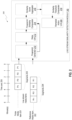
- FIG. 2 is an example use of a live-stream similarity detection module, in accordance with an implementation of the disclosure.
- System 200 shows live-stream similarity detection module 140, probe media item 201, and reference media item 202.
- System 200 may include similar features to system architecture 100 as described with respect to FIG. 1 . It may be noted that features of FIG. 1 may be used herein to help describe FIG. 2 .
- probe media item 201 and reference media item 202 item may both be transmitted as a live-stream of the same event.
- Reference media item 202 may be transmitted by the owner of the media item.
- Probe media item 201 may be transmitted by a user, other than the owner.
- an initial lookup of probe media item 201 may be performed approximately immediately after a segment is received to detect a similarity of a probe media item 201 to a reference media item received prior to or at the same time as the probe media item 201.
- One or more lookups of individual segments 203 (P1-Pn) may be performed as part of the initial lookup.
- one or more secondary lookups may be performed after a delay period to detect a similarity of a probe media item 201 to a reference media item 202 received after the probe media item 201.
- One or more lookups of individual segments 203 (P1-Pn) may be performed as part of the one or more secondary lookups.
- Probe media item 201 is shown to include segments 203 (e.g., P1 to Pn) (also referred to as “probe segments”).
- Reference media item 202 is shown to include segments 204 (e.g., R1 to Rn) (also referred to as “reference segments”). It may be noted that probe media item 201 or reference media item 202 may include any number of segments.
- a segment may be a part of a media item.
- a segment may include a contiguous part of media item having a start timestamp and end timestamp different from other segments.
- segments may be non-overlapping parts of a media item.
- time axis 205 illustrates 1 minute (min) intervals starting at time "0".
- Segments 203 of probe media item 201 may each be 1 minute in length.
- P1 may be have a start timestamp (0:00 min) and end timestamp (1:00 min)
- P2 may have start timestamp (1:00 min) and end timestamp (2:00 min)
- P3 may have start timestamp (2:00 min) and end timestamp (3:00 min).
- segments of 1 minute length are provided for purposes of illustration rather than limitation. In other implementation, segments may be any length and also may vary in length. It may be noted that in implementations, a segment may remain relatively small so that the computational overhead to perform a lookup also remains small.
- two or more probe segments are to be found similar to respective reference segments prior to taking a remedial measure (e.g., rather than just one large segment). In some implementations, two or more probe segments are found to be similar to respective reference segments prior to determining that probe media item 201 is similar to reference media item 202.
- System 200 also illustrates probe media item 201 being received by system 200 prior to reference media item 202.
- a media item that is received prior to other media items may also be transmitted or broadcast as a live-stream to user devices for consumption prior to the other media items.
- each segment of probe media item 201 is also received prior to the corresponding segment of reference media item 202 (e.g., P1 is received two minutes prior to R1, and P3 is received two minutes prior to R3).
- the segments may also be transmitted as a live-stream via system 200 and transmitted as a live-stream with negligible delay from the time the segment is uploaded.
- live-stream similarity detection module 140 may perform similarity detection, as described herein, concurrently or serially with transmission of a media item as a live-stream to user devices.
- a probe media item 201 (e.g., user uploaded media item) that is received prior to a reference media item 202 (e.g., owner uploaded media item) may present challenges for similarity detection.
- live-stream similarity detection module 140 may perform an initial lookup and perform a lookup of segment P1 after it is received by system 200. Since the reference media item 202 has yet to arrive at system 200, live-stream similarity detection module 140 may not detect a segment similar to segment P1 because the corresponding segment R1 of reference media item 202 has not yet been received and no similarity can be detected.
- similarity detection module 140 may include fingerprint generator 210, delay unit 212, fingerprint similarity comparator 214, similarity score aggregator 216, similarity threshold comparator 218, and remedial action unit 220.
- probe media item 201 is received by live-stream similarity detection module 140 prior to reference media item 202.
- probe media item 201 or reference media item 202 are transmitted as a live-stream of the same event.
- fingerprint generator 210 generates one or more fingerprints for a particular segment, such as segment P1, of probe media item 201. It may be noted that fingerprint as used herein, may refer to one or more fingerprints unless otherwise described.
- fingerprint similarity comparator 214 may produce a similarity value.
- a similarity value may be a value assigned to a segment of the probe media item and indicative of whether or not a particular probe segment is similar to a reference segment of any reference media item.
- the similarity value may be an integer (e.g., "1" for a similar segment, "0" for a non-similar segment).
- the similarity value may reflect a temporal length of the particular probe segment found similar to a reference segment. For example, a similarity value of 1 minute may be assigned to a 1-minute probe segment found similar to a reference segment. In another example, a similarity value of 2 minutes may be assigned to a 2-minute probe segment found similar to a reference segment, and so forth.
- a similarity value of "0" may be assigned to a probe segment that is not found similar to a reference segment. In the present example, no similarity is found for fingerprint P1 and similarity value of "0" may be assigned.
- the above similarity values are provided for purposes of illustration, rather than limitation. A similarity value may be expressed in any number of ways.
- fingerprint generator may bypass delay unit 212.
- the initial lookup may be performed with negligible delay after a segment, such as segment P1, of probe media item 201 is received by system 200.
- Delay unit 212 may be implemented in subsequent secondary lookups (e.g., to detect a similarity of a reference media item 202 received after probe media item 201).
- fingerprint generator 210 may also pass fingerprints to delay unit 212 concurrent with the initial lookup, and delay unit 212 may wait a predetermined delay period before executing one or more secondary lookups.
- the result (e.g., similarity value) of the comparison of fingerprint P1 of probe media item 201 with reference fingerprints may be sent to similarity score aggregator 216.
- Similarity score aggregator 216 may aggregate the received similarity value to previously received similarity values for probe media item 201 to generate a similarity score for the probe media item 201.
- the similarity values may be aggregated in numerous ways, such as by weighting one or more similarity values or using other functions.
- the similarity value may be aggregated by adding a new similarity value to the existing similarity score.
- live-stream similarity detection module 140 may pass the similarity score associated with probe media item 201 to similarity threshold comparator 218 to compare the similarity score with one or more similarity thresholds defined by an administrator, for example. In response to the similarity score being greater or equal to one or more similarity thresholds, live-stream similarity detection module 140 may pass the information to remedial action unit 220 to initiate an appropriate remedial action. In the present example, a similarity score of "0" does not exceed any similarity thresholds, and no remedial action is taken against probe media item 201.
- live-stream similarity detection module 140 may terminate the initial lookup (e.g. not perform a lookup of P2-Pn). In other implementations, if no similarity is determined for fingerprint P1 and a fingerprint of any reference media item, live-stream similarity detection module 140 may wait a delay period to initiate a secondary lookup of fingerprint P1 (e.g., to detect a probe media item 201 similar to a reference media item 202 received after the probe media item 201).
- live-stream similarity detection module 140 may continue to perform the initial lookup by performing similar operations as described above for one or more of additional segments P2 to Pn of probe media item 201 to detect a similarity to a reference media item 202 received prior to or at the same time as reference media item 202.
- live-stream similarity detection module 140 may continue the initial lookup by performing similar operations as described above for one or more of segments P2 to Pn (e.g., continue to perform the initial lookup for at least some number of non-similar (or contiguous non-similar) probe segments before terminating the initial lookup). It may be noted that numerous combinations of responses may be performed responsive to performing a lookup and detecting fingerprint P1 is similar to or not similar to a reference fingerprint.
- reference media item 202 is delayed by 2 minutes and live-stream similarity detection module 140 may not detect probe media item 201 as similar to reference media item 202 by performing an initial lookup using segments 203 of probe media item 201. It may be noted that in other examples where reference media item 202 is received prior to or at the same time as probe media item 201, live-stream similarity detection module 140 may detect the similarity between the two media items using the above described operations of the initial lookup.
- live-stream similarity detection module 140 may perform one or more secondary lookups after a delay period.
- a delay period may be a period of time between receiving a particular segment of a media item by a system (e.g., system 200) to performing a lookup for the particular segment. For instance, a delay period of 3 minutes may indicate that after segment P1 is received by system 200 (e.g., at minute 1 on time axis 205), system 200 may perform a lookup of segment P1 after 3 minutes (e.g., at minute 4 on time axis 205).
- a delay period of 3 minutes may indicate that after segment P2 is received by system 200 (e.g., at minute 2 on time axis 205), system 200 may perform a lookup of segment P2 after 3 minutes (e.g., at minute 5 on time axis 205). It may be noted that in the present example although the delay period is the same for segment P1 and P2, the corresponding lookup of P1 and P2 are performed at different times. It may be noted that delay period may be measured in other ways. In implementations, the secondary lookups may be performed after a delay period in the range of 2 minutes to 15 minutes. It may be noted that the delay period may be any amount of time, and may be chosen by operational considerations, among others.
- live-stream similarity detection module 140 may initiate a secondary lookup after a first delay period (e.g., 3 minute delay period) by causing delay unit 212 to pass a fingerprint of segment P1 to fingerprint similarity comparator 214.
- live-stream similarity detection module 140 may initiate a secondary lookup by performing a lookup of segment P1 at minute 4 on time axis 201 (3 minute delay period).
- the fingerprint P1 may be stored in and retrieved from data store 106 after being generated by fingerprint generator 210 of system 200.
- Fingerprint similarity comparator 214 may compare fingerprint P1 to fingerprints of reference media items. Segment R1 of reference media item 202 is received by minute 3 of time axis 205.
- Segment R1 is passed to fingerprint generator 210 to produce a fingerprint for segment R1 of reference media item 202 (e.g., fingerprint R1). Since segment R1 is received within the first delay period, fingerprint R1 may be made available to fingerprint similarity comparator 214 for comparison to fingerprint P1. Fingerprint similarity comparator 214 compares fingerprint P1 to fingerprint R1 and determines a similarity, and produces a similarity value (e.g., similarity value of 1 minute representing the length of segment P1).
- fingerprint similarity comparator 214 compares fingerprint P1 to fingerprint R1 and determines a similarity, and produces a similarity value (e.g., similarity value of 1 minute representing the length of segment P1).
- live-stream similarity detection module 140 may pass the similarity value for segment P1 to similarity score aggregator 216.
- the live-stream similarity detection module 140 may pass the similarity score to similarity threshold comparator 218 to compare the similarity score with one or more similarity thresholds.
- a first similarity threshold may be set at 2 minutes.
- Live-stream similarity detection module 140 may compare the similarity score (1 minute) to the first similarity threshold (2 minutes) and compute that the current similarity score is less than the first similarity threshold. Responsive to the similarity score not exceeding (or equaling) the first similarity threshold, live-stream similarity detection module 140 does not pass an indicator to remedial action unit 220 and no remedial action is taken on probe media item 201.
- live-stream similarity detection module 140 may continue the secondary lookup after the first delay period (e.g., 3 minute delay period) by causing delay unit 212 to pass a fingerprint of segment P2 of probe media item 201 to fingerprint similarity comparator 214.
- live-stream similarity detection module 140 may continue the secondary lookup by performing a lookup of segment P2 at minute 5 on time axis 2015 (3 minute delay period).
- the fingerprint P2 may be stored in and retrieved from data store 106.
- Fingerprint similarity comparator 214 may compare fingerprint P2 to fingerprints of reference media items. Segment R2 of reference media item 202 is received by minute 4 of time axis 205.
- R2 is passed to fingerprint generator 210 to produce a fingerprint for segment R2 or reference media item 202 (e.g., fingerprint R2). Since segment R2 is received within the first delay period associated with segment P2, fingerprint R2 may be made available to fingerprint similarity comparator 214 for comparison to fingerprint P2. Fingerprint similarity comparator 214 compares fingerprint P2 to fingerprint R2 and determines a similarity and produces a similarity value (e.g., similarity value of 1 minute representing the length of segment P2).
- a similarity value e.g., similarity value of 1 minute representing the length of segment P2).
- live-stream similarity detection module 140 may pass the similarity value for segment P2 to similarity score aggregator 216.
- the live-stream similarity detection module 140 may pass the similarity score to similarity threshold comparator 218 to compare the similarity score with one or more similarity thresholds.
- a single similarity threshold is implemented and is set at 2 minutes.
- Live-stream similarity detection module 140 may compare the similarity score (2 minutes) to the similarity threshold (2 minutes) and compute that the current similarity score is greater than or equal to the similarity threshold. Responsive to the similarity score exceeding or equaling the similarity threshold, live-stream similarity detection module 140 passes a corresponding indicator to remedial action unit 220.
- remedial action unit 220 receives the indicator from similarity threshold comparator 218 indicating that the similarity score for probe media item 201 has exceeded or equaled the similarity threshold.
- Remedial action unit 220 may perform a number of remedial actions.
- the remedial actions may include sending a warning notification to a user account associated with the transmission of the probe media item 201. For example, an email may be sent to the user account requesting the user to stop the transmission of the probe media item 201.
- the remedial action may include muting the probe media item. For example, if the probe media item 201 is an audio media item, the sound of the audio content may be muted.
- the remedial action may include blocking a display of video content of the probe media item 201. For instance, if the probe media item 201 is a video media item, the video content of the probe media item 201 may be blocked from the user device while the audio content is presented to the user device.
- the remedial action may include terminating the transmission of the probe media item 201. For instance, the transmission of the probe media item 201 may be terminated to some or all user devices.
- the remedial action may include suspending the user account associated with the transmission of the probe media item 201, so the user cannot re-upload the probe media item 201 from the same user account, for example.
- a single similarity threshold may be used. If the similarity score exceeds or is equal to the single similarity threshold, live-stream similarity detection module 140 may execute one or more of the remedial actions described above. In other implementations, two or more similarity thresholds may be implemented. For example, a first similarity threshold may be set at 2 minutes and a second similarity threshold may be set at 4 minutes. If the similarity score is below both the first and the second similarity threshold, remedial action unit 220 may take no action. If the similarity score is greater than or equal to the first similarity threshold and below the second similarity threshold, a remedial action other than terminating the transmission of the probe media item 201 may be executed.
- the remedial action unit 220 may perform the remedial action including at least one of sending a warning notification to a user account associated with the transmission of the probe media item 201, muting the probe media item 201, or blocking a display of video content of the probe media item 201. If the similarity score is greater than or equal to the second similarity threshold, remedial action unit 220 may terminate the transmission of the probe media item.
- live-stream similarity detection module 140 may continue the above described operations to execute the first secondary lookup for one or more of the remaining probe segments P3-Pn. In some implementations, live-stream similarity detection module 140 may continue the first secondary lookup for all the segments 203 of probe media item 201 or until one or more remedial actions (e.g. termination of transmission of probe media item 201) occurs, if at all. In some implementations, live-stream similarity detection module 140 may terminate the first secondary lookup after some number of segments 203 of probe media item 201 are found not to be similar to the segments of reference media item 202. For example, live-stream similarity detection module 140 may terminate the first secondary lookup after three consecutive segments of probe media item 201 are found not similar to reference media item 202.
- live-stream similarity detection module 140 may terminate the first secondary lookup after three consecutive segments of probe media item 201 are found not similar to reference media item 202.
- live-stream similarity detection module 140 performs one secondary lookup. In other implementations, live-stream similarity detection module 140 performs two secondary lookups. In still other implementations, live-stream similarity detection module 140 performs any number of secondary lookups. In some implementations, if live-stream similarity detection module 140 does not find the segment P1 of probe media item 201 (or two consecutive segments P1 and P2, for example), the first secondary lookup may be terminated and a second secondary lookup may be performed after a second delay period. It may be noted that additional secondary lookups may be performed as described herein, but with a different delay period (e.g., 7 minutes) than a preceding secondary lookup.
- a different delay period e.g. 7 minutes
- a fingerprint may refer to a signature of a first data item (e.g., the probe media item 201 or a segment of the probe media item 201 or frame of the probe media item 201) that may uniquely identify the first data item, and that can be mapped to a signature of a second data item (e.g., the reference media item 202 or a segment of the reference media item 202 or a frame of the reference media item 202) that may uniquely identify the second data item.
- a media item or a segment of a media item may be input into a fingerprint function (e.g., a hash function) to generate a fingerprint representative of the media item or segment, respectively.
- a fingerprint function e.g., a hash function
- a media item may be transformed into a sequence of multiple fingerprints where each fingerprint is representative of a different segment of the media item.
- each of a sequence of fingerprints represents a different non-overlapping segment of the media item.
- a fingerprint for a segment of a media item may include one or more fingerprints.
- fingerprint generator 210 may generate a fingerprint for every 1 ⁇ 4 second of a 1 minute segment. Fingerprint may refer to one or more fingerprints herein, unless otherwise described.
- live-stream similarity detection module 140 may be used to compare fingerprints representative of segments of two video items to determine if the two video items are similar. In another implementation, live-stream similarity detection module 140 may be used to compare fingerprints representative of segments of two audio items to determine if the two audio items are similar. In still another implementation, the live-stream similarity detection module 140 may be used to compare two melodies to determine if the two melodies are similar.
- a melody may be data, such as a chord progression, sufficient to recognize a song. For example, two melodies may be considered similar (e.g., similarity score exceeds a similarity threshold) if the two melodies have roughly the same transitions between notes at roughly the same times. Melodies played at different pitches or speeds may be considered similar. Additionally, melodies may be considered similar even when one of the melodies has added a few notes or harmonics.
- live-stream similarity detection module 140 may determine that the probe media item 201 and reference media item 202 are similar. Similarity may be determined in multiple ways. For example, a similarity function may be implemented that quantitatively measures the similarity between two data items. In one example, a pair of fingerprints (e.g., fingerprint P1 and fingerprint R1) may be used as input for a similarity function. The similarity function may output a value indicative of the similarity between the two fingerprints.
- a similarity function may be implemented that quantitatively measures the similarity between two data items.
- a pair of fingerprints e.g., fingerprint P1 and fingerprint R1
- the similarity function may output a value indicative of the similarity between the two fingerprints.
- a similarity function may output a fingerprint pair similarity score between 0 and 1 (or a fingerprint pair similarity score of 0 or 1), where 1 is most similar and 0 is least similar.
- the fingerprint pair similarity score may be indicative of the similarity between the associated segments (e.g., segment P1 and segment R1). It may be noted that any number of similarity functions may be implemented such as the Euclidean (L2) distance between two fingerprints represented as vectors, cosine distance between two fingerprints represented as vectors, Kendall-Tau distance, or Hamming distance, for example.
- FIG. 3 is a flow diagram illustrating method 300 for determining similarities between media items using live-stream similarity detection module, in accordance with some implementations.
- Method 300 may be performed by processing logic that includes hardware (e.g., circuitry, dedicated logic, programmable logic, microcode), software (e.g., instructions run on a processing device to perform hardware simulation), or a combination thereof.
- live-stream similarity detection module 140 may perform some or all the operations described herein.
- Method 300 begins at block 305 where processing logic receives a first segment of a probe media item that is transmitted as a first live-stream of an event.
- processing logic responsive to receiving the first segment of the probe media item, initiates the initial lookup and performs a first lookup of the first segment of the probe media item to determine whether the first segment of the probe media item is similar to a segment of any reference media item transmitted as another live-stream of the event and received prior to or at a same time as the probe media item.
- processing logic responsive to determining, based on the first lookup of the first segment of the probe media item, that the first segment of the probe media item is not similar to the segment of any reference media item, performs a second lookup of the first segment of the probe media item after a first delay period to determine whether the first segment of the probe media item is similar to a first segment of a first reference media item that is transmitted as a second live-stream of the event and received subsequent to the probe media item.
- processing logic responsive to determining, based on the second lookup of the first segment of the probe media item, that the first segment of the probe media item is similar to the first segment of the first reference media item, performs a third lookup of a second segment of the probe media item after the first delay period to determine whether the second segment of the probe media item is similar to a second segment of the first reference media item.
- processing logic responsive to determining, based on the second lookup and the third lookup, that the first segment and the second segment of the probe media item are respectively similar to the first segment and the second segment of the first reference media item, performs a remedial action in association with the probe media item.
- FIG. 4 is a flow diagram illustrating a method for determining similarity between a probe media item and reference media item received after the probe media item, in accordance with some implementations.
- Method 400 may be performed by processing logic that includes hardware (e.g., circuitry, dedicated logic, programmable logic, microcode), software (e.g., instructions run on a processing device to perform hardware simulation), or a combination thereof.
- live-stream similarity detection module 140 may perform some or all the operations described herein.
- Method 400 may describe operations to perform a second lookup of the first segment of the probe media item after a first delay period or performing a third lookup of a second segment of the probe media item after the first delay period.
- method 400 may represent operation of block 315 or block 320 of method 300 described with respect to FIG. 3 .
- Method 400 begins at block 405 where processing logic determines the first delay period for performing the second lookup.
- live-stream similarity detection module 140 may communicate with delay unit 212 to determine the first delay period.
- the delay period may be part of the information stored in association with server 130, and may be retrieved by live-stream similarity detection module 140.
- processing logic subsequent the first delay period compares the first probe fingerprint to a first reference fingerprint associated with the first segment of the first reference media item to determine a similarity between the first segment of the probe media item and the first segment of the first reference media item.
- processing logic responsive to determining the similarity between the first segment of the probe media item and the first segment of the first reference media item aggregates a first similarity value with a similarity score associated with the probe media item.
- processing logic subsequent the first delay period compares a second probe fingerprint associated with the second segment of the probe media item to a second reference fingerprint associated with the second segment of the first reference media item to determine a similarity between the second segment of the probe media item and the second segment of the first reference media item.
- processing logic responsive to determining the similarity between the second segment of the probe media item and the second segment of the first reference media item aggregates a second similarity value to the similarity score associated with the probe media item.
- FIG. 5 is a flow diagram illustrating a method for performing a remedial action in association with a probe media item, in accordance with some implementations.
- Method 500 may be performed by processing logic that includes hardware (e.g., circuitry, dedicated logic, programmable logic, microcode), software (e.g., instructions run on a processing device to perform hardware simulation), or a combination thereof.
- live-stream similarity detection module 140 may perform some or all the operations described herein.
- method 500 may represent operation of block 325 of method 300 described with respect to FIG. 3 .
- Method 500 begins at block 505 where processing logic compares a similarity score associated with the probe media item to a first similarity threshold.
- the similarity score is indicative of a similarity between the probe media item and the first reference media item.
- processing logic compares the similarity score associated with the probe media item to a second similarity threshold.
- the first remedial action may include at least one of sending a warning notification to a user account associated with the transmission of the probe media item, muting the probe media item, or blocking a display of video content of the probe media item.
- processing logic responsive to determining the similarity score is greater than or equal to the second similarity threshold, performs a second remedial action by terminating the transmission of the probe media item.
- the second remedial action is different from the first remedial action
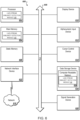
- FIG. 6 is a block diagram illustrating an exemplary computer system 600.
- the computer system 600 executes one or more sets of instructions that cause the machine to perform any one or more of the methodologies discussed herein.
- Set of instructions, instructions, and the like may refer to instructions that, when executed computer system 600, cause computer system 600 to perform one or more operations of live-stream similarity detection module 140.
- the machine may operate in the capacity of a server or a client device in client-server network environment, or as a peer machine in a peer-to-peer (or distributed) network environment.
- the machine may be a personal computer (PC), a tablet PC, a set-top box (STB), a personal digital assistant (PDA), a mobile telephone, a web appliance, a server, a network router, switch or bridge, or any machine capable of executing a set of instructions (sequential or otherwise) that specify actions to be taken by that machine.
- PC personal computer
- PDA personal digital assistant
- STB set-top box
- PDA personal digital assistant
- mobile telephone a web appliance
- server a network router, switch or bridge
- machine shall also be taken to include any collection of machines that individually or jointly execute the sets of instructions to perform any one or more of the methodologies discussed herein.
- the computer system 600 includes a processing device 602, a main memory 604 (e.g., read-only memory (ROM), flash memory, dynamic random access memory (DRAM) such as synchronous DRAM (SDRAM) or Rambus DRAM (RDRAM), etc.), a static memory 606 (e.g., flash memory, static random access memory (SRAM), etc.), and a data storage device 616, which communicate with each other via a bus 608.
- main memory 604 e.g., read-only memory (ROM), flash memory, dynamic random access memory (DRAM) such as synchronous DRAM (SDRAM) or Rambus DRAM (RDRAM), etc.
- DRAM dynamic random access memory
- SDRAM synchronous DRAM
- RDRAM Rambus DRAM
- static memory 606 e.g., flash memory, static random access memory (SRAM), etc.
- SRAM static random access memory
- the processing device 602 represents one or more general-purpose processing devices such as a microprocessor, central processing unit, or the like. More particularly, the processing device 602 may be a complex instruction set computing (CISC) microprocessor, reduced instruction set computing (RISC) microprocessor, very long instruction word (VLIW) microprocessor, or a processing device implementing other instruction sets or processing devices implementing a combination of instruction sets.
- the processing device 602 may also be one or more special-purpose processing devices such as an application specific integrated circuit (ASIC), a field programmable gate array (FPGA), a digital signal processor (DSP), network processor, or the like.
- the processing device 602 is configured to execute instructions of the system architecture 100 and the live-stream similarity detection module 140 for performing the operations and steps discussed herein.
- the computer system 600 may further include a network interface device 622 that provides communication with other machines over a network 618, such as a local area network (LAN), an intranet, an extranet, or the Internet.
- the computer system 600 also may include a display device 610 (e.g., a liquid crystal display (LCD) or a cathode ray tube (CRT)), an alphanumeric input device 612 (e.g., a keyboard), a cursor control device 614 (e.g., a mouse), and a signal generation device 620 (e.g., a speaker).
- a display device 610 e.g., a liquid crystal display (LCD) or a cathode ray tube (CRT)
- an alphanumeric input device 612 e.g., a keyboard
- a cursor control device 614 e.g., a mouse
- a signal generation device 620 e.g., a speaker
- the data storage device 616 may include a non-transitory computer-readable storage medium 624 on which is stored the sets of instructions of the system architecture 100 and live-stream similarity detection module 140 embodying any one or more of the methodologies or functions described herein.
- the sets of instructions of the system architecture 100 and live-stream similarity detection module 140 may also reside, completely or at least partially, within the main memory 604 and/or within the processing device 602 during execution thereof by the computer system 600, the main memory 604 and the processing device 602 also constituting computer-readable storage media.
- the sets of instructions may further be transmitted or received over the network 618 via the network interface device 622.
- While the example of the computer-readable storage medium 624 is shown as a single medium, the term “computer-readable storage medium” can include a single medium or multiple media (e.g., a centralized or distributed database, and/or associated caches and servers) that store the sets of instructions.
- the term “computer-readable storage medium” can include any medium that is capable of storing, encoding or carrying a set of instructions for execution by the machine and that cause the machine to perform any one or more of the methodologies of the present disclosure.
- the term “computer-readable storage medium” can include, but not be limited to, solid-state memories, optical media, and magnetic media.
- the present disclosure also relates to an apparatus for performing the operations herein.
- This apparatus may be specially constructed for the required purposes, or it may include a general purpose computer selectively activated or reconfigured by a computer program stored in the computer.
- a computer program may be stored in a computer readable storage medium, such as, but not limited to, any type of disk including a floppy disk, an optical disk, a compact disc read-only memory (CD-ROM), a magnetic-optical disk, a read-only memory (ROM), a random access memory (RAM), an erasable programmable read-only memory (EPROM), an electrically erasable programmable read-only memory (EEPROM), a magnetic or optical card, or any type of media suitable for storing electronic instructions.
- a computer readable storage medium such as, but not limited to, any type of disk including a floppy disk, an optical disk, a compact disc read-only memory (CD-ROM), a magnetic-optical disk, a read-only memory (ROM), a random
- example or “exemplary” are used herein to mean serving as an example, instance, or illustration. Any aspect or design described herein as “example' or “exemplary” is not necessarily to be construed as preferred or advantageous over other aspects or designs. Rather, use of the words “example” or “exemplary” is intended to present concepts in a concrete fashion.
- the term “or” is intended to mean an inclusive “or” rather than an exclusive “or.” That is, unless specified otherwise, or clear from context, "X includes A or B" is intended to mean any of the natural inclusive permutations.
Landscapes
- Engineering & Computer Science (AREA)
- Multimedia (AREA)
- Signal Processing (AREA)
- Databases & Information Systems (AREA)
- Computer Networks & Wireless Communication (AREA)
- Physics & Mathematics (AREA)
- General Physics & Mathematics (AREA)
- Theoretical Computer Science (AREA)
- Information Transfer Between Computers (AREA)
- Information Retrieval, Db Structures And Fs Structures Therefor (AREA)
- Two-Way Televisions, Distribution Of Moving Picture Or The Like (AREA)
Claims (15)
- Procédé comprenant :la réception (305), par un dispositif de traitement (130, 140), d'un premier segment d'un élément multimédia de sonde qui est transmis par une plateforme de partage de contenu (120) en tant que premier flux en direct d'un événement ; etsimultanément à la transmission de l'élément multimédia de sonde en tant que premier flux en direct de l'événement :le fait de déterminer (310) si le premier segment de l'élément multimédia de sonde est similaire à un premier segment d'un quelconque élément multimédia de référence transmis en tant qu'autre flux en direct de l'événement et reçu pas plus tard que l'élément multimédia de sonde ;en réponse à la détermination que le premier segment de l'élément multimédia de sonde n'est pas similaire au premier segment d'un élément multimédia de référence reçu pas plus tard que l'élément multimédia de sonde, le fait de déterminer (315), après une première période de retard, si le premier segment de l'élément multimédia de sonde est similaire à un premier segment d'un premier élément multimédia de référence qui est transmis en tant que deuxième flux en direct de l'événement et reçu après l'élément multimédia de sonde, dans lequel le fait de déterminer (315), après la première période de retard, si le premier segment de l'élément multimédia de sonde est similaire à un premier segment d'un premier élément multimédia de référence qui est transmis en tant que deuxième flux en direct de l'événement et reçu après l'élément multimédia de sonde comprend :après la première période de retard, la comparaison (410) de la première empreinte de sonde à une première empreinte de référence associée au premier segment du premier élément multimédia de référence pour déterminer une similarité entre le premier segment de l'élément multimédia de sonde et le premier segment du premier élément multimédia de référence ; eten réponse à la détermination de la similarité entre le premier segment de l'élément multimédia de sonde et le premier segment du premier élément multimédia de référence, l'agrégation (415) d'une première valeur de similarité à un score de similarité associé à l'élément multimédia de sonde ;en réponse à la détermination, après la première période de retard, que le premier segment de l'élément multimédia de sonde est similaire au premier segment du premier élément multimédia de référence reçu après l'élément multimédia de sonde, le fait de déterminer (420), après la première période de retard, si un second segment de l'élément multimédia de sonde est similaire à un second segment du premier élément multimédia de référence ; eten réponse à la détermination, après la première période de retard, que le premier segment et le second segment de l'élément multimédia de sonde sont respectivement similaires au premier segment et au second segment du premier élément multimédia de référence, l'exécution (325) d'une action en association avec l'élément multimédia de sonde.
- Procédé selon la revendication 1, comprenant également :en réponse à la détermination que le premier segment de l'élément multimédia de sonde n'est pas similaire au premier segment du premier élément multimédia de référence reçu après l'élément multimédia de sonde, le fait de déterminer, après une seconde période de retard, si le premier segment de l'élément multimédia de sonde est similaire à un premier segment d'un second élément multimédia de référence qui est transmis en tant que troisième flux en direct de l'événement et reçu après l'élément multimédia de sonde ;en réponse à la détermination, après la seconde période de retard, que le premier segment de l'élément multimédia de sonde est similaire au premier segment du second élément multimédia de référence reçu après l'élément multimédia de sonde, le fait de déterminer, après la seconde période de retard, si le second segment de l'élément multimédia de sonde est similaire à un second segment du second élément multimédia de référence ; eten réponse à la détermination, après la seconde période de retard, que le premier segment et le second segment de l'élément multimédia de sonde sont respectivement similaires au premier segment et au second segment du second élément multimédia de référence, l'exécution de l'action en association avec l'élément multimédia de sonde.
- Procédé selon la revendication 1 ou 2, dans lequel le fait de déterminer si le premier segment de l'élément multimédia de sonde est similaire à un premier segment d'un quelconque élément multimédia de référence transmis en tant qu'autre flux en direct de l'événement et reçu pas plus tard que l'élément multimédia de sonde comprend :la génération d'une première empreinte de sonde pour le premier segment de l'élément multimédia de sonde ; etla comparaison de la première empreinte de sonde à une pluralité d'empreintes de référence associées à une pluralité de segments pour une pluralité d'éléments multimédias de référence reçus pas plus tard que l'élément multimédia de sonde pour déterminer une similarité entre le premier segment de l'élément multimédia de sonde et le segment du quelconque élément multimédia de référence de la pluralité d'éléments multimédias de référence.
- Procédé selon la revendication 3, comprenant également :
la détermination de la première période de retard. - Procédé selon la revendication 1, dans lequel le fait de déterminer, après la première période de retard, si un second segment de l'élément multimédia de sonde est similaire à un second segment du premier élément multimédia de référence comprend :après la première période de retard, la comparaison d'une seconde empreinte de sonde associée au second segment de l'élément multimédia de sonde à une seconde empreinte de référence associée au second segment du premier élément multimédia de référence pour déterminer une similarité entre le second segment de l'élément multimédia de sonde et le second segment du premier élément multimédia de référence ; eten réponse à la détermination de la similarité entre le second segment de l'élément multimédia de sonde et le second segment du premier élément multimédia de référence, l'agrégation d'une seconde valeur de similarité au score de similarité associé à l'élément multimédia de sonde.
- Procédé selon une quelconque revendication précédente, dans lequel l'exécution d'une action en association avec l'élément multimédia de sonde comprend :la comparaison d'un score de similarité associé à l'élément multimédia de sonde à un premier seuil de similarité, dans lequel le score de similarité est indicatif d'une similarité entre l'élément multimédia de sonde et le premier élément multimédia de référence ; eten réponse à la détermination que le score de similarité est supérieur ou égal à un premier seuil de similarité, l'exécution de l'action ;et éventuellement dans lequel l'action comprend l'un de l'envoi d'une notification d'avertissement à un compte d'utilisateur associé à la transmission de l'élément multimédia de sonde, de la mise en sourdine de l'élément multimédia de sonde, du blocage d'un affichage de contenu vidéo de l'élément multimédia de sonde, ou de la fin de la transmission de l'élément multimédia de sonde.
- Procédé selon la revendication 6, dans lequel l'exécution d'une action en association avec l'élément multimédia de sonde comprend également :la comparaison du score de similarité associé à l'élément multimédia de la sonde à un second seuil de similarité ;en réponse à la détermination que le score de similarité est supérieur ou égal au premier seuil de similarité et inférieur à un second seuil de similarité, l'exécution d'une première action comprenant au moins l'un de l'envoi d'une notification d'avertissement à un compte d'utilisateur associé à la transmission de l'élément multimédia de sonde, de la mise en sourdine de l'élément multimédia de sonde, du blocage d'un affichage de contenu vidéo de l'élément multimédia de sonde ; eten réponse à la détermination que le score de similarité est supérieur ou égal au second seuil de similarité, l'exécution d'une seconde action en mettant fin à la transmission de l'élément multimédia de sonde.
- Procédé selon une quelconque revendication précédente, dans lequel la première période de retard est comprise dans une plage de 3 minutes à 15 minutes.
- Procédé selon une quelconque revendication précédente, dans lequel l'élément multimédia de sonde est un élément multimédia vidéo, ou dans lequel l'élément multimédia de sonde est un élément multimédia audio.
- Système (130,140) comprenant :une mémoire ; etun dispositif de traitement, couplé à la mémoire, pour :recevoir (305) un premier segment d'un élément multimédia de sonde qui est transmis en tant que premier flux en direct d'un événement par une plateforme de partage de contenu (120) ; etsimultanément à la transmission de l'élément multimédia de sonde en tant que premier flux en direct de l'événement :déterminer (310) si le premier segment de l'élément multimédia de sonde est similaire à un premier segment d'un quelconque élément multimédia de référence transmis en tant qu'autre flux en direct de l'événement et reçu pas plus tard que l'élément multimédia de sonde ;en réponse à la détermination que le premier segment de l'élément multimédia de sonde n'est pas similaire au premier segment d'un quelconque élément multimédia de référence reçu pas plus tard que l'élément multimédia de sonde, déterminer (315), après une première période de retard, si le premier segment de l'élément multimédia de sonde est similaire à un premier segment d'un premier élément multimédia de référence qui est transmis en tant que deuxième flux en direct de l'événement et reçu après l'élément multimédia de sonde par :après la première période de retard, la comparaison (410) de la première empreinte de sonde à une première empreinte de référence associée au premier segment du premier élément multimédia de référence pour déterminer une similarité entre le premier segment de l'élément multimédia de sonde et le premier segment du premier élément multimédia de référence ; eten réponse à la détermination de la similarité entre le premier segment de l'élément multimédia de sonde et le premier segment du premier élément multimédia de référence, l'agrégation (415) d'une première valeur de similarité à un score de similarité associé à l'élément multimédia de sonde ;en réponse à la détermination, après la première période de retard, que le premier segment de l'élément multimédia de sonde est similaire au premier segment du premier élément multimédia de référence reçu après l'élément multimédia de sonde, déterminer (420), après la première période de retard, si un second segment de l'élément multimédia de sonde est similaire à un second segment du premier élément multimédia de référence ; eten réponse à la détermination, après la première période de retard, que le premier segment et le second segment de l'élément multimédia de sonde sont respectivement similaires au premier segment et au second segment du premier élément multimédia de référence, exécuter (325) une action en association avec l'élément multimédia de sonde.
- Procédé selon la revendication 10, dans lequel, pour déterminer si le premier segment de l'élément multimédia de sonde est similaire à un premier segment d'un quelconque élément multimédia de référence transmis en tant qu'autre flux en direct de l'événement et reçu pas plus tard que l'élément multimédia de sonde, le dispositif de traitement doit :générer une première empreinte de sonde pour le premier segment de l'élément multimédia de sonde ; etcomparer la première empreinte de sonde à une pluralité d'empreintes de référence associées à une pluralité de segments pour une pluralité d'éléments multimédias de référence reçus pas plus tard que l'élément multimédia de sonde pour déterminer une similarité entre le premier segment de l'élément multimédia de sonde et le segment du quelconque élément multimédia de référence de la pluralité d'éléments multimédias de référence.
- Système selon la revendication 10, le dispositif de traitement doit également :
déterminer la première période de retard. - Système selon la revendication 12, dans lequel, pour déterminer, après la première période de retard, si un second segment de l'élément multimédia de sonde est similaire à un second segment du premier élément multimédia de référence, le dispositif de traitement doit :après la première période de retard, comparer une seconde empreinte de sonde associée au second segment de l'élément multimédia de sonde à une seconde empreinte de référence associée au second segment du premier élément multimédia de référence pour déterminer une similarité entre le second segment de l'élément multimédia de sonde et le second segment du premier élément multimédia de référence ; eten réponse à la détermination de la similarité entre le second segment de l'élément multimédia de sonde et le second segment du premier élément multimédia de référence, agréger une seconde valeur de similarité au score de similarité associé à l'élément multimédia de sonde.
- Système selon l'une quelconque des revendications 10 à 13, dans lequel, pour exécuter une action en association avec l'élément multimédia de sonde, le dispositif de traitement doit :comparer un score de similarité associé à l'élément multimédia de sonde à un premier seuil de similarité, dans lequel le score de similarité est indicatif d'une similarité entre l'élément multimédia de sonde et le premier élément multimédia de référence ; eten réponse à la détermination que le score de similarité est supérieur ou égal à un premier seuil de similarité, exécuter l'action, dans lequel l'action comprend l'un de l'envoi d'une notification d'avertissement à un compte d'utilisateur associé à la transmission de l'élément multimédia de sonde, de la mise en sourdine de l'élément multimédia de sonde, du blocage d'un affichage de contenu vidéo de l'élément multimédia de sonde, ou de la fin de la transmission de l'élément multimédia de sonde.
- Support lisible par ordinateur qui stocke des instructions qui, lorsqu'elle est exécutée par un dispositif de traitement, amènent le dispositif de traitement à exécuter des opérations comprenant un procédé tel que défini dans l'une quelconque des revendications 1 à 9.
Applications Claiming Priority (2)
| Application Number | Priority Date | Filing Date | Title |
|---|---|---|---|
| US15/370,886 US10659509B2 (en) | 2016-12-06 | 2016-12-06 | Detecting similar live streams ingested ahead of the reference content |
| PCT/US2017/054143 WO2018106323A1 (fr) | 2016-12-06 | 2017-09-28 | Détection de flux en direct similaires ingérés en avance du contenu de référence |
Publications (2)
| Publication Number | Publication Date |
|---|---|
| EP3552397A1 EP3552397A1 (fr) | 2019-10-16 |
| EP3552397B1 true EP3552397B1 (fr) | 2024-11-27 |
Family
ID=60117766
Family Applications (1)
| Application Number | Title | Priority Date | Filing Date |
|---|---|---|---|
| EP17784746.4A Active EP3552397B1 (fr) | 2016-12-06 | 2017-09-28 | Détection de flux en direct similaires ingérés en avance du contenu de référence |
Country Status (4)
| Country | Link |
|---|---|
| US (2) | US10659509B2 (fr) |
| EP (1) | EP3552397B1 (fr) |
| CN (2) | CN110036643B (fr) |
| WO (1) | WO2018106323A1 (fr) |
Families Citing this family (7)
| Publication number | Priority date | Publication date | Assignee | Title |
|---|---|---|---|---|
| US11025693B2 (en) * | 2017-08-28 | 2021-06-01 | Banjo, Inc. | Event detection from signal data removing private information |
| US10313413B2 (en) | 2017-08-28 | 2019-06-04 | Banjo, Inc. | Detecting events from ingested communication signals |
| US10585724B2 (en) | 2018-04-13 | 2020-03-10 | Banjo, Inc. | Notifying entities of relevant events |
| CN110677682B (zh) | 2018-07-02 | 2022-05-31 | 阿里巴巴集团控股有限公司 | 直播检测与数据处理方法、设备、系统及存储介质 |
| US10506275B1 (en) * | 2018-07-16 | 2019-12-10 | Gracenote, Inc. | Dynamic control of fingerprinting rate to facilitate time-accurate revision of media content |
| US10904587B2 (en) | 2018-07-19 | 2021-01-26 | Gracenote, Inc. | Establishment and use of time mapping based on interpolation using low-rate fingerprinting, to help facilitate frame-accurate content revision |
| KR102734142B1 (ko) * | 2018-08-08 | 2024-11-26 | 삼성전자주식회사 | 카테고리에 기반하여 아이템에 관한 정보를 제공하는 전자 장치 |
Citations (1)
| Publication number | Priority date | Publication date | Assignee | Title |
|---|---|---|---|---|
| US20150143519A1 (en) * | 2012-04-03 | 2015-05-21 | Google Inc. | Detection of potentially copyrighted content in user-initiated live streams |
Family Cites Families (31)
| Publication number | Priority date | Publication date | Assignee | Title |
|---|---|---|---|---|
| US9349411B2 (en) * | 2002-07-16 | 2016-05-24 | Digimarc Corporation | Digital watermarking and fingerprinting applications for copy protection |
| CN100504818C (zh) * | 2003-07-07 | 2009-06-24 | 巨视股份有限公司 | 调控对非易失性存储区访问的方法和判定访问的自动方法 |
| KR100765749B1 (ko) * | 2005-04-26 | 2007-10-15 | 삼성전자주식회사 | 이진영상 압축장치 및 방법 |
| WO2006132622A2 (fr) * | 2005-06-03 | 2006-12-14 | Nielsen Media Research, Inc. | Procedes et appareil pour la detection d'un evenement de programmation associe a la presentation de contenu multimedia |
| US20070033408A1 (en) * | 2005-08-08 | 2007-02-08 | Widevine Technologies, Inc. | Preventing illegal distribution of copy protected content |
| CN1968137A (zh) * | 2006-04-30 | 2007-05-23 | 华为技术有限公司 | 一种媒体流审查系统及审查码流生成节点设备 |
| US9177209B2 (en) | 2007-12-17 | 2015-11-03 | Sinoeast Concept Limited | Temporal segment based extraction and robust matching of video fingerprints |
| CA2660674A1 (fr) * | 2008-03-27 | 2009-09-27 | Crim (Centre De Recherche Informatique De Montreal) | Detection de media par reconnaissance acoustique |
| US9785708B2 (en) * | 2008-06-18 | 2017-10-10 | Gracenote, Inc. | Scalable, adaptable, and manageable system for multimedia identification |
| US8259177B2 (en) * | 2008-06-30 | 2012-09-04 | Cisco Technology, Inc. | Video fingerprint systems and methods |
| US8422731B2 (en) * | 2008-09-10 | 2013-04-16 | Yahoo! Inc. | System, method, and apparatus for video fingerprinting |
| EP2323046A1 (fr) * | 2009-10-16 | 2011-05-18 | Telefónica, S.A. | Procédé de détection d'une copie audio et vidéo dans des flux multimédia |
| TWI438605B (zh) * | 2010-07-21 | 2014-05-21 | Global Unichip Corp | Method and device for aligning multi - channel data in transmission system |
| US8639178B2 (en) * | 2011-08-30 | 2014-01-28 | Clear Channel Management Sevices, Inc. | Broadcast source identification based on matching broadcast signal fingerprints |
| US8625027B2 (en) * | 2011-12-27 | 2014-01-07 | Home Box Office, Inc. | System and method for verification of media content synchronization |
| US8645485B1 (en) * | 2012-01-30 | 2014-02-04 | Google Inc. | Social based aggregation of related media content |
| US20130271655A1 (en) * | 2012-04-12 | 2013-10-17 | Google Inc. | System, apparatus and method to facilitate live video streaming |
| US9064154B2 (en) * | 2012-06-26 | 2015-06-23 | Aol Inc. | Systems and methods for associating electronic content |
| US9661361B2 (en) * | 2012-09-19 | 2017-05-23 | Google Inc. | Systems and methods for live media content matching |
| US9207964B1 (en) * | 2012-11-15 | 2015-12-08 | Google Inc. | Distributed batch matching of videos with dynamic resource allocation based on global score and prioritized scheduling score in a heterogeneous computing environment |
| US8976221B2 (en) * | 2012-12-03 | 2015-03-10 | Google Inc. | Adaptable identification of relevant regions in live streams |
| US9153239B1 (en) * | 2013-03-14 | 2015-10-06 | Google Inc. | Differentiating between near identical versions of a song |
| US9442935B2 (en) * | 2013-05-31 | 2016-09-13 | Nokia Technologies Oy | Method and apparatus for presenting media to users |
| ES2879628T3 (es) * | 2013-11-08 | 2021-11-22 | Friend For Media Ltd | Identificación de componentes multimedia |
| US9665614B2 (en) * | 2014-03-25 | 2017-05-30 | Google Inc. | Preventing abuse in content sharing system |
| WO2015183148A1 (fr) * | 2014-05-27 | 2015-12-03 | Telefonaktiebolaget L M Ericsson (Publ) | Prise d'empreinte et mise en correspondance de contenus d'un fichier multimédia |
| US10152479B1 (en) * | 2014-08-01 | 2018-12-11 | Google Llc | Selecting representative media items based on match information |
| US9497505B2 (en) * | 2014-09-30 | 2016-11-15 | The Nielsen Company (Us), Llc | Systems and methods to verify and/or correct media lineup information |
| US20160294890A1 (en) * | 2015-03-31 | 2016-10-06 | Facebook, Inc. | Multi-user media presentation system |
| US20170279757A1 (en) * | 2016-03-22 | 2017-09-28 | Facebook, Inc. | Systems and methods for identifying matching content |
| US10305958B2 (en) * | 2017-04-25 | 2019-05-28 | International Business Machines Corporation | Checkpointing a set of stream computing data |
-
2016
- 2016-12-06 US US15/370,886 patent/US10659509B2/en active Active
-
2017
- 2017-09-28 WO PCT/US2017/054143 patent/WO2018106323A1/fr not_active Ceased
- 2017-09-28 EP EP17784746.4A patent/EP3552397B1/fr active Active
- 2017-09-28 CN CN201780075362.9A patent/CN110036643B/zh active Active
- 2017-09-28 CN CN202110856297.1A patent/CN113784153B/zh active Active
-
2020
- 2020-05-18 US US16/877,228 patent/US11757966B2/en active Active
Patent Citations (1)
| Publication number | Priority date | Publication date | Assignee | Title |
|---|---|---|---|---|
| US20150143519A1 (en) * | 2012-04-03 | 2015-05-21 | Google Inc. | Detection of potentially copyrighted content in user-initiated live streams |
Also Published As
| Publication number | Publication date |
|---|---|
| CN113784153A (zh) | 2021-12-10 |
| US10659509B2 (en) | 2020-05-19 |
| EP3552397A1 (fr) | 2019-10-16 |
| US20200280593A1 (en) | 2020-09-03 |
| WO2018106323A1 (fr) | 2018-06-14 |
| US20180159914A1 (en) | 2018-06-07 |
| CN113784153B (zh) | 2024-06-25 |
| CN110036643B (zh) | 2021-08-13 |
| CN110036643A (zh) | 2019-07-19 |
| US11757966B2 (en) | 2023-09-12 |
Similar Documents
| Publication | Publication Date | Title |
|---|---|---|
| US11757966B2 (en) | Detecting similar live streams ingested ahead of the reference content | |
| US10777229B2 (en) | Generating moving thumbnails for videos | |
| KR102405115B1 (ko) | 머신 학습을 이용한 라이브-스트림 콘텐츠의 추천 | |
| US10452891B2 (en) | Multi-step sequence alignment | |
| US10911384B2 (en) | Staggered notification by affinity to promote positive discussion | |
| US20150245094A1 (en) | Merging Content Channels | |
| US20240037537A1 (en) | Infrastructure for digital asset management | |
| US12111891B2 (en) | DRM sharing and playback service specification selection | |
| US9336210B2 (en) | Determining a likelihood and degree of derivation among media content items | |
| US20170054669A1 (en) | Notification targeting based on downstream user engagement | |
| US20220345777A1 (en) | Proactive detection of media item matching | |
| US11487806B2 (en) | Media item matching using search query analysis | |
| US20230379556A1 (en) | Crowd source-based time marking of media items at a platform | |
| US9936264B1 (en) | Method of restricting offline video playback to include advertisements | |
| JP2025168231A (ja) | 大規模推薦システムでコンテンツの重複を排除するための方法、コンピュータ装置、およびコンピュータプログラム |
Legal Events
| Date | Code | Title | Description |
|---|---|---|---|
| STAA | Information on the status of an ep patent application or granted ep patent |
Free format text: STATUS: UNKNOWN |
|
| STAA | Information on the status of an ep patent application or granted ep patent |
Free format text: STATUS: THE INTERNATIONAL PUBLICATION HAS BEEN MADE |
|
| PUAI | Public reference made under article 153(3) epc to a published international application that has entered the european phase |
Free format text: ORIGINAL CODE: 0009012 |
|
| STAA | Information on the status of an ep patent application or granted ep patent |
Free format text: STATUS: REQUEST FOR EXAMINATION WAS MADE |
|
| 17P | Request for examination filed |
Effective date: 20190708 |
|
| AK | Designated contracting states |
Kind code of ref document: A1 Designated state(s): AL AT BE BG CH CY CZ DE DK EE ES FI FR GB GR HR HU IE IS IT LI LT LU LV MC MK MT NL NO PL PT RO RS SE SI SK SM TR |
|
| AX | Request for extension of the european patent |
Extension state: BA ME |
|
| DAV | Request for validation of the european patent (deleted) | ||
| DAX | Request for extension of the european patent (deleted) | ||
| RAP1 | Party data changed (applicant data changed or rights of an application transferred) |
Owner name: GOOGLE LLC |
|
| STAA | Information on the status of an ep patent application or granted ep patent |
Free format text: STATUS: EXAMINATION IS IN PROGRESS |
|
| 17Q | First examination report despatched |
Effective date: 20210608 |
|
| GRAP | Despatch of communication of intention to grant a patent |
Free format text: ORIGINAL CODE: EPIDOSNIGR1 |
|
| STAA | Information on the status of an ep patent application or granted ep patent |
Free format text: STATUS: GRANT OF PATENT IS INTENDED |
|
| INTG | Intention to grant announced |
Effective date: 20240617 |
|
| GRAS | Grant fee paid |
Free format text: ORIGINAL CODE: EPIDOSNIGR3 |
|
| GRAA | (expected) grant |
Free format text: ORIGINAL CODE: 0009210 |
|
| STAA | Information on the status of an ep patent application or granted ep patent |
Free format text: STATUS: THE PATENT HAS BEEN GRANTED |
|
| AK | Designated contracting states |
Kind code of ref document: B1 Designated state(s): AL AT BE BG CH CY CZ DE DK EE ES FI FR GB GR HR HU IE IS IT LI LT LU LV MC MK MT NL NO PL PT RO RS SE SI SK SM TR |
|
| REG | Reference to a national code |
Ref country code: GB Ref legal event code: FG4D |
|
| REG | Reference to a national code |
Ref country code: CH Ref legal event code: EP |
|
| P01 | Opt-out of the competence of the unified patent court (upc) registered |
Free format text: CASE NUMBER: APP_59035/2024 Effective date: 20241029 |
|
| REG | Reference to a national code |
Ref country code: DE Ref legal event code: R096 Ref document number: 602017086400 Country of ref document: DE |
|
| REG | Reference to a national code |
Ref country code: IE Ref legal event code: FG4D |
|
| REG | Reference to a national code |
Ref country code: LT Ref legal event code: MG9D |
|
| REG | Reference to a national code |
Ref country code: NL Ref legal event code: MP Effective date: 20241127 |
|
| PG25 | Lapsed in a contracting state [announced via postgrant information from national office to epo] |
Ref country code: HR Free format text: LAPSE BECAUSE OF FAILURE TO SUBMIT A TRANSLATION OF THE DESCRIPTION OR TO PAY THE FEE WITHIN THE PRESCRIBED TIME-LIMIT Effective date: 20241127 Ref country code: PT Free format text: LAPSE BECAUSE OF FAILURE TO SUBMIT A TRANSLATION OF THE DESCRIPTION OR TO PAY THE FEE WITHIN THE PRESCRIBED TIME-LIMIT Effective date: 20250327 Ref country code: IS Free format text: LAPSE BECAUSE OF FAILURE TO SUBMIT A TRANSLATION OF THE DESCRIPTION OR TO PAY THE FEE WITHIN THE PRESCRIBED TIME-LIMIT Effective date: 20250327 |
|
| PG25 | Lapsed in a contracting state [announced via postgrant information from national office to epo] |
Ref country code: NL Free format text: LAPSE BECAUSE OF FAILURE TO SUBMIT A TRANSLATION OF THE DESCRIPTION OR TO PAY THE FEE WITHIN THE PRESCRIBED TIME-LIMIT Effective date: 20241127 Ref country code: FI Free format text: LAPSE BECAUSE OF FAILURE TO SUBMIT A TRANSLATION OF THE DESCRIPTION OR TO PAY THE FEE WITHIN THE PRESCRIBED TIME-LIMIT Effective date: 20241127 |
|
| REG | Reference to a national code |
Ref country code: AT Ref legal event code: MK05 Ref document number: 1746889 Country of ref document: AT Kind code of ref document: T Effective date: 20241127 |
|
| PG25 | Lapsed in a contracting state [announced via postgrant information from national office to epo] |
Ref country code: BG Free format text: LAPSE BECAUSE OF FAILURE TO SUBMIT A TRANSLATION OF THE DESCRIPTION OR TO PAY THE FEE WITHIN THE PRESCRIBED TIME-LIMIT Effective date: 20241127 |
|
| PG25 | Lapsed in a contracting state [announced via postgrant information from national office to epo] |
Ref country code: ES Free format text: LAPSE BECAUSE OF FAILURE TO SUBMIT A TRANSLATION OF THE DESCRIPTION OR TO PAY THE FEE WITHIN THE PRESCRIBED TIME-LIMIT Effective date: 20241127 |
|
| PG25 | Lapsed in a contracting state [announced via postgrant information from national office to epo] |
Ref country code: NO Free format text: LAPSE BECAUSE OF FAILURE TO SUBMIT A TRANSLATION OF THE DESCRIPTION OR TO PAY THE FEE WITHIN THE PRESCRIBED TIME-LIMIT Effective date: 20250227 |
|
| PG25 | Lapsed in a contracting state [announced via postgrant information from national office to epo] |
Ref country code: LV Free format text: LAPSE BECAUSE OF FAILURE TO SUBMIT A TRANSLATION OF THE DESCRIPTION OR TO PAY THE FEE WITHIN THE PRESCRIBED TIME-LIMIT Effective date: 20241127 Ref country code: GR Free format text: LAPSE BECAUSE OF FAILURE TO SUBMIT A TRANSLATION OF THE DESCRIPTION OR TO PAY THE FEE WITHIN THE PRESCRIBED TIME-LIMIT Effective date: 20250228 Ref country code: AT Free format text: LAPSE BECAUSE OF FAILURE TO SUBMIT A TRANSLATION OF THE DESCRIPTION OR TO PAY THE FEE WITHIN THE PRESCRIBED TIME-LIMIT Effective date: 20241127 |
|
| PG25 | Lapsed in a contracting state [announced via postgrant information from national office to epo] |
Ref country code: PL Free format text: LAPSE BECAUSE OF FAILURE TO SUBMIT A TRANSLATION OF THE DESCRIPTION OR TO PAY THE FEE WITHIN THE PRESCRIBED TIME-LIMIT Effective date: 20241127 |
|
| PG25 | Lapsed in a contracting state [announced via postgrant information from national office to epo] |
Ref country code: RS Free format text: LAPSE BECAUSE OF FAILURE TO SUBMIT A TRANSLATION OF THE DESCRIPTION OR TO PAY THE FEE WITHIN THE PRESCRIBED TIME-LIMIT Effective date: 20250227 |
|
| PG25 | Lapsed in a contracting state [announced via postgrant information from national office to epo] |
Ref country code: SM Free format text: LAPSE BECAUSE OF FAILURE TO SUBMIT A TRANSLATION OF THE DESCRIPTION OR TO PAY THE FEE WITHIN THE PRESCRIBED TIME-LIMIT Effective date: 20241127 |
|
| PG25 | Lapsed in a contracting state [announced via postgrant information from national office to epo] |
Ref country code: DK Free format text: LAPSE BECAUSE OF FAILURE TO SUBMIT A TRANSLATION OF THE DESCRIPTION OR TO PAY THE FEE WITHIN THE PRESCRIBED TIME-LIMIT Effective date: 20241127 |
|
| PG25 | Lapsed in a contracting state [announced via postgrant information from national office to epo] |
Ref country code: EE Free format text: LAPSE BECAUSE OF FAILURE TO SUBMIT A TRANSLATION OF THE DESCRIPTION OR TO PAY THE FEE WITHIN THE PRESCRIBED TIME-LIMIT Effective date: 20241127 |
|
| PG25 | Lapsed in a contracting state [announced via postgrant information from national office to epo] |
Ref country code: RO Free format text: LAPSE BECAUSE OF FAILURE TO SUBMIT A TRANSLATION OF THE DESCRIPTION OR TO PAY THE FEE WITHIN THE PRESCRIBED TIME-LIMIT Effective date: 20241127 |
|
| PG25 | Lapsed in a contracting state [announced via postgrant information from national office to epo] |
Ref country code: SK Free format text: LAPSE BECAUSE OF FAILURE TO SUBMIT A TRANSLATION OF THE DESCRIPTION OR TO PAY THE FEE WITHIN THE PRESCRIBED TIME-LIMIT Effective date: 20241127 |
|
| PG25 | Lapsed in a contracting state [announced via postgrant information from national office to epo] |
Ref country code: CZ Free format text: LAPSE BECAUSE OF FAILURE TO SUBMIT A TRANSLATION OF THE DESCRIPTION OR TO PAY THE FEE WITHIN THE PRESCRIBED TIME-LIMIT Effective date: 20241127 |
|
| PG25 | Lapsed in a contracting state [announced via postgrant information from national office to epo] |
Ref country code: IT Free format text: LAPSE BECAUSE OF FAILURE TO SUBMIT A TRANSLATION OF THE DESCRIPTION OR TO PAY THE FEE WITHIN THE PRESCRIBED TIME-LIMIT Effective date: 20241127 |
|
| REG | Reference to a national code |
Ref country code: DE Ref legal event code: R097 Ref document number: 602017086400 Country of ref document: DE |
|
| PG25 | Lapsed in a contracting state [announced via postgrant information from national office to epo] |
Ref country code: SE Free format text: LAPSE BECAUSE OF FAILURE TO SUBMIT A TRANSLATION OF THE DESCRIPTION OR TO PAY THE FEE WITHIN THE PRESCRIBED TIME-LIMIT Effective date: 20241127 |
|
| PLBE | No opposition filed within time limit |
Free format text: ORIGINAL CODE: 0009261 |
|
| STAA | Information on the status of an ep patent application or granted ep patent |
Free format text: STATUS: NO OPPOSITION FILED WITHIN TIME LIMIT |
|
| REG | Reference to a national code |
Ref country code: CH Ref legal event code: L10 Free format text: ST27 STATUS EVENT CODE: U-0-0-L10-L00 (AS PROVIDED BY THE NATIONAL OFFICE) Effective date: 20251008 |
|
| PGFP | Annual fee paid to national office [announced via postgrant information from national office to epo] |
Ref country code: DE Payment date: 20250929 Year of fee payment: 9 |
|
| PGFP | Annual fee paid to national office [announced via postgrant information from national office to epo] |
Ref country code: GB Payment date: 20250929 Year of fee payment: 9 |
|
| PGFP | Annual fee paid to national office [announced via postgrant information from national office to epo] |
Ref country code: FR Payment date: 20250925 Year of fee payment: 9 |
|
| 26N | No opposition filed |
Effective date: 20250828 |
|
| REG | Reference to a national code |
Ref country code: CH Ref legal event code: H13 Free format text: ST27 STATUS EVENT CODE: U-0-0-H10-H13 (AS PROVIDED BY THE NATIONAL OFFICE) Effective date: 20260425 |