EP3551992B1 - Flexibilitätsmessungen von injizierbaren gelen - Google Patents
Flexibilitätsmessungen von injizierbaren gelen Download PDFInfo
- Publication number
- EP3551992B1 EP3551992B1 EP17825403.3A EP17825403A EP3551992B1 EP 3551992 B1 EP3551992 B1 EP 3551992B1 EP 17825403 A EP17825403 A EP 17825403A EP 3551992 B1 EP3551992 B1 EP 3551992B1
- Authority
- EP
- European Patent Office
- Prior art keywords
- flexibility
- gel
- injectable
- injectable gel
- strain
- Prior art date
- Legal status (The legal status is an assumption and is not a legal conclusion. Google has not performed a legal analysis and makes no representation as to the accuracy of the status listed.)
- Active
Links
Images


Classifications
-
- G—PHYSICS
- G01—MEASURING; TESTING
- G01N—INVESTIGATING OR ANALYSING MATERIALS BY DETERMINING THEIR CHEMICAL OR PHYSICAL PROPERTIES
- G01N11/00—Investigating flow properties of materials, e.g. viscosity, plasticity; Analysing materials by determining flow properties
- G01N11/10—Investigating flow properties of materials, e.g. viscosity, plasticity; Analysing materials by determining flow properties by moving a body within the material
- G01N11/16—Investigating flow properties of materials, e.g. viscosity, plasticity; Analysing materials by determining flow properties by moving a body within the material by measuring damping effect upon oscillatory body
- G01N11/162—Oscillations being torsional, e.g. produced by rotating bodies
- G01N11/165—Sample held between two members substantially perpendicular to axis of rotation, e.g. parallel plate viscometer
-
- A—HUMAN NECESSITIES
- A61—MEDICAL OR VETERINARY SCIENCE; HYGIENE
- A61K—PREPARATIONS FOR MEDICAL, DENTAL OR TOILETRY PURPOSES
- A61K47/00—Medicinal preparations characterised by the non-active ingredients used, e.g. carriers or inert additives; Targeting or modifying agents chemically bound to the active ingredient
- A61K47/30—Macromolecular organic or inorganic compounds, e.g. inorganic polyphosphates
- A61K47/36—Polysaccharides; Derivatives thereof, e.g. gums, starch, alginate, dextrin, hyaluronic acid, chitosan, inulin, agar or pectin
-
- A—HUMAN NECESSITIES
- A61—MEDICAL OR VETERINARY SCIENCE; HYGIENE
- A61K—PREPARATIONS FOR MEDICAL, DENTAL OR TOILETRY PURPOSES
- A61K9/00—Medicinal preparations characterised by special physical form
- A61K9/0012—Galenical forms characterised by the site of application
- A61K9/0019—Injectable compositions; Intramuscular, intravenous, arterial, subcutaneous administration; Compositions to be administered through the skin in an invasive manner
-
- A—HUMAN NECESSITIES
- A61—MEDICAL OR VETERINARY SCIENCE; HYGIENE
- A61K—PREPARATIONS FOR MEDICAL, DENTAL OR TOILETRY PURPOSES
- A61K9/00—Medicinal preparations characterised by special physical form
- A61K9/0012—Galenical forms characterised by the site of application
- A61K9/0019—Injectable compositions; Intramuscular, intravenous, arterial, subcutaneous administration; Compositions to be administered through the skin in an invasive manner
- A61K9/0024—Solid, semi-solid or solidifying implants, which are implanted or injected in body tissue
-
- A—HUMAN NECESSITIES
- A61—MEDICAL OR VETERINARY SCIENCE; HYGIENE
- A61K—PREPARATIONS FOR MEDICAL, DENTAL OR TOILETRY PURPOSES
- A61K9/00—Medicinal preparations characterised by special physical form
- A61K9/06—Ointments; Bases therefor; Other semi-solid forms, e.g. creams, sticks, gels
-
- A—HUMAN NECESSITIES
- A61—MEDICAL OR VETERINARY SCIENCE; HYGIENE
- A61L—METHODS OR APPARATUS FOR STERILISING MATERIALS OR OBJECTS IN GENERAL; DISINFECTION, STERILISATION OR DEODORISATION OF AIR; CHEMICAL ASPECTS OF BANDAGES, DRESSINGS, ABSORBENT PADS OR SURGICAL ARTICLES; MATERIALS FOR BANDAGES, DRESSINGS, ABSORBENT PADS OR SURGICAL ARTICLES
- A61L27/00—Materials for grafts or prostheses or for coating grafts or prostheses
- A61L27/14—Macromolecular materials
- A61L27/20—Polysaccharides
-
- A—HUMAN NECESSITIES
- A61—MEDICAL OR VETERINARY SCIENCE; HYGIENE
- A61L—METHODS OR APPARATUS FOR STERILISING MATERIALS OR OBJECTS IN GENERAL; DISINFECTION, STERILISATION OR DEODORISATION OF AIR; CHEMICAL ASPECTS OF BANDAGES, DRESSINGS, ABSORBENT PADS OR SURGICAL ARTICLES; MATERIALS FOR BANDAGES, DRESSINGS, ABSORBENT PADS OR SURGICAL ARTICLES
- A61L27/00—Materials for grafts or prostheses or for coating grafts or prostheses
- A61L27/50—Materials characterised by their function or physical properties, e.g. injectable or lubricating compositions, shape-memory materials, surface modified materials
- A61L27/52—Hydrogels or hydrocolloids
-
- A—HUMAN NECESSITIES
- A61—MEDICAL OR VETERINARY SCIENCE; HYGIENE
- A61L—METHODS OR APPARATUS FOR STERILISING MATERIALS OR OBJECTS IN GENERAL; DISINFECTION, STERILISATION OR DEODORISATION OF AIR; CHEMICAL ASPECTS OF BANDAGES, DRESSINGS, ABSORBENT PADS OR SURGICAL ARTICLES; MATERIALS FOR BANDAGES, DRESSINGS, ABSORBENT PADS OR SURGICAL ARTICLES
- A61L27/00—Materials for grafts or prostheses or for coating grafts or prostheses
- A61L27/50—Materials characterised by their function or physical properties, e.g. injectable or lubricating compositions, shape-memory materials, surface modified materials
- A61L27/58—Materials at least partially resorbable by the body
-
- G—PHYSICS
- G01—MEASURING; TESTING
- G01N—INVESTIGATING OR ANALYSING MATERIALS BY DETERMINING THEIR CHEMICAL OR PHYSICAL PROPERTIES
- G01N11/00—Investigating flow properties of materials, e.g. viscosity, plasticity; Analysing materials by determining flow properties
- G01N11/10—Investigating flow properties of materials, e.g. viscosity, plasticity; Analysing materials by determining flow properties by moving a body within the material
- G01N11/16—Investigating flow properties of materials, e.g. viscosity, plasticity; Analysing materials by determining flow properties by moving a body within the material by measuring damping effect upon oscillatory body
-
- G—PHYSICS
- G01—MEASURING; TESTING
- G01N—INVESTIGATING OR ANALYSING MATERIALS BY DETERMINING THEIR CHEMICAL OR PHYSICAL PROPERTIES
- G01N11/00—Investigating flow properties of materials, e.g. viscosity, plasticity; Analysing materials by determining flow properties
- G01N11/10—Investigating flow properties of materials, e.g. viscosity, plasticity; Analysing materials by determining flow properties by moving a body within the material
- G01N11/16—Investigating flow properties of materials, e.g. viscosity, plasticity; Analysing materials by determining flow properties by moving a body within the material by measuring damping effect upon oscillatory body
- G01N11/162—Oscillations being torsional, e.g. produced by rotating bodies
-
- A—HUMAN NECESSITIES
- A61—MEDICAL OR VETERINARY SCIENCE; HYGIENE
- A61K—PREPARATIONS FOR MEDICAL, DENTAL OR TOILETRY PURPOSES
- A61K31/00—Medicinal preparations containing organic active ingredients
- A61K31/70—Carbohydrates; Sugars; Derivatives thereof
- A61K31/715—Polysaccharides, i.e. having more than five saccharide radicals attached to each other by glycosidic linkages; Derivatives thereof, e.g. ethers, esters
- A61K31/726—Glycosaminoglycans, i.e. mucopolysaccharides
- A61K31/728—Hyaluronic acid
-
- A—HUMAN NECESSITIES
- A61—MEDICAL OR VETERINARY SCIENCE; HYGIENE
- A61L—METHODS OR APPARATUS FOR STERILISING MATERIALS OR OBJECTS IN GENERAL; DISINFECTION, STERILISATION OR DEODORISATION OF AIR; CHEMICAL ASPECTS OF BANDAGES, DRESSINGS, ABSORBENT PADS OR SURGICAL ARTICLES; MATERIALS FOR BANDAGES, DRESSINGS, ABSORBENT PADS OR SURGICAL ARTICLES
- A61L2400/00—Materials characterised by their function or physical properties
- A61L2400/06—Flowable or injectable implant compositions
-
- A—HUMAN NECESSITIES
- A61—MEDICAL OR VETERINARY SCIENCE; HYGIENE
- A61L—METHODS OR APPARATUS FOR STERILISING MATERIALS OR OBJECTS IN GENERAL; DISINFECTION, STERILISATION OR DEODORISATION OF AIR; CHEMICAL ASPECTS OF BANDAGES, DRESSINGS, ABSORBENT PADS OR SURGICAL ARTICLES; MATERIALS FOR BANDAGES, DRESSINGS, ABSORBENT PADS OR SURGICAL ARTICLES
- A61L2430/00—Materials or treatment for tissue regeneration
- A61L2430/34—Materials or treatment for tissue regeneration for soft tissue reconstruction
-
- A—HUMAN NECESSITIES
- A61—MEDICAL OR VETERINARY SCIENCE; HYGIENE
- A61L—METHODS OR APPARATUS FOR STERILISING MATERIALS OR OBJECTS IN GENERAL; DISINFECTION, STERILISATION OR DEODORISATION OF AIR; CHEMICAL ASPECTS OF BANDAGES, DRESSINGS, ABSORBENT PADS OR SURGICAL ARTICLES; MATERIALS FOR BANDAGES, DRESSINGS, ABSORBENT PADS OR SURGICAL ARTICLES
- A61L27/00—Materials for grafts or prostheses or for coating grafts or prostheses
- A61L27/50—Materials characterised by their function or physical properties, e.g. injectable or lubricating compositions, shape-memory materials, surface modified materials
-
- G—PHYSICS
- G01—MEASURING; TESTING
- G01N—INVESTIGATING OR ANALYSING MATERIALS BY DETERMINING THEIR CHEMICAL OR PHYSICAL PROPERTIES
- G01N11/00—Investigating flow properties of materials, e.g. viscosity, plasticity; Analysing materials by determining flow properties
- G01N11/10—Investigating flow properties of materials, e.g. viscosity, plasticity; Analysing materials by determining flow properties by moving a body within the material
- G01N11/14—Investigating flow properties of materials, e.g. viscosity, plasticity; Analysing materials by determining flow properties by moving a body within the material by using rotary bodies, e.g. vane
- G01N11/142—Sample held between two members substantially perpendicular to axis of rotation, e.g. parallel plate viscometer
-
- G—PHYSICS
- G01—MEASURING; TESTING
- G01N—INVESTIGATING OR ANALYSING MATERIALS BY DETERMINING THEIR CHEMICAL OR PHYSICAL PROPERTIES
- G01N11/00—Investigating flow properties of materials, e.g. viscosity, plasticity; Analysing materials by determining flow properties
- G01N2011/0026—Investigating specific flow properties of non-Newtonian fluids
-
- G—PHYSICS
- G01—MEASURING; TESTING
- G01N—INVESTIGATING OR ANALYSING MATERIALS BY DETERMINING THEIR CHEMICAL OR PHYSICAL PROPERTIES
- G01N2400/00—Assays, e.g. immunoassays or enzyme assays, involving carbohydrates
- G01N2400/10—Polysaccharides, i.e. having more than five saccharide radicals attached to each other by glycosidic linkages; Derivatives thereof, e.g. ethers, esters
- G01N2400/38—Heteroglycans, i.e. polysaccharides having more than one sugar residue in the main chain in either alternating or less regular sequence, e.g. gluco- or galactomannans, Konjac gum, Locust bean gum or Guar gum
- G01N2400/40—Glycosaminoglycans, i.e. GAG or mucopolysaccharides, e.g. chondroitin sulfate, dermatan sulfate, hyaluronic acid, heparin, heparan sulfate, and related sulfated polysaccharides
-
- G—PHYSICS
- G06—COMPUTING OR CALCULATING; COUNTING
- G06F—ELECTRIC DIGITAL DATA PROCESSING
- G06F9/00—Arrangements for program control, e.g. control units
- G06F9/06—Arrangements for program control, e.g. control units using stored programs, i.e. using an internal store of processing equipment to receive or retain programs
- G06F9/44—Arrangements for executing specific programs
Definitions
- the present invention relates to the field of polysaccharide gels. More specifically, the present invention relates to a process to characterize an injectable gel.
- hyaluronic acid is a naturally occurring polysaccharide belonging to the group of glycosaminoglycans (GAGs).
- GAGs glycosaminoglycans
- HA glycosaminoglycans
- HA and products derived from hyaluronic acid are widely used in the biomedical and cosmetic fields, for instance during viscosurgery and as a dermal filler.
- WO 2016150974 discloses a method for evaluating the mechanical performance of a filler gel.
- a sample gel is subjected to oscillating mechanical stresses to determine the elastic modulus G' and a score is derived from the integration of G'.
- the first aspect of the invention relates to a process to characterize an injectable gel, and more preferably a dermal filler gel, by measuring the flexibility.
- the flexibility of the gel is a feature that is displayed after injection, when the dermal filler gel has settled in the tissue.
- the flexibility gives the ability to natural animation without the implant showing under the skin.
- the gel follows the movement of the face and gives the ability to preserve the natural expressions of the face.
- the flexibility value of the injectable gel is the crossover point.
- injectable gels having the same degree of crosslinking may have different measured flexibility, and that the flexibility may be a good parameter to use when evaluating if a gel is suitable for injection e.g. in the facial area of a patient.
- a more flexible gel may be able to follow the movements of the surrounding tissue to a better degree compared to a less flexible gel.
- Measuring the flexibility according to the present disclosure is further advantageous in that it gives a measure that is not only dependent on the elastic modulus G' alone, but instead takes into account both the elastic modulus G' and the viscous modulus G".
- the flexibility value as measured in the present disclosure takes into account several rheological parameters and is thus believed to give a better measure of the viscous properties of an injectable gel.
- the method of the present disclosure is further believed to be a versatile way of measuring a flexibility value and is further less complex compared to prior art methods that e.g. comprises integrating a function of G'.
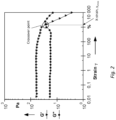
- the crossover point of the amplitude sweep is the point where the elastic modulus G' and the viscous modulus G" have the same value.
- G' and G" will be used and are defined as follows:
- Amplitude sweeps and frequency sweeps refer to oscillary rheological test and are known to the skilled person for determining G' and G" as a function of strain of a gel.
- the stress is the force causing the deformation divided by the area to which the force is applied, whereas the strain may be referred to as the relative deformation compared to an original state of the specimen.
- the test may be performed by introducing a probe into the gel.
- the cone may be forced into oscillatory shear (angular frequency ⁇ ) or rotation.
- the storage modulus G' and the loss modulus G" are plotted against the deformation.
- the process comprises
- the amplitude sweep may be performed by increasing the amount of deformation of the gel until a change in both G' and G" are observed.
- the step of determining the crossover point ⁇ cross from the measured G' and G" as a function of strain ( ⁇ ) may be performed in different ways.
- ⁇ cross may be determined in a visual manner.
- the step of determining the crossover point as the point at which G' and G" have the same value is performed by plotting G' and G" as a function of the strain ( ⁇ ) and selecting the crossover point as the point where the plot of G' and the plot of G" intersect.
- the step of determining G' and G" as a function of strain ( ⁇ ) comprises a step of performing a frequency sweep at a fixed strain before performing the amplitude sweep.
- the frequency is varied while the amplitude of the deformation - or alternatively the amplitude of the shear stress - is kept constant.
- the storage and loss modulus are plotted against the frequency. The data at low frequencies may describe the behaviour of the samples at slow changes of stress.
- the crossover point is a point outside the linear viscoelastic region (LVR) of the injectable gel.
- LVR linear-viscoelastic region
- the flexibility is measured in percentage (%).
- the flexibility values for injectable gels may be in the range 0.1% to 20000%, such as in the range 0.1% to 10000%, according to the type of dermal filler analysed.
- the flexibility may also be expressed as a dimensionless number, proportional to the percentage. As an example, a flexibility of 100 could be equal to a strain of 1%.
- the process of the present invention may be used for evaluating different gels to see if they are suitable for certain applications.
- the process further comprises the step of comparing the evaluated flexibility with a flexibility value of a reference gel, and if the evaluated flexibility is above said flexibility value of a reference gel, concluding that the injectable gel is more flexible than the reference gel.
- the step of concluding comprises concluding that the injectable gel is more suitable than the reference gel for being implanted at regions in the face that are subjected to movement.
- the process further comprises the step of comparing the evaluated flexibility with a reference flexibility value, and if the evaluated flexibility is above said reference flexibility value, concluding that the injectable gel is suitable for injection.
- a first reference flexibility value may be used for a first behavior in the skin after injection
- a second reference flexibility value may be used for a second behavior after injection
- the step of concluding may comprise concluding that the gel is suitable for the first application if the measured flexibility is above the first reference flexibility value and suitable for the second application if the measured flexibility is above the second reference flexibility value.
- the measured flexibility may as a complement be compared to reference intervals.
- a first reference flexibility interval may be used for a first behavior in the skin after injection
- a second reference flexibility interval may be used for a second behavior after injection
- the step of concluding may comprise concluding that the gel is suitable for the first application if the measured flexibility is within the first reference flexibility interval and suitable for the second application if the measured flexibility is within second reference flexibility interval.
- the amplitude sweep is performed at a frequency of between 0.1-10 Hz, such as 0.5 Hz -1.5 Hz.
- the amplitude sweep may be performed at a frequency of about 1 Hz.
- the injectable gel is a dermal filler comprising crosslinked hyaluronic acid.
- hyaluronic acid encompasses all variants and combinations of variants of hyaluronic acid, or hyaluronan, of various chain lengths and charge states, as well as with various chemical modifications That is, the term also encompasses the various hyaluronate salts of hyaluronic acid, such as sodium hyaluronate.
- Various modifications of the hyaluronic acid are also encompassed by the term, such as oxidation, e.g. oxidation of CH 2 OH groups to COOH; periodate oxidation of vicinal hydroxyl groups, optionally followed by reduction or imine formation etc; reduction, e.g.
- the hyaluronic acid may be a chemically unmodified hyaluronic acid or hyaluronate salt, preferably sodium hyaluronate, having an average molecular weight in the range of 0.5-10 MDa, preferably 0.8-5 MDa, more preferably 1.5-3 MDa or 2-3 MDa. It is preferred that the hyaluronic acid is obtained from non-animal origin, preferably bacteria.
- the method comprises
- the gel having the highest flexibility value may be selected as a dermal filler suitable for injection in the facial area.
- a gel having a high measured flexibility may follow the movement of the face and may give the ability to preserve the natural expressions of the face.
- the method of comparison may further comprise an initial step of manufacturing a plurality of candidate dermal filler gels in small amount and the selected dermal filler gel suitable for injection may then be manufactured in a greater amount
- candidate dermal filler gels may be suitable for injection, e.g. if they have a measured flexibility above a specific reference flexibility value or within a reference flexibility interval.
- the method may comprise the step of determining that a candidate dermal filler gel is suitable for injection if they have a measured flexibility above a specific reference flexibility value or within a reference flexibility interval, and determining that a candidate dermal filler gel is unsuitable for injection if they have a measured flexibility below the specific reference flexibility value or outside a reference flexibility interval.
- the flexibility value of the injectable gel is the crossover point.
- the method of this example may be performed by a computer program for determining the flexibility from measurement data of the elastic modulus G' and the viscous modulus G".
- Receiving input data of the elastic modulus G' and the viscous modulus G" may also comprise plotting G'( ⁇ ) and G" ( ⁇ ) and/or fitting a function to the data points of G', G" and ⁇ to estimate functions G'( ⁇ ) and G" ( ⁇ ), such as continuous functions G'( ⁇ ) and G" ( ⁇ ).
- the method is further comprising the step of comparing the flexibility value of the injectable gel with a reference flexibility value.
- the method of this example may comprise the step of displaying the flexibility value on a computer screen.
- the method of the fourth aspect of the invention may comprise displaying plots of G' and the viscous modulus G" as a function of the strain.
- a computer program product comprising computer-executable components for causing a device to perform the steps of the method according to the example above when the computer-executable components are run on a processing unit included in the device.
- the present invention relates to a process to characterize an injectable gel, and more preferably a dermal filler gel, by measuring the flexibility.
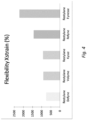
- the flexibility of the gel is measured and in the below description and examples denoted as XStrain. The higher the value is, the higher the flexibility of the gel. This parameter can be used to characterize different dermal fillers and their different behaviors in skin after injection.
- rheology was employed.
- the filler flexibility can be measured.
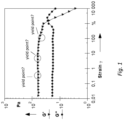
- a difference in flexibility was evident from the difference in the deformation (strain, ⁇ ) at which the cross-over point occurred.
- the flexibility value obtained is here denoted XStrain.
- the value of XStrain demonstrates how much deformation the tested material can withstand before changing from a solid-like to a liquid-like behavior, i.e. going from basically reversible to basically irreversible deformation.
- the XStrain measured can be considered a flexibility index of a material.
- the firmness of a product is performed under nearly static conditions.
- the deformations used in these measurements are very small, in order to keep within the linear viscoelastic region (LVR), the region where the stress changes linearly with deformation.
- LVR linear viscoelastic region
- amplitude sweep is performed, where the amount of deformation is increased until a change in the results is observed, indicating the end of the LVR.
- a level of deformation where the measured firmness is stable is chosen for the frequency sweep. However, the data from the amplitude sweep can be further evaluated.
- the edge of the LVR When the edge of the LVR is reached, it means that the deformation is so large that the material can no longer retain its original shape, and starts behaving more like a liquid than a solid. In rheology, this point is often referred to as the yield point.
- a typical example of a material having a noticeable yield point is tomato ketchup, which moves frustratingly little until the bottle is shaken enough, resulting in the delivered portion of ketchup being larger than intended.
- Flexibility values can be in the range of 0.1% to 20000% according to the type of dermal filler requested use.
- the flexibility parameter gives the ability to natural animation without the implant showing under the skin. Being more of less flexible, the dermal filler hydrogel follows the movement of the face and gives the ability to preserve the natural expressions of the face.
- the Optimal Balance Technology (OBT) products from Galderma are dermal filler differing in the amount of crosslinker used. This results in materials with different rheological properties. There is a need to understand their behavior by characterizing their rheological properties, through this measurement of the new parameter: flexibility.
- the OBT family of dermal filler products has previously been found to cover a large span of G' values as measured from a frequency sweep at small deformations. The purpose of this study was to investigate evaluation of the cross-over point in the amplitude sweep as a measure of flexibility for the OBT family of products. This measurement can characterize dermal fillers and explain their differentiating features and behavior in the skin.
- the rheology measurement was performed in a sequence including a relaxation time of 30 min, a frequency sweep from 10 to 0.1 Hz at 0.1% strain, followed by an amplitude sweep from 0.1 to 10000% (0.001 to 100) strain at 1 Hz.
- the gap was 1 mm using a PP25 measuring system at 25°C.
- the frequency sweep was evaluated for G', G" at 0.1 Hz.
- the amplitude sweep was first evaluated at 0.1% strain in order to verify that the applied frequency sweep strain was within the linear viscoelastic range. Secondly the strain was evaluated at the crossover point of the amplitude sweep, i.e. the point where G' and G" have the same value ( Figure 3 ).
Landscapes
- Health & Medical Sciences (AREA)
- Chemical & Material Sciences (AREA)
- Life Sciences & Earth Sciences (AREA)
- General Health & Medical Sciences (AREA)
- Veterinary Medicine (AREA)
- Public Health (AREA)
- Animal Behavior & Ethology (AREA)
- Epidemiology (AREA)
- Medicinal Chemistry (AREA)
- Dermatology (AREA)
- General Physics & Mathematics (AREA)
- Biochemistry (AREA)
- Pathology (AREA)
- Analytical Chemistry (AREA)
- Immunology (AREA)
- Physics & Mathematics (AREA)
- Pharmacology & Pharmacy (AREA)
- Transplantation (AREA)
- Oral & Maxillofacial Surgery (AREA)
- Dispersion Chemistry (AREA)
- Inorganic Chemistry (AREA)
- Engineering & Computer Science (AREA)
- Biomedical Technology (AREA)
- Neurosurgery (AREA)
- Investigating Strength Of Materials By Application Of Mechanical Stress (AREA)
- Ultra Sonic Daignosis Equipment (AREA)
- Investigating Or Analysing Biological Materials (AREA)
- Materials For Medical Uses (AREA)
Claims (14)
- Prozess zur Beurteilung der Flexibilität eines injizierbaren Gels, wobei der Prozess umfasst:Unterziehen des injizierbaren Gels oszillierenden mechanischen Beanspruchungen, um den Elastizitätsmodul (G') und den Viskositätsmodul (G") des injizierbaren Gels als eine Funktion von Dehnung (Y) in einem Amplitudendurchlauf des injizierbaren Gels zu bestimmen;Bestimmen der Dehnung (Ycross) an einem Kreuzungspunkt des Amplitudendurchlaufs des injizierbaren Gels, wobei der Kreuzungspunkt des Amplitudendurchlaufs dort ist, wo der Elastizitätsmodul (G') und der Viskositätsmodul (G") denselben Wert aufweisen;Bestimmen der Flexibilität des injizierbaren Gels als die Dehnung am Kreuzungspunkt des Amplitudendurchlaufs des injizierbaren Gels (Ycross); wobei der Prozess dadurch gekennzeichnet ist, dass er ferner umfasst:
Vergleichen der Flexibilität des injizierbaren Gels mit einem Flexibilitätswert eines Referenzgels, wobei eine Flexibilität des injizierbaren Gels, die höher als der Flexibilitätswert des Referenzgels ist, anzeigt, dass das injizierbare Gel sich besser als das Referenzgel zur Implantation in Gesichtsregionen eignet, die Bewegungen ausgesetzt sind. - Prozess nach Anspruch 1, wobei der Amplitudendurchlauf durch zunehmende Verformung des injizierbaren Gels durchgeführt wird, bis sowohl eine Änderung des Elastizitätsmoduls (G') als auch des Viskositätsmoduls (G") zu beobachten ist.
- Prozess nach Anspruch 1 oder 2, wobei der Schritt des Bestimmens der Dehnung (Ycross) am Kreuzungspunkt des Amplitudendurchlaufs durch Flotten des Elastizitätsmoduls (G') und des Viskositätsmoduls (G") als eine Funktion der Dehnung (y) und Auswählen des Kreuzungspunkt als den Punkt durchgeführt wird, an dem der Plot des Elastizitätsmoduls (G') und der Plot des Viskositätsmoduls (G") einander schneiden.
- Prozess nach einem der vorhergehenden Ansprüche, umfassend einen Schritt des Durchführens eines Frequenzdurchlaufs bei einer festen Dehnung vor dem Durchführen des Amplitudendurchlaufs.
- Prozess nach einem der vorhergehenden Ansprüche, wobei die Flexibilität in Prozenten (%) gemessen wird.
- Prozess nach einem der vorhergehenden Ansprüche, wobei der Amplitudendurchlauf bei einer Frequenz zwischen 0,5 Hz - 1,5 Hz durchgeführt wird.
- Prozess nach einem der vorhergehenden Ansprüche, wobei das injizierbare Gel ein Hautfüllstoff ist, der vernetzte Hyaluronsäure umfasst.
- Verfahren zum Vergleichen der Eignung injizierbarer Gele als Hautfüllstoffe, wobei das Verfahren umfasst:Beurteilen der Flexibilität einer Mehrzahl von injizierbaren Gelen, die in Frage kommende Hautfüllstoffe sind, gemäß dem Prozess nach einem der vorhergehenden Ansprüche,Vergleichen der beurteilten Flexibilität zwischen der Mehrzahl von injizierbaren Gelen;und Auswählen eines Hautfüllstoffs aus der Mehrzahl von verschiedenen injizierbaren Gelen als einen zur Injektion geeigneten Hautfüllstoff basierend auf dem Vergleich.
- Verfahren nach Anspruch 8, wobei das injizierbare Gel mit der höchsten Flexibilität als der Hautfüllstoff ausgewählt wird, der sich zur Injektion im Gesichtsbereich eignet.
- Verfahren zur Beurteilung des Hautfüllstoffverhaltens eines injizierbaren Gels in menschlicher Haut durch Beurteilen der Flexibilität des injizierbaren Gels gemäß dem Prozess nach einem der Ansprüche 1 bis 7.
- Prozess nach einem der Ansprüche 1 bis 7, wobei das Bestimmen der Dehnung (Ycross) am Kreuzungspunkt des Amplitudendurchlaufs des injizierbaren Gels, wobei der Kreuzungspunkt des Amplitudendurchlaufs dort ist, wo der Elastizitätsmodul (G') und der Viskositätsmodul (G") denselben Wert aufweisen, ein Empfangen von Eingabedaten des Elastizitätsmoduls (G') und des Viskositätsmoduls (G") als eine Funktion der Dehnung (Y) des Gels umfasst.
- Prozess nach Anspruch 11, ferner umfassend ein Vergleichen des Flexibilitätswerts des injizierbaren Gels mit einem Referenzflexibilitätswert.
- Prozess nach Anspruch 11 oder 12, ferner umfassend ein Anzeigen des Flexibilitätswerts des injizierbaren Gels auf einem Bildschirm eines Computers.
- Computerprogrammprodukt, umfassend computerausführbare Komponenten, um eine Vorrichtung zu veranlassen, die Schritte nach einem der Ansprüche 11 bis 13 auszuführen, wenn die computerausführbaren Komponenten auf einer Verarbeitungseinheit ausgeführt werden, die in der Vorrichtung enthalten ist.
Applications Claiming Priority (2)
| Application Number | Priority Date | Filing Date | Title |
|---|---|---|---|
| US201662431093P | 2016-12-07 | 2016-12-07 | |
| PCT/EP2017/081783 WO2018104426A1 (en) | 2016-12-07 | 2017-12-07 | Flexibility measurements of injectable gels |
Publications (2)
| Publication Number | Publication Date |
|---|---|
| EP3551992A1 EP3551992A1 (de) | 2019-10-16 |
| EP3551992B1 true EP3551992B1 (de) | 2024-02-28 |
Family
ID=60935778
Family Applications (1)
| Application Number | Title | Priority Date | Filing Date |
|---|---|---|---|
| EP17825403.3A Active EP3551992B1 (de) | 2016-12-07 | 2017-12-07 | Flexibilitätsmessungen von injizierbaren gelen |
Country Status (6)
| Country | Link |
|---|---|
| US (1) | US11662290B2 (de) |
| EP (1) | EP3551992B1 (de) |
| CN (1) | CN110546479A (de) |
| AU (2) | AU2017371268A1 (de) |
| BR (1) | BR112019011453A2 (de) |
| WO (1) | WO2018104426A1 (de) |
Families Citing this family (2)
| Publication number | Priority date | Publication date | Assignee | Title |
|---|---|---|---|---|
| FR3113522B1 (fr) | 2020-08-20 | 2025-04-18 | Lab Vivacy | procédé d’évaluation des caractéristiques rhéologiques d’un gel |
| WO2024089607A1 (en) | 2022-10-25 | 2024-05-02 | Galderma Holding SA | Method and system for facial augmentation |
Family Cites Families (3)
| Publication number | Priority date | Publication date | Assignee | Title |
|---|---|---|---|---|
| CN1843606A (zh) * | 2006-03-21 | 2006-10-11 | 华东理工大学 | 一种含低聚阴离子表面活性剂粘弹性凝胶 |
| US10173357B2 (en) | 2013-09-26 | 2019-01-08 | Northwestern University | Poly(ethylene glycol) cross-linking of soft materials to tailor viscoelastic properties for bioprinting |
| FR3034195B1 (fr) | 2015-03-24 | 2017-04-21 | Teoxane | Procede d'evaluation des performances mecaniques d'un gel de comblement |
-
2017
- 2017-12-07 WO PCT/EP2017/081783 patent/WO2018104426A1/en not_active Ceased
- 2017-12-07 BR BR112019011453A patent/BR112019011453A2/pt not_active Application Discontinuation
- 2017-12-07 AU AU2017371268A patent/AU2017371268A1/en not_active Abandoned
- 2017-12-07 US US16/466,364 patent/US11662290B2/en active Active
- 2017-12-07 EP EP17825403.3A patent/EP3551992B1/de active Active
- 2017-12-07 CN CN201780075688.1A patent/CN110546479A/zh active Pending
-
2022
- 2022-11-17 AU AU2022271463A patent/AU2022271463A1/en not_active Abandoned
Also Published As
| Publication number | Publication date |
|---|---|
| US20200072721A1 (en) | 2020-03-05 |
| CN110546479A (zh) | 2019-12-06 |
| BR112019011453A2 (pt) | 2019-10-15 |
| US11662290B2 (en) | 2023-05-30 |
| AU2022271463A1 (en) | 2022-12-22 |
| EP3551992A1 (de) | 2019-10-16 |
| AU2017371268A1 (en) | 2019-06-13 |
| WO2018104426A1 (en) | 2018-06-14 |
Similar Documents
| Publication | Publication Date | Title |
|---|---|---|
| Faivre et al. | Advanced concepts in rheology for the evaluation of hyaluronic acid–based soft tissue fillers | |
| Zuidema et al. | A protocol for rheological characterization of hydrogels for tissue engineering strategies | |
| AU2022271463A1 (en) | Flexibility measurements of injectable gels | |
| Zarraga et al. | High shear rheology and anisotropy in concentrated solutions of monoclonal antibodies | |
| Khan et al. | 6-amino caproic acid regulated mechanical performance of ionically conductive ultra-stretchable hydrogels for flexible strain and epidermis sensors | |
| Mensitieri et al. | Viscoelastic evaluation of different knee osteoarthritis therapies | |
| Wagner et al. | Age-dependent capillary thinning dynamics of physically-associated salivary mucin networks | |
| Cacopardo et al. | A new load-controlled testing method for viscoelastic characterisation through stress-rate measurements | |
| Bingöl et al. | Characterization and comparison of shear and extensional flow of sodium hyaluronate and human synovial fluid | |
| Kim et al. | Experimental validation for the interconversion between generalized Kelvin–Voigt and Maxwell models using human skin tissues | |
| Ret et al. | Exact determination of the degree of substitution of high molar mass hyaluronan by controlling the conformation in solution | |
| Henni et al. | Hyper-frequency viscoelastic spectroscopy of biomaterials | |
| Chen et al. | Identification of the testing parameters in high frequency dynamic shear measurement on agarose gels | |
| Phan-Thien et al. | Oscillatory squeezing flow of a biological material | |
| Evans et al. | Rheometrical detection of incipient blood clot formation by Fourier transform mechanical spectroscopy | |
| Leone et al. | The applicability of an amidated polysaccharide hydrogel as a cartilage substitute: structural and rheological characterization | |
| Eckman et al. | Crosslink strength governs yielding behavior in dynamically crosslinked hydrogels | |
| US20250244216A1 (en) | Method for evaluating a filler gel | |
| Salpavaara et al. | Non-destructive and wireless monitoring of biodegradable polymers | |
| US10132734B2 (en) | Process for evaluating the mechanical performance of a filler gel | |
| Falconer et al. | Developing a soft tissue surrogate for use in photoelastic testing | |
| Halimi et al. | Chitosan solutions as injectable systems for dermal filler applications: Rheological characterization and biological evidence | |
| Zhu et al. | Integrated mechanical and structural characterisation of 24 commercial hyaluronic acid fillers: A multi-parametric framework for comparative analysis | |
| CN111579398B (zh) | 一种体外血栓物性检测装置 | |
| Shadrin et al. | Mechanical properties of silicon breast implants |
Legal Events
| Date | Code | Title | Description |
|---|---|---|---|
| STAA | Information on the status of an ep patent application or granted ep patent |
Free format text: STATUS: UNKNOWN |
|
| STAA | Information on the status of an ep patent application or granted ep patent |
Free format text: STATUS: THE INTERNATIONAL PUBLICATION HAS BEEN MADE |
|
| PUAI | Public reference made under article 153(3) epc to a published international application that has entered the european phase |
Free format text: ORIGINAL CODE: 0009012 |
|
| STAA | Information on the status of an ep patent application or granted ep patent |
Free format text: STATUS: REQUEST FOR EXAMINATION WAS MADE |
|
| 17P | Request for examination filed |
Effective date: 20190617 |
|
| AK | Designated contracting states |
Kind code of ref document: A1 Designated state(s): AL AT BE BG CH CY CZ DE DK EE ES FI FR GB GR HR HU IE IS IT LI LT LU LV MC MK MT NL NO PL PT RO RS SE SI SK SM TR |
|
| AX | Request for extension of the european patent |
Extension state: BA ME |
|
| DAV | Request for validation of the european patent (deleted) | ||
| DAX | Request for extension of the european patent (deleted) | ||
| RAP1 | Party data changed (applicant data changed or rights of an application transferred) |
Owner name: GALDERMA HOLDING SA |
|
| STAA | Information on the status of an ep patent application or granted ep patent |
Free format text: STATUS: EXAMINATION IS IN PROGRESS |
|
| 17Q | First examination report despatched |
Effective date: 20220314 |
|
| GRAP | Despatch of communication of intention to grant a patent |
Free format text: ORIGINAL CODE: EPIDOSNIGR1 |
|
| STAA | Information on the status of an ep patent application or granted ep patent |
Free format text: STATUS: GRANT OF PATENT IS INTENDED |
|
| INTG | Intention to grant announced |
Effective date: 20230920 |
|
| GRAS | Grant fee paid |
Free format text: ORIGINAL CODE: EPIDOSNIGR3 |
|
| GRAA | (expected) grant |
Free format text: ORIGINAL CODE: 0009210 |
|
| STAA | Information on the status of an ep patent application or granted ep patent |
Free format text: STATUS: THE PATENT HAS BEEN GRANTED |
|
| AK | Designated contracting states |
Kind code of ref document: B1 Designated state(s): AL AT BE BG CH CY CZ DE DK EE ES FI FR GB GR HR HU IE IS IT LI LT LU LV MC MK MT NL NO PL PT RO RS SE SI SK SM TR |
|
| REG | Reference to a national code |
Ref country code: GB Ref legal event code: FG4D |
|
| REG | Reference to a national code |
Ref country code: CH Ref legal event code: EP |
|
| REG | Reference to a national code |
Ref country code: DE Ref legal event code: R096 Ref document number: 602017079591 Country of ref document: DE |
|
| P01 | Opt-out of the competence of the unified patent court (upc) registered |
Effective date: 20240215 |
|
| REG | Reference to a national code |
Ref country code: IE Ref legal event code: FG4D |
|
| REG | Reference to a national code |
Ref country code: LT Ref legal event code: MG9D |
|
| PG25 | Lapsed in a contracting state [announced via postgrant information from national office to epo] |
Ref country code: IS Free format text: LAPSE BECAUSE OF FAILURE TO SUBMIT A TRANSLATION OF THE DESCRIPTION OR TO PAY THE FEE WITHIN THE PRESCRIBED TIME-LIMIT Effective date: 20240628 |
|
| REG | Reference to a national code |
Ref country code: NL Ref legal event code: MP Effective date: 20240228 |
|
| PG25 | Lapsed in a contracting state [announced via postgrant information from national office to epo] |
Ref country code: LT Free format text: LAPSE BECAUSE OF FAILURE TO SUBMIT A TRANSLATION OF THE DESCRIPTION OR TO PAY THE FEE WITHIN THE PRESCRIBED TIME-LIMIT Effective date: 20240228 |
|
| PG25 | Lapsed in a contracting state [announced via postgrant information from national office to epo] |
Ref country code: GR Free format text: LAPSE BECAUSE OF FAILURE TO SUBMIT A TRANSLATION OF THE DESCRIPTION OR TO PAY THE FEE WITHIN THE PRESCRIBED TIME-LIMIT Effective date: 20240529 |
|
| PG25 | Lapsed in a contracting state [announced via postgrant information from national office to epo] |
Ref country code: RS Free format text: LAPSE BECAUSE OF FAILURE TO SUBMIT A TRANSLATION OF THE DESCRIPTION OR TO PAY THE FEE WITHIN THE PRESCRIBED TIME-LIMIT Effective date: 20240528 Ref country code: HR Free format text: LAPSE BECAUSE OF FAILURE TO SUBMIT A TRANSLATION OF THE DESCRIPTION OR TO PAY THE FEE WITHIN THE PRESCRIBED TIME-LIMIT Effective date: 20240228 Ref country code: NL Free format text: LAPSE BECAUSE OF FAILURE TO SUBMIT A TRANSLATION OF THE DESCRIPTION OR TO PAY THE FEE WITHIN THE PRESCRIBED TIME-LIMIT Effective date: 20240228 |
|
| PG25 | Lapsed in a contracting state [announced via postgrant information from national office to epo] |
Ref country code: ES Free format text: LAPSE BECAUSE OF FAILURE TO SUBMIT A TRANSLATION OF THE DESCRIPTION OR TO PAY THE FEE WITHIN THE PRESCRIBED TIME-LIMIT Effective date: 20240228 |
|
| PG25 | Lapsed in a contracting state [announced via postgrant information from national office to epo] |
Ref country code: RS Free format text: LAPSE BECAUSE OF FAILURE TO SUBMIT A TRANSLATION OF THE DESCRIPTION OR TO PAY THE FEE WITHIN THE PRESCRIBED TIME-LIMIT Effective date: 20240528 Ref country code: NO Free format text: LAPSE BECAUSE OF FAILURE TO SUBMIT A TRANSLATION OF THE DESCRIPTION OR TO PAY THE FEE WITHIN THE PRESCRIBED TIME-LIMIT Effective date: 20240528 Ref country code: NL Free format text: LAPSE BECAUSE OF FAILURE TO SUBMIT A TRANSLATION OF THE DESCRIPTION OR TO PAY THE FEE WITHIN THE PRESCRIBED TIME-LIMIT Effective date: 20240228 Ref country code: LT Free format text: LAPSE BECAUSE OF FAILURE TO SUBMIT A TRANSLATION OF THE DESCRIPTION OR TO PAY THE FEE WITHIN THE PRESCRIBED TIME-LIMIT Effective date: 20240228 Ref country code: IS Free format text: LAPSE BECAUSE OF FAILURE TO SUBMIT A TRANSLATION OF THE DESCRIPTION OR TO PAY THE FEE WITHIN THE PRESCRIBED TIME-LIMIT Effective date: 20240628 Ref country code: HR Free format text: LAPSE BECAUSE OF FAILURE TO SUBMIT A TRANSLATION OF THE DESCRIPTION OR TO PAY THE FEE WITHIN THE PRESCRIBED TIME-LIMIT Effective date: 20240228 Ref country code: GR Free format text: LAPSE BECAUSE OF FAILURE TO SUBMIT A TRANSLATION OF THE DESCRIPTION OR TO PAY THE FEE WITHIN THE PRESCRIBED TIME-LIMIT Effective date: 20240529 Ref country code: FI Free format text: LAPSE BECAUSE OF FAILURE TO SUBMIT A TRANSLATION OF THE DESCRIPTION OR TO PAY THE FEE WITHIN THE PRESCRIBED TIME-LIMIT Effective date: 20240228 Ref country code: ES Free format text: LAPSE BECAUSE OF FAILURE TO SUBMIT A TRANSLATION OF THE DESCRIPTION OR TO PAY THE FEE WITHIN THE PRESCRIBED TIME-LIMIT Effective date: 20240228 Ref country code: BG Free format text: LAPSE BECAUSE OF FAILURE TO SUBMIT A TRANSLATION OF THE DESCRIPTION OR TO PAY THE FEE WITHIN THE PRESCRIBED TIME-LIMIT Effective date: 20240228 |
|
| PG25 | Lapsed in a contracting state [announced via postgrant information from national office to epo] |
Ref country code: PT Free format text: LAPSE BECAUSE OF FAILURE TO SUBMIT A TRANSLATION OF THE DESCRIPTION OR TO PAY THE FEE WITHIN THE PRESCRIBED TIME-LIMIT Effective date: 20240628 Ref country code: PL Free format text: LAPSE BECAUSE OF FAILURE TO SUBMIT A TRANSLATION OF THE DESCRIPTION OR TO PAY THE FEE WITHIN THE PRESCRIBED TIME-LIMIT Effective date: 20240228 |
|
| REG | Reference to a national code |
Ref country code: AT Ref legal event code: MK05 Ref document number: 1661672 Country of ref document: AT Kind code of ref document: T Effective date: 20240228 |
|
| PG25 | Lapsed in a contracting state [announced via postgrant information from national office to epo] |
Ref country code: SE Free format text: LAPSE BECAUSE OF FAILURE TO SUBMIT A TRANSLATION OF THE DESCRIPTION OR TO PAY THE FEE WITHIN THE PRESCRIBED TIME-LIMIT Effective date: 20240228 Ref country code: PT Free format text: LAPSE BECAUSE OF FAILURE TO SUBMIT A TRANSLATION OF THE DESCRIPTION OR TO PAY THE FEE WITHIN THE PRESCRIBED TIME-LIMIT Effective date: 20240628 Ref country code: PL Free format text: LAPSE BECAUSE OF FAILURE TO SUBMIT A TRANSLATION OF THE DESCRIPTION OR TO PAY THE FEE WITHIN THE PRESCRIBED TIME-LIMIT Effective date: 20240228 Ref country code: LV Free format text: LAPSE BECAUSE OF FAILURE TO SUBMIT A TRANSLATION OF THE DESCRIPTION OR TO PAY THE FEE WITHIN THE PRESCRIBED TIME-LIMIT Effective date: 20240228 |
|
| PG25 | Lapsed in a contracting state [announced via postgrant information from national office to epo] |
Ref country code: DK Free format text: LAPSE BECAUSE OF FAILURE TO SUBMIT A TRANSLATION OF THE DESCRIPTION OR TO PAY THE FEE WITHIN THE PRESCRIBED TIME-LIMIT Effective date: 20240228 |
|
| PG25 | Lapsed in a contracting state [announced via postgrant information from national office to epo] |
Ref country code: SM Free format text: LAPSE BECAUSE OF FAILURE TO SUBMIT A TRANSLATION OF THE DESCRIPTION OR TO PAY THE FEE WITHIN THE PRESCRIBED TIME-LIMIT Effective date: 20240228 |
|
| PG25 | Lapsed in a contracting state [announced via postgrant information from national office to epo] |
Ref country code: EE Free format text: LAPSE BECAUSE OF FAILURE TO SUBMIT A TRANSLATION OF THE DESCRIPTION OR TO PAY THE FEE WITHIN THE PRESCRIBED TIME-LIMIT Effective date: 20240228 Ref country code: CZ Free format text: LAPSE BECAUSE OF FAILURE TO SUBMIT A TRANSLATION OF THE DESCRIPTION OR TO PAY THE FEE WITHIN THE PRESCRIBED TIME-LIMIT Effective date: 20240228 |
|
| PG25 | Lapsed in a contracting state [announced via postgrant information from national office to epo] |
Ref country code: AT Free format text: LAPSE BECAUSE OF FAILURE TO SUBMIT A TRANSLATION OF THE DESCRIPTION OR TO PAY THE FEE WITHIN THE PRESCRIBED TIME-LIMIT Effective date: 20240228 |
|
| PG25 | Lapsed in a contracting state [announced via postgrant information from national office to epo] |
Ref country code: SK Free format text: LAPSE BECAUSE OF FAILURE TO SUBMIT A TRANSLATION OF THE DESCRIPTION OR TO PAY THE FEE WITHIN THE PRESCRIBED TIME-LIMIT Effective date: 20240228 |
|
| PG25 | Lapsed in a contracting state [announced via postgrant information from national office to epo] |
Ref country code: SM Free format text: LAPSE BECAUSE OF FAILURE TO SUBMIT A TRANSLATION OF THE DESCRIPTION OR TO PAY THE FEE WITHIN THE PRESCRIBED TIME-LIMIT Effective date: 20240228 Ref country code: SK Free format text: LAPSE BECAUSE OF FAILURE TO SUBMIT A TRANSLATION OF THE DESCRIPTION OR TO PAY THE FEE WITHIN THE PRESCRIBED TIME-LIMIT Effective date: 20240228 Ref country code: RO Free format text: LAPSE BECAUSE OF FAILURE TO SUBMIT A TRANSLATION OF THE DESCRIPTION OR TO PAY THE FEE WITHIN THE PRESCRIBED TIME-LIMIT Effective date: 20240228 Ref country code: EE Free format text: LAPSE BECAUSE OF FAILURE TO SUBMIT A TRANSLATION OF THE DESCRIPTION OR TO PAY THE FEE WITHIN THE PRESCRIBED TIME-LIMIT Effective date: 20240228 Ref country code: DK Free format text: LAPSE BECAUSE OF FAILURE TO SUBMIT A TRANSLATION OF THE DESCRIPTION OR TO PAY THE FEE WITHIN THE PRESCRIBED TIME-LIMIT Effective date: 20240228 Ref country code: CZ Free format text: LAPSE BECAUSE OF FAILURE TO SUBMIT A TRANSLATION OF THE DESCRIPTION OR TO PAY THE FEE WITHIN THE PRESCRIBED TIME-LIMIT Effective date: 20240228 Ref country code: AT Free format text: LAPSE BECAUSE OF FAILURE TO SUBMIT A TRANSLATION OF THE DESCRIPTION OR TO PAY THE FEE WITHIN THE PRESCRIBED TIME-LIMIT Effective date: 20240228 |
|
| REG | Reference to a national code |
Ref country code: DE Ref legal event code: R097 Ref document number: 602017079591 Country of ref document: DE |
|
| PG25 | Lapsed in a contracting state [announced via postgrant information from national office to epo] |
Ref country code: IT Free format text: LAPSE BECAUSE OF FAILURE TO SUBMIT A TRANSLATION OF THE DESCRIPTION OR TO PAY THE FEE WITHIN THE PRESCRIBED TIME-LIMIT Effective date: 20240228 |
|
| PG25 | Lapsed in a contracting state [announced via postgrant information from national office to epo] |
Ref country code: IT Free format text: LAPSE BECAUSE OF FAILURE TO SUBMIT A TRANSLATION OF THE DESCRIPTION OR TO PAY THE FEE WITHIN THE PRESCRIBED TIME-LIMIT Effective date: 20240228 |
|
| PLBE | No opposition filed within time limit |
Free format text: ORIGINAL CODE: 0009261 |
|
| STAA | Information on the status of an ep patent application or granted ep patent |
Free format text: STATUS: NO OPPOSITION FILED WITHIN TIME LIMIT |
|
| 26N | No opposition filed |
Effective date: 20241129 |
|
| PG25 | Lapsed in a contracting state [announced via postgrant information from national office to epo] |
Ref country code: SI Free format text: LAPSE BECAUSE OF FAILURE TO SUBMIT A TRANSLATION OF THE DESCRIPTION OR TO PAY THE FEE WITHIN THE PRESCRIBED TIME-LIMIT Effective date: 20240228 |
|
| REG | Reference to a national code |
Ref country code: DE Ref legal event code: R119 Ref document number: 602017079591 Country of ref document: DE |
|
| PG25 | Lapsed in a contracting state [announced via postgrant information from national office to epo] |
Ref country code: MC Free format text: LAPSE BECAUSE OF FAILURE TO SUBMIT A TRANSLATION OF THE DESCRIPTION OR TO PAY THE FEE WITHIN THE PRESCRIBED TIME-LIMIT Effective date: 20240228 |
|
| REG | Reference to a national code |
Ref country code: CH Ref legal event code: PL |
|
| PG25 | Lapsed in a contracting state [announced via postgrant information from national office to epo] |
Ref country code: LU Free format text: LAPSE BECAUSE OF NON-PAYMENT OF DUE FEES Effective date: 20241207 |
|
| GBPC | Gb: european patent ceased through non-payment of renewal fee |
Effective date: 20241207 |
|
| REG | Reference to a national code |
Ref country code: BE Ref legal event code: MM Effective date: 20241231 |
|
| PG25 | Lapsed in a contracting state [announced via postgrant information from national office to epo] |
Ref country code: DE Free format text: LAPSE BECAUSE OF NON-PAYMENT OF DUE FEES Effective date: 20250701 |
|
| PG25 | Lapsed in a contracting state [announced via postgrant information from national office to epo] |
Ref country code: BE Free format text: LAPSE BECAUSE OF NON-PAYMENT OF DUE FEES Effective date: 20241231 Ref country code: GB Free format text: LAPSE BECAUSE OF NON-PAYMENT OF DUE FEES Effective date: 20241207 |
|
| PG25 | Lapsed in a contracting state [announced via postgrant information from national office to epo] |
Ref country code: FR Free format text: LAPSE BECAUSE OF NON-PAYMENT OF DUE FEES Effective date: 20241231 |
|
| PG25 | Lapsed in a contracting state [announced via postgrant information from national office to epo] |
Ref country code: CH Free format text: LAPSE BECAUSE OF NON-PAYMENT OF DUE FEES Effective date: 20241231 |
|
| PG25 | Lapsed in a contracting state [announced via postgrant information from national office to epo] |
Ref country code: IE Free format text: LAPSE BECAUSE OF NON-PAYMENT OF DUE FEES Effective date: 20241207 |
|
| PG25 | Lapsed in a contracting state [announced via postgrant information from national office to epo] |
Ref country code: CY Free format text: LAPSE BECAUSE OF FAILURE TO SUBMIT A TRANSLATION OF THE DESCRIPTION OR TO PAY THE FEE WITHIN THE PRESCRIBED TIME-LIMIT; INVALID AB INITIO Effective date: 20171207 |