EP3551743B1 - Adsorptionsmittel für anaerobe vergärungsprozesse - Google Patents
Adsorptionsmittel für anaerobe vergärungsprozesse Download PDFInfo
- Publication number
- EP3551743B1 EP3551743B1 EP17821714.7A EP17821714A EP3551743B1 EP 3551743 B1 EP3551743 B1 EP 3551743B1 EP 17821714 A EP17821714 A EP 17821714A EP 3551743 B1 EP3551743 B1 EP 3551743B1
- Authority
- EP
- European Patent Office
- Prior art keywords
- particulate carbon
- substantially planar
- carbon adsorbent
- adsorbent
- anaerobic digestion
- Prior art date
- Legal status (The legal status is an assumption and is not a legal conclusion. Google has not performed a legal analysis and makes no representation as to the accuracy of the status listed.)
- Active
Links
Images




Classifications
-
- C—CHEMISTRY; METALLURGY
- C02—TREATMENT OF WATER, WASTE WATER, SEWAGE, OR SLUDGE
- C02F—TREATMENT OF WATER, WASTE WATER, SEWAGE, OR SLUDGE
- C02F11/00—Treatment of sludge; Devices therefor
- C02F11/02—Biological treatment
- C02F11/04—Anaerobic treatment; Production of methane by such processes
-
- C—CHEMISTRY; METALLURGY
- C12—BIOCHEMISTRY; BEER; SPIRITS; WINE; VINEGAR; MICROBIOLOGY; ENZYMOLOGY; MUTATION OR GENETIC ENGINEERING
- C12M—APPARATUS FOR ENZYMOLOGY OR MICROBIOLOGY; APPARATUS FOR CULTURING MICROORGANISMS FOR PRODUCING BIOMASS, FOR GROWING CELLS OR FOR OBTAINING FERMENTATION OR METABOLIC PRODUCTS, i.e. BIOREACTORS OR FERMENTERS
- C12M21/00—Bioreactors or fermenters specially adapted for specific uses
- C12M21/04—Bioreactors or fermenters specially adapted for specific uses for producing gas, e.g. biogas
-
- C—CHEMISTRY; METALLURGY
- C02—TREATMENT OF WATER, WASTE WATER, SEWAGE, OR SLUDGE
- C02F—TREATMENT OF WATER, WASTE WATER, SEWAGE, OR SLUDGE
- C02F11/00—Treatment of sludge; Devices therefor
- C02F11/10—Treatment of sludge; Devices therefor by pyrolysis
-
- C—CHEMISTRY; METALLURGY
- C12—BIOCHEMISTRY; BEER; SPIRITS; WINE; VINEGAR; MICROBIOLOGY; ENZYMOLOGY; MUTATION OR GENETIC ENGINEERING
- C12M—APPARATUS FOR ENZYMOLOGY OR MICROBIOLOGY; APPARATUS FOR CULTURING MICROORGANISMS FOR PRODUCING BIOMASS, FOR GROWING CELLS OR FOR OBTAINING FERMENTATION OR METABOLIC PRODUCTS, i.e. BIOREACTORS OR FERMENTERS
- C12M45/00—Means for pre-treatment of biological substances
- C12M45/02—Means for pre-treatment of biological substances by mechanical forces; Stirring; Trituration; Comminuting
-
- C—CHEMISTRY; METALLURGY
- C12—BIOCHEMISTRY; BEER; SPIRITS; WINE; VINEGAR; MICROBIOLOGY; ENZYMOLOGY; MUTATION OR GENETIC ENGINEERING
- C12M—APPARATUS FOR ENZYMOLOGY OR MICROBIOLOGY; APPARATUS FOR CULTURING MICROORGANISMS FOR PRODUCING BIOMASS, FOR GROWING CELLS OR FOR OBTAINING FERMENTATION OR METABOLIC PRODUCTS, i.e. BIOREACTORS OR FERMENTERS
- C12M45/00—Means for pre-treatment of biological substances
- C12M45/20—Heating; Cooling
-
- C—CHEMISTRY; METALLURGY
- C02—TREATMENT OF WATER, WASTE WATER, SEWAGE, OR SLUDGE
- C02F—TREATMENT OF WATER, WASTE WATER, SEWAGE, OR SLUDGE
- C02F2305/00—Use of specific compounds during water treatment
-
- Y—GENERAL TAGGING OF NEW TECHNOLOGICAL DEVELOPMENTS; GENERAL TAGGING OF CROSS-SECTIONAL TECHNOLOGIES SPANNING OVER SEVERAL SECTIONS OF THE IPC; TECHNICAL SUBJECTS COVERED BY FORMER USPC CROSS-REFERENCE ART COLLECTIONS [XRACs] AND DIGESTS
- Y02—TECHNOLOGIES OR APPLICATIONS FOR MITIGATION OR ADAPTATION AGAINST CLIMATE CHANGE
- Y02E—REDUCTION OF GREENHOUSE GAS [GHG] EMISSIONS, RELATED TO ENERGY GENERATION, TRANSMISSION OR DISTRIBUTION
- Y02E50/00—Technologies for the production of fuel of non-fossil origin
- Y02E50/30—Fuel from waste, e.g. synthetic alcohol or diesel
Definitions
- the invention relates to the field of fermentation, such as anaerobic digestion, more specifically to adsorbents used in fermentation processes.
- organic and mineral adsorbents are used in anaerobic digestion for biogas production. They bind inhibitory substances like organic acids, cyanides such as those present in cassava waste, phenols such as those present in olive oil waste, ammonium and hydrogen sulphide in the fermentation liquor, and they support growth of biogas-producing microorganisms on their surfaces leading to productive biofilms.
- DE 10 2011 010 525 discloses an adsorbent for the cleaning of biogas, which is produced from animal products like bones and part of bones.
- WO 2011/018505 describes a device and process for production of biogas and biochar and for refinement of the biochar.
- DE 10 2014 100 850 discloses the production and use of magnetisable biochar particles for biogas plants.
- the surface area of the adsorbent defines its effectiveness in terms of sorption capacity and available space for biogas-producing biofilms. Porous adsorbents with a high inner surface could initially adsorb high amounts of dissolved chemicals, but over time the pores will become blocked by fine particles in the biogas slurry and microbial growth. This reduces the ability of sorption and desorption and biofilms, which grow on the inner surface, will suffer from lack of substrates.
- Phosphorus is an essential plant nutrient. Its limited accessibility has become an increasing concern for global food security. On the other hand, anthropogenic release of phosphorus is a major cause of eutrophication which is a great threat for fresh water and ecosystems. In consequence, several biological, chemical and physical methods have been developed to separate phosphorus from waste streams esp. waste water and to turn it into a fertilizer. This includes phosphate precipitation by a coagulant like calcium, aluminium and iron. Also struvite precipitation is considered which also contains nitrogen (as ammonium) and usually requires the addition of magnesium. Biological removal bases on microbial phosphorus take up by specialised microorganisms that accumulate phosphorus. However, because of high costs associated with the current methods of phosphorus removal the search for more feasible methods has led to investigations of carbon materials for phosphorus removal.
- Carbon adsorbents known in the art are typically made up of particulate carbon materials like activated carbon or biochar, and are used for various purposes e.g. filtering and separation, catalysis, soil amendment, energy storage, and carbon sequestration.
- Several of these applications require or prefer agglomerated carbon particles instead of loose particles.
- Other applications e.g., composting, stabilization and deodorisation of sewage sludge and agricultural wastes, biogas production, and soil amendment
- WO2015/077484 A1 discloses a particulate carbon adsorbent as an additive for an bioreactor.
- a particulate carbon adsorbent in anaerobic digestion the particulate carbon adsorbent being substantially planar and comprising between 40-90 wt% carbon, characterised in the particulate carbon adsorbent is obtainable by pyrolysing a substantially planar organic material at a temperature from 300°C to 800°C, grinding the pyrolysed material; and sorting the ground pyrolysed material to specify the dimensions of the particulate carbon adsorbent.
- the particulate carbon adsorbent is formed by pyrolysis of substantially planar organic material. Pyrolysis is a thermochemical decomposition of organic materials at elevated temperatures in the absence of oxygen, or in low levels or reduced levels of oxygen.
- substantially planar we refer to a material that is formed of at least one sheet, wherein the length and width of the sheet extends by at least 5 times the thickness of the sheet. Accordingly, the particulate carbon adsorbent may be considered to be carbon flakes.
- the at least one sheet may be curved, folded, creased or otherwise deformed from the original plane of the sheet, but retains on at least a local scale the properties of the thickness of the material being at least 5 times less the extent of the material in the remaining two dimensions.
- a sheet of paper is included in the definition of a substantially planar material whether that sheet of material is folded, creased or otherwise deformed form the original plane of the sheet of paper.
- substantially planar carbon adsorbents are particularly effective for promoting the production of biogas or biofuel in anaerobic digestion.
- the substantially planar geometry of the particulate carbon adsorbents or carbon flakes have been found to both effectively adsorb inhibitory species from the aqueous solution typically found within bioreactors that are produced as a by-product of the anaerobic digestion process, and to provide an ideal substrate for the formation of a productive biofilm of microorganisms that are typically used in anaerobic digestion in bioreactors.
- the particulate carbon adsorbents may be suitable substrates for the formation of biofilms formed by methanogenic bacteria and/or archaea.
- the anaerobic digestion may be carried out in a bioreactor, and as a result, the particulate carbon adsorbent may be used in a bioreactor.
- the bioreactor may be used to produce biofuel by anaerobic digestion of a feedstock by a microorganism or a consortium of different microorganisms, and the particulate carbon adsorbent may adsorb at least some of the by-products of anaerobic digestion that may inhibit further production of biofuel.
- the inhibitory by-products of anaerobic digestion may include organic acids, including C1-C10 organic acids, ammonia, and hydrogen sulphide.
- the organic acids may include C1-C6 organic acids.
- the organic acids may include propionic acid (C3 organic acid).
- the particulate carbon adsorbent may be added to the feedstock of the bioreactor as a powder or in a granular form prior to initiation of anaerobic digestion.
- the particulate carbon adsorbent may be added regularly to the feedstock of the bioreactor as a powder or in a granular form with a batching process of anaerobic digestion.
- the particulate carbon adsorbent may be added continuously to the feedstock of the bioreactor as a powder or in a granular form in a continuous process of anaerobic digestion.
- the particulate carbon adsorbent may be dispersed throughout the feedstock of the bioreactor to ensure that the particulate carbon adsorbent is able to efficiently adsorb inhibitory by-products and therefore enhance the production of biogas or biofuel in the bioreactor.
- the particulate carbon adsorbent may provide a substrate for the formation of an active biofilm.
- the substantially planar geometry of the particulate carbon adsorbent provides a larger outer surface area upon which the microorganisms can colonise and produce an active biofilm than known absorbents with similar volume.
- the surface of the particulate carbon adsorbent may provide sufficient porosity to provide protected or sheltered environments within which microorganisms may thrive, whilst at the same time having sufficiently shallow pores so that the microorganisms that colonise the pores have ready access to the nutrients they require to thrive.
- the particulate carbon adsorbent may comprise a pre-formed biofilm prior to use. Accordingly, the particulate carbon adsorbent may be pre-inoculated with suitable microorganisms to allow a ready-to-activate biofilm to form on the surface of the particulate carbon adsorbent.
- the particulate carbon adsorbent may be pre-inoculated with microorganisms within fluid obtained from the target system at any stage of the anaerobic digestion process. Accordingly, the biofilm formed on the particulate carbon adsorbent may comprise microorganisms that are naturally found in the target system, thereby ensuring that the particulate carbon adsorbent already has a potentially productive biofilm before being added to the target system.
- the particulate carbon adsorbent may be pre-inoculated with fluid obtained from the bioreactor at any stage of the anaerobic digestion process.
- the particulate carbon adsorbent may be pre-inoculated with fluid obtained from a bioreactor that processes the same or similar feedstock as the target system at any stage of the anaerobic digestion process.
- the particulate carbon adsorbent may be pre-inoculated with fluid that comprises a mix of microorganisms that are active in anaerobic digestion processes and/or are beneficial in anaerobic digestion bioreactors.
- the fluid may be specifically tailored such that the fluid comprises specific identified microorganisms that are beneficial for anaerobic digestion.
- the specific microorganisms may have been isolated from a natural source, or may have been cultured artificially.
- the substantially planar organic material may comprise paper or cardboard or similar.
- the substantially planar organic material may comprise leaves from plants, or other substantially planar organic materials.
- the substantially planar organic material may comprise a plurality of layers of substantially planar organic material.
- substantially planar organic material has the effect that the particulate carbon adsorbent formed therefrom is also substantially planar. Accordingly, the form and shape of the substantially planar organic material may be transferred to the particulate carbon adsorbent formed therefrom.
- the substantially planar organic material may be a composite material.
- the composite material may be formed from layers of paper and layers of plastic or wax.
- the substantially planar organic material may be formed from reinforced paper, which comprises at least one layer of paper and at least one layer of plastic or wax.
- the at least one layer of plastic or wax may be a coating of plastic or wax on the at least one layer of paper.
- the substantially planar organic material comprises paper
- the paper typically comprises cellulose fibres derived from wood, cloth or grasses.
- the particulate carbon adsorbent may comprise fibre formations, and these formations may provide suitable colony sites for microorganisms such as bacteria and archaea used in anaerobic digestion.
- the substantially planar organic material may comprise waste material.
- the substantially planar organic material may comprise waste paper.
- the substantially planar organic material comprises at least one layer of paper and at least one layer of plastic or wax, the substantially planar waste material may comprise waste paper cups.
- the particulate carbon adsorbent may comprise bubbles of gases such as methane, hydrogen or carbon dioxide or mixtures thereof that are trapped at the surface. Accordingly, these particulate carbon adsorbents may become at least neutrally buoyant and thereby resist sedimentation. Therefore, in embodiments where the anaerobic digestion process is occurring within a bioreactor, the particulate carbon adsorbent may remain suspended within the liquid within the bioreactor during use. The particulate carbon adsorbents may become positively buoyant and thereby float to the surface of the liquid within the bioreactor during use. Accordingly, at a significant proportion of the particulate carbon adsorbents may be retained within the bioreactor when the digestate is removed from the bottom of the bioreactor, for example.
- gases such as methane, hydrogen or carbon dioxide or mixtures thereof that are trapped at the surface. Accordingly, these particulate carbon adsorbents may become at least neutrally buoyant and thereby resist sedimentation. Therefore, in embodiments where the
- the particulate carbon adsorbent may comprise calcium and/or magnesium ions. Particulate carbon adsorbents comprising calcium and/or magnesium ions may be better substrate for the microbial colonisation. Accordingly, particulate carbon adsorbents that comprise calcium and/or magnesium ions may more readily form microbial biofilms on the surface of the particulate carbon adsorbents than particulate carbon adsorbents that do not comprise calcium and/or magnesium ions. Microbial biofilms formed on the surface of particulate carbon adsorbents may be more viable or more productive where the particulate carbon adsorbent comprises calcium and/or magnesium ions.
- the substantially planar organic material may comprise calcium and/or magnesium salts and those salts may at least partially survive the pyrolysis process
- the calcium or magnesium may be component of the filler of the paper.
- the paper may comprise a filler that comprises CaCO 3 (calcium carbonate), MgCO 3 (magnesium carbonate), MgO (magnesium oxide), Mg(OH) 2 (magnesium hydroxide), CaMg(CO 3 ) 2 (dolomite) or talc (which comprises magnesium and typically has the chemical formula H 2 Mg 3 (SiO 3 ) 4 or Mg 3 Si 4 O 10 (OH) 2 ).
- the particulate carbon adsorbent may comprise from about 0.1 wt % to about 10 wt% calcium ions.
- the particulate carbon adsorbent may comprise from about 1.0 wt% to about 15.0 wt% magnesium ions.
- the particulate carbon adsorbent may comprise both calcium ions and magnesium ions.
- the particulate carbon adsorbent may comprise phosphorus.
- the particulate carbon adsorbent may comprise nitrogen or a nitrogen oxide.
- the particulate carbon adsorbent has a major dimension and extends at least 0.05mm along the major dimension.
- the particulate carbon adsorbent may extend at least 1.0mm along the major dimension.
- the particulate carbon adsorbent does not extend more than 5mm along the major dimension.
- the particulate carbon adsorbent may extend along the major dimension from 0.05mm to 5mm.
- the particulate carbon adsorbent may extend along the major dimension from 0.1mm to 1.2mm.
- the particulate carbon adsorbent may extend along the major dimension from 0.1mm to 1.0mm.
- the particulate carbon adsorbent may extend along the major dimension from 0.1 mm to 0.5mm.
- the particulate carbon adsorbent may have a thickness of less than 0.3mm.
- the particulate carbon adsorbent may have a thickness of less than 0.2mm.
- the particulate carbon adsorbent may have a thickness of less than 0.1mm.
- the particulate carbon adsorbent may have a thickness of less than 0.05mm.
- the particulate carbon adsorbent may have a thickness of less than 0.02mm.
- the particulate carbon adsorbent may have a thickness of less than 0.01mm.
- the particulate carbon adsorbent is in the form of a granular material.
- the carbon particles of the particulate carbon adsorbent within the granular material are substantially planar or "flake-shaped".
- the particulate carbon adsorbent granular material may be added to an aqueous solution comprising the feedstock for the anaerobic digestion such that the particulate carbon adsorbent is dispersed throughout the aqueous solution.
- the particulate carbon adsorbent may comprise an aqueous composition, and the aqueous composition may comprise one or more compounds that promote biofilm formation.
- the aqueous composition may comprise a buffering agent that maintains the pH of the aqueous composition to pH 6 to pH 8.
- the aqueous composition may comprise macro- and/or micro-nutrients for the microorganisms that are to colonise the surface of the particulate carbon adsorbent to form the biofilm.
- the aqueous composition may comprise phosphorus containing compounds or salts.
- the aqueous composition may comprise nitrogen containing compounds or salts.
- the aqueous composition may comprise magnesium containing compounds or salts.
- the aqueous composition may comprise calcium containing compounds or salts.
- the concentration of the particulate carbon adsorbent to the feedstock may be about 0.5-3.0 wt%.
- the concentration of the particulate carbon adsorbent added to the feedstock will be dependent on the type and amount of feedstock used in the anaerobic digestion process. For example, in embodiments where the reactor liquid is more viscous (from high solid feedstocks such as food waste, maize silage or solid manure, for example), the particulate carbon adsorbent may be required to be replaced at a higher rate than embodiments where the reactor liquid is less viscous.
- the higher the required concentration of flakes or particulate carbon adsorbent in embodiments where there is a higher risk and/or a higher severity of inhibition of the anaerobic digestion process, the higher the required concentration of flakes or particulate carbon adsorbent.
- a higher risk of inhibition or a higher severity of inhibition may occur with higher concentrations of inhibitors in the feedstock materials or their precursors (e.g. organic nitrogen to ammonia), with higher degradation rates (e.g. due readily available feedstock and higher process temperatures), short retention time (e.g. due to higher water content of the feedstock), low buffer capacity (e.g. water rich feedstocks), and high fluctuations in digester feeding (e.g. type and dosage of feedstock), for example.
- the particulate carbon adsorbent may comprise a magnetic species.
- the magnetic species may allow the particulate carbon adsorbent used in the anaerobic digestion process to be readily separated from the digestate to allow the particulate carbon adsorbent to be reused in further anaerobic digestion processes.
- the magnetic species may be ferrites.
- the invention extends in a second aspect to a method of manufacture of particulate carbon adsorbents for the use of the first aspect, the method comprising the steps:
- the substantially planar organic feedstock may be pyrolysed at a temperature from 300°C to 500°C.
- the substantially planar organic feedstock may be pyrolysed at a temperature from 350°C to 500°C.
- the substantially planar organic feedstock is pyrolysed at a temperature from 400°C to about 475°C. More preferably, the substantially planar organic feedstock is pyrolysed at a temperature of about 450°C.
- the substantially planar organic feedstock may be pyrolysed at a temperature from 400°C to about 475°C if high yields and low alkalinity of the resulting pyrolysed material are required.
- the substantially planar organic feedstock may be pyrolysed at a temperature from 650°C to about 800°C if high alkalinity, high porosity and high electrical conductivity of the resulting pyrolysed material are required.
- the substantially planar organic feedstock may be pyrolysed at a temperature of about either 450°C or 750°C depending on the desired properties of the resulting pyrolysed material.
- the substantially planar organic material may be shredded before it is pyrolysed.
- the shredded substantially planar organic material may be compressed before the step of pyrolysing the substantially planar organic material.
- the shredded substantially planar organic material may be compressed into a block.
- the shredded substantially planar organic material may be compressed into a block of about 3cm, 4cm or 5cm in diameter.
- the block may be a compressed briquette or pellet form of the shredded substantially planar organic material.
- the substantially planar organic material is paper or cardboard.
- the substantially planar organic material may include laminated paper comprising at least one layer of paper and at least one layer of plastic or wax.
- the substantially planar organic material may include laminated paper comprising at least one layer of paper and one layer of aluminium.
- the substantially planar organic material may comprise multiple layers of paper and a single layer of a plastic such as polyethylene or polylactic acid (PLA) or single layer of wax.
- the layer of plastic or wax may cover the inner surface of the cup or carton to ensure that the food or beverage product may be retained within the cup or carton without absorption of the moisture into the paper layers leading to degradation of the integrity of the cup or carton.
- the substantially planar organic material may comprise at least two layers of a plastic or wax.
- the paper cup or cartons may comprise a plastic or wax layer on the inner surface and a plastic or wax layer on the outer surface.
- the paper may comprise a filler, and the filler may comprise calcium and/or magnesium.
- the substantially planar particulate carbon adsorbents may be mixed and then incubated with fluid from a target system within which the substantially planar particulate carbon adsorbents are intended to be used.
- the substantially planar particulate carbon adsorbents may be incubated with the fluid for at least 12 hours, at least 24 hours or at least 36 hours. Incubation may allow microorganisms to adhere and a biofilm to form on the substantially planar particulate carbon adsorbents.
- the biofilm may comprise microorganisms from the target system. Accordingly, the biofilm of the substantially planar particulate carbon adsorbents may comprise microorganisms that are beneficial to anaerobic digestion.
- the step of sorting the ground pyrolysed material may be carried out by sieving or sifting the material to isolate particulates that fall within a chosen particle range.
- anaerobic digestion process comprising the steps:
- the feedstock comprises organic waste, such as waste from sewage plants, food and beverage waste, processing residues such as bakery and brewery waste, agricultural residues such as straw, leaves, or unwanted fruit and vegetables, and specifically grown crops such as maize, grass silage, energy beet and wholecrop cereals.
- the microorganism composition may comprise bacteria that hydrolyse the feedstock.
- the microorganism composition may comprise acidogenic bacteria that convert sugars and amino acids into carbon dioxide, hydrogen, ammonia and organic acids. Bacteria within the microorganism composition may convert organic acids into acetic acid, formic acid, hydrogen and carbon dioxide.
- the microorganism composition may comprise methanogenic archaea that are able to convert the products of feedstock hydrolysis into methane and carbon dioxide.
- the microorganism composition comprises a combination of types of bacteria and archaea such that the microorganism composition is capable of converting the feedstock added to the bioreactor into biogas and digestate.
- Carbon dioxide and methane produced by the microorganism composition forms the biogas that is typically the desired product of the bioreactor.
- the substantially planar particulate carbon adsorbent adsorbs soluble compounds of the feedstock and by-products of the anaerobic digestion process.
- the substantially planar particulate carbon adsorbent adsorbs soluble compounds of the feedstock and by-products of the anaerobic digestion process that inhibit the anaerobic digestion process either already at the beginning or during the production process.
- the inhibitory compounds of the feedstock or by-products of anaerobic digestion may include organic acids, including C1-C10 organic acids, ammonia, and hydrogen sulphide.
- the substantially planar particulate carbon adsorbent adsorbent which increases the methane content of the produced biogas and thereby it increases the biogas' energetic value and simplifies upgrading of biogas into bio-methane.
- a particulate carbon adsorbent in phosphorous capture, the particulate carbon adsorbent being substantially planar and comprising between 40-90 wt% carbon, and comprising between 1-15wt% magnesium ions.
- the particulate carbon adsorbent may comprise from 1-15wt% magnesium ions.
- Preferably at least 30% of the magnesium is MgO (magnesium oxide).
- Table 1 shows the variations in the total content of calcium and magnesium; and the distribution of magnesium bonding types. Because the MgO (magnesium oxide) is the dominant binder of phosphorous, pyrolysis temperatures above 450°C are preferred for phosphorous binding over pyrolysis temperatures below 450°C.
- the particulate carbon adsorbent is formed by pyrolysis of substantially planar organic material. Pyrolysis is a thermochemical decomposition of organic materials at elevated temperatures in the absence of oxygen, or in low levels or reduced levels of oxygen.
- substantially planar is defined in accordance with the first aspect.
- the particulate carbon adsorbent is added to waste water to capture phosphorous (in the form of phosphate) that may be present within the waste water.
- the magnesium ions within the particulate carbon adsorbent is in the form of magnesium oxide (MgO).
- MgO magnesium oxide
- the inventors have found that the particulate carbon adsorbent as described in the first aspect is particularly effective at adsorbing phosphorous from an aqueous solution when the particulate carbon adsorbent comprises magnesium oxide.
- the particulate carbon adsorbent comprises magnesium oxide
- the particulate carbon adsorbent may comprise from about 1 wt% to about 15 wt% of magnesium that is bound as magnesium oxide.
- the substantially planar organic material may comprise paper or cardboard or similar.
- the pyrolysis of substantially planar organic material has the effect that the particulate carbon adsorbent formed therefrom is also substantially planar. Accordingly, the form and shape of the substantially planar organic material may be transferred to the particulate carbon adsorbent formed therefrom.
- the substantially planar organic material may be a composite material.
- the composite material may be formed from layers of paper and layers of plastic or wax.
- the substantially planar organic material may be formed from reinforced paper, which comprises at least one layer of paper and at least one layer of plastic or wax.
- the at least one layer of plastic or wax may be a coating of plastic or wax on the at least one layer of paper.
- the substantially planar organic material may comprise waste material.
- the substantially planar organic material may comprise waste paper.
- the substantially planar organic material may comprise waste paper cups.
- the magnesium may be component of the filler of the paper.
- the paper may comprise a filler that comprises CaCO 3 (calcium carbonate), MgCO 3 (magnesium carbonate), MgO (magnesium oxide), Mg(OH) 2 (magnesium hydroxide), CaMg(CO 3 ) 2 (dolomite) or talc (which comprises magnesium and typically has the chemical formula H 2 Mg 3 (SiO 3 ) 4 or Mg 3 Si 4 O 10 (OH) 2 ).
- the particulate carbon adsorbent has a major dimension and extends at least 0.05mm along the major dimension.
- the particulate carbon adsorbent may extend at least 1.0mm along the major dimension.
- the particulate carbon adsorbent does not extend more than 5mm along the major dimension.
- the particulate carbon adsorbent may extend along the major dimension from 0.05mm to 5mm.
- the particulate carbon adsorbent may extend along the major dimension from 0.1mm to 1.2mm.
- the particulate carbon adsorbent may extend along the major dimension from 0.1mm to 1.0mm.
- the particulate carbon adsorbent may extend along the major dimension from 0.1 mm to 0.5mm.
- the particulate carbon adsorbent may have a thickness of less than 0.3mm.
- the particulate carbon adsorbent may have a thickness of less than 0.2mm.
- the particulate carbon adsorbent may have a thickness of less than 0.1mm.
- the particulate carbon adsorbent may have a thickness of less than 0.05mm.
- the particulate carbon adsorbent may have a thickness of less than 0.02mm.
- the particulate carbon adsorbent may have a thickness of less than 0.01mm.
- the particulate carbon adsorbent is in the form of a granular material.
- the carbon particles of the particulate carbon adsorbent within the granular material are substantially planar or "flake-shaped".
- the particulate carbon adsorbent may be removed from the waste water once the phosphorous (or phosphate) within the waste water has been captured by the particulate carbon adsorbent.
- the waste water may be filtered.
- the particulate carbon adsorbent may tend to float to the surface of the waste water and the particulate carbon adsorbent may be skimmed from the surface of the waste water. Further, the particulate carbon adsorbent may settle and then be removed from the waste water. Settling can occur naturally or enforced by using a centrifuge.
- the particulate carbon adsorbent is typically enriched with phosphorous.
- the enriched particulate carbon adsorbent may be used to amend soil to provide an additional source of phosphorous. Accordingly, the enriched particulate carbon adsorbent may be used as a fertiliser, or added to enrich a fertiliser. Further, the enriched particulate carbon adsorbent can also be used as additive in anaerobic digestion plants. For example, the particulate carbon adsorbent can be added to the aerobic treatment step of a waste water treatment plant to adsorb phosphate. The enriched particulate carbon adsorbent can then be transferred into an anaerobic digester together with the sewage sludge that is produced in the same waste water treatment plant.
- the substantially planar organic material may be pyrolysed at a temperature from 550°C to 800°C, while 600°C to 750°C are preferred.
- the pyrolysis reactor may be purged with an inert gas e.g. N 2 , in order to foster the formation of MgO by removing CO 2 and other gases from the reactor.
- the substantially planar organic material may be shredded before it is pyrolysed.
- the shredded substantially planar organic material may be compressed into briquettes or pellets before the step of pyrolysing the substantially planar organic material.
- the shredded substantially planar organic material may be compressed before the step of pyrolysing the substantially planar organic material.
- the shredded substantially planar organic material may be compressed into a block.
- the shredded substantially planar organic material may be compressed into a block (briquette) of about 3cm, 4cm or 5cm in diameter.
- the substantially planar organic material is paper or cardboard.
- the substantially planar organic material may include laminated paper comprising at least one layer of paper and at least one layer of plastic or bioplastic (e.g. polylactic acid (PLA)) or wax.
- PVA polylactic acid
- the substantially planar organic material may comprise multiple layers of paper and a single layer of a plastic such as polyethylene or a layer of wax.
- the layer of plastic or wax may cover the inner surface of the cup or carton to ensure that the food or beverage product may be retained within the cup or carton without absorption of the moisture into the paper layers leading to degradation of the integrity of the cup or carton.
- the substantially planar organic material may comprise at least two layers of a plastic or wax.
- the paper cup or cartons may comprise a plastic or wax layer on the inner surface and a plastic or wax layer on the outer surface.
- the substantially planar organic material comprises magnesium.
- the paper may comprise a filler that comprises CaCO 3 (calcium carbonate), MgCO 3 (magnesium carbonate), MgO (magnesium oxide), Mg(OH) 2 (magnesium hydroxide), CaMg(CO 3 ) 2 (dolomite) or talc which comprises magnesium and typically has the chemical formula H 2 Mg 3 (SiO 3 ) 4 or Mg 3 Si 4 O 10 (OH) 2 .
- the step of sorting the ground pyrolysed material may be carried out by sieving or sifting the material to isolate particulates that fall within a chosen particle range.
- a carbon granule comprising substantially planar particulate carbon adsorbent and a binder.
- the carbon granule may comprise an outer shell surrounding a core.
- the outer shell may comprise substantially planar particulate carbon adsorbent.
- the core may comprise carbon particles.
- the core may comprise substantially planar particulate carbon adsorbent.
- the core may comprise both carbon particles and substantially planar particulate carbon adsorbent.
- substantially planar is defined above with respect to the first aspect, and this definition is included in the present discussion.
- carbon particles we refer to particles of carbon that are not substantially planar.
- the carbon particles may comprise activated carbon.
- Activated carbon is a form of carbon that has been processed to have a high degree of microporosity to thereby increase the surface area of the carbon.
- the substantially planar particulate carbon adsorbent may be carbon flakes.
- the particulate carbon adsorbent within the carbon granule may be configured to adsorb species.
- the substantially planar particulate carbon adsorbent may adsorb species from the aqueous solution.
- the substantially planar particulate carbon adsorbent may be particularly effective at adsorbing species from aqueous solution.
- Species in the sense of the present invention refer to inhibitory species from the aqueous solution typically found within bioreactors that are produced as by-products of the anaerobic digestion process.
- the inhibitory by-products of anaerobic digestion may include organic acids, including C1-C10 organic acids, ammonia, and hydrogen sulphide.
- the binder may be a composition that binds at least some of the particles together.
- the binder may bind the particles within the outer shell and in the core together.
- the binder may bind the particles in the outer shell only.
- the binder may be a composition that binds the particulate carbon adsorbent together and dissolves when brought into contact with water. Accordingly, the binder is typically a water soluble composition. As a result, the carbon granules may break up and disperse the particulate carbon adsorbent and carbon particles within the granules through an aqueous medium when the carbon granules are brought into contact with that aqueous medium.
- the binder may be a sugar or a composition comprising a sugar.
- the binder may be molasses.
- the binder may be a composition extracted from a plant source.
- the binder may be a seaweed extract.
- the binder may be carboxymethyl cellulose (CMC), hydroxypropylmethyl cellulose (MPMC), ammonium nitrate or polyethylene glycol (PEG).
- the binder may be a silicate.
- the binder may be sodium silicate or an organic ammonium silicate.
- the binder may be a composition that binds the particulate carbon adsorbent and/or carbon particles together and dissolves when brought into contact with a non-polar solvent. Accordingly, the binder is typically an oil soluble composition. As a result, the carbon granules may break up and disperse the particulate carbon adsorbent and/or carbon particles within the granules through non-polar medium when the carbon granules are brought into contact with that non-polar medium.
- the binder may be an oil-based binder.
- the binder may be palm oil, cocoa butter, or a paraffin.
- the binder may be tar, lignin, lignin derivatives such as lignin sulfonate, and bentonite, such as sodium bentonite or calcium bentonite.
- the carbon granules of the invention have been found to be more stable than those known in the art.
- the carbon granules may retain their shape when subjected to vibration or other physical stress to a greater degree than carbon agglomerates known in the art.
- the carbon granules may be more resistant to dusting than carbon agglomerates known in the art.
- more of the substantially planar particulate carbon adsorbent retain their shape and form when stored in the carbon granules of the invention than stored in other forms.
- the carbon granules may be used in anaerobic digestion processes, such as those described in the third aspect of the invention.
- the carbon granules may be used in contaminant capture processes, such as phosphorous capture, for example.
- the carbon granules may be used in waste water treatment.
- the carbon granules may be added to waste water to adsorb contaminants within the waste water. Once the waste water has been treated, the substantially planar particulate carbon adsorbent and/or carbon particles from the granules may be removed from the treated waste water.
- the carbon granules may be used in processes for recovering materials from waste water.
- the carbon granules may be used to adsorb materials from waste water that may be used in other applications.
- the substantially planar particulate carbon adsorbent within the carbon granules may be used to adsorb phosphorus and nitrogen from waste water.
- the enriched substantially planar particulate carbon adsorbent may then be extracted from the waste water and used to enrich the phosphorus and nitrogen content of soil or to supply phosphorous and nitrogen as a nutrient to bioprocesses such as anaerobic digestion.
- the substantially planar particulate carbon adsorbent may adsorb phosphorus and nitrogen and be used to enrich soil.
- the carbon granules may be used in water cleaning.
- the carbon granules may be applied to water and the dispersed substantially planar particulate carbon adsorbent may adsorb contaminants within the water.
- the substantially planar particulate carbon adsorbent may then be extracted, resulting in cleaner water.
- the carbon granules may be used in nitrification processes in waste water cleaning plants.
- the carbon granules may be used in composting.
- the carbon granules may be used in soil amendment.
- the carbon granules may be applied to soil such that the water within the soil dissolves the binder and thereby releases the substantially planar particulate carbon adsorbent within the granule into the soil.
- the substantially planar particulate carbon adsorbent will disperse through the soil at a slower rate than carbon particles that are not substantially planar within the core of the granules.
- the distribution of carbon particles will vary as a function of depth through the soil, with the concentration of substantially planar particulate carbon adsorbent being greater near the surface of the soil to which the granules are applied, and the concentration of carbon particles that are not substantially planar being more uniform throughout the soil.
- the carbon granules of the invention may be used to increase the carbon content of the soil, thereby sequestering carbon in the soil.
- the carbon granules may be pre-loaded with a composition that comprises nutrients for plants that may be planted within the soil to be treated. Therefore, the carbon granules may be used to increase the nutrients within the soil to increase the growth of plants planted in the treated soil, for example.
- the carbon granules may be used as a template to grow microbial biofilms comprising specific useful microorganisms.
- the carbon granules comprising the microbial biofilm may be used to apply the microorganisms to treat or digest a specific material.
- the carbon granules could be used as a substrate for Colwellia (consume ethane), Cycloclasticus (consume aromatic compounds), Oceanospirillales (consume alkanes), Alcanovorax (consume the hydrocarbons that make up raw oil), or Methylococcaceae (consume methane), for example, and the carbon granules used to treat oil spills.
- the carbon granules may comprise a biofilm.
- the substantially planar particulate carbon adsorbent may comprise a biofilm.
- the particulate carbon material may comprise substantially planar particulate carbon adsorbent and/or carbon particles.
- the first composition may comprise activated carbon.
- the first composition may comprise substantially planar particulate carbon adsorbent.
- the first composition may comprise both activated carbon and substantially planar particulate carbon adsorbent.
- the first composition may comprise a binder.
- the binder of the first composition may be the same as the binder of the second composition.
- the binder of the first composition may be different from the binder of the second composition.
- the particulate carbon adsorbent was produced from pyrolysed paper-plastic composite material.
- the paper-plastic composite material was pyrolysed into flake-shaped particles (acting as particulate carbon adsorbents according to the invention) with a carbon content of 46%, a pH of 9.7, and an electrical conductivity of 93.7 ⁇ S/cm (1:20 dilution with purified H 2 O).
- the particles were sieved and only particles that passed through a sieve with an aperture of 0.5 mm but not through a sieve with an aperture of 0.125 mm were selected for further testing.
- the particulate carbon adsorbent was confirmed to have a flake shape with a vertical extent mostly between 0.02-0.30 mm.
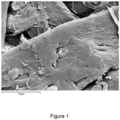
- the surface of the particulate carbon adsorbent formed using the above method are shown in Figures 1 and 2 .
- An example particulate carbon adsorbent, or "carbon flake" is shown in Figure 3 , as seen via optical microscopy.
- Figure 4 shows Energy-dispersive spectroscopy results from the surface of the particulate carbon adsorbent (carbon flakes) showing the elemental composition of those surfaces.
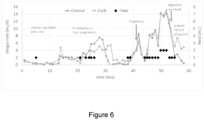
- a first anaerobic digestion experiment was carried out in 60 mL plastic syringes that were continuously shaken and kept at 37°C. Initially, 8 syringes were each filled with 10 mL of inoculum from a full scale biogas plant that treats sewage sludge. In addition, 4 of the syringes were each amended with 0.2 g of the adsorbent (Carb), as particulate carbon adsorbents according to the invention. The other 4 of the syringes are referred to as the control in the following. On day 5, all syringes were fed with 1 mL of a 1% propionic acid solution to simulate inhibitory conditions.
- Carb adsorbent
- the control showed an accumulation of organic acids leading to process failure, whereas the adsorbent (Carb) treatment showed stable gas production.
- the adsorbent (Carb) material can stimulate and stabilize microbial activity.
- nutrients including phosphorus are needed.
- the adsorbent (carb) can induce a lack of phosphorus availability in the anaerobic digestion reactor.
- the adsorbent (carb) can be pre-charged with phosphorus before entering the anaerobic digestion reactor.
- the ideal concentration of the adsorbent depends on the type and amount of inhibitory substances and the desired increase of active microbial biomass in the biogas reactor. Usually, the ideal concentration will be 0.5-3wt% of the particulate carbon adsorbent to the feedstock. Higher concentrations are not advisable because they will increase the viscosity of the biogas slurry, which makes stirring harder and could interfere with the removal of digestate. However, the ideal concentration of the adsorbent can be found and sustained by monitoring the common biogas process performance parameters e.g. methane concentration and biogas productivity and by measuring the energy consumption of the stirring devices.
- the ideal concentration of the adsorbent can be found and sustained by monitoring the common biogas process performance parameters e.g. methane concentration and biogas productivity and by measuring the energy consumption of the stirring devices.
- Pre-incubation with inoculum from the target system may be carried out as follows:
- the digestate for the AD tests was obtained from the AD site at Seafield, Edinburgh UK.
- the plant processes thermally-hydrolysed sludge from the adjacent municipal wastewater treatment plant.
- AD tests were performed under the guidelines set out by the Fermentation of Organic Materials Standard VDI 4630 with the Hohenheim Biogas Yield Test batch system in 100 ml glass syringes. Reactors were supplemented with 5 g/l COD bio-oil obtained from the pyrolysis of softwood pellets at 350 degrees Celsius.
- Carbon flakes were added dry or pre-incubated to the reactors to assess their impact on biogas production. Pre-incubation was achieved by adding char to the same digestate as used in the reactors to a 1:10 ratio and letting it shake at 37 Celsius for 48 hours anaerobically. Afterwards, the chars were sieved and washed with distilled water and directly added to the reactors. Reactors supplemented with pre-incubated carbon flakes showed a significantly reduced lag time before biogas production and therefore inhibition from bio-oil addition was alleviated (see Figure 9 ).
- PC1 is an 8oz white single walled polyethylene (PE)-laminated paper cup made in China for Sainsbury's.
- PE polyethylene
- PC2 is a 12oz black doubled walled PE-laminated paper cup branded for Marks & Spencer and made by Euro Packaging UK Ltd.
- PC3 is an 8oz brown single walled polylactic acid (PLA)-laminated paper cup made by Vegware Ltd.
- a phosphorous solution was prepared using K 2 HPO 4 and deionized water with a measured phosphorous concentration to achieve a phosphorous concentration of 20 mgL -1 , which is a relevant concentration in waste waters.
- the sorption experiment was carried out in centrifuge tubes filled with 10 mg of carbon material and 20 g of the phosphorous solution. The tubes were kept on a shaker. After 24 hrs, the liquid phase was analysed for its phosphorous content and the specific amount of adsorbed (or desorbed) phosphorous by the carbon material was calculated using the control as basis.
- the particulate carbon adsorbents of the invention are effective phosphorous adsorbents.
- the particulate carbon adsorbent should be produced at temperatures of at least 550°C and from feedstock materials that have a Mg content of at least 1wt%.
- the sorption capacity can be increased by grinding the adsorbent into smaller particles sizes.
- smaller particles are more difficult to separate from the treated wastewater and Mg and Ca compounds are more likely to become detached from the carbon adsorbent.
- a particle size in the range of 0.05mm to 5mm is ideal.
- the carbon flakes for the carbon granule's shell are produced from pyrolysed paper-plastic composite material and a seaweed extract is used as binder for both the core and shell.
- the paper-plastic composite material was pyrolysed into flake-shaped particles with a carbon content of 46%, a pH of 9.7, and an electrical conductivity of 93,7 ⁇ S/cm (1:20 dilution with purified H 2 O). The particles were sieved and only particles that passed through a sieve with an aperture of 0.5 mm but not through a sieve with an aperture of 0.125mm were selected for further testing.
- the carbon particles were confirmed to have a flake-shape with a vertical extent mostly between 0.02mm to 0.30mm.
- a commercial seaweed-extract (Original Organic Seaweed Extract by MaxiCrop) with a total solids content of 8% and a pH of 8.5 was used as binder.
- activated carbon with a mesh size of 100 to 400 was purchased from Sigma Aldrich. The agglomeration was performed in a wet drum granulator using a round tin box with a diameter of 24cm and length of 13cm.
- the initial amounts of activated carbon used for granulation were 17.4 g (for a control without a shell), 20.6 g for a granule with an intended mass-based core-to-shell ratio of 20:1 (thin shell) and 10.7 g for a granule with a mass-based core-to-shell ratio of 1:1 (thick shell).
- the right amount of activated carbon was fed into the drum and granulated at 60 rpm. Each three minutes the granulation process was checked.
- binder In another embodiment, no binder but only water is used to agglomerate the carbon particles for the core granule. Binder was only used to form the shell of carbon flakes. Again, the carbon flakes for the granule's shell are produced from pyrolysed paper-plastic composite material and a seaweed extract is used as binder.
- the same activated carbon, carbon flakes, binder and wet drum granulator were used as in the previous experiment.
- the amount of activated carbon was 16.2 g.
- 16.2 g of water was added to the activated carbon.
- the material was granulated for 5 minutes then further 5.3 g of H 2 O was added. After additional 10 minutes, formation of granules with diameters of 5-15 mm were observed and 1.62 of carbon flakes for shell formation were added. After further 8 minutes of granulation, most of the carbon flakes were picked up by the wet granules to form the shell as desired.
- wet drum granulates can be used to produce the shelled-carbon granules.
- the system allows continuous spray feeding of the binder as well as continuous feeding of carbon particles. Drying could be performed in the same granulator or separately by various batch or continuous types of dryers e.g. belt dryers. After the drying step, additional treatments can be conducted in order to remove dust and granules that are outside the desired size range. This can be achieved by common mechanical or pneumatic separation systems. In cases where the binder and flake-shaped carbon particles are tolerated inside the granules' core, removed dust and outsized granules can be recycled to the agglomeration process. Therefore, the outsized granules should be crushed first.
- the heat for drying the granules is obtained from an onsite pyrolysis kiln that produces the carbon particles for either the granules' core, the shell or both.
- the pyrolysis gas that is produced during pyrolysis can be burned onsite to fuel the drying process.
- Figure 7 shows an embodiment of the granular aggregate comprising a core of smaller carbon particles (1) and a shell of larger flake-shaped particles (2).
- the carbon adsorbent granules so produced can then be used in a number of applications, such as in anaerobic digestion, treatment of wastewater, phosphorous capture and soil amendment.
- Atomic adsorption for total Mg and Ca analysis of the particulate carbon adsorbent
- the solid samples were digested as described in the following: 0.5 g of sample material was weighed into crucibles, heated to 500°C and held at this temperature for 8 h. After cooling, the samples were placed in a steam bath and 5 mL of concentrated (70%) HNO 3 (analytical grade, Fisher Scientific) was added and evaporated to dryness. After cooling, 1 mL HNO 3 and 4 mL H 2 O 2 (30%, analytical grade, Fisher Scientific) were added and evaporated to dryness. Next, 2 mL HNO 3 was added to dissolve the solids. The resulting solution was filtered through Whatman No. 41 filter paper and the volume increased to 50 mL with DI water. The solutions were than analysed by a ThermoFisher Scientific ICE 3000 atomic absorption spectrometer.
- a Bruker AXS D8 Advance Diffractometer with copper anode x-ray tube and Sol-X Energy Dispersive detector was used.
- the running conditions for the X-Ray tube were 40 kV and 40 mA. Experiments were carried out in the range of 2° ⁇ 2 ⁇ ⁇ 65° with a step size of 0.05° and 1 sec per step.
- Data analysis was performed by Bruker's DIFFRAC EVA software and Bruker's TOPAS software was used for semiquantitative analysis. The samples were analysed in powdery form with a particle size below 0.125mm.
- the elemental (CHN) analysis was performed in quadruplicates using a Flash 2000 Elemental Analyser.
Landscapes
- Life Sciences & Earth Sciences (AREA)
- Health & Medical Sciences (AREA)
- Engineering & Computer Science (AREA)
- Chemical & Material Sciences (AREA)
- Organic Chemistry (AREA)
- Zoology (AREA)
- Bioinformatics & Cheminformatics (AREA)
- Wood Science & Technology (AREA)
- Molecular Biology (AREA)
- Genetics & Genomics (AREA)
- Biochemistry (AREA)
- Sustainable Development (AREA)
- Microbiology (AREA)
- General Engineering & Computer Science (AREA)
- General Health & Medical Sciences (AREA)
- Biotechnology (AREA)
- Biomedical Technology (AREA)
- Oil, Petroleum & Natural Gas (AREA)
- General Chemical & Material Sciences (AREA)
- Hydrology & Water Resources (AREA)
- Environmental & Geological Engineering (AREA)
- Water Supply & Treatment (AREA)
- Mechanical Engineering (AREA)
- Chemical Kinetics & Catalysis (AREA)
- Solid-Sorbent Or Filter-Aiding Compositions (AREA)
- Processing Of Solid Wastes (AREA)
- Water Treatment By Sorption (AREA)
Claims (15)
- Ein teilchenförmiges Kohlenstoffadsorptionsmittel zur Verwendung bei der anaeroben Vergärung, wobei das teilchenförmige Kohlenstoffadsorptionsmittel im Wesentlichen planar ist und zu zwischen 40 und 90 Gew.-% Kohlenstoff beinhaltet, dadurch gekennzeichnet, dass das teilchenförmige Kohlenstoffadsorptionsmittel durch Pyrolysieren eines im Wesentlichen planaren organischen Materials bei einer Temperatur von 300 °C bis 800 °C, Mahlen des pyrolysierten Materials und Sortieren des gemahlenen pyrolysierten Materials, um die Abmessungen des teilchenförmigen Kohlenstoffadsorptionsmittels zu spezifizieren, erhalten werden kann.
- Teilchenförmiges Mittel gemäß Anspruch 1, wobei die Temperatur zum Pyrolysieren des im Wesentlichen planaren organischen Materials von 400 °C bis etwa 475 °C beträgt oder wobei die Temperatur zum Pyrolysieren des im Wesentlichen planaren organischen Materials von 650 °C bis etwa 800 °C beträgt.
- Teilchenförmiges Kohlenstoffadsorptionsmittel zur Verwendung bei der anaeroben Vergärung gemäß Anspruch 1, wobei die anaerobe Vergärung in einem Bioreaktor ausgeführt wird und das teilchenförmige Kohlenstoffadsorptionsmittel folglich zur Verwendung in einem Bioreaktor ausgelegt ist.
- Teilchenförmiges Kohlenstoffadsorptionsmittel zur Verwendung bei der anaeroben Vergärung gemäß einem der vorhergehenden Ansprüche, wobei das teilchenförmige Kohlenstoffadsorptionsmittel ein Substrat zur Bildung eines aktiven Biofilms ist.
- Teilchenförmiges Kohlenstoffadsorptionsmittel zur Verwendung bei der anaeroben Vergärung gemäß einem der vorhergehenden Ansprüche, wobei das teilchenförmige Kohlenstoffadsorptionsmittel einen aktiven Biofilm, optional vor der Verwendung, beinhaltet.
- Teilchenförmiges Kohlenstoffadsorptionsmittel zur Verwendung bei der anaeroben Vergärung gemäß Anspruch 5, wobei das teilchenförmige Kohlenstoffadsorptionsmittel Mikroorganismen beinhaltet, die von innerhalb aus einem Zielsystem in einem beliebigen Stadium des anaeroben Vergärungsprozesses erhaltenen Fluid vorgeimpft wurden.
- Teilchenförmiges Kohlenstoffadsorptionsmittel zur Verwendung bei der anaeroben Vergärung gemäß einem der vorhergehenden Ansprüche, wobei das teilchenförmige Kohlenstoffadsorptionsmittel Calcium- und/oder Magnesiumionen beinhaltet.
- Teilchenförmiges Kohlenstoffadsorptionsmittel zur Verwendung bei der anaeroben Vergärung gemäß Anspruch 7, wobei das teilchenförmige Kohlenstoffadsorptionsmittel zu etwa 0,1 Gew.-% bis etwa 10 Gew.-% Calciumionen beinhaltet; und/oder wobei das teilchenförmige Kohlenstoffadsorptionsmittel zu etwa 1,0 Gew.-% bis etwa 15,0 Gew.-% Magnesiumionen beinhaltet.
- Ein Verfahren zur Herstellung teilchenförmiger Kohlenstoffadsorptionsmittel zur Verwendung bei der anaeroben Vergärung, wobei das teilchenförmige Kohlenstoffadsorptionsmittel im Wesentlichen planar ist und zu zwischen 40 und 90 Gew.-% Kohlenstoff beinhaltet, wobei das Verfahren die folgenden Schritte beinhaltet:a) Bereitstellen eines im Wesentlichen planaren organischen Materials;b) Pyrolysieren des bereitgestellten im Wesentlichen planaren organischen Materials bei einer Temperatur von 300 °C bis 800 °C;c) Mahlen des aus Schritt b) resultierenden pyrolysierten Materials; undd) Sortieren des aus Schritt c) resultierenden gemahlenen pyrolysierten Materials, um die benötigten Abmessungen des teilchenförmigen Kohlenstoffadsorptionsmittels zu spezifizieren.
- Verfahren gemäß Anspruch 9, wobei das im Wesentlichen planare organische Beschickungsmaterial bei einer Temperatur von 400 °C bis etwa 475 °C pyrolysiert wird oder wobei das im Wesentlichen planare organische Beschickungsmaterial bei einer Temperatur von 650 °C bis etwa 800 °C pyrolysiert wird.
- Verfahren gemäß Anspruch 9 oder Anspruch 10, wobei das Verfahren ferner den Schritt des Zerkleinerns des im Wesentlichen planaren organischen Materials, bevor es pyrolysiert wird, beinhaltet.
- Verfahren gemäß Anspruch 11, wobei das Verfahren vor dem Schritt des Pyrolysierens des im Wesentlichen planaren organischen Materials ferner den Schritt des Komprimierens des zerkleinerten im Wesentlichen planaren organischen Materials beinhaltet.
- Verfahren gemäß Anspruch 9 bis Anspruch 12, wobei das im Wesentlichen planare organische Beschickungsmaterial Papier, Pappe oder ein Verbundstoffmaterial, das aus Schichten von Papier, Schichten von Kunststoff und/oder Wachs und/oder Aluminium gebildet ist, beinhaltet.
- Ein anaerober Vergärungsprozess, der die folgenden Schritte beinhaltet:a) Bereitstellen eines Bioreaktors;b) Hinzufügen eines Beschickungsmaterials zu dem Bioreaktor;c) Hinzufügen einer Mikroorganismenzusammensetzung zu dem Bioreaktor;d) Hinzufügen einer Adsorptionsmittelzusammensetzung zu dem Bioreaktor, wobei die Adsorptionsmittelzusammensetzung im Wesentlichen planares teilchenförmiges Kohlenstoffadsorptionsmittel gemäß einem der Ansprüche 1 bis 8 beinhaltet;e) Inkubieren des Bioreaktors, sodass die Mikroorganismen in der Mikroorganismenzusammensetzung das Beschickungsmaterial vergären, um einen Gärrest und Biogas zu produzieren; undf) Entfernen des produzierten Biogases und Gärrests.
- Verfahren gemäß Anspruch 14, wobei die Adsorptionsmittelzusammensetzung vor dem Hinzufügen zu dem Bioreaktor mit Fluid von dem Bioreaktor, das das Beschickungsmaterial und die Mikroorganismenzusammensetzung dieses Bioreaktors enthält, vorgeimpft wird.
Applications Claiming Priority (2)
| Application Number | Priority Date | Filing Date | Title |
|---|---|---|---|
| GBGB1620753.2A GB201620753D0 (en) | 2016-12-06 | 2016-12-06 | Adsorbent for anaerobic digestion processes |
| PCT/GB2017/053673 WO2018104730A1 (en) | 2016-12-06 | 2017-12-06 | Adsorbent for anaerobic digestion processes |
Publications (3)
| Publication Number | Publication Date |
|---|---|
| EP3551743A1 EP3551743A1 (de) | 2019-10-16 |
| EP3551743C0 EP3551743C0 (de) | 2023-09-27 |
| EP3551743B1 true EP3551743B1 (de) | 2023-09-27 |
Family
ID=58159823
Family Applications (1)
| Application Number | Title | Priority Date | Filing Date |
|---|---|---|---|
| EP17821714.7A Active EP3551743B1 (de) | 2016-12-06 | 2017-12-06 | Adsorptionsmittel für anaerobe vergärungsprozesse |
Country Status (6)
| Country | Link |
|---|---|
| US (1) | US20200071218A1 (de) |
| EP (1) | EP3551743B1 (de) |
| CN (1) | CN110050057B (de) |
| GB (1) | GB201620753D0 (de) |
| PL (1) | PL3551743T3 (de) |
| WO (1) | WO2018104730A1 (de) |
Families Citing this family (6)
| Publication number | Priority date | Publication date | Assignee | Title |
|---|---|---|---|---|
| GB201913290D0 (en) | 2019-09-13 | 2019-10-30 | Carbogenics Ltd | Adsorbent for municipal wastewater treatment |
| CN112744991B (zh) * | 2021-01-12 | 2022-11-18 | 江西省农业科学院农业应用微生物研究所(江西省农村能源研究中心) | 一种全量化收集养殖粪污的高负荷厌氧发酵产沼气方法 |
| CN113336329A (zh) * | 2021-06-01 | 2021-09-03 | 中国农业科学院农业环境与可持续发展研究所 | 一种颗粒生物炭及其制备方法和在厌氧消化产甲烷中的应用 |
| CN114853298B (zh) * | 2022-05-05 | 2023-06-23 | 同济大学 | 一种利用高碳氮比生物质碳促进高氨氮生境下污泥厌氧消化产甲烷的方法 |
| FR3138136A1 (fr) * | 2022-07-22 | 2024-01-26 | Suez International | Procédé de pyrolyse du méthane avec une recirculation du carbone solide produit |
| CN117701444B (zh) * | 2023-12-15 | 2025-03-11 | 标发生态科技(山东)有限公司 | 一种固载耐氨氮厌氧微生物的磁性生物炭的制备方法及缓解氨氮抑制的方法 |
Family Cites Families (11)
| Publication number | Priority date | Publication date | Assignee | Title |
|---|---|---|---|---|
| US4267055A (en) * | 1979-09-04 | 1981-05-12 | Rohm And Haas Company | Separation of more planar molecules from less planar molecules |
| EP2284141A1 (de) | 2009-08-12 | 2011-02-16 | Leibniz-Institut für Agrartechnik Potsdam-Bornim e.V. (ATB) | Verfahren und Vorrichtung zur Herstellung von mit Mineralstoffen angereicherten Kohlepartikeln |
| WO2011097183A2 (en) * | 2010-02-03 | 2011-08-11 | University Of Florida Research Foundation, Inc. | Biologically activated biochar, methods of making biologically activated biochar, and methods of removing contaminants from water |
| EP2386648A1 (de) * | 2010-05-10 | 2011-11-16 | Solvay SA | Herstellungsverfahren für Biogas |
| US8945906B2 (en) * | 2010-07-06 | 2015-02-03 | University Of Maryland Baltimore County | Organic biofilm substrata as a microbial inoculum delivery vehicle for bioaugmentation of persistent organic pollutants in contaminated sediments and soils |
| DE102011010525A1 (de) | 2011-02-08 | 2012-08-09 | Universität Rostock | Verfahren zur Reinigung von Biogas, Rauchgas oder Flüssigkeiten, Adsorbens dafür, Filter, sowie Verwendung des Adsorptionsmittels |
| WO2015003273A1 (en) * | 2013-07-11 | 2015-01-15 | Anaergia Inc. | Anaerobic digestion and pyrolysis system |
| US10351455B2 (en) * | 2013-11-25 | 2019-07-16 | University Of Idaho | Biochar water treatment |
| US20150252267A1 (en) * | 2014-01-23 | 2015-09-10 | Jeff Licht | Production, Conditioning, Testing and Applications of Cardboard and Chipboard Biochar |
| DE102014100850B4 (de) | 2014-01-24 | 2015-09-03 | Leibniz-Institut für Agrartechnik Potsdam-Bornim e.V.(ATB) | Magnetisierbare Partikel, Verfahren zu deren Herstellung sowie deren Verwendung |
| US9994870B2 (en) * | 2014-11-13 | 2018-06-12 | Uchicago Argonne, Llc | Method for generating methane from a carbonaceous feedstock |
-
2016
- 2016-12-06 GB GBGB1620753.2A patent/GB201620753D0/en not_active Ceased
-
2017
- 2017-12-06 WO PCT/GB2017/053673 patent/WO2018104730A1/en not_active Ceased
- 2017-12-06 PL PL17821714.7T patent/PL3551743T3/pl unknown
- 2017-12-06 EP EP17821714.7A patent/EP3551743B1/de active Active
- 2017-12-06 CN CN201780075991.1A patent/CN110050057B/zh active Active
- 2017-12-06 US US16/465,760 patent/US20200071218A1/en not_active Abandoned
Also Published As
| Publication number | Publication date |
|---|---|
| CN110050057A (zh) | 2019-07-23 |
| EP3551743C0 (de) | 2023-09-27 |
| CN110050057B (zh) | 2023-07-14 |
| US20200071218A1 (en) | 2020-03-05 |
| PL3551743T3 (pl) | 2024-07-01 |
| EP3551743A1 (de) | 2019-10-16 |
| GB201620753D0 (en) | 2017-01-18 |
| WO2018104730A1 (en) | 2018-06-14 |
Similar Documents
| Publication | Publication Date | Title |
|---|---|---|
| EP3551743B1 (de) | Adsorptionsmittel für anaerobe vergärungsprozesse | |
| Chen et al. | Upcycling food waste digestate for energy and heavy metal remediation applications | |
| Xiao et al. | Insight into multiple and multilevel structures of biochars and their potential environmental applications: a critical review | |
| Li et al. | Simultaneous capture removal of phosphate, ammonium and organic substances by MgO impregnated biochar and its potential use in swine wastewater treatment | |
| Arun et al. | Sustainable and eco-friendly approach for phosphorus recovery from wastewater by hydrothermally carbonized microalgae: study on spent bio-char as fertilizer | |
| US10071335B2 (en) | Ozonized biochar compositions and methods of making and using the same | |
| Bhatnagar et al. | Multidisciplinary approaches to handling wastes in sugar industries | |
| WO2011097183A2 (en) | Biologically activated biochar, methods of making biologically activated biochar, and methods of removing contaminants from water | |
| Mulugeta et al. | Removal of methylene blue (Mb) dye from aqueous solution by bioadsorption onto untreated Parthenium hystrophorous weed | |
| EP2464614B1 (de) | Systeme und verfahren zur erzeugung von biogas und biokohle sowie zur veredelung der biokohle | |
| US12503377B2 (en) | Adsorbent for municipal wastewater treatment | |
| Qiu et al. | Quality of poultry litter-derived granular activated carbon | |
| Tehreem et al. | Analysis of the role of various biochar in the remediation of heavy metals in contaminated water and its kinetics study | |
| Nadarajah et al. | Biochar from waste biomass, its fundamentals, engineering aspects, and potential applications: an overview | |
| Pellera et al. | Biochar production from waste biomass: Characterization and evaluation for agronomic and environmental applications | |
| Ramola et al. | Fixed bed adsorption of Pb and Cu by iron modified bamboo, bagasse and tyre biochar | |
| Al-Swadi et al. | Impacts of kaolinite enrichment on biochar and hydrochar characterization, stability, toxicity, and maize germination and growth | |
| Kusmayadi et al. | Microwave-assisted hydrothermal carbonization of microalgae grown in swine wastewater: Process optimization and application of hydrochar for dye adsorption | |
| Mishra et al. | Production of engineered algal biochar through microwave pyrolysis for nutrient recovery from aqueous solution | |
| Rajput et al. | Nanomaterials and nano-biochar in reducing soil stress: an integrated approach for sustainable agriculture | |
| Khatri et al. | Catalytic calcite-based bio-composite material synthesis for decolourization of methyl red by Burkholderia sp. ISTR5 | |
| Notodarmojo et al. | Performance of oyster shell powder size on methane gas generation in two-stage anaerobic digestion system | |
| Tran et al. | Studying the biochar modified by AgNO3 from coffee grounds to handle organic pollutants and microorganism in the seafood-processing wastewater | |
| Wijaya | Adsorption kinetics and isotherm study of ammonium and phosphate removal using magnesium-activated biochar | |
| Liu et al. | Preparation of magnetic recovery biochar originated sludge, red mud and pine sawdust for adsorption of OTC and LEV in wastewater |
Legal Events
| Date | Code | Title | Description |
|---|---|---|---|
| STAA | Information on the status of an ep patent application or granted ep patent |
Free format text: STATUS: UNKNOWN |
|
| STAA | Information on the status of an ep patent application or granted ep patent |
Free format text: STATUS: THE INTERNATIONAL PUBLICATION HAS BEEN MADE |
|
| PUAI | Public reference made under article 153(3) epc to a published international application that has entered the european phase |
Free format text: ORIGINAL CODE: 0009012 |
|
| STAA | Information on the status of an ep patent application or granted ep patent |
Free format text: STATUS: REQUEST FOR EXAMINATION WAS MADE |
|
| 17P | Request for examination filed |
Effective date: 20190625 |
|
| AK | Designated contracting states |
Kind code of ref document: A1 Designated state(s): AL AT BE BG CH CY CZ DE DK EE ES FI FR GB GR HR HU IE IS IT LI LT LU LV MC MK MT NL NO PL PT RO RS SE SI SK SM TR |
|
| AX | Request for extension of the european patent |
Extension state: BA ME |
|
| DAV | Request for validation of the european patent (deleted) | ||
| DAX | Request for extension of the european patent (deleted) | ||
| STAA | Information on the status of an ep patent application or granted ep patent |
Free format text: STATUS: EXAMINATION IS IN PROGRESS |
|
| 17Q | First examination report despatched |
Effective date: 20221124 |
|
| GRAP | Despatch of communication of intention to grant a patent |
Free format text: ORIGINAL CODE: EPIDOSNIGR1 |
|
| STAA | Information on the status of an ep patent application or granted ep patent |
Free format text: STATUS: GRANT OF PATENT IS INTENDED |
|
| INTG | Intention to grant announced |
Effective date: 20230411 |
|
| GRAS | Grant fee paid |
Free format text: ORIGINAL CODE: EPIDOSNIGR3 |
|
| GRAA | (expected) grant |
Free format text: ORIGINAL CODE: 0009210 |
|
| STAA | Information on the status of an ep patent application or granted ep patent |
Free format text: STATUS: THE PATENT HAS BEEN GRANTED |
|
| AK | Designated contracting states |
Kind code of ref document: B1 Designated state(s): AL AT BE BG CH CY CZ DE DK EE ES FI FR GB GR HR HU IE IS IT LI LT LU LV MC MK MT NL NO PL PT RO RS SE SI SK SM TR |
|
| REG | Reference to a national code |
Ref country code: GB Ref legal event code: FG4D |
|
| REG | Reference to a national code |
Ref country code: CH Ref legal event code: EP |
|
| REG | Reference to a national code |
Ref country code: DE Ref legal event code: R096 Ref document number: 602017074720 Country of ref document: DE |
|
| REG | Reference to a national code |
Ref country code: IE Ref legal event code: FG4D |
|
| U01 | Request for unitary effect filed |
Effective date: 20231025 |
|
| U07 | Unitary effect registered |
Designated state(s): AT BE BG DE DK EE FI FR IT LT LU LV MT NL PT SE SI Effective date: 20231031 |
|
| PG25 | Lapsed in a contracting state [announced via postgrant information from national office to epo] |
Ref country code: GR Free format text: LAPSE BECAUSE OF FAILURE TO SUBMIT A TRANSLATION OF THE DESCRIPTION OR TO PAY THE FEE WITHIN THE PRESCRIBED TIME-LIMIT Effective date: 20231228 |
|
| PG25 | Lapsed in a contracting state [announced via postgrant information from national office to epo] |
Ref country code: RS Free format text: LAPSE BECAUSE OF FAILURE TO SUBMIT A TRANSLATION OF THE DESCRIPTION OR TO PAY THE FEE WITHIN THE PRESCRIBED TIME-LIMIT Effective date: 20230927 Ref country code: NO Free format text: LAPSE BECAUSE OF FAILURE TO SUBMIT A TRANSLATION OF THE DESCRIPTION OR TO PAY THE FEE WITHIN THE PRESCRIBED TIME-LIMIT Effective date: 20231227 Ref country code: HR Free format text: LAPSE BECAUSE OF FAILURE TO SUBMIT A TRANSLATION OF THE DESCRIPTION OR TO PAY THE FEE WITHIN THE PRESCRIBED TIME-LIMIT Effective date: 20230927 Ref country code: GR Free format text: LAPSE BECAUSE OF FAILURE TO SUBMIT A TRANSLATION OF THE DESCRIPTION OR TO PAY THE FEE WITHIN THE PRESCRIBED TIME-LIMIT Effective date: 20231228 |
|
| U20 | Renewal fee for the european patent with unitary effect paid |
Year of fee payment: 7 Effective date: 20231222 |
|
| PG25 | Lapsed in a contracting state [announced via postgrant information from national office to epo] |
Ref country code: IS Free format text: LAPSE BECAUSE OF FAILURE TO SUBMIT A TRANSLATION OF THE DESCRIPTION OR TO PAY THE FEE WITHIN THE PRESCRIBED TIME-LIMIT Effective date: 20240127 |
|
| PG25 | Lapsed in a contracting state [announced via postgrant information from national office to epo] |
Ref country code: ES Free format text: LAPSE BECAUSE OF FAILURE TO SUBMIT A TRANSLATION OF THE DESCRIPTION OR TO PAY THE FEE WITHIN THE PRESCRIBED TIME-LIMIT Effective date: 20230927 |
|
| PG25 | Lapsed in a contracting state [announced via postgrant information from national office to epo] |
Ref country code: SM Free format text: LAPSE BECAUSE OF FAILURE TO SUBMIT A TRANSLATION OF THE DESCRIPTION OR TO PAY THE FEE WITHIN THE PRESCRIBED TIME-LIMIT Effective date: 20230927 Ref country code: RO Free format text: LAPSE BECAUSE OF FAILURE TO SUBMIT A TRANSLATION OF THE DESCRIPTION OR TO PAY THE FEE WITHIN THE PRESCRIBED TIME-LIMIT Effective date: 20230927 Ref country code: IS Free format text: LAPSE BECAUSE OF FAILURE TO SUBMIT A TRANSLATION OF THE DESCRIPTION OR TO PAY THE FEE WITHIN THE PRESCRIBED TIME-LIMIT Effective date: 20240127 Ref country code: ES Free format text: LAPSE BECAUSE OF FAILURE TO SUBMIT A TRANSLATION OF THE DESCRIPTION OR TO PAY THE FEE WITHIN THE PRESCRIBED TIME-LIMIT Effective date: 20230927 Ref country code: CZ Free format text: LAPSE BECAUSE OF FAILURE TO SUBMIT A TRANSLATION OF THE DESCRIPTION OR TO PAY THE FEE WITHIN THE PRESCRIBED TIME-LIMIT Effective date: 20230927 Ref country code: SK Free format text: LAPSE BECAUSE OF FAILURE TO SUBMIT A TRANSLATION OF THE DESCRIPTION OR TO PAY THE FEE WITHIN THE PRESCRIBED TIME-LIMIT Effective date: 20230927 |
|
| REG | Reference to a national code |
Ref country code: DE Ref legal event code: R097 Ref document number: 602017074720 Country of ref document: DE |
|
| REG | Reference to a national code |
Ref country code: CH Ref legal event code: PL |
|
| PLBE | No opposition filed within time limit |
Free format text: ORIGINAL CODE: 0009261 |
|
| STAA | Information on the status of an ep patent application or granted ep patent |
Free format text: STATUS: NO OPPOSITION FILED WITHIN TIME LIMIT |
|
| PG25 | Lapsed in a contracting state [announced via postgrant information from national office to epo] |
Ref country code: MC Free format text: LAPSE BECAUSE OF FAILURE TO SUBMIT A TRANSLATION OF THE DESCRIPTION OR TO PAY THE FEE WITHIN THE PRESCRIBED TIME-LIMIT Effective date: 20230927 |
|
| PG25 | Lapsed in a contracting state [announced via postgrant information from national office to epo] |
Ref country code: MC Free format text: LAPSE BECAUSE OF FAILURE TO SUBMIT A TRANSLATION OF THE DESCRIPTION OR TO PAY THE FEE WITHIN THE PRESCRIBED TIME-LIMIT Effective date: 20230927 |
|
| 26N | No opposition filed |
Effective date: 20240628 |
|
| REG | Reference to a national code |
Ref country code: IE Ref legal event code: MM4A |
|
| PG25 | Lapsed in a contracting state [announced via postgrant information from national office to epo] |
Ref country code: IE Free format text: LAPSE BECAUSE OF NON-PAYMENT OF DUE FEES Effective date: 20231206 |
|
| PG25 | Lapsed in a contracting state [announced via postgrant information from national office to epo] |
Ref country code: CH Free format text: LAPSE BECAUSE OF NON-PAYMENT OF DUE FEES Effective date: 20231231 |
|
| PG25 | Lapsed in a contracting state [announced via postgrant information from national office to epo] |
Ref country code: IE Free format text: LAPSE BECAUSE OF NON-PAYMENT OF DUE FEES Effective date: 20231206 Ref country code: CH Free format text: LAPSE BECAUSE OF NON-PAYMENT OF DUE FEES Effective date: 20231231 |
|
| U20 | Renewal fee for the european patent with unitary effect paid |
Year of fee payment: 8 Effective date: 20241220 |
|
| PG25 | Lapsed in a contracting state [announced via postgrant information from national office to epo] |
Ref country code: CY Free format text: LAPSE BECAUSE OF FAILURE TO SUBMIT A TRANSLATION OF THE DESCRIPTION OR TO PAY THE FEE WITHIN THE PRESCRIBED TIME-LIMIT; INVALID AB INITIO Effective date: 20171206 |
|
| PG25 | Lapsed in a contracting state [announced via postgrant information from national office to epo] |
Ref country code: HU Free format text: LAPSE BECAUSE OF FAILURE TO SUBMIT A TRANSLATION OF THE DESCRIPTION OR TO PAY THE FEE WITHIN THE PRESCRIBED TIME-LIMIT; INVALID AB INITIO Effective date: 20171206 |
|
| PG25 | Lapsed in a contracting state [announced via postgrant information from national office to epo] |
Ref country code: TR Free format text: LAPSE BECAUSE OF FAILURE TO SUBMIT A TRANSLATION OF THE DESCRIPTION OR TO PAY THE FEE WITHIN THE PRESCRIBED TIME-LIMIT Effective date: 20230927 |
|
| PGFP | Annual fee paid to national office [announced via postgrant information from national office to epo] |
Ref country code: GB Payment date: 20251231 Year of fee payment: 9 |
|
| PGFP | Annual fee paid to national office [announced via postgrant information from national office to epo] |
Ref country code: PL Payment date: 20251126 Year of fee payment: 9 |
|
| U20 | Renewal fee for the european patent with unitary effect paid |
Year of fee payment: 9 Effective date: 20251229 |