EP3551387B1 - Flexibler schleifartikel - Google Patents
Flexibler schleifartikel Download PDFInfo
- Publication number
- EP3551387B1 EP3551387B1 EP17822026.5A EP17822026A EP3551387B1 EP 3551387 B1 EP3551387 B1 EP 3551387B1 EP 17822026 A EP17822026 A EP 17822026A EP 3551387 B1 EP3551387 B1 EP 3551387B1
- Authority
- EP
- European Patent Office
- Prior art keywords
- major surface
- curable composition
- abrasive
- abrasive particles
- liner
- Prior art date
- Legal status (The legal status is an assumption and is not a legal conclusion. Google has not performed a legal analysis and makes no representation as to the accuracy of the status listed.)
- Active
Links
Images
Classifications
-
- B—PERFORMING OPERATIONS; TRANSPORTING
- B24—GRINDING; POLISHING
- B24D—TOOLS FOR GRINDING, BUFFING OR SHARPENING
- B24D3/00—Physical features of abrasive bodies, or sheets, e.g. abrasive surfaces of special nature; Abrasive bodies or sheets characterised by their constituents
- B24D3/02—Physical features of abrasive bodies, or sheets, e.g. abrasive surfaces of special nature; Abrasive bodies or sheets characterised by their constituents the constituent being used as bonding agent
- B24D3/20—Physical features of abrasive bodies, or sheets, e.g. abrasive surfaces of special nature; Abrasive bodies or sheets characterised by their constituents the constituent being used as bonding agent and being essentially organic
- B24D3/28—Resins or natural or synthetic macromolecular compounds
-
- B—PERFORMING OPERATIONS; TRANSPORTING
- B24—GRINDING; POLISHING
- B24D—TOOLS FOR GRINDING, BUFFING OR SHARPENING
- B24D11/00—Constructional features of flexible abrasive materials; Special features in the manufacture of such materials
-
- C—CHEMISTRY; METALLURGY
- C08—ORGANIC MACROMOLECULAR COMPOUNDS; THEIR PREPARATION OR CHEMICAL WORKING-UP; COMPOSITIONS BASED THEREON
- C08L—COMPOSITIONS OF MACROMOLECULAR COMPOUNDS
- C08L33/00—Compositions of homopolymers or copolymers of compounds having one or more unsaturated aliphatic radicals, each having only one carbon-to-carbon double bond, and only one being terminated by only one carboxyl radical, or of salts, anhydrides, esters, amides, imides or nitriles thereof; Compositions of derivatives of such polymers
- C08L33/04—Homopolymers or copolymers of esters
- C08L33/06—Homopolymers or copolymers of esters of esters containing only carbon, hydrogen and oxygen, which oxygen atoms are present only as part of the carboxyl radical
- C08L33/08—Homopolymers or copolymers of acrylic acid esters
-
- C—CHEMISTRY; METALLURGY
- C09—DYES; PAINTS; POLISHES; NATURAL RESINS; ADHESIVES; COMPOSITIONS NOT OTHERWISE PROVIDED FOR; APPLICATIONS OF MATERIALS NOT OTHERWISE PROVIDED FOR
- C09J—ADHESIVES; NON-MECHANICAL ASPECTS OF ADHESIVE PROCESSES IN GENERAL; ADHESIVE PROCESSES NOT PROVIDED FOR ELSEWHERE; USE OF MATERIALS AS ADHESIVES
- C09J133/00—Adhesives based on homopolymers or copolymers of compounds having one or more unsaturated aliphatic radicals, each having only one carbon-to-carbon double bond, and at least one being terminated by only one carboxyl radical, or of salts, anhydrides, esters, amides, imides, or nitriles thereof; Adhesives based on derivatives of such polymers
- C09J133/04—Homopolymers or copolymers of esters
- C09J133/06—Homopolymers or copolymers of esters of esters containing only carbon, hydrogen and oxygen, the oxygen atom being present only as part of the carboxyl radical
- C09J133/062—Copolymers with monomers not covered by C09J133/06
- C09J133/066—Copolymers with monomers not covered by C09J133/06 containing -OH groups
Definitions
- Flexible abrasives enable the efficient and uniform sanding of contoured areas.
- Existing flexible coated abrasive products are supported on a paper or polymer backing before they are attached to a backing pad or used for hand-sanding.
- wet or dry abrasive with a paper backing is flexible when soaked in water, but the cleanup is time-consuming. There is therefore an unmet need for flexible abrasives that meet performance requirements, but do not succumb to the disadvantages of existing products.
- Such abrasive articles are known for example from WO2008/079934 and WO98/12021 .
- the present invention relates to a curable composition
- a curable composition comprising: a polymerizable epoxy-acrylate resin composition having a complex viscosity at 25°C and 1 Hz frequency of at least 4500 Pa-s; and abrasive particles partially or fully embedded in the polymerizable epoxy-acrylate resin component.
- the invention further relates to a cured composition formed from the curable composition wherein the abrasive particles are partially or fully embedded in the cured composition.
- the invention further relates to a method of making the abrasive article comprising: coating a curable composition comprising a polymerizable epoxy-acrylate resin composition having a complex viscosity at 25°C and 1 Hz frequency of at least about 4500 Pa-s and having a curable composition first major surface and a curable composition second major surface between a first liner having a first liner major surface and a first liner second major surface and a second liner having a second liner first major surface and a second liner second major surface, wherein the first liner second major surface is in direct contact with substantially the entire curable composition first major surface and the second liner first major surface is in direct contact with substantially the entire curable composition second major surface; removing the first liner to expose the curable composition first major surface; depositing abrasive particles on the curable composition first major surface, wherein the abrasive particles are partially or fully embedded in the curable composition first major surface; and curing the curable composition to form an abrasive layer having an
- the invention further relates to a method of making the abrasive article comprising: coating a curable composition comprising a polymerizable epoxy-acrylate resin composition having a complex viscosity at 25°C and 1 Hz frequency of at least about 4500 Pa-s and having a curable composition first major surface and a curable composition second major surface on a liner having a liner major surface and a liner second major surface, wherein the liner second major surface is in direct contact with substantially the entire curable composition first major surface; depositing abrasive particles on the curable composition first major surface, wherein the abrasive particles are partially or fully embedded in the curable composition first major surface; and curing the curable composition to form an abrasive layer having an abrasive layer first major surface comprising the abrasive particles and an abrasive layer second major surface, wherein the abrasive layer second major surface is in direct contact with substantially the entire liner first major surface.
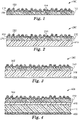
- FIGS. 1-4 are side cross-sectional views of abrasive articles according to various examples.
- Abrasive products are used to sand a wide variety of substrates, including soft, difficult to finish materials such as painted surfaces.
- the applications for coated abrasives for collision repair market are very wide include cleaning, coating removal, filler shaping, metal shaping, paint stripping to metal, primer sanding, paint preparation, paint finishing etc.
- Abrasive articles in general, include a plurality of abrasive particles and a binder.
- abrasive articles include bonded abrasive articles (such as grinding wheels), coated abrasive articles, nonwoven abrasive articles, to name a few.
- Coated abrasive products generally have a backing substrate, abrasive particles, and a binder system which operates to hold the abrasive particles to the backing.
- the backing is first coated with a layer of binder, commonly referred to as a "make" coat, and then the abrasive particles are applied to the binder coating.
- the abrasive particles optimally are at least partially embedded in the make coat.
- the resulting binder/abrasive particle layer is then generally solidified or set (such as by a series of drying or curing ovens) sufficient to retain the adhesion of abrasive particles to the backing.
- a second layer of binder commonly referred to as a "size coat” is applied over the surface of the make coat and abrasive particles, and, upon setting, it further supports the particles and enhances the anchorage of the particles to the backing.
- a "supersize" coat which may contain grinding aids, can be applied over the precured size coat.
- the resulting coated abrasive product can be converted into a variety of convenient forms such as sheets, rolls, belts, and discs for, among other applications, for metal working belt applications, such as for gate removal.
- Some abrasives currently in production and use employ epoxy-acrylate hybrid chemistry to prepare the make coat to manufacture coated abrasives. But there are some challenges to existing coated abrasives. For example, current make resin coating on paper and film backings is very brittle. In addition, due to the low viscosity of the resin, it fills the fibers of porous cloth backings making the construction brittle, and less pliable, which has some limitations for coated abrasives. Further, existing make-coats exhibit poor adhesion with untreated backings. Thus, processing of backings is required to increase the adhesion with the make resin, which adds to the cost and complexity in manufacturing.
- abrasive articles comprising polymerizable (e.g., photopolymerizable) epoxy-acrylate resin compositions as toughened make compositions for next generation coated abrasives.
- polymerizable (e.g., photopolymerizable) epoxy-acrylate resin compositions as toughened make compositions for next generation coated abrasives.
- these new make resin compositions form a self-supporting abrasive layer that can serve as both make and backing layers for an abrasive article. This means that expensive backings currently used in coated abrasives can be avoided, and opens up opportunities for new cost-advantaged constructs, particularly in the area of flexible abrasive articles.
- FIG. 1 shows one example of an abrasive article referred to by the numeral 100.
- the abrasive article 100 includes a plurality of layers. From the bottom to the top, with the abrasive surface facing upwards, these layers include: an abrasive layer 112, and a supersize coat 122.
- the abrasive layer 112 is itself multilayered and includes an abrasive layer 116, abrasive particles 114, and a size coat 118. It should be clear from the abrasive article illustrated in FIG. 1 , in contrast to the abrasive articles depicted in FIGS. 2-4 , that the abrasive article lacks a backing.
- a backing can be added to the abrasive article depicted in FIG. 1 to arrive, for example, at an abrasive article such as the one depicted in FIGS. 2-4 .
- the abrasive article 100 can comprise an attachment layer (not shown) that is one part of a hook-and-loop attachment mechanism.
- FIG. 2 shows one example of an abrasive article referred to by the numeral 200.
- the abrasive article 200 includes a plurality of layers. From the bottom to the top, with the abrasive surface facing upwards, these layers include: an optional backing 210, an abrasive layer 212, and a supersize coat 222.
- the abrasive layer 212 is itself multilayered and includes an abrasive layer 216 abrasive particles 214, and a size coat 218.
- the abrasive article 200 can comprise an attachment layer (not shown) that is one part of a hook-and-loop attachment mechanism.
- FIG. 3 shows an abrasive article 300 having an optional backing 310, abrasive layer 312, and supersize coat 322.
- the abrasive article 300 additionally has a continuous attachment layer 330 that extends across and directly contacts a major surface of the backing 310 facing away from the abrasive layer 312.
- the attachment layer 330 is a removable pressure-sensitive adhesive.
- the attachment layer 330 is one part of a hook-and-loop attachment mechanism.
- the backing 310 is absent.
- the attachment layer 330 extends across and directly contacts a major surface of the abrasive layer 312, where the major surface of the abrasive layer is the one facing away from the supersize coat 322.
- FIG. 4 shows an abrasive article 400 having an optional backing 410, abrasive layer 412, and supersize coat 422.
- the abrasive article 400 has an attachment layer 430.
- the attachment layer 430 is one part of a hook-and-loop attachment mechanism.
- a polymeric compressible foam 430 can be interposed between the backing 410 and the attachment layer 430.
- one or more additional layers could be disposed between any of the above layers to help adhere layers to each other, provide a printed image, act as a barrier layer, or serve any other purpose known in the art.
- the compressible foam 440 can enable a more uniform contact with the workpiece to the abraded, and particularly so where the workpiece has non-planar contours.
- the backing 410 and compressible foam 440 could be consolidated into a single layer that serves both functions.
- the abrasive layer of the abrasive article of the various embodiments described herein is made from a curable composition.
- the curable composition comprises a polymerizable epoxy-acrylate resin composition having a complex viscosity at 25°C and 1 Hz frequency of at least about 4500 Pa-s; and abrasive particles partially or fully embedded in the polymerizable epoxy-acrylate resin composition.
- the cured composition/abrasive layer is the photopolymerization product of the curable composition.
- the cured polymerizable epoxy-acrylate resin composition has a storage modulus (G') at 25°C and 1 Hz frequency of at least about 300 MPa.
- the polymerizable epoxy-acrylate resin composition has a complex viscosity at 25°C and 1 Hz frequency of at least about 600 Pa-s, at least about 1200 Pa-s, at least about 4000 Pa-s, at least about 4500 Pa-s, at least about 8000 Pa-s, at least about 10,000 Pa-s or at least 12,000 Pa-s. In some examples, the polymerizable epoxy-acrylate resin composition has a complex viscosity at 25°C and 1 Hz frequency of up to about 8000 Pa-s, up to about 10,000 Pa-s, up to about 12,000 Pa-s or up to about 15,000 Pa-s.
- the polymerizable epoxy-acrylate resin composition has a complex viscosity 25°C and 1 Hz frequency of about 600 Pa-s to about 3000 Pa-s, about 3000 Pa-s to about 8000 Pa-s, 6000 Pa-s to about 15,000 Pa-s, about 8000 Pa-s to about 10,000 Pa-s, about 8000 Pa-s to about 12,000 Pa-s or about 10,000 Pa-s to about 15,000 Pa-s.
- the polymerizable epoxy-acrylate resin composition has a storage modulus (G') at 25°C and 1 Hz frequency of at least about 5,000 Pa, at least about 20,000 Pa, at least about 30,000 Pa or at least 40,000 Pa. In some examples, the polymerizable epoxy-acrylate resin composition has a G' at 25°C and 1 Hz frequency of up to about 20,000 Pa, up to about 30,000 Pa, up to about 40,000 Pa or up to about 50,000 Pa.
- G' storage modulus
- the polymerizable epoxy-acrylate resin composition has a G' at 25°C and 1 Hz frequency of about 5000 Pa to about 10,000 Pa, 10,000 Pa to about 50,000 Pa, about 20,000 Pa to about 40,000 Pa, about 25,000 Pa to about 40,000 Pa or about 25,000 Pa to about 35,000 Pa.
- the polymerizable epoxy-acrylate resin composition has a loss modulus (G") at 25°C and 1 Hz frequency of at least about 5,000 Pa, at least about 20,000 Pa, at least about 30,000 Pa or at least 40,000 Pa.
- the curable composition has a G" at 25°C and 1 Hz frequency of up to about 20,000 Pa, up to about 30,000 Pa, up to about 40,000 Pa or up to about 50,000 Pa.
- the curable composition has a G" at 25°C and 1 Hz frequency of about 5000 Pa to about 10,000 Pa, 10,000 Pa to about 50,000 Pa, about 20,000 Pa to about 40,000 Pa, about 25,000 Pa to about 40,000 Pa or about 25,000 Pa to about 35,000 Pa.
- a 10 cm ⁇ 5 cm ⁇ 0.07 mm film (the film can be of any suitable dimension, however) formed from curing the polymerizable epoxy-acrylate resin composition has a G' at 25°C and 1 Hz frequency of at least about 300 MPa, at least about 400 MPa, at least about 600 MPa or at least about 800 MPa.
- the cured polymerizable epoxy-acrylate resin composition has a G' of up to about 400 MPa, up to about 500 MPa, or up to about 950 MPa.
- a 10 cm ⁇ 5 cm ⁇ 0.07 mm film (the film can be of any suitable dimension, however) formed from the cured polymerizable epoxy-acrylate resin composition has a G' of about 300 MPa to about 950 MPa; about 400 MPa to about 800 MPa; or about 300 MPa to about 600 MPa.
- a 10 cm ⁇ 5 cm ⁇ 0.07 mm film (the film can be of any suitable dimension, however) formed from curing the polymerizable epoxy-acrylate resin composition has a G" at 25°C and 1 Hz frequency of at least about 100 MPa, at least about 200 MPa, at least about 250 MPa or at least about 350 MPa.
- the cured polymerizable epoxy-acrylate resin composition has a G" of up to about 200 MPa, up to about 300 MPa, or up to about 400 MPa.
- a 10 cm ⁇ 5 cm ⁇ 0.07 mm film (the film can be of any suitable dimension, however) formed from the cured polymerizable epoxy-acrylate resin composition has a G" of about 100 MPa to about 300 MPa; about 100 MPa to about 200 MPa; or about 150 MPa to about 250 MPa.
- the complex viscosity, G', and G" measurements can be obtained using a TA Instruments Discovery HR-2 rheometer with disposable 8 mm diameter aluminum parallel plate geometry directly probed viscoelastic properties of the copolymers and generated time-temperature-superposition (TTS) curves. Measurements can be performed at a constant nominal strain value within the linear viscoelastic regime, determined with strain sweeps (0.004 to 2.0 % oscillatory strain) at 1 Hz. The samples were subjected to temperature-step, frequency-sweep experiments at 10 °C/step. The time-temperature superposition method can be utilized to investigate the frequency dependence over a wide frequency range.
- TTS time-temperature-superposition
- the resulting G' and G" for each polymer can be shifted using the TA Instruments TRIOS software package and horizontal shift factors (aT). Master curves based on shifting and overlapping both G' and G" generated horizontal shift factors, which can be fitted to the WLF equation using TRIOS. The G' and G" and complex viscosity values can then be extracted at 25 °C at 1 Hz frequency.
- films (the film can be of any suitable dimension, however) formed from curing the polymerizable epoxy-acrylate resin composition have a stiffness of from about 0.01 to about 0.5 N-mm (e.g., about 0.01 to about 0.1 N-mm, about 0.05 to about 0.1 N-mm or about 0.05 to about 0.09 N-mm).
- a film formed from curing the polymerizable epoxy-acrylate resin composition has a stiffness as determined using the methods described herein of no more than about 0.5 N-mm, no more than about 0.3 N-mm, no more than about 0.2 N-mm, no more than about 0.1 N-mm or no more than about 0.9 N-mm.
- the cured polymerizable epoxy-acrylate resin composition has a stiffness of at least about 0.01 N-mm, at least about 0.05 N-mm, at least about 0.09 N-mm; at least about 0.1 N-mm or at least about 0.2 N-mm.
- the cured polymerizable epoxy-acrylate resin composition has a stiffness of from about 0.01 to about 0.5 N-mm (e.g., about 0.01 to about 0.1 N-mm, about 0.05 to about 0.1 N-mm or about 0.05 to about 0.09 N-mm).
- a film formed from curing the polymerizable epoxy-acrylate resin composition has a bending force as determined using the methods described herein of no more than about 1.5 N, no more than about 0.7 N, no more than about 0.5 N, no more than about 0.3 N or no more than about 0.1 N.
- the cured polymerizable epoxy-acrylate resin composition has a bending force of at least about 0.2 N, at least about 0.5 N, at least about 0.7 N; at least about 0.9 N or at least about 1.0 N.
- the cured polymerizable epoxy-acrylate resin composition has a bending force of from about 0.1 to about 1.5 N (e.g., about 0.2 to about 0.9 N, about 0.3 to about 0.5 N or about 0.4 to about 0.9 N).
- a film formed from curing the polymerizable epoxy-acrylate resin composition has a force after holding time as determined using the methods described herein of no more than about 1.5 N, no more than about 0.7 N, no more than about 0.5 N, no more than about 0.3 N or no more than about 0.1 N.
- the cured polymerizable epoxy-acrylate resin composition has a force after holding time of at least about 0.2 N, at least about 0.5 N, at least about 0.7 N; at least about 0.9 N or at least about 1.0 N.
- the cured polymerizable epoxy-acrylate resin composition has a force after holding time of from about 0.1 to about 1.5 N (e.g., about 0.2 to about 0.9 N, about 0.3 to about 0.5 N or about 0.4 to about 0.9 N).
- a film formed from curing the polymerizable epoxy-acrylate resin composition has a maximum force as determined using the methods described herein of no more than about 1.5 N, no more than about 0.7 N, no more than about 0.5 N, no more than about 0.3 N or no more than about 0.1 N.
- the cured polymerizable epoxy-acrylate resin composition has a maximum force of at least about 0.2 N, at least about 0.5 N, at least about 0.7 N; at least about 0.9 N or at least about 1.0 N.
- the cured polymerizable epoxy-acrylate resin composition has a maximum force of from about 0.1 to about 1.5 N (e.g., about 0.2 to about 0.9 N, about 0.3 to about 0.5 N or about 0.4 to about 0.9 N).
- the curable composition of the various embodiments described herein does not require heat for curing, although heat can be used to accelerate the curing process. Further, in some embodiments, the curable composition is prepared using a hot melt process, thereby avoiding the need for volatile solvents, since solvents are often undesirable because of costs associated with procurement, handling, and disposal.
- the polymerizable epoxy-acrylate resin component included in the curable composition comprises a tetrahydrofurfuryl (THF) (meth)acrylate copolymer component; one or more epoxy resins; and one or more hydroxy-functional polyethers.
- THF tetrahydrofurfuryl
- the tetrahydrofurfuryl (THF) (meth)acrylate copolymer component is formed from a polymerizable mixture. Unless otherwise specified, THF acrylates and methacrylates will be abbreviated as THFA. More specifically, the curable composition comprises a THFA copolymer component formed from a polymerizable composition comprising one or more tetrahydrofurfuryl (meth)acrylate monomers, one or more C 1 -C 8 (meth)acrylate ester monomers, one or more optional cationically reactive functional (meth)acrylate monomers, one or more chain transfer agents, and one or more photoinitiators.
- the THFA copolymer component comprises a C 1 -C 8 alkyl (meth)acrylate ester monomer.
- Useful monomers include the acrylates and methacrylate of methyl, ethyl, propyl, isopropyl, butyl, pentyl, hexyl, heptyl and octyl alcohols, including all isomers, and mixtures thereof.
- the alcohol is selected from C 3 -C 6 alkanols, and in certain embodiments, the carbon number molar average of the alkanols is C 3 -C 6 . It has been found that within this range the copolymer has sufficient miscibility with the epoxy resin component described herein.
- the THFA copolymer component may contain a cationically reactive monomer (e.g., a (meth)acrylate monomer having a cationically reactive functional group).
- a cationically reactive monomer e.g., a (meth)acrylate monomer having a cationically reactive functional group.
- monomers include, for example, glycidyl acrylate, glycidyl methacrylate, hydroxyethyl acrylate, hydroxyethyl methacrylate, hydroxypropyl methylacrylate, hydroxybutyl acrylate and alkoxysilylalkyl (meth)acrylates, such as trimethoxysilylpropyl acrylate.
- the copolymer is formed from a polymerizable mixture comprising one or more chain transfer agents that function to, among other things, control the molecular weight of the resultant THFA copolymer component.
- chain transfer agents include, but are not limited to, carbon tetrabromide, alcohols, mercaptans such as isooctylthioglycolate, and mixtures thereof.
- the polymerizable mixture may include up to 0.5 weight of a chain transfer agent based on a total weight of polymerizable material.
- the polymerizable mixture can contain 0.01 to 0.5 weight percent, 0.05 to 0.5 weight percent, or 0.05 to 0.2 weight percent chain transfer agent.
- the THFA copolymer component contains essentially no acid functional monomers, whose presence could initiate polymerization of the epoxy resin prior to UV curing of the curable composition.
- the copolymer also does not contain any amine-functional monomers.
- the copolymer does not contain any acrylic monomers having moieties sufficiently basic so as to inhibit cationic cure of a curable composition.
- the THFA copolymer generally comprises polymerized monomer units of: (A) 40-60 wt% (e.g., 50-60 wt% and 45-55 wt%) of tetrahydrofurfuryl (meth)acrylate; (B) 40-60 wt% (e.g., 40-50 wt% and 45-55 wt%) of C 1 -C 8 (e.g., C 3 -C 6 ) alkyl (meth)acrylate ester monomers; and (C) 0-10 wt% (e.g., 1-5 wt%, 0-5 wt%, and 0-2 wt%) of cationically reactive functional monomers, wherein the sum of A)-C) is 100 wt%.
- A 40-60 wt% (e.g., 50-60 wt% and 45-55 wt%) of tetrahydrofurfuryl (meth)acrylate
- B 40-60 wt% (e.
- the curable compositions of the various embodiments described herein can comprise one or more THFA copolymers in various amounts, depending on the desired properties of the abrasive layer (cured and/or uncured).
- the curable compositions comprises one or more THFA copolymers in an amount of from 15-50 parts (e.g., 25-35 parts), by weight based on 100 parts total weight of monomers/copolymers in the curable compositions.
- the curable compositions may include one or more thermoplastic polyesters. Suitable polyester components include semi-crystalline polyesters as well as amorphous and branched polyesters. But in some embodiments, the curable compositions of the various embodiments described herein contain substantially no thermoplastic polyesters; no more than trace amounts of thermoplastic polyesters; or amounts that will not materially affect the characteristics of the curable compositions.
- Thermoplastic polyesters may include polycaprolactones and polyesters having hydroxyl and carboxyl termination, and may be amorphous or semi-crystalline at room temperature.
- the polyesters are hydroxyl terminated polyesters that are semi-crystalline at room temperature.
- a material that is "amorphous” has a glass transition temperature but does not display a measurable crystalline melting point as determined on a differential scanning calorimeter ("DSC"). In some embodiments, the glass transition temperature is less than about 100°C.
- a material that is "semi-crystalline” displays a crystalline melting point as determined by DSC, in some embodiments, with a maximum melting point of about 120°C.
- Crystallinity in a polymer can also be reflected by the clouding or opaqueness of a sheet that had been heated to an amorphous state as it cools.
- the polyester polymer is heated to a molten state and knife-coated onto a liner to form a sheet, it is amorphous and the sheet is observed to be clear and fairly transparent to light.
- crystalline domains form and the crystallization is characterized by the clouding of the sheet to a translucent or opaque state.
- the degree of crystallinity may be varied in the polymers by mixing in any compatible combination of amorphous polymers and semi-crystalline polymers having varying degrees of crystallinity.
- material heated to an amorphous state be allowed sufficient time to return to its semi-crystalline state before use or application.
- the clouding of the sheet provides a convenient non-destructive method of determining that crystallization has occurred to some degree in the polymer.
- the polyesters may include nucleating agents to increase the rate of crystallization at a given temperature.
- Useful nucleating agents include microcrystalline waxes.
- a suitable wax could include an alcohol comprising a carbon chain having a length of greater than 14 carbon atoms (CAS #71770-71-5) or an ethylene homopolymer (CAS #9002-88-4) sold by Baker Hughes, Houston, TX, as UNILIN TM 700.
- the polyesters are solid at room temperature.
- the polyesters can have a number average molecular weight of about 7,500 g/mol to 200,000 g/mol (e.g., from about 10,000 g/mol to 50,000 g/mol and from about 15,000 g/mol to 30,000 g/mol).
- Polyesters useful for use in the curable compositions of the various embodiments described herein comprise the reaction product of dicarboxylic acids (or their diester equivalents) and diols.
- the diacids (or diester equivalents) can be saturated aliphatic acids containing from 4 to 12 carbon atoms (including branched, unbranched, or cyclic materials having 5 to 6 carbon atoms in a ring) and/or aromatic acids containing from 8 to 15 carbon atoms.
- Suitable aliphatic acids are succinic, glutaric, adipic, pimelic, suberic, azelaic, sebacic, 1,12-dodecanedioic, 1,4-cyclohexanedicarboxylic, 1,3-cyclopentanedicarboxylic, 2-methylsuccinic, 2-methylpentanedioic, 3-methylhexanedioic acids, and the like.
- Suitable aromatic acids include terephthalic acid, isophthalic acid, phthalic acid, 4,4'-benzophenone dicarboxylic acid, 4,4'-diphenylmethanedicarboxylic acid, 4,4'-diphenylthioether dicarboxylic acid, and 4,4'-diphenylamine dicarboxylic acid.
- the structure between the two carboxyl groups in the diacids contain only carbon and hydrogen atoms.
- the structure between the two carboxyl groups in the diacids is a phenylene group. Blends of the foregoing diacids may be used.
- the diols include branched, unbranched, and cyclic aliphatic diols having from 2 to 12 carbon atoms.
- suitable diols include ethylene glycol, 1,3-propylene glycol, 1,2-propylene glycol, 1,4-butanediol, 1,3-butanediol, 1,5-pentanediol, 2-methyl-2,4-pentanediol, 1,6-hexanediol, cyclobutane-1,3-di(2'-ethanol), cyclohexane-1,4-dimethanol, 1,10-decanediol, 1,12-dodecanediol, and neopentyl glycol.
- Long chain diols including poly(oxyalkylene)glycols in which the alkylene group contains from 2 to 9 carbon atoms (e.g., 2 to 4 carbon atoms), may also be used. Blends of the foregoing diols may be used.
- Useful, commercially available hydroxyl terminated polyester materials include various saturated linear, semi-crystalline copolyesters available from Evonik Industries, Essen, North Rhine-Westphalia, Germany, such as DYNAPOL TM S1401, DYNAPOL TM S1402, DYNAPOL TM S1358, DYNAPOL TM S1359, DYNAPOL TM S1227, and DYNAPOL TM S1229.
- Useful saturated, linear amorphous copolyesters available from Evonik Industries include DYNAPOL TM 1313 and DYNAPOL TM S1430.
- the curable compositions may include one or more thermoplastic polyesters in an amount that varies depending on the desired properties of the abrasive layer.
- the curable compositions include one or more thermoplastic polyesters in an amount of up to 50 percent by weight, based on the total weight of monomers/copolymers in the curable compositions.
- the one or more thermoplastic polyesters are present, in some embodiments, in an amount of at least 5 percent, at least 10 percent, at least 12 percent, at least 15 percent, or at least 20 percent by weight based on the total weight of monomers/copolymers in the composition.
- the one or more thermoplastic polyesters are, in some embodiments, present in an amount of at most 20 percent, at most 25 percent, at most 30 percent, at most 40 percent, or at most 50 percent by weight based on the total weight of monomers/copolymers in the curable compositions.
- the curable compositions comprise one or more epoxy resins, which are polymers comprising at least one epoxide functional group.
- Epoxy resins or epoxides that are useful in the composition of the present disclosure may be any organic compound having at least one oxirane ring that is polymerizable by ring opening.
- the average epoxy functionality in the epoxy resins is greater than one, and, in some instances, at least two.
- the epoxides can be monomeric or polymeric, and aliphatic, cycloaliphatic, heterocyclic, aromatic, hydrogenated, or mixtures thereof.
- epoxides contain more than 1.5 epoxy group per molecule and, in some instances, at least 2 epoxy groups per molecule.
- the useful materials typically have a weight average molecular weight of 150 g/mol to 10,000 g/mol (e.g., 180 g/mol to 1,000 g/mol).
- the molecular weight of the epoxy resin can be selected to provide the desired properties of the curable compositions or the cured compositions.
- Suitable epoxy resins include linear polymeric epoxides having terminal epoxy groups (e.g., a diglycidyl ether of a polyoxyalkylene glycol), polymeric epoxides having skeletal epoxy groups (e.g., polybutadiene poly epoxy), and polymeric epoxides having pendant epoxy groups (e.g., a glycidyl methacrylate polymer or copolymer), and mixtures thereof.
- the epoxide-containing materials include compounds having the general formula: wherein R 1 is alkyl, alkoxy or aryl and n is an integer from 1 to 6.
- Epoxy resins include aromatic glycidyl ethers, e.g., such as those prepared by reacting a polyhydric phenol with an excess of epichlorohydrin, cycloaliphatic glycidyl ethers, hydrogenated glycidyl ethers, and mixtures thereof.
- Such polyhydric phenols may include resorcinol, catechol, hydroquinone, and the polynuclear phenols such as p,p'-dihydroxydibenzyl, p,p'-dihydroxydiphenyl, p,p'- dihydroxyphenyl sulfone, p,p'-dihydroxybenzophenone, 2,2'-dihydroxy-1,1-dinaphthylmethane, and the 2,2', 2,3', 2,4', 3,3', 3,4', and 4,4' isomers of dihydroxydiphenylmethane, dihydroxydiphenyldimethylmethane, dihydroxydiphenylethylmethylmethane, dihydroxydiphenylmethylpropylmethane, dihydroxydiphenylethylphenylmethane, dihydroxydiphenylpropylphenylmethane, dihydroxydiphenylbutylphenylmethane, dihydroxydiphenylto
- curable epoxy resins are also described in various publications including, for example, Lee and Nevil, Handbook of Epoxy Resins (McGraw-Hill Book Co. 1967 ) and Encyclopedia of Polymer Science and Technology, 6, p.322 (1986 ).
- epoxy resin used can depend upon its intended end use. For example, epoxides with "flexible backbones" may be desired where a greater amount of ductility is needed.
- Materials such as diglycidyl ethers of bisphenol A and diglycidyl ethers of bisphenol F can provide desirable structural properties that these materials attain upon curing, while hydrogenated versions of these epoxies may be useful for compatibility with substrates having oily surfaces.
- Examples of commercially available epoxides useful in the present disclosure include diglycidyl ethers of bisphenol A (e.g., those available under the trade names EPON TM 828, EPON TM 1001, EPON TM 1004, EPON TM 2004, EPON TM 1510, and EPON TM 1310 from Momentive Specialty Chemicals, Inc., Waterford, NY; those under the trade designations D.E.R. TM 331, D.E.R. TM 332, D.E.R. TM 334, and D.E.N.
- TM 439 available from Dow Chemical Co., Midland, MI; and those available under the trade name EPONEX TM 1510 available from Hexion); diglycidyl ethers of bisphenol F (that are available, e.g., under the trade designation ARALDITE TM GY 281 available from Huntsman Corporation); silicone resins containing diglycidyl epoxy functionality; flame retardant epoxy resins (e.g., that are available under the trade designation D.E.R. TM 560, a brominated bisphenol type epoxy resin available from Dow Chemical Co.); and 1,4-butanediol diglycidyl ethers.
- diglycidyl ethers of bisphenol F that are available, e.g., under the trade designation ARALDITE TM GY 281 available from Huntsman Corporation
- silicone resins containing diglycidyl epoxy functionality e.g., that are available under the trade designation D.E.R. TM 560, a brominated bisphenol type epoxy resin available from
- Epoxy containing compounds having at least one glycidyl ether terminal portion, and in some instances, a saturated or unsaturated cyclic backbone may optionally be added to the curable compositions as reactive diluents.
- Reactive diluents may be added for various purposes such as to aid in processing, e.g., to control the viscosity in the curable compositions as well as during curing, make the cured composition more flexible, and/or compatibilize materials in the composition.
- Examples of such diluents include: diglycidyl ether of cyclohexanedimethanol, diglycidyl ether of resorcinol, p-tert-butyl phenyl glycidyl ether, cresyl glycidyl ether, diglycidyl ether of neopentyl glycol, triglycidyl ether of trimethylolethane, triglycidyl ether of trimethylolpropane, triglycidyl p-amino phenol, N,N'-diglycidylaniline, N,N,N'N'-tetraglycidyl meta- xylylene diamine, and vegetable oil polyglycidyl ether.
- Reactive diluents are commercially available as HELOXY TM 107 and CARDURA TM N10 from Momentive Specialty Chemicals, Inc.
- the composition may contain a toughening agent to aid in providing, among other features, peel resistance and impact strength.
- the curable compositions can contain one or more epoxy resins having an epoxy equivalent weight of from 100 g/mol to 1500 g/mol. In some instances, the curable compositions contain one or more epoxy resins having an epoxy equivalent weight of from 300 g/mol to 1200 g/mol. And in other embodiments, the curable compositions of the various embodiments described herein contain two or more epoxy resins, wherein at least one epoxy resin has an epoxy equivalent weight of from 150 g/mol to 250 g/mol, and at least one epoxy resin has an epoxy equivalent weight of from 500 g/mol to 600 g/mol.
- the curable compositions may comprise one or more epoxy resins in an amount, which varies depending on the desired properties of the curable compositions that make up the abrasive layer of the abrasive article of the various embodiments described herein.
- the curable compositions comprise one or more epoxy resins in an amount of at least 20, at least 25, at least 35, at least 40, at least 50 parts, or at least 55 parts by weight, based on the 100 parts total weight of the composition.
- the one or more epoxy resins are present in an amount of at most 45, at most 50 parts, at most 75 parts, or at most 80 parts by weight, based on the 100 parts total weight of the monomers/copolymers in the curable compositions.
- Vinyl ethers represent a different class of monomers that, like epoxy resins, are cationic polymerizable. These monomers can be used as an alternative to, or in combination with, the epoxy resins disclosed herein.
- the vinyl ether monomer has a high electron density of double bonds and produces a stable carbocation, enabling this monomer to have high reactivity in cationic polymerizations.
- the vinyl ether monomer may be limited to those not containing nitrogen. Examples thereof include methyl vinyl ether, ethyl vinyl ether, tert-butyl vinyl ether, isobutyl vinyl ether, triethylene glycol divinyl ether, and 1,4-cyclohexane dimethanol divinyl ether.
- Preferred examples of the vinyl ether monomer include triethylene glycol divinyl ether and cyclohexane dimethanol divinyl ether (both sold under the trade designation RAPI-CURE by Ashland, Inc., Covington, Kentucky).
- the curable compositions can further include one or more hydroxy-functional polyether.
- the one or more hydroxy-functional polyether are liquid at a temperature of 25°C and pressure of 1 atm (101 kilopascals).
- the one or more hydroxy-functional polyethers include a polyether polyol.
- the polyether polyol can be present in an amount of at least 5 parts, at least 10 parts, or at most 15 parts relative to 100 parts total weight of monomers/copolymers in the composition.
- the polyether polyol is present in an amount of at most 15 parts, at most 20 parts, or at most 30 parts relative to 100 parts total weight of monomers/copolymers in the composition.
- hydroxy-functional polyethers include, but are not limited to, polyoxyethylene and polyoxypropylene glycols; polyoxyethylene and polyoxypropylene triols and polytetramethylene oxide glycols.
- Suitable hydroxy-functional poly(alkylenoxy) compounds include, but are not limited to, the POLYMEG TM series of polytetramethylene oxide glycols (from Lyondellbasell, Inc., Jackson, TN), the TERATHANE TM series of polytetramethylene oxide glycols (from Invista, Newark, DE); the POLYTHF TM series of polytetramethylene oxide glycol (from BASF SE, Ludwigshafen, Germany); the ARCOL TM series of polyoxypropylene polyols (from Bayer Material Science LLC, Pittsburgh, PA) and the VORANOL TM series of polyether polyols (from Dow Chemical Company, Midland, MI).
- the POLYMEG TM series of polytetramethylene oxide glycols from Lyondellbasell, Inc., Jackson, TN
- the TERATHANE TM series of polytetramethylene oxide glycols from Invista, Newark, DE
- the curable compositions of the various embodiments described herein, that are used to form the abrasive layer can further contain one or more hydroxyl-functional film-forming polymers having at least one and, in some instances, at least two hydroxyl groups.
- hydroxyl-functional film-forming polymer does not include the polyether polyols described herein, which also contain hydroxyl groups.
- the film-forming polymer are substantially free of other "active hydrogen" containing groups such as amino and mercapto moieties.
- the film-forming polymer or polymers can also be substantially free of groups, which may be thermally and/or photolytically unstable so that the compounds will not decompose when exposed to UV radiation and, in some instances, heat during curing.
- the hydroxyl-containing film-forming polymer contains two or more primary or secondary aliphatic hydroxyl groups (i.e., the hydroxyl group is bonded directly to a nonaromatic carbon atom).
- the hydroxyl-functional film-forming polymer has a hydroxyl number of at least 0.01. While not wishing to be bound by any specific theory, it is believed the hydroxyl groups participate in the cationic polymerization with the epoxy resin.
- the hydroxyl-functional film-forming polymer may be selected from phenoxy resins, ethylene-vinyl acetate (“EVA”) copolymers, polycaprolactone polyols, polyester polyols, and polyvinyl acetal resins that are solid under ambient conditions.
- the hydroxyl-functional film-forming polymer is solid at a temperature of 25°C and pressure of 1 atm (101 kilopascals).
- the hydroxyl group may be terminally situated, or may be pendent from a polymer or copolymer.
- the addition of a film-forming polymer to the curable compositions of the various embodiments described herein can improve the dynamic overlap shear strength and/or decrease the cold flow of the curable compositions used to make the abrasive layer.
- hydroxy-containing film-forming polymers is hydroxy-containing phenoxy resins.
- Desirable phenoxy resins include those derived from the polymerization of a diglycidyl bisphenol compound. Typically, the phenoxy resin has a number average molecular weight of less than 60,000 g/mol (e.g., in the range of 20,000 g/mol to 30,000 g/mol).
- phenoxy resins include, but are not limited to, PAPHEN TM PKHP-200, available from Inchem Corp., Rock Hill, SC and the SYN FAC TM series of polyoxyalkylated bisphenol A from Milliken Chemical, Spartanburg, SC) such as SYN FAC TM 8009, 8024, 8027, 8026, and 8031.
- hydroxyl-containing film-forming polymers Another useful class of hydroxyl-containing film-forming polymers is that of EVA copolymer resins. While not wishing to be bound by any specific theory, it is believed that these resins contain small amounts of free hydroxyl groups, and that EVA copolymers are further deacetylated during cationic polymerization. Hydroxyl-containing EVA resins can be obtained, for example, by partially hydrolyzing a precursor EVA copolymer.
- Suitable ethylene-vinyl acetate copolymer resins include, but are not limited to, thermoplastic EVA copolymer resins containing at least 28 percent by weight vinyl acetate.
- the EVA copolymer comprises a thermoplastic copolymer containing at least 28 percent by weight vinyl acetate, desirably at least 40 percent by weight vinyl acetate (e.g., at least 50 percent by weight vinyl acetate and at least 60 percent by weight vinyl acetate) by weight of the copolymer.
- the EVA copolymer contains an amount of vinyl acetate in the range of from 28 to 99 weight percent of vinyl acetate (e.g., from 40 to 90 weight percent of vinyl acetate; from 50 to 90 weight percent of vinyl acetate; and from 60 to 80 weight percent vinyl acetate) in the copolymer.
- EVA copolymers examples include, but are not limited to, the EL VAX TM series, including ELVAX TM 150, 210, 250, 260, and 265 from E. I. Du Pont de Nemours and Co., Wilmington, DE, ATEVA TM series from Celanese, Inc., Irving, TX); LEVAPREN TM 400 from Bayer Corp., Pittsburgh, PA including LEVAPREN TM 450, 452, and 456 (45 weight percent vinyl acetate); LEVAPREN TM 500 HV (50 weight percent vinyl acetate); LEVAPREN TM 600 HV (60 weight percent vinyl acetate); LEVAPREN TM 700 HV (70 weight percent vinyl acetate); and LEVAPREN TM KA 8479 (80 weight percent vinyl acetate), each from Lanxess Corp., Cologne, Germany.
- ELVAX TM series including ELVAX TM 150, 210, 250, 260, and 265 from E. I. Du Pont de Nemours
- Additional useful film-forming polymers include the TONE TM series of polycaprolactone polyols series available from Dow Chemical, the CAPA TM series of polycaprolactone polyols from Perstorp Inc., Perstorp, Sweden, and the DESMOPHEN TM series of saturated polyester polyols from Bayer Corporation, Pittsburgh, PA, such as DESMOPHEN TM 631A 75.
- the curable composition comprises one or more hydroxyl-containing film-forming polymers resins in an amount, which can vary depending on the desired properties of the curable composition, whether cured or uncured.
- the curable composition can include one or more hydroxyl-containing film-forming polymer resins in an amount of at least 10 parts, at least 15 parts, at least 20 parts, or at least 25 parts by weight, based on 100 parts total weight of monomers/copolymers in the composition.
- the one or more hydroxyl-containing film-forming polymer resins can be present in an amount of at most 20 parts, at most 25 parts, or at most 50 parts, based on 100 parts total weight of monomers/copolymers in the composition.
- photoinitiators for use in the curable compositions of the various embodiments described herein include photoinitiators used to i) polymerize precursor polymers (for example, in some embodiments, tetrahydrofurfuryl (meth)acrylate copolymer) and ii) those used to ultimately polymerize the curable compositions.
- Photoinitiators for the former include benzoin ethers such as benzoin methyl ether and benzoin isopropyl ether; substituted acetophenones such as 2,2 dimethoxy-1,2-diphenylethanone, available as IRGACURE TM 651 (BASF SE) or ESACURE TM KB-1 (Sartomer Co., West Chester, PA), dimethoxyhydroxyacetophenone; substituted ⁇ -ketols such as 2-methyl-2-hydroxy propiophenone; aromatic sulfonyl chlorides such as 2-naphthalene-sulfonyl chloride; and photoactive oximes such as 1-phenyl-1,2-propanedione-2-(O-ethoxy-carbonyl)oxime.
- the photoinitiators are substituted acetophenones.
- photoinitiators are photoactive compounds that undergo a Norrish I cleavage to generate free radicals that can initiate by addition to the acrylic double bonds.
- photoinitiators are present in an amount of from 0.1 to 1.0 pbw per 100 parts of the precursor polymer composition.
- photoinitiators include, but are not limited to, ionic photoacid generators, which are compounds that can generate acids upon exposure to actinic radiation. These are extensively used to initiate cationic polymerizations, in which case they are referred to as cationic photoinitiators.
- Useful ionic photoacid generators include bis(4-t-butylphenyl) iodonium hexafluoroantimonate (FP5034 TM from Hampford Research Inc., Stratford, CT), a mixture of triarylsulfonium salts (diphenyl(4-phenylthio) phenylsufonium hexafluoroantimonate, bis(4- (diphenylsulfonio)phenyl)sulfide hexafluoroantimonate) available as Syna PI-6976 TM from Synasia Metuchen, NJ, (4-methoxyphenyl)phenyl iodonium triflate, bis(4-fert-butylphenyl) iodonium camphorsulfonate, bis(4-tert-butylphenyl) iodonium hexafluoroantimonate, bis(4-tert-butylphenyl)
- the photoinitiator is used in amounts sufficient to effect the desired degree of crosslinking of the copolymer.
- the desired degree of crosslinking may vary, depending on the desired properties of the abrasive layer (whether cured or uncured) or the thickness of the abrasive layer (whether cured or uncured).
- the amount of the photoinitiator necessary to effect the desired degree of crosslinking will depend on the quantum yield of the photoinitiator (the number of molecules of acid released per photon absorbed), the permeability of the polymer matrix, the wavelength and duration of irradiation and the temperature.
- the photoinitiator is used in amounts of at least 0.001 parts, at least 0.005 parts, at least 0.01 parts, at least 0.05 parts, at least 0.1 parts, or at least 0.5 parts by weight relative to 100 parts by weight of total monomer/copolymer in the composition.
- the photoinitiator is generally used in amounts of at most 5 parts, at most 3 parts, at most 1 part, at most 0.5 parts, at most 0.3 parts, or at most 0.1 parts by weight relative to 100 parts by weight of total monomer/copolymer in the composition.
- compositions of the various embodiments described herein may further contain any of a number of optional additives.
- additives may be homogeneous or heterogeneous with one or more components in the composition.
- Heterogenous additives may be discrete (e.g., particulate) or continuous in nature.
- Aforementioned additives can include, for example, fillers, stabilizers, plasticizers, tackifiers, flow control agents, cure rate retarders, adhesion promoters (for example, silanes such as (3-glycidoxypropyl)trimethoxysilane (GPTMS), and titanates), adjuvants, impact modifiers, expandable microspheres, thermally conductive particles, electrically conductive particles, and the like, such as silica, glass, clay, talc, pigments, colorants, glass beads or bubbles, and antioxidants, so as to reduce the weight and/or cost of the structural layer composition, adjust viscosity, and/or provide additional reinforcement or modify the thermal conductivity of compositions and articles used in the provided methods so that a more rapid or uniform cure may be achieved.
- adhesion promoters for example, silanes such as (3-glycidoxypropyl)trimethoxysilane (GPTMS), and titanates
- adjuvants for example, silanes such as (3-gly
- the curable compositions can contain one or more fiber reinforcement materials.
- a fiber reinforcement material can provide an abrasive layer having improved cold flow properties, limited stretchability, and enhanced strength.
- the one or more fiber reinforcement materials have a certain degree of porosity that enables the photoinitiator, which can be dispersed throughout the, to be activated by UV light and properly cured without the need for heat.
- the one or more fiber reinforcements may comprise one or more fiber-containing webs including, but not limited to, woven fabrics, nonwoven fabrics, knitted fabrics, and a unidirectional array of fibers.
- the one or more fiber reinforcements could comprise a nonwoven fabric, such as a scrim.
- Materials for making the one or more fiber reinforcements may include any fiber-forming material capable of being formed into one of the above-described webs.
- Suitable fiber-forming materials include, but are not limited to, polymeric materials such as polyesters, polyolefins, and aramids; organic materials such as wood pulp and cotton; inorganic materials such as glass, carbon, and ceramic; coated fibers having a core component (e.g., any of the above fibers) and a coating thereon; and combinations thereof.
- the polymerizable composition used to form the THFA copolymer component, the curable compositions used to form the abrasive layer, and/or the compositions used to make the size coat may be irradiated using various activating UV light sources to polymerize (e.g., photopolymerize) one or more component(s).
- Light sources based on light emitting diodes can enable a number of advantages. These light sources can be monochromatic, which for the purposes of this disclosure implies that the spectral power distribution is characterized by a very narrow wavelength distribution (e.g., confined within a 50 nm range or less). Monochromatic ultraviolet light can reduce thermal damage or harmful deep UV effects to coatings and substrates being irradiated. In larger scale applications, the lower power consumption of UV-LED sources can also allow for energy savings and reduced environmental impact.
- matching the spectral power distribution of the photoinitiator with the absorption spectrum of UV light source too closely can result in inferior curing of thick abrasive layers. While not wishing to be bound by any specific theory, it is believed that aligning the peak output of the UV source with the excitation wavelength of the photoinitiator can be undesirable because it leads to formation of a "skin" layer that dramatically increases the viscosity of the monomer mixture and progressively hinders the ability of available monomer to access reactive polymer chain ends. The result of this lack of access is a layer of uncured, or only partially cured, abrasive layer beneath the skin layer and subsequent failure of the abrasive layer to, e.g., retain abrasive particles.
- offset between the spectral power distribution and a given wavelength means that the given wavelength does not overlap with wavelengths over which the output of the UV light source has significant intensity.
- the offset referred to above is a positive offset (e.g., the spectral power distribution spans wavelengths that are higher than the primary excitation wavelength of the photoinitiator).
- the primary excitation wavelength can be defined at the highest wavelength absorption peak (e.g., the local maximum absorption peak located at the highest wavelength) in the UV absorption curve of the photoinitiator, as determined by spectroscopic measurement at a photoinitiator concentration of 0.03 wt% in acetonitrile solution.
- the highest wavelength absorption peak is located at a wavelength of at most 395 nm, at most 375 nm, or at most 360 nm.
- the difference in wavelength between the highest wavelength absorption peak of the photoinitiator and the peak intensity of the UV light source is in the range of from 30 nm to 110 nm, preferably from 40 nm to 90 nm, and more preferably from 60 nm to 80 nm.
- the curable composition is exposed to ultraviolet radiation over an exposure period of at least 0.25 seconds, at least 0.35 seconds, at least 0.5 seconds, or at least 1 second.
- the curable composition can be exposed to ultraviolet radiation over an exposure period of at most 10 minutes, at most 5 minutes, at most 2 minutes, at most 1 minute, or at most 20 seconds.
- the UV radiation should provide a sufficient energy density to obtain a functional cure.
- the UV radiation can deliver an energy density of at least 0.5 J/cm 2 , at least 0.75 J/cm 2 , or at least 1 J/cm 2 .
- the UV radiation can deliver an energy density of at most 15 J/cm 2 , at most 12 J/cm 2 , or at most 10 J/cm 2 .
- the abrasive article of the various embodiments described herein include an abrasive layer, such as any of abrasive layers 112, 212, and 312.
- the abrasive layer is a layer containing a hard mineral that serves to abrade a workpiece.
- the abrasive layer is a coated abrasive film that includes a plurality of abrasive particles 114 secured to an abrasive layer of the various embodiments described herein.
- the abrasive particles 114 are adhesively coupled to the optional backing by implementing a sequence of coating operations involving the abrasive layer 116 and size coat 118.
- the abrasive layer results from the curing of the curable composition.
- the abrasive particles 114 are partially or fully embedded in at least the abrasive layer 116 in close proximity to the surface of the abrasive article 100. This allows the abrasive particles 114 to easily come into frictional contact with the workpiece when the abrasive article 100 is rubbed against the workpiece.
- abrasive particles may be utilized in the various embodiments described herein.
- the particular type of abrasive particle e.g. size, shape, chemical composition
- Suitable abrasive particles may be formed of, for example, cubic boron nitride, zirconia, alumina, silicon carbide and diamond.
- the abrasive particles may be provided in a variety of sizes, shapes and profiles, including, for example, random or crushed shapes, regular (e.g. symmetric) profiles such as square, star-shaped or hexagonal profiles, and irregular (e.g. asymmetric) profiles.
- the abrasive article may include a mixture of abrasive particles that are inclined on the backing (i.e. stand upright and extend outwardly from the backing) as well as abrasive particles that lie flat on their side (i.e. they do not stand upright and extend outwardly from the backing).
- the abrasive article may include a mixture of different types of abrasive particles.
- the abrasive article may include mixtures of platey and non-platey particles, crushed and shaped particles (which may be discrete abrasive particles that do not contain a binder or agglomerate abrasive particles that contain a binder), conventional non-shaped and non-platey abrasive particles (e.g. filler material) and abrasive particles of different sizes.
- Suitable shaped abrasive particles can be found in, for example, U.S. Patent Nos. 5,201,916 (Berg ) and 8,142,531 (Adefris et al. )
- a material from which the shaped abrasive particles may be formed comprises alpha alumina.
- Alpha alumina shaped abrasive particles can be made from a dispersion of aluminum oxide monohydrate that is gelled, molded to shape, dried to retain the shape, calcined, and sintered according to techniques known in the art.
- U.S. Patent No. 8,034,137 (Erickson et al. ) describes alumina crushed abrasive particles that have been formed in a specific shape, then crushed to form shards that retain a portion of their original shape features.
- shaped alpha alumina particles are precisely-shaped (i.e., the particles have shapes that are at least partially determined by the shapes of cavities in a production tool used to make them). Details concerning such shaped abrasive particles and methods for their preparation can be found, for example, in U.S. Patent Nos. 8,142,531 (Adefris et al. ); 8,142,891 (Culler et al. ); and 8,142,532 (Erickson et al.
- crushed abrasive particles include crushed abrasive particles comprising fused aluminum oxide, heat-treated aluminum oxide, white fused aluminum oxide, ceramic aluminum oxide materials such as those commercially available as 3M CERAMIC ABRASIVE GRAIN from 3M Company, St.
- sol-gel-derived abrasive particles from which crushed abrasive particles can be isolated and methods for their preparation can be found in U.S. Patent Nos. 4,314,827 (Leitheiser et al. ); 4,623,364 (Cottringer et al. ); 4,744,802 (Schwabel ), 4,770,671 (Monroe et al. ); and 4,881,951 (Monroe et al. ).
- the crushed abrasive particles could comprise abrasive agglomerates such as, for example, those described in U.S. Patent Nos. 4,652,275 (Bloecher et al. ) or 4,799,939 (Bloecher et al. ).
- the crushed abrasive particles comprise ceramic crushed abrasive particles such as, for example, sol-gel-derived polycrystalline alpha alumina particles.
- Ceramic crushed abrasive particles composed of crystallites of alpha alumina, magnesium alumina spinel, and a rare earth hexagonal aluminate may be prepared using sol-gel precursor alpha alumina particles according to methods described in, for example, U.S. Patent No. 5,213,591 (Celikkaya et al. ) and U.S. Publ. Pat. Appln. Nos. 2009/0165394 A1 (Culler et al. ) and 2009/0169816 A1 (Erickson et al. ).
- sol-gel-derived abrasive particles Further details concerning methods of making sol-gel-derived abrasive particles can be found in, for example, U.S. Patent Nos. 4,314,827 (Leitheiser ); 5,152,917 (Pieper et al. ); 5,435,816 (Spurgeon et al. ); 5,672,097 (Hoopman et al. ); 5,946,991 (Hoopman et al. ); 5,975,987 (Hoopman et al. ); and 6,129,540 (Hoopman et al. ); and in U.S. Patent Publication No. 2009/0165394 A1 (Culler et al. ). Examples of suitable platey crushed abrasive particles can be found in, for example, U.S. Patent No. 4,848,041 (Kruschke ).
- the abrasive particles may be surface-treated with a coupling agent (e.g., an organosilane coupling agent) or other physical treatment (e.g., iron oxide or titanium oxide) to enhance adhesion of the crushed abrasive particles to the binder.
- a coupling agent e.g., an organosilane coupling agent
- other physical treatment e.g., iron oxide or titanium oxide
- the abrasive layer in some embodiments, includes a particulate mixture comprising a plurality of formed abrasive particles (e.g., precision shaped grain (PSG) mineral particles available from 3M, St. Paul, MN, which are described in greater detail herein; not shown in FIGS. 1-3 ) and a plurality of abrasive particles 114, or only formed abrasive particles, adhesively secured to the abrasive layer.
- a plurality of formed abrasive particles e.g., precision shaped grain (PSG) mineral particles available from 3M, St. Paul, MN, which are described in greater detail herein; not shown in FIGS. 1-3
- PSG precision shaped grain
- the formed abrasive particles and the abrasive particles 114 are substantially on the same plane, such that at rest, the formed abrasive particles and the abrasive particles 114 simultaneously contact the surface to be cut with the abrasive article.
- the formed abrasive particles and the abrasive particles 114 can be arranged as shown in FIGS 1-3 , wherein the formed abrasive particles and the abrasive particles 114 are on a different plane, such that at rest, substantially only the formed abrasive particles simultaneously contact the surface to be cut with the abrasive article.
- the formed abrasive particles and the abrasive particles 114 can be arranged such that the formed abrasive particles and the abrasive particles 114 are on a different plane, such that at rest, substantially only the abrasive particles 114 simultaneously contact the surface to be cut with the abrasive article. Whether the formed abrasive particles and the abrasive particles 114 are on the same or a different plane will depend, in some examples, on the relative size of the formed abrasive particles and the abrasive particles 114.
- the relative sizes of the formed abrasive particles and the abrasive particles 114 can select, in some examples, the relative sizes of the formed abrasive particles and the abrasive particles 114 to achieve any of the arrangements described herein where the formed abrasive particles and the abrasive particles 114 are on the same or different planes.
- formed abrasive particles generally refers to abrasive particles (e.g., formed ceramic abrasive particles) having at least a partially replicated shape.
- Non-limiting processes to make formed abrasive particles include shaping the precursor abrasive particle in a mold having a predetermined shape, extruding the precursor abrasive particle through an orifice having a predetermined shape, printing the precursor abrasive particle though an opening in a printing screen having a predetermined shape, or embossing the precursor abrasive particle into a predetermined shape or pattern.
- Non-limiting examples of formed abrasive particles are disclosed in Published U.S. Patent Appl. No. 2013/0344786 .
- Non-limiting examples of formed abrasive particles include shaped abrasive particles formed in a mold, such as triangular plates as disclosed in U.S. Pat. Nos. RE 35,570 ; 5,201,916 , and 5,984,998 ; or extruded elongated ceramic rods/filaments often having a circular cross section produced by Saint-Gobain Abrasives an example of which is disclosed in U.S. Pat. No. 5,372,620 .
- Formed abrasive particle as used herein excludes randomly sized abrasive particles obtained by a mechanical crushing operation.
- Formed abrasive particles also include shaped abrasive particles.
- shaped abrasive particle generally refers to abrasive particles with at least a portion of the abrasive particles having a predetermined shape that is replicated from a mold cavity used to form the shaped precursor abrasive particle. Except in the case of abrasive shards (e.g. as described in U.S. patent publication US 2009/0169816 ), the shaped abrasive particle will generally have a predetermined geometric shape that substantially replicates the mold cavity that was used to form the shaped abrasive particle. Shaped abrasive particle as used herein excludes randomly sized abrasive particles obtained by a mechanical crushing operation.
- Formed abrasive particles also include "platey crushed abrasive particles,” such as those described in Published PCT Appl. No. WO2016/160357 .
- the term “platey crushed abrasive particle,” generally refers to crushed abrasive particles resembling a platelet and/or flake that is characterized by a thickness that is less than the width and length.
- the thickness may be less than 1/2, 1/3, 1/4, 1/5, 1/6, 1/7, 1/8, 1/9, or even less than 1/10 of the length and/or width.
- the width may be less than 1/2, 1/3, 1/4, 1/5, 1/6, 1/7, 1/8, 1/9, or even less than 1/10 of the length.
- Formed abrasive particles also include precision-shaped grain (PSG) mineral particles, such as those described in Published U.S. Appl. No. 2015/267097.
- PSG precision-shaped grain
- formed abrasive particles and the abrasive particles can be made of the same or different materials.
- formed abrasive particles and the abrasive particles 114 are not limited and may be composed of any of a variety of hard minerals known in the art.
- Suitable abrasive particles include, for example, fused aluminum oxide, heat treated aluminum oxide, white fused aluminum oxide, black silicon carbide, green silicon carbide, titanium diboride, boron carbide, silicon nitride, tungsten carbide, titanium carbide, diamond, cubic boron nitride, hexagonal boron nitride, garnet, fused alumina zirconia, alumina-based sol gel derived abrasive particles, silica, iron oxide, chromia, ceria, zirconia, titania, tin oxide, gamma alumina, and mixtures thereof.
- the alumina abrasive particles may contain a metal oxide modifier.
- the diamond and cubic boron nitride abrasive particles may be monocrystalline or polycrystalline.
- the formed abrasive particles can be made according to methods known in the art including the methods described in Published U.S. Appl. Nos. 2015/267097 and 2016/0311084 .
- formed abrasive particles can be selected to have a length in a range of from about 1 micron to about 15000 microns, about 10 microns to about 10000 microns, and from about 150 to about 2600 microns, although other lengths may also be used.
- Formed abrasive particles can also be selected to have a width in a range of from about 0.1 micron to about 3500 microns, about 100 microns to about 3000 microns, and about 100 microns to about 2600 microns, although other lengths may also be used.
- the term "length" refers to the maximum dimension of a shaped abrasive particle.
- Width refers to the maximum dimension of the shaped abrasive particle that is perpendicular to the length.
- the terms “thickness” or “height” refer to the dimension of the shaped abrasive particle that is perpendicular to the length and width.
- the formed abrasive particles have a substantially monodisperse particle size of from about 80 micrometers to about 150 micrometers (e.g., from about 75 micrometers to about 150 micrometers; about 90 micrometers to about 110 micrometers; about 90 micrometers to about 100 micrometers; about 85 micrometers to about 110 micrometers; or about 95 micrometers to about 120 micrometers).
- substantially monodisperse particle size is used to describe formed abrasive particles having a size that does not vary substantially.
- formed abrasive particles e.g., a PSG mineral particles
- greater than 90%, greater than 95% or greater than 99% of the formed abrasive particles will have a particle having its largest dimension be 100 micrometers.
- the abrasive particles 114 can have a range or distribution of particle sizes. Such a distribution can be characterized by its median particle size.
- the median particle size of the abrasive particles may be at least 0.001 micrometers, at least 0.005 micrometers, at least 0.01 micrometers, at least 0.015 micrometers, or at least 0.02 micrometers.
- the median particle size of the abrasive particles may be up to 300 micrometers, up to 275 micrometers, up to 250 micrometers, up to 150 micrometers, or up to 100 micrometers.
- the median particle size of the abrasive particles is from about 50 micrometers to about 2502000 micrometers (e.g., a median particle size from about 50 micrometers to about 100 micrometers; about 75 micrometers to about 150 micrometers; about 100 micrometers to about 200 micrometers; or about 100 micrometers to about 250 micrometers; about 500 to about 1000 micrometers; or about 1000 micrometers to about 1700 micrometers).
- the formed abrasive particles and the abrasive particles are present in the particulate mixture comprised in the abrasive layer in different weight percent (wt.%) amounts relative to one another, based on the overall weight of the particulate mixture.
- the particulate mixture comprises from about 0 wt.% to less than 10 wt.% formed abrasive particles (e.g., from about 1 wt.% to less than 10 wt.%, about 1 wt.% to about 5 wt.%; about 1 wt.% to about 3 wt.%; about 3 wt.% to about less than 10 wt.%; about 3 wt.% to about 5 wt.%; about 5 wt.% to about less than about 10 wt.%; or about 3 wt.% to about 8 wt.%).
- abrasive particles e.g., from about 1 wt.% to less than 10 wt.%, about 1 wt.% to about 5 wt.%; about 1 wt.% to about 3 wt.%; about 3 wt.% to about less than 10 wt.%; about 3 wt.% to about 5 wt.%
- the particulate mixture comprises from about greater than 90 wt.% to about 99 wt.% abrasive particles (e.g., from about 91 wt.% to about 97 wt.%; about 92 wt.% to about 97 wt.%; about 95 wt.% to about 97 wt.%; or greater than about 90 wt.% to about 97 wt.%).
- abrasive particles e.g., from about 91 wt.% to about 97 wt.%; about 92 wt.% to about 97 wt.%; about 95 wt.% to about 97 wt.%; or greater than about 90 wt.% to about 97 wt.%.
- the abrasive article of the various embodiments described herein include a size coat 118.
- the size coat comprises the cured (e.g., photopolymerized) product of a bis-epoxide (e.g., 3,4-epoxy cyclohexylmethyl-3,4-epoxy cyclohexylcarboxylate, available from Daicel Chemical Industries, Ltd., Tokyo, Japan); a trifunctional acrylate (e.g., trimethylol propane triacrylate, available under the trade designation "SR351" from Sartomer USA, LLC, Exton, PA); an acidic polyester dispersing agent (e.g., "BYK W-985" from Byk-Chemie, GmbH, Wesel, Germany); a filler (e.g., a sodium-potassium alumina silicate filler, obtained under the trade designation "MINEX 10" from The Cary Company, Addison, IL.); a photoinitiator (
- the abrasive article of the various embodiments described herein optionally include a backing, such as any of backings 110, 210, and 310.
- the backing may be constructed from any of a number of materials known in the art for making coated abrasive articles.
- the backing can have a thickness of at least 0.02 millimeters, at least 0.03 millimeters, 0.05 millimeters, 0.07 millimeters, or 0.1 millimeters.
- the backing could have a thickness of up to 5 millimeters, up to 4 millimeters, up to 2.5 millimeters, up to 1.5 millimeters, or up to 0.4 millimeters.
- the backing is flexible and may be either solid (as shown in FIG. 1 ) or porous.
- Flexible backing materials include polymeric film (including primed films) such as polyolefin film (e.g., polypropylene including biaxially oriented polypropylene, polyester film, polyamide film, cellulose ester film), polyurethane rubber, metal foil, mesh, polymeric foam (e.g., natural sponge material or polyurethane foam), cloth (e.g., cloth made from fibers or yarns comprising polyester, nylon, silk, cotton, and/or rayon), scrim, paper, coated paper, vulcanized paper, vulcanized fiber, nonwoven materials, combinations thereof, and treated versions thereof.
- polymeric film including primed films
- polyolefin film e.g., polypropylene including biaxially oriented polypropylene, polyester film, polyamide film, cellulose ester film
- polyurethane rubber e.g., natural sponge material or polyurethane foam
- cloth e.g., cloth
- the backing may also be a laminate of two materials (e.g., paper/film, cloth/paper, film/cloth). Cloth backings may be woven or stitch bonded. In some examples, the backing is a thin and conformable polymeric film capable of expanding and contracting in transverse (i.e. in-plane) directions during use.
- a strip of such a backing material that is 5.1 centimeters (2 inches) wide, 30.5 centimeters (12 inches) long, and 0.102 millimeters (4 mils) thick and subjected to a 22.2 Newton (5 Pounds-Force) dead load longitudinally stretches at least 0.1%, at least 0.5%, at least 1.0%, at least 1.5%, at least 2.0%, at least 2.5%, at least 3.0%, or at least 5.0%, relative to the original length of the strip.
- the backing strip longitudinally stretches up to 20%, up to 18%, up to 16%, up to 14%, up to 13%, up to 12%, up to 11%, or up to 10%, relative to the original length of the strip.
- the stretching of the backing material can be elastomeric (with complete spring back), inelastic (with zero spring back), or combination of elastomeric and inelastic stretching. This property can help promote contact between the abrasive particles and the underlying workpiece, and can be especially beneficial when the workpiece includes raised and/or recessed areas.
- Useful backing materials can be highly conformable.
- Highly conformable polymers that may be used in the backing include certain polyolefin copolymers, polyurethanes, and polyvinyl chloride.
- An examples of a polyolefin copolymer is an ethylene-acrylic acid resin (available under the trade designation "PRIMACOR 3440" from Dow Chemical Company, Midland, MI).
- ethylene-acrylic acid resin is one layer of a bilayer film in which the other layer is a polyethylene terephthalate (“PET”) carrier film.
- PET polyethylene terephthalate
- the PET film is not part of the backing itself and is stripped off prior to using the abrasive article 100. While it is possible to strip the PET from the ethylene-acrylic acid resin surface, the ethylene-acrylic acid resin and the PET can also be bonded such that these two layers stay together during use of the abrasive article.
- the backing has a modulus of at least 10, at least 12, or at least 15 kilogram-force per square centimeter (kgf/cm 2 ). In some examples, the backing has a modulus of up to 200, up to 100, or up to 30 kgf/cm 2 .
- the backing can have a tensile strength at 100% elongation (double its original length) of at least 200 kgf/cm 2 , at least 300 kgf/cm 2 , or at least 350 kgf/cm 2 .
- the tensile strength of the backing can be up to 900 kgf/ cm 2 , up to 700 kgf/ cm 2 , or up to 550 kgf/cm 2 . Backings with these properties can provide various options and advantages, some of which are described in U.S. Patent No. 6,183,677 (Usui et al ).
- the backing may have at least one of a saturant, presize layer, or backsize layer.
- a saturant, presize layer, or backsize layer can be used to seal the backing or to protect yarn or fibers present in the backing. If the backing is a cloth material, at least one of these materials is typically used.
- the addition of the presize layer or backsize layer can provide a smoother surface on either the front and/or the back side of the backing.
- Other optional layers known in the art may also be used, as described in U.S. Patent No. 5,700,302 (Stoetzel et al ).
- the abrasive article of the various embodiments described include a supersize coat, such as any of supersize coats 122, 222, and 322.
- the supersize coat is the outermost coating of the abrasive article and directly contacts the workpiece during an abrading operation.
- the supersize coat is, in some examples, substantially transparent.
- substantially transparent refers to a majority of, or mostly, as in at least about 30%, 40%, 50%, 60%, or at least about 70% or more transparent.
- the measure of the transparency of any given coat described herein is the coat's transmittance.
- the supersize coat displays a transmittance of at least 5 percent, at least 20 percent, at least 40 percent, at least 50 percent, or at least 60 percent (e.g., a transmittance from about 40 percent to about 80 percent; about 50 percent to about 70 percent; about 40 percent to about 70 percent; or about 50 percent to about 70 percent), according to a Transmittance Test that measures the transmittance of 500 nm light through a sample of 6 by 12 inch by approximately 1-2 mil (15.24 by 30.48 cm by 25.4 - 50.8 ⁇ m) clear polyester film, having a transmittance of about 98%.
- a Transmittance Test that measures the transmittance of 500 nm light through a sample of 6 by 12 inch by approximately 1-2 mil (15.24 by 30.48 cm by 25.4 - 50.8 ⁇ m) clear polyester film, having a transmittance of about 98%.
- a grinding aid is defined as particulate material the addition of which to an abrasive article has a significant effect on the chemical and physical processes of abrading, thereby resulting in improved performance. In general, the addition of a grinding aid increases the useful life of a coated abrasive article. Grinding aids encompass a wide variety of different materials and can be inorganic or organic. Examples of grinding aids include waxes, organic halide compounds, halide salts, and metals and their alloys. The organic halide compounds will typically break down during abrading and release a halogen acid or a gaseous halide compound.
- Examples of such materials include chlorinated waxes, such as tetrachloronaphthalene, pentachloronaphthalene, and polyvinyl chloride.
- Examples of halide salts include sodium aluminum fluoride, sodium chloride, potassium cryolite, sodium cryolite, ammonium cryolite, potassium tetrafluoroborate (e.g., KBF4), sodium tetrafluoroborate, silicon fluorides, potassium chloride, and magnesium chloride.
- Examples of metals include tin, lead, bismuth, cobalt, antimony, cadmium, iron, and titanium.
- Other grinding aids include sulfur, organic sulfur compounds, graphite, and metallic sulfides.
- grinding aids are meant to be a representative showing of grinding aids, and it is not meant to encompass all grinding aids. Additional examples of grinding aids include sodium metaphosphate, tripotassium phosphate and blends of polyvinyl chloride and potassium tetrafluoroborate.
- One component of supersize coats can be a metal salt of a long-chain fatty acid (e.g., a C 12 -C 22 fatty acid, a C 14 -C 18 fatty acid, and a C 16 -C 20 fatty acid).
- the metal salt of a long-chain fatty acid is a stearate salt (e.g., a salt of stearic acid).
- the conjugate base of stearic acid is C 17 H 35 COO-, also known as the stearate anion.
- Useful stearates include, but are not limited to, calcium stearate, zinc stearate, and combinations thereof.
- the metal salt of a long-chain fatty acid can be present in an amount of at least 10 percent, at least 50 percent, at least 70 percent, at least 80 percent, or at least 90 percent by weight based on the normalized weight of the supersize coat (i.e., the average weight for a unit surface area of the abrasive article).
- the metal salt of a long-chain fatty acid can be present in an amount of up to 100 percent, up to 99 percent, up to 98 percent, up to 97 percent, up to 95 percent, up to 90 percent, up to 80 percent, or up to 60 percent by weight (e.g., from about 10 wt.% to about 100 wt.%; about 30 wt.% to about 70 wt.%; about 50 wt.% to about 90 wt.%; or about 50 wt.% to about 100 wt.%) based on the normalized weight of the supersize coat.
- the supersize composition is a polymeric binder, which, in some examples, enables the composition used to form the supersize coat to form a smooth and continuous film over the abrasive layer.
- the polymeric binder is a styrene-acrylic polymer binder.
- the styrene-acrylic polymer binder is the ammonium salt of a modified styrene-acrylic polymer, such as, but not limited to, JONCRYL ® LMV 7051.
- the ammonium salt of a styrene-acrylic polymer can have, for example, a weight average molecular weight (Mw) of at least 100,000 g/mol, at least 150,000 g/mol, at least 200,000 g/mol, or at least 250,000 g/mol (e.g., from about 100,000 g/mol to about 2.5 ⁇ 106 g/mol; about 100,000 g/mol to about 500,000 g/mol; or about 250,000 to about 2.5 ⁇ 106 g/mol).
- Mw weight average molecular weight
- the minimum film-forming temperature is the lowest temperature at which a polymer self-coalesces in a semi-dry state to form a continuous polymer film.
- this polymer film can then function as a binder for the remaining solids present in the supersize coat.
- the styrene-acrylic polymer binder e.g., the ammonium salt of a styrene-acrylic polymer
- the binder is dried at relatively low temperatures (e.g., at 70°C or less).
- the drying temperatures are, in some examples, below the melting temperature of the metal salt of a long-chain fatty acid component of the supersize coat.
- Use of excessively high temperatures (e.g., temperatures above 80°C) to dry the supersize coat is undesirable because it can induce brittleness and cracking in the backing, complicate web handling, and increase manufacturing costs.
- a binder comprised of, e.g., the ammonium salt of a styrene-acrylic polymer allows the supersize coat to achieve better film formation at lower binder levels and at lower temperatures without need for added surfactants such as DOWANOL ® DPnP.
- the polymeric binder can be present in an amount of at least 0.1 percent, at least 1 percent, or at least 3 percent by weight, based on the normalized weight of the supersize coat.
- the polymeric binder can be present in an amount of up to 20 percent, up to 12 percent, up to 10 percent, or up to 8 percent by weight, based on the normalized weight of the supersize coat.
- the ammonium salt of a modified styrene acrylic copolymer is used as a binder, the haziness normally associated with a stearate coating is substantially reduced.
- the supersize coats of the present disclosure optionally contain clay particles dispersed in the supersize coat.
- the clay particles when present, can be uniformly mixed with the metal salt of a long chain fatty acid, polymeric binder, and other components of the supersize composition.
- the clay can bestow unique advantageous properties to the abrasive article, such as improved optical clarity and improved cut performance.
- the inclusion of clay particles can also enable cut performance to be sustained for longer periods of time relative to supersize coats in which the clay additive is absent.
- the clay particles when present, can be present in an amount of at least 0.01 percent, at least 0.05 percent, at least 0.1 percent, at least 0.15 percent, or at least 0.2 percent by weight based on the normalized weight of the supersize coat. Further, the clay particles can be present in an amount of up to 99 percent, up to 50 percent, up to 25 percent, up to 10 percent, or up to 5 percent by weight based on the normalized weight of the supersize coat.
- the clay particles may include particles of any known clay material.
- Such clay materials include those in the geological classes of the smectites, kaolins, illites, chlorites, serpentines, attapulgites, palygorskites, vermiculites, glauconites, sepiolites, and mixed layer clays.
- Smectites in particular include montmorillonite (e.g., a sodium montmorillonite or calcium montmorillonite), bentonite, pyrophyllite, hectorite, saponite, sauconite, nontronite, talc, beidellite, and volchonskoite.
- kaolins include kaolinite, dickite, nacrite, antigorite, anauxite, halloysite, indellite and chrysotile.
- Illites include bravaisite, muscovite, paragonite, phlogopite and biotite.
- Chlorites can include, for example, corrensite, penninite, donbassite, sudoite, pennine and clinochlore.
- Mixed layer clays can include allevardite and vermiculitebiotite. Variants and isomorphic substitutions of these layered clays may also be used.
- nanoparticles i.e., nanoscale particles
- Useful nanoparticles include, for example, nanoparticles of metal oxides, such as zirconia, titania, silica, ceria, alumina, iron oxide, vanadia, zinc oxide, antimony oxide, tin oxide, and alumina-silica.
- the nanoparticles can have a median particle size of at least 1 nanometer, at least 1.5 nanometers, or at least 2 nanometers.
- the median particle size can be up to 200 nanometers, up to 150 nanometers, up to 100 nanometers, up to 50 nanometers, or up to 30 nanometers.
- supersize compositions include curing agents, surfactants, antifoaming agents, biocides, and other particulate additives known in the art for use in supersize compositions.
- the supersize coat can be formed, in some examples, by providing a supersize composition in which the components are dissolved or otherwise dispersed in a common solvent.
- the solvent is water.
- the supersize dispersion can be coated onto the underlying layers of the abrasive article and dried to provide the finished supersize coat.
- the supersize composition can be cured (e.g., hardened) either thermally or by exposure to actinic radiation at suitable wavelengths to activate the curing agent.
- the coating of the supersize composition onto, e.g., the abrasive layer can be carried out using any known process.
- the supersize composition is applied by spray coating at a constant pressure to achieve a pre-determined coating weight.
- a knife coating method where the coating thickness is controlled by the gap height of the knife coater can be used.
- alkyl refers to straight chain and branched alkyl groups having from 1 to 40 carbon atoms (C 1 -C 40 ), 1 to about 20 carbon atoms (C 1 -C 20 ), 1 to 12 carbons (C 1 -C 12 ), 1 to 8 carbon atoms (C 1 -C 8 ), or, in some embodiments, from 3 to 6 carbon atoms (C 3 -C 6 ).
- straight chain alkyl groups include those with from 1 to 8 carbon atoms such as methyl, ethyl, n-propyl, n-butyl, n-pentyl, n-hexyl, n-heptyl, and n-octyl groups.
- branched alkyl groups include, but are not limited to, isopropyl, iso-butyl, sec-butyl, t-butyl, neopentyl, isopentyl, and 2,2-dimethylpropyl groups.
- alkoxy refers to the group -O-alkyl, wherein “alkyl” is defined herein.
- aryl refers to cyclic aromatic hydrocarbons that do not contain heteroatoms in the ring.
- aryl groups include, but are not limited to, phenyl, azulenyl, heptalenyl, biphenyl, indacenyl, fluorenyl, phenanthrenyl, triphenylenyl, pyrenyl, naphthacenyl, chrysenyl, biphenylenyl, anthracenyl, and naphthyl groups.
- aryl groups contain about 6 to about 14 carbons (C 6 -C 14 ) or from 6 to 10 carbon atoms (C 6 -C 10 ) in the ring portions of the groups.
- the term “substantially” as used herein refers to a majority of, or mostly, as in at least about 50%, 60%, 70%, 80%, 90%, 95%, 96%, 97%, 98%, 99%, 99.5%, 99.9%, 99.99%, or at least about 99.999% or more.
- substantially no refers to a minority of, or mostly no, as in less than about 10%, 5%, 2%, 1%, 0.5%, 0.01%, 0.001%, or less than about 0.0001% or less.
- the steps can be carried out in any order without departing from the principles of the invention, except when a temporal or operational sequence is explicitly recited. Furthermore, specified steps can be carried out concurrently unless explicit claim language recites that they be carried out separately. For example, a claimed step of doing X and a claimed step of doing Y can be conducted simultaneously within a single operation, and the resulting process will fall within the literal scope of the claimed process.
- Hot-melt compounding and coating compositions were prepared using a BRABENDER mixer (C.W. Brabender Instruments, Inc., Hackensack, New Jersey) equipped with a 50 or 250 gram capacity heated mix head and kneading elements.
- the mixer was operated at the desired mixing temperature of 120 - 150 °C and the kneading elements were operated at 100 rpm.
- the solid epoxy resin and hydroxy-functional film-forming polymer were added and allowed to mix until uniformly distributed through the mixture.
- the liquid epoxy resin, polyol, and silane materials were added slowly until uniformly distributed.
- the resulting mixture was allowed to stir for several minutes then the photoacid generator was added drop-wise.
- the mixture was allowed to stir several minutes and was then transferred to an aluminum pan and allowed to cool.
- the mass of material was placed between two release liners and was pressed, with heating to 95°C, into 0.6 mm thick film by means of a hydraulic press (Carver Inc., Wabash, Indiana).
- Approximately 105 g/m 2 P180 FSX mineral was electrostatically coated onto a 4 by 6 inch (10.16 by 15.24 cm) sheet of the make resin film by means of a model "SL 150" electrostatic coater from Spellman High Voltage Electronics Corporation, Hauppauge, New York, at a charge of 25 volts at 21°C.
- the abrasive coated film was initially cured by passing through a UV processor having two "D" type bulbs, from Fusion Systems Inc., Gaithersburg, Maryland, at 600 W/in. (236 W/cm2), a line speed of 50 ft/min (15.24 m/min), then thermally cured in an oven for 5 minutes at 140°C.
- a size resin was prepared as follows. 387.8 grams UVR-6110 was charged into a black plastic container at 21oC and 166.2 grams SR-351 dispersed in the resin using the high speed mixer. 5.9 grams W-985 was added, followed by 400 grams M-10, and mixed for approximately 10 minutes. To this mixture, 30 grams CPI-6976 and 10 grams D-1173 were added and dispersed until homogeneous. The resultant size resin was then coated over the abrasive make resin film using a two-roll coater at 21°C and a nominal dry coating weight of 105 g/m 2 , after which it was cured under the same conditions as the abrasive make resin described above.
- a supersize composition was prepared as follows. 90 pbw EC-1511 was dispersed by means of a high speed mixer at 21oC, after which 10 pbw JCRYL was added and mixing continued until the mixture was homogeneous. The resulting supersize composition was then applied over the cured size coated abrasive resin by means of a 3-roll mill, at a dry coating weight of 14 g/m2, and dried for 16 hours at 21°C, then 5 minutes at 90°C.
- a loop-backed abrasive coated resin was prepared as generally described in Example 1, wherein the P180 FSX mineral was replaced by a 90:10 by weight blend of P180 FSX and SAP abrasive minerals.
- Loop-backed abrasive coated resins were prepared as generally described in Example 1, according to the compositions listed in Table 1. TABLE 1 Component Composition (pbw) Example 1 Example 2 Example 3 Example 4 Example 5 Example 6 Acrylic Copolymer 32 32 38 41 33 33 LVPREN 10 10 0 0 10 10 PKHA 10 10 0 0 10 10 E-1001F 19 19 24 25 20 20 E-1510 19 19 24 0 0 0 ARCOL 10 10 12 0 10 10 GPTMS 1 1 0 0 0 0 0 UVI-6976 0.5 0.5 0.5 0.625 0.5 0.5 CHDM 0 0 0 12.5 0 0 E-828 0 0 0 25 0 0 0 0 0 20 0 SU-8 0 0 0 0 0 20
- Abrasive performance was evaluated on an 18 by 24 inch (45.7 cm by 61 cm) black painted cold roll steel test panels having NEXA OEM type clearcoat, obtained from ACT Laboratories, Inc., Hillsdale, Michigan.
- the abrasive discs were attached to a 6-inch (15.2 cm) backup pad, commercially available under the trade designation "HOOKIT BACKUP PAD, PART NO. 05865", from 3M Company.
- Sanding was performed using a dual action axis of a servo controlled motor, disposed over an X-Y table, operating at 6,000 rpm, and 3/16 inch (4.76 mm) stroke, and the abrasive article urged at an angle of 2.5 degrees against the panel at a load of 15 lbs (6.80 Kg).
- the tool was then set to traverse at a rate of 3.5 in/min (8.89 cm/min) along the length, and then width, of the panel for a total of 1 minute. Four such cycles along the length and width of the panel were completed, for a total of 4 minutes sanding time.
- the mass of the panel was measured before and after each cycle to determine the mass lost in grams for each cycle, as well as a cumulative mass loss (total cut) at the end of 4 cycles. Cut life was calculated by dividing the third pass weight by the first pass weight, showing the performance drop during the test. Average surface finish (Ra) was measured at five positions using a contact profilometer, model "PERTHOMETER M2" from Mahr Federal Inc., Buffalo, Rhode Island.
- Results listed in Table 2 represent the average of 3 discs per sample. TABLE 2 Sample Total Cut (grams) Cut Life Ra ( ⁇ -inch/ ⁇ m) Comparative A 12.7 0.22 58.6/1.49 Comparative B 12.1 0.21 89.5/2.27 Example 1 18.9 0.44 70.0/1.80 Example 2 12.6 0.22 48.7/1.24 Example 3 21.0 0.63 68.0/1.73 Example 4 22.4 0.69 70.0/1.78 Example 5 24.0 0.72 72.0/1.83 Example 6 29.1 0.85 69.0/1.75
Landscapes
- Engineering & Computer Science (AREA)
- Mechanical Engineering (AREA)
- Chemical & Material Sciences (AREA)
- Organic Chemistry (AREA)
- Health & Medical Sciences (AREA)
- Chemical Kinetics & Catalysis (AREA)
- Medicinal Chemistry (AREA)
- Polymers & Plastics (AREA)
- Polishing Bodies And Polishing Tools (AREA)
- Epoxy Resins (AREA)
Claims (15)
- Eine härtbare Zusammensetzung, aufweisend:(a) eine polymerisierbare Epoxyacrylatharzzusammensetzung mit einer komplexen Viskosität bei 25 °C und 1 Hz Frequenz von mindestens 4.500 Pa-s, gemessen wie in der Beschreibung spezifiziert; und(b) Schleifteilchen, die teilweise oder vollständig in die polymerisierbare Epoxyacrylatharzkomponente eingebettet sind.
- Die härtbare Zusammensetzung nach Anspruch 1, wobei die polymerisierbare Epoxyacrylatharzkomponente eine Tetrahydrofurfuryl- (THF-) (Meth)acrylatcopolymerkomponente aufweist; ein oder mehrere Epoxidharze; und einen oder mehrere hydroxyfunktionelle Polyether.
- Die härtbare Zusammensetzung nach einem der Ansprüche 1 bis 2, wobei die polymerisierbare Epoxyacrylatharzzusammensetzung ferner ein oder mehrere hydroxylhaltige filmbildende Polymere aufweist.
- Die härtbare Zusammensetzung nach einem der Ansprüche 1 bis 3, ferner aufweisend einen oder mehrere Photoinitiatoren.
- Die härtbare Zusammensetzung nach einem der Ansprüche 2 bis 4, wobei die THF-(Meth)acrylat-Copolymerkomponente ein oder mehrere THF-(Meth)acrylatmonomere, ein oder mehrere C1-C8-(Meth)acrylatestermonomere und ein oder mehrere optionale kationisch reaktive funktionelle (Meth)acrylatmonomere aufweist.
- Die härtbare Zusammensetzung nach einem der Ansprüche 2 bis 5, wobei die THF-(Meth)acrylat-Copolymerkomponente polymerisierte Monomereinheiten aufweist von: (A) 40 bis 60 Gew.-% Tetrahydrofurfuryl(meth)acrylat; (B) 40 bis 60 Gew.-% C1-C8-Alkyl(meth)acrylatester-Monomeren; und (C) 0 bis 10 Gew.-% kationisch reaktiven funktionellen Monomeren, wobei die Summe von A) bis C) 100 Gew.-% des THF-A-Copolymers beträgt.
- Die härtbare Zusammensetzung nach einem der Ansprüche 2 bis 6, wobei die härtbare Zusammensetzung aufweist: i) von 15 bis 50 Gewichtsteile die THF-(Meth)acrylat-Copolymerkomponente; ii) von 25 bis 50 Gewichtsteile das eine oder die mehreren Epoxidharze; iii) von 5 bis 15 Gewichtsteile den einen oder die mehreren hydroxyfunktionellen Polyether; iv) im Bereich von 10 bis 25 Gewichtsteile ein oder mehrere hydroxylhaltige filmbildende Polymere; wobei die Summe von i) bis iv) 100 Gewichtsteile beträgt; und v) von 0,1 bis 5 Gewichtsteile einen Photoinitiator, bezogen auf die 100 Teile von i) bis iv).
- Die härtbare Zusammensetzung nach einem der Ansprüche 4 bis 7, wobei der Photoinitiator ein kationischer Photoinitiator ist.
- Die härtbare Zusammensetzung nach einem der Ansprüche 1 bis 8, wobei die Schleifteilchen geformte Schleifteilchen aufweisen.
- Eine gehärtete Zusammensetzung, gebildet aus der härtbaren Zusammensetzung nach einem der Ansprüche 1 bis 9, wobei die Schleifteilchen teilweise oder vollständig in die gehärtete Zusammensetzung eingebettet sind.
- Die gehärtete Zusammensetzung nach Anspruch 10, wobei die gehärtete Zusammensetzung eine Steifigkeit von 0,01 mm bis 0,5 mm N-mm aufweist, gemessen gemäß dem in der Beschreibung angegebenen Verfahren "Flexibilitätstest".
- Ein Schleifartikel, aufweisend die gehärtete Zusammensetzung nach Anspruch 10 als Schleifschicht.
- Der Schleifartikel nach Anspruch 12, ferner aufweisend mindestens eines von einem Deckbinder, einem Superdeckbinder und einem Träger.
- Ein Verfahren zur Herstellung des Schleifartikels nach Anspruch 12, aufweisend:Beschichten einer härtbaren Zusammensetzung, aufweisend eine polymerisierbare Epoxyacrylatharzzusammensetzung mit einer komplexen Viskosität bei 25 °C und 1 Hz Frequenz von mindestens 4.500 Pa-s, gemessen wie in der Beschreibung spezifiziert,und mit einer ersten Hauptoberfläche der härtbaren Zusammensetzung und einer zweiten Hauptoberfläche der härtbaren Zusammensetzung zwischen einer ersten Decklage mit einer Hauptoberfläche der ersten Decklage und einer zweiten Hauptoberfläche der ersten Decklage und einer zweiten Decklage mit einer ersten Hauptoberfläche der zweiten Decklage und einer zweiten Hauptoberfläche der zweiten Decklage, wobei die zweite Hauptoberfläche der ersten Decklage in direktem Kontakt mit im Wesentlichen der gesamten ersten Hauptoberfläche der härtbaren Zusammensetzung steht und die erste Hauptoberfläche der zweiten Decklage in direktem Kontakt mit im Wesentlichen der gesamten zweiten Hauptoberfläche der härtbaren Zusammensetzung steht;Entfernen der ersten Decklage, um die erste Hauptoberfläche der härtbaren Zusammensetzung freizulegen;Aufbringen von Schleifteilchen auf der ersten Hauptoberfläche der härtbaren Zusammensetzung, wobei die Schleifteilchen teilweise oder vollständig in der ersten Hauptoberfläche der härtbaren Zusammensetzung eingebettet sind; undHärten der härtbaren Zusammensetzung, um eine Schleifschicht mit einer ersten Hauptoberfläche der Schleifschicht, die die Schleifteilchen aufweist, und einer zweiten Hauptoberfläche der Schleifschicht zu bilden, wobei die zweite Hauptoberfläche der Schleifschicht in direktem Kontakt mit im Wesentlichen der gesamten ersten Hauptoberfläche der zweiten Decklage steht.
- Ein Verfahren zur Herstellung des Schleifartikels nach Anspruch 12, aufweisend:Beschichten einer härtbaren Zusammensetzung, aufweisend eine polymerisierbare Epoxyacrylatharzzusammensetzung mit einer komplexen Viskosität bei 25 °C und 1 Hz Frequenz von mindestens 4.500 Pa-s, gemessen wie in der Beschreibung spezifiziert,und aufweisend eine erste Hauptoberfläche der härtbaren Zusammensetzung und eine zweite Hauptoberfläche der härtbaren Zusammensetzung auf einer Decklage mit einer Hauptoberfläche der Decklage und einer zweiten Hauptoberfläche der Decklage, wobei die zweite Hauptoberfläche der Decklage in direktem Kontakt mit im Wesentlichen der gesamten ersten Hauptoberfläche der härtbaren Zusammensetzung steht;Aufbringen von Schleifteilchen auf der ersten Hauptoberfläche der härtbaren Zusammensetzung, wobei die Schleifteilchen teilweise oder vollständig in der ersten Hauptoberfläche der härtbaren Zusammensetzung eingebettet sind; undHärten der härtbaren Zusammensetzung, um eine Schleifschicht mit einer ersten Hauptoberfläche der Schleifschicht, die die Schleifteilchen aufweist, und einer zweiten Hauptoberfläche der Schleifschicht zu bilden, wobei die zweite Hauptoberfläche der Schleifschicht in direktem Kontakt mit im Wesentlichen der gesamten ersten Hauptoberfläche der Decklage steht.
Applications Claiming Priority (2)
| Application Number | Priority Date | Filing Date | Title |
|---|---|---|---|
| US201662431200P | 2016-12-07 | 2016-12-07 | |
| PCT/IB2017/057691 WO2018104883A1 (en) | 2016-12-07 | 2017-12-06 | Flexible abrasive article |
Publications (2)
| Publication Number | Publication Date |
|---|---|
| EP3551387A1 EP3551387A1 (de) | 2019-10-16 |
| EP3551387B1 true EP3551387B1 (de) | 2023-01-25 |
Family
ID=60813882
Family Applications (1)
| Application Number | Title | Priority Date | Filing Date |
|---|---|---|---|
| EP17822026.5A Active EP3551387B1 (de) | 2016-12-07 | 2017-12-06 | Flexibler schleifartikel |
Country Status (5)
| Country | Link |
|---|---|
| US (1) | US20200070312A1 (de) |
| EP (1) | EP3551387B1 (de) |
| JP (1) | JP7056877B2 (de) |
| CN (1) | CN110062681A (de) |
| WO (1) | WO2018104883A1 (de) |
Families Citing this family (5)
| Publication number | Priority date | Publication date | Assignee | Title |
|---|---|---|---|---|
| WO2021217046A1 (en) * | 2020-04-23 | 2021-10-28 | Saint-Gobain Abrasives, Inc. | Abrasive articles and methods for forming same |
| US20230364743A1 (en) * | 2020-07-07 | 2023-11-16 | 3M Innovative Properties Company | Non-Scratch Abrasive Composite |
| US20230286112A1 (en) * | 2020-07-28 | 2023-09-14 | 3M Innovative Properties Company | Coated abrasive article and method of making the same |
| JP7784267B2 (ja) * | 2021-11-02 | 2025-12-11 | バンドー化学株式会社 | 研磨パッド |
| CN119609914A (zh) * | 2024-12-13 | 2025-03-14 | 中科锐研(中山)新材料研发有限公司 | 基于led-uv光固化的树脂研磨垫及其制备方法 |
Family Cites Families (45)
| Publication number | Priority date | Publication date | Assignee | Title |
|---|---|---|---|---|
| US3846366A (en) * | 1971-11-22 | 1974-11-05 | R Wallace | Structural material and method |
| US4314827A (en) | 1979-06-29 | 1982-02-09 | Minnesota Mining And Manufacturing Company | Non-fused aluminum oxide-based abrasive mineral |
| US4623364A (en) | 1984-03-23 | 1986-11-18 | Norton Company | Abrasive material and method for preparing the same |
| CA1254238A (en) | 1985-04-30 | 1989-05-16 | Alvin P. Gerk | Process for durable sol-gel produced alumina-based ceramics, abrasive grain and abrasive products |
| US4652275A (en) | 1985-08-07 | 1987-03-24 | Minnesota Mining And Manufacturing Company | Erodable agglomerates and abrasive products containing the same |
| US4770671A (en) | 1985-12-30 | 1988-09-13 | Minnesota Mining And Manufacturing Company | Abrasive grits formed of ceramic containing oxides of aluminum and yttrium, method of making and using the same and products made therewith |
| US4799939A (en) | 1987-02-26 | 1989-01-24 | Minnesota Mining And Manufacturing Company | Erodable agglomerates and abrasive products containing the same |
| US4881951A (en) | 1987-05-27 | 1989-11-21 | Minnesota Mining And Manufacturing Co. | Abrasive grits formed of ceramic containing oxides of aluminum and rare earth metal, method of making and products made therewith |
| US4848041A (en) | 1987-11-23 | 1989-07-18 | Minnesota Mining And Manufacturing Company | Abrasive grains in the shape of platelets |
| US5152917B1 (en) | 1991-02-06 | 1998-01-13 | Minnesota Mining & Mfg | Structured abrasive article |
| US5256170A (en) * | 1992-01-22 | 1993-10-26 | Minnesota Mining And Manufacturing Company | Coated abrasive article and method of making same |
| US5201916A (en) | 1992-07-23 | 1993-04-13 | Minnesota Mining And Manufacturing Company | Shaped abrasive particles and method of making same |
| US5366523A (en) | 1992-07-23 | 1994-11-22 | Minnesota Mining And Manufacturing Company | Abrasive article containing shaped abrasive particles |
| US5213591A (en) | 1992-07-28 | 1993-05-25 | Ahmet Celikkaya | Abrasive grain, method of making same and abrasive products |
| US5435816A (en) | 1993-01-14 | 1995-07-25 | Minnesota Mining And Manufacturing Company | Method of making an abrasive article |
| SG64333A1 (en) | 1993-09-13 | 1999-04-27 | Minnesota Mining & Mfg | Abrasive article method of manufacture of same method of using same for finishing and a production tool |
| WO1995011111A1 (en) * | 1993-10-19 | 1995-04-27 | Minnesota Mining And Manufacturing Company | Abrasive articles comprising a make coat transferred by lamination |
| US5372620A (en) | 1993-12-13 | 1994-12-13 | Saint Gobain/Norton Industrial Ceramics Corporation | Modified sol-gel alumina abrasive filaments |
| US5804610A (en) | 1994-09-09 | 1998-09-08 | Minnesota Mining And Manufacturing Company | Methods of making packaged viscoelastic compositions |
| US5975987A (en) | 1995-10-05 | 1999-11-02 | 3M Innovative Properties Company | Method and apparatus for knurling a workpiece, method of molding an article with such workpiece, and such molded article |
| JP2808261B2 (ja) | 1995-10-31 | 1998-10-08 | 株式会社コバックス | 研磨シートおよびその製造方法 |
| US5700302A (en) | 1996-03-15 | 1997-12-23 | Minnesota Mining And Manufacturing Company | Radiation curable abrasive article with tie coat and method |
| US5766277A (en) * | 1996-09-20 | 1998-06-16 | Minnesota Mining And Manufacturing Company | Coated abrasive article and method of making same |
| US5946991A (en) | 1997-09-03 | 1999-09-07 | 3M Innovative Properties Company | Method for knurling a workpiece |
| US5984998A (en) | 1997-11-14 | 1999-11-16 | American Iron And Steel Institute | Method and apparatus for off-gas composition sensing |
| US20020182955A1 (en) | 2001-03-29 | 2002-12-05 | Weglewski James T. | Structural bonding tapes and articles containing the same |
| FR2825309B1 (fr) * | 2001-05-30 | 2004-08-20 | Lam Plan Sa | Dispositif d'abrasion economique et procede de fabrication |
| CN100341667C (zh) * | 2003-11-21 | 2007-10-10 | 联华电子股份有限公司 | 研磨构件 |
| CN100386356C (zh) * | 2006-01-17 | 2008-05-07 | 江苏三木集团有限公司 | 改良的环氧丙烯酸酯及制备方法 |
| US7947097B2 (en) * | 2006-12-21 | 2011-05-24 | Saint-Gobain Abrasives, Inc. | Low corrosion abrasive articles and methods for forming same |
| EP2242618B1 (de) | 2007-12-27 | 2020-09-23 | 3M Innovative Properties Company | Geformte bruchartige schleifpartikel, schleifartikel damit und herstellungsverfahren |
| US8123828B2 (en) | 2007-12-27 | 2012-02-28 | 3M Innovative Properties Company | Method of making abrasive shards, shaped abrasive particles with an opening, or dish-shaped abrasive particles |
| US8142532B2 (en) | 2008-12-17 | 2012-03-27 | 3M Innovative Properties Company | Shaped abrasive particles with an opening |
| US8142891B2 (en) | 2008-12-17 | 2012-03-27 | 3M Innovative Properties Company | Dish-shaped abrasive particles with a recessed surface |
| US8142531B2 (en) | 2008-12-17 | 2012-03-27 | 3M Innovative Properties Company | Shaped abrasive particles with a sloping sidewall |
| CN101613588A (zh) * | 2009-08-04 | 2009-12-30 | 北京天山新材料技术有限责任公司 | 用于磁铁与磁缸粘接的紫外光厌氧双重固化胶 |
| JP5651190B2 (ja) | 2009-12-02 | 2015-01-07 | スリーエム イノベイティブ プロパティズ カンパニー | 双対テーパ形状の成形研磨粒子 |
| KR101849797B1 (ko) | 2010-04-27 | 2018-04-17 | 쓰리엠 이노베이티브 프로퍼티즈 컴파니 | 세라믹 형상화 연마 입자, 이의 제조 방법 및 이를 함유하는 연마 용품 |
| CN103025490B (zh) | 2010-08-04 | 2016-05-11 | 3M创新有限公司 | 相交平板成形磨粒 |
| JP5989679B2 (ja) | 2011-02-16 | 2016-09-07 | スリーエム イノベイティブ プロパティズ カンパニー | 回転整列した成形セラミック研磨粒子を有する被覆された研磨物品及び作製方法 |
| JP5901155B2 (ja) | 2011-06-27 | 2016-04-06 | スリーエム イノベイティブ プロパティズ カンパニー | 研磨用構造体及びその製造方法 |
| EP2914402B1 (de) | 2012-10-31 | 2021-04-28 | 3M Innovative Properties Company | Geformte schleifpartikel, verfahren zur herstellung und schleifartikel damit |
| CN105829025B (zh) | 2013-12-23 | 2019-02-26 | 3M创新有限公司 | 制备带涂层的磨料制品的方法 |
| US10307889B2 (en) | 2015-03-30 | 2019-06-04 | 3M Innovative Properties Company | Coated abrasive article and method of making the same |
| CN105199058B (zh) * | 2015-09-30 | 2018-09-21 | 惠州市安品新材料有限公司 | 一种3d打印光固化树脂组合物及由其制备的造型物 |
-
2017
- 2017-12-06 EP EP17822026.5A patent/EP3551387B1/de active Active
- 2017-12-06 WO PCT/IB2017/057691 patent/WO2018104883A1/en not_active Ceased
- 2017-12-06 US US16/467,405 patent/US20200070312A1/en not_active Abandoned
- 2017-12-06 JP JP2019530447A patent/JP7056877B2/ja active Active
- 2017-12-06 CN CN201780075862.2A patent/CN110062681A/zh active Pending
Also Published As
| Publication number | Publication date |
|---|---|
| JP2020500730A (ja) | 2020-01-16 |
| US20200070312A1 (en) | 2020-03-05 |
| EP3551387A1 (de) | 2019-10-16 |
| CN110062681A (zh) | 2019-07-26 |
| WO2018104883A1 (en) | 2018-06-14 |
| JP7056877B2 (ja) | 2022-04-19 |
Similar Documents
| Publication | Publication Date | Title |
|---|---|---|
| EP3551709B1 (de) | Flexibler schleifartikel | |
| US20200070312A1 (en) | Flexible abrasive article | |
| US20250269494A1 (en) | Porous abrasive article | |
| EP3532246B1 (de) | Geformtes verglastes schleifagglomerat mit geformten schleifpartikeln, schleifartikel und zugehörige verfahren | |
| JP4328629B2 (ja) | 被覆研磨物品 | |
| JP4411083B2 (ja) | 芳香族ポリエポキシドを含む被覆研磨物品 | |
| US11865673B2 (en) | Abrasive article | |
| EP0932477B1 (de) | Beschichtetes schleifmittel und verfahren zu seiner herstellung | |
| AU2015253558A1 (en) | Flexible abrasive article and method of using the same | |
| WO2006019747A1 (en) | Composition, coated abrasive article, and methods of making the same | |
| BR112020011376B1 (pt) | Artigo abrasivo e método para fabricação de um artigo abrasivo |
Legal Events
| Date | Code | Title | Description |
|---|---|---|---|
| STAA | Information on the status of an ep patent application or granted ep patent |
Free format text: STATUS: UNKNOWN |
|
| STAA | Information on the status of an ep patent application or granted ep patent |
Free format text: STATUS: THE INTERNATIONAL PUBLICATION HAS BEEN MADE |
|
| PUAI | Public reference made under article 153(3) epc to a published international application that has entered the european phase |
Free format text: ORIGINAL CODE: 0009012 |
|
| STAA | Information on the status of an ep patent application or granted ep patent |
Free format text: STATUS: REQUEST FOR EXAMINATION WAS MADE |
|
| 17P | Request for examination filed |
Effective date: 20190611 |
|
| AK | Designated contracting states |
Kind code of ref document: A1 Designated state(s): AL AT BE BG CH CY CZ DE DK EE ES FI FR GB GR HR HU IE IS IT LI LT LU LV MC MK MT NL NO PL PT RO RS SE SI SK SM TR |
|
| AX | Request for extension of the european patent |
Extension state: BA ME |
|
| DAV | Request for validation of the european patent (deleted) | ||
| DAX | Request for extension of the european patent (deleted) | ||
| STAA | Information on the status of an ep patent application or granted ep patent |
Free format text: STATUS: EXAMINATION IS IN PROGRESS |
|
| 17Q | First examination report despatched |
Effective date: 20201119 |
|
| RIC1 | Information provided on ipc code assigned before grant |
Ipc: C09J 133/06 20060101ALI20220705BHEP Ipc: C08L 63/00 20060101ALI20220705BHEP Ipc: B24D 11/00 20060101ALI20220705BHEP Ipc: B24D 3/28 20060101AFI20220705BHEP |
|
| INTG | Intention to grant announced |
Effective date: 20220803 |
|
| RIN1 | Information on inventor provided before grant (corrected) |
Inventor name: MAHLER, THOMAS A. Inventor name: ANDERSON, CYRUS A. Inventor name: OWEN, IAN R. Inventor name: JANGU, CHAINIKA Inventor name: SHAFER, KATHLEEN S. |
|
| GRAS | Grant fee paid |
Free format text: ORIGINAL CODE: EPIDOSNIGR3 |
|
| STAA | Information on the status of an ep patent application or granted ep patent |
Free format text: STATUS: GRANT OF PATENT IS INTENDED |
|
| GRAA | (expected) grant |
Free format text: ORIGINAL CODE: 0009210 |
|
| STAA | Information on the status of an ep patent application or granted ep patent |
Free format text: STATUS: THE PATENT HAS BEEN GRANTED |
|
| AK | Designated contracting states |
Kind code of ref document: B1 Designated state(s): AL AT BE BG CH CY CZ DE DK EE ES FI FR GB GR HR HU IE IS IT LI LT LU LV MC MK MT NL NO PL PT RO RS SE SI SK SM TR |
|
| REG | Reference to a national code |
Ref country code: GB Ref legal event code: FG4D |
|
| REG | Reference to a national code |
Ref country code: CH Ref legal event code: EP |
|
| REG | Reference to a national code |
Ref country code: DE Ref legal event code: R096 Ref document number: 602017065794 Country of ref document: DE |
|
| REG | Reference to a national code |
Ref country code: AT Ref legal event code: REF Ref document number: 1545608 Country of ref document: AT Kind code of ref document: T Effective date: 20230215 Ref country code: IE Ref legal event code: FG4D |
|
| REG | Reference to a national code |
Ref country code: LT Ref legal event code: MG9D |
|
| REG | Reference to a national code |
Ref country code: NL Ref legal event code: MP Effective date: 20230125 |
|
| REG | Reference to a national code |
Ref country code: AT Ref legal event code: MK05 Ref document number: 1545608 Country of ref document: AT Kind code of ref document: T Effective date: 20230125 |
|
| PG25 | Lapsed in a contracting state [announced via postgrant information from national office to epo] |
Ref country code: NL Free format text: LAPSE BECAUSE OF FAILURE TO SUBMIT A TRANSLATION OF THE DESCRIPTION OR TO PAY THE FEE WITHIN THE PRESCRIBED TIME-LIMIT Effective date: 20230125 |
|
| P01 | Opt-out of the competence of the unified patent court (upc) registered |
Effective date: 20230530 |
|
| PG25 | Lapsed in a contracting state [announced via postgrant information from national office to epo] |
Ref country code: RS Free format text: LAPSE BECAUSE OF FAILURE TO SUBMIT A TRANSLATION OF THE DESCRIPTION OR TO PAY THE FEE WITHIN THE PRESCRIBED TIME-LIMIT Effective date: 20230125 Ref country code: PT Free format text: LAPSE BECAUSE OF FAILURE TO SUBMIT A TRANSLATION OF THE DESCRIPTION OR TO PAY THE FEE WITHIN THE PRESCRIBED TIME-LIMIT Effective date: 20230525 Ref country code: NO Free format text: LAPSE BECAUSE OF FAILURE TO SUBMIT A TRANSLATION OF THE DESCRIPTION OR TO PAY THE FEE WITHIN THE PRESCRIBED TIME-LIMIT Effective date: 20230425 Ref country code: LV Free format text: LAPSE BECAUSE OF FAILURE TO SUBMIT A TRANSLATION OF THE DESCRIPTION OR TO PAY THE FEE WITHIN THE PRESCRIBED TIME-LIMIT Effective date: 20230125 Ref country code: LT Free format text: LAPSE BECAUSE OF FAILURE TO SUBMIT A TRANSLATION OF THE DESCRIPTION OR TO PAY THE FEE WITHIN THE PRESCRIBED TIME-LIMIT Effective date: 20230125 Ref country code: HR Free format text: LAPSE BECAUSE OF FAILURE TO SUBMIT A TRANSLATION OF THE DESCRIPTION OR TO PAY THE FEE WITHIN THE PRESCRIBED TIME-LIMIT Effective date: 20230125 Ref country code: ES Free format text: LAPSE BECAUSE OF FAILURE TO SUBMIT A TRANSLATION OF THE DESCRIPTION OR TO PAY THE FEE WITHIN THE PRESCRIBED TIME-LIMIT Effective date: 20230125 Ref country code: AT Free format text: LAPSE BECAUSE OF FAILURE TO SUBMIT A TRANSLATION OF THE DESCRIPTION OR TO PAY THE FEE WITHIN THE PRESCRIBED TIME-LIMIT Effective date: 20230125 |
|
| PG25 | Lapsed in a contracting state [announced via postgrant information from national office to epo] |
Ref country code: SE Free format text: LAPSE BECAUSE OF FAILURE TO SUBMIT A TRANSLATION OF THE DESCRIPTION OR TO PAY THE FEE WITHIN THE PRESCRIBED TIME-LIMIT Effective date: 20230125 Ref country code: PL Free format text: LAPSE BECAUSE OF FAILURE TO SUBMIT A TRANSLATION OF THE DESCRIPTION OR TO PAY THE FEE WITHIN THE PRESCRIBED TIME-LIMIT Effective date: 20230125 Ref country code: IS Free format text: LAPSE BECAUSE OF FAILURE TO SUBMIT A TRANSLATION OF THE DESCRIPTION OR TO PAY THE FEE WITHIN THE PRESCRIBED TIME-LIMIT Effective date: 20230525 Ref country code: GR Free format text: LAPSE BECAUSE OF FAILURE TO SUBMIT A TRANSLATION OF THE DESCRIPTION OR TO PAY THE FEE WITHIN THE PRESCRIBED TIME-LIMIT Effective date: 20230426 Ref country code: FI Free format text: LAPSE BECAUSE OF FAILURE TO SUBMIT A TRANSLATION OF THE DESCRIPTION OR TO PAY THE FEE WITHIN THE PRESCRIBED TIME-LIMIT Effective date: 20230125 |
|
| REG | Reference to a national code |
Ref country code: DE Ref legal event code: R097 Ref document number: 602017065794 Country of ref document: DE |
|
| PG25 | Lapsed in a contracting state [announced via postgrant information from national office to epo] |
Ref country code: SM Free format text: LAPSE BECAUSE OF FAILURE TO SUBMIT A TRANSLATION OF THE DESCRIPTION OR TO PAY THE FEE WITHIN THE PRESCRIBED TIME-LIMIT Effective date: 20230125 Ref country code: RO Free format text: LAPSE BECAUSE OF FAILURE TO SUBMIT A TRANSLATION OF THE DESCRIPTION OR TO PAY THE FEE WITHIN THE PRESCRIBED TIME-LIMIT Effective date: 20230125 Ref country code: EE Free format text: LAPSE BECAUSE OF FAILURE TO SUBMIT A TRANSLATION OF THE DESCRIPTION OR TO PAY THE FEE WITHIN THE PRESCRIBED TIME-LIMIT Effective date: 20230125 Ref country code: DK Free format text: LAPSE BECAUSE OF FAILURE TO SUBMIT A TRANSLATION OF THE DESCRIPTION OR TO PAY THE FEE WITHIN THE PRESCRIBED TIME-LIMIT Effective date: 20230125 Ref country code: CZ Free format text: LAPSE BECAUSE OF FAILURE TO SUBMIT A TRANSLATION OF THE DESCRIPTION OR TO PAY THE FEE WITHIN THE PRESCRIBED TIME-LIMIT Effective date: 20230125 |
|
| PG25 | Lapsed in a contracting state [announced via postgrant information from national office to epo] |
Ref country code: SK Free format text: LAPSE BECAUSE OF FAILURE TO SUBMIT A TRANSLATION OF THE DESCRIPTION OR TO PAY THE FEE WITHIN THE PRESCRIBED TIME-LIMIT Effective date: 20230125 |
|
| PLBE | No opposition filed within time limit |
Free format text: ORIGINAL CODE: 0009261 |
|
| STAA | Information on the status of an ep patent application or granted ep patent |
Free format text: STATUS: NO OPPOSITION FILED WITHIN TIME LIMIT |
|
| 26N | No opposition filed |
Effective date: 20231026 |
|
| PG25 | Lapsed in a contracting state [announced via postgrant information from national office to epo] |
Ref country code: SI Free format text: LAPSE BECAUSE OF FAILURE TO SUBMIT A TRANSLATION OF THE DESCRIPTION OR TO PAY THE FEE WITHIN THE PRESCRIBED TIME-LIMIT Effective date: 20230125 |
|
| PG25 | Lapsed in a contracting state [announced via postgrant information from national office to epo] |
Ref country code: IT Free format text: LAPSE BECAUSE OF FAILURE TO SUBMIT A TRANSLATION OF THE DESCRIPTION OR TO PAY THE FEE WITHIN THE PRESCRIBED TIME-LIMIT Effective date: 20230125 |
|
| REG | Reference to a national code |
Ref country code: CH Ref legal event code: PL |
|
| PG25 | Lapsed in a contracting state [announced via postgrant information from national office to epo] |
Ref country code: LU Free format text: LAPSE BECAUSE OF NON-PAYMENT OF DUE FEES Effective date: 20231206 |
|
| PG25 | Lapsed in a contracting state [announced via postgrant information from national office to epo] |
Ref country code: MC Free format text: LAPSE BECAUSE OF FAILURE TO SUBMIT A TRANSLATION OF THE DESCRIPTION OR TO PAY THE FEE WITHIN THE PRESCRIBED TIME-LIMIT Effective date: 20230125 |
|
| GBPC | Gb: european patent ceased through non-payment of renewal fee |
Effective date: 20231206 |
|
| REG | Reference to a national code |
Ref country code: BE Ref legal event code: MM Effective date: 20231231 |
|
| PG25 | Lapsed in a contracting state [announced via postgrant information from national office to epo] |
Ref country code: MC Free format text: LAPSE BECAUSE OF FAILURE TO SUBMIT A TRANSLATION OF THE DESCRIPTION OR TO PAY THE FEE WITHIN THE PRESCRIBED TIME-LIMIT Effective date: 20230125 Ref country code: LU Free format text: LAPSE BECAUSE OF NON-PAYMENT OF DUE FEES Effective date: 20231206 |
|
| REG | Reference to a national code |
Ref country code: IE Ref legal event code: MM4A |
|
| PG25 | Lapsed in a contracting state [announced via postgrant information from national office to epo] |
Ref country code: IE Free format text: LAPSE BECAUSE OF NON-PAYMENT OF DUE FEES Effective date: 20231206 |
|
| PG25 | Lapsed in a contracting state [announced via postgrant information from national office to epo] |
Ref country code: GB Free format text: LAPSE BECAUSE OF NON-PAYMENT OF DUE FEES Effective date: 20231206 |
|
| PG25 | Lapsed in a contracting state [announced via postgrant information from national office to epo] |
Ref country code: BE Free format text: LAPSE BECAUSE OF NON-PAYMENT OF DUE FEES Effective date: 20231231 |
|
| PG25 | Lapsed in a contracting state [announced via postgrant information from national office to epo] |
Ref country code: CH Free format text: LAPSE BECAUSE OF NON-PAYMENT OF DUE FEES Effective date: 20231231 |
|
| PG25 | Lapsed in a contracting state [announced via postgrant information from national office to epo] |
Ref country code: IE Free format text: LAPSE BECAUSE OF NON-PAYMENT OF DUE FEES Effective date: 20231206 Ref country code: GB Free format text: LAPSE BECAUSE OF NON-PAYMENT OF DUE FEES Effective date: 20231206 Ref country code: CH Free format text: LAPSE BECAUSE OF NON-PAYMENT OF DUE FEES Effective date: 20231231 Ref country code: BE Free format text: LAPSE BECAUSE OF NON-PAYMENT OF DUE FEES Effective date: 20231231 |
|
| PG25 | Lapsed in a contracting state [announced via postgrant information from national office to epo] |
Ref country code: BG Free format text: LAPSE BECAUSE OF FAILURE TO SUBMIT A TRANSLATION OF THE DESCRIPTION OR TO PAY THE FEE WITHIN THE PRESCRIBED TIME-LIMIT Effective date: 20230125 |
|
| PG25 | Lapsed in a contracting state [announced via postgrant information from national office to epo] |
Ref country code: BG Free format text: LAPSE BECAUSE OF FAILURE TO SUBMIT A TRANSLATION OF THE DESCRIPTION OR TO PAY THE FEE WITHIN THE PRESCRIBED TIME-LIMIT Effective date: 20230125 |
|
| PG25 | Lapsed in a contracting state [announced via postgrant information from national office to epo] |
Ref country code: CY Free format text: LAPSE BECAUSE OF FAILURE TO SUBMIT A TRANSLATION OF THE DESCRIPTION OR TO PAY THE FEE WITHIN THE PRESCRIBED TIME-LIMIT; INVALID AB INITIO Effective date: 20171206 |
|
| PG25 | Lapsed in a contracting state [announced via postgrant information from national office to epo] |
Ref country code: HU Free format text: LAPSE BECAUSE OF FAILURE TO SUBMIT A TRANSLATION OF THE DESCRIPTION OR TO PAY THE FEE WITHIN THE PRESCRIBED TIME-LIMIT; INVALID AB INITIO Effective date: 20171206 |
|
| PG25 | Lapsed in a contracting state [announced via postgrant information from national office to epo] |
Ref country code: TR Free format text: LAPSE BECAUSE OF FAILURE TO SUBMIT A TRANSLATION OF THE DESCRIPTION OR TO PAY THE FEE WITHIN THE PRESCRIBED TIME-LIMIT Effective date: 20230125 |
|
| PGFP | Annual fee paid to national office [announced via postgrant information from national office to epo] |
Ref country code: DE Payment date: 20251126 Year of fee payment: 9 |
|
| PGFP | Annual fee paid to national office [announced via postgrant information from national office to epo] |
Ref country code: FR Payment date: 20251120 Year of fee payment: 9 |