EP3550802A1 - Verfahren und vorrichtung zur verarbeitung von persistenten verbindungsaufbauanfragen - Google Patents
Verfahren und vorrichtung zur verarbeitung von persistenten verbindungsaufbauanfragen Download PDFInfo
- Publication number
- EP3550802A1 EP3550802A1 EP17916475.1A EP17916475A EP3550802A1 EP 3550802 A1 EP3550802 A1 EP 3550802A1 EP 17916475 A EP17916475 A EP 17916475A EP 3550802 A1 EP3550802 A1 EP 3550802A1
- Authority
- EP
- European Patent Office
- Prior art keywords
- processing process
- establishment request
- connection establishment
- processing
- persistent
- Prior art date
- Legal status (The legal status is an assumption and is not a legal conclusion. Google has not performed a legal analysis and makes no representation as to the accuracy of the status listed.)
- Withdrawn
Links
Images



Classifications
-
- H—ELECTRICITY
- H04—ELECTRIC COMMUNICATION TECHNIQUE
- H04L—TRANSMISSION OF DIGITAL INFORMATION, e.g. TELEGRAPHIC COMMUNICATION
- H04L67/00—Network arrangements or protocols for supporting network services or applications
- H04L67/14—Session management
- H04L67/141—Setup of application sessions
-
- H—ELECTRICITY
- H04—ELECTRIC COMMUNICATION TECHNIQUE
- H04L—TRANSMISSION OF DIGITAL INFORMATION, e.g. TELEGRAPHIC COMMUNICATION
- H04L67/00—Network arrangements or protocols for supporting network services or applications
- H04L67/01—Protocols
-
- H—ELECTRICITY
- H04—ELECTRIC COMMUNICATION TECHNIQUE
- H04L—TRANSMISSION OF DIGITAL INFORMATION, e.g. TELEGRAPHIC COMMUNICATION
- H04L67/00—Network arrangements or protocols for supporting network services or applications
- H04L67/01—Protocols
- H04L67/10—Protocols in which an application is distributed across nodes in the network
- H04L67/1001—Protocols in which an application is distributed across nodes in the network for accessing one among a plurality of replicated servers
- H04L67/1004—Server selection for load balancing
- H04L67/1008—Server selection for load balancing based on parameters of servers, e.g. available memory or workload
-
- H—ELECTRICITY
- H04—ELECTRIC COMMUNICATION TECHNIQUE
- H04L—TRANSMISSION OF DIGITAL INFORMATION, e.g. TELEGRAPHIC COMMUNICATION
- H04L69/00—Network arrangements, protocols or services independent of the application payload and not provided for in the other groups of this subclass
- H04L69/16—Implementation or adaptation of Internet protocol [IP], of transmission control protocol [TCP] or of user datagram protocol [UDP]
- H04L69/161—Implementation details of TCP/IP or UDP/IP stack architecture; Specification of modified or new header fields
- H04L69/162—Implementation details of TCP/IP or UDP/IP stack architecture; Specification of modified or new header fields involving adaptations of sockets based mechanisms
Definitions
- the present disclosure relates to the field of network communication technologies and, more particularly, relates to a method and a device for processing a persistent connection establishment request.
- the network services based on the TCP (Transmission Control Protocol) connection may include two connection modes: persistent connection and multiple connections.
- the persistent connections are usually applied to point-to-point communication showing frequent operations.
- the user terminal may establish a TCP connection with the client provided by the service supplier, and meanwhile, the client may establish a TCP connection with a server.
- TCP connection After the aforementioned TCP connection is established and before it is released, it can be ensured that the TCP connection stays connected.
- data interaction demand exists between the user terminal and the server
- data interaction with the server may be performed through the client, and in each data interaction, data packet(s) may be sent based on the established TCP connection without the TCP connection being re-established. Accordingly, processing resources consumed by establishment of the TCP connection may be effectively saved.
- the server After the client establishes the persistent connection with the server, the server often maintain persistent connections with several clients, respectively, through a plurality of processes. Due to the randomness of the services initiated by the user terminal, the situation in which a specific processing process of the server is overloaded while other processing processes are in an idle state may occur. Thus, the utilization rate of the processing resources by the server is relatively low.
- embodiments of the present disclosure provide a method and a device for processing a persistent connection establishment request.
- the technical solutions are as follows.
- a method for processing a persistent connection establishment request includes:
- receiving the persistent connection establishment request sent by the client comprises: determining a second processing process based on a preset receiving order, and receiving the persistent connection establishment request sent by the client through the second processing process.
- the method further includes:
- the method further comprises:
- determining the first processing process with the lowest number of current persistent connections comprises:
- a device for processing a persistent connection establishment request includes:
- the receiving module is specifically configured to: determine a second processing process based on a preset receiving order, and receive the persistent connection establishment request sent by the client through the second processing process.
- the device further includes:
- processing module is further configured to:
- the determination module is specifically configured to:
- a server in the third aspect, includes a processor and a memory.
- the memory stores at least one instruction, at least one section of programs, a code set, or an instruction set.
- the at least one instruction, at least one section of programs, a code set or an instruction set is loaded by the processor and is executed to implement the method for processing a persistent connection establishment request, as described in the first aspect.
- a computer-readable storage medium stores at least one instruction, at least one section of programs, a code set or an instruction set.
- the at least one instruction, at least one section of programs, a code set or an instruction set is loaded by the processor and is executed to implement the method for processing a persistent connection establishment request, as described in the first aspect.
- the server receives a persistent connection establishment request sent by the client, and based on the locally stored number of current persistent connections of each processing process, determines a first processing process with a lowest number of current persistent connection . Further, the first processing process processes the persistent connection establishment request. As such, when persistent connection needs to be established with the client, the server may, from all the processing processes, select the processing process that has the lowest load for processing, thereby enabling the loads of the plurality of processing processes to be balanced and improving the utilization rate of the processing resources by the server.
- Embodiments of the present disclosure provides a method for processing a persistent connection establishment request, and the execution body of the method may be a server.
- the server may be any server that provides network service, and the network service may be cloud broadband service, and cloud line service, etc.
- a plurality of processing processes responsible for network services may run on the server, and each processing process may support at least one persistent connection with the client.
- the at least one client herein may be client(s) provided by the service supplier, and may be distributed over different regions to assist execution of network services initiated by user terminals in each region.
- the specific scenario may refer to FIG. 1 , where the user terminal may establish a connection with the aforementioned client, and perform data interaction with the client through the persistent connection between the client and the server.
- the aforementioned server may include a processor, a memory and a transceiver.
- the processor may be configured to process a persistent connection establishment request in the following procedures.
- the memory may be configured to store data needed by the following processing procedure and the data generated thereof.
- the transceiver may be configured to receive and send related data in the following processing procedure, such as receive the information sent by the client, and return data to the client, etc.
- the server receives a persistent connection establishment request sent by the client.
- the service supplier of the network service may arrange clients in each region within the service coverage range to assist the user terminal in performing network service.
- a plurality of processing processes may run simultaneously on the client, and the processing processes may be primarily responsible for establishment/release of the persistent connection with the server and the sending of the persistent data.
- Each processing process of the client may establish a persistent connection with the server through the TCP protocol, and between each processing process of the client and the server, the establishment and release of the persistent connection are individual to each other, without mutual disturbance.
- the main process After the client enters a working status, the main process is started. Further, based on the configuration file, the managing process and the processing process are created by the main process, and the processing process listens to the service port to receive the network service data sent by the user terminal. Further, the client may forward the network service data sent by the user terminal to the server by establishing the persistent connection with the server.
- the client may detect the loading condition of the current persistent connection, and if the load of the persistent connection reaches a threshold, the number of the persistent connections may increase dynamically, namely, a persistent connection establishment request may be sent to the server. Similarly, if during the detection process, the client discovers that the number of idle persistent connections is greater than a preset threshold, a part of the persistent connections may be released dynamically.
- the managing process of the client may be used to manage the processing processes, such as fault detection, and statistics of loading, etc.
- a plurality of processing processes may run simultaneously on the server. More specifically, when the server operates, a main process may be started, and based on the configuration file, a managing process and processing processes may be created by the main process. Further, connections between the managing process and each processing process may be established, and the load information of each processing process may be recorded through the managing process.
- the server may receive the corresponding persistent connection establishment request.
- the server may receive the persistent connection establishment request through a plurality of processing processes in turn.
- processing of Step 201 may be as follows: determining a second processing process based on a preset receiving order, and receiving the persistent connection establishment request sent by the client through the second processing process.
- the server may be configured with a uniform service port configured to receive a persistent connection establishment request.
- the plurality of processing processes may all listen to the service port, and when the persistent connection establishment request arrives, the server may awake a processing process (i.e., the second processing process) based on the preset receiving order, and further receives the persistent connection establishment request sent by the client through the second processing process.
- the preset receiving order may be the arrangement order of the reference number of each processing process, or may be the size order of the number of the persistent connections already established by each processing process, or may even be other orders configured manually by technicians, etc.
- a plurality of processing processes may be selected herein to listen to the service port at the same time.
- the situations where the number of persistent connection establishment requests that undergo parallel processing by the server is relatively low due to the insufficient upper limit of the load of the listening process may be effectively avoided.
- the server determines a first processing process with a lowest number of current persistent connections.
- the managing process of the server may record load information of each processing process, and the load information may at least include the number of current persistent connections of each processing process.
- the managing process may modify the number of the persistent connections of the recorded processing process adaptively. As such, after the server receives the persistent connection establishment request sent by the client, the locally stored number of the persistent connections of each processing process may be first acquired, and the processing process having the lowest load may be selected. That is, the first processing process with the minimum persistent connections is determined.
- the persistent connection establishment request may be forwarded to the managing process, and the specific procedure may include: through the second processing process, using SOCKET to forward the persistent connection establishment request to the managing process.
- the procedure of Step 202 may be as follows: based on the locally stored number of current persistent connections of each processing process, determining a first processing process with a lowest number of current persistent connections through the managing process.
- the server may enable a plurality of processing processes to listen to a service port by configuring the "SO REUSEPORT" property of the SOCKET. Further, the server may implement communication between the processing processes and the managing process through the SOCKET, thereby achieving the objective of sharing information between processes. As such, in existing technologies, when each processing process shares the information, the loss in the system performance of the server caused by the usage of lock mechanism may be reduced . Based on the aforementioned procedures, the server determines the second processing process, and after using the second processing process to receive the persistent connection establishment request, the server may use the SOCKET to forward the persistent connection establishment request to the managing process of the server through the second processing process.
- the managing process of the server may receive the persistent connection establishment request forwarded by the second processing process, and thus may acquire the load information (i.e., the number of current persistent connections) of each processing process stored locally. Further, based on the acquired load information, the first processing process having the lowest number of persistent connections may be determined.
- the client may designate the processing process for processing the persistent connection establishment request, and the corresponding process may be as follows: if the persistent connection establishment request carries identification information of a third processing process, using the third processing process to process the persistent connection establishment request. Further, the processing of Step 202 may be as follows: if the persistent connection establishment request does not carry any identification information of any processing process, based on the locally stored number of current persistent connections of each processing process, determining the first processing process with the lowest number of current persistent connections.
- the client when starting the persistent connection establishment request, the client may designate a processing process for performing processing. For example, for network services involving a relatively large data amount, such as download of movies and of installation packages of games, during the initial stage of data interaction, the service data may be transmitted together with service data of other network services in the same persistent connection. During transmission, if the client finds the data amount of the network service is relatively large and needs to individually occupy a persistent connection, the client may re-establish a persistent connection with the original processing process of the server. Thus, the identification information of the original processing process may be directly written into the persistent connection establishment request.
- a processing process for performing processing For example, for network services involving a relatively large data amount, such as download of movies and of installation packages of games, during the initial stage of data interaction, the service data may be transmitted together with service data of other network services in the same persistent connection. During transmission, if the client finds the data amount of the network service is relatively large and needs to individually occupy a persistent connection, the client may re-establish
- the persistent connection establishment request received by the server may carry the identification information of a certain processing process. Further, the server may determine a corresponding processing process (i.e., a third processing process) through the identification information. Further, the third processing process may be applied to process the persistent connection establishment request. It can be understood that, if after receiving the persistent connection establishment request transmitted by the client, the server finds the request includes no identification information of any processing process, processing of Step 202 may be executed. That is, the first processing process having the lowest number of current persistent connections may be directly determined based on the locally stored number of current persistent connections of each processing process.
- the second processing process may be used to directly process the persistent connection establishment request. If the persistent connection establishment request carries identification information of other processing processes or does not carry any identification information of any processing process, the server may use the SOCKET or the second processing process to forward the persistent connection establishment request to the managing process.
- a plurality of persistent connection of the same client may be allocated as evenly as possible between a plurality of processing processes.
- the processing of Step 202 may be as follows: based on the current persistent connections of each locally stored processing process, determining a preset number of processing processes with the lowest number of the current persistent connections; acquiring the identification information of the client carried in the persistent connection establishment request, and during the preset number of processing processes, determine the first processing process that has the lowest number of persistent connections established with the client.
- the managing process of the server may store a table of load information corresponding to each processing process, and each table of load information may include a plurality of records. Each record may correspond to one client and store the number of the persistent connections already established with the client in the current processing process.
- the server receives a persistent connection establishment request sent by the client, the number of the persistent connections of each locally stored processing process may be acquired, and the plurality of processing processes having the lowest current load may be selected. That is, a preset number of processing processes having the lowest number of persistent connection established with the client may be determined. Further, among the preset number of processing processes, the first processing process with the lowest number of persistent connections established with the client may be determined.
- the client uses the first processing process to process the persistent connection establishment request.
- the client may use the first processing process to process the aforementioned persistent connection establishment request, namely, to establish a new persistent connection with the client through the first processing process. Further, the managing process may update the load information of the first processing process. That is, the number of the current persistent connections of the first processing process may be increased by one.
- each processing process is individual to each other, which does not affect the stability of the main process and may fully utilize the system resources such as the multi-core CPU (central processing units).
- FIG. 4 illustrate the specific processing procedure of the disclosed server, where the main process may create the managing process and processing processes after being started. All processing processes listen to the service port, and the second processing process is selected to receive the persistent connection establishment request based on a certain order. Further, whether the persistent connection establishment request needs to be processed by the second processing process is determined. If yes, the request is processed by the second processing process, and if not, the persistent connection establishment request is forwarded to the managing process, and the managing process determines whether or not to designate a processing process. If yes, the request is processed by the designated third processing process; and if not, the first processing process is selected for processing the request according to a preset load balancing algorithm.
- the server receives the persistent connection establishment request sent by the client, and based on the locally stored number of current persistent connections of each processing process, the server determines the first processing process with the minimum number of current persistent connections and uses the first processing process to process the persistent connection establishment request.
- the server may, from all the processing processes, select the processing process with the lowest load for processing. Accordingly, the load of the plurality of processing processes become balanced, and the utilization rate of server in processing the resources is improved.
- embodiments of the present disclosure further provide a device for processing a persistent connection establishment request.
- the device include followings.
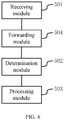
- a receiving module 501 is configured to receive a persistent connection establishment request sent by a client.
- a determination module 502 is configured to, based on the locally stored number of current persistent connections of each processing process, determine a first processing process with a lowest number of current persistent connections.
- a processing module 503 is configured to use the first processing process to process the persistent connection establishment request.
- the receiving module 501 is specifically configured to: determine a second processing process based on a preset receiving order, and receive the persistent connection establishment request sent by the client through the second processing process.
- the device further includes: a forwarding module configured to, through the second processing process, use SOCKET to forward the persistent connection establishment request to a managing process.
- a forwarding module configured to, through the second processing process, use SOCKET to forward the persistent connection establishment request to a managing process.
- the determining module 502 is specifically configured to: based on the locally stored number of current persistent connections of each processing process, determine a first processing process with a lowest number of current persistent connections through the managing process.
- the processing module 503 is further configured to: after receiving the persistent connection establishment request sent by the client, if the persistent connection establishment request carries identification information of a third processing process, use the third processing process to process the persistent connection establishment request.
- the determining module 502 is specifically configured to: if the persistent connection establishment request carries no identification information of any processing process, based on the locally stored number of current persistent connections of each processing process, determine the first processing process with the lowest number of current persistent connections
- the determining module 502 is specifically configured to:
- the server receives the persistent connection establishment request sent by the client, and based on the locally stored number of current persistent connections of each processing process, the server determines the first processing process with the minimum number of current persistent connections and uses the first processing process to process the persistent connection establishment request.
- the server may select, from all the processing processes, the processing process with the lowest load for processing. Accordingly, the loads of the plurality of processing processes become balanced, and the utilization rate of server in processing the resources is improved.
- the device for processing the persistent connection establishment request provided by the aforementioned embodiments processes the persistent connection establishment request
- the division of the aforementioned functional modules are merely for illustrative purposes. In practical applications, the aforementioned functions may be implemented by different functional modules based on demand. That is, the internal structure of the device may be divided into different functional modules to implement all or partial of the above-described functions.
- the device for processing the persistent connection establishment request provided by the aforementioned embodiments is based on the same idea behind the method embodiment for processing the persistent connection establishment request belong to the same idea, whose specific implementation process may refer to the method embodiments. Repeated descriptions are not provided herein.
- FIG. 7 is a structural schematic view of a server provided by embodiments of the present disclosure.
- the server 700 may vary largely due to the variance of configurations and performances, which may include one or more CPUs 722 (e.g., one or more processors), a memory 732, one or more storage application programs 742 or a storage medium 730 (e.g., one or more mass storage devices) of data 744.
- the memory 732 and the storage medium 730 may be temporary or persistent storage media.
- Programs stored in the storage medium 730 may include one or more modules (not labeled in the figure), and each module may include a series of instructional operations in the server.
- the CPU 722 may be configured to communicate with the storage medium 730, and at the server 700, a series of instructional operations in the storage medium may be executed.
- the server 700 may further include one or more power sources 726, one or more wired or wireless network interfaces 750, one or more I/O interfaces 758, one or more keyboards 756, and/or one or more operating systems 741, such as Windows ServerTM, Mac OS XTM, UnixTM, LinuxTM, and FreeBSDTM.
- the server 700 may include a memory, and one or more programs.
- the one or more programs may be stored in the memory, and may be configured to enable one or more processors to execute one or more programs including instructions for processing the aforementioned persistent connection establishment request.
Landscapes
- Engineering & Computer Science (AREA)
- Computer Networks & Wireless Communication (AREA)
- Signal Processing (AREA)
- Computer Security & Cryptography (AREA)
- Computer Hardware Design (AREA)
- General Engineering & Computer Science (AREA)
- Computer And Data Communications (AREA)
Applications Claiming Priority (2)
| Application Number | Priority Date | Filing Date | Title |
|---|---|---|---|
| CN201710550234.7A CN107135279B (zh) | 2017-07-07 | 2017-07-07 | 一种处理长连接建立请求的方法和装置 |
| PCT/CN2017/095551 WO2019006808A1 (zh) | 2017-07-07 | 2017-08-02 | 一种处理长连接建立请求的方法和装置 |
Publications (2)
| Publication Number | Publication Date |
|---|---|
| EP3550802A1 true EP3550802A1 (de) | 2019-10-09 |
| EP3550802A4 EP3550802A4 (de) | 2020-01-08 |
Family
ID=59737402
Family Applications (1)
| Application Number | Title | Priority Date | Filing Date |
|---|---|---|---|
| EP17916475.1A Withdrawn EP3550802A4 (de) | 2017-07-07 | 2017-08-02 | Verfahren und vorrichtung zur verarbeitung von persistenten verbindungsaufbauanfragen |
Country Status (4)
| Country | Link |
|---|---|
| US (1) | US10791166B2 (de) |
| EP (1) | EP3550802A4 (de) |
| CN (1) | CN107135279B (de) |
| WO (1) | WO2019006808A1 (de) |
Families Citing this family (13)
| Publication number | Priority date | Publication date | Assignee | Title |
|---|---|---|---|---|
| CN108306926B (zh) * | 2017-11-30 | 2021-08-13 | 深圳市科列技术股份有限公司 | 一种车联网设备网关业务数据的推送方法和装置 |
| CN108055346B (zh) * | 2017-12-26 | 2020-12-22 | 广东睿江云计算股份有限公司 | 一种优化邮件终端链接的方法 |
| CN108200218B (zh) * | 2018-03-09 | 2021-11-26 | 北京奇艺世纪科技有限公司 | 一种实现负载均衡的方法、装置及电子设备 |
| CN110855726B (zh) * | 2018-08-20 | 2024-02-06 | 北京京东尚科信息技术有限公司 | 通信方法、装置以及网关、计算设备和介质 |
| CN110958281B (zh) * | 2018-09-26 | 2021-07-09 | 华为技术有限公司 | 基于物联网的数据传输方法及通信装置 |
| CN113411371B (zh) * | 2020-11-12 | 2024-02-06 | 腾讯科技(深圳)有限公司 | 应用于车辆的通信方法、装置、电子设备及车辆 |
| CN113923249B (zh) * | 2021-10-12 | 2024-08-27 | 工银科技有限公司 | 一种高性能网络长连接建立方法及装置 |
| CN113992731B (zh) * | 2021-11-02 | 2024-04-30 | 四川安迪科技实业有限公司 | 基于stomp协议的异常控制方法及装置 |
| CN114286425B (zh) * | 2021-12-17 | 2024-12-03 | 北京达佳互联信息技术有限公司 | 一种长连接建立系统、方法、装置、电子设备及存储介质 |
| CN114168348A (zh) * | 2021-12-17 | 2022-03-11 | 中国建设银行股份有限公司 | 一种调度方法、装置及存储介质 |
| US11652909B1 (en) | 2022-03-10 | 2023-05-16 | International Business Machines Corporation | TCP session closure in container orchestration system |
| CN115134400B (zh) * | 2022-06-29 | 2024-11-19 | 中国工商银行股份有限公司 | 动态调整长连接数的方法和装置 |
| CN116095007A (zh) * | 2023-02-10 | 2023-05-09 | 平安科技(深圳)有限公司 | 负载调度方法、装置、计算机设备及存储介质 |
Family Cites Families (10)
| Publication number | Priority date | Publication date | Assignee | Title |
|---|---|---|---|---|
| AU2001296993A1 (en) | 2000-10-05 | 2002-04-15 | Christopher Peiffer | Connection management system and method |
| US20040049580A1 (en) * | 2002-09-05 | 2004-03-11 | International Business Machines Corporation | Receive queue device with efficient queue flow control, segment placement and virtualization mechanisms |
| US7966418B2 (en) * | 2003-02-21 | 2011-06-21 | Axeda Corporation | Establishing a virtual tunnel between two computer programs |
| US20050154733A1 (en) * | 2003-12-05 | 2005-07-14 | David Meltzer | Real-time change detection for network systems |
| CN102916953B (zh) * | 2012-10-12 | 2016-03-09 | 青岛海信传媒网络技术有限公司 | 基于tcp连接实现并发服务的方法及装置 |
| CN103051724B (zh) * | 2012-12-28 | 2016-06-15 | 北京思特奇信息技术股份有限公司 | 一种基于长连接的套接字同步方法 |
| US9756086B1 (en) * | 2013-03-04 | 2017-09-05 | Amazon Technologies, Inc. | Distributed connection management |
| US10243854B2 (en) * | 2015-12-09 | 2019-03-26 | International Business Machines Corporation | Persistent connection rebalancing |
| CN105721342B (zh) * | 2016-02-24 | 2017-08-25 | 腾讯科技(深圳)有限公司 | 多进程设备的网络连接方法和系统 |
| CN105763634B (zh) * | 2016-04-14 | 2019-01-04 | 北京思特奇信息技术股份有限公司 | 一种基于tcp长连接的服务实现方法和装置 |
-
2017
- 2017-07-07 CN CN201710550234.7A patent/CN107135279B/zh not_active Expired - Fee Related
- 2017-08-02 WO PCT/CN2017/095551 patent/WO2019006808A1/zh not_active Ceased
- 2017-08-02 US US16/328,943 patent/US10791166B2/en not_active Expired - Fee Related
- 2017-08-02 EP EP17916475.1A patent/EP3550802A4/de not_active Withdrawn
Also Published As
| Publication number | Publication date |
|---|---|
| WO2019006808A1 (zh) | 2019-01-10 |
| US10791166B2 (en) | 2020-09-29 |
| CN107135279B (zh) | 2020-11-27 |
| US20190245914A1 (en) | 2019-08-08 |
| EP3550802A4 (de) | 2020-01-08 |
| CN107135279A (zh) | 2017-09-05 |
Similar Documents
| Publication | Publication Date | Title |
|---|---|---|
| US10791166B2 (en) | Method and device for processing persistent connection establishment request | |
| US9547502B2 (en) | Rebooting InfiniBand clusters | |
| US10419531B2 (en) | Method for setting gateway device identity, and management gateway device | |
| US9532359B2 (en) | Resource allocation method and device | |
| CN110166524B (zh) | 数据中心的切换方法、装置、设备及存储介质 | |
| US9571379B2 (en) | Computer system, communication control server, communication control method, and program | |
| US12041688B2 (en) | Screen projection method and system | |
| KR20210016802A (ko) | 소프트웨어 정의 네트워킹 환경에서 서버-클라이언트 기반의 네트워크 서비스를 위한 플로우 테이블을 최적화하는 방법 및 이를 위한 sdn 스위치 | |
| CN106302647A (zh) | 消息分发方法及服务器 | |
| CN110868323B (zh) | 一种带宽控制方法、装置、设备及介质 | |
| CN112565390B (zh) | 服务分配方法、装置、电子设备及存储介质 | |
| CN112416495A (zh) | 一种超融合云终端资源统一管理系统及方法 | |
| CN104753714B (zh) | 网络设备及网络中的业务处理方法 | |
| CN113535402A (zh) | 基于5g mec的负载均衡处理方法、装置及电子设备 | |
| CN119276834A (zh) | 一种端口绑定方法和相关装置 | |
| JPH1027146A (ja) | 通信処理装置及び通信処理方法 | |
| CN112995311B (zh) | 服务提供方法、设备及存储介质 | |
| US20150200813A1 (en) | Server connection apparatus and server connection method | |
| CN116962446B (zh) | 一种NVMe-oF链路动态管理方法及系统 | |
| US12432642B2 (en) | Dynamic core sharding in a cloud-based 5G network | |
| CN119105808B (zh) | 模型加载方法、电子设备以及存储介质 | |
| CN110798512A (zh) | 一种集中式数据推送方法、智能终端及存储介质 | |
| CN100442227C (zh) | 一种软件加载系统和软件加载实现方法 | |
| CN120705108A (zh) | 一种基于rdma的通信方法以及相关装置 | |
| Zhang et al. | A Runtime Framework for Context-Sensitive Device-to-Device Communication |
Legal Events
| Date | Code | Title | Description |
|---|---|---|---|
| STAA | Information on the status of an ep patent application or granted ep patent |
Free format text: STATUS: THE INTERNATIONAL PUBLICATION HAS BEEN MADE |
|
| PUAI | Public reference made under article 153(3) epc to a published international application that has entered the european phase |
Free format text: ORIGINAL CODE: 0009012 |
|
| STAA | Information on the status of an ep patent application or granted ep patent |
Free format text: STATUS: REQUEST FOR EXAMINATION WAS MADE |
|
| 17P | Request for examination filed |
Effective date: 20190701 |
|
| AK | Designated contracting states |
Kind code of ref document: A1 Designated state(s): AL AT BE BG CH CY CZ DE DK EE ES FI FR GB GR HR HU IE IS IT LI LT LU LV MC MK MT NL NO PL PT RO RS SE SI SK SM TR |
|
| AX | Request for extension of the european patent |
Extension state: BA ME |
|
| A4 | Supplementary search report drawn up and despatched |
Effective date: 20191205 |
|
| RIC1 | Information provided on ipc code assigned before grant |
Ipc: H04L 29/06 20060101ALI20191130BHEP Ipc: H04L 29/08 20060101AFI20191130BHEP |
|
| RIN1 | Information on inventor provided before grant (corrected) |
Inventor name: YU, SHENGSHUI Inventor name: LIN, ZHANGKUN |
|
| STAA | Information on the status of an ep patent application or granted ep patent |
Free format text: STATUS: EXAMINATION IS IN PROGRESS |
|
| 17Q | First examination report despatched |
Effective date: 20200911 |
|
| DAV | Request for validation of the european patent (deleted) | ||
| DAX | Request for extension of the european patent (deleted) | ||
| STAA | Information on the status of an ep patent application or granted ep patent |
Free format text: STATUS: THE APPLICATION IS DEEMED TO BE WITHDRAWN |
|
| 18D | Application deemed to be withdrawn |
Effective date: 20220721 |