EP3546316B1 - Automatic electrical propulsion for prams or stroller - Google Patents
Automatic electrical propulsion for prams or stroller Download PDFInfo
- Publication number
- EP3546316B1 EP3546316B1 EP19170141.6A EP19170141A EP3546316B1 EP 3546316 B1 EP3546316 B1 EP 3546316B1 EP 19170141 A EP19170141 A EP 19170141A EP 3546316 B1 EP3546316 B1 EP 3546316B1
- Authority
- EP
- European Patent Office
- Prior art keywords
- pram
- stroller
- pushing force
- propulsion
- engine
- Prior art date
- Legal status (The legal status is an assumption and is not a legal conclusion. Google has not performed a legal analysis and makes no representation as to the accuracy of the status listed.)
- Active
Links
Images
Classifications
-
- B—PERFORMING OPERATIONS; TRANSPORTING
- B62—LAND VEHICLES FOR TRAVELLING OTHERWISE THAN ON RAILS
- B62B—HAND-PROPELLED VEHICLES, e.g. HAND CARTS OR PERAMBULATORS; SLEDGES
- B62B9/00—Accessories or details specially adapted for children's carriages or perambulators
-
- B—PERFORMING OPERATIONS; TRANSPORTING
- B62—LAND VEHICLES FOR TRAVELLING OTHERWISE THAN ON RAILS
- B62B—HAND-PROPELLED VEHICLES, e.g. HAND CARTS OR PERAMBULATORS; SLEDGES
- B62B5/00—Accessories or details specially adapted for hand carts
- B62B5/0026—Propulsion aids
- B62B5/0033—Electric motors
- B62B5/0036—Arrangements of motors
- B62B5/0046—One motor drives two wheels
-
- B—PERFORMING OPERATIONS; TRANSPORTING
- B62—LAND VEHICLES FOR TRAVELLING OTHERWISE THAN ON RAILS
- B62B—HAND-PROPELLED VEHICLES, e.g. HAND CARTS OR PERAMBULATORS; SLEDGES
- B62B5/00—Accessories or details specially adapted for hand carts
- B62B5/0026—Propulsion aids
- B62B5/0069—Control
- B62B5/0073—Measuring a force
Definitions
- the invention concerns the additional electrical propulsion for the standard pram or stroller but the propulsion is activated automatically only when it is useful on. the ascent or on the flat surface with the heavy load of the pram.
- the purpose of the invention is to implement fully-automatic propulsion on the pram or stroller as easy to operate as a normal pram/stroller without propulsion.
- the prior art includes prams/strollers with basic propulsion.
- a person operating the pram/stroller has to regulate the speed with the accelerator lever manually ( US 8,033,348 or DE 20 2011 209 457 U1 ).
- FR 2 688 181 A describes a propulsion control with a bar under the handle.
- DE 20 2007 008 851 U1 discloses two electric motors and two control devices for each of the motors.
- the actual state of this art includes prams/strollers with electric engine and accelerator lever; and a person who is operating the pram/stroller has to regulate the speed with the accelerator lever manually. It is necessary to place the accelerator lever on the pram's handle and a person who is operating the pram has to use one hand or some fingers for operate the lever and therefore his/her attention is not fully focused on the pram's control.
- the first group of problems concerns the technical or ergonomic aspects for operating the electric pram/stroller with manual control lever:
- the second group of problems concerns the safety of the baby. There are not sensors or any other devices which would stop the propulsion and the pram's movement in case of danger which implies that it can come to pass several dangerous situations:
- the invention concerns additional electrical propulsion for the standard pram or stroller.
- the propulsion is not directly controlled by the person who is pushing the pram but is controlled by a micro-computer automatically.
- the electric propulsion is activated only in case the pushing force (F p ) rises above the defined activation level (F on ); the other way the electric propulsion is deactivated in case the pushing force (F p ) falls under the defined deactivation level (F off ) which implies two operation modes:
- a power unit on the rear end of the pram's chassis and it is placed between the rear wheels.
- the front wheels are independent from the rear wheels therefore the front wheels could keep on revolving.
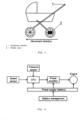
- the last component of the system is a pressure sensor (it can be mechanical or electrical) placed on the pram's handle which is the only component placed outside of the power unit ( Fig. 1 ).
Landscapes
- Engineering & Computer Science (AREA)
- Mechanical Engineering (AREA)
- Chemical & Material Sciences (AREA)
- Public Health (AREA)
- Combustion & Propulsion (AREA)
- Transportation (AREA)
- Health & Medical Sciences (AREA)
- Hydraulic Clutches, Magnetic Clutches, Fluid Clutches, And Fluid Joints (AREA)
- Electric Propulsion And Braking For Vehicles (AREA)
- Carriages For Children, Sleds, And Other Hand-Operated Vehicles (AREA)
- Handcart (AREA)
- Stand-By Power Supply Arrangements (AREA)
- Arrangement And Mounting Of Devices That Control Transmission Of Motive Force (AREA)
Description
- The invention concerns the additional electrical propulsion for the standard pram or stroller but the propulsion is activated automatically only when it is useful on. the ascent or on the flat surface with the heavy load of the pram. The purpose of the invention is to implement fully-automatic propulsion on the pram or stroller as easy to operate as a normal pram/stroller without propulsion.
- The prior art includes prams/strollers with basic propulsion. A person operating the pram/stroller has to regulate the speed with the accelerator lever manually (
US 8,033,348 orDE 20 2011 209 457 U1 ).FR 2 688 181 ADE 20 2007 008 851 U1 discloses two electric motors and two control devices for each of the motors. - The actual state of this art includes prams/strollers with electric engine and accelerator lever; and a person who is operating the pram/stroller has to regulate the speed with the accelerator lever manually. It is necessary to place the accelerator lever on the pram's handle and a person who is operating the pram has to use one hand or some fingers for operate the lever and therefore his/her attention is not fully focused on the pram's control.
- The below mentioned problems are the primary reasons why electric propulsion is not widely required on the market at the moment. Therefore most of the sold prams/strollers are sold without any propulsion.
- The first group of problems concerns the technical or ergonomic aspects for operating the electric pram/stroller with manual control lever:
- 1) The usage of a pram with electric engine and accelerator lever is not natural. It is necessary and could be difficult to coordinate the accelerator lever, the pushing and the handling.
- 2) The hands position of the person who is operating the pram is different than the normal pram without propulsion.
- 3) The person who is operating the pram has to divide his/her attention to control the propulsion.
- 4) There is a problem with the smoothness of the pram's movements, because the surface of the way is not straight and the engine does not have enough feedback power to sustain the pram's speed.
- 5) The moment of switching on and off is not automatically defined and depends on the person who is operating the pram.
- 6) The maximum speed of a pram with propulsion is very low due to safety concerns for the baby.
- 7) And the last but not least problem is that the accelerator lever has a bad impact on the design of the pram/stroller.
- The second group of problems concerns the safety of the baby. There are not sensors or any other devices which would stop the propulsion and the pram's movement in case of danger which implies that it can come to pass several dangerous situations:
- 1) Failure of the electrical circuits could cause uncontrolled movement of the pram/stroller and bring potential danger to the baby.
- 2) The person who is operating the pram or stroller could make a mistake with the manipulation of the lever and it can bring potential danger to the baby.
- 3) The person who is operating the pram/stroller could have a sudden impairing health situation and it could cause uncontrolled movement and bring potential danger to the baby.
- The solution according to the invention is defined in the appended claims.
- The invention concerns additional electrical propulsion for the standard pram or stroller. However, the propulsion is not directly controlled by the person who is pushing the pram but is controlled by a micro-computer automatically.
- Preferably, the electric propulsion is activated only in case the pushing force (Fp) rises above the defined activation level (Fon); the other way the electric propulsion is deactivated in case the pushing force (Fp) falls under the defined deactivation level (Foff) which implies two operation modes:
- a. Active mode - Fp reaches Fon and simultaneously Fp does not fall under Foff.
The electric engine drives the rear wheels so that median value of Fp will be constant and be equal to Fon. - b. Non active mode - Fp does not reach Fon or Fp fall under Foff.
- There is a power unit on the rear end of the pram's chassis and it is placed between the rear wheels. The front wheels are independent from the rear wheels therefore the front wheels could keep on revolving. And the last component of the system is a pressure sensor (it can be mechanical or electrical) placed on the pram's handle which is the only component placed outside of the power unit (
Fig. 1 ). - In case of active mode the revolution of the engine is controlled by the CPU depending on the pressure force of the person who is operating the pram/stroller. And then the revolution of the engine is:

- n
- the revolution of the engine
- Pi
- the input engine's power
- R
- the engine's load
- Ak
- engine's parameter constant
- There is only one variable that can affect the revolution in real which is the input engine's power (Pi). The engine's parameters are given, therefore Ak is constant. And the engine's load is not possible to be predicted in advance of real time. It is necessary to think how is the pressure force (Fp) changing in real time. Because the pressure force (Fp) is not constant, it is necessary to control the input engine's power depending on the average pressure force in a definite elapse of time.
- It could be convenient to measure the real engine's revolution and control the input engine's power to keep the engine's revolution constant. The change of the engine's revolution depends on the change of the average pressure force.
- Electronic components (
Fig. 2 ): - a) The CPU (central processing unit)
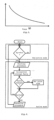
This component is an 8 bit microprocessor that controls input and output signals and all the logic around the propulsion (input power of the engine and alternatively the switching of the clutch). In case of DC engine we can use the wide pulse modulation (PWM) for controlling the engine (the flow chart is shown inFig. 6 ).- Input signals:
- actual pushing force
- actual wheel's speed (optional)
- Output signals:
- the signal for the amplifier which controls the engine's revolution
- alternatively the switching on or off the clutch
- the other signalization
- Basic parameters for DC engine:
- the optimal PWM signal frequency is between 500Hz and 1kHz
- the microprocessor clock rate has to be at least 1000x higher than the PWM signal frequency
- the optimal period for average pushing force calculation is 1,5s,
- the microprocessor has to have an A/D convertor.
- Input signals:
- b) The pressure sensor
There is the pressure sensor on the pram's handle which measures the intensity of the pushing force (Fp). This sensor can be mechanical or electrical and it is connected directly to the A/D input of the CPU. In case of the electrical sensor, the sensor is placed in the central area of the pram's handle. This sensor changes its internal resistance depending on the pressure of the mechanical force (Fig. 5 ). - c) The speed sensor
This sensor measures the number of revolutions of the rear wheels or rather the rear shaft before the differential. This component is not necessary for the basic principle of this invention but can provide the linear operation and the run-up of the engine. - d) The power amplifier
The semi-conductor MOSFET transistor supplies power to the engine. The parameters of this transistor are dependent primarily on the required input power of the engine. - e) The battery pack
It is possible to use any kind of battery but in this case it is necessary to use batteries with low weight, with high output current, with large capacity and sufficiently safe. The nominal voltage and total capacity are dependent on the chosen engine. - f) The battery control unit
It is the electronic circuit which controls the primary switching on or off and the discharging of battery. Battery charging is solved externally because it is necessary to take the battery out of the pram/stroller and charging it separately. - Mechanical components (
Fig. 3 or Fig. 4 ): - a) The engine
This component is a convertor of electric energy to mechanical power. It is possible to use an AC or DC engine but it is very important to choose an engine with good characteristics. In the case of the DC engine it is strongly recommend this set of characteristics:- Rated power round 40W
- Rated voltage 12V
- Rated revolution around 5000 rev/min
- Maximal revolution around 7000 rev/min
- Rated current around 6A
- Basic torque 700 g/cm
- b) The gear
The electric engine has a high rated revolution and for this application it is necessary to use gear because the pram needs torque instead of speed. The gear ratio depends on the engine's rated revolution and it is optimal to calculate the maximal pram's speed around 10 km/h. In the case of the recommended engine and 25cm diameter wheels the gear ratio will be 24 to 1. - c) The clutch
This component is not necessary for the basic principle of this invention but can provide:- Smooth start of the propulsion in case Fp increases above Fon.
- In case of electrical circuits failure the clutch switches off automatically ensuring the safety of the baby.
- The clutch ensures that in case of non active propulsion the engine should not have negative effect on the movement of the pram/stroller. The principle of the slippery clutch is as the same as in the automotive industry. The clutch switching mode is controlled electronically by the CPU.
- d) The differential freewheel
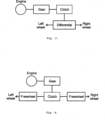
These components transfer the mechanical power to the left and right wheel independently. The alternative for freewheel (Fig. 4 ) is cheaper but there is one problem with the rear wheels' freedom of movement in case of backward movement. The rear wheels are locked together during the backward movement. Therefore the best way is to use a small differential whose principle is known from automotive industry. -
- Fig. 1
- The position of the| power unit and the, pressure 5 sensor.
- Fig. 2
- The principle diagram of electronic components.
- Fig. 3
- The principle diagram of mechanical components in case of the differential usage.
- Fig. 4
- The principle diagram of mechanical components in case of the freewheel usage.
- Fig. 5
- The pressure sensor resistance depending on pressure force.
- Fig. 6
- The operation flowchart of the CPU software.
Claims (14)
- A method for controlling electrical propulsion of a pram or stroller,wherein an average pushing force of the person who is operating the pram or stroller is determined with respect to a predetermined time period,wherein the average pushing force is kept constant regardless of external aspects such as the pram's load, the quality and the tilt of a surface.
- The method of claim 1, wherein at least one sensor determines at least one physical variable in addition to the average pushing force, such as a revolution, a tilt, an acceleration, et cetera.
- The method of claim 1 or 2, wherein a value for an activation force Fon and a value for a deactivation force Foff is defined, and wherein the electrical propulsion is activated if the average pushing force exceeds Fon and is deactivated when the average pushing force falls below Foff.
- The method of one of the preceding claims, wherein a pressure sensor measures the actual pushing force (Fp) for determining the average pushing force.
- The method of claim 4, wherein the pressure sensor is placed in the central area of a handle of the pram or stroller.
- The method of claim 4 or 5, wherein the pressure sensor is mechanical or electrical.
- The method of one of the preceding claims, wherein a speed sensor measures the speed of the pram or stroller, in particular via the number of revolutions of wheels, preferably rear wheels, or of a rear shaft before a differential.
- The method of one of the preceding claims, wherein the electrical propulsion comprises a gear and/or a clutch and/or a differential.
- The method of one of the preceding claims, wherein the electrical propulsion is PWM-controlled.
- The method of one of the preceding claims, wherein a microprocessor is provided for controlling the electrical propulsion.
- A method for electrical propulsion of a pram or stroller including the method of one of the preceding claims.
- An electric propulsion control device for controlling electrical propulsion of a pram or stroller, in particular for the method of one of the preceding claims, being configured so that an average pushing force of the person who is operating the pram or stroller is determined with respect to a predetermined time period, wherein the average pushing force is kept constant regardless of external aspects such as the pram's load, the quality and the tilt of a surface.
- An electric propulsion device for a pram or stroller including an electric propulsion control device of claim 12.
- A pram or stroller including an electric propulsion device of claim 13 or an electric propulsion control device of claim 12.
Priority Applications (1)
| Application Number | Priority Date | Filing Date | Title |
|---|---|---|---|
| EP19170141.6A EP3546316B1 (en) | 2013-06-24 | 2013-06-24 | Automatic electrical propulsion for prams or stroller |
Applications Claiming Priority (2)
| Application Number | Priority Date | Filing Date | Title |
|---|---|---|---|
| EP13466010.9A EP2818382B1 (en) | 2013-06-24 | 2013-06-24 | Automatic electrical propulsion for prams or stroller |
| EP19170141.6A EP3546316B1 (en) | 2013-06-24 | 2013-06-24 | Automatic electrical propulsion for prams or stroller |
Related Parent Applications (2)
| Application Number | Title | Priority Date | Filing Date |
|---|---|---|---|
| EP13466010.9A Division EP2818382B1 (en) | 2013-06-24 | 2013-06-24 | Automatic electrical propulsion for prams or stroller |
| EP13466010.9A Division-Into EP2818382B1 (en) | 2013-06-24 | 2013-06-24 | Automatic electrical propulsion for prams or stroller |
Publications (3)
| Publication Number | Publication Date |
|---|---|
| EP3546316A1 EP3546316A1 (en) | 2019-10-02 |
| EP3546316B1 true EP3546316B1 (en) | 2024-02-14 |
| EP3546316C0 EP3546316C0 (en) | 2024-02-14 |
Family
ID=48746412
Family Applications (2)
| Application Number | Title | Priority Date | Filing Date |
|---|---|---|---|
| EP13466010.9A Active EP2818382B1 (en) | 2013-06-24 | 2013-06-24 | Automatic electrical propulsion for prams or stroller |
| EP19170141.6A Active EP3546316B1 (en) | 2013-06-24 | 2013-06-24 | Automatic electrical propulsion for prams or stroller |
Family Applications Before (1)
| Application Number | Title | Priority Date | Filing Date |
|---|---|---|---|
| EP13466010.9A Active EP2818382B1 (en) | 2013-06-24 | 2013-06-24 | Automatic electrical propulsion for prams or stroller |
Country Status (12)
| Country | Link |
|---|---|
| EP (2) | EP2818382B1 (en) |
| CY (1) | CY1121987T1 (en) |
| DK (1) | DK2818382T3 (en) |
| ES (1) | ES2739324T3 (en) |
| HR (1) | HRP20191317T1 (en) |
| HU (1) | HUE045485T2 (en) |
| LT (1) | LT2818382T (en) |
| PL (1) | PL2818382T3 (en) |
| PT (1) | PT2818382T (en) |
| RS (1) | RS59212B1 (en) |
| SI (1) | SI2818382T1 (en) |
| SM (1) | SMT201900470T1 (en) |
Families Citing this family (9)
| Publication number | Priority date | Publication date | Assignee | Title |
|---|---|---|---|---|
| CN105644606A (en) * | 2016-02-24 | 2016-06-08 | 好孩子儿童用品有限公司 | Child stroller |
| CN106023521B (en) * | 2016-06-12 | 2018-11-16 | 江苏科力斯通新材料有限公司 | It is capable of the perambulator security system of early warning speed |
| CN105869352B (en) * | 2016-06-12 | 2018-11-16 | 绍兴上虞德能机械制造有限公司 | It is capable of the perambulator security system of early warning security distance |
| CN105976561B (en) * | 2016-06-12 | 2019-02-15 | 深圳市万佳安物联科技股份有限公司 | security system |
| CN106043397B (en) * | 2016-06-20 | 2020-09-01 | 好孩子儿童用品有限公司 | Power-assisted baby stroller |
| DE102016211916A1 (en) * | 2016-06-30 | 2018-01-04 | Robert Bosch Gmbh | Pushchair comfort device, stroller underframe and stroller |
| CN107463115A (en) * | 2017-08-07 | 2017-12-12 | 深圳和而泰智能家居科技有限公司 | Intelligent stroller and its power-control method |
| DE102018215506A1 (en) * | 2018-09-12 | 2020-03-12 | Robert Bosch Gmbh | Transport device, especially a stroller |
| DE102021120796A1 (en) | 2021-08-10 | 2023-02-16 | Cybex Gmbh | Stroller, frame and method for automatic rocking |
Citations (2)
| Publication number | Priority date | Publication date | Assignee | Title |
|---|---|---|---|---|
| EP1630061A1 (en) * | 2003-06-02 | 2006-03-01 | Sony Corporation | Transportation motor vehicle and method of controlling the same |
| DE202011109457U1 (en) * | 2011-12-22 | 2012-01-31 | Werner Maier | Pushchair or transport device with electric drive, in one unit or as an adapter, coupled with extra auxiliary drive wheel, battery, solar elevator spring operation |
Family Cites Families (15)
| Publication number | Priority date | Publication date | Assignee | Title |
|---|---|---|---|---|
| GB8421712D0 (en) | 1984-08-28 | 1984-10-03 | Unilever Plc | Floor-cleaning machine |
| FR2688181A1 (en) | 1992-03-09 | 1993-09-10 | Bodereau Pierre | Device for motorising a pram, baby carriage, pushchair, be they foldable or otherwise, fixed permanently, or which can be added-on |
| DE9311075U1 (en) | 1993-07-24 | 1994-11-24 | Strothmann, Rolf, Dr., 66123 Saarbrücken | Electric drive of a hand-drawn or pushed, mobile object |
| DE69515746T2 (en) | 1994-07-06 | 2000-10-26 | Nabco Ltd., Kobe | Motor vehicle |
| EP0707842A1 (en) | 1994-10-17 | 1996-04-24 | Nabco Limited | Motor driven vehicle |
| DE19607976C2 (en) | 1996-03-01 | 1998-01-15 | Jungheinrich Ag | Travel encoder for a hand-held industrial truck powered by a motor |
| EP0811469B1 (en) | 1996-06-08 | 2003-09-17 | EXPRESSO DEUTSCHLAND TRANSPORTGERÄTE GmbH | Distribution or transport trolley |
| DE29713739U1 (en) | 1997-08-01 | 1998-11-26 | Strothmann, Rolf, Dr.rer.nat., 66123 Saarbrücken | Transport system |
| DE10309621A1 (en) | 2003-03-05 | 2004-09-30 | Fraunhofer-Gesellschaft zur Förderung der angewandten Forschung e.V. | Motor-powered, hand-guided transport vehicle, especially electric wheelchair, with intuitive grip control has sensors that detect forces/torques, pass measurement data to evaluation and control device |
| GB2426963B (en) | 2005-06-07 | 2009-02-18 | Clive George Hemsley | Control apparatus for motorised article |
| DE202007008851U1 (en) | 2007-06-25 | 2008-10-30 | Brodda-Sikora, Ines | Battery stroller |
| US8033348B1 (en) | 2008-04-07 | 2011-10-11 | Hemin Parkhe | Self-propelled child stroller |
| US7987933B1 (en) | 2009-02-12 | 2011-08-02 | Mcclellan John L | Motorized stroller apparatus |
| DE102009044840A1 (en) | 2009-12-09 | 2011-06-16 | Clean Mobile Ag | Multiple stroller with seating areas for at least two children |
| DE102011114337A1 (en) | 2011-09-23 | 2013-03-28 | Bernd von Löbbecke | Motor control for an electric auxiliary drive |
-
2013
- 2013-06-24 RS RSP20190926 patent/RS59212B1/en unknown
- 2013-06-24 SM SM20190470T patent/SMT201900470T1/en unknown
- 2013-06-24 SI SI201331529T patent/SI2818382T1/en unknown
- 2013-06-24 HU HUE13466010A patent/HUE045485T2/en unknown
- 2013-06-24 ES ES13466010T patent/ES2739324T3/en active Active
- 2013-06-24 DK DK13466010.9T patent/DK2818382T3/en active
- 2013-06-24 EP EP13466010.9A patent/EP2818382B1/en active Active
- 2013-06-24 EP EP19170141.6A patent/EP3546316B1/en active Active
- 2013-06-24 LT LTEP13466010.9T patent/LT2818382T/en unknown
- 2013-06-24 PT PT13466010T patent/PT2818382T/en unknown
- 2013-06-24 PL PL13466010T patent/PL2818382T3/en unknown
-
2019
- 2019-07-22 HR HRP20191317TT patent/HRP20191317T1/en unknown
- 2019-07-26 CY CY20191100798T patent/CY1121987T1/en unknown
Patent Citations (2)
| Publication number | Priority date | Publication date | Assignee | Title |
|---|---|---|---|---|
| EP1630061A1 (en) * | 2003-06-02 | 2006-03-01 | Sony Corporation | Transportation motor vehicle and method of controlling the same |
| DE202011109457U1 (en) * | 2011-12-22 | 2012-01-31 | Werner Maier | Pushchair or transport device with electric drive, in one unit or as an adapter, coupled with extra auxiliary drive wheel, battery, solar elevator spring operation |
Also Published As
| Publication number | Publication date |
|---|---|
| HUE045485T2 (en) | 2019-12-30 |
| EP2818382A1 (en) | 2014-12-31 |
| ES2739324T3 (en) | 2020-01-30 |
| PL2818382T3 (en) | 2019-11-29 |
| DK2818382T3 (en) | 2019-08-12 |
| CY1121987T1 (en) | 2020-10-14 |
| SMT201900470T1 (en) | 2019-09-09 |
| PT2818382T (en) | 2019-09-05 |
| LT2818382T (en) | 2019-09-25 |
| EP3546316C0 (en) | 2024-02-14 |
| EP2818382B1 (en) | 2019-05-29 |
| EP3546316A1 (en) | 2019-10-02 |
| HRP20191317T1 (en) | 2019-10-18 |
| RS59212B1 (en) | 2019-10-31 |
| SI2818382T1 (en) | 2019-10-30 |
Similar Documents
| Publication | Publication Date | Title |
|---|---|---|
| EP2818382B1 (en) | Automatic electrical propulsion for prams or stroller | |
| EP2572831B1 (en) | Electric power tool | |
| US20150137721A1 (en) | Power tool | |
| US9263975B2 (en) | Motor control system and control system for electric motor-driven vehicle | |
| US10603770B2 (en) | Adaptive impact blow detection | |
| EP4675384A2 (en) | Anti bind-up control for power tools | |
| EP4364713A1 (en) | Power-assisted control method and apparatus for smart walking aid, smart walking aid, and controller | |
| JP5331136B2 (en) | Electric tool | |
| ES2939838T3 (en) | System for piloting an electric motor on electric motorcycles or similar | |
| JP6548318B2 (en) | Drive system and method for driving a vehicle | |
| EP2818281B1 (en) | Electric power tool | |
| JP2014014221A (en) | Slip suppression drive control device and slip suppression method for electric vehicle | |
| JP2015050836A (en) | Walking assist mobile | |
| JPWO2015053244A1 (en) | Wheelbarrow | |
| US9481262B2 (en) | Electric vehicle and method | |
| JP2015000617A (en) | Power conversion equipment for power steering of electric forklift and electric forklift using the same | |
| CN103659747B (en) | Electric tool | |
| JP5552019B2 (en) | Power tools | |
| CN206602475U (en) | Step actuator | |
| JP3575533B2 (en) | Adjustment mode switching device for electric vehicle | |
| KR20220032106A (en) | stroller | |
| JP2001025101A (en) | Safety controller of electric vehicle | |
| EP3418176A1 (en) | Control system of learning applications for electric bikes | |
| CN207683687U (en) | Electric vehicle and its speed control device | |
| KR20150001032A (en) | Vehicle for children and operating method for breaking thereof |
Legal Events
| Date | Code | Title | Description |
|---|---|---|---|
| PUAI | Public reference made under article 153(3) epc to a published international application that has entered the european phase |
Free format text: ORIGINAL CODE: 0009012 |
|
| STAA | Information on the status of an ep patent application or granted ep patent |
Free format text: STATUS: THE APPLICATION HAS BEEN PUBLISHED |
|
| AC | Divisional application: reference to earlier application |
Ref document number: 2818382 Country of ref document: EP Kind code of ref document: P |
|
| AK | Designated contracting states |
Kind code of ref document: A1 Designated state(s): AL AT BE BG CH CY CZ DE DK EE ES FI FR GB GR HR HU IE IS IT LI LT LU LV MC MK MT NL NO PL PT RO RS SE SI SK SM TR |
|
| STAA | Information on the status of an ep patent application or granted ep patent |
Free format text: STATUS: REQUEST FOR EXAMINATION WAS MADE |
|
| 17P | Request for examination filed |
Effective date: 20200330 |
|
| RBV | Designated contracting states (corrected) |
Designated state(s): AL AT BE BG CH CY CZ DE DK EE ES FI FR GB GR HR HU IE IS IT LI LT LU LV MC MK MT NL NO PL PT RO RS SE SI SK SM TR |
|
| STAA | Information on the status of an ep patent application or granted ep patent |
Free format text: STATUS: EXAMINATION IS IN PROGRESS |
|
| 17Q | First examination report despatched |
Effective date: 20220121 |
|
| GRAP | Despatch of communication of intention to grant a patent |
Free format text: ORIGINAL CODE: EPIDOSNIGR1 |
|
| STAA | Information on the status of an ep patent application or granted ep patent |
Free format text: STATUS: GRANT OF PATENT IS INTENDED |
|
| INTG | Intention to grant announced |
Effective date: 20230831 |
|
| GRAS | Grant fee paid |
Free format text: ORIGINAL CODE: EPIDOSNIGR3 |
|
| GRAA | (expected) grant |
Free format text: ORIGINAL CODE: 0009210 |
|
| STAA | Information on the status of an ep patent application or granted ep patent |
Free format text: STATUS: THE PATENT HAS BEEN GRANTED |
|
| AC | Divisional application: reference to earlier application |
Ref document number: 2818382 Country of ref document: EP Kind code of ref document: P |
|
| AK | Designated contracting states |
Kind code of ref document: B1 Designated state(s): AL AT BE BG CH CY CZ DE DK EE ES FI FR GB GR HR HU IE IS IT LI LT LU LV MC MK MT NL NO PL PT RO RS SE SI SK SM TR |
|
| REG | Reference to a national code |
Ref country code: GB Ref legal event code: FG4D |
|
| REG | Reference to a national code |
Ref country code: CH Ref legal event code: EP |
|
| REG | Reference to a national code |
Ref country code: DE Ref legal event code: R096 Ref document number: 602013085305 Country of ref document: DE |
|
| REG | Reference to a national code |
Ref country code: IE Ref legal event code: FG4D |
|
| U01 | Request for unitary effect filed |
Effective date: 20240313 |
|
| U07 | Unitary effect registered |
Designated state(s): AT BE BG DE DK EE FI FR IT LT LU LV MT NL PT SE SI Effective date: 20240320 |
|
| PG25 | Lapsed in a contracting state [announced via postgrant information from national office to epo] |
Ref country code: IS Free format text: LAPSE BECAUSE OF FAILURE TO SUBMIT A TRANSLATION OF THE DESCRIPTION OR TO PAY THE FEE WITHIN THE PRESCRIBED TIME-LIMIT Effective date: 20240614 |
|
| PG25 | Lapsed in a contracting state [announced via postgrant information from national office to epo] |
Ref country code: GR Free format text: LAPSE BECAUSE OF FAILURE TO SUBMIT A TRANSLATION OF THE DESCRIPTION OR TO PAY THE FEE WITHIN THE PRESCRIBED TIME-LIMIT Effective date: 20240515 |
|
| PG25 | Lapsed in a contracting state [announced via postgrant information from national office to epo] |
Ref country code: RS Free format text: LAPSE BECAUSE OF FAILURE TO SUBMIT A TRANSLATION OF THE DESCRIPTION OR TO PAY THE FEE WITHIN THE PRESCRIBED TIME-LIMIT Effective date: 20240514 Ref country code: HR Free format text: LAPSE BECAUSE OF FAILURE TO SUBMIT A TRANSLATION OF THE DESCRIPTION OR TO PAY THE FEE WITHIN THE PRESCRIBED TIME-LIMIT Effective date: 20240214 |
|
| PG25 | Lapsed in a contracting state [announced via postgrant information from national office to epo] |
Ref country code: ES Free format text: LAPSE BECAUSE OF FAILURE TO SUBMIT A TRANSLATION OF THE DESCRIPTION OR TO PAY THE FEE WITHIN THE PRESCRIBED TIME-LIMIT Effective date: 20240214 |
|
| PG25 | Lapsed in a contracting state [announced via postgrant information from national office to epo] |
Ref country code: RS Free format text: LAPSE BECAUSE OF FAILURE TO SUBMIT A TRANSLATION OF THE DESCRIPTION OR TO PAY THE FEE WITHIN THE PRESCRIBED TIME-LIMIT Effective date: 20240514 Ref country code: NO Free format text: LAPSE BECAUSE OF FAILURE TO SUBMIT A TRANSLATION OF THE DESCRIPTION OR TO PAY THE FEE WITHIN THE PRESCRIBED TIME-LIMIT Effective date: 20240514 Ref country code: IS Free format text: LAPSE BECAUSE OF FAILURE TO SUBMIT A TRANSLATION OF THE DESCRIPTION OR TO PAY THE FEE WITHIN THE PRESCRIBED TIME-LIMIT Effective date: 20240614 Ref country code: HR Free format text: LAPSE BECAUSE OF FAILURE TO SUBMIT A TRANSLATION OF THE DESCRIPTION OR TO PAY THE FEE WITHIN THE PRESCRIBED TIME-LIMIT Effective date: 20240214 Ref country code: GR Free format text: LAPSE BECAUSE OF FAILURE TO SUBMIT A TRANSLATION OF THE DESCRIPTION OR TO PAY THE FEE WITHIN THE PRESCRIBED TIME-LIMIT Effective date: 20240515 Ref country code: ES Free format text: LAPSE BECAUSE OF FAILURE TO SUBMIT A TRANSLATION OF THE DESCRIPTION OR TO PAY THE FEE WITHIN THE PRESCRIBED TIME-LIMIT Effective date: 20240214 |
|
| PG25 | Lapsed in a contracting state [announced via postgrant information from national office to epo] |
Ref country code: PL Free format text: LAPSE BECAUSE OF FAILURE TO SUBMIT A TRANSLATION OF THE DESCRIPTION OR TO PAY THE FEE WITHIN THE PRESCRIBED TIME-LIMIT Effective date: 20240214 |
|
| U20 | Renewal fee for the european patent with unitary effect paid |
Year of fee payment: 12 Effective date: 20240628 |
|
| PG25 | Lapsed in a contracting state [announced via postgrant information from national office to epo] |
Ref country code: PL Free format text: LAPSE BECAUSE OF FAILURE TO SUBMIT A TRANSLATION OF THE DESCRIPTION OR TO PAY THE FEE WITHIN THE PRESCRIBED TIME-LIMIT Effective date: 20240214 |
|
| PG25 | Lapsed in a contracting state [announced via postgrant information from national office to epo] |
Ref country code: SM Free format text: LAPSE BECAUSE OF FAILURE TO SUBMIT A TRANSLATION OF THE DESCRIPTION OR TO PAY THE FEE WITHIN THE PRESCRIBED TIME-LIMIT Effective date: 20240214 |
|
| PG25 | Lapsed in a contracting state [announced via postgrant information from national office to epo] |
Ref country code: CZ Free format text: LAPSE BECAUSE OF FAILURE TO SUBMIT A TRANSLATION OF THE DESCRIPTION OR TO PAY THE FEE WITHIN THE PRESCRIBED TIME-LIMIT Effective date: 20240214 |
|
| PG25 | Lapsed in a contracting state [announced via postgrant information from national office to epo] |
Ref country code: SK Free format text: LAPSE BECAUSE OF FAILURE TO SUBMIT A TRANSLATION OF THE DESCRIPTION OR TO PAY THE FEE WITHIN THE PRESCRIBED TIME-LIMIT Effective date: 20240214 |
|
| PG25 | Lapsed in a contracting state [announced via postgrant information from national office to epo] |
Ref country code: SM Free format text: LAPSE BECAUSE OF FAILURE TO SUBMIT A TRANSLATION OF THE DESCRIPTION OR TO PAY THE FEE WITHIN THE PRESCRIBED TIME-LIMIT Effective date: 20240214 Ref country code: SK Free format text: LAPSE BECAUSE OF FAILURE TO SUBMIT A TRANSLATION OF THE DESCRIPTION OR TO PAY THE FEE WITHIN THE PRESCRIBED TIME-LIMIT Effective date: 20240214 Ref country code: RO Free format text: LAPSE BECAUSE OF FAILURE TO SUBMIT A TRANSLATION OF THE DESCRIPTION OR TO PAY THE FEE WITHIN THE PRESCRIBED TIME-LIMIT Effective date: 20240214 Ref country code: CZ Free format text: LAPSE BECAUSE OF FAILURE TO SUBMIT A TRANSLATION OF THE DESCRIPTION OR TO PAY THE FEE WITHIN THE PRESCRIBED TIME-LIMIT Effective date: 20240214 |
|
| REG | Reference to a national code |
Ref country code: DE Ref legal event code: R097 Ref document number: 602013085305 Country of ref document: DE |
|
| PLBE | No opposition filed within time limit |
Free format text: ORIGINAL CODE: 0009261 |
|
| STAA | Information on the status of an ep patent application or granted ep patent |
Free format text: STATUS: NO OPPOSITION FILED WITHIN TIME LIMIT |
|
| 26N | No opposition filed |
Effective date: 20241115 |
|
| PG25 | Lapsed in a contracting state [announced via postgrant information from national office to epo] |
Ref country code: MC Free format text: LAPSE BECAUSE OF FAILURE TO SUBMIT A TRANSLATION OF THE DESCRIPTION OR TO PAY THE FEE WITHIN THE PRESCRIBED TIME-LIMIT Effective date: 20240214 |
|
| REG | Reference to a national code |
Ref country code: CH Ref legal event code: PL |
|
| PG25 | Lapsed in a contracting state [announced via postgrant information from national office to epo] |
Ref country code: IE Free format text: LAPSE BECAUSE OF NON-PAYMENT OF DUE FEES Effective date: 20240624 |
|
| PG25 | Lapsed in a contracting state [announced via postgrant information from national office to epo] |
Ref country code: CH Free format text: LAPSE BECAUSE OF NON-PAYMENT OF DUE FEES Effective date: 20240630 |
|
| PGFP | Annual fee paid to national office [announced via postgrant information from national office to epo] |
Ref country code: GB Payment date: 20250619 Year of fee payment: 13 |
|
| U20 | Renewal fee for the european patent with unitary effect paid |
Year of fee payment: 13 Effective date: 20250630 |
|
| PG25 | Lapsed in a contracting state [announced via postgrant information from national office to epo] |
Ref country code: CY Free format text: LAPSE BECAUSE OF FAILURE TO SUBMIT A TRANSLATION OF THE DESCRIPTION OR TO PAY THE FEE WITHIN THE PRESCRIBED TIME-LIMIT; INVALID AB INITIO Effective date: 20130624 |
|
| PG25 | Lapsed in a contracting state [announced via postgrant information from national office to epo] |
Ref country code: HU Free format text: LAPSE BECAUSE OF FAILURE TO SUBMIT A TRANSLATION OF THE DESCRIPTION OR TO PAY THE FEE WITHIN THE PRESCRIBED TIME-LIMIT; INVALID AB INITIO Effective date: 20130624 |