EP3545923A1 - Trunks type disposable diaper - Google Patents
Trunks type disposable diaper Download PDFInfo
- Publication number
- EP3545923A1 EP3545923A1 EP17873481.0A EP17873481A EP3545923A1 EP 3545923 A1 EP3545923 A1 EP 3545923A1 EP 17873481 A EP17873481 A EP 17873481A EP 3545923 A1 EP3545923 A1 EP 3545923A1
- Authority
- EP
- European Patent Office
- Prior art keywords
- leg elastic
- around
- leg
- elastic member
- elastic members
- Prior art date
- Legal status (The legal status is an assumption and is not a legal conclusion. Google has not performed a legal analysis and makes no representation as to the accuracy of the status listed.)
- Granted
Links
Images








Classifications
-
- A—HUMAN NECESSITIES
- A61—MEDICAL OR VETERINARY SCIENCE; HYGIENE
- A61F—FILTERS IMPLANTABLE INTO BLOOD VESSELS; PROSTHESES; DEVICES PROVIDING PATENCY TO, OR PREVENTING COLLAPSING OF, TUBULAR STRUCTURES OF THE BODY, e.g. STENTS; ORTHOPAEDIC, NURSING OR CONTRACEPTIVE DEVICES; FOMENTATION; TREATMENT OR PROTECTION OF EYES OR EARS; BANDAGES, DRESSINGS OR ABSORBENT PADS; FIRST-AID KITS
- A61F13/00—Bandages or dressings; Absorbent pads
- A61F13/15—Absorbent pads, e.g. sanitary towels, swabs or tampons for external or internal application to the body; Supporting or fastening means therefor; Tampon applicators
- A61F13/45—Absorbent pads, e.g. sanitary towels, swabs or tampons for external or internal application to the body; Supporting or fastening means therefor; Tampon applicators characterised by the shape
- A61F13/49—Absorbent pads, e.g. sanitary towels, swabs or tampons for external or internal application to the body; Supporting or fastening means therefor; Tampon applicators characterised by the shape specially adapted to be worn around the waist, e.g. diapers or nappies
- A61F13/49007—Form-fitting, self-adjusting disposable diapers
- A61F13/49009—Form-fitting, self-adjusting disposable diapers with elastic means
- A61F13/49011—Form-fitting, self-adjusting disposable diapers with elastic means the elastic means is located at the waist region
-
- A—HUMAN NECESSITIES
- A61—MEDICAL OR VETERINARY SCIENCE; HYGIENE
- A61F—FILTERS IMPLANTABLE INTO BLOOD VESSELS; PROSTHESES; DEVICES PROVIDING PATENCY TO, OR PREVENTING COLLAPSING OF, TUBULAR STRUCTURES OF THE BODY, e.g. STENTS; ORTHOPAEDIC, NURSING OR CONTRACEPTIVE DEVICES; FOMENTATION; TREATMENT OR PROTECTION OF EYES OR EARS; BANDAGES, DRESSINGS OR ABSORBENT PADS; FIRST-AID KITS
- A61F13/00—Bandages or dressings; Absorbent pads
- A61F13/15—Absorbent pads, e.g. sanitary towels, swabs or tampons for external or internal application to the body; Supporting or fastening means therefor; Tampon applicators
- A61F13/45—Absorbent pads, e.g. sanitary towels, swabs or tampons for external or internal application to the body; Supporting or fastening means therefor; Tampon applicators characterised by the shape
- A61F13/49—Absorbent pads, e.g. sanitary towels, swabs or tampons for external or internal application to the body; Supporting or fastening means therefor; Tampon applicators characterised by the shape specially adapted to be worn around the waist, e.g. diapers or nappies
- A61F13/496—Absorbent pads, e.g. sanitary towels, swabs or tampons for external or internal application to the body; Supporting or fastening means therefor; Tampon applicators characterised by the shape specially adapted to be worn around the waist, e.g. diapers or nappies in the form of pants or briefs
-
- A—HUMAN NECESSITIES
- A61—MEDICAL OR VETERINARY SCIENCE; HYGIENE
- A61F—FILTERS IMPLANTABLE INTO BLOOD VESSELS; PROSTHESES; DEVICES PROVIDING PATENCY TO, OR PREVENTING COLLAPSING OF, TUBULAR STRUCTURES OF THE BODY, e.g. STENTS; ORTHOPAEDIC, NURSING OR CONTRACEPTIVE DEVICES; FOMENTATION; TREATMENT OR PROTECTION OF EYES OR EARS; BANDAGES, DRESSINGS OR ABSORBENT PADS; FIRST-AID KITS
- A61F13/00—Bandages or dressings; Absorbent pads
- A61F13/15—Absorbent pads, e.g. sanitary towels, swabs or tampons for external or internal application to the body; Supporting or fastening means therefor; Tampon applicators
- A61F13/45—Absorbent pads, e.g. sanitary towels, swabs or tampons for external or internal application to the body; Supporting or fastening means therefor; Tampon applicators characterised by the shape
- A61F13/49—Absorbent pads, e.g. sanitary towels, swabs or tampons for external or internal application to the body; Supporting or fastening means therefor; Tampon applicators characterised by the shape specially adapted to be worn around the waist, e.g. diapers or nappies
- A61F13/49007—Form-fitting, self-adjusting disposable diapers
- A61F13/49009—Form-fitting, self-adjusting disposable diapers with elastic means
-
- A—HUMAN NECESSITIES
- A61—MEDICAL OR VETERINARY SCIENCE; HYGIENE
- A61F—FILTERS IMPLANTABLE INTO BLOOD VESSELS; PROSTHESES; DEVICES PROVIDING PATENCY TO, OR PREVENTING COLLAPSING OF, TUBULAR STRUCTURES OF THE BODY, e.g. STENTS; ORTHOPAEDIC, NURSING OR CONTRACEPTIVE DEVICES; FOMENTATION; TREATMENT OR PROTECTION OF EYES OR EARS; BANDAGES, DRESSINGS OR ABSORBENT PADS; FIRST-AID KITS
- A61F13/00—Bandages or dressings; Absorbent pads
- A61F13/15—Absorbent pads, e.g. sanitary towels, swabs or tampons for external or internal application to the body; Supporting or fastening means therefor; Tampon applicators
- A61F13/45—Absorbent pads, e.g. sanitary towels, swabs or tampons for external or internal application to the body; Supporting or fastening means therefor; Tampon applicators characterised by the shape
- A61F13/49—Absorbent pads, e.g. sanitary towels, swabs or tampons for external or internal application to the body; Supporting or fastening means therefor; Tampon applicators characterised by the shape specially adapted to be worn around the waist, e.g. diapers or nappies
- A61F13/49001—Absorbent pads, e.g. sanitary towels, swabs or tampons for external or internal application to the body; Supporting or fastening means therefor; Tampon applicators characterised by the shape specially adapted to be worn around the waist, e.g. diapers or nappies having preferential bending zones, e.g. fold lines or grooves
-
- A—HUMAN NECESSITIES
- A61—MEDICAL OR VETERINARY SCIENCE; HYGIENE
- A61F—FILTERS IMPLANTABLE INTO BLOOD VESSELS; PROSTHESES; DEVICES PROVIDING PATENCY TO, OR PREVENTING COLLAPSING OF, TUBULAR STRUCTURES OF THE BODY, e.g. STENTS; ORTHOPAEDIC, NURSING OR CONTRACEPTIVE DEVICES; FOMENTATION; TREATMENT OR PROTECTION OF EYES OR EARS; BANDAGES, DRESSINGS OR ABSORBENT PADS; FIRST-AID KITS
- A61F13/00—Bandages or dressings; Absorbent pads
- A61F13/15—Absorbent pads, e.g. sanitary towels, swabs or tampons for external or internal application to the body; Supporting or fastening means therefor; Tampon applicators
- A61F13/45—Absorbent pads, e.g. sanitary towels, swabs or tampons for external or internal application to the body; Supporting or fastening means therefor; Tampon applicators characterised by the shape
- A61F13/49—Absorbent pads, e.g. sanitary towels, swabs or tampons for external or internal application to the body; Supporting or fastening means therefor; Tampon applicators characterised by the shape specially adapted to be worn around the waist, e.g. diapers or nappies
- A61F13/49007—Form-fitting, self-adjusting disposable diapers
- A61F13/49009—Form-fitting, self-adjusting disposable diapers with elastic means
- A61F13/49017—Form-fitting, self-adjusting disposable diapers with elastic means the elastic means being located at the crotch region
-
- A—HUMAN NECESSITIES
- A61—MEDICAL OR VETERINARY SCIENCE; HYGIENE
- A61F—FILTERS IMPLANTABLE INTO BLOOD VESSELS; PROSTHESES; DEVICES PROVIDING PATENCY TO, OR PREVENTING COLLAPSING OF, TUBULAR STRUCTURES OF THE BODY, e.g. STENTS; ORTHOPAEDIC, NURSING OR CONTRACEPTIVE DEVICES; FOMENTATION; TREATMENT OR PROTECTION OF EYES OR EARS; BANDAGES, DRESSINGS OR ABSORBENT PADS; FIRST-AID KITS
- A61F13/00—Bandages or dressings; Absorbent pads
- A61F13/15—Absorbent pads, e.g. sanitary towels, swabs or tampons for external or internal application to the body; Supporting or fastening means therefor; Tampon applicators
- A61F13/45—Absorbent pads, e.g. sanitary towels, swabs or tampons for external or internal application to the body; Supporting or fastening means therefor; Tampon applicators characterised by the shape
- A61F13/49—Absorbent pads, e.g. sanitary towels, swabs or tampons for external or internal application to the body; Supporting or fastening means therefor; Tampon applicators characterised by the shape specially adapted to be worn around the waist, e.g. diapers or nappies
- A61F13/49007—Form-fitting, self-adjusting disposable diapers
- A61F13/49009—Form-fitting, self-adjusting disposable diapers with elastic means
- A61F13/49019—Form-fitting, self-adjusting disposable diapers with elastic means the elastic means being placed longitudinally, transversely or diagonally over the article
-
- A—HUMAN NECESSITIES
- A61—MEDICAL OR VETERINARY SCIENCE; HYGIENE
- A61F—FILTERS IMPLANTABLE INTO BLOOD VESSELS; PROSTHESES; DEVICES PROVIDING PATENCY TO, OR PREVENTING COLLAPSING OF, TUBULAR STRUCTURES OF THE BODY, e.g. STENTS; ORTHOPAEDIC, NURSING OR CONTRACEPTIVE DEVICES; FOMENTATION; TREATMENT OR PROTECTION OF EYES OR EARS; BANDAGES, DRESSINGS OR ABSORBENT PADS; FIRST-AID KITS
- A61F13/00—Bandages or dressings; Absorbent pads
- A61F13/15—Absorbent pads, e.g. sanitary towels, swabs or tampons for external or internal application to the body; Supporting or fastening means therefor; Tampon applicators
- A61F13/45—Absorbent pads, e.g. sanitary towels, swabs or tampons for external or internal application to the body; Supporting or fastening means therefor; Tampon applicators characterised by the shape
- A61F13/49—Absorbent pads, e.g. sanitary towels, swabs or tampons for external or internal application to the body; Supporting or fastening means therefor; Tampon applicators characterised by the shape specially adapted to be worn around the waist, e.g. diapers or nappies
- A61F13/49058—Absorbent pads, e.g. sanitary towels, swabs or tampons for external or internal application to the body; Supporting or fastening means therefor; Tampon applicators characterised by the shape specially adapted to be worn around the waist, e.g. diapers or nappies characterised by the modular concept of constructing the diaper
- A61F13/4906—Absorbent pads, e.g. sanitary towels, swabs or tampons for external or internal application to the body; Supporting or fastening means therefor; Tampon applicators characterised by the shape specially adapted to be worn around the waist, e.g. diapers or nappies characterised by the modular concept of constructing the diaper the diaper having an outer chassis forming the diaper and an independent absorbent structure attached to the chassis
-
- A—HUMAN NECESSITIES
- A61—MEDICAL OR VETERINARY SCIENCE; HYGIENE
- A61F—FILTERS IMPLANTABLE INTO BLOOD VESSELS; PROSTHESES; DEVICES PROVIDING PATENCY TO, OR PREVENTING COLLAPSING OF, TUBULAR STRUCTURES OF THE BODY, e.g. STENTS; ORTHOPAEDIC, NURSING OR CONTRACEPTIVE DEVICES; FOMENTATION; TREATMENT OR PROTECTION OF EYES OR EARS; BANDAGES, DRESSINGS OR ABSORBENT PADS; FIRST-AID KITS
- A61F13/00—Bandages or dressings; Absorbent pads
- A61F13/15—Absorbent pads, e.g. sanitary towels, swabs or tampons for external or internal application to the body; Supporting or fastening means therefor; Tampon applicators
- A61F13/45—Absorbent pads, e.g. sanitary towels, swabs or tampons for external or internal application to the body; Supporting or fastening means therefor; Tampon applicators characterised by the shape
- A61F13/49—Absorbent pads, e.g. sanitary towels, swabs or tampons for external or internal application to the body; Supporting or fastening means therefor; Tampon applicators characterised by the shape specially adapted to be worn around the waist, e.g. diapers or nappies
- A61F13/493—Absorbent pads, e.g. sanitary towels, swabs or tampons for external or internal application to the body; Supporting or fastening means therefor; Tampon applicators characterised by the shape specially adapted to be worn around the waist, e.g. diapers or nappies adjustable by adding or removing material, e.g. umbilical cord arrangements
-
- A—HUMAN NECESSITIES
- A61—MEDICAL OR VETERINARY SCIENCE; HYGIENE
- A61F—FILTERS IMPLANTABLE INTO BLOOD VESSELS; PROSTHESES; DEVICES PROVIDING PATENCY TO, OR PREVENTING COLLAPSING OF, TUBULAR STRUCTURES OF THE BODY, e.g. STENTS; ORTHOPAEDIC, NURSING OR CONTRACEPTIVE DEVICES; FOMENTATION; TREATMENT OR PROTECTION OF EYES OR EARS; BANDAGES, DRESSINGS OR ABSORBENT PADS; FIRST-AID KITS
- A61F13/00—Bandages or dressings; Absorbent pads
- A61F13/15—Absorbent pads, e.g. sanitary towels, swabs or tampons for external or internal application to the body; Supporting or fastening means therefor; Tampon applicators
- A61F13/45—Absorbent pads, e.g. sanitary towels, swabs or tampons for external or internal application to the body; Supporting or fastening means therefor; Tampon applicators characterised by the shape
- A61F13/49—Absorbent pads, e.g. sanitary towels, swabs or tampons for external or internal application to the body; Supporting or fastening means therefor; Tampon applicators characterised by the shape specially adapted to be worn around the waist, e.g. diapers or nappies
- A61F13/496—Absorbent pads, e.g. sanitary towels, swabs or tampons for external or internal application to the body; Supporting or fastening means therefor; Tampon applicators characterised by the shape specially adapted to be worn around the waist, e.g. diapers or nappies in the form of pants or briefs
- A61F13/4963—Absorbent pads, e.g. sanitary towels, swabs or tampons for external or internal application to the body; Supporting or fastening means therefor; Tampon applicators characterised by the shape specially adapted to be worn around the waist, e.g. diapers or nappies in the form of pants or briefs characterized by the seam
-
- A—HUMAN NECESSITIES
- A61—MEDICAL OR VETERINARY SCIENCE; HYGIENE
- A61F—FILTERS IMPLANTABLE INTO BLOOD VESSELS; PROSTHESES; DEVICES PROVIDING PATENCY TO, OR PREVENTING COLLAPSING OF, TUBULAR STRUCTURES OF THE BODY, e.g. STENTS; ORTHOPAEDIC, NURSING OR CONTRACEPTIVE DEVICES; FOMENTATION; TREATMENT OR PROTECTION OF EYES OR EARS; BANDAGES, DRESSINGS OR ABSORBENT PADS; FIRST-AID KITS
- A61F13/00—Bandages or dressings; Absorbent pads
- A61F13/15—Absorbent pads, e.g. sanitary towels, swabs or tampons for external or internal application to the body; Supporting or fastening means therefor; Tampon applicators
- A61F13/53—Absorbent pads, e.g. sanitary towels, swabs or tampons for external or internal application to the body; Supporting or fastening means therefor; Tampon applicators characterised by the absorbing medium
-
- A—HUMAN NECESSITIES
- A61—MEDICAL OR VETERINARY SCIENCE; HYGIENE
- A61F—FILTERS IMPLANTABLE INTO BLOOD VESSELS; PROSTHESES; DEVICES PROVIDING PATENCY TO, OR PREVENTING COLLAPSING OF, TUBULAR STRUCTURES OF THE BODY, e.g. STENTS; ORTHOPAEDIC, NURSING OR CONTRACEPTIVE DEVICES; FOMENTATION; TREATMENT OR PROTECTION OF EYES OR EARS; BANDAGES, DRESSINGS OR ABSORBENT PADS; FIRST-AID KITS
- A61F13/00—Bandages or dressings; Absorbent pads
- A61F13/15—Absorbent pads, e.g. sanitary towels, swabs or tampons for external or internal application to the body; Supporting or fastening means therefor; Tampon applicators
- A61F13/53—Absorbent pads, e.g. sanitary towels, swabs or tampons for external or internal application to the body; Supporting or fastening means therefor; Tampon applicators characterised by the absorbing medium
- A61F13/531—Absorbent pads, e.g. sanitary towels, swabs or tampons for external or internal application to the body; Supporting or fastening means therefor; Tampon applicators characterised by the absorbing medium having a homogeneous composition through the thickness of the pad
- A61F13/532—Absorbent pads, e.g. sanitary towels, swabs or tampons for external or internal application to the body; Supporting or fastening means therefor; Tampon applicators characterised by the absorbing medium having a homogeneous composition through the thickness of the pad inhomogeneous in the plane of the pad
-
- A—HUMAN NECESSITIES
- A61—MEDICAL OR VETERINARY SCIENCE; HYGIENE
- A61F—FILTERS IMPLANTABLE INTO BLOOD VESSELS; PROSTHESES; DEVICES PROVIDING PATENCY TO, OR PREVENTING COLLAPSING OF, TUBULAR STRUCTURES OF THE BODY, e.g. STENTS; ORTHOPAEDIC, NURSING OR CONTRACEPTIVE DEVICES; FOMENTATION; TREATMENT OR PROTECTION OF EYES OR EARS; BANDAGES, DRESSINGS OR ABSORBENT PADS; FIRST-AID KITS
- A61F13/00—Bandages or dressings; Absorbent pads
- A61F13/15—Absorbent pads, e.g. sanitary towels, swabs or tampons for external or internal application to the body; Supporting or fastening means therefor; Tampon applicators
- A61F13/45—Absorbent pads, e.g. sanitary towels, swabs or tampons for external or internal application to the body; Supporting or fastening means therefor; Tampon applicators characterised by the shape
- A61F13/49—Absorbent pads, e.g. sanitary towels, swabs or tampons for external or internal application to the body; Supporting or fastening means therefor; Tampon applicators characterised by the shape specially adapted to be worn around the waist, e.g. diapers or nappies
- A61F2013/49088—Absorbent pads, e.g. sanitary towels, swabs or tampons for external or internal application to the body; Supporting or fastening means therefor; Tampon applicators characterised by the shape specially adapted to be worn around the waist, e.g. diapers or nappies characterized by the leg opening
Definitions
- the present invention relates to a trunks-type disposable diaper having improved fitting to the inner thigh.
- An underpants-type disposable diaper generally includes an outer member, an inner member, and side seal portions.
- the outer member has a waist opening and a pair of leg openings and extends from a front waist opening edge to a back waist opening edge.
- the inner member is provided at least in a crotch portion of the outer member and includes an absorber.
- the side seal portions bond both sides on the front side and both sides on the back side of the outer member.
- a trunks-type disposable diaper (also referred to as a one-quarter length form or a boxer type) having a pair of cylindrical leg portions surrounding root sides of the thighs.
- a trunks-type disposable diaper having a simple structure in a cylindrical leg portion a trunks-type disposable diaper is known in which a crotch portion of an outer member has a pair of inner thigh contact portions respectively extending to one side and the other side in the width direction of a circumscribed rectangle of an absorber, and a portion along edges of leg openings including these inner thigh contact portions is a pair of cylindrical leg portions surrounding root sides of the thighs (refer to, for example, Patent Literatures 1 to 5).
- a trunks-type disposable diaper like other types of underpants-type disposable diapers, in order to improve fitting to the body, various elastic members are fixed to an outer member in a stretched state.
- a front around-leg elastic member and a back around-leg elastic member are attached on the front and back sides of the outer member in a pattern of extending from one of side seal portions toward the center in the width direction along the edges of leg openings, crossing the center in the width direction towards the other leg opening, and extending along the other leg opening to the other side seal portion.
- the front around-leg elastic member and the back around-leg elastic member are important since those determines the fitting of cylindrical leg portions of a trunks-type disposable diaper.
- a trunks-type disposable diaper comprising an outer member having a waist opening and a pair of leg openings and extending from a front waist opening edge to a back waist opening edge, an inner member provided at least in a crotch portion of the outer member and including an absorber, and side seal portions that bond both sides on the front side and both sides on the back side of the outer member, a crotch portion of the outer member has a pair of inner thigh contact portions which respectively extend to one side and the other side in a width direction from a circumscribed rectangle of the absorber, portions along edges of the leg openings including the inner thigh contact portions form a pair of cylindrical leg portions surrounding a root side of thighs, the front side of the outer member has one or a plurality of elongated front around-leg elastic members not crossing each other, the elastic member is attached in a pattern of extending from one of the side seal portions toward the center in the width direction along an edge of the leg opening, crossing the center in the width direction, extending toward the other leg opening, and
- An inner member bonded portion that is a region bonding the outer member and the inner member is provided only further to a center side in the width direction than a crossing position of the front around-leg elastic member and the back around-leg elastic member on both sides in the width direction in the intermediate region.
- the inner member bonded portion is provided only to the center side in the width direction than the crossing position of the front around-leg elastic member and the back around-leg elastic member on both sides in the width direction, and the front around-leg elastic member and the back around-leg elastic member do not expand or contract together with the inner member. Therefore, the fitting is not deteriorated at a portion including a crossing position between the front around-leg elastic member and a back around-leg elastic member though the front around-leg elastic member and the back around-leg elastic member cross each other and are substantially continuous along the leg opening.
- an intermediate portion in the front-back direction of the absorber is a narrower portion having a width narrower than both front and back sides thereof, and the narrowest portion of the narrower portion is positioned further to the center side in the width direction than both side edges of the inner member bonded portion.
- the inner member bonded portion is provided only further to the center side in the width direction than the crossing position of the front around-leg elastic member and the back around-leg elastic member on both width direction sides in the intermediate region between the edge of one leg opening and the edge of the other leg opening. Even in such case, if a highly rigid absorber is present laterally from the inner member bonded portion, the effect of improving the fitting by the around-leg elastic members is hindered. Therefore, the configuration as the present aspect is one preferable embodiment.
- a non-stretchable region in which the front around-leg elastic member and the back around-leg elastic member are cut finely is provided further to the center side in the width direction from the crossing position of the front around-leg elastic member and the back around-leg elastic member on both sides in the width direction.
- the stretchable region of the front around-leg elastic member and the back around-leg elastic member is provided further to the center side in the width direction than the crossing position of the front around-leg elastic member and the back around-leg elastic member on both sides in the width direction, the wearing feeling is deteriorated due to the contraction of the absorber in the width direction. Therefore, as in this aspect, it is preferable to form a non-stretchable region on the center side in the width direction while maintaining continuity by crossing the front around-leg elastic member and the back around-leg elastic member.
- a plurality of the front around-leg elastic members and a plurality of the back around-leg elastic members are provided, the front around-leg elastic members and the back around-leg elastic members are attached on both sides in the width direction of the intermediate region in a pattern in which a group of a plurality of the front around-leg elastic members and a group of a plurality of the back around-leg elastic members cross each other, and when the front around-leg elastic members and the back around-leg elastic members are sequentially numbered in this order from the member closest to the edge of the leg opening to the furthest member, the front around-leg elastic members and the back around-leg elastic members in the same order are continuous from the side seal portion to the mutual crossing position, and respective portions on the center side in the width direction from the mutual crossing positions are cut.
- the combination of the front around-leg elastic member and the back around-leg elastic member, which are continuous along the leg opening is a combination of each one of the front around-leg elastic member and the back around-leg elastic member, and since the front around-leg elastic member and the back around-leg elastic member of each set do not cross each other, flexibility is less likely to decrease.
- a plurality of the front around-leg elastic members and a plurality of the back around-leg elastic members are provided, the front around-leg elastic members and the back around-leg elastic members are attached on both sides in the width direction of the intermediate region in a pattern in which a group of a plurality of the front around-leg elastic members and a group of a plurality of the back around-leg elastic members cross each other, and when the front around-leg elastic members and the back around-leg elastic members are sequentially numbered in this order from the member furthest to the edge of the leg opening to the closest member, among the front around-leg elastic members and the around-back leg elastic members in the same order, the front around-leg elastic members are continuous from the side seal portion to the crossing position with the back around-leg elastic member in the next order, and the back around-leg elastic members are continuous from the side seal portion to the crossing position with the front around-leg elastic member in the next order, and respective portions on the center side in the width direction
- the combination of the front around-leg elastic member and the back around-leg elastic member, which are continuous along the leg opening is a combination of each one of the front around-leg elastic member and the back around-leg elastic member, and since the front around-leg elastic member and the back around-leg elastic member of each set do not cross each other, flexibility is less likely to decrease. Furthermore, according to this aspect, there is also an advantage that the crossing position of the front around-leg elastic member and the back around-leg elastic member is close to the leg opening, and the front around-leg elastic member and the back around-leg elastic member are continuous in a shape closer to the edge of the leg opening.
- the fitting is not deteriorated at a portion including a crossing position between a front around-leg elastic member and a back around-leg elastic member though the front around-leg elastic member and the back around-leg elastic member cross each other and are substantially continuous along the leg opening.
- polish rate means a value when the natural length is taken as 100%.
- dotted pattern portions in the drawings indicate a bonding means such as a hot melt adhesive.
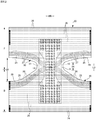
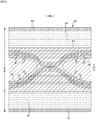
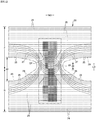
- Figs. 1 to 10 illustrate a trunks-type disposable diaper.
- This trunks-type disposable diaper (hereinafter also simply referred to as a diaper) includes an outer member 20, an inner member 10, and side seal portions 21.
- the outer member 20 has a waist opening and a pair of leg openings and extends from an edge of a waist opening of a front body F to an edge of a waist opening of a back body B.
- the inner member 10 is provided at least in a crotch portion 28 of the outer member 20 and includes an absorber 13.
- the side seal portions 21 bond both sides on the front side and both sides on the back side of the outer member 20.
- the crotch portion 28 of the outer member 20 has a pair of inner thigh contact portions 31 respectively extending to one side and the other side in the width direction from the circumscribed rectangle of the absorber 13 (the circumscribed rectangle means a virtual rectangle circumscribing the absorber 13 in a plan view in a spread state.
- the circumscribed rectangle means a virtual rectangle circumscribing the absorber 13 in a plan view in a spread state.
- one opposite side of the circumscribed rectangle of the absorber 13 is substantially equal to both side edges of the inner member 10).
- Portions along the edges 29 of the leg openings including the inner thigh contact portions 31 are a pair of cylindrical leg portions 30 surrounding the root side of the thighs.
- the inner member 10 and the outer member 20 are folded at the center in the front-back direction (longitudinal direction) which is a boundary between the front body F and the back body B, and both side portions thereof are bonded to each other by thermal welding, a hot melt adhesive, or the like to form the side seal portion 21.
- a trunks-type disposable diaper having a waist opening and a pair of leg openings can be formed.
- the inner member 10 has a structure in which the absorber 13 is interposed between a liquid pervious top sheet 11 made of a nonwoven fabric and the liquid impervious sheet 12 made of polyethylene or the like to absorb and retain excreted fluid that has permeated through the top sheet 11.
- the planar shape of the inner member 10 is not particularly limited, but generally it is a substantially rectangular shape as the illustrated embodiment.
- a porous or nonporous nonwoven fabric, a porous plastic sheet, or the like is suitably used.
- a raw material fiber forming a nonwoven fabric in addition to synthetic fibers such as polyolefin type such as polyethylene or polypropylene, polyester type, polyamide type, etc., regenerated fibers such as rayon and cupra, and natural fibers such as cotton can be used, and a nonwoven fabric obtained by an appropriate processing method, such as a spun lace method, a spun bond method, a thermal bond method, a melt blown method, and a needle punch method can be used.
- the spun lace method is excellent in terms of flexibility and drapability
- the thermal bond method is excellent in terms of bulkiness and softness.
- urine and the like are quickly absorbed, and dry touch property is excellent.
- the top sheet 11 is wound around the side edge portion of the absorber 13 and extends to the back surface side of the absorber 13, but is not limited thereto.
- a liquid impermeable plastic sheet such as polyethylene or polypropylene is used.
- these having moisture permeability are preferably used from the viewpoint of prevention of stuffiness.
- this waterproof/moisture pervious sheet include a microporous sheet.
- the microporous sheet is obtained by stretching a sheet in one or two axial directions after forming the sheet by melt kneading an inorganic filler in a polyolefinic resin such as polyethylene and polypropylene.
- the liquid impervious sheet 12 it is desirable to use an opaque sheet such that brown color of excreta, urine, and the like does not appear.
- a film obtained by internally adding a pigment or a filler such as calcium carbonate, titanium oxide, zinc oxide, white carbon, clay, talc, barium sulfate, or the like in a plastic is suitably used.
- the liquid impervious sheet 12 is folded back to the back surface side together with the top sheet 11 on both sides in the width direction of the absorber 13, but is not limited thereto.
- the absorber 13 is basically a known absorber, for example, laminates of pulp fibers, assembly of filaments such as cellulose acetate, or nonwoven fabrics, and as necessary, super absorbent polymers can be mixed therewith and fixed.
- the absorber 13 can be wrapped with a package sheet 14 having liquid permeability and liquid retention, such as crepe paper, as necessary, for shape and polymer retention and the like.
- the entire shape of the absorber 13 is formed in a substantially hourglass shape having a narrower portion 13N narrower than the front and back sides thereof in the front-back direction range including the crotch portion 28. However, it may have an appropriate shape such as a rectangular shape. Although the size of the narrower portion 13N can be determined as appropriate, the length in the front-back direction of the narrower portion 13N can be set to about 20 to 50% of the maximum length Y of the diaper, and the width of the narrowest portion 13m is about 40 to 60% of the maximum width of the absorber 13. In the case where such the narrower portion 13N is provided, if the planar shape of the inner member 10 is substantially rectangular, a remaining portion without the absorber 13 is formed at a portion corresponding to the narrower portion 13N of the absorber 13 in the inner member 10.
- the diffusion groove 17 extending in the front-back direction is provided in the intermediate portion in the width direction of the absorber 13, it is preferable since the diffusibility in the front-back direction of urine is improved. From the viewpoint of diffusibility of urine, it is preferable that the diffusion groove extends to both front and back sides of the intermediate region between the edge of one leg opening and the edge of the other leg opening. Only one diffusion groove 17 may be provided at the center in the width direction, but two diffusion grooves may be provided at an interval in the width direction. Although the diffusion groove 17 extends linearly in the illustrated embodiment, it may extend in a curved shape.
- the diffusion groove 17 is preferably a slit penetrating the absorber 13 in the thickness direction as the illustrated embodiment, but it may be a concave portion provided on at least one side of the front and back of the absorber 13 and not penetrating it in the thickness direction.
- the concave portion can be formed by reducing the basis weight of the formation position of the concave portion in comparison with the surroundings, and also it is formed by compressing the formation position of the concave portion by embossing.
- the position of the diffusion groove forming region is not limited as long as it is provided at the intermediate portion in the width direction of the absorber 13, but normally, the diffusion groove forming region is desirably located in the center in the width direction, and it is preferable that the width thereof (the width of the diffusion groove 17d in the case of one) is 5 to 20% of the maximum width 13w of the absorber 13. Further, the length 17L in the front-back direction of the diffusion groove 17 can be determined as appropriate, and can be set to about 30 to 70% of the maximum length of the absorber 13, for example.
- the three-dimensional gather BS is formed of the double folded gather sheet 15 composed of a fixed portion, a main unit section, a fallen portion, and a free portion.
- the fixed portion is fixed to a side portion of a back surface of the inner member 10.
- the main unit section extends from the fixed portion through a side of the inner member 10 to a side portion of a front surface of the inner member 10.
- the fallen portion is formed by fixing the front and back end portions of the main unit section to the side portion of the surface of the inner member 10 in a fallen state.
- the free portion is formed by non-fixing between the fallen portions.
- a water-repellent nonwoven fabric is suitably used as the gather sheet 15.
- an elongated gather elastic member 16 is disposed at a tip portion of the free portion or the like. As illustrated by a two-dot chain line in Fig. 5 in a product state, the gather elastic member 16 is used to form a three-dimensional gather BS by standing the free portion by an elastic contraction force.
- the gather elastic member 16 materials such as styrene rubber, polyolefin rubber, polyurethane rubber, polyester rubber, polyurethane, polyethylene, polystyrene, styrene butadiene, silicon, polyester, and the like which are usually used can be used. Further, in order to make it difficult to be seen from the outside, it is better that the thickness is set to 925 dtex or less, a stretch rate is set to 150 to 350%, and the interval is set to 10.0 mm or less. As the gather elastic member 16, in addition to a thread-like shape as the illustrated embodiment, a tape-shaped member having a certain width can be used.
- a nonwoven fabric used for the gather sheet 15 is not particularly limited and can be made of, in addition to synthetic fibers such as polyolefin type such as polyethylene or polypropylene, polyester type, polyamide type, etc., regenerated fibers such as rayon and cupra, and natural fibers such as cotton. Further, the nonwoven fabric can be manufactured by an appropriate processing method, such as a spun bond method, a thermal bond method, a melt blown method, and a needle punch method.
- various elastic members 24 to 27 for imparting elasticity are provided on the outer member 20, a region having at least an elastic member (the entire region in the illustrated embodiment) has a plurality of sheet layers, and the elastic members 24 to 27 are sandwiched between these sheet layers.
- a plurality of the sheet layers can be formed by folding back one sheet material, in addition to each being formed by one sheet material.
- the outer member 20 in the illustrated embodiment has a two-layered structure including a pressing sheet 20A and a back sheet 20B each of which is made of a nonwoven fabric or the like, and the elasticity is imparted thereto by disposing various elastic members 24 to 27 between the pressing sheet 20A and the back sheet 20B and between the nonwoven fabrics of a folded-back portion 20C formed by folding the back sheet 20B toward the internal surface side at a waist opening edge.
- the outer member 20 has a substantially hourglass shape in which the middle in the front-back direction LD is narrow, and both side edges of the narrower portion are the edges 29 of the leg openings, respectively.
- the crotch portion 28 of the outer member 20 has a pair of inner thigh contact portions 31 respectively extending to one side and the other side in the width direction WD from the circumscribed rectangle of the absorber 13.
- the portions along the edges 29 of the leg openings including the inner thigh contact portions 31 form a pair of cylindrical leg portions 30 surrounding the root side of the thighs.
- the dimension of the inner thigh contact portion 31 may be appropriately determined according to the length of the cylindrical leg portion 30, but in the usual case, the width 31x of the inner thigh contact portion 31 in the narrowest portion of the outer member 20 is preferably set to about 1 to 5% of the maximum length Y of the diaper. Further, as illustrated in Fig.
- the back body B when a virtual straight line L2 is drawn which extends outward in the width direction and toward the waist side from the virtual point P1 positioned closet to the center side in the width direction on the edge 29 of the leg opening at an angle ⁇ 2 of 30 degrees with respect to the width direction, it is preferable to have a crossing point P3 between the virtual straight line L2 and the side edge of the outer member 20 in the front-back direction range having the side seal portion 21, and the front-back direction interval 30b from this crossing point P3 to the edge 29 of the leg opening may be equal to or narrower than or equal to or wider than the width 31x of the inner thigh contact portion 31 in the narrowest portion of the outer member 20.
- each of the front body F and the back body B is provided with a waist elastic member 24, a lower waist portion elastic member 25, and a plurality of front around-leg elastic members 27 and back around-leg elastic members 26.
- the waist elastic member 24 is disposed along the width direction WD in the waist opening vicinity 23.
- the lower waist portion elastic member 25 is disposed along the width direction WD toward the leg opening side from the waist elastic member 24.
- a plurality of the front around-leg elastic members 27 and the back around-leg elastic member 26 is disposed at intervals without crossing each other in a curved pattern of extending from one of the side seal portions 21 along the edge 29 of the leg opening toward the center in the width direction WD, crossing the center in the width direction WD, and extending toward the other leg opening to the other side seal portion 21 along the edge 29 of the other leg opening.
- Each of the elastic members 24 to 27 is fixed in a state of being elongated at a predetermined stretch rate along the extending direction thereof, so as to expand and contract together with the outer member 20 between the stretched state at the time of fixing and the natural length state.
- the outer member 20 there is no around-leg elastic member continuous with one member from the side seal portion 21 of the front body F to the side seal portion 21 of the back body B along the edge 29 of the leg opening.
- the waist elastic member 24 is an elongated elastic member such as a plurality of rubber threads disposed at intervals in the longitudinal direction at the waist opening vicinity 23 in the front-back direction range of the side seal portion 21 where the front body F and the back body B are bonded, and the waist elastic member 24 is for tightening and fitting the vicinity 23 of the waist opening of the diaper.
- a plurality of rubber threads are used as the waist elastic member 24 in the illustrated example, a tape-like stretchable member may be used, for example.
- the waist elastic member 24 in the illustrated embodiment is sandwiched between the nonwoven fabrics of the folded-back portion 20C of the back sheet 20B in the waist portion, but it may be sandwiched between the pressing sheet 20A and the back sheet 20B.
- the lower waist portion elastic member 25 is an elongated elastic member such as a plurality of rubber threads or the like disposed at intervals in the longitudinal direction in the region on the leg opening side of the waist elastic member 24 in the range in the front-back direction having the side seal portion 21.
- the lower waist portion elastic member is for tightening and fitting substantially the whole of a lower torso of the diaper except for the vicinity 23 of the waist opening.
- the boundary between the waist elastic member 24 and the lower waist portion elastic member 25 is positioned at a position where the stretching characteristic changes, such as the thickness and stretch rate of the elastic member, or the boundary is positioned at the waist side edge of the inner member 10 when the stretching characteristics do not change. It is desirable that the lower waist portion elastic member 25 be not provided in the crotch portion 28 as the illustrated embodiment. Further, on both front and back sides of the intermediate region 22, the lower waist portion elastic member 25 may be provided as illustrated embodiment, but it may not be provided.
- the back around-leg elastic member 26 disposed separately from the lower waist portion elastic member 25 is an elongated elastic member such as a rubber thread, and at least one elastic member, preferably a plurality of elastic members, is disposed along a predetermined curve passing through the cylindrical leg portion 30 of the back body B.
- one back around-leg elastic member 26 may be provided, it is preferable that a plurality of elastic members are provided.
- an elongated elastic members such as five rubber threads is provided, and the back around-leg elastic members 26 do not cross each other but are disposed at intervals therebetween.
- a group of the around-back leg elastic members 26 is not disposed in a substantially bundle with the elastic members being closely spaced, and three or more, preferably four or more, elastic members are disposed at intervals of about 3 to 20 mm, preferably about 6 to 16 mm so as to form a predetermined stretching zone including the cylindrical leg portion 30 of the back body B.
- the front around-leg elastic member 27 disposed separately from the lower waist portion elastic member 25 is an elongated elastic member such as a rubber thread, and at least one elastic member, preferably a plurality of elastic members, is disposed along a predetermined curve passing through the cylindrical leg portion 30 of the front body F.
- one front around-leg elastic member 27 may be provided, it is preferable that a plurality of elastic members is provided.
- elongated elastic members such as five rubber threads are provided, and the front around-leg elastic members 27 do not cross each other but are disposed at intervals therebetween.
- a group of the front around-leg elastic members 27 is not disposed in a substantially bundle with the elastic members being closely spaced, and three or more, preferably four or more, elastic members are disposed at intervals of about 3 to 20 mm, preferably about 6 to 16 mm so as to form a predetermined stretching zone including the cylindrical leg portion 30 of the front body F.
- the number of the front around-leg elastic members 27 is preferably equal to the number of the back around-leg elastic members 26, but it is also possible to set them to different numbers as necessary.
- the front around-leg elastic member 27 and the back around-leg elastic member 26 need not be entirely curved, and may have a partially linear portion.
- the front around-leg elastic member 27 and the back around-leg elastic member 26 are attached in a pattern in which at least one of the front around-leg elastic members 27 and at least one of the back around-leg elastic members 26 cross each other on both sides in the width direction of the intermediate region 22 between the edge 29 of one leg opening and the edge 29 of the other leg opening.
- the front around-leg elastic member 27 and the back around-leg elastic member 26 cross each other and are substantially continuous along the leg opening, and the elasticity is imparted over the entire circumferential direction of the cylindrical leg portion 30.
- the number of crossing members of the front around-leg elastic members 27 and the back around-leg elastic members 26 may be one each at the front and back as in the form illustrated in Fig. 2 , and also all the front around-leg elastic members 27 and the back around-leg elastic members 26 may cross as in the embodiment illustrated in Fig. 12 .
- the interval between the edge 29 of the leg opening and the elastic member closest to the edge 29 of the leg opening may be determined appropriately.
- the interval 29e between the edge 29 of the leg opening and the elastic member closest to the edge 29 of the leg opening in the direction orthogonal to the tangent of the edge 29 of the leg opening is preferably 10 mm or more, and particularly preferably 10 to 50 mm in the crotch portion 28.
- the lower waist portion elastic member 25, the front around-leg elastic member 27, and the back around-leg elastic member 26 are continuously fixed to the outer member 20 at the time of manufacturing, and then, a part or all of the portion overlapping with the inner member bonded portion 18 is finely cut according to the predetermined cutting pattern CP to become the non-stretchable region 19 which does not expand and contract (that is, a portion overlapping with the cutting pattern CP in Fig. 8 ).
- a portion extending laterally from the non-stretchable region 19 may be a stretchable region (that is, the portion in which the lower waist portion elastic member 25, the front around-leg elastic member 27, and the back around-leg elastic member 26, positioned on the side of the cutting pattern CP in Fig.
- the lower waist portion elastic member 25, the front leg elastic member 27, and the back leg elastic member 26 are continuously provided from the side seal portion 21 on one side to the side seal portion 21 on the other (opposite) side across the inner member 10, and then a part or all of the portion overlapping with the inner member bonded portion 18 is cut finely. Thereby, it is possible to prevent unnecessary shrinkage in the width direction of the inner member 10 (in particular, the absorber 13).
- the absorber 13 has the diffusion groove 17 in the absorber 13, as illustrated in Figs. 15 and 16 , it is preferable that at least one of the front around-leg elastic member 27 and the back around-leg elastic member 26 extends from the side seal portions 21 on both sides in the width direction WD to a portion at least overlapping with the side portion of the absorber 13 and is cut at a portion overlapping with the diffusion groove 17, and a portion overlapping with the diffusion groove 17 in the outer member 20 is a non-stretchable region 19.
- At least one of the front around-leg elastic member 27 and the back around-leg elastic member 26 extends to the end on the diffusion groove 17 side in the region between the side edge of the absorber 13 and the diffusion groove 17 and is cut at a portion overlapping with the diffusion groove 17, and a portion overlapping with the diffusing groove 17 in the outer member 20 is the non-stretchable region 19.
- the absorber 13 is sandwiched between the legs, and the width is reduced, but at least one of the front around-leg elastic member 27 and the back around-leg elastic member 26 extends to the side portion of the absorber 13 and is cut at a portion overlapping with the diffusion groove 17.
- the contraction force of the elastic member acts to spread the diffusion groove 17 on both sides in the width direction, and collapse of the diffusion groove 17 is prevented.
- the angle between the contraction direction and the width direction WD becomes small, the component in the width direction of the contraction force becomes large, and the collapse of the diffusion groove 17 can be more effectively prevented.
- the waist elastic member 24 and the lower waist portion elastic member 25 since the elastic members 24 and 25 in the lower torso region corresponding to the side seal portion 21 do not pass through the intermediate region 22, the collapse of the diffusion groove 17 cannot be prevented in the intermediate region 22 which is a portion sandwiched between the legs.
- the lower waist portion elastic member 25 may be provided in the intermediate region 22, since one end of the lower waist portion elastic member 25 is positioned at the leg opening instead of the side seal portion 21, the collapse of the diffusion groove 17 cannot be suppressed even if the lower waist portion elastic member 25 is used.
- the front around-leg elastic member 27 and the back around-leg elastic member 26 are provided in a front-back symmetrical arrangement with respect to the number and arrangement thereof, the longitudinal component of the contraction force of the front around-leg elastic member 27 and the back around-leg elastic member 26 is canceled out each other, and the force in the width direction WD acts well in balance with respect to both sides of the diffusion groove 17 in the absorber 13, and the effect of preventing the diffusion groove 17 from being collapsed is further enhanced.
- the front around-leg elastic member 27 and the back around-leg elastic members 26 cross each other on both sides in the width direction of the intermediate region 22
- the front around-leg elastic member 27 and the back around-leg elastic member 26 are cut at the center side in the width direction from the crossing position.
- a group of a plurality of the front around-leg elastic members 27 and a group of a plurality of the back around-leg elastic members 26 cross on both sides in the width direction WD of the intermediate region 22, as illustrated in Fig.
- the techniques described in JP 2002-35029 A , JP 2002-178428 A , and JP 2002-273808 A can be adopted. It is obvious that the lower waist portion elastic member 25, the front around-leg elastic member 27, and the back around-leg elastic member 26 can also be disposed continuously across the inner member 10 without being cut.
- the stretch rate at the time of fixing the elastic members 24 to 27 can be appropriately determined, for normal adult use, about 160 to 320% for the waist elastic member 24, about 160 to 320% for the lower waist portion elastic member 25, and about 230 to 350% for the front around-leg elastic member 27 and the back around-leg elastic member 26.
- the stretch rate is gradually increased, and conversely the stretch rate is gradually decreased, in one preferred form.
- the thickness of the elastic member can be varied as well.
- the waist elastic member 24, the lower waist portion elastic member 25, and the around-leg elastic members 26, 27 are sandwiched between the folded-back portions 20C of the back sheet and between the pressing sheet 20A and the back sheet 20B, and those are adhered and fixed to the sheets 20A and 20B by a hot melt adhesive.
- the application pattern of the hot melt adhesive can be determined as appropriate, but as illustrated in Fig. 9 , it is preferable that the adhesive portion (hot melt adhesive B1) for fixing the waist elastic member 24 and the lower waist portion elastic member 25 is only the arrangement portion and the vicinity of the waist elastic member 24, the arrangement portion and the vicinity of the lower waist portion elastic member 25.
- FIG. 9 illustrates the application site of the hot melt adhesive B1 in the manufacturing process, and the hot melt adhesive B1 for fixing the waist elastic member 24 and the lower waist portion elastic member 25 to both the sheets 20A and 20B is substantially applied only to the place where the elastic members 24 and 25 are disposed and the vicinity thereof.
- Such application of the adhesive can be realized by sandwiching the waist elastic member 24 with the adhesive applied on the outer peripheral surface and the lower waist portion elastic member 25 between both sheets 20A and 20B.
- the hot melt adhesive B2 for fixing the around-leg elastic members 26 and 27 to the pressing sheet 20A and the back sheet 20B is continuously applied in the width direction over the entire range in the front-back direction having the around-leg elastic members 26 and 27 and also can be applied in a stepwise manner along the elastic members 26 and 27 around the legs (not illustrated).
- the front and back end portions of the inner member 10 attached on the inner surface of the outer member 20 is covered.
- the front and back pressing sheets 50, 60 may be provided.
- the front pressing sheet 50 extends in the entire width direction from the inner surface of the folded-back portion 20C of the inner surface of the front body F to a position overlapping with the front end portion of the inner member 10
- the back pressing sheet 60 extends from the inner surface of the folded-back portion 20C of the inner surface of the back body B to the position overlapping with the back end portion of the inner member 10 in the entire width direction.
- the inner member bonded portion 18 that is a bonded region of the outer member 20 and the inner member 10 is provided only further to the center side in the width direction WD than the crossing position C1 of the front around-leg elastic member 27 and the back around-leg elastic member 26 on both sides in the width direction WD in the intermediate region 22.
- the fitting is not deteriorated at a portion including the crossing position C1 between the front around-leg elastic member 27 and the back around-leg elastic member 26 though the front around-leg elastic member 27 and the back around-leg elastic member 26 cross each other and are substantially continuous along the edge 29 of the leg opening.
- the inner member bonded portion 18 may be positioned only further to the center side in the width direction WD than the crossing position C1 of the front around-leg elastic member 27 and the back around-leg elastic member 26 on both sides in the width direction WD over the entire front-back direction. However, it is preferable that the inner member bonded portion 18 extends to the outside in the width direction WD from the crossing position C1 on the front and back sides of the intermediate region 22 as the illustrated embodiment.
- the inner member bonded portion 18 is provided only further to the center side in the width direction WD than the crossing position C1 of the front around-leg elastic member 27 and the back around-leg elastic member 26 on both sides in the width direction WD in the intermediate region 22. Even in such case, if a highly rigid absorber 13 is present laterally beyond the inner member bonded portion 18, the effect of improving the fitting by the around-leg elastic members 26 and 27 is hindered. Therefore, as illustrated in Fig.
- the intermediate portion of the absorber 13 is a narrower portion 13N having a width narrower than both sides in the front-back direction LD, and the narrowest portion of the narrower portion 13N is positioned further to the center side in the width direction WD than both side edges of the inner member bonded portion 18.
- the stretchable region of the front around-leg elastic member 27 and the back around-leg elastic member 26 is provided to the center side in the width direction WD from the crossing position C1 of the front around-leg elastic member 27 and the back around-leg elastic member 26 on both sides in the width direction WD, the wearing feeling is deteriorated due to the contraction of the absorber 13 in the width direction WD.
- the non-stretchable region 19 in which the front around-leg elastic member 27 and the back around-leg elastic member 26 are cut finely is provided further to the center side in the width direction WD than the crossing position C1 of the front around-leg elastic member 27 and the back around-leg elastic member 26 on both sides in the width direction WD.
- the combination of the front around-leg elastic member 27 and the back around-leg elastic member 26, which are continuous along the edge 29 of the leg opening is a combination of each one of the front around-leg elastic member 27 and the back around-leg elastic member 26, continuous at the crossing position indicated by a circle and since the front around-leg elastic member 27 and the back around-leg elastic member 26 of each set do not cross each other, flexibility is less likely to decrease.
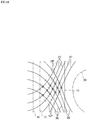
- the front around-leg elastic members 27 and the back around-leg elastic members 26 are sequentially numbered in this order from the member furthest to the edge 29 of the leg opening to the closest member, among the front around-leg elastic members 27 and the back around-leg elastic members 26 in the same order, the front around-leg elastic member 27 is continuous from the side seal portion 21 to the crossing position (the portion surrounded by a circle in the drawing) with the back around-leg elastic member 26 in the next order, and the back around-leg elastic member 26 is continuous from the side seal portion 21 to the crossing position (a portion surrounded by a circle in the drawing) with the front around-leg elastic member 27 in the next order, and the portions on the center side in the width direction WD from the crossing positions are respectively cut off so as not to substantially expand and contract.
- the combination of the front around-leg elastic member 27 and the back around-leg elastic member 26, which are continuous along the leg opening is a combination of each one of the front around-leg elastic member 27 and the back around-leg elastic member 26, continuous at the crossing position indicated by a circle and since the front around-leg elastic member 27 and the back around-leg elastic member 26 of each set do not cross each other, flexibility is less likely to decrease. Furthermore, according to this embodiment, there is also an advantage that the crossing position C1 of the front around-leg elastic member 27 and the back around-leg elastic member 26 is close to the leg opening, and the front around-leg elastic member 27 and the back around-leg elastic member 26 are continuous in a shape closer to the edge 29 of the leg opening.
- Front body and back body mean front and back portions, respectively, with the center in the front-back direction of a disposable diaper as a boundary.
- Rotch portion means a portion to be positioned at the crotch of a wearer, in the usual case, as illustrated in Fig. 18 , it means the front-back direction range 28 including the center in the front-back direction and in which the acute-angle crossing angle formed by a tangent to the edge 29 of the leg opening in the spread state and the back direction is 45 ° or less.
- Basis weight is measured as follows. After preliminary drying a sample or a test piece, the sample or the test piece is left in a test chamber or equipment in the standard state (the test location is at a temperature of 20 ⁇ 5°C and with a relative humidity of 65% or less) to be constant weight.
- the preliminary drying refers to making a sample or a test piece constant weight in an environment not exceeding a temperature of 50°C and a relative humidity of 10 to 25%. For fibers with an official moisture regain of 0.0%, preliminary drying may not be performed.
- a sample of dimensions of 200 mm x 250 mm ( ⁇ 2 mm) is cut using a template for sampling (200 mm ⁇ 250 mm, ⁇ 2 mm) from a test piece in a constant weight.
- the basis weight is set by weighing the sample, multiplying by 20, and calculating the weight per one square meter.
- Thickness of an absorber is measured using a thickness measuring instrument (Peacock, large dial gauge type, model J-B (measurement range 0 to 35 mm) or model K-4 (measurement range 0 to 50 mm)) manufactured by Ozaki Seisakusho Co., Ltd., and a sample and the thickness measuring instrument are set to be horizontal.
- a thickness measuring instrument Peacock, large dial gauge type, model J-B (measurement range 0 to 35 mm) or model K-4 (measurement range 0 to 50 mm) manufactured by Ozaki Seisakusho Co., Ltd.
- Thickness other than the above is automatically measured under the conditions of a load of 0.098 N/cm 2 and a pressing area of 2 cm 2 using an automatic thickness measuring device (KES-G5 handy compression measuring program).
- Spread state means a flatly spread state without shrinkage or slackness.
- test and measurements shall be carried out in a test room or apparatus in a standard state (a temperature of 20 ⁇ 5°C and a relative humidity of 65% or less at the test location).
- the present invention is applicable to a trunks-type disposable diaper as in the above example.
Landscapes
- Health & Medical Sciences (AREA)
- Epidemiology (AREA)
- Engineering & Computer Science (AREA)
- Biomedical Technology (AREA)
- Heart & Thoracic Surgery (AREA)
- Vascular Medicine (AREA)
- Life Sciences & Earth Sciences (AREA)
- Animal Behavior & Ethology (AREA)
- General Health & Medical Sciences (AREA)
- Public Health (AREA)
- Veterinary Medicine (AREA)
- Absorbent Articles And Supports Therefor (AREA)
Abstract
Description
- The present invention relates to a trunks-type disposable diaper having improved fitting to the inner thigh.
- An underpants-type disposable diaper generally includes an outer member, an inner member, and side seal portions. The outer member has a waist opening and a pair of leg openings and extends from a front waist opening edge to a back waist opening edge. The inner member is provided at least in a crotch portion of the outer member and includes an absorber. The side seal portions bond both sides on the front side and both sides on the back side of the outer member.
- Further, as one form of the underpants-type disposable diaper, a trunks-type disposable diaper (also referred to as a one-quarter length form or a boxer type) having a pair of cylindrical leg portions surrounding root sides of the thighs. As a trunks-type disposable diaper having a simple structure in a cylindrical leg portion, a trunks-type disposable diaper is known in which a crotch portion of an outer member has a pair of inner thigh contact portions respectively extending to one side and the other side in the width direction of a circumscribed rectangle of an absorber, and a portion along edges of leg openings including these inner thigh contact portions is a pair of cylindrical leg portions surrounding root sides of the thighs (refer to, for example,
Patent Literatures 1 to 5). - In such a trunks-type disposable diaper, like other types of underpants-type disposable diapers, in order to improve fitting to the body, various elastic members are fixed to an outer member in a stretched state. In particular, a front around-leg elastic member and a back around-leg elastic member are attached on the front and back sides of the outer member in a pattern of extending from one of side seal portions toward the center in the width direction along the edges of leg openings, crossing the center in the width direction towards the other leg opening, and extending along the other leg opening to the other side seal portion. The front around-leg elastic member and the back around-leg elastic member are important since those determines the fitting of cylindrical leg portions of a trunks-type disposable diaper.
- In such a structure having the front around-leg elastic member and the back around-leg elastic member, when the front around-leg elastic member and the back around-leg elastic member are attached in a pattern in which at least one front around-leg elastic member and at least one back around-leg elastic member cross each other on both sides in the width direction of an intermediate region between an edge of one leg opening and an edge of the other leg opening, the around-leg elastic members are continuously present along leg openings, and there is an advantage that the fitting of the cylindrical leg portion is improved.
-
- Patent Literature 1:
JP 2006-230920 A - Patent Literature 2:
JP 2007-061335 A - Patent Literature 3:
JP 2010-82133 A - Patent Literature 4:
JP 2010-227505 A - Patent Literature 5:
JP 5208965 B2 - Patent Literature 6:
JP 4439150 B2 - However, if the crossing position of a front around-leg elastic member and a back around-leg elastic member is positioned within a region of the inner member bonded portion which is the bonded region of the outer member and the inner member, that portion of the front around-leg elastic member and the back around-leg elastic member, which is positioned within the region of the inner member bonded portion expands and contracts with the inner member, and the elasticity is decreased as compared with other portions. That is, even if the elastic member continuously exists along the leg opening, the elasticity may be insufficient in the portion including the crossing position of the elastic member.
- It is therefore a primary object of the present invention not to deteriorate the fitting at a portion including a crossing position between the front around-leg elastic member and a back around-leg elastic member though the front around-leg elastic member and the back around-leg elastic member cross each other and are substantially continuous along the leg opening.
- The representative aspects of the present invention that have solved the above problems will be described below.
- In a trunks-type disposable diaper comprising an outer member having a waist opening and a pair of leg openings and extending from a front waist opening edge to a back waist opening edge, an inner member provided at least in a crotch portion of the outer member and including an absorber, and side seal portions that bond both sides on the front side and both sides on the back side of the outer member,
a crotch portion of the outer member has a pair of inner thigh contact portions which respectively extend to one side and the other side in a width direction from a circumscribed rectangle of the absorber, portions along edges of the leg openings including the inner thigh contact portions form a pair of cylindrical leg portions surrounding a root side of thighs,
the front side of the outer member has one or a plurality of elongated front around-leg elastic members not crossing each other, the elastic member is attached in a pattern of extending from one of the side seal portions toward the center in the width direction along an edge of the leg opening, crossing the center in the width direction, extending toward the other leg opening, and extending to the other side seal portion along an edge of the other leg opening,
the back side of the outer member has one or a plurality of elongated back around-leg elastic members not crossing each other, the elastic member is attached in a pattern of extending from one of the side seal portions toward the center in the width direction along an edge of the leg opening, crossing the center in the width direction, extending toward the other leg opening, and extending to the other side seal portion along an edge of the other leg opening, and
the front around-leg elastic member and the back around-leg elastic member are attached in a pattern in which at least one front around-leg elastic member and at least one back around-leg elastic member cross each other on both sides in the width direction of an intermediate region that is a region between the edge of one leg opening and the edge of the other leg opening. - An inner member bonded portion that is a region bonding the outer member and the inner member is provided only further to a center side in the width direction than a crossing position of the front around-leg elastic member and the back around-leg elastic member on both sides in the width direction in the intermediate region.
- In the present aspect, in the intermediate region between the edge of one leg opening and the edge of the other leg opening, the inner member bonded portion is provided only to the center side in the width direction than the crossing position of the front around-leg elastic member and the back around-leg elastic member on both sides in the width direction, and the front around-leg elastic member and the back around-leg elastic member do not expand or contract together with the inner member. Therefore, the fitting is not deteriorated at a portion including a crossing position between the front around-leg elastic member and a back around-leg elastic member though the front around-leg elastic member and the back around-leg elastic member cross each other and are substantially continuous along the leg opening.
- In the trunks-type disposable diaper according to the first aspect, an intermediate portion in the front-back direction of the absorber is a narrower portion having a width narrower than both front and back sides thereof, and the narrowest portion of the narrower portion is positioned further to the center side in the width direction than both side edges of the inner member bonded portion.
- As described above, it is preferable that the inner member bonded portion is provided only further to the center side in the width direction than the crossing position of the front around-leg elastic member and the back around-leg elastic member on both width direction sides in the intermediate region between the edge of one leg opening and the edge of the other leg opening. Even in such case, if a highly rigid absorber is present laterally from the inner member bonded portion, the effect of improving the fitting by the around-leg elastic members is hindered. Therefore, the configuration as the present aspect is one preferable embodiment.
- In the trunks-type disposable diaper according to the first or second aspect, a non-stretchable region in which the front around-leg elastic member and the back around-leg elastic member are cut finely is provided further to the center side in the width direction from the crossing position of the front around-leg elastic member and the back around-leg elastic member on both sides in the width direction.
- When the stretchable region of the front around-leg elastic member and the back around-leg elastic member is provided further to the center side in the width direction than the crossing position of the front around-leg elastic member and the back around-leg elastic member on both sides in the width direction, the wearing feeling is deteriorated due to the contraction of the absorber in the width direction. Therefore, as in this aspect, it is preferable to form a non-stretchable region on the center side in the width direction while maintaining continuity by crossing the front around-leg elastic member and the back around-leg elastic member.
- In the trunks-type disposable diaper according to any one of the first to third aspects,
a plurality of the front around-leg elastic members and a plurality of the back around-leg elastic members are provided,
the front around-leg elastic members and the back around-leg elastic members are attached on both sides in the width direction of the intermediate region in a pattern in which a group of a plurality of the front around-leg elastic members and a group of a plurality of the back around-leg elastic members cross each other, and
when the front around-leg elastic members and the back around-leg elastic members are sequentially numbered in this order from the member closest to the edge of the leg opening to the furthest member,
the front around-leg elastic members and the back around-leg elastic members in the same order are continuous from the side seal portion to the mutual crossing position, and respective portions on the center side in the width direction from the mutual crossing positions are cut. - In the case where the group of a plurality of front around-leg elastic members and the group of a plurality of back around-leg elastic members cross each other on both sides in the width direction of the intermediate region between the edge of one leg opening and the edge of the other leg opening, a plurality of crossing positions of the elastic members are present in region with a small area, and the portion surrounded by the elastic members bulges in a hump shape, flexibility decreases compared with other portions. On the other hand, by adopting the cutting pattern as in this aspect, the combination of the front around-leg elastic member and the back around-leg elastic member, which are continuous along the leg opening is a combination of each one of the front around-leg elastic member and the back around-leg elastic member, and since the front around-leg elastic member and the back around-leg elastic member of each set do not cross each other, flexibility is less likely to decrease.
- In the trunks-type disposable diaper according to any one of first to third aspects,
a plurality of the front around-leg elastic members and a plurality of the back around-leg elastic members are provided,
the front around-leg elastic members and the back around-leg elastic members are attached on both sides in the width direction of the intermediate region in a pattern in which a group of a plurality of the front around-leg elastic members and a group of a plurality of the back around-leg elastic members cross each other, and
when the front around-leg elastic members and the back around-leg elastic members are sequentially numbered in this order from the member furthest to the edge of the leg opening to the closest member,
among the front around-leg elastic members and the around-back leg elastic members in the same order, the front around-leg elastic members are continuous from the side seal portion to the crossing position with the back around-leg elastic member in the next order, and the back around-leg elastic members are continuous from the side seal portion to the crossing position with the front around-leg elastic member in the next order, and respective portions on the center side in the width direction from the mutual crossing positions are cut. - As described above, in the case where the group of a plurality of front around-leg elastic members and the group of a plurality of back around-leg elastic members cross each other on both sides in the width direction of the intermediate region between the edge of one leg opening and the edge of the other leg opening, a plurality of crossing positions of the elastic members are present in region with a small area, and the portion surrounded by the elastic members bulges in a hump shape, flexibility decreases compared with other portions. On the other hand, by adopting the cutting pattern as in this aspect, the combination of the front around-leg elastic member and the back around-leg elastic member, which are continuous along the leg opening is a combination of each one of the front around-leg elastic member and the back around-leg elastic member, and since the front around-leg elastic member and the back around-leg elastic member of each set do not cross each other, flexibility is less likely to decrease. Furthermore, according to this aspect, there is also an advantage that the crossing position of the front around-leg elastic member and the back around-leg elastic member is close to the leg opening, and the front around-leg elastic member and the back around-leg elastic member are continuous in a shape closer to the edge of the leg opening.
- As described above, according to the present invention, the fitting is not deteriorated at a portion including a crossing position between a front around-leg elastic member and a back around-leg elastic member though the front around-leg elastic member and the back around-leg elastic member cross each other and are substantially continuous along the leg opening.
-
-
Fig. 1 is a plan view (internal surface side) of a trunks-type disposable diaper in a spread state. -
Fig. 2 is a plan view (external surface side) of a trunks-type disposable diaper in a spread state. -
Fig. 3 is a plan view of an inner member. -
Fig. 4 is a cross-sectional view taken along line 4-4 inFig. 1 . -
Fig. 5 is a cross-sectional view taken along line 2-2 inFig. 1 . -
Fig. 6 is a cross-sectional view taken along line 3-3 inFig. 1 . -
Fig. 7 is a perspective view as viewed obliquely from the lower front of a trunks-type disposable diaper in a wearing state. -
Fig. 8 is a plan view illustrating a cut pattern of an elastic member. -
Fig. 9 is a plan view illustrating an adhesive application pattern. -
Fig. 10 is an enlarged plan view of a main part ofFig. 2 . -
Fig. 11 is an enlarged plan view of a main part of another embodiment. -
Fig. 12 is a plan view illustrating another pattern of an around-leg elastic member. -
Fig. 13 is an enlarged view of a main part ofFig. 12 . -
Fig. 14 is an enlarged view of a main part ofFig. 13 . -
Fig. 15 is a plan view (external surface side) of a trunks-type disposable diaper in a spread state. -
Fig. 16 is an enlarged plan view of a main part ofFig. 15 . -
Fig. 17 is a plan view (external surface side) of a trunks-type disposable diaper in a spread state. -
Fig. 18 is an enlarged plan view of a trunks-type disposable diaper in a spread state. - Hereinafter, embodiments of the present invention will be described in detail with reference to the accompanying drawings. The term "stretch rate" means a value when the natural length is taken as 100%. In addition, dotted pattern portions in the drawings indicate a bonding means such as a hot melt adhesive.
-
Figs. 1 to 10 illustrate a trunks-type disposable diaper. This trunks-type disposable diaper (hereinafter also simply referred to as a diaper) includes anouter member 20, aninner member 10, andside seal portions 21. Theouter member 20 has a waist opening and a pair of leg openings and extends from an edge of a waist opening of a front body F to an edge of a waist opening of a back body B. Theinner member 10 is provided at least in acrotch portion 28 of theouter member 20 and includes anabsorber 13. Theside seal portions 21 bond both sides on the front side and both sides on the back side of theouter member 20. Thecrotch portion 28 of theouter member 20 has a pair of innerthigh contact portions 31 respectively extending to one side and the other side in the width direction from the circumscribed rectangle of the absorber 13 (the circumscribed rectangle means a virtual rectangle circumscribing theabsorber 13 in a plan view in a spread state. In this aspect, one opposite side of the circumscribed rectangle of theabsorber 13 is substantially equal to both side edges of the inner member 10). Portions along theedges 29 of the leg openings including the innerthigh contact portions 31 are a pair ofcylindrical leg portions 30 surrounding the root side of the thighs. Upon manufacturing, after theinner member 10 is bonded to theouter member 20 by a bonding means such as a hot melt adhesive, theinner member 10 and theouter member 20 are folded at the center in the front-back direction (longitudinal direction) which is a boundary between the front body F and the back body B, and both side portions thereof are bonded to each other by thermal welding, a hot melt adhesive, or the like to form theside seal portion 21. As a result, a trunks-type disposable diaper having a waist opening and a pair of leg openings can be formed. - As illustrated in
Figs. 3 to 6 , theinner member 10 has a structure in which theabsorber 13 is interposed between a liquid pervioustop sheet 11 made of a nonwoven fabric and the liquidimpervious sheet 12 made of polyethylene or the like to absorb and retain excreted fluid that has permeated through thetop sheet 11. The planar shape of theinner member 10 is not particularly limited, but generally it is a substantially rectangular shape as the illustrated embodiment. - As the
top sheet 11 covering a front surface side of theabsorber 13 and forming a skin contact surface, a porous or nonporous nonwoven fabric, a porous plastic sheet, or the like is suitably used. For a raw material fiber forming a nonwoven fabric, in addition to synthetic fibers such as polyolefin type such as polyethylene or polypropylene, polyester type, polyamide type, etc., regenerated fibers such as rayon and cupra, and natural fibers such as cotton can be used, and a nonwoven fabric obtained by an appropriate processing method, such as a spun lace method, a spun bond method, a thermal bond method, a melt blown method, and a needle punch method can be used. In these processing methods, the spun lace method is excellent in terms of flexibility and drapability, and the thermal bond method is excellent in terms of bulkiness and softness. When a large number of through holes are formed on thetop sheet 11, urine and the like are quickly absorbed, and dry touch property is excellent. In the illustrated embodiment, thetop sheet 11 is wound around the side edge portion of theabsorber 13 and extends to the back surface side of theabsorber 13, but is not limited thereto. - For the liquid
impervious sheet 12 covering a back surface side of theabsorber 13, a liquid impermeable plastic sheet such as polyethylene or polypropylene is used. In recent years, those having moisture permeability are preferably used from the viewpoint of prevention of stuffiness. Examples of this waterproof/moisture pervious sheet include a microporous sheet. The microporous sheet is obtained by stretching a sheet in one or two axial directions after forming the sheet by melt kneading an inorganic filler in a polyolefinic resin such as polyethylene and polypropylene. - As the liquid
impervious sheet 12, it is desirable to use an opaque sheet such that brown color of excreta, urine, and the like does not appear. As the opaque sheet, a film obtained by internally adding a pigment or a filler such as calcium carbonate, titanium oxide, zinc oxide, white carbon, clay, talc, barium sulfate, or the like in a plastic is suitably used. In the illustrated embodiment, the liquidimpervious sheet 12 is folded back to the back surface side together with thetop sheet 11 on both sides in the width direction of theabsorber 13, but is not limited thereto. - The
absorber 13 is basically a known absorber, for example, laminates of pulp fibers, assembly of filaments such as cellulose acetate, or nonwoven fabrics, and as necessary, super absorbent polymers can be mixed therewith and fixed. Theabsorber 13 can be wrapped with apackage sheet 14 having liquid permeability and liquid retention, such as crepe paper, as necessary, for shape and polymer retention and the like. - The entire shape of the
absorber 13 is formed in a substantially hourglass shape having anarrower portion 13N narrower than the front and back sides thereof in the front-back direction range including thecrotch portion 28. However, it may have an appropriate shape such as a rectangular shape. Although the size of thenarrower portion 13N can be determined as appropriate, the length in the front-back direction of thenarrower portion 13N can be set to about 20 to 50% of the maximum length Y of the diaper, and the width of thenarrowest portion 13m is about 40 to 60% of the maximum width of theabsorber 13. In the case where such thenarrower portion 13N is provided, if the planar shape of theinner member 10 is substantially rectangular, a remaining portion without theabsorber 13 is formed at a portion corresponding to thenarrower portion 13N of theabsorber 13 in theinner member 10. - As illustrated in
Fig. 1 andFigs. 3 to 5 , if thediffusion groove 17 extending in the front-back direction is provided in the intermediate portion in the width direction of theabsorber 13, it is preferable since the diffusibility in the front-back direction of urine is improved. From the viewpoint of diffusibility of urine, it is preferable that the diffusion groove extends to both front and back sides of the intermediate region between the edge of one leg opening and the edge of the other leg opening. Only onediffusion groove 17 may be provided at the center in the width direction, but two diffusion grooves may be provided at an interval in the width direction. Although thediffusion groove 17 extends linearly in the illustrated embodiment, it may extend in a curved shape. - The
diffusion groove 17 is preferably a slit penetrating theabsorber 13 in the thickness direction as the illustrated embodiment, but it may be a concave portion provided on at least one side of the front and back of theabsorber 13 and not penetrating it in the thickness direction. When the concave portion is formed in theabsorber 13, the concave portion can be formed by reducing the basis weight of the formation position of the concave portion in comparison with the surroundings, and also it is formed by compressing the formation position of the concave portion by embossing. - The position of the diffusion groove forming region is not limited as long as it is provided at the intermediate portion in the width direction of the
absorber 13, but normally, the diffusion groove forming region is desirably located in the center in the width direction, and it is preferable that the width thereof (the width of thediffusion groove 17d in the case of one) is 5 to 20% of themaximum width 13w of theabsorber 13. Further, thelength 17L in the front-back direction of thediffusion groove 17 can be determined as appropriate, and can be set to about 30 to 70% of the maximum length of theabsorber 13, for example. - Three-dimensional gathers BS fitting around the legs are formed on both sides of the
inner member 10. As illustrated inFigs. 5 and6 , the three-dimensional gather BS is formed of the double folded gathersheet 15 composed of a fixed portion, a main unit section, a fallen portion, and a free portion. The fixed portion is fixed to a side portion of a back surface of theinner member 10. The main unit section extends from the fixed portion through a side of theinner member 10 to a side portion of a front surface of theinner member 10. The fallen portion is formed by fixing the front and back end portions of the main unit section to the side portion of the surface of theinner member 10 in a fallen state. The free portion is formed by non-fixing between the fallen portions. A water-repellent nonwoven fabric is suitably used as the gathersheet 15. - Further, between the double gather
sheets 15, an elongated gatherelastic member 16 is disposed at a tip portion of the free portion or the like. As illustrated by a two-dot chain line inFig. 5 in a product state, the gatherelastic member 16 is used to form a three-dimensional gather BS by standing the free portion by an elastic contraction force. - As the gather
elastic member 16, materials such as styrene rubber, polyolefin rubber, polyurethane rubber, polyester rubber, polyurethane, polyethylene, polystyrene, styrene butadiene, silicon, polyester, and the like which are usually used can be used. Further, in order to make it difficult to be seen from the outside, it is better that the thickness is set to 925 dtex or less, a stretch rate is set to 150 to 350%, and the interval is set to 10.0 mm or less. As the gatherelastic member 16, in addition to a thread-like shape as the illustrated embodiment, a tape-shaped member having a certain width can be used. - A nonwoven fabric used for the gather
sheet 15 is not particularly limited and can be made of, in addition to synthetic fibers such as polyolefin type such as polyethylene or polypropylene, polyester type, polyamide type, etc., regenerated fibers such as rayon and cupra, and natural fibers such as cotton. Further, the nonwoven fabric can be manufactured by an appropriate processing method, such as a spun bond method, a thermal bond method, a melt blown method, and a needle punch method. In particular, as the gathersheet 15, in order to prevent permeation of urine and the like, it is desirable to use a water-repellent treated nonwoven fabric coated with a silicone type, a paraffin metal type, an alkylchromic chloride type water repellent agent or the like. - As also illustrated in
Fig. 4 , variouselastic members 24 to 27 for imparting elasticity are provided on theouter member 20, a region having at least an elastic member (the entire region in the illustrated embodiment) has a plurality of sheet layers, and theelastic members 24 to 27 are sandwiched between these sheet layers. A plurality of the sheet layers can be formed by folding back one sheet material, in addition to each being formed by one sheet material. Theouter member 20 in the illustrated embodiment has a two-layered structure including apressing sheet 20A and aback sheet 20B each of which is made of a nonwoven fabric or the like, and the elasticity is imparted thereto by disposing variouselastic members 24 to 27 between thepressing sheet 20A and theback sheet 20B and between the nonwoven fabrics of a folded-back portion 20C formed by folding theback sheet 20B toward the internal surface side at a waist opening edge. - The
outer member 20 has a substantially hourglass shape in which the middle in the front-back direction LD is narrow, and both side edges of the narrower portion are theedges 29 of the leg openings, respectively. As described above, thecrotch portion 28 of theouter member 20 has a pair of innerthigh contact portions 31 respectively extending to one side and the other side in the width direction WD from the circumscribed rectangle of theabsorber 13. The portions along theedges 29 of the leg openings including the innerthigh contact portions 31 form a pair ofcylindrical leg portions 30 surrounding the root side of the thighs. The dimension of the innerthigh contact portion 31 may be appropriately determined according to the length of thecylindrical leg portion 30, but in the usual case, thewidth 31x of the innerthigh contact portion 31 in the narrowest portion of theouter member 20 is preferably set to about 1 to 5% of the maximum length Y of the diaper. Further, as illustrated inFig. 18 , in the front body F, when a virtual straight line L1 is drawn which extends outward in the width direction and toward the waist side from a virtual point P1 positioned closest to the center side in the width direction on theedge 29 of the leg opening at an angle θ1 of 20 degrees with respect to the width direction, it is preferable to have a crossing point P2 between the virtual straight line L1 and the side edge of theouter member 20 in the front-back direction range having theside seal portion 21, and the front-back direction interval 30f from this crossing point P2 to theedge 29 of the leg opening is preferably equal to or wider than thewidth 31x of the innerthigh contact portion 31 in the narrowest portion of theouter member 20, and it is preferably substantially the same. On the other hand, in the back body B, when a virtual straight line L2 is drawn which extends outward in the width direction and toward the waist side from the virtual point P1 positioned closet to the center side in the width direction on theedge 29 of the leg opening at an angle θ2 of 30 degrees with respect to the width direction, it is preferable to have a crossing point P3 between the virtual straight line L2 and the side edge of theouter member 20 in the front-back direction range having theside seal portion 21, and the front-back direction interval 30b from this crossing point P3 to theedge 29 of the leg opening may be equal to or narrower than or equal to or wider than thewidth 31x of the innerthigh contact portion 31 in the narrowest portion of theouter member 20. - In the
outer member 20 of the illustrated embodiment, each of the front body F and the back body B is provided with a waistelastic member 24, a lower waist portionelastic member 25, and a plurality of front around-legelastic members 27 and back around-legelastic members 26. The waistelastic member 24 is disposed along the width direction WD in thewaist opening vicinity 23. The lower waist portionelastic member 25 is disposed along the width direction WD toward the leg opening side from the waistelastic member 24. A plurality of the front around-legelastic members 27 and the back around-legelastic member 26 is disposed at intervals without crossing each other in a curved pattern of extending from one of theside seal portions 21 along theedge 29 of the leg opening toward the center in the width direction WD, crossing the center in the width direction WD, and extending toward the other leg opening to the otherside seal portion 21 along theedge 29 of the other leg opening. Each of theelastic members 24 to 27 is fixed in a state of being elongated at a predetermined stretch rate along the extending direction thereof, so as to expand and contract together with theouter member 20 between the stretched state at the time of fixing and the natural length state. In theouter member 20, there is no around-leg elastic member continuous with one member from theside seal portion 21 of the front body F to theside seal portion 21 of the back body B along theedge 29 of the leg opening. - The waist
elastic member 24 is an elongated elastic member such as a plurality of rubber threads disposed at intervals in the longitudinal direction at thewaist opening vicinity 23 in the front-back direction range of theside seal portion 21 where the front body F and the back body B are bonded, and the waistelastic member 24 is for tightening and fitting thevicinity 23 of the waist opening of the diaper. Although a plurality of rubber threads are used as the waistelastic member 24 in the illustrated example, a tape-like stretchable member may be used, for example. Further, the waistelastic member 24 in the illustrated embodiment is sandwiched between the nonwoven fabrics of the folded-back portion 20C of theback sheet 20B in the waist portion, but it may be sandwiched between thepressing sheet 20A and theback sheet 20B. - The lower waist portion
elastic member 25 is an elongated elastic member such as a plurality of rubber threads or the like disposed at intervals in the longitudinal direction in the region on the leg opening side of the waistelastic member 24 in the range in the front-back direction having theside seal portion 21. The lower waist portion elastic member is for tightening and fitting substantially the whole of a lower torso of the diaper except for thevicinity 23 of the waist opening. Now that, the boundary between the waistelastic member 24 and the lower waist portionelastic member 25 is positioned at a position where the stretching characteristic changes, such as the thickness and stretch rate of the elastic member, or the boundary is positioned at the waist side edge of theinner member 10 when the stretching characteristics do not change. It is desirable that the lower waist portionelastic member 25 be not provided in thecrotch portion 28 as the illustrated embodiment. Further, on both front and back sides of theintermediate region 22, the lower waist portionelastic member 25 may be provided as illustrated embodiment, but it may not be provided. - In the
outer member 20 of the back body B, the back around-legelastic member 26 disposed separately from the lower waist portionelastic member 25 is an elongated elastic member such as a rubber thread, and at least one elastic member, preferably a plurality of elastic members, is disposed along a predetermined curve passing through thecylindrical leg portion 30 of the back body B. Although one back around-legelastic member 26 may be provided, it is preferable that a plurality of elastic members are provided. In the illustrated example, an elongated elastic members such as five rubber threads is provided, and the back around-legelastic members 26 do not cross each other but are disposed at intervals therebetween. A group of the around-back legelastic members 26 is not disposed in a substantially bundle with the elastic members being closely spaced, and three or more, preferably four or more, elastic members are disposed at intervals of about 3 to 20 mm, preferably about 6 to 16 mm so as to form a predetermined stretching zone including thecylindrical leg portion 30 of the back body B. - In the
outer member 20 of the front body F, the front around-legelastic member 27 disposed separately from the lower waist portionelastic member 25 is an elongated elastic member such as a rubber thread, and at least one elastic member, preferably a plurality of elastic members, is disposed along a predetermined curve passing through thecylindrical leg portion 30 of the front body F. Although one front around-legelastic member 27 may be provided, it is preferable that a plurality of elastic members is provided. In the illustrated example, elongated elastic members such as five rubber threads are provided, and the front around-legelastic members 27 do not cross each other but are disposed at intervals therebetween. A group of the front around-legelastic members 27 is not disposed in a substantially bundle with the elastic members being closely spaced, and three or more, preferably four or more, elastic members are disposed at intervals of about 3 to 20 mm, preferably about 6 to 16 mm so as to form a predetermined stretching zone including thecylindrical leg portion 30 of the front body F. The number of the front around-legelastic members 27 is preferably equal to the number of the back around-legelastic members 26, but it is also possible to set them to different numbers as necessary. - The front around-leg
elastic member 27 and the back around-legelastic member 26 need not be entirely curved, and may have a partially linear portion. - As a method for attaching the front around-leg
elastic member 27 and the back around-legelastic member 26, for example, the techniques described inJP 4-28363 A JP 11-332913 A - As illustrated in
Fig. 10 , the front around-legelastic member 27 and the back around-legelastic member 26 are attached in a pattern in which at least one of the front around-legelastic members 27 and at least one of the back around-legelastic members 26 cross each other on both sides in the width direction of theintermediate region 22 between theedge 29 of one leg opening and theedge 29 of the other leg opening. As a result, the front around-legelastic member 27 and the back around-legelastic member 26 cross each other and are substantially continuous along the leg opening, and the elasticity is imparted over the entire circumferential direction of thecylindrical leg portion 30. The number of crossing members of the front around-legelastic members 27 and the back around-legelastic members 26 may be one each at the front and back as in the form illustrated inFig. 2 , and also all the front around-legelastic members 27 and the back around-legelastic members 26 may cross as in the embodiment illustrated inFig. 12 . - The interval between the
edge 29 of the leg opening and the elastic member closest to theedge 29 of the leg opening may be determined appropriately. Normally, in the front around-legelastic member 27 and the back around-legelastic member 26, theinterval 29e between theedge 29 of the leg opening and the elastic member closest to theedge 29 of the leg opening in the direction orthogonal to the tangent of theedge 29 of the leg opening is preferably 10 mm or more, and particularly preferably 10 to 50 mm in thecrotch portion 28. - As illustrated in
Fig. 8 , the lower waist portionelastic member 25, the front around-legelastic member 27, and the back around-legelastic member 26 are continuously fixed to theouter member 20 at the time of manufacturing, and then, a part or all of the portion overlapping with the inner member bondedportion 18 is finely cut according to the predetermined cutting pattern CP to become thenon-stretchable region 19 which does not expand and contract (that is, a portion overlapping with the cutting pattern CP inFig. 8 ). A portion extending laterally from thenon-stretchable region 19 may be a stretchable region (that is, the portion in which the lower waist portionelastic member 25, the front around-legelastic member 27, and the back around-legelastic member 26, positioned on the side of the cutting pattern CP inFig. 8 , is continuously left). In this case, the lower waist portionelastic member 25, the front legelastic member 27, and the back legelastic member 26 are continuously provided from theside seal portion 21 on one side to theside seal portion 21 on the other (opposite) side across theinner member 10, and then a part or all of the portion overlapping with the inner member bondedportion 18 is cut finely. Thereby, it is possible to prevent unnecessary shrinkage in the width direction of the inner member 10 (in particular, the absorber 13). - In the case where the
absorber 13 has thediffusion groove 17 in theabsorber 13, as illustrated inFigs. 15 and16 , it is preferable that at least one of the front around-legelastic member 27 and the back around-legelastic member 26 extends from theside seal portions 21 on both sides in the width direction WD to a portion at least overlapping with the side portion of theabsorber 13 and is cut at a portion overlapping with thediffusion groove 17, and a portion overlapping with thediffusion groove 17 in theouter member 20 is anon-stretchable region 19. In particular, as the illustrated embodiment, at least one of the front around-legelastic member 27 and the back around-legelastic member 26 extends to the end on thediffusion groove 17 side in the region between the side edge of theabsorber 13 and thediffusion groove 17 and is cut at a portion overlapping with thediffusion groove 17, and a portion overlapping with the diffusinggroove 17 in theouter member 20 is thenon-stretchable region 19. At the time of wearing, in thecrotch portion 28, theabsorber 13 is sandwiched between the legs, and the width is reduced, but at least one of the front around-legelastic member 27 and the back around-legelastic member 26 extends to the side portion of theabsorber 13 and is cut at a portion overlapping with thediffusion groove 17. Consequently, the contraction force of the elastic member acts to spread thediffusion groove 17 on both sides in the width direction, and collapse of thediffusion groove 17 is prevented. In particular, in the case of the front around-legelastic member 27 and the back around-legelastic member 26 in the trunks-type disposable diaper as the illustrated embodiment, the angle between the contraction direction and the width direction WD becomes small, the component in the width direction of the contraction force becomes large, and the collapse of thediffusion groove 17 can be more effectively prevented. - Although it is conceivable to use other elastic members, for example, the waist
elastic member 24 and the lower waist portionelastic member 25, since theelastic members side seal portion 21 do not pass through theintermediate region 22, the collapse of thediffusion groove 17 cannot be prevented in theintermediate region 22 which is a portion sandwiched between the legs. Further, although the lower waist portionelastic member 25 may be provided in theintermediate region 22, since one end of the lower waist portionelastic member 25 is positioned at the leg opening instead of theside seal portion 21, the collapse of thediffusion groove 17 cannot be suppressed even if the lower waist portionelastic member 25 is used. - In the case where the collapse of the
diffusion groove 17 is prevented by the front around-legelastic member 27 and the back around-legelastic member 26, although not illustrated, when the front around-legelastic member 27 and the back around-legelastic member 26 are provided in a front-back symmetrical arrangement with respect to the number and arrangement thereof, the longitudinal component of the contraction force of the front around-legelastic member 27 and the back around-legelastic member 26 is canceled out each other, and the force in the width direction WD acts well in balance with respect to both sides of thediffusion groove 17 in theabsorber 13, and the effect of preventing thediffusion groove 17 from being collapsed is further enhanced. - In the case where at least one of the front around-leg
elastic members 27 and at least one of the back around-legelastic members 26 cross each other on both sides in the width direction of theintermediate region 22, the front around-legelastic member 27 and the back around-legelastic member 26 are cut at the center side in the width direction from the crossing position. In the case where a group of a plurality of the front around-legelastic members 27 and a group of a plurality of the back around-legelastic members 26 cross on both sides in the width direction WD of theintermediate region 22, as illustrated inFig. 17 , if a mutual interval of the elastic members in the group of the front around-legelastic members 27 and a mutual interval between the elastic members in the group of the back around-legelastic members 26 are narrowed toward the center side in the width direction, it is preferable that even if the cutting positions are somewhat shifted, or the cut elastic member is moved in the stretchable direction without being fixed, any one of the front around-legelastic members 27 and any one of the back around-legelastic members 26 cross each other, and the continuity of the front around-legelastic members 27 and the back around-legelastic members 26 tends to remain along theedge 29 of the leg opening from theside seal portion 21 of the front body F to theside seal portion 21 of the back body B. - As a method of cutting the
elastic members 24 to 27 to form the non-stretchable region, for example, the techniques described inJP 2002-35029 A JP 2002-178428 A JP 2002-273808 A elastic member 25, the front around-legelastic member 27, and the back around-legelastic member 26 can also be disposed continuously across theinner member 10 without being cut. - Although the stretch rate at the time of fixing the
elastic members 24 to 27 can be appropriately determined, for normal adult use, about 160 to 320% for the waistelastic member 24, about 160 to 320% for the lower waist portionelastic member 25, and about 230 to 350% for the front around-legelastic member 27 and the back around-legelastic member 26. In particular, in the case where a plurality of the front around-legelastic members 27 and the back around-legelastic members 26 are provided, with increasing proximity to the edge of the leg opening, the stretch rate is gradually increased, and conversely the stretch rate is gradually decreased, in one preferred form. Instead of or in conjunction with this change in the stretch rate, the thickness of the elastic member can be varied as well. - The waist
elastic member 24, the lower waist portionelastic member 25, and the around-legelastic members back portions 20C of the back sheet and between thepressing sheet 20A and theback sheet 20B, and those are adhered and fixed to thesheets Fig. 9 , it is preferable that the adhesive portion (hot melt adhesive B1) for fixing the waistelastic member 24 and the lower waist portionelastic member 25 is only the arrangement portion and the vicinity of the waistelastic member 24, the arrangement portion and the vicinity of the lower waist portionelastic member 25.Fig. 9 illustrates the application site of the hot melt adhesive B1 in the manufacturing process, and the hot melt adhesive B1 for fixing the waistelastic member 24 and the lower waist portionelastic member 25 to both thesheets elastic members elastic member 24 with the adhesive applied on the outer peripheral surface and the lower waist portionelastic member 25 between bothsheets - On the other hand, as illustrated in
Fig. 9 , the hot melt adhesive B2 for fixing the around-legelastic members pressing sheet 20A and theback sheet 20B is continuously applied in the width direction over the entire range in the front-back direction having the around-legelastic members elastic members - As also illustrated in
Figs. 1 and4 , the front and back end portions of theinner member 10 attached on the inner surface of theouter member 20 is covered. In addition, in order to prevent leakage from the front and back edges of theinner member 10, the front and backpressing sheets front pressing sheet 50 extends in the entire width direction from the inner surface of the folded-back portion 20C of the inner surface of the front body F to a position overlapping with the front end portion of theinner member 10, and theback pressing sheet 60 extends from the inner surface of the folded-back portion 20C of the inner surface of the back body B to the position overlapping with the back end portion of theinner member 10 in the entire width direction. As the illustrated embodiment, when the front and backpressing sheets pressing sheets back portion 20C to a portion overlapping with theinner member 10. - Characteristically, as illustrated in the enlarged view of
Fig. 10 , the inner member bondedportion 18 that is a bonded region of theouter member 20 and theinner member 10 is provided only further to the center side in the width direction WD than the crossing position C1 of the front around-legelastic member 27 and the back around-legelastic member 26 on both sides in the width direction WD in theintermediate region 22. As a result, since the front around-legelastic member 27 and the back around-legelastic member 26 do not extend and contract with theinner member 10 in theintermediate region 22, the fitting is not deteriorated at a portion including the crossing position C1 between the front around-legelastic member 27 and the back around-legelastic member 26 though the front around-legelastic member 27 and the back around-legelastic member 26 cross each other and are substantially continuous along theedge 29 of the leg opening. - The inner member bonded
portion 18 may be positioned only further to the center side in the width direction WD than the crossing position C1 of the front around-legelastic member 27 and the back around-legelastic member 26 on both sides in the width direction WD over the entire front-back direction. However, it is preferable that the inner member bondedportion 18 extends to the outside in the width direction WD from the crossing position C1 on the front and back sides of theintermediate region 22 as the illustrated embodiment. - As described above, it is preferable that the inner member bonded
portion 18 is provided only further to the center side in the width direction WD than the crossing position C1 of the front around-legelastic member 27 and the back around-legelastic member 26 on both sides in the width direction WD in theintermediate region 22. Even in such case, if a highlyrigid absorber 13 is present laterally beyond the inner member bondedportion 18, the effect of improving the fitting by the around-legelastic members Fig. 11 , it is also desirable that the intermediate portion of theabsorber 13 is anarrower portion 13N having a width narrower than both sides in the front-back direction LD, and the narrowest portion of thenarrower portion 13N is positioned further to the center side in the width direction WD than both side edges of the inner member bondedportion 18. - When the stretchable region of the front around-leg
elastic member 27 and the back around-legelastic member 26 is provided to the center side in the width direction WD from the crossing position C1 of the front around-legelastic member 27 and the back around-legelastic member 26 on both sides in the width direction WD, the wearing feeling is deteriorated due to the contraction of theabsorber 13 in the width direction WD. Accordingly, as the illustrated embodiment, it is preferable that, while maintaining the continuity by crossing the front around-legelastic member 27 and the back around-legelastic member 26, thenon-stretchable region 19 in which the front around-legelastic member 27 and the back around-legelastic member 26 are cut finely is provided further to the center side in the width direction WD than the crossing position C1 of the front around-legelastic member 27 and the back around-legelastic member 26 on both sides in the width direction WD. - On the other hand, as illustrated in
Fig. 12 , when a group of a plurality of front around-legelastic members 27 and a group of a plurality of back around-legelastic members 26 cross each other on both sides in the width direction WD of theintermediate region 22, as illustrated in an enlarged view inFig. 13(a) , there are many crossing positions (portions surrounded by circles in the drawing) of the around-legelastic members elastic members Fig. 13(b) , when the front around-legelastic members 27 and the back around-legelastic members 26 are sequentially numbered in this order from the member closest to theedge 29 of the leg opening to the furthest member, the front around-legelastic members 27 and the back around-legelastic members 26 in the same order are continuous from theside seal portion 21 to the mutual crossing positions (portions surrounded by circles in the drawing), and the portions on the center side in the width direction WD from the crossing positions are respectively cut off from the mutual crossing positions so as not to substantially expand and contract. The reference sign CP in the drawing indicates a cutting pattern. By adopting such a cutting pattern CP, the combination of the front around-legelastic member 27 and the back around-legelastic member 26, which are continuous along theedge 29 of the leg opening is a combination of each one of the front around-legelastic member 27 and the back around-legelastic member 26, continuous at the crossing position indicated by a circle and since the front around-legelastic member 27 and the back around-legelastic member 26 of each set do not cross each other, flexibility is less likely to decrease. - Further, it is proposed that, as illustrated in
Fig. 14 , when the front around-legelastic members 27 and the back around-legelastic members 26 are sequentially numbered in this order from the member furthest to theedge 29 of the leg opening to the closest member, among the front around-legelastic members 27 and the back around-legelastic members 26 in the same order, the front around-legelastic member 27 is continuous from theside seal portion 21 to the crossing position (the portion surrounded by a circle in the drawing) with the back around-legelastic member 26 in the next order, and the back around-legelastic member 26 is continuous from theside seal portion 21 to the crossing position (a portion surrounded by a circle in the drawing) with the front around-legelastic member 27 in the next order, and the portions on the center side in the width direction WD from the crossing positions are respectively cut off so as not to substantially expand and contract. In the case of adopting such a cutting pattern, the combination of the front around-legelastic member 27 and the back around-legelastic member 26, which are continuous along the leg opening is a combination of each one of the front around-legelastic member 27 and the back around-legelastic member 26, continuous at the crossing position indicated by a circle and since the front around-legelastic member 27 and the back around-legelastic member 26 of each set do not cross each other, flexibility is less likely to decrease. Furthermore, according to this embodiment, there is also an advantage that the crossing position C1 of the front around-legelastic member 27 and the back around-legelastic member 26 is close to the leg opening, and the front around-legelastic member 27 and the back around-legelastic member 26 are continuous in a shape closer to theedge 29 of the leg opening. - The following terms in the specification have the following meanings unless otherwise specified in the specification.
- "Front body" and "back body" mean front and back portions, respectively, with the center in the front-back direction of a disposable diaper as a boundary.
- "Crotch portion" means a portion to be positioned at the crotch of a wearer, in the usual case, as illustrated in
Fig. 18 , it means the front-back direction range 28 including the center in the front-back direction and in which the acute-angle crossing angle formed by a tangent to theedge 29 of the leg opening in the spread state and the back direction is 45 ° or less. - "Stretch rate" means the value when the natural length is taken as 100%.
- "Basis weight" is measured as follows. After preliminary drying a sample or a test piece, the sample or the test piece is left in a test chamber or equipment in the standard state (the test location is at a temperature of 20 ± 5°C and with a relative humidity of 65% or less) to be constant weight. The preliminary drying refers to making a sample or a test piece constant weight in an environment not exceeding a temperature of 50°C and a relative humidity of 10 to 25%. For fibers with an official moisture regain of 0.0%, preliminary drying may not be performed. A sample of dimensions of 200 mm x 250 mm (± 2 mm) is cut using a template for sampling (200 mm × 250 mm, ± 2 mm) from a test piece in a constant weight. The basis weight is set by weighing the sample, multiplying by 20, and calculating the weight per one square meter.
- "Thickness" of an absorber is measured using a thickness measuring instrument (Peacock, large dial gauge type, model J-B (measurement range 0 to 35 mm) or model K-4 (measurement range 0 to 50 mm)) manufactured by Ozaki Seisakusho Co., Ltd., and a sample and the thickness measuring instrument are set to be horizontal.
- "Thickness" other than the above is automatically measured under the conditions of a load of 0.098 N/cm2 and a pressing area of 2 cm2 using an automatic thickness measuring device (KES-G5 handy compression measuring program).
- "Spread state" means a flatly spread state without shrinkage or slackness.
- The dimension and positional relationships of each part means the dimension in the spread state, not the natural length state, unless otherwise stated.
- When environmental conditions in tests and measurements are not described, the tests and measurements shall be carried out in a test room or apparatus in a standard state (a temperature of 20 ± 5°C and a relative humidity of 65% or less at the test location).
- The present invention is applicable to a trunks-type disposable diaper as in the above example.
-
- 10
- inner member
- 11
- top sheet
- 12
- liquid impervious sheet
- 13
- absorber
- 13N
- narrower portion
- 14
- package sheet
- 15
- gather sheet
- 16
- gather elastic member
- 17
- diffusion groove
- 18
- inner member bonded portion
- 19
- non-stretchable region
- 20
- outer member
- 20C
- folded back portion
- 21
- side seal portion
- 22
- intermediate region
- 24
- waist elastic member
- 25
- lower waist portion elastic member
- 26
- back around-leg elastic member
- 27
- front around-leg elastic member
- 28
- crotch portion
- 29
- edge of leg opening
- 30
- cylindrical leg portion
- 31
- inner thigh contact portion
- B
- back body
- BS
- three-dimensional gather
- C1
- crossing position
- F
- front body
- LD
- front-back direction
- WD
- width direction
Claims (5)
- A trunks-type disposable diaper comprising:an outer member having a waist opening and a pair of leg openings and extending from a front waist opening edge to a back waist opening edge;an inner member provided at least in a crotch portion of the outer member and including an absorber; andside seal portions that bond both sides on a front side and both sides on a back side of the outer member,in which a crotch portion of the outer member has a pair of inner thigh contact portions which respectively extend to one side and the other side in a width direction from a circumscribed rectangle of the absorber, portions along an edge of the leg openings including the inner thigh contact portions form a pair of cylindrical leg portions surrounding a root side of thighs,the front side of the outer member has one or a plurality of elongated front around-leg elastic members not crossing each other, the elastic member is attached in a pattern of extending from one of the side seal portions toward the center in the width direction along an edge of the leg opening, crossing the center in the width direction, extending toward the other leg opening, and extending to the other side seal portion along an edge of the other leg opening,the back side of the outer member has one or a plurality of elongated back around-leg elastic members not crossing each other, the elastic member is attached in a pattern of extending from one of the side seal portions toward the center in the width direction along an edge of the leg opening, crossing the center in the width direction, extending toward the other leg opening, and extending to the other side seal portion along an edge of the other leg opening, andthe front around-leg elastic member and the back around-leg elastic member are attached in a pattern in which at least one front around-leg elastic member and at least one back around-leg elastic member cross each other on both sides in the width direction of an intermediate region that is a region between the edge of one leg opening and the edge of the other leg opening,wherein an inner member bonded portion that is a region bonding the outer member and the inner member is provided only further to a center side in the width direction than a crossing position of the front around-leg elastic member and the back around-leg elastic member on both sides in the width direction in the intermediate region.
- The trunks-type disposable diaper according to claim 1,
wherein an the intermediate portion in the front-back direction of the absorber is a narrower portion having a width narrower than both front and back sides thereof, and
the narrowest portion of the narrower portion is positioned further to the center side in the width direction than both side edges of the inner member bonded portion. - The trunks-type disposable diaper according to claim 1 or 2,
wherein a non-stretchable region in which the front around-leg elastic member and the back around-leg elastic member are cut finely is provided further to the center side in the width direction than the crossing position of the front around-leg elastic member and the back around-leg elastic member on both sides in the width direction. - The trunks-type disposable diaper according to any one of claims 1 to 3,
wherein a plurality of the front around-leg elastic members and a plurality of the back around-leg elastic members are provided,
the front around-leg elastic members and the back around-leg elastic members are attached on both sides in the width direction of the intermediate region in a pattern in which a group of a plurality of the front around-leg elastic members and a group of a plurality of the back around-leg elastic members cross each other, and
when the front around-leg elastic members and the back around-leg elastic members are sequentially numbered in this order from the member closest to the edge of the leg opening to the furthest member,
the front around-leg elastic members and the back around-leg elastic members in the same order are continuous from the side seal portion to the mutual crossing position, and respective portions on the center side in the width direction from the mutual crossing positions are cut. - The trunks-type disposable diaper according to any one of claims 1 to 3,
wherein a plurality of the front around-leg elastic members and a plurality of the back around-leg elastic members are provided,
the front around-leg elastic members and the back around-leg elastic members are attached on both sides in the width direction of the intermediate region in a pattern in which a group of a plurality of the front around-leg elastic members and a group of a plurality of the back around-leg elastic members cross each other, and
when the front around-leg elastic members and the back around-leg elastic members are sequentially numbered in this order from the member furthest to the edge of the leg opening to the closest member,
among the front around-leg elastic members and the back around-leg elastic members in the same order, the front around-leg elastic members are continuous from the side seal portion to the crossing position with the back around-leg elastic member in the next order, and the back around-leg elastic members are continuous from the side seal portion to the crossing position with the front around-leg elastic member in the next order, and respective portions on the center side in the width direction from the mutual crossing positions are cut.
Applications Claiming Priority (2)
| Application Number | Priority Date | Filing Date | Title |
|---|---|---|---|
| JP2016229580A JP6359071B2 (en) | 2016-11-25 | 2016-11-25 | Trunks type disposable diaper |
| PCT/JP2017/041930 WO2018097159A1 (en) | 2016-11-25 | 2017-11-22 | Trunks type disposable diaper |
Publications (3)
| Publication Number | Publication Date |
|---|---|
| EP3545923A1 true EP3545923A1 (en) | 2019-10-02 |
| EP3545923A4 EP3545923A4 (en) | 2020-09-09 |
| EP3545923B1 EP3545923B1 (en) | 2026-04-15 |
Family
ID=62196235
Family Applications (1)
| Application Number | Title | Priority Date | Filing Date |
|---|---|---|---|
| EP17873481.0A Active EP3545923B1 (en) | 2016-11-25 | 2017-11-22 | Trunks type disposable diaper |
Country Status (6)
| Country | Link |
|---|---|
| US (1) | US11291592B2 (en) |
| EP (1) | EP3545923B1 (en) |
| JP (1) | JP6359071B2 (en) |
| CN (2) | CN208611126U (en) |
| TW (1) | TWI742203B (en) |
| WO (1) | WO2018097159A1 (en) |
Families Citing this family (7)
| Publication number | Priority date | Publication date | Assignee | Title |
|---|---|---|---|---|
| US11134925B2 (en) * | 2016-03-01 | 2021-10-05 | The Procter & Gamble Company | Diaper adapted for collection of urine sample from an infant |
| JP7096750B2 (en) * | 2018-10-12 | 2022-07-06 | 株式会社リブドゥコーポレーション | Disposable diapers |
| JP7104602B2 (en) * | 2018-10-12 | 2022-07-21 | 株式会社リブドゥコーポレーション | Disposable diapers |
| CN109998790B (en) * | 2019-04-03 | 2024-08-16 | 黄山富田精工智造股份有限公司 | An absorbent article |
| CN110403764B (en) * | 2019-07-26 | 2021-05-04 | 福建恒安集团有限公司 | Preparation method of flat-angle pants-type sanitary towel |
| WO2021085399A1 (en) * | 2019-10-28 | 2021-05-06 | 株式会社瑞光 | Absorber and disposable diaper equipped with same |
| JP7831257B2 (en) * | 2021-12-07 | 2026-03-17 | 王子ホールディングス株式会社 | Absorbent articles |
Family Cites Families (28)
| Publication number | Priority date | Publication date | Assignee | Title |
|---|---|---|---|---|
| JPS528965B1 (en) | 1971-06-25 | 1977-03-12 | ||
| JP3007380B2 (en) | 1990-05-23 | 2000-02-07 | 大王製紙株式会社 | Pants-type disposable diaper and method and apparatus for manufacturing the same |
| JP2774441B2 (en) * | 1993-12-16 | 1998-07-09 | トーヨー衛材株式会社 | Disposable pants |
| JP3382793B2 (en) * | 1996-11-01 | 2003-03-04 | 大王製紙株式会社 | Pants-type disposable paper diapers |
| JP4090568B2 (en) | 1998-05-25 | 2008-05-28 | 大王製紙株式会社 | Pants-type paper diapers |
| JPH11332913A (en) | 1998-05-28 | 1999-12-07 | Daio Paper Corp | Method and apparatus for attaching elastic member to pants-type diaper |
| JP4243008B2 (en) | 2000-07-21 | 2009-03-25 | 大王製紙株式会社 | Stretchable sheet manufacturing method and disposable wearing article using the same |
| JP2002119538A (en) * | 2000-10-13 | 2002-04-23 | Uni Charm Corp | Pants-type disposable wearing article |
| EP1354576B1 (en) * | 2000-11-29 | 2011-06-08 | Daio Paper Corporation | Disposable paper napkin and method of manufacturing the paper napkin |
| JP4184591B2 (en) | 2000-12-11 | 2008-11-19 | 大王製紙株式会社 | Method for producing stretchable sheet and disposable diaper using the same |
| JP3561477B2 (en) | 2001-03-16 | 2004-09-02 | 大王製紙株式会社 | Method for manufacturing elastic sheet |
| JP4439150B2 (en) | 2001-09-28 | 2010-03-24 | 花王株式会社 | Pants-type disposable diapers |
| JP4249993B2 (en) * | 2003-01-30 | 2009-04-08 | ユニ・チャーム株式会社 | Pants-type disposable wearing articles |
| JP4938986B2 (en) | 2005-02-28 | 2012-05-23 | 大王製紙株式会社 | Trunks type diapers |
| JP4606974B2 (en) | 2005-08-31 | 2011-01-05 | 大王製紙株式会社 | Trunks type diapers |
| JP4688669B2 (en) * | 2005-12-20 | 2011-05-25 | 株式会社リブドゥコーポレーション | Disposable absorbent pants |
| JP2008136515A (en) | 2006-11-30 | 2008-06-19 | Oji Nepia Kk | Pants-type disposable diaper |
| JP5208965B2 (en) | 2007-12-25 | 2013-06-12 | 株式会社光洋 | Trunks type diapers |
| JP5301880B2 (en) * | 2008-05-27 | 2013-09-25 | 株式会社リブドゥコーポレーション | Disposable absorbent article |
| JP5385556B2 (en) * | 2008-06-25 | 2014-01-08 | ユニ・チャーム株式会社 | Method for manufacturing absorbent article |
| JP5405077B2 (en) * | 2008-09-30 | 2014-02-05 | 大王製紙株式会社 | Trunks pattern diapers |
| JP5352311B2 (en) | 2009-03-30 | 2013-11-27 | 大王製紙株式会社 | Trunks type diapers |
| JP4527801B2 (en) * | 2009-07-07 | 2010-08-18 | 大王製紙株式会社 | Disposable diapers |
| JP5667806B2 (en) * | 2010-07-27 | 2015-02-12 | 大王製紙株式会社 | Pants-type disposable diaper |
| CA2812185C (en) * | 2010-09-16 | 2021-03-02 | Dsg Technology Holdings Ltd | Article with elastic distribution and system and method for making same |
| JP5745246B2 (en) * | 2010-09-30 | 2015-07-08 | ユニ・チャーム株式会社 | Disposable pants-type wearing articles |
| JP5897829B2 (en) * | 2011-07-01 | 2016-03-30 | ユニ・チャーム株式会社 | Disposable wearing items |
| JP5917961B2 (en) * | 2012-03-15 | 2016-05-18 | 株式会社光洋 | Disposable wearing items |
-
2016
- 2016-11-25 JP JP2016229580A patent/JP6359071B2/en active Active
-
2017
- 2017-11-22 EP EP17873481.0A patent/EP3545923B1/en active Active
- 2017-11-22 WO PCT/JP2017/041930 patent/WO2018097159A1/en not_active Ceased
- 2017-11-22 US US16/348,559 patent/US11291592B2/en active Active
- 2017-11-23 CN CN201721586194.3U patent/CN208611126U/en not_active Expired - Fee Related
- 2017-11-23 CN CN201711179615.5A patent/CN108095899B/en active Active
- 2017-11-24 TW TW106140853A patent/TWI742203B/en active
Also Published As
| Publication number | Publication date |
|---|---|
| TW201822738A (en) | 2018-07-01 |
| JP2018083019A (en) | 2018-05-31 |
| CN108095899A (en) | 2018-06-01 |
| US20200054498A1 (en) | 2020-02-20 |
| EP3545923B1 (en) | 2026-04-15 |
| WO2018097159A1 (en) | 2018-05-31 |
| JP6359071B2 (en) | 2018-07-18 |
| US11291592B2 (en) | 2022-04-05 |
| CN108095899B (en) | 2021-11-02 |
| TWI742203B (en) | 2021-10-11 |
| EP3545923A4 (en) | 2020-09-09 |
| CN208611126U (en) | 2019-03-19 |
Similar Documents
| Publication | Publication Date | Title |
|---|---|---|
| EP3545923B1 (en) | Trunks type disposable diaper | |
| EP3202383B1 (en) | Pants-type disposable diaper | |
| JP2018083019A5 (en) | ||
| US11045360B2 (en) | Underpants-type disposable diaper | |
| EP3545922B1 (en) | Trunks type disposable diaper | |
| JP2017176494A5 (en) | ||
| JP6823491B2 (en) | Trunks type disposable diapers | |
| JP6861505B2 (en) | Trunks type disposable diapers | |
| JP2018083021A5 (en) | ||
| JP2018134272A5 (en) | ||
| JP2018083023A5 (en) | ||
| US12193921B2 (en) | Disposable wearing article | |
| JP6492208B2 (en) | Trunks type disposable diaper | |
| JP6492209B2 (en) | Trunks type disposable diaper | |
| JP6842893B2 (en) | Pants type disposable diapers | |
| JP2018134481A5 (en) | ||
| JP2018134482A5 (en) | ||
| JP6752696B2 (en) | Trunks type disposable diapers | |
| JP2018083020A5 (en) | ||
| JP2018083022A5 (en) | ||
| EP4279044B1 (en) | Disposable diaper | |
| JP7289215B2 (en) | Trunks type disposable wearing article | |
| WO2021193152A1 (en) | Trunks-type disposable article |
Legal Events
| Date | Code | Title | Description |
|---|---|---|---|
| STAA | Information on the status of an ep patent application or granted ep patent |
Free format text: STATUS: THE INTERNATIONAL PUBLICATION HAS BEEN MADE |
|
| PUAI | Public reference made under article 153(3) epc to a published international application that has entered the european phase |
Free format text: ORIGINAL CODE: 0009012 |
|
| STAA | Information on the status of an ep patent application or granted ep patent |
Free format text: STATUS: REQUEST FOR EXAMINATION WAS MADE |
|
| 17P | Request for examination filed |
Effective date: 20190515 |
|
| AK | Designated contracting states |
Kind code of ref document: A1 Designated state(s): AL AT BE BG CH CY CZ DE DK EE ES FI FR GB GR HR HU IE IS IT LI LT LU LV MC MK MT NL NO PL PT RO RS SE SI SK SM TR |
|
| AX | Request for extension of the european patent |
Extension state: BA ME |
|
| DAV | Request for validation of the european patent (deleted) | ||
| DAX | Request for extension of the european patent (deleted) | ||
| A4 | Supplementary search report drawn up and despatched |
Effective date: 20200806 |
|
| RIC1 | Information provided on ipc code assigned before grant |
Ipc: A61F 13/53 20060101ALI20200731BHEP Ipc: A61F 13/496 20060101ALI20200731BHEP Ipc: A61F 13/49 20060101AFI20200731BHEP |
|
| STAA | Information on the status of an ep patent application or granted ep patent |
Free format text: STATUS: EXAMINATION IS IN PROGRESS |
|
| 17Q | First examination report despatched |
Effective date: 20230905 |
|
| GRAP | Despatch of communication of intention to grant a patent |
Free format text: ORIGINAL CODE: EPIDOSNIGR1 |
|
| STAA | Information on the status of an ep patent application or granted ep patent |
Free format text: STATUS: GRANT OF PATENT IS INTENDED |
|
| INTG | Intention to grant announced |
Effective date: 20251113 |
|
| P01 | Opt-out of the competence of the unified patent court (upc) registered |
Free format text: CASE NUMBER: UPC_APP_0014419_3545923/2025 Effective date: 20251124 |
|
| GRAS | Grant fee paid |
Free format text: ORIGINAL CODE: EPIDOSNIGR3 |
|
| GRAA | (expected) grant |
Free format text: ORIGINAL CODE: 0009210 |
|
| STAA | Information on the status of an ep patent application or granted ep patent |
Free format text: STATUS: THE PATENT HAS BEEN GRANTED |
|
| AK | Designated contracting states |
Kind code of ref document: B1 Designated state(s): AL AT BE BG CH CY CZ DE DK EE ES FI FR GB GR HR HU IE IS IT LI LT LU LV MC MK MT NL NO PL PT RO RS SE SI SK SM TR |
|
| REG | Reference to a national code |
Ref country code: CH Ref legal event code: F10 Free format text: ST27 STATUS EVENT CODE: U-0-0-F10-F00 (AS PROVIDED BY THE NATIONAL OFFICE) Effective date: 20260415 Ref country code: GB Ref legal event code: FG4D |
|
| REG | Reference to a national code |
Ref country code: IE Ref legal event code: FG4D |
|
| REG | Reference to a national code |
Ref country code: DE Ref legal event code: R096 Ref document number: 602017094854 Country of ref document: DE |